North from Madrid: León

North from Madrid: León

(I have broken up my original post for ease of navigation. Click here for Gijón, and here for Oviedo.)

“See that?” D said. “That’s the Valle de los Caídos.”

D is a softspoken Spaniard who works in software development. He was our only driver, poor man, because none of us could drive a stick-shift. We were on the highway going north. D was pointing out the window at a gigantic cross in the distance; this was the famous and controversial monument erected by Franco after the Spanish Civil War: the Valle de los Caídos, or the Valley of the Fallen.

“Anyone want a piece of avocado?” T asked.

T is a lively Russian émigré, who teaches English here. We had a very international car.

Our first stop was León because it was the closest. The drive there took about four and a half hours, which is quite a long time when you’re sitting in the back and have long legs and achy knees. I was going into my typical hibernation mode, which I use for all long car rides, when a thought popped into my head.

“Hey guys,” I said. “I’m pretty sure I forgot to bring underwear.”

“Too late now,” GF said.

“Yeah,” T said. “You’ll just have to buy some when we get there.”

I spent a few minutes panicking about whether any stores would be open; but the panic quickly passed, and within an hour I had fallen asleep, as I always do, with my head pressed against the glass.


León

I woke up. We had arrived. It was dark outside. My neck hurt the way it always does when I sleep sitting up, and my mouth was full of that disgusting taste I always get when I take a nap. D was trying to find a parking spot near our hostel. As we drove along, I looked out the window in the hopes of finding an open clothing store. There were several, and I tried to remember their location as the car went along.

T really had to go to the bathroom so D dropped us off near the entrance to go find a parking spot by himself. The hostel was confusing. We pressed the buzzer to get in and walked up the stairs to the first floor. There we found two doors, one right and one left, each with a sign on the side of it. T went to one of the doors and knocked. No answer. She knocked harder. Nothing.

“What the hell?” she said. “Does nobody work here?”

She knocked again and we waited, but the building was absolutely silent.

“This is ridiculous,” she said. “I’m calling them.”

She took out her phone and dialed the number of the hostel.

I couldn’t follow the conversation, but after a minute T went over to one of the doors and dialed a number on the keypad. The door clicked and we pushed it open.

We walked inside and found an empty hallway with several doors along the sides. Each door had a keypad on the side of it. The hostel was completely automated, apparently. Pretty cool.

Soon D arrived from parking the car.

“We need codes to get in,” T said.

D looked in his phone and found an email from the hostel. They’d sent it just two hours before. We typed in the codes and went into our rooms. But I couldn’t relax. I had to buy underwear.

“Hey, would you mind if I went to buy some underwear real quick?” I said to T.

“What, are you embarrassed if we come with you?”

“It will only take a minute,” I said. “I want to go before the stores close.”

“Okay, go, go,” T said.

GF and I walked out into the street and started looking. On the next corner was a Hiperasia. These are locally owned shops—most often owned by Chinese immigrants—that contain every variety of product you can imagine, from window fans to a white boards, from candelabras to Halloween costumes, from cigarette lighters to potted plants. These products are often of mediocre quality, but the stores are quite convenient—not only because of their variety, but also because they are open when most other stores are closed.

We walked inside.

¿Hay ropa de interior para hombres?” I asked the woman standing near the door.

From the confused look on the woman’s face I could immediately tell that she couldn’t speak Spanish. It was really weird to have the shoe on the other foot, for once.

Thankfully, I soon noticed a bunch of underwear hanging nearby. I picked two of them, paid, and went back to the hostel, where D and T were waiting for us.

“Do you guys wanna go walk around and get something to eat?” D asked.

“Sure,” we said.

The four of us went down to the street and started walking. On our walk we passed a park, where there was a small metal model of a settlement.

“This is the Roman camp,” D said to me, pointing at the model. “León was originally a camp for Roman soldiers. The name comes from the word for ‘legions’.”

(According to Wikipedia, this is true; the name comes from the old Roman name Legio. This is an interesting coincidence, since león is also the Spanish word for lion.)

After about fifteen minutes we found a restaurant and went inside. All of us ordered drinks first, to see what food would be included. Our drinks came with two small plates, one of chorizo, and one of mushrooms in a sauce made from queso de cabrales.

Queso de cabrales, or goat cheese, is a type of blue cheese that is native to Asturias (the province immediately to the north of León). I was not prepared for the flavor of this cheese. I winced as soon as it touched my tongue. It did not taste sour or rank the way some blue cheeses do, but bitter and earthy. But it wasn’t the flavor that made me wince, but something else; as soon as it touched my tongue I felt an electric shock—the flavor was intense. I did not like it very much, but everyone else loved it.

We sat there and ate and drank, all of us a bit tired. After three rounds of drinks and three rounds of tapas we’d had enough and went back to bed. I stayed up for a few hours reading Anna Karenina. Anna and Vronsky had just moved abroad to Italy where they were dallying in European art, and Tolstoy was satirizing them beautifully, with the lightest and most compassionate touch. There’s nothing like traveling with a good book.

§

We woke up the next day, bright and early, ready to see León.

“Did you do a new underwear dance this morning?” T asked as we met in the hall. (I hadn’t. The underwear was a little tight but still quite comfortable, in case you’re wondering.)

Our first stop was the cathedral, but on our way there we went past the Casa Botines (see above), which is one of the few architectural works by Antoni Gaudí outside of Barcelona. It was the first work of his I had ever seen, and I have to admit it looked Disneyish to me. The style is theatrical neo-gothic. All the windows and towers are designed to be narrow, sharp, and tall; and combined with the somber grey color, the building looks like it belongs on a movie set rather than a city block. The building is now the headquarters of the bank, Caja España.
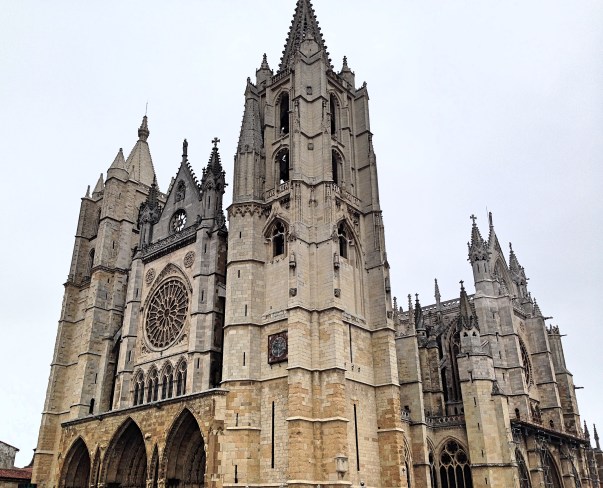
Leon CathedralSoon we were standing in front of the cathedral. The building had that wonderful, foreboding grandeur of true gothic architecture. Two large towers flanked the central section with the rose window, flying buttresses extending from either side. So much mass is concentrated in the front of the building that the final effect, for me, is that the edifice looks like it is about to charge right at you when you’re standing in front of it. All of the architectural elements are pushing and pulling against one another, giving it a feeling of tension and poise.

Stained Glass Close Leon

We went in. It was quite dark inside. The walls and chapels seemed bare and unadorned—not that it mattered, since it was impossible to focus on anything but the cathedral’s stained glass windows. These must be the most beautiful in all of Spain. Standing in that dark room and looking up at the glass, with their deep greens and blues and reds, I felt strangely at peace. Looking back, I am reminded of a quote from Middlemarch:

It is strange how deeply colors seem to penetrate one, like scent. I suppose that is the reason why gems are used as spiritual emblems in the Revelation of St. John. They look like fragments of heaven.

Indeed these windows were more than mere fragments of heaven, but portals letting heaven shine through into interior gloom. The building—so massive when seen from the outside—is pure air and light within. How could these medieval workmen have built such massive windows in a structure made completely of stone? It is an architectural feat so amazing that I cannot get used to it. Every wall of the cathedral glowed with dancing patterns of glimmering images. I soon gave up walking around the cathedral and just sat down on the pews, lost in silent admiration.
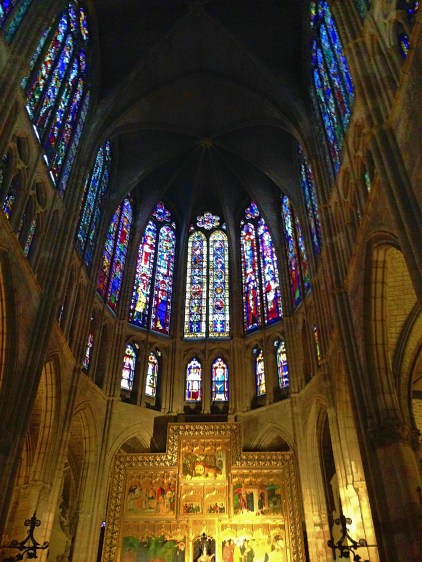
Stained Glass and Main Altar Leon_Fotor
The main altar with stained glass above

Thirty minutes passed, and we were back on the street. Suddenly the sound of drumming and singing caught my ear. I looked over and saw a procession of about a dozen strangely dressed women. Curious, I started following the little parade. The women were dressed in colorful headscarves, dresses, and black shawls. A man was beating on a little drum and all of them were singing.

“What is this?” I asked D.

“I think it’s a procession for a religious holiday celebrating women,” he said.

“Oh, neat.”

We followed the procession for a while and then cut off to visit the Plaza Mayor. There, we found a farmer’s market. Tables were set up, covered in crates of fresh vegetables. The vegetable vendors were doing good business, too; the place was buzzing. Nearby there were parked several vans, with sides that opened up to reveal red piles of meat. D and T, who love buying food from these markets, went right over to one of these meat vans.

I wasn’t particularly interested in buying anything, but the meat vendor almost convinced me. He was giving away samples left and right, giving us a taste of anything we wanted. I was chewing on some particularly good chorizo when a very short man with a big blond mustache, wearing a plastic Viking’s helmet (with the two horns) and carrying about thirty balloons, walked up and started talking with the meat vendor.

Then the balloon Viking noticed a wineskin hanging from the meat van. He walked over, grabbed the wineskin, and said “¡Mira!” (look!) as he proceeded to squirt a stream of red wine into his mouth, turning his tongue blood red and leaving scarlet specks in his blonde mustache. A true viking indeed.

We had plans to see Oviedo and Gijon that same weekend, so we couldn’t stick around all day. Thus, sadly, we had to start making our way back to the hostel.

On our way, we passed by the remains of an old wall city walls, which we climbed up. These are the original Roman walls that protected the budding city. At present they delimit the outer edge of the casco viejo, or historical center.
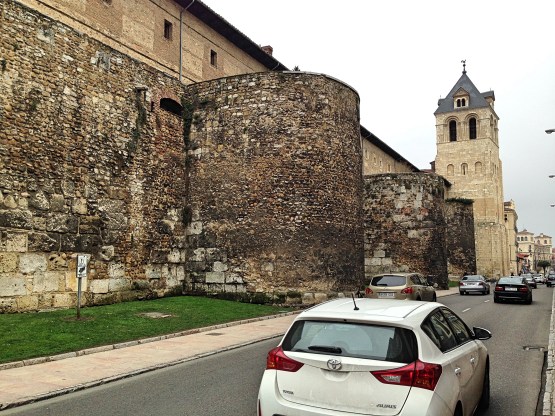
Leon Wall

We got back to the hostel, paid the bill, and then got into the car. But we only got about a mile before we stopped to see something that caught our eye. This was the Hostal de San Marcos, a large, impressive building that was originally a convent, but has since been converted into a Parador de Turismo: a luxury hotel in an old historical building. Convento de San MarcosDespite whatever renovations the building has suffered on its insides, the exterior retains its impressive plateresque façade. Though part of the building is off limits to visitors, since that’s where the fancy guests stay, there is a church and a small museum you can visit—with a lovely gothic interior and several fine statues, not to mention a Renaissance church.

But I was most surprised to learn that this building, one of the most important Renaissance structures in Spain, was used to intern political prisoners in the wake of the Spanish Civil War. Indeed, during and after the war, this noble building became a symbol of Fascist repression. Thousands of prisoners were sent here, and many were tortured and killed. This beautiful building is thus a fair summary of European history: from religious piety, to fascist brutality, to high-end luxury.

Out in front of the convent, in the middle of the massive plaza, there is a statue of a weary pilgrim, resting his bearded head against a crucifix, a reminder of the important role that the Camino de Santiago has played in its history.

Pilgrim Statue

After half an hour of peeking around, we got in the car and drove off again. This time I stayed awake, for the most part.


Addendum: I was only in the city of León a short time, and I certainly missed a lot. One thing I wish I had seen was the Interpretation Center of León’s Roman history.

But the most obvious and grave omission was the Basílica de San Isidro de León, which is considered to be one of the most important Romanesque buildings in Spain. The Royal Mausoleum is particularly noteworthy: I have heard it described as the “Sistine Chapel of the Romanesque” for its extensive, wonderful ceiling frescos. The kings buried here were not kings of Spain, but of León, which was its own small kingdom before the unification of the Spanish peninsula in the 15th century. Hopefully one day I will be able to see it for myself.
Review: Some Still Live

Review: Some Still Live

Some Still LiveSome Still Live by Frances Smith McCamic Tinker

My rating: 4 of 5 stars

You can’t even surrender in an airplane; your opponent wouldn’t know whether you were joking or not.

I am fortunate enough to have a colleague who studies the Spanish Civil War professionally. And when he heard that I was interested in learning about the conflict, he generously lent me this book, the memoirs of an American pilot who fought during the war. Considering that this book is out of print and hard to get your hands on, this was luck indeed.

Frank Glasgow Tinker, Jr. was an American boy from Louisiana who came to Spain in 1936 to take part in the war. He had learned to fly in the US Navel Academy, and spent some time in the Navy until he was discharged for drinking and brawling (which, if you think about it, is pretty impressive). His main motivation for joining the war, it seems, was just the opportunity to fly combat missions: “When the fighting broke out in Spain in 1936, I was not quite sure which side was fighting for what. I gathered that each was slaughtering the other for being or doing something that the other side did not like.”

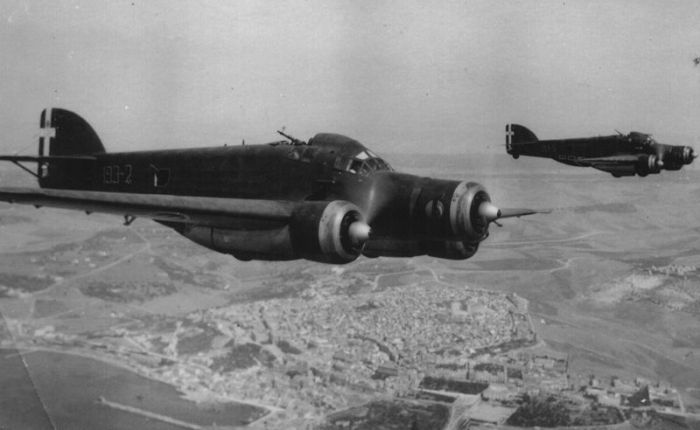
After sneaking in by obtaining a fake passport in Mexico, and pretending to be a Spanish citizen—despite his total innocence of the Spanish language—he spent seven months here flying and fighting. Tinker fought on the “loyalist” side, alongside Spaniards, Americans, and Russians, mainly against Italian and German pilots—which shows how international the “civil” war really was. He flew both older biplanes and more modern monoplanes, both of Russian make, against Italian Fiats and German Heinkels and Messerschmitts. And he was good. He shot down at least eight enemy planes, possibly more, making him one of the most successful pilots in Spanish aviation history.

He flew up to three flights a day—responding to alarms, accompanying bombers, strafing trenches, dive-bombing enemy targets, blowing up bridges and trains, driving off enemy bombing squads, and fighting in dogfight after dogfight. The bulk of his fighting took place in the vicinity of Madrid, but he also fought all over the north of Spain. After seven months of this he packed up his bags and went back to the States. Going back wasn’t easy, since he had arrived in Spain with a fake passport and didn’t have any identification; but eventually he succeeded in returning to the States, where he began writing and going on radio programs.

Some mystery still surrounds his death. The accepted explanation is that he suffered from PTSD and ended his own life; but some have suggested that the FBI may have been responsible. As his own tombstone says, ¿Quién Sabe?

Simply as a historical document, this book is invaluable. It contains maps of the air bases used by the government side, photographs by the reporter Robert Capa of wartime Spain, and a vivid picture of the Government Air Force, not to mention reams of information about aviation. Tinker obviously knew what he was doing when it came to flying; the book is filled with aviation jargon—altitude, weather, engines, weapons, rates of climbing and diving, difficulties of landing and taking off.

Even more impressively, this book is successful simply as a book. For somebody who was not a man of letters, Trinker is a strong writer. He sticks to the facts, and relates them with such vividness, candor, and energy that I often had trouble putting the book down. He never overwrites, he never bogs the book down with too many details, and he never uses flowery rhetoric. His time in Spain was so interesting that no embellishment is needed; the bare facts are fascinating enough.

Apart from his doings, Tinker himself is memorable. He is a uniquely American type. He brawls, he jokes, he drinks, he pranks, he gambles, he womanizes, and he drinks some more, and he flies and fights, and he betrays no ideals beyond good-natured hedonism, fierce loyalty, and a kind of warrior’s respect for bravery and skill. There is not a single political statement in this book, and not any indication that his understanding of the war’s causes ever progressed beyond the very basics. He was a soldier.

I will leave you with my favorite paragraph from the book:

Whitey had managed to get the elevator down (it was one of those automatic affairs), but after he got inside he couldn’t reach the control buttons to make it go up again. He was also unable to reopen the door to get out. After about two minutes of this a huge fellow with a mustache came along and wanted to go up on the elevator, too, but as he saw Whitey was already inside he waited awhile, expecting him to go either up or down. When Whitey failed to do either, the large stranger opened the door and asked him, in Spanish, what the hell he thought he was doing. Whitey, not understanding him, asked, in English, why in hell he hadn’t opened the door instead of standing there with his mouth full of teeth. Whereupon the stranger, in perfectly good American, answered that people shouldn’t get into strange elevators unless they were sure they could get out of them. Whitey almost fell on his face when he heard himself answered in English, but soon recovered and explained his predicament and had the stranger do his button-pushing for him. I saw the last part of this act and asked the man at the desk who the stranger was. He proved to be no other than Ernest Hemingway, the famous writer.

View all my reviews

Santiago in Retrospect

Santiago in Retrospect

Well over a year ago, after completing my short camino, I spent some time exploring the city of Santiago de Compostela. Procrastination prevented me from doing a timely blog post. So with the benefit of hindsight but penalty of forgetting, I will complete this long overdue write-up.


Monastery Church Entrance

Santiago de Compostela is a remote and storied city. Situated in the province of Galicia, in the north-west of the Iberian Peninsula, far from Spain’s capital and remote from the rest of Europe, it has never been the crucible of a religion nor the seat of an empire. Probably we would never have mentioned it had it not been for one shepherd who, one day, over a thousand years ago, reported seeing a light over a field. Those who followed this light found a tomb; and inside, the body of St. James the Greater.

As I discussed in my post about the Camino de Santiago, this story is an apocryphal legend. What is certain is that the Christians in the north of Spain were in trouble. During the last one hundred years, Muslims had poured into the Iberian Peninsula, conquering everything with effortless ease. These Muslims relied on irrigation for their agriculture—the combination of the crops and the technologies they brought with them forever transformed Iberian farming—so they had trouble colonizing mountainous regions. So it was these northern, rainy, and mountainous areas to which many of the Christians retreated, huddling in modern-day Galicia and Asturias.

Outmanned, disorganized, technologically and culturally outmatched, these Christians had little hope of defeating the Muslims southward. But the “discovery” of St. James’s body helped to change this situation. Suddenly, an obscure, rural, and remote area of a Christian outpost became one of the most important holy sites in Christendom, comparable with Rome or Jerusalem. Eventually, the Christians of northern Spain expanded their territory, extending their dominion along the northern coast all the way to the Pyrenees. Once linked up with France, pilgrims began to pour into the country, seeking penance and repentance through the journey.

The cultural effects of this pilgrimage could hardly be overstated. By this time, Europe had emerged from the confusion which followed Rome’s collapse, and daring new architectural styles were being developed: the Romanesque, Gothic, and later Renaissance and Baroque. The Camino de Santiago became the artery through which these styles flowed into Spain; and as a result, some of the most splendid cathedrals in the country can be found along the route: the gothic cathedrals in León and Burgos, for example, and the magnificent Romanesque cathedral of Santiago itself. And it is this cathedral that any visitor to the city must turn to first.


Mirador

The Cathedral of Santiago is the end-point of the entire camino, the iconic goal of the arduous pilgrimage. And the building is worth the walk.

According to legend, the cathedral was built over the tomb of St. James. This church quickly became a potent symbol of Christianity, prompting the Moors in 997 to invade, burn down the early church, and take the bells and the gates with them back to their capital in Córdoba, where this bounty was placed—appropriately enough—in the Great Mosque. When King Ferdinand III of Castile conquered Córdoba over two hundreds years later, he had the same bells and gates transported to the Cathedral of Toledo, where they remain to this day.

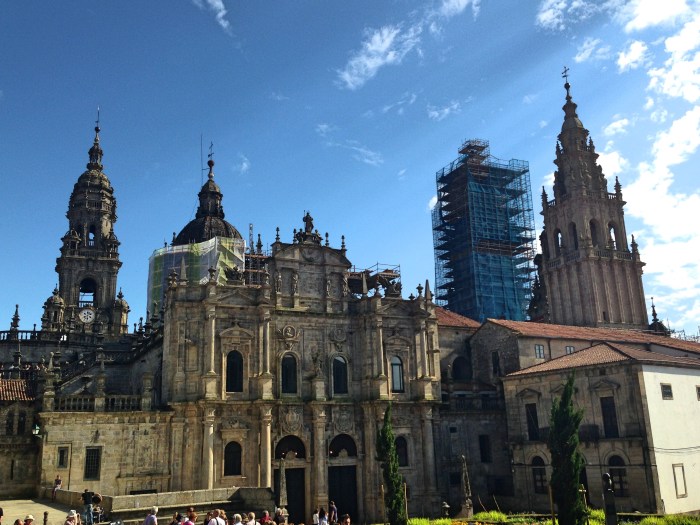
The front entrance of the cathedral stands proudly above the Plaza de Obradoiro (gallego for “workshop”), a monumental square that, on any given day, is full of exhausted pilgrims and energetic street vendors. This square, and the two baroque spires of the cathedral’s façade, owe their current form to Fernando de Casas Novoa, who undertook the work in the early 18th century. Though a relatively obscure architect, Novoa achieved a stupendous result. The façade sweeps upward like an orchestral crescendo, its symmetrical ornamentation perfectly balanced between a strong upward vertical push and swelling curves, embellished at every point by intricate friezes.

This would be enough to make any cathedral notable; but the Santiago Cathedral has three more impressive façades: on the northern, southern, and eastern ends. And each of these façades overlooks plazas of almost equal grandeur. Counterbalancing the two spires at the western entrance is the clock tower, another elegant Baroque skyscraper. The pilgrim can thus walk 360 degrees around the building without ceasing to find something to attract his eye.

Cathedral from North
The Cathedral from the north

And yet the most beautiful portal of the cathedral is not visible from the outside at all. It is the Pórtico de la Gloria—which, because of the subsequently built baroque exterior, now stands on the inside of the western entrance. Designed by Master Mateo in the late 12th century, this portal is now considered to be one of the masterpieces of Romanesque sculpture. Tragically—for me—this site was closed when I arrived in Santiago, so I did not have the privilege of beholding it. But I did get a chance to see some sculptures from this portico in the Prado, where they were transported during repair-work in Santiago—and even this small sample was extraordinary.

Like so many secular pilgrims, I decided to go to a “pilgrim’s mass” in the cathedral, to take part in the religious tradition. These are held throughout the day, in multiple languages, and are abbreviated compared with the usual mass. I was hoping to see the famous botafumeiro, but it made no appearance. This is a giant censer—or incense burner—that is swung from the ceiling during masses on religious holidays. If you haven’t seen a video, I recommend it; the censer swings wildly, spilling forth perfumed smoke into the cavernous church. A team of eight men is needed to get it going; and it costs the cathedral nearly $500 every time this ceremony is performed. Swinging a giant metal object full of burning coals would seem to come with certain risks; and indeed the censer has flown off its rope many times—though I believe no one has ever been seriously hurt.

Santiago Main altar

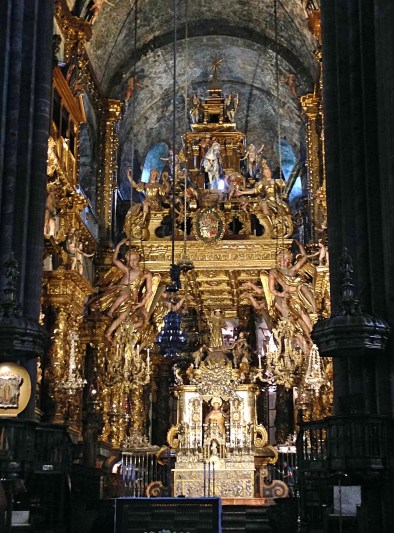
After the mass was finished, I got in line to ascend to the main altar. This is a magnificent mass of gold and smiling angels, whose lithe bodies lift the shimmering metal towards heaven. In the center of this arrangement, seated under Jesus, is a statue St. James himself; and it is considered good luck to lay one’s hand on his back. (I am not sure if this statue is a reliquary or just an icon.) This deed having been performed, I leapt down to explore the rest of the cathedral. Signs are posted on every wall, with a schedule for mass in English, French, German, Italian, Japanese…. to be held in one of the cathedral’s many attractive chapels. The cathedral’s ceiling has the characteristic rounded barrel vault of Romanesque structures; and surface after surface is adorned with the signature scallop shell of the camino.

Once you exit the cathedral, and finish your long circuit around the outside, you will end up once again in the Plaza de Obradoiro. Here there is yet another notable landmark: the Hostal de los Reyes Católicos. As you face the cathedral’s western entrance, this venerable building stands to your left. It was originally a hostel, commissioned by the Catholic Monarchs, Isabel and Ferdinand, for weary pilgrims finishing their journey. A lovely platersque façade adorns the main doors of this building; but beyond this I could not venture, for nowadays the hostel is a Parador de Turísimo: an old building refurbished into a fancy hotel for wealthy guests. The old hostel does honor its roots by offering a free meal to pilgrims—the first ten who walk in the doors, that is. I didn’t try my luck.

Monasterio de San Martín Pinario

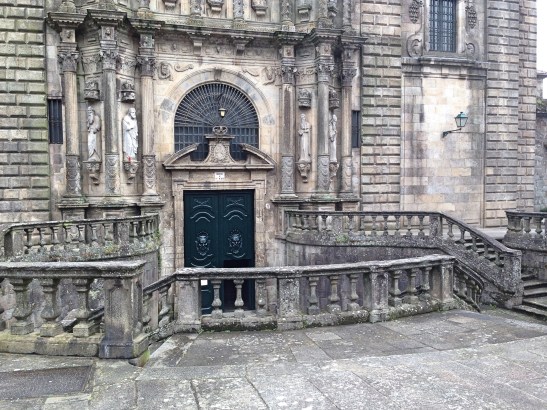
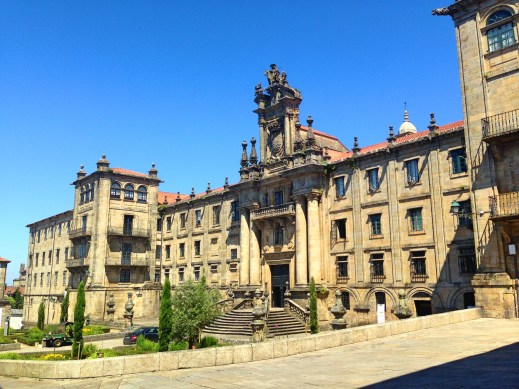
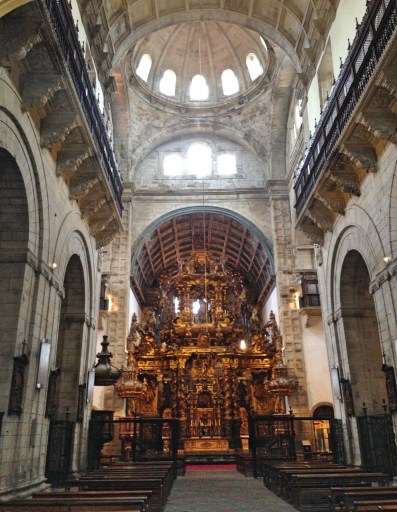
Facing the northern façade of the cathedral is yet another landmark: the Monasterio de San Martín Pinario. This is the second largest monastery in the country, after El Escorial. The side facing the cathedral is fronted with a lovely garden, but the visitor cannot enter here; rather you must go around the corner, at the church entrance, where a sweeping staircase takes you underneath an imposing sculptural display of saints. Inside, you will find a golden altar in a high-walled church. Unlike in so many churches—since this one is no longer in use—you are allowed to walk wherever you please, onto or behind the main altar, or up into the choir, which gives you a priest’s-eye view of the church.

Monastery Church

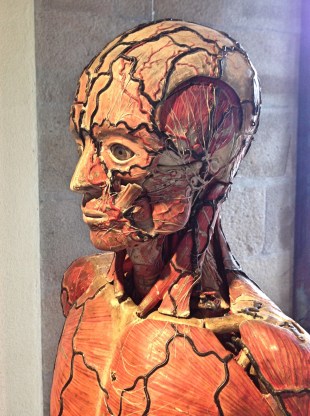
Like the Monasterio de Santo Tomás in Ávila, this monastery also previously served as a center of scientific research: inside there was a collection of bird specimens, a surprisingly accurate anatomical model, and a collection of old chemical containers on display. This monastery was confiscated by the central government at around the same time as the Monasterio de Piedra in Zaragoza, in 1835, during the Carlist War. Thankfully, unlike the Monasterio de Piedra it was not burned, and was finally given over to be used as a seminary, a use which it retains to this day.

Anatomical Specimen

The “casco viejo” (historical center) of Santiago is itself a monument. As in Toledo, Córdoba, or Cáceres, the narrow, twisting, tightly packed medieval streets have been preserved. Small squares centered around statuesque fountains, churches with their stone crucifixes sticking from the street—this was the old city, which, like everything else in Galicia, was made almost exclusively from the deep grey granite so abundant in the region. The constant presence of this somber silvery stone, juxtaposed with the cool green of the countryside, is one of the most characteristic features of this part of Spain.

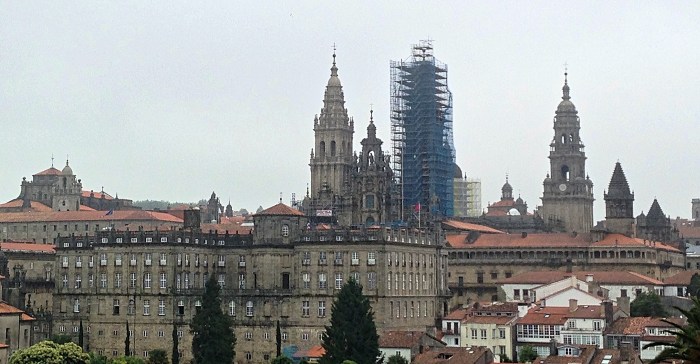
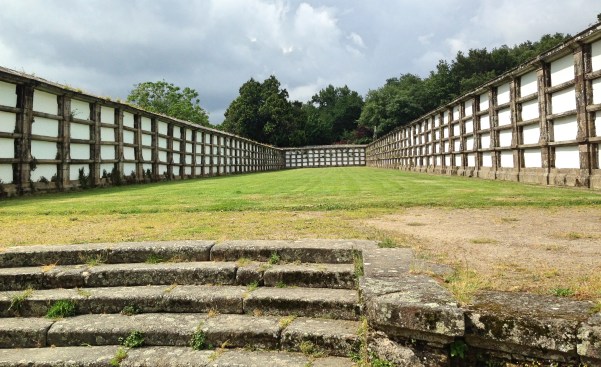
One of the finest parks in the city is the Parque de Alameda, which provides some excellent relief from the occasionally claustrophobic center. This park is most notable for its lookout point, which provides the best view of the Santiago Cathedral in the city (see the headline image above). Unfortunately for me, this view was partially obscured by the scaffolding erected around one of the towers, as part of the cathedral’s extensive maintenance work. Santiago’s other notable park is the Parque de Santo Domingo de Bonival, a Romantic garden filled with stone fragments and ruins, in the grounds of a former convent. The park still preserves a cemetery—in which, quite unlike American cemeteries, the bodies are interred in shelves built into long walls.

Santiago Cemetery

The convent to which this cemetery belonged was possessed by the Spanish government during the same wave of confiscations that took the Monasterio de San Martín Pinario. The beautiful church still stands, and is now used for events—I briefly peeked inside, but they were performing renovations. The convent itself has also been repurposed. Nowadays it is home to the Museo de Pobo Galego. “Pobo Galego” is gallego (the language of Galicia) for el Pueblo Gallego, or the Galician People, and is without doubt one of the best museums in the city.

Compared to both the Basques and the Catalans, the Galicians have been relatively free from separatist and nationalist movements. Yet as a region, Galicia is arguably as distinct from the rest of Spain as those better-known examples. Gallego is one of Spain’s four official languages—along with Spanish, Basque, and Catalan—and is widely spoken in the region. Written down, gallego looks extremely similar to Portuguese, but I do not believe the two languages are mutually intelligible. For what it’s worth, the traveler George Henry Borrow—who was a genius in languages and could speak over twenty—reported being dumbfounded by the language, despite being fluent in Portuguese and Spanish.

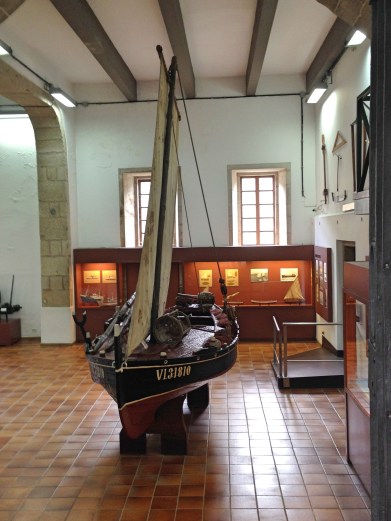
Galicia Museum Ship

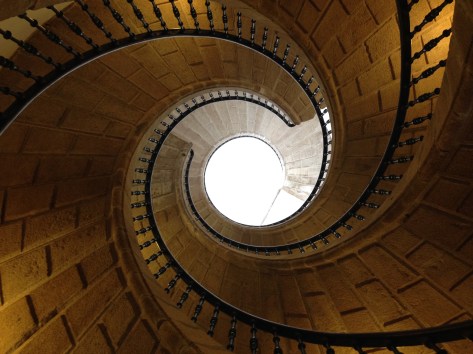
Appropriately enough, gallego is abundant in the Museum of the Galician People. This museum is dedicated to preserving some of the distinct cultural traditions of the region—many of which are sinking into obscurity, due to technological innovation and the spread of mainstream Spanish culture. The museum is full of models and replicas: of buildings, costumes, fishing nets, musical instruments, farming implements, and even traditional fishing vessels, all accompanied with extensive information. To someone with an anthropological background, like me, it was enchanting. The highlight of the museum was, however, not an exhibit at all, but the picturesque double-helix staircase that was part of the erstwhile monastery.

IMG_4575

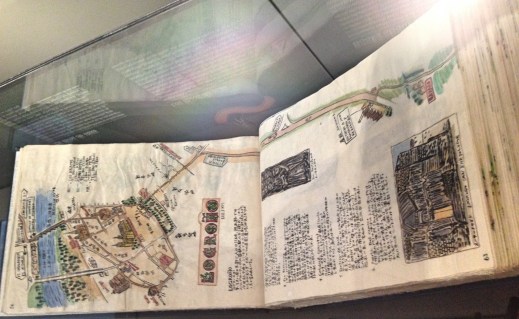
My last stop was the Museo de las Peregrinaciones, or the Pilgrimage Museum. This turned out to be far more interesting than I expected. Not only was there a good historical overview of the Camino de Santiago—complete with examples of guidebooks from many centuries and countries, including a huge hand-drawn guidebook in Japanese—but there was also information about pilgrimage as a human phenomenon.

Japanese Guide Book

Europe, of course, is not the only place that has turned the simple act of moving into a religious rite. The hajj is one of the five pillars of Islam; and today the journey to Mecca is undertaken by millions every year. Aside from the Camino de Santiago, the pilgrimage routes of Kumano Kodo, in Japan, is the only UNESCO-recognized walking path—and journeys on foot have as long and venerable a history in Japan as anywhere.

And this is not to mention the examples from literature. The Odyssey is the West’s foundational and proverbial example of a transformative journey; and Chaucer’s Canterbury Tales takes place on a pilgrimage. In Japan, Matsuo Basho’s famous collection of Haiku’s, The Narrow Road to the Deep North, was written during his wanderings on foot. But naming individual works cannot do justice to the idea of pilgrimage, since nearly every iconic story involves a journey of some kind.

Why is it that humans, from around the world and across history, have discovered a spiritual significance in travel? The new sites and sounds, foreign cities and strange customs, hold an obvious appeal. The privations induced by travel reduce life to its most basic elements, perhaps reminding pilgrims of what is important and what is frivolous. The act of the journey easily lends itself as a metaphor for the transformation of the traveler, whose outlook is shifted as much as his body. The withdrawal from one’s usual surroundings gives the pilgrim time to think and reflect during the long hours on the road. And the act of throwing one’s fortune to the winds—away from the safety of one’s home, navigating unfamiliar obstacles—has obvious religious implications.

Pilgrimage represents travel at its best—the seeking of wisdom, simplicity, and community, the sense of adventure, the willingness to adapt, the striving for understanding—and Santiago de Compostela is, as I discovered, an ideal place for pilgrims of all nations.

Day Trips from Madrid: Ávila

Day Trips from Madrid: Ávila

Early in the morning, we took a train from Madrid to this splendid city. Ávila is the capital of its eponymous province. The city sits in the south of the autonomous region of Castilla y León, and houses a population of 60,000. Of course, I didn’t know a thing about the place when I booked the trip, but by now I’m sure you’ve come to expect that.

The train ride was stunningly lovely—certainly one of the most beautiful, and least expensive, in Spain. The train made its way northwest of Madrid, passing town after town until we got to Escorial. The monastery looked inconceivably majestic in its perch among the mountains, a brooding symbol of Spanish authority.

By now we were in the Guadarrama mountains. Through the window I could see valleys far below us, green but nearly treeless. In the distance the rising sun hung above the horizon, glaring yellow. Underneath was a sea of fog sitting at ground level. Occasionally a derelict farmhouse or a stone fence could be seen, and once or twice I spotted a few cows looking tiny and delicate in the valleys below—but for the most part the view was unmarked by human habitation. We passed through several tunnels, and eventually a city could be seen up ahead, which grew nearer and nearer until the train slowed to a stop.

We were in Ávila. We walked out of the station and into the city center, and in just five minutes we were face to face with the one of the gates of the city walls. It was an impressive sight: two towers flanked the door, two rows of battlements above.

I imagined what it would have been like to be the poor soldier trying to break in these walls. Arrows, stones, and spears would rain down soon as you came near—death from above. It would be a pretty wretched day. I wonder how generals went about conquering places so well-fortified? The only safe way seems to be a siege: starve them out, rather than risk a confrontation. Then I tried imagining what it would be like to be an average citizen, stuck inside a besieged town, watching the supply of grain and fresh water gradually dwindle. War is hell for soldiers and bystanders both.

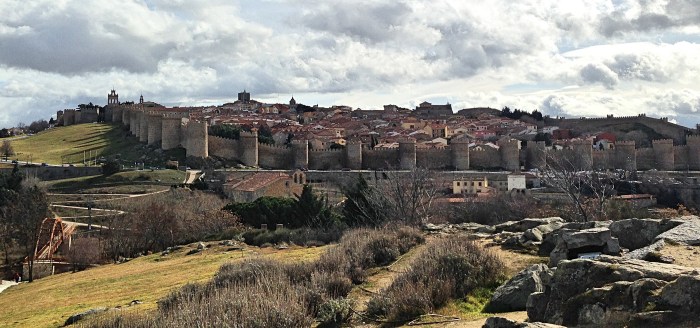
We walked around the wall until we found the entrance to climb up. A few euros exchanged hands, and soon we were standing on the walls of Ávila. They are impressively well-preserved. To my eye it seemed that they could’ve been built just last week; I saw no signs of damage or wear. But according to Wikipedia, they were constructed from the 11th to the 14th centuries. The walls are thick and tall, and seem strong enough to withstand even a cannonball—not that I’d know. We walked and walked, circumnavigating half the town. Red-thatched roofs of houses stood in the foreground, while in the background, far away, thin white clouds hovered over the mountains.

GF absolutely loved the walls. She smiled like a five year old at an amusement park as she peered through the battlements, her hair waving in the wind. I was in a bad mood again: I was hungry. I absolutely hate being hungry. I’m ashamed to say this, because it underscores how easy and prosperous my life has been, but I feel acutely miserable if I wait too long between breakfast and lunch. I get so sour that even the most interesting and joyful experiences seem dreadful.

So as soon as we had walked the kilometer of wall from start to finish, and climbed up and down our fair share of stairs, we headed to a restaurant. And for whatever reason, I decided that we would go to the top-rated restaurant in the city: El Restaurante Bococo.

We sat down for the menú del día—which was a bit pricey, but not overly so. Little did I know what awaited me.

First the wine. Two orders of the menú came with a bottle of wine included; and since GF can’t drink (it’s genetic), it was up to me to drink all of it. Granted, we didn’t have to order it in the first place; but I’ll be damned if I pass up a free bottle of wine. We didn’t have all day, so I had to drink pretty quickly. Bottoms up.

Then the food. As usual, I nibbled on the bread as soon as it was brought out. Normally, the portions in Spain aren’t that big (for an American) so I don’t worry about filling up my stomach a bit. But I knew I was in trouble when our first dishes were brought out. Each of them was big enough to share. After eating both—a soup with pork, sausage and beans, and fried eggs with pieces of foie gras over potatoes—I was comfortably full.

Then our main dishes arrived. We had both ordered steaks, and they were massive. I was determined not to let any of the food go to waste, so I started determinedly stuffing piece after piece down my throat, hoping to outrace the signals of distress emanating from my stomach. Steak, wine, steak, wine, until my stomach felt like it would burst. Then, I ate some more.

By the time all the food and wine was done, I was in misery. I stood up to go, and I was so full of food and wine that I could hardly suppress my groans as I shuffled across the room and out the door. I pride myself in being an atypical American, but in this respect I am as American as can be. Bill Bryson, in his Notes from a Small Island, put it best:

To an American the whole purpose of living, the one constant confirmation of continued existence, is to cram as much sensual pleasure as possible into one’s mouth more or less continually. Gratification, instant and lavish, is a birthright.

But I had to pay a price for this pleasure, since the rest of the day I could hardly move or think.

Still, though I was in pain, I was agreeably buzzed. This made the Cathedral of Ávila particularly moving for me. It’s a Romanesque church, built around the same time as the walls. In fact, the cathedral was built into walls, making it a fortification as well as a house of God. The cathedral itself has a square, imposing, massive quality. Its plain grey façade is hardly enlivened by decoration.

Avila North Door

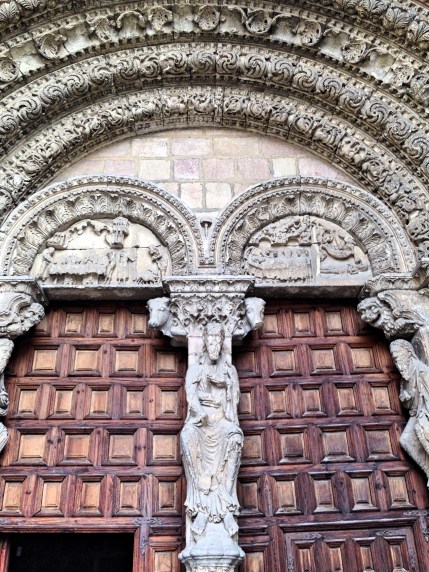
I found the gothic north door of the cathedral particularly impressive. As in many cathedrals, the doorway is surrounded by concentric arches, which are filled with figures. Long, drawn-out statues of saints sit below, each of them dressed in a robe; and above, within the arches, tiny seated and standing figures fly over you like little angels. In the center, above the door, is the Last Judgment. At this time, Jesus wasn’t conceived as the joyful, forgiving, kindhearted father figure he is today; rather, he was a powerful and vengeful deity who condemns sinners to the fire.

Another doorway was more Romanesque. Above its rounded arch floral motifs abounded. The door is flanked by two soldiers, their bodies covered in what look like fish scales, wielding shields and clubs. Statues of lions were seated on platforms to the right and left. Above the door, the window was divided into pretty swirling patterns. In a third doorway, also Romanesque, smiling demons seem to pop out of the stone, along with two curious cows heads. The Romanesque seems to have been more playful than the Gothic.

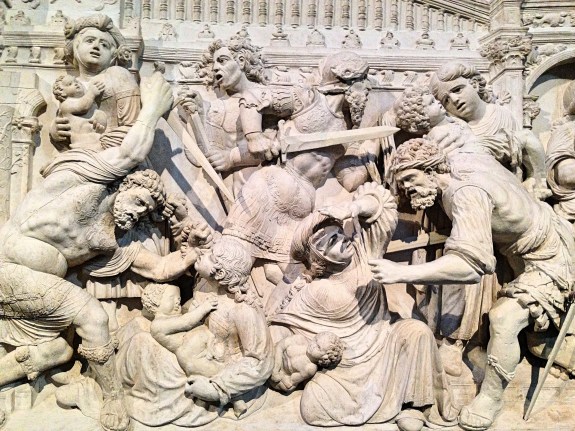
Avila Cathedral Frieze

We walked inside. I was trying my best to be alert and focused, but the wine was having its effect. I kept zoning out as I walked around the cathedral, and didn’t get the proper experience. Still, I remember being very impressed by the carvings in high-relief behind the main altar. They represented scenes of intense drama. I remember one in particular that depicted what appear to be Roman soldiers massacring women and children. Their swords are drawn, and several are stabbing or slashing down at women on the ground, whose hands are uselessly raised in defense, their faces contorted in terror. It’s a gruesome scene; and the craftsmanship is superb.

Basilica de San Vicente
Basílica de San Vicente

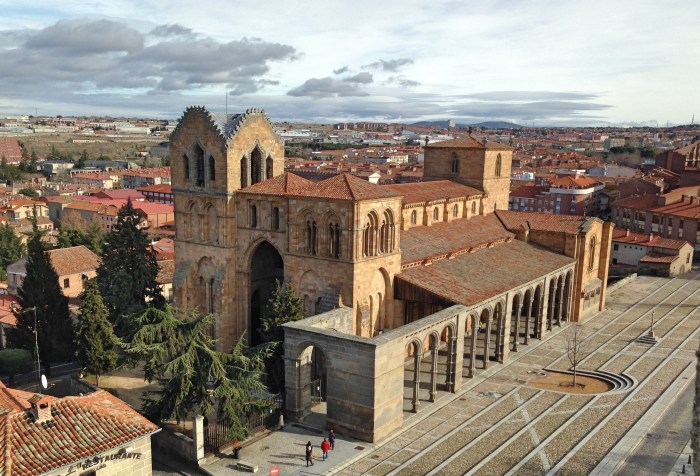
The rest is a blur, however, and the next thing I knew I was being whisked off to the Basílica de San Vicente. This basilica is one of the best examples of Romanesque architecture in the country. According to legend, it was built on the site where three young siblings were martyred during Roman times.

San Vicente Door

More bizarre figures stand on the capitols of the columns flanking the door—sphinxes this time; and more floral, swirling designs filled the stone. On the inside, right before the altar, is a massive, elaborate cenotaph to the three martyrs, covered in painted carvings that narrate their lives from beginning to end. I was deeply impressed. But this is the only thing that stuck in my befuddled mind, and soon we had to go.

In fact, we had run out of time. We’d spent so long at the restaurant stuffing ourselves that we gave ourselves only a few hours before our train back to Madrid. So, with much reluctance, we pulled ourselves away, passed again under the main gate of the city, and headed towards the station.

We trekked up a hill and got on the train with only a couple minutes to spare. I planned to read, but fell into a deep doze as soon as I sat down. And so my drunken body was conveyed to Madrid.


Avila Distance

Addendum: In a later trip to Ávila, I managed to investigate some sites that I missed on my first pass through.

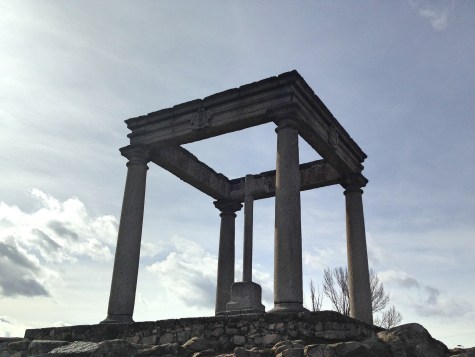
One of the most iconic sites of Ávila are Los Cuatro Postes, the Four Posts. This is a humilladero, or a religious sign marking the entrance to a city. The marker itself is extremely simple: just a cross standing within four posts. But the view from of the city from this spot is excellent (see the photo above). Multiple tourist buses were parked nearby, so their passengers could get out and snap a picture.

Cuatro Postes

As I walked back to the city, crossing the bridge you can see in the foreground above, I found a nice walking path that runs along the river Adaja. There is also a lovely path that goes alongside the walls on the other side of the city, giving you an unimpeded view of the country beyond.

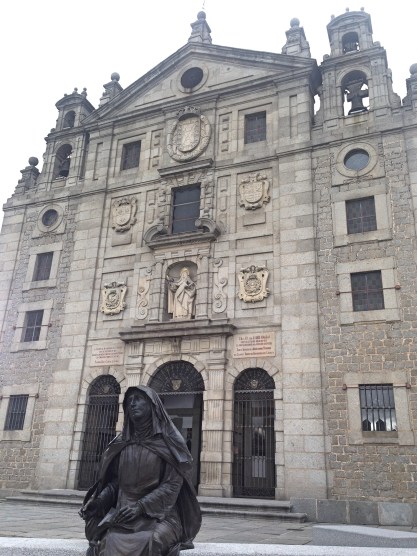
The most famous person from Avila is, without doubt, St. Teresa, the religious mystic who helped to galvanize the Spanish Counter-Reformation. She is the subject of Bernini’s iconic, and scandolously erotic, sculpture in Rome. After her death, a convent was built in her honor, supposedly over the very spot where she was born. This is the Convento de Santa Teresa de Ávila. Out front is a compelling statue of the Saint, pen in hand, eyes uplifted to heaven. Inside, you can find a shrine dedicated to her, as well as a re-creation of her infant bedroom.

St Teresa
Convento de Santa Teresa

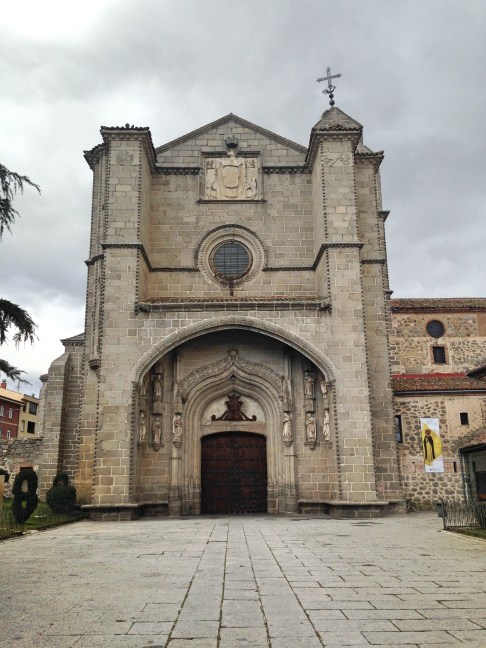
Situated outside the city walls is the Real Monasterio de Santo Tomás, a gothic monastery that was founded under the reign of the Catholic Monarchs. The monastery is home to several excellent cloisters and an impressive church. Somewhat more strangely, the monastery also contains two miniature museums, one of natural history and one of Asian art. The natural history “museum” is especially odd, since it consists of little more than the stuffed and preserved carcasses of several animals, sitting behind class cases in a few little rooms. I assume that this taxidermy was performed a long time ago, when the clergy was still the leading intellectual force in the country. The museum of Asian art is, by contrast, quite nice, containing excellent samples of sculpture from many different countries.

Monastery of Santo Tomas
Monasterio de Santo Tomas

Ávila is certainly one of the most romantic cities in Spain, and easily one of the best day trips from Madrid. Just don’t eat or drink too much.

Day Trips from Madrid: Aranjuez

Day Trips from Madrid: Aranjuez

(As I mention in this melodramatic post, I happened to visit Aranjuez on an inopportune day. I have subsequently visited many times; and now I think it is one of the nicest day trips from Madrid. For more, see my addendum at the end of this post.)

“Oh God, not again! Why can’t we get anything right?”

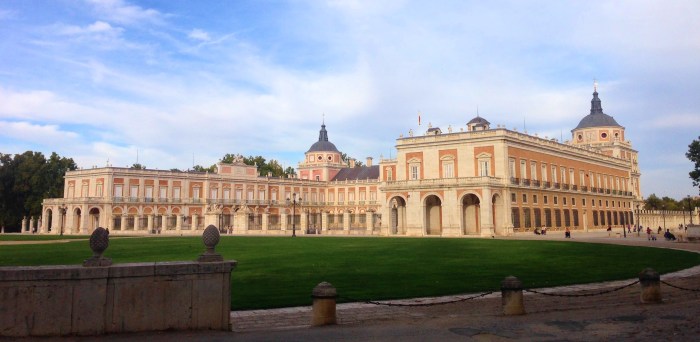
We were standing in front of the Royal Palace of Aranjuez. It was big but not imposing, perhaps because of its playful pink color. The building’s two wings seemed to stretch toward us like a man reaching for a hug. On the top of the building the Spanish flag was fitfully blowing in the wind.

“Why!?” I whined. “We managed to come the only day that it’s closed! Why didn’t I just check the hours? This always happens!”

It was Monday, the only day of the week that the palace isn’t open for visits. We’d just taken the train from Atocha station in Madrid. It was the day after our trip to Chinchón, and the weather was still gloomy and overcast. I wasn’t in a good mood.

“Shut up,” GF said. “It’s not a big deal.”

We began walking around, somewhat aimlessly. In the area surroundings the palace there is a lot of monumental architecture, with large open courtyards surrounded by stone walls. Rounded archways run along nearly every surface, which, along with the reddish color, gives the complex a unified aesthetic. But I wasn’t in the mood for appreciating architecture.

“We’ve been in this country for months,” I said. “And still we mess up even these basic things.”

“It’s not a big deal,” GF said.

By now we were standing in front of the Iglesia Real de San Antonio, the church that forms part of the palace complex, and I was still sulking.

“This sucks,” I said.

“Come on,” GF said. “Let’s go eat.”

We walked into town, found a restaurant, and sat down. The food was surprisingly good, and also cheap. By the time I finished, I was in a considerably better mood. And in that spirit, we went off to see the gardens.

It was a miserable day for this. The trees were bare and skeletal; the flowers were nowhere to be seen; the place was empty and desolate. The wind was blowing freezing air, the endless gray clouds cast a dreary shadow over everything, and in general the world looked bleak.

The only light relief from this brooding picture were the geese. At least I think they were geese, though they didn’t look much like the Canadian geese I’m used to. There were dozens of them sitting in the river. And as we passed by a few geese wandering around the park, they began honking at each other. It was a comical sight. It looked like they were having a petty argument, and perhaps they were.

With nothing much to interest me, my mind began to wander. I had just begun watching Kenneth Clark’s landmark television documentary, Civilisation; and that program had brought to the fore a question I’d long thought about.

“You know, I’ve been thinking,” I said. “It’s supposed to be good for you in some way to travel to all these famous monuments. You see these beautiful buildings and paintings, and ostensibly the experience ennobles you. But how, specifically does that work? How does it improve people to appreciate fine architecture, for example?”

“Uh, well it’s historically significant,” GF said, “and it’s important for people to understand history.”

“That’s true. But it seems that it’s something more than just history. After all, you could just read a history book. Why do people spend all this money to visit places so they can see fine architecture?”

“Because it’s nice to look at?”

“I guess. But lots of things are nice to look at. Lots of models, for example, are nice to look at, but not many people think looking at celebrities makes them ‘cultured’.”

“Right…”

“And of course, seeing beautiful art doesn’t necessarily do anything for you. If somebody is naturally uninterested in or insensitive to fine art, he won’t be improved no matter how many museums you force him through.”

“Okay…”

By now she had completely zoned out and I was talking to myself. I gave up and started turning over the question in my mind. But I didn’t make any progress, and soon my mind was someplace else.

We kept going, crossed a bridge, and found ourselves walking along a road lined with sycamore trees, their overhanging branches leafless and emaciated. To our left and right were fields of farmland—empty.

More than anything else I’ve seen in Spain, this wintry and desolate landscape reminded me of home. I felt like I was in upstate New York, taking a wintertime stroll. The wind whipped up and send a chill to my bones.

A wave of homesickness came over me as I walked. What am I doing here? Where am I headed? I didn’t know. What is my mom doing? And my brother? What’s happening with my friends? Didn’t know, either. What will happen next year? What will I do when I get back home? And when will that be? How will I be changed? And how will home be changed?

The road extended into the distance, empty and dreary. And as I looked down that road, I could imagine nothing but sadness ahead of me. This sadness wasn’t just for myself. I was seized by that tender, reflective melancholy—what Virgil calls lacrimae rerum, or “the tears of things”—when you realize that the universe is indifferent to your happiness, that all pleasure is temporary, that death is permanent, and that all your hopes and dreams, and those of the people you love, might come to nothing. It’s the realization—so painful we do our best to forget it—that tragedy is an inevitable part of life. And though this fact is unbearably sad, it is the source of beauty; for beauty is so precious because, like all things, it is doomed to pass away.

In this pensive state of mind, perhaps just a result of the weather and the new year, we walked down the long road, turned a corner, and kept on going. We talked about our plans for next year, and expressed anxiety about how we’d cope if we had to go long distance. And then we fell into silence as the leaves crunched underneath our feet and the light leaked out of the sky, and we said little as we dragged our weary feet to the train and left.


Aranjuez Palace

Addendum: The city of Aranjuez is located south of Madrid, easily accessible via the Cercanías trains. Situated at a lower altitude than Madrid, and at the confluence of two rivers, the Tajo and the Jarama, Aranjuéz is a verdant place. Trees grow notably taller here than in Madrid, and the city is also famous for its fields of strawberries and asparagus. These picturesque fields inspired the composer Joaquín Rodrigo to write his famous Concierto de Aranjuez, one of Spain’s most iconic musical works. 

In the spring and summer, an antique train takes visitors from Príncipe Pío in Madrid to Aranjuez, traveling through the lush surrounding countryside. This is the Tren de la Fresa, or Strawberry Train, and is one of the first train lines ever opened in Madrid.

Aranjuez is most notable for its palace, which was commissioned under the reign of Philip II, and designed by the same architect who designed the Escorial, Juan Bautista de Toledo. Judged from either its exterior or interior, the palace is magnificent, one of the finest in Spain. Unlike so many palaces, the outside of the building manages to be grandiose without opulence. The same cannot be said for its interior decorations, however, which are certainly palatial.

IMG_6174

Next to the palace is the Plaza and the Church of San Antonio, an extension of the palace complex. A big open square surrounded by brick arches, the plaza leads to the lovely baroque Church, which was built to be used by the monarchs. 

IMG_6152

Even more charming than the palace are the surrounding gardens. These are divided into multiple, interconnected sections, each of which has its own character. The royal gardens are arguably the finest in Spain, more varied and inviting than the comparatively sterile ones of La Granja, especially considering the Tajo River which flows through the center. It is also worth exploring the surrounding farmland of Aranjuez, which competes even with the gardens for bucolic splendor.

The town of Aranjuez itself is notable for its grid-like street layout, a consequence of its royal planning. There are some excellent restraurants to be found here, such as De Pikoteo. In sum, it makes for a first-rate day trip—just don’t go on a Monday in winter. 

IMG_6178

Day Trips from Madrid: Alcalá de Henares

Day Trips from Madrid: Alcalá de Henares

(I wrote this post only a few months after my arrival in Spain, while I was still mostly ignorant of the country and its language. With the exception of Chinchón, I have visited all of these places since then, so I have appended little notes at the end of my posts about what I now know. I have also broken up my original post for ease of navigation.)


There are many advantages to living in Madrid. It’s big, it’s bustling, and it’s diverse. But one of my favorite aspects of Madrid is its location. By design, the capital of Spain is almost equidistant from every corner of the country; to drive from Madrid to Catalonia, to Andalusia, to the Basque Country, and to Galicia all take roughly the same amount of time. And transportation isn’t hard to find; the city is well connected by rail, highway, and plane to all points of the compass. Travel is cheap, easy, and fast.

As a consequence, there are a great many excellent day trips you can take from Madrid. I’ve already written about some of them: Toledo, Segovia, and El Escorial. In these posts, I want to talk about some of the perhaps lesser-known cities for day-trippers. I’ll start at the very beginning, with my first trip inside Spain.


Alcalá de Henares

As soon as I got to Spain, I blabbed to everybody I met that I had read Don Quixote. I was very proud of this, for I thought it gave me some kind of badge of honor in Spanish culture. And indeed, a few people seemed genuinely impressed—though less so when I told them I read it in English.

“Ah, so you like Cervantes?” a friend of ours said.

“Oh yes, he’s incredible.”

“You should visit Alcalá de Henares, then. It’s where Cervantes was born.”

This was only our second week in Spain, and we were still a bit disoriented by our surroundings. The prospect of taking an actual trip in Spain seemed almost Herculean, an added challenge to the day-to-day struggle of navigating our new city. But I was determined to get culture, by hell or high water; so as soon as we could, we made it to Atocha station and took the Cercanías to Alcalá de Henares. (For once in our lives, we found the train without a problem.)

The train was too full for us to sit down. We stood by the doors, both of us swaying nervously with the ever-present anxiety you feel when in a strange environment. I was looking forward to seeing the area around Madrid, but the windows were smudged and dirty; and the view, from what I could see, wasn’t much anyway—just the featureless tan wasteland of the dry foothills. Before even coming to Spain I had terrified myself by reading online stories about the ingenuity of pickpockets in Europe, and couldn’t stop casting interrogative glances at all the passengers around me, wondering whether any of them were thieves eyeing me up, waiting for the perfect moment to strike.

Station after station went by, and I was paying fierce attention to all of them, paranoid that we would miss our stop and get hopelessly lost. It’s really exhausting traveling somewhere totally new—it is for me, at least—because you can’t take anything for granted. The doors of the trains work differently; the seats are arranged differently; the automatic announcer is speaking a foreign language. Added to this, I was constantly afraid of doing something wrong by accident, breaking the train etiquette of Spain and drawing everyone’s attention to myself. It’s pretty amusing to me now, as I look back; but then it was just stressful and scary.
We arrived. After some confused mucking about, we began making our way to the center of town. Neither of us had Spanish SIM cards yet, so our phones didn’t work. We just followed the crowd, who all seemed to be walking in the same direction. The city seemed rather ordinary at first—though even this was interesting to me, since I hadn’t seen any city in Spain besides Madrid yet—but soon something caught our eye. It looked like a little castle, with a tower on one end and a tiny battlement at the top of a square structure.

IMG_0364

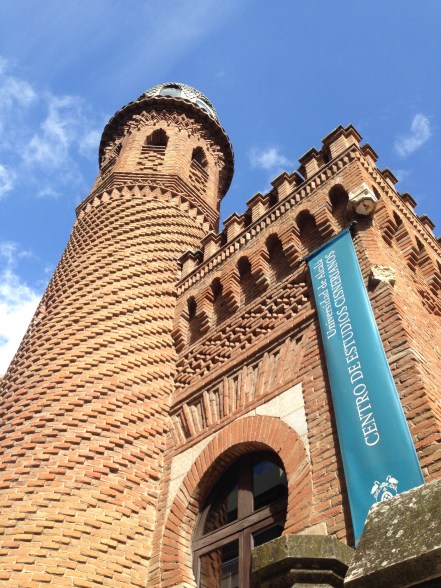
But what really made it stand out was the intricate ornamentation. The façade of the tower, for example, was covered in swirls. It was quite pretty. Although we didn’t know this at the time, it’s called the Palacete Laredo, and is one of the famous monuments of Alcalá. It was originally built as a private house for Manuel Laredo, a polymath artist who served as the mayor of Alcalá de Henares. Nowadays, it serves as a museum of the Cistercian order, as well as a specialized research branch of the Complutense University.

Looking back now, I can tell that it was built in a Neo-Mudéjar style, with crescent arches and a domed minaret. The top of the main building, however, is not Neo-Mudéjar in style, but rather looks like a small copy of the Alcázar in Segovia. In fact, the more I look at my pictures, the more of a stylistic jumble the place appears, with all sorts of different Spanish architectural elements mixed together. Of course, at the time I just thought it looked weird.

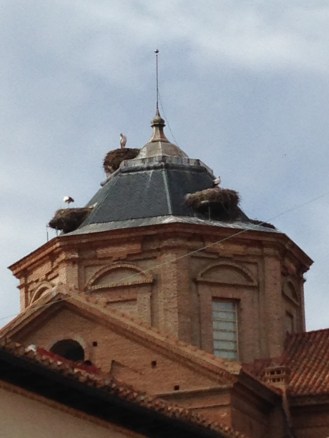
We kept going, following the trickle of pedestrians into the center of town. Eventually the buildings started to look older; the streets were narrower here and paved with stone. But what most caught our attention was a big beautiful bird, sitting on top of an old church. It looked so incongruous and stood so still that we were convinced it was fake—that is, until it twitched its head. When we got a bit closer we could see it had built a big, bushy nest up high on the building.

IMG_0399.jpg

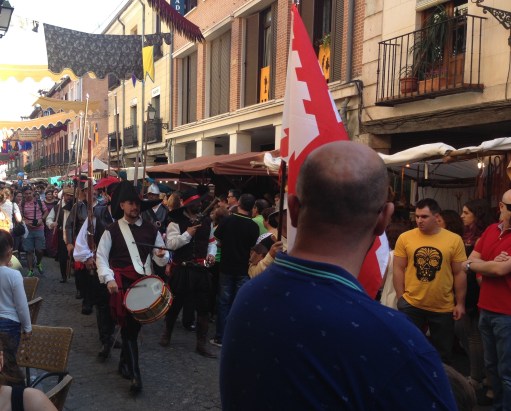
As we moved on, following the throng of people wherever it seemed thickest, we eventually found ourselves in a dense crowd. Little shacks were set up all over the place, selling cheese, sausage, olives, nuts, spices, tea, wooden bowls, leather bags, colorful scarves, cheap jewelry. Not only that, but all the people in these shops were dressed up in funny outfits, like they were in Medieval times. Was Spain always like this on the weekends? I was both excited and terrified—excited to see a slice of Spanish life, but now scared more than ever about being pickpocketed.

We rounded a corner and came across an outdoor restaurant. Dozens of tables and chairs were gathered under a tent. Several harried men in ridiculous costumes—looking like court jesters, with striped red and white shirts and big puffy hats—were running left and right, carrying massive trays of food. Outside the tent was the cooking area, where a large circular charcoal grill was covered in sausages, meats, fish, and vegetables of all kinds. Immediately I felt very, very hungry. From the shops were hung all manner of flags and banners painted with signs from medieval heraldry—black, yellow, and red.

Every new street we entered was more packed than the last. Soon it dawned on us that this wasn’t at all normal, but was some kind of special festival. As if to confirm our suspicion, a group of men dressed up like medieval soldiers, with fake swords by their sides, paraded through the crowd while another man, dressed in rags, pretended to be a lunatic. One of the soldiers held him by a rope, while the maniac ran after people in the crowd (mostly women), gargling his throat and reaching out his dirty hands. Another soldier was beating a big bass drum, while they all shouted things that I couldn’t understand.

Alcala Marching Band

(As we later learned, this was the Cervantino, a medieval fair named after Cervantes, which is held in the first couple weeks of October. I have since gone back twice, and I highly recommend it.)

We wandered along this way, two bewildered Americans, absolutely intimidated by our surroundings, until eventually we were standing in front of a couple of statues. I immediately recognized these as being Don Quixote and Sancho Panza; both of them were sitting on a bench, and seemed to be having a damned good time. In between the knight errant and his square there was a space on the bench where tourist after tourist was lining up to have their picture taken. I would have had my picture taken, too, if I wasn’t so afraid that my phone would disappear as soon as I took it out of my pocket.

Don and Sancho statue

Behind the bench was the Cervantes House—the house where Cervantes himself was born and reared. We got on line and went right in. It’s quite a small place, actually. In the center of the house is a little courtyard, around which every room is situated. The insides of these rooms were furnished to look like they would have during Cervantes’ lifetime. I have to admit not much caught my eye, except perhaps the old kitchen equipment. It was more rewarding just to pace about, thinking that I was standing in the very place where Cervantes, that master of masters, entered into the world. This feeling was so strange to me that I’m not sure I quite took it in. This was perhaps the first appearance of “European Travel Syndrome” in my life. You simply can’t have an experience like this in New York.

Cervantes Statue
The statue of Cervantes in the main square

In just half an hour, we were out in the street again. We didn’t know anything else to do except walk around, seeing as much of the city as we could. Many of the buildings were impressive; but at this early stage, we didn’t really know how to go about visiting buildings or even how to look at them. In fact, what I most remember were not the buildings themselves, but the dozens stork nests sitting snuggly on rooftops, their bushy lairs looking somehow both ridiculous and majestic.

Alcala Food Stand

Eventually, we decided to sit down to eat in one of those tent restaurants. The waiter ran up to us, his floppy hat thrown over to one side of his head, and asked us in a slew of Spanish words what we wanted. We ordered two things, and he was off. At this point, we were so clueless in Spanish that most of the time we didn’t even know what we were ordering in restaurants. This was a classic example: We asked for “pimientos fritos” thinking they were french fries; five minutes later, the waiter dropped a plate of fried, salted green peppers on our table. I know, I know, this is an embarrassing mistake, not least because “potato” is “patata” here—not hard to guess.

The upside of our ignorance was that we ended up learning a lot about Spanish food, since we accidentally ate a lot of it. These pimientos were a case in point: we loved them, and pimientos now are one of our staple dishes. Really, if you’re in Spain and you can’t speak Spanish, just go into a restaurant and order whatever sounds interesting. All the food is good here.

After eating the pimientos, and then following it with a plate full of chorizo and tomato sauce on bread, we began to walk around again. But I’m afraid we didn’t do much of interest; and in an hour, we were on our way back to the train station to return to Madrid.

Reading over what I just wrote, and comparing it to what I find online about Alcalá de Henares, it’s obvious to me that we left most of the main sights unseen. Oh well, next time. But it was a fantastic stroke of luck to arrive on the very weekend when they were having their famous Medieval Market. And as I look back on it, this trip seems to presage our whole time in Spain so far: we arrive clueless and unprepared, and yet everything works out marvelously. Traveling in Spain is, in fact, a lot like ordering in a Spanish restaurant: even if you have no idea what you’ll get, you can be sure it will be delightful.


Alcala University

Addendum: Since this initial trip, I have since learned that Alcalá de Henares has been more than simply the birthplace of Cervantes, but has played an important role in Spanish history.

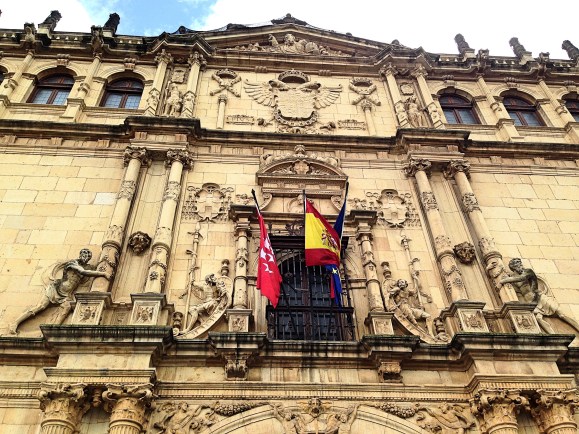
The city has existed since at least Roman times, when it was known as Complutum. It was in this town that Cardinal Cisneros, one of the leading functionaries of the Catholic Monarchs, founded the University of Alcalá in 1499. Under his direction the scholars of the university undertook and completed one of the greatest intellectual accomplishments of the Spanish Golden Age, the Polyglot Bible, which contained the entire text of the Old and New Testaments in three languages: Latin, Hebrew, and Greek—and sometimes Aramaic. The University was eventually moved to Madrid, where it was renamed the Complutense (which comes from Alcalá’s Latin name); and it remains one of the major universities in the country.

The original university building still stands in Alcalá’s main square. Its frontal façade is magnificent, and for a small price you can take a guided tour to learn about the university’s history.

The Cathedral of Alcalá is also worth a visit. Although it was burned during the Spanish Civil War, thus destroying many of its decorations and altars, it remains an attractive building. The cathedral is, curiously, the unique for being the only one in the world which possess the title “Magistral Church,” which requires that all of its priests be doctors in theology. 

Alcala Cathedral

Basking in the Basque Country: San Sebastián

Basking in the Basque Country: San Sebastián

(This post is part of my series on the Basque Country. Click here for Bilbao, here for San Juan de Gaztelugatxe, and here for the Vizcaya Bridge.)

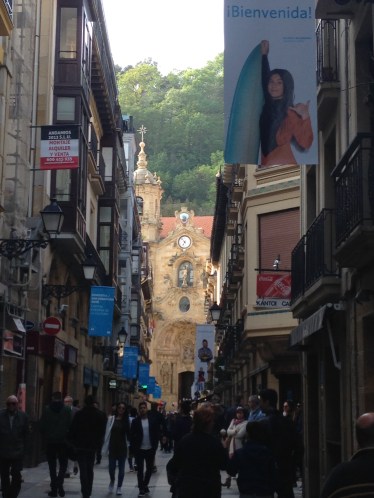
San Sebastián is a city much unlike Bilbao. For one, it is noticeably smaller, with a population of less than 200,000. But more conspicuously, it is not at all a city of industry, commerce, or manufacturing. Rather, it is a place of tourism. The streets are full of foreigners, squeezed into the narrow streets, filling up the parks, covering the beaches with their bodies. The city is also remarkably pretty. As I strolled along the beaches I was reminded of Cádiz; and as I wandered through the streets, Oviedo came to mind. But the strongest and most persistent impression was surprise at the number of tourists. They were all over the place; every restaurant was full, every shop was crowded. The shoreline was an unbroken wall of hotels. I had no idea San Sebastián was so popular.

Some of this probably had to do with the city being (along with Wroclaw in Poland) one of the European Cultural Capitals of 2016. (Each year, a city or two in the European Union gets designated a European Cultural Capital, which means it will host several Europe-oriented events during the year.) This may have attracted even more tourists than usual. Even so, it is clear that San Sebastián is a major tourist destination, because its whole economy is oriented around visitors. This is fitting, for the city is undeniably charming. Its location is a good one, too, being only 12 miles from the French border, and northerly enough so that the temperature is nearly perfect in summer.

We were hungry when we arrived, so our first order of business was food. Our Airbnb host recommended a restaurant in the center. The restaurant was the Bar Aitona, and it was excellent. We ordered the steak and the octopus. Both were served on a huge bed of fries, both were amply portioned, both were well seasoned, and both were scrumptious. Added to that, the prices were very reasonable. We left very full, and very satisfied. I recommend it with great enthusiasm.

IMG_3778

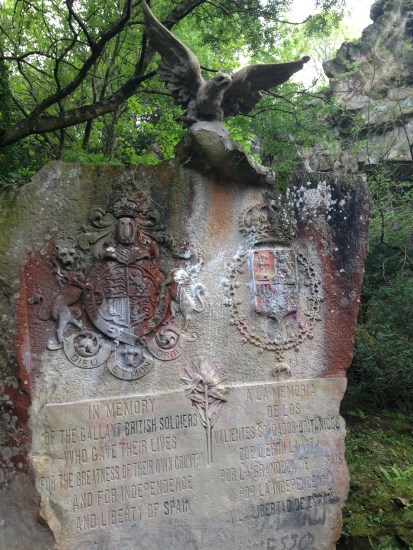
When we were back on the street, we decided to start exploring the city. This inevitably led us to Monte Urgull, the most conspicuous landmark in San Sebastián. Urgull is a hill that overlooks the bay. Nowadays, it is covered in trees, and is basically a park; but in the past it formed as a military fortification, since its high elevation at the bay’s edge made it well suited for defense. And these fortifications were not just for show; they were used in several important battles. Probably the most significant of these was the Siege of San Sebastián, in which the British forces, led by Wellington, ousted Napoleon’s troops in the Peninsular Wars. Of course, I didn’t know any of this at the time, but was instead attracted by the gigantic statue of Jesus—12 meters, or almost 40 feet tall—that looms over the hill.

IMG_3773

We began walking up, and quickly found that it is a delightful place. Old walls, broken battlements, obsolete canons, and other aging fortifications still stand, some in ruins, some overgrown; and for me there is something remarkably romantic about the sight of weeds and trees reclaiming the abandoned dwellings of past times. The hill is divided into several levels, and as you ascend you get a progressively better view of the city. From the top, the whole shore is spread before you, with its azure water, crowded beaches, and the rolling green hills in the distance. We got to the top, where we could stare up at the towering figure of Jesus, and then descended on the other side of the hill.

IMG_3781

This part of was a wooded area. But as we climbed down a rocky path, something caught our eye. Right below a cliff, surrounded by roots and trees, was the old memorial erected by the British army after the conquest of San Sebastián. A broken and discolored plaque, bearing the royal insignias of England and Spain, bore a message in both English and Spanish honoring the fallen soldiers. Further on, we noticed another plaque, this one on the side of a rock face, honoring the unknown soldiers lost in the campaign. I know these must be well known, but at the time, with only the two of us, it felt like coming upon an archaeological treasure. This illusion was quickly dispelled, since at the bottom of the hill we encountered a map showing where all the different war memorials, graves, and mausoleums could be found on the hill. In any case, it’s a lovely area, both for its history and its views.

IMG_3788

The rest of our day was rather uneventful. We strolled around San Sebastián, enjoying the ocean, the river, the crowded city center. But we did not really visit anything in particular, since we couldn’t find anything to visit. It seems that San Sebastián is a lovely place if you want to eat and go to the beach, but it does not have much in the way of cultural tourism, which is mostly what I’m after. In any case, it was late. We had arrived at around noon, and by now the sun was setting. So we walked along the river to our apartment, and the next morning we said farewell to the Basque Country. But I hope to return, the sooner the better.

IMG_3795

Basking in the Basque Country: the Vizcaya Bridge

Basking in the Basque Country: the Vizcaya Bridge

(This post is part of my series on the Basque Country. Click here for Bilbao, here for San Juan de Gaztelugatxe, and here for San Sebastián.)

The train pulled up to Portugalete station, the doors opened, and we got off. Portugalete is one of the towns, ranged along the Bilbao river, that make up the Bilbao metropolitan area. (The name’s resemblance with “Portugal” is apparently only a coincidence.) With a population of about 50,000, and a land area of only 3.21 square kilometers, it is actually the fifth most densely populated area in Spain.

To me, the place struck me as a pleasant, moderately urbanized, more or less tranquil town. Along the riverside there were some large, attractive restaurants, their tables crowding into the streets—though at this hour, too early for dinner in Spain, the chairs were mostly empty. But the surroundings didn’t attract my attention for long, since I could already see my goal: the Vizcaya Bridge.

IMG_3745

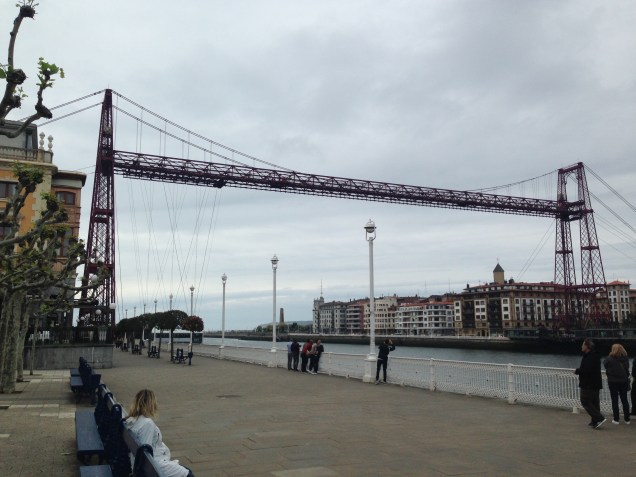
In Spanish it is called the Puente Colgante, or “Hanging Bridge.” The name is appropriate. It is a perplexing sight at first. The bridge has the familiar form of a suspension bridge; but the middle section seems to be misplaced: it hangs ludicrously high in the air, with no ramps to get up or down. The more I looked, the more confused I became, for there didn’t seem to be any way you could use the bridge.

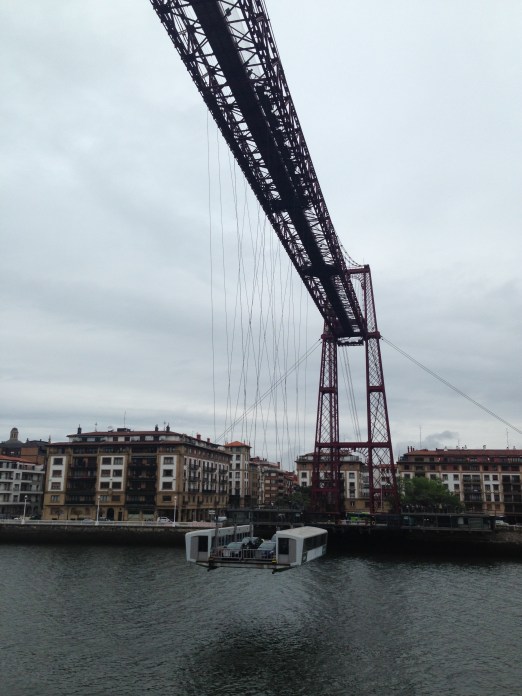
As I got nearer, I noticed something strange on the water. It wasn’t quite on the water, actually, but hovering above it. I looked up, and saw that the thing was hanging from the bridge. So that’s how it worked! The reason the bridge looked so odd was that it transported a shuttle that hung underneath, almost like a puppet on strings. That’s why the bridge was so high up and there weren’t any ramps to get on.

IMG_3749

But it looked dangerous to me. The shuttle was fairly large; it transported about six cars and one hundred people. Could that skeletal iron structure above support so much weight? Dreadful fantasies immediately started rushing to my mind. I saw the bridge snapping in the middle, sending iron raining down into the river below, crushing the shuttle and sending everyone inside to a watery grave. Unfortunately, awful visions like this plague me rather frequently. I wonder if it’s the product of a morbid imagination, or just watching too many action movies.

We went into the office and bought our tickets, though I wasn’t sure what the tickets were for. The man explained that there was an elevator to take you up to the top, where you could walk to the other end. He also gave us a little information pamphlet about the bridge. From this, I learned that the bridge is actually a UNESCO World Heritage site, the only monument in the Industrial Heritage category in Spain.

I also learned more about the construction and history of the bridge. The Vizcaya Bridge is a transporter bridge, the first of its kind in the world. If you haven’t heard of a transporter bridge before, that is perfectly normal, since this type of bridge is uncommon; according to Wiki, less than two dozen were built, and only 12 still stand today.

The Vizcaya Bridge, finished in 1893, was designed by one of Gustave Eiffel’s disciples, Alberto Palacio; and Eiffel’s influence shows. The bridge is built in the same manner as the Eiffel Tower, with narrow iron beams riveted together to form a triangular grid; and like the Eiffel Tower, the Vizcaya Bridge is austere and elegant. Palacio originated the idea in response to a common engineering problem: how do you create a bridge that allows people and cars to cross the river, while leaving the river open for shipping vessels? The Vizcaya bridge, then, in both purpose and execution, is a symbol of the Basque Country’s embrace of industry, commerce, and the future—not to mention art.

(I do wonder, though, whether Palacio’s solution was all that efficient. After all, there must be a reason why the design didn’t catch on. The primary problem, it seems to me, is that the amount of cars and people that can cross at any one time is limited by the size of the shuttle and the frequency of its trips. Perhaps the famous Tower Bridge in London—completed almost the same year—solved the problem more satisfactorily, by putting a drawbridge on the lower level and a pedestrian walkway on the upper. But Palacio’s design is beautiful, original, and elegant, so efficiency can go to the devil.)

Finally it was our turn for the elevator. It was an ancient thing, crawling up the bridge at a snail’s pace. Eventually the lift creaked to a halt, and we got out. A narrow wooden walkway, surrounded by the iron structure, extended from one end of the bridge to the other. It’s really amazing how much of the Vizcaya Bridge is just air. You can see right through the thing, and yet it is strong enough to support the weight of a large shuttle carrying six cars.

IMG_3750

I experienced this when one of the shuttles came rolling by, right underneath our feet. I could feel the entire bridge shaking, rattling, and shivering, as the electrical buzzing of the engine roared past. Once again, terrible fantasies started flickering through my mind, this time with me myself plunging to a ghastly death. But soon the shuttle came to a halt, and I realized that the bridge was solid as stone. What an impressive achievement: The bridge seems to float high up in the air, supported by the slenderest structure; and yet it is sturdy enough to remain operational after more than one hundred years of daily use.

IMG_3751

We took some time to admire the view. On one side we could see the bay, and then the ocean beyond. In the dockyard in the distance, I could see dozens of giant cranes standing silently, like petrified dinosaurs, waiting to come back to life. On the other side, we could see the river gradually making its way towards Bilbao; and in the distance, a factory loomed. Really, wherever you turned you could not fail to notice the signs of industry, filling up the entire estuary with their jagged, colossal, metallic forms. Below us, we could see the towns of Portugalete on one side and Getxo on the other, their streets now full. We might have stayed more time up there, but the wind was quite strong and chilly, so we took the elevator down on the other side. Not long after that, we took the shuttle from Getxo across the river, back to Portugalete; and I am happy to report that the ride was quick and smooth.

There is only one thing more I have to report. Before we left, GF had asked some of her students in Madrid where you can buy good pizza, and they told her to go to Telepizza (a popular chain here, comparable to Dominoes). That sounded awful to me, but GF wanted to try it; so, once we got to Portugalete, we decided to go to the nearest Telepizza for dinner. It brings me no joy to tell you that, as I expected, the pizza was horrible, some of the worst pizza I’ve ever had; and GF was of the same opinion. Is this what Spanish people think pizza is supposed to taste like?

Basking in the Basque Country: San Juan de Gaztelugatxe

Basking in the Basque Country: San Juan de Gaztelugatxe

(This post is part of my series on the Basque Country. Click here for Bilbao, here for the Vizcaya bridge, and here for San Sebastián.)

I always find public transportation a bit nerve-racking—especially in a new city, not to mention a foreign country. Every time I hop on a bus, I feel like I’m taking a leap of faith. I imagine taking the wrong bus and getting stranded in the middle of nowhere, or taking the right bus and getting off on the wrong stop—and these fears aren’t totally unfounded, as I’ve done both of these things. Thus I was filled with apprehension as we searched for the bus to Bakio, the A3518.

Probably you have never heard of Bakio, because there isn’t much to be heard about it. Bakio is a small town, with a population of about 2,500, situated about 30 kilometers from Bilbao. There is admittedly a beach there, although the damp, chilly, overcast weather of the region didn’t exactly put me in the mood for surfing. Rather, we were going to Bakio because it was the closest we could to get by bus to San Juan de Gaztelugatxe.

IMG_3711
The town of Bakio

The bus ride to Bakio was quite pleasant, taking us through the green countryside, filled with little huts and farmhouses tucked away into the rolling hills. After 40 minutes we arrived, ate some breakfast, and then set on our way. I had found a little report online (found here), written by somebody who had walked from Bakio to Gaztelugatxe. And attached in that report is a little map, with the walking route conveniently highlighted. But for whatever reason I forgot about this map as we started walking. Instead I chose to rely on my phone’s GPS to guide me there. Please, don’t make this mistake: just follow the walking route.

GF and I soon found ourselves walking along a busy road, with no sidewalks.

“Are you sure this is the right way?” she said.

“Yeah, I’m just following my phone.”

“Okay…”

We walked further, and after a while came to a sharp curve in the road. Because there wasn’t any sidewalk, and the road was hemmed in by a rockface on one side and some trees on another, we found ourselves in the predicament that, no matter which side we chose, we would risk making ourselves invisible to an incoming car. Thankfully, the cars only came periodically, with big gaps in-between; and we hoped we’d be able hear them a ways off. Still, it was nerve-racking as we rushed around the corner, trying to minimize our time on the curve.

“I hope there aren’t any more curves like that,” GF said as we got to the other side.

“Me too,” I said.

But five minutes later, we came to another curve. And then another, and another. The entire road, it seemed, wrapped around the hills like a snake, constantly turning left and right. Meanwhile, the amount of cars on the road seemed to be steadily increasing.

“I don’t like this,” GF said. “Is there any way off this road?”

“Umm,” I said, “maybe up ahead.” (I had no idea.)

During the stretches of straight roads, I did my best to enjoy the scenery. It was a nice place, with pine trees and farmhouses all around, and the occasional view of the countryside beyond. But the whoosh of a passing cars destroyed any peace to be had; and the sight of every sharp turn ahead increased my anxiety.

There was over an hour of this, the two of us walking on through the brush and bushes by the side of the road, our feet searching for stability amid the roots and rocks, changing sides whenever it seemed more safe, pressing ourselves against the trees whenever a car went past, rushing around curves with our adrenalin racing, GF nervously complaining while I tried to keep my own fears to myself. And then, finally, just as I was at my wit’s end, the hermitage came into view.

“Yes!” GF said, filled with relief.

§

San Juan de Gatztelugatxe (recently made famous in Game of Thrones, as the location of Dragonstone) is an island off the coast of Biscay, connected to the maindland by a man-made bridge. Since at least the 10th century, a little religious building has been perched up at the top of it, though it has burnt down and been rebuilt many times, most recently in 1980.

To get there from the road we had to climb down towards the shore. The path was steep, twisting, and rocky. Even though you’re going down hill, it is exhausting because you need to be constantly on guard against falling. At last we got near the bottom, where there was a lookout point from which we could get a good view of the island.

IMG_3719

It must be one of the most astonishing sights in Spain. The island is a mound of jagged grey rock, covered in slight patches of green. Its splayed form stretches out into the sea, wherein it is battered day and night, on all sides, by the winds and the waves. In the middle of this island, criss-crossing its way up from the bottom to the top, is a staircase—usually filled with the miniscule forms of people going up and down. And crowning the island is the hermitage, a small shack with a dull red roof.

Perhaps this image is so appealing to me because I find in it a symbol of the relationship of humanity to nature. We have carved a staircase into the rock, and erected a place of worship on the summit of the island; and in this way we can be said to have dominated the place. And yet, how feeble our dominance of nature seems when viewed from a distance—just a pile of boards, liable to be blown away by the first strong gust. This is the age-old contest of craft, cleverness, and perseverance against capricious, indifferent power. And I cannot help thinking that, however successful we are now, there will come a day when the hermitage blows down, and there won’t be anyone to build it back up again.

IMG_3725

But these gloomy thoughts were soon gone as I huffed and puffed my way up the staircase to the top of the island. By now we had been walking over an hour next to that road, our hearts in our throats all the while; so we were understandably a bit worn out. It felt all the better, then, when we finally reached the top, and could look back towards the land.

In the distance, to our right, we could see the beach of Bakio; and to the left, nothing but steep, grey cliffs and green forests. Gigantic rocks stuck out of the ocean, the biggest one almost as big as the island itself. To one side, far off, I could see what looked like an oil drill. Apart from that, no boats, no freighters, no planes broke the endless blue of the sea beyond or the grey of the sky above. It felt like standing at the edge of the world.

IMG_3733

We couldn’t go inside the hermitage, nor even peek through a window. This didn’t bother me, however, since judging by the looks of the plain exterior, the interior would be similarly nondescript. What we could do was ring the bell. A string hung from the bell on the roof to the ground below, and all the visitors were taking turns having a pull (one kid got a bit too enthusiastic, and his parents had to keep him away). I gripped the chord and lightly tugged, and the satisfying clang of a church bell sounded overhead.

Since neither of us had any intention of repeating that dreadful walk by the road, this time I looked up the walking path on my phone. We found the path without any trouble, which made me feel like such an idiot for not using it the first time. It was such a relief! Instead of the twisting, turning road we had a straight path, free of cars, taking us through quiet countryside. We passed through a copse of trees, and then through some fields where cows were grazing, making our way over gently rolling hills, the seaside on our right, until we were finally back in Bakio. The bus soon arrived, and then we were on our way to Bilbao, where we still had one more thing to see.

El Monasterio de Piedra

El Monasterio de Piedra

The bus crawled out of Zaragoza’s main bus terminal, Delicias, and quickly left the city limits. It was early morning. The landscape was entirely shrouded in fog. It wasn’t long before I gave up trying to see the countryside and fell asleep. When I awoke—with a headache and a nasty taste in my mouth—we had parked in Catalayud, a small town midway between Zaragoza and my destination, where we had to transfer buses. I was on my way to the Monasterio de Piedra.

I was still in a daze. That morning I had awoken at an ungodly hour to walk all the way across the misty city to catch an eight o’clock bus. I still felt chilled from the early morning air, but I couldn’t warm up, since it was nearly as cold inside the bus station as it was outside.

I looked out the station window to check if there was anything to see, but the fog acted as an impenetrable veil. This was a shame, since I had noticed Calatayud from the highway on the drive to Zaragoza, and immediately became intrigued. The town is nestled beneath towering cliffs, on top of which stands a commanding castle, whose walls look like they sprung spontaneously out of the rocks. This, it turns out, is the oldest and largest Moorish fortress still existent in Spain.

It wasn’t long before we boarded another bus. Again, I fell asleep immediately, only coming to my senses as we approached the monastery. The fog had cleared by now, and I could see that our bus was creeping along a fairly narrow road, situated above a river; red cliffs ran along the other side. This dramatic scenery was an omen of what was to come.

Finally we arrived. We all shuffled out of the bus and made our way past the walls and into the complex. I waited in line and bought a ticket, still fairly ignorant of what I was paying for. I had come here on the recommendation of friends; and as usual I hadn’t looked up any information about the place before coming.

§

The Monasterio de Piedra is situated at the confluence of the rivers Piedra (thus the name) and Ortiz, in a remote spot within the Iberian Mountains. Founded in the late 12th century by the Cistercians, the monastery was a symbol and outpost of the accelerating Reconquista, the Christian push southward against the Moors, who then controlled all of Aragon and beyond. As such, the monastery was liable to being attacked, which is why defensive wall surrounds the complex.

During the centuries of its use, as the Cistercian monks worked and prayed along the banks of the Piedra, steeped in the cool mountain air of the region. The Moors, who had so long controlled and shaped the Iberian Peninsula—it was the Moors, for example, who established the city of Catalayud that I passed through—eventually lost control, and the small Christian principalities and kingdoms were merged into larger and larger states. It wasn’t long after the “reconquest” was completed, and Castile and Aragon were unified under the “Catholic Monarchs,” that Columbus made his famous voyage to the “Indies,” thus commencing Spain’s brutal colonization of the New World. It was here, in this monastery, that chocolate was first made in Europe, after Hernán Cortes send cacao beans and an Aztec recipe to the monks here.

Three hundred years later, Spain was again divided. In 1833, the first Carlist war commenced, a war between two contending successors to the throne, Carlos de Borbón and Isabella II (who won, and was eventually deposed). Heavily in debt from the prolonged civil war, the Spanish government commenced another of its desamortizaciones, or confiscations, of Church property. Besides the financial incentive, the conservative Church hierarchy supported the reactionary Don Carlos, so this move had both financial and emotional appeal. In any case, it was during this desamortización that the Monasterio de Piedra was seized and sold, thus putting an end to its Catholic history.

For reason of pure anti-clerical fervor, I presume, the church building itself was burned. Now all that remains is a ruined shell of a building. This is a shame, since was fragments that remains give some hint of a glorious medieval edifice. Some of the ornamental friezes around the doorways, for example, are of the finest quality. Now, however, the building’s appeal is Romantic rather than Romanesque. As I’ve mentioned elsewhere, ruins have a strange power to evoke feelings of mysterious awe. Certainly I felt this as I sat facing the destroyed altar, the walls reaching up to a vacant ceiling, the sky gaping overhead. It was like stepping into one of Caspar David Friedrich’s paintings—a timeless, fossilized wreck.

Piedra 8

If the burnt church building is unintentionally romantic, the rest of the monastery is quite intentionally so. After briefly being owned by a wealthy Catalan merchant, who mainly used it for agriculture, it passed into the hands of Juan Federico Muntadas.

A well-educated and original man—among other things, he created the first fish farm in Spain—Muntadas was born in 1826, and was thus roughly of the same generation as Gustavo Adolfo Bécquer. And, like Bécquer, he was a Romantic. If you, for example, compare the royal gardens of Aranjuez or La Granja with Muntadas’s creation in the Monasterio de Piedra, you can get some idea of the mental difference between the Enlightenment and the Romantics. Whereas the royal gardens are neat, orderly, symmetrical, with clearly delineated plots for plants and paths for people, Muntadas molded a space that creates the sensation—if not exactly the illusion—of untrammeled nature.

Piedra 1

The walking path through the monastery grounds takes about an hour. Though it was winter, the place was still quite green. Shallow ponds reflected the twisted and bare forms of tree limbs, while the verdant underbrush was speckled with the reds of crinkled fallen leaves. Small wooden bridges led the walker through this marshy area to the main attraction: the waterfalls.

Piedra 2.jpg

Using the diverted waters of the Piedra and the Ortiz, Muntadas created a dazzling series of cascades. Varying in size from ankle-level to the size of an apartment building, these waterfalls are some of the prettiest I have ever seen. The rocks have been carefully placed to divide the stream into several rivulets, creating a dancing pattern of sparkling, splashing streams.

Piedra 4

The path took me up beside one of the larger waterfalls and up a staircase in the adjacent rock face. Ivy, branches, and leaves were draped around the water, as if thirsty for a drink. Once at the top, we passed over a shallow stream, and followed it down again as it accelerated into a whooshing, multi-layered cataract, the stairwell winding its way downwards beside the water. Children and parents were crowded on the slippery steps, posing for photos. Along the way I caught a glimpse of the surrounding area, whose red rocky cliffs and rolling hills stretched into the far distance. The path continued, becoming narrow as it navigated the hillside, until finally we were led into a cave.

Piedra 5

This cave—full of stalactites and stalagmites, green with algae, the jagged rock edges worn into eerie undulations by the water—was under the largest of the waterfalls. Water poured down at its entrance, filling the place with a ceaseless mist. I had to take off my glasses since they got so covered in droplets. We came out of the cave the same way we went in; then, after a walk through a long tunnel, I found myself by the famous Lago del Espejo, or Mirror Lake.

Piedra 6

The shallow water, only inches deep and filled with aquatic plants, was uncannily reflective. And there was plenty to reflect, since the lake is situated underneath impressive rock faces, stretching up far above us and casting imposing shadows. By this time I had completely fallen under the spell of the place. The impression created by so many manipulations of water and stone was that of deep, almost meditative calm. I felt perfectly relaxed and refreshed.

Piedra 7

Finally I ended up where I had begun: by the old, burnt church. Quite hungry by now, I went to the restaurant near the visitor’s center, which had quite a good—and affordable—daily menu. Then, stuffed and exhausted, I boarded the bus to go back to Zaragoza.

Remote and difficult to get to using public transportation, El Monasterio de Piedra is yet another example of Spain’s seemingly inexhaustible treasures.