I should think that anyone who considered it more reasonable for the whole universe to move in order to let the earth remain fixed would be more irrational than one who should climb to the top of your cupola just to get a view of the city and its environs, and then demand that the whole countryside should revolve around him so that he would not have to take the trouble to turn his head.
It often seems hard to justify reading old works of science. After all, science continually advances; pioneering works today will be obsolete tomorrow. As a friend of mine said when he saw me reading this, “That shit’s outdated.” And it’s true: this shit is outdated.
Well, for one thing, understanding the history of the development of a theory often aids in the understanding of the theory. Look at any given technical discipline today, and it’s overwhelming; you are presented with such an imposing edifice of knowledge that it seems impossible. Yet even the largest oak was once an acorn, and even the most frightening equation was once an idle speculation. Case in point: Achieving a modern understanding of planetary orbits would require mastery of Einstein’s theories—no mean feat. Flip back the pages in history, however, and you will end up here, at this delightful dialogue by a nettlesome Italian scientist, as accessible a book as ever you could hope for.
This book is rich and rewarding, but for some unexpected reasons. What will strike most moderns readers, I suspect, is how plausible the Ptolemaic worldview appears in this dialogue. To us alive today, who have seen the earth in photographs, the notion that the earth is the center of the universe seems absurd. But back then, it was plain common sense, and for good reason. Galileo’s fictional Aristotelian philosopher, Simplicio, puts forward many arguments for the immobility of the earth, some merely silly, but many very sensible and convincing. Indeed, I often felt like I had to take Simplicio’s side, as Galileo subjects the good Ptolemaic philosopher to much abuse.
I’d like to think that I would have sensed the force of the Copernican system if I were alive back then. But really, I doubt it. If the earth was moving, why wouldn’t things you throw into the air land to the west of you? Wouldn’t we feel ourselves in motion? Wouldn’t canon balls travel much further one way than another? Wouldn’t we be thrown off into space? Galileo’s answer to all of these questions is the principal of inertia: all inertial (non-accelerating) frames of reference are equivalent. That is, an experiment will look the same whether it’s performed on a ship at constant velocity or on dry land.
(In reality, the surface of the earth is non-inertial, since it is undergoing acceleration due to its constant spinning motion. Indeed the only reason we don’t fly off is because of gravity, not because of inertia as Galileo argues. But for practical purposes the earth’s surface can be treated as an inertial reference frame.)
Because this simple principle is the key to so many of Galileo’s arguments, the final section of this book is trebly strange. In the last few pages of this dialogue, Galileo triumphantly puts forward his erroneous theory of the tides as if it were the final nail in Ptolemy’s coffin. Galileo’s theory was that the tides were caused by the movement of the earth, like water sloshing around a bowl on a spinning Lazy Susan. But if this was what really caused the tides, then Galileo’s principle of inertia would fall apart; since if the earth’s movements could move the oceans, couldn’t it also push us humans around? It’s amazing that Galileo didn’t mind this inconsistency. It’s as if Darwin ended On the Origin of Species with an argument that ducks were the direct descendants of daffodils.
Yet for all the many quirks and flaws in this work, for all the many digressions—and there are quite a few—it still shines. Galileo is a strong writer and a superlative thinker; following along the train of his thoughts is an adventure in itself. But of course this work, like all works of science, is not ultimately about the mind of one man; it is about the natural world. And if you are like me, this book will make you think of the sun, the moon, the planets, and the stars in the sky; will remind you that your world is spinning like a top, and that the very ground we stand on is flying through the dark of space, shielded by a wisp of clouds; and that the firmament up above, something we often forget, is a window into the cosmos itself—you will think about all this, and decide that maybe this shit isn’t so outdated after all.
(This post is a continuation of my series on Day Trips: Click here for my post on Alcalá de Henares.)
“Just once, I’d like to begin a blog post without our travel troubles!” I said to GF as we walked around, confused and lost, looking for the bus to Chinchón. We’d just walked fifteen minutes in the wrong direction, and were heading back to the metro station now.
“Shut up,” she said. “I have it here on my phone.”
Indeed she did; and we were soon standing by the appropriate bus station near Conde de Casal, waiting to go to Chinchón.
Chinchón is a small town—its population is about 5,000—just south of Madrid. It isn’t the home of any big castles or cathedrals; it isn’t the place to take the best photos or hear the best music. Rather, Chinchón is a place to sit and eat, and that’s what we planned to do.
After an hour on the bus, we arrived. Immediately we headed for the plaza mayor, the most famous place in the town, a five minute walk from the bus stop.
This was the first week of January. We had this week off for Tres Reyes, the Spanish holiday celebrating the three wise men who visited infant Jesus. Instead of giving presents on Christmas, this is the day when most gifts are exchanged. And lucky for us, the combination of Christmas, New Year’s, and Tres Reyes makes for a long, long holiday.
We’d just gotten back from our Christmas trip to Andalusia, and were thirsting to see more of Spain. Unfortunately, Madrid and its environs are a good deal colder than the south of Spain. We were freezing. Added to this, the weather was awful that day, overcast, windy, with a bit of rain. It was the kind of dull, dreary weather than can make the Taj Mahal look dreadful.
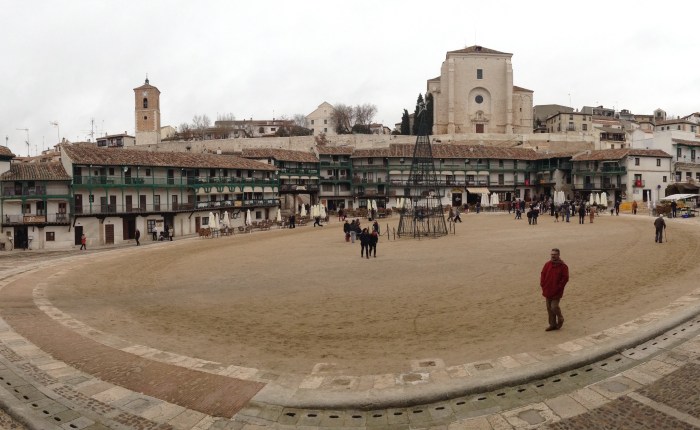
But the plaza mayor of Chinchón didn’t look dreadful at all. It looked positively cute. Identical white buildings with green balconies and tiled roofs surrounded a circular area in the center. This center was filled with sand. A few guys were selling donkey rides to kids, leading a long train of donkeys with excited children bouncing on top of them around the square, while their parents walked cautiously beside. A plastic Christmas tree decoration sat in the exact center. Every building had a restaurant or two, which was good because we were already quite hungry.
Being a man of this modern age, I looked on my phone for the restaurant with the highest rating: it was called La Villa. Of course it was expensive (for a Spanish restaurant). But it was the new year, and we felt like living high.
I’m glad to report that I absolutely stuffed myself, and then ate some more. The house red wine was also just fantastic, dangerously so, for I drank too much of it. After I ate and drank my fill, we ordered dessert—also great—and then asked for the check. This came with two complementary shots of Chinchón, which is the local liquor, apparently. Since my girlfriend can’t drink, I had to have both shots. It was strong, I tell you, and had a subtle liquorish flavor, a bit like Jägermeister. As we walked out, we noticed a bunch of black-and-white pictures hanging on the walls. Closer inspection revealed that they were of bull fights in the plaza mayor of Chinchón. Apparently, it was originally a bullring, which explains its symmetrical layout.
After this, there’s not much to tell. Stomachs painfully full, we waddled around town a bit. We found a castle, ruined and empty, which we couldn’t enter. There were several churches, closed to visitors. And then there was a view of the countryside beyond, rendered a bit dour by the weather. An hour later we were waiting at the bus stop with a bunch of chatting old ladies, and an hour after that we were sitting at home, drowsy, relaxed, ready for our next trip.
The Castle of Chinchón
Addendum: For any visitors of Madrid looking for a day trip to see a beautiful Spanish pueblo, Chinchón is perhaps the best choice. Small, intimate, easily accessible, and one of the most charming pueblos in the country, Chinchón is also famous for its gastronomy.
The liquor I mentioned above is Anís, which is simply referred to as “Chinchón” in Spanish, since this little town has long been the leading manufacturer of the drink. Chinchón is also famous for its pastries; its signature pastry has been appropriately compared to a breast, complete with a nipple on top.
The castle I mentioned above was built in the sixteenth century. Standing nearby, the visitor gets an excellent view of the surrounding countryside. Chinchón’s Plaza Mayor has not only been the site of bull fights, but also executions, comedy performances, royal proclamations, and many movie scenes. If you walk from this plaza up to the Torre Reloj, you will be rewarded with a marvelous view of the town.
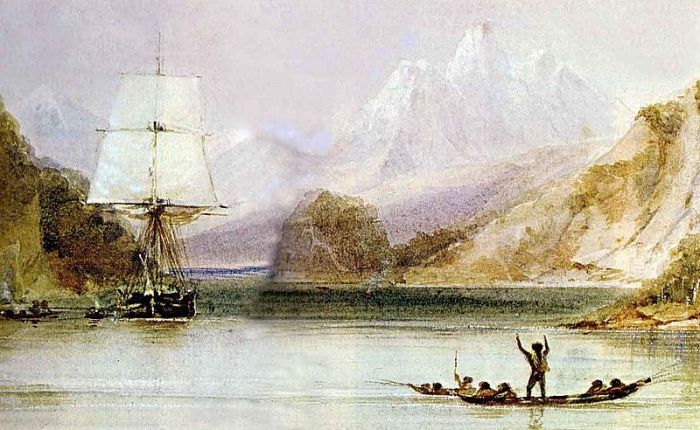
This book is really a rare treasure. Is there anything comparable? Here we have the very man whose ideas have revolutionized completely our understanding of life, writing with charm about the very voyage which sparked and shaped his thinking on the subject. And even if this book was not a window into the mind of one of history’s most influential thinkers, it would still be entertaining on its own merits. Indeed, the public at the time thought so, making Darwin into a bestselling author.
I can hardly imagine how fascinating it would have been for a nineteenth-century Englishman to read about the strange men and beasts in different parts of the world. Today the world is so flat that almost nothing can surprise. But what this book has lost in exotic charm, it makes up for in historical interest; for now it is a fascinating glimpse into the world of 150 years ago. Through Darwin’s narrative, we both look out at the world as it was, and into the mind of a charming man. And Darwin was charming. How strange it is that one of today’s most vicious debates—creationism vs. evolution, religion vs. science—was ignited by somebody as mild-mannered and likable as Mr. Darwin.
His most outstanding characteristic is his curiosity; everything Darwin sees, he wants to learn about: “In England any person fond of natural history enjoys in his walks a great advantage, by always having something to attract his attention; but in these fertile climates, teeming with life, the attractions are so numerous, that he is scarcely able to walk at all.”
As a result, the range of topics touched upon in this volume is extraordinary: botany, entomology, geology, anthropology, paleontology—the list goes on. Darwin collects and dissects every creature he can get his hands on; he examines fish, birds, mammals, insects, spiders. (Admittedly, the descriptions of anatomy and geological strata were often so detailed as to be tedious; Darwin, though brilliant, could be very dry.) In the course of these descriptions, Darwin also indulged in quite a bit of speculation, offering an interesting glimpse into both his thought-process and the state of science at that time. (I wonder if any edition includes follow-ups of these conjectures; it would have been interesting to see how they panned out.)
In retrospect, it is almost unsurprising that Darwin came up with his theory of evolution, since he encounters many things that are perplexing and inexplicable without it. Darwin finds fossils of extinct megafauna, and wonders how animals so large could have perished completely. He famously sees examples of one body-plan being adapted—like a theme and variations—in the finches of the Galapagos Islands. He also notes that the fauna and flora on those islands are related to, though quite different from, that in mainland South America. (If life there was created separately, why wouldn’t it be completely different? And if it was indeed descended from the animals on the mainland, what made it change?)
Darwin also sees abundant examples of convergent evolution—two distinct evolutionary lines producing similar results in similar circumstances—in Australia:
A little time before this I had been lying on a sunny bank, and was reflecting on the strange character of the animals in this country as compared with the rest of the world. An unbeliever in everything but his own reason might exclaim, ‘Two distinct Creators must have been at work; their object, however, has been the same & certainly the end in each case is complete.’
More surprisingly, Darwin finds that animals in isolated, uninhabited islands tend to have no fear of humans. And, strangely enough, an individual animal from these islands cannot even be taught to fear humans. Why, Darwin asks, does an individual bird in Europe fear humans, even though it is never been harmed by one? And why can’t you train an individual bird from an isolated island to fear humans? My favorite anecdote is of Darwin repeatedly throwing a turtle into the water, and having it return to him again and again—because, as Darwin notes, its natural predators are ocean-bound, and it has adapted to see the land as a place of safety. Darwin also manages to walk right up to an unwary fox and kill it with his geological hammer.
You can see how all of these experiences, so odd without a theory of evolution, become clear as day when Darwin’s ideas are embraced. Indeed, many are still textbook examples of the implications of his theories.
This book would have been extraordinary just for the light it sheds on Darwin’s early experiences in biology, but it contains many entertaining anecdotes as well. It is almost a Bildungsroman: we see the young Darwin, a respectable Englishman, astounded and amazed by the wide world. He encounters odd creatures, meets strange men, and travels through bizarre landscapes. And, like all good coming of age stories, he often makes a fool of himself:
The main difficulty in using either a lazo or bolas, is to ride so well, as to be able at full speed, and while suddenly turning about, to whirl them so steadily about the head, as to take aim: on foot any person would soon learn the art. One day, as I was amusing myself by galloping and whirling the balls round my head, by accident the free one struck a bush; and its revolving motion being thus destroyed, it immediately fell to the ground, and like magic caught one hind leg of my horse; the other ball was then jerked out of my hand, and the horse fairly secured. Luckily he was an old practiced animal, and knew what it meant; otherwise he would probably have kicked till he had thrown himself down. The Gauchos roared with laughter; they cried they had seen every sort of animal caught, but had never before seen a man caught by himself.
At this point, I am tempted to get carried away and include all of the many quotes that I liked. Darwin writes movingly about the horrors of slavery, he includes some vivid description of “savages,” and even tells some funny stories. But I will leave these passages to be discovered by the curious reader, who, in his voyage through the pages of this book, will indulge in a voyage far more comfortable than, and perhaps half as fascinating as, Darwin’s own. At the very least, the fortunate reader need not fear exotic diseases (Darwin suffered from ill health the rest of his days) or heed Darwin’s warning to the potential traveler at sea: “If a person suffer much from sea-sickness, let him weigh it heavily in the balance. I speak from experience: it is no trifling evil which may be cured in a week.”
(I wrote this post only a few months after my arrival in Spain, while I was still mostly ignorant of the country and its language. With the exception of Chinchón, I have visited all of these places since then, so I have appended little notes at the end of my posts about what I now know. I have also broken up my original post for ease of navigation.)
There are many advantages to living in Madrid. It’s big, it’s bustling, and it’s diverse. But one of my favorite aspects of Madrid is its location. By design, the capital of Spain is almost equidistant from every corner of the country; to drive from Madrid to Catalonia, to Andalusia, to the Basque Country, and to Galicia all take roughly the same amount of time. And transportation isn’t hard to find; the city is well connected by rail, highway, and plane to all points of the compass. Travel is cheap, easy, and fast.
As a consequence, there are a great many excellent day trips you can take from Madrid. I’ve already written about some of them: Toledo, Segovia, and El Escorial. In these posts, I want to talk about some of the perhaps lesser-known cities for day-trippers. I’ll start at the very beginning, with my first trip inside Spain.
Alcalá de Henares
As soon as I got to Spain, I blabbed to everybody I met that I had read Don Quixote. I was very proud of this, for I thought it gave me some kind of badge of honor in Spanish culture. And indeed, a few people seemed genuinely impressed—though less so when I told them I read it in English.
“Ah, so you like Cervantes?” a friend of ours said.
“Oh yes, he’s incredible.”
“You should visit Alcalá de Henares, then. It’s where Cervantes was born.”
This was only our second week in Spain, and we were still a bit disoriented by our surroundings. The prospect of taking an actual trip in Spain seemed almost Herculean, an added challenge to the day-to-day struggle of navigating our new city. But I was determined to get culture, by hell or high water; so as soon as we could, we made it to Atocha station and took the Cercanías to Alcalá de Henares. (For once in our lives, we found the train without a problem.)
The train was too full for us to sit down. We stood by the doors, both of us swaying nervously with the ever-present anxiety you feel when in a strange environment. I was looking forward to seeing the area around Madrid, but the windows were smudged and dirty; and the view, from what I could see, wasn’t much anyway—just the featureless tan wasteland of the dry foothills. Before even coming to Spain I had terrified myself by reading online stories about the ingenuity of pickpockets in Europe, and couldn’t stop casting interrogative glances at all the passengers around me, wondering whether any of them were thieves eyeing me up, waiting for the perfect moment to strike.
Station after station went by, and I was paying fierce attention to all of them, paranoid that we would miss our stop and get hopelessly lost. It’s really exhausting traveling somewhere totally new—it is for me, at least—because you can’t take anything for granted. The doors of the trains work differently; the seats are arranged differently; the automatic announcer is speaking a foreign language. Added to this, I was constantly afraid of doing something wrong by accident, breaking the train etiquette of Spain and drawing everyone’s attention to myself. It’s pretty amusing to me now, as I look back; but then it was just stressful and scary.
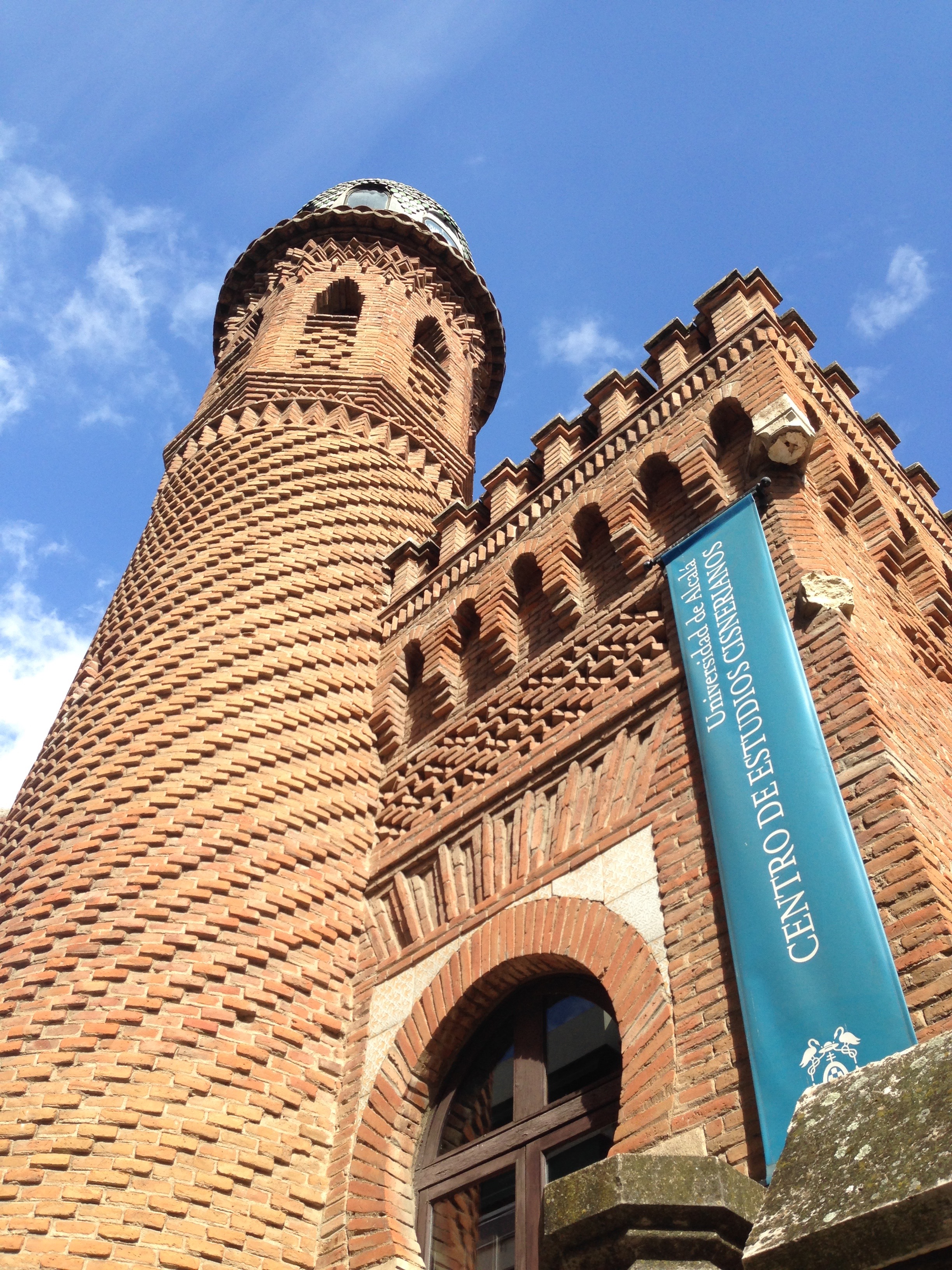
We arrived. After some confused mucking about, we began making our way to the center of town. Neither of us had Spanish SIM cards yet, so our phones didn’t work. We just followed the crowd, who all seemed to be walking in the same direction. The city seemed rather ordinary at first—though even this was interesting to me, since I hadn’t seen any city in Spain besides Madrid yet—but soon something caught our eye. It looked like a little castle, with a tower on one end and a tiny battlement at the top of a square structure.
But what really made it stand out was the intricate ornamentation. The façade of the tower, for example, was covered in swirls. It was quite pretty. Although we didn’t know this at the time, it’s called the Palacete Laredo, and is one of the famous monuments of Alcalá. It was originally built as a private house for Manuel Laredo, a polymath artist who served as the mayor of Alcalá de Henares. Nowadays, it serves as a museum of the Cistercian order, as well as a specialized research branch of the Complutense University.
Looking back now, I can tell that it was built in a Neo-Mudéjar style, with crescent arches and a domed minaret. The top of the main building, however, is not Neo-Mudéjar in style, but rather looks like a small copy of the Alcázar in Segovia. In fact, the more I look at my pictures, the more of a stylistic jumble the place appears, with all sorts of different Spanish architectural elements mixed together. Of course, at the time I just thought it looked weird.
We kept going, following the trickle of pedestrians into the center of town. Eventually the buildings started to look older; the streets were narrower here and paved with stone. But what most caught our attention was a big beautiful bird, sitting on top of an old church. It looked so incongruous and stood so still that we were convinced it was fake—that is, until it twitched its head. When we got a bit closer we could see it had built a big, bushy nest up high on the building.
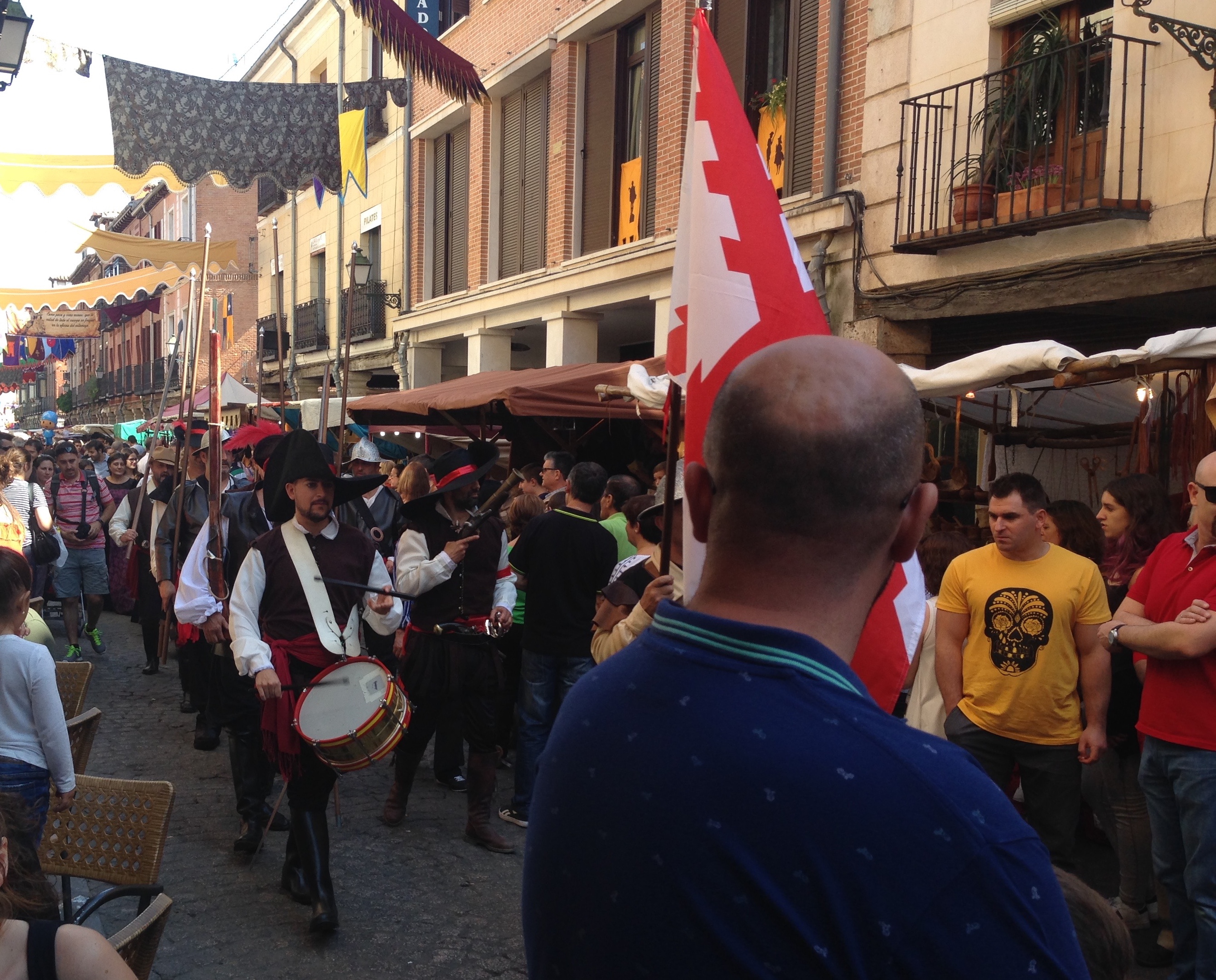
As we moved on, following the throng of people wherever it seemed thickest, we eventually found ourselves in a dense crowd. Little shacks were set up all over the place, selling cheese, sausage, olives, nuts, spices, tea, wooden bowls, leather bags, colorful scarves, cheap jewelry. Not only that, but all the people in these shops were dressed up in funny outfits, like they were in Medieval times. Was Spain always like this on the weekends? I was both excited and terrified—excited to see a slice of Spanish life, but now scared more than ever about being pickpocketed.
We rounded a corner and came across an outdoor restaurant. Dozens of tables and chairs were gathered under a tent. Several harried men in ridiculous costumes—looking like court jesters, with striped red and white shirts and big puffy hats—were running left and right, carrying massive trays of food. Outside the tent was the cooking area, where a large circular charcoal grill was covered in sausages, meats, fish, and vegetables of all kinds. Immediately I felt very, very hungry. From the shops were hung all manner of flags and banners painted with signs from medieval heraldry—black, yellow, and red.
Every new street we entered was more packed than the last. Soon it dawned on us that this wasn’t at all normal, but was some kind of special festival. As if to confirm our suspicion, a group of men dressed up like medieval soldiers, with fake swords by their sides, paraded through the crowd while another man, dressed in rags, pretended to be a lunatic. One of the soldiers held him by a rope, while the maniac ran after people in the crowd (mostly women), gargling his throat and reaching out his dirty hands. Another soldier was beating a big bass drum, while they all shouted things that I couldn’t understand.
(As we later learned, this was the Cervantino, a medieval fair named after Cervantes, which is held in the first couple weeks of October. I have since gone back twice, and I highly recommend it.)
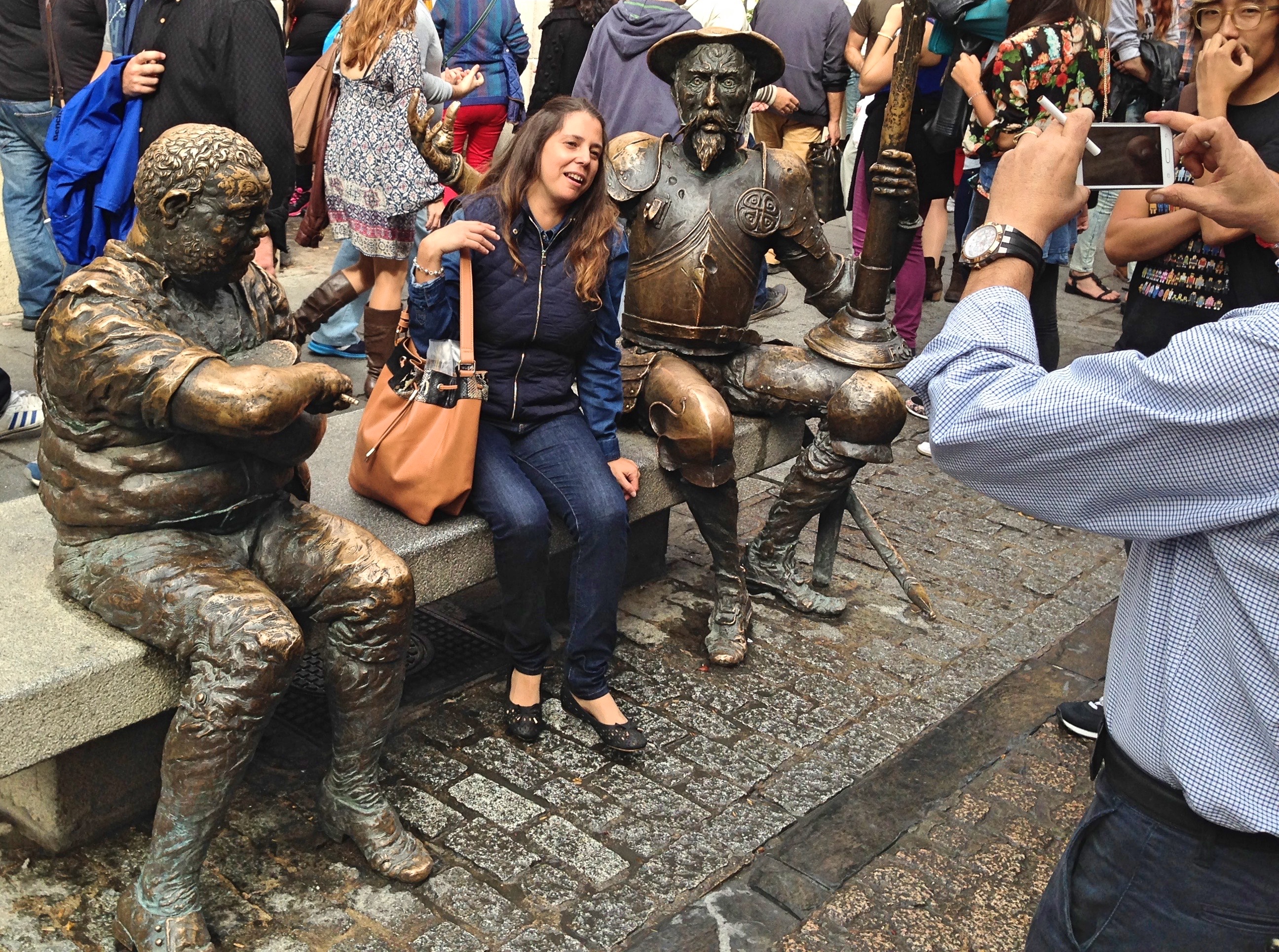
We wandered along this way, two bewildered Americans, absolutely intimidated by our surroundings, until eventually we were standing in front of a couple of statues. I immediately recognized these as being Don Quixote and Sancho Panza; both of them were sitting on a bench, and seemed to be having a damned good time. In between the knight errant and his square there was a space on the bench where tourist after tourist was lining up to have their picture taken. I would have had my picture taken, too, if I wasn’t so afraid that my phone would disappear as soon as I took it out of my pocket.
Behind the bench was the Cervantes House—the house where Cervantes himself was born and reared. We got on line and went right in. It’s quite a small place, actually. In the center of the house is a little courtyard, around which every room is situated. The insides of these rooms were furnished to look like they would have during Cervantes’ lifetime. I have to admit not much caught my eye, except perhaps the old kitchen equipment. It was more rewarding just to pace about, thinking that I was standing in the very place where Cervantes, that master of masters, entered into the world. This feeling was so strange to me that I’m not sure I quite took it in. This was perhaps the first appearance of “European Travel Syndrome” in my life. You simply can’t have an experience like this in New York.
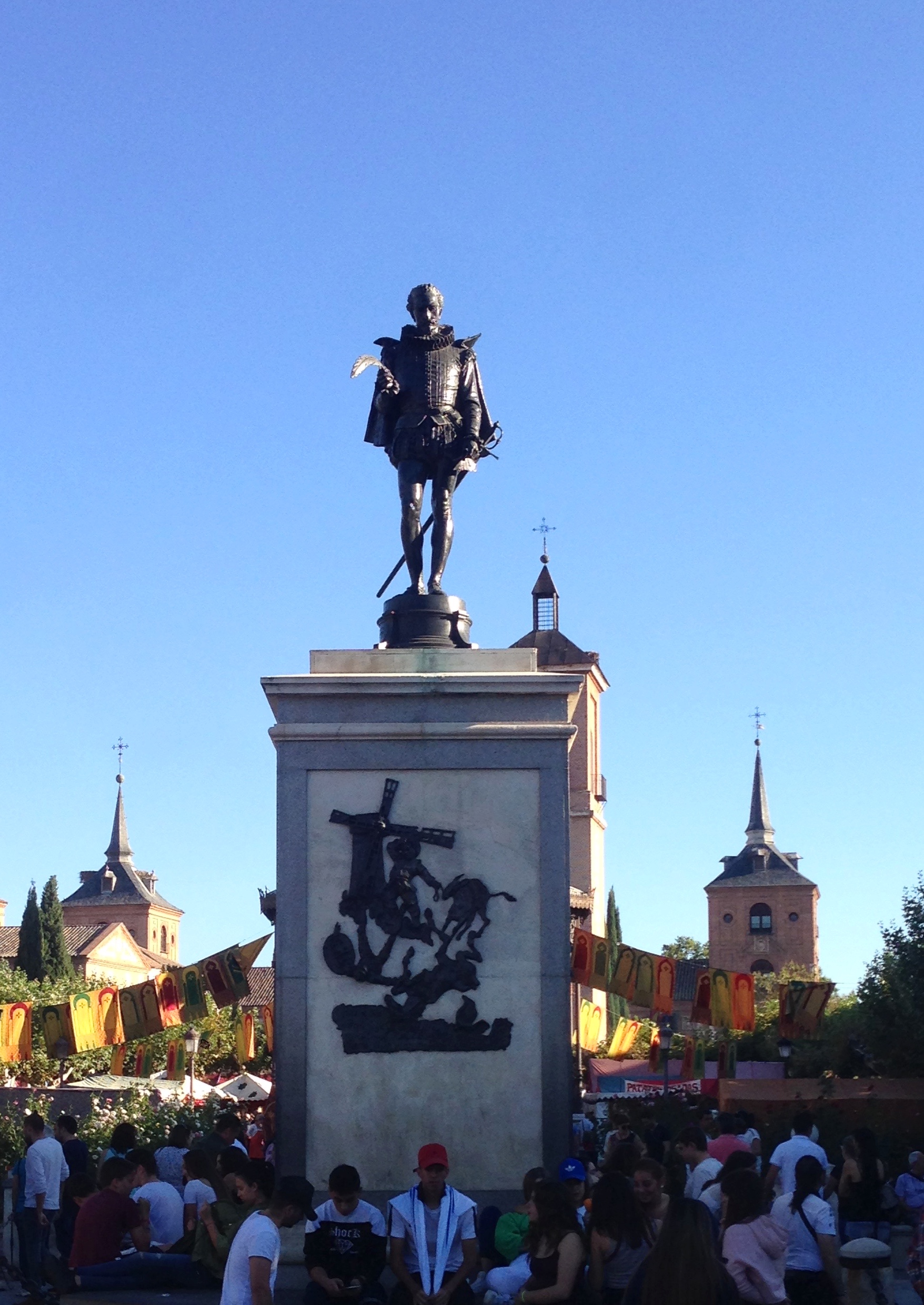
The statue of Cervantes in the main square
In just half an hour, we were out in the street again. We didn’t know anything else to do except walk around, seeing as much of the city as we could. Many of the buildings were impressive; but at this early stage, we didn’t really know how to go about visiting buildings or even how to look at them. In fact, what I most remember were not the buildings themselves, but the dozens stork nests sitting snuggly on rooftops, their bushy lairs looking somehow both ridiculous and majestic.
Eventually, we decided to sit down to eat in one of those tent restaurants. The waiter ran up to us, his floppy hat thrown over to one side of his head, and asked us in a slew of Spanish words what we wanted. We ordered two things, and he was off. At this point, we were so clueless in Spanish that most of the time we didn’t even know what we were ordering in restaurants. This was a classic example: We asked for “pimientos fritos” thinking they were french fries; five minutes later, the waiter dropped a plate of fried, salted green peppers on our table. I know, I know, this is an embarrassing mistake, not least because “potato” is “patata” here—not hard to guess.
The upside of our ignorance was that we ended up learning a lot about Spanish food, since we accidentally ate a lot of it. These pimientos were a case in point: we loved them, and pimientos now are one of our staple dishes. Really, if you’re in Spain and you can’t speak Spanish, just go into a restaurant and order whatever sounds interesting. All the food is good here.
After eating the pimientos, and then following it with a plate full of chorizo and tomato sauce on bread, we began to walk around again. But I’m afraid we didn’t do much of interest; and in an hour, we were on our way back to the train station to return to Madrid.
Reading over what I just wrote, and comparing it to what I find online about Alcalá de Henares, it’s obvious to me that we left most of the main sights unseen. Oh well, next time. But it was a fantastic stroke of luck to arrive on the very weekend when they were having their famous Medieval Market. And as I look back on it, this trip seems to presage our whole time in Spain so far: we arrive clueless and unprepared, and yet everything works out marvelously. Traveling in Spain is, in fact, a lot like ordering in a Spanish restaurant: even if you have no idea what you’ll get, you can be sure it will be delightful.
Addendum: Since this initial trip, I have since learned that Alcalá de Henares has been more than simply the birthplace of Cervantes, but has played an important role in Spanish history.
The city has existed since at least Roman times, when it was known as Complutum. It was in this town that Cardinal Cisneros, one of the leading functionaries of the Catholic Monarchs, founded the University of Alcalá in 1499. Under his direction the scholars of the university undertook and completed one of the greatest intellectual accomplishments of the Spanish Golden Age, the Polyglot Bible, which contained the entire text of the Old and New Testaments in three languages: Latin, Hebrew, and Greek—and sometimes Aramaic. The University was eventually moved to Madrid, where it was renamed the Complutense (which comes from Alcalá’s Latin name); and it remains one of the major universities in the country.
The original university building still stands in Alcalá’s main square. Its frontal façade is magnificent, and for a small price you can take a guided tour to learn about the university’s history.
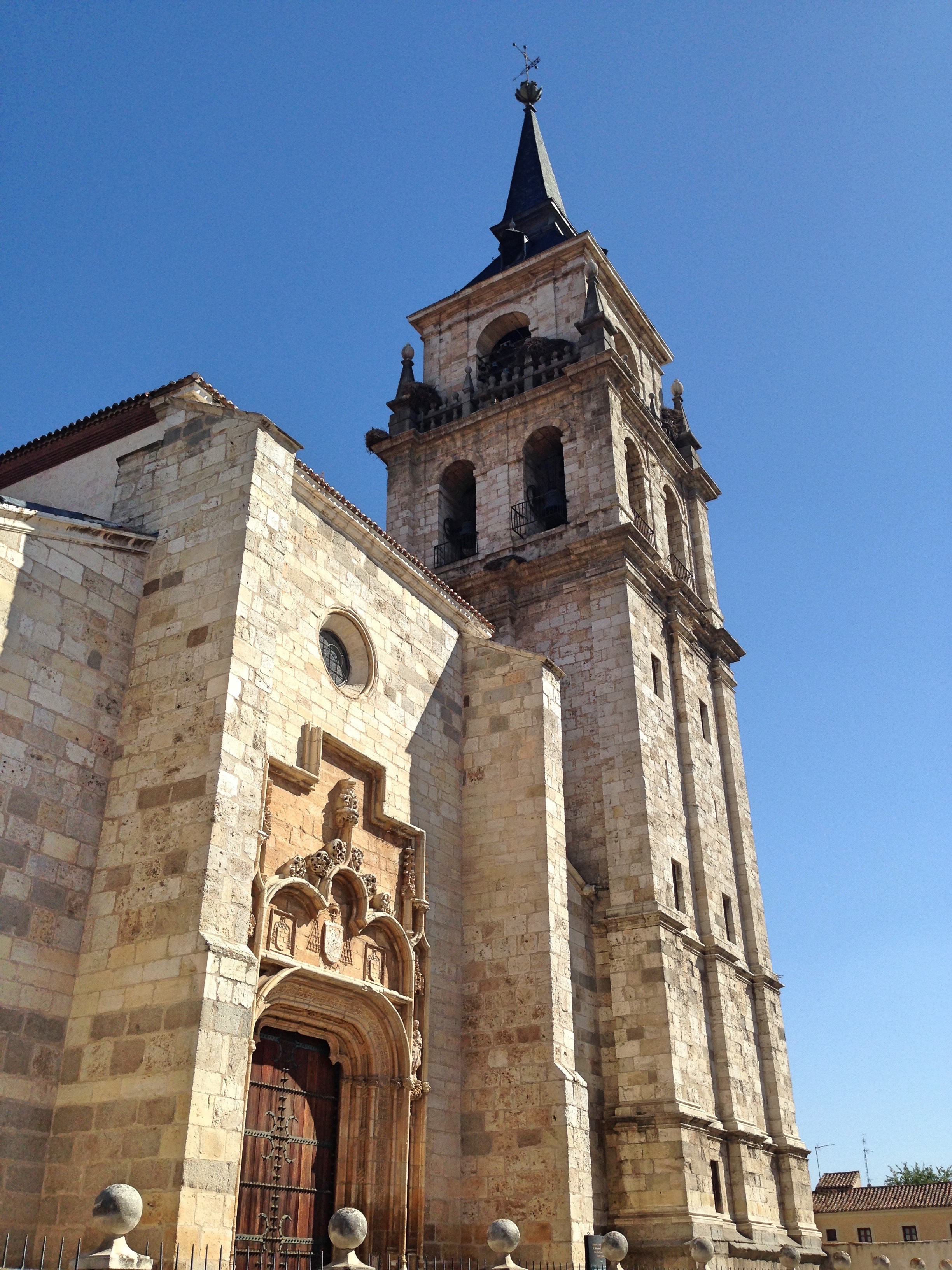
The Cathedral of Alcalá is also worth a visit. Although it was burned during the Spanish Civil War, thus destroying many of its decorations and altars, it remains an attractive building. The cathedral is, curiously, the unique for being the only one in the world which possess the title “Magistral Church,” which requires that all of its priests be doctors in theology.
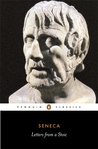
Philosophy is good advice; and no one can give advice at the top of his lungs.
One of the most persistent criticisms made of modern philosophy is that it isn’t useful. The critics have a point. Modern philosophy largely concerns itself with a variety of theoretical problems. Even though many of these problems do have practical ramifications, many do not; and regardless, the debates can often get so technical, so heated, and so abstract, that it is difficult to see modern philosophy as the path to wisdom it once professed to be. People don’t have time or patience for logic-chopping; they want useful advice.
Those of this persuasion will be happy to find a forerunner and a sage in Seneca. As the opening quote shows, he conceived philosophy to be, above all, the giving of good advice. Seneca thus finds a perfect vehicle for his thought in the form of the letter. Although this book apparently consists of the private correspondence between Seneca and his friend Lucilius, it is obvious from the first page that these were expressly written for publication and posterity. This book should rather be thought of as a collection of moral essays and exhortations.
Even in translation, Seneca is a master stylist. He is by turns intimate, friendly, self-deprecating, nagging, mundane, and profound. He has an enormous talent for epigram; he can squeeze a lifetime into a line, compress a philosophy into a phrase. He is also remarkably modern in his tolerant, cosmopolitan, and informal attitude. Indeed I often found it difficult to believe that the book was written by a real Roman. Montaigne and Emerson obviously learned a great deal from Seneca; you might even say they ripped him off. The only thing that marks Seneca as ancient is his comparative lack of introspection. While Montaigne and Emerson are mercurial, wracked by self-doubt, driven by contrary tides of emotion, Seneca is calm, self-composed, confident.
Perhaps because of his professed aversion to abstract argument, Seneca is not a systematic thinker. Emerson wrote “A foolish consistency is the hobgoblin of little minds,” and Seneca apparently would agree, for there are many inconsistencies to be found in these pages. Sometimes God is conceived of as an impersonal order of the universe, and at other times a personal deity; sometimes Lucilius is advised not to take the opinions of friends and family into account, other times to do so. Seneca’s metaphysical arguments are weak and confused affairs; he is not one for disputation. But for all this, there is a core of good sense contained within these pages, which Seneca himself summarizes:
No man is good by chance. Virtue is something which must be learned. Pleasure is low, petty, to be deemed worthless, shared even by dumb animals—the tiniest and meanest of whom fly towards pleasure. Glory is an empty and fleeting thing, lighter than air. Poverty is an evil to no man unless he kick’s against it. Death is not an evil; why need you ask? Death alone is the equal privilege of mankind.
Like Marcus Aurelius, a prominent statesman in troubled times, Seneca is very concerned with how to be happy in spite of circumstances. There is no satisfaction to be had through external goods, like fame and riches, because these cannot be gotten unless fortune is kind, and fortune is notoriously fickle. Even in good times, this can only lead you into an empty, meaningless competition, valuing yourself for something that isn’t really yours, causing you to ceaselessly measure yourself against others. You must rather become content with yourself, taking pleasure in life whether fortune smiles or frowns: “We have reached the heights if we know what it is that we find joy in and if we have not placed our happiness in externals.”
Of course, this is easier said than done, and Seneca does not have a fully worked-out system for reaching this state. He offers, instead, an unsystematic mass of advice. It is here that Seneca is most charming and helpful, for most other philosophers would not deign to offer such workaday recommendations and observations. Here is Seneca on negative thinking:
The mind at times fashions for itself false shapes of evil when there are no signs that point to evil; it twists into the worst construction some word of doubtful meaning; or it fancies some personal grudge to be more serious than it really is, considering not how angry the enemy is, but to what lengths he may go if he is angry.
It is in these sections, of plain, friendly advice, that I think Seneca is at his best. Certainly not all of his advice is good; every reader will pick and choose what suits them best. But much of Seneca’s advice is timeless, and phrased in deathless prose. Most refreshing is Seneca’s insistence that his advice is for action and not reflection. This is more than slightly ironic, considering that Seneca is often accused of being a hypocrite whose lifestyle was far removed from his doctrines; but, to quote a modern philosopher, “There is no contradiction, or even paradox, in describing someone as bad at practising what he is good at preaching.” So preach on, Seneca.
(This post is part of my series on the Basque Country. Click here for Bilbao, here for San Juan de Gaztelugatxe, and here for the Vizcaya Bridge.)
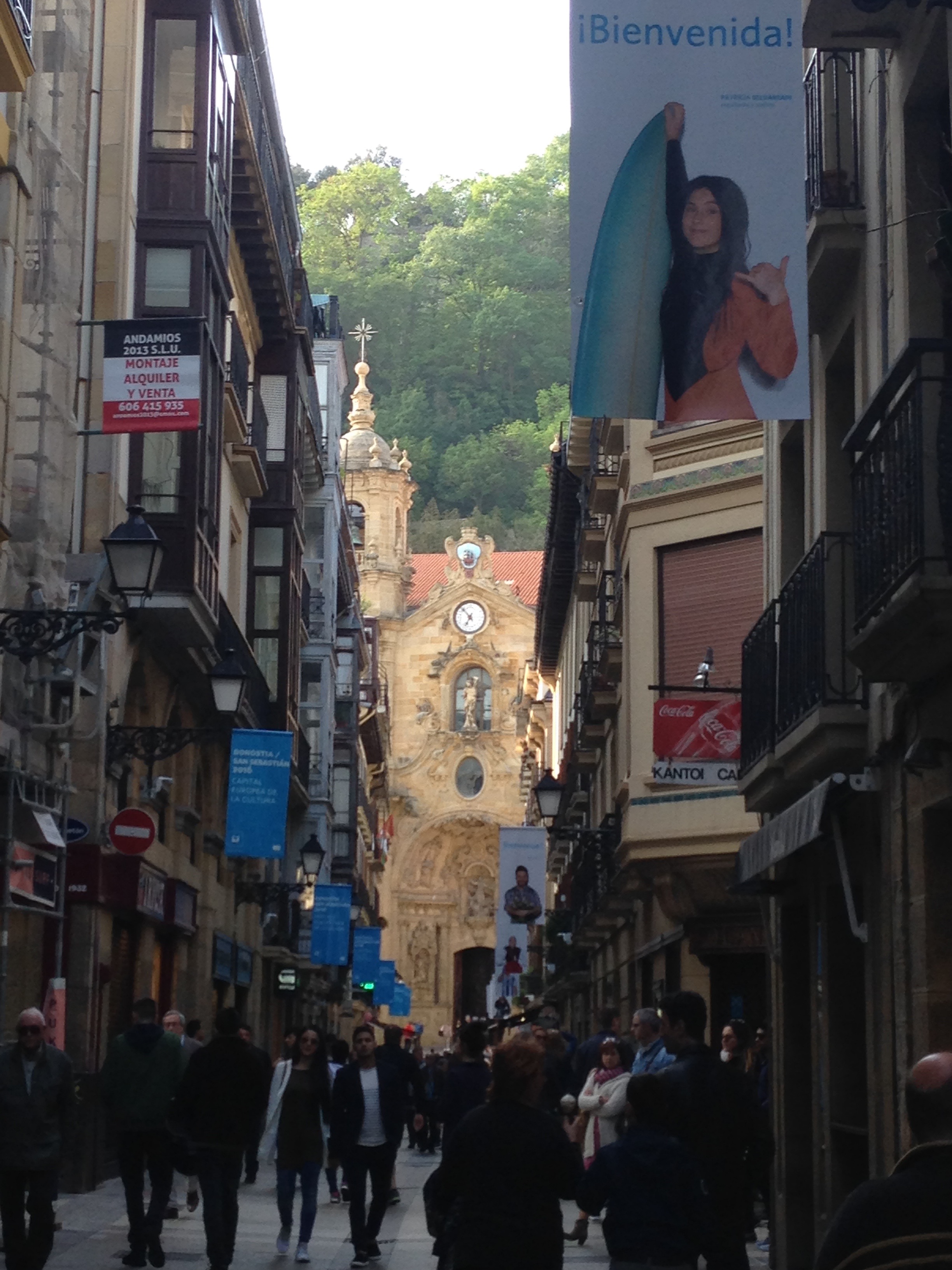
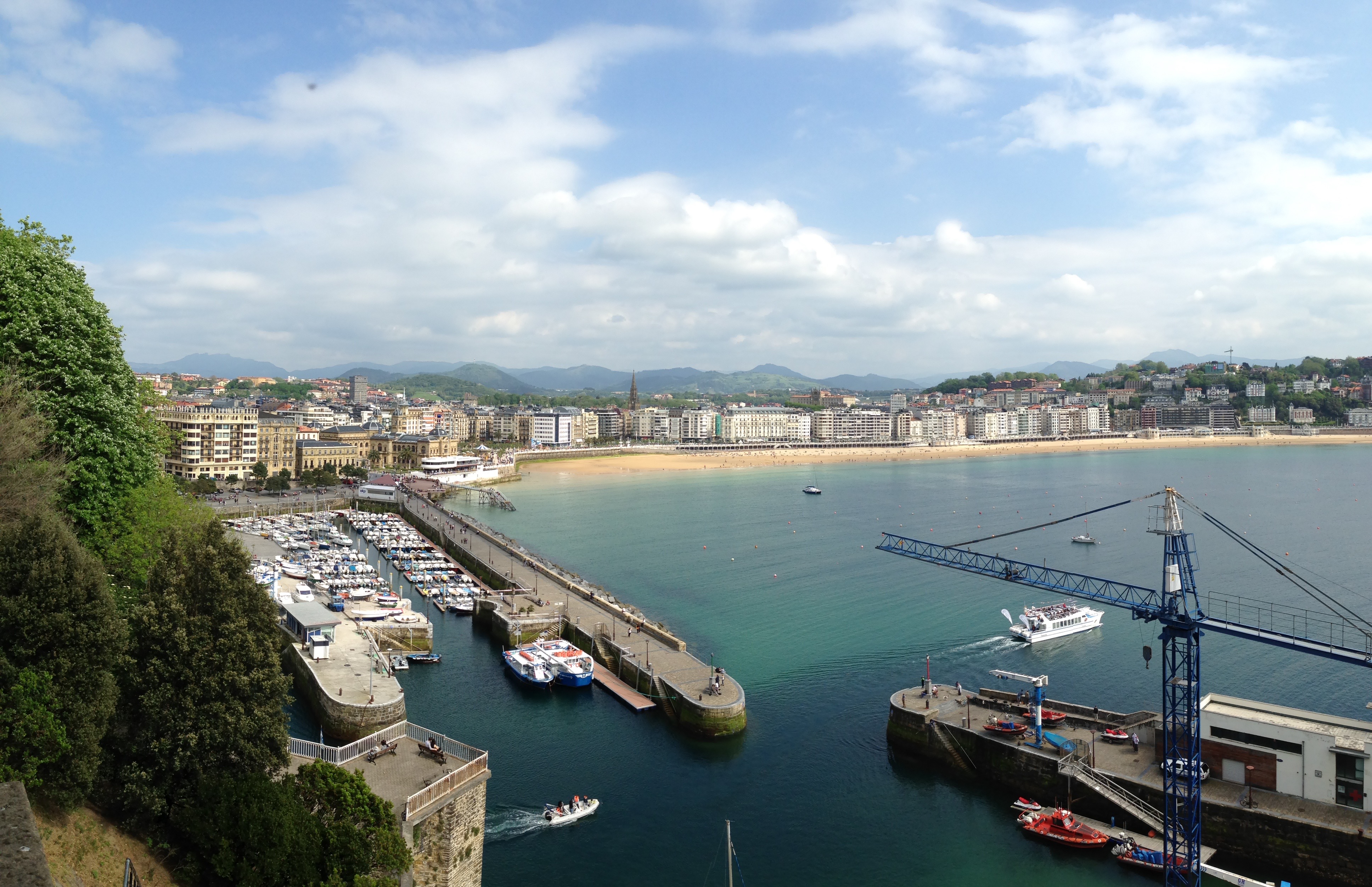
San Sebastián is a city much unlike Bilbao. For one, it is noticeably smaller, with a population of less than 200,000. But more conspicuously, it is not at all a city of industry, commerce, or manufacturing. Rather, it is a place of tourism. The streets are full of foreigners, squeezed into the narrow streets, filling up the parks, covering the beaches with their bodies. The city is also remarkably pretty. As I strolled along the beaches I was reminded of Cádiz; and as I wandered through the streets, Oviedo came to mind. But the strongest and most persistent impression was surprise at the number of tourists. They were all over the place; every restaurant was full, every shop was crowded. The shoreline was an unbroken wall of hotels. I had no idea San Sebastián was so popular.
Some of this probably had to do with the city being (along with Wroclaw in Poland) one of the European Cultural Capitals of 2016. (Each year, a city or two in the European Union gets designated a European Cultural Capital, which means it will host several Europe-oriented events during the year.) This may have attracted even more tourists than usual. Even so, it is clear that San Sebastián is a major tourist destination, because its whole economy is oriented around visitors. This is fitting, for the city is undeniably charming. Its location is a good one, too, being only 12 miles from the French border, and northerly enough so that the temperature is nearly perfect in summer.
We were hungry when we arrived, so our first order of business was food. Our Airbnb host recommended a restaurant in the center. The restaurant was the Bar Aitona, and it was excellent. We ordered the steak and the octopus. Both were served on a huge bed of fries, both were amply portioned, both were well seasoned, and both were scrumptious. Added to that, the prices were very reasonable. We left very full, and very satisfied. I recommend it with great enthusiasm.
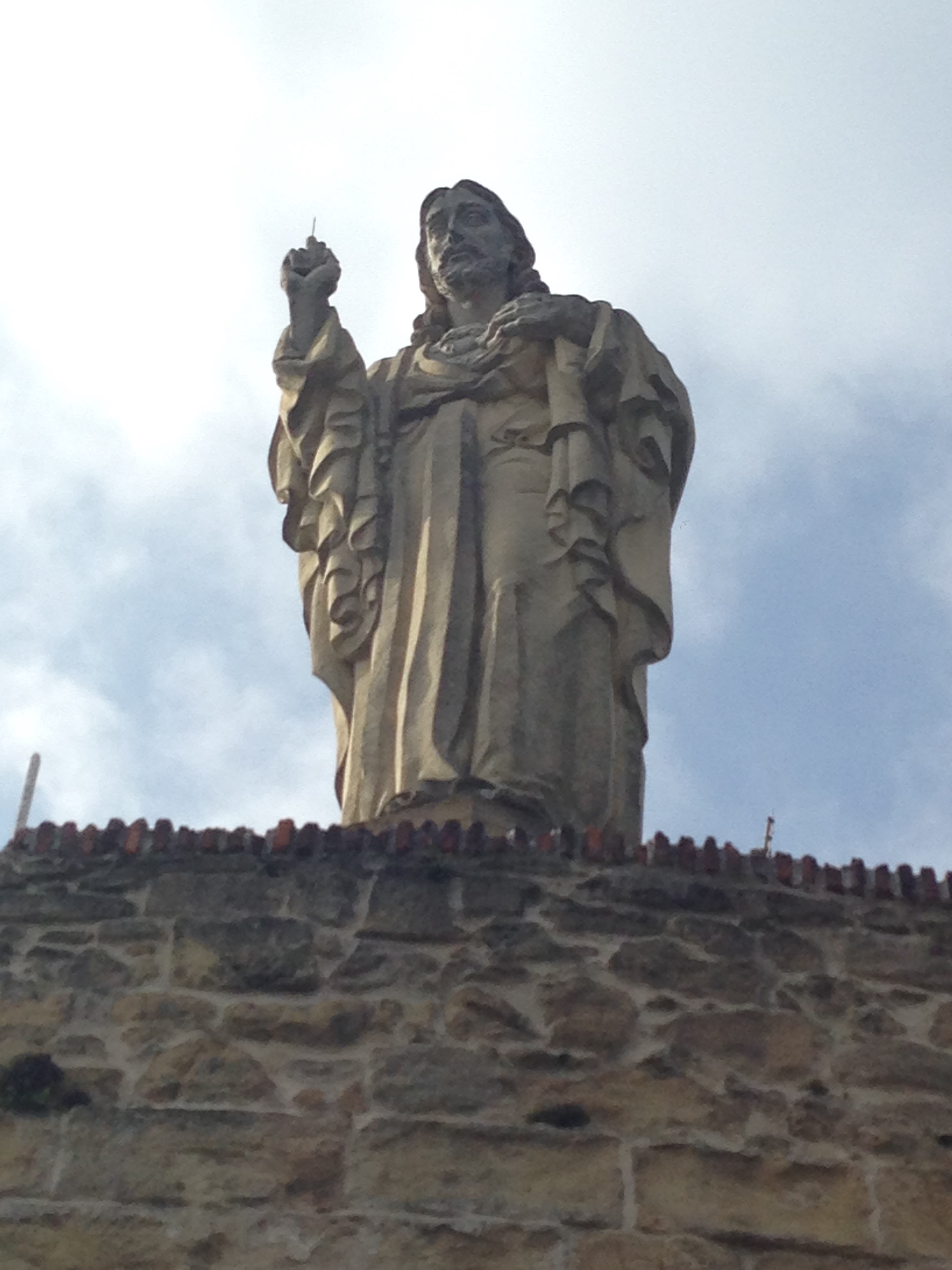
When we were back on the street, we decided to start exploring the city. This inevitably led us to Monte Urgull, the most conspicuous landmark in San Sebastián. Urgull is a hill that overlooks the bay. Nowadays, it is covered in trees, and is basically a park; but in the past it formed as a military fortification, since its high elevation at the bay’s edge made it well suited for defense. And these fortifications were not just for show; they were used in several important battles. Probably the most significant of these was the Siege of San Sebastián, in which the British forces, led by Wellington, ousted Napoleon’s troops in the Peninsular Wars. Of course, I didn’t know any of this at the time, but was instead attracted by the gigantic statue of Jesus—12 meters, or almost 40 feet tall—that looms over the hill.
We began walking up, and quickly found that it is a delightful place. Old walls, broken battlements, obsolete canons, and other aging fortifications still stand, some in ruins, some overgrown; and for me there is something remarkably romantic about the sight of weeds and trees reclaiming the abandoned dwellings of past times. The hill is divided into several levels, and as you ascend you get a progressively better view of the city. From the top, the whole shore is spread before you, with its azure water, crowded beaches, and the rolling green hills in the distance. We got to the top, where we could stare up at the towering figure of Jesus, and then descended on the other side of the hill.
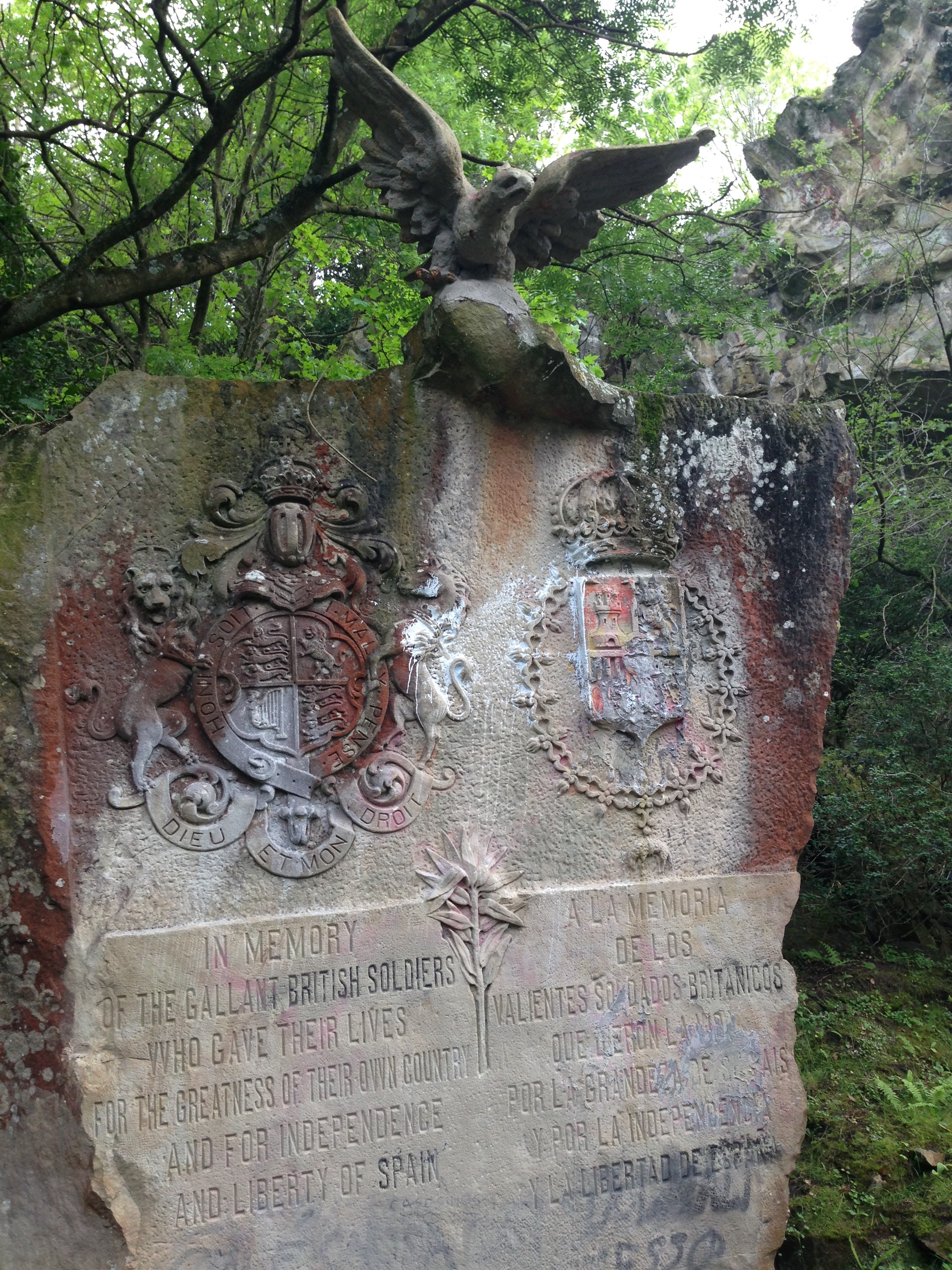
This part of was a wooded area. But as we climbed down a rocky path, something caught our eye. Right below a cliff, surrounded by roots and trees, was the old memorial erected by the British army after the conquest of San Sebastián. A broken and discolored plaque, bearing the royal insignias of England and Spain, bore a message in both English and Spanish honoring the fallen soldiers. Further on, we noticed another plaque, this one on the side of a rock face, honoring the unknown soldiers lost in the campaign. I know these must be well known, but at the time, with only the two of us, it felt like coming upon an archaeological treasure. This illusion was quickly dispelled, since at the bottom of the hill we encountered a map showing where all the different war memorials, graves, and mausoleums could be found on the hill. In any case, it’s a lovely area, both for its history and its views.
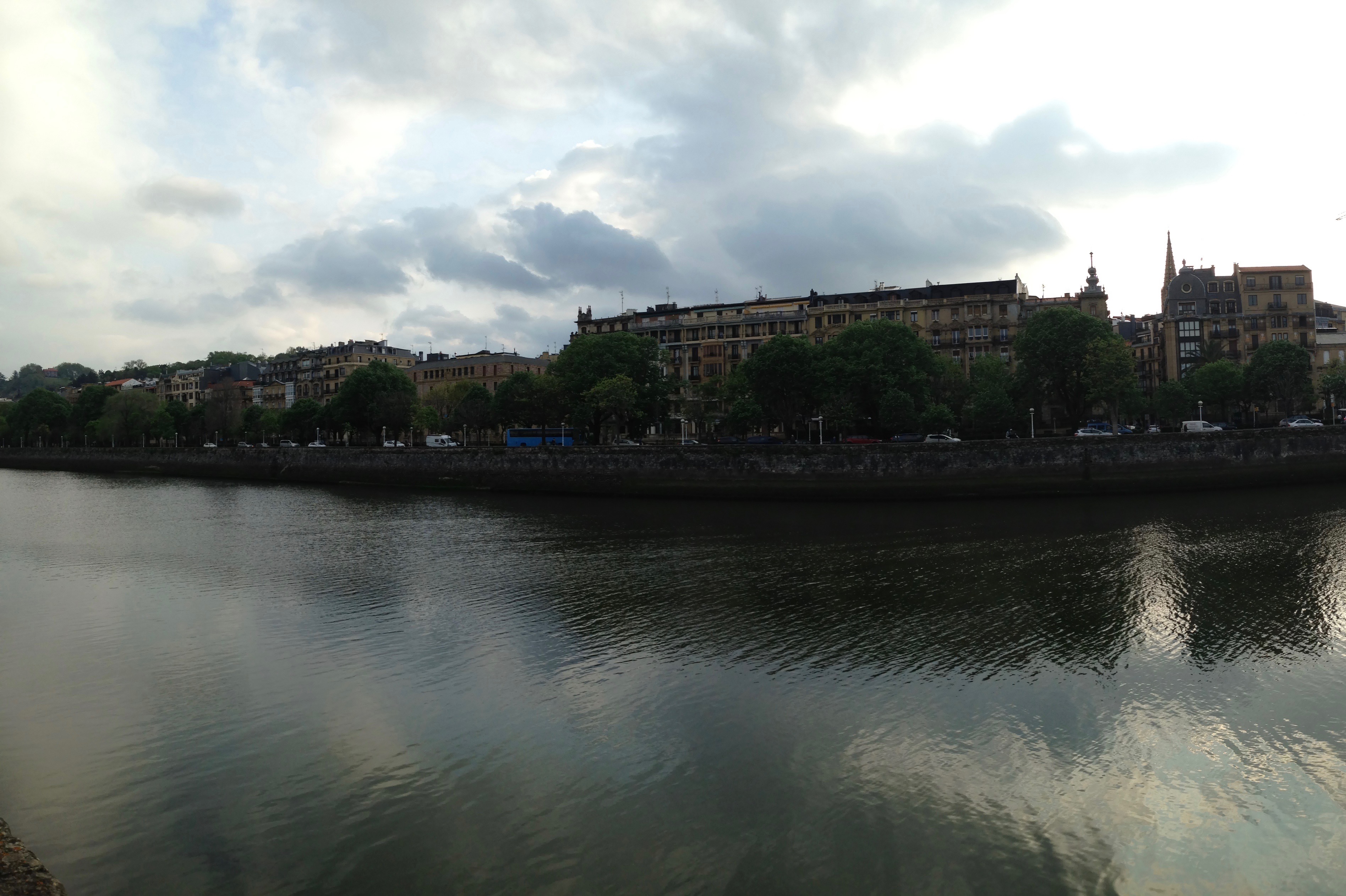
The rest of our day was rather uneventful. We strolled around San Sebastián, enjoying the ocean, the river, the crowded city center. But we did not really visit anything in particular, since we couldn’t find anything to visit. It seems that San Sebastián is a lovely place if you want to eat and go to the beach, but it does not have much in the way of cultural tourism, which is mostly what I’m after. In any case, it was late. We had arrived at around noon, and by now the sun was setting. So we walked along the river to our apartment, and the next morning we said farewell to the Basque Country. But I hope to return, the sooner the better.
A Comedy of Errors holds a special place in Shakespeare’s oeuvre. It is believed to be his first play; it is one of two Shakespeare plays that observe the “classical unities”; and it is Shakespeare’s shortest play. You can add to this list, Shakespeare’s silliest play, since A Comedy of Errors amply merits this superlative.
To enjoy this work, the viewer must be an expert in suspending disbelief. That there be two sets of twins, bestowed with the same names, who happened to be dressed in the same clothes on the same day—it does not even approach credulity. Added to this is the capstone absurdity that the mother was in the city the whole time, but did not choose to reveal herself to her son for years.
The reward for accepting this improbable premise is hilarity. The humor is low and occasionally crude, but no less brilliant for that. Shakespeare manipulates the simple device of mistaken identity like a virtuoso, squeezing out every bit of drama and every fleeting giggle from this ancient gag. Shakespeare is always witty and amusing, of course, but seldom was he such an expert conjurer of belly-laughs. The scene in which Dromio of Syracuse compares the kitchen-maid to a globe, describing where all the countries can be found on her rotund body, is a pinnacle of comedy.
If this play was, indeed, his first, it certainly augurs Shakespeare’s coming greatness. To make a slapstick farce such as this, the writer need not endow the characters with anything resembling a round personality. But Shakespeare does, and brilliantly. Antipholus of Syracuse is appealing speculative, comparing his search for his long-lost brother to “a drop of water / That in the ocean seeks another drop,” and repeatedly questioning his own identity. His twin brother of Ephesus is decidedly more bourgeois and extroverted; and his wife, Adriana, is touching in her scorned devotion. But of course the real star of the play is Dromio—played by none other than Roger Daltrey in the version I saw—who’s relentless good nature and nonstop wordplay render him irresistibly endearing.
In sum, though certainly not “deep,” this play is both expert and original—a piece of juvenilia that, even by itself, would have secured Shakespeare a modest place in the Western canon, if only as the most perfect example of a staged farce.
(This post is part of my series on the Basque Country. Click here for Bilbao, here for San Juan de Gaztelugatxe, and here for San Sebastián.)
The train pulled up to Portugalete station, the doors opened, and we got off. Portugalete is one of the towns, ranged along the Bilbao river, that make up the Bilbao metropolitan area. (The name’s resemblance with “Portugal” is apparently only a coincidence.) With a population of about 50,000, and a land area of only 3.21 square kilometers, it is actually the fifth most densely populated area in Spain.
To me, the place struck me as a pleasant, moderately urbanized, more or less tranquil town. Along the riverside there were some large, attractive restaurants, their tables crowding into the streets—though at this hour, too early for dinner in Spain, the chairs were mostly empty. But the surroundings didn’t attract my attention for long, since I could already see my goal: the Vizcaya Bridge.
In Spanish it is called the Puente Colgante, or “Hanging Bridge.” The name is appropriate. It is a perplexing sight at first. The bridge has the familiar form of a suspension bridge; but the middle section seems to be misplaced: it hangs ludicrously high in the air, with no ramps to get up or down. The more I looked, the more confused I became, for there didn’t seem to be any way you could use the bridge.
As I got nearer, I noticed something strange on the water. It wasn’t quite on the water, actually, but hovering above it. I looked up, and saw that the thing was hanging from the bridge. So that’s how it worked! The reason the bridge looked so odd was that it transported a shuttle that hung underneath, almost like a puppet on strings. That’s why the bridge was so high up and there weren’t any ramps to get on.
But it looked dangerous to me. The shuttle was fairly large; it transported about six cars and one hundred people. Could that skeletal iron structure above support so much weight? Dreadful fantasies immediately started rushing to my mind. I saw the bridge snapping in the middle, sending iron raining down into the river below, crushing the shuttle and sending everyone inside to a watery grave. Unfortunately, awful visions like this plague me rather frequently. I wonder if it’s the product of a morbid imagination, or just watching too many action movies.
We went into the office and bought our tickets, though I wasn’t sure what the tickets were for. The man explained that there was an elevator to take you up to the top, where you could walk to the other end. He also gave us a little information pamphlet about the bridge. From this, I learned that the bridge is actually a UNESCO World Heritage site, the only monument in the Industrial Heritage category in Spain.
I also learned more about the construction and history of the bridge. The Vizcaya Bridge is a transporter bridge, the first of its kind in the world. If you haven’t heard of a transporter bridge before, that is perfectly normal, since this type of bridge is uncommon; according to Wiki, less than two dozen were built, and only 12 still stand today.
The Vizcaya Bridge, finished in 1893, was designed by one of Gustave Eiffel’s disciples, Alberto Palacio; and Eiffel’s influence shows. The bridge is built in the same manner as the Eiffel Tower, with narrow iron beams riveted together to form a triangular grid; and like the Eiffel Tower, the Vizcaya Bridge is austere and elegant. Palacio originated the idea in response to a common engineering problem: how do you create a bridge that allows people and cars to cross the river, while leaving the river open for shipping vessels? The Vizcaya bridge, then, in both purpose and execution, is a symbol of the Basque Country’s embrace of industry, commerce, and the future—not to mention art.
(I do wonder, though, whether Palacio’s solution was all that efficient. After all, there must be a reason why the design didn’t catch on. The primary problem, it seems to me, is that the amount of cars and people that can cross at any one time is limited by the size of the shuttle and the frequency of its trips. Perhaps the famous Tower Bridge in London—completed almost the same year—solved the problem more satisfactorily, by putting a drawbridge on the lower level and a pedestrian walkway on the upper. But Palacio’s design is beautiful, original, and elegant, so efficiency can go to the devil.)
Finally it was our turn for the elevator. It was an ancient thing, crawling up the bridge at a snail’s pace. Eventually the lift creaked to a halt, and we got out. A narrow wooden walkway, surrounded by the iron structure, extended from one end of the bridge to the other. It’s really amazing how much of the Vizcaya Bridge is just air. You can see right through the thing, and yet it is strong enough to support the weight of a large shuttle carrying six cars.
I experienced this when one of the shuttles came rolling by, right underneath our feet. I could feel the entire bridge shaking, rattling, and shivering, as the electrical buzzing of the engine roared past. Once again, terrible fantasies started flickering through my mind, this time with me myself plunging to a ghastly death. But soon the shuttle came to a halt, and I realized that the bridge was solid as stone. What an impressive achievement: The bridge seems to float high up in the air, supported by the slenderest structure; and yet it is sturdy enough to remain operational after more than one hundred years of daily use.
We took some time to admire the view. On one side we could see the bay, and then the ocean beyond. In the dockyard in the distance, I could see dozens of giant cranes standing silently, like petrified dinosaurs, waiting to come back to life. On the other side, we could see the river gradually making its way towards Bilbao; and in the distance, a factory loomed. Really, wherever you turned you could not fail to notice the signs of industry, filling up the entire estuary with their jagged, colossal, metallic forms. Below us, we could see the towns of Portugalete on one side and Getxo on the other, their streets now full. We might have stayed more time up there, but the wind was quite strong and chilly, so we took the elevator down on the other side. Not long after that, we took the shuttle from Getxo across the river, back to Portugalete; and I am happy to report that the ride was quick and smooth.
There is only one thing more I have to report. Before we left, GF had asked some of her students in Madrid where you can buy good pizza, and they told her to go to Telepizza (a popular chain here, comparable to Dominoes). That sounded awful to me, but GF wanted to try it; so, once we got to Portugalete, we decided to go to the nearest Telepizza for dinner. It brings me no joy to tell you that, as I expected, the pizza was horrible, some of the worst pizza I’ve ever had; and GF was of the same opinion. Is this what Spanish people think pizza is supposed to taste like?
(This post is part of my series on the Basque Country. Click here for Bilbao, here for the Vizcaya bridge, and here for San Sebastián.)
I always find public transportation a bit nerve-racking—especially in a new city, not to mention a foreign country. Every time I hop on a bus, I feel like I’m taking a leap of faith. I imagine taking the wrong bus and getting stranded in the middle of nowhere, or taking the right bus and getting off on the wrong stop—and these fears aren’t totally unfounded, as I’ve done both of these things. Thus I was filled with apprehension as we searched for the bus to Bakio, the A3518.
Probably you have never heard of Bakio, because there isn’t much to be heard about it. Bakio is a small town, with a population of about 2,500, situated about 30 kilometers from Bilbao. There is admittedly a beach there, although the damp, chilly, overcast weather of the region didn’t exactly put me in the mood for surfing. Rather, we were going to Bakio because it was the closest we could to get by bus to San Juan de Gaztelugatxe.
The town of Bakio
The bus ride to Bakio was quite pleasant, taking us through the green countryside, filled with little huts and farmhouses tucked away into the rolling hills. After 40 minutes we arrived, ate some breakfast, and then set on our way. I had found a little report online (found here), written by somebody who had walked from Bakio to Gaztelugatxe. And attached in that report is a little map, with the walking route conveniently highlighted. But for whatever reason I forgot about this map as we started walking. Instead I chose to rely on my phone’s GPS to guide me there. Please, don’t make this mistake: just follow the walking route.
GF and I soon found ourselves walking along a busy road, with no sidewalks.
“Are you sure this is the right way?” she said.
“Yeah, I’m just following my phone.”
“Okay…”
We walked further, and after a while came to a sharp curve in the road. Because there wasn’t any sidewalk, and the road was hemmed in by a rockface on one side and some trees on another, we found ourselves in the predicament that, no matter which side we chose, we would risk making ourselves invisible to an incoming car. Thankfully, the cars only came periodically, with big gaps in-between; and we hoped we’d be able hear them a ways off. Still, it was nerve-racking as we rushed around the corner, trying to minimize our time on the curve.
“I hope there aren’t any more curves like that,” GF said as we got to the other side.
“Me too,” I said.
But five minutes later, we came to another curve. And then another, and another. The entire road, it seemed, wrapped around the hills like a snake, constantly turning left and right. Meanwhile, the amount of cars on the road seemed to be steadily increasing.
“I don’t like this,” GF said. “Is there any way off this road?”
“Umm,” I said, “maybe up ahead.” (I had no idea.)
During the stretches of straight roads, I did my best to enjoy the scenery. It was a nice place, with pine trees and farmhouses all around, and the occasional view of the countryside beyond. But the whoosh of a passing cars destroyed any peace to be had; and the sight of every sharp turn ahead increased my anxiety.
There was over an hour of this, the two of us walking on through the brush and bushes by the side of the road, our feet searching for stability amid the roots and rocks, changing sides whenever it seemed more safe, pressing ourselves against the trees whenever a car went past, rushing around curves with our adrenalin racing, GF nervously complaining while I tried to keep my own fears to myself. And then, finally, just as I was at my wit’s end, the hermitage came into view.
“Yes!” GF said, filled with relief.
§
San Juan de Gatztelugatxe (recently made famous in Game of Thrones, as the location of Dragonstone) is an island off the coast of Biscay, connected to the maindland by a man-made bridge. Since at least the 10th century, a little religious building has been perched up at the top of it, though it has burnt down and been rebuilt many times, most recently in 1980.
To get there from the road we had to climb down towards the shore. The path was steep, twisting, and rocky. Even though you’re going down hill, it is exhausting because you need to be constantly on guard against falling. At last we got near the bottom, where there was a lookout point from which we could get a good view of the island.
It must be one of the most astonishing sights in Spain. The island is a mound of jagged grey rock, covered in slight patches of green. Its splayed form stretches out into the sea, wherein it is battered day and night, on all sides, by the winds and the waves. In the middle of this island, criss-crossing its way up from the bottom to the top, is a staircase—usually filled with the miniscule forms of people going up and down. And crowning the island is the hermitage, a small shack with a dull red roof.
Perhaps this image is so appealing to me because I find in it a symbol of the relationship of humanity to nature. We have carved a staircase into the rock, and erected a place of worship on the summit of the island; and in this way we can be said to have dominated the place. And yet, how feeble our dominance of nature seems when viewed from a distance—just a pile of boards, liable to be blown away by the first strong gust. This is the age-old contest of craft, cleverness, and perseverance against capricious, indifferent power. And I cannot help thinking that, however successful we are now, there will come a day when the hermitage blows down, and there won’t be anyone to build it back up again.
But these gloomy thoughts were soon gone as I huffed and puffed my way up the staircase to the top of the island. By now we had been walking over an hour next to that road, our hearts in our throats all the while; so we were understandably a bit worn out. It felt all the better, then, when we finally reached the top, and could look back towards the land.
In the distance, to our right, we could see the beach of Bakio; and to the left, nothing but steep, grey cliffs and green forests. Gigantic rocks stuck out of the ocean, the biggest one almost as big as the island itself. To one side, far off, I could see what looked like an oil drill. Apart from that, no boats, no freighters, no planes broke the endless blue of the sea beyond or the grey of the sky above. It felt like standing at the edge of the world.
We couldn’t go inside the hermitage, nor even peek through a window. This didn’t bother me, however, since judging by the looks of the plain exterior, the interior would be similarly nondescript. What we could do was ring the bell. A string hung from the bell on the roof to the ground below, and all the visitors were taking turns having a pull (one kid got a bit too enthusiastic, and his parents had to keep him away). I gripped the chord and lightly tugged, and the satisfying clang of a church bell sounded overhead.
Since neither of us had any intention of repeating that dreadful walk by the road, this time I looked up the walking path on my phone. We found the path without any trouble, which made me feel like such an idiot for not using it the first time. It was such a relief! Instead of the twisting, turning road we had a straight path, free of cars, taking us through quiet countryside. We passed through a copse of trees, and then through some fields where cows were grazing, making our way over gently rolling hills, the seaside on our right, until we were finally back in Bakio. The bus soon arrived, and then we were on our way to Bilbao, where we still had one more thing to see.
The bus crawled out of Zaragoza’s main bus terminal, Delicias, and quickly left the city limits. It was early morning. The landscape was entirely shrouded in fog. It wasn’t long before I gave up trying to see the countryside and fell asleep. When I awoke—with a headache and a nasty taste in my mouth—we had parked in Catalayud, a small town midway between Zaragoza and my destination, where we had to transfer buses. I was on my way to the Monasterio de Piedra.
I was still in a daze. That morning I had awoken at an ungodly hour to walk all the way across the misty city to catch an eight o’clock bus. I still felt chilled from the early morning air, but I couldn’t warm up, since it was nearly as cold inside the bus station as it was outside.
I looked out the station window to check if there was anything to see, but the fog acted as an impenetrable veil. This was a shame, since I had noticed Calatayud from the highway on the drive to Zaragoza, and immediately became intrigued. The town is nestled beneath towering cliffs, on top of which stands a commanding castle, whose walls look like they sprung spontaneously out of the rocks. This, it turns out, is the oldest and largest Moorish fortress still existent in Spain.
It wasn’t long before we boarded another bus. Again, I fell asleep immediately, only coming to my senses as we approached the monastery. The fog had cleared by now, and I could see that our bus was creeping along a fairly narrow road, situated above a river; red cliffs ran along the other side. This dramatic scenery was an omen of what was to come.
Finally we arrived. We all shuffled out of the bus and made our way past the walls and into the complex. I waited in line and bought a ticket, still fairly ignorant of what I was paying for. I had come here on the recommendation of friends; and as usual I hadn’t looked up any information about the place before coming.
§
The Monasterio de Piedra is situated at the confluence of the rivers Piedra (thus the name) and Ortiz, in a remote spot within the Iberian Mountains. Founded in the late 12th century by the Cistercians, the monastery was a symbol and outpost of the accelerating Reconquista, the Christian push southward against the Moors, who then controlled all of Aragon and beyond. As such, the monastery was liable to being attacked, which is why defensive wall surrounds the complex.
During the centuries of its use, as the Cistercian monks worked and prayed along the banks of the Piedra, steeped in the cool mountain air of the region. The Moors, who had so long controlled and shaped the Iberian Peninsula—it was the Moors, for example, who established the city of Catalayud that I passed through—eventually lost control, and the small Christian principalities and kingdoms were merged into larger and larger states. It wasn’t long after the “reconquest” was completed, and Castile and Aragon were unified under the “Catholic Monarchs,” that Columbus made his famous voyage to the “Indies,” thus commencing Spain’s brutal colonization of the New World. It was here, in this monastery, that chocolate was first made in Europe, after Hernán Cortes send cacao beans and an Aztec recipe to the monks here.
Three hundred years later, Spain was again divided. In 1833, the first Carlist war commenced, a war between two contending successors to the throne, Carlos de Borbón and Isabella II (who won, and was eventually deposed). Heavily in debt from the prolonged civil war, the Spanish government commenced another of its desamortizaciones, or confiscations, of Church property. Besides the financial incentive, the conservative Church hierarchy supported the reactionary Don Carlos, so this move had both financial and emotional appeal. In any case, it was during this desamortización that the Monasterio de Piedra was seized and sold, thus putting an end to its Catholic history.
For reason of pure anti-clerical fervor, I presume, the church building itself was burned. Now all that remains is a ruined shell of a building. This is a shame, since was fragments that remains give some hint of a glorious medieval edifice. Some of the ornamental friezes around the doorways, for example, are of the finest quality. Now, however, the building’s appeal is Romantic rather than Romanesque. As I’ve mentioned elsewhere, ruins have a strange power to evoke feelings of mysterious awe. Certainly I felt this as I sat facing the destroyed altar, the walls reaching up to a vacant ceiling, the sky gaping overhead. It was like stepping into one of Caspar David Friedrich’s paintings—a timeless, fossilized wreck.
If the burnt church building is unintentionally romantic, the rest of the monastery is quite intentionally so. After briefly being owned by a wealthy Catalan merchant, who mainly used it for agriculture, it passed into the hands of Juan Federico Muntadas.
A well-educated and original man—among other things, he created the first fish farm in Spain—Muntadas was born in 1826, and was thus roughly of the same generation as Gustavo Adolfo Bécquer. And, like Bécquer, he was a Romantic. If you, for example, compare the royal gardens of Aranjuez or La Granja with Muntadas’s creation in the Monasterio de Piedra, you can get some idea of the mental difference between the Enlightenment and the Romantics. Whereas the royal gardens are neat, orderly, symmetrical, with clearly delineated plots for plants and paths for people, Muntadas molded a space that creates the sensation—if not exactly the illusion—of untrammeled nature.
The walking path through the monastery grounds takes about an hour. Though it was winter, the place was still quite green. Shallow ponds reflected the twisted and bare forms of tree limbs, while the verdant underbrush was speckled with the reds of crinkled fallen leaves. Small wooden bridges led the walker through this marshy area to the main attraction: the waterfalls.
Using the diverted waters of the Piedra and the Ortiz, Muntadas created a dazzling series of cascades. Varying in size from ankle-level to the size of an apartment building, these waterfalls are some of the prettiest I have ever seen. The rocks have been carefully placed to divide the stream into several rivulets, creating a dancing pattern of sparkling, splashing streams.
The path took me up beside one of the larger waterfalls and up a staircase in the adjacent rock face. Ivy, branches, and leaves were draped around the water, as if thirsty for a drink. Once at the top, we passed over a shallow stream, and followed it down again as it accelerated into a whooshing, multi-layered cataract, the stairwell winding its way downwards beside the water. Children and parents were crowded on the slippery steps, posing for photos. Along the way I caught a glimpse of the surrounding area, whose red rocky cliffs and rolling hills stretched into the far distance. The path continued, becoming narrow as it navigated the hillside, until finally we were led into a cave.
This cave—full of stalactites and stalagmites, green with algae, the jagged rock edges worn into eerie undulations by the water—was under the largest of the waterfalls. Water poured down at its entrance, filling the place with a ceaseless mist. I had to take off my glasses since they got so covered in droplets. We came out of the cave the same way we went in; then, after a walk through a long tunnel, I found myself by the famous Lago del Espejo, or Mirror Lake.
The shallow water, only inches deep and filled with aquatic plants, was uncannily reflective. And there was plenty to reflect, since the lake is situated underneath impressive rock faces, stretching up far above us and casting imposing shadows. By this time I had completely fallen under the spell of the place. The impression created by so many manipulations of water and stone was that of deep, almost meditative calm. I felt perfectly relaxed and refreshed.
Finally I ended up where I had begun: by the old, burnt church. Quite hungry by now, I went to the restaurant near the visitor’s center, which had quite a good—and affordable—daily menu. Then, stuffed and exhausted, I boarded the bus to go back to Zaragoza.
Remote and difficult to get to using public transportation, El Monasterio de Piedra is yet another example of Spain’s seemingly inexhaustible treasures.