e’ssay. (2) A loose sally of the mind; an irregular indigested piece; not a regular and orderly composition.
—From Samuel Johnson’s Dictionary of the English Language.
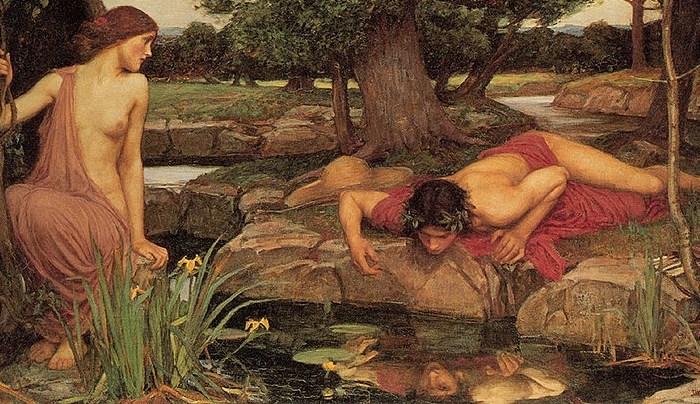
Now I finally have an answer to the famous “desert island book” question: This book. It would have to be. Not that Montaigne’s Essays is necessarily the greatest book I’ve ever read—it’s not. But here Montaigne managed to do something that has eluded the greatest of our modern science: to preserve a complete likeness of a person. Montaigne lives and breathes in these pages, just as much as he would if he’d been cryogentically frozen and brought back to life before your eyes.
Working your way through this book is a little like starting a relationship. At first, it’s new and exciting. But eventually the exhilaration wears off. You begin looking for other books, missing the thrill of first love. But what Montaigne lacks in bells and whistles, he more than compensates for with his constant companionship. You learn about the intimacies of his eating habits and bowel movements, his philosophy of sex as well as science, his opinion on doctors and horsemanship. He lets it all hang out. And after a long and stressful day, you know Montaigne will be waiting on your bedside table to tell you a funny anecdote, to have easygoing conversation, or to just pass the time.
To quote Francis Bacon’s Essays: “Some books are to be tasted, others to be swallowed, and some few to be chewed and digested.” Montaigne’s essays are to be sipped. This book took me a grand total of six months to read. I would dip into it right before bed—just a few pages. Sometimes, I tried to spend more time on the essays, but I soon gave it up. Montaigne’s mind drifts from topic to topic like a sleepwalker. He has no attention span for longwinded arguments or extended exposition. It’s not quite stream-of-consciousness, but almost. As a result, whenever I tried to spend an hour on his writing, I got bored.
Plus, burning your way through this book would ruin the experience of it. Another reviewer called Montaigne’s Essays the “introvert’s Bible”. This is a very perceptive comment. For me, there was something quasi-religious in the ritual of reading a few pages of this book right before bed—night after night after night. For everything Montaigne lacks in intelligence, patience, diligence, and humility, he makes up for with his exquisite sanity. I can find no other word to describe it. Dipping into his writing is like dipping a bucket into a deep well of pure, blissful sanity. It almost seems like a contradiction to call someone “profoundly down-to-earth,” but that’s just it. Montaigne makes the pursuit of living a reasonable life into high art.
Indeed, I find something in Montaigne’s quest for self-knowledge strangely akin to religious thinking. In Plato’s system, self-knowledge leads to knowledge of the abstract realm of ideals; and in the Upanishads, self-knowledge leads to the conception of the totality of the cosmos. For Montaigne, self-knowledge is the key to knowledge of the human condition. In his patient cataloging of his feelings and opinions, Montaigne shows that there is hardly anything like an unchanging ‘self’ at the center of our being, but we are rather an ever-changing flux of emotions, thoughts, memories, anxieties, hopes, and sensations. Montaigne is a Skeptic one moment, an Epicurean another, a Stoic still another, and finally a Christian.
And isn’t this how it always is? You may take pride in a definition of yourself—a communist, a musician, a vegan—but no simple label ever comes close to pinning down the chaotic stream that is human life. We hold certain principles near and dear one moment, and five minutes later these principles are forgotten with the smell of lunch. The most dangerous people, it seems, are those that do try to totalize themselves under one heading or one creed. How do you reason with a person like that?
I’ve read too much Montaigne—now I’m rambling. To return to this book, I’m both sorry that I’ve finished it, and excited that it’s done. Now I can move on to another bedside book. But if I ever feel myself drifting towards radicalism, extremism, or if I start to think abstract arguments are more important than the real stuff of human life, I will return to my old friend Montaigne. This is a book that could last you a lifetime.
“That’s what the pigs eat, the acorns from those trees. They’re called encinas.”
We were on our way to Cáceres, one of the major cities in Extremadura. Out the window I could see the flat, featureless, interminable plains of the region. Extremadura is known in Spain as being the poorest autonomous region—whose subsidization the Catalans are forever resenting. Life here, in this land of farmers and shepherds, has historically been rough. Perhaps this is why so many of the infamous conquistadors—including the two most famous, Francisco Pizarro and Hernán Cortés—ventured forth from this land: having few prospects at home, they sought adventure abroad.
The drive west from Madrid is perhaps the least interesting one in Spain I know. There isn’t anything to see except fields of grass and the aforementioned short, shrubby trees. But the visual dullness is amply compensated by what the traveler can learn about Spain from a trip here. Case in point: jamón ibérico, the finest ham in the country—and ham is fundamental to Spanish food—comes from here. The black pigs roam, free-range, eating the acorns of the encina trees, known in English as the “holm oak.”
Our driver spoke in the fast, clipped accent of Cáceres, only slightly easier to understand than the dreaded accent of Andalusia. We were on vacation for Semana Santa, Holy Week. Our final destination was Lisbon; but to break the trip into manageable chunks we decided to stop in Cáceres and Mérida on the way there, cities that had been recommended to us.
In two hours we arrived, dropped off our bags, and went into the city center. It was a rainy, overcast day, with a chilly breeze. The gray sky and the dull light gave the town a forsaken aspect. But instead of detracting from the city’s charm, the weather added to it.
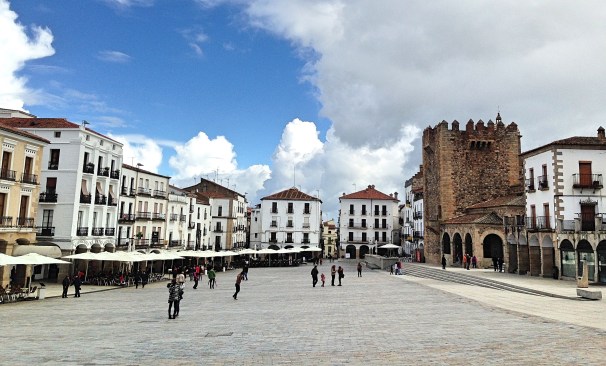
Cáceres is one of the major cities of the region, the capital of its eponymous province. The city is notable for having one of the finest historical centers in Spain. The walled city is almost perfectly preserved; it looks as though hardly anything has changed since the Middle Ages. Most of the buildings are worn and weather-beaten, but their brown stone façades are all the more impressive for that. Unlike Toledo, few buildings stand out for special comment. Rather it is the entire city center that is the main attraction, the narrow stone streets, the proud walls, the many church spires.
The Plaza Mayor
But Cáceres is not exactly beautiful, and it certainly isn’t pretty. The city is impressive for its severity. While wandering through the chilly interior of a cavernous church, or standing in the rain underneath the city walls, you get the powerful sense of what it must have been to live here, eking out a living on the hard soil, taking shelter behind the walls, seeking salvation in another world. The final impression is that life here was precarious and hard; and even now the town seems only to limp by on the strength of its tourism.
The first building we visited was the Concatedral de Santa Maria de Cáceres, a co-cathedral built at the end of the Romanesque period. Like most building in Cáceres, it is rather plain; the outside is devoid of ornament. The most beautiful thing on the inside is a massive carved wooden altar, quite a marvelous piece of work. You can also visit the building’s tower, which affords you with an excellent view of the old city.
Probably the most conspicuous church in Cáceres is the Iglesia de San Francisco Javier. This church sits at one of the highest points in the city, and its two white towers, which flank the main doorway, can be seen from quite a distance. The inside is rather unusual: On both the ground and the upper level there is a massive timeline, recounting the history of Spain and the Catholic Church. It wasn’t very well made; the board was so crowded with names and dates, all printed in tiny letters, that you would have to spend many hours to read everything. Also on the upper floor was a museum of Belén (nativity scene) figurines. They had examples not only from Spanish history, but from all around the world. There was everything in the church except a church.
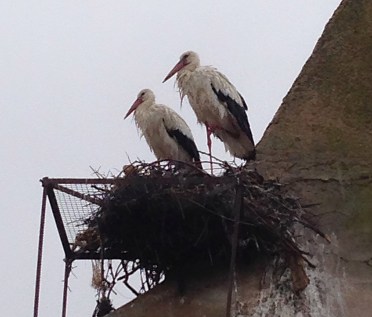
From the top floor you can walk up to either of the tall, white towers. Not only did we get a nice view of the city, but we also got a close look at some of the white storks nesting on the opposite tower. They are lovely birds.
Next we went to the Museum of Cáceres. In truth, I wasn’t expecting much from this museum; and the nondescript building only confirmed my lack of excitement. The place seemed so destitute that I doubted there could be anything worth seeing. But I am happy to report that I was very wrong.
The collection spanned from prehistory to the present day. It began with the region’s pre-Roman inhabitants, their jewelry and clay pots. Next were the Roman artifacts, including little statues and tablets with still visible Latin inscriptions. There were replicas of the agricultural tools used by the erstwhile peasants of the region, as well as their traditional dresses. Down a flight of steps I found a room dedicated to the Visigoths, and down another flight, in the basement, was the most impressive room of all. It was an original aljibe, a water well constructed by the Moors. In dim, subterranean light, the distinctive crescent arches of the Moors stand over a still pool of water. It is enchanting.
I thought that would be all, but a walkway led to another building, and there I found that the Museum of Cáceres also boasts an impressive collection of modern art, including a sketch by Picasso. On the floor below that, there are also a few examples of Medieval art, and even a work by El Greco. If you find yourself in Cáceres, do visit this museum.
The next day was bright and sunny. We ate breakfast and headed into town. Once there, however, we realized that we didn’t have very much to do. We had seen the major churches, we had seen the museum, we had walked all the streets. Now what? I was lazily turning this question over when I noticed how lovely the surrounding area looked in the sunlight.
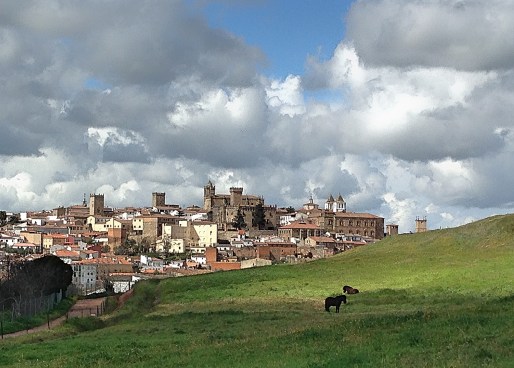
Thus we turned down a narrow street, passed through the old medieval gate, and emerged on the other side. In just twenty minutes we were surrounded by farms and rolling grassland. Horses grazed nearby, sticking their noses through the farm gate in hope of food. We found a dirt path leading away from the road, going to our left into one of the grassy fields. By now the weather was nearly perfect, with a warm sun and a cool breeze. The grass shone green, and the flowers were in bloom. In the distance we could see more horses grazing in the open fields; and beyond that the old city center of Cáceres sitting nobly on its hill.
The natural scenery and the blue sky felt so refreshing after the gloomy rain and the harsh Medieval architecture of yesterday. The only buildings here were derelict. An old farmhouse with boarded up windows, stuccoed brick walls, and cracked wooden window-frames stood by the side of the path; its roof was totally caved in, the wooden beams a broken heap on the floor, everything covered in weeds. A stone wall ran besides this farm; shards of colored glass has been glued to the top to discourage trespassers.
We walked for hours, holding our jackets, soaking in the sun and breathing the fresh air. But then the sun began to go away, and it became so chilly we had to put our jackets back on. Storm clouds were appearing; in just minutes the blue sky was devoured by grey. We began heading back for town, but we hadn’t gotten far before the rain started. Unluckily for us, we didn’t have our umbrellas, so we huddled through the town back to our room.
Soon we were back at our Airbnb. Our two days in Cáceres were spent. The town is not, perhaps, as imposing as Toledo or Córdoba; but what Cáceres lacks in major landmarks it makes up in intimacy. The medieval streets are not filled with noisy street performers or clowns in costume, as in so many other Spanish cities. You will not have to nudge your way through massive tour groups or dodge gaggles of Americans on Segways. The restaurants are filled with locals, not tourists. Horses roam the city’s surroundings, not double-decker buses. Intense tourism gradually turns every site into Disneyland, but Cáceres is still a city.
My Design in this Book is not to explain the Properties of Light by Hypotheses, but to propose and prove them by Reason and Experiment
Newton’s masterwork is, unquestionably, his Principia. But it is neither an easy nor a pleasant book to read. Luckily, the great scientist wrote a far more accessible volume that is scarcely less important: the Opticks.
The majority of this text is given over to descriptions of experiments. To the modern reader—and I suspect to the historical reader as well—these sections are remarkably dry. In simple yet exact language, Newton painstakingly describes the setup and results of experiment after experiment, most of them conducted in his darkened chamber, with the window covered up except for a small opening to let in the sunlight. Yet even if this doesn’t make for a thrilling read, it is impossible not to be astounded at the depth of care, the keenness of observation, and the subtle brilliance Newton displays. Using the most basic equipment (his most advanced tool is the prism), Newton tweezes light apart, making an enormous contribution both to experimental science and to the field of optics.
At the time, the discovery that white light could be decomposed into a rainbow of colors, and that this rainbow could be recombined back into white light, must have seemed as momentous as the discovery of the Higgs Boson. And indeed, even the modern reader might catch a glimpse of this excitement as she watches Newton carefully set up his prism in front of his beam of light, tweaking every variable, adjusting every parameter, measuring everything could be measured, and describing in elegant prose everything that could not.
Whence it follows, that the colorifick Dispositions of Rays are also connate with them, and immutable; and by consequence, that all the Productions and Appearances of Colours in the World are derived, not from any physical Change caused in Light by Refraction or Reflexion, but only from the various Mixtures or Separations of Rays, by virtue of their different Refrangibility or Reflexibility. And in this respect the Science of Colours becomes a Speculation as truly mathematical as any other part of Opticks.
Because I had recently read Feynman’s QED, one thing in particular caught my attention. Here is the problem: When you have one surface of glass, even if most of the light passes through it, some of the light is reflected; and you can roughly gauge what portion of light does one or the other. Let us say on a typical surface of glass, 4% of light is reflected. Now we add another surface of glass behind the first. According to common sense, 8% of the light should be reflected, right? Wrong. Now the amount of light which is reflected varies between 0% and 16%, depending on the distance between the two surfaces. This is truly bizarre; for it seems that the mere presence of second surface of glass alters the reflectiveness of the first. But how does the light “know” there is a second surface of glass? It seems the light somehow is affected before it comes into contact with either surface.
Newton was aware of this awkward problem, and he came up with his theory of “fits of easy reflection or transmission” to explain this phenomenon. But this “theory” was merely to say that the glass, for some unknown reason, sometimes lets light through, and sometimes reflects it. In other words, it was hardly a theory at all.
Every Ray of Light in its passage through any refracting Surface is put into a certain transient Constitution or State, which in the progress of the Ray returns at equal Intervals, and disposes the Ray at every return to be easily transmitted through the next refracting Surface, and between the returns to be easily reflected by it.
Also fascinating to the modern reader is the strange dual conception of light as waves and as particles in this work, which cannot help but remind us of the quantum view. The wave theory makes it easy to account for the different refrangibility of the different colors of light (i.e. the different colors reflect at different angles in a prism).
Do not several sorts of Rays make Vibrations of several bignesses, which according to their bignesses excite Sensations of several Colours, much after the manner that the Vibrations of the Air, according to their several bignesses excite Sensations of several sounds. And particularly do not the most refrangible Rays excite the shortest Vibrations for making a Sensation of deep violet, the least refrangible the largest for making a Sensation of deep red, and the several intermediate bignesses to make Sensations of the several intermediate Colours?
To this notion of vibrations, Newton adds the “corpuscular” theory of light, which held (in opposition to his contemporary, Christiaan Huygens) that light was composed of small particles. This theory must have been attractive to Newton because it fit into his previous work in physics. It explained why beams of light, like other solid bodies, travel in straight lines (cf. Newton’s first law), and reflect off surfaces at angles equal to their angles of incidence (cf. Newton’s third law).
Are not the Rays of Light very small Bodies emitted from shining Substances? For such Bodies will pass through uniform Mediums in right Lines without bending into the shadow, which is the Nature of the Rays of Light. They will also be capable of several Properties, and be able to conserve their Properties unchanged in passing through several Mediums, which is another conditions of the Rays of Light.
As a side note, despite some problems with the corpuscular theory of light, it came to be accepted for a long while, until the phenomenon of interference gave seemingly decisive weight to the wave theory. (Light, like water waves, will interfere with itself, creating characteristic patterns; cf. the famous double-slit experiment.) The wave theory was reinforced with Maxwell’s equations, which treated light as just another electro-magnetic wave. It was, in fact, Einstein who brought back the viability of the corpuscular theory, when he suggested the idea that light might come in packets to explain the photoelectric effect. (Blue light, when shined on certain metals, will cause an electric current, while red light will not. Why not?)
All this tinkering with light is good fun. But the real treat, at least for the layreader, comes at the final section, where Newton speculates on many of the unsolved scientific problems of his day. His mind is roving and vast; and even if most of his speculations have turned out incorrect, it is stunning simply to witness him at work. Newton realizes, for example, that radiation can travel without a medium (like air), and can heat objects even in a vacuum. (And thank goodness for that, for how else would the earth be warmed by the sun?) But from this fact he incorrectly deduces that there must be some more subtle medium that remains (like the famous ether).
If in two large tall cylindrical Vessels of Glass inverted, to little Thermometers be suspended so as not to touch the Vessels, and the Air be drawn out of one of these Vessels thus prepared be carried out of a cold place into a warm one; the Thermometer in vacuo will grow warm as much, and almost as soon as the Thermometer that is not in vacuo. And when the Vessels are carried back into the cold place, the Thermometer in vacuo will grow cold almost as soon as the other Thermometer. Is not the Heat of the warm Room convey’d through the Vacuum by the Vibrations of a much subtiler Medium than Air, which after the Air was drawn out remained in the Vacuum?
Yet for all Newton’s perspicacity, the most touching section was a list of question Newton asks, as if to himself, that he cannot hope to answer. It seems that even the most brilliant among us are stunned into silence by the vast mystery of the cosmos:
What is there in places almost empty of Matter, and whence is it that the Sun and Planets gravitate towards one another, without dense Matter between them? Whence is it that Nature doth nothing in vain; and whence arises all that Order and Beauty which we see in the World? To what end are Comets, and whence is it that Planets move all one and the same way in Orbs concentrick, while Comets move all manner of ways in Orbs very excentrick; and what hinders the fix’d Stars from falling upon one another? How came the Bodies of animals to be contrived with so much Art, and for what ends were their several Parts? Was the Eye contrived without Skill in Opticks, and the Ear without Knowledge of Sounds? How do the Motions of the Body follow from the Will, and whence is the Instinct in Animals?
Our next stop was the city of Logroño, the capital of the province of La Rioja. With only 5,045 square kilometers, La Rioja is the smallest province on mainland Spain and the second smallest overall, only slightly larger than the Balearic Islands. For any wine connoisseurs, the region needs no introduction. Located in the upper regions of the Iberian System of mountains, the province occupies the valley of the Ebro; and it is here that this mighty river splits and divides into seven channels, which is why La Rioja is known in Spanish as “The land of the seven valleys.” The climate of this valley—gradually varying as the land ascends from east to west—has proven ideal for viticulture.
Logroño is by far the largest city in this province, concentrating more than half its population within its reach. Like Zaragoza, the city is huddled around the Ebro; and like León and Oviedo, it is an important stop on the Camino de Santiago. Compared with any of those three cities, Logroño has played a relatively modest part in Spanish history. Surrounded by Aragon to the East and Castilla y León to the West, the city has never been a major center of power. But it is a center of wine—and that is what I was there for.
We took a Blablacar there the next morning. For part of the way, we were accompanied by two college-aged girls. I only mention them because they immediately struck me as odd.
In Spain, greetings are important. When you get into a car, you often perform all sorts of contortions so you can—like a proper human being!—kiss one another on the cheeks and make introductions. But these girls, who were Spaniards, sat timidly in the corner and gave us nervous smiles. And even though my Spanish was halfway decent by then, I found it impossible to communicate with them. Eventually we stopped in a small, no-name town and they hastily got out without even a word of goodbye. I looked around at the town, which struck me as one of the seemingly identical, featureless pueblos one drives through on the way to the major cities. Why were they here? Were they running away or something?
“Weird people,” the driver said, as we started driving away. I’m glad I wasn’t the only person to think so.
Our plan was to visit a bodega, which is the Spanish word for winery. (As a side note, I can’t help finding this word funny, since in New York City a “bodega” is a corner store.)
Our Airbnb host was out of town, so we were shown in by the host’s mother, a terribly nice woman who answered all our questions, gave us recommendations, and even made us reservations for a tour at a winery—specifically, the Campo Viejo winery. But there was one problem. When she left, we realized that she was under the impression that we had a car; the winery was well outside of town, and when I called to ask if it was possible to walk there, the man said “No, no, take a taxi.”
We were feeling stingy and we didn’t want to pay for a cab. Travel doesn’t pay for itself. Google Maps said it would take an hour, and that was exactly how much time we had before our tour. So we decided to walk. Our phones soon led us out of the city and into the surroundings countryside. We were forced to walk on the road because there were no sidewalks, but thankfully the roads were mostly empty.
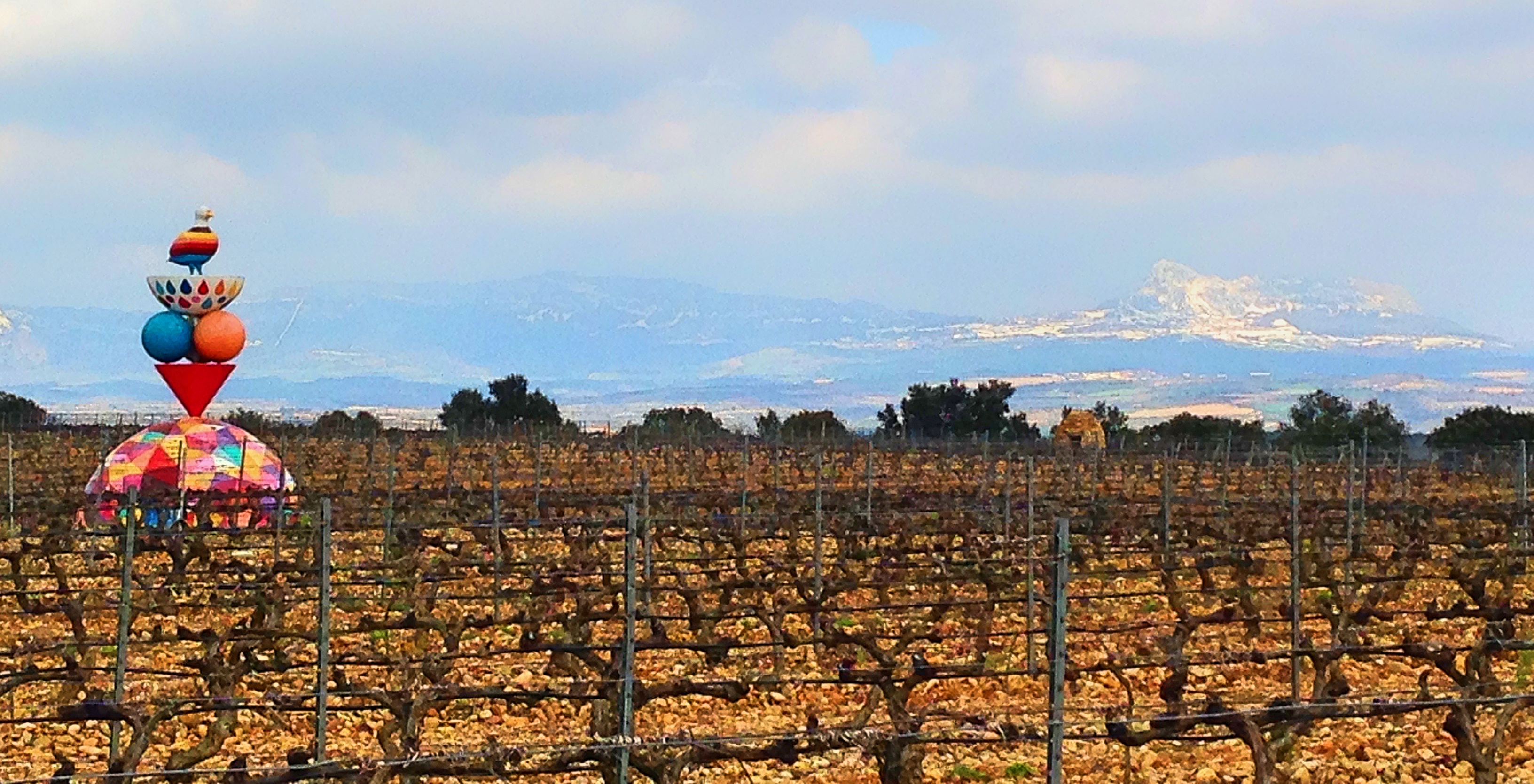
In just forty minutes we were making our way through rows and rows of grape plants. Or at least I assumed they were. This was my first trip to a vineyard or a winery, and to my ignorant eyes the plants looked like stunted trees, not “vines.”
The colorful thing was part of a marketing campaign
Finally we arrived, and right on time. The tour began. And unsurprisingly, it was in Spanish. The guide very kindly offered to translate in English for us, but we bravely said no, hoping to improve our Spanish in the process.
Consequently, at a generous estimate I understood about 20% of the tour. Probably more like 10%. But here’s the outline. To start, he took us outside where he talked about the grapes, and then went downstairs where he told us about the history of the winery. Next he led us into a massive room where hundreds of thousands of bottles of wine were sitting on racks; he had to shout to be heard over the giant fans, which kept the room at a constant temperature, pressure, and humidity. I believe this room was to combat the effects of “bottle-shock”—the temporary distortion in flavor that follows the bottling of wine.
After that, we were shown the factory. On metal platforms suspended twenty feet from the ground we walked among about forty gigantic metal tanks. He told us about the fermentation and distillation process, and I understood none of it. But even though I didn’t understand what any of the equipment was for, I think there is something terribly exciting about being around big, shiny, high-tech equipment. I felt like I had stepped into the future, and it smelled like fermented grapes. The last stop was most impressive of all. A ramp led us down to another massive room at the bottom of the building. Our guide switched on the lights, and suddenly I saw thousands of wooden barrels, all pilled atop one another, stretching out before me like the ocean. There must have been thousands.
It always amazes me that we can develop things like wine-making to the pitch of perfection, an exquisite blend of science and art, and yet we cannot solve problems like poverty. I suppose there’s more profit in the former.
Finally it was time for the tasting. Our group gathered around the bar, and the guide began pouring out classes of white wine. He tried to talk us through the process to properly taste wine—sniffing and gurgling and pondering—but I had downed my glass before he’d even started. I liked everything, but I must admit by pallet is extremely insensitive: all wine tastes pleasant but rather similar to me. Case in point: the thing I remember most fondly from the tasting was not the wine, but the free chorizo and bread sticks that I munched on ravenously.
Best of all, we didn’t even have to walk back. There was a nice Spanish couple from Burgos on our tour, and one of them was very excited by the opportunity to practice his English with us. He spent the whole tour tasting chatting with us; and when we finished, he offered to give us a ride back to town.
“Do you trust me?” he said, as we climbed into his car. Normally this kind of comment would send chills running down my spine; but in the mouth of a non-native speaker, it seemed nice and innocent.
Well, we survived. In just ten minutes we were back in town. Since we didn’t have any plans beyond our wine tasting, we decided to kill time before dinner by visiting all the church buildings in town. Logroño, as I mentioned, is situated along the Camino de Santiago, the famous pilgrimage route that runs along the north of Spain. This route is clearly marked with the classic cockle shell insignia; and even though it was cold and off-season, we saw a handful of dutiful pilgrims, wearing blue rain jackets and lugging around giant backpacks, making their way through the town.
None of the churches or basilicas of Logroño is memorably impressive on its own, especially after seeing the Burgos Cathedral. But taken together, the churches of Logroño form a wonderful tableau of religious architecture.
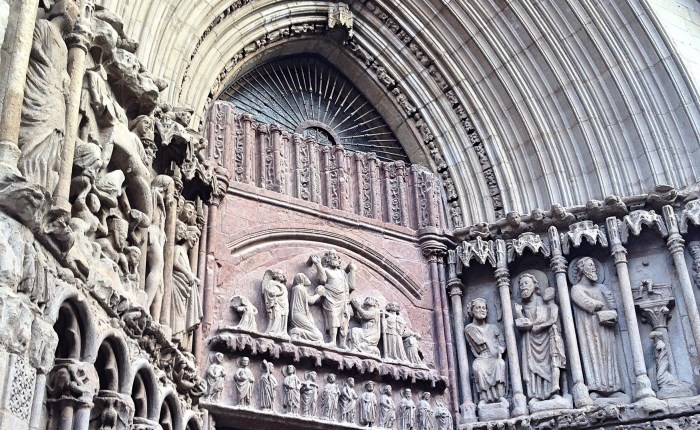
We went to four or five in quick succession. One church that sticks out in my memory is the Iglesia de San Bartolomé, which has a wonderful front portal, bursting with radiating arches and crowned with a sculpture of the Last Judgment. The inside was empty, except for a lonely priest sitting in the confessional booth; and in the cold silence of that stone building, I couldn’t help feeling sorry for the lonely priest, waiting for a congregation that seldom comes.
Another church worth mentioning is the Iglesia de Santiago del Real, one of the largest churches in the city. You can recognize the church from the equestrian statue of Santiago wearing his pilgrim’s hat, his arm raised to strike. As we wandered through the dark and cavernous insides, examining the chapels and altars, a man came in, kneeled down on a pew, and prayed. Three minutes later he got up and left, the thud of the heavy wooden door echoing ominously through the interior.
Photo by jynus; licensed under CC BY 2.5; taken from Wikimedia Commons
“I wonder what it’s like to be a catholic in one of these places,” GF said. “Does it add to the experience?”
I had been wondering the same thing. For the two of us, all the altars, chapels, and architecture of Catholicism are simply art; our appreciation is purely aesthetic. It must be a different thing completely to look upon the giant crucifixes in the stone buildings, and see the Truth of the Universe. Sometimes I almost regret that these stronger, more spiritual pleasures are cut off from me. But so it goes.
Last we went to the cathedral, which you can recognize by its two towering spires. Technically the Cathedral of Logroño is a co-cathedral; indeed it is one of three in its diocese, along with the Cathedral of Calahorra and the Cathedral of Santo Domino de la Calzada. In any case, we weren’t able to look around because there was a wedding being held. When we peeped in, the groom and the bride were kneeling before the altar while loud organ music was playing. The priest was standing nearby. Catholicism may be fading here in Spain, but it’s certainly not dead.
Finally it was time for dinner. For this we went to the Calle Laurel, the famous culinary arterty of Logroño. The street is so narrow and so full of people during meal times that no car could make it through—and none did. Restaurant after restaurant is packed into the small stretch of street; and in each one you can see plate after plate lined up on the bar, waiting for you to partake. Many of these dishes are ostentatious in their presentation: meatballs are served in a wine glass, covered in a bright red sauce; ham is suspended like a flag on a ship from toothpicks sticking out of the top of a croquette.
To avoid the crowd, we got to the street at 7:30 (very early for Spain), picked a restaurant, and dove in. We ordered whatever caught our eye. But to my dismay, as soon as I chose a dish the waiter would take it and stick it in the microwave. The food still tasted good, but the microwave rendered it soggy and textureless, and one croquette was still cold in the middle.
We went to another bar and got the same treatment; and ditto in a third bar after that. All told, we samples six different bars before calling it quits, most of the food only moderately good. But thankfully we saved the best for last. To finish we walked into a bar that served only mushrooms—the Bar Ángel. They are the simplest things in the world, cooked in olive oil with a sprinkle of salt; and they are delicious. If you’re in Logroño, find the restaurant with the grill filled with mushrooms and eat your fill.
The next morning we took a Blablacar back to Madrid, riding with a couple of guys from Senegal; they both worked in a meat factory in Cuenca. One of them slept the whole time, but the driver was a sociable fellow and we talked in accented Spanish the whole way back. And thus ended another weekend in Spain.
Compared with Europe, America has a strange fixation with standardized tests. Administrators and bureaucrats seems to view these tests as tools of accountability, allowing for standard measurement across the system with no possibility of error. But the result is often quixotic: the attempt to come up with a test that creates a normal curve in scores, a test immune to differences in social and cultural background, and a test that measures something predictive of future success, irrespective of the field or career.
As far as these tests go, the Graduate Record Examinations (GRE) is well done. The math sections only include the most basic techniques, focusing instead on tricky word problems or painstakingly lengthy operations, which theoretically would put all students—regardless of math background—on an equal footing. The essays focus on equally fundamental skills: creating and defending a thesis, and critiquing somebody else’s thesis. The verbal section is a straightforward vocabulary and reading comprehension drill. In sum, as far as possible, I think that the GRE is focused on fundamental skills needed for study.
The catch, of course, is the “as far as possible.” For no matter how much the test-makers try, a physics major and a history major will not be on an even footing in the math and verbal sections. What is more, by making vocabulary such an integral part of the exam, people from more privileged backgrounds—whose well-educated parents work white-collar jobs—have an obvious advantage. This is not to mention the upper hand that the well-off always have in competitions of this sort: the time available for studying (without worrying about multiple jobs or rent), and the resources (private tutors and so on) to prepare adequately.
In any case, can even a well-designed test give valuable information at the graduate school level? For lower-level education, where students are taught the basics of academic skills, a general test seems more plausible. But as students apply to Masters and Doctorate programs—the final steps of vocational and academic specialization—the usefulness of a generalized skill exam is far more questionable. The ability to write an essay in 30 minutes taking a stance on a randomly generated quote (one of the essay tasks) is perhaps hardly related to the ability to, say, write a detailed exploration of the post-Soviet period in Poland.
Granted, I can see why admissions offices like tests such as this one. First, it is a quick and easy to cut down the hefty stack of applications. What’s more, the GRE scores do provide a standard measurement across varying backgrounds (but what is it a measurement of?). And even if the admissions office sees the GRE as purely pro forma—something that is not uncommon—the obstacle of a $205, 4-hour test may help whittle out those less interested in applying.
However convenient it may be for these admissions officers, I personally cannot help being frustrated with exams like this. At present, Educational Testing Services (ETS), its creator, is the Standard Oil of the testing business. To apply to any institution of higher education in the United States, you must pay a toll—in time, stress, and money—to this organization. If I thought that this ritual improved educational quality in any way, I would tolerate it; but I have trouble believing that.
ETS is not the only entity that benefits from this arrangement, since the competition for scores gives rise to innumerable test-prep companies and products, such as this book. I have used the Princeton Review on numerous occasions, and have consistently appreciated their prep-books. This book provides quite a bit of value for the price: including dozens of specific techniques, and 6 full-length practice tests.
Because the Princeton Review can’t use real ETS questions, they must come up with their own. And this is no easy thing, since their questions must replicate exactly the look, difficulty, and type of questions on the real thing. For what it’s worth, in my own experience I have found that the real ETS verbal questions are easier than the Princeton versions, while the ETS math section is more difficult than Princeton’s—though admittedly this difference is fairly small.
A world where we didn’t have to spend months preparing for standard exams would be ideal. But in the world we live in, Princeton Review books are a valuable aid.
Burgos is the second largest city in the province of Castilla y León, after León itself. One thousand years ago or thereabouts, the city was the capital of the erstwhile kingdom of Castilla. Now the city governs a high plateau, 859 m (2,818 ft) above sea level, situated some miles inland and therefore insulated from the warming currents of the Mediterranean. Chilly wind sweeps through its streets, and winter inevitably brings heavy snow.
But there is plenty to compensate for the cold.
The ride up was long and pleasant. It was only the driver, GF, and myself. The driver was a young man from Galicia who lived in Burgos, working as an air traffic controller. He spoke slowly and with a clear accent, which gave me the pleasant illusion that I was fluent in Spanish. After two hours we arrived.
Soon we were walking towards the center of the city. As usual in Burgos, it was a cold, cloudy day. But I didn’t care; I was about to see one of the finest cathedrals in Spain.
But first we had to eat. I was hungry. So we ducked into a bar for some croquettes and tortilla and coffee. While there, we asked the barman to point us to the cathedral’s entrance.
“Right around that corner,” he said. “But before you go in, go to the Iglesia de San Nicolás, a very nice church.”
He was right. This little church is right next to the cathedral, and it definitely merits a visit. The central altarpiece is incredible, a towering monolith of white marble carved into an army of angles. There are so many little figures and scenes in it that it would be impossible to look at it all; in fact, the carved reliefs are so tiny that they form only surface details, elements of an abstract pattern. This monumental altar, one of the great works of Renaissance Spain, was designed by the sculptor Simón de Colonia and executed by his son.
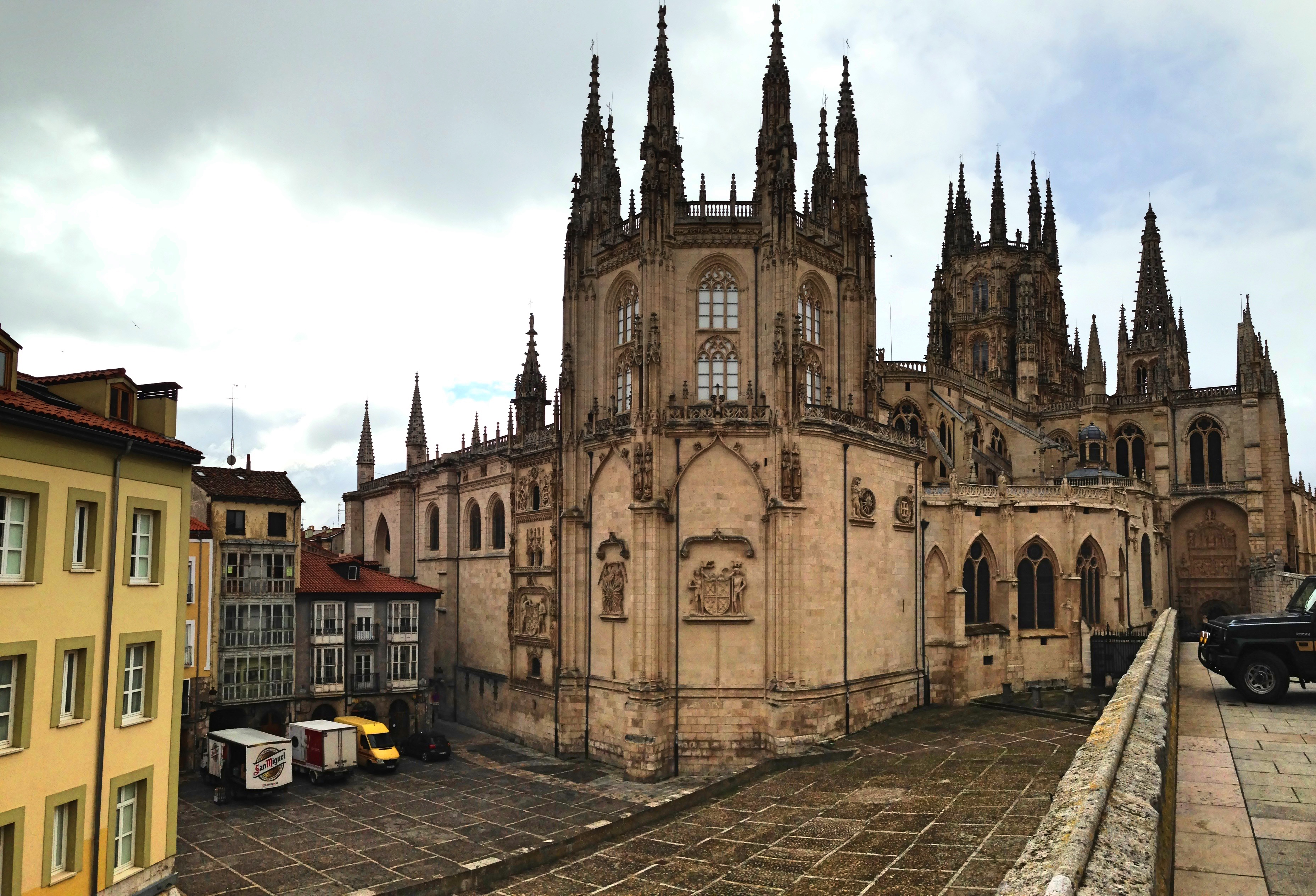
Now it was time to see what we came for: the Cathedral of Burgos, La Santa Iglesía Catedral Basílica Metropolitana de Santa María. We walked out of the church and looked up. It was stupendous. The cathedral of Burgos is one of Spain’s lesser known treasures, at least to outsiders. Even greater than the Cathedral of León, it is the finest example of French Gothic in Spain.
We walked around the outside for a while, just taking it in. Like the Cathedral of Santiago de Compostela, the massive building is impressive from every side. Sculptures stand above the doorway, their noble robed figures looking down on the viewer with infinite calm. Reliefs are carved into the exterior walls, of men, of animals, of abstract decorations. Above one doorway, now unused, is an excellent scene of the Last Judgment, each figure looking like it had been carved yesterday. The whole thing is bristling with spires, over twenty of them, impaling any poor clouds that get too close.
Whereas many cathedrals in Spain are stylistic patchworks, due to their being built and repaired in many different epochs, the Cathedral of Burgos is a symphony of stone—balanced, unified, pure French Gothic. (And this is not, by the way, because it was built all at once, but because later generations mostly kept to the original aesthetic.) Burgos, you see, is one of the major stopping-points on the Camino de Santiago, the pilgrimage route which brought untold thousands from the rest of Europe. This is why the cathedral has such a strong French influence.
After we had drunk our fill of the looming edifice, we went inside. The entry ticket came with an audioguide included. Thinking that we’d practiced enough Spanish that day, we got the guides in English. There were two narrators, a man and a woman, and both of them spoke with such soothing tones and such calm slowness that I felt I was being deliberately lulled to sleep, not informed.
The inside of the cathedral is not as overwhelming as its outside, which is hardly saying anything. There are fine Renaissance paintings, old Romanesque frescos, impressive sculptures, admirable altars—too much to remember or name. But a few things stick out in my memory.
First was a wooden figure of a man’s upper half emanating from a section of the ceiling, high up above near the ceiling. Every hour this impish fellow strikes the bell and opens his mouth. This automaton is called the Papamoscas, named after the flycatching tit, whose snapping beak the Papamoscas is supposed to resemble. Unfortunately I didn’t get to see this delightful rogue in action. But he is sufficiently incongruous—looking almost Mephistophelean with his grin—to attract the attention of nearly every traveler to the cathedral, including Victor Hugo.Then there was the central cupola. This was unlike any I had ever seen before. Instead of a large dome crowning the building, it was filled with small windows in an intricate pattern; standing underneath and looking up, it looks like heaven itself is opening up. The audioguide explained how it was created, but I don’t remember now, and even at the time I couldn’t believe it. Hanging from so high a place and looking as delicate as paper ribbons, it is impossible to believe it was made from stone. The credit for this lovely work goes to Juan de Vallejos, an otherwise obscure and unknown figure.
Immediately below is something even more special: the tomb of El Cid Campeador, the half-legendary warrior from the Spanish Middle Ages. The tomb is nothing special to look at—just a slab of granite on the floor—but the man certainly was.
El Cid is the star of the first major work of Spanish literature, El Cantar del Mio Cid, an epic poem in which he is portrayed as a tireless warrior for Christianity against the Muslims. (The real story was, as usual, more complicated.) I had read this poem right before moving to Spain. Thus, standing there before his tomb felt a bit like standing in front of Washington Irving’s old room in the Alhambra: like I had completed a circuit. I love moments like this, when past and present are suddenly thrown together, because it is in these times that we can feel how much we’ve changed and how much we’ve stayed the same.
On the recommendation of both our driver and our host, we went to Casa Pancho for lunch, a restaurant quite near the cathedral. It was early for lunch, but the place was already bustling.
I knew what I wanted: morcilla. This is Spanish blood sausage, a common ingredient in stews from Asturias to Segovia to Cáceres; and the morcilla in Burgos is supposed to be the best in Spain. Indeed, in supermarkets you can find blood sausage labeled “Morcilla de Burgos.” This label doesn’t necessarily mean that the morcilla was made in Burgos; rather it means that the sausage was made with rice rather than onions, which is the Burgos style. Rice gives the sausage a denser and, in my opinion, more pleasant texture in comparison with onions, which are used in the morcilla of Estremadura.
I ordered two tapas of morcilla to start. It was great, so much better than other morcilla I had tried. Then I ordered pepper stuffed with morcilla in a spicy sauce, and it was even better; and after that, a piece of bread topped with a quail egg, a hot pepper, and morcilla. Everything was delicious.
Along the streets of Burgos, the trees were cut to grow into one another, forming one continuous twisted form
Both of us left satisfied and happy. In fact, the food was so good and so reasonably priced that the meal stands out in my memory as one of the best I’ve had in Spain.
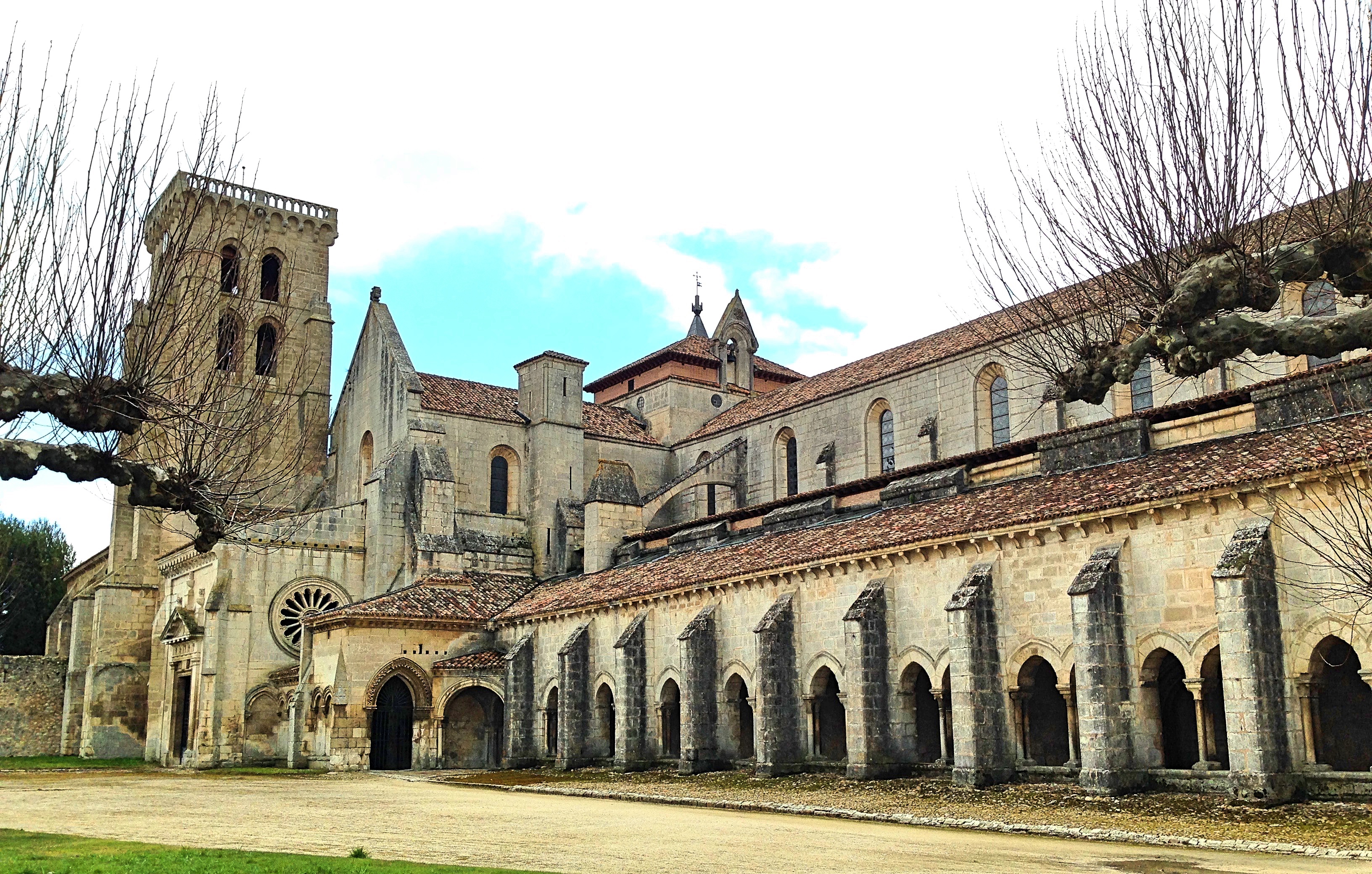
The next stop was Las Huelgas. This is a large monastery that is situated a bit outside the city center. It took us about twenty minutes to walk there. It is an impressively large building, its gray form stretching hundreds of feet.
But when we got there we found that it was closed, and it wouldn’t open for another forty minutes. This is a common occurrence in Spain, especially in smaller cities: monuments close in the middle of the day and reopen a few hours later. The Spanish may profess that the siesta is dead, but midday breaks are still something the tourist must be wary of.
We retreated to a café to kill time. On the television, the news was playing; they were covering the story about the castle in the south of Spain, the Medrera castle in Cádiz, that had been restored with hideously poor taste, essentially turning the old castle into a block of concrete. The news story compared it to the other famous botched restoration in Spain, the ecce homo in Borja that an elderly Spaniard had famously turned into ‘Beast Jesus’. In fairness, restoration is difficult, delicate work. But it shouldn’t be the occasion to turn a piece of heritage into modern art.
Finally it was time to go. We paid and went to buy our tickets.
“Would you like to visit now?” the cashier asked as I was paying.
“Yeah, now,” I said.
“Okay, follow her,” she said, pointing to her colleague.
We did, and soon discovered that we were with a group. We were on a tour; the only problem was, the tour was in Spanish. Our guide was a woman with short gray hair, who seemed very professional. Sometimes I understood almost everything she said, other times almost nothing.
What immediately struck me were the sarcophagi. For a long time this monastery had served as a royal burying place; many kings and queens of Castille can be found here. In this respect Las Huelgas is the counterpart to the Royal Pantheon in the the Basilica of San Isidro in León. Though many of the sarcophagi are relatively bare and unadorned, and though I had never hard of anyone buried there, the sensation of being surrounded by so many royal corpses sent shivers up my spine. Even on a purely aesthetic level, many of the coffins bear beautiful carvings and decorations, and their placement in the cavernous space allows the visitor to walk around them and get a close-up view
Another thing I noticed was the preponderance of Mudéjar ornamentation on the walls. The ceilings were built with the lovely, crisscrossing, intricately interlocking wooden pieces so typical of Mudéjar and Moorish architecture. And some of the stucco decorations could easily have been in the Alhambra, if not for the royal emblem of Castile inscribed in the vegetable motifs, not to mention the Latin calligraphy (instead of Arabic) inscribed into the pattern—a wonderful example of syncretism in history.
Though the visitor wouldn’t guess it—I certainly didn’t—the monastery is still active and in use, with a population of Cistercian monks. Apart from its use as a royal pantheon, it is also historically notable for having some of the oldest stained class windows in Spain, and for being the discovery site of one of the most important musical manuscripts from the middle ages, the Las Huelgas Codex—which is an invaluable source of our knowledge of medieval plainchant and polyphonic motets. And this is not to mention its museum of cloths and fabrics, preserving many royal garments and tapestries from the middle ages.
Beyond this I unfortunately cannot say much, since I visited when my Spanish was still far from fluent, thus preventing me from understanding much of what our guide said.
By now it was late. The only thing to do that was still open was the Museum of Human Evolution. We walked there from the monastery—about twenty minutes—and searched around for the entrance. The museum is in a cluster of big buildings, and the entrance is actually not well marked. We walked around for about five minutes before asking somebody, who pointed us in the right direction. Ahead of us in line to enter was an American man, who took the opportunity to complain to the woman at the front desk that the place is hard to find.
“I was looking for twenty minutes!” he said.
“Yes, sir, it’s not very good,” she said.
The Museo de Evolución Humana is housed in a huge building. The best way to describe the museum is that it looks expensive. Lots of money had been spent here. Everything was new and shiny. Indeed, it looks like they had money to spare, since they didn’t use the space efficiently; probably more than half of the volume of the building is totally empty.
The first floor (or floor zero in Europe) is dedicated to the archaeological site in the (now collapsed) caves of the Atapuerca Mountains, just a few kilometers away from the museum. This site, which can be visited by bus from the city, is known for being the location of the discovery of the oldest known European hominin fossils, Homo antecessor. It is not a designated UNESCO World Heritage site, and I hope to visit one day.
On this floor there were four raised platforms, the tops of which were covered in a very realistic imitation landscape, with fake trees, shrubs, and grass. These are meant to be the environment of the Atapuerca Mountains. You can walk into the bottom of these platforms, as if walking into the caves; and inside are all sorts of fancy displays, with replicas of bones, tools, and audiovisual presentations.
The second floor (European first floor) is dedicated to the theory of evolution. Most notable was the timeline, arranged in a semicircle, of human evolution. It is complete with replica skulls of hominin fossils, making the gamut from Australopithecines, to Homo erectus, to Neanderthals, and finally to us. Even more impressive than the skulls were the life-sized models of these species as they might have looked in life, all of them excellently made, quite startlingly alive. I kept expecting them to move.
The next level up was about the history of technology. In glass cases were stone tools from different stages of our evolution, ranging from simple choppers to finely crafted arrowheads, as well as replicas of wooden and bone tools. Despite its showy and even ostentatious presentation, the museum is undoubtedly among the best science museums in Spain, and well worth a visit.
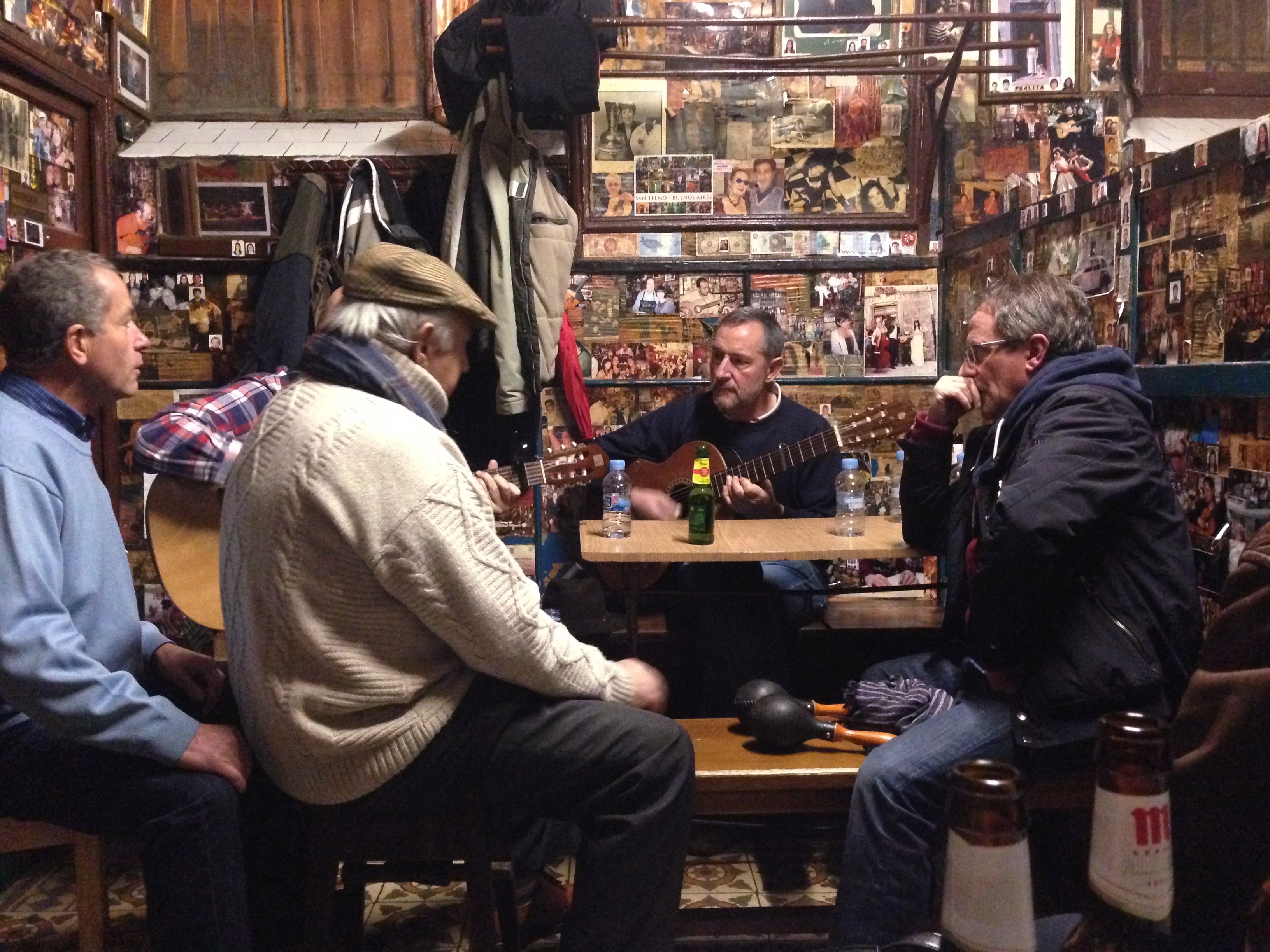
It was late now, and we had only one more stop: the Taberna Patillas. This bar was recommended to us by our host because every night they have free music. We ate a quick dinner of pizza and then huddled into the corner of the bar, drinks in hand, waiting for the music to start. We waited, and waited. The bar gradually filled up. Half an hour went by.
As we waited, we took the time to examine the decoration. Every inch of the walls and even the ceilings was covered in old ads, postcards, portraits, posters, photographs, and other paraphernalia—all related to musical performances. There were framed and signed pictures of musicians, and on one wall there was a big painting of the bar itself, with the bartender playing the guitar. Next to it, a guitar hung; and nearby was a mandolin. The place has character.
After forty minutes a group of men walked into the bar and sat down at a table near ours, two of them carrying guitars. All of them were late middle-aged, with graying hair, all wearing collared shirts and sweaters. Everyone around grew quiet and turned their seats to face the men. The two guitarists tuned; then one of the other men stood up. He looked like the oldest of the bunch; he had snow white hair swept back across his head, and an equally white goatee.
The guitarists started playing, running through a few bars. Then the man started to sing. He had a strong voice, almost operatic. When he sung, he held his body in a stiff posture, his shoulders thrown back, his chin raised, gesticulating dramatically with his hands. He finished with a flourish and everyone burst into applause; then he began on another, this one more mellow.
After three songs, the singer bowed and made his exit. But the band stayed on. Many of them were also talented singers; and they could sing in harmony. Maybe it was the atmosphere, maybe it was the beer, maybe it’s because I was tired and had seen so much that day, but I thought the music some of the best I’d ever heard. It was so intimate, and so direct. If you find yourself in Burgos, go to Taberna Patillas at about 8:30, and wait.
After about an hour, we left. We were both very tired. All in all, my day in Burgos was easily one of the best I’ve had in Spain—full of history, science, music, fine architecture, and good food. Burgos is a special place.
When dealing with people, let us remember we are not dealing with creatures of logic. We are dealing with creatures of emotion, creatures bristling with prejudices and motivated by pride and vanity.
Dale Carnegie is a quintessentially American type. He is like George F. Babbitt come to life—except considerably smarter. And here he presents us with the Bible for the American secular religion: capitalism with a smile.
In a series of short chapters, Carnegie lays out a philosophy of human interaction. The tenets of this philosophy are very simple. People are selfish, prideful, and sensitive creatures. To get along with people you need to direct your actions towards their egos. To make people like you, compliment them, talk in terms of their wants, make them feel important, smile big, and remember their name. If you want to persuade somebody, don’t argue, and never contradict them; instead, be friendly, emphasize the things you agree on, get them to do most of the talking, and let them take credit for every bright idea.
The most common criticism lodged at this book is that it teaches manipulation, not genuine friendship. Well, I agree that this book doesn’t teach how to achieve genuine intimacy with people. A real friendship requires some self-expression, and self-expression is not part of Carnegie’s system. As another reviewer points out, if you use this mindset to try to get real friends, you’ll end up in highly unsatisfying relationships. Good friends aren’t like difficult customers; they are people you can argue with and vent to, people who you don’t have to impress.
Nevertheless, I think it’s not accurate to say that Carnegie is teaching manipulation. Manipulation is when you get somebody to do something against their own interests; but Carnegie’s whole system is directed towards getting others to see that their self-interest is aligned with yours. This is what I meant by calling him the prophet of “capitalism with a smile,” since his philosophy is built on the notion that, most of the time, people can do business with each other that is mutually beneficial. He never advocates being duplicitous: “Let me repeat: The principles taught in this book will work only when they come from the heart. I am not advocating a bag of tricks. I am talking about a new way of life.”
Maybe what puts people off is his somewhat cynical view of human nature. He sees people as inherently selfish creatures who are obsessed with their own wants; egotists with a fragile sense of self-esteem: “People are not interested in you. They are not interested in me. They are interested in themselves—morning, noon and after dinner.”
Well, maybe it’s just because I am an American, but this conception of human nature feels quite accurate to me. Even the nicest people are absorbed with their own desires, troubles, and opinions. Indeed, the only reason that it’s easy to forget that other people are preoccupied with their own priorities is because we are so preoccupied with our own that it’s hard to imagine anyone thinks otherwise. The other day, for example, I ran into my neighbor, a wonderfully nice woman, who immediately proceeded to unload all her recent troubles on me while scarcely asking me a single question. This isn’t because she is bad or selfish, but because she’s human and wanted a listening ear. I don’t see anything wrong with it.
In any case, I think this book is worth reading just for its historical value. As one of the first and most successful examples of the self-help genre, it is an illuminating document. Already in this book, we have what I call “Self-Help Miracle Stories”—you know, the stories about somebody applying the lessons from this book and achieving a complete life turnaround. Although the author always insists the stories are real, the effect is often comical: “Jim applied this lesson, and his customer was so happy he named his first-born son after him!” “Rebecca impressed her boss so much that he wrote her a check for one million dollars on the spot!” “Frank did such a good job at the meeting that one of his clients bought him a Ferrari, and another one offered him his daughter in marriage!” (These are only slight exaggerations.)
Because of this book’s age, the writing is quaint and charming. Take, for example, this piece of advice on how to get the most out of the book: “Make a lively game out of your learning by offering some friend a dime or a dollar every time he or she catches you violating one of these principles.” A lively game! How utterly delightful.
Probably this book would be far more effective if Carnegie included some exercises instead of focusing on anecdotes. But then again, it would be far less enjoyable reading in that case, since the anecdotes are told with such verve and pep (to quote Babbitt). And I think we could all use a little more pep in our lives.
Talk not to me. I shall go sit and weep
Till I can find occasion of revenge.
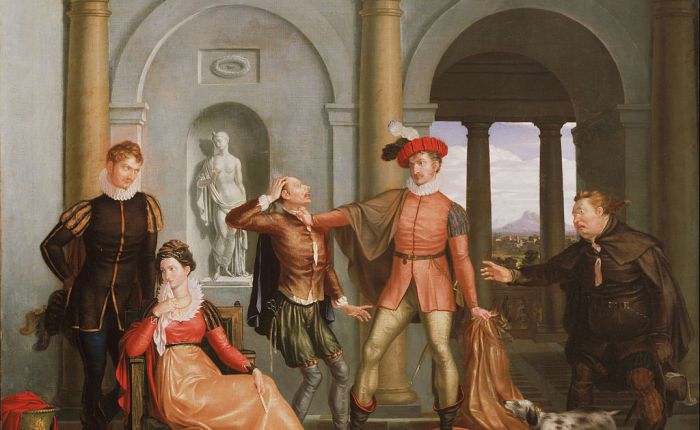
Like The Merchant of Venice, whose anti-Semitism makes us squirm, this play presents a sticky problem to modern audiences: was Shakespeare a misogynist? And it must be said that the misogyny present in this play is more difficult to excuse than the prejudice against poor Shylock, since Shakespeare is not clearly in sympathy with the titular shrew, Katherine, as he is with the Venetian merchant. So just as bardolaters have striven to distance Shakespeare from the badness of Titus Andronicus, so have they tried to complicate Shakespeare’s relationship to the explicit misogyny of the play.
First there is the induction, a seemingly extraneous introductory bit that frames the rest of the work, making it a play-within-a-play. Did Shakespeare do this to distance himself from the misogyny? A rather flimsy shield, if you ask me. Another way to excuse the bard has been historical relativism, noting that misogyny was universal in his day and thus excusable. But this explanation isn’t satisfying, either. The play presents Petruchio’s actions as unusual and noteworthy, so much so that the rest of the characters are awestricken by the end. In the context of Shakespeare’s own plays, too, the relationship between Petruchio and Katherine is far from typical.
But perhaps Shakespeare meant this as a negative example, not to emulate but to scorn? Maybe we are supposed to loathe Petruchio and gasp in horror at Katherine’s submissive ending monologue? This does not seem plausible to me; rather it strikes me as a wholly un-Shakespearean reading—with evil unapologetically triumphant, something that never happens even in his tragedies. Somewhat differently, Harold Bloom frees Shakespeare with irony. As he notes, the ending monologue is far too long, and can easily be read as satire on Katherine’s part. Using evidence such as this, Bloom asserts that Katherine is not tamed at all, but rather learns to dominate Petruchio. Yet avoiding her husband’s temper tantrums through unconditional obedience hardly seems like “dominance” to me.
We are thus left, uneasily, with simple misogyny.* And yet the play did not have a terribly unpleasant effect on me. This is because several factors serve to mitigate the main theme of shrew-taming.
For one, however unhealthy their relationship might be by modern standards, Petruchio and Katherine have undeniable chemistry. From the hilarious sexual raillery of the opening courtship to the “Kiss me, Kate” in the streets of Padua, the couple is electrifying to watch. Then there is the obvious ironic comparison with the relationship between Lucentio and Bianca. Bianca, the sweetly submissive girl who every suitor pursues, ends up deceiving her father and making her own choice of marriage; while Katherine, the infamous shrew, compliantly marries the first suitable suitor who comes along with no deception whatsoever. And it is also worth noting that, all the bizarre torture notwithstanding, Katherine does seem better off with Petruchio, who is deeply fond of her, than with her father, who finds her to be a pestilence.
In any case, this play can take its place alongside A Comedy of Errors as a light comedy with finely-drawn characters, full of life and wit—indeed in many ways it is far better. If only it wasn’t about subjugating a wife!
*Given that this play is very unusual in the context of Shakespeare’s oeuvre—full as it is of strong and compelling women—I doubt that it represented Shakespeare’s own views on the subject.
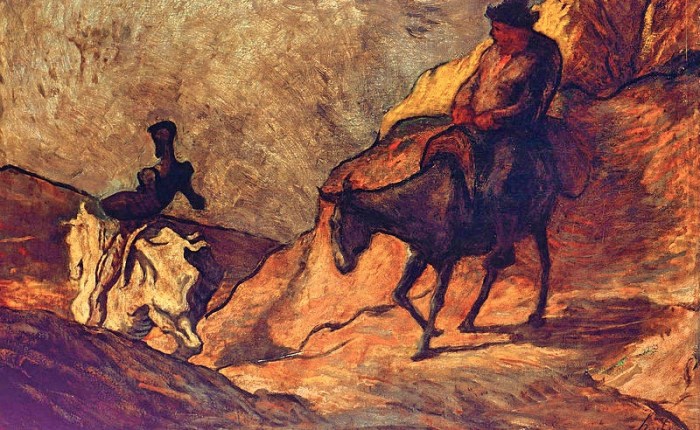
‘For me alone was Don Quixote born, and myself for his sake; he knew how to act and I to write,’ Cervantes has written with his pen. And I say that for Cervantes to recount their lives, and for me to explain and elucidate them, were born Don Quijote and Sancho. Cervantes was born to narrate, and to write commentary was I made.
Miguel de Unamuno defies classification. At once a philosopher, a literary critic, a novelist, a poet, and an essayist—and yet none of them completely—he resembled Nietzsche in his mercurial identity. In this way, too, did he resemble Nietzsche: though he had many themes and central ideas, he had no system. He wrote in short feverish bursts, each one as fiery and explosive as a sermon, going off into the branches (as the Spanish say) and returning again and again to his ostensible subject—only to depart once more. He was a wandering knight errant of a writer.
Unamuno was a member of the so-called Generation of ‘98. The date—1898—alludes to the Spanish-American war, a conflict in which Spain suffered a humiliating defeat and lost nearly all of her colonies. After this, it became impossible to see Spain as a world power; her decline and decadence were incontrovertible. This generation of intellectuals and artists was, therefore, concerned with rejuvenating Spanish culture. In Unamuno’s case, this took the form of finding Spain’s ‘essence’: which he did in the person of Don Quixote. He sees in the knight errant everything profound and important in Spanish culture, as a kind of Messiah of Spanish Catholicism, often comparing Quixote to Iñigo de Loyola and Teresa de Ávila.
This book has, therefore, a quasi-nationalistic aim, which may weary the non-Spanish reader. But it survives as one of the greatest works of criticism written on Spain’s greatest book.
The title of Vida de Don Quijote y Sancho is usually rendered in English as Our Lord Don Quijote; and this title, though not literal, does ample justice to Unamuno’s project. In this work Unamuno undertakes to write a full, chapter-by-chapter commentary on Cervantes’ novel; but his commentary is no conventional literary criticism. Unamuno declares his belief that Don Quixote and his squire were real, and that Cervantes did a grave injustice to their lives by writing it as a farce. In reality, the Don was a hero of the highest order, a saint and a savior, and Unamuno aims to reveal the holiness of the Knight of the Sorrowful Countenance for his readers.
Unamuno is, thus, the most quixotic of interpreters. He claims to see naught but pure nobility and heroism in the great knight from La Mancha. And yet the grandiose and ludicrous claims of Unamuno, and the farcical nature of Don Quixote himself, put the reader on guard: this commentary, like the great novel itself, is laden with delicate irony—an irony that does not undermine Unamuno’s literal meaning, but complements and complicates it.
You might call this Cervantine irony, and it is difficult to adequately describe, since it relies on a contradiction. It is the contradiction of Don Quixote himself: perhaps the most heroic character in all of literature, braver than Achilles and nobler than Odysseus, and yet laughably ridiculous—at times even pitiable and pathetic. We are thus faced with a dilemma: applaud the knight, or ridicule him? Neither seems satisfactory. At times Quixote is undeniably funny, a poor fool who tilts at windmills; but by the end of the novel—an ending more tragic than the darkest of Shakespeare’s tragedies—when he renounces his life as a knight and condemns all his adventures as insanity, we cannot help but feel profoundly sad, and we plead along with Sancho that he continue to live in his fantasy world, if not for his sake than for ours.
This is the paradox of idealism. To change the world you must be able to re-imagine it: to see it for what it might be rather than for what it is. Further, you must act “as if”—to pretend, as it were, that you were living in a better world. How can you hope to transform a dishonest world if you are not honest yourself, if you do not insist on taking others at their word? Quixoticism is thus the recipe for improving the world. Dorothea, from Middlemarch, is a quietly quixotic figure, only seeing pure intentions in those around her. But paradoxically, by presupposing only the best, and seeing goodness where it is not, she creates the goodness that she imagines. Confronted with a person who sees only the most generous motives, those she meets actually become kind and generous in her presence.
We then must ask: Is Dorothea a fool? And if so, does it even matter? And what does it even mean to be a fool? For as Lionel Trilling pointed out, Cervantes posed one of the central questions of literature: What is the relationship between fiction and reality?
Human reality is peculiar: We acknowledge an entire class of facts that are only facts because of social agreement. The value of a dollar, for example, or the rules of football are real enough—we see their effects every day—and yet, if everyone were to change their opinion at once, these “facts” would evaporate. These “social facts” dominate our lives: that Donald Trump is president and that the United States is a country are two more examples. You might say that these are facts only because everyone acts “as if” they are: and our actions constitute their being true.
The reality that Don Quixote inhabits is not, in this sense, less real than this “normal” social reality. He simply acts “as if” he were residing in another social world, one purer and nobler. And in doing so, he engenders his own reality—a reality inspired by his pure and noble heart. What is a queen, after all, but a woman who we agree to treat as special? And if Don Quixote treats his Dulcinea the same way, what prevents her from being a queen? What is a helmet but a piece of metal we choose to put on our heads? And if Don Quixote treats his barber’s bowl as a helmet, isn’t it one? We see this happen again and again: the great knight transforms those around him, making them lords and ladies, monsters and villains, only by seeing them differently.
In this way, Don Quixote opens a gulf for us: by acknowledging the conventional nature of much of our reality, and the power of the imagination to change it, we are left groping. What does it mean for something to be real? What does it mean to be mistaken, or to be a fool? To improve the world, must we see it falsely? Is this false seeing even “false,” or is it profoundly true? In short, what is the relationship between fiction and fact?
To me, this is the central question of Cervantes’ novel. But it remains a dead issue if we choose to see Quixote merely as a fool, as he is so commonly understood. Indeed I think we laugh at the knight partly out of self-defense, to avoid these troublesome issues. Unamuno’s worshipful commentary pushes against this tendency, and allows us to see the knight in all his heroism.
G. J. Meyer set out to write this book to fill a gap in the available literature on the First World War: a popular, holistic account that covered every phase and every front, without presupposing much knowledge from the reader. In this, he was undeniably successful. A World Undone begins at the beginning, with the assassination of Franz Ferdinand, and ends at the end, with the Treaty of Versailles—signed five years to the day of the assassination of the infamous archduke.
Meyer’s scheme is simple but effective: interspersing “background” chapters between his main, military account of the war. These background chapters were inevitably more interesting for me, and provided much-needed relief from the seemingly endless string of battles, divisions, battalions, generals, troop movements, and so on that composed the military history. In these auxiliary sections, Meyer introduces us to war literature, major personalities, political traditions, economic crises, military technology, shell shock, and much else. The wealth of both historical backdrop and military history makes this book an ideal, if somewhat long, introduction to the “Great War.”
Meyer himself is an able and diligent writer, who steers a middle course between rhetorical excess and crass simplicity, keeping his prose lean and tasteful. He has the quintessential skills of the popularizer: the ability to compress information into a tight space, and to explain complex phenomenon without overwhelming the reader. He also wisely avoids speculation himself, leaving the analysis to the reader or the historian, keeping his eye focused on the surface-level events—which is desirable in an introductory text, I believe.
Even with a guide as competent as Meyer, however, the Great War is depressing and deadening. Meyer’s account, perhaps unintentionally, confirmed many stereotypes I had previously imbibed. In his telling, the beginning of the war was due to a combination of poor planning and reckless and incompetent advisors. That Germany could not mobilize its forces without invading Belgium, for example, or that Russia could not choose to mobilize only half of its troops, thus unintentionally threatening Germany—consequences of carefully-drawn plans, an arrangement that virtually guaranteed war—is difficult to believe or forgive.
As for the fighting, the impression one is left with is of remarkably courageous troops heedlessly wasted by monomaniacal generals. Offensive after ineffective offensive, with general after general trying the same tactics and achieving the same failures—leading to endless butchery. One quickly draws the conclusion that the leaders of Europe in this epoch were dim and shortsighted men.
It is this dreary and dreadful aspect that partially accounts for the First World War being overshadowed by its younger brother. The conflict was strikingly non-ideological. There are no Nazis, no Communists, no Fascists, no racial purges (except in Armenia), no freedom fighters, no Resistance—only obsolete Empires fighting for spheres of influence. The fighting, too, has none of the cinematic drama of the Second World War: only interminable shelling campaigns, repeated advances and retreats through no-man’s land, stagnant stalemates and antiquated tactics—there is nothing even vaguely romantic about the bloodshed, despite what Ernst Jünger may have thought.
But even if it is less compelling to learn about than the Second World War, the First World War arguably has even more valuable lessons to teach us. The logic of naked power confrontation is, after all, more historically common than ideological conflict. The comparatively colorless, and often incompetent, quality of the war’s leadership invites us to see the conflict in all its bare, barbaric brutality, without the distorting effects of charismatic chiefs. The manufactured hatred of whole populaces for one another—engineered through strict censorship, outright lies, and strident propaganda—is a case-study in how patriotism can be exploited for deeply cynical ends.
And most important, unlike the Second World War—a sad story that at least ends with the defeat of a genocidal maniac—the First World War has no silver lining, no comforting achievement to offset the millions of lives lost. As the vindictiveness of the victors proved, the winning side wasn’t on a clearly higher moral level than the losers; and in any case, the war didn’t even achieve a resolution to the conflicts brewing within Europe, only a partial deferment. In sum, the First World War is worth learning about because it was a calamitous, unnecessary tragedy that stubbornly resists romanticization or justification—and that is war.

 The Complete Essays by Michel de Montaigne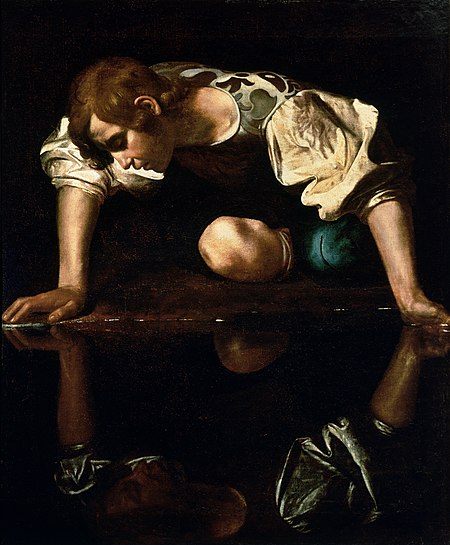




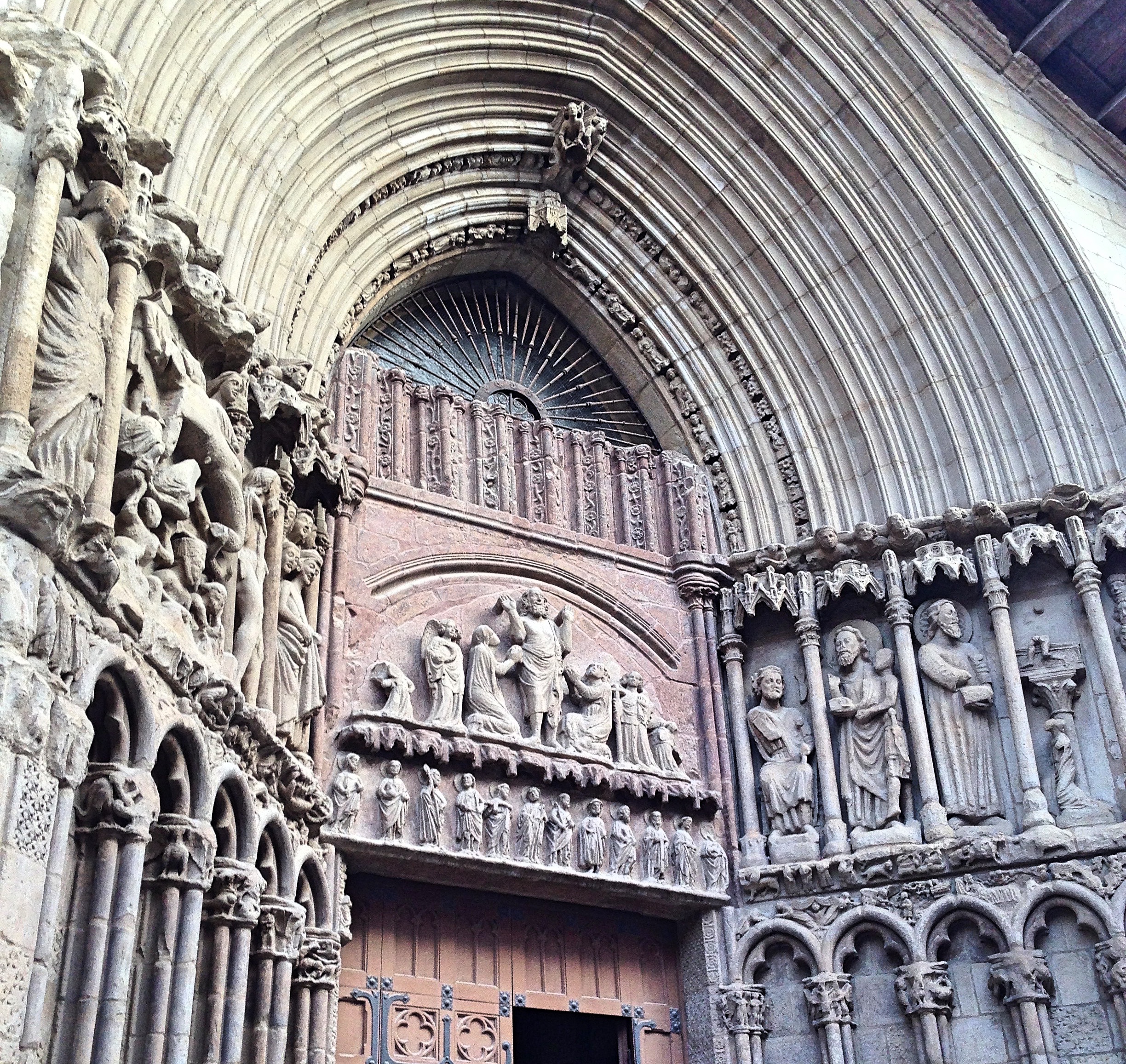



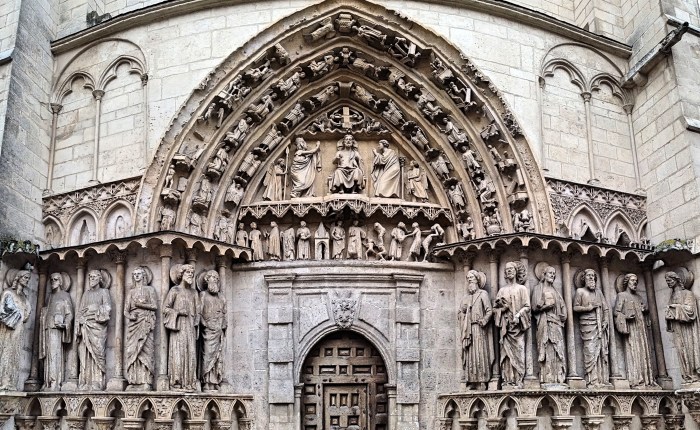
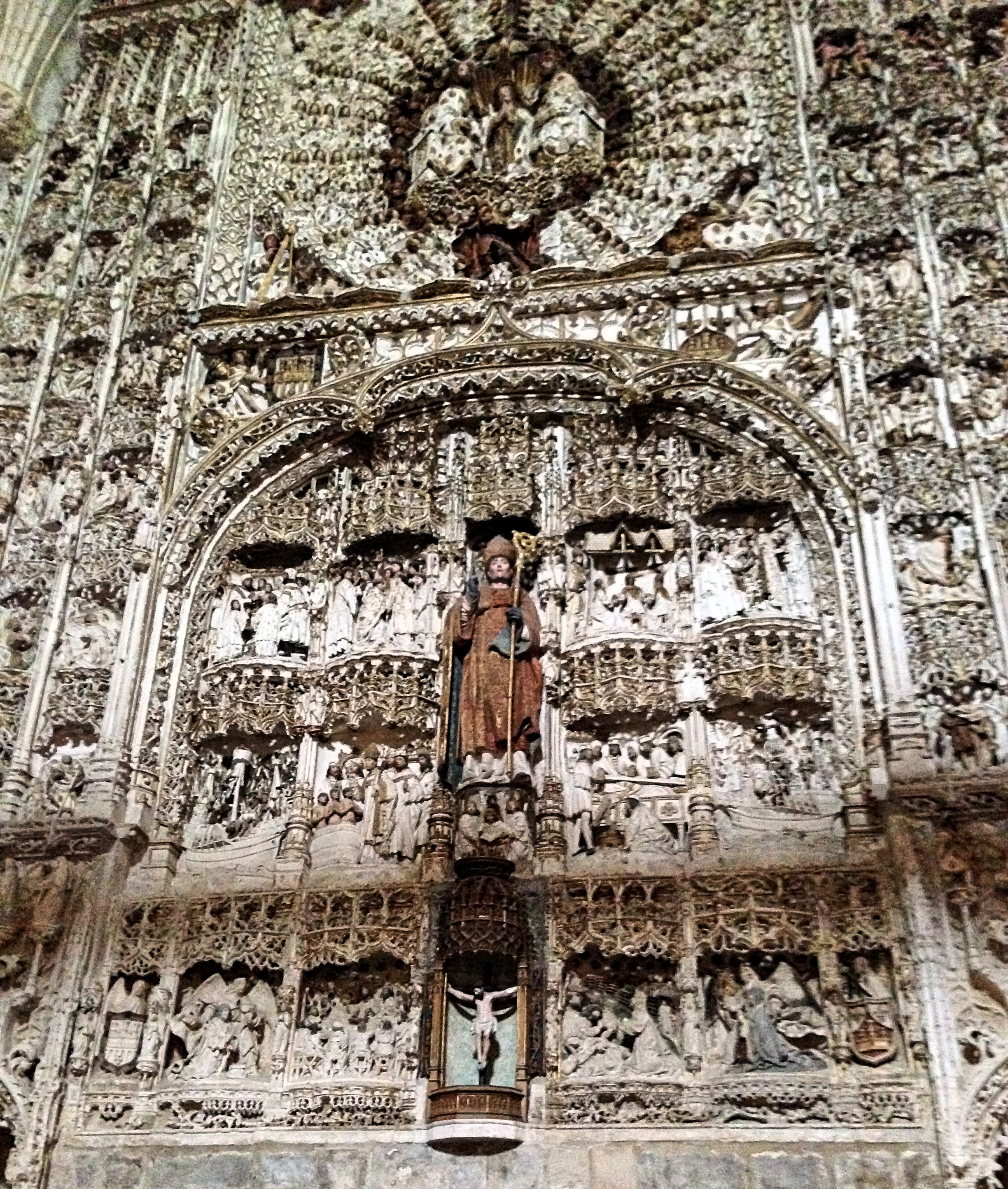 Now it was time to see what we came for: the Cathedral of Burgos, La Santa Iglesía Catedral Basílica Metropolitana de Santa María. We walked out of the church and looked up. It was stupendous. The cathedral of Burgos is one of Spain’s lesser known treasures, at least to outsiders. Even greater than the Cathedral of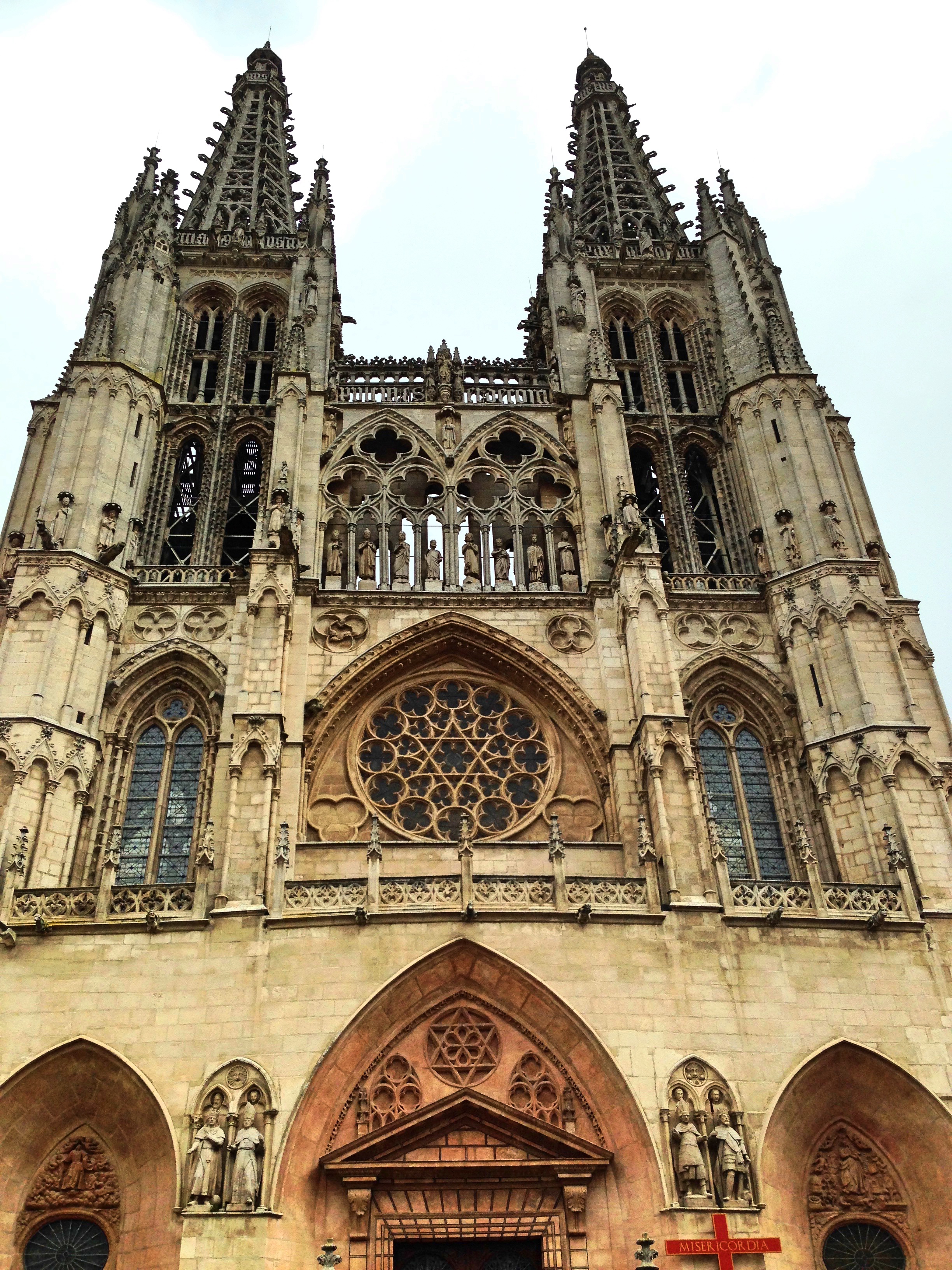
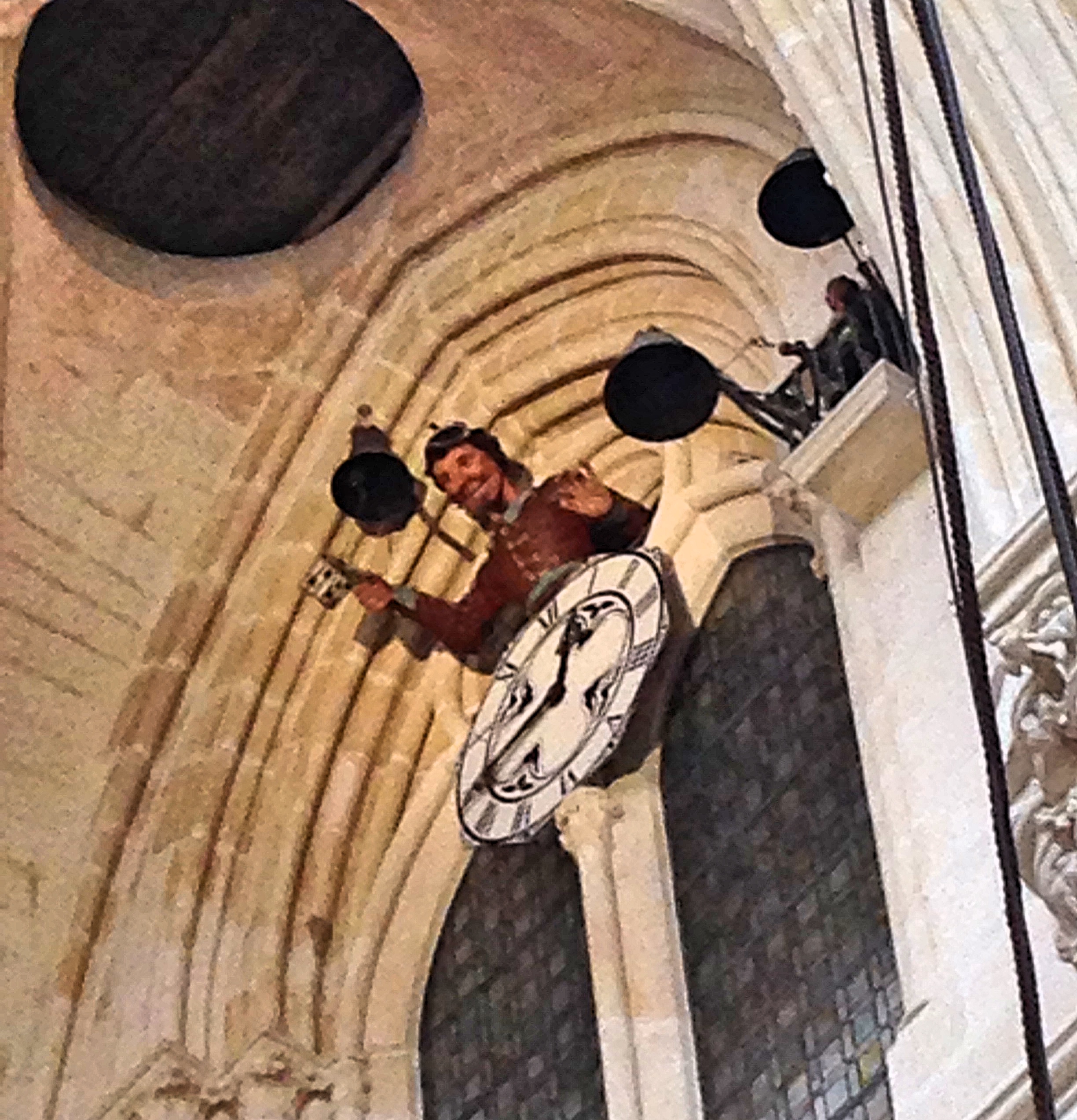 Then there was the central cupola. This was unlike any I had ever seen before. Instead of a large dome crowning the building, it was filled with small windows in an intricate pattern; standing underneath and looking up, it looks like heaven itself is opening up. The audioguide explained how it was created, but I don’t remember now, and even at the time I couldn’t believe it. Hanging from so high a place and looking as delicate as paper ribbons, it is impossible to believe it was made from stone. The credit for this lovely work goes to Juan de Vallejos, an otherwise obscure and unknown figure.







 Lotz in Translation