Review: A Farewell to Arms

Review: A Farewell to Arms

A Farewell to ArmsA Farewell to Arms by Ernest Hemingway

My rating: 3 of 5 stars

There were many words that you could not stand to hear and finally only the names of places had dignity.

If Voltaire had read Hemingway’s famous war novel, I’d wager that he would pronounce that it is neither about war nor a novel. Compared to All Quiet on the Western Front, for example, the descriptions of war in this book are ludicrously tame. The vast majority of the time the narrator is not even at the front; and when he is, he is far behind the front lines, driving an ambulance. The bulk of the book is taken up, instead, by a love story. The war forms the backdrop—though admittedly a very conspicuous backdrop—and is not the main thread of the book.

What of the novel? Hemingway is a writer of conspicuous strengths and weaknesses; and the longer the book, the more apparent his shortcomings. Though the novel is slim, it still feels padded. Hemingway, for whatever reason, considered it dramatically necessary to narrate every time his characters ate or drank. Aside from telling us that his characters drank a lot (even while pregnant) and appreciated good wines, we learn very little from these frequent repasts, and the ultimate effect is to make the reader hungry.

The conversations, too, are repetitive—especially between the narrator and Catherine Barkley, his wartime sweetheart. While strikingly tender and frank, especially for Hemingway, the relationship between these two never sparkles with the interplay of personality. There is none of the mutual discovery we find in, say, Jane Eyre and Mr. Rochester. Instead, the two of them talk to each other the way people talk to their dogs—asking cutesie rhetorical questions never meant to be answered.

These two examples are just part of a larger fault: Hemingway’s tendency to get carried away into nostalgic, atmospheric descriptions. At his best moments, admittedly, he creates that wistful, bittersweet, melancholic tone that he is known for, and that forms such a beautiful part of his work. But too often the book becomes pointlessly autobiographical. Hemingway is, after all, one of the strongest proponents of the “write what you know” school of fiction. Though wise advice, there is a danger to this method: Since everyone’s life is interesting to themselves, it can be difficult to know which parts may be interesting to other people. This book definitely suffers in this way.

Of course there are many strong bits. Some scenes are unforgettable—the narrator’s injury, the long retreat, rowing across the Swiss Lake, among others. I also really loved the conversations between the narrator and Rinanldi. Unlike the love story, that friendship has true chemistry. Indeed many episodes, taken by themselves, are remarkable. But do they add up to a coherent book?

I ask this specifically in regards to the ending. Since I had just read A.C. Bradley’s book on tragedy, in which he insisted that tragedy requires that a hero create his own downfall, I was struck by how un-tragic was the end of this book. The fatal stroke is not the inevitable result of any personal flaw or a misguided decision, but pure misfortune. The final effect, therefore, is not tragic, but pathetic. In Hemingway’s novel, the universe itself is malevolent, even sadistic, and humans just confused defenseless creatures caught in its maw.

Thus I am a bit perplexed that some people see this as an anti-war novel. The narrator’s crushing blow is not caused by the war; indeed it is something that could have happened to anyone. You can argue that the novel’s bleak atmosphere reflects the fatalism and the pessimism engendered by the war: a nihilistic perspective that is carried over into every phase of life—even love. Yet the narrator himself is not pessimistic—at least not most of the time; if he were, he would not have embarked on his love-affair. It is neither his perspective nor the war, therefore, that dooms the narrator, but some mysterious malevolency of the world itself that makes lasting happiness impossible, in war or in peace.

Thus, aside from a few explicitly anti-war passages in the book, the general tenor has little to do with pacifism or any other political reflection. Instead, to paraphrase the book’s most famous passage, the final message is: Everyone gets broken in the end no matter what. And I don’t think this notion has any truth or value.

View all my reviews

Christmastime in Andalusia: Jerez de la Frontera

Christmastime in Andalusia: Jerez de la Frontera

(Continued in my posts about Cádiz, Nerja, Ronda, and Málaga.)

The Voyage

On December 24, Christmas Eve—or Noche Buena (“Good Night”) as the Spanish call it—in the year 2015, at an egregious hour in the morning, we met up with a couple of guys that we had contacted through Blablacar to make the drive down to Jerez de la Frontera.

They were both extremely nice, agreeable fellows; but I’m afraid they had Andalusian accents and I could hardly understand them.

The people of Andalusia, you see, have something of a reputation. Their accent is distinctive and difficult for outsiders to understand. They speak in a rapid staccato, spitting out the words like a machine gun. Unlike in most of Spain, Andalusians do not pronounce c’s or z’s like “th” (often mocked, incorrectly, as the “Spanish lisp”); and instead pronounce all soft c’s and z’s like an “s,” as they do in Latin America. For most people this would not be a problem; but since I’m only used to Castillian Spanish this confuses me.

What is more, Andalusians drop the terminal “s” wherever it appears: tres becomes tregracias becomes gracia, and so on. To top it off, the consonants separating two ending vowels are also dropped, and the vowels are blended together into a dipthong: complicado becomes complicao. With all these factors taken together, the final result is, for me, an indistinct slur of sound that never resolves itself into separate words.

In sum, I could not understand them. So I slept; and GF slept; and we woke up and then fell asleep again.

The countryside of Andalucía, normally so flat and treeless that you can see for miles, was shrouded in a mysterious and impenetrable wall of fog. Apparently, mornings in the south of Spain are typically foggy, which I find odd considering how absolutely sunny and cloudless are the days.

But I had traveled this road before, when I went to Seville. So even though I couldn’t see much, memories flew by the window instead.

There are castles, I recalled: mostly run-down and in ruins, dotting the countryside; we must have passed five or six. Then there are the great, big, black silhouettes of bulls, which stood here and there, sometimes next to the highway and sometimes on a hillside beyond. These are the Osborne Bulls: signs that were originally set up as advertisements for Osborne brand sherry. Despite this prosaic commercial origin, they have since become something of a symbol for Spain, and you can find them on everything from T-shirts to book jackets to postcards.

Osborne_bull

I also remembered the livestock. The Spanish countryside has a rugged, rural, pastoral charm that I did not expect to find in an industrialized country. In what look like wild fields along the highways you can see cows grazing, sheep huddling in herds, and horses bathing their shiny coats in the sun. No human can be seen watching over them; not a fence is in sight—except perhaps and old, derelict stone barrier that looks short enough to hop over.

Then I thought of the wind turbines—those gigantic white towers, their blades meditatively spinning in the breeze—and the solar panels, glistening like the future itself in the sun. These new technologies served to break the spell of the castles and the wandering livestock, snapping you back to the twenty-first century. But they also showed a wonderful continuity; people still made their living here, and were still doing their best to achieve harmony with their environment.

But the castles and the bulls and the horses and the turbines were nowhere to be seen this morning; just the grey fog, the clouds overhead, and the few feet of road in front of us. I was having trouble staying awake, and still more trouble staying asleep. So I drifted in that unpleasant, cramped, confusing, groggy twilight between consciousness and unconsciousness, my neck hurting, my knees in pain, my eyelids feeling as though a gigantic weight had been placed upon them.

But then we arrived. Our driver, very kindly, drove us right up to the door of our Airbnb, and soon we found ourselves in Jerez de la Frontera, blinking in the familiar bright of the Andalusian sun, our bags sitting on the sidewalk, both of us tired and dazed, pressing the buzzer to get in.


Jerez de la Frontera

Our hosts were just as kind and friendly and welcoming as our driver had been. One of them, the husband, was a professor of Spanish and French from Switzerland; and his wife was a wonderful woman from Peru. They were hospitality incarnate; they gave us a tour of the neighborhood, told us about the bus schedule, provided us information about all the things to do and see in Jerez, and in general answered every question we had. Not only this, but they had the patience of saints with our halting, slow, mistake-ridden Spanish.

Soon we were on the bus, heading towards town. We arrived at 3:30 in Jerez de la Frontera, on Christmas Eve. The restaurants were jam-packed, the streets filled with so many people eating, drinking, and talking that there weren’t nearly enough chairs, so most people had to stand—not that anybody seemed to care. On Christmas Eve, apparently, the entire town celebrates by having an after-lunch drink.

With more hope than foresight, we thought we could visit some of the main sights of Jerez. First, we tried the Alcázar, a Moorish castle in the center of town. It was closed. Then we tried the cathedral. Closed. After that, we walked to a bodega (winery), to taste some famous sherry. (Jerez de la Frontera is the birthplace of sherry wine.) They were all closed, too. It was Christmastime in Andalusia, and the only places open were the restaurants.

So we walked around, somewhat aimlessly, feeling lost and out of place. What were we doing here? This was the holidays, a time for family, and here we were, just the two of us, alone in a strange city with nothing to do. After two hours of wandering, we decided we might as well eat, and sat down at the first restaurant we could find.

Two tables over an entire extended family was gathered together. They were playing flamenco. Three boys were strumming on guitars, others were stomping and clapping, and they were singing in unison, the women an octave higher than the men. It wasn’t professional by any means, but it was fun and exciting. As we sat outside in temperate sun, listening to this family play flamenco—not because they were being paid, but to celebrate the holiday—the day suddenly became ineffably romantic.

We sat at that restaurant as long as we could before they kicked us out—which was at about 5 o’clock. Then we walked back to the Airbnb.

It did not feel like Christmas Eve. We spoke with our families through Skype, but this only served to remind us of what we were missing. The loneliness was easy to forget during the day, when surrounded by crowds, overhearing small-talk, exchanging pleasantries with waiters. But as the sun went down and the shops began to close and the people retreated indoors to be with their brothers and sisters, sons and daughters, fathers and mothers, we could not forget that we were not at home; that on another side of the globe, our own families were celebrating without us; and that instead of being surrounded by familiar faces, we were surrounded by faces entirely new, and even strange.

And with these thoughts, we went to sleep.

§

Christmas morning.

We got out of bed and went downstairs. Sadly, there weren’t any presents waiting for us, not even a tree; but there was breakfast. It was simple and delicious: bread, yogurt, fresh fruit, and Spanish ham. Even though our goodly hosts had eaten several hours before, they had sat at the table with us just to talk. As I sat there, I realized how odd it was to be staying at the house of a stranger—or, at least, someone we’d just met—during Christmas. It felt somehow intrusive and indecent. But then I remembered that our hosts were immigrants, too, and all their family was elsewhere as well. This made me feel a bit more at home.

We were off to town again, though we hardly knew what for. Just like yesterday, everything was closed; and today, not even the restaurants were busy. This time we didn’t even try to see anything. We sat down at a restaurant, ordered some food, and relaxed. I must admit, though, that I was getting a bit cranky by this point. Not only had I missed Christmas, but for what?

I calmed down a bit after I pulled out my book to read. I read and read, looking up now and again to observe people strolling by, kids playing, grandparents chiding, young couples chitchatting—and the day passed like this. I began to feel calm and happy. There is something strangely intoxicating about Andalusia. I don’t know quite what it is. A big part is just the weather. The sun is so bright that it’s hypnotic. The intense light is just so constantly present; it transforms everything, making colors brighter, laughter louder, people friendlier.

Then again, the people really are friendlier in Andalusia. Here the social instinct of the Spanish is expressed most fully. In New York, there are crowds, of course; but the crowds are always crowds of individuals thrown together more or less by accident, by force of circumstance. But the Andalusians, as I witnessed on Christmas Eve, congregate purposefully and joyfully—taking pleasure in the feeling of togetherness and camaraderie and excitement that good crowds generate.

The day wore on, and nothing much happened. I looked around the square; there wasn’t much to see. A cone-shaped, plastic Christmas light sat in the center. Beside that was a civic statue of someone riding a horse, surrounded by fountains and flowers. Palm trees were lightly swaying in the breeze. At another table, an elderly British woman was yelling at her dog every time it barked; but the dog didn’t seem to care, and kept on barking at every passerby.

Behind me some kids were riding around on a toy car ride that played cheesy music as it went by. Later, another group of kids were amusing themselves by exploding firecrackers in the middle of the plaza. These firecrackers were astoundingly loud, sounding like gunshots. I nearly jumped out of my seat the first time one went off. I’m still surprised that the kids’ parents, who were sitting nearby, didn’t mind their six and seven-year-olds playing with such powerful explosives. American parents would sooner let their kids eat gluten and get vaccinated.

We sat there four solid hours, until the sun began to set behind the restaurant, casting the square in shadow. Without the sun, I began to feel colder and more lonely. So we left. The walk back took us through several strip malls, all completely vacant. Although the sun was still out we could see the moon. It was full and seemed much bigger and closer than usual. Behind us the sun was setting, turning the sky a bright storybook pink and orange. By the time we reached the Airbnb, all was dark.

Everything was closed, even the supermarkets. What would we eat? Our hosts came to the rescue. In their freezer, they had cooked, seasoned pork chops ready to heat up, along with rice, potatoes, and salad. It was fantastic. We sat around the table, talking some more—the kind of supremely pleasant small-talk that is both interesting and easygoing, the kind that engages the mind enough to keep your attention but not so much to get you flustered.

We ate; we slept. Tomorrow we were leaving, so we only had the first part of the day to explore. Thus, even though I spent three days in Jerez, the time lost to Christmas closures resulted in only a half-day to visit the sites.

§

Jerez de la Frontera, translated literally into English, means “Sherry of the Border.” Indeed the English word “sherry” is an anglicization of “Xeres,” the antique name for this town. For it is here that the famous fortified wine originated. Situated just 7 miles (12 km) inland from the Atlantic Ocean, Jerez enjoys a mixture of humidity and heat that has proven ideal for its trademark wine. This sprawling city has overtaken Cádiz, the regional capital, as the region’s most populous city; and apart from its wine it is know for being the home of the Grand Prix motorcycle race.

Tiopepe
A statue of Manuel Críspulo González y Soto, founder of Tío Pepe sherry, with the cathedral in the background

Our first stop was the Alcázar of Jerez. The word “alcázar” comes from the Arabic word for “fortress,” and many cities in Spain have one: Córdoba, Segovia, Toledo.

This alcázar is located right in the center of town, surrounded on all sides by pretty plazas filled with orange trees. Today this area was also filled with people. The locals were holding a market around the old fortress—a flea market, more precisely. Tables and tables were filled with all sorts of delightful rubbish, old plastic toys, dusty books with broken spines, varieties of colorful knickknacks, tiny statuettes for nativity scenes, and much else. We wandered through the crowd as we looked for the entrance, passing around the entire building before we finally found it.

The Alcázar of Jerez is a compound surrounded on all sides by a high wall. It was originally built when Jerez was a small Taifa kingdom during the Moorish period. Many of the internal structures—likely built of wood and therefore perishable—have disappeared, and a garden now occupies the center of the fortress.

alcazar_jerez

An old Mosque, the only one that wasn’t destroyed by the conquering Christians, still stands (though I couldn’t identify it); and you can walk inside an old Moorish bath with its roof pierced with star-shaped holes. Also standing is the oven and the machinery that the Christian used to make their pottery. Yet the best part of the visit was just the opportunity to stand on the walls and see the whole city spread out before us.

After this we went across the plaza to see the city’s cathedral. The Jerez Cathedral is comparatively small. Indeed it wasn’t originally built as a cathedral, but as a church, and was only elevated to that status in 1980. Stylistically speaking, the building is eclectic: gothic flying buttresses were fixed to neoclassical columns. We walked in the door, excited to explore the interior, but stopped in our tracks. They were having a service.

The whole place was packed, every pew totally filled. At the altar, several white-robed priests were gathered. One of them was speaking through a microphone, his old, tired voice projected throughout the cavernous space. He sighed rather than preached, seeming to exhale the words with minimal emphasis. Meanwhile, his proclamations were punctuated by the cadences of an organ, going from the dominant to the tonic minor chord. This might have been the first time in my life that I’ve heard an organ in a cathedral. The sound was duly impressive. But more interesting were the musical interludes provided by a group of flamenco singers and guitar players. Yes, here in Jerez they even have flamenco in their church services. It sounded absolutely great in that old building, and provided a welcome contrast to the old gentleman’s fatiguing voice.

“You gonna put that in your blog?” GF asked as we walked out.

“Of course,” I said. “I put everything in my blog.”

This was the end of our time in Jerez. We had to eat lunch, pick up our luggage, and catch a train to our next stop. I still regret that we didn’t get to visit one of the town’s famous sherry wineries. I suppose I’ll just have to come back.

Review: Shakespearean Tragedy

Review: Shakespearean Tragedy

Shakespearean TragedyShakespearean Tragedy by A.C. Bradley

My rating: 5 of 5 stars

I dreamt last night that Shakespeare’s Ghost
Sat for a civil service post
The English paper for that year
Had several questions on King Lear
Which Shakespeare answered very badly
Because he hadn’t read his Bradley

Analyzing great works of art is always fraught with danger. Whether the critic sets her sights on a portrait, a sonata, or a play, the task is always that of turning poetry into prose. The critic, in other words, must extract content from form—and making content and form inseparable is one of the goals of art. Insofar as art is great, therefore, the critic’s task will prove difficult; and criticism thus reaches its most acute challenge in Shakespeare. His works have eluded minds as powerful as Coleridge and Freud, Goethe and Joyce. The man worthiest to the challenge was not anyone so famous; he was, rather, a retiring Oxford don who published a series of lectures on Shakespeare’s tragedies in 1904.

Bradley’s method has been attacked and dismissed as overly literal, treating Shakespeare’s characters as real people: “How Many Children had Lady Macbeth?” was the derisive title of one critical article, implying that the question (which Bradley never asked) was ludicrous. But I am convinced that Bradley’s method is, on the whole, the right one. For Shakespeare’s tragedies are incomprehensible unless we set our sights on character—the plays’ personalities. If you try the experiment suggested by Bradley himself, you will see this: attempt to narrate the plots of any of these stories without any mention of personality, merely recording the events, and the plot becomes weak and baffling.

The extreme example of this is, of course, Hamlet, whose endless ruminations and procrastinations have been a stumbling block for generations of critics. But the central importance of personality is apparent in all the tragedies. Indeed it must be, as Bradley explains, since a tragedy is tragic only insofar as the events result from a character’s personality. To fall off a building, to catch a deadly disease, to be conscripted into the army—all of these, while remarkably sad, are not tragic in the strict sense because they might happen to anyone. A tragedy may only happen to one person, because it is caused by that person. It does not result from circumstance, accident, or any overwhelming external force. To confirm this, try mentally switching the characters in these tragedies. Othello would have solved Hamlet’s problem in an hour, and Hamlet would have seen right through Iago’s trickery—the plot disappears.

The existence of tragedy, as Bradley also makes clear, seems to suggest a certain sort of universe. The characters must be capable of free action, since the consequences must flow from their personalities. Along with divine determination, the idea of a Christian afterlife is incompatible, too, since if every character ultimately receives their just desserts then the feeling of dreadful finality is lost. For tragedy, as Bradley tells us, always involves the idea of irrecoverable waste—wasted lives, wasted talents, wasted goodness. But the universe in Shakespeare’s plays is not indifferent. Indeed, although good and evil qualities are deeply mixed in all of his most memorable characters, we are never in doubt which is which. And though the hero is inevitably defeated, evil never triumph.

Most difficult to articulate is the odd mixture of inevitability and avoidability that permeates the atmosphere in these tragedies. One is never in doubt that the characters are, in every sense, free and responsible for their destiny; and yet their unhappy fate seems certain. This feeling is caused, I think, by the way that circumstance bleeds into personality. The behavior of Shakespeare’s characters is the reaction of their personality with their environment; and in tragedy this reaction is always fateful. The events correspond exactly with our heroes’ fatal weakness—a weakness which, in any other situation, would not have doomed them. In this sense their personality becomes their prison. They cannot but act otherwise because it is who they are. The final impression is one of cosmic misfortune—by some twist of fate they have been thrown into a predicament which dooms them, and they participate in creating this situation every fateful step of the way.

To fully illustrate this view of tragedy, as springing from a character’s personality, Bradley must analyze Shakespeare’s heroes and villains. And these investigations are absolutely masterful. His dissections of Hamlet and Iago in particular—my two favorite Shakespeare characters, and the two most resistant to analysis—were spectacular. Ever since I first read those plays, I have been beating my head against them in the attempt to make sense of these bottomless personages. The plots of their respective plays are determined by the actions of these two, and yet their motivations are famously difficult to ferret out. What motivates Iago, and what prevents Hamlet from acting? They are mysterious, and yet extremely coherent; one is always sure their actions are of a piece with their nature—and yet their natures are so subtle and complex that they evade understanding. Indeed for some time I was ready to say that the challenge was impossible; but Bradley’s exegesis has convinced me that I was wrong.

This book was, in sum, a revelation: a model of literary criticism that left me thoroughly convinced. And to complete the triumph, Bradley accomplishes his analysis with brevity and charm. There is nothing stifled or academic in his approach; all technical matters are reserved for footnotes and endnotes. He is, rather, a frank and plainspoken man. Nothing could feel more natural than his tone and approach, and no guide could be more friendly and tolerant. However the intellectual winds may blow in the halls of academe, ordinary lovers of Shakespeare will always cherish Bradley, for he performs the office of the critic: to enhance our enjoyment of a work while being true to its spirit.

View all my reviews

Review: Meditations on Quixote

Review: Meditations on Quixote

Meditaciones Del QuijoteMeditaciones Del Quijote by José Ortega y Gasset

My rating: 4 of 5 stars

Like the varnish on a painting, the critic aspires to put literary objects in a purer atmosphere, the high mountain air, where the colors are more vibrant and the perspective more ample.

Ortega published this, his first book, in 1914 when he was 31 years old. It was meant to be only the opening salvo of a continuous barrage. According to his plan, this book was to be followed by nine other “Meditations”: on Azorín, Pío Baroja, the aesthetics of The Poem of the Cid, a parallel analysis of Lope de Vega and Goethe, among others. But, like so many youthful plans, this ambitious scheme was soon abandoned and this brief essay now stands alone.

As is the custom, Ortega fashions himself a follower of Cervantes; but he distinguishes his “quijotismo” by asserting that he worships, not the character Don Quixote, but the book. Ortega sees in this novel a repudiation of an earlier form of literature. By having his titular character rattle his brains by reading romantic tales of knights and adventure, only to go out into the world and make a fool of himself, Cervantes condemned all literature based on unusual people and events, replacing it with the literature of realism.

This is most dramatically portrayed in the episodes involving Maese Pedro, a picaresque character whom Quixote frees in the first part, and who returns in the second part to put on a puppet show for our hero. Unable to distinguish the puppets from his reality, the knight promptly charges and destroys them. This little episode demonstrates that romantic characters, such as Maese Pedro, reside in an imaginative space clearly delineated from the reality we know; but for Don Quixote imagination and reality are one seamless blend.

Apart from this discussion of the novel, Ortega roams far and wide in this essay, comparing Mediterranean and German cultures, discussing the epic form and Charles Darwin, and also including a germ of his later philosophy: “I am myself and my circumstances.” This collection also includes a long essay on Pío Baroja, which I could not properly appreciate since I have yet to read any of Baroja’s novels.

Ortega is his usual charming self. His prose is fluid and clean; his sentences sparkle with epigrams. He scatters his thoughts here and there with youthful zeal, not properly developing, clarifying, or defending any of them, but pushing joyfully on to the next point. I have heard some people describe Ortega as “dense,” but to me he is remarkably readable. Indeed I would describe Ortega as more of an intellectual essayist than a disciplined thinker. And the more I read of him, the more I am impressed.

View all my reviews

Quotes & Commentary #55: Nietzsche

Quotes & Commentary #55: Nietzsche

The madman jumped into their midst and pierced them with his eyes. ‘Whither is God?’ he cried: ‘I will tell you. We have killed him—you and I. All of us are his murderers.’

—Friedrich Nietzsche, The Gay Science

Religion has long been a source of tension for me. On the one hand I find it to be extraordinarily interesting. Religions seem to reveal so much about our separate cultures and our shared human condition. Further, tolerance is important to me—both personally and philosophically. I would never want to be a zealot who could only be friends with like-minded people; nor do I want to be dismissive or scornful of other views.

Nevertheless, while I am comfortable with religion in the abstract, when I confront religious sentiments and behavior in person I feel uneasy. I have trouble understanding or accepting why people I know and respect would choose to be religious. And my uneasiness stems from being wholly and completely unconvinced of the validity of supernatural beliefs of any kind.

In brief, my skepticism is partly evidential (I see no compelling evidence for religious claims), partly philosophical (theological arguments are fallacious, and supernatural explanations are vapid), partly anthropological (the huge abundance of difference beliefs across the world, revealing religion to be a social institution and not a divine gift), and partly historical (the clear evidence that religions changed markedly over time, and the wars and persecutions that religious beliefs have given rise to).

In short, supernatural beliefs are wholly incompatible with how I think and what I know about the world.

While many religious people in the modern world would grant all this—saying it makes perfect sense to be an atheist—they might still argue that it makes just as much sense to be religious. “Nobody knows, right?” is the classic phrase. And indeed, nobody does or can know if there is a supernatural being who created the universe. So, in the absence of knowledge, isn’t faith an acceptable response? “Maybe I can’t prove God exists,” the argument continues, “but you can’t prove that He doesn’t exist.”

I think this reasoning is obviously fallacious. If there is something which is completely unknown, the only logical response is to suspend judgment. Further, the inability to disprove something has no bearing on whether it should be believed. I cannot disprove that there is a French teacup on Mercury, or a magic dragon sleeping in the center of the earth, or an army of invisible and intangible spirits living in my closet—but I would be wrong to believe these things.

The question is never, “Can this be disproved?” but “Is there any evidence to support this belief?” Believing in something just because it cannot be disproved leads to absurdities.

It might be argued, however, that suspending judgment is unreasonable since all of us will die one day and we risk eternal damnation if we are wrong. Indeed, there are situations in which we are forced, from practical necessity, to act in the absence of knowledge. If a roof is collapsing and there are three doors, you must choose one even if you don’t know where it goes.

But I think that the human condition is not comparable to this situation. We have every reason to believe that consciousness ends with death. There is no evidence for intangible, immaterial souls—indeed, everything we know supports the opposite conclusion: that consciousness is inextricably tied to the material brain. The very idea of souls and the afterlife was never supported by dependable evidence in the first place—it is a traditional idea, handed down to us by people who lived in more ignorant times. Besides, the psychological roots of such an idea in our fear of death and our sorrow for lost loved ones seems remarkably obvious.

In sum, since we have good reasons for believing that consciousness ends with life, the necessity of choosing in ignorance is taken away. We can safely suspend judgment. I have thus come to the conclusion that supernatural beliefs are irrational. (This issue can clearly be debated ad infinitum but this is supposed to be a short post!)

Given this conclusion of mine, I cannot help but feel uneasy around people whose religion plays a large role in their day-to-day life. Dietary restrictions, sartorial restrictions, fasting, praying, lengthy rituals, limits on whom one can marry or even befriend—all this strikes me as a severe limitation on life, with no justification whatsoever.

Of course not all religious people—maybe not even most—have a lifestyle markedly different from my own. Indeed, there are huge numbers of “moderate” religious people who seldom or rarely go to church or pray, who do not obey the numerous traditional lifestyle restrictions, and who basically lead secular or nearly secular lives—and yet who, when pressed, still identify as religious and who profess to believe in God.

Now, you might think that I would be less bothered by this sort of moderate religiousness. But I find it just as perplexing. For if God the Creator existed, and He were really the arbiter of morals and the source of good, and if there were really a heaven and a hell that awaited us in the next life—well, how could you logically believe all this and not do everything in your power to live in accordance with your religion? By definition, religion deals with ultimate questions and the most permanent consequences; and so it boggles my mind how somebody could believe in it and yet do nothing.

How can you be a Christian, for example, and be friends with atheists or Muslims or Jews? This seems like a silly question, since inter-faith friendships are very common. But I cannot help wondering: Can someone be a sincere Christian without believing that his non-Christian friends will be denied entrance into heaven? Thus for their sake shouldn’t this Christian do his very best to evangelize his non-Christian friends? And if these questions never even occur to the Christian, does he sincerely believe in what he says he does?

Moderate religiousness bothers me because it cheapens the entire question. To be moderately religious, in other words, strikes me as inevitably hypocritical—since it means not living in accordance with one’s stated views on the ultimate questions. Indeed, I think it is this very hypocrisy which led Nietzsche to accuse his contemporaries of killing God: they professed to believe in God, but lived without Him. Identifying as religious without living in accordance with any religious tenets is like saying, “Do these questions really matter?”

And to many people, perhaps these ultimate questions of Fate, God, and the origin of the universe really do not occupy much thought-space. But for me it is deeply important to find out the truth as far as possible, and to live my life in accordance with this truth. Thus I feel equally at odds with deeply religious people (I admire their conviction, but I think they are wrong) and moderately religious people (I admire their tolerance, but I am frightened by their lack of concern with living in accordance with their stated beliefs).

Thus, when I confront religion—serious or moderate—in people I know, I cannot help feeling uneasy.

West to Extremedura: Mérida

West to Extremedura: Mérida

(Continued from my post about Cáceres.)

Mérida has a long and noble history. Founded in the year 25 C.E. as a Roman Colony, during the reign of Octavius, the city was the starting point of the Vía de la Plata (the Silver Way)—a major Roman road running from south to north—and the capital of the Roman province of Lusitania. The city is an hour’s drive west of Cáceres. As usual, we were taking a Blablacar. Our driver was a young man from Seville—laid back, sociable, patient with our Spanish—and the drive proceeded very pleasantly.

The drive became doubly pleasant when a rainbow appeared to our left. It was interesting to see how the rainbow seemed to move across the landscape with us as we drove. I have this deep-rooted idea from watching cartoons as a child that a rainbow is a stationary object (how else could Leprechauns bury their pots of gold at the end?). But of course that’s not true; rainbows are optical illusions caused by the refraction of light through water droplets in the air, and thus appear at a different locations to each individual viewer. I suppose I’ll have to play the lottery if I want a pot of gold.

Soon we had arrived. Our bags tucked away,  we began to explore the city. By now it was already rather late; all the monuments were closed, and the sun would be setting in an hour. With few options, we decided that we would stroll along the Guadiana River. The Guadiana is the bigger of the two rivers (the other is the Albarregas) that run through the city. The forth largest river in Spain, further west it forms part of the border with Portugal.

(By the way, the prefix Guad- can be found in several other Spanish place names, such as the Guadalquivir, the river that runs through Seville and Córdoba; the Guadarrama, a mountain range near Madrid; and Guadalajara, an old city in Castilla La Mancha. This prefix is a Castillianization of Arabic.)

A park ran along the riverside, green and splendid. Stray cats hid among the bushes, and teenagers sat and chatted on the benches. The river was calm and clear; the overhanging trees were reflected on its surface in the waning daylight. We walked until we reached a bridge, and then climbed a stairwell hoping to cross the river. But once we got to the top, we both gasped.

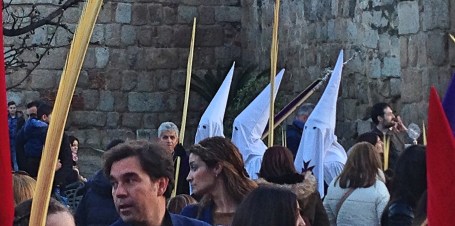
Half the town was gathered in the square, under the walls of the old Moorish fortress. The people were having an Easter Parade.

The most immediately noticeable thing—for an American, at least—is that it looks like a gathering of the Ku Klux Klan. Of course, the Spaniards created their costumes first, and thus it is absurd to associate them with American racism. Nevertheless, the first time I saw it with my own eyes, I couldn’t help feeling uneasy.

Semana Santa

The unease passed quickly, however, and soon I was wholly absorbed in the spectacle. Rows and rows of hooded figures were lined up, some in red, some in white, each of them carrying a stalk of wheat. Among these were dozens of children, who carried little bags full of candy with them; as they walked by, they handed each passerby a treat. Behind the hooded figures was the float. On a large platform a life-sized figure of Jesus was seated on a donkey for his triumphant entry into Jerusalem.

Floats such as this—typical of Semana Santa (Holy Week) in Spain—are carried on the shoulders of a team of men, who huddle underneath, hidden under a veil. It must be heavy. As I watched, the float slowly lurched into motion, step by slow step, plodding like a giant through the town.

Behind the float was the marching band of brass instruments and drums. The music was very simple, and very loud. The snare drums beat out a slow, methodical march rhythm. Over this, the band played a somber sequence of minor chords—a sour, out of tune, tremendously tragic sound that conveyed a sense of overwhelming loss. Sometimes a trumpeter would play a call-and-response with the rest of the horns, squeezing out a strangled series of shrill notes, to be answered by the violent blare of the other players. If you think I didn’t liked it, you’re mistaken; it was music with pathos.

We stood and watched the Holy Week procession for over an hour. I feel privileged to have seen it. Unlike any American tradition, the Semana Santa traditions in Spain give the overwhelming impression of authentic age—as if they have been celebrated the same way for centuries. One feels that one is looking into the depths of history. In stark contrast to the commercial holidays I am accustomed to, the parade had a gravity and solemnity that was deeply moving.

But now it was dark, and we were hungry and tired. After a quick bite we went to sleep.


The next day was Monday. This was to be our only day full in Mérida, so we had lots to see. As I mentioned, Mérida was an important city in Hispania (Rome’s name for Spain). Consequently, some of the finest Roman ruins in Spain, and perhaps anywhere in the world outside Italy, can be found here.

Visitors to the Roman ruins of Mérida have the option to buy combination tickets, which include six sites. This is what we did. Then we went to the two jewels of the city: the Theater and the Amphitheater, located right in the center of town.

The visit took us to the amphitheater first. This is a like a smaller version of Rome’s Colosseum—though it was still a massive construction, big enough for 15,000 spectators. Many of the entranceways into the area are still perfectly useable, the Roman arches still holding strong. Other parts of the building are in various states of decay, allowing me to see the different layers of materials used in the building. One thing I learned—and I’m mildly ashamed I didn’t know this before—was that the Romans had bricks. Indeed, the bricks looked so neat and pristine, their color still bright red, that I found it hard to believe that they were original.

Caceres Amphitheater

The years had been hardest on the seats; most of them are reduced to rubble. Apart from that, however, the preservation is astonishing. Our visit took us through a long tunnel, the main entrance. On either side of the walkway, cardboard cutouts of gladiators are standing guard; beside these are captions of information, explaining the typical armaments of the different types of gladiators. I had thought there were only two or three types of gladiators, but apparently there were a dozen or more, each with their own distinct weaponry. Some had tridents and nets, some had rectangular shields and short swords, and some had small circular shields, heavy helmets, and daggers.

On a stone in front of the box seats reserved for government officials is a faded inscription: AUGUST. PONT. MAXIM. TRIBUNIC POTESTATE XVI. (I myself couldn’t read it, but there was an informational plaque nearby.) From this we learn that this amphitheater was built during the reign of Caesar Augustus, around the year 8 BCE to be precise. To put that in context, the Colosseum was built about eighty years later, in 75 CE.

I tried in vain to imagine what it would be like to fight for my life in front of hundreds of cheering people, and gave up. It is a chilling thought to realize that this splendid architectural marvel was built so that the exploited citizenry and overfed nobles could watch slaves kill each other. It is yet another proof that great art can be produced for nefarious ends.

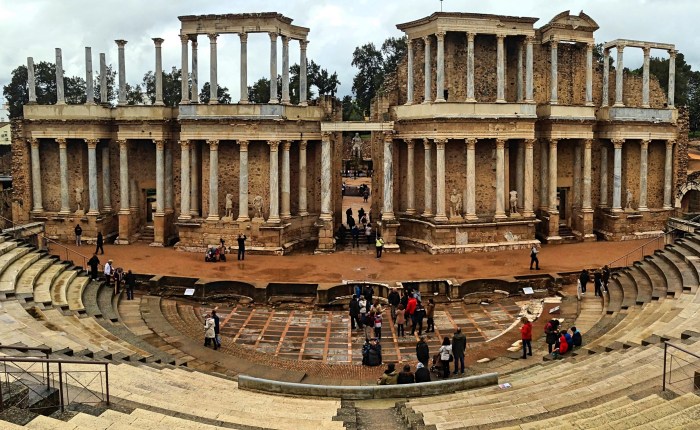
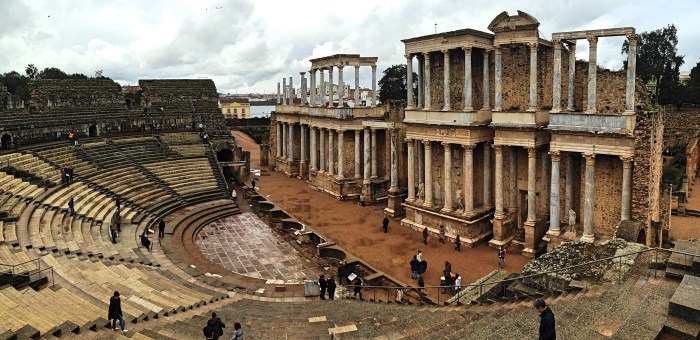
After our fill of pictures we went to the next stop, the Roman theater. It was even more impressive than the amphitheater we had just passed through: it was gorgeous.

Caceres Theater

The theater holds about 6,000 people. First built in around 15 BCE, and majorly renovated about 200 years later, it consists of a semi-circular stadium of seats surrounds a central stage. At first glance the seats looked to be in much better condition than the seats in the neighboring amphitheater; but this was an illusion created by stone-colored plastic coverings. (Plays are still performed here so they need working seats.) In the middle is a semi-circular open space, and beyond that, on a raised platform, a larger rectangular space: this was where the magic happened. But the real attraction was the structure behind the stage.

On each side, resting upon two levels of ten elegant Corinthian columns, was a wonderful façade that served as a backdrop for the ancient theater productions. This is called the scaenae frons, a normal fixture of Roman theaters. It had three doors, one in the center and one on each side, that allowed the actors to enter and exit the stage. The columns themselves were lovely, carved from delicately textured gray and white marble. Standing in the nooks of these columns were Roman statues (the originals are on display at Mérida’s Museum of Roman Art; these are replicas) of gods and heroes, with flowing robes and ornate armor.

I feel a powerful sense of helplessness in moments like this, when faced with something so beautiful and so historic. What am I supposed to do? I take pictures, I wander around, I sit, I stand, I stroll, I do my best to examine and appreciate. I feel a sense of awe at the age and splendor of the place, but what am I supposed to do with this feeling? I wish that the experience would humble me, will put things in perspective, and thus ennoble me; but of course the person who walks out of the monument is still the same petty, neurotic person who walked in.

I hoped to visit the city’s Museum of Roman Art next, but here I realized that I had planned my trip poorly: we were there on the only day the museum is closed, Monday. So we left to go find some more Roman ruins.

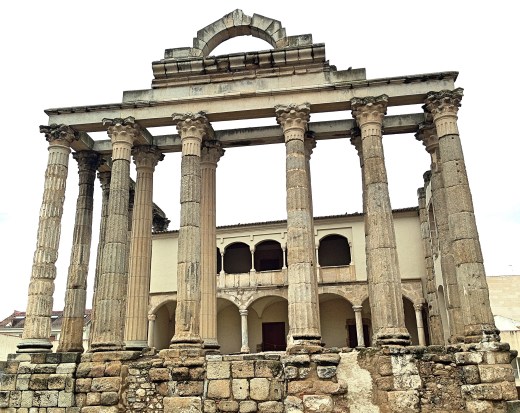
Luckily, Roman ruins were not in short supply. In just ten minutes we came upon the so-called Temple of Diana. This is something of a misnomer, as the temple was actually dedicated to Augustus. In any case it is an impressive sight; a marble lintel sat atop several towering columns. Behind the remains of the temple is affixed an old Renaissance-style house. Apparently, some rich knight decided that it would be nice to live next to the old ruins. The house was elegant enough, but the final effect of the house and the temple was somewhat incongruous. If memory serves, the government considered knocking the house down; but finally decided that it was important enough to merit preservation.

Templo de Diana Caceres

Next we went to the Alcázaba. As its name suggests, this is an old Moorish fortress; it stands next to the Roman bridge, so as to guard the old entrance to the city, and apparently was built over the remains of an older, Roman fortress. This fortress came in handy to the Moors, as they faced several uprisings. The walls are tall and thick, and could have easily withstood all but the most organized attacks.

The entrance fee was included in our combination tickets, so we walked right in. Unfortunately, there wasn’t much to see inside the walls. I imagine that the place was previously full of military barracks and other martial necessities, made out of non-durable materials like wood, which have since disappeared. The only exception to this was the stone cistern. This was a square building that stands in the center of the fortress. There is nothing inside except a long ramp that leads deep underground. At the bottom is a pool of clear, blue rainwater where, surprisingly enough, some fish make their home. But what do they eat?

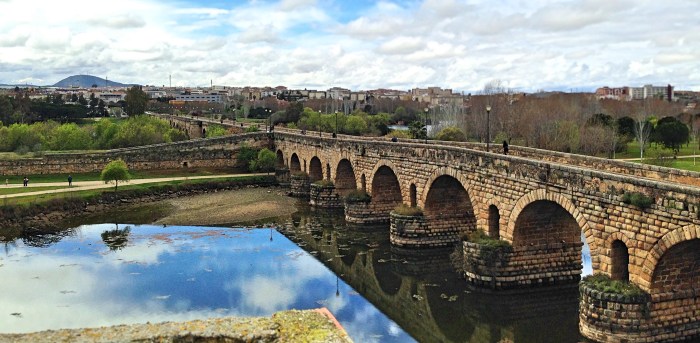
Adjacent to the fortress is the Roman Bridge. This bridge is quite similar to the Roman bridges I had seen in Salamanca and Córdoba: a stone road built over a series of arches, not more than fifty feet over the water. But the bridge of Mérida does have the distinction of being considerably longer; indeed, it is the longest surviving bridge from ancient Rome. The bridge stretches well over 790 m, or 2,500 ft—a stupefying achievement of engineering. The Romans knew what they were doing.

Caceres Roman Bridge

GF and I walked to the other side of the river, and towards the other major bridge of Mérida, the Puente Lusitania. This is an attractive, modern bridge, designed by the architect Santiago Calatraba. The form of the Puente Lusitania is dominated by a big, great fin, like the back of a whale. Its completion in 1991 finally allowed the city to close the Roman Bridge to vehicular traffic. In other words, the only bridge linking both halves of Mérida until 1991 was a bridge built by the Romans.

(The only other bridge across the Guadiana is the railroad bridge, a triangulated structure of cast iron beams riveted together, designed by an Englishman named William Finch in the nineteenth century. The three bridges of Mérida, taken together, are a lovely study in contrasts.)

Our next stop was the Circus Maximus. This was on the other side of town; we had to walk about half an hour, all the way through the city center and through a tunnel under a highway to get there. Again, our tickets included this visit, so we walked right in.

In truth, there wasn’t much to see. It is a dilapidated stone wall (previously, rows of seating), that surrounds an oval-shaped grass field. The only impressive thing about the monument was its size: it’s huge. This was, of course, because chariot races cannot be carried out in closets. We walked around the grassy field for a few minutes, while I tried in vain to imagine what a chariot race would look and feel like, the horses stampeding in a confused heap, the wheels rattling, the whips cracking, the men shouting, the crowd screaming.

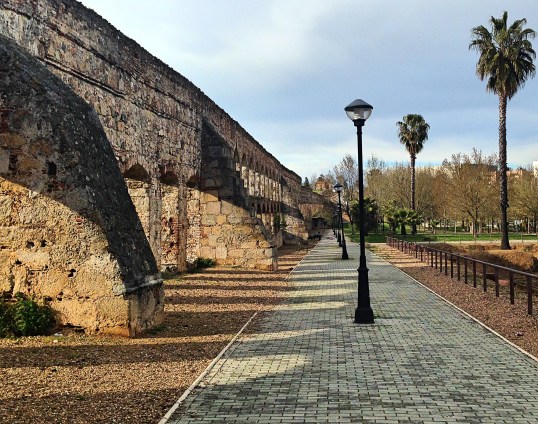
Outside the Circus Maximus were the remains of an old Roman aqueduct, the Acueducto de San Lázaro, one of the three Roman aqueducts of Mérida. Compared with the extraordinary aqueduct of Segovia, this one was rather short—only about 20 to 30 feet. It did go on for quite a ways, however, eventually extending over the other river of Mérida, the Albarregas.

San Lazaro Aqueduct

We followed the aqueduct for a while, across the river and into a park, until the aqueduct disappeared over a hill. Then, we broke off for our next destination, the last site included in our tickets: the Casa del Mitreo.

This is an archaeological site that consists of the remains of an entire Roman housing complex. Understandably, you can’t go in; the visitor walks around a platform raised above the ruins, allowing you to peek inside the rooms from above. The complex was quite large; either it was one very rich family, or several families of more humble means. I don’t know, because all the information panels were written in very small font, in Spanish, and there was a crying kid nearby that kept breaking my focus. Oh well.

Most notable were the impressive floor mosaics, beautifully preserved. My favorite was a floor that had three concentric patterns: an outer pattern of criss-crosses, a middle pattern of rectangles, and an inner pattern of an intricate labyrinth. Floor tilling hasn’t advanced much in the last two thousand years, it seems.

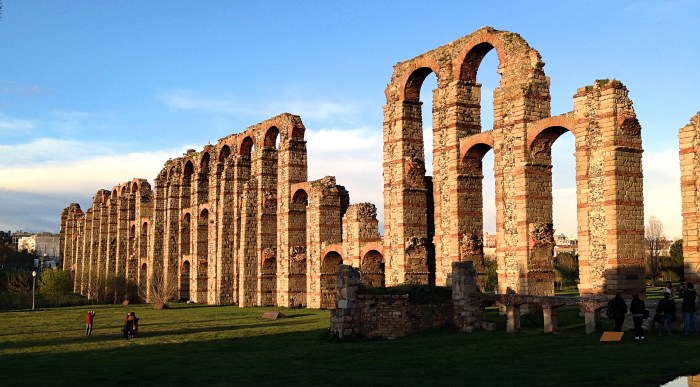
The sun was setting now, and both of us were exhausted. We had been on our feet all day, crisscrossing all over town. But we had one final thing see: the Acueducto de los Milagros, or Aqueduct of the Miracles. This meant yet another walk through town, which we dutifully made, painful and blistered as my feet now were. It was worth it.

Aqueduct Milagro


This aqueduct is massive, about 25 m, or 80 ft tall, standing on three rows of arches. It is partly in ruins now, scarred by the tooth of time, but this only lent it a special majesty. The sun was setting, shinning directly onto the aqueduct, making its brick construction glow a rusty red. All around was a park, where families were talking and laughing. GF and I sat on a bench, resting our aching limbs, staring up at the towering ruin. It was so impressive and so lovely that soon I felt myself full of energy again, ready to drag myself through a dozen more Roman monuments.

Soon the sun was setting. We limped back into town, and were again greeted with a surprise: they were having another Easter Parade. This time the crowd was gathered in front of the doors of a church. Just as we got there, the procession started to exit the building, walking with slow steps to the beat of another doleful march. We watched it go for a while, and then went to feast on beer and cheap sandwiches. Our trip was over. We would be going to Lisbon early next morning, but that’s for another post.
I’m not sure I’ve had a better day in Spain, and that’s saying something. Do visit Mérida. It is an extraordinary place.

Caceres Storks

Review: The Complete Essays

Review: The Complete Essays

The Complete EssaysThe Complete Essays by Michel de Montaigne

My rating: 5 of 5 stars

e’ssay. (2) A loose sally of the mind; an irregular indigested piece; not a regular and orderly composition.
—From Samuel Johnson’s Dictionary of the English Language.

Now I finally have an answer to the famous “desert island book” question: This book. It would have to be. Not that Montaigne’s Essays is necessarily the greatest book I’ve ever read—it’s not. But here Montaigne managed to do something that has eluded the greatest of our modern science: to preserve a complete likeness of a person. Montaigne lives and breathes in these pages, just as much as he would if he’d been cryogentically frozen and brought back to life before your eyes.

Working your way through this book is a little like starting a relationship. At first, it’s new and exciting. But eventually the exhilaration wears off. You begin looking for other books, missing the thrill of first love. But what Montaigne lacks in bells and whistles, he more than compensates for with his constant companionship. You learn about the intimacies of his eating habits and bowel movements, his philosophy of sex as well as science, his opinion on doctors and horsemanship. He lets it all hang out. And after a long and stressful day, you know Montaigne will be waiting on your bedside table to tell you a funny anecdote, to have easygoing conversation, or to just pass the time.

To quote Francis Bacon’s Essays: “Some books are to be tasted, others to be swallowed, and some few to be chewed and digested.” Montaigne’s essays are to be sipped. This book took me a grand total of six months to read. I would dip into it right before bed—just a few pages. Sometimes, I tried to spend more time on the essays, but I soon gave it up. Montaigne’s mind drifts from topic to topic like a sleepwalker. He has no attention span for longwinded arguments or extended exposition. It’s not quite stream-of-consciousness, but almost. As a result, whenever I tried to spend an hour on his writing, I got bored.

Plus, burning your way through this book would ruin the experience of it. Another reviewer called Montaigne’s Essays the “introvert’s Bible”. This is a very perceptive comment. For me, there was something quasi-religious in the ritual of reading a few pages of this book right before bed—night after night after night. For everything Montaigne lacks in intelligence, patience, diligence, and humility, he makes up for with his exquisite sanity. I can find no other word to describe it. Dipping into his writing is like dipping a bucket into a deep well of pure, blissful sanity. It almost seems like a contradiction to call someone “profoundly down-to-earth,” but that’s just it. Montaigne makes the pursuit of living a reasonable life into high art.

Indeed, I find something in Montaigne’s quest for self-knowledge strangely akin to religious thinking. In Plato’s system, self-knowledge leads to knowledge of the abstract realm of ideals; and in the Upanishads, self-knowledge leads to the conception of the totality of the cosmos. For Montaigne, self-knowledge is the key to knowledge of the human condition. In his patient cataloging of his feelings and opinions, Montaigne shows that there is hardly anything like an unchanging ‘self’ at the center of our being, but we are rather an ever-changing flux of emotions, thoughts, memories, anxieties, hopes, and sensations. Montaigne is a Skeptic one moment, an Epicurean another, a Stoic still another, and finally a Christian.

And isn’t this how it always is? You may take pride in a definition of yourself—a communist, a musician, a vegan—but no simple label ever comes close to pinning down the chaotic stream that is human life. We hold certain principles near and dear one moment, and five minutes later these principles are forgotten with the smell of lunch. The most dangerous people, it seems, are those that do try to totalize themselves under one heading or one creed. How do you reason with a person like that?

I’ve read too much Montaigne—now I’m rambling. To return to this book, I’m both sorry that I’ve finished it, and excited that it’s done. Now I can move on to another bedside book. But if I ever feel myself drifting towards radicalism, extremism, or if I start to think abstract arguments are more important than the real stuff of human life, I will return to my old friend Montaigne. This is a book that could last you a lifetime.

Narcicus Caravaggio

View all my reviews

West to Extremadura: Cáceres

West to Extremadura: Cáceres

“See those trees?” the driver said.

“Yeah.”

“That’s what the pigs eat, the acorns from those trees. They’re called encinas.”

We were on our way to Cáceres, one of the major cities in Extremadura. Out the window I could see the flat, featureless, interminable plains of the region. Extremadura is known in Spain as being the poorest autonomous region—whose subsidization the Catalans are forever resenting. Life here, in this land of farmers and shepherds, has historically been rough. Perhaps this is why so many of the infamous conquistadors—including the two most famous, Francisco Pizarro and Hernán Cortés—ventured forth from this land: having few prospects at home, they sought adventure abroad.

The drive west from Madrid is perhaps the least interesting one in Spain I know. There isn’t anything to see except fields of grass and the aforementioned short, shrubby trees. But the visual dullness is amply compensated by what the traveler can learn about Spain from a trip here. Case in point: jamón ibérico, the finest ham in the country—and ham is fundamental to Spanish food—comes from here. The black pigs roam, free-range, eating the acorns of the encina trees, known in English as the “holm oak.”

Our driver spoke in the fast, clipped accent of Cáceres, only slightly easier to understand than the dreaded accent of Andalusia. We were on vacation for Semana Santa, Holy Week. Our final destination was Lisbon; but to break the trip into manageable chunks we decided to stop in Cáceres and Mérida on the way there, cities that had been recommended to us.

In two hours we arrived, dropped off our bags, and went into the city center. It was a rainy, overcast day, with a chilly breeze. The gray sky and the dull light gave the town a forsaken aspect. But instead of detracting from the city’s charm, the weather added to it.

Cáceres is one of the major cities of the region, the capital of its eponymous province. The city is notable for having one of the finest historical centers in Spain. The walled city is almost perfectly preserved; it looks as though hardly anything has changed since the Middle Ages. Most of the buildings are worn and weather-beaten, but their brown stone façades are all the more impressive for that. Unlike Toledo, few buildings stand out for special comment. Rather it is the entire city center that is the main attraction, the narrow stone streets, the proud walls, the many church spires.

Caceres Plaza Mayor
The Plaza Mayor

But Cáceres is not exactly beautiful, and it certainly isn’t pretty. The city is impressive for its severity. While wandering through the chilly interior of a cavernous church, or standing in the rain underneath the city walls, you get the powerful sense of what it must have been to live here, eking out a living on the hard soil, taking shelter behind the walls, seeking salvation in another world. The final impression is that life here was precarious and hard; and even now the town seems only to limp by on the strength of its tourism.

Caceres Street

The first building we visited was the Concatedral de Santa Maria de Cáceres, a co-cathedral built at the end of the Romanesque period. Like most building in Cáceres, it is rather plain; the outside is devoid of ornament. The most beautiful thing on the inside is a massive carved wooden altar, quite a marvelous piece of work. You can also visit the building’s tower, which affords you with an excellent view of the old city.

Caceres Altar

Probably the most conspicuous church in Cáceres is the Iglesia de San Francisco Javier. This church sits at one of the highest points in the city, and its two white towers, which flank the main doorway, can be seen from quite a distance. The inside is rather unusual: On both the ground and the upper level there is a massive timeline, recounting the history of Spain and the Catholic Church. It wasn’t very well made; the board was so crowded with names and dates, all printed in tiny letters, that you would have to spend many hours to read everything. Also on the upper floor was a museum of Belén (nativity scene) figurines. They had examples not only from Spanish history, but from all around the world. There was everything in the church except a church.

From the top floor you can walk up to either of the tall, white towers. Not only did we get a nice view of the city, but we also got a close look at some of the white storks nesting on the opposite tower. They are lovely birds.

Caceres Storks

Next we went to the Museum of Cáceres. In truth, I wasn’t expecting much from this museum; and the nondescript building only confirmed my lack of excitement. The place seemed so destitute that I doubted there could be anything worth seeing. But I am happy to report that I was very wrong.

The collection spanned from prehistory to the present day. It began with the region’s pre-Roman inhabitants, their jewelry and clay pots. Next were the Roman artifacts, including little statues and tablets with still visible Latin inscriptions. There were replicas of the agricultural tools used by the erstwhile peasants of the region, as well as their traditional dresses. Down a flight of steps I found a room dedicated to the Visigoths, and down another flight, in the basement, was the most impressive room of all. It was an original aljibe, a water well constructed by the Moors. In dim, subterranean light, the distinctive crescent arches of the Moors stand over a still pool of water. It is enchanting.

I thought that would be all, but a walkway led to another building, and there I found that the Museum of Cáceres also boasts an impressive collection of modern art, including a sketch by Picasso. On the floor below that, there are also a few examples of Medieval art, and even a work by El Greco. If you find yourself in Cáceres, do visit this museum.


The next day was bright and sunny. We ate breakfast and headed into town. Once there, however, we realized that we didn’t have very much to do. We had seen the major churches, we had seen the museum, we had walked all the streets. Now what? I was lazily turning this question over when I noticed how lovely the surrounding area looked in the sunlight.

Thus we turned down a narrow street, passed through the old medieval gate, and emerged on the other side. In just twenty minutes we were surrounded by farms and rolling grassland. Horses grazed nearby, sticking their noses through the farm gate in hope of food. We found a dirt path leading away from the road, going to our left into one of the grassy fields. By now the weather was nearly perfect, with a warm sun and a cool breeze. The grass shone green, and the flowers were in bloom. In the distance we could see more horses grazing in the open fields; and beyond that the old city center of Cáceres sitting nobly on its hill.

Caceres Distance


The natural scenery and the blue sky felt so refreshing after the gloomy rain and the harsh Medieval architecture of yesterday. The only buildings here were derelict. An old farmhouse with boarded up windows, stuccoed brick walls, and cracked wooden window-frames stood by the side of the path; its roof was totally caved in, the wooden beams a broken heap on the floor, everything covered in weeds. A stone wall ran besides this farm; shards of colored glass has been glued to the top to discourage trespassers.

We walked for hours, holding our jackets, soaking in the sun and breathing the fresh air. But then the sun began to go away, and it became so chilly we had to put our jackets back on. Storm clouds were appearing; in just minutes the blue sky was devoured by grey. We began heading back for town, but we hadn’t gotten far before the rain started. Unluckily for us, we didn’t have our umbrellas, so we huddled through the town back to our room.

Soon we were back at our Airbnb. Our two days in Cáceres were spent. The town is not, perhaps, as imposing as Toledo or Córdoba; but what Cáceres lacks in major landmarks it makes up in intimacy. The medieval streets are not filled with noisy street performers or clowns in costume, as in so many other Spanish cities. You will not have to nudge your way through massive tour groups or dodge gaggles of Americans on Segways. The restaurants are filled with locals, not tourists. Horses roam the city’s surroundings, not double-decker buses. Intense tourism gradually turns every site into Disneyland, but Cáceres is still a city.

Review: Opticks

Review: Opticks
Opticks

Opticks by Isaac Newton

My rating: 4 of 5 stars

My Design in this Book is not to explain the Properties of Light by Hypotheses, but to propose and prove them by Reason and Experiment

Newton’s masterwork is, unquestionably, his Principia. But it is neither an easy nor a pleasant book to read. Luckily, the great scientist wrote a far more accessible volume that is scarcely less important: the Opticks.

The majority of this text is given over to descriptions of experiments. To the modern reader—and I suspect to the historical reader as well—these sections are remarkably dry. In simple yet exact language, Newton painstakingly describes the setup and results of experiment after experiment, most of them conducted in his darkened chamber, with the window covered up except for a small opening to let in the sunlight. Yet even if this doesn’t make for a thrilling read, it is impossible not to be astounded at the depth of care, the keenness of observation, and the subtle brilliance Newton displays. Using the most basic equipment (his most advanced tool is the prism), Newton tweezes light apart, making an enormous contribution both to experimental science and to the field of optics.

At the time, the discovery that white light could be decomposed into a rainbow of colors, and that this rainbow could be recombined back into white light, must have seemed as momentous as the discovery of the Higgs Boson. And indeed, even the modern reader might catch a glimpse of this excitement as she watches Newton carefully set up his prism in front of his beam of light, tweaking every variable, adjusting every parameter, measuring everything could be measured, and describing in elegant prose everything that could not.

Whence it follows, that the colorifick Dispositions of Rays are also connate with them, and immutable; and by consequence, that all the Productions and Appearances of Colours in the World are derived, not from any physical Change caused in Light by Refraction or Reflexion, but only from the various Mixtures or Separations of Rays, by virtue of their different Refrangibility or Reflexibility. And in this respect the Science of Colours becomes a Speculation as truly mathematical as any other part of Opticks.

Because I had recently read Feynman’s QED, one thing in particular caught my attention. Here is the problem: When you have one surface of glass, even if most of the light passes through it, some of the light is reflected; and you can roughly gauge what portion of light does one or the other. Let us say on a typical surface of glass, 4% of light is reflected. Now we add another surface of glass behind the first. According to common sense, 8% of the light should be reflected, right? Wrong. Now the amount of light which is reflected varies between 0% and 16%, depending on the distance between the two surfaces. This is truly bizarre; for it seems that the mere presence of second surface of glass alters the reflectiveness of the first. But how does the light “know” there is a second surface of glass? It seems the light somehow is affected before it comes into contact with either surface.

Newton was aware of this awkward problem, and he came up with his theory of “fits of easy reflection or transmission” to explain this phenomenon. But this “theory” was merely to say that the glass, for some unknown reason, sometimes lets light through, and sometimes reflects it. In other words, it was hardly a theory at all.

Every Ray of Light in its passage through any refracting Surface is put into a certain transient Constitution or State, which in the progress of the Ray returns at equal Intervals, and disposes the Ray at every return to be easily transmitted through the next refracting Surface, and between the returns to be easily reflected by it.

Also fascinating to the modern reader is the strange dual conception of light as waves and as particles in this work, which cannot help but remind us of the quantum view. The wave theory makes it easy to account for the different refrangibility of the different colors of light (i.e. the different colors reflect at different angles in a prism).

Do not several sorts of Rays make Vibrations of several bignesses, which according to their bignesses excite Sensations of several Colours, much after the manner that the Vibrations of the Air, according to their several bignesses excite Sensations of several sounds. And particularly do not the most refrangible Rays excite the shortest Vibrations for making a Sensation of deep violet, the least refrangible the largest for making a Sensation of deep red, and the several intermediate bignesses to make Sensations of the several intermediate Colours?

To this notion of vibrations, Newton adds the “corpuscular” theory of light, which held (in opposition to his contemporary, Christiaan Huygens) that light was composed of small particles. This theory must have been attractive to Newton because it fit into his previous work in physics. It explained why beams of light, like other solid bodies, travel in straight lines (cf. Newton’s first law), and reflect off surfaces at angles equal to their angles of incidence (cf. Newton’s third law).

Are not the Rays of Light very small Bodies emitted from shining Substances? For such Bodies will pass through uniform Mediums in right Lines without bending into the shadow, which is the Nature of the Rays of Light. They will also be capable of several Properties, and be able to conserve their Properties unchanged in passing through several Mediums, which is another conditions of the Rays of Light.

As a side note, despite some problems with the corpuscular theory of light, it came to be accepted for a long while, until the phenomenon of interference gave seemingly decisive weight to the wave theory. (Light, like water waves, will interfere with itself, creating characteristic patterns; cf. the famous double-slit experiment.) The wave theory was reinforced with Maxwell’s equations, which treated light as just another electro-magnetic wave. It was, in fact, Einstein who brought back the viability of the corpuscular theory, when he suggested the idea that light might come in packets to explain the photoelectric effect. (Blue light, when shined on certain metals, will cause an electric current, while red light will not. Why not?)

All this tinkering with light is good fun. But the real treat, at least for the layreader, comes at the final section, where Newton speculates on many of the unsolved scientific problems of his day. His mind is roving and vast; and even if most of his speculations have turned out incorrect, it is stunning simply to witness him at work. Newton realizes, for example, that radiation can travel without a medium (like air), and can heat objects even in a vacuum. (And thank goodness for that, for how else would the earth be warmed by the sun?) But from this fact he incorrectly deduces that there must be some more subtle medium that remains (like the famous ether).

If in two large tall cylindrical Vessels of Glass inverted, to little Thermometers be suspended so as not to touch the Vessels, and the Air be drawn out of one of these Vessels thus prepared be carried out of a cold place into a warm one; the Thermometer in vacuo will grow warm as much, and almost as soon as the Thermometer that is not in vacuo. And when the Vessels are carried back into the cold place, the Thermometer in vacuo will grow cold almost as soon as the other Thermometer. Is not the Heat of the warm Room convey’d through the Vacuum by the Vibrations of a much subtiler Medium than Air, which after the Air was drawn out remained in the Vacuum?

Yet for all Newton’s perspicacity, the most touching section was a list of question Newton asks, as if to himself, that he cannot hope to answer. It seems that even the most brilliant among us are stunned into silence by the vast mystery of the cosmos:

What is there in places almost empty of Matter, and whence is it that the Sun and Planets gravitate towards one another, without dense Matter between them? Whence is it that Nature doth nothing in vain; and whence arises all that Order and Beauty which we see in the World? To what end are Comets, and whence is it that Planets move all one and the same way in Orbs concentrick, while Comets move all manner of ways in Orbs very excentrick; and what hinders the fix’d Stars from falling upon one another? How came the Bodies of animals to be contrived with so much Art, and for what ends were their several Parts? Was the Eye contrived without Skill in Opticks, and the Ear without Knowledge of Sounds? How do the Motions of the Body follow from the Will, and whence is the Instinct in Animals?

View all my reviews

A Sip of Logroño

A Sip of Logroño

(Continued from my post about Burgos.)

Our next stop was the city of Logroño, the capital of the province of La Rioja. With only 5,045 square kilometers, La Rioja is the smallest province on mainland Spain and the second smallest overall, only slightly larger than the Balearic Islands. For any wine connoisseurs, the region needs no introduction. Located in the upper regions of the Iberian System of mountains, the province occupies the valley of the Ebro; and it is here that this mighty river splits and divides into seven channels, which is why La Rioja is known in Spanish as “The land of the seven valleys.” The climate of this valley—gradually varying as the land ascends from east to west—has proven ideal for viticulture.

Logroño is by far the largest city in this province, concentrating more than half its population within its reach. Like Zaragoza, the city is huddled around the Ebro; and like León and Oviedo, it is an important stop on the Camino de Santiago. Compared with any of those three cities, Logroño has played a relatively modest part in Spanish history. Surrounded by Aragon to the East and Castilla y León to the West, the city has never been a major center of power. But it is a center of wine—and that is what I was there for.

We took a Blablacar there the next morning. For part of the way, we were accompanied by two college-aged girls. I only mention them because they immediately struck me as odd.

In Spain, greetings are important. When you get into a car, you often perform all sorts of contortions so you can—like a proper human being!—kiss one another on the cheeks and make introductions. But these girls, who were Spaniards, sat timidly in the corner and gave us nervous smiles. And even though my Spanish was halfway decent by then, I found it impossible to communicate with them. Eventually we stopped in a small, no-name town and they hastily got out without even a word of goodbye. I looked around at the town, which struck me as one of the seemingly identical, featureless pueblos one drives through on the way to the major cities. Why were they here? Were they running away or something?

“Weird people,” the driver said, as we started driving away. I’m glad I wasn’t the only person to think so.

Our plan was to visit a bodega, which is the Spanish word for winery. (As a side note, I can’t help finding this word funny, since in New York City a “bodega” is a corner store.)

Our Airbnb host was out of town, so we were shown in by the host’s mother, a terribly nice woman who answered all our questions, gave us recommendations, and even made us reservations for a tour at a winery—specifically, the Campo Viejo winery. But there was one problem. When she left, we realized that she was under the impression that we had a car; the winery was well outside of town, and when I called to ask if it was possible to walk there, the man said “No, no, take a taxi.”

We were feeling stingy and we didn’t want to pay for a cab. Travel doesn’t pay for itself. Google Maps said it would take an hour, and that was exactly how much time we had before our tour. So we decided to walk. Our phones soon led us out of the city and into the surroundings countryside. We were forced to walk on the road because there were no sidewalks, but thankfully the roads were mostly empty.

In just forty minutes we were making our way through rows and rows of grape plants. Or at least I assumed they were. This was my first trip to a vineyard or a winery, and to my ignorant eyes the plants looked like stunted trees, not “vines.”

Logroño Vineyard
The colorful thing was part of a marketing campaign

Finally we arrived, and right on time. The tour began. And unsurprisingly, it was in Spanish. The guide very kindly offered to translate in English for us, but we bravely said no, hoping to improve our Spanish in the process.

Consequently, at a generous estimate I understood about 20% of the tour. Probably more like 10%. But here’s the outline. To start, he took us outside where he talked about the grapes, and then went downstairs where he told us about the history of the winery. Next he led us into a massive room where hundreds of thousands of bottles of wine were sitting on racks; he had to shout to be heard over the giant fans, which kept the room at a constant temperature, pressure, and humidity. I believe this room was to combat the effects of “bottle-shock”—the temporary distortion in flavor that follows the bottling of wine.

After that, we were shown the factory. On metal platforms suspended twenty feet from the ground we walked among about forty gigantic metal tanks. He told us about the fermentation and distillation process, and I understood none of it. But even though I didn’t understand what any of the equipment was for, I think there is something terribly exciting about being around big, shiny, high-tech equipment. I felt like I had stepped into the future, and it smelled like fermented grapes. The last stop was most impressive of all. A ramp led us down to another massive room at the bottom of the building. Our guide switched on the lights, and suddenly I saw thousands of wooden barrels, all pilled atop one another, stretching out before me like the ocean. There must have been thousands.

It always amazes me that we can develop things like wine-making to the pitch of perfection, an exquisite blend of science and art, and yet we cannot solve problems like poverty. I suppose there’s more profit in the former.

Finally it was time for the tasting. Our group gathered around the bar, and the guide began pouring out classes of white wine. He tried to talk us through the process to properly taste wine—sniffing and gurgling and pondering—but I had downed my glass before he’d even started. I liked everything, but I must admit by pallet is extremely insensitive: all wine tastes pleasant but rather similar to me. Case in point: the thing I remember most fondly from the tasting was not the wine, but the free chorizo and bread sticks that I munched on ravenously.

Best of all, we didn’t even have to walk back. There was a nice Spanish couple from Burgos on our tour, and one of them was very excited by the opportunity to practice his English with us. He spent the whole tour tasting chatting with us; and when we finished, he offered to give us a ride back to town.

“Do you trust me?” he said, as we climbed into his car. Normally this kind of comment would send chills running down my spine; but in the mouth of a non-native speaker, it seemed nice and innocent.

Well, we survived. In just ten minutes we were back in town. Since we didn’t have any plans beyond our wine tasting, we decided to kill time before dinner by visiting all the church buildings in town. Logroño, as I mentioned, is situated along the Camino de Santiago, the famous pilgrimage route that runs along the north of Spain. This route is clearly marked with the classic cockle shell insignia; and even though it was cold and off-season, we saw a handful of dutiful pilgrims, wearing blue rain jackets and lugging around giant backpacks, making their way through the town.

None of the churches or basilicas of Logroño is memorably impressive on its own, especially after seeing the Burgos Cathedral. But taken together, the churches of Logroño form a wonderful tableau of religious architecture.

We went to four or five in quick succession. One church that sticks out in my memory is the Iglesia de San Bartolomé, which has a wonderful front portal, bursting with radiating arches and crowned with a sculpture of the Last Judgment. The inside was empty, except for a lonely priest sitting in the confessional booth; and in the cold silence of that stone building, I couldn’t help feeling sorry for the lonely priest, waiting for a congregation that seldom comes.

Logroño San Bartolomé_Fotor

Another church worth mentioning is the Iglesia de Santiago del Real, one of the largest churches in the city. You can recognize the church from the equestrian statue of Santiago wearing his pilgrim’s hat, his arm raised to strike. As we wandered through the dark and cavernous insides, examining the chapels and altars, a man came in, kneeled down on a pew, and prayed. Three minutes later he got up and left, the thud of the heavy wooden door echoing ominously through the interior.

Santiago's_Church_in_Logroño
Photo by jynus; licensed under CC BY 2.5; taken from Wikimedia Commons

“I wonder what it’s like to be a catholic in one of these places,” GF said. “Does it add to the experience?”

I had been wondering the same thing. For the two of us, all the altars, chapels, and architecture of Catholicism are simply art; our appreciation is purely aesthetic. It must be a different thing completely to look upon the giant crucifixes in the stone buildings, and see the Truth of the Universe. Sometimes I almost regret that these stronger, more spiritual pleasures are cut off from me. But so it goes.

Logroño Cathedral.jpg

Last we went to the cathedral, which you can recognize by its two towering spires. Technically the Cathedral of Logroño is a co-cathedral; indeed it is one of three in its diocese, along with the Cathedral of Calahorra and the Cathedral of Santo Domino de la Calzada. In any case, we weren’t able to look around because there was a wedding being held. When we peeped in, the groom and the bride were kneeling before the altar while loud organ music was playing. The priest was standing nearby. Catholicism may be fading here in Spain, but it’s certainly not dead.

Logroño Wedding

Finally it was time for dinner. For this we went to the Calle Laurel, the famous culinary arterty of Logroño. The street is so narrow and so full of people during meal times that no car could make it through—and none did. Restaurant after restaurant is packed into the small stretch of street; and in each one you can see plate after plate lined up on the bar, waiting for you to partake. Many of these dishes are ostentatious in their presentation: meatballs are served in a wine glass, covered in a bright red sauce; ham is suspended like a flag on a ship from toothpicks sticking out of the top of a croquette.

To avoid the crowd, we got to the street at 7:30 (very early for Spain), picked a restaurant, and dove in. We ordered whatever caught our eye. But to my dismay, as soon as I chose a dish the waiter would take it and stick it in the microwave. The food still tasted good, but the microwave rendered it soggy and textureless, and one croquette was still cold in the middle.

We went to another bar and got the same treatment; and ditto in a third bar after that. All told, we samples six different bars before calling it quits, most of the food only moderately good. But thankfully we saved the best for last. To finish we walked into a bar that served only mushrooms—the Bar Ángel. They are the simplest things in the world, cooked in olive oil with a sprinkle of salt; and they are delicious. If you’re in Logroño, find the restaurant with the grill filled with mushrooms and eat your fill.

The next morning we took a Blablacar back to Madrid, riding with a couple of guys from Senegal; they both worked in a meat factory in Cuenca. One of them slept the whole time, but the driver was a sociable fellow and we talked in accented Spanish the whole way back. And thus ended another weekend in Spain.