This past year of reading has shaped up to be a great one.
One major theme this year was war. Perplexed by the prevalence of such a monstrous and destructive activity, I read several histories and biographies, particularly focusing on the First World War and the Spanish Civil War. Of the former, Rainer Maria Rilke’s and Ernest Hemingway’s novels combined with Ernst Jünger’s memoirs to give me some idea of a soldier’s life during the Great War. G.J. Meyer’s excellent overview, A World Undone, completed the picture by summarizing the background and the battles. On the Spanish front, F.G. Tinker’s thrilling memoirs of his time as a fighter pilot complemented Antony Beevor’s military history and Gerald Brenan’s historical background to the conflict. (I also went on a superb tour in Barcelona focused on the war.)
I remain both morbidly fascinated and equally baffled by warfare, and plan on continuing this theme into the next year, focusing more on the Second World War.
I also explored history more generally. To compensate for my dearth of high culture, I made my way through Grout & Palisca’s History of Western Music—a worthy overview of the subject—as well as several smaller books about individual artists—Dalí, Gaudí, Sorolla, and Picasso. Stefan Zweig’s memoirs taught me about the pre-war and interwar periods in Europe, and Tony Judt’s magnificent history of postwar Europe led me from 1945 up to the present day. Then, Joseph Stiglitz’s economic analysis shed light on Europe’s uneasy status quo. Hoping to penetrate the mysterious rise and fall of civilizations, I tackled Oswald Spengler’s phantasmagoric Decline of the West and Arnold Toynbee’s more soporific companion, A Study of History; but I remain in the dark on this question, so I content myself with the sharp prose and colorful descriptions of Lord Macaulay.
Henry David Thoreau was born 200 years ago this year, so I decided to re-read his classic account of life in the woods once more, and found myself once more conflicted. (I also visited Walden Pond, as well as a fantastic exhibition about Thoreau in the Morgan Museum in New York.) I also decided to trace Thoreau’s influence through some of his spiritual followers, both as a conservationist and as a social advocate. This led me to Aldo Leopold’s A Sand County Almanac, Rachel Carson’s Silent Spring, Upton Sinclair’s The Jungle, Howard Zinn’s People’s History of the United States, and Jacob Riis’s How the Other Half Lives.
This last book dovetailed with another major theme, New York City, which led me to learn about the Croton Aqueduct and the subway system, as well as to read Federico Garcia Lorca’s surreal poetry, Jane Jacob’s brilliant analysis of what makes cities succeed and fail, and Robert Caro’s wholly remarkable biography of Robert Moses—easily one of the best books of the year.
Though this year has been fairly light on fiction, I still had some literary pleasures. Among these were severalShakespeareplays, Hemingway’s short stories, Dickens’s Bleak House, and the final three volumes of Proust’s sprawling epic. But my favorite novel, and my favorite book of the year, is without doubt George Elliot’s Middlemarch, which I found to be life-alteringly brilliant. I have also read some excellent literary criticism: Orwell’s essay on Dickens, Ortega y Gasset’s essay on Cervantes, Unamuno’s ecstatic commentary on Don Quijote, and best of all Bradley’s lectures on Shakespeare’s tragedies—a model of literary appreciation.
To sharpen my travel writing I read Patrick Leigh Fermor’s wordy account of his trip through Europe in the 1930s, and George Henry Borrow’s even wordier account of his trip through Spain in the 1830s, neither of which I very much liked. Yet I relished Richard Ford’s Gatherings From Spain, and recommend it to any curious travelers to the Iberian peninsula.
My reviews have grown longer and more detailed this year, as I have incorporated more summary into my reviews in the hope, perhaps vain, that it will allow me to understand and retain more of what I read. The downside of this strategy is, of course, that many reviews are a slog to read. But on the whole I am happy with most of my reviews from this year. Of these, I am most proud of my review of Hegel’s Phenomenology, followed closely by Susan Haack’s Defending Science—Within Reason—two philosophy texts, as it happens.
Thanks to all of you for reading so much and for writing so well, and may 2018 be even better.
Working as an English teacher in Spain gives you a certain insight into its economy. Immediately noticeable is the huge demand: seemingly everybody—adults, children, babies, retirees—wants to learn English. Finding work is less than effortless; you need to fend jobs off. The obvious explanation for this is the paucity of the available domestic jobs, and the undesirability of the jobs that do exist, leading many people to seek work elsewhere. More concerning are the large numbers of highly skilled workers who cannot find work. Unemployed doctors, lawyers, computer programmers, and engineers have come to my classes, hoping to improve their chances of getting hired. Added to this, young people in my high school complain bitterly about the prospects of finding a job upon graduating.
Clearly something is amiss. And according to Stiglitz, that something is the euro.
Introduced into circulation in 1999, the euro was the optimistic sign of a coming age of European integration. Nowadays, after a recession, a Greek debt crisis, a Brexit, a refugee crisis, and the resurgence of several nationalist and regionalist parties, things look somewhat less bright on the continent. Unemployment remains high in many parts of the eurozone, especially in the crisis countries—Spain, Portugal, Greece, Ireland—and especially among the young. More than that, the much-anticipated European solidarity and common European identity have largely failed to materialize (or, at least, not nearly to the hoped-for degree). Stiglitz believes that one of the main culprits for these failures is the common currency.
Aside from fostering solidarity, the euro was, of course, expected to aide prosperity. The absence of economic borders, the free movement of labor and goods, and the elimination of conversions and exchange rates was expected to boost the economy and reduce the differences in wealth between countries. But contrary to predictions the economy did not grow notably faster than it had been pre-euro; and after the 2007-8 crisis, the economy sank into a prolonged recession from which is has yet to completely recover.
The explanation for this, according to Stiglitz, is that the introduction of a common currency took away a crucial flexibility—the ability to adjust inflation and interest rates—without replacing it with any compensating institutions. Specifically, this inflexibility makes it more difficult to deal with trade deficits (when a country is importing more than it is exporting). Normally, when there is a trade deficit a country can inflate its currency to correct the imbalance. But when the currency is essential ‘pegged’—leading to a situation similar to a gold-standard—than this adjustment cannot happen, and the deficit can persist long-term.
If a country is buying more foreign products than it is selling, then clearly the money must come from somewhere. If the money comes from banks—borrowing money from abroad and lending it to domestic consumers—then this leaves the country vulnerable to a financial crisis, should too many borrowers demand their money at once. If, conversely, the government absorbs the deficit in the form of debt then this leads to another vulnerability: if the debt mounts so high that investors lose confidence that it can be repaid, then lending might suddenly stop, leading to a debt crisis. And since the debt is, essentially, in a foreign currency—one that cannot be devalued by the country—it will require some sort of foreign assistance to deal with.
Debt and financial crises can easily lead to general economic crises—high unemployment coupled with low aggregate demand—so running a persistent trade deficit is something that most countries would like to avoid. But how? In order to work properly, common currency areas normally require that its member states be sufficiently similar. This is clearly not the case in Europe; and this disparity allows Germany to persistently runs a trade surplus—a surplus that virtually requires other countries to run a deficit (since all surpluses and deficits add to zero).
Indeed, the crafters of the euro were aware of the problem of a too-differentiated economy, which is why they created “convergence criteria” that the countries had to satisfy in order to join the eurozone. Unfortunately, according to Stiglitz, these criteria were poorly conceived, focusing exclusively on currency stability and fiscal deficit (a narrow-minded focus that characterizes the entire project, it seems). It was hoped that the common currency would aide further convergence between the countries; but the reverse has happened. Rather, the common currency has turned some countries into debtors and others into creditors, further dividing their economies.
But the United States is a common currency area that is highly differentiated by state. Why, then, does a common currency work there and not in Europe? Well, for one it is far easier for Americans to move to different states than for Europeans to move to different countries. A Spaniard in Germany is not like a Mainer in New York. And even if people in Europe could easily move from country to country, it would be alarming if, say, Slovenia became depopulated—what would happen to its culture? On the institutional level, Washington has far more funds to spend—either on countercyclical investment, social safety net programs, or bailing out banks—than does Brussels. In short, culturally, linguistically, and institutionally, the United States is far more integrated.
The situation created by the euro, then, left many countries vulnerable to crises. And when a crisis hit—a very big crisis, admittedly not of their own making—the institutions of the eurozone made it much worse than it had to be. As either the government (as in Greece) or the banks (as in Spain) succumbed, the European Troika imposed austerity as conditions of their bailouts. This, of course, led to still further economic recession, since raising taxes and cutting spending is the reverse of what governments ought to do in a downturn. The increased unemployment should, in theory, have led to wage reduction, and thus to decreased prices and increased exports, which would restore the economy to equilibrium. Certain market rigidities, however—such as resistance to wage cuts and a reluctance to lower prices in a downturn—impede this adjustment, leading to a prolonged recession.
This, in a very simplified form, is Stiglitz’s diagnosis of the problem. And behind all of these institutional failings—from the eurozone’s flawed architecture to the incompetent response to the crisis—Stiglitz sees one culprit: neoliberalism, or “market fundamentalism” as he calls it.
But he does not merely set out to criticize. This book is also full of potential solutions, many of which I found quite creative. To correct the trade imbalance, for example, “chits” can be introduced: a type of credit that can be bought and sold, and which allows its possessor to import or export. Controlling the “chit” supply would thus control the deficit or surplus. More prosaically, he suggests common deposit insurance, institutions to invest in small businesses, a broader mandate for the ECB (European Central Bank), large investments in infrastructure and research, a procedure for country-level debt restructuring, and financial reforms to encourage productive investments rather than speculation, to name just a few ideas.
In short, he believes that greater European solidarity—leading to common institutions that focus on a common prosperity—is needed if the euro is to work. And if that is not possible, Stiglitz believes that the cost of exiting the eurozone is less than the cost of remaining inside and pushing doggedly onward. He even provides a detailed plan of action should Greece decide to leave the eurozone. Of course every country need not return to its old currency; there could, for example, be a “northern euro” and a “southern euro.” Merely having Germany leave would go a long way in restoring balance to Europe’s economy.
For such a short and quick read, this book is impressively rich in ideas and penetrating in its analysis. But of course there are shortcomings. While easy enough to read, I found the writing to be stiff and lifeless; the book is written with the impersonal tone of an academic article. More seriously, I fear that many will find the book too partisan—specifically, too leftist—to be convincing. It is intrinsically unsatisfying for Stiglitz to dismiss his theoretical opponents as “market fundamentalists,” since this leads me to wonder why so many people could hold such contrary views about how the economy works. Admittedly, as Stiglitz himself argues, all economic decisions are, at bottom, political decisions, since they are aimed at pushing society in a certain direction. Even so, Stiglitz makes too little of an attempt to reach out to those not of his ideological persuasion.
Though I am far too ignorant to evaluate his economic arguments, I found the book quite convincing. This pains me. Personally I like the euro very much. The ability to use my pocket money in Italy, Ireland, or Germany is extraordinarily convenient. But if the euro leads to a prolonged underperformance in some countries then it must be reformed or replaced. It is, after all, only a currency. The really important issue is European solidarity: the belief that Europeans are stronger together than apart. And when some countries are debtors and some are creditors, and both are economically stagnant, and when voters have little sway over important economic decisions—this is no recipe for harmonious coexistence. The euro was, in any case, only intended to be a halfway house: one step on the road to greater European consolidation. Clearly this process must continue, and must be crafted to ensure prosperity for all. In the meantime, I suppose I’ll just keep on teaching English.
The word puente has two meanings in Spanish. Most commonly it simply means “bridge.”
But it is also the word for an extra day off given when a holiday falls in-between a weekday and the weekend. For example, December 8, 2015—a Tuesday—was a holiday; and as a result I got the preceding Monday off. (This holiday, which comes every year, is called the Día de la inmaculada, a day dedicated to the Virgin Mary. Unlike in the US, most holidays in Spain are religious—specifically, Catholic.)
In short, it was time to go to Seville.
But how to get there? Before I came to Spain, everyone told me that flying in Europe was remarkably cheap; but every flight to Seville I found was annoyingly pricey. How about the high-speed train? This was even worse. What, then?
“How about Blablacar?” someone recommended, as I vented my frustrations.
“What’s that?” I asked.
“It’s a ridesharing service. It’s like AirBNB, except for car rides. You pay the driver and then go together. It’s quite cheap.”
“Hmm, interesting.”
“And it’s a good way to practice Spanish, too, since you can talk with the driver. I’d recommend it.”
(As a side note, I have since used Blablacar dozens of times, and I have had nothing but good experiences. Though I was at first concerned for my safety—getting into a car with a stranger—the identity checks and the system of reviews on the site make it quite safe. And besides, what other ways are there of forcing a Spanish person to talk to you for hours on end?)
§
When you take the usual dross material of small-talk, and then throw in the difficulty of communicating in a language you hardly know, the end result is pretty stale conversation. Our poor Spanish driver had thus to deal with five hours of slow and painful attempts by me to be personable and interesting, while I fumbled for words and made a mockery of grammar.
Many hours after I had reached the full extent of my Spanish ability, we reached Seville.
Seville is a city with a long past and a bright present. Populated at least since Roman times, the city grew into a prosperous power under the Moors, who controlled the city for about 500 years—until, in 1248, the city was conquered by the Christian king Ferdinand III of Castille.
The city is 80 km (50 miles) from the Atlantic Ocean, crowded along the banks of the Guadalquivir River; and Seville’s harbor is the only river port in all of Spain. This port on the Atlantic Ocean gave Seville a huge economic advantage when Spain began the age of colonization in the New World—an economic dominance which lasted until the 17th century, when silting rendered the port unusable, thus leading to the ascendence of Cádiz (though by this time Spain was economically in decline).
Though not as dominant as it was in the past, Seville is still a thriving place. The fourth largest city in the country, with a population of about 700,000, the city is also the capital of all of Andalusia. It is also the metropolitan area with the highest average temperatures in all of Europe—its summer highs only exceeded by nearby Córdoba. Culturally, too, Seville is extreme: its massive Holy Week processions are internationally famous, as is the city’s raucous annual festival.
Our first stop was the cathedral. The Cathedral of Seville, Santa María de la Sede, is one of the largest church buildings in the world. Indeed, when it was first built it surpassed the Hagia Sophia in Constantinople, which had held the title of the biggest church for the previous 1,000 years. The cathedral was built on such an enormous scale as a way of celebrating the Christian reconquest of the city from the Moors, back in 1248, as well as the city’s growing wealth. According to an old tradition, the cathedral chapter wanted to build a cathedral “so big that those who see it think we are insane.”
Despite all this, I must say that, from the inside, the cathedral did not feel noticeably bigger than the other cathedrals I have been in. All of them are fairly gigantic.
In any case, the Seville Cathedral is not only big, but is one of the finest in the country. The cavernous space, populated by a forest of columns that branch into elegant ribbed vaults, is spacious and bright. The choir, the organ, the chapels—everything has been decorated with extreme skill and unfailing taste.
Even among this embarrassment of riches the main altar stands out. Like the cathedral itself, it is absolutely massive: 20 meters (66 ft) in height, 18 meters (59 ft) wide, and divided into 28 scenes of the life of Jesus and the Virgin Mary. Considered among the finest altars in Christendom, this piece was designed by Pierre Dancart, and took fully 80 years to complete (by which time Dancart had long since died). The audioguide remarked that the altar can be thought of as a gigantic visual theological treatise, though perhaps calling it a visual Gospel would be more accurate. Several hours would be necessary to properly examine the whole work, savoring every scene and detail. As it was, I could only gape stupidly at the big hunk of finely decorated gold for a few minutes before moving on.
Photo by losmininos; licended under CC BY-SA 2.0; taken from Wikimedia Commons
I do remember being somewhat disappointed with the audioguide. The visit took us to every small chapel in the cathedral—and there are many—directing us to look through the grilles at the altars and tombs inside, as the narrator simply listed off individual object therein. I would have appreciated more information about selected pieces rather than a catalogue. In any case, according to the guide the cathedral possesses one of the most important collections of religious paintings in all of Spain. Unfortunately this collection is difficult to appreciate, as—peering through the bars of the grille like a prisoner, squinting from 15 feet away—you cannot get a good look at most of the paintings.
So I was a bit bored by the time I circled through half the cathedral, and found myself standing in front of an impressive statue of four men holding a coffin on their shoulders.
“This is the tomb of Christopher Columbus,” said the guide.
Columbus’s Tomb
I froze. This is an excellent example of what I call “European Travel Syndrome.” Let me explain. It is sometimes easy to forget that you are traveling in Europe. On a car, a train, a city street, often surrounded by other American tourists, you could be at home. But sometimes the reality that you are in Europe—the place which you spent so long learning about in school, the place where Alexander the Great, Julius Caesar, and Napoleon performed their famous and infamous deeds—brings itself to your attention so forcefully that it nearly knocks you down.
This was one such occasion.
Most of the time, historical personages like Columbus are little different from fictional characters. We hear a few stories about them, stories which purportedly explain some facet of the present world; but really they remain shadowy figures in our imagination, in the same realm as Santa Claus and Huckleberry Finn. But here were Columbus’s bones.
I was staggered. It is not that I have any particular love or respect for the man—from what I’ve heard, he was horrid—but it was simply the shock of having an erstwhile figment of my imagination become a flesh-and-blood individual right before my eyes.
It’s worth noting in passing that Columbus’s remains roamed nearly as much as he did. They were first interred in Spain, first in Valladolid and then in Seville. Then they were moved to the Dominican Republic, and then to Cuba, and then finally back to Spain again. The man was well-traveled.
The Giralda
Columbus’s bones notwithstanding, the highlight of the cathedral is without doubt the Giralda. This is the cathedral’s famous and lovely bell-tower. It owes its form to two cultures: originally a minaret constructed by the Moors, the Christians later added a Renaissance-style top to the edifice, leaving the Giralda with a unique juxtaposition of styles. The result, however, is a beautiful structure, which stands nobly over the surrounding area, its tan façade shining brightly in the Andalusian sun. The tower’s 105 meters (343 ft) are topped with a statue (known as “El Giraldillo”) of Faith triumphantly lifting a cross, designed by Hernán Ruiz. (A copy of this statue greets visitors on their way inside the building.)
The Giraldillo
Though the Giralda is tall, the climb to the top is not so bad. This is because there are not any stairs. Rather, dozens of ramps lead the pilgrim gently up and up, without having to break a sweat. The original purpose of these ramps, by the way, was to allow people to ride their horses up to the top, which sounds like great fun to me.
Like the Empire State Building, the top of the Giralda is always crowded, with people jostling for space, squeezing into every spot with a view. I joined the contest, nudging and elbowing my way to a good spot. It is worth the struggle, for this is undoubtedly the finest view in Seville. You can see for miles and miles, all of Seville stretched out before you with its rows of white buildings glaring in the sun, so bright that it was hard to look at them.
The visit ended in the Courtyard of the Oranges—which, as the name implies, is a courtyard full of orange trees. This is typical of Seville: there are orange trees everywhere, in every park and alongside every street. Several times I considered plucking one of these oranges, but thought better of it when I noticed that nobody else was doing so. Perhaps there’s an obscure sevillano law forbidding it. Regardless, I’ve never seen fruit trees just sitting around a town like that, completely laden with ripe fruit. Don’t the oranges eventually rot and fall into the street? Do they have government employees dedicated to cleaning up all the fallen oranges? Are they ever harvested? These are the questions that keep me up at night.
§
In a rare spasm of foresight, I did a bit of research and bought tickets to a flamenco show before arriving in Seville. Andalusia is known for its flamenco; and being a longtime fan of Paco de Lucía, I simply had to see a show.
So after a stroll around the city, across two bridges which spanned the Guadalquivir river, we found ourselves in a cozy room filled with folding chairs—not more than thirty, I’d say—the walls covered in sundry Spanish guitars, sitting before a stage. The show was about to begin.
A young man with a full black beard, dressed from head to foot in plain black clothes, climbed onto the stage and sat down. He was the guitarist. As soon he began I could tell that he was excellent. Like all flamenco guitarists, he played with his fingers, not a pick. The nails on his right thumb, forefinger, middle finger, and ring finger were filed into impressive knife-blades, with which he plucked, strummed, tapped, and flicked the strings. Most of the interesting guitar-work in flamenco is done with this hand. The guitarist picked out complex arpeggios and sustained notes with a rabid tremolo, his fingers so precise that they seemed more like machines than human appendages.
But there was nothing mechanical about the music. The first song was in a free rhythm. It began in a whisper and ended in a roar. The harmonies used in flamenco are not the sweet and dulcet harmonies often heard in, say, classical guitar. Rather, they use (among other things) a lot of parallel octaves and fifths, which gives the chords a strong, striking, and slightly sour sound.
Partly as a consequence, there is a certain emotional flavor associate with flamenco music that I find hard to put into words. As in American blues, in flamenco sadness is the fundamental emotion of the music, and the problem to be dealt with. But whereas blues deals with melancholy using a winking ironic, in flamenco the response is passionate melodrama. The emotions are mastered, paradoxically, by pushing them to the limit of intensity. Thus there is something grandiose, even ostentatious, about flamenco; it is as if one must puff oneself up with pride before performing.
The show went on. The guitarist shifted to a faster tune, showing off his rhythmic chops. A man joined him on stage for this song, wearing leather shoes with high heels, who stomped and clapped as accompaniment to the guitarist. But in addition to being the drummer of sorts, this man was the singer; and for the next song he stood up, walked to a corner of the stage, and raised his chin into the air as he prepared to sing.
His voice was incredibly loud—almost painfully so. In flamenco, the goal of the singer is neither melodic flourish nor sweetness of tone, but intensity. To this end, the singing is done with the back of the throat, producing a thick, husky timbre, surging with energy. The result is extremely expressive; it is as if you are not merely hearing the sound, but being pummeled with it.
Next came the dancer. She was a young woman, wearing a bright dress. Before she began, she arched her shoulders back and looked straight out across the audience, her face scrunched up in an expression of both pain and the contempt of pain. She seemed somehow too giant for that tiny room and that miniscule stage. Her squinted eyes looked past audience and even the walls, penetrating far beyond.
The dancing began. She was wearing high-heeled shoes similar to the singer’s, which allowed her to use her feet as drumsticks to pound on the floor. It was staggering how quickly she could move her feet, sounding like a snare drum as she crossed the stage from right to left, left to right, creating a sound so tremendously loud that I considered plugging my ears with my fingers.
Soon I was completely absorbed. My sense of time disappeared; I was so involved in the sound, my entire attention focused on the little details of timbre and ornament, that no concentration was left for anything else. I forgot everything: where I was, who I was, even that I was anything at all—my mind so awash in notes and rhythms that, for all I knew, my whole life up until that point might have been a silly dream.
By now I was sitting on the edge of my seat, my feet tapping of their own accord, my heart thumping, my skin covered in goosebumps, the hair on my arms and legs standing on end. The singing was so loud, the rhythm so fast, the guitar playing so intricate, that the whole effect was overwhelming. It became as physical as it was mental, as if the sounds were reaching across the room and shaking me in my seat.
My mind started to race. Thoughts popped in and out of my head, new thoughts, strange thoughts, memories, hopes, dreams, fears, vague longings, all colored with ecstatic shades of excitement. I felt timeless and invincible; I felt that nobody has ever been so inspired or so creative. The world around me took on a new glow, and I saw and heard everything for the first time. Mad confidence surged through me: I
And then the music ended, my heart rate slowed, and I became tired and groggy, like I just woke up from a troubled sleep. I walked from the venue into the cool night air, which brought me back to my senses. Like all great music, the flamenco had lifted me into a heightened state and kept me there, refreshing my spirit in the process.
§
Because one day of the puente was taken up visiting Córdoba (an easy day trip on the train), we only had one more day to see Seville.
It was time to visit the Alcázar of Seville. Now, there are “alcázars” all over Spain. This word (as do many Spanish words that begin with “al-”) comes from Arabic (“al-” is just the word for “the”, and “cázar” comes from “qasr”, meaning palace, castle, or fort). After the Moors were banished from Spain, several impressive castles and forts were left behind, which the Spanish Catholics happily repurposed. The Alcázar in Seville is one of the most famous of these, and justly so.
After a long line that thankfully moved quickly, we had passed through the front gate—the Puerta del León, named for the painting of a grotesque lion, wearing a crown and holding a cross, which sits over the entrance—and had arrived inside.
The Alcázar of Seville is among the most fascinating building complexes in Spain. Gothic, mannerist, baroque, and mudéjar styles are crammed up next to each other, as different sections of the palace were completed in different phases of history. The most famous section of the palace is the mudéjar palace. Though the palace’s history dates back to the Moorish period, this palace was built under Peter I of Castille, a Christian king who hired Muslim artisans to construct a palace similar to the Alhambra in Granada, which had been built just 20 years before. This building is thus a testimony to the deep cultural exchanges between the medieval Christians and Muslims.
As a side note, the Alcázar is still a royal residence—where the royal family stays when they visit Seville—thus making it the oldest active palace in the country.
The intricate Moorish architecture, with its finely carved floral designs, its sweet blues and subdued sand-colored walls, its elaborate wooden and gilded ceilings, gave the structure a gentle nobility far removed from the ostentatious grandeur of the gothic architecture of Seville’s cathedral. Every surface of every wall was covered with complex designs: arabesques, calligraphy, and colored tiles running along the lower half. Horshoe archways (which the Moors copied from the Visigoths) separated chamber from chamber. Within was an open space, the Courtyard of the Maidens, containing a rectangular pool of sky-blue water.
The most impressive room in the entire palace is the Salón de embajadores, or the Ambassador’s Salon, which is covered with a golden dome that has been ornamented with intricate geometrical designs. The adornments on the walls, too, are sumptuous and remarkably fine. One of the only reminders that this palace is not the Alhambra itself are the insignias of Castille and León which can be seen inserted into many of the designs.
Another clue are the floor tiles that contains the words Plus Ultra. This phrase is a reference to the phrase ne plus ultra (“not further beyond”), which was applied to the Strait of Gibraltar—believed in previous ages to be the limit of the navigable world. Columbus, sailing for Spain, proved this to be wrong, and thus the Spanish Coat of Arms contains the phrase “further beyond”: Plus Ultra.
There is also a gothic palace in the Alcázar. Compared with the mudéjar palace, this one looks rather shabby—some of the decorative tiles have even been installed incorrectly. But it does contain some excellent tapestries with images of old maps.
Beyond the palaces are the gardens. These are marvelous—and enormous, covering 60,000 square meters (about 15 acres), and containing more than 170 species of plant.
Tiled walkways cut through enclosures of big-leafed shrubs; tiny aqueducts lead from fountain to lazily bubbling fountain; palm trees jut into the air, towering high up above. It is very easy, and very pleasant, to get totally lost amongst the winding paths and tall trees. Suddenly you are not in a busy city, surrounded by tourists and street performers, but someplace far away, someplace quiet and green. It was lovely.
But we couldn’t stop and smell the palm trees; our time was running short. So, after just a half hour, we pulled ourselves from the garden and made our way to the Plaza de España.
This plaza lies in the heart of the Parque de María Luisa, the loveliest park in the city. Both this park and the plaza owe their current form to the Ibero-American exposition, a world’s fair held in Seville in 1929. Thus, unlike other plazas de España in Spain, Seville’s Plaza de España is not a city-square at all, but a massive exhibition space and architectural showpiece.
A fountain sits at the center of the large open space, embraces by a sprawling, semi-circular edifice. This structure was built in the Neo-Mudéjar (Moorish-Revival) style, and consists of a central building with two towers on either end, connected by curved wings. Separating the fountain area from the building is a moat, spanned by several bridges; and if you pay a price, you can rent a little row-boat and row around this artificial river. I didn’t do this myself, but the rowboats certainly added to the charm of the place.
Beyond the bridges, attached to the building’s façade, are rows of elaborately decorated benches. Each of these is dedicated to a specific Spanish city, and has a famous historical event depicted in colorful marble on the back. The cities were arranged alphabetically, making the Plaza de España a true celebration of Spain and all its history.
“Let’s take a picture in front of one of these,” GF said.
“Fine,” I said, and began to sulk. For whatever reason, I loathe the idea of bothering strangers to take a picture of me. First, I think it’s a silly reason to interrupt someone else’s vacation; and second, I have this reoccurring fantasy that as soon as my phone is handed over, they’ll just bolt with it.
In any case, we asked an elderly couple to do the honors. This little interaction led to a conversation—during which I learned that they were Germans, and that the husband was very displeased with Spain’s upkeep of its monuments. “They don’t clean anything here,” he said, and then went on to comment on the abundance of “black money” (money kept off the books) to be found in the country. They were Germans, all right.
§
Our last stop was the Metropol Parasol. This is a gigantic wooden structure that looks like a bunch of mushrooms sticking out of the ground in downtown Seville. Indeed, in Spanish it is known as Las Setas de la Incarnación, “Incarnation’s mushrooms.” This structure, which boasts to be the largest wooden structure in the world—judging from this and its cathedral, Seville has a preoccupation with largeness, it seems—was designed by Jürgen Mayer, a German architect, in 2011.
After another line (the omnipresent plague of holiday-makers), a three-euro fare, and a ride in a snazzy elevator, we were up at the top of the thing. A twisty passageway led from the elevator to the main platform. The view here was excellent, nearly as fine as the view from the Giralda. The sun was just setting, lighting up the horizon in a faint carmine glow, while the rest of the overcast sky was a dull bluish gray hanging lazily above us. A nearby church tower split the view of the city into halves; and beyond we could see the cathedral, standing proudly over the city streets. And as I looked out over the city of Seville, I could not help feeling the faint tug of melancholy, for our wonderful weekend had come to a close.
Our trip ended at a restaurant on the Guadalquivir river, eating tapas and watching the ferries go by. The lights from the boats and the bridges shimmered off the water, making the ground and sky melt into one another. Our waiter happily welcomed us to our seats, and then promptly forgot us—which is so typical of Spanish waiters. I sat and sipped my wine, watching a couple of children play on the fences nearby—and this is also typical of Spain, where parents take their young kids out to bars at night. In short, everything was perfect. There is something special about Andalusia.
The Guadalquivir River, with the Torre de Oro (“Golden Tower”) in the center.
One time there was a bull and his name was not Ferdinand and he cared nothing for flowers.
Hemingway’s reputation precedes him: a misogynistic, alcoholic, macho author whose maximum sentence length was five words. Given all this, it is difficult to understand why feminist, vegetarian, and highbrow folks often end up reading and enjoying his work—as I’ve seen happen. Clearly there is more to Hemingway than his myth; but separating the man from his reputation is especially difficult in his case, since the myth, however simplifying, has a substantial grain of truth.
The best place to begin this disentanglement may be his short stories. Hemingway was an excellent writer of short stories, perhaps even better than he was a novelist, and these stories display his style in concentrated form. More than that, the succession of tales allows the reader to see Hemingway in all his favorite attitudes, which makes this an ideal place for the critic to set to work.
The most conspicuous aspect of Hemingway’s writing is his style. He was, above all, a stylist; and his prose has probably been the most influential of the previous century. He uses simple words and avoids grammatical subordination; instead of commas, parentheses, or semicolons he simply uses the word “and.” The final affect is staccato, lean, and blunt: the sentences tumble forward in a series of broken images, accumulating into a disjointed pile. The tone is deadpan: neither rising to a crescendo nor ascending into lyricism. One imagines most lines read in a monotone.
On the level of story and structure, too, Hemingway is a stylist. He developed characteristic ways of omitting material and splicing scenes to disorient the reader. Between two lines of conversation, for example, many minutes may have elapsed. Characters typically talk around the issue, only eluding vaguely to the principle event that determined the story, thus leaving readers to grasp at straws. The most famous example of this may be “Hills Like White Elephants,” a sparse conversation between a couple in which they make (or don’t) a decision to do something (or other).
Hemingway’s most typical plot strategy is to fill a story with atmospheric descriptions and seemingly pointless conversations until everything suddenly explodes right before the end. My favorite example of this is “The Capital of the World,” which is hardly a story at all until the final moments. His protagonists (who are, to my knowledge, exclusively male) are most often harboring some traumatic memory and find themselves drifting towards the next traumatic event that ends the narrative. The uncomfortable darkness surrounding their past creates an anxious sense of foreboding about their future (which the events usually justify)—and this is how Hemingway keeps up the tension that gets readers to the end.
Hemingway is certainly not a writer of characters. An experiment will make this very clear. Read the dialogue of any of his protagonists out loud, and even Hemingway fans will have difficulty saying who is doing the talking. In short, all of his protagonists sound the same—like Hemingway himself. You might say that Hemingway had one big character with many different manifestations. Luckily this character is compelling—damaged but tough, proud but sensitive, capable of both callousness and tenderness—and, most important, highly original. A much underappreciated aspect of this character, by the way, is the humor. Hemingway had a dry and occasionally absurdist comedic sense, which can be seen most clearly in this collection in “The Good Lion” (a story about a lion who only eats Italian food).
His stories circle tightly around the same subjects: war, boxing, bullfighting, fishing, hunting, and desperate love affairs—with alcohol ever-present. Without doubt Hemingway was attracted to violence. But he is not a Tarantino, an aficionado of the aesthetics of violence. Rather, violence for Hemingway is not beautiful in itself but a kind of necessary crucible to reduce life to its barest elements. For with life, like prose, Hemingway was a minimalist and a purist. And the essential question of life, for him, was what a man did when faced with an overpowering force—whether this came in the form of a bull, a marlin, a war, or nature itself. And the typical Hemingway response to this conundrum is to go down swinging with a kind of grim resolve, even if you’d rather just not bother with the whole ordeal.
Nature plays an interesting double role in Hemingway’s fiction: as adversary and comforter. Sometimes characters escape into nature, like Nick Adams going fishing. Other times they must face it down, like Francis Macomber with his buffalo. Yet nature is never to be passively enjoyed, as a bird watcher or a naturalist, but must always be engaged with—as either predator or prey. Of course you always end up being the prey in the end; that’s not the question. The question is whether these roles are performed with dignity—bravery, resolve, skill—or without. Writing itself, for him, is a kind of hunting, a hunting inside of yourself for the cold truth, and must also be done bravely or the writer will end up producing rubbish. And even the writer ends up prey in the end—eaten by his own demons.
This, as far as I can tell, is Hemingway’s insistent theme—the central thread that ties his other interests together. And one’s final reaction to his work will thus rest on the extent to which one thinks that this view encapsulates reality. For me, and I believe for many, Hemingway at his best does capture an essential part of life, one that is usually missed or ignored. But such a universally cannibalistic world is difficult to stomach in large doses.
Even within the boundaries of his own style, Hemingway has some notable defects. He most often gets into trouble nowadays for his portrayal of women. And it is true that none of them, to my memory, are three-dimensional. What most puts me off is the cloyingly subordinate way that many of the women speak their partners. But what I found even more uncomfortable was Hemingway’s racist treatment of black characters, which was hard to take at times. And as I mentioned in another review, I can also do with fewer mentions of food and drink.
These criticisms are just small sample of what can be lodged at him. Yet even the harshest critic, if they are a sensitive reader, must admit that he is a writer who cuts deeply. When Hemingway’s story and his style hit their stride, the effect is powerful and unforgettable. My personal favorite is the paragraphs in “The Short Happy Life of Francis Macomber,” when the narration switches to the lion’s point of view:
Macomber stepped out of the curved opening at the side of the front seat, onto the step and down onto the ground. The lion still stood looking majestically and coolly toward this object that his eyes only showed in silhouette, bulking like some super-rhino. There was no man smell carried toward him and he watched the object, moving his great head a little from side to side. Then watching the object, not afraid, but hesitating before going down the bank to drink with such a thing opposite him, he saw a man figure detach itself from it and he turned his heavy head and swung away toward the cover of the trees as he heard a cracking crash and felt the slam of a .30-06 220-grain solid bullet that bit his flank and ripped in sudden hot scalding nausea through his stomach.
If you go to number 37 of the Calle de General Martínez Campos, in Madrid, and walk inside, you will find one of the most enchanting corners of the city. This is the Museo de Sorolla, a museum situated in the former house of painter Joaquín Sorolla, still furnished much as it was during his lifetime and which now contains the lion’s share of his most famous works.
Joaquín Sorolla (1863 – 1923) was Spain’s archetypal gentlemanly bourgeois painter. He achieved fame and fortune during his lifetime. He rubbed elbows with American presidents and businessmen, and finished portraits for philosophers, scientists, and novelists. And yet, for all this, nowadays he is most remembered for his luminescent scenes on the beaches of Valencia.
Sorolla had a miraculous ability to capture the play of light on his canvass. The way that skin gleams in the sun, the way sunlight filters through fabric, the way that rays glisten on the ocean surface. In a time when photography was not much respected in the world of art, Sorolla gave some of his most famous works the seemingly arbitrary boundaries, unstudied poses, and high angles typical of a photograph. He was at his best when his subjects were ordinary people—a young couple, fishermen at work, a group of kids on the sand. The resulting paintings are delightful: intimate and playful swirls of color in which air, water, clothes, and skin melt into one radiant fabric.
One is naturally reminded of the impressionists in Sorolla’s work; but he was not a self-conscious member of the vanguard. He was, rather, firmly rooted in the realist tradition going back to Velazquez. Indeed, during his life he was scorned by many as a commercial artists who adapted his style to conventional taste, and who was merely interested in surfaces. I think this judgment is highly unfair—Sorolla’s style was deeply original and often daring—but it is true that he did not try to self-consciously break with tradition or fashion. And finding unexplored room for growth in a tradition can be a more subtle and difficult task than simply trying to reject it.
Though his beach scenes are his most characteristic and his finest work, Sorolla had an impressive range. He was a capable landscape painter and a gifted portrait artist. I was fortunate enough to see the series of portraits of notable Spaniards that Sorolla undertook at the behest of the Hispanic Society of New York—a series that includes portraits of Unamuno, Pío Baroja, and Ramón y Cajal. What some say is his greatest work remains in the Hispanic Society building (currently closed due to renovations): Visions of Spain—a monumental mural that contains scenes from every region of Spain.
While nobody would mistake Sorolla for a profound artist—his paintings delight but never overwhelm—I find in him an admirable example of the life of the artist. He developed his own highly distinctive style, achieved commercial success without compromising his own vision, practiced his craft obsessively and incessantly—eventually working himself into ill-health—and extended his artistic range to the full. One walk around his house is enough to convince you that he was every inch a painter.
This book is a nice little collection of his work. The pictures are large and high-quality, and the commentary is economical, tasteful, and informative.
First there was a line. There always is—especially if you’re like us and don’t plan your trip ahead of time. The queue curved from the entrance, through the front lawn full of palm trees, and into the sidewalk.
We were waiting to get into the Alcázar de los Reyes Cristianos (Alzázar of the Christian Monarchs), yet another castle in Spain with Moorish origins.
The fortress that stands now was built in the year 1328 under the reign of Alfonso XI of Castille. By then the city of Córdoba—the erstwhile capital of Al-Andalus, the Arabic name for Muslim Spain—had been under Christian rule for 100 years. The present edifice was built over the Alcázar de los Califas, a fortress which had served as the seat of Al-Andalus’s government since the Muslims conquered Spain in the 8th century.
Córdoba and the Cathedral, seen from the Alcázar
The name of the current Alcázar stems from its use as a military base by the Catholic Monarchs during the Reconquista of Spain. Ferdinand and Isabel stayed in this castle for eight years as they directed their military campaign against Granada, the last Muslim power on the peninsula.
The “Reconquista” is the name given to the lengthy, unsystematic, and disorganized invasions of Muslim-controlled Spain by Christian forces, which took place over hundreds of years. Do not imagine that all of the Catholics up in the north of the Iberian Peninsula got together and decided to start pushing the Moors out. The reality was far more complicated. There was infighting between both the Moors and the Catholics; Muslim fought Muslim and Christian fought Christian almost as often as they fought each other. Religion was just one factor in a spectrum of conflicts of interests and ambitions as rulers jockeyed for power.
This was especially true during the so-called taifa period. A “taifa” is the name given to the small kingdoms and emirates (often little more than city-states) that divided up the peninsula after the collapse of the Caliphate of Córdoba in 1031. Until then, Córdoba had served as the center of power on the Iberian Peninsula—first as an emirate (from 759 – 929) and then as an independent caliphate (929 – 1031). Its collapse split the continent into a patchwork of warring factions, during which time the Muslims gradually lost ground to the Christians.
The last phase of Moorish Spain is called the Nasrid period—named after the dynasty that ruled Granada up until 1492, the year when the Moors were expelled. It was this dynasty that was responsible for the Alhambra.
The Ruins of a Roman Temple, only unearthed in 1950
This long period of interaction—from 711 to 1492—produced a rather different attitude towards Muslims in Spain than existed elsewhere in Europe. To get a taste of this, read The Song of Roland and then The Poem of the Cid. The first is French, the second Spanish. Both are Medieval epics that include battles between Muslims and Christians in their narratives. And both are based on historical events, but include much distortion of facts—not to mention purely fabricated material.
The French poem treats the Muslims as the incarnation of evil; they are little more human than the orcs in The Lord of the Rings. Thus the battle is a struggle between light and darkness, with the Christian protagonists Roland and Charlemagne -the champions of all that is good.
But it is obvious that whoever wrote the poem had scant knowledge of Islam, as he has the Muslims invoking the name “Apollo!” during battle—which is simply ludicrous. An added irony is that the historical event that this poem was based on didn’t even involve Muslims; rather, Charlemagne’s forces were ambushed by a bunch of Basques as they crossed the Roncevaux pass through the Pyrenees. Thus, the conflict had nothing to do with religion and everything to do with the invasion of land.
ThePoem of the Cid is hardly more factual. It tells of the exploits of Rodrigo Díaz de Vivar, otherwise known as “the Cid,” a military commander who lived in Medieval Spain. In this story, however, the Muslims, though they are sometimes enemies, are not the inhuman beasts of The Song of Roland. They are people just the same; and in one scene they even cheer as the Cid liberates their city and allows them to live in peace. The reality behind this story is even more complicated; the real Rodrigo Díaz de Vivar, a bit of a mercenary character, spent some time fighting for Muslims against Christians.
But however complicated the reality may have been, and whatever mutual tolerance may have existed, the Moors were eventually pushed out. The whole process came to a close in 1492, when the last Muslims were forced to flee, when the Jews were expelled from Spain, and when Columbus set out on his voyage across the Atlantic.
This year marks the beginning of Spain as we know it. The Middle Ages had come to a close, and the newly united country was entering its Golden Age as a global superpower. And since the Catholic monarchs directed their final military campaign from this castle, and since Christopher Columbus proposed his ocean voyage to the King and the Queen as they stayed here, the Alcázar of Córdoba can be said to be at the center of this story. Next came the infamous Inquisition, which used the Alcázar as a dungeon—converting some of the old Arab baths into torture Chambers—and the Conquistadores of the New World: two of the ugliest chapters in the country’s history.
But this long story of wars, persecutions, and conquests seemed very distant as we stood in the gardens of the Alcázar on a beautiful sunny Andalusian day, after waiting in line for an hour. A stream of light-blue water trickled down the center of a walkway lined with palm trees and green bushes. The only hint of historical significance is a statue commemorating Columbus’s visit. He is shown standing before the king and queen, a scroll of paper in his hand.
It is hard to imagine a view more picturesque than that from the back of the gardens, with the walls and the tower of the tan castle standing over the azure water, its banks lined with red and yellow flowers, little fountains sprinkling streamlets into the air, the intense blue of the cloudless sky above, and every color magnified into vivid shades by the intense sunlight. It is almost unthinkable that this space could once have been used to torture accused heretics and to plan bloody battles. And this shows how easy it is to beautify the past.
We left the Alcázar the same way we came in, passing a line which had by now grown even longer. Our next stop was the Puente Romano, or Roman Bridge.
This bridge, now reserved for foot traffic only, was built in the first century BC. Its squat and splendid form stretches across the Guadalquivir River, one of Spain’s most important waterways. And on any given day the bridge is swarming with people.
The Roman Bridge, seen from the Alcázar
It certainly was this day. A crowd of tourists strolled by in a lazy stampede, ambling along with backpacks, sneakers, cellphones, and cameras, taking turns taking photos of one another. A violinist was playing; a guitarist was strumming; a man was dressed as a Roman legionnaire. Another man had built for himself a box, so that only his head was sticking out; his face was covered in clown makeup, and he was wearing a bright, frizzy wig and a red nose. He would scream and laugh maniacally at you when you passed by. For whatever reason, I think we were expected to give him tips.
The bridge looked too new and spotless to be ancient; I certainly didn’t feel like I was walking on a monument. And, indeed, it has been repaired and restored several times. In any case it is a beautiful bridge; and from the far end you get an excellent view of the city. Siting on little islands in the river below were several of what seemed to be ruins. They did not look ancient, but their presence did give the view a slight tinge of mystery that mixed oddly well with the beautiful sunny landscape, the sparkling river, the chatting tourists, and the cackling clown-head.
The Roman Bridge, with the Mezquita in the distance
But we were hungry. So after just a few minutes, we were strolling back the way we came, past the violinist and the guitarist and the legionnaire, back through the entrance archway and up into the town. We were going to lunch.
Lucky for me, I had mentioned my impending trip to Córdoba to one of my students the week before. It turned out that he was, in fact, from Córdoba; and like everybody, everywhere, he was very anxious that I have a good time in his home town. So on the day of our trip he thoughtfully texted me a lunch recommendation. It was the restaurant where his brother worked.
Though it was December the weather was nice enough to sit outside in a T-shirt. (Córdoba has the highest summer temperatures of any town in Europe.) So we sat beneath an orange tree and had a delicious lunch: eggplant in garlic sauce and spicy paella. My student’s brother soon found me (my student texted him a photo he had taken of me in class) and we had a short—a very short—conversation, since my Spanish is still shaky, and he spoke in the staccato, machine-gun rhythm that all residents of Andalucia seem to speak in.
§
An hour later we were back on the move, this time to see something which held particular interest for me: the statue of Moses Maimonides in the old Jewish quarter of the city.
Córdoba is a wonderful city for philosophy. In 4 BCE, the Roman philosopher Seneca the Younger, a Stoic, was born in this selfsame city. He went on to tutor the infamous emperor Nero, and eventually ended his own life after that disturbed Emperor decreed his death. Much later, in 1126, the Muslim philosopher Averroes was born in this same city; and just nine years later, in 1135, the Jewish philosopher Moses Maimonides added his name to the list. Though nowadays neither Maimonides nor Averroes are much read, they are two of the most influential thinkers of their epoch.
The statues of Averroes and Seneca (pictured above) are near one another, located outside the old city walls. The statue of Maimonides is found in the Judería, the old Jewish Quarters, one of the loveliest sections of the city. Córdoba was not only home to a thriving Muslim population, you see, but to a flowering of Jewish culture. Many Jews serves as important advisors, counselors, and ministers to the Muslim rulers. Poetry flourished—in both Hebrew and Arabic—and many Jews were notable intellectuals and doctors.
Philosophy: Medieval & Modern
Maimonides himself was a doctor in addition to a theologian. And as I stood there, in the preternaturally bright Andalusian sun, contemplating the bearded face, crowned in a turban, decked in a robe, with pointy shoes to boot, I could not help feeling a certain awe at the intellectual dramas that had played out here, right here, so many years ago, back in the Age of Faith.
The sun beat down upon my back, sweat dripped from my forehead, my feet ached from all the walking. I stuck my finger into my pocket and felt the laminated edge of the ticket we had purchased earlier that morning. It was for the one place we had yet to go.
§
“No building in Europe,” says the English historian Norman Davies, “better illustrates the cycle of civilizations than the Mezquita Aljama, now the cathedral church in Cordoba.”
We walked inside and stopped in our tracks. It was incredible. Rows and rows of double arches stretched out before us, one arch atop the other, colored in candy-cane stripes of red and white. This was no gothic cathedral; this was a medieval mosque.
Or was it? In little nooks in the walls were Christian shines, just as in any other cathedral, barred off with a grille and containing altarpieces and religious paintings. But the catholic paraphernalia looked so oddly out of place sitting there—almost as if it had been left there by accident. Of course, this was no accident—and in fact this juxtaposition of styles and cultures, of architectures and faiths, is what constitutes the grandeur and charm of the Mezquita of Córdoba.
[The Mezquita’s] originality lies in the use of materials taken from the demolished Latin-Byzantine Basilica of St. Vincent which stood until 741 in the same site, and which had once been shared by Christian and Moslem congregations. What is more, both mosque and basilica rested on the foundations of a great Roman temple, which in its turn had replaced a Greek or possibly a Phoenician edifice. Only St. Sofia in Istanbul can match such varied connections.
This motley heritage is easy to sense as one strolls through the building, examining a crucifix hanging on the walls between two richly decorated Moorish arches. As one proceeds, the slightly claustrophobic space suddenly opens up, revealing the gigantic dome that sits above the main altarpiece. Suddenly one is standing in a Renaissance cathedral, with colorful, naturalistic portraits of Jesus, the Virgin Mary, and the saints sitting between elegant marble columns with elaborate Corinthian capitals. Light streams in through the windows, high up above, lighting up the ivory-white ceiling so it seems to float weightlessly above one’s head.
And is not this structure a perfect metaphor in stone for the relationship between the two faiths, Christianity and Islam? They have been built on top of each other, over each other, with materials and ideas taken from one another. And although they owe such a mutual debt, they have so often—though not always—striven to burry this debt in oblivion, denying its very existence.
This even extends to the modern day. For despite a deeply shared history, Muslims are now forbidden to pray in the Mezquita; and a campaign launched by Muslims in the 2000s to change this has fallen on deaf ears and apathetic minds. The Vatican has denied their request; and now there is less mutual toleration than existed over one thousand years ago, when Muslims and Christians shared the Basilica of St. Vincent.
Of course, it was the Muslims back then who destroyed that old basilica. Humanity harbors no spotless faiths. Yet one would think that now, in our supposedly Enlightened age, we would have grown out of this petty bickering and territorialism. The Mezquita belongs to everyone; and this certainly includes Muslims.
The traces of Muslim influence are everywhere, if you cares to look. Among other things, the Muslims of Spain introduced “oranges, lemons, spinach, asparagus, aubergines, artichokes, pasta, and toothpaste, together with mathematics, Greek philosophy, and paper” into Europe. But we are apt to forget this heritage because the victors have so often striven to wipe out all traces of what came before them, giving no credit to anyone but themselves. And this process has certainly taken a toll on the Western mind, which thinks it has sprung fully formed from the land.
“When Spaniards shout ‘Olé,’” Davies says, “many don’t care to remember that they are voicing an invocation to Allah.” But it is important that we remember this, now more than ever. To forget our shared history is to open the door to the kind of intolerance, fear, and misunderstanding we see so rampant today.
Books, like people, we respect and admire for their good qualities, but we only love them for some of their defects.
Santiago Ramón y Cajal has a fair claim to being the greatest scientist to hail from Spain. I have heard him called the “Darwin of Neuroscience”: his research and discoveries are foundational to our knowledge of the brain. When he won the Nobel Prize in 1906 it was for his work using nerve stains to differentiate neurons. At the time, you see, the existence of nerve cells was still highly controversial; Camillo Golgi, with whom Ramón y Cajal shared the Nobel, was a supporter of the reticular theory, which held that the nervous system was one continuous object.
Aside from being an excellent scientist, Ramón y Cajal was also a man of letters and a passionate teacher. These three aptitudes combined to produce this charming book. Its prosaic title is normally translated into English—inaccurately but more appealingly—as Advice to a Young Investigator. These originated as lectures delivered in the Real Academia de Ciencias Exactas, Físicas y Naturales in 1897 and published the next year by his colleague. They consist of warm and frank advice to students embarking on a scientific career.
Ramón y Cajal is wonderfully optimistic when it comes to the scientific enterprise. Like the philosopher Susan Haack, he thinks that science follows no special logic or method, but is only based on sharpened common sense. Thus one need not be a genius to make a valuable contribution. Indeed, for him, intelligence is much overrated. Focus, dedication, and perseverance are what really separate the successes from the failures. He goes on to diagnose several infirmities of the will that prevent young and promising students from accomplishing anything in the scientific field. Among these are megalófilos, a type exemplified in the character Casaubon in Middlemarch, who cannot finish taking notes and doing research in time to actually write his book.
While much of Ramón y Cajal’s advice is timeless, this book is also very much of a time and a place. He advises his young students to buy their own equipment and to work at home—something that would be impractical today, not least because the equipment used in laboratories today has grown so much in complexity and expense. He even advises his student on finding the right wife (over-cultured women are to be avoided). More seriously, these lectures are marked by the crisis of 1898, when Spain lost the Spanish-American war and the feeling of cultural degeneration was widespread. Ramón y Cajal is painfully aware that Spain lagged behind the other Western countries in scientific research, and much of these lectures is aimed alleviating at specifically Spanish shortcomings.
In every one of these pages Ramón y Cajal’s fierce dedication to the scientific enterprise, his conviction that science is noble, useful, and necessary, and his desire to see the spirit of inquiry spread far and wide, are expressed with pungent wit that cannot fail to infect the reader with the same zeal to expand the bounds of human knowledge and with an admiration for such an exemplary scientist.
Our train for Granada left at an odious hour in the morning—so early that we almost missed it. We climbed aboard at the last moment, confused, dazed, disoriented, hungry, tired, frazzled, miserable.
I planned to read, but promptly feel asleep. The book I was reading was Washington Irving’s Tales of the Alhambra, which I had started in preparation for our voyage. Irving is quite a special figure for me, you see, since I am from Sleepy Hollow. It was thus strange and gratifying to find out that he had lived in Spain as well, and had written a whole book about his time visiting the Alhambra.
In the weeks before our trip, this book only served to intensify the feeling of awe with which I contemplated my visit. Irving writes of the place with such Romantic intensity, such breathless wonder, that now Granada loomed ahead in my imagination like a dreamy fantasy.
But Granada is anything but a dream, as I realized in the train station when I woke up, dazed, drooling, and bleary-eyed. (Since March of 2015, Granada has been without a direct train connection; thus to get there from Madrid you need to take a train towards Córdoba, and then transfer to a bus at the Santa Ana de Antequera station.)
After taking a short nap and fueling ourselves with caffeine and churros, we headed towards the cathedral.
Granada is famous for being the last stronghold in Muslim Spain to fall to the Reconquista. It was captured during the reign of the Catholic Monarchs—Isabella and Ferdinand—in 1492, a year of great symbolic importance for Spain. In this same year, Columbus set sail for America (thus setting in motion the conquest of the New World, which greatly expanded Spanish power) and the Jews and Muslims were expelled from Spain (cementing the country’s status as a Catholic nation).
This was the beginning of Spain as we know it—a unified, Catholic empire. Thus the Granada Cathedral, the Christian shrine erected in the last Muslim territory, has great symbolic importance in the national imagination.
The cathedral was built in a Renaissance style, atop the remains of the former mosque. It is a lovely building. The insides radiate with light. Everything is white and gold, and the space shines splendidly in the sunshine that pours in through the windows. The forms are clean and graceful—straight lines, gentle curves, perfect circles. The main altar sits underneath the central dome; and built into the walls on each side are a statue of Ferdinand and Isabella, knelt in prayer. Piety is not above propaganda.
After seeing the cathedral, we headed to the Royal Chapel, a large gothic structure right next door. Here is where Catholic Monarchs, Isabel and Ferdinand, rest after their long and eventful reigns. Isabella wanted a modest tomb; but since she died before Ferdinand he got his way. The Chapel is as big as a church, with its own ornate altar and rows of pews.
In one corner of the chapel is a museum, which displays some objects used by the Catholic Monarchs themselves: a scepter, a sword, and a crown. The role symbols like these play in the exercise of power fascinates me. After all, for the most part power is not a physical force. Power is psychological and social; it lives in attitudes and rituals, and depends upon convincing people of its legitimacy. Symbols, therefore, play an essential role, not only in the pomp of power, but in its very existence, since it is through symbols that rulers render their legitimacy visible.
In the center of the main room were four cenotaphs: two for the Catholic monarchs, one for their daughter, Juana la Loca (Joanna the Mad), and one for her husband, Felipe el Hemoso (Phillip the Fair). These are elaborately decorated monuments, shaped like sarcophagi, but do not actually contain the remains. Each is carved into the image of the deceased, lying peacefully in death, surrounded by decorative motifs. It was hard to get a very good look at these, though, since they were separated with a grille and were too tall.
Right underneath these cenotaphs is the actual burial site. A stone staircase leads down to a little chamber in the floor, where you can see the coffins. These are astonishingly simple; they are plain and black, sitting in an undecorated granite room. These individuals had shaped an entire country as we know it; they are perhaps the most consequential rulers in Spanish history. Here they are, a pile of dust and ashes sitting in a black coffin.
I thought of those words of Hamlet:
Alexander dies, Alexander was buried, Alexander returneth to dust; the dust is earth; of earth we make loam; and why of that loam whereto he was converted might they not stop a beer barrel?
We like to think that fame lends great people a certain sort of immortality. Their accomplishments, their work, their names are lauded and remembered throughout the centuries. But this is the emptiest form of ‘immortality,’ since you remain just as mortal, just as liable to disease and tragedy; and of course fame does not help you once you’re gone. Is it just vanity, then, that prompts people to seek glory and build themselves elaborate tombs?
§
Granada is in many ways a typical Andalusian city—the friendly people, the Moorish architecture, the difficult accent—but in one way it is quite different: it gets chilly. This is because Granada is up in the Sierra Nevada, at almost 800 meters (2,500 feet) above sea level. Thus, like Madrid, it gets very cold in the winters and very hot in the summers. On this January day, we were walking with our hands in our pockets and our necks buried in our collars.
After lunching on Granada’s famously generous tapas, we were visiting the Albaicín, Granada’s iconic historical center. This neighborhood sits on the hillside opposite the Alhambra.
The Albaicín seen from the Alhambra
Like in any proper medieval city, the Albaicín is full of winding coblestone streets and narrow alleys, many of them steeply uphill. Though a modern city planner would doubtless consider this haphazard plan to be scandalously inefficient, the experiencing of walking through these old neighborhoods is incomparably more interesting than the regular grids of modern street designs. The unpredictability lends surprise to every turn of the corner. And the maze-like, twisting and turning streets make the space seem bigger than it actually is, since more of the city is hidden from view on each street.
On one of the neighborhood’s central streets, the Calle de la Calderería, there are dozens of touristy shops. Along with the more typical paraphernalia like T-shirts and plastic knicknacks, they were selling “Moorish” products: leather bags, incense, wooden boxes with arabesque decorations. Arabic music emanated from each of these shops, and just nearby a street vendor had a sign that advertised “Your name in Arabic, 1€.” I suppose many tourists come to Granada seeking some mystical, Oriental experience, and a few enterprising people have come here to fill that niche.
We kept walking up the hill. On the mountainside high up above, far beyond any buildings, I made out the remains of an old wall, climbing up and over the mountain into the distance. In a time without airplanes or automobiles, invading a place ensconced so high up in the mountains was a huge challenge. This is why it took so long for the Catholics to take Granada: its location is ideal for defense.
The sun was setting now, so we decided to go to the Mirador de San Nicolas, the Saint Nicholas Viewpoint. This is a little terrace next to an old church with the best view of the Alhambra in the city. By the time we arrived, it was already swarming with people.
A woman was selling pastel paintings of Granada, a guitarist and a singer were playing flamenco, and everyone else was a tourist. These visitors were doing the typical dance: posing for pictures, switching partners, posing for more pictures. The more ambitious and affluent tourists were fiddling with expensive cameras; the younger were pursing their lips for selfies.
We squirmed our way through the crowd and found an empty seat on the stone fence that marked the edge of the terrace. There we could sit, our legs dangling over the edge above the street below, looking at the Alhambra as the sun went down.
From the outside the Alhambra looks like a fortress, not a palace, and indeed it was both. As we learned later, all of the ornamentation is concealed within. The citadel sits on a hill with a commanding view of the surrounding city. One pointed spire breaks the skyline; the rest of the complex is rigidly rectangular, snuggled on the hill. In the distance beyond rose the snow-capped peaks of the Sierra Nevada.
We stayed for a long while. People came and went; the musicians kept playing; sitting next to us, British exchange students gossiped. The sun set to our right, flaring up in a brilliant fireball flash before fading and falling behind the horizon. Gradually, the daylight seeped out of the sky and the city began to stir. Now it was night, and now light came not from above but from the city below, each building a bright pinprick, just like the stars overhead.
The view was, in a word, beautiful. But why do we humans have this capacity for aesthetic appreciation? Beauty is not useful. Ugly buildings protect us from the elements just as well as beautiful ones. Beautiful scenes like this do nothing practical for us. So why did we evolve this sensitivity? Was it sexual selection, as Darwin thought, or just some kind of evolutionary byproduct of our more pragmatic intelligence?
This is just idle speculation. In any case, the feeling is there, and it is one of the things that makes us human.
There is an otherworldly sublimity to aesthetic pleasure. The experience is valuable not for reasons of the flesh, of practical necessity, or to fatten one’s wallet, but for itself. Gazing out at the city, I enjoyed a purely impersonal pleasure, a pleasure cleansed of all selfish motives. It is this pleasure, a somewhat cold and yet grand feeling, that ennobles you, for it teaches you to look on life with a detached appreciation. We learn to appreciate things for their own qualities, and not for how these qualities affect us.
So my thoughts ran, inspired by the view before me, until I got chilly and we had to go. We ate at another restaurant and went to bed early. The next day was our visit to the Alhambra.
§
The walk to the entrance is entirely uphill. As you approach, the fortress walls loom overhead. We passed by the Puerta de la Justicia, a fortified entrance, and above the door was the image of a single open hand. According to the guide book the hand’s five fingers symbolize the five pillars of Islam.
We picked up our tickets from a machine, skipped the line to get in, and were soon standing in the line for the Palaces. (It is highly advisible to buy your tickets to the Alhambra online, several weeks in advance, since the number of visitors per day is strictly limited.
After a few minutes on the queue we entered the Royal Palace (Plaza de Nazaríes). But here I hesitate to proceed. The insides of these palaces were so magnificent that I cannot help feeling that my attempts to describe them will be merely pathetic. To compensate for my own ignorance I have used the excellent guidebook, The Alhambra and Granada in Focus. Using this as a crutch, I will limp into this fool’s errand.
We went in. My first thought was that the place looked very much like the insides of the Alcázar in Seville, which indeed it does—since that building was made in imitation of the Alhambra. But the original is without doubt superior.
Everywhere the walls are covered in elaborate stucco ornamentation. These often use floral or vegetal motifs, twisting vines, budding flowers, curling leaves; but these forms are so stylized that they have only the most cursory resemblance with real plants. Another constant element of the ornamentation was the calligraphy: curvy Arabic script that adorns rooms and surrounds doorways. Of course I could not read a word of this, but I learned from the guidebook that one of the most common inscriptions is the motto of the erstwhile sultans: “God is the only conqueror.”
The final effect of this decoration is starkly different from that of Christian edifices. Catholicism is a religion of the eye; images were crucial to the religion, not least because most of the congregation could not read. Thus the elaborate mythology of Catholicism is represented in devotional images, a kind of visual Gospel for the letterless. Islam is, by contrast, a religion of the ear, or so it seems to me. The abstract arabesque decorations are a kind of petrified music, washing over the eye like a visual fugue.
Another striking difference with much Christian architecture is the size. These palaces are not monumental structures, designed to crush the viewer with the weight of the heavens. Rather, they are built on a human scale. The ceiling, the doorways, the courtyards—they are delightfully intimate and comfortable. You feel that you could really live here, that it was designed for people and not gods.
This is related to another quality of Moorish architecture. Hardly any effort is put into the façade; in fact from the outside the palaces look quite modest. The whole orientation is, rather, internal. Islam is an introspective and introverted religion, or at least it was here. The plain outside reveals a labyrinthine interior, with hallways and courtyards, a private world cut off from the outside. One feels that one is walking through the passages of a subtle and brilliant mind.
The famous Court of the Lions
This brings me to another distinctive difference: the layout. Christian cathedrals and palaces are usually planned in an orderly, symmetrical shape. It is hard to get lost in a cathedral, since the floor plan is so easy to sense once you are inside. The Moorish palaces, by contrast, are twisting, mysterious, and surprising—just like the Albaicín outside. I had no idea what to expect every time I rounded a corner or went through a doorway. This makes a walk through these palaces something like the unfolding of a great story, where each twist is refreshing and unforeseen while still maintaining the cogency of the whole.
I must pause here. I do not want to give you the wrong impression of my visit. Though I could not help but be amazed, there were simply too many tourists there to lapse into romantic daydreaming, or even to properly analyze my experience. The place was simply swarming. Every few feet, I had to duck or stop suddenly in order to avoid ruining someone else’s picture. My face might be inadvertently hanging on somebody’s refrigerator in Berlin or Singapore. Who knows?
Tourists in the Alhambra
The best corners and crevices for pictures were inevitably occupied, and had a line of people already waiting for their turn. It always amuses me to see somebody, usually young, go from a blank expression to an ecstatic smile in seconds when the camera is pointed at them. Of course, once the picture is taken, the blank expression returns, and the determined hunt for photo opportunities begins again.
Let me return to the architecture. Apart from the stuccoed patterns, the bottom half of the walls are covered in the Alhambra’s famous tessellations. These tiles are a marvelous manifestation of Moorish mathematics. The culture which built this palace understood geometry on a deep level; and this understanding is manifested in the elaborate patterns of colorful shapes arranged so that they have every type of symmetry possible on a flat plain—rotational symmetry, mirror symmetry, and other sorts of symmetries I can’t hope to explain. The great Dutch artist M.C. Escher found these patterns fascinating, and you can clearly see the influence in his work.
In the sides of some doorways were little niches, elaborately decorated, which looked like mihrabs (the nooks in Mosques that designate the qibla, the direction of Mecca, towards which prayers are directed). According to the guide, however, these were for holding jugs of water.
Water, you see, has a special significance in Islam, no doubt because the religion grew up in a desert. Water is here elevated into a powerful and multivalent symbol. Like life itself, water flows constantly—always the same and yet ever new. Like a mirror, water reflects the visible world, in the same way that the visible world is only a reflection of the divine reality. It is pure and life-giving; it washes the body in the same way that piety cleanses the soul.
The pools and rivulets of water that abound in the Alhambra thus reinforce the idea of impermanence that formed an essential part of the perspective of the erstwhile rulers: “The only conqueror is God.” All earthly conquest is merely a temporary changing of hands. Everything human will pass away. According to the guide, this is why the materials used in the construction of these palaces were not chosen to last. While the walls were necessarily built to be solid and permanent, the palace itself was constructed from materials that would fade with time. To me this is a wonderfully poetic.
The ceilings were just as beautiful as the walls. The wonderful geometrical patterns in the wooden ceilings were made from thousands of individual pieces of wood attached to one another. The designs are so stunning that you cannot help giving yourself a neck ache looking up at them. And even more incredible than these wooden ceilings were the Mocárabes. These look like the inside of a cave, and this was intentional. According to tradition, the Koran was revealed to Muhammad by an angel in a cave outside Mecca. Thus caves, like water, have a special significance in Islam.
Like the wooden ceilings, the Mocárabes are composed of thousands of tiny segments. These pieces are organized into types; according to my guide book, there are seven distinct shapes in one ceiling. These shapes could be combined in any sequence you like, but in practice are organized into breathtakingly complex patterns. What supernatural patience would be required to create something like this?
I can hardly say more. We passed through the Hall of the Ambassadors and the Courtyard of the Lions, nudging our way through the crowd and taking pictures of everything. It was hard to know how to react to it all. It was like being given one hour to study a foreign language; I didn’t know where to start or what to do. So I shuffled somewhat apologetically through the buildings, my mind a perfect blank, just looking, seeing, observing.
Finally, we passed the room where Irving had stayed, and walked out onto the balcony. Before us was Granada, rows and rows of white building shining in the sun. It was as bright and cloudless as every Andalusian day. To my left I could make out the viewpoint from which we had seen the Alhambra the day before. The wind whipped up and a chill ran through me. I couldn’t shake the feeling that I was locking eyes with my past.
§
Some minutes later we were standing in the Palace of Charles V. This is one of the Christian edifices in the complex, built after the Reconquista. It’s a rather strange building. The perimeter is square, but the inside contains a circular courtyard that reminded me most strongly of the bullring in Ronda. After walking through the Moorish Palaces, I couldn’t help but be underwhelmed by the severe edifice. The conquering Christians had far worse taste than the Muslims they displaced.
There a few other things to see. We went to the Alcazaba, the old Moorish fortress that sits at the most westerly end of the complex, overlooking the city below. Next we went to the Moorish baths, and then to the church nearby. Yet everything seemed plain and unremarkable after seeing the Royal Complex. Granted, we were quite tired at this point.
But our energy returned when we went to the Generalife. This is the old retreat of the Granadan sultans. It is situated on the other end of the hill, about a ten minute walk from the palaces. Not much of a getaway, if you ask me.
The walk to the Generalife takes you through a garden, with plants neatly arranged in little square plots, dividing the space into rows and columns. It was the middle of January, however, and there was not a flower to be seen; bushes and bare branches were our welcome party.
Like the Moorish palaces, the Generalife is a modest structure, roughly the size of a typical American house. The building is oriented around a large central courtyard: the water garden. Here again we see the quality of introversion and the preoccupation with water that we saw with the Moorish palaces. A long pool extends from end to end, with jets of water making arcs in the air that mirrored the shapes of the horseshoe arches that surround the courtyard.
I walked over to the western side, from which you can see the Alhambra nestled on its perch. Here it stands: a magnificent testament to the uncertainty of life. Where are the people who built it? They have vanished. And if such a magnificent civilization could cease to exist, what hopes do we have? None, I suppose. Slowly and inevitably the passing years will sink their teeth into this and every other human creation, and destroy it all. If the Alhambra can teach one lesson, it is to accept impermanence.
We passed through the Generalife and reached a stairway. This is the famous Water Stairway that leads up to a viewpoint at the top of the complex. The name comes from the little streams that run down either side of the stairwell, where the railways normally are. The walk up was interrupted by several small circular areas with a fountain in the middle. At the top we could see the terraced gardens below, rows and rows cut into the hillside, all covered with trapezoidal ferns and flower plots.
Another stairwell led down, and we found ourselves walking through a long promenade covered with trees. Thus we were led back to the entrance. Our visit was over. Four hours had gone by and soon the next batch of tourists would be entering. It was time to leave. I turned for one final look at the Alhambra, feeling like Boabdil himself—Granada’s last Moorish ruler—who famously turned and gave a final sigh before retreating across the Straight of Gibraltar.
On the walk down, we passed a statue of Washington Irving. On the base was inscribed “Son of the Alhambra.” It was lovely to meet him face to face after all these years.
Two sons of the Hudon
How many artists and poets have taken inspiration from the Alhambra? How many writers? Washington Irving, one of the best American writers, had to make up a dozen fairy tales to express his feelings, and even that wasn’t enough. Scholars have studied every square inch of the place; brilliant minds have analyzed the mathematics, the architecture, and the history. And yet all this writing and drawing and studying, to which this is my pathetic contribution, seems so puny in comparison with their subject, the Alhambra. It is the finest monument of a lost civilization, a testament to the splendor and impermanence of human genius:
“A Moslem pile in the midst of a Christian land; an Oriental palace amidst the Gothic edifices of the West; an elegant memento of a brave, intelligent, and graceful people, who conquered, ruled, flourished, and passed away.”
The day started with another problem. We had flights booked back to Madrid, but both of us had forgotten to bring our passports. Before seeing anything in Málaga, therefore, we had to take a trip to the airport (luckily, easily accessible on the metro) to find out whether we could fly using our Spanish ID cards. Long story short, we couldn’t, and it was too late to get a refund. Travel can be a humbling experience.
It was a shame to waste time like that, since this was our only day in Málaga.
Málaga is the second-largest city in Andalusia, after Seville, and the sixth-largest in Spain. Like Cádiz, the city’s origins lay far in the past, founded by Phoenicians thousands of years ago, making it among the oldest cities in the world. Carthaginians, Romans, and Muslims Berbers have all ruled the city in turn. Nowadays the place is bustling—with a busy port and a thriving economy. Yet like everywhere on the Costa del Sol, the core of the city is tourism.
Today was a good day for tourism. It was December 30th and the weather was perfect.
After arriving back to the center we ate quickly in a kebab place, and soon were headed to our first stop: the Alcazaba. This is an old citadel in the center of the city; and as its name suggests, it was built by the Moors. The city of Málaga, by the way, was among the last to fall to the Reconquista, being taken by the Catholic Monarchs in 1487 after a long siege, just five years before Granada, the last Moorish stronghold, fell.
Street art in Picasso’s birthplace
The fortress stands on a hill overlooking the surrounding streets—a collection of tan walls and towers. Below the fortress are the remains of an old Roman theater; and the fortress itself is built over a previous Roman fortification. Thus the layers of history accumulate.
We paid the small fee and went inside. Most of the walking was uphill (which didn’t make the döner kebab in my stomach sit any easier). The place was attractive for its gardens and its promenades rather than its architecture. It was a fortress and not a castle, after all, and so free of ornamentation.
We spent a pleasant hour wandering around its walls and gardens, enjoying the ubiquitous Andalusian fountains and streams that flowed all over the place. These tiny aqueducts, carrying water down stairwells, across walkways, and into fountains, might be the most distinctive sign of Andalusia. These are a sign of Andalusia’s Moorish legacy: it was the Muslims who introduced irrigation into the region, which forever transformed the landscape and permitted the growth of new crops. Practical considerations aside, water has a special symbolic significance in Islam—a religion which grew up in a region even drier than Andalusia. Running water gives everything a touch of paradise, especially in a climate this hot and dry.
Below the Alcazaba is the aforementioned Roman theater. You can walk inside and sit on the top steps for free. By now, with my stomach in open rebellion from the greasy food, it felt magnificent just to sit down for a few minutes. Immediately below us were the ruins of where the stage had been. On the street beyond, a performer was playing John Mayer on guitar.
John Mayer thus collided with Ancient Rome in my mind, making me feel even more queasy. This odd juxtaposition of ancient and new, elegant and tacky, timeless and transitory, is what characterizes all trips to historical places. Just when you are getting lost in reveries of the ancient past, the constant crush of tourists with selfie-sticks and the peddlers with their overpriced baubles insistently shock one back to the present day.
Daylight was already waning, but there was something more I wanted to see: the Castillo de Gilbralfaro. It was in this castle that, in 1487, the Moors held out in a famous three-month siege against the Catholic Monarchs. The castle stands on the same hill as the Alcazaba, but much higher up. This hill, by the way, has the same name as the castle, Gilbralfaro, and is one of the foothills of the Málaga Mountains.
To get up to the castle, we had to go up a steep walking path that zig-zagged its way to the top. We took half an hour to get there, with fairly frequent stops for two unathletic Americans to catch their breath. The views kept getting better, though, so we pressed on, until finally we reached the entrance and walked in.
As the guard informed us, we only had half an hour before the placed closed. We didn’t waste any time. At the first entrance to the castle walls, we climbed up and began walking. The view from up here was incredible. (In clear weather it is possible to see all the way to the Strait of Gibraltar and the Rif mountains in Morroco.) We could see for miles and miles—the harbor, the city, and the mountain range to the north. The castle walls went all around the perimeter, allowing us a 360 degree view.
After walking across one wall, entering a tower, and climbing some stairs, I found myself standing on the highest point of the fortification, absolutely alone. The whole city stretched out before me. I could see the ships at dock and the massive cranes used to load and unload them; two large freighters were sitting in the water offshore; thousands of white apartment and office buildings spread across the hilly terrain; and green mountains curved into the horizon. From up here, everything looked so precious and so delicate. The town, in particular, looked like a bunch of toys scattered across the landscape.
Night was falling. To our right, as we faced the Mediterranean, the setting sun turned the sky a vivid orange. We descended slowly down the hill, by now completely cured of the stress of the morning, once more under the enchanting aura of Andalusia. The weather was perfect, the sky was cloudless, and everybody around was laughing. And in this state of reverie, we headed for the beach.
By the time we arrived, the sun had sank completely below the horizon, leaving the world in twilight. We walked alongside the water, listening to the soft sound of the waves. It was dark and a bit chilly now, and only a few people were on the beach. We reached boardwalk, walked to the end, and sat down.
The last light was just leaving the horizon, painting the western sky purple and the skyline red. The shore, the city, and the harbor were outlined against the sky. The skeletal silhouettes of cranes hung over the water. A lighthouse began flashing its warning. The wind whipped up, chilling us through our light clothes and sending waves splashing.
It was time to eat dinner and go to sleep. We went back towards town. Dozens and dozens of shacks lined the road, selling fireworks, dolls, toys, knickknacks, incense, candy, and nativity figurines. It was a Christmas market. In Spain, you see, gifts are normally given on Epiphany, or Three Kings Day (in Spanish called Tres Reyes Magos), which falls on January 6. Thus Christmas season extends a lot further than December 25 here.
The sidewalk was crowded with Spaniards; kids were all over the place, some sparring with toy swords, some slumped in sleep in strollers. We reached the main avenue and turned towards town. A long arch of Christmas lights extended over the packed sidewalk.—the famous Malagueño Christmas lights. Suns and moons and stars studded the glowing canopy, which extended hundreds of feet down the avenue. More than anything I saw that vacation, this walkway, crowded with happy people, awoke in me that wonderful Christmas feeling—the feeling of naïve wonder and excitement, the magic feeling of childhood when the world was simple and good and everything was new.
Our trip had come to a close. We were taking a Blablacar back the next day. To celebrate, we ate at El Pimpi, a restaurant and winery that was recommended to us. The service was astonishingly attentive for a Spanish restaurant, the food was excellent, and I drank several pintados (which the waiter explained was half sweet wine and half dry sherry).
In the morning we woke up early, said goodbye to our hosts, and walked to the train station, Vialia, to meet our driver. Five hours later we stepped out of the car into the cold Madrid air. It was New Year’s Eve. That night we celebrated with some friends of ours. As is the custom in Spain, we ate twelve grapes as the clock ticked down towards New Year’s, making a wish for each grape. Everyone was celebrating, the world was reborn, and the future was bright.
Beauty is the mirror of truth, and since art is beauty, without truth there is no art.
—Antoni Gaudí
Gaudí has the distinction of being among the few genuinely famous and popular architects in history. Along with Frank Gehry and Frank Lloyd Wright, he is among the handful of architects that decently educated people can be expected to know of. More tourists flock to the Sagrada Familia every year than to the Alhambra—even if many of these gapers mistakenly believe that it is a cathedral (it is an expiatory temple).
And he wasn’t just some popular hack. Gaudí’s stature in the history of art is equally monumental. This wasn’t always the case, however. Both George Orwell and Gerald Brenan, two cultured men, thought that his work was pretentious rubbish. (Orwell regretted that it wasn’t blown up during the Spanish Civil War, and Brenan evinced his work as evidence that Catalonia was culturally behind Spain.) I admit that I had misgivings upon first seeing some of Gaudí’s work. It struck me as exaggerated and theatrical, too mindlessly showy.
But this impression disappears as soon as one begins to inspect Gaudi’s work with any circumspection: for the man was undeniably a genius of the highest order. And it is especially enthralling to encounter a genius architect. For, unlike a painter or a novelist, you can literally step into a world created by Gaudí. You can immerse yourself in his work—see it, hear it, touch it, even smell it.
And Gaudí’s world is incredibly rich. He was the capstone modernisme, the Catalan version of Art Nouveau, an art movement that was preoccupied with rich decoration. Gaudí’s art developed this preoccupation into an explosion; his works burst with ornament. To achieve his typically overwhelming effect, he combined several crafts: sculpture, landscaping, stained glass, ceramics, mosaics, carpentry, blacksmithing, among others. And underlying this passionate drive to beautify was a keen sense of space—the architect’s fundamental aptitude—making his works remarkable on both the macro and micro scale.
His method of working was famously unconventional. He seemed to operate by instinct rather than calculation, even when dealing with complex problems of structure. Gaudí thought spatially: instead of drawing plans he preferred to build models (many of which were burned during the Civil War). Most famously he hung weights from strings to study the optimal angles for weight-bearing arcs. Thus he was a kind of unconscious geometrician, and underneath the seemingly heavy ornaments are beautifully elegant forms.
One of Gaudí’s central passions was nature. A deeply religious man, he considered the natural world to be the work of God; thus he thought that architects should strive to emulate the original creation. Consequently you will look in vain for any straight lines in his works, since perfectly straight lines are seldom found in the natural world. This also helps to explain his use of color: how often are natural landscapes black and white?
A severe and passionate Catholic (not to mention a fervent Catalan nationalist), at first glance it is perplexing that a man so avant-garde in art could be so conservative in every other sphere of life. This is no paradox, of course, and only seems strange because we have come to associate cutting-edge art with the left—a historical and not a logical connection. In any case, Gaudí is yet another example of the truism that great artists manage to be both traditional and innovative in the same moment.
This little book is a nice companion and introduction to the man’s work. For my taste, the text consists too much of dense descriptions of buildings and not enough of biography or history; but any book of this length is bound to leave a lot out. The photos are excellent to have; and the final section, which includes several different interpretations of Gaudí’s work (including Dalí’s Surrealist-Freudian take on it), was very welcome.


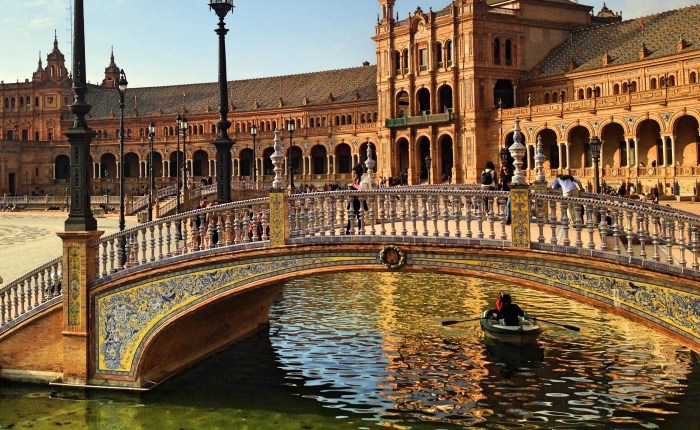
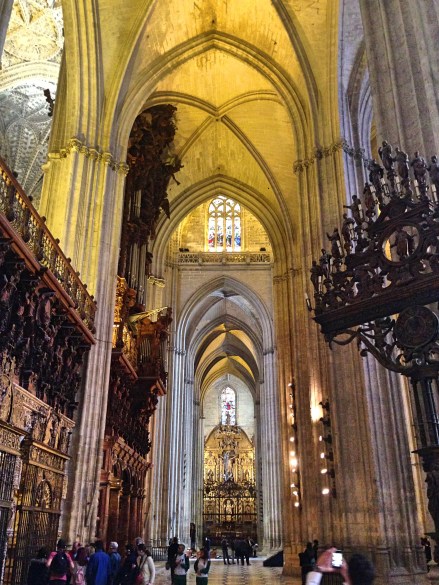
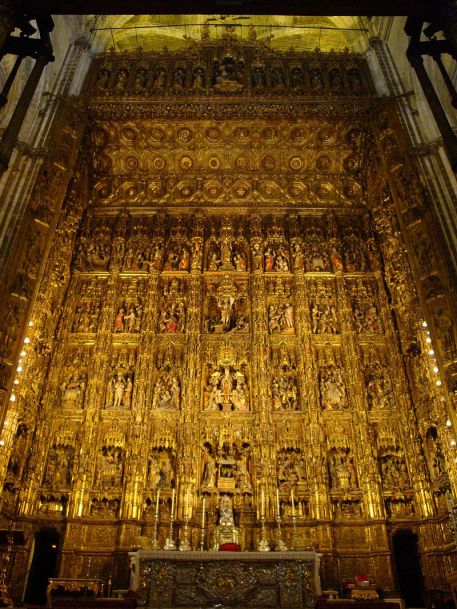

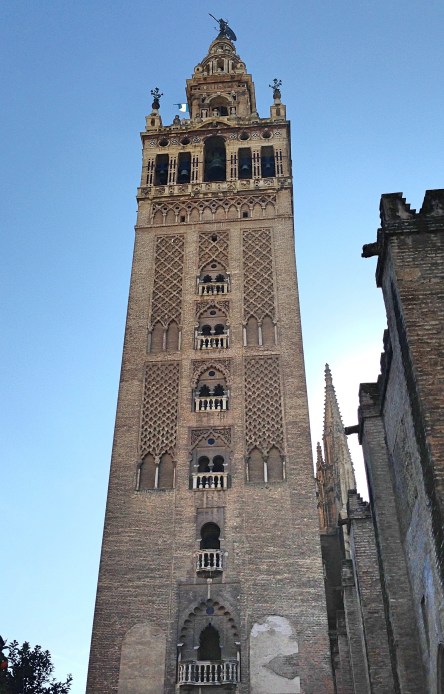


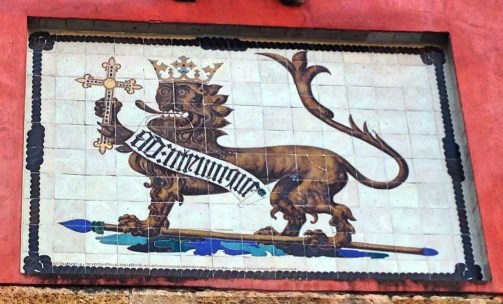
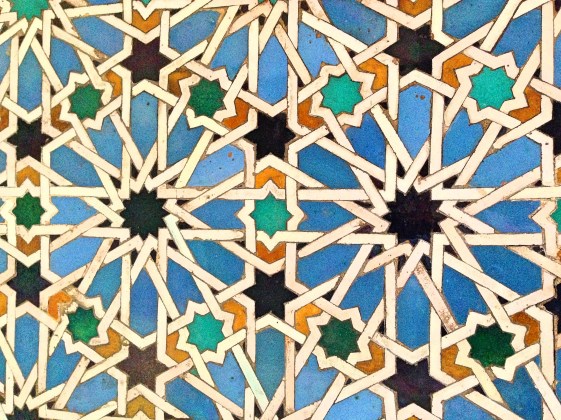
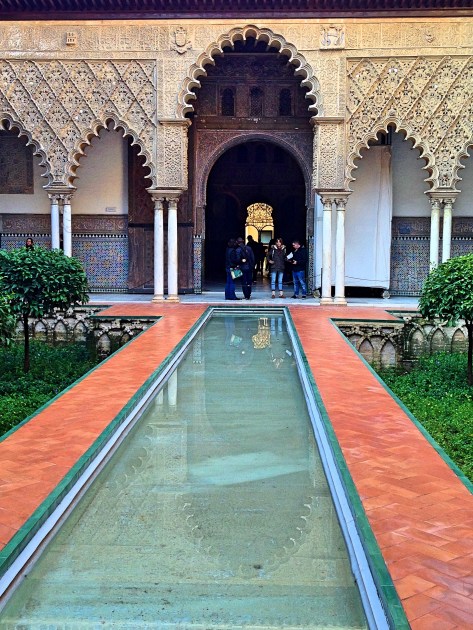

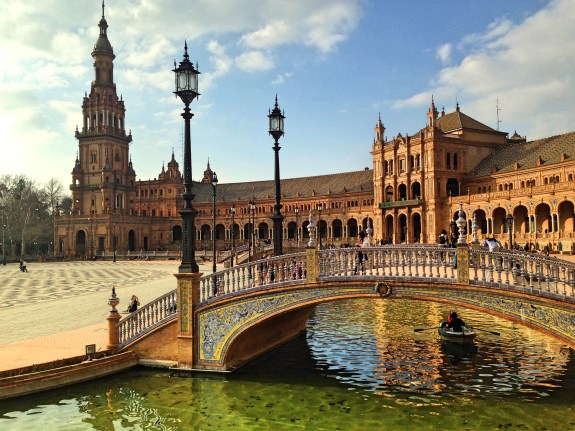

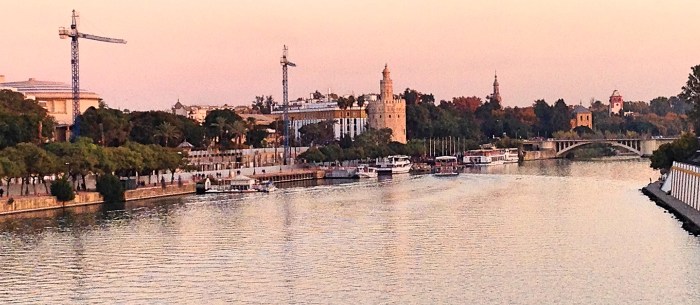
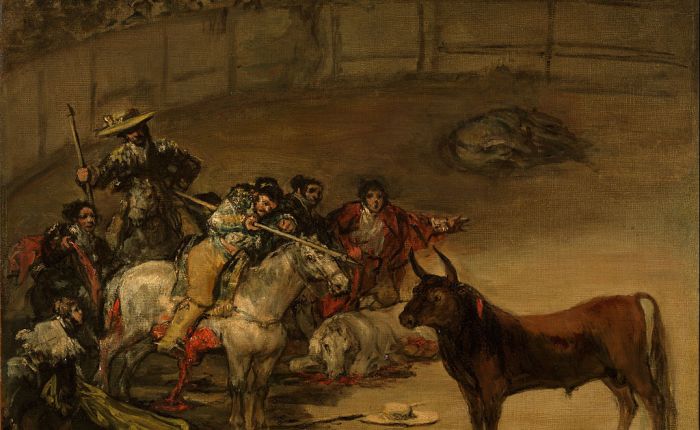

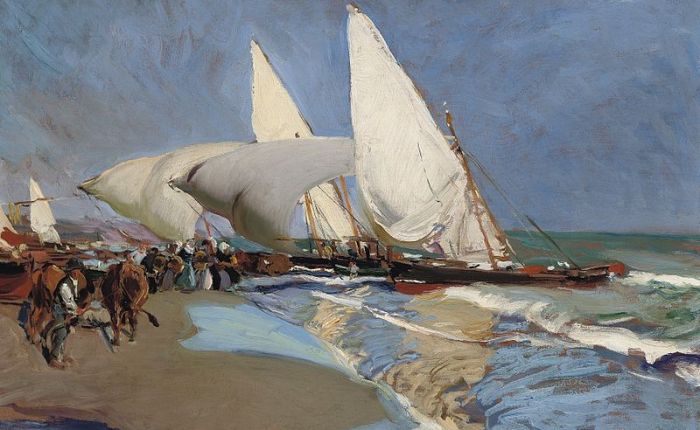

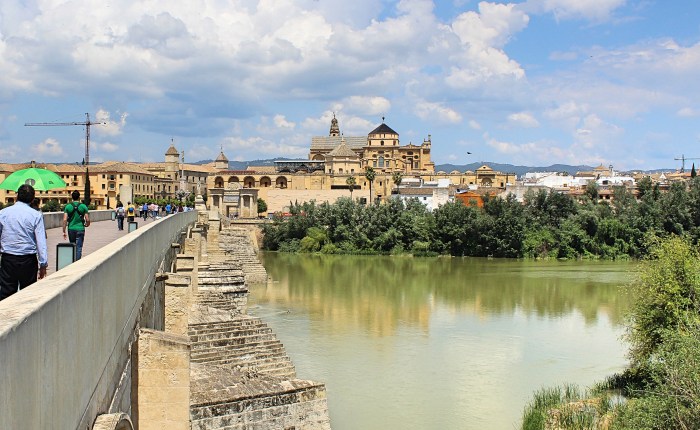


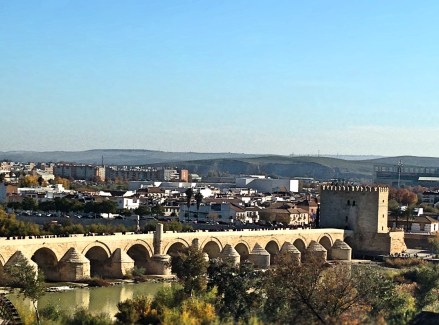
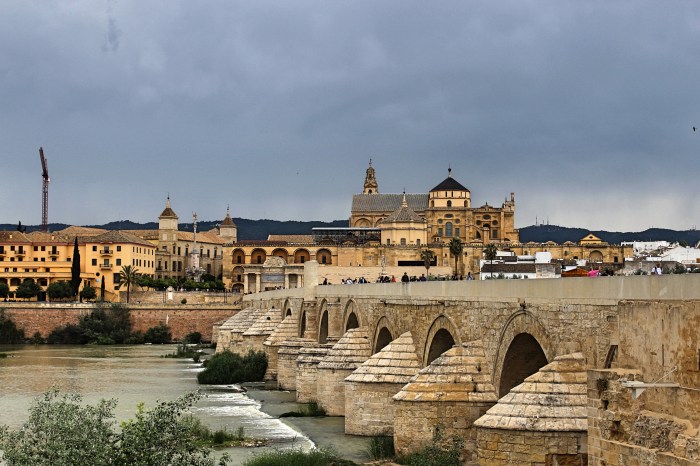


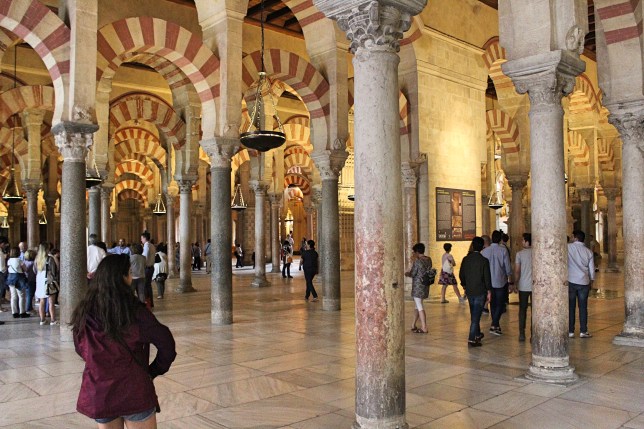
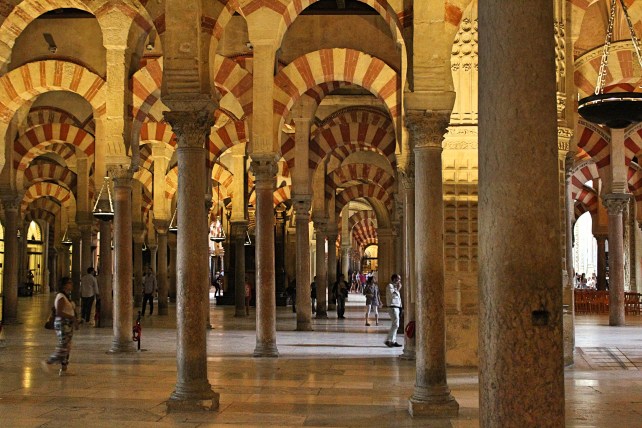 Or was it? In little nooks in the walls were Christian shines, just as in any other cathedral, barred off with a grille and containing altarpieces and religious paintings. But the catholic paraphernalia looked so oddly out of place sitting there—almost as if it had been left there by accident. Of course, this was no accident—and in fact this juxtaposition of styles and cultures, of architectures and faiths, is what constitutes the grandeur and charm of the Mezquita of Córdoba.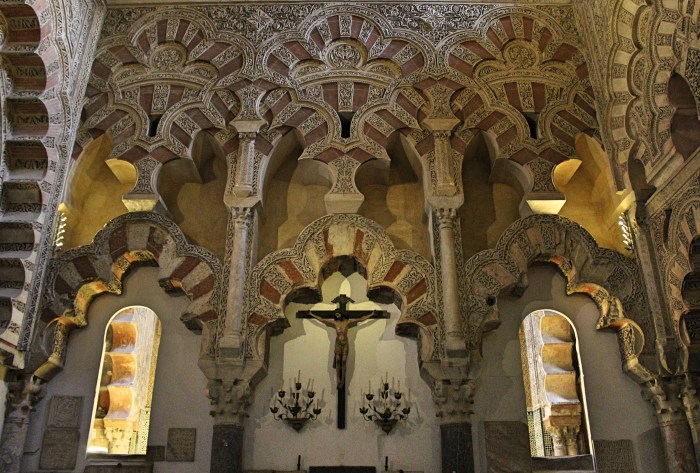
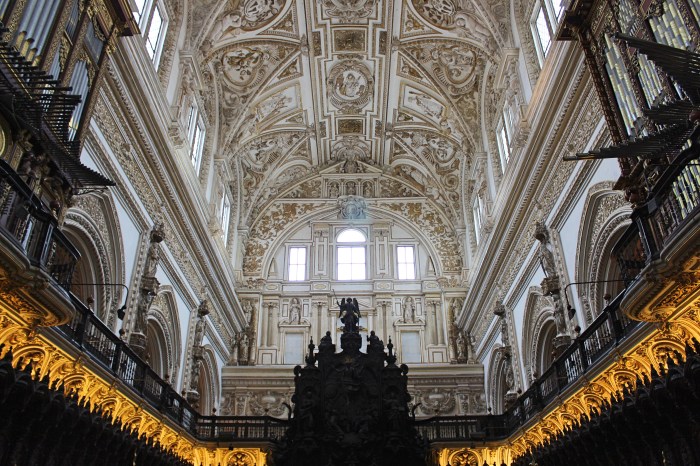
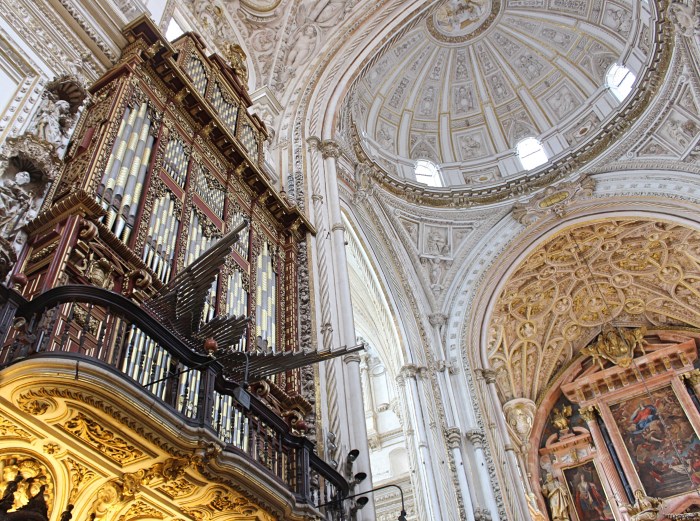


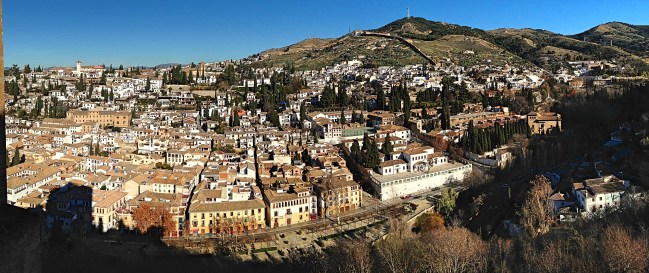
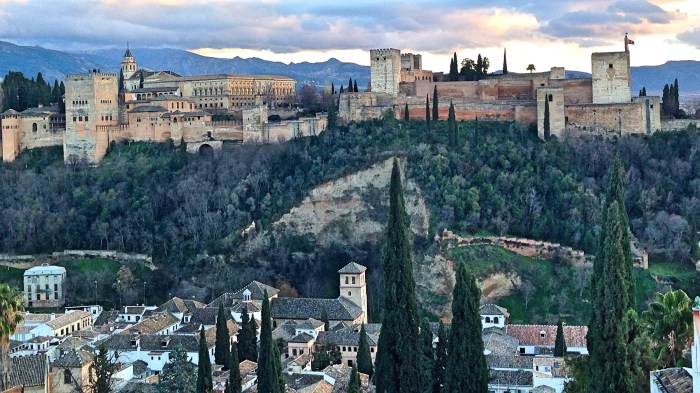


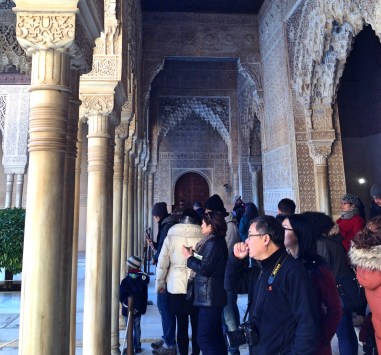
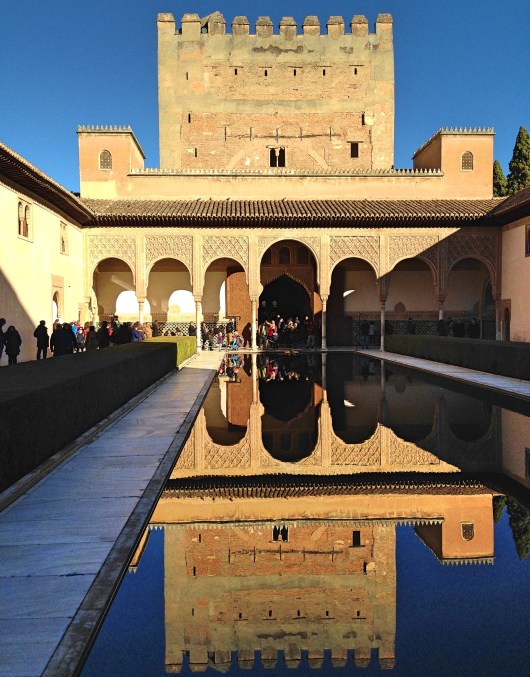
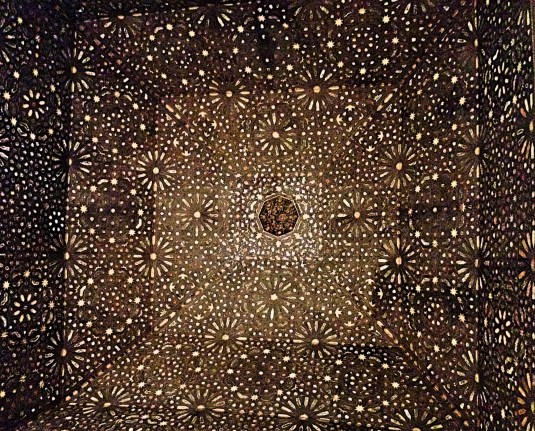


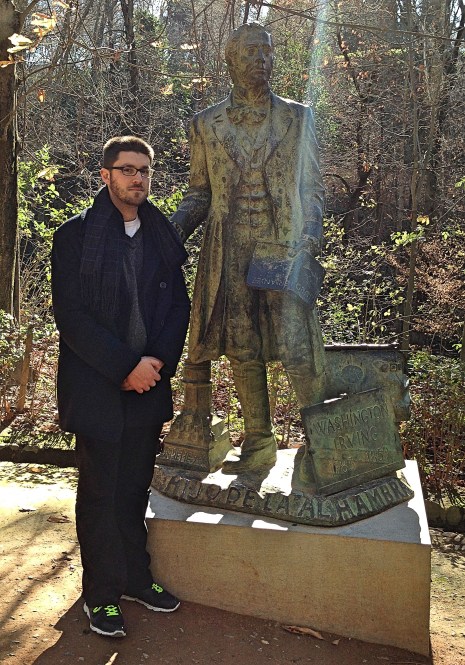
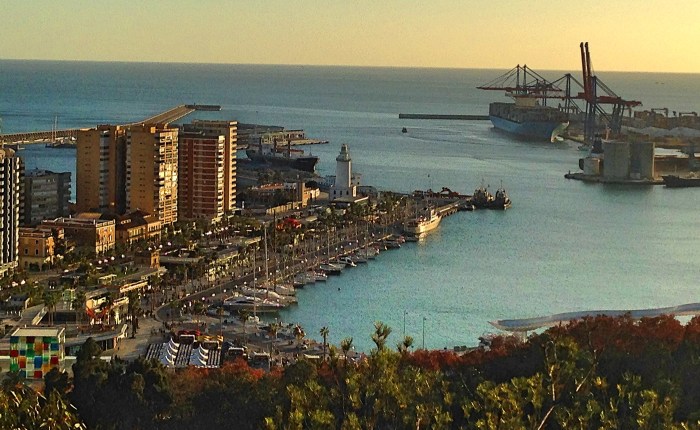

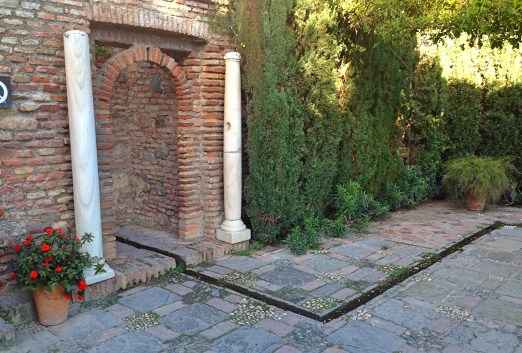
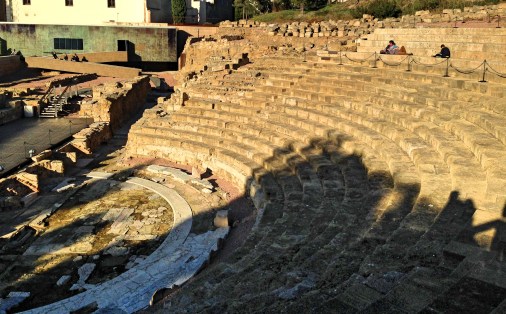
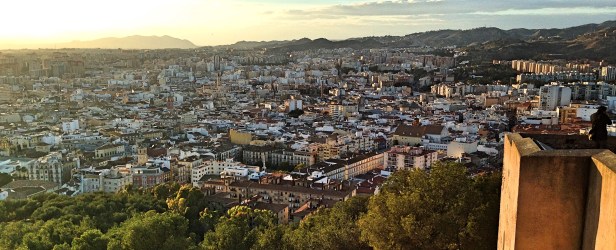

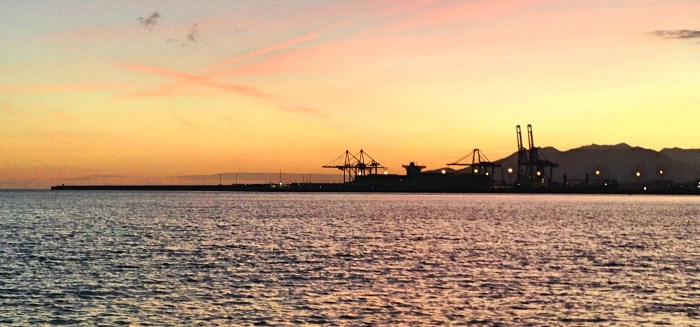


 Lotz in Translation