The Walk to the End of the World

The Walk to the End of the World

It was 2018, and my Easter break was fast approaching. Leaving the country during Holy Week is always expensive; and, besides, I had already booked two pricey trips—to Prague and to Paris—so I didn’t want to spend more than the bare minimum. Luckily, Spain has one travel option that requires almost no planning and little expenditure: the Camino de Santiago.

Two years had already gone by since my first and last camino, five days from Lugo to Santiago de Compostela. This time I wanted to start up where I had left off, in Santiago itself, in order to walk to the coast. The Romans may have made this pilgrimage before Christ or Christianity; they named the long granite cape that extends into the Atlantic “Finis Terrae,” or the End of the World, because they believed that this was the westernmost extension of the land. Unfortunately they were wrong in two respects: first, they underestimated the world by several continents; and second, Finisterre (as it is now known) is not even the westernmost point of the Iberian peninsula.

The cape has nevertheless continued to attract travelers. After pilgrims began to flock to Santiago during the Middle Ages, many of them decided, after reaching their goal, to keep going to the coast. This may be why the scallop shell became the symbol of the camino: many people wanted a souvenir from the end of the earth. This was my goal, too: to start in Santiago and keep going until the land ran out. I would walk 88 km (or 55 miles) in four days, giving me enough time to be back in Madrid for my birthday.

The best part of this plan was that almost no preparation was necessary. I did not need to book accomodations or even to buy gear, since I already had it. But I did need to obtain a pilgrim’s passport, or I wouldn’t be allowed to use the camino hostels (called “albergues”). This was easy enough. In the Plaza de Santiago in Madrid, at the Parish Church of Santiago and San Juan Bautista, they hand out passports for free (though a donation is recommended). If you go this route, be aware that the hours of availability are a little strange: 10:00 am to 1:00 pm, and then 6:00 pm to 8:00 pm. The other option is to go to the Association of the Friends of the Camino, but they are only open Tuesday through Thursday.

My passport in hand, my flight to Santiago booked, I was ready for my walk to the end of the world.


Arrival

The plane descended through the thick fog until the ground suddenly appeared out the window, moments before landing. With a jolt we had reached the earth. I was sleep-deprived and panicky. Even in the best of times flying makes me nervous; but lack of sleep throws my chemical balance off, and I am consequently much more prone to worry. I thus spent the flight alternating between fear and delirium. Though I had woken up at 4:45 that morning to catch the horridly early (but cheap) flight, I could not sleep a wink on the plane. I was wretched.

It was a wretched day in Galicia, too, and I was happy to be there. A short bus ride brought me to the center of the city, where I had breakfast with some friends who were also doing the camino (but a different route). After some aimless wandering, I made my way to the albergue. I had reserved a room in the Seminario Menor. This is a massive building on a hill across from the cathedral, not to be confused with the Seminario Mayor, which is right next to the cathedral. If the building had indeed been a seminary, it had been a major one: the albergue was large enough to house hundreds of pilgrims, and also had room for a primary school.

Though I had vague ideas of seeing more of Santiago, the bed proved irresistible. I collapsed into a feverish nap. By the time I awoke, hours later, I found that the city was suffering under the wrath of a terrible rainstorm. The water came down in sheets, turning the streets into streams and the sidewalks into puddles of mud. I was glad to be indoors. But if I ran into weather like this on my camino, I would be in for a bad time. The only rain equipment I had brought was a poncho. My shoes were not waterproof, nor was my backpack. The thought of simply going back to Madrid flitted through my head. A tempting idea.

But I had something to accomplish on this camino. My renewal deadline was coming up: I had to decide whether I was going to stay in Spain another year, or finally go back to New York to recommence by suspended adulthood. There were weighty factors on both sides. On the New York side I had my family and friends, and the prospect of a career as a public school teacher—quite a good profession in Westchester. Meanwhile, I was in a long-term relationship with a Spaniard, and had gotten accepted into a masters program for the coming year. I felt torn. The prospect of being away from home yet another year frightened me, especially since I had lately been prone to fits of homesickness. On the other hand, the thought of leaving Spain struck me as tragic: the end of an adventure, the end of a relationship, the beginning of a more conventional life. This seemed like the perfect problem to mull over on a pilgrimage.

When the rain died down, I went out to have dinner and buy some final supplies. That night I went to sleep early. I would need the rest.


Day 1: Santiago to Negreira

I set out as the sun was just beginning to rise. Though I am no enthusiast of the morning, it is advisable to begin walking the camino early: you avoid the hottest part of the day, and reduce the chance that the albergues will fill up. The route out of the city took my past the cathedral for one final look, and soon I was again in the Galician countryside.

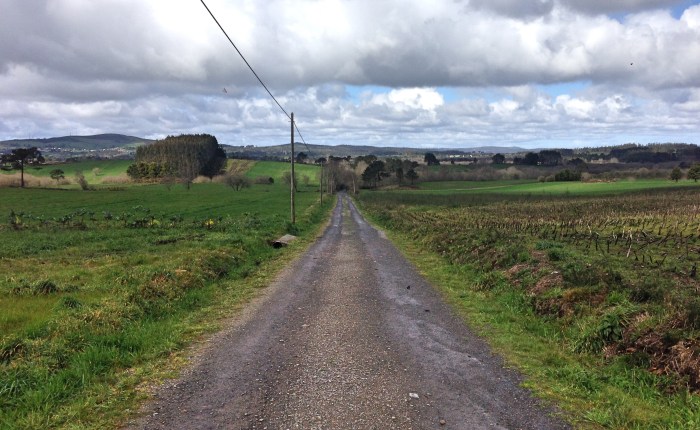
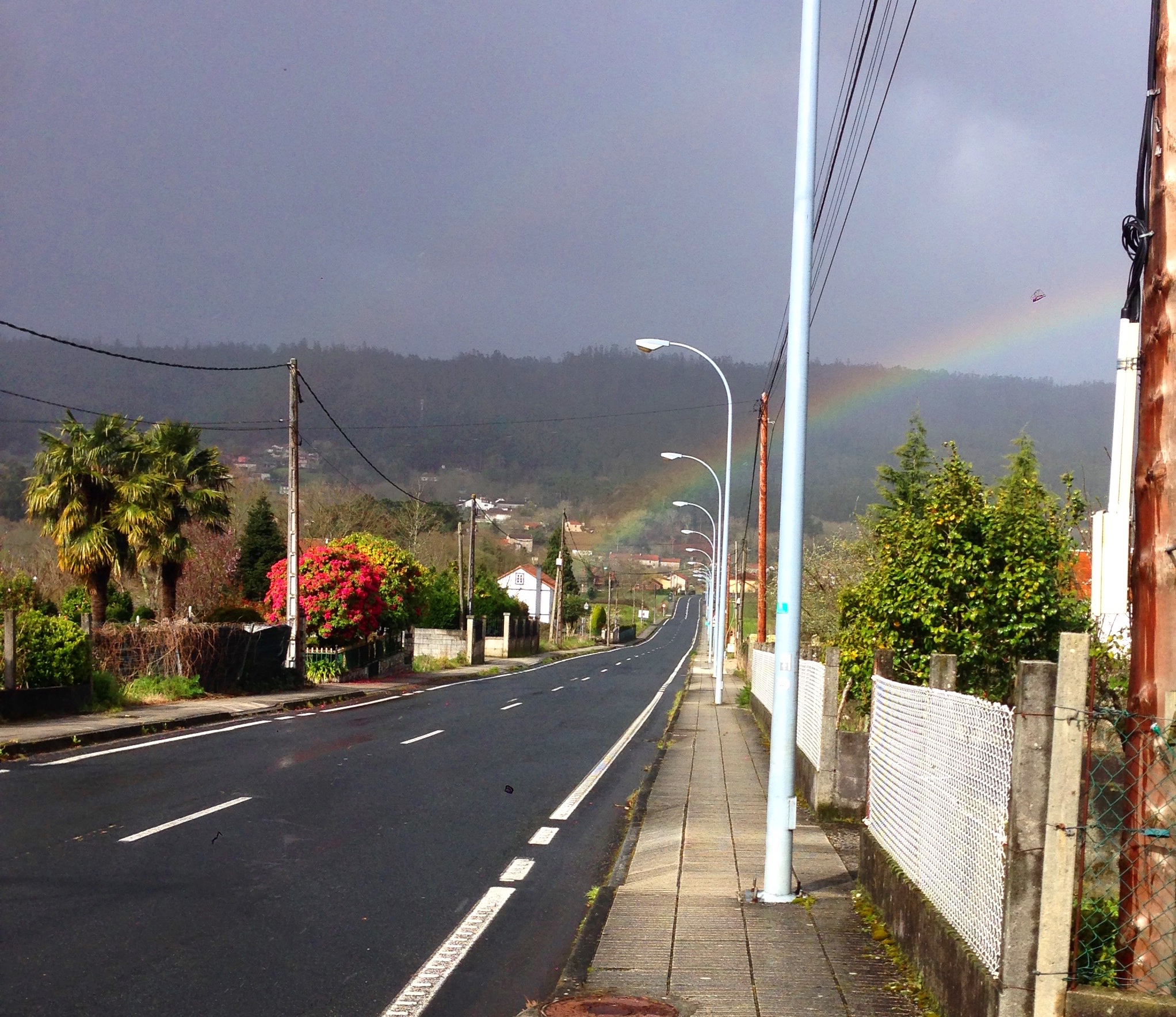
The day was overcast and a little cold. As usual, I found the mossy green of the landscape to be enchanting. I love Madrid, but its sandy soil can leave me longing for the verdant foliage of wetter climates. Coming to Galicia satisfies this yearning. After an hour of walking I looked over my shoulder to see the two spires of the cathedral in the far distance. I was on my way. I passed suburban homes and granite farms. Horses nibbled idly in a grassy field. The sky alternated between shades of grey occasionally broken by blue. Rain fell periodically, mostly in a drizzle. Two hours into the walk a magnificent rainbow appeared up ahead. It looked like it came to an end right in front of me: a good omen.
Before both of my caminos, I had imagined that I would do a lot of thinking as I walked. But this was far from true. Instead, I found myself in a kind of dreamy stupor, merely observing the slowly shifting landscape and the villages that I passed through—a rhythmic repetition of trees, clouds, hills, farms, fences, and fields. Scarcely an articulate thought broke my awareness. At times I feared that I was not properly savoring the moment, and so I attempted a walking meditation, focusing all my attention on my breath. This did little to change my state of mind, however, and soon I began listening to an audiobook (a history of 18th century Europe).
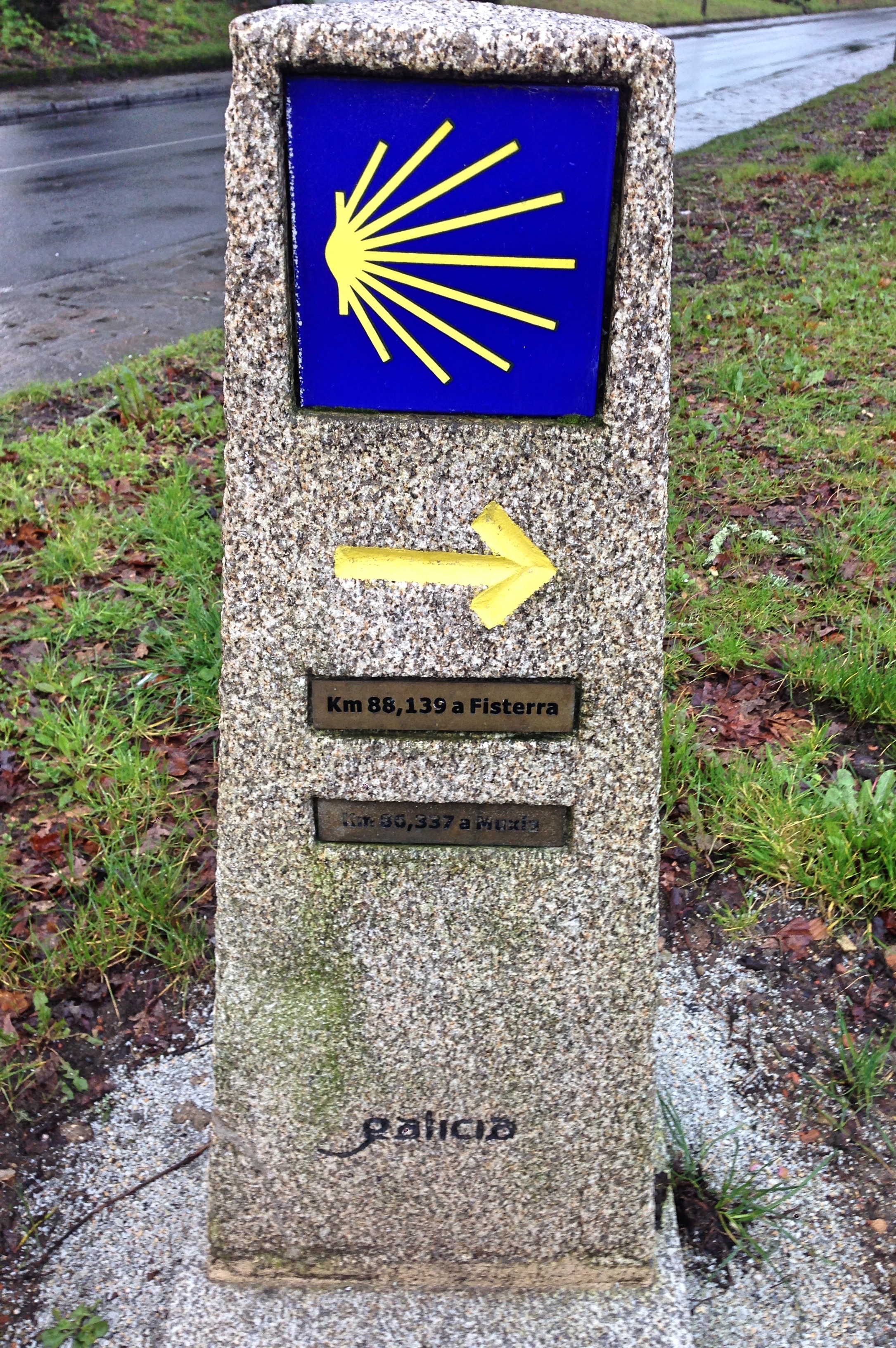
The first trail marker

The camino has a tendency to lull one into a blissful calm. No thinking is required; every turn is marked with a big yellow arrow, and all one has to do is put one foot in front of the other. It did not take a philosophical mind to compare this with my present life conundrum. While I followed this path which so many had walked before, I was trying to make a decision which many had made before: to stay abroad or to go home. Yet a wrong turn on the camino can be easily detected and corrected; but an unwise choice cannot be so easily mended, as time marches steadily forward.

The decisions we make in life are often compared to turns in a road. Yet life, unlike the camino, has no obvious right or wrong turns. Indeed, the whole concept of right and wrong breaks down when it comes to major decisions. Two turns in a road can be easily compared, since one leads to the desired destination and the other does not (or at the very least one is faster). But in life, the question is often not how to get to the final destination, but which destination to choose. Different answers cannot easily be compared.

What is better, to be a doctor or a painter? This depends on your own values, of course. But what are your values? Though we often think of ourselves as defined by what we deem important, it can be difficult to know what is truly important to us. We cannot simply introspect and encounter our values, since our priorities are revealed in actions over the long term. One may, for example, think that one has a passion for playing the piano; but after a year of practicing and giving recitals, this passion may fade into boredom. In any case, even if we could easily find out what is deeply important to us now, this would not necessarily solve the problem, since values change over time.

Most perplexingly, our values change in response to the decisions we make. So when we make a major decision, we are in the paradoxical position of choosing ourselves. Rather than choose something based on our values, we are choosing our values themselves. But then what can we base our decisions on? In other words, we are trying to choose something in the present which will satisfy us in the future—without knowing exactly what we are choosing will be like, or how the choice will change our own preferences. This seems like an intractable problem. If only life had big yellow arrows directing us in the right direction.

As you can tell, I do not like making major life decisions. No approach seems intellectually satisfactory. No criteria or value suffices. As a result, no matter how much I weigh the pros and cons, I always end up feeling as though I were following a kind of gut instinct. An existentialist would say that this proves that I am free; but personally I do not feel free when I am forced to choose something based on non-rational factors, merely following impulse and whim.

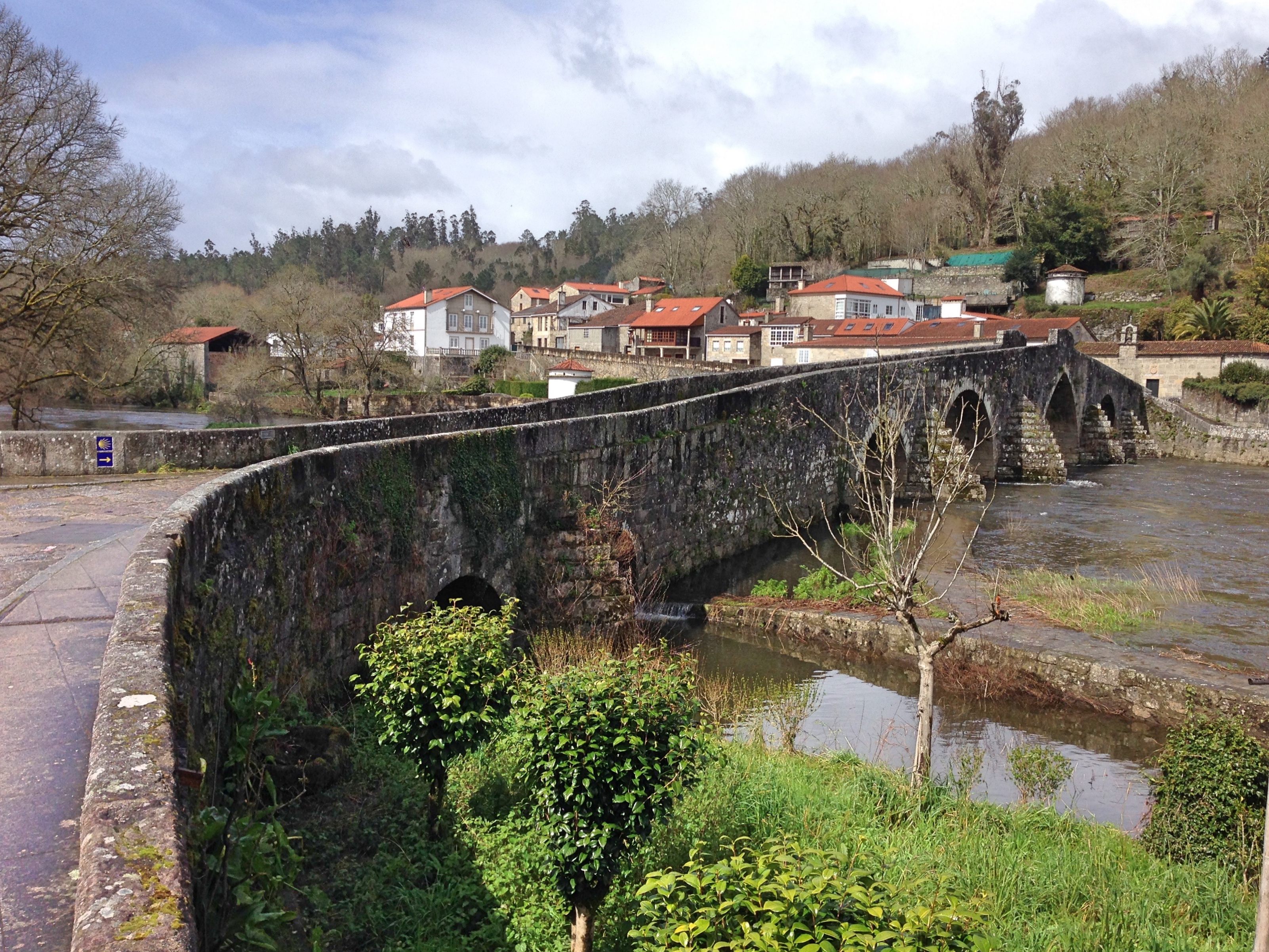
I am writing this now, but I did not think any of this as I trekked the first twenty kilometers of the journey. I merely walked and occasionally worried. The day passed uneventfully. I crossed the Ponte Maceira in Ames, a beautiful medieval stone bridge. The weather was mostly overcast, threatening rain and occasionally delivering. About four hours into the walk it started to rain seriously. I tried to put up with it, but eventually I gave up, rummaged through my backpack for my poncho, and then put it on. The thing wouldn’t fit over my coat, so I had to take off my coat and tie it to my backpack while I wore the blue plastic covering. And, of course, fifteen minutes after going through the trouble, the rain stopped and the skies cleared. This was the last time I used the poncho.
I arrived at Negreira at around one in the afternoon, cold to the bone. After dropping off my bag I went into a restaurant with a menu del día. This is one of the great parts of the camino. Most stopping points have restaurants offering cheap set meals—normally under ten euros—to pilgrims, most of them consisting of plentiful, hardy food. This was no different. I ordered wine, and they gave me a whole bottle, of which I drank more than I should have. It cost me 7.50€. Then I limped and stumbled back to the hostel for a nap.

The host met me at the front desk. He was an older man, with a paunch and a mustache, who was remarkably talkative. I’ll call him Maligno. Normally I do not like to chit chat while I travel, but I was feeling a little lonely just then, so I was glad for the conversation. His mouth rattled on like a freight train, his gravelly voice following the dramatic, sing-song accent common to the region. I got him on the subject of Galicia, on which he was loquacious. He started googling some of the sights to show me: attractive coastal towns, old Celtic ruins, and even a Roman gold mine.

Somehow the subject got changed to people who speak ugly languages. This quickly led him to tell the old joke about how Spanish is for talking to God, Italian for talking to women, and German for talking to horses. He then went on:

“Once I saw this girl, beautiful, just beautiful, I mean everything was perfect. And then she opened her mouth, and it was like—eck! Just the foulest, ugliest language you ever heard. What a shame, I thought. What a shame.”

With this, I excused myself and went to my bunk bed, where I promptly passed out. When I awoke, I decided to do something productive, and I made a pro and con chart of staying in Spain. It didn’t solve anything, of course, but it did occupy some time. After that I wrote a very bad poem, had a light dinner, and went to sleep.


Day 2: Negreira to Olveiroa

This was to be my hardest day—the longest that I had ever walked in my life: 33.6 km, or 21 miles. I had to get going early.

I began before sunrise. The mist was still heavy upon the land. The moon shone out from behind the clouds, and a light breeze blew through the trees. It was almost completely quiet. I felt a keen anxiety grip me as I began walking into the countryside. It was so dark that I was afraid I would get lost. But soon I found the familiar yellow arrows, pointing the way.
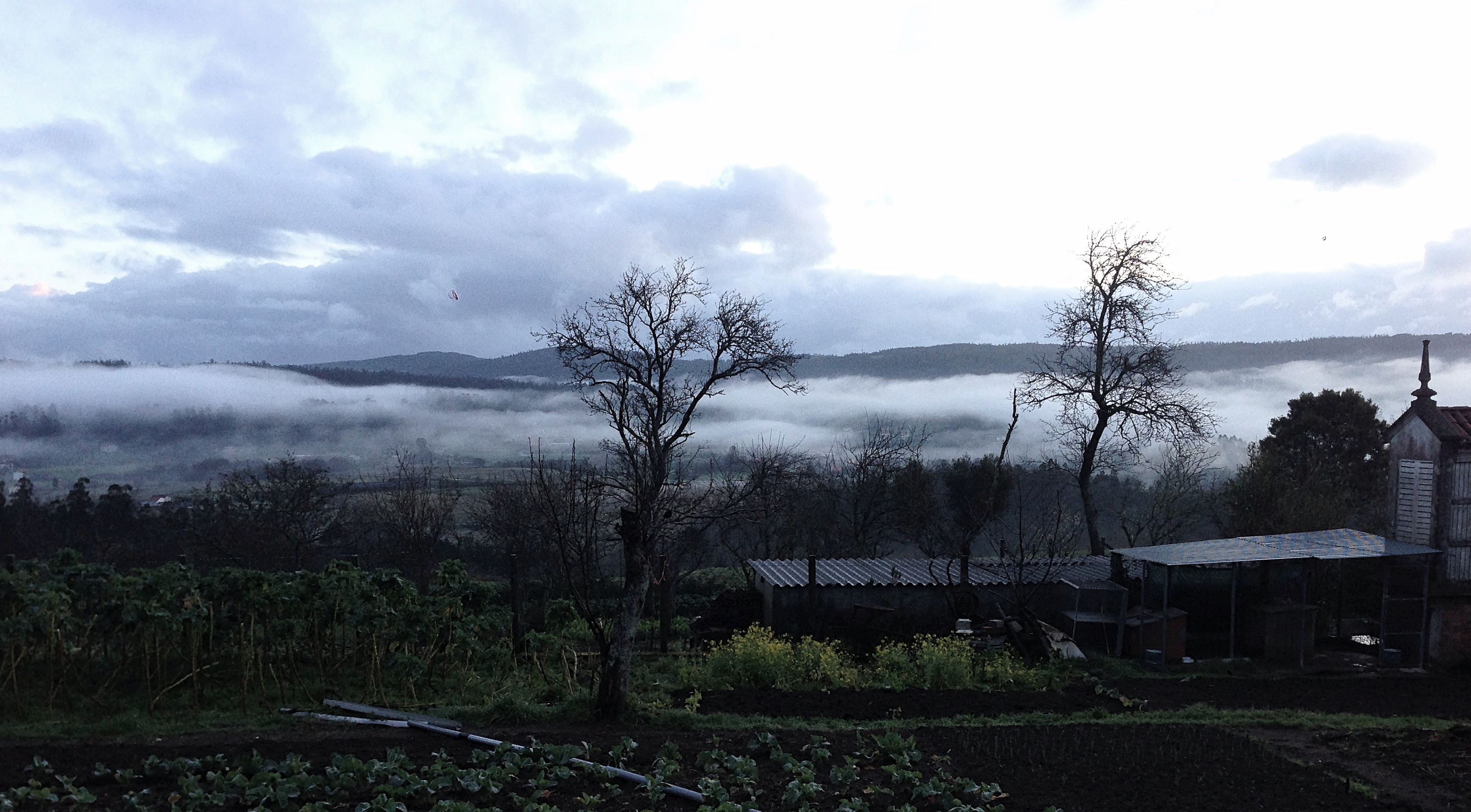
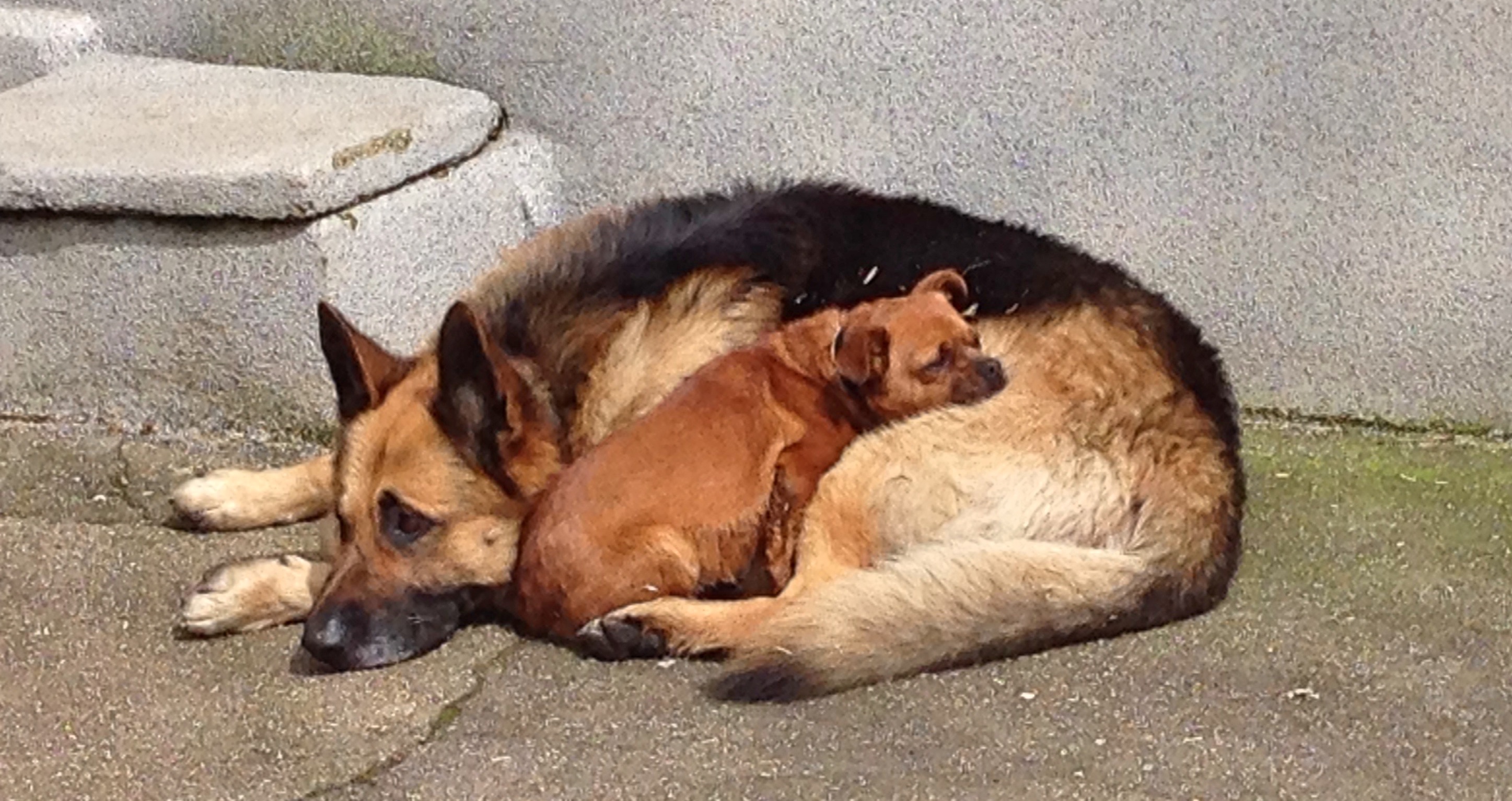
The sun gradually rose and I found myself, once again, in the mossy green countryside of Galicia. The walk that day was especially beautiful, mostly avoiding major roads. As the sun rose I could once again see the farmhouses and the fallow fields. A cow peeked its nose from out a barn window, while two dogs snuggled in the road. Once again I saw a rainbow, and once again it seemed to land right in front of me. I felt that I was on the right track.

It was a much sunnier day than the last, and the heat did not make the long walk any easier. I stopped several times—beside a wooden fence, by a stone church, near a running brook—to rest and eat a little. I had bought pretzels in Santiago, an uncommon snack in Spain, and savored a few handfuls on the way. At one point I stopped at a roadside cafe for a chocolate pastry and a coffee. The exhaustion crept up on me slowly; my feet began to hurt, my legs to tire. But the human body is made to walk. It is one of the hidden benefits of bipedalism: aside from freeing up our hands to carry things, walking on two legs allowed us to be more energy efficient. At least that is the theory.
When it was well past lunch time, the path led into an open field and up a large hill. A plaque informed me that this moderate eminence was the highest point in the county. And in ancient times this had been the site of a fortified settlement (though I could find no traces of it). But the view was valuable enough. The beautiful Galician countryside rolled out in front of me, almost painfully pretty in the sun, with its fields of farmland dotted with patches of pine trees. The grass shone intoxicatingly green in the sunshine, filling me with energy that carried me the remaining distance.

By the time I arrived it was four in the afternoon. Olveiroa is hardly big enough to even be called a village; it mainly exists as a stopping point on the camino. The biggest building in the place is the albergue, where everyone seemed to be concentrated. When I arrived it was absolutely packed, which made me nervous about finding a spot. But it turns out that the vast majority of the people eating in the restaurant where on a kind of bus tour, where they hike different segments of the camino each day and then get bused to back to a hotel. It struck me as a strange concept. In any case, I ordered a gigantic plate of food and ate it with ravenous delight.

The rest of the day was spent in my bunk. My feet were blistered and my knees ached. I limped outside around sundown to see the sky, but quickly gave up and hobbled back to my mattress to read. Very few people were staying at the albergue. Among them was a young German couple, probably around my age. They spent the whole time hugging and whispering to each other. I found it very annoying. Whispering, to me, is far more unpleasant to listen to than speaking, since a whisper conserves only the harsh consonant sounds—the hissing and popping.

Maybe I was feeling cranky, since the more I observed the cuddling couple the more irritated I became. At one point I felt inspired by my distaste of the amorous Germans to write a poem in my journal, which I include here:

Why do humans form pairs,
Like socks or testicles?
We arrange ourselves with mates
Kiss, embrace, quarrel, separate.
The world deems successful
The couples that last until death.
A strange prejudice!
Separation is separation,
In the grave or in the courts;
And an amicable divorce may be
A better way to say goodbye
Than a heart attack.
Monogamy has the worst track record
Of any human institution,
Except for all the other ones.
We relieve ourselves with:
Fantasies, flings, fights,
Affairs, breakups, divorce...
Or just the iron patience
Of the ignored wife or the henpecked husband
Waiting, waiting, waiting,
For the end.

And with this bit of free-verse bile, I went to bed.


Day 3: Olveiroa to Cee

The next morning I fell out of bed, and quickly found myself ascending the steep hills nearby. Again, I got going before before dawn. The landscape was shrouded in morning mist. As I walked up the path I began to feel extremely isolated. Panicky thoughts began to pass through my brain. If a pilgrim-hating murderer was hiding behind one of these rocks, they could kill me and get away with it. My eyes began darting left and right, my body tense.

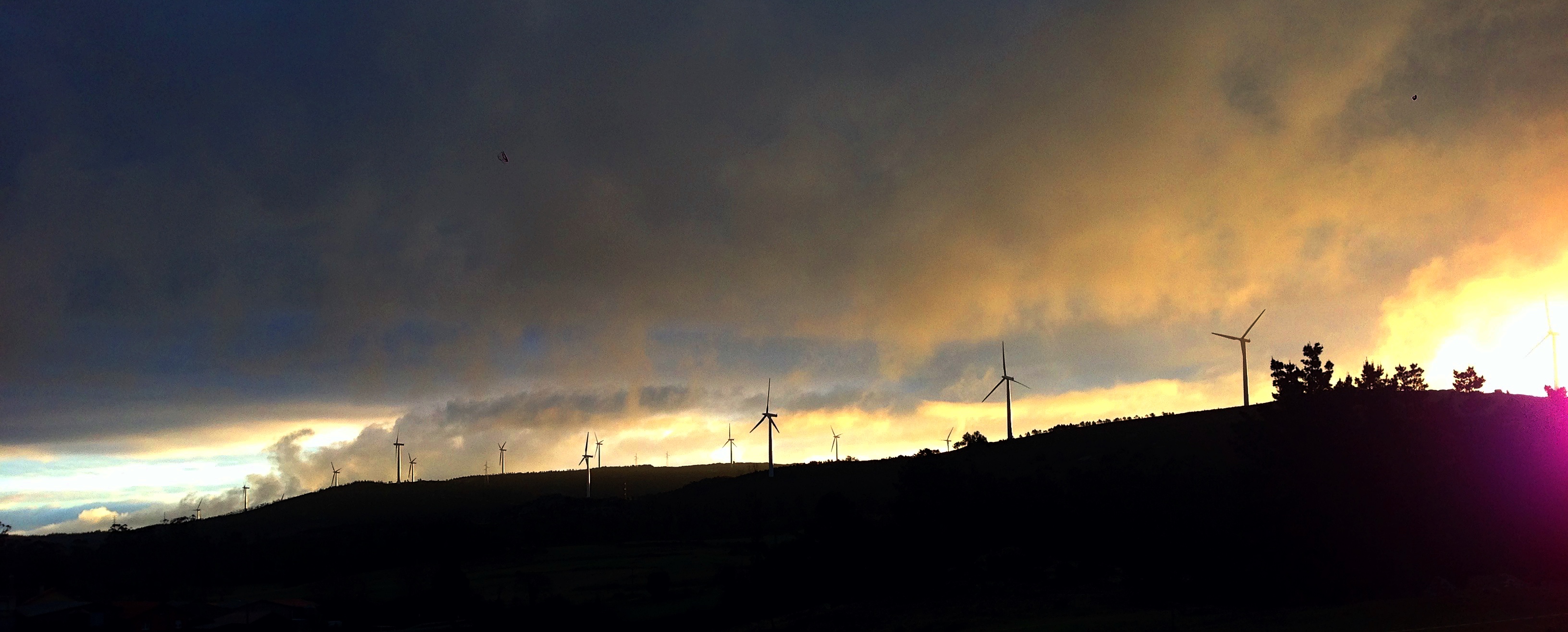
But the beauty of the surroundings, revealed by dawn, eventually calmed my nerves. It was marvelous. The fog opened up below me to reveal a river flowing through the valley. The rising sun cracked through the grey sky, splitting the horizon with yellow light; and in so doing revealed the silhouettes of wind turbines, so common here, immobile on the hilltops. At the time I was reading Don Quixote, and I imagined the old knight making a charge for one of these modern monsters. These power-generating machines are one of our century’s great inventions; their sleek forms make no attempt to counterfeit nature, and yet they blend in so harmoniously with the landscape.
Eventually I reached a fork in the road, where the camino diverges. You see, there are two options for the pilgrimage to Finisterre: the first goes direct, while the second takes a detour to Muxía, another beautiful coastal town somewhat to the north. The second path is considerably more taxing, since there are three days in a row of 30+ km. I chose the first, since I did not have an extra day to spend; but, of course, every road not taken leaves a little residue of regret. Further on, while crossing another field, I caught my first glance of the sea. It was a dreary grey day, and so all the greens and blues looked muted under the brooding sky. But I could smell the ocean, that salty, fresh savor in the air.

I reached Cee by one in the afternoon, a modest coastal town of about 8,000 inhabitants. I found a mostly-empty albergue, dropped off my bags, and then set out to have some lunch. The sight of the ocean put me in the mood for seafood, so I decided to find some of the justly famous pulpo gallego, or Galician octopus. This is one of the finest dishes in Spain. The octopus is extremely tender, without a trace of rubberiness; and the combination of sea salt, olive oil, and the spicy local paprika make it addictively savory.

After a short walk around town I retired to the albergue. The host was another talkative Galician fellow. He was a youngish man, in his mid thirties I guess, and had the air of a tired hippie. He told me that he had gotten addicted to the camino at a young age, when his mother took him for a week on the trail. Eventually he opened up his own albergue, and met his future wife a few years later—a Russian woman who was passing through. She came in the door a few moments later, with their two little lap dogs in tow. It seemed like a happy family. I had a beer while flipping through some of the extensive National Geographic guide books that were shelved in the salon.
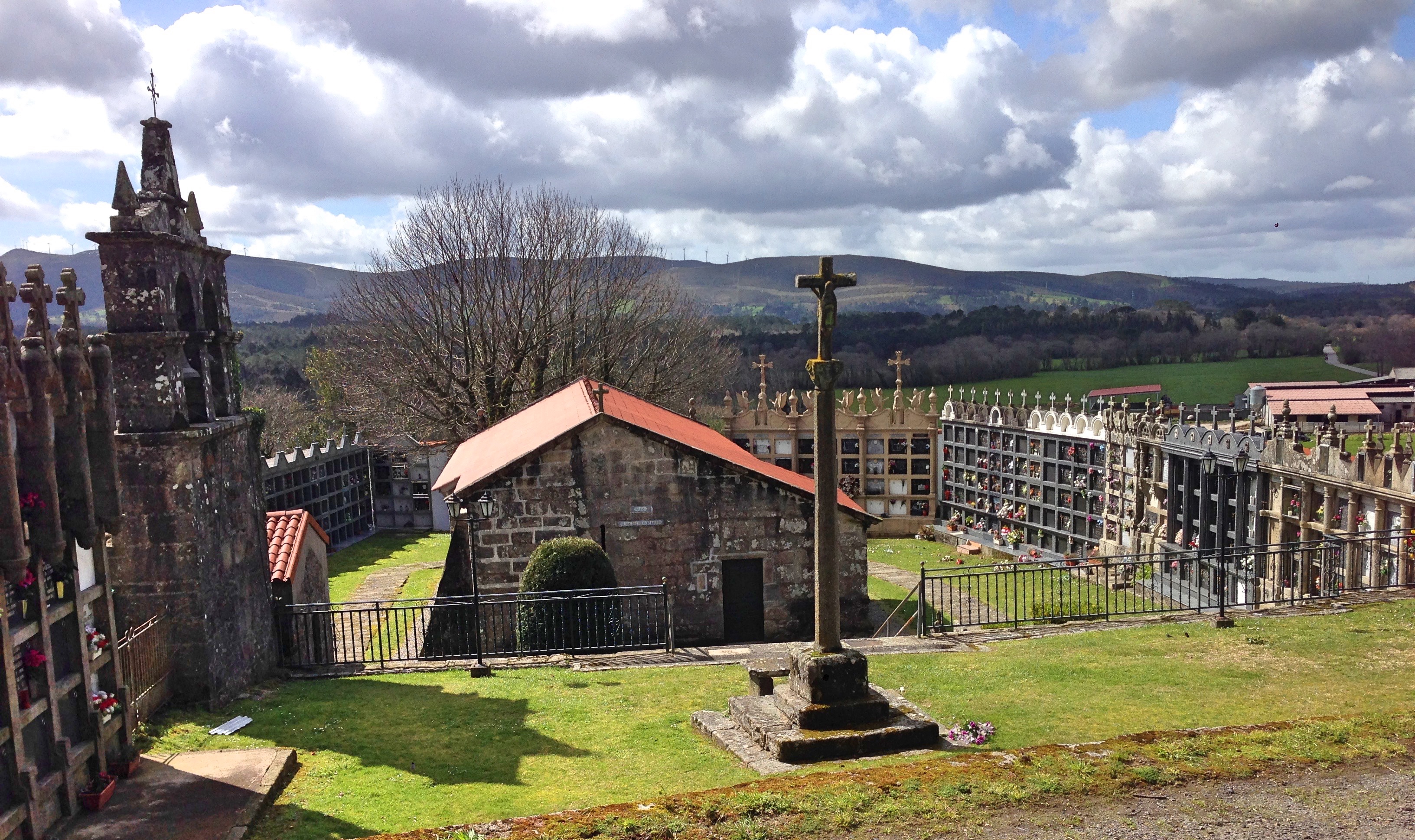
A typical Galician church and graveyard

The only other pilgrims in the albergue were two Frenchmen. I guessed they were father and son, since the younger one looked like he was in his teens. Neither of them spoke much English, though it was not for lack of trying on the teenager’s part. He struggled through a ten minute conversation with me, using plentiful hand gestures to make up for the gaps in his vocabulary. From this mime show I gathered that he had been on the camino for quite three months, having started in Seville. I admit that I find it difficult to imagine spending such a long time on the road, simply walking. Surely one would see many beautiful things. But I am afraid my brain would atrophy from the lack of variety. It had only been three days and I was already looking forward to returning to Madrid.


Day 4: Cee to Finisterre

My final day. I woke up a bit later, knowing that it was going to be a short walk. The path took me through stone alley up into the surrounding hills. The sky was overcast yet again, though the bits of clover covering the ground still glowed with a powerful green. My route followed the coastline towards the peninsula, which jutted out into the sea like a moored ship. As I looked down from the pine-shaded hilltop to the granite shore below, I wished, yet again, that I could properly savor the moment, that I could nestle inside the feeling of being alone in nature and just stay there, hold onto it, and take some piece of the feeling with me. But again the sights came and went, and I was left none the better.
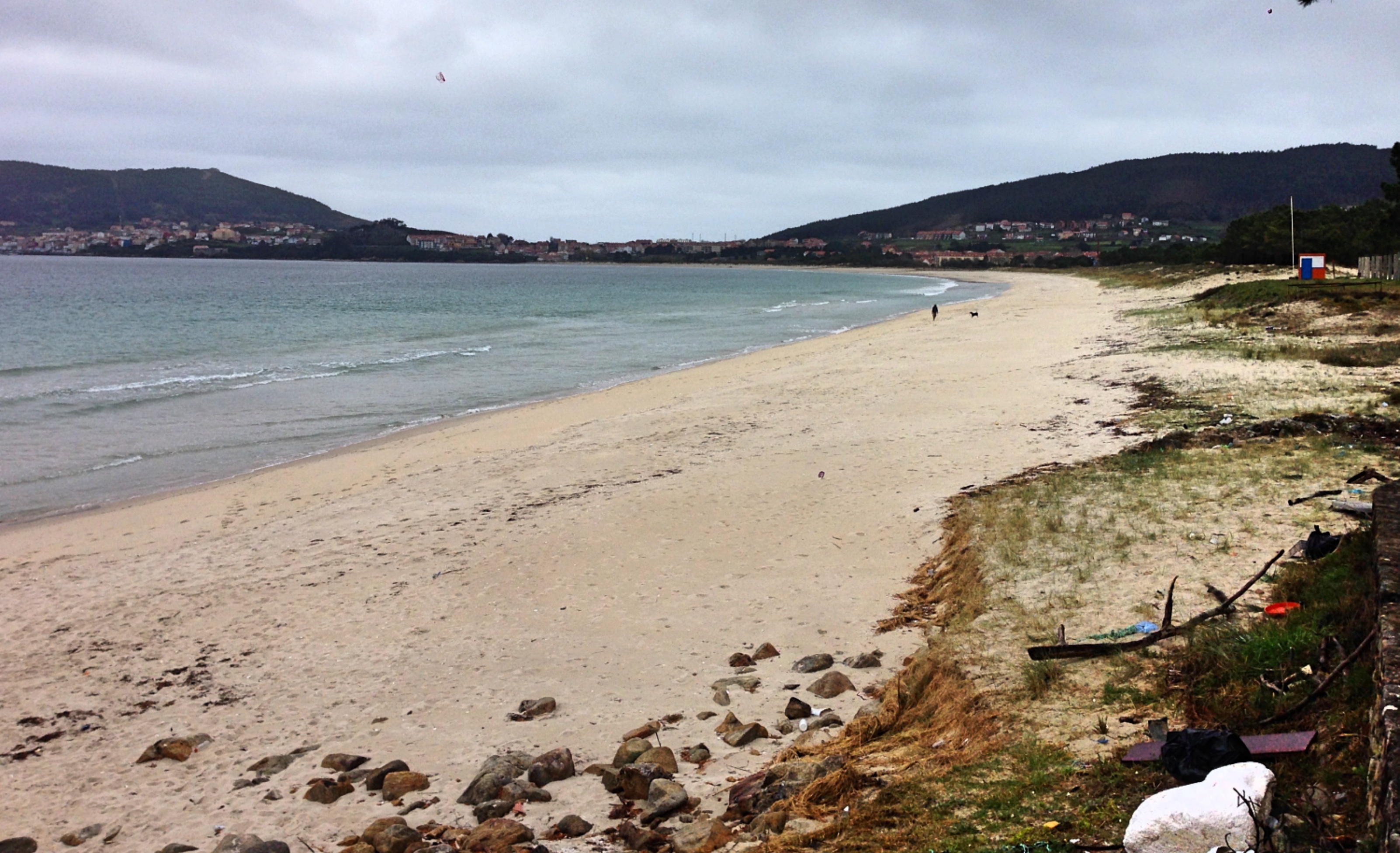
Eventually I walked down the hills onto a long beach. A man was playing with his dog on the sand, some hundred meters away. I snapped a photo. Minutes later, as I sat on a bench re-tying my shoes, he approached me, and asked me if I could email the photo to him. Sadly, I have forgotten to do it—until writing this post. We shall see if he replies.

From there I made my way to the town of Fisterra (the Galician name for Finisterre). Like so many places in Galicia, it is dominated by the camino. Half the people walking through the town sported the typical gear of the modern pilgrim: waterproof coat, nylon backpack, collapsible walking stick. Advertisements for albergues were everywhere. Many of the faces I recognized from the past three days; a few recognized me, and we exchanged a wave. I was tempted to stop, but I wanted to see the end of the road first.
The path to the end of the peninsula brought me once again above the Galician shore. Halfway to the end I passed a statue of a windblow pilgrim, dressed in the traditional medieval costume; and I could not help comparing the modern pilgrims (myself included), with their bright neon clothes, unfavorably to this more simply apparelled traveler. After what seemed like an interminably long time, the end came into view.

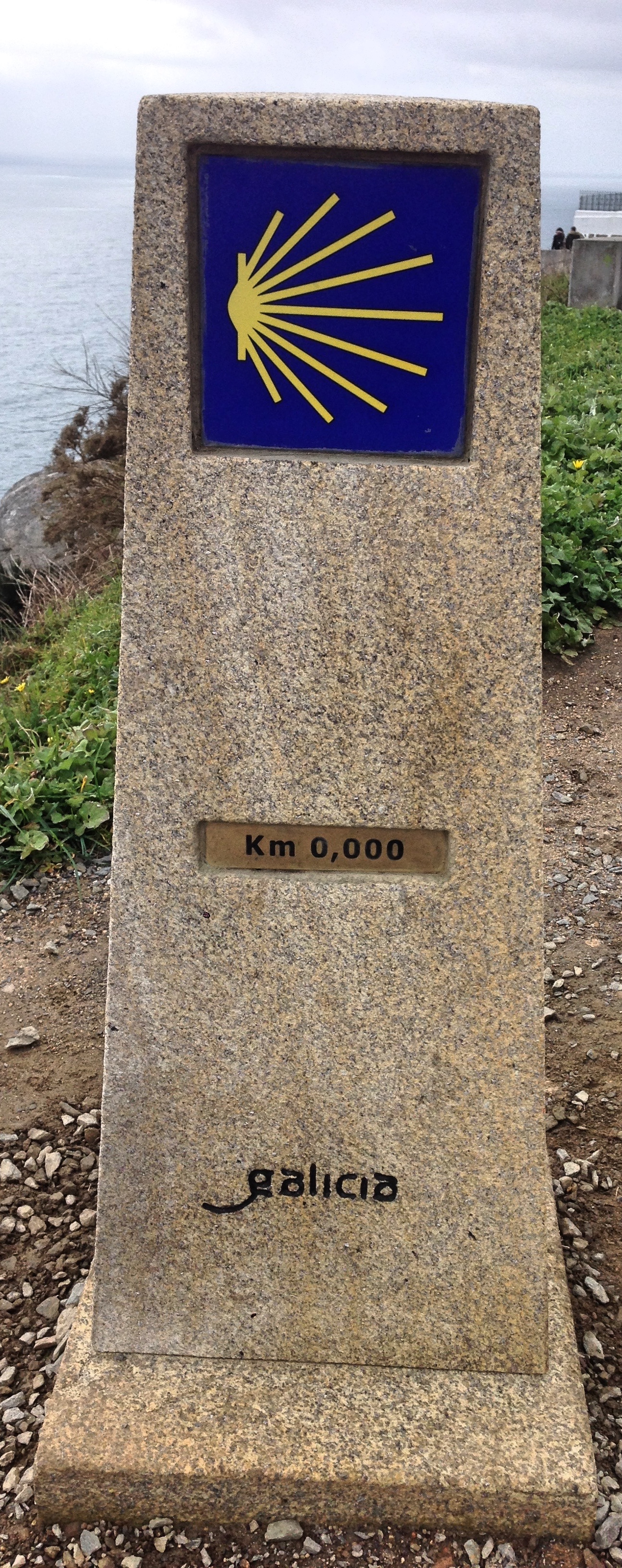
I admit that I was a little deflated, if only because there were so many people about. I wanted to feel alone on the edge of the world; but instead I felt like I was at a moderately popular tourist attraction—which, of course, I was. There was a stone cross on a boulder, where many were gathered. More gratifying, for me, was to see the final trail marker: 0.00 km. Seeing the constant and yet slow diminution of the remaining distance is one of the more satisfying and yet maddening aspects of the camino; so I felt a great surge of relief at finally seeing a zero. I was officially finished.

Further on, I came to the lighthouse. Next to it was one of those signs that shows the direction and distance to several major cities. One of the signs, pointing directly across the sea, was for New York: 5,235 km away. My home was right beyond the horizon. Or was it still my home? Did I belong on this side of the Atlantic, or that one? I still had not made a decision for next year. The camino had not resolved my dilemma.

I passed the lighthouse and went down to the rocky tip of the peninsula, where it descends into the sea. The base of a red metal tower had been covered in stickers and paraphernalia—pilgrims wishing to leave their mark. Nearby was a metal statue of a single boot, a trademark camino marker. It seemed to be the perfect memorial for the trail—an anonymous testament to the blisters and bliss of untold walkers. I sat next to it and stared into the ocean, turning over my problem in my head. And I decided, then, that unless something unexpected happened, I would go back to New York to pick up my interrupted life.
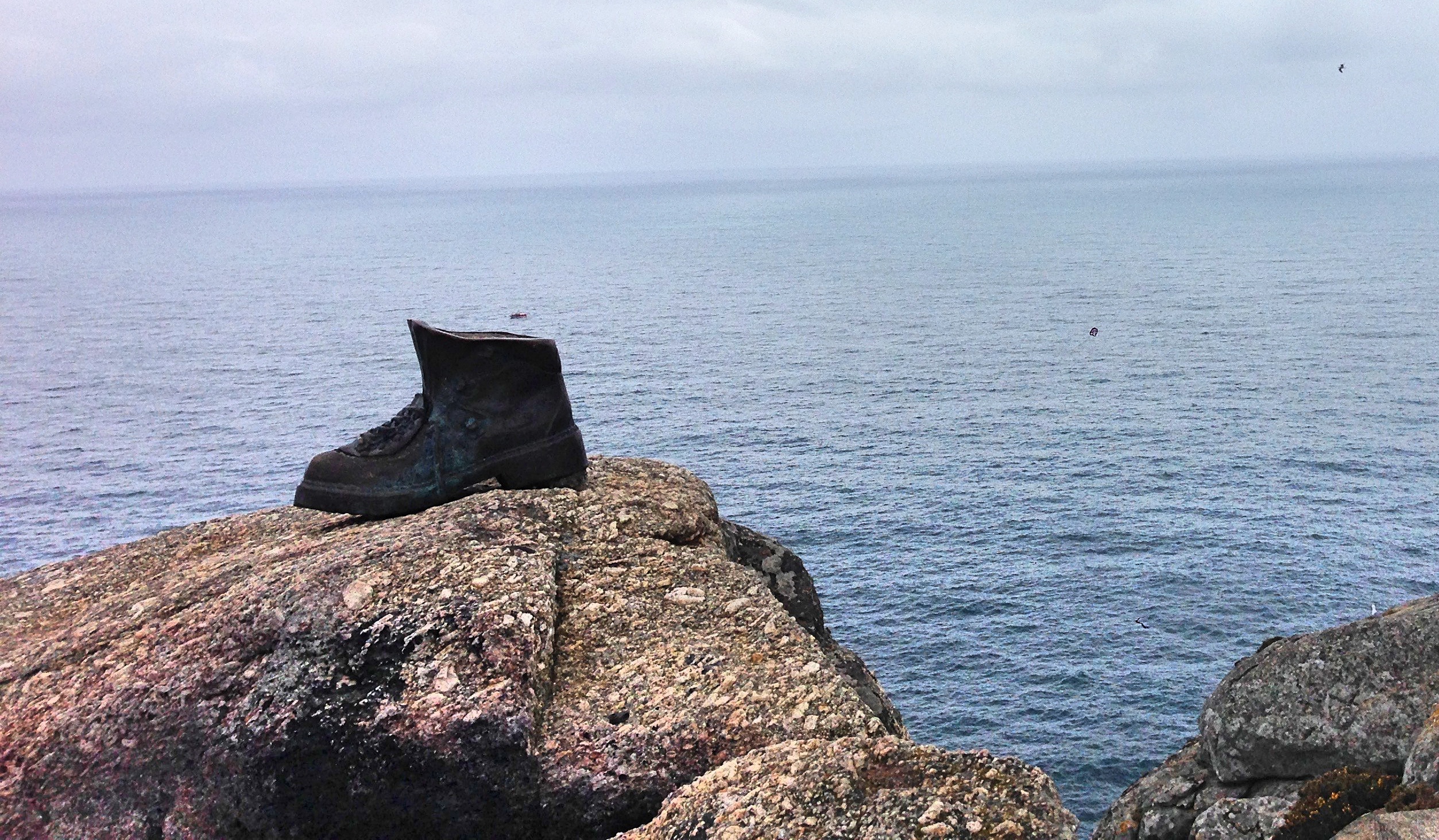
And in that moment I felt sad to have to leave such a beautiful place that had given me so much; and I felt relieved at having chosen a path. But mostly, I just felt exhausted and hungry. Little did I know that, just two weeks later, my brother would decide to move to Spain, which would change my calculations completely. And so I now find myself, a year later, writing this long tale of failed self-discovery and unsuccessful soul-searching from Madrid.

I picked myself up and dragged myself back into town, where I found a nice albergue and paid extra to have my own room. The rest of the day was spent in walking idly around the port, eating delicious chipirones (squid sauteed with garlic), and writing in my diary. “Will I ever see this shore again?” I asked myself. “It’s very possible I won’t.” (I would.) My brain was eerily silent. The usual little voices which pop in and out of our heads, telling us things to fret about, were almost entirely gone. I felt empty and free.
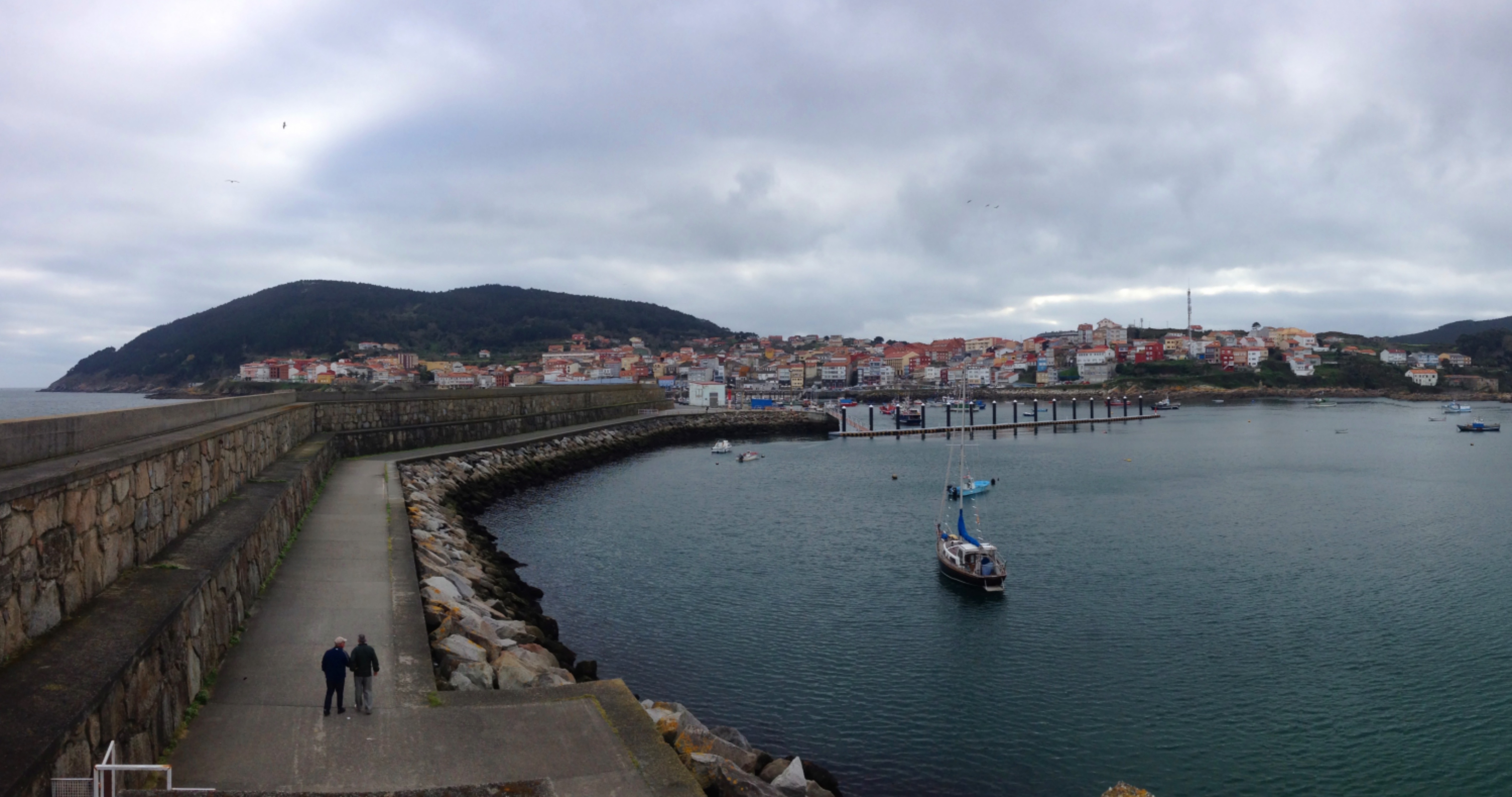
Fisterra

The next day I walked to the bus station with a Russian man who was staying in my albergue, and who told me that he had begun his camino by taking ayahuasca in Portugal. The bus left me in Santiago de Compostela, and then a train brought me to Madrid. In five days I had been to the edge of the world and back, and was none the wiser for it.
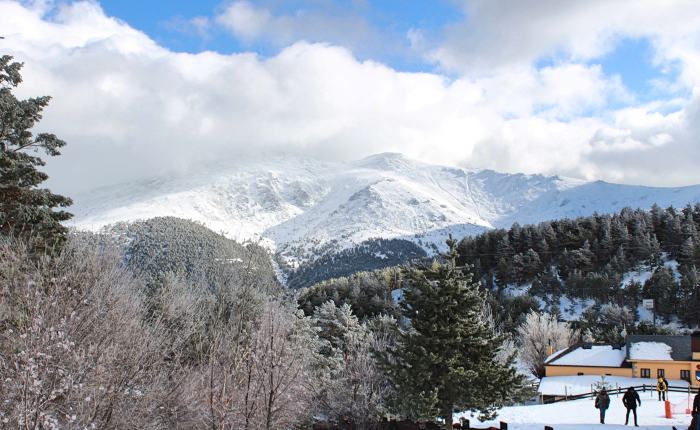
Images of Peñalara

Images of Peñalara

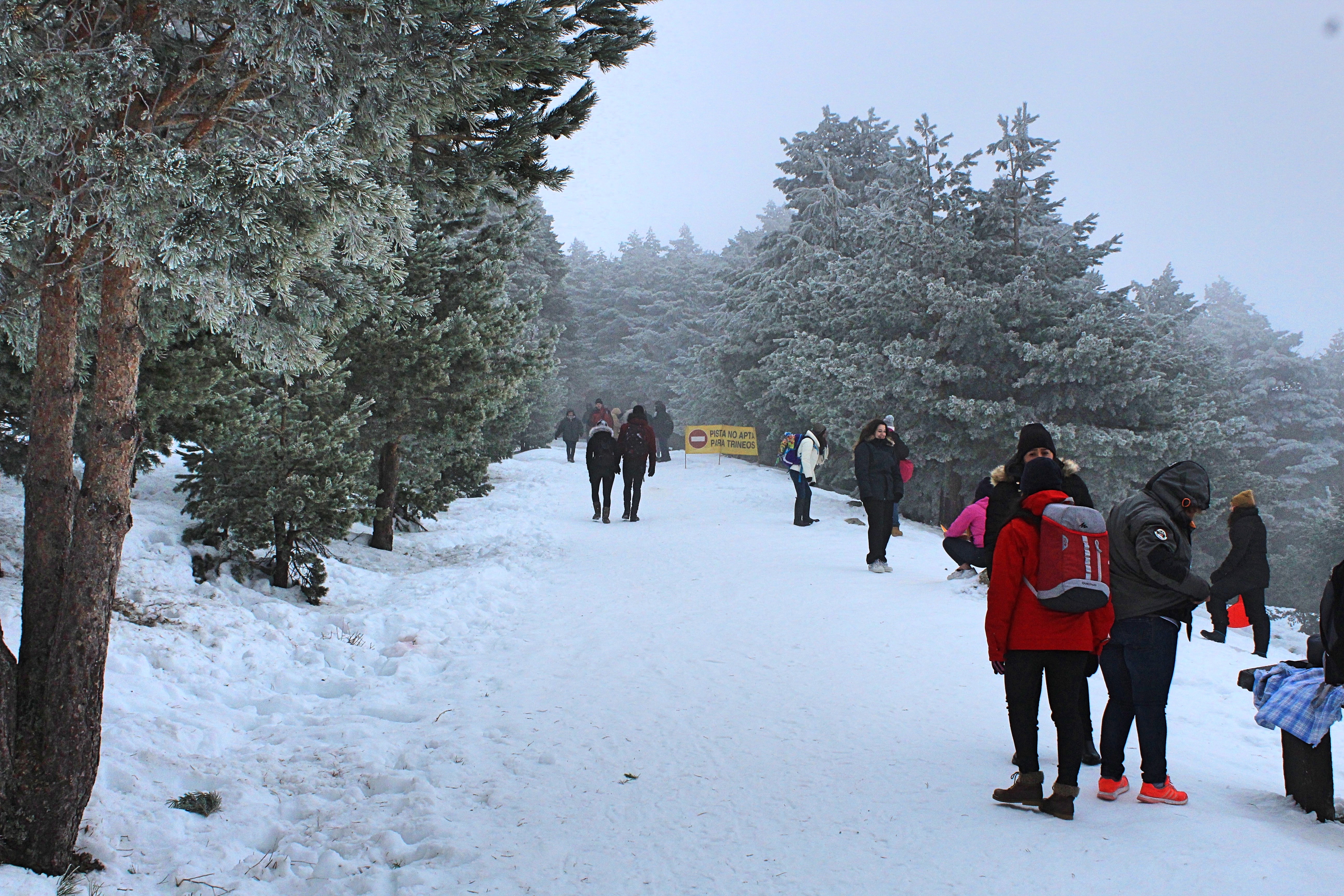
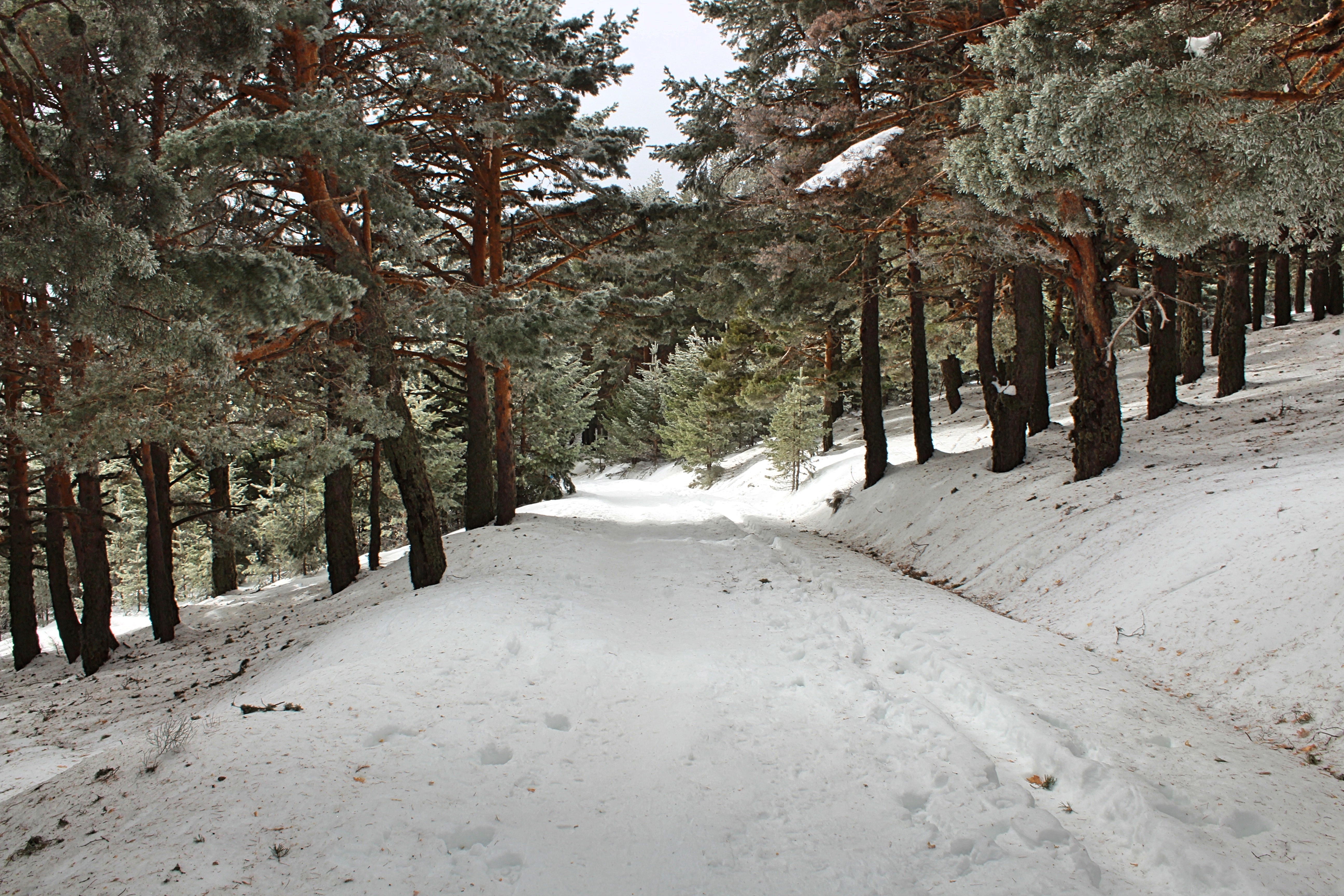
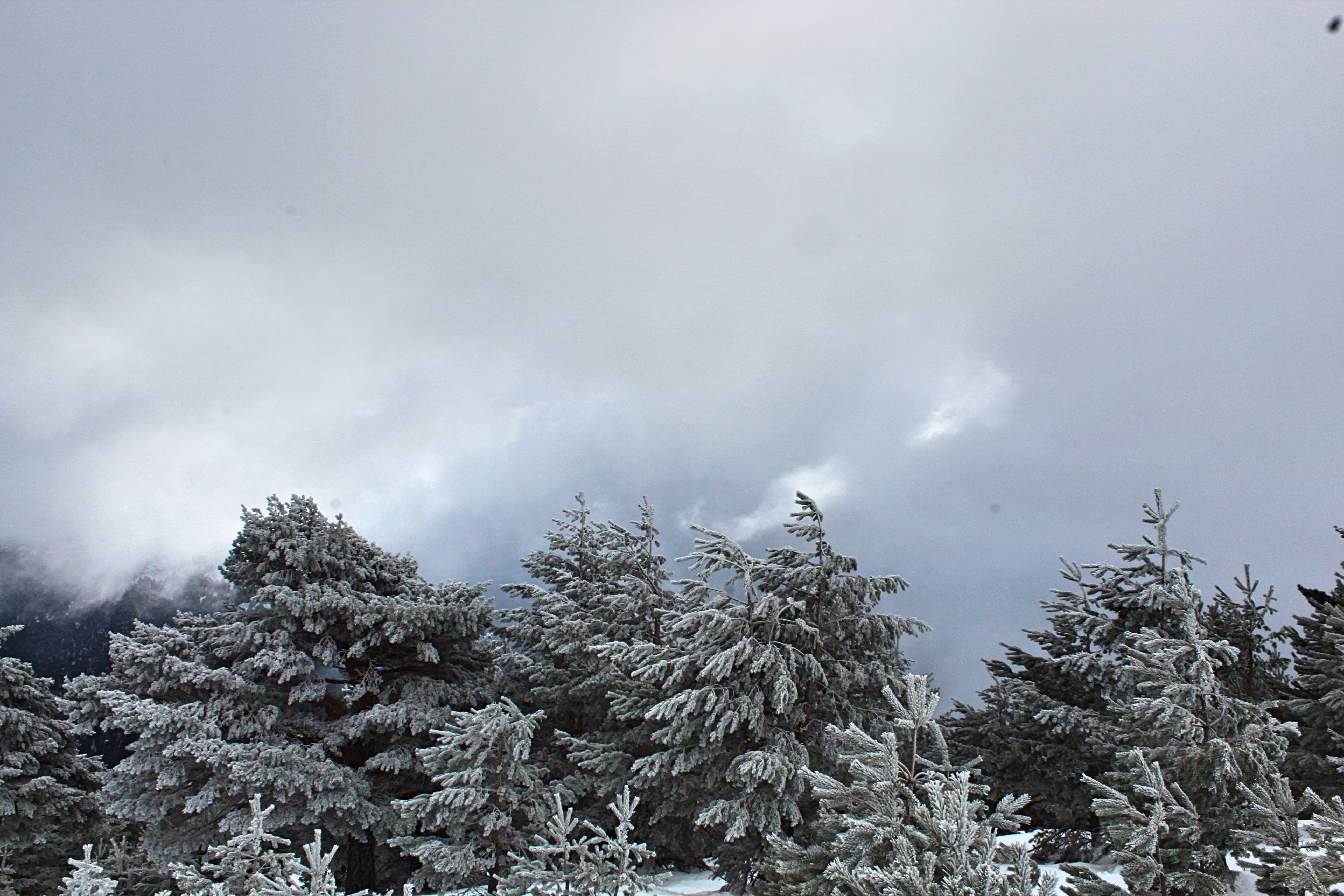
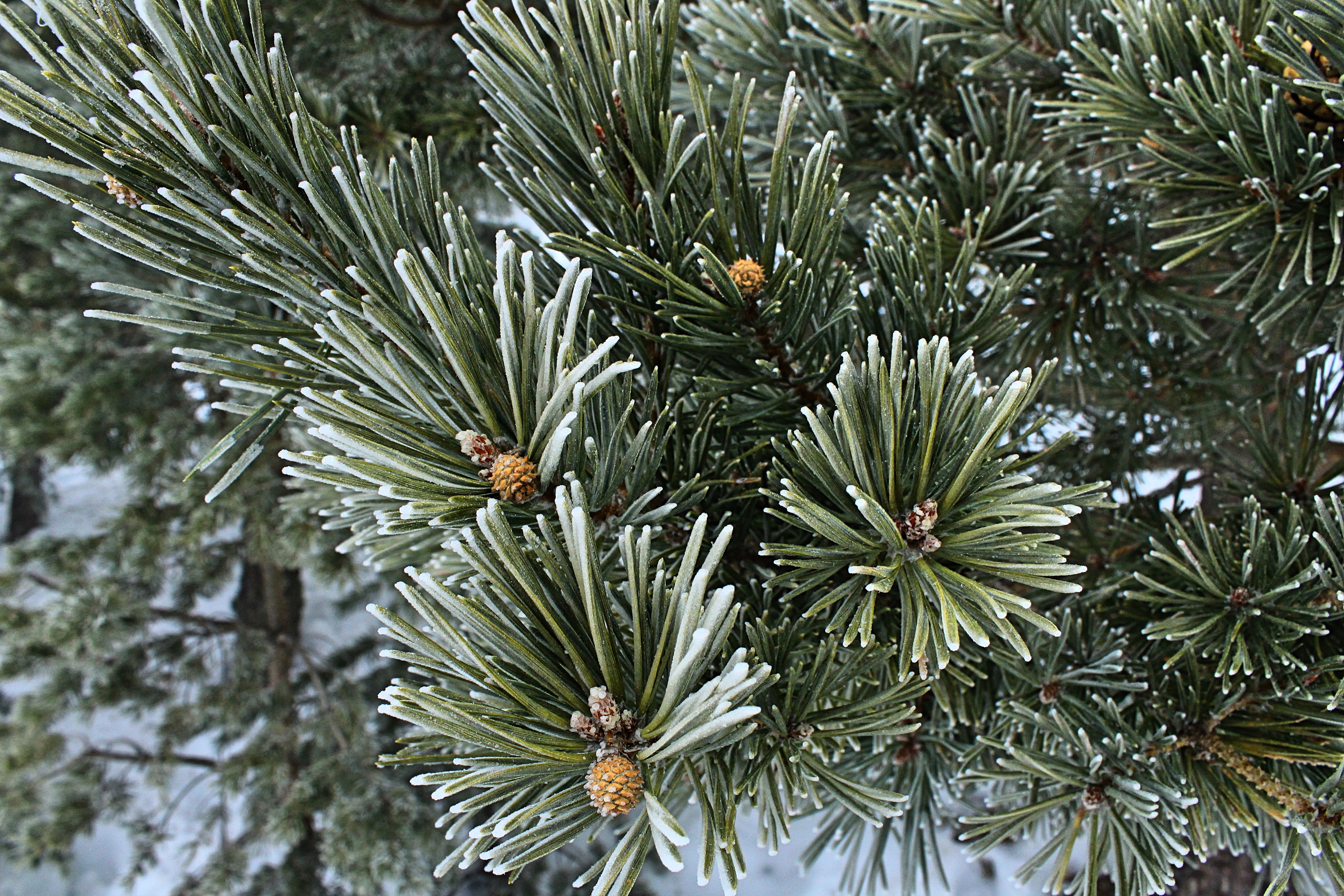
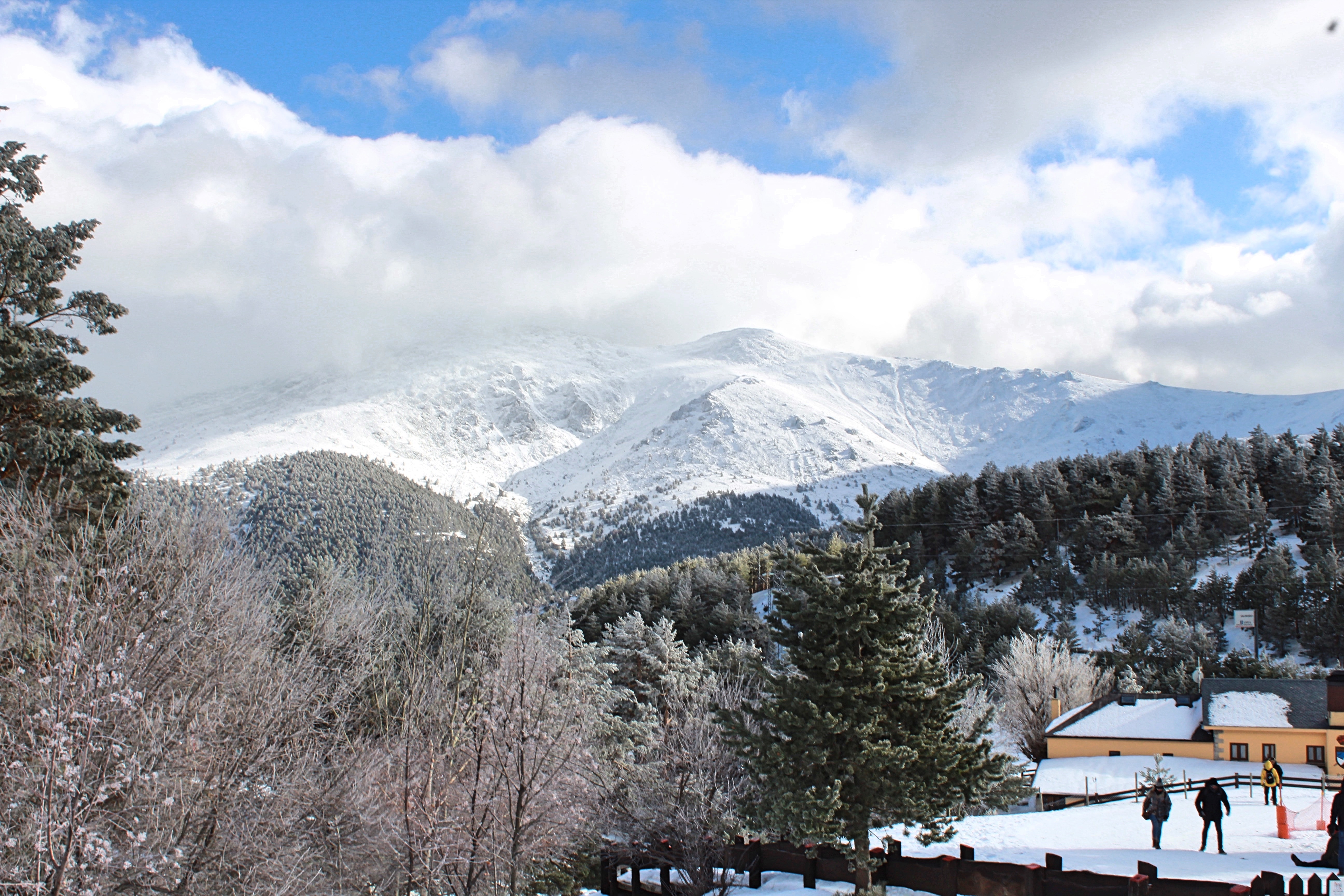
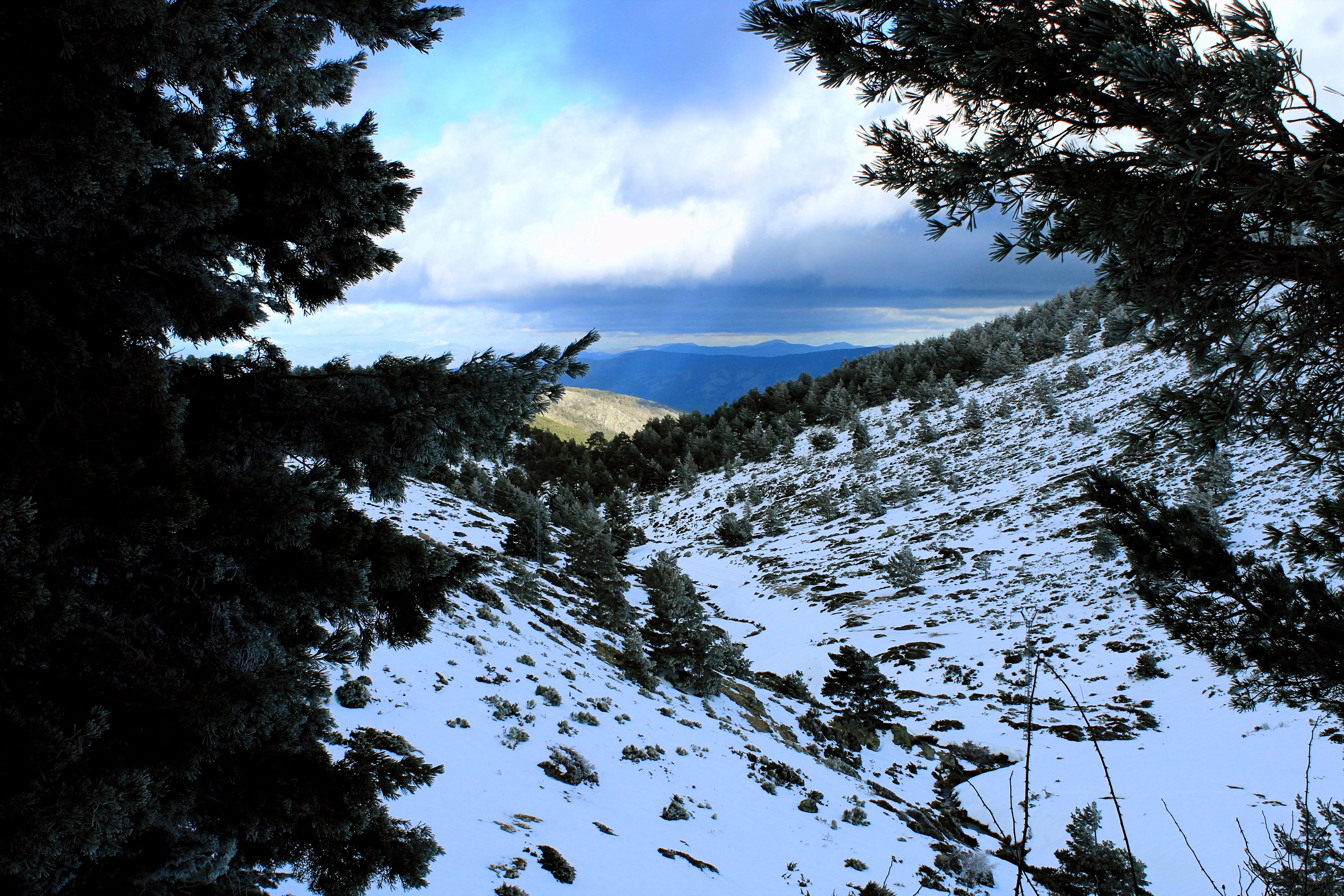
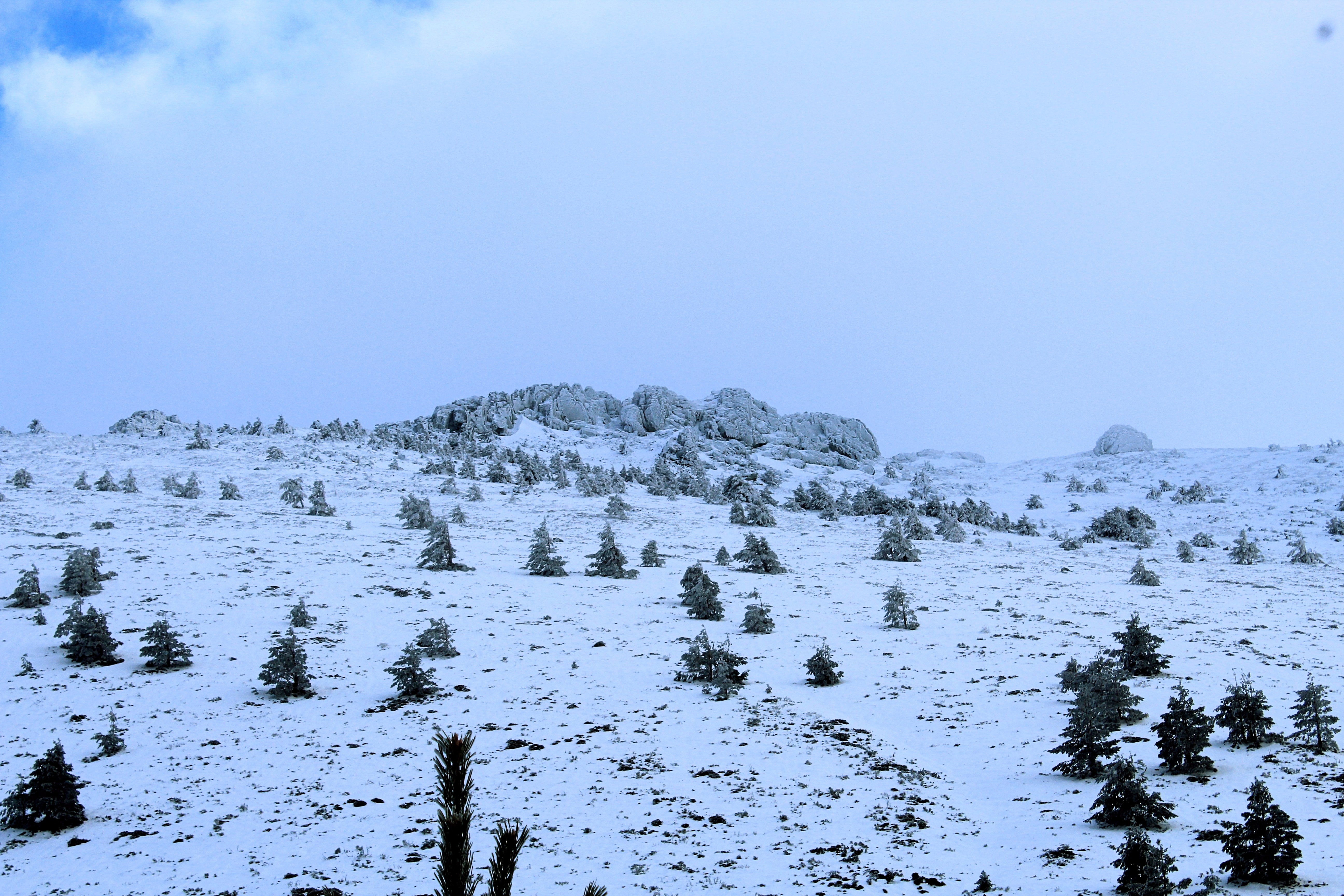
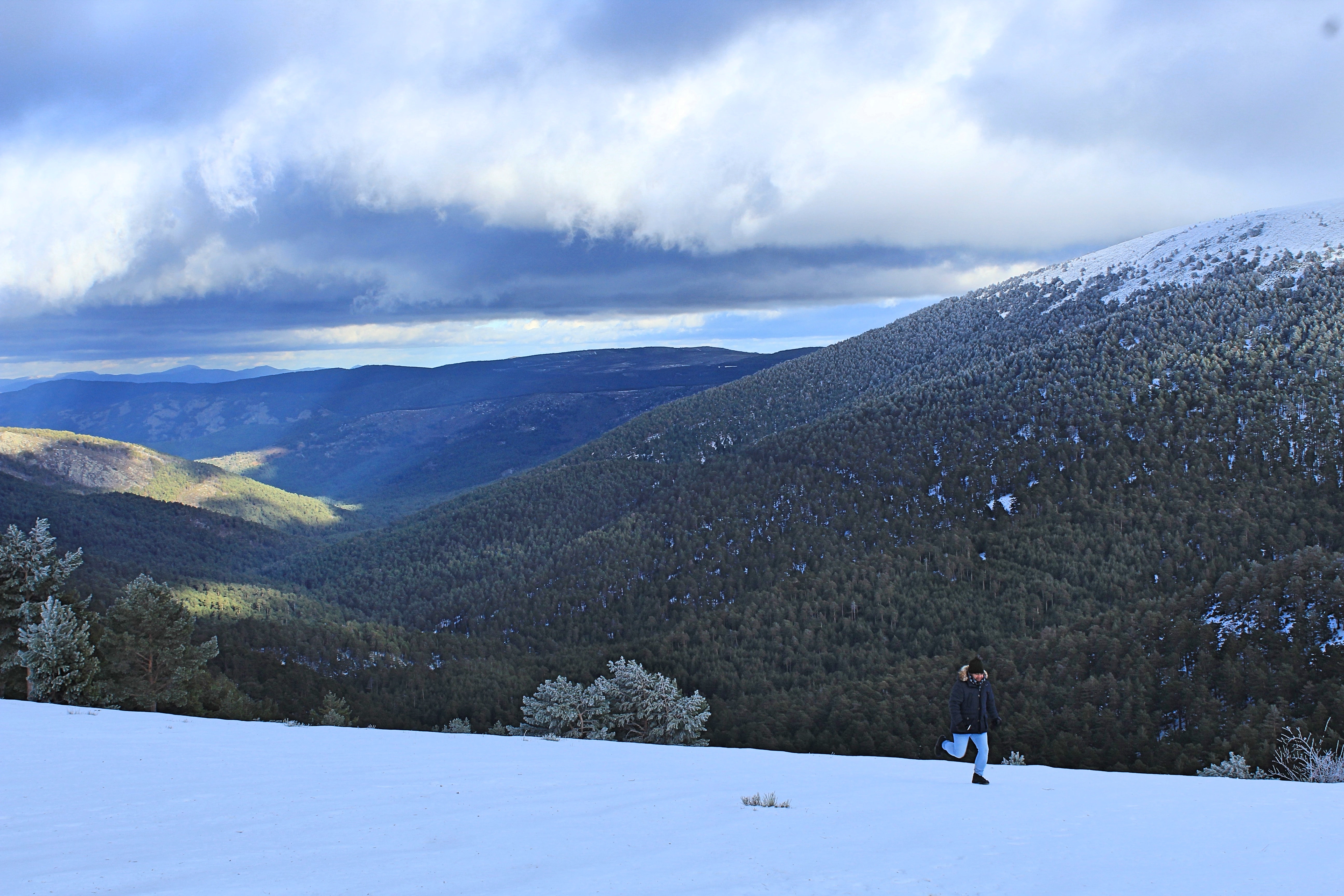
Recently I revisited Peñalara—the biggest mountain in Madrid’s Guadarrama range. I had already been to the mountain four times, but never before in the dead of winter. I doubted that there would be any snow at all. But I was wrong. The landscape was completely covered with snow and ice, smoothed slick by the wind. Rebe and I tried to climb to the peak, but we couldn’t even get halfway. The ground was too slippery, the wind too strong, and the fog too dense.

But it was still a lovely time. As a New Yorker, I sometimes find myself yearning for a proper winter in Spain. Going to the mountains gave me a taste of the cold without my having to live in it. It’s a perfect daytrip from Madrid. The only negative aspect was that, this time, I had to pay almost 30 euros round-trip to get there. Rebe, on the other hand, traveled for free, since it was included in her youth metro pass. Oh, the lost dreams of youth.

The train to Los Cotos. Tickets must be bought in advance.
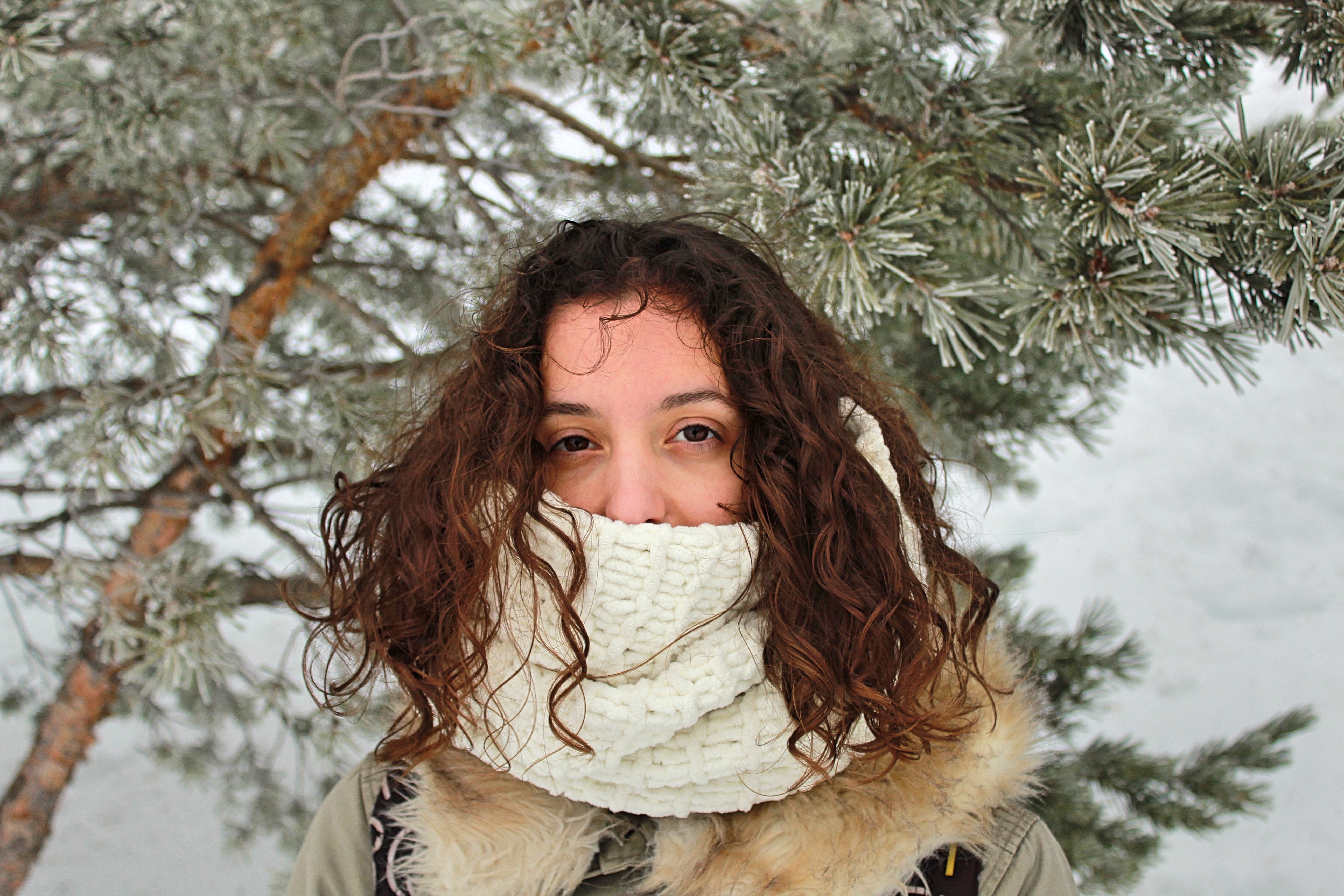
Rebe in the pines
The author in a knit wool hat
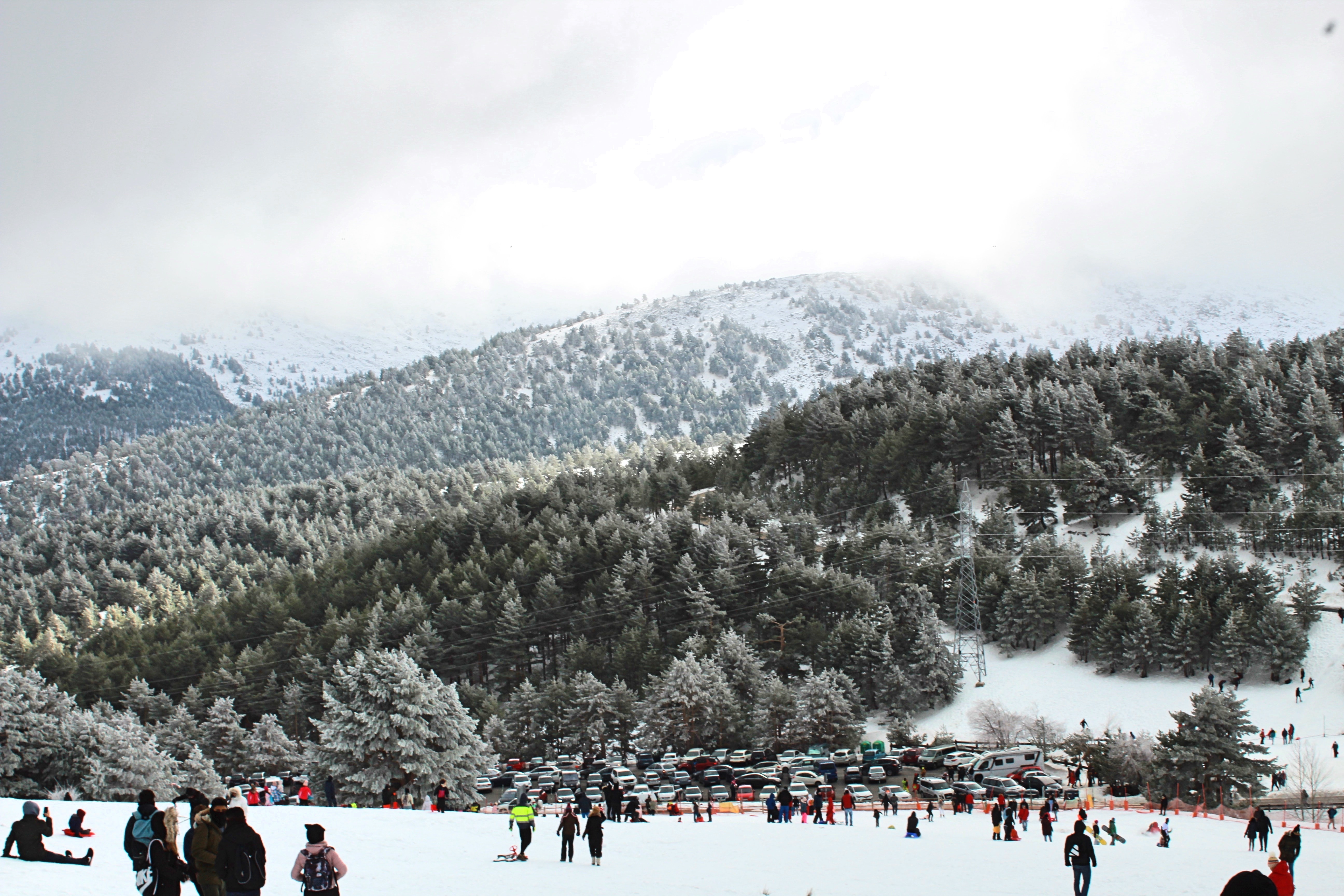
Many families come to go sledding
Skiers and serious hikers were also in attendance
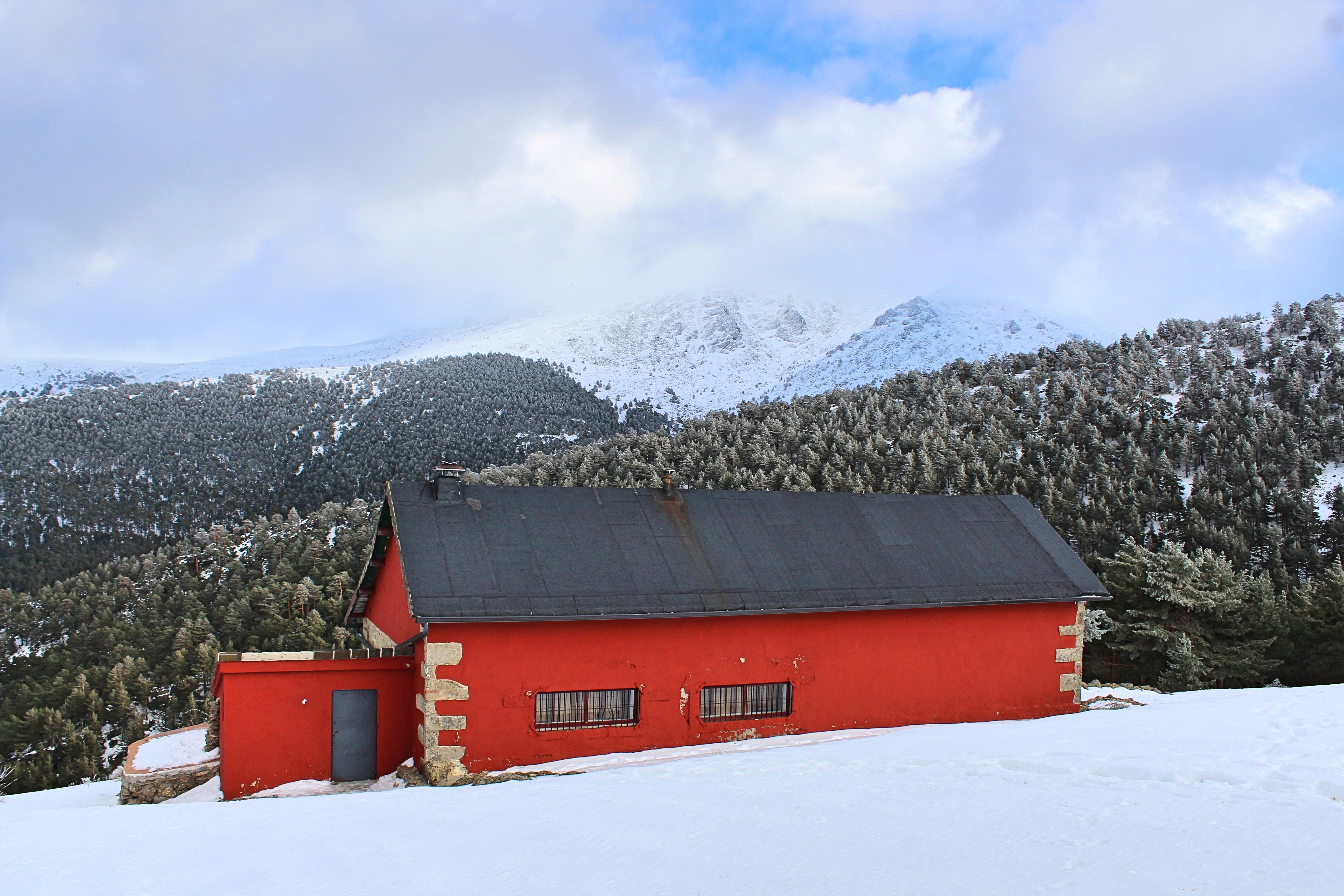
A refuge from the snow

Review: The Art of Worldly Wisdom

Review: The Art of Worldly Wisdom
Oráculo manual y arte de prudencia

Oráculo manual y arte de prudencia by Baltasar Gracián

My rating: 4 of 5 stars

Cada uno habla del objeto según su afecto.

This little book is one of the most read and translated works of the Spanish Golden Age. It has been surprisingly influential. Schopenhauer was a famous devotee, and even learned Spanish so that he could produce a translation (which went on to commercial success). Two English translations have been best-sellers, the first in 1892 and the second in 1992. Advice typically does not age well, but Gracián’s has stood the temporal test.

Yet for the reader of the original Spanish—especially the non-native reader—the book can be perplexing. Gracián was a major writer in the conceptismo movement: a literary style in which a maximum of meaning was compressed into a minimum of words, using every rhetorical trick of the trivium to achieve a style that seems to curl itself into a ball and then to explode in all directions. This can make the experience of reading Gracián quite akin to that of reading poetry—except here, unlike in poetry, you can be sure that there is a sensible meaning laying concealed underneath. When the antiquity of Gracián’s Castilian is added to the mix, the result is literary dish that is difficult to digest.

After a meaning is beaten out of Gracián’s twisted words, however, the result is some surprisingly straightforward advice. “Prudent” is the operative word, for Gracián manages to be idealistic and realistic at once, walking the fine like between cynicism and naïveté. Admittedly, however, the bulk of this advice is directed towards the successful courtier, and so is difficult to apply to less exalted positions. There is, for example, much advice concerned with how to treat inferiors and superiors, but in a world where explicit hierarchies are increasingly frowned upon (or at least tactfully concealed), the poor reader wonders what to make of it.

But much of the advice is timeless and universal. Make friends with those you can learn from (but not those who can outshine you!). Don’t let wishful thinking lead you into unrealistic hopes. Never lose your self-respect. The wise man gains more from his enemies than the fool from his friends. Know how to forget. Know how to ask. Look within… As any reader of Don Quixote knows, Spanish is a language exceedingly rich in proverbs; so it perhaps should come as no surprise that this language—so rhythmic and so easy to make rhymes with—is also an excellent vehicle for maxims. Gracián exploits the proverbial potential of Castilian to the maximum, expressing a sly but respectable philosophy in 300 pithy paragraphs.

Despite all the wit and wisdom to be found in these pages, however, I found myself wishing for amplification. Montaigne, though short on practical advice, is long on examples; so by the end of his essays the reader has a good idea how to put his ideas into practice. Gracián, by contrast, has no time for examples, and so the reader is left with a rather abstract imperative to work with. Needless to say I will not become a successful courtier anytime soon.


View all my reviews

Images of Sevilla

Images of Sevilla

Recently I returned to Sevilla for the third time, to show my brother the enchanting city. (For my original post, click here.) I used the opportunity to take pictures with my new camera.

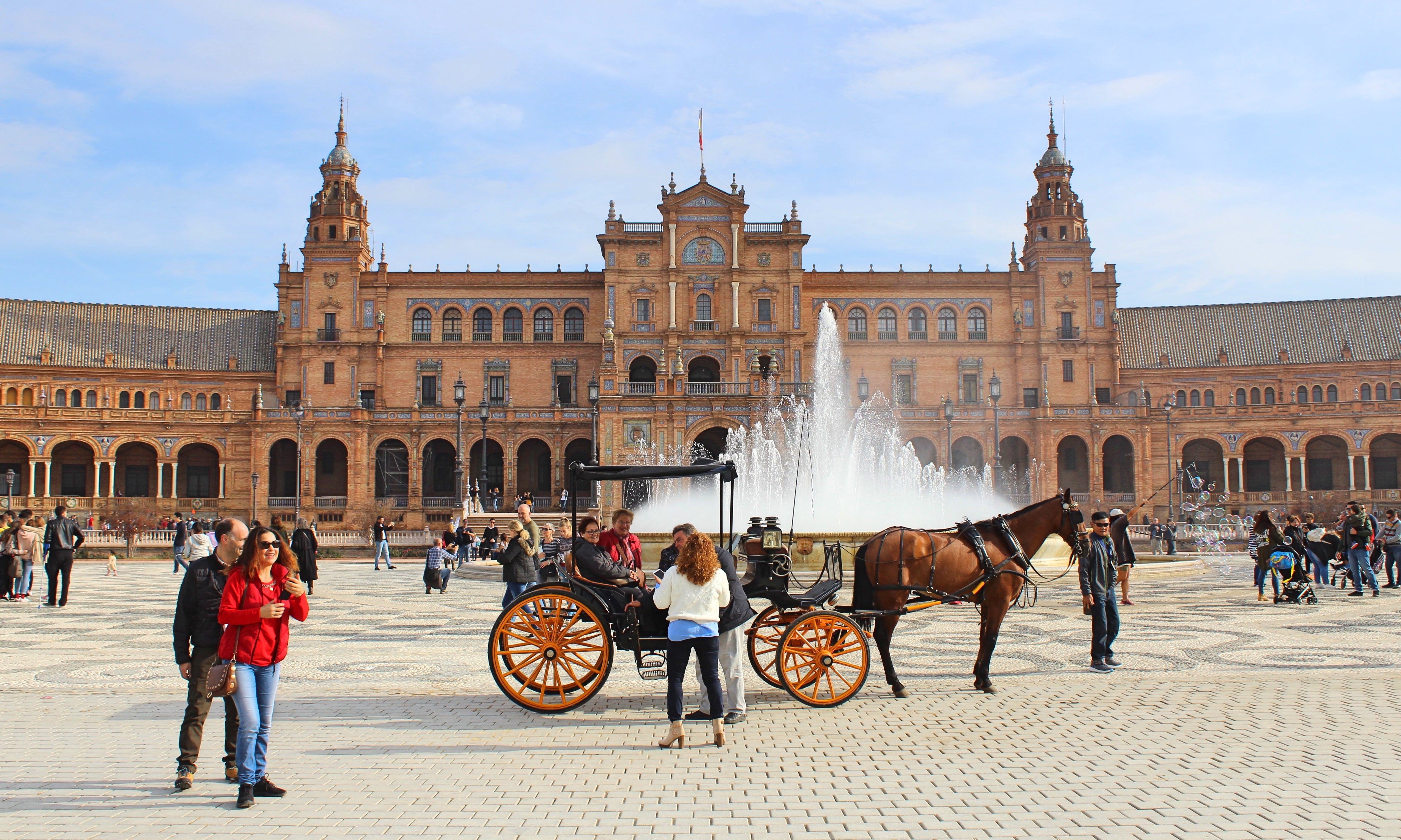
Our first stop was the Plaza de España, a place so attractive that anyone with any camera can take a fine photo.

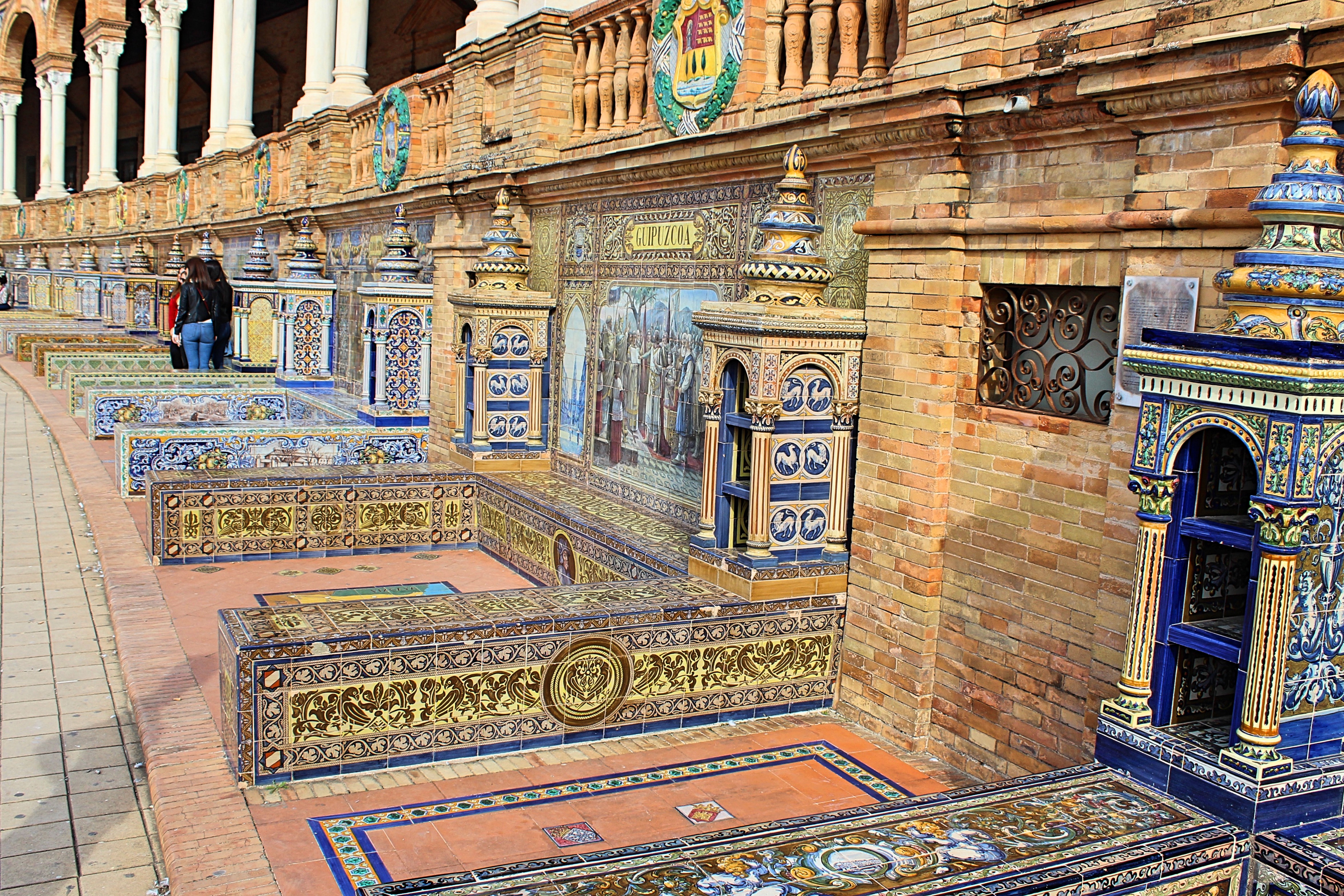
The plaza was built for the 1929 Ibero-American exposition to showcase the wonders of Spain. The architectural style is a cross between Spanish Baroque and Neo-Mudéjar. Along the semi-circular building there are nooks with ceramic images of every Spanish province, accompanied by illustrations of important events in Spain’s history. Running parallel to the building is a little moat in which you can rent a boat and paddle about.

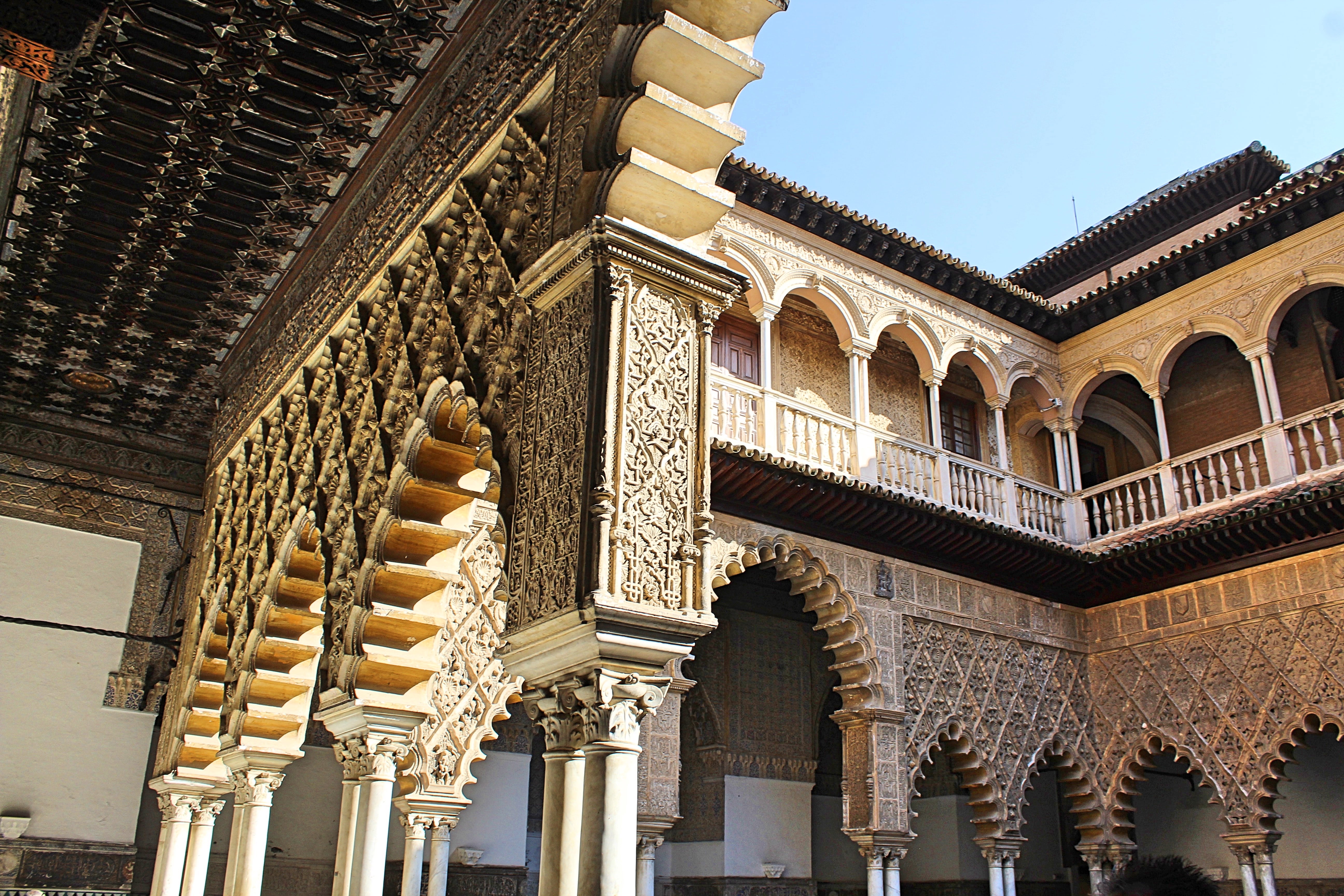
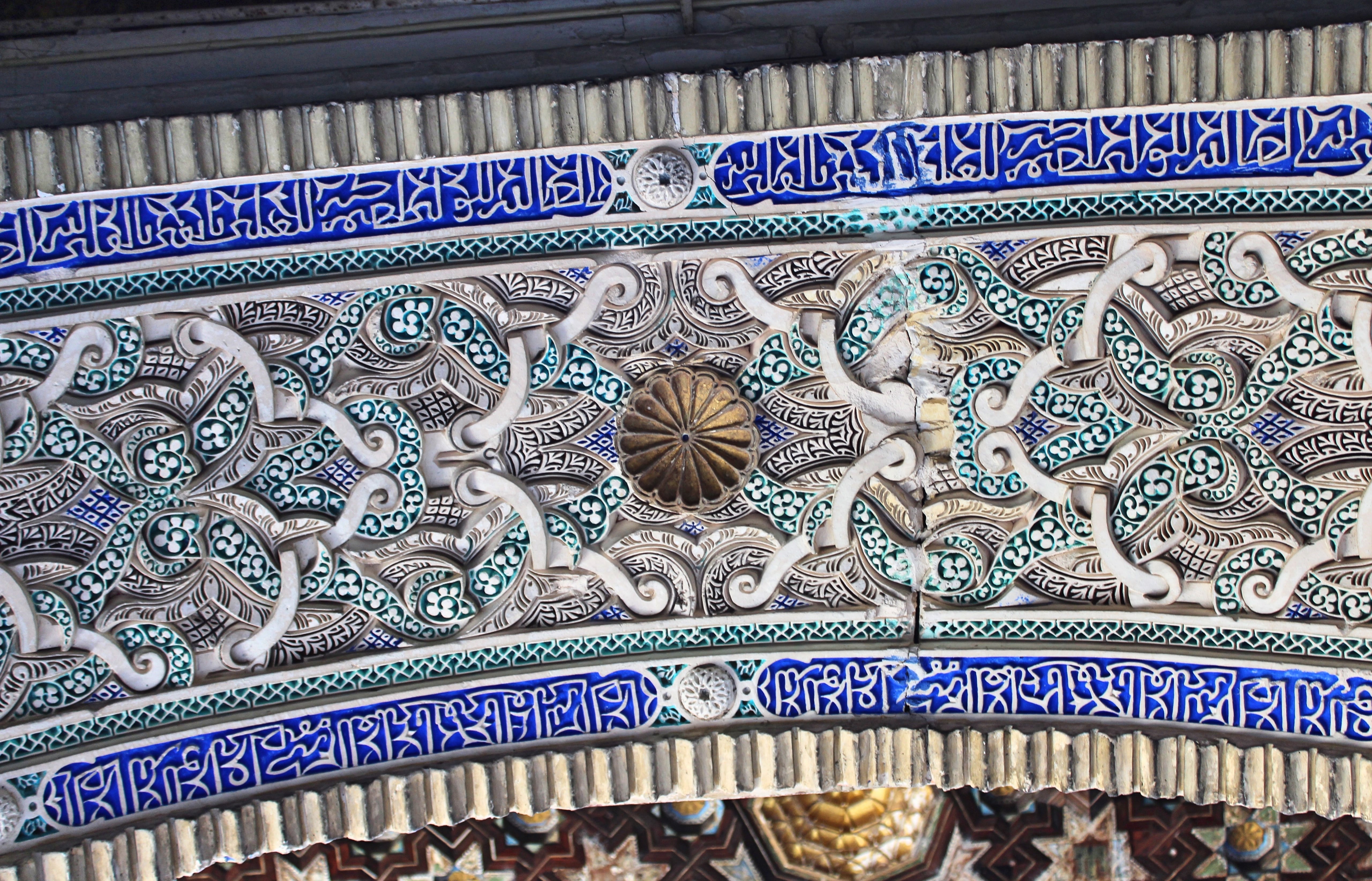
Next we went to the Alcázar—Seville’s Moorish palace. Curiously, the most famous part of the palace was not built under Muslim rule, but under the Christian king Peter (alternatively called “the cruel” or “the just”). He employed Muslim workmen to construct a kind of homage to the Alhambra in Granada. Later kings added to the palace, and maintained the large and lush garden surrounding the building complex.

The lion guarding the entrance
An inner courtyard, where the Dorn scenes from Game of Thrones were filmed
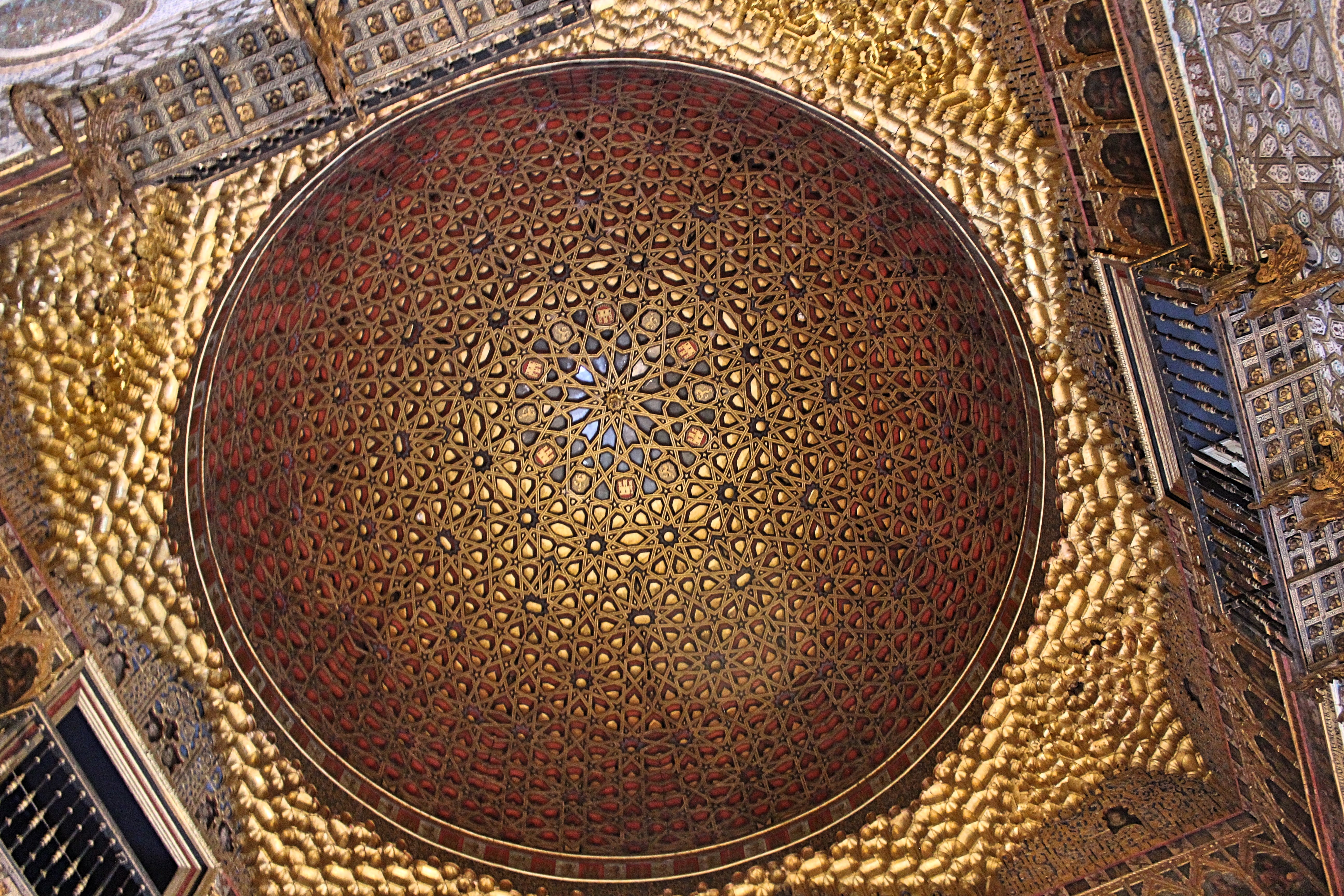
The ceiling from the Hall of Ambassadors
A detail from a doorway
Fish in the pond behind the palace
The cistern under the palace
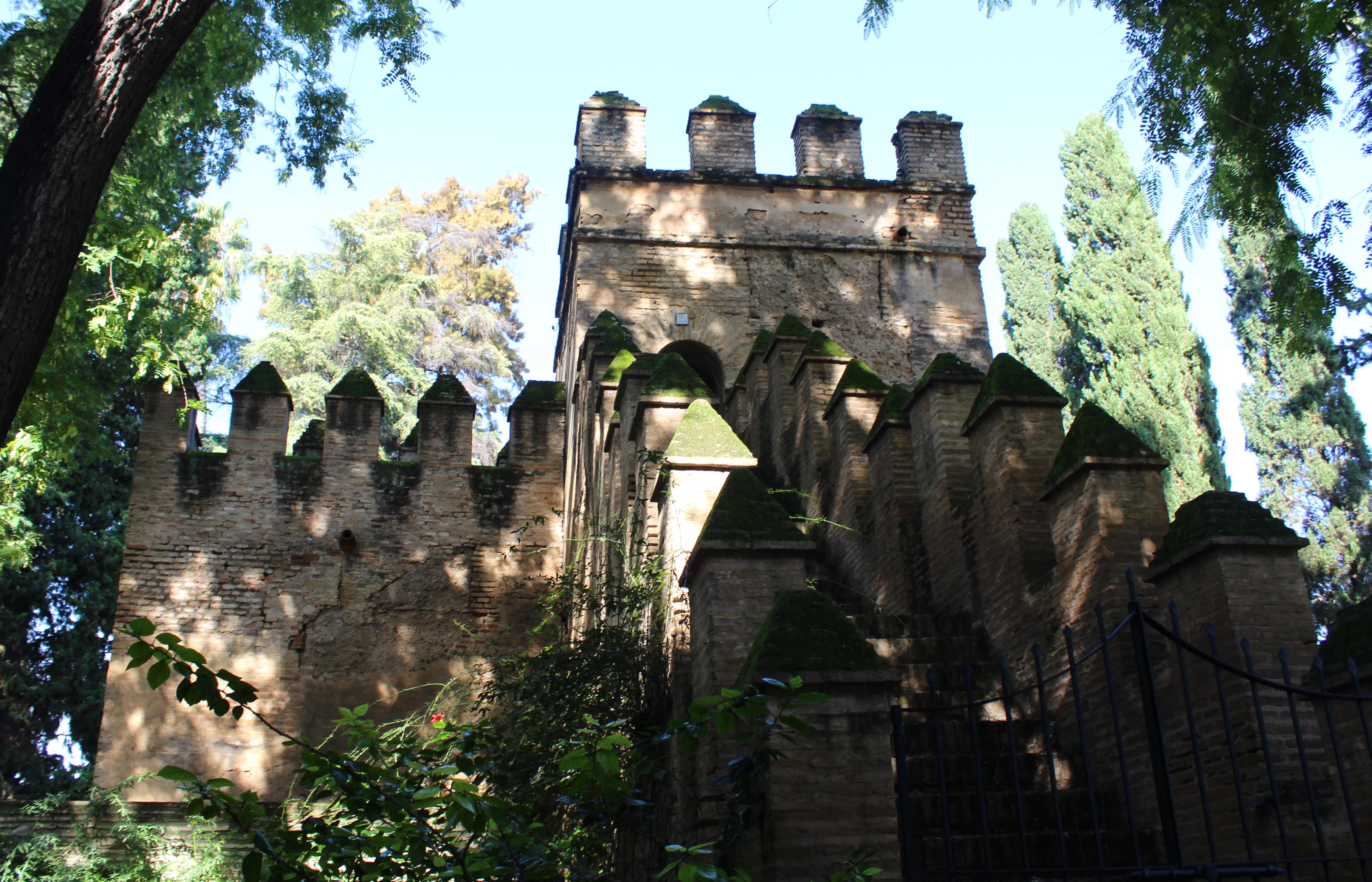
A structure in the gardens

After the Alcázar, we went to Seville’s famous cathedral—one of the biggest in the world.

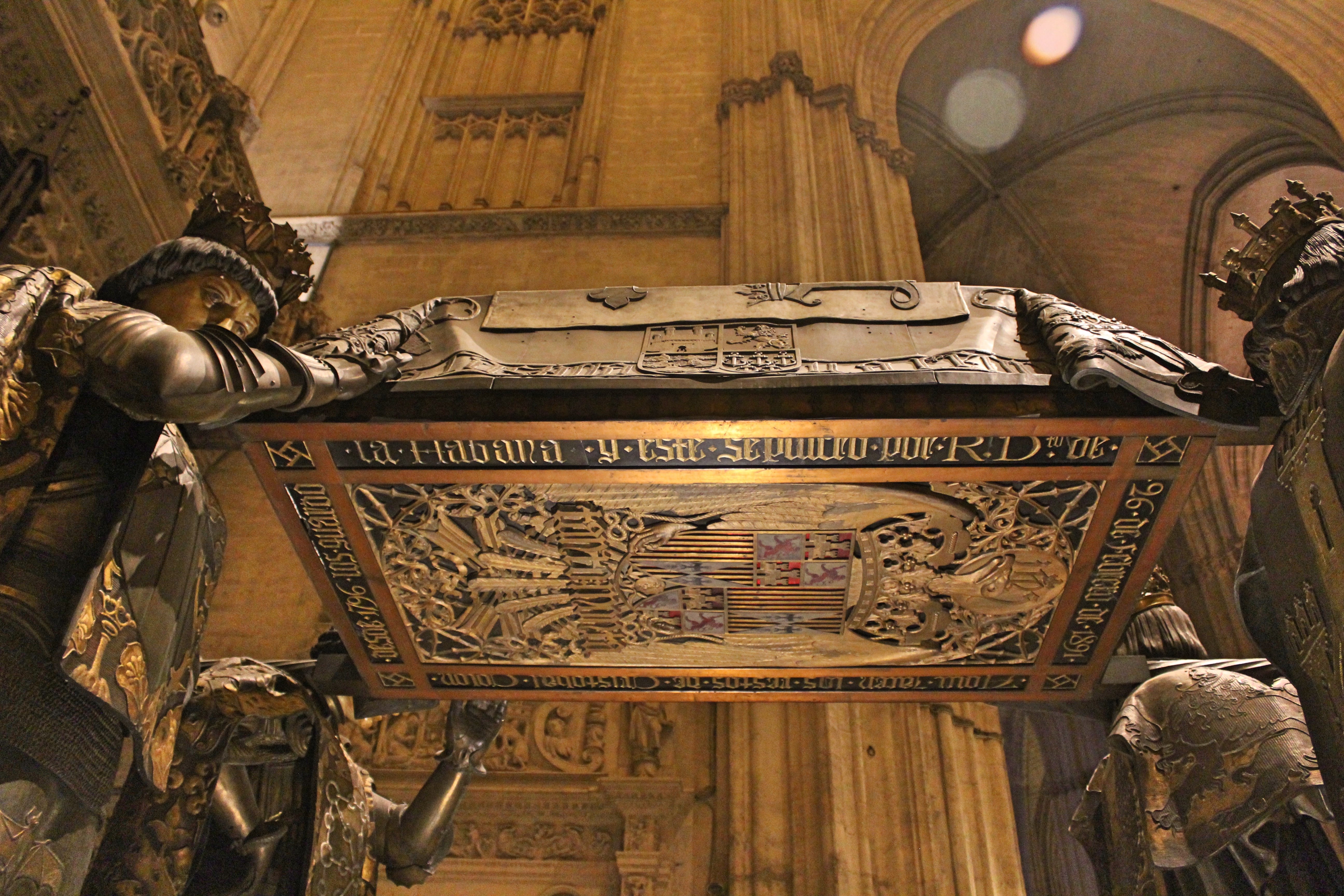
The underside of Christopher Colombus’s tomb
The enormous, and enormously detailed, main altar

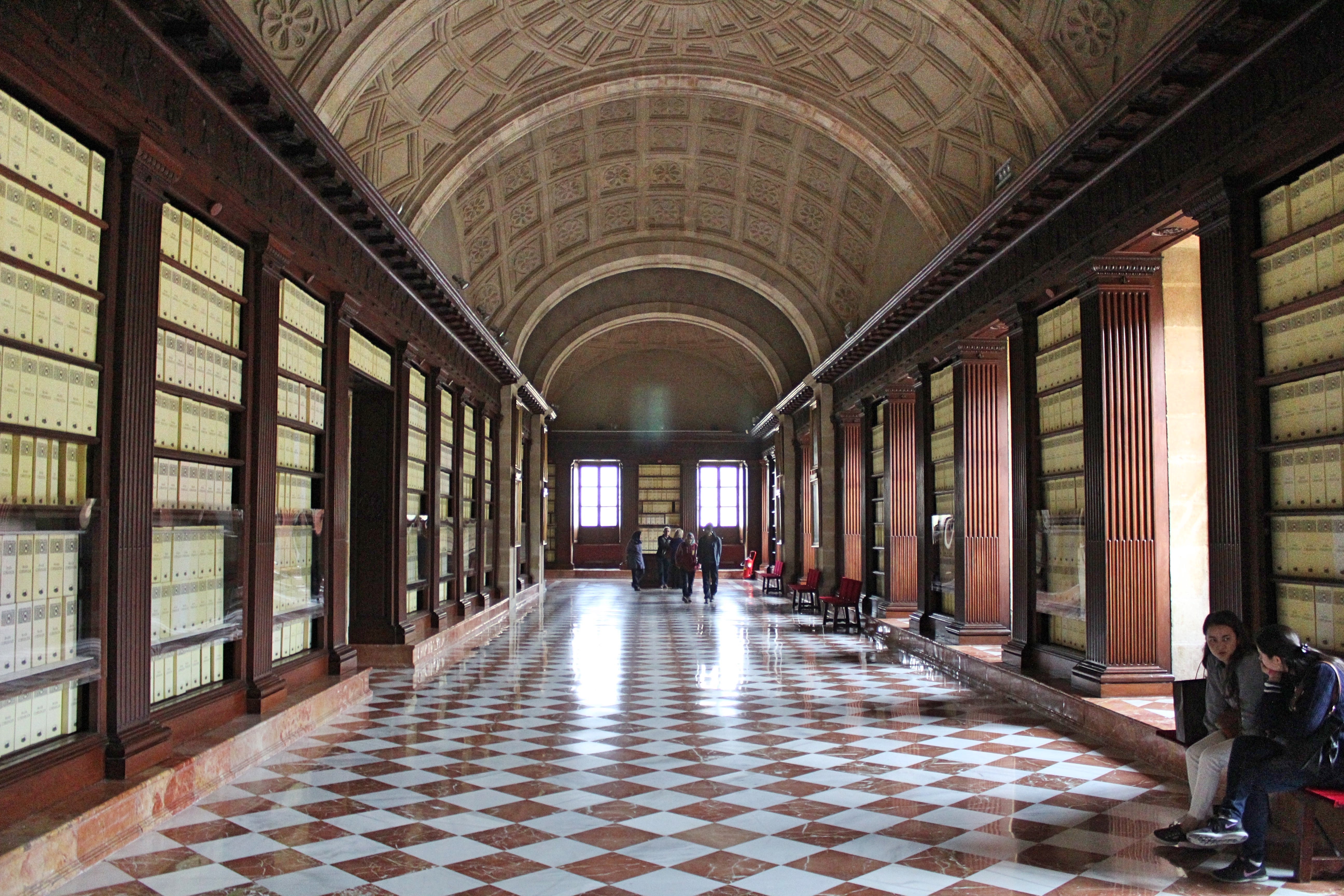
Nextdoor to the cathedral is the famous Archivo General de las Indias (General Archive of the Indies). The building was designed by Juan de Herrera (also respondible for El Escorial and the palace in Aranjuez) in the 16th century, to be used by the merchant guild, it was later converted to be the central storehouse of documents pertaining to Spanish colonization. As such, it is now a repository of immense value to historians, and was thus included in Seville’s UNESCO designation.

The building itself is stately and restrained, consisting of two stories around a central courtyard. Every wall is lined with binders on glass-covered shelves, containing millions upon millions of pages.

The building also contains some delightful paintings by Murillo.

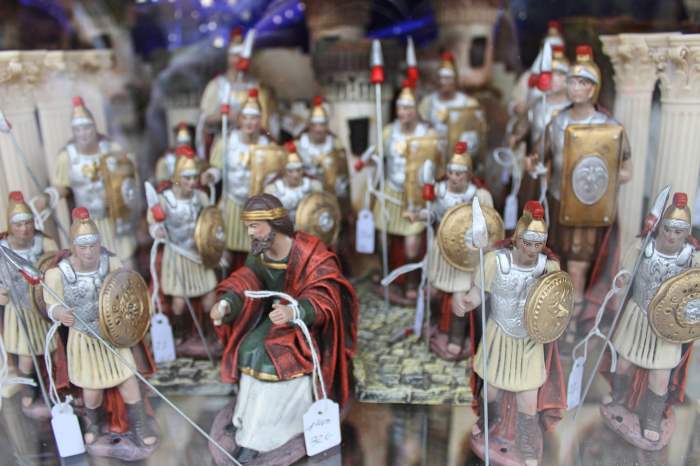
Because went in December, outside the cathedral the streets were full of stalls selling nativity figurines.

Our next stop was new for me: the Monasterio de la Cartuja (Carthusian Monastery, or charterhouse). This is an old religous complex, located across the Guadarrama River, that was also used to manufacture ceramics—which explains the conical chimneys that stick up all around the central religious buildings.

More recently the center has been converted into a modern art museum. It was completely free to visit. Outside, in the courtyard, a band was playing rock music (with the volume turned up a bit too loud) while children danced on the grass.

Some of the permanent artworks (see below) were charming. But the temporary exhibition spaces (housed in the empty church and among ornate graves) were extremely disappointing—self-important post-modernism at its worst.

The Tower of Seville, the tallest building in the city, as reflected in a pool near the monastery

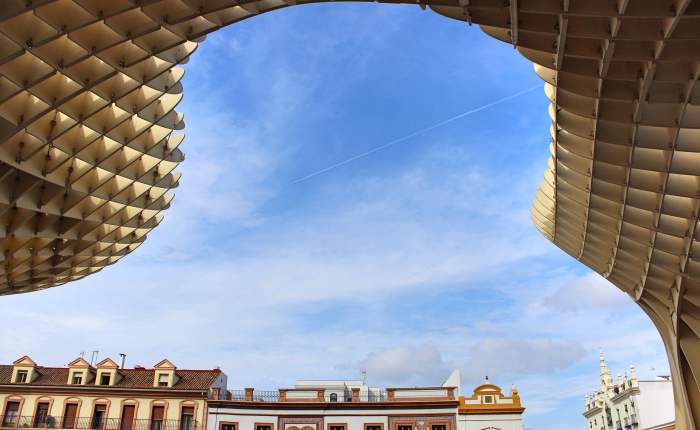
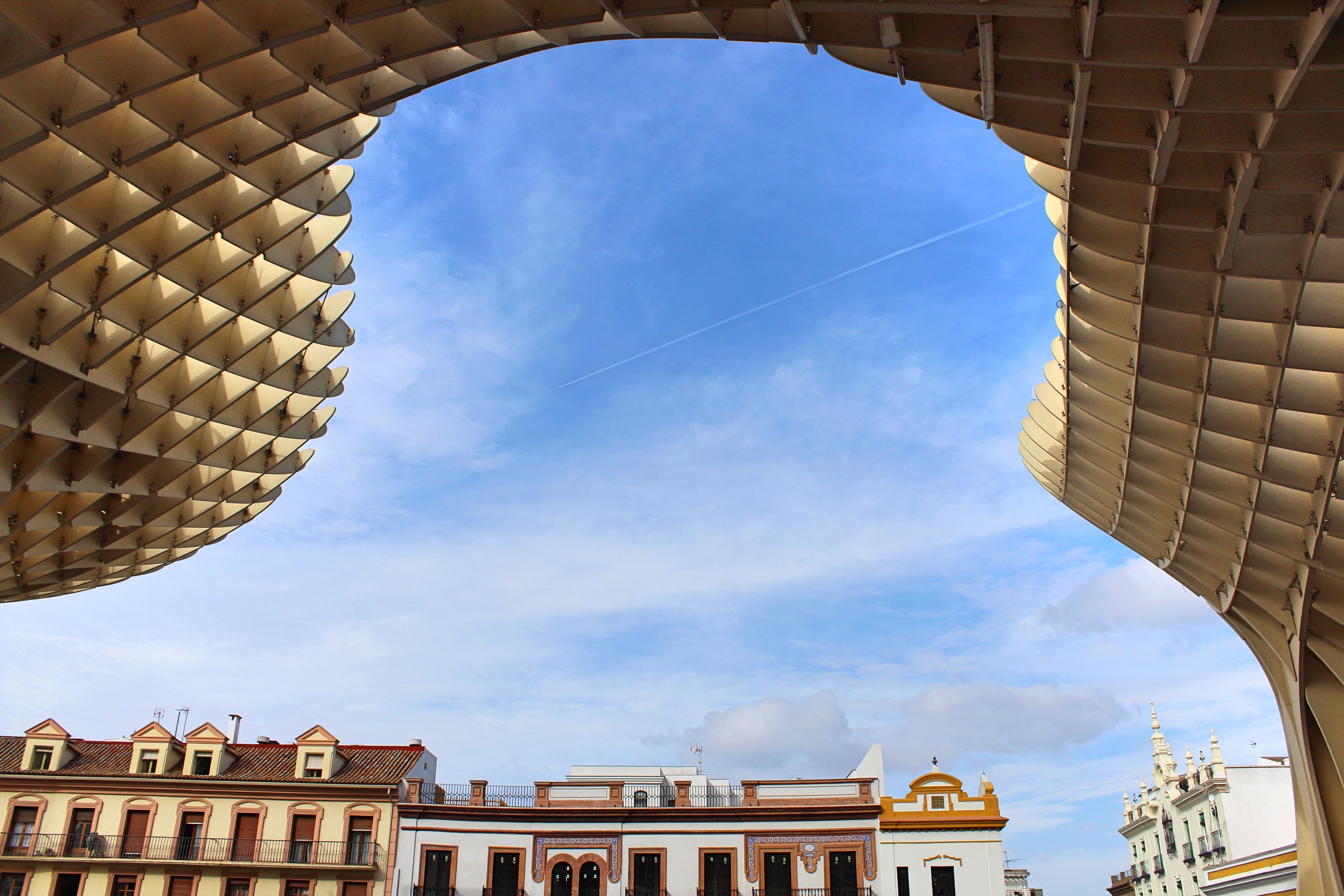
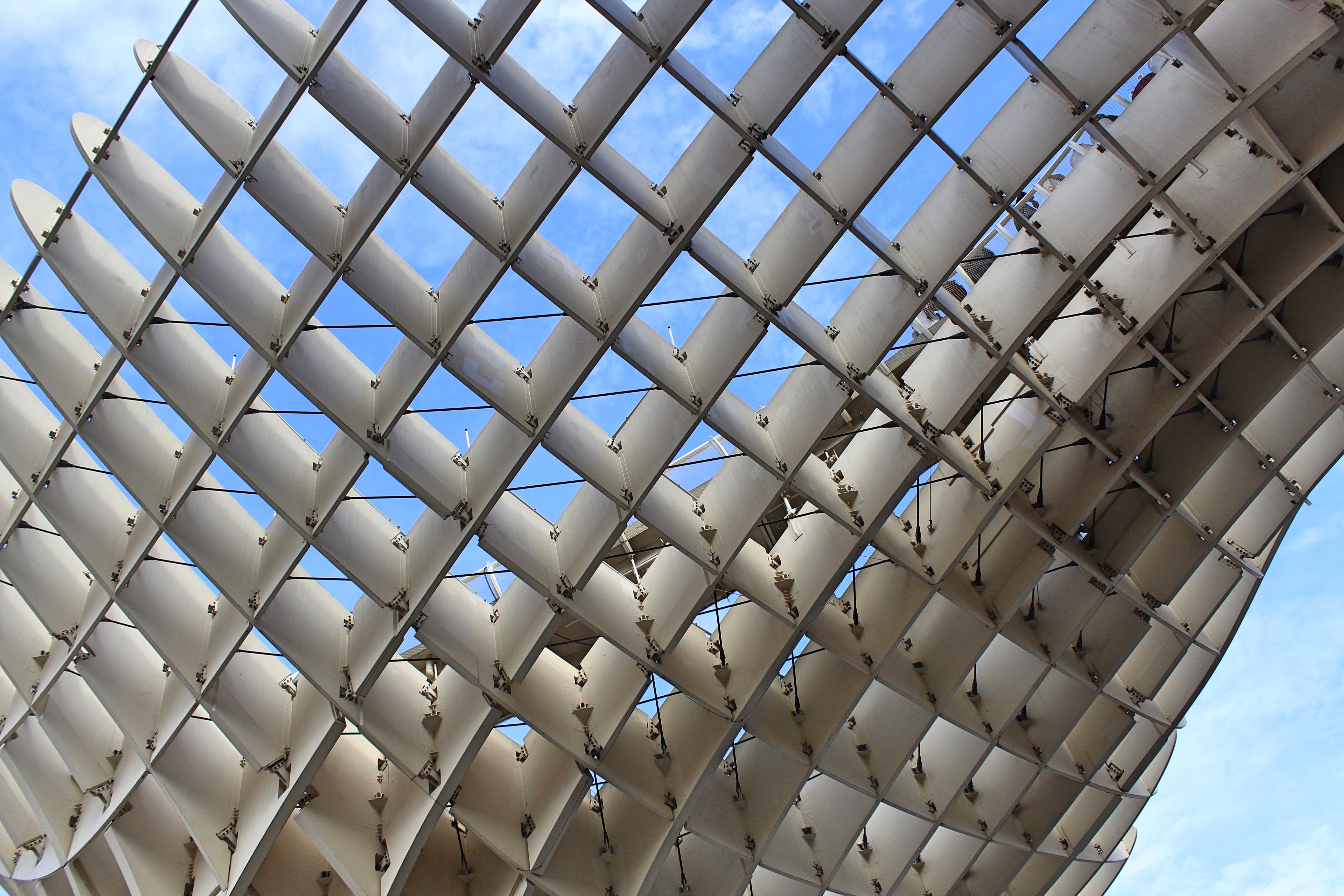
After this, we crossed the Guadarrama River again, and went to see Setas de Sevilla (“Mushrooms of Seville”)—enormous, bulbous wooden figures that sprout from the center of the city. These were constructed in 2011, and have succeeded in becoming one of the city’s most distinctive sights.

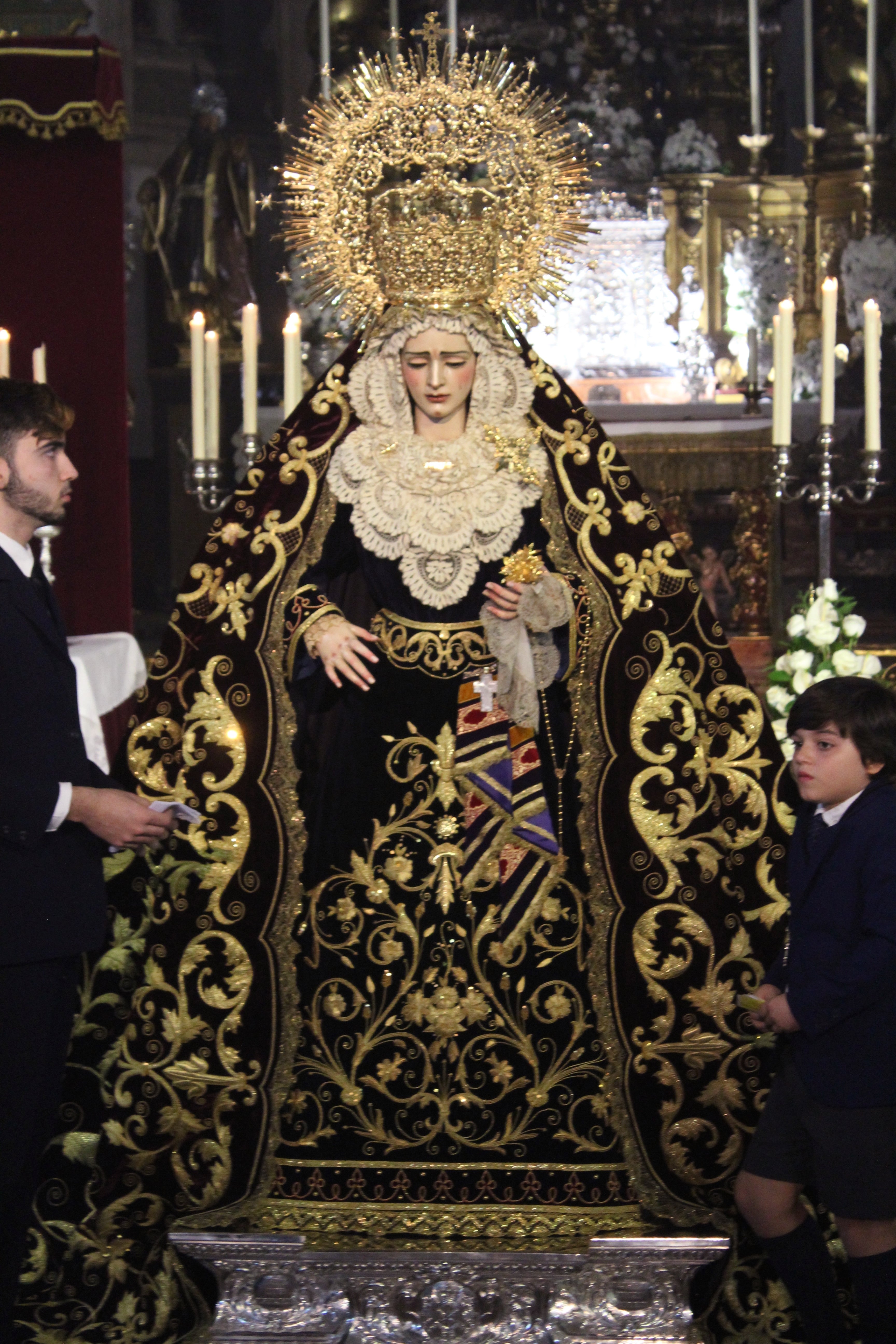
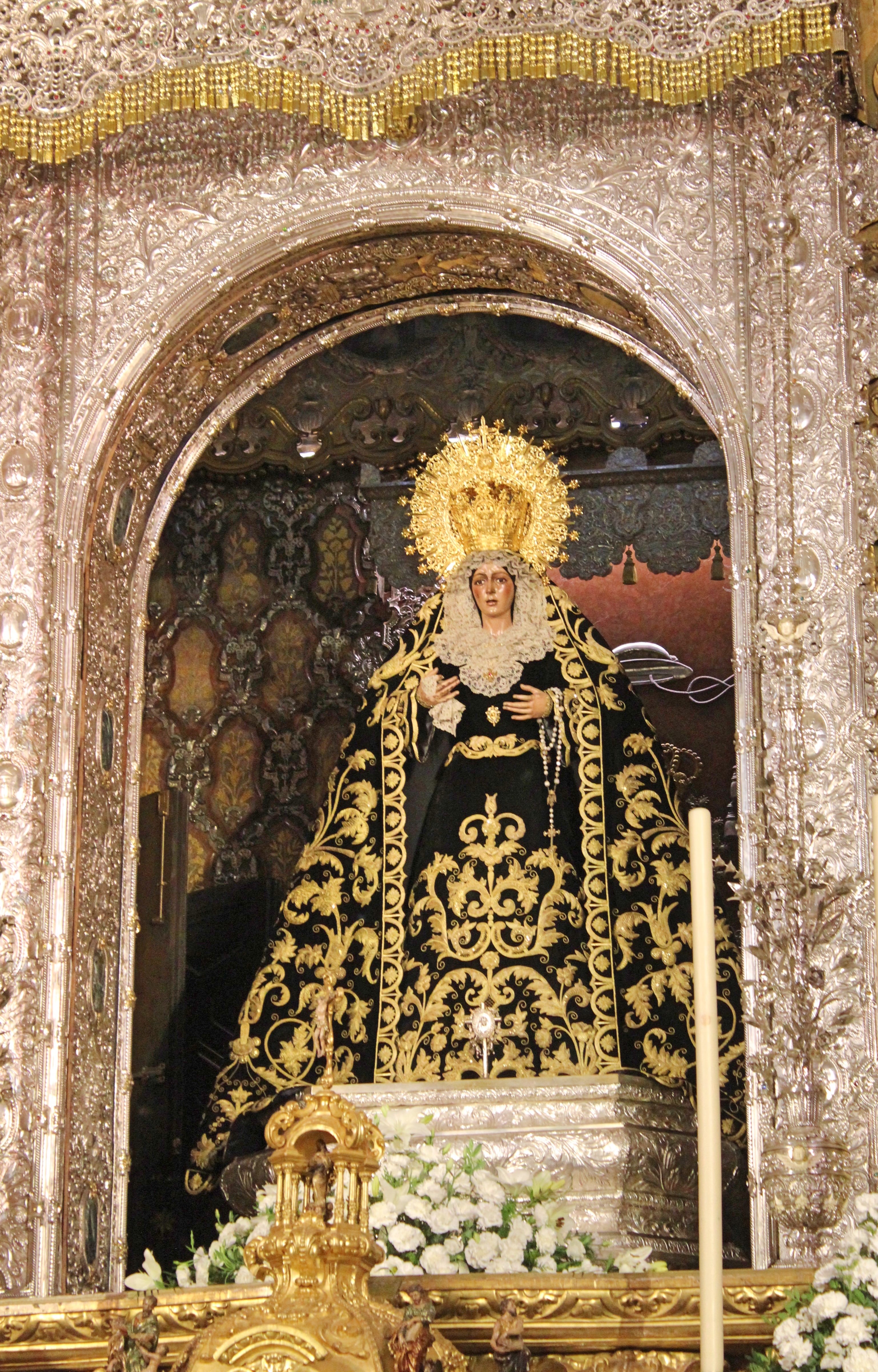
Later, we decided to visit the Basilica of Macarena, which is famous for housing the Virgen de la Macarena. This is a wooden devotional figure, considered the patroness of bullfighters, widely known through the Catholic country.

On the way there, we dipped into another church, where we witnessed another wooden Virgin playing its role in worship. Congregants lined up to kiss the Virgin’s hand, after which a young man would patiently rub away the saliva with a rag, thus preparing the hand to bless the next devotee.

The Virgin of the Macarena did not disappoint. She is ensconced high in the altar, looking omnipotent and tragic. But the dedicated believer can go behind the altar and ascend some stairs, to examine the blessed figure up close.

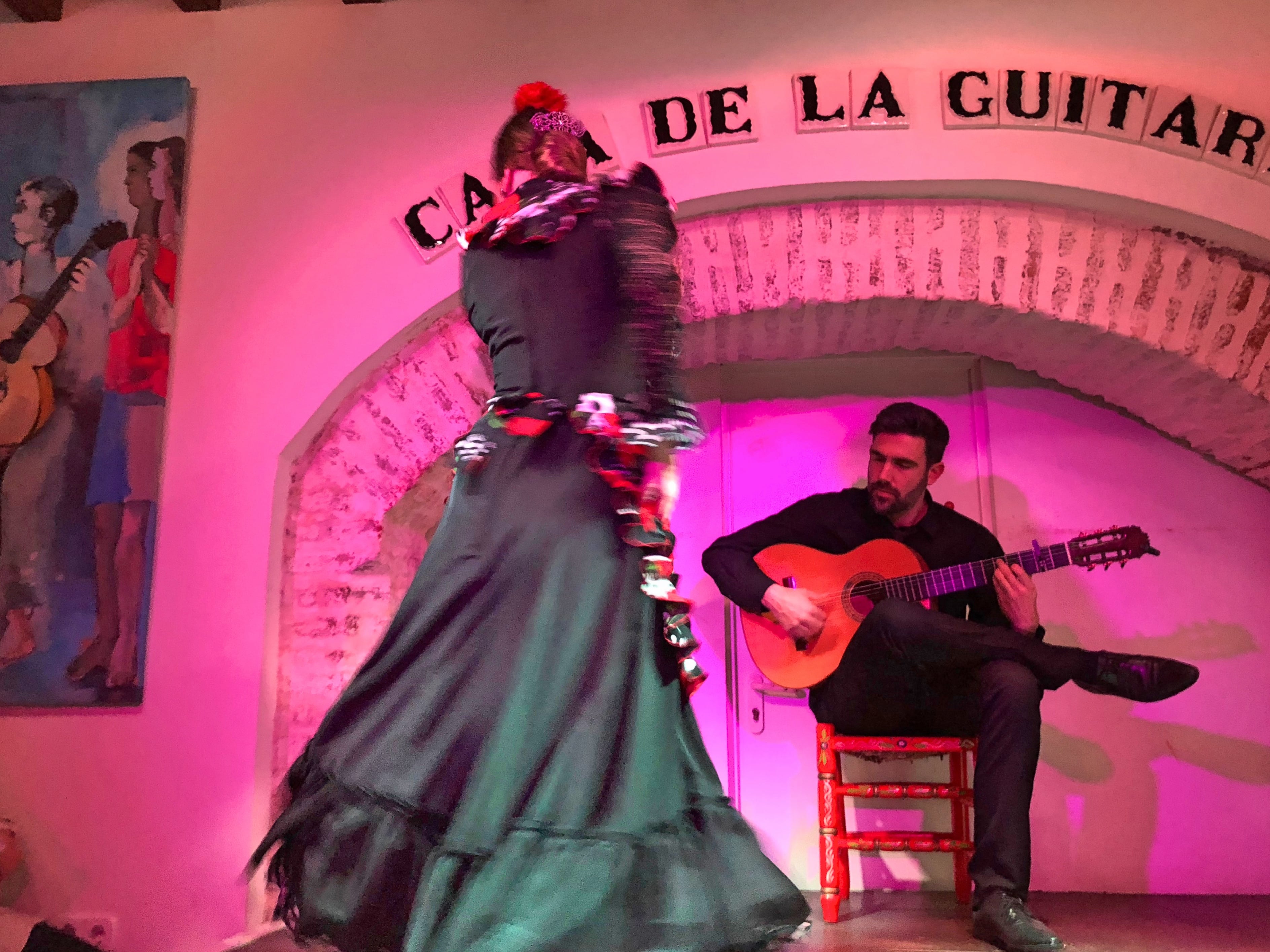
Our final stop was a flamenco show in the center of town. As usual, I loved every minute of it. Seville never disappoints.

Review: Marianela

Review: Marianela

Marianela (Los mejores clásicos)Marianela by Benito Pérez Galdós

My rating: 5 of 5 stars

Benito Peréz Galdós is yet another of those Spanish authors whose wide fame in their own language is equalled by their wide obscurity elsewhere. In Spain his reputation as a novelist is second only to Cervantes; and yet the English translation of this book, one of his most famous, is out of print. This is a shame, since Galdós was a writer of rare gifts, a fountain of stories written in beautiful prose. In many ways he is reminiscent of Lope de Vega: both a critical and popular success, whose celebrity did not get in the way of his output. For like the golden age playwright, Galdós was extremely prolific. Apart from his few dozen—and often lengthy—social-realist novels, he wrote five series of historical novels, forty-six novels in all, covering the 19th century in Spain. Dickens was a slug by comparison.

This book is about Marianela, called La Nela, an orphaned, “deformed” adolescent who lives in the mining country in Cantabria. She is described as having spotty skin, thin hair, a malproportioned face, and most notably an underdeveloped body for her age. She is the “lazarillo,” or guide, to Pablo, a blind young man from a rich family. The two fall in love, and share many passionate sentiments on their walks together. But then the brilliant doctor, Teodoro Celepín, comes to visit Pablo, examines him, cures his blindness, and, well, Marianela’s life gets considerably worse. It is a simple story with a tragic arc.

For me the outstanding quality of Galdós’s writing is his prose. It is elegant but readable, balanced but energetic. Though there were many words scattered about that I did not understand, I never felt lost; to the contrary, I read quickly, avidly, completely sucked into the story in a way that is rare for me with Spanish books. As with many novelists, there are two main registers of Galdós’s writing on display: scene-setting description and dialogue. Galdós excels at both. The conversations between La Nela and Pablo, though sentimental in a way that only enamored teenagers can be, was totally convincing. And his description of the desolate, charred, and barren landscape of the mines is an excellent example of how a scene can contribute to the narrative of a book:

El vapor principió a zumbar en las calderas del gran automóvil, que hacía funcionar a un tiempo los aparatos de los talleres y el aparato de lavado. El agua, que tan principal papel desempeñaba en esta operación, comenzó a correr por las altas cañerías, de donde debía saltar sobre los cilindros. Risotadas de mujeres y ladridos de hombres que venían de tomar la mañana [beber aguardiente] precedieron a la faena; y al fin empezaron a girar las cribas cilíndricas con infernal chillido; el agua corría de una en otra, pulverizándose, y la tierra sucia se atormentaba con vertiginoso voltear, todando y cayendo de rueda en rueda hasta convertirse en fino polvo achocolatado.

And in English:

The steam began to hiss in the boilers of the big car, which operated the workshop equipment and the cleaning machines at the same time. The water, which played such a principal role in this operation, began to run through the high pipes, where it had to jump over the cylinders. The guffaws of women and the barks of men who came to take the morning [drink aguardiente] preceded the task; and at last they begun to turn the cylindrical sieves with a hellish shriek; the water ran from one to the other, spraying and splashing, and the dirty earth was tormented with dizzy turning, rolling and falling from wheel to wheel until it became a fine chocolate powder.

Few authors could provide such a gripping description of an industrial process and also present us with a character as memorable as La Nela. She is self-contained but selfless, self-willed but self-abnegating, intelligent but ignorant, a person who was given nothing and so expects nothing, but whose isolation caused her to form a novel perspective. Her notion of the world is pagan; she sees things in mythical, poetic categories that lead everyone around her to chastise her for being unchristian. Her tragedy, like so many, is the plight of undeveloped potential; in other circumstances, she may have done remarkable things; but being born poor, orphaned, and “ugly” has confined her to being a guide.

I have said all this in praise of Galdós prose, his scene-setting, his characterization, but of course there is more to this story. Thematically, this book is also quite rich—the relation between inner and outer sense, between inner and outer worth, the relation between knowledge and love—but I will not get into that. This book was too enjoyable to belabor it with heady analysis. To conclude, this novel has convinced me that Galdós is a master of the craft. I am eager to devour more of his books.

View all my reviews

Review: Don Quixote

Review: Don Quixote

Don Quijote de la Mancha: puesto en castellano actual íntegra y fielmente por Andrés TrapielloDon Quijote de la Mancha: puesto en castellano actual íntegra y fielmente por Andrés Trapiello by Miguel de Cervantes Saavedra

My rating: 5 of 5 stars

“I know who I am,” replied don Quijote, “and I know who I can be…”

I bought this book under the sway of a caprice which, if it were not too hackneyed to say so, I would call quixotic. This was two years ago. I was in the royal palace in La Granja de San Ildefonso, near Segovia. I had just toured the palace—one of the finest in Spain—and was about to explore the French gardens, modeled after those in Versailles, when I encountered the gift shop. Normally I do not buy anything in gift shops, since half of it is rubbish and all of it is overpriced. But this book, this particular volume, called out to me and I obeyed.

It was a foolish purchase—not only because I paid gift-shop prices, but because my Spanish was not anywhere near the level I needed to read it. And at the time, I had no idea I would be staying in Spain for so long. There was a very good chance, in other words, that I would never be able to tackle this overpriced brick with Bible-thin pages. At least I left myself some hope. For this is not the original El ingenioso caballero don Quijote de la Mancha—written in Spanish contemporaneous with Shakespeare’s English—but a bastardization: its style diligently modernized by the writer Andrés Trapiello. Even with this crutch, and even with an additional two years of living in Spain, this book was a serious challenge.

Before charging headlong into the thickets of criticism, I want to say a word in praise of Trapiello’s edition. Cervantes’s Spanish is not as difficult as Shakespeare’s English, but it still foreign enough to prove an obstacle even to native speakers. I know many Spaniards, even well-read ones, who have never successfully made it through El Quijote for this very reason (or so they allege). Trapiello has done the Spanish-speaking world a great service, then, since he has successfully made El Quijote as accessible as it would have been to its first readers, while preserving the instantly recognizable Cervantine style. And while I can see why purists would object to this defacement of hallowed beauty, I would counter that, if ever there were a book to painlessly enjoy, it is El Quijote.

To get a taste of the change, here is Trapiello’s opening lines:

En un lugar de la Mancha, de cuyo nombre no quiero acordarme, vivía no hace mucho un hidalgo de los de lanza ya olvidada, escudo antiguo, rocín flaco y galgo corredor. Consumían tres partes de su hacienda una olla con algo más de vaca que carnero, ropa vieja casi todas las noches, huevos con torreznos los sábados, lentejas los viernes y algún palomino de añadidura los domingos.

And here is the original:

En un lugar de la Mancha, du cuyo nombre no quiero acordarme, no ha mucho tiempo que vivía un hidalgo de los de lanza en astillero, adarga antigua, rocín flaco y galgo corredor. Una olla de algo más vaca que carnero, salpicón las más noches, duelos y quebrantos los sábados, lentejas los viernes, algún palomino de añadidura los domingos, consumían tres partes de su hacienda.

Now, undeniably something is lost in the transition. Cervantes’s “duelos y quebrantos” (lit. “aches and pains”), for example, is undeniably more evocative than Trapiello’s “huevos con torreznos” (eggs with bacon); but without Trapiello I would have no idea what Cervantes meant. It is also worth noting how similar the two are; Trapiello has taken care to change only what he must.

Onward to the book itself. But I hesitate. The more I contemplate this book, the more I think that a critic must be as daft as the don and as simple as his squire to think he can get to the bottom of it. Cervantes was either extremely muddle-headed or fantastically subtle, since this book resists any definite conclusions you may try to wring from its pages. Perhaps, like many great books, it simply got out of the author’s control. Just as Tolstoy set out to write the parable of a fallen woman and gave us Anna Karenina, and as Mark Twain set out to write a boys’ book and invented American literature, it seems Cervantes set out to write a satire of chivalric romances and produced one of the great works of universal art. It is as if a New Yorker cartoonist accidentally doodled Guernica.

The key to the book’s enduring beauty, I think, is Cervantes’s special brand of irony. He is the only author I know who can produce scorn and admiration in the same sentence. He is able to ruthlessly make fun of everything under the sun, while in the same moment praising them to the heavens. The book itself embodies this paradox: for it is at once the greatest rejection of chivalric romance and its greatest embodiment—an adventure tale that laughs at adventure tales. There is no question that Cervantes finds the old don ridiculous, and he makes us agree with him; yet by the end, Quijote is more heroic than Sir Galahad himself.

The central question the books asks is whether idealism is noble or silly. There is no question that the Knight of the Sorrowful Countenance is a hilarious figure. But do we laugh at his expense, or at our own? Is his idealism pathetic, or is it our realism? The book resists both horns of this dilemma, until finally we must conclude that we are all—dreamers and realists alike—equally ridiculous. For we all reside in a social world whose rules only exist in our beliefs and in our actions, a world which we create but do not design. It is only Quijote who seems to realize (however unconsciously) that, by changing the script, we can recreate the world. And he does. By the time we get to Part Two, everyone is playing along with Quijote.

Even so, I am not able to go so far as Miguel de Unamuno, and consider Quijote a sort of messiah. I do not think Cervantes’s irony permits this. For Quijote truly is out of touch, and frequently gets pummeled for it. And even when his fantasy inspires others to play along, and to help him create his new world, they never do so for disinterested reasons. Some, including Sancho, play along for gain; others do so to control or to help Quijote; and most do it just to have some fun at his expense. This is the dilemma faced by all revolutionaries: they have the vision to see a better world, the courage to usher it in with their actions, and the charisma to inspire others to follow them; but most worldlings chose to play along for ulterior motives, not for ideals; and so the new world becomes as corrupt as the old one. To put this another way, Quijote’s problem is not that he is out of touch with the social order, but that he is out of touch with the human heart.

Much of the greatness of this book lays in the relationship between the don and his squire. Few friendships in literature are so heartwarming. Sancho, in his simplicity, is the only one who can even partially meet Quijote in his new world—as a genuine participant in Quijote’s make-believe. Of course, Sancho is not free from ulterior motives, either. There is the island he is to rule over. But the longer the story goes on, the more Sancho believes in his master, and the less he pursues material gain. We are relieved to see that, when finally offered his island, the squire comes running back to the don in a matter of days. As the only two inhabitants of their new world, as the only two actors in their play, they are homeless without one another.

It is useful to compare Shakespeare’s and Cervantes’s method of characterization. As Harold Bloom points out, Shakespeare’s characters are most truly themselves when they are alone, soliloquizing. When together, on the other hand, even close friends and lovers never seem to communicate perfectly, but talk past each other, or talk for their own benefit, or simply show off. But don Quijote and Sancho Panza are most truly themselves when they are with each other; they draw one another out and spur one another on; they ceaselessly bicker while remaining absolutely loyal; they quibble and squabble while understanding one another perfectly. When they are separated during Sancho’s sojourn on the island, the reader feels that each has lost more than half of himself. For my part, though I am not sure it is more “realistic,” I find Cervantes’s friendship more heartening than the bard’s. Though they begin as polar opposites, the squire and the knight influence one another as the story progresses, eventually coming to resemble one another. This beats Romeo and Juliet by a league.

What strikes most contemporary readers of this ur-novel is its modernity. Formally, Cervantes is far more daring than his Victorian successors. This is admittedly more apparent in Part Two, when Cervantes has his characters travel around a world where Part One has already been published and read widely, and where the spurious Part Two by Alonso Fernández de Avellaneda (a pseudonym) has just been released. This leads to self-referential tricks worthy of the coolest postmodernist: the duo encountering readers of the prequels and commenting on their own portrayal. Another daring touch was Cervantes’s use of the Arabic historian Cide Hamete Berengeli—whose Arabic book, found on the streets of Toledo, he is merely transcribing into Castilian—which allows him to comment on the text he is writing: praising the historian’s scrupulous attention to detail and skipping over boring sections in the “original.”

All this is done, not merely to be clever, but to reinforce the sense of infinite irony that pervades the text. The gap opened up by these tricks is what gives Cervantes room to be so delightfully ambiguous. As the authorship is called into question, and as the characters—who are imaginative actors to begin with—become aware of themselves as characters, the sense of a guiding intelligence crafting the story becomes ever more tenuous. The final irony, then, is that this self-referential irony does not undermine the reality of the story, but only reinforces it. In Part Two, especially, the characters leap from the book into reality, becoming both readers and writers of themselves—so real, indeed, that we risk repeating the don’s error of mistaking the book with reality.

Having said all this in praise of El Quijote, I should mention some of the book’s flaws. These are mostly confined to Part One, wherein Cervantes inserts several short novelas that have, for the most part, aged poorly. At the time there was, apparently, a craze for pastoral love stories involving shepherds and shepherdesses, which nowadays is soppy sentimental trash. One must also admit that Cervantes’s was a very mediocre poet, so the verse scattered throughout these pages can safely be skipped. On the whole, though the book’s most iconic moments are in Part One, Part Two is much superior and more innovative.

Part Two is also far sadder. And this is the last ambiguity: the reader can never fully decide whether to laugh or cry. Tragedy and comedy are blended so deeply together that no emotional response seems adequate. I still have not decided with any certainty how I feel or what I think about this book. All I know is that I wish it could go on forever—that I could read another chapter of don Quijote’s and Sancho Panza’s adventures for the rest of my life. To reach the end is unbearable. Don Quijote should live eternal life. And he will.

View all my reviews

Gimme Shelter: Santander & Altamira

Gimme Shelter: Santander & Altamira

Santander

On Spain’s northern coast, sandwiched between Asturias and the Basque Country, is a little slice of land that makes up the province of Cantabria. Like the rest of Spain’s northern coast, influenced by the Oceanic climate blowing down from the Bay of Biscay, it is a lush and verdant region that gets plenty of rain. Though somewhat less popular as a tourist destination than its neighboring provinces, the region’s capital, Santander, is widely recognized for the eponymous international bank, Banco Santander—Spain’s biggest bank and second-largest company.

And it seems that the capital is bound to receive new visitors, thanks in part to the recently opened Botín Center. This building takes its name from the family that owns the bank (and who financed the project), and is designed to rival the Guggenheim in Bilbao, just a couple hours east by car. Like that Basque museum, designed by Frank Gehry, the Botín Center is a museum of modern art housed in a striking modern edifice, in this case designed by the Italian architect Renzo Piano. I happened to visit Santander in April of 2017, when the building was complete but had yet to open its doors to the public. From the outside the museum looks like an alien spacecraft which has been neatly bifurcated. It is in a beautiful area, right on the water, a fact which has irritated some local critics, but which undoubtedly adds to its charm. Though I haven’t been inside, I read online that there is a room dedicated to drawings by Goya (on loan from the Prado) and another room dedicated to installations by contemporary artists. I hope to visit someday.

Botin

This center—looking incongruously futuristic against the serene waters of the bay, surrounded by fishermen—was, by chance, one of my first glimpses of the city. My Blablacar driver had dropped me off nearby. I was, as usual, disoriented and ragged, from having gotten up so early; and I still had several hours to kill before I could drop off my bag at my Airbnb. So I had little choice but to trek heavily around the city for several hours.

Fisherman_Botin

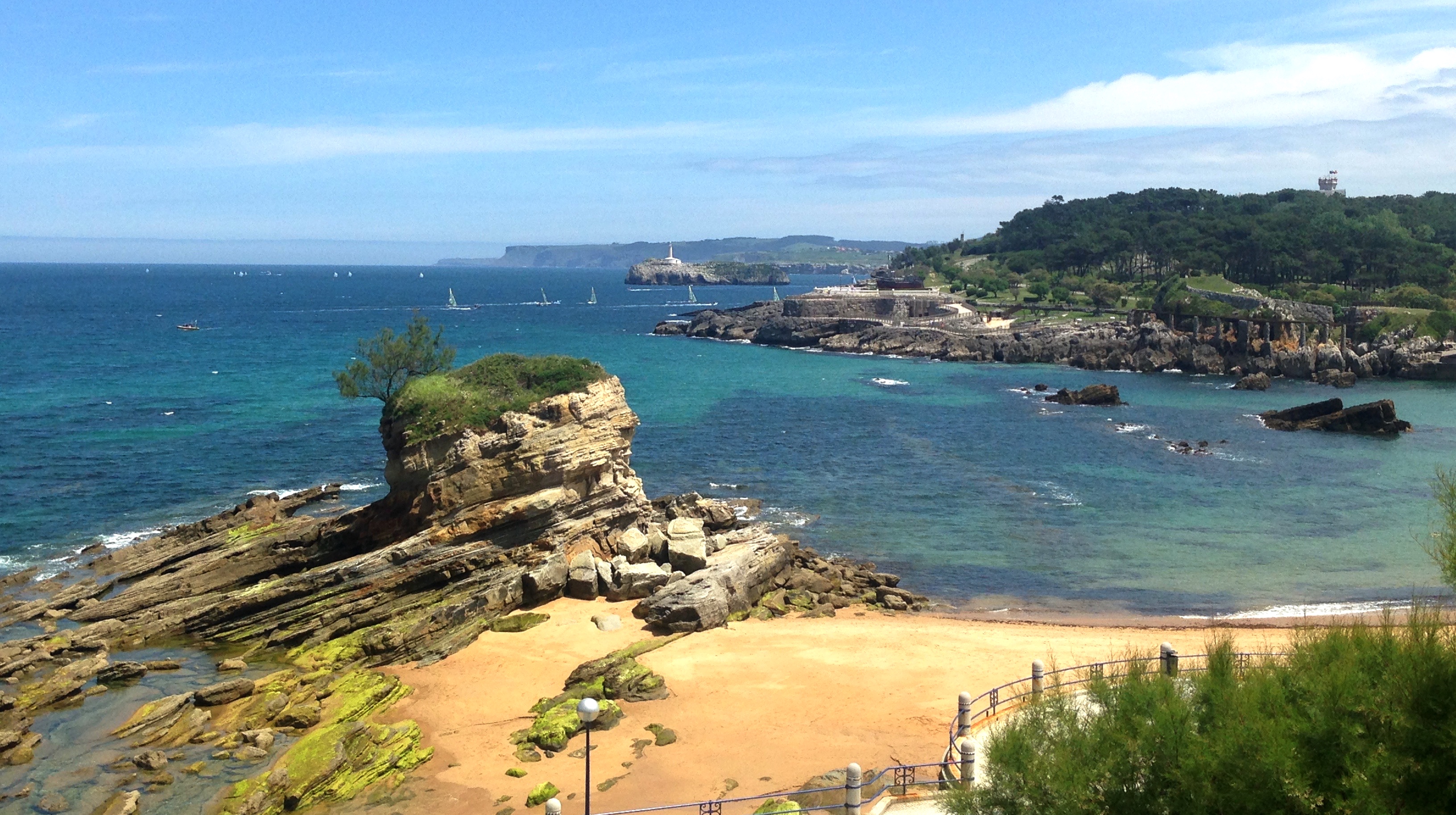
Santander is a maritime city, perched on a peninsula wrapped around a beautiful bay. The walk along the water is wonderfully picturesque, with stately building on one side and green mountains across the blue water—and it was especially nice since, when I visited, the sidewalk was the site of a street fair. Proceeding upwards this way, I walked by the memorable Palacio de Festivales, a municipal event space, and then the Maritime Museum, which has an aquarium and some impressive fishy fossils on display. I also saw the monument to the raqueros, or beachcombers, a whimsical group of faceless statues about to dive into the water. Continuing onwards, I got to the end of the peninsula, which consists of a lovely park area. There were several families having a picnic, and I am sure I looked fairly ridiculous as I strode by with my disheveled grey hoodie and my bulging green suitcase.

Walking on in this tiresome manner, I got to the Palacio de la Magdalena, Santander’s royal residence. This was actually built by popular subscription (the royal family was more popular in those days) and gifted to the king, in 1911. The royals did not have very many years to enjoy it, however, since the Second Spanish Republic (1931) and then the Civil War (1936) put an end to their annual peregrinations. The palace is built in a gaudy eclectic style, heavily indebted to the English; but it has an undeniably nice view of the sea. Nowadays it is used for conferences and suchlike things. Looking out from the tip of the peninsula, I saw the azure bay filled with little sailboats. My Santanderino friend, who himself has a sailing permit, informs me that this maritime pastime is very popular in the city. Certainly it is a good place for it.
Palacio_magdalena

As I walked on westward, more and more of the Cantabrian coast opened up into view, a rugged rocky coast bathed by serene waves (though I am sure it gets rather stormy sometimes). I walked by an open-air museum, grandly named the Museum of Man and the Sea, but which consists of three reconstructions of old galleons. I believe they were meant to represent the three ships which sailed with Columbus to the New World, the Niña, Pinta, and Santa María, though to my eyes they looked too small. A little further I encountered an open-air zoo, with walkways overlooking a pool in which seals were restlessly swimming.

Finally I reached Santander’s major beach: the Sardinero. This is about as nice a beach as anyone can ask for: with golden sand and ample space. Hotels and restaurants hemm in the coast, of course, while sailboats float out in the distance. In the summer I imagine the place is crawling with people; but when I arrived, a few months before proper swimming weather, the beach was charmingly empty, even peaceful. Looking back from the beach toward the palace, I was struck by how jagged and natural the coast appeared, despite being in the center of a city.

Santander_view2

Now it was time to drop off my things. As usual, I had booked the cheapest Airbnb I could find, which was far outside the city center, deep in the industrial part of the city. Also as usual, I did not want to pay for a cab. So I walked an hour and a half, through the city, under the sun, sweating and stumbling, across highways and past strip malls, until finally reaching my destination. By saving money, I also stay thin.

Returning to the city was far less painful, not only because I wasn’t dragging around my bag, but also because my Airbnb host told me which bus to take. Thus in less than half an hour I was back in the center, ready to see more.

Though Santander’s history stretches back to medieval times—its position on the bay is a natural spot for settlements—the visitor will not notice any of the chaotic, jumbled, narrow streets characteristic of old cities. This is largely due to the great fire of 1941, which destroyed most of the old center and left thousands homeless. The conflagration occurred during the lean years following the Spanish Civil War, when the resultant poverty occasioned many accidents around the country. As a result of this catastrophe, the center is crisscrossed with wide, perpendicular streets and full of modern buildings. There is a monument to the blaze—several human figures, looking hopeless and lost—in the park near the Botín Center.

One of the buildings damaged in the blaze was Santander’s medieval Cathedral. What stands today is largely a reconstruction. The cathedral struck me as rather odd, with its stark, white exterior almost wholly devoid of ornament. To go inside one must climb a flight of stairs, for the cathedral is not level with the street. I remember going through one door, only to find it full of a congregation midway through mass. This was the crypt, which is used as an independent church, La Iglesia del Cristo. The cathedral stands on top of this crypt-church; this is why the space is so claustrophobic and full of thick supports. Though finely vaulted, the cathedral’s interior was not any more richly adorned than its exterior. I admit that I left the building feeling rather baffled, since at the time I did not know that the original church had mostly burned down, or that there were two separate churches in the same building.
banco_santander

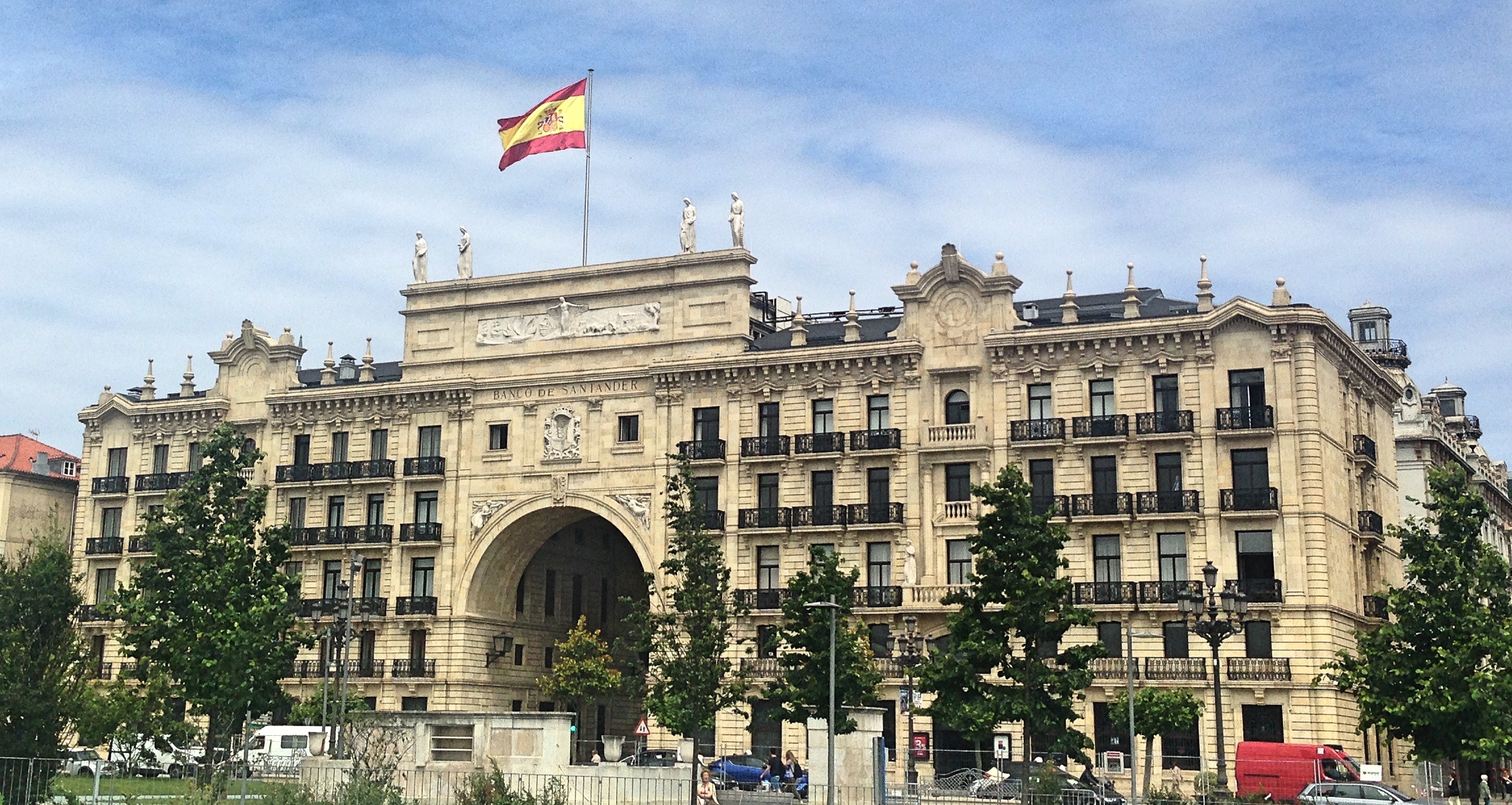
Quite nearby is the original building of Banco Santander, a stately edifice that projects conservative dignity, very appropriate for a bank. You can pass through the central arch of this building to the other side, and then make your way to the Pedro Velarde Square. The plaza was named after a Spanish soldier who was involved in the much-mythologized uprising of May 2nd against Napoleon’s invading troops (a scene immortalized by Goya). A statue of this fierce patriot stands guard over the entrance to the square. The plaza is surrounded by a uniform row of attractive apartment buildings, much like the Plaza Mayor in Salamanca, making it an excellent spot for photos. I should also note that there are many fine restaurants nearby.

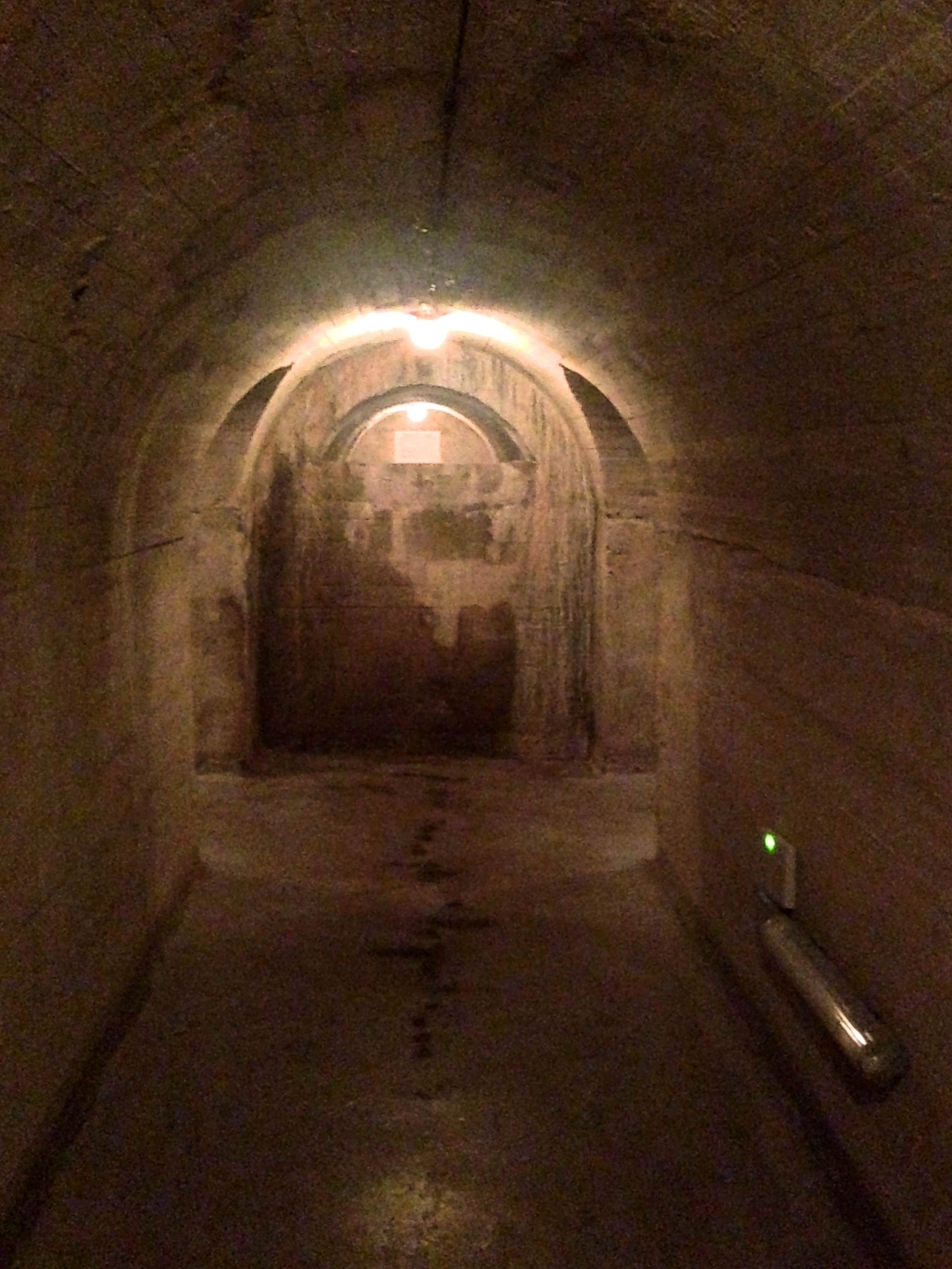
One of the city’s most intriguing sites is right next to this plaza, the air raid shelter, or refugio antiaéreo. As one might expect, this is not very conspicuous from the street, merely consisting of a stairwell. I was fortunate in being able to visit, since you normally need to reserve a spot in advance, and I had not done so. What is more, all visits to the tunnels are guided, which meant I would have to hitch a spot with another group. But by chance, as I approached the entrance to the shelter, another visiting couple (from Madrid) was inquiring about tours, too, so I was able to join theirs. Being a third wheel has seldom proven so educational.

Santander_shelter

The shelter was built during the Spanish Civil War. Though Santander was not of paramount strategic importance and was not the scene of major fighting, the city was nevertheless the target of bombing raids by the fascist forces. In Madrid, metro stations were refitted to be used as bomb shelters; but lacking a metro system, the people of Santander had to build shelters from scratch—and quickly. This shelter is not very big (maybe 100 people could have squeezed into it, briefly) and consisted of several interconnected concrete passageways. Our tour guide gave us some of the context of the war and the history of the tunnel’s construction. There were a few video clips, examples of uniforms worn by the fascist (many of them Germans) and Republican pilots, and sound clips designed to reproduce the feeling of being underground during a bombing. Although the shelter did not get much use, since Santander was taken by Franco’s forces fairly early on during the war, it remains a moving artifact of the new horrors of aerial warfare, dropping death indiscriminately on enemy cities—something the world had never seen before.

After this, I decided to visit the Prehistory and Archaeology Museum of Cantabria, which is just down the road from the shelter. This was good to save for last, since it is open quite late—until 8 pm during the summer. Here I found myself descending underground once again, for the museum’s collection is below street level. Intentionally or not, the sun-less, cave-like interior of the museum adds to the evocative power of its exhibitions about early humans. I was in the right mindset to learn about stone tools and extinct bears. Even so, I did not expect to encounter such a fine museum. Somehow, I imagined that it would be mainly geared towards children; yet within minutes I was spellbound by the quality of the displays. It is superbly made.

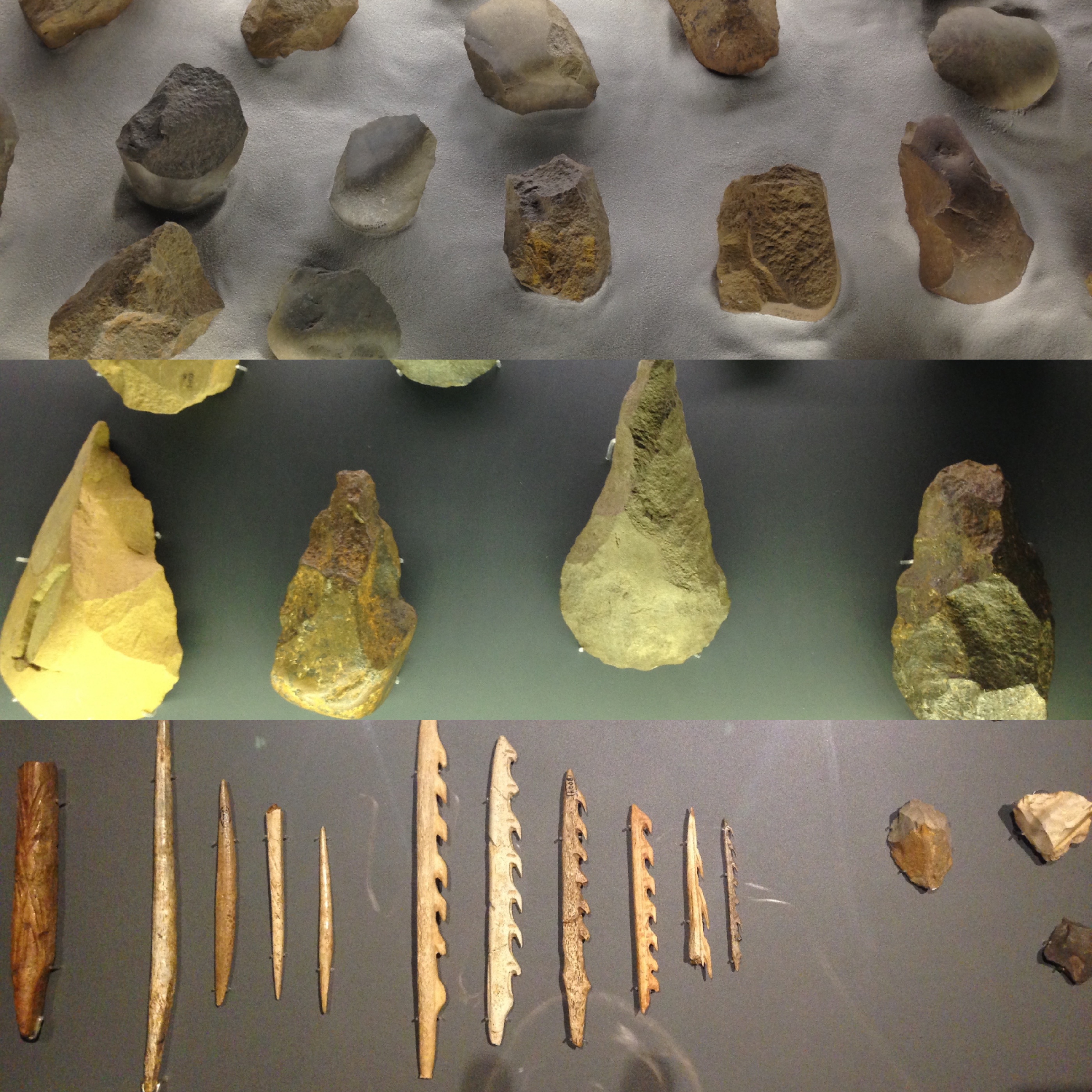
Admittedly I was predisposed to be interested, since I studied archaeology in college and even tried my hand at making stone tools once. Even so, I think anyone can appreciate the scope of information and the skill in presentation to be found there. On display are hundreds of stone tools—choppers, knives, arrowheads—arranged chronologically, showing the increasing sophistication of human ancestors over time. There are also recreations of tools made from wood and antler (which normally do not survive the ages), accompanied by videos of people making and even using these tools. This was not all. There was a recreation of a shellfish midden, a refuse pile left by generations of ancient shellfish-eaters; there were fossils of extinct animals, many of them massive; there were stone megaliths covered with decorative carvings; and there were even some Roman artifacts. When I visited I was the only person there, and stayed until it closed. It was an enchanting experience.

stonetools_collage
The evolution of tools, from oldest (top) to youngest (bottom)

Though this did not happen on the same day, for the sake of continuity I will mention my visit to the Hermitage of La Virgen del Mar. This is quite far from the city; I was only able to visit thanks to my aforementioned Santanderino, who kindly drove me there. The building of the hermitage itself is quite bare and basic. But its location, like that of San Juan de Gaztelugatxe, is exquisite, standing atop an island (very close to shore) next to a rocky, windswept beach. It is a gorgeous, romantic place that preserves its peaceful, natural beauty, despite the constant trickle of tourists.

This fairly does it for my time in Santander. I was dividing my limited time—a single weekend—between this city and Altamira (which I will describe next), so I did not get to know Santander as well as I should have liked. Even so, I was left with fond memories. Both the city itself and its location on the shore make it one of the great cities of northern Spain, reminding me most nearly of La Coruña in Galicia—one of my favorite places in the country. The rugged coast, oceanic weather, attractive center, and cultural monuments make the city one more delightful stopping-place in the Spanish panorama. And as you will shortly see, Cantabria has much more to offer.


santillana_view

Altamira

The cave paintings of Altamira are perhaps only behind those of Lascaux in renown. Luckily, the site of their discovery is quite close to Santander, making it an easy daytrip. In a car the trip is around half an hour. And there are fairly frequent buses (every two hours) that run from the city center to town nearest the caves, Santillana del Mar.

I arrived in this town on a Saturday morning, shivering with excitement. Ever since I saw Werner Herzog’s transfixing documentary on the caves of Lascaux—Cave of Forgotten Dreams—I have been fascinated by the artistic power of our early ancestors. As a child I wondered at the enormous antiquity of the artifacts from Egypt in the Metropolitan Museum of Art. Yet the span of time between us and the people who painted these caves is far vaster. That an image created from a human hand could survive so many years—that it could speak to us from an age when strange extinct animals roamed the earth, when the stars in the sky were shifted, when the climate was altered and cold winds blew down from nearby glaciers—and not only speak to us, but entrance us with its beauty—it seemed too miraculous to believe. And thus it seemed even more stupendous that I could, with my own eyes, witness this temporal miracle.

I should stop my melodrama to note at this point that I was not going to see the actual paintings. These are much too precious and delicate to be casually seen by the general public. The organization has a lottery that they hold on Fridays in the museum, to select five lucky people to visit the caves. Since I was visiting on a Saturday, this left me with scant hope. But after closing the caves to public visits in 2002, the authorities have constructed a replica (called the “neocueva,” or “neo-cave”) that can be visited freely. This is what I was going to see.

The bus dropped me off in the center of town. I had bought my ticket ahead, which had a timed entrance to see the neo-cave. (Because of restricted space, smallish groups are allowed in at staggered times.) My entrance was in less than an hour, so I had little time to spare. Without pausing to catch a glimpse of the town, I strode out into the countryside towards the hill of Altamira. Even through my anxiety and morbid determination, however, I could not help noticing that the countryside was absolutely lovely. Gentle rolling hills, green with grass, dotted with trees, crisscrossed with plots of farmland, spread out ahead of me. White mist clung to the distance, as black-and-white cows grazed before a lonely church; and to my right were the tiled roofs of Santillana del Mar. Spain has seemingly boundless reserves of beauty.

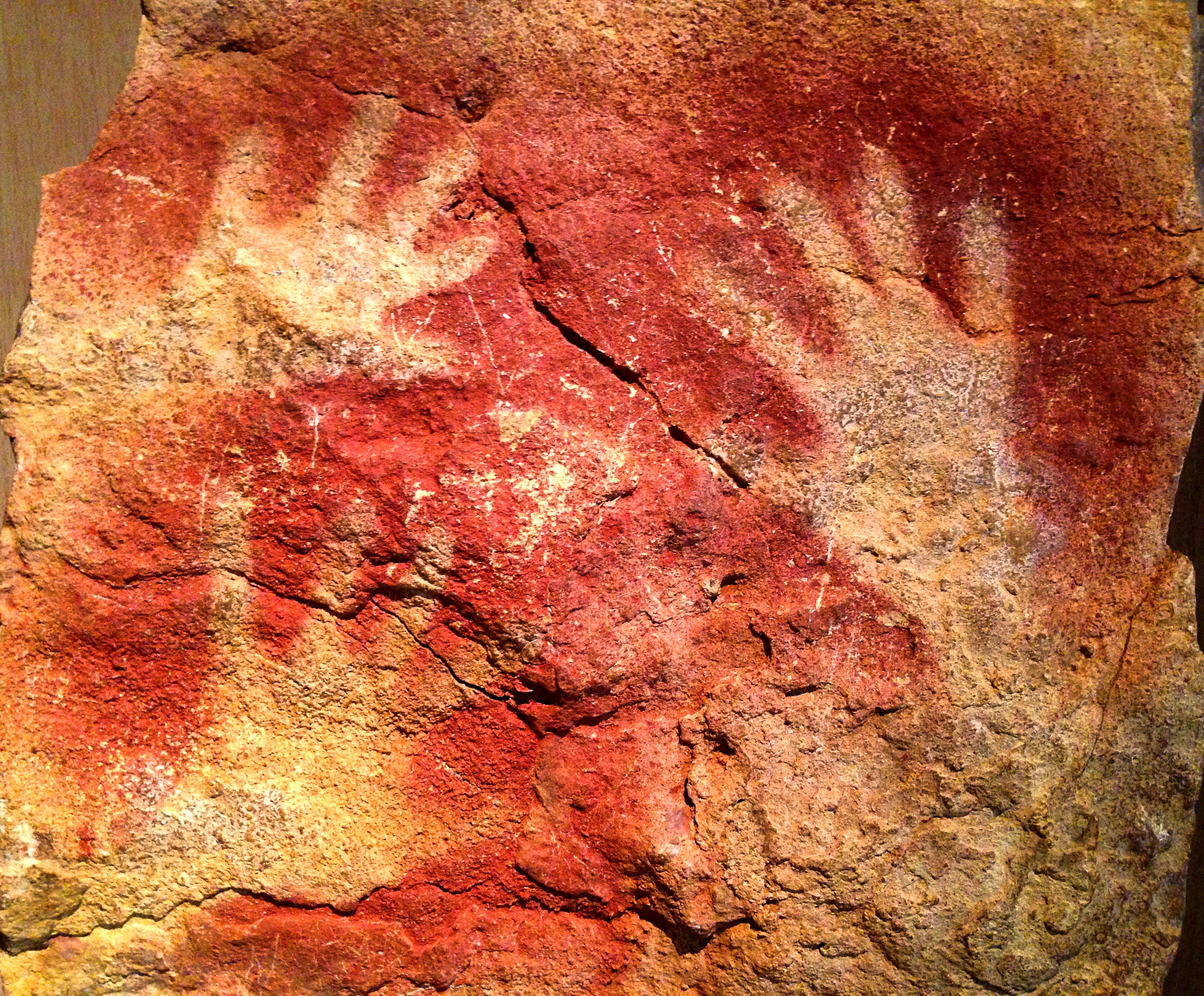
I arrived at the museum with 20 minutes to spare (of course). This was hardly a problem, since the neo-cave comprises only a part of the display. There are dioramas of ancient peoples, skulls of ancestral species, piles of stone tools, and smaller replicas of cave art. Not bad for three euros—a modest price which includes the neo-cave, too. I particularly liked the examples of shapes made on the cave wall by blowing pigment against a hand, thus creating a reverse hand-print. There is something elemental about this gesture, allowing us to shake hands with someone from a different epoch. Perhaps all culture is rooted in the attempt to cheat death—sometimes literally, as with weapons and medicine, and sometimes figuratively, as with art. These cave-dwellers lived short and difficult lives compared to us; but will we leave any art that survives half so long?

altamira_hands

Finally it was time for me to visit the neo-cave.  I joined a small group of waiting tourists, while a placid employee scanned our tickets. Finally, like the heavy gates to an ancient city, the doors of the neo-cave slid open. I could scarcely have been more excited if the caves had been real.

A single footpath leads down through the neo-cave, into the main chamber, and out again. Some introductory panels of information are posted along the way; and a glass screen projects a cave-dwelling family into the artificial cave—the Jetsons meet the Flintstones. All of this is got through in five minutes. The rest of the time is spent gazing up at the ceiling of the main chamber. Photos are not allowed, which is likely a good thing, since the combination of lighting, angle, and surface texture would make it difficult to capture the chamber. In any case, the paintings are reproductions anyway, so why reproduce them once over?

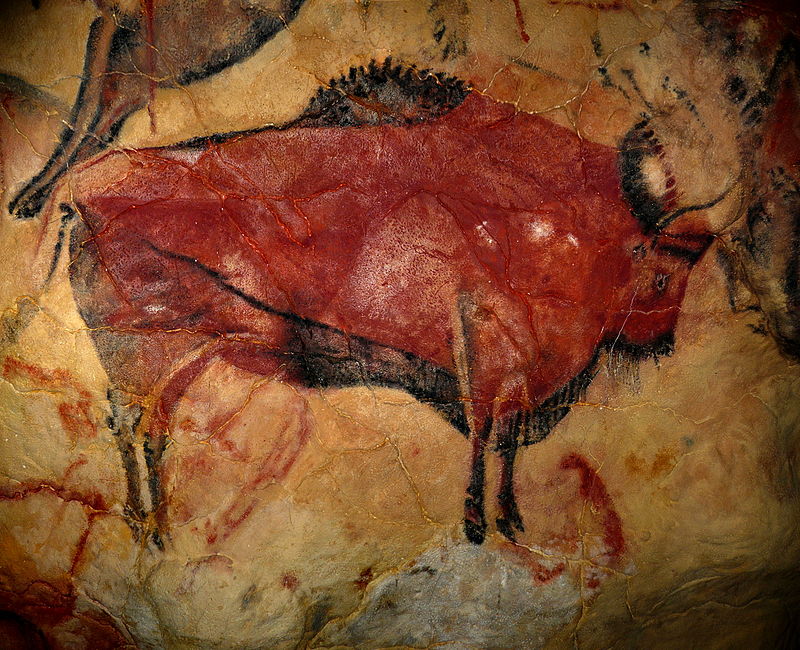
The main chamber consists of a roughly square space with a low, uneven ceiling, which has been covered with paintings. Most of these consist of hooved animals, most prominently bison. These are executed using charcoal and red ochre. The round bodies of the bison crowd around each other, sometimes overlapping, and conform to the bumpy, bulging surface of the cave. As a rough estimate, the average size of these figures is three feet across; and there must be several dozen individual figures. As is inevitable with prehistoric art, many mysteries remain as to the origin and function of these paintings. We know that they were completed during the last ice age, before the cave was sealed by a rockslide 13,000 years ago; but beyond that there is a wide range of possible dates. We may safely surmise that the bison were prey animals, and tentatively guess that these paintings were involved in some kind of ritual to ensure plentiful food. But we do not know if they were painted all at once—perhaps by a few brilliant painters—or over the course of generations, perhaps even used successively by distinct cultural groups. However we may guess, we do not know what these paintings meant to their creators. We cannot even rule out the possibility that they were made by neanderthals, not humans.

The neo-cave is lit up by discrete LED lights in the built into the floors, walls, and ceilings. It is tastefully done; but no electric light can replicate how these caves must have looked when seen by firelight. In the weak, quivering glow of the flames, these bison may have been terrifying apparitions, seeming to run and dance in the unsteady light. Given the location of these paintings and the light-sources available to people at the times, it seems unlikely that the creators saw them the way that we are inclined to: as works of visual art, to be contemplated for their great aesthetic beauty. But that does not mean that we are not free to view them this way. The bison are somehow both stylized and realistic. They represent the lumbering form of the animal—powerful, meaty, muscular—with relatively few, bold strokes, reducing the animals to their most essential features. Yet this does not render them to caricature, but turns them into elemental monsters, like fire or rain. Clearly these artists had carefully observed real bison, and fully understood the animals’ essential role in their survival.

800px-AltamiraBison

After I emerged from the neo-cave, blinking and exhausted, I was left with that sense of empty purposelessness that accompanies the doing of any long-awaited thing. Now what? I strolled around the museum some more, but I had already had my fill of prehistory museums in Santander. Then the idea struck me to see if I could find the entrance of the cave.

This is very easy to do, for the cave stands within five minutes of the museum compound. You cannot get very close, since it is closed off with an ample fence (I bet vandals and thrill-seekers occasionally try to break in); and in any case, there is not much to see, just a little doorway covered with a barred gate. It was hard to believe that beyond that small portal lay one of the most remarkable finds in the history of art.

After being sealed by a rockslide around 13,000 years ago, the cave became a natural time capsule. Apparently the cave’s entrance had become revealed by the 19th century, since by then it was visited by locals. One of these locals was Marcellino Sanz de Sautuola, a well-to-do Spaniard who both happened to own the land and have an interest in archaeology—a fortunate coincidence. After being led into the cave by his young daughter and realizing the importance of the paintings, Sautuolo cooperated on the original publication announcing their existence. Sadly, academics dismissed his claim of the paintings’ great antiquity, and he died before the truth was realized—an unfortunate coincidence.

Santillana1

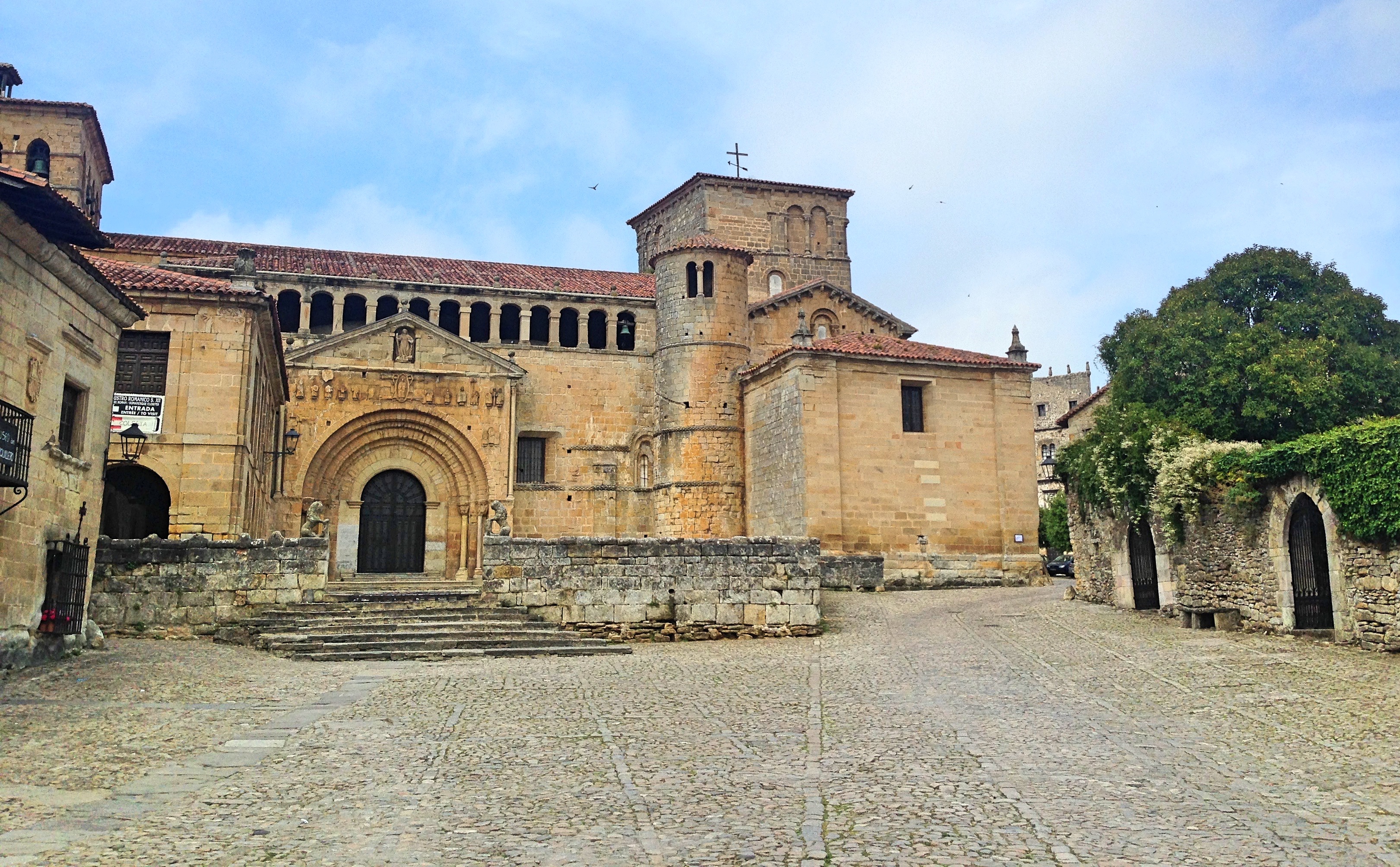
Now I was absolutely famished, so I descended the Altamira hill back to Santillana del Mar, once more passing through the delicious countryside. Contrary to what you might expect, Santillana del Mar is not actually on the sea, only somewhat near it (15 minutes by car). I had assumed that there was another Santillana somewhere in Spain, but I cannot find any, which leaves me wondering why they thought it necessary to add “del Mar” to their name. In any case, this pueblo is routinely included in lists of beautiful Spanish villages, and for good reason. Long before the Altamira caves were discovered, it was a stopping point on the Camino de Santiago, which meant that a fair amount of monied pilgrims travelled through these streets. The result is an extremely handsome village, well worth visiting even if you do not, for some insane reason, visit the Altamira site.

Santillana2

For lunch, I went to a restaurant whose name I unfortunately did not write down. It was one of the best meals I have had in Spain. I sat on a balcony overlooking some of the surrounding countryside, drinking an ice-cold red wine, with a brash, fruity flavor. Because I was alone, and had ordered the daily menu, they gave me a full bottle of wine all to myself (which I mercifully decided not to finish). For the main course I was served cocido montañés, the typical stew of Cantabria. Now, many regions of Spain have their own type of stew; and they are all broadly similar, consisting of beans and cured meat. This particular variety is made with white beans and collard greens, making it somewhat lighter than other cocidos. With wine, cocido, a salad, and a slice of cake in my belly, I waddled back to the bus stop to return to Santander.

I left Cantabria thinking of the mysterious power of shelter. The cramped church underneath the cathedral, the air raid shelter underneath the street, and the caves of Altamira—all of them created a similar emotional atmosphere, at once safe and unsafe. These spaces protect us from what is outside; and yet the claustrophobic darkness within is unnerving, and even frightening. A Jungian might say the visitor delves into a deeper layer of the unconscious, while a Freudian might be content by pointing out that caves remind us of a mother’s womb. Leaving psychoanalyzing to one side, I will only point out that, thousands of years ago, our ancestors were driven into caves to hide from the elements and to make contact with spirits; and now, thousands of years later, we are making caves for the same reasons—to hide and to pray.

Una Entrevista con Roy Lotz

Una Entrevista con Roy Lotz

After completing several interviews with my coworkers, they suggested that somebody interview me. Initially I resisted the idea. But when the wonderful Rebeca López offered to do the interview in Spanish (and then edit it so that I don’t sound like a complete dunce) I said vamos. Here it is:


Pregunta: Bueno, Roy, ¿has sido entrevistado antes?

Respuesta: Tres veces. Una vez, en la universidad, acerca de la música que hacía; otra vez, por Skype, sobre libros; y la última vez fue para el blog de una amiga, sobre mi vida en España.

P: ¿Te gusta que te entrevisten?

R: Sí, me gusta mucho hablar de mí. (risas)

P: Cuéntanos un poco sobre ti: de dónde vienes, qué estudiaste, tus hobbies…

R: Soy de Sleepy Hollow, un pueblo bastante pequeño en el norte de Nueva York, más o menos a hora en tren hasta Manhattan. Es un pueblo famoso por la leyenda del jinete sin cabeza, escrita por Washington Irving, que está enterrado en el famoso cementerio de Sleepy Hollow, a diez minutos de mi casa. Es interesante porque este hombre vivió también en España y visitó y escribió sobre la Alhambra. Para mí es interesante porque es como mi guía, ¿sabes? porque soy de su pueblo y ahora estoy en España y no puedo escapar de él.

P: Claro, porque ahora vives en España, ¿verdad?

R: Sí. Vivo en Madrid. Viví en Sleepy Hollow toda mi juventud, estudié en Stony Brook University antropología, aunque mi plan original era estudiar química. Sin embargo, aunque creo que la química es muy interesante, es algo muy abstracto y para mí era mucho más interesante aprender cómo vivía la gente en otras partes del mundo porque no sabía nada de esto. Crecí en Nueva York, fui a una universidad en Nueva York, estaba muy en mi mundo. Era como una revelación saber que había gente viviendo en la selva de Brasil, por ejemplo, o conocer tantas diferencias entre las costumbres de la cultura. Estudié antropología y fui de viaje académico a Kenia a estudiar la evolución humana a Turkana Basin, que es una escuela dirigida por la familia Leakey, una familia muy famosa dentro del mundo de la antropología, porque descubrieron muchos fósiles importantes.

P: ¿Cuánto tiempo estuviste en Kenia?

R: Tres meses. Y luego fui a Tanzania, que está también en el este de África, al sur de Kenia, y fui para estudiar la cultura, aprender un poco de Swahili, que es un idioma muy bonito, y ver a los animales. Al final hice una tesis sobre la música del este de África, leí un montón de artículos y libros, escribí un trabajo, hice una presentación, y… ya está.

P: ¿Cuáles son tus hobbies?

R: Me gusta mucho leer y escribir. Toco la guitarra, canto también, tengo un blog, obviamente (risas)… me gusta mucho andar… Me gusta mucho, sobre todo, aprender.

P: ¿Y por qué decidiste venir a España?

R: Estaba trabajando en Nueva York, en Manhattan, y para mí era algo muy aburrido, porque después de graduarme en la universidad fui a estudiar un doctorado, pero no estaba preparado para hacer algo tan duro, algo tan serio… tampoco había mucho trabajo, pero empecé a trabajar en el primero que pude encontrar. Era solo por hacer algo, no por interés. No estaba mal, pero no me interesaba, no era algo especial para mí. Al año y poco estaba harto de trabajar, no le vi el sentido de seguir haciendo esto. Quise escapar y hacer algo diferente, como romper mi rutina. Descubrir lo que quería hacer de verdad en mi vida. Mi plan inicial era ir a Alemania, porque había estudiado alemán en la universidad y me interesaba mucho la cultura, pero es bastante difícil ir a Alemania por el visado. Mi exnovia quiso ir a España, y entonces descubrí que era mucho más fácil ir a este país que a Alemania, por lo que decidí ir con ella. También, hay mucha gente en Nueva York que habla español y quería aprender este idioma.

P: ¿A qué te dedicas? ¿Es este el trabajo de tus sueños?

R: Ahora soy asistente en un instituto en Rivas-Vaciamadrid. Aunque me gusta mucho enseñar, este no es el trabajo de mis sueños. Primero preferiría tener más poder en mis clases y no ser asistente, pero tengo que admitir que no sé muy bien cómo controlar las clases. Idealmente yo sería escritor. ¿Escritor de qué? No sé, pero me gusta mucho escribir. Puedo escribir todos los días y, no sé… para mí es mi vocación.

P: ¿Qué diferencias hay entre el sistema educativo español y el americano?

R: Hay muchísimas. Por ejemplo, en mi páis llamamos a los profes “mister” o “miss” y sus apellidos, no sus nombres. Yo creo que hay más respeto por eso, es desigual el status de los profes y de los alumnos. Lo peor es que en mi país no aprendemos muy bien idiomas extranjeros normalmente. No tenemos un programa bilingüe muy fuerte y somos muy monolingües.

P: ¿Y las universidades?

R: Las universidades son muy diferentes, porque son mucho más caras y vivimos ahí normalmente. Es un poco raro vivir con los padres cuando estás en la universidad. Ir a la universidad para nosotros es un paso muy importante, porque es cuando te descubres a ti mismo, bebes con tus amigos, haces cosas locas, no tienes responsabilidades, descubres tus intereses…

P: ¿Qué es lo más complicado de vivir en un país extranjero?

R: Tienes que hacer muchas cosas sobre el visado, y si no lo haces bien estás jodido, básicamente. Tienes que tener mucho cuidado con estas cosas: los documentos, las renovaciones, las citas… es muy fácil no hacerlo bien.

P: ¿Tuviste problemas con el idioma?

R: Sí, al principio era difícil encontrar un piso y hacer amigos y esas cosas, porque no hablaba español, pero me motivaba mucho esto porque es como descubrir un lado nuevo de mí dentro del idioma. Puedo ser un niño otra vez y descubrir el mundo otra vez, dentro del español. Para mí era algo muy interesante aprender este idioma… es algo difícil pero hay que verlo como un reto y una oportunidad y no como un obstáculo. Sí es un obstáculo, pero aprender otro idioma abre muchas puertas y es como si pudieras ser una persona nueva y conocer otro mundo que no pudiste antes. El idioma no fue algo muy duro para mí, aunque me costó aprenderlo, lo vi como una oportunidad. También, cuando estás en un país extranjero es como que vives ahí pero no vives ahí… haces amigos, pero ¿amigos de cuánto tiempo? Y echas de menos a tu familia y es difícil invertir en la vida, porque es una vida semipermanente.

P: ¿Qué es lo que más echas de menos de EEUU?

R: A mi familia, a mis amigos… también lo que echo de menos es el sentimiento de estar absolutamente cómodo y entendido. Ser tú mismo sin ser forzado.

P: Bueno, como has mencionado antes, te gusta mucho leer. ¿Cómo comenzó esa inquietud?

R: No me gustaba leer en el insti, pero mi primer año en la universidad tuve unas clases en las que tuve que leer muchos libros y me gustó mucho, porque sentí que estaba aprendiendo muy rápidamente y mi mente y mi perspectiva estaban creciendo. Descubrí que los libros son un mundo sin límites, porque hay de antropología, literatura, filosofía, geografía, viajes… sobre cada tema que puedas imaginar hay un libro, y para mí está relacionado con el deseo de viajar, es el deseo que me permite expandir los límites de mi mundo, porque cada libro es como una ventana a un mundo nuevo.

P: ¿Cuál es tu definición de “libro bueno”?

R: Para mí un libro bueno es un libro que te hace pensar en una forma en la que nunca habías pensado antes. Por ejemplo, los libros de Platón o de Spinoza o Shakespeare. Hay libros ricos, tienen mucha capacidad de hacerte pensar… quizás no tienen razón, pero para decidir si tienen razón o no tienes que pensar sobre una pregunta en la que nunca habías reflexionado antes. Para mí, es sobre las preguntas. Los libros buenos intentan responder a preguntas importantes y que siempre tendrán esta importancia.

P: ¿Qué libro me recomendaría si quisiera iniciarme en el mundo de la filosofía?

R: La Republica, de Platón. Platón es muy fácil de leer. Este libro está relacionado con todo y cada libro de filosofía escrito posteriormente es una respuesta a Platón. Tiene epistemología, lógica, justicia, ética, estética… es un libro muy completo.

P: Por último, ¿cómo te imaginas tu vida dentro de diez años?

R: No tengo ni idea. Me gustaría ser un escritor famosísimo y tener millones de dólares (risas) y haber viajado a Rusia, China, América Latina… tener un perro, criados en una mansión… no sé

Diego Cruz: Conversation Assistant

Diego Cruz: Conversation Assistant

I have been working alongside Diego for two years now. When I first met him he was straight out of college—a frat boy without his frat, living all the way out in Arganda del Rey, a quiet town far from the center of Madrid. It was obviously a new experience for him. And he adapted admirably: growing more confident, more independent, and more empathetic to others in the process. Far more than two years seem to have elapsed between the Diego I first met and the Diego I know now. He recently took some time to sit down with me and share some of his story:


R: How are you feeling?

D: Feeling pretty good, kinda nervous. It’s weird, you know, having your friend interview you.

R: Have you been interviewed before?

D: Only professional interviews.

R: Tell me about your background—your family, your education, your hobbies, and so on.

D: Okey dokey. My dad is Mexican, born in Mexico. He moved to Los Angeles in the late seventies. My mom was born in America but she’s of Armenian-Spanish descent. And she grew up in Spain, in orphanages. I identify myself as a chicano. I grew up with a bunch of latinos in my community. So I always thought I was Mexican. I was born in East LA but I lived my whole life in South Gate, California.

IMG_4237

I went to university to UC Santa Barbara, and I graduated with a bachelor’s degree in sociology. I came to Spain right after that. My hobbies? I like to go to the gym, I like to play soccer, I like to be with my friends. Sometimes write, sometimes read, you know.

R: How did you decide to come to Spain?

D: Alright, so my brother forced me to come to Spain. My brother Rafael was like, “Hey fool you got really bad grades in university so you gotta do something spectacular.” So he was like, “You should do this program.” So for a year and a half or so I was thinking about going to Spain. And then the time came to apply and I barely made it on the deadline and I was told in August that I got in.

R: In August? [The program begins in October.]

D: Yeah, so I had to do everything super fast before I came mid-September.

R: What were some of the challenges of moving to Spain?

D: So the challenges were raising the money, saving up the money to buy the tickets and for rent, security deposit, food. Then eventually it was just saying goodbye to your family and friends. Some friends don’t understand that it’s something you have to do for yourself. Some friends just forget about you. But my family is there for me, so that’s what matters the most.

R: How did you raise money?

D: I worked, I was working as a referee, I was washing dishes. And my mom hooked me up with some money, too, so I was really lucky with my mom.

R: And what about the visa process?

D: That shit was wack. Everything was new to me. You know, my dad came to the States and he got his citizenship. So I thought, “If this fool can get a citizenship then I can get my visa.” So the paperwork took me like three or four weeks. I did some of the things wrong so I had to redo it several times. And so I wasted like 300 bucks.

R: Tell me about your job as an auxiliar—your schedule, your duties, your role in the classroom.

D: Well, I work 16 hours a week, but I’m here for like twenty-something. [We have breaks between classes that adds to the time at high school.] My role is to assist the teacher. But as a second-year now, I’m leading the class and I’m lecturing. I’d say about half of the time I’m lecturing and the other half I’m with the students, with groups of four, talking. I feel we have a specific role in the classroom, because we’re obviously younger than the teachers, so we become this bridge with the students and the teachers. And sometimes the teachers come down on the students hard, so you kinda have to go to the student and tell them what’s good. You’re like, “Hey, the teacher is being a little harsh, but you gotta understand that these are the rules.” So you just try to help them figure it out. That’s how I see myself.

R: What are some of the challenges of being an auxiliar?

IMG_4238

D: Upholding the expectations, meeting the expectations of the teachers. Because last year some of the expectations weren’t that clear, you know. So you don’t know if you’re doing a good job or not. But this year I’m doing a lot better, I have better communication with my teachers. So the challenges might be that the students just wanna keep talking to you, and you gotta be like “Hey, now it’s time to do classwork.” Last year it was a struggle to keep them attentive, but this year I’ve been doing a good job of keeping them focused in class, helping them out with their work.

R: How would you compare the education system here to ours in the States?

D: So here I think it’s a little bit too lenient. A five [out of ten] is still passing. And to me that’s failure, you know. You did half of the work wrong. So I don’t see how that’s considered passing. And I also think the students repeat too much. [As in, students are held back because they failed.] You have twenty-year-olds graduating from high school. I think it’s too easy to repeat, it’s done too frequently. But I think the issue is because they have too many subjects, they have eleven subjects in the semester. Back in the States we only had to take six or seven. They’re focusing too much on too many. So it’s too much for the kids and that’s when they start messing up in school, they start not caring in class, they start missing school.

Classroom management is too lenient, too. Some of the teachers are really strict but some other teachers just let the kids talk, and the kids are talking and talking and chit chatting. I think they send out the kids too much. [As in, send the kids out in the hallway when they’re misbehaving.] I don’t know if they should be disciplined or what, but they don’t know respect and a lot of them don’t have that respect towards the teachers. I’m pretty well respected but even if I tell them to be quiet they will just keep talking and chit chatting.

R: What do you plan on doing when you leave Spain?

D: I wanna start getting my coaching license. I want to work with professional soccer teams or college soccer teams. If I fail in doing something with soccer I’ll do something with any type of sport. And if I fail at that, I’ll become a gym teacher. But I’ll be a good gym teacher, I’ll try hard, do my thing. But I definitely want to to something with sports after Spain.

R: How do you think you’ll look back on this experience in 10 years?

D: I think 10 years from now Diego will be really happy with this Diego. I tell this to my friends, in university I was a cool guy and people liked me, but I felt like I was a loser. I wasn’t responsible, I didn’t handle my scandal, you know. I was just a loser, you know. Yeah I had friends and I know people loved me but the way I was, that was some loser stuff. And I’m really proud that when I’ve been here, I’ve been more responsible and I’ve managed to change, to live a healthier lifestyle, to be more optimistic about life. It’s just given me a brand new type of identity. Or it’s reinforced my identity and I’ve become stronger. So I feel that ten years from now I’ll be really proud of that, that I was able to leave everything back home and come to Spain, give it my all, and be the person I would eventually become. I’ll be really happy, I’ll be really content with this Diego.

R: So you think it’s important in your development?

D: Oh yeah, I already know it’s super important. For the person who I wish to become, who I want to become, who I will become.

R: Well that’s all my question. Anything else?

D: Well I want to say that, at first I thought Roy was wack, but then he’s a great guy.

A Report on the Battle of Jarama

A Report on the Battle of Jarama

Today I went on a school trip to learn more about the Battle of Jarama, an important and bloody battle of the Spanish Civil War, which took place near my high school. We went with a group of Spanish and Dutch students, who are visiting for the week in an exchange program.

It was, incidentally, amusing to see the students side-by-side—the blond northerners and the dark-haired Mediterraneans. It was one of the first nice days of the year. The Dutch, for whom it was as hot as summer, were wearing bright colors and short sleeves, while the Spaniards felt fine in long-legged pants and dark colors. Climate does make a difference. Another contrast I noticed was how the two groups spent their time. The Spaniards sang together on the bus rides, while the Dutch took every opportunity to play games involving touching their hands and feet together in a rhythm; the boys played slap and the girls a game like patty cake.

Our first stop was at the Arganda Bridge, now called the Puente de la paz by residents of the town. It is an old steel bridge that runs over the Jarama River. In the past it formed part of the highway between Madrid and Valencia; but now it sits, alone and unused, near the Rivas lagoons, while cars buzz by on the new highway in the distance.

To understand the importance of the bridge, a little historical background is required. After the commencement of the military coup, in 1936, the government of the Republic relocated to Valencia in order to get away from the front lines of the fighting. Franco’s forces soon almost entirely surrounded Madrid, hoping to take the city. The highway to Valencia then became the city’s only lifeline. Thus the road was heavily defended by Republic forces. The Jarama River, which ran alongside the highway, formed an important natural barrier that could be used in its defense. In this area only three bridges crossed the water, of which the Arganda Bridge is one.

Puente_arganda (2pac3.0)
The Arganda Bridge. Photo by 2pac; licensed under CC BY-SA 3.0; taken from Wikimedia Commons

To illustrate how crucial was this crossing, it suffices to know that it was over this modest bridge that the paintings of the Prado were carried during their evacuation to Valencia. According to our guide, the trucks couldn’t even fit on the bridge, so the paintings had to be taken out and moved by hand. Later on, during the Battle of Jarama itself, the Republican forced tried to destroy the bridge; but their explosives failed to break or dislodge the structure. As a result, on February 11th Nationalist forces successfully crossed and established a bridgehead.

rivas_trench

From this bridge we went to the Cerro Melero, a hill near the Hospital Universitario del Sureste. There you can find an open-air museum that preserves some of the trenches used in the Republican line. These trenches formed the second line of defense, in case of a Nationalist attack on the city of Arganda del Rey. The eminence offers a commanding view of the valley below; standing there, you can almost see the enemy forces scrambling underneath you. To protect from aerial attacks (both German and Italian fighter pilots participated in the battle), the trenches were built with an air raid shelter 32 meters long. Standing on other side of the hill is a sculpture of a cube split in two, symbolizing the Civil War. On its base is inscribed a fragment of Pablo Neruda’s famous poem, España en el corazón, lamenting the war.

Our next stop was the memorial to Suicide Hill. This morbid name comes from the brigade of British soldiers who sustained heavy loses defending the hill. According to our guides, these volunteer fighters were barely trained and poorly equipped; and they were up against seasoned veterans of Spain’s wars in the north of Africa. Nevertheless, they fought stoutly, holding off the enemy forces from taking the nearby village of Morata while losing over half of their 600 men. A stone cairn was the only thing to mark this spot for many decades, formed spontaneously by visitors piling up rocks. Yet repeated vandalism—a problem for any monument to the war, since it is still deeply controversial in this country—prompted some locals to invest in permanent masonry, so that it at least cannot be easily knocked over.

Not far from here the American volunteers, called the Lincoln Brigades, fought and also suffered heavy losses. One of the survivors, Alex MacDage, wrote lyrics to the tune of “Red River Valley” commemorating the event; and some years later Woody Guthrie recorded the song, which begins thus:

There’s a valley in Spain called Jarama
It’s a place that we all know so well
It was there that we gave of our manhood
And there that our brave comrades fell.

cerro700

We walked from this point to the Cota 700, a hill named for its height of 700 meters above sea-level. There we found some stone fortifications still standing from the Republican front line. The guide explained that the machine gunners were stowed in chambers separated by strong stone walls, so that if a bomb struck one of them it would not take out the rest.

Across the valley we could see the hill of Pingarrón, which was controlled by the Nationalist forces. After the halt of the Nationalist advance (largely thanks to the brave fighting of the International Brigades), the Republican forces repeatedly tried to counterattack and take this hill. Yet the lack of cover between the two lines—only a few scrubby olive trees—and the strong Nationalist artillery made it impossible.

chirino_monument

Not far from here, surrounded by fields of olive trees used as hunting grounds, is another monument. Standing on a stone base is a sculpture of two giant hands, one covering the other. This is the work of Martín Chirino, a sculptor from the Canary Islands. It represents the open palm of the fascist salute united with the communist fist, symbolizing the unity of the opposed sides. As with everything related to the war, it has proven controversial. Its base is frequently vandalized with spraypaint, so that somebody must come regularly to paint over the political graffiti. The statue is certainly not calculated to please many, since supporters of neither side are inclined to see each other with sympathy. After all, by now both have felt the sting of defeat, the Republicans after the war itself, the Nationalists after the fall of Franco’s regime.

Our last stop was in the little town of Morata de Tajuña, in a charming restaurant and inn called the Mesón El Cid. Apart from the restaurant, terrace, and pool, the establishment has two free museums: one dedicated to the ethnography of local agricultural ways, the other dedicated to the Battle of Jarama. These are both the work of Gregorio (Goyo) Salcedo, a mustachioed man, now over seventy, who is from this area. His interest in history was sparked by necessity. Growing up in the harsh and scarce times after the war, when the economy was in the doldrums and hunger was common, he and his father and brothers would collect old guns, shells, and equipment from these battlegrounds to sell for scrap. “If the war was hard, so was the postwar,” he said in a newspaper interview; “it was another war.”

museobatalladejarama
The Museum of the Battle of Jarama. This sculpture was made using shrapnel from the battle, incorporating about three thousands bullets and casings of different calibres

Soon he became interested in these artifacts for their own sake, and began collecting them. As his collection grew, so did his network, as former soldiers and their relatives got in contact with him. Eventually he converted an old garage into a museum, and quite an impressive one. There are thousands of photos, along with stories of individuals who fought and died in the battle. There are pieces of artillery and anti-aircraft, helmets, shells, uniforms, gas masks, guns, knives, flags, and every other manner of war paraphernalia. There is even a reconstruction of a Civil War-era schoolroom. That all this was collected, catalogued, and displayed by one man, is a testament to how much a private citizen can do for the sake of history. It is by far the best and most complete exhibition related to the Civil War that I have seen in Spain.

Like the sculptor Chirino, Salcedo strives for neutrality. As he says in that same interview: “Here there are no sides; all were human beings who fought, suffered, and died. We cannot forget that in war we are all victims, we all lose.”

Like so many battles, the Battle of Jarama was as inconclusive as it was bloody. Despite thousands of casualties on both sides and weeks of fierce fighting, the Nationalists did not break through and the Republican forces did not retake their lost ground. The war shifted elsewhere in the country, and the front largely held until the conflict’s final stages. Yet the soldiers who gave their lives to prevent the nationalists from cutting off Madrid—especially the foreign soldiers, poorly trained and equipped, who chose to come to Spain to fight against fascism—cannot but inspire the visitor with their example of moral and physical courage.

iandonelly
A memorial to Charles Donnelly, an Irish poet who died during the battle, in Rivas-Vaciamadrid. Shortly before his death, he was heard to say: “Even the olives are bleeding.”