Review: The Decline of the West

Review: The Decline of the West

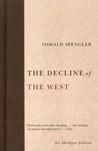
The Decline of the WestThe Decline of the West by Oswald Spengler

My rating: 4 of 5 stars

All genuine historical work is philosophy, unless it is mere ant-industry.

Gibbon’s Decline and Fall of the Roman Empire is one of my favorite books, not only because it is written so beautifully, but because of the spectacle of decline—of a great empire slowly and inevitably crumbling. The scene is irresistibly tragic. Like a Macbeth or an Oedipus, the Empire succumbs to itself, brought down by its own efforts at self-expansion. Or perhaps the scene can be better compared to the Fall of Man in Milton’s poem, a grand cosmic undoing, followed by the heroic struggle against the inevitable.

Besides the sublime tragedy of Rome’s decline, it fascinates because it gives us a foreboding of what might happen to us. Indeed, maybe it is already? This would explain all the banality we see on television every day, all the terrible music on the radio. More than decline—a loss of political and economic power—this is decadence: a decay of taste, morals, artistic skill. Decadence seems observable in many historical instances: the Egyptians, the Babylonians, the Greeks, the Romans, the Byzantines: they all petered out, losing cultural vitality until they disappeared completely. Couldn’t the same thing be happening to us?

Oswald Spengler thought so, and he turned this thought into the basis for an entire philosophy of history. He was not a professional historian, nor an academic of any kind. He worked as a school teacher until his mother’s inheritance allowed him quit his job and to devote all of his time to scholarship. This scholarship was mustered to write an enormous book, whose publication was delayed by World War I. Probably this was very lucky for Spengler, since the pessimism and anguish caused by that war set the mood for his grand theory of cultural decline.

The Decline of the West puts forward a radically unconventional view of history. Spengler divides up world history, not into countries or epochs, but into “Cultures.” There have been only eight: the Egyptian, the Babylonian, the Meso-American, the Chinese, the Indian, the Classical (Greco-Roman), the Arabian (includes the Byzantine), and the Western (European Culture, beginning around the year 1000). Each of these Cultures he conceives as a super-organism, with its own birth, middle-age, and dotage. These Cultures all age at a similar rate, and go through analogical stages in the process (Napoleon is the Western equivalent to Alexander the Great, for example). Spengler believed that he had delineated these Cultures and traced their basic growth and aging process, thus providing a valid scheme for all future history as well, if any new Culture should arise.

Spengler is a cultural determinist and a cultural relativist. This means that he does not see these Cultures as dependent on the talent of individuals to grow; the individual is a product of the Culture and not the reverse. He also thinks that each of these Cultures creates its own self-contained world of significance, based on its own fundamental ideas. There is no such thing as inter-cultural influence, he thinks, at least not on any deep level. Each of these Cultures conceives the world so differently that they can hardly understand one another, let alone determine one another, even if one Culture can overpower another one in a contest of arms. Their art, their mathematics, their architecture, their experience of nature, their whole mental world is grounded in one specific cultural worldview.

Because Spengler is a determinist, he does not present us with a Gibbonian spectacle of a civilization succumbing to its own faults, struggling against its own decline. For Spengler, everything that happens in history is destiny. People don’t make history; history makes people. Thus, while often classed as a political conservative, it is hard to put any political label on Spengler, or to co-opt his views for any political purpose, since he didn’t think we directed our own history. To be a true Spenglerian is to believe that decline is inevitable: decadence wasn’t anyone’s “fault,” and it can’t be averted.

Much of this book consists of a contrast between what he calls the Apollonian (Greco-Roman) worldview, and the Faustian (Western) worldview. The Apollonian world-picture is based on the idea of definite form and definable shape; the nude statue is its most characteristic art, the delineated human body; its mathematics is all based on geometry, concrete shapes and visible lines. The Faustian picture, by contrast, is possessed by the idea of infinity; we make fugues, roving explorations of musical space; our mathematics is based on the idea of a function, an operation that can create an endless series of numbers. Spengler dwells on this contrast in chapter after chapter, trying to prove his point that Western Culture, far from being a development of Classical Culture, is entirely incompatible with it.

His own Culture, the Western, he traces to around the year 1000, at the commencement of the Romanesque. How or why new a Culture begins, Spengler doesn’t venture to say; but once they do begin, they follow the same definite steps. It was inevitable, he thinks, that the Romanesque transformed into the Gothic, and then eventually flourished into the Baroque, the high point of our Culture, wherein we expressed our deep longing for the infinite in Bach’s fugues and Descartes’s mathematics.

Sometime around the year 1800, the Western Culture entered its late, senescent phase, which Spengler terms ‘Civilization.’ This is the phase that follows cultural growth and flourishing; its onset begins when a Culture has exhausted its fundamental idea and explored its inherent forms. A Civilization is what remains of Culture when it has spent its creative forces: “The aim once attained—the idea, the entire content of inner possibilities, fulfilled and made externally actual—the Culture suddenly hardens, it mortifies, its blood congeals, its force breaks down, and it becomes Civilization.”

The ‘decline’ that forms the title of this book is just this transition from Culture to Civilization, wherein major creative work is at an end. Civilization is, rather, the age of Caesarism, the consolidation of political power. It is the age of world cities, major metropolises filled with cosmopolitan urban intellectuals. It is the age of academics rather than geniuses, the Alexandrine Greeks instead of the Golden-Age of Athens. It is, in other words, the period that corresponds with the onset of the Roman Empire, a period of no substantial innovation, but of magnificent stability. The Western Culture, Spengler thought, was entering just this period.

Whereas those who are actuated by a Culture during its creative period feel themselves driven by inevitable impulses, which allow even mediocre artists to create great works, people within a Civilization are creatures of the intellect, not the instinct; and instead of being given creative power and direction by their Culture, they are left to substitute their own subjective tastes and whims for cultural destiny. Instead of, for example, having one overriding epoch in our artistic productions—such as the Gothic, the Baroque, or what have you—we have artistic ‘movements’ or trends—Futurism, Dadaism, Cubism—which, far from being necessary phases in a Culture’s self-expression, are merely intellectual fads with no force behind them.

Spengler’s theory does have the considerable merit of being testable, because he made very specific predictions about what the immediate future held. We had gone through the period of ‘Warring States,’ he thought, in which country fought country and money ruled everything, and were about to enter a period of Caesarism, wherein people would lose faith in the power of self-interested capitalism and follow a charismatic leader. This would also be a period of ‘Second Religiousness,’ a period of faith rather than reason—a period of patriotism, zeal, and peaceful capitulation to the status quo.

Nowadays, one-hundred years later, it seems these predictions were certainly false. For one, he did not foresee the Second World War, but thought the period of internecine warfare was coming to a close. What is more, economic power has grown even more important—far more important than political power, in many ways—and no Caesar has arisen, despite many contenders (including Hitler, during Spengler’s lifetime, of whom Spengler didn’t think highly).

Aside from its breadth, one thing that sets this book apart is its style. Spengler is a remarkable writer. He can be poetic, describing the “flowers at eventide as, one after the other, they close in the setting sun. Strange is the feeling that then presses in upon you—a feeling of enigmatic fear in the presence of this blind dreamlike earth-bound existence.” He can be bitter, biting, and caustic, castigating the blind scholars who couldn’t see the obvious, satirizing the pseudo-sauve intellectuals who populated the cities of his time. He can be lyrical or epigrammatic, and can write ably about art, music, and mathematics.

His most characteristic mode, however, is the oracular: Spengler proclaims, predicts, pronounces. His voice, resonating through the written word, booms as if from a mountaintop. He sweeps the reader up in his swelling prose, an inundation of erudition, a flood that covers the world and brings us, like Noah in his ark, even higher than mountaintops. Perhaps a flood is the most apt metaphor, since Spengler is not only overwhelming in his rhetorical force, but all-encompassing in his world-view. He seems to have thought of everything, considered every subject, drawn his own conclusions about every fact; no detail escapes him, no conventionality remains to be overturned by his roving mind. The experience can be intoxicating as he draws you into his own perspective, with everything you thought you knew now blurry and swirling.

Spengler is so knowledgeable that, at times, he can sound like some higher power declaiming from above. But he was a man, after all, and his erudition was limited. He was most certainly an expert on music, mathematics, and the arts, and writes with keen insight in each of these subjects. But in politics, economics, religion, and especially science, he is less impressive. He completely fails to understand Darwin’s theory, for example, and he thought that physics was already complete and there would be no more great geniuses (and this, in one of the greatest epochs of physics!). He doesn’t even mention Einstein. Spengler also thought that our scientific theories were culturally determined and culturally bound; the Western conception of nature, for example, would have no validity for the Chinese (which doesn’t seem to stop the Chinese from learning Newton’s theories).

His grand theory, though undeniably fascinating, is also impossible to accept. What is the nature of a Culture? Why do they arise, why are they self-contained, why do they follow the same life-course? Why would one single idea determine every single cultural production—from mathematics to music, from architecture to physics—in a Culture from birth to death? All these seem like fundamental questions, and yet they are not satisfactorily addressed—nor do I see how they could be.

By insisting on the Culture as the unit of history, Spengler seems to be at once too narrow and too broad. Too narrow, because he does not allow for the possibility that these Cultures can influence one another; while it seems obvious to me that, yes, there was influence from the Classical to the Western, as well as from the Classical to the so-called ‘Magian’ (his term for the Arabian Culture), and from the Magian to the Western, and so on. And too broad, because within any given Culture there are not only different ages but different areas. Is the cultural difference between Spain and England ultimately superficial, but between the Renaissance and Classical Greece unbridgeable? Really, the more you think about Spengler’s claims, the less credible they seem. After all, if Spengler were right, how could he, a Western intellectual living in the Civilization phase of Western Culture, delineate the fundamental ideas of other Cultures and produce what he regarded as a major intellectual achievement?

I am certainly not saying that this book is intellectually valueless. By comparison, Walter Pater had this to say about aesthetic theories: “Many attempts have been made by writers on art and poetry to define beauty in the abstract, and express it in the most general terms, to find a universal formula for it. The value of these attempts has most often been in the suggestive and penetrating things said by the way.”

This seems equally true with regard to Spengler’s universal formula for history. Although I think his theory is untenable, this book is nevertheless filled to the brim with suggestive and penetrating observations, especially about art, architecture, music, and mathematics. Spengler may be a failed prophet, but he was an excellent critic, capable of making the most astonishing comparisons between arts of different eras and epochs.

Even if we reject Spengler’s proposed theory, we may still savor the grand vision required to see all of human history as a whole, to scan one’s eye over the past and present of humankind, in all its forms and phases, and to form conjectures as to its destiny. And Spengler was undeniably original in his inclusion of Babylonian, Egyptian, Indian, Chinese, and Meso-American Cultures as of equal importance as Western history; indeed, it is at least in part to Spengler that we owe our notion of world-history. Rich in ideas, set forth in ringing prose, invigorating in its novelty, breathtaking in its scope—here we have a true classic, yet another example of a book whose enormous originality outweighs every conventional defect we can detect in it.

View all my reviews

Review: Tools for Teaching

Review: Tools for Teaching

Tools for Teaching: Discipline, Instruction, Motivation.  Primary Prevention of Classroom Discipline ProblemsTools for Teaching: Discipline, Instruction, Motivation. Primary Prevention of Classroom Discipline Problems by Fredric H. Jones
My rating: 5 of 5 stars

Have you ever looked at the work kids turn in these days and wondered, “What will happen to this country in the next 50 years?” When you watch Larry sharpen his pencil, you know that the future is in good hands. It’s inspirational.

Last year I switched from teaching adults to teaching teenagers. Though I’m still teaching English, the job could hardly be more different. With adults, I could focus entirely on content; my students were mature, intelligent, and motivated, so I could think exclusively about what to teach them, and how. With kids, I am dealing with a classroom full of energetic, distracted, unruly, loud, and sometimes obnoxious humans whose main motivation is not to fail the upcoming exam. They’re not there because they want to be, and they would always inevitably rather be doing something else.

This probably makes me sound jaded and disenchanted (and I hasten to add that I actually have a lot more fun teaching kids, and my students are great, I swear!); but the fact is inescapable: when you’re teaching in a school setting, you need to worry about classroom management. Either you will control the kids, or they will control you.

It is the hope of every beginning teacher, myself included, to manage through instruction. We all begin with the same dream: to create lessons so dynamic, so enriching, so brilliant, and to teach with such charisma and compassion, that misbehavior isn’t a problem. But this doesn’t work, for two obvious reasons. For one, we don’t have unlimited control of the curriculum; to the contrary, our room to maneuver is often quite limited. And even with complete autonomy, having interesting lessons would be no guarantee of participation or attention, since it only takes one bored student to disrupt, and only one disruption to derail a lesson.

Even if you’re Socrates, disruptions will happen. When they do, in the absence of any plan, you will end up falling back on your instincts. The problem is that your instincts are probably bad. I know this well, both from experience and observation. Our impulsive reaction is usually to nag, to argue, to preach, to bargain, to threaten, to cajole—in other words, to flap our mouths in futility until we finally get angry, snap, yell, and then repeat the process.

But no amount of nagging creates a motivated classroom; and no amount of speeches—about the value of education, the importance of respect, or the relevance of the lesson to one’s future—will produce interested and engaged students. In short, our instinctual response is inefficient, ineffective, and stressful for both teacher and students. (Again, I know this both from experience and observation.)

Some strategies are therefore needed to keep the kids settled and on task. And since teachers are chronically overworked as it is—the endless grading and planning, not to mention the physical strain of standing in front of classes all day—these strategies must be neither too complex nor too expensive. To the contrary, they must be relatively straightforward to implement, and they must save time in the long run.

This is where Fred Jones comes in. Fred Jones is the Isaac Newton of classroom management. This book is nothing less than a fully worked out strategy for controlling a room full of young people. This system, according to him, is the result of many hundreds of hours of observing effective and ineffective teachers, trying to analyze what the “natural” teachers did right and the “unnatural” teachers wrong, and to put it all together into a system. And it really is systematic: every part fits into every part, interlocking like the gears of a bicycle.

This makes the book somewhat difficult to summarize, since it is not a bag of tricks to add to your repertoire. Indeed, its main limitation—especially for me, since I’m just assistant who goes from class to class—is that his strategies cannot be implemented piecemeal. They work together, or they don’t work. As a pedagogical nomad who merely helps out, I am not really in a position to put this book into practice, so I cannot personally vouch for it.

Despite this, Jones manages to be utterly convincing. The book is so full of anecdotes, insights, and explanations that were immediately familiar that it seemed as if he was spying on my own classrooms. Unlike so many books on education, which offer ringing phrases and high-minded idealism, this book deals with the nitty-gritty reality of being a teacher: the challenges, frustrations, and the stress.

The main challenge of classroom management—the problem that dwarfs all others—is to eliminate talking to neighbors. Kids like to talk, and they will talk: when they’re supposed to be listening, when they should be working, whenever they think they can get away with it. This is only natural. And with the conventional classroom approach—standing in the front and lecturing, snarling whenever the kids in the back are too loud—talking to neighbors is inevitable, since the teacher is physically distant, and the kids have nothing else to do.

Jones begins by suggesting board work: an activity that each student must start at the beginning of class, something handed out or written on the board, to eliminate the usual chaos that attends the beginning of the lesson. He then goes into detail about how the classroom should be arranged: with large avenues to the teacher can quickly move around. Movement is key, because the most important factor that determines goofing off is physical proximity to the teacher. (This seems certainly less true in Spain, where people are more comfortable with limited personal space, but I imagine it’s quite true in the United States.)

This leads to the lesson. Jones advocates a pedagogical approach that only requires the teacher to talk for five minutes or less at a time. Break down the lesson into chunks, using visual aids for easy understanding, and then immediately follow every concept with an activity. When the kids are working, the teacher is to move around the classroom, helping, checking, and managing behavior, while being sure not to spend too much time with the students he calls “helpless handraisers”—the students who inevitably raise their hands and say they don’t understand. (To be clear, he isn’t saying to ignore these students, but to resist the impulse to re-teach the whole lesson with your back turned to the rest of the class.)

This leads to one of the main limitation of Jones’s method: it works better for math and science than for the humanities. I don’t see how literature or history can be broken down into these five-minute chunks without destroying the content altogether. Jones suggests frequent writing exercises, which I certainly approve of, but it is also hard for me to imagine teaching a lesson about the Spanish Reconquest, for example, without a lengthy lecture. Maybe this is just due to lack of imagination on my part.

When it comes to disruptions, Jones’s advice is refreshingly physical. The first challenge is remaining calm. When you’re standing in front of a crowd, and some kids are chuckling in the back, or worse, talking back to you, your adrenaline immediately begins to flow. Your heart races, and you feel a tense anxiety grip your chest, intermediate between panic and rage. Before doing anything, you must calm down. Jones suggests learning how to relax yourself by breathing deeply. You need to be in control of your emotions to respond effectively.

Then, Jones follows this with a long section on body language. The way we hold our bodies signals a lot about our intentions and our resolve. Confidence and timidity are things we all intuitively perceive just from looking at the way someone holds herself. How do you turn around and face the offending students with conviction? How do you signal that you are taking the disruption seriously? And how do you avoid seeming noncommittal or unserious?

One of the most brilliant sections in this book, I thought, was on dealing with backtalk. Backtalk can be anything, but as Jones points out, it usually takes a very limited number of forms. Denial is probably the most common; in Spanish, this translates to “Pero, ¡no he hecho nada!” Then there is blaming; the student points her finger at her neighbor, and says “But, she asked me a question!” And then there is misdirection, when the offending student says, “But, I don’t understand!” as if they were in a busy intellectual debate. I see all these on a daily basis. The classic mistake to make in these situations is to engage the student—to argue, to nag, or to scold, or to take their claim that they “don’t understand” at face value. Be calm, stay quiet, and if they keep talking move towards them. Talking back yourself only puts you on the same level.

The penultimate section of the book deals with what Jones calls Preferred Activity Time, or PAT. This is an academic activity that the students want to do, and will work for. It is not a reward to hold over their heads, or something to punish the students with by taking it away, but something the teacher gives to the class, with the opportunity for them to earn more through good behavior. This acts as an additional incentive system to stay on task and well behaved.

The book ends with a note on what Jones calls “the backup system,” which consists of the official punishments, like suspension and detention, that the school system inflicts on misbehaving kids. As Jones repeatedly says, this backup system has been in place for generations, and yet it has always been ineffective. The same small number of repeat offenders account for the vast majority of these reprimands; obviously it is not an successful deterrent. Sometimes the backup system is unavoidable, however, and he has some wise words on how to use it when needed.

Now, if you’ve been following along so far, you’ll have noticed that this book is behaviorist. Its ideas are based on control, on incentive systems, on input and output. As a model of human behavior, I think behaviorism is far too simplistic to be accurate, and so I’m somewhat uncomfortable thinking of classroom management in this way. Furthermore, there are moments, I admit, when the job of teaching in a public school feels more like working in a prison than the glorious pursuit of knowledge. Your job is to keep the kids in a room, keep them quiet and seated, and to keep them busy—at least, that’s how it feels at times. And Jones’s whole system can perhaps legitimately be accused of perpetuating this incarceration model of education.

But teachers have the choice of working within an imperfect system or not working. The question of the ideal educational model is entirely different from the question this book addresses: how to effectively teach in the current educational paradigm. Jones’s approach is clear-eyed, thorough, intelligent, insightful, and eminently practical, and for that reason I think he has done a great thing. Teaching, after all, is too difficult a job, and too important a job, to do with only idealism and instinct as tools.

View all my reviews

Review: Imperial Spain

Imperial Spain, 1469-1716Imperial Spain, 1469-1716 by J.H. Elliott

My rating: 4 of 5 stars

Already by the end of the sixteenth century many Spaniards seem to have been gripped by that sense of fatalism which would prompt the famous pronouncement of a Junta of theologians in the reign of Philip IV. Summoned to consider a project for the construction of a canal linking the Manzanares and the Tagus, it flatly declared that if God had intended the rivers to be navigable, He would have made them so.

For Anglophone readers interested in the history of Spain, this book is invaluable. Elliott has here accomplished a real feat, of research, of writing, and of analysis. The book ably navigates that forbidding passage between simplifying popular accounts and unreadable scholarly monographs, managing to be both a work of serious intellectual synthesis and an absorbing account of Spain’s history.

Elliott has an astounding ability to seamlessly combine many disparate threads into the same narrative. He pays close attention to economic history: crop yields, interest rates, inflation and deflation, the debasement of currency, the balance of trade, tariffs and regulations. He incorporates social and cultural shifts: changing religious attitudes, demographic trends, class tensions, intellectual movements. And yet he also does not neglect the superlative individuals: Ferdinand and Isabella, Charles V, Philip II, the Conde Duque, among others. The only thing conspicuously absent was military history, which suited me just fine.

Although the story of Spain during this time was heavily interwoven with both the New World and the rest of Europe, Elliott’s focus doesn’t stray from the Iberian peninsula. He gives only the most cursory account of the Spanish conquest of the Americas, and only mentions the struggles of Charles V against the Protestant Reformation. For those looking for a history of Spanish colonization, this book will therefore be disappointing. I must also add that Elliott’s judgment is at its worst in his brief section on the conquistadores. He describes them as glorious conquering heroes of a barren civilization, which I cannot abide in the light of the destruction and exploitation that followed in their wake.

Keeping those exceptions in mind, this book is a superlative account of this period of Spanish history. The competing centrifugal and centralizing forces at play, the conflicting traditions of Castilian and Aragonese governments, the infinitely subtle machinations of power, the gradual emergence of a national identity, the meteoric rise of the Spanish Empire, the cruel, grinding decline that followed, the heroic and hapless individuals struggling with forces beyond their control—all this is related with brevity, insight, and power.

It is difficult not to see the whole story as a morality play writ large. What with the ruthless exploitation of the treasure mines of the New World, the expulsion of the Jews and the Moors, the obsession with purity of blood, and the alignment of religious orthodoxy with central power, it seems as if the collapse of the grand but hollow edifice was the inevitable result of intolerance and folly. But even if we can learn some valuable lessons from this history, it is important to remember that the story is not so simple, and many decisions which in retrospect seem obviously foolish were at the time fairly reasonable (though of course many weren’t).

In short, I heartily recommend this book to anyone interested in this fascinating time and place. It could hardly be better.

View all my reviews

Review: Europe, by Norman Davies

Review: Europe, by Norman Davies

EuropeEurope by Norman Davies

My rating: 4 of 5 stars

Can one narrate time—time as such, in and of itself? Most certainly not, what a foolish undertaking that would be. The story would go: “Time passed, ran on, flowed in a mighty stream,” and on and on in the same vein. No one with any common sense could call that a narrative.

—Thomas Mann, The Magic Mountain

Personal Preface

Lately I have been thinking a lot about time. Well, perhaps thinking isn’t the right word; I’ve been worrying. Ever since I moved to Spain, time has been a problem. What’s the proper time to eat? When do people sleep here? How long will my job last? What about my visa? Multiple clocks beset me, counting down and counting up.

Beyond my petty troubles, I have been thinking about time as an experience: how monotony speeds up the clock’s hand, variety slows it down, and nothing can stop it. I have been thinking about the inexorability of time: every passing second is irretrievable, every yesterday is irrecoverable. I have been spending a lot of time remembering, connecting my past with my present, if only artificially, and wondering how much the act of remembering itself distorts my memories. And in a Proustian mood, I have wondered whether a tremendous act of remembrance is the only defense we have against the ceaseless tide of time.

In the midst of our mundane concerns, it is all too easy to forget to remember. But is it crucial to remember; otherwise life can go by without us noticing. This is why we celebrate birthdays. Logically, it is silly to think that you turn from one age to another all at once; of course we get older every day. We celebrate birthdays to force ourselves to reflect on the past year, on how we have spent our time and, more chillingly, on how much time we have left. This reflection can help us assess what to do next.

Birthdays are just one example. In general, I have been finding it increasingly important to focus on these cycles, when a milestone is reached, when a process is completed, moments when the past is forcefully juxtaposed with the present. Finishing Norman Davies’s Europe was one such moment for me, and an important one. I first heard of the book from an old copy of National Geographic; it was in an article discussing the recent introduction of the euro (in 1999), a historic step in European unity. Davies’s book had just been published the year before, and the reporter had interviewed Davies about his thoughts on the future of Europe.

I read this article right as my love of reading began to blossom. Thus I dutifully underlined the name of Davies’s book, hoping to buy and read it some time in the future. But it was years until I finally bought a copy; and still more years before I finally started reading. When I first heard of the book I would never have imagined that I would finally read it, many years later, in Europe. But here I am, and it feels great.

The Review

Norman Davies’s Europe is an attempt to write a survey history of Europe in one volume, from prehistoric times to the dissolution of the Soviet Union, covering both Western and Eastern Europe. It’s an ambitious project. As you can imagine, an enormous amount of selection and compression was necessary in order to fit all this material into one volume. Luckily, Davies is adept at both of these skills; unfortunately, the book is still too big to carry around. It is big, fat, and heavy: thick enough to stop a bullet, hefty enough to knock someone out cold.

In terms of content, the book is both longer and shorter than it appears. Of the nearly 1,400 pages, only about 1,140 are actual history; the rest is given over to his notes, the index, and a lengthy series of appendices, on subjects ranging from the standard canon of opera, to death tolls in the Second World War, to the life course of an Austrian peasant household. Nevertheless, the pages are dense with text, in small font and with narrow margins; and the pages themselves are quite big. Moreover, owing to the huge amount of territory Davies covers, the book is almost nauseatingly packed with information, every page a summary of whole books. It isn’t the sort of thing you can breeze through.

Davies begins with a pugnacious introduction, in which he denounces all of his forbearers. For him, attempts to write European history have all fallen into various traps, by focusing too much on the ‘Great Books’, by their excessive length, or by their neglect of Eastern Europe. Davies snubs his nose at specialization, and wags his finger at academic fads; he bashes both the traditionalists and the radicals. I personally found this introduction to be an interesting read, but it does seem out of place in a book for the general reader.

For all that talk, you’d think Davies’s treatment would be highly heterodox. But that’s not the case. After an obligatory chapter on prehistory, he goes into a chapter on Greece, then Rome, then the Middle Ages, and so on. And even though one of his major bones of contention is the erstwhile disregard for Eastern Europe, he generally spends far more time on Western Europe.

The chapters increase in length as they approach the future, becoming progressively more detailed. For example, Aristotle and Plato must share one measly paragraph between them, but Gorbachev is given a dozen pages. As a result, the book gets more interesting the further you read. The coverage is only so-so for the ancient world; quite good for the Medieval period; and becomes really gripping by the 19th century. Davies attempts to cover all the major developments, but of course his space is limited. He sketches the historical individuals when necessary, but this is certainly not a “Great Man” telling of history. For the most part Davies focuses on economic, political, social, and cultural history, while paying less attention to intellectual and art history. Among the arts, he is strong on music but weak on painting, sculpture, and architecture.

The main narrative is broken up by what Davies calls ‘capsules’. These are mini-essays, ranging from half a page to two pages, on a variety of topics that interested Davies; they are set aside in their own boxes, interrupting the flow of the main text. This was Davies’s attempt to give extra color to his narrative, by focusing on little parts of the story that would otherwise be ignored. But I had mixed feelings about the idea. Half of the capsules were fascinating, but I thought many were uninspiring. And it was annoying to constantly be having to put the main narrative on hold, read a little essay, and then return where I left off. I thought it would have been a much better idea if he had left the capsules out completely, developed them into full-length essays, and then released them in their own book. I’d read it.

Davies is a writer of high caliber. He can adapt his style to any subject. His prose, although largely devoid of flourish, is consistently strong. In short, he has achieved that allusive aim of popular history writers: to inform and entertain in one breath. Seldom does he come across as seriously biased; but he is not afraid to be opinionated at times, which adds a nice touch of spice to the book: “Chamberlain’s three rounds with Hitler must qualify as one of the most degrading capitulations in history. Under pressure from the ruthless, the clueless combined with the spineless to achieve the worthless.”

I did catch two errors worth noting. First, Davies says that Dante called Virgil “The master of those who know,” when that epithet was really applied to Aristotle. Second, in the same sentence Davies calls Picasso, who was born in Andalusia, a “Catalan exile,” but he calls Dalí, who was born in Catalonia, a “Spaniard.” There were probably many more errors that I couldn’t catch, but in general the information seemed reliable.

Although this book is a survey history, Davies does have one central concern: the European identity. What does it mean to be a European? Davies doesn’t give any simple answers to this question, but instead traces how the European identity evolved through time. The reason for his concern is obvious. The Soviet bloc had only recently been dismantled, and now the European Union was faced with the task of dealing with these newly freed states. Davies himself appears to be strongly pro-Union; and in that light, this history of both Western and Eastern Europe can be seen as an attempt to give the people’s of Europe a shared past, in the hopes that they might embrace a shared future.

It was a bit strange to be finishing this book now. I can still remember the hopeful, enthusiastic tone of that National Geographic article about the new euro. People must have felt that they were entering a new age of European unity. Now the United Kingdom is threatening to leave the European Union, and several other countries are grumbling. The future, as always, is in doubt.

 Afterthought

I finished the book on April 23, which is Book Day here in Spain. Yesterday was the 400th anniversary of Cervantes’s death; and today is the same anniversary for Shakespeare. To celebrate, I go to the Circulo de Bellas Artes, where they are having a public reading of Don Quixote. Everyday people, old and young, are lined up in an auditorium to read a page from that great masterpiece; it will go on for 48 hours. After that, I walk to the Cervantes exhibition in the National Library, where they have dozens of old manuscripts of Cervantes and his contemporaries on display. From there, I walk to the Convent of the Barefoot Trinitarians, where Cervantes was buried.

I was celebrating the completion of a cycle, and so was Spain. The past is alive and well in Europe.

View all my reviews