Dresden is the capital of Saxony, but it is not its largest city. That distinction belongs to Leipzig, which is just a short train-ride away. Though not the most beautiful nor the most historic city in Germany—not even close—it has long been on my list, if only for its connection to one of the great figures of history: Johann Sebastian Bach.
Only modestly well-known during his lifetime, Bach has come to be regarded as equalled only by Beethoven and Mozart in the history of European classical music. His developments in harmony, in counterpoint, in compositional form—all of this helped create both the vocabulary and the grammar of his successors—all while leaving us a body of music that is still a source of fascination and delight. And it was his music, more than any other, that fostered my early appreciation for the art of composition.
I remember taking long walks in the forest behind my house, during the summer between junior and senior year of high school—listening to Heifetz play the violin sonatas, to Casals play the cello suites, to Glenn Gould playing the Goldberg Variations. Noticing my interest, my band teacher lent me a copy of a biography of Bach, which I eagerly devoured. Later, in college, I took a course on the composer’s life and music—and read the same biography again. I even tried to compose a flute sonata in his style (terrible, obviously).
Because of this, the first thing I did when I stepped off the train was to visit the St. Thomas Church. This is where the great composer worked and taught for the last 27 years of his life, and it is where he was ultimately buried. The great figures of the past can often seem to be as unsubstantial as the characters of a novel. This is why I find it so important to visit places physically connected with these people, as it is only then that they become, psychologically, real. One of the great benefits of travel, in other words, is to make the past come alive.
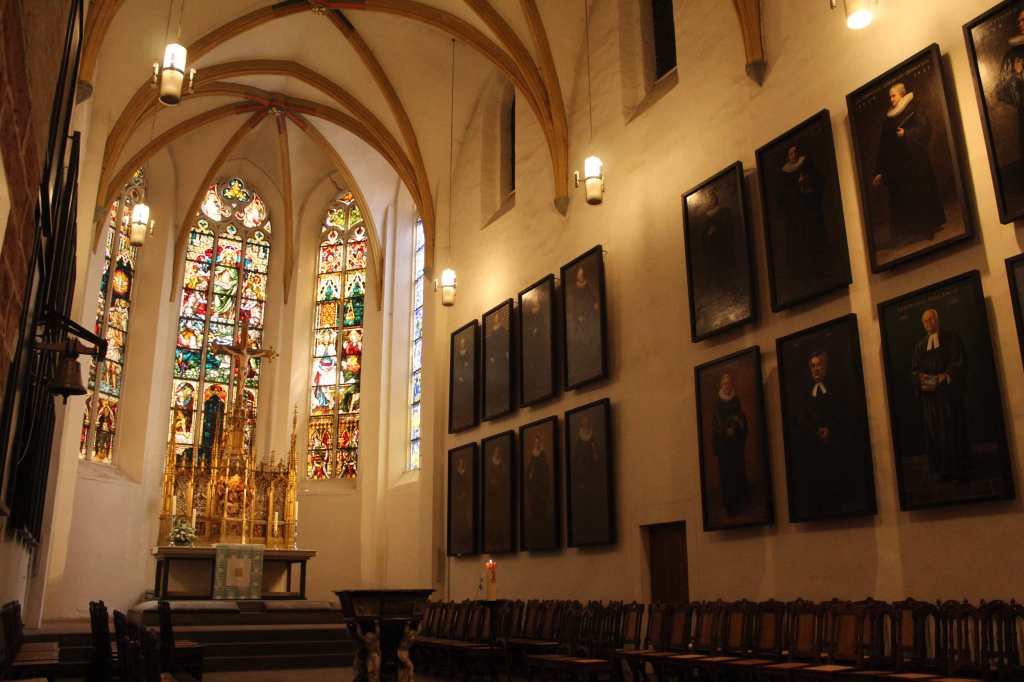
Bach certainly felt alive as I took my first tentative step into the church. Architecturally, St. Thomas Church is a lovely late-gothic construction—though this did not explain the feeling of reverence with which I crept about the space. Bach himself is buried near the altar, in a cordoned off area. Peeking at it from an angle, I gazed in awe at the bronze plaque on the ground.
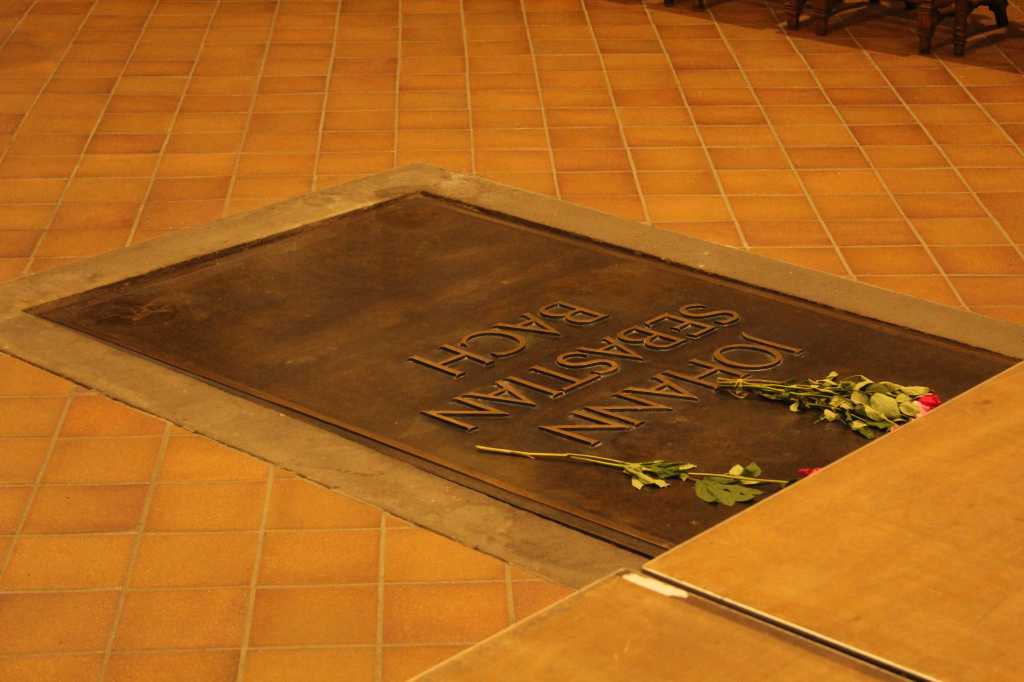
History, however, is not without a sense of irony. While I looked on, full of artistic devotion, I did not know that Bach’s bones had only been here for less than a century. After his death in 1750, following unsuccessful eye surgery, the 65-year-old composer was originally interred in the graveyard of the nearby Johanniskirche. By the time of his death, he was considered something of an old fogey, whose music was out of fashion; and despite his respectable career, he was buried in an unmarked grave.
It took his successors more than a century to realize the full importance of his music, and to finally commission a doctor to locate his bones among the human remains. Once found, they were separated and reinterred in a more ornate sarcophagus, in the basement of the church. Yet his bones suffered yet another indignity when the church above it was destroyed by Allied bombs during the war. Five years after that war concluded, his remains (if, indeed, they really are his bones) were moved here—permanently, we hope.
Yet an artist does not live on through his tomb, but his works. And while I was in the church, I was electrified to hear the reedy sigh of an organ begin to breathe through the space. It was a piece by the man himself. And it was a fitting tribute, as Bach was just as well-known for his virtuosic organ-playing as for his composing (indeed, probably more so). Hearing his work in a space where he himself could have heard it was, in a quiet way, one of the culminating moments in my time in Europe.
My visit to this site of pilgrimage was followed, appropriately, by a visit to the Bach-Museum, right across the square. Opened in 1985, the museum is situated in the Bosehaus, an apartment building owned by the Bose family, acquaintances of the Bachs. (Bach’s own house has not survived the ravages of time.) Inside is a series of exhibits about the man’s life and music.
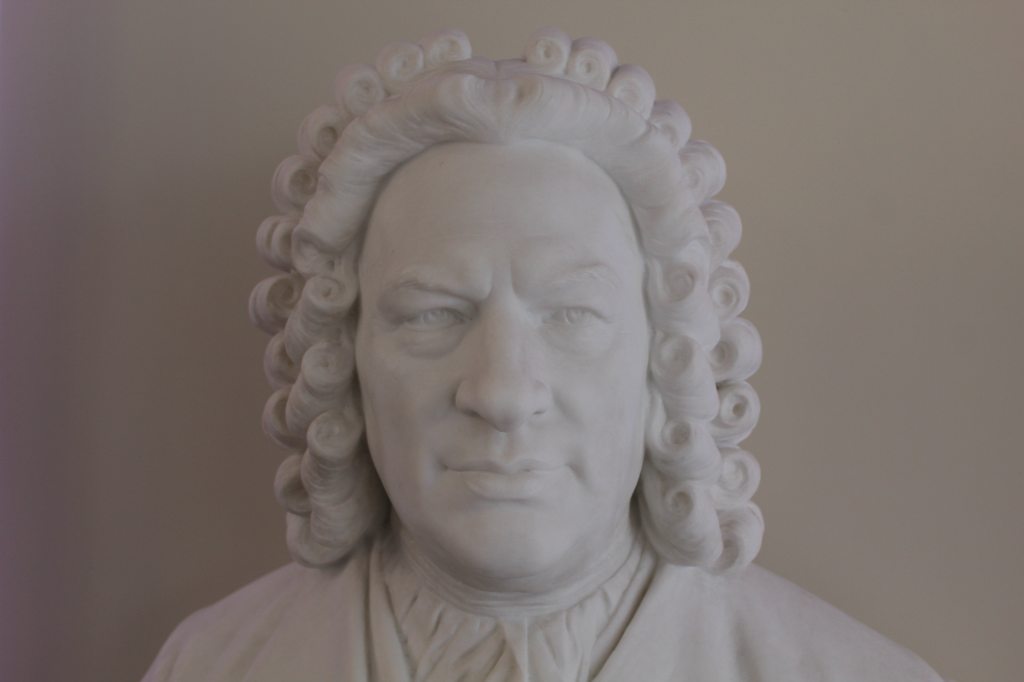
It should be admitted that Bach did not have an especially dramatic life. Indeed, he comes across as a relatively conservative and conventional man—pious, industrious, upstanding (if sometimes prickly and irate). Born into a large musical dynasty, Bach himself was a family man—marrying twice, and having a total of 20 children. Sadly, only ten of these survived into adulthood. Four of those became composers themselves—two sons a great deal more famous and successful than the paterfamilias himself, at least at the time.
In short, his life presents a kind of study in contrast with the typical romanticized image of the artist—the tortured Beethovens and solitary Van Goghs. Bach wrote for the church and supported his large family by teaching, performing, and testing out organs. Indeed, as I mentioned before, by the end of his life Bach’s heavily contrapuntal music was considered passé amid the rising taste for simpler and sweeter melodies. And yet, underneath the apparently conventional form, Bach had created a body of work which would dwarf anything written by his sons, and inspire generations of artists for centuries to come. It is an interesting corrective to our conventional view of artistic genius.
Unlike a visual artist (who naturally leaves behind a trove of attractive artifacts) it is somewhat difficult to make a museum about a musician, whose work is abstract. But the curators of the museum did a fine job. There are displays about Bach’s life—his family, his ancestors, his progeny, his travels throughout Germany—and examples of antique instruments (which were often quite different from contemporary concert instruments). My favorite room was full of interactive exhibits, which allowed the listener to isolate specific instruments in a concert piece—an especially interesting exercise in music as intricately woven as Bach’s. Yet the highlight of the museum is undoubtedly the “treasure room,” which has original Bach manuscripts as well as the most famous portrait of the great composer.
After this, I wanted to see something of the town. Time was tight—I had to catch my evening train back to Dresden—so my impressions of the city were necessarily shallow. Still, I had time to appreciate the splendor of the St. Nicholas Church, an enormous gothic building that is famous for being the epicenter of the 1989 Monday Demonstrations, which precipitated the collapse of communism in East Germany. A church may seem an odd place for a political protest; this was because—in the context of the official atheism of the government—prayer was a subversive act.
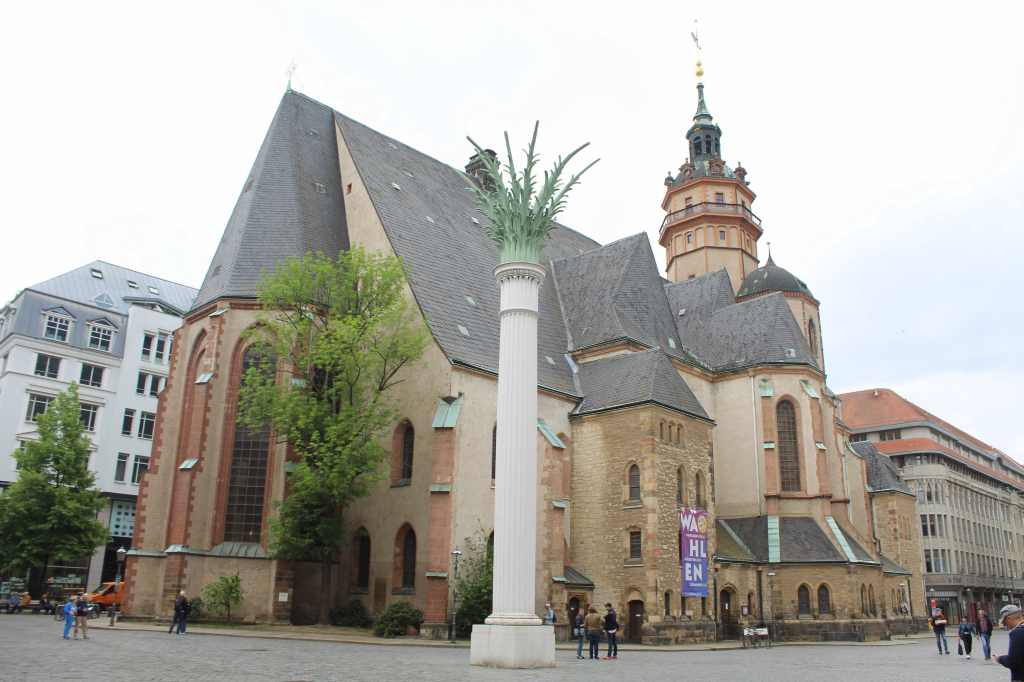
As I wandered around the city center, I bumped into a monument to another famous German composer, Felix Mendelssohn. The greatest child prodigy since Mozart, Mendelssohn had a strong connection to Leipzig, as he moved there as an adult and dedicated himself to improving its musical life. This not only included performances of his own works (many of which entered the classical canon), but the promotion of the work of other composers, both living and dead. Notably, Mendelssohn was a key figure in the revival of interest in Bach’s music, conducting a landmark performance of Bach’s St. Matthew Passion. We owe much to him.
Leipzig clearly has had an august musical past. Yet history was not always so kind to the city. After enduring the ethnic cleansing of the Nazis, and then Allied bombing, the city fell under the influence of the Soviet Union. As part of their central economic plan, the city was directed towards heavy industry—shrinking the cultural sector and polluting the skies into the bargain. Things got even worse in the wake of German reunification, as the city’s factories could not compete with their Western counterparts, and soon closed. All told, from the start of the First World War to the end of the Cold War, the city’s population shrunk by around a third.
But things are looking up for Leipzig. Partly this is due to the revitalization of Leipzig University, one of the oldest and most important centers of higher learning in the country. The university’s daring new main building—looking like an enormous glacier had slid into the Augustplatz—symbolizes this embrace of the future. Indeed, with tens of thousands of university students thrown into the population, the city has been looking especially youthful these days.
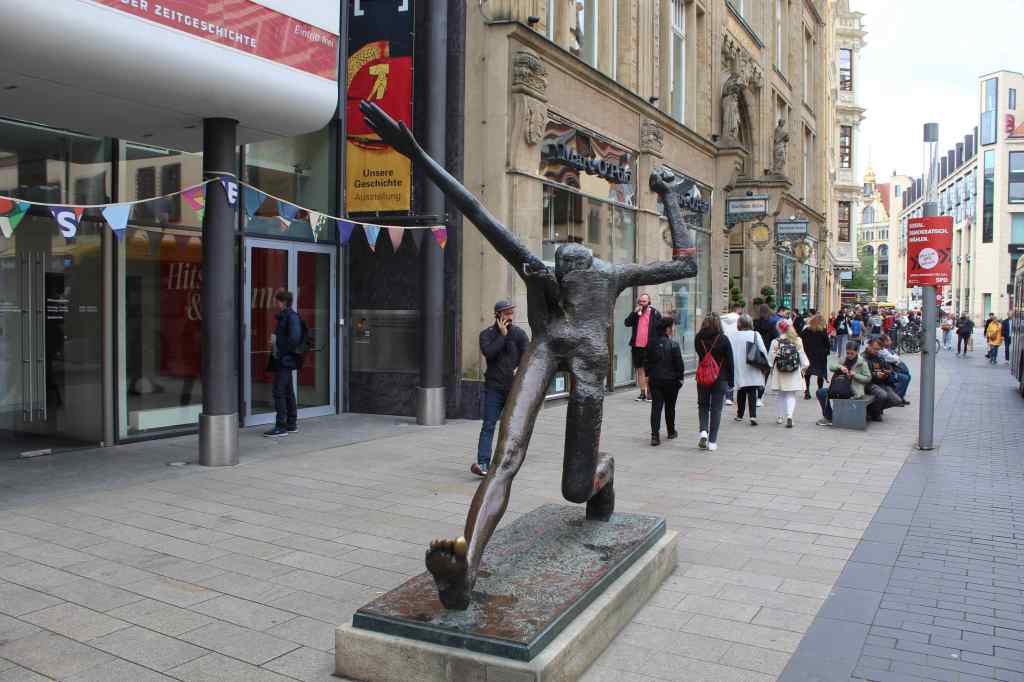
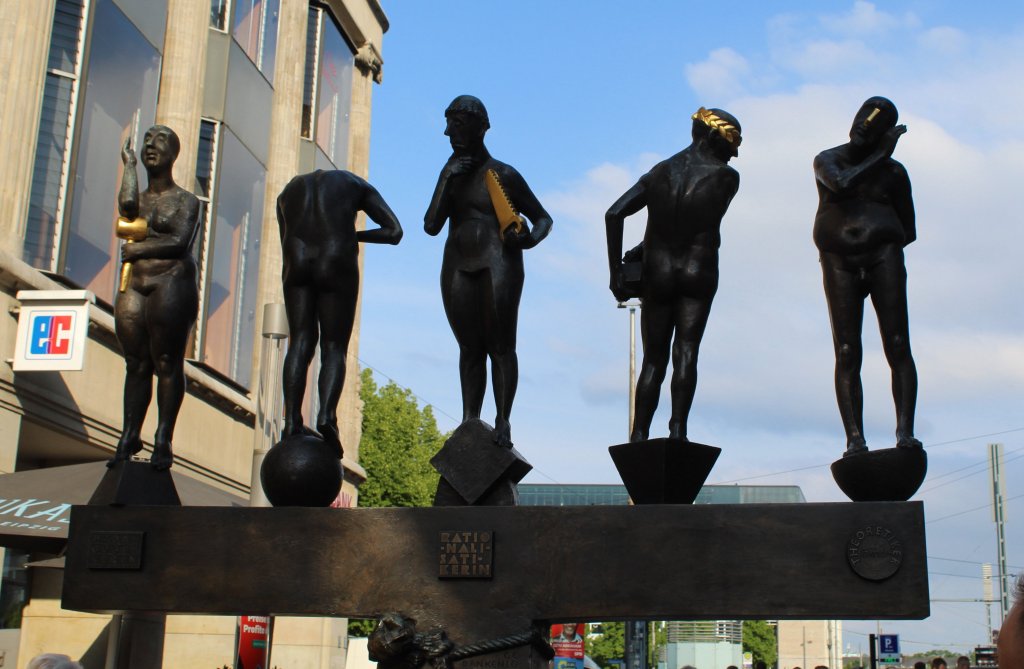
The city’s past still looms large. We can see this in the public sculpture, The Step of the Century, by Wolfgang Mattheuer, depicting a goosestepping man with one hand in a Nazi salute, and another holding up a communist fist. His head is, appropriately, beaten down by these competing and extreme ideologies. Another notable sculpture is Untimely Contemporaries (the pun works better in German), by Bernd Göbel, which consists of five nude figures on an iron crossbeam. These five figures—a teacher, a diagnostician, a rationalizer, an art theorist, and a city planner—all embody, in Göbel’s view, the overreach of cold reason in the GDR. The city planner, for example, points to a university church that was demolished by the authorities in 1968.
Yet if you really want to step into what conditions were like under communism, the best place to visit is the Runde Ecke, the city’s Stasi museum. Its name (Round Corner) comes from the building’s design, which juts out into the surrounding ring road. It was here that the Stasi, the country’s forbidding secret police, conducted their state-wide surveillance, interrogation, and repression.
Once a place of fear and loathing, protestors forcibly occupied this building during the fall of the GDR, in order to prevent the destruction of files. Now, the lower floor is a history museum, while the upper floors are used by the Stasi Records Agency—a federal program which manages the old Stasi files, making them accessible to anyone who may wish to see their own. (This, as it happens, is a painful decision to make, since you may discover that a loved one informed on you.)
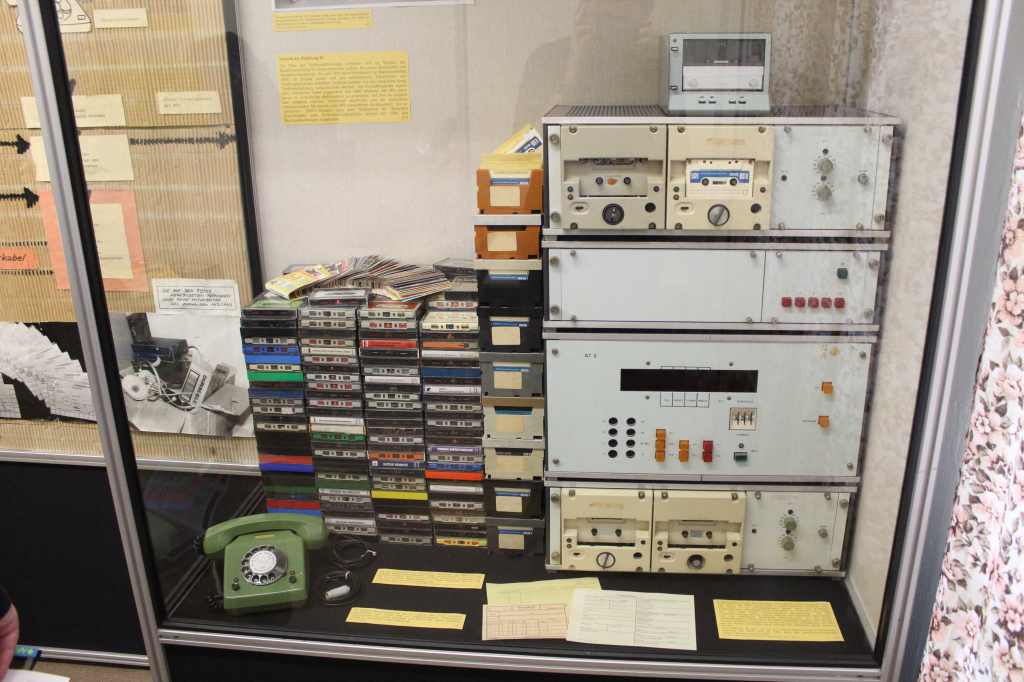
The museum at the Runde Ecke is terrifying for its ordinariness—indeed, for its drabness. The visitor walks through an old office space, complete with ugly furniture and a musty smell. The exhibits themselves, made shortly after the fall of the GDR, consist of fading printed posters (exclusively in German), which gives the museum a charming amateurishness. There is information about the history and organization of the Stasi; but the best parts of the museum are the tools and artifacts on display.
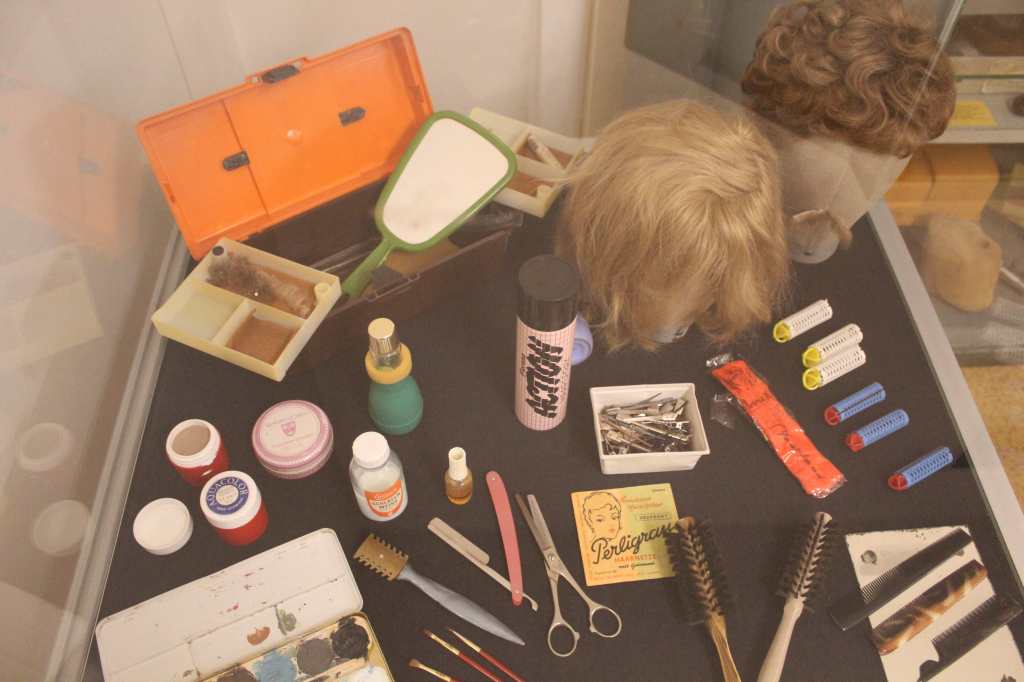
There are wigs, disguises, and prosthetic noses; all sorts of hidden cameras and microphones; and even a large letter-opening device—so that correspondence could be read and re-sealed without detection. We can see, of course, the endless filing cabinets used for their records, and setups used for interrogations. There is also a recreation of a prison cell. One of the strangest activities of the Stasi was collecting “scent samples,” which they got from old clothes or upholstery, and sealed in glass jars. Apparently, this was to be used for sniffer dogs. Nevertheless, as with so much bureaucratic activity, one suspects that data collection became an end unto itself for the Stasi—a kind of official mania that confused information with security.
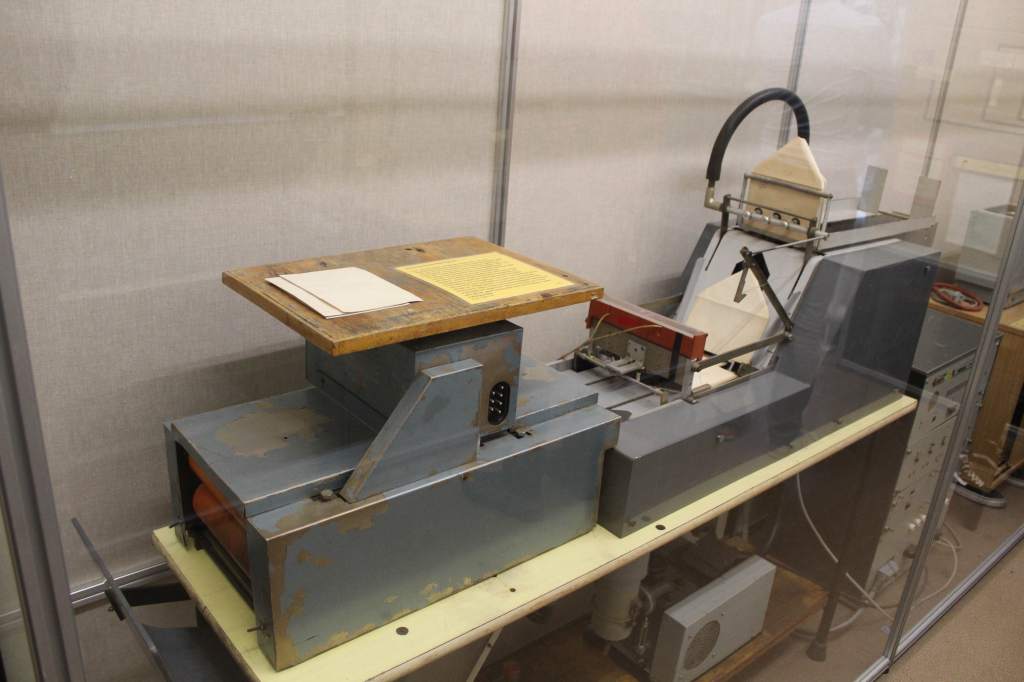
Even now, the environment inside the sunless, soulless place is draining. So it was a relief to walk back outside, into a beautiful day of late spring. It was time to eat. For this, I made my way to a place recommended by Rick Steves, the Bayerische Bahnhof. As its name suggests, this Biergarten is in what used to be a train station, with ample seating both inside and out. I ordered a schnitzel with potato salad, and chased it down with the restaurant’s famous (and quite sour) Gose beer. I needed fuel for the final push.
I walked from the restaurant, further away from the city center, into a large green space—until a large brown monument came into view. Soon enough, from across a large reflecting pool, the grand, weird form dominated the scene. This was the Völkerschlachtdenkmal, the Monument to the Battle of the Nations.
This monument takes us back to the Napoleonic era, and one of the biggest and bloodiest battles ever waged—at least, before the World Wars. I am speaking of the Battle of Leipzig, which took place in 1813. This pitted the forces of Napoleon against the combined armies of Austria, Prussia, Sweden, and Russia, involving over half a million combatants and 100,000 casualties. It was a decisive defeat for the French conqueror, leading to his initial fall from power and exile in Elba.
This victory also became a symbol of German pride and unification (even though, ironically, German soldiers fought on both sides of the battle). For years, suggestions and plans for a monument were proposed, until construction finally began in 1898. It was completed fifteen years later, in 1913, just in time for the 100th anniversary. Designed by Bruno Schmitz, the monument is unusual in taking its inspiration from Egyptian and Mesopotamian architecture, rather than the typical Greco-Roman style. It is a work of pharaonic proportions.
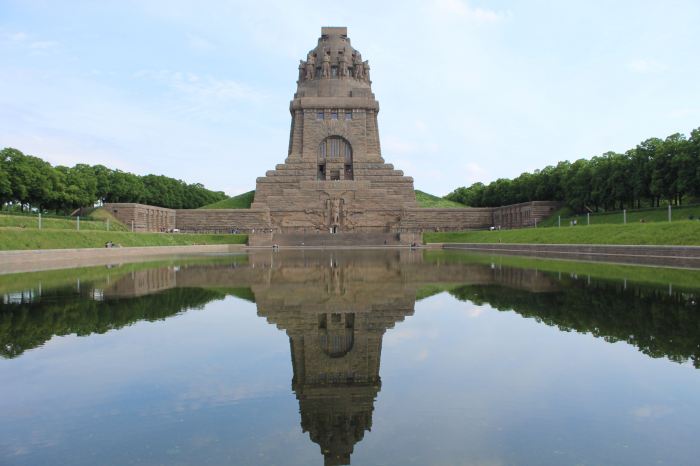
I can give you the dimensions of the monument, but no number can capture the sense of massiveness it conveys. The enormous pile of concrete is designed to make the human feel small and insignificant. The tourists seem like insects compared to the enormous figures molded into the surface; and these figures are themselves dwarfed by the structure. Once inside, the space seems to extend endlessly upward, culminating in the encasing dome, covered in a frieze of horsemen riding to glory.
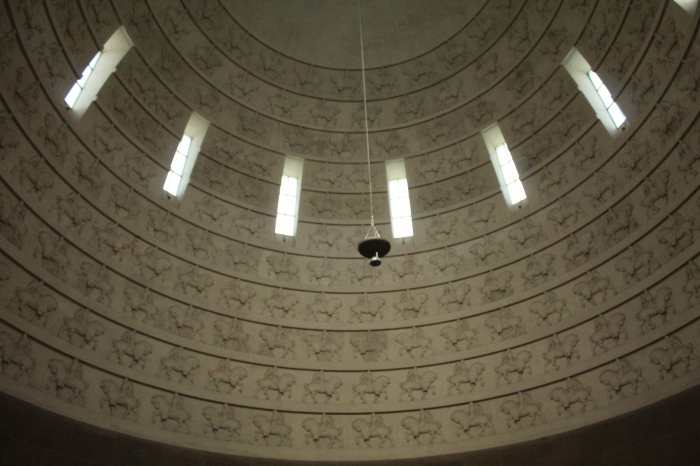
The aesthetic impression of the Völkerschlachtdenkmal is strange. On the one hand, it is an obvious piece of bombastic propaganda, of an almost childish worship of the Fatherland. And yet, the overblown sombreness of the art—mostly consisting of Teutonic knights—reminded me strongly of the Valley of the Fallen, that great monument to Spanish Fascism. Indeed, that this structure was completed just one year before the outbreak of World War I seems strangely prophetic, as the monument embodies the glorification of dying for one’s country—a kind of religion of the state. The subsequent history of the monument—used by everyone from the Nazis to the Soviets—confirms this suspicion.
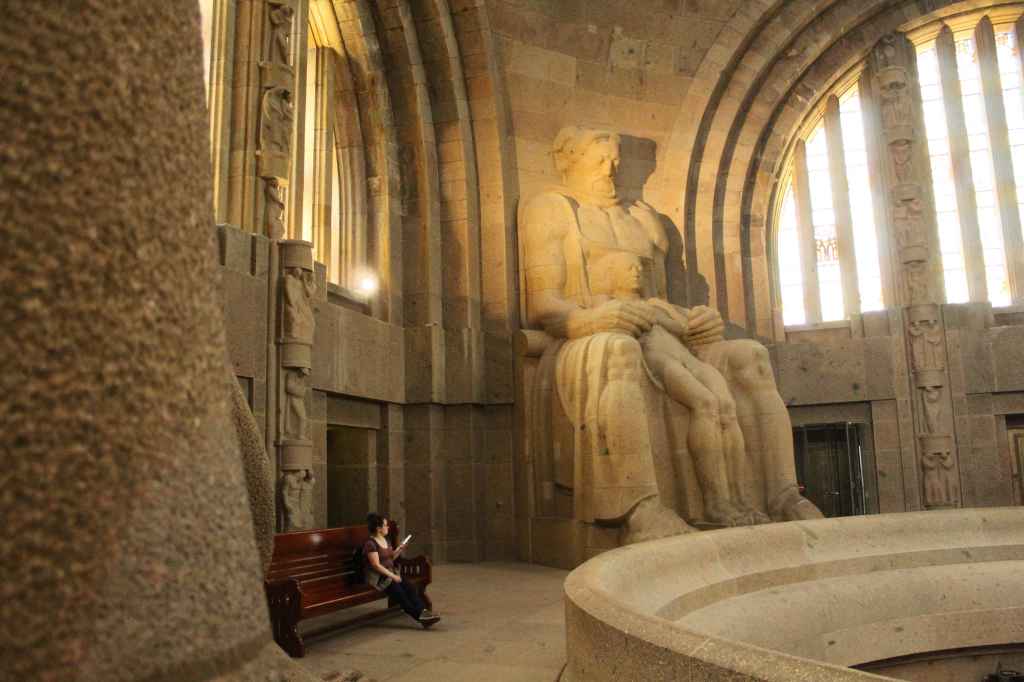
And yet, I must admit that there is something strangely beautiful about the Völkerschlachtdenkmal. Its artwork, while jingoistic, is also a wonderful example of Art Nouveau, and reminded me (quite discordantly) of Rockefeller Center. Indeed, despite its ridiculousness and its questionable ideology, it must be admitted that the monument succeeds in its purpose. From the outside, it is absolutely imposing; from the inside, it is dark, grave, and meditative.
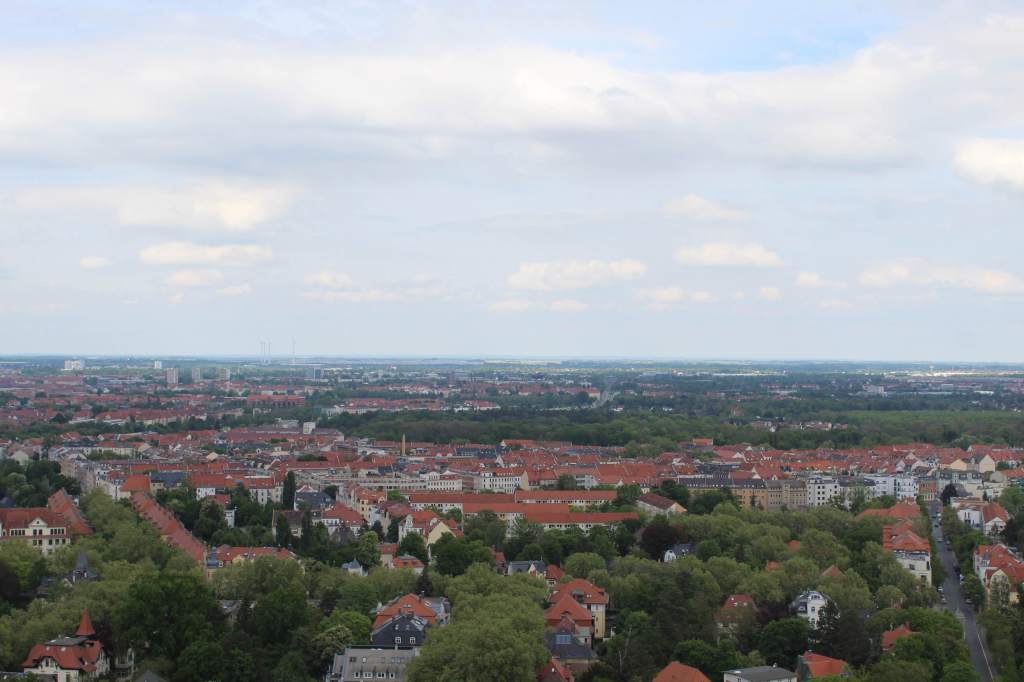
After much straining and many stairs, I finally reached the top viewing platform and looked out. The surroundings were flat and green, the land lying low beneath the close gray sky. There was nothing remarkable about it, nothing dramatic or noteworthy. It was hard to believe that such a plot of earth was the home to one of the greatest musicians of history, was the site of a battle that changed the destiny of Europe, was marked by nationalism, fascism, communism, and the struggle for freedom. All this, and more, fit into the story of this mid-sized German city.


Great piece Roy! I didn’t know you loved Bach and am happy you do. A sensitive and well thought overview.
loved your survey of Leipzig too. Your blog was always very interesting and this piece is marvelous.
LikeLiked by 1 person
Thank you very much for the kind words!
LikeLike
Nice to read op Leipzig! Visited in 2020, under special circumstances. “Hidden gem” is perhaps too much of a cliché but Leipzig is certainly overlooked too much.
LikeLike
I agree!
LikeLiked by 1 person
Thanks Roy for this very revealing and enjoyable guide to Leipzig, which I’ve never visited. I love Bach of course, but the part about the Stasi was new to me (I’d assumed they worked from East Berlin). Thanks again.
LikeLike
Thank you! I believe the Stasi had local headquarters in every major GDR city.
LikeLike