(This post is a continuation of my series on Day Trips: Click here for my post on Alcalá de Henares.)
“Just once, I’d like to begin a blog post without our travel troubles!” I said to GF as we walked around, confused and lost, looking for the bus to Chinchón. We’d just walked fifteen minutes in the wrong direction, and were heading back to the metro station now.
“Shut up,” she said. “I have it here on my phone.”
Indeed she did; and we were soon standing by the appropriate bus station near Conde de Casal, waiting to go to Chinchón.
Chinchón is a small town—its population is about 5,000—just south of Madrid. It isn’t the home of any big castles or cathedrals; it isn’t the place to take the best photos or hear the best music. Rather, Chinchón is a place to sit and eat, and that’s what we planned to do.
After an hour on the bus, we arrived. Immediately we headed for the plaza mayor, the most famous place in the town, a five minute walk from the bus stop.
This was the first week of January. We had this week off for Tres Reyes, the Spanish holiday celebrating the three wise men who visited infant Jesus. Instead of giving presents on Christmas, this is the day when most gifts are exchanged. And lucky for us, the combination of Christmas, New Year’s, and Tres Reyes makes for a long, long holiday.
We’d just gotten back from our Christmas trip to Andalusia, and were thirsting to see more of Spain. Unfortunately, Madrid and its environs are a good deal colder than the south of Spain. We were freezing. Added to this, the weather was awful that day, overcast, windy, with a bit of rain. It was the kind of dull, dreary weather than can make the Taj Mahal look dreadful.
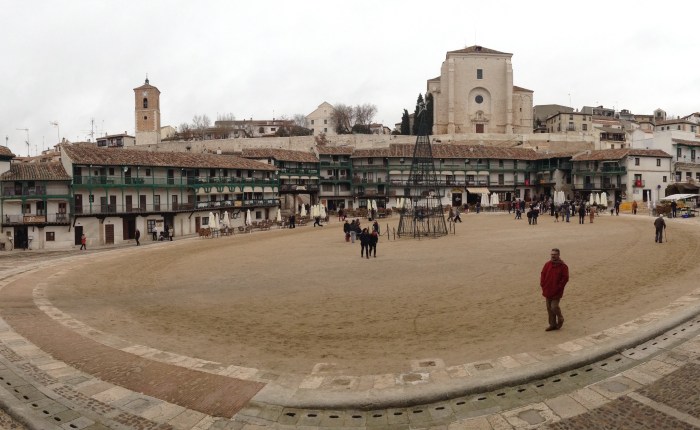
But the plaza mayor of Chinchón didn’t look dreadful at all. It looked positively cute. Identical white buildings with green balconies and tiled roofs surrounded a circular area in the center. This center was filled with sand. A few guys were selling donkey rides to kids, leading a long train of donkeys with excited children bouncing on top of them around the square, while their parents walked cautiously beside. A plastic Christmas tree decoration sat in the exact center. Every building had a restaurant or two, which was good because we were already quite hungry.
Being a man of this modern age, I looked on my phone for the restaurant with the highest rating: it was called La Villa. Of course it was expensive (for a Spanish restaurant). But it was the new year, and we felt like living high.
I’m glad to report that I absolutely stuffed myself, and then ate some more. The house red wine was also just fantastic, dangerously so, for I drank too much of it. After I ate and drank my fill, we ordered dessert—also great—and then asked for the check. This came with two complementary shots of Chinchón, which is the local liquor, apparently. Since my girlfriend can’t drink, I had to have both shots. It was strong, I tell you, and had a subtle liquorish flavor, a bit like Jägermeister. As we walked out, we noticed a bunch of black-and-white pictures hanging on the walls. Closer inspection revealed that they were of bull fights in the plaza mayor of Chinchón. Apparently, it was originally a bullring, which explains its symmetrical layout.
After this, there’s not much to tell. Stomachs painfully full, we waddled around town a bit. We found a castle, ruined and empty, which we couldn’t enter. There were several churches, closed to visitors. And then there was a view of the countryside beyond, rendered a bit dour by the weather. An hour later we were waiting at the bus stop with a bunch of chatting old ladies, and an hour after that we were sitting at home, drowsy, relaxed, ready for our next trip.
The Castle of Chinchón
Addendum: For any visitors of Madrid looking for a day trip to see a beautiful Spanish pueblo, Chinchón is perhaps the best choice. Small, intimate, easily accessible, and one of the most charming pueblos in the country, Chinchón is also famous for its gastronomy.
The liquor I mentioned above is Anís, which is simply referred to as “Chinchón” in Spanish, since this little town has long been the leading manufacturer of the drink. Chinchón is also famous for its pastries; its signature pastry has been appropriately compared to a breast, complete with a nipple on top.
The castle I mentioned above was built in the sixteenth century. Standing nearby, the visitor gets an excellent view of the surrounding countryside. Chinchón’s Plaza Mayor has not only been the site of bull fights, but also executions, comedy performances, royal proclamations, and many movie scenes. If you walk from this plaza up to the Torre Reloj, you will be rewarded with a marvelous view of the town.
(I wrote this post only a few months after my arrival in Spain, while I was still mostly ignorant of the country and its language. With the exception of Chinchón, I have visited all of these places since then, so I have appended little notes at the end of my posts about what I now know. I have also broken up my original post for ease of navigation.)
There are many advantages to living in Madrid. It’s big, it’s bustling, and it’s diverse. But one of my favorite aspects of Madrid is its location. By design, the capital of Spain is almost equidistant from every corner of the country; to drive from Madrid to Catalonia, to Andalusia, to the Basque Country, and to Galicia all take roughly the same amount of time. And transportation isn’t hard to find; the city is well connected by rail, highway, and plane to all points of the compass. Travel is cheap, easy, and fast.
As a consequence, there are a great many excellent day trips you can take from Madrid. I’ve already written about some of them: Toledo, Segovia, and El Escorial. In these posts, I want to talk about some of the perhaps lesser-known cities for day-trippers. I’ll start at the very beginning, with my first trip inside Spain.
Alcalá de Henares
As soon as I got to Spain, I blabbed to everybody I met that I had read Don Quixote. I was very proud of this, for I thought it gave me some kind of badge of honor in Spanish culture. And indeed, a few people seemed genuinely impressed—though less so when I told them I read it in English.
“Ah, so you like Cervantes?” a friend of ours said.
“Oh yes, he’s incredible.”
“You should visit Alcalá de Henares, then. It’s where Cervantes was born.”
This was only our second week in Spain, and we were still a bit disoriented by our surroundings. The prospect of taking an actual trip in Spain seemed almost Herculean, an added challenge to the day-to-day struggle of navigating our new city. But I was determined to get culture, by hell or high water; so as soon as we could, we made it to Atocha station and took the Cercanías to Alcalá de Henares. (For once in our lives, we found the train without a problem.)
The train was too full for us to sit down. We stood by the doors, both of us swaying nervously with the ever-present anxiety you feel when in a strange environment. I was looking forward to seeing the area around Madrid, but the windows were smudged and dirty; and the view, from what I could see, wasn’t much anyway—just the featureless tan wasteland of the dry foothills. Before even coming to Spain I had terrified myself by reading online stories about the ingenuity of pickpockets in Europe, and couldn’t stop casting interrogative glances at all the passengers around me, wondering whether any of them were thieves eyeing me up, waiting for the perfect moment to strike.
Station after station went by, and I was paying fierce attention to all of them, paranoid that we would miss our stop and get hopelessly lost. It’s really exhausting traveling somewhere totally new—it is for me, at least—because you can’t take anything for granted. The doors of the trains work differently; the seats are arranged differently; the automatic announcer is speaking a foreign language. Added to this, I was constantly afraid of doing something wrong by accident, breaking the train etiquette of Spain and drawing everyone’s attention to myself. It’s pretty amusing to me now, as I look back; but then it was just stressful and scary.
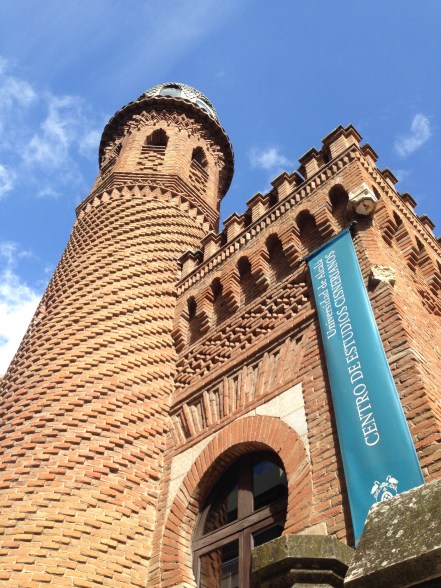
We arrived. After some confused mucking about, we began making our way to the center of town. Neither of us had Spanish SIM cards yet, so our phones didn’t work. We just followed the crowd, who all seemed to be walking in the same direction. The city seemed rather ordinary at first—though even this was interesting to me, since I hadn’t seen any city in Spain besides Madrid yet—but soon something caught our eye. It looked like a little castle, with a tower on one end and a tiny battlement at the top of a square structure.
But what really made it stand out was the intricate ornamentation. The façade of the tower, for example, was covered in swirls. It was quite pretty. Although we didn’t know this at the time, it’s called the Palacete Laredo, and is one of the famous monuments of Alcalá. It was originally built as a private house for Manuel Laredo, a polymath artist who served as the mayor of Alcalá de Henares. Nowadays, it serves as a museum of the Cistercian order, as well as a specialized research branch of the Complutense University.
Looking back now, I can tell that it was built in a Neo-Mudéjar style, with crescent arches and a domed minaret. The top of the main building, however, is not Neo-Mudéjar in style, but rather looks like a small copy of the Alcázar in Segovia. In fact, the more I look at my pictures, the more of a stylistic jumble the place appears, with all sorts of different Spanish architectural elements mixed together. Of course, at the time I just thought it looked weird.
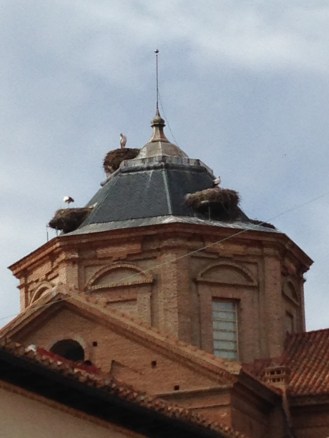
We kept going, following the trickle of pedestrians into the center of town. Eventually the buildings started to look older; the streets were narrower here and paved with stone. But what most caught our attention was a big beautiful bird, sitting on top of an old church. It looked so incongruous and stood so still that we were convinced it was fake—that is, until it twitched its head. When we got a bit closer we could see it had built a big, bushy nest up high on the building.
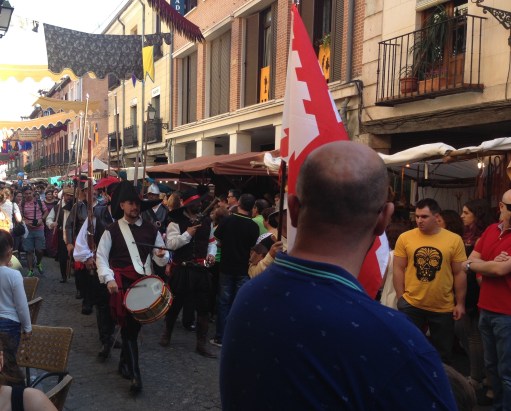
As we moved on, following the throng of people wherever it seemed thickest, we eventually found ourselves in a dense crowd. Little shacks were set up all over the place, selling cheese, sausage, olives, nuts, spices, tea, wooden bowls, leather bags, colorful scarves, cheap jewelry. Not only that, but all the people in these shops were dressed up in funny outfits, like they were in Medieval times. Was Spain always like this on the weekends? I was both excited and terrified—excited to see a slice of Spanish life, but now scared more than ever about being pickpocketed.
We rounded a corner and came across an outdoor restaurant. Dozens of tables and chairs were gathered under a tent. Several harried men in ridiculous costumes—looking like court jesters, with striped red and white shirts and big puffy hats—were running left and right, carrying massive trays of food. Outside the tent was the cooking area, where a large circular charcoal grill was covered in sausages, meats, fish, and vegetables of all kinds. Immediately I felt very, very hungry. From the shops were hung all manner of flags and banners painted with signs from medieval heraldry—black, yellow, and red.
Every new street we entered was more packed than the last. Soon it dawned on us that this wasn’t at all normal, but was some kind of special festival. As if to confirm our suspicion, a group of men dressed up like medieval soldiers, with fake swords by their sides, paraded through the crowd while another man, dressed in rags, pretended to be a lunatic. One of the soldiers held him by a rope, while the maniac ran after people in the crowd (mostly women), gargling his throat and reaching out his dirty hands. Another soldier was beating a big bass drum, while they all shouted things that I couldn’t understand.
(As we later learned, this was the Cervantino, a medieval fair named after Cervantes, which is held in the first couple weeks of October. I have since gone back twice, and I highly recommend it.)
We wandered along this way, two bewildered Americans, absolutely intimidated by our surroundings, until eventually we were standing in front of a couple of statues. I immediately recognized these as being Don Quixote and Sancho Panza; both of them were sitting on a bench, and seemed to be having a damned good time. In between the knight errant and his square there was a space on the bench where tourist after tourist was lining up to have their picture taken. I would have had my picture taken, too, if I wasn’t so afraid that my phone would disappear as soon as I took it out of my pocket.
Behind the bench was the Cervantes House—the house where Cervantes himself was born and reared. We got on line and went right in. It’s quite a small place, actually. In the center of the house is a little courtyard, around which every room is situated. The insides of these rooms were furnished to look like they would have during Cervantes’ lifetime. I have to admit not much caught my eye, except perhaps the old kitchen equipment. It was more rewarding just to pace about, thinking that I was standing in the very place where Cervantes, that master of masters, entered into the world. This feeling was so strange to me that I’m not sure I quite took it in. This was perhaps the first appearance of “European Travel Syndrome” in my life. You simply can’t have an experience like this in New York.
The statue of Cervantes in the main square
In just half an hour, we were out in the street again. We didn’t know anything else to do except walk around, seeing as much of the city as we could. Many of the buildings were impressive; but at this early stage, we didn’t really know how to go about visiting buildings or even how to look at them. In fact, what I most remember were not the buildings themselves, but the dozens stork nests sitting snuggly on rooftops, their bushy lairs looking somehow both ridiculous and majestic.
Eventually, we decided to sit down to eat in one of those tent restaurants. The waiter ran up to us, his floppy hat thrown over to one side of his head, and asked us in a slew of Spanish words what we wanted. We ordered two things, and he was off. At this point, we were so clueless in Spanish that most of the time we didn’t even know what we were ordering in restaurants. This was a classic example: We asked for “pimientos fritos” thinking they were french fries; five minutes later, the waiter dropped a plate of fried, salted green peppers on our table. I know, I know, this is an embarrassing mistake, not least because “potato” is “patata” here—not hard to guess.
The upside of our ignorance was that we ended up learning a lot about Spanish food, since we accidentally ate a lot of it. These pimientos were a case in point: we loved them, and pimientos now are one of our staple dishes. Really, if you’re in Spain and you can’t speak Spanish, just go into a restaurant and order whatever sounds interesting. All the food is good here.
After eating the pimientos, and then following it with a plate full of chorizo and tomato sauce on bread, we began to walk around again. But I’m afraid we didn’t do much of interest; and in an hour, we were on our way back to the train station to return to Madrid.
Reading over what I just wrote, and comparing it to what I find online about Alcalá de Henares, it’s obvious to me that we left most of the main sights unseen. Oh well, next time. But it was a fantastic stroke of luck to arrive on the very weekend when they were having their famous Medieval Market. And as I look back on it, this trip seems to presage our whole time in Spain so far: we arrive clueless and unprepared, and yet everything works out marvelously. Traveling in Spain is, in fact, a lot like ordering in a Spanish restaurant: even if you have no idea what you’ll get, you can be sure it will be delightful.
Addendum: Since this initial trip, I have since learned that Alcalá de Henares has been more than simply the birthplace of Cervantes, but has played an important role in Spanish history.
The city has existed since at least Roman times, when it was known as Complutum. It was in this town that Cardinal Cisneros, one of the leading functionaries of the Catholic Monarchs, founded the University of Alcalá in 1499. Under his direction the scholars of the university undertook and completed one of the greatest intellectual accomplishments of the Spanish Golden Age, the Polyglot Bible, which contained the entire text of the Old and New Testaments in three languages: Latin, Hebrew, and Greek—and sometimes Aramaic. The University was eventually moved to Madrid, where it was renamed the Complutense (which comes from Alcalá’s Latin name); and it remains one of the major universities in the country.
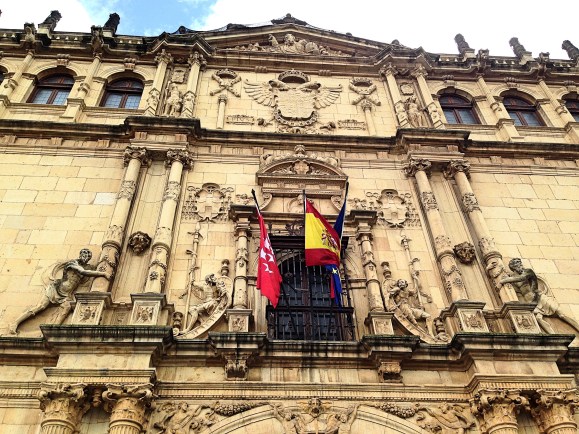
The original university building still stands in Alcalá’s main square. Its frontal façade is magnificent, and for a small price you can take a guided tour to learn about the university’s history.
The Cathedral of Alcalá is also worth a visit. Although it was burned during the Spanish Civil War, thus destroying many of its decorations and altars, it remains an attractive building. The cathedral is, curiously, the unique for being the only one in the world which possess the title “Magistral Church,” which requires that all of its priests be doctors in theology.
(This post is part of my series on the Basque Country. Click here for Bilbao, here for San Juan de Gaztelugatxe, and here for the Vizcaya Bridge.)
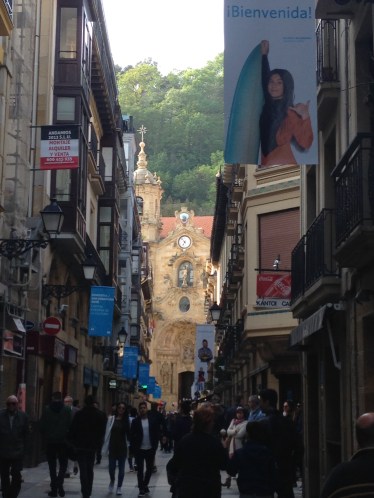
San Sebastián is a city much unlike Bilbao. For one, it is noticeably smaller, with a population of less than 200,000. But more conspicuously, it is not at all a city of industry, commerce, or manufacturing. Rather, it is a place of tourism. The streets are full of foreigners, squeezed into the narrow streets, filling up the parks, covering the beaches with their bodies. The city is also remarkably pretty. As I strolled along the beaches I was reminded of Cádiz; and as I wandered through the streets, Oviedo came to mind. But the strongest and most persistent impression was surprise at the number of tourists. They were all over the place; every restaurant was full, every shop was crowded. The shoreline was an unbroken wall of hotels. I had no idea San Sebastián was so popular.
Some of this probably had to do with the city being (along with Wroclaw in Poland) one of the European Cultural Capitals of 2016. (Each year, a city or two in the European Union gets designated a European Cultural Capital, which means it will host several Europe-oriented events during the year.) This may have attracted even more tourists than usual. Even so, it is clear that San Sebastián is a major tourist destination, because its whole economy is oriented around visitors. This is fitting, for the city is undeniably charming. Its location is a good one, too, being only 12 miles from the French border, and northerly enough so that the temperature is nearly perfect in summer.
We were hungry when we arrived, so our first order of business was food. Our Airbnb host recommended a restaurant in the center. The restaurant was the Bar Aitona, and it was excellent. We ordered the steak and the octopus. Both were served on a huge bed of fries, both were amply portioned, both were well seasoned, and both were scrumptious. Added to that, the prices were very reasonable. We left very full, and very satisfied. I recommend it with great enthusiasm.
When we were back on the street, we decided to start exploring the city. This inevitably led us to Monte Urgull, the most conspicuous landmark in San Sebastián. Urgull is a hill that overlooks the bay. Nowadays, it is covered in trees, and is basically a park; but in the past it formed as a military fortification, since its high elevation at the bay’s edge made it well suited for defense. And these fortifications were not just for show; they were used in several important battles. Probably the most significant of these was the Siege of San Sebastián, in which the British forces, led by Wellington, ousted Napoleon’s troops in the Peninsular Wars. Of course, I didn’t know any of this at the time, but was instead attracted by the gigantic statue of Jesus—12 meters, or almost 40 feet tall—that looms over the hill.
We began walking up, and quickly found that it is a delightful place. Old walls, broken battlements, obsolete canons, and other aging fortifications still stand, some in ruins, some overgrown; and for me there is something remarkably romantic about the sight of weeds and trees reclaiming the abandoned dwellings of past times. The hill is divided into several levels, and as you ascend you get a progressively better view of the city. From the top, the whole shore is spread before you, with its azure water, crowded beaches, and the rolling green hills in the distance. We got to the top, where we could stare up at the towering figure of Jesus, and then descended on the other side of the hill.
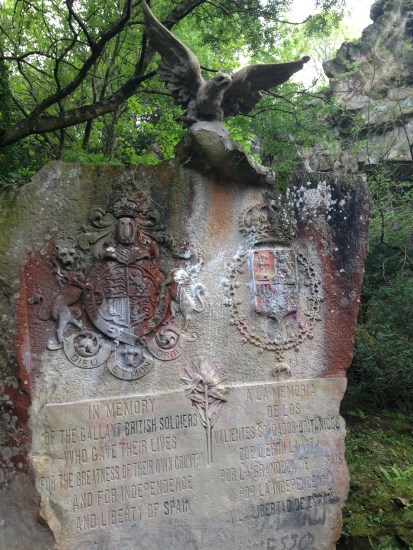
This part of was a wooded area. But as we climbed down a rocky path, something caught our eye. Right below a cliff, surrounded by roots and trees, was the old memorial erected by the British army after the conquest of San Sebastián. A broken and discolored plaque, bearing the royal insignias of England and Spain, bore a message in both English and Spanish honoring the fallen soldiers. Further on, we noticed another plaque, this one on the side of a rock face, honoring the unknown soldiers lost in the campaign. I know these must be well known, but at the time, with only the two of us, it felt like coming upon an archaeological treasure. This illusion was quickly dispelled, since at the bottom of the hill we encountered a map showing where all the different war memorials, graves, and mausoleums could be found on the hill. In any case, it’s a lovely area, both for its history and its views.
The rest of our day was rather uneventful. We strolled around San Sebastián, enjoying the ocean, the river, the crowded city center. But we did not really visit anything in particular, since we couldn’t find anything to visit. It seems that San Sebastián is a lovely place if you want to eat and go to the beach, but it does not have much in the way of cultural tourism, which is mostly what I’m after. In any case, it was late. We had arrived at around noon, and by now the sun was setting. So we walked along the river to our apartment, and the next morning we said farewell to the Basque Country. But I hope to return, the sooner the better.
(This post is part of my series on the Basque Country. Click here for Bilbao, here for San Juan de Gaztelugatxe, and here for San Sebastián.)
The train pulled up to Portugalete station, the doors opened, and we got off. Portugalete is one of the towns, ranged along the Bilbao river, that make up the Bilbao metropolitan area. (The name’s resemblance with “Portugal” is apparently only a coincidence.) With a population of about 50,000, and a land area of only 3.21 square kilometers, it is actually the fifth most densely populated area in Spain.
To me, the place struck me as a pleasant, moderately urbanized, more or less tranquil town. Along the riverside there were some large, attractive restaurants, their tables crowding into the streets—though at this hour, too early for dinner in Spain, the chairs were mostly empty. But the surroundings didn’t attract my attention for long, since I could already see my goal: the Vizcaya Bridge.
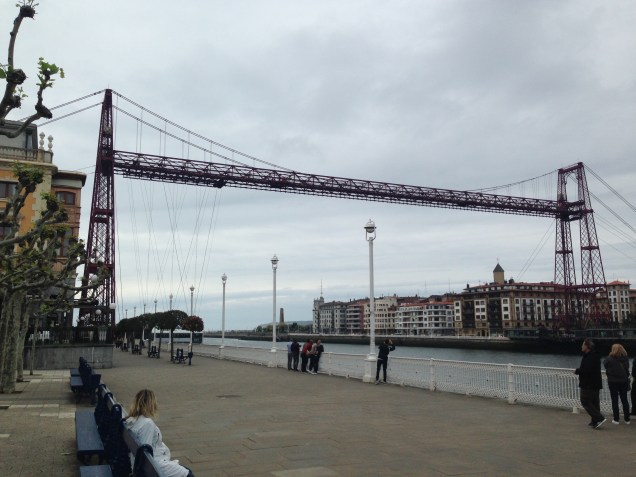
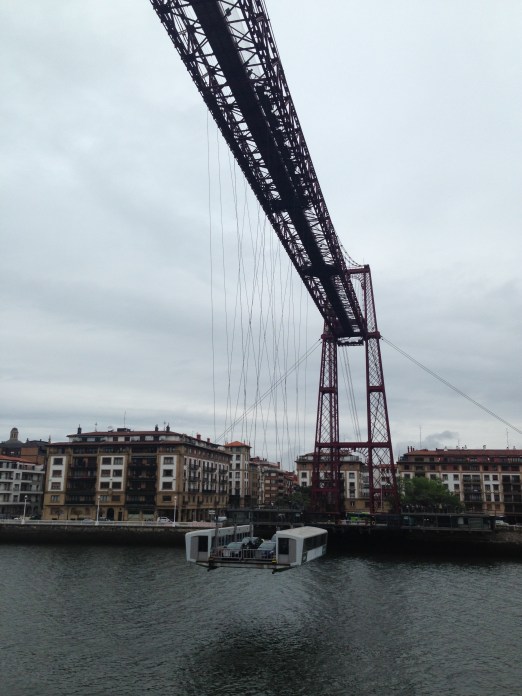
In Spanish it is called the Puente Colgante, or “Hanging Bridge.” The name is appropriate. It is a perplexing sight at first. The bridge has the familiar form of a suspension bridge; but the middle section seems to be misplaced: it hangs ludicrously high in the air, with no ramps to get up or down. The more I looked, the more confused I became, for there didn’t seem to be any way you could use the bridge.
As I got nearer, I noticed something strange on the water. It wasn’t quite on the water, actually, but hovering above it. I looked up, and saw that the thing was hanging from the bridge. So that’s how it worked! The reason the bridge looked so odd was that it transported a shuttle that hung underneath, almost like a puppet on strings. That’s why the bridge was so high up and there weren’t any ramps to get on.
But it looked dangerous to me. The shuttle was fairly large; it transported about six cars and one hundred people. Could that skeletal iron structure above support so much weight? Dreadful fantasies immediately started rushing to my mind. I saw the bridge snapping in the middle, sending iron raining down into the river below, crushing the shuttle and sending everyone inside to a watery grave. Unfortunately, awful visions like this plague me rather frequently. I wonder if it’s the product of a morbid imagination, or just watching too many action movies.
We went into the office and bought our tickets, though I wasn’t sure what the tickets were for. The man explained that there was an elevator to take you up to the top, where you could walk to the other end. He also gave us a little information pamphlet about the bridge. From this, I learned that the bridge is actually a UNESCO World Heritage site, the only monument in the Industrial Heritage category in Spain.
I also learned more about the construction and history of the bridge. The Vizcaya Bridge is a transporter bridge, the first of its kind in the world. If you haven’t heard of a transporter bridge before, that is perfectly normal, since this type of bridge is uncommon; according to Wiki, less than two dozen were built, and only 12 still stand today.
The Vizcaya Bridge, finished in 1893, was designed by one of Gustave Eiffel’s disciples, Alberto Palacio; and Eiffel’s influence shows. The bridge is built in the same manner as the Eiffel Tower, with narrow iron beams riveted together to form a triangular grid; and like the Eiffel Tower, the Vizcaya Bridge is austere and elegant. Palacio originated the idea in response to a common engineering problem: how do you create a bridge that allows people and cars to cross the river, while leaving the river open for shipping vessels? The Vizcaya bridge, then, in both purpose and execution, is a symbol of the Basque Country’s embrace of industry, commerce, and the future—not to mention art.
(I do wonder, though, whether Palacio’s solution was all that efficient. After all, there must be a reason why the design didn’t catch on. The primary problem, it seems to me, is that the amount of cars and people that can cross at any one time is limited by the size of the shuttle and the frequency of its trips. Perhaps the famous Tower Bridge in London—completed almost the same year—solved the problem more satisfactorily, by putting a drawbridge on the lower level and a pedestrian walkway on the upper. But Palacio’s design is beautiful, original, and elegant, so efficiency can go to the devil.)
Finally it was our turn for the elevator. It was an ancient thing, crawling up the bridge at a snail’s pace. Eventually the lift creaked to a halt, and we got out. A narrow wooden walkway, surrounded by the iron structure, extended from one end of the bridge to the other. It’s really amazing how much of the Vizcaya Bridge is just air. You can see right through the thing, and yet it is strong enough to support the weight of a large shuttle carrying six cars.
I experienced this when one of the shuttles came rolling by, right underneath our feet. I could feel the entire bridge shaking, rattling, and shivering, as the electrical buzzing of the engine roared past. Once again, terrible fantasies started flickering through my mind, this time with me myself plunging to a ghastly death. But soon the shuttle came to a halt, and I realized that the bridge was solid as stone. What an impressive achievement: The bridge seems to float high up in the air, supported by the slenderest structure; and yet it is sturdy enough to remain operational after more than one hundred years of daily use.
We took some time to admire the view. On one side we could see the bay, and then the ocean beyond. In the dockyard in the distance, I could see dozens of giant cranes standing silently, like petrified dinosaurs, waiting to come back to life. On the other side, we could see the river gradually making its way towards Bilbao; and in the distance, a factory loomed. Really, wherever you turned you could not fail to notice the signs of industry, filling up the entire estuary with their jagged, colossal, metallic forms. Below us, we could see the towns of Portugalete on one side and Getxo on the other, their streets now full. We might have stayed more time up there, but the wind was quite strong and chilly, so we took the elevator down on the other side. Not long after that, we took the shuttle from Getxo across the river, back to Portugalete; and I am happy to report that the ride was quick and smooth.
There is only one thing more I have to report. Before we left, GF had asked some of her students in Madrid where you can buy good pizza, and they told her to go to Telepizza (a popular chain here, comparable to Dominoes). That sounded awful to me, but GF wanted to try it; so, once we got to Portugalete, we decided to go to the nearest Telepizza for dinner. It brings me no joy to tell you that, as I expected, the pizza was horrible, some of the worst pizza I’ve ever had; and GF was of the same opinion. Is this what Spanish people think pizza is supposed to taste like?
(This post is part of my series on the Basque Country. Click here for Bilbao, here for the Vizcaya bridge, and here for San Sebastián.)
I always find public transportation a bit nerve-racking—especially in a new city, not to mention a foreign country. Every time I hop on a bus, I feel like I’m taking a leap of faith. I imagine taking the wrong bus and getting stranded in the middle of nowhere, or taking the right bus and getting off on the wrong stop—and these fears aren’t totally unfounded, as I’ve done both of these things. Thus I was filled with apprehension as we searched for the bus to Bakio, the A3518.
Probably you have never heard of Bakio, because there isn’t much to be heard about it. Bakio is a small town, with a population of about 2,500, situated about 30 kilometers from Bilbao. There is admittedly a beach there, although the damp, chilly, overcast weather of the region didn’t exactly put me in the mood for surfing. Rather, we were going to Bakio because it was the closest we could to get by bus to San Juan de Gaztelugatxe.
The town of Bakio
The bus ride to Bakio was quite pleasant, taking us through the green countryside, filled with little huts and farmhouses tucked away into the rolling hills. After 40 minutes we arrived, ate some breakfast, and then set on our way. I had found a little report online (found here), written by somebody who had walked from Bakio to Gaztelugatxe. And attached in that report is a little map, with the walking route conveniently highlighted. But for whatever reason I forgot about this map as we started walking. Instead I chose to rely on my phone’s GPS to guide me there. Please, don’t make this mistake: just follow the walking route.
GF and I soon found ourselves walking along a busy road, with no sidewalks.
“Are you sure this is the right way?” she said.
“Yeah, I’m just following my phone.”
“Okay…”
We walked further, and after a while came to a sharp curve in the road. Because there wasn’t any sidewalk, and the road was hemmed in by a rockface on one side and some trees on another, we found ourselves in the predicament that, no matter which side we chose, we would risk making ourselves invisible to an incoming car. Thankfully, the cars only came periodically, with big gaps in-between; and we hoped we’d be able hear them a ways off. Still, it was nerve-racking as we rushed around the corner, trying to minimize our time on the curve.
“I hope there aren’t any more curves like that,” GF said as we got to the other side.
“Me too,” I said.
But five minutes later, we came to another curve. And then another, and another. The entire road, it seemed, wrapped around the hills like a snake, constantly turning left and right. Meanwhile, the amount of cars on the road seemed to be steadily increasing.
“I don’t like this,” GF said. “Is there any way off this road?”
“Umm,” I said, “maybe up ahead.” (I had no idea.)
During the stretches of straight roads, I did my best to enjoy the scenery. It was a nice place, with pine trees and farmhouses all around, and the occasional view of the countryside beyond. But the whoosh of a passing cars destroyed any peace to be had; and the sight of every sharp turn ahead increased my anxiety.
There was over an hour of this, the two of us walking on through the brush and bushes by the side of the road, our feet searching for stability amid the roots and rocks, changing sides whenever it seemed more safe, pressing ourselves against the trees whenever a car went past, rushing around curves with our adrenalin racing, GF nervously complaining while I tried to keep my own fears to myself. And then, finally, just as I was at my wit’s end, the hermitage came into view.
“Yes!” GF said, filled with relief.
§
San Juan de Gatztelugatxe (recently made famous in Game of Thrones, as the location of Dragonstone) is an island off the coast of Biscay, connected to the maindland by a man-made bridge. Since at least the 10th century, a little religious building has been perched up at the top of it, though it has burnt down and been rebuilt many times, most recently in 1980.
To get there from the road we had to climb down towards the shore. The path was steep, twisting, and rocky. Even though you’re going down hill, it is exhausting because you need to be constantly on guard against falling. At last we got near the bottom, where there was a lookout point from which we could get a good view of the island.
It must be one of the most astonishing sights in Spain. The island is a mound of jagged grey rock, covered in slight patches of green. Its splayed form stretches out into the sea, wherein it is battered day and night, on all sides, by the winds and the waves. In the middle of this island, criss-crossing its way up from the bottom to the top, is a staircase—usually filled with the miniscule forms of people going up and down. And crowning the island is the hermitage, a small shack with a dull red roof.
Perhaps this image is so appealing to me because I find in it a symbol of the relationship of humanity to nature. We have carved a staircase into the rock, and erected a place of worship on the summit of the island; and in this way we can be said to have dominated the place. And yet, how feeble our dominance of nature seems when viewed from a distance—just a pile of boards, liable to be blown away by the first strong gust. This is the age-old contest of craft, cleverness, and perseverance against capricious, indifferent power. And I cannot help thinking that, however successful we are now, there will come a day when the hermitage blows down, and there won’t be anyone to build it back up again.
But these gloomy thoughts were soon gone as I huffed and puffed my way up the staircase to the top of the island. By now we had been walking over an hour next to that road, our hearts in our throats all the while; so we were understandably a bit worn out. It felt all the better, then, when we finally reached the top, and could look back towards the land.
In the distance, to our right, we could see the beach of Bakio; and to the left, nothing but steep, grey cliffs and green forests. Gigantic rocks stuck out of the ocean, the biggest one almost as big as the island itself. To one side, far off, I could see what looked like an oil drill. Apart from that, no boats, no freighters, no planes broke the endless blue of the sea beyond or the grey of the sky above. It felt like standing at the edge of the world.
We couldn’t go inside the hermitage, nor even peek through a window. This didn’t bother me, however, since judging by the looks of the plain exterior, the interior would be similarly nondescript. What we could do was ring the bell. A string hung from the bell on the roof to the ground below, and all the visitors were taking turns having a pull (one kid got a bit too enthusiastic, and his parents had to keep him away). I gripped the chord and lightly tugged, and the satisfying clang of a church bell sounded overhead.
Since neither of us had any intention of repeating that dreadful walk by the road, this time I looked up the walking path on my phone. We found the path without any trouble, which made me feel like such an idiot for not using it the first time. It was such a relief! Instead of the twisting, turning road we had a straight path, free of cars, taking us through quiet countryside. We passed through a copse of trees, and then through some fields where cows were grazing, making our way over gently rolling hills, the seaside on our right, until we were finally back in Bakio. The bus soon arrived, and then we were on our way to Bilbao, where we still had one more thing to see.
The bus crawled out of Zaragoza’s main bus terminal, Delicias, and quickly left the city limits. It was early morning. The landscape was entirely shrouded in fog. It wasn’t long before I gave up trying to see the countryside and fell asleep. When I awoke—with a headache and a nasty taste in my mouth—we had parked in Catalayud, a small town midway between Zaragoza and my destination, where we had to transfer buses. I was on my way to the Monasterio de Piedra.
I was still in a daze. That morning I had awoken at an ungodly hour to walk all the way across the misty city to catch an eight o’clock bus. I still felt chilled from the early morning air, but I couldn’t warm up, since it was nearly as cold inside the bus station as it was outside.
I looked out the station window to check if there was anything to see, but the fog acted as an impenetrable veil. This was a shame, since I had noticed Calatayud from the highway on the drive to Zaragoza, and immediately became intrigued. The town is nestled beneath towering cliffs, on top of which stands a commanding castle, whose walls look like they sprung spontaneously out of the rocks. This, it turns out, is the oldest and largest Moorish fortress still existent in Spain.
It wasn’t long before we boarded another bus. Again, I fell asleep immediately, only coming to my senses as we approached the monastery. The fog had cleared by now, and I could see that our bus was creeping along a fairly narrow road, situated above a river; red cliffs ran along the other side. This dramatic scenery was an omen of what was to come.
Finally we arrived. We all shuffled out of the bus and made our way past the walls and into the complex. I waited in line and bought a ticket, still fairly ignorant of what I was paying for. I had come here on the recommendation of friends; and as usual I hadn’t looked up any information about the place before coming.
§
The Monasterio de Piedra is situated at the confluence of the rivers Piedra (thus the name) and Ortiz, in a remote spot within the Iberian Mountains. Founded in the late 12th century by the Cistercians, the monastery was a symbol and outpost of the accelerating Reconquista, the Christian push southward against the Moors, who then controlled all of Aragon and beyond. As such, the monastery was liable to being attacked, which is why defensive wall surrounds the complex.
During the centuries of its use, as the Cistercian monks worked and prayed along the banks of the Piedra, steeped in the cool mountain air of the region. The Moors, who had so long controlled and shaped the Iberian Peninsula—it was the Moors, for example, who established the city of Catalayud that I passed through—eventually lost control, and the small Christian principalities and kingdoms were merged into larger and larger states. It wasn’t long after the “reconquest” was completed, and Castile and Aragon were unified under the “Catholic Monarchs,” that Columbus made his famous voyage to the “Indies,” thus commencing Spain’s brutal colonization of the New World. It was here, in this monastery, that chocolate was first made in Europe, after Hernán Cortes send cacao beans and an Aztec recipe to the monks here.
Three hundred years later, Spain was again divided. In 1833, the first Carlist war commenced, a war between two contending successors to the throne, Carlos de Borbón and Isabella II (who won, and was eventually deposed). Heavily in debt from the prolonged civil war, the Spanish government commenced another of its desamortizaciones, or confiscations, of Church property. Besides the financial incentive, the conservative Church hierarchy supported the reactionary Don Carlos, so this move had both financial and emotional appeal. In any case, it was during this desamortización that the Monasterio de Piedra was seized and sold, thus putting an end to its Catholic history.
For reason of pure anti-clerical fervor, I presume, the church building itself was burned. Now all that remains is a ruined shell of a building. This is a shame, since was fragments that remains give some hint of a glorious medieval edifice. Some of the ornamental friezes around the doorways, for example, are of the finest quality. Now, however, the building’s appeal is Romantic rather than Romanesque. As I’ve mentioned elsewhere, ruins have a strange power to evoke feelings of mysterious awe. Certainly I felt this as I sat facing the destroyed altar, the walls reaching up to a vacant ceiling, the sky gaping overhead. It was like stepping into one of Caspar David Friedrich’s paintings—a timeless, fossilized wreck.
If the burnt church building is unintentionally romantic, the rest of the monastery is quite intentionally so. After briefly being owned by a wealthy Catalan merchant, who mainly used it for agriculture, it passed into the hands of Juan Federico Muntadas.
A well-educated and original man—among other things, he created the first fish farm in Spain—Muntadas was born in 1826, and was thus roughly of the same generation as Gustavo Adolfo Bécquer. And, like Bécquer, he was a Romantic. If you, for example, compare the royal gardens of Aranjuez or La Granja with Muntadas’s creation in the Monasterio de Piedra, you can get some idea of the mental difference between the Enlightenment and the Romantics. Whereas the royal gardens are neat, orderly, symmetrical, with clearly delineated plots for plants and paths for people, Muntadas molded a space that creates the sensation—if not exactly the illusion—of untrammeled nature.
The walking path through the monastery grounds takes about an hour. Though it was winter, the place was still quite green. Shallow ponds reflected the twisted and bare forms of tree limbs, while the verdant underbrush was speckled with the reds of crinkled fallen leaves. Small wooden bridges led the walker through this marshy area to the main attraction: the waterfalls.
Using the diverted waters of the Piedra and the Ortiz, Muntadas created a dazzling series of cascades. Varying in size from ankle-level to the size of an apartment building, these waterfalls are some of the prettiest I have ever seen. The rocks have been carefully placed to divide the stream into several rivulets, creating a dancing pattern of sparkling, splashing streams.
The path took me up beside one of the larger waterfalls and up a staircase in the adjacent rock face. Ivy, branches, and leaves were draped around the water, as if thirsty for a drink. Once at the top, we passed over a shallow stream, and followed it down again as it accelerated into a whooshing, multi-layered cataract, the stairwell winding its way downwards beside the water. Children and parents were crowded on the slippery steps, posing for photos. Along the way I caught a glimpse of the surrounding area, whose red rocky cliffs and rolling hills stretched into the far distance. The path continued, becoming narrow as it navigated the hillside, until finally we were led into a cave.
This cave—full of stalactites and stalagmites, green with algae, the jagged rock edges worn into eerie undulations by the water—was under the largest of the waterfalls. Water poured down at its entrance, filling the place with a ceaseless mist. I had to take off my glasses since they got so covered in droplets. We came out of the cave the same way we went in; then, after a walk through a long tunnel, I found myself by the famous Lago del Espejo, or Mirror Lake.
The shallow water, only inches deep and filled with aquatic plants, was uncannily reflective. And there was plenty to reflect, since the lake is situated underneath impressive rock faces, stretching up far above us and casting imposing shadows. By this time I had completely fallen under the spell of the place. The impression created by so many manipulations of water and stone was that of deep, almost meditative calm. I felt perfectly relaxed and refreshed.
Finally I ended up where I had begun: by the old, burnt church. Quite hungry by now, I went to the restaurant near the visitor’s center, which had quite a good—and affordable—daily menu. Then, stuffed and exhausted, I boarded the bus to go back to Zaragoza.
Remote and difficult to get to using public transportation, El Monasterio de Piedra is yet another example of Spain’s seemingly inexhaustible treasures.
In the center of the province of Aragon, on the banks of the second longest river in the Iberian Peninsula, the river Ebro, sits the city of Zaragoza. (In Spain, the name is pronounced “Tharagotha.”) The fifth largest city in the country, Zaragoza is comparatively ignored by tourists. Yet the city is well worth a visit. Populated since Roman times, conquered and ruled by the famous warrior, El Cid, and then governed by the Muslim Almoravids until reconquered by Alfonso I, the city has a long and important role in Spanish history.
But all I knew about the place, when I visited, was that it is relatively cheap and relatively close to Madrid. So one puente (a long weekend) in December, I decided to explore the city.
§
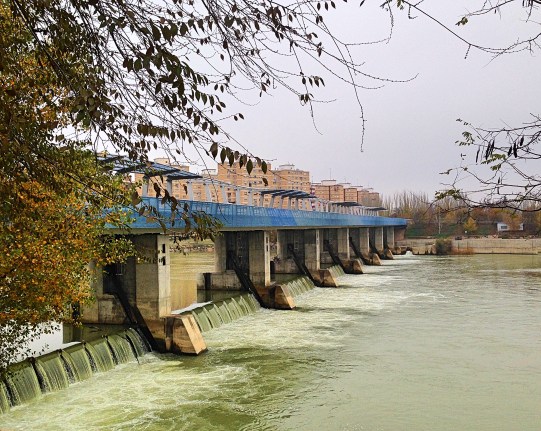
The drive to Zaragoza took us through Soria—“the ugliest part of Spain,” said the driver of my blablacar, who didn’t like the Martian red soil of the province (I disagreed). Zaragoza itself is situated betwixt several mountains, which protect the city from rain but do not shield it from the mist that drifts down during winter. The city huddles around both banks of the Ebro, a wide and powerful river that is periodically spanned by low-lying bridges, connecting both halves of the city.
I arrived fairly late in the day. The city was chilly, a fog hung about the air, some snow had recently fallen but little remained. My Airbnb host recommended a nearby walking path. I took her advice, having more than enough time to explore the city later. This path was called La Alfranca, and quickly led me outside the city and into the fields beyond, following the course of the Ebro going southeast.
This was my first trip alone in Spain. I enjoyed the solitude and the silence of the countryside. The skeletal forms of winter trees, arranged in neat rows, bisected fields of wheat. A lonely man in a tractor dug up a field. Joggers went by occasionally, but for the most part I was alone on the path. La Alfranca stretches 15 kilometers in total but I decided to turn back long before that, returning on the opposite bank of the Ebro.
Walking on in this way, I came back to the city. Eventually the magnificent form of Zaragoza’s famous basilica, Nuestra Señora de Pilar, rose up on the other side of the river, its four towers lit up from underneath with a pale yellow glow. I crossed over the Puente de Piedra, the oldest standing bridge in Zaragoza, which leads directly to the basilica. The design of this bridge is very similar to the Roman bridges that can be found in Spain, such as in Mérida or Córoba or Salamanca, but it was built in 1440, long after the Romans. There was, indeed, a Roman bridge that used to span the Ebro near that spot, but it was destroyed in the ninth century.
El Pilar
I found my way to the Plaza de Pilar, Zaragoza’s central square, which stands in front of the basilica. The place was bustling with life. A Christmas market, selling nativity figurines and specialty foods, surrounded the periphery. In the middle was a life-sized nativity display, fenced off, which you had to pay to enter; there was a long line of eager families waiting. On one end of the square was a skating rink, full of people slipping and circling, and on the other side there was a large artificial hill where children and adolescents could ride down on inflatable red sleds.
Kids sledding, with Le Seo behind
I went up to the food stand and ordered “hot wine,” which was warm and sweet, the perfect winter drink, and then I decided to eat dinner there. As I ate, the sound of music attracted my ears. A band, playing a fusion of traditional and rock music, was on stage performing; an accordion and a mandolin player supplemented the usual rock trio. I quite liked it. I stayed to watch the whole performance, and later, when it finished, a big group of amateur flamenco musicians set up chairs below the stage and began to sing and play. I must say I love encountering flamenco in this way, as a genuine part of daily life here in Spain. It is such a raw and gripping music, at once dramatic and unpretentious.
This was my first day in Zaragoza, a lovely walk followed by a lovely encounter with community life in the city. Already I had decided that I quite liked it here.
§
Day two. Now it was time to explore the city’s monuments. My first stop was, of course, Nuestra Señora de Pilar.
The basilica gets its name from a legend. Saint James the Greater was in Spain, attempting to convert the (then Roman) citizens to Christianity. Dispirited by failure, he began to pray at the banks of the Ebro, and the Virgin Mary appeared to him in a vision, holding in her hand a column of jasper. According to tradition, James then established a small chapel in Spain—the first ever church dedicated to the Virgin Mary. In the center of the beautiful main altar is a small wooden statue of Mary standing atop a small jasper pillar, believed to have been given to James by Mary’s accompanying angles.
One need not believe this story to believe that the basilica has an impressively long history. After Christianity was legalized in the Roman Empire and eventually made the state religion under Constantine, a basilica was built on the spot. This basilica subsequently underwent all the stylistic changes of Spanish history: Romanesque, Gothic, Mudéjar. In the fifteenth century a fire gutted and damaged the previous building; and thus the current edifice mostly owes its shape to the Baroque. Four high towers stand on each corner of the cathedral; a central dome, not quite as tall as the towers, is flanked by several smaller cupolas. The result is undeniably magnificent, giving the impression of tremendous size and elegant design.
The interior is equally grand, with white walls and long naves, flanked by rounded arches and topped with cupolas that let in the daylight. The decoration has none of that excess or horror vacui commonly associated with Baroque; rather the friezes and moldings are neoclassical in their symmetry and restraint. The floor-plan of the building is not a crucifix, but a grid, with several impressive altars nestled in different chapels.
When I entered, mass was being held in one of these, the Chapel of the Virgin. The priest stood before a statue of Mary, as she is carried up to heaven on a cloud, surrounded by a halo of golden sunlight. Along with El Transparente in the Cathedral of Toledo, this whole chapel, by Ventura Rodríguez, is one of the masterpieces of Spanish Baroque, clearly bearing the influence of Bernini.
The insides of the cupolas are decorated with colorful frescos showing scenes of heaven. A young Francisco de Goya was one of the painters who worked on these, though to my ignorant eyes his fresco does not have any of the distinctive marks of his later style. Among this embarrassment of riches, my favorite work was the main altarpiece, a colossal and stunningly intricate carving in alabaster. It is this altar that holds the legendary statue of the Virgin. My mind boggles as I contemplate the amount of time it would take to carve something so big and so finely detailed. One would think a lifetime would be needed for such a task; but the sculptor Damián Forment did it in just six years, from 1512 to 1518, mixing late Gothic and early Renaissance elements in the style.
El Pilar main altar
My next stop was Zaragoza’s cathedral, La Seo. Its real name is the Catedral del Salvador, but it is commonly call “La Seo” (Spanish for “Episcopal see”) to differentiate it from El Pilar. Somewhat unusually, Zaragoza doesn’t have one cathedral; instead El Pilar and La Seo share co-cathedral status.
La Seo
From the outside La Seo is nothing compared with El Pilar. Indeed for a cathedral it is quite diminutive and inconspicuous. This is not to say that it is unattractive. The main entrance is, admittedly, adorned with a somewhat bland neoclassical façade; but the campanile is really lovely, an elegant Baroque structure whose tan outline cleaved the foggy sky. I particularly liked the floating angels who hold up the central clock. On the other side of the building you will be surprised to find a mudéjar exterior, complete with geometrical patterns and six-pointed stars. About one thousand years ago, a mosque occupied this spot; and the influence of the Moors can be seen still.
Mudéjar exterior of La Seo. Photo by ecelan, taken from Wikipedia Commons
This stylistic jumble is a foretaste of what the visitor encounters on the interior. I still feel bitter that I was prevented from taking photos—I don’t know why some monuments prohibit them and others do not—since the chapels in La Seo are some of the most ornate and stunning that I have ever laid eyes upon.
Every chapel is in a world unto itself. Each one is executed in a different style. On the pillars and walls surrounding some were friezes of almost nauseating detail, full of vegetable patterns and gruesome figures, bodies and vines woven around one another in an intricate tapestry (this is called Churrigueresque). Not every chapel was so lavish; other were neat, orderly, and harmonious, and no less visually pleasing. I found myself staring in wonderment, spending a long time at each chapel, doing my best to disentangle the layers of images and commit the chapels to memory.
Considering that the visitor can find examples of so many different styles—Romanesque, Gothic, Mudéjar, Baroque, Churrigueresque, Plateresque, Aragonese Renaissance, and Neoclassical—La Seo is a veritable history of Spanish architecture in miniature. Its interior is just as impressive as the exterior of El Pilar.
My last stop was the Aljafería. This is the Alhambra of the north, a fortified castle that contains a Moorish interior. From the outside it is an imposing military edifice, complete with a moat (empty of water) and high walls. Though impressively massive, there is little to distinguish these walls, in my eyes, from other castles I’ve seen, except for a few horseshoe arches.
But this is far from true of the interior of the palace. Here you will find the greatest example of architecture from the Taifa period of Moorish Spain. This was the period after the fall of the Caliphate in Córdoba (1031), when power in the peninsula was highly decentralized, divided into many small “Taifa” kingdoms. The palace within the walls was mostly constructed between 1065 and 1081, under the auspices of Abú Yafar Al-Muqtadir.
This palace is the most magnificent example from this period in Spain’s history, and each room merits deep study. Unfortunately my ignorance only allowed me to gape with admiration as I walked through, appreciating much but understanding little.
One thing I did notice was that most of the arches were not the typical horseshoe shape I had come to associate with Moorish architecture. Instead, they are pointed arches, with a series of miniature arcs that provide ornamentation. (I believe the technical name is “mixtilinear arch.”) As is typical in Moorish and Mudéjar architecture, intricate stucco-work decorated the walls with fancy geometrical patterns and exotic arabesques; and the ceilings are the elaborate wooden type I have seen in many buildings across Spain. All of these features can be seen in the Golden Hall, the former throne room. Also characteristic was the garden courtyard, a cool interior space adorned with symmetrically arranged plants: this is the Patio de Santa Isabel, named after Isabel, canonized queen of Portugal (1282 – 1325), who was born in the Aljafería.
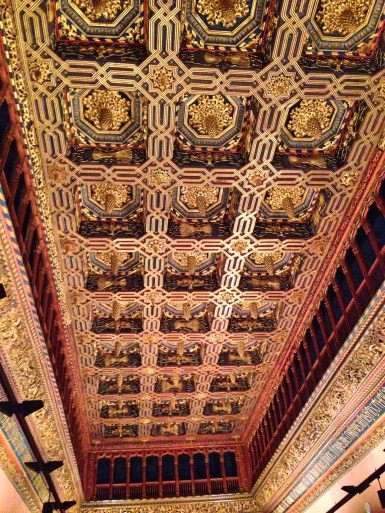
After inspecting this lovely space, I ascended some stairs and found myself in an entirely different world. This is the adjoining palace of Peter IV of Aragon, a Christian king of the 14th century. (Christians had conquered Zaragoza in 1118.) Though aesthetically quite different—closed spaces as opposed to open-air, for one thing—this palace is quite as lovely as the original, mixing Gothic and Mudéjar styles into a distinctly Spanish combination. The most impressive room is, as usual, the throne room, which is covered with a brilliant coffered ceiling—complete with six-pointed stars and hanging golden pine cones. This is a style of decoration called artesonado, heavily influenced by Moorish precedent and employed in many buildings in Spain.
The ceiling of the throne room.
As you can see, the Aljafería has served as the seat of power for Muslim and Christian rulers alike. And it continues that function today, as the home of the Cortes of Aragón, the province’s regional government. Considering the huge lines that often attend visiting the famous Moorish monuments of the south—the Alhambra, the Alcázar, the Mezquita—I would say that the Aljafería is well worth your time, since there was no line at all.
Now it was lunch time, and I’m afraid my story takes on a farcical tone at this point. I was feeling somewhat lonely, and what’s more I wanted to treat myself, since it was my first trip of the school year. So I went to Zaragoza’s famous eating neighborhood, a street called El Tubo, and found a mall that had an Arrocería (a paella restaurant). I ordered myself paella and some patatas bravas—fried potatoes covered in a mild sauce. But I found that this was far more food than I anticipated. The quantity of potatoes was obviously meant for two people. But I was treating myself, so I decided that I would overeat and try to finish them all. Despite my typically American ability to stuff myself, I couldn’t quite do it; my stomach was full to bursting. After that, I went to get a coffee and cookies.
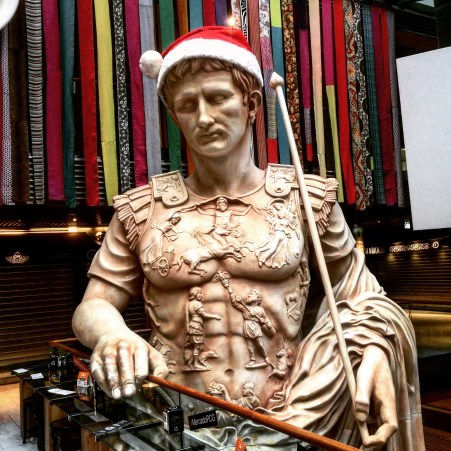
A giant plastic statue of Caesar Augustus, wishing you Merry Christmas
Uncomfortably bloated and feeling a little sick, I waddled my way to my next stop: the Museo Pablo Gargallo. I actually had no idea what this was, and only went because of its high rating on Trip Advisor—such is modern tourism. Pablo Gargallo (1881 – 1934), it turns out, was one of the greatest sculptors of twentieth century Spain; and his museum, much like the Musée Rodin in Paris, is a grand collection of his works in an attractive historical building (in this case, a former palace).
Gargallo’s style wavered between classicism and modernism, combing traditional and cubist elements. His most famous work, El Profeta, is an excellent example of this: a moving mixture of Picasso and the Old Testament. (There’s a copy of this work in the Reina Sofia.)
But I was in no mood to deeply analyze his work. I was in pain. My stomach felt like it was filled with lead. Bullets of sweat were dripping down my back. Meanwhile, I was faced with an odd assortment of grotesque statues—twisted bodies, fragmented faces, simplified expressions—and I couldn’t help feeling unnerved, as if my suffering was somehow manifest in this museum.
Finally the pain got so bad I had to sit down. I unbuckled my belt and sat back, breathing hard. I couldn’t fool myself any longer: my day was over. When the agony abated somewhat, I got to my feet and left the museum. I was going back to my Airbnb; and since I wasn’t familiar with the public transportation system, I had to walk. So, clutching my belly, I slowly made my way through the winter streets, pausing now and then to recover myself.
About ten minutes into the walk I began to gag. Stomach acid scorched my throat as I choked it down. I knew it would feel good to just empty my innards; but I was surrounded by people and mortified by the possibility of vomiting in broad daylight. The gagging came stronger, I resisted, and it came stronger still. I was determined not to throw up; my belly had the opposite idea. Finally, after a heroic effort, I forced down an eruption. Suddenly the pressure let off; I thought I was in the clear. But then without warning it all came rumbling up, and I emptied my insides all over the street, my shoes, my scarf, and my coat. I was covered in it.
I looked bad, and smelled worse. I began to walk at full speed, keeping my eyes on the ground, determined not to make eye contact with anyone on the street. I still had a ten-minute walk ahead of me. I couldn’t even handle my phone since my hands were sticky and wet. Those minutes passed like hours. My adrenaline was pumping like mad, filling me with a nervous excitement, my fight-or-flight response temporarily suppressing my embarrassment and my disgust.
Finally I got to the apartment. I rushed up the stairs, nearly fell into the bathroom, and threw all my clothes into the shower. After an hour of frantic cleaning, I went wearily to my room, dwelling on my miserable condition.
So ended my trip to Zaragoza. Despite my mishap, I was extremely impressed. The next day I was going to Zaragoza’s famous nature preserve, El Monasterio de Piedra. But that’s for another post.
(I decided to split my original post for ease of navigation. Continued from part one.)
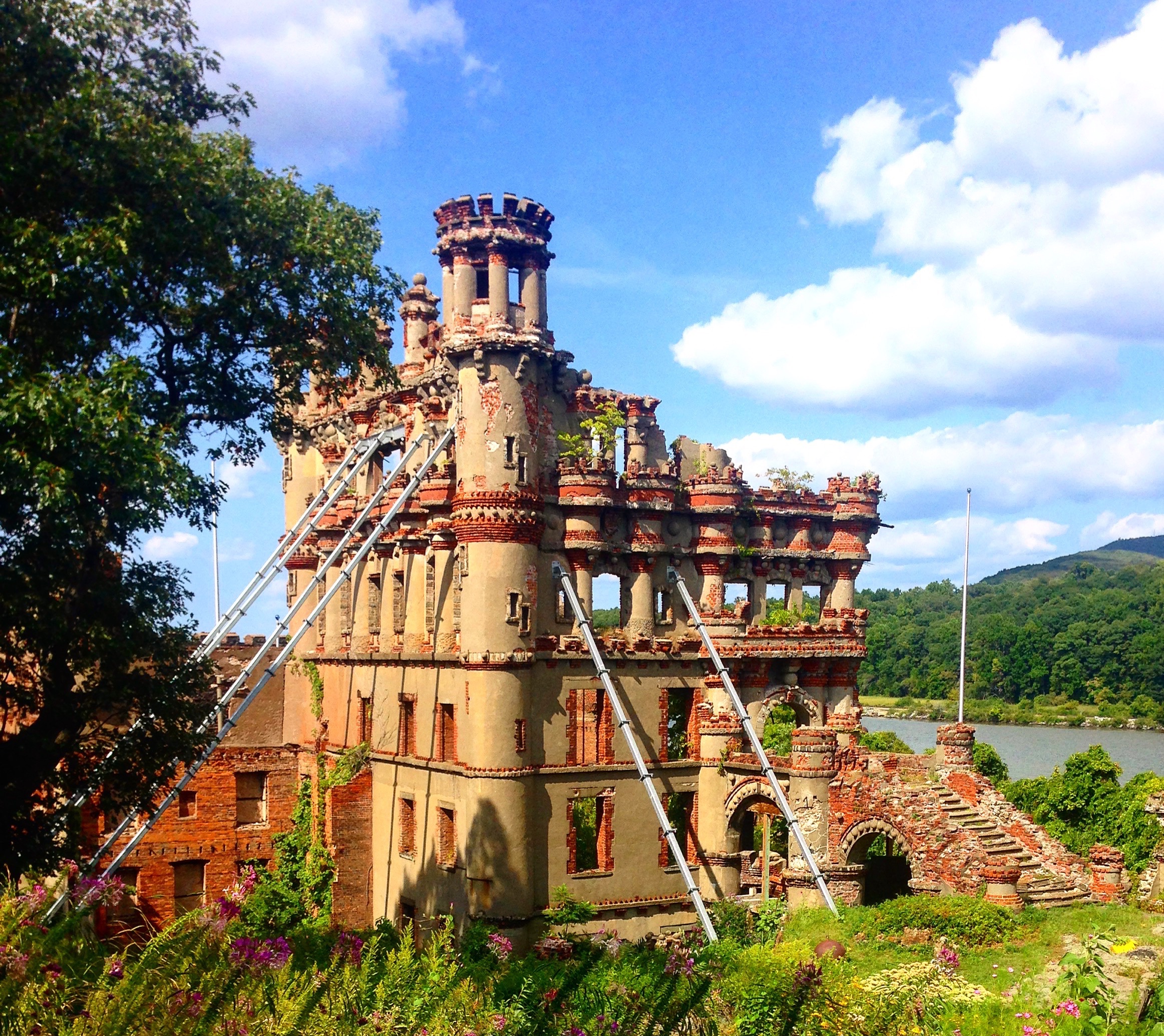
Further north in the Hudson, as the train passes through the marshes at Cold Spring and then hooks along the edge of Hudson Highland Park on its way to Beacon, the passenger will see something striking through the window. Standing on an island in the Hudson, conspicuous and incongruous, is a castle.
Or perhaps I should say a former castle, since it is distinctly a ruin now. Only the outer walls remain, its insides gutted and empty. Ivy climbs up the surface and the green shade of trees can be seen through the empty window frames. Even so, it is an impressive sight, with its battlements and crenellated walls standing proudly over the Hudson, like something out of a fairy tale.
But it is clear, upon reflection, that this structure could never have been an actual castle, despite appearances to the contrary. Putting all tactical considerations aside—castles were obsolete during almost all of our history—its brick walls are thin and high, totally unsuited to defensive architecture. (To see what I mean, visit Castle Clinton in Battery Park, which has thick, squat walls, durable and difficult to hit with canon fire.)
Like many passengers on the train, I idly wondered “What is that?” as we passed, my mind drifting off to remote possibilities. When I asked my mom later, she told me that it was built by a rich American with a European wife, who wanted to make her feel at home in the New World—or at least, that’s the story she heard. I was satisfied with this rumored explanation for a time. But upon my return from Spain, I decided to dig a little deeper into the castle’s history. And, as so often happens, the truth is far more interesting than the myths.
Unless you have a boat and don’t mind being penalized for trespassing, the way to visit the castle is on a tour with the Bannerman Castle Trust. These tours depart from either Newburgh or Beacon, two historic towns that are themselves worth visiting. You can choose to go by ferry or kayak. (In a recent homicide case, which made national headlines, a woman was convicted for criminally negligent homicide when she left her fiancé to die in the Hudson after his kayak capsized near Bannerman Island. I took the ferry.)
Our tour left at two in the afternoon. About forty people lined up at the water, and then crossed a wobbly dock to board the ferry. As I said, the tours are given by Bannerman Castle Trust, the same organization that is responsible for the castle’s preservation. They are a genial and jovial bunch who obviously enjoy what they do.
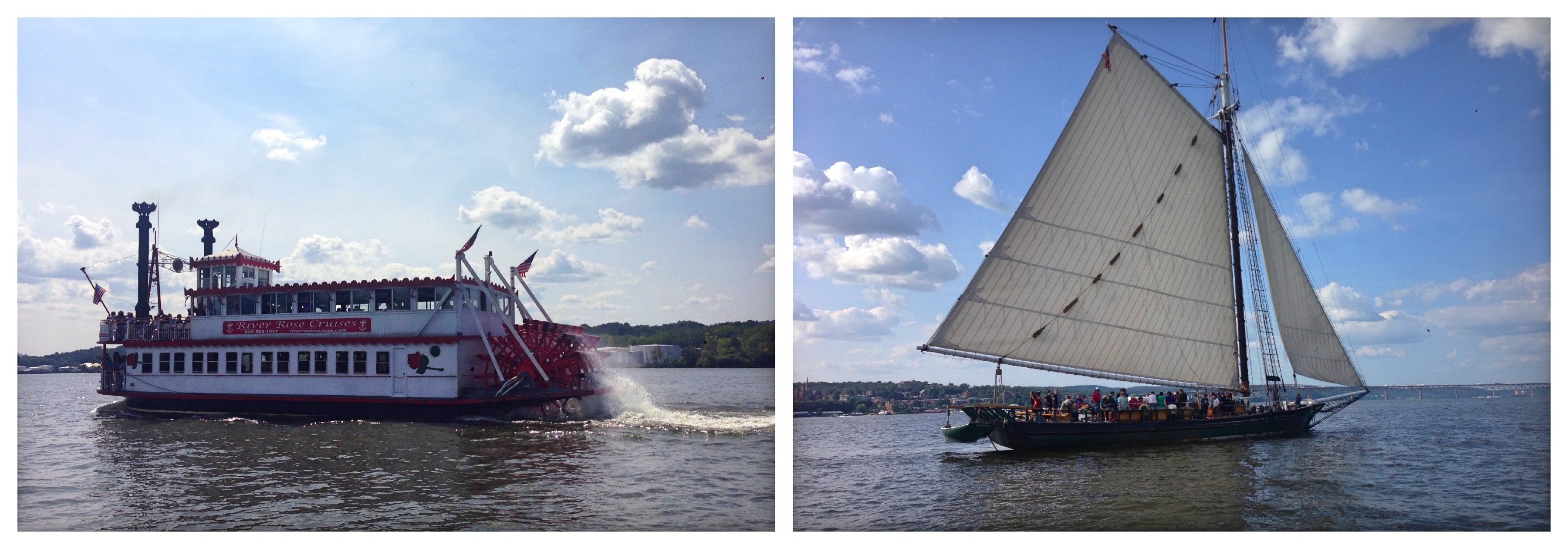
The boat began its short journey to the island. To our left we could see the Newburgh-Beacon bridge, a surprisingly pretty cantilevered steel construction. It was a sunny day and the river was full of boats. Jet skis and cigarette boats zoomed past, making a terrible racket, and kayakers waded in the shallows. Along the way, we passed two antique vessels, a Mississippi paddle wheeler and a sail sloop, and all the passengers waved to each other—people are generally friendlier at sea, I suppose. (The sloop was the Clearwater, the boat built as part of Pete Seeger’s campaign to clean the Hudson.)
The River Rose and the Clearwater
The castle seemed to rise out of the sea as we neared. By its juxtaposition, the Hudson Valley was transformed into an alpine lake or a Scottish loch in my eyes. We docked and shuffled out, and the tour guides split us into two groups. Thus commenced an excellent two-hour tour, which explained a history that was far more interesting than I dared hope.
Though commonly known as Bannerman Island, its true name is Pollepel Island. ‘Pollepel’ is one of those place-names that baffle explanation. Our guide told us that his preferred hypothesis was that the island was named after the Dutch word for a wooden spoon, which was also the name for the contraption that deposited misbehaving sailors on the island as punishment. There is also a legend about a girl named Polly Pell, who was stranded on the island and rescued by a brave lad, who she then married—a story which, like all tales of romance, our guide assured us is baseless and false.
In any case, the really interesting history of the island begins in 1900, when it was purchased by Francis Bannerman VI (1851 – 1918).
Bannerman has one of those appealing, Andrew Carnegie, rags-to-riches stories from the nineteenth century. Like Carnegie, Bannerman came to the United States from Scotland, a poor boy in a poor family. After a series of odd jobs, his father ended up in the scrap industry. Then, when the Civil War broke out, Bannerman’s father went to fight for the Union side, forcing the younger Bannerman to quit school and work for the family business. At night, he made extra money by traveling around the New York harbor in a little rowboat, using a hook to dredge up chains and rope that ships had sloughed off into the water, in order to sell them for scrap.
Later, the younger Bannerman started his own scrap company. He found a profitable—and at the time entirely novel—avenue for business in selling old military equipment. You see, after a war is concluded, all sorts of goods—rifles, swords, bayonets, canons, black powder, uniforms, and even canned foods—can be purchased very cheaply. Then, when another war breaks out, it can be sold at lower prices than new equipment, while still making a nice profit. Bannerman didn’t only sell to bellicose governments, however, but became a leading supplier to collectors, bands, vaudeville acts, rodeos, movie producers, circuses, and theater groups. Bannerman’s illustrated catalogue are still regarded as the gold standard by collectors of antique war equipment.
After doing business in several different locations in Brooklyn, Bannerman opened his main shop in Manhattan, at 501 Broadway. But the city government very sensibly decided that it was unsafe to have so much military equipment, including several tons of explosives, in the middle of a major city; so they made him move it out. This is why Bannerman purchased Pollepel island for his armory—it is isolated and therefore safe. The location had another advantage. Since the island is in full view of the train, and since the Hudson, at that time, was crawling with merchant ships, Pollepel was an excellent place to advertise his business from. Hundreds of potential customers would be passing by each day. This is also why Bannerman invested in such ornate architecture. A castle is certainly more eye-catching than a billboard.
Bannerman died in 1918, of “overwork,” as the New York Timesobituary said, using one of those euphemisms of the previous era. At the time, he was donating large amounts of equipment to the Allies fighting the First World War. His business model became seriously compromised a few years earlier, when a change in the laws imposed stricter regulations on the trading of explosives—which is good news for the rest of us.
If Bannerman had lived two years more, he would have seen the wisdom of the New York City government in banishing him to the island. For in 1920, one of the powder houses blew up. It was a massive explosion, reportedly breaking windows for miles in all directions—or so said our guide—and blowing a chunk of the wall hundreds of feet across the Hudson onto the train tracks, blocking the train for hours. Bannerman’s wife, Helen, narrowly avoided death (the hammock she had been laying on was hit by flying debris, but she had just gone inside), and her eardrums were ruptured by the shockwave.
Under the direction of Bannerman’s sons, the business carried on for a time, until eventually, in 1967, the island was purchased by the State of New York for parkland. Despite the family’s attempts to sell off their massive store of supplies, there was still much left, some of which was taken by the Smithsonian Museum. The island was opened to the public the next year. But then the next phase of damage to the island occurred. In 1969, the buildings caught fire in a colossal blaze, perhaps an act of arson, destroying everything except the outer brick and concrete walls. After that the island was off limits to the public, for the sensible reason that the remaining structures were unstable and could collapse.
Many years later, in 1993, the Bannerman Castle Trust was founded, which worked with the State of New York to preserve and promote the castle. They have made great strides. Kayak tours, hard-hat tours, and finally, in 2003, walking tours were introduced. The dock where the ferry lands and the stairway that leads up to the island were built under their direction, as was a bridge connecting the two highest peaks of the island (which cadets in West Point helped to construct). They also organize volunteer teams of gardeners, who have created some really splendid gardens on the island. And this is not to mention the historical work.
Thankfully, nobody was hurt when, in 2009, a big section of the outer walls collapsed. To prevent further damage, the walls are held up by long metal braces. Still, it’s worth asking how much longer the structure will last without substantial repairs.
Despite the explosion, the fire, and the collapse—and partially because of them—the castle is magnificent. For me it was a dreamlike experience to be standing near it, since I have been fantasizing about visiting this island since I first laid eyes on the ruin. The façade of the building has many charming architectural ornaments, such as the semispherical balls that run along the top. A resourceful man, Bannerman used vintage bayonets to reinforce the concrete.
The castle isn’t the only structure on the island. On the second highest point—Bannerman was afraid of lightning strikes, so he didn’t build on the highest—is the house in which he and his family stayed. This building was only very recently rehabilitated; only a few years ago, it was covered in ivy. The house is built in the same vein as the castle, a fanciful exterior concealing a homey interior. Now it is a sort of mini-museum, full of old images and informational panels.
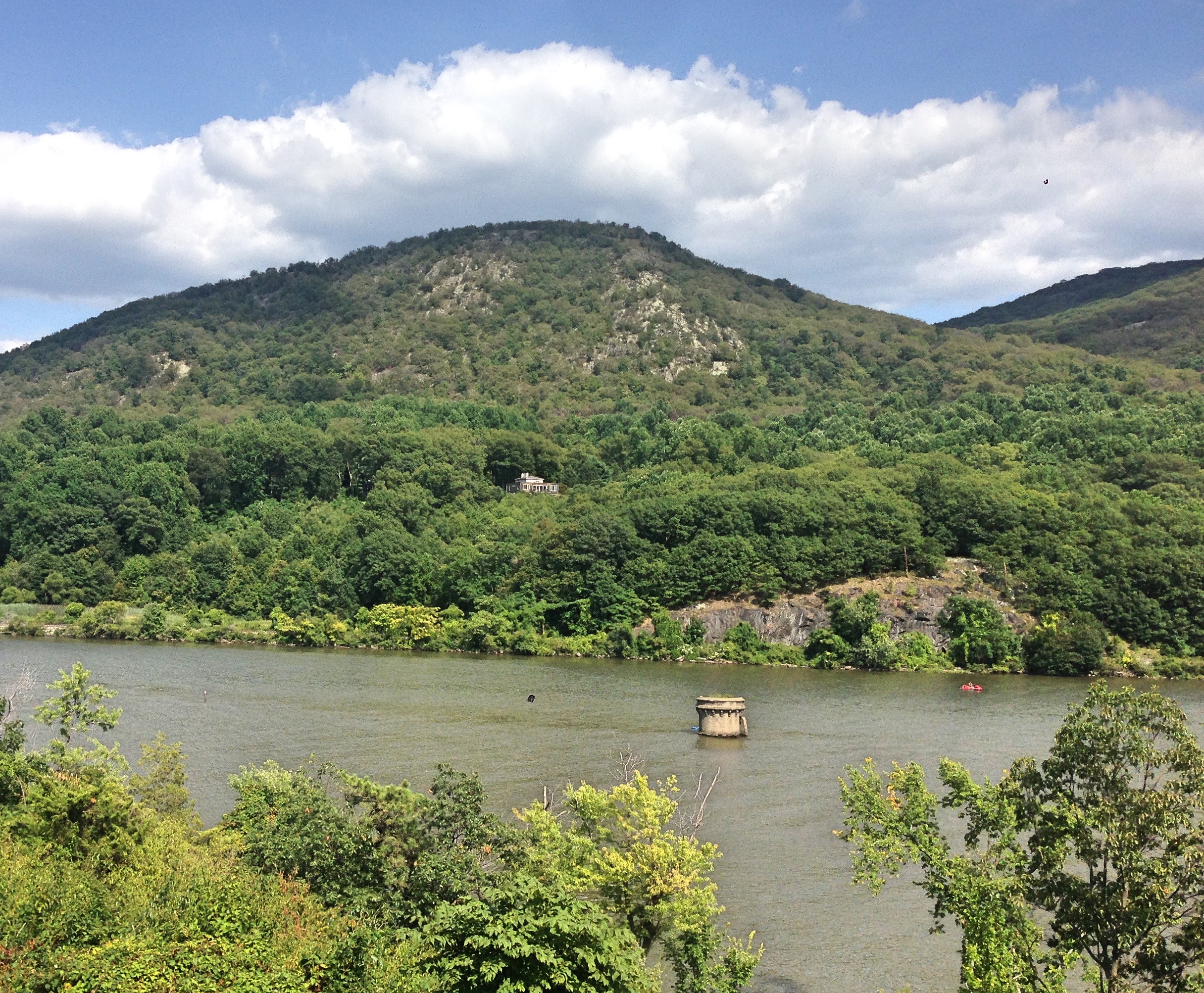
In the water surrounding the island, there are still further remnants of Bannerman’s business. During the island’s heyday, Bannerman constructed an artificial harbor, or breakwater, around the island. Now only a few stone towers remain, peaking out of the water. Doubtless more are submerged just under the waves, a hazard for passing boats.
One of the old towers for the breakwater
The Bannermans only stayed on the island during summers. But a superintendent, Leonard Owen, stayed all year long; and his daughter, Eleanor, grew up on the island, commuting to school by sled during winter. Two of the historians of the island, Barbara and Wesley Gottlock, recently turned her memoirs into a children’s book. (These two authors also collaborated on the Images of America book on the island, which I relied on for this post.) Bannerman’s daughter, Jane, is still alive and active in the Trust.
Well that’s the story, or at least the quick version. When I began learning about these ruins, I had no idea that they would contain so much history. Perhaps I should stop being so surprised that the world, once examined, is a tremendously interesting place. Ruins are not just food for the imagination. Every ruin, even the humblest, is the product of human hands, and bears the traces of humans dreams and disappointments.
(I have broken up my original post into two separate posts, for ease of navigation. You can find part two here.)
Introduction
The train ride on the Hudson Line, from Manhattan to Poughkeepsie, must be one of the most scenic in the United States. The ride has both natural and artificial beauties along the way. The Hudson Valley itself is magnificent, with the palisades across the shimmering waters; and this is doubly true in autumn, when the trees turn their fiery hues. Occasionally you pass a sail boat or a freight barge in the river, or a team of rowers diligently practicing in the Bronx. The train also takes you under the High Bridge, the new Tappan Zee Bridge, and the Bear Mountain Bridge, three engineering feats. A careful rider can even catch a glimpse of Sunnyside, Washington Irving’s old home. (Irving was very annoyed when they built the railroad right next to his house.)
Hudson Palisades
Among all this, the most striking landmarks along the way are, for me, the ruins. Specifically, two ruins: the Yonkers Power Plant and Bannerman Castle.
Ruins have a power to fascinate that is difficult to account for logically. They are the same structures that exist, in unruined form, all over the place. The difference between a ruin and a proper structure, architecturally speaking, is pure defect: the ruins have lost their integrity and utility. And yet ruins have been captivating the artistic imagination since at least the Romantic era. Their battered and broken forms have provided inspiration for Shelley’s poems, Byron’s travel sketches, and Caspar David Friedrich’s paintings. It was the ruins of Rome that shaped the Renaissance in Italy, and those same ruins that inspired Edward Gibbon to memorialize Rome’s decline and fall.
What is it about ruins that is so compelling? There are many answers. One is that ruins allow us to visualize time. We see how time’s tooth rusts metal, cracks foundations, and crumbles stone. We see what rots away and what petrifies in place. Ruins also allow us catch a glimpse of a world without humans, the world we would leave behind if we all mysteriously disappeared. We can see the natural world slowly reclaiming buildings and walls, as plants and animals invade the empty space. Perhaps we feel what Shelley felt when contemplating the fate of Ozymandias: that humanity’s urge for immortality is futile and vain, since everything eventually decays.
For all of these reasons, and still others, ruins have an undeniable power—as attested by the many photographers, amateur and professional, who go out of their way to document them. This is my little contribution.
The Yonkers Power Plant
The Hudson Valley has been many things since its water began to carve a channel through the earth: wilderness, scenic escape, suburbia.
One hundred years ago, the valley was an artery of industrialization, dotted with factories and warehouses, noisy with barges and freight trains. The Hudson Valley was also one of the great centers of brick production, its soil baked and sold far and wide, which is why so many of its old buildings are brick. But we are long past the industrial age, and these buildings no longer house factories or store goods. Nowadays they house fine restaurants, cafés, or even libraries, such as the Irvington Public Library, which is in the old Lord and Burnham factory building.
The most impressive of these old factory buildings is still in use: the Domino Sugar Refinery, in Yonkers. Originally built in 1893, this refinery still produces three million pounds of sugar per day. It is one of Domino’s three major refineries, the last major sugar refinery in the Northeast, and a major source of employment within Yonkers. With an old, hulking brick building standing aside newer metal conveyer belts, this refinery is the sister of the more famous one in Williamsburg, Brooklyn, which closed in 2004 and was mostly demolished in 2014, except for some buildings given landmark status.
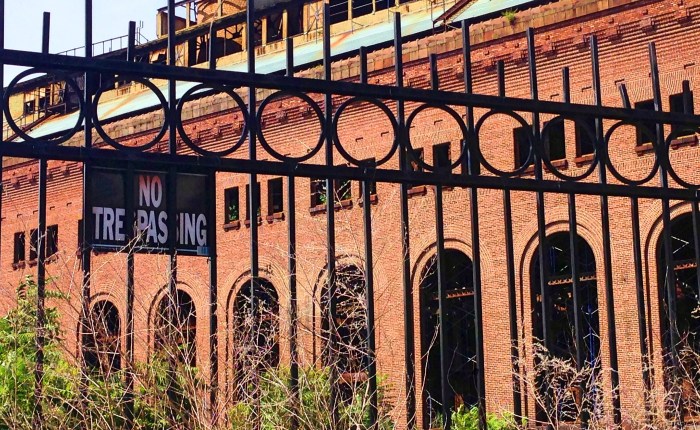
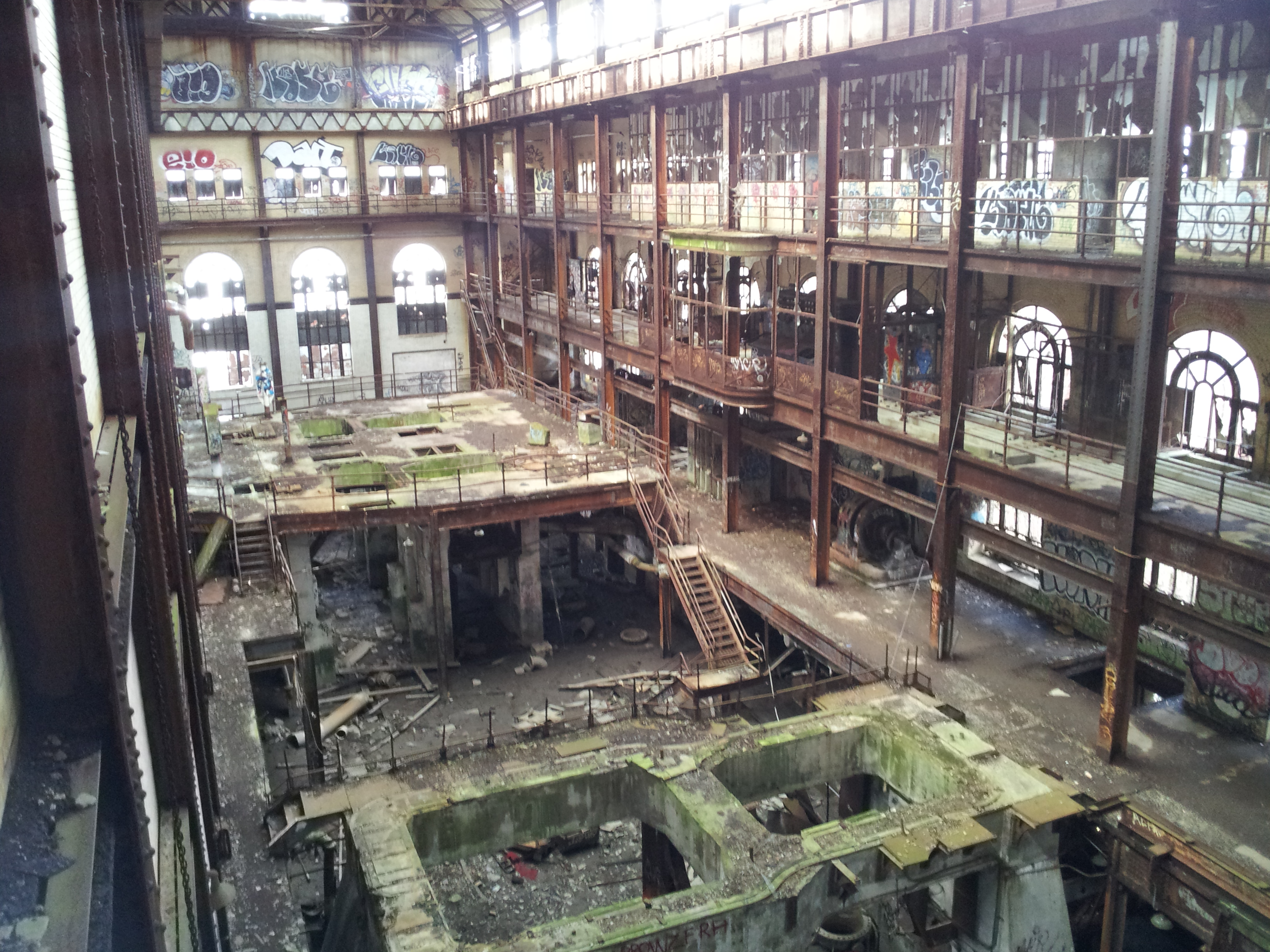
But the grandest ruin of the industrial age sits a few miles north. This is the Yonkers Power Plant, which stands on the river side of the local Glenwood train station. With its smokestacks scolding the sky hundreds of feet in the air, the plant is hard to miss. I often saw it on my commute to the city and wondered, what is it doing here? Why was there such a massive building rotting, empty and neglected, by the side of the tracks?
The answer comes down to power. When the trains began running in the 1840s—connecting faraway places and disturbing Washington Irving’s peace—they were running on steam. By the early 1900s, the railroad was prepared to switch to electricity, using the newly designed third rail. The problem was that, at the time, the municipal electrical grid was not powerful or dependable enough to supply the power. Thus the New York Central & Hudson River Railroad, which owned the Hudson Line back then, built their own power plants. The Yonkers Power Plant was situated along the river for several reasons: to be close to the tracks, to take advantage of the water to cool the machinery, and to make it easy to supply the plant with coal, which was delivered by ship.
The power plant was built by the architectural firm, Reed and Stem, who also collaborated on Grand Central Station. (Charles A. Reed was related by marriage to the president of the New York Central railroad, which doubtless helped him get commissions.) The plant opened in 1907, and ran on coal, which was brought by barge to the boiler room below. The steam generated by the boiler was used to power several massive turbines on the floor above. This power, generated in alternating current, was changed into direct current for the trains by rotary converters. (These rotary converters, by the way, are the only heavy machinery still in the factory; the rest was sold for scrap metal.)
Photo of the interior, by Brendan Jenkins, taken from Wikipedia Commons
By the 1930, it no longer made financial sense for the railroads to be in the power business, so in 1936 the plant was sold to Edison Light and Electric (a subsidiary of Con Edison) and converted to run on oil. This was not a long term solution either, since the plant’s relatively small size (relative to more modern power plants, that is) made it inadequate to New York’s massive power needs. So in 1963, the plant was closed. It was eventually sold to a private owner, who mostly let nature and teenagers have their way. The plant acquired the name “Gates of Hell,” for supposedly being the place where gangs held ritual inductions. Over the years, it became overgrown and covered in graffiti (some of it quite good). Meanwhile, proposals to transform the plant into apartments did not pan out.
(By the way, I am mainly relying on the excellent website, Hudson Valley Ruins, for this information. Their page on the power plant also has many great pictures.)
Most recently, the power plant was purchased by an entrepreneur named Lela Goren, who announced a plan to convert the plant into an arts exhibition center. The building will be renovated in two phases, which will cost $150 million all together, and finished sometime in the next decade. Work began in 2013. The grounds have already been substantially cleared of rubbish and debris, and the walls are being stabilized. I am pleased to learn, from this NY Times article, that Goren plans on keeping much of the industrial aesthetic, even the graffiti.
On a sunny summer afternoon I visited the plant for myself. I stepped off the train at Glenwood Station and craned my neck upward at the redbrick wreck. Despite the work the Goren Group had already done, the place is still visibly a ruin. All the windows are smashed; ivy climbs up iron beams; and an eerie silence pervades the building.
Glenwood is a local station, and few people use it. Aside from the old plant, Glenwood’s main attraction is the Hudson River Museum, which focuses on the river’s ecology. That day, I was the only person standing on the platform. A fence surrounds the old plant, covered in “Do Not Enter” and “No Trespassing” signs, assuring the prospective intruder that video cameras are surveilling the property. Even so, standing there alone on the platform, with nobody else in sight, it was difficult to resist climbing into the ruin. I would not even have had to climb the fence, since a stepladder was helpfully leaned up against it. The ruin still has its visitors.
Ladder still used by trespassers
But I’m no daredevil, so I contented myself with patrolling its perimeter. Yet through the gaping windows I could glimpse the cavernous interior space, which many have compared to a cathedral nave. Indeed, compared with a gothic cathedral, the power plant is an exceedingly light, airy structure, with thin walls and plentiful windows. The towering brick façade, combined with the thin steel girders of the building’s innards, make it seem as if an elephant body is being suspended from chicken bones.
The plant consists of two buildings, the main plant and a substation next door. The substation is where the rotary converters transformed the current from alternating to direct, so the trains could use it; from there the current was sent to the rail tracks. An attractive metal footbridge connects the two buildings. Outside, a metal tower still stands, rusted and overgrown, which I believe used to hold the wires. On the southern side of the station there’s a little park. From here you can see how the station juts out into the Hudson. This must have been to enable the use of the Hudson’s water in the boilers; and, indeed, the boiler room still floods during high tide, I believe.
The plant and substation, with skybridge
I can see why Lela Goren saw potential in the plant, since its location is as attractive as the building itself. Across the river you have an excellent view of the Hudson Palisades. Looking northwards, you can see the Hudson Valley all the way up to the Tappan Zee. Looking south, Manhattan comes into view, a silhouette behind the George Washington Bridge.
From this vantage point, with the city in the distance, the river ferrying boats along its glimmering waves, it is difficult to believe that this wonderful brick building was made to simply to supply electricity to trains. It was truly a different time. At its peak, the Yonkers Power Plant could generation 30,000 kilowatts, or 30 megawatts. To put this in perspective, the Indian Point Nuclear Plant in Croton, the Robert Moses Power Dam in Niagara Falls, and the Ravenswood Generating Station in Queens can all generate over 2,000 megawatts. We have come a long way. But unfortunately for us, not one of those is even one-tenth as beautiful as the Yonkers Power Station.
When Washington Irving published “The Legend of Sleepy Hollow” in 1820, he forever blessed—or cursed—my hometown, turning a modest cemetery in an otherwise unremarkable village in the Hudson Valley into a tourist attraction. Maybe he knew this himself, for he chose to get himself buried in that cemetery, which has since grown to a sprawling size and has gained other prestigious bodies.
One of my cousins told me and my brother, when we were both young and impressionable, that you should hold your breath when driving past a cemetery so that you don’t breathe in the evil spirits. Neither of us were superstitious enough to believe that, but it made for a fun game in otherwise boring car rides. Yet holding my breath for the entirety of the Sleepy Hollow Cemetery, as we drove down Route 9, was always a painful challenge. The cemetery is vast—or, at least, it felt vast as I turned red, and then purple, and then blue.
The free map of the cemetery
Every year around Halloween, when the fall foliage is at its most vibrant—“It was one of the most beautiful things I’ve ever seen,” said a friend from Spain who saw the New York foliage for the first time—this normally sleepy town is overrun with tourists from the city, all of them to see this famous cemetery. The cemetery is a ten-minute walk from the Philipse Manor station on the Hudson Line, making it an easy trip for urbanites. There are tours in the morning and evening, and on the weekends there are souvenir shops set up at the entrance. In the fall, closer to Halloween, you can buy freshly grilled sausages and drink mulled wine as you inspect the burials. They lock the gates at 4:30 pm daily.
The Old Dutch Church
The Sleepy Hollow Cemetery is sandwiched between Route 9, where cars continually buzz by, and the Croton Aqueduct, a trail that runs through the Rockefeller State Park preserve. The cemetery was built around, but is not affiliated with, the historic Old Dutch Church. This is a lovely stone and wooden structure, built in the 1700s near a pre-existent graveyard. The burial grounds of this church, going back to the Dutch ownership of New York, must be one of the oldest in the country. There are still tombstones written in Dutch on the property; and over the years, trees have grown up and nearly engulfed graves within their trunks. The Reformed Church of the Tarrytowns still holds services in the church every Sunday, where the congregation sits on its lovely wooden pews.
Dutch tombstone
The Sleepy Hollow Cemetery itself was established much later than the church, in 1849, and is non-denominational. The website says that Washington Irving had a hand in its creation, or at least its conception. The size of the cemetery is about 90 acres. Forty-five thousand people are buried there, about twice as many as the current populations of Tarrytown and Sleepy Hollow combined. As an old brochure put it, the cemetery is a veritable city of the dead. And it is still growing. Across a wooden bridge that spans the babbling Pocantico River are the recent burials, where funerals and mourners are most often seen, and where construction equipment still busily digs new graves.
This wooden bridge, pretty and quaint with tree-trunk guardrails, is often mistaken for the bridge from Irving’s legend; but it did not exist in his day. The real location of that bridge is near the Old Dutch Church, where a sign marks its former location. Nowadays the Pocantico River is spanned by a monstrous concrete bridge in that place, which allows the busy Route 9 to cross over the water unimpeded.
When I was in high school, a friend of mine told me that his father, who worked for the cemetery, found the body of a young man who hung himself from the wooden bridge. Indeed, for many years, in the water underneath that bridge a stone plaque was clearly visible—although unreadable—which seemed to confirm the story. But now the plaque is gone—did it get washed away?—and I can’t find any information about the suicide online, which makes me wonder if the story was true.
The Sleepy Hollow Cemetery is not a somber place. It is as beautiful and inviting as the finest park. I was surprised to learn that, in Spain, cemeteries have no greenery within; they are stone courtyards where bodies are interred in granite shelves and tombs. Our cemetery is almost as heavily wooded as the forest nearby, full of cedars, sycamores, and oaks, European beeches with scarlet leaves, and tiny Japanese maples whose seeds have blown into the park next door and begun to grow in the wild. There are so many bushes and ferns that the cemetery has become very popular with the local deer, who slip in through a hole in the chain-link fence. Once, in the dead of winter, I even surprised a couple of coyotes stalking around the graves, who promptly retreated to the forest.
Deer among the graves
The graves and mausoleums of the Sleepy Hollow Cemetery only add to its beauty. It is as much a statue garden as a graveyard. The monument to John Hudson Hall (1818 – 1891)—about whom I can’t find a thing—was, according to this site, crafted by the famous Beaux-Arts sculptor Augustus Saint-Gaudens; and indeed it does have a striking resemblance to one of his works, Amor Caritas. I am inclined to believe that the famous sculptor was involved, considering the extreme fineness and delicacy of the angel’s robe.
One of my favorite works in the cemetery
The monument to Owen Jones (died 1884), a successful dry-goods dealer in the 19th century, features a life-sized and lifelike statue of the late merchant. Somewhat nearby is a monument to Edwin Lister (1829 – 1889), who owned a fertilizer company. Lister’s monument has a stately bust of the deceased entrepreneur, and an excellent statue of a mournful woman eternally leaning on the grave.
Owen Jones
These monuments reminds me of the Pyramid of Cestius in Rome. That pyramid is the pharonic mausoleum of a rich Roman aristocrat, which coincidentally stands near the simple graves of John Keats and Percy Bysshe Shelley—just as Jones’s and Lister’s graves stand near the simple graves of more famous men. It seems there are two ways of making one’s tomb a visiting place: accomplish something great, or invest in an elaborate monument.
The only statue to be marked on the official map (available for free at the entrance) is the so-called “Bronze Lady.” It is a twice-life-size statue of a seated woman. Her eyes are sad and downcast as she looks mournfully at the mausoleum in front of her. This is the tomb of Samuel Thomas (1840 – 1903), a relatively obscure Civil War General. The sculpture is a work of Andrew O’Connor, Jr., a sculptor of considerable reputation in his day. According to the inscription at its base, it was smelted in Paris by a famous company, the Rudier Foundry, which also made works for Auguste Rodin.
The Bronze Lady
This statue was the subject of a New York Times article called “The Other Legend of Sleepy Hollow,” and deservedly so. For several generations now, local kids have been telling ghost stories about the metal woman, reporting that the statue cries and weeps at night. Even when I was in high school, a whole century after the statue was installed, kids told stories about it. The story I was told was that, if you snuck into the graveyard at midnight, spit in her eye, spun around three times, and then looked into the little hole in the mausoleum door, you would be blinded for life. I never tried the experiment, although I have looked through the hole in daylight and wasn’t able to make out anything in the pitch darkness of the tomb. The legends are still going strong, if I can judge by the coins that are frequently deposited on her laps.
At least one more general is buried in the cemetery: Daniel Delavan (1757 – 1835). His military service goes back even further, to the American War of Independence. His actions in that war may not have been remarkable—since I can’t find anything about him—but his grave certainly is. A near life-size statue stands atop a large pillar, tall enough to be seen from my neighbor’s backyard. This pillar is surrounded by still more figures, including a moving sculpture of an angel cradling a crucifix. You can tell how old these statues are at a glance, since they’re so weather-beaten and eroded from the rains and years.
Delevan’s Monument
Accompanying its two generals, the Sleepy Hollow Cemetery has a Revolutionary and a Civil War Memorial. The former is rather simple—it was erected long after the war concluded—and consists of a small stone obelisk with the names of the soldiers inscribed. The Civil War Memorial is more impressive, with a bronze statue (now carbonated and green) of a Northern soldier, striding with his musket and bayonet over a platform that bears the names of the fallen buried there. Cemeteries and wars march side by side.
A review of the surnames of the burials here gives a taste of the ethnic makeup of the town in days gone by: Foster, Grave, Heartt, Knower, Bull, Clark, Coffin, Underhill, Newman, Newton, Small, Risk, Hackett, Hyatt. Apparently English was the dominant group—something that is certainly not true nowadays. Most graves have scant information about the people they mark. A name, a birth year, and a death year are the only facts that endure in the stone. There are some exceptions to this. One is the grave of Frederick Trevor Hill (1866 – 1933), which is an attractive plaque installed into a rocky outcrop, that informs us that he served on the American Expeditionary Force during World War I.
The Sleepy Hollow Cemetery is a sea of names, read and soon forgotten. But several famous names stick out. Washington Irving is, of course, the most famous denizen of the cemetery. His tombstone is simplicity itself, a rectangular slab with a rounded top. If flags were not flanking his grave, most visitors would probably walk right by it. A family man in life and in death—he supported his brother and his nieces when they fell on hard times—Irving is buried in a family plot. As the first internationally famous American author, his funeral was a national event. It was the subject of a Harper’s Magazine cover. So many people crowded into the Christ Episcopal Church for the event that they feared the floorboards would break.
After Washington Irving, the most notable person buried in the Sleepy Hollow Cemetery is Andrew Carnegie (1835 – 1919). Carnegie was apparently confident of immortality, since he did not create an ornate tomb for himself. His grave is a cross, about six feet high, isolated in a little grove. The cross is decorated in patterns that remind me of the Book of Kells. In the little footpath to the grave, there’s a plaque with a small portrait of Carnegie, as well as a list of the institutions he founded.
Carnegie was certainly an inspiring philanthropist, eventually donating 90% of his wealth to various charities. And he had the means to do it. Carnegie was one of the richest Americans who ever lived—and thus one of the richest people in history. A hugely admirable man, Carnegie’s reputation was slightly tarnished by his support of Henry Clay Frick (of the beautiful gallery in New York City) in Frick’s attempt to break the power of the unions in Homestead, Pennsylvania—a conflict which culminated in the death of seven strikers and three strike-breakers.
Andrew Carnegie and his wife
It is somewhat ironic, then, that the famous union organizer, Samuel Gompers (1850 – 1924), is buried about one hundred feet away. His grave embodies the principles of his life. Even more simple than Carnegie’s, it is a plain gray tombstone. He is not buried in a family plot; the tombstone is set amidst other burials. And it was not paid for by himself or his heirs, but by the union he helped to establish: the American Federation of Labor (AFL). Gompers was a labor organizer, who helped to join the competing guilds and small craft unions into a powerful organization, and his grave is a fitting tribute to his commitment to his fellows.
Up the hill from Gompers and Carnegie is a decidedly immodest tomb: that of William Rockefeller (1841 – 1922). William was the younger brother of the richer and more famous John D. Rockefeller. Notwithstanding his role as second fiddle, he was still fabulously wealthy, since he co-founded Standard Oil with John. William’s tomb is a massive white mausoleum, at least twice as large as the next biggest in the cemetery. The urge that actuated pharaohs to build the pyramids—the urge to monumental immortality—seems to re-emerge whenever wealth is concentrated into the hands of few, powerful men. William Rockefeller’s former residence overlooking the Hudson, Rockwood Hall, is now a State Park. The massive mansion has been torn down, but the stone walls and groundwork remain, and the view is worth the millions he must have paid for it.
William Rockefeller’s mausoleum
Also among the opulent captains of industry buried in the Sleepy Hollow Cemetery is Walter Chrysler (1875 – 1940). His mausoleum is a kind of neo-Roman structure with Doric columns in front. The mausoleum is located at the very end of the cemetery, its entrance turned away from the road. I must admit that this tomb always strikes me as ugly. Although it emulates a noble Roman temple, it is clearly machine-made, with inhumanly sharp angles; and the gray concrete used in the building is drab and unattractive, especially when compared with the marble originals. My father, a longtime resident of the town, admitted the other day that he has never visited the cemetery. Considering that he is a big fan of Chrysler cars, perhaps he ought to come and give homage.
Chrysler’s mausoleum
Near the gap in the chain-link fence, used by deer, coyotes, and the occasional human to pass from the cemetery to the Old Croton Aqueduct, is buried Elizabeth Arden (1878 – 1966), the famous cosmetic entrepreneur and founder of the eponymous makeup company. Arden’s grave is astonishingly modest—so much so that it is very easy not to notice it. She is buried under a tombstone with the name “Graham,” which is her real name (“Elizabeth Arden” is a pseudonym). Looking down at the little plaque, it is hard to believe that, at one time, she was one of the richest women in the world.
The grave of Elizabeth Arden
A short ways away is the last grave identified on the cemetery map, that of the Helmsleys. Harry Helmsley (1909 – 1997) was yet another fabulously wealthy man, a prominent real-estate owner in New York City whose company once owned the Empire State Building. His wealth notwithstanding, he is nowadays primarily remembered for his second wife, Leona Helmsley (1920 – 2007), the famous “Queen of Mean.” Leona was a sort of proto Donald Trump—a quick-mouthed, tyrannical, arrogant, proudly rich New York real-estate baroness, who is remembered for saying “We don’t pay taxes; only the little people pay taxes.” This quote was brought to the public’s attention during a trial for tax evasion, which resulted in her conviction and imprisonment for 19 months (the rich always get light sentences, mysteriously).
The Helmsleys’ mausoleum is very similar to Chrysler’s—a Roman inspiration—except that it is slightly bigger. I find this tomb almost equally unattractive; but if you walk up to the door and peer through, you can see a lovely stained-glass window on the other side of the structure, with an image of the Manhattan skyline illuminated in the darkness of the tomb.
As you can see from these examples, the tombs we build for ourselves can say a lot about our values. Our graves and mausoleums represent our stance on posterity. Carnegie wanted to be remembered for his charity; Rockefeller, Chrysler, and Helmsley for their power and wealth. Gompers apparently paid little heed to his grave, perhaps feeling that his work was more important than his immortal reputation. For many of us, I suspect, our anxieties about our posthumous reputation stems from anxieties about the ultimate value of our work. Compare, for example, the tombs of Owen Jones and Washington Irving. The dry-goods dealer invests enough money to preserve his likeness for future generations, while the lionized writer can rest easy under a plain headstone.
To the eyes of a cold logician, graveyards are nonsensical places. Why invest precious space and hard-earned money on a stone over a dead body? Why place bodies in expensive coffins that delay decomposition? Surely, it would be more sensible to bury our dead in unmarked mass graves, just like they do on Hart Island, and let them return their nutrients to the soil. Why build a monument or preserve a dead man’s name? The dead can make no use of their reputations; they are deaf to the tears of their relatives, and are well beyond caring whether they are remembered or not.
But I suspect that few among us could be so “sensible.” For death is not just a problem of logistics, expense, and disposal: it is an existential problem. Every culture that has ever thrived has had to confront the problem of death in some way. How can we reconcile human finitude with human striving? Why invest in the future if, inevitably, we won’t be a part of it? Death is traumatic, not just to friends and family but to communities. There must be communal rituals for death, acceptable stages of grief and routines of mourning, if a culture is to persist. These rituals allow the community to rally around the afflicted and to help pull them up, and allow the grief-stricken to put their pain in a wider context. Seen in this light, cemeteries are eminently sensible places.
Both Irving’s “Legend of Sleepy Hollow” and the legends that grew up around the Bronze Lady illustrate something the anthropologist Victor Turner said about rituals. Rituals create what he called “liminal” spaces, spaces of transition and transgression, where boys can be girls and where social norms can be flouted, and where the living and the dead can mingle. These psychological “spaces” are essential for great transitions: from single to married, from boy to man, from living to dead. Cemeteries are an example of such liminal spaces, a meeting ground for this world and the next, which is why we call them “haunted.” Haunted places allow mourners to make “contact” with the deceased and then to retreat to their normal world. Cemeteries thus play a psychological and ritualistic role essential to the community.
Yet there is an existential danger in death rituals, too. When there is a routine for death, it makes mortality easier to ignore and to push into the background. In a way, rituals remove some of the terror of death by depersonalizing it: every mourner and every funeral follows the same procedure, and every corpse is buried in the same ground. But death is always personal, and can never be routine. For every person is radically unique, and death will only visit once. And as Heidegger reminded us, when death is ritualized, we risk forgetting that our lives are singular opportunities, limited and unrepeatable, and thus risk living inauthentically. In our quiet moments, most of us feel immortal; and with time stretched out indefinitely before us, there is little pressure to act on our deepest desires.
My own walks through the cemetery illustrates this double dilemma. Most of the time it is easy to forget that the names on the tombstones were, once, actual people, living and breathing, with their own ideas and perspectives and quirks, just as individual as I am. As a result, it is also easy to forget that, one day, I will be nothing more than a name on a tombstone—and maybe not even that. There is, to be sure, something positive in this forgetting. If we went around all day dreading our death, we would be miserable creatures; and if we were constantly obsessed with the potential death of our loved ones, we could hardly form any kind of relationship.
But we do need to be periodically reminded that life is limited, or we take things for granted. Real appreciation of life requires this delicate balance between awareness of our mortality and an absence of crippling dread. An occasional memento mori will suffice, I think, to prevent complacency.
Cemeteries accomplish both functions for us: they give us a place for our rituals, and they serve as perennial monuments of mortality. This was illustrated for me just the other day, as I strolled among the graves. I was drifting along when I noticed a tombstone with toy cars resting on its base. These were the same Hot Wheels that I used to play with as a kid. On the tombstone was a name, and below it the inscription “Beloved Uncle.”
Here was a private tragedy on public display, an uncle mourned by his nieces and nephews, children who lovingly placed these toys on his resting place. My insides twisted into a knot as I looked down on the grave. I felt pity, but also a twinge of dread—the flashing certainty that, one day, I would be a beloved somebody—or even an un-beloved somebody—and that this day might, for all I know, be soon.
Processing…
Success! You're on the list.
Whoops! There was an error and we couldn't process your subscription. Please reload the page and try again.