Review: Moorish Spain

Review: Moorish Spain

Moorish SpainMoorish Spain by Richard Fletcher

My rating: 4 of 5 stars

Nostalgia is the enemy of historical understanding.

After reading and being disappointed with Menocal’s famous book on Moorish Spain, The Ornament of the World, I decided to take another crack with this book. And I am happy to report that Fletcher’s book is much better.

While Menocal is wistful and romantic, Fletcher is more detached and occasionally wry. While Menocal hardly acknowledges her sources, Fletcher is usually careful to note where he is getting his information from, even if this book lacks a scholarly bibliography. I found this a great relief, as I have been discovering that Moorish Spain is one of the most persistently mythologized periods in history. Washington Irving set the tone for this in his Tales of the Alhambra, but other writers have been following in his romantic footsteps ever since. Thus Fletcher’s dispassionate treatment was refreshing.

The main drawbacks of this book is that it is too short, and too scholarly. Fletcher was explicitly aiming for a popular audience, but the book he wrote would be better suited for an undergraduate class than a tourist. You cannot, for example, find many good vacation ideas in these pages; indeed, if this was your introduction to Moorish Spain, you might not even want to travel there at all.

Instead of focusing on intellectual and cultural history, the majority of this text deals with political and military history—the invasions, battles, territorial expansions, and so on. Admittedly, Fletcher also quotes poems, autobiographies, and includes pictures of famous buildings; he even has a whole chapter on the relations between Christians and Muslims during this time. But this information jostles for space among dozens of unfamiliar names of rulers who I do not much care to remember. Probably, if he wanted a better-selling book, he could have bot expanded it and included more of a personal touch. He is a fine writer and rather opinionated, so it would have served him well, I think, to have written something less formal.

In any case, I doubt there are any better books on the market for the history hungry tourist visiting Andalusia. This book will give you an overview of the period, and in the process inoculate you against much of the nonsense that gets thrown around about al-Andalus. It was not a paradise of tolerance, nor was it a perpetual war of faith against faith. As Fletcher said: “The past, like the present, is for most of the time rather flavourless.”

View all my reviews

Review: Julius Caesar, by Shakespeare

Review: Julius Caesar, by Shakespeare

Julius CaesarJulius Caesar by William Shakespeare
My rating: 5 of 5 stars

Why, man, he doth brestride the narrow world like a Colossus, and we petty men walk under his huge legs and peep about to find ourselves dishonorable graves.

One of Shakespeare’s best, this play is also, I think, one of his most morally ambiguous. The central question of the play—was it right to have killed Caesar?—is left unresolved, principally because of the complexity of the protagonists.

The play opens with Cassius persuading Brutus to act against Caesar. This monologue, though eloquent, is also somewhat confusing, perhaps even incoherent. The reasons Cassius avers for wanting Caesar dead are all petty and somewhat beside the point. Cassius hates Caesar, but why? Because once Caesar faltered while swimming the Tiber? Or because Caesar once had a cold? Of course, these examples are only meant to show that Caesar is a mere man, and thus does not deserve to occupy such a high eminence. And yet, this same argument—namely, that human weakness makes everyone equal—can be used against any form of inequality, be it wealth, power, or prestige; and communism is certainly not what Cassius is preaching.

True enough, word later comes that Mark Antony offered Caesar a crown, which would threaten the very existence of the Republic. But there is nothing in Cassius’s words or deeds that reveal him as someone motivated by political philosophy. Rather, he is a sensitive man, easily insulted, with a delicate ego; and his emotional episode in Brutus’s tent also reveals him to be needy and high-strung. There is nothing evil in him, nor even overtly malicious; but he is not like Brutus, a man of principles, honor, nobility. Thus I cannot help concluding that his plot against Caesar was mainly motivated by petty emotions, even if Cassius told himself otherwise. He felt envious of Caesar’s power, slighted at having a superior, fearful of future humiliations.

All this is more or less apparent in Cassius’s speech to Brutus. From the start, therefore, it should have been apparent to Brutus that he was allying himself with men acting from a suspect motive. But perhaps Brutus is too good-hearted to question the motivations of his friends. Indeed, throughout the play, Brutus is shown to be ethically unimpeachable, a purely noble and righteous person. Even his enemies admit it. And given that he talks the most and dies last, many have argued that the play should be entitled Brutus and not Julius Caesar, since the latter has few lines and dies halfway through.

It is, indeed, tempting to see Brutus as the tragic hero, trying to do what is right, brought down by circumstances. But I have trouble taking his side completely.

For one, it seems foolish to have let himself be persuaded by Cassius. The assassination was rash, and they had no plan whatsoever for restoring order once the deed was done. It also struck me as hypocritical, to say the least, to march through the streets yelling “Liberty! Freedom! Tyranny is dead!” since, at best, the conspirators restored an oligarchy of hereditary privilege. I am not convinced that the life of the common people was any better under the Senators than under Caesar.

Brutus also has a tendency to act imprudently, which is arguably his fatal flaw. First, the assassination plot itself—specifically the plan for restoring order—should have been more carefully considered. Brutus’s oration to the Roman people after the assassination is evidence that his rationales were not given enough thought. He cites “ambition” as the reason Caesar had to be killed, but does not clearly show in which of Caesar’s actions this ambition was manifested. This makes it very easy for Mark Antony to refute the charges. Brutus should have foreseen this, which is why it was the height of folly to have let Mark Antony give that oration. Besides all this, he shows himself to be a poor general.

Brutus’s personal honor code, while earning him respect, also handicaps him. For one, as noted, his tendency to trust others make him a poor judge of character. More troublingly, in attempting to set himself up above petty emotions, he renders himself inhumanly cold. Cassius, though oversensitive, is right in rebuking Brutus for attempting to see the vices and virtues of a friend with an unprejudiced eye, rather than overlooking Cassius’s faults. More significantly, Brutus’s attempt to rise above the grief of his wife’s death lowers him instead, turning him into a mere empty shell motivated by an honor code that brings nobody happiness, not even himself. For these reasons, I feel sad at his loss, but I also feel that he had it coming.

Mark Antony has some of the marks of a villain, who vows revenge even if he drags down all of Rome in the process. He is also not terribly likeable, being arrogant to others and fawning to Caesar. But he has redeeming qualities. His love for Caesar, while at first apparently sycophantic, is later shown genuine. The praises of a living commander are always suspect, but the praises of a departed one are honorable. Mark Antony is also not insensitive to the virtues of Brutus, even praising his memory. He fights for vengeance, true, and vengeance is always ethically suspect; but Hamlet fought for vengeance, and that does not make us like him any less.

In sum, it is difficult to see either Cassius, Brutus, or Mark Antony (or Julius Caesar, for that matter) as unambiguously right or wrong. They are rather three imperfect individuals, with different faults and strengths, who all fight in good faith for what they believe is right.

To acknowledge the faults in these characters, and yet portray them as acting sincerely, is a demonstration of the genius and the nobility of Shakespeare. For the quality Brutus most lacked was the one Shakespeare had in superabundance: empathy. As this play demonstrates, he could acknowledge a person’s faults and limitations while also understanding that, from their point of view, what they were doing was perfectly right. And therein lies both the secret of his art and the moral value of his works.

View all my reviews

Review: The World at War

Review: The World at War

The World At WarThe World At War by Mark Arnold-Forster

My rating: 5 of 5 stars

Consisting of 26 episodes, each about 50 minutes long, The World at War traces the history of the Second World War from its pre-War beginnings to its aftermath. The program is remarkable in scope, covering the relevant political history of the United States, England, Germany, and Japan; the war efforts in north Africa and southeast Asia; the Russian and the Western front, as well as the final push against Japan; the bombing campaigns and their effects on civilian life; the struggle of the Allied shipping fleet against the German U-boats; the final peace negotiations in Europe and Asia, and the concomitant haggling between the U.S.S.R. and the West; the horrors of the Holocaust; and much else.

But the series has depth as well as breadth. There are hours and hours of archival footage—of battles, bombings, bombardments, protests, speeches, life on the front line, civilian life, negotiations, military parades, invasions, celebrations, triumphs, massacres, tragedies—much of it never used before, unearthed by the program’s research team.

Even more impressively, there are hours of interview footage, from from Poles, Russians, French, Germans, English, Americans, Japanese. There are interviews of gunners, tank crew, infantrymen, sailors, pilots; interviews of housewives, firefighters, barmen, taxi drivers; as well as from politicians, advisors, generals, and even Hitler’s personal secretary and chauffeur. Considering that these interviews were made specifically for the series, from people directly involved in the action, this makes the raw footage (most of it unused) a valuable primary historical document. And this is not to mention the wonderful narration by Laurence Olivier, which is always tasteful, often moving, and sometimes chilling.

In short, the documentary is a masterpiece, bringing the drama of the war to life while also being supremely informative. If you want to watch any documentary about World War II, make it this one.

To speak personally, watching this documentary had a strange effect on me, because it made me realize how much my perspective has changed since I was a kid. Back then, I used to watch World War II documentaries because the war seemed like a comic book. It was a story with clear bad guys and good guys, and the good guys won in the end. It was a story of personal heroism and bravery, of self-sacrifice and honor, of hardships endured and battles fought for the greater good. I was even fascinated with the military technology, the tanks, war planes, battleships, and guns. I remember going to the military museum at West Point, and seeing replicas of the nuclear bombs used on Hiroshima and Nagasaki. There was something undeniably awe-inspiring about the ability to create so much destruction, to wield so much power.

This time around, I had a different reaction. The more I watched, the more I became overwhelmed with a sense of pointless loss, destruction, and violence. Millions of young men marching off to shoot other young men, and for what? Towns blown to pieces, cities burned to the ground, and, most of all, countless lives lost. People shot, stabbed, drowned, burned; people executed by firing squad, hanging, the gas chamber. Beaches filled with bloated bodies, corpses rotting in the road, the remains grandmothers and children buried under piles of rubble. And it just kept going, the planes kept dropping bombs, the men kept throwing grenades, the tanks kept rolling on. By the end of the series, every episode made me feel sick.

When you see the numbers of the dead, it’s easy to grow numb. The totals become mere, meaningless statistics. But when you realize that those millions were composed of individuals, people with their own favorite song to whistle, shade of blue, local restaurant, people with their own quirks of personality, their own flaws and virtues, people who were loved and who loved in return, people who might have done anything had they survived the war, the enormity of the tragedy dawns on you. No matter what the aggressors hoped to gain from the war, no matter how glorious it seemed, it could not have been worth it.

The documentary does not shy away from the horrors of war, but dwells on them, and for good reason. For if there is any lesson to be learned from World War II, it is simply this: We must do everything in our power to avoid repeating that catastrophe.

View all my reviews

Basking in the Basque Country: Bilbao

Basking in the Basque Country: Bilbao

(For ease of navigation, I have split my original post into four parts: click here for San Juan de Gaztelugatxe, here for the Vizcaya Bridge, and here for San Sebastián.)

If you travel north-east from Madrid, towards the elbow where the northern coast of Spain meets the western coast of France, you will eventually reach one of the most fascinating corners of the country: el País Vasco, or the Basque Country.

The Basques are an ethnic group indigenous to the region, and they’ve been around a long time. Their origins cannot be precisely determined, but it is thought that they represent a living lineage of the people who occupied Europe before the Roman expansion. This is believed because their language, Basque (Euskara, as they call it), is unrelated to any of the neighboring Romantic languages. That’s clear at a glance. Look at even a Basque street sign, and your eye will rebel at the confusing jumble of consonants—so thick that even German would flee in terror. The language is absolutely isolated; there is nothing similar, no dialects even remotely related. Its survival is an indication of the Basques’ remarkable toughness.

The Basque region has always been troublesome for Spain. This is understandable, considering that the Basques have a different language and culture. Basque separatism has existed since at least the time of Ortega y Gasset, who identified it in his book, España Invertebrada (1922), as one of the forces of disintegration in modern Spain.

Much more recently, the Basque terrorist group ETA fought for independence. To date they have killed over 800 people, and that number rises when you include injuries and kidnapping. Thankfully there haven’t been any attacks in many years. But this antagonism between the Basques and the Spanish still exists. Just this month, while working at a summer camp, some kids from Bilbao got very angry when kids from Madrid started making fun of them for being Basque. And one of those Basque kids kept telling me “I don’t like Spain,” even though he lived in Spain and spoke Spanish far better than Euskara.

For all these reasons, I have long been interested in visiting the region; and this is not to mention all the friends who recommended going. So GF and I decided to spend a long weekend exploring the Basque Country for ourselves. Our first stop was the most populous city: Bilbao.


Bilbao

IMG_3701

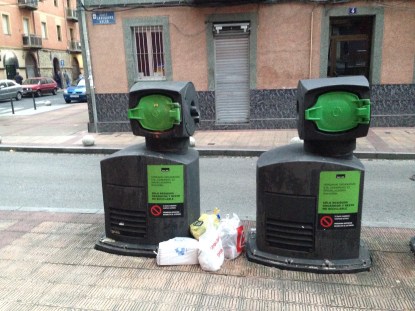
Bilbao is a city of industry. On our train ride from the suburbs to the city center, we passed dockyards, cranes, shipping containers, and factories. Bilbao is situated on an estuary; and the whole riverside, from the city center to the Bay of Biscay, is a scene of unbroken industry. Unlike many Spanish cities, Bilbao is a place bent on the future. On our way in, GF and I passed the Exhibition Center—a daring building, erected in 2004, that looks like a waiter carrying too many plates in one hand. Once you reach the center of Bilbao, a circular glass skyscraper towers overhead; and a modern bridge made of twisting metal spans the river. Even the garbage disposals look like robots.

IMG_3757

But Bilbao also has history. The historical center of the city is the Casco Viejo, which is where we headed to first. It is a lovely area, with narrow streets and plentiful restaurants. One of the most famous things about the Basque country is the food. Instead of tapas, they have pintxos, which are more or less the same thing—small servings of food, mostly on bread.

Our Airbnb host recommended the Casco Viejo for eating; and since every restaurant was advertising pintxos, we randomly picked one and sat down. I’m sorry to say that, although good, the food did not leave a deep impression on me. Indeed, I cannot say that I found the food in Bilbao noticeably different from the food in, say, Logroño—that is to say, it seemed fairly typical of Spanish food. It’s good food, to be sure, but I expected something more distinct. Instead, we had croquetas on bread, jamón on bread, tortilla on bread, chorizo on bread, and so on. In any case, it was inexpensive and filling, so I cannot complain.

We spent some time wandering around the Casco Viejo, enjoying the medieval streets. We wanted to visit the cathedral, which is small and has a lovely façade; but it was closed, for whatever reason. So we decided to leave the old area, and walk towards Bilbao’s main attraction: the Guggenheim Museum.

IMG_3684
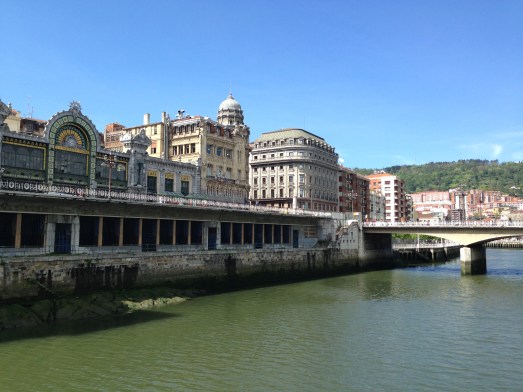
The River, with Bilbao’s lovely art nouveau train station

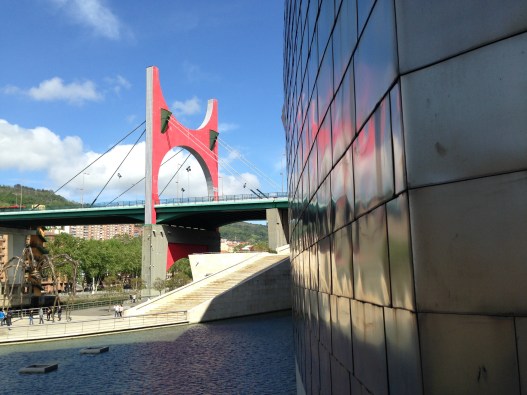
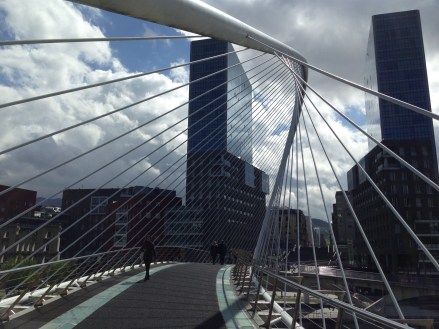
The walk towards the Guggenheim was delightful, taking us along the riverside. In some sections I was reminded of Paris, with elegant apartment buildings and the old Santander train station, decorated in a colorful art nouveau style. Then the city began to look more modern. Rectangular glass buildings, brutally square, towered overhead; and a small white suspension bridge came into view. Soon we could see the Guggenheim itself, although its strange form was mostly hidden from view by apartment buildings and another suspension bridge. Next to this bridge, two odd, grey towers curled up towards the sky, serving no apparent function but decoration.

IMG_3686

As we neared, I grew increasingly excited. I had heard of the Bilbao Guggenheim before I even came to Spain, and had longed to see it ever since. My anticipation growing, we walked under the bridge and turned a corner.

IMG_3696
The Guggenheim

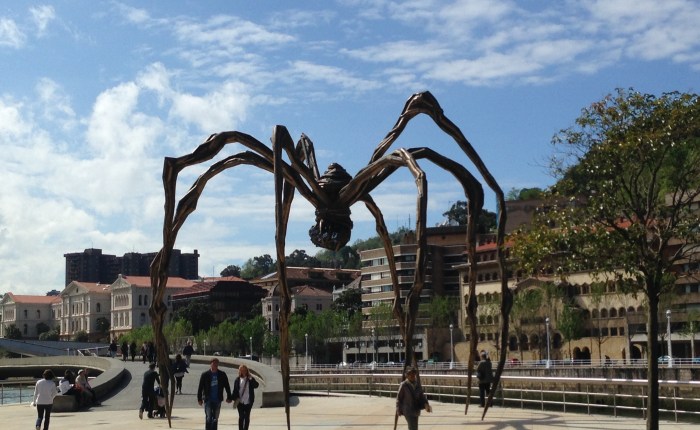
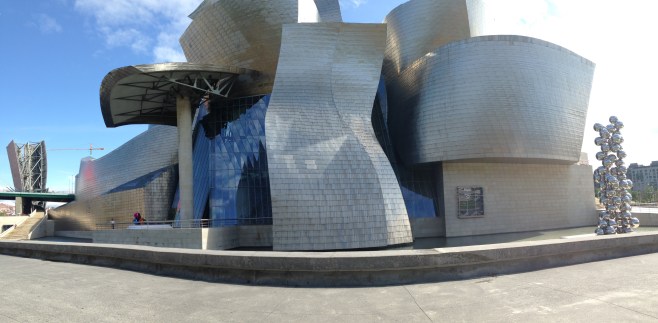
The sight did not disappoint. Designed by Frank Gehry, the Bilbao Guggenheim is covered in overlapping titanium strips, meant to look like the scales of a giant fish. The curling form of the building is also reminiscent of a fish, or perhaps of a massive, misshapen boat. Indeed, the building looks more at home in water than on land—a feeling reinforced both by a large pond in front and its location right next to the river. Just as in Gaudí’s work, there is hardly a straight line to be found; everything swells and curves, contracts and expands. In front, a large statue of a ghastly, nightmarish spider welcomes visitors to the museum. It is not exactly a beautiful place, but undeniably intriguing.

We found the entrance and went inside. The first thing we saw was a work by Andy Warhol. Consisting of at least fifty separate silkscreens, the work was an exploration of color and shadow. Essentially, Warhol just took the same silkscreen and made copies of it with many different colors (mostly bright neon). I enjoyed walking around the room, seeing how the image changed as I went along, but GF was deeply unimpressed with the piece. And I cannot say I found it terribly inspiring, either.

My favorite room in the museum was the largest. It housed Richard Serra’s massive installation, The Matter of Time. The work consists of long, thin metal strips, far taller than a person, arranged in geometrical patterns throughout the space. Some of these are in waves, some circles, some spirals. The feeling of walking through it is rather like being lost in a maze. Several times I lost track of GF, and had to search through the odd shapes to find her. The acoustic properties were also interesting, the metal sheets creating massive echoes, amplifying my footsteps into a loud clacking. The way that the installation warped and stretched my perception of space made it a true work of art.

The most well-represented artist in the museum was Louise Bourgeois. She is mostly known for her three-dimensional installations, which often use materials found around the house. In content, her work tends to be highly autobiographical. The aforementioned spider in front of the museum, which is her work, is meant to represent her mother. This strikes me as rather grim, but as the audioguide informed us, the spider’s weaving is supposed to represent nurturing and protection—though I’m not sure I buy that. Her relationship with her father does not seem to have been any better. One of her most famous works, Destruction of the Father, is an abstract depiction of a banquet in which the children have rebelled, killed, and eaten their father. The whole installation is made of soft materials, illuminated with red light that makes everything look like flesh; and the “children,” the “food,” and the “table” are formless blobs. In sum, I find her work a bit creepy.

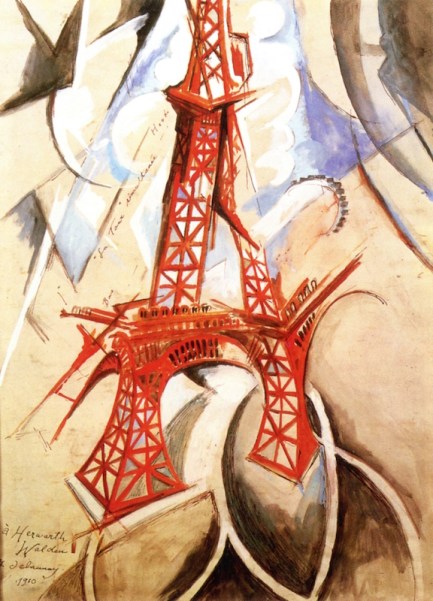
The most beautiful room in the museum was the one dedicated to 20th century Parisian art. Unfortunately, while I remember being quite pleased with the paintings, the only canvases that stick out in my memory are Robert Delaunay’s portrayals of the Eiffel Tower. These are wonderful works, with the towering form of the Eiffel Tower squeezed, compressed, stretched, and twisted, standing over a trembling Paris below. There is an attractive energy and dynamism to the paintings, which fit well with the aesthetic of Bilbao, for Delaunay’s painting, the Eiffel Tower, and Bilbao are all oriented towards the technological future. More generally, I found the works in those rooms satisfied my ideal of what art should be—original, daring, personal, and yet informed by a tradition of technical competency and well-worn standards of beauty.

Eiffen Tower Delaunay

This does not apply to another room in the Bilbao Guggenheim, the one dedicated to “Masterpieces.” This label may have been tongue-in-cheek, for the works contained therein were, one and all, large canvasses covered in either a monochromatic shade of paint, or merely splattered haphazardly with colors. One of them, I remember, looked like someone had randomly thrown blue paint at a white canvass; but the audioguide informed me that the artist had a nude model covered in paint roll around on it. Another one (if memory serves) consisted of an amorphous blob of green, yellow, and blue, which the audioguide explained was meant to represent the countryside of the artist’s youth. It’s things like that which give modern art a bad name. True, there was a work by Mark Rothko, who I tend to enjoy. Apart from this, however, I was left cold. I spent about ten minutes doing my best to appreciate the works, and then finally gave it up.

It took us about three hours to see the whole museum, and then we were out on the street again. My final assessment of the museum’s collection is the same as my opinion of the building itself: not exactly beautiful, but intriguing. There are times when I feel that the modernist emphasis on originality and personal expression has been horrid for visual art. By jettisoning tradition they have abandoned both the technical facility and the standards of beauty that have guided the best artists for hundreds of years. But sometimes, when I see something truly strange and fascinating, I think that this search for new modes of expression, new aesthetics, new mediums, new techniques—in a word, for newness—is both necessary and good. It is, in any case, true that it is impossible to reproduce the aesthetics of earlier times without producing sterile works; great art must reflect both the times of its birth and the vision of its creator.

I wanted to see more, but our day was over. Since we had spent the morning in the car, it was already quite late. We ate dinner and went back to our Airbnb to rest. Originally we planned to spend two days exploring Bilbao, but a recommendation from our Blablacar driver made us change those plans. Instead, we would try to see the Hermitage of San Juan de Gaztelugatxe.

Review: The Renaissance, by Walter Pater

Review: The Renaissance, by Walter Pater

The Renaissance: Studies in Art and PoetryThe Renaissance: Studies in Art and Poetry by Walter Pater
My rating: 4 of 5 stars

That it has given a new sense, that it has laid open a new organ, is the highest that can be said of any critical effort.

I had no idea what to expect from these essays. The only reason I became aware of Pater was because a copy of this book was sitting on the bathroom floor in my friend’s father’s house. Since my friend’s father is a successful painter, I naturally took note of a book about art so intimately placed. Much later, after finishing Burckhardt’s famous analysis of the Renaissance, and with my trip to Rome looming, I decided that I would finally see why a painter sought out this book for his bathroom inspiration.

Pater was an idiosyncratic fellow, and these essays certainly reflect that. Some of the topics he covers are expected: Botticelli, Michelangelo, Leonardo da Vinci. Others are more surprising: Joachim du Bellay, a Frenchman who wrote a defense of the French language; two medieval French stories about love and adventure; and Johann Winckelmann, the 18th century German classicist. Clearly, Pater’s conception of the Renaissance was far broader than Burckhardt’s, who considered the Renaissance a strictly Italian affair. Also broad is Pater’s conception of criticism: for him, it is not merely a vocation, but an entire philosophy of life.

I am referring specifically to the famous “Conclusion” that is tacked on to the end of these essays. In it, Pater puts forward a whole aesthetic philosophy of life: Everything is in flux; both matter and mind are temporary; the only thing we have is the moment; and since death may come at any time, and will come inevitably, the only rational response is to enjoy this moment as best you can. Now, some thought that Pater was advocating hedonism, but that is far from the case. He was, rather, an aesthete; and for him, “enjoying the moment” meant finding the most beautiful shade of green in a field of grass, or observing the play of light on a windowpane—that sort of thing. The ability to be constantly, delicately, indefatigably absorbed in one’s senses, and yet have the focus and taste necessary to select from these perceptions the most lovely, is what Pater meant with his famous suggestion to “burn always with this hard, gemlike flame,” which for him is “success in life.”

At times, the age of these essays showed. This was most conspicuous in Pater’s essay on Giorgione, in which he bases his whole appreciation on one painting, elevating it to the height and epitome of Giorgione’s aesthetic—a painting which is now believed to be by Titian. But for the most part, the essays have retained their force and interest. Indeed, you may not realize how original this book was, since it anticipated and shaped so many of our attitudes about art and the Renaissance. To pick just one example, Pater’s discussion of the Mona Lisa, dwelling on her mysterious smile, certainly helped spur on our fascination for that work.

Nevertheless, I am unsure whether Pater actually deepened my appreciation for the Renaissance works he discussed. This is due, I think, to his ideal of the critic: to be acutely sensitive to the power of art, and to be finely discriminating of what is more or less beautiful. Sensitive and discriminating Pater certainly is. (Several times I wondered if he passed out while writing his essays, since, judging by his breathless and insistent tone, he was always to be right on the cusp of a brilliant epiphany or a transcendent experience. It must have been exhausting.)

But notice was is lacking from his ideal of the critic: to analyze, to discuss, to inform. The critics who have most helped me appreciate art are those who taught me about the painting the artist; who showed me what to look for, how best to situated the painting within a certain context; in short, who pulled me into the world of the painting. But since Pater holds up sensitivty and discrimination as ideals, he is faced with the problem: how does one communicate those qualities, which are personal, to somebody else? To do this, he resorts to writing long rhapsodies, reveries, aesthetic ecstasies about the works under consideration. These passages are almost uniformly brilliant, often breathtaking. Nevertheless, it felt more like watching Pater look at a painting, overhearing the thoughts and associations the painting inspires in his brain, rather than learning how to appreciate the painting myself.

I cannot finish this review without discussing Pater’s prose. He is considered to be one of the great stylists, and this reputation is well deserved. The man was such a brilliant writer that it often seemed irrelevant what he was writing about; he could write an essay on the underside of a mosquito and it would be good literature.

This is not to say that he has no limitations. Most conspicuously, he has not even a trace of the epigrammatic. If a point can be made in ten words, Pater will give you fifty, though those fifty will be as finely crafted as a Baroque statue. His sentences never arrest you or stop you short, but rather overwhelm you, burying you under a pile of clauses, metaphors, images, until you’re short of breath and so dazzled that it seems someone has shone a flashlight in your eyes. Comparisons with Proust and Woolf, especially the latter, come readily to mind; but Pater has a manic insistence that makes his writing uniquely urgent.

Another limitation is that Pater seems incapable of that kind of easy grace, that effortless virtuosity, which many of the greatest writers display. Rather, his prose strains every nerve, exerts every muscle, panting and sweating as it pushes itself onward. This impression is, apparently, an accurate one: According to Wiki, he obsessively polished, tweaked, and rewrote his works, until every word, every sentence, every paragraph was just to his taste. This makes his prose like a super-ornate jewel, breathtaking in its designs, its symmetries, and its technical daring; yet for all that rather delicate and precious, and inevitably a bit ostentatious.

I will leave you with a passage from his essay on Michelangelo:

And of all that range of sentiment he is the poet, a poet still alive, and in possession of our inmost thoughts—dumb inquiry over the relapse after death into the formlessness which preceded life, the change, the revolt from that change, then the correcting, hallowing, consoling rush of pity; at last, far off, thin and vague, yet not more vague than the most definite thoughts men have had through three centuries on a matter that has been so near their hearts, the new body—a passing light, a mere intangible, external effect, over those too rigid, or too formless faces; a dream that lingers a moment, retreating in the dawn, incomplete, aimless, helpless; a thing with faint hearing, faint memory, faint power of touch; a breath, a flame in the doorway, a feather in the wind.

View all my reviews

On Justice

On Justice

A question that I often ask myself, especially now during the election season, is this: What makes a society just? Specifically, what are the criteria that determine whether a law is legitimate or a government is principled? I do not intend this question to be a legal question; whether something is constitutional is for me a secondary matter. The primary matter is this: What are the values on which a constitution is based that make it a worthy document?

Justice consists of the standards by which we determine whether a society is fair.

Justice is always a meta-standard—a standard applied to other standards that allows us to determine whether these other standards are worthy. For example, our standards of justice can be applied to our standards of ethics, to determine whether they need changing. But justice deals with other things besides crime and punishment. Economic justice deals with the fairness of the distribution of economic means; and social justice deals with the fairness of the treatment different demographic groups in the society. All of these, however, deal with the fairness of certain standards, whether they are the standards for determining whether someone should go to jail, make a lot of money, or be treated differently.

The crux of the matter, of course, is what we mean by fair. This is what philosophers, politicians, and virtually everyone else disagree about. The problem is that fairness often seems like a self-evident concept, when it reality it is far from that.

To start, what seems fair or unfair can depend very much on your situation. Let us say a lion managed to grab a gazelle and is about to eat it. From the gazelle’s point of view, this situation is monstrously unfair. The gazelle didn’t do anything to the lion, nor anything to anyone else, so why should it be the one being eaten? From the lion’s point of view, on the other hand, the situation is absolutely fair. The lion was born with certain dietary needs; it has to hunt and kill to survive; it picked the gazelle it found easiest to catch. What’s unfair about that? Should the lion starve itself?

Of course, lions and gazelles have no concept of fairness, so they lack this particular problem. But we have to deal with it. Finding a standard that can satisfy everyone in a given community is, I think, impossible. Every standard of fairness is bound to disappoint and embitter some. This is the basic tragedy of life. We can mourn this, but also learn from it. Since disappointment is unavoidable, and since perspective colors our notions of fair and unfair, it is clear that emotion alone cannot be the basis of a consistent standard of justice. We need something more objective, a clear set of principles that can be applied to any situation.

Let us start, as so many philosophers have before, with people in a so-called State of Nature. By this, I only mean people living without community of any sort—without rules, laws, or government, each person looking out for themself.

In this hypothetical (and wholly imaginary) situation, every person is maximally free. The only restrictions on people’s actions exist through the necessities of life. If they want to survive, the natural people must devote time and energy to finding food and building shelter for themselves. If they choose not to kill another person, it might be because they want that person’s help or because they are afraid of vengeance; but not because of moral scruples or fear of legal persecution. If a natural person finds a loner in the forest and decides to kill him and take his stuff, there might not be consequences. It is up to each individual what to do. Their every action is thus a calculated risk.

There are clearly some advantages to this hypothetical state of affairs. Most conspicuously, each person is a master of themself and does not have to listen to anybody. They can live where they like, how they like; they can eat, sleep, and play whenever they wish. But the disadvantages are also considerable. The main problem is lack of security. Without laws or police, you would always need to fear your neighbor; without a social safety net, you would always live at the mercy of the elements. It would be a life of maximal freedom and constant danger.

To repeat, I am not saying that this ‘Natural State’ ever existed; to the contrary, I do not think humans ever existed without communities, and I am only calling it ‘natural’ in keeping with the philosophical tradition. I am merely using this scenario to illustrate what a situation of maximal freedom would look like—wherein the only checks on a person’s actions are due to natural, and not social, constraints; wherein bare necessity, and not rules, custom, or law, are what guide life.

Now let us imagine what will happen if the people decide to get together and form a little community. This will clearly entail some changes. Most relevantly for my purposes, the people will have to start developing ways of organizing their actions. This is because, as they will soon discover, their unbridled desires will inevitably come into conflict.

If, for example, there are 10 apples and 10 people, it might be the case that each person wants all ten for themself. But when each of them tries to take all the apples, they will of course start arguing. If they are going to continue living together, they need to develop a solution.

Perhaps three of them fashion spears and shields, and use their weapons to impose their will on the other seven. Thus an oligarchy emerges, in which the three masters make the seven slaves gather apples for them, leaving the slaves only the cores for meager sustenance. The masters punish disobedience, hunt down deserters, and grow fat while the others wither away.

This is the classic Might Makes Right solution to the problem of human society. Thinkers since Plato have been grappling with it, and as long as humans live together it will be a constant temptation. Nietzsche would say that a society wherein the strong dominate the weak is the fairest society of all—fairness itself, he might say, since people are being divided due to the natural law of strength and not the artificial law of custom. The devotees of Realpolitik—Thucydides and Machiavelli, to name just two—find this dominance of the strong over the weak inevitable; and the Social Darwinians go further and find it desirable.

Admittedly, the use of force does solve the problem of conflict, albeit brutally. A powerful few, by violent means, can indeed reduce infighting enough to produce a stable society. But I think most people instinctively recoil from the solution as unjust. After all, being born strong, violent, and domineering does not make you any more deserving of power than being born weak, meek, and kindhearted.

But let us a take a closer look. In my society—namely, the modern West—we have attempted (in theory) to create a meritocracy, wherein the most intelligent and innovative people are able to become wealthy. But is a meritocracy of mind any more fair than a meritocracy of muscle? Is it any better to reward the clever than the cruel? Perhaps both systems are unfair, since they reward people based on an attribute that is not within their control. After all, you can’t choose whether you’re born a genius any more than whether you’re born a warrior. Yes, rewarding the bright involves less bruising and bloodshed than rewarding the belligerent; but is it, in the strict sense, any more fair?

I think so, for the following reason. In a meritocracy of intelligence (in theory, at least) everybody possesses the same rights; whereas in a society governed by Might Makes Right, the rulers have different rights than the ruled. A simple example will suffice. If you agree to play chess with your friend, probably you won’t complain of injustice if your friend easily defeats you. Both of you are playing by the same rules, and your friend, either through practice or natural talent, simply operated within these rules more effectively than you did. But if your friend took out a knife, held it to your throat, and declared himself the winner, this would be clearly unfair, because your friend gave himself an extra dimension of power that you lacked.

Admittedly, a true advocate of Might Makes Right can, with total consistency, insist that the situation is still fair, since you could have thought of using a knife, too. Your friend had an idea you didn’t; what’s unfair about that? Using this logic, any rule-breaking can be regarded as fair, since anybody could have thought of any breach of the rules. To repeat, ‘fairness’ is a slippery concept; and some purists would insist that the only real fairness exists in the law of survival of the fittest. After all, aren’t all the rules of society just artificial contrivances used by the weak to entrap the strong? Many have thought so.

All I can say is that the advocates of Nietzsche’s Will to Power and Social Darwinism do indeed have a self-consistent worldview that cannot be refuted without begging the question. Personally, I find a world governed by Might Makes Right immoral. All moral systems, in my view, must exist between equals and benefit each individual who takes part in it. Thus a society based on violent coercion cannot be moral—at least for me—since the members abide by the rules out of fear and not self-interest. Granted, a Social Darwinian or a Nietzchean would have a very different concept of morality so again my criticism is still begging the question. All I can plead, therefore, is that I find Might Makes Right distasteful; so while acknowledging its logical appeal I will focus on other solutions to the problems of human society.

Now let us return to the problem of the ten people and their ten apples. We have considered and rejected the possibility of violent coercion, though my rejection was personal rather than philosophical. (The thorny problem with ‘justice’ is that it deals in fairness; and how do you decide if your standard of fairness is fair? Obviously you cannot without using circular logic, and thus your personal preferences come into play. As you will see shortly, we’re about to encounter this same problem again.)

We shall consider another solution: The community comes together and decides that the apple supply must always be divided equally between its members. Thus with ten apples each person gets one apple; with five apples each person gets a half, and so on. This is communism, of course, and represents another classic response to the problem of human society. Instead of the brutal law of strength, we get the perfect law of equality.

There is a certain elegance and undeniable appeal to communism. After all, what could be more fair than everyone getting the same thing? But upon closer inspection, it is easy to see how a communist system can also be considered unjust.

An obvious consideration is that every person does not have the same needs. If nine people were healthy but one person had a medical problem, would it be fair for every person to get the same amount of medical attention? Obviously that would be absurd; and even a hardliner communist would admit that perfect equality should be abandoned with regards to medical care, since different people clearly have different needs.

But if individuals differ in their needs for medical care, how else might their needs differ? Perhaps one person only feels good after nine hours of sleep, while the others feel fine after seven. Is it then fair to ask all of them to sleep eight? Perhaps not. We can give the needy sleeper a special dispensation to sleep nine hours. But then won’t this person be doing less work then the rest? Isn’t that unfair too?

A trickier problem is distinguishing a need from a desire. We distinguish between the two quite strictly in our language, but in reality the difference is not so clear. To pick a silly example, if nine of the community prefer apples but one abhors apples and loves pears, this pear-lover will be doomed to constant gustatory dissatisfaction if all decisions with regard to the food supply are taken collectively. This sounds quite trivial, but the point is that different things make different people happy; thus giving every person the same thing, while fair with regard to supply, is possibly quite unfair in terms of satisfaction.

An additional possibility of unfairness is differential contribution. In a communist community, some people may work harder, innovate more, and keep scrupulously to the rules; others may not carry their weight, or may otherwise take advantage of the system. In sum, different people will contribute different amounts to the community. Some of this difference will be due to ability, and some to personality. In any case, it is arguably quite unfair that, whatever you put into the collective, you take out the same amount.

The above criticisms are not meant to discredit communism; rather, they are only meant to show that, even in ostensibly the most perfectly fair system, unfairness still exists. (Unfortunately, unfairness of some sort always exists.) As an individualist, I am not attracted by communism because I think people have different needs, desires, and abilities, and that society should reflect these differences; but this preference of mine is obviously of emotional and not philosophical character. In any case, I do not know of any successful large-scale, long-term societies that had a truly communist character (most ‘communist’ countries being so in name only); so I feel justified in moving on from communism as a possibility.

Let us return, therefore, to our ten people with their ten apples. They tried a military oligarchy, and there was a rebellion; then they tried communism, but they grew resentful and dissatisfied. Then somebody has a bright idea: Whoever picks the apple owns it. The picker can choose to eat it, store it, or give it away; but under no circumstances can another person take it without permission; and if anyone is caught stealing the thief will have to pay a three apple penalty. Our society just invented the right to private property. Thus we see the birth of rights as a tool for organizing society.

There is nothing natural or God-given about a right. Rights are privileges agreed upon by the community, and exist by consent of the community. Rights are ways of organizing what people can and cannot do, to ensure that each person has a clearly delineated sphere of free action that does not impinge upon those of others. In other words, rights restrict people’s freedom at the point at which their freedom interferes with the freedom of their neighbors. A right to kill would thus be logically absurd, since if you killed me you would have deprived me of my right to kill. In other words, exercising your right extinguished my ability to exercise mine. This clearly will not do. This is why murder, larceny, and rape cannot be made into rights: They cannot be made universal, since they are actions that by definition involve the violation of other people’s autonomy.

Limitations on people’s actions are only justified insofar as these limitations protect the freedom of others. Anything beyond this is unnecessary and therefore unjust. Thus a law against homicide is valid, but a law forbidding the eating of sesame seeds cannot be justified, since that action does not deprive anybody else of their liberty. The aim is to secure for each individual the biggest allowable range of mutually consistent actions. To accomplish this, it is more suitable to define rights negatively rather than positively. Rights, in other words, ought to be defined as freedoms from rather than freedoms to, in order to secure the maximum amount of available action. This is consistent with the principle that freedom should only be limited at the points at which they interfere with the freedoms of others, since the rights are defined as freedom from this interference.

We return, now, to our apple community. Things are going along quite well in this new system. Then something happens: a man breaks his leg, and thus cannot pick apples any more. He begins to starve, while his neighbors continue happily along. So one night he makes a proposal of a new rule: When a member of the community is hurt, the healthy members must donate a certain fraction of their food to support the injured person during their convalescence. Since anybody can get injured, the man argued, this rule could potentially benefit any one of them. The healthy members disagree with the proposal, arguing that contributing their own food to another person is an infringement of their rights.

Which party is correct? More broadly, I want to ask how disputes like these should be resolved, when members of the community differ in their preferences of rights.

To answer this, I will introduce a Hierarchy of Rights.

Rights can, I believe, be ordered into a hierarchy from more to less fundamental. The measure of a right’s importance is the degree of autonomy that the right entails. Thus the most fundamental right is to life, since without life no other rights can be enjoyed. The right to be free from taxation is, by comparison, less important, since the loss of autonomy suffered through starvation is greater than the that suffered through taxation.

In the above case, therefore, I think the just thing to do is to impose a tax to keep the injured man alive. Contrarily, if somebody wanted to tax the population to build a gigantic statue of himself, this should be rejected, since the freedom to use one’s own money is more fundamental a right than the freedom to build giant statues. Having money appreciably increases your autonomy, while having a giant statue does not, and autonomy is the measure of a right’s importance.

Let us apply this line of thinking to a contemporary problem: Gun Control. Constitutional problems aside, I think it is clear that gun regulation is justifiable within this system. If the freedom to buy an assault riffle is interfering with another person’s freedom from violent death, obviously the first must be curtailed in some way, since it is the less fundamental right. Regulating firearms is thus justifiable in the same way as instituting taxes for welfare programs.

This same line of thinking applies to many other areas of life. We regulate car speed because the right to drive as quickly as you like is superficial in comparison with the right to life; and we regulate the finance industry because the right to speculate on the markets is less important than the right to our own money. In short, some rights are more important than others, since they entail a greater degree of autonomy; and to protect these fundamental rights it is justifiable to limit other rights of less importance.

Failing to distinguish between the importance of different rights is a mistake that I have often encountered. Once, for example, I spoke with a libertarian who argued that everybody should be able to own nuclear weapons. He argued this because, being a libertarian, he thought everybody should have as much freedom as possible. But this fails to take into account that, without limits, your autonomy will at some point interfere with mine. Maximal freedom is simply impossible in a society. The idea of allowing citizens to buy nuclear weapons is an obvious example: If one person used a nuclear weapon, in a flash they would deprive millions of people of their lives, and thus all of their rights. Thus for the sake of protecting personal liberty—not to mention human life—it is necessary to prevent individuals from possessing weapons of this kind. In other words, libertarians should be in favor of limiting access to weapons, since weapons deprive people of their liberty.

Similarly absurd was the argument that gay people should not marry because it offended people’s religious sensibilities. The right to marry is a quite fundamental, being of great social, personal, and financial importance; while the right not to be offended is not a right at all. (Anybody can potentially get offended at anything, since being offended is an emotional reaction; thus it would lead to absurdities to try to ban everything that offends.) While I am at it, polyamorous marriages should also be legal, I think, so long as all the parties consented. In general, I do not see why the love lives of consenting adults should be regulated at all.

The only justification for regulating or banning something is that it could potentially deprive somebody of their autonomy. The highly addictive and dangerous nature of drugs like cocaine and heroine give a compelling case for regulation, since it is possible that the substances compromise people’s ability to choose freely. And if you influence me to try cocaine, and I get addicted, you will have compromised my autonomy just the same as if you’d stolen from me. (This is philosophically interesting territory: Should you have a right to choose to do something that might compromise your ability to choose? It’s a tricky problem, but I think there are good grounds for banning certain substances, both because they cause people to act in ways they regret and, through their repercussions to people’s health, create a strain on the public health system.)

Likewise, I think it is the right choice to regulate, but not to ban, cigarettes and alcohol, since the addictive nature of the first and the intoxicating effects of the second can compromise a person’s autonomy. In the case of marijuana, on the other hand, I think that it is absolutely unjust that it has been made illegal and that people have been jailed for its possession. It is not a powerful drug, and does not limit people’s autonomy to the degree that an absolute ban is justified. More generally, I think many of the laws surrounding drug possession in the United States are good examples of unjust laws—some of them banning substances with insufficient justification, others imposing unduly harsh penalties for crimes of a non-violent nature. (As I wrote elsewhere, punishments are only justifiable insofar as they act as effective deterrents.) But let me return to the main subject.

This hierarchy of rights conception is obviously quite abstract, and without deliberate care will not be put into practice. In the above case of the ten people, I doubt that the one injured party would be able to prevail upon the nine healthy ones to give up a fraction of their food. The poor fellow might starve.

This is a constant danger in any community: the tyranny of the powerful. The powerful might be a majority, a race, a sex, or a class. This is one reason why I think government is a necessary institution in any large community. I do not see, in other words, how justice could be enforced in an anarchic system; and for this reason I am generally hostile to anarchism. Without a government, what would prevent the strong from preying on the weak? An anarchist will easily retort that the government is far from an ethically perfect entity, and indeed the state has often become the very thing we need protection against. This is true, and to prevent this careful measures must be taken.

The strategy used in the United States is a model example: divide up the government’s powers between different branches, with checks and balances between them. A division of powers between different levels of government and regions of the country—in other words, Federalism—is also an excellent practical measure against state tyranny. All the powers of each branch of government must be made explicit in a constitution, thus making any breaches easy to detect. Periodic elections also help to hold the government accountable to the people, as well as to prevent any one individual from accumulating too much power. Sad to say, no government and no constitution will ever be immune to totalitarian impulses, which is why a free press and an active, vigilant citizenry are necessary for a healthy state. But this is an essay on justice, not a plan of government.

The most just societies are those that keep the hierarchy of rights most clearly in view. When a just government balances the right of one person to buy thirteen private jets against the rights of a beggar to have food and shelter, it always sides with the latter. In general, the more resources, power, and privilege you have, the more justifiable it becomes to curtail your rights to your own property with the aim of redistribution. This is the justification behind welfare, food stamps, and Medicare; this is the reason why we have a graduated income tax. If you have one billion dollars, it does not appreciably affect your autonomy to be deprived of a large percentage of your income. On the other hand, government welfare programs allow worse-off people to stay alive and to find work, which are fundamental to their autonomy.

The above sketch is my preferred solution to the problem of creating a standard of justice. A system of rights, ordered into a hierarchy, allows each citizen a definite sphere of autonomy. This is important, because I think every person should be an authority over themself. Nobody knows your needs and desires better than you do; thus you are the person who best knows how to secure your own livelihood and attain your own happiness. Allowing people to order their own lives is not only good for each person individually, but is also good for the society as a whole. When people can think for themselves and reap the benefits of their own innovations, it provides both the means and motivations for a thriving society.

Review: Introductory Lectures on Psycho-Analysis

Review: Introductory Lectures on Psycho-Analysis

Introductory Lectures on PsychoanalysisIntroductory Lectures on Psychoanalysis by Sigmund Freud
My rating: 4 of 5 stars

The medulla oblongata is a very serious and lovely object.

When I was in college, I used to get in long and rather aimless arguments with a friend about Freud. The funny thing is, both of us agreed that Freud was fundamentally wrong about most things. The argument was, rather, whether Freud was worth reading and thinking about—and was even potentially useful—in spite of his theories’ veracity. My friend said he wasn’t, and I said he was. I still think this way, which is why, every now and then, I find myself making my way through one of his books.

Probably I should have come to this book sooner. Freud’s Introductory Lectures on Psychoanalysis is his attempt to give an accessible introduction to his system, and is thus probably one of the best places to start if you’re curious about his work. The lectures, given over one academic year, are divided into three sections: the parapraxes (the “Freudian slips”), the interpretation of dreams, and the neuroses. The material is arranged this way for pedagogical purposes, beginning with the simplest and most easily observable phenomena and ending with genuine mental disorders. By necessity, the last section is both the longest and densest.

One thing that fascinates me about Freud is how a system of ideas with paltry factual support could be so seductive and gripping. For my part, I find Freud’s system remarkably attractive; thinking along his lines has an undeniable emotional appeal, at least in my case. In my review of Civilization and its Discontents, I gave a partial explanation of this by likening Freud’s system in outline to that of Christianity. But I don’t think that’s the whole story, and thus I want to explore it further.

While reading this book, it struck me that Freud’s system is comparable with the Aristotelian physics and cosmology that held sway for so long in the Western world. Both of these systems, Freud’s and Aristotle’s, are so compelling and take such hold of one’s mind because they seem to explain everything while offering very little in the way of falsifiable propositions. Aristotelians could throw around terms like matter, form, ideal, potential, perfect, nature, and soul without providing any circumstances in which these concepts could be tested and disproved.

These categories were specific enough to be rationally compelling, and yet vague enough to be applied to nearly anything. Similarly, Freud created a system that could be applied to history, religion, mythology, and literature, while never specifying how its categories—repression, unconscious, transference, libido, censor etc.—could be disproven. It thus gives the illusion of an airtight and exhaustive system while remaining safe from testability.

The main reason that Freud’s theories are untestable is that they rely on interpretation; and interpretations, by definition, cannot be falsified. Now to be fair I think Freud’s system is most plausible, as a therapeutic technique, when he has his patients interpret their own dreams and symptoms. If a patient is free-associating, it makes sense that they might be able to hit upon an emotionally resonant interpretation.

Nevertheless, I think it would still be incorrect to call even the patient’s interpretation the “true” one, since being emotionally affected by something now in no way proves that this same thing motivated a dream in the past. And this is putting to the side the fact that Freud’s explanation for how dreams are formed relies on unobservable processes and entities that he posits in the mind. But let me stop here before I get sucked down the rabbit hole.

To repeat, then, although I think it cannot be proved that any interpretation of a dream is a “true” one, I still think having patients interpret their dreams might help them to explore their own feelings. But when Freud begins enumerating a kind of “key” for dream interpretation, his system gets really unsupportable. According to Freud, certain things always symbolize other things in dreams, irrespective of the individual, their cultural background, or their experiences. And, of course, most of these symbols are representatives of sexual matters:

We have earlier referred to landscapes as representing the female genitals. Hills and rocks are symbols of the male organ. Fruit stands, not for children, but for the breasts. Wild animals mean people in an excited sensual state, and further, evil instincts or passions. Blossoms or flowers indicate women’s genitals, or, in particular, virginity. Do not forget that blossoms are actually the genitals of a plant.

There is an entire lecture like this; and personally I find it so ludicrous that it makes me deeply suspicious of Freud’s judgment. It relies on so many unsubstantiated premises—that dreams have a deeper meaning, that this deeper meaning is always a desire, that this desire is always illicit and sexual, that somehow certain symbols are universal, and that Freud is somehow privy to this information—that it boggles the mind trying to unravel it.

When Freud does offer the explanation for why one thing symbolizes another, it bears a remarkable similarity to the logic used by conspiracy theorists:

And, speaking of wood, it is hard to understand how that material came to represent what is maternal and female. But here comparative philology may come to our help. Our German word ‘Holz’ seems to come from the same root as the Greek [hule], meaning ‘stuff’ ‘raw material’. … Now there is an island in the Atlantic named ‘Madeira’. This name was given to it by the Portuguese when they discovered it, because at that time it was covered all over with woods. For in the Portuguese language ‘madeira’ means ‘wood’. You will notice, however, that ‘madeira’ is only a slightly modified version of the Latin word ‘materia’, which once more means ‘material’ in general. But ‘material’ is derived from ‘mater’, ‘mother’: the material out of which anything is made is, as it were, mother to it. This ancient view of the thing survives, therefore, in the symbolic use of wood for ‘woman’ or ‘mother’.

Clearly this sort of thing wouldn’t past muster in any scientific journal nowadays, and it’s hard to see how it could have been convincing in Freud’s day either.

The above is just one example of the un-falsifiability inherent in Freud’s thought; and this is a big part, I think, of why his system can be so seductive. But there is another reason for its appeal: It is fundamental to Freud’s system to question the motivations of its detractors. That it, the system has a built-in defense mechanism in that anyone who disagrees can be accused of being a repressed individual who can’t face the truth of his own illicit desires.

To take just one example, let’s look at Freud’s discussion of his famous Freudian slip. In these lectures, he claims that all slips of the tongue are caused by a repressed desire that is finding a distorted expression. Now to be fair, there are definitely many instances when this seems to be the case, that somebody accidentally said something they were trying to keep secret. Nevertheless, it is absurd to claim that all slips of the tongue have this origin. For one, you cannot legitimately make a universal generalization from any finite data set. You cannot, for example, claim that all apples are delicious after you’ve eaten 100 delicious apples. Moreover, and once again, finding the “deeper meaning” of a Freudian slip relies on interpretation, and interpretations can never be objectively determined.

But a more troubling problem for me is that Freud essentially asserts that it is impossible to make an innocent mistake. If you are tired and you misspeak, it cannot just be an error, but must be the expression of a deep and terrible desire of which you are not aware. And if you deny this, it only proves Freud’s point; obviously you can’t face the truth about yourself, you are too repressed. Thus there isn’t any way out. You can’t disprove Freud’s interpretation (since it’s an interpretation and can’t be disproven), and all your protestations only make you look more guilty. And this sort of double bind isn’t restricted to Freud’s theories on slips of the tongue, but apply to the interpretation of dreams and neurotic symptoms. I wouldn’t be surprised if Freud argued that any time somebody fell off a bike it was because of a latent death wish.

To be fair to Freud, none of these criticisms is unique to his system. To the contrary, they can be applied to many, if not all, religious and political ideologies. The questioning of other people’s motivation is especially destructive in the latter sphere, and can be found on both the Right and the Left. Democrats only want to expand social security because they’re communists who want to make everyone dependent on the government; they only want to expand background checks to take away everyone’s guns and make them unable to fight against the government tyranny. Meanwhile, poor whites are too dumb to vote for their own interests, those who disagree with Obama are racists, those with Hillary are sexists, and if you disagree it’s your privilege talking.

Don’t misunderstand me: I’m not saying that these accusations are necessarily incorrect, and indeed I think they are often quite compelling. Nevertheless I think you have got to be careful when you questions the motivations of your opponent, because it makes it impossible to have a reasonable debate. Probably it’s best to assume good intentions unless proven otherwise. But this brings me pretty far from Freud.

Or does it? I began by saying how useful is Freud even if one disagrees with him, and I think one way is to see how unsupported ideas can become widely accepted. But of course that’s not all.

Freud was, in my opinion, quite obviously brilliant. His ideas were so original and his thought process so novel that it is fascinating just to see him at work. What is more, even if they lack rigor in a scientific setting, Freud’s ideas, terminology, and system have undeniably enriched how we think about the human experience. That dreams can reveal a deeper meaning, that slips of the tongue can reveal hidden intentions, that desires can be repressed, that traumatic memories can be unconscious, that much of your motivation lies beyond your conscious awareness—all this and more we owe to Freud.

Two weeks ago I was walking through the Thyssen-Bornemisza in Madrid, where there is a wonderful painting by Salvador Dalí: Dream Caused by the Flight of a Bee Around a Pomegranate a Second Before Awakening. The painting, which makes no rational sense, was partly inspired by Freud’s ideas on the dream-logic, how ideas get associated in the unconscious. Thus the elements in the painting are associated, not by reason, but by other chains of association—the sounds of their names, specific memories, visual properties, sexual desires. The entire logic of the painting can thus be said to be Freudian. Now, considering this, can you argue that he didn’t enrich our culture?

View all my reviews

Review: Interior Castle

Review: Interior Castle

The Interior CastleThe Interior Castle by Teresa of Ávila

My rating: 4 of 5 stars

It is absurd to think that we can enter Heaven without first entering our own souls

Last week I spend five days walking on the Camino de Santiago. I know, probably that doesn’t sound terribly impressive to anyone who walked all the way from France, but I still had a great time. Every morning we set out before sunrise, when the lush landscape of Galicia was still shrouded in mist and twilight. We walked on and on, guided by the conch shell signs that point the way. We reached our destination just as the heat of the day began to take hold. My back sore, my feet blistered, I dropped my backpack in the hostel and stretched out in my bunkbed. Besides walking, sleeping, and eating, the only thing I did was to read this book: St. Teresa’s book on prayer.

It seemed like an appropriate choice. Both Santiago (St. James) and St. Teresa are patron saints of Spain; and yet they represent two very different periods in Spain’s history. The cult of Santiago dates from the time of the Moors, when Christians needed a figure to rally around during the Reconquista. St. Teresa, on the other hand, lived during the Counter-Reformation. As the Catholic world was coming apart, Catholic officials were understandably skittish at even a hint of heterodoxy. Thus St. Teresa’s mysticism was first viewed with suspicion, and she was even picked up by the Inquisition. But after some investigation, it was decided that St. Teresa posed no threat to orthodoxy; to the contrary, she helped to reinvigorate the faith.

This context is necessary to understand this book, or at least half of it. This is because, although ostensibly guide for prayer, it is also a handbook for avoiding the suspicions of unorthodoxy. It is full of advice for those having mystical experiences on which visions to discount, because they are products of Satan or the imagination, and which visions to accept. Teresa also explains when you should yield to one’s prioress or confessor, and when you should stand your ground. St. Teresa was obviously acutely aware of the paranoid climate, and thus this book is as full of pragmatic counsel as religious guidance. St. Teresa even explains in the beginning that the only reason she wrote the book was because she was commanded to.

As James Michener pointed out, the most striking thing about St. Teresa is this seamless mixture of pragmatism and mysticism. For somebody who reported feeling her soul leave her body, she comes across as remarkably down to earth. Several times, she quotes or references a Biblical passage and then adds parenthetically “Well, at least I think that’s what it says,” as if she couldn’t be bothered to go look it up. She also frequently comments on how inadequate she feels to the task at hand; and a few times she says that she’s unsure whether she is repeating herself, because she wrote the last bit a while ago and she doesn’t have time to reread it. The final effect is really charming, as if she just sat down and dashed off the whole thing between breakfast and lunch.

These interior matters are so obscure to the mind that anyone with as little learning as I will be sure to have to say many superfluous and even irrelevant things in order to say a single one that is to the point. The reader must have patience with me, as I have with myself when writing about things of which I know nothing; for really I sometimes take up my paper, like a perfect fool, with no idea of what to say or of how to begin.

Ironically, but perhaps unsurprisingly, the religious content was what least impressed me. The book is divided into seven mansions within the crystalline castle that represents the soul. Each progressive mansion is one step closer to God. Despite this organization, however, I found the chapters quiet repetitive; the divisions from one stage to another didn’t strike me as very clear. The general tendency is for the mystical experiences to keep growing in intensity, which culminates in the experience of a burning mixture of pleasure and pain that seems to come from nowhere. This is the inspiration for Bernini’s famous, and famously erotic, portrayal of the Saint.

What most bothered me was that the mystical and orthodox strains in Teresa’s thought did not go easily together. Perhaps this is only my taste. One thing I enjoy about mystic writings is their grand conception of the cosmos, the notion that everything apparently opposite and contradictory is one. Thus mystic writers, in my experience, tend not to be especially preoccupied with moral injunctions, since they regard good and evil as a kind of illusion.

But in Teresa, the emphasis on wickedness, on personal shortcomings, on temptation, and in general the whole moral framework of Catholicism made her system as much about avoiding sinfulness and unorthodoxy as achieving a mystical experience. For example, I’ve heard mystics say that each person is a part of God, but Teresa councils that we should contemplate God to realize our own foulness and lowliness. This is just a matter of taste, but I don’t find that appealing.

On the fifth day after we began, at about noon, I found myself standing in front of the two towers of Santiago Cathedral. Later that day, I finished the final pages of this book. I had taken a pilgrimage of the body and soul, and hopefully I’m better for it. In any case, I enjoyed myself and learned something.

View all my reviews

In Praise of Brexit

In Praise of Brexit

Praise of FollyPraise of Folly by Desiderius Erasmus

My rating: 4 of 5 stars

A Review of The Praise of Folly by Erasmus

Folly speaks:

About five hundred years ago, a man named Erasmus decided to publish a book praising me. Unbelievably, no one had this idea before, and none since. Nobody has the time or the inclination—nobody besides Erasmus, that is—to sing my praises, apparently. All the other gods get their encomiums, but not me.
IMG_3814
Well, perhaps I should take the neglect as a compliment. After all, isn’t it the height of folly not to acknowledge the role that folly plays in human life? So is not the neglect a kind of compliment, albeit backhanded?

Nevertheless, some folks need some reminding, it seems, especially after what happened the other day. Oh, you know what I’m talking about: the United Kingdom’s vote to leave the European Union. All I’m hearing left and right is how stupid, short-sighted, narrow-minded, and above all foolish it was to vote “leave.” Well, I can’t stand my name being dragged around in the dust any longer, so I’m taking this opportunity to peep up and remind you how much you owe me.

First, let’s follow in Erasmus’s footsteps and take a short trip around Europe. As you might already know, Erasmus may justly be called the first true “European,” since he was such a cosmopolitan fellow and traveled everywhere. Even now, the trans-European student-exchange program is named after Erasmus. You might already know that the most popular destination for the Erasmus program is sunny Spain, where lots of young Britons like to go and get a tan. (Guess they won’t be coming anymore!)

Spain’s a lot different now from when Erasmus was alive. Back then, the Inquisition was in full swing and anybody who wanted to hold public office had to prove his “purity of blood,” which meant he didn’t have any Jewish or Muslims ancestors. Nowadays we don’t see that kind of behavior anymore in Spain; the Spaniards decided that it wasn’t such a good idea. But the folks in England apparently disagree: one UKIP candidate, Robert Blay, got suspended after saying his rival “isn’t British enough.” You see, my foolish devotees never disappear, but only migrate!

Yes indeed, Spain is truly different now. Let’s go to the Mediterranean coast to take a closer look. It’s a veritable mini-England! We can find British pubs, British radio broadcasts, British supermarkets selling British products. We can see retired old Brits eating baked beans and drinking tea as they take in the southern sun. And we can meet some Brits who have lived here for over a decade, and who still can’t speak a word of Spanish! Yes, and in between a pint these same Brits can tell you about how terrible is the EU and how there are too many immigrants in England. Oh, my wonderful followers!

As you might recall, it was around the time Erasmus wrote this book that England decided to leave another international organization: the Catholic Church. And the reasons were, I suppose, similar enough: “We don’t want some Italian Pope telling our king which wife he can or can’t behead!” Thomas More, one of Erasmus’s friends, and to whom this book is dedicated, disagreed with this, and he got beheaded along with the wives. Lots of people didn’t like this, but honestly I can’t say it was such a bad move. Executions are decisive, at least. Some people still agree with this strategy, like the guy who killed the politician Jo Cox. It worked for Henry VIII, so it can work for us!

IMG_3304

Let’s fast forward a bit in time, to the glorious British Empire. By Jingo, it was big! It stretched across the whole world! Look at how these colonial officers stroll around Mumbai, Nairobi, Hong Kong, Sydney! You’ve got to admire them. They don’t ask anybody’s permission to go anywhere, they just walk right in with their guns and biscuits. Doesn’t take long to subdue the native population when you’ve got the Royal Navy on your side! Sure, this approach didn’t please everybody. But, hey, it was the high point of British history. Nowadays, they’re a bit more worried about foreign immigrants colonizing them than the reverse.

Now you see what a big role I’ve played throughout history. You see how many decisions and opinions I’ve inspired! Oh, but now I hear some people saying that the world would be better off without me. Sure, Folly is important, they say, but that doesn’t mean Folly is worth praising. Fair enough, I suppose. Yes, maybe I do cause a bit of mayhem in the world. And yes, maybe I take things too far. But consider this: For every bad decision I inspire, I also provide the remedy.

For without Folly, do you think people could overcome the sheer hypocrisy necessary for their decisions? Without me, do you think people could congratulate themselves for shooting their own foot? Without my soothing balm, do you think people could go to bed with a clean conscience after doing harm to the world? Do you think British people could simultaneously praise the heroic strength of their culture while worrying that a few thousand immigrants could totally destroy their way of life?

No! Of course not! And since happiness is the goal of life, and happiness is most easily achieved through folly, I think that, despite whatever decision I inspire, I still deserve a lot of praise.

So long live Erasmus! Long live Folly! And long live Little England!

View all my reviews

Marching Through Paris

Marching Through Paris

“Oh, Paris! How beautiful! It’s super-romantic!”

A Spanish woman was saying this to her friend as we passed by.

GF and I both laughed.

“I guess Paris has the same reputation everywhere,” GF said.

Indeed it does. It is amazing to me how many Spaniards have recited the same line to me: “The only problem with Paris is the Parisians.”

I would expect this kind of stereotype to be prevalent among tourists; but two Spaniards who lived in Paris for a long time, and who spoke French fluently, told me the same thing. Why is this image so persistent? Even now we see this stereotype reenacted in movies, television shows, and books. Bill Bryson, in his jejune travelogue of Europe, dwells on this image of the Parisians at length: the snobby, miserable, rude, pretentious Parisian.

Perhaps the person who explained it most memorably was a Blablacar driver from Barcelona who spent three years living there. He said:

“People from Madrid are cocky. But they’re at least happy. People from Paris think they’re better than everyone else, and they’re still miserable.”

In short, the Parisians have an image problem.

Paris, however, does not. Every person I’ve spoken to has praised Paris to the skies. What a strange reputation for a city to have: beautiful and full of assholes. Needless to say I was curious to see for myself.

Not that I needed any additional encouragement to visit Paris. The city’s history speaks for itself. Voltaire, the French Revolution, World War II; the Eiffel Tower, the Louvre, Versailles; the impressionists, the modernists, the existentialists; Ernest Hemingway, Ezra Pound, Gertrude Stein; the art of French cooking, the art of French life—the city has been the center of so much activity that, whatever interest you may have, whether it be painting, cooking, writing, history, philosophy, or just eating, odds are you will be led to Paris.

And I was finally going.


Unfortunately I wouldn’t be there for long. I had to squeeze my trip into a weekend. We would arrive early Friday morning, have all of Saturday to explore, and leave early Sunday.

When I say early, I mean early in the most brutal and cruel sense. In order to book the cheapest flights, GF and I fly when other people don’t. When you’re booking a flight several months in advance, it may sound reasonable to fly at 7 in the morning. But when the date of departure nears, and you realize to make it to the airport, get through security, and be on time for boarding, you have to wake up at 4, this decision may feel somewhat less sensible than it appeared at first. This decision may be especially regretted if, like me, you spend most of the week without sleeping enough, because you teach classes both in the early morning and late at night. And if you’re built like me—tall, leggy, and delicate—you will not be able to catch a wink of sleep when sitting in a cramped seat several thousand feet in the air.

Thus I arrived in Paris with red eyes, a sore neck, and that mixture of panic and mental inactivity that comes with sleep-deprivation. It was in this state that I shuffled down the line to get through customs. (I thought that people coming from Madrid didn’t have to go through customs, since it’s in the Schengen zone, but with the terrorist activity I understand border control has been tightened.)

In my best accent, I said Bonjour to the woman behind the class, as I handed her my passport. She flipped through the passport to the page with my photo and personal information. Then, she flipped to the page before that.

Immediately I felt nervous. Several years ago, on a flight to Kenya, I managed to get toothpaste on my passport (the tube exploded). Unfortunately, the stains are still visible; but fortunately, only the irrelevant first page was affected. Sure, it doesn’t look great, but it’s hardly worth the hassle and expense to get a new one.

These considerations were apparently lost on the customs official who, after turning to the afflicted page, looked up to give me the most unforgettable look. She jerked her neck back, pursed her lips into a duck-billed sneer, and raised her eyebrows with alarm. Then she stamped my passport and rolled her eyes and she handed it back to me. This hasn’t happened to me anywhere else.

I was in France.

More specifically, I was in the Beauvais-Tillé Airport. This is a small and shabby airport, handling about 4 million people annually. (For comparison, the Charles de Gaulle Airport handles about 66 million people annually.) It is marketed by Ryanair as the Beauvais-Paris airport, but this is simply a lie. The airport is 85 km away from Paris. The only way to get to Paris is by bus; the bus costs 17€ per trip, and the ride takes over an hour. Bear this in mind the next time you want to fly Ryanair to Paris.

A long line had already formed in front of the ticket machines for the bus. Apparently, the only way to get a ticket was to use one of these machines; and since everybody needed a ticket, everyone was waiting. The line moved slowly. We stood, shuffled a feet steps forward, and stood.

“I’m gonna go look at what’s going on,” GF said.

She left her bag and went to the front.

“There’s only one working machine,” she said as she returned.

There must have been at least fifty people in line. So here’s another tip: if you plan on saving money by taking an early flight on Ryanair to Paris, and justify this decision with the thought that it gives you extra time in Paris, consider that you will have to wait in line to buy tickets for a bus, and then take a bus ride that lasts 70 minutes and costs 17€. But I was too tired to be feeling regrets.

Finally an employee came out and began working on the broken machines. He pulled them apart, tinkering with the inside, and then rebooted them. As one of them started up, I noticed the operating system: Windows 97. No wonder they weren’t working.

But when the machines sprung back to life, we were able to buy our tickets and go out to the buses. And what do you know? Outside was a ticket booth with real people selling tickets, and a pretty reasonable line. Keep all this in mind for your next trip to Paris.

IMG_3648
The countryside around Beauvais

GF slept the whole busride. I listened to an audiobook and looked out the window. The ride from the Beauvais-Tillé Airport to Paris is at least quite nice. It was a lovely, sunny day, and the French countryside rolled past—fields of green farmland with hardly a house in sight. The ride was so different from any I’d seen in Spain. For one, the landscape was flat, while Spain is persistently mountainous. What is more, the lush, glowing green of everything contrasted sharply with the dry, sandy soil near Madrid. And I didn’t even see one castle!

I was just about to drift off when we entered the city. Suddenly, I was filled with excitement. Out the window I could see several skyscrapers. And then, in the distance, I saw that famous form, so iconic and unmistakable—the silhouette of the Eiffel Tower in the distance.

Now only was I in France, but in Paris.


The first thing you will notice about Paris is that it looks like Paris.

IMG_3462

Nothing is out of place. You can stroll along the Seine, its dirty, dark green waters flowing merrily while ferry after ferry go by. Along the river, people are selling used books, Japanese prints, and pornographic posters from shabby wooden shacks. Cafés are inescapable and immaculate. There are no gaudy plastic signs, there is no tasteless decoration. The menus are displayed in glass cases; the color scheme is a subdued mix of blacks, greys, and dark reds. The waiters are well dressed; the tables and chairs are of finished wood; the silverware, the plates, the glasses are polished and stylish. Tree-shaded boulevards lead to roundabouts with monuments in the middle. Everything looks antique and lovingly preserved. The city is elegance itself.

Our first stop was the Sainte-Chapelle. I wanted to go there, because I still have a vivid memory of seeing pictures of the Sainte-Chapelle in my art history course. We were covering the gothic, and the professor was explaining how the gothic architects managed to make buildings with ever-large windows—a very difficult feat in a stone building. The apotheosis of this tendency was the Sainte-Chapelle, a building made completely of stained glass—or at least it seems.

The Sainte-Chapelle (Holy Chapel) was completed in 1248, under the auspices of Louis IX. He had acquired some important relics from Venice (including the Crown of Thorns) and wanted a place to put them. Damaged during the Revolution and restored afterwards, nowadays the building is primarily a tourist attraction.

Except for the tall, gothic spire, you cannot see the building from the street. It is now entirely surrounded by another edifice, that wraps around the outside. This building serves as a security checkpoint, through which you must pass in order to reach the inside. This means standing on a line as person by person shuffles through a metal detector. The French are not taking any risks nowadays. Once you get through security, you’ll see burly men with assault riffles strolling around the complex, looking tough and serious. They walk by, looking both reassuring or menacing, depending on your mood, as you wait in the next line to actually purchase your ticket. You can enjoy the exterior of the building as you wait; but unfortunately you cannot see the facade very well, since the restricted area prevents you from getting far enough away.

IMG_3468

When we finally bought our tickets, went inside, and then ascended the stairs to the upper chapel, we gasped in unison. The place is stunning. The room seems to be suspended through sorcery; how can such delicate mullions support a stone roof? This illusion is created, as in many gothic structures, by moving the main support outside and out of view, in the form of flying buttresses. But the illusion is perfect.

Light pours in from every direction, turned into a rainbow of colors by the stained glass. The more you examine the glass, the more entranced you become, for the glass is covered with scenes from the Bible. On one side is the Old Testament, and on the other side the New. The ceiling has been painted to look like the night sky; wooden sculptures of saints adorn the interior; and on the wall above the doorway, below the magnificent rose window, is a fresco of Christ enthroned, surrounded by angels. For me, the only thing that the Sainte-Chapelle lacked was the sense of spiritual power and religious awe that I often get from gothic buildings. The final effect is rather purely aesthetic—a sweet, delicious prettiness.

Our next stop was the Louvre. By now we were tired and hungry. We had been awake for a long time, hadn’t slept or ate much, and had been on our feet for much of the day. But I was determined to go. Even before I had any interest in history, art, or Paris, I had heard of the Louvre. Everyone has. It is one of the few art museums with a world-wide reputation, a name respected by connoisseurs and philistines. It was unavoidable.

IMG_3586
The Louvre seen from the Musée d’Orsay

Originally, the Louvre was a fortress, built under Philip II in the 12th century, right in the center of Paris on the right bank of the Seine. (You can still see the castle foundations in the Louvre basement.) Many years later, in the 16th century, the building was transformed into a Renaissance palace by Francis I; the Louvre thus bears no trace of the French Gothic style, and is instead a classical construction of straight lines and clean forms. Monarchs stayed in the palace for a while, until Louis XIV decided that he preferred to live in Versailles. Then the building was given to various academies. Finally, during the French Revolution, people had the truly revolutionary idea of transforming it into a public museum to display the Royal Collection. It opened in 1793.

The Louvre is large. It contains multitudes. Its collection spans from the beginnings of Egypt to the present day. You would need several days of persistent, diligent walking to see everything, and perhaps a lifetime to properly appreciate and understand the many thousands of paintings and artifacts. We didn’t have a lifetime or several days; we had a few hours before the museum closed. Thus I only experienced a taste of the collection, and I can only offer you an echo of a taste.

Of course, there’s the Mona Lisa. The painting hangs in the center of the Louvre’s vast collection of Renaissance art. A museum employee stands on either side; a barrier prevents anyone from getting too close; and a thick plate of glass ensures that the painting would survive even if the museum went up in flames. Probably at any time of the day, there is a big crowd around the painting. When GF and I went, it was around dinner time (the Louvre is open late on Fridays), so the crowd was not terrible.

We slowly elbowed our way through the crowd, as the elusive image came into view. It is a very strange experience, seeing a famous painting with your own eyes. The Mono Lisa is perhaps the most iconic image in the world (maybe second to McDonald’s golden arches) so you’d think seeing the original would be akin to a religious experience. But many have told me that they found the painting disappointing.

The most common complaint I hear is that the painting is small. At first glance, this is an odd thing to complain about; the Mona Lisa is a portrait, and has the usual dimensions of that genre. But upon further reflection, this complaint is revealing of the way we experience art in the modern world.

Unlike people living as recently as the 19th century, you have already seen high quality images of the Mona Lisa a thousand times—on television, in movies, on billboards, advertisements, and commercials. This reproduction of the image has turned it into an icon. What makes something iconic is that it stands for more than itself. Originally, the word icon meant a devotional image, of a saint, Jesus, or the Virgin, used in prayer and religious ritual. In theory, the icon is not meant to be the object of religious worship, but merely an aid; the image allows the worshipper to focus his feelings and thoughts on the next world. Thus an icon is not meant to draw attention to itself, but help you think of something else.

The Mona Lisa performs a similar function in our own world, serving as a visual cue for all sorts of diverse associations—Leonardo, the Renaissance, Italy, the Louvre, culture, sophistication, mystery, even painting itself. This use of the image has gradually ruined our ability to really see it; we stop paying attention to the details, just as we stop paying attention to a font when we begin to read a story. Like a word in a book, we glance at the image instead of carefully scanning it. The Mona Lisa has ceased to be a thing in itself, and has become a symbol for other things. And when this is the case, the only difference between seeing a copy and seeing the original can be superficial things, like size.

It would take much patient work to be able to see the painting as it would appear to you for the first time, as a fresh work of art. And when you are standing in a crowd of people, crushed on all sides, surrounded by cameras and iPhones, separating by at least ten feet from the painting itself, it is all but impossible to give the painting justice. I stood there and did my very best; but it wasn’t long before somebody nearby asked me to take a photo of him standing in front of the painting.

“Alright,” I said, as he handed me his camera.

He smiled and then unfurled a sign that read:

“YOU SHOULD BE HERE!”

It would take a library of books to do justice to the Louvre’s collection, so I will only mention a few more famous works. A floor below the Mona Lisa is a sculpture by Michelangelo, the Dying Slave. Originally sculpted for the uncompleted tomb of Pope Julius II, the work depicts the moment of death of a supine and nearly naked man. This seems potentially spiritual and tragic, but to me the sculpture looks inescapably sexual; the figure’s pose and even his face strike me as strangely feminine. Am I alone in this?

IMG_3516

The Louvre boasts two Greek sculptures of high repute, the Winged Victory of Samothrace and the Venus de Milo. Both of these works, made before the common era, were discovered in the 19th century. The first is an image of the goddess of victory, Nike, perhaps built to commemorate a naval victory. She seems to be standing on the brow of a ship, her silky garments flowing in the breeze. Unfortunately, the statue’s head and arms have been lost to time; she is now a winged torso on two strong legs. Despite this, the work manages to be supremely expressive, perhaps the most convincing image of triumph I know. The Venus de Milo is a sculpture of Venus, her arms missing, her chest bare, her legs wrapped in a loose robe, leaning on one leg with an arched torso.

IMG_3501

The last work I’ll mention is the Seated Scribe. This is a small sculpture of painted limestone, depicting a man sitting cross legged, writing on a piece of papyrus that rests on his lap. Compared to a Greek sculpture, there is nothing remarkable about this work. But when you consider that it was made around 2,500 BCE in Ancient Egypt, you will be able to appreciate just how special it is. The Seated Scribe is unlike any other piece of Egyptian art I’ve seen. First, the very fact that the work depicts a scribe is significant, for Egyptian art typically portrays gods, pharaohs, or perhaps servants and soldiers. What is more, while most art from this period is highly idealized, this sculpture is quite realistic; the scribe has an individualized face and even a paunch. Instead of seeing an image of power, we are seeing a single man, imperfect, frail, and hard at work.

IMG_3526

By the time we left, we were both utterly exhausted. We hadn’t slept more than four hours, we hadn’t eaten in about eight hours, and we had been on our feet for about ten hours. My body was a patchwork of pains: my legs were aching, my feet were blistered, my clothes were soaked with sweat, my stomach was grumbling, my eyes were bloodshot, and my head was pounding. GF wasn’t doing much better. And in that state, we dragged ourselves to eat some cheap Chinese food and go to bed. We had another long day ahead.


We awoke early, threw on our clothes, and skipped breakfast. We wanted to get to Notre-Dame right as it was opening, to avoid the extremely long line we had seen the previous day.

This was only partly successful. A line had already formed, though it was only about half as long as the line from yesterday. We dutifully got on and waited. This at least gave me a chance to observe the cathedral’s wonderful façade.

IMG_3461

The demeanor of the great building is immediately recognizable and familiar, even to people who do not consider themselves interested in this sort of thing. To me, the cathedral, although undeniably gothic, has a certain classical elegance not found in, say, Toledo. Everything is perfectly symmetrical and harmonious. There is no jumbling of styles or mixture of motifs you so often find in other cathedrals. Although the building took almost 200 years to build, it seems to bear a unified design. (I suspect, however, that a more knowledgeable eye would detect significant differences in style that escaped me.)

Perhaps because the cathedral was recently given a cleaning, nowadays it looks fresh and even youthful. This freshness was accentuated by the beautiful sunny day, to the extent that the spiritual power I normally feel in the presence of gothic cathedrals was somehow lacking. Notre-Dame looked rather cheerful and even inviting. This might be because the building is not so angular as other cathedrals; instead of spires, such as are found in Burgos and Chartres, the towers of Notre-Dame have flat tops.

The line was moving quickly. As I approached, I was able to better see the friezes that adorned the front portals. These are perhaps the most impressive part of the cathedral; for gothic sculptures, they are remarkably naturalistic, while remaining powerfully religious. My favorite was of a man calmly holding his own decapitated head in his hands. This is St. Denis of Paris. Back in Roman times, in the third century, he was the Bishop Paris, and had the good fortune to be decapitated during a persecution of the Christians. Unperturbed by this, the good bishop calmly picked up his head and walked ten kilometers, preaching all the way. People had more pluck back then.

IMG_3460

Finally we got inside; and to our surprise, it was free. The place was absolutely swarming with tourists. This is why I don’t enjoy visiting the cathedrals in Madrid and in Lisbon. I enjoy cathedrals not only for the art, but because they are big, quiet places that put me in a meditative mood. But in a dense crowd, watching out for pickpockets, I didn’t feel that I could properly enjoy the ambience. This is a shame, because it’s really a lovely cathedral; the stained glass is almost as marvelous as that in the Sainte-Chapelle.

We were outside in about half an hour, both of us starving by now. We sat down to an overpriced, but quite good, breakfast in a café nearby and then began walking towards our next destination: the Musée d’Orsay.

The Musée d’Orsay is one of the world’s finest art museums. Opened as recently as 1986, the museum is housed in an erstwhile railroad station, Gare d’Orsay, completed right in time for the 1900 World’s Fair in Paris. The place still looks like a train station, with a cavernous, rounded glass ceiling. Wisely, the architects of the museum decided to leave much of the upper space open; and this, combined with the plentiful natural light, makes you feel almost as if you are outside. The layout of the museum is equally tasteful. The galleries for paintings are situated symmetrically on each side, along a central corridor; and this corridor, as well as two walkways up above, has been filled with sculptures, big and tiny.

Unlike the Louvre, the Musée d’Orsay concentrates on a very specific place and time—namely, art produced in France (Paris, mostly) in the mid 19th and early 20th centuries. This may sound a bit narrow, but this was actually one of the most fertile periods in the history of art; and if you want to properly know this epoch, you’ve got to come here. The museum has paintings by Delecroix, Manet, Monet, Cézanne, van Gogh, Signac, Seurat, as well as sculptures by Gaugin and Rodin, among innumerable others. The collection has been chosen with exquisite taste. Every other painting is a masterpiece. Nothing is disappointing or out of place. And best of all, unlike the Louvre, you can see everything in three to four hours.

Walking through the Musée d’Orsay was nearly overwhelming. I have never been more entranced by a museum, nor more affected by visual art. In fact, the experience made such a deep impression on me that I will have to devote an entire post to it. Here I offer only a brief sketch.

William_Bouguereau_-_Dante_and_Virgile_-_Google_Art_Project_2

I saw everything, drinking up each painting with desperate relish. I watched as the styles changed and evolved. First I admired the academic style of William Bourguereau, who painted mythological subjects—Greek Gods, ancient heroes, scenes from Dante—with technical mastery: carefully arranged compositions, scientific anatomy, photographic shadowing; every shape is molded, every line is deliberate, every brushstroke is concealed. The paintings are masterpieces of technique, and yet stale, because they seem to bear no relationship between the artist and the world; rather, they are monuments to a dying tradition.

In reaction to this academic style, which held sway for so long, came the impressionists. Instead of mythological scenes, the impressionists turned their eye to everyday subjects—picnics, soirées, views of the street from apartment windows. Their compositions are typically off-center and messy. Their brushstrokes are not concealed; colors and lines blur into one another. In terms of technique, it seems a step backwards from Bourguereau, but in reality the achievement is more stunning, for they had to develop their technique from scratch. The final effect is a perfect representation of that moment when, after turning your head, a new scene comes into view, all the colors still buzzing, the light playing tricks with your eyes, the forms indistinct as you try to focus. The rise of the impressionists represents a step away from the Platonic conception of knowledge—namely, a View from Nowhere, a perfect perspective that can grasp the world in its entirety—to the our more Nietzschean view of knowledge—namely, inherently subjective, bound up within a specific point of view.

IMG_3577

But the impressionists were only the first step. After investigating the way our eyes detect light, later artists started to probe into the ways that our brains put together the data from our eyes into the world as we know it. With this came the following question: What if the way we tend reconstructed the world is completely arbitrary? Could we make sense of our sense data using a different principle, with equal legitimacy? Thus artists began tearing the world apart, sewing it back together in new or interesting ways. Some artists, like Cezánne, tried to simplify the world into more elemental shapes and colors; others, like Signac, tried using atoms of pure color; and van Gogh used curling waves, as if the world we see were only reflection in an swirling ocean of paint.

Starry_Night_Over_the_Rhone
Starry Night over the Rhône

By the time I walked through the museum, I was absolutely exhausted. But we still had one more museum to see: the Musée de Rodin. This museum, opened in 1919, devoted almost solely to the French sculptor, Auguste Rodin, who was considered by none other than Kenneth Clark as the greatest sculptor since Michelangelo. The museum is situated in the former Hôtel Biron, where Rodin liked to work. When he died, he donated his sculptures and his collection of art to the French government, on the condition that they make the hotel into a museum. It was done, and is now one of the many charming places to visit in Paris.

IMG_3616

The museum consists of an extensive garden and the old building, with Rodin’s sculptures scattered generously throughout. The garden might be the nicest part. There, you can find The Thinker thinking away, surrounded by hedges, as well as copies of almost every one of his major works.

IMG_3613

Now, I must admit that my ability to appreciate sculpture lags far behind my ability to appreciate paintings. Even so, it is clear that Rodin was a brilliant artist. While still depicting human figures, largely with realistic anatomy, he manages to break completely from the Greco-Roman tradition. Far from representing idealized forms, Rodin’s figures are human, imperfect, and often ugly. Far from achieving a classical, timeless grace, Rodin’s figures are twisted, contorted, tortured. The Thinker is a case in point: far from a wise philosopher, calm and contemplative, the man is troubled, anguished, and brooding.

One of my favorite works was Rodin’s Gates of Hell. Originally intended to be the doorway for a Museum of Decorative Arts, until the museum was abandoned, the sculpture is now considered one of Rodin’s masterworks, perhaps his magnus opus. It is meant to be an elaborate representation of Dante’s Inferno. Many of his most famous sculptures originated as pieces of this composition, with The Thinker presiding over the entrance. Everything around the pensive man is a stew of sin and suffering, with figures emerging, half-formed, from the background, tortured, broken, their faces wracked with pain. It is a powerful and terrifying work.

But the sculpture I like best is Rodin’s Monument to Balzac. It is really an absurd statue. The writer stands, his body entirely enveloped in a robe, with his mustachioed face held high, as if snubbing the viewer. At first glance, the figure’s pose might seem totally unnatural; but the longer you look, the more you can see how the body of a paunchy man might easily look like this under a thick robe. I love the sculpture because it manages to make something so apparently unheroic into the symbol of human genius. Balzac is totally uncouth. He is ugly, fat, unshaven; his hair is messy, his robe is shabby. And yet, his inner brilliance allows him to stand completely above the world, unconcerned with conventional success, totally devoted to his personal vision. The sculpture is a monument to the outcast, eccentric, and ultimately triumphant artist.

Steichen-rodin-balzac-1911
The monument photographed in 1911 by Edward Steichen

After walking through the garden and the old hotel, enjoying not only samples of Rodin’s finished work but preparatory studies he left behind, I was done with museums. I couldn’t possibly absorb any more art. By now the day was waning; in a couple hours, the sun would set. Luckily, there was only one more thing I absolutely needed to see: the Eiffel Tower.

Luckily, it wasn’t hard to find. Standing at 1,063 ft (324 m) tall, the Eiffel Tower remains the tallest structure in Paris. Built for the World’s Fair 1889, it was criticized quite severely in its time, especially by the intelligentsia. This is amazing to me, for it is difficult to imagine how the tower could be more perfect.

IMG_3635

For me, and perhaps many others, the Eiffel Tower represents Paris’s Golden Age. It was a time when the future could be embraced without scorning the past, when aesthetic values could be questioned without beauty being abandoned. Made of wrought iron, the structure was so daring that people thought it would be blown over by the wind. I can understand why. Even now, there seems to be so little metal per square inch that it looks like it’s made of matchsticks glued together, ready to come apart at the merest breeze.

IMG_3636
You can no longer walk under the Eiffel Tower without passing through a security checkpoint.

There is something human about its shape. Looking at the tower dead on, with only two of its legs visible, the tower seems like a Colossus standing over the world. The tower is also, like Paris, elegance itself. The way that the legs gently curve together until they meet at the top has all the classic grace of the Parthenon. Or perhaps the Eiffel Tower can be better compared with the pyramids, as its creator did. This is the modern pyramid, equally useless, equally monolithic, equally iconic. For whatever reason, I find it tremendously inspiring that people built something so big and so ambitious for no practical benefit whatsoever. To me, this is the essence of being human.

We sat in the grass nearby for a few minutes, just taking in the sight. Men were walking around, trying to sell bottles of wine. I was really in the mood for some wine, but I didn’t feel confident about buying wine from these guys and drinking it in the park. Isn’t it illegal? After shooing away five of them, I decided to go. You can’t really enjoy a view when you’re constantly refusing a drink.

We had only one final stop, and not much time to see it: Montmartre. Montmartre is a famous neighborhood in Paris, with a similar reputation to the West Village in New York. Situated on a hill, in the past Montmartre was a haven for artists, where eccentric bohemians could live with cheap rents. Nowadays, it is mainly a tourist attraction, most notable for the gigantic Sacré-Cœur Basilica. Near Montmartre is the famous Moulin-Rouge, nestled amid countless sex shops. By the way, I wonder how so many sex shops manage to stay in business; you’d think they would all sell basically similar products, and so having so many would be unsustainable. But they manage to stay in business, apparently. I suppose enough horny tourists come to Paris to keep an entire town of sex shops above water.

We took our obligatory photo of the Moulin-Rouge, and then began to walk up the hill. On the way, we passed Les Deux Moulins, the café where the film Amélie was shot. (Great movie, by the way.) Soon we arrived at the top. The white cupola of Sacré-Cœur, lit up by spotlights, shone like a beacon amid the darkness. Gathered round where hundreds of people, tourists speaking dozens of languages, and immigrants speaking dozens more trying to sell stuff to the tourists. Inside the basilica, a mass was being held. Outside, people smoke and drank and laughed with one another. It was a wonderful night.

We walked down the stairs in front to the street below. Then suddenly I saw a flash of light.

“What was that?” I asked GF.

“Dunno,” she said. “Go look.”

I walked over to where some other people where standing.

In the distance, I could see the Eiffel Tower, its form lit up with yellow lights. On the top, a searchlight was slowly spinning, sending a powerful beam in all directions. Seconds later, the light turned towards us again, flashing like the sun itself as it passed. I looked on in wonder. And as I looked, I couldn’t help thinking that this image could represent all of Paris: elegant, mysterious, brilliant, illuminating all the world around.