Enlightenment isn’t about going someplace else or attaining something that we don’t have right now. Enlightenment is when the blinders start to come off.
When I was in high school, I spent a few years going to Tae Kwon Do classes. I was never any good. Every time we had sparring practice, I got whooped—that is, unless I accidentally kicked my opponent in the crotch (which I did a lot). But besides the fun of hand-to-hand combat, one thing that kept me coming back was the meditation. After every class, we would spend about ten minutes in a guided meditation. These were not easy. Most often, the master had us holding an uncomfortable or difficult pose, until all my muscles were quivering and shaking and I collapsed.
Sometimes all I felt was pain and struggle; but other times, something would happen. As I listened to the master talk about energy flowing through my body, I could actually feel it. I felt strange forces in my arms and legs, seeming to move through me. This was weird, since I didn’t believe anything the master was saying—at least not in a literal way. I didn’t believe in qi, or energy centers in the body, or any of that stuff; but I felt something, and it was interesting.
This experience left me with a lingering respect for and curiosity about meditation. A book by David D. Burns about anxiety recently reawakened this curiosity. As I read about Cognitive Behavioral Therapy, I kept thinking that it reminded me of what I knew (or thought I knew) about Buddhism. Besides that, Burns himself drew some parallels with Buddhism in his discussions of fear. So I decided to look into it. A Buddhist friend of mine suggested Pema Chödrön as a place to start; and this book, a practical guide to meditation, seemed perfect.
I was surprised by what I found. The type of meditation Chödrön advocates doesn’t involve holding difficult postures or enduring pain. You don’t even have to close your eyes. Instead, you find a spot, sit up straight, cross your legs (or don’t), and stay there, eyes open, breathing in and breathing out. You don’t focus on energy centers or the cosmic flow of qi. Instead, you just try to focus on your breath. You breathe in, breathe out, and try to keep your attention on the present moment.
I have been doing these exercises for a week now, and I can tell you that being present, focusing on the moment, is far more difficult than you’d think. My mind is like a boiling, bubbling cauldron. Memories randomly appear; fearful fantasies flash into being; my to-do list nags me; an itch on my head irritates; my leg’s falling asleep; a sound triggers an association; a smell makes me think of food; and spasms of impatience surge through me as the time wares on.
Meditation certainly hasn’t induced a Zen-like calm in me so far. But it says a lot that now I’m aware of all these things. Just sitting there noticing what happens in my head, and letting it all pass through me, has been tremendously interesting. I realize that my very brain is not totally under my control. Things are always happening in there, constantly, spontaneously, which draw my attention from the moment; and it takes effort not to get sucked in.
One of the things I like most about Chödrön’s approach is its versatility. You can make anything your object of meditation. You can focus on sounds, sights, tactile sensations, or the taste of an apple. You can focus on fear, anger, sadness, joy, on fantasies or memories. Anything in your life can be the object of meditation, as long as you use it as an opportunity to reconnect with the present moment. Meditation gives you the self-awareness—not through conceptual discussion, but first-hand experience—to learn what your mind is doing and how to interrupt your habitual patterns.
What I find especially appealing is the philosophy. Well, perhaps “philosophy” isn’t the right word; it’s more of an attitude or a mindset. Through the attempt to reconnect with the moment, you realize how much of your experience is transformed by the conceptual overlay you put on top of it. Our heads are full of judgments, opinions, beliefs. We are constantly telling stories about our lives, with ourselves as the protagonist.
Have you ever had an experience like this? When I was in college, I accepted a job doing surveys over the phone. But I was extremely nervous about it. I imagined respondent after respondent yelling at me, hanging up on me, and my manager angry at me and chastising me, and me having a breakdown and getting fired. This fantasy was so strong, I almost couldn’t make myself go to my first day of work. But when I finally did make myself go, shivering with fear, and when I finally made myself call, my voice quaking, I realized that I could do it. What seemed impossible in my imagination was easy in reality. In fact, I ended up loving that job.
This is what I like to call the “novelistic imagination.” Your mind is a natural dramatist—at least, mine is—and it can tell the most outrageous stories about your past, present, and future. But the interesting thing, I’ve found, is that we’re actually quite bad at imagining how things will be. We’re good at imagining possibilities—especially worst-case scenarios—but bad at imagining experiences. That’s because, when we use our novelistic imagination, we assume that life is a story with a beginning, middle, and end. But life is not a story: it’s a collection of moments. And the present moment is so different, and so much richer, than all the wild fantasies in our minds.
My hunch is that we evolved our novelistic imagination as a way of avoiding danger by running scenarios. “If I go so far away, maybe I won’t be back by sundown, and the hyenas over there might smell me, etc.” The problem is that this gets out of hand, which is why we humans get so many stress-related diseases—not to mention suffer from chronic anxiety. We developed the mental faculty to anticipate danger and avoid it; but we can’t turn it off, so we sense danger everywhere.
This is taking me pretty far from the book (so you know it’s a good book, because it’s making me think). I’ll only add that this book strikes me as an ideal introduction to meditation. Chödrön writes with warmth, humor, and understanding. She is brief and to the point, but you don’t feel that she’s leaving anything out. She is practical, encouraging, and inspiring. I encourage anyone whose curious to try it. You can be a Catholic, a Protestant, a Jew, a Muslim, or an atheist like me—it doesn’t matter. Meditation is not about believing certain things. To the contrary: it’s about getting past your beliefs about the world, and experiencing the world itself.
“Learned we may be with another man’s learning: we can only be wise with a wisdom of our own.”
—Michel de Montaigne
This is one of my favorite of Montaigne’s insights. He draws a distinction between wisdom and knowledge: knowledge is impersonal while wisdom is inevitably personal.
Knowledge—at least, academic knowledge—can be broken down into a collection of propositions; and these propositions, forming a complex whole, can be transmitted to others through language. This is what we do when we read history, science, or even math: we absorb new information and new theories, thus leading to a new understanding of the empirical, logical, or mathematical world.
Wisdom is not solely knowledge about the world; it must consist of knowledge of the self. For me, wisdom requires a great deal of self-awareness. Wise people have an understanding their habits, their faults, their tendencies; and this self-awareness allows them to carry themselves more calmly and successfully through the world.
Put another way, wisdom involves knowing-how in addition to knowing-that. A wise person knows how to deal with herself. She may not be an expert on any academic subject, but she is an expert on herself, and can use this expertise to move through the world with tranquility and joy.
Tradition is not only a handing-down or process of benign transmission; it is also a conflict between past genius and present aspiration, in which the prize is literary survival or canonical inclusion.
As far as I know, Harold Bloom is the last major proponent of the ‘Great Books’ paradigm of higher education. This makes him something of an apocalyptic prophet. With great solemnity, he predicted (this was in 1994) that the Western world was about to enter into a new cultural era, a new Theocratic Age, wherein dogmatism would drive out aesthetic criteria from literature departments. These new dogmatists Bloom dubs the School of Resentment—a catch-all term that includes Marxist, Feminist, and post-structuralist literary critics. All of these approaches, says Bloom, seek to replace an aesthetic motive for a social or political one, and thus miss the point of literature.
Bloom sets out to defend his familiar Western Canon, and does so by analyzing twenty-six writers to see what makes them canonical. Why do we keep reading Shakespeare, Dante, Cervantes, and Tolstoy? The answer, Bloom finds, is because these works are strange: “One mark of an originality that can win canonical status for a literary work is a strangeness that we either never altogether assimilate, or that becomes such a given that we are blinded to its idiosyncrasies.” Canonical works are those that are always beyond us somehow, those that are too rich, deep, and original to fully absorb.
How do artists achieve this exquisite strangeness? Bloom’s answer is that authors creatively misread the works of their predecessors to clear a creative space for themselves. This is Bloom’s famous anxiety of influence. Every writer feels anxiety about what they owe to their predecessors, so they attempt to find a weakness or a shortcoming—a place where there is still room for originality. But almost no author is original enough to outperform every one of their literary forebears. In Bloom’s opinion, there have only been two writers who have done so: Dante and Shakespeare. (I would add a few others to the list, personally.)
While Dante is given his due, Shakespeare is the real center of this book. Bloom is obsessed with Shakespeare: he worships him. For Bloom, Shakespeare invented the modern human. By this he means (I think) that Shakespeare’s characters redefined what we think of as personality and the self. Every writer since Shakespeare has so deeply internalized Shakespeare’s version of human nature that we can’t portray people in any other light. Shakespeare’s mind was too vast, acute, and convincing for us to get beyond it. Thus all writers after Shakespeare are forced to misread and misunderstand him in order to find a space for creativity.
Since Bloom thinks Shakespeare is so inescapably central, he discusses Shakespeare in every chapter—even the chapters on writers who predated Shakespeare: Dante, Chaucer, Cervantes, and Montaigne. But Shakespeare is not the only writer whose influence Bloom discusses. Bloom’s whole model of literary originality consists of reading and misreading, influence and anxiety, so he is constantly comparing and contrasting writers. One of his favorite activities is to trace out literary ancestries, saying which writer descended from which.
It is hard for me to know what to make of all this. I find Bloom’s model of the anxiety of influence really compelling. But it is clearly the theory of an avid reader, not a writer. As is obvious on every page, Bloom is obsessed with reading; so it’s natural for him to reduce the writing process to reading and misreading. Bloom’s approach also leads to a rather inordinate amount of name-dropping. He mentions scores of poets, playwrights, and novelists on every page, often in long lists, and sometimes this seems to be for purposes of intimidation rather than illumination. What is more, Bloom’s approach requires a great deal of comparing and contrasting between different authors, which can make it seem as though he is more interested in connections between authors rather than authors themselves.
Bloom’s writing style, while appealing, can also be off-putting. There is something incantatory about it. He repeats similar observations, drops the same names, inserts the same quotations, and asserts the same points in different contexts and to slightly different purposes. His mind seems always to be swirling and buzzing rather than traveling in a straight line. He also has the bad habit of arguing from authority rather than with reasons. His treatment of the so-called School of Resentment is dismissive at best. He does not address their arguments, but rather talks of them as lost souls, blinded by worldly things. Another fault is that he makes assertions about authors that are not properly substantiated. The most noticeable of these was his claim that all of Freud’s theories are contained in Shakespeare—something he says repeatedly, but never adequately demonstrates.
I found Bloom to be consistently good in his criticism, but not great. There are many excellent and thought-provoking observations about writers and books here. But all too often Bloom’s criticism consists of little more than repeatedly insisting that this author is one of the best. His belief is that aesthetic appreciation can’t be taught; thus if you are not so endowed, you simply have to trust Bloom that certain writers are better than others. To be fair I think it’s impossible to “prove” that Shakespeare is better than Dan Brown. Nevertheless, Bloom’s attitude of authority can be seriously disagreeable. To question the motivation of your opponents (which he does) and to position yourself as an oracle and a prophet (which he also does) are not healthy attitudes for an intellectual.
Despite all of these misgivings, however, I still largely agree with Bloom’s judgments. In my experience the writers in Bloom’s canon are in a league of their own for the depth of literary pleasure they can provide. And although I am not so convinced of the autonomy of the aesthetic, I also think that aesthetic criteria are ultimately the most important in literary judgments.
For many years now, it’s been my habit to write down my favorite quotes from the books I read. These can be passages that are particularly pungent, sentences with a memorable turn of phrase, or an insight that, for whatever reason, resonated with me. This collection of quotes has gradually grown into a sprawling mass, hundreds of pages long.
At present my hoard resembles an attic of precious jewelry, old antique furniture, forgotten knick-knacks, and fading photographs, collecting dust from age and neglect. It is time I put this attic into good order. To do this, I will select a quote I find especially appealing and write a short commentary on it, briefly explaining why I like it, what I think it means, and why I think it’s valuable.
This quote, by Montaigne, is the perfect place to start. On a verbal level, it is arresting because of his phrase “quote myself,” which is intentionally paradoxical. In my experience, this paradox is so true: We learn to express ourselves by imitating others. This is how we learn to speak, sing, paint, and write.
Montaigne did a great deal of quoting in his Essays, most often from ancient authors like Plutarch, Seneca, and Lucretius. Although the effect is sometimes pedantic, by the end you see how Montaigne’s style, tone, and perspective gradually emerges from these influences. He teaches himself how to write by selecting and digesting the writings of others. And this is what I hope to do, too.
In adolescence, I hated life and was continually on the verge of suicide, from which, however, I was restrained by the desire to know more mathematics. Now, on the contrary, I enjoy life; I might almost say that with every year that passes I enjoy it more.
Like many people, I suspect, I find Russell an extremely agreeable person. And though he is, no doubt, several orders of magnitude cleverer than I am, I still identify very strongly with him. Perhaps this is only wishful thinking, but the more I read Russell, the more I find that, in outlook and temperament, I am rather similar to the man—apart from his aristocratic English manners, of course. Thus it was a pleasure to read his views on what makes for a happy life, as almost everything he said resonated very strongly with me.
Russell’s aim is to examine not extraordinary grief or mourning or tragedy, but the usual sort of unhappiness that Thoreau meant when he said “The mass of men lead lives of quiet desperation.” And Russell’s message boils down to something simple: happiness comes from taking a genuine interest in the world, and unhappiness consists in spending too much time thinking about oneself and one’s problems.
Here is a simple example. If, on my walk back from work, I run into my neighbor, who then proceeds to tell me—for the umpteenth time—about his recent hunting trip, I can choose to see it as an imposition on myself, a needless waste of my time, a sign of this man’s stupidity, and finally as a part of a general decline in good manners and good taste. Or I can, with any luck, choose to see it as an amusing foible, as a window into another person’s life, or at the very least as something absolutely trivial and not worth fussing about. The difference is that the first is self-centered and more than a bit unrealistic, while in the second scenario my attention is directed outwards and I maintain a sense of perspective.
Russell fills up a book by exploring this idea from a variety of angles. What are the emotions that focus our attention inward and cause us to lose our perspective and our zest for life? Envy, greed, guilt, ruthless competitiveness, the need for approval, fear of public opinion. To combat these pulls, Russell recommends ways to constantly remind ourselves that we aren’t, in fact, the center of the universe, and the world around us is not some backdrop for our problems or an obstacle in the way, but is rather extremely interesting and a good deal more important than our own lives.
One of Russell’s key strategies is to take an interest in things that have no practical benefit to us. Simple as this sounds, many don’t seem to understand this lesson. It always strikes me as bizarre and shortsighted when someone says, “Why should I learn about this? It doesn’t affect me in any way. Will this ever be useful?” But isn’t this the point? Learning about wildflowers, for example, is relaxing because you won’t have to rely on this knowledge to pass an exam or to get a paycheck; it’s a relief from your usual cares, and one that, besides, enriches your experience of the world. And not only does learning about wildflowers enrich your experience, but it also reminds you that there’s an entire region of reality—one that people have devoted their lives to—that will be completely unaffected if you go bankrupt tomorrow. Isn’t that a nice thought?
In some places, this book shows its age. Russell speaks of women in ways that would probably get him tarred and feathered now; though, to be fair, at the time he was considered extremely progressive. At another point, Russell partly blames the growing unhappiness of women on the decline in good domestic service. Yet these bits are easy to ignore and forgive; and much of the book still feels relevant. Russell is particularly good on envy, competitiveness, and workaholism. These three—very prevalent here in New York City—are deeply intertwined.
So many people—and I am not excluded from this—make themselves miserable by thinking about all the nice things happening to everyone else, all the money their cousin is making (who’s not, after all, any smarter than me!), and all the luck that some people seem to have. They look in the mirror and think about the handsomer fellow on television; they receive their paycheck and think about how much their boss must make. This has been exacerbated by social media, but is, I think, something we all must deal with, especially in a capitalistic society where, ostensibly at least, your social position is determined by your own merit. The dark side of living in a supposed meritocracy is that people at the bottom or even comfortably in the middle feel that they are failures for not reaching the top—which is obviously absurd, especially if you realize that the people at the top most likely aren’t any happier than you are.
Thinking about yourself purely in relation to others leads directly to a certain amount of competitiveness; many people struggle, not to attain something they need, but simply to win a race against their peers. This is the cause of obsessive working. Now don’t get me wrong, there’s nothing wrong with working, and working hard, but some people have completely lost a sense of perspective. In fact, I recently read a piece by someone who had spent his life in advertising—Lind Redding was his name—who detailed this very phenomenon after he was diagnosed with cancer and started looking back on his working life. After working furiously for decades, he concluded that, after all, he was only trying to make advertisements, so why on earth had he spent so many stressful hours at the office rather than at home?
This has happened to me, though on a much smaller scale, when I have been convinced that what I was working on was terribly important and that the consequences for not doing it perfectly would be disastrous—when, in reality, what I was doing was of no importance and the consequences of doing it imperfectly would be nonexistent. A proper sense of perspective would have helped me avoid this, for I would realize that other people’s success doesn’t make me a failure, that I have more than I need already, that my task is a very minor event in the universe, and that the earth won’t detonate if every detail isn’t just right. Or at least, I hope it won’t.
I’m getting a bit carried away. To return to the book, Russell, with his usually acute mind, tackles this trouble, among others, offering friendly advice on how to avoid it and to maintain a mental balance. And lucky for the reader, Russell’s advice is usually summed up in wonderful epigrams that sparkle with good-natured wit. I constantly found myself highlighting sentences in this book, as I read in continuous astonishment at Russell’s skill with the pen. His style is neither flashy nor even conspicuous; he uses no tricks, no elaborate metaphors, no high-flown words. Yet every time I read Russell, I find myself filled with envy at his writing ability; I think it’s criminal that there should be someone so much better than I am. Russell would, of course, remind me that after all there will always be someone who’s a better writer than I am, and that his prose should be appreciated as a gift rather than considered as a reproach to my own. Now, how do you argue with a person like that?
A while ago a friend asked me an interesting question.
As usual, I was engrossed in some rambling rant about a book I was reading—no doubt enlarging upon the author’s marvelous intellect (and, by association, my own). My poor friend, who is by now used to this sort of thing, suddenly asked me:
“Do you really think reading all these books has made you a better person?”
“Well, yeah…” I stuttered. “I think so…”
An awkward silence took over. I could truthfully say that reading had improved my mind, but that wasn’t the question. Was I better? Was I more wise, more moral, calmer, braver, kinder? Had reading made me a more sympathetic friend, a more caring partner? I didn’t want to admit it, but the answer seemed to be no.
This wasn’t an easy thing to face up to. My reading was a big part of my ego. I was immensely proud, indeed even arrogant, about all the big books I’d gotten through. Self-study had strengthened a sense of superiority.
But now I was confronted with the fact that, however much more knowledgeable and clever I had become, I had no claim to superiority. In fact—although I hated even to consider the possibility—reading could have made me worse in some ways, by giving me a justification for being arrogant.
This phenomenon is by no means confined to myself. Arrogance, condescension, and pretentiousness are ubiquitous qualities in intellectual circles. I know this both at first- and second-hand. While lip-service is often given to humility, the intellectual world is rife with egotism. And often I find that the more well-educated someone is, the more likely they are to assume a condescending tone.
This is the same condescending tone that I sometimes found myself using in conversations with friends. But condescension is of course more than a tone; it is an attitude towards oneself and the world. And this attitude can be fostered and reinforced by habits you pick up through intellectual activity.
One of these habits is argumentativeness for me, most closely connected with reading philosophy. Philosophy is, among other things, the art of argument; and good philosophers are able to bring to their arguments a level of rigor, clarity, and precision that is truly impressive. The irony here is that there is far more disagreement in philosophy than in any other discipline. To be fair, this is largely due to the abstract, mysterious, and often paradoxical nature of the questions they investigate—which resist even the most thorough analysis.
Nevertheless, given that their professional success depends upon putting forward the strongest argument to a given problem, philosophers devote a lot of time to picking apart the theories and ideas of their competitors. Indeed, the demolition of a rival point of view can assume supreme importance. A good example of this is Gilbert Ryle’s Concept of Mind—a brilliant and valuable book, but one that is mainly devoted to debunking an old theory rather than putting forward a new one.
This sort of thing isn’t confined to philosophy, of course. I have met academics in many disciplines whose explicit goal is to quash another theory rather than to provide a new one. I can sympathize with this, since proving an opponent wrong can feel immensely powerful. To find a logical fallacy, an unwarranted assumption, an ambiguous term, an incorrect generalization in a competitor’s work, and then to focus all your firepower on this structural weakness until the entire argument comes tumbling down—it’s really satisfying. Intellectual arguments can have all the thrill of combat, with none of the safety hazards.
But to steal a phrase from the historian Richard Fletcher, disputes of this kind usually generate more heat than light. Disproving a rival claim is not the same thing as proving your own claim. And when priority is given to finding the weaknesses rather than the strengths of competing theories, the result is bickering rather than the pursuit of truth.
To speak from my own experience, in the past I’ve gotten to the point where I considered it a sign of weakness to agree with somebody. Endorsing someone else’s conclusions without reservations or qualifications was just spineless. And to fail to find the flaws in another thinker’s argument—or, worse yet, to put forward your own flawed argument—was simply mortifying for me, a personal failing. Needless to say this mentality is not desirable or productive, either personally or intellectually.
Besides being argumentative, another condescending attitude that intellectual work can reinforce is name-dropping.
In any intellectual field, certain thinkers reign supreme. Their theories, books, and even their names carry a certain amount of authority; and this authority can be commandeered by secondary figures through name-dropping. This is more than simply repeating a famous person’s name (although that’s common); it involves positioning oneself as an authority on that person’s work.
Two books I read recently—Mortimer Adler’s How to Read a Book, and Harold Bloom’s The Western Canon—are prime examples of this. Both authors wield the names of famous authors like weapons. Shakespeare, Plato, and Newton are bandied about, used to cudgel enemies and to cow readers into submission. References to famous thinkers and writers can even be used as substitutes for real argument. This is the infamous argument from authority, a fallacy easy to spot when explicit, but much harder when used in the hands of a skilled name-dropper.
I have certainly been guilty of this. Even while I was still an undergraduate, I realized that big names have big power. If I even mentioned the names of Dante or Milton, Galileo or Darwin, Hume or Kant, I instantly gained intellectual clout. And if I found a way to connect the topic under discussion to any famous thinker’s ideas—even if that connection was tenuous and forced—it gave my opinions weight and made me seem more “serious.” Of course I wasn’t doing this intentionally to be condescending or lazy. At the time, I thought that name-dropping was the mark of a dedicated student, and perhaps to a certain extent it is. But there is a difference between appropriately citing an authority’s work and using their work to intimidate people.
There is a third way that intellectual work can lead to condescending attitudes, and that is, for lack of a better term, political posturing. This particular attitude isn’t very tempting for me, since I am by nature not very political, but this habit of mind is extremely common nowadays.
By political posturing I mean several related things. Most broadly, I mean when someone feels that people (himself included) must hold certain beliefs in order to be acceptable. These can be political or social beliefs, but they can also be more abstract, theoretical beliefs. In any group—be it a university department, a political party, or just a bunch of friends—a certain amount of groupthink is always a risk. Certain attitudes and opinions become associated with the group, and they become a marker of identity. In intellectual life this is a special hazard because proclaiming fashionable and admirable opinions can replace the pursuit of truth as the criterion of acceptability.
At its most extreme, this kind of political posturing can lead to a kind of gang mentality, wherein disagreement is seen as evil and all dissent must be punished with ostracism and mob justice. This can be observed in the Twitter shame campaigns of recent years, but a similar thing happens in intellectual circles.
During my brief time in graduate school, I felt an intense and ceaseless pressure to espouse leftist opinions. This seemed to be ubiquitous: students and professors sparred with one another, in person and in print, by trying to prove that their rival is not genuinely right-thinking (or “left-thinking” as the case may be). Certain thinkers could not be seriously discussed, much less endorsed, because their works had intolerable political ramifications. Contrariwise, questioning the conclusions of properly left-thinking people could leave you vulnerable to accusations about your fidelity to social justice or economic equality.
But political posturing has a milder form: know-betterism. Know-betterism is political posturing without the moral outrage, and its victims are smug rather than indignant.
The book Language, Truth, and Logic by A.J. Ayer comes to mind, wherein the young philosopher, still in his mid-twenties, simply dismisses the work of Plato, Aristotle, Spinoza, Kant and others as hogwash, because it doesn’t fit into his logical positivist framework.
Indeed, logical positivism is an excellent example of the pernicious effects of know-betterism. In retrospect, it seems incredible that so many brilliant people endorsed it, because logical positivism has crippling and obvious flaws. But not only did people believe it, but they thought it was “The Answer”—the solution to every philosophical problem—and considered anyone who thought otherwise a crank or a fool, somebody who couldn’t see the obvious. This is the danger of groupthink: when everyone “in the know” believes something, it can seem obviously right, regardless of the strength of the ideas.
The last condescending attitude I want to mention is rightness—the obsession with being right. Now of course there’s nothing wrong with being right. Getting nearer to the truth is the goal of all honest intellectual work. But to be overly preoccupied with being right is, I think, both an intellectual and a personal shortcoming.
As far as I know, the only area of knowledge in which real certainty is possible is mathematics. The rest of life is riddled with uncertainty. Every scientific theory might, and probably will, be overturned by a better theory. Every historical treatise is open to revision when new evidence, priorities, and perspectives arise. Philosophical positions are notoriously difficult to prove, and new refinements are always around the corner. And despite the best efforts of the social sciences, the human animal remains a perpetually surprising mystery.
To me, this uncertainty in our knowledge means that you must always be open to the possibility that you are wrong. The feeling of certainty is just that—a feeling. Our most unshakeable beliefs are always open to refutation. But when you have read widely on a topic, studied it deeply, thought it through thoroughly, it gets more and more difficult to believe that you are possibly in error. Because so much effort, thought, and time has gone into a conclusion, it can be personally devastating to think that you are mistaken.
This is human, and understandable, but can also clearly lead to egotism. For many thinkers, it becomes their goal in life to impose their conclusions upon the world. They struggle valiantly for the acceptance of their opinions, and grow resentful and bitter when people disagree with or, worse, ignore them. Every exchange thus becomes a struggle, pushing your views down another person’s throat.
This is not only an intellectual shortcoming—since it is highly unlikely that your views represent the whole truth—but it is also a personal shortcoming, since it makes you deaf to other people’s perspectives. When you are sure you’re right, you can’t listen to others. But everyone has their own truth. I don’t mean that every opinion is equally valid (since there are such things as uninformed opinions), but that every opinion is an expression, not only of thoughts, but of emotions, and emotions can’t be false.
If you want to have a conversation with somebody instead of giving them a lecture, you need to believe that they have something valuable to contribute, even if they are disagreeing with you. In my experience it is always better, personally and intellectually, to try to find some truth in what someone is saying than to search for what is untrue.
Lastly, being overly concerned with being right can make you intellectually timid. Going out on a limb, disagreeing with the crowd, putting forward your own idea—all this puts you at risk of being publicly wrong, and thus will be avoided out of fear. This is a shame. The greatest adventure you can take in life and thought is to be extravagantly wrong. Name any famous thinker, and you will be naming one of the most gloriously incorrect thinkers in history. Newton, Darwin, Einstein—every one of them has been wrong about something.
For a long time I have been the victim of all of these mentalities—argumentativeness, name-dropping, political posturing, know-betterism, and rightness—and to a certain extent, probably I always will. What makes them so easy to fall into is that they are positive attitudes taken to excess. It is admirable and good to subject claims to logical scrutiny, to read and cite major authorities, to advocate for causes you think are right, to respect the opinions of your peers and colleagues, and to prioritize getting to the truth.
But taken to excesses, these habits can lead to egotism. They certainly have with me. This is not a matter of simple vanity. Not only can egotism cut you off from real intimacy with other people, but it can lead to real unhappiness, too.
When you base your self-worth on beating other people in argument, being more well read than your peers, being on the morally right side, being in the know, being right and proving others wrong, then you put yourself at risk of having your self-worth undermined. To be refuted will be mortifying, to be questioned will be infuriating, to be contradicted will be intolerable. Simply put, such an attitude will put you at war with others, making you defensive and quick-tempered.
An image that springs to mind is of a giant castle with towering walls, a moat, and a drawbridge. On the inside of this castle, in the deepest chambers of the inner citadel, is your ego. The fortifications around your ego are your intellectual defenses—your skill in rhetoric, logic, argument, debate, and your impressive knowledge. All of these defense are necessary because your sense of self-worth depends on certain conditions: being perceived, and perceiving oneself, as clever, correct, well-educated, and morally admirable.
Intimacy is difficult in these circumstances. You let down the drawbridge for people you trust, and let them inside the walls. But you test people for a long time before you get to this point—making sure they appreciate your mind and respect your opinions—and even then, you don’t let them come into the inner citadel. You don’t let yourself be totally vulnerable, because even a passing remark can lead to crippling self-doubt when you equate your worth with your intellect.
Thus the fundamental mindset that leads to all of the bad habits described above is that being smart, right, or knowledgeable is the source of your worth as a human being. This is dangerous, because it means that you constantly have to reinforce the idea that you have all of these qualities in abundance. Life becomes then a constantly performance, an act for others and for yourself. And because a part of you knows that its an act—a voice you try to ignore—then it also leads to considerable bad faith.
As for the solution, I can only speak from my own experience. The trick, I’ve found, is to let down my guard. Every time you defend yourself you make yourself more fragile, because you tell yourself that there is a part of you that needs to be defended. When you let go of your anxieties about being wrong, being ignorant, or being rejected, your intellectual life will be enriched. You will find it easier to learn from others, to consider issues from multiple points of view, and to propose original solutions.
Thus I can say that reading has made me a better person, not because I think intellectual people are worth more than non-intellectuals, but because I realized that they aren’t.
I’m having trouble articulating the complex mix of opinions and emotions that I’ve formed around Durant. Several times I have come away from his books disappointed; and yet I continue to read them. One reason he fascinates me is that he is a species of American which is now almost entirely extinct: a product of the ‘Great Books’ paradigm in American higher education.
As far as I can tell, this paradigm in education was first popularized in 1909, when Charles W. Eliot released his Harvard Classics—the so-called Five-Foot Shelf—which consisted of 51 volumes of classic works from western history. The spirit of this idea was later epitomized in the Book-of-the-Month club, about which Bertrand Russell, writing in 1930, penned his famous line: “There are two motives for reading a book: one, that you enjoy it; the other, that you can boast about it.”
It was certainly a different time. The philosopher George Santayana and the historian Arnold Toynbee were bestselling authors, both featured on the cover of Time magazine. Will Durant, whose prose style strikes the modern ear as purple and grandiloquent, created a publishing sensation with his Story of Civilization, a series which totals four million words and ten thousand pages. And the monstrously big, 54-volume Great Books of the Western World sold thousands of copies—thousands!—even though it included works of Alexandrian astronomy, Greek mathematics, and German metaphysics, among other difficult material. One suspects that the bragging motive was the operative one in the majority of these purchases.
The spirit of the ‘Great Books’ paradigm is that of idolatry towards European intellectual history. The tone of its advocates often sound ludicrously reverential, such as this excerpt from a speech delivered on the occasion of the release of the Great Books series: “This is more than a set of books, and more than a liberal education. Great Books of the Western World is an act of piety. Here are the sources of our being. Here is our heritage. This is the West. This is its meaning for mankind.” (I got that from Wikipedia, by the way.) As two World Wars wracked the European continent, and as the fear of communism and nuclear war covered the Western world with gloom, perhaps it is unsurprising to see American intellectuals and laypeople positioning themselves as the heirs of European civilization.
This idea held sway for a long time in American Universities, and perhaps isn’t altogether dead. The swan songs of this pedagogical philosophy can be heard in Allan Bloom’s The Closing of the American Mind (1987) and in Harold Bloom’s The Western Canon (1994), wherein both authors lament and eulogize the disappearance of the ‘Great Books’ from American universities.
Educated at Columbia during the heyday of this phenomenon, Durant was formed by the ‘Great Books’ ethos, and perhaps was one of its most eloquent proponents. And it strikes me now that, in Durant’s writings, one finds both the virtues and the vices of the ‘Great Books’ idea illustrated with extreme precision.
Durant was broadminded and well-rounded; he could write ably about a multitude of subjects. He was tolerant, kindly, sometimes witty, with a firm belief in human progress and achievement. His prose style was superb—a model of clarity and grace—which he used in his quest to disseminate as widely as possible the fruits of “Civilization” (his all-inclusive term for everything good in the West). Neither a genius nor a scholar, Durant was an enthusiast: he was able to write so wonderfully about historical figures because he genuinely loved and revered them; in fact, he almost literally worshiped them, as he himself admitted.
But he also had many weaknesses. First, the ‘Great Books’ mindset caused Durant to concentrate his attention overmuch on the high-points in cultural achievement. One gets an extremely skewed picture of European history if one focuses solely on the greatest thinkers and artists. Of course, it’s pleasant to contemplate these individuals, which is partly why Durant’s books are so fun to read; but such exclusive concentration also produces a kind of Pollyannish attitude, where history is seen through rose-tinted glasses, and persecutions, wars, and bigotry are not given their due—and the banality of daily life is wholly sidestepped.
A related consequence of the ‘Great Books’ attitude is a somewhat reactionary mindset. Since Durant so often equates the old with the good, tradition with right, age with quality, he can be remarkably, and sometimes stupidly, conservative. For example, whenever Durant writes of sexual mores, he comes across as a moralizing Sunday-school teacher. For Durant, promiscuity is immoral, and homosexuality a sin. Long-term, faithful heterosexual marriages are the mark of ‘civilization’. Because Durant never justifies this opinion—a habit of his—I can only conclude that this was mere prejudice on his part.
Another obvious result of the ‘Great Books’ philosophy is elitism. Durant frequently mentions in this book that talent is unequally distributed; and because of this “natural inequality of man,” the stupid majority are destined forever to toil under the dominance of the intelligent minority. Now, of course I wouldn’t disagree that people are differently endowed from birth with various aptitudes. But I’m very far from believing that the inequality which we see throughout history and which persists today is simply the result of the “skill” of the wealthy and powerful. Rather, I agree with Gibbon, that “The generality of princes, if they were stripped of their purple and cast naked into the world, would immediately sink to the lowest rank of society without a hope of emerging from their obscurity.”
The ‘Great Books’ program also has the shortcoming of emphasizing breadth over depth. Durant certainly embodies this. Although he can write about many subjects, he is an expert on none of them; and this lack of serious expertise prevented him from advancing the state of knowledge in any field. Durant’s ideology also privileges the transmission of old ideas rather than the creation of new ones. After all, if one worships the past, there is little motivation to re-imagine the future. Moreover, the ‘Great Books’ doctrine stressed reputation at the expense of rigor. Ideas are praised for their lasting influence, their grandness of scope, their contribution to a long-standing debate—but not for their accuracy. In Durant, this produced a man who often cared more about whether an idea was beautiful or interesting rather than whether it was true.
Fueling this tendency is another shibboleth of the ‘Great Books’ school: that simply by reading the greatest books of the ages, one could purge oneself of all provincial prejudices and look upon history as from a timeless perspective. Durant seems to think this way, as the very title of this book shows: The Lessons of History. These conclusions are not his own theses, not his own ideas—but lessons, which Durant can gather from the fabric of history as easily as a child can infer the lesson from a fairytale. It goes without saying that this is nonsense. Durant looked at history and found his own prejudices; and this book is merely a collection of them.
I’m sure you’re wearied by this litany of accusations and complaints, so I will only mention in passing the other distinctive sins of this ‘Great Books’ mindset—namely, its glorification of Europe, and only Western Europe, at the expense of the rest of the world, as well as its underrepresentation of women and minorities. This is wonderfully illustrated in Durant’s plan of the Story of Civilization, wherein he dedicates one volume to all of Asia, and the rest of the eleven volumes to Europe (and none to South America or to Africa).
At this point you may be wondering, “If Durant has so many faults, which you are apparently so acutely aware of, why are you reading so much of him?” Well, this has to do with my own history. At the end of my time in college, vaguely feeling that the education I received wasn’t worth half of what I paid for it, I picked up Allan Bloom’s Closing of the American Mind. This book had a profound effect on me. Bloom seemed to articulate my dissatisfaction with my education, as well point me in the direction where it could be rectified. As soon as I finished, I looked up the list of the Great Books of the Western World, and dove in.
Now, despite all of the faults I listed above, I must still admit that one receives a stupendous education by reading the books recommended in the program. I read rabidly, desperately, doing my best to make up for lost time; and whatever may be my intellectual shortcomings now—and they are many—I am at least far better off than I was before I began. But of course I still haven’t read all of these hoary books—there are a lot!—and this is partly why I’m interested in Will Durant: for in him, I can see the end result of my own educational project.
Unfortunately, while Durant was truly an excellent writer, for the reasons I discussed above, he was a poor thinker. This slim volume, the fruits of a massive research project, is a collection of vague homilies, baseless theorizing, and unsupported claims. It’s incredible and a bit depressing that so much learning could produce so little insight. I still think I have much to learn from Durant and the other proponents of the ‘Great Books’ school—as well as from the books themselves, of course. But now, hopefully, after sorting through Durant’s writings, I will be better able to separate the good from the bad, the worthless from the valuable; for I do think, after all, that there is something essentially precious in the idea.
I have always been an anxious person. I think I get it from my mother.
One time, we were in the car on our way to the supermarket when, for whatever reason, she asked if I had my license on me. “No,” I said. “Why do I need it? You’re driving.” “But what if we get into an accident?” she replied. At first, this response confused me. Then I realized that she was wondering how people would identify my body if we both died in a crash. “I think they’d figure it out,” I said finally, as scenes of bloody car crashes played in my mental theater.
This anxiety was part of my identity. It shaped how I interacted with strangers, my friends, my family, how I behaved in school, at work, and in my relationships. I thought it was a part of me. Sometimes I would have episodes when my worrying would flare up to the point that I was incapacitated; but for the most part it was manageable. Around last year, however, my panicking got decidedly worse. Terrible fantasies would flood my brain, making my chest tense up, my stomach tie itself into a knot, and adrenaline rush through my body. After another attack again this year, I decided that I didn’t want anxiety to be such a big part of my life anymore, and thus reached for this book.
Burns begins with his general views on anxiety. He doesn’t believe in anxiety disorders. The criteria for diagnosis are, he thinks, vague and arbitrary. There are people who tend to be more anxious than others; but anxiety-proneness falls onto a spectrum and does not map onto two neat categories, normal and pathological. Burns also has a negative opinion of anxiety medications. In his experience, they often don’t work and generally leave the underlying cause untouched. Thus he thinks it’s more effective when people don’t tell themselves that they’re “sick” and don’t treat anxiety like a disease to be cured. Rather, anxiety is a common state and it can be effectively managed through fairly simple techniques.
After explaining his general views, Burns launches into his techniques. These techniques occupy the bulk of the book, and are divided into three categories, Cognitive, Exposure, and Hidden-Emotion.
The Cognitive techniques were the most familiar to me, since this is the same approach used in his book on depression, Feeling Good. As the name implies, these techniques focus on your thoughts and beliefs. Anxiety, in this view, is the result of unrealistically negative thoughts which are traceable to certain deeply held beliefs. Burns calls these beliefs self-defeating, because they equate certain things with happiness, and yet inevitably lead to unhappiness. These self-defeating beliefs may be personal—such as perfectionism or achievement addiction—or interpersonal—such as entitlement or blame. The techniques thus focus on these beliefs and the thoughts they give rise to, with the goal of adopting a more realistic, forgiving, and easygoing attitude towards yourself and others.
Exposure techniques operate on a different principle. Instead of combating your anxiety, you seek it out and embrace it. For people with phobias, this means doing exactly the thing they’re afraid of. For people with traumatic memories, this means revisiting these experiences. For people who are shy, this means socializing. If you run away from what you fear, you only tell yourself that you ought to fear it; but if you confront it, you can find out that there’s nothing to be afraid of.
The Hidden-Emotion technique is based on still another principle. It holds that anxiety results when people sweep negative emotions—like frustration, anger, or hatred—under the rug. This most often results from “niceness”—the fear of upsetting anyone or even admitting to yourself that you’re upset. It is not that the negative feelings are consciously shunned, but that they are not consciously registered at all. Thus the technique consists in examining your life—not your childhood, but right now—and looking for things that bother you that you’ve been ignoring.
By the end of the book, Burns has explained 40 techniques. He includes so many because nobody can be sure which technique will work for which person. His treatment plan consists of trying these techniques one after the other until you find one that’s effective. In his experience, it can be very difficult to predict which one will work in any given case, so he encourages you to experiment.
I can’t summarize each of his techniques here, but I want to include just a couple examples of cognitive techniques.
One technique is thinking in shades of grey—that is, avoid essentialism in your self-talk. This sounds simple enough, but I’ve found that most people tend not to do this. For example, if a guy is trying to quit smoking, but he only lasts three months, he might conclude “I’m a failure.” Yet it would be more realistic for him to say “I was successful for three months, and then I relapsed. Maybe I can be successful for longer next time.” That’s both more accurate and more encouraging.
Also useful is the double-standard technique. If you’re having a problem and beating yourself up, ask yourself how you’d treat a friend who was having this same problem. Often you’ll find that you’re much more compassionate, understanding, and optimistic with your friend. Once you realize that, try talking to yourself the same way. If you do this, you can respect yourself in good times and bad, just like you respect your best friends, rather than beating yourself up for falling short, failing, being rejected, or getting criticized.
You may be thinking that these “techniques” are childishly simple. Indeed they are. And yet I was acting in the very opposite way, and without this book I don’t think I would have changed. Besides, simplicity is a good thing. The techniques don’t require you to believe anything untenable or subscribe to a new philosophy of life. They only require that you do some work with a pencil or paper, or try a new approach in conversation, or get over a fear that’s been holding you back. They allow you to understand and confront your emotions rather than be their victim.
That’s all for my overview. I could stop here with the note that I’ve found the book extremely helpful, indeed emancipating. But it is hard to write reviews of self-help books without lapsing into autobiography—at least for me it is. Well, here it goes.
The biggest realization I had while reading this book is that much of my anxiety resulted from being out of touch with my emotions. I think Burns would say I had emotional perfectionism, and thus swept a lot of negative feelings under the rug. But lately some kind of interior barrier broke. I suddenly realized that I was sad, and I cried for the first time in many years. It was a huge relief! Now even children’s movies are enough to set me off. I watched Inside Out on the plane ride back from Spain and ended up in tears. My girlfriend was absolutely shocked.
My other main lesson from this book is that fears have to be faced, not shunned. Instead of trying to push away my anxiety—resulting in endless struggle—now I just let it do its work. And the strange thing is that as soon as I stop resisting, the anxiety loses its grip.
To reinforce this lesson, I decided to confront one of my oldest fears—roller coasters. I went out to Coney Island and rode three of them.
When I was a kid, I went on a few roller coasters and hated it. Looking back, I think that’s because I mentally resisted the experience. I kept wishing to stop and get off, and simply wouldn’t accept the fact that I couldn’t do anything but sit there. This time around, I was scared, but instead of resisting it I told myself that there’s no getting off so I might as well try to enjoy it. That made all the difference. The ride itself was actually fun, and not terribly scary. The only difficult part was making myself get on.
And I realized that roller coasters provide a perfect metaphor for anxiety. If you resist the experience and try to wish it away, it’s only going to seem terrifying, pointless, and dangerous. But if you accept the experience and embrace it, you’ll find that it’s harmless fun.
So treat fear like a roller coaster that you can’t get off. Accept the things that scare you, accept your fear, and accept the insecurities, limitations, and imperfections that make you afraid. You can’t wish them away, so you might as well have some fun.
In the year 812—or so the story goes—a hermit in the northwest of Spain saw a strange light hovering over an empty field. When he and his compatriots later went to investigate, they found an old Roman tomb; and inside, miraculously preserved, was the body of Saint James the Apostle.
There are, of course, several difficulties with this story. First, James was supposed to have been martyred by being decapitated, but his body was found intact. (This is not to mention the 800-year preservation.) Moreover, since he was killed in Jerusalem, it is difficult to explain how his body traveled hundreds of miles to Spain. According to tradition, an angel deposited the body in an empty, rudderless boat, which miraculously sailed all the way to Spain; but this requires that we invoke a legend to explain another legend.
According to another story, St. James was later seen at the Battle of Clavijo, fighting with the Christians against the Moors during the Reconquista, in which the Christians conquered the Iberian Peninsula from its erstwhile Muslim rulers. This exploit earned James the epithet “Matamoros” (Moorslayer). Unfortunately, putting aside the obvious problem of resurrection, the Battle of Clavijo is now almost unanimously believed to be a fictitious battle, invented hundreds of years after it supposedly took place.
All of these are legends that stretch credulity to the breaking point. But legends, even if they are not literally true, can often teach us valuable lessons about history. The main thing that these stories tell us is that the Christians in Medieval Spain needed a figure to rally around, a religious and yet warlike figure to provide them with inspiration.
The reason for this is not difficult to discern. In the 9th century, Moors were in control of most of the Iberian Peninsula, with the Christians pushed into a pocket in the north. Fighting an enemy with a different religion, a bigger population, more resources, and a thriving culture was probably not terribly encouraging for the Christians. Thus, Santiago (Spanish for “Saint James”) was “discovered,” an event that eventually transformed the lonely region of Galicia into one of the most important religious sites in Christendom.
Since the 9th century, people have been visiting Santiago de Compostela, a tradition that has continued, unbroken, ever since. Nowadays there are innumerable routes you can take, all of them converging on the great cathedral in Santiago de Compostela. The original route, traveled by the first pilgrims, is now called the Camino Primitivo; it starts in Oviedo and takes about two weeks. When the path to France was conquered by Christians in the 11th century, pilgrims began visiting from beyond the Pyrenees. This route, from France, is called the Camino Francés, and is now the most famous and popular of all, taking the pilgrim from Saint-Jean-Pied-de-Port in the French Pyrenees across the whole breadth of Spain to Santiago, a journey that lasts about 30 days.
During the Middle Ages, the Camino was often undertaken as a form of penance, a way to expiate some sin. Today the pilgrimage mostly attracts tourists, though there is no shortage of those whose motivation is religious or spiritual.
My motivation was, I suppose, curiosity. I had never walked a long distance on foot, I had never stayed in a hostel, and I had never been to Galicia. This is not to mention the friends, acquaintances, and strangers who had all recommended the experience. But since neither GF nor I had neither the time nor the stamina, we couldn’t dream of doing the whole 30 day trek from France. So we took a week off and decided to spend five days on camino, five days experiencing the pilgrimage. We bought boots and backpacks, and booked our Blablacar to our starting point: Lugo.
Arrival: Lugo
We arrived in the afternoon, and I was feeling nervous. I am by nature a nervous fellow, often for no good reason; but that day I felt nervous for what I thought was a legitimate cause: we didn’t have any reservations for a place to stay. This was because, as GF informed me, we could just go to the local albergue (pilgrim’s hostel) and sleep there. But we discovered on the ride up to Lugo that, this very weekend, the city was hosting its popular Roman Festival. The town would be packed with visitors. This made me fear that, due to the influx of tourists, the albergue would be totally full. By the time we arrived, I had convinced myself that we’d have to sleep on the street.
In the hopes of avoiding this fate, I was desperately trying to get us to the albergue as quickly as possible, since the beds are always provided on a first-come, first-served basis. But to get a bed, first we had to get our pilgrim’s passport. This is a little booklet that allows you to use the pilgrim’s hostels (much cheaper than normal lodgings), and is also proof of your voyage, allowing you to get your certificate of completion when you get to Santiago. It is full of blank pages, and every albergue and church you visit along the way has a special stamp to mark it.
Where you buy the passport depends on what town you’re in. We found out from the local tourist office that we had to go to the cathedral. There, a man sold us each a passport for the very reasonable sum of 2€, and then stamped it with the logo of the Lugo Cathedral. From there we rushed to the albergue and found that they had plenty of spots (as usual my panic was baseless). We got our passports duly stamped at the front desk, paid 6€ apiece—a typical price at the public albergues—and went upstairs to the sleeping area.
It was a Spartan room, with white walls and aluminum bunkbeds. The receptionist had given us both a plastic package at the front desk, which I discovered to be a thin, tissue-like covering for the mattress and pillow, for hygiene and not comfort. I put these on the bed, and then had a look around the place. The sleeping area must have had space for at least 20 people, yet the bathroom only had one shower; and the shower had no door or screen, which for me was very distressing, since I like my privacy.
Besides that, the place was lacking one more crucial thing: blankets. A quick look around told me that most of the other pilgrims were smart enough to have brought sleeping bags. Us two, we didn’t have anything. But what could we do now? Just hope it didn’t get too cold.
We had until 10pm to explore the city. If we weren’t back at the albergue by then, we’d be locked out for the night. (Most albergues have a curfew.) But this was more than enough time to see Lugo.
Both of us were very hungry by now. Luckily, because of the Roman festival, the city center was full of little stands selling food. The vendors at these stands were, as befitting a Roman festival, dressed in togas; and the labels for the food were written in Latin. We ordered empanadas gallegas, which are a kind of flat empanada typical of Galicia, cut into triangular slices like a pizza. I had the “pullum” (chicken).
When we were done eating, we took some time to explore the festival. The entire town was a scene of buzzing activities. In one square, wooden walls were built, creating a little fortress; and in front were catapults, trebuchets, and other siege weapons—all life-sized copies, if somewhat crudely made. Young men and women swaggered around in togas, tunics, capes, and armor, some of them holding fake swords. Others were dressed like barbarians, wearing fur cloaks and wielding spears. A marching band passed through, dressed in impressively realistic centurion costumes.
Little stands were everywhere, selling ribbons and garlands of flowers, scented candles and jars of honey, dried meats and cheeses, wooden mortars and pestles, silk tunics and leather-bound notebooks, plastic helmets and toy bows and arrows, fake swords and brightly painted shields. Some people walked around, dragging dozens of floating, cartoon-themed balloons, while firefighters stood on the periphery in case of emergency. It was a lovely sight.
After enjoying the festival, we went back to the cathedral to get a better look. Since the day was cloudy and overcast, the inside was quite dark. Thus the cathedral had that gloomy, mystical ambience I so enjoy in Spanish churches—the shadowy space only illuminated by the gleam of light reflecting off the gold altar-piece. There is, for me, something especially profound about Spanish Catholicism, and the Lugo Cathedral exemplified it perfectly.
Next we had a real treat: the Roman walls. Lugo is, in fact, the only city in the world still surrounded by fully intact Roman walls. Undoubtedly the walls have been repaired many times over the centuries; indeed, sections were being repaired that very day. Nevertheless, the walls are original, and they encircle the entire old section of Lugo. These walls are made of thin slabs of granite (which are ubiquitous in Galicia), and reach a height of 10 to 15 meters (about 30 to 50 feet). They are free to visit, and have many staircases and ramps to get on or off.
We got on and started walking. I didn’t appreciate how tall and thick the walls were until we got to the top. I wonder why the Romans built them this way, for they seemed unnecessarily big to me. It’s difficult for me to imagine any of the local “barbarian” tribes posing such a serious threat to the Roman military that these robust defenses would be necessary. The walls are too tall to climb, too strong to knock down. Even a modern day truck going at full speed wouldn’t be enough to break through; so what hope did the barbarians have? I suppose that fortifications like these have a psychological as well as a military purpose, demonstrating Roman might. And I also suppose that “better safe than sorry” is a principle that the Romans must have followed, too.
The circumference of the walls is more than two kilometers. We did not want to wear ourselves out before the camino even began, so we walked about half that before getting off. After this, there isn’t much to tell. We went to a supermarket to get some food, spent some time relaxing at the albergue, and went to sleep early.
Or at least, I tried to go to sleep. Laying down without a blanket, in a room full of 20 other people, some of them snoring, others whispering, others staring at the ceiling, made me feel uncomfortably exposed. I could see everyone and they could see me. Lying there, so obviously unprepared, surrounded by obviously prepared pilgrims, I couldn’t help feeling like a fool out of my depth. Maybe this camino was too much for me?
It took me about two hours to finally get to sleep; and I woke up two hours later, shivering all over from the cold. I lay there awake for some time, vainly wrapping myself in my little towel for warmth, too sleepy to think or to feel anything in particular. Then finally my body adapted to the cold and I drifted off once again, but not for long.
Day 1: Lugo to Ponte Ferreira
We woke at six in the morning.
Waking up early had been recommended to us, since, as I said before, the beds in the albergues as given on a first-come, first-served basis; and the idea of walking five hours and then not being able to find a bed sent shivers of terror down my spine. I was determined not to let that happen.
The walk did not start smoothly. We attempted to follow the signs for the camino, but quickly got lost. After some panicked walking about, GF looked up the proper route on her phone and we got ourselves on track. The morning was cool, grey, and misty. It was the time of day that seems suspended halfway between dream and reality, when everyone is asleep, when the town is silent and empty, and when the world is covered in a shroud of fog.
Or it would have seemed like this, had not Lugo been full of bedraggled partygoers. The Spanish are really intense: dozens and dozens of people had stayed out partying until six in the morning. As GF and I walked along in our boots and backpacks, groups of half-drunk and half-asleep young people—their togas in disarray and their tiaras sitting sideways on their heads—slowly made their way to their beds. It was quite a sight.
Soon we were out of the town, following the path. It was really exciting at first; following the signs felt like a scavenger hunt, deciphering clues to find a prize.
The route of the camino is marked simply and obviously. Sometimes a yellow arrow, painted onto the ground or a wall, is all the pilgrim has to go on. But the most iconic and common symbol for the camino a scallop shell, its round side facing the proper direction. Usually this symbol is placed on concrete platforms along the roadway, though sometimes the signs are stuck into city streets or the sides of buildings.
The scallop shell, by the way, is one of the most important symbols of the camino. The shape of the shell itself is a wonderful representation of the voyage, with all the lines of the shell converging on a single point, just as all the pilgrimage routes converge on Santiago. The way that scallop shells get swept up by the waves and deposited on the beach is symbolic of pilgrims getting swept up on the camino and deposited in Santiago. Despite this symbolic resonance, it is not known for sure why the scallop shell was adopted as the symbol of the camino. There are various legends surrounding the origins, but the most likely explanation seems to be that pilgrims just wanted a souvenir to take back, and scallop shells made nice keepsakes.
That first morning, the scallop-shell signs directed us on a grassy path surrounded on both sides by granite walls. Then we were led down a staircase, under a bridge, across a river—and away we went on a road into the depths of Galicia.
I was still feeling anxious. The idea of spending every night in a place with public showers and no blankets didn’t sit well with me. I imagined myself by the end of the experience—dirty, stinky, and beside myself with sleep-deprivation. But I did my best to put away these thoughts and appreciate the walk.
It was extremely charming, being led on and on by the scallop shells. The morning was still young, and the temperature was perfect: cool, misty, with a slight breeze.
It wasn’t long until we had left the suburbs and had entered the countryside of Galicia. Here I soon noticed that the province of Galicia is quite distinct from the rest of Spain. For one, it is green. Madrid is dry and up in the mountains, so the soil is sandy and the trees are sparse and scrawny. But Galicia is fairly flat and very rainy, so is covered in thick, lush vegetation. For me, this was wonderful, since one of the things I miss the most about New York is the trees and forests—the ability to get lost in the woods, with the sky covered by the canopy overhead and the tree trunks closing in around you. Thus Galicia didn’t feel foreign to me, but made me feel right at home.
Also distinct is the architecture of Galicia, which relies on their copious supplies of granite. They use granite for everything: for houses, barns, fences, statues, bridges, walls, and roofs. The way that towns are distributed in Galicia is also striking: instead of being widely spaced, with big stretches of emptiness between them (as is common in the rest of Spain), the towns are lightly spread throughout the province, with a few farms here, a few cottages there, and not many big vacant areas.
A typical Galician crucifix
The Galicians also have two signature architectural works. First are the big stone crucifixes that they like to put outside their churches. Second are the hórreos, which are raised food storage containers used to keep out rats and other vermin. They are typically built on large platforms, with a barrier on the bottom so that no rodent could climb up. The upper structure is usually made with a granite frame and wooden walls, often with a crucifix on top.
An hórreo made of brick
At the time, however, GF and I didn’t know this, so we spent many hours trying to figure out what the things were. Because of the crucifix, at first we thought they were family tombs. But then we noticed that we could see through the cracks in the wooden boards, and there was nothing inside. (Nowadays people just use refrigerators to store their food, so the hórreos stand empty.) I was wondering if it had some sort of religious significance, like a family shrine; and GF thought it might be used to keep animals.
The route alternated between country roads and forest paths. The latter were certainly preferable, not only because of the more scenic surroundings, but because it felt more comfortable to walk on dirt than asphalt. That being said, the trails were occasionally muddy, at times impassably so; and I managed to get my pants absolutely covered in dirt. A word to the wise: don’t wear white trousers on your camino.
I expected to do a lot of thinking and talking on the camino, but for the most part we went along in a thoughtless silence. Most of the time I simply got lost in the scenery, observing the Galician countryside.
We walked through countless tiny villages, maybe just a dozen houses along the road. Dogs were everywhere, barking and sniffing at us as we passed. Now and then we’d pass by a farmer, engaged in some day to day task: sitting on their tractor, rummaging around in their shed, or escorting their cows out to pasture, switch in hand, whipping and yelling to keep the animals moving. Sometimes the scenery would bore me with its monotony, but then a snatch of singular beauty would shock me out of my weariness: a glance of cows sunbathing through the trees, a granite church by the roadside, a trail lined with purple flowers.
Of course, there was some pain involved. We were sleep-deprived and hungry. We ate a light breakfast early in the morning, and didn’t eat lunch until around 3:00 pm. The only thing that kept us going was a package of mixed nuts that GF had wisely brought along. Thankfully, the path was usually flat, so we didn’t feel exhausted by the walking. But it wasn’t long before our feet began to get sore and our bulky backpacks pressed painfully on our shoulders.
In general, the early mornings were the easiest, since we were refreshed from sleep; then, after an hour, we’d begin to get tired; eventually we’d get our second wind, as we got into the rhythm of walking; and then a more complete exhaustion would begin to take hold around noon.
This first day was the toughest. We walked about 25 kilometers, which took seven hours. We arrived at the albergue hungry, exhausted, tired, sore, and covered in dirt and sweat. All I wanted was a shower and a warm place to sleep; and I was doubtful about getting either of these. But we were in luck. This time, we stayed at a private albergue. This meant that the prices were higher—10 euros instead of 6—but it also meant they had warm blankets and individual showers.
We were actually the first to arrive at the albergue, beating everyone else from Lugo. I was so nervous about not getting a bed, I didn’t allow us to take any breaks or to let up the pace. I don’t recommend this: the camino isn’t a race. Take my advice, and don’t obsess about not getting a place to stay, since it can interfere with your ability to relax and enjoy the experience.
We took our boots off our stinky and sore feet, took long showers, changed into our pajamas, and washed our dirty clothes. We had sandwiches for lunch, and then spent time relaxing in bed, reading and napping. At night we had a communal dinner with the other pilgrims, which I recommend. None of them spoke English, giving us a good opportunity to practice our Spanish. We ate seafood paella and complained about Donald Trump—a perfect dinner, if you asked me.
Then we went to bed, tired and satisfied, ready for our next leg of the journey.
Day 2: Ponte Ferreira to Melide
The next day we woke up at 6, had a communal breakfast, and hit the road.
Again, the landscape was shrouded in mist. A wonderful silence permeated the countryside. The sun was hidden behind the clouds, a cool breeze gently blew, and our voices and footsteps seemed muffled in that heavy air. The dim light and the grey fog turned everything the same liquid color and blurred the boundaries between earth and sky. Gradually the fog receded and clear sunlight poured in from above, making every leaf and flower glow with their proper shade, reestablishing the normal shapes of things.
In addition to being very bright, the sun also has the unfortunate quality of being remarkably hot. I certainly felt this was we walked on into the daylight hours, the sun beating down upon my neck. My back and shoulders were absolutely soaked in sweat, since my backpack prevented any ventilation. The water in our bottles got unpleasantly warm, and soon there wasn’t much water left.
We walked through a pocket of farmland, passing field after field, until we found ourselves in a hilly stretch of open land. On the hilltops were dozens, if not hundreds, of wind turbines spinning away. The path kept leading us closer to them, allowing me to get a better look. I enjoyed this, since I find wind turbines to be extremely pretty. They look modern, even space-age with their sleek white form; and yet they blend so bucolically with the landscape. To me, the view represents the future harmony of humans with their environment, using both technology and taste to achieve a sustainable relationship.
Our path began to take us up one of these hills, disclosing a progressively more expansive view of the countryside around us. Soon both of us were gaping and sputtering—“Wow, wow, wow, it’s so nice!”—and stopping every twenty feet to take more photos and to take it all in.
A little bit after one o’ clock, we reached our destination: Melide. This is a town with a population of about 9,000, which is actually quite large for the area. We found an albergue—with blankets!—and made ourselves at home. Already present was a Canadian woman, holding an ice pack to her leg. She was extremely talkative, and soon we learned that her son had bought her a ticket to Europe as a Christmas present, so they could walk the camino together. But about a week’s walk from the final point she hurt her knee. Also present were a couple women from Puerto Rico, one a makeup artist and one a painter. We made small talk for a while until, compelled by hunger, GF and I went out to get some food.
Melide is most well known for its pulpo (octopus), so we went to the town’s most well-regarded pulpería: A Garnacha. It’s a big place with long, wooden benches and a busy wait staff. GF and I ordered some potatoes, pimientos, and octopus. It was all delicious. Most distinctive was the strong, spicy paprika they had put on everything.
An elderly Galician couple sat next to us. I was trying to decide what to drink, so when I noticed the waiter bring them a small pitcher of wine, I asked:
“Sorry, what kind of wine is that?”
“This? This is Ribeiro. It’s good, I recommend it,” the man said.
“Oh, thanks.”
I ordered some when the waiter came by again, and quickly got a chance to taste it myself.
“Wow, it’s very good,” I said.
“Isn’t it? It’s the local specialty.”
“It tastes very young, very fruity.”
“Yes, they don’t age the wine in barrels,” the man said, “but bottle it immediately. That’s how we like it.”
“Well, cheers!” I said, and we all clinked our glasses and returned to our meals.
After we finished eating, the man leaned over and asked:
“Would you like a coffee? We invite you.” (This means he’ll pay.)
“Really? Sure we would.”
“So are you both pilgrims?”
“Yes, we walked five hours today.”
“Where did you start?”
“In Lugo, not too far away.”
“Ah, well, that’s still good. And where are you from?”
“New York, but we live in Madrid.”
“Really? What do you do there?”
“English teachers.”
“That’s lovely. I’m a Spanish teacher, myself.”
“Yeah?”
“I work for an NGO here, teaching immigrants how to speak.”
The man told us more about the local cuisine and gave us recommendations for places to see in Santiago. After coffee, he had me try a couple of the local liquors. By the time I left, I had downed two shots in addition to the wine, making me a bit tipsy. It wasn’t long before we had finished talking and parted ways; but this short conversation is one of my favorite memories from the camino. It felt wonderful to have two local people welcome us like that.
The rest of the evening we spent resting and chatting with the Canadians and the Puerto Ricans. Soon we were off to sleep, ready for our next day.
Day 3: Melide to Arzúa
A sign with information on albergues, written in Gallego, the language of Galicia
We awoke to another cool, misty morning.
By now, the walking had already begun to take a toll on us. I felt achy and apathetic. GF felt energetic enough, but her feet were beginning to blister. One of the Canadians told her that Vaseline would help, and even gave her some to put on; but even so treated, her feet felt sore and sensitive.
The trails were much more crowded now. Our route was linking up with the more popular Camino Francés, so we were seldom alone. This did ruin some of the romance of the walk, since it didn’t feel as adventurous with so many other people around. The compensating pleasure was to see all the types of people that the Camino attracts.
There were Spaniards, Americans, Brits, Germans, Chinese, Portuguese, and Italians—not to mention the Puerto Ricans and Canadians. I saw a husband and wife with two young kids, pushing them along in a sports stroller. I briefly met a man from Manchester, who was walking the camino at the impressive age of 83. There were couples, groups of friends, and loners. At a café, I spent some time talking to an American father and daughter who had walked all the way from France. And several times we passed a young, hippy couple who were walking along with a donkey, pitching a tent by the side of the road. There were many bicyclists, too, who would often zoom by in their brightly-colored, form-fitting outfits, yelling “Buen Camino!” as they passed. No matter what country you come from, what language you speak, that’s what you say to another pilgrim when you pass on the road: Buen Camino!
Seeing such a variety of people made me think of a section in The Autobiography of Malcolm X. During his pilgrimage to Mecca, as part of the hajj, Malcolm X saw people of all different races interacting as brothers and sisters; and this experience inspired him to change his pessimistic views about the coexistence of races.
This, I think, is one of the lessons of any pilgrimage. When you’re on the road, with only some clothes on your back and only your feet to push you forward, all the differences that normally loom so large—race, age, nationality, gender, and even religion—become insignificant. Everyone is equal on a pilgrimage. Everyone eats the same food, sleeps in the same beds, and walks the same road. Everyone has the same needs and the same struggles. And not only are you equals, but you are allies; your destination binds you together with common purpose. If only we could treat life more like a pilgrimage—help each other up when we fall, cheer each other on instead of envying success, and feeling our common humanity rather than our petty differences.
We arrived in Arzúa in just about four hours—quite an easy walk. Arzúa is a small town of about 6,000, mostly situated along a central highway.
We got ourselves set up in a nice albergue, and went out to lunch at the town’s best restaurant, Casa Teodora. Though it had very good reviews online, neither of us were expecting much from a restaurant in such a small town. But we were pleasantly surprised. The food was generously portioned, and absolutely scrumptious. I particularly remember the caldo gallego, or Galician soup, a simple but delicious dish of potatoes and cabbage. We left thoroughly full (and in my case inebriated, because they included a bottle of wine), and soon passed out in our albergue. By dinner time, we were still so stuffed that we could hardly eat. If you find yourself in Arzúa, make sure to eat at Casa Teodora.
Day 4: Arzúa to Pedrouzo
As I write this, my memories of our days of walking are a blur of green countryside, foresty trails, idyllic farmland, and the constant weight of my backpack pressing down upon me. Misty mornings and bright afternoons, sore feet and achy hips, the smell of dew and cow manure, the taste of mixed nuts and chocolate biscuits, the sound of chirping birds and the occasional Buen camino! and always the endless road ahead—all this forms the fabric of my recollections.
Only a few impressions stick out from this day. I remember that some people had taken it upon themselves to print out quotes of famous philosophers on orange and yellow sheets of paper, and to tape them onto the sides of garbage cans along the way. We ran into these in many different areas, which really amused me. The prank crescendoed in a so-called “Wall of Wisdom,” which was a granite wall that had been covered in hundreds of these quotes. Unfortunately I didn’t bother to take a photo, and I can’t remember any quote in particular; but I respected the dedication of the authors and their aim of spreading wisdom to pilgrims. My only other distinct memory is of a wall next to a bar that had hundreds of empty beer bottles sitting on it. Some people had a good time.
Our original plan was to stop in a small town called A Rúa, but we arrived there so early and felt so energetic that we went on to the next town, O Pedrouzo. This turned out to be a good choice, because the town was bigger and had a better selection of places to eat. Yet even though we walked farther than originally planned, we arrived before noon, when the albergue wasn’t even open. We passed the time sitting in a café, wasting time on our phones.
By chance, I found myself reading an article about travel and classism.
“Yo, I just read this article someone posted on Facebook,” I said to GF, after finishing.
“Oh yeah?” GF said, without looking up from her phone.
“Yeah, it’s about travel and privilege.”
GF gave a polite grunt.
“I’ve actually been thinking about this,” I went on. “We have this whole culture of touting travel as soul-expanding and so forth, but the author argues that this is just a form of classism.”
GF looked up, slightly more interested.
“For example, you take all these photos of cool places, you eat in all these expensive restaurants, and you interact mainly with people working in the travel industry—you know, people who speak English and you are paid to accommodate your needs. Then you go back and talk about how enriching travel is. Isn’t that just a way of flouting your privilege?”
“Yeah, I guess so,” GF said. “But, for example, I feel like we don’t do that. We interact with a lot of locals and don’t spend that much money.”
“That’s true. Although even to be here, we had to save up for a while, and probably we couldn’t have done that unless we had parents who let us live with them.”
“Yeah, I guess,” GF said. “But it still doesn’t seem right to put down traveling because it costs money.”
“I agree. I think that’s the problem with this article. To do something that requires money isn’t necessarily classist. And even if it is a sign of privilege, that doesn’t mean it isn’t good for you.”
“Word.”
I thought for a moment. GF went back to her phone.
“Though, to be fair,” I finally said, “probably most of this talk about travel is just self-aggrandizing. When people do things that genuinely make them a better person, usually they don’t immediately brag about it.”
“Eh, I don’t know about that,” GF said. “Doesn’t everybody want to look good in front of others?”
“Yeah, I think so,” I said. “But I still think that people often confuse the urge to look good with actually improving themselves.”
“Probably,” GF said. I could tell she was losing interest in the conversation.
Thankfully, it was soon time to go to the albergue. We were the first to arrive. The receptionist hadn’t even started working yet; the cleaning lady had just unlocked the door and started tidying up the place. She let us leave our stuff there, even though she wasn’t authorized to accept our money. So after staking out two beds in the enormous room, we walked into town, bought some snacks at the supermarket, and sat on a park bench.
There isn’t much else to tell about this day, except for something I overheard at dinner. GF and I went to a pizza shop and sat down. The only other people there were a middle-aged Australian couple who had finished eating and were polishing off their beers. I tried not to eavesdrop, but my ears perked up when I heard the woman mention that she had just finished reading a book about the camino. I strained to catch the title of the book, since I wanted to read a book about the camino myself. Unfortunately, I missed it. By the time I started paying attention, she was saying:
“Yeah, and you know, one of the things he says that struck me as so true, was this. The biggest lesson that the camino teaches is to pack light.”
The guy chuckled.
“That’s it?” he said. “Not very profound, I don’t think.”
“No, no, but it is,” she said. “When people start the camino, they think they need to bring all this fancy stuff. But it just slows them down and makes them tired. So they learn exactly what they need, and what they can do away with.”
“Yeah, sure.”
“But also, that’s an important lesson for life, isn’t it? You really don’t need that much. And most people load themselves down with all sorts of things that just slow them down in the long run. You can just chuck it in the trash. You really need very little to be happy.”
“Alright,” the guy said. “I’ll cheers to that.” And the two of them finished their beers.
Day 5: O Pedrouzo to Santiago de Compostela
I woke up excited. This was it: the final leg of the journey, the last day on the road, the culmination of all those miles. Barring any unforeseen disasters, by that afternoon I would be standing underneath the iconic spires of the Santiago Cathedral.
There was no mist that morning, just blue sky and sun. We quickly located the camino and began walking. Soon we were out of the town, on a forest trail. The trees curved up all around us, their branches sweeping in protective arches. For me, there is a curious mix of the static and the dynamic about trees; they seem like petrified bodies, twisting and turning as if in motion, and yet curiously still.
Soon we were running into other pilgrims; we passed some, and others passed us. A few faces were familiar, but most were strangers. We smiled regardless. But about an hour into the walk, we ran into some friends: the two women from Puerto Rico. They were walking along with a man from Andalusia. GF and I decided to join them. The Andalusian was a nice fellow—though unfortunately I had a lot of trouble understanding him. No matter how good my Spanish gets, that accent defeats me every time.
This difficulty was alleviated when, a few minutes later, the man decided to stop off at a café for something to eat. This left just us and the Puerto Ricans. I think both GF and I were craving some additional company, so we decided to stick with our friends. Walking along, we talked about everything and nothing—the roving, scatterbrained, inconsequential small talk of strangers on a long journey. They taught us some Puerto Rican expressions and told us something about their lives. We chatted about the local food, made banal observations about our surroundings, and told each other stories of other places we visited.
The hours passed swiftly as we walked. Soon we were within an hour of our destination. The Andalusian man caught up with us while we tarried at a café, and thus we began our final approach with five people. We stopped for a final rest near the Monte de Gozo, or the Hill of Joy, an elevation overlooking Santiago de Compostela. On top is a funny, modern sculpture with two metal loops and a crucifix on top. There was also small church nearby, where GF and I stamped our pilgrim’s passports. One of the Puerto Ricans offered me a fig, which I gladly accepted. It was sugary, gooey, syrupy, and scrumptious. I made a mental note to eat more figs.
Soon we were off again. We climbed down the hill, crossed a bridge over a highway, and soon began the seemingly endless walk through the outskirts of Santiago de Compostela towards the center. Slowly but steadily, we neared the heart of the city. The buildings grew bigger, the streets more crowded. Eventually I realized that the city was beginning to look medieval, with the characteristic narrow, winding streets. We passed an imposing stone church, and then a granite fountain with the bust of a man in a frilly collar. Then we found ourselves walking past a large, impressive building with the frieze of the royal insignia sculpted on the front.
“What’s that?” GF said.
“Maybe it’s a university,” I said.
“Or a convent?” said one of the Puerto Ricans.
“It’s a monastery,” said a man nearby. He was wearing long dreadlocks but no shirt.
“Oh, thanks,” I said.
“Didn’t want you guys not to know,” he said, and then shrugged.
We passed through a small tunnel. Inside was a man playing the bag pipe, a traditional instrument in Galicia. I wanted to enjoy it, but the hollering ricocheted off the walls until it became truly abrasive to listen to. But soon we were out in the open air again, this time in the Plaza del Obradoiro.
We had arrived. In the middle of the large, square plaza, lots of pilgrims were laying down on the ground, their backpacks still on their backs. Other pilgrims were taking turns posing for pictures in front of the cathedral, their walking sticks held high in the air. Merchants were selling scallop shells, others were going around advertising hostels; but most people were just smiling and enjoying the moment. The pilgrimage was over. This was it.
To our left was the famous Hostal de los Reyes Católicos, a pilgrim hostel established by Queen Isabel and King Ferdinand five hundred years ago. (Nowadays it’s way too expensive for folks like me.) Behind us was the Town Hall of Santiago, with a sculpture of Santiago himself on horseback gracing the top. And in front was the Santiago Cathedral, with its crisscrossing front staircase and two Romanesque towers. Unfortunately, the moment was not quite as picturesque as it could have been, since more than half of the cathedral’s façade was covered with scaffolding for repair work. But, damn it, we made it!
Coming to the end of any journey is always bittersweet. For five days and more, the Santiago Cathedral seemed impossibly distant. There were even times before our trip that I thought I’d never see the cathedral for myself. After all, when was I ever going to find the time and energy to hike on some old pilgrimage trail in the north of Spain? And now, here I was, seeing the thing with my very eyes. I felt fantastic, but also a bit sad. Now I had nothing to be excited about.
Indeed, it was a really bittersweet moment for me. I knew that this was the last big trip in Spain I would take with GF, since she had to go back for graduate school. At least I could say that we had a fitting end to our adventurous year, ending our travels in the most symbolic destination in the country: Santiago de Compostela. We had spent only five days walking; but we had spent eight months traveling. We had seen and done so many things since we arrived. We had tried so many foods, visited so many churches, walked so many miles. We had met so many people, had so many conversations (many in Spanish!), traveled in so many cars, buses, trains, and planes. And were we any different? Or was this all just an exercise in conspicuous consumption? Were we flaunting our privilege, or did we grow?
These questions flashed through my mind, and then I let them go. We said goodbye to our Puerto Rican friends and went to our Airbnb. Soon we had put our backpacks down and were lounging on the bed. My back, my hips, my knees, my feet—everything was sore. I was sad to finish, but also pretty happy I didn’t have to carry that backpack anymore.
There was only one more thing we had to do for our trip to be complete. After we rested for a while, we headed back towards the city center. We were going to the Pilgrim’s Reception Office to get our Compostelas—the official document showing that you completed your camino. The office is on Rúa Carretas, 33, about a five minute’s walk from the cathedral.
To get in, we had to show a security guard our pilgrim’s passports. He took some time to look them over. I’m not sure what he was checking, but I believe he was making sure that we walked at least 100 kilometers. Lugo is almost exactly 100 kilometers from Santiago, which is why we chose it. I also think he was making sure we had stamps from albergues along the way. You see, the stamps aren’t just for fun; they are to make sure you don’t just take a bus. Granted, it still wouldn’t be too difficult to fake it, but honestly who would want to do that?
Soon the security guard let us inside. We turned a corner and found ourselves in a queue. I was afraid that we’d have to wait for a long time, since our Spanish professor said that it can take hours. But there were only about ten people ahead of us, and the line moved fast. As in a government office, a monitor over the door displayed the number of an available desk.
Soon it was my turn. I walked up, said hello, and the woman handed me a short form to fill out with basic information. One of the questions was whether I had completed the camino for reasons of sport, tourism, spirituality, or religion. The truth is, probably tourism would have been the most honest answer. But a friend of ours advised us that the certificate they give to tourists is far uglier than the one they give to spiritual or religious pilgrims; so, with some misgivings, I put down spirituality. In an instant she handed me my certificate.
It was marvelous. The whole thing was written in Latin—they had even translated my name. A medieval image of Santiago sat atop the upper right corner; and across the left side was a charming, floral motif. I loved it. Soon the certificate was safely stowed away in a little tube they sold me for two euros, and we were out on the street again. We had officially, certifiably, formally walked the camino. We even had receipts to prove it.
(Click here for my post about Santiago de Compostela.)


 How to Meditate: A Practical Guide to Making Friends with Your Mind by Pema Chödrön







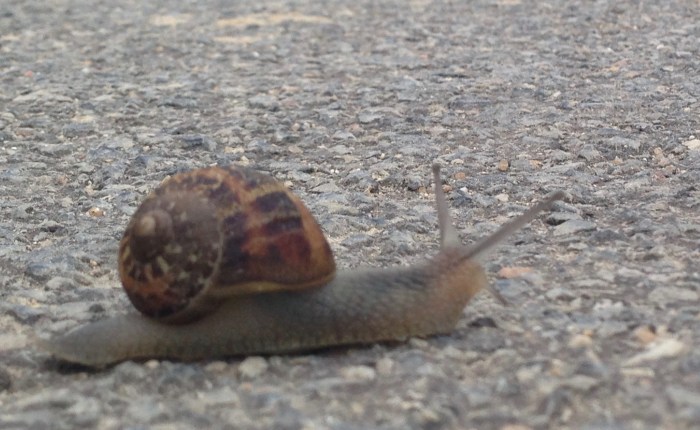
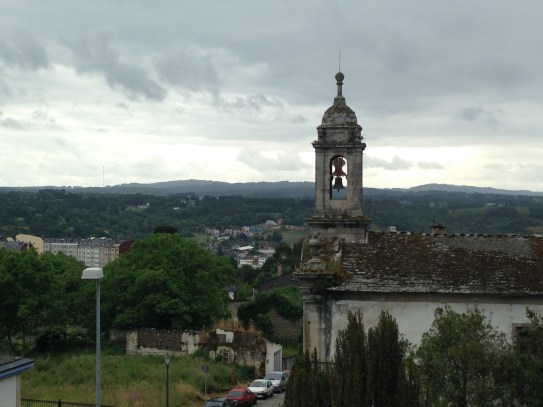
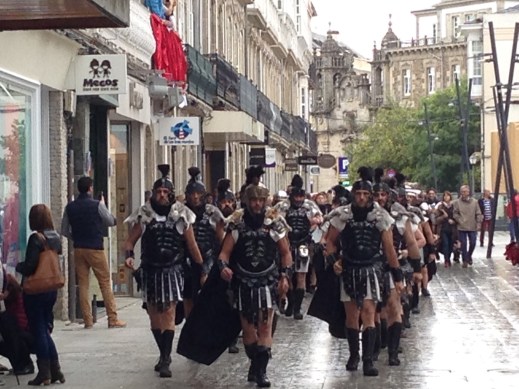
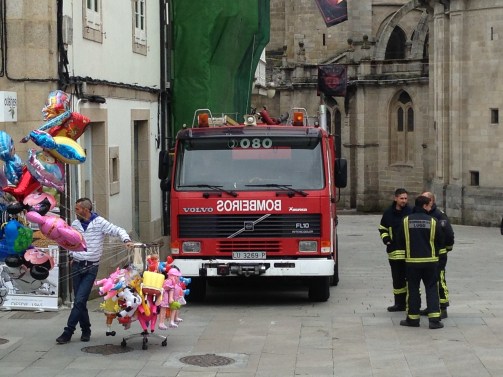


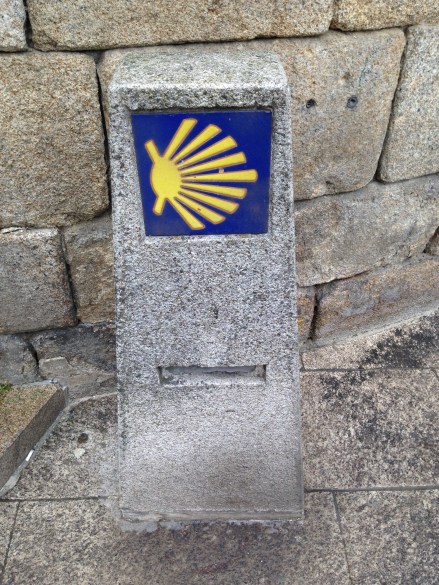
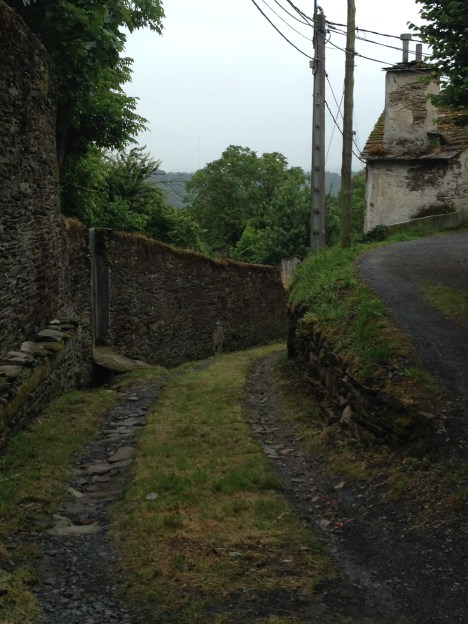
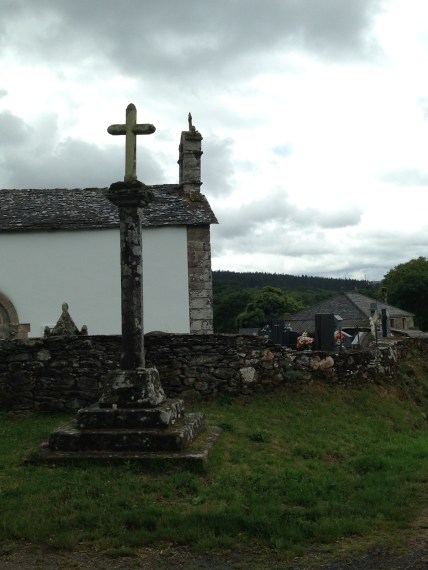


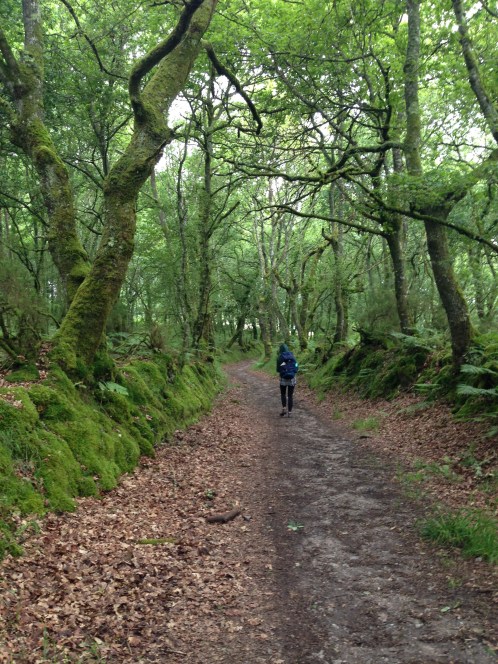

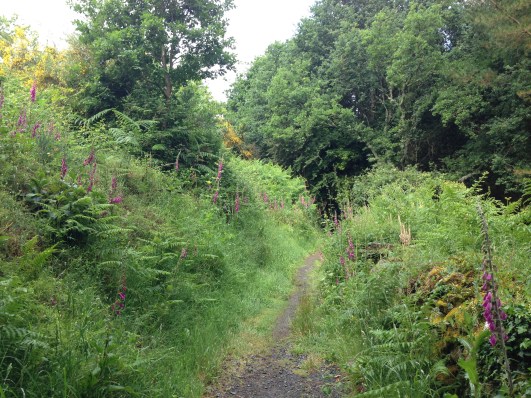
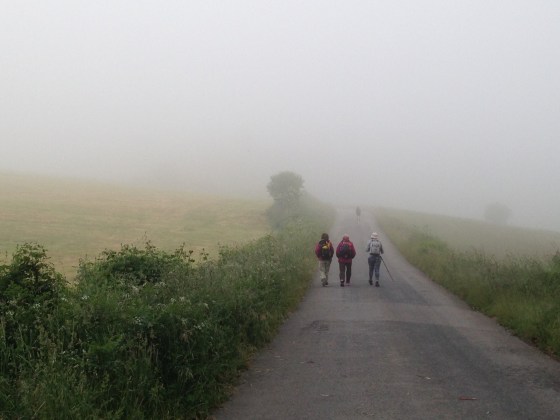
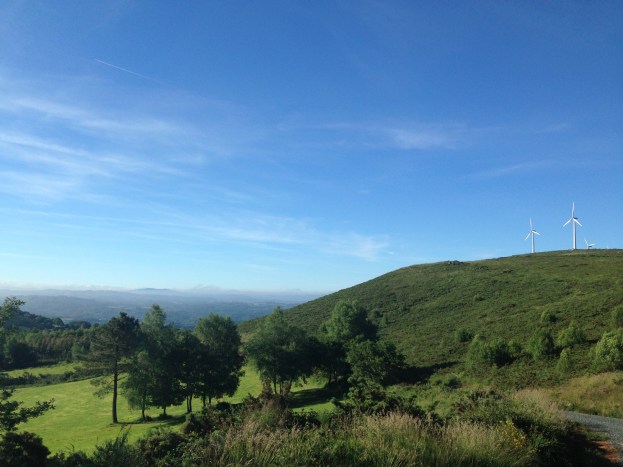
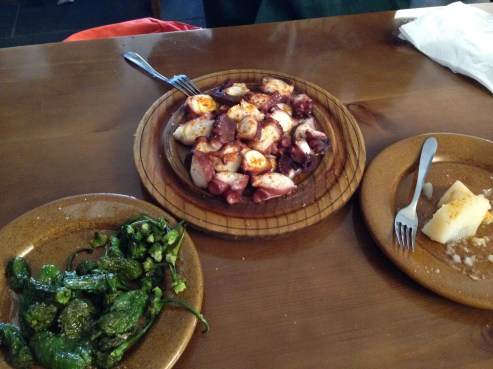

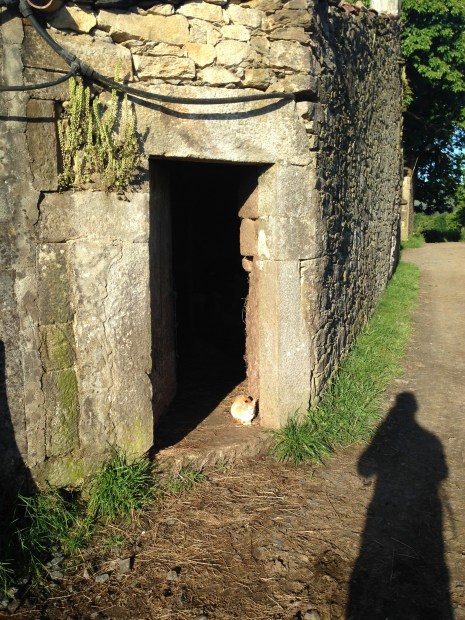
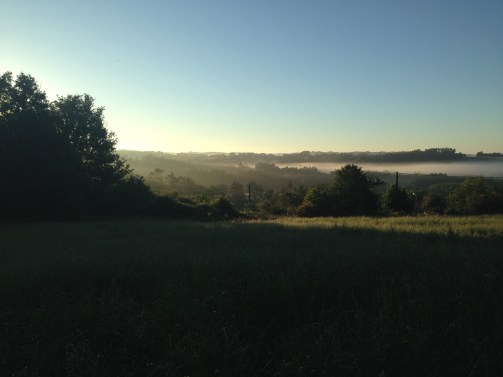
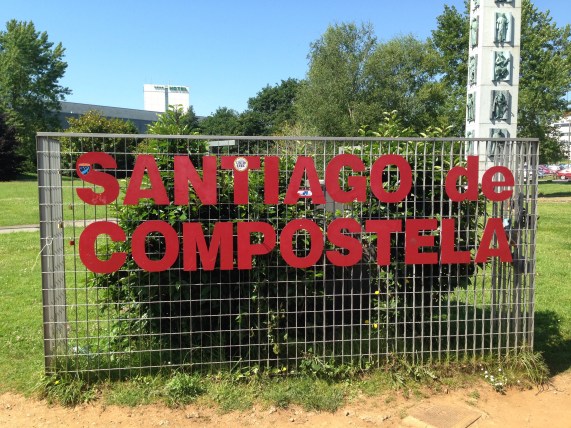
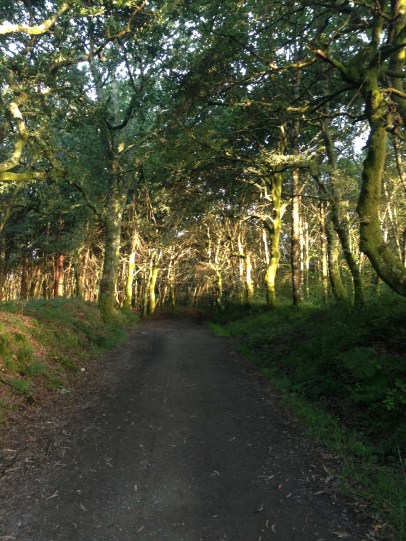
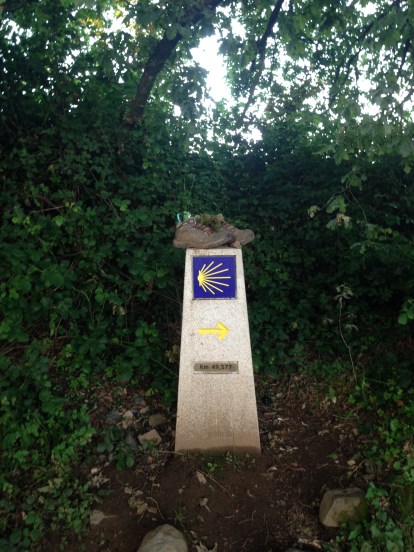

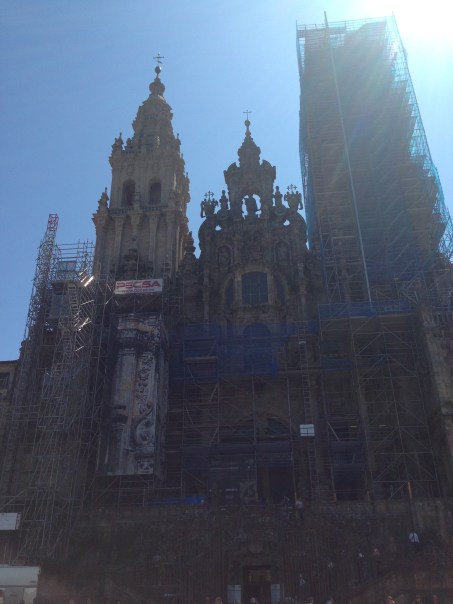
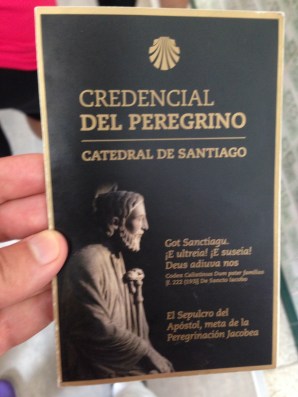
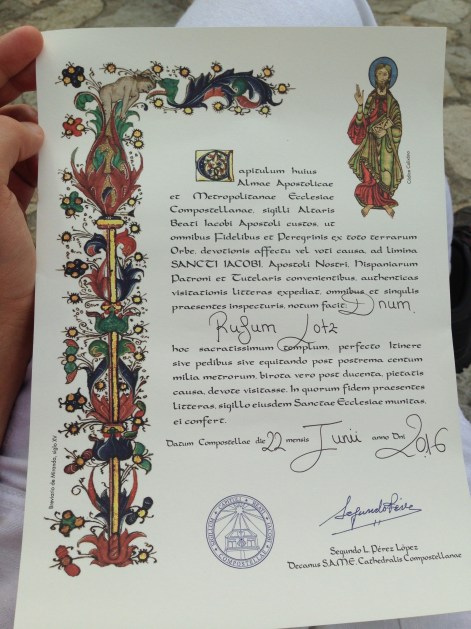
 Lotz in Translation