Christmastime in Andalusia: Málaga

Christmastime in Andalusia: Málaga

(Continued from my posts about Jerez de la Frontera, Cádiz, Nerja, and Ronda.)

The day started with another problem. We had flights booked back to Madrid, but both of us had forgotten to bring our passports. Before seeing anything in Málaga, therefore, we had to take a trip to the airport (luckily, easily accessible on the metro) to find out whether we could fly using our Spanish ID cards. Long story short, we couldn’t, and it was too late to get a refund. Travel can be a humbling experience.

It was a shame to waste time like that, since this was our only day in Málaga.

Málaga is the second-largest city in Andalusia, after Seville, and the sixth-largest in Spain. Like Cádiz, the city’s origins lay far in the past, founded by Phoenicians thousands of years ago, making it among the oldest cities in the world. Carthaginians, Romans, and Muslims Berbers have all ruled the city in turn. Nowadays the place is bustling—with a busy port and a thriving economy. Yet like everywhere on the Costa del Sol, the core of the city is tourism.

Today was a good day for tourism. It was December 30th and the weather was perfect.

After arriving back to the center we ate quickly in a kebab place, and soon were headed to our first stop: the Alcazaba. This is an old citadel in the center of the city; and as its name suggests, it was built by the Moors. The city of Málaga, by the way, was among the last to fall to the Reconquista, being taken by the Catholic Monarchs in 1487 after a long siege, just five years before Granada, the last Moorish stronghold, fell.

Malaga_Picasso
Street art in Picasso’s birthplace

The fortress stands on a hill overlooking the surrounding streets—a collection of tan walls and towers. Below the fortress are the remains of an old Roman theater; and the fortress itself is built over a previous Roman fortification. Thus the layers of history accumulate.

We paid the small fee and went inside. Most of the walking was uphill (which didn’t make the döner kebab in my stomach sit any easier). The place was attractive for its gardens and its promenades rather than its architecture. It was a fortress and not a castle, after all, and so free of ornamentation.

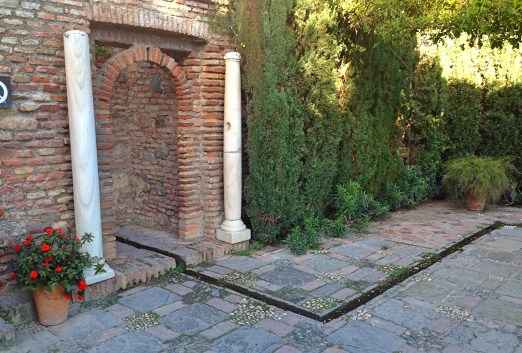
We spent a pleasant hour wandering around its walls and gardens, enjoying the ubiquitous Andalusian fountains and streams that flowed all over the place. These tiny aqueducts, carrying water down stairwells, across walkways, and into fountains, might be the most distinctive sign of Andalusia. These are a sign of Andalusia’s Moorish legacy: it was the Muslims who introduced irrigation into the region, which forever transformed the landscape and permitted the growth of new crops. Practical considerations aside, water has a special symbolic significance in Islam—a religion which grew up in a region even drier than Andalusia. Running water gives everything a touch of paradise, especially in a climate this hot and dry.
Malaga_Aqueduct

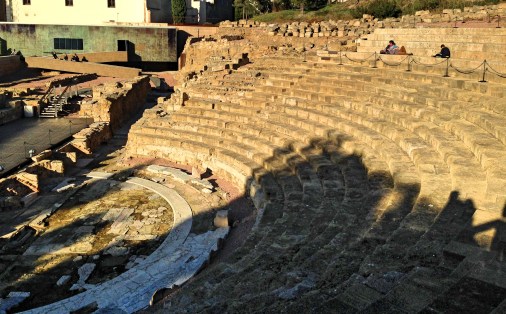
Below the Alcazaba is the aforementioned Roman theater. You can walk inside and sit on the top steps for free. By now, with my stomach in open rebellion from the greasy food, it felt magnificent just to sit down for a few minutes. Immediately below us were the ruins of where the stage had been. On the street beyond, a performer was playing John Mayer on guitar.
Malaga_Theater

John Mayer thus collided with Ancient Rome in my mind, making me feel even more queasy. This odd juxtaposition of ancient and new, elegant and tacky, timeless and transitory, is what characterizes all trips to historical places. Just when you are getting lost in reveries of the ancient past, the constant crush of tourists with selfie-sticks and the peddlers with their overpriced baubles insistently shock one back to the present day.

Daylight was already waning, but there was something more I wanted to see: the Castillo de Gilbralfaro. It was in this castle that, in 1487, the Moors held out in a famous three-month siege against the Catholic Monarchs. The castle stands on the same hill as the Alcazaba, but much higher up. This hill, by the way, has the same name as the castle, Gilbralfaro, and is one of the foothills of the Málaga Mountains.

To get up to the castle, we had to go up a steep walking path that zig-zagged its way to the top. We took half an hour to get there, with fairly frequent stops for two unathletic Americans to catch their breath. The views kept getting better, though, so we pressed on, until finally we reached the entrance and walked in.

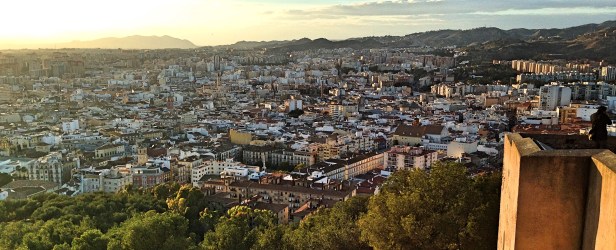
As the guard informed us, we only had half an hour before the placed closed. We didn’t waste any time. At the first entrance to the castle walls, we climbed up and began walking. The view from up here was incredible. (In clear weather it is possible to see all the way to the Strait of Gibraltar and the Rif mountains in Morroco.) We could see for miles and miles—the harbor, the city, and the mountain range to the north. The castle walls went all around the perimeter, allowing us a 360 degree view.
Malaga_City

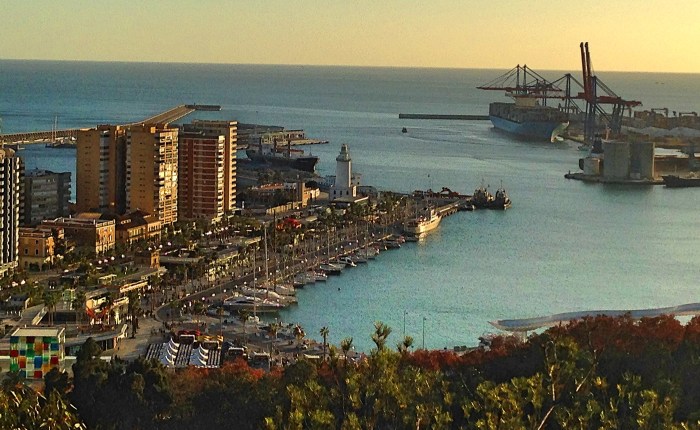
After walking across one wall, entering a tower, and climbing some stairs, I found myself standing on the highest point of the fortification, absolutely alone. The whole city stretched out before me. I could see the ships at dock and the massive cranes used to load and unload them; two large freighters were sitting in the water offshore; thousands of white apartment and office buildings spread across the hilly terrain; and green mountains curved into the horizon. From up here, everything looked so precious and so delicate. The town, in particular, looked like a bunch of toys scattered across the landscape.

Night was falling. To our right, as we faced the Mediterranean, the setting sun turned the sky a vivid orange. We descended slowly down the hill, by now completely cured of the stress of the morning, once more under the enchanting aura of Andalusia. The weather was perfect, the sky was cloudless, and everybody around was laughing. And in this state of reverie, we headed for the beach.

By the time we arrived, the sun had sank completely below the horizon, leaving the world in twilight. We walked alongside the water, listening to the soft sound of the waves. It was dark and a bit chilly now, and only a few people were on the beach. We reached boardwalk, walked to the end, and sat down.

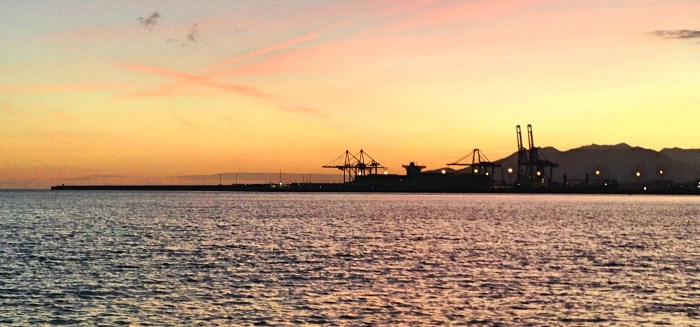
The last light was just leaving the horizon, painting the western sky purple and the skyline red. The shore, the city, and the harbor were outlined against the sky. The skeletal silhouettes of cranes hung over the water. A lighthouse began flashing its warning. The wind whipped up, chilling us through our light clothes and sending waves splashing.

It was time to eat dinner and go to sleep. We went back towards town. Dozens and dozens of shacks lined the road, selling fireworks, dolls, toys, knickknacks, incense, candy, and nativity figurines. It was a Christmas market. In Spain, you see, gifts are normally given on Epiphany, or Three Kings Day (in Spanish called Tres Reyes Magos), which falls on January 6. Thus Christmas season extends a lot further than December 25 here.

The sidewalk was crowded with Spaniards; kids were all over the place, some sparring with toy swords, some slumped in sleep in strollers. We reached the main avenue and turned towards town. A long arch of Christmas lights extended over the packed sidewalk.—the famous Malagueño Christmas lights. Suns and moons and stars studded the glowing canopy, which extended hundreds of feet down the avenue. More than anything I saw that vacation, this walkway, crowded with happy people, awoke in me that wonderful Christmas feeling—the feeling of naïve wonder and excitement, the magic feeling of childhood when the world was simple and good and everything was new.

Malaga_Christmaslights

Our trip had come to a close. We were taking a Blablacar back the next day. To celebrate, we ate at El Pimpi, a restaurant and winery that was recommended to us. The service was astonishingly attentive for a Spanish restaurant, the food was excellent, and I drank several pintados (which the waiter explained was half sweet wine and half dry sherry).

In the morning we woke up early, said goodbye to our hosts, and walked to the train station, Vialia, to meet our driver. Five hours later we stepped out of the car into the cold Madrid air. It was New Year’s Eve. That night we celebrated with some friends of ours. As is the custom in Spain, we ate twelve grapes as the clock ticked down towards New Year’s, making a wish for each grape. Everyone was celebrating, the world was reborn, and the future was bright.
Malaga_Sunset

Review: Gaudí—Visionary Architect

Review: Gaudí—Visionary Architect

Gaudí: Arquitecto visionarioGaudí: Arquitecto visionario by Philippe Thiébaut

My rating: 3 of 5 stars

Beauty is the mirror of truth, and since art is beauty, without truth there is no art.
—Antoni Gaudí

Gaudí has the distinction of being among the few genuinely famous and popular architects in history. Along with Frank Gehry and Frank Lloyd Wright, he is among the handful of architects that decently educated people can be expected to know of. More tourists flock to the Sagrada Familia every year than to the Alhambra—even if many of these gapers mistakenly believe that it is a cathedral (it is an expiatory temple).

And he wasn’t just some popular hack. Gaudí’s stature in the history of art is equally monumental. This wasn’t always the case, however. Both George Orwell and Gerald Brenan, two cultured men, thought that his work was pretentious rubbish. (Orwell regretted that it wasn’t blown up during the Spanish Civil War, and Brenan evinced his work as evidence that Catalonia was culturally behind Spain.) I admit that I had misgivings upon first seeing some of Gaudí’s work. It struck me as exaggerated and theatrical, too mindlessly showy.

But this impression disappears as soon as one begins to inspect Gaudi’s work with any circumspection: for the man was undeniably a genius of the highest order. And it is especially enthralling to encounter a genius architect. For, unlike a painter or a novelist, you can literally step into a world created by Gaudí. You can immerse yourself in his work—see it, hear it, touch it, even smell it.

And Gaudí’s world is incredibly rich. He was the capstone modernisme, the Catalan version of Art Nouveau, an art movement that was preoccupied with rich decoration. Gaudí’s art developed this preoccupation into an explosion; his works burst with ornament. To achieve his typically overwhelming effect, he combined several crafts: sculpture, landscaping, stained glass, ceramics, mosaics, carpentry, blacksmithing, among others. And underlying this passionate drive to beautify was a keen sense of space—the architect’s fundamental aptitude—making his works remarkable on both the macro and micro scale.

His method of working was famously unconventional. He seemed to operate by instinct rather than calculation, even when dealing with complex problems of structure. Gaudí thought spatially: instead of drawing plans he preferred to build models (many of which were burned during the Civil War). Most famously he hung weights from strings to study the optimal angles for weight-bearing arcs. Thus he was a kind of unconscious geometrician, and underneath the seemingly heavy ornaments are beautifully elegant forms.

One of Gaudí’s central passions was nature. A deeply religious man, he considered the natural world to be the work of God; thus he thought that architects should strive to emulate the original creation. Consequently you will look in vain for any straight lines in his works, since perfectly straight lines are seldom found in the natural world. This also helps to explain his use of color: how often are natural landscapes black and white?

A severe and passionate Catholic (not to mention a fervent Catalan nationalist), at first glance it is perplexing that a man so avant-garde in art could be so conservative in every other sphere of life. This is no paradox, of course, and only seems strange because we have come to associate cutting-edge art with the left—a historical and not a logical connection. In any case, Gaudí is yet another example of the truism that great artists manage to be both traditional and innovative in the same moment.

This little book is a nice companion and introduction to the man’s work. For my taste, the text consists too much of dense descriptions of buildings and not enough of biography or history; but any book of this length is bound to leave a lot out. The photos are excellent to have; and the final section, which includes several different interpretations of Gaudí’s work (including Dalí’s Surrealist-Freudian take on it), was very welcome.

View all my reviews

Christmastime in Andalusia: Ronda

Christmastime in Andalusia: Ronda

(Continued from my posts about Jerez de la Frontera, Cádiz, and Nerja, and continued in my post about Málaga.)

The drive from Málaga to Ronda is one of the pleasantest in Spain. The countryside is exquisitely rustic, with sun-baked fields and tiny towns full of white houses. We took a Blablacar with a nice young woman, on her way to her pueblo nearby. Ronda is about 100 km west of Málaga, and the drive takes about an hour and a half.

(It is a common thing, by the way, for Spaniards to have a “pueblo.” This is the town, not necessarily where they were born or where they grew up, but where their family is from. Work is scarce in these small towns, however, and so many people move to cities to find jobs; yet family ties remain strong and weekend trips to visit parents and relatives in “the pueblo” are ubiquitous.)

We were dropped off in the center of Ronda, and began making our way to Ronda’s most famous landmark: El Puente Nuevo, or the New Bridge.

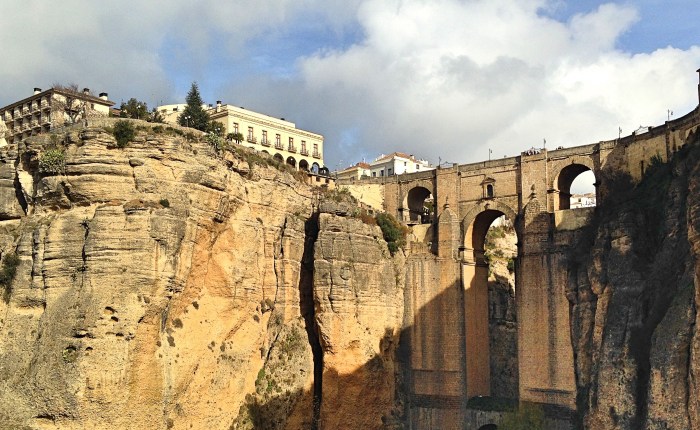
This bridge is eye-poppingly massive—a stone structure standing almost 400 feet (98 m) above the Guadalevín River. Indeed, the huge effort necessary to create a bridge of this size struck me as out of all proportion to the city of Ronda itself, which now is home to about 35,000 people. And I am doubly astounded when I consider that, as the name “New Bridge” suggests, there was already a bridge in Ronda: the Puente Romano—which, despite its name, was probably built by the Moors.

Ronda_Bridge

Looking down from the cliff at the towering structure, I wondered: How on earth was it built? Indeed it almost wasn’t. The bridge that stands today, built between 1751 and 1793, was the second attempt to span this chasm. The first attempt, constructed from 1735 to 1741 with a single arch, was built hastily and poorly, and soon collapsed—resulting in the deaths of 50 people. The bridge which stands now, designed by José Martín de Aldehuela, is not only strong but beautiful—its graceful form tying the whole landscape together.

After we had taken our fill of photos, we began to walk around the promenade overlooking the cliff. The view of the countryside was, if possible, even lovelier than the bridge itself. A vast green field was divided into neat patches, some brown, some with rows of bushy plants. Here and there was a farm, looking like doll houses from so far away. And beyond was a patch of forest, which led to the sierra in the distance, the morning fog still sitting on the peaks. On a dirt road a pickup truck was making its way to who-knows-where, throwing up a tiny cloud of dust. Ronda_Countryside

To our left we could see a path leading down into the gorge below. It looked like too much fun to resist. We crossed the bridge, found the path, and soon were carefully edging our way down. The path forked several times, and each time we chose the one that led towards the bridge. At times it was quite steep and slippery, so we proceeded slowly for fear of falling.

We were getting close to the bridge now; it loomed overhead like a skyscraper. The white noise of the waterfall below turned into a steady roar.

After walking down a hazardous rocky path, made slippery by the atmospheric spray of water, we came upon a little shack. It was visibly run-down, obviously hadn’t been used in years. We took a peek inside. It wasn’t terribly interesting: full of old leaves, beer cans, and other garbage. On the walls, above a little hole in the floor, was spray-painted the ominous message: “It’s easy to descend into hell.”

“Wanna go down there?” I asked GF.

“No way.”

“Good idea.”

We turned around and began again to approach to the bridge. In fact, the path went right under it. A staircase that bounced too much to inspire confidence led down to a concrete pathway with a wobbly iron railing that went straight through to the other side. We passed underneath the bridge, and then under some impressively huge boulders sitting at the base of the bridge. Now we were standing between the two cliffs, which stretched hundreds of feet up above. Everything was quiet here.

Though it was broad daylight, and though we were following a public path, we felt like we were sneaking into a place we shouldn’t be. This impression of trespassing was reinforced after we found ourselves in a small working area. There was a concrete hut, empty on the inside, with plants growing on the roof; clearly it hadn’t been used in years. Nearby were all sorts of metal devices—a trough, a wheel used to raise and lower a barrier, and other things I didn’t understand—laying apparently unused and rusted. The place had that sort of eerie, post-apocalyptic feel that all abandoned places have.

Ronda_Beyondbridge

After taking in the scene we started trekking back up. The steep ascent didn’t feel good on my knees, I can tell you.

By now we’d had our fill of the bridge. I knew of only one other thing to see in Ronda: the Plaza de Toros, or bull ring. Built from 1779 to 1785, and designed by the same architect who designed the New Bridge, this is the oldest bull ring in Spain. Every year the Corrida goyesca takes place here—a traditional bullfight performed in historical costumes. For most of the year, however, it is a museum—of bullfighting and more.

Ronda_Bullring

I had never seen a bullring before, so I had nothing to compare it with. But it was quite pretty. Martín de Aldehuela designed the ring in a harmonious neo-classical style. Two floors of seats, four rows each, surround a circular area filled with sand. I stood in the center and tried to imagine what it would feel like to be a matador, how absolutely terrified I would be if I was facing a bull, only armed with a cape and a little sword.

The little museum on the inside is about the history of bullfighting and other violent European pursuits, such as hunting and dueling. Most memorable for me were several pairs of ornate dueling pistols, in lush velvet cases, alongside plaques that explained which famous persons had used these weapons on one another. For my part, I cannot imagine any situation in which I would let somebody fire a loaded pistol at me purely for the sake of honor. As the honorable Falstaff said:

Can honour set-to a leg? No. Or an arm? No. Or take away the grief of a wound? No. Honour hath no skill in surgery, then? No. What is honour? A word. What is in that word “honor”? What is that “honour”? Air.

I can’t help feeling that bullfighters would disagree.

After we spent enough time in the museum to get our money’s worth—staring at the rifles and pistols, the elaborate costumes for men and horses on display, and perusing the old bullfighting posters advertising bygone shows—we made our way to the gift shop, where I found a copy of Death in the Afternoon. This is Hemingway’s book on bullfighting, which I would recommend to anyone at all curious about the bloody art.

Hemingway, for his part, was very fond of Ronda. In that book, he says:

[Ronda] is where you should go if you ever go to Spain on a honeymoon or if you ever bolt with any one. The entire town and as far as you can see in any direction is romantic background and there is an hotel there that is so comfortable, so well run and where you eat so well and usually have a cool breeze at night that, with the romantic background and the modern comfort, if a honeymoon or elopement is not a success in Ronda it would be as well to start for Paris and both commence making your own friends.

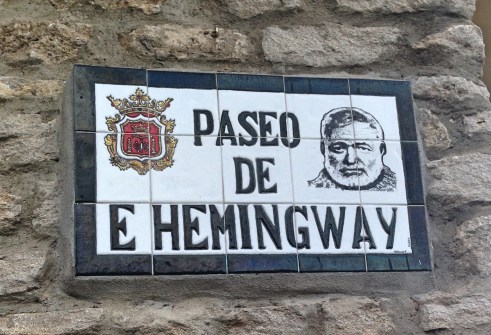
Ronda has repaid the compliment by naming a street after Hemingway.

Ronda_Hemingway

When we left the bullring, it was already time to go back to Málaga. We began to make our way up narrow cobblestone streets, back towards the train station where we would meet our ride. My shoes—cheap sneakers I bought here—have thin soles, so I could feel every stone sticking out from the pavement. Our footsteps made that distinctive thud that footsteps make in quiet, narrow, stone-paved Spanish streets.

Eventually we reached the main road, got to the station, and were again driving through the Spanish countryside. We had only one day left before our trip was over.

Review: Blake’s Poetry

Review: Blake’s Poetry

Blake: Poems (Everyman's Library Pocket Poets)Blake: Poems by William Blake

My rating: 4 of 5 stars

The Angel that presided o’er my birth
Said, ‘Little creature, form’d of Joy & Mirth,
Go love, without the help of any Thing on Earth.’

As I’ve said before, I feel a bit uncomfortable reviewing poetry. I don’t have the proper tools; I lack the vocabulary. Critiquing poetry, to me, is like critiquing a human body. I don’t know why one face pleases me, and another pleases me not; I simply couldn’t say why I find one shape shapely, and another shape misshapen. When I see a pleasing face or an attractive form, I respond automatically; and the same might be said for my reactions to poetry.

William Blake makes this job even more difficult, as he was, in the truest sense of the word, an individual. How does one evaluate a totally idiosyncratic artist? It seems impossible; all evaluations, either explicitly or implicitly, involve comparison. But when somebody is so aloof and peculiar as was Blake, comparisons seem somehow inappropriate. Well, I’ll stop caviling, and on with it.

There is a childlike innocence to many of Blake’s poems. Some of them have the gentle sing-song rhythm of a lullaby; the words seem to rock you back and forth, lulling you into a dreamy peace. Blake’s early poems, in particular, are totally free of cynicism and disenchantment; rather, they are direct, honest, wide-eyed.

To see the World in a Grain of Sand
And a Heaven in a Wild Flower,
Hold Infinity in the palm of your hand
And Eternity in an hour.

Married to this total innocence, however, is an intense spirituality. Blake is a textbook mystic. Perhaps the closest poet to Blake that I’ve read is Whitman. Like Whitman, Blake is scornful of organized, traditional, Puritanical religion. Rather, he sees God in every blade of grass, and considers the body a source of delight, rather than of sin.

All Bibles or sacred codes have been the causes of the following Errors.
1. That Man has two real existing principles, Viz: a Body & a Soul.
2. That Energy, call’d Evil, is alone from the Body, & that Reason, call’d Good, is alone from the Soul.
3. That God will torment Man in Eternity for following his energies.

In terms of pure poetic skill, Blake is no match for a Milton, a Donne, or a Whitman. Indeed, that sort of thing seems not to interest him. He has not a great talent for aphorism; he is not eminently quotable. The poems are not meant to be unraveled or chewed; you will not be left puzzled or bewildered. Verbal ingenuity is not, in short, Blake’s strength; and if Blake is read with that purpose in mind, you are sure to be disappointed. His aim is instead to disarm you, to make you let down your guard; his poetry is, in fact, almost conversational. Blake knew he was something of an oddball; but he was too wise to think himself any the worse for it. His poetry, then, is a kind of invitation into his personal world.

My mother groan’d! my father wept,
Into the dangerous world I leapt,
Helpless, naked, piping loud,
Like a fiend hid in a cloud.

And indeed, this world gets more odd and fanciful the longer you stay with him. Blake’s later poetry is considerably more obscure than his earlier work. He seems, in fact, to have invented his own mythology; and the poems from this period are little more than tales and visions of his personal gods and heroes and demons. It is certainly odd; but it is oddly alluring.

If the doors of perception were cleansed, every thing would appear to man as it is, infinite.

For man has closed himself up, till he sees all things thro’ narrow chinks of his cavern.

Part of the reason books are so fascinating is because people are so fascinating. Right before reading this collection, I read a collection of Donne’s poetry. The juxtaposition is telling. Both men are mystics, both men are sensualists, both men are aloof individuals. Yet Donne is intellectual, anguished, and strained; Blake is direct, joyful, effortless. At least, this is my impression. It is odd trying to get to know somebody purely through their poetry; it is rather like trying to get to know somebody by rummaging through their trash. We are forced to guess at what’s locked inside by shifting through what’s shed.

View all my reviews

Christmastime in Andalusia: Nerja

Christmastime in Andalusia: Nerja

(Continued from my posts about Jerez de la Frontera and Cádiz, and continued in my posts about Ronda and Málaga.)

Our next Airbnb was in Málaga. The Blablacar driver for our ride was a nice fellow from Cádiz. His accent, however, was absolutely incomprehensible to us. He spoke like a jackhammer, and made about as much sense. I have heard from people here in Madrid (who are obviously biased) that the people of Cádiz have the worst accents in all of Spain; even native Spaniards have trouble understanding it. He might as well have been speaking another language.

At least we could understand the radio, however, since it was in English. Málaga, you see, has become something of a getaway home for retired English people—England’s Florida, you might say. This expatriate community has created its own little England in the province. Radio stations, advertisements, store names—English is all over the place. You can even find bars that serve fish and chips and warm beer.

(Subsequent experience only confirms this. I came back to the Málaga a year later to stay with a relative in the outskirts of the city. One day, while walking around the neighborhood of my cousin’s rented house, I noticed that all of the “Beware of Dog!” signs on the houses were either in English or in German (Vorsicht vor dem Hund!), but none were in Spanish.)

And this is not to mention the huge numbers of tourists who come here, usually from colder climes, to enjoy the famous Costa del Sol—the series of beach towns on the south of the Peninsula, perpetually sunny and beautiful. We had come to see one of these beach downs: Nerja.

Nerja is about 50 km east of Málaga. The bus leaves from Vialia, the central transportation hub in the city for both buses and trains, and the ride takes about an hour. We arrived not knowing what to expect. The only reason we went was because a friend had recommended going.

Thus we were surprised, after walking from the bus stop through town, to find ourselves standing in a plaza filled with restaurants and people, which sat on a big rock overlooking the sea. This is the famed Balcón de Europea. The view was incredible. In front was the Mediterranean, a bright aquamarine; and flanking the plaza, far below us, were small beaches. Foamy waves washed the sand where kids were playing in the water. Over these beaches, white houses and hotels clung to the cliffs, every window open to the ocean breeze. It could not have looked more like a tropical paradise.

Nerja_Beach

We climbed down some stairs from the plaza to the white beach, which was hemmed in by rock formations on either side. Whole families were sunning themselves on the sand; brightly colored canoes were sitting near a little hut; and a father was playing with his daughters in the gentle waves. I can see why so many tourists come here.

Nerja_Columns

After we got our fill of sun and sand we climbed the stairs again and ate. We had only one thing we particularly wanted to see in Nerja: the caves.

The Caves of Nerja were discovered as recently as 1959, accidentally stumbled upon by five friends. Since then they have become a major tourist attraction. Unfortunately for us, the caves aren’t in the town center; they’re about an hour away by foot.

A lot of this journey was, unsurprisingly, pretty dull; though there were some neat things to see along the way. We passed restaurants, houses, farmlands, bridges, with the Mediterranean constantly on our right. Eventually we came to the Aqueduct of Nerja, which looks like a Roman Aqueduct, more or less, but was actually built in the 1800s for the industrial revolution. It’s a fine piece of architecture, with four rows of arches built of red brick; and it’s still in use.

Nerja_Aqueduct

We arrived at the caves, both of us quite tired, paid the entrance fee, and descended into the bowels of the earth. These caves, which began to form about five million years ago, were in continuous use by humans from the Ice Age until a few thousand years ago. Paintings have been discovered on the cave, though you can’t visit them, and in 2012 it was announced that some paintings were possibly made by Neanderthals—which would make them unique.

After walking through a series of small chambers, we walked into one of the big ones.

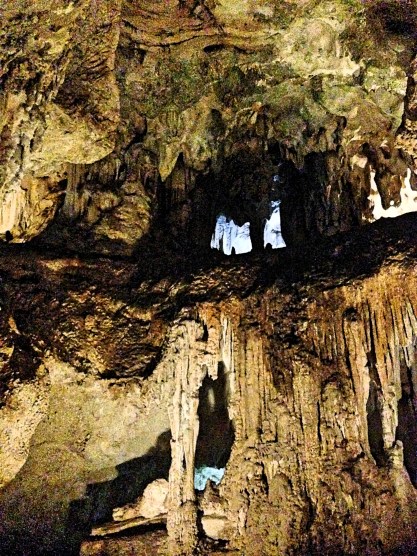
It was stunning. I had no idea these caves were so huge. Standing at the bottom of one of the big chambers was like standing in a basilica looking up at the roof. Years of seeping water and liquid erosion has left the cave full of stalactites and stalagmites; every surface looks melted, as if the rock of the cave were chocolate left out too long in the sun. How many years of water drip, drip, dripping must it have taken for these bubbling, flowing textures to have arisen in solid stone? You can’t wrap your mind around it.

Nerja_Cave


And the caves kept going, every chamber more impressive than the next. In the last and biggest there was a tremendous pillar, extending from the floor to the ceiling like a column in a cathedral. Indeed, the elaborate patterns in the rock reminded me very much of gothic ornamentation. And is it a coincidence that our most sacred spaces reproduce dark, stony, shadowy interiors such as this?

Think of the early humans, thousands of years ago, who took refuge in these natural shelters seeking protection from predators and the elements. What were their thoughts as they sat here in the darkness? What did they talk about? How did they pass the idle hours? Did this place, so grand and so inhumanly vast—a place of safety but also of mystery—excite the first religious stirrings in our ancestors? Standing in that cave, it must have seemed obvious that there were forces far more powerful than humans and animals shaping the earth.

After an hour, we were blinking in the daylight. Tired and thirsty, we still had the long walk back from the caves to Nerja, to catch the bus back to Málaga. So we bought bottles of water and set out, too tired to talk even if we had anything to say. The clouds closed in, evening fell, and the sun was setting in the distance when we reached the station. Both of us fell asleep almost immediately after we sat down on the bus. We had to rest: we had another trip the next day.

Christmastime in Andalusia: Cádiz

Christmastime in Andalusia: Cádiz

(This post is continued from my post about Jerez de la Frontera, and continued in my posts about Nerja, Ronda, and Málaga.)

As usual, the trip began with a problem. Trying to act with foresight, we bought train tickets the day before. But, as our host told us later that night, the tickets are only good for one day. Ours were expired. So we had to try to convince the train official to change our tickets, and do this with our halting Spanish.

The morning was thus off to a stressful start. We both had that sort of irritable cabin-fever you get when you spend day after day with somebody in a foreign country; every word we exchanged was peevish bickering. Things ran pretty smoothly, though. The man at the ticket office was very nice and understanding; it took him only a couple minutes to change our tickets.

Soon the train came and we were off. The ride from Jerez to Cádiz is gorgeous. We went through grassy wetlands; on either side of us we could see fields half-flooded with water, with irrigation ditches dug through them in a grid-shaped pattern. What crops are grown here? Outside the window I could see the aquamarine blue of the ocean, sparkling in the Andalusian sunlight like a sapphire.

We arrived. My first impression—and impression that gained in force throughout my stay—was that Cádiz is painfully pretty. I think it’s the prettiest city I have ever seen. The old city center sits on a peninsula, jutting out into the ocean. The narrow streets—lined with pink, yellow, and skyblue buildings—lead you through the interior; and every few blocks you come across a little plaza, with sidewalks tiled in black and white, and tropical trees I can’t hope to name. Eventually you reach the water, lightly lapping the rocky shoreline, which is so bright and blue it looks like it has been dyed.

Cadiz_Square

Cádiz is the oldest continuously populated cities in Spain, having been founded by the Phoenicians back around 1,000 BCE. It might even be the oldest in all of Western Europe. By the time Herodotus mentioned it in the fifth century BCE, the city was already hundreds of years old. This continuous occupation is no doubt due to the city’s fine port, though nowadays the beaches are more for tourists than traders and explorers.

We got to the shore and strolled. The scene was so intensely pretty that I felt simultaneously ecstatic and relaxed. A sublime cheerfulness flooded my senses. GF had a list of things to see and do here, but now I couldn’t believe anything could be better than the city itself.

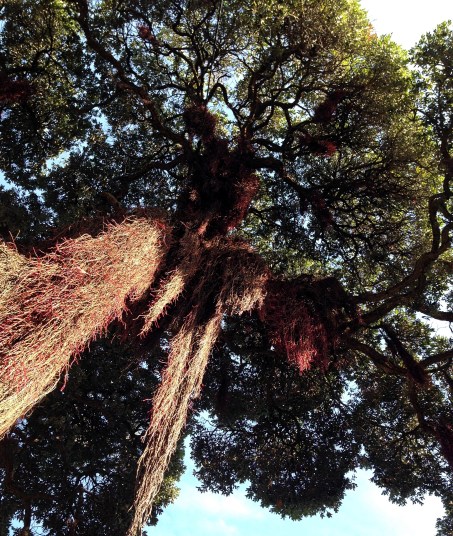
We passed a church painted with pastel pink, built in a colonial style, and kept going. Eventually we reached a park, El Parque Genovés. A long promenade cut through the center, each side lined with ferns shaped into spirals and cylinders. Big, twisting, knotty trees, covered in rubbery broad leaves, jutted from the ground, their trunks exploding in multiple directions. Trees even more bizarre bid us farewell as we left—one with a bulbous, almost cucumber-like trunk; and another that looked like it had been turned upside-down.

Tree_Cadiz

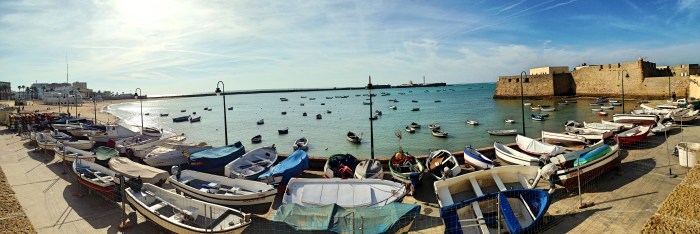
We turned another corner, and now the prettiness started to sting my eyes. Directly before us was a bay, filled with little white row-boats, floating idly in the calm, sparkling waters. To our left was an old fortress, the Castle of Santa Catalina—a squat, square structure built of tan stones, standing over the water. And to our right was the beach, the Playa de La Caleta, nearly empty. The scraggly heads of palm trees dotted the shoreline, and a boardwalk extended into the ocean beyond.

Cadiz_Bay

I could not pull myself away; so we sat in the nearest café and decided to have lunch. I sipped a glass of sherry as I attempted to burn the view into my memory. The white boats and buildings, the yellow-brown sand and tiled walkway, the ocean breeze and the slightly sweet taste of sherry—I was enamored and intoxicated. It was one of those views that look immediately familiar because they are so classically picturesque.

Indeed, as it turns out I had seen this view before. It is the where a beach scene in the James Bond movie Die Another Day was filmed. In that movie, the beach is supposed to be in Cuba—which explains why I was immediately reminded of Cuba, although I have never been there. It’s funny how our memories work.

After lunch we went straight for the beach, stumbling over the sand in a kind of bewildered, euphoric daze. Only a few other people were there, most of them sitting on the sand and looked out towards the ocean. At the end of the beach was a boardwalk, leading towards a big structure sticking out a few hundred feet into the water. This is the counterpart fortress of the Castle of Santa Catalina on the beach’s right side: the Castillo de San Sebastián. 

“Oh, this was on my list,” GF said. “It’s a castle or something.”

“Let’s go,” I said.

The Castle of San Sebastián is connected to the mainland by a narrow walkway, only wide enough for two people abreast. When we were midway across the wind started to whip up; the waves were no longer gentle, but angry. They splashed against the platform, spraying foam onto the walkway and covering my glasses in salty droplets. The wind accelerated every few seconds, turning our clothes into balloons and making our hair dance wildly.

The further out we crept, the more of Cádiz we could see behind us. The city was no longer the pretty jewel it had been one moment ago, but a bold bulwark against the brooding power of the sea.

We reached the castle. This was built in 1706 to complement the Castile of Santa Catalina on the other end of the beach. Before the castle was built a hermitage stood on this island, where sailors recovering from the bubonic plague could be isolated. Nowadays the fortress is in a dilapidated state, consisting mainly of ruins and rubble; in any case it is mostly a collection of stone walls, never meant to be pretty. But the view from the tip of the island was splendid, allowing you to see the whole coast of Cádiz and far beyond. Yet it was really the ocean that captivated me. The sound of crashing waves, the smell of salt, and the feeling of the cool breeze chilling you to the bone.

We still had much to see. Our next stop was the cathedral. It isn’t very far off. The cathedral’s tall form towers over a row of apartment buildings. These buildings are painted in creamy colors; and the view of the marble cathedral looming above them is one of Cádiz’s distinctive views. Our road ran right along the sea; and to my right, separating the sidewalk from the ocean, was the breackwater: a pile of giant, perfectly cubic stones.

Cadiz_Cathedral_Distance

We reached the cathedral and went inside. Everything was smooth lines, rounded forms, and clean white marble. This was neoclassical—elegant and symmetrical. According to the audioguide, this cathedral was built when Cádiz began to profit enormously from Spain’s trade with her colonies in America. Thus this grand edifice resulted. By contrast with gothic cathedrals I had seen, this one looked more like a celebration of human reason than divine might. Its even proportions, its emphasis on balance, its ghostly white marble columns, all this reminds one more of a mathematical theorem made manifest rather than a vengeful deity who sits in judgment.

Cadiz_Cathedral

If you visit this cathedral, make sure to go to the crypt in the basement. There isn’t much to see, but the central chamber has really astounding acoustics. Stand in the right place, and even a whisper will be magnified into an omnipresent hiss. And the sounds of your footsteps bounce from the roof to the floor like a rubber bouncy ball sped up fifty times.

Next stop was the Torre Tavira, an old tower from the city’s golden age of trade. At first I thought it would be a scam—pay a few to climb a lot of stairs. But it turned out to be perhaps the best thing we did in Cádiz. The view from the top is worth the money, as it is probably the most impressive in the city. But the best part of the visit commenced when we were led by the guide to the cámara oscura. This is a very old and very simple device, consisting of a dark chamber with an angled mirror with a small opening. Light enters the aperture and is reflected by the mirror to a surface, where the image shows like a projector.

Our tour guide led us into the room, had us encircle the disc-shaped projecting surface, and dimmed the lights. The show began. Light poured in through the camara obscura above us, created a perfect image of the city on the disc. This image was magnified quite a bit; and by turning the mirror overhead the guide could focus on different areas of the city. Going on this way, we explored the city in every direction, our guide pointing out the notable buildings and briefly explaining their history.

The show ended and we went downstairs. By now I was exhausted. Being continually astonished really takes a lot out of you. I didn’t have the energy to gape at anything else. Besides, it was getting dark by now, and we had to get to our next stop. So we pulled ourselves away from this city, walked to the train, and returned to our Airbnb. Please, if you get the chance, visit Cádiz. It’s a jewel.

Review: A Farewell to Arms

Review: A Farewell to Arms

A Farewell to ArmsA Farewell to Arms by Ernest Hemingway

My rating: 3 of 5 stars

There were many words that you could not stand to hear and finally only the names of places had dignity.

If Voltaire had read Hemingway’s famous war novel, I’d wager that he would pronounce that it is neither about war nor a novel. Compared to All Quiet on the Western Front, for example, the descriptions of war in this book are ludicrously tame. The vast majority of the time the narrator is not even at the front; and when he is, he is far behind the front lines, driving an ambulance. The bulk of the book is taken up, instead, by a love story. The war forms the backdrop—though admittedly a very conspicuous backdrop—and is not the main thread of the book.

What of the novel? Hemingway is a writer of conspicuous strengths and weaknesses; and the longer the book, the more apparent his shortcomings. Though the novel is slim, it still feels padded. Hemingway, for whatever reason, considered it dramatically necessary to narrate every time his characters ate or drank. Aside from telling us that his characters drank a lot (even while pregnant) and appreciated good wines, we learn very little from these frequent repasts, and the ultimate effect is to make the reader hungry.

The conversations, too, are repetitive—especially between the narrator and Catherine Barkley, his wartime sweetheart. While strikingly tender and frank, especially for Hemingway, the relationship between these two never sparkles with the interplay of personality. There is none of the mutual discovery we find in, say, Jane Eyre and Mr. Rochester. Instead, the two of them talk to each other the way people talk to their dogs—asking cutesie rhetorical questions never meant to be answered.

These two examples are just part of a larger fault: Hemingway’s tendency to get carried away into nostalgic, atmospheric descriptions. At his best moments, admittedly, he creates that wistful, bittersweet, melancholic tone that he is known for, and that forms such a beautiful part of his work. But too often the book becomes pointlessly autobiographical. Hemingway is, after all, one of the strongest proponents of the “write what you know” school of fiction. Though wise advice, there is a danger to this method: Since everyone’s life is interesting to themselves, it can be difficult to know which parts may be interesting to other people. This book definitely suffers in this way.

Of course there are many strong bits. Some scenes are unforgettable—the narrator’s injury, the long retreat, rowing across the Swiss Lake, among others. I also really loved the conversations between the narrator and Rinanldi. Unlike the love story, that friendship has true chemistry. Indeed many episodes, taken by themselves, are remarkable. But do they add up to a coherent book?

I ask this specifically in regards to the ending. Since I had just read A.C. Bradley’s book on tragedy, in which he insisted that tragedy requires that a hero create his own downfall, I was struck by how un-tragic was the end of this book. The fatal stroke is not the inevitable result of any personal flaw or a misguided decision, but pure misfortune. The final effect, therefore, is not tragic, but pathetic. In Hemingway’s novel, the universe itself is malevolent, even sadistic, and humans just confused defenseless creatures caught in its maw.

Thus I am a bit perplexed that some people see this as an anti-war novel. The narrator’s crushing blow is not caused by the war; indeed it is something that could have happened to anyone. You can argue that the novel’s bleak atmosphere reflects the fatalism and the pessimism engendered by the war: a nihilistic perspective that is carried over into every phase of life—even love. Yet the narrator himself is not pessimistic—at least not most of the time; if he were, he would not have embarked on his love-affair. It is neither his perspective nor the war, therefore, that dooms the narrator, but some mysterious malevolency of the world itself that makes lasting happiness impossible, in war or in peace.

Thus, aside from a few explicitly anti-war passages in the book, the general tenor has little to do with pacifism or any other political reflection. Instead, to paraphrase the book’s most famous passage, the final message is: Everyone gets broken in the end no matter what. And I don’t think this notion has any truth or value.

View all my reviews

Christmastime in Andalusia: Jerez de la Frontera

Christmastime in Andalusia: Jerez de la Frontera

(Continued in my posts about Cádiz, Nerja, Ronda, and Málaga.)

The Voyage

On December 24, Christmas Eve—or Noche Buena (“Good Night”) as the Spanish call it—in the year 2015, at an egregious hour in the morning, we met up with a couple of guys that we had contacted through Blablacar to make the drive down to Jerez de la Frontera.

They were both extremely nice, agreeable fellows; but I’m afraid they had Andalusian accents and I could hardly understand them.

The people of Andalusia, you see, have something of a reputation. Their accent is distinctive and difficult for outsiders to understand. They speak in a rapid staccato, spitting out the words like a machine gun. Unlike in most of Spain, Andalusians do not pronounce c’s or z’s like “th” (often mocked, incorrectly, as the “Spanish lisp”); and instead pronounce all soft c’s and z’s like an “s,” as they do in Latin America. For most people this would not be a problem; but since I’m only used to Castillian Spanish this confuses me.

What is more, Andalusians drop the terminal “s” wherever it appears: tres becomes tregracias becomes gracia, and so on. To top it off, the consonants separating two ending vowels are also dropped, and the vowels are blended together into a dipthong: complicado becomes complicao. With all these factors taken together, the final result is, for me, an indistinct slur of sound that never resolves itself into separate words.

In sum, I could not understand them. So I slept; and GF slept; and we woke up and then fell asleep again.

The countryside of Andalucía, normally so flat and treeless that you can see for miles, was shrouded in a mysterious and impenetrable wall of fog. Apparently, mornings in the south of Spain are typically foggy, which I find odd considering how absolutely sunny and cloudless are the days.

But I had traveled this road before, when I went to Seville. So even though I couldn’t see much, memories flew by the window instead.

There are castles, I recalled: mostly run-down and in ruins, dotting the countryside; we must have passed five or six. Then there are the great, big, black silhouettes of bulls, which stood here and there, sometimes next to the highway and sometimes on a hillside beyond. These are the Osborne Bulls: signs that were originally set up as advertisements for Osborne brand sherry. Despite this prosaic commercial origin, they have since become something of a symbol for Spain, and you can find them on everything from T-shirts to book jackets to postcards.

Osborne_bull

I also remembered the livestock. The Spanish countryside has a rugged, rural, pastoral charm that I did not expect to find in an industrialized country. In what look like wild fields along the highways you can see cows grazing, sheep huddling in herds, and horses bathing their shiny coats in the sun. No human can be seen watching over them; not a fence is in sight—except perhaps and old, derelict stone barrier that looks short enough to hop over.

Then I thought of the wind turbines—those gigantic white towers, their blades meditatively spinning in the breeze—and the solar panels, glistening like the future itself in the sun. These new technologies served to break the spell of the castles and the wandering livestock, snapping you back to the twenty-first century. But they also showed a wonderful continuity; people still made their living here, and were still doing their best to achieve harmony with their environment.

But the castles and the bulls and the horses and the turbines were nowhere to be seen this morning; just the grey fog, the clouds overhead, and the few feet of road in front of us. I was having trouble staying awake, and still more trouble staying asleep. So I drifted in that unpleasant, cramped, confusing, groggy twilight between consciousness and unconsciousness, my neck hurting, my knees in pain, my eyelids feeling as though a gigantic weight had been placed upon them.

But then we arrived. Our driver, very kindly, drove us right up to the door of our Airbnb, and soon we found ourselves in Jerez de la Frontera, blinking in the familiar bright of the Andalusian sun, our bags sitting on the sidewalk, both of us tired and dazed, pressing the buzzer to get in.


Jerez de la Frontera

Our hosts were just as kind and friendly and welcoming as our driver had been. One of them, the husband, was a professor of Spanish and French from Switzerland; and his wife was a wonderful woman from Peru. They were hospitality incarnate; they gave us a tour of the neighborhood, told us about the bus schedule, provided us information about all the things to do and see in Jerez, and in general answered every question we had. Not only this, but they had the patience of saints with our halting, slow, mistake-ridden Spanish.

Soon we were on the bus, heading towards town. We arrived at 3:30 in Jerez de la Frontera, on Christmas Eve. The restaurants were jam-packed, the streets filled with so many people eating, drinking, and talking that there weren’t nearly enough chairs, so most people had to stand—not that anybody seemed to care. On Christmas Eve, apparently, the entire town celebrates by having an after-lunch drink.

With more hope than foresight, we thought we could visit some of the main sights of Jerez. First, we tried the Alcázar, a Moorish castle in the center of town. It was closed. Then we tried the cathedral. Closed. After that, we walked to a bodega (winery), to taste some famous sherry. (Jerez de la Frontera is the birthplace of sherry wine.) They were all closed, too. It was Christmastime in Andalusia, and the only places open were the restaurants.

So we walked around, somewhat aimlessly, feeling lost and out of place. What were we doing here? This was the holidays, a time for family, and here we were, just the two of us, alone in a strange city with nothing to do. After two hours of wandering, we decided we might as well eat, and sat down at the first restaurant we could find.

Two tables over an entire extended family was gathered together. They were playing flamenco. Three boys were strumming on guitars, others were stomping and clapping, and they were singing in unison, the women an octave higher than the men. It wasn’t professional by any means, but it was fun and exciting. As we sat outside in temperate sun, listening to this family play flamenco—not because they were being paid, but to celebrate the holiday—the day suddenly became ineffably romantic.

We sat at that restaurant as long as we could before they kicked us out—which was at about 5 o’clock. Then we walked back to the Airbnb.

It did not feel like Christmas Eve. We spoke with our families through Skype, but this only served to remind us of what we were missing. The loneliness was easy to forget during the day, when surrounded by crowds, overhearing small-talk, exchanging pleasantries with waiters. But as the sun went down and the shops began to close and the people retreated indoors to be with their brothers and sisters, sons and daughters, fathers and mothers, we could not forget that we were not at home; that on another side of the globe, our own families were celebrating without us; and that instead of being surrounded by familiar faces, we were surrounded by faces entirely new, and even strange.

And with these thoughts, we went to sleep.

§

Christmas morning.

We got out of bed and went downstairs. Sadly, there weren’t any presents waiting for us, not even a tree; but there was breakfast. It was simple and delicious: bread, yogurt, fresh fruit, and Spanish ham. Even though our goodly hosts had eaten several hours before, they had sat at the table with us just to talk. As I sat there, I realized how odd it was to be staying at the house of a stranger—or, at least, someone we’d just met—during Christmas. It felt somehow intrusive and indecent. But then I remembered that our hosts were immigrants, too, and all their family was elsewhere as well. This made me feel a bit more at home.

We were off to town again, though we hardly knew what for. Just like yesterday, everything was closed; and today, not even the restaurants were busy. This time we didn’t even try to see anything. We sat down at a restaurant, ordered some food, and relaxed. I must admit, though, that I was getting a bit cranky by this point. Not only had I missed Christmas, but for what?

I calmed down a bit after I pulled out my book to read. I read and read, looking up now and again to observe people strolling by, kids playing, grandparents chiding, young couples chitchatting—and the day passed like this. I began to feel calm and happy. There is something strangely intoxicating about Andalusia. I don’t know quite what it is. A big part is just the weather. The sun is so bright that it’s hypnotic. The intense light is just so constantly present; it transforms everything, making colors brighter, laughter louder, people friendlier.

Then again, the people really are friendlier in Andalusia. Here the social instinct of the Spanish is expressed most fully. In New York, there are crowds, of course; but the crowds are always crowds of individuals thrown together more or less by accident, by force of circumstance. But the Andalusians, as I witnessed on Christmas Eve, congregate purposefully and joyfully—taking pleasure in the feeling of togetherness and camaraderie and excitement that good crowds generate.

The day wore on, and nothing much happened. I looked around the square; there wasn’t much to see. A cone-shaped, plastic Christmas light sat in the center. Beside that was a civic statue of someone riding a horse, surrounded by fountains and flowers. Palm trees were lightly swaying in the breeze. At another table, an elderly British woman was yelling at her dog every time it barked; but the dog didn’t seem to care, and kept on barking at every passerby.

Behind me some kids were riding around on a toy car ride that played cheesy music as it went by. Later, another group of kids were amusing themselves by exploding firecrackers in the middle of the plaza. These firecrackers were astoundingly loud, sounding like gunshots. I nearly jumped out of my seat the first time one went off. I’m still surprised that the kids’ parents, who were sitting nearby, didn’t mind their six and seven-year-olds playing with such powerful explosives. American parents would sooner let their kids eat gluten and get vaccinated.

We sat there four solid hours, until the sun began to set behind the restaurant, casting the square in shadow. Without the sun, I began to feel colder and more lonely. So we left. The walk back took us through several strip malls, all completely vacant. Although the sun was still out we could see the moon. It was full and seemed much bigger and closer than usual. Behind us the sun was setting, turning the sky a bright storybook pink and orange. By the time we reached the Airbnb, all was dark.

Everything was closed, even the supermarkets. What would we eat? Our hosts came to the rescue. In their freezer, they had cooked, seasoned pork chops ready to heat up, along with rice, potatoes, and salad. It was fantastic. We sat around the table, talking some more—the kind of supremely pleasant small-talk that is both interesting and easygoing, the kind that engages the mind enough to keep your attention but not so much to get you flustered.

We ate; we slept. Tomorrow we were leaving, so we only had the first part of the day to explore. Thus, even though I spent three days in Jerez, the time lost to Christmas closures resulted in only a half-day to visit the sites.

§

Jerez de la Frontera, translated literally into English, means “Sherry of the Border.” Indeed the English word “sherry” is an anglicization of “Xeres,” the antique name for this town. For it is here that the famous fortified wine originated. Situated just 7 miles (12 km) inland from the Atlantic Ocean, Jerez enjoys a mixture of humidity and heat that has proven ideal for its trademark wine. This sprawling city has overtaken Cádiz, the regional capital, as the region’s most populous city; and apart from its wine it is know for being the home of the Grand Prix motorcycle race.

Tiopepe
A statue of Manuel Críspulo González y Soto, founder of Tío Pepe sherry, with the cathedral in the background

Our first stop was the Alcázar of Jerez. The word “alcázar” comes from the Arabic word for “fortress,” and many cities in Spain have one: Córdoba, Segovia, Toledo.

This alcázar is located right in the center of town, surrounded on all sides by pretty plazas filled with orange trees. Today this area was also filled with people. The locals were holding a market around the old fortress—a flea market, more precisely. Tables and tables were filled with all sorts of delightful rubbish, old plastic toys, dusty books with broken spines, varieties of colorful knickknacks, tiny statuettes for nativity scenes, and much else. We wandered through the crowd as we looked for the entrance, passing around the entire building before we finally found it.

The Alcázar of Jerez is a compound surrounded on all sides by a high wall. It was originally built when Jerez was a small Taifa kingdom during the Moorish period. Many of the internal structures—likely built of wood and therefore perishable—have disappeared, and a garden now occupies the center of the fortress.

alcazar_jerez

An old Mosque, the only one that wasn’t destroyed by the conquering Christians, still stands (though I couldn’t identify it); and you can walk inside an old Moorish bath with its roof pierced with star-shaped holes. Also standing is the oven and the machinery that the Christian used to make their pottery. Yet the best part of the visit was just the opportunity to stand on the walls and see the whole city spread out before us.

After this we went across the plaza to see the city’s cathedral. The Jerez Cathedral is comparatively small. Indeed it wasn’t originally built as a cathedral, but as a church, and was only elevated to that status in 1980. Stylistically speaking, the building is eclectic: gothic flying buttresses were fixed to neoclassical columns. We walked in the door, excited to explore the interior, but stopped in our tracks. They were having a service.

The whole place was packed, every pew totally filled. At the altar, several white-robed priests were gathered. One of them was speaking through a microphone, his old, tired voice projected throughout the cavernous space. He sighed rather than preached, seeming to exhale the words with minimal emphasis. Meanwhile, his proclamations were punctuated by the cadences of an organ, going from the dominant to the tonic minor chord. This might have been the first time in my life that I’ve heard an organ in a cathedral. The sound was duly impressive. But more interesting were the musical interludes provided by a group of flamenco singers and guitar players. Yes, here in Jerez they even have flamenco in their church services. It sounded absolutely great in that old building, and provided a welcome contrast to the old gentleman’s fatiguing voice.

“You gonna put that in your blog?” GF asked as we walked out.

“Of course,” I said. “I put everything in my blog.”

This was the end of our time in Jerez. We had to eat lunch, pick up our luggage, and catch a train to our next stop. I still regret that we didn’t get to visit one of the town’s famous sherry wineries. I suppose I’ll just have to come back.

Review: Shakespearean Tragedy

Review: Shakespearean Tragedy

Shakespearean TragedyShakespearean Tragedy by A.C. Bradley

My rating: 5 of 5 stars

I dreamt last night that Shakespeare’s Ghost
Sat for a civil service post
The English paper for that year
Had several questions on King Lear
Which Shakespeare answered very badly
Because he hadn’t read his Bradley

Analyzing great works of art is always fraught with danger. Whether the critic sets her sights on a portrait, a sonata, or a play, the task is always that of turning poetry into prose. The critic, in other words, must extract content from form—and making content and form inseparable is one of the goals of art. Insofar as art is great, therefore, the critic’s task will prove difficult; and criticism thus reaches its most acute challenge in Shakespeare. His works have eluded minds as powerful as Coleridge and Freud, Goethe and Joyce. The man worthiest to the challenge was not anyone so famous; he was, rather, a retiring Oxford don who published a series of lectures on Shakespeare’s tragedies in 1904.

Bradley’s method has been attacked and dismissed as overly literal, treating Shakespeare’s characters as real people: “How Many Children had Lady Macbeth?” was the derisive title of one critical article, implying that the question (which Bradley never asked) was ludicrous. But I am convinced that Bradley’s method is, on the whole, the right one. For Shakespeare’s tragedies are incomprehensible unless we set our sights on character—the plays’ personalities. If you try the experiment suggested by Bradley himself, you will see this: attempt to narrate the plots of any of these stories without any mention of personality, merely recording the events, and the plot becomes weak and baffling.

The extreme example of this is, of course, Hamlet, whose endless ruminations and procrastinations have been a stumbling block for generations of critics. But the central importance of personality is apparent in all the tragedies. Indeed it must be, as Bradley explains, since a tragedy is tragic only insofar as the events result from a character’s personality. To fall off a building, to catch a deadly disease, to be conscripted into the army—all of these, while remarkably sad, are not tragic in the strict sense because they might happen to anyone. A tragedy may only happen to one person, because it is caused by that person. It does not result from circumstance, accident, or any overwhelming external force. To confirm this, try mentally switching the characters in these tragedies. Othello would have solved Hamlet’s problem in an hour, and Hamlet would have seen right through Iago’s trickery—the plot disappears.

The existence of tragedy, as Bradley also makes clear, seems to suggest a certain sort of universe. The characters must be capable of free action, since the consequences must flow from their personalities. Along with divine determination, the idea of a Christian afterlife is incompatible, too, since if every character ultimately receives their just desserts then the feeling of dreadful finality is lost. For tragedy, as Bradley tells us, always involves the idea of irrecoverable waste—wasted lives, wasted talents, wasted goodness. But the universe in Shakespeare’s plays is not indifferent. Indeed, although good and evil qualities are deeply mixed in all of his most memorable characters, we are never in doubt which is which. And though the hero is inevitably defeated, evil never triumph.

Most difficult to articulate is the odd mixture of inevitability and avoidability that permeates the atmosphere in these tragedies. One is never in doubt that the characters are, in every sense, free and responsible for their destiny; and yet their unhappy fate seems certain. This feeling is caused, I think, by the way that circumstance bleeds into personality. The behavior of Shakespeare’s characters is the reaction of their personality with their environment; and in tragedy this reaction is always fateful. The events correspond exactly with our heroes’ fatal weakness—a weakness which, in any other situation, would not have doomed them. In this sense their personality becomes their prison. They cannot but act otherwise because it is who they are. The final impression is one of cosmic misfortune—by some twist of fate they have been thrown into a predicament which dooms them, and they participate in creating this situation every fateful step of the way.

To fully illustrate this view of tragedy, as springing from a character’s personality, Bradley must analyze Shakespeare’s heroes and villains. And these investigations are absolutely masterful. His dissections of Hamlet and Iago in particular—my two favorite Shakespeare characters, and the two most resistant to analysis—were spectacular. Ever since I first read those plays, I have been beating my head against them in the attempt to make sense of these bottomless personages. The plots of their respective plays are determined by the actions of these two, and yet their motivations are famously difficult to ferret out. What motivates Iago, and what prevents Hamlet from acting? They are mysterious, and yet extremely coherent; one is always sure their actions are of a piece with their nature—and yet their natures are so subtle and complex that they evade understanding. Indeed for some time I was ready to say that the challenge was impossible; but Bradley’s exegesis has convinced me that I was wrong.

This book was, in sum, a revelation: a model of literary criticism that left me thoroughly convinced. And to complete the triumph, Bradley accomplishes his analysis with brevity and charm. There is nothing stifled or academic in his approach; all technical matters are reserved for footnotes and endnotes. He is, rather, a frank and plainspoken man. Nothing could feel more natural than his tone and approach, and no guide could be more friendly and tolerant. However the intellectual winds may blow in the halls of academe, ordinary lovers of Shakespeare will always cherish Bradley, for he performs the office of the critic: to enhance our enjoyment of a work while being true to its spirit.

View all my reviews

Review: Meditations on Quixote

Review: Meditations on Quixote

Meditaciones Del QuijoteMeditaciones Del Quijote by José Ortega y Gasset

My rating: 4 of 5 stars

Like the varnish on a painting, the critic aspires to put literary objects in a purer atmosphere, the high mountain air, where the colors are more vibrant and the perspective more ample.

Ortega published this, his first book, in 1914 when he was 31 years old. It was meant to be only the opening salvo of a continuous barrage. According to his plan, this book was to be followed by nine other “Meditations”: on Azorín, Pío Baroja, the aesthetics of The Poem of the Cid, a parallel analysis of Lope de Vega and Goethe, among others. But, like so many youthful plans, this ambitious scheme was soon abandoned and this brief essay now stands alone.

As is the custom, Ortega fashions himself a follower of Cervantes; but he distinguishes his “quijotismo” by asserting that he worships, not the character Don Quixote, but the book. Ortega sees in this novel a repudiation of an earlier form of literature. By having his titular character rattle his brains by reading romantic tales of knights and adventure, only to go out into the world and make a fool of himself, Cervantes condemned all literature based on unusual people and events, replacing it with the literature of realism.

This is most dramatically portrayed in the episodes involving Maese Pedro, a picaresque character whom Quixote frees in the first part, and who returns in the second part to put on a puppet show for our hero. Unable to distinguish the puppets from his reality, the knight promptly charges and destroys them. This little episode demonstrates that romantic characters, such as Maese Pedro, reside in an imaginative space clearly delineated from the reality we know; but for Don Quixote imagination and reality are one seamless blend.

Apart from this discussion of the novel, Ortega roams far and wide in this essay, comparing Mediterranean and German cultures, discussing the epic form and Charles Darwin, and also including a germ of his later philosophy: “I am myself and my circumstances.” This collection also includes a long essay on Pío Baroja, which I could not properly appreciate since I have yet to read any of Baroja’s novels.

Ortega is his usual charming self. His prose is fluid and clean; his sentences sparkle with epigrams. He scatters his thoughts here and there with youthful zeal, not properly developing, clarifying, or defending any of them, but pushing joyfully on to the next point. I have heard some people describe Ortega as “dense,” but to me he is remarkably readable. Indeed I would describe Ortega as more of an intellectual essayist than a disciplined thinker. And the more I read of him, the more I am impressed.

View all my reviews