Roaming in Rome: Ruins

Roaming in Rome: Ruins

This is Part Five of a six-part series on Rome, following this plan:


It was at Rome, on the 15th of October 1764, as I sat musing amidst the ruins of the Capitol, while the bare-footed friars were singing vespers in the temple of Jupiter, that the idea of writing the decline and fall of the city first started to my mind.

—Edward Gibbon

Trajan’s Column

I was stressed, sweaty, tired, and running a little late. Today was my day to visit the Vatican. I needed to get to the ticket office on time, or risk losing my entry to that sacred place. The only problem was that—because I did not trust myself with navigating Rome’s metro, especially not when so much was at stake—I had opted to walk; and this meant over an hour of trekking, at full speed, on a humid sunny day, as I followed my phone—which occasionally froze and required me to restart the map program—through the unfamiliar city.

Nothing could stop me or slow me down: not the lure of food, not the heat of the sun, not the ambling tourists that crowded the sidewalks. The only thing that could halt my steps was, as it turned out, Trajan’s Column.

trajan_column

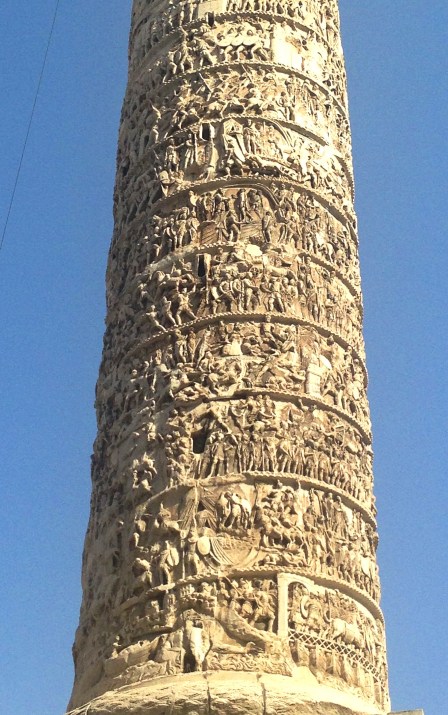
I had first seen this monument in art history class; even now I can vividly remember how awed and impressed I was at the craftsmanship displayed by the Romans in this work. The column, I should explain, was made to celebrate the military victories of Trajan. It stands 30 meters (98 feet) tall, and even higher if you include the pedestal. Twisting along this length, covering the entire surface, is a series of bas reliefs depicting Trajan’s military campaigns. The detail is fine and exquisite: hundreds and hundreds of figures, legionaries, barbarians, and beasts of burden, in all varieties of poses and positions, marching and fighting up and down the column. We see Trajan laying siege, crossing rivers, celebrating victory; trumpeters blowing their horns, animals being led to the sacrifice, barbarians being tortured and trampled underfoot.

I must immediately admit, however, that all this detail was mostly invisible to me. You see, the column now sits in a parking lot—quite forlornly, I think—and it is not possible to get close enough to really appreciate the bas relief. It would be better if there were some sort of scaffold surrounding the column. As it stands now, the tourist must gape up from a distance.

There is a platform on the top, which can be reached by climbing up the steps inside the column (though this is off limits to the visitor). Originally the work was topped with a statue of an eagle, later replaced by a statue of Trajan himself. During the Renaissance, this imperial statue was, in turn, later replaced by a statue of St. Peter. Nowadays the Fords and Hondas that surround the column add an extra contemporary flavor. Thus time and changing fashions conspire to render the old glory of the Roman emperor obsolete and ridiculous. And yet, even now, there is no way to look upon Trajan’s Column without imagining that same emperor standing on the top, looking proudly out at his city and his empire, the ruler and conqueror of all within view and beyond the horizon in every direction.
trajans_column2


The Pantheon

I turned a corner, and there it was: the Pantheon. I was not even looking for it; I had been searching for the Trevi Fountain. Only in Rome can you unintentionally stumble upon one of the most famous buildings in the world.

The exterior of the building is striking enough. In front is a portico, supported by eight Corinthian columns. Sticking out behind this portico is a somewhat bulbous mass, a circular structure made of plain, drab concrete. The surface is discolored from centuries of rain, leaving ugly water stains, and is now cheerlessly grey, even in the bright summer sun of Rome. But contained within this somewhat unpromising exterior is one of the most beautiful spaces in history.

The Pantheon’s name, which means “all the gods,” reveals its original function as a temple. (Though there is some doubt about whether all the Olympian gods were actually worshipped there.) It was built during the reign of Hadrian, in about 120 CE, and is one of the best-preserved buildings from ancient Rome. Indeed, it seems hardly fitting to include the Pantheon in my post on “ruins,” since it is a fully functioning building.

Pantheon

The building was mobbed when I arrived. A line extended out the door; the surrounding area was packed with people; and inside there was hardly an inch of elbow room. This is unsurprising, considering that the ancient temple is right in the center of Rome, free to visit, and one of the most famous edifices in the world.

Since the beginning of the medieval period, the Pantheon has been used as a Christian church. It was this re-consecration and repurposing that saved the building from oblivion. (The official name is the Church of St. Mary and the Martyrs.) There is an altar at the far end of the building; and statues of Mary and various Saints stand guard around the perimeter of the building. The final effect is somewhat like standing in the Mezquita in Cordova: the Christian trapping look out of place in building whose architectural language is so different from a usual church.

The real highlight of the Pantheon is its ceiling. Even today, there is no unreinforced concrete dome larger than the Pantheon’s. It is a magnificent architectural feat. To me it scarcely seems believable that the Romans, without computers or calculators or even protractors, could have designed and executed something so geometrically precise. The coffering is so clean and regular that it looks digital.

Pantheon_inside

In the center of this dome is an oculus, or opening, that lets sunlight pour into the building. A bright, yellow spot of the sun’s rays illuminates the interior like a searchlight, traveling around the space as the sun moves in the sky. On the floor below this opening are drains, so that the building doesn’t flood in the rain.

I sat down on one of the pews facing the altar, and stared up at the magnificent ceiling, suspended so enchantingly above me. This temple had been built for many gods, and had been re-dedicated to One; but as I sat there, it was easy to see what that the Pantheon was really consecrating: the force of human genius.


Triumphal Arches

The architecture of Rome speaks the language of power. It has been imitated around the world, in ancient and modern times, to symbolize dominance and military might.

You can see this in the Arc de Triomphe in Paris, or the Porte Saint-Denise in the same city; you can see this in Madrid, with the Puerta de Alcalá; you can see this in London, with the Wellington Arch; you can see this in New York City, with the Washington Square Arch; and you can see this most clearly, perhaps, in Berlin, with the Reichstag Building and its neoclassical portico, the towering Berlin Victory Column inspired by Trajan’s Column, and the Brandenburg Gate, one of so many triumphal arches to be inspired by Roman examples.
Arch_sunset

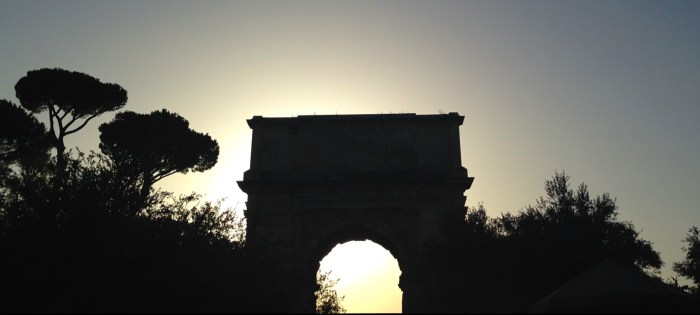
One of the earlier and most influential of these Roman arches is that of Titus, located just outside the Roman Forum, on the famous Via Sacra. Built in the first century CE, it has only one arch. The inside of this arch is coffered with floral motifs. On the inner walls, on both sides, are reliefs commemorating the victories of Titus, the emperor Domitian’s older brother. I remembered from my art history class that this arch is notable for having one of the earliest depictions of a Menorah, which is pictured in the frieze celebrating Titus’s conquest of Jerusalem.

archoftitus

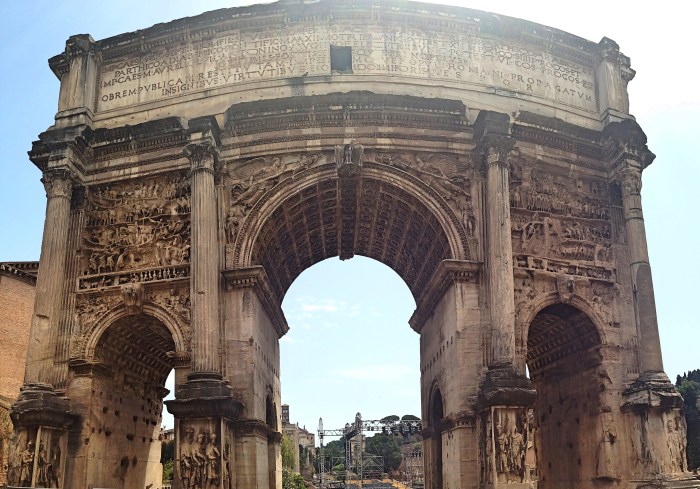
Larger and grander is the arch of Septimius Severus, which is in the Roman Forum itself. This was completed in 203 CE, and dedicated to the military victories of Septimus Severus and his sons against the Parthians. It has three arches—a large one in the center, and two smaller ones flanking it—and its façades are covered with reliefs depicting military campaigns. One of Septimius Severus’s sons, Caracalla, eventually had his brother Geta assassinated; and Geta’s name and image were removed from all monuments.
 

archofseverus

The largest of the three triumphal arches is the Arch of Constantine, completed in 315. This arch is situated between the Coliseum and the Roman Forum; originally it spanned the Via triumphalis, the road that generals and emperors traveled when they entered the city in triumph. It is an interesting stylistic jumble, since it was built out of spolia, or the remains of earlier pieces, which leads to juxtapositions of artistic periods. I cannot help but seeing this gesture—appropriating Rome’s glorious past—as a sign of the empire’s decadence. Indeed, Constantine’s arch, while the largest, was also the last triumphal arch built in Rome.

Constantine_archfull


The Palatine Hill

The Palatine Hill, Roman Forum, and Colosseum are included on the same ticket. This is important to know, since it makes buying your ticket much more convenient. Most people buy their tickets at the Colosseum ticket office, which can mean quite a long wait on line. You might have better luck doing as I did, and buying your tickets at the Palatine Hill ticket office, on Via San Gregorio 30. There wasn’t a single person ahead of me; in three minutes I had my tickets and was strolling around the Palatine Hill. And this was on a Saturday.

The Palatine Hill is one of the Seven Hills of Rome; and of these seven it is the most central. According to legend, this hill was where the she-wolf, Lupa, nurtured the abandoned Romulus and Remus, and where Romulus, after killing his brother in a fit of pique, decided to found the city that bears his name. The less-mythological origins of this hill are also interesting: archaeologists have discovered settlements dating back to the Bronze Age, the remains of which you can see displayed in the Palatine Museum. Both in fable and in fact, then, the Palatine Hill is at the heart of Rome’s history.

As you stroll up the hill, a jumble of sun-baked brick strikes your eye. Arches tower over arches, in a rolling, chaotic mass of rusty red. I could not guess what any of these skeletal structures had been used for. I was first reminded of the abandoned Yonkers Power Plant, near my home in Sleepy Hollow, a similarly empty pile of brick. Yet that ruin, far younger, is somewhat ghoulish; it still echoes with the sounds of departed life. These bones of Rome had been washed by the rain of a thousand seasons, and bleached by the sun of a thousand summers. They were dead and sterile; they seemed to be part of the landscape, growing from the soil, rather than anything put there by people.
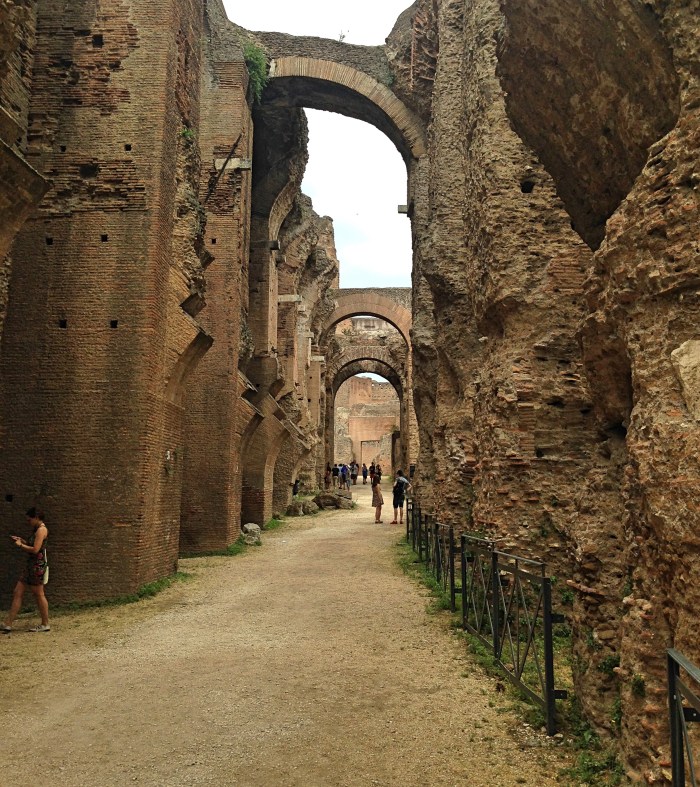
capitoline_ruins

But of course people did build these structures—very powerful people. These ruins are, most of them, the remains of palace complexes of erstwhile emperors; the biggest of these is the Flavian Palace (Domus Flavia), which owes its ultimate form to Septimius Severus, but there are also temples and aristocratic houses from the Republican period. Another notable structure is the one known as the Stadium of Domitian, which looks like a hippodrome for chariot races, except that it is obviously too small to fulfill that purpose. This has led to some speculation as to its function; the most popular theory is that it was the emperor’s private gardens.

Because there were so many different buildings, from different eras, jutting up against one another and superimposed on top of one another, it was difficult for me to get a sense of what it used to look like by walking around the ruins. Instead, I was given a sense of time, of lost time; a feel for the lapsed years that disappeared into an unknown past. So many generations had come and gone on this hill, dismantling, repurposing, renovating, and expanding the work of their predecessors. These were people like me, with their own ambitions and ideologies, their own perspectives; and some were the most powerful men of their time. And now look what is left.

roman_forum4

Aside from its ruins, the Palatine Hill is worth visiting simply for the view. Standing atop of the hill, surrounded by the remains of an ancient empire, you can see modern Rome stretch out before you. St. Peter’s stands proudly in the distance; to one side is the Circus Maximus; and standing above the enormous retaining walls, which extended the hill’s scope to accommodate the ever-growing imperial palace, you can see the whole Roman Forum.
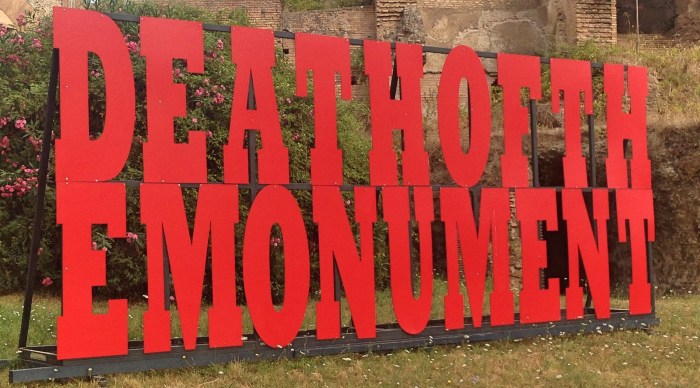
deathofthemonument

The only thing, besides the burning Roman sun, that detracted from my visit were the art installations set up around the site. Take, for example, Mark Lulic’s piece, The Death of the Monument. This is just a large sign that says “Death of the Monument” in bright red letters. Now, in my opinion this piece obviously has no aesthetic merit, since it looks like an unimaginative advertisement. Its only purpose, then, can be conceptual. And as one might expect, accompanying this work is an explanatory caption, written in pretentious art jargon. I will quote an example:

Persuasive and seducing like in the best mass communication marketing tradition, the admonition transforms into an illogical presence of the artwork, which is a monumental negation of itself. The visual impact conveyed through a specialized and unconscious mechanism acquires instinctively a conceptual form, leading us to raise some questions: doesn’t the death of the monument coincide with its birth?

And so on in the same vein.

I find this disturbing on many levels. First, I am against any work of art that lacks both aesthetic and intellectual interest, and requires a condescending and badly written plaque in order to explain the art to the viewer. Good art should never need to be explained, only experienced. This is putting aside the sacrilege of putting such mediocre art in the middle of the Palatine Hill, turning a profound historical visit into a trip to a mediocre art gallery. The artist’s bad taste has been compounded by the bad taste of whoever let him install his art here. And this piece is only one example of many that pollute the Palatine Hill. Such art is a depressing index of our current cultural moment.


The Roman Forum

The Roman Forum (Forum Romanum) sits in a valley underneath the Palatine Hill. This forum was, for many hundreds of years, the heart of Rome; it was a center of commerce, trade, worship, and political power. Now it is center of tourism.

Looking down from that hill, you can see the Forum in its entirety. What you see is a jumble of columns with no roof to support, domes hanging over open air, fragmentary walls slowly crumbling to dust, the foundations of demolished buildings, and doorways leading nowhere; you see arches celebrating long-dead emperors, fountains sacred to long-dead heroes, temples dedicated to long-dead gods: the ruins of an entire civilization.

capitolinehill

It would take many thousands of words to describe all of these ruins individually. I will only mention a few in passing. The Temple of Castor and Pollux, built around 500 BCE, is now little more than three towering Corinthian columns supporting the smallest bit of roof. The Temple of Saturn, built about the same time, is somewhat more complete, still possessing all of its front portico; in the old temple building, now long-gone, the Romans used to keep the official scales for weighing precious metals. The old Palace of the Vestal Virgins—where virgins lived a life of solitude, tending a sacred flame—has been lost; but several statues of the blessed women still grace the forum.

Romanforum

Perhaps the most impressive ruin, at least for sheer size, is the Basilica of Maxentius. This was completed during the reign of Constantine. Now only three of the basilica’s three concrete barrel vaults, coffered to save weight, remain standing. Rising to 39 meters (130 feet), it was the largest building in the Roman Forum; even now it is so large that it looks scarcely out of place amid the modern city. How on earth Romans managed to construct a building so large, with little internal support, is beyond my feeble understanding and imagination.

The most complete building in the Roman Forum might be Santa Maria Antiqua. Built in the 5th century, this is the oldest Christian monument in the forum, and one of the most important examples of early Christian art. The reason it has been so well-preserved is because an earthquake buried the church in the 9th century, and it stayed sealed under the rocks for over 1,000 years, until finally it was re-opened in the 20th century. This makes the church something of an unintentional time-capsule. What was revealed, upon its re-discovery, was a wonderful assortment of frescoes, their vivid colors preserved by the sterile air. These frescoes are especially valuable, since they provide a window into the pre-iconoclastic period of Christian art.

Santamaria_antiqua

For my part, although I am ignorant as to their scholarly importance, I could not but be moved by these ancient, decaying portraits of angels and saints. In the dim light and dusky air, amid the faded ink and chipped plaster, the serene eyes of the first Christians stared back at me from across centuries—a triumphant victory, however temporary, against Time’s sharp tooth.


The Colosseum

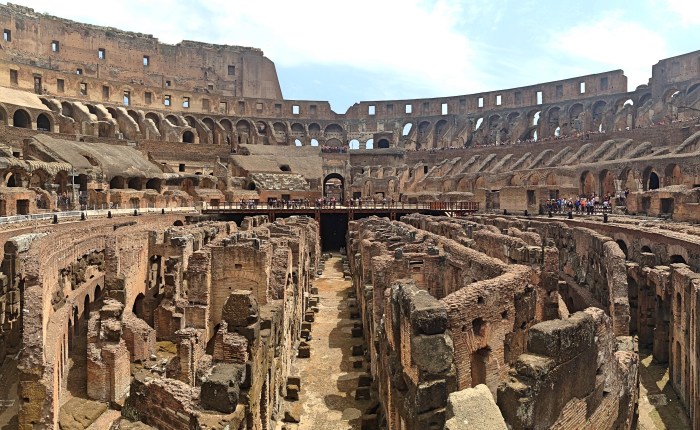
Finally it was time to visit the last ruin. Blinking in the hot sun, overwhelmed by all I had seen—far too much to take in for one day—I walked away from the forum and towards the most famous building in Rome. I still remember seeing the Colosseum in pictures in my sixth grade history class. I remember learning about the gladiators, the battles between wild animals and condemned prisoners, the executions of Christians, the mock-naval battles. Now I was finally here.

Purists will insist on calling it the Flavian Amphitheater. This was its original name, which it took from the name of the dynasty who built it. Construction began in 72 under Vespasian, and was completed in 80 by Titus; then Domitian, also a Flavian emperor, could not resist making a few modifications of his own. It is known as the Colosseum—or so the theory goes—because of the colossal statue of Nero that used to stand nearby. (This statue was 30 meters, or 100 feet, tall. Now no trace of it remains, save its base. How something like that disappears is not easy to fathom.)

The Colosseum is the biggest amphitheater ever built. It could hold somewhere between 50,000 and 80,000 people. Its tall outer walls reach a height of 48 meters (157 feet). Elliptical rather than perfectly circular, it is 189 meters (615 feet) long and 156 meters (510 feet) wide; its perimeter stretches to about 550 meters (1,800 feet).

But these numbers seem pale and lifeless compared to the experience of seeing it with your own eyes. It is a mammoth structure. As you stand on the hillside facing its outer walls, the building fills up your entire field of vision. Its walls tower above you, dwarfing the hundreds of people scurrying about its edges. Circumambulating the building takes five long minutes. The tall outer wall only extends about halfway round the structure; where it has collapsed, you can see the rows of interior arches that supported the many rows of seats inside. The entire area around the Colosseum is packed with tourists, tour guides, and vendors. Selfie sticks jut out left and right; groups pose for photo after photo; aggressive guides try to sell you their services.
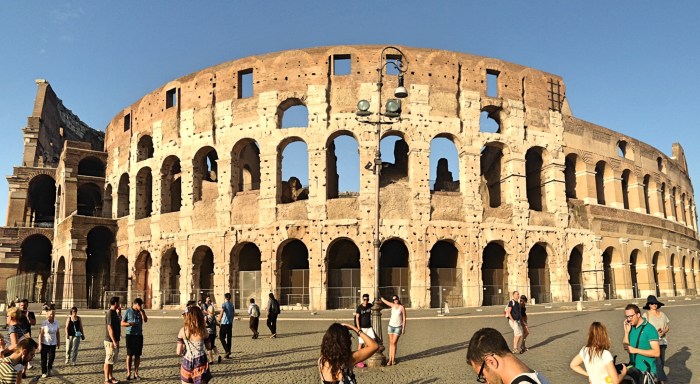
Colisseum_Pano

Even though I had a ticket, I had to wait a few minutes on a long line. The security was pretty tight; everyone had to scuttle through a pair of overworked metal detectors. When you are finally inside, the most striking thing is the place’s familiarity. I had already seen so many photos of the amphitheater that every curve of its outline was already known to me. This happens with every iconic monument. It takes an act of will to see the place as it really is, rather than as a cultural symbol. I tried to blink away my preconceptions, to see the Colosseum afresh, as a hunk of stones laden with history; but so many notions had already molded my reaction that I felt strangely disconnected.

colisseum_interior

There is nothing especially beautiful about the Colosseum’s interior. Every part of the building is the same shade of brown; and its partially collapsed state makes it seem like a rolling mass of dun-colored stones in some lonely desert. The building is so filled with windows and arches that it is practically transparent; what remains today are just the building’s bones, its vital organs having long been reduced to dust. Today there are two levels available to visitors, though in the past there must have been at least four (and many more rows of seats). As I walked in the covered corridors that circumscribe the amphitheater, I was reminded when I was in Madrid’s bull ring, Las Ventas: and in that moment I could dimly imagine how it must have felt to be a Roman bustling through a crowd, trying to find his seat, so he could watch a bloody spectacle.

Beautiful or not, the building is grand and impressive. Merely as a feat of engineering, it is enough to inspire awe. Putting aside its massive size and its thoughtful organization, allowing visitors quick exit and entry, the Colosseum also boasted a system, called the hypogeum, of trap-doors and hidden chambers that allowed gladiators and animals to enter the ring from many different spots. What remains of this elaborate system can be seen in the amphitheater’s arena.

The now-absent floor of the Colosseum was made of wood and covered with sand. The hypogeum was below this, which consisted of walls, cages, and tunnels, two levels deep. Complex pulleys, and even hydraulic equipment, were used to haul men and animals onto the stage. Animals as big as elephants could be introduced this way. Tunnels also connected the Colosseum with nearby stables and gladiator barracks, allowing the “performers” to enter into the arena unseen by the crowd. Before this hypogeum was built, the arena could be flooded with water to have mock-naval battles.

The ultimate irony of the Colosseum is, of course, that something so grand and inspiring, the result of so much knowledge and work, could be used for such barbarous purposes. Slaves condemned to kill other slaves, exotic animals brought to be butchered, prisoners mauled by lions en masse. This is only another example of the sad human truth, that our greatest gifts and capabilities, our art and our technology, can be employed in the service of the darkest side of our nature. This is why we must educate our ends as well as means.

capitalinehill2
Another view of the Roman Forum

Afterthought

Edward Gibbon decided to write his magisterial history of Rome’s decline and fall after seeing her ruins. Upon witnessing these remains of a long-dead empire, the contemporary visitor cannot help but ask the same question as did Gibbon: how did such a powerful civilization collapse and fail? How is it possible that the people who built the Pantheon and who decorated Trajan’s column could vanish?

History teaches few lessons more clearly than this: that all human order requires constant reinforcement, or it will fall into disorder. Gibbon said much the same thing when he reminded us that “all that is human must retrograde if it does not advance.” Rome’s progress from the proud conqueror who erected arches celebrating her victories, to the aging empire of Constantine that looked backward to Rome’s glory days, to the sack of Rome by Alaric in 410; her progress from the glorious marble statues you can see in the Palatine Hill Museum, to the sad faces that stare back at you from the walls of Santa Maria Antiqua; her progress from the engineers who could create the concrete dome of the Pantheon, to the middle ages when the secret of making concrete had been lost: What does all this mean for us? Are we staring into our past, or our future?

And yet, did Rome really fall? Here I am, writing in a Latinized language, in a European country whose laws and institutions were influenced by Rome’s, and whose language, Spanish, grew directly out of Rome’s. Here I am in Spain, one of the many countries of the European Union, an effort to unite the continent largely inspired by Rome’s example. Order, when neglected, may fall into disorder; and perhaps it always does. But the ideal of order persists: it persists in the memories of men and women, it persists in books and the spoken word, and it persists in monumental ruins—in broken columns, crumbling amphitheaters, and cracked foundations—that serve as a beacon for future generations.
Roaming in Rome: Museums

Roaming in Rome: Museums

This is Part Four of a six-part series on Rome, following this plan:


The idea of a museum seems somewhat superfluous in Rome, a city that is itself a work of art. Monuments abound; and famous paintings and statues can be seen—for free!—in several churches and basilicas around the city. But Rome is also home to some of the finest museums in the world, and this is not even counting the Vatican museum, which I will discuss in a later post.

I only went to two museums while in Rome, but they were two of the best museums I have had the pleasure of visiting. So, without further ado:


The Borghese Gallery

The first thing you must know about the Borghese Gallery is that you need to get tickets in advance if you want to have any shot of getting inside. (Go to the website to get them.) If you do not, your only remaining option is to stand by the entrance, offering to buy tickets from passersby, like I saw a few ragged tourists doing on my way inside. This is not the strategy I would recommend.

Your ticket will come with a specific date and time. You need to collect your ticket half an hour before entering or it will be canceled (that is what it says on their website, but I am not sure this policy is enforced); and you only have about an hour and a half to see the museum. This is more than enough time, however, since the museum is fairly small.

Borghese

The Borghese Gallery originated as the private collection of Scipione Borghese (1577 – 1622), a Cardinal and nephew of Pope Paul V (there was a lot of nepotism in those days), who was a Caravaggio collector and a patron of Bernini. The beautiful building did not originate as a museum, but as the Cardinal’s villa; its garden is still known as the Villa Borghese, and is now perhaps the finest park in Rome.

I arrived at the museum hungry, sweaty, and stressed out. Every time I have to be a new place on time—be it a job, a date, or a museum—I panic and arrive very early. Today was no different; by the time I got there, I still had an hour to kill.

I tried strolling around the park, which is lovely, but eventually the Roman sun and humidity overwhelmed me, so I gave up and sat down on a bench. An American family chatted on my left (about gelato, if memory serves), and a group of young Chinese people chatted on my right (probably about gelato, too, but I can’t be sure).

Finally it was time for me to go inside. It is an extremely well-organized place, with tight security. They made me check my small bag, for example, but the line to drop off and pick up my bag moved very quickly. Soon I was about to enter, congratulating myself on buying a ticket early, eager to enjoy the fruits of my rare foresight.

I nearly gasped the first time I stepped inside the museum. Like so many Italian interiors, the space is staggeringly lush. The walls, ceiling, and floor are exquisitely decorated: doorways are framed by columns of fine marble and golden capitals; a delicately carved frieze of mythological figures runs along the upper walls; the ceiling is trimmed with gold and covered in neo-classical designs inspired by Pompey’s mosaics. Everything shines and sparkles and glitters, overwhelming you with prettiness but, even more so, with opulence. Borghese was a rich man.

The museum is divided into two floors: the first is mostly for statues, the second for paintings. Each floor is not terribly large, but each room is so packed with art, great art, that you can hardly give anything the time it deserves.

Like many people who visit the gallery, I was most interested in seeing the Bernini sculptures, since he’s one of my favorite sculptors. If you have any interest in Bernini, you can’t find anyplace more rewarding to visit than the Borghese Gallery. Almost every room on the first floor has a masterpiece by Bernini sitting right in the center.

RapeofPersephone

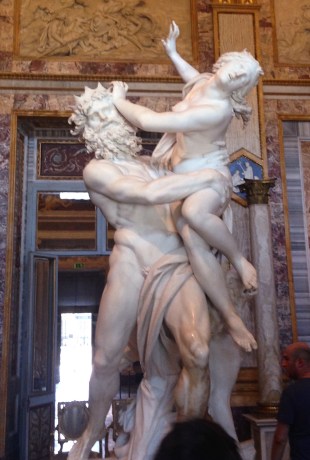
The Bernini statue that greets you upon entry is The Rape of Proserpina. Though it is incredible to believe, Bernini completed this technical tour de force when he was only 23, while I am sitting here at 25 writing this blog. It depicts the moment when Hades (Pluto), god of the underworld, abducted Persephone (Proserpina) to be his queen in the underworld.

(The myth is literally a classic: Hades rips through a hole in the ground and abducts Persephone when she’s gathering flowers. Persephone’s mother, Demeter, goddess of the harvest, seeks high and low to find her; and in her grief, she neglects her duties as goddess, letting crops wither and die. Zeus, seeing this, eventually intervenes, forcing Hades to return Persephone to her mother. Unfortunately for Persephone, however, she ate some pomegranates, fruit of the underworld, and for this reason she must return a part of each year to spend time with Hades. During these months, Demeter is so upset that she again neglects her duties as goddess of the harvest; and this is why we have winter every year.)

The sculpture depicts the moment when Hades grabbed Persephone to whisk her away into his dark underworld. Bernini, as usual, seems to transcend the limitations of sculpture, creating a scene of dramatic action rather than stable form. The bearded, crowned, and burly Hades is picking up Persephone and pulling her towards him. She is obviously not pleased with this: her body is turned violently away, her hand pushing on Hades’s forehead, her face filled with terror. For his part, Hades looks rather pleased.

Bernini_rapeofpersephone

The technical excellence of this sculpture is seen most impressively by looking at Hades’s hands gripping Persephone’s back and leg. Bernini has somehow rendered in stone the effect of hands pressing on soft skin. Looking closely at this, it is easy to forget that you are looking at sculpted marble, so anatomically perfect is every detail. I cannot help imaging that, if I were to touch the statue, I would feel the warmth of living flesh.

The next outstanding Bernini sculpture is his David. Here Bernini captures the moment when David is winding up his body to launch his stone at Goliath. The sculpture was, like so many of Bernini’s, a radical departure from previous efforts. Compare, for example, Michelangelo’s David. That Renaissance statue is perfect form, standing stable and erect, motionless and pure. Bernini’s statue, by contrast, is all fire and energy, drama and movement, contortion and stress.

Bernini_David

Two aspects of the statue stick out in my impressions. First is the expression on David’s face: eyebrows knit, squinting with concentration, biting his lips. No photograph of any athlete in motion has better captured the mixture of focus and effort that all skilled physical activity requires. Next I would call your attention to the rope of David’s sling: two narrow bands of marble, floating miraculously in mid-air. How on earth did he acquire such enormous technical facility?

The last Bernini sculpture I will mention here—though there are others—is his Apollo and Daphne.

It is worth recounting the myth before seeing the work. Cupid, the eternal trouble-maker, shoots Apollo one day and causes him to fall in love with Daphne, a nymph who is repelled by men. Apollo pursues her, promising everything and more, and Daphne flees. When Apollo is about to catch her, Daphne prays to her father, the river-god Peneus, to destroy her beauty. Like any good father, he promptly turns his daughter into a tree. In Ovid’s famous poem, The Metamorphoses, this story is given as the origin of the laurel tree.

Bernini_apollodaphne

Bernini’s sculpture captures this moment, as Apollo is on the verge of capturing the nymph, and the nymph is mid-transformation. Daphne’s fingertips are sprouting leaves; branches grow from her thighs; her legs are disappearing into a tree trunk. Apollo seems to be unaware of this transformation; on his face he wears a serene, joyful expression. The nimble god’s pose is as light as a ballerina’s, almost as if he as flying. Daphne is a study in contrast. Her body is twisted violently away, struggling to escape his grasp, and on her face she wears a look of horror.

Perhaps at this point it would not be out of place to say a few words on Bernini in general. In technical facility he is unsurpassed; nobody disputes this. But what of his artistic aims? He is drawn to action rather than form, to motion rather than meditation. His statues lack classic grace but make up for it in their exuberance and vitality. True, there is something superficial about his art. Many of his sculptures seem like the Baroque equivalent of special effects, meant to dazzle but not to move the viewer; and this was in keeping with the spirit of times, when egregiously rich cardinals would vie with each other to commission the most extravagant art. And yet the surfaces of Bernini’s art are so staggering and magnificent that all misgivings about “deeper” meaning are shushes into silence.

The first level also contains several splendid paintings by Caravaggio. There is Boy with a Basket of Fruit, St. Jerome Writing, and David with the Head of Goliath. I particularly like the latter painting, since it exhibits Caravaggio’s talent for gruesome, gritty, and human depictions of Biblical scenes.

800px-David_with_the_Head_of_Goliath-Caravaggio_(1610)

The second floor of the museum is mostly dedicated to paintings. It is a bit disappointing to move from the splendid decoration and several masterpieces of the first floor to this comparatively subdued level. This is not to say that it is not also a storehouse of riches and treasures. There are many wonderful paintings, too many to adequately view in one sitting, the most outstanding of which is Raphael’s Entombment, depicting the burial of the dead Christ.

I walked and looked and walked and looked, until my eyes hurt from squinting, and my brain, overwhelmed with art, gave up the ghost. There are few museums in the world that can compete with the Borghese Gallery for elegance and taste.


Palazzo Massimo alle Terme

The Museo Nazionale Romano (National Roman Museum) has several branches around the city. The most famous of these is the Palazzo Massimo alle Terme, located near Rome’s central Termini station, which houses an impressive collection of ancient artifacts.

I went fairly late in the afternoon on a Saturday, in the height of the tourist season. Nevertheless the museum was nearly empty; very often I was alone with the collection. This is a shame since, as I will venture to show, this is a museum well worth visiting, especially considering the modest price of admission and its central location.

The majority of the museum’s outstanding works can be found on the first floor (second floor for Americans). This floor is overflowing with portrait busts and sculptures—of gods, goddesses, heroes, emperors, senators, mythological creatures, philosophers, athletes, and everyday people—some of them larger than life, others small enough to fit in the palm of your hand.

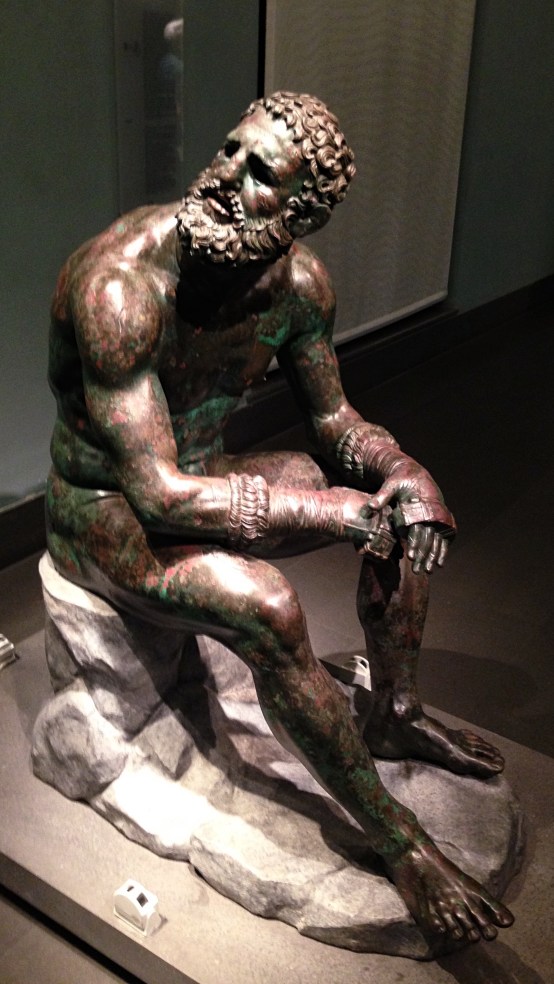
The piece I was most excited for was Boxer at Rest. I had first seen this statue in my introductory art history class, and was lucky enough to have seen it in person at the Metropolitan Museum of Art, where it was on loan. This was the very first time it was displayed in the United States.

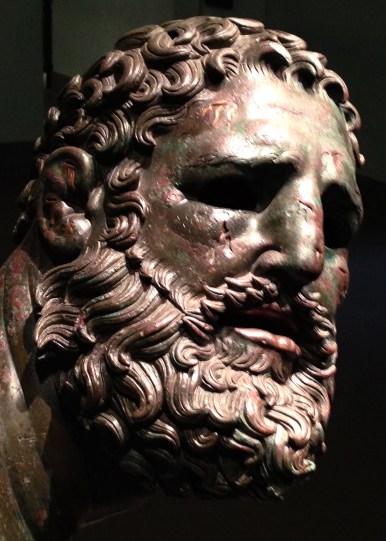
It is a bronze sculpture, made by the lost-wax technique out of eight separate pieces that were later joined together. Its subject matter is, unsurprisingly, a boxer at rest. This boxer does not look like he’s having a good day. He is naked except for a pair of boxing gloves, made from rope and leather. He seems to have just completed a fight. The poor man is stooped over; his face is covered in scars; his nose is broken; he has cauliflower ears; and drops of blood trickle down his arms and legs.

Boxer_statue

In this one sculpture, we can see how far the Hellenistic Greeks were from the mentality of the Golden Age Greeks and their idealized human forms. Far from calm and ideal, this athlete is battered, bruised, and ugly. His head is twisted around to one side, as if somebody had just called his name; but the pose looks so uncomfortable and unnatural that it reminds me of Rodin’s work. As I look into the shadows of his eye sockets, buried underneath is knit brows, I feel a mixture of admiration and pity for the man, for his resilience and his pain.

Boxer_Statue1

It is nearly impossible to believe that this magnificent sculpture was made in ancient times, before even the birth of Christ. There is a gritty, evocative, expressive quality of the work—the aging boxer, past his prime, pushing his injured body past its limits—that is strikingly modern. I suppose there really is nothing new under the sun.

Several other works are worth mentioning in passing. There are many vases, sarcophagi, and fragments of walls with wonderful sculptures in relief, including the Portonaccio Sarcophagus. There is the Aphrodite of Menophantos, the nude goddess of love shyly covering her private parts, as if embarrassed, but with a serene expression on her face. There were also busts of Socrates and Epicurus that I quite enjoyed.

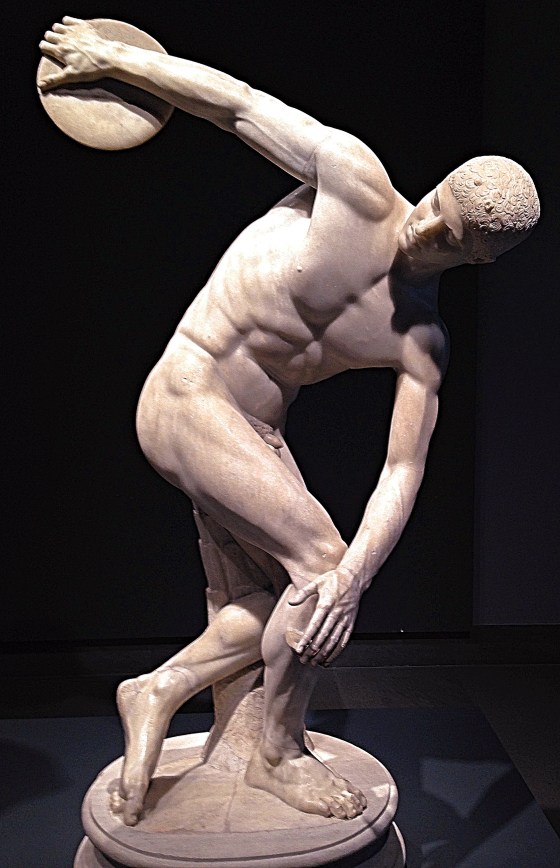
Several essays could be written on any of the pieces in the collection; but here I will only pause to reflect on one more, the Discobolus. This is a Roman copy in marble of a Greek original in bronze, by the famous sculpture Myron (c. 480 – 440 BCE). The subject of the statue is an athlete, as usual nude, throwing a discus. His body is wound up to its maximum and he is about to reverse directions and release.

disc-thrower-full

This sculpture dates from a much earlier period than the Boxer at Rest, and presents a striking contrast of mentality. Although the athlete’s body is doubtless under a tremendous about of strain, his face is emotionless and blank. He stares placidly at the viewer, his vacant eyes giving the impression that his mind is totally elsewhere, on a different plane, a realm of pure thought and idea. He seems to be so totally absorbed in the act of throwing that he feels no strain.

This is Greek idealization at its finest. There is not a flaw on his body. His muscles are not even tensed. Most striking, however, is the impression of stability that the sculpture conveys. Although the athlete is in mid-motion, it does not invite the viewer to imagine him coming to life and completing the throw. We are, rather, bidden to contemplate the perfection of the athlete’s body, the harmony of his pose, the calmness of his gaze. It is as if the flesh has been sublimated into pure thought.

A contrast with Bernini’s David might be appropriate here. Although both works portray a man about to launch a projectile, Bernini’s work is all fire and movement, while Myron’s is as still and lifeless as ice. The Classic Greeks are always there to remind us that passion and realism are not necessary, nor even always desirable, for great art.

The second floor of the museum is devoted to frescoes, stuccos, and mosaics. Although beautiful as works of art, these are, to me, more fascinating as windows into Roman life, since many originated as decorations in the homes of wealthy Romans. Wandering around this floor, it is easy to imagine that you stumbled into a Roman villa, full of images of sea monsters, gods, and strange beasts.

This does it for my experience of Rome’s museums; next I will discuss Rome’s ancient ruins.


Roaming in Rome: Basilicas

Roaming in Rome: Basilicas

This is Part Three of a six-part series on Rome, following this plan:


Rome’s basilicas comprise one of the city’s most popular attractions, and rightly so: they are among the most beautiful examples of religious architecture in the world.

The four so-called major basilicas, so designated by the Pope, are all within the diocese of Rome. These are San Giovani in Laterano, Santa Maria Maggiore, San Paulo Fuori Le Mura, and St. Peter’s in the Vatican (which I discuss in my Vatican post). Besides these four major basilicas there are a multitude of minor basilicas to visit, which are minor in name only.


Santa Maria Maggiore

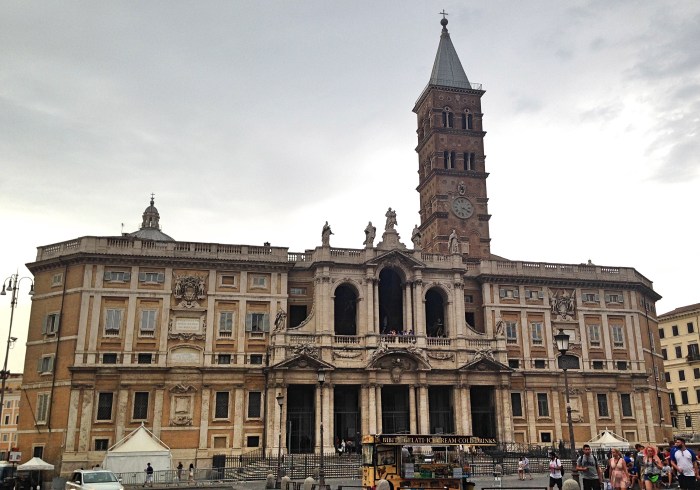
Santa Maria Maggiore is one of the few churches in Rome for which you need to pass through security to enter. In addition to the security guards manning the metal detector there are burly Italian soldiers carrying assault riffles standing outside. All these defenses should tell you that this is a precious building.

Santa_MariaMaggiore1

Santa_Mariamaggiore2

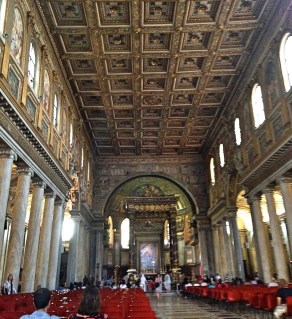
From the outside, the Basilica is hard to miss. Aside from its massive size, the basilica is notable for having the highest bell tower in Rome, a lovely 14th century construction. The inside is even more impressive. When you stand in the center, looking down the central nave, everything seems to be made of solid gold. The coffered ceiling is covered in gilded wooden flowers. Light pours in through the top row of windows, which sit above a row of marble columns. Straight ahead is the main chapel; on the apse above is a mosaic of the Virgin Mary’s coronation amid a golden background. The decoration is absolutely sumptuous.

Santamaria_dome

The feature that most stuck in my memory was a sculpture of Pope Pius IX in prayer, which sits in a sunken area before the main altar. But much more important, historically and artistically, are the mosaics. Mosaics run along the nave in a row under the window, and also surround the semidome above the main altar. Unfortunately, the mosaics on the nave are difficult to see from the ground, but those around the arch are lovely works of art.


Santa Giovanni in Laterano

Bad luck again. I followed my phone to the Basilica di Santa Giovanni in Laterano, and it was not open. The gates were shut, the doors were closed.

In the plaza nearby was another Egyptian obelisk. (This is the Lateran Obelisk—the largest ancient obelisk in the world, apparently. I am embarrassed to say that I hardly took the time to look at it.)

I sat down sullenly on the surrounding barrier, determined to wait until the basilica opened. The thin metal railing was uncomfortably skinny, so I switched to one of the concrete supports. That was slightly better, but still too spherical to make a good seat. If I leaned forward or back, I would slip off; and my tail bone kept rubbing painfully against the concrete. On top of that, it looked like it was going to rain.

I sat and waited. A family of tourists walked up to the gate and then turned back, disappointed. A young couple did the same. Meanwhile, two Italian soldiers, standing beside an armored vehicle and carrying intimidating assault riffles, talked amongst themselves. Their job was not to interact with tourists; their job was to shoot anyone who did anything fishy.

An hour went by. Now it was drizzling. I began to seriously doubt whether this basilica was worth it. The outside was not terribly impressive. Maybe I could just bag it? But I’d come all this way to see it! And there’s no reason it should be closed. Idly, I checked the map on my phone. I could see that the building was quite big, occupying a whole block all by itself. Maybe there was another entrance?

With nothing to lose, I got off my perch, my bottom a bit tender, and walked around the corner. Once there, I smacked myself in the head. This was obviously the entrance. I had been waiting in the wrong place for a whole hour. But I am too used to messing up to get very frustrated when it happens.

SanGiovanni_Laterano

As I lingered near the entrance, I was amused to see a young American couple being forced to tie bits of colorful cloth around their waists. They had to do this because they were both wearing shorts, and the churches in Rome have a dress code. In my brief experience, this dress code applies more stringently to women than to men; several times I observed men walking around basilicas in shorts, while women were always made to cover up their shoulders and legs. Keep this in mind on your visit.

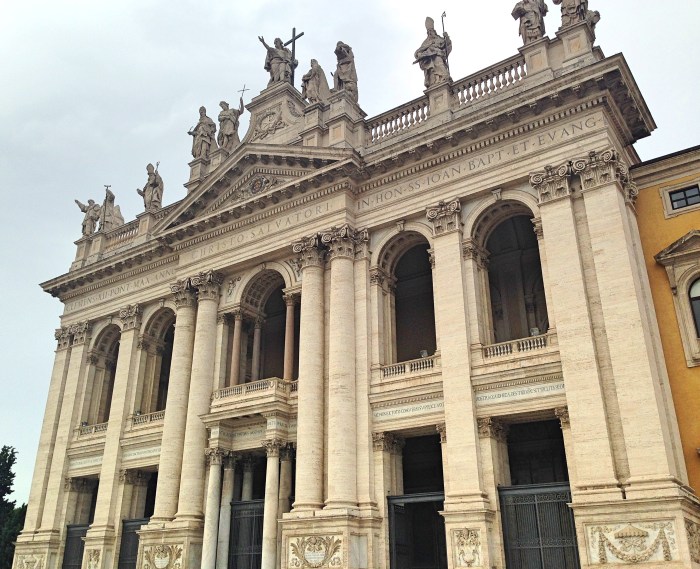
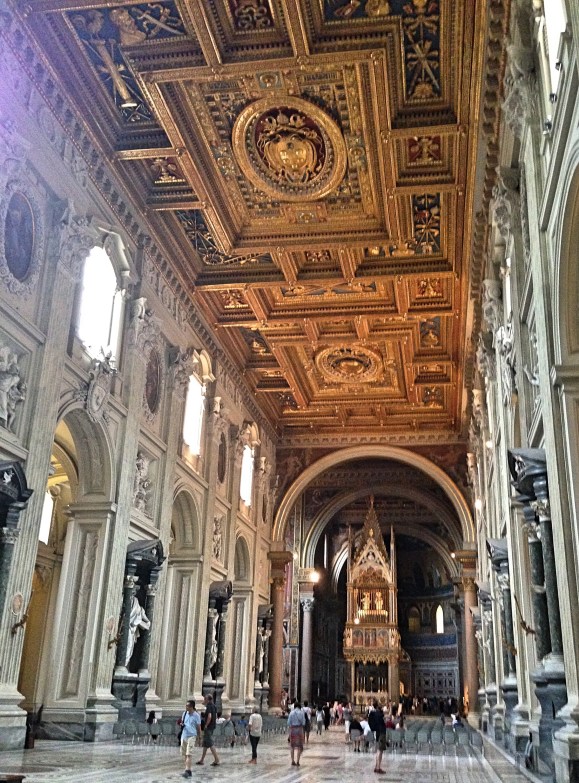
The façade of the basilica is austere and neoclassical, full of straight lines and right angles, rising up to an impressive height. The interior is still more impressive. The main nave is cavernous and enormous. Far above hangs the gilded wooden ceiling, sectioned off into quadrilaterals and covered in armorial and floral motifs. The main altar is covered with a gothic baldachin; this is like a guard tower, with two figures (presumably saints) keeping watch inside.

sangiovanni_laterano1

The most outstanding feature of the basilica, however, is the series of statues of the twelve apostles. These are situated in niches in the columns of the main nave. Under the direction of Pope Clement XI, in the early years of the eighteenth century, seven sculptors were commissioned to make these statues. Each one larger than life-size, and each one is elegant and glorious.

Walking from one end of the basilica to the other, from the entrance to the main altar, dwarfed beneath the gilded roof, passing between these dramatic apostles with their flowing robes and outstretched hands, you can feel the gripping power of the Catholic faith—even if, like me, you do not belong to it.


San Clemente al Laterano

The Basilica of San Clement is one of the more historical and well-known minor basilicas in Rome. Unfortunately for me, my experience with this basilica is largely of frustration.

The first time I went—and I walked everywhere in Rome, so this was a major investment of time—it was closed. I do not know why it was closed, since it was the middle of the day, but it was.

The second time I went was quite late. I arrived at 5:30, just half an hour before the basilica shut its doors for the day. This normally wouldn’t have been a problem; the place is not very large, so half an hour was more than enough time to see everything.

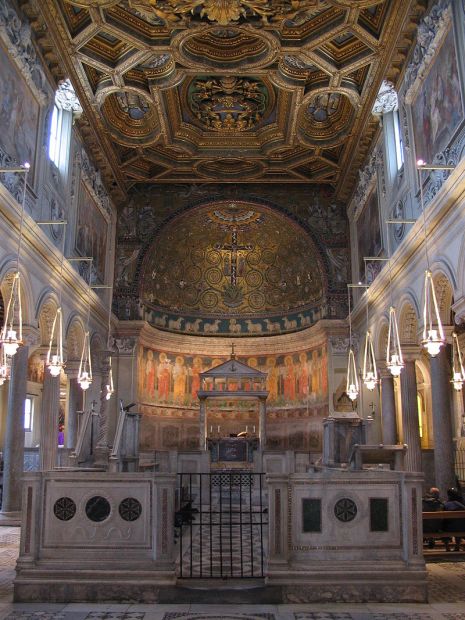
But the Basilica of San Clement is not famous for its main floor; it is famous for what lies buried underneath. The present basilica—which I shall describe in a moment—was built around the year 1,100, over the remains of an older, smaller basilica, which had been converted from the remains of a Roman house. This house had served, at various times, as an early Christian church and as a small temple to the god Mithras. Before that, there had been a house built during the Roman Republic, destroyed in 64 AD by the Great Fire. These ruins are preserved in the lower levels of the basilica.

800px-Interior_of_San_Clemente,_Rome
The “second basilica” of San Clemente in Laterano. Photo by Sixtus; licensed under CC BY-SA 3.0; taken from Wikimedia Commons

The basilica itself, like all basilicas in Rome, is free to enter; but you need to pay to go down to the basement levels to see the archaeological remains. I was more than willing to pay, since it sounded fascinating, but by the time I arrived they had stopped taking new visitors. I missed my opportunity. But I record this so you do not make the same mistake.

In any case, the current basilica was worth a visit. It is more on the scale of a church than a basilica; the roof does not tower above you, and there is no overwhelming sense of space. The semi-dome over the main altar, and the wooden roof above the central nave, are richly ornamented and glimmering with gold. The paintings and designs decorating the semi-dome have that lovely, medieval simplicity that always strikes me as noble and fresh.


San Paulo Fuori Le Mura

The only subway ride I took in Rome was to see the Basilica of Saint Paul Outside the Walls. As you might have guessed, its name derives from the fact that it was situated outside of the (now nonexistent) walls of Rome. As a consequence, the basilica is quite far from the city center, which is why I had to take a subway.

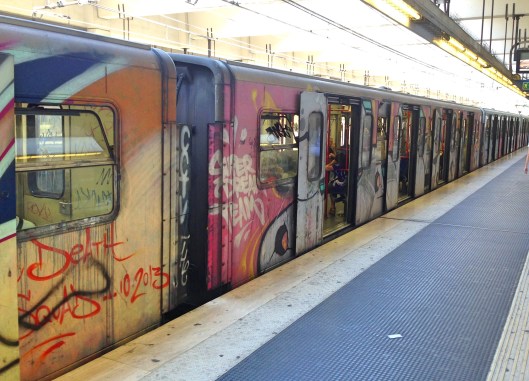
The train was absolutely covered in graffiti. It reminded me of photos I had seen of the New York City subway in the seventies. There must be very lax security if people are able to so completely cover the outside of the train cars. I always wonder: where and how graffiti artists do it? Is there a place where the trains are stored for the night, that the artists can sneak into? Maybe a railway yard in some corner of the city? For my part, I thought that the paint job was a little messy, but I appreciated the bright colors.

Rome_metro

The walk from the metro to the basilica was instantaneous. In a second I was there, sweating like a pig in the Roman sun, facing the grand edifice. To enter, I needed to pass through military-controlled security, perhaps because the basilica, although in Italy, is technically owned by the Vatican. I was going through customs.

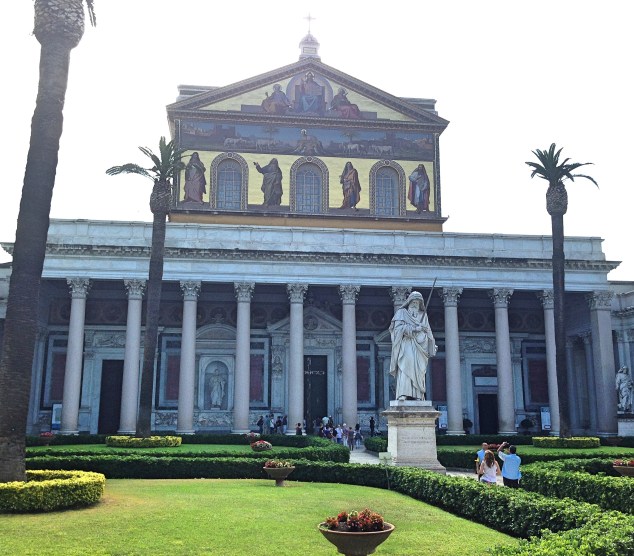
Before entering the basilica proper, you must pass through a courtyard. In the center is a statue of Saint Paul, sword in one hand, book in another, his bearded face staring down ominously. The courtyard is surrounded on all sides by rows of elegant columns, which makes it feel more like a Roman ruin than a Catholic church.

san_pablofuori

And indeed, this feeling is justified by the history of San Clement Outside the Walls. The basilica was founded all the way back in the reign of Constantine, and was later expanded by Theodosius in 386. Although damaged at various times in its history due to wars and earthquakes, it retained its original, ancient form until 1823. That year, a workman repairing the roof inadvertently caused a terrible fire that consumed nearly the whole structure. As it stands now, the building is almost entirely a reconstruction. It is ancient in design, but modern in appearance and execution.

san_pablofuori2

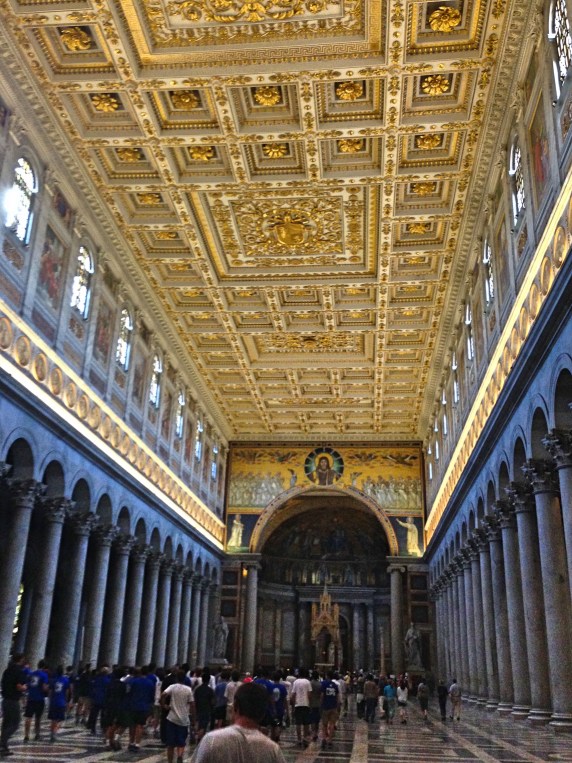
When I went inside, the most lasting impression was of space. Even more than other basilicas, Saint Paul’s is vast and spacious. The paneled ceiling, covered in golden designs and decorations, glows from the light pouring in through the top row of windows. Between each of these windows is a painting of an episode from Saint Paul’s life. The ceiling is so long and wide, and the area underneath so empty, that it seems impossible it could stay suspended above you without more support. Why doesn’t the middle crack under so much weight?

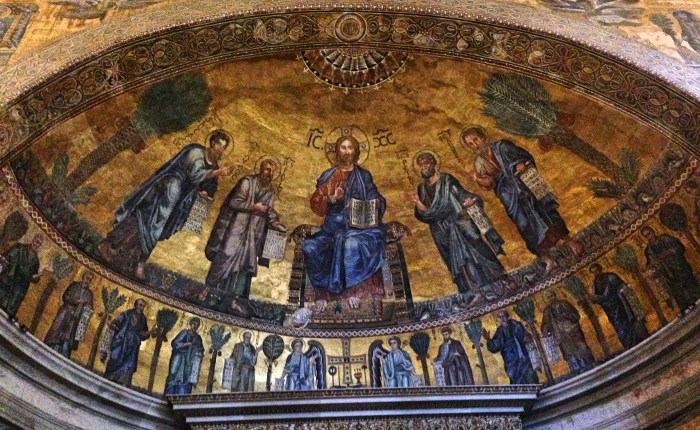
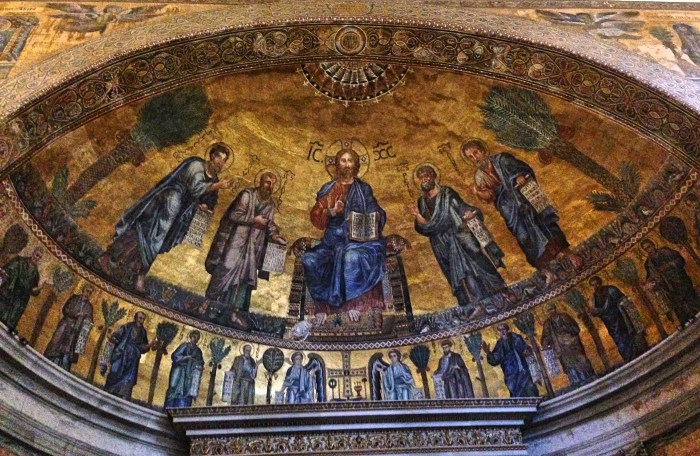
The most beautiful part of the basilica, for me, was the apse mosaic. It captures wonderfully the medieval mood of simple piety that I find so appealing in religious art. Sitting underneath it, with Jesus benignly looking down upon me, I thought I could feel a trace of the comfort that believers must feel in these sacred places.

San_Pablofuori3

But I have not yet mentioned the basilica’s most holy treasure: the grave of St. Paul himself. In truth, there is not much to see. In a lowered section of the floor, there is a clear, plastic panel through which can be glimpsed white stone. In a wall adjacent there is another transparent screen with more white stone. I would not have had any idea what I was looking at if there hadn’t been a sign.

By chance, just when I walked down the stairs to see this tomb, an entire American football team came marching into the cathedral. They seemed to be of college age, and there must have been at least fifty. A nun with an Irish accent guided them to the tomb (I made a hasty retreat to get out of their way) and they all gathered to hear her give a brief explanation. Then, they all bowed their heads in prayer.

Perhaps I am just a cynic, but I could not help wondering how much time these burly, hormonal males spend on spiritual things compared with the time they devote to girls and sports. None of them looked particularly excited to be there.


Santa Maria in Trastevere

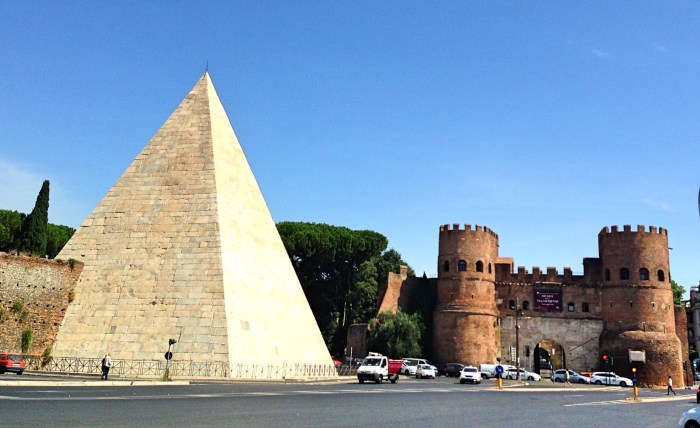
From Saint Paul Outside the Walls I took a long walk to Trastevere. For the most part, this walk was unexciting and unpleasant—just sweating and slogging my way past apartment buildings and parking lots in the heat and humidity. The most notable exception to this pattern of boredom was when I turned a corner and saw a pyramid.

Rome_pyramid

This is the Pyramid of Cestius, and is actually one of the best-preserved ancient buildings in Rome. To me it looked as though it could have been built yesterday. Instead, it was built in around 12 BCE as a tomb for Gauis Cestius, a magistrate, when Rome was conquering Egypt and there was consequently a fad for Egyptian paraphernalia in the city. I thought it was strange that Cestius would put up a tomb in the middle of the city; but of course, back when it was built, the tomb was well outside the city walls, and the city later expanded around it.

It has since been incorporated into the Aurelian Walls. This was done to save money and materials, but it looks a little funny to see a pyramid with walls sticking out on both sides. The fortified gate near the pyramid is also well-preserved.

I did not know this at the time, but near the pyramid is the famous Protestant Cemetery, where John Keats and Percy Bysshe Shelley are buried. It is funny how fame works. Keats and Shelley have modest tombstones, no bigger than average; and yet they will be remembered at least as long as English is spoken. The name of Gaius Cestius, by contrast, is not associated with any notable words or deeds; the only reason we remember him is for his peculiar and grandiose taste in funerary architecture.

The novelist Thomas Hardy visited this area in 1887 to pay his respects to Keats and Shelley. The sight inspired him to write a poem, Rome: At the Pyramid of Cestius near the Graves of Shelley and Keats. He begins by asking: “Who, then, was Cestius / And what is he to me?” He continues:

I can recall no word
Of anything he did;
For me he was a man who died and was interred
To leave a pyramid

And so he was.

Soon I passed the pyramid, walked through the gate, and found myself in Trastevere. This is one of the most historical and most hip neighborhoods in Rome. It is attractive for tourists because of its narrow, stone-paved streets and its plentiful bars and restaurants.

The basilica of Santa Maria in Trastevere is one of the oldest churches in the city. The basic floor plan comes from the 4th century; and the building as it stands now was largely built during the Romanesque period.

Santa_Maria_Trastevere

The basilica is lovely from the outside. Unlike many basilicas, it is not imposing or grandiose, but humble and pleasant. Its graceful brick campanile stands above a simple, triangular roof. At the top of the bell tower, above the clock, there is a small mosaic of the Virgin and Child, easy to miss if you are not looking; and beneath the roof is another, larger mosaic of the Virgin, surrounded by women holding lamps.

Santa_mariatastevere3

The inside of the basilica is even more charming. Its paneled roof is particularly nice; it is divided into stars, crosses, and other shapely forms, and has a painting of the assumption of the Virgin in the center. The glory of the basilca, however, is its apse, covered in medieval mosaics by Pietro Cavallini. (This is the same artist who did the mosaics in Saint Peter Outside the Walls, which were destroyed in the fire.) As is fitting in a church dedicated to the Virgin Mary, these mosaics depict her life, and center on her coronation in heaven.

santa_mariatrastevere2.jpg

Before moving to Spain, I had already thought the art of medieval Europe was simpleminded and cartoonish. But the more I look at this profoundly religious style, the more I fall under its spell. There is no pretence at realism. Two-dimensional figures, hardly individualized, stand in a neutral space with a gold background. And yet it is this lack of realism that allows the artwork to be so emotionally expressive. The figures are frankly symbols of higher things, too subtle and spiritual to be realistically expressed; the sign can thus not be confused with its signifier.

I sat under the apse and thought about time. How many years had it taken to build that basilica? How long has it stood? How many have worshipped here? How many have visited? I tried to think of all the people who were somehow connected with the basilica’s existence: the men who mined the rock, who baked the bricks, who carried the materials from the quarry to the building site. The Early Christians who founded the religion amid persecution, and the later Christians who built up the Catholic Church into the most impressive institution of the medieval world. The Popes who commissioned works, the priests who gave services, the artists who painted and sculpted. The poor mother who left a donation every Sunday. The specialists who helped preserve the aging artwork. The tourist who visits and takes a picture with his phone.

I thought of all the years that went into the place, and all the people who contributed, directly and indirectly, in big ways and small, and I thought about how many more people would visit this basilica after I was dead and gone, and I grasped, just slightly, how small I am in the grand scheme of things. Now, that is some good religious architecture.


Roaming in Rome: Churches

Roaming in Rome: Churches

This is Part Two of a six-part series on Rome, following this plan:


It is an absurd understatement to say that Rome has many beautiful churches. You can hardly go two blocks without passing a church which would, in any other city, be a major tourist destination, but which in Rome is just another church.

Rome has so much world-class religious architecture that I need to divide up my posts by building type. This post is for the churches; the basilicas will come next. (The difference between a church and a basilica is largely a matter of size.) I only visited five churches, although they were quite famous ones. Thus this post, like everything written about Rome, will be woefully incomplete.


Santa Maria della Victoria

The first thing I did when I put down my bags was rush to Santa Maria della Victoria, which was luckily right near my Airbnb.

The main reason I wanted to go was because of Bernini’s famous statue: The Ecstasy of Saint Teresa. That was all I knew about the church. So I was astounded, upon entering, to find that every inch of the place was breathtaking. I found myself gasping, transfixed, at everything I saw. The church deservers Bernini’s masterpiece.

The first word that springs to mind, as I attempt to describe the place, is lush. Like a forest in springtime, the church overflowed with sensory pleasure. The floor, the walls, the ceiling, the statues, the altars—every surface, corner, and crevice provided fascination and delight to the eye.

After gaping at everything for a few moments, I went immediately to find Bernini’s statue. And there it was. In my experience, the first time you lay eyes on a famous work of art, one that you have seen many times in photos, there is a second of disappointment. “So, that’s it?” you say to yourself. At first glance, the statue looks like any other.

When you look closer and more deeply, the disappointment soon turns into a feeling of unreality. It’s like you just walked into a television program: you are suddenly inside something which you had been experiencing from without. “Am I really here?” you think.

This feeling, too, goes away soon enough, leaving only you and the artwork. Now that you can look at it, what do you see? To the modern eye, The Ecstasy of Saint Teresa looks inescapably sexual. A smiling angel stands over the supine saint, an arrow raised in his hands. Teresa is crumpled over, obviously overwhelmed, her mouth hanging open (in pain, pleasure, or both?).

Bernini_Ecstasy

To us in the post-Freudian age, the spear, the postures, and the Saint’s expression all seem like an obvious depiction of coitus. This impression is confirmed when you know a bit about St. Teresa’s life, whose greatest religious struggle was her attraction to handsome men. Yet I wonder if this was intended by Bernini. He was certainly not unacquainted with the sexual side of life. But it is also hard for me to think that a sincerely pious man would have intentionally depicted something sexual for a church, and that the church would have accepted something it considered suggestive.

As usual with Bernini, the statue is a work of technical virtuosity. The most outstanding feature is Saint Teresa’s robe. In the Renaissance, as in Rome and Greece, cloaks and robes were depicted as falling naturally over the body, closely fitting the body underneath. But here the robe seems to be alive. Far from succumbing to gravity, it is animated as if by an electric current, rippling and folding and crashing like stormy ocean waves. Instead of revealing the saint’s body underneath, the robe totally obscures her form, absorbing her into a torrent of energy that represents, all too clearly, the ecstasy she is feeling. This also serves to highlight the saint’s face, since the rest of her is absorbed by her garment. And here too we find Bernini to be a master. The saint is angelic, beautiful, and otherworldly.

Across from this masterpiece is a much lesser work, The Dream of Joseph by Domenico Guido, which is nonetheless impressive. The ceiling is covered with a heavenly fresco, and is held up by white, stucco angels. Besides Bernini’s statue, what most stuck in my memory was the marble in the walls and the floor. Several different colored stones were used, all of extraordinary quality. I cannot fathom how much money went into this single church. I find marble to be nearly hypnotic to look at. Light and dark patches of color swirl around each other like puffs of petrified smoke.

SantaMariaVictoria


Santa Maria del Popolo

I had the bright idea of trying to visit this church on Sunday morning. I walked in to find that, of course, they were celebrating mass, so I did an abrupt about-face and sat down on the steps outside.

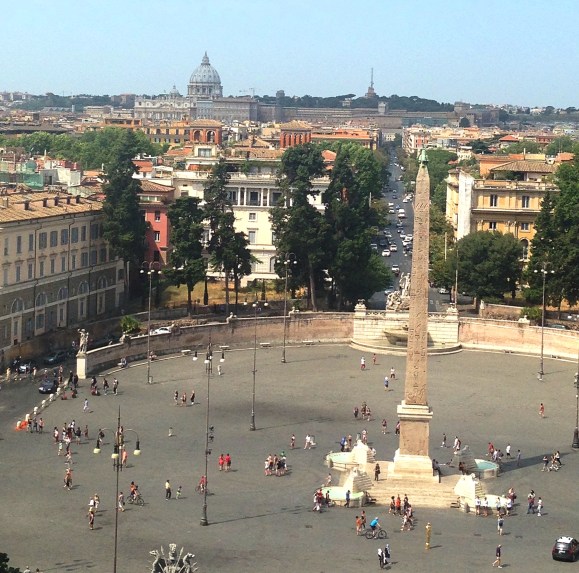
Santa Maria del Popolo is situated in the Piazza del Popolo, one of the pleasantest plazas in the city. In the center is a large Egyptian obelisk, the second oldest obelisk in Rome; and bounding the plaza are two semicircular walls, with a fountain in the middle of each. Although the name literally means “Plaza of the People” in Italian, its name historically comes from the poplar trees that grew there. It was also the site of many public executions.

Piazzadelpoppolo

It was in this plaza that I waited, hungry and frustrated, for the mass to end. The only thing that provided amusement were the many other tourists who made the same mistake. Person after person walked into the door and immediately walked out again, as a beggar by the door futilely said “La messa, la messa!” (“The mass, the mass!”). Obviously nobody could understand the poor guy, or else people habitually ignore the homeless. In any case, the steps were soon full of frustrated tourists who were, like myself, waiting for the mass to end.

It is, by the way, a sardonic comment on religion in the modern world that hundreds of people were annoyed that a church was being used for worship. There are still millions of Catholics in the world, of course; but it seems obvious to me that, in Europe at least, the religion is dying. I don’t know how I feel about this. On the one hand it seems like progress; but on the other it is hard for me to be happy about a religion disappearing when it inspired and helped fund so much beautiful art. But with this new Pope, maybe the future of Catholicism is looking up.

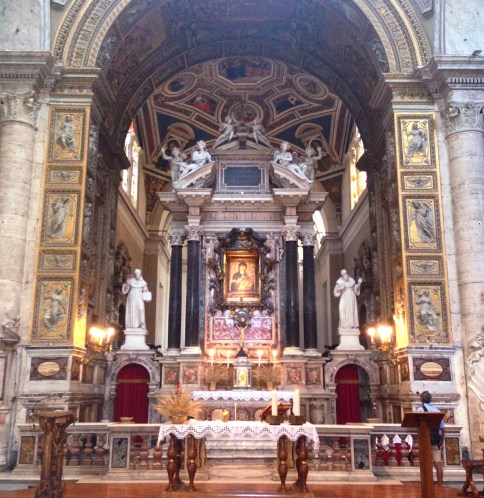
Finally the mass was over, and we all poured inside. Compared with other churches in Rome, the interior of Santa Maria del Popolo is relatively austere. This isn’t saying very much, of course. There were statues, friezes, paintings, and shining golden surfaces in abundance. The church’s dome is lovely, with a pinkish-yellow swirl of clouds painted on the inside, and light pouring in the windows from all directions.

Santamaria_delpopolo

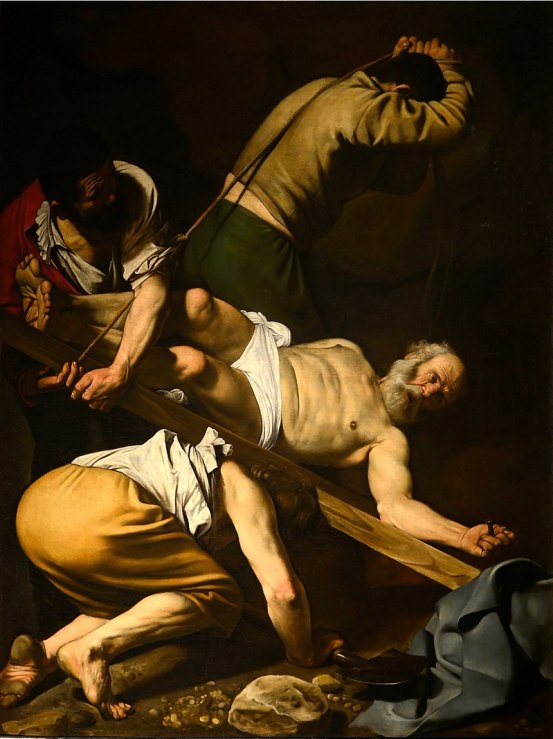
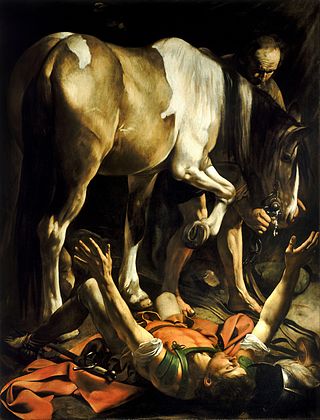
Although Santa Maria del Popolo is home to many important and lovely monuments, it is most known for two paintings by Caravaggio. As soon as we got inside, all of us immediately flocked to the altar where the paintings hang. These two works are the Crucifixion of St. Peter and the Conversion on the Way to Damascus. Unfortunately, the paintings are hung in such a way that they face each other, rather than the viewer, so you have to see them at an odd angle. And if you want to see the paintings properly lighted, you have to put a euro into a little machine nearby (or wait till another visitor does it, like I did).

As usual with Caravaggio, the style is darkly realistic. Accurate anatomy, shadowy backgrounds, grubby details, and an intense focus on dramatic moments are what set Caravaggio apart from his contemporaries.

In Crucifixion of Saint Peter, Caravaggio pictures the saint—old, bearded, and grey—in the moment when he is being hoisted up on the cross (he was crucified upside down). Peter looks with helpless alarm at his hand, nailed to the cross. The workmen are, by contrast, anonymous forms: two of them have their backs turned to the viewer, and the last has his face cloaked in shadow. Caravaggio chose to portray the workers dressed in Renaissance Italian garb, giving the painting an extra feeling of realism.

800px-Martirio_di_San_Pietro_September_2015-1a

Conversion on the Way to Damascus depicts the moment when Saul of Tarsus (later, St. Paul) was struck blind by God and converted to Christianity. The saint is laying flat on his back, his eyes closed, his hands reaching up to heaven. A horse and a servant look down at the supine man, confused at what transpired. The bright red and green of Saul’s clothes contrasts with the dull colors of the upper half. To me, there is something particularly touching about this painting. St. Paul is totally helpless, overwhelmed, as fragile as a newborn; and yet the look of rapture on his face tells us that he will soon be reborn.

320px-Conversion_on_the_Way_to_Damascus-Caravaggio_(c.1600-1)


Sant’Ignazio di Loyola

This church, which stands right in the center of the city, was built in the Baroque period to commemorate St. Ignatius of Loyola, the founder of the Jesuits.

The decoration of this church is lighthearted and joyful. This is exemplified in the fresco painted on the main vault (see above), which abounds in pinks, yellows, and blues, and whose numerous characters, flying through the heavenly skies, are almost cartoonish.

This playfulness is most apparent in the “dome.” Lacking funds to build a proper dome, the Jesuits commissioned a painter to create the illusion of one. It is excellently done: I am sure many visitors do not even notice it is false. When I did notice, I did a double take. “No, that can’t be right,” I thought, and tried to see it from a different angle. But soon the conclusion is inescapable: the dome is a fake.

SantIgnazio1

Also notable are two friezes, one depicting the Annunciation and another St. Aloysius Gonzaga being welcomed into heaven. The swirling spiral columns of dark marble, which flank these friezes, particularly tickle my fancy.

Even more impressive is the monument to Pope Gregory XV. Four angels hold open a curtain, revealing the Pope sitting on a throne. What is most amazing is that the sculptor, Monnot, was able to make marble into a near-perfect semblance of fabric. Technically, at least, it is a masterful.

Sant'Ignazio2


St. Louis of the French

This is the French national church in Rome. This means that the church originated as a charitable organization that helped French pilgrims in Rome. As a result, all the signs in the church are in French.

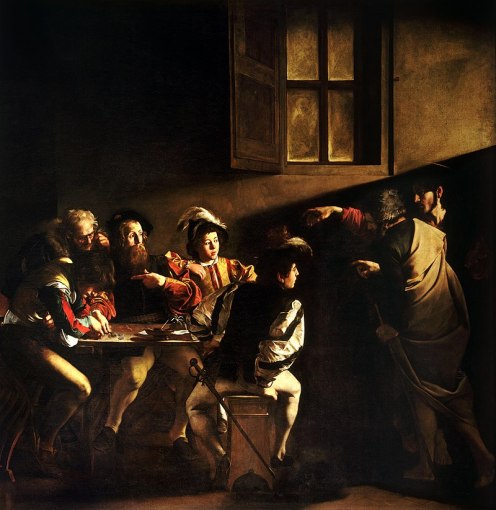
The church of St. Louis of the French is not far from the Piazza Navona. Although a lovely church by itself, it nowadays attracts visitors for its three famous Caravaggio paintings about the life of St. Matthew: The Calling of Saint Matthew, The Inspiration of Saint Matthew, and The Martyrdom of Saint Matthew. All three hang together in the Contarelli Chapel, and all three are masterpieces.

(Unfortunately, as in Santa Maria del Popolo, two of the three paintings are difficult to see, not only because they are a bit far away, because they are positioned at a right angle from the viewer. I can’t help thinking it’s a shame that such great works of art are not more easily visible.)

StLouis_French

On the left wall is The Calling of Saint Matthew. Here is a perfect illustration of Caravaggio’s genius and originality. Instead of a heavenly scene, with the divine Jesus calling Matthew to serve God, we are shown a confused rabble in a bar. Jesus is almost invisible, hidden in shadow; most noticeable is his pointing finger. We follow this finger to a shabby, bearded man sitting behind a wooden table. This is Matthew. He thinks Jesus must be confused, looking for someone else; he points helpfully to his companion, who is bent over, counting money on the table. As usual, the costumes and the scenery are all taken from Caravaggio’s contemporary world (note the boy dressed in bright livery). The grimy realism, the dramatic gesture, the innocent surprise on Matthew’s face—all this combine to make the painting one of the most convincing portrayals of this Gospel scene.

800px-The_Calling_of_Saint_Matthew-Caravaggo_(1599-1600)

In the center, facing the viewer, is The Inspiration of Saint Matthew. This was apparently a difficult commission for Caravaggio, since several earlier versions were rejected by his patron. Unfortunately for us, the most famous of these early versions, Saint Matthew and the Angel, was destroyed during World War II. (As the historian Will Durant notes, art and war are engaged in an eternal struggle.) This earlier painting is almost scandalous in its realism. St. Matthew is portrayed as a illiterate peasant. He is seated uncomfortably on a chair, his eyes squinting, his hand gripped awkwardly around the pen. An angel stands next to him, his hand guiding Matthew’s, acting the role as writing teacher. I love the painting, but I can see why the cardinal did not.

Matthew_collage
The older version (a colorized photograph) is on the left; the current version is on the right.

The later work is somewhat more conventional, but nonetheless wonderful. Instead of guiding St. Matthew’s hand, the angel hovers above the saint, talking to him (the angel seems to be counting something on his fingers). Matthew looks only slightly more comfortable. He is kneeling on a stool, hunched over his table, bending backward apprehensively to listen to the advising angel. Although less startlingly realistic, this painting makes up for that with its iconic design. The angel, robed in white, comes down from the upper right; while Matthew, robed in red, is positioned in a diagonal from the bottom right. The antithesis of the figures’ colors and postures make this painting instantly memorable.

Last we have The Martyrdom of Saint Matthew. This painting is by far the most dramatic. A nearly naked, intensely muscular soldier stands over St. Matthew, whose has collapsed on the ground. The soldier’s face is pure anger and violence. He is the wrathful embodiment of human strength. Surrounding the two central actors are about a dozen figures, reacting to the scene in different ways, from horror to mild curiosity. The saint seems, at first glance, to be frightened. His arm is raised, as if pleading. But then we notice that he is not looking at or reaching towards the soldier, but is entranced by the angel floating above. The angel is holding down the branch of a tree, which St. Matthew reaches for, as if he is about to be pulled right into heaven.

The_Martyrdom_of_Saint_Matthew-Caravaggio_(c._1599-1600)


San Pietro in Vincoli

San Pietro in Vincoli is a tremendously old church, first consecrated in the year 439 (although rebuilt after that). Nowadays, it is famous for being the home of Michelangelo’s statue of Moses. The statue is part of a larger funeral monument to Pope Julius II (who was, incidentally, the subject of one of Raphael’s greatest portraits).

The relationship between fame and quality is interesting. To be honest, if I had not known that the statue was done by Michelangelo, I’m not sure I would have paid any special attention to it. This is most likely due to my own ignorance of art, rather than any defect on Michelangelo’s part. Nevertheless, I think the same is true of nearly every person who visits, not only this church, but many other famous works of art: we are impressed as much by the name as by the art itself (if not more).

San_PietroVincoli1

You might notice that Moses is depicted with horns on his head. This isn’t because Michelangelo thought he was a cuckold, but because of the way St. Jerome, in his Latin Vulgate Bible, translated a Hebrew word. The original Hebrew word, used to describe Moses as he descended from Mt. Sinai, often meant “horned,” but also could mean “shining.” St. Jerome chose the first option; and thus there are many portrayals of Moses with little horns on his head.

Moses is seated. His long, flowing beard hangs down in tangled glory. In body and face he is so splendid that he could be mistaken for Zeus. Under his right arm are the two tablets with God’s commandments. On his face, he wears a dark and judgmental expression. What is he looking at? Perhaps he is casting a disappointed glance at his people, who are lost in idolatry. Freud made this statue the subject of some psychoanalysis, and later scholars have done likewise.

Roaming in Rome: Introduction

Roaming in Rome: Introduction

This is Part One of a six-part series on Rome, following this plan:


Arrival

I walked off the plane and into the sweltering heat. Then I paused to look around and breathe in the hot, humid air. I was in Rome.

Well, not quite. I was in the Ciampino airport, about 12 kilometers from the city center. Now I had to find my bus.

Back in Madrid, while I was on the queue to board the plane, a representative from Ryanair went by selling bus tickets. Impulsively I bought one—they were only four euros—and now I had to figure out where to go.

This would not have presented any difficulty to a sane person. But I was stressed and anxious, partly because I am always like that when I travel, but also because this was the first international trip that I had taken by myself. I felt totally exposed and vulnerable. I had no support system if I messed up, nobody to bail me out if I did something stupid. More pragmatically, I did not have a working phone. Anything could happen.

Panic attacks notwithstanding, the bus was easy to find. Exhausted, sweaty, and shaking with nerves, I dropped my bag into the luggage compartment and climbed aboard. The sunlight shone harshly through the window, causing my skin to burn and my face to flush with the heat. The bus seemed to sit there for a long while, as passengers lazily threw their bags into the bottom compartments, and shuffled on.

I felt terribly self-conscious already. What kind of loser travels alone? What did these people think of me? Were they staring at me? Was I staring back? And why wasn’t there air conditioning? Finally the bus began to move, saving me from myself. We were off towards the eternal city.

I could hardly believe it: I was going to Rome. I had been hearing about this city all my life. Roman poets, generals, statesmen, emperors, philosophers, historians, slaves—the names of so many Romans were familiar to me. I was visiting the city where Cicero delivered his speeches, where Virgil penned his verses, and where Caesar bestrode the narrow world like a colossus. All these people were like characters in a long-cherished novel, creatures endowed with the aura of my imagination. Now I would be standing where they stood, under the same sun, sky, and stars, walking on the same soil. (And this is not to mention the Renaissance Italians!)

My eyes were glued to the window. Everything that even hinted at antiquity—crumbled buildings, little run-down shacks, piles of rubble—sent my imagination flying. Were they ruins? Was that a castle? Was this a temple?

Soon reality intervened. Pharmacies, car dealerships, tobacco stores, and rows and rows of ugly buildings surrounded the bus. Pudgy pedestrians walked on the streets, cars honked their horns, and exhaust fumes wafted up into the sky. This was the eternal city?

In fairness, we did pass through a lovely stone gate on the way to the main bus terminal: Termini. (This is an enormous transportation hub, the Roman equivalent of Grand Central.) There, we were dropped off, and soon I was panicking again, wondering how to get to my Airbnb.

Once more, there was nothing inherently difficult or perilous about this. But I was a ragged bundle of nerves, filled with terrible anxiety. Plus, it was hot.

Because I am a millennial, the prospect of navigating a city without Google Maps is alarming. I only ask strangers for directions in emergencies, and I cannot be trusted with a physical map. Luckily, there is Maps.Me, a navigation app that allows you to use your phone even when you don’t have service. (I was confused by this at first, but apparently your phone’s GPS still works even when it’s on airplane mode.) The application is pretty neat, and I certainly recommend it; although it can be pretty laggy and sometimes crashes.

After struggling to find the address in my notebook, walking in the wrong direction, enduring three panic attacks and some hyperventilation; and after getting lost and looking hopelessly at the sky while fighting back tears, I found the apartment. It took about twenty minutes.

I was greeted by a friendly older Italian man, who spoke good English. Seeing him, hearing him, having some of the fresh fruit he offered me—all this calmed me down instantly. I have been talking to Italian people and eating Italian food all my life. I wasn’t in a foreign country; I was somewhere very familiar—where I knew the history, the cuisine, and the culture (though unfortunately not the language). I was in Rome.

I had five days to explore the city, five days to drink up as much of the history, art, and architecture as I could. I got started immediately.


First Impressions of Eternity

What they say about Roman drivers is true: the roads are bedlam. Every time I crossed a street I felt like I was taking my life into my hands. The drivers would not stop to spare a whole kindergarten class. At best, the drivers swerved around me; most did not seem to notice me at all. I would like to see the mortality statistics.

I had been advised not to visit Rome in July; but that was the only time I had available, so I went anyway. Nevertheless, it is good advice. In a word, the weather is inhospitable—hot and humid. Just a few minutes in the afternoon sun were enough to soak my clothes through with sweat. The air hung heavily around me, seeming to physically pull me down.

The only compensation were the drinking fountains. Rome is full of them. Do yourself a favor and bring a refillable bottle. Just watch out of the fountain says “non potable.” Otherwise, drink up—you will need it. Several times I was so thirsty that the water tasted like divine ambrosia.

Because I was trying to save money—and I’m not a connoisseur, in any case—I ate as cheaply as I could. This usually meant eating pizza. I ate a lot of it. Maybe I am a snob when it comes to pizza, but I was not terribly impressed by the quality. The one exception to this was the pizza from a place called Pinsere, which was both excellent and reasonably priced.

Rome is full of tourists in any season, but this is doubly true during the summer—another reason to choose a different time to visit. Everywhere was packed. I could hardly walk three blocks without overhearing Americans chit-chattering away. Rome can be a religious experience, even if you are not religious. But it is hard to appreciate the beauty, history, and sanctity of the place when tour groups go stampeding by, their guide yelling into a microphone; or when you have to keep dodging out of people’s photos; or when the people next to you are whining about the weather while taking several selfies. Complaining about tourists is as old as tourism itself, of course. It is an activity especially popular among tourists. Nevertheless, I suggest that you visit Rome in fall or winter, if you can.
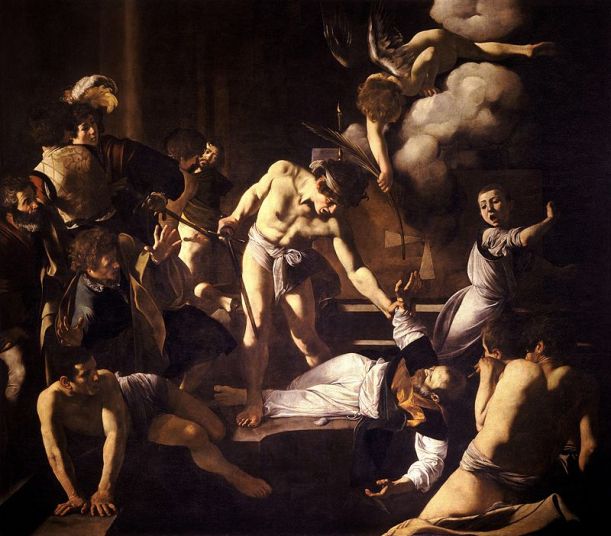
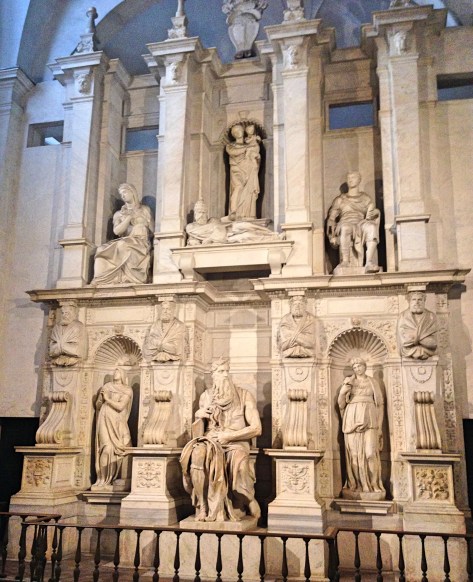
If you knocked down all the churches, destroyed the Roman forum, blew up the Colosseum, dynamited all the monuments, burned the museums, and smashed the statues, then Rome would not be much to look at. The streets are a bit dirty, the buildings are plain, modern, and unremarkable, and the traffic crawls through the streets like a column of army ants.

But of course Rome has churches, ruins, monuments, museums, and statues in abundance.

The night of my arrival, I decided to walk to the Colosseum. I got there just as the sun was setting. There it was in the twilight, its familiar iconic form towering above me, shushing me with awe.

How many others had stood in wonder at that same sight? How many others had come to Rome to pay tribute to the civilization that had flourished, conquered, ruled, declined, and then passed away? It boggles the mind that a civilization could build such a thing and then pass away. But Rome was more than an empire; Rome was more than a culture or a people. Rome was an eternal achievement, an achievement for all of humanity, setting a standard of civilization that futures peoples would forever emulate.