Review: Epitome of Copernican Astronomy & Harmonies of the World

Review: Epitome of Copernican Astronomy & Harmonies of the World

Epitome of Copernican Astronomy and Harmonies of the WorldEpitome of Copernican Astronomy and Harmonies of the World by Johannes Kepler

My rating: 3 of 5 stars

The Earth sings MI, FA, MI so that you may infer even from the syllables that in this our domicile MIsery and FAmine obtain.

Thomas Kuhn switched from studying physics to the history of science when, after teaching a course on outdated scientific models, he discovered that his notion of scientific progress was completely mistaken. As I plow through these old classics in my lackadaisical fashion, I am coming to the same conclusion. For I have discovered that the much-maligned Ptolemy produced a monument of observation and mathematical analysis, and that Copernicus’s revolutionary work relied heavily on this older model and was arguably less convincing. Now I discover that Johannes Kepler, one of the heroes of modern science, was also something of a crackpot.

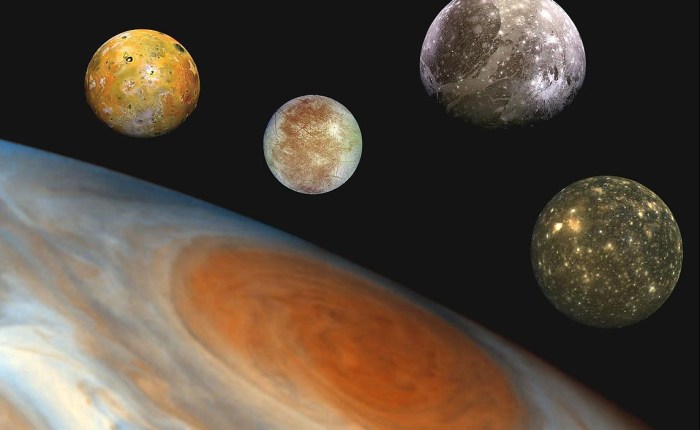
The mythical image of the ideal scientist, patiently observing, cataloguing, calculating—a person solely concerned with the empirical facts—could not be further removed from Kepler. Few people in history had such a fecund and overactive imagination. Every new observation suggested a dozen theories to his feverish mind, not all of them testable. When Galileo published his Siderius Nuncius, for example, announcing the presence of moons orbiting Jupiter, Kepler immediately concluded that there must be life on Jupiter—and, why not, on all the other planets. Kepler even has a claim of being the first science-fiction writer, with his book Somnium, describing how the earth would appear to inhabitants of the moon (though Lucian of Samothrace, writing in the 2nd Century AD, seems to have priority with his fantastical novella, A True Story). This imaginative book, by the way, may have contributed to the accusations that Kepler’s mother was a witch.

In reading Kepler, I was constantly reminded of a remark by Bertrand Russell: “The first effect of emancipation from the Church was not to make men think rationally, but to open their minds to every sort of antique nonsense.” Similarly, the decline in Aristotle’s metaphysics did not prompt Kepler to reject metaphysical thinking altogether, but rather to speculate with wild abandon. But Kepler’s speculations differed from the ancients’ in two important respects: First, even when his theories are not testable, they are mathematical in nature. Gone are the verbal categories of Aristotle; and in comes the modern notion that nature is the manifestation of numerical harmonies. Second, whenever Kepler’s theories are testable, he tested them, and thoroughly. And he had ample data with which to test his speculations, since he was bequeathed the voluminous observations of his former mentor, Tycho Brahe.

At its worst, Kepler’s method resulted in meaningless numerical coincidences that explained nothing. As many a statistician has learned, if you crunch enough numbers and enough variables, you will eventually stumble upon a serendipitous correlation. This aptly describes Kepler’s use of the five Platonic solids to explain planetary orbits; by trying many combinations, Kepler found that he could create an arrangement of these regular solids, nested within one another, that mostly corresponded with the size of the planets’ orbits. But what does this explain? And how does this help calculation? The answer to both of these questions is negative; the solution merely appeals to Kepler’s sense of mathematical elegance, and reinforced his religious conviction that God must have arranged the world harmoniously.

Another famous example of this is Kepler’s notion of the “harmonies of the world.” By playing with the numbers of the perihelion, aphelion, orbital lengths, and so forth, Kepler assigns a melodic range to each of the planets. Mercury, having the most elongated orbit, has the biggest range; while Venus’s orbit, which most approximates a perfect circle, only produces a single note. Jupiter and Saturn are the basses, of course, while Mars is the tenor, Earth and Venus the altos, and Mercury the soprano. He then suggests (though vaguely) that there are beings on the sun, capable of sensing this heavenly music. (The composer Laurie Spiegel created a piece in which she recreates this music; it is not exactly Bach.) Once more, we naturally ask: What would all this speculation on music and harmonies explain? And once more, the answer is nothing.

Kepler’s writing is full of this sort of thing—torturous explorations of ratios, data, figures, which strike the modern mind as ravings rather than reasoning. But the fact remains that Kepler was one of the great scientific geniuses of history. He was writing in a sort of interim period between the fall of Aristotelian science and the rise of Newtonian physics, a time when the mind of Europe was completely untethered to any recognizable paradigm, free to luxuriate in speculation. Most people in such circumstances would produce nothing but nonsense; but Kepler managed to invent astrophysics.

What gives Kepler a claim to this title was his conception of a scientific law (though he did not put it as such). Astronomers from Ptolemy to Copernicus used schemes to predict planetary movements; but there was no one underlying principle which could explain everything. Kepler’s relentless search for numerical coincidences led him to statements that unified observations of all the planets. These are now known as Kepler’s Laws.

The first of these was the seemingly simple but revolutionary insight that planets orbit in ellipses, with the sun at one of the foci. It is commonly said that previous astronomers preferred circles for petty metaphysical reasons, seeing them as perfect. But there were other reasons, too. Most obviously, the mathematics of shapes inscribed in circles was well-understood; this was the basis of trigonometry.

Yet the use of circles to track orbits that, in reality, are not circular, created some problems. Thus in the Ptolemaic system the astronomer used one circle (the eccentric) for the distance, and another, overlapping circle (the equant) for the speed. When these were combined with the epicycles (used to explain retrogression) the resultant orbits, though composed of perfect circles, were anything but circular. Kepler’s use of ellipses obviated the need for all these circles, reducing a complicated machinery into a single shape. It was this innovation that made the Copernican system so much more efficient than the Ptolemaic one. As Owen Gingerich, a Copernican scholar, has said: “What passes today as the ‘Copernican System’ is in detail the Keplerian system.”

Yet the use of ellipses, by itself, would not have been so useful were it not for Kepler’s Second Law: that planets sweep out equal areas in equal times of their orbits. For when a planet is closest to the sun (at perihelion) it is moving its fastest; and when it is furthest (at aphelion) it is slowest; and this creates a constant ratio (which is the result of the conserved angular momentum of each planet). Ironically, of the two, Ptolemy was closer than Copernicus to this insight, since Ptolemy’s much-maligned equant (the imaginary point around which a planet travels at a constant speed) is a close approximation of the Second Law. Even so, I think that Kepler moved far beyond all previous astronomy with these insights, jumping from observed and analyzed regularities to general principles.

Kepler’s Third Law seemed to have excited the astronomer the most, since he even includes the exact date at which he made the realization: “… on the 8th of March in this year One Thousand Six Hundred and Eighteen but unfelicitously submitted to calculation and rejected as false, finally, summoned back on the 15th of May, with a fresh assault undertaken, outfought the darkness of my mind.” This law states that, for every planet, the ratio of the orbital period squared to the orbital size cubed, is constant. (For the orbital size Kepler used half the major axis of the ellipse.)

While it is no doubt striking that this ratio is almost the same for every planet (this is because the planet’s mass is negligible compared with the sun’s), it is difficult to completely sympathize with Kepler’s excitement, since the resultant law is not useful for predicting orbits, and its significance was only explained much later by Newton as a derivable conclusion from his equations. Kepler, being the man he was, used this mathematical constant to fuel his metaphysical speculations.

However much, then, that Kepler’s theories may strike us nowadays as baseless, crackpot theorizing, he must be given a commanding place in the history of science. The reason I cannot rate this collection any higher is that Kepler is extremely tiresome to read. In his more lucid moments, his imaginative energy is charming. But much of the book consists of whole paragraphs of ratio after ratio, shape after shape, number after number, and so it is easy to get lost or bored. Since I have a decent grasp of music theory, I thought I might be able to get something out of his Harmonies of the World, but I found even that section mostly opaque, swirling in obscure and impenetrable reasoning.

The great irony, then, is that Kepler’s writings can strike the modern-day reader as far less “scientific” than Ptolemy’s; but perhaps we should expect such ironies from a man who helped to inaugurate modern science, but who made his living casting horoscopes.

View all my reviews

Review: The Great Bridge

Review: The Great Bridge

The Great Bridge: The Epic Story of the Building of the Brooklyn BridgeThe Great Bridge: The Epic Story of the Building of the Brooklyn Bridge by David McCullough

My rating: 4 of 5 stars

… on a day when two young men were walking on the moon, a very old woman on Long Island would tell reporters that the public excitement over the feat was not so much compared to what she had seen “on the day they opened the Brooklyn Bridge.”

On the inside cover of my copy of this book its previous owner has inserted a little love note. The brief message is written in a very neat script, in red ink, apparently on the eve of a long separation. Now, you may think that a book about the Brooklyn Bridge is a rather odd gift for a lover—and, considering that the book ended up in a used book shop, this may be what the recipient thought, too—but, now that I have read McCullough’s chronicle of the Brooklyn Bridge, I can see why it might inspire such sentimental attachment. For it is a thoroughly lovable book.

This is my first McCullough work, and I am pleased. He is a fine writer. His prose is stylish yet unobtrusive, striking that delicate balance between being intelligible but not simplified. He has a keen eye for the exciting details of a seemingly dry story; and effectively brings together many different threads—the personalities, the politics, the technology—in such a way that the past looms up effortlessly in the imagination. The only parts which I think could have been improved were his explanations of the engineering, since he used too many unfamiliar terms without explaining them, perhaps thinking that such explanations might swell the book to unseemly proportions. In any case, he is a writer, not an engineer, and he shines most when discussing the human experience of the Bridge.

The bridge’s designer was John A. Roebling, who deserves a book unto himself. An eccentric polymath, who among other things studied philosophy under Hegel, he came to America to found a Utopian village and ended up the foremost expert on suspension bridges. The Brooklyn Bridge was his project; but tragically he died during the first year of the project, after his foot was crushed, his toes amputated, and he contracted tetanus. His son, Washington, immediately took over—in many ways just as remarkable a man. A Civil War hero with a tenacious memory, the bridge ruined his health, too, through a combination of stress and the bends.

In those days the bends were known as “caisson sickness,” named for the compartment sunk underwater in order to excavate for the bridge’s foundations. These were filled with pressurized air in order to prevent water from seeping in. Unfortunately, in those days the dangers of rapidly depressurizing were not understood, so many people fell ill during the construction—including Roebling himself, who spent the final years of the bridge’s construction as an invalid, observing the work through a telescope from his apartment. Luckily for him, his wife, Emily, was a remarkable woman—diplomatic and brilliant—and helped to carry the project to completion.

These personalities come alive in McCullough’s narration, turning what could have been a dry chronicle into an enthralling book. And this is not to mention the political corruption, the manufacturing fraud, the deadly accidents, and the glorious celebrations that took place during the fourteen years of the bridge’s construction.

Yesterday I revisited the Brooklyn Bridge, which is beautiful even if you know nothing about it. As a friend and I strolled across in the intense summer heat, elbowing our way through crowds of tourists, I blathered on about all the fun facts I had learned from this book—which I am sure my friend very much appreciated. Sensing his discomfort, I made sure to emphasize that a fraudulent wire manufacturer had tricked the engineers into using sub-par cables, and that a panic broke out a week after the bridge’s opening, which resulted in twelve people being trampled. You see this book has already helped my social life. Maybe next I can write my own love note inside.

View all my reviews

Review: Sidereal Messenger

Review: Sidereal Messenger

Sidereus Nuncius, or The Sidereal MessengerSidereus Nuncius, or The Sidereal Messenger by Galileo Galilei

My rating: 4 of 5 stars

A most excellent a kind service has been performed by those who defend from envy the great deeds of excellent men and have taken it upon themselves to preserve from oblivion and ruin names deserving of immortality.

This book (more of a pamphlet, really) is proof that you do not need to write many pages to make a lasting contribution to science. For it was in this little book that Galileo set forth his observations made through his newly improved telescope. In 50-odd pages, with some accompanying diagrams and etchings, Galileo quickly asserts the roughness of the Moon’s surface, avers the existence of many more stars than can be seen with the naked eye, and—the grand climax—announces the existence of the moons of Jupiter. Suddenly the universe seemed far bigger, and stranger, than it had before.

The actual text of Siderius Nuncius does not make for exciting reading. To establish his credibility, Galileo includes a blow-by-blow account of his observations of the moons of Jupiter, charting their nightly appearance. The section on our Moon is admittedly more compelling, as Galileo describes the irregularities he observed as the sun passed over its surface. Even so, this edition is immeasurably improved by the substantial commentary provided by Albert van Helden, who gives us the necessary historical background to understand why it was so controversial, and charts the aftermath of the publication.

Though Galileo is sometimes mistakenly credited with inventing the telescope, spyglasses were widely available at the time; what Galileo did was improve his telescope far beyond the magnification commonly available. The result was that, for a significant span of time, Galileo was the only person on the planet with the technology to closely and accurately observe the heavens. The advantage was not lost on him, and he made sure that he published before he got scooped. In another shrewd move, he named the newly-discovered moons of Jupiter after the Grand Duke Cosimo II and his brothers, for which they were known as the Medician Stars (back then, the term “star” meant any celestial object). This earned him patronage and protection.

Galileo’s findings were controversial because none of them aligned with the predictions of Aristotelian physics and Ptolemaic astronomy. According to the accepted view, the heavens were pure and incorruptible, devoid of change or imperfection. Thus it was jarring to find the moon’s surface bumpy, scarred, and mountainous, just like Earth’s. Even more troublesome were the Galilean moons. In the orthodox view the Earth was the only center of orbit; and one of the strongest objections against Copernicus’s system was that it included two centers, the Sun and the Earth (for the Moon). Galileo’s finding of an additional center of orbit meant that this objection ceased to carry any weight, since in any case we must posit multiple centers. Understandably there was a lot of skepticism at first, with some scholars doubting the efficacy of Galileo’s new instrument. But as other telescopes caught up with Galileo’s, and new anomalies were added to the mix—the phases of Venus and the odd shape of Saturn—his observations achieved widespread acceptance.

Though philosophers and historians of science often emphasize the advance of theory, I find this text a compelling example of the power of pure observation. For Galileo’s breakthrough relied, not on any new theory, but on new technology, extending the reach of his senses. He had no optical theory to guide him as he tinkered with his telescope, relying instead on simple trial-and-error. And though theory plays a role in any observation, some of Galileo’s findings—such as that the Milky Way is made of many small stars clustered together—are as close to simple acts of vision as possible. Even if Copernicus’s theory was not available as an alternative paradigm, it seems likely to me that advances in the power of telescopes would have thrown the old worldview into a crisis. This goes to show that observational technology is integral to scientific progress.

It is also curious to note the moral dimension of Galileo’s discovery. Now, the Ptolemaic system is commonly lambasted as narcissistically anthropocentric, placing humans at the center of it all. Yet it is worth pointing out that, in the Ptolemaic system, the heavens are regarded as pure and perfect, and everything below the moon as corruptible and imperfect (from which we get the term “sublunary”). Indeed, Dante placed the circles of paradise on the moon and the planets. So arguably, by making Earth the equal of the other planets, the new astronomy actually raised the dignity of our humble abode. In any case, I think that it is simplistic to characterize the switch from geocentricity to heliocentricity as a tale of declining hubris. The medieval Christians were hardly swollen with pride by their cosmic importance.

As you can see, this is a fascinating little volume that amply rewards the little time spent reading it. Van Helden has done a terrific job in making this scientific classic accessible.

View all my reviews

Review: Almagest

Review: Almagest
The Almagest: Introduction to the Mathematics of the Heavens

The Almagest: Introduction to the Mathematics of the Heavens by Ptolemy

My rating: 4 of 5 stars

… it is not fitting even to judge what is simple in itself in heavenly things on the basis of things that seem to be simple among us.

In my abysmal ignorance, I had for years assumed that tracking the orbits of the sun and planets would be straightforward. All you needed was a starting location, a direction, and the daily speed—and, with some simple arithmetic and a bit of graph paper, it would be clear as day. Attempting to read Ptolemy has revealed the magnitude of my error. Charting the heavenly bodies is a deviously complicated affair; and Ptolemy’s solution must rank as one of the greatest intellectual accomplishments of antiquity—fully comparable with the great scientific achievements of European Enlightenment. Indeed, Otto Neugebauer, the preeminent scholar of ancient astronomy, went so far as to say:

One can perfectly well understand the ‘Principia’ without much knowledge of earlier astronomy but one cannot read a single chapter in Copernicus or Kepler without a thorough knowledge of Ptolemy’s “Almagest”. Up to Newton all astronomy consists in modifications, however ingenious, of Hellenistic astronomy.

With more hope than sense, I cracked open my copy of The Great Books of the Western World, which has a full translation of the Almagest in the 16th volume. Immediately repulsed by the text, I then acquired a students’ edition of the book published by the Green Lion Press. This proved to be an excellent choice. Through introductions, preliminaries, footnotes, and appendices—not to mention generous omissions—this edition attempts to make Ptolemy accessible to a diligent college student. Even so, for someone with my background to attain a thorough knowledge of this text, he would still require months of dedicated study with a teacher as a guide. For the text is difficult in numerous ways.

Most obviously, this book is full of mathematical proofs and calculations, which are not exactly my strong suit. Ptolemy’s mathematical language—relying on the Greek geometrical method—will be unfamiliar to students who have not read some Euclid; and even if it is familiar, it proves cumbrous for the sorts of calculations demanded by the subject. To make matters worse, Ptolemy employs the sexagesimal system (based on multiples of 60) for fractions; so his numbers all must be converted into our decimals for calculation. What is more, even the names of the months Ptolemy uses are different, bearing their Egyptian names (Thoth, Phaöphi, Athur, etc.), since Ptolemy was an Alexandrian Greek. Yet even if we put all these technical obstacles to the side, we are left with Ptolemy’s oddly infelicitous prose, which the translator describes thus:

In general, there is a sort of opacity, even awkwardness, to Ptolemy’s writing, especially when he is providing a larger frame for a topic or presenting a philosophical discussion.

Thus, even in the non-technical parts of the book, Ptolemy’s writing tends to be headache-inducing. All this combines to form an unremitting slog. So since my interest in this book was amateurish, I skimmed and skipped liberally. Yet this text is so rich that, even proceeding in such a dilettantish fashion, I managed to learn a great deal.

Ptolemy’s Almagest, like Euclid’s Elements, proved so comprehensive and conclusive when it was published that it rendered nearly all previous astronomical work obsolete or superfluous. For this reason, we know little about Ptolemy’s predecessors, since there was little point in preserving their work after Ptolemy summed it up in such magnificent fashion. As a result it is unclear how much of this book is original and how much is simply adapted. As Ptolemy himself admits, he owes a substantial debt to the astronomer Hipparchus, who lived around 200 years earlier. Yet it does seem that Ptolemy originated the novel way of accounting for the planets’ position and speed, which he puts forth in later books.

Ptolemy begins by explaining the method by which he will measure chords; this leads him to construct one of the most precise trigonometric tables from antiquity. Later, Ptolemy goes on to produce several proofs of spherical trigonometry, which allows him to measure distances on the inside of a sphere, making this book an important source for Greek trigonometry as well as astronomy. Ptolemy also employs Menelaus’ Theorem, which uses the fixed proportions of a triangle to establish ratios. (From this I see that triangles are marvelously useful shapes, since they are the only shape which is rigid—that is, the angles cannot be altered without also changing the ratio of the sides, and vice versa. This is also, by the way, what makes triangles such strong structural components.)

Ptolemy gets down to business by analyzing the sun’s motion. This is tricky for several reasons. For one, the sun does not travel parallel to the “fixed stars” (so called because the stars do not position change relative to one another), but rather at an angle, which Ptolemy calculates to be around 23 degrees. We now know this is due to earth’s axial tilt, but for Ptolemy it was called the obliquity of the ecliptic (the angle of the sun’s path). Also, the angle that the sun travels through the sky (straight overhead or nearer the horizon) is determined by one’s latitude; this also determines the seasonal shifts in day-length; and during these shifts, the sun rises on different points on the horizon. To add to these already daunting variables, the sun also shifts in speed during the course of the year. And finally, Ptolemy had to factor in the procession of the equinoxes—the ecliptic’s gradual westward motion from year to year.

The planets turn out to be even more complex. For they all exhibit anomalies in their orbits which entail further complications. Venus, for example, not only speeds up and slows down, but also seems to go forwards and backwards along its orbit. This leads Ptolemy to the adoption of epicylces—little circles which travel along the greater circle, called the “deferent,” of the planet’s orbit. But to preserve the circular motion of the deferent, Ptolemy must place the center (called the “eccentric”) away from earth, in empty space. Then, Ptolemy introduces another imaginary circle, around which the planet travels with constant velocity: and the center of this is called the “equant,” which is also in empty space. Thus the planet’s motion was circular around one point (the eccentric) and constant around another circle (the equant), neither of which coincide with earth (so much for geocentric astronomy). In addition to all this, the orbit of Venus is not exactly parallel with the sun’s orbit, but tilted, and its tilt wobbles throughout the year. For Ptolemy to account for all this using only the most primitive observational instruments and without the use of calculus or analytic geometry is an extraordinary feat of patience, vision, and drudgery.

Even after writing all this, I am not giving a fair picture of the scope of Ptolemy’s achievement. This book also includes an extensive star catalogue, with the location and brightness of over one thousand stars observable with the naked eye. He argues strongly for earth’s sphericity (so much for a flat earth) and even offers a calculation of earth’s diameter (which was 28% too small). Ptolemy also calculates the distance from the earth to the moon, using the lunar parallax (the difference in the moon’s appearance when seen from different positions on earth), which comes out the quite accurate figure of 59 earth radii. And all of this is set forth in dry, sometimes baffling prose, accompanied by pages of proofs and tables. One can see why later generations of astronomers thought there was little to add to Ptolemy’s achievement, and why Arabic translators dubbed it “the greatest” (from which we get the English name).

A direct acquaintance with Ptolemy belies his popular image as a metaphysical pseudo-scientist, foolishly clinging to a geocentric model, using ad-hoc epicycles to account for deviations in his theories. To the contrary, Ptolemy scarcely ever touches on metaphysical or philosophical arguments, preferring to stay in the precise world of figures and proofs. And if science consists in predicting phenomena, then Ptolemy’s system was clearly the best scientific theory around for its range and accuracy. Indeed, a waggish philosopher might dismiss the whole question of whether the sun or the earth was at the “center” as entirely metaphysical (is it falsifiable?). Certainly it was not mere prejudice that kept Ptolemy’s system alive for so long.

Admittedly, Ptolemy does occasionally include airy metaphysical statements:

We propose to demonstrate that, just as for the sun and moon, all the apparent anomalistic motions of the five planets are produced through uniform, circular motions; these are proper to the nature of what is divine, but foreign to disorder and variability.

Yet notions of perfection seem hard to justify, even within Ptolemy’s own theory. The combined motions of the deferent and the epicycle do not make a circle, but a wavy shape called an epitrochoid. And the complex world of interlocking, overlapping, slanted circles—centered on imaginary points, riddled with deviations and anomalies—hardly fits the stereotypical image of an orderly Ptolemaic world.

It must be said that Ptolemy’s system, however comprehensive, does leave some questions tantalizingly unanswered. For example, why do Mercury and Venus stay within a definite distance from the sun, and travel along at the same average speed as the sun? And why are the anomalies of the “outer planets” (Mars, Jupiter, Saturn) sometimes related to the sun’s motion, and sometimes not? All this is very easy to explain in a heliocentric model, but rather baffling in a geocentric one; and Ptolemy does not even attempt an explanation. Even so, I think any reader of this volume must come to the conclusion that this is a massive achievement—and a lasting testament to the heights of brilliance and obscurity that a single mind can reach.

View all my reviews

Review: The Structure of Scientific Revolutions

Review: The Structure of Scientific Revolutions

The Structure of Scientific RevolutionsThe Structure of Scientific Revolutions by Thomas S. Kuhn

My rating: 5 of 5 stars

Observation and experience can and must drastically restrict the range of admissible scientific belief, else there would be no science. But they cannot alone determine a particular body of such belief. An apparently arbitrary element, compounded of personal and historical accident, is always a formative ingredient of the beliefs espoused by a given scientific community at a given time.

This is one of those wonderfully rich classics, touching on many disparate fields and putting forward ideas that have become permanent fixtures of our mental furniture. Kuhn synthesizes insights from history, sociology, psychology, and philosophy into a novel conception of science—one which, despite seemingly nobody agreeing with it, has become remarkably influential. Indeed, this book made such an impact that the contemporary reader may have difficulty seeing why it was so controversial in the first place.

Kuhn’s fundamental conception is of the paradigm. A paradigm is a research program that defines a discipline, perhaps briefly, perhaps for centuries. This is a not only a dominant theory, but a set of experimental methodologies, ontological commitments, and shared assumptions about standards of evidence and explanation. These paradigms usually trace their existence to a breakthrough work, such as Newton’s Principia or Lavoisier’s Elements; and they persist until the research program is thrown into crisis through stubborn anomalies (phenomena that cannot be accounted for within the theory). At this point a new paradigm may arise and replace the old one, such as the switch from Newton’s to Einstein’s system.

Though Kuhn is often spoken of as responding to Popper, I believe his book is really aimed at undermining the old positivistic conception of science: where science consists of a body of verified statements, and discoveries and innovations cause this body of statements to gradually grow. What this view leaves out is the interconnection and interdependence between these beliefs, and the reciprocal relationship between theory and observation. Our background orients our vision, telling us where to look and what to look for; and we naturally do our best to integrate a new phenomenon into our preexisting web of beliefs. Thus we may extend, refine, and elaborate our vision of the world without undermining any of our fundamental theories. This is what Kuhn describes as “normal science.”

During a period of “normal science” it may be true that scientific knowledge gradually accumulates. But when the dominant paradigm reaches a crisis, and the community finds itself unable to accommodate certain persistent observations, a new paradigm may take over. This cannot be described as a mere quantitative increase in knowledge, but is a qualitative shift in vision. New terms are introduced, older ones redefined; previous discoveries are reinterpreted and given a new meaning; and in general the web of connections between facts and theories is expanded and rearranged. This is Kuhn’s famous “paradigm shift.” And since the new paradigm so reorients our vision, it will be impossible to directly compare it with the older one; it will be as if practitioners from the two paradigms speak different languages or inhabit different worlds.

This scandalized some, and delighted others, and for the same reason: that Kuhn seemed to be arguing that scientific knowledge is socially solipsistic. That is to say that scientific “truth” was only true because it was given credence by the scientific community. Thus no paradigm can be said to be objectively “better” than another, and science cannot be said to really “advance.” Science was reduced to a series of fashionable ideas.

Scientists were understandably peeved by the notion, and social scientists concomitantly delighted, since it meant their discipline was at the crux of scientific knowledge. But Kuhn repeatedly denied being a relativist, and I think the text bears him out. It must be said, however, that Kuhn does not guard against this relativistic interpretation of his work as much as, in retrospect, he should have. I believe this was because Kuhn’s primary aim was to undermine the positivistic, gradualist account of science—which was fairly universally held in the past—and not to replace it with a fully worked-out theory of scientific progress himself. (And this is ironic since Kuhn himself argues that an old paradigm is never abandoned until a new paradigm takes its place.)

Though Kuhn does say a good deal about this, I think he could have emphasized more strongly the ways that paradigms contribute positively to reliable scientific knowledge. For we simply cannot look on the world as neutral observers; and even if we could, we would not be any the wiser for it. The very process of learning involves limiting possibilities. This is literally what happens to our brains as we grow up: the confused mass of neural connections is pruned, leaving only the ones which have proven useful in our environment. If our brains did not quickly and efficiently analyze environmental stimuli into familiar categories, we could hardly survive a day. The world would be a swirling, jumbled chaos.

Reducing ambiguities is so important to our survival that I think one of the primary functions of human culture is to further eliminate possibilities. For humans, being born with considerable behavioral flexibility, must learn to become inflexible, so to speak, in order to live effectively in a group. All communication presupposes a large degree of agreement within members of a community; and since we are born lacking this, we must be taught fairly rigid sets of assumptions in order to create the necessary accord. In science this process is performed in a much more formalized way, but nevertheless its end is the same: to allow communication and cooperation via a shared language and a shared view of the world.

Yet this is no argument for epistemological relativism, any more than the existence of incompatible moral systems is an argument for moral relativism. While people commonly call themselves cultural relativists when it comes to morals, few people are really willing to argue that, say, unprovoked violence is morally praiseworthy in certain situations. What people mean by calling themselves relativists is that they are pluralists: they acknowledge that incompatible social arrangements can nevertheless be equally ethical. Whether a society has private property or holds everything in common, whether it is monogamous or polygamous, whether burping is considered polite or rude—these may vary, and yet create coherent, mutually incompatible, ethical systems. Furthermore, acknowledging the possibility of equally valid ethical systems also does not rule out the possibility of moral progress, as any given ethical system may contain flaws (such as refusing to respect certain categories of people) that can be corrected over time.

I believe that Kuhn would argue that scientific cultures may be thought of in the same pluralistic way: paradigms can be improved, and incompatible paradigms can nevertheless both have some validity. Acknowledging this does not force one to abandon the concept of “knowledge,” any more than acknowledging cultural differences in etiquette forces one to abandon the concept of “politeness.”

Thus accepting Kuhn’s position does not force one to embrace epistemological relativism—or, at least not the strong variety, which reduces knowledge merely to widespread belief. I would go further, and argue that Kuhn’s account of science—or at least elements of his account—can be made to articulate even with the system of his reputed nemesis, Karl Popper. For both conceptions have the scientist beginning, not with observations and facts, but with certain arbitrary assumptions and expectations. This may sound unpromising; but these assumptions and expectations, by orienting our vision, allow us to realize when we are mistaken, and to revise our theories. The Baconian inductivist or the logical positivist, by beginning with an raw mass of data, has little idea how to make sense of it and thus no basis upon which to judge whether an observation is anomalous or not.

This is not where the resemblance ends. According to both Kuhn and Popper (though the former is describing while the second is prescribing), when we are revising our theories we should if possible modify or discard the least fundamental part, while leaving the underlying paradigm unchanged. This is Kuhn’s “normal science.” So when irregularities were observed in Uranus’ orbit, the scientists could have either discarded Newton’s theories (fundamental to the discipline) or the theory that Uranus was the furthest planet in the solar system (a superficial fact); obviously the latter was preferable, and this led to the discovery of Neptune. Science could not survive if scientists too willingly overturned the discoveries and theories of their discipline. A certain amount of stubbornness is a virtue in learning.

Obviously, the two thinkers also disagree about much. One issue is whether two paradigms can be directly compared or definitively tested. Popper envisions conclusive experiments whose outcome can unambiguously decide whether one paradigm or another is to be preferred. There are some difficulties to this view, however, which Kuhn points out. One is that different paradigms may attach very different importance to certain phenomena. Thus for Galileo (to use Kuhn’s example) a pendulum is a prime exemplar of motion, while to an Aristotelian a pendulum is a highly complex secondary phenomenon, unfit to demonstrate the fundamental properties of motion. Another difficulty in comparing theories is that terms may be defined differently. Einstein said that massive objects bend space, but Newtonian space is not a thing at all and so cannot be bent.

Granting the difficulties of comparing different paradigms, I nevertheless think that Kuhn is mistaken in his insistence that they are as separate as two languages. I believe his argument rests, in part, on his conceiving of a paradigm as beginning with definitions of fundamental terms (such as “space” or “time”) which are circular (such as “time is that measured by clocks,” etc.); so that comparing two paradigms would be like comparing Euclidian and non-Euclidian geometry to see which is more “true,” though both are equally true to their own axioms (while mutually incompatible). Yet such terms in science do not merely define, but denote phenomena in our experience. Thus (to continue the example) while Euclidian and non-Euclidian geometries may both be equally valid according to their premises, they may not be equally valid according to how they describe our experience.

Kuhn’s response to this would be, I believe, that we cannot have neutral experiences, but all our observations are already theory-laden. While this is true, it is also true that theory does not totally determine our vision; and clever experimenters can often, I believe, devise tests that can differentiate between paradigms to most practitioners’ satisfaction. Nevertheless, as both Kuhn and Popper would admit, the decision to abandon one theory for another can never be a wholly rational affair, since there is no way of telling whether the old paradigm could, with sufficient ingenuity, be made to accommodate the anomalous data; and in any case a strange phenomena can always be tabled as a perplexing but unimportant deviation for future researchers to tackle. This is how an Aristotelian would view Galileo’s pendulum, I believe.

Yet this fact—that there can be no objective, fool-proof criteria for switching paradigms—is no reason to despair. We are not prophets; every decision we take involves risk that it will not pan out; and in this respect science is no different. What makes science special is not that it is purely rational or wholly objective, but that our guesses are systematically checked against our experience and debated within a community of dedicated inquirers. All knowledge contains an imaginative and thus an arbitrary element; but this does not mean that anything goes. To use a comparison, a painter working on a portrait will have to make innumerable little decisions during her work; and yet—provided the painter is working within a tradition that values literal realism—her work will be judged, not for the taste displayed, but for the perceived accuracy. Just so, science is not different from other cultural realms in lacking arbitrary elements, but in the shared values that determine how the final result is judged.

I think that Kuhn would assent to this; and I think it was only the widespread belief that science was as objective, asocial, and unimaginative as a camera taking a photograph that led him to emphasize the social and arbitrary aspects of science so strongly. This is why, contrary to his expectations, so many people read his work as advocating total relativism.

It should be said, however, that Kuhn’s position does alter how we normally think of “truth.” In this I also find him strikingly close to his reputed nemesis, Popper. For here is the Austrian philosopher on the quest for truth:

Science never pursues the illusory aim of making its answers final, or even probable. Its advance is, rather, towards the infinite yet attainable aim of ever discovering new, deeper, and more general problems, and of subjecting its ever tentative answers to ever renewed and ever more rigorous tests.

And here is what his American counterpart has to say:

Later scientific theories are better than earlier ones for solving puzzles in the often quite different environments to which they are applied. That is not a relativist’s position, and it displays the sense in which I am a convinced believer in scientific progress.

Here is another juxtaposition. Popper says:

Science is not a system of certain, or well-established, statements; nor is it a system which steadily advances towards a state of finality. Our science is not knowledge (episteme): it can never claim to have attained truth, or even a substitute for it, such as probability. … We do not know: we can only guess. And our guesses are guided by the unscientific, the metaphysical (though biologically explicable) faith in laws, in regularities which we can uncover—discover.

And Kuhn:

One often hears that successive theories grow ever closer to, or approximate more and more closely to, the truth… Perhaps there is some other way of salvaging the notion of ‘truth’ for application to whole theories, but this one will not do. There is, I think, no theory-independent way to reconstruct phrases like ‘really there’; the notion of a match between the ontology of a theory and its ‘real’ counterpart in nature now seems to me illusive in principle.

Though there are important differences, to me it is striking how similar their accounts of scientific progress are: the ever-increasing expansion of problems, or puzzles, that the scientist may investigate. And both thinkers are careful to point out that this expansion cannot be understood as an approach towards an ultimate “true” explanation of everything, and I think their reasons for saying so are related. For since Popper begins with theories, and Kuhn with paradigms—both of which stem from the imagination of scientists—their accounts of knowledge can never be wholly “objective,” but must contain an aforementioned arbitrary element. This necessarily leaves open the possibility that an incompatible theory may yet do an equal or better job in making sense of an observation, or that a heretofore undiscovered phenomenon may violate the theory. And this being so, we can never say that we have reached an “ultimate” explanation, where our theory can be taken as a perfect mirror of reality.

I do not think this notion jeopardizes the scientific enterprise. To the contrary, I think that science is distinguished from older, metaphysical sorts of enquiry in that it is always open-ended, and makes no claim to possessing absolute “truth.” It is this very corrigibility of science that is its strength.

This review has already gone on for far too long, and much of it has been spent riding my own hobby-horse without evaluating the book. Yet I think it is a testament to Kuhn’s work that it is still so rich and suggestive, even after many of its insights have been absorbed into the culture. Though I have tried to defend Kuhn from accusations of relativism or undermining science, anyone must admit that this book has many flaws. One is Kuhn’s firm line between “normal” science and paradigm shifts. In his model, the first consists of mere puzzle-solving while the second involves a radical break with the past. But I think experience does not bear out this hard dichotomy; discoveries and innovations may be revolutionary to different degrees, which I think undermines Kuhn’s picture of science evolving as a punctuated equilibrium.

Another weakness of Kuhn’s work is that it does not do justice to the way that empirical discoveries may cause unanticipated theoretical revolutions. In his model, major theoretical innovations are the products of brilliant practitioners who see the field in a new way. But this does not accurately describe what happened when, say, DNA was discovered. Watson and Crick worked within the known chemical paradigm, and operated like proper Popperians in brainstorming and eliminating possibilities based on the evidence. And yet the discovery of DNA’s double helix, while not overturning any major theoretical paradigms, nevertheless had such far-reaching implications that it caused a revolution in the field. Kuhn has little to say about events like this, which shows that his model is overly simplistic.

I must end here, after thrashing about ineffectually in multiple disciples in which I am not even the rankest amateur. What I hoped to re-capture in this review was the intellectual excitement I felt while reading this little volume. In somewhat dry (though not technical) academic prose, Kuhn caused a revolution still forceful enough to make me dizzy.

View all my reviews

Review: King John

Review: King John

King JohnKing John by William Shakespeare

My rating: 3 of 5 stars

And oftentimes excusing of a fault
Doth make the fault the worse by the excuse

King John is normally regarded as one of Shakespeare’s earliest and weakest history plays. The plot mainly concerns the king’s conflict with France over his legitimacy, since John inherited the throne from his brother, Richard the Lionheart, even though the late king’s son, Arthur, was alive and well. This leads to a rather silly confrontation between the two powers, in which they try to get the town of Angiers to recognize one of them as the true king, which the townsfolk resolutely refuse to do. The warring factions finally decide to just destroy Angiers—presumably for the satisfaction—until they receive the timely recommendation to marry the prince of France to the princess of England, thus uniting their houses. This is done, and succeeds in suppressing the conflict for about five minutes, until a Cardinal stirs up the war again (which leads to some notable anti-Catholic blasts from Shakespeare).

Compared to Shakespeare’s more mature works, the characters in this play are mostly stiff and lifeless, with far less individualizing marks than we expect from the master of characterization. As Harold Bloom says, at this point Shakespeare was very much under the influence of Christophe Marlowe, and follows that playwright in his inflated, bombastic speeches. I admit that the swollen rhetoric often had me laughing, especially during the first confrontation between the English and French parties. The pathetic and spiteful King John is somewhat more interesting, if not more lovable, than the rest, but the real star is Philip Faulconbridge (later Richard Plantaganet), the bastard son of Richard the Lionheart, and the only immediately recognizable Shakespearean character. As with Launce in Two Gentlemen of Verona, it is a relief and a delight whenever Philip appears onstage.

As far as notable quotes go, this play is the source of our phrase “gild the lily,” though it misquotes the play, which goes: “To gild refined gold, to paint the lily.” Also notable is this description of grief for a lost child, which many surmise expressed Shakespeare’s grief for his own deceased son, Hamnet, though this is pure speculation:

Grief fills the room up of my absent child
Lies in his bed, walks up and down with me,
Puts on his pretty looks, repeats his words,
Remembers me of his gracious parts,
Stuffs out his vacant garments with his form

View all my reviews

A Report on the Battle of Jarama

A Report on the Battle of Jarama

Today I went on a school trip to learn more about the Battle of Jarama, an important and bloody battle of the Spanish Civil War, which took place near my high school. We went with a group of Spanish and Dutch students, who are visiting for the week in an exchange program.

It was, incidentally, amusing to see the students side-by-side—the blond northerners and the dark-haired Mediterraneans. It was one of the first nice days of the year. The Dutch, for whom it was as hot as summer, were wearing bright colors and short sleeves, while the Spaniards felt fine in long-legged pants and dark colors. Climate does make a difference. Another contrast I noticed was how the two groups spent their time. The Spaniards sang together on the bus rides, while the Dutch took every opportunity to play games involving touching their hands and feet together in a rhythm; the boys played slap and the girls a game like patty cake.

Our first stop was at the Arganda Bridge, now called the Puente de la paz by residents of the town. It is an old steel bridge that runs over the Jarama River. In the past it formed part of the highway between Madrid and Valencia; but now it sits, alone and unused, near the Rivas lagoons, while cars buzz by on the new highway in the distance.

To understand the importance of the bridge, a little historical background is required. After the commencement of the military coup, in 1936, the government of the Republic relocated to Valencia in order to get away from the front lines of the fighting. Franco’s forces soon almost entirely surrounded Madrid, hoping to take the city. The highway to Valencia then became the city’s only lifeline. Thus the road was heavily defended by Republic forces. The Jarama River, which ran alongside the highway, formed an important natural barrier that could be used in its defense. In this area only three bridges crossed the water, of which the Arganda Bridge is one.

Puente_arganda (2pac3.0)
The Arganda Bridge. Photo by 2pac; licensed under CC BY-SA 3.0; taken from Wikimedia Commons

To illustrate how crucial was this crossing, it suffices to know that it was over this modest bridge that the paintings of the Prado were carried during their evacuation to Valencia. According to our guide, the trucks couldn’t even fit on the bridge, so the paintings had to be taken out and moved by hand. Later on, during the Battle of Jarama itself, the Republican forced tried to destroy the bridge; but their explosives failed to break or dislodge the structure. As a result, on February 11th Nationalist forces successfully crossed and established a bridgehead.

rivas_trench

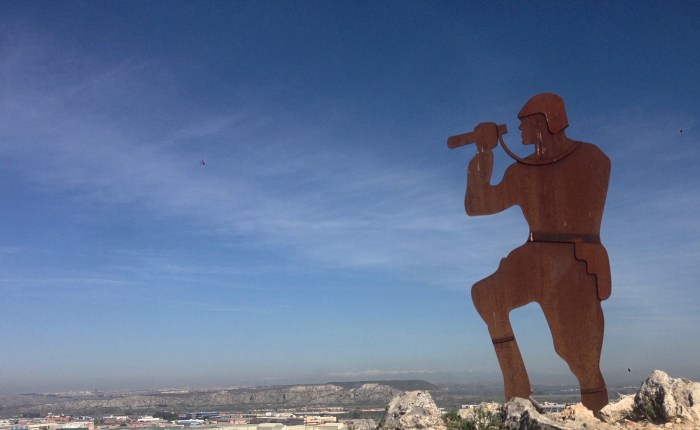
From this bridge we went to the Cerro Melero, a hill near the Hospital Universitario del Sureste. There you can find an open-air museum that preserves some of the trenches used in the Republican line. These trenches formed the second line of defense, in case of a Nationalist attack on the city of Arganda del Rey. The eminence offers a commanding view of the valley below; standing there, you can almost see the enemy forces scrambling underneath you. To protect from aerial attacks (both German and Italian fighter pilots participated in the battle), the trenches were built with an air raid shelter 32 meters long. Standing on other side of the hill is a sculpture of a cube split in two, symbolizing the Civil War. On its base is inscribed a fragment of Pablo Neruda’s famous poem, España en el corazón, lamenting the war.

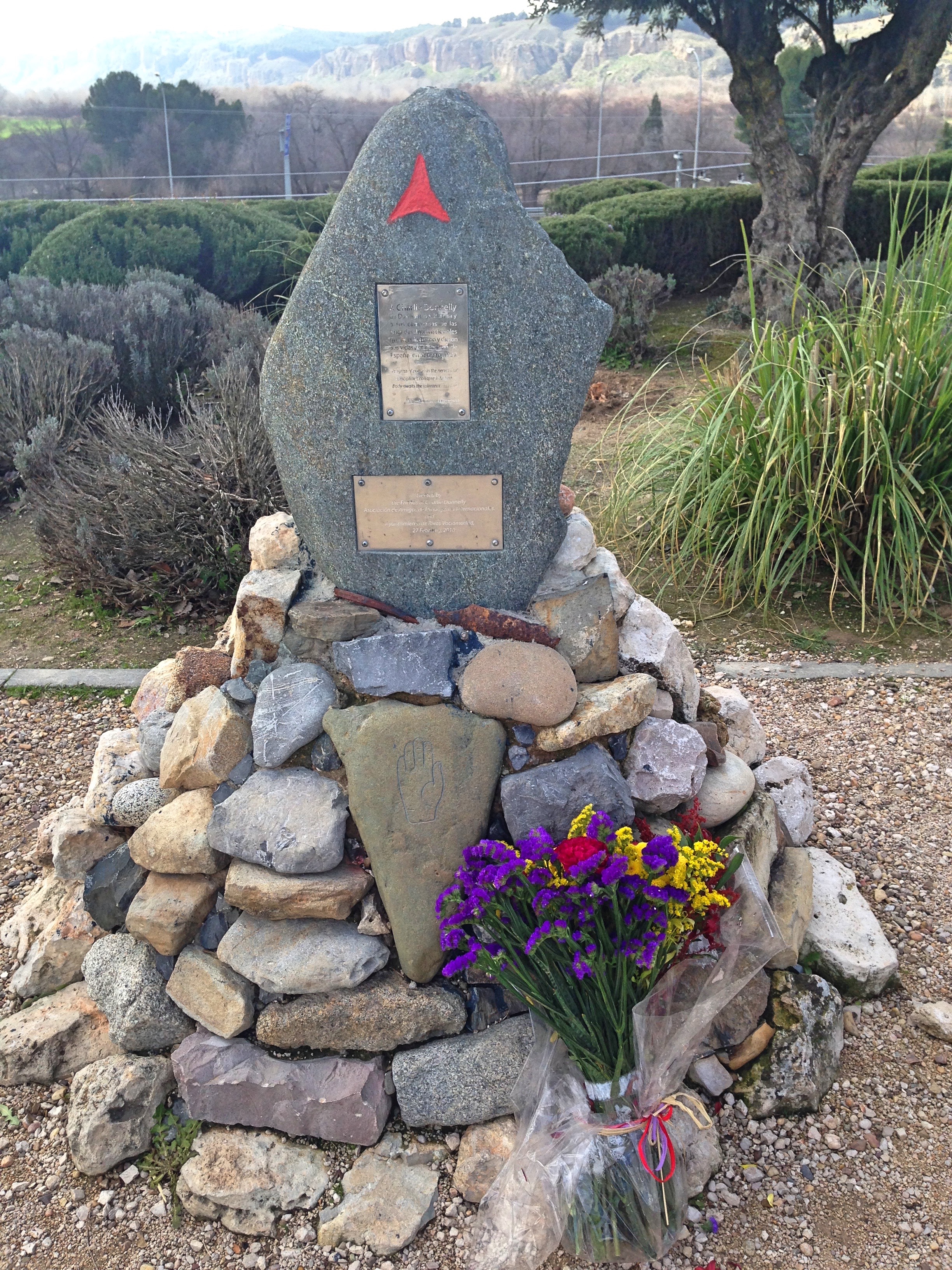
Our next stop was the memorial to Suicide Hill. This morbid name comes from the brigade of British soldiers who sustained heavy loses defending the hill. According to our guides, these volunteer fighters were barely trained and poorly equipped; and they were up against seasoned veterans of Spain’s wars in the north of Africa. Nevertheless, they fought stoutly, holding off the enemy forces from taking the nearby village of Morata while losing over half of their 600 men. A stone cairn was the only thing to mark this spot for many decades, formed spontaneously by visitors piling up rocks. Yet repeated vandalism—a problem for any monument to the war, since it is still deeply controversial in this country—prompted some locals to invest in permanent masonry, so that it at least cannot be easily knocked over.

Not far from here the American volunteers, called the Lincoln Brigades, fought and also suffered heavy losses. One of the survivors, Alex MacDage, wrote lyrics to the tune of “Red River Valley” commemorating the event; and some years later Woody Guthrie recorded the song, which begins thus:

There’s a valley in Spain called Jarama
It’s a place that we all know so well
It was there that we gave of our manhood
And there that our brave comrades fell.

cerro700

We walked from this point to the Cota 700, a hill named for its height of 700 meters above sea-level. There we found some stone fortifications still standing from the Republican front line. The guide explained that the machine gunners were stowed in chambers separated by strong stone walls, so that if a bomb struck one of them it would not take out the rest.

Across the valley we could see the hill of Pingarrón, which was controlled by the Nationalist forces. After the halt of the Nationalist advance (largely thanks to the brave fighting of the International Brigades), the Republican forces repeatedly tried to counterattack and take this hill. Yet the lack of cover between the two lines—only a few scrubby olive trees—and the strong Nationalist artillery made it impossible.

chirino_monument

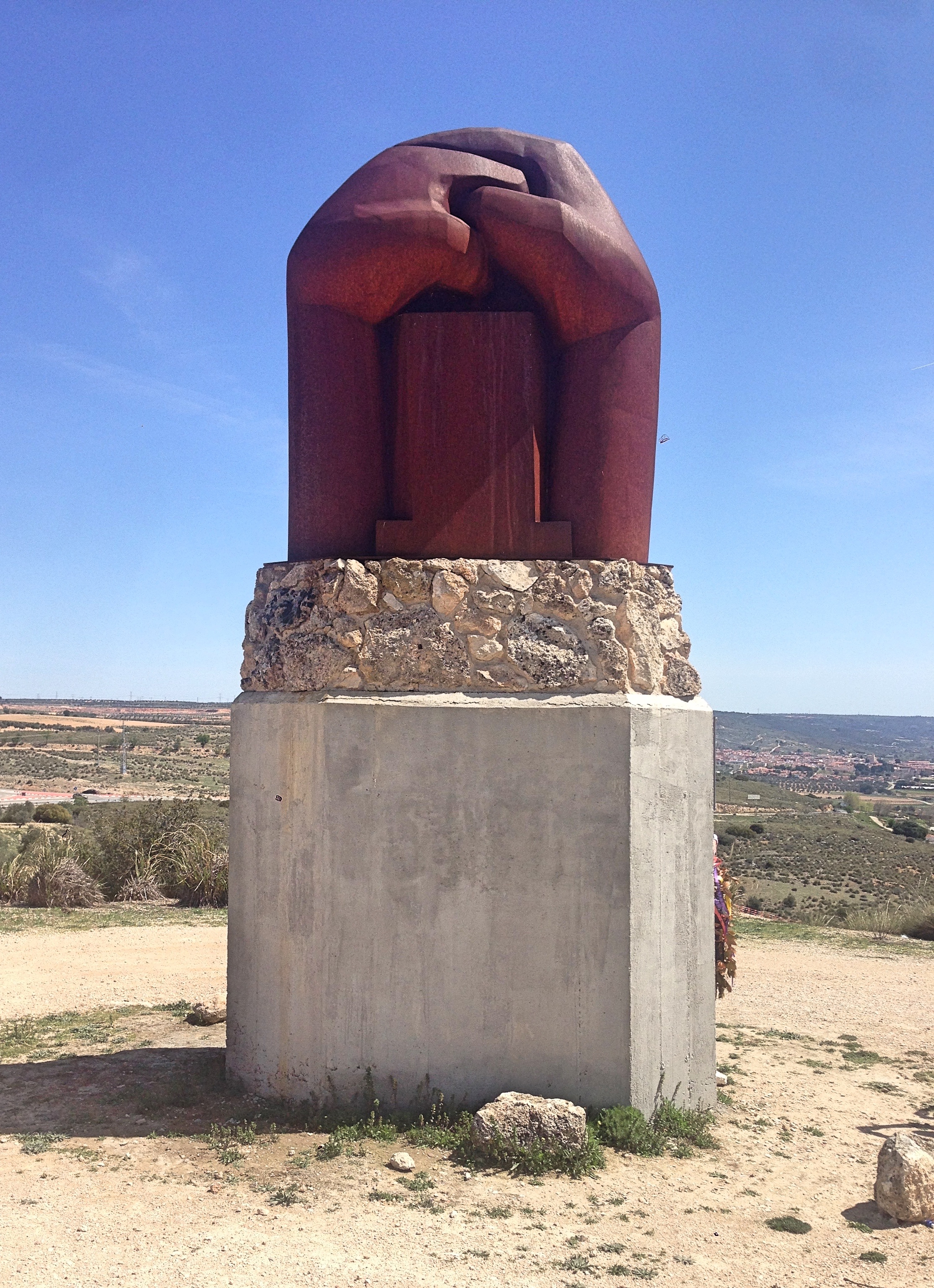
Not far from here, surrounded by fields of olive trees used as hunting grounds, is another monument. Standing on a stone base is a sculpture of two giant hands, one covering the other. This is the work of Martín Chirino, a sculptor from the Canary Islands. It represents the open palm of the fascist salute united with the communist fist, symbolizing the unity of the opposed sides. As with everything related to the war, it has proven controversial. Its base is frequently vandalized with spraypaint, so that somebody must come regularly to paint over the political graffiti. The statue is certainly not calculated to please many, since supporters of neither side are inclined to see each other with sympathy. After all, by now both have felt the sting of defeat, the Republicans after the war itself, the Nationalists after the fall of Franco’s regime.

Our last stop was in the little town of Morata de Tajuña, in a charming restaurant and inn called the Mesón El Cid. Apart from the restaurant, terrace, and pool, the establishment has two free museums: one dedicated to the ethnography of local agricultural ways, the other dedicated to the Battle of Jarama. These are both the work of Gregorio (Goyo) Salcedo, a mustachioed man, now over seventy, who is from this area. His interest in history was sparked by necessity. Growing up in the harsh and scarce times after the war, when the economy was in the doldrums and hunger was common, he and his father and brothers would collect old guns, shells, and equipment from these battlegrounds to sell for scrap. “If the war was hard, so was the postwar,” he said in a newspaper interview; “it was another war.”

museobatalladejarama
The Museum of the Battle of Jarama. This sculpture was made using shrapnel from the battle, incorporating about three thousands bullets and casings of different calibres

Soon he became interested in these artifacts for their own sake, and began collecting them. As his collection grew, so did his network, as former soldiers and their relatives got in contact with him. Eventually he converted an old garage into a museum, and quite an impressive one. There are thousands of photos, along with stories of individuals who fought and died in the battle. There are pieces of artillery and anti-aircraft, helmets, shells, uniforms, gas masks, guns, knives, flags, and every other manner of war paraphernalia. There is even a reconstruction of a Civil War-era schoolroom. That all this was collected, catalogued, and displayed by one man, is a testament to how much a private citizen can do for the sake of history. It is by far the best and most complete exhibition related to the Civil War that I have seen in Spain.

Like the sculptor Chirino, Salcedo strives for neutrality. As he says in that same interview: “Here there are no sides; all were human beings who fought, suffered, and died. We cannot forget that in war we are all victims, we all lose.”

Like so many battles, the Battle of Jarama was as inconclusive as it was bloody. Despite thousands of casualties on both sides and weeks of fierce fighting, the Nationalists did not break through and the Republican forces did not retake their lost ground. The war shifted elsewhere in the country, and the front largely held until the conflict’s final stages. Yet the soldiers who gave their lives to prevent the nationalists from cutting off Madrid—especially the foreign soldiers, poorly trained and equipped, who chose to come to Spain to fight against fascism—cannot but inspire the visitor with their example of moral and physical courage.

iandonelly
A memorial to Charles Donnelly, an Irish poet who died during the battle, in Rivas-Vaciamadrid. Shortly before his death, he was heard to say: “Even the olives are bleeding.”

Review: The Rise and Fall of the Third Reich

Review: The Rise and Fall of the Third Reich

The Rise and Fall of the Third Reich: A History of Nazi GermanyThe Rise and Fall of the Third Reich: A History of Nazi Germany by William L. Shirer

My rating: 4 of 5 stars

Reading this book is an ordeal. It is very long and very depressing. Charting the Third Reich from the birth of Hitler to the collapse of Germany, Shirer tells the whole story with the sweep of a novelist and the detail of an accountant. He wrote the book after having access to huge stores of documents captured by the Allies after the war. Diaries, schedules, testimonies from the Nuremberg trials, the minutes of meetings, and much more were the raw material marshalled to create this tome.

As is often noted, Shirer was a journalist, not a historian, a fact that helps to explain much about this book. He lived in Berlin as a foreign correspondent from 1933 to the end of 1940, reporting on the rise of Hitler and the beginnings of the war, until the threat of the Gestapo forced him to return home. This firsthand experience lent color to his narrative, but also focused his attention on readily observable events. Rather than talk of larger trends—social shifts, economic pressures, cultural developments—Shirer focuses almost exclusively on the doings of individuals in power, such as he had been reporting on.

This focus makes the narrative vivid and pleasingly concrete, but also results in a superficial analysis. A historian would naturally spend more time on the rampant inflation of the times, the institutional weakness of the Weimar Republic, the wider political trends in Europe, the mechanics of a totalitarian state, and so on. Further, Shirer’s explanation of why Germany embarked on such a destructive enterprise boils down to: because it is peopled by Germans. That is, he locates a kind of cultural essence in the German people, an essence stemming from the Reformation and especially Martin Luther, added to by Hegel and then by Nietzsche, which came to full fruition in National Socialism. But this sort of cultural essentialism is, for me, just intellectual laziness. It can be used to explain anything or everything, since these posited cultural qualities are vague and unobservable.

In any case wider historical analysis plays a very small part in this book, which is mainly a record of the decisions and actions of the leading men of the Nazi regime. That is to say that this book is a political and not a military history. The Second World War is discussed, of course, but only insofar as its developments affected or were caused by the Nazi leaders. Shirer is mainly concerned with charting the rise to power of these ruthless men: how they outsmarted the Weimar Republic leaders, fooled the international community, bullied and threatened their way to conquests, and finally instigated a war that resulted in their own ruin.

The balance of the book is tilted heavily towards the rise of the Third Reich. This can make for some dreary reading. In retrospect it is stupefying to witness how blind, inept, and spineless were Hitler’s opponents, first within Germany and then beyond its borders, until the final crisis spurred the world into action against him. Though Shirer’s sturdy prose is normally quite plain and unadorned, he has a steady instinct for the dramatic and writes several unforgettable scenes. Nevertheless the scale of detail Shirer saw fit to include sometimes weighs down the narrative into benumbing dullness. The endless, petty diplomatic maneuvers that preceded the beginning of the War—negotiations, ambassadors, threats, ultimatums, calculations, second thoughts, and so on—made it a relief when the soldiers finally started shooting.

These political dealings of the Nazis constitute the vast bulk of this book. It is a masterclass in how far a little cunning, shameless lying, and absolute ruthlessness can get you. It is also a lesson in the need to cooperate to take decisive action against common threats. In the years since Vietnam, many have concluded that the main lesson to be drawn from America’s foreign policy is the folly of interventionist wars. After the First World War, the Western powers were understantly ever more chary of violence. And yet, at least in Shirer’s telling of the history, a timely show of force could have nipped Hitler’s rise in the bud. If England and France had upheld their treaties and defended their territories and their allies, Hitler could not have amassed so much power at a time when the German military was still small. (Though it must be said that Shirer’s intellectual weakness appears here, too, since he attributes this inaction to pure cowardice.)

In any case, this does bring out an interesting dilemma in foreign policy concerning the benefits and risks of violent intervention. In the case of Hitler, timely action could have prevented a disastrous conflict. And yet in many other historical cases, such as with Saddam Hussein, the threat of non-intervention was vastly overestimated, while the cost of intervention vastly underestimated. The word “estimate” is key here, since these decisions must necessarily be based on guesses of future threats and costs—guesses which may easily be wrong. Since it is impossible to know with certainty the scale of a threat that a situation may pose if left unchecked, there is no surefire way out of this dilemma. This, of course, is just a part of a wider dilemma in life, since so many of our everyday decisions must necessarily be made based on guesses of what the future holds.

You can see that this book, though a popular account, is not lightweight in its details or its implications. Yet it does show its age. Published in 1960, it was written before many valuable sources of information became available, such as the French archives. It also shows its age in its occasional references to homosexuality, which Shirer treats as a perverted vice. This is, of course, morbidly ironic, considering the Nazi persecution of homosexuals (something that Shirer fails to mention). But all in all The Rise and Fall of the Third Reich remains a gripping popular overview of this nightmarish time.

(Cover attributed to Bundesarchiv, Bild 102-16196; licensed under CC BY-SA 3.0; taken from Wikimedia Commons.)

View all my reviews

Review: The Aeronautic Adventure

Review: The Aeronautic Adventure

La aventura aeronáutica: Emilio Herrera, Juan de la CiervaLa aventura aeronáutica: Emilio Herrera, Juan de la Cierva by Carlos Lazaro Avila

My rating: 4 of 5 stars

This book has the very modest distinction of being the only book I’ve read whose author I have interviewed. Carlos Lázaro is a history teacher at the school in which I work; and when he is not scolding students or grading reports, he is researching Spanish military aviation history. This is one of the numerous books he has published on this topic.

La aventura aeonáutica is a dual biography of two of the most important innovators in Spanish aviation history: Emilio Herrera and Juan de la Cierva. Herrera was of the same generation as the Wright Brothers. His specialty was lighter-than-air crafts—dirigibles, zeppelins, and so on—to which he made great practical and theoretical contributions. Among his many accomplishments was his participation in the first intercontinental flight of the Graf Zeppelin, which earned him a ticker-tape parade in New York City. He also designed what is considered the first spacesuit, for a planned but never realized ascension to the stratosphere. Later in life he was also important for his loyalty to the Spanish Republic in exile, even becoming its (mostly ceremonial) president.

Juan de la Cierva is mainly remembered for his invention of the autogiro, or autogyro. This was a sort of early-generation helicopter, designed to fly at speeds impossibly slow for fixed-wing aircraft. The principle of the autogyro is, however, quite different from that of a helicopter. Most notably, the rotor on top is completely unpowered. Forward thrust is provided by a small frontal propeller. This motion pushes air up into the rotor, causing it to spin—though notably, unlike in a helicopter, the air flows through the rotor upwards, not downwards. The rotor’s blades are angled so that the rotation provides lift. You may think of an autogyro as a plane whose wings rotate rather than stay fixed. For this reason autogyros cannot take off and land vertically, nor can they hover, unless there is a countervailing breeze. In any case, I hope you can see from this description that this was an ingenious and original contribution to aeronautic technology.

Like Herrera, De la Cierva was politically active; unlike Herrera, De la Cierva was a committed member of the Right, and threw his support behind Franco. His life was cut short in a plane crash—ironically a passenger plane, not any experimental flight—while trying to organize international support for the coup.

I found the lives of these two men fascinating, since I had not even known their names beforehand, much less any of their accomplishments. The book is admirably informative and concise, full of attractive photos and nifty little side-panels. Hopefully I will visit the Museo del Aire in Madrid soon, to see some of these historical craft for myself.

[Cover photo licensed under CC BY-SA 3.0; taken from Wikimedia Commons; author unknown.]

View all my reviews

A Conversation with a Historian

A Conversation with a Historian

I have been working with Carlos Lázaro for two years now, as an assistant in his history lessons. His class is inevitably enjoyable. Students who, in other classes, are noisy and disruptive act respectfully and dutifully in Carlos’s classroom. Indeed, the students are so assiduous about taking notes that it can be hard to get them to stop.

The high school in which I work is “bilingual,” which means that some subjects, such as history, are taught in English. Carlos is the head of the school’s history department. Together we work with students in 2º ESO, which is equivalent to America’s eighth grade. The curriculum we follow is, in many ways, strikingly different from the sorts of stuff we learned in my high school in New York. Most notably (for me at least) are the lengthy units on art history—architecture, sculpture, painting. Our textbooks in the states mainly focused on social, economic, and political history.

In addition to his job as a teacher, Carlos is an accomplished academic and author, having written several books. I sat down with him one day to ask him about his work and life.


ROY: Have you ever done an interview before?

CARLOS: No.

R: Really?

C: No, no, not in English. Though I was interviewed on Spanish television, TVE1.

R: Tell me about your education. What subjects did you study?

C: I grew up in a working class neighborhood in the southwest of Madrid. A very violent neighborhood with a lot of drugs. Carabanchel Alto, it’s called. It had one of the biggest prisons in Spain. I went to a religious school for my whole primary and secondary education. But as early as middle school I was interested in history. When I was a kid I learned to read and write through history books that I got from my older schoolmates. Yes, I love history and this is the reason I was interested.

Originally, I was more interested in ancient history—Rome, Greece, Ancient Egypt. But when I got to university I changed my interest to Native American anthropology. In fact I got a PhD in this subject. My thesis was related to the tribes that refused or expelled the Spanish conquerors. I was specialized in the Chilean Mapuche. But my final book in anthropology was related with the treaties that the Spanish Crown signed with Native American tribes, covering about 200 signed agreements. I saw the original documents in the archives, both here in Spain and in the Americas.

R: How did you get interested in aviation history?

C: In the university I met former Republican fighter pilots, and it was an overwhelming experience for me. But I had been interested in aviation long before that. For 24 years I had lived near a military airfield, watching the planes take off and land. So when I met these pilots I got so excited about the histories of their lives. They had fought in the Spanish Civil War and they explained what they did afterwards. For example, some of them fled to the Soviet Union after the war. Some went to the United States or to Mexico, and also, in some cases, were in prison. It was, as I said, overwhelming for me, so from this moment onwards I began to do research about them.

R: Tell me about some of your books. What are they about? Why did you choose those topics?

Herreraspacesuit
The space suit designed by Emilio Herrerra

C: The book I’m working on now is a collection of memoirs of pilots—foreign and Spanish—who fought in the Civil War. But with one main goal. Our main problem in teaching history, not only aviation history but in general, is that we don’t have titles like “A Brief History of the Spanish Civil War” or “A Brief History of Aerial Warfare in the Spanish Civil War.” So I’m trying to provide people with these memoirs in order to be able to hook the public’s interest. This is the same thing I do with my teaching, to try to hook my students on history.

I have written 10 books. Three of them were about anthropology and the rest are about aviation history. My most beloved book is a biography of Emilio Herrera, a Spanish engineer who designed, in 1934, the first space suit in history, designed for a high altitude balloon flight. He was both a pilot and a scientist, and was in contact with Einstein and von Braun. I also wrote a book about a pilot, a Republican pilot. My personal goal, as I said, is to popularize aviation history and also to make it available in both Spanish and English, a bilingual version, for the many English and Americans who are interested in this history. As you know we are sitting near the battleground of the Battle of Jarama (a battle in the Spanish Civil War), and not every American knows that there were American pilots fighting in this battle.

R: What brought you to teaching?

C: Well, I like explaining and summarizing historical events—and I like history, of course—so, this is the reason that I got my PhD and also took the oposiciones (the required state exam that all public servants must take) in order to get my teaching position. My teaching definitely helps my writing, and vice versa. Every day I try to improve what I’m doing, reviewing my classes in order see what works and what doesn’t. Presenting information accessibly in my books helps me do the same in class; and my students’ reactions help me decide how to present information in my books.

R: What are some challenges of teaching history? How do you deal with them?

C: I think the most difficult challenge of teaching history is providing students with accessible information. Making it accessible. I think that history couldn’t be “unverbal,” and thus couldn’t be, in a sense, boring. You need to be patient, giving them tips, clearly organized topics. Summarize as much as possible: don’t try to fill their brains with data because they are going to erase everything when they leave the classroom. I’m trying to get my students to love something about their past.

R: What are some tips you have for history teachers?

C: Define your goals. Strive towards these goals. Provide your students with accessible information—and most of all, information that is useful in their daily lives. Old pupils have gotten in contact with me, and say they love history because it has been so useful for them—reading books, traveling, visiting museums, something like that. When I was teaching in a village in Toledo we made a trip to an old airfield that was nearby, and I explained how it was used during the war. It was an extraordinary experience for them. They had no idea it was there.

Besides giving lectures, it’s great to have the students do research and give presentations. Also different media are useful. For example today I showed them a short documentary about the Renaissance. Jokes, anecdotes, and open-ended questions are good for engaging their attention. Try not to be monotonous.

R: How do you get your students to work so well?

C: It’s a mixture of mastering them, being tough in some cases, and in other cases giving them self-confidence. Some students are not self-confident, and you need to show them that they have a lot of interesting things to work with. In the beginning of the year it’s important to go over classroom rules—sitting properly, raising your hand, taking notes. Establish very clear rules from the very beginning.

R: How is teaching history important for society in general?

C: Someone* once said, “People who forget their past are condemned to repeat it.” It’s a good way to learn about our mistakes, to think about what happened in the past, to try to avoid the same problems and avoid risks in the future.

R: Why do you think many people find history boring?

C: I think because, for them, history is repeating facts and not thinking. And of course in some cases you need to learn the names of battles and so on. But history is, fundamentally, a way of thinking, a way of organizing your brain, so that you can understand what happened in the past.

But for many students history is just a pile of dates, names, battles, events, nothing useful for their lives. I’m trying to provide them with another face of history. How could history help them? What does history teach us? Why did our ancestors face these problems? And what solutions did they find? What lessons do these have for the new problems we will face in the future?

To hook their interest it helps to explain something to do with their behavior or their language that they use in their daily lives. For example there is a Spanish word “flipado” that is like “dizzy,” which comes from the English word “flip.” This was a drink that buccaneers drank, a kind of alcoholic mixture. So this common Spanish words has this English origin, and most of my students have no idea. This is a small example of how history can explain our daily reality.


*George Santayana is the originator of the English quote, “Those who do not remember their past are condemned to repeat it.” The nearly identical Spanish phrase “Los pueblos que olvidan su historia están condenado a repetirla,” is attributed to Nicholás Avellaneda, who is said to have taken it from Cicero.