“I think that was the train,” I said to GF as the train accelerated away from the station and into the distance.
“Oh.”
“Maybe we should have ran for it.”
“Oh well,” she said. “I bet there’ll be another one soon.”
“Yeah.”
The two of us were standing on a platform in the Chamartín train station in Madrid, trying to get to Cercedilla. A friend of ours, a local, had told us that we could see mountains there. But unfortunately for us—and all too typically—we hadn’t checked any sort of schedule before attempting the journey.
“I guess we just gotta wait,” I said, and pulled out my Kindle to read.
We sat on a bench and I began distractedly reading, glancing up at the sign board every few minutes. Ten minutes passed; then twenty. Finally, the name “Cercedilla” appeared on the glowing sign board: the next train wouldn’t come for another hour.
“We really should have ran for it,” I said, and began to sulk. We gave up and went home.
One week later: Round Two.
This time we looked up the schedule beforehand, and had gotten to the station with half-an-hour to spare. Nothing could stop us now.
The ride to Cercedilla lasts a little more than an hour. This was two years ago, shortly after arriving in Spain, and so it was one of my first times seeing the countryside around Madrid. Most striking, for me, was how parched is the environment. The soil is tan and sandy; the trees are short and shrubby; and rolling brown fields stretch out towards the horizon, with a sierra beyond. To a New Yorker accustomed to towering trees and even taller skyscrapers, the easy visibility across so many miles is startling.
Stop after stop swept by, until eventually we reached our destination: Cercedilla. I have since gone back to Cercedilla a few times. It is an attractive town, popular as a cool getaway during the hot summer months; it sits up in the Madrid Sierra, not far from El Escorial and Rascafría. There are some very pretty hiking trails immediately outside the city.
But I didn’t have much time to look around, for soon I felt GF tugging on my arm.
“What’s that?” she said, pointing to small train nearby.
“Dunno.”
“The sign says Los Cotos,” she said. “I think those are the trains to the mountains.”
“But I thought that was the train to the mountains,” I said, pointing to the train we just got off.
“I’m pretty sure this is right,” she said.
Three minutes later we were sitting on a quaint old wooden train, much smaller than the one that took us here, with plush red seats which faced each other.
The train creaked into motion. Immediately we were heading steeply uphill; and we remained slanted this way the whole trip, as the train crept up the mountainside. We went by the backyards of houses, passing pools and patios, and kept climbing until we left all signs of the town behind. We were in a pine forest now, a uniform sea of green thorns and pine cones and grey bark.
I couldn’t shake the feeling that I was in a movie, the trip was so dreamy and picturesque. As the train wound its way up, making wide, concentric circles—each successive circle decreasing in radius—we were given a more expansive view of the mountains nearby, their sides covered in the same uniform sea of pine trees that surrounded us.
The train to Cotos makes only one stop on the way there, at Navacerrada, which is a small town that mainly serves as a base for hikers and campers. Along with Cercedilla, it is also one of the stops along the Camino de Santiago from Madrid.
Finally the train reached Cotos. Neither of us had any idea what to expect when we got out. There was an old, derelict station building, and a road leading away from the station and up a hill. But whatever curiosity I had for my surroundings evaporated when I walked out of the train and into the cold.
“Man!” I said. “It’s freezing here!”
“You didn’t bring a jacket or something?”
“No.”
“You only brought your t-shirt?”
“Yeah…”
“What were you thinking?!”
“But it was warm in Madrid!”
We wandered around, noticing that we had wandered into a national park. But the cold was overwhelming. I tried to warm myself by rubbing my arms and bouncing around, but it was al in vain.
“We really have to go,” I finally said to GF. “Sorry.”
“Are you kidding? We got up early and spent two hours in the train, on a Sunday, and we’ve gotta go back?”
“I can’t stay here. I’m so cold.”
“Ugh!”
And so, thanks to a small but very stupid choice on my part, we made the long trip down the mountain, back to Cercedilla, and then back to Madrid. We had been defeated a second time.
Two months later: Round Three
We’d figured out the public transportation; I’d bought sneakers, a winter jacket, a scarf, and a hat. In short, we were ready for our third attempt to scale the mountain.
Once again, we took the train from Chamartín; once more, we went through the countryside to Cercedilla; again I was treated to the beautiful sights of the nearby mountains and pine forest as the train wound its way up, climbing to Cotos. And I breathed a sigh of relief in the cold air when, looking out towards the mountain, I saw another cloud gnawing on the same mountain. We were back; and this time I wasn’t shivering.
But before we began to hike, we decided to eat in the café near the station. We both ordered tortillas—which, in Spain, is not the flour-based wrap of Mexican cuisine. A Spanish tortilla is an omelet with potatoes, cooked in the shape of a thick cake and cut into slices. They are gooey, hearty, and delicious—easily one of my favorite Spanish dishes. But I found it so absurd, and so typically Spanish, when our generous slices of tortilla were served on top of generous portions of bread. Potatoes on bread, carbs on carbs. I really have no idea how the Spanish stay so thin. (Nowadays I eat tortilla with bread every day, and I haven’t gained a pound.)
This done, we began. We followed a dirt path up into the forest, towards what I gathered was the top of the mountain. But almost immediately I felt winded, as if somebody had hit me in the stomach.
“I can’t breathe,” I said, loosening my scarf around my neck. “The air here—it’s so thin!”
“Really? I feel fine,” GF said.
“What?” I said between gasps. “How?”
“Just relax.”
I felt strangely winded, perhaps from the altitude, but more probably it was all in my head. Yet I’m a stubborn person, and occasionally my stubbornness is a virtue—like when I’m trying to force my weak, flabby body up a mountain. So we pressed on. The path zigzagged its way up, from left to right, from right to left, gently leading us up and up.
We were on Peñalara, the tallest mountain of the Guadarrama range, otherwise known as the Madrid Sierra. These are the mountains that bound Madrid’s northern edge, separating the province from Segovia, and which provide some of the best hiking and most picturesque sights in the country. Peñalara itself rises about 3,600 feet (1,100 m) from its surroundings, and at its peak is 8,000 feet (2,500 m) above sea-level. Coincidentally, 8,000 feet is also the altitude at which people begin to be susceptible to acute mountain sickness (AMS). But I knew exactly none of this at the time.
It wasn’t long before I noticed the trees getting smaller and stumpier. We were nearing the tree-line. By now the restaurant below looked like a toy house, and I was getting used to the air; soon I was comfortable enough to start walking at a good pace. Every foot we advanced made the view that much more stunning. I’d never seen anything like it. The mountainous horizon seemed to roll, like an undulating sea; and the head of every mountain was buried in a cloud, which sat like fluffy top-hats over the peaks.
Soon the trees had all but disappeared. The only vegetation left was dry tufts of grass, forcing its way up through the rocky soil, and a few shrubs here and there. The rocks had interesting patches of neon-green on them, which I took to be lichen. Now we were ourselves just a few hundred feet away from a cloud.
We took a break on a big rock to eat some snacks, and noticed a strange little round hut in the distance with a blue door. This is the Refugio Zabala, an open refuge that was built in 1927 by the members of the Guadarrama Society. The door is always open and unmonitored, though two people could hardly fit in the available space (the rest of the building is taken up by material storage and weather-monitoring equipment).
We pressed on. I was tired now, too tired for conversation, too tired even for my usual complaining. But as my mind wandered, I found myself thinking of my copy of Nietzsche’s Thus Spoke Zarathustra, which has a picture of Caspar David Friedrich’s famous painting, Wanderer Above a Sea of Fog on it, an iconic painting of the Romantic period. A brilliant idea struck me.
“Hey hold on,” I said to GF. “I want to take a picture.”
“Okay.”
“Take my phone. I’m gonna go stand on that rock over there.”
So I clambered over a pile of jagged rocks off the path, and carefully positioned myself to recreate, as best I could, Wanderer Above a Sea of Fog, one leg raised, one hand on my hip, looking out towards the mountains. I felt somehow both extremely cool and unbelievably lame as I did this. But it came out pretty good.
We kept going. There wasn’t much distance now between the clouds and us. The view was so grand it was almost painful to look at. I didn’t feel tired any more, not cold, not winded. All of my senses felt supernaturally acute; the sun seemed nearer, the air clearer, the light more vivid. There was hardly any sound except my own breathing, the crunching of rocky soil beneath my feet, and the breeze going by my ears.
Finally we were there. The view disappeared behind a veil of gray clouds; we were standing in the sky. I could see my breath now. Some patches of snow were laying here and there on the bare ground. A couple of hikers passed us, going the other direction, obviously much better prepared than we were, with poles and those futuristic-looking synthetic jackets. Meanwhile, I was wearing a cheap coat and a hat with a little fluffy bun on the top. But it didn’t matter: we made it.
The peak of Peñalara
We walked around a bit, though there wasn’t much to see. In fact, there wasn’t anything to see; we were completely surrounded by fog, which was so thick that the sun was dim enough to look at directly. We walked perhaps three hundred feet before deciding to turn around.
But as we began to head back, a strange feeling started to take hold of me. I looked in the direction which, I was sure, we had come from; but it looked completely unfamiliar. Suddenly I felt lost; I began to feel dizzy. What was going on? Why didn’t I recognize the path? Was I suffering altitude sickness or something? Was I disoriented? Was it safe for me to try to navigate back?
My thoughts jumped to a scene from Bill Bryson’s A Walk in the Woods, when Bryson himself was climbing a mountain. Being the nervous man that he is, he’d read up about altitude sickness beforehand, learning about how the lack of oxygen had made some climbers hallucinate and act erratically, sometimes making stupid decisions that got themselves killed. So when Bryson got up in a mountain himself, he began doubting his own mental state, suspecting that he may have come unwound without noticing.
Was something like this happening to me? It’s an interesting paradox, trying to determine your own sanity. If I was losing my judgment, how could I judge whether I had lost my judgment?
Terrible scenarios began to pop in and out of my consciousness, wherein we get ourselves totally, hopelessly lost and are eventually eaten by a bear—if there are bears around here—or simply starve or freeze in the vast national park. Nobody knew we were here; nobody would notice if we got lost.
“Want a carrot?” GF asked. She’d brought a plastic bag full of carrots in her backpack, and was holding out an orange stick for me to take.
“Oh, thanks.”
I took a bite of the carrot; and the crunch, crunch, crunching in my skull snapped me out of it. I took a deep breath; I was completely fine. The path began to be recognizable, and in just five minutes we were stumbling and slipping down the mountain.
When I visited another day, I improbably found horses grazing near the peak
We had a train to catch. So, exhausted and hungry, we both made our way past the rocks with the bright lichen, past the dry grass and the stumpy shrubs, until we were again surrounded by tall pines. It took us three tries, but we had conquered the mountain.
We were standing by a bike rack outside a metro station, waiting for our Blablacar driver to pick us up. He was late.
We were going to Cuenca for a day trip. Cuenca is a small city east of Madrid, about halfway on the road to Valencia. The Spanish word cuenca literally means “basin,” a fitting name for a town known for its gorges. Several of my students had recommended it, so on a weekend when we didn’t have anything else to do we impulsively booked a Blablacar to go there, without even bothering to look for a way back. The drive takes between 1.5 to 2 hours. For those looking to travel with greater comfort and speed, there is a high-speed train that runs to Cuenca several times daily.
Incidentally, there is a vulgar Spanish expression connected to this city: To “ponerle a alguien mirando a Cuenca” (literally to “put somebody looking at Cuenca”). It means to bend somebody over. But clearly the expression makes no sense for those in Cuenca. What do the cuencanos say? To put somebody looking at Aranjuez.
Soon the driver arrived with his girlfriend in tow, and we started off towards Cuenca. They were studying tourism and spoke English very well. GF and I did our best to keep the conversation in Spanish, but in general a group will always take the path of least resistance and speak the language easiest for everybody. (This was two years ago, when my Spanish was still quite basic.)
As we neared Cuenca, the driver said:
“Before going to the city we’re going to see the torcas. Want to come?”
“What are torcas?” I asked.
“They’re like big holes in the ground. You’ll see.”
We passed fields and farms and then headed up into some hills into a pine forest. We kept going until we reached a parking lot and then got out. A path led into the forest and further up the hill.
The first torca came into view. The driver was correct: they are big holes in the ground. They were formed by ancient lakes, I believe, but are now completely dry. The biggest ones are over 500 meters, or 1,600 feet, in diameter. These torcas are just one of the natural points of interest in the vicinity of Cuenca. The most famous is the Ciudad Encantada, a geological park filled with weird rocks formed by the limestone deposits of an ancient sea. It is a thirty-minute drive from the city itself and the pictures look marvelous. But there is an entry fee (5€), which made my driver not wish to visit.
We got back in the car and started driving to the Ventano del Diablo, a popular lookout point about 20 minutes outside the city. By now I was getting kind of sick of sitting in the car. We had spent about 2 hours driving so far and I have long legs and achy knees so sitting in cars is very uncomfortable for me. But the view was well worth it.
The lookout point is inside a hollowed out cliff. Standing there, buffeted by the wind, one sees the tan-colored precipices on all sides and the Júcar river whose greenish water flows down below. This is the same river that runs through the city of Cuenca itself, and is responsible for wearing away the deep gorges for which the city is famous. It was also this river which, in 1982, flooded and overran the Tous Dam, damaging several towns and killing 30 people. The flood was so bad that it was even given its own name, the Pantanada de Tous, or the “Marshing of Tous.”
We enjoyed the view until the wind forced us to retreat. In fifteen minutes we’d arrived, parked, and split up. Our driver had kindly agreed to give us a ride back to Madrid, since we hadn’t arranged anything else.
On our walk up to the city we passed over the Huécar, a much smaller river that bounds the southern edge of Cuenca’s old city. The old city center of is even higher than the rest of the town, perched up on a rocky hill 1,000 meters (3,280 feet) above sea level. This is why Cuenca can get chilly.
We were quite hungry by now and were looking forward to lunch. But we got distracted almost immediately by the view. From almost every side of the town there is an excellent vista of the surrounding area. And because the town is squished onto a hill, with very uneven ground, the streets are charmingly narrow and twisting; and several times we had to climb staircases in the street.
The streets were indeed so twisty that we got confused and ended up overshooting the restaurants and going to the other end of town, where we found a lovely iron bridge. Built in 1902, this is the Bridge of Saint Paul, which replaced an older bridge that was built in the 16th century. The bridge gets its name from the Convent of Saint Paul, built on a hill across a gorge opposite the town itself.
From this bridge we could see the famous Casas Colgadas, or the Hanging Houses of Cuenca. These are buildings that are situated right on the edge of the cliff and which have balconies that hang off, giving them their name. It seems dangerous to me, but I suppose you have to use all the real estate you have when you’re confined to the top of a hill.
The Bridge of Saint Paul, with the Convent in the background
We took some pictures, fended off a scam artist, and then went up to Plaza Mayor to find a restaurant. I really wanted to eat inside because I was uncomfortably cold, but the best deals were for restaurants that had seats outside, so I decided to suck it up and sit down in the plaza.
The benefit of eating in the Plaza Mayor was that I got a chance to take a good look at the cathedral’s façade, which is particularly pretty. This façade was actually rebuilt after it was destroyed in 1902 by a lightning strike—the same year, coincidentally, as the Bridge of Saint Paul—so the surface that greets visitors today is neo-gothic, though no less attractive for that. The cathedral itself is, along with the Ávila Cathedral, the oldest gothic building in Spain, though succeeding years have wrought their changes.
Photo by Der pepe; licensed under CC BY-SA 3.0; taken from Wikimedia Commons
We paid the bill at the restaurant and then went inside the cathedral. In one chapel there was a colorful statue of a monk standing over a demon; and in the dim light the demon’s eyes deemed to follow me as I walked past. The experience gave me the willies. I can see how such realistic sculptures, combined with dim and flickering light, could have terrified people of a less skeptical disposition.
After that I walked outside to the courtyard and there discovered that there was a kind of patio with a wonderful view of the countryside beyond. There was an air of ruin about the place, filled with cracked stone and damaged statues. But by now the cold was becoming unbearable. I had spent over an hour eating outside and this cathedral wasn’t any warmer. I wanted to go somewhere with heat.
So I convinced GF to visit the Museum of Spanish Abstract Art. This museum is in one of the Hanging Houses and is one of the most notable attractions in Cuenca, but I was mainly interested in the heat.
The Museum of Spanish Abstract Art
This museum was founded in 1966 by the Spanish Filipino artist Fernando Zóbel, displaying works that the artist had previously collected. The museum is free to enter and, most importantly, nice and warm inside. Unfortunately, I derived very little pleasure from the artwork on display. At the time I was fairly ignorant of modern art and normally disliked it. If I visited again I would, perhaps, have different opinion.
After wandering around the museum and staring blankly at blank canvases, we left to explore the city some more. The sun was setting now and it was getting dark quickly. We walked up past the Church of St. Peter towards the Barrio del Castillo, so-called because a castle once occupied this hill. Indeed, ruins of a castle wall can be found there still. One can climb up to the top of one of the old turrets for an excellent view of the city and the surrounding countryside.
From here we could see the whole city center below us, the bridge, the valley, and the landscape beyond. In the distance the sun had just set behind the horizon, turning the skyline a bright red. The lights of the town were coming on, and in just a few minutes everything was twilight and the town was aglow with artificial light. On a large hill nearby, the Cerro de Socorro, there is a large statue of Jesus atop a tall pedestal; and now spotlights had been turned out and it glowed bright yellow against the darkness of the surrounding hill.
It was completely dark now and nothing would be open. So GF and I finally gave up and decided that we could go sit in a café until 9:00, when we would meet up with the driver. Eventually the driver and his girlfriend wandered in and sat down with us. Talk turned to politics and, predictably, they asked us about Donald Trump, with that air of horrified bafflement that all Europeans (and many Americans) contemplate the man.
We got back to Madrid at 11:30—over 14 hours after we left. It was a long day. We all said goodbye, and really I was sad to do so. I have had many excellent experiences with Blablacar, but this stands out as by far the best.
The most famous monastery in the community of Madrid is, undoubtedly and deservedly, El Escorial—the grandest monastery in the country. Nevertheless, that building’s primary function was never to be a home for monks, but a seat of power. To see a proper monastery without leaving the bounds of Madrid, one can go to Las Descalzas or La Encarnación, two historic and lovely monasteries in the center.
More impressive than either of these, however, is El Paular, which is located near a small village, Rascafría, in the Madrid mountains. Getting there on public transportation is not easy, especially on the weekend. Bus 194 leaves the Plaza de Castilla every Sunday at 8 am. The trip lasts well over two hours, mostly because the indirect route travels over local roads, making frequent stops. And since the only viable return bus leaves Rascafría at 6:30 pm, going there is an all-day commitment. (Admittedly there is a return bus at 3:00 pm, but if you visit the monastery and take the tour you won’t make it.)
Let me pause here for a linguistic lesson. When we wish to make a compound word out of a noun and a verb in English, we normally put the noun first and add “-er” to the verb. Thus we get “skyscraper.” Spanish follows the opposite procedure, with the verb first and the noun second, which is plural. The word for “skyscraper” in Spanish is rascacielos (lit. “scrape skies”). Learning this principle was invaluable to me, since it makes trips to hardware stores infinitely easier. Can-opener is abrelatas and pencil-sharpener is sacapuntas. At first glance the toponym Rascafría follows this principle, rasca being from “scrape” (although “fría” as a noun isn’t known to me). This appearance is entirely illusory, it seems, since the name derives from rocas frías, or cold rocks.
The bus deposited me in this cold and rocky place at around 10:30 in the morning, on a chilly November day. The walk to the monastery took about twenty minutes. I arrived in time to be there when the gates opened at 11:00. Before going inside, I retreated a little from the entrance so as to see the monastery amid its surroundings. The best place to see El Paular is from the Puente del Perdón, a picturesque stone bridge (built in the 1700s) that runs over the river Lozoya. From here you can see the monastery’s tall spire presiding over a square building, adjoining a series of domes and semi-domes on the right. With the looming mountains serving as a backdrop, the monastery is quite a quaint sight.
El Paular was founded around the year 1390 as a Carthusian monastery, a purpose which it served until, in 1835, like so many monasteries in Spain, it was confiscated by the state. Bereft of purpose, the monastery suffered the effects of time and neglect. In the twentieth century there was an ineffectual attempt to incorporate it into the national park of the Guadarrama Mountains. Later on, the monastery was converted into a sort of artist residence for landscape painters—a task for which, due to its surroundings, the monastery was admirably well-suited. Finally, in 1954, the monastery became, once again, a monastery, this time for the Benedictine order; and it remains so to this day.
I paid the entrance and went inside. They were having mass in the church when I entered, so I proceeded directly to the cloister. Here I discovered an unexpected delight. Lining the walls of the cloister is a series of 52 oil paintings by Vicente Carducho, a contemporary of Diego Velazquez. These paintings tell the story of the Carthusian Order from its founding to the present day. Thus the series begins with the Carthusian founder, St. Bruno, and ends with the closure of the monasteries during the English Reformation. Individually, these paintings are masterful works of Golden Age realism, telling stories of miracles, martyrs, and myths with a dynamic flair worthy of Carducho’s friend, Lope de Vega. (Indeed, the two of them can be seen in one of the paintings.) But together they have a cumulative effect that goes far beyond their technical merits.
Lope de Vega is the grey, bearded man on the left; Carducho himself is immediately to the right of the writer.
And we must count ourselves extremely fortunate to be able to see the series all together, since after the monastery’s 1835 confiscation the paintings were acquired by the Prado, and for many years were loaned out to various museums around the country. During this time two of the paintings were lost (there were originally 54) in the confusion of the Spanish Civil War. It was only in 2006 that they were restored and finally reunited in their original home.
Once I finished appreciating the paintings—which took the better part of an hour—I wandered over the entrance of the church for the scheduled tour. Mass soon finished; and about a dozen people, mostly elderly, shuffled out of the elaborately decorated church door. A short, rotund man wearing a monk’s habit—a plain dark robe in this case—appeared and shepherded us inside. The church itself is a plain, clean, white space, mostly devoid of elaborate decoration. The exception to this is the magnificent main altar, which contains 17 Biblical scenes in finely detailed alabaster.
In a jovial and bouncing voice, the monk explained all about the monastery and its history. Then we moved further into the monastery, passing through the vestry and the chapter house, while the monk rapidly rattled off the dates, styles, and provenance of the art work to be seen. Finally we reached the Capilla del Sagrario, or the Chapel of the Sanctuary.
This chapel is undoubtedly one of the greatest works of Baroque art to be found in Spain. The colors are regal and soothing: silver, pink, and sky blue. Every surface is covered with extremely intimate ornament, in a style the monk called “Churrigueresque,” a Baroque manner of decoration native to Spain. Floral designs squirmed up the walls; silver curled and bloomed; columns twisted and angels burst from walls. The chapel comprises several separate nooks, each one dedicated to a different saint. In the central chamber a hexagonal tabernacle rises up several meters off the ground, constructed of colored marble taken from all over Spain. It is an extraordinary work. Even the floor is impressive, made from interlocking triplets of diamonds that, together, form the image of a cube.
The monk then led us to the refectory, where the monks eat their meals in silence, while somebody reads scripture aloud. Finally we reached the church and concluded the tour.
I now had about three hours to kill before my bus left back to Madrid. Thankfully, aside from the monastery, Rascafría is itself a lovely place. Madrid’s northern mountains provide some of the best hiking in the country. Rascafría is no exception to this. Even on this chilly winter day the place was full of men, women, and children in windbreakers carrying pointed walking sticks. I joined them, crossing the Puende del Perdón and turning to walk alongside the river Lozoya. Unknowingly I had entered the Bosque finlandes, or the Finnish Forest, an attractive natural park formed by importing trees and vegetation from that Scandinavian country. Though at the time I did not know this, I did notice that the trees were strikingly tall and straight.
I walked on, passing by ruined farms, masticating cows, and once again over the shallow river. Eventually I came upon a sign about the local trails. There was a short caption about an old legend pertinent to the area, which told of a beautiful Moorish girl who fell in love with a young man, and every day washed her face in the river while waiting his return (from where, it didn’t say). It is said that she waits still in a cave somewhere. Well, I certainly did not find any beautiful enchanted lasses, Moorish or otherwise, on my walk; but I did take some nice pictures of the scenery. Eventually I wandered onto the route of the Cascada del Purgatorio (everything seems to have a religious name in Spain), named after a nearby waterfall that the hiker can visit.
As the hour of my departure neared, I went back to the town to eat something. Though small, Rascafría is itself a charming sight, with the Artiñuelo Stream passing its center. There are also many attractive restaurants, though they are strangely expensive, due to the many visitors of the trails and the monastery, I suppose. I ate a delicious chocolate cake with raspberry dressing and then got on the bus, to doze during the long ride back to Madrid.
The most spectacular day trips from Madrid are also, fortunately, some of the easiest. Toledo, Segovia, and El Escorial can all be reached in under an hour from the center, and Ávila isn’t much further away. But once these more convenient options are exhausted there is still much to see.
Granted, with Spain’s high-speed trains even faraway cities like Seville and Barcelona can be visited in a day (though they deserve far more time). And with a car you will have no trouble getting around. But if, like me, you are looking to travel cheaply, on public transportation, then some destinations are difficult.
One of these difficult day trips is Consuegra. This is a little town, of about 10,000 inhabitants, in the region of Castilla La-Mancha, further south from Toledo. Getting there from Madrid takes time. The only option for public transportation is a bus. It departs from Madrid’s Estación del Sur, near the Mendez Álvaro metro station. The journey lasts 2.5 hours each way, which means a day trips involves 5 hours on the bus.
I had planned to get some good reading in but, as often happens, the lack of sleep (I left Madrid early) and the shifting and rocking of the bus soon lulled me into a deep doze. My kindle rested in my lap, while my head rested against the window. The drive was thus passed in the uneasy limbo between unconsciousness, vivid dreams, and semi-wakefulness. Eventually I stirred, groggy yet refreshed, in Consuegra before lunch time.
Allow me to pause here for a linguistic lesson. The word consuegra itself means the mother-in-law of your son or daughter. In other words, she is the mother of whoever your child marries. In English we have no word for this, of course. We just lazily affix “in-law” to our names for blood-relations. But in Spanish there is a distinct name for parent-in-law (suegro/a), daughter-in-law (nuera), son-in-law (yerno), and brother/sister-in-law (cuñado/a), in addition to the parent-in-law of your child (consuegro/a). Curiously, these terms are nowadays applied to the family of boyfriends and girlfriends who are not yet married. Indeed the term for boyfriend/girlfriend (novio/a) was originally adapted from the Spanish word for groom/bride. It seems that, when dating became widely practiced and accepted, lacking the vocabulary for non-marital relationships, the words for married couples were simply transferred to this new situation.
The town of Consuegra itself, though charming, is not especially remarkable. It is a destination because of the hill that rises above the center. On this modest eminence, the Cerro Calderico, the visitor will see why Consuegra is a site of pilgrimage for Quixote followers. For this hill in La Mancha is crowned with twelve windmills, perhaps the very same that the Knight of the Sad Countenance thought were an army of giants.
Though the wind still blows, the mills no longer grind grain. (Indeed, the wind in this area stills blows so hard that, the first of March, they sustained heavy damage from hurricane-force gales, nearly destroying many of them. Repairs are underway.) Many of the windmills house specialized stores for local products, like wines and cheese—and Castilla-La Mancha makes the best cheese in all of Spain. But they are worth visiting just for the tremendous view of these slumbering giants.
A craggy stone wall, a dilapidated pile now, still crosses over the hill. Weeds and wildflowers spring up from the dry soil. Though the hill is not especially tall, it provides a commanding view of the surrounding countryside. Castilla-La Mancha is one of the only non-mountainous parts of Spain. Instead of peaks, empty fields spread out before the visitor, spotted with roads and farmland. Consuegra and its environs have maintained their agricultural character, you see. Not nearly enough tourists pause here to have transformed the economy.
The Cerro Calderico does not only provide a platform for windmills, but is also the site of one of Castilla-La Mancha’s greatest castles: El Castillo de la Muela (which literally means the “castle of the molar”). The hill is a logical place for a fortress, with its steep sides and commanding view; and indeed it has been used for this purpose since Roman times. More recently, the castle was the squabbled over during the confusion of the Middle Ages, when Spain was populated by various small kingdoms, Christian and Muslim.
From the outside the castle presents itself as little more than a vertical heap of stones. To enter one had to pay a small fee. I considered it, even though in my experience the insides of castles are fairly uninteresting. But then I heard screaming, shouting, and riotous laughing coming from within. I assumed that a gaggle of drunkards were wandering around inside, and decided to skip the experience. I later learned, however, that the castle gives guided tours with historical reenactments, which doubtless was the source of the shouting I heard.
After taking my fill of the terrific view I descended back into town for lunch. For this I went into the first attractive bar I found, ordering some beer and tapas. Here I had one of those experiences that make me love this country. Unlike in the United States, whole families are welcomed into bars. A young couple with a newborn in a cradle were standing at the bar, eating and chatting. Next to them a group of senior citizens did the same, and at a table another married couple sat with their two children. Everybody was huddled close and talking loud. The bartenders joked with the customers, all of whom (except me) seemed to be regulars. There was an incredible feeling of effortless bustle, as drinks and food were served with speed but no stress, as Spaniards spoke in loud tones and made sweeping gesticulations, and easy laughter sounded all around.
More and more people packed into the bar, which only improved the atmosphere. Spaniards are far less shy than Americans when it comes to close physical contact; and unlike in American bars, there was no loud music to drown out conversation. The result is a lively but easygoing mood of all-embracing social life. Though alone, I instantly felt as if I were part of the community.
I left the bar in high spirits, intending to go straight for the bus station. But soon my attention was caught by a large tent that had been set up in one of the central squares. Investigation revealed that a wine festival was taking place. I paid three euros to enter, which came with three tickets, each of which I could trade for a glass of wine. Local vintners had set up stalls all around tent. In the center was a giant table, already littered with paper plates and plastic cups. The place was packed. I had to elbow my way to each glass of wine.
I quickly became curious about the strange cardboard boxes, filled with small holes, that so many people were carrying around. In the back of the tent I discovered the reason for this. In an open cage, dozens of little chicks were waddling. For a small price the customer could scoop up one of these chicks to take home. This was a big hit with the children, you may imagine. Yet I doubt that any of these chicks will be allowed to grow up and become useful, for eggs or meat. And using baby chickens as for the amusement of children does not strike me as kosher.
The wine drunk, I tipsily made my way back to the bus to return to Madrid. It had been a truly excellent day. And, best of all, I had 2.5 hours to sleep off the wine on the way home.
If you want to catch a glimpse of Catalonia’s Roman heritage, no city is better suited than Tarragona—or, as the Romans called it, Tarraco. The capital of its eponymous province, the city of Tarragona is nevertheless much smaller than Barcelona, with a population of about 130,000. It is easily accessible from that mecca of Catalonia, about an hour away by commuter train, and thus well-suited for day trips. Tarragona is also worth visiting on its own—especially if you’re looking for a place less infested by tourists. Like Barcelona, it is situated on the Mediterranean coast, in a section the Catalans call the Costa Daurada, or “golden coast.”
Tarragona’s beach with the tracks towards Barcelona
Roman remains are scattered throughout the city, especially in the old city center. This part of town is also called the “high part” by the inhabitants, for the obvious reason that it is situated high on a hill overlooking the sea to one side and the land on the other. You can reach this point by ascending the Via de l’Imperi Roma, a fine tiled walkway, sheltered with trees, that goes along the remains of the old Roman wall (which was likely built atop another, older wall, perhaps Phoenician). For a small price the visitor can climb up these walls and walk their length, giving one an excellent view of the city as well as the surrounding valley on the inland side.
Going along this way, the walker curves around back towards the city and the sea. I passed the Archaeology Museum, which unfortunately was closed at the time. Nevertheless, outside the building there are some ruins to explore, notably a staircase that leads up into the shell of the old Praetorium Tower. This tower has been repaired, rebuilt, and repurposed many times throughout its long life: as a castle, a barracks, and finally a prison. According to the informational plaque, it was used for this last function as recently as the Spanish Civil War (1936-39), when it was filled far beyond capacity with political and military prisoners, many of whom were executed. Nowadays, the tower is a ruined shell; before it, on a tall pillar, stands the statue of a Roman dignitary, who seems to be gazing despairingly at the sea beyond.
Nearby, like a stone scar in the middle of the city, is yet another ruin. Like so many ancient remains, weather and time (not to mention the people who used these old ruins as stone quarries) have taken their toll on this site. All I could discern were doorways and what could have been rows of seats. A plaque informed me that this was a section of the old circus maximus, the stands where crowds cheered as chariots sped by. Further down, closer to the sea, a larger section of the old racing ground has been preserved. Apart from walls, doorways, and seating, there is a tower affixed to the structure—whose purpose I admit I do not know, but which looks to my eyes like a later addition.
But the most impressive ruin in Tarragona is still further towards the water. This is the amphitheater, which sits like a man-made crater in the hill above the beach. Few sights in Catalonia are more picturesque than this one: the tan stone, symmetrical and bare, seeming to float above the sea. Built in the early 2nd century, the amphitheater was approximately the same size as the one in Mérida, big enough for 15,000 spectators. And like all amphitheaters in Rome, what these spectators viewed was gore: fights to the death between slaves. During the reign of Valerian (253 – 260), the Christian bishop Fructuosus was, along with his two deacons, burned alive in this very amphitheater during one of the many waves of persecutions against the Christians.
The Roman remains within Tarragona have been subject to the pressure of an expanding city. Their rocks have been quarried and their structures used as foundations. But outside the city, some ruins have fared rather better. The most famous of these is the so-called Pont del Diable, or Devil’s Bridge. More prosaically, this is Les Ferreres Aqueduct. This was built during the time of Augustus to transport water to the city of Tarraco. Today it sits, peaceful and pristine, in a wooded area about 4 km north of the city.
I could have gotten there easily enough by bus. But I like walking and so I decided to go by foot. Google Maps has a bad habit of routing pedestrians with the most direct route, without considering whether it’s really walkable. So the path took me along the highway N-240 (which links Tarragona and Bilbao), which is indeed quite direct. The problem was that the sidewalk dwindled and eventually disappeared, leaving me wandering in the tight space between the guardrail and the grass. Eventually I decided that this was possibly unsafe and certainly unpleasant, so I turned into Sant Pere i Sant Paul, a suburb of Tarragona. Once I crossed through this sleepy hamlet (and stopped for coffee), I entered some dirt paths that led through a pine forest.
Amid these natural surroundings the aqueduct mysteriously materializes, traversing a wide valley between two hills. It has hardly aged a day. The tan rock bears the same color as the sandy soil underneath, and indeed of much of the stone of this region. It is not as tall or as graceful as the aqueduct of Segovia, which has three levels of arches rather than Ferreres’s two. Nevertheless, one cannot walk across the top of the aqueduct in Segovia, as one can here. There is no ticket booth nor any tourist apparatus of any kind. One simply walks up and across, enjoying the view of the surrounding forest. Admittedly the constant whooshing of the nearby highway traffic does lessen the enchanting sensation of having discovered a forgotten ruin. Even so, the aqueduct is one of the jewels of Tarragona.
This exhausts my knowledge of Tarragona’s famous Roman ruins. But Tarragona has still more to offer.
The most beautiful building in the city is Tarragona’s Cathedral. The building sits ensconced in the historic center, up on the hill, surrounded by attractive narrow streets and old buildings. A flight of stairs leads you up to its façade. This is most notable for its row of saints, apostles, and prophets in robs who flank the main doorway. In the central doorjamb stands the Virgin, holding Christ; and below her is a bas-relief of Adam and Eve. Once inside, I was able to hear the cathedral’s magnificent organ resonating throughout the space, since it was in the process of being tuned. This did not sound exactly beautiful, I admit, but it is a pleasure to hear even a single note on a real church organ.
What first attracted my attention was the main altar. Luckily the visitor can walk right up to it, which is usually not the case. It is a wonderful gothic creation in polychromed alabaster, depicting scenes from the lives of Jesus and Mary in 18 separate reliefs. Once more, the Virgin and Child stand in the center, while above two golden angels raise their weapons in righteous fury. The cathedral also has a lovely cloister, spacious and filled with green. When I visited a painter had set up an easel in one corner and was at work. From the painter’s spot you could also see the cathedral’s distinctive octagonal tower, which is doubtless why he chose it. I particularly enjoyed the small vents in the walls around above the cloister windows, each one carved into a different pattern.
Attached to the cloister is the Dioecian Museum, which houses several religious paintings and tapestries. I was also surprised to find that one door led into an archaeological excavation. A temple dedicated to the cult of Augustus has been uncovered under the cathedral. Humans like to build their temples over one another, it seems, perhaps for the sake of continuity during a period of dogmatic change. Many churches in Spain have been built over mosques, which themselves had been built over Visigothic churches. And so history flows on.
Once you descend the hill on which the old town sits, you can come to the city’s central road: the Rambla Nova. In the center is a spacious walkway where, when I visited, a Christmas market had been set up. Here you can also see the Monument als castellers, which is a metal statue depicting Catalonia’s famous tradition of making human pyramids. This tradition, by the way, is one of two in Catalonia to be designated UNESCO Intangible Cultural Heritage. The other is the Patum of Berga, a festival celebrated in the city of Berga during Corpus Christi, in which people dress up in giant monster costumes and dance.
At the end of the Nova Rambla is the Balcó del Mediterrani, a lookout point that sits high up above the Mediterranean Sea beyond. Dotting the seascape were the shapes of ships, large shipping frigates at anchor in the harbor. I wonder, do the sailors sleep on board or do they take a little boat to shore? The life of a sailor is a great mystery to me. Someone who assuredly did sleep many nights at sea is Roger de Llúria, a Catalan who was one of the greatest naval commanders of the medieval period, and whose statue stands in the center of the lookout point.
From here there is no direct way to get down to Tarragona’s beach, the Platja del Miracle. But it is worth the walk if you want to see the sun set below the dockyard, turning the skyline red and turning every building and person into a black silhouette. You may even enjoy a swim.
This wraps up my series on Catalonia. Of course with my measly three trips there I have inevitably left out much of the region’s treasures. Even so, I am tremendously impressed with Catalonia. It is a place replete with national and cultural beauty, rich with history, and still striving towards the future.
The monastery of Montserrat, situated about 50 kilometers from Barcelona, is understandably one of the most popular day trips for visitors to Barcelona. But before I tell you about that monastery, allow me to take a detour to the Poblet Monastery—comparatively little visited, and yet the only monastery in Catalonia (which has three famous Cistercian monasteries aside from Montserrat) to earn the distinction of being designated a UNESCO World Heritage site.
Poblet
The UNESCO designation largely rests on Poblet’s status as the royal burial site of the Kings of Aragón. Every king and queen of Aragón since James I (1208 – 1276)—save one—is buried in an alabaster tomb in the monastery’s church. The exception is the last king that Aragón ever had, King Ferdinand II (1452 – 1516), who married Isabel of Castile and thus merged their kingdoms—incorporating Aragón into Spain as we know it. Ferdinand is buried in Granada, a city that he “reconquered” from the Muslims, along with his wife. (With few exceptions, every monarch since this marriage—henceforth, kings of Spain—has been buried in El Escorial, in Madrid.)
My plan was to take a day trip from Tarragona to visit the Poblet Monastery. But I made a fatal error: I had waited until Saturday, when the buses aren’t running. My only option was to take a commuter train to a nearby town, Espluga de Francoli, and walk about an hour to the monastery. The problem with this plan was that, due to the train schedule, I would have to turn around as soon as I reached the monastery in order to catch the only train back to Tarragona. This was clearly not desirable. But, lacking options, this is what I did.
Luckily, the train ride to Espluga de Francoli was itself worth the trip, skirting around the edge of the Prades Mountains. Even Espluga de Francoli was a charming sight, sitting atop one of the range’s foothills, like so many villages in the area. And though I did not have time to appreciate it, I enjoyed the town’s Moderniste wine cellar, designed by Pere Domènech i Roura. The walk to the monastery quickly drew me through the town, however, and into the surrounding agricultural fields. It was winter and nothing was growing, though the hills in the distance were still green.
The monastery hiding behind a sunbeam
I arrived at the monastery with barely ten minutes to spare. But this was enough to go inside and take a look around. This Cistercian monastery is built somewhat like a fort, and for good reason. Like the Monasterio de Piedra in Zaragoza, it was founded when there were still frequent clashes between Christians and Muslims on the Iberian Peninsula. Thus a strong wall surrounds the outside and there is a second layer of defense within. But it turns out that the monastery had more to fear from disenchanted Spaniards than from Muslims, since it was during the Mendizábal confiscations, in 1835, that the monastery was taken from the church’s hands and then destroyed by angry, anti-clerical mobs. In his youth Gaudí wanted to rebuild the monastery and turn it into a sort of religious commune; but this didn’t happen. Instead, the monastery was rebuilt later, starting in 1930, and began to house monks again in 1940. At present there are 29 monks living in the monastery.
But I had no time to dwell on any of this history. Indeed, I barely had time to rush through the church’s Baroque portal, walk down the nave, and peek at the royal tombs beside the main altar (designed by Damià Forment, who also designed the even more impressive altar in Zaragoza’s El Pillar). After that I had to speed away back through the farmland towards Espluga de Francoli, where I caught the train back to Tarragona. Thankfully, my trip to Montserrat went more smoothly.
Poblet’s main altar and, to the left, the royal tombs
Montserrat
As I said above, Montserrat is about 50 km (or 30 miles) from Barcelona. Getting there from the city center is easy. A commuter FGC train departs from the Plaça d’Espanya every hour: the R5 towards Manresa. You can hardly miss it: the ticket machines at the station are constantly swamped, and there are attendants on standby to help tourists buy the correct ticket. This train will, however, only bring you to the base of the mountain. There are two options for going up: a cable car and a rack railway. The second is slightly cheaper and the first has a slightly better view; but in the end it hardly makes a difference in the time or the experience.
Montserrat is Catalan for “serrated mountain,” and the name is well-chosen. As you approach, its form looms up above you like a giant stone saw. The surrounding countryside is a deep pine green, so the greyish brown rocks that appear look as though they are slicing through nature herself. The monastery complex is nestled between these sawtooths, overlooking the surrounding countryside. From up close, however, the sharp edges of Montserrat look swollen and bulbous, even vaguely alive. They could have been designed by Gaudí himself.
Unlike Poblet and other two famous monasteries of Catalonia—Santes Creus and Vallbona de les Monges—Montserrat is Benedictine, not Cistercian. Its origins are somewhat unclear, and legend has extended them far into the past; but what is certain is that by the 12th century it was taking shape. The monastery grew steadily over the years, with Romanesque and then Gothic additions, until the 19th century, when it was struck by two blows. First, Napoleon’s invading troops burned the monastery in 1811 and 1812; and then it was taken by the government during the 1835 Confiscations of Mendizábal (which affected so many of the Spanish monasteries I have seen). Unlike Poblet Monastery, however, the Monastery of Montserrat was reopened less than a decade later, in 1844.
But this wasn’t the end of the monastery’s troubles. When the Spanish Civil War broke out in 1936 the monastery was closed and confiscated by the Catalan government, the Generalitat. The wave of anti-clerical violence and persecution that took place during the war years resulted in the deaths of over twenty of the monastery’s monks. After the war’s conclusion, however, Montserrat was returned to the church. During Franco’s reign it became (like everything else in Catalonia, it seems) a symbol of Catalan nationalism, serving as a refuge and a place of protest. At present over 70 monks are still living, praying, and fasting within its walls.
Though many buildings make up the Monastery of Montserrat, the most impressive, by far, is the basilica. You cannot see it from the outside, since it is enclosed in a rather plain and unremarkable square building. But once you enter this through the front portal and stand in the enclosed plaza, you can see the basilica’s façade. This actually of quite recent date, having been constructed after the Spanish Civil War. Nevertheless its fine sculptural friezes and decoration are perfectly in keeping with the place’s long history, as well as with the mountain itself, since the architect Francesc Folguera used stone quarried on site. The inside of the basilica is absolutely radiant. Numerous lights and candles illuminate the gold that seems to cover every surface. The vaulted ceiling, the walls, the altar—they all emit a regal glow.
In a space above and behind the main altar is the famed Virgin of Montserrat. Sometimes called the “Black Virgin” because of her dark skin, this is a statue of the Virgin and Child enthroned. According to legend it was carved by Saint Luke himself and discovered by some shepherds in the year 890 or so; but in reality it bears the clear marks of a Romanesque work. In any case, kissing this Virgin is supposed to bring blessing and good fortune, and so people line up for hours to do so. The expectant smoocher passes through an elaborately decorated doorway and ascends a staircase, at the top of which the Virgin patiently awaits—as she has done for centuries. For those in search of additional benediction there is a narrow passage in the space between the basilica and the mountain’s rockface, where for a small fee one can light a candle and place it on a metal rack. These candles are housed in colorful glass cups that glow attractively in the shadowy passage.
At this point I felt hungry and began searching for something to eat. Montserrat is well-stocked with restaurants, cafeterias, and vending machines. But they are uniformly overpriced. And since being stuck on a mountain is like being on an airplane—in that there are limited options—vendors can charge whatever they like for quite ordinary food. I bought a sandwich from a machine and scuttled away, unsatisfied. Heed my advice and pack a lunch.
Next I wanted to explore the mountain itself. Montserrat is full of walking paths, ranging from a quick stroll to mountain climbing. There are also funiculars for those who would prefer not to climb up any steep hills. The Funicular de Santa Cova takes one down to an important shrine in situated in a cave; the Funicular de Sant Joan takes one upwards, giving one a panoramic view of the compound. But I had just spent several weeks in city centers, surrounded by grey asphalt, so I wasn’t interested in either of those. I was aching to lose myself in nature; so I chose the longest path, up to the top of San Jeroni, the highest peak in the area.
The beginning stretch was the most difficult, leading up several steep staircases that had been carved into the mountain rock. After the first half-hour, however, the trail levelled out somewhat. Still, the constant pumping of my legs as I rushed ever upwards quickly had me panting. The scanty trees seldom provided any relief from the glaring sun. But the mountain spurred me on like a mystery story, gradually revealing itself in a series of twists and turns, each one bringing more of the whole picture into view. The undulating curves of the mountainside were covered in emerald bushes and spotted with the bulbous grey of rocks, like the scales of an enormous reptile.
Nearly an hour and a half had elapsed before I reached the top. The clouds hung lower and lower as I rose. The vegetation dwindled and finally disappeared, leaving only the swollen, jagged stone of this enchanting place. As often happens, there are many small cairns near the top—piles of stone that serve as miniature monuments to former climbers. Soon the whole surrounding landscape came into view; and the sight was well worth the exertion. The distant horizon faded into the atmospheric blue of faraway. The shadows of small clouds darkened the landscape below, where roads and towns looked like mere patches of dirt. But for the most part the view is a gently rolling sea of green.
So concluded my trip to Barcelona’s iconic mountain monastery. Now I must move on to another of Catalonia’s great cities: Tarragona.
One of the most visited museums in all of Spain is not in any major city. Indeed, it is not even close to one. This is the Teatre-Museu Dalí (the Dalí Theater and Museum), which can be found in Figueres, a small town—with about 45,000 inhabitants—located in the north of Catalonia, just 24 km (15 miles) from the French border.
The train ride from Barcelona to Figueres lasts about 2 hours. The route passes through another of the jewels of Catalonia: Girona, capital of its eponymous province. Though I only glimpsed the city through the window, its form has stayed with me. The cathedral stands proudly over the city, which is splayed out on the hilly ground surrounding the River Oñar. (Though it doesn’t look especially big, this cathedral apparently has the widest gothic nave in the world.) The city is visibly well-preserved, retaining the chaotic cobblestone of its medieval period. One of the city’s most iconic sights—reproduced in calendars and posters—are the colorful “hanging houses” that surround the River Oñar, reflecting brilliantly in the calmly flowing waters. A visit to this precious city is high on my list for my next trip to Catalonia.
Girona. Image by Infernalfox; licensed under CC BY-SA 3.0; taken from Wikimedia Commons
When I wasn’t gazing out the window of the train, I was busy reading the poetry of Federico García Lorca. This is one of Spain’s greatest poets, who was also a great friend of Dalí, whom he met while the two were living in the Residencia de Estudiantes in Madrid. Indeed it is rumored that the two had a love affair. In any case, though they worked in different mediums, Lorca and Dalí undoubtedly influenced one another, pushing each other into surrealism. Lorca’s poetry is the closest verbal approximationto a Dalí painting, which is what made it so good to read on the way to Figueres. Sadly, their friendship was cut short: Lorca was killed at the outbreak of the Spanish Civil War—executed by some fascist soldiers. Dalí was deeply saddened by this; but it did not prevent him, later in life, from cozying up with Franco.
Finally the train arrived. Figueres does not present such an immediately striking aspect as Girona. Indeed, if not for the Dalí Museum probably few people would visit this sleepy town. Dalí chose it for his museum because it was here that the painter was born. Nevertheless I was soon charmed by the city. As I walked from the train station towards the museum I passed a park where some sort of school festival was taking place. Dozens of children in matching costumes—as flowers, as cars, as construction workers—waited on the sidelines as groups took turns dancing in the center. The group I saw had a costume of a giant van, worn by two teachers, which they raised into the air. It all seemed appropriately absurd for Dalí’s hometown.
The line for the museum stretched far into the neighboring plaza. Luckily it was a sunny day. I took the time to examine the attractive Church of St. Peter, a fine gothic structure that sits next to the museum. The building of the Dalí Museum itself is visually absorbing. In Dalí’s childhood the building was a theater, where the young Dalí himself once had an exhibition. But this building was mostly burned down during the Spanish Civil War. Its remains were renovated to construct this museum under Dalí’s own supervision and guidance. He furnished the museum with his own personal collection, which is why it has the largest number of original Dalí works of any museum in the world. He also chose to be buried here, under the stage of the original theater. (His body was recently exhumed to check if he was really the father of tarot-card reader Pilar Abel, as she has been claiming for years. Her fortune-telling failed her, it seems, for DNA evidence revealed that he was not the father.)
The rebuilt theater now bears the clear mark of Dalí’s taste. Its red exterior is covered in rows of fleshy knobs. The roof is topped with alternating eggs and golden statues that look like Oscar awards, except that they have their arms upraised. One side of the building is shaped to look like a castle’s turret, while on the other side is a giant glass dome that crowns the old stage. One enters through the original theater façade—topped with the same golden figures; and below them statues of knights with baguettes resting horizontally on their helmets. A scuba diver stands guard above the entrance. Outside in the plaza is a surrealist sculpture: a towering, playing-card figure who grows out of a tree trump, and whose robe contains several other sculptural busts and friezes. The visitor is thus well-prepared for what waits inside.
Soon after entering, one comes to the courtyard. In the center stands the statue of a busty and curvaceous woman, her pose looking like some ancient fertility goddess. She is standing on an old cadillac, inside of which, at the driver’s seat, a dummy sits surrounded by artificial plants. High up above all this, suspended on a pole, is a small sailboat. Meanwhile, more golden statuettes raise their arms in nooks in the courtyard’s surrounding wall.
From there one can walk under the glass dome, onto the old stage. On one wall is a giant mural of a faceless torso standing in front of a landscape, his head cracking like an egg, a tree growing on his chest. On another wall a man with a cubic skull is climbing, suspended above one of Dalí’s famous paintings, concisely named Gala Contemplating the Mediterranean Sea which at a distance of 20m is transformed into the portrait of Abraham Lincoln. You might be surprised to learn that this image, when seen from afar, looks like Abraham Lincoln; but from up close one sees a woman looking out at the sea. Dalí achieves this effect by using large squares of color that, from afar, function like pixels. This painting is just one of the many examples of Dalí’s fondness for visual puns and for optical illusions, of which the museum is full.
Paintings and sculptures and other installations are found in the exhibit floors surrounding the courtyard and theater. These are impressive more for their cumulative effect than for their individual merit. The museum has none of Dalí’s masterpieces. But seeing so many works by Dalí—silly surrealist assemblages, Bosch-like doodles, and even a series of portraits of his mustache—gives the visitor a sense of the great artist’s witty and whimsical humor. One friend describes it as like “walking through Dalí’s head,” and this does capture the powerful impression of personality that pervades the space. This personality is irreverent, restless, even impatient, perhaps somewhat immature, certainly self-absorbed, but undeniably brilliant and sharp.
Some works do stand out for comment. One of my favorites is his Soft Self-Portrait with Grilled Bacon, an image of a melting mustachioed face, barely held up by several wooden crutches, sitting on a platform next to a strip of bacon. Another is The Specter of Sex-Appeal, a painting that is dominated by the huge form of a grotesque woman—her legs ham bones, her body pillows and blankets and bags, her head dissolving into the rock behind her. This specter, too, is held up with wooden crutches—one of Dalí’s motifs—and is gazed upon wonderingly by a young boy in a sailor’s outfit. Galatea of the Spheres belongs to Dalí’s scientific period, when he became deeply interest in physics and mathematics; thus the image of Galatea (a mythical sea nymph who, like so many women in Dalí’s works, is really his wife Gala) is broken into manifold colored spheres that float in space. Leda Atomica belongs to this same phase, and also takes a mythological subject (Leda, a woman raped by Zeus in the form of a swan) and transforms it into an allegory of atomic physics, with everything floating mysteriously in space without contact.
Top left to bottom left: The Specter of Sex-Appeal; Leda Atomica; Galatea of the Spheres. Right: Soft Self-Portrait with Grilled Bacon
Apart from paintings there are many memorable exhibition spaces. The most famous of these is a room full of furniture—a couch, a fireplace and mantel, two pictures hung on the wall—that looks like the face of iconic blond Mae West when seen from a certain angle. There was a long line to walk up the raised platform, and I didn’t want to wait. Instead I moved on to see some of Dalí’s visual experiments, such as his stereoscopic art. These consisted of two similar images, often differing in a small detail like color, separated in a glass enclosure, so that the viewer must look at each image with one eye. The idea, I think, is that the brain would blend the images from each eye together to form a mental composite; but most often I just found these confusing. One room was furnished like an elaborate bedroom. A tapestry on the wall bore the image of Dalí’s most famous painting, the Persistence of Memory. Next to the bed was the skeleton of a chimpanzee, painted gold.
A ceiling fresco in one of the rooms
When I finished explored the main building of the Dalí Museum there was still more to see. In a separate location, though quite nearby, is the collection of jewelry that Dalí designed. He was something of a Renaissance man, you see, or at least that is how he liked to fancy himself. Now, I am not normally very fond of jewelry; indeed I rarely even notice it. But this was easily one of my favorite parts of the museum. The fine draughtsmanship one finds in his paintings is also seen in the exquisitely detailed gold and silver shapes that wrap around the sparkling gems. Dalí’s penchant for bizarre forms also translates well into this medium: a flower with arms for petals, an elephant with long spindly spider legs, a four-legged arthropod whose legs are elongated arms with hands on each end. You don’t normally see this sort of thing at Zales.
I was absolutely famished by the time I left the museum, so I went to a restaurant in town and ordered a classic Catalan dish: butifarra (a type of lean sausage) with white beans. It was delicious. Then I got on the train and read Lorca all the way back to Madrid.
I left the Dalí Museum with mixed feelings. The museum is undeniably impressive. Like the Museu Picasso and the Fundació Miró in Barcelona, the Teatre-Museu Dalí gives the visitor an opportunity to immerse herself in the work of a great artist, noting how his style evolved and how it remained the same, witnessing the mind of a brilliant painter grow and change over the years. Indeed, even more than those two museums, the Dalí Museum in Figueres gives one the sense of really meeting and getting to intimately know the artist, since every inch of the building is reeking of his personality.
Yet getting to know Dalí makes one realize that there are many reasons to dislike the man. Besides his tolerant attitude towards Fascism in life—a political shortcoming that Orwell famously decried him for—Dalí was personally off-putting. His narcism is grating, even from a distance. Now, I am willing to tolerate a certain amount of vanity from brilliant people; but Dalí could be positively (and literally) onanistic. This may or may not have negatively affected his art, but it is undeniably unpleasant. Egotism aside, Dalí was often superficial. He was the pioneer of “shocking” art—gestures, meaningless in themselves, only meant to upset conventional opinion. Oddity for the sake of oddity, vulgarity for the sake of vulgarity, the prototype of so much contemporary pop culture. He was also drawn to cheap wittiness, such as his love for visual puns (of which the Mae West room is an example). It is in the nature of puns, verbal or visual, to be cheap and empty, since they actively erode meaning rather than create it. Thus, much of Dalí’s art produces little more than a snort or a chuckle, and then is quickly forgotten.
All this may be true. But it is also true that Dalí was one of the great artists of the previous century, as even a cursory acquaintance with his work makes clear. His technical ability is undoubtable. More importantly, his visual genius, even if it strayed into shallow waters, was so fertile that he added greatly to our collective imagination. And for every time that Dalí is grating, there is another in which he is undeniably charming. For this reason, the Dalí Museum in Figueres is without doubt one of the best museums in Catalonia, and in all of Spain.
The Dalí Museum is quite a trek from Barcelona, which makes it a somewhat inconvenient day-trip. But there is another beautiful site that is quite a bit closer to Barcelona, which is what makes it such a popular destination: Montserrat.
Few cities can compare with Barcelona for the variety and depth of architectural pleasure on display. In my posts I have already had occasion to mention some of Barcelona’s wonderful gothic buildings, such as its cathedral and its basilicas. Even quite functional buildings are intriguing, such as the Fundació Miró, the Palau Nacional, as well as Barcelona’s former bullring, Las Arenas, and even its latest one, Monumental. Indeed, Barcelona is so full of fine buildings that many are barely noticed by the tourists. As an example of this I would offer the Casa Comalat, a bulging apartment building designed by Salvador Valeri i Pupurull, whose form would be eye-catching if it weren’t in the same city as Gaudi’s works.
Though Barcelona dates back to Roman times, its most fertile architecture period occured at the turn of the 20th century. This was the epoch of Modernisme, the Catalan version of Art Nouveau. The most overpowering quality of this trend was its emphasis on ostentatious decoration. There is nothing light or understated; the architecture bursts forth like a flower into curves and colors. Modernisme also coincided with a resurchange of Catalan nationalism, and as a result many buildings from this fruitful period are explicitly or implicitly involved in the Catalan identity. This movement had many excellent practitioners; but two architects stand out above the rest: Lluís Domènech i Montaner and Antoni Gaudí.
Lluís Domènech i Montaner
I cannot say why Lluis Domènech i Montaner (1850 – 1923), an architect nearly as original as Gaudí, is not even one-tenth as well-known. Certainly he was a less Byronic figure. Far from the typical brooding, solitary genius, Domènech was a man of the world. A brilliant polymath, he was a writer, scholar, teacher, and politician in addition to his work as an architect. But his central concern, in all of these endeavors, was to create a Catalan nationalism that was forward-looking and unprovincial—a Catalan nationalism that celebrated the region without rejecting the rest of the world.
One of his best-known buildings stands in the Parc de la Ciutadella (discussed in a previous post), beyond the Arc de Triomf. It is the Castell dels Tres Dragons, which was made for the same 1888 World’s Fair as the arc and the park’s fountain. Originally it was meant to be the Café-Restaurant adjoining a nearby hotel, which Domènech also designed but which was subsequently torn down. Nowadays the fortress is home to the zoological museum. It is notable for its use of brick as a decorative material—looked down upon at the time, though Domènech liked it because it contained Catalan soil—as well as nakedly visible cast-iron supports.
Far more showy is Domènech’s Palau de la Música Catalana (Palace of Catalan Music). This is a concert hall built between 1905-8 for the Orfeó choral society. Though unfortunately I have not yet gone inside—one of my biggest regrets of my visits to Barcelona—Robert Hughes considered this building to be Domènech’s masterpiece, and I have no reason to doubt him.
The concert hall stands amid the cramped streets of the old city center, hemmed in closely on all sides; so it is difficult to get a good look at its impressive façade. Nevertheless you can certainly appreciate the sculptural group exploding from its front corner, bursting forth like the prow of a ship. This is an allegorical representation of Catalan folk song, designed by Miguel Blay. Sitting on columns, high up above, are the busts of Palestrina, Bach, Beethoven, and Wagner. (According to Hughes, Wagner was deeply loved in Catalonia at this time, since his own project of creating nationalistic art by combining different mediums—Gesamtkunstwerk—was obviously parallel to Domènech’s own aims, as well as those of his compatriots.) Colored mosaic enliven the building’s flaming brick-red exterior, giving the whole a playful, festive air.
Judging from the photos, and from Robert Hughes’s descriptions, the inside is even more impressive than the exterior. The roof of the concert hall is dominated by a glowing stained-glass skylight that droops down into the space. On either side of the stage are elaborate sculptural friezes. On the right, Beethoven’s bust swells into the smoke of inspiration, which then bursts forth into flying valkyries. Opposite Beethoven is the Catalan poet Josep Anselm Clavé, whose thoughts spring into a tree that blooms across from the winged warriors. Curiously, for a performance space, the concert hall is extremely open—both sides dominated by large windows. This means that, ironically enough, the acoustics are not great; and also that the space is poorly insulated from street noise. This hasn’t stopped many famous performers from adoring the space, including the famous Catalan cellist, Pau Casals (whose recordings of Bach’s cello suites, the first ever recorded, are still my favorite).
Photo by Jiuguang Wang; licensed under CC BY-SA 3.0; taken from Wikimedia Commons
The building I have visited is Domènech’s Hospital de la Santa Creu i Sant Pau (Hospital of the Holy Cross and Saint Paul), begun in 1905 and not completed until 1930, after Domènech’s death, by his son Pere Domènech i Roura. This building complex is listed—along with the Palau de la Música Catalana—as one of Spain’s many UNESCO World Heritage sites, and deservedly so.
The Hospital de Sant Pau replaced Barcelona’s far older and obsolescent Hospital of the Holy Cross, a gothic structure that had been in use since the middle ages. This hospital was overcrowded and wholly unsuited to the new technologies and techniques of modern medicine. Luckily, a hefty donation from Pau Gil, a wealthy banker, allowed the city to begin work on a replacement. (This is why the new hospital is named Sant Pau, to honor Pau Gil’s contribution.) The new hospital was to be situated in the recently constructed Eixample, away from the overcrowded old city, almost next to Gaudí’s Sagrada Família (which begun construction about twenty years earlier). You can still see some of the buildings that formed the old gothic hospital, by the way, since they have been refurbished—most notably as the Library of Catalonia.
The hospital that Domènech designed could not be further removed than the dreary gothic interior of its predecessor. Indeed, it is unlike any hospital I have ever seen or heard of. Far from the white, sterile, and crowded places I know as hospitals, Domènech designed a place open, colorful, and tranquil—a place of pleasure and peace. For me his design is so convincing that I wonder why every hospital does not emulate it. For if healing is not just a matter of treatment and cures, but of will and mindset—as I think is the case—then Domènech’s work is a model: catering to the mind as well as the body.
The entrance to the hospital is a sweeping, winged building that seems to embrace the visitor as she walks inside (see photo above). It is crowned by a magnificent clock tower and adorned with angels. These angels were designed by the neoclassical sculptor Eusebi Arnau and his more famous pupil, Pau Gargallo (who has a museum dedicated to him in Zaragoza), whose own angels reveal the growing influence of cubism in his work. Running across the outside of this central structure is a mosaic showing scenes from the development of medicine in Catalonia, ending with the creation of the hospital itself.
Once the visitor walks through this main building, she will find herself surrounded by several separate pavilions, arranged in two neat rows with their entrances facing one another. Domènech wanted a place open and green; and to do that he split up the hospital into these individual buildings, leaving a garden in the center. This decision had medical as well as aesthetic motives; for it allowed patients with different ailments to be separated and quarantined from each other, reducing infection and improving organization.
The central garden is filled with benches, where patients could sit and rest. But of course the entire effect would be spoiled if doctors, nurses, and orderlies were constantly rushing in-between the pavilions and through the gardens. To prevent this, Domènech built a network of tunnels under the hospital, which directly connect each structure in the compound.
Each one of the pavilions is a delight, with a glowing, multicolored dome crowning one side of its entrance, and a narrow circular tower on the other. This fairly narrow façade conceals the buildings’ lengths, their main bulk leading away from the central courtyard. Each of their slanting roofs is decorated with bright tiles in delightful swirling patterns, different for each building. The insides are equally inviting. A vaulted nave leads down to the back of the building, its walls and ceiling covered in shining tiles, making the visitor feel that she is walking inside a luminescent seashell. Windows run along the top of each side, providing enough natural light to render artificial lighting unnecessary during the day. Beside the entrance, beneath the frontal dome, is the sun room, whose large windows flood the space with light. This room was used for relaxation and also for receiving visitors.
The Hospital de Sant Pau stopped receiving patients in 2009, when a new hospital was opened up nearby. Nowadays it survives as a museum and a monument. Judging from the informational video on display in the building complex, the hospital which replaced it is yet another modern care center—devoid of color and empty of air. This is a shame, I think, for Domènech’s building has much to teach us that we have yet to learn. Indeed, the Hospital de Sant Pau teaches the lessons of all great architecture: that beauty can be functional; that daily life need not be drab; that art and science can be merged. The building complex is not just a work of art, but a vision of what a cultured society can be: catering to and caring for the whole human being—not just the body’s obvious physical necessities but the mind’s subtler needs.
From the front steps of the administration building, the visitor can see the masterpiece of Barcelona’s next great architect—the Sagrada Família—whose work, albeit differently, illustrates the same lessons as Domènech’s.
Antoni Gaudí
The life of Antoni Gaudí (1852 – 1926) fits our Romantic mold of the eccentric artist far better than does Domènech’s. Neither a man of the world nor a public intellectual, but an austere man of deep spiritual convictions, Gaudí was every inch an artist. Uncompromising in his style, he accepted no projects unless he was given a free hand—complete creative control. Unyielding in his religion, he stood against the secularizing and cosmopolitan currents of his day. Fully obsessed with his work, he lived a monkish life, never marrying or even having any significant partners. He was killed by a tram on daily walk to confession—too deaf, apparently, to hear the oncoming train or the shouted warnings of bystanders. He was 73. His appearance was so shabby, and his pockets so empty, that he was originally mistaken as a beggar and sent to a public hospital to receive basic care. When his identity was finally ascertained it was too late to save him.
Gaudí came from a long line of artisans. At a young age he observed his father bending and molding metal into shapes. His profound understanding of structure and form, therefore, was anything but mathematical; he did not like drawings and hardly made any. He performed poorly in school. He thought with his hands, and thus preferred making models. Nowadays we have computers to aide architects in the difficult problems of support and weight distribution. Lacking (but not missing) these resources, Gaudí invented his own solutions. His most memorable one was to suspend little bags of birdshot from strings, showing how the weight naturally fell. When he photographed these models, and then turned the pictures over, he had perfectly sound structure. Unfortunately for history, many of his models for the Sagrada Família were destroyed in 1936, during the outburst of anti-clerical violence that followed the onset of the Spanish Civil War. Thus much of the work done on that building is little more than a guess at his intentions.
Perhaps the most perplexing thing about Gaudí, at least for us in the modern world, is his simultaneously radical style and ultra-conservative worldview. This is only a paradox if you blandly assume that avant-garde art comes with a left-wing perspective. Very often this is the case, of course, especially in the past one hundred years. But not necessarily. Now, Gaudí’s radicalism had many components. Most obviously it was religious. Gaudí was living in a time of growing secularism; anti-clericalism was a strong cultural force in Spain, occasionally leading to outbreaks of violence and destruction of church property. The famed Poblet Monastery of Gaudí’s native Tarragona, for example, was burned to the ground in the 1830s in one such outbreak. Gaudí thought that the only proper response to this was unconditional submission to the church and extreme acts of penance. He himself fasted intensely, sometimes endangering his health.
Gaudí was also an intense regionalist. He thought that Catalonia was ideally situated between the passionate south and the over-intellectual north. To this religious regionalism one must add his love of nature. The movement of Modernisme itself emphasized natural forms, particularly the colors and curves of flowers. But Gaudí took this love of nature to an extreme. In his works, for example, one can find scarcely a single straight line—since perfectly straight lines are rarely seen in natural objects. To make some of the decorative friezes on the Sagrada Família, Gaudí made casts of plants and dead animals, even asking nuns for stillborn babies to use for the little angels (and the nuns agreed). To make the crucifix for the Sagrada Família’s main altar, he had a workman tied to a cross in order to see how a body naturally hangs from such a pose (the body droops down far more than in conventional representation). In short, Gaudí saw nature as God’s creation and strove to incorporate its order into his works.
The majority of Gaudí’s works are found in Barcelona. I have only managed to visit three, but these were enough to fill me with awe and to give me enough imaginative food for a lifetime.
The first was the Casa Batlló. This building is located on the Passeig de Gracia, in the famous Illa de la Discòrdia (Isle of Discord), a block so-called because it is home to four famous houses by four architects with jarringly different styles. One of these was by designed by the aforementioned Domènech: the Casa Lleó Morera. Next door is the Casa Ramon Mulleras, by Enric Sagier, the architect who designed the expiatory temple atop Tibidabo. But the most attractive house, after Gaudí’s, is the Casa Amattler by Josep Puig y Cadafalch. Topped with a Dutch-style crow-stepped gabble, the house brims with color and charm—very appropriate for the home of a chocolatier, which it was. Barcelona has no lack of brilliant architects.
The Isle of Discord. Top row: Casa Lleó Morera on the left, and the Casa Ramon Mulleras nextdoor. Bottom row: the Casa Amattler with the step-gabbled roof, and Gaudí’s Casa Batlló to its right
Yet even such showy houses look absolutely tame next to Gaudí’s construction. This home was built (actually renovated, from 1904-1906), like all the other fine apartments on the block, at the behest of a rich patron—in this case, Josep Batlló i Casanovas. Seen from the outside the building has three distinct levels. The lowest consists of the cavernous windows covering the first floor, with spindly stalactites for supports. The windows above are discontinuous; and each is fronted with a skeletal, even skull-like railing. The roof bursts from the building’s body like the frilled back of some tremendous reptile. Indeed, this is the most popular interpretation of the building’s form: that the apartment is meant to be the dragon vanquished by St. George—the bottom layer its cave, the windows its victims’ skulls, the top its back, and the turret on the left St. George’s deadly spear. This interpretation ties into both Gaudí’s religiosity and his regional pride, since St. George is Catalonia’s patron saint.
The inside of the building is just as spectacular. In the dining room, which overlooks the Passeig de Gracia through the cave-like window, the ceiling swirls like a hurricane, its undulations closing in on the central light—molded to look like a glowing iron sun. Above the windows and doors circular panels of stained glass shed colored light throughout the space. Every surface swells and shifts like a windswept pond. On the far side of the room is the fireplace seat—two seats situated in a mushroom-shaped nook around the fireplace.
The central lightwell is one of the most impressive sights. Each surface is covered in shiny blue tiles, darker near the light source at the top and brighter near the bottom in order to equalize the brightness. Ascending upwards the visitor reaches the loft, where white catenary arches (similar to parabolic arches) enclose a narrow passageway (supposedly representing the dragon’s ribcage). On the roof one can see Gaudí’s whimsically bent chimneys, covered in colored tiles, as well as his trademark blooming cross, whose flower-like shape allows it to appear cruciform from any angle. Like so many of Gaudí’s buildings, the whole thing has an Alice-in-Wonderland quality.
Undeniably, one of the Casa Batlló’s finest features are the tilework that adorns the surface, making them shimmer with color like a Monet painting. This technique is called trencadís, and is done by plastering together smashed up china. The credit for this fine work actually belongs, not to Gaudí himself, but to Josep Maria Jujol, who also collaborated with Gaudí to create the fantastic mosaics in our next site: the Park Güell (1900 – 1914).
The park takes its name from Eusebi Güell, a wealthy entrepreneur who became one of Gaudí’s greatest patrons. The original idea was not to create a simply a park but a garden housing development, following the English garden city movement initiated by Sir Ebenezer Howard (which is why its real name is the English word “Park”). The goal was to create a green neighborhood for the wealthy who wanted to escape Barcelona’s insalubrious city air. But the idea was a flop, since nobody wanted to move so far away from the center; indeed, most people with money preferred to build fancy apartments on the Passeig de Gracia, such as the Casa Batlló. In the end only two houses were sold, one to Gaudí himself, where he lived from 1906 until his death in 1926, and which is now the Gaudi House Museum.
Describing the whole park would be an exercise in futility, but there are some highlights that cannot be missed. The first is the statue (in Jujol’s brilliant trencadís) of a salamander, nicknamed the dragon, which seems to guard the water in the fountain below. This is found on the staircase leading up to a forest of columns—the “hypostyle room”—modelled after a Greek temple, whose pillars hold up the terrace above. This terrance is one of the most famous spots in Barcelona, partly for its view of the city, but also for its undulating, ceramic bench that slithers around the exterior. Below, one can see the two pavilions that flank the original entrance, with rough brown walls and black and white roofs, one of them sporting a large tower topped with Gaudí’s signature budding crucifix.
The park itself is full of structures dun-colored stone—walls holding up terraces, elevated roadways and viaducts, balconies and covered footpaths proceeding through columns. The aesthetic effect produced by all this stonework is unique—for me at least—being somehow both natural and unnatural, which was undoubtedly intended by Gaudí.
If you leave the park and head towards the shore, you will replicate a journey taken by Gaudí himself many times during his life, ending up with his greatest and most iconic work of all: the Sagrada Família.
The full name of this building is the Basílica i Temple Expiatori de la Sagrada Família, which translates to the Basilica and Expiatory Temple of the Holy Family. To repeat an earlier post, it is not and never has been a cathedral. By the time construction on the Sagrada Família began, in 1882, Barcelona had possessed a cathedral for several hundreds years already and was in no need of a replacement. Indeed, it is only recently, in 2010, that the building was designated a basilica (which essentially means it is an especially grand church). Before this consecration it could not even be used for mass.
The history of the building is an epic in itself. Never an official church project, the idea was conceived by an independent religious organization and funded by private donations. Gaudí used himself to go visit wealthy families on the Passeig de Gracia, asking for “a sacrifice.” Even today the building’s continuing construction is funded by entrance fees. Construction began in 1882; and by the time Gaudí died, in 1926, not even a quarter had been built. Since his models were destroyed during the Civil War, we cannot even be sure if the final result will be true to his vision. The builders hope to have the main towers completed by 2026 for the anniversary of Gaudí’s death—but these things are hard to plan.
The building has grown from its controversial origins—many feared that it would outshine Barcelona’s cathedral, and arguably it has—into being the inescapable symbol of Barcelona, as thoroughly identified with the city as the Eiffel Tower is with Paris or the Empire State Building is with New York. Indeed, the Sagrada Familia is the most visited monument in all of Spain—surpassing even the Alhambra in its more than 3 million visitors per year. Even so, not everyone likes it. George Orwell infamously remarked that the anarchists showed poor taste in not blowing it up; and Gerald Brenan cited the building as evidence of Catalonia’s low cultural level. I admit that when I first saw it I was put off by the hugely exaggerated goliath that greeted my eyes. The bulging form struck me as garishly Disneyesque, all cheap flare with little thought.
But I was badly mistaken. For close inspection cannot but reveal the Sagrada Família to be one of the great edifices of the world. Like all of Gaudí’s work, the Sagrada Família does not conform to any particular style. But if forced to put a label on it, you might call it a mixture of neo-gothic and Modernisme—though it goes far beyond the bounds of both.
As you approach you can see the basilica’s famous towers that curve up like rockets waiting for takeoff. Its dusty brown color gives it an earthy appearance, almost like a giant sandcastle, which belies its bizarre and otherworldly form. The continuing construction is evident. The newer sections are visibly more mathematically precise and their material is fresh and clean, unstained by the years. And if that wasn’t enough, the towering cranes overhead let you know immediately that the building is still very much a work in progress.
The visitor enters through the Nativity Façade, the only one completed during Gaudí’s life. It was for this façade that Gaudí made all those casts of plants, animals, and babies—to emphasize the divinity in nature and the nature of divinity. The holy family stands on the central doorjamb, surrounded by smiling angels and onlookers, heralded by four musicians who celebrate the coming of the Lord. These figure are suspended in a quasi-natural space, much like that of the Park Güell, the rough and bulging stone looking like a cave or a cliffside. Animals can be seen, too, such as the two turtles—one aquatic and the other terrestrial, representing the stability of the sea and the land—as well as plants, such as the palm leaves that grow out of the two pillars. Crowning the whole façade is what looks like a Christmas tree: the tree of life. You might even be tempted to call such nature-worship “pagan,” if it weren’t tinged with such a strong dose of repentance.
Impressive as all this was, I was prepared for it. Like nearly everyone I had seen photos of the Sagrada Família beforehand and so knew roughly what it looks like. But I was not prepared for what awaited me inside.
Gaudí has created a space utterly unlike any I have ever seen. The effect was so strange that I felt as though I had been transported onto another planet or was exploring an alien temple. Several factors combine to produce this effect. Most obvious is the lighting. Radiantly colorful light pours in through the exquisite stained glass. There are lighted panels on the columns, too, as well as on the roof, and so color comes from every direction. The columns are designed to maximize this effect. They subtly change in shape throughout their lengths, going from eight-sided to circular to six-sided, and so on, which affects how the light hits their surface. Gaudí’s columns are special in another way. They do not sit perpendicular to the ground, but at a slight angle; and as they approach the ceiling these columns branch off like the trunks of trees. The visitor feels that she is walking through a petrified forest illuminated by the light of distant suns.
I found the interior of the building so stunning that, when I exited on the other side, I was somewhat exhausted. What greeted me here was the Passion Façade. This side was expressly conceived by Gaudí to contrast with the Nativity Façade. Where that side of the building bursts with curves and figures and thus brims with life, the façade dedicated to the Passion is bare, linear, and austere—a monument to death. The sculptures depicting the crucifixion were designed by Josep Maria Subirachs, who also designed the monument to Francesc Macià (discussed in a previous post). The harsh and almost cubist sculptures that Subirachs designed have proven somewhat divisive. Some, like Robert Hughes, think that the sculptures are not consonant with Gaudí’s aesthetic. Others were offended for religious reasons, since this façade has one of the few extant representations of Christ completely nude. In any case I liked the heavy, blocky statues, since they provided a nice contrast with the previous side. They are also, arguably, not very distant from Gaudí’s own work, since they are highly reminiscent of the sculptures atop another of Gaudí’s famous works, the Casa Milà (which I have yet to visit).
This exhausts my experience and knowledge of Gaudí’s work in Barcelona. Indeed, with this post I come to the limit of my knowledge of Barcelona. Yet despite my tour of Barcelona’s museums and architecture, one iconic Catalan artist has yet to be discussed: Salvador Dalí.
Barcelona, is a vast and cultured city, and has a correspondingly huge number of museums. There is the Museum of Contemporary Art; the Museum of Catalan Modernisme; and a museum dedicated to archaeology and to design—just to name a few. But I have only visited the three most famous: the National Art Museum; the Miró Foundation; and the Picasso Museum.
Museu Nacional d’Art de Catalunya
The biggest and grandest museum in Barcelona is the National Art Museum of Catalonia, situated atop the Montjuïc hill. The museum’s building itself is splendid: the Palau Nacional, a large palace built for the 1929 World’s Fair. It reminds me very much of El Escorial, and for good reason, since it was intentionally made in a Spanish Renaissance style. Four large towers flank a central dome, which rise above the city on its perch.
The museum’s collection is expansive, ranging from the Romanesque to modern art. The oldest pieces are arguably the museum’s most impressive. Whole church apses have been transported into the museum in order to display their frescos. And these frescos are exquisite. Romanesque art always charms me with its fantastic stylization. As in Egyptian and Babylonian art, humans are idealized and abstracted, turned into cartoonish symbols. The volume of Greco-Roman art and the realism of the Renaissance are completely absent from these flat figures, residing in a two-dimensional realm of color and sentiment.
When I first saw medieval Christian art I found is disagreeable, almost childish in its lack of naturalism and its technical unsophistication. But now I find in the Romanesque a sense of otherworldly peace. It is a spiritual art, representing timeless truths, and thus the stylization suits it perfectly. Unlike the real world, where facts and details have no meaning beyond their own existence, every line in Romanesque frescoes is imbued with significance. Every scene is part of a cosmic drama; every man and beast symbolizes a divine attribute; every gesture illustrates a religious truth. The apparently simplicity of the works, then, is the result of a synthesis: focusing a whole worldview into vivid clarity.
Quite as enchanting as the frescoes are the Romanesque capitals. These often display what, to me, seems like a playful delight in the grotesque. The monsters, men, and vegetable motifs that weave around each other—their squat forms helping to hold up the structure—are almost pagan in their exuberant love of life. The friezes are ingenious, endlessly varying, each one a different pictorial solution to the puzzle of turning things into designs. Apart from the frescoes and the capitals, the museum also has a digital reconstruction of the monumental portal of the Ripoll Monastery (in Gerona). Using a projector you can explore the façades many excellent friezes in detail, and in 3D.
The character of the art changes quite noticeably once you go from the Romanesque to the Gothic section. Gothic representation is, on the whole, far more naturalistic than that of the Romanesque. The people are individualized—escaping the anonymously identical faces of the Romanesque—with flowing robes and fluffy beards. Frescoes and paintings have more sense of solidity and depth. This growing naturalism, if it lacks the purity of the Romanesque, does give the Gothic a greater visual delight, while maintaining a deep sense of spirituality.
Having finished with the medieval period, I ascended the stairs to the second level. Here you can stand under the building’s central dome. Its inside is decorated with an attractive, allegorical fresco by Francesc d’Assís Galí. From here you can skip ahead in time a few hundred years, and visit the museum’s collection of modern art. I must admit that none of the individual pieces made a deep impression on me as I walked through. But I did very much like the historical and sociological framing of the progression of modern art, which reminded me very much of how Robert Hughes introduced the subject in his documentary, The Shock of the New.
This about does it for the National Art Museum. Luckily, the next museum is only a short walk away.
Fundació Miró
The Fundació Miró sits perched on the same hill, Montjuïc, with the same grand view of the city beyond. Around it are the lush gardens of the hill, where many locals come to exercise, play, and walk their dogs. The building of the foundation looks incongruous amid such surroundings, white and angular like a warehouse. It was designed by Josep Lluís Sert, a friend of Miró’s, who managed to create an ideal museum space. Each room, bare and unobtrusive, is bathed in natural light; and the visitor is led effortlessly through the museum on a linear path.
The right angles and stark whiteness of the building offsets the colorful curves of Miró’s paintings. These are arranged both by chronology and theme. Miró’s earliest works are actually some of my favorites. They were made during his fauvist period, when he was painting realistic scenes of Montroig—his ancestral home in Tarragona, to which he returned throughout his life—using lush and vibrant colors. The influence of Cézanne also shows, with shapes somewhat simplified and made geometrical. To me, these works have a wonderful cheerfulness, purely absorbed in the joy of bright colors and the beauty of the Mediterranean landscape.
But this realistic phase is soon got through. Now we come to the Miró as we know him: the Miró of flat spaces and abstract shapes. The human form in particular becomes unrecognizably twisted in Miró’s works—a whole person being evoked with a few lines and dots and shapes. To me many of these paintings have a sort of childlike naiveté—completed with a seemingly simple technique, at times approaching stick figures. But there was nothing childlike in Miró’s thought. He was deeply interested in poetry throughout his life and aspired to make his paintings like poems, employing an idiosyncratic system of symbols. To the knowledgeable eye, therefore—which I do not possess—his paintings are deeplying meaningful.
On a purely formal level, however, they may still be savored. Miró’s bulbous and suggestive shapes, swelling and sticking, stretching and squeezing, evoke many things at once. Unlike Picasso, who bent form but never broke it, Miró’s paintings sometimes verge on the nebulous—the outlines floating on top of nowhere. It is a deeply organic world with no hard surfaces, with every simple form evoking the body and the natural world. And though grotesque and even monstrous, it is not a frightening world. Miró’s demons are cartoonish and his nightmares have laughing tracks.
This is the Miró that charms me. But when Miró attempts a grave statement, I cannot go along with him. His series of three paintings, The Hope of a Dead Man, which were painted on the occasion of a young anarchist’s condemnation and execution, provoke no reaction in me save boredom. They consist of a single blank stroke on a white background, with a ball of color floating nearby. Such art is too much statement and too little substance. In general I think Miró’s work is rather hermetic—floating in his own dream world—and so his attempts to be political fall flat.
The Fundació Miró also tells us something of Miró’s philosophy of art. One of his most quoted phrases was his desire to “assassinate painting.” This statement can be interpreted in manifold ways, but I believe refers to his desire to escape bourgeois commodification. (Notwithstanding this desire his paintings sell for millions of dollars at auction.) It is true, though, that Miró was never quite content with painting. He loved poetry and strove to emulate it, developing a complex system of symbols for his works. He also branched out into sculpture (of which the Fundació Miró has many examples) and even into tapestries. Apart from assassination, Miró was interested in the idea of anonymity, believing that art should be so popular that it cannot be said to have come from anyone. (According to what I’ve read, Miró liked popular music, especially Jimi Hendrix.) All of these ideas, taken together, seem quite odd in a painter who developed an individual style that is not widely popular.
I cannot say that I emerged from the Fundació Miró deeply shaken by an aesthetic awakening. But I did emerge deeply impressed by the diligence with which Miró followed the bent of his vision and his success in bringing forth an entirely new visual language. After visiting this museum one can hardly doubt that Miró was one of the great Catalan artists of the previous century.
Museu Picasso
(Unfortunately photos are not allowed in this museum, so you will just have to imagine the art.)
The last museum on my itinerary is quite a walk from Montjuïc: forty minutes away, deep in the old city center. This is Barcelona’s Picasso Museum. Picasso was not Catalan: he was born in Málaga (where there’s another Picasso museum) and spent several years in La Coruña. Nevertheless he is regarded as something of an honorary Catalan, since he spent his teenage years in the city and often returned to it throughout his life. This is why Picasso suggested Barcelona as the location for a museum dedicated to his artistic career.
The Museu Picasso occupies five aristocratic houses dating from the gothic period. Its collection is somewhat bipolar: with an extensive (approaching exhaustive) collection from the beginning and end of Picasso’s career, and very few from its famous middle. Despite this—or because of it—the museum is one of the best places to go to explore the workings of Picasso’s mind.
In the first rooms of the museum the visitor can see Picasso’s juvenilia—in itself not especially great, but showing great promise. These gradually increase in sophistication, under the influence of Picasso’s academic tutelage, until it culminates in Science and Charity. This paintings, which he completed in 1897 at the age of 15, is astonishingly finished. Picasso manages to be both allegorical and naturalistic. The morbid topic of death is portrayed with great realism, with the brown hues of the space and the sick girl’s palid face giving the painting a certain grimy edge. Belying this naturalness is the careful diagonal composition of the figures, and the obvious dichotic symbolism of the doctor (science) and the nun (charity). It is no wonder the critics loved it.
But Picasso does not continue down the academic path. Instead he turns toward the avant-garde, and thus commences his blue period. Here his work becomes decidedly unrealistic, completed in monochromatic blue; and his drawings of human forms reveals the influence of El Greco, with bodies extended and features exaggerated. In subject matter, Picasso turned towards poverty, sadness, and death—the darker aspects of the human experience. Though perhaps not technically in the Blue Period, The Madman (1904), which you can see at the museum, illustrates this trend in Picasso’s painting: a homeless man, covered in rags, his long fingers extended almost maniacally—all done in a single shade.
Also on display is The Frugal Meal (1904)—showing two gaunt, emaciated forms, the man desperate and the woman resigned, leaning over a bare table. This vein in Picasso’s early work reminds me of one of Van Gogh’s early works: The Potatoes Eaters. Both artists, it seems, were deeply concerned with the poor and neglected during their youths; and both used gritty hues and nightmarish distortions to represent it. As I mentioned, the museum has relatively few paintings from Picasso’s most well-known periods—when he was developing, perfecting, and then moving beyond cubism—but this time is not totally neglected. The museum has, for example, The Offering (1908), a recognizably proto-cubist work clearly reminiscent of Les Demoiselles d’Avignon. The museum also has a copy of Picasso’s famous etchings, Minotauromachy (1935), made when Picasso was experimenting with mythological themes in the years leading up to Guernica.
The museum becomes, once again, close to exhaustive when it reaches Picasso’s later years. Most notably, the museum boasts the complete Las Meninas series (1957).
Las Meninas is, of course, a famous painting by Velazquez, on display at the Prado in Madrid. Picasso used this iconic image as the bases of a series of reinterpretations, 45 in all. Though many are excellent, I don’t think any of these paintings, individually, is a masterpiece. But taken together the series is an incredible look at the way Picasso can take a form apart and put it back together. Velazquez’s painting explodes under Picasso’s gaze, reduced to its basic elements. Picasso then experiments with the different ways these elements can be distorted, twisted, stretched, compressed, simplified, and how all these can be reassembled into a new work. Admittedly there is something trivial about all this; many of the paintings look somewhat slapdash and hasty. But their lack of finish does help us to see Picasso’s mind at work—to catch a glimpse of his cognitive processing of shapes and compositions. And one of the paintings, at least (the most famous one, in black and white) does capture some of the creative energy of Velazquez’s original.
Here I reach the limit of my knowledge of Barcelona’s museums. But the city of Barcelona, you might say, is itself a sort of museum, housing some of the most interesting buildings I have ever seen. It is to these buildings, and the architects that designed them, that I turn next.
The city of Barcelona is one of the most immediately inviting cities on the planet. Like New York, with its numbered grid of streets, Barcelona is intuitively navigable: you are either travelling towards the eastern coast or away from it, towards the mountains that bound the city’s western edge. Moving around is easy: the city has a clean and efficient metro and train system. Thanks to the Mediterranean, the weather is agreeable: Barcelona has mild winters and warm summers. And, most importantly, Barcelona is stuffed with restaurants and attractions that cater to every taste.
It is no wonder, then, that the place is swarming with tourists. This is a classic case of a city’s strengths becoming its weakness: visited by many times more tourists annually than its 1.7 million inhabitants, the city has—at least in my experience—less local character than many other cities in Spain. Every major street and site is constantly swarming with foreigners, visiting for a week or for a weekend, which can give the city a feeling of artificiality and anonymity. The city’s harbor is partially responsible for this influx: it is the European port most used by cruise liners. But the real culprit are the city’s many treasures, which make it worth visiting despite the crowds and despite the fact that it is the most expensive city in Spain.
Like many cities in Europe, Barcelona is far older than its surrounding country, having been founded by the Romans. But traces of that ancient people are mostly absent from the city. Nowadays the most important division is between the medieval city center and the newer expansions. It was only in the 1850s that the old medieval walls were torn down, which is why there is a sharp contrast between these two sections: the narrow, crooked streets of the old city, and the wide, cuadrangular streets of the new.
The most famous part of this old center is the Barri Gótic, or the Gothic Quarter. Its winding streets, unsuited for automobiles, are now home to one of the most fashionable areas of the city. It is somewhat like Madrid’sMalasaña or even Brooklyn: with trendy restaurants and quirky boutiques. This transformation from dreary old city to tourist haven was far from accidental; the place was heavily refurbished, in a Neo-Gothic style, in preparation for the 1929 International Exhibition in Barcelona.
This is true even of one of the Gothic Quarter’s most famous landmarks: Barcelona Cathedral. The church’s magnificently pointy façade is, in fact, neo-gothic; the original exterior was, judging from pictures, quite unremarkable. Authentic or not, however, the cathedral’s façade is beautiful, resembling St. Patrick’s in New York City (which was built around the same time). Part of the old medieval walls (built on top of the ancient Roman walls) were incorporated into one of the cathedral’s sides, and have thus escaped destruction. The church is dedicated to Saint Eulalia, a young girl who was executed for being a Christian during Roman times. There is a magnificent tomb of the saint, with an exquisitely carved sarcophagus, in the cathedral’s crypt. But my favorite part of the cathedral was its peaceful cloister, which is home to 13 white geese (13 being the age when Eulalia was martyred) who mill about to the gurgling sound of a mossy fountain.
I should note here that this building, not the Sagrada Familia, is the true cathedral of Barcelona. The Sagrada Familia is, rather, an “expiatory temple” (by contributing money to its creation you can expiate your sins). A cathedral, by the way, is not a cathedral by virtue of its size or splendor, but because it is the seat of a bishop (the word “cathedral” comes from the Latin word for “chair”), who oversees a diocese (a division of land). Each diocese normally has only one cathedral. This is Barcelona’s.
As attractive as is Barcelona’s cathedral, the city’s loveliest gothic church is undoubtedly Santa Maria del Mar. As its name implies, this church is found near the sea, in the Ribera quarter of the old city center. Its imposing outside, formidably stiff and monumental, gives way to an extraordinarily fluid interior. Unlike most churches of this size, Santa Maria del Mar was built relatively quickly, between 1329 and 1383, which means that historical progress did not create an mixture of styles. The word that comes to mind upon entering the church is, instead, “pure.” The curving lines of the columns and vaulted arches flow into one another, creating a shell-like space, liquid but still. This effect is partially the result of historical accident. Upon the outbreak of the Spanish Civil War, in 1936, there was a corresponding outbreak in anticlerical violence. Angry anarchists pilled all the pews and altars and, according to Robert Hughes, lit a fire that burned for 11 days, charing the stone and leaving only the building’s skeleton. The stark simplicity of the empty building allows one to more fully appreciate its noble form.
(A similar fate befell the nearby Santa Maria del Pi, another massive gothic church in the old city center. Anticlericalism seems to have been particularly strong here in Barcelona during the 1930s. On a tour I was once shown photographs of anarchists posing next to the exhumed bodies of saints and firing their rifles at crucifixes.)
The old center of Barcelona gives way to the new section at the Plaça de Catalunya, the true center of the city. This massive plaza is always throbbing with people—mostly tourists—since it stands at the intersection of so many corners of the city. The pigeons also like it, which is why the square’s many neoclassical statues are covered in fine spikes that prevent them from landing.
One of the most eye-catching of these statues, a monument to Francesc Macià, looks like an inverted staircase and is meant to symbolize the difficult road to Catalan independence. Macià was a Catalan separatist, you see, who led the Esquerra Republicana de Cataluyna, a leftist party that favored independence; and when his party gained a majority in the 1931 elections he duly declared Catalonia an independent Republic. This state of affairs lasted for a total of three days, from April 14 to 17, until they settled on partial autonomy within the Spanish Republic. As far as I know, these three days are the only time in modern history that Catalonia has been independent.
The Plaça de Catalunya hasn’t always been such a tranquil tourist haven. On a tour I was once shown bullet marks that remained from infighting between anarchists and communists during the Civil War. It was during this infighting that George Orwell had to go into hiding, after he spent three days posted on a nearby building with a rifle. In the early 1900s, when Barcelona was an industrial center riven by stark inequality, the city was a hotbed of leftist movements among the workers. Anarchism in particular was popular, as Gerald Brenan details in his classic study of the causes of the Spanish Civil War. The idealism of these movements, as well as the machinations which eventually destroyed the anarchists and brought the Stalinists to power, made a deep impression on Orwell, which he describes in his remarkable memoirs of the war. Anyone who wishes to learn more about this can contact Nick Lloyd, who also wrote a book about this chaotic time.
(To see another scar from the Civil War, you can visit the Plaça de Sant Felip Neri, near the Cathedral. One side of the eponymous church is deeply pockmarked. During Franco’s time this damage was explained as having been caused by executions committed by the Republic side, as bullets missed their targets. This is a classic case of history being falsified by the victors. For the real explanation for the damage are two bombs that fell on this spot, hitting the church, which was being used as a refugee for children. Forty-two died in the blasts, mostly children, and a plaque now commemorates the spot.)
One of the major paths leading away from the plaza is La Rambla. The word “rambla” originates in the Arabic word for “riverbed,” for that it all it was, originally—a dried river that used to flow into the Mediterranean. Now it leads the tourist in the same direction, towards the beach, in a lovely procession lined with trees. Robert Hughes called the street “one of the great, seedy, absorbing theaters of Spain,” but I think it has changed somewhat since he wrote those words. He speaks of bursting flower stalls and vendors selling exotic caged birds. Nowadays, however, the walker is treated to a series of indistinguishable, gaudy restaurants, with their colorful menus displaying “authentic” cuisine and their chairs and awnings crowding the sidewalk.
In other words, tourism has largely eroded whatever distinct character this street once had, leaving it with the nowhere-in-particular quality of so many tourist centers—which, ironically, are travel destinations that all look the same. Another consequence of the huge influx of tourists is that the street is also popular with pickpockets. Indeed, Barcelona in general is one of the great pickpocketing capitals of the world; half of everyone who goes there seems to lose something—though I’ve been lucky so far. If you walk down the Rambla—and any time you are in Barcelona, for that matter—be aware of your belongings. This huge concentration of people also made La Rambla a target of a terrorist attack in 2017, when a man drove a van through the crowd, killing 15 people.
But you cannot let either pickpocket or terrorist dissuade you from walking down this street, at least as far as La Boqueria, Barcelona’s famous market. I am no foodie and not usually captivated by markets. But the Boqueria is undeniably impressive, with stall after stall selling a huge variety of foods—all of it vibrant and delicious. Fish, sausage, fruit, vegetables, beans—cured, dried, pickled, freshly picked—you can find everything here. I didn’t even buy anything but I very much enjoyed just walking around.
The end of La Rambla spills into the sea. Here you can find Barcelona’s gigantic monument to Christopher Columbus. There is a joke that Catalonians like to claim everything; and thus many Catalans believe Columbus wasn’t an Italian at all, but a Catalan. (According to this article, he has also been claimed by the Italians, French, and Scottish.) This may partially explain why Barcelona has such a monumental dedication to the explorer. The main tower, on top of which stands the man himself, rises to almost 200 feet (60 m) tall; and its base is bursting with finely carved statues. But now that Columbus is coming to be seen as a subjugator and even as genocidal, perhaps these different places will stop trying to identify themselves with him. (The irony of Columbus, one of the great claimers of history, being himself claimed, reclaimed, and disclaimed after his death, will not be lost on the reader.)
From here you can walk along the seaside towards Barcelona’s finest park (aside from the Park Güell, to be discussed in another post): the Parc de la Ciutadella. The name of the park comes from a huge citadel that used to occupy the spot. This fortress was built after the Spanish forces conquered Barcelona during the War of Spanish Succession, in order to maintain control of the unruly province. Unsurprisingly it became a hated symbol of Spanish dominance, and was eventually destroyed. The park that later emerged was, for a long while, Barcelona’s only stretch of green. But it is not only attractive for its trees and grass. The park’s central fountain is massive and glorious, bursting with the granite and golden forms of horses. The final effect is undeniably impressive, much like the monument to Columbus. This is no coincidence. Both of these works were built for the 1888 Barcelona Universal Exposition (a world’s fair).
Image by Bernard Gagnon; licensed under CC BY-SA 3.0; taken from Wikimedia Commons
A third surviving monument to this exposition stands right next to the park: the Arc de Triomf, a triumphal arch that served as the fair’s entrance. The arch looks somewhat lonely now, with nothing to lead to or from; but the lovely Neo-Mudejar design retains its sense of excitement. As you can see, then, the 1888 exposition and the 1929 exposition (in the Gothic Quarters) have left their mark on the city. So have the 1992 Summer Olympics, which were hosted here. It is a short walk from the Arc de Triomf to the Olympic Port, where you can see Frank Gehry’s wiry sculpture of a fish made for the event, in addition to some of the hotels erected for the influx of spectators and athletes. From here you can walk onto the sands of Barcelona’s beach—always crowded, of course, but with a bona fide Mediterranean sun.
Some years before the 1888 exhibition, an idealistic urban planner (and socialist) named Ildefons Cerdà i Sunyer was laying the foundation for the next phase of Barcelona’s expansion. Up until the mid 19th century the city of Barcelona was still constrained by walls: Roman, medieval, and Spanish Bourbon (such as the citadel). Their destruction meant that the city could now expand into the largely uninhabited areas beyond. And it was Cerdà who was given the task of planning this expansion, from which the resultant Eixample gets its name (Catalan for “enlargement”).
Image by Alzheii; licensed under CC BY-SA 2.0; taken from Wikimedia Commons
Cerdà was a polymath who had studied urban poverty; appalled by the massive inequality and poor living conditions that plagued the city in his time (and continued to long after his death), he originated a utopian scheme for a city without center or division. If every building and street is identical, in a symmetrical space with no uptown or downtown, then there can be no segregation by class or wealth.
This was the ideology that motivated the Eixample’s grid pattern. Cerdà wanted his new city to be efficient and healthy, and he thought of everything: constraining the heights of buildings to allow sunlight; rounding off the corners of buildings to allow street cars to go by; and dedicating a large portion of the space to patios and parks. But the developers who built up the area were not faithful to this plan: the buildings are taller and there is very little in the way of green space. The final result is not nearly as sunny and open as was Cerdà’s original vision. And far from creating an ideal equality, the Eixample became yet another playground for the rich, with wealthy industrialists paying famous architects to design ostentatious homes. Idealistic plans have little chance against the combined strength of wealth and greed. On the plus side, though, many of these homes are now landmarks.
The most extraordinary of these houses—including two of Gaudí’s greatest works—are found on the Eixample’s iconic avenue: the Passeig de Gracia. Here one does not miss the narrow, twisting streets of the old city. The wide avenue is bathed in sunlight and warmth. The pedestrian enjoys a grand procession as she walks down the avenue, with beautiful building arranged like paintings in a museum. Even the street lights are lovely: ornate wrought iron that lazily hangs over the pavement; and each of these street lights emanates from a ceramic bench, giving the avenue many places to sit, rest, and enjoy the scenery. But it must be admitted that other parts of the Eixample are not so impressive, but recede into an undifferentiated dullness that seems to prefigure the inhumanity of modernist urban planning. This is the general drawback of grid plans: they lack the spontaneity and surprise of cities that have grown more “organically.”
The next point of interest is also to be found in the Eixample: the Plaça d’Espanya. This square itself is not particularly attractive. It was built on the occasion of the 1929 World’s Fair, and suffers from its monumental aspirations—being inhumanly vast. Admittedly, in the center of the plaza is an impressive fountain, full of sculptures; but so many cars swarm around the roundabout (it is the intersection of four major roads) that it cannot be seen from up close. On one side of the square is Las Arenas, a shopping center built in a beautiful old bullring—its neo-mudéjar design quite similar to Las Ventas in Madrid.
(Bullfighting, by the way, was banned by the Catalonian government in 2011, and hasn’t taken place since. This ban was, however, overturned in the Spanish courts—so I am unclear whether it is now legal or not. In any case, bullfighting is so symbolic of Spanish culture that it now arouses disapproval in Catalonia for political as well as ethical reasons.)
On the other side of this square are the two Venetian towers—also built for the World’s Fair—that welcome the pedestrian towards the famed mountain of Montjuïc. Well, Montjuïc is more of a hill than a mountain; and on it stand two of the city’s finest museums: the National Art Museum of Catalonia and the Miró Foundation (to be discussed in a separate post). In front of this first museum is the so-called Magic Fountain: a large fountain that has been programmed to be part of an audiovisual show. Basically, at a certain time at night the water is lit up with colored lights while it sprays in rhythm to music played over a speaker system. I did not enjoy the show very much, especially since so many people came to see it, but others may like it.
Standing on top of Montjuïc one gets an excellent view of Barcelona, the whole city spread out before you. And in the distance, rising above the city, is Tibidabo, the highest peak of the Collserola range that encloses Barcelona’s western edge. If you squint you may be able to see the pointed form of the Temple Expatriatori del Sagrat Cor, a modernist church designed by Enric Sagnier. Nearby you may also spot the ferris wheel of Tibidabo’s amusement park, the second oldest amusement park in all of Europe, having been opened in 1901. Easier to spot is the Collserola Tower, a huge telecommunications spire that extends almost 1,000 feet into the air.
This does it for my tour of Barcelona. Next I will visit some of the museums, beginning with the National Art Museum right behind me.

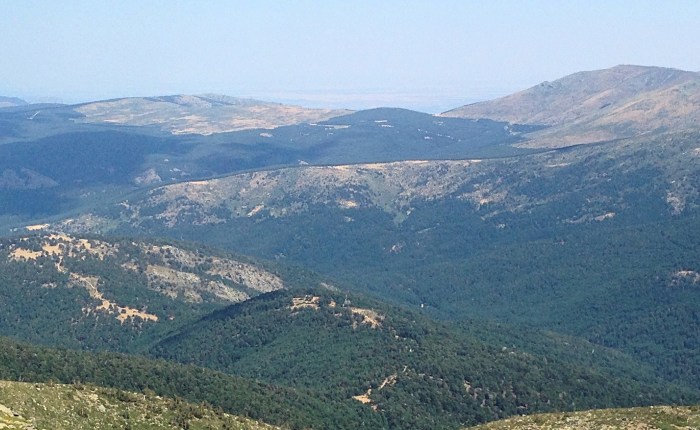
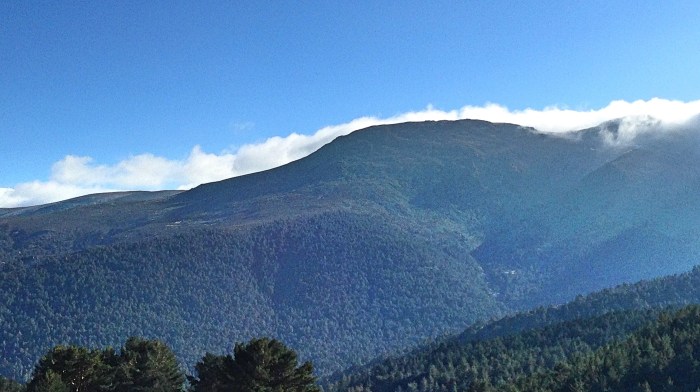
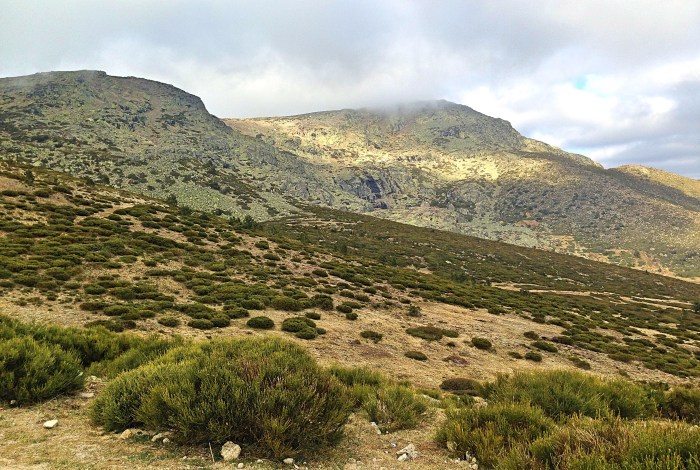
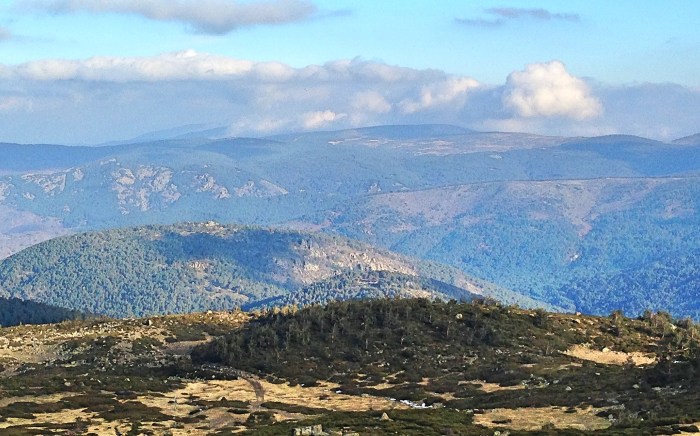
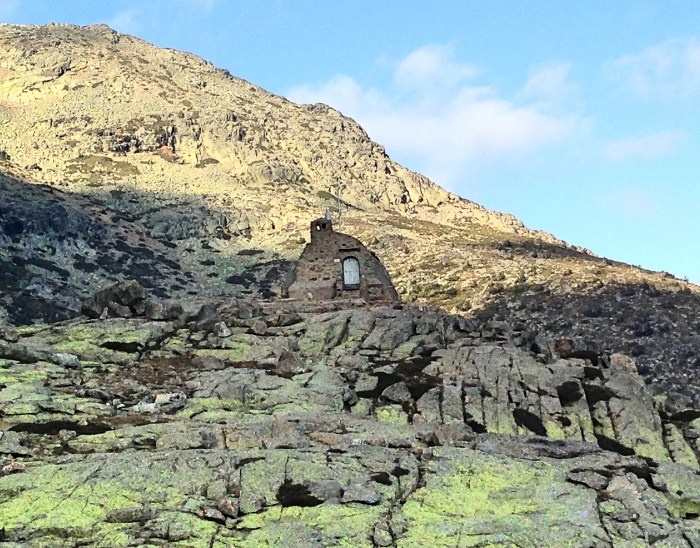
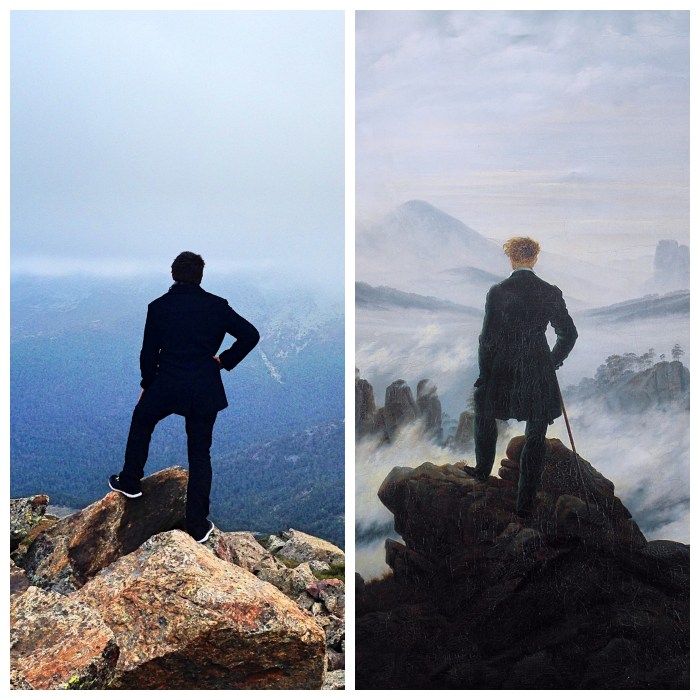
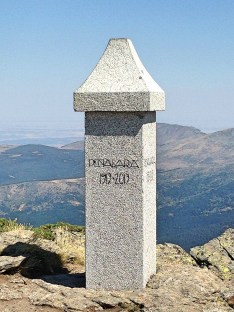
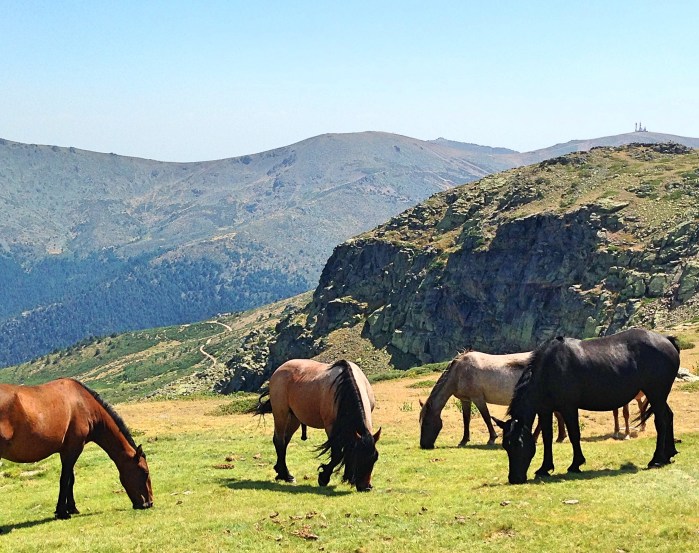
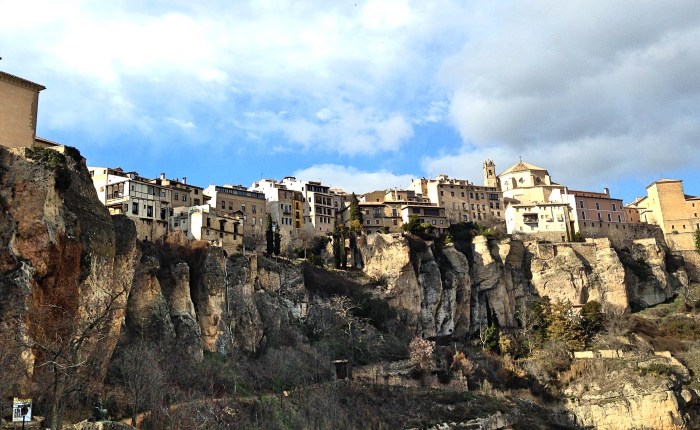

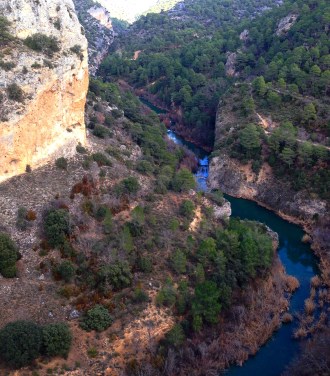
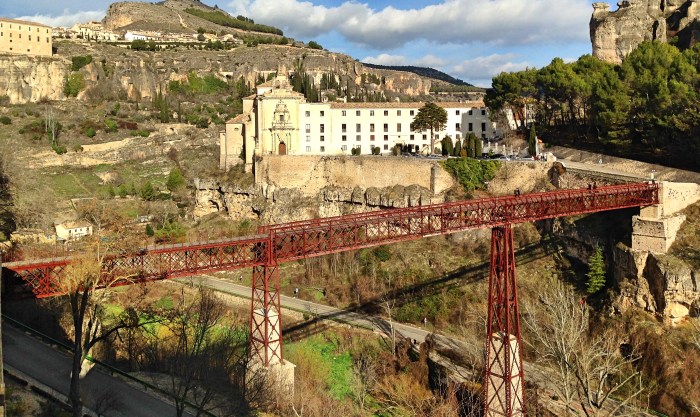
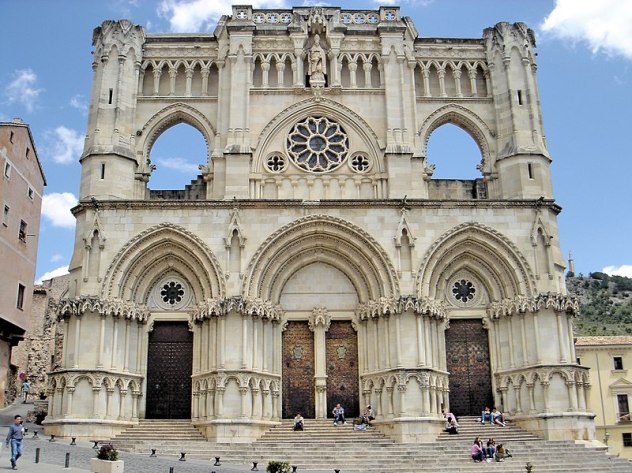

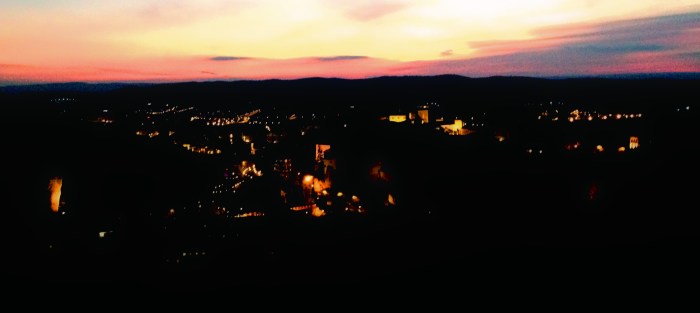
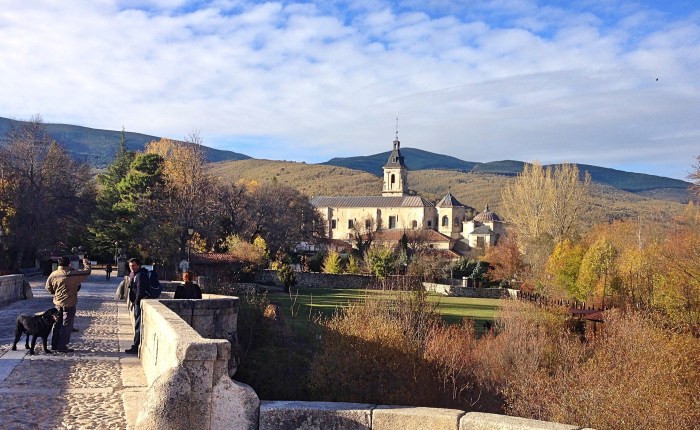
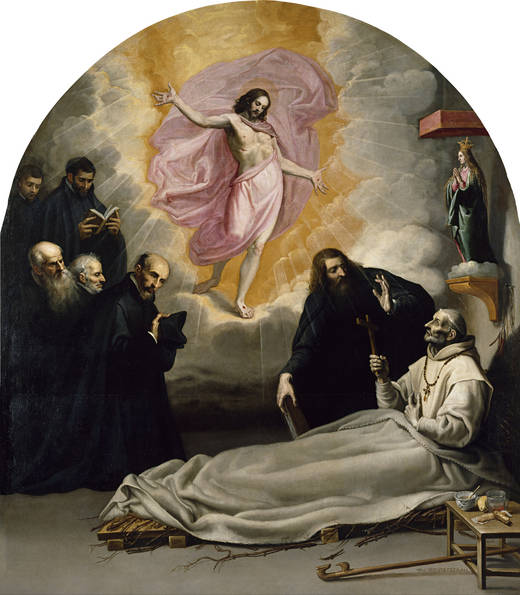
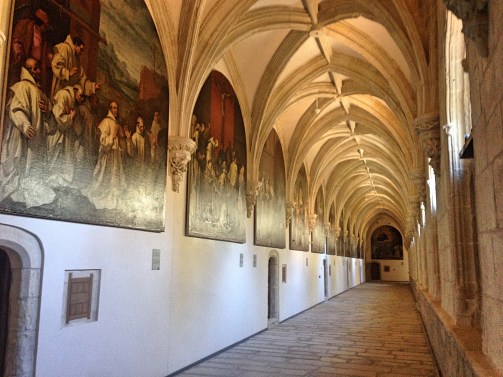

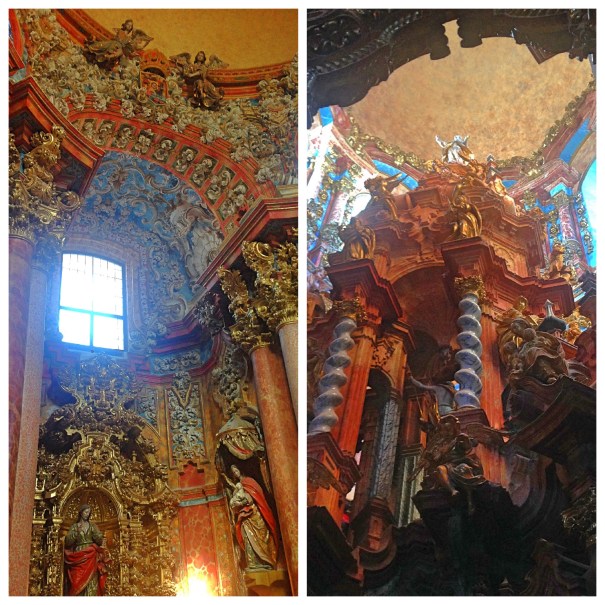
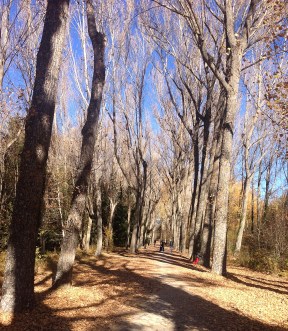

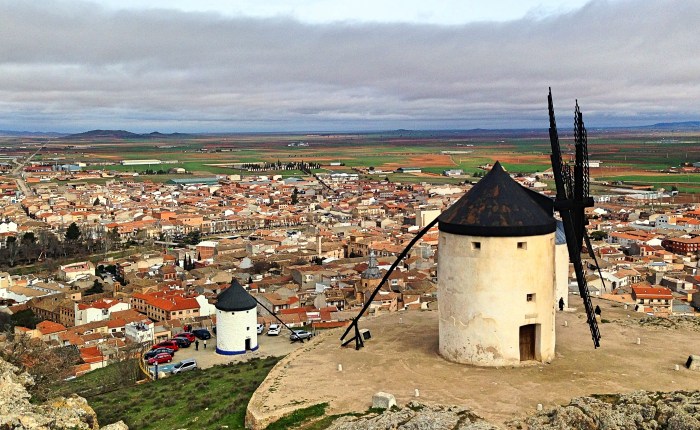
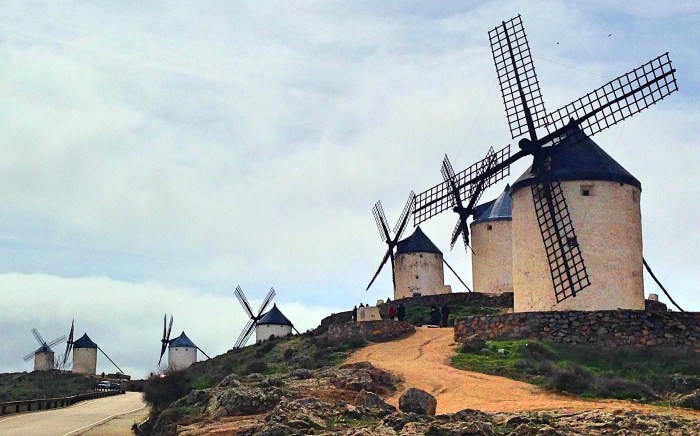
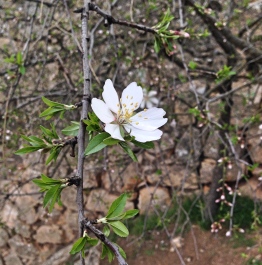

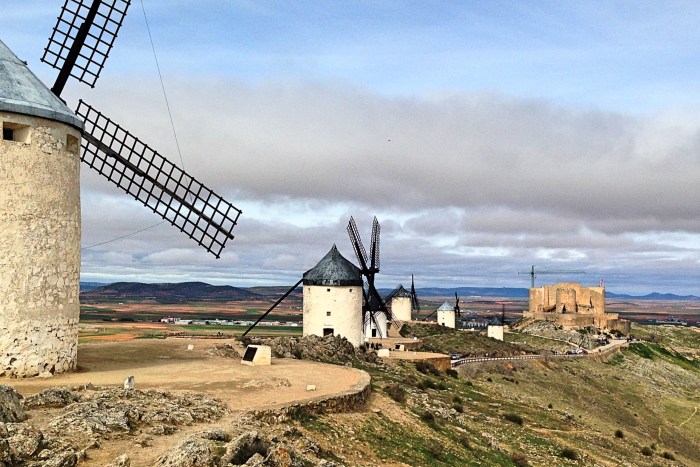

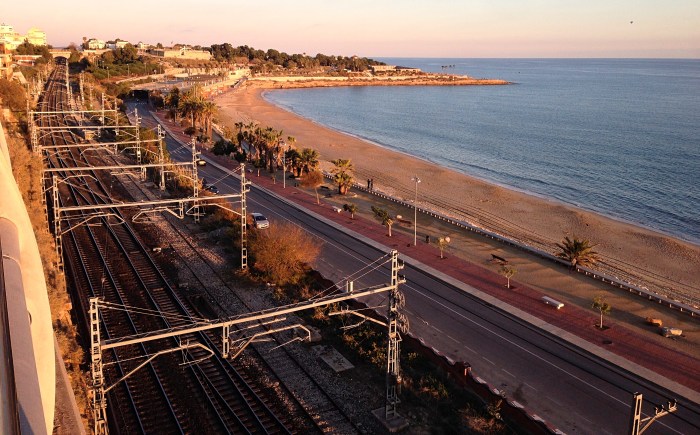


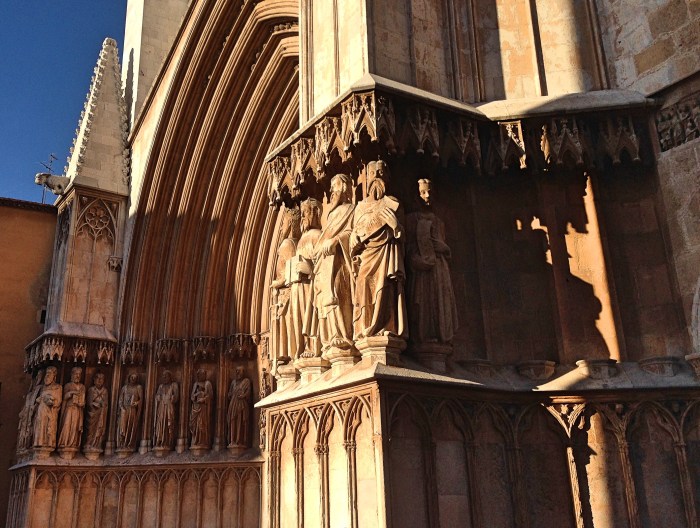


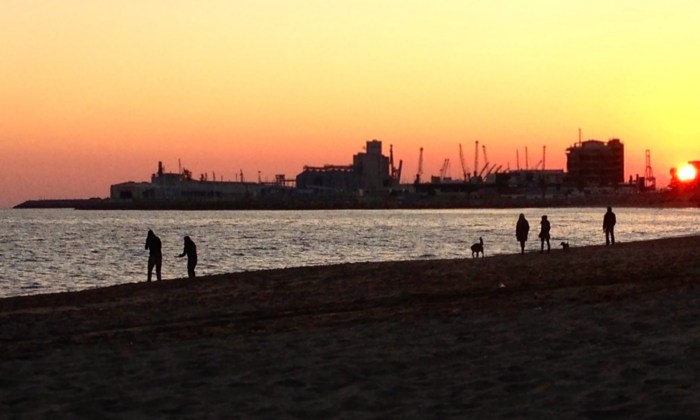


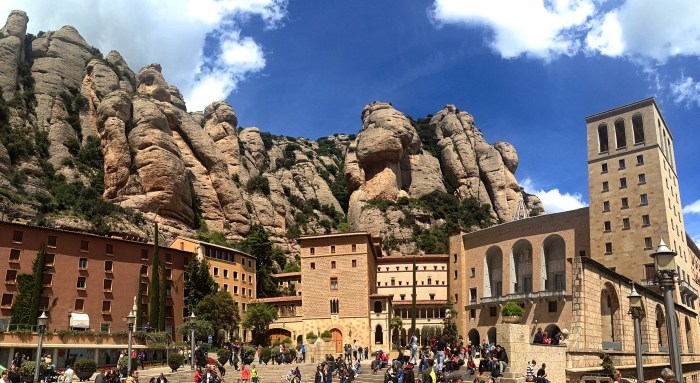
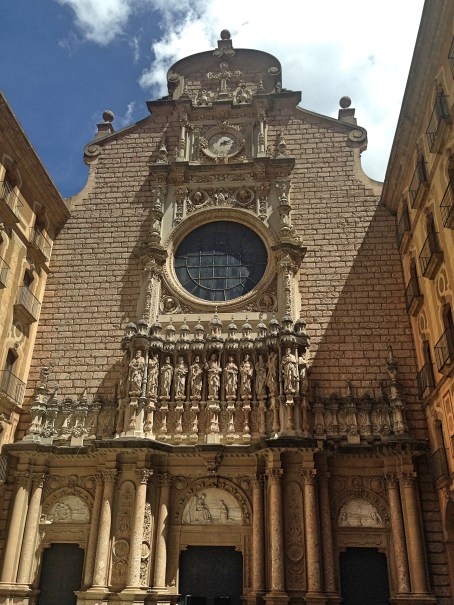
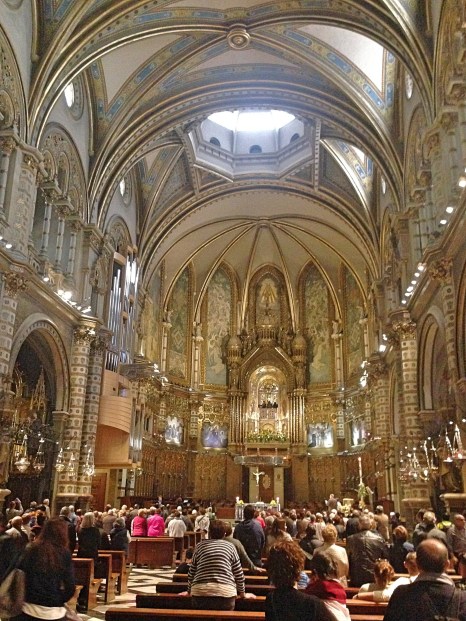
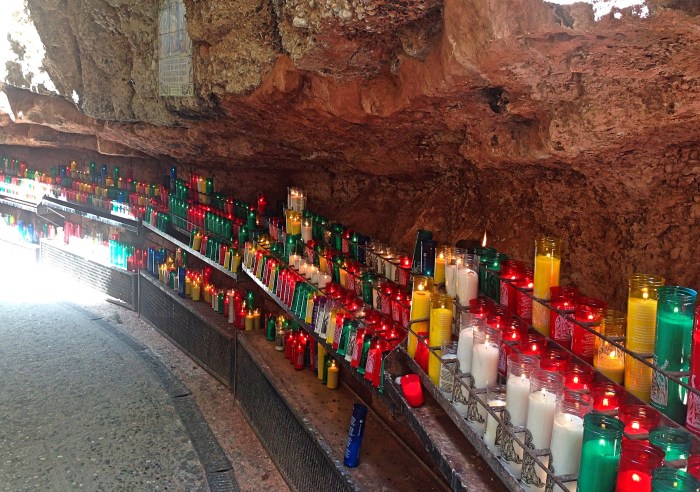

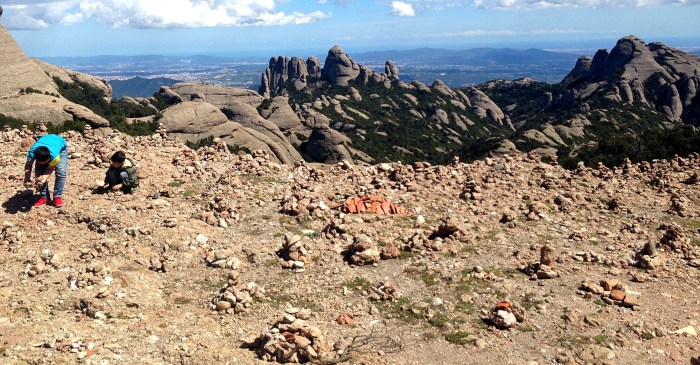
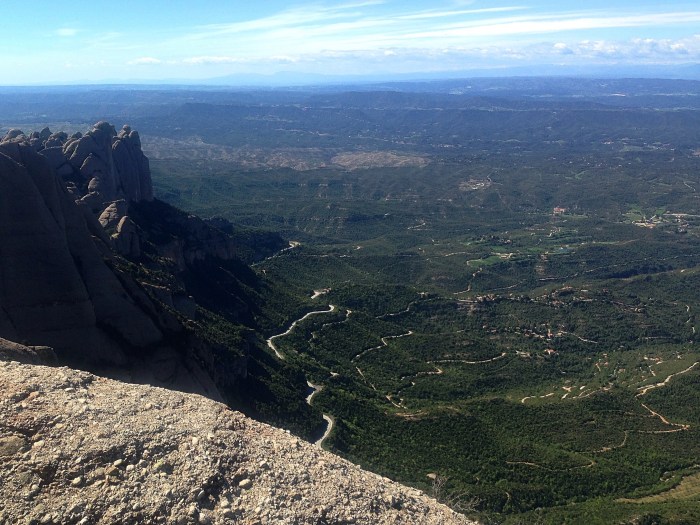


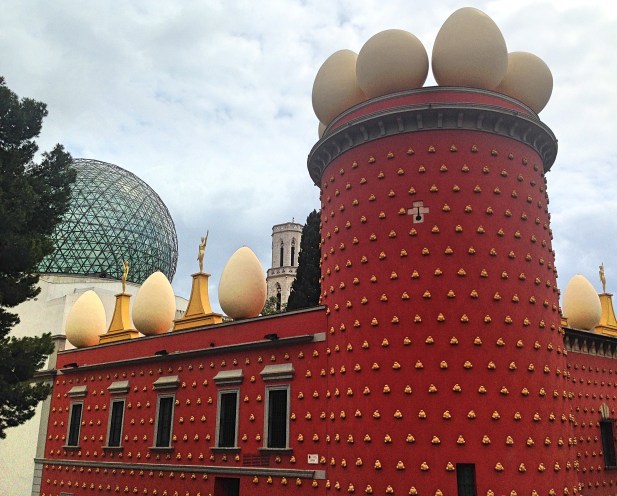

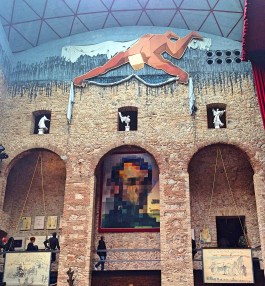


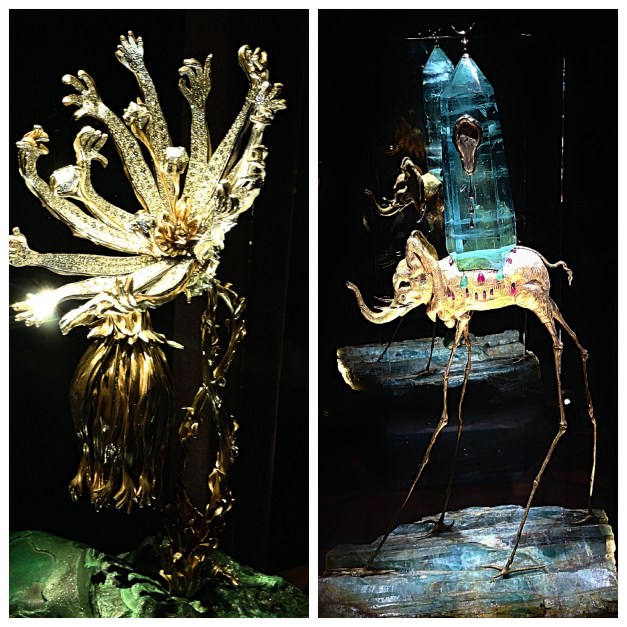


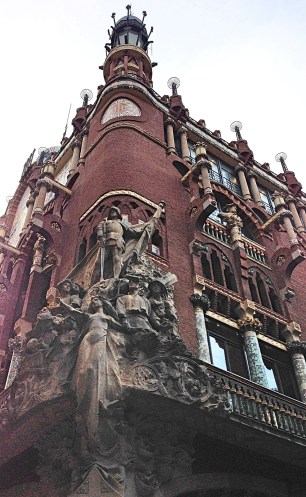
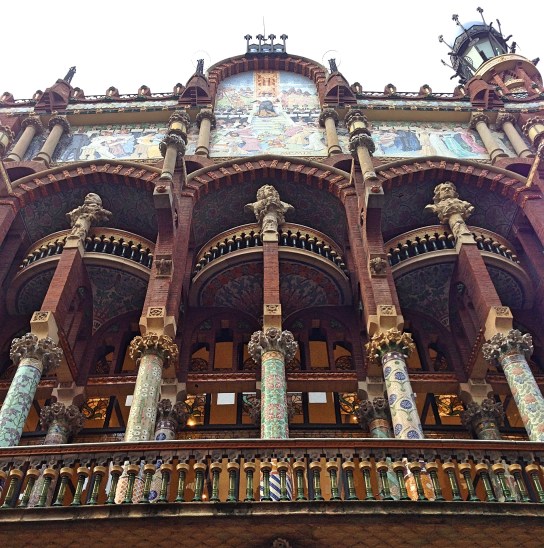
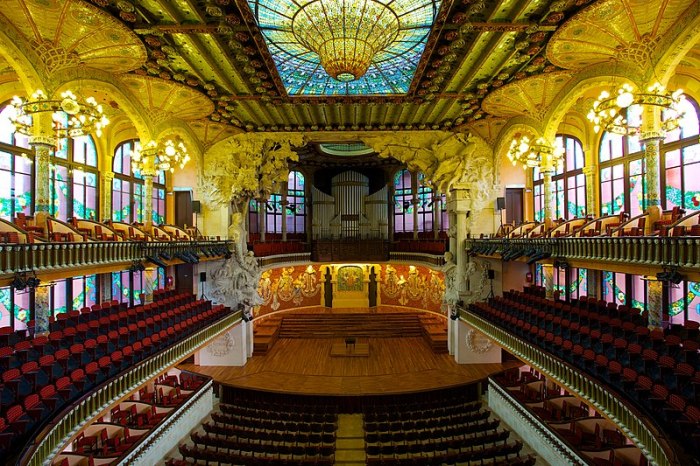

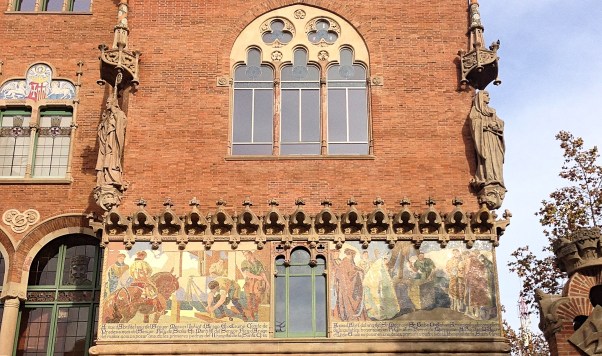


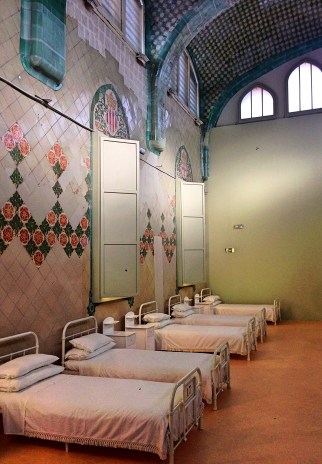

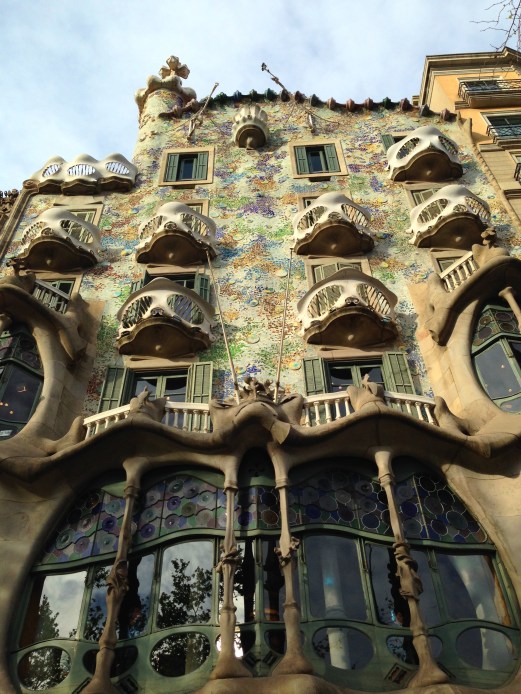


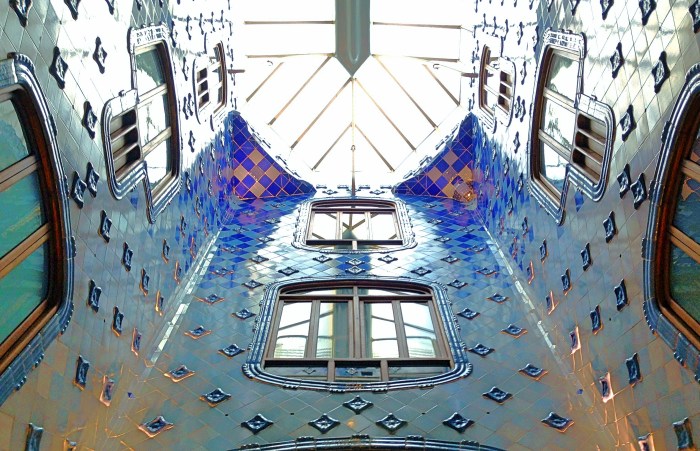
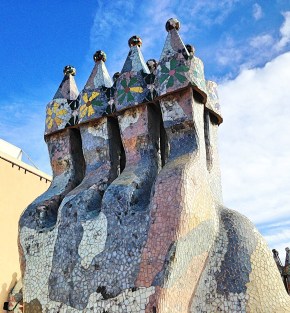


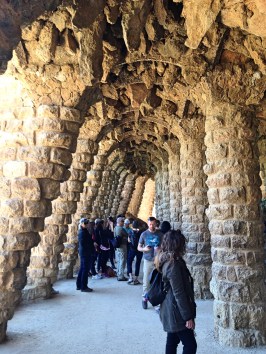
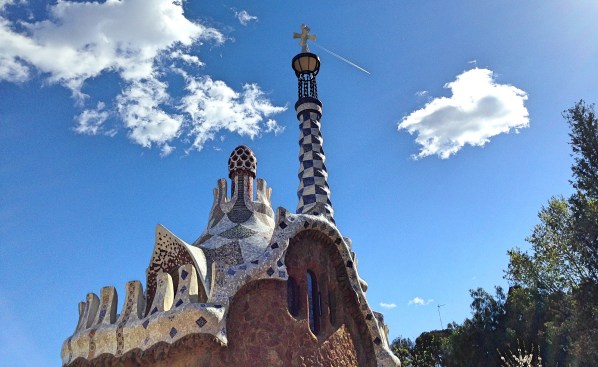
 The park itself is full of structures dun-colored stone—walls holding up terraces, elevated roadways and viaducts, balconies and covered footpaths proceeding through columns. The aesthetic effect produced by all this stonework is unique—for me at least—being somehow both natural and unnatural, which was undoubtedly intended by Gaudí.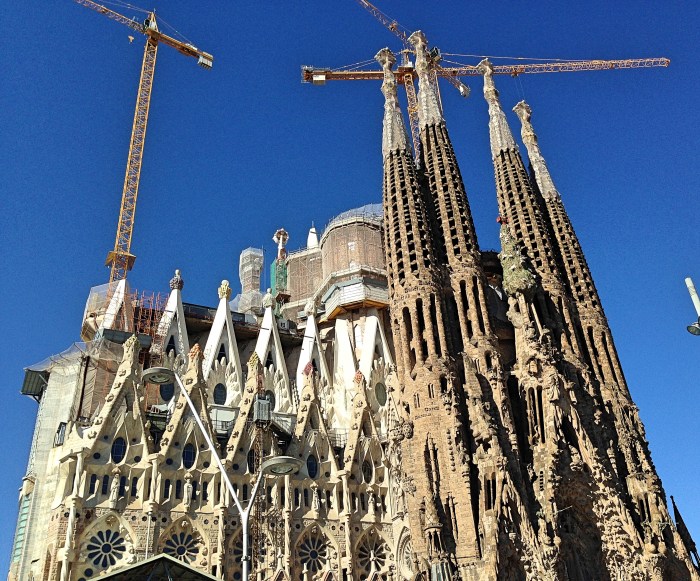

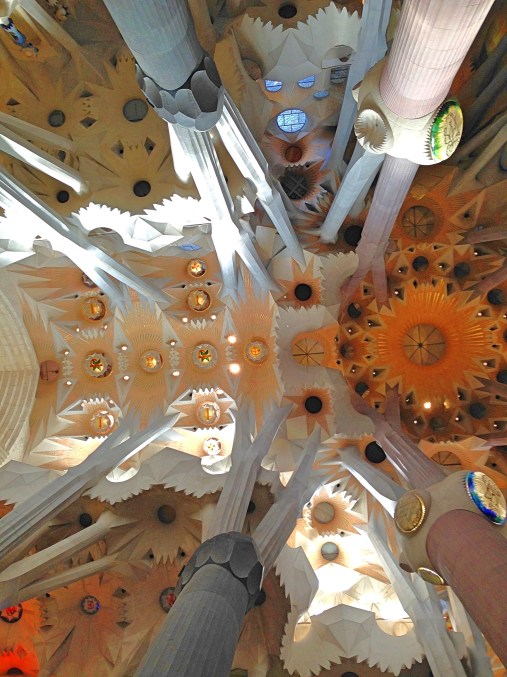
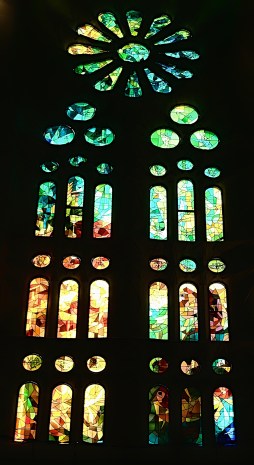
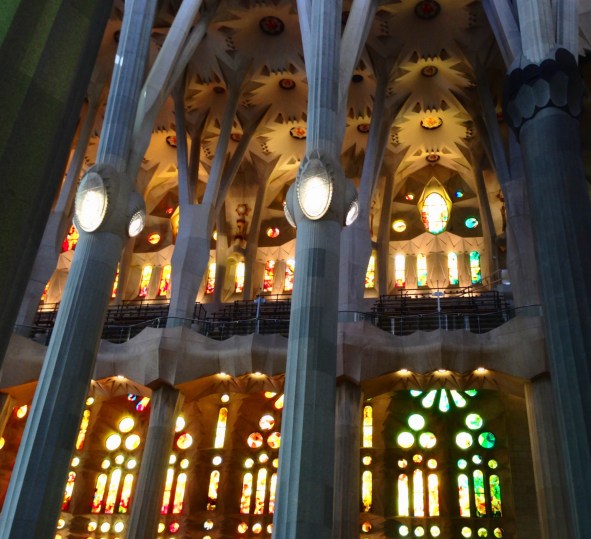


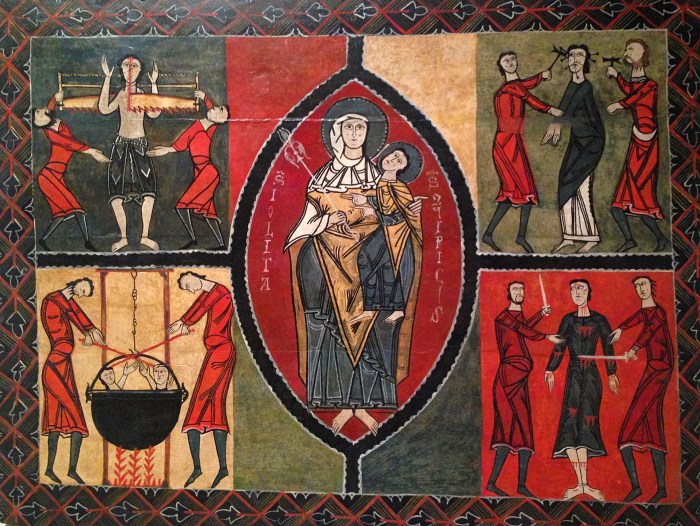


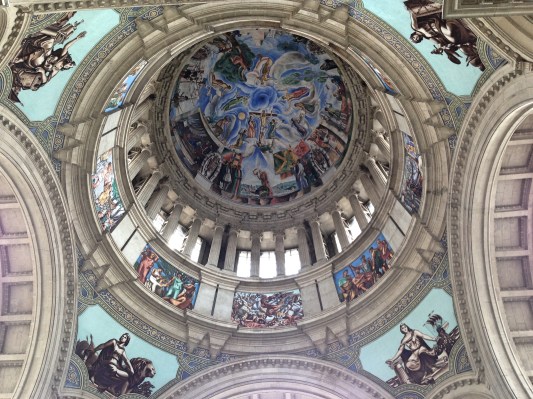

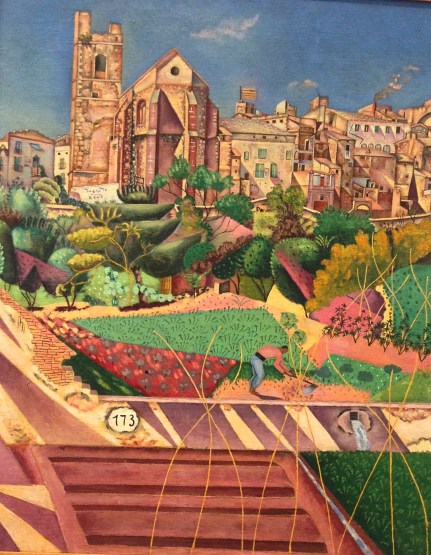


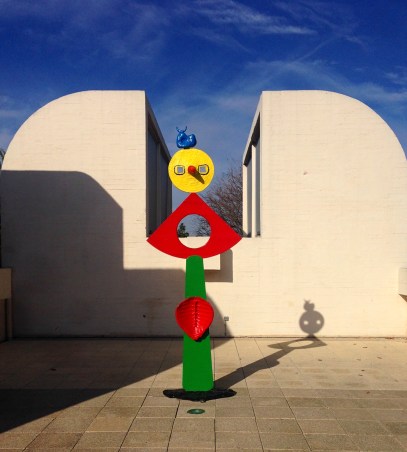


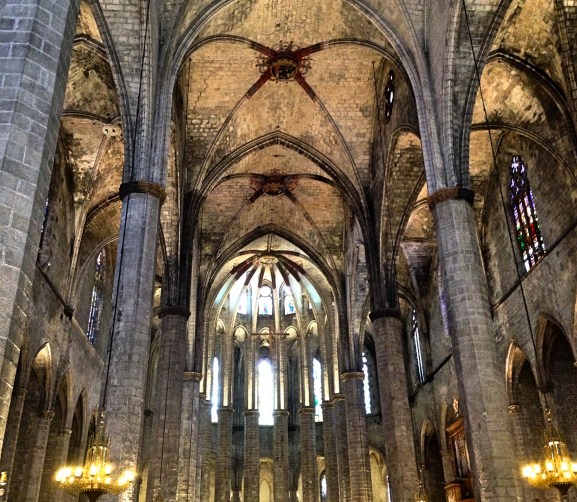
 (To see another scar from the Civil War, you can visit the Plaça de Sant Felip Neri, near the Cathedral. One side of the eponymous church is deeply pockmarked. During Franco’s time this damage was explained as having been caused by executions committed by the Republic side, as bullets missed their targets. This is a classic case of history being falsified by the victors. For the real explanation for the damage are two bombs that fell on this spot, hitting the church, which was being used as a refugee for children. Forty-two died in the blasts, mostly children, and a plaque now commemorates the spot.)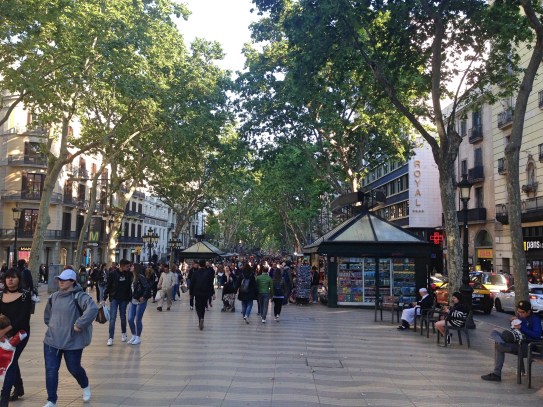

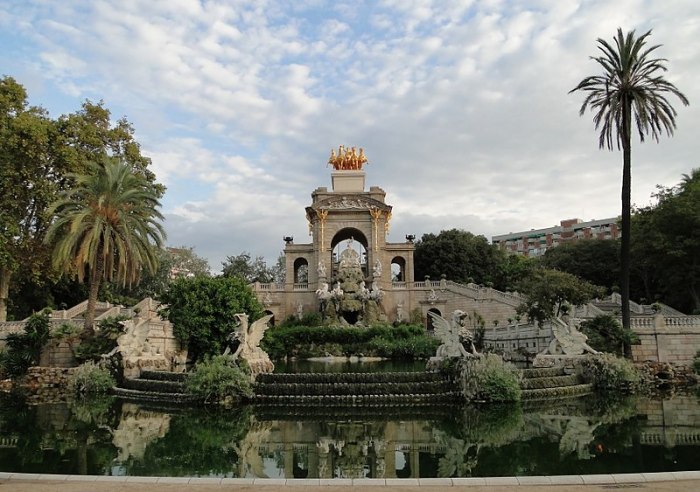

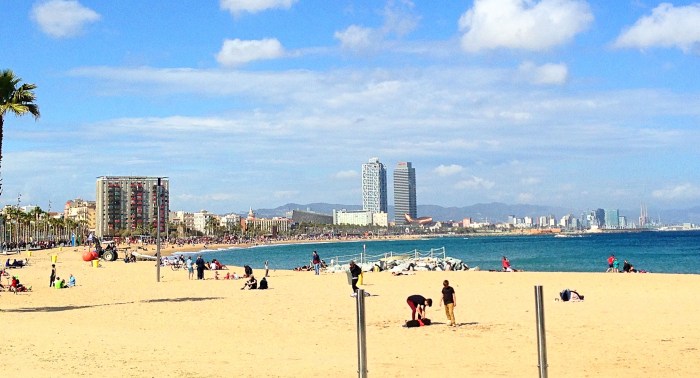
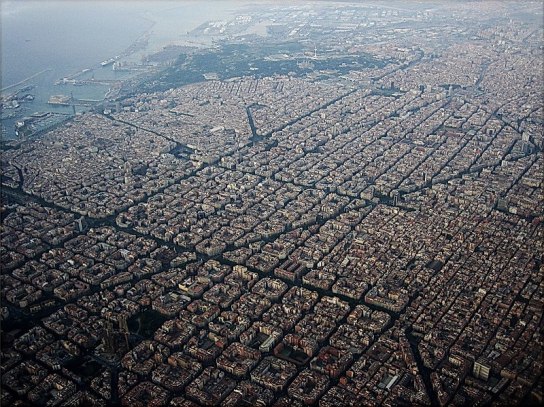


 Lotz in Translation