Review: Interior Castle

Review: Interior Castle

The Interior CastleThe Interior Castle by Teresa of Ávila

My rating: 4 of 5 stars

It is absurd to think that we can enter Heaven without first entering our own souls

Last week I spend five days walking on the Camino de Santiago. I know, probably that doesn’t sound terribly impressive to anyone who walked all the way from France, but I still had a great time. Every morning we set out before sunrise, when the lush landscape of Galicia was still shrouded in mist and twilight. We walked on and on, guided by the conch shell signs that point the way. We reached our destination just as the heat of the day began to take hold. My back sore, my feet blistered, I dropped my backpack in the hostel and stretched out in my bunkbed. Besides walking, sleeping, and eating, the only thing I did was to read this book: St. Teresa’s book on prayer.

It seemed like an appropriate choice. Both Santiago (St. James) and St. Teresa are patron saints of Spain; and yet they represent two very different periods in Spain’s history. The cult of Santiago dates from the time of the Moors, when Christians needed a figure to rally around during the Reconquista. St. Teresa, on the other hand, lived during the Counter-Reformation. As the Catholic world was coming apart, Catholic officials were understandably skittish at even a hint of heterodoxy. Thus St. Teresa’s mysticism was first viewed with suspicion, and she was even picked up by the Inquisition. But after some investigation, it was decided that St. Teresa posed no threat to orthodoxy; to the contrary, she helped to reinvigorate the faith.

This context is necessary to understand this book, or at least half of it. This is because, although ostensibly guide for prayer, it is also a handbook for avoiding the suspicions of unorthodoxy. It is full of advice for those having mystical experiences on which visions to discount, because they are products of Satan or the imagination, and which visions to accept. Teresa also explains when you should yield to one’s prioress or confessor, and when you should stand your ground. St. Teresa was obviously acutely aware of the paranoid climate, and thus this book is as full of pragmatic counsel as religious guidance. St. Teresa even explains in the beginning that the only reason she wrote the book was because she was commanded to.

As James Michener pointed out, the most striking thing about St. Teresa is this seamless mixture of pragmatism and mysticism. For somebody who reported feeling her soul leave her body, she comes across as remarkably down to earth. Several times, she quotes or references a Biblical passage and then adds parenthetically “Well, at least I think that’s what it says,” as if she couldn’t be bothered to go look it up. She also frequently comments on how inadequate she feels to the task at hand; and a few times she says that she’s unsure whether she is repeating herself, because she wrote the last bit a while ago and she doesn’t have time to reread it. The final effect is really charming, as if she just sat down and dashed off the whole thing between breakfast and lunch.

These interior matters are so obscure to the mind that anyone with as little learning as I will be sure to have to say many superfluous and even irrelevant things in order to say a single one that is to the point. The reader must have patience with me, as I have with myself when writing about things of which I know nothing; for really I sometimes take up my paper, like a perfect fool, with no idea of what to say or of how to begin.

Ironically, but perhaps unsurprisingly, the religious content was what least impressed me. The book is divided into seven mansions within the crystalline castle that represents the soul. Each progressive mansion is one step closer to God. Despite this organization, however, I found the chapters quiet repetitive; the divisions from one stage to another didn’t strike me as very clear. The general tendency is for the mystical experiences to keep growing in intensity, which culminates in the experience of a burning mixture of pleasure and pain that seems to come from nowhere. This is the inspiration for Bernini’s famous, and famously erotic, portrayal of the Saint.

What most bothered me was that the mystical and orthodox strains in Teresa’s thought did not go easily together. Perhaps this is only my taste. One thing I enjoy about mystic writings is their grand conception of the cosmos, the notion that everything apparently opposite and contradictory is one. Thus mystic writers, in my experience, tend not to be especially preoccupied with moral injunctions, since they regard good and evil as a kind of illusion.

But in Teresa, the emphasis on wickedness, on personal shortcomings, on temptation, and in general the whole moral framework of Catholicism made her system as much about avoiding sinfulness and unorthodoxy as achieving a mystical experience. For example, I’ve heard mystics say that each person is a part of God, but Teresa councils that we should contemplate God to realize our own foulness and lowliness. This is just a matter of taste, but I don’t find that appealing.

On the fifth day after we began, at about noon, I found myself standing in front of the two towers of Santiago Cathedral. Later that day, I finished the final pages of this book. I had taken a pilgrimage of the body and soul, and hopefully I’m better for it. In any case, I enjoyed myself and learned something.

View all my reviews

In Praise of Brexit

In Praise of Brexit

Praise of FollyPraise of Folly by Desiderius Erasmus

My rating: 4 of 5 stars

A Review of The Praise of Folly by Erasmus

Folly speaks:

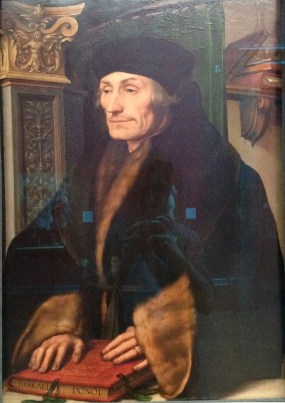
About five hundred years ago, a man named Erasmus decided to publish a book praising me. Unbelievably, no one had this idea before, and none since. Nobody has the time or the inclination—nobody besides Erasmus, that is—to sing my praises, apparently. All the other gods get their encomiums, but not me.
IMG_3814
Well, perhaps I should take the neglect as a compliment. After all, isn’t it the height of folly not to acknowledge the role that folly plays in human life? So is not the neglect a kind of compliment, albeit backhanded?

Nevertheless, some folks need some reminding, it seems, especially after what happened the other day. Oh, you know what I’m talking about: the United Kingdom’s vote to leave the European Union. All I’m hearing left and right is how stupid, short-sighted, narrow-minded, and above all foolish it was to vote “leave.” Well, I can’t stand my name being dragged around in the dust any longer, so I’m taking this opportunity to peep up and remind you how much you owe me.

First, let’s follow in Erasmus’s footsteps and take a short trip around Europe. As you might already know, Erasmus may justly be called the first true “European,” since he was such a cosmopolitan fellow and traveled everywhere. Even now, the trans-European student-exchange program is named after Erasmus. You might already know that the most popular destination for the Erasmus program is sunny Spain, where lots of young Britons like to go and get a tan. (Guess they won’t be coming anymore!)

Spain’s a lot different now from when Erasmus was alive. Back then, the Inquisition was in full swing and anybody who wanted to hold public office had to prove his “purity of blood,” which meant he didn’t have any Jewish or Muslims ancestors. Nowadays we don’t see that kind of behavior anymore in Spain; the Spaniards decided that it wasn’t such a good idea. But the folks in England apparently disagree: one UKIP candidate, Robert Blay, got suspended after saying his rival “isn’t British enough.” You see, my foolish devotees never disappear, but only migrate!

Yes indeed, Spain is truly different now. Let’s go to the Mediterranean coast to take a closer look. It’s a veritable mini-England! We can find British pubs, British radio broadcasts, British supermarkets selling British products. We can see retired old Brits eating baked beans and drinking tea as they take in the southern sun. And we can meet some Brits who have lived here for over a decade, and who still can’t speak a word of Spanish! Yes, and in between a pint these same Brits can tell you about how terrible is the EU and how there are too many immigrants in England. Oh, my wonderful followers!

As you might recall, it was around the time Erasmus wrote this book that England decided to leave another international organization: the Catholic Church. And the reasons were, I suppose, similar enough: “We don’t want some Italian Pope telling our king which wife he can or can’t behead!” Thomas More, one of Erasmus’s friends, and to whom this book is dedicated, disagreed with this, and he got beheaded along with the wives. Lots of people didn’t like this, but honestly I can’t say it was such a bad move. Executions are decisive, at least. Some people still agree with this strategy, like the guy who killed the politician Jo Cox. It worked for Henry VIII, so it can work for us!

IMG_3304

Let’s fast forward a bit in time, to the glorious British Empire. By Jingo, it was big! It stretched across the whole world! Look at how these colonial officers stroll around Mumbai, Nairobi, Hong Kong, Sydney! You’ve got to admire them. They don’t ask anybody’s permission to go anywhere, they just walk right in with their guns and biscuits. Doesn’t take long to subdue the native population when you’ve got the Royal Navy on your side! Sure, this approach didn’t please everybody. But, hey, it was the high point of British history. Nowadays, they’re a bit more worried about foreign immigrants colonizing them than the reverse.

Now you see what a big role I’ve played throughout history. You see how many decisions and opinions I’ve inspired! Oh, but now I hear some people saying that the world would be better off without me. Sure, Folly is important, they say, but that doesn’t mean Folly is worth praising. Fair enough, I suppose. Yes, maybe I do cause a bit of mayhem in the world. And yes, maybe I take things too far. But consider this: For every bad decision I inspire, I also provide the remedy.

For without Folly, do you think people could overcome the sheer hypocrisy necessary for their decisions? Without me, do you think people could congratulate themselves for shooting their own foot? Without my soothing balm, do you think people could go to bed with a clean conscience after doing harm to the world? Do you think British people could simultaneously praise the heroic strength of their culture while worrying that a few thousand immigrants could totally destroy their way of life?

No! Of course not! And since happiness is the goal of life, and happiness is most easily achieved through folly, I think that, despite whatever decision I inspire, I still deserve a lot of praise.

So long live Erasmus! Long live Folly! And long live Little England!

View all my reviews

Review: Imperial Spain

Imperial Spain, 1469-1716Imperial Spain, 1469-1716 by J.H. Elliott

My rating: 4 of 5 stars

Already by the end of the sixteenth century many Spaniards seem to have been gripped by that sense of fatalism which would prompt the famous pronouncement of a Junta of theologians in the reign of Philip IV. Summoned to consider a project for the construction of a canal linking the Manzanares and the Tagus, it flatly declared that if God had intended the rivers to be navigable, He would have made them so.

For Anglophone readers interested in the history of Spain, this book is invaluable. Elliott has here accomplished a real feat, of research, of writing, and of analysis. The book ably navigates that forbidding passage between simplifying popular accounts and unreadable scholarly monographs, managing to be both a work of serious intellectual synthesis and an absorbing account of Spain’s history.

Elliott has an astounding ability to seamlessly combine many disparate threads into the same narrative. He pays close attention to economic history: crop yields, interest rates, inflation and deflation, the debasement of currency, the balance of trade, tariffs and regulations. He incorporates social and cultural shifts: changing religious attitudes, demographic trends, class tensions, intellectual movements. And yet he also does not neglect the superlative individuals: Ferdinand and Isabella, Charles V, Philip II, the Conde Duque, among others. The only thing conspicuously absent was military history, which suited me just fine.

Although the story of Spain during this time was heavily interwoven with both the New World and the rest of Europe, Elliott’s focus doesn’t stray from the Iberian peninsula. He gives only the most cursory account of the Spanish conquest of the Americas, and only mentions the struggles of Charles V against the Protestant Reformation. For those looking for a history of Spanish colonization, this book will therefore be disappointing. I must also add that Elliott’s judgment is at its worst in his brief section on the conquistadores. He describes them as glorious conquering heroes of a barren civilization, which I cannot abide in the light of the destruction and exploitation that followed in their wake.

Keeping those exceptions in mind, this book is a superlative account of this period of Spanish history. The competing centrifugal and centralizing forces at play, the conflicting traditions of Castilian and Aragonese governments, the infinitely subtle machinations of power, the gradual emergence of a national identity, the meteoric rise of the Spanish Empire, the cruel, grinding decline that followed, the heroic and hapless individuals struggling with forces beyond their control—all this is related with brevity, insight, and power.

It is difficult not to see the whole story as a morality play writ large. What with the ruthless exploitation of the treasure mines of the New World, the expulsion of the Jews and the Moors, the obsession with purity of blood, and the alignment of religious orthodoxy with central power, it seems as if the collapse of the grand but hollow edifice was the inevitable result of intolerance and folly. But even if we can learn some valuable lessons from this history, it is important to remember that the story is not so simple, and many decisions which in retrospect seem obviously foolish were at the time fairly reasonable (though of course many weren’t).

In short, I heartily recommend this book to anyone interested in this fascinating time and place. It could hardly be better.

View all my reviews

Review: The Odyssey

The OdysseyThe Odyssey by Homer
My rating: 5 of 5 stars

To this day, the most interesting research project that I’ve ever done was the very first. It was on the Homeric Question.

I was a sophomore in college—a student with (unfortunate) literary ambitions who had just decided to major in anthropology. By this point, I had at least tacitly decided that I wanted to be a professor. In my future lay the vast and unexplored ocean of academia. What was the safest vessel to travel into that forbidden wine-dark sea? Research.

I signed up for a reading project with an anthropology professor. Although I was too naïve to sense it at the time, he was a man thoroughly sick of his job. Lucky for him, he was on the cusp of retirement. So his world-weariness manifested itself as a total, guilt-free indifference to his teaching duties. Maybe that’s why I liked him so much. I envied a man that could apparently care so little about professional advancement. That’s what I wanted.

In any case, now I had to come up with a research topic. I had just switched into the major, and so had little idea what typical anthropology research projects were like. And because my advisor was so indifferent, I received no guidance from him. The onus lay entirely on me. One night, as I groped half-heartedly through Wikipedia pages, I stumbled on something fascinating, something that I hadn’t even considered before.

Who is Homer? Nobody knew. Nobody could know. The man—if man he was—was lost to the abyss of time. No trace of him existed. We can’t even pin down what century he lived. And yet, we have these glorious poems—poems at the center of our history, the roots of the Western literary canon. Stories of the Greek Gods had fascinated me since my childhood; Zues and Athena were as familiar as Little Red Riding Hood and the Big Bad Wolf. That the person (or persons) responsible could be so totally lost to history baffled me—intrigued me.

But I was not majoring in literature or the humanities. I was in anthropology, and so had to do a proper anthropological project. At the very least, I needed an angle.

Milman Parry and Albert Lord duly provided this angle. The two men were classicists—scholars of ancient Greece. But instead of staying in their musty offices reading dusty manuscripts, they did something no classicist had done before: they attempted to answer the Homeric question with field work.

At the time (and perhaps now?) a vibrant oral tradition existed in Serbo-Croatia. Oral poets (guslars, they’re called there) would tell massive stories at public gatherings, some stories even approaching the length of the Homeric poems. But what was most fascinating was that these stories were apparently improvised.

In our decadent culture, we have a warped idea of improvisation. Many of us believe improvisation to be the spontaneous outflowing of creative energies, manifesting themselves in something totally new. Like God shaping the Earth out of the infinite void, these imaginary improvisers shape their art from nothing whatsoever. Unfortunately, this never happens.

Whether you’re a jazz saxophonist playing on a Coltrane tune, a salesperson dealing with a new client, or an oral bard telling a tale, improvisation is done via a playful recombining of preexisting, formulaic elements. This was Milman and Parry’s great discovery. By carefully transcribing hundreds of these Serbo-Croation poems, they discovered that—although a single poem may vary from person to person, place to place, or performance to performance—the variation took place within predictable boundaries.

The poet’s brains were full of stock-phrases (“when dawn with her rose-red fingers shone once more”), common epithets (“much-enduring Odysseus”), and otherwise formulaic verses that allowed them to quickly put together their poems. Individual scenes, in turn, also followed stereotypical outlines—feasts, banquets, catalogues of forces, battles, athletic contests, etc. Of course, this is not to say that the poet was not original. Rather, it is to say that they are just as original as John Coltrane or Charlie Parker—individuals working within a tradition. These formulas and stereotypical scenes were the raw material with which the poet worked. They allowed him to compose material quickly enough to keep up the performance, and not break his rhythm.

But could poems as long as The Odyssey and The Iliad come wholly from an oral tradition? It seems improbable: it would take multiple days to recite, and the bard would have to pick up where he left off. But Milman and Parry, during their fieldwork, managed to put our fears at rest. They found a singer that could (and did) compose poems equal in length to Homer’s. (I actually read one. It’s called The Wedding of Smailagic Meho, and was recited by a poet named Avdo. It’s no Odyssey, but still entertaining.)

All this is impressive, but one question remained: how could the oral poems get on paper? Did an oral poet—Homer, presumably—learn to write, and copy it down? Not possible, says Alfred Lord, in his book The Singer of Tales. According to him, once a person becomes literate, the frame of mind required to learn the art of oral poetry cannot be achieved. A literate person thinks of language in an entirely different way as a non-literate one, and so the poems couldn’t have been written by a literate poet who had learned from his oral predecessors.

According to Lord, this left only one option: Homer must have been a master oral poet, and his poems must have been transcribed by someone else. (This is how the aforementioned poem by Avdo was taken down by the researchers.) At the time, this struck me as perfectly likely—indeed, almost certain. But the more I think about it, the less I can imagine an oral poet submitting himself to sit with a scribe, writing in the cumbersome Linear B script, for the dozens and dozens of hours it would have taken to transcribe these poems. It’s possible, but seems unlikely.

But according to Ruth Finnegan, Alfred Lord’s insistence that literacy destroys the capacity to improvise poems is mistaken. An anthropologist, Finnegan found many cases in Africa of semi-literate or fully literate people who remained capable of improvising poetry. So it’s at least equally possible that Homer was an oral poet who learned to read, and then decided to commit the poems to paper (or whatever they were writing on back then).

I submit this longwinded overview of the Homeric Question because, despite my usual arrogance, I cannot even imagine writing a ‘review’ for this poem. I feel like that would be equivalent to ‘reviewing’ one’s own father and mother. For me, and everyone alive in the Western world today, The Odyssey is flesh of my flesh, blood of my blood. Marvelously sophisticated, fantastically exciting, it is the alpha and omega of our tradition. From Homer we sprang, and unto Homer shall we return.

[Note: I’d also like to add that this time, my third or forth time through the poem, I decided to go through it via audiobook. Lucky for me, the Fagles translation (a nice one if you’re looking for readability) is available as an audiobook, narrated by the great Sir Ian McKellen. It was a wonderful experience, not only because Sir Ian has such a beautiful voice (he’s Gandalf, after all), but because hearing it read rather than reading it recreated, however dimly, the original experience of the poem: as a performance. I highly recommend it.]

View all my reviews

Review: Europe, by Norman Davies

Review: Europe, by Norman Davies

EuropeEurope by Norman Davies

My rating: 4 of 5 stars

Can one narrate time—time as such, in and of itself? Most certainly not, what a foolish undertaking that would be. The story would go: “Time passed, ran on, flowed in a mighty stream,” and on and on in the same vein. No one with any common sense could call that a narrative.

—Thomas Mann, The Magic Mountain

Personal Preface

Lately I have been thinking a lot about time. Well, perhaps thinking isn’t the right word; I’ve been worrying. Ever since I moved to Spain, time has been a problem. What’s the proper time to eat? When do people sleep here? How long will my job last? What about my visa? Multiple clocks beset me, counting down and counting up.

Beyond my petty troubles, I have been thinking about time as an experience: how monotony speeds up the clock’s hand, variety slows it down, and nothing can stop it. I have been thinking about the inexorability of time: every passing second is irretrievable, every yesterday is irrecoverable. I have been spending a lot of time remembering, connecting my past with my present, if only artificially, and wondering how much the act of remembering itself distorts my memories. And in a Proustian mood, I have wondered whether a tremendous act of remembrance is the only defense we have against the ceaseless tide of time.

In the midst of our mundane concerns, it is all too easy to forget to remember. But is it crucial to remember; otherwise life can go by without us noticing. This is why we celebrate birthdays. Logically, it is silly to think that you turn from one age to another all at once; of course we get older every day. We celebrate birthdays to force ourselves to reflect on the past year, on how we have spent our time and, more chillingly, on how much time we have left. This reflection can help us assess what to do next.

Birthdays are just one example. In general, I have been finding it increasingly important to focus on these cycles, when a milestone is reached, when a process is completed, moments when the past is forcefully juxtaposed with the present. Finishing Norman Davies’s Europe was one such moment for me, and an important one. I first heard of the book from an old copy of National Geographic; it was in an article discussing the recent introduction of the euro (in 1999), a historic step in European unity. Davies’s book had just been published the year before, and the reporter had interviewed Davies about his thoughts on the future of Europe.

I read this article right as my love of reading began to blossom. Thus I dutifully underlined the name of Davies’s book, hoping to buy and read it some time in the future. But it was years until I finally bought a copy; and still more years before I finally started reading. When I first heard of the book I would never have imagined that I would finally read it, many years later, in Europe. But here I am, and it feels great.

The Review

Norman Davies’s Europe is an attempt to write a survey history of Europe in one volume, from prehistoric times to the dissolution of the Soviet Union, covering both Western and Eastern Europe. It’s an ambitious project. As you can imagine, an enormous amount of selection and compression was necessary in order to fit all this material into one volume. Luckily, Davies is adept at both of these skills; unfortunately, the book is still too big to carry around. It is big, fat, and heavy: thick enough to stop a bullet, hefty enough to knock someone out cold.

In terms of content, the book is both longer and shorter than it appears. Of the nearly 1,400 pages, only about 1,140 are actual history; the rest is given over to his notes, the index, and a lengthy series of appendices, on subjects ranging from the standard canon of opera, to death tolls in the Second World War, to the life course of an Austrian peasant household. Nevertheless, the pages are dense with text, in small font and with narrow margins; and the pages themselves are quite big. Moreover, owing to the huge amount of territory Davies covers, the book is almost nauseatingly packed with information, every page a summary of whole books. It isn’t the sort of thing you can breeze through.

Davies begins with a pugnacious introduction, in which he denounces all of his forbearers. For him, attempts to write European history have all fallen into various traps, by focusing too much on the ‘Great Books’, by their excessive length, or by their neglect of Eastern Europe. Davies snubs his nose at specialization, and wags his finger at academic fads; he bashes both the traditionalists and the radicals. I personally found this introduction to be an interesting read, but it does seem out of place in a book for the general reader.

For all that talk, you’d think Davies’s treatment would be highly heterodox. But that’s not the case. After an obligatory chapter on prehistory, he goes into a chapter on Greece, then Rome, then the Middle Ages, and so on. And even though one of his major bones of contention is the erstwhile disregard for Eastern Europe, he generally spends far more time on Western Europe.

The chapters increase in length as they approach the future, becoming progressively more detailed. For example, Aristotle and Plato must share one measly paragraph between them, but Gorbachev is given a dozen pages. As a result, the book gets more interesting the further you read. The coverage is only so-so for the ancient world; quite good for the Medieval period; and becomes really gripping by the 19th century. Davies attempts to cover all the major developments, but of course his space is limited. He sketches the historical individuals when necessary, but this is certainly not a “Great Man” telling of history. For the most part Davies focuses on economic, political, social, and cultural history, while paying less attention to intellectual and art history. Among the arts, he is strong on music but weak on painting, sculpture, and architecture.

The main narrative is broken up by what Davies calls ‘capsules’. These are mini-essays, ranging from half a page to two pages, on a variety of topics that interested Davies; they are set aside in their own boxes, interrupting the flow of the main text. This was Davies’s attempt to give extra color to his narrative, by focusing on little parts of the story that would otherwise be ignored. But I had mixed feelings about the idea. Half of the capsules were fascinating, but I thought many were uninspiring. And it was annoying to constantly be having to put the main narrative on hold, read a little essay, and then return where I left off. I thought it would have been a much better idea if he had left the capsules out completely, developed them into full-length essays, and then released them in their own book. I’d read it.

Davies is a writer of high caliber. He can adapt his style to any subject. His prose, although largely devoid of flourish, is consistently strong. In short, he has achieved that allusive aim of popular history writers: to inform and entertain in one breath. Seldom does he come across as seriously biased; but he is not afraid to be opinionated at times, which adds a nice touch of spice to the book: “Chamberlain’s three rounds with Hitler must qualify as one of the most degrading capitulations in history. Under pressure from the ruthless, the clueless combined with the spineless to achieve the worthless.”

I did catch two errors worth noting. First, Davies says that Dante called Virgil “The master of those who know,” when that epithet was really applied to Aristotle. Second, in the same sentence Davies calls Picasso, who was born in Andalusia, a “Catalan exile,” but he calls Dalí, who was born in Catalonia, a “Spaniard.” There were probably many more errors that I couldn’t catch, but in general the information seemed reliable.

Although this book is a survey history, Davies does have one central concern: the European identity. What does it mean to be a European? Davies doesn’t give any simple answers to this question, but instead traces how the European identity evolved through time. The reason for his concern is obvious. The Soviet bloc had only recently been dismantled, and now the European Union was faced with the task of dealing with these newly freed states. Davies himself appears to be strongly pro-Union; and in that light, this history of both Western and Eastern Europe can be seen as an attempt to give the people’s of Europe a shared past, in the hopes that they might embrace a shared future.

It was a bit strange to be finishing this book now. I can still remember the hopeful, enthusiastic tone of that National Geographic article about the new euro. People must have felt that they were entering a new age of European unity. Now the United Kingdom is threatening to leave the European Union, and several other countries are grumbling. The future, as always, is in doubt.

 Afterthought

I finished the book on April 23, which is Book Day here in Spain. Yesterday was the 400th anniversary of Cervantes’s death; and today is the same anniversary for Shakespeare. To celebrate, I go to the Circulo de Bellas Artes, where they are having a public reading of Don Quixote. Everyday people, old and young, are lined up in an auditorium to read a page from that great masterpiece; it will go on for 48 hours. After that, I walk to the Cervantes exhibition in the National Library, where they have dozens of old manuscripts of Cervantes and his contemporaries on display. From there, I walk to the Convent of the Barefoot Trinitarians, where Cervantes was buried.

I was celebrating the completion of a cycle, and so was Spain. The past is alive and well in Europe.

View all my reviews

Review: Iberia

Review: Iberia

IberiaIberia by James A. Michener

My rating: 4 of 5 stars

In a sense no visitor can ever be adequately prepared to judge a foreign city, let alone an entire nation; the best he can do is to observe with sympathy.

Travel writing is like love poetry. All travelers and lovers are convinced that their experiences are unique, and therefore worth writing about; while in reality most travel stories and love poems express nearly the same basic sentiment, over and over, with only minor variations. Both genres are easy to write and hard to read, which is why far more travel blogs and love poems are written then read. Even brilliant writers sometimes make fools of themselves.

James Michener is not a brilliant writer, but he has done a fine job in this book. And for once in my life, I think I am actually qualified to judge, since I have been to about 80% of the major places he visited. Not only that, but I myself have written about my travels in Spain.

As I said before, Michener is not a brilliant writer; but he is a highly competent one. There are very few parts of this book that are memorably good, but very few that are memorably bad. The best thing that can be said for his prose is that you can read him for hours without getting tired or bored. The only parts that stuck out as bad were in some of his descriptions of churches. For example, I got completely lost in his description of the Toledo Cathedral, even though I’ve been to it—which is a bad sign.

His approach to travel writing is not very different from that of Bill Bryson: go someplace, find an interesting tidbit from the history, and then describe a few nice buildings or whatever. Apart from this, however, the two men are quite different. Michener is very much preoccupied with what in earlier times was called ‘culture’: painting, literature, architecture, music, and so on. Thus much of this book consists of descriptions and appraisals of Spain’s artistic and intellectual life. He covers flamenco, zarzuela, the music of Tomás Luis de Victoria, the paintings of Velazquez and El Greco, romanesque, gothic, and modernist architecture, the philosophy of Seneca, Maimonides, and Averroes, and much else.

But most of all, Michener is concerned with history. For him, Spain is a kind of window into the past, and he spends many pages on his so-called ‘speculations’. Mainly, these speculations deal with the following question: Why was Spain once so great and is now not so great? Personally, I found him to be a pretty mediocre historian, academically speaking; but he knows how to find a good story and how to tell one. And it is true that you learn quite a bit about Spain’s history in the course of this book.

Michener spent about thirty years traveling in Spain, on and off. As a result, he is able to cast a wide net, covering almost every major city in the country. Most of the chapters are centered around one city—Barcelona, Madrid, Salamanca, Seville, Santiago, Córdoba, Toledo—but Michener inevitably ends up leaving the city and touring the surrounding areas. (The exceptions to this are his chapters on the Guadalquivir Marshes and bullfighting.) Not only that, but Michener is very digression-prone, so he will often pause to tell you some bit of history that interests him. Thus in the course of these 900 pages he travels through nearly all of the country, the only noticeable exception being the Basque Country. It is an encyclopedic travel book.

Some people have said this book is outdated. To a certain extent this is true. Michener first came to Spain as a young man, which must have been in the late 1920s or early 1930s, and then continued his visits until the books publication in 1968. Thus you obviously can’t find anything here about the great transformations and dramas of post-Franco Spain. Apart from this, however, the book has kept its relevance. Every time he visited somewhere that I had been, I found little to no discrepancy between his description and my experience. All the beautiful cathedrals and churches and plazas are still standing today, just as lovely as when Michener saw them.

The only section where the book’s age really made itself felt was in the chapter on Madrid. In one section, Michener adds excerpts from several conversations he had about what would happen when Franco died. What is most fascinating is that nobody saw what was coming. In fact, many people insisted that democracy could never work in Spain and that Juan Carlos was just a weak little boy. A mere seven years after this book’s publication, Franco would die, Juan Carlos would take over, and then the new king would effect a masterful transition from fascism to liberal democracy. Of course, Michener can’t be faulted for missing this.

I am not sure whether this book can be enjoyed by somebody who is not at least planning on visiting Spain. It’s simply too long and too detailed. For those who are planning a trip, the book can be profitably skimmed, and indeed that might be the best way to read it. But frankly this may not a great travel guide, if only because it can make you feel inadequate and envious. You see, Michener was a successful novelist with plenty of time and disposable income on his hands. As a result he went everywhere he pleased, stayed in whatever hotel he wanted, spent months driving around eating, drinking, seeing bullfights. Every time he goes to a new town the local professor comes to talk to him about the local history. He gets private tours of every monument. In short, he has many experiences that aren’t available for the rest of us.

On the whole this book is a very well-done piece of work. It is not poetic, not profound, but it covers a lot of ground in a highly readable way. But the book suffers from several faults. First, it is simply too big and sprawling. Michener needed a better organizing principle than “Hey, this is all the stuff I liked in Spain!” This lack of an overarching organization really wore on me by the end of the book. There are only so many buildings I can hear described in agonizing detail, there are only so many times I can hear him say “This is one of Spain’s finest plazas,” or “This was one of the best meals I had in Spain.”

This is related to another flaw. For travel not to be frivolous, I think it must change you in some way, if only subtly. Well, Michener is certainly not a superficial person, and I think he was deeply affected by Spain. Nevertheless, at times I wondered whether all this travel—all this eating and music and art loving—was just another, more sophisticated version of consumer culture. Of course this is a bigger question than this book; and in fact it can be asked about all modern travel. At what point does the itch to go to a new city and to see all the sights become just as frivolous as the itch to buy the newest iPhone? At what point does travel stop being a rewarding experience and start becoming a consumption of experience? And by the way, this question can be asked of books too, especially on Goodreads: at what point does reading stop being a form of self-learning and start being a form of conspicuous consumption? Probably there is no clear line, but in any case there were several times during the course of this book that Michener’s urge to see and know everything about Spain struck me as the urge to consume the country.

The third flaw was Michener’s preoccupation with authenticity. He often talks about finding the ‘real’ Spain, and I find this grating. He goes from place to place, finding each one more ‘authentic’ and more ‘Spanish’ than the last. I admit that I have had experiences in which I couldn’t help saying to myself “This is so incredibly Spanish.” Just the same, I am deeply suspicious about this idea of authenticity in travel. Every tourist looks for something that is unique to the area they are visiting. This unique thing—whether it’s a dish or a genre of music—becomes profitable and then becomes commodified very quickly by locals hoping to earn some money. Thus a kind of arms-race ensues, with tourists trying to find out where the locals go and locals trying to find out where the tourists go. The whole thing is silly. And the silliest part is that often the locals are not fond of the ‘authentic’ local attraction. I know Spaniards who dislike flamenco, and I’ve met Germans who insisted that the best food in Germany is Döner Kebab.

These flaws are all certainly applicable to myself. I offer them in the spirit of comradeship and not of spite. All things considered, this book is really a marvelous tour of Spain. Michener did a fine job in a difficult task. If you read it, you will learn a lot, and you’ll get many good ideas for trips too. Michener is a clear writer, a knowledgeable guide, and a genial companion. More than that, this book has a special significance for me, since we are two writers with similar experiences, similar flaws, and roughly the same interests. This book spoke to directly to me in a way that few other books have, so I am sad to be putting it down.

View all my reviews

Review: South from Granada

South From GranadaSouth From Granada by Gerald Brenan

My rating: 3 of 5 stars

All I have aimed at is to entertain a few armchair travellers, who may enjoy whiling away a rainy night in reading of how people live in remote mountain villages in the serene climate of the South Mediterranean.

This book left me cold. I didn’t expect this. Early on in the book, Brenan tells us how he used to sit under an orange tree in Andalusia, reading Spinoza’s Ethics. Shortly thereafter, he moves into a little town in the Alpujarras and brings along with him hundreds of books, with the intention of educating himself. It is hard for me to think of a more promising start to a memoir. But as I turned the last page, I felt only relief that the book was over and I could move on.

Perhaps this coldness is due to the long gap between Brenan’s stay there and his writing of this book. South From Granada is an account of Brenan’s time living in Yegen, a small town in Andalusia, in the years between 1920 and 1934. The book was written about twenty years later, and published 1957. The intervening time seems to have dulled Brenan’s memories or taken some of the tang out of his experience, for I found many of the descriptions of Yegen in this book underwhelming bordering on soporific. And this, despite all of the things this book has going for it: skillful prose, an interesting story, as well as cameos from Lytton Strachey and Virginia Woolf. What went wrong?

Even though Brenan spent an awful lot of time in this village, I got the impression that he didn’t get to know most of the people all that well. His fullest portraits in this book are of his landlord, his servant, a drunken Scottish person who lived a few miles away, and his friends who came to visit him. Maybe he spent most of his time reading? (He mentions at one point that he was reading all twelve volumes of James Frazer’s The Golden Bough.) Much of the rest of the book is given over to descriptions of the countryside—very good descriptions, I might add—and other amateur interests of Brenan’s: archaeology, botany, history, poetry, folklore, and anthropology.

As that list suggests, Brenan was an exceptionally well-rounded and well-educated man. Yet he doesn’t manage to translate this into interesting or insightful writing. Each chapter is much too short and too sketchy to provide any real understanding for the reader; and besides, I often felt that Brenan wasn’t the most trustworthy person to consult in these matters, and my skepticism got in the way of my enjoyment. In the introduction, Christ Steward suggests that Brenan’s versatility is a reproach to our overly specialized age. Yet for me this book taught the opposite lesson: if you want to do serious intellectual work, you’ve got to specialize. Otherwise, you end up like Brenan, with a superficial understanding of many things but a deep understanding of nothing in particular.

Brenan’s excellent prose might have been expected to remedy this situation. And indeed, much of the book is very impressively written. Nevertheless, even here Brenan irked me a little. First was his habit of using “one” in his descriptions of the countryside:

One flies over the villages in the air, one seens their strange names on the map, one may even, if one leaves the main road, bump past them in a car, but their life remains as mysterious at that girl with the unforgettable face one caught sight of for a moment through the window of a railway carriage.

Second was his habit of using “would” to describe his routines and village life:

I would come back tired and stiff from a long expedition and, while I washed and changed my clothes, the fire would be lit and a meal brought in. My post would be waiting for me and a copy of the Nation—that ancestor of the New Statesman—and over my coffee I would read my letters and begin to answer them.

This second habit I found especially distracting, because I’ve caught myself doing the same thing in my own writing and have tried to get rid of it as much as possible.

Both of these habits—using the impersonal “one,” and frequently using “would”—reinforce the feeling of distance and coldness that I experienced. It would have been much better, I think, not to tell us of what “one” would see, but of what he saw; not to tell us of what “would” happen, but of what did happen. There are too many generalities in this book and not enough specifics; there is too much description and not enough action.

Nevertheless, the book redeems itself in several places. The first is Brenan’s description of Virginia Woolf’s visit, in which he gives us an excellent portrait of her personality and also some details about his experience in the Bloomsbury Group. I actually got the feeling that Brenan was not a little in love with Woolf, his descriptions of her are so vivid and so thoughtful. The other standout chapter was Brenan’s account of his visits to the brothels of Almeria. The brothels themselves sounded dull, but the companion Brenan takes with him was a real character. But then just as the book is ending, Brenan tells us that he won’t give an account of Bertrand Russell’s visit—which really frustrated me, since I think that would have been another great chapter.

In any case, it must be admitted that this book is probably the most readable account of a time and place that no longer exists. According to the Wikipedia article, now there is a sizeable expat community of British people living in the town, probably in part thanks to this book. Still, I can’t help being disappointed that something with so much potential came out so mediocre. Wasted potential is always vexing.

View all my reviews

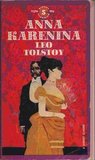
Review: Anna Karenina

Review: Anna Karenina

Anna KareninaAnna Karenina by Leo Tolstoy
My rating: 5 of 5 stars

Anna Karenina,” my friend told me, “is one of the few books that have influenced how I live my life from day to day.”

This statement touches on a question I often wonder about: Can reading great fiction make you a better person? I don’t mean to ask whether it can improve your mental agility or your knowledge of the world, for it undoubtedly does. But can these books make you kinder, wiser, more moral, more content? The answer to this question is far from self-evident. And maybe we should be doubtful, when we consider how many disagreeable Shakespeare fans have probably existed. Nevertheless, I suspect that most of us are inclined to say yes, these books do improve us. But how?

Here are my answers. First, many great works of fiction tackle the moral question directly: What does it mean to be good? How do you live a good life? What is the point of it all? Dostoyevsky is the exemplary author in this respect, who was intensely, almost morbidly, preoccupied with these questions. Second, great fiction often involves a social critique; many well-known authors have been penetrating guides into the hypocrisies, immoralities, and stupidities of their societies. Dickens, for example, is famous for spreading awareness of the plights of the poor; and Jane Austen performed a similar task in her novels, though much more quietly, by satirizing the narrow, pinched social rules the landed gentry had to abide by.

Finally, we come to great literature’s ability to help us empathize. By imagining the actions, thoughts, feelings, desires, and hopes of another person—a person perhaps from a different time, with different values—we learn to see the world from multiple points of view. This not only helps us to understand others, but also helps us to understand ourselves. And this is important, since a big part of wise living (in my experience at least) involves the ability to see ourselves from a distance, as only one person among many, and to treat ourselves with the same good-natured respect as we treat our good friends. And the master of empathy is undoubtedly Leo Tolstoy.

Leo Tolstoy was a contradictory man. He idolized the peasants and their simple life, and he preached a renunciation of worldly riches; and yet he maintained his aristocratic privileges till the end of his life. He considered marriage to be of enormous importance in living a moral life, and yet his relationship with his wife was bitterly unhappy and he ended up fleeing his house to escape. And as Isaiah Berlin pointed out in his essay on Tolstoy’s view of history, he yearned for unity and yet saw only multiplicity in the world. I can’t help attributing this contradictoriness to his nearly supernatural ability to sympathize with other points of view, which caused him to constantly be pulled in different directions.

This is on full display in Anna Karenina, but I can’t discuss this or anything else about the book without copious spoilers. So if you are among the handful of people who don’t know the plot already, here is your warning.

Like so many authors, Tolstoy here writes about a “fallen” woman who ends up in a bad situation. But unlike anyone else, Tolstoy presents this story without taking any clear moral stance on Anna, her society, her betrayed husband, or her lover. It is, for example, close to impossible to read this simply as a parable of the immoral woman getting her just desserts. What was Anna supposed to do? She would have condemned herself to a life of unhappiness had she stayed with Karenin. And it can hardly be said that she was responsible for her unhappy marriage, since marriages in those days were contracted when women were very young, for reasons of power and wealth, not love. Tolstoy makes this very clear, and as a result this book can be read, in part, as a feminist critique of a society that severely limits the freedom of women and condemns them to live at the mercy of their fathers and husbands.

But this is not the whole story. If it is impossible to read this book as a parable of an immoral wife, it is equally impossible to read it as the heroic struggle of a wronged women against an immoral society. Anna is neither wholly right nor wrong in her decision. For in choosing to abandon her husband, she also chooses to abandon her son. Admittedly, it was only the social rules that forced her to make this choice, but the fact remains that she knowingly chose it. What’s more, unlike in Madame Bovary, where the deceived husband is not a sympathetic character, Tolstoy brings Karenin to life, showing us an imperfect and limited man, but a real man nonetheless, a man who was deeply hurt by Anna’s actions.

A similar ambiguity can be seen in the relationship between Anna and Vronsky. Tolstoy never makes us doubt that they do truly love one another. This is not the story of vanity or lust, but of tender, affectionate love—a love that was denied Anna for her whole life before her affair. For his part, Vronsky is also neither wholly bad nor good. He wrongs Karenin without any moral scruples; but his love for Anna is so deep—at least at first—that he gives up his respectability, his position in the military, and even his good relationship with his family to be with her. I cannot admire Vronsky, but it is impossible for me to condemn him, just like it is impossible for me to condemn Anna or Karenin, for they were all making the choices that seemed best to them.

The final effect of these conflicts is not a critique of society nor a parable of vice, but a portrayal of the tragedy of life, of the unhappiness that inevitably arises when desires are not in harmony with values and when personalities are not in harmony with societies.

The other thread of this book—that of Levin and Kitty—is where Tolstoy tells us how to be happy. For Tolstoy, this involves a return to tradition; specifically, this means a return to rural Russian tradition and a concomitant shunning of urban European influence. Levin and Kitty’s happy life in the countryside is repeatedly contrasted with Vronsky and Anna’s unhappy life in the city. Levin is connected with the earth; he knows the peasants and he works with them, while Vronsky only associates with aristocrats. Levin is earnest, provincial, and clumsy, while Vronsky is urbane, cosmopolitan, and suave. Kitty is simple, unreflecting, and pure-hearted, while Anna is well-read, sophisticated, and passionate.

The most obvious symbol of Europeanization is the fateful railway. Anna and Vronsky meet in a train station; Vronsky confesses his love to Anna in another train station; and it is of course a train that ends Anna’s life. Levin, by contrast, catches sight of Kitty as he sits in the grass in his farm, while Kitty goes by in a horse-drawn carriage. Anna and Vronsky travel to Italy to see the sights, while for Levin even Moscow is painfully confusing and shallow.

This contrast of urban Europe with rural Russia is mirrored in the contrast of atheism with belief. Like Dostoyevsky, Tolstoy attributed the growing disbelief in Christianity to the nefarious influence of the freethinking West. In Tolstoy’s view—and in this respect he’s remarkably close to Dostoyevsky—Russians were mistaken to gleefully import European technologies and modes of thought without paying attention to how appropriate these new arrivals were to Russia. Both Tolstoy and Dostoevsky wanted Russia to develop its own path into the future, a path that relied on an embrace of the Christian ethic, not an attempt to fill the vacuum left by religion with socialism and science.

The final scene of this novel—where Levin renounces his old free-thinking ways and embraces Christianity—is the ultimate triumph of Russia over Europe in Levin’s soul. But this is where the book rings the most hollow for me. For here Tolstoy is attempting to put up one mode of life as ideal, while his prodigious ability to see the world from so many points of view makes us doubt whether there is such a thing as an ideal life or one right way of viewing the world. At least for me, Tolstoy’s magnificent empathy is the real moral lesson I have taken away from this book. His insights into the minds and personalities of different people is staggering, and I can only hope to emulate this, in my own small way, as I fight the lifelong battle with my own ego.

View all my reviews

Review: The Speech

The Speech: A Historic Filibuster on Corporate Greed & the Decline of Our Middle ClassThe Speech: A Historic Filibuster on Corporate Greed & the Decline of Our Middle Class by Bernie Sanders
My rating: 4 of 5 stars

Greed, in my view, is like a sickness. It is like an addiction.

Say what you will, this presidential race has been, at the very least, an intensely interesting affair. Of course, there is the debacle of the Republican primaries; but those are mainly interesting in the same way that a car accident is interesting—you can’t help but rubberneck, even if you’re a bit disgusted with yourself for doing so. Much more engrossing, for me, has been the rise of Bernie Sanders, something which seems to have surprised everybody, even Sanders himself.

I should admit, right off the bat, that I like Sanders; but I’m going to try my best in this review, however ineffectual that may be, to maintain some skeptical distance. I suggest you do the same for me.

This book was first released in 2011. As its back cover will tell you, it is a transcription of Sanders’s long filibuster speech, delivered on December 10, 2010, on the eve of a deal, brokered by Obama and the Republicans, which extended the Bush tax cuts on the super-rich, among other things. The whole speech is on YouTube, if you’re interested, all eight-and-a-half hours. This book is just a transcription of the speech.

As Sanders warns in the beginning, this speech is quite repetitive, deliberately so; he expected viewers to turn in for only a few minutes on CSPAN, and not to stick through the whole thing. This redundancy is probably the worst aspect of this book. I don’t see why it couldn’t have been edited and neatened up. Even so, despite the recurring sections, there is just enough new material scattered throughout the speech to keep the reader’s interest—or at least, to keep mine.

The subject of Sanders’s speech is most immediately the financial legislation in question and its shortcomings; but Sanders uses this as a jumping-off point to discuss what he sees as the pressing and dire problems facing the United States. Sanders is a remarkably consistent politician, and you will see him focused on the same issues, often using the same language, that he’s employed during his presidential bid this year.

The core of Sanders’s campaign, and this speech, is income inequality. Truly, the level of income inequality in the United States is staggering and hard to wrap one’s head around. Sanders does his best by hammering his listeners with statistic after statistic, numbers so big and so stark that they baffle the mind. After about five repetitions, they start to sink in; and after ten, your own moral outrage begins to simmer along with Sanders’s.

It’s worthwhile to compare Sanders’s speaking style with that of Obama. Obama is, I think, certainly the stronger and more versatile speaker. He is capable of sharp wit, of passionate outrage, of good-natured jocularity. But where I think he most excels, and what was his biggest asset when he ran for president, was his ability to inspire. He does this mainly through the use of anecdotes. He makes his speeches very personal; the way he speaks of nurses and teachers and firefighters is not at all condescending or pandering, but really makes you feel he knows them, knows them personally and intimately.

Sanders’s approach is quite different. For one, he is certainly more narrow in ability and focus. What Sanders conveys, with his voice, with his words, with his thrashing body language and unkempt appearance, is moral outrage. Indeed, I find something Biblical about Sanders’s speeches. He shouts until his voice cracks, until he is absolutely hoarse, detailing in a long, grotesque list how unfair and unequal our society has become. You don’t so much feel inspired as galvanized, jolted with a mixture of desperation and indignation.

To create these feelings, he does not tell stories, but recites facts. It’s astonishingly simple, really; he just has to read off a long list of ways that America is doing poorly—our shamefully huge prison population, our crumbling infrastructure, our soaring college tuition and health costs, and of course the absurd level of wealth and income inequality, which seems to grow more every year.

To speak personally for a moment, I remember the moment when his message really hit me. First I have to tell you that, among my friends, it’s almost a cliché to talk about how much better life in Europe is than in America. In fact, one of my friends, after a long vacation in Europe, said to me: “It’s honest really depressing how much better life is over there.” And it’s not just us; a lot of people have these thoughts. You get used to thinking of the United States as poorer, less prosperous, more benighted than places like Germany and Denmark.

Anyhow, one day when I was listening to a Sanders speech, he said: “Some of you may not know this, it’s easy to forget it sometimes, but the United States is the wealthiest country in the history of the world.” This really made something click within me. I’d gotten so used to thinking of the United States as poor and inferior—a place where you can’t afford to go to school or to get sick—that I was shocked to be reminded that we have more wealth in this country than anywhere else. This is, I think, what’s so effective and compelling about Sanders: you feel you’re being snapped back into reality.

So this is what I like about Sanders. What I dislike is his tendency to demonize the rich. He speaks of the super-wealthy as if they’re a bunch of nefarious, mustache-twirling, conscience-less devils trying to enslave the rest of the world. I just don’t see this rhetoric as necessary. First, everybody pursues their own interests—the poor, the middle-class, and the wealthy—so I don’t see any reason to act morally superior. And second, I simply don’t think it’s true, strictly speaking, that the economy is hurting solely because of the greed of the wealthy. Yes, I am sure that a lot of stupid, selfish greed contributed to our economic situation today; but the economy is bloody complicated; it’s not a moral playground, but a vast system that even the best minds have failed to understand.

The cynical side of me sees this finger-wagging as just the sort of us-versus-them rhetoric that politicians use to gain power. But I do think, to be honest, that Sanders is not capable of something so underhanded. He’s been ragging on the rich for his whole career; it’s only recently that this strategy has started to pay off. And besides, I do think his larger point is not only valid, but vitally important—namely, that the influence of the wealthy class on politics, with campaign contributions and corporate lobbyists, has to be curtailed in order to preserve a working democracy.

As for Sanders’s political vision, I can’t deny that it appeals to me deeply. In a nutshell, Sanders’s vision is to make the United States more like Europe, with cheap college education, with free healthcare, with a strong social safety net, with higher taxes on the rich, with stronger infrastructure, and with a great deal more economic regulation. For the truth is, life in European countries often sounds too good to be true to young Americans.

Let me give you some concrete examples. Just the other day, I was in a car with a Spaniard. We got on the topic of vacation. She said she has a friend in the States who only gets 8 vacation days per year. “Is that typical?” she asks. Yes, we tell her. In my last job I got 15, but my girlfriend only had 5. Our driver is aghast. “I get thirty,” she says, “and I think that’s too few!”

Here’s another example, with regards to infrastructure. A monthly subway card in New York City costs $117; the equivalent here in Madrid costs 55€, and only 20€ if you’re 26 or under. What’s more, the subways in New York are overcrowded and dirty, with constant delays due to lines being shut down for repair; whereas the metro here is clean and always has good service. I’ve even seen a video—here’s the link—which shows some of the machines being used today in the NYC subway system. They were built in the 1930s, if you can believe that.

And this is not to mention the looks of shocked disbelief on the faces of Europeans when I tell them just how expensive college and healthcare are in the United States. So, really, when you’re reminded that your country—the place with the slow and expensive and obsolescent trains, where every young person is several thousand dollars in debt from college, and where we still have high levels of unemployment and child poverty—is the richest country in all of history, it hits a nerve.

And while I don’t like demonizing the rich, I do agree that the rich in the U.S. live in a world apart. This was illustrated for me last year when, by chance, I found myself looking through a yacht magazine. Have you ever seen one? It was unbelievable, and I mean I honestly couldn’t believe what I saw. These ships were just huge. Inside they had bowling alleys, movie theaters; they had personal gyms and helicopter landing pads; they had living rooms created by world-famous interior designers. The boats were, I admit, super cool. But what does it say about our society that there are people who can afford things like this, when on every corner is somebody on the street?

This review has already dragged on too long, and still there is so much to be said about Sanders and what his campaign means. The pundits dismissed him before he began, and even now, even in some liberal publications, he’s discussed—discussed all too rarely—with a kind of guarded skepticism. Some have said that the media is ignoring him because of their corporate overlords. But in general, I don’t think conspiracy theories are necessary. The news media in the U.S. is not evil, it’s just shamefully bad.

For example, on several occasions I’ve heard pundits criticize Sanders for focusing on income inequality in the wake of the terrorist attacks in Paris and San Bernardino. What a bizarre situation we’re in, when a politician is criticized for not trying to whip up fear. Other pundits have dismissed Sanders based on poll numbers; but even when Sanders was leading in Iowa and New Hampshire, Hillary was regarded as inevitable. Besides, my understanding is that these poll numbers, which change every week, are done on landlines—and thus probably exclude most young people, the bulk of Sanders’s supporters. Ironically enough, the only thing that seems to get the journalists’ attention is how much money Sanders is managing to make without accepting donations from corporations—which says quite a lot about the American media.

Almost every prediction I’ve heard about this election cycle has been shown to be foolish, so perhaps I should demure. But let me give it a go. Even if he doesn’t quite win, I think Sanders will surprise everyone on election day by how close he gets. And even if he loses, I predict that his presidential run will serve a similar function as Barry Goldwater’s did, back in the 60s, giving impetus and direction to a new political movement in the country. In other words, even if he loses the political battle, I think he’s already won the battle of ideas. And, who knows? Maybe he’ll win the political battle, too.

View all my reviews

Review: The Ascent of Man

Review: The Ascent of Man

The Ascent of ManThe Ascent of Man by Jacob Bronowski

My rating: 5 of 5 stars

Fifty years from now, if an understanding of man’s origins, his evolution, his history, his progress is not in the common place of the school books, we shall not exist.

I watched this series right after finishing Kenneth Clark’s Civilisation, as I’d heard The Ascent of Man described as a companion piece. So like my review of Clark’s work, this review is about the documentary and not the book (though since the book is just a transcription of the series, I’m sure it applies to both).

The Ascent of Man is a remarkable program. I had doubts that anyone could produce a series to match Civilisation, but Bronowski made something that might even be better. Bronowski was a polymath: he did work in mathematics, biology, physics, history, and even poetry. In this program, his topic is the history of science. Yet for Bronowski, the word “science” not only refers to the modern scientific method, but rather encompasses all of humanity’s efforts to understand and manipulate the natural world.

We thus begin with Homo erectus, learning how to chip away stone to make tools. As Bronowski notes, this simple ability, to chip away at a stone until a cutting edge is left, is a remarkable indication of human uniqueness. Since the behavior is learned and is not an instinct, it requires a preconception of what the toolmaker wants to create, a certain amount of imagination is required to picture the goal before it is realized. What’s more, creating a stone tool requires a sense of the structural properties of the rock. (I’ve actually tried making stone tools with various types of rock, and let me tell you that it’s not so easy. Even with an archaeologist giving me advice, I was only able to create stone tools of the sophistication of an Australopithecus—randomly beating the stone until a sharp edge was created.) Thus both our creative drive and our knowledge are involved in this quintessentially human activity. “Every animal leaves traces of what he was. Man alone leaves traces of what he created.”

This brings Bronowski to one of his main points, one of the themes of this series: that art and science are not fundamentally different; rather, they are two manifestations of the human spirit. What is this human spirit? It is a composite of many qualities, what Bronowski calls “a jigsaw of human faculties,” which include our wide behavioral flexibility, our capacity to play, our need to create, our curiosity about the natural world, our sense of adventure, our love of variety. Indeed, these can be pithily described by saying that humans retain many childlike characteristics throughout their lives. The name of the last episode is “The Long Childhood.”

One of my favorite sequences in this documentary is when Bronowski takes the viewer from the posts and lintels of the Greek temples, to the arches in the Roman aqueduct in Segovia, to the somewhat prettier arches in the Mezquita in Cordoba, to the cathedral at Reims with its magnificent flying buttresses. Each of these structures, he explains, is a more sophisticated solution to this problem: how do you create a covered space out of stone? The lintel and post system used by the Greeks leads to a forest of columns, and the Mezquita, although less crowded, is still filled with arches. The Medieval Christians achieved a magnificent solution by placing the buttresses on the outside, thus leading to the towering, open interior of Reims.

We’re used to thinking of this development as an architectural triumph, but as Bronowski points out, it was also an intellectual triumph. This progression represents better and better understandings of the structural properties of stone, of the force of gravity, and of the distribution of weight. And when you see it play out in front of your eyes, it’s hard to shake the impression that these marvelous works are also progressively more elegant solutions to a mathematical puzzle. This is just one example of Bronowski’s talent: to see the artistic in the scientific and the scientific in the artistic; and he does this by seeing the human spirit in all of it.

Here’s another example. Bronowski wants to talk about how humanity has come to understand space, and how this understanding of space underpins our knowledge of structure. How does he do it? He goes to the Alhambra, and analyzes the symmetry in the tiles of the Moorish Palace. Then, he bends down and spreads a bunch of crystals on the ground, and begins to talk about the molecular symmetry that gave rise to them. It’s such a stunning juxtaposition. How many people would think to compare Moorish architecture with modern chemistry? But it’s so appropriate and so revealing that I couldn’t help but be awed.

As the title suggests, this series is not simply about science (or art), but about science through history. Bronowski aims to show how humanity, once freed from the constraints of instinct, used a combination of logic and imagination to achieve ever-deeper conceptions of our place in the universe. This is the Ascent of Man: a quest for self knowledge. It’s sometimes hard for us moderns to grasp this, but consider that we are living in one of the brief times in history that we can explain the formation of the earth, the origin of our species, and even the workings of our own brains. Imagine not knowing any of that. It’s hard to envy former ages when you consider that their sense of their place of the universe was based on myth supported by authority, or was simply a mystery. I’m sure (and I earnestly hope) that future generations will believe the same about us.

Bronowski’s final message is a plea to continue this ascent. This means spreading a understanding and an appreciation of science, as his programs tries to do. This strikes me as terribly important. I’ve met so many people who say things like “Science is a form of faith” or “Science can’t solve every problem” or “Science is dehumanizing and arrogant.” It’s sad to hear intelligent people say things like this, for it simply isn’t true. It’s an abuse of language to call science a faith; then what isn’t? And yes, of course science can’t solve every problem and can’t answer every question; but can anything? Science can solve some problems, and can do so very well. And science, as Bronowski points out, is the very opposite of dehumanizing and arrogant. Science is a most human form of knowledge, born of humility of our intellectual powers, based on repeated mistakes and guesses, always pressing forward into the unknown, always revising its opinions based on evidence. Atrocities are committed, not by people who are trained to question their own beliefs, but by ideologues who are convinced they are right.

This is Bronowski’s essential message. But like in any good story, the telling is half of it. As I’ve mentioned above, Bronowski and his team are brilliant at finding unexpected ways to illustrate abstract ideas. This series is full of wonderful and striking visual illustrations of Bronowski’s points. What’s more, the man is a natural storyteller, and effectively brings to life many of this series’ heroes: Newton, Galileo, Alfred Russell Wallace, Mendel. He’s also a poet; one of his books is a study of William Blake’s poetry. This not only gives him a knack for similes, but helps him to explain how science is fundamentally creative. One of my favorite scenes is when Bronowski compares abstract portraits of a man to the ways that various scientific instruments—radar, infrared, cameras, X-rays—detect the man’s face. As he explains, both the portrait and these readings are interpretations of their subjects.

The cinematography is also excellent. There are some sequences in this documentary that are still impressive, saturated as we are with CGI. There are even some quite psychedelic sections. One of my favorite of these was a sequence of microscopic shots of human cells with Pink Floyd (who contributed music) jamming chaotically in the background. Unlike in Clark’s Civilisation, which uses exclusively ‘classical’ music and is devoid of special effects, the style of this documentary is surprisingly modern and even edgy. Another thing Bronowski does that Clark doesn’t, is include some information on non-Western cultures, from Meso-America, Japan, China, and Easter Island.

Yes, there are some parts of this that are outdated. Most obviously, much of the scientific information is no longer accurate—particularly the information on human evolution in the first episode. This is unavoidable, and is in fact a tribute to the ideals Bronowski championed. More jarring is Bronowski’s somewhat negative assessments of the culture of Easter Island and the lifestyle of nomadic peoples. Less controversially, he also has some negative words to say about Hegel. (Did you know Hegel published an absurd thesis when he was young about how the distance of the orbits of the planets had to conform to a number series?) Another mark of this program’s age is that Bronowski several times shows nudity and even a human birth. This would never fly on television today, at least not in the States.

But these flaws are minor in such a tremendous program. The Ascent of Man is a landmark in the history of science education and of documentary making, and a stirring vision of the progress of humanity by an brilliant and sympathetic man. I hope you get a chance to watch it.

View all my reviews