Review: Collected Poems of Emily Dickinson

Review: Collected Poems of Emily Dickinson

Can you write a book review
Entirely in verse?
Omitting standard sentences
For stanzas taut and terse?

It seems a fitting treatment
For such a book as this;
So humor me, I beg you—
And my limited wit.

Emily Dickinson was a poet,
One of the very best;
A natural gift with language—
At once daft and deft.

Something of a recluse,
Something of a crank;
Living closed up in her room—
Like a fish in a tank.

Undoubtedly a genius,
Ahead of her time;
Unappreciated in her life,
For her erratic rhymes.

But when she finally passed away,
Her cache of poems was found;
Edited to the day’s tastes—
The dashes taken out.

The dash—the perfect punctuation
For her unique style;
Jagged—ragged—sudden—striking
And also—versatile.

Obsessed with life—and death—and bees,
Most of her poems are short;
Some of them only one quatrain,
They end before they start.

And what entrancing rhythm!
Like the beating of a drum—
Her words hammer forward—
Marching—stomping—thumping—done!

The classic case of genius,
At first misunderstood;
Now her poems are classic,
Widely read and widely loved.

So thank you, Ms. Dickinson,
For dedicating yourself—
To art, to words, to poetry—
To posterity’s bookshelf.

Review: Feeling Good

Review: Feeling Good

Feeling Good: The New Mood TherapyFeeling Good: The New Mood Therapy by David D. Burns
My rating: 5 of 5 stars

If you can love and respect yourself in failure, worlds of adventure and new experiences will open up before you, and your fears will vanish.

It is an interesting statement on contemporary culture that practical, self-help books are often looked down on as lowbrow, unsophisticated, and unworthy of serious consideration. Just note how often in reviews of self-help books you come across the phrase, “I don’t normally read books like this,” or the like. Of course, skepticism regarding books of this kind is merited, especially when you take into account the amount of quackery, chicanery, demagoguery, and baloney in print. Indeed, I think it’s fair to say we have a veritable advice industry in our culture today, with a great deal of money to be made and thus lots of enterprising, unscrupulous people peddling various forms of nonsense, hoping to get rich. Self-help books now sell so well that they have to be excluded from non-fiction sales rankings, because if they weren’t the top 10 best sellers would be an endless parade of one self-help book after another.

But why are so many people willing to pay for and devour book after book, getting swept about by the ceaseless winds of doctrine, navigating their lives through fad after fad? Fashionable ways of running and ruining your life have always been with us; yet I think there is another aggravating factor at work in the present day.

Recently I read two history books, one about Ancient Greece and the other about Rome. As I learned about the philosophies of education in those societies, I noticed how central were the ideas of ethical and moral teaching. I don’t mean ethical in the narrow sense of right and wrong, but in the wider Greek sense, used by Aristotle, the Stoics, and the Epicureans—how to cultivate wisdom, how to live a well-regulated life, how to deal with the hardships and misfortunes that are so often thrown our way. These were primary concerns of pedagogy. By contrast, our current education system, as least here in the States, has deemphasized ethical teaching almost completely.

There are, of course, many reasons for this, and many of them are good ones; but I do think it leaves a certain gap in our culture that self-help books partially fill. Unfortunately, from what I can tell, many of these seem rather mediocre—or worse. But this book, by David D. Burns, is for me one of the exceptions. It is an interesting and, for me, an extremely useful book, based on a well-studied and much-tested therapeutic technique.

Burns’s aim in writing this book was to popularize the methods of Cognitive Behavioral Therapy (CBT), a therapeutic technique developed by the psychologist Aaron T. Beck, among others. The premise of CBT is very simple: your moods are caused by your thoughts, so by controlling your thoughts you can control your moods. At first sight, this may seem like complete nonsense; our moods come and go, and our thoughts simply take on the timbre of whatever mood we happened to be in, right? This seems to be what most people assume; certainly I did. Yet consider this scenario, which actually happened to me:

My boss scheduled a meeting with me out of the blue. I immediately started thinking that I hadn’t been doing a good job recently, so I began to panic, sure I was about to get fired. Eventually, this panic turned to indignation, as I convinced myself of the injustice of the situation, since I worked hard and tried my best. So, literally trembling with anxiety and outrage, I went to the meeting and sat down; and my boss said: “We’re giving you a bonus, because you’ve been doing so well. Congratulations!” Suddenly, all my negative feelings turned into joy.

This I think well illustrates the central idea behind CPT. All of my negative and positive emotions in this scenario were due to my interpretation of the event, not the event itself. I made the false assumption, based on no evidence, that I was going to be fired. I thought of every mistake and imperfection in my work over the last month or so, and convinced myself that I was doing poorly and that termination was imminent. Then, I persuaded myself that I wasn’t given adequate resources or support, and that the situation was unjust. And when I was finally given the bonus, I interpreted that to mean I was doing a good job and that I was getting all the support I needed—which were equally tenuous interpretations. Thus you can see how my mood was a direct product of my thoughts.

All of my negative assumption in the above paragraph contain what Burns calls “warped thoughts,” or cognitive distortions. These are irrational patterns of thinking which have been found to be common in depressed and overly anxious patients. The CBT interpretation of depression is that these thinking patterns are not caused by depression, but actually cause depression. In other words, depression results from persistent, unrealistic negative interpretations of one’s life and experience, leading one to focus solely on the bad and to feel hopeless about the future.

Burns gives a list of 10 types of warped thoughts, but in my opinion there is quite a bit of overlap in the categories. The distortions more or less boil down to the following:

—Making negative assumptions, whether about the future or about what someone else is thinking;
—Assuming that one’s emotions accurately reflect reality;
—Over-generalizing a small number of negative occurrences into an inevitable trend;
—Willfully ignoring all of the positives to focus solely on the negative;
—Thinking in black and white categories;
—Making unjustified “should” or “ought” statements about the world without considering other people’s perspectives;
—Feeling that you are responsible for things over which you have no control;
—Labeling oneself and others with vague pejoratives.

The first part of this book is dedicated to allowing the reader to recognize these types of thoughts and to combat them. This most often is just a matter of writing these thoughts down and exposing the distortions that lay beneath. Simple as this sounds, I’ve found this to be remarkably effective. As you might have guessed from the above example, I am rather prone to anxiety; and during this summer, my anxiety was getting to the point that I felt incapacitated. I was driving my friends and family nuts with my constant worrying; and nobody, including myself, knew how to deal with me.

Luckily, I heard about a site called MoodGYM, which is a website developed by the Australian National University for people dealing with anxiety and depression, using the techniques of CBT. Desperate for some relief, I completed the reading and activities on the website, and found that I felt much, much better. Impressed, I looked for books on CBT techniques, and of course came across this one.

What most intrigued me about CBT was the emphasis on accuracy. The techniques weren’t based on the premise that I was somehow damaged or filled with strange desires, nor did they include any amount of self-delusion or wishful thinking. Quite the reverse: the whole emphasis was on thinking clearly, basing beliefs on evidence, avoiding unreasonable assumptions, and seeing things from multiple points of view.

Take anger. Very often (though not always), our feelings of indignation simply result from seeing an event through a narrowly selfish lens. We don’t get the job we interviewed for, and we feel cheated; someone beat us to that parking spot, and we feel outraged. But when we consider these scenarios from the perspective of the boss or the other driver, the situation suddenly seems much more just and fair; they are pursuing their own interests, just like we are. So simply by looking at the situation from multiple points of view, and thus understanding it more fully, our feelings of anger are cooled.

When I began working through the techniques in the book, I was astounded by how often these types of distortions plagued my thinking. It would almost be funny if it wasn’t so unpleasant: I could twist any situation or piece of information into somehow reflecting negatively on my character. Everything bad in the world confirmed my negativity, and everything good only served to reproach me and to make me envious and resentful. The good news was that, when I began to recognize these illogical patterns of thought, it was extremely easy for me to correct them; and for the past month or so I’ve been feeling a great deal happier and calmer.

After teaching the reader several personal and interpersonal techniques—strategies for dealing with oneself and others more effectively—Burns moves on to examining some of the underlying assumptions that give rise to warped thinking. It turns out that these all involve equating one’s “value” or “worth” with some extrinsic good, whether it be approval, love, success, fame, or even skill. There is, of course, nothing wrong with enjoying the approval of others, the thrill of love, the sense of accomplishment, or the satisfaction of a job well done. The problem arises when, instead of enjoying something, we use it to measure ourselves.

To use a somewhat silly but germane example, how many people believe that those who read more books, bigger books, harder books, are somehow “superior” to people who don’t? I’ve certainly been guilty of this; but it is pretty clearly an absurd position when I think about it, and one that I couldn’t possibly defend on any valid moral or intellectual grounds. What on earth does it even mean to be a “superior” person?

Superiority only makes sense when we have some quality we can measure, such as wealth or strength; but when we say “superior” by itself, what quality do we mean? “Worth”? How do you measure that? You can try being clever and say “By the number of books you read” or something, but that’s clearly circular reasoning. If you are a humanist or religious, you might say that you have worth just from the fact of being alive; but then of course everyone is equally worthy and there’s no sense in feeling worthless.

In the non-Goodreads population, I suspect book addiction isn’t a big problem; more often, people feel down because they imagine that approval, love, money, or expertise is necessary to be a worthwhile and happy person. But the absurdity of this kind of thinking is revealed when you consider how many famous, beloved, rich, virtuosic, brilliant, successful people there have been, and still are, who are deeply depressed and feel worthless and hopeless. Short of torture, there are no circumstances in life that guarantee unhappiness; and the same goes for happiness. This is not to say that you shouldn’t try to change or improve your situation, only a reminder you that the way you interpret a situation is often as important as the situation itself, if not more so.

I cannot hope to sum up the entire book in the space of this review; but I hope what I have included has convinced you that it’s at least worth looking into. After all, by definition, nothing feels better than happiness.

Of course, the book isn’t perfect. Burns’s writing style is nothing remarkable, and it is occasionally tacky; but I think that it’s excusable considering that he’s a therapist, not a writer, and that he’s trying to reach a popular audience. One flaw that I thought was less easy to excuse was Burns’s exclusive focus on straight couples in his sections on love and relationships. Burns writes in a purely heteronormative vein, not even acknowledging same-sex couples, which is difficult to justify, considering the higher rates of depression and anxiety among gays and lesbians—not to mention others in the LGBTQ community. I hope this is changed in future additions.

A criticism I am tempted to make, but which I actually think is unfair, is that CBT makes people passive, accepting, and more content with the status quo. It sometimes seems as if Burns is telling people not to try to change their circumstances, but rather to accommodate themselves to them. I think this is unfair for a few reasons. No matter how powerful we may be, there will always be things in life which we cannot change and which we simply have to accept; so developing the tools to do so without frustration or anger is useful for everyone. What’s more, real depression and anxiety are not conducive to effective action. Quite the opposite: depression often makes people apathetic and anxiety makes people feel too overwhelmed to do anything. Besides, you can’t solve a problem unless you can see it clearly, and the thinking patterns associated with depression and anxiety lead to a total inability to see problems clearly and to deal with them rationally. So I think accusations that this book is somehow reactionary or that it leads to passivity are unfair.

To sum up this already overlong review, I just hope I’ve convinced you that this book might be extremely valuable to you or to someone you know. It certainly has been for me. Now I no longer feel that I am at the mercy of my moods or emotions, or that my sense of self-worth or confidence is dependent on my circumstances. And I’d say these benefits definitely outweigh the tacky cover and the corny title, don’t you?

(Oh, and if the book seems like too big a commitment, MoodGYM is pretty swell too, despite additional corniness of course.)

View all my reviews

The Upanishads

The Upanishads

The UpanishadsThe Upanishads by Anonymous
My rating: 4 of 5 stars

I find it interesting how pervasive is the mystic idea of unity. From transcendentalists to scientists to Buddhists to Christians to Hindus, I hear this same thing emphasized repeatedly—everything is one. Physicists wax poetic about how our bodies are made of star-dust. Biologists and naturalists wonder at the unity of life on earth. Christians celebrate the infinite simplicity of God. Spinoza’s philosophy proclaims the oneness of all reality. Walt Whitman had this to say:

And I know that the hand of God is the elderhand of my own,
And I know that the spirit of God is the eldest brother of my own,
And that all the men ever born are also my brothers… and the women my sisters and lovers

And here is Herman Hesse:

Slowly blossomed, slowly ripened in Siddhartha the realization, the knowledge, what wisdom actually was, what the goal of his long search was. It was nothing but a readiness of the soul, an ability, a secret art, to think every moment, while living his life, the thought of oneness, to be able to feel and inhale the oneness.

Opening yourself up to this realization is the corner-stone to many words of wisdom I’ve so far come across. When it is written in Ecclesiastes, “There is no new thing under the sun,” what else could this mean that reality is ever the same, that all change is superficial, that all is one?

Just so in The Upanishads, where it is written that “He who perceives all beings as the Self, how can there be delusion or grief for him, when he sees this oneness everywhere?”

This equating self with cosmos can also be found in Plato. In fact, the Socratic injunction to ‘know thyself’ takes on a different meaning in this context. Since, for Plato, the soul of a man is that which takes part in the realm of ideals, knowing this soul puts oneself in more intimate contact with this ultimate reality. So self-knowledge is the key to wisdom, and wisdom consists in the knowledge that all is one. To quote again from The Leaves of Grass, “I celebrate myself, / And what I assume you shall assume, / For every atom belonging to me as good belongs to you.”

The parallels with Plato are actually astounding. In both Plato’s works and The Upanishads, the soul is likened to a driver on a chariot. Both systems divide the self or soul in similar ways. Both have an idea of reincarnation. And in both systems one finds the idea that true enlightenment comes from detached introspection.

I suspect that the intellectual knowledge that the universe is, in a sense, one thing, is not really what wisdom is all about. That we are made of materials created by exploding stars may be factually correct; but the statement’s emotional power does not come from that fact, but by what the fact implies—that you’re troubles and anxieties pale in comparison to the miracle of being alive in the universe. And truly, it is a miracle. I think scientists, Christians, Hindus, Platonists, and Buddhists can all agree with that.

To quote Bill Bryson’s fantastic A Short History of Nearly Everything:

To begin with, for you to be here now trillions of drifting atoms had somehow to assemble in an intricate and intriguingly obliging manner to create you. It’s an arrangement so specialized and particular that it has never been tried before and will only exist this once. For the next many years (we hope) these tiny particles will uncomplainingly engage in all the billions of deft, cooperative efforts necessary to keep you intact and let you experience the supremely agreeable but generally underappreciated state known as existence.

But Wittgenstein might have said it best: “Not how the world is, is the mystical, but that it is.”

View all my reviews

Review: Language, Truth, and Logic

Review: Language, Truth, and Logic

Language, Truth, and LogicLanguage, Truth, and Logic by A.J. Ayer
My rating: 2 of 5 stars

[SOCRATES is sitting in his living room on an easy chair, reading a newspaper. Suddenly, he hears a knock on the door, and gets up to answer it. Standing there is AYER, a skinny young man in a grey suit, with short-cropped hair. He is smiling and staring intently at SOCRATES.]

SOC: Hello? How may I help you?

AYER: Hello! My name is Alfred Jules Ayer, but most people call me Freddie. How are you today?

SOC: I’m fine, quite fine, thanks. Are you selling something? Because I’m afraid I am not interested…

AYER: Oh, no—no, no. I’m a member of the Vienna Circle, and I’m going door to door to promote our doctrine of logical positivism. It’s the amazing new doctrine that solves all philosophical problems now and for good. May I come in?

SOC: Really? Is that so? Yes, sure, come in. Sit down here on the couch.

[The two men sit down, SOC on his easy chair, and AYER on the couch.]

AYER: Thanks for letting me in! You’re the first one all week. Most people seem to think I’m a Mormon. [Looks around.] Nice place you got here. What do you do, if I may ask?

SOC: Oh, me? People think I’m a philosopher, but I just like to ask questions.

AYER: A philosopher? Neat! Well, then you’ll be real glad to hear what I have to say!

SOC: I don’t doubt it. So what’s this, um… logical positivism? Is it a religion?

AYER: A religion? Of course not! Logical positivism is the opposite of a religion! It’s a doctrine that tells us everything we ever want to know. If you learn about logical positivism, you’ll never be wrong again. Every problem you’ve ever asked about philosophy will be answered!

SOC: Wow, that sounds impressive… How does it work?

AYER: It’s simple! Here: let me demonstrate it by solving a philosophical problem. What’s something you want resolved?

SOC: Well, I’ve always been a bit puzzled by Hume’s problem of induction. I’m not at all satisfied with Kant’s treatment of it, and even Russell seems to shrug his shoulders.

AYER: The problem of induction? That’s child’s play! Let me read the solution from my new book, and you’ll see the answer clearly. [Pulls out a copy of Language, Truth, and Logic, and starts reading.] “… it appears that there is no possible way of solving the problem of induction, as it is ordinarily conceived. And this means that it is a fictitious problem, since all genuine problems are at least theoretically capable of being solved: and the credit of natural science is not impaired by the fact that some philosophers continue to be puzzled by it.”

SOC: So, wait. You’re saying that because you can’t figure out a way to solve the problem, it’s not a real problem?

AYER: Exactly! That’s the beauty of logical positivism! Anything that you can’t solve you just decide isn’t a real problem. Isn’t that great?

SOC: Really, is that all you have to do?

AYER: Well, you have to wave your hand around a bit, but that’s the general idea.

SOC: Hmm, how about another problem, like ethics. What do logical positivists say about what it means to do the right or wrong thing?

AYER: Ethics? Oh, please! That’s another easy one. Let me find the right passage. Here it is: “We can now see why it is impossible to find a criterion for determining the validity of ethical judgements. It is not because they have ‘absolute’ validity which is mysteriously independent of ordinary sense-experience, but because they have no objective validity whatsoever.”

SOC: Ah, I understand now. You’re saying that, since you can’t figure out a way to shoehorn ethical statements into your system, they aren’t real statements at all. Is that right?

AYER: Absolutely! That’s how it all works. All you have to do is say what you think—no argument is needed at all! And anyone who disagrees with you, just call them a metaphysician with a sneer.

SOC: So what’s the upshot of all this?

AYER: The upshot? Philosophy is over! It’s really incredible: all these smart philosopher-guys thought about all this stuff for thousands of years. But the solution was so obvious! Just stop having substantive arguments, and start dismissing everyone who disagrees with you as a befuddled moron. That way, you can be sure to get at the truth.

SOC: Wow, that’s quite a strategy. But I’m still a little curious about the specifics. For example, how do logical positivists deal with the question of truth?

AYER: Oh, Socrates, you ask the silliest questions! Well first, we just take an idea from Kant and Hume, and divide up all statements into analytic and synthetic statements. Then, we take an idea from William James, and insist that nothing is meaningful unless it is either a tautology or can be verified in experience. So that’s all of truth, either tautologies or science. It’s called the verification principle.

SOC: Interesting approach there… But, I wonder, what about this ‘verification principle’ itself? How does that fit into the system? How is this principle either empirical or a tautology? Clearly, the verification principle itself doesn’t picture any facts; in other words, the principle itself can’t be verified—so it’s not empirical. (Also, it would be absurd to verify a principle with the principle itself; that leads to a reductio ad absurdum.) Then, in order for it not to be meaningless, in your view, it must be a tautology. But it clearly isn’t a logical contradiction to assert that there are other criteria we might use to distinguish truth from falsity than the verification principle. So since the principle itself is clearly neither empirical nor a tautology, how can you justify it in your system?

AYER: Justify it? We don’t justify things. We assert that it’s true, and anyone who points out the contradictions we then assert are metaphysicians.

SOC: Wow, I see. Let me see if I get it. First you take ideas from other philosophers, then you throw them together into a half-coherent system, and finally you yell at anyone who disagrees. Is that right?

AYER: You got it! Logical positivism! You know, Socrates, you’re really a quick learner. Now there is no longer any legitimate reason to disagree with someone in philosophy. If they’re logical positivists, they’re right; and if not, they’re wrong. The Vienna Circle has arrived at the truth, and no further work need be done! As I say in my book: “One of the main objects of this treatise has been to show that there is nothing in the nature of philosophy to warrant the existence of conflicting philosophical parties or ‘schools.'” In other words, now that we figured everything out, there isn’t any good reason to fundamentally disagree with us. So all you have to do is join us, adopt our dogmas, and you will be saved from all falsity and metaphysics; you can believe exactly what we believe, and read the holy books of Russell and Wittgenstein and Hume.

SOC [Getting up from his seat]: Actually, I have to go somewhere… so I’m afraid I’m going to have to ask you to leave. But it was nice talking to you.

AYER [Getting up as well]: Oh, of course! Can I leave a book with you?

SOC: Sure…

AYER: Alright. [Lays book on table.] Nice talking with you. I hope to again!

SOC: Yep, yep.

[AYER leaves through front door, after vigorously shaking SOCRATES’ hand. A moment later, SOCRATES’ wife XANTHIPPE walks in.]

XAN: Who was that, dear?

SOC: Oh, never mind him, honey. Just a Mormon.

View all my reviews

Review: Feeling Good Together

Review: Feeling Good Together

Feeling Good Together: The Secret to Making Troubled Relationships WorkFeeling Good Together: The Secret to Making Troubled Relationships Work by David D. Burns
My rating: 5 of 5 stars

The path to intimacy is nearly always painful.


For a while now I have believed that the Life of Reading, if it isn’t to be merely a diversion or a way of stroking one’s own ego, must be a life of self-transformation. To be well-read does not only mean to be familiar with certain names and ideas, plots and quotes; more importantly, it entails the development of real changes in perspective, personality, and behavior. Thus when I recently ran into a problem in my relationship, I chose to see it as an opportunity to improve myself through reading. And since I’ve already been helped by David Burns’s Feeling Good, I turned once more to his work.

Burns begins with a simple but, for me, surprising point. Psychologists and the general public have long assumed that people experience relationship difficulties because they lack the proper interpersonal skills. They crave intimacy, but they don’t know how to achieve it. The obvious solution would be to train couples to express their feelings—to learn how to empathize and to be assertive. The problem is, despite many different techniques for doing this, couples counseling has a pretty disappointing success rate. Why is this?

The reason, says Burns, is because very often we don’t really want intimacy. There are lots of benefits of having an antagonistic relationship: you get to feel like you’re in the right, you feel powerful, you take without giving, you aren’t vulnerable, you get to complain to your friends about how mistreated you are—and this list only scratches the surface. This is the ugly side of human nature, the side of ourselves we most often don’t like to acknowledge. But coming to terms with this part of ourselves, and deciding whether we prefer the benefits of an intimate or an antagonistic relationship, is a crucial step: you’ve got to decide if you want intimacy, and if you’re willing to look at a part of yourself usually swept under the rug.

Next, Burns introduces his criteria for successful communication: empathize with your partner’s thoughts and feelings, clearly express your own feelings, and always treat your partner with respect. This sounds simple and even obvious, but when I analyzed a common interaction I had with my partner, I realized how badly I was communicating. Indeed, the more I analyzed my own interactions, the more I realized that I had been effectively shutting down communication. And when I imagined what it would be like to be on the receiving end of my words, I suddenly understood—with a pang of remorse—that it would have felt really awful.

After coming to terms with the flaws in one’s own behavior, Burns next teaches you skills for communicating more effectively. Conceptually, these are simple enough: understand your partner’s perspective, acknowledge their feelings, share your own feelings respectfully, give them praise, and encourage them to share more. However, doing this in the heat of battle, when both you and your partner are upset, is challenging and takes a lot of practice. The urge to blame your partner for your problems can be overwhelming; and treating someone else respectfully while you’re feeling angry, hurt, or rejected can be an enormous challenge. Thus Burns has you practice with a variety of imaginary scenarios and also provides some exercises to do with a friend. The practice is the really valuable part. Everyone says they want to empathize better, but most people don’t know how and don’t take the time to learn.

That’s the book in a nutshell. Personally, I found it to be clear, persuasive, and helpful; and although I still need practice, I have found the strategies highly effective. Even if you do all the exercises, it’s a pretty quick read, yet he packs quite a lot into the book.

Of course, this book isn’t perfect. One superficial thing that bothered me was Burns’s calling his strategies “Secrets,” which unfortunately makes him sound like a cheap con artist to me. Also unfortunate was his choice to use imaginary couples for his examples, thus giving most his anecdotes a rather artificial and flavorless quality. The men and women don’t seem like real people with real problems, but soulless illustrations. Another shortcoming, it seems to me, was that Burns didn’t discuss forgiveness. Relationships require constant forgiveness, and they reach crises when one of the partners can’t decide whether to forgive or not. I’ve known many people in relationships who were wondering, after years of accumulated pain, whether it was worth forgiving the partner or if it was better to let the relationship end. Usually I don’t know what advice to give, and I’d be curious to hear Burns on the topic.

But I can’t dwell on these faults, because once again I feel an enormous debt of gratitude to Burns, for I discovered something about myself as I read. While analyzing my own ineffective behavior, I began to wonder why I had acted in such a nasty way to a loved one. Gradually, I was forced to face the fact that I got a real pleasure from acting disrespectfully. Being condescending was a way of propping up my ego and maintaining a heightened self-image.

The more I thought about it, the more I realized how many of my actions, both inside and outside my relationship, were done to gratify my ego and create a certain persona. Meanwhile, this prevented me from effectively sharing my emotions or feeling close to others. I was trapped by a need to feel superior, which required constant snobbishness..

It feels odd to write these things about myself, for truly it is ignoble to be so egotistic. But I had to look deeply at this part of myself, and understand that my condescension was fueled by a deep fear of inadequacy, before I could change my behavior. This meant giving up this self-image, letting my ego die—and it’s been hard. Feeling superior to others was something I savored, and now I’m trying to give it up. But it’s worth it. The compensation is being open to a new world of joys.

View all my reviews

Review: Moorish Spain

Review: Moorish Spain

Moorish SpainMoorish Spain by Richard Fletcher

My rating: 4 of 5 stars

Nostalgia is the enemy of historical understanding.

After reading and being disappointed with Menocal’s famous book on Moorish Spain, The Ornament of the World, I decided to take another crack with this book. And I am happy to report that Fletcher’s book is much better.

While Menocal is wistful and romantic, Fletcher is more detached and occasionally wry. While Menocal hardly acknowledges her sources, Fletcher is usually careful to note where he is getting his information from, even if this book lacks a scholarly bibliography. I found this a great relief, as I have been discovering that Moorish Spain is one of the most persistently mythologized periods in history. Washington Irving set the tone for this in his Tales of the Alhambra, but other writers have been following in his romantic footsteps ever since. Thus Fletcher’s dispassionate treatment was refreshing.

The main drawbacks of this book is that it is too short, and too scholarly. Fletcher was explicitly aiming for a popular audience, but the book he wrote would be better suited for an undergraduate class than a tourist. You cannot, for example, find many good vacation ideas in these pages; indeed, if this was your introduction to Moorish Spain, you might not even want to travel there at all.

Instead of focusing on intellectual and cultural history, the majority of this text deals with political and military history—the invasions, battles, territorial expansions, and so on. Admittedly, Fletcher also quotes poems, autobiographies, and includes pictures of famous buildings; he even has a whole chapter on the relations between Christians and Muslims during this time. But this information jostles for space among dozens of unfamiliar names of rulers who I do not much care to remember. Probably, if he wanted a better-selling book, he could have bot expanded it and included more of a personal touch. He is a fine writer and rather opinionated, so it would have served him well, I think, to have written something less formal.

In any case, I doubt there are any better books on the market for the history hungry tourist visiting Andalusia. This book will give you an overview of the period, and in the process inoculate you against much of the nonsense that gets thrown around about al-Andalus. It was not a paradise of tolerance, nor was it a perpetual war of faith against faith. As Fletcher said: “The past, like the present, is for most of the time rather flavourless.”

View all my reviews

Review: Julius Caesar, by Shakespeare

Review: Julius Caesar, by Shakespeare

Julius CaesarJulius Caesar by William Shakespeare
My rating: 5 of 5 stars

Why, man, he doth brestride the narrow world like a Colossus, and we petty men walk under his huge legs and peep about to find ourselves dishonorable graves.

One of Shakespeare’s best, this play is also, I think, one of his most morally ambiguous. The central question of the play—was it right to have killed Caesar?—is left unresolved, principally because of the complexity of the protagonists.

The play opens with Cassius persuading Brutus to act against Caesar. This monologue, though eloquent, is also somewhat confusing, perhaps even incoherent. The reasons Cassius avers for wanting Caesar dead are all petty and somewhat beside the point. Cassius hates Caesar, but why? Because once Caesar faltered while swimming the Tiber? Or because Caesar once had a cold? Of course, these examples are only meant to show that Caesar is a mere man, and thus does not deserve to occupy such a high eminence. And yet, this same argument—namely, that human weakness makes everyone equal—can be used against any form of inequality, be it wealth, power, or prestige; and communism is certainly not what Cassius is preaching.

True enough, word later comes that Mark Antony offered Caesar a crown, which would threaten the very existence of the Republic. But there is nothing in Cassius’s words or deeds that reveal him as someone motivated by political philosophy. Rather, he is a sensitive man, easily insulted, with a delicate ego; and his emotional episode in Brutus’s tent also reveals him to be needy and high-strung. There is nothing evil in him, nor even overtly malicious; but he is not like Brutus, a man of principles, honor, nobility. Thus I cannot help concluding that his plot against Caesar was mainly motivated by petty emotions, even if Cassius told himself otherwise. He felt envious of Caesar’s power, slighted at having a superior, fearful of future humiliations.

All this is more or less apparent in Cassius’s speech to Brutus. From the start, therefore, it should have been apparent to Brutus that he was allying himself with men acting from a suspect motive. But perhaps Brutus is too good-hearted to question the motivations of his friends. Indeed, throughout the play, Brutus is shown to be ethically unimpeachable, a purely noble and righteous person. Even his enemies admit it. And given that he talks the most and dies last, many have argued that the play should be entitled Brutus and not Julius Caesar, since the latter has few lines and dies halfway through.

It is, indeed, tempting to see Brutus as the tragic hero, trying to do what is right, brought down by circumstances. But I have trouble taking his side completely.

For one, it seems foolish to have let himself be persuaded by Cassius. The assassination was rash, and they had no plan whatsoever for restoring order once the deed was done. It also struck me as hypocritical, to say the least, to march through the streets yelling “Liberty! Freedom! Tyranny is dead!” since, at best, the conspirators restored an oligarchy of hereditary privilege. I am not convinced that the life of the common people was any better under the Senators than under Caesar.

Brutus also has a tendency to act imprudently, which is arguably his fatal flaw. First, the assassination plot itself—specifically the plan for restoring order—should have been more carefully considered. Brutus’s oration to the Roman people after the assassination is evidence that his rationales were not given enough thought. He cites “ambition” as the reason Caesar had to be killed, but does not clearly show in which of Caesar’s actions this ambition was manifested. This makes it very easy for Mark Antony to refute the charges. Brutus should have foreseen this, which is why it was the height of folly to have let Mark Antony give that oration. Besides all this, he shows himself to be a poor general.

Brutus’s personal honor code, while earning him respect, also handicaps him. For one, as noted, his tendency to trust others make him a poor judge of character. More troublingly, in attempting to set himself up above petty emotions, he renders himself inhumanly cold. Cassius, though oversensitive, is right in rebuking Brutus for attempting to see the vices and virtues of a friend with an unprejudiced eye, rather than overlooking Cassius’s faults. More significantly, Brutus’s attempt to rise above the grief of his wife’s death lowers him instead, turning him into a mere empty shell motivated by an honor code that brings nobody happiness, not even himself. For these reasons, I feel sad at his loss, but I also feel that he had it coming.

Mark Antony has some of the marks of a villain, who vows revenge even if he drags down all of Rome in the process. He is also not terribly likeable, being arrogant to others and fawning to Caesar. But he has redeeming qualities. His love for Caesar, while at first apparently sycophantic, is later shown genuine. The praises of a living commander are always suspect, but the praises of a departed one are honorable. Mark Antony is also not insensitive to the virtues of Brutus, even praising his memory. He fights for vengeance, true, and vengeance is always ethically suspect; but Hamlet fought for vengeance, and that does not make us like him any less.

In sum, it is difficult to see either Cassius, Brutus, or Mark Antony (or Julius Caesar, for that matter) as unambiguously right or wrong. They are rather three imperfect individuals, with different faults and strengths, who all fight in good faith for what they believe is right.

To acknowledge the faults in these characters, and yet portray them as acting sincerely, is a demonstration of the genius and the nobility of Shakespeare. For the quality Brutus most lacked was the one Shakespeare had in superabundance: empathy. As this play demonstrates, he could acknowledge a person’s faults and limitations while also understanding that, from their point of view, what they were doing was perfectly right. And therein lies both the secret of his art and the moral value of his works.

View all my reviews

Review: The World at War

Review: The World at War

The World At WarThe World At War by Mark Arnold-Forster

My rating: 5 of 5 stars

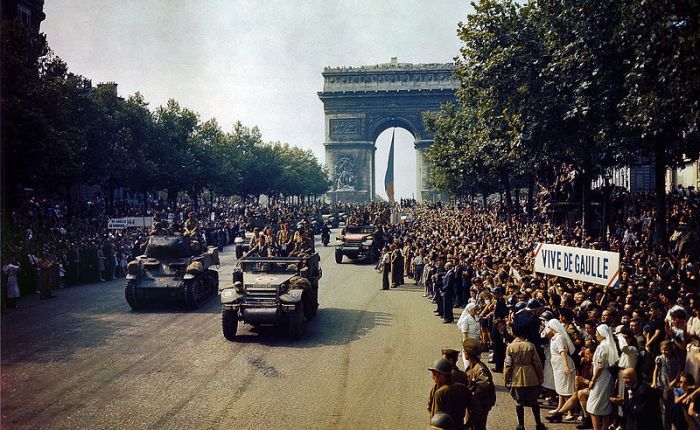
Consisting of 26 episodes, each about 50 minutes long, The World at War traces the history of the Second World War from its pre-War beginnings to its aftermath. The program is remarkable in scope, covering the relevant political history of the United States, England, Germany, and Japan; the war efforts in north Africa and southeast Asia; the Russian and the Western front, as well as the final push against Japan; the bombing campaigns and their effects on civilian life; the struggle of the Allied shipping fleet against the German U-boats; the final peace negotiations in Europe and Asia, and the concomitant haggling between the U.S.S.R. and the West; the horrors of the Holocaust; and much else.

But the series has depth as well as breadth. There are hours and hours of archival footage—of battles, bombings, bombardments, protests, speeches, life on the front line, civilian life, negotiations, military parades, invasions, celebrations, triumphs, massacres, tragedies—much of it never used before, unearthed by the program’s research team.

Even more impressively, there are hours of interview footage, from from Poles, Russians, French, Germans, English, Americans, Japanese. There are interviews of gunners, tank crew, infantrymen, sailors, pilots; interviews of housewives, firefighters, barmen, taxi drivers; as well as from politicians, advisors, generals, and even Hitler’s personal secretary and chauffeur. Considering that these interviews were made specifically for the series, from people directly involved in the action, this makes the raw footage (most of it unused) a valuable primary historical document. And this is not to mention the wonderful narration by Laurence Olivier, which is always tasteful, often moving, and sometimes chilling.

In short, the documentary is a masterpiece, bringing the drama of the war to life while also being supremely informative. If you want to watch any documentary about World War II, make it this one.

To speak personally, watching this documentary had a strange effect on me, because it made me realize how much my perspective has changed since I was a kid. Back then, I used to watch World War II documentaries because the war seemed like a comic book. It was a story with clear bad guys and good guys, and the good guys won in the end. It was a story of personal heroism and bravery, of self-sacrifice and honor, of hardships endured and battles fought for the greater good. I was even fascinated with the military technology, the tanks, war planes, battleships, and guns. I remember going to the military museum at West Point, and seeing replicas of the nuclear bombs used on Hiroshima and Nagasaki. There was something undeniably awe-inspiring about the ability to create so much destruction, to wield so much power.

This time around, I had a different reaction. The more I watched, the more I became overwhelmed with a sense of pointless loss, destruction, and violence. Millions of young men marching off to shoot other young men, and for what? Towns blown to pieces, cities burned to the ground, and, most of all, countless lives lost. People shot, stabbed, drowned, burned; people executed by firing squad, hanging, the gas chamber. Beaches filled with bloated bodies, corpses rotting in the road, the remains grandmothers and children buried under piles of rubble. And it just kept going, the planes kept dropping bombs, the men kept throwing grenades, the tanks kept rolling on. By the end of the series, every episode made me feel sick.

When you see the numbers of the dead, it’s easy to grow numb. The totals become mere, meaningless statistics. But when you realize that those millions were composed of individuals, people with their own favorite song to whistle, shade of blue, local restaurant, people with their own quirks of personality, their own flaws and virtues, people who were loved and who loved in return, people who might have done anything had they survived the war, the enormity of the tragedy dawns on you. No matter what the aggressors hoped to gain from the war, no matter how glorious it seemed, it could not have been worth it.

The documentary does not shy away from the horrors of war, but dwells on them, and for good reason. For if there is any lesson to be learned from World War II, it is simply this: We must do everything in our power to avoid repeating that catastrophe.

View all my reviews

Review: The Renaissance, by Walter Pater

Review: The Renaissance, by Walter Pater

The Renaissance: Studies in Art and PoetryThe Renaissance: Studies in Art and Poetry by Walter Pater
My rating: 4 of 5 stars

That it has given a new sense, that it has laid open a new organ, is the highest that can be said of any critical effort.

I had no idea what to expect from these essays. The only reason I became aware of Pater was because a copy of this book was sitting on the bathroom floor in my friend’s father’s house. Since my friend’s father is a successful painter, I naturally took note of a book about art so intimately placed. Much later, after finishing Burckhardt’s famous analysis of the Renaissance, and with my trip to Rome looming, I decided that I would finally see why a painter sought out this book for his bathroom inspiration.

Pater was an idiosyncratic fellow, and these essays certainly reflect that. Some of the topics he covers are expected: Botticelli, Michelangelo, Leonardo da Vinci. Others are more surprising: Joachim du Bellay, a Frenchman who wrote a defense of the French language; two medieval French stories about love and adventure; and Johann Winckelmann, the 18th century German classicist. Clearly, Pater’s conception of the Renaissance was far broader than Burckhardt’s, who considered the Renaissance a strictly Italian affair. Also broad is Pater’s conception of criticism: for him, it is not merely a vocation, but an entire philosophy of life.

I am referring specifically to the famous “Conclusion” that is tacked on to the end of these essays. In it, Pater puts forward a whole aesthetic philosophy of life: Everything is in flux; both matter and mind are temporary; the only thing we have is the moment; and since death may come at any time, and will come inevitably, the only rational response is to enjoy this moment as best you can. Now, some thought that Pater was advocating hedonism, but that is far from the case. He was, rather, an aesthete; and for him, “enjoying the moment” meant finding the most beautiful shade of green in a field of grass, or observing the play of light on a windowpane—that sort of thing. The ability to be constantly, delicately, indefatigably absorbed in one’s senses, and yet have the focus and taste necessary to select from these perceptions the most lovely, is what Pater meant with his famous suggestion to “burn always with this hard, gemlike flame,” which for him is “success in life.”

At times, the age of these essays showed. This was most conspicuous in Pater’s essay on Giorgione, in which he bases his whole appreciation on one painting, elevating it to the height and epitome of Giorgione’s aesthetic—a painting which is now believed to be by Titian. But for the most part, the essays have retained their force and interest. Indeed, you may not realize how original this book was, since it anticipated and shaped so many of our attitudes about art and the Renaissance. To pick just one example, Pater’s discussion of the Mona Lisa, dwelling on her mysterious smile, certainly helped spur on our fascination for that work.

Nevertheless, I am unsure whether Pater actually deepened my appreciation for the Renaissance works he discussed. This is due, I think, to his ideal of the critic: to be acutely sensitive to the power of art, and to be finely discriminating of what is more or less beautiful. Sensitive and discriminating Pater certainly is. (Several times I wondered if he passed out while writing his essays, since, judging by his breathless and insistent tone, he was always to be right on the cusp of a brilliant epiphany or a transcendent experience. It must have been exhausting.)

But notice was is lacking from his ideal of the critic: to analyze, to discuss, to inform. The critics who have most helped me appreciate art are those who taught me about the painting the artist; who showed me what to look for, how best to situated the painting within a certain context; in short, who pulled me into the world of the painting. But since Pater holds up sensitivty and discrimination as ideals, he is faced with the problem: how does one communicate those qualities, which are personal, to somebody else? To do this, he resorts to writing long rhapsodies, reveries, aesthetic ecstasies about the works under consideration. These passages are almost uniformly brilliant, often breathtaking. Nevertheless, it felt more like watching Pater look at a painting, overhearing the thoughts and associations the painting inspires in his brain, rather than learning how to appreciate the painting myself.

I cannot finish this review without discussing Pater’s prose. He is considered to be one of the great stylists, and this reputation is well deserved. The man was such a brilliant writer that it often seemed irrelevant what he was writing about; he could write an essay on the underside of a mosquito and it would be good literature.

This is not to say that he has no limitations. Most conspicuously, he has not even a trace of the epigrammatic. If a point can be made in ten words, Pater will give you fifty, though those fifty will be as finely crafted as a Baroque statue. His sentences never arrest you or stop you short, but rather overwhelm you, burying you under a pile of clauses, metaphors, images, until you’re short of breath and so dazzled that it seems someone has shone a flashlight in your eyes. Comparisons with Proust and Woolf, especially the latter, come readily to mind; but Pater has a manic insistence that makes his writing uniquely urgent.

Another limitation is that Pater seems incapable of that kind of easy grace, that effortless virtuosity, which many of the greatest writers display. Rather, his prose strains every nerve, exerts every muscle, panting and sweating as it pushes itself onward. This impression is, apparently, an accurate one: According to Wiki, he obsessively polished, tweaked, and rewrote his works, until every word, every sentence, every paragraph was just to his taste. This makes his prose like a super-ornate jewel, breathtaking in its designs, its symmetries, and its technical daring; yet for all that rather delicate and precious, and inevitably a bit ostentatious.

I will leave you with a passage from his essay on Michelangelo:

And of all that range of sentiment he is the poet, a poet still alive, and in possession of our inmost thoughts—dumb inquiry over the relapse after death into the formlessness which preceded life, the change, the revolt from that change, then the correcting, hallowing, consoling rush of pity; at last, far off, thin and vague, yet not more vague than the most definite thoughts men have had through three centuries on a matter that has been so near their hearts, the new body—a passing light, a mere intangible, external effect, over those too rigid, or too formless faces; a dream that lingers a moment, retreating in the dawn, incomplete, aimless, helpless; a thing with faint hearing, faint memory, faint power of touch; a breath, a flame in the doorway, a feather in the wind.

View all my reviews

Review: Introductory Lectures on Psycho-Analysis

Review: Introductory Lectures on Psycho-Analysis

Introductory Lectures on PsychoanalysisIntroductory Lectures on Psychoanalysis by Sigmund Freud
My rating: 4 of 5 stars

The medulla oblongata is a very serious and lovely object.

When I was in college, I used to get in long and rather aimless arguments with a friend about Freud. The funny thing is, both of us agreed that Freud was fundamentally wrong about most things. The argument was, rather, whether Freud was worth reading and thinking about—and was even potentially useful—in spite of his theories’ veracity. My friend said he wasn’t, and I said he was. I still think this way, which is why, every now and then, I find myself making my way through one of his books.

Probably I should have come to this book sooner. Freud’s Introductory Lectures on Psychoanalysis is his attempt to give an accessible introduction to his system, and is thus probably one of the best places to start if you’re curious about his work. The lectures, given over one academic year, are divided into three sections: the parapraxes (the “Freudian slips”), the interpretation of dreams, and the neuroses. The material is arranged this way for pedagogical purposes, beginning with the simplest and most easily observable phenomena and ending with genuine mental disorders. By necessity, the last section is both the longest and densest.

One thing that fascinates me about Freud is how a system of ideas with paltry factual support could be so seductive and gripping. For my part, I find Freud’s system remarkably attractive; thinking along his lines has an undeniable emotional appeal, at least in my case. In my review of Civilization and its Discontents, I gave a partial explanation of this by likening Freud’s system in outline to that of Christianity. But I don’t think that’s the whole story, and thus I want to explore it further.

While reading this book, it struck me that Freud’s system is comparable with the Aristotelian physics and cosmology that held sway for so long in the Western world. Both of these systems, Freud’s and Aristotle’s, are so compelling and take such hold of one’s mind because they seem to explain everything while offering very little in the way of falsifiable propositions. Aristotelians could throw around terms like matter, form, ideal, potential, perfect, nature, and soul without providing any circumstances in which these concepts could be tested and disproved.

These categories were specific enough to be rationally compelling, and yet vague enough to be applied to nearly anything. Similarly, Freud created a system that could be applied to history, religion, mythology, and literature, while never specifying how its categories—repression, unconscious, transference, libido, censor etc.—could be disproven. It thus gives the illusion of an airtight and exhaustive system while remaining safe from testability.

The main reason that Freud’s theories are untestable is that they rely on interpretation; and interpretations, by definition, cannot be falsified. Now to be fair I think Freud’s system is most plausible, as a therapeutic technique, when he has his patients interpret their own dreams and symptoms. If a patient is free-associating, it makes sense that they might be able to hit upon an emotionally resonant interpretation.

Nevertheless, I think it would still be incorrect to call even the patient’s interpretation the “true” one, since being emotionally affected by something now in no way proves that this same thing motivated a dream in the past. And this is putting to the side the fact that Freud’s explanation for how dreams are formed relies on unobservable processes and entities that he posits in the mind. But let me stop here before I get sucked down the rabbit hole.

To repeat, then, although I think it cannot be proved that any interpretation of a dream is a “true” one, I still think having patients interpret their dreams might help them to explore their own feelings. But when Freud begins enumerating a kind of “key” for dream interpretation, his system gets really unsupportable. According to Freud, certain things always symbolize other things in dreams, irrespective of the individual, their cultural background, or their experiences. And, of course, most of these symbols are representatives of sexual matters:

We have earlier referred to landscapes as representing the female genitals. Hills and rocks are symbols of the male organ. Fruit stands, not for children, but for the breasts. Wild animals mean people in an excited sensual state, and further, evil instincts or passions. Blossoms or flowers indicate women’s genitals, or, in particular, virginity. Do not forget that blossoms are actually the genitals of a plant.

There is an entire lecture like this; and personally I find it so ludicrous that it makes me deeply suspicious of Freud’s judgment. It relies on so many unsubstantiated premises—that dreams have a deeper meaning, that this deeper meaning is always a desire, that this desire is always illicit and sexual, that somehow certain symbols are universal, and that Freud is somehow privy to this information—that it boggles the mind trying to unravel it.

When Freud does offer the explanation for why one thing symbolizes another, it bears a remarkable similarity to the logic used by conspiracy theorists:

And, speaking of wood, it is hard to understand how that material came to represent what is maternal and female. But here comparative philology may come to our help. Our German word ‘Holz’ seems to come from the same root as the Greek [hule], meaning ‘stuff’ ‘raw material’. … Now there is an island in the Atlantic named ‘Madeira’. This name was given to it by the Portuguese when they discovered it, because at that time it was covered all over with woods. For in the Portuguese language ‘madeira’ means ‘wood’. You will notice, however, that ‘madeira’ is only a slightly modified version of the Latin word ‘materia’, which once more means ‘material’ in general. But ‘material’ is derived from ‘mater’, ‘mother’: the material out of which anything is made is, as it were, mother to it. This ancient view of the thing survives, therefore, in the symbolic use of wood for ‘woman’ or ‘mother’.

Clearly this sort of thing wouldn’t past muster in any scientific journal nowadays, and it’s hard to see how it could have been convincing in Freud’s day either.

The above is just one example of the un-falsifiability inherent in Freud’s thought; and this is a big part, I think, of why his system can be so seductive. But there is another reason for its appeal: It is fundamental to Freud’s system to question the motivations of its detractors. That it, the system has a built-in defense mechanism in that anyone who disagrees can be accused of being a repressed individual who can’t face the truth of his own illicit desires.

To take just one example, let’s look at Freud’s discussion of his famous Freudian slip. In these lectures, he claims that all slips of the tongue are caused by a repressed desire that is finding a distorted expression. Now to be fair, there are definitely many instances when this seems to be the case, that somebody accidentally said something they were trying to keep secret. Nevertheless, it is absurd to claim that all slips of the tongue have this origin. For one, you cannot legitimately make a universal generalization from any finite data set. You cannot, for example, claim that all apples are delicious after you’ve eaten 100 delicious apples. Moreover, and once again, finding the “deeper meaning” of a Freudian slip relies on interpretation, and interpretations can never be objectively determined.

But a more troubling problem for me is that Freud essentially asserts that it is impossible to make an innocent mistake. If you are tired and you misspeak, it cannot just be an error, but must be the expression of a deep and terrible desire of which you are not aware. And if you deny this, it only proves Freud’s point; obviously you can’t face the truth about yourself, you are too repressed. Thus there isn’t any way out. You can’t disprove Freud’s interpretation (since it’s an interpretation and can’t be disproven), and all your protestations only make you look more guilty. And this sort of double bind isn’t restricted to Freud’s theories on slips of the tongue, but apply to the interpretation of dreams and neurotic symptoms. I wouldn’t be surprised if Freud argued that any time somebody fell off a bike it was because of a latent death wish.

To be fair to Freud, none of these criticisms is unique to his system. To the contrary, they can be applied to many, if not all, religious and political ideologies. The questioning of other people’s motivation is especially destructive in the latter sphere, and can be found on both the Right and the Left. Democrats only want to expand social security because they’re communists who want to make everyone dependent on the government; they only want to expand background checks to take away everyone’s guns and make them unable to fight against the government tyranny. Meanwhile, poor whites are too dumb to vote for their own interests, those who disagree with Obama are racists, those with Hillary are sexists, and if you disagree it’s your privilege talking.

Don’t misunderstand me: I’m not saying that these accusations are necessarily incorrect, and indeed I think they are often quite compelling. Nevertheless I think you have got to be careful when you questions the motivations of your opponent, because it makes it impossible to have a reasonable debate. Probably it’s best to assume good intentions unless proven otherwise. But this brings me pretty far from Freud.

Or does it? I began by saying how useful is Freud even if one disagrees with him, and I think one way is to see how unsupported ideas can become widely accepted. But of course that’s not all.

Freud was, in my opinion, quite obviously brilliant. His ideas were so original and his thought process so novel that it is fascinating just to see him at work. What is more, even if they lack rigor in a scientific setting, Freud’s ideas, terminology, and system have undeniably enriched how we think about the human experience. That dreams can reveal a deeper meaning, that slips of the tongue can reveal hidden intentions, that desires can be repressed, that traumatic memories can be unconscious, that much of your motivation lies beyond your conscious awareness—all this and more we owe to Freud.

Two weeks ago I was walking through the Thyssen-Bornemisza in Madrid, where there is a wonderful painting by Salvador Dalí: Dream Caused by the Flight of a Bee Around a Pomegranate a Second Before Awakening. The painting, which makes no rational sense, was partly inspired by Freud’s ideas on the dream-logic, how ideas get associated in the unconscious. Thus the elements in the painting are associated, not by reason, but by other chains of association—the sounds of their names, specific memories, visual properties, sexual desires. The entire logic of the painting can thus be said to be Freudian. Now, considering this, can you argue that he didn’t enrich our culture?

View all my reviews