Review: The Magic Mountain

Review: The Magic Mountain

The Magic MountainThe Magic Mountain by Thomas Mann

My rating: 5 of 5 stars

Ah yes, irony! Beware of the irony that flourishes here, my good engineer.

In my freshman year of college, I took a literature course to fulfill a core curriculum requirement: Sexuality in Literature. It was a great class; we read Plato’s Symposium, Sappho’s poetry, the Song of Solomon, Sade, and Sacher-Masoch. But of all the great books we made our way through that semester, the one that most stuck with me was Mann’s collection of short fiction, which included Death in Venice.

I was a negligent student of literature in high school. Only rarely did I do my assigned readings, and so I had a remarkably poor vocabulary. (In fact, a friend recently borrowed my copy of Death in Venice, wherein I underlined every word I didn’t know; “Man, your vocabulary sucked,” he said as he returned it.) So you can imagine what it was like for me to try and tackle the enormous erudition and sophistication of Thomas Mann. I was underprepared and overwhelmed. It was work enough to simply understand a sentence; unweaving his sophisticated themes and symbols was beyond my ken. Yet I still managed to enjoy the collection; more, I even savored it. The acute joys of reading fine literature, so alien before, were slowly opening themselves up to me.

The point of this autobiographical digression is that Thomas Mann has earned himself a special place in my reader’s heart. So it was with excitement and trepidation that I recently walked into a book store and bought a copy of his most iconic novel: The Magic Mountain.

Now, seven long weeks later, I have set myself the difficult task of reviewing this book. And, make no mistake, the task is difficult; for The Magic Mountain is perhaps the most ambiguous and elusive work of literature I’ve ever read. Even perhaps more so than Ulysses, the novel is a throwing down of the gauntlet, a tremendous, impudent challenge to any would-be critic. So I hope my reader will excuse me if this review it a bit disorganized, a bit slipshod, as I wrestle with this novel’s hydra heads in no particular order.

The premise is simple: Hans Castorp, a likable, if simpleminded, young man visits his cousin, Joachim Ziemssen, in a sanatorium for a three-week stay, and ends up staying seven years. All of the action takes place on the titular mountain—a reference to a sentence in Nietzsche’s Birth of Tragedy, where Nietzsche is himself referring to Mount Olympus—as the young, impressionable Castorp gets sucked into the environment. He toys around with ideas, he listens to learned discussions, he befriends interesting personalities, he acquaints himself with death, he falls in love, he indulges in food and alcohol—in a word, he dabbles. He almost entirely forgets about his former life as an aspiring engineer “down there” in the “flatlands”—as the residents of the Berghof call the hustling, bustling world of the healthy below.

When characterizing the style of this novel, one falls naturally into paradoxes: the book is both carefully realistic and deeply allegorical, it is both poetic and prosaic, both lyrical and didactic, both ironic and earnest, both knowing and naïve. Mann accomplishes this feat of ambiguity by adopting a narrative voice of the most gentle and subtle irony. Mann’s own opinions of any of the ideas and characters presented in the book are difficult, if not impossible, to guess at. Simply put, Mann takes no sides; he never professes unguarded allegiance or admiration; everything, in short, is coated in an understated mocking humor. And this ambiguity is summed up perfectly well in the person of our protagonist Hans himself, who dabbles in all things and commits to none, and who is constantly vacillating in his dilettante fashion.

Perhaps as a result of this essential abstruseness, the novel seems to make reference to everything at once. Dostoyevsky often comes to mind, as Mann involves his characters in long philosophical debates, à la The Brothers Karamazov. And like Dostoyevsky’s fiction, Mann creates characters which are allegories for certain philosophies of life: we have Settembrini the rational humanist, Naphta the religious radical, Madame Chauchat the symbol of lust, and, my personal favorite, Mynheer Peeperkorn the hedonist. But then suddenly the novel will take a distinctly Proustian turn, as the narrator indulges in long, lyrical discussions of time, music, and the passing seasons. We sometimes get doses of Faust or even Don Quixote, as Hans, our would-be scholar, our wandering knight-errant, trundles about with Joachim in tow, often getting himself into farcical situations. And then suddenly Dante will appear, with Settembrini as Virgil, Madame Chauchat as Beatrice, and the sanatorium itself as the Mountain of Purgatory—where the patients come to be purged of their sickness, rather than their sins.

What is so arresting about all of these literary parallels is that Mann manages to evoke them in the context of story wherein—it must be admitted—almost nothing at all happens; at least, nothing out of the ordinary. There’s no plot to speak of, no major obstacle to overcome, no central struggle, and even no consistent theme. Rather, the story is episodic in nature (here we are reminded of Cervantes again), and is quite realistic to boot. In fact, on the surface, The Magic Mountain is a fairly conventional novel; at least, it isn’t nearly as difficult to read as either Proust or Joyce. Mann’s sentences, though sometimes long, are rarely rococo; and his dialogue and characterizations are, on the surface at least, rather orthodox. Again, here we see Mann as a master of subtlety, evoking the whole Western cannon in the course of a conversation between a patient and his doctor.

Now let me try to unravel some of the themes heard in Mann’s great symphony. One obvious theme is that of sickness and death. Hans encounters a wide variety of attitudes towards illness during his stay. First, we have the medical staff, represented by Dr. Behrens, who sees sickness and death as just matters of business and biology—a matter for science. Contrasted with Behrens, we have Dr. Krokowski, the aspiring psychologist, who sees sickness as unrequited love, as a product of mental tensions. Then, we see Settembrini’s proud disdain of sickness, for it the enemy of vital human life, of social progress. Castorp is inclined to see something poetic in sickness—a kind of ennobling suffering, which parallels the genius’s intellectual struggle. Naphta is wont to praise sickness, for it weakens man’s love of the flesh, and turns his attention to the ascetic Spirit. And we cannot forget the dutiful Joachim, who hates sickness, because it prevents the accomplishment of one’s duty.

Amid the great themes of the novel, we also encounter innumerable smaller motifs. One is that of music. Castorp becomes obsessed with a gramophone; the narrator speculates on the experience of time in music and literature; Settembrini famously calls music “politically suspect.” Another is politics, as the reader gets absorbed in the intellectual clashes between the humanist Settembrini, who champions liberalism and enlightement, and the caustic Naphta, who is a monomaniacal Christian-Marxist-Hegelian. Mann also displays his talents in evoking sexual tension, as Castorp eyes the alluring Chauchat for months and months, just as Aschenbach observed Tadzio.

But perhaps the major theme of this novel is time. In the Berghof, time is experienced differently. Down below, in the flatlands, time is measured in days, hours, minutes, seconds. Up here, in the sanatorium, time is measured in weeks, months, years. Time forms the whole basis of their stay; for their sickness is often likened to a prison sentence, a sentence which is constantly increased. Their day is carefully divided into segments—five meals, “rest cures” (which consist of just laying down for hours on end), and little strolls. They regularly measure their temperature—holding the thermometer in their mouths for seven painful minutes—and chart their fevers through the passing weeks, hoping to see it normalize. One is often even reminded of Einstein’s theory, for time seems to be supernaturally stretched out, dilated and distended, up in the mountain.

Connected with the leitmotif of time is that of acclimatization. When Castorp arrives, he is a stranger in a strange land. Everything is unfamiliar to him. His habits are all out of sync; he finds the patients’ behavior odd and uncanny. But slowly Hans gets used to things (or, as it’s put by Behrens, he gets used to not getting used to things). The reader, too, experiences a sort of acclimatization, as we acquaint ourselves with the Berghof and its many residents. The world of rest-cures and the half-lung club are, to us as well, strange at first, but gradually become intimately familiar. How much the reader himself has gotten used to things is made clear when Hans gets a visit from his uncle. Hans’s uncle goes through the same process as did Hans when he first arrived; but whereas we were outsiders for Hans’s arrival, we are locals for his uncle’s. We are inclined to laugh at the uncle’s incredulity and foreignness; we are now part of the knowing club, and can wink to each other when the flat-footed visiter from the flatlands commits a faux-pas.

Because so much of this novel has to do with getting used to things, it almost demands to be read slowly—a little bit at a time, over many weeks. Indeed, I was almost dismayed at how much time it took me to get through; for not only does the novel take a long time to read, but it feels long. This book simply revels in its own length. One can even go further and say that the experience of reading the novel—to a degree that is almost eerie—mirrors the experience of Castorp as he stays in the Berghof. I picked up the book from the bookstore in almost the same spirit as Castorp when he arrived to visit his cousin—a casual impulsiveness. And gradually, inevitably, I got absorbed in it, entranced by it. I too committed more time than I expected to toy with ideas, to acclimatize myself to a strange place, to put normal life on hold and indulge in an aesthetic experience.

When the reader gets to the 700th page, and reflects that he has been with Hans Castorp for seven whole years, and has gotten to know so many characters so well, he, too, may feel that he has gotten himself a little lost. The atmosphere of the novel, so rich in ambiguity and so full of ideas, may also awake some lingering sickness of soul, or maybe just make us a little dizzy. And now, as I take my leave of the book, I am, like my companion Hans, thrown back into the hustle and bustle of the buzzing flatlands, expelled from the rarefied air of The Magic Mountain—a little wiser, a little more experienced, and, with any luck, a little healthier.

View all my reviews

Review: The Power of Myth

Review: The Power of Myth

The Power of MythThe Power of Myth by Joseph Campbell
My rating: 4 of 5 stars

I have bought this wonderful machine—a computer. Now I am rather an authority on gods, so I identified the machine—it seems to me to be an Old Testament god with a lot of rules and no mercy.

Joseph Campbell’s Hero with a Thousand Faces is a book that, for better or worse, will forever change how you see the world. Once you read his analysis of the monomyth, the basic outline of mythological stories, you find it everywhere. It’s maddening sometimes. Now I can’t watch certain movies without analyzing them in terms of Campbell’s outline.

But that book had another lasting effect on me. Campbell showed that these old myths and stories, even if you don’t believe them literally—indeed, he encourages you not to—still hold value for us. In our sophisticated, secular society, we can still learn from these ancient tales of love, adventure, magic, monsters, heroes, death, rebirth, and transcendence.

This book is a transcription of conversations between Campbell and Bill Moyers, made for a popular TV series. It isn’t exactly identical with the series, but there’s a lot of overlap. Moyers is interested in Campbell for seemingly the same reason I am: to find a value for myths and religion without the need for dogmatism or provinciality.

The book is mainly focused on Campbell’s philosophy of life, but many subjects are touched upon in these conversations. Campbell was, in his own words, a generalist, so you will find passages in here that will annoy nearly anybody. (A good definition of a generalist is somebody who can irritate specialists in many different fields.) Personally, I find Campbell most irritating when he talks about how bad the world is nowadays since people don’t have enough myths to live by. It seems obvious to me that the contemporary world, more secular than ever before, is also better off than ever before (Trump notwithstanding).

Campbell sometimes shows himself to be a sloppy scholar, such as his quoting of a letter by Chief Seattle, now widely believed to be fake. And I certainly don’t agree with his adoption of Jung’s psychology, which is hardly scientific. Indeed, to reduce old myths to Jung’s psychological system is merely to translate one myth into another. Perhaps Jung’s myth is easier to identify with nowadays, but I reject any claim of scientific accuracy. In sum, there is much to criticize in Campbell’s scholarly and academic approach.

Yet his general message—that myths and religions can be made valuable even for contemporary nonbelievers—has a special relevance for me. I grew up in an entirely nonreligious household, and I’m thankful for that. Nevertheless, I sometimes wonder whether I have missed out on something precious. Religious is as near to a human universal as you are likely to find, and I have no experience with it. Often I find myself reading religious books, exploring spiritual practices, and hanging around cathedrals. Although many beliefs and practices repel me, some I find beautiful, and I am fitfully filled with envy at the tranquility and fortitude that some practitioners seem to derive from their faith.

Campbell has been most valuable to me in his ability interpret religions metaphorically, and his insistence that they still have value. Reading Campbell helped me to clarify many of the things I have been thinking and wondering about lately, so I can’t help mixing up my own reflections with Campbell’s. Indeed, there might be more of my opinions in this review than Campbell, but here it goes.

One of the main lessons that art, philosophy, and religion teach us is that society imposes upon us superficial values. Wealth, attractiveness, sex, coolness, success, respectability—these are the values of society. And it’s no wonder. The economy doesn’t function well unless we strive to accumulate wealth; competition for mates creates a need for standards of beauty; cultural, political, and economic power is distributed hierarchically, and there are rules of behavior to differentiate the haves from the have-nots. In short, in a complex society these values are necessary—or at any rate inevitable.

But of course, these are the values of the game: the competition for mates, success, power, and wealth. In other words, they are values that differentiate how well you’re doing from your neighbor. In this way they are superficial—measuring you extrinsically rather than intrinsically. One of the functions of art, philosophy, and religion, as I see it, is to remind us of this, and to direct our attention to intrinsic values. Love, friendship, compassion, beauty, goodness, wisdom—these are valuable in themselves, and give meaning and happiness to an individual life.

How many great stories pit one of these personal values against one of the social values? Love against respectability, friendship against coolness, wisdom against wealth, compassion against success. In comedy—stories with happy endings—the intrinsic value is harmonized with the social value. Consider Jane Austen’s novels. In the end, genuine love is shown to be compatible with social respectability. But this is often not true, as tragedy points out. In tragedy, the social value wins against the personal value. The petty feud between the Capulets and the Montagues prevents Romeo and Juliet from being together. Respectability wins over love. But the victory is hollow, since this respectability brings its adherents nothing but pain and conflict.

Art thus dramatizes this conflict to show us what is really valuable from what is only apparently so. Philosophy does this not through drama, but reason. (I’m not claiming this is all either art or philosophy does.) Religion does it through ritual. This, I think, is the advantage of religion: it is periodical, it is tied to your routine, and it involves the body and not just the mind. Every week and every day you go through a procedure to remind yourself of what is really worthwhile.

But these things can fail, and often do. Art and philosophy can become academic, stereotyped, or commercial. And religion can become just another social value, used to cloak earthly power in superficial sanctity. As Campbell points out during these interviews, religion must change as society changes, or it will lose its efficacy. To use Campbell’s terminology, the social function of myth can entirely replace its pedagogical function. In such cases, the myths and rituals only serve to strengthen the group identity, to better integrate individuals into the society. When this is taken too far—as Campbell believes it has nowadays—then the social virtues are taught at the expensive of the individual virtues, and the religion just becomes another worldly power.

Myths can become ineffective, not only due to society co-opting their power, but also because myths have a cosmological role that can quickly become outdated. This is where religion comes into conflict with science. As Campbell explains, one of the purposes of myths is to help us find our place in the universe and understand our relationship to the world around us. If the religion is based on an outdated picture of the world, it can’t do that effectively, since then it forces people to choose between connecting with contemporary thought or adhering to the faith.

For my part, I think the conflict between science and religion is ultimately sterile, since it is a conflict about beliefs, and beliefs are not fundamental to either.

When I enter a cathedral, for example, I don’t see an educational facility designed to teach people facts. Rather, I see a place carefully constructed to create a certain psychological experience: the shadowy interior, the shining golden altars, the benevolent faces of the saints, the colored light from the stained glass windows, the smell of incense, the howl of the organ, the echo of the priest’s voice in the cavernous interior, the sense of smallness engendered by the towering roof. There are beliefs about reality involved in the experience, but the experience is not reducible to those beliefs; rather, the beliefs form a kind of scaffolding or context to experience the divine presence.

Science, too, is not a system of beliefs, but a procedure for investigating the world. Theories are overturned all the time in science. The most respected scientists have been proven wrong. Scientific orthodoxy today might be outmoded tomorrow. Consequently, when scientists argue with religious people about their beliefs, I think they’re both missing the point.

So far we have covered Campbell’s social, pedagogical, and cosmological functions of myths. This leaves only his spiritual function: connecting us to the mystery of the world. This is strongly connected with mysticism. By mysticism, I mean the belief that there is a higher reality behind the visual world; that there is an invisible, timeless, eternal plain that supports the field of time and action; that all apparent differences are only superficial, and that fundamentally everything is one. Plotinus is one of the most famous mystics in Western history, and his system exemplifies this: the principal of existence, for him, is “The One,” which is only his name for the unknowable mystery that transcends all categories.

Now, from a rational perspective all this is hard to swallow. And yet, I think there is a very simple thought buried underneath all this verbiage. Mysticism is just the experience of the mystery of existence, the mystery there is something instead of nothing. Science can explain how things work, but does not explain why these things are here in the first place. Stephen Hawking expressed this most memorably when he said: “Even if there is only one possible unified theory, it is just a set of rules and equations. What is it that breathes fire into the equations and makes universe for them to describe?”

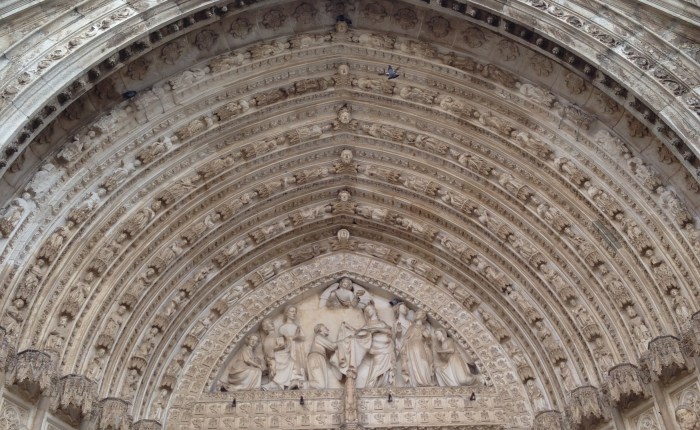
It is arguably not a rational question—maybe not even a real question at all—to ask “Why is there something rather than nothing?” In any case, it is unanswerable. But I still often find myself filled with wonder that I exist, that I can see and hear things, that I have an identity, and that I am a part of this whole universe, so exquisite and vast. Certain things reliably connect me with this feeling: reading Hamlet, looking up at the starry sky, and standing in the Toledo Cathedral. Because it is not rational, I cannot adequately put it into words or analyze it; and yet I think the experience of mystery and awe is one of the most important things in life.

Since it is just a feeling, there is nothing inherently rational or anti-rational in it. I’ve heard scientists, mystics, and philosophers describe it. Yes, they describe it in different terms, using different concepts, and give it different meaning, but all that is incidental. The feeling of wonder is the thing, the perpetual surprise that we exist at all. Campbell helps me to connect with and understand that, and for that reason I am grateful to him.

View all my reviews

Review: Publishing 101

Review: Publishing 101

Publishing 101Publishing 101 by Jane Friedman

My rating: 4 of 5 stars

I teach the rules, even though there aren’t any.

Several years ago I embarked upon a novel (my second; although my first attempt was so slapdash and haphazard that it hardly deserves the name). As it gradually took form, and draft after draft accumulated, the idea that I might actually do something with it appeared less and less absurd. But few things are more mysterious to me than the world of publishing. Every time I tried to investigate, a hornet’s nest of unfamiliar entities—agents, editors, query letters, submissions guidelines, genre, category, digital platform—swarmed and buzzed so menacingly until I gave up, overwhelmed. I needed someone to hold my hand, a Virgil to guide me through the several circles of pre-publication hell. That’s where Friedman came in.

Friedman has been in the publishing industry a long time, notably working as the publisher and editorial director of Writer’s Digest. Now she is perhaps best-known for her blog on writing advice. This book was made from that blog, stitching together the most popular posts since 2008 into a basic guide. In theory, you could get everything in this book for free by rummaging around her site. But the book is cheap on Kindle, so what the heck.

Friedman is a sober and pragmatic guide. This is what I like about her. She is not promising miracles, she knows that no approach will work for everyone (or even most people), she has no illusions about the failure rate. There is no magical thinking in this book, only cold and calculated strategies to incrementally increase your likelihood of success. Absent from this book are those “self-help miracle stories” that one so often finds in the writings of professional advice givers.

She is also a fountain of information. Here you will find advice on traditional publication, self-publishing, as well as ample instruction on digital marketing, online platform, and all the other things that keep me up at night. Indeed, Friedman is most enthusiastic and convincing when it comes to online self-promotion. This is unsurprising, since this was her main avenue of success. Still, I think many would-be writers will be surprised by how much of this book is given over to marketing rather than researching and contacting publishers. I know I was.

There is an awful lot of sales talk in this book. Trying to publish a book is, after all, just marketing a product (although I find it bemusing to consider my poor manuscript a commodity). And I must admit that all this talk of hard-selling, soft-selling, building a network, connecting with fans, and suchlike salesy things sometimes gives me a queasy feeling in my stomach. Many writers, I suspect, write to get away from all that, not to make it a permanent fixture in their lives. Writers are not known for being particularly social, suave, or business-savvy creatures.

Nevertheless I think Friedman’s advice is sane and sensible. Her main nugget of wisdom is that your online presence should not be forced or mercenary. Write a blog about something you care about; connect with people just for fun; do things that interest you and that are connected with your creative work. It takes patience and persistence to establish any kind of reputation, following, or clout, so you’ve got to see your digital activity as something rewarding rather than a chore. Easier said than done, I’m sure.

Like anything under the sun, this book is not without its flaws. The main flaw, as Friedman herself acknowledges, is that it was originally written as a series of blog posts. (At one point she says: “If I read a book and think ‘I could’ve gotten this from a series of blog posts,’ then I consider it a failure.” Luckily for her, I’m more lenient in this regard.) The writing is filled with lists, bullet-points, and a relentless stream of short paragraphs. Such writing works extremely well on a blog, of course, where most people are simply scanning for information; but in a book, it grows tiresome.

Another thing I missed was concrete examples. Friedman’s advice, though sensible, was often abstract; often I wished she would give me the story of an author she helped, or just a short vignette about someone who successfully implemented her strategies. I’m sure she has many such stories, and I wished she had used some of them, since they would have brought warmth and blood to potentially anemic advice.

There were also many times I was inclined to doubt her recommendations. For example, Friedman is very keen on authors having their own websites. Now maybe I am exceptional, but I have never, not once, visited an author’s website. Have you? Also, she suggests that you gather emails and send out blasts (not indiscriminately) when you have a big update. But again, I habitually delete all emails that aren’t work related or personal. Doesn’t everyone?

All these quibbles and queries aside, however, I think that this is an excellent book. Friedman is realistic, thorough, and businesslike, without sacrificing the raison d’être of writing: to create and to enjoy the process of creation. Unfortunately for me, I am now fairly convinced that my own poor manuscript hasn’t much commercial potential (but now that I see how brutal the publishing industry is, I’m not sure I mind). In any case, for those lost souls wandering around inferno, looking for the path to paradise, Friedman will be your guide. But be warned: a long climb up Mt. Purgatory awaits!

View all my reviews

Review: Pride and Prejudice

Review: Pride and Prejudice

Pride and PrejudicePride and Prejudice by Jane Austen
My rating: 5 of 5 stars

Jane Austen’s tools are tweezers and a nail file. Tolstoy built cityscapes; Dostoyevsky dug sewer systems; Joyce made funhouses; Kafka put up prisons; Cervantes created carnivals. Austen crafts ivory figurines, incredibly lifelike portraits that fit in the palm of your hand.

When you read Pride and Prejudice you see the novel in its barest form. Her prose has no pyrotechnics, her descriptions have little poetry. Word-play, fantastic events, bizarre characters, cliff-hangers, and elaborate plots are similarly absent. When you read this book you realize that these tools are not only unnecessary, but can distract from the craft of the novel.

In all of the annals of social science—the ethnographies of anthropology, the studies of sociology—there has never been an observer of social life more keen than Ms. Austen. What we have here is one of the best accounts of marriage customs ever written. That information alone would make this book invaluable.

But of course, this is no academic treatise; it is a novel, and a brilliant one at that. Unlike other authors, who use the dialogue to present information about the plot, for Austen the dialogue is the plot. It is a story of information and misunderstanding. Who thinks what, who knows what, who tells what to whom—all form the intimate tapestry of events that propel this book forward to its merry conclusion.

Austen also excels at omitting unnecessary information. She never tells instead of shows. She does not beleaguer the reader with descriptions of personalities, or even of appearances. Descriptions of setting are similarly kept to the barest minimum; in fact, they are almost apologetic.

The scenes of our greatest struggles and triumphs aren’t always aboard a whaling ship or before the gates of Troy. Sometimes they are conversations held over the soft plunking of a piano-forte

View all my reviews

Review: Writing to Learn

Review: Writing to Learn

Writing to Learn: How to Write--And Think--Clearly about Any Subject at AllWriting to Learn: How to Write–And Think–Clearly about Any Subject at All by William Zinsser
My rating: 3 of 5 stars

Humor is the most perilous of writing forms, full of risk; to make a vocation of brightening the reader’s day is an act of continuing gallantry.

Specialization inspires in me a certain existential dread. This is of two sorts. The first is the despairing thought that, by specializing, I will come to know only a certain, restricted corner of the vast universe. The second, more puerile fear is that, by becoming a specialist, I will commit myself on a path I won’t like very much.

Generalization is often, I suspect, motivated as much by fear of commitment as by humanistic curiosity. In Spanish there’s a word for a man who likes to sleep around—a picaflor—which conjures up the suggestive image of a bee going from flower to flower. Well, picaflores and Don Juans and Lotharios are generalists. Devoted husbands are specialists.

Promiscuity aside, we continue to do homage to generalists with our notion of the “Renaissance Man,” and the quintessential Renaissance Man was of course Leonardo da Vinci. His notebooks are filled not only with “art,” but studies of anatomy, light, physics, engineering, music, and so much else.

Last year I read a selection of Leonardo’s notebooks, hoping to find out how one man could tackle so many disparate subjects. My conclusion was that his versatility was due to the application of his medium: drawing. By making careful, detailed sketches of things—bees, bodies, bridges—he came to understand them. His pencil thus acted as antennae, with which he probed and investigated his world.

I thought: Could I do something similar? Certainly I have little talent as regards visual art. But I do have a verbal addiction. Perhaps I could use writing in a way similar to how Leonardo used sketching? Such an idea was hardly original. Soon I found out that Zinsser, the writing guru, already had a book about it.

The idea of reading another Zinsser book was not especially appealing. I had already read his popular book On Writing Well, and came away with a sour taste in my mouth. But if I was going to be the next Leonardo, I had to swallow some pickles. Dutifully I bought this book; and, after equally dutiful procrastination, I am here to tell you about it.

My first reaction is distaste. This is not entirely rational. Every good writer has what I call a “literary personality”—related to, but not identical with, their real personality—and I simply do not like Zinsser’s. I do not wish to spend time with him or to invite him to supper. I cannot really articulate why I dislike him, in the same way I can’t say exactly why I don’t like the sound of people eating apples. He’s a strong writer and I agree with much of what he says. He is thoughtful, curious, broadly educated, sensitive to art, music, and literature, and generally benign in his means and ends. When I think about it, I really ought to like him quite a bit. Yet I don’t.

Maybe this is because I object to the way he romanticizes his craft. Zinsser would have you believe writing clearly is one of the most difficult, dangerous, and distasteful activities in the world. It is so hard and so strenuous that it requires continual, backbreaking effort. Good writers are saints, many of them martyrs, including Zinsser himself: “I don’t like to write, but I take great pleasure in having written.” Zinsser makes very clear that his vocation is a heroic one, especially considering that he not only writes himself, but teaches it too:

Why, then, would anyone in his right mind want to be a writing teacher? The answer is that writing teachers aren’t altogether in their right mind. They are in one of the caring professions, no more sane in the allotment of their time and energy than the social worker or the day care worker or the nurse.

It takes serious audacity (to use a polite word) for a writing teacher to compare himself to a nurse. I also gag at this self-pity about the how hard it is to write well. Yes, it can be hard. Lots of things are hard. The only thing that sets writers apart is that they tend to whine the most eloquently.

Even when I put my personal dislike aside, however, I still must conclude that this book is disappointing. It begins with an unnecessary autobiographical section on Zinsser’s childhood education. (Considering how much Zinsser likes to talk about omitting unnecessary material, I found this especially ironic.) The rest of the book consists of long excerpts of what Zinsser considers to be successful examples of writing in different subjects, from anthropology to chemistry, from geology to mathematics. The book could easily have been an anthology, and probably should have been.

Most of what I wanted from this book is lacking. Yes, any subject can be written about engagingly—Zinsser didn’t need to prove this to me—but how do you go about doing that? Zinsser avoids the problem of methodology by insisting that good writing is learned by imitation. This is no doubt largely true; still I found it to be an abdication of this book’s promise: to give the would-be autodidact a strategy, or at least a few tips, for writing to learn.

Another serious omission is that Zinsser does not provide any concrete advice for teachers looking to apply this philosophy to their classes. There are a few reported examples of teachers who have done so, and a lot of hortatory passages about the benefits of “writing across the curriculum,” but very little in the way of concrete strategies for implementing this idea. As both a student and a teacher, I was irked by this.

Still, I suppose this book does have its value as a piece of propaganda. Zinsser is enthusiastic about writing, and his enthusiasm is contagious. For anyone skeptical that any subject—even chemistry, physics, or math—can be written well, or if you’re unsure whether writing can help you think and learn, you’ll find these doubts addressed here. For all its faults, this book does provide a glimpse of a compelling educational ideal: one that allows all of us to be picaflores in good conscience.

View all my reviews

Review: How to Meditate

Review: How to Meditate

How to Meditate: A Practical Guide to Making Friends with Your MindHow to Meditate: A Practical Guide to Making Friends with Your Mind by Pema Chödrön

My rating: 5 of 5 stars

Enlightenment isn’t about going someplace else or attaining something that we don’t have right now. Enlightenment is when the blinders start to come off.

When I was in high school, I spent a few years going to Tae Kwon Do classes. I was never any good. Every time we had sparring practice, I got whooped—that is, unless I accidentally kicked my opponent in the crotch (which I did a lot). But besides the fun of hand-to-hand combat, one thing that kept me coming back was the meditation. After every class, we would spend about ten minutes in a guided meditation. These were not easy. Most often, the master had us holding an uncomfortable or difficult pose, until all my muscles were quivering and shaking and I collapsed.

Sometimes all I felt was pain and struggle; but other times, something would happen. As I listened to the master talk about energy flowing through my body, I could actually feel it. I felt strange forces in my arms and legs, seeming to move through me. This was weird, since I didn’t believe anything the master was saying—at least not in a literal way. I didn’t believe in qi, or energy centers in the body, or any of that stuff; but I felt something, and it was interesting.

This experience left me with a lingering respect for and curiosity about meditation. A book by David D. Burns about anxiety recently reawakened this curiosity. As I read about Cognitive Behavioral Therapy, I kept thinking that it reminded me of what I knew (or thought I knew) about Buddhism. Besides that, Burns himself drew some parallels with Buddhism in his discussions of fear. So I decided to look into it. A Buddhist friend of mine suggested Pema Chödrön as a place to start; and this book, a practical guide to meditation, seemed perfect.

I was surprised by what I found. The type of meditation Chödrön advocates doesn’t involve holding difficult postures or enduring pain. You don’t even have to close your eyes. Instead, you find a spot, sit up straight, cross your legs (or don’t), and stay there, eyes open, breathing in and breathing out. You don’t focus on energy centers or the cosmic flow of qi. Instead, you just try to focus on your breath. You breathe in, breathe out, and try to keep your attention on the present moment.

I have been doing these exercises for a week now, and I can tell you that being present, focusing on the moment, is far more difficult than you’d think. My mind is like a boiling, bubbling cauldron. Memories randomly appear; fearful fantasies flash into being; my to-do list nags me; an itch on my head irritates; my leg’s falling asleep; a sound triggers an association; a smell makes me think of food; and spasms of impatience surge through me as the time wares on.

Meditation certainly hasn’t induced a Zen-like calm in me so far. But it says a lot that now I’m aware of all these things. Just sitting there noticing what happens in my head, and letting it all pass through me, has been tremendously interesting. I realize that my very brain is not totally under my control. Things are always happening in there, constantly, spontaneously, which draw my attention from the moment; and it takes effort not to get sucked in.

One of the things I like most about Chödrön’s approach is its versatility. You can make anything your object of meditation. You can focus on sounds, sights, tactile sensations, or the taste of an apple. You can focus on fear, anger, sadness, joy, on fantasies or memories. Anything in your life can be the object of meditation, as long as you use it as an opportunity to reconnect with the present moment. Meditation gives you the self-awareness—not through conceptual discussion, but first-hand experience—to learn what your mind is doing and how to interrupt your habitual patterns.

What I find especially appealing is the philosophy. Well, perhaps “philosophy” isn’t the right word; it’s more of an attitude or a mindset. Through the attempt to reconnect with the moment, you realize how much of your experience is transformed by the conceptual overlay you put on top of it. Our heads are full of judgments, opinions, beliefs. We are constantly telling stories about our lives, with ourselves as the protagonist.

Have you ever had an experience like this? When I was in college, I accepted a job doing surveys over the phone. But I was extremely nervous about it. I imagined respondent after respondent yelling at me, hanging up on me, and my manager angry at me and chastising me, and me having a breakdown and getting fired. This fantasy was so strong, I almost couldn’t make myself go to my first day of work. But when I finally did make myself go, shivering with fear, and when I finally made myself call, my voice quaking, I realized that I could do it. What seemed impossible in my imagination was easy in reality. In fact, I ended up loving that job.

This is what I like to call the “novelistic imagination.” Your mind is a natural dramatist—at least, mine is—and it can tell the most outrageous stories about your past, present, and future. But the interesting thing, I’ve found, is that we’re actually quite bad at imagining how things will be. We’re good at imagining possibilities—especially worst-case scenarios—but bad at imagining experiences. That’s because, when we use our novelistic imagination, we assume that life is a story with a beginning, middle, and end. But life is not a story: it’s a collection of moments. And the present moment is so different, and so much richer, than all the wild fantasies in our minds.

My hunch is that we evolved our novelistic imagination as a way of avoiding danger by running scenarios. “If I go so far away, maybe I won’t be back by sundown, and the hyenas over there might smell me, etc.” The problem is that this gets out of hand, which is why we humans get so many stress-related diseases—not to mention suffer from chronic anxiety. We developed the mental faculty to anticipate danger and avoid it; but we can’t turn it off, so we sense danger everywhere.

This is taking me pretty far from the book (so you know it’s a good book, because it’s making me think). I’ll only add that this book strikes me as an ideal introduction to meditation. Chödrön writes with warmth, humor, and understanding. She is brief and to the point, but you don’t feel that she’s leaving anything out. She is practical, encouraging, and inspiring. I encourage anyone whose curious to try it. You can be a Catholic, a Protestant, a Jew, a Muslim, or an atheist like me—it doesn’t matter. Meditation is not about believing certain things. To the contrary: it’s about getting past your beliefs about the world, and experiencing the world itself.

View all my reviews

Review: The Western Canon

Review: The Western Canon

The Western Canon: The Books and School of the AgesThe Western Canon: The Books and School of the Ages by Harold Bloom

My rating: 4 of 5 stars

Tradition is not only a handing-down or process of benign transmission; it is also a conflict between past genius and present aspiration, in which the prize is literary survival or canonical inclusion.

As far as I know, Harold Bloom is the last major proponent of the ‘Great Books’ paradigm of higher education. This makes him something of an apocalyptic prophet. With great solemnity, he predicted (this was in 1994) that the Western world was about to enter into a new cultural era, a new Theocratic Age, wherein dogmatism would drive out aesthetic criteria from literature departments. These new dogmatists Bloom dubs the School of Resentment—a catch-all term that includes Marxist, Feminist, and post-structuralist literary critics. All of these approaches, says Bloom, seek to replace an aesthetic motive for a social or political one, and thus miss the point of literature.

Bloom sets out to defend his familiar Western Canon, and does so by analyzing twenty-six writers to see what makes them canonical. Why do we keep reading Shakespeare, Dante, Cervantes, and Tolstoy? The answer, Bloom finds, is because these works are strange: “One mark of an originality that can win canonical status for a literary work is a strangeness that we either never altogether assimilate, or that becomes such a given that we are blinded to its idiosyncrasies.” Canonical works are those that are always beyond us somehow, those that are too rich, deep, and original to fully absorb.

How do artists achieve this exquisite strangeness? Bloom’s answer is that authors creatively misread the works of their predecessors to clear a creative space for themselves. This is Bloom’s famous anxiety of influence. Every writer feels anxiety about what they owe to their predecessors, so they attempt to find a weakness or a shortcoming—a place where there is still room for originality. But almost no author is original enough to outperform every one of their literary forebears. In Bloom’s opinion, there have only been two writers who have done so: Dante and Shakespeare. (I would add a few others to the list, personally.)

While Dante is given his due, Shakespeare is the real center of this book. Bloom is obsessed with Shakespeare: he worships him. For Bloom, Shakespeare invented the modern human. By this he means (I think) that Shakespeare’s characters redefined what we think of as personality and the self. Every writer since Shakespeare has so deeply internalized Shakespeare’s version of human nature that we can’t portray people in any other light. Shakespeare’s mind was too vast, acute, and convincing for us to get beyond it. Thus all writers after Shakespeare are forced to misread and misunderstand him in order to find a space for creativity.

Since Bloom thinks Shakespeare is so inescapably central, he discusses Shakespeare in every chapter—even the chapters on writers who predated Shakespeare: Dante, Chaucer, Cervantes, and Montaigne. But Shakespeare is not the only writer whose influence Bloom discusses. Bloom’s whole model of literary originality consists of reading and misreading, influence and anxiety, so he is constantly comparing and contrasting writers. One of his favorite activities is to trace out literary ancestries, saying which writer descended from which.

It is hard for me to know what to make of all this. I find Bloom’s model of the anxiety of influence really compelling. But it is clearly the theory of an avid reader, not a writer. As is obvious on every page, Bloom is obsessed with reading; so it’s natural for him to reduce the writing process to reading and misreading. Bloom’s approach also leads to a rather inordinate amount of name-dropping. He mentions scores of poets, playwrights, and novelists on every page, often in long lists, and sometimes this seems to be for purposes of intimidation rather than illumination. What is more, Bloom’s approach requires a great deal of comparing and contrasting between different authors, which can make it seem as though he is more interested in connections between authors rather than authors themselves.

Bloom’s writing style, while appealing, can also be off-putting. There is something incantatory about it. He repeats similar observations, drops the same names, inserts the same quotations, and asserts the same points in different contexts and to slightly different purposes. His mind seems always to be swirling and buzzing rather than traveling in a straight line. He also has the bad habit of arguing from authority rather than with reasons. His treatment of the so-called School of Resentment is dismissive at best. He does not address their arguments, but rather talks of them as lost souls, blinded by worldly things. Another fault is that he makes assertions about authors that are not properly substantiated. The most noticeable of these was his claim that all of Freud’s theories are contained in Shakespeare—something he says repeatedly, but never adequately demonstrates.

I found Bloom to be consistently good in his criticism, but not great. There are many excellent and thought-provoking observations about writers and books here. But all too often Bloom’s criticism consists of little more than repeatedly insisting that this author is one of the best. His belief is that aesthetic appreciation can’t be taught; thus if you are not so endowed, you simply have to trust Bloom that certain writers are better than others. To be fair I think it’s impossible to “prove” that Shakespeare is better than Dan Brown. Nevertheless, Bloom’s attitude of authority can be seriously disagreeable. To question the motivation of your opponents (which he does) and to position yourself as an oracle and a prophet (which he also does) are not healthy attitudes for an intellectual.

Despite all of these misgivings, however, I still largely agree with Bloom’s judgments. In my experience the writers in Bloom’s canon are in a league of their own for the depth of literary pleasure they can provide. And although I am not so convinced of the autonomy of the aesthetic, I also think that aesthetic criteria are ultimately the most important in literary judgments.

View all my reviews

Review: Conquest of Happiness

Review: Conquest of Happiness

The Conquest of HappinessThe Conquest of Happiness by Bertrand Russell
My rating: 4 of 5 stars

In adolescence, I hated life and was continually on the verge of suicide, from which, however, I was restrained by the desire to know more mathematics. Now, on the contrary, I enjoy life; I might almost say that with every year that passes I enjoy it more.


Like many people, I suspect, I find Russell an extremely agreeable person. And though he is, no doubt, several orders of magnitude cleverer than I am, I still identify very strongly with him. Perhaps this is only wishful thinking, but the more I read Russell, the more I find that, in outlook and temperament, I am rather similar to the man—apart from his aristocratic English manners, of course. Thus it was a pleasure to read his views on what makes for a happy life, as almost everything he said resonated very strongly with me.

Russell’s aim is to examine not extraordinary grief or mourning or tragedy, but the usual sort of unhappiness that Thoreau meant when he said “The mass of men lead lives of quiet desperation.” And Russell’s message boils down to something simple: happiness comes from taking a genuine interest in the world, and unhappiness consists in spending too much time thinking about oneself and one’s problems.

Here is a simple example. If, on my walk back from work, I run into my neighbor, who then proceeds to tell me—for the umpteenth time—about his recent hunting trip, I can choose to see it as an imposition on myself, a needless waste of my time, a sign of this man’s stupidity, and finally as a part of a general decline in good manners and good taste. Or I can, with any luck, choose to see it as an amusing foible, as a window into another person’s life, or at the very least as something absolutely trivial and not worth fussing about. The difference is that the first is self-centered and more than a bit unrealistic, while in the second scenario my attention is directed outwards and I maintain a sense of perspective.

Russell fills up a book by exploring this idea from a variety of angles. What are the emotions that focus our attention inward and cause us to lose our perspective and our zest for life? Envy, greed, guilt, ruthless competitiveness, the need for approval, fear of public opinion. To combat these pulls, Russell recommends ways to constantly remind ourselves that we aren’t, in fact, the center of the universe, and the world around us is not some backdrop for our problems or an obstacle in the way, but is rather extremely interesting and a good deal more important than our own lives.

One of Russell’s key strategies is to take an interest in things that have no practical benefit to us. Simple as this sounds, many don’t seem to understand this lesson. It always strikes me as bizarre and shortsighted when someone says, “Why should I learn about this? It doesn’t affect me in any way. Will this ever be useful?” But isn’t this the point? Learning about wildflowers, for example, is relaxing because you won’t have to rely on this knowledge to pass an exam or to get a paycheck; it’s a relief from your usual cares, and one that, besides, enriches your experience of the world. And not only does learning about wildflowers enrich your experience, but it also reminds you that there’s an entire region of reality—one that people have devoted their lives to—that will be completely unaffected if you go bankrupt tomorrow. Isn’t that a nice thought?

In some places, this book shows its age. Russell speaks of women in ways that would probably get him tarred and feathered now; though, to be fair, at the time he was considered extremely progressive. At another point, Russell partly blames the growing unhappiness of women on the decline in good domestic service. Yet these bits are easy to ignore and forgive; and much of the book still feels relevant. Russell is particularly good on envy, competitiveness, and workaholism. These three—very prevalent here in New York City—are deeply intertwined.

So many people—and I am not excluded from this—make themselves miserable by thinking about all the nice things happening to everyone else, all the money their cousin is making (who’s not, after all, any smarter than me!), and all the luck that some people seem to have. They look in the mirror and think about the handsomer fellow on television; they receive their paycheck and think about how much their boss must make. This has been exacerbated by social media, but is, I think, something we all must deal with, especially in a capitalistic society where, ostensibly at least, your social position is determined by your own merit. The dark side of living in a supposed meritocracy is that people at the bottom or even comfortably in the middle feel that they are failures for not reaching the top—which is obviously absurd, especially if you realize that the people at the top most likely aren’t any happier than you are.

Thinking about yourself purely in relation to others leads directly to a certain amount of competitiveness; many people struggle, not to attain something they need, but simply to win a race against their peers. This is the cause of obsessive working. Now don’t get me wrong, there’s nothing wrong with working, and working hard, but some people have completely lost a sense of perspective. In fact, I recently read a piece by someone who had spent his life in advertising—Lind Redding was his name—who detailed this very phenomenon after he was diagnosed with cancer and started looking back on his working life. After working furiously for decades, he concluded that, after all, he was only trying to make advertisements, so why on earth had he spent so many stressful hours at the office rather than at home?

This has happened to me, though on a much smaller scale, when I have been convinced that what I was working on was terribly important and that the consequences for not doing it perfectly would be disastrous—when, in reality, what I was doing was of no importance and the consequences of doing it imperfectly would be nonexistent. A proper sense of perspective would have helped me avoid this, for I would realize that other people’s success doesn’t make me a failure, that I have more than I need already, that my task is a very minor event in the universe, and that the earth won’t detonate if every detail isn’t just right. Or at least, I hope it won’t.

I’m getting a bit carried away. To return to the book, Russell, with his usually acute mind, tackles this trouble, among others, offering friendly advice on how to avoid it and to maintain a mental balance. And lucky for the reader, Russell’s advice is usually summed up in wonderful epigrams that sparkle with good-natured wit. I constantly found myself highlighting sentences in this book, as I read in continuous astonishment at Russell’s skill with the pen. His style is neither flashy nor even conspicuous; he uses no tricks, no elaborate metaphors, no high-flown words. Yet every time I read Russell, I find myself filled with envy at his writing ability; I think it’s criminal that there should be someone so much better than I am. Russell would, of course, remind me that after all there will always be someone who’s a better writer than I am, and that his prose should be appreciated as a gift rather than considered as a reproach to my own. Now, how do you argue with a person like that?

View all my reviews

Review: The Lessons of History

Review: The Lessons of History

The Lessons of HistoryThe Lessons of History by Will Durant
My rating: 2 of 5 stars

I’m having trouble articulating the complex mix of opinions and emotions that I’ve formed around Durant. Several times I have come away from his books disappointed; and yet I continue to read them. One reason he fascinates me is that he is a species of American which is now almost entirely extinct: a product of the ‘Great Books’ paradigm in American higher education.

As far as I can tell, this paradigm in education was first popularized in 1909, when Charles W. Eliot released his Harvard Classics—the so-called Five-Foot Shelf—which consisted of 51 volumes of classic works from western history. The spirit of this idea was later epitomized in the Book-of-the-Month club, about which Bertrand Russell, writing in 1930, penned his famous line: “There are two motives for reading a book: one, that you enjoy it; the other, that you can boast about it.”

It was certainly a different time. The philosopher George Santayana and the historian Arnold Toynbee were bestselling authors, both featured on the cover of Time magazine. Will Durant, whose prose style strikes the modern ear as purple and grandiloquent, created a publishing sensation with his Story of Civilization, a series which totals four million words and ten thousand pages. And the monstrously big, 54-volume Great Books of the Western World sold thousands of copies—thousands!—even though it included works of Alexandrian astronomy, Greek mathematics, and German metaphysics, among other difficult material. One suspects that the bragging motive was the operative one in the majority of these purchases.

The spirit of the ‘Great Books’ paradigm is that of idolatry towards European intellectual history. The tone of its advocates often sound ludicrously reverential, such as this excerpt from a speech delivered on the occasion of the release of the Great Books series: “This is more than a set of books, and more than a liberal education. Great Books of the Western World is an act of piety. Here are the sources of our being. Here is our heritage. This is the West. This is its meaning for mankind.” (I got that from Wikipedia, by the way.) As two World Wars wracked the European continent, and as the fear of communism and nuclear war covered the Western world with gloom, perhaps it is unsurprising to see American intellectuals and laypeople positioning themselves as the heirs of European civilization.

This idea held sway for a long time in American Universities, and perhaps isn’t altogether dead. The swan songs of this pedagogical philosophy can be heard in Allan Bloom’s The Closing of the American Mind (1987) and in Harold Bloom’s The Western Canon (1994), wherein both authors lament and eulogize the disappearance of the ‘Great Books’ from American universities.

Educated at Columbia during the heyday of this phenomenon, Durant was formed by the ‘Great Books’ ethos, and perhaps was one of its most eloquent proponents. And it strikes me now that, in Durant’s writings, one finds both the virtues and the vices of the ‘Great Books’ idea illustrated with extreme precision.

Durant was broadminded and well-rounded; he could write ably about a multitude of subjects. He was tolerant, kindly, sometimes witty, with a firm belief in human progress and achievement. His prose style was superb—a model of clarity and grace—which he used in his quest to disseminate as widely as possible the fruits of “Civilization” (his all-inclusive term for everything good in the West). Neither a genius nor a scholar, Durant was an enthusiast: he was able to write so wonderfully about historical figures because he genuinely loved and revered them; in fact, he almost literally worshiped them, as he himself admitted.

But he also had many weaknesses. First, the ‘Great Books’ mindset caused Durant to concentrate his attention overmuch on the high-points in cultural achievement. One gets an extremely skewed picture of European history if one focuses solely on the greatest thinkers and artists. Of course, it’s pleasant to contemplate these individuals, which is partly why Durant’s books are so fun to read; but such exclusive concentration also produces a kind of Pollyannish attitude, where history is seen through rose-tinted glasses, and persecutions, wars, and bigotry are not given their due—and the banality of daily life is wholly sidestepped.

A related consequence of the ‘Great Books’ attitude is a somewhat reactionary mindset. Since Durant so often equates the old with the good, tradition with right, age with quality, he can be remarkably, and sometimes stupidly, conservative. For example, whenever Durant writes of sexual mores, he comes across as a moralizing Sunday-school teacher. For Durant, promiscuity is immoral, and homosexuality a sin. Long-term, faithful heterosexual marriages are the mark of ‘civilization’. Because Durant never justifies this opinion—a habit of his—I can only conclude that this was mere prejudice on his part.

Another obvious result of the ‘Great Books’ philosophy is elitism. Durant frequently mentions in this book that talent is unequally distributed; and because of this “natural inequality of man,” the stupid majority are destined forever to toil under the dominance of the intelligent minority. Now, of course I wouldn’t disagree that people are differently endowed from birth with various aptitudes. But I’m very far from believing that the inequality which we see throughout history and which persists today is simply the result of the “skill” of the wealthy and powerful. Rather, I agree with Gibbon, that “The generality of princes, if they were stripped of their purple and cast naked into the world, would immediately sink to the lowest rank of society without a hope of emerging from their obscurity.”

The ‘Great Books’ program also has the shortcoming of emphasizing breadth over depth. Durant certainly embodies this. Although he can write about many subjects, he is an expert on none of them; and this lack of serious expertise prevented him from advancing the state of knowledge in any field. Durant’s ideology also privileges the transmission of old ideas rather than the creation of new ones. After all, if one worships the past, there is little motivation to re-imagine the future. Moreover, the ‘Great Books’ doctrine stressed reputation at the expense of rigor. Ideas are praised for their lasting influence, their grandness of scope, their contribution to a long-standing debate—but not for their accuracy. In Durant, this produced a man who often cared more about whether an idea was beautiful or interesting rather than whether it was true.

Fueling this tendency is another shibboleth of the ‘Great Books’ school: that simply by reading the greatest books of the ages, one could purge oneself of all provincial prejudices and look upon history as from a timeless perspective. Durant seems to think this way, as the very title of this book shows: The Lessons of History. These conclusions are not his own theses, not his own ideas—but lessons, which Durant can gather from the fabric of history as easily as a child can infer the lesson from a fairytale. It goes without saying that this is nonsense. Durant looked at history and found his own prejudices; and this book is merely a collection of them.

I’m sure you’re wearied by this litany of accusations and complaints, so I will only mention in passing the other distinctive sins of this ‘Great Books’ mindset—namely, its glorification of Europe, and only Western Europe, at the expense of the rest of the world, as well as its underrepresentation of women and minorities. This is wonderfully illustrated in Durant’s plan of the Story of Civilization, wherein he dedicates one volume to all of Asia, and the rest of the eleven volumes to Europe (and none to South America or to Africa).

At this point you may be wondering, “If Durant has so many faults, which you are apparently so acutely aware of, why are you reading so much of him?” Well, this has to do with my own history. At the end of my time in college, vaguely feeling that the education I received wasn’t worth half of what I paid for it, I picked up Allan Bloom’s Closing of the American Mind. This book had a profound effect on me. Bloom seemed to articulate my dissatisfaction with my education, as well point me in the direction where it could be rectified. As soon as I finished, I looked up the list of the Great Books of the Western World, and dove in.

Now, despite all of the faults I listed above, I must still admit that one receives a stupendous education by reading the books recommended in the program. I read rabidly, desperately, doing my best to make up for lost time; and whatever may be my intellectual shortcomings now—and they are many—I am at least far better off than I was before I began. But of course I still haven’t read all of these hoary books—there are a lot!—and this is partly why I’m interested in Will Durant: for in him, I can see the end result of my own educational project.

Unfortunately, while Durant was truly an excellent writer, for the reasons I discussed above, he was a poor thinker. This slim volume, the fruits of a massive research project, is a collection of vague homilies, baseless theorizing, and unsupported claims. It’s incredible and a bit depressing that so much learning could produce so little insight. I still think I have much to learn from Durant and the other proponents of the ‘Great Books’ school—as well as from the books themselves, of course. But now, hopefully, after sorting through Durant’s writings, I will be better able to separate the good from the bad, the worthless from the valuable; for I do think, after all, that there is something essentially precious in the idea.

View all my reviews

Review: When Panic Attacks

Review: When Panic Attacks

When Panic Attacks: The New, Drug-Free Anxiety Therapy That Can Change Your LifeWhen Panic Attacks: The New, Drug-Free Anxiety Therapy That Can Change Your Life by David D. Burns

My rating: 5 of 5 stars

I have always been an anxious person. I think I get it from my mother.

One time, we were in the car on our way to the supermarket when, for whatever reason, she asked if I had my license on me. “No,” I said. “Why do I need it? You’re driving.” “But what if we get into an accident?” she replied. At first, this response confused me. Then I realized that she was wondering how people would identify my body if we both died in a crash. “I think they’d figure it out,” I said finally, as scenes of bloody car crashes played in my mental theater.

This anxiety was part of my identity. It shaped how I interacted with strangers, my friends, my family, how I behaved in school, at work, and in my relationships. I thought it was a part of me. Sometimes I would have episodes when my worrying would flare up to the point that I was incapacitated; but for the most part it was manageable. Around last year, however, my panicking got decidedly worse. Terrible fantasies would flood my brain, making my chest tense up, my stomach tie itself into a knot, and adrenaline rush through my body. After another attack again this year, I decided that I didn’t want anxiety to be such a big part of my life anymore, and thus reached for this book.

Burns begins with his general views on anxiety. He doesn’t believe in anxiety disorders. The criteria for diagnosis are, he thinks, vague and arbitrary. There are people who tend to be more anxious than others; but anxiety-proneness falls onto a spectrum and does not map onto two neat categories, normal and pathological. Burns also has a negative opinion of anxiety medications. In his experience, they often don’t work and generally leave the underlying cause untouched. Thus he thinks it’s more effective when people don’t tell themselves that they’re “sick” and don’t treat anxiety like a disease to be cured. Rather, anxiety is a common state and it can be effectively managed through fairly simple techniques.

After explaining his general views, Burns launches into his techniques. These techniques occupy the bulk of the book, and are divided into three categories, Cognitive, Exposure, and Hidden-Emotion.

The Cognitive techniques were the most familiar to me, since this is the same approach used in his book on depression, Feeling Good. As the name implies, these techniques focus on your thoughts and beliefs. Anxiety, in this view, is the result of unrealistically negative thoughts which are traceable to certain deeply held beliefs. Burns calls these beliefs self-defeating, because they equate certain things with happiness, and yet inevitably lead to unhappiness. These self-defeating beliefs may be personal—such as perfectionism or achievement addiction—or interpersonal—such as entitlement or blame. The techniques thus focus on these beliefs and the thoughts they give rise to, with the goal of adopting a more realistic, forgiving, and easygoing attitude towards yourself and others.

Exposure techniques operate on a different principle. Instead of combating your anxiety, you seek it out and embrace it. For people with phobias, this means doing exactly the thing they’re afraid of. For people with traumatic memories, this means revisiting these experiences. For people who are shy, this means socializing. If you run away from what you fear, you only tell yourself that you ought to fear it; but if you confront it, you can find out that there’s nothing to be afraid of.

The Hidden-Emotion technique is based on still another principle. It holds that anxiety results when people sweep negative emotions—like frustration, anger, or hatred—under the rug. This most often results from “niceness”—the fear of upsetting anyone or even admitting to yourself that you’re upset. It is not that the negative feelings are consciously shunned, but that they are not consciously registered at all. Thus the technique consists in examining your life—not your childhood, but right now—and looking for things that bother you that you’ve been ignoring.

By the end of the book, Burns has explained 40 techniques. He includes so many because nobody can be sure which technique will work for which person. His treatment plan consists of trying these techniques one after the other until you find one that’s effective. In his experience, it can be very difficult to predict which one will work in any given case, so he encourages you to experiment.

I can’t summarize each of his techniques here, but I want to include just a couple examples of cognitive techniques.

One technique is thinking in shades of grey—that is, avoid essentialism in your self-talk. This sounds simple enough, but I’ve found that most people tend not to do this. For example, if a guy is trying to quit smoking, but he only lasts three months, he might conclude “I’m a failure.” Yet it would be more realistic for him to say “I was successful for three months, and then I relapsed. Maybe I can be successful for longer next time.” That’s both more accurate and more encouraging.

Also useful is the double-standard technique. If you’re having a problem and beating yourself up, ask yourself how you’d treat a friend who was having this same problem. Often you’ll find that you’re much more compassionate, understanding, and optimistic with your friend. Once you realize that, try talking to yourself the same way. If you do this, you can respect yourself in good times and bad, just like you respect your best friends, rather than beating yourself up for falling short, failing, being rejected, or getting criticized.

You may be thinking that these “techniques” are childishly simple. Indeed they are. And yet I was acting in the very opposite way, and without this book I don’t think I would have changed. Besides, simplicity is a good thing. The techniques don’t require you to believe anything untenable or subscribe to a new philosophy of life. They only require that you do some work with a pencil or paper, or try a new approach in conversation, or get over a fear that’s been holding you back. They allow you to understand and confront your emotions rather than be their victim.

That’s all for my overview. I could stop here with the note that I’ve found the book extremely helpful, indeed emancipating. But it is hard to write reviews of self-help books without lapsing into autobiography—at least for me it is. Well, here it goes.

The biggest realization I had while reading this book is that much of my anxiety resulted from being out of touch with my emotions. I think Burns would say I had emotional perfectionism, and thus swept a lot of negative feelings under the rug. But lately some kind of interior barrier broke. I suddenly realized that I was sad, and I cried for the first time in many years. It was a huge relief! Now even children’s movies are enough to set me off. I watched Inside Out on the plane ride back from Spain and ended up in tears. My girlfriend was absolutely shocked.

My other main lesson from this book is that fears have to be faced, not shunned. Instead of trying to push away my anxiety—resulting in endless struggle—now I just let it do its work. And the strange thing is that as soon as I stop resisting, the anxiety loses its grip.

To reinforce this lesson, I decided to confront one of my oldest fears—roller coasters. I went out to Coney Island and rode three of them.

When I was a kid, I went on a few roller coasters and hated it. Looking back, I think that’s because I mentally resisted the experience. I kept wishing to stop and get off, and simply wouldn’t accept the fact that I couldn’t do anything but sit there. This time around, I was scared, but instead of resisting it I told myself that there’s no getting off so I might as well try to enjoy it. That made all the difference. The ride itself was actually fun, and not terribly scary. The only difficult part was making myself get on.

And I realized that roller coasters provide a perfect metaphor for anxiety. If you resist the experience and try to wish it away, it’s only going to seem terrifying, pointless, and dangerous. But if you accept the experience and embrace it, you’ll find that it’s harmless fun.

So treat fear like a roller coaster that you can’t get off. Accept the things that scare you, accept your fear, and accept the insecurities, limitations, and imperfections that make you afraid. You can’t wish them away, so you might as well have some fun.

IMG_5621

View all my reviews