Review: Moorish Spain

Review: Moorish Spain

Moorish SpainMoorish Spain by Richard Fletcher

My rating: 4 of 5 stars

Nostalgia is the enemy of historical understanding.

After reading and being disappointed with Menocal’s famous book on Moorish Spain, The Ornament of the World, I decided to take another crack with this book. And I am happy to report that Fletcher’s book is much better.

While Menocal is wistful and romantic, Fletcher is more detached and occasionally wry. While Menocal hardly acknowledges her sources, Fletcher is usually careful to note where he is getting his information from, even if this book lacks a scholarly bibliography. I found this a great relief, as I have been discovering that Moorish Spain is one of the most persistently mythologized periods in history. Washington Irving set the tone for this in his Tales of the Alhambra, but other writers have been following in his romantic footsteps ever since. Thus Fletcher’s dispassionate treatment was refreshing.

The main drawbacks of this book is that it is too short, and too scholarly. Fletcher was explicitly aiming for a popular audience, but the book he wrote would be better suited for an undergraduate class than a tourist. You cannot, for example, find many good vacation ideas in these pages; indeed, if this was your introduction to Moorish Spain, you might not even want to travel there at all.

Instead of focusing on intellectual and cultural history, the majority of this text deals with political and military history—the invasions, battles, territorial expansions, and so on. Admittedly, Fletcher also quotes poems, autobiographies, and includes pictures of famous buildings; he even has a whole chapter on the relations between Christians and Muslims during this time. But this information jostles for space among dozens of unfamiliar names of rulers who I do not much care to remember. Probably, if he wanted a better-selling book, he could have bot expanded it and included more of a personal touch. He is a fine writer and rather opinionated, so it would have served him well, I think, to have written something less formal.

In any case, I doubt there are any better books on the market for the history hungry tourist visiting Andalusia. This book will give you an overview of the period, and in the process inoculate you against much of the nonsense that gets thrown around about al-Andalus. It was not a paradise of tolerance, nor was it a perpetual war of faith against faith. As Fletcher said: “The past, like the present, is for most of the time rather flavourless.”

View all my reviews

Review: Julius Caesar, by Shakespeare

Review: Julius Caesar, by Shakespeare

Julius CaesarJulius Caesar by William Shakespeare
My rating: 5 of 5 stars

Why, man, he doth brestride the narrow world like a Colossus, and we petty men walk under his huge legs and peep about to find ourselves dishonorable graves.

One of Shakespeare’s best, this play is also, I think, one of his most morally ambiguous. The central question of the play—was it right to have killed Caesar?—is left unresolved, principally because of the complexity of the protagonists.

The play opens with Cassius persuading Brutus to act against Caesar. This monologue, though eloquent, is also somewhat confusing, perhaps even incoherent. The reasons Cassius avers for wanting Caesar dead are all petty and somewhat beside the point. Cassius hates Caesar, but why? Because once Caesar faltered while swimming the Tiber? Or because Caesar once had a cold? Of course, these examples are only meant to show that Caesar is a mere man, and thus does not deserve to occupy such a high eminence. And yet, this same argument—namely, that human weakness makes everyone equal—can be used against any form of inequality, be it wealth, power, or prestige; and communism is certainly not what Cassius is preaching.

True enough, word later comes that Mark Antony offered Caesar a crown, which would threaten the very existence of the Republic. But there is nothing in Cassius’s words or deeds that reveal him as someone motivated by political philosophy. Rather, he is a sensitive man, easily insulted, with a delicate ego; and his emotional episode in Brutus’s tent also reveals him to be needy and high-strung. There is nothing evil in him, nor even overtly malicious; but he is not like Brutus, a man of principles, honor, nobility. Thus I cannot help concluding that his plot against Caesar was mainly motivated by petty emotions, even if Cassius told himself otherwise. He felt envious of Caesar’s power, slighted at having a superior, fearful of future humiliations.

All this is more or less apparent in Cassius’s speech to Brutus. From the start, therefore, it should have been apparent to Brutus that he was allying himself with men acting from a suspect motive. But perhaps Brutus is too good-hearted to question the motivations of his friends. Indeed, throughout the play, Brutus is shown to be ethically unimpeachable, a purely noble and righteous person. Even his enemies admit it. And given that he talks the most and dies last, many have argued that the play should be entitled Brutus and not Julius Caesar, since the latter has few lines and dies halfway through.

It is, indeed, tempting to see Brutus as the tragic hero, trying to do what is right, brought down by circumstances. But I have trouble taking his side completely.

For one, it seems foolish to have let himself be persuaded by Cassius. The assassination was rash, and they had no plan whatsoever for restoring order once the deed was done. It also struck me as hypocritical, to say the least, to march through the streets yelling “Liberty! Freedom! Tyranny is dead!” since, at best, the conspirators restored an oligarchy of hereditary privilege. I am not convinced that the life of the common people was any better under the Senators than under Caesar.

Brutus also has a tendency to act imprudently, which is arguably his fatal flaw. First, the assassination plot itself—specifically the plan for restoring order—should have been more carefully considered. Brutus’s oration to the Roman people after the assassination is evidence that his rationales were not given enough thought. He cites “ambition” as the reason Caesar had to be killed, but does not clearly show in which of Caesar’s actions this ambition was manifested. This makes it very easy for Mark Antony to refute the charges. Brutus should have foreseen this, which is why it was the height of folly to have let Mark Antony give that oration. Besides all this, he shows himself to be a poor general.

Brutus’s personal honor code, while earning him respect, also handicaps him. For one, as noted, his tendency to trust others make him a poor judge of character. More troublingly, in attempting to set himself up above petty emotions, he renders himself inhumanly cold. Cassius, though oversensitive, is right in rebuking Brutus for attempting to see the vices and virtues of a friend with an unprejudiced eye, rather than overlooking Cassius’s faults. More significantly, Brutus’s attempt to rise above the grief of his wife’s death lowers him instead, turning him into a mere empty shell motivated by an honor code that brings nobody happiness, not even himself. For these reasons, I feel sad at his loss, but I also feel that he had it coming.

Mark Antony has some of the marks of a villain, who vows revenge even if he drags down all of Rome in the process. He is also not terribly likeable, being arrogant to others and fawning to Caesar. But he has redeeming qualities. His love for Caesar, while at first apparently sycophantic, is later shown genuine. The praises of a living commander are always suspect, but the praises of a departed one are honorable. Mark Antony is also not insensitive to the virtues of Brutus, even praising his memory. He fights for vengeance, true, and vengeance is always ethically suspect; but Hamlet fought for vengeance, and that does not make us like him any less.

In sum, it is difficult to see either Cassius, Brutus, or Mark Antony (or Julius Caesar, for that matter) as unambiguously right or wrong. They are rather three imperfect individuals, with different faults and strengths, who all fight in good faith for what they believe is right.

To acknowledge the faults in these characters, and yet portray them as acting sincerely, is a demonstration of the genius and the nobility of Shakespeare. For the quality Brutus most lacked was the one Shakespeare had in superabundance: empathy. As this play demonstrates, he could acknowledge a person’s faults and limitations while also understanding that, from their point of view, what they were doing was perfectly right. And therein lies both the secret of his art and the moral value of his works.

View all my reviews

Review: The World at War

Review: The World at War

The World At WarThe World At War by Mark Arnold-Forster

My rating: 5 of 5 stars

Consisting of 26 episodes, each about 50 minutes long, The World at War traces the history of the Second World War from its pre-War beginnings to its aftermath. The program is remarkable in scope, covering the relevant political history of the United States, England, Germany, and Japan; the war efforts in north Africa and southeast Asia; the Russian and the Western front, as well as the final push against Japan; the bombing campaigns and their effects on civilian life; the struggle of the Allied shipping fleet against the German U-boats; the final peace negotiations in Europe and Asia, and the concomitant haggling between the U.S.S.R. and the West; the horrors of the Holocaust; and much else.

But the series has depth as well as breadth. There are hours and hours of archival footage—of battles, bombings, bombardments, protests, speeches, life on the front line, civilian life, negotiations, military parades, invasions, celebrations, triumphs, massacres, tragedies—much of it never used before, unearthed by the program’s research team.

Even more impressively, there are hours of interview footage, from from Poles, Russians, French, Germans, English, Americans, Japanese. There are interviews of gunners, tank crew, infantrymen, sailors, pilots; interviews of housewives, firefighters, barmen, taxi drivers; as well as from politicians, advisors, generals, and even Hitler’s personal secretary and chauffeur. Considering that these interviews were made specifically for the series, from people directly involved in the action, this makes the raw footage (most of it unused) a valuable primary historical document. And this is not to mention the wonderful narration by Laurence Olivier, which is always tasteful, often moving, and sometimes chilling.

In short, the documentary is a masterpiece, bringing the drama of the war to life while also being supremely informative. If you want to watch any documentary about World War II, make it this one.

To speak personally, watching this documentary had a strange effect on me, because it made me realize how much my perspective has changed since I was a kid. Back then, I used to watch World War II documentaries because the war seemed like a comic book. It was a story with clear bad guys and good guys, and the good guys won in the end. It was a story of personal heroism and bravery, of self-sacrifice and honor, of hardships endured and battles fought for the greater good. I was even fascinated with the military technology, the tanks, war planes, battleships, and guns. I remember going to the military museum at West Point, and seeing replicas of the nuclear bombs used on Hiroshima and Nagasaki. There was something undeniably awe-inspiring about the ability to create so much destruction, to wield so much power.

This time around, I had a different reaction. The more I watched, the more I became overwhelmed with a sense of pointless loss, destruction, and violence. Millions of young men marching off to shoot other young men, and for what? Towns blown to pieces, cities burned to the ground, and, most of all, countless lives lost. People shot, stabbed, drowned, burned; people executed by firing squad, hanging, the gas chamber. Beaches filled with bloated bodies, corpses rotting in the road, the remains grandmothers and children buried under piles of rubble. And it just kept going, the planes kept dropping bombs, the men kept throwing grenades, the tanks kept rolling on. By the end of the series, every episode made me feel sick.

When you see the numbers of the dead, it’s easy to grow numb. The totals become mere, meaningless statistics. But when you realize that those millions were composed of individuals, people with their own favorite song to whistle, shade of blue, local restaurant, people with their own quirks of personality, their own flaws and virtues, people who were loved and who loved in return, people who might have done anything had they survived the war, the enormity of the tragedy dawns on you. No matter what the aggressors hoped to gain from the war, no matter how glorious it seemed, it could not have been worth it.

The documentary does not shy away from the horrors of war, but dwells on them, and for good reason. For if there is any lesson to be learned from World War II, it is simply this: We must do everything in our power to avoid repeating that catastrophe.

View all my reviews

Review: The Renaissance, by Walter Pater

Review: The Renaissance, by Walter Pater

The Renaissance: Studies in Art and PoetryThe Renaissance: Studies in Art and Poetry by Walter Pater
My rating: 4 of 5 stars

That it has given a new sense, that it has laid open a new organ, is the highest that can be said of any critical effort.

I had no idea what to expect from these essays. The only reason I became aware of Pater was because a copy of this book was sitting on the bathroom floor in my friend’s father’s house. Since my friend’s father is a successful painter, I naturally took note of a book about art so intimately placed. Much later, after finishing Burckhardt’s famous analysis of the Renaissance, and with my trip to Rome looming, I decided that I would finally see why a painter sought out this book for his bathroom inspiration.

Pater was an idiosyncratic fellow, and these essays certainly reflect that. Some of the topics he covers are expected: Botticelli, Michelangelo, Leonardo da Vinci. Others are more surprising: Joachim du Bellay, a Frenchman who wrote a defense of the French language; two medieval French stories about love and adventure; and Johann Winckelmann, the 18th century German classicist. Clearly, Pater’s conception of the Renaissance was far broader than Burckhardt’s, who considered the Renaissance a strictly Italian affair. Also broad is Pater’s conception of criticism: for him, it is not merely a vocation, but an entire philosophy of life.

I am referring specifically to the famous “Conclusion” that is tacked on to the end of these essays. In it, Pater puts forward a whole aesthetic philosophy of life: Everything is in flux; both matter and mind are temporary; the only thing we have is the moment; and since death may come at any time, and will come inevitably, the only rational response is to enjoy this moment as best you can. Now, some thought that Pater was advocating hedonism, but that is far from the case. He was, rather, an aesthete; and for him, “enjoying the moment” meant finding the most beautiful shade of green in a field of grass, or observing the play of light on a windowpane—that sort of thing. The ability to be constantly, delicately, indefatigably absorbed in one’s senses, and yet have the focus and taste necessary to select from these perceptions the most lovely, is what Pater meant with his famous suggestion to “burn always with this hard, gemlike flame,” which for him is “success in life.”

At times, the age of these essays showed. This was most conspicuous in Pater’s essay on Giorgione, in which he bases his whole appreciation on one painting, elevating it to the height and epitome of Giorgione’s aesthetic—a painting which is now believed to be by Titian. But for the most part, the essays have retained their force and interest. Indeed, you may not realize how original this book was, since it anticipated and shaped so many of our attitudes about art and the Renaissance. To pick just one example, Pater’s discussion of the Mona Lisa, dwelling on her mysterious smile, certainly helped spur on our fascination for that work.

Nevertheless, I am unsure whether Pater actually deepened my appreciation for the Renaissance works he discussed. This is due, I think, to his ideal of the critic: to be acutely sensitive to the power of art, and to be finely discriminating of what is more or less beautiful. Sensitive and discriminating Pater certainly is. (Several times I wondered if he passed out while writing his essays, since, judging by his breathless and insistent tone, he was always to be right on the cusp of a brilliant epiphany or a transcendent experience. It must have been exhausting.)

But notice was is lacking from his ideal of the critic: to analyze, to discuss, to inform. The critics who have most helped me appreciate art are those who taught me about the painting the artist; who showed me what to look for, how best to situated the painting within a certain context; in short, who pulled me into the world of the painting. But since Pater holds up sensitivty and discrimination as ideals, he is faced with the problem: how does one communicate those qualities, which are personal, to somebody else? To do this, he resorts to writing long rhapsodies, reveries, aesthetic ecstasies about the works under consideration. These passages are almost uniformly brilliant, often breathtaking. Nevertheless, it felt more like watching Pater look at a painting, overhearing the thoughts and associations the painting inspires in his brain, rather than learning how to appreciate the painting myself.

I cannot finish this review without discussing Pater’s prose. He is considered to be one of the great stylists, and this reputation is well deserved. The man was such a brilliant writer that it often seemed irrelevant what he was writing about; he could write an essay on the underside of a mosquito and it would be good literature.

This is not to say that he has no limitations. Most conspicuously, he has not even a trace of the epigrammatic. If a point can be made in ten words, Pater will give you fifty, though those fifty will be as finely crafted as a Baroque statue. His sentences never arrest you or stop you short, but rather overwhelm you, burying you under a pile of clauses, metaphors, images, until you’re short of breath and so dazzled that it seems someone has shone a flashlight in your eyes. Comparisons with Proust and Woolf, especially the latter, come readily to mind; but Pater has a manic insistence that makes his writing uniquely urgent.

Another limitation is that Pater seems incapable of that kind of easy grace, that effortless virtuosity, which many of the greatest writers display. Rather, his prose strains every nerve, exerts every muscle, panting and sweating as it pushes itself onward. This impression is, apparently, an accurate one: According to Wiki, he obsessively polished, tweaked, and rewrote his works, until every word, every sentence, every paragraph was just to his taste. This makes his prose like a super-ornate jewel, breathtaking in its designs, its symmetries, and its technical daring; yet for all that rather delicate and precious, and inevitably a bit ostentatious.

I will leave you with a passage from his essay on Michelangelo:

And of all that range of sentiment he is the poet, a poet still alive, and in possession of our inmost thoughts—dumb inquiry over the relapse after death into the formlessness which preceded life, the change, the revolt from that change, then the correcting, hallowing, consoling rush of pity; at last, far off, thin and vague, yet not more vague than the most definite thoughts men have had through three centuries on a matter that has been so near their hearts, the new body—a passing light, a mere intangible, external effect, over those too rigid, or too formless faces; a dream that lingers a moment, retreating in the dawn, incomplete, aimless, helpless; a thing with faint hearing, faint memory, faint power of touch; a breath, a flame in the doorway, a feather in the wind.

View all my reviews

Review: Introductory Lectures on Psycho-Analysis

Review: Introductory Lectures on Psycho-Analysis

Introductory Lectures on PsychoanalysisIntroductory Lectures on Psychoanalysis by Sigmund Freud
My rating: 4 of 5 stars

The medulla oblongata is a very serious and lovely object.

When I was in college, I used to get in long and rather aimless arguments with a friend about Freud. The funny thing is, both of us agreed that Freud was fundamentally wrong about most things. The argument was, rather, whether Freud was worth reading and thinking about—and was even potentially useful—in spite of his theories’ veracity. My friend said he wasn’t, and I said he was. I still think this way, which is why, every now and then, I find myself making my way through one of his books.

Probably I should have come to this book sooner. Freud’s Introductory Lectures on Psychoanalysis is his attempt to give an accessible introduction to his system, and is thus probably one of the best places to start if you’re curious about his work. The lectures, given over one academic year, are divided into three sections: the parapraxes (the “Freudian slips”), the interpretation of dreams, and the neuroses. The material is arranged this way for pedagogical purposes, beginning with the simplest and most easily observable phenomena and ending with genuine mental disorders. By necessity, the last section is both the longest and densest.

One thing that fascinates me about Freud is how a system of ideas with paltry factual support could be so seductive and gripping. For my part, I find Freud’s system remarkably attractive; thinking along his lines has an undeniable emotional appeal, at least in my case. In my review of Civilization and its Discontents, I gave a partial explanation of this by likening Freud’s system in outline to that of Christianity. But I don’t think that’s the whole story, and thus I want to explore it further.

While reading this book, it struck me that Freud’s system is comparable with the Aristotelian physics and cosmology that held sway for so long in the Western world. Both of these systems, Freud’s and Aristotle’s, are so compelling and take such hold of one’s mind because they seem to explain everything while offering very little in the way of falsifiable propositions. Aristotelians could throw around terms like matter, form, ideal, potential, perfect, nature, and soul without providing any circumstances in which these concepts could be tested and disproved.

These categories were specific enough to be rationally compelling, and yet vague enough to be applied to nearly anything. Similarly, Freud created a system that could be applied to history, religion, mythology, and literature, while never specifying how its categories—repression, unconscious, transference, libido, censor etc.—could be disproven. It thus gives the illusion of an airtight and exhaustive system while remaining safe from testability.

The main reason that Freud’s theories are untestable is that they rely on interpretation; and interpretations, by definition, cannot be falsified. Now to be fair I think Freud’s system is most plausible, as a therapeutic technique, when he has his patients interpret their own dreams and symptoms. If a patient is free-associating, it makes sense that they might be able to hit upon an emotionally resonant interpretation.

Nevertheless, I think it would still be incorrect to call even the patient’s interpretation the “true” one, since being emotionally affected by something now in no way proves that this same thing motivated a dream in the past. And this is putting to the side the fact that Freud’s explanation for how dreams are formed relies on unobservable processes and entities that he posits in the mind. But let me stop here before I get sucked down the rabbit hole.

To repeat, then, although I think it cannot be proved that any interpretation of a dream is a “true” one, I still think having patients interpret their dreams might help them to explore their own feelings. But when Freud begins enumerating a kind of “key” for dream interpretation, his system gets really unsupportable. According to Freud, certain things always symbolize other things in dreams, irrespective of the individual, their cultural background, or their experiences. And, of course, most of these symbols are representatives of sexual matters:

We have earlier referred to landscapes as representing the female genitals. Hills and rocks are symbols of the male organ. Fruit stands, not for children, but for the breasts. Wild animals mean people in an excited sensual state, and further, evil instincts or passions. Blossoms or flowers indicate women’s genitals, or, in particular, virginity. Do not forget that blossoms are actually the genitals of a plant.

There is an entire lecture like this; and personally I find it so ludicrous that it makes me deeply suspicious of Freud’s judgment. It relies on so many unsubstantiated premises—that dreams have a deeper meaning, that this deeper meaning is always a desire, that this desire is always illicit and sexual, that somehow certain symbols are universal, and that Freud is somehow privy to this information—that it boggles the mind trying to unravel it.

When Freud does offer the explanation for why one thing symbolizes another, it bears a remarkable similarity to the logic used by conspiracy theorists:

And, speaking of wood, it is hard to understand how that material came to represent what is maternal and female. But here comparative philology may come to our help. Our German word ‘Holz’ seems to come from the same root as the Greek [hule], meaning ‘stuff’ ‘raw material’. … Now there is an island in the Atlantic named ‘Madeira’. This name was given to it by the Portuguese when they discovered it, because at that time it was covered all over with woods. For in the Portuguese language ‘madeira’ means ‘wood’. You will notice, however, that ‘madeira’ is only a slightly modified version of the Latin word ‘materia’, which once more means ‘material’ in general. But ‘material’ is derived from ‘mater’, ‘mother’: the material out of which anything is made is, as it were, mother to it. This ancient view of the thing survives, therefore, in the symbolic use of wood for ‘woman’ or ‘mother’.

Clearly this sort of thing wouldn’t past muster in any scientific journal nowadays, and it’s hard to see how it could have been convincing in Freud’s day either.

The above is just one example of the un-falsifiability inherent in Freud’s thought; and this is a big part, I think, of why his system can be so seductive. But there is another reason for its appeal: It is fundamental to Freud’s system to question the motivations of its detractors. That it, the system has a built-in defense mechanism in that anyone who disagrees can be accused of being a repressed individual who can’t face the truth of his own illicit desires.

To take just one example, let’s look at Freud’s discussion of his famous Freudian slip. In these lectures, he claims that all slips of the tongue are caused by a repressed desire that is finding a distorted expression. Now to be fair, there are definitely many instances when this seems to be the case, that somebody accidentally said something they were trying to keep secret. Nevertheless, it is absurd to claim that all slips of the tongue have this origin. For one, you cannot legitimately make a universal generalization from any finite data set. You cannot, for example, claim that all apples are delicious after you’ve eaten 100 delicious apples. Moreover, and once again, finding the “deeper meaning” of a Freudian slip relies on interpretation, and interpretations can never be objectively determined.

But a more troubling problem for me is that Freud essentially asserts that it is impossible to make an innocent mistake. If you are tired and you misspeak, it cannot just be an error, but must be the expression of a deep and terrible desire of which you are not aware. And if you deny this, it only proves Freud’s point; obviously you can’t face the truth about yourself, you are too repressed. Thus there isn’t any way out. You can’t disprove Freud’s interpretation (since it’s an interpretation and can’t be disproven), and all your protestations only make you look more guilty. And this sort of double bind isn’t restricted to Freud’s theories on slips of the tongue, but apply to the interpretation of dreams and neurotic symptoms. I wouldn’t be surprised if Freud argued that any time somebody fell off a bike it was because of a latent death wish.

To be fair to Freud, none of these criticisms is unique to his system. To the contrary, they can be applied to many, if not all, religious and political ideologies. The questioning of other people’s motivation is especially destructive in the latter sphere, and can be found on both the Right and the Left. Democrats only want to expand social security because they’re communists who want to make everyone dependent on the government; they only want to expand background checks to take away everyone’s guns and make them unable to fight against the government tyranny. Meanwhile, poor whites are too dumb to vote for their own interests, those who disagree with Obama are racists, those with Hillary are sexists, and if you disagree it’s your privilege talking.

Don’t misunderstand me: I’m not saying that these accusations are necessarily incorrect, and indeed I think they are often quite compelling. Nevertheless I think you have got to be careful when you questions the motivations of your opponent, because it makes it impossible to have a reasonable debate. Probably it’s best to assume good intentions unless proven otherwise. But this brings me pretty far from Freud.

Or does it? I began by saying how useful is Freud even if one disagrees with him, and I think one way is to see how unsupported ideas can become widely accepted. But of course that’s not all.

Freud was, in my opinion, quite obviously brilliant. His ideas were so original and his thought process so novel that it is fascinating just to see him at work. What is more, even if they lack rigor in a scientific setting, Freud’s ideas, terminology, and system have undeniably enriched how we think about the human experience. That dreams can reveal a deeper meaning, that slips of the tongue can reveal hidden intentions, that desires can be repressed, that traumatic memories can be unconscious, that much of your motivation lies beyond your conscious awareness—all this and more we owe to Freud.

Two weeks ago I was walking through the Thyssen-Bornemisza in Madrid, where there is a wonderful painting by Salvador Dalí: Dream Caused by the Flight of a Bee Around a Pomegranate a Second Before Awakening. The painting, which makes no rational sense, was partly inspired by Freud’s ideas on the dream-logic, how ideas get associated in the unconscious. Thus the elements in the painting are associated, not by reason, but by other chains of association—the sounds of their names, specific memories, visual properties, sexual desires. The entire logic of the painting can thus be said to be Freudian. Now, considering this, can you argue that he didn’t enrich our culture?

View all my reviews

Review: Interior Castle

Review: Interior Castle

The Interior CastleThe Interior Castle by Teresa of Ávila

My rating: 4 of 5 stars

It is absurd to think that we can enter Heaven without first entering our own souls

Last week I spend five days walking on the Camino de Santiago. I know, probably that doesn’t sound terribly impressive to anyone who walked all the way from France, but I still had a great time. Every morning we set out before sunrise, when the lush landscape of Galicia was still shrouded in mist and twilight. We walked on and on, guided by the conch shell signs that point the way. We reached our destination just as the heat of the day began to take hold. My back sore, my feet blistered, I dropped my backpack in the hostel and stretched out in my bunkbed. Besides walking, sleeping, and eating, the only thing I did was to read this book: St. Teresa’s book on prayer.

It seemed like an appropriate choice. Both Santiago (St. James) and St. Teresa are patron saints of Spain; and yet they represent two very different periods in Spain’s history. The cult of Santiago dates from the time of the Moors, when Christians needed a figure to rally around during the Reconquista. St. Teresa, on the other hand, lived during the Counter-Reformation. As the Catholic world was coming apart, Catholic officials were understandably skittish at even a hint of heterodoxy. Thus St. Teresa’s mysticism was first viewed with suspicion, and she was even picked up by the Inquisition. But after some investigation, it was decided that St. Teresa posed no threat to orthodoxy; to the contrary, she helped to reinvigorate the faith.

This context is necessary to understand this book, or at least half of it. This is because, although ostensibly guide for prayer, it is also a handbook for avoiding the suspicions of unorthodoxy. It is full of advice for those having mystical experiences on which visions to discount, because they are products of Satan or the imagination, and which visions to accept. Teresa also explains when you should yield to one’s prioress or confessor, and when you should stand your ground. St. Teresa was obviously acutely aware of the paranoid climate, and thus this book is as full of pragmatic counsel as religious guidance. St. Teresa even explains in the beginning that the only reason she wrote the book was because she was commanded to.

As James Michener pointed out, the most striking thing about St. Teresa is this seamless mixture of pragmatism and mysticism. For somebody who reported feeling her soul leave her body, she comes across as remarkably down to earth. Several times, she quotes or references a Biblical passage and then adds parenthetically “Well, at least I think that’s what it says,” as if she couldn’t be bothered to go look it up. She also frequently comments on how inadequate she feels to the task at hand; and a few times she says that she’s unsure whether she is repeating herself, because she wrote the last bit a while ago and she doesn’t have time to reread it. The final effect is really charming, as if she just sat down and dashed off the whole thing between breakfast and lunch.

These interior matters are so obscure to the mind that anyone with as little learning as I will be sure to have to say many superfluous and even irrelevant things in order to say a single one that is to the point. The reader must have patience with me, as I have with myself when writing about things of which I know nothing; for really I sometimes take up my paper, like a perfect fool, with no idea of what to say or of how to begin.

Ironically, but perhaps unsurprisingly, the religious content was what least impressed me. The book is divided into seven mansions within the crystalline castle that represents the soul. Each progressive mansion is one step closer to God. Despite this organization, however, I found the chapters quiet repetitive; the divisions from one stage to another didn’t strike me as very clear. The general tendency is for the mystical experiences to keep growing in intensity, which culminates in the experience of a burning mixture of pleasure and pain that seems to come from nowhere. This is the inspiration for Bernini’s famous, and famously erotic, portrayal of the Saint.

What most bothered me was that the mystical and orthodox strains in Teresa’s thought did not go easily together. Perhaps this is only my taste. One thing I enjoy about mystic writings is their grand conception of the cosmos, the notion that everything apparently opposite and contradictory is one. Thus mystic writers, in my experience, tend not to be especially preoccupied with moral injunctions, since they regard good and evil as a kind of illusion.

But in Teresa, the emphasis on wickedness, on personal shortcomings, on temptation, and in general the whole moral framework of Catholicism made her system as much about avoiding sinfulness and unorthodoxy as achieving a mystical experience. For example, I’ve heard mystics say that each person is a part of God, but Teresa councils that we should contemplate God to realize our own foulness and lowliness. This is just a matter of taste, but I don’t find that appealing.

On the fifth day after we began, at about noon, I found myself standing in front of the two towers of Santiago Cathedral. Later that day, I finished the final pages of this book. I had taken a pilgrimage of the body and soul, and hopefully I’m better for it. In any case, I enjoyed myself and learned something.

View all my reviews

In Praise of Brexit

In Praise of Brexit

Praise of FollyPraise of Folly by Desiderius Erasmus

My rating: 4 of 5 stars

A Review of The Praise of Folly by Erasmus

Folly speaks:

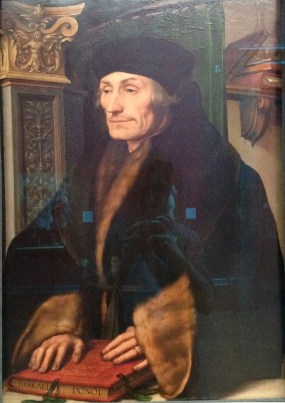
About five hundred years ago, a man named Erasmus decided to publish a book praising me. Unbelievably, no one had this idea before, and none since. Nobody has the time or the inclination—nobody besides Erasmus, that is—to sing my praises, apparently. All the other gods get their encomiums, but not me.
IMG_3814
Well, perhaps I should take the neglect as a compliment. After all, isn’t it the height of folly not to acknowledge the role that folly plays in human life? So is not the neglect a kind of compliment, albeit backhanded?

Nevertheless, some folks need some reminding, it seems, especially after what happened the other day. Oh, you know what I’m talking about: the United Kingdom’s vote to leave the European Union. All I’m hearing left and right is how stupid, short-sighted, narrow-minded, and above all foolish it was to vote “leave.” Well, I can’t stand my name being dragged around in the dust any longer, so I’m taking this opportunity to peep up and remind you how much you owe me.

First, let’s follow in Erasmus’s footsteps and take a short trip around Europe. As you might already know, Erasmus may justly be called the first true “European,” since he was such a cosmopolitan fellow and traveled everywhere. Even now, the trans-European student-exchange program is named after Erasmus. You might already know that the most popular destination for the Erasmus program is sunny Spain, where lots of young Britons like to go and get a tan. (Guess they won’t be coming anymore!)

Spain’s a lot different now from when Erasmus was alive. Back then, the Inquisition was in full swing and anybody who wanted to hold public office had to prove his “purity of blood,” which meant he didn’t have any Jewish or Muslims ancestors. Nowadays we don’t see that kind of behavior anymore in Spain; the Spaniards decided that it wasn’t such a good idea. But the folks in England apparently disagree: one UKIP candidate, Robert Blay, got suspended after saying his rival “isn’t British enough.” You see, my foolish devotees never disappear, but only migrate!

Yes indeed, Spain is truly different now. Let’s go to the Mediterranean coast to take a closer look. It’s a veritable mini-England! We can find British pubs, British radio broadcasts, British supermarkets selling British products. We can see retired old Brits eating baked beans and drinking tea as they take in the southern sun. And we can meet some Brits who have lived here for over a decade, and who still can’t speak a word of Spanish! Yes, and in between a pint these same Brits can tell you about how terrible is the EU and how there are too many immigrants in England. Oh, my wonderful followers!

As you might recall, it was around the time Erasmus wrote this book that England decided to leave another international organization: the Catholic Church. And the reasons were, I suppose, similar enough: “We don’t want some Italian Pope telling our king which wife he can or can’t behead!” Thomas More, one of Erasmus’s friends, and to whom this book is dedicated, disagreed with this, and he got beheaded along with the wives. Lots of people didn’t like this, but honestly I can’t say it was such a bad move. Executions are decisive, at least. Some people still agree with this strategy, like the guy who killed the politician Jo Cox. It worked for Henry VIII, so it can work for us!

IMG_3304

Let’s fast forward a bit in time, to the glorious British Empire. By Jingo, it was big! It stretched across the whole world! Look at how these colonial officers stroll around Mumbai, Nairobi, Hong Kong, Sydney! You’ve got to admire them. They don’t ask anybody’s permission to go anywhere, they just walk right in with their guns and biscuits. Doesn’t take long to subdue the native population when you’ve got the Royal Navy on your side! Sure, this approach didn’t please everybody. But, hey, it was the high point of British history. Nowadays, they’re a bit more worried about foreign immigrants colonizing them than the reverse.

Now you see what a big role I’ve played throughout history. You see how many decisions and opinions I’ve inspired! Oh, but now I hear some people saying that the world would be better off without me. Sure, Folly is important, they say, but that doesn’t mean Folly is worth praising. Fair enough, I suppose. Yes, maybe I do cause a bit of mayhem in the world. And yes, maybe I take things too far. But consider this: For every bad decision I inspire, I also provide the remedy.

For without Folly, do you think people could overcome the sheer hypocrisy necessary for their decisions? Without me, do you think people could congratulate themselves for shooting their own foot? Without my soothing balm, do you think people could go to bed with a clean conscience after doing harm to the world? Do you think British people could simultaneously praise the heroic strength of their culture while worrying that a few thousand immigrants could totally destroy their way of life?

No! Of course not! And since happiness is the goal of life, and happiness is most easily achieved through folly, I think that, despite whatever decision I inspire, I still deserve a lot of praise.

So long live Erasmus! Long live Folly! And long live Little England!

View all my reviews

Review: Imperial Spain

Imperial Spain, 1469-1716Imperial Spain, 1469-1716 by J.H. Elliott

My rating: 4 of 5 stars

Already by the end of the sixteenth century many Spaniards seem to have been gripped by that sense of fatalism which would prompt the famous pronouncement of a Junta of theologians in the reign of Philip IV. Summoned to consider a project for the construction of a canal linking the Manzanares and the Tagus, it flatly declared that if God had intended the rivers to be navigable, He would have made them so.

For Anglophone readers interested in the history of Spain, this book is invaluable. Elliott has here accomplished a real feat, of research, of writing, and of analysis. The book ably navigates that forbidding passage between simplifying popular accounts and unreadable scholarly monographs, managing to be both a work of serious intellectual synthesis and an absorbing account of Spain’s history.

Elliott has an astounding ability to seamlessly combine many disparate threads into the same narrative. He pays close attention to economic history: crop yields, interest rates, inflation and deflation, the debasement of currency, the balance of trade, tariffs and regulations. He incorporates social and cultural shifts: changing religious attitudes, demographic trends, class tensions, intellectual movements. And yet he also does not neglect the superlative individuals: Ferdinand and Isabella, Charles V, Philip II, the Conde Duque, among others. The only thing conspicuously absent was military history, which suited me just fine.

Although the story of Spain during this time was heavily interwoven with both the New World and the rest of Europe, Elliott’s focus doesn’t stray from the Iberian peninsula. He gives only the most cursory account of the Spanish conquest of the Americas, and only mentions the struggles of Charles V against the Protestant Reformation. For those looking for a history of Spanish colonization, this book will therefore be disappointing. I must also add that Elliott’s judgment is at its worst in his brief section on the conquistadores. He describes them as glorious conquering heroes of a barren civilization, which I cannot abide in the light of the destruction and exploitation that followed in their wake.

Keeping those exceptions in mind, this book is a superlative account of this period of Spanish history. The competing centrifugal and centralizing forces at play, the conflicting traditions of Castilian and Aragonese governments, the infinitely subtle machinations of power, the gradual emergence of a national identity, the meteoric rise of the Spanish Empire, the cruel, grinding decline that followed, the heroic and hapless individuals struggling with forces beyond their control—all this is related with brevity, insight, and power.

It is difficult not to see the whole story as a morality play writ large. What with the ruthless exploitation of the treasure mines of the New World, the expulsion of the Jews and the Moors, the obsession with purity of blood, and the alignment of religious orthodoxy with central power, it seems as if the collapse of the grand but hollow edifice was the inevitable result of intolerance and folly. But even if we can learn some valuable lessons from this history, it is important to remember that the story is not so simple, and many decisions which in retrospect seem obviously foolish were at the time fairly reasonable (though of course many weren’t).

In short, I heartily recommend this book to anyone interested in this fascinating time and place. It could hardly be better.

View all my reviews

Review: The Odyssey

The OdysseyThe Odyssey by Homer
My rating: 5 of 5 stars

To this day, the most interesting research project that I’ve ever done was the very first. It was on the Homeric Question.

I was a sophomore in college—a student with (unfortunate) literary ambitions who had just decided to major in anthropology. By this point, I had at least tacitly decided that I wanted to be a professor. In my future lay the vast and unexplored ocean of academia. What was the safest vessel to travel into that forbidden wine-dark sea? Research.

I signed up for a reading project with an anthropology professor. Although I was too naïve to sense it at the time, he was a man thoroughly sick of his job. Lucky for him, he was on the cusp of retirement. So his world-weariness manifested itself as a total, guilt-free indifference to his teaching duties. Maybe that’s why I liked him so much. I envied a man that could apparently care so little about professional advancement. That’s what I wanted.

In any case, now I had to come up with a research topic. I had just switched into the major, and so had little idea what typical anthropology research projects were like. And because my advisor was so indifferent, I received no guidance from him. The onus lay entirely on me. One night, as I groped half-heartedly through Wikipedia pages, I stumbled on something fascinating, something that I hadn’t even considered before.

Who is Homer? Nobody knew. Nobody could know. The man—if man he was—was lost to the abyss of time. No trace of him existed. We can’t even pin down what century he lived. And yet, we have these glorious poems—poems at the center of our history, the roots of the Western literary canon. Stories of the Greek Gods had fascinated me since my childhood; Zues and Athena were as familiar as Little Red Riding Hood and the Big Bad Wolf. That the person (or persons) responsible could be so totally lost to history baffled me—intrigued me.

But I was not majoring in literature or the humanities. I was in anthropology, and so had to do a proper anthropological project. At the very least, I needed an angle.

Milman Parry and Albert Lord duly provided this angle. The two men were classicists—scholars of ancient Greece. But instead of staying in their musty offices reading dusty manuscripts, they did something no classicist had done before: they attempted to answer the Homeric question with field work.

At the time (and perhaps now?) a vibrant oral tradition existed in Serbo-Croatia. Oral poets (guslars, they’re called there) would tell massive stories at public gatherings, some stories even approaching the length of the Homeric poems. But what was most fascinating was that these stories were apparently improvised.

In our decadent culture, we have a warped idea of improvisation. Many of us believe improvisation to be the spontaneous outflowing of creative energies, manifesting themselves in something totally new. Like God shaping the Earth out of the infinite void, these imaginary improvisers shape their art from nothing whatsoever. Unfortunately, this never happens.

Whether you’re a jazz saxophonist playing on a Coltrane tune, a salesperson dealing with a new client, or an oral bard telling a tale, improvisation is done via a playful recombining of preexisting, formulaic elements. This was Milman and Parry’s great discovery. By carefully transcribing hundreds of these Serbo-Croation poems, they discovered that—although a single poem may vary from person to person, place to place, or performance to performance—the variation took place within predictable boundaries.

The poet’s brains were full of stock-phrases (“when dawn with her rose-red fingers shone once more”), common epithets (“much-enduring Odysseus”), and otherwise formulaic verses that allowed them to quickly put together their poems. Individual scenes, in turn, also followed stereotypical outlines—feasts, banquets, catalogues of forces, battles, athletic contests, etc. Of course, this is not to say that the poet was not original. Rather, it is to say that they are just as original as John Coltrane or Charlie Parker—individuals working within a tradition. These formulas and stereotypical scenes were the raw material with which the poet worked. They allowed him to compose material quickly enough to keep up the performance, and not break his rhythm.

But could poems as long as The Odyssey and The Iliad come wholly from an oral tradition? It seems improbable: it would take multiple days to recite, and the bard would have to pick up where he left off. But Milman and Parry, during their fieldwork, managed to put our fears at rest. They found a singer that could (and did) compose poems equal in length to Homer’s. (I actually read one. It’s called The Wedding of Smailagic Meho, and was recited by a poet named Avdo. It’s no Odyssey, but still entertaining.)

All this is impressive, but one question remained: how could the oral poems get on paper? Did an oral poet—Homer, presumably—learn to write, and copy it down? Not possible, says Alfred Lord, in his book The Singer of Tales. According to him, once a person becomes literate, the frame of mind required to learn the art of oral poetry cannot be achieved. A literate person thinks of language in an entirely different way as a non-literate one, and so the poems couldn’t have been written by a literate poet who had learned from his oral predecessors.

According to Lord, this left only one option: Homer must have been a master oral poet, and his poems must have been transcribed by someone else. (This is how the aforementioned poem by Avdo was taken down by the researchers.) At the time, this struck me as perfectly likely—indeed, almost certain. But the more I think about it, the less I can imagine an oral poet submitting himself to sit with a scribe, writing in the cumbersome Linear B script, for the dozens and dozens of hours it would have taken to transcribe these poems. It’s possible, but seems unlikely.

But according to Ruth Finnegan, Alfred Lord’s insistence that literacy destroys the capacity to improvise poems is mistaken. An anthropologist, Finnegan found many cases in Africa of semi-literate or fully literate people who remained capable of improvising poetry. So it’s at least equally possible that Homer was an oral poet who learned to read, and then decided to commit the poems to paper (or whatever they were writing on back then).

I submit this longwinded overview of the Homeric Question because, despite my usual arrogance, I cannot even imagine writing a ‘review’ for this poem. I feel like that would be equivalent to ‘reviewing’ one’s own father and mother. For me, and everyone alive in the Western world today, The Odyssey is flesh of my flesh, blood of my blood. Marvelously sophisticated, fantastically exciting, it is the alpha and omega of our tradition. From Homer we sprang, and unto Homer shall we return.

[Note: I’d also like to add that this time, my third or forth time through the poem, I decided to go through it via audiobook. Lucky for me, the Fagles translation (a nice one if you’re looking for readability) is available as an audiobook, narrated by the great Sir Ian McKellen. It was a wonderful experience, not only because Sir Ian has such a beautiful voice (he’s Gandalf, after all), but because hearing it read rather than reading it recreated, however dimly, the original experience of the poem: as a performance. I highly recommend it.]

View all my reviews

Review: Europe, by Norman Davies

Review: Europe, by Norman Davies

EuropeEurope by Norman Davies

My rating: 4 of 5 stars

Can one narrate time—time as such, in and of itself? Most certainly not, what a foolish undertaking that would be. The story would go: “Time passed, ran on, flowed in a mighty stream,” and on and on in the same vein. No one with any common sense could call that a narrative.

—Thomas Mann, The Magic Mountain

Personal Preface

Lately I have been thinking a lot about time. Well, perhaps thinking isn’t the right word; I’ve been worrying. Ever since I moved to Spain, time has been a problem. What’s the proper time to eat? When do people sleep here? How long will my job last? What about my visa? Multiple clocks beset me, counting down and counting up.

Beyond my petty troubles, I have been thinking about time as an experience: how monotony speeds up the clock’s hand, variety slows it down, and nothing can stop it. I have been thinking about the inexorability of time: every passing second is irretrievable, every yesterday is irrecoverable. I have been spending a lot of time remembering, connecting my past with my present, if only artificially, and wondering how much the act of remembering itself distorts my memories. And in a Proustian mood, I have wondered whether a tremendous act of remembrance is the only defense we have against the ceaseless tide of time.

In the midst of our mundane concerns, it is all too easy to forget to remember. But is it crucial to remember; otherwise life can go by without us noticing. This is why we celebrate birthdays. Logically, it is silly to think that you turn from one age to another all at once; of course we get older every day. We celebrate birthdays to force ourselves to reflect on the past year, on how we have spent our time and, more chillingly, on how much time we have left. This reflection can help us assess what to do next.

Birthdays are just one example. In general, I have been finding it increasingly important to focus on these cycles, when a milestone is reached, when a process is completed, moments when the past is forcefully juxtaposed with the present. Finishing Norman Davies’s Europe was one such moment for me, and an important one. I first heard of the book from an old copy of National Geographic; it was in an article discussing the recent introduction of the euro (in 1999), a historic step in European unity. Davies’s book had just been published the year before, and the reporter had interviewed Davies about his thoughts on the future of Europe.

I read this article right as my love of reading began to blossom. Thus I dutifully underlined the name of Davies’s book, hoping to buy and read it some time in the future. But it was years until I finally bought a copy; and still more years before I finally started reading. When I first heard of the book I would never have imagined that I would finally read it, many years later, in Europe. But here I am, and it feels great.

The Review

Norman Davies’s Europe is an attempt to write a survey history of Europe in one volume, from prehistoric times to the dissolution of the Soviet Union, covering both Western and Eastern Europe. It’s an ambitious project. As you can imagine, an enormous amount of selection and compression was necessary in order to fit all this material into one volume. Luckily, Davies is adept at both of these skills; unfortunately, the book is still too big to carry around. It is big, fat, and heavy: thick enough to stop a bullet, hefty enough to knock someone out cold.

In terms of content, the book is both longer and shorter than it appears. Of the nearly 1,400 pages, only about 1,140 are actual history; the rest is given over to his notes, the index, and a lengthy series of appendices, on subjects ranging from the standard canon of opera, to death tolls in the Second World War, to the life course of an Austrian peasant household. Nevertheless, the pages are dense with text, in small font and with narrow margins; and the pages themselves are quite big. Moreover, owing to the huge amount of territory Davies covers, the book is almost nauseatingly packed with information, every page a summary of whole books. It isn’t the sort of thing you can breeze through.

Davies begins with a pugnacious introduction, in which he denounces all of his forbearers. For him, attempts to write European history have all fallen into various traps, by focusing too much on the ‘Great Books’, by their excessive length, or by their neglect of Eastern Europe. Davies snubs his nose at specialization, and wags his finger at academic fads; he bashes both the traditionalists and the radicals. I personally found this introduction to be an interesting read, but it does seem out of place in a book for the general reader.

For all that talk, you’d think Davies’s treatment would be highly heterodox. But that’s not the case. After an obligatory chapter on prehistory, he goes into a chapter on Greece, then Rome, then the Middle Ages, and so on. And even though one of his major bones of contention is the erstwhile disregard for Eastern Europe, he generally spends far more time on Western Europe.

The chapters increase in length as they approach the future, becoming progressively more detailed. For example, Aristotle and Plato must share one measly paragraph between them, but Gorbachev is given a dozen pages. As a result, the book gets more interesting the further you read. The coverage is only so-so for the ancient world; quite good for the Medieval period; and becomes really gripping by the 19th century. Davies attempts to cover all the major developments, but of course his space is limited. He sketches the historical individuals when necessary, but this is certainly not a “Great Man” telling of history. For the most part Davies focuses on economic, political, social, and cultural history, while paying less attention to intellectual and art history. Among the arts, he is strong on music but weak on painting, sculpture, and architecture.

The main narrative is broken up by what Davies calls ‘capsules’. These are mini-essays, ranging from half a page to two pages, on a variety of topics that interested Davies; they are set aside in their own boxes, interrupting the flow of the main text. This was Davies’s attempt to give extra color to his narrative, by focusing on little parts of the story that would otherwise be ignored. But I had mixed feelings about the idea. Half of the capsules were fascinating, but I thought many were uninspiring. And it was annoying to constantly be having to put the main narrative on hold, read a little essay, and then return where I left off. I thought it would have been a much better idea if he had left the capsules out completely, developed them into full-length essays, and then released them in their own book. I’d read it.

Davies is a writer of high caliber. He can adapt his style to any subject. His prose, although largely devoid of flourish, is consistently strong. In short, he has achieved that allusive aim of popular history writers: to inform and entertain in one breath. Seldom does he come across as seriously biased; but he is not afraid to be opinionated at times, which adds a nice touch of spice to the book: “Chamberlain’s three rounds with Hitler must qualify as one of the most degrading capitulations in history. Under pressure from the ruthless, the clueless combined with the spineless to achieve the worthless.”

I did catch two errors worth noting. First, Davies says that Dante called Virgil “The master of those who know,” when that epithet was really applied to Aristotle. Second, in the same sentence Davies calls Picasso, who was born in Andalusia, a “Catalan exile,” but he calls Dalí, who was born in Catalonia, a “Spaniard.” There were probably many more errors that I couldn’t catch, but in general the information seemed reliable.

Although this book is a survey history, Davies does have one central concern: the European identity. What does it mean to be a European? Davies doesn’t give any simple answers to this question, but instead traces how the European identity evolved through time. The reason for his concern is obvious. The Soviet bloc had only recently been dismantled, and now the European Union was faced with the task of dealing with these newly freed states. Davies himself appears to be strongly pro-Union; and in that light, this history of both Western and Eastern Europe can be seen as an attempt to give the people’s of Europe a shared past, in the hopes that they might embrace a shared future.

It was a bit strange to be finishing this book now. I can still remember the hopeful, enthusiastic tone of that National Geographic article about the new euro. People must have felt that they were entering a new age of European unity. Now the United Kingdom is threatening to leave the European Union, and several other countries are grumbling. The future, as always, is in doubt.

 Afterthought

I finished the book on April 23, which is Book Day here in Spain. Yesterday was the 400th anniversary of Cervantes’s death; and today is the same anniversary for Shakespeare. To celebrate, I go to the Circulo de Bellas Artes, where they are having a public reading of Don Quixote. Everyday people, old and young, are lined up in an auditorium to read a page from that great masterpiece; it will go on for 48 hours. After that, I walk to the Cervantes exhibition in the National Library, where they have dozens of old manuscripts of Cervantes and his contemporaries on display. From there, I walk to the Convent of the Barefoot Trinitarians, where Cervantes was buried.

I was celebrating the completion of a cycle, and so was Spain. The past is alive and well in Europe.

View all my reviews