Philosophy is good advice; and no one can give advice at the top of his lungs.
One of the most persistent criticisms made of modern philosophy is that it isn’t useful. The critics have a point. Modern philosophy largely concerns itself with a variety of theoretical problems. Even though many of these problems do have practical ramifications, many do not; and regardless, the debates can often get so technical, so heated, and so abstract, that it is difficult to see modern philosophy as the path to wisdom it once professed to be. People don’t have time or patience for logic-chopping; they want useful advice.
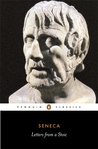
Those of this persuasion will be happy to find a forerunner and a sage in Seneca. As the opening quote shows, he conceived philosophy to be, above all, the giving of good advice. Seneca thus finds a perfect vehicle for his thought in the form of the letter. Although this book apparently consists of the private correspondence between Seneca and his friend Lucilius, it is obvious from the first page that these were expressly written for publication and posterity. This book should rather be thought of as a collection of moral essays and exhortations.
Even in translation, Seneca is a master stylist. He is by turns intimate, friendly, self-deprecating, nagging, mundane, and profound. He has an enormous talent for epigram; he can squeeze a lifetime into a line, compress a philosophy into a phrase. He is also remarkably modern in his tolerant, cosmopolitan, and informal attitude. Indeed I often found it difficult to believe that the book was written by a real Roman. Montaigne and Emerson obviously learned a great deal from Seneca; you might even say they ripped him off. The only thing that marks Seneca as ancient is his comparative lack of introspection. While Montaigne and Emerson are mercurial, wracked by self-doubt, driven by contrary tides of emotion, Seneca is calm, self-composed, confident.
Perhaps because of his professed aversion to abstract argument, Seneca is not a systematic thinker. Emerson wrote “A foolish consistency is the hobgoblin of little minds,” and Seneca apparently would agree, for there are many inconsistencies to be found in these pages. Sometimes God is conceived of as an impersonal order of the universe, and at other times a personal deity; sometimes Lucilius is advised not to take the opinions of friends and family into account, other times to do so. Seneca’s metaphysical arguments are weak and confused affairs; he is not one for disputation. But for all this, there is a core of good sense contained within these pages, which Seneca himself summarizes:
No man is good by chance. Virtue is something which must be learned. Pleasure is low, petty, to be deemed worthless, shared even by dumb animals—the tiniest and meanest of whom fly towards pleasure. Glory is an empty and fleeting thing, lighter than air. Poverty is an evil to no man unless he kick’s against it. Death is not an evil; why need you ask? Death alone is the equal privilege of mankind.
Like Marcus Aurelius, a prominent statesman in troubled times, Seneca is very concerned with how to be happy in spite of circumstances. There is no satisfaction to be had through external goods, like fame and riches, because these cannot be gotten unless fortune is kind, and fortune is notoriously fickle. Even in good times, this can only lead you into an empty, meaningless competition, valuing yourself for something that isn’t really yours, causing you to ceaselessly measure yourself against others. You must rather become content with yourself, taking pleasure in life whether fortune smiles or frowns: “We have reached the heights if we know what it is that we find joy in and if we have not placed our happiness in externals.”
Of course, this is easier said than done, and Seneca does not have a fully worked-out system for reaching this state. He offers, instead, an unsystematic mass of advice. It is here that Seneca is most charming and helpful, for most other philosophers would not deign to offer such workaday recommendations and observations. Here is Seneca on negative thinking:
The mind at times fashions for itself false shapes of evil when there are no signs that point to evil; it twists into the worst construction some word of doubtful meaning; or it fancies some personal grudge to be more serious than it really is, considering not how angry the enemy is, but to what lengths he may go if he is angry.
It is in these sections, of plain, friendly advice, that I think Seneca is at his best. Certainly not all of his advice is good; every reader will pick and choose what suits them best. But much of Seneca’s advice is timeless, and phrased in deathless prose. Most refreshing is Seneca’s insistence that his advice is for action and not reflection. This is more than slightly ironic, considering that Seneca is often accused of being a hypocrite whose lifestyle was far removed from his doctrines; but, to quote a modern philosopher, “There is no contradiction, or even paradox, in describing someone as bad at practising what he is good at preaching.” So preach on, Seneca.
(This post is part of my series on the Basque Country. Click here for Bilbao, here for San Juan de Gaztelugatxe, and here for the Vizcaya Bridge.)
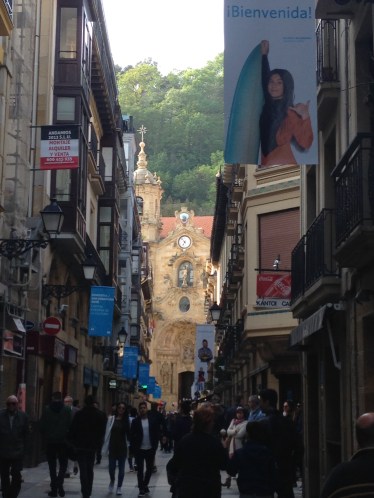
San Sebastián is a city much unlike Bilbao. For one, it is noticeably smaller, with a population of less than 200,000. But more conspicuously, it is not at all a city of industry, commerce, or manufacturing. Rather, it is a place of tourism. The streets are full of foreigners, squeezed into the narrow streets, filling up the parks, covering the beaches with their bodies. The city is also remarkably pretty. As I strolled along the beaches I was reminded of Cádiz; and as I wandered through the streets, Oviedo came to mind. But the strongest and most persistent impression was surprise at the number of tourists. They were all over the place; every restaurant was full, every shop was crowded. The shoreline was an unbroken wall of hotels. I had no idea San Sebastián was so popular.
Some of this probably had to do with the city being (along with Wroclaw in Poland) one of the European Cultural Capitals of 2016. (Each year, a city or two in the European Union gets designated a European Cultural Capital, which means it will host several Europe-oriented events during the year.) This may have attracted even more tourists than usual. Even so, it is clear that San Sebastián is a major tourist destination, because its whole economy is oriented around visitors. This is fitting, for the city is undeniably charming. Its location is a good one, too, being only 12 miles from the French border, and northerly enough so that the temperature is nearly perfect in summer.
We were hungry when we arrived, so our first order of business was food. Our Airbnb host recommended a restaurant in the center. The restaurant was the Bar Aitona, and it was excellent. We ordered the steak and the octopus. Both were served on a huge bed of fries, both were amply portioned, both were well seasoned, and both were scrumptious. Added to that, the prices were very reasonable. We left very full, and very satisfied. I recommend it with great enthusiasm.
When we were back on the street, we decided to start exploring the city. This inevitably led us to Monte Urgull, the most conspicuous landmark in San Sebastián. Urgull is a hill that overlooks the bay. Nowadays, it is covered in trees, and is basically a park; but in the past it formed as a military fortification, since its high elevation at the bay’s edge made it well suited for defense. And these fortifications were not just for show; they were used in several important battles. Probably the most significant of these was the Siege of San Sebastián, in which the British forces, led by Wellington, ousted Napoleon’s troops in the Peninsular Wars. Of course, I didn’t know any of this at the time, but was instead attracted by the gigantic statue of Jesus—12 meters, or almost 40 feet tall—that looms over the hill.
We began walking up, and quickly found that it is a delightful place. Old walls, broken battlements, obsolete canons, and other aging fortifications still stand, some in ruins, some overgrown; and for me there is something remarkably romantic about the sight of weeds and trees reclaiming the abandoned dwellings of past times. The hill is divided into several levels, and as you ascend you get a progressively better view of the city. From the top, the whole shore is spread before you, with its azure water, crowded beaches, and the rolling green hills in the distance. We got to the top, where we could stare up at the towering figure of Jesus, and then descended on the other side of the hill.
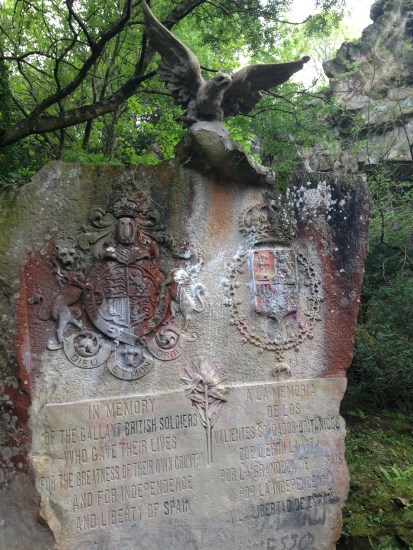
This part of was a wooded area. But as we climbed down a rocky path, something caught our eye. Right below a cliff, surrounded by roots and trees, was the old memorial erected by the British army after the conquest of San Sebastián. A broken and discolored plaque, bearing the royal insignias of England and Spain, bore a message in both English and Spanish honoring the fallen soldiers. Further on, we noticed another plaque, this one on the side of a rock face, honoring the unknown soldiers lost in the campaign. I know these must be well known, but at the time, with only the two of us, it felt like coming upon an archaeological treasure. This illusion was quickly dispelled, since at the bottom of the hill we encountered a map showing where all the different war memorials, graves, and mausoleums could be found on the hill. In any case, it’s a lovely area, both for its history and its views.
The rest of our day was rather uneventful. We strolled around San Sebastián, enjoying the ocean, the river, the crowded city center. But we did not really visit anything in particular, since we couldn’t find anything to visit. It seems that San Sebastián is a lovely place if you want to eat and go to the beach, but it does not have much in the way of cultural tourism, which is mostly what I’m after. In any case, it was late. We had arrived at around noon, and by now the sun was setting. So we walked along the river to our apartment, and the next morning we said farewell to the Basque Country. But I hope to return, the sooner the better.
A Comedy of Errors holds a special place in Shakespeare’s oeuvre. It is believed to be his first play; it is one of two Shakespeare plays that observe the “classical unities”; and it is Shakespeare’s shortest play. You can add to this list, Shakespeare’s silliest play, since A Comedy of Errors amply merits this superlative.
To enjoy this work, the viewer must be an expert in suspending disbelief. That there be two sets of twins, bestowed with the same names, who happened to be dressed in the same clothes on the same day—it does not even approach credulity. Added to this is the capstone absurdity that the mother was in the city the whole time, but did not choose to reveal herself to her son for years.
The reward for accepting this improbable premise is hilarity. The humor is low and occasionally crude, but no less brilliant for that. Shakespeare manipulates the simple device of mistaken identity like a virtuoso, squeezing out every bit of drama and every fleeting giggle from this ancient gag. Shakespeare is always witty and amusing, of course, but seldom was he such an expert conjurer of belly-laughs. The scene in which Dromio of Syracuse compares the kitchen-maid to a globe, describing where all the countries can be found on her rotund body, is a pinnacle of comedy.
If this play was, indeed, his first, it certainly augurs Shakespeare’s coming greatness. To make a slapstick farce such as this, the writer need not endow the characters with anything resembling a round personality. But Shakespeare does, and brilliantly. Antipholus of Syracuse is appealing speculative, comparing his search for his long-lost brother to “a drop of water / That in the ocean seeks another drop,” and repeatedly questioning his own identity. His twin brother of Ephesus is decidedly more bourgeois and extroverted; and his wife, Adriana, is touching in her scorned devotion. But of course the real star of the play is Dromio—played by none other than Roger Daltrey in the version I saw—who’s relentless good nature and nonstop wordplay render him irresistibly endearing.
In sum, though certainly not “deep,” this play is both expert and original—a piece of juvenilia that, even by itself, would have secured Shakespeare a modest place in the Western canon, if only as the most perfect example of a staged farce.
(This post is part of my series on the Basque Country. Click here for Bilbao, here for San Juan de Gaztelugatxe, and here for San Sebastián.)
The train pulled up to Portugalete station, the doors opened, and we got off. Portugalete is one of the towns, ranged along the Bilbao river, that make up the Bilbao metropolitan area. (The name’s resemblance with “Portugal” is apparently only a coincidence.) With a population of about 50,000, and a land area of only 3.21 square kilometers, it is actually the fifth most densely populated area in Spain.
To me, the place struck me as a pleasant, moderately urbanized, more or less tranquil town. Along the riverside there were some large, attractive restaurants, their tables crowding into the streets—though at this hour, too early for dinner in Spain, the chairs were mostly empty. But the surroundings didn’t attract my attention for long, since I could already see my goal: the Vizcaya Bridge.
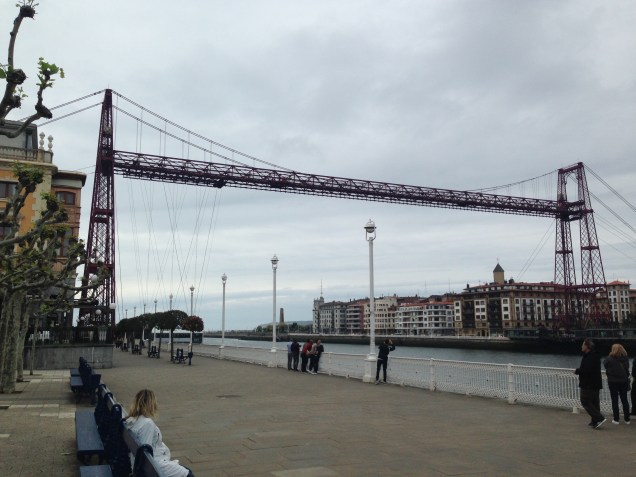
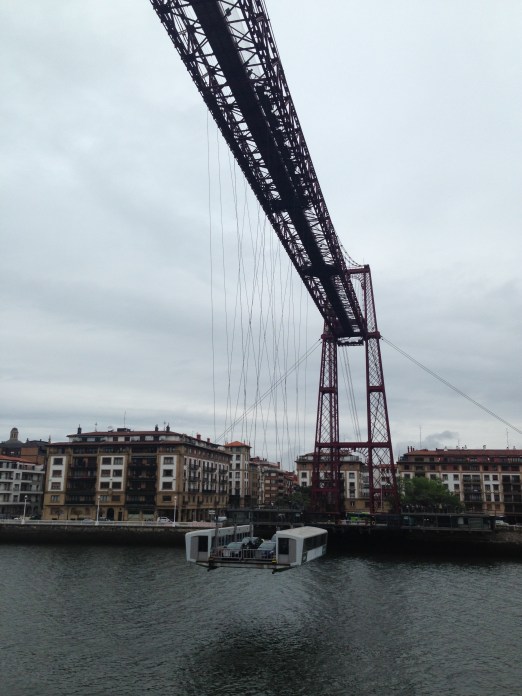
In Spanish it is called the Puente Colgante, or “Hanging Bridge.” The name is appropriate. It is a perplexing sight at first. The bridge has the familiar form of a suspension bridge; but the middle section seems to be misplaced: it hangs ludicrously high in the air, with no ramps to get up or down. The more I looked, the more confused I became, for there didn’t seem to be any way you could use the bridge.
As I got nearer, I noticed something strange on the water. It wasn’t quite on the water, actually, but hovering above it. I looked up, and saw that the thing was hanging from the bridge. So that’s how it worked! The reason the bridge looked so odd was that it transported a shuttle that hung underneath, almost like a puppet on strings. That’s why the bridge was so high up and there weren’t any ramps to get on.
But it looked dangerous to me. The shuttle was fairly large; it transported about six cars and one hundred people. Could that skeletal iron structure above support so much weight? Dreadful fantasies immediately started rushing to my mind. I saw the bridge snapping in the middle, sending iron raining down into the river below, crushing the shuttle and sending everyone inside to a watery grave. Unfortunately, awful visions like this plague me rather frequently. I wonder if it’s the product of a morbid imagination, or just watching too many action movies.
We went into the office and bought our tickets, though I wasn’t sure what the tickets were for. The man explained that there was an elevator to take you up to the top, where you could walk to the other end. He also gave us a little information pamphlet about the bridge. From this, I learned that the bridge is actually a UNESCO World Heritage site, the only monument in the Industrial Heritage category in Spain.
I also learned more about the construction and history of the bridge. The Vizcaya Bridge is a transporter bridge, the first of its kind in the world. If you haven’t heard of a transporter bridge before, that is perfectly normal, since this type of bridge is uncommon; according to Wiki, less than two dozen were built, and only 12 still stand today.
The Vizcaya Bridge, finished in 1893, was designed by one of Gustave Eiffel’s disciples, Alberto Palacio; and Eiffel’s influence shows. The bridge is built in the same manner as the Eiffel Tower, with narrow iron beams riveted together to form a triangular grid; and like the Eiffel Tower, the Vizcaya Bridge is austere and elegant. Palacio originated the idea in response to a common engineering problem: how do you create a bridge that allows people and cars to cross the river, while leaving the river open for shipping vessels? The Vizcaya bridge, then, in both purpose and execution, is a symbol of the Basque Country’s embrace of industry, commerce, and the future—not to mention art.
(I do wonder, though, whether Palacio’s solution was all that efficient. After all, there must be a reason why the design didn’t catch on. The primary problem, it seems to me, is that the amount of cars and people that can cross at any one time is limited by the size of the shuttle and the frequency of its trips. Perhaps the famous Tower Bridge in London—completed almost the same year—solved the problem more satisfactorily, by putting a drawbridge on the lower level and a pedestrian walkway on the upper. But Palacio’s design is beautiful, original, and elegant, so efficiency can go to the devil.)
Finally it was our turn for the elevator. It was an ancient thing, crawling up the bridge at a snail’s pace. Eventually the lift creaked to a halt, and we got out. A narrow wooden walkway, surrounded by the iron structure, extended from one end of the bridge to the other. It’s really amazing how much of the Vizcaya Bridge is just air. You can see right through the thing, and yet it is strong enough to support the weight of a large shuttle carrying six cars.
I experienced this when one of the shuttles came rolling by, right underneath our feet. I could feel the entire bridge shaking, rattling, and shivering, as the electrical buzzing of the engine roared past. Once again, terrible fantasies started flickering through my mind, this time with me myself plunging to a ghastly death. But soon the shuttle came to a halt, and I realized that the bridge was solid as stone. What an impressive achievement: The bridge seems to float high up in the air, supported by the slenderest structure; and yet it is sturdy enough to remain operational after more than one hundred years of daily use.
We took some time to admire the view. On one side we could see the bay, and then the ocean beyond. In the dockyard in the distance, I could see dozens of giant cranes standing silently, like petrified dinosaurs, waiting to come back to life. On the other side, we could see the river gradually making its way towards Bilbao; and in the distance, a factory loomed. Really, wherever you turned you could not fail to notice the signs of industry, filling up the entire estuary with their jagged, colossal, metallic forms. Below us, we could see the towns of Portugalete on one side and Getxo on the other, their streets now full. We might have stayed more time up there, but the wind was quite strong and chilly, so we took the elevator down on the other side. Not long after that, we took the shuttle from Getxo across the river, back to Portugalete; and I am happy to report that the ride was quick and smooth.
There is only one thing more I have to report. Before we left, GF had asked some of her students in Madrid where you can buy good pizza, and they told her to go to Telepizza (a popular chain here, comparable to Dominoes). That sounded awful to me, but GF wanted to try it; so, once we got to Portugalete, we decided to go to the nearest Telepizza for dinner. It brings me no joy to tell you that, as I expected, the pizza was horrible, some of the worst pizza I’ve ever had; and GF was of the same opinion. Is this what Spanish people think pizza is supposed to taste like?
(This post is part of my series on the Basque Country. Click here for Bilbao, here for the Vizcaya bridge, and here for San Sebastián.)
I always find public transportation a bit nerve-racking—especially in a new city, not to mention a foreign country. Every time I hop on a bus, I feel like I’m taking a leap of faith. I imagine taking the wrong bus and getting stranded in the middle of nowhere, or taking the right bus and getting off on the wrong stop—and these fears aren’t totally unfounded, as I’ve done both of these things. Thus I was filled with apprehension as we searched for the bus to Bakio, the A3518.
Probably you have never heard of Bakio, because there isn’t much to be heard about it. Bakio is a small town, with a population of about 2,500, situated about 30 kilometers from Bilbao. There is admittedly a beach there, although the damp, chilly, overcast weather of the region didn’t exactly put me in the mood for surfing. Rather, we were going to Bakio because it was the closest we could to get by bus to San Juan de Gaztelugatxe.
The town of Bakio
The bus ride to Bakio was quite pleasant, taking us through the green countryside, filled with little huts and farmhouses tucked away into the rolling hills. After 40 minutes we arrived, ate some breakfast, and then set on our way. I had found a little report online (found here), written by somebody who had walked from Bakio to Gaztelugatxe. And attached in that report is a little map, with the walking route conveniently highlighted. But for whatever reason I forgot about this map as we started walking. Instead I chose to rely on my phone’s GPS to guide me there. Please, don’t make this mistake: just follow the walking route.
GF and I soon found ourselves walking along a busy road, with no sidewalks.
“Are you sure this is the right way?” she said.
“Yeah, I’m just following my phone.”
“Okay…”
We walked further, and after a while came to a sharp curve in the road. Because there wasn’t any sidewalk, and the road was hemmed in by a rockface on one side and some trees on another, we found ourselves in the predicament that, no matter which side we chose, we would risk making ourselves invisible to an incoming car. Thankfully, the cars only came periodically, with big gaps in-between; and we hoped we’d be able hear them a ways off. Still, it was nerve-racking as we rushed around the corner, trying to minimize our time on the curve.
“I hope there aren’t any more curves like that,” GF said as we got to the other side.
“Me too,” I said.
But five minutes later, we came to another curve. And then another, and another. The entire road, it seemed, wrapped around the hills like a snake, constantly turning left and right. Meanwhile, the amount of cars on the road seemed to be steadily increasing.
“I don’t like this,” GF said. “Is there any way off this road?”
“Umm,” I said, “maybe up ahead.” (I had no idea.)
During the stretches of straight roads, I did my best to enjoy the scenery. It was a nice place, with pine trees and farmhouses all around, and the occasional view of the countryside beyond. But the whoosh of a passing cars destroyed any peace to be had; and the sight of every sharp turn ahead increased my anxiety.
There was over an hour of this, the two of us walking on through the brush and bushes by the side of the road, our feet searching for stability amid the roots and rocks, changing sides whenever it seemed more safe, pressing ourselves against the trees whenever a car went past, rushing around curves with our adrenalin racing, GF nervously complaining while I tried to keep my own fears to myself. And then, finally, just as I was at my wit’s end, the hermitage came into view.
“Yes!” GF said, filled with relief.
§
San Juan de Gatztelugatxe (recently made famous in Game of Thrones, as the location of Dragonstone) is an island off the coast of Biscay, connected to the maindland by a man-made bridge. Since at least the 10th century, a little religious building has been perched up at the top of it, though it has burnt down and been rebuilt many times, most recently in 1980.
To get there from the road we had to climb down towards the shore. The path was steep, twisting, and rocky. Even though you’re going down hill, it is exhausting because you need to be constantly on guard against falling. At last we got near the bottom, where there was a lookout point from which we could get a good view of the island.
It must be one of the most astonishing sights in Spain. The island is a mound of jagged grey rock, covered in slight patches of green. Its splayed form stretches out into the sea, wherein it is battered day and night, on all sides, by the winds and the waves. In the middle of this island, criss-crossing its way up from the bottom to the top, is a staircase—usually filled with the miniscule forms of people going up and down. And crowning the island is the hermitage, a small shack with a dull red roof.
Perhaps this image is so appealing to me because I find in it a symbol of the relationship of humanity to nature. We have carved a staircase into the rock, and erected a place of worship on the summit of the island; and in this way we can be said to have dominated the place. And yet, how feeble our dominance of nature seems when viewed from a distance—just a pile of boards, liable to be blown away by the first strong gust. This is the age-old contest of craft, cleverness, and perseverance against capricious, indifferent power. And I cannot help thinking that, however successful we are now, there will come a day when the hermitage blows down, and there won’t be anyone to build it back up again.
But these gloomy thoughts were soon gone as I huffed and puffed my way up the staircase to the top of the island. By now we had been walking over an hour next to that road, our hearts in our throats all the while; so we were understandably a bit worn out. It felt all the better, then, when we finally reached the top, and could look back towards the land.
In the distance, to our right, we could see the beach of Bakio; and to the left, nothing but steep, grey cliffs and green forests. Gigantic rocks stuck out of the ocean, the biggest one almost as big as the island itself. To one side, far off, I could see what looked like an oil drill. Apart from that, no boats, no freighters, no planes broke the endless blue of the sea beyond or the grey of the sky above. It felt like standing at the edge of the world.
We couldn’t go inside the hermitage, nor even peek through a window. This didn’t bother me, however, since judging by the looks of the plain exterior, the interior would be similarly nondescript. What we could do was ring the bell. A string hung from the bell on the roof to the ground below, and all the visitors were taking turns having a pull (one kid got a bit too enthusiastic, and his parents had to keep him away). I gripped the chord and lightly tugged, and the satisfying clang of a church bell sounded overhead.
Since neither of us had any intention of repeating that dreadful walk by the road, this time I looked up the walking path on my phone. We found the path without any trouble, which made me feel like such an idiot for not using it the first time. It was such a relief! Instead of the twisting, turning road we had a straight path, free of cars, taking us through quiet countryside. We passed through a copse of trees, and then through some fields where cows were grazing, making our way over gently rolling hills, the seaside on our right, until we were finally back in Bakio. The bus soon arrived, and then we were on our way to Bilbao, where we still had one more thing to see.
The bus crawled out of Zaragoza’s main bus terminal, Delicias, and quickly left the city limits. It was early morning. The landscape was entirely shrouded in fog. It wasn’t long before I gave up trying to see the countryside and fell asleep. When I awoke—with a headache and a nasty taste in my mouth—we had parked in Catalayud, a small town midway between Zaragoza and my destination, where we had to transfer buses. I was on my way to the Monasterio de Piedra.
I was still in a daze. That morning I had awoken at an ungodly hour to walk all the way across the misty city to catch an eight o’clock bus. I still felt chilled from the early morning air, but I couldn’t warm up, since it was nearly as cold inside the bus station as it was outside.
I looked out the station window to check if there was anything to see, but the fog acted as an impenetrable veil. This was a shame, since I had noticed Calatayud from the highway on the drive to Zaragoza, and immediately became intrigued. The town is nestled beneath towering cliffs, on top of which stands a commanding castle, whose walls look like they sprung spontaneously out of the rocks. This, it turns out, is the oldest and largest Moorish fortress still existent in Spain.
It wasn’t long before we boarded another bus. Again, I fell asleep immediately, only coming to my senses as we approached the monastery. The fog had cleared by now, and I could see that our bus was creeping along a fairly narrow road, situated above a river; red cliffs ran along the other side. This dramatic scenery was an omen of what was to come.
Finally we arrived. We all shuffled out of the bus and made our way past the walls and into the complex. I waited in line and bought a ticket, still fairly ignorant of what I was paying for. I had come here on the recommendation of friends; and as usual I hadn’t looked up any information about the place before coming.
§
The Monasterio de Piedra is situated at the confluence of the rivers Piedra (thus the name) and Ortiz, in a remote spot within the Iberian Mountains. Founded in the late 12th century by the Cistercians, the monastery was a symbol and outpost of the accelerating Reconquista, the Christian push southward against the Moors, who then controlled all of Aragon and beyond. As such, the monastery was liable to being attacked, which is why defensive wall surrounds the complex.
During the centuries of its use, as the Cistercian monks worked and prayed along the banks of the Piedra, steeped in the cool mountain air of the region. The Moors, who had so long controlled and shaped the Iberian Peninsula—it was the Moors, for example, who established the city of Catalayud that I passed through—eventually lost control, and the small Christian principalities and kingdoms were merged into larger and larger states. It wasn’t long after the “reconquest” was completed, and Castile and Aragon were unified under the “Catholic Monarchs,” that Columbus made his famous voyage to the “Indies,” thus commencing Spain’s brutal colonization of the New World. It was here, in this monastery, that chocolate was first made in Europe, after Hernán Cortes send cacao beans and an Aztec recipe to the monks here.
Three hundred years later, Spain was again divided. In 1833, the first Carlist war commenced, a war between two contending successors to the throne, Carlos de Borbón and Isabella II (who won, and was eventually deposed). Heavily in debt from the prolonged civil war, the Spanish government commenced another of its desamortizaciones, or confiscations, of Church property. Besides the financial incentive, the conservative Church hierarchy supported the reactionary Don Carlos, so this move had both financial and emotional appeal. In any case, it was during this desamortización that the Monasterio de Piedra was seized and sold, thus putting an end to its Catholic history.
For reason of pure anti-clerical fervor, I presume, the church building itself was burned. Now all that remains is a ruined shell of a building. This is a shame, since was fragments that remains give some hint of a glorious medieval edifice. Some of the ornamental friezes around the doorways, for example, are of the finest quality. Now, however, the building’s appeal is Romantic rather than Romanesque. As I’ve mentioned elsewhere, ruins have a strange power to evoke feelings of mysterious awe. Certainly I felt this as I sat facing the destroyed altar, the walls reaching up to a vacant ceiling, the sky gaping overhead. It was like stepping into one of Caspar David Friedrich’s paintings—a timeless, fossilized wreck.
If the burnt church building is unintentionally romantic, the rest of the monastery is quite intentionally so. After briefly being owned by a wealthy Catalan merchant, who mainly used it for agriculture, it passed into the hands of Juan Federico Muntadas.
A well-educated and original man—among other things, he created the first fish farm in Spain—Muntadas was born in 1826, and was thus roughly of the same generation as Gustavo Adolfo Bécquer. And, like Bécquer, he was a Romantic. If you, for example, compare the royal gardens of Aranjuez or La Granja with Muntadas’s creation in the Monasterio de Piedra, you can get some idea of the mental difference between the Enlightenment and the Romantics. Whereas the royal gardens are neat, orderly, symmetrical, with clearly delineated plots for plants and paths for people, Muntadas molded a space that creates the sensation—if not exactly the illusion—of untrammeled nature.
The walking path through the monastery grounds takes about an hour. Though it was winter, the place was still quite green. Shallow ponds reflected the twisted and bare forms of tree limbs, while the verdant underbrush was speckled with the reds of crinkled fallen leaves. Small wooden bridges led the walker through this marshy area to the main attraction: the waterfalls.
Using the diverted waters of the Piedra and the Ortiz, Muntadas created a dazzling series of cascades. Varying in size from ankle-level to the size of an apartment building, these waterfalls are some of the prettiest I have ever seen. The rocks have been carefully placed to divide the stream into several rivulets, creating a dancing pattern of sparkling, splashing streams.
The path took me up beside one of the larger waterfalls and up a staircase in the adjacent rock face. Ivy, branches, and leaves were draped around the water, as if thirsty for a drink. Once at the top, we passed over a shallow stream, and followed it down again as it accelerated into a whooshing, multi-layered cataract, the stairwell winding its way downwards beside the water. Children and parents were crowded on the slippery steps, posing for photos. Along the way I caught a glimpse of the surrounding area, whose red rocky cliffs and rolling hills stretched into the far distance. The path continued, becoming narrow as it navigated the hillside, until finally we were led into a cave.
This cave—full of stalactites and stalagmites, green with algae, the jagged rock edges worn into eerie undulations by the water—was under the largest of the waterfalls. Water poured down at its entrance, filling the place with a ceaseless mist. I had to take off my glasses since they got so covered in droplets. We came out of the cave the same way we went in; then, after a walk through a long tunnel, I found myself by the famous Lago del Espejo, or Mirror Lake.
The shallow water, only inches deep and filled with aquatic plants, was uncannily reflective. And there was plenty to reflect, since the lake is situated underneath impressive rock faces, stretching up far above us and casting imposing shadows. By this time I had completely fallen under the spell of the place. The impression created by so many manipulations of water and stone was that of deep, almost meditative calm. I felt perfectly relaxed and refreshed.
Finally I ended up where I had begun: by the old, burnt church. Quite hungry by now, I went to the restaurant near the visitor’s center, which had quite a good—and affordable—daily menu. Then, stuffed and exhausted, I boarded the bus to go back to Zaragoza.
Remote and difficult to get to using public transportation, El Monasterio de Piedra is yet another example of Spain’s seemingly inexhaustible treasures.
The Civil War was an appalling calamity in which every class and every party lost.
The longer I live, work, and travel in Spain, the harder it is to believe that, less than a century ago, the entire country was torn apart by a bloody war. What set of circumstances could prompt a nation of ordinary, law-abiding people to explode into conflict and kill each other by the hundreds of thousands? This, of course, is just a specific version of a more general question: Why do people wage wars? I may sound naïve, but I do find this perplexing—since, as Brenan points out, in the destruction wrought by war, especially modern war, there are only losers.
Brenan’s work was one of the first serious analyses of the Civil War to be published (in 1943, just four years after the war’s conclusion), and has remained in print ever since. Nevertheless I was somewhat hesitant to read it. I found Brenan’s famous memoirs, South from Granada, to be underwhelming, so I assumed that this book would be as well. Happily I was mistaken. The Spanish Labyrinth is a comprehensive and penetrating work, easily one of the best books about the Civil War—or indeed about Spain—that I’ve had the pleasure of reading.
This does not mean it is accessible. Brenan chose his title well. The events leading up to the Spanish Civil War are intrinsically complex. So many different parties were involved in the accelerating dance of political turmoil that even the most skilled popular writer would have trouble seamlessly weaving it all together. And Brenan, though a strong writer, was too close to the events described to even approach a popular account. As a result the book itself can feel labyrinthine—with valuable comments and data tucked away into footnotes, with several miniature appendices per chapter and a longer one at the end of the book, and a seemingly endless cast of characters, organizations, and movements. Certainly this book, like any excellent book, will repay careful rereading.
Brenan’s take on the Civil War can be helpfully contrasted with that of George Orwell. Orwell, who was in Spain a matter of months and who never learned Spanish very well, saw the Spanish Civil War in terms of the wider struggle between the Right and the Left. For him, it was a straightforward class conflict between the poor workers and the rich fascists, a struggle that was playing out all over the globe. Brenan, on the other hand, who spoke fluent Spanish and who lived in Spain for a decades, saw the war as a particularly Spanish affair; and his analysis focuses almost exclusively on internal factors. (Both authors, incidentally, did share a distaste for Gaudí’s Sagrada Familia.)
Before the Civil War, political instability plagued Spain for generations. This was, in part, a consequence of economic backwardness; and this backwardness, in turn, had its roots deep in Spanish history—Spain’s commitment to New World gold at the expense of industrialization, and to merino wool at the expense of agriculture. (By the way, Spanish shepherds still hold onto their special privileges, which they demonstrate every year in the Fiesta de Transhumancia, during which sheep are herded straight through the center of Madrid.)
The Church came to identify itself fully with the rich and powerful, alienating itself from the people. As a result, anti-clericalism has played nearly as big a role in Spanish history as the church itself. The army, meanwhile, through a series of pronuciamientos and coups d’etat, came to see itself as the guardian of traditional Spanish values, able and willing to topple any regimes they deemed unsatisfactory—and, as history amply shows, it is always bad news to have a politically active military.
During all this time, Spain was plagued by a long-standing agrarian crisis. In one of Brenan’s most brilliant chapters, he details how different farming traditions sprung up in different regions of the country, partly in response to varying soil and climatic conditions. Unfortunately, many regions of Spain are—either from lack of rain or inferior soil—rather poor for agriculture; and distinct social arrangements (such as small-holding minifundios or large latifundios) are appropriate for these different climatic conditions.
In the hot and dry south, for example, farms are usually quite large; and the work required is seasonal, not year-round. Since a small number of wealthy families controlled these large estates, the vast majority were left to subsist on badly-paid seasonal work, thus leading to inequality and violent political tension. (As I discovered from Gilmore’s The People of the Plain, these agrarian problems persisted until the end of Franco’s reign.)
In addition to the inefficiency and inequality of Spanish agriculture, there was the ever-present problem of Spanish regionalism. Brenan follows Richard Ford and Ortega y Gasset in seeing regionalism as one of the defining features of Spanish political life. (Those watching the Catalan independence movement unfold today will be little disposed to disagree.) Spain is crisscrossed by several mountain ranges and sudden changes in elevation, thus leading to jarring climatic juxtaposition. I have experienced this myself: one moment I will be driving through a windswept mountain range, and the next I will be on the verdant coast. This is one culprit for the famous Spanish regionalism.
Another is Spain’s history. When Fernando and Isabel were married, thus uniting all of Spain for the first time, their separate kingdoms, Castile and Aragon, had distinct political traditions. As the historian J.H. Elliott describes in his excellent book, Imperial Spain, the Castile of Isabel, with its history of centralized rule and its emphasis on military power, was bound to conflict with Catalonia’s history of liberalism and commercial capitalism. The industrial revolution further fueled these regional tensions, as Bilbao and Barcelona became heavily industrialized while the interior and the south remained mainly agricultural.
These divisions in Spain—climatic, historical, and political—translated into splits in leftist movements in the years leading up to the Spanish Civil War. The fundamental split was between the socialists and the anarcho-syndicalists. The socialists tended to be more reformist, while the anarcho-syndicalists were straightforwardly revolutionary. Each party had its associated union, respectively the U.G.T. and the C.N.T., which most often refused to work with one another as they attempted to bring down the capitalist system using general strikes. Brenan’s histories of these movements—their origins, development, and leaders—constitutes the central portion of this book, and is absolutely first-rate.
On the conservative side, in addition to the wealthy landowners and the Church—not to mention the army—there were the Monarchists and the Carlists. The presence of Monarchists, in a country which still had a king living in exile, requires no explanation. The Carlists, on the other hand, were a distinctly Spanish product. The death of Fernando VII, in 1833, set off a series of civil wars (the war in 1936 was hardly the first in Spain) between two contending lines to the throne. Those who supported the pretender Don Carlos became known as Carlists. Theoretically, Monarchists and Carlists were arch-nemeses; but since, by the 1930s, the last living Carlist claimant was old and without an heir, the distinction had worn thin.
Trapped between these arch-conservative and revolutionary-leftist forces were a comparatively small group of liberals, who attempted to create a Republic in 1931. But they were doomed from the start. First, as Brenan notes, liberalism has historically had little appeal in Spain. What is more, the economic downturn—caused by the great depression—severely limited whatever resources the government had to work with. Meanwhile, forces from every side were determined to undermine or dismantle the nascent state. Go too far to appease one side, and they risked severe retaliation from the other. Threading its way between this Scylla and that Charybdis, the ship of state crashed and sank.
From this rather pathetic summary, I hope you can at least get a taste of how complex a story Brenan had to tell. Climatic and cultural regions, revolutionary movements, workers’ unions, political parties, the army, the Church, economical classes—all of these were involved in the conflagration. There do not even appear to be any outstanding individuals towards whom you can orient your gaze. Franco himself was notoriously uncharismatic. The final result is confusion—labyrinthine confusion—and given all this, Brenan did a terrific job in his analysis.
The book is flawed, of course. Like Richard Ford, and like so many foreign writers, Brenan is pre-disposed to find some essential core to the “Spanish personality,” which can be used as a catch-all historical explanation. More often these are crass stereotypes (Spaniards are lazy, excitable, etc.), or otherwise Romantic wishful thinking—for instance Brenan’s insistence on the Spanish abhorrence of the modern world. Another flaw is Brenan’s focus on the Left. Though his histories of socialism and anarcho-syndicalism are masterful, his analysis of the Right leaves a lot to be desired. One certainly does not get any clear picture of Franco’s program from these pages. Finally, by focusing so exclusively on Spain, Brenan ignores the wider international scope of the conflict. The rise of the communists from an obscure party to the most influential organization on the Republic side, for example, cannot be explained without turning one’s eye towards the Soviet Union.
But it won’t do to dwell on these shortcomings. Given that this book was written, not by a professional historian but an amateur, and that it was written so soon after the conflict came to an end, it is a near miraculous achievement. I may not be any closer to understanding war in general; but I do think I’ve come a long way towards understanding this one.
In the center of the province of Aragon, on the banks of the second longest river in the Iberian Peninsula, the river Ebro, sits the city of Zaragoza. (In Spain, the name is pronounced “Tharagotha.”) The fifth largest city in the country, Zaragoza is comparatively ignored by tourists. Yet the city is well worth a visit. Populated since Roman times, conquered and ruled by the famous warrior, El Cid, and then governed by the Muslim Almoravids until reconquered by Alfonso I, the city has a long and important role in Spanish history.
But all I knew about the place, when I visited, was that it is relatively cheap and relatively close to Madrid. So one puente (a long weekend) in December, I decided to explore the city.
§
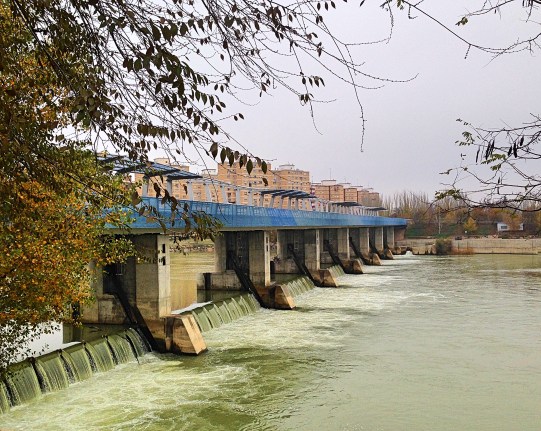
The drive to Zaragoza took us through Soria—“the ugliest part of Spain,” said the driver of my blablacar, who didn’t like the Martian red soil of the province (I disagreed). Zaragoza itself is situated betwixt several mountains, which protect the city from rain but do not shield it from the mist that drifts down during winter. The city huddles around both banks of the Ebro, a wide and powerful river that is periodically spanned by low-lying bridges, connecting both halves of the city.
I arrived fairly late in the day. The city was chilly, a fog hung about the air, some snow had recently fallen but little remained. My Airbnb host recommended a nearby walking path. I took her advice, having more than enough time to explore the city later. This path was called La Alfranca, and quickly led me outside the city and into the fields beyond, following the course of the Ebro going southeast.
This was my first trip alone in Spain. I enjoyed the solitude and the silence of the countryside. The skeletal forms of winter trees, arranged in neat rows, bisected fields of wheat. A lonely man in a tractor dug up a field. Joggers went by occasionally, but for the most part I was alone on the path. La Alfranca stretches 15 kilometers in total but I decided to turn back long before that, returning on the opposite bank of the Ebro.
Walking on in this way, I came back to the city. Eventually the magnificent form of Zaragoza’s famous basilica, Nuestra Señora de Pilar, rose up on the other side of the river, its four towers lit up from underneath with a pale yellow glow. I crossed over the Puente de Piedra, the oldest standing bridge in Zaragoza, which leads directly to the basilica. The design of this bridge is very similar to the Roman bridges that can be found in Spain, such as in Mérida or Córoba or Salamanca, but it was built in 1440, long after the Romans. There was, indeed, a Roman bridge that used to span the Ebro near that spot, but it was destroyed in the ninth century.
El Pilar
I found my way to the Plaza de Pilar, Zaragoza’s central square, which stands in front of the basilica. The place was bustling with life. A Christmas market, selling nativity figurines and specialty foods, surrounded the periphery. In the middle was a life-sized nativity display, fenced off, which you had to pay to enter; there was a long line of eager families waiting. On one end of the square was a skating rink, full of people slipping and circling, and on the other side there was a large artificial hill where children and adolescents could ride down on inflatable red sleds.
Kids sledding, with Le Seo behind
I went up to the food stand and ordered “hot wine,” which was warm and sweet, the perfect winter drink, and then I decided to eat dinner there. As I ate, the sound of music attracted my ears. A band, playing a fusion of traditional and rock music, was on stage performing; an accordion and a mandolin player supplemented the usual rock trio. I quite liked it. I stayed to watch the whole performance, and later, when it finished, a big group of amateur flamenco musicians set up chairs below the stage and began to sing and play. I must say I love encountering flamenco in this way, as a genuine part of daily life here in Spain. It is such a raw and gripping music, at once dramatic and unpretentious.
This was my first day in Zaragoza, a lovely walk followed by a lovely encounter with community life in the city. Already I had decided that I quite liked it here.
§
Day two. Now it was time to explore the city’s monuments. My first stop was, of course, Nuestra Señora de Pilar.
The basilica gets its name from a legend. Saint James the Greater was in Spain, attempting to convert the (then Roman) citizens to Christianity. Dispirited by failure, he began to pray at the banks of the Ebro, and the Virgin Mary appeared to him in a vision, holding in her hand a column of jasper. According to tradition, James then established a small chapel in Spain—the first ever church dedicated to the Virgin Mary. In the center of the beautiful main altar is a small wooden statue of Mary standing atop a small jasper pillar, believed to have been given to James by Mary’s accompanying angles.
One need not believe this story to believe that the basilica has an impressively long history. After Christianity was legalized in the Roman Empire and eventually made the state religion under Constantine, a basilica was built on the spot. This basilica subsequently underwent all the stylistic changes of Spanish history: Romanesque, Gothic, Mudéjar. In the fifteenth century a fire gutted and damaged the previous building; and thus the current edifice mostly owes its shape to the Baroque. Four high towers stand on each corner of the cathedral; a central dome, not quite as tall as the towers, is flanked by several smaller cupolas. The result is undeniably magnificent, giving the impression of tremendous size and elegant design.
The interior is equally grand, with white walls and long naves, flanked by rounded arches and topped with cupolas that let in the daylight. The decoration has none of that excess or horror vacui commonly associated with Baroque; rather the friezes and moldings are neoclassical in their symmetry and restraint. The floor-plan of the building is not a crucifix, but a grid, with several impressive altars nestled in different chapels.
When I entered, mass was being held in one of these, the Chapel of the Virgin. The priest stood before a statue of Mary, as she is carried up to heaven on a cloud, surrounded by a halo of golden sunlight. Along with El Transparente in the Cathedral of Toledo, this whole chapel, by Ventura Rodríguez, is one of the masterpieces of Spanish Baroque, clearly bearing the influence of Bernini.
The insides of the cupolas are decorated with colorful frescos showing scenes of heaven. A young Francisco de Goya was one of the painters who worked on these, though to my ignorant eyes his fresco does not have any of the distinctive marks of his later style. Among this embarrassment of riches, my favorite work was the main altarpiece, a colossal and stunningly intricate carving in alabaster. It is this altar that holds the legendary statue of the Virgin. My mind boggles as I contemplate the amount of time it would take to carve something so big and so finely detailed. One would think a lifetime would be needed for such a task; but the sculptor Damián Forment did it in just six years, from 1512 to 1518, mixing late Gothic and early Renaissance elements in the style.
El Pilar main altar
My next stop was Zaragoza’s cathedral, La Seo. Its real name is the Catedral del Salvador, but it is commonly call “La Seo” (Spanish for “Episcopal see”) to differentiate it from El Pilar. Somewhat unusually, Zaragoza doesn’t have one cathedral; instead El Pilar and La Seo share co-cathedral status.
La Seo
From the outside La Seo is nothing compared with El Pilar. Indeed for a cathedral it is quite diminutive and inconspicuous. This is not to say that it is unattractive. The main entrance is, admittedly, adorned with a somewhat bland neoclassical façade; but the campanile is really lovely, an elegant Baroque structure whose tan outline cleaved the foggy sky. I particularly liked the floating angels who hold up the central clock. On the other side of the building you will be surprised to find a mudéjar exterior, complete with geometrical patterns and six-pointed stars. About one thousand years ago, a mosque occupied this spot; and the influence of the Moors can be seen still.
Mudéjar exterior of La Seo. Photo by ecelan, taken from Wikipedia Commons
This stylistic jumble is a foretaste of what the visitor encounters on the interior. I still feel bitter that I was prevented from taking photos—I don’t know why some monuments prohibit them and others do not—since the chapels in La Seo are some of the most ornate and stunning that I have ever laid eyes upon.
Every chapel is in a world unto itself. Each one is executed in a different style. On the pillars and walls surrounding some were friezes of almost nauseating detail, full of vegetable patterns and gruesome figures, bodies and vines woven around one another in an intricate tapestry (this is called Churrigueresque). Not every chapel was so lavish; other were neat, orderly, and harmonious, and no less visually pleasing. I found myself staring in wonderment, spending a long time at each chapel, doing my best to disentangle the layers of images and commit the chapels to memory.
Considering that the visitor can find examples of so many different styles—Romanesque, Gothic, Mudéjar, Baroque, Churrigueresque, Plateresque, Aragonese Renaissance, and Neoclassical—La Seo is a veritable history of Spanish architecture in miniature. Its interior is just as impressive as the exterior of El Pilar.
My last stop was the Aljafería. This is the Alhambra of the north, a fortified castle that contains a Moorish interior. From the outside it is an imposing military edifice, complete with a moat (empty of water) and high walls. Though impressively massive, there is little to distinguish these walls, in my eyes, from other castles I’ve seen, except for a few horseshoe arches.
But this is far from true of the interior of the palace. Here you will find the greatest example of architecture from the Taifa period of Moorish Spain. This was the period after the fall of the Caliphate in Córdoba (1031), when power in the peninsula was highly decentralized, divided into many small “Taifa” kingdoms. The palace within the walls was mostly constructed between 1065 and 1081, under the auspices of Abú Yafar Al-Muqtadir.
This palace is the most magnificent example from this period in Spain’s history, and each room merits deep study. Unfortunately my ignorance only allowed me to gape with admiration as I walked through, appreciating much but understanding little.
One thing I did notice was that most of the arches were not the typical horseshoe shape I had come to associate with Moorish architecture. Instead, they are pointed arches, with a series of miniature arcs that provide ornamentation. (I believe the technical name is “mixtilinear arch.”) As is typical in Moorish and Mudéjar architecture, intricate stucco-work decorated the walls with fancy geometrical patterns and exotic arabesques; and the ceilings are the elaborate wooden type I have seen in many buildings across Spain. All of these features can be seen in the Golden Hall, the former throne room. Also characteristic was the garden courtyard, a cool interior space adorned with symmetrically arranged plants: this is the Patio de Santa Isabel, named after Isabel, canonized queen of Portugal (1282 – 1325), who was born in the Aljafería.
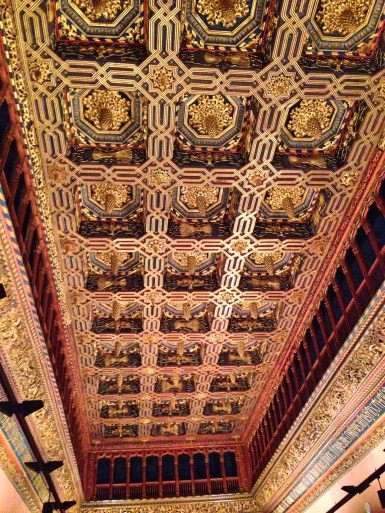
After inspecting this lovely space, I ascended some stairs and found myself in an entirely different world. This is the adjoining palace of Peter IV of Aragon, a Christian king of the 14th century. (Christians had conquered Zaragoza in 1118.) Though aesthetically quite different—closed spaces as opposed to open-air, for one thing—this palace is quite as lovely as the original, mixing Gothic and Mudéjar styles into a distinctly Spanish combination. The most impressive room is, as usual, the throne room, which is covered with a brilliant coffered ceiling—complete with six-pointed stars and hanging golden pine cones. This is a style of decoration called artesonado, heavily influenced by Moorish precedent and employed in many buildings in Spain.
The ceiling of the throne room.
As you can see, the Aljafería has served as the seat of power for Muslim and Christian rulers alike. And it continues that function today, as the home of the Cortes of Aragón, the province’s regional government. Considering the huge lines that often attend visiting the famous Moorish monuments of the south—the Alhambra, the Alcázar, the Mezquita—I would say that the Aljafería is well worth your time, since there was no line at all.
Now it was lunch time, and I’m afraid my story takes on a farcical tone at this point. I was feeling somewhat lonely, and what’s more I wanted to treat myself, since it was my first trip of the school year. So I went to Zaragoza’s famous eating neighborhood, a street called El Tubo, and found a mall that had an Arrocería (a paella restaurant). I ordered myself paella and some patatas bravas—fried potatoes covered in a mild sauce. But I found that this was far more food than I anticipated. The quantity of potatoes was obviously meant for two people. But I was treating myself, so I decided that I would overeat and try to finish them all. Despite my typically American ability to stuff myself, I couldn’t quite do it; my stomach was full to bursting. After that, I went to get a coffee and cookies.
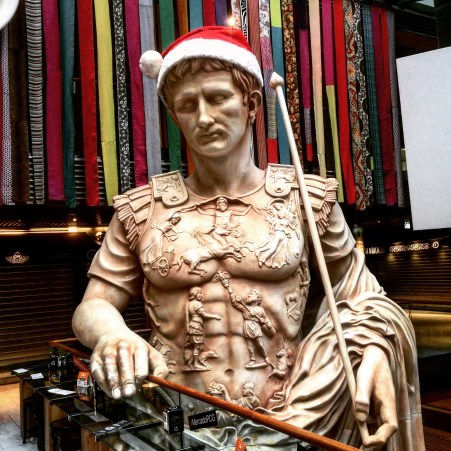
A giant plastic statue of Caesar Augustus, wishing you Merry Christmas
Uncomfortably bloated and feeling a little sick, I waddled my way to my next stop: the Museo Pablo Gargallo. I actually had no idea what this was, and only went because of its high rating on Trip Advisor—such is modern tourism. Pablo Gargallo (1881 – 1934), it turns out, was one of the greatest sculptors of twentieth century Spain; and his museum, much like the Musée Rodin in Paris, is a grand collection of his works in an attractive historical building (in this case, a former palace).
Gargallo’s style wavered between classicism and modernism, combing traditional and cubist elements. His most famous work, El Profeta, is an excellent example of this: a moving mixture of Picasso and the Old Testament. (There’s a copy of this work in the Reina Sofia.)
But I was in no mood to deeply analyze his work. I was in pain. My stomach felt like it was filled with lead. Bullets of sweat were dripping down my back. Meanwhile, I was faced with an odd assortment of grotesque statues—twisted bodies, fragmented faces, simplified expressions—and I couldn’t help feeling unnerved, as if my suffering was somehow manifest in this museum.
Finally the pain got so bad I had to sit down. I unbuckled my belt and sat back, breathing hard. I couldn’t fool myself any longer: my day was over. When the agony abated somewhat, I got to my feet and left the museum. I was going back to my Airbnb; and since I wasn’t familiar with the public transportation system, I had to walk. So, clutching my belly, I slowly made my way through the winter streets, pausing now and then to recover myself.
About ten minutes into the walk I began to gag. Stomach acid scorched my throat as I choked it down. I knew it would feel good to just empty my innards; but I was surrounded by people and mortified by the possibility of vomiting in broad daylight. The gagging came stronger, I resisted, and it came stronger still. I was determined not to throw up; my belly had the opposite idea. Finally, after a heroic effort, I forced down an eruption. Suddenly the pressure let off; I thought I was in the clear. But then without warning it all came rumbling up, and I emptied my insides all over the street, my shoes, my scarf, and my coat. I was covered in it.
I looked bad, and smelled worse. I began to walk at full speed, keeping my eyes on the ground, determined not to make eye contact with anyone on the street. I still had a ten-minute walk ahead of me. I couldn’t even handle my phone since my hands were sticky and wet. Those minutes passed like hours. My adrenaline was pumping like mad, filling me with a nervous excitement, my fight-or-flight response temporarily suppressing my embarrassment and my disgust.
Finally I got to the apartment. I rushed up the stairs, nearly fell into the bathroom, and threw all my clothes into the shower. After an hour of frantic cleaning, I went wearily to my room, dwelling on my miserable condition.
So ended my trip to Zaragoza. Despite my mishap, I was extremely impressed. The next day I was going to Zaragoza’s famous nature preserve, El Monasterio de Piedra. But that’s for another post.
War means the destruction of the enemy without scruple and by any means. War is the harshest of all trades, and the masters of it can only entertain humane feelings so long as they do no harm.
Ernst Jünger was a born soldier:neither risk-averse nor foolhardy, able to command the loyalty of others and to follow orders without question, able to fight without malice and kill without scruple. These are his captivating memoirs of fighting during the First World War.
The consensus of posterity regarding this war is that it was bloody, tragic, and ultimately inconclusive—the exemplar of a brutal, pointless war. Erich Maria Remarque, who fought on the same side and on the same front as Jünger—albeit far more briefly—writes of his experience with trauma and disgust. Yet Jünger’s memoirs, equally as bloody as All Quiet on the Western Front, are strangely warm and cheery. A born soldier, he felt right at home.
As regards the basic experiences of the war, Jünger’s memoirs cover all the bases: bloody hand-to-hand combat, endless artillery shelling, taking cover in shell-holes and scrambling to put on one’s gas-mask, swarms of flying shrapnel and bullets, and death forever prowling. But out of this basic fabric of experiences Jünger weaves a heroic and even jaunty tale, a battle narrative of gallantry and daring. Each soldier, in Jünger’s archaizing eyes, is a knight locked in a gentlemanly joust with an enemy, motivated by duty and honor. I often wondered whether this quaint way of viewing the war was some kind of subtle psychological defense mechanism, shutting out its horrors with a chivalrous fantasy; but Jünger seems to have carried this perspective with him before the fight even began.
In many ways Jünger reminds me of Patrick Leigh Fermor. Both war heroes, both adrenaline junkies, both of a seemingly inexhaustible vitality—Leigh Fermor lived to 96, Jünger to 104—and both obscenely well-educated, these two authors tend to see life as a legend. Jünger’s prose has little of that cinematographic immediacy as has Remarque’s. By comparison his writing is highly stylized, like a Byzantine mosaic or Homeric verse. Admittedly, this is more true of the first half than the second, which becomes quite thrilling. In any case it takes a special kind of person to compare an artillery bombardment to “a witch’s cauldron,” or to motivate oneself in battle by quoting a verse from Ariosto.
The ending of the book contains, in brief, some of Jünger’s thoughts on the significance of the war. Clausewitz’s famous aphorism, that war is “politics by other means,” seems to have been lost on Jünger. For him the war’s value was not in accomplishing any concrete objective—which was, in any case, foiled for Germany—but in hardening the fighting men. You might say that, for Jünger, the war was valuable for its own sake. The extreme circumstances of war roused in the soldiers an equally extreme dedication to an ideal beyond themselves, the ability to yield themselves completely to their Fatherland; and he thought that future generations would look on the soldiers much as saints:
And so, strange as it may sound, I learned from this very four years of schooling in force and in all the fantastic extravagance of material warfare, that life has no depth of meaning except when it is pledged for an ideal, and that there are ideals in comparison with which the life of an individual and even of a people has no weight.
Personally I find this view disturbing, as I’m sure many do. The nationalistic dreams of Kaisers are nothing in comparison with even one life. In any case I think history has amply proven Jünger mistaken; the very hardening anvil of war he praised led, in just a few years, to another, even more deadly war—under a regime which Jünger himself despised. And whatever we may think of the heroism displayed by individual soldiers, it is outweighed by the sheer horror of it all. I also must say that I am incredulous that someone who lost so many friends and comrades—and who himself narrowly escaped death, getting wounded 14 times—could talk in such fanciful, romantic, and vague terms about the lessons of the war—and again I wonder, was this some kind of defense mechanism?
In sum, this must be one of the oddest war memoirs ever published, equal parts exciting, off-putting, and exacerbating. For those interested in the First World War, certainly it is required reading.
I know a hymn, giant and strange, that announces an aurora in the soul’s night; and these pages are from that hymn: cadences which expand in the overshadowed air.
Bécquer is an example of that species of national writers, almost universally known in their own countries, almost universally obscure elsewhere. Here in Spain he is the second most commonly assigned author in schools, only bested by Cervantes himself. But how many readers—even avid readers—outside of Hispanophone countries even know his name?
For an iconic Spaniard, Gustavo Adolfo Bécquer has a curiously Germanic name; change a few letters and you have Gustav Adolf Becker. Indeed, “Bécquer” wasn’t the name he was born with, but one he adopted later in life. (It was his father’s mother’s last name, of Flemish origin.) To me this Germanic tinge is singularly appropriate, since Bécquer was a prophet of Romanticism, an intellectual movement I most strongly associate with German authors.
Notwithstanding this Teutonic whiff, the writer who, in many ways, most closely resembles Bécquer is Edgar Allen Poe: both of them are authors of creepy tales and charming verses. Romantic writers to the bone, they both died relatively young (Bécquer at 34, Poe at 40), although Bécquer perhaps beats Poe by never having achieved widespread fame during his lifetime. This book, Bécquer’s most famous, is a collection of his most popular short stories (“Legends”) and several dozen short poems (“Rhymes”). Poetry was his first and truest love. Yet, as befalls so many of us, penury forced him into prose.
I read the Legends before the Rhymes. These are distinguished, most of all, by their atmosphere. The plot, the dialogue, the characters, the description—everything is subordinate to a certain mood, a mood of mystery and foreboding. The characters wander, wide-eyed and wondering, through haunted glades, enchanted monasteries, and cursed dens. And as is so common in literature written by men, beautiful women are mixed up with these demonic haunts; and Bécquer’s women are always surpassingly beautiful—with pure white skin and pure black hair. Added to this medieval twilight is a strong dose of Spanish Catholicism: beautiful Jewish and Moorish maids are whisked away by their Christian paramours, saved from their heathen fathers.
Some examples might illustrate these tales. In “El Rayo de Luna,” a wandering poet, who walks aimlessly from dawn to dusk in his aesthetic quest, encounters a beautiful woman, chases her until she mysteriously disappears, and then spends the rest of his life comparing everything to “a moonbeam.” In “Tres Fechas,” the Narrator spends most of his time in extended descriptions of old buildings in Toledo, only to be interrupted, three times, by a fleeting vision of a beautiful woman—with ivory-white skin, of course—until finally he encounters her taking the vows of a nun. In “Creed en Dios,” a young atheist kills a priest, gets lost in a forest, is overwhelmed by a cosmic vision, and suddenly awakens to find that generations have gone by—a sort of Catholic Rip Van Winkle. You get the idea.
Although I enjoyed the overwrought atmosphere of these legends, I must say I was surfeited by the end. The Rhymes, on the other hand, are absolutely charming from first to last. The poems seem to have been especially written for Spanish students, since they are surprisingly simple and easy, while maintaining a high quality throughout. In form they are as simple as can be, rhyming couplets or alternating ABAB patterns, sometimes with a refrain. In subject matter they concern themselves with the usual holy trinity of poetry: death, immortality, and love:
“What is poetry?” you ask while
You fix in mine your eyes of azure
What is poetry! And you ask me this?
Poetry… is you
It is light and airy, and appeals to the teenager in all of us—sometimes even to the wistful adult. For any students of Spanish, I cannot recommend this book highly enough.


 Letters from a Stoic by Seneca










 Lotz in Translation