Once more! this is a story of education, not of adventure! It is meant to help young men—or such as have intelligence enough to seek help—but it is not meant to amuse them.
Everyone agrees that this book is difficult and odd. An autobiography of an American man of letters, the son of a diplomat, grandson of a president, historian, journalist, secretary, all told in the third person, written for his private circle of friends. At once claiming to be the story of one man’s life, a critique of the educational methods of the nineteenth century, a parable of the fin de siècle, and a new theory of history, the book is, in reality, none of the above, and is instead the sigh of an old man looking back on his life.
I must admit that I found this book exasperating in the extreme. One quickly gets the impression that, when Adams uses the word “education,” it is meaningless or worse than meaningless. He goes to London with his father, and becomes intimately acquainted with the workings of British politics, all during the difficult years of the American Civil War, and complains that he received no useful “education.” He teaches at Harvard for seven years, a professor of Medieval History, and concludes: “On the whole, he was content neither with what he had taught nor with the way he had taught it. The seven years in teaching seemed to him lost.” He becomes a journalist in the capital, and then works on a seven-volume history of America during Jefferson’s presidency; and still, after all this, he insists he has received no useful “education.” And after every phase of his life, when Adams rings the same gloomy bell, the reader asks: “What on earth would satisfy you, Mr. Adams?”
Another exasperating element is the degree to which Adams assumes a familiarity with the intricacies of 19th century politics. Reading the chapters when he was in England felt like reading a grocer’s shopkeeping books. It was disjointed, jerky, and, worst of all, didn’t explain a thing. At first, I assumed this difficulty resulted from Adams’s originally writing the book for his circle of friends; but the obscurity goes even further: it is as if Adams wrote the book only for himself. The book swings wildly in tone from dry note-taking to half-formed and half-coherent abstractions, all written in a prose style lucidly opaque.
Adams also gives the impression of being a bit muddle-headed. He spends some time talking about Lyell’s geology and Darwin’s evolution, and it soon becomes apparent he understands neither. He goes on long tangents about “force,” while it is obvious that what Adams means by that word is as meaningless as what he means by “education.” He ends the book on a very confused and seemingly pointless attempt to give a mathematical explanation of history, but never reaches above vague commonplaces, endlessly repeated. I seldom came across an insight of his that was insightful.
In short, the impression was that Adams had taken all of the stuff of his life—his doings, his friendships, his thoughts, his career, his background—and left it out to bake in the hot sun, until all the savor and succulence was scorched out of it, leaving only a tough jerky that wearies the jaw in the attempt to chew the husk.
Still, after all this, I must admit that this book has a strange power. There were times I could not put it down, even when I felt I wasn’t understanding a thing. Adams always seemed to be only two steps away from a great insight, an astounding thought; but he never quite reaches it, which is why the book can seem so tragic. He was always searching and never finding; and the reader is left in doubt what he was searching for, and whether anyone will ever find it. In his elegant, knotty prose, he turns out aphorism after aphorism—all apparently insightful, but in reality empty—popping like soap bubbles leaving nothing but air. And what saves the book is that Adams knew this, and yet could do nothing better.
Saint Thomas did not allow the Deity the right to contradict Himself, which is one of man’s chief pleasures.
I read this book in preparation for my visit to Chartres, which was just last week. I had not been very fond of Adam’s most famous book, his Education, but I had high hopes that his writing would improve when his focus shifted to something other than his own life. Yet I have found the two books discouragingly similar.
As a stylist Adams appears, at least superficially, quite strong. His sentences are clear and mostly elegant, occasionally epigrammatic. But stylistic problems appear on a higher level of organization. Both Adam’s autobiography and this book were not originally written for publication, but for his close circle of family and friends; and as a result, Adams seems to explain everything except what most needs to be explained. His ideas float against a background that he does not provide, making his train of thought appear out of context. In this he reminds me of George Santayana, who similarly omits to signal where he is going and why he is going there, though Adams lacks the philosopher’s occasionally forays into sublimity to compensate. The result is rather irritating, superficially clear but actually opaque, like overhearing an eloquent old man talk to himself.
But my gravest complaint about Adams, both here and in his autobiography, is his tendency to organize his books around central ideas that I find vague and vapid. In the Education, this takes the form of his armchair theorizing about “force,” the Dynamo, and the laws of physics as applied to history, and even more prominently in his main theme of “education,” his conception of which remains unclear to the very end. In this book it mainly takes the form of his insistence that “The Virgen” was personally involved in the construction of Chartres Cathedral. To be fair, he tends to treat these ideas (and himself) with a considerable amount of irony; but the irony does not amount to full satire, leaving it unclear whether he is merely kidding or if he intends these ideas to be somehow insightful.
Again, just as in his autobiography, here the dominant mood is notalgia. Though extremely successful, Adams apparently felt out of harmony with his world and yearned for a time when society was simpler and more unified. This leads him quite naturally to the Middle Ages, to the poetry, to the great cathedrals, and to the theology of St. Thomas Aquinas, which unite art and science into a seamless whole. Consequently this book, far from being historical analysis, is more of a personal appreciation of the French Medieval period, spinning off into fantasy or speculation wherever it suits him. This self-indulgent tone is grating to somebody trying to learn about Chartres.
Now that I have gotten all this criticism out of the way, I must admit that the book, like his autobiography, has its merits and charms. He is obviously fond of this period, and so writes in a tone of enthusiastic admiration that proves quite infectious. This keen appreciation for the “spirit” of the Medieval period is the book’s most useful attribute, helping to put the reader in the mindset to appreciate the epoch’s art, poetry, and thought. I found Adams’s chapters on architecture, specifically on Chartres, to be stuffy and difficult to follow—for here, as in his chapters on British politics in the Education—he assumes a level of familiarity (specifically about the French royal family) that the reader is unlikely to possess. But when context is provided by an external source, Adams can be quite pleasant. When I visited Chartres, and saw its magnificent stained glass for myself, his chapters ceased to be so vexing.
The chapters I most enjoyed were the final three, about philosophy—specifically, Abelard, St. Francis of Assisi, and St. Thomas Aquinas—since here my background was not so lacking. Yet even here it must be said that Adams’s comments are more in the spirit of an amateurish aficionado rather than a serious student. He interprets Aquinas as an “artist” rather than a thinker, repeatedly disqualifying himself from passing sentence on Aquinas’s arguments (though he says some perceptive things in spite of this).
By contrast I thought the chapters on poetry were the worst, since they mainly consisted of excerpts of poetry, in Latin or Medieval French, with repeated assurances of their high quality and their untranslatable beauty. (His mostly bland translations serve to prove his point.) But in general Adams’s approach to poetry is the same as his approach to architecture and theology, mostly confined to passionate declarations of affection, without much attempt at analysis or insight.
In his younger days a man dreams of possessing the heart of the woman whom he loves; later, the feeling that he possesses the heart of a woman may be enough to make him fall in love with her.
—Proust
When it comes to love, artists can be usefully divided between romantics and cynics.
The former see love as something unambiguously wonderful, whose presence produces absolute joy and whose absence the most profound misery—something endlessly interesting to contemplate and unquestionably good. The cynical attitude—far less common—sees love as a kind of illusion, a self-hypnosis, which promises everything and delivers nothing. Proust was of the latter camp, whose solipsism admitted no possibility of genuine human connection.
I admit that I normally incline towards Proust’s view. I have never much liked love songs or love poetry, and most love stories leave me cold. Indeed, I wish that we did not dedicate so much of our art to romance. Human life is so rich in potential themes, and yet our art circles endlessly around the standard tropes of romantic love: the pain of rejection, the agony of desire, the triumph of success, the pangs of jealousy, and so on. The conventions are so well-established that it strikes me as artistically lazy to go through the same motions: first, because little originality is needed; second, because love, being an innate human desire, is something that people will respond to automatically, so little skill is needed to hold the audience’s attention.
I would even go farther, and assert that any art which relies so exclusively on these instinctual urges is a form of pornography. This is what I mean. However artfully pornography is directed and acted, it is still a lower form of art than non-pornographic films, since to be effective it only needs to appeal to a fundamental human desire. Food photography is arguably in the same class: even when well-done, its main appeal is to the stomach and not the mind. Extremely sentimental art, by appealing to the basic human desire for intimacy, falls into this category as well.
This is not to say that art should not involve emotions; that would be absurd. But true aesthetic appeal, for me, is always disinterested, involving the absence of desire. Thus any art which appeals directly to desires—and, like pornography, is really just the satisfaction of a desire in fantasy—falls short of real aesthetic appeal. Much love-themed art is clearly based on this fantasy satisfaction.
I do not wish to be dogmatic about this. Undeniably there are poems, plays, songs, and novels of the finest quality about love. My contention is only that these superlative works sublimize love into an aesthetic sensation, a pure appreciation of emotion devoid of pain or excitement. The ultimate example of this is Dante, who took his erotic passion and made it the primary element of his sweeping vision of the universe. But this, of course, is no easy thing. Rather I think it requires the greatest artistry to create excellent works devoted to love, since the artist must resist at every point the temptation to give into fantasy.
If Dante is the ultimate artist of the positive potential of love—describing God as “The Love that moves the sun and other stars”—then Proust is the ultimate artist of the cynical view. For him love was just another false prophet that distracts us from the truth of life and the tranquility of art. And nowadays it is hard to disagree with him.
We have found that love, far from a divine mystery, is the expression of an instinctual drive to procreate. Since stable pair-bonding is helpful for the survival of our children, it makes sense that we would evolve the tendency to fall in love. And now that romantic relationships are more fluid than ever before—with the rise of dating and divorce—we have clear and persistent evidence that even the strongest feelings of love do not necessarily, or even often, lead to permanent relationships.
Indeed, when you observe a person moving from partner to partner, equally in love with all of them in turn, equally convinced that each one is incredible (until he breaks up with them, at which point they become undesirable), then it is hard to resist the conclusion that love is a sort of self-hypnosis. For when we fall in love, we see only perfection in the beloved; and when we fall out of love, we see only ordinary flaws. The conclusion seems to be, as Proust says, that we love what we possess only because we possess it, and see the beloved as extraordinary simply because it is our beloved. This, of course, is an ironical situation, since the “most intimate” of connections appears, upon inspection, to be based on willful misapprehension. The loving eye sees least.
Given these reasons for cynicism, why is the romantic, rosy-eyed view of love so common in our culture? I would even go so far as to say that the cult of love has become a sort of religion. Finding the perfect partner is portrayed as the apex of happiness, the seal and guarantee of a good life.
Now, do not think I am some bitter enemy of love. Anybody who has ever been in love knows that it is one of the best feelings in life. Even so, I think it is unhealthy to dwell so insistently on romantic love, as if it could save us, complete us, perfect us. It is unhealthy, first, because happiness must always come from within us, and not from some external—not even a relationship; and, second, because our inflated notions of love ironically lead us to expect too much from it, which damages relationships.
Though it is a cliché to say so, I think the truth about love lies between the romantic and the cynical view. Neither salvation nor illusion, neither effortless nor impossible, neither invincible nor insubstantial, neither the point of life nor a pointless waste—love is a beautiful but ordinary thing. And art, insofar as it strives to represent reality, ought to try to show love in all its ordinariness.
I have been working alongside Diego for two years now. When I first met him he was straight out of college—a frat boy without his frat, living all the way out in Arganda del Rey, a quiet town far from the center of Madrid. It was obviously a new experience for him. And he adapted admirably: growing more confident, more independent, and more empathetic to others in the process. Far more than two years seem to have elapsed between the Diego I first met and the Diego I know now. He recently took some time to sit down with me and share some of his story:
R: How are you feeling?
D: Feeling pretty good, kinda nervous. It’s weird, you know, having your friend interview you.
R: Have you been interviewed before?
D: Only professional interviews.
R: Tell me about your background—your family, your education, your hobbies, and so on.
D: Okey dokey. My dad is Mexican, born in Mexico. He moved to Los Angeles in the late seventies. My mom was born in America but she’s of Armenian-Spanish descent. And she grew up in Spain, in orphanages. I identify myself as a chicano. I grew up with a bunch of latinos in my community. So I always thought I was Mexican. I was born in East LA but I lived my whole life in South Gate, California.
I went to university to UC Santa Barbara, and I graduated with a bachelor’s degree in sociology. I came to Spain right after that. My hobbies? I like to go to the gym, I like to play soccer, I like to be with my friends. Sometimes write, sometimes read, you know.
R: How did you decide to come to Spain?
D: Alright, so my brother forced me to come to Spain. My brother Rafael was like, “Hey fool you got really bad grades in university so you gotta do something spectacular.” So he was like, “You should do this program.” So for a year and a half or so I was thinking about going to Spain. And then the time came to apply and I barely made it on the deadline and I was told in August that I got in.
R: In August? [The program begins in October.]
D: Yeah, so I had to do everything super fast before I came mid-September.
R: What were some of the challenges of moving to Spain?
D: So the challenges were raising the money, saving up the money to buy the tickets and for rent, security deposit, food. Then eventually it was just saying goodbye to your family and friends. Some friends don’t understand that it’s something you have to do for yourself. Some friends just forget about you. But my family is there for me, so that’s what matters the most.
R: How did you raise money?
D: I worked, I was working as a referee, I was washing dishes. And my mom hooked me up with some money, too, so I was really lucky with my mom.
R: And what about the visa process?
D: That shit was wack. Everything was new to me. You know, my dad came to the States and he got his citizenship. So I thought, “If this fool can get a citizenship then I can get my visa.” So the paperwork took me like three or four weeks. I did some of the things wrong so I had to redo it several times. And so I wasted like 300 bucks.
R: Tell me about your job as an auxiliar—your schedule, your duties, your role in the classroom.
D: Well, I work 16 hours a week, but I’m here for like twenty-something. [We have breaks between classes that adds to the time at high school.] My role is to assist the teacher. But as a second-year now, I’m leading the class and I’m lecturing. I’d say about half of the time I’m lecturing and the other half I’m with the students, with groups of four, talking. I feel we have a specific role in the classroom, because we’re obviously younger than the teachers, so we become this bridge with the students and the teachers. And sometimes the teachers come down on the students hard, so you kinda have to go to the student and tell them what’s good. You’re like, “Hey, the teacher is being a little harsh, but you gotta understand that these are the rules.” So you just try to help them figure it out. That’s how I see myself.
R: What are some of the challenges of being an auxiliar?
D: Upholding the expectations, meeting the expectations of the teachers. Because last year some of the expectations weren’t that clear, you know. So you don’t know if you’re doing a good job or not. But this year I’m doing a lot better, I have better communication with my teachers. So the challenges might be that the students just wanna keep talking to you, and you gotta be like “Hey, now it’s time to do classwork.” Last year it was a struggle to keep them attentive, but this year I’ve been doing a good job of keeping them focused in class, helping them out with their work.
R: How would you compare the education system here to ours in the States?
D: So here I think it’s a little bit too lenient. A five [out of ten] is still passing. And to me that’s failure, you know. You did half of the work wrong. So I don’t see how that’s considered passing. And I also think the students repeat too much. [As in, students are held back because they failed.] You have twenty-year-olds graduating from high school. I think it’s too easy to repeat, it’s done too frequently. But I think the issue is because they have too many subjects, they have eleven subjects in the semester. Back in the States we only had to take six or seven. They’re focusing too much on too many. So it’s too much for the kids and that’s when they start messing up in school, they start not caring in class, they start missing school.
Classroom management is too lenient, too. Some of the teachers are really strict but some other teachers just let the kids talk, and the kids are talking and talking and chit chatting. I think they send out the kids too much. [As in, send the kids out in the hallway when they’re misbehaving.] I don’t know if they should be disciplined or what, but they don’t know respect and a lot of them don’t have that respect towards the teachers. I’m pretty well respected but even if I tell them to be quiet they will just keep talking and chit chatting.
R: What do you plan on doing when you leave Spain?
D: I wanna start getting my coaching license. I want to work with professional soccer teams or college soccer teams. If I fail in doing something with soccer I’ll do something with any type of sport. And if I fail at that, I’ll become a gym teacher. But I’ll be a good gym teacher, I’ll try hard, do my thing. But I definitely want to to something with sports after Spain.
R: How do you think you’ll look back on this experience in 10 years?
D: I think 10 years from now Diego will be really happy with this Diego. I tell this to my friends, in university I was a cool guy and people liked me, but I felt like I was a loser. I wasn’t responsible, I didn’t handle my scandal, you know. I was just a loser, you know. Yeah I had friends and I know people loved me but the way I was, that was some loser stuff. And I’m really proud that when I’ve been here, I’ve been more responsible and I’ve managed to change, to live a healthier lifestyle, to be more optimistic about life. It’s just given me a brand new type of identity. Or it’s reinforced my identity and I’ve become stronger. So I feel that ten years from now I’ll be really proud of that, that I was able to leave everything back home and come to Spain, give it my all, and be the person I would eventually become. I’ll be really happy, I’ll be really content with this Diego.
R: So you think it’s important in your development?
D: Oh yeah, I already know it’s super important. For the person who I wish to become, who I want to become, who I will become.
R: Well that’s all my question. Anything else?
D: Well I want to say that, at first I thought Roy was wack, but then he’s a great guy.
And when your rapture in this feeling is complete, Call it what you will, Call it bliss! heart! love! God! I do not have a name For this. Feeling is all; Names are but sound and smoke Befogging heaven’s blazes.
—Goethe
We humans give the name “love” to so many different things that it can be difficult to tell what it means. No word is more overused. Turn on the radio we hear love songs; switch on the television and every show, comedy or drama, has a love story; open a novel, chances are the same is true. We love everything from our children to cheetos, from our friends to our phones. Some people love God and some love Lady Gaga. How can any word accommodate so many different relationships?
Part of the ambiguity comes from our using the word “love” to express three distinct things: feelings, preferences, and values. By “feeling” I mean some emotion felt in the present moment, in this case an emotion of intense pleasure. This is what somebody means when they take a bite of a hamburger and say, “I love this!” We are also expressing a feeling when, with a loved one, we spontaneously say “I love you!” In this sense, the word is purely emotive, comparable to smiling or laughing.
All feelings are, by definition, fleeting and temporary; but we use “love” in calmer moments to express more durable preferences. By “preference” I mean a tendency to enjoy and choose something; this is what somebody means when they say “I love the Beatles.” In less serious moments, we also use the word “love” this way with people, such as when we say “I love my coworkers.” By saying this, the speaker is clearly not expressing any level of commitment to her coworkers; she is only expressing her tendency to enjoy and appreciate their company.
The strongest and, you might say, the most proper use of the word “love” is to express a value. We “value” something when we are willing to act for its sake, enduring inconvenience, pain, or even death in its service. When we value something we identify ourselves with it, making it an extension of ourselves. This is the sort of bond that exists between close friends, family, and romantic partners. And I think it is important to understand love this way, since it explains how it is possible to simultaneously love somebody and be furious at them—which would be contradictory if love were simply a feeling.
Clearly, any good relationship will consist of a combination of these three layers. We feel good in the presence of a loved one, we prefer seeing them, and we value them deeply. Yet is is clearly possible to have one without the others. Specifically, I think a confusion between the emotive and the value aspects of love is what causes people to agonize over the question, “Do I really love x…..?” This is because it is clearly possible to value somebody deeply but to feel angry and hurt in their presence; and conversely it is possible to feel very happy in somebody’s company without being committed to them.
Part of this confusion is unavoidable. This is because it can be difficult to tell how much we really value something. Value is not something we feel and thus is not obvious. Rather, our values are revealed by our actions over a stretch of time. How much time and energy do we devote to somebody? How far are we willing to interrupt our lives for their sake? How consistent is our willingness? We cannot, in other words, simply introspect and feel value. And even when we see that we consistently value something, it is impossible to predict with certainty how long it will last. Thus love, like the rest of life, always requires a leap of faith.
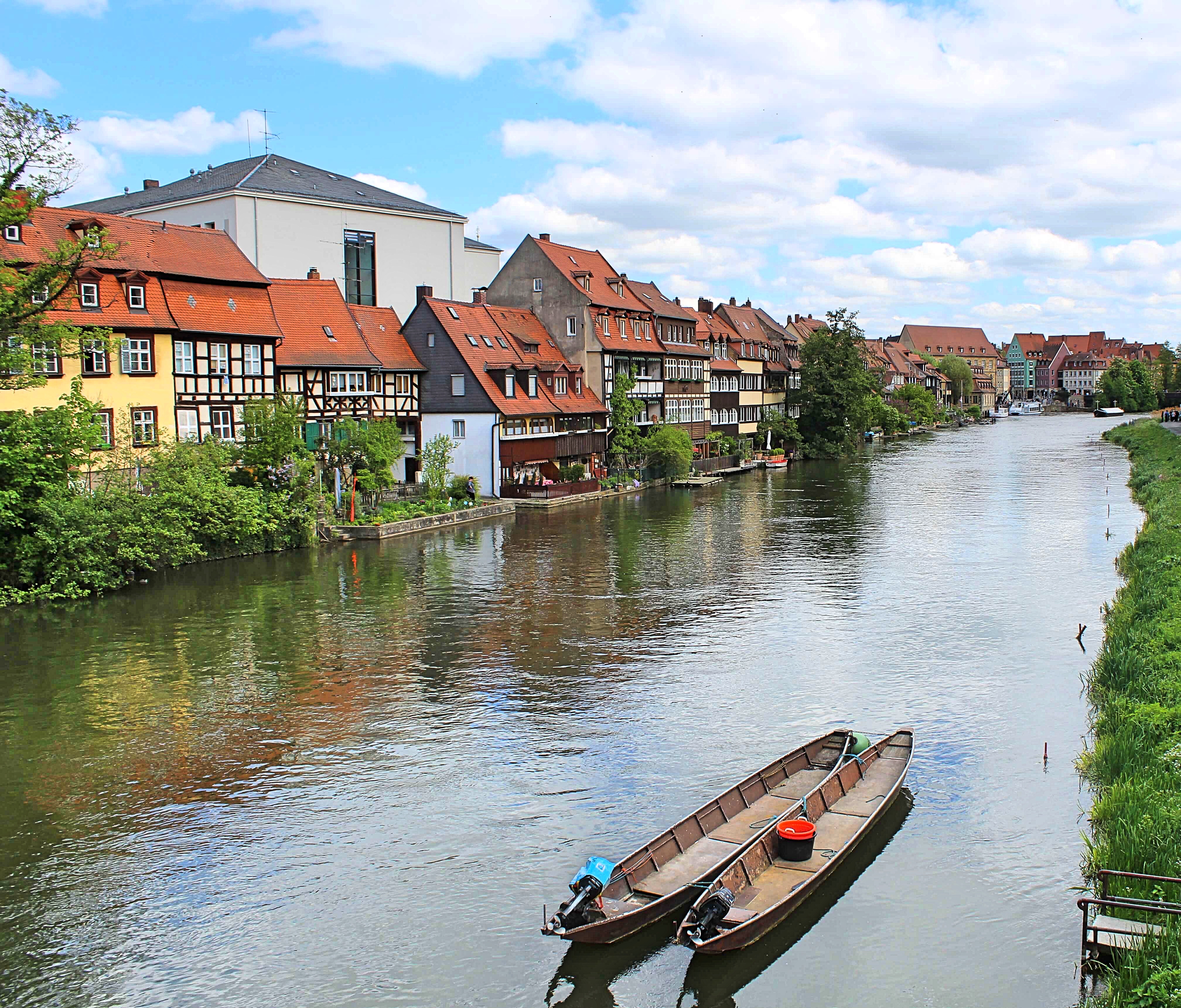
If you wish to see a German Altstadt (historic center) that escaped the fire and the bombs of the Second World War, you will need to go to a smaller city than Munich and Nuremberg. For this I took a day trip to Bamberg, a city about 60 kilometers north of Nuremberg, an hour away by train. The city of 75,000 souls is wrapped around the winding river Regnitz. Like Rome the city is built upon seven hills, each one topped with a church. Thus it is a city of sweeping views and picturesque quays by the riverside.
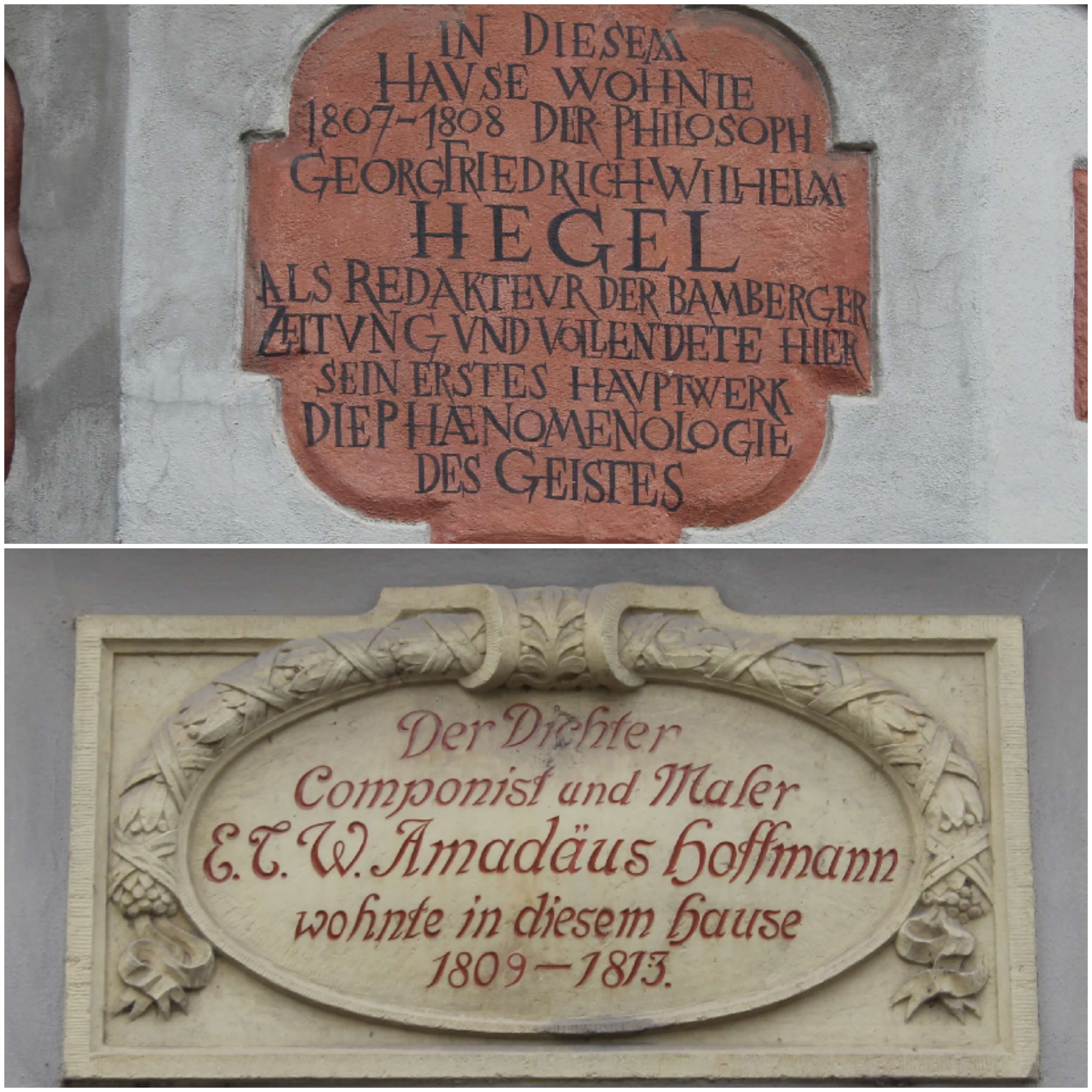
The historic center of Bamberg has been a designated UNESCO World Heritage site since 1993, not only for its excellent preservation, but also for its historical importance. The ecclesiastical architecture and the town’s layout proved influential throughout the rest of Germany (or at least that is what the UNESCO website says); and Bamberg also played an important part in the German Enlightenment, being where the philosopher G.F. Hegel and the writer E.T.A. Hoffman spent many years. For my part, I arrived in Bamberg completely ignorant of its history and I have improved very little since then. I just wanted to take some nice photos.
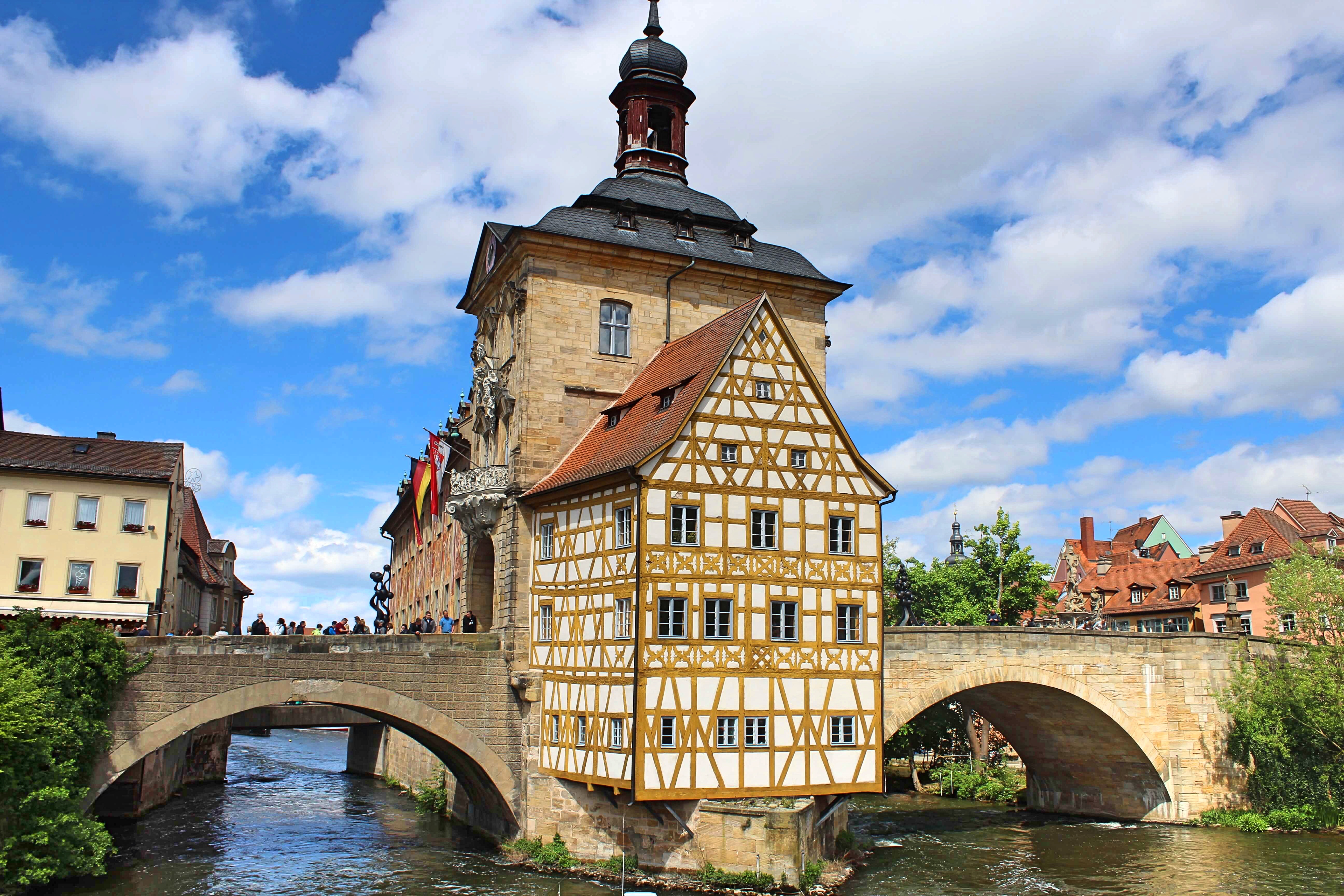
The most iconic image of Bamberg is the Altes Rathaus, or the old town hall. It is built on a little island in the middle of the river, with part of the structure hanging over the water. A bridge goes through the building and out the other side, connecting the island with both sides of the land, making it look like a man holding hands with two partners. Since it proved too small for the intricate bureaucracy of the current age, the building is no longer used as a town hall, but now houses the Museum of the City of Bamberg. No doubt the town hall erected to replace this one has no charming façade or bright colors, since we have grown out of such quaint customs.
On a nearby bridge you can see Igor Mitoraj’s sculpture, Centurion, an attractive fragment of a sharp Roman visage. From here Bamberg’s “Little Venice” comes into view, a colorful row of fisherman’s houses along the riverside. They don’t have gondolas but they do have ducks. I walked a short circuit along the south side of the river, returning on the north. At this time the coffee from this morning had hit my bladder, which is one of the traveler’s most persistent distractions. Luckily I found a public restroom along the river’s northern edge. Yet like seemingly all the restrooms in Central Europe it cost 50 cents to use, which I think is rather steep for a bodily function—though in fairness, the bathroom was quite clean.
Now it was time to ascend one of Bamberg’s famous hills, for I wanted to see the city’s cathedral. After the Altes Rathaus, this is Bamberg’s most recognizable structure, with the cathedral’s four spires topping a hill like an iron crown. It is a late Romanesque edifice that reminded me somewhat of Toulouse’s Basilica of Saint-Sernin; the cathedral’s massive form lacks that ebullient pointiness of later gothic structures, instead preserving a sort of grand dignity with its symmetrical mass. The cathedral is noteworthy for being one of the few places outside of Italy where a pope is buried—in this case, Pope Clement II (1005-47). A more attractive grave is reserved for Heinrich II, Holy Roman Emperor from 1014 to 1024. The sarcophagi, which shows scenes from the emperor’s life, was carved several hundred years after his death by the German Renaissance sculptor Tilman Riemenschneider. Standing watch nearby is the famous Bamberger Reiter, an equine sculpture portraying a dashing man of uncertain identity.
By now I was hungry, so I walked to some food stands I had seen earlier in the Grüner Markt square. There I indulged in a modern classic of German cuisine, Currywurst: a pork sausage drenched in ketchup spiced with curry. It may sound strange but tastes exactly how you would expect—though for my part the curry flavor is always too mild. In any case, it is filling, sweet, and salty, and does not leave me feeling particularly well. To complete the experience I had a Bavarian Weißbier, which literally means “white beer” but is really wheat beer. It is a rather sweet and light brew, with hardly any bitterness (since few hops are used) or sourness (since more wheat than malt is used). I much prefer them to pilsners. Having topped all this off with another coffee, you can imagine that I was soon paying for the bathrooms once again.
Having got my fill of grease, alcohol, and caffeine, I went off once again to see Bamberg. As I walked aimlessly on, I happened upon a building with a commemorative plaque on the side, which announced that Hegel stayed here while writing his famous Phänomenologie des Geistes, which I had painfully read the year before. I reached out my hand and touched the building with all the reverence due to Teutonic obscurity. From there I went to see the Hoffman house, which has since been converted into a museum about the polymath’s life. I went inside but everything on the walls was written in German, and I did not feel like fighting a battle.
Next I went to the top of another hill, to see the Michaelsberg Abbey. This is no longer an abbey, but a retirement home; but the abbey church is still open—at least, it normally is. When I arrived the building was covered in a thick mass of scaffolding; the church is undergoing substantial repairs and has been closed since 2016. But the abbey is surrounded by attractive gardens; and the patio still offers a wonderful view of Bamberg. On the day I went there were several gliders floating around in the air, their long white wings difficult to see against the clouds. I imagine it would be peaceful to be in one of those, sailing around the sky.
After walking along some more, enjoying the tree-lines streets that wind up and down the hills, examining the charming stone and wood-framed buildings that make the town feel so idyllically rustic, I came upon the Alte Hofhaltung and the Neue Residenz. The former is a lovely building with a steep roof and timber balconies that acted as a sort of palace for the bishops until the seventeenth century, when they moved to the Neue Residenz, a bigger, grander, but somewhat lifeless neoclassical structure nearby. Drunk with the scenery, I continued walking up the hill away from the river, until I came upon the Jacobskirche. This church, dedicated to St. James, was located outside of the now-demolished city walls, and acted as an important stop on the Camino de Santiago, the famous pilgrimage that terminates in Spain. I was surprised and delighted to see signs of the Camino in a distant land, and I enjoyed the peacefulness of the church’s Romanesque interior.
From there it isn’t far to leave the city altogether, entering some of the lush forests that surround Bamberg. On my offline map—I was using the application maps.me to get around—I found a lookout point in a grassy field. Though much of the city center was hidden from view, I could see the whole surrounding valley, with wind turbines on a distant hillside, and the town’s industrial sector off to my left, with freight trains rumbling by. Bavaria is an astonishingly lovely place—at least in summer. The town is surrounded by an extensive system of trails, something which the residents themselves—the Germans are an outdoorsy people—amply take advantage of.
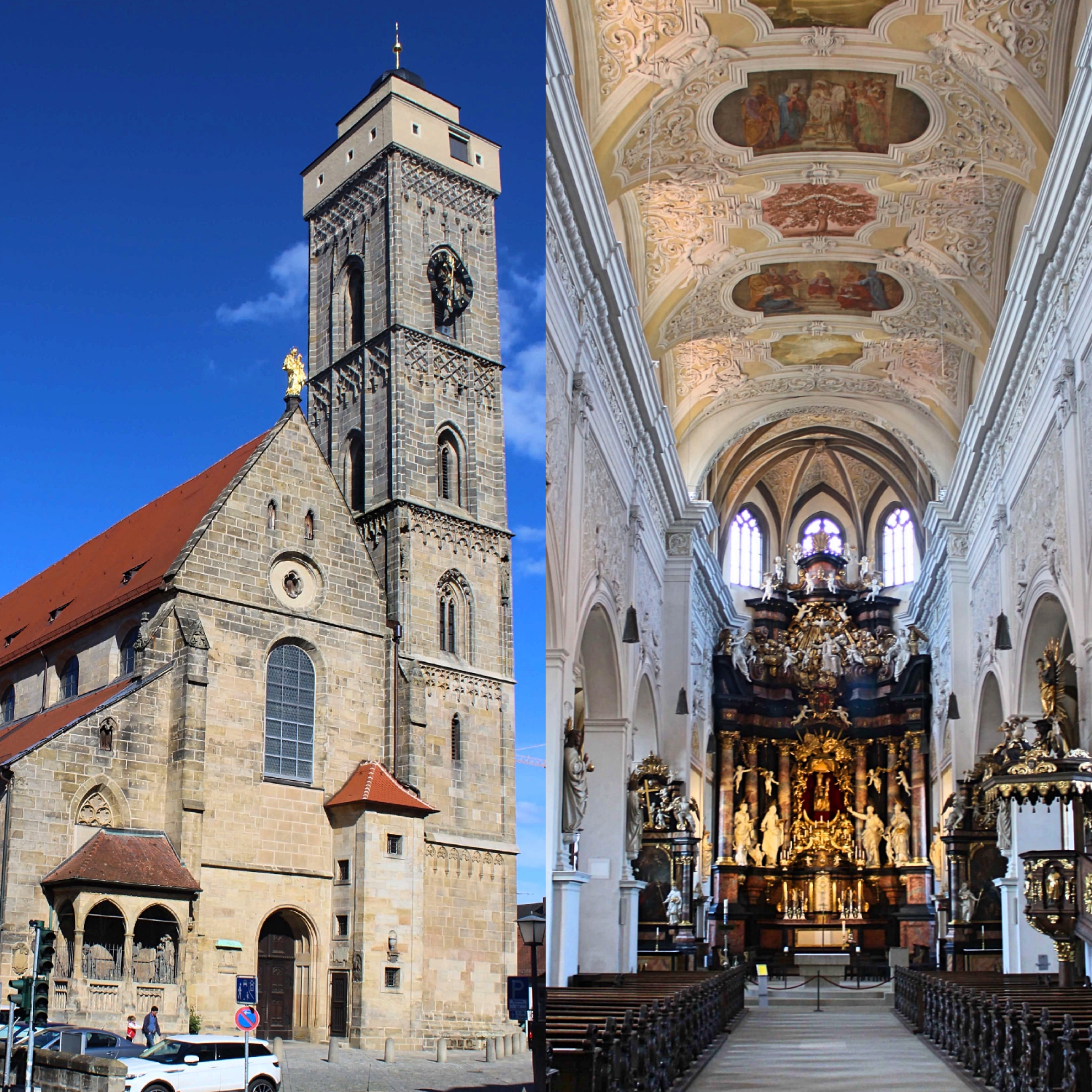
Now the hour of my return train to Nuremberg was approaching. So I walked back into town and back towards the train station. On my way I stopped at the Obere Pfarrekirche, or Upper Parish Church, also called the Church of Our Lady. This is the only purely gothic church in the city; and its altar and ceiling frescos are lovely to behold. Sadly, I missed the opportunity to visit one of Bamberg’s many breweries. In the finest Bavarian tradition, the city has its own local brews and is spotted with beer cellars. Truly, Bamberg is a garden of delights, bucolic and picturesque, and I wish I could have spent more time there.
Bodas de Sangre, or Blood Weddings, is an odd combination of the ancient and the modern. The story could not be more elemental: the conflict of love and duty, the tragedy of death. And yet the style is pure Lorca—symbolic, surrealistic, modern. The play is effective, not for any subtlety or refinement, but for the sheer amount of force that Lorca brings to bear on the main themes. The characters are nameless archetypes, whose speech is poetic passion. Lorca’s use of naturalistic imagery in his poetry—animals, trees, rivers, the moon—reinforces the primeval quality of the story, as if tragedy were a law of the universe. I am excited to read the other two plays of Lorca’s so-called rural trilogy.
This is the second of Lorca’s “rural trilogy” I have read, and if anything I liked it even more than Bodas de Sangre. In form and theme the two are quite similar. Like a Greek tragedy, the plot is simplicity itself, with one obvious conflict and one calamitous resolution. Again, Lorca’s power as a dramatist comes, not from subtlety or wit, but from pure passion. The incompatibility between traditional values and human impulses, with all its tragic implications, is laid bare by Lorca, who shows us a culture whose religious mores and gender norms oppress women and deprive them of a fulfilling life. Strikingly, the cast of characters is entirely female, even though the conflict revolves around a male who is always offstage. This allows Lorca to focus on a side of life that was often swept aside, while maintaining an atmosphere of tension and constraint that makes the play so riveting. I am excited for Yerma.
I have enjoyed each play of Lorca’s rural trilogy more than the last. He is such a heartrending writer. Even on the page, the emotion of the play is raw and deeply affecting. He had an acute ear for dialogue, and could write as naturalistically as anyone; and when this naturalism is supplemented by his poetic gifts—at times surrealistic, at times pastoral—the language becomes electric with meaning. The word I keep coming back to is “elemental,” since the plays dramatize basic and timeless tragedies of human life.
In this play the tragedy is the anguish caused by being childless in a time when women were valued as mothers and mostly confined to the house. As in the other two plays in the so-called “trilogy” (they all have distinct plots), the basic conflict is between conservative, religious traditions and spontaneous human impulses. Lorca seems to have felt deeply the suffering caused by an uncompromising Catholic morality, and convincingly shows how it doomed people to lifelong unhappiness. It is fittingly tragic that this same moral code contributed to Lorca’s own death.
If there is one city more strongly associated with National Socialism than Munich, it is Nuremberg. For it was here that the Nazis had their infamous rallies, and also here that the Nazi leaders were tried and convicted after the war. But even without these epochal events, the city would be worth visiting, for it has the same charming combination of an attractive city center and a Bavarian beer culture that makes Munich so popular. And as the second-biggest city in Bavaria, after Munich itself, Nuremberg has quite a lot to see.
When I arrived in Nuremberg I was in a sour mood. I was coming to the city from Prague (a place for another post), and had very thoughtfully planned the trip by buying a bus ticket beforehand. But I failed to take into account that the metro runs more slowly on Sundays; and so my trip took ten fatal minutes more than planned, and I arrived at the station just as the bus was pulling away. Thus I had to buy a ticket for the next bus, which cost twice as much as the one I already had and which lost me two precious hours in Nuremberg. Admittedly this is not very important; but I hate wasting money and I felt like a fool for not giving myself more time to get to the bus.
But my ill temper was soon alleviated as I walked around the center of Nuremberg. This was my first trip with my new camera, a Canon Rebel T6—all my photography before having been with my phone—so I eagerly marched through the city, snapping photos like a maniac of anything and everything that caught my eye. And this was quite a lot of things, since the old center of Nuremberg is a handsome place.
Like Munich, Berlin, and so many German cities, Nuremberg’s original old center was sadly bombed out of existence during the Second World War. The ability to aim bombs back then was rudimentary at best; and in any case I do not think the Allied bombers were apt to be very careful, since one of their goals was to demoralize the population. I do not know whether or not it would have significantly impeded the war effort to have tried to avoid destroying these historic cities, but still I find it sad that so much great architecture went up in flames and was reduced to rubble. War and art are perpetual enemies. Lucky for us, however, the people of Nuremberg reconstructed their historic city after the war; and if not perfectly replicated, the result is still very fine.
Nuremberg has historically been a walled city; and the old center still stands behind high walls, lookout towers, and an old moat that has been converted into a park. Nuremberg’s central square is the Hauptmarkt, which in December is home of a Christmas market, and all year long has stalls selling fruits, vegetables, sweets, preserves, and other delicacies. The square is presided over by the noble Frauenkirche (“Church of Our Lady”), a brick gothic structure whose stepping roof leads up to a central clock, under which the Holy Roman Emperor sits enthroned in a golden robe, surrounded by counselors. The church is rather unusual in having a balcony above its front portal. This was originally because the Holy Roman Emperors wanted to use the church for ceremonial functions. Nowadays it is used to give the opening speech of the Christkindlesmarkt.
In the center of the Hauptmarkt is the Schöner Brunnen (“beautiful fountain”), whose tall, golden, gothic spire juts into the air, decorated with statues representing the liberal arts, the church fathers, and other political and religious figures important to the Holy Roman Empire. The fountain is aptly named.
Right next to this central square is the river Pegnitz, which runs right through the center of the city, and whose calm surface is never free of a couple loafing ducks. From the city’s well-preserved Fleishbrücke (literally, “meat bridge”)—a lovely Renaissance bridge that escaped the bombs—you can see the Heilig-Geist-Spital (Holy Ghost Hospital), a pretty building that extends out into the river, supported by two arches. Built in 1399, it long served its medical function, in addition to being a kind of old folks’ home and, from 1424 to 1796, the depository of the imperial jewels. Originally there was a church attached to the building, but the bombs destroyed it in 1945 and it wasn’t rebuilt. But there is a nice restaurant there nowadays, apparently.
The most magnificent church in Nuremberg is, without doubt, the Lorenzkirche, or St. Lorenz Church. This is a Lutheran church which was another casualty of the world war, not destroyed but badly damaged. But it has been restored magnificently. The imposing gothic façade gives way to an equally impressive interior, whose vaulting, statues, and stained glass form a harmoniously somber whole. Standing on the other side of the old town is the almost equally majestic Sebalduskirche, which has the same curiously hunchbacked profile as the Lorenzkirche. This distinctive shape resulted, I believe, from converting an older cruciform church into a larger gothic building, raising the side aisles and adding an ambulatory in the back. In any case, it is another damaged and well-restored structure, which preserves the original shrine of St. Sebaldus, Nuremberg’s patron saint. (I was under the impression that Lutherans don’t have shrines to saints, but apparently I was wrong.)
Presiding over the northern edge of the old city, perched like an enormous eagle on a hill that overlooks the town, is the Imperial Castle of Nuremberg (Kaiserburg Nürnberg). This castle was extensively used by the Holy Roman Emperors, making Nuremberg a sort of unofficial capital of the empire. (This association with the Holy Roman Empire, which Hitler retroactively named the “First Reich,” is one reason why he chose to have his rallies here.) Like everything else, the castle was badly damaged during the war, but has been repaired beautifully; its brown buildings and rust-colored roofs fit in perfectly with the city’s aesthetic.
Walking towards the castle, you may come upon the attractive Tiergärtnerplatz, a plaza surrounded by pretty buildings and, in good weather, full of beer drinkers sitting on the pavement. Nearby is the historic Albrecht Dürer Haus, where the famous painter lived from 1509 until his death. It is a typical municipal dwelling, with a sandstone bottom and a timber-framed top, and houses a museum dedicated to the artist. If you continue from this square up the hill into the castle, you will be rewarded with an excellent view of the city, spread out before you like a dinner table.
Feeling ravenous at this point, I went off to find dinner. For this I went to Som Tam Siam Food, a Thai restaurant in the north of the city that I found online. You may think it’s silly to eat Thai food on a trip to Germany, but it was delicious and cheap, and I didn’t regret a thing. To be fair, the next day I tried the culinary specialty of Nuremberg, which are its bratwurst—greasy, juicy, meaty, delicious sausage. I also treated myself to a German pretzel, which are buttery and rich, much better than the pretzels that are sold on the streets of New York. But I have to admit the Thai food was my favorite; I went back the next day.
It is worth taking a stroll from the city center to one of Nuremberg’s cemeteries, the Johannisfriedhof. In my travels I have discovered that there is a great variety in cemetery design. In Spain, France, Ireland, the United States, and Germany, they all have a distinctive look. The Johannisfriedhof is a lovely open space filled with stone sarcophagi, filled with flowers, ferns, and trees. Like many cemeteries, it is a solemn and silent place, mostly empty, and full of benches to sit and enjoy the peaceful atmosphere. Its most famous inhabitant is Nuremberg’s most famous son, Albrecht Dürer, widely regarded as the greatest of German artists, in a league with the best Renaissance painters for his brilliance. I sadly missed the opportunity to see his iconic Self-Portait at 28, which is in Munich’s Alte Pinakothek, yet another of my traveler’s regrets. The artist’s grave is modest and plain, blending in with those surrounding him. His best friend, Willibald Pirckheimer, of whom Dürer made many portraits, is also buried in this cemetery.
My last stop in the city center was the Germanisches Nationalmuseum. It was founded during the eighteenth-century upsurge in cultural interest, and has since grown into a massive institution—Germany’s largest museum of cultural history. I visited on my last day in Nuremberg, when I only had a few hours to explore before going to the airport. This was not nearly enough time to properly see everything—or anything—but how much time is enough will depend, of course, on the visitor’s tastes.
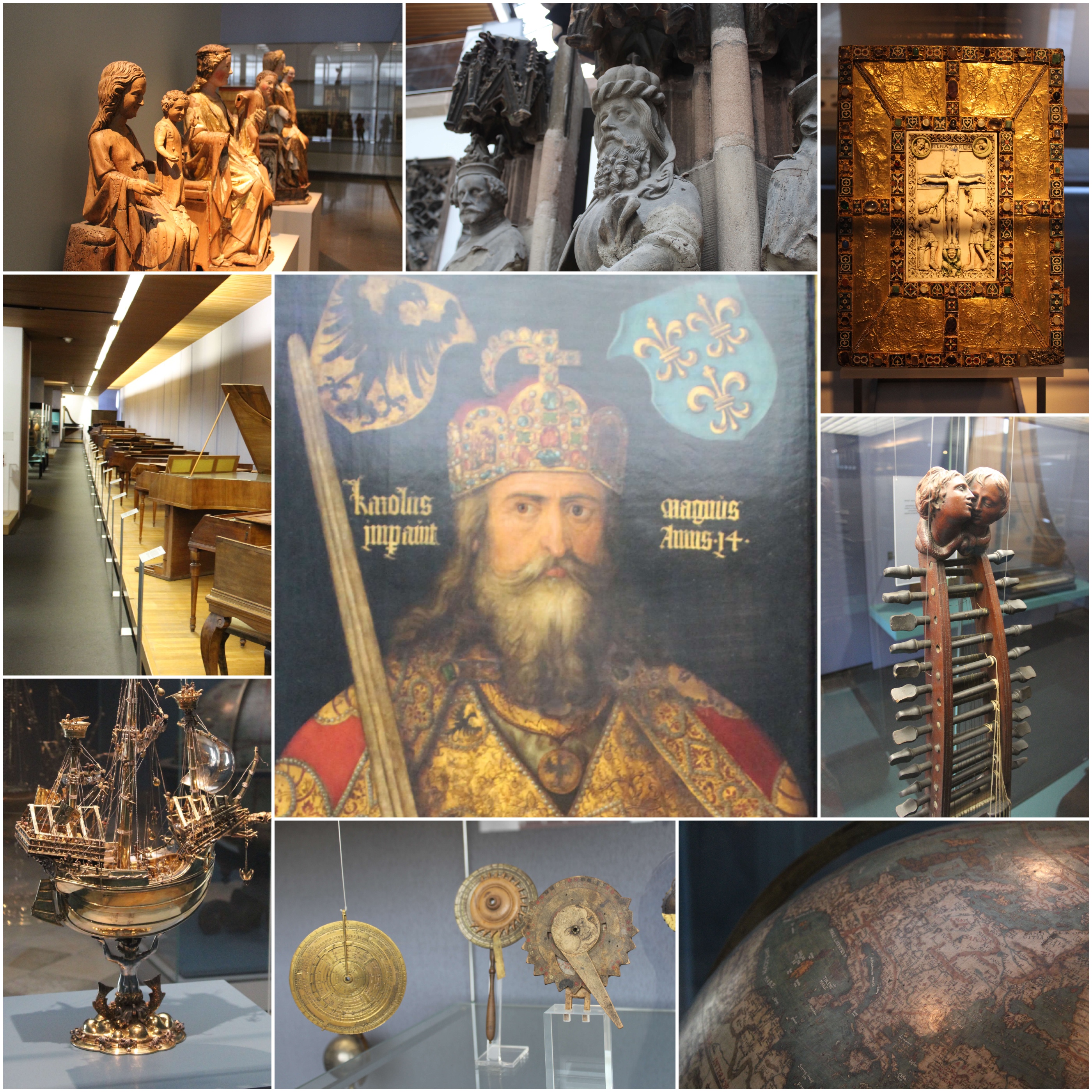
The museum building itself is a sort of artifact, having been converted from an old monastery, like the Musée des Augustines in Toulouse. The lovely old cloisters and church are preserved and stocked with statues, most notably by the local gothic sculptor Adam Kraft. From there the museum seems to expand in every direction. There is a sizable collection of prehistoric and ancient artifacts, including Roman military equipment. One large hall is dedicated to fashion—and walking past so many oddly-dressed mannequins is a little creepy. Directly below is the museum’s impressive exhibition of antique instruments, showing viol de gambas, ornate pianos, obsolete reed instruments, and much more.
In five minutes you can go from the pious passion of gothic painting to the stylish precision of scientific instruments. Among these, the most famous is Martin Behaim’s Erdapfel (“earth apple”), the earliest surviving globe. The map is difficult to read now, discolored and faded with age; but it is obvious that the Americas are not included, since it was made in 1490-92, before Christopher Columbus returned from his voyage in 1493. (This, by the way, is yet another proof that people back then already knew the earth was round.) Leaving no stone unturned, the museum also has a substantial collection of paintings from the Renaissance, Baroque, and Enlightenment periods. This includes Dürer’s imaginary portrait of Charlemagne, a famous miniature portrait of Martin Luther, and several works by Rembrandt. But the museum is impressive for the range and depth of its collections rather than outstanding specimens, though it has its fair number of these too. The place is worth as much time as you care to spend in it.
§
As everybody knows, Nuremberg’s reputation as a seat of imperial power and the home of the German Renaissance’s most famous representative, Albrecht Dürer, was considerably darkened in the twentieth century. Nowadays it is nearly impossible for most outsiders to think of Nuremberg without immediately thinking of the Nazis. Far from trying to cover up this association, the people of Nuremberg have admirably opened two excellent exhibitions about this dark era, the first at the former rally grounds, the second at the courthouse where the Nazi leaders were put on trial. Because both are on site, they are situated a little far from the center; but they are well worth visiting.
Photo by Stefan Wagner; licensed under CC BY-SA 2.0 de; taken from Wikimedia Commons
The documentation center at the rally grounds has been built into its largest preserved structure, the Congress Hall. This is a semicircular arena, loosely based on the Coliseum, that could hold 50,000 party members. The documentation center’s metallic exterior seems to spear through the older stone building, creating a visual pun on the name of Albert Speer, the chief Nazi architect. Opened in 2001, the center is designed to explain the rise of Hitler’s party and the part that the Nuremberg rallies played in that story. The ticket automatically comes with an audioguide, which is good, since all of the text in the museum is in German so you have little choice but to listen. The exhibitions are organized by chronology and theme, taking the visitor through the early days of National Socialism, the Beer Hall Putsch and the writing of Mein Kampf, and on to their rise to power—including much else along the way: their ideology and rituals, their organization and methods of control, their use of propaganda and pageantry, and so on. Though there are plenty of photos, the main substance of the exhibit consists in this self-guided tour, making the experience of visit somewhat like listening to an audiobook—though a very good one.
Since I had recently read The Rise and Fall of the Third Reich, a lot of the information was not new to me. The explanations of the actual rituals were, however, new and fascinating. As in my visit to Berlin’sTopography of Terror, what most struck me about the Nazi party was the degree to which its organization, rituals, and ethos of manliness were reminiscent of the Boy Scouts. By this I do not intend to insult boy scouts; rather, mean that, in its rituals and architecture, these rallies were like nightmare versions of boyish fantasies. Propaganda films show grown men roughhousing, partaking in good clean fun, exercising with their mates, laughing and singing songs together, and demonstrating their manly martial prowess in mock battles. The melodramatic gravity of the rituals reminds me of a children’s game, aping the movements and motions of real solemnity while missing their substance. The architecture consists of shallow imitations of classical structures or medieval fortresses; and you get the impression that, like so many boys, they were imagining themselves in an ancient time, in an epoch of emperors and knights and Crusades.
But clearly the rallies were effective. Indeed, during their tenure in power the Nazis proved themselves to be geniuses of propaganda. The rallies’ tight choreography and grand orchestration showcased the dazzling efficiency of the German army. Their massive marches and endless parades reinforced the image of German might. The mixture of military and religious rituals created an effective blend of awe and aggression. The free use of symbols from the past—the ancient Romans, the church, the Holy Roman Empire—impressed on the German people the idea that they were following in the footsteps of illustrious ancestors and fulfilling their destiny. The total coordination of myth, pageantry, rhetoric, and spectacle created a hermetically sealed whole, a cultural space where beauty, truth, and goodness were the party line, and the attendee just a passionate part of a glorious movement. The ability to inspire had never been so abused.
These were the lessons I learned from my visit to the documentation center and a short walk around the remaining buildings. It is a sobering experience.
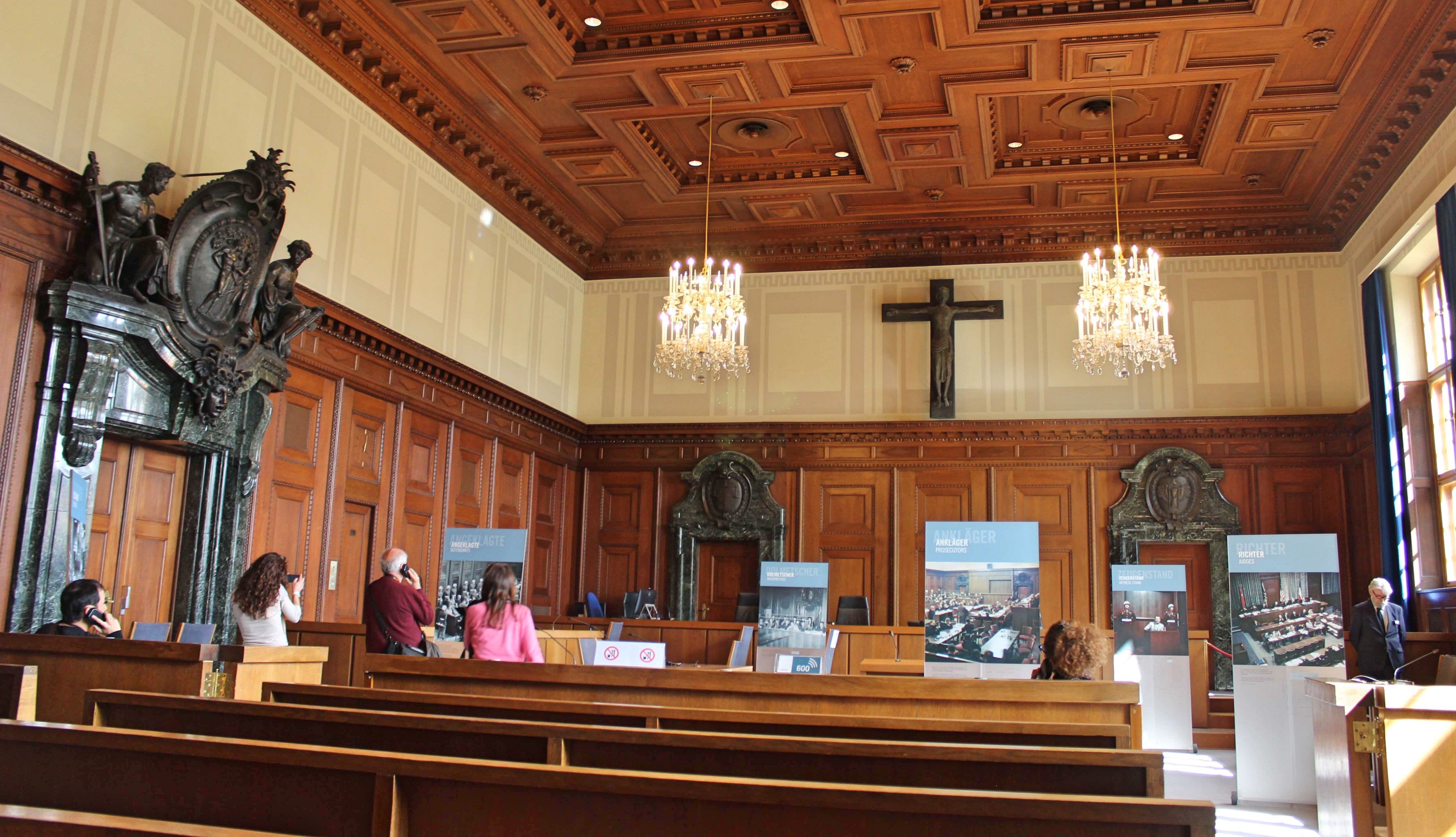
Somewhat more uplifting is a visit to the Nuremberg Trial courtroom. The room is in the monumental Palace of Justice, Nuremberg’s court building on the other side of town from the Documentation Center. Nuremberg was chosen as the site of the trials partly for the city’s association with Nazism, and also because the Palace of Justice has a sizable adjoining prison. After entering through a side door of the building, paying the entrance fee, and ascending some stairs, the visitor is confronted with Courtroom 600, where the trial actually took place. My first impression was that it was much smaller than I expected, indeed hardly bigger than a civil courtroom I had seen in New York. Admittedly the courtroom is now significantly smaller than it was during the trial, since the back wall was at that time removed to allow for a double-decker gallery of onlookers and reporters.
Even so, it was a small stage on which to create history. For into this modest room there presided judges from the four allied powers (one main and one alternative for each, making eight); a bank of interpreters simultaneously translated between the four official languages (Russian, French, German, and English); prosecutors from every Allied power; defense attorneys for all the 24 accused; the accused themselves; a witness stand; guards, clerks, and amanuenses; and then the press, with cameras and notepads. It must have been very crowded. Standing in that room, I felt that strange mixture of disappointment and awe that historical places create—in this case, disappointment that it is an ordinary courtroom, awe that such normal surroundings could have been host to such a world-changing event. But history does not always leave an obvious mark; and the courtroom—which is still occasionally used—looks clean and polished.
Up another flight of stairs is the main exhibition, which has only been open since 2010. As in the rally grounds, here the visit consists of an audioguide and lots of panels. Really, the amount of information on display is overwhelming; to listen to all of it, one would need two hours at least. But it is good information, giving some idea of the leadup and consequences of the trial, but mainly focusing on the trial itself—its legal bases, its personalities, its progress. The audioguide takes an uncompromising pro-trial stance, which is somewhat surprising, given that they were often seen within Germany as an example of “victor’s justice.” For it hardly seems like a recipe for fairness that the victors to put the leaders of an enemy country on trial. And anyone must admit that the victor’s hands were hardly clean. The most extreme case are the Soviets, who had their own mass killings, invasions, and wars of aggression; but none of the Allies were beyond reproach: many French collaborated, the English appeasement strategy aided Germany’s rise, and America’s bombing of Dresden is nefarious.
Even granting all this, I still think that the Nuremberg Trials were a step forward in the bumbling progress of our species. The victorious powers could simply have shot the Nazis without due process, or have submitted them to a shallow show-trial. It is rather remarkable that we didn’t. As Robert H. Jackson said in his opening speech: “That four great nations, flushed with victory and stung with injury stay the hand of vengeance and voluntarily submit their captive enemies to the judgment of the law is one of the most significant tributes that Power has ever paid to Reason.” The trial set new precedents for international law—defining war crimes and crimes against humanity—which served as a model for similar trials ever since, such as those in the wake of the Rwandan massacre or the Balkan Wars. And the trials were instrumental in uncovering the horrible truth of the Nazi atrocities and the full extent of their culpability, since the prosecutors were determined to convict the defendants using their own documents.
If the Nuremberg trials were a victory for Reason, that the city most associated with Nazism could be home to two thorough and honest exhibitions about the history of their crimes is yet another.
And oftentimes excusing of a fault
Doth make the fault the worse by the excuse
King John is normally regarded as one of Shakespeare’s earliest and weakest history plays. The plot mainly concerns the king’s conflict with France over his legitimacy, since John inherited the throne from his brother, Richard the Lionheart, even though the late king’s son, Arthur, was alive and well. This leads to a rather silly confrontation between the two powers, in which they try to get the town of Angiers to recognize one of them as the true king, which the townsfolk resolutely refuse to do. The warring factions finally decide to just destroy Angiers—presumably for the satisfaction—until they receive the timely recommendation to marry the prince of France to the princess of England, thus uniting their houses. This is done, and succeeds in suppressing the conflict for about five minutes, until a Cardinal stirs up the war again (which leads to some notable anti-Catholic blasts from Shakespeare).
Compared to Shakespeare’s more mature works, the characters in this play are mostly stiff and lifeless, with far less individualizing marks than we expect from the master of characterization. As Harold Bloom says, at this point Shakespeare was very much under the influence of Christophe Marlowe, and follows that playwright in his inflated, bombastic speeches. I admit that the swollen rhetoric often had me laughing, especially during the first confrontation between the English and French parties. The pathetic and spiteful King John is somewhat more interesting, if not more lovable, than the rest, but the real star is Philip Faulconbridge (later Richard Plantaganet), the bastard son of Richard the Lionheart, and the only immediately recognizable Shakespearean character. As with Launce in Two Gentlemen of Verona, it is a relief and a delight whenever Philip appears onstage.
As far as notable quotes go, this play is the source of our phrase “gild the lily,” though it misquotes the play, which goes: “To gild refined gold, to paint the lily.” Also notable is this description of grief for a lost child, which many surmise expressed Shakespeare’s grief for his own deceased son, Hamnet, though this is pure speculation:
Grief fills the room up of my absent child
Lies in his bed, walks up and down with me,
Puts on his pretty looks, repeats his words,
Remembers me of his gracious parts,
Stuffs out his vacant garments with his form
Time, which alone gives reputation to writers, at last makes their very faults venerable.
Voltaire and Rousseau are usually grouped together as the twin pillars of the 18th century, the first championing reason and reform, the second romanticism and revolution. After reading them back to back, I know who I prefer. Rousseau is arguably a far more original thinker and writer; yet his personality is so irksome and his arguments so irrational that it can be unpleasant to read him. Voltaire, by contrast, is witty, charming, and delightful; and after Rousseau’s lyrical fantasies, Voltaire’s deflating sarcasm is extremely refreshing.
This book is a collection of essays on topics related to England, written after Voltaire’s three-year stay on the island nation. He interviews a Quaker, visits Parliament, goes to the theater, and then expounds the philosophy of Bacon, Locke, and Newton. He skips lightly from topic to topic, a barb here, a jest there, while revealing an impressive range of knowledge—from inoculation to history, from theater to physics. In general his opinion of England is quite positive, arguably idealized, seeing England as a land of toleration and philosophy. Indeed, the only thing that Voltaire shows some reservation towards is Shakespeare, whose dramas struck Voltaire’s Enlightenment taste as lacking refinement.
The book was controversial when published, since many in France saw Voltaire’s praise of England—correctly—as veiled criticism of their own country. Nowadays, this political purpose only adds to the essays’ charms, as we see Voltaire as a champion of an open society, from religion to science to literature, in addition to an omnivorous intellectual. Few books pack so much into so little space.
The superstitious are the same in society as cowards in an army; they themselves are seized with a panic fear, and communicate it to others.
—Voltaire
When I was a child I was afraid of ghosts. Coincidentally, at both my mother’s and my father’s house, I had a nextdoor neighbor who very much encouraged the fear. Both were girls, both a couple years older than me, and both told me ghost stories that filled me with wonder and scared me half to death. Once, I remember being so frightened of ghosts in the attic that I begged my mother, with tears in my eyes, not to go up, sure that she would meet some horrible end. (She was miraculously unharmed.) I even went on ghost discovery missions with my neighbor and my brother, in the forest behind my house; we didn’t find anything, but once we took a polaroid in which the sun’s rays, coming through the trees, created an odd aura that looked vaguely ghostlike.
Naturally my superstitious beliefs weakened with age until they left me altogether. Admittedly, living in a very secular part of the country helped. Since those ghost hunting days, I have not personally come into contact with a lot of superstitious behavior. But whenever I have, I am filled with a strange mixture of pity and revulsion, for superstition strikes me as the lowest depth to which the adult human mind may fall. Traditional superstitions are the child’s fear of the dark, of the strange creaks at night, of the unexplained coincidence—in short, fear of the unknown—hardened into a belief handed down the generations. They are socially condoned phobias.
While I am no friend of religion, I can at least sympathize with the comfort provided by a faith in a just and caring God. I can see how a belief in a higher power might ennoble a person and lift them up above circumstances. But superstition, as I understand it, does just the opposite: it shrinks the universe down to petty dimensions, and fills the superstitious with debilitating and needless fears. For to believe that throwing salt over your shoulder, walking over a grave or under a ladder, opening an umbrella indoors or saying some forbidden word, being passed by a black cat or doing something at a certain hour or on a specific day—to believe that these trivial events can significantly influence your life is to give monumental importance to one’s smallest actions, and is thus really a form of egotism.
And how does the belief in ghosts, spirits, demons, devils, monsters, or even “luck” itself, add to your experience of the world? All these are boogeymen who cause us to revert to a state of childlike terror. And what are the consequences of these beliefs? If you believe that certain very normal things are cursed, haunted, or even “bad luck,” you will go through life needlessly avoiding things. Indeed, I admit that it strikes me as an affront to human reason for a person in this century to become nervous because they have spilled salt.
But the most nefarious part of superstitions is not that they are illogical, but that they are socially condoned, often through association with religion. Thus people are not encouraged to test these fears in order to see if they are justified, but exactly the opposite, they are encouraged to obey the fears and never to criticize them. This is what I mean by calling them socially condoned phobias. For an irrational fear in one person is a phobia, to be treated by a psychologist; but in a whole society it is a superstition, to be respected.
In general I think that fear should be combated wherever it isn’t absolutely necessary, for fear limits our options, distorts our views, and shrinks our world. And superstition, being a socially contagious form of irrational fear, is perhaps the worst example of this. Yet having written this diatribe, I must here admit that I enjoy picking up pennies when I find them on the ground. I do not believe they give me good luck, but somehow it feels like winning a prize. What strange stuff we are made of!

 The Education of Henry Adams : An Autobiography by Henry Adams
 Mont-Saint-Michel and Chartres by Henry Adams













 Lotz in Translation