Here is another excellent lecture series by Edwin Barnhart. Just earlier this year I listened to, and greatly enjoyed, his series on the civilizations of North America. Now he is on his home turf, for Barnhart is a specialist in Maya archaeology. Surprisingly, however, I thought that the lecture series got off to something of a rough start. He jumps right into the Olmecs without enough framing or background. But soon enough I got my bearings, and the rest was a delightful trip through Meso-American archaeology.
Although I was somewhat more familiar with the basics of the Mayans and the Aztecs than with the ancient peoples of North Americans, I was still astounded at the depths of my own ignorance. It is frankly incredible that you can go through the American educational system and learn infinitely more about the Babylonians, Egyptians, and the Greeks than about the Mayans and the Aztecs. Granted, much of what we know about these civilizations was discovered fairly recently. The Mayan script was only deciphered in the 1970s; and as Barnhart points out, there is so much left to be discovered, including whole cities. Barnhart himself discovered a city (Maax Na).
The pyramids, pictoral script, and ancient date of these civilizations naturally bring up associations of Egypt. Yet the comparison is somewhat misleading, since the peoples of Meso-America consisted of a patchwork of cultures, sharing obvious similarities but equally important differences, whose fortunes waxed and waned through the centuries. Egypt, by contrast, was a singularly homogenous culture. Mesopotamia is likely a better comparison in this regard. But, of course, the Meso-American cultures have many distinct features.
One of the most important is the elaborate calendar system. Barnhart, an expert on paleo-archaeology, goes into great detail in explaining the Mayan numeral and calendrical systems. What is striking is not only the great complexity of the system, but also the cultural importance of the calendar. It was used by the entire region; and its keepers—who were religious men—communicated with one another even while their own states were at war. The calendar was filled with significance and omens, and was always consulted before important tasks. Barnhart speculates that the cyclical nature of the calendar also explains why cities were periodically abandoned.
Another peculiar feature is the Meso-American ball game, which was played across the region. This ball game was not just a sport, but a kind of living metaphor for Meso-American cosmology. I am not familiar of any other examples from the ancient world of a sport being so culturally central. And, of course, there is the human sacrifice—especially among the Aztecs. It is difficult to hear about these practices nowadays; though I do wonder which area had more religion-inspired killings during this time: Meso-America or Europe?
Barnhart ends the lecture series by narrating the first European contact and the eventual destruction of the Aztec Empire by Hernán Cortés and his men. (There is a new series on Amazon about Cortés, which was made to commemorate the 500th anniversary of the fall of Tenochtitlán, which happened in 1521.) It is an exciting and a depressing story, as the work of centuries is burned or buried. But Barnhart ends on a positive note, observing the many ways that these cultures have survived, and expressing hope that the modern descendants of the Maya, the Aztecs, and the many other cultures will take control of their heritage. For my part, now I really want to go to Mexico.
Economies around the world have, increasingly, become vast engines for producing nonsense.
Reading this was cathartic. Like so many people, I, too, have experienced the suffering that is a useless job—a job that not only lacks any real benefit to society, but which also does not even benefit the company. (Lucky for me, I am now a teacher, which, for all its unpleasant aspects, almost never feels useless.) Even though I got a lot of reading and writing done on the job, the feeling of total futility eventually drove me half-crazy. So it felt liberating to read an entire book about this phenomenon.
But let me take a step back and explain the book. In 2013 Graeber published an article in STRIKE! magazine (a fairly obscure publication) about bullshit jobs, and it immediately went viral. This book is basically an articulation, elaboration, and defense of the points in that short article. Graeber notes that Keynes predicted the rise of automation to cause a startling reduction in the work-week. Yet this has not occurred. Many economists explain this by pointing to the rise of the so-called “service” industry. But this would seem to imply that we have switched from factory-work to making lattes for one another, or giving each other massages. As Graeber shows, this is hardly the case: the number of people in such jobs has remained fairly constant. What has grown, rather, is a vast edifice of managerial and administrative work.
Anyone familiar with the academic world will instantly recognize this. Universities have come to be dominated by a top-heavy administrative structure, and faculty have been forced to spend ever-increasing amounts of time on bureaucratic nonsense. The same is true in the medical field, or so I hear. Really, the story is the same everywhere: an increasingly arcane hierarchy of administrators, leading to byzantine networks of paperwork—all of it ostensibly for improving quality, and yet manifestly distracting from the real work. This kind of ritualistic box-ticking is only one of the types of bullshit jobs that Graeber investigates. Also included are flunkies (subordinates whose only role is to make superiors feel important), goons (jobs which arise from a kind of arms race, such as marketing agents or corporate lawyers), and duct tapers (who are hired to patch over an easily-fixed problem).
Obviously, one could argue all day about the typology of useless jobs. One could also argue about which jobs, if any, are useless. It must be said that Graeber’s reliance on subjective experience of his informants does introduce a worrisome element of capricious judgment. Besides this, some might say that the free market can never give rise to useless jobs, since such things would be obviously detrimental to a company’s profits. But one need only read through the many testimonies collected by Graeber to be convinced that, yes, some jobs really ought not to exist. According to surveys, around 40% of workers report that they believe their own jobs to be useless—so useless that they could vanish tomorrow without anyone minding. To pick just one of Graeber’s examples: a man works for a subcontractor of a subcontractor of a contractor for the German military, whose job is to fill out the paperwork necessary to allow somebody to move their desk from one room to another room. I do not think this is necessary.
But this raises the obvious question: If so many jobs are really useless, why do they exist? One might understand this happening in the government, but this is precisely the sort of thing that the private sector should be immune from. Well, Graeber is an anthropologist, not an economist, and so his explanations are social and cultural. He cites several factors. There is a huge amount of political pressure, from the left and the right, to create more jobs. This is natural, since being out of work means being poor, or worse. More than that, we have culturally internalized the institution of “work” to the extent that our jobs are the primary source of meaning in many people’s lives, even if they ultimately are disagreeable. Indeed, Graeber believes it is just the unpleasantness of work that makes it a source of value in our culture, as it becomes a type of ennobling suffering.
Graeber also notes the usefulness of useless jobs to the upper classes. For one, they keep people endlessly busy; and, what is more, well-paying, white-collar jobs—even useless ones—make their holders identify with the interests of the upper class. The economy then becomes a kind of engine for distributing favors and resources down an elaborate chain of command. Graeber coins the term “managerial feudalism” for this arrangement: the return of the medieval obsession with ranks mirrored by the modern penchant for inflated job titles. Now, my brief summary does not do justice to Graeber’s writing. Nevertheless, it is here where one wishes most for an economist to contribute to the argument. For even if there are forces countervailing the pressures of profit, the economy is still running on manifestly capitalist lines. So how could a sort of inefficient feudalism exist in this context?
Another point that Graeber examines is the relative pay of people with useful and useless employment. The obvious trend is that jobs which have undeniable social value—like nurses and teachers—are paid less, while jobs that have questionable or even negative social value—such as “creative vice presidents” and corporate lobbyists—are richly rewarded. Now, I do not think you need to be an idealist to see this situation as undesirable. Graeber explains this tendency by analyzing the culture of work (specifically, that useful employment is supposed to be its own reward, while useless employment requires incentives), but again one craves an economic explanation. (This, by the way, is one of the frustrations of social science: that the different disciplines operate with incompatibly different premises and methodologies.)
For my part, my own experience, combined with the many testimonies and statistics in this book, is enough to convince me that some jobs are really bullshit—even from the limited standpoint of a company’s profit. And I think that Graeber may be correct in searching for a cultural and political, rather than a strictly “economic,” explanation. After all, we humans are not exactly renowned for our rational economies. But for my part, I think he may have underestimated the role that corporate mergers have played in vastly reducing competition—and, thus, the pressure to eliminate useless jobs.
While all of this deserves analysis and debate, I think that this book is valuable if only for raising serious questions about the institution of work itself. The more that I read about history, the more I have come to see our modern ritual of work as strange and aberrant. The idea that we would all go to work five days a week, eight hours a day, year after year—regardless of whether we are making cars or filling out forms, and regardless of how much work there is on any given day—would have struck people in nearly any other place and time as bizarre.
To me, it just seems backwards to use a cookie-cutter schedule for every task (from lawyer to salesman), and then expect every member of society to adopt this basic template or risk abject poverty. Considering that the economy requires a certain level of employment to function, and that the current social safety net could not support a large number of unemployed people anyway, perhaps it should come as no surprise that we are plagued by dummy jobs. And if you think about it, it would be an amazing coincidence if the economy—through all the structural and technological changes of the previous century—always needed between 90 to 95 percent of the working population at any given time.
Graeber’s proposed solution to this problem is Universal Basic Income—providing every person with a regular paycheck, sufficient to cover the necessities of life. Personally I think that this is a wonderful idea, and one which could greatly alleviate many of our social ills. Unfortunately, in the United States, at least, UBI seems just as likely as paid maternity leave. But whatever the means, I think it is high time to change our attitude towards work. We spend enormous amounts of time doing things we do not want to do, and, what is worse, things which often do not need to be done. What fuels this is a kind of masochistic work ethic, defining our worth by our ability to do things that we do not want to do. This ethic has so pervaded our culture that, in America at least, we take it for granted that everything from health care to our self-respect should depend on our jobs.
One of Graeber’s most interesting points is that the phenomenon of useless jobs may reveal that we are using a flawed conception of human nature. One would think that being paid to do little or nothing would be the height of happiness. But most people in useless jobs report profound feelings of unease and distress. Again, my own experience testifies to this. Though I had little work, and was paid decently, I often found myself miserable, even beside myself with a strange mixture of boredom and anxiety. Graeber has a long section on this, but basically it comes down to the way that useless work undermines our sense of agency in the world. There is a reason the gods punished Sisyphus that way. As Dostoyevsky said, having humans perform an unpleasant, uninteresting, and totally worthless task might be the most profound form of torture. In my own case, it gave me a very unsettling feeling of dissociation, as if I really could not control my own actions.
So if we build our economy on the assumption that humans, left to themselves, will choose to get the maximum reward for the least benefit, we may be building on false premises. I think that Graeber is right, and that people generally prefer feeling like they are doing something useful. This is why I think we ought not to fear that Universal Basic Income, or a drastic reduction in working hours, would lead to a society of lazy idlers. In any case, people bored at home may do something more worthwhile than people bored at work, who mostly seem to go on social media. (Graeber notes that the rise in social media use coincides with the rise of useless employment. Certainly it was true in my case, that useless employment led naturally to spending huge amounts of time on Facebook.)
This summary does not do justice to the full contents of the book. Graeber is a sharp writer and an agile thinker. Not only is he the first to really hone in on this strange aspect of the modern world, but he does so within a wide perspective. To give just a few more examples, he connects the rise of bullshit jobs with the slowdown in scientific progress and the decline in quality of Hollywood movies. Perhaps Graeber’s political identity as an anarchist helps him to avoid the basic narratives of both the left and the right, and to develop strikingly original opinions about social problems. While I am not anarchist myself, I think the institution of work deserves far more questioning and criticism. We have accepted work as the bedrock of society and the foundations of our lives’ meanings, and yet most of us do not particularly like it. If I could wax utopian for a moment, I would imagine a movement devoted to the creation of a society of leisure. I would even work for it.
Well, this past week has been fairly unremarkable. Really, the only podcast-worthy thing that happened was yet another bad experience with Spanish banks. Basically, I went to a bank during my lunch break to try to pay some government fees for my visa. But I was turned away by no fewer than three banks. You see, it is common, not only for banks to be open during quite restricted hours (which is why I had to go during my lunch break), but also to have even more ludicrously restricted hours when they allow you to actually do things, like pay a government fee. It all reminds me of a book I am reading about useless employment.
But I cannot let myself get sucked into another rant about Spanish banks, as gratifying as it would be. Today, I want to talk about something different: the Spanish sense of time and space.
The phrase “Spanish time” is familiar to every American who lives in Spain. The idea is basically that everything is always late: people arrive late, nothing starts on time, and so on. Now, I actually think that this is an unfair stereotype. The vast majority of the people I’ve worked with have been very punctual. In fact, I catch myself being late more often than my Spanish coworkers. Obviously these things vary a lot from person to person. But I’d be willing to bet that, if some kind of study were performed, it would be found that Spaniards are, on the whole, just as likely to show up on time for an engagement as an American.
But I am not suggesting that there is no such thing as “Spanish time.” Punctuality is only a tiny aspect of a culture’s sense of time. In some ways Spain is indeed extremely anomalous. This is most notable when it comes to meal times. Spaniards eat lunch and dinner quite late, even compared to their Mediterranean counterparts. Lunch at three is not unusual, and neither is dinner at ten. In fact, many tourists are annoyed to find that they cannot even keep to their American schedules, since it is common for the kitchens in Spanish restaurants not to open until around 1:00, and to close between, say, 4:30 and 8:00. So no lunches at noon or six-o’-clock dinners in Spain.
Spanish time is strange in another respect. Though Spain occupies around the same latitude as England, it is one hour later in Spain than in England. This means that the sun rises and sets quite late in Spain. Right now, for example, the sun rises at about 8 and sets at about six. (In the west of Spain it’s obviously a bit later.) Meanwhile, the sun rises at around 6:45 in New York, and sets at around 4:30. Now, the reason for this difference dates back to the Franco era, when he apparently switched his time zone to coincide with Germany’s, apparently in a gesture of goodwill towards Hitler. England, apparently, switched its timezone to central European time, too, right before the Second World War. But after the war, England switched back, but Spain stayed.
Maybe it’s partly as a consequence of this off-kilter time zone that things tend to happen a bit later in Spain. For example, even though Spaniards have a reputation for laziness, it is common for Spanish people to work until eight o’clock at night! Even workaholic Americans would not accept such hours as normal. Granted, Spaniards do often have a significant break in the middle of the day for lunch, at least an hour. This, of course, is the famous Spanish “siesta.” Now, there’s a lot to say about the siesta. For one, sleeping in the middle of the day makes a lot of sense if you live in the south of the country, where afternoon temperatures can make any activity impossible.
But the more important point is that, for the vast majority of Spaniards, the siesta does not exist. Honestly I wish it did. If I was given time to go home and nap for a bit every day, I am sure I would feel a lot better in general. But the midday break is simply not long enough for most Spanish people to leave the office, go home, eat lunch, sleep, and then make it back to the office. I salute the lucky few who can, since I think it is a healthier and saner way to live. But the siesta is an important cultural institution nonetheless, even if it doesn’t usually involve sleeping. This is because lots of things in Spain—shops, offices, and even churches—close around lunch time. It takes a lot of getting used to, really, since this is normally the perfect time to do things.
On the subject of Spanish time, we also must mention the schedule of Spanish partying. Just as Spaniards eat lunch and dinner late, they go out late. Just the other day, I happened to be chatting with a bunch of Spaniards are they prepared to hit the town for Halloween. The clock had struck midnight before they left the apartment. As you can imagine, if they only start at midnight, they don’t stop until the wee hours of the morning. Partying all night in Spain is not only common, but the norm. I really have no idea how they do it, or why they want to. But if you want to have a good time with a group of Spanish people, make sure you don’t have anything important to do the next morning.
As you can see, Spanish time is in some ways quite different from American time. But I think that the Spanish version of space is, if anything, even more different than how we Americans think of space.
The most obvious example of this is in the realm of personal space. Americans typically want a lot more of it than Spaniards do. It is a common experience for Americans to find themselves backing away while speaking to Spaniards, since for us Americans it can feel like Spanish people get way too close. I still have trouble with it, sometimes. I just can’t get used to talking with someone when their face is only a few centimeters from mine. But, you do slowly adapt. I remember one time, when I went back to America for the summer, I was told by the person in the post office than I should back away. When you’re talking to someone behind a desk in Spain, you typically lean in.
Related to personal space is the issue of touching. In Spain it is far more acceptable to casually touch somebody. This can take a thousand forms, but it can really make Americans uncomfortable. In America, if a stranger is touching you, you are either very happy or in immediate danger. In other words, touching between strangers in America is rarely casual. For whatever reason, people in Spain have much less fear of sexual harassment—either being the victim of it, or being accused of it—which is such a huge cloud hanging over American interpersonal relations. When I first came to Spain, I thought that every man was dating every woman, since they all touched each other in ways that struck me as extremely flirtatious. But I was wrong. To pick another example, primary school teachers in Spain have no issues hugging, kissing, or pinching the cheeks of their students, while in America this is a fearful taboo.
So personal space can be very different in Spain. But there is another difference, which I think is quite a bit more interesting. This has to do with the difference between public and private space. In Spain, I think this contrast is far more sharp than in America, and I say this for a few reasons. For one, it is very common—even the norm—in the United States to invite friends over or to be invited over. In my case, I spend the vast majority of my time with American friends in someone’s house. We go to a bar or a restaurant maybe a few times a month.
But in Spain this is a totally different story. Most friends, even good friends, meet outside the home, in a neutral space. Whenever I ask my high school kids what they did over the weekend, they always say they “went to the street,” meaning they walked around or hung out in a park, doing God knows what. Likewise, adult friends are more likely to meet in a bar or a restaurant than in someone’s living room.
Part of this is a simple preference. Compared to Americans—who are lovers of their own property—Spanish people love to be in public, surrounded by people. Again, while an American might feel overwhelmed by an intensely crowded bar, many Spaniards seem to think this is a good thing. The street, the bar, the café, the square—this is where life happens in Spain. And for this reason Spain can be such a vibrant, energetic place to be. The people aren’t in their homes, but outside, socializing in large numbers. You can even see this preference reflected if you see portions of the Spanish countryside from the air. Rather than a bunch of isolated farms scattered about, the people live all bunched together, with miles and miles of uninhabited land all around them.
I also think, as I said, that Spanish people also have a stronger sense of the divide between public and private than Americans do. For Spanish people, the home is just not a place to have a party. That’s for a public space. To illustrate this point, I think it is enlightening to think about Spanish and American homes. My home back in NY, for example, has a front lawn entirely open to the street. Most of the front windows can be easily seen from the outside. By contrast, most of the houses I see in Spain have a wall entirely encircling the property, making it difficult to see anything going on within. To me, this has much more to do with the Spanish idea of a home as an isolated space, than any functional purpose associated with the wall.
To sum up, for a European country, Spain presents some striking contrasts to the United States. Why these differences arose is an interesting question, but one which would take serious historical research to answer. For now, I am content with just pointing out the differences.
Winter is in the air here in Madrid. It’s not just the cold that lets you know, but the smell. The churro trucks have now taken their positions in the city, selling that most wonderful of Spanish junk foods. I was surprised, when I first came to Spain, to learn that churros, by themselves, are not particularly sweet. In fact, if anything they’re a little salty. The secret is chocolate. Spaniards dip their churros in a thick liquid chocolate. And when they’re done with the churro, they drink the chocolate. At first I could not understand how old women managed to chug down such a viscous, heavy drink. The first time I tried it, I thought I would choke—the chocolate is nothing like our American hot chocolate, which is so milky. But, now I can happily have two or three of those chocolates.
The other staple of Spanish streets in wintertime are the chestnuts. Vendors roast chestnuts on charcoal grills, creating a wonderful aroma that spreads everywhere. It’s fantastic.
Well, another week has rolled around. And it has been an eventful one. Most notably, this last Sunday, the tenth of November, Spain has had its elections. Now, there is nothing that makes me feel quite so much like a foreigner as when there are elections. Of course, not being a Spanish citizen, I cannot vote. And even though I live in Spain, I don’t have very much to gain or to lose by the results of the elections. So I feel very left out. Besides all that, like many Americans I have had trouble understanding how a foreign country’s government—Spain’s government—works.
I will try not to bore you with the details—which I don’t even know anyways—but here’s what I have learned so far. Spain’s democracy is quite young, since it only began in 1978 with the death of Franco. The country has had literally dozens of constitutions throughout its history, beginning with the Napoleonic invasions, but the current constitution is only the second fully democratic one. (The first one, of 1931, lasted only five years until the Spanish Civil War and ended when Franco took power.) Before his death, Franco groomed the prince of Spain, Juan Carlos, to be his dictatorial heir. But the young monarch surprised everyone after Franco died by moving resolutely in the direction of democracy. And so, to make a long story short, the current government was born.
Like many countries around the world, Spain has a parliamentary system. This is confusing for Americans. In America we vote separately for the legislature—our representatives and senators—and for the president. In Spain, on the other hand, the president is not directly chosen by the people (or even the electoral college), but instead by the legislature. So basically, if one party achieves a majority in the parliament, the leader of that party will become the president. This means that you can’t have the president be of one party and then the congress controlled by the opposing party, which so often happens in America. For this reason, parliamentary systems are often more decisive than the American model, since there aren’t so many checks and balances between the legislature and executive, and the two are much more closely involved.
Now, the situation is more complicated if no single party achieves a majority. This is what happened in the recent elections. Then, the government must be run by a coalition, which usually means that the party with the most votes needs to cut a deal with a smaller party (or two…) in order to achieve the necessary majority. To be specific, the country’s socialist party, PSOE, won the most votes this last election, but not enough to have an absolute majority. To achieve a majority, they teamed up with a party called Podemos, a left-wing populist party. Pedro Sánchez, the leader of the socialists, is therefore now the president, and the leader of Podemos, Pablo Iglesías, is the vice president. So Spain, unlike many European countries nowadays, has a leftist government. But to maintain power these two parties not only need to work with each other—which has been difficult for them recently—but to work with several smaller, regional parties, most notably those Catalonian parties that favor independence. We’ll see if they can work it out.
I should mention another curious aspect of parliamentary systems, at least from the perspective of an American. In Spain, there is no fixed timing for elections. The Spanish don’t, like us, automatically vote every four years, even though politicians do have term limits. Rather, elections happen when there are special circumstances. For example, a government may call a snap election in the hopes of bolstering its majority—this is what happened this past April, which was the last election. (So the last election was just a few months ago.) Or elections may be held if the current parliament fails to form a working majority or coalition, maybe because one party is holding out in the hopes of better election results. This is what recently happened. (It didn’t pan out for the socialists.)
Oh, and I should mention that Spain is still technically a monarchy, even though the king does not have any real power. King Felipe VI is the head of state in Spain. From what I can tell, though lots of Spaniards don’t like having a monarchy, and though some Spaniards are die-hard monarchists, most people don’t seem to pay the monarchy much mind. It’s not like England, where the royal family are tabloid celebrities.
Anyways, anyways, I don’t want to bore you with a treatise on Spanish government. Even Spanish people don’t talk that much about Spanish politics, at least compared to how much we Americans talk about American politics. Ironically, however, the voter turnout in Spain is higher than it is in America! This can be hard for us Americans to believe, since we like to think we invented democracy, and in any case we spend so much energy on politics. But most of Europe has us beat in that regard. Maybe it helps that elections in Spain are on Sundays, and not Tuesdays.
The funny thing about the recent elections is that, from what I can tell, most Spaniards aren’t talking about who won, but rather but who lost. During the rise of Trump and the whole Brexit fiasco—not to mention similar right-wing populist movements in Europe—many commentators noted Spain’s seeming immunity from this phenomenon. Commentators said, “Oh, they remember Franco.” But that is no longer the case. A new, far-right party, Vox, surprised everyone by winning more seats in congress than either Podemos or Ciudadanos (a centrist party that used to be a major player), making it the third-largest party in the country, after the socialists and the old conservative party. Vox conforms to many of the far-right stereotypes: anti-European Union, anti-Islam, anti-femminist, anti-LGBT, and so on. One would have hoped that this strain of Spanish politics had died with Franco. But history is never so tidy.
Well, I’ve given you this whole spiel about the Spanish government, and yet this was not the most interesting part of my weekend. Not by a long-shot. I recently discovered that Madrid’s opera house, the royal theater—a massive building right next to the royal palace—offers discount tickets for people under thirty. This, for the moment, includes me! So this last Sunday I went to the box office two hours before the show, and got myself a good seat for only nineteen euros. Keep in mind that this could have cost me five times as much if I were older. The opera was L’elisir d’Amore, by Donizetti—a kind of farcical Romantic comedy. Let me tell you, I have seldom felt both so fancy and so shabby as when I went to see an opera in a red t-shirt.
Opera is only the tip of the performance iceberg in Madrid. Largely thanks to my girlfriend—who is a theater maniac—I have discovered that Madrid is extremely rich in theater of every kind. To name just a few of the city’s excellent theaters, there is the Teatro Lara, the Teatro del Canal, the Teatro de la Comedia, the Teatro Español, and so on. Dozens and dozens of theaters, some of them small holes in the wall, and some of them elaborately decorated spaces. I have seen Shakespeare’s Othello performed as a sado-masochistic dystopian work, and I have seen classic plays from the Spanish Golden Age performed with perfect correctness. Besides being simply fun, visiting the theater is a wonderful way to practice my Spanish and to immerse myself in Spanish culture.
Like the Opera, many theaters—particularly the fancier ones—offer generous discounts to young people. This is common all over Europe. If you are 26 or under (unfortunately not me, at the moment), you can visit many of Europe’s famous monuments for cheap or even for free. The Prado in Madrid, for example, is free if you are under 27. You can even get discounts on public transportation. Up until the age of 26, you can get a transit pass that includes all of the trains, metros, and buses in the entire Madrid metropolitan area—going all the way to Toledo—for only twenty euros a month. Although I am obviously biased, I think this is a wonderful idea. It certainly helps to encourage young people to take advantage of all of the available cultural experiences they can. My girlfriend, for example, could never have developed such a terrible addiction to the theater if it weren’t so cheap for her.
The idea of a “youth discount” is one of the many small ways that life in Europe can seem so much more accessible and accommodating than life in the United States. It is certainly difficult to imagine the New York Subway letting you ride the entire network for only 20 bucks a month. And imagine if the Metropolitan Opera offered 19 dollar tickets to anyone under thirty! Now that I’ve discovered these youth tickets, maybe I’ll take the opportunity to become an opera addict. It’s certainly better than being addicted to politics.
This week I wanted to concentrate on what I have discovered to be one of the greatest differences between Spain and the United States: Banks. It is a telling contrast, as I hope to show. Most Americans, after opening bank accounts here, are astounded to learn how limited are the hours in which the banks remain open. My local bank back in NY, for example, is open until six o’clock Monday through Friday, and until two in the afternoon on Saturdays. A typical Spanish bank schedule is to be open until two in the afternoon Monday through Friday, and possibly later on Thursdays. Nothing on weekends.
You realize, of course, that this means there is no time that a person with a normal working schedule can visit the bank. Consequently, half the time I visit a bank, most of the clients inside are retired. This is certainly an odd situation. Normally, the limited hours of banks are not really a problem, I admit, since I just need an ATM. But there are times when it is desperately necessary. All government fees, for example, cannot be paid in the government office itself, but must be paid in a bank—don’t ask me why. So if, like me, you need to visit government offices to do the paperwork for your visa, or even if you want to sign up for language classes at the government schools, then you need to figure out when you can visit an open bank.
But the differences between Spanish and American banking cultures goes far deeper. To illustrate this difference, here are two anecdotes.
The first anecdote is about my brother. Upon arriving to Spain and opening a bank account—I won’t say the bank’s name—he transferred money from his American to his Spanish account, in order to withdraw it without fees. Something went wrong with this transfer, though, and he received three times the amount of money he had sent. You can imagine he was very happy. That is, until the bank automatically froze his account.
Now here’s another curious thing about the way banks are set up here. If you have any serious administrative issue to resolve, you can’t just go to any office of your bank. You need to go to the office where you opened your account. So my brother couldn’t go to the bank around the corner. He had to travel half an hour in the metro.
When he arrived, the interaction went something like this.
“There’s a problem with my account,” he said. “Let me see…, no, it’s fine,” the clerk said. “But it’s not working at all.” “There’s no problem with your account.” “My ATM card doesn’t work and there’s too much money in my account.” “Let me see…” At this point the bank clerk got up from his desk and accompanied my brother to the ATM outside, to see for himself that the card didn’t work. Then, after witnessing it, he went back to his chair. “Ah, I see now,” the clerk said. “Your account is frozen.” “Yes,” my brother said. “How do I fix it?” “We’ll take care of it,” the clerk said. “It will be fine in a couple of days.”
This sounds reassuring. But this exact conversation replayed itself four times before the problem could be properly addressed. My brother arrived for several weeks in a row, and each time the clerks would insist that nothing was wrong with his account. Then, they would insist that the problem would be taken care of. The solution, it turned out, was rather complicated. Somehow my brother ended up with money from a Lithuanian bank, and he had to send it back.
What was striking for us Americans was the behavior of the bank staff. How could it be that their computer system did not clearly indicate that there was a problem? Why was it so difficult to figure out how to fix it? And why were the clerks so keen on insisting that there was no problem, or that it would be taken care of very soon?
As you contemplate these questions, let me tell you an anecdote of my own.
I know that I’ve been in Spain for quite a while, since my debit card, the one that I had gotten during my first weeks in the country, was about to expire. Foreseeing an issue, I went to my local bank a month before its expiration. Trying to avoid any delay, I requested that the card be sent to this office, which is around the corner from my house. That way it would be easy to pick up. The clerk assured me that he had put a notice into the system and it would be there before my old card stopped working. All well and good.
The month rolled around, and I got a text message saying that my new card had been sent. But there was a problem: it had been sent, not to the office near my apartment, but to the original bank where I opened my account. To add to the annoyance, the message sent to me told me the street where the bank was located (I hadn’t been there in years) but not the number. As I learned from Google, there are two of my banks on the same street.
I proceeded to call both banks. After I figured out which was the right one, I asked if they had my card. Two people looked, and told me no. So now I was lost. Was the card sent to my local office after all? The next chance I could, I went to my local office, and I asked the same man if they had my card. “No, it’ll be at the office where you opened your account,” he said. “I called,” I replied, “and it’s not there. Can they send it here?” “It’s better to just go there and get it,” he said. “Well, the problem is that I have a job,” I said, “and I don’t work anywhere near this bank.” “What do you want us to do?” the clerk said, adopting the typical Spanish strategy of throwing the guilt back on you. “You should’ve had the card sent to your apartment.” “Ok,” I said, becoming impatient. “But what should I do now?” “Find a way to go to that bank,” he said.
To emphasize, this bank office closes most days at 2 p.m., and I work until 4:30 p.m. over an horu away. The only chance I had was to go on a Thursday, when the bank closes at 6. If I went straight there from work, I could just barely make it in time. I should also mention that, despite my calling twice and having two separate people check for my card, the office really did have it. The problem was that they filed the card under A, for my middle name Andrew. In Spain people have two last names, you see (one from their father and one from their mother), and no middle names, so the bank staff confused my middle name for one of my last names.
Ok, so my card was going to expire soon. Thursday came around. I had to rush from my job to the office. I left work and walked to the train station. A train was waiting. Perfect. I got on board and began to read. But there was a problem: the train sat for a long time without moving. When it finally did begin to move, it went slowly, and spent a long time parked at each stop. What was going on? It took us fifteen minutes to go three stations, which normally takes less than five minutes. At the next stop the train stopped completely. It was packed with people desperate, like me, to get into Madrid. Nobody knew why the train was stopped, or when the next train would be. Even the security guards in the station had no idea.
Another train pulled up across from us, and then, obeying a herd mentality, everyone switched to the new train. Then the original train began to move. We switched back—hundreds of people rushing across the platform. By this point I gave up and sat down on a bench. The train was too packed to get on, anyway. As I contemplated my next move, the other train, the one without anyone on it, closed its doors and left the station. The crowd erupted in anger. A man began to shriek in a falsetto at the security guards, blaming them for telling everyone to switch trains.
Eventually the security guard began to shout back, and a hilarious screeching contest ensued. I was too amused to feel very worried. Then, without any warning, the doors of the original train—the one with people one it—closed, and the train left the station. Now, this has nothing to do with banks, but I was dumbstruck that the people driving the trains did not simply announce over their PA systems which train was going to leave. Such an absurd situation would never have occurred on the Metro North, where I live in New York. Then again, I later learned that the delay was caused by a strike, which is another thing that seldom happens in my country.
Anyways, I wait for the next train, which slowly makes its way to Madrid. By the time it arrived in Atocha, I only had about twenty minutes. I ran into a cab and told the driver to take me to the bank on X street. In the few minutes of the ride, I asked the driver about her job. She works over twelve hours a day, with hardly a break for meals. And they say Spanish people are lazy! Undoubtedly this gruelling schedule is partly a result of the new competition from other services like Uber. But that’s another story.
The cab pulled up to the bank, I paid and got out. Here at last! I marched into the bank and asked for my card. The man searched for my name in the computer. “Hmmm,” he says. “Your card isn’t here. It’s at the other bank on X street, about eight minutes away.” Of course! I had forgotten that there are two of these banks on the same street! I rushed out of the office, running like mad to the other bank. I got there about seven minutes before they close.
The only clerk at the desk was occupied with somebody. It looked like a rather complicated issue they were resolving. I began to panic. All this for nothing! Yet just when I was on the point of giving in to self-pity, a woman came walking in, talking on her phone. “Ah, sorry,” she said, seeing me. “Ok dad, I’ll call you back.” This, by the way, was another perfect little moment of Spanish culture: a bank clerk happily strolling in after going outside to chat with her dad. To add to this absurd impression, the clerk actually took a call from a friend in the middle of giving me my card. They are a social people, the Spanish.
Well, after going on for such a long, long time about the inconvenience of Spanish banking, I ought to add that I managed to lose this debit card within two weeks of this ordeal. Thus the circle of incompetence is completed. This time, I asked for my replacement card to be sent to me in the mail. It arrived in three days. The banks, as usual, have the last laugh.
Good heavens! Is being happy, is being loved no more than that?
Few books have so totally engrossed me as this French novel written nearly two hundred years ago. Stendhal has aged very well. The novel is just fun to read: with short chapters, simple prose, and a plot that keeps the reader constantly wondering. That the novel was not widely appreciated during Stendhal’s own lifetime shows how much literary taste has changed. Whether this change has been for the better is difficult to say. But at least we can now appreciate Stendhal’s masterpiece.
For me, Stendhal’s signature effect is the interplay of Romantic idealism and deflating realism. Like his contemporary Balzac, Stendhal catches the world in his net. Every character, scene, and situation is carefully realistic. Though hardly a political novel, Stendhal succeeds in painting a subtle and compelling portrait of his age—the dynamic between the provinces and Paris, the political clashes between liberals and royalists, the relationship between the peasants, the clergy, and the old aristocracy. His characters, while individual, are also recognizable types, which he uses to dissect and analyze the social realities of his age.
Yet acting as a great counterweight to the ballast of detail is Stendhal’s famous psychological acuteness. This turns what would potentially be a dated social study into a gripping story of universal import. For his protagonist, Stendhal creates Julien Sorel—passionate, brilliant, stubborn, naïve, calculating, ambitious, and manifestly unfit for his social station.
Stendhal, a liberal himself, could easily have written a kind of morality tale about what happens when a man of great gifts is born in the lower ranks of society, with hardly any legitimate way of advancing. This is indeed Julien Sorel’s position. This morality tale would show us a good-hearted man, doing his best to be recognized for his genius, but overcome by circumstances. Yet Julien is infinitely more interesting for being both flawed and devious. Stendhal does not only show us how society makes his lot difficult, but, far more subtly, shows us how society deforms his psyche.
Deprived of any external encouragement, Julien’s motivation must come from worldly ambition and an egoistic pride. Since his only path to advancement is through people he despises—the clergy and the aristocracy—Julien must be dishonest, hypocritical, and ever-cautious. Forced to suppress his own emotions so constantly, and forced so frequently to act against his inclinations, whenever Julien is given a taste of kindness, love, or happiness, he loses control and threatens to undo all that his calculating subtlety had accomplished.
This psychological portrait is so perfectly realized that we both sympathize with, root for, and yet see through Julien Sorel. He is extraordinary, and yet painfully limited by his surroundings. His tragedy is that circumstances deprived the world of what he could have been had he been born in a different time and place. That Stendhal could create, at the same time, a universal morality tale, a realistic sketch of society, a vivid psychological study, and a thrilling novel—complete with a burning love story—all in the simplest prose, is a testament to the author’s high art.
I still vividly remember my writing class in my first semester of college. Our professor was a lover of paradoxes. She had us read Kafka and Borges, whom none of us could understand. And she had a habit of asking impossible questions—such as “What does it mean to be infinitely finite?”—and savoring the uncomfortable silences that followed. Once, she even scared us half to death by asking one of these questions, and than yelping like a banshee half a minute later. Quite a good professor.
The final section of this iconic essay was among the readings she had us read. Of course I did not understand a word of it. I was no where near mature enough to wrap my mind around the idea of absurdism. The “meaning of life” was not a problem for me at that time. Surrounded as I was by thousands of potential friends and girlfriends—free for the first time in my life to do as I pleased—such a confrontation with nihilism was beyond the horizons of my mental life.
This was not the case four years later, when I graduated college with thousands of dollars in debt, confronted with the possibility of deciding “Who I Wanted to Be.” Probably I should have read this book at that time, when I could so keenly feel the weight of life’s pointlessness. Or maybe I should have read it a year later, when I was working in an office job. Humankind has seldom plunged deeper into the void than in entry-level positions.
I mention this biographical background because I think this book should likely not be read during a time of relative stability and contentedness, such as I am in now. We seldom pause to ponder the “meaning of life” when we are enjoying ourselves. The problem of “philosophical suicide” is not a problem at all on beautiful summer days. It is only a problem on cold, rainy Tuesday nights, in the few minutes of mental calm between work, chores, sleep, and work the next day. Unfortunately, such Tuesdays come all too often in this world of ours.
My point is simply that I would have enjoyed this essay far more under more propitious circumstances. Albert Camus’s style is well-calculated to please: a winsome mixture of anecdote, philosophy, literary criticism, and poetry. Certainly it is a relief after dragging my way through Sartre’s tortured syntax and cumbersome verbiage. Camus, by contrast, is concise and stylish. My only reservation is that, for all his accessibility, Camus is not perfectly clear. I say this from the perspective of somebody trying to read his essay as a philosophical work. All philosophy consists in argument; and in order to accept or reject an argument, one must use clearly defined terms. With Camus, however, I was never quite sure what his criteria were for considering something absurd or meaningful—his two central categories.
This is perhaps the wrong way to read Camus. What he was trying to create was arguably more in the tradition of wisdom literature than formal philosophy. From this perspective, the essay is somewhat more satisfying. However, here too I found Camus somewhat lacking. One extracts more piquant lessons in the art of life from Montaigne or La Rochefoucauld than from Camus. Where Camus excels these authors is not in wisdom per se, but in capturing a certain mood, a mood peculiar to modern times: being intellectually and spiritually adrift. After all of the traditional systems belief which underpinned life have crumbled, it is the crushing realization that one is unable to justify anything, even life itself. In this peculiar vein, Camus is difficult to beat.
Even so, I wonder if this iconic essay adds anything essential to that famous remark of Pascal: “Man is only a reed, the weakest in nature, but he is a thinking reed.” Camus’s Sisyphus is the twin brother of Pascal’s thinking reed—the plaything of an indifferent universe, and yet dignified by his consciousness. In his more despairing moments, Pascal may have been quite as horrified by the vast spectacle of an indifferent cosmos as Camus: “The eternal silence of these infinite spaces frightens me.” The essential difference between these two men is not their realization of humanity’s insignificance, but their reactions. Pascal seeks to escape this conclusion any way he can, bolstering his faith with every fallacious argument under the sun. Camus was innovative in his insistence that we must calmly accept this situation, taking it as a starting point and not as a depressing conclusion.
My main criticism with this essay is that, if life has no inherent meaning, and the universe is nothing but a cold expanse, this throws the question of the “meaning of life” back upon each individual. Answering that question definitively, for every person, becomes de facto impossible. But, again, perhaps Camus is not trying to prove anything universal. Rather, his essay is a sort of invitation to abandon the traditional justifications of life, and to focus, as Camus himself did, on the smaller joys—sunlight, the sea, travel. The rest of the essays in this collection may be seen in that light, as enlarging upon Camus’s omnivorous curiosity for his surroundings.
What bothers me is that I do not agree with Camus’s opening assertion: I do not think the most pressing question is whether we should all just commit suicide. To the contrary, once this question is decided in the negative, it opens up a world of far more interesting issues.
Most obviously, and least importantly, Halloween is coming up. Though the origins of Halloween are properly European—hailing from the Celtic ‘Samhain,’ or summer’s end, and related to the Catholic All Saints’ Day—the holiday nowadays is quite justly considered to be an American invention. Geniuses of marketing that we Americans are, we have turned Halloween into a commercial extravaganza. And when money is to be made, people quickly follow suit.
Thus the so-called “Chinese” shops fill up with Halloween paraphernalia: costumes, masks, plastic weapons, and grisly makeup. (These shops, by the way, are somewhat similar to American dollar stores, and are often owned by Chinese immigrants—thus the name.) Pumpkins and witches can be spotted in the windows of bakeries and cafés, and the supermarket is selling giant tubs of gummies in the shapes of spiders and skeletons.
In a way, Halloween is a more sensible holiday in Spain than in the United States, since the following day, November 1st or All Saints’ Day, is always a holiday. (Most of the holidays in Spain are still Catholic.) But for most Spaniards, Halloween is totally unremarkable. College students don’t go to costume parties, adults don’t watch scary movies, and few people buy candy for trick or treaters. Indeed, Halloween’s main importance is in primary schools, where the holiday is embraced as a way of teaching American culture, not to mention giving teachers and students a fun event.
I dutifully went myself to the shop this past weekend and bought a costume for school, as I prepared myself for the rush of Halloween activities that this week will bring.
But, to repeat, Halloween is probably the least important event in Spain during these past weeks. In fact, I was amused the other day to see a sign in my local supermarket saying that “Christmas is finally here.” In America, we have Halloween, Thanksgiving, and Black Friday to slow down the approach of Christmas season; but in Spain, Christmas is already in the air in late October. Much to my delight, they are already selling the typical Spanish Christmas sweets. I love turrón with chocolate.
The most important event from this last week has to do with Spain’s past. The government made history this last Thursday by exhuming the remains of dictator Francisco Franco from his burial place in the Valley of the Fallen. As you may recall, after winning the Spanich Civil War in 1939, Francisco Franco ruled Spain for 36 years until his death in 1975—a dictator of a repressive, reactionary regime. The Valley of the Fallen is a tourist destination for many foreigners, but for Spaniards it remains deeply controversial. The place is undeniably impressive. Situated in the pine-covered mountains north of Madrid, it is a basilica built into the base of a granite outcropping, topped with a 150 m (or nearly 500 ft) tall cross.
The Valley of the Fallen was ostensibly built as a place of reconciliation after the Civil War. But it is difficult to accept it as a truly neutral monument. For one, part of the labor that went into building it was performed by prisoners of war. Moreover, a great many of the over 33,000 fallen soldiers buried in the crypt of the basilica were moved there without the families’ permission. They lie entombed in an enormous vault, unmarked and inaccessible to visitors. The only two marked graves in the Valley belong to José Antonio Primo de Rivera, a leader of the proto-fascist Falangist party whose murder helped to trigger the Civil War, and Francisco Franco himself.
The exhumation was the fruit of a long and bitter legal struggle between the socialist government and Franco’s family. When the courts finally decided in the government’s favor, the exhumation was quickly scheduled to proceed. The authorities were wisely afraid of sparking a violent protest—Spain has had enough of that in recent weeks, with the riots in Barcelona—and so took pains to make the event as quiet as possible. The body, housed in a coffin draped with a cloth and crowned with a wreath, was born by his relatives to a hearse waiting at the foot of the stairs. A priest sprinkled holy water on the remains, before the car drove a short distance to a helicopter waiting nearby. This mode of transport was thought convenient, so as to avoid and disturbances along the way. It flew the dictator’s bones to a cemetery north of Madrid, where Franco was re-interred next to his wife in a private ceremony.
All things considered, the event was surprisingly calm. About 500 Franco supporters appeared outside of the gates of the basilica, but there was no violence. The Civil War is still quite a touchy subject in Spain. It is very much an open wound in the country’s psyche, since naturally people are divided on the topic. Virtually every Spaniard alive has relatives who fought and died on one side or another, and the conclusion that Franco was an evil man is far from universally accepted.
As an American, I can sympathize with this situation. Our own Civil War, almost one hundred years older than Spain’s, is still the cause of political tension in our country. And the removal of Franco’s body from the basilica is very much akin to our own removal of Confederate flags and statues of Southern generals from our public spaces. Now, it is easy to be jaded about this. After all, such symbolic victories are good publicity for politicians—cheap, easy, and ultimately involving no real change for living people. Franco’s bones were not hurting anyone. That being said, I do think that the heroes a country chooses to honor constitute a tacit statement of values. If we publically honor men who fought for slavery, or men who trampled democracy underfoot, we condone these actions.
A sophist might respond that Jefferson owned slaves, and that king Philip II of Spain was also against democracy. So where do we draw the line? First, it is worth noting that the answer to that question is always: somewhere. The necessity of making a decision is not an argument against decisions. Where we collectively choose to draw this line will inevitably be a matter of debate for every generation to come. But I hope that we can agree not to publicly honor men who deliberately fought against their own country with the aim of limiting human freedom. That statement applies just as readily to General Custer as it does to the Generalisimo Franco.
Thanks to its Civil War, and the deep code of silence which followed, Spain remains (after Cambodia) the country with the most mass graves in the world. The Valley of the Fallen is the largest mass grave of them all. The country has a long way to go in dealing with this legacy, and this basilica is at the epicenter of this question. My own vote is to deconsecrate the place and to preserve it as a museum. But if that ever happens, it is many years off. For now, the exhumation is a historical step in the right direction, painful as it may have been.
Processing…
Success! You're on the list.
Whoops! There was an error and we couldn't process your subscription. Please reload the page and try again.
In my review of Plutarch’s Lives, I noted the stark difference between that ancient author’s conception of personality, and our own. For Plutarch, character was static and definable—an essence that is manifested in every decision and remark of a given person. Compare this with Montaigne’s or Shakespeare’s portrayal of personality: fluctuating, contradictory, infinitely deep, and ever fugitive. To borrow a metaphor from Oswald Spengler, the Plutarchian self is statuesque, while the Shakespearian self is more like a work of music. The first is a self-contained whole, while the second is abstract, fleeting, and morphs through time.
It is fascinating, therefore, to see Shakespeare handle a story right out of Plutarch. Shakespeare adapts his art to the subject-matter, and creates a character in Caius Marcius Coriolanus that is remarkably opaque. I say “remarkably” because Shakespeare had just finished with his five greatest tragedies, each of which has a character notable for its depth. Caius Marcius, by contrast, is a man almost in the Plutarchian mode: with a enumerable list of vices and virtues, who acts and speaks predictably, with little self-reflection. Next to Hamlet, Iago, or Macbeth, the Roman general seems almost childlike in his restriction.
Like Julius Caesar, this play is interesting for a certain amount of moral ambiguity. It is difficult to side with any of the major players. The plebeians of Rome are certainly not a mindless rabble, but they are somewhat vain and narrow-minded, not to mention easily influenced by empty words. Coriolanus himself is a superb soldier but ill-suited to anything else, whose capital vice is not exactly pride, but a certain smallness of mind. His mother, Volumnia, is scarcely less warlike than her son. Even if her counsels are good, it is difficult to see the mother-son relationship as perfectly healthy. She comes across, rather, as a kind of Roman helicopter mom, bringing up her son to be a killing machine for the glory of the state.
For me, the tragedy was not quite successful, simply because Coriolanus was such an unsympathetic protagonist—belligerent, scornful, reactionary, and often a great fool. It is a testament to Shakespeare’s art that he is not altogether hateful. As Harold Bloom says, this play is technically brilliant: in its pacing, language, and plotting. Shakespeare was certainly a professional. But if you come to Shakespeare seeking grand personalities, the work is a barren field.
In light of Francisco Franco’s recent exhumation, I am updating and republishing this post, which I originally published in February of 2017.
Any tourist to Berlin will soon be reminded of its ugly past. Monuments to the Nazi movement, to the Holocaust, to the Berlin Wall, and to the Stasi secret police are everywhere. This abundance of tragic memorials might be shocking at first, even depressing; but the very fact that they exist is an encouraging sign. The conflict, persecution, oppression, and violent terror that killed so many and ripped Germany apart—it is not hidden away, but openly discussed, commemorated, taught to children, so that it is not forgotten and never repeated.
A tourist in Madrid, by comparison, can be forgiven for never guessing that there was ever a Spanish Civil War at all. The most notable monument to that bloody conflict hangs in the Reina Sofia: Picasso’s Guernica. But there are no museums, no educational centers, no memorials. Why? Perhaps it is all too recent; after all, Franco died in 1975, and he had supporters right until the end. And yet the Berlin Wall fell even more recently, in 1989, and Berlin is full of references to its famous barrier. So mere historical proximity is not the answer
This question is taken up in Giles Tremlett’s excellent book, Ghosts of Spain. Spaniards, he says, are still so divided on the issue of Franco that it is impossible to present the Spanish Civil War in any kind of neutral way. Any mention of the war is bound to upset one side or the other, threatening to reopen old wounds, to aggravate societal tensions that once ripped the country in half.
The only solution that seems to satisfy nearly everyone is—silence. For a long time, both sides abided by a pact of forgetting, pacto de olvido, pushing the war into the half-forgotten background, letting it collect dust in the basement. As we will see later, this is becoming less and less true recently, but is still very much the norm.
With the political situation in my own country becoming more alarming by the day, I cannot afford to be a part of this pact of forgetting. I do not think it is wise to forget, nor to remain silent, especially now. We cannot indulge in historical ignorance. Averting our eyes away from painful events only makes it more likely that they will reoccur. With this in mind, I traveled to the most imposing monument to Facist Spain, El Valle de los Caídos, to hear distant echoes of Spain’s silent past.
El Valle de los Caídos, or the Valley of the Fallen, is situated about an hour’s drive outside the city of Madrid, in a valley called Cuelgamuros in the Guadarrama mountains. It is a Catholic basilica tunnelled into a rocky outcropping, its main altar deep underground. The basilica is situated in a natural preserve that covers over 13 square kilometers, in a picturesque area among pine forests and granite boulders.
The Valley is not exactly easy to get to using public transportation. The best option, I think, is to take either the 664 or the 661 to El Escorial. From there, you can take a special bus that leaves every day at 3:15 pm, and drops you off right in front of the monument. This bus returns at 5:30 to El Escorial (two hours is more than enough time to visit), and from there you can return to Madrid.
The Valley took nineteen years to complete; construction lasted from 1940 to 1959, and cost over one billion pesetas. (I do not know how much that would be in euros.) The two principal architects were Pedro Muguruza Otaño and Diego Méndez, who consciously built the monument in a Neo-Herrerian style—a revival of the architectural style of Juan de Herrera, the architect of El Escorial. But according to the official guide book
… in large part, the Valley is a personal creation of Francisco Franco, since it was his idea to have the monument crowning the rock where the sepulchral crypt would open that contains the remains of the fallen; his is the Program of the Abbey and the Center of Social Studies, after overruling the original idea that there would be a military barracks; his the choice of the site; his the decisions about thousands of little details throughout the construction and, finally, his the choice of the various projects of the Cross and the architects.
(My translation from the Spanish edition.)
The Valley took so long and cost so much money to build because of the massive engineering challenge of building it. The mountain had to be hollowed out, and careful calculations had to be made regarding the vertical and lateral stability of the rock. The rock that was excavated to make the basilica is the same rock that paves the large terrace out front.
Aside from the feat of engineering, the Valley is impressive simply for its size. If part of its interior had not intentionally been left unconsecrated—to avoid competition with the mother church—it would be a bigger Basilica than St. Peter’s in Rome. Even more striking is the cross atop the monument, which is the largest cross in the world; it stretches to 150 meters (500 feet) in height, and is visible from a distance of 32 kilometers (20 miles). A funicular—which wasn’t working when I was there—takes visitors up to the base of the cross. Inside the cross is an elevator and a stairway, which lead up to a hatch in the top. But tourists are not allowed here.
The Valley is officially meant to commemorate the fallen combatants of both sides in the Spanish Civil War. On the opposite side of the mountain from the basilica is a Benedictine Abbey, where the monks hold a perpetual mass to the dead. (I’m not sure if this abbey can be visited.) Interred somewhere within the complex—I think in chambers connected to the side chapels—are the fallen soldiers. There are 33,872 combatants buried there, all unmarked, making the Valley of the Fallen the biggest mass grave in Spain.
When I walked off the bus, I was surprised to see snow on the ground. This was the first time I had seen snow from up close in Spain. The atmosphere was dense with fog, a mist that seemed to suffocate all sound, leaving the surroundings in an eerie silence. There were about twenty of us on the bus, mostly younger people, mostly Spanish.
We followed the signs towards the monument, walking down a simple road, passing a café, towards a large hill that loomed overhead; its top was totally shrouded in the mist. The scene gave me a sense of foreboding—the jagged rocks jutting from the hillside, the pine trees laden with snow, the opaque air, the absence of sound.
I walked on, and suddenly a form emerged through the fog: a concrete arch, about thirty feet high. This was the front of the monument. Soon the path opened up into a large empty space, a flat terrace covered with snow. I walked into the middle of this terrace, my feet crunching in the snow, leaving a lonely trail of footprints. From there I could see the monument’s façade. A semicircular row of arches curved around me in a massive embrace. In the middle was the door, and above that a pietá, or lamentation, showing the Virgin Mary bent down over the dead Christ’s body.
There was something cold and sterile about those concrete arches, lifelessly repeating in perfect order like a row of tombstones in a military cemetery. They impressed at first, but had nothing behind them: doorways leading nowhere, meaning nothing. The dreary grey of concrete was only drearier in the fog. I moved towards the door and looked up at the statue. The Virgin looked so absolutely alone out here in the wilderness, up on the mountain amid the rocks and snow: petrified grief, forever mourning.
I passed through the door, decorated with bas reliefs of the Life of Christ, and went inside. This was the basilica, built in the mountain’s belly. A long tunnel stretched out before me, dimly lit. I could hear the soft mechanical hum of ventilation. Footsteps and conversation softly echoed in the cavernous space. A sign on the wall told me to be silent, for I was entering a “sacred place.”
Through another doorway, and I was standing in another tunnel, this one much larger. In the hallway, yellow bulbs glowed like torches; their light was reflected on the polished surface of the floor, making every surface shimmer with a pallid glimmer. I was deep in the earth now, buried under a mountain of rock, far from the sun’s rays and the cool breeze.
Along the walls, tapestries were hung. I looked and saw scenes of chaos: warriors on horseback attacking crowds, multi-headed hydras trampling people underfoot, angels with swords held aloft, fire and smoke and rays of light, battles and beatific visions, and always God, enshrined with light, watching from above. This was the apocalypse, depicted in eight sequential images along the hallway: the Antichrist, the four horsemen, the beast, and the final judgment. In small nooks, underneath giant bas reliefs, altars hung from the walls, telling the story of the Virgin Mary: the annunciation, the visitation, the adoration of the Magi.
Photo by Sebastien Dubiel; licensed under CC BY-SA 3.0; taken from Wikimedia Commons
My phone was in my hand and I was busy taking pictures, when a woman dressed in black walked by and yelled “No fotos, caballero.” I continued on, pausing here and there to examine a tapestry and an altar, but feeling somehow distracted, maybe even drained. There was something oppressive about the space. Like the façade outside, this hallway seemed sterile, lifeless, inhuman. The perfect symmetry of the decoration—the tapestries and altars arranged in exactly regular intervals, opposite one other, repeating and repeating—and the mathematical precision of every line and angle: there was no warmth in it, no life, only calculation and design.
I ascended a staircase, and found myself among rows of pews. Overhead, on platforms along the walls, were four statues of shrouded figures. Before me was the main altar. Christ hung from a crucifix made from tree trunks, staring up at the ceiling in merciful agony. Now I stared at the ceiling, too, as I stepped into the center of the basilica.
Over me was an enormous dome, golden and flooded with light. It was magnificent. Christ sat enthroned in the center, by far the largest figure, while dozens of believers ascended up towards him in a mountain of men and women. I walked around the circular space, agape at the sight, slowly making my way to where I began. Then I walked around again, this time pausing to investigate the small chapels on either side. They were dedicated to “the fallen.” In one chapel, a man was kneeling in prayer.
Photo by Merce; licensed under CC BY-SA 2.0; taken from Wikimedia Commons
In my third pass around the space, I noticed something on the ground. I approached and saw these words written on a concrete slab: Francisco Franco. So this was it; this was the dictator’s tomb. I paused for a long while and stared down at the grave. Here he was, the man who kept Spain under his boot for forty long years. And what was he now? A pile of dust underneath a concrete slab. But he was not forgotten. A bouquet of white and red flowers sat above his name, neatly arranged. The flowers looked fresh.
As I stood there, looking down at the grave, a strange feeling began to take hold of me. An icy hand gripped my insides and twisted; my knees felt weak; sweat ran down my back. Suddenly a sound snapped me out of the trance. “¡NO FOTOS!” yelled the woman in black at a tourist—her words echoing harshly in the cavernous space and breaking, for a moment, the suffocating silence.
I walked around the room once more, and then I fled—walking through the tunnel, through the door, and back into the open air. I went down the front stairs and into the courtyard. In a corner, someone had built a snowman. The poor fellow was already starting to melt.
I turned to look at the monument once again. The fog had receded somewhat, giving me a better view of the mountainside. Up above, breaking through the mist like a ship pushing through stormy waves, was the cross. It was just an outline, a faint silhouette in the semi-darkness, standing far up above everything in the surroundings.
The Valley of the Fallen is popular: it is the third-most visited monument under the direction of the Patrimonio Nacional, the governmental caretaker agency. But it is also intensely controversial. Indeed, how can it not be? Whatever Franco may have said or thought about its ostensible purpose—commemorating both sides of the war indifferently—the Valley is an obvious monument to Spanish Fascism: nationalistic, Roman Catholic, Falangist, megalomaniac.
Added to this is the uncomfortable fact that part of the labor that went into the Valley’s construction was done by Spanish prisoners of war of the defeated side. Granted, from what I can find, it seems that these prisoners constituted a rather small percentage of the workforce; what is more, the labor allowed prisoners to commute their sentences. Nevertheless, the thought that Republican soldiers contributed their sweat and toil to a monument celebrating their defeat, cannot help but inspire discomfort.
More controversial still are the burials. I mentioned above that nearly 34,000 people are buried in the Valley. But it is important to note that many of these burials were not performed with the consent of the families. To the contrary, Franco’s men dug up soldier’s graves in huge numbers, carting them off to the Valley to be a part of Franco’s grandiose gesture of reconciliation. To this day, families are trying to retrieve their loved ones from the massive vaults of the basilica, where they are interred without name or marking of any kind.
This is not to mention Franco’s tomb. Francisco Franco is the only person interred in the Valley who did not die in the Civil War. More problematically, Franco is buried as a hero: right in the center of the Basilica, still carefully adorned with flowers. There are many who think his remains should be removed,* and others who think they should at least be moved to the mausoleum on an equal footing with the rest of the deceased. The Right counters that this gesture would be pointless, purely symbolic, and would needlessly disturb the populace. So his remains remain.
[*His remains have, of course, been removed, as I discuss at the end of this post.]
I should also mention the only other marked grave in the basilica, that of José Antonio Primo de Rivera. Little known nowadays, Primo de Rivera was the leader of the proto-fascist Falangist party in the Spanish Republic. Due to his revolutionary activities as a politician, he was imprisoned before the Civil War, and was executed after the outbreak of the conflict. He is buried in the center of the Basilica, right across from Franco. Though his political career was marked with some contradictions, his death in prison allowed the Francoist forces to turn him into a martry for the cause. Thus his presence.
In his book, Ghosts of Spain, Tremlett describes a Falangist rally that he witnessed inside the Mausoleum. The flag and symbol of Franco’s party were proudly waved, and Franco’s daughter was even in attendance. These rallies were formally outlawed in 2007, as part of the Historical Memory Law. In 2009 and 2010, when Spain was in control of the socialist party, the monument was closed several times. This was ostensibly for safety reasons, though the Right saw it as a sign of suppression. When the socialists were voted out of power in 2011, masses resumed in the Basilica.
The most pressing question, it seems to me, is what should be done with the monument? At present, the Valley of the Fallen is presented as just another historic Catholic Basilica, like El Escorial, with informational plaques about its artwork and design. A visitor, totally innocent of Spanish history, can conceivably visit the monument and never guess that it was connected with a Fascist government. I think this is not an acceptable situation.
In 2011, an “expert commission” was formed under the socialist government to give advice on the future of the monument. They proposed setting up an interpretive center, to explain to visitors why it exists. They also suggested that remains of the soldiers be identified, and their names inscribed on the terrace outside, and that Franco’s remains should be removed completely. These seem like sensible and good suggestions to me, but the conservative government, upon their ascension to power, announced that they had no intention of following them.
I think this situation needs to change, and soon. As one of my students said, if you see the monument with “non-political eyes,” it is a beautiful and astonishing work. But there is no separating the Valley from its politics; and any attempt to do so is itself a political act—one that tacitly approves of what the monument stands for. History cannot be swept under the rug, especially now; it must be confronted, interpreted, understood, and taught. Reframing the Valley will be a challenge, but it is also an opportunity for Spain to come to grips with its past
Update, October 2019: The Remain’s of Francisco Franco have, at long last, been removed from the Valley. It was the fruit of a long legal struggle between the socialist government and Franco’s family, among other conservative forces. The relocation of Franco’s body was purposefully quiet, dignified, and private—all the better to prevent violent outbreaks.
For my part, I think that this is certainly a step in the right direction, though much work remains to be done. The remains of the dead must be identified and, if the family desires, removedfrom the basilica. Moreover, information should be available on the site, telling of the monument’s past and not just of its architecture. This will be no easy task, of course, and is certainly many years off. But the removal of Franco’s body gives me hope that Spain is now readier to confront its past.
Processing…
Success! You're on the list.
Whoops! There was an error and we couldn't process your subscription. Please reload the page and try again.



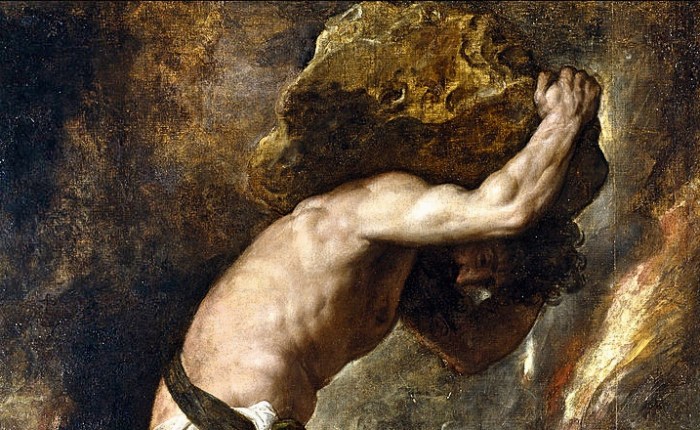

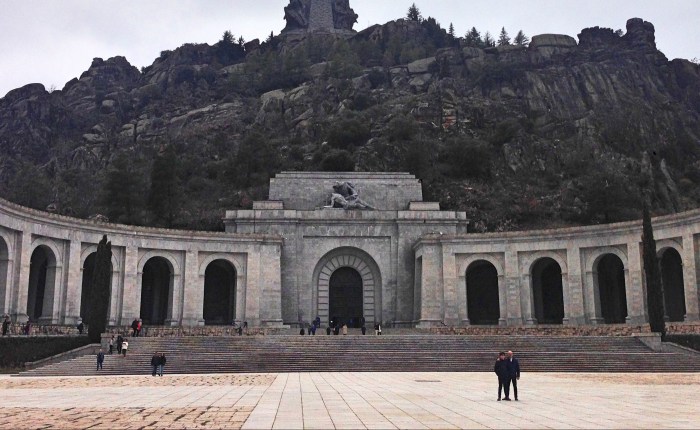

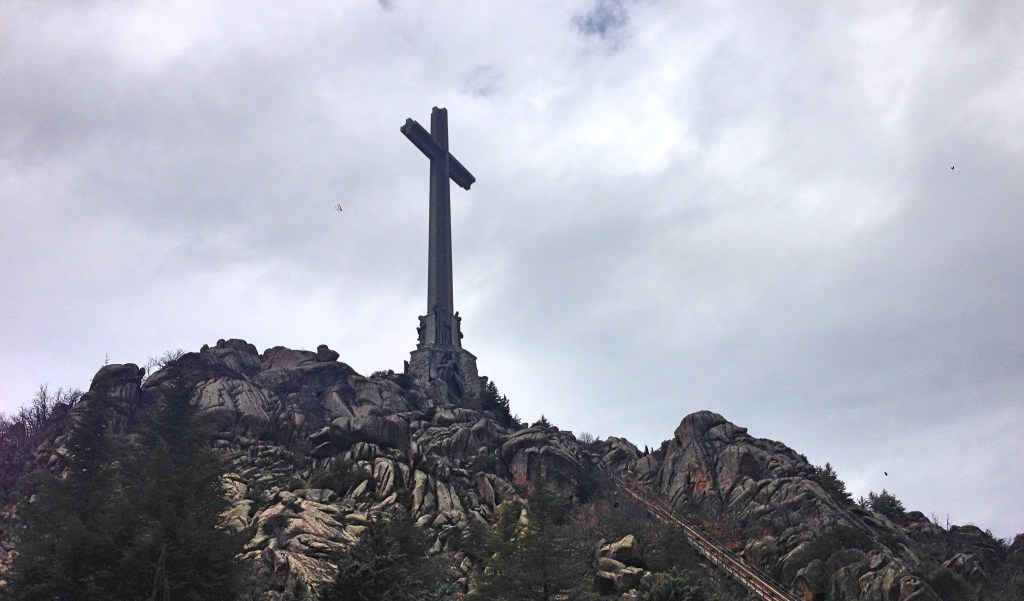
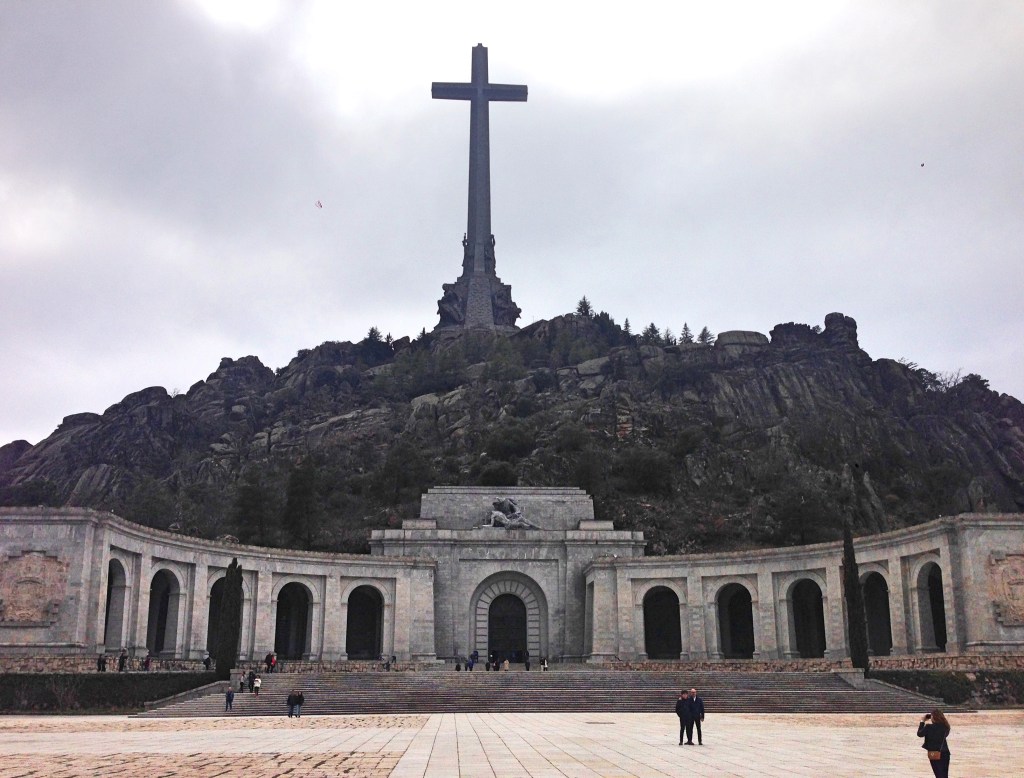
_01.jpg)
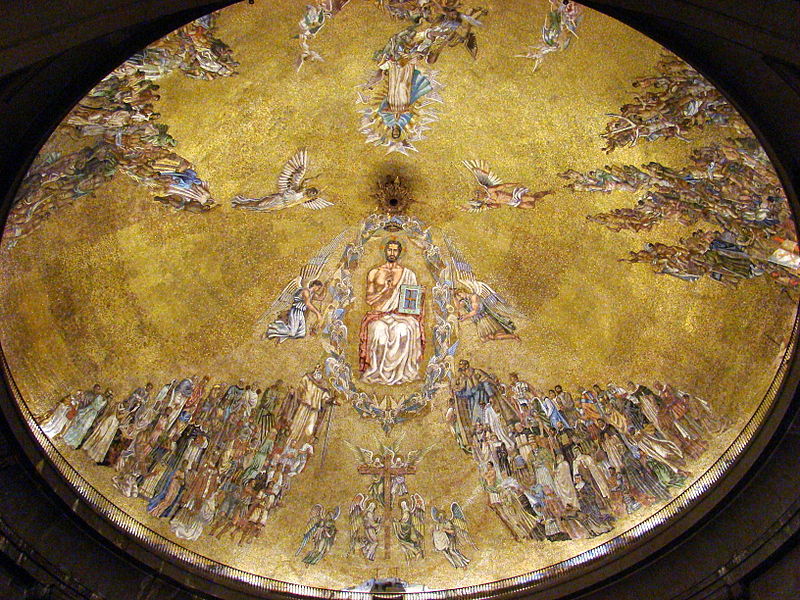
 Lotz in Translation