My first time in Paris was a whirlwind affair. I took a horribly early Ryanair flight and had barely 48 hours to see the major sites. Every waking moment was spent on my feet—and it was easily one of the most impressive travel experiences of my life. Yet such a breakneck tour naturally left me curious. What had I missed as I marched through the city? Thankfully, my second trip to Paris was far more leisurely.
In this post, I want to talk about a particular interest of mine: burial sites. For me, visiting cemeteries is oddly comforting. It is tragic, of course, that we all must die. But it does help to put things in perspective. Recalling that the greatest artists, scientists, and emperors have all succumbed to the same fate can ease our own existential anxiety. And being reminded of our universal destiny can also help us to savor the experiences that make life really worthwhile. This is how I feel, and this is why I went out to explore some of the most famous graves in Paris.
Père-Lachaise
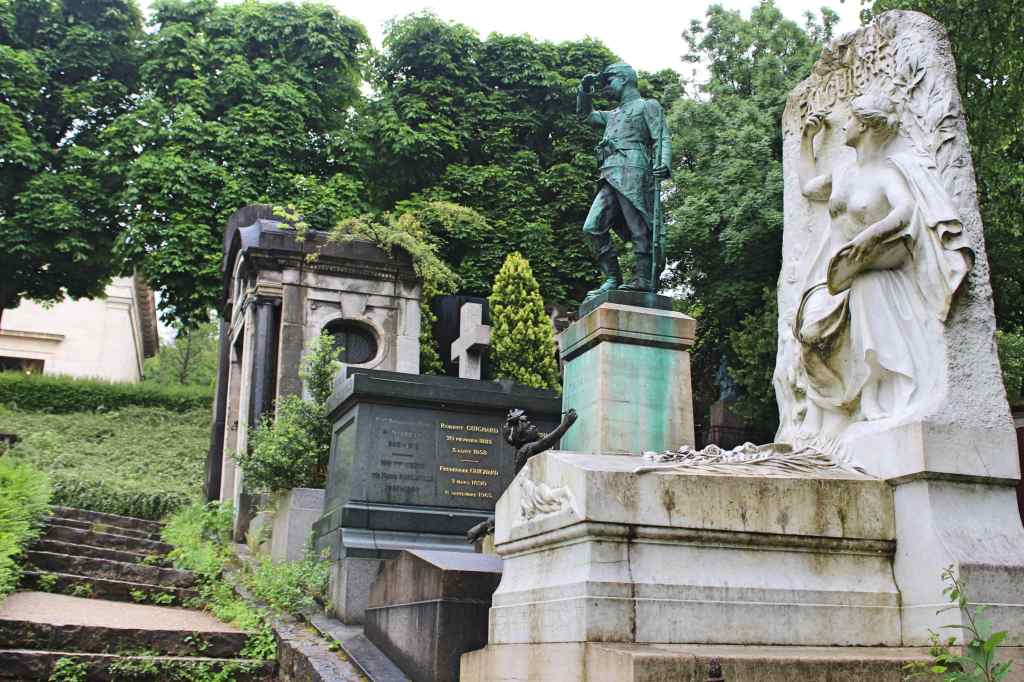
Père-Lachaise is located somewhat outside the city-center, and that is for a reason. As in many major cities in the 19th century, there was less and less room for more and more bodies. Overcrowding in municipal cemeteries was both unattractive and unhygienic. So in 1804, shortly after Napoleon’s ascent to the throne, several “garden cemeteries” were opened on the outskirts of the city. This same process played out in New York City, leading to the creation of beautiful cemeteries like Woodlawn or Green-Wood, among others. In Paris, the biggest cemetery established was Père-Lachaise—built on a hill outside the city, and named for a royal confessor who used to live on the site.
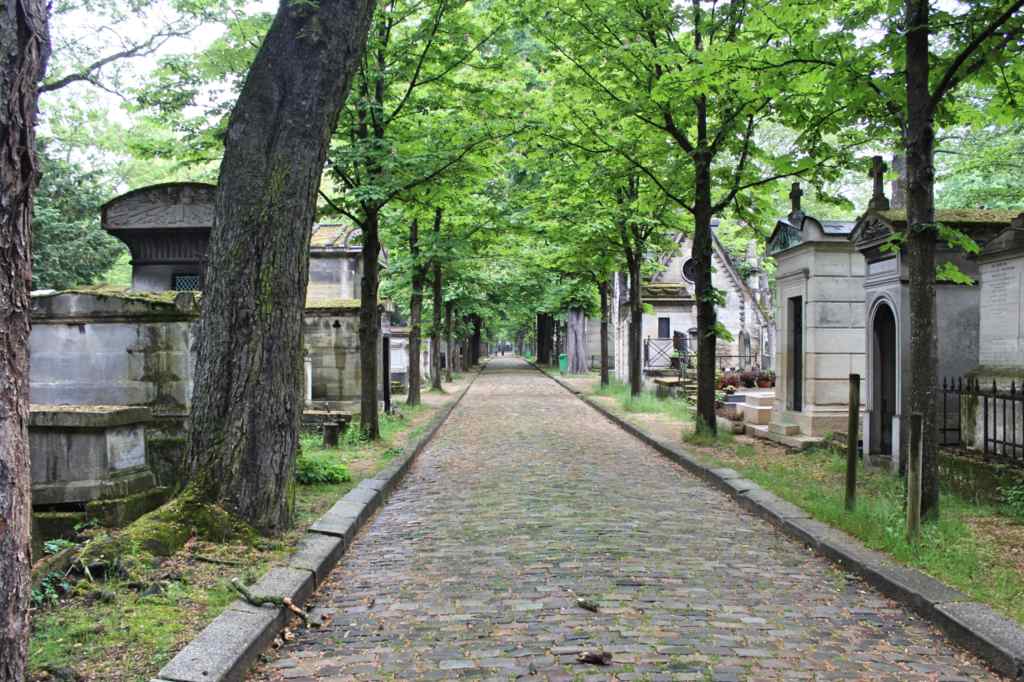
In appearance, Père-Lachaise is somewhere intermediate between the solid stone cemeteries of Spain and the park-like cemeteries of New York. Tree-shaded walkways lead past rows and rows of gravestones, most of them large and ornate. As soon as I walked inside I felt refreshed. After the bustle and noise of Paris, the dead make welcome company. And there are many of them to choose from. Over one million souls lie interred in Père-Lachaise—half the population of modern-day Paris. The cemetery is still active, though burial is expensive and the waiting-list is long. Because of overcrowding, the cemetery actually engages in space-saving measures, such as burying family members together or digging up bodies whose leases have expired. In Paris, even the departed get evicted.
Even though the cemetery is only two-hundred years old—quite young in a European context—it contains bodies that are far older. The most conspicuous example of this is the iconic couple: Abelard and Heloïse. Abelard was one of the finest intellectuals of the Middle Ages, whose philosophical contributions to theology are still fascinating. But among laypeople, he is most famous for his tumultuous love-affair with Hélöise, documented in a series of passionate letters that have become literary classics. Their bodies—supposed bodies, I should say—were moved to Père-Lachaise as part of a marketing ploy to boost the cemetery’s reputation, and now lay interred in an elaborate psuedo-gothic tomb, where the two lovers—whose religious vows made their love rather difficult—can now enjoy eternal rest together.
Two more celebrities were dug up and re-buried here as part of the same marketing push: the dramatist Molière and fabulist Jean de la Fontaine, who both died in the 17th century. I was especially happy to find Molière, who is one of my favorite dramatists of any kind. His comedies are uniformly profound and delightful. The two iconic writers lie interred next to one another, in fairly simple stone sarcophagi raised above the ground. I am not sure about the ethics of relocating bodies for reasons of profit; but I was very glad to see Molière.
Gertrude Stein
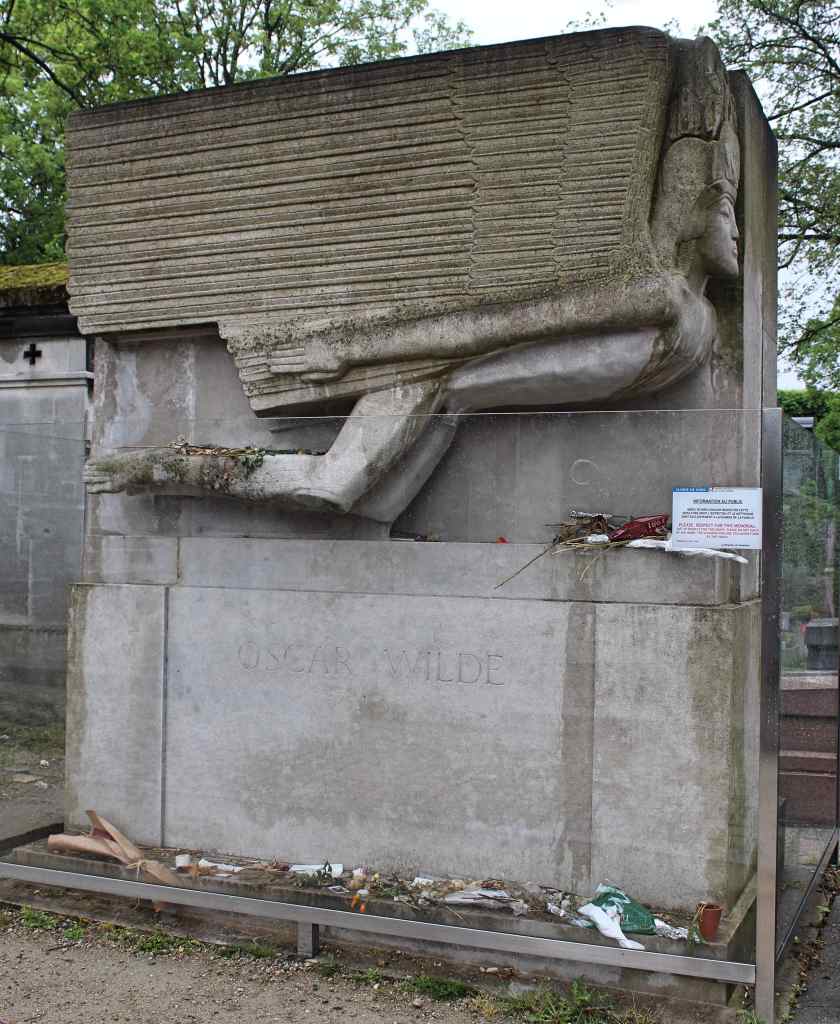
There are many other famous writers to be found, and not all of them French. Gertrude Stein—who wrote innovative, complex books—lies under a simple, traditional grave. The playwright Oscar Wilde’s tomb is significantly more elaborate. It is an enormous statue carved by the sculptor Jacob Epstein, featuring a kind of winged messenger. To my eyes, however, the sculpture appears a bit stiff and awkward, certainly not suggestive of flight. But it at least catches one’s attention. Somehow, the tradition of kissing the statue with bright red lipstick got underway. Nowadays there is a plexiglass barrier to prevent this. A writer I prefer to either Stein or Wilde has a less-visited tomb: Marcel Proust. After having slogged my way through all of his enormous novel, In Search of Lost Time, I was moved to see the great artist’s modest tombstone. For an artist so obsessed with remembrance, he has an inconspicuous grave.
Edith Piaf
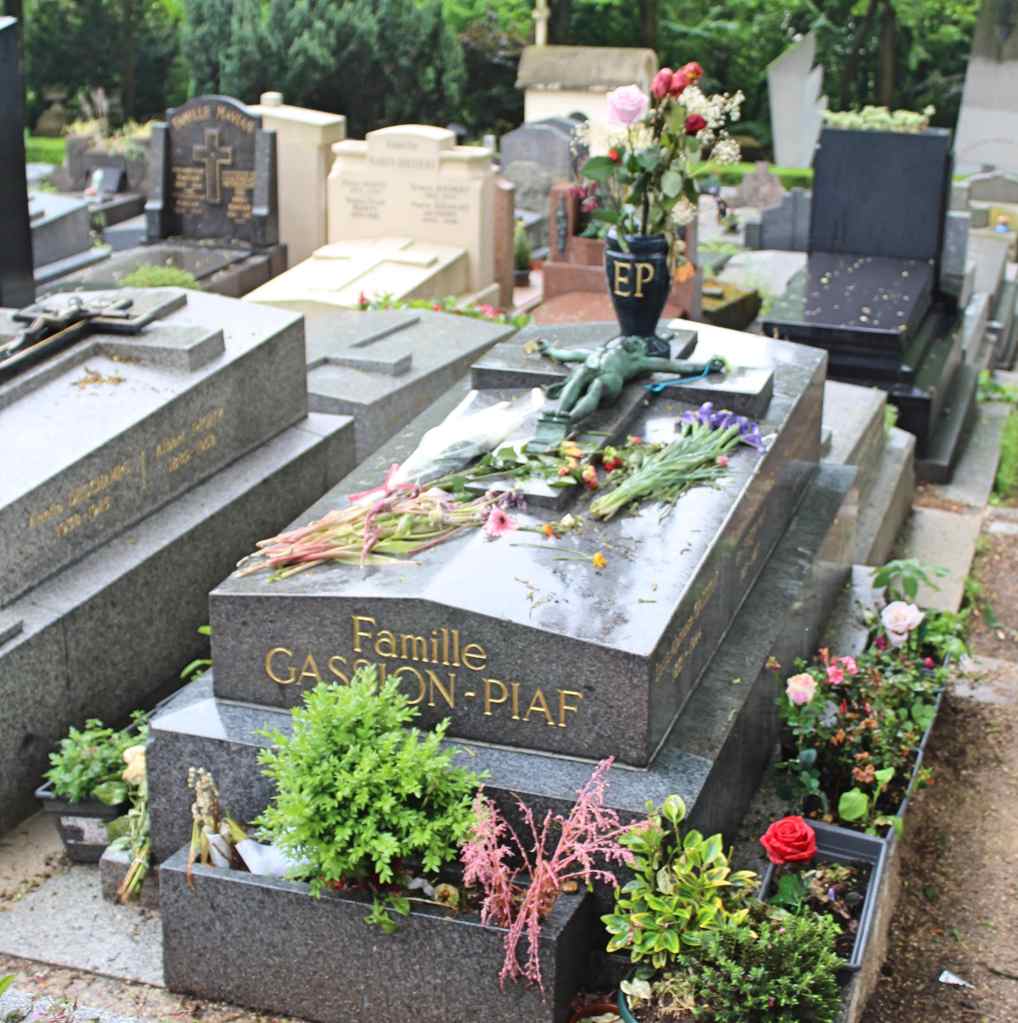
Père-Lachaise also has its share of musicians. The body of Fréderic Chopin, the great piano composer, is close to the entrance. Further on, one comes across Edith Piaf, that star of French singers. It was impossible to look down on her grave without unconsciously hearing her distinctive voice. Yet the most famous musician buried in Père-Lachaise is not a European, but Jim Morrison, the American singer who died at age 27. His may be the most-visited grave in the entire cemetery. So many people visit and vandalize it, in fact, that the cemetery has taken to placing a barrier around the tombstone, so that nobody can get too close.
Oscar Wilde’s tombstone
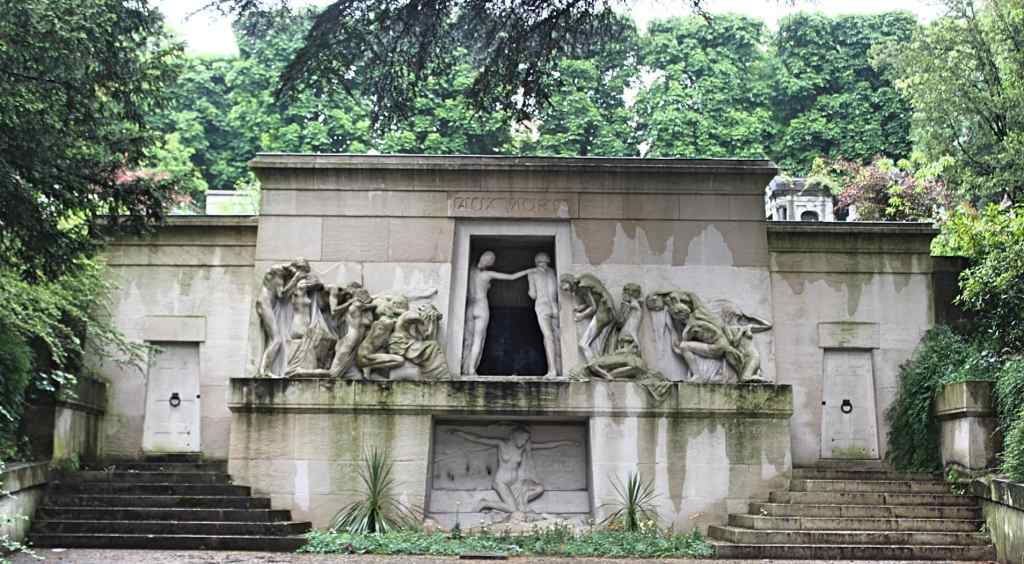
Apart from these personal monuments to the illustrious dead, there are several more general monuments in Père-Lachaise. The most general is the monuments aux morts, a sculptural complex unveiled in 1899 commemorating all of the dead in the cemetery (and presumably beyond). Père-Lachaise has more specific commemorations, too, such as the monument to the victims of the Mauthausen concentration camp. For me this is an extremely moving piece. It shows us a gaunt and haggard figure sprawled across impossibly steep steps. This is meant to evoke the “stairs of death,” 186 steps in which inmates were forced to carry granite up to the top of a quarry. Owing to my own background, I was also pleased to find a monument to the Spaniards who fought in World War II and the French who served in the International Brigades in the Spanish Civil War. Francisco Largo Caballero, one of the leaders of the Republic during this tragic time in Spanish history, is also interred nearby.
The Monument to the Dead
One could go on endlessly listing famous bodies in this cemetery. But since life is short, we must move on to the next one.
Montparnasse
Montparnasse is situated in the south of the city. It was established around the same time as Père-Lachaise, and for the same reasons: overcrowding in municipal cemeteries. It is the second-largest cemetery in Paris, with 300,000 bodies. While not quite as beautiful as its more famous cousin, Montparnasse is home to almost as many icons.
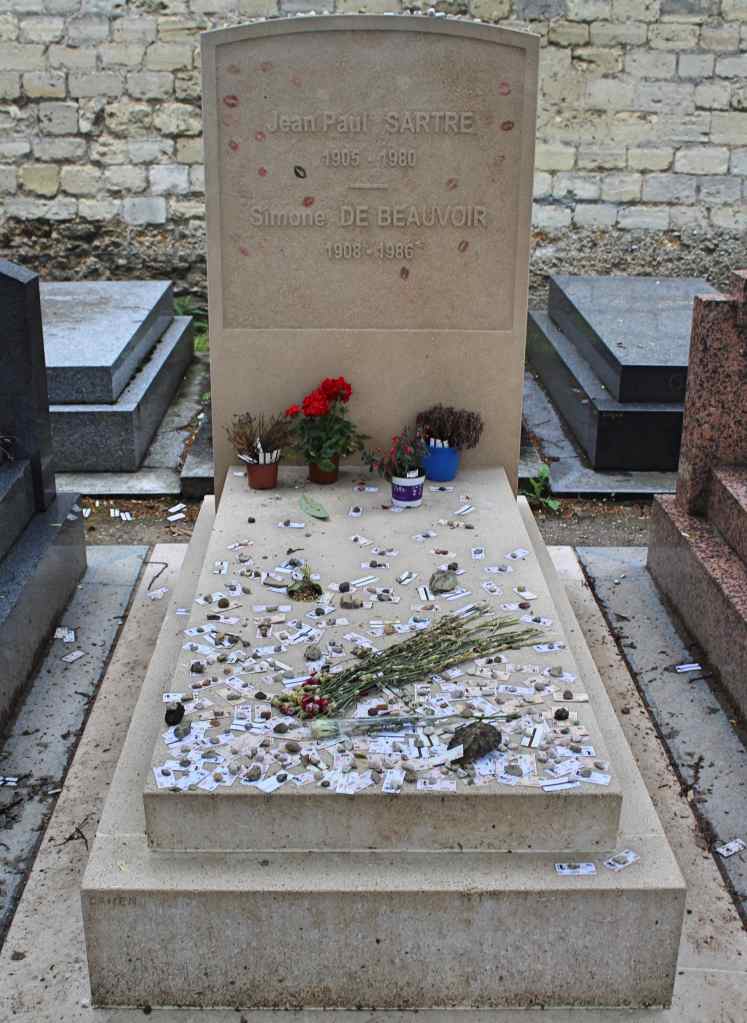
Of special interest for me were the two most famous philosophers of 20th-century France: Simone de Beauvoir and Jean-Paul Sartre. Simone de Beauvoir is usually remembered nowadays as a feminist, and her book The Second Sex is still widely read. She deserves to be remembered for far more, however, as she was an extremely versatile writer and thinker. During her lifetime she published important works of philosophy, best-selling novels, and many memoirs that have become classics. She spent most of her working life in an open relationship with Jean-Paul Sartre, the patron saint of existentialism. Sartre was just as versatile as de Beauvoir, writing plays, novels, pamphlets, treatises, biographies, and much else. Though controversial, Sartre was extremely popular during his lifetime, and his funeral was attended by tens of thousands of mourners. I can think of no writer alive today who could compare with this pair.
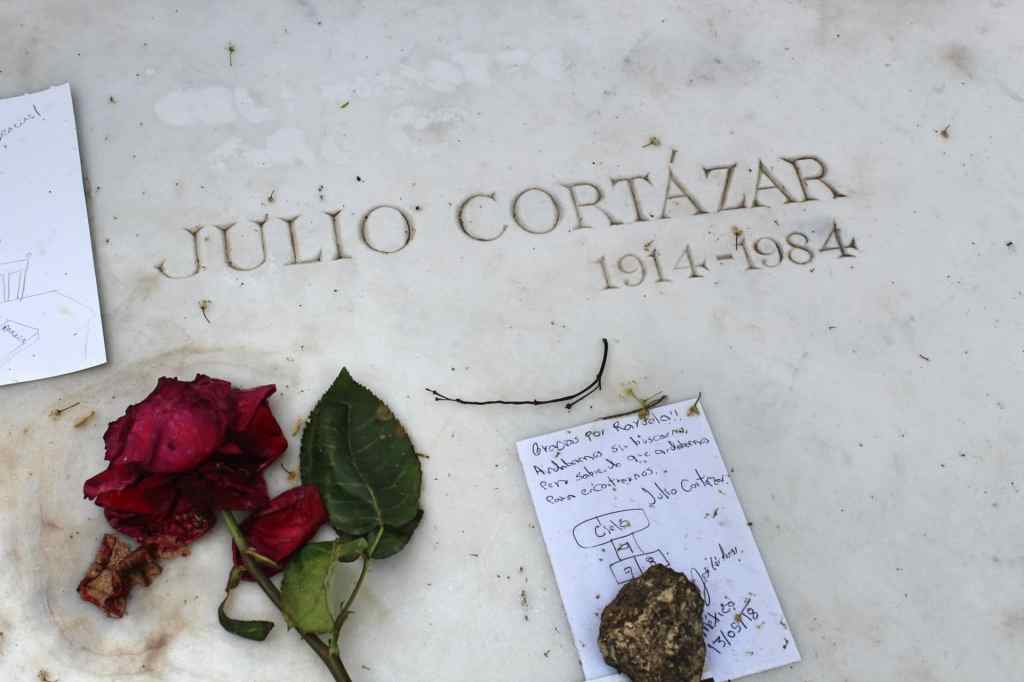
There are still more writers to be found. Charles Baudelaire—one of the most important French poets of the 19th century—lies peacefully under a modest tombstone, after having thrown the world of literature into disarray. And Emile Durkheim, who helped to found sociology as a discipline, lies similarly inconspicuous among the tombs. I was surprised to find Julio Cortázar, as well, who was regarded as one of the outstanding Latin American novelists of any time. Finding Susan Sontag, the influential American essayist, only added to my surprise. Finally I must mention Samuel Beckett, the Irish writer who was one of the pioneers of the absurd. I knew that Paris attracted writers, but I did not know its appeal was so everlasting.
Les Invalides
You will recognize that Les Invalides looks an awful lot like “the invalids,” and that gives you a clue as to its history. Les Invalides originates as a huge hospital and home for military veterans who had been wounded in war, built under Louis XIV. It is a sprawling complex of long halls separated by ample courtyards, covering an enormous area in central Paris.
The majority of the complex is now given over to its use as a military museum. Thus, as you stroll through the seemingly endless halls, you see knights in armor, crossbows, muskets, cannons, machine guns, and tanks. Not being especially fond of military history, I made my way through this area rather quickly; but I am sure it would hold many delights for aficionados.
I was mainly there to see the tomb of one of the most important men in history: Napoleon Bonaparte. Napoleon the man was a paradox: power-hungry but idealistic, republical but imperial, egotistical but patriotic, heroic but despotic—the list goes on. This is why he is so fascinating. Indeed, I have heard that Napoleon is the subject of more books than any other historical figure apart from Jesus. It seems only fitting that his tomb be resplendent.
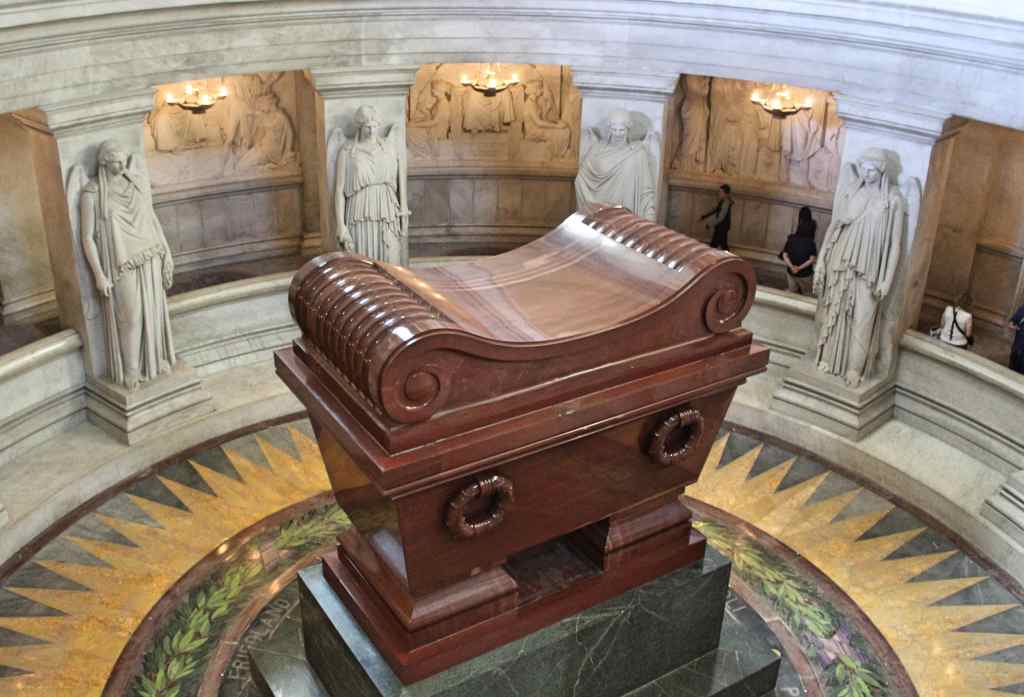
Napoleon lies interred under the central dome of Les Invalides, which originated as a royal chapel for Louis XIV. One wonders whether a church is the most appropriate place for the remains of the dictator—who was not, after all, especially religious—but at least the space is appriopriately grand. A painted dome ceiling hangs far above the space, which opens up to reveal the magnificent sarcophagus of the little emperor. Carved from red quartzite, the sarcophagus emerges from the floor, with its curved lid seeming to break upon the space like a wave. The sarcophagus is surrounded by statues and friezes depicting Napoleon’s glorious reign. Many of them depict the French emperor as the second coming of Alexander the Great—crowned in laurels, sitting as a god among men. It is a bit hard to stomach if you are not an admirer.
As you may know, Napoleon spent his final days on the tiny island of St. Helena, far away from France. It was only during the reign of Louis Philippe (who was trying to curry favor with Napoleon supporters) that the emperor’s bones were brought to France and interred in such grandiose style. As with all funerary displays, the pomp can seem rather empty. Napoleon died a defeated man, after all; and no matter how glorious he was, he is gone for good. But on the other hand, it is humbling to think that somebody born into ordinary circumstances could acquire such a hold over his adopted country (Napoleon was born in Corsica).
The tomb of Joseph Bonaparte
Well, the great Bonaparte is not the only one to be buried here. His son, Napoleon II, is also in attendance, though he died quite too young (21) to have anything but a minor role in French history. I was more interested in finding Joseph Bonaparte, Napoleon’s brother, who held the title as the King of Spain for a few years before being forced to flee. After abdicating, Joseph spent much of his remaining life in the United States, living off the jewels he took from Spain. This is basically my plan, too.
The Panthéon
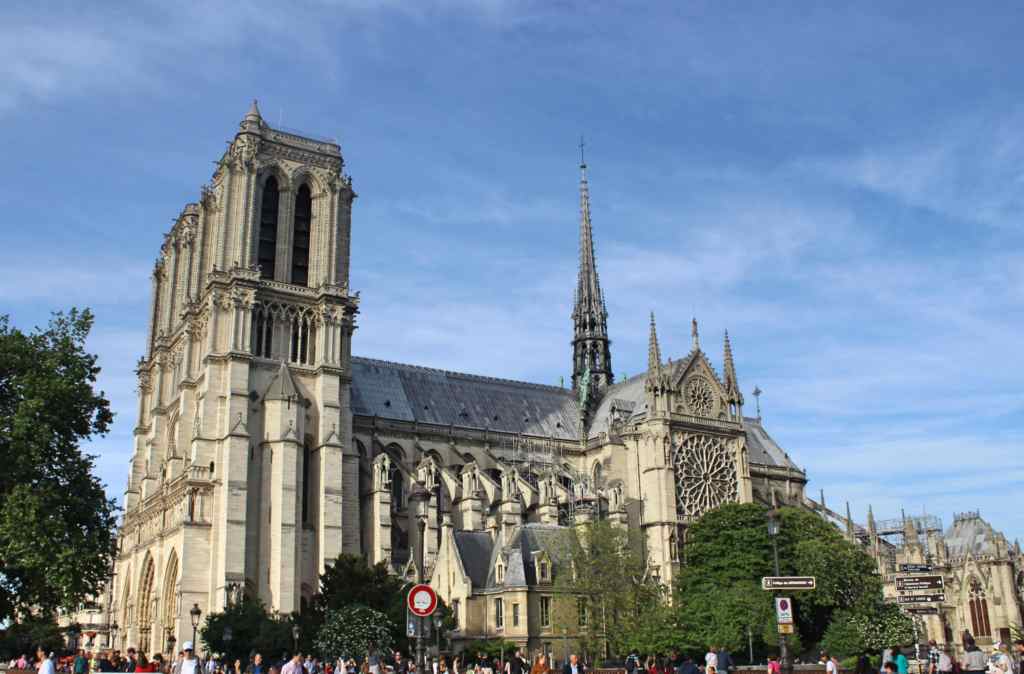
The last time I visited Paris was in May of 2018—about a year before Notre-Dame burned. Nowadays, I suspect, it is impossible to look at the charred building without feeling a bit melancholy. Yet normally the area around Notre-Dame is one of the prettiest parts of Paris. The cathedral is situated on the Île de la Cité, a small island in the Seine. Crossing the bridge southwards, you could see the cathedral’s monumental form standing above calm waters of the river, and marvel at the elaborate iron spire.
Just across the bridge you will come across Shakespeare and Company, the famous book store frequented by Anglophone expatriots like James Joyce and Ernest Hemingway. This is not the original location of the store, however; nor was it ever affiliated with the store’s original owner, Sylvia Beach. This store is more like an homage to Beach’s. Original or not, it has an excellent selection of English-language books, so I decided to walk inside. I emerged with a used copy of Giogio Vasari’s Lives of the Most Excellent Painters, Sculptors, and Architects, a book that I had wanted to read for some time.
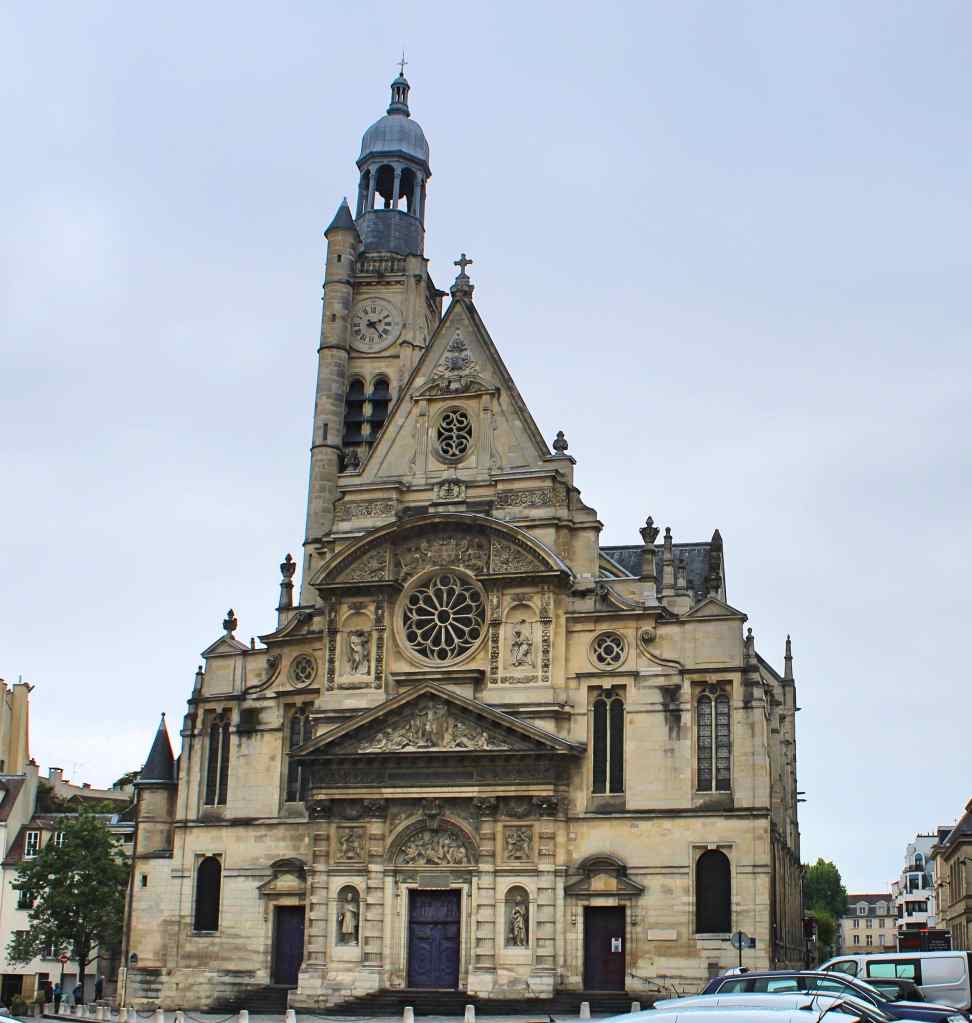
Moving further south, you come to Saint-Étienne-du-Mont, another of Paris’s beautiful churches. Its façade is a rather strange and cluttered jumble of styles, which nevertheless manages to be quite charming. Unfortunately for me, both times I tried to visit, the church was closed; so I have not seen its interior. From what I have read, it is quite a lovely space.
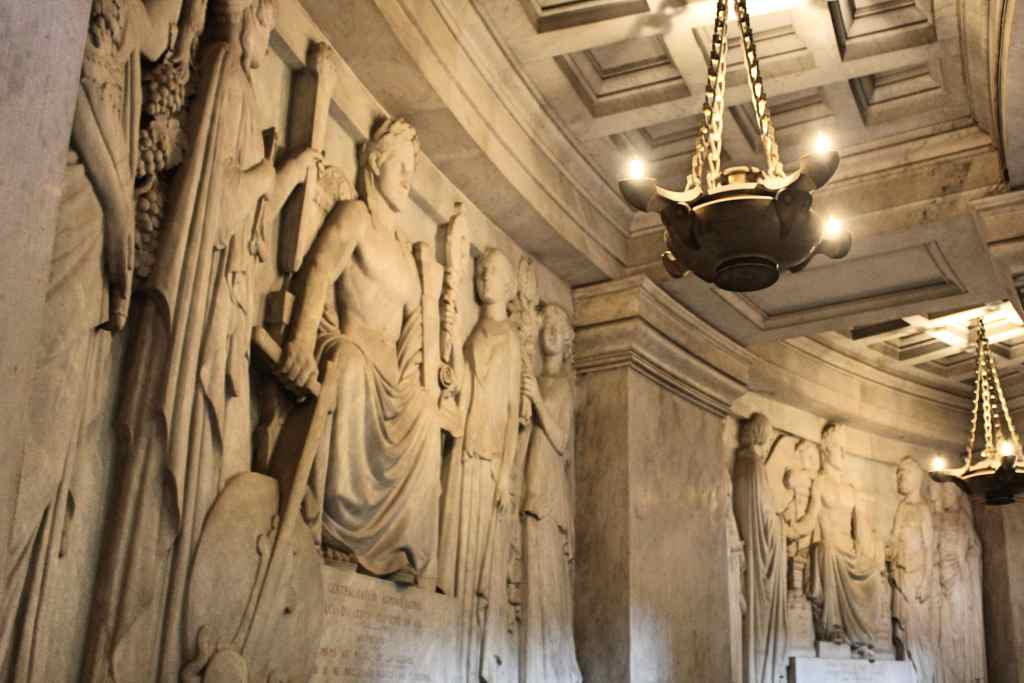
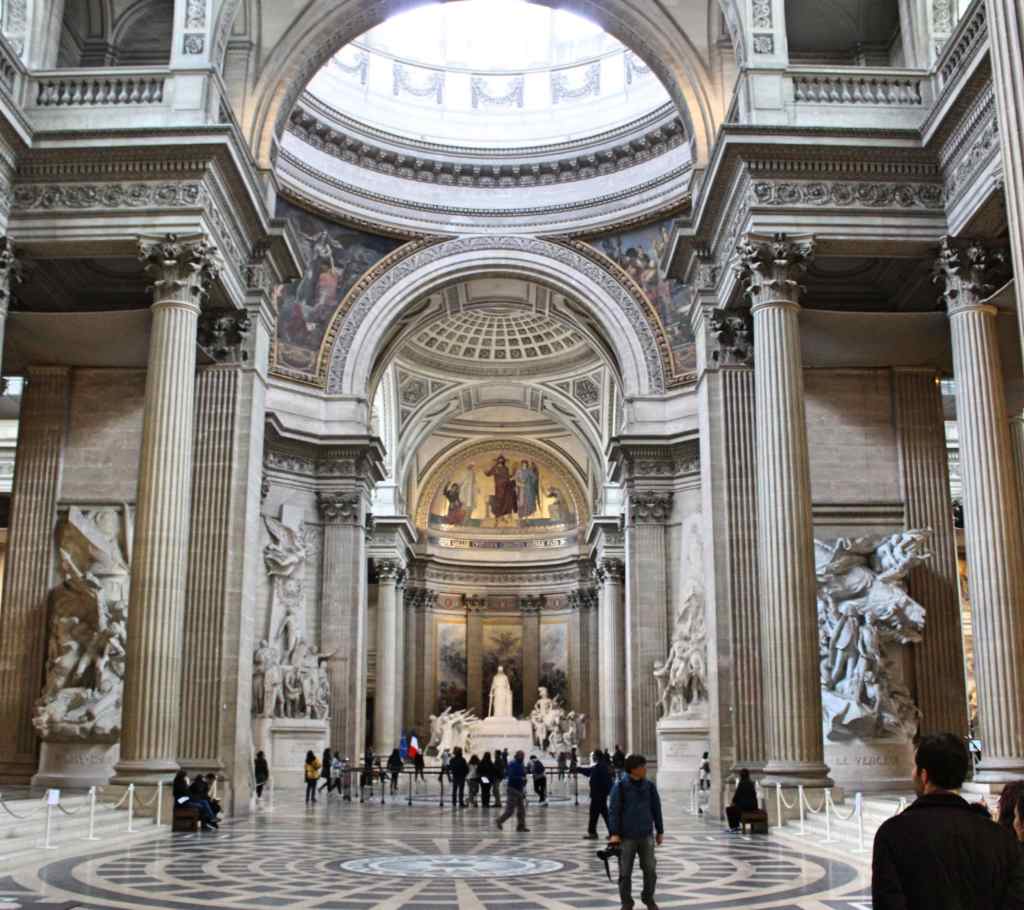
But I was not there to see cathedrals, churches, or bookstores. I was there was the Panthéon, Paris’s great temple to its illustrious dead. It is an enormous neoclassical building, with a towering dome highly reminiscent of America’s Capitol Building (which is not surprising, since the Panthéon was a direct influence). Originally, however, this grandiose building was not built for France’s secular heros, but as a church to Saint Genevive, the patron saint of Paris. But during the atheistic years of the French Revolution, it was decided to deconsecrate the space and use it to honor heroes of the Enlightenment.
Every inch of the structure is richly decorated. The visitor walks under the peristyle, through the flowering Corinthian columns, and past elaborate friezes of religious scenes. The interior of the building is expansive and just as ornate. Any list of the sculptures and paintings would be tedious, but the interplay between Enlightenment and Church decorations is immediately noticeable. The great battle for Europe’s soul is played out on the walls.
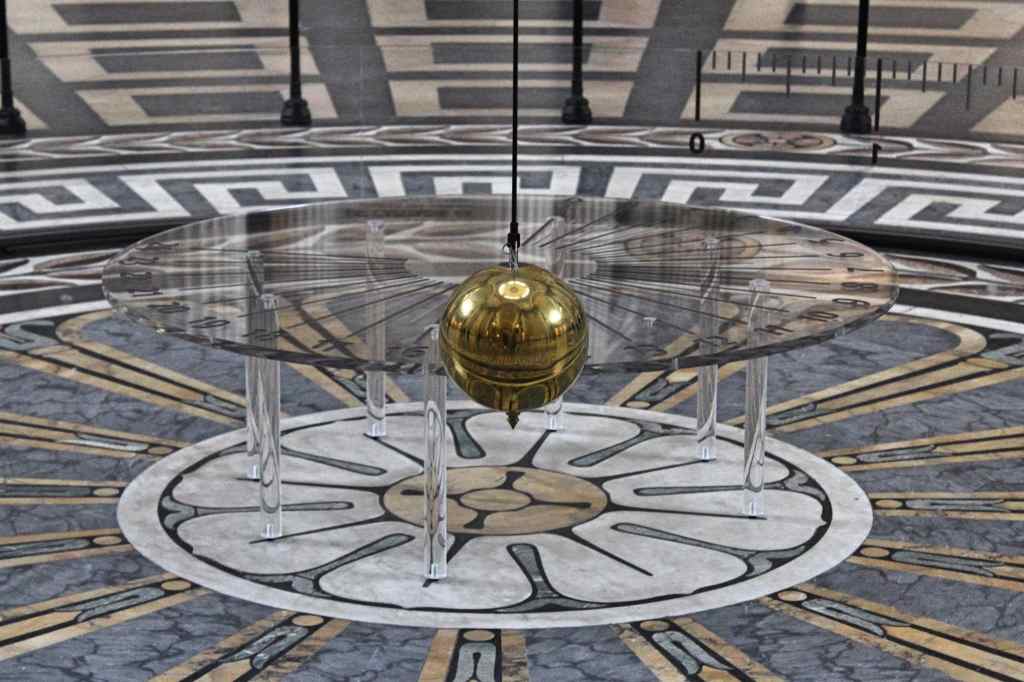
Under the magnificently painted dome, which shows us the apotheosis of Saint Genevieve, there hangs a celebration of human science: Foucault’s pendulum. This is a simple device, consisting of a bob hanging down on a long wire. The back and forth motion of the pendulum undergoes a precession around a circle, directly illustrating earth’s motion. Behind this tribute to the human mind is a celebration of democracy: François-Léon Siccard’s sculptural portrayal of the National Convention. We see a martial female figure (liberty?) surrounded by politicians and soldiers, where underneath it states: “Vivre libre ou mourir” (Live free or die).
Foucault’s pendulumTwo Frances: The monument to the National Convention, with Jesus in the background.
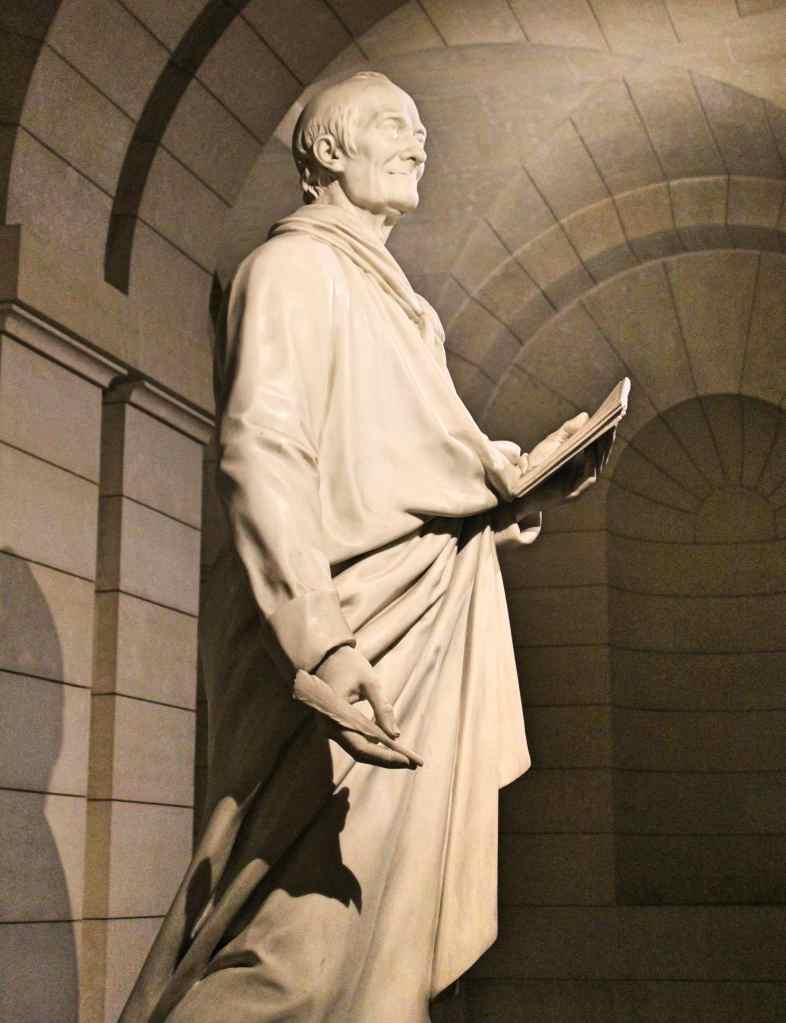
As interesting as is the temple itself, the crypt was why I was there. If you have any love for classic books, it is a holy place. After descending a small staircase, you suddenly find yourself standing between two of the most influential writers of any place and time: Voltaire and Jean-Jacques Rousseau. Voltaire was the first Enlightenment hero to be interred here. At first denied a Christian burial, his remains were first interred in secret in an Abbey in Champagne. But in 1791, during the heady days of the Revolution, it was decided that Voltaire deserved the secular equivalent to canonization, and his remains were moved here. The procession was enormous: reportedly a million people came out to celebrate the late hero, with music, ritual, and fanfare.
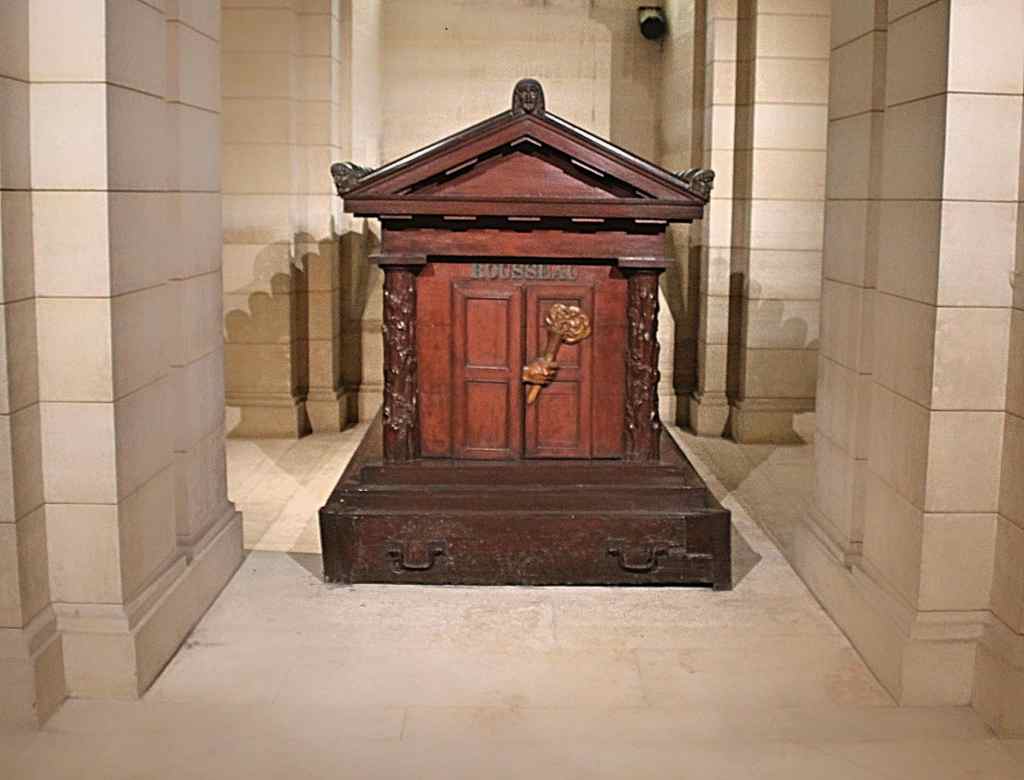
The philosopher Jean-Jacques Rousseau was moved here three years later, in 1794, after it was decided that he too was a hero of the Revolution. For my part, it is rather strange to find these two men sharing the same vault. They are opposed in both thought and temperament. Voltaire was an enemy of tyranny but he was no democrat; his writings stressed the importance of civilization and rationality. Rousseau, on the other hand, was a champion of the “general will” in politics; and he emphasized the importance of nature and feeling. The two writers sparred several times in life, each finding the other brilliant but repugnant. Somehow, the ideals of the Revolution were able to accomodate them both.
Voltaire’s tomb is the more impressive of the two, if only because of the wonderfully lifelike statue of the wry old philosopher standing before it. Rousseau’s coffin celebrates the man’s accomplishments in inscriptions on both sides, and on one end we see a hand reaching out, bearing a torch. I got goosebumps as I stood there.
Moving further into the crypt, one finds many little chambers branching off the central corridor. Many of these are filled with officers and generals, most of whom served under Napoleon. This had little interest for me. Instead, I made my way straight to the chamber containing the mortal remains of three giants of French literature: Alexander Dumas, Victor Hugo, and Emile Zola.
Victor Hugo was the first to be buried here. Few writers have ever been so beloved by their country. His ceremony was even more elaborate than that for Voltaire, with over two million people in attendance. Emile Zola, another liberal writer, was next to enter the Parthéon, although the ceremony was disturbed by an assassination attempt on the life of Alfred Dreyfus. (Dreyfus was a Jewish officer falsely accused of a crime, whom Zola publicly defended. Proust writes much about the case in his enormous novel. Dreyfus is now buried in Montparnasse.) Finally, as recently as 2002, Alexander Dumas was relocated here, in recognition of his enormous popularity.
As usual with the tombs of icons, standing in their presence is both humbling yet exalting. But what I most like about such visits, perhaps, is that it helps to make a historical figure—a person who can seem impossibly distant—seem real and concrete. These people are no longer just names on a page, but just as real as I am.
So ended my visit to Paris’s tombs. If you can believe it, I managed to visit all of these illustrious graves in the span of a single day. It was a modern, secular pilgrimage.
The Catacombs
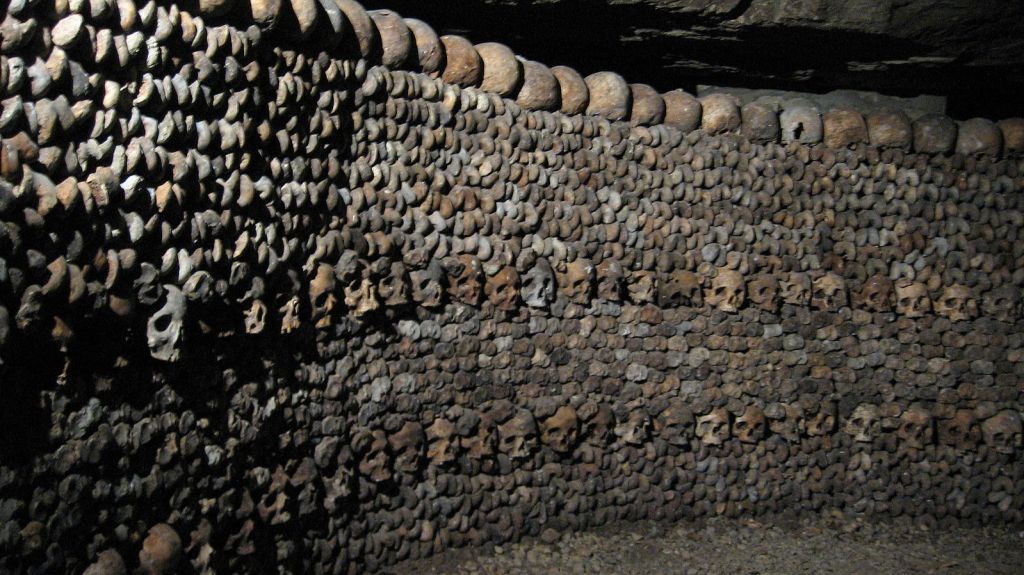
Though I have never visited the catacombs myself, I feel that I cannot end this post without at least making mention of this popular spot. As I mentioned in the beginning of this post, by the end of the 18th century Paris was having a problem with making room for its ever-multiplying dead. It is difficult for an American to quite realize the scope of this problem, since our country’s history is so comparatively shallow. Paris has been around a long time: inhabited since at least the Roman times, it has been a major settlement for over 1,000 years. In short, there are an awful lot of bones to bury, and the city’s space is limited.
By the late 1700s, the situation was getting serious. In the largest municipal cemetery, Saints-Innocents, so many people were buried on top of one another that the ground was piled up to six feet (or two meters) high. In some areas, this proved to be so heavy that it caused the ground to collapse. Also, as you can imagine, having such a huge pile of bodies is not good for the water supply, not to mention for the air quality. Luckily, however, a solution was at hand. Much of the ground in this area of the city—the Left Bank, close to Montparnasse—was riddled with tunnels and holes, widely used in previous years to mine limestone. Thus, beginning in the 1780s, wagons carried these ancient bones into their new resting-place, under the streets of Paris.
I admit that it does make me feel a bit ethically uneasy to imagine disturbing the eternal rest of so many citizens. Then again, I suppose many of the bones belonged to people who had lived centuries ago, and who were buried in mass graves anyway. Now these skulls and femurs compose one of the most popular tourist attractions in the city. The skeletal remains are arranged into patterns on the walls, creating a kind of grim aesthetic charm. I suppose I should visit; but the thought does make me slightly queasy.
Processing…
Success! You're on the list.
Whoops! There was an error and we couldn't process your subscription. Please reload the page and try again.
I must, unfortunately, begin this podcast with some bad news. Well, it’s bad for me anyway. This past Saturday, as you may know, was Chinese New Year. To celebrate, I decided to go to the big parade in Usera—the Madrid equivalent of Flushing, Queens. The parade was packed. It took us twenty minutes just to walk a couple blocks, and even then our view of the parade was obscured by the crowds. I still managed to take some good pictures, though.
But you will most likely never be able to see these pictures, since shortly after the parade ended my camera was stolen. I’m not sure how it happened. The most likely story seems to be that it was nabbed while I was sitting down at a Chinese restaurant. There were tons of people around and the place was very busy. For half the meal, both me and my brother had our backs to the door, and I carelessly placed my camera on the floor. When we got up, it had vanished. My theory is that someone walked in, spotted it, and nabbed it before anyone took notice. Either that, or I did something even more stupid and left it on a chair or something.
Anyways, this loss, bad as it was, did at least connect me with a universal experience for tourists in Europe: being pickpocketed. There is not a whole lot you can do after the fact. In my case, I looked up my camera’s serial number (which is encoded with every photo you take with it) and then filled out a police report. Though I’ve heard stories of people waiting for hours in the police station, I filled out the report online and then went over to the station to sign all the paperwork. It took me about ten minutes. Every pawn shop in the city is required by law to keep a list of all the serial numbers of its products, and to submit that list to the police. But thieves must have their own workarounds, since business in the pickpocket industry is booming. In fact, judging anecdotally, theft seems to be on the rise. So be careful out there.
Well, to repeat, pickpocketing is a common hazard for travelers everywhere. Though strangely, it seems to be far more common in Europe than in the United States, and particularly bad in Spain. Barcelona is commonly called the pickpocketing capital, with Madrid not far behind. Again, judging anecdotally, the situation is really quite bad in Barcelona. Judging from the stories I see on Facebook, it can seem like half of the tourists who go there lose their phone. Pickpockets are quite good at what they do.
Pickpocketing statistics are naturally very difficult to collect. Many people don’t report the crimes, and even if they are reported it normally cannot be proven that a missing item was stolen and not merely lost. Besides that, pickpockets are only rarely caught by the police. The only figure I’ve been able to get my hands on is 10,000 robberies a year in Madrid, done by about 500 pickpockets who mainly prowl the city’s metro. But I’m not sure how far to trust those figures. In any case, I am constantly hearing about phones and wallets stolen in Madrid.
By contrast, I don’t think I’ve ever heard a pickpocketing story about New York City. This is really strange. There are lots of needy people in NYC, and the dense crowds would make it an ideal place for pickpocketing. So why isn’t there more petty theft? Is it a cultural thing? Better law enforcement? Harsher penalties?
While I’m on the topic of crimes, I thought that I would compare some other crime statistics across my two countries. I quickly found that, while Spain may be worse than the United States when it comes to theft, the US is a lot more violent. Here the relevant statistics are easy to find: In America there are a little more than five murders per 100,000 people. In Spain, the number is 0.63—eight times smaller. Now, call me a liberal snowflake, but I can’t help thinking that this huge difference is largely due to greater access to guns in America.
The American statistics on sexual violence are just as bad. The relevant figure for the United States is 27.3, while in Spain it is a measly 3.4. Of course, rape is also difficult to measure, since it is underreported and under-prosecuted almost everywhere. Here in Spain there have been notorious cases of rapists walking free. So it’s certainly not great anywhere.
Now, Spain may or may not be better than America when it comes to crime rates as a whole. But Spain—and the rest of the world, for that matter—definitely has America beat when it comes to incarceration rates. The United States has the highest percentage of its population behind bars of all the countries in the world: 655 per 100,000. Believe it or not, the United States also has the biggest total number of prisoners in the world—well over two million—significantly more than China, a country with a much bigger population, and which we usually disparage for being totalitarian. The incarceration rate for Spain is 126 per 100,000, about five times lower.
When you consider that Spain experiences significantly less violent crime than America, I don’t know how one can justify such an insanely high incarceration rate. To be honest, I really can’t see any way to explain it other than by drawing the conclusion that we are throwing way too many people into prison in America. (And of course a disproportionately high number of them are black.)
Apart from this, prisoners are generally treated better in Spain than in America. The prisons are less crowded, for one thing, and are therefore more comfortable. Prisoners can pay to have a television or radio in their cells, and can even vote in the elections. Most shocking for me, conjugal visits are allowed, even for non-married partners (they are only permitted in four states in America, and they are not easy to arrange).
But maybe the biggest difference is the death penalty. The United States is the only country in all of the Americas—north, central, and south—to maintain the practice, and also the only so-called Western country to do so. In Europe, only one country (Belarus) continues capital punishment. Spain is a typical European country in this respect: the death penalty has been abolished since the 1970s, and even abolished in the military since the 1990s.
If you ask me, it is way past the time that we do the same in America. There’s little evidence that capital punishment serves as an effective deterrent. And since such a disproportionate percentage of our population is in prison, it stands to reason that we are in general over-prosecuting, and sending many innocent people to jail. Morally speaking, I think it’s worse to kill an innocent person than to insufficiently punish a guilty one.
As a last little piece of data for my informal comparison of crime and punishment, we can look at police killings. In America, there were 119 police killings in 2019, and 390 before that.* And of course the victims are, as usual, disproportionately black. Meanwhile, I can’t even find any statistics about police killings in Spain, and I’ve never heard of it happening. Once again, I suspect that a big culprit is guns. When the population is armed, it naturally makes police officers more prone to panic and overreact with deadly force, since there is a substantially higher risk for them. But if guns are extremely uncommon, then police officers can more easily remain cool. And a calm officer is obviously one less likely to open fire. (But this is just my little hypothesis about this.**)
Well, there you go, a little picture of crime and punishment in Spain and America. All told, Spain looks pretty good by comparison—with significantly less violent crime and far fewer people locked up in prisons. But all this doesn’t change the fact that I’m still missing my camera.
* According to this database, these numbers should be much higher. Apparently there is no government agency that collects statistics of this kind, or any mandate that the data get reported. So it is up to journalists and activists to do so. The database also contains lots of information on the factors that influence police violence.
** According to this article, police killing in America is far worse than in any other Western country. (The Guardian also collects its own statistics on police killings, which don’t quite match the above database, but it’s close.) The portrait that this article paints of American police violence is grim. My gut feeling is that the most likely way to explain this huge disparity is the presence of guns in America, though I’m sure this must be an oversimplification. The database above mentions several policies that are proven to reduce police killings, such as requiring that use of force be reported and that using deadly force be a last possible alternative. Considering America’s abysmal record in this regard, I think it’s clear that we should do something. We shouldn’t accept a situation as inevitable that does not exist elsewhere.
One of my favorite places in Spain is Mérida. If you have never heard of Mérida, then this illustrates my point: it is one of Spain’s lesser-known gems, which means that it is not overly crowded nor overly expensive. But it is an extraordinary place. Very few cities in the world can compare with Mérida for the breadth and quality of its Roman ruins. The city was one of the capitals of Hispania (Roman Spain) and had all of the comforts of provincial Roman life.
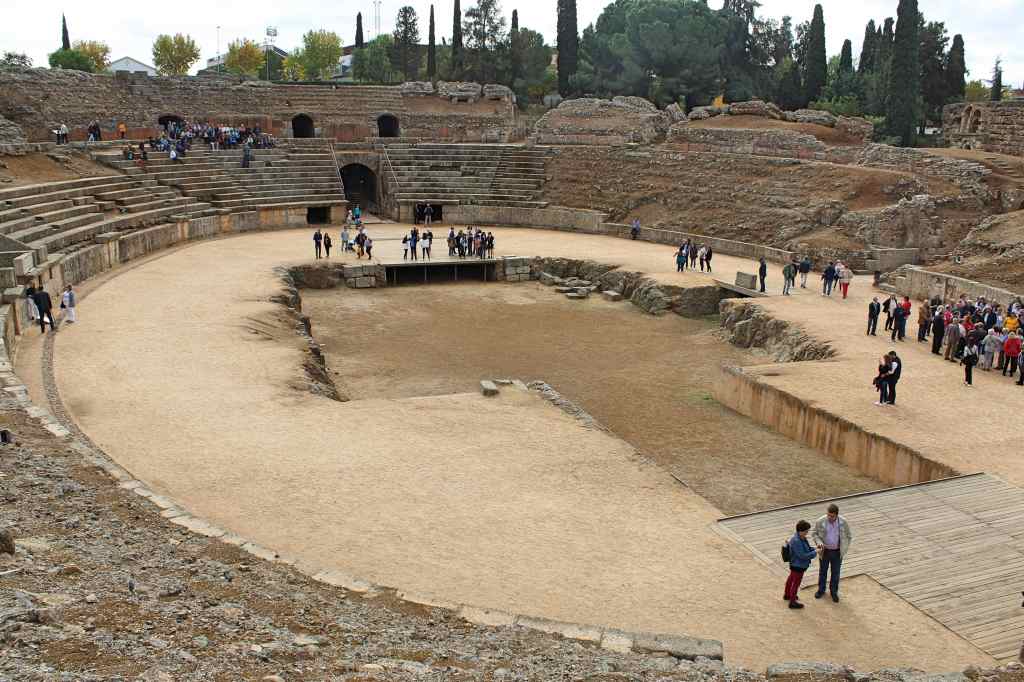
Most of the major sites in Mérida can be visited on a combination ticket, which you can purchase for 15 euros. I recently had a chance to visit Mérida and to experience anew the impressive monuments. The two stars are the amphitheater and theater. They are both enormous and well-preserved—especially the latter—and give you a good sense of what it would have been like to be a Roman having a day of entertainment. Ironically, the architectural monuments may have more lasting value than what the Romans actually consumed inside—gory violence and farcical comedies.
Ancient comedies and tragedies are still performed in this theater, during Mérida’s anual theater festival
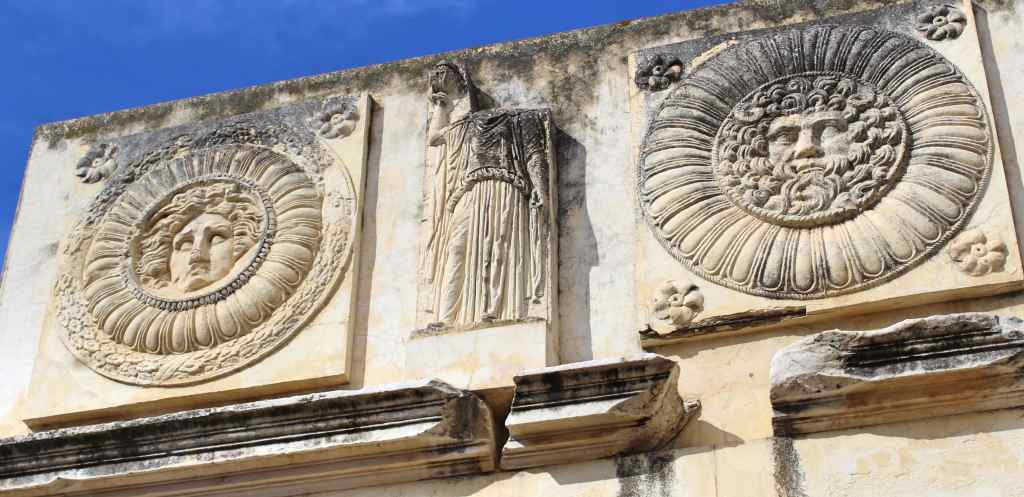
There are several ruins to be seen right in the center of town, free of charge. One of these is the so-called Temple of Diana, which was actually dedicated to the emperor. It is especially interesting because of the Renaissance house that has been incorporated into the remaining pillars (which you can see in the background). Nearby is the old Roman forum, where some fragments and columns still stand.
The temple of DianaA detail from the Roman forum
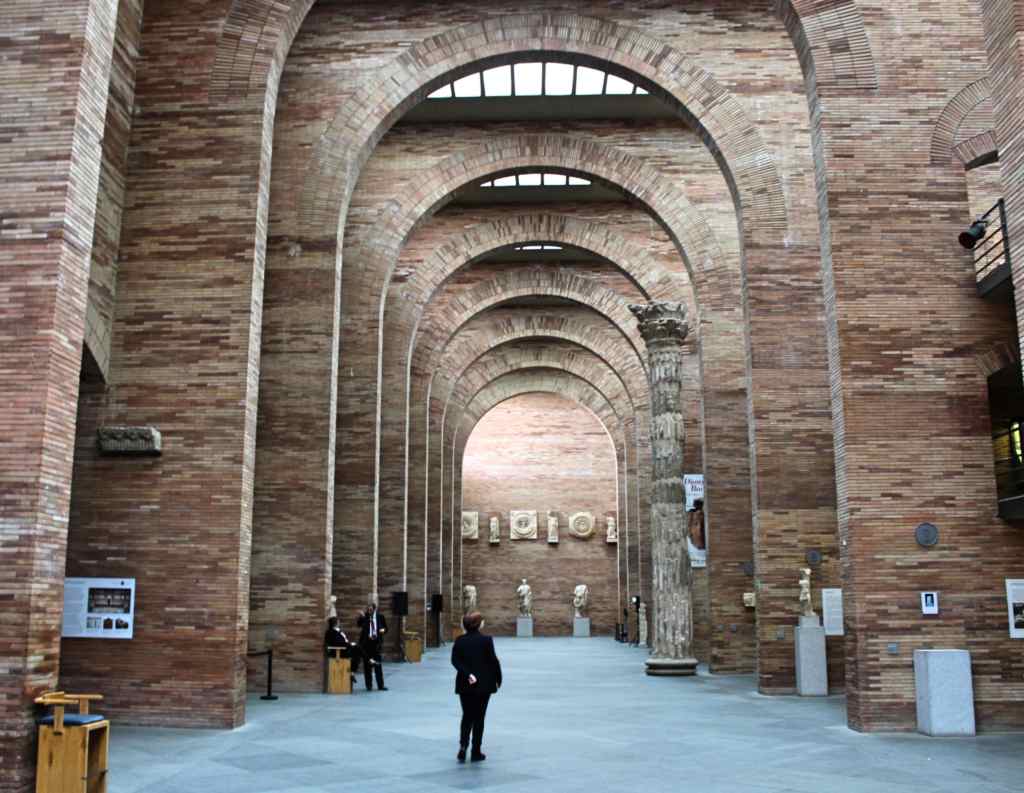
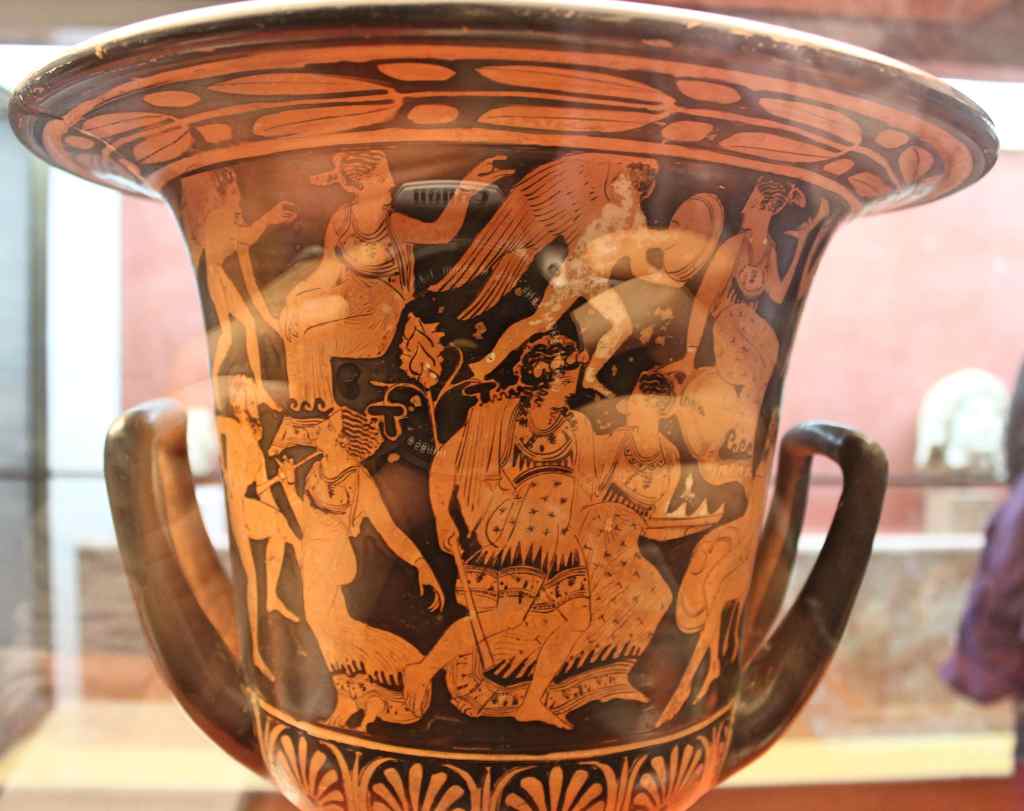
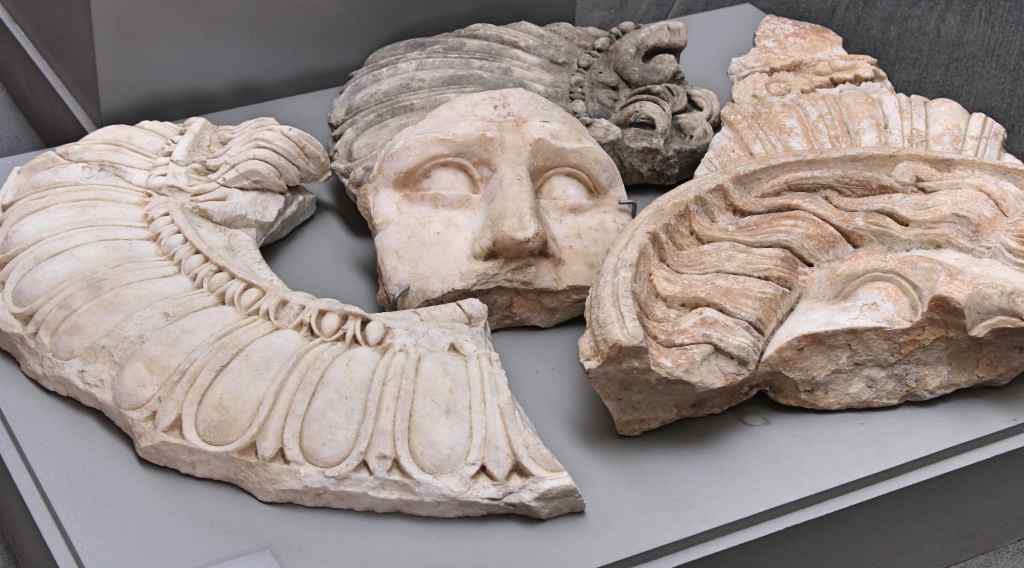
Apart from its many monuments, Mérida has an excellent museum of ancient Rome. The building itself is lovely—made of brick, with a high ceiling help up by Roman-style arches, and skylights that illuminate the space. There are artifacts of all kind inside: statues, pillars, mosaics, gravestones, pottery, jewelry, coins, and more. On the ground floor you can see a preserved section of a Roman road, and marvel at their extraordinary engineering. And in the museum’s basement still more artifacts are displayed, which were uncovered during construction.
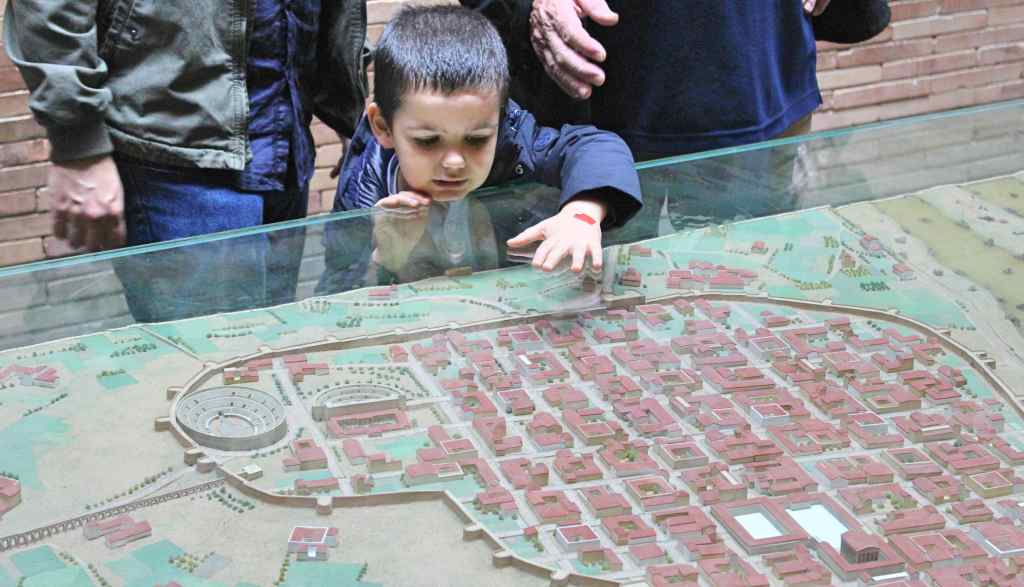
The National Museum of Roman ArtA Roman interior, with wall paintings and a floor mosaicA Greek-style vaseA model of how the ancient city may have lookedThe impressive Roman road, a section of the Via de la Plata, an which connected the north and south of Roman Spain
Fairly close-by to the museum is the Casa del Mitreo, the excavation of a Roman villa. Whoever lived here must have been extremely wealthy, since there are three separate patios and many interiors are richly decorated. The Romans had taste. Another interesting site is below the Church of Santa Eulalia, were still more ruins have been uncovered. Probably there are rooms, walls, pillars, and shards of pottery under every inch of the place.
The Casa del MitreoThe crypt of the Church of Santa Eulalia
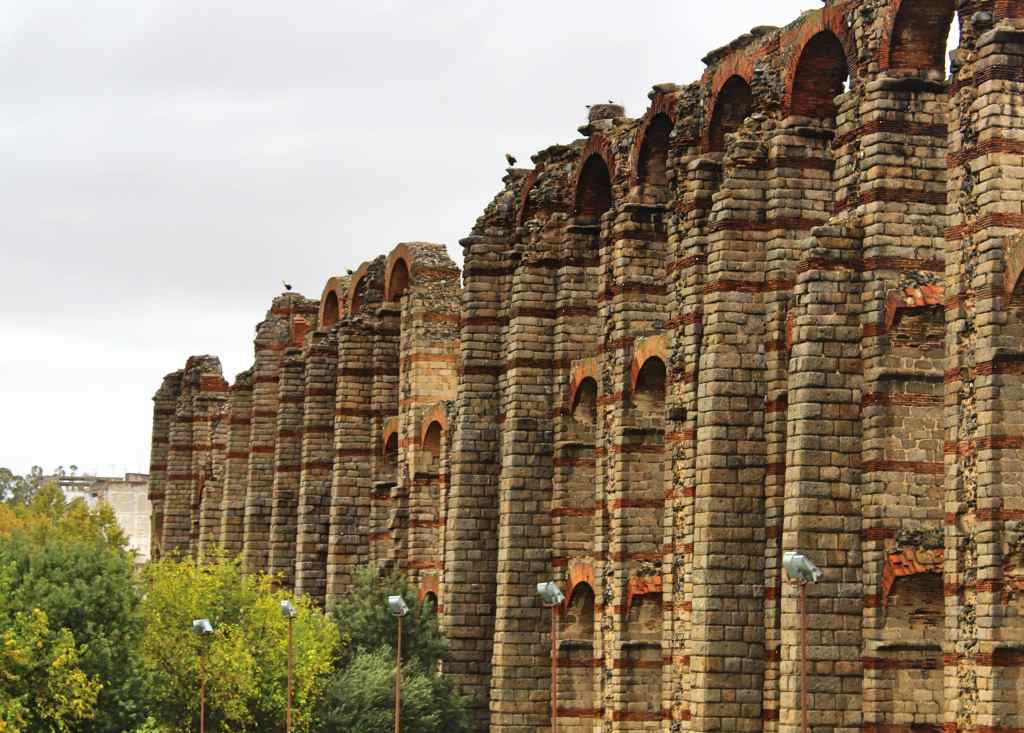
But some of the most beautiful ruins are located well outside of the city center. One is the Acueducto de los Milagros, a towering aqueduct dominating a grassy field. And it really is miraculous that something so seemingly delicate could survive two thousand years, exposed to the elements. Only slightly less impressive is the Acueducto de San Lázaro, which is near the old Circus Romano.
On the other side of town is the Roman bridge, which is connected to the Moorish fortress overlooking the Guadiana River. It is amazingly long—almost a kilometer in length, making it the longest surviving bridge from antiquity. And this is not the only Roman bridge in Mérida: there is another one near the Acueducto de los Milagros.
But perhaps the most impressive feat of Roman technology is the Embalse de Proserpina, a Roman dam. The Romans were extremely skilled hydraulic engineers, you see, and created their own reservoir to feed the town. The dam a lot more complicated than what meets the eye. There are deep chambers underground that the Romans used to divert the water into pipes, which eventually directed the water to the Aqueducto de los Milagros, which in turn brought it right into the center of the city.
The dam’s retaining wallThe exposed structure of the dam
As I hope you can see, Mérida has many sites for such a small and relatively obscure city. But this is how it always is in Spain: in every corner of the country, treasures await.
At long last, here is my first podcast of the new year. Some of my older podcasts are unavailable on iTunes now, but they are all on YouTube, including this one!
Happy New Years to all five of my listeners! It feels good to be back.
For this letter, I want to finally talk about something that has been on my mind a long time, and that is the contrast between the American and the European ways of life. I think this is especially relevant now, during our endlessly long election season back in America, because this contrast between America and Europe has actually exerted a strong influence over progressive American politics. You could arguably boil down the progressive platform—championed by Bernie Sanders and Elizabeth Warren—to the following statement: that America should be more like Europe. So what’s Europe like?
One of the most obvious contrasts is healthcare. Spain, like Germany, France, or Denmark, has a nationalized healthcare system. That means that every citizen is automatically covered at all times, free of charge or nearly so (although some people do supplement their public healthcare with private insurance). This is radically different from the United States, where most people have private healthcare, usually tied to one’s job. The difference is profound. In America, people really worry about the cost of healthcare. Even relatively well-off people.
The cost of an ambulance is one example. If you pass out in the street and somebody calls the ambulance for you, you can wake up in debt. There’s a famous story of a woman who fell between the subway car and the platform, who begged people not to call an ambulance because she couldn’t afford it. People go bankrupt in America because of illnesses and injuries—something almost unheard of in Europe. It’s not uncommon in America to see GoFundMe campaigns for people struggling with medical costs. But this isn’t just a question of insurance. It’s also because anything related to healthcare is absurdly expensive in the United States. A hip replacement, for example, is six times more expensive in the US than in Spain. That means you could take a nice long vacation in Spain, and then get your hip replacement, and it would still cost less money. And medication prices are wild in America. Insulin is so expensive that some people try to ration it, and a few have died in the process.
There are lots of reasons for the high cost of healthcare in the USA. One is the bureaucratic complexity needed to deal with all the different private insurers. Some hospitals need just as many administrators as hospital beds to process all the intricacies of insurance claims. Another reason is that, in most countries, medicine is bought in bulk by the government from the drug companies, while in the United States each person buys directly from the drug companies—and there’s no bargaining power in that situation.
Anyways, I don’t want to set myself up as some expert on healthcare, which I’m clearly not. What I can say is that I’ve never heard a Spanish person worry about whether they’ll be able to afford going to a doctor, while in America the financial costs of getting sick are at times even scarier than the actual sickness. On the other hand, I have had a bad experience with a Spanish dentist here. They often try to rip you off. (Though admittedly most dentists are private in Spain.)
Speaking of health, another big difference between America and Europe is our eating habits. We eat a lot in America—a lot of food, and a lot of junk food—and as a consequence obesity rates in America are over twice as high as they are in Europe. This tends to make us sick, which only exacerbates our healthcare problem. One thing that we Americans do have over Spain, at least, is that fewer people smoke in the United States (15%) than in Spain (about 22%). But America definitely loses when it comes to physical activity. Since so much of our country is designed for driving, the average American walks less than 5,000 steps a day, as compared to more than 9,000 for Spain. This, combined with other factors like Spain’s diet, led Bloomberg to proclaim Spain the healthiest country in the world. (The United States ranked 35. In fact, the average life expectancy in America has been falling for the last three years.)
So much for health. But there are still more striking contrast between Spain and the United States. One big one is maternity leave. Every European Union country guarantees at least 14 weeks of maternity leave, and several also give paternity leave. This means that a new mother can take over three months with her new baby, while receiving full pay, and guaranteeing a job when she returns to work. I have no idea why this isn’t a more outrageous issue in the United States, where the government guarantees no days of paid maternity leave—everybody likes mothers, after all. By the way, America is also unique for offering no minimum paid vacation days, and no guaranteed paid holidays. Spain, by contrast, offers a minimum of 22 working days off, plus a mandated 12 paid holidays, and an optional 2 more holidays that local governments can choose.
The last major contrast I’ll mention is university. The cost of going to college in America is incomparably higher than it is in Europe. Even a public university can cost tens of thousands of dollars per year. Student debt has become a way of life in the US, and virtually everyone graduates with at least a few thousand dollars of loans they need to pay off. This has a huge effect, not only on our economy, but in our educational decisions and philosophy. It influences everything from what we study, to grade inflation, to job choices after college. Meanwhile, in Europe, getting a degree is cheap and in some places even free. With a stipend, you may even be paid to attend a university. As you can imagine, this makes a big difference.
There are many other differences, too—the strength of workers’ unions in Europe is a big one—which combine to make Europe substantially more egalitarian than the United States. Here are some figures. From 1970 to the present, the share of total income going to the top 1% in America rose from 8% to 20%. In Europe, it also rose, but from 7.5% to 10%. That is, in America it increased by 150%, while in Europe by about 33%. That’s a big difference. In this same time period, the share of income going to the bottom 50% of the population fell by 7% in America (to 13%), and by only 2% in Europe (to 18%). To sum up, in America the gap between the rich and the poor has grown far wider than in Europe.
And this brings me to a central contrast. In America we talk about the American “dream.” That is, our model is based on the idea of people “making it”—pulling themselves up by their bootstraps into another economic echelon. And of course there are success stories. But this narrative hides the fact that, if you don’t “make it,” then life in America can be rather harsh. Even more importantly, getting to the top is extremely rare. Besides the fact that having a highly unequal society means that there is less room at the top and more room at the bottom, America does not score particularly well on social mobility. According to the World Economic Forum, the United States ranked 27th globally. The top 13 countries, by the way, were all European. And the top five are the Nordic countries, famed for their socialist policies: Denmark, Norway, Finland, Sweden, and Iceland (in that order).
Admittedly, Spain ranked just below America, at the 28th spot. But the important thing to note is that, in Spain, social mobility is not vitally important to well-being, since a robust social security program guarantees a high minimum standard of life. This is why I refer to the “European Way of Life” rather than the “European Dream.” Because the idea in Europe is that the good life should not be a longshot, rags-to-riches, one-in-a-million dream, but something taken for granted.
My point has not been to convince you with statistics. These issues are extremely complicated, and of course Europe has its own problems. My point is this. When Americans, especially younger Americans, look across the Atlantic and see all of these differences—healthcare, education, maternity leave, vacation—many of them naturally wonder why we cannot do the same thing in our wealthy country. Why is America so exceptional in these rather unfortunate ways? I can’t say I know the answer to this question. But I know that awareness of this discrepancy is growing, and has already had a major effect on our own politics as more and more voters react with outrage. Americans put up with many things that, in Europe, would cause mass protests. But will Americans continue to do so?
I ended my resolutions post last year by promising I would not diet or exercise. Well, I broke the last part of the resolution when I took up running in February. This confirms my suspicion that the best way to motivate yourself is to resolve to do the opposite. So this year I resolve to stop exercising, eat poorly, be very unkind, and just be generally irresponsible and unpleasant.
My travel writing aspirations were only half-successful. Admittedly, I did compensate somewhat by writing long posts on the big NYCmuseums, but the list of travel writing keeps growing. Here are the big ones:
In books, I got through most of my resolved reading from last year. My main omissions were the works of Archimedes, Apollonius, and Sir Thomas Heath’s book on Greek mathematics. Apart from this, one of my big goals this year is to read more about economics. I have a large biography of John Maynard Keynes sitting on my shelf. I also have a few scattered books and lectures to guide me. Hopefully I can make some headway in this most dismal of sciences.
In literature, these are the authors in my sights: Lord Byron, Henry James, D.H. Lawrence. In the history of science, here are the big names: Lavoisier, Lyell, and Faraday. And in philosophy I hope to finish reading the works of Plato.
I will do at least one more season (10 episodes) of my podcast. But my big goal is to put more energy into getting published. This includes short stories, articles, and hopefully my old novel. Wish me luck!
It’s the most wonderful time of year here in Spain: Christmas. And the Spanish love Christmas, just as much as we Americans do. In fact, as I mentioned in another podcast, since there aren’t any major holidays in November, the Christmas season in Spain starts very early. Now we are in full Christmas swing, as can be seen by taking a short walk through any Spanish city. On the first of December the lights, decorations, and trees go up.
Now, Spain does not have such a strong tradition of festive house decoration as we have in the United States. This is largely because, as I’ve said before, the private houses in Spain are not open to the street, but instead normally have tall walls wrapping around the property (so there’s not much to decorate). But the Spanish do love their Christmas lights. People, old and young, flock to the center of Madrid to enjoy the street decorations. It gets so crowded in the city center that you can hardly walk. This year there is a new star attraction: a massive illuminated globe that stands at the end of Gran Vía. Once in a while the ball plays Christmas songs on big speakers, and all the Spaniards within eyesight pull out their phones to record the bright singing ball. Yeah, it’s charming.
A Christmas tradition that may be a bit surprising for Americans is the Christmas Lottery, called El Gordo (the fat one). Everyone buys a ticket, and you can buy them everywhere. In my case, I bought a ticket through the school where I work, and this is fairly common for employees. You can also buy tickets at cafés or restaurants or other types of shops, or at specific lottery stands. There is one particular shop near the Puerta de Sol, right in the center of Madrid, which has somehow become famous for being especially lucky. Thus, every year people line up for hours in order to buy a lottery ticket there (a ticket that is no different from a lottery ticket bought anyywhere else).
A big part of the lottery tradition are the commercials. They have quite a good marketing team, and every year there’s a new concept for the lottery commercial. Last year, for example, it was kind of a spoof on Groundhog Day, with a guy winning the lottery every day over and over until he got sick of it, and then somehow becoming a better person. This year, it’s a bit more sentimental, and it’s about how lottery tickets bring people together. Of course it is ridiculous to connect the idea of a lottery ticket with generosity and family, but the commercials somehow accomplish this paradox. In any case, if I win you can be sure the production values of this podcast will be going up.
Well, Spain has more wholesome Christmas traditions, too. A big part of the Christmas season is the food. There are many types of seasonal sweets. Most famous, perhaps, is turrón, which is like marzipan (which the Spanish also eat) but made with added honey. It comes in many different forms, from a barely solid paste to toothbreakingly hard bars, but in general it’s very very sweet. There are also polvorones, which are balls made with flour and sugar. They have very little water or fat in them, which makes them sort of dry and dusty to eat. (Polvo is Spanish for “powder.”)
My favorite is a type of sweet cake called Roscón de Reyes. This is a type of sweet bread that is delicious when you dip it in coffee. It reminds me a lot of something my dad makes around Christmas, which he calls Swedish Cardamom Coffee Braid. Traditionally, a small toy is baked into the cake, and if you get this piece it’s considered good luck.
Possibly the biggest difference between Spanish and American Christmas is the celebration of the Three Wise Men. In Spanish, they are called the tres reyes magos, which translated to something like the three magic kings, or perhaps the three magi kings. In Spain the day of the magic kings (January 6, which we call Epiphany in English) is almost as important as Christmas itself. And the magic kings also deliver presents! So Christmas season in Spain is long indeed, since the holidays extends from before Christmas all the way to the sixth of January, and the children get presents twice. I should also mention the Cabalgata de los Reyes, a massive parade held on January 5th, with giant floats and people dressed up as the wise kings themselves. Unfortunately for me, I’ve never seen it. Normally I’m home for Christmas break.
Connected with the importance of the Three Wise Men is the popularity of Nativity Scenes. In Spanish these are called belén, which is the translation of Bethlehem. Nativity figurines are sold everywhere, and it’s very common for Spaniards to have little nativity scenes in their houses. In Spain there is a special twist to their nativity scenes, which comes from Catalonia. This is to include a little person defecating in the corner of the scene, called the Caganer (which is Catalan for “the pooper”). The tradition of nativity scenes is just another example of how Spain can be intensely Catholic in its culture, while at the same time divorcing Catholicism from actual religiosity. There are many people who would call themselves atheists who still have nativity scenes in their houses.
The Spanish also like to perform nativity plays, or Christmas pageants. And this brings me to something that is a source of controversy every Christmas season. As you may know, one of the three wise men, Balthasar, is traditionally portrayed as being black. As a result, every year, all around Spain, a white Spanish person—sometimes a celebritiy—will dress up in blackface to play the role of Balthasar (noy only in schools, but also during the big parade). This inevitably makes any visiting Americans extremely uncomfortable, since blackface is a deeply racist symbol in the United States. Spaniards typically react with puzzlement when told by Americans that the practice is racist, and that is normally where the matter ends.
I have never personally seen a nativity play, nor have I seen any Spanish person wearing blackface. I’m sure I would find it upsetting. But, to be honest, this is an area where I hesitate to venture an opinion. Blackface is undeniably racist in an American context, since it is connected with the tradition of minstrel shows, which were based on explicit mockery of black people and black culture. All the same, Spain does not have this history, with all its baggage, and so applying our American sensibilities to a Spanish context is probably not valid. A symbol has no inherent meaning, after all, but is given a meaning by its culture. As a comparison, consider the costumes that Spanish people wear during their Easter processions, which look to Americans like the Klu Klux Klan outfits, but which of course are completely different.
Of course, you could make a strong argument that dressing up as someone from a different race is inherently racist. But considering the different cultural contexts, my inclination is to think that this is just something Spanish people need to work out among themselves, without Americans telling them what is right or wrong. Judging from the petitions on change.org to have a Balthasar played by a black person, the country is slowly moving in the right direction.
Well, let’s leave these troubled waters and move on to New Year’s Eve. For the most part this is celebrated just like it is everywhere: with parties, champaign, and fireworks. But in Spain they have a special tradition. As they count down from 12 to 0, they try to eat one grape every second. That’s twelve grapes total. It’s not easy—I’ve tried. The idea is that it’s supposed to bring you good luck. (My girlfriend doesn’t like grapes, so she eats little pieces of chocolate.)
There are just a couple more differences I shall mention between the Christmas season in Spain and in the United States. I forgot to mention that, since most Spanish homes don’t have fireplaces, they hang their stockings somewhere else. Another is that, since Spain does not have big forests, virtually everyone in the country uses plastic trees. Probably this is a lot better for the environment, since they don’t need to cut down millions of trees every year, like we do in the United States. But I have to admit a real Christmas tree has a lot more romance (besides having a better smell). You are also pretty unlikely to get a beautiful snowy Christmas anywhere in Spain, unless you live up on the mountains.
As for me, I’ll be heading home. Christmas is a time to spend with family and old friends. It is also not a time for making podcasts, so this will be my last episode of 2019. It has been a good run. In a week I will be sitting in my house, wrapped in a blanket, and eating some of my mom’s delicious cooking. But I’ll be sure to bring some Spanish turrón home, too.
Even though Halloween is not nearly as popular in Spain as it is in my own country, it is still a time of celebration. For the day after Halloween, November 1st, is All Saints’ Day. and this means that we have a long weekend. I took the opportunity to visit one of the lesser-known regions of Spain: Extremadura. This is the area that lies to the Southwest of Madrid. Known for its relative poverty (the area is mostly agricultural, with hardly any industry), Extremadura nevertheless produces some of the country’s finest cured meats. Its cuisine is delightful.
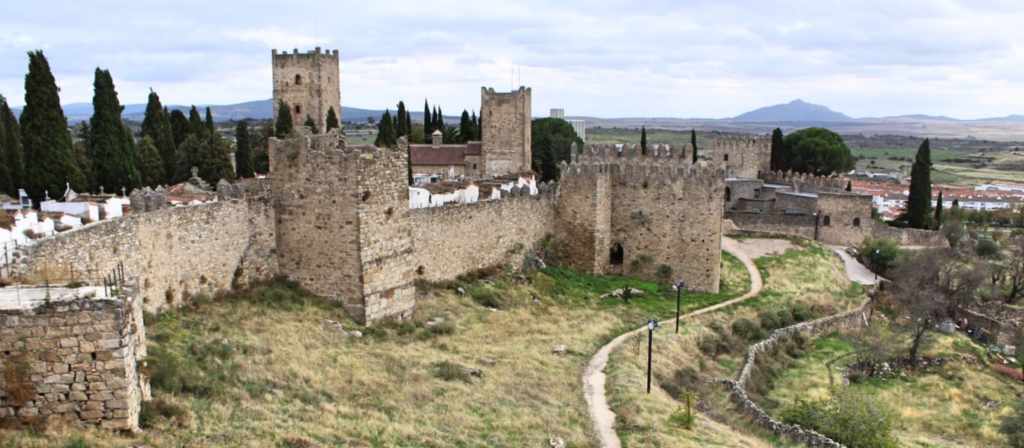
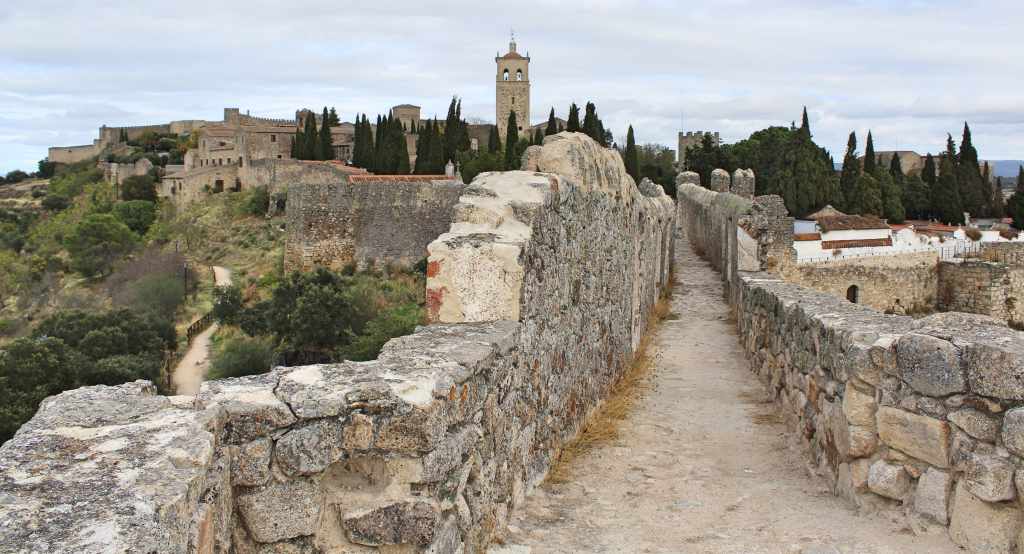
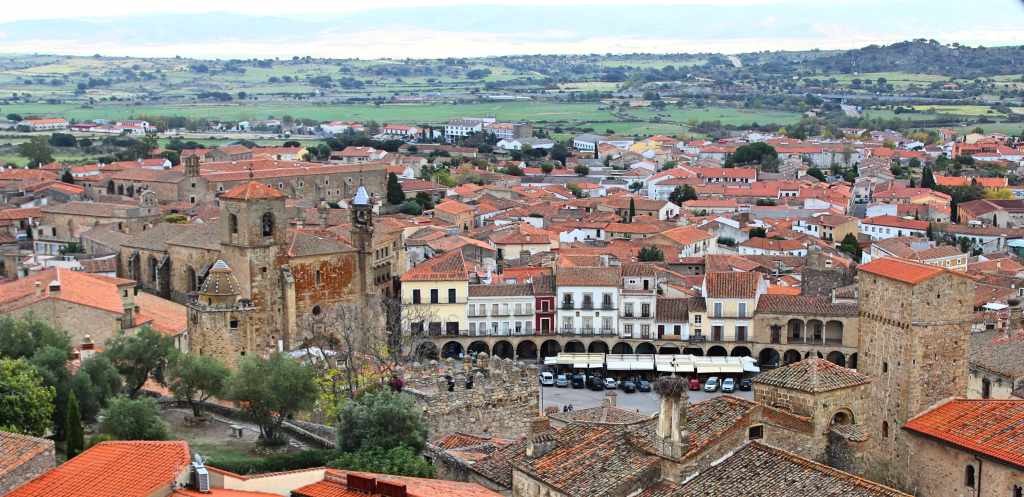
Our first stop was the town of Trujillo. This is a small town (with less than 10,000 inhabitants) famous for being both beautiful and historically significant. The town owes its beauty partly to its location. Situated atop a granite knoll, the town has a commanding view of the surroundings, and the plentiful local rock has been quarried and used to give all the buildings a uniform appearance. The whole place is stone—from the pavement stones, to the restaurants, to the churches, to the city walls.
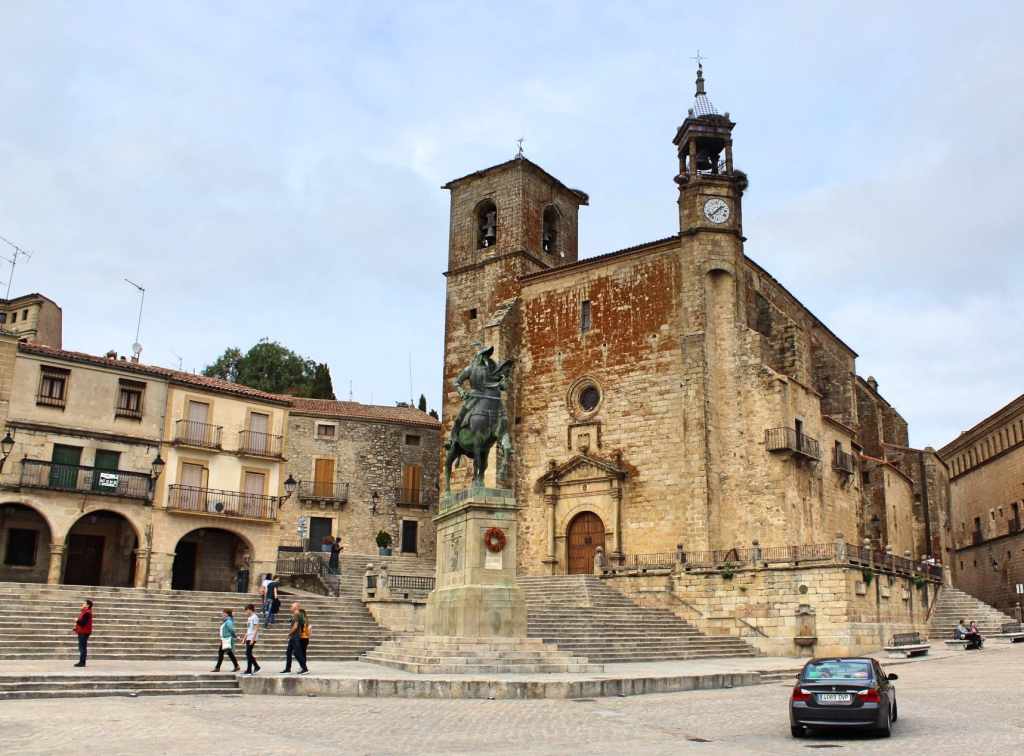
The town is also known for being the home of several Conquistadores (the Spaniards who conquered the New World), most notably Francisco Pizarro, the man who conquered the Incan Empire. Nowadays, of course, we are more likely to feel uneasy at this “accomplishment” of destroying a whole civilization. Even so, he is a historical character of immense importance. Pizarro’s statue stands in the main square, looking properly triumphant. (Hernan Cortés, the conquirer of the Aztecs, was from a small village not so far off. I wonder why Extremadura was a breeding-ground for these characters.)
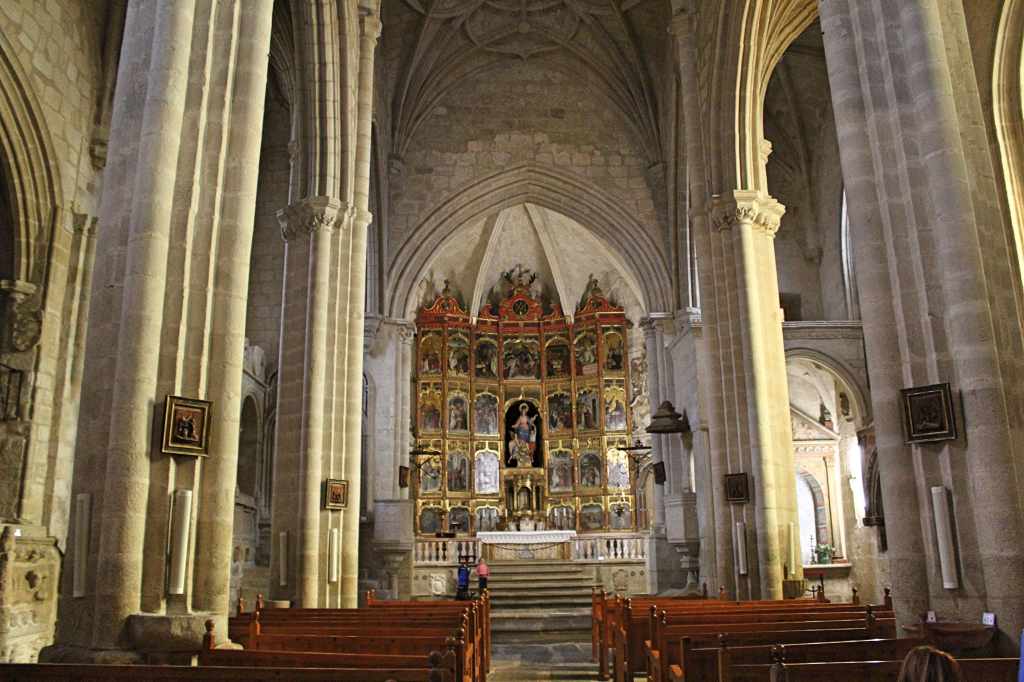
The city walls.The town cemetery. Many families were gathered inside, busy leaving flowers and cleaning the tombs of their ancestors. This is a common tradition on All Saints’ Day.The main square, with the statue of Pizarro.The church of Santa María la Mayor, which is both beautiful in itself and which has excellent views of the city and the surrounding countrysideThe view from the church tower.
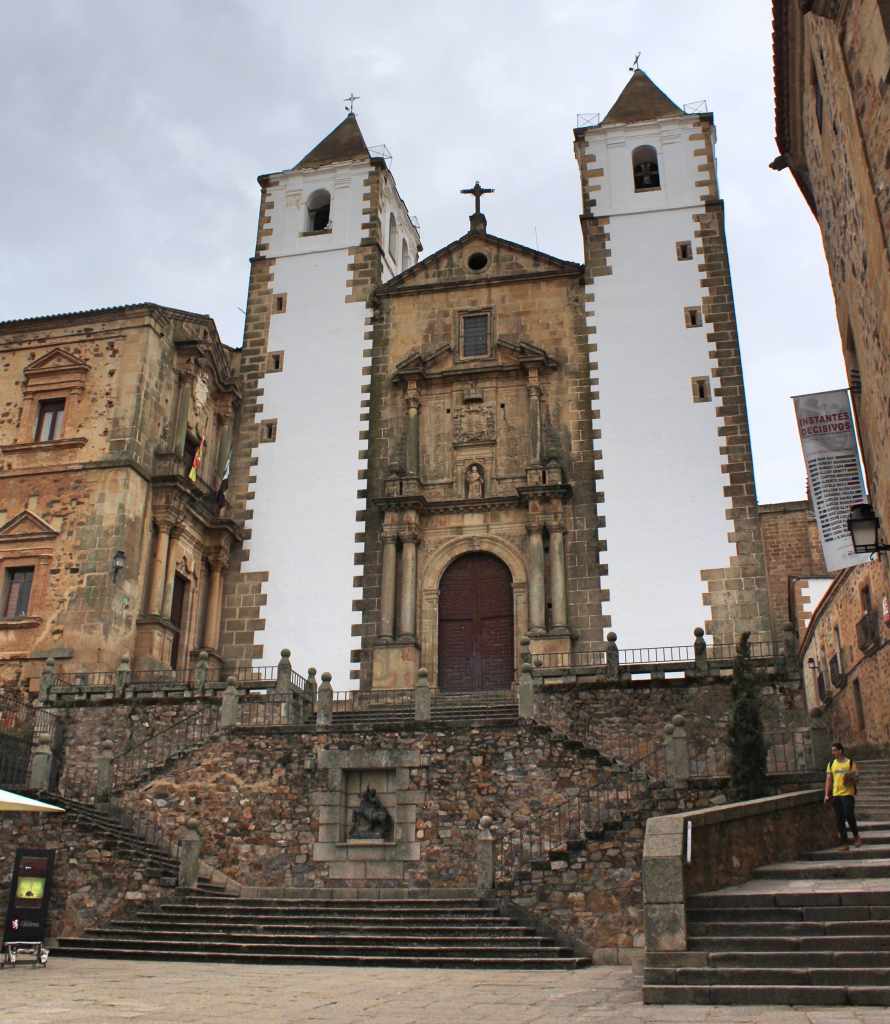
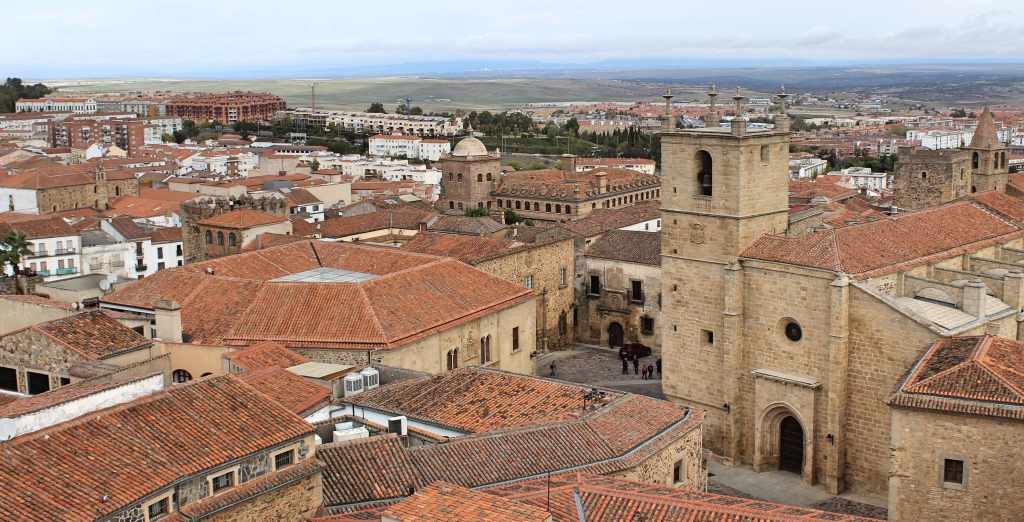
Later that day we went to Cáceres, the second-largest city in the whole province. Cáceres also has a beautifully-preserved historical center, making it a lovely place to walk around. But perhaps even more important, Cáceres has an excellent food scene. There are many superb restaurants in the city.
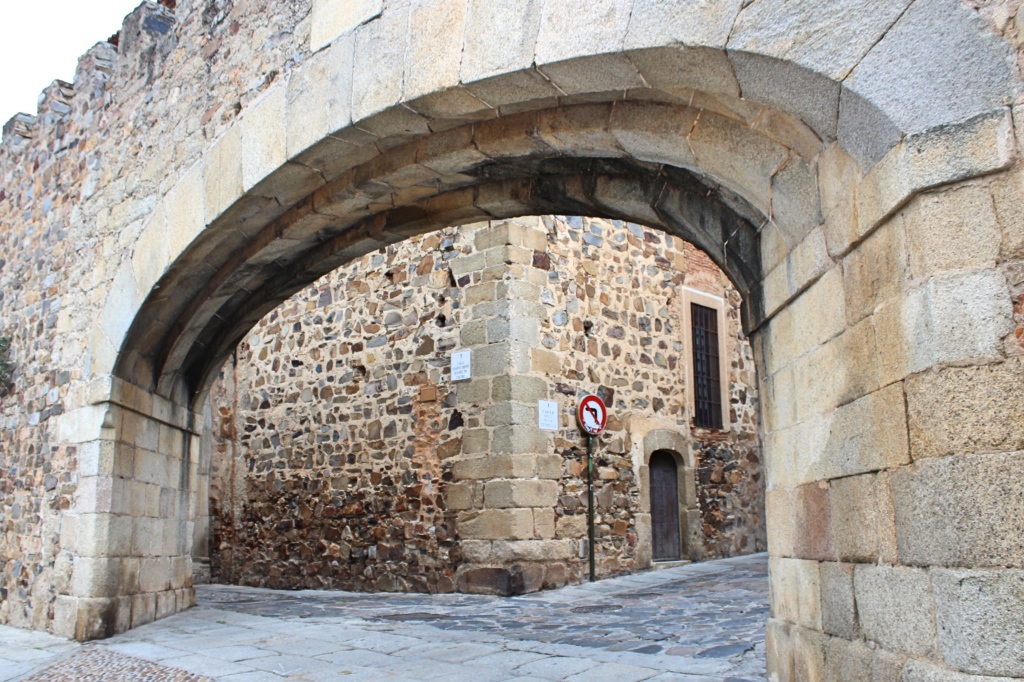
The Church of San Francisco Javier, in the Plaza of San Jorge. Nearby a musician was playing flamenco guitar and singing—and he was excellent at both.The view from the tower of the Church of San FranciscoThe Arch of the Star, a gateway in the main square, made at an angle to allow carriages to pass through from the nearby street.
The next morning we left Cáceres early to go to the National Park of Monfragüe. This is a beautiful area of green hills around the valley of the Tajo River. Humans have been drawn to this area for a long time. In the center of the park, high up on a hill, are the remains of a medieval fortress. In a cave on that same hill, cave paintings have been found, dating from thousands of years ago.
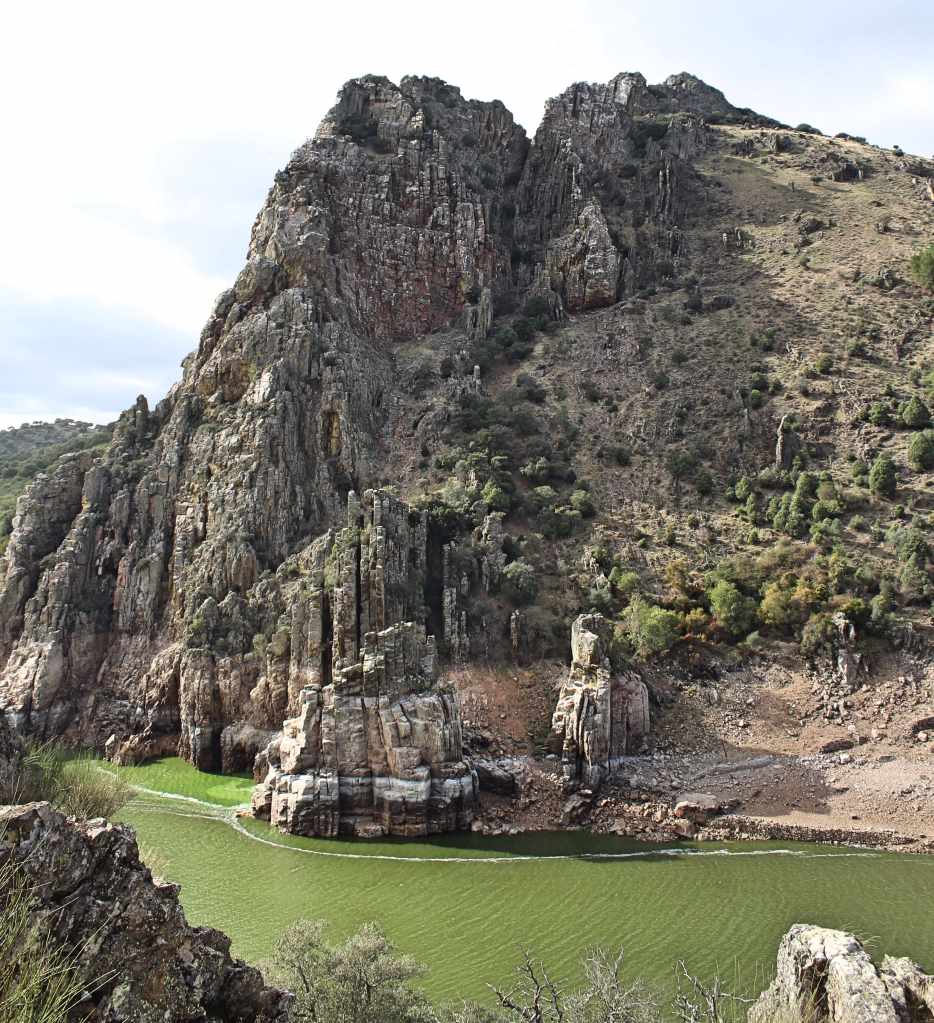
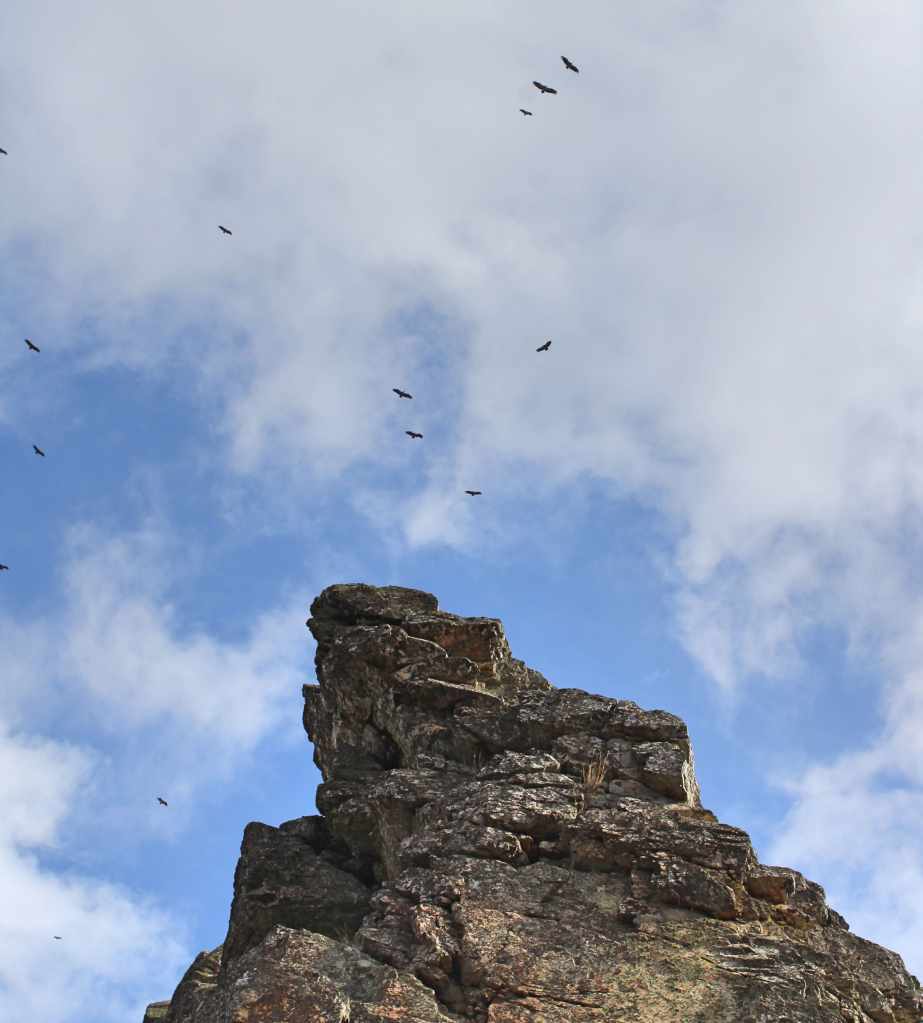
Nowadays tourists mostly come for the birds. A massive rock formation, called the Salto del Gitano (or the “gypsy’s jump”), sits at the river’s edge, creating a persistent updraft. For whatever reason, predatory birds—most notably vultures, but eagles as well—enjoy coasting in this pillow of air. This has made the park one of the best places for bird-watching in all of Europe.
We have had another long weekend here in Spain, and this one was for the Day of the Constitution. It commemorates the day in 1978 when the constitution was passed into law via a referendum. We also had Monday, December 9th, off. And this was basically just because the government guarantees a certain number of holidays per year, and organizes them to make as many long weekends as possible. I quite like this aspect of Spain.
Like so many people (judging from the traffic), I took the opportunity to leave Madrid and to go visit another part of Spain. And while I travelled, I was reminded, once again, of how amazingly diverse the Spanish landscape can be. So I thought I would take this opportunity to give you a kind of quick overview of Spain’s geography.
We can begin with Madrid and its surroundings. Now, I am sorry to say that I think this is one of the ugliest parts of Spain. Madrid is a kind of bureaucratic capital. The site of the city was chosen because it is in the middle of the country. There really isn’t any geographical reason a city should be here. The soil is dry and sandy and isn’t good for farming. There is no coast and no navigable river. (Madrid’s river, the Manzanares, is a kind of pathetic trickle most of the year.) Basically, if the city were to disappear completely, the thought of founding a city here would probably never even occur to anyone (well, unless you were a bureaucrat).
I mostly like Madrid’s climate, if only because it rarely rains. The air is so dry that it hardly holds any heat. This is weird for a New Yorker, used to humidity. The temperature can vary quite a lot from morning to evening, and can even change drastically between sun and shade. All this is because Madrid is at a relatively high altitude—in fact, it is the highest altitude capital in Europe—and the air is sort of thin. Besides that, a whole mountain chain to the north shields the city from any weather making its way from the coast. As a result, it’s dry and pretty barren.
Here is what Ernest Hemingway had to say about Madrid:
“Madrid is a mountain city with a mountain climate. It has the high cloudless Spanish sky that makes the Italian sky seem sentimental and it has air that is actively pleasurable to breathe. The heat and the cold come and go quickly there.”
I can attest to the air being pleasurable to breathe. At the very least, I feel invigorated when I go running here.
If Madrid itself has an unremarkable landscape, it is fortunately close to some beautiful areas. Most notably there are the Guadarrama mountains to the north. For a New Yorker like me, seeing any mountains is an exciting experience. The highest point in all of New York state is Mount Marcy, which is 1,600 meters tall. And this is in the Adirondacks, pretty far from where I live. The tallest peak fairly close to my house is Mount Beacon, which is 491 meters tall. The whole city of Madrid is higher than that!
The highest peak in Madrid’s mountain range is called Peñalara, and it is about 2,400 meters above sea level. That’s just high enough so that you might experience altitude sickness, though the risk is very small. I’ve climbed to the top many times. It’s fantastic both in winter, when it’s covered in snow and skiers, and in summer, when the view is magnificent. This, by the way, is one of Spain’s 15 national parks. So far, I’ve only visited six of them.
Now that I am on the subject, though, let me tell you about two more national parks that I’ve visited recently. One is in the province of Extremadura. This province is now known as the poorest area of Spain. Ironically, however, it was one of the richest parts of the peninsula when the Romans were here, as we can see from the many Roman ruins. Nowadays, much of Extremadura is given over to raising the Iberian pigs which produce some of the country’s finest hams. The pigs are fed a diet of acorns from a little shrubby tree called the holm oak, which grows in abundance in Extremadura.
Anyways, the national park is called Monfragüe. It occupies part of the Tagus river valley, where a huge rock formation called the Salto del Gitano created a strong updraft that birds really like. As a result, on any given day you can see dozens and dozens of the indigenous vultures hovering overhead. I highly recommend it.
Just this last weekend I saw another national park, the Picos de Europa (or the “peaks of Europe”). This is a mountain range in the north of Spain (it occupies the borders of three provinces), which gets its name for being the first bits of land that sailors from the New World could see on their return to Europe. Personally, I doubt this story is true, since the Picos de Europa aren’t especially close to the Atlantic, and they aren’t the tallest mountains on the peninsula. Regardless, they are absolutely gorgeous. You could easily imagine yourself in the Swiss alps.
I like these national parks partly because they are not the sorts of things people normally associate with Spain. The popular image of the country is of the beach, the hot sun, orange trees, palm trees, and olive trees. And of course you can find all that in Spain, too. Spain has great beaches, and great palm trees. But arguably Spain’s most important geographic characteristic is that it is so mountainous. In fact, Spain is the second most mountainous country in Europe, after Switzerland, with an average elevation of about 600 meters (or 2,000 feet). Mountain chains crisscross the country. Besides the two mountain chains I already mentioned, there are the Pyrenees on the border with France, and the Sierra Nevada in Andalucia, which is the tallest range in the peninsula (there are many mountains well over 3,000 meters, or 10,000 feet tall!).
These mountains have played an extremely important role in Spain’s history, both for their effect on transport and the climate. To state the obvious, mountains can get in the way of travel, and this has contributed to the political and cultural disunity of Spain. Historically, it wasn’t so easy to get around. Even more important, the many changes in elevation—mountains, plateaus, and river valleys—can create lots of little micro-climates, and this has an important effect on the culture. I’ll illustrate this with a comparison.
Andalusia, which is in the south of the country, is fairly flat and low-lying, with lots of sun and good soil. As a consequence, farmers can gather lots of land together under one owner, and then farm it with a team of professional planters and pickers for added efficiency. Historically, this led to a great deal of inequality, since the wealthy would buy up the land, and the poor would be forced to work as itinerant laborers. By contrast, consider Galicia. This is the area on the northwestern tip of Spain, right above Portugal. Much like New York, Galicia is hilly rather than mountainous, and it receives quite a lot of rain from the Atlantic, so it’s very green. The soil is workable but not very high quality, and in any case the dense forest and the many hills make it difficult to unite lots of land under one owner. So the Galicians became subsistence farmers, with each family owning their own little plot of land. As you can imagine, these differences in farming strategies have shaped the cultures of these two regions.
I am going on and on, and yet I am afraid I am not doing justice to the Spanish landscape. So here is the historian, J.H. Elliott, on the country’s geography:
“A dry, barren, impoverished land: 10 percent of its soil bare rock; 35 percent poor and unproductive; 45 percent moderately fertile; 10 percent rich. A peninsula separated from the continent of Europe by the mountain barrier of the Pyrenees—isolated and remote. A country divided within itself, broken by a high central tableland that stretches from the Pyrenees to the southern coast. No natural centre, no easy routes. Fragmented, disparate, a complex of different races, languages, and civilizations—this was, and is, Spain.”
Well, for style I doubt I’m going to beat that. I do think that Elliott exaggerates the harshness of the Spanish climate and the isolation of the country’s geography. But he does capture the strangely disunited quality of the landscape. Whenever I drive through the country I am surprised at the sharp contrasts from one region to another. Just yesterday I drove from the snowy, green mountains of Asturias into the incredibly flat and empty plains of León. I am sure that the United States, being so much bigger, contains more variety. But I doubt that any part of America can present such stark contrasts in such a small span of space. In a single day, driving from one end of the peninsula to the other, you can see sandy desserts, arid plains, ice-tipped mountains, verdant river valleys, and lush forests.
When speaking of beautiful Spanish landscapes, we also cannot forget the country’s islands. There are the Baleares in the Mediteranean, which are lovely. But even more interesting are the Canary Islands. This is an archipelago located in the Atlantic, somewhere off the coast of Morocco. The islands are volcanic, which makes them especially fascinating to visit. The tallest mountain in Spain, el Teide, is located on the largest island of the archipelago: Tenerife. I’m sure I’ve never seen anything taller than Teide. The mountain (which is really the volcano that formed the island) stretched up to 3,700 meters. That’s 12,000 feet! And of course the whole height of the volcano is very apparent, since it’s right next to the ocean. I remember being on the plane as we took off from the island, passing through the clouds on the way up, and then seeing Teide above me.
Naturally, Teide is a national park. The island of Lanzarote, which is the third-largest in the archipelago, also has a national park, called Timanfaya. This is the part of Lanzarote that was most recently formed by a volcanic eruption. As a result, there’s basically no vegetation at all. And the rocks are twisted into all sorts of nightmarish shapes. It’s both beautiful and hellish.
Well, I can’t hope to do justice to every one of Spain’s beautiful landscapes in the podcast. But if you take away one thing, I hope it is that Spain has more than just beaches and sun. The geography is fascinatingly diverse, and you can’t hope to understand the variety of Spain’s many regions without knowing something about its many different climates. The national parks are especially wonderful and are just as worth visiting as Spain’s many cultural treasures. Spain is a fortunate country.
In a city full of famous art museums, the Metropolitan is undoubtedly the queen. The institution is a behemoth. With a collection containing millions of objects—objects which come from every corner of the world, from ancient times to the present day—the museum has nary a rival in the world for range. And the objects comprising this encyclopedic collection are, inevitably, of the finest quality that money can buy. By now I have seen enough of the great European museums to say confidently that the Met can compete with any of them.
The museum was conceived as a kind of sister institution to the American Museum of Natural History. It was an age when the rich and educated sought to “civilize” the less privileged. Both museums are located near Central Park, a place which itself was designed as a civilizing project—a kind of pastoral refuge from the ills of city life, where the people could learn to appreciate more refined recreational activities: Sunday strolls, picnics, birdwatching, and so on. The Museum of Natural History would bring the light of knowledge to the uneducated, while the Met would show the unsophisticated the value of high art.
The museum’s founders were embarking on a pathbreaking project. There were already plenty of examples of great European museums to learn from. But what would an American art museum be like? When the museum opened in 1872, its collection was modest. Indeed, many of the works it displayed were either prints or reproductions of famous European works. Yet this quickly changed. New York was emerging as the financial capital of the world. Andrew Carnegie, John D. Rockefeller, and J.P. Morgan were among the city’s residents. Since Europe was still considered the cultural epicenter of the West, these newly-minted super-rich naturally spent their piles of gold in buying up as much European artwork as they could.
The Metropolitan benefited immensely from this confluence of money and ostentatious display. Not only did the museum itself have the budget to purchase high-quality works, but it also increased its collection from gifts and bequests. After all, donating beautiful art to a public museum is a good way to demonstrate wealth and civic-mindedness at once. We ought not to criticize, however. There are times when the vanities of the world manage to produce genuine treasures. And the Met is certainly such a treasure.
At present, the museum’s holdings are so vast and varied that no single person, however knowledgeable, could hope to do justice to it all. It would take a team of professional art historians working for years on end to complete even a basic catalogue of the museum’s works, much less an appreciation along aesthetic grounds. And I am no art historian. So in this post I hope only to give you a superficial tour through this enormous institution. (Much of the information and many of the images come from the Met’s website, which is quite well-made. The people at the museum have done the world a service by publishing high-quality public domain images of their collection.)
We begin at the entrance on Fifth Avenue. The museum is difficult to miss. The building stretches out along several city blocks. Fountains shoot and sprinkle outside, and the sidewalk is always thick with crowds. The building is neoclassical in form, its façade a kind of pale white decorated in a pseudo-Roman style. The steps leading up to the main entrance, lined with imposing double columns, are one of the most iconic spots in New York. There are always food stands parked right below these steps, and usually a street performer—a dancing saxophonist, perhaps—plays for the amusement of those sitting on the steps.
We enter the building, and are faced with a choice: right or left. There are ticket stands on either side. To the left there is a graceful Greek statue of woman, and to the right a stiff Egyptian man seated on a throne. These statues are informative, since the respective galleries for these cultures are located in these directions. For the purpose of getting a ticket, the choice is immaterial: the lines on either side are normally about the same, and usually move pretty quickly.
Now, there was recently a significant change in the museum’s admissions policy. For the past few decades, visitors could pay any amount they liked. Just last year, however, the museum changed its recommended prices to mandatory payments—for everyone except residents of New York State, that is. (Lucky for me, I am still a resident.) Another change, by the way, was the switch from using metal clips to using stickers to identify visitors. I am sure that the Metropolitan has increased its budget by making these changes. But I admit I miss the old, pay-as-you-wish, metal clip Metropolitan. A man from China could pay a dollar, and leave with a nice little keepsake from his visit. I still have some of the old clips in my room.
Anyways, let us now enter the museum proper. I like to begin with the Egyptian section, not just because it is near the entrance, but also because it represents the chronological beginning of the museum’s collection. Here we can ground ourselves in one of the world’s oldest civilizations before we examine anything else.
The Egyptian section is massive and labyrinthine. Unlike the other departments of the museum, the Egyptian department displays everything in its collection—almost 30,000 objects. To make room for all of this, the halls double around one another, making it sometimes confusing to navigate the collection. But it is a worthwhile use of one’s time to get lost in the art. If you proceed carefully through the department, you can take a very satisfying chronological journey: beginning near the entrance, in prehistoric Egypt, and ending up in the same spot, having gone through the Old, Middle, and New Kingdoms, and finishing in the Roman era.
Now, I love this department, because it has everything. Walking through it, the visitor gets a very complete picture of life in this ancient civilization. Of course there are sarcophagi and mummies, along with amulets, jewelry, and ceramics. Among the most famous of the smaller pieces in the museum is William the Hippopotamus, a beautiful figurine made of faience, which is a ceramic type specific to Egypt. It has a radiant blue color that is delightful to look at.
The museum also has a wealth of larger statues, ranging from the size of a child to the size of a giant. For me, the most beautiful of these is a statue of the pharaoh Hatshepsut. As you may know, Hatshepsut was the only woman to officially become the pharaoh. This presented a challenge for Egyptian artists. The art of Ancient Egypt is distinguished for its astonishing conservatism, preserving the same stylistic features through centuries. A single glance is all we need to know that something is Egyptian. But portraying a woman required innovation, and the artists rose to the challenge. Rather than making her appear masculine, as they did in other works, in this seated statue Hatshepsut appears both feminine and even feline. There is a smooth grace and delicacy to the sculpture which is rare in the usually rigid forms of Egyptian art, and I find it enchanting.
Though not, perhaps, especially beautiful, some of the most illuminating artifacts on displays are sets of models. Made around 1900 BCE, the models were found in the 1930s in a tomb in the Memphite region of Egypt. They show us rare scenes of daily life in Egypt. We can see several boats travelling along the Nile, one of them transporting a mummy, another for hunting. There are also models of more cotidian scenes: a granary, a garden, a house. These models are wonderful little things, since it is as if they were made by the Egyptians for a museum exhibit about Egypt. It is difficult to identify with the people who sculpted enormous statues of god kings, but very easy to see oneself gardening.
The centerpiece of the collection is the Temple of Dendur. The Met actually has large sections of several temples in its collection, from different periods of Egypt’s history, but this is the only complete, free-standing temple in the museum. It is in the center of a large room, surrounded by a little water moat where visitors like to throw coins. Statues of crocodiles and lion-headed gods surround the space. The temple itself is of a fairly modest size, and is from the end of Egyptian civilization. It was built after the conquest of Egypt by the Romans, and commissioned by Augustus himself. While the temple is a lovely work of architecture, what most stuck in my memory were the many graffiti carved into the walls.
When you complete your circuit through the Egyptian section, you will be where you began, right by the entrance. From there, I like to go across the hall and then into the section on Ancient Greece. This part of the museum looks very different. Whereas the Egyptian section is twisting and jam-packed, the Greek section is open and clear. The visitor enters a large hall with a vaulted roof. Free-standing statues are scattered through the space, while friezes line the walls. For any lovers of classical art—with its flowing robes, idealized forms, and restrained emotion—there are dozens of works to admire. While I greatly enjoy the statues, I find myself even more interested in the friezes. Some of these come from Athenian tombs, such as a touching portrayal of a little girl cradling a dove.
The collection contains many excellent examples of art from Classical Athens—art that we readily identify as quintessentially Greek. Besides the statues and freizes, there are many examples of Greek vase art. But the collection also contains works that do not fit this description. Among these are the many sculptures from pre-Classical Greece, which to our eyes can seem more Egyptian than anything. The museum has an excellent example of one of these kouroi: A young man, standing with one foot extended forward. I like the work, since it is an interesting example of a midpoint between Egyptian stylization and Greek realism. The young man is manifestly unreal, and yet the musculature in his limbs and torso is well done. An even older work—from around 750 BCE—is a terracotta vase. Its decoration is very much unlike the red, white, and black images of gods and heroes we normally associate with Greece. Rather, it is covered in a thick pattern of geometrical shapes and tiny like stick-like figures. I quite like it.
The collection of Roman art is perhaps even better than that devoted to Greece. There are several excellent busts of Roman Emperors. I have a long, personal attachment to a bust of Marcus Aurelius in the collection, which to me is the perfect image of a philosopher—calm, wise, detached. I use it as my own symbol now. A much more amusing work is a statue of Trebonianus Gallus. It is a rare example in the Met of art gone wrong. Clearly, whoever made it was not a master. The whole figure is awkward, with a bulging stomach and a head that is manifestly too small. Maybe Rome was not doing so well in the year 250 CE, when it was made.
Statues, being made of metal or rock, naturally preserve very well. But painting is another story. Even though the Greeks had a developed tradition of painting, nothing has survived the ravages of time. That is not the case for Rome, from which we have many well-preserved wall paintings. The Met has an entire room, the bedroom of P. Fannius Synistor, which was buried in the eruption of Vesuvius in 79 CE. The art on the walls is really wonderful, showing several architectural and natural scenes. It shows us how the Romans gave a realistic impression of space without using the technique of perspective. Having seen my fair share of Roman wall frescoes and mosaic floors, I must say that they had wonderful taste in interior decoration.
As you can see from this example and the Egyptian temple, the Met is big on re-creating interiors. This is a theme throughout the whole institution, and one of the Met’s most distinguishing features: The visitor is allowed to walk into history.
Before moving on to the next department, I want to mention the wonderful collection of Etruscan art (from Italy before the Roman period) on the balcony above the Roman section. One of the most outstanding pieces in this section is a bronze chariot from around 550 BCE. Having a preserved chariot is quite rare, so it is a treat to be able to see one so exquisitely decorated.
The Greek and Roman section leads direction to the collection of art from Africa, Oceania, and the Americas. Of course, one can tell at a glance that this grouping is a kind of mishmash of art from non-Western cultures, which in previous days was called “primitive.” In reality the arts of these three continents have nothing to do with each other; and, of course, the amount of geographical space supposedly represented in these galleries is incomparably more vast than that of Greco-Roman or Egyptian art. That being said, at least the Metropolitan has a fine collection of art from these parts of the world, which are too often ignored.
For my part, it is a great refreshment to go from the world of Greece and Rome to this gallery. Our culture has so internalized those classical forms that they charm us more for their “perfections” than for any surprises they contain. Thus it is a pleasure to sample some of the other great visual cultures from around the world, which really do contain surprises for Western eyes.
The grand hall of the collection (gallery 354) is one of the most spectacular in the museum. From the ceiling hangs an enormous collection of shields from Oceania, arranged into a kind of meta-shield formation. I am always reminded, incongruously, of a spaceship. Large sculptures fill the space below the shields. There are some slit gongs from the island of Vanuatu, which double as huge musical instruments and works of visual art. There are funerary sculptures from Papua New Guinea; called malaga carvings, they are beautiful and highly intricate wooden carvings meant to be used only temporarily to celebrate the dead, and then disposed of. (This certainly goes against the grain of Western thinking, wherein we want our art to be eternal.) The bis poles of the Asmata people, another culture in New Guinea, are used for a similar purpose, and are also beautifully carved and then disposed of.
The adjacent section on African art is equally captivating. During my last visit I was particularly attracted to a small wooden carving of a man, called a Power Figure, made by the Kongo peoples. Bent forward slightly, standing with arms akimbo, the statue has a real intensity when seen in person—the exaggerated form only magnified by the many steel nails emanating from the man’s body. More famous is the Benin ivory mask, a real masterpiece, made by the Edo people of Nigeria—one of the great pre-colonial states in sub-saharan Africa. The mask, which represents a powerful queen mother, is clearly the work of experts working within a vibrant tradition. The mask has an elegance and a graceful polish that make it very satisfying on the eye: each detail is finely crafted, and yet they all work together to make a perfect form.
During my last visit, I was especially interested in the section on pre-colonial American art, since I had just finished listening to an audio course on the peoples of North America. I was delighted to find beautiful examples of geometric pottery from the Ancestral Pueblo culture (fascinating to compare to the geometrical designs from pre-Classical Greece). Among the many sculptures on display, one of the most iconic is a ceramic baby from the Olmec culture, made around 1,000 BCE. It is a wonderful piece, surprisingly lifelike despite its stylized face. The folds of fat and the hand placed idly in the mouth serve to make this sculpture a far more realistic depiction of babyhood than the many portraits of the infant Jesus made over 2,000 years later in medieval Europe.
Moving on in our rapid tour, we come next to the museum’s Department of Modern and Contemporary art. The very fact that the Met has this department is a testament to its uniqueness. I can think of no other museum in the world that has significant holdings of ancient and non-Western art as well as “modern” art. But the Met is devoted to a vision of total universality—the art world’s equivalent of the Museum of Natural History—and so has it all.
The collection as the Met is almost as impressive as that in the MoMA—and that is saying a lot. Though there are so many great works on display, I will restrict myself to mentioning my favorite painting, which is also perhaps the most famous painting in the whole collection: Pablo Picasso’s portrait of Gertrude Stein.
It is an extraordinary portrait, arguably the greatest of the previous century. The painting is revolutionary. Gertrude Stein sits in a kind of abstract, unfinished space. She is not surrounded by her papers and books, but instead sits alone. While previous portraits in European art showed us the heroic and cultured male, handsome and lithe, Stein is hunched-over, short, and tick. Yet her body—mostly concealed under her heavy clothes—has a kind of elemental power on the canvass, even a monumental grandeur. But her face is what attracts the most attention. Rather than faithfully reproducing Stein, Picasso turns her face into a kind of mask. Thus her eyes and nose do not obey the normal rules of perspective and anatomy. Ironically, though this technique necessarily makes Stein’s face blank and inexpressive, the result is a convincing representation of the writer’s presence, of her indomitable energy. There is a charming story that, when told that Stein did not look anything like this portrait, Picasso responded “She will.” He was right: this portrait has helped to define Stein’s image far more than photographs of her.
I will also mention the largest work on display in this Department: America Today, a mural by Thomas Hart Benton. It consists of ten canvasses, and shows in visual form the America of the 1930s. The work was commissioned by the New School of Social Research—a kind of progressive think tank. I quite like the mural, as I do much of the public art created during the Great Depression and the New Deal. Looking at this work, one feels that we modern Americans were successfully creating our own visual language with which to decorate our public monuments—much like the Egyptians and the Greeks. The inclusion of this large mural is also keeping with the Met’s proclivity for immersive artistic experiences.
Next we come to the massive Department of European Sculpture and Decorative Arts. Once again, the Met excels when it comes to the re-creation of historical spaces. One of the most beautiful rooms in the Met is an entire patio taken from a Renaissance Spanish villa—the Castle of Veléz Blanco. Not only are the carvings on the arches and columns beautiful, but the space is filled with quite lovely statues of mythical, historical, and religious figures. Just as astounding is a study from the Ducal Palace of Gubbio. Every surface is covered in images made using the technique of wood inlay (intarsia, or marquestry), which consists of piecing together little bits of colored wood in order to make a complex image. The amount of time it must have taken to assemble a whole room this way is frankly stupefying. The result is an extraordinary work of immersive art, whose walls symbolize different areas of human activity. I am sure the room itself is a greater accomplishment than whatever happened inside it.
These two rooms only scratch the surface of the department’s holdings of decorative arts. There is everything one would expect to find in the homes of aristocrats and royalty, from elaborate coffee pots to ornate globes. I admit that, however fine these products are, they are generally less interesting to me than the sculptures.
Some of the museum’s best sculptures can be found in gallery 548, which takes the form of a large atrium. On one side of the space, you can even see the brick façade of the museum’s original building (which is mostly buried in the later constructions). There are two outstanding statues in this space. The first is Perseus with the Head of Medusa, by Antonio Canova. It is an extremely fine work of Neoclassicism, achieving the idealized grace of the Greeks and Romans. Simply as a composition, the statue works marvelously, with the gruesome head balanced by the peculiarly barbed sword, making a strong diagonal. The other great statue (in my opinion) is Ugolino and his Sons, by Jean-Baptise Carpeux. This depicts a story taken out of Dante of an Italian count who—along with his sons and grandsons—was imprisoned and starved to death. We see the count, driven almost to insanity through starvation and despair, surrounded by the tortured forms of his progeny.
Continuing on through the museum, the visitor will next reach the museum’s section of Medieval Art. Now, I feel justified in mostly passing over this department, since the bulk of the museum’s medieval art resides in the Cloisters Museum, uptown (an enchanting branch of the Met). Even so, it must be said that the central room of the Medieval Department is a beautiful space, with a high ceiling and high windows, like a cathedral. An ornate grill (from the Valladolid Cathedral, in Spain) stretches most of the way to the ceiling, and charming examples of sculptures, tapestries, and stained glass give the space a properly church-like atmosphere. This last time around I was particularly impressed with the museum’s small collection of Byzantine art.
From here it is appropriate to go straight to the Department of Arms and Armor. As you can imagine, this was my favorite section to visit when I was a young kid, and did much to fuel my youthful obsession with swords and guns. Even now, I admit I find this section extremely impressive, and I have never seen any collection of historical weapons even half as good. The presentation is excellent. The visitor enters a large hall, where medieval flags are hanging from the ceiling. A group of mounted knights ride through the center, while other armored knights stand guard all around the periphery. One feels that one has entered a jousting tournament.
The suits of armor are fascinating and, often, strangely beautiful. They are like abstract sculptures of human forms, or a kind of proto-machine with moving parts. Though you naturally would think that a metal suit would be extremely cumbersome, you can see innumerable little joints made into the armor, giving the wearers a surprising range of movement. The most beautiful of these many suits on display is that made for Emperor Ferdinand I (brother of Charles V). Every piece of metal is covered in ornate designs. Just as wonderful are the Japanese suits of armor on display. Rather than turning their wearers into metallic turtles, this armor is clearly designed for a different sort of fighting—one requiring more lightness and flexibility. The monstrous grimaces on the helmets would be genuinely terrifying if someone was coming at you wearing this.
Right next to this department is the American Wing. This is one of the areas where the Met is really untouchable. Other museums may have finer paintings or sculptures or what have you, but I do not think any museum has such a complete and rich collection of American art. Indeed, the American Wing could be cut off and moved to a different spot, and it would still be one of the finest museums in the country. Its collection is vast, and it is so wonderfully presented. The visitor enters an enormous courtyard full of benches and statues. The glass wall and roof flood the space with light, making the department a welcome relief from the dark medieval section. Bright, colorful stained glass, and an equally colorful fountain, line the walls; and a beautiful bronze statue of Diana, lightly resting on one foot, occupies the center.
The visitor enters the main collection through a kind of pseudo-façade, as if this is an entirely different building. And, indeed, the visitor suddenly finds herself thrown into a richly-furnished home. In keeping with the museum’s penchant for interior spaces, there are a great many recreations of American interiors from different points in the country’s history. Surely, we have not invented anything as close to time travel as this. Proceeding onward, the visitor next finds a strange sort of room. It is in the shape of a large oval, and on the walls there is an enormous painting of the palace and the gardens of Versaille. When standing in the center of the room, the curving panoramic does create a satisfying illusion of actually standing in France. Just as the study in the Ducal Palace of Gubbio, this painting (by John Vanderlyn) must have taken a nauseating amount of time.
I walked up the stairs, and then found myself in what is called “open storage.” These are the chairs, tables, paintings, lamps, and everything else that the museum has but did not have the space to use. So they hang here, in transparent cases. I recommend a visit to this, if only because it gives you an idea of the enormous amount of material any major museum must be holding in storage.
Proceeding onward, we come to the painting gallery. There are far too many excellent works to name. I was particularly happy to see a portrait of Alexander Hamilton and George Washington—both of which used to hang in Hamilton’s home, up in Harlem. More conspicuously, there is the iconic painting of Washington Crossing the Delaware—almost ludicrously heroic. I was also happy to find Frederic Edwin Church’s painting, In the Heart of the Andes. Church was inspired by the naturalist, Alexander von Humboldt, and included as much scientific detail as he could in this painting. Just as famous is John Singer Sargeant’s painting, Madame X, an intentionally risque (at the time) portrait of a society beauty (her real name was Madame Pierre Gautreau).
I was most delighted to learn that the museum has an entire room designed by Frank Lloyd Wright. I am no expert in the design of houses or in interior decoration, but I must say that it is both a welcoming and an animating space. It is easy to imagine myself reading a good novel within, while watching the snow fall out the windows.
This completes our long circuit around the museum’s massive ground floor. If we continue on, we reach the Egyptian section again. So now let us return once again to the Great Hall, and then ascend the grand staircase to the museum’s first floor (or second floor, in America).
Finally we come to the museum’s collection of European Paintings. Now, I must be careful here to avoid getting pulled into an endless catalogue of the museum’s excellent works. Like the American Wing, the Met’s Department of European Paintings could be a self-standing museum, and still be one of the best in the nation. Whether you like Dutch, Italian, French, or Spanish art, you will not leave the gallery disappointed (though German painting is fairly absent).
As you might expect, I am most interested in the Spanish paintings on display. The Met has excellent examples of the three great Spanish masters: Velázquez, El Greco, and Goya. The outstanding work of Velázquez is a portrait of Juan de Pareja, an enslaved man of African descent, which the artist executed in Italy. You will be pleased to hear that the great painter freed Juan de Pareja, who went on to become a skilled painter himself (there is a work of his hanging in the Prado). In any case, when you look at this painting, you do not see a man in bondage. To the contrary, Juan de Pareja appears almost regal with dignity. The painting is beautiful and startlingly realistic. To depict a man of African descent in such a way was a radical gesture on Velazquez’s part.
Goya’s contribution is a portrait of Manuel Osorio Manrique de Zuñiga, a very young aristocrat. As usual with Goya, the figure has an odd stiffness, and the face is inexpressive. The viewer’s eye is naturally drawn to the scene at the boy’s feet, where two cats hungrily eye a magpie on a leash. This is a strangely morbid scene for a portrait of a youth, and it becomes all the more eerie when one considers that the boy died only a few years later, at the age of eight. El Greco’s outstanding work is his View of Toledo, the best of the artist’s few landscape paintings. As always, the artist’s signature style is immediately apparent: deep, rich colors combined with a dramatic verticality. This style is perfect for the city of Toledo—which is built on a hill overlooking a river, and filled with sharp towers. El Greco manages to imbue this wholly secular and inanimate scene with a burning spiritual intensity.
The number of excellent French painters in attendance dwarfs the representatives of any other nation. My personal favorite is Jacques Louis David. There is a charming portrait of the French chemist Antoine Lavoisier, who was executed during the French Revolution under false accusations. This is quite a historic loss, considering that Lavoisier is normally considered to be the father of modern chemistry. David’s more famous painting is his The Death of Socrates, a historical scene showing the great philosopher’s final moments. Socrates, who was very ugly and was quite old at the time, is shown as a partially nude Greek hero—with a muscular torso to boot. While I am not sure the painting captures the spirit of Plato’s dialogues, it is a brilliantly theatrical image.
On the subject of French painters, I must also mention The Love Letter, by Jean Honoré Fregonard, a delightfully coquettish image of a young woman receiving a note from her secret admirer. (I use this image in my blog’s newsletter.) I would love to keep going—since paintings speak to use in a modern language, easy for us to appreciate—but I will content myself with a short list of the artists in attendance: Rembrandt, Van Gogh, Vermeer, Ingres, Canaletto, Tiepollo, Turner, Klimt, Monet, Manet, Guaguin, Cézanne, Dürer, Memling, Rubens… Really even the list gets too long. The museum’s holdings of 19th century European paintings is so big, in fact, that the collection is held in a different section of the building.
To get there, you must pass a little hallway devoted to drawings, prints, and photographs. Now, you may be surprised to learn that, counted by individual works, this department is by far the biggest in the museum. But only a fraction of the drawings and prints in the museum’s holdings are on display at any given time. Sometimes they are taken out for special exhibitions, such as one on Michelangelo a few years ago. There, I got to see some of Michelangelo’s schematic drawings for fortresses, when he was briefly hired as a military engineer. Besides being innovative designs, the drawings themselves are beautiful works of abstract art.
Continuing on through the paintings of 19th and early 20th century Europe—where you can admire the great impressionists and post-impressionists—you get to the Department of Islamic Art. During my time in Spain I have come to admire Islamic art for its intricate designs, its geometrical sophistication, and its sense of divine calm. Wonderfully creative patterns decorate everything from tiles, to carpets, to pages of the Qur’an. As an example of the last, there is a stunning illuminated Qur’an from Turkey, whose decoration is just as intricate as the Book of Kells in Dublin.
Representational art is relatively uncommon in the Islamic world, as it is explicitly forbidden by the religion, but there are still some examples in the gallery. A particularly beautiful one is a tile panel from Iran, executed in a style that looks to my ignorant eye as if it could be Indian. A seductively posed woman is being courted by a man wearing a European hat. I wonder who made object, for whom, and where it would be placed, since it seems to so flagrantly flout the strictures of Islamic religion.
In keeping with the museum’s love of historical spaces, this section has the Damascus Room. This is a winter reception room from a palace in Damascus, Syria, made around the year 1700. It is a beautiful space. Shelves display ornate ceramics and the gilded covers of Qur’ans. Panels of lovely calligraphy (bearing messages from the Qur’an) and floral designs decorate the walls, and the floor is covered with geometrical tiles. The ceiling is perhaps the most stunning of all, composed of elaborate woodwork. It is such a sophisticated, elegant space; it must certainly have set the tone for any conversations which took place within.
Next we come to the museum’s relatively small section on the Ancient Near East (Mesopotamia). For the most part these halls are filled with wonderful little objects from long ago, like cylinder seals, jewelry, incense burners, and small-scale statues. Among this last category is a small statue of Gudea, made around 2,000 BCE. It is a work of skilled craftsmanship, showing us a Sumerian king in a rather humble pose. His robe bears an inscription in cuneiform about his accomplishments (typical propaganda). What is striking is the thoughtfulness and even the humility of the king’s gaze and pose. He strikes us as more of a monk than a fearsome ruler. Another outstanding work is the bronze head of an unknown ruler, made between 2300 and 2000 BCE. Though not exactly realistic, I think this work is remarkable for the degree of individualization in the ruler’s features. We are not looking at a generic, stylized male head, but a particular man from 3,000 years ago.
But the real stars of this department are the lamassu: colossal sculptures of human-headed winged lions that flank the hallways. These were made in Assyria, around 850 BCE. Walking through this hallway, flanked by these mythical figures, feels like walking into the past. One detail I particularly like is that the creatures have five legs, as a result of a bit of illusionism. The front two legs are parallel, as if the creature is standing still; yet from the side, an extra leg is added (invisible from the front) to make it look as though the creature is mid-stride when seen from the side. The walls surrounding these stone guardians are covered with friezes in low relief, depicting other mythological scenes. For me, this Assyrian art is as lovely anything in the Egyptian section.
You emerge from ancient times onto the balcony overlooking the Great Hall. Here you can walk across and enter into the Department of Asian Art. This is one of my favorite areas of the museum, partly because of the art itself, and partly for the way that this department is laid out. Clever planning makes the department seem much bigger than it actually is, and walking through it the first time feels like exploring an old palace or temple.
The viewer enters the department by walking into a grand gallery, filled with enormous works of Chinese Buddhist art. There are large stele, bearing inscriptions and carvings, and a huge sculpture of a Bodhisattva. This may, in fact, be the biggest statue in the museum. It is 13’9’’ tall (over 4 m) and must weigh thousands of pounds. It is also quite beautiful, with richly decorated robes. On the wall is an even bigger paintings of the Buddha of Medicine, seated among a large retinue. It is a magnificent way to enter Asia.
From this large hall, one can either further explore Chinese art, on the left, or enter the arts of India, on the right. For the sake of consistency, we can begin with China. The Met’s collection of Chinese Buddhist sculpture is the largest outside of Asia, and more examples can be seen in Gallery 208. There are so many lovely sculptures. One I particularly like is a ceramic sculpture of an Arhat (or a Luohan, as they are known in China), which is a person who has achieved an advanced state of enlightenment. The sculpture is lifesize; and the man’s tired and worn expression is extremely compelling. His robes are still brightly colored, even though this was made over 1,000 years ago.
The Met also has a wonderful collection of Chinese drawings, calligraphy, pottery, and much else. But the most stunning room is the so-called Astor Court: a recreation of a Ming Dynasty-era courtyard. This is just another example of the stunning interiors from around the world collected at the Met. Finished in 1981, this installation was built by hand, using traditional methods; and besides being a beautiful work of art, it represented a landmark in cultural exchange between communist China and the United States. You enter through a round doorway guarded by two stone beasts (one is reminded of the lamassu in the Ancient Near East). Immediately you find yourself in a different world. A sheltered walkway surrounds a garden filled with oddly shaped rocks. These are called Taihu stones; they are formed via water erosion at the foot of a particular mountain in China (Dongting), and they are abstract sculptures in their own right.
At the end of the garden is a large room, designed to be used as a study, I believe. Unlike the great European interiors of the Met, this room does not appear at all ostentatious. Rather it is spare, restrained, and tasteful. As in the Damascus Room, it is impossible not to be awed by the high degree of sophistication and elegance of the room and the adjoining garden. I cannot but help imagining myself as a Ming Dynasty scholar, sitting in the garden and contemplating some intellectual puzzle. The space seems to invite contemplation.
Next we shall enter India and Southeast Asia. But before that, I ought to mention the Met’s small but delightful collection of Korean art. It is all in one room, Gallery 233, and I quite like the space. All of the objects are diminutive, and many have a kind of geometrical simplicity and elegance which gives the space its own distinct aesthetic. But we have no time to stop and savor. We walk from China, through Korea, and into India.
For me, the standout objects in these galleries are the many small figurines of gods. Indian sculpture enchants me for the kind of whimsical energy it often possesses. Though magnificent, the many gods do not seem remote or beyond reach, but rather quite approachable and inviting. These galleries are arranged chronologically, so we begin at around 2,000 BCE—about as old as anything in the Egyptian or the Ancient Near East sections—and move towards the present. To pick just a few of my favorite examples, there is an Avalokiteshvara Padmapani from the 7th century, a Bodhisattva who seems to be coyly beckoning. Or there is a statue of Shiva as the Lord of Dance, wherein the god is shown mid-stride, dancing within a fiery circle.
Another favorite is Yashoda with the Infant Krisha, who is suckling the young diety at her breast. This sculpture is especially resonant for Westerners, since we also have a tradition of representing the sacred mother suckling the divine child. But the style is here so very different. Whereas Mary is de-sexualized as much as possible, Yashoda is nearly naked and her breasts are almost comically large (of course, I am looking at this sculpture as a Westerner). Indian art is, after all, famous for its erotic content. An excellent example of this is a sculpture of a loving couple in a passionate embrace, made in the 13th century. You may be surprised to learn that this was part of the decoration of a temple. Certainly you would never see anything similar on a gothic cathedral!
The last work I will mention is a statue of Ganesha from the 12th century. This elephant-headed god is the bestower of good fortune, and it is customary to make an offering before doing anything important. When I visited a few years ago, I was delighted to find that this practice extended into the museum: there were coins left at the base of the statue.
We still have Japan to cover, but first we must take a little detour. Standing near the end of the section on India and Southern Asia is a beautiful wooden ceiling. This comes from a Jain temple built in the late 16th century. The staircase underneath this roof leads up to a small gallery on the floor above, this one devoted to the arts of Tibet and Nepal. For my part, this is some of the coolest art that I have ever seen. Though thematically related to art in both the Chinese and the Indian sections, the art here has a peculiar intensity not found anywhere else. An example of this is the painting of Walse Ngampa, a wrathful deity of Tibetan Buddhism. The figure has an electrifying intensity, with two arms wrapped around a terrified victim about to be devoured, while its many other arms are outstretched, holding symbolic objects.
When we descend, we can finally make our way to the section of Japanese art. Here, too, we can find some excellent statues. I particularly like the wooden guardian figures, which flank a statue of the Dainichi Nyorai, or the Cosmic Buddha. These guardian figures are formidable. I am always drawn to their fearsome grimaces. Even more wonderful is Ogata Korin’s ink drawing of waves on a folding panel. Here we can see a non-Western tradition of drawing that is intensely sophisticated. The waves do not occupy any kind of realistic space, but instead seem to emerge from nowhere and engulf everything. The lines of the waves are nothing like the blurry colors of Turner’s seascapes, which gives these waves a disturbing sense of solidity; the leading edge of the water appears sharp and even claw-like. It is a wonderful image.
We have already spent hours and hours in this museum, and yet there is still more to see. From the Japanese Department we can move on to the Department of Musical Instruments. This is housed in two galleries overlooking the section of Arms and Armor. I have never seen a collection of musical instrument that even comes close to the Met’s collection. There are superb examples of instruments from around the world: Italian harpsichords, Chinese pipas (similar to a lute), Native American rattles, Congolese horns, and Japanese drums. Seeing them in this context reminds us that instruments can be very beautiful simply as objects. To pick just one extravagant example, there is an Indian taus (a bowed lute) in the form of a peacock. And, of course, we must not neglect to mention the Stradivarius violins.
This gallery also has paintings with musical subjects hanging on the walls. My favorite is Dancing in Columbia, by Fernando Botero, if only because a copy of it has been hanging in my mother’s living room as far back as I can remember. Two balconies connect the two halves of the instrument department. On one of these is a charming old organ, and on the other is a fantastic assortment of wind instruments, arranged as if they are exploding from a central point. It is an evocative representation of a fanfare.
By now we have made our way through most of the major sections of the museum. There is only one place left on our tour: the Robert Lehman Collection.
Robert Lehman was a banker who owned one of the biggest and best private art collections in history. Active for a long time on the Metropolitan Board of Directors, he bequeathed his extraordinary collection to the Met, but on the condition that it not be mixed in with the other departments. Thus, the Met built a special space, attached at the back of the building, almost like a spaceship taking off from the main building. The rooms of the department are furnished to vaguely evoke a private home. Personally, I do not like having this department separate, since I do not see any good reason to do so other than vanity. If Lehman wanted his collection separate, he could have done what Frick or Morgan did, and established his own museum. But, in any case, there are some extraordinary works of art to be found, so it cannot be missed.
Robert Lehman seems to have been most interested in European paintings, and that is what we find in abundance. One of my favorites is The Creation of the World and the Expulsion from Paradise, by Giovanni di Paolo. I love the color palette of the paintings, filled with rich dark hues. But I am most drawn to the representation of the creation of the world: with God holding a series of concentric circles surrounding an image of Eden. Most famous, perhaps, is a portrait by Ingres of the Princesse de Broglie. Ingres’s technique is masterful, brilliantly capturing the rich fabric of her dress and furniture. It is also psychologically subtle, as it shows us a woman poised between shy reserve and self-assuredness.
There are dozens of other great paintings in this collection, and thousands upon thousands of great works in the museum, but this is where our tour must end. I have already written far too much. But the Met is endless—or, at least, it might as well be.
Confronted with such an enormous mass of culture and beauty from all around the world, it is difficult to know how to react. Part of me wonders whether all of these objects really should be here. With the financial resources that the Met possesses, the museum has been able to get nearly anything. But should they? And were all of the objects collected in ways that we would now approve of? Admittedly, the museum is trying to address this last question with their Provenance Project, paying particular attention to works that may have been looted by the Nazis and not restituted to their rightful owners. Personally I wonder about many of the objects in the Department of Oceanic, African, and American arts.
On the other hand, I think it is important that we do have spaces where we can see the human experience as one enormous tapestry. Traveling from Egypt, to China, to Turkey, to Senegal—in short, to nearly every inhabited corner of the world—and seeing these different traditions unfold through centuries of time: one would hope that this might lead to some insight into our human condition. There are some very obvious lessons, the most obvious one being that humans really like to make art. Other common themes are the relationships between art and power, or art and religion. It is all too much to really digest everything. But I hope every visit provides just a little bit more to chew on.
To conclude rather lamely, the Met is a uniquely excellent museum. Not only does it have vast and high-quality collections, but the museum is unique in many respects. As often mentioned, there is the museum’s emphasis on interior decoration and the arts of daily life. More important is the museum’s attempt to be all-inclusive: incorporating art from all over the world, and from every historical period. The Met’s view of art is expansive, incorporating not only paintings and sculptures, but swords, helmets, harpsichords, photographs, and dresses (the Costume Institute is downstairs). It is a kind of universal storehouse of human activity. I will surely keep going as long as my legs will take me.
I have to begin this letter on a somber note. This Monday, November 25, was the International Day for the Elimination of Violence Against Women. This issue is a big concern in Spain. It seems like there is always a story on the news about a woman who was murdered by a partner, or about men who have sexually abused women without facing consequences. So far this year, 52 women have been killed by their partners, and only 11 of them had filed any kind of police report beforehand. I am sometimes asked by Spaniards if we in America have such a big violence against women problem. Though I am inclined to say yes, it strikes me that in America we do not discuss domestic violence nearly as often as they do here in Spain.
So I decided to see if I could find some figures that I could compare between the two countries. In the United States, in 2005, 1,181 women were killed by an intimate partner. For that same year in Spain, 63 women were killed by partners or ex-partners. Keeping in mind that the population of Spain is about one-seventh the population of the United States, the American figure is still much bigger. So it seems that we in America have a much worse domestic violence problem than they have here in Spain. Though it is sad news, to me it is not very surprising. The easy access to guns in America makes all forms of violence more common, or at least more deadly. The reason we don’t talk about domestic violence as much in America as in Spain, I think, is that in America all of our conversations about violence end up being arguments about guns. In Spain, the issue is normally framed more as a cultural problem—the culture of machismo.
As tempting as it would be now to launch into a rant about American gun violence or machista culture, this episode is focused on a slightly more peaceful topic (well, maybe not): the history of Spain. This past weekend, I finally took the time to revisit one of the great museums in Madrid: the Museo de Arqueología Nacional (the National Archaeology Museum). It is a bit out of the way for most tourists, though not much. The museum is housed in the same enormous building as the National Library, which is also worth a visit, if only to see the ornate façade complete with sculptures of iconic Spanish writers (like Lope de Vega or Cervantes). The Archaeology Museum is huge, and fascinating, and very cheap: only three euros, and free on Saturday afternoons.
The museum goes through the prehistory and history of Spain from the earliest times to the early modern period (about the 1700s). Human ancestors have been in the Iberian peninsula for at least one million years. Quite a long time. One of the most famous early-hominid sites in Spain is Atapuerca, near the city of Burgos. (Researchers are still debating what species to assign to the fossils found there.) Around 200,000 years ago, the Neanderthals set up shop in Iberia, and began making all sorts of little sharp stone tools. There were probably homo sapiens, too, and it is possible the two species interbred. They at least influenced one another’s technology. By far the most famous artifact left by the prehistoric humans of Iberia are the cave paintings in Altamira, which were made around 36,000 years ago. The archaeology museum has a beautiful replica of these caves near the entrance, made using traditional methods. If we can judge by these cave paintings, two things have occupied the Spanish for a very, very long time: painting and bulls.
Soon enough in the museum’s collection we get to the development of agriculture, permanent settlements, pottery, metallurgy, and all of the other dubious developments of sedentary life. Sometime around 500 BCE, the Celts came into Spain. (And I bet a lot of people didn’t know that the Celts were in Spain.) You can still see traces of their culture in the northwest corner of the country, Galicia. Meanwhile, the Phonecians (from northern Africa) began to colonize the south of the peninsula. The city of Cádiz has been inhabited since around 1,000 BCE, making it the oldest city in Spain. A bit later, the Greeks started landing on the East coast, establishing the city of Empúries, which is in modern-day Catalonia. They did this around 600 BCE.
Under the influence of the Greeks and the Phoenecians, a new indigenous culture eventually emerged in the East Peninsula, which is now called simply the Iberian culture. The museum has quite a few beautiful examples of Iberian sculpture, such as the so-called Lady of Elche—an imposing woman with Princess Leia hair. In general, Iberian sculpture is distinguished from the typical Greek style by its abstract stylization. Its rediscovery in the early 20th century influenced Picasso. But the culture was not to last, since the Iberian Peninsula eventually was the site of the Punic wars—the clash between Ancient Rome and Hannibal’s Carthage. Rome won, of course, and then incorporated Iberia into the ever-growing Roman Empire. Iberia then became Hispania, and its culture became roman.
You don’t need to go to the archaeology museum to see evidence of Rome’s influence. There are Roman ruins in Segovia, Mérida, and Tarragona, to pick just three examples. But you don’t even need to look that far: the whole Spanish language evolved from Latin. The museum has some wonderful examples of metal sheets on which Roman laws were published. I like to imagine a Roman lawyer doing his research on a rainy day, standing in his toga outside in the plaza, bent over, reading these laws. In any case, the Romans really Romanized Spain: they built aqueducts, temples, fortresses, bath houses, dams, lighthouses, roads, theaters, amphitheaters—tons of stuff. Talk about a colonial mindset. But at least they had a sense of style. The archaeology museum in Madrid has some beautiful samples of Roman floor and wall mosaics, which in my opinion are in better taste than any of our interior decoration.
Rome lasted a long, long time. Spain was controlled by the Romans for about 700 years, which left an indelible mark on the country. But eventually Rome declined and fell. This left a huge power vacuum, which allowed the Visigoths to move in from the north of Europe. The museum has a few interesting artifacts from this period, but really it was not a time that left a huge archaeological footprint. After all, these were the Dark Ages. The Visigoths only enjoyed their time on top for about 200 years, until they were crushed by the invading Muslims, who came in from across the Strait of Gibraltar.
This was the beginning of Al-Andalus, or Moorish Spain. (The word moro in Spanish is considered slightly offensive, but in English “Moorish” is standard.) This was actually another cultural high point in the history of the peninsula. While most of Europe was still slowly crawling its way back from the Dark Ages, Moorish Spain was an advanced place. New crops and agricultural techniques were introduced, major philosophers like Averroes and Moses Maimonides lived and wrote, and beautiful buildings were constructed, like the Great Mosque of Cordoba or the Alhambra in Granada. The Archaeology Museum has some amazing examples of Moorish art and architecture, as well as some works made by Christians in a Moorish style (which is called mudéjar). The Moors left a sizable linguistic heritage, too, as thousands of Spanish words come from Arabic.
Eventually the power of the Moors fractured, and the power of the Christians in the north grew and consolidated. After many centuries of battles, shifting alliances, and gradual conquest, the Christians pushed south until the last Moorish kingdom—Granada—fell in 1492, and modern Spain was born. Soon the country entered its Golden Age as the pre-eminent global superpower, with colonies all around the world (thanks partly to Columbus), and most of Europe under its thumb. But this was not to last. By the 1700s, Spain was a decidedly second-rate power in Europe, even if it still managed to hang on to its colonies. The museum has some lovely objects from the Enlightenment in Spain, but it must be said that the Age of Reason was a tame affair here compared with, say, France or England.
This is when the museum’s collection ends. You must go elsewhere if you want to trace Spain’s history to the present day. Even so, I think this brief story gives a taste of why travelling in Spain is so fascinating. So many different cultures shared this relatively small bit of land, and they are all piled up on top of each other. In a single day, you can go from a gothic cathedral, to a Roman bridge, to a Moorish mosque. The cave paintings of Altamira, for example, are situated right next to a beautiful medieval village. This is something that we just don’t have in America, mostly because European colonization so completely wiped out the indigenous cultures.
Speaking of European colonization, I should also mention Thanksgiving before I end this podcast. Of course, Thanksgiving in Spain means precisely: nothing. Thursday is a work day just like any other. Well, my brother got the day off somehow, but in my case I’ll spend Thanksgiving giving presentations about Thanksgiving to Spanish children who must go through this every year. But I do think that Thanksgiving encapsulates America like no other holiday can. What do we do? We eat until we’re sick, we watch men tackling each other on television, or we watch giant floating cartoons, or we argue about politics, and then the next day we all go shopping for things we don’t need. It is America in a nutshell. My own Thanksgiving celebrations will have to wait until Friday. There is no way a whole turkey is going to fit inside my little tabletop oven. Well, I’ll figure it out.