Homage to Catalunya: The City of Barcelona

Homage to Catalunya: The City of Barcelona

This is Part Two of a seven-part series on Catalonia, following this plan:

  1. Introduction & Background
  2. The City of Barcelona
  3. Museums of Barcelona
  4. Architecture of Barcelona
  5. The Museum of Dalí
  6. Montserrat
  7. Tarragona

The city of Barcelona is one of the most immediately inviting cities on the planet. Like New York, with its numbered grid of streets, Barcelona is intuitively navigable: you are either travelling towards the eastern coast or away from it, towards the mountains that bound the city’s western edge. Moving around is easy: the city has a clean and efficient metro and train system. Thanks to the Mediterranean, the weather is agreeable: Barcelona has mild winters and warm summers. And, most importantly, Barcelona is stuffed with restaurants and attractions that cater to every taste.

It is no wonder, then, that the place is swarming with tourists. This is a classic case of a city’s strengths becoming its weakness: visited by many times more tourists annually than its 1.7 million inhabitants, the city has—at least in my experience—less local character than many other cities in Spain. Every major street and site is constantly swarming with foreigners, visiting for a week or for a weekend, which can give the city a feeling of artificiality and anonymity. The city’s harbor is partially responsible for this influx: it is the European port most used by cruise liners. But the real culprit are the city’s many treasures, which make it worth visiting despite the crowds and despite the fact that it is the most expensive city in Spain.

Like many cities in Europe, Barcelona is far older than its surrounding country, having been founded by the Romans. But traces of that ancient people are mostly absent from the city. Nowadays the most important division is between the medieval city center and the newer expansions. It was only in the 1850s that the old medieval walls were torn down, which is why there is a sharp contrast between these two sections: the narrow, crooked streets of the old city, and the wide, cuadrangular streets of the new.

The most famous part of this old center is the Barri Gótic, or the Gothic Quarter. Its winding streets, unsuited for automobiles, are now home to one of the most fashionable areas of the city. It is somewhat like Madrid’s Malasaña or even Brooklyn: with trendy restaurants and quirky boutiques. This transformation from dreary old city to tourist haven was far from accidental; the place was heavily refurbished, in a Neo-Gothic style, in preparation for the 1929 International Exhibition in Barcelona.

Barcelona_Cathedral

This is true even of one of the Gothic Quarter’s most famous landmarks: Barcelona Cathedral. The church’s magnificently pointy façade is, in fact, neo-gothic; the original exterior was, judging from pictures, quite unremarkable. Authentic or not, however, the cathedral’s façade is beautiful, resembling St. Patrick’s in New York City (which was built around the same time). Part of the old medieval walls (built on top of the ancient Roman walls) were incorporated into one of the cathedral’s sides, and have thus escaped destruction. The church is dedicated to Saint Eulalia, a young girl who was executed for being a Christian during Roman times. There is a magnificent tomb of the saint, with an exquisitely carved sarcophagus, in the cathedral’s crypt. But my favorite part of the cathedral was its peaceful cloister, which is home to 13 white geese (13 being the age when Eulalia was martyred) who mill about to the gurgling sound of a mossy fountain.

Barcelona_Cathedral_Courtyard

I should note here that this building, not the Sagrada Familia, is the true cathedral of Barcelona. The Sagrada Familia is, rather, an “expiatory temple” (by contributing money to its creation you can expiate your sins). A cathedral, by the way, is not a cathedral by virtue of its size or splendor, but because it is the seat of a bishop (the word “cathedral” comes from the Latin word for “chair”), who oversees a diocese (a division of land). Each diocese normally has only one cathedral. This is Barcelona’s.

As attractive as is Barcelona’s cathedral, the city’s loveliest gothic church is undoubtedly Santa Maria del Mar. As its name implies, this church is found near the sea, in the Ribera quarter of the old city center. Its imposing outside, formidably stiff and monumental, gives way to an extraordinarily fluid interior. Unlike most churches of this size, Santa Maria del Mar was built relatively quickly, between 1329 and 1383, which means that historical progress did not create an mixture of styles. The word that comes to mind upon entering the church is, instead, “pure.” The curving lines of the columns and vaulted arches flow into one another, creating a shell-like space, liquid but still. This effect is partially the result of historical accident. Upon the outbreak of the Spanish Civil War, in 1936, there was a corresponding outbreak in anticlerical violence. Angry anarchists pilled all the pews and altars and, according to Robert Hughes, lit a fire that burned for 11 days, charing the stone and leaving only the building’s skeleton. The stark simplicity of the empty building allows one to more fully appreciate its noble form.
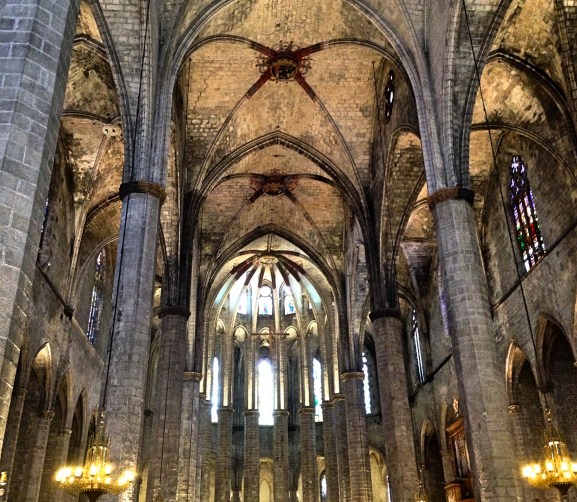
SantamariadelMar

(A similar fate befell the nearby Santa Maria del Pi, another massive gothic church in the old city center. Anticlericalism seems to have been particularly strong here in Barcelona during the 1930s. On a tour I was once shown photographs of anarchists posing next to the exhumed bodies of saints and firing their rifles at crucifixes.)

The old center of Barcelona gives way to the new section at the Plaça de Catalunya, the true center of the city. This massive plaza is always throbbing with people—mostly tourists—since it stands at the intersection of so many corners of the city. The pigeons also like it, which is why the square’s many neoclassical statues are covered in fine spikes that prevent them from landing.

One of the most eye-catching of these statues, a monument to Francesc Macià, looks like an inverted staircase and is meant to symbolize the difficult road to Catalan independence. Macià was a Catalan separatist, you see, who led the Esquerra Republicana de Cataluyna, a leftist party that favored independence; and when his party gained a majority in the 1931 elections he duly declared Catalonia an independent Republic. This state of affairs lasted for a total of three days, from April 14 to 17, until they settled on partial autonomy within the Spanish Republic. As far as I know, these three days are the only time in modern history that Catalonia has been independent.

The Plaça de Catalunya hasn’t always been such a tranquil tourist haven. On a tour I was once shown bullet marks that remained from infighting between anarchists and communists during the Civil War. It was during this infighting that George Orwell had to go into hiding, after he spent three days posted on a nearby building with a rifle. In the early 1900s, when Barcelona was an industrial center riven by stark inequality, the city was a hotbed of leftist movements among the workers. Anarchism in particular was popular, as Gerald Brenan details in his classic study of the causes of the Spanish Civil War. The idealism of these movements, as well as the machinations which eventually destroyed the anarchists and brought the Stalinists to power, made a deep impression on Orwell, which he describes in his remarkable memoirs of the war. Anyone who wishes to learn more about this can contact Nick Lloyd, who also wrote a book about this chaotic time.

Barcelona_Civilwar(To see another scar from the Civil War, you can visit the Plaça de Sant Felip Neri, near the Cathedral. One side of the eponymous church is deeply pockmarked. During Franco’s time this damage was explained as having been caused by executions committed by the Republic side, as bullets missed their targets. This is a classic case of history being falsified by the victors. For the real explanation for the damage are two bombs that fell on this spot, hitting the church, which was being used as a refugee for children. Forty-two died in the blasts, mostly children, and a plaque now commemorates the spot.)

One of the major paths leading away from the plaza is La Rambla. The word “rambla” originates in the Arabic word for “riverbed,” for that it all it was, originally—a dried river that used to flow into the Mediterranean. Now it leads the tourist in the same direction, towards the beach, in a lovely procession lined with trees. Robert Hughes called the street “one of the great, seedy, absorbing theaters of Spain,” but I think it has changed somewhat since he wrote those words. He speaks of bursting flower stalls and vendors selling exotic caged birds. Nowadays, however, the walker is treated to a series of indistinguishable, gaudy restaurants, with their colorful menus displaying “authentic” cuisine and their chairs and awnings crowding the sidewalk.
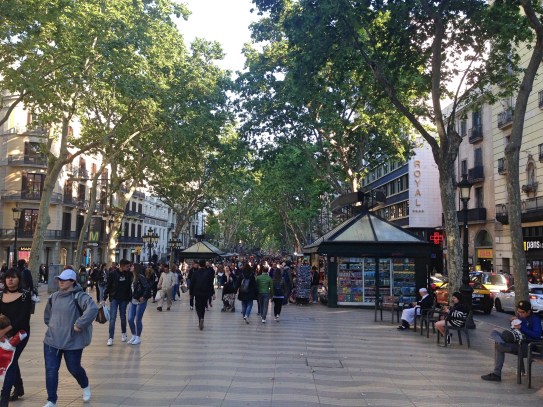
Larambla

In other words, tourism has largely eroded whatever distinct character this street once had, leaving it with the nowhere-in-particular quality of so many tourist centers—which, ironically, are travel destinations that all look the same. Another consequence of the huge influx of tourists is that the street is also popular with pickpockets. Indeed, Barcelona in general is one of the great pickpocketing capitals of the world; half of everyone who goes there seems to lose something—though I’ve been lucky so far. If you walk down the Rambla—and any time you are in Barcelona, for that matter—be aware of your belongings. This huge concentration of people also made La Rambla a target of a terrorist attack in 2017, when a man drove a van through the crowd, killing 15 people.

But you cannot let either pickpocket or terrorist dissuade you from walking down this street, at least as far as La Boqueria, Barcelona’s famous market. I am no foodie and not usually captivated by markets. But the Boqueria is undeniably impressive, with stall after stall selling a huge variety of foods—all of it vibrant and delicious. Fish, sausage, fruit, vegetables, beans—cured, dried, pickled, freshly picked—you can find everything here. I didn’t even buy anything but I very much enjoyed just walking around.

Columbusmonument

The end of La Rambla spills into the sea. Here you can find Barcelona’s gigantic monument to Christopher Columbus. There is a joke that Catalonians like to claim everything; and thus many Catalans believe Columbus wasn’t an Italian at all, but a Catalan. (According to this article, he has also been claimed by the Italians, French, and Scottish.) This may partially explain why Barcelona has such a monumental dedication to the explorer. The main tower, on top of which stands the man himself, rises to almost 200 feet (60 m) tall; and its base is bursting with finely carved statues. But now that Columbus is coming to be seen as a subjugator and even as genocidal, perhaps these different places will stop trying to identify themselves with him. (The irony of Columbus, one of the great claimers of history, being himself claimed, reclaimed, and disclaimed after his death, will not be lost on the reader.)

From here you can walk along the seaside towards Barcelona’s finest park (aside from the Park Güell, to be discussed in another post): the Parc de la Ciutadella. The name of the park comes from a huge citadel that used to occupy the spot. This fortress was built after the Spanish forces conquered Barcelona during the War of Spanish Succession, in order to maintain control of the unruly province. Unsurprisingly it became a hated symbol of Spanish dominance, and was eventually destroyed. The park that later emerged was, for a long while, Barcelona’s only stretch of green. But it is not only attractive for its trees and grass. The park’s central fountain is massive and glorious, bursting with the granite and golden forms of horses. The final effect is undeniably impressive, much like the monument to Columbus. This is no coincidence. Both of these works were built for the 1888 Barcelona Universal Exposition (a world’s fair).
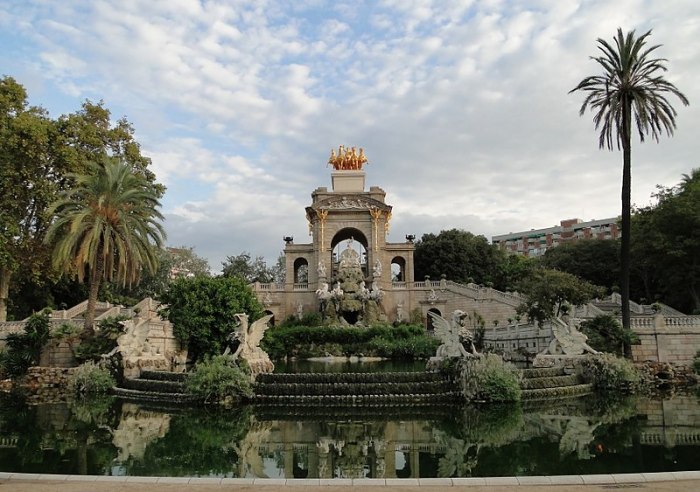
800px-Ciutadella_Park_fountain_Bernard Gagnon
Image by Bernard Gagnon; licensed under CC BY-SA 3.0; taken from Wikimedia Commons

A third surviving monument to this exposition stands right next to the park: the Arc de Triomf, a triumphal arch that served as the fair’s entrance. The arch looks somewhat lonely now, with nothing to lead to or from; but the lovely Neo-Mudejar design retains its sense of excitement. As you can see, then, the 1888 exposition and the 1929 exposition (in the Gothic Quarters) have left their mark on the city. So have the 1992 Summer Olympics, which were hosted here. It is a short walk from the Arc de Triomf to the Olympic Port, where you can see Frank Gehry’s wiry sculpture of a fish made for the event, in addition to some of the hotels erected for the influx of spectators and athletes. From here you can walk onto the sands of Barcelona’s beach—always crowded, of course, but with a bona fide Mediterranean sun.

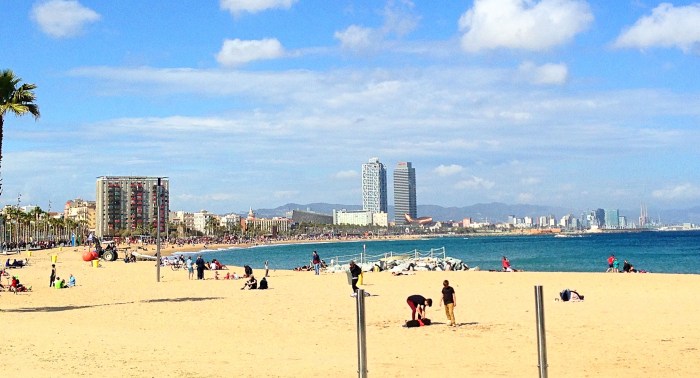
arcdetriomf

Barcelona_OlympicPort

Some years before the 1888 exhibition, an idealistic urban planner (and socialist) named Ildefons Cerdà i Sunyer was laying the foundation for the next phase of Barcelona’s expansion. Up until the mid 19th century the city of Barcelona was still constrained by walls: Roman, medieval, and Spanish Bourbon (such as the citadel). Their destruction meant that the city could now expand into the largely uninhabited areas beyond. And it was Cerdà who was given the task of planning this expansion, from which the resultant Eixample gets its name (Catalan for “enlargement”).
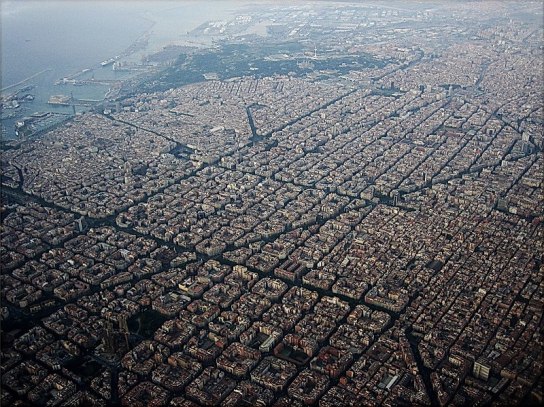
800px-Eixample_aire_Alhzeiia
Image by Alzheii; licensed under CC BY-SA 2.0; taken from Wikimedia Commons

Cerdà was a polymath who had studied urban poverty; appalled by the massive inequality and poor living conditions that plagued the city in his time (and continued to long after his death), he originated a utopian scheme for a city without center or division. If every building and street is identical, in a symmetrical space with no uptown or downtown, then there can be no segregation by class or wealth.

This was the ideology that motivated the Eixample’s grid pattern. Cerdà wanted his new city to be efficient and healthy, and he thought of everything: constraining the heights of buildings to allow sunlight; rounding off the corners of buildings to allow street cars to go by; and dedicating a large portion of the space to patios and parks. But the developers who built up the area were not faithful to this plan: the buildings are taller and there is very little in the way of green space. The final result is not nearly as sunny and open as was Cerdà’s original vision. And far from creating an ideal equality, the Eixample became yet another playground for the rich, with wealthy industrialists paying famous architects to design ostentatious homes. Idealistic plans have little chance against the combined strength of wealth and greed. On the plus side, though, many of these homes are now landmarks.

Eixample_Streetlight

The most extraordinary of these houses—including two of Gaudí’s greatest works—are found on the Eixample’s iconic avenue: the Passeig de Gracia. Here one does not miss the narrow, twisting streets of the old city. The wide avenue is bathed in sunlight and warmth. The pedestrian enjoys a grand procession as she walks down the avenue, with beautiful building arranged like paintings in a museum. Even the street lights are lovely: ornate wrought iron that lazily hangs over the pavement; and each of these street lights emanates from a ceramic bench, giving the avenue many places to sit, rest, and enjoy the scenery. But it must be admitted that other parts of the Eixample are not so impressive, but recede into an undifferentiated dullness that seems to prefigure the inhumanity of modernist urban planning. This is the general drawback of grid plans: they lack the spontaneity and surprise of cities that have grown more “organically.”

The next point of interest is also to be found in the Eixample: the Plaça d’Espanya. This square itself is not particularly attractive. It was built on the occasion of the 1929 World’s Fair, and suffers from its monumental aspirations—being inhumanly vast. Admittedly, in the center of the plaza is an impressive fountain, full of sculptures; but so many cars swarm around the roundabout (it is the intersection of four major roads) that it cannot be seen from up close. On one side of the square is Las Arenas, a shopping center built in a beautiful old bullring—its neo-mudéjar design quite similar to Las Ventas in Madrid.

(Bullfighting, by the way, was banned by the Catalonian government in 2011, and hasn’t taken place since. This ban was, however, overturned in the Spanish courts—so I am unclear whether it is now legal or not. In any case, bullfighting is so symbolic of Spanish culture that it now arouses disapproval in Catalonia for political as well as ethical reasons.)

On the other side of this square are the two Venetian towers—also built for the World’s Fair—that welcome the pedestrian towards the famed mountain of Montjuïc. Well, Montjuïc is more of a hill than a mountain; and on it stand two of the city’s finest museums: the National Art Museum of Catalonia and the Miró Foundation (to be discussed in a separate post). In front of this first museum is the so-called Magic Fountain: a large fountain that has been programmed to be part of an audiovisual show. Basically, at a certain time at night the water is  lit up with colored lights while it sprays in rhythm to music played over a speaker system. I did not enjoy the show very much, especially since so many people came to see it, but others may like it.

Magicfountain

Standing on top of Montjuïc one gets an excellent view of Barcelona, the whole city spread out before you. And in the distance, rising above the city, is Tibidabo, the highest peak of the Collserola range that encloses Barcelona’s western edge. If you squint you may be able to see the pointed form of the Temple Expatriatori del Sagrat Cor, a modernist church designed by Enric Sagnier. Nearby you may also spot the ferris wheel of Tibidabo’s amusement park, the second oldest amusement park in all of Europe, having been opened in 1901. Easier to spot is the Collserola Tower, a huge telecommunications spire that extends almost 1,000 feet into the air.

View_From_Montjuic

This does it for my tour of Barcelona. Next I will visit some of the museums, beginning with the National Art Museum right behind me.
Homage to Catalunya: Introduction & Background

Homage to Catalunya: Introduction & Background

This is Part One of a seven-part series on Catalonia, following this plan:

  1. Introduction & Background
  2. The City of Barcelona
  3. Museums of Barcelona
  4. Architecture of Barcelona
  5. The Museum of Dalí
  6. Montserrat
  7. Tarragona

Introduction & Background

No region of Spain has been more in the news lately than Catalonia. And this region is also, by chance, the most visited part of the country, mostly thanks to Barcelona. So what sets Catalonia apart from the rest of Spain? In this series of posts I hope to give you some suggestions of an answer.

Catalonia (Cataluña in Spanish, Catalunya in Catalan) is a triangular plot of land that sits at the northeastern corner of the Iberian peninsula. To the north is France, to the south Valencia, to the west Aragón, to the east the shimmering Mediterranean. Divided into four provinces—Barcelona, Tarragona, Girona, and Leida—the region is home to more than 7.5 millions people (about 16% of Spain’s total), most of whom are concentrated around Barcelona, the region’s capital. This storied city is the second biggest in the country, after Madrid, and is in the top ten largest of Europe.

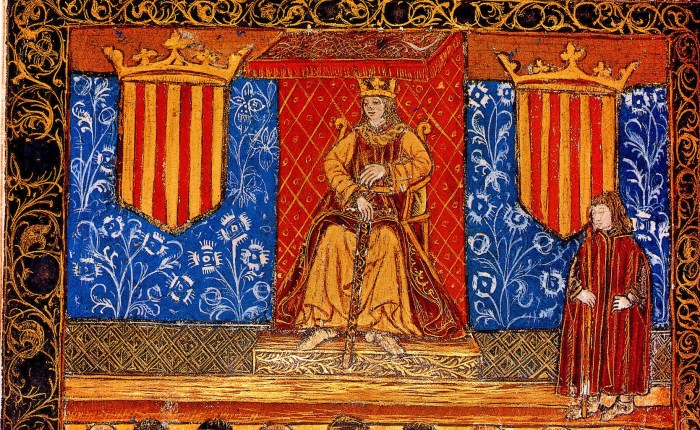
The history of Catalonia is deep and complex. After the fall of Rome it came under the control of the invading Visigoths, and then eventually the invading Moors. After that it was made a sort of Frankish protectorate, serving as a heavily militarized buffer zone between the Carolingian empire and the Moors of the Iberian peninsula. The region became more and more independent until it was essentially autonomous; the hereditary title of Catalonia’s ruler was the “Count of Barcelona.” In 1137 one of these, Ramon Berenguer IV, married the daughter of the King of Aragón, effectively joining the two lands.

Eventually the Kingdom of Aragón came to comprise the whole eastern part of the Peninsula, including Valencia and the Balearic Islands. Then, in 1469, Isabel of Castile married Ferdinand of Aragón, thus swallowing up Catalonia into yet another large polity—the beginnings of Spain as we know it.

From the very beginning there was some tension in this unification. Catalonia, you see, has always been a mercantile area. Its Mediterranean perch makes it an ideal place for trade by sea. As such, Catalonia has historically been prosperous and liberal—with democratic institutions and limitations on centralized power. (Barcelona’s “Council of 100,” a group of 100 citizens from every rung of society, was one of the first democratic institutions in post-Roman Europe). This tendency has continued to the present day, with Catalonia typically voting for the left; and the region remains one of the wealthiest in the country. Castille (comprising the Western, inland half of the country), on the other hand, has a history of centralized rule and militarism; and many parts of Castille, then and now, are poor and agricultural.

This tension was dealt with, originally, by preserving the liberal institutions of Aragón—not only in Catalonia, but throughout the kingdom. (J.H. Elliot’s book, Imperial Spain, covers this subject and more with admirable clarity.) But Catalonians have a habit of backing the wrong horse when wars break out. This happened in the War of Spanish Succession (1701 – 1714), when the death of the last Hapsburg ruler, Charles II, without an heir (he was the feeble product of inbreeding) led to a fight for the Spanish crown. Full of anti-French sentiment due to the French occupation of Barcelona after the Franco-Spanish War (1635 – 1659), the Catalans rallied against the French Bourbon candidate to the throne. Unluckily for them, it was this candidate who eventually won the war and became Philip V.

Philip V was the grandson of Louis XIV of France—that famed “sun king” who brought about so much political centralization north of the Pyrenees. Philip V emulated his grandfather in this centralization, eliminating the Catalan institutions with his Nueva Planta decrees and replacing them with those of Castile. (He emulated his grandfather in another way, building his own version of Versailles in La Granja.) These decrees made Castilian Spanish the official language, thus limiting the use of Catalan. Clearly the new king had little scruples in curtailing the freedom of a people who had opposed his ascension to the throne. The same dynamic played out, three hundred years later, when Franco conquered Catalonia, forbade the use of Catalan, and eliminated the Generalitat (the name for Catalonia’s government).

In spite of this political oppression, Catalonia continued to be an economic powerhouse during Franco’s rule. As a result huge numbers of Spaniards from poorer regions, notably Andalucia and Estremadura, moved to Catalonia. This adds a touch of irony to the recent independence struggles, since many present-day Catalans are “first-generation,” so to speak, being descended from Spaniards.

Since the transition to democracy after Franco’s death, Catalonia has gained much of its previous autonomy. Now the Catalans have their own police force (Mossos d’Esquadra), their own parliament and president (in the aforementioned Generalitat), and control of their own educational system. The Catalan language is presently (along with Castilian, Basque, and Gallego) enshrined as one of the four national languages of Spain. It is the primary language of instruction in Catalan schools—a fact that bothers many Spaniards I’ve spoken to—and a major object of ethnic pride in the region (and thus not to be confused with Castilian Spanish!). This fact notwithstanding, Castilian is widely spoken and almost universally understood in Catalonia.

(It should be noted that Catalan is not only spoken in Catalonia. Many also speak the language in Valencia and in the Balearic Islands; but for political reasons they are officially called different names in these places. Nevertheless it is only in Catalonia where it is the primary language of instruction and where it is exerts such a powerful cultural force.)

Catalan is a Romance language with obvious similarities to its neighboring Romance languages, Castilian and French. But none of these are mutually intelligible. Knowing Spanish, in other words, will not allow you to fluently understand spoken Catalan. Both the pronunciation and the vocabulary of Catalan are strikingly different from Spanish; and consequently many Catalans speak Castilian with a marked accent. To get a taste for this difference, compare the Catalan beginning of the Lord’s Prayer (“Pare nostra, que esteu en el cel; sigui santificat el vostre nom; vingui a nosaltres el vostre Regne…”) with the Spanish version (“Padre nuestro que estás en el cielo, santificado sea tu nombre, venga a nosotros tu Reino…”). With about ten million speakers—four million of them native, and many of them passionate—and a strong literary tradition, Catalan is in no danger of disappearing.

Languages, by their nature, are relatively closed systems; the difference in grammar and accent between neighboring languages prevent them from freely mixing, though individual words travel easily enough. (Languages are also more easily controlled by official bodies bent on keeping them “pure.”) But nothing prevents cultures from being so mixed. Thus while traveling from Valencia or Aragón into Catalonia there is not any especially noticeable cultural differences. It is not anything like, say, going from Spain to Portugal or to France; which makes me scratch my head when I see Catalonia described in English media as having “its own culture.” In my experience the cultural difference between, say, Madrid and Granada is far more striking than that between Madrid and Barcelona. To give just one example, typical Spanish foods, such as tortilla and paella, have made their way into Catalonia; and typical Catalan foods, such as butifarra, fuet, and toast with tomato, have become staples in Spain.

More generally, in terms of eating habits, dressing habits, and basic lifestyle I fail to see much of a difference between Catalonia and the rest of Spain. But some difference is certainly perceived within Spain and Catalonia. The stereotype in Spain, as far as I can make out, is that Catalans are more hardworking, stingy, and reserved than other Spaniards. I have not spent nearly enough time in Catalonia to give the Catalan side of the story.

More tangibly, Catalonia has several distinctive customs. Their most famous dance is the sardana, a bouncing circular style, accompanied by traditional oboes. More impressive, for me, is the tradition of Castell, which is the art of making giant human pyramids. I have unfortunately never seen it in person, but the pictures make it look incredible. (Click the links for videos.) Also worthy of note is the Catalan tradition on the Diada de Sant Jordi (Saint George’s Day, April 23), in which boys give girls a rose, and girls give boys a book.

Independence?

I cannot write this post in good conscience without discussing the Catalan independence movement. Nevertheless I hesitate to, considering how divisive this issue is within Spain. Trump’s presidency is scarcely less controversial and absorbs hardly more media attention than the Catalan crisis does here.

Open displays of patriotism in Spain are quite rare, largely because of the nasty odor left by Franco’s nationalist regime. But in the wake of the Catalan referendum of October 1, 2017—which was not authorized by the Spanish government and which eventually led Catalonia’s president, Carles Puigdemont, to declare independence—Spaniards started putting up flags on balconies and windows all over Madrid. Puigdemont’s declaration also provoked more decisive action from the Spanish government: article 155 of the Spanish constitution was triggered, which dismissed the Catalan government and led to direct rule from Madrid, until new elections were held in December. Puigdemont, meanwhile, fled into exile in Belgium.

But why was Puigdemont led into such precipitate action? Well, the roots of Catalan separatism extend far into the past. As we have seen, there were important institutional and cultural differences between Castile and Aragón; and these persisted long after their unification. We have also seen that the Spanish government has several times abolished Catalonia’s institutions and banned its language. But I do not think any reasonable visitor to Barcelona today would conclude that the Catalans are oppressed; indeed, they have regained their historic autonomy.

One persistent feature in Catalan separatism is a concern with taxes. Catalonia contributes more to the national government in taxes than it receives back in services. Catalans see this as a form of theft, and this is hardly a new complaint. As Gerald Brenan said in his 1943 book on the Spanish Civil War:

“We in Catalonia must sweat and toil so that ten thousand drones in the Madrid Government offices may live,” the Catalans would say. And they would go on to point out that, although their population was only one-eighth of that of Spain, they paid one-quarter of the State taxes and that only one-tenth of the total budget came back to their province. These were much the same complaints that their ancestors had expressed in 1640.

The Catalans may feel, in other words, that the lazy Spanish are stealing their hard-earned money; while the Spanish think that the Catalans are greedy and selfish. In any case, provided that the taxes contributed by Catalonia are not used for frivolous purposes, but are redistributed to the poorer regions of Spain, this tax deficit seems perfectly normal to me. All over the world rich regions pay more than they receive in services, in order to bolster up the poorer regions. Thus I have trouble seeing why this issue has been so bothersome to the Catalans. Further, I have difficulty believing something as dry as a tax deficit could be the true emotional driving factor in the independence movement.

Perhaps looking for a special cause is misguided, anyhow. For, as Gerald Brenan also pointed out: “The Catalan question is, to begin with, merely one rather special instance of the general problem of Spanish regionalism.” In the 1980s and 90s Spain had another separatism crisis: the Basque terrorist organization, ETA, which killed hundreds of people in their quest to achieve Basque independence. And regionalism is a major feature of Spanish culture more broadly. The English traveler Richard Ford perceived this as far back as the 1840s; and Spain’s leading philosopher, José Ortega y Gasset, wrote a book about this very problem in 1922.

Nevertheless, it is true that Catalans have been especially proud of their independence. As evidence of this, Robert Hughes cites the medieval Catalan oath of allegiance to the Spanish crown:

We, who are as good as you, swear to you, who are not better than us, to accept you as our king and sovereign, provided you observe all our liberties and laws; but if not, not.

It seems clear to me, especially after reading a collection of pro-independence writers, What’s Up with Catalonia?, that many Catalans want independence for its own sake—not for anything to do with taxes. Well, whatever the reason, the percentage of the population in favor of independence has been hovering somewhere around 50% in recent years. The pro-independence coalition which brought Puigdemont to power had a narrow majority; and though control of Parliament was retained after the most recent elections, their percentage of the votes fell to 47.5%.

In a time when Spain is relatively peaceful and Catalonia has a considerable amount of autonomy, why are millions of Catalans in favor of seceding from Spain? Separatism has a long history in Catalonia, but serious efforts for separatism only flare up once in a while. Why this should be so is an extremely complex question, of course; but I am inclined to agree with Joseph Stiglitz in blaming the European debt crisis.

The crisis of 2009 hit Spain hard, with economic contraction and unemployment comparable to the Great Depression; and it took a long time to even begin to recover from the shock. True, the situation has been improving recently, albeit slowly; but I think Tocqueville’s maxim applies here: “the most critical moment for bad governments is the one which witnesses their first steps towards reform.”  In other words, when things are at their worst, as in a crisis, people are unlikely to try to change the political order; yet when the crisis abates somewhat, the memory of suffering lingers on and the disaffected regain the time and resources to point fingers. The economic suffering of the debt crisis is why, I think, so many Catalans have focused their energy on the tax imbalance.

While the Catalan independence movement can be seen more broadly as but one manifestation of regionalism within Spain, it is also but one manifestation of separatism in Europe. In a continent full of ethnic groups notoriously unable to get along, this is no surprise. The wealthy north of Italy might be the closest case to Catalonia, with the industrious inhabitants of Veneto and Lombardy resenting their support for the poorer south—though Scotland, Northern Ireland, Bavaria, and Flanders are also afflicted by this tendency.

It is difficult for me to envision how this separatism would play out. Should every ethnic group get its own polity? And if so, what qualifies as an ethnic group? These centrifugal forces, if successful, could divide Europe into a checkerboard of nations. Yet if Europe is to be competitive in the coming years, poised between the United States and China, it needs more integration, not less. Only as a continent working together will Europe have the clout to greatly influence world affairs. And I sincerely hope it does, considering how attractive the European way of life has proven.

But enough of these dreary political matters. Let us take a look inside this region, beginning with its capital city.

Escape to Valencia

Escape to Valencia

Our long delicious winter vacation was coming to a close, but we still had one weekend left. Originally, we planned to stay home and relax; but traveling so much had gotten us addicted. After returning from Ávila, we hastily arranged and booked a trip to Valencia to savor the last gasp of our holiday.

Valencia is the third largest city in Spain after Madrid and Barcelona. It is situated on the Eastern coast of the Iberian Peninsula (a three hour drive from Madrid); and its port has long been, and remains, one of the busiest on the Mediterranean. The city has a deep history; Romans have been mucking around here since well before Christ. The city, as well as the surrounding province, even has its variant of the Catalan language: Valenciano. This language is not just spoken by the people, but it’s officially used; streets are called carrer and not calle here, which confused as we tried to look up the address of our Airbnb.

Our Blablacar driver was a native of that city, and spoke with their characteristic accent. Our fellow passenger was a gato, literally a “cat,” which is the slang term for people whose parents are both from Madrid. This is a lot less common than you might think; most people, if they didn’t themselves move into the city, have at least one parent who did.

Both of them were swell fellows. I tried keeping up with their conversation, but a question I asked inadvertently led them into a deep, energetic political discussion. This was just after the election in Spain, and obviously both of them had a lot to say on the subject. It’s interesting to me how much Spaniards enjoy talking about politics, even among people they hardly know. Americans usually avoid political discussions at all cost, even (or perhaps especially) among family. But these two guys, who had just met, seemed to be having a very deep conversation on the subject.

I wish I understood them. The political situation now in Spain (this was back in early 2016) strikes me as similar in certain respects to that in the States. Particularly, there seems to be a widespread dissatisfaction with the establishment, and this dissatisfaction expressed itself in the formation of two new parties, Podemos and Ciudadanos—something that is unsual for Spain, which has been a two-state country since the establishment of democracy. In the States, this anti-establishment ethos is expressing itself as new candidates rather than new parties, which I think is a consequence of our political system, but I believe the dissatisfaction is the same.

Valencia_Graffiti2

We got to Valencia at around dinner time (for Americans), checked in to our Airbnb—with another welcoming host and another comfortable apartment—and went out to eat. Although we’d only been in the car for three hours, it was about thirty degrees (Fahrenheit) warmer here. We went from winter jackets, scarves, and hats to light sweaters. It was even warm enough to eat outside, underneath a fruit tree laden with the famous Valencian oranges. Partially because of its mountainous terrain, Spain is a land of striking climatic contrasts. Still, it’s hard for me to get used to it. All these climatic zones seem jammed next to one another. In the States, we keep our hot and cold zones far apart.

Valencia_Graffiti

We woke up the next day ready to experience Valencia. As per our usual routine, we visited the cathedral first. But on the walk there, we couldn’t help noticing the graffiti on the walls. Much of it was the usual stuff, but some of it was really excellent. There were abstract pictures of colored squares, detailed images of batman, and several grotesqueries I can’t adequately describe. Most interesting, though, was the image of a ninja that was painted all over the city, on walls, parking machines, in entrances to stores. I couldn’t help thinking that this ninja had some mysterious significance, that it had been drawn by some shadowy organization as a sign, or perhaps as a clue—but to what?

Valencia_Ninja

But perhaps the conspiratorial part of my brain was overactive from seeing the spray-painted slogans of anarchists all over the city. “No king, No God, No Owner. Revolution,” they said, under the symbol of anarchy: an “A” inscribed in a circle.

We got to the cathedral. I have to admit that my memories of this cathedral are pretty hazy; after a while, all cathedrals start blending into one another. The façade was the most pretty and distinctive part. At one entrance, the door is connected to a round wall with three levels; it looks like a section from a Roman amphitheater was just stuck on the side.

Valencia_Grafitti3

Outside the cathedral, in the surrounding plaza, high school boys were skateboarding, a fact that GF found particularly amusing.

“Can you imagine just skateboarding in front of something like this?” she said. “Europe is crazy, man.”

We went inside. Skipping the descriptions of the usual beautiful stuff—the altar, the stained glass windows, and so on—I’ll only mention that the Valencia Cathedral holds the best candidate for the true Holy Grail. Of course, there are many other chalices in Europe which are claimed to be this blessed object, but the opinion of most Christian thinkers and historians is apparently that this one in Valencia is most likely to be the real deal. It’s displayed in one of the cathedral’s chapels, somewhat external to the main area.

I sat in a pew for some minutes looking at it, without having any idea what it was supposed to be. All I saw was a shining gold object, nothing more. It was only after we left and GF looked up the cathedral on her phone that we found out. As often happens, admission came with audioguides; but lately, to practice Spanish, we have been asking for these to be set in Castellano. A consequence of this is that the majority of the time we have no idea what we’re looking at.

Next was the Torre de Serranos, an old fortified gate at the north end of town. Valencia used to be completely surrounded by walls (as were most major cities), but now only a few gates remain. What surprised me most was its height. Compared to the gates of Ávila, this one was absolutely massive. The visit was quick: Pay the fee, climb some stairs, and enjoy the view of Valencia. Perhaps since we’d just visited the castle walls in Ávila a few days before, standing on this tower wasn’t especially engaging. But the view is certainly nice. Valencia, like Madrid, is an interesting mixture of modernity and history. For the most part, it looks like any city in the twenty-first century, with concrete and glass buildings, except for the odd medieval tower popping up here and there.

Valencia_City

We descended. It was lunch time now, and we knew what we had to eat: Valencian paella. That most famous of Spanish dishes, paella, originated in this city. Paella is often made with seafood—prawns and oysters and so forth—but, as I was informed by my Valencian Spanish teacher, “paella” with seafood is not true paella at all. To be traditional, it has to made with chicken, rabbit, and vegetables. So that’s what we would eat.

(The Spanish can be very finicky with their food; indeed, they are more puritanical than the Inquisition when it comes to paella. Thus the British chef, Jamie Oliver, got into trouble when he posted a photo of paella he made with chorizo. For whatever reason, this is blasphemous in Spain, and Oliver is dragged over the coals by Spaniards on social media. Ironically, however, according to this article, historically chorizo was used in paella. Personally I like it that way.)

Lucky for us, we usually get hungry for lunch a whole hour before most Spaniards, so we had no trouble getting a seat at a good restaurant. In fact, we were the only two people sitting outside. (As our Airbnb host explained to us, the Valencians have a different view of hot and cold; what was a beautiful day for us was a bit chilly for them.) The food was prompt, the waiter friendly, and the paella delicious.

Valencia_Paella

Stomachs full, we went back towards the Torre de Serranos, and then to the Jardines del Real. The name (Royal Gardens) comes from the royal palace of the erstwhile kings of Valencia that used to occupy the area. The palace was demolished in 1810 during the Napoleonic wars in order to prevent the French from occupying it—a move that had no military justification whatsoever, and was partly motivated by bourgeois resentment of kingly privilege.

But I didn’t know that at the time. All I remembered from my conversation with our Airbnb host was that he said the word “palacio” when he recommended it, which led me to believe that there was still a palace to visit.

“Where’s this damn palace?” I said to GF.

“What palace?”

“I thought there was supposed to be a palace here.”

“Iunno.”

We went from one end of the gardens to the other.

“Maybe it’s outside the gardens?” I said. “Think it’s that thing?” I pointed to a tall building.

“Could be.”

We walked over to the building and looked up. It was a bank.

“Where is it?”

“Just forget it,” GF said. “Let’s go back to the gardens.”

At least the gardens were lovely. Most memorable was a big bird cage in the center, filled with a dozen or so different species of bird, including one lonely rooster. I thought it curious that all the birds congregated in their own corner with their own species.

We sat in a bench for a few minutes to enjoy the Valencian sun. The weather was perfect, though I was having some trouble appreciating it owing to my bitterness from failing to find that damned palace.

Next we went to the Museo de Bellas Artes, also recommended by our Airbnb host. In turn, I’d like to recommend this museum to you, for it was excellent. It’s free to enter; and the collection, though small, is tasteful and impressive. The art is arranged chronologically, with the oldest works near the entrance on the first floor and the most recent by the exit on the second. I enjoyed the older paintings the most. There’ is something about Medieval art, a certain simple tenderness, almost naïveté, that I find especially moving. No attempt is made at realism. The often disproportionate figures, with heads and bodies turned at unnatural angles, stand in an flat space with a gold background.

Valencia_Museum

What’s more, the scenes depicted are often bizarre. One typical example is a portrait of Luke the Evangelist seated before the Virgin, writing his Gospel. The only reason you can tell it’s Luke (the faces are hardly individualized) is because there is a little, tiny bull, the symbol of Luke, pointing with his hoof at the page; the bull even has a halo. Apparently, to the Medieval mind this was not at all strange.

Upstairs there was some masterful Renaissance paintings, including one by El Greco and Velazquez. The difference between the gothic and the Renaissance era paintings is stark. Faces are individualized, bodies are solid, shadow is used to create a sense of space, and perspective transforms the two-dimensional flatland into a three-dimensional world. Medieval paintings are symbols, whereas these are representations. What happened to the European mind to create this huge shift?

We had seen nearly everything in an hour or so, and decided to leave. On our walk out, I noticed a painting of Jesus pouring blood out of the wound into a golden bowl, from which two lambs were drinking. Now, I’ve seen morbid Catholic art before, but this gives me goosebumps.

By the time we walked outside, the sun was setting. We decided that we’d walk down the Jardín del Turia. This is a long park that runs through the center of Valencia. It sits built in a riverbed of the river Turia. Like many major cities, such as Zaragoza and Seville, Valencia grew up along the banks of a river. But unlike those cities, Valencia’s river no longer exists. It was diverted from its course after it flooded in 1957, causing major damage to Valencia. Now the riverbed is home to a park, and quite a pretty one.

It winds its riverine way through town, below street-level, filled with trees, gardens, and ponds. Bridges transport cars and pedestrians overhead. The park was beautiful, but quite long—or at least we thought so, having by now been walking all day. We walked and walked, our feet sore, hoping to get to the end of the park so we could see the sunset on the beach. But we didn’t have enough time, or else underestimated the distance, and the sun had almost totally set before we reached the end.

This didn’t matter so much, for the park was nice enough. Garden after garden went by; palm trees swayed gently above. Pedestrians crowded the sidewalk; kids were skateboarding; adults were bicycling. Eventually we walked through a gate and into a gigantic playground. It must be the biggest playground I’ve ever seen. Instead of a jungle-gym, swings, a slide, or any of that, there was a massive plastic statue of Gulliver, tied down to the ground by the Lilliputians. His body was the playground; kids slid down his stomach, climbed up his cheeks, jumped on his belly button.

Valencia_Playground

There’s something almost sacred about playgrounds. It’s a space that the community devotes purely to enjoyment. Kids from all backgrounds, rich and poor, natives or immigrants, are equal (or nearly so) in this plastic wonderland. They are happy just to run around and feel their legs, to shout and hear their voice. Only the severest misanthrope could remain cold at the sight.

Now it was dark; the day was over. Completely exhausted by now, we walked back to our apartment, had dinner at a burger place, and slept. We still had another half-day in Valencia.

§

Valencia_Aquarium2

Our first and only stop for Sunday was the Oceanographic, the largest aquarium in Europe. (TripAdvisor ranks it as the fourth best aquarium in the world; the best is in Lisbon.) It sits at the end of the Jardín del Turia, one of the buildings in the Ciudad de las Artes y las Ciencias, the City of Arts and Sciences, a collection of museums, galleries, and other high-minded institutions.

Valencia_Aquarium

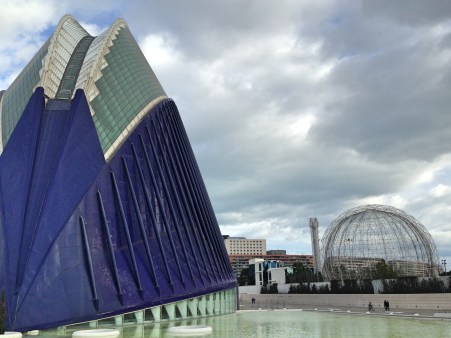
This complex is one of the biggest tourist attractions in Valencia, and for good reason. Here, the Spaniards’ flair for modern architecture is on full display. Every building is given a futuristic design, looking like sea shells, tulip bulbs, shark fins, and other shapes too difficult to describe. The buildings are sleek and shiny, covered in reflective glass and girded with bands of metal. There is a planetarium, a science museum, a theater, and of course the oceanographic—which was designed to have the layout of a water lily.

The only bad part of our visit was paying the entrance fee, which was surprisingly steep. I suppose it costs a lot to maintain all these animals. It hurt to fork over the money, but in retrospect it was well worth it.

Our tickets came with a dolphin show; and the next one was starting almost immediately. We headed to the dolphin theater and found seats, high up so we didn’t get splashed. The show began, and immediately became very cheesy. Dance music started playing, and the announcer’s tone and manner were so exaggerated it felt like a WWE commercial.

Dolphin_Show

The show began. It was exactly what I expected. Dolphins flipped, jumped, did backflips, swam backwards, and then towed around their trainers in the water like little speed boats. Simply for their physical ability, dolphins are impressive animals. Imagine how much force it takes to accelerate a dolphin fast enough to shoot straight out of the water to snatch a fish dangling from a fifteen foot ladder. Their whole body must be one giant muscle.

Two things bothered me as I watched the show. First, I had just re-watched the movie version of The Hitchhiker’s Guide to the Galaxy, a pretty mediocre adaptation, but which does start with a musical version of “So Long, and Thanks for all the Fish,” and now I couldn’t get it out of my head. Then, I remembered this quote from the book:

For instance, on the planet earth, man had always assumed that he was more intelligent than dolphins because he had achieved so much—the wheel, New York, wars, and so on—whilst all the dolphins had ever done was to muck about in the water having a good time. But conversely, the dolphins had always believed they were far more intelligent than man—for precisely the same reasons.

Second, I kept thinking that there was something morally questionable about the whole affair. As evinced by the show, dolphins are smart—very smart. Consider this: A dolphin can watch a human spin around on land, and then translate that movement to its own quite different body in the water. Monkey see, monkey do is not a sign of stupidity, but of intelligence. Imitation is a sophisticated cognitive task. And dolphins are not only smart, but highly social; like dogs and humans, they live in groups with their own hierarchies.

What’s the morality of keeping a creature like this in an aquarium? Do they get bored swimming around their pools? Do they get listless and depressed being isolated from the ocean? Does the loud music and the applause of the show bother them? I don’t know. The strongest argument I know in favor of keeping intelligent mammals in zoos is utilitarian: Yes, maybe they’re less happy here, but they’re safe; and besides, the publicity and good-feeling generated from zoos and aquariums makes people more likely to donate to charities and to set up nature reserves. So maybe the benefits outweigh the drawbacks. And perhaps the dolphins enjoy the exercise of performing and the bonds with their trainers? Still, I couldn’t shake the feeling that this show was questionable.

This led me to a deeper question: What is intelligence, anyway? How do you define it? Is it a measure of the complexity of tasks the brain can perform? Yet spider webs are enormously complex, yet we don’t think of spiders as intelligent. A spider does not need to be a chemical genius to synthesize silk. Perhaps intelligence is the ability to learn? This seems like a better definition. Humans, the smartest of animals (we think), are also the most adaptable; we can learn to make new technology, and then use this technology to live in new environments. Chimps can learn to use tools and even to use sign language; dolphins can be trained to perform like this.

The show ended, and we left to see the rest. The aquarium is divided into ten sections, each one a different natural habitat. Here are some of the highlights

One of the tanks was for the seals. They are lovely creatures, so dog-like that you can imagine keeping one in your backyard pool. As I looked at the seals, though, the same pang of unease shot through me as when I saw the dolphin show. They must be bored swimming around that cage all day and all night long. And having people point and gawk can’t be pleasant. Case in point, a little girl next to me began throwing a yellow toy—one of those minions from that Pixar movie—up and down, and a curious seal on the other side of the glass began following it. The seal even tried to snap at the toy, like it was a fish; though of course his teeth just bounced off the glass. The kid’s parents thought this was cute and neat, and I admit it was kind of cute. But it also seemed a bit cruel, adding insult to injury.

Of course, there were lots of fish. I like looking at fish, but not especially. Have you ever looked into the eyes of a fish? Nothing seems to look back at you. The same goes for birds, for the most part. In one section, under a big netted area which I believe was the wetland habitat, were lots of birds standing about. They were very pretty; but if I spend too much time looking at one I get unsettled. I try imagining what’s going on in their brain, and get nothing.

Also in abundance were lots of strange sea creatures. There were sea horses, those surreal beauties that look like fantasy intruding upon reality. Jellyfish also give me this impression, floating in their tank like plastic wrap, lit up like neon signs against the black background. How bizarre is it that something like this—something I can literally see through—can be alive?

Valencia_Jellyfish

In one cage were two spider crabs. I could hardly believe my eyes, they were so big. And according to the audioguide, they weren’t even fully grown. The two crabs leisurely made their way across the bottom, their thin, spindly legs—perhaps three feet long—supporting their armored body. Their shell must be tough; it seems such a slow-moving, easily visible animal would make easy prey. Less mobile animals also occupied the tanks, star fish and anemones. I find anemones particularly fascinating, since they as immobile as plants but are just as animal as you and me.

Valencia_Crab

More impressive than the individual tanks were the tunnels. The Valencia Oceanographic boasts not one but two display tunnels, through which visitors can walk, surrounded on all sides by ocean creatures. The first tunnel was the more modest, consisting mostly of fish. There was, however, a beautiful bright green monstrous eel, swimming about in one corner. It opened and closed its mouth repeatedly, giving me a close up glimpse of its impressive row of teeth. The audioguide explained that the eel did this to breath better, not as a threat; but I still felt intimidated.

The second tunnel was many times more impressive. This was the deep ocean. It was filled with sharks of all kinds, with long, saw-like snouts, with flattened bodies, and of course the classical, recognizable form, an aquatic death machine swimming above your head. I don’t know anything about sharks except that they are terrifying and strangely beautiful. Also present were sting rays, looking angelic as they glided through the water, flapping their wings.

This brings me to a question: Why don’t the sharks in these tanks eat the fish? Why don’t the big fish eat the little ones? Are aquarium keepers just good at grouping animals in the right way? Or do they keep them well-fed, thus suppressing their instinct to hunt? There must be some art or science to it, since I’ve not once seen a shark even attempt a nibble. And I find this impressive, because if I was a big, mean shark floating around a tank all day with a slow, juicy fish, eventually my self-control would fail me.

As great as this shark-tunnel was, the most impressive section of the aquarium was the arctic region. It was there I saw the first living walrus I’ve ever seen—two of them. For such fat, fleshy creatures, they’re astonishingly graceful in the water, like mustachioed ballerinas. Even more astonishing were the belugas. These white whales are midway in size between dolphins and orcas—which means they’re quite large, dwarfing even the walruses. They’re cute, too, seeming to have a constantly inquisitive smile on their faces.

The chubbiness of both animals, walrus and beluga, is visible evidence of the harsh, freezing environment they’ve adapted to. It boggles my mind that these two huge creatures, which doubtless require enormous amounts of food to survive, have managed to arise in such an apparently barren environment. Natural selection works wonders.

Now, we were done. We had a Blablacar to catch. We ate some overpriced food from one of the aquarium cafes, and scrammed.

I can’t end this post without a description of our ride back to Madrid. We traveled with three others—the driver and two of his friends. All of them were Spaniards. The driver spoke excellent English. He had learned English from serving in Eurocorps, where he used English to communicate with his fellow soldiers from Poland. As a consequence, he spoke with an absurd and hilarious Polish accent, even using Eastern European mannerisms.

“Yes, yes, you speak English, very good!” he yelled back at us, as we spoke with one of his friends. “You make friends! A’right!”

This friend of his, who sat in the back with us for the ride, was a professional bodybuilder. The poor guy had to constantly be on a special diet, which I think gave him a food obsession. He couldn’t stop talking about how he wanted to go to Chicago to try the deep dish pizza.

“Oh my God!” he said, showing us a picture of the pizza on his phone. “Can you believe this? We have to go!”

“Oh, you like pizza?”

“Like pizza? I love it!”

“Have you ever been to New York?”

“Yes, it was magical. And there I had the best pizza of my life. It was from Dominoes. Amazing!”

The poor man.

Now our vacation really was over. Next morning, we would have to drag ourselves back to work, after not working for three whole weeks. It was an awful shock. But in the meantime, we had visited nine fantastic Spanish cities. I’ve never had a better break.

South to Seville

South to Seville

The word puente has two meanings in Spanish. Most commonly it simply means “bridge.”

But it is also the word for an extra day off given when a holiday falls in-between a weekday and the weekend. For example, December 8, 2015—a Tuesday—was a holiday; and as a result I got the preceding Monday off. (This holiday, which comes every year, is called the Día de la inmaculada, a day dedicated to the Virgin Mary. Unlike in the US, most holidays in Spain are religious—specifically, Catholic.)

In short, it was time to go to Seville.

But how to get there? Before I came to Spain, everyone told me that flying in Europe was remarkably cheap; but every flight to Seville I found was annoyingly pricey. How about the high-speed train? This was even worse. What, then?

“How about Blablacar?” someone recommended, as I vented my frustrations.

“What’s that?” I asked.

“It’s a ridesharing service. It’s like AirBNB, except for car rides. You pay the driver and then go together. It’s quite cheap.”

“Hmm, interesting.”

“And it’s a good way to practice Spanish, too, since you can talk with the driver. I’d recommend it.”

(As a side note, I have since used Blablacar dozens of times, and I have had nothing but  good experiences. Though I was at first concerned for my safety—getting into a car with a stranger—the identity checks and the system of reviews on the site make it quite safe. And besides, what other ways are there of forcing a Spanish person to talk to you for hours on end?)

§

When you take the usual dross material of small-talk, and then throw in the difficulty of communicating in a language you hardly know, the end result is pretty stale conversation. Our poor Spanish driver had thus to deal with five hours of slow and painful attempts by me to be personable and interesting, while I fumbled for words and made a mockery of grammar.

Many hours after I had reached the full extent of my Spanish ability, we reached Seville.

Seville is a city with a long past and a bright present. Populated at least since Roman times, the city grew into a prosperous power under the Moors, who controlled the city for about 500 years—until, in 1248, the city was conquered by the Christian king Ferdinand III of Castille.

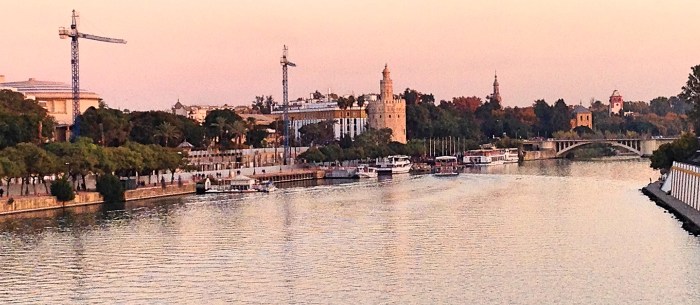
The city is 80 km (50 miles) from the Atlantic Ocean, crowded along the banks of the Guadalquivir River; and Seville’s harbor is the only river port in all of Spain. This port on the Atlantic Ocean gave Seville a huge economic advantage when Spain began the age of colonization in the New World—an economic dominance which lasted until the 17th century, when silting rendered the port unusable, thus leading to the ascendence of Cádiz (though by this time Spain was economically in decline).

Though not as dominant as it was in the past, Seville is still a thriving place. The fourth largest city in the country, with a population of about 700,000, the city is also the capital of all of Andalusia. It is also the metropolitan area with the highest average temperatures in all of Europe—its summer highs only exceeded by nearby Córdoba. Culturally, too, Seville is extreme: its massive Holy Week processions are internationally famous, as is the city’s raucous annual festival.

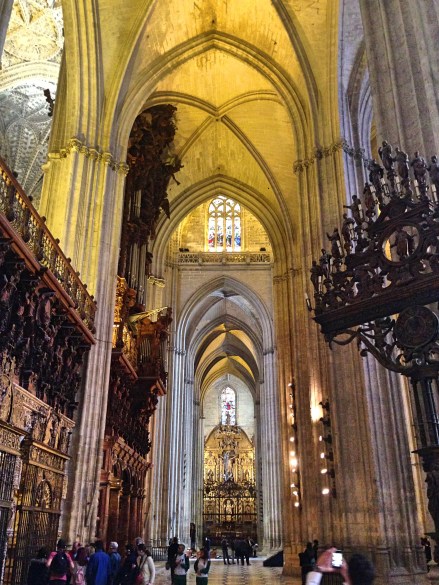
Our first stop was the cathedral. The Cathedral of Seville, Santa María de la Sede, is one of the largest church buildings in the world. Indeed, when it was first built it surpassed the Hagia Sophia in Constantinople, which had held the title of the biggest church for the previous 1,000 years. The cathedral was built on such an enormous scale as a way of celebrating the Christian reconquest of the city from the Moors, back in 1248, as well as the city’s growing wealth. According to an old tradition, the cathedral chapter wanted to build a cathedral “so big that those who see it think we are insane.”

Despite all this, I must say that, from the inside, the cathedral did not feel noticeably bigger than the other cathedrals I have been in. All of them are fairly gigantic.

Seville_Cathedralinside

In any case, the Seville Cathedral is not only big, but is one of the finest in the country. The cavernous space, populated by a forest of columns that branch into elegant ribbed vaults, is spacious and bright. The choir, the organ, the chapels—everything has been decorated with extreme skill and unfailing taste.

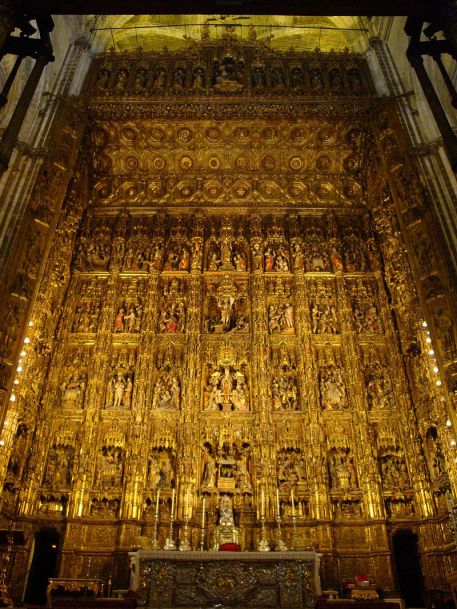
Even among this embarrassment of riches the main altar stands out. Like the cathedral itself, it is absolutely massive: 20 meters (66 ft) in height, 18 meters (59 ft) wide, and divided into 28 scenes of the life of Jesus and the Virgin Mary. Considered among the finest altars in Christendom, this piece was designed by Pierre Dancart, and took fully 80 years to complete (by which time Dancart had long since died). The audioguide remarked that the altar can be thought of as a gigantic visual theological treatise, though perhaps calling it a visual Gospel would be more accurate. Several hours would be necessary to properly examine the whole work, savoring every scene and detail. As it was, I could only gape stupidly at the big hunk of finely decorated gold for a few minutes before moving on.

MainAltarSeville
Photo by losmininos; licended under CC BY-SA 2.0; taken from Wikimedia Commons

I do remember being somewhat disappointed with the audioguide. The visit took us to every small chapel in the cathedral—and there are many—directing us to look through the grilles at the altars and tombs inside, as the narrator simply listed off individual object therein. I would have appreciated more information about selected pieces rather than a catalogue. In any case, according to the guide the cathedral possesses one of the most important collections of religious paintings in all of Spain. Unfortunately this collection is difficult to appreciate, as—peering through the bars of the grille like a prisoner, squinting from 15 feet away—you cannot get a good look at most of the paintings.

So I was a bit bored by the time I circled through half the cathedral, and found myself standing in front of an impressive statue of four men holding a coffin on their shoulders.

“This is the tomb of Christopher Columbus,” said the guide.

Columbus_Tomb
Columbus’s Tomb

I froze. This is an excellent example of what I call “European Travel Syndrome.” Let me explain. It is sometimes easy to forget that you are traveling in Europe. On a car, a train, a city street, often surrounded by other American tourists, you could be at home. But sometimes the reality that you are in Europe—the place which you spent so long learning about in school, the place where Alexander the Great, Julius Caesar, and Napoleon performed their famous and infamous deeds—brings itself to your attention so forcefully that it nearly knocks you down.

This was one such occasion.

Most of the time, historical personages like Columbus are little different from fictional characters. We hear a few stories about them, stories which purportedly explain some facet of the present world; but really they remain shadowy figures in our imagination, in the same realm as Santa Claus and Huckleberry Finn. But here were Columbus’s bones.

I was staggered. It is not that I have any particular love or respect for the man—from what I’ve heard, he was horrid—but it was simply the shock of having an erstwhile figment of my imagination become a flesh-and-blood individual right before my eyes.

It’s worth noting in passing that Columbus’s remains roamed nearly as much as he did. They were first interred in Spain, first in Valladolid and then in Seville. Then they were moved to the Dominican Republic, and then to Cuba, and then finally back to Spain again. The man was well-traveled.

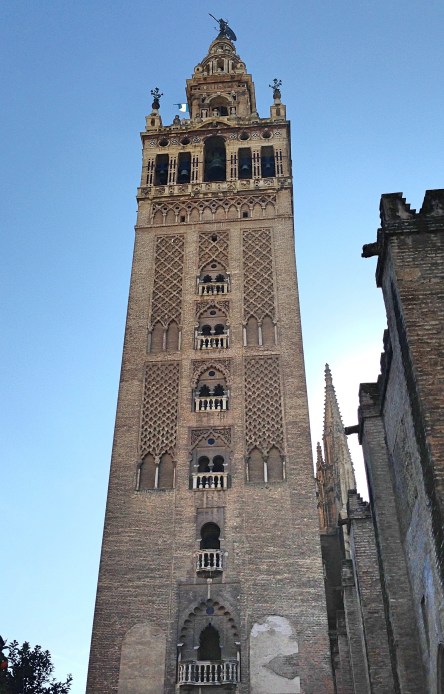
Giralda
The Giralda

Columbus’s bones notwithstanding, the highlight of the cathedral is without doubt the Giralda. This is the cathedral’s famous and lovely bell-tower. It owes its form to two cultures: originally a minaret constructed by the Moors, the Christians later added a Renaissance-style top to the edifice, leaving the Giralda with a unique juxtaposition of styles. The result, however, is a beautiful structure, which stands nobly over the surrounding area, its tan façade shining brightly in the Andalusian sun. The tower’s 105 meters (343 ft) are topped with a statue (known as “El Giraldillo”) of Faith triumphantly lifting a cross, designed by Hernán Ruiz. (A copy of this statue greets visitors on their way inside the building.)

Giraldillo
The Giraldillo

Though the Giralda is tall, the climb to the top is not so bad. This is because there are not any stairs. Rather, dozens of ramps lead the pilgrim gently up and up, without having to break a sweat. The original purpose of these ramps, by the way, was to allow people to ride their horses up to the top, which sounds like great fun to me.

Like the Empire State Building, the top of the Giralda is always crowded, with people jostling for space, squeezing into every spot with a view. I joined the contest, nudging and elbowing my way to a good spot. It is worth the struggle, for this is undoubtedly the finest view in Seville. You can see for miles and miles, all of Seville stretched out before you with its rows of white buildings glaring in the sun, so bright that it was hard to look at them.

Giralda_View

The visit ended in the Courtyard of the Oranges—which, as the name implies, is a courtyard full of orange trees. This is typical of Seville: there are orange trees everywhere, in every park and alongside every street. Several times I considered plucking one of these oranges, but thought better of it when I noticed that nobody else was doing so. Perhaps there’s an obscure sevillano law forbidding it. Regardless, I’ve never seen fruit trees just sitting around a town like that, completely laden with ripe fruit. Don’t the oranges eventually rot and fall into the street? Do they have government employees dedicated to cleaning up all the fallen oranges? Are they ever harvested? These are the questions that keep me up at night.

Seville_Cathedral_Oranges

§

In a rare spasm of foresight, I did a bit of research and bought tickets to a flamenco show before arriving in Seville. Andalusia is known for its flamenco; and being a longtime fan of Paco de Lucía, I simply had to see a show.

So after a stroll around the city, across two bridges which spanned the Guadalquivir river, we found ourselves in a cozy room filled with folding chairs—not more than thirty, I’d say—the walls covered in sundry Spanish guitars, sitting before a stage. The show was about to begin.

A young man with a full black beard, dressed from head to foot in plain black clothes, climbed onto the stage and sat down. He was the guitarist. As soon he began I could tell that he was excellent. Like all flamenco guitarists, he played with his fingers, not a pick. The nails on his right thumb, forefinger, middle finger, and ring finger were filed into impressive knife-blades, with which he plucked, strummed, tapped, and flicked the strings. Most of the interesting guitar-work in flamenco is done with this hand. The guitarist picked out complex arpeggios and sustained notes with a rabid tremolo, his fingers so precise that they seemed more like machines than human appendages.

But there was nothing mechanical about the music. The first song was in a free rhythm. It began in a whisper and ended in a roar. The harmonies used in flamenco are not the sweet and dulcet harmonies often heard in, say, classical guitar. Rather, they use (among other things) a lot of parallel octaves and fifths, which gives the chords a strong, striking, and slightly sour sound.

Partly as a consequence, there is a certain emotional flavor associate with flamenco music that I find hard to put into words. As in American blues, in flamenco sadness is the fundamental emotion of the music, and the problem to be dealt with. But whereas blues deals with melancholy using a winking ironic, in flamenco the response is passionate melodrama. The emotions are mastered, paradoxically, by pushing them to the limit of intensity. Thus there is something grandiose, even ostentatious, about flamenco; it is as if one must puff oneself up with pride before performing.

The show went on. The guitarist shifted to a faster tune, showing off his rhythmic chops. A man joined him on stage for this song, wearing leather shoes with high heels, who stomped and clapped as accompaniment to the guitarist. But in addition to being the drummer of sorts, this man was the singer; and for the next song he stood up, walked to a corner of the stage, and raised his chin into the air as he prepared to sing.

His voice was incredibly loud—almost painfully so. In flamenco, the goal of the singer is neither melodic flourish nor sweetness of tone, but intensity. To this end, the singing is done with the back of the throat, producing a thick, husky timbre, surging with energy. The result is extremely expressive; it is as if you are not merely hearing the sound, but being pummeled with it.

Next came the dancer. She was a young woman, wearing a bright dress. Before she began, she arched her shoulders back and looked straight out across the audience, her face scrunched up in an expression of both pain and the contempt of pain. She seemed somehow too giant for that tiny room and that miniscule stage. Her squinted eyes looked past audience and even the walls, penetrating far beyond.

The dancing began. She was wearing high-heeled shoes similar to the singer’s, which allowed her to use her feet as drumsticks to pound on the floor. It was staggering how quickly she could move her feet, sounding like a snare drum as she crossed the stage from right to left, left to right, creating a sound so tremendously loud that I considered plugging my ears with my fingers.

Soon I was completely absorbed. My sense of time disappeared; I was so involved in the sound, my entire attention focused on the little details of timbre and ornament, that no concentration was left for anything else. I forgot everything: where I was, who I was, even that I was anything at all—my mind so awash in notes and rhythms that, for all I knew, my whole life up until that point might have been a silly dream.

By now I was sitting on the edge of my seat, my feet tapping of their own accord, my heart thumping, my skin covered in goosebumps, the hair on my arms and legs standing on end. The singing was so loud, the rhythm so fast, the guitar playing so intricate, that the whole effect was overwhelming. It became as physical as it was mental, as if the sounds were reaching across the room and shaking me in my seat.

My mind started to race. Thoughts popped in and out of my head, new thoughts, strange thoughts, memories, hopes, dreams, fears, vague longings, all colored with ecstatic shades of excitement. I felt timeless and invincible; I felt that nobody has ever been so inspired or so creative. The world around me took on a new glow, and I saw and heard everything for the first time. Mad confidence surged through me: I

And then the music ended, my heart rate slowed, and I became tired and groggy, like I just woke up from a troubled sleep. I walked from the venue into the cool night air, which brought me back to my senses. Like all great music, the flamenco had lifted me into a heightened state and kept me there, refreshing my spirit in the process.

§

Because one day of the puente was taken up visiting Córdoba (an easy day trip on the train), we only had one more day to see Seville.

It was time to visit the Alcázar of Seville. Now, there are “alcázars” all over Spain. This word (as do many Spanish words that begin with “al-”) comes from Arabic (“al-” is just the word for “the”, and “cázar” comes from “qasr”, meaning palace, castle, or fort). After the Moors were banished from Spain, several impressive castles and forts were left behind, which the Spanish Catholics happily repurposed. The Alcázar in Seville is one of the most famous of these, and justly so.

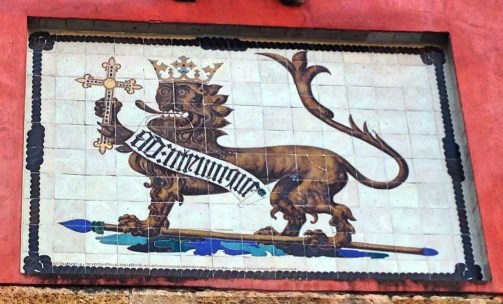
After a long line that thankfully moved quickly, we had passed through the front gate—the Puerta del León, named for the painting of a grotesque lion, wearing a crown and holding a cross, which sits over the entrance—and had arrived inside.

Seville_Lion

The Alcázar of Seville is among the most fascinating building complexes in Spain. Gothic, mannerist, baroque, and mudéjar styles are crammed up next to each other, as different sections of the palace were completed in different phases of history. The most famous section of the palace is the mudéjar palace. Though the palace’s history dates back to the Moorish period, this palace was built under Peter I of Castille, a Christian king who hired Muslim artisans to construct a palace similar to the Alhambra in Granada, which had been built just 20 years before. This building is thus a testimony to the deep cultural exchanges between the medieval Christians and Muslims.

As a side note, the Alcázar is still a royal residence—where the royal family stays when they visit Seville—thus making it the oldest active palace in the country.

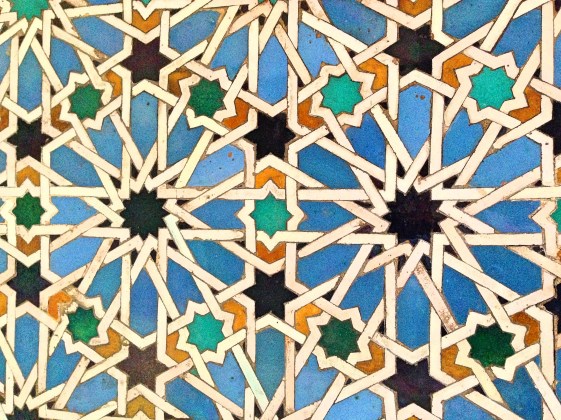
Alcazar_tiles

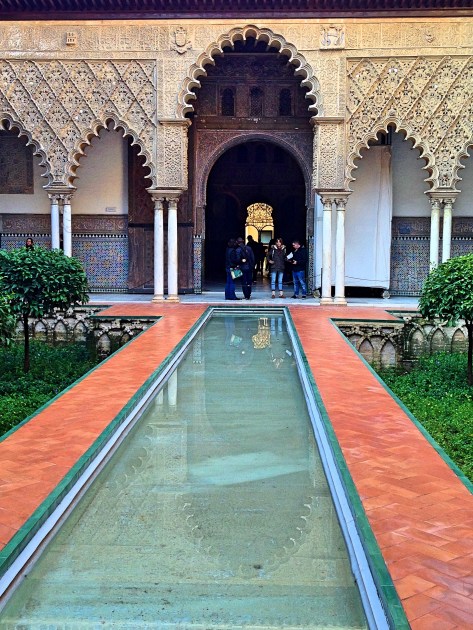
The intricate Moorish architecture, with its finely carved floral designs, its sweet blues and subdued sand-colored walls, its elaborate wooden and gilded ceilings, gave the structure a gentle nobility far removed from the ostentatious grandeur of the gothic architecture of Seville’s cathedral. Every surface of every wall was covered with complex designs: arabesques, calligraphy, and colored tiles running along the lower half. Horshoe archways (which the Moors copied from the Visigoths) separated chamber from chamber. Within was an open space, the Courtyard of the Maidens, containing a rectangular pool of sky-blue water.

Alcazar_Pool

The most impressive room in the entire palace is the Salón de embajadores, or the Ambassador’s Salon, which is covered with a golden dome that has been ornamented with intricate geometrical designs. The adornments on the walls, too, are sumptuous and remarkably fine. One of the only reminders that this palace is not the Alhambra itself are the insignias of Castille and León which can be seen inserted into many of the designs.

Alcazar_Ornament

Another clue are the floor tiles that contains the words Plus Ultra. This phrase is a reference to the phrase ne plus ultra (“not further beyond”), which was applied to the Strait of Gibraltar—believed in previous ages to be the limit of the navigable world. Columbus, sailing for Spain, proved this to be wrong, and thus the Spanish Coat of Arms contains the phrase “further beyond”: Plus Ultra.

There is also a gothic palace in the Alcázar. Compared with the mudéjar palace, this one looks rather shabby—some of the decorative tiles have even been installed incorrectly. But it does contain some excellent tapestries with images of old maps.

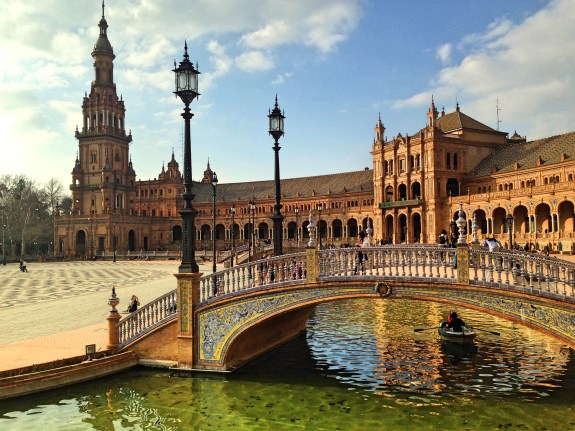
Beyond the palaces are the gardens. These are marvelous—and enormous, covering 60,000 square meters (about 15 acres), and containing more than 170 species of plant.

Tiled walkways cut through enclosures of big-leafed shrubs; tiny aqueducts lead from fountain to lazily bubbling fountain; palm trees jut into the air, towering high up above. It is very easy, and very pleasant, to get totally lost amongst the winding paths and tall trees. Suddenly you are not in a busy city, surrounded by tourists and street performers, but someplace far away, someplace quiet and green. It was lovely.

But we couldn’t stop and smell the palm trees; our time was running short. So, after just a half hour, we pulled ourselves from the garden and made our way to the Plaza de España.

This plaza lies in the heart of the Parque de María Luisa, the loveliest park in the city. Both this park and the plaza owe their current form to the Ibero-American exposition, a world’s fair held in Seville in 1929. Thus, unlike other plazas de España in Spain, Seville’s Plaza de España is not a city-square at all, but a massive exhibition space and architectural showpiece.

A fountain sits at the center of the large open space, embraces by a sprawling, semi-circular edifice. This structure was built in the Neo-Mudéjar (Moorish-Revival) style, and consists of a central building with two towers on either end, connected by curved wings. Separating the fountain area from the building is a moat, spanned by several bridges; and if you pay a price, you can rent a little row-boat and row around this artificial river. I didn’t do this myself, but the rowboats certainly added to the charm of the place.

PlazadeEspana

Beyond the bridges, attached to the building’s façade, are rows of elaborately decorated benches. Each of these is dedicated to a specific Spanish city, and has a famous historical event depicted in colorful marble on the back. The cities were arranged alphabetically, making the Plaza de España a true celebration of Spain and all its history.

“Let’s take a picture in front of one of these,” GF said.

“Fine,” I said, and began to sulk. For whatever reason, I loathe the idea of bothering strangers to take a picture of me. First, I think it’s a silly reason to interrupt someone else’s vacation; and second, I have this reoccurring fantasy that as soon as my phone is handed over, they’ll just bolt with it.

In any case, we asked an elderly couple to do the honors. This little interaction led to a conversation—during which I learned that they were Germans, and that the husband was very displeased with Spain’s upkeep of its monuments. “They don’t clean anything here,” he said, and then went on to comment on the abundance of “black money” (money kept off the books) to be found in the country. They were Germans, all right.

§

Our last stop was the Metropol Parasol. This is a gigantic wooden structure that looks like a bunch of mushrooms sticking out of the ground in downtown Seville. Indeed, in Spanish it is known as Las Setas de la Incarnación, “Incarnation’s mushrooms.” This structure, which boasts to be the largest wooden structure in the world—judging from this and its cathedral, Seville has a preoccupation with largeness, it seems—was designed by Jürgen Mayer, a German architect, in 2011.

Metropol_Parasol

After another line (the omnipresent plague of holiday-makers), a three-euro fare, and a ride in a snazzy elevator, we were up at the top of the thing. A twisty passageway led from the elevator to the main platform. The view here was excellent, nearly as fine as the view from the Giralda. The sun was just setting, lighting up the horizon in a faint carmine glow, while the rest of the overcast sky was a dull bluish gray hanging lazily above us. A nearby church tower split the view of the city into halves; and beyond we could see the cathedral, standing proudly over the city streets. And as I looked out over the city of Seville, I could not help feeling the faint tug of melancholy, for our wonderful weekend had come to a close.

Our trip ended at a restaurant on the Guadalquivir river, eating tapas and watching the ferries go by. The lights from the boats and the bridges shimmered off the water, making the ground and sky melt into one another. Our waiter happily welcomed us to our seats, and then promptly forgot us—which is so typical of Spanish waiters. I sat and sipped my wine, watching a couple of children play on the fences nearby—and this is also typical of Spain, where parents take their young kids out to bars at night. In short, everything was perfect. There is something special about Andalusia.

Seville_River
The Guadalquivir River, with the Torre de Oro (“Golden Tower”) in the center.

Córdoba: In Search of Al-Andalus

Córdoba: In Search of Al-Andalus

First there was a line. There always is—especially if you’re like us and don’t plan your trip ahead of time. The queue curved from the entrance, through the front lawn full of palm trees, and into the sidewalk.

We were waiting to get into the Alcázar de los Reyes Cristianos (Alzázar of the Christian Monarchs), yet another castle in Spain with Moorish origins.

The fortress that stands now was built in the year 1328 under the reign of Alfonso XI of Castille. By then the city of Córdoba—the erstwhile capital of Al-Andalus, the Arabic name for Muslim Spain—had been under Christian rule for 100 years. The present edifice was built over the Alcázar de los Califas, a fortress which had served as the seat of Al-Andalus’s government since the Muslims conquered Spain in the 8th century.

Cordoba_Belltower
Córdoba and the Cathedral, seen from the Alcázar

The name of the current Alcázar stems from its use as a military base by the Catholic Monarchs during the Reconquista of Spain. Ferdinand and Isabel stayed in this castle for eight years as they directed their military campaign against Granada, the last Muslim power on the peninsula.

The “Reconquista” is the name given to the lengthy, unsystematic, and disorganized invasions of Muslim-controlled Spain by Christian forces, which took place over hundreds of years. Do not imagine that all of the Catholics up in the north of the Iberian Peninsula got together and decided to start pushing the Moors out. The reality was far more complicated. There was infighting between both the Moors and the Catholics; Muslim fought Muslim and Christian fought Christian almost as often as they fought each other. Religion was just one factor in a spectrum of conflicts of interests and ambitions as rulers jockeyed for power.

This was especially true during the so-called taifa period. A “taifa” is the name given to the small kingdoms and emirates (often little more than city-states) that divided up the peninsula after the collapse of the Caliphate of Córdoba in 1031. Until then, Córdoba had served as the center of power on the Iberian Peninsula—first as an emirate (from 759 – 929) and then as an independent caliphate (929 – 1031). Its collapse split the continent into a patchwork of warring factions, during which time the Muslims gradually lost ground to the Christians.

The last phase of Moorish Spain is called the Nasrid period—named after the dynasty that ruled Granada up until 1492, the year when the Moors were expelled. It was this dynasty that was responsible for the Alhambra.

Cordoba_Temple
The Ruins of a Roman Temple, only unearthed in 1950

This long period of interaction—from 711 to 1492—produced a rather different attitude towards Muslims in Spain than existed elsewhere in Europe. To get a taste of this, read The Song of Roland and then The Poem of the Cid. The first is French, the second Spanish. Both are Medieval epics that include battles between Muslims and Christians in their narratives. And both are based on historical events, but include much distortion of facts—not to mention purely fabricated material.

The French poem treats the Muslims as the incarnation of evil; they are little more human than the orcs in The Lord of the Rings. Thus the battle is a struggle between light and darkness, with the Christian protagonists Roland and Charlemagne -the champions of all that is good.

But it is obvious that whoever wrote the poem had scant knowledge of Islam, as he has the Muslims invoking the name “Apollo!” during battle—which is simply ludicrous. An added irony is that the historical event that this poem was based on didn’t even involve Muslims; rather, Charlemagne’s forces were ambushed by a bunch of Basques as they crossed the Roncevaux pass through the Pyrenees. Thus, the conflict had nothing to do with religion and everything to do with the invasion of land.

The Poem of the Cid is hardly more factual. It tells of the exploits of Rodrigo Díaz de Vivar, otherwise known as “the Cid,” a military commander who lived in Medieval Spain. In this story, however, the Muslims, though they are sometimes enemies, are not the inhuman beasts of The Song of Roland. They are people just the same; and in one scene they even cheer as the Cid liberates their city and allows them to live in peace. The reality behind this story is even more complicated; the real Rodrigo Díaz de Vivar, a bit of a mercenary character, spent some time fighting for Muslims against Christians.

But however complicated the reality may have been, and whatever mutual tolerance may have existed, the Moors were eventually pushed out. The whole process came to a close in 1492, when the last Muslims were forced to flee, when the Jews were expelled from Spain, and when Columbus set out on his voyage across the Atlantic.

This year marks the beginning of Spain as we know it. The Middle Ages had come to a close, and the newly united country was entering its Golden Age as a global superpower. And since the Catholic monarchs directed their final military campaign from this castle, and since Christopher Columbus proposed his ocean voyage to the King and the Queen as they stayed here, the Alcázar of Córdoba can be said to be at the center of this story. Next came the infamous Inquisition, which used the Alcázar as a dungeon—converting some of the old Arab baths into torture Chambers—and the Conquistadores of the New World: two of the ugliest chapters in the country’s history.

But this long story of wars, persecutions, and conquests seemed very distant as we stood in the gardens of the Alcázar on a beautiful sunny Andalusian day, after waiting in line for an hour. A stream of light-blue water trickled down the center of a walkway lined with palm trees and green bushes. The only hint of historical significance is a statue commemorating Columbus’s visit. He is shown standing before the king and queen, a scroll of paper in his hand.

Cordoba_Alcazar

It is hard to imagine a view more picturesque than that from the back of the gardens, with the walls and the tower of the tan castle standing over the azure water, its banks lined with red and yellow flowers, little fountains sprinkling streamlets into the air, the intense blue of the cloudless sky above, and every color magnified into vivid shades by the intense sunlight. It is almost unthinkable that this space could once have been used to torture accused heretics and to plan bloody battles. And this shows how easy it is to beautify the past.


We left the Alcázar the same way we came in, passing a line which had by now grown even longer. Our next stop was the Puente Romano, or Roman Bridge.

This bridge, now reserved for foot traffic only, was built in the first century BC. Its squat and splendid form stretches across the Guadalquivir River, one of Spain’s most important waterways. And on any given day the bridge is swarming with people.

Cordoba_Bridge
The Roman Bridge, seen from the Alcázar

It certainly was this day. A crowd of tourists strolled by in a lazy stampede, ambling along with backpacks, sneakers, cellphones, and cameras, taking turns taking photos of one another. A violinist was playing; a guitarist was strumming; a man was dressed as a Roman legionnaire. Another man had built for himself a box, so that only his head was sticking out; his face was covered in clown makeup, and he was wearing a bright, frizzy wig and a red nose. He would scream and laugh maniacally at you when you passed by. For whatever reason, I think we were expected to give him tips.

The bridge looked too new and spotless to be ancient; I certainly didn’t feel like I was walking on a monument. And, indeed, it has been repaired and restored several times. In any case it is a beautiful bridge; and from the far end you get an excellent view of the city. Siting on little islands in the river below were several of what seemed to be ruins. They did not look ancient, but their presence did give the view a slight tinge of mystery that mixed oddly well with the beautiful sunny landscape, the sparkling river, the chatting tourists, and the cackling clown-head.

Cordoba_cover
The Roman Bridge, with the Mezquita in the distance

But we were hungry. So after just a few minutes, we were strolling back the way we came, past the violinist and the guitarist and the legionnaire, back through the entrance archway and up into the town. We were going to lunch.

Lucky for me, I had mentioned my impending trip to Córdoba to one of my students the week before. It turned out that he was, in fact, from Córdoba; and like everybody, everywhere, he was very anxious that I have a good time in his home town. So on the day of our trip he thoughtfully texted me a lunch recommendation. It was the restaurant where his brother worked.

Though it was December the weather was nice enough to sit outside in a T-shirt. (Córdoba has the highest summer temperatures of any town in Europe.) So we sat beneath an orange tree and had a delicious lunch: eggplant in garlic sauce and spicy paella. My student’s brother soon found me (my student texted him a photo he had taken of me in class) and we had a short—a very short—conversation, since my Spanish is still shaky, and he spoke in the staccato, machine-gun rhythm that all residents of Andalucia seem to speak in.

§

An hour later we were back on the move, this time to see something which held particular interest for me: the statue of Moses Maimonides in the old Jewish quarter of the city.

Córdoba is a wonderful city for philosophy. In 4 BCE, the Roman philosopher Seneca the Younger, a Stoic, was born in this selfsame city. He went on to tutor the infamous emperor Nero, and eventually ended his own life after that disturbed Emperor decreed his death. Much later, in 1126, the Muslim philosopher Averroes was born in this same city; and just nine years later, in 1135, the Jewish philosopher Moses Maimonides added his name to the list. Though nowadays neither Maimonides nor Averroes are much read, they are two of the most influential thinkers of their epoch.

The statues of Averroes and Seneca (pictured above) are near one another, located outside the old city walls. The statue of Maimonides is found in the Judería, the old Jewish Quarters, one of the loveliest sections of the city. Córdoba was not only home to a thriving Muslim population, you see, but to a flowering of Jewish culture. Many Jews serves as important advisors, counselors, and ministers to the Muslim rulers. Poetry flourished—in both Hebrew and Arabic—and many Jews were notable intellectuals and doctors.

Roy_Maimonides
Philosophy: Medieval & Modern

Maimonides himself was a doctor in addition to a theologian. And as I stood there, in the preternaturally bright Andalusian sun, contemplating the bearded face, crowned in a turban, decked in a robe, with pointy shoes to boot, I could not help feeling a certain awe at the intellectual dramas that had played out here, right here, so many years ago, back in the Age of Faith.

The sun beat down upon my back, sweat dripped from my forehead, my feet ached from all the walking. I stuck my finger into my pocket and felt the laminated edge of the ticket we had purchased earlier that morning. It was for the one place we had yet to go.

§

“No building in Europe,” says the English historian Norman Davies, “better illustrates the cycle of civilizations than the Mezquita Aljama, now the cathedral church in Cordoba.”

We walked inside and stopped in our tracks. It was incredible. Rows and rows of double arches stretched out before us, one arch atop the other, colored in candy-cane stripes of red and white. This was no gothic cathedral; this was a medieval mosque.

Mezquita1Mezquita2Or was it? In little nooks in the walls were Christian shines, just as in any other cathedral, barred off with a grille and containing altarpieces and religious paintings. But the catholic paraphernalia looked so oddly out of place sitting there—almost as if it had been left there by accident. Of course, this was no accident—and in fact this juxtaposition of styles and cultures, of architectures and faiths, is what constitutes the grandeur and charm of the Mezquita of Córdoba.

Mezquita_cross

Allow me to quote once again from Norman Davies’s single-volume history of Europe:

[The Mezquita’s] originality lies in the use of materials taken from the demolished Latin-Byzantine Basilica of St. Vincent which stood until 741 in the same site, and which had once been shared by Christian and Moslem congregations. What is more, both mosque and basilica rested on the foundations of a great Roman temple, which in its turn had replaced a Greek or possibly a Phoenician edifice. Only St. Sofia in Istanbul can match such varied connections.

This motley heritage is easy to sense as one strolls through the building, examining a crucifix hanging on the walls between two richly decorated Moorish arches. As one proceeds, the slightly claustrophobic space suddenly opens up, revealing the gigantic dome that sits above the main altarpiece. Suddenly one is standing in a Renaissance cathedral, with colorful, naturalistic portraits of Jesus, the Virgin Mary, and the saints sitting between elegant marble columns with elaborate Corinthian capitals. Light streams in through the windows, high up above, lighting up the ivory-white ceiling so it seems to float weightlessly above one’s head.

Cordoba_cathedralCordoba_cathedral2


And is not this structure a perfect metaphor in stone for the relationship between the two faiths, Christianity and Islam? They have been built on top of each other, over each other, with materials and ideas taken from one another. And although they owe such a mutual debt, they have so often—though not always—striven to burry this debt in oblivion, denying its very existence.

This even extends to the modern day. For despite a deeply shared history, Muslims are now forbidden to pray in the Mezquita; and a campaign launched by Muslims in the 2000s to change this has fallen on deaf ears and apathetic minds. The Vatican has denied their request; and now there is less mutual toleration than existed over one thousand years ago, when Muslims and Christians shared the Basilica of St. Vincent.

Of course, it was the Muslims back then who destroyed that old basilica. Humanity harbors no spotless faiths. Yet one would think that now, in our supposedly Enlightened age, we would have grown out of this petty bickering and territorialism. The Mezquita belongs to everyone; and this certainly includes Muslims.

The traces of Muslim influence are everywhere, if you cares to look. Among other things, the Muslims of Spain introduced “oranges, lemons, spinach, asparagus, aubergines, artichokes, pasta, and toothpaste, together with mathematics, Greek philosophy, and paper” into Europe. But we are apt to forget this heritage because the victors have so often striven to wipe out all traces of what came before them, giving no credit to anyone but themselves. And this process has certainly taken a toll on the Western mind, which thinks it has sprung fully formed from the land.

“When Spaniards shout ‘Olé,’” Davies says, “many don’t care to remember that they are voicing an invocation to Allah.” But it is important that we remember this, now more than ever. To forget our shared history is to open the door to the kind of intolerance, fear, and misunderstanding we see so rampant today.


Christmastime in Andalusia: Málaga

Christmastime in Andalusia: Málaga

(Continued from my posts about Jerez de la Frontera, Cádiz, Nerja, and Ronda.)

The day started with another problem. We had flights booked back to Madrid, but both of us had forgotten to bring our passports. Before seeing anything in Málaga, therefore, we had to take a trip to the airport (luckily, easily accessible on the metro) to find out whether we could fly using our Spanish ID cards. Long story short, we couldn’t, and it was too late to get a refund. Travel can be a humbling experience.

It was a shame to waste time like that, since this was our only day in Málaga.

Málaga is the second-largest city in Andalusia, after Seville, and the sixth-largest in Spain. Like Cádiz, the city’s origins lay far in the past, founded by Phoenicians thousands of years ago, making it among the oldest cities in the world. Carthaginians, Romans, and Muslims Berbers have all ruled the city in turn. Nowadays the place is bustling—with a busy port and a thriving economy. Yet like everywhere on the Costa del Sol, the core of the city is tourism.

Today was a good day for tourism. It was December 30th and the weather was perfect.

After arriving back to the center we ate quickly in a kebab place, and soon were headed to our first stop: the Alcazaba. This is an old citadel in the center of the city; and as its name suggests, it was built by the Moors. The city of Málaga, by the way, was among the last to fall to the Reconquista, being taken by the Catholic Monarchs in 1487 after a long siege, just five years before Granada, the last Moorish stronghold, fell.

Malaga_Picasso
Street art in Picasso’s birthplace

The fortress stands on a hill overlooking the surrounding streets—a collection of tan walls and towers. Below the fortress are the remains of an old Roman theater; and the fortress itself is built over a previous Roman fortification. Thus the layers of history accumulate.

We paid the small fee and went inside. Most of the walking was uphill (which didn’t make the döner kebab in my stomach sit any easier). The place was attractive for its gardens and its promenades rather than its architecture. It was a fortress and not a castle, after all, and so free of ornamentation.

We spent a pleasant hour wandering around its walls and gardens, enjoying the ubiquitous Andalusian fountains and streams that flowed all over the place. These tiny aqueducts, carrying water down stairwells, across walkways, and into fountains, might be the most distinctive sign of Andalusia. These are a sign of Andalusia’s Moorish legacy: it was the Muslims who introduced irrigation into the region, which forever transformed the landscape and permitted the growth of new crops. Practical considerations aside, water has a special symbolic significance in Islam—a religion which grew up in a region even drier than Andalusia. Running water gives everything a touch of paradise, especially in a climate this hot and dry.

Malaga_Aqueduct

Below the Alcazaba is the aforementioned Roman theater. You can walk inside and sit on the top steps for free. By now, with my stomach in open rebellion from the greasy food, it felt magnificent just to sit down for a few minutes. Immediately below us were the ruins of where the stage had been. On the street beyond, a performer was playing John Mayer on guitar.

Malaga_Theater

John Mayer thus collided with Ancient Rome in my mind, making me feel even more queasy. This odd juxtaposition of ancient and new, elegant and tacky, timeless and transitory, is what characterizes all trips to historical places. Just when you are getting lost in reveries of the ancient past, the constant crush of tourists with selfie-sticks and the peddlers with their overpriced baubles insistently shock one back to the present day.

Daylight was already waning, but there was something more I wanted to see: the Castillo de Gilbralfaro. It was in this castle that, in 1487, the Moors held out in a famous three-month siege against the Catholic Monarchs. The castle stands on the same hill as the Alcazaba, but much higher up. This hill, by the way, has the same name as the castle, Gilbralfaro, and is one of the foothills of the Málaga Mountains.

To get up to the castle, we had to go up a steep walking path that zig-zagged its way to the top. We took half an hour to get there, with fairly frequent stops for two unathletic Americans to catch their breath. The views kept getting better, though, so we pressed on, until finally we reached the entrance and walked in.

As the guard informed us, we only had half an hour before the placed closed. We didn’t waste any time. At the first entrance to the castle walls, we climbed up and began walking. The view from up here was incredible. (In clear weather it is possible to see all the way to the Strait of Gibraltar and the Rif mountains in Morroco.) We could see for miles and miles—the harbor, the city, and the mountain range to the north. The castle walls went all around the perimeter, allowing us a 360 degree view.

Malaga_City

After walking across one wall, entering a tower, and climbing some stairs, I found myself standing on the highest point of the fortification, absolutely alone. The whole city stretched out before me. I could see the ships at dock and the massive cranes used to load and unload them; two large freighters were sitting in the water offshore; thousands of white apartment and office buildings spread across the hilly terrain; and green mountains curved into the horizon. From up here, everything looked so precious and so delicate. The town, in particular, looked like a bunch of toys scattered across the landscape.

Night was falling. To our right, as we faced the Mediterranean, the setting sun turned the sky a vivid orange. We descended slowly down the hill, by now completely cured of the stress of the morning, once more under the enchanting aura of Andalusia. The weather was perfect, the sky was cloudless, and everybody around was laughing. And in this state of reverie, we headed for the beach.

By the time we arrived, the sun had sank completely below the horizon, leaving the world in twilight. We walked alongside the water, listening to the soft sound of the waves. It was dark and a bit chilly now, and only a few people were on the beach. We reached boardwalk, walked to the end, and sat down.

The last light was just leaving the horizon, painting the western sky purple and the skyline red. The shore, the city, and the harbor were outlined against the sky. The skeletal silhouettes of cranes hung over the water. A lighthouse began flashing its warning. The wind whipped up, chilling us through our light clothes and sending waves splashing.

It was time to eat dinner and go to sleep. We went back towards town. Dozens and dozens of shacks lined the road, selling fireworks, dolls, toys, knickknacks, incense, candy, and nativity figurines. It was a Christmas market. In Spain, you see, gifts are normally given on Epiphany, or Three Kings Day (in Spanish called Tres Reyes Magos), which falls on January 6. Thus Christmas season extends a lot further than December 25 here.

The sidewalk was crowded with Spaniards; kids were all over the place, some sparring with toy swords, some slumped in sleep in strollers. We reached the main avenue and turned towards town. A long arch of Christmas lights extended over the packed sidewalk.—the famous Malagueño Christmas lights. Suns and moons and stars studded the glowing canopy, which extended hundreds of feet down the avenue. More than anything I saw that vacation, this walkway, crowded with happy people, awoke in me that wonderful Christmas feeling—the feeling of naïve wonder and excitement, the magic feeling of childhood when the world was simple and good and everything was new.

Malaga_Christmaslights

Our trip had come to a close. We were taking a Blablacar back the next day. To celebrate, we ate at El Pimpi, a restaurant and winery that was recommended to us. The service was astonishingly attentive for a Spanish restaurant, the food was excellent, and I drank several pintados (which the waiter explained was half sweet wine and half dry sherry).

In the morning we woke up early, said goodbye to our hosts, and walked to the train station, Vialia, to meet our driver. Five hours later we stepped out of the car into the cold Madrid air. It was New Year’s Eve. That night we celebrated with some friends of ours. As is the custom in Spain, we ate twelve grapes as the clock ticked down towards New Year’s, making a wish for each grape. Everyone was celebrating, the world was reborn, and the future was bright.

Malaga_Sunset

Christmastime in Andalusia: Ronda

Christmastime in Andalusia: Ronda

(Continued from my posts about Jerez de la Frontera, Cádiz, and Nerja, and continued in my post about Málaga.)

The drive from Málaga to Ronda is one of the pleasantest in Spain. The countryside is exquisitely rustic, with sun-baked fields and tiny towns full of white houses. We took a Blablacar with a nice young woman, on her way to her pueblo nearby. Ronda is about 100 km west of Málaga, and the drive takes about an hour and a half.

(It is a common thing, by the way, for Spaniards to have a “pueblo.” This is the town, not necessarily where they were born or where they grew up, but where their family is from. Work is scarce in these small towns, however, and so many people move to cities to find jobs; yet family ties remain strong and weekend trips to visit parents and relatives in “the pueblo” are ubiquitous.)

We were dropped off in the center of Ronda, and began making our way to Ronda’s most famous landmark: El Puente Nuevo, or the New Bridge.

This bridge is eye-poppingly massive—a stone structure standing almost 400 feet (98 m) above the Guadalevín River. Indeed, the huge effort necessary to create a bridge of this size struck me as out of all proportion to the city of Ronda itself, which now is home to about 35,000 people. And I am doubly astounded when I consider that, as the name “New Bridge” suggests, there was already a bridge in Ronda: the Puente Romano—which, despite its name, was probably built by the Moors.

Ronda_Bridge

Looking down from the cliff at the towering structure, I wondered: How on earth was it built? Indeed it almost wasn’t. The bridge that stands today, built between 1751 and 1793, was the second attempt to span this chasm. The first attempt, constructed from 1735 to 1741 with a single arch, was built hastily and poorly, and soon collapsed—resulting in the deaths of 50 people. The bridge which stands now, designed by José Martín de Aldehuela, is not only strong but beautiful—its graceful form tying the whole landscape together.

After we had taken our fill of photos, we began to walk around the promenade overlooking the cliff. The view of the countryside was, if possible, even lovelier than the bridge itself. A vast green field was divided into neat patches, some brown, some with rows of bushy plants. Here and there was a farm, looking like doll houses from so far away. And beyond was a patch of forest, which led to the sierra in the distance, the morning fog still sitting on the peaks. On a dirt road a pickup truck was making its way to who-knows-where, throwing up a tiny cloud of dust. Ronda_Countryside

To our left we could see a path leading down into the gorge below. It looked like too much fun to resist. We crossed the bridge, found the path, and soon were carefully edging our way down. The path forked several times, and each time we chose the one that led towards the bridge. At times it was quite steep and slippery, so we proceeded slowly for fear of falling.

We were getting close to the bridge now; it loomed overhead like a skyscraper. The white noise of the waterfall below turned into a steady roar.

After walking down a hazardous rocky path, made slippery by the atmospheric spray of water, we came upon a little shack. It was visibly run-down, obviously hadn’t been used in years. We took a peek inside. It wasn’t terribly interesting: full of old leaves, beer cans, and other garbage. On the walls, above a little hole in the floor, was spray-painted the ominous message: “It’s easy to descend into hell.”

“Wanna go down there?” I asked GF.

“No way.”

“Good idea.”

We turned around and began again to approach to the bridge. In fact, the path went right under it. A staircase that bounced too much to inspire confidence led down to a concrete pathway with a wobbly iron railing that went straight through to the other side. We passed underneath the bridge, and then under some impressively huge boulders sitting at the base of the bridge. Now we were standing between the two cliffs, which stretched hundreds of feet up above. Everything was quiet here.

Though it was broad daylight, and though we were following a public path, we felt like we were sneaking into a place we shouldn’t be. This impression of trespassing was reinforced after we found ourselves in a small working area. There was a concrete hut, empty on the inside, with plants growing on the roof; clearly it hadn’t been used in years. Nearby were all sorts of metal devices—a trough, a wheel used to raise and lower a barrier, and other things I didn’t understand—laying apparently unused and rusted. The place had that sort of eerie, post-apocalyptic feel that all abandoned places have.

Ronda_Beyondbridge

After taking in the scene we started trekking back up. The steep ascent didn’t feel good on my knees, I can tell you.

By now we’d had our fill of the bridge. I knew of only one other thing to see in Ronda: the Plaza de Toros, or bull ring. Built from 1779 to 1785, and designed by the same architect who designed the New Bridge, this is the oldest bull ring in Spain. Every year the Corrida goyesca takes place here—a traditional bullfight performed in historical costumes. For most of the year, however, it is a museum—of bullfighting and more.

Ronda_Bullring

I had never seen a bullring before, so I had nothing to compare it with. But it was quite pretty. Martín de Aldehuela designed the ring in a harmonious neo-classical style. Two floors of seats, four rows each, surround a circular area filled with sand. I stood in the center and tried to imagine what it would feel like to be a matador, how absolutely terrified I would be if I was facing a bull, only armed with a cape and a little sword.

The little museum on the inside is about the history of bullfighting and other violent European pursuits, such as hunting and dueling. Most memorable for me were several pairs of ornate dueling pistols, in lush velvet cases, alongside plaques that explained which famous persons had used these weapons on one another. For my part, I cannot imagine any situation in which I would let somebody fire a loaded pistol at me purely for the sake of honor. As the honorable Falstaff said:

Can honour set-to a leg? No. Or an arm? No. Or take away the grief of a wound? No. Honour hath no skill in surgery, then? No. What is honour? A word. What is in that word “honor”? What is that “honour”? Air.

I can’t help feeling that bullfighters would disagree.

After we spent enough time in the museum to get our money’s worth—staring at the rifles and pistols, the elaborate costumes for men and horses on display, and perusing the old bullfighting posters advertising bygone shows—we made our way to the gift shop, where I found a copy of Death in the Afternoon. This is Hemingway’s book on bullfighting, which I would recommend to anyone at all curious about the bloody art.

Hemingway, for his part, was very fond of Ronda. In that book, he says:

[Ronda] is where you should go if you ever go to Spain on a honeymoon or if you ever bolt with any one. The entire town and as far as you can see in any direction is romantic background and there is an hotel there that is so comfortable, so well run and where you eat so well and usually have a cool breeze at night that, with the romantic background and the modern comfort, if a honeymoon or elopement is not a success in Ronda it would be as well to start for Paris and both commence making your own friends.

Ronda has repaid the compliment by naming a street after Hemingway.

Ronda_Hemingway

When we left the bullring, it was already time to go back to Málaga. We began to make our way up narrow cobblestone streets, back towards the train station where we would meet our ride. My shoes—cheap sneakers I bought here—have thin soles, so I could feel every stone sticking out from the pavement. Our footsteps made that distinctive thud that footsteps make in quiet, narrow, stone-paved Spanish streets.

Eventually we reached the main road, got to the station, and were again driving through the Spanish countryside. We had only one day left before our trip was over.

Christmastime in Andalusia: Nerja

Christmastime in Andalusia: Nerja

(Continued from my posts about Jerez de la Frontera and Cádiz, and continued in my posts about Ronda and Málaga.)

Our next Airbnb was in Málaga. The Blablacar driver for our ride was a nice fellow from Cádiz. His accent, however, was absolutely incomprehensible to us. He spoke like a jackhammer, and made about as much sense. I have heard from people here in Madrid (who are obviously biased) that the people of Cádiz have the worst accents in all of Spain; even native Spaniards have trouble understanding it. He might as well have been speaking another language.

At least we could understand the radio, however, since it was in English. Málaga, you see, has become something of a getaway home for retired English people—England’s Florida, you might say. This expatriate community has created its own little England in the province. Radio stations, advertisements, store names—English is all over the place. You can even find bars that serve fish and chips and warm beer.

(Subsequent experience only confirms this. I came back to the Málaga a year later to stay with a relative in the outskirts of the city. One day, while walking around the neighborhood of my cousin’s rented house, I noticed that all of the “Beware of Dog!” signs on the houses were either in English or in German (Vorsicht vor dem Hund!), but none were in Spanish.)

And this is not to mention the huge numbers of tourists who come here, usually from colder climes, to enjoy the famous Costa del Sol—the series of beach towns on the south of the Peninsula, perpetually sunny and beautiful. We had come to see one of these beach downs: Nerja.

Nerja is about 50 km east of Málaga. The bus leaves from Vialia, the central transportation hub in the city for both buses and trains, and the ride takes about an hour. We arrived not knowing what to expect. The only reason we went was because a friend had recommended going.

Thus we were surprised, after walking from the bus stop through town, to find ourselves standing in a plaza filled with restaurants and people, which sat on a big rock overlooking the sea. This is the famed Balcón de Europea. The view was incredible. In front was the Mediterranean, a bright aquamarine; and flanking the plaza, far below us, were small beaches. Foamy waves washed the sand where kids were playing in the water. Over these beaches, white houses and hotels clung to the cliffs, every window open to the ocean breeze. It could not have looked more like a tropical paradise.

Nerja_Beach

We climbed down some stairs from the plaza to the white beach, which was hemmed in by rock formations on either side. Whole families were sunning themselves on the sand; brightly colored canoes were sitting near a little hut; and a father was playing with his daughters in the gentle waves. I can see why so many tourists come here.

Nerja_Columns

After we got our fill of sun and sand we climbed the stairs again and ate. We had only one thing we particularly wanted to see in Nerja: the caves.

The Caves of Nerja were discovered as recently as 1959, accidentally stumbled upon by five friends. Since then they have become a major tourist attraction. Unfortunately for us, the caves aren’t in the town center; they’re about an hour away by foot.

A lot of this journey was, unsurprisingly, pretty dull; though there were some neat things to see along the way. We passed restaurants, houses, farmlands, bridges, with the Mediterranean constantly on our right. Eventually we came to the Aqueduct of Nerja, which looks like a Roman Aqueduct, more or less, but was actually built in the 1800s for the industrial revolution. It’s a fine piece of architecture, with four rows of arches built of red brick; and it’s still in use.

Nerja_Aqueduct

We arrived at the caves, both of us quite tired, paid the entrance fee, and descended into the bowels of the earth. These caves, which began to form about five million years ago, were in continuous use by humans from the Ice Age until a few thousand years ago. Paintings have been discovered on the cave, though you can’t visit them, and in 2012 it was announced that some paintings were possibly made by Neanderthals—which would make them unique.

After walking through a series of small chambers, we walked into one of the big ones.

It was stunning. I had no idea these caves were so huge. Standing at the bottom of one of the big chambers was like standing in a basilica looking up at the roof. Years of seeping water and liquid erosion has left the cave full of stalactites and stalagmites; every surface looks melted, as if the rock of the cave were chocolate left out too long in the sun. How many years of water drip, drip, dripping must it have taken for these bubbling, flowing textures to have arisen in solid stone? You can’t wrap your mind around it.

Nerja_Cave


And the caves kept going, every chamber more impressive than the next. In the last and biggest there was a tremendous pillar, extending from the floor to the ceiling like a column in a cathedral. Indeed, the elaborate patterns in the rock reminded me very much of gothic ornamentation. And is it a coincidence that our most sacred spaces reproduce dark, stony, shadowy interiors such as this?

Think of the early humans, thousands of years ago, who took refuge in these natural shelters seeking protection from predators and the elements. What were their thoughts as they sat here in the darkness? What did they talk about? How did they pass the idle hours? Did this place, so grand and so inhumanly vast—a place of safety but also of mystery—excite the first religious stirrings in our ancestors? Standing in that cave, it must have seemed obvious that there were forces far more powerful than humans and animals shaping the earth.

After an hour, we were blinking in the daylight. Tired and thirsty, we still had the long walk back from the caves to Nerja, to catch the bus back to Málaga. So we bought bottles of water and set out, too tired to talk even if we had anything to say. The clouds closed in, evening fell, and the sun was setting in the distance when we reached the station. Both of us fell asleep almost immediately after we sat down on the bus. We had to rest: we had another trip the next day.

Christmastime in Andalusia: Cádiz

Christmastime in Andalusia: Cádiz

(This post is continued from my post about Jerez de la Frontera, and continued in my posts about Nerja, Ronda, and Málaga.)

As usual, the trip began with a problem. Trying to act with foresight, we bought train tickets the day before. But, as our host told us later that night, the tickets are only good for one day. Ours were expired. So we had to try to convince the train official to change our tickets, and do this with our halting Spanish.

The morning was thus off to a stressful start. We both had that sort of irritable cabin-fever you get when you spend day after day with somebody in a foreign country; every word we exchanged was peevish bickering. Things ran pretty smoothly, though. The man at the ticket office was very nice and understanding; it took him only a couple minutes to change our tickets.

Soon the train came and we were off. The ride from Jerez to Cádiz is gorgeous. We went through grassy wetlands; on either side of us we could see fields half-flooded with water, with irrigation ditches dug through them in a grid-shaped pattern. What crops are grown here? Outside the window I could see the aquamarine blue of the ocean, sparkling in the Andalusian sunlight like a sapphire.

We arrived. My first impression—and impression that gained in force throughout my stay—was that Cádiz is painfully pretty. I think it’s the prettiest city I have ever seen. The old city center sits on a peninsula, jutting out into the ocean. The narrow streets—lined with pink, yellow, and skyblue buildings—lead you through the interior; and every few blocks you come across a little plaza, with sidewalks tiled in black and white, and tropical trees I can’t hope to name. Eventually you reach the water, lightly lapping the rocky shoreline, which is so bright and blue it looks like it has been dyed.

Cadiz_Square

Cádiz is the oldest continuously populated cities in Spain, having been founded by the Phoenicians back around 1,000 BCE. It might even be the oldest in all of Western Europe. By the time Herodotus mentioned it in the fifth century BCE, the city was already hundreds of years old. This continuous occupation is no doubt due to the city’s fine port, though nowadays the beaches are more for tourists than traders and explorers.

We got to the shore and strolled. The scene was so intensely pretty that I felt simultaneously ecstatic and relaxed. A sublime cheerfulness flooded my senses. GF had a list of things to see and do here, but now I couldn’t believe anything could be better than the city itself.

We passed a church painted with pastel pink, built in a colonial style, and kept going. Eventually we reached a park, El Parque Genovés. A long promenade cut through the center, each side lined with ferns shaped into spirals and cylinders. Big, twisting, knotty trees, covered in rubbery broad leaves, jutted from the ground, their trunks exploding in multiple directions. Trees even more bizarre bid us farewell as we left—one with a bulbous, almost cucumber-like trunk; and another that looked like it had been turned upside-down.

Tree_Cadiz

We turned another corner, and now the prettiness started to sting my eyes. Directly before us was a bay, filled with little white row-boats, floating idly in the calm, sparkling waters. To our left was an old fortress, the Castle of Santa Catalina—a squat, square structure built of tan stones, standing over the water. And to our right was the beach, the Playa de La Caleta, nearly empty. The scraggly heads of palm trees dotted the shoreline, and a boardwalk extended into the ocean beyond.

Cadiz_Bay

I could not pull myself away; so we sat in the nearest café and decided to have lunch. I sipped a glass of sherry as I attempted to burn the view into my memory. The white boats and buildings, the yellow-brown sand and tiled walkway, the ocean breeze and the slightly sweet taste of sherry—I was enamored and intoxicated. It was one of those views that look immediately familiar because they are so classically picturesque.

Indeed, as it turns out I had seen this view before. It is the where a beach scene in the James Bond movie Die Another Day was filmed. In that movie, the beach is supposed to be in Cuba—which explains why I was immediately reminded of Cuba, although I have never been there. It’s funny how our memories work.

After lunch we went straight for the beach, stumbling over the sand in a kind of bewildered, euphoric daze. Only a few other people were there, most of them sitting on the sand and looked out towards the ocean. At the end of the beach was a boardwalk, leading towards a big structure sticking out a few hundred feet into the water. This is the counterpart fortress of the Castle of Santa Catalina on the beach’s right side: the Castillo de San Sebastián. 

“Oh, this was on my list,” GF said. “It’s a castle or something.”

“Let’s go,” I said.

The Castle of San Sebastián is connected to the mainland by a narrow walkway, only wide enough for two people abreast. When we were midway across the wind started to whip up; the waves were no longer gentle, but angry. They splashed against the platform, spraying foam onto the walkway and covering my glasses in salty droplets. The wind accelerated every few seconds, turning our clothes into balloons and making our hair dance wildly.

The further out we crept, the more of Cádiz we could see behind us. The city was no longer the pretty jewel it had been one moment ago, but a bold bulwark against the brooding power of the sea.

We reached the castle. This was built in 1706 to complement the Castile of Santa Catalina on the other end of the beach. Before the castle was built a hermitage stood on this island, where sailors recovering from the bubonic plague could be isolated. Nowadays the fortress is in a dilapidated state, consisting mainly of ruins and rubble; in any case it is mostly a collection of stone walls, never meant to be pretty. But the view from the tip of the island was splendid, allowing you to see the whole coast of Cádiz and far beyond. Yet it was really the ocean that captivated me. The sound of crashing waves, the smell of salt, and the feeling of the cool breeze chilling you to the bone.
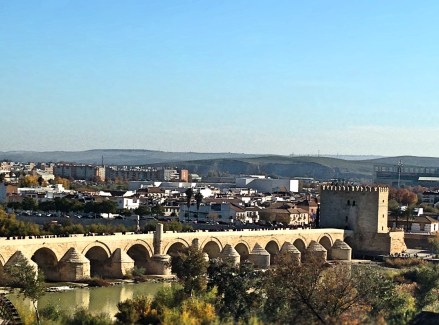
We still had much to see. Our next stop was the cathedral. It isn’t very far off. The cathedral’s tall form towers over a row of apartment buildings. These buildings are painted in creamy colors; and the view of the marble cathedral looming above them is one of Cádiz’s distinctive views. Our road ran right along the sea; and to my right, separating the sidewalk from the ocean, was the breackwater: a pile of giant, perfectly cubic stones.

Cadiz_Cathedral_Distance

We reached the cathedral and went inside. Everything was smooth lines, rounded forms, and clean white marble. This was neoclassical—elegant and symmetrical. According to the audioguide, this cathedral was built when Cádiz began to profit enormously from Spain’s trade with her colonies in America. Thus this grand edifice resulted. By contrast with gothic cathedrals I had seen, this one looked more like a celebration of human reason than divine might. Its even proportions, its emphasis on balance, its ghostly white marble columns, all this reminds one more of a mathematical theorem made manifest rather than a vengeful deity who sits in judgment.

Cadiz_Cathedral

If you visit this cathedral, make sure to go to the crypt in the basement. There isn’t much to see, but the central chamber has really astounding acoustics. Stand in the right place, and even a whisper will be magnified into an omnipresent hiss. And the sounds of your footsteps bounce from the roof to the floor like a rubber bouncy ball sped up fifty times.

Next stop was the Torre Tavira, an old tower from the city’s golden age of trade. At first I thought it would be a scam—pay a few to climb a lot of stairs. But it turned out to be perhaps the best thing we did in Cádiz. The view from the top is worth the money, as it is probably the most impressive in the city. But the best part of the visit commenced when we were led by the guide to the cámara oscura. This is a very old and very simple device, consisting of a dark chamber with an angled mirror with a small opening. Light enters the aperture and is reflected by the mirror to a surface, where the image shows like a projector.

Our tour guide led us into the room, had us encircle the disc-shaped projecting surface, and dimmed the lights. The show began. Light poured in through the camara obscura above us, created a perfect image of the city on the disc. This image was magnified quite a bit; and by turning the mirror overhead the guide could focus on different areas of the city. Going on this way, we explored the city in every direction, our guide pointing out the notable buildings and briefly explaining their history.

The show ended and we went downstairs. By now I was exhausted. Being continually astonished really takes a lot out of you. I didn’t have the energy to gape at anything else. Besides, it was getting dark by now, and we had to get to our next stop. So we pulled ourselves away from this city, walked to the train, and returned to our Airbnb. Please, if you get the chance, visit Cádiz. It’s a jewel.

Christmastime in Andalusia: Jerez de la Frontera

Christmastime in Andalusia: Jerez de la Frontera

(Continued in my posts about Cádiz, Nerja, Ronda, and Málaga.)

The Voyage

On December 24, Christmas Eve—or Noche Buena (“Good Night”) as the Spanish call it—in the year 2015, at an egregious hour in the morning, we met up with a couple of guys that we had contacted through Blablacar to make the drive down to Jerez de la Frontera.

They were both extremely nice, agreeable fellows; but I’m afraid they had Andalusian accents and I could hardly understand them.

The people of Andalusia, you see, have something of a reputation. Their accent is distinctive and difficult for outsiders to understand. They speak in a rapid staccato, spitting out the words like a machine gun. Unlike in most of Spain, Andalusians do not pronounce c’s or z’s like “th” (often mocked, incorrectly, as the “Spanish lisp”); and instead pronounce all soft c’s and z’s like an “s,” as they do in Latin America. For most people this would not be a problem; but since I’m only used to Castillian Spanish this confuses me.
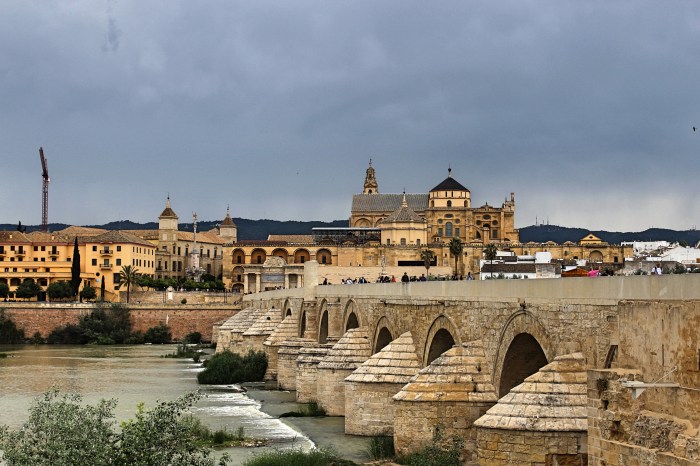
What is more, Andalusians drop the terminal “s” wherever it appears: tres becomes tregracias becomes gracia, and so on. To top it off, the consonants separating two ending vowels are also dropped, and the vowels are blended together into a dipthong: complicado becomes complicao. With all these factors taken together, the final result is, for me, an indistinct slur of sound that never resolves itself into separate words.

In sum, I could not understand them. So I slept; and GF slept; and we woke up and then fell asleep again.

The countryside of Andalucía, normally so flat and treeless that you can see for miles, was shrouded in a mysterious and impenetrable wall of fog. Apparently, mornings in the south of Spain are typically foggy, which I find odd considering how absolutely sunny and cloudless are the days.

But I had traveled this road before, when I went to Seville. So even though I couldn’t see much, memories flew by the window instead.

There are castles, I recalled: mostly run-down and in ruins, dotting the countryside; we must have passed five or six. Then there are the great, big, black silhouettes of bulls, which stood here and there, sometimes next to the highway and sometimes on a hillside beyond. These are the Osborne Bulls: signs that were originally set up as advertisements for Osborne brand sherry. Despite this prosaic commercial origin, they have since become something of a symbol for Spain, and you can find them on everything from T-shirts to book jackets to postcards.

Osborne_bull

I also remembered the livestock. The Spanish countryside has a rugged, rural, pastoral charm that I did not expect to find in an industrialized country. In what look like wild fields along the highways you can see cows grazing, sheep huddling in herds, and horses bathing their shiny coats in the sun. No human can be seen watching over them; not a fence is in sight—except perhaps and old, derelict stone barrier that looks short enough to hop over.

Then I thought of the wind turbines—those gigantic white towers, their blades meditatively spinning in the breeze—and the solar panels, glistening like the future itself in the sun. These new technologies served to break the spell of the castles and the wandering livestock, snapping you back to the twenty-first century. But they also showed a wonderful continuity; people still made their living here, and were still doing their best to achieve harmony with their environment.

But the castles and the bulls and the horses and the turbines were nowhere to be seen this morning; just the grey fog, the clouds overhead, and the few feet of road in front of us. I was having trouble staying awake, and still more trouble staying asleep. So I drifted in that unpleasant, cramped, confusing, groggy twilight between consciousness and unconsciousness, my neck hurting, my knees in pain, my eyelids feeling as though a gigantic weight had been placed upon them.

But then we arrived. Our driver, very kindly, drove us right up to the door of our Airbnb, and soon we found ourselves in Jerez de la Frontera, blinking in the familiar bright of the Andalusian sun, our bags sitting on the sidewalk, both of us tired and dazed, pressing the buzzer to get in.


Jerez de la Frontera

Our hosts were just as kind and friendly and welcoming as our driver had been. One of them, the husband, was a professor of Spanish and French from Switzerland; and his wife was a wonderful woman from Peru. They were hospitality incarnate; they gave us a tour of the neighborhood, told us about the bus schedule, provided us information about all the things to do and see in Jerez, and in general answered every question we had. Not only this, but they had the patience of saints with our halting, slow, mistake-ridden Spanish.

Soon we were on the bus, heading towards town. We arrived at 3:30 in Jerez de la Frontera, on Christmas Eve. The restaurants were jam-packed, the streets filled with so many people eating, drinking, and talking that there weren’t nearly enough chairs, so most people had to stand—not that anybody seemed to care. On Christmas Eve, apparently, the entire town celebrates by having an after-lunch drink.

With more hope than foresight, we thought we could visit some of the main sights of Jerez. First, we tried the Alcázar, a Moorish castle in the center of town. It was closed. Then we tried the cathedral. Closed. After that, we walked to a bodega (winery), to taste some famous sherry. (Jerez de la Frontera is the birthplace of sherry wine.) They were all closed, too. It was Christmastime in Andalusia, and the only places open were the restaurants.

So we walked around, somewhat aimlessly, feeling lost and out of place. What were we doing here? This was the holidays, a time for family, and here we were, just the two of us, alone in a strange city with nothing to do. After two hours of wandering, we decided we might as well eat, and sat down at the first restaurant we could find.

Two tables over an entire extended family was gathered together. They were playing flamenco. Three boys were strumming on guitars, others were stomping and clapping, and they were singing in unison, the women an octave higher than the men. It wasn’t professional by any means, but it was fun and exciting. As we sat outside in temperate sun, listening to this family play flamenco—not because they were being paid, but to celebrate the holiday—the day suddenly became ineffably romantic.

We sat at that restaurant as long as we could before they kicked us out—which was at about 5 o’clock. Then we walked back to the Airbnb.

It did not feel like Christmas Eve. We spoke with our families through Skype, but this only served to remind us of what we were missing. The loneliness was easy to forget during the day, when surrounded by crowds, overhearing small-talk, exchanging pleasantries with waiters. But as the sun went down and the shops began to close and the people retreated indoors to be with their brothers and sisters, sons and daughters, fathers and mothers, we could not forget that we were not at home; that on another side of the globe, our own families were celebrating without us; and that instead of being surrounded by familiar faces, we were surrounded by faces entirely new, and even strange.

And with these thoughts, we went to sleep.

§

Christmas morning.

We got out of bed and went downstairs. Sadly, there weren’t any presents waiting for us, not even a tree; but there was breakfast. It was simple and delicious: bread, yogurt, fresh fruit, and Spanish ham. Even though our goodly hosts had eaten several hours before, they had sat at the table with us just to talk. As I sat there, I realized how odd it was to be staying at the house of a stranger—or, at least, someone we’d just met—during Christmas. It felt somehow intrusive and indecent. But then I remembered that our hosts were immigrants, too, and all their family was elsewhere as well. This made me feel a bit more at home.

We were off to town again, though we hardly knew what for. Just like yesterday, everything was closed; and today, not even the restaurants were busy. This time we didn’t even try to see anything. We sat down at a restaurant, ordered some food, and relaxed. I must admit, though, that I was getting a bit cranky by this point. Not only had I missed Christmas, but for what?

I calmed down a bit after I pulled out my book to read. I read and read, looking up now and again to observe people strolling by, kids playing, grandparents chiding, young couples chitchatting—and the day passed like this. I began to feel calm and happy. There is something strangely intoxicating about Andalusia. I don’t know quite what it is. A big part is just the weather. The sun is so bright that it’s hypnotic. The intense light is just so constantly present; it transforms everything, making colors brighter, laughter louder, people friendlier.

Then again, the people really are friendlier in Andalusia. Here the social instinct of the Spanish is expressed most fully. In New York, there are crowds, of course; but the crowds are always crowds of individuals thrown together more or less by accident, by force of circumstance. But the Andalusians, as I witnessed on Christmas Eve, congregate purposefully and joyfully—taking pleasure in the feeling of togetherness and camaraderie and excitement that good crowds generate.

The day wore on, and nothing much happened. I looked around the square; there wasn’t much to see. A cone-shaped, plastic Christmas light sat in the center. Beside that was a civic statue of someone riding a horse, surrounded by fountains and flowers. Palm trees were lightly swaying in the breeze. At another table, an elderly British woman was yelling at her dog every time it barked; but the dog didn’t seem to care, and kept on barking at every passerby.

Behind me some kids were riding around on a toy car ride that played cheesy music as it went by. Later, another group of kids were amusing themselves by exploding firecrackers in the middle of the plaza. These firecrackers were astoundingly loud, sounding like gunshots. I nearly jumped out of my seat the first time one went off. I’m still surprised that the kids’ parents, who were sitting nearby, didn’t mind their six and seven-year-olds playing with such powerful explosives. American parents would sooner let their kids eat gluten and get vaccinated.

We sat there four solid hours, until the sun began to set behind the restaurant, casting the square in shadow. Without the sun, I began to feel colder and more lonely. So we left. The walk back took us through several strip malls, all completely vacant. Although the sun was still out we could see the moon. It was full and seemed much bigger and closer than usual. Behind us the sun was setting, turning the sky a bright storybook pink and orange. By the time we reached the Airbnb, all was dark.

Everything was closed, even the supermarkets. What would we eat? Our hosts came to the rescue. In their freezer, they had cooked, seasoned pork chops ready to heat up, along with rice, potatoes, and salad. It was fantastic. We sat around the table, talking some more—the kind of supremely pleasant small-talk that is both interesting and easygoing, the kind that engages the mind enough to keep your attention but not so much to get you flustered.

We ate; we slept. Tomorrow we were leaving, so we only had the first part of the day to explore. Thus, even though I spent three days in Jerez, the time lost to Christmas closures resulted in only a half-day to visit the sites.

§

Jerez de la Frontera, translated literally into English, means “Sherry of the Border.” Indeed the English word “sherry” is an anglicization of “Xeres,” the antique name for this town. For it is here that the famous fortified wine originated. Situated just 7 miles (12 km) inland from the Atlantic Ocean, Jerez enjoys a mixture of humidity and heat that has proven ideal for its trademark wine. This sprawling city has overtaken Cádiz, the regional capital, as the region’s most populous city; and apart from its wine it is know for being the home of the Grand Prix motorcycle race.

Tiopepe
A statue of Manuel Críspulo González y Soto, founder of Tío Pepe sherry, with the cathedral in the background

Our first stop was the Alcázar of Jerez. The word “alcázar” comes from the Arabic word for “fortress,” and many cities in Spain have one: Córdoba, Segovia, Toledo.

This alcázar is located right in the center of town, surrounded on all sides by pretty plazas filled with orange trees. Today this area was also filled with people. The locals were holding a market around the old fortress—a flea market, more precisely. Tables and tables were filled with all sorts of delightful rubbish, old plastic toys, dusty books with broken spines, varieties of colorful knickknacks, tiny statuettes for nativity scenes, and much else. We wandered through the crowd as we looked for the entrance, passing around the entire building before we finally found it.

The Alcázar of Jerez is a compound surrounded on all sides by a high wall. It was originally built when Jerez was a small Taifa kingdom during the Moorish period. Many of the internal structures—likely built of wood and therefore perishable—have disappeared, and a garden now occupies the center of the fortress.

alcazar_jerez

An old Mosque, the only one that wasn’t destroyed by the conquering Christians, still stands (though I couldn’t identify it); and you can walk inside an old Moorish bath with its roof pierced with star-shaped holes. Also standing is the oven and the machinery that the Christian used to make their pottery. Yet the best part of the visit was just the opportunity to stand on the walls and see the whole city spread out before us.

After this we went across the plaza to see the city’s cathedral. The Jerez Cathedral is comparatively small. Indeed it wasn’t originally built as a cathedral, but as a church, and was only elevated to that status in 1980. Stylistically speaking, the building is eclectic: gothic flying buttresses were fixed to neoclassical columns. We walked in the door, excited to explore the interior, but stopped in our tracks. They were having a service.

The whole place was packed, every pew totally filled. At the altar, several white-robed priests were gathered. One of them was speaking through a microphone, his old, tired voice projected throughout the cavernous space. He sighed rather than preached, seeming to exhale the words with minimal emphasis. Meanwhile, his proclamations were punctuated by the cadences of an organ, going from the dominant to the tonic minor chord. This might have been the first time in my life that I’ve heard an organ in a cathedral. The sound was duly impressive. But more interesting were the musical interludes provided by a group of flamenco singers and guitar players. Yes, here in Jerez they even have flamenco in their church services. It sounded absolutely great in that old building, and provided a welcome contrast to the old gentleman’s fatiguing voice.

“You gonna put that in your blog?” GF asked as we walked out.

“Of course,” I said. “I put everything in my blog.”

This was the end of our time in Jerez. We had to eat lunch, pick up our luggage, and catch a train to our next stop. I still regret that we didn’t get to visit one of the town’s famous sherry wineries. I suppose I’ll just have to come back.