Review: Philosophical Investigations

Review: Philosophical Investigations

Philosophical InvestigationsPhilosophical Investigations by Ludwig Wittgenstein

My rating: 5 of 5 stars

If you read first Wittgenstein’s Tractatus, and then follow it with his Philosophical Investigations, you will treat yourself to perhaps the most fascinating intellectual development in the history of philosophy. Wittgenstein has the distinct merit of producing, not one, but two enormously influential systems of philosophy—systems, moreover, that are at loggerheads with one another.

In fact, I wouldn’t recommend attempting to tackle this work without first reading the Tractatus, as the Investigations is essentially one long refutation and critique of his earlier, somewhat more conventional, views. But because I wish to give a short summary of some of Wittgenstein’s later views here, I will first give a little précise of the earlier work.

In the Tractatus, Wittgenstein argues that language has one primary function: to state facts. Language is a logical picture of the world. A given proposition mirrors a given state of affairs. This leads Wittgenstein to regard a great many types of utterances as strictly nonsense. For example, since ethics is not any given state of affairs, language couldn’t possible picture it; therefore, all propositions in the form of “action X is morally good” are nonsense.

Wittgenstein honestly believed that this solved all the problems of philosophy. Long-standing problems about causation, truth, the mind, goodness, beauty, etc., were all attempts to use language to picture something which it could not—because beauty, truth, etc., are not states of affairs. Philosophers only need stop the attempt to transcend the limits of language, and the problems would disappear. In his words: “The solution of the problem of life is seen in the vanishing of this problem.”

After publishing this work and taking leave of professional philosophy (as he thought it had been dealt with) Wittgenstein began to have some doubts. Certain everyday uses of language seemed hard to account for if you regarded language as purely a truth-stating tool. These doubts eventually culminated in a return to Cambridge, and to philosophy. His posthumously published Investigations represents the fullest expression of his later views.

So what are these views? Well, first let us compare the styles of the two works. The writing in both the Tractatus and the Investigations is extraordinary. Wittgenstein is one of the very finest writers of philosophy, in a league with Nietzsche and Plato. He uses almost no technical terms, and very simple sentence-structures; yet his phrases can stick in the mind for months, years, after first reading them. Just the other day, I was having a conversation with my German tutor about learning a foreign language. To something I said, she responded, “Die Grenzen meiner Spracher bedeuten die Grenzen meiner Welt.” (“The limits of my language are the limits of my world”—a quote from the Tractatus.)

Although the the writing in both works is equally compelling, the structures are quite different. In the Tractatus, Wittgenstein’s argument is unified, complete; he even numbers his sentences as primary, secondary, and tertiary in terms of their importance to the argument. In that work, we can clearly see the influence of Bertrand Russell’s logicism: language is reduced to logical propositions, and the argument is organized along logical grounds.

The reader of the Investigations will encounter something quite different. Wittgenstein writes in similarly terse aphorisms; he even retains a numbering-system for his points—each individual point getting its own numbered paragraph. The numbering of these paragraphs, however, is cumulative, and does not express anything about their significance to his larger design. It is almost as if Wittgenstein wrote down his thoughts on numbered flash cards, and simply constructed the book by moving the flash cards around. Unlike the Tractatus, which resolves itself into a unified whole, the Investigations is fragmentary.

I begin with style because the contrast in writing is a clue to the differences in thought between the earlier and later works. Unlike the Tractatus, the Investigations is rather a collection of observations and ideas. The spirit of Wittgenstein’s later enterprise is anti-systematic, rather than systematic. Wittgenstein aims not at erecting a whole edifice of thought, but at destroying other edifices. Thus, the text jumps from topic to topic, without any explicit connections or transitions, now attacking one common philosophical idea, now another. The experience can often be exasperating, since Wittgenstein is being intentionally oblique rather than direct. In the words of John Searle, reading the Investigations is “like getting a kit for a model airplane without any explanation for how to put it together.”

Let me attempt to put some of these pieces together—at least the pieces that were especially useful to me.

Wittgenstein replaces his old picture metaphor with a new tool metaphor. Instead of a word being meaningful because it pictures a fact, the meaning of a word is—at least most of the time—synonymous with the social use of that word. For example, the word “pizza” does not mean pizza because it names the food; rather, it means pizza because you can use the word to order the food at a restaurant. So instead of the reference to a type of object being primary, the social use is primary.

This example reveals a general quality of Wittgenstein’s later thought: the replacement of the objective/subjective dichotomy with the notion of public, social behavior.

Philosophers have traditionally posited theories of meaning that are either internal or external. For example, pizza can mean the particular food either because the word points to the food, or because the word points to our idea, or sensation, of the food. Either language is reporting objective states of affairs, or subjective internal experiences.

Wittgenstein destroys the external argument with a very simple observation. Take the word “game.” If the external theory of meaning is correct, the word game must mean what it does because it points to something essential about games. But what is the essential quality that makes games games? Is there any? Some games are not social (think of solitaire), some games are not trivial (think of the Olympic Games), some games are not consequence-free (think of compulsive gambling), and some games are social, trivial, and consequence-free. Is a game something that you play? But you also play records and trombones. So what is the essential, single quality of “game” that our word refers to?

Wittgenstein says there isn’t any. Rather, the word “game” takes on different meanings in different social contexts, or modes of discourse. Wittgenstein calls these different modes of discourse “language-games.” Some examples of language games are that of mimicking, of joking, of mourning, of philosophizing, of religious discourse. Every language game has its own rules; therefore, any proposed all-encompassing theory of language (like Wittgenstein’s own Tractatus) will fail, because it attempts to reduce the irreducible. You cannot reduce chess, soccer, solitaire, black-jack, and tag to one set of rules; the same is true (says Wittgenstein) of language.

Another popular theory of meaning is the internal theory. This theory holds that propositions mean things by referring to thoughts or sensations. When I refer to pain, I am referring to an internal object; when I refer to a bunny, I am referring to a set of visual sensations that I have learned to call ‘bunny’.

Wittgenstein makes short work of this argument too. Let’s start with the argument about sensations. Wittgenstein points out that our ‘sensations’ of an object—say, a bunny—are not something that we experience, as it were, purely. Rather, our interpretations alter the sensations themselves. To illustrate this, Wittgenstein uses perhaps the funiest example in all of philosophy, the duck-rabbit:

duckrabbit

As you can see, whether you interpret this conglomeration of shapes, lines, and spaces as a rabbit or a duck depends on your interpretation; and, if you had never seen a duck or a rabbit in your life, the picture would look rather strange. Ernst Gombrich summed up this point quite nicely in his Story of Art: “If we look out of the window we can see the view in a thousand different ways. Which of them is our sense impression?”

The point of all this is that trying to make propositions about sense-impressions is like trying to hit a moving target—since you only see something a certain way because of certain beliefs or experiences you already hold.

The argument about inner feelings is equally weak. For example, when we learned the word pain, did someone somehow point to the feeling and name it? Clearly, that’s impossible. What actually happens is that we (or someone else) exhibited normal behavioral manifestations of pain—crying, moaning, tearing, clutching the afflicted area. The word pain then is used (at least originally) to refer to pain-behavior, and we later use the word ‘pain’ as a replacement for our infantile pain-behavior—instead of moaning and clutching our arm, we tell someone we have a pain, and that it’s in our arm. This shows that the internal referent of the word ‘pain’ is not fundamental to its meaning, but is derivative of its more fundamental, public use.

This may seem trivial, but this line of argument is a powerful attack on the entire Cartesian tradition. Let me give you an example.

René Descartes famously sat in his room, and then tried to doubt the whole world. He then got down to his own ego, and tried to build the work back up from there. This line of thought places the individual at the center of the epistemological question, and makes all other phenomena derivative of the fundamental, subjective experience of certainty.

But let us, as Wittgenstein advises, examine the normal use of the word “to know.” You say, “I know Tom,” or “I know American history.” If someone asked you, “What makes you say you know Tom and American history?” you might say something like “I can pick Tom’s face out of a crowd,” or “I could pass a history test.” Already, you are giving social criteria for what it means to know. In fact, the word “to know” presupposes the ability to verify something with something that is not yourself. You would never verify something you remember by pointing to another thing you remember—that would be absurd, since your memory is the thing being tested. Instead, you indicate an independent criterion for determining whether or not you know something. (The social test of knowledge is also explicit in science, since experiments must be repeatable and communicable; if a scientist said “I know this but I my can’t prove it once more,” that would not be science.)

So because knowing anything apparently requires some kind of social confirmation, the Cartesian project of founding knowledge on subjective experience is doomed from the start. Knowing anything requires at least two people—since you couldn’t know if you were right or wrong without some kind of social confirmation.

Wittgenstein brings this home with his discussion of private language. Let’s say you had a feeling that nobody has told you how to name. As a result, you suspect that this feeling is unique to yourself, and so you create your own name for it. Every time you have the feeling, you apply this made-up name to it. But how do you know if you’re using the name correctly? How do you know that every time you use your private name you are referring to the same feeling? You can’t check it against your memory, since your memory is the very thing being doubted. You can’t ask somebody else, because nobody else knows this name or has this sensation. Therefore, merely thinking you’re using the name consistently and actually using the name consistently would be indistinguishable experiences. You could never really know.

Although Wittgenstein’s views changed dramatically from the early to the late phase of his career, you can see some intriguing similarities. One main current of Wittgenstein’s thought is that all philosophical problems result from the misuse of language. Compare this statement from the Tractatus, “All philosophy is ‘Critique of language’,” with this, from the Investigations: “Philosophy is a battle against the bewitchment of our intelligence by means of language.” In both works, Wittgenstein is convinced that philosophical problems only arise because of the misuses of language; that philosophers either attempt to say the unsayable, or confuse the rules of one language-game with another—producing nonsense.

I cannot say I’ve thought-through Wittgenstein’s points fully enough to say whether I agree or disagree with them. But, whether wrong or right, Wittgenstein already has the ultimate merit of any philosopher—provoking thought about fundamental questions. And even if he was wrong about everything, his books would be worth reading for the writing alone. Reading Wittgenstein can be very much like taking straight shots of vodka—it burns on the way down, it addles your brain, it is forceful and overwhelming; but after all the pain and toil, the end-result is pleasant elation.

View all my reviews

Review: The World at War

Review: The World at War

The World At WarThe World At War by Mark Arnold-Forster

My rating: 5 of 5 stars

Consisting of 26 episodes, each about 50 minutes long, The World at War traces the history of the Second World War from its pre-War beginnings to its aftermath. The program is remarkable in scope, covering the relevant political history of the United States, England, Germany, and Japan; the war efforts in north Africa and southeast Asia; the Russian and the Western front, as well as the final push against Japan; the bombing campaigns and their effects on civilian life; the struggle of the Allied shipping fleet against the German U-boats; the final peace negotiations in Europe and Asia, and the concomitant haggling between the U.S.S.R. and the West; the horrors of the Holocaust; and much else.

But the series has depth as well as breadth. There are hours and hours of archival footage—of battles, bombings, bombardments, protests, speeches, life on the front line, civilian life, negotiations, military parades, invasions, celebrations, triumphs, massacres, tragedies—much of it never used before, unearthed by the program’s research team.

Even more impressively, there are hours of interview footage, from from Poles, Russians, French, Germans, English, Americans, Japanese. There are interviews of gunners, tank crew, infantrymen, sailors, pilots; interviews of housewives, firefighters, barmen, taxi drivers; as well as from politicians, advisors, generals, and even Hitler’s personal secretary and chauffeur. Considering that these interviews were made specifically for the series, from people directly involved in the action, this makes the raw footage (most of it unused) a valuable primary historical document. And this is not to mention the wonderful narration by Laurence Olivier, which is always tasteful, often moving, and sometimes chilling.

In short, the documentary is a masterpiece, bringing the drama of the war to life while also being supremely informative. If you want to watch any documentary about World War II, make it this one.

To speak personally, watching this documentary had a strange effect on me, because it made me realize how much my perspective has changed since I was a kid. Back then, I used to watch World War II documentaries because the war seemed like a comic book. It was a story with clear bad guys and good guys, and the good guys won in the end. It was a story of personal heroism and bravery, of self-sacrifice and honor, of hardships endured and battles fought for the greater good. I was even fascinated with the military technology, the tanks, war planes, battleships, and guns. I remember going to the military museum at West Point, and seeing replicas of the nuclear bombs used on Hiroshima and Nagasaki. There was something undeniably awe-inspiring about the ability to create so much destruction, to wield so much power.

This time around, I had a different reaction. The more I watched, the more I became overwhelmed with a sense of pointless loss, destruction, and violence. Millions of young men marching off to shoot other young men, and for what? Towns blown to pieces, cities burned to the ground, and, most of all, countless lives lost. People shot, stabbed, drowned, burned; people executed by firing squad, hanging, the gas chamber. Beaches filled with bloated bodies, corpses rotting in the road, the remains grandmothers and children buried under piles of rubble. And it just kept going, the planes kept dropping bombs, the men kept throwing grenades, the tanks kept rolling on. By the end of the series, every episode made me feel sick.

When you see the numbers of the dead, it’s easy to grow numb. The totals become mere, meaningless statistics. But when you realize that those millions were composed of individuals, people with their own favorite song to whistle, shade of blue, local restaurant, people with their own quirks of personality, their own flaws and virtues, people who were loved and who loved in return, people who might have done anything had they survived the war, the enormity of the tragedy dawns on you. No matter what the aggressors hoped to gain from the war, no matter how glorious it seemed, it could not have been worth it.

The documentary does not shy away from the horrors of war, but dwells on them, and for good reason. For if there is any lesson to be learned from World War II, it is simply this: We must do everything in our power to avoid repeating that catastrophe.

View all my reviews

Review: Introductory Lectures on Psycho-Analysis

Review: Introductory Lectures on Psycho-Analysis

Introductory Lectures on PsychoanalysisIntroductory Lectures on Psychoanalysis by Sigmund Freud
My rating: 4 of 5 stars

The medulla oblongata is a very serious and lovely object.

When I was in college, I used to get in long and rather aimless arguments with a friend about Freud. The funny thing is, both of us agreed that Freud was fundamentally wrong about most things. The argument was, rather, whether Freud was worth reading and thinking about—and was even potentially useful—in spite of his theories’ veracity. My friend said he wasn’t, and I said he was. I still think this way, which is why, every now and then, I find myself making my way through one of his books.

Probably I should have come to this book sooner. Freud’s Introductory Lectures on Psychoanalysis is his attempt to give an accessible introduction to his system, and is thus probably one of the best places to start if you’re curious about his work. The lectures, given over one academic year, are divided into three sections: the parapraxes (the “Freudian slips”), the interpretation of dreams, and the neuroses. The material is arranged this way for pedagogical purposes, beginning with the simplest and most easily observable phenomena and ending with genuine mental disorders. By necessity, the last section is both the longest and densest.

One thing that fascinates me about Freud is how a system of ideas with paltry factual support could be so seductive and gripping. For my part, I find Freud’s system remarkably attractive; thinking along his lines has an undeniable emotional appeal, at least in my case. In my review of Civilization and its Discontents, I gave a partial explanation of this by likening Freud’s system in outline to that of Christianity. But I don’t think that’s the whole story, and thus I want to explore it further.

While reading this book, it struck me that Freud’s system is comparable with the Aristotelian physics and cosmology that held sway for so long in the Western world. Both of these systems, Freud’s and Aristotle’s, are so compelling and take such hold of one’s mind because they seem to explain everything while offering very little in the way of falsifiable propositions. Aristotelians could throw around terms like matter, form, ideal, potential, perfect, nature, and soul without providing any circumstances in which these concepts could be tested and disproved.

These categories were specific enough to be rationally compelling, and yet vague enough to be applied to nearly anything. Similarly, Freud created a system that could be applied to history, religion, mythology, and literature, while never specifying how its categories—repression, unconscious, transference, libido, censor etc.—could be disproven. It thus gives the illusion of an airtight and exhaustive system while remaining safe from testability.

The main reason that Freud’s theories are untestable is that they rely on interpretation; and interpretations, by definition, cannot be falsified. Now to be fair I think Freud’s system is most plausible, as a therapeutic technique, when he has his patients interpret their own dreams and symptoms. If a patient is free-associating, it makes sense that they might be able to hit upon an emotionally resonant interpretation.

Nevertheless, I think it would still be incorrect to call even the patient’s interpretation the “true” one, since being emotionally affected by something now in no way proves that this same thing motivated a dream in the past. And this is putting to the side the fact that Freud’s explanation for how dreams are formed relies on unobservable processes and entities that he posits in the mind. But let me stop here before I get sucked down the rabbit hole.

To repeat, then, although I think it cannot be proved that any interpretation of a dream is a “true” one, I still think having patients interpret their dreams might help them to explore their own feelings. But when Freud begins enumerating a kind of “key” for dream interpretation, his system gets really unsupportable. According to Freud, certain things always symbolize other things in dreams, irrespective of the individual, their cultural background, or their experiences. And, of course, most of these symbols are representatives of sexual matters:

We have earlier referred to landscapes as representing the female genitals. Hills and rocks are symbols of the male organ. Fruit stands, not for children, but for the breasts. Wild animals mean people in an excited sensual state, and further, evil instincts or passions. Blossoms or flowers indicate women’s genitals, or, in particular, virginity. Do not forget that blossoms are actually the genitals of a plant.

There is an entire lecture like this; and personally I find it so ludicrous that it makes me deeply suspicious of Freud’s judgment. It relies on so many unsubstantiated premises—that dreams have a deeper meaning, that this deeper meaning is always a desire, that this desire is always illicit and sexual, that somehow certain symbols are universal, and that Freud is somehow privy to this information—that it boggles the mind trying to unravel it.

When Freud does offer the explanation for why one thing symbolizes another, it bears a remarkable similarity to the logic used by conspiracy theorists:

And, speaking of wood, it is hard to understand how that material came to represent what is maternal and female. But here comparative philology may come to our help. Our German word ‘Holz’ seems to come from the same root as the Greek [hule], meaning ‘stuff’ ‘raw material’. … Now there is an island in the Atlantic named ‘Madeira’. This name was given to it by the Portuguese when they discovered it, because at that time it was covered all over with woods. For in the Portuguese language ‘madeira’ means ‘wood’. You will notice, however, that ‘madeira’ is only a slightly modified version of the Latin word ‘materia’, which once more means ‘material’ in general. But ‘material’ is derived from ‘mater’, ‘mother’: the material out of which anything is made is, as it were, mother to it. This ancient view of the thing survives, therefore, in the symbolic use of wood for ‘woman’ or ‘mother’.

Clearly this sort of thing wouldn’t past muster in any scientific journal nowadays, and it’s hard to see how it could have been convincing in Freud’s day either.

The above is just one example of the un-falsifiability inherent in Freud’s thought; and this is a big part, I think, of why his system can be so seductive. But there is another reason for its appeal: It is fundamental to Freud’s system to question the motivations of its detractors. That it, the system has a built-in defense mechanism in that anyone who disagrees can be accused of being a repressed individual who can’t face the truth of his own illicit desires.

To take just one example, let’s look at Freud’s discussion of his famous Freudian slip. In these lectures, he claims that all slips of the tongue are caused by a repressed desire that is finding a distorted expression. Now to be fair, there are definitely many instances when this seems to be the case, that somebody accidentally said something they were trying to keep secret. Nevertheless, it is absurd to claim that all slips of the tongue have this origin. For one, you cannot legitimately make a universal generalization from any finite data set. You cannot, for example, claim that all apples are delicious after you’ve eaten 100 delicious apples. Moreover, and once again, finding the “deeper meaning” of a Freudian slip relies on interpretation, and interpretations can never be objectively determined.

But a more troubling problem for me is that Freud essentially asserts that it is impossible to make an innocent mistake. If you are tired and you misspeak, it cannot just be an error, but must be the expression of a deep and terrible desire of which you are not aware. And if you deny this, it only proves Freud’s point; obviously you can’t face the truth about yourself, you are too repressed. Thus there isn’t any way out. You can’t disprove Freud’s interpretation (since it’s an interpretation and can’t be disproven), and all your protestations only make you look more guilty. And this sort of double bind isn’t restricted to Freud’s theories on slips of the tongue, but apply to the interpretation of dreams and neurotic symptoms. I wouldn’t be surprised if Freud argued that any time somebody fell off a bike it was because of a latent death wish.

To be fair to Freud, none of these criticisms is unique to his system. To the contrary, they can be applied to many, if not all, religious and political ideologies. The questioning of other people’s motivation is especially destructive in the latter sphere, and can be found on both the Right and the Left. Democrats only want to expand social security because they’re communists who want to make everyone dependent on the government; they only want to expand background checks to take away everyone’s guns and make them unable to fight against the government tyranny. Meanwhile, poor whites are too dumb to vote for their own interests, those who disagree with Obama are racists, those with Hillary are sexists, and if you disagree it’s your privilege talking.

Don’t misunderstand me: I’m not saying that these accusations are necessarily incorrect, and indeed I think they are often quite compelling. Nevertheless I think you have got to be careful when you questions the motivations of your opponent, because it makes it impossible to have a reasonable debate. Probably it’s best to assume good intentions unless proven otherwise. But this brings me pretty far from Freud.

Or does it? I began by saying how useful is Freud even if one disagrees with him, and I think one way is to see how unsupported ideas can become widely accepted. But of course that’s not all.

Freud was, in my opinion, quite obviously brilliant. His ideas were so original and his thought process so novel that it is fascinating just to see him at work. What is more, even if they lack rigor in a scientific setting, Freud’s ideas, terminology, and system have undeniably enriched how we think about the human experience. That dreams can reveal a deeper meaning, that slips of the tongue can reveal hidden intentions, that desires can be repressed, that traumatic memories can be unconscious, that much of your motivation lies beyond your conscious awareness—all this and more we owe to Freud.

Two weeks ago I was walking through the Thyssen-Bornemisza in Madrid, where there is a wonderful painting by Salvador Dalí: Dream Caused by the Flight of a Bee Around a Pomegranate a Second Before Awakening. The painting, which makes no rational sense, was partly inspired by Freud’s ideas on the dream-logic, how ideas get associated in the unconscious. Thus the elements in the painting are associated, not by reason, but by other chains of association—the sounds of their names, specific memories, visual properties, sexual desires. The entire logic of the painting can thus be said to be Freudian. Now, considering this, can you argue that he didn’t enrich our culture?

View all my reviews

Review: Interior Castle

Review: Interior Castle

The Interior CastleThe Interior Castle by Teresa of Ávila

My rating: 4 of 5 stars

It is absurd to think that we can enter Heaven without first entering our own souls

Last week I spend five days walking on the Camino de Santiago. I know, probably that doesn’t sound terribly impressive to anyone who walked all the way from France, but I still had a great time. Every morning we set out before sunrise, when the lush landscape of Galicia was still shrouded in mist and twilight. We walked on and on, guided by the conch shell signs that point the way. We reached our destination just as the heat of the day began to take hold. My back sore, my feet blistered, I dropped my backpack in the hostel and stretched out in my bunkbed. Besides walking, sleeping, and eating, the only thing I did was to read this book: St. Teresa’s book on prayer.

It seemed like an appropriate choice. Both Santiago (St. James) and St. Teresa are patron saints of Spain; and yet they represent two very different periods in Spain’s history. The cult of Santiago dates from the time of the Moors, when Christians needed a figure to rally around during the Reconquista. St. Teresa, on the other hand, lived during the Counter-Reformation. As the Catholic world was coming apart, Catholic officials were understandably skittish at even a hint of heterodoxy. Thus St. Teresa’s mysticism was first viewed with suspicion, and she was even picked up by the Inquisition. But after some investigation, it was decided that St. Teresa posed no threat to orthodoxy; to the contrary, she helped to reinvigorate the faith.

This context is necessary to understand this book, or at least half of it. This is because, although ostensibly guide for prayer, it is also a handbook for avoiding the suspicions of unorthodoxy. It is full of advice for those having mystical experiences on which visions to discount, because they are products of Satan or the imagination, and which visions to accept. Teresa also explains when you should yield to one’s prioress or confessor, and when you should stand your ground. St. Teresa was obviously acutely aware of the paranoid climate, and thus this book is as full of pragmatic counsel as religious guidance. St. Teresa even explains in the beginning that the only reason she wrote the book was because she was commanded to.

As James Michener pointed out, the most striking thing about St. Teresa is this seamless mixture of pragmatism and mysticism. For somebody who reported feeling her soul leave her body, she comes across as remarkably down to earth. Several times, she quotes or references a Biblical passage and then adds parenthetically “Well, at least I think that’s what it says,” as if she couldn’t be bothered to go look it up. She also frequently comments on how inadequate she feels to the task at hand; and a few times she says that she’s unsure whether she is repeating herself, because she wrote the last bit a while ago and she doesn’t have time to reread it. The final effect is really charming, as if she just sat down and dashed off the whole thing between breakfast and lunch.

These interior matters are so obscure to the mind that anyone with as little learning as I will be sure to have to say many superfluous and even irrelevant things in order to say a single one that is to the point. The reader must have patience with me, as I have with myself when writing about things of which I know nothing; for really I sometimes take up my paper, like a perfect fool, with no idea of what to say or of how to begin.

Ironically, but perhaps unsurprisingly, the religious content was what least impressed me. The book is divided into seven mansions within the crystalline castle that represents the soul. Each progressive mansion is one step closer to God. Despite this organization, however, I found the chapters quiet repetitive; the divisions from one stage to another didn’t strike me as very clear. The general tendency is for the mystical experiences to keep growing in intensity, which culminates in the experience of a burning mixture of pleasure and pain that seems to come from nowhere. This is the inspiration for Bernini’s famous, and famously erotic, portrayal of the Saint.

What most bothered me was that the mystical and orthodox strains in Teresa’s thought did not go easily together. Perhaps this is only my taste. One thing I enjoy about mystic writings is their grand conception of the cosmos, the notion that everything apparently opposite and contradictory is one. Thus mystic writers, in my experience, tend not to be especially preoccupied with moral injunctions, since they regard good and evil as a kind of illusion.

But in Teresa, the emphasis on wickedness, on personal shortcomings, on temptation, and in general the whole moral framework of Catholicism made her system as much about avoiding sinfulness and unorthodoxy as achieving a mystical experience. For example, I’ve heard mystics say that each person is a part of God, but Teresa councils that we should contemplate God to realize our own foulness and lowliness. This is just a matter of taste, but I don’t find that appealing.

On the fifth day after we began, at about noon, I found myself standing in front of the two towers of Santiago Cathedral. Later that day, I finished the final pages of this book. I had taken a pilgrimage of the body and soul, and hopefully I’m better for it. In any case, I enjoyed myself and learned something.

View all my reviews

In Praise of Brexit

In Praise of Brexit

Praise of FollyPraise of Folly by Desiderius Erasmus

My rating: 4 of 5 stars

A Review of The Praise of Folly by Erasmus

Folly speaks:

About five hundred years ago, a man named Erasmus decided to publish a book praising me. Unbelievably, no one had this idea before, and none since. Nobody has the time or the inclination—nobody besides Erasmus, that is—to sing my praises, apparently. All the other gods get their encomiums, but not me.
IMG_3814
Well, perhaps I should take the neglect as a compliment. After all, isn’t it the height of folly not to acknowledge the role that folly plays in human life? So is not the neglect a kind of compliment, albeit backhanded?

Nevertheless, some folks need some reminding, it seems, especially after what happened the other day. Oh, you know what I’m talking about: the United Kingdom’s vote to leave the European Union. All I’m hearing left and right is how stupid, short-sighted, narrow-minded, and above all foolish it was to vote “leave.” Well, I can’t stand my name being dragged around in the dust any longer, so I’m taking this opportunity to peep up and remind you how much you owe me.

First, let’s follow in Erasmus’s footsteps and take a short trip around Europe. As you might already know, Erasmus may justly be called the first true “European,” since he was such a cosmopolitan fellow and traveled everywhere. Even now, the trans-European student-exchange program is named after Erasmus. You might already know that the most popular destination for the Erasmus program is sunny Spain, where lots of young Britons like to go and get a tan. (Guess they won’t be coming anymore!)

Spain’s a lot different now from when Erasmus was alive. Back then, the Inquisition was in full swing and anybody who wanted to hold public office had to prove his “purity of blood,” which meant he didn’t have any Jewish or Muslims ancestors. Nowadays we don’t see that kind of behavior anymore in Spain; the Spaniards decided that it wasn’t such a good idea. But the folks in England apparently disagree: one UKIP candidate, Robert Blay, got suspended after saying his rival “isn’t British enough.” You see, my foolish devotees never disappear, but only migrate!

Yes indeed, Spain is truly different now. Let’s go to the Mediterranean coast to take a closer look. It’s a veritable mini-England! We can find British pubs, British radio broadcasts, British supermarkets selling British products. We can see retired old Brits eating baked beans and drinking tea as they take in the southern sun. And we can meet some Brits who have lived here for over a decade, and who still can’t speak a word of Spanish! Yes, and in between a pint these same Brits can tell you about how terrible is the EU and how there are too many immigrants in England. Oh, my wonderful followers!

As you might recall, it was around the time Erasmus wrote this book that England decided to leave another international organization: the Catholic Church. And the reasons were, I suppose, similar enough: “We don’t want some Italian Pope telling our king which wife he can or can’t behead!” Thomas More, one of Erasmus’s friends, and to whom this book is dedicated, disagreed with this, and he got beheaded along with the wives. Lots of people didn’t like this, but honestly I can’t say it was such a bad move. Executions are decisive, at least. Some people still agree with this strategy, like the guy who killed the politician Jo Cox. It worked for Henry VIII, so it can work for us!

IMG_3304

Let’s fast forward a bit in time, to the glorious British Empire. By Jingo, it was big! It stretched across the whole world! Look at how these colonial officers stroll around Mumbai, Nairobi, Hong Kong, Sydney! You’ve got to admire them. They don’t ask anybody’s permission to go anywhere, they just walk right in with their guns and biscuits. Doesn’t take long to subdue the native population when you’ve got the Royal Navy on your side! Sure, this approach didn’t please everybody. But, hey, it was the high point of British history. Nowadays, they’re a bit more worried about foreign immigrants colonizing them than the reverse.

Now you see what a big role I’ve played throughout history. You see how many decisions and opinions I’ve inspired! Oh, but now I hear some people saying that the world would be better off without me. Sure, Folly is important, they say, but that doesn’t mean Folly is worth praising. Fair enough, I suppose. Yes, maybe I do cause a bit of mayhem in the world. And yes, maybe I take things too far. But consider this: For every bad decision I inspire, I also provide the remedy.

For without Folly, do you think people could overcome the sheer hypocrisy necessary for their decisions? Without me, do you think people could congratulate themselves for shooting their own foot? Without my soothing balm, do you think people could go to bed with a clean conscience after doing harm to the world? Do you think British people could simultaneously praise the heroic strength of their culture while worrying that a few thousand immigrants could totally destroy their way of life?

No! Of course not! And since happiness is the goal of life, and happiness is most easily achieved through folly, I think that, despite whatever decision I inspire, I still deserve a lot of praise.

So long live Erasmus! Long live Folly! And long live Little England!

View all my reviews

Review: Iberia

Review: Iberia

IberiaIberia by James A. Michener

My rating: 4 of 5 stars

In a sense no visitor can ever be adequately prepared to judge a foreign city, let alone an entire nation; the best he can do is to observe with sympathy.

Travel writing is like love poetry. All travelers and lovers are convinced that their experiences are unique, and therefore worth writing about; while in reality most travel stories and love poems express nearly the same basic sentiment, over and over, with only minor variations. Both genres are easy to write and hard to read, which is why far more travel blogs and love poems are written then read. Even brilliant writers sometimes make fools of themselves.

James Michener is not a brilliant writer, but he has done a fine job in this book. And for once in my life, I think I am actually qualified to judge, since I have been to about 80% of the major places he visited. Not only that, but I myself have written about my travels in Spain.

As I said before, Michener is not a brilliant writer; but he is a highly competent one. There are very few parts of this book that are memorably good, but very few that are memorably bad. The best thing that can be said for his prose is that you can read him for hours without getting tired or bored. The only parts that stuck out as bad were in some of his descriptions of churches. For example, I got completely lost in his description of the Toledo Cathedral, even though I’ve been to it—which is a bad sign.

His approach to travel writing is not very different from that of Bill Bryson: go someplace, find an interesting tidbit from the history, and then describe a few nice buildings or whatever. Apart from this, however, the two men are quite different. Michener is very much preoccupied with what in earlier times was called ‘culture’: painting, literature, architecture, music, and so on. Thus much of this book consists of descriptions and appraisals of Spain’s artistic and intellectual life. He covers flamenco, zarzuela, the music of Tomás Luis de Victoria, the paintings of Velazquez and El Greco, romanesque, gothic, and modernist architecture, the philosophy of Seneca, Maimonides, and Averroes, and much else.

But most of all, Michener is concerned with history. For him, Spain is a kind of window into the past, and he spends many pages on his so-called ‘speculations’. Mainly, these speculations deal with the following question: Why was Spain once so great and is now not so great? Personally, I found him to be a pretty mediocre historian, academically speaking; but he knows how to find a good story and how to tell one. And it is true that you learn quite a bit about Spain’s history in the course of this book.

Michener spent about thirty years traveling in Spain, on and off. As a result, he is able to cast a wide net, covering almost every major city in the country. Most of the chapters are centered around one city—Barcelona, Madrid, Salamanca, Seville, Santiago, Córdoba, Toledo—but Michener inevitably ends up leaving the city and touring the surrounding areas. (The exceptions to this are his chapters on the Guadalquivir Marshes and bullfighting.) Not only that, but Michener is very digression-prone, so he will often pause to tell you some bit of history that interests him. Thus in the course of these 900 pages he travels through nearly all of the country, the only noticeable exception being the Basque Country. It is an encyclopedic travel book.

Some people have said this book is outdated. To a certain extent this is true. Michener first came to Spain as a young man, which must have been in the late 1920s or early 1930s, and then continued his visits until the books publication in 1968. Thus you obviously can’t find anything here about the great transformations and dramas of post-Franco Spain. Apart from this, however, the book has kept its relevance. Every time he visited somewhere that I had been, I found little to no discrepancy between his description and my experience. All the beautiful cathedrals and churches and plazas are still standing today, just as lovely as when Michener saw them.

The only section where the book’s age really made itself felt was in the chapter on Madrid. In one section, Michener adds excerpts from several conversations he had about what would happen when Franco died. What is most fascinating is that nobody saw what was coming. In fact, many people insisted that democracy could never work in Spain and that Juan Carlos was just a weak little boy. A mere seven years after this book’s publication, Franco would die, Juan Carlos would take over, and then the new king would effect a masterful transition from fascism to liberal democracy. Of course, Michener can’t be faulted for missing this.

I am not sure whether this book can be enjoyed by somebody who is not at least planning on visiting Spain. It’s simply too long and too detailed. For those who are planning a trip, the book can be profitably skimmed, and indeed that might be the best way to read it. But frankly this may not a great travel guide, if only because it can make you feel inadequate and envious. You see, Michener was a successful novelist with plenty of time and disposable income on his hands. As a result he went everywhere he pleased, stayed in whatever hotel he wanted, spent months driving around eating, drinking, seeing bullfights. Every time he goes to a new town the local professor comes to talk to him about the local history. He gets private tours of every monument. In short, he has many experiences that aren’t available for the rest of us.

On the whole this book is a very well-done piece of work. It is not poetic, not profound, but it covers a lot of ground in a highly readable way. But the book suffers from several faults. First, it is simply too big and sprawling. Michener needed a better organizing principle than “Hey, this is all the stuff I liked in Spain!” This lack of an overarching organization really wore on me by the end of the book. There are only so many buildings I can hear described in agonizing detail, there are only so many times I can hear him say “This is one of Spain’s finest plazas,” or “This was one of the best meals I had in Spain.”

This is related to another flaw. For travel not to be frivolous, I think it must change you in some way, if only subtly. Well, Michener is certainly not a superficial person, and I think he was deeply affected by Spain. Nevertheless, at times I wondered whether all this travel—all this eating and music and art loving—was just another, more sophisticated version of consumer culture. Of course this is a bigger question than this book; and in fact it can be asked about all modern travel. At what point does the itch to go to a new city and to see all the sights become just as frivolous as the itch to buy the newest iPhone? At what point does travel stop being a rewarding experience and start becoming a consumption of experience? And by the way, this question can be asked of books too, especially on Goodreads: at what point does reading stop being a form of self-learning and start being a form of conspicuous consumption? Probably there is no clear line, but in any case there were several times during the course of this book that Michener’s urge to see and know everything about Spain struck me as the urge to consume the country.

The third flaw was Michener’s preoccupation with authenticity. He often talks about finding the ‘real’ Spain, and I find this grating. He goes from place to place, finding each one more ‘authentic’ and more ‘Spanish’ than the last. I admit that I have had experiences in which I couldn’t help saying to myself “This is so incredibly Spanish.” Just the same, I am deeply suspicious about this idea of authenticity in travel. Every tourist looks for something that is unique to the area they are visiting. This unique thing—whether it’s a dish or a genre of music—becomes profitable and then becomes commodified very quickly by locals hoping to earn some money. Thus a kind of arms-race ensues, with tourists trying to find out where the locals go and locals trying to find out where the tourists go. The whole thing is silly. And the silliest part is that often the locals are not fond of the ‘authentic’ local attraction. I know Spaniards who dislike flamenco, and I’ve met Germans who insisted that the best food in Germany is Döner Kebab.

These flaws are all certainly applicable to myself. I offer them in the spirit of comradeship and not of spite. All things considered, this book is really a marvelous tour of Spain. Michener did a fine job in a difficult task. If you read it, you will learn a lot, and you’ll get many good ideas for trips too. Michener is a clear writer, a knowledgeable guide, and a genial companion. More than that, this book has a special significance for me, since we are two writers with similar experiences, similar flaws, and roughly the same interests. This book spoke to directly to me in a way that few other books have, so I am sad to be putting it down.

View all my reviews

Review: Anna Karenina

Review: Anna Karenina

Anna KareninaAnna Karenina by Leo Tolstoy
My rating: 5 of 5 stars

Anna Karenina,” my friend told me, “is one of the few books that have influenced how I live my life from day to day.”

This statement touches on a question I often wonder about: Can reading great fiction make you a better person? I don’t mean to ask whether it can improve your mental agility or your knowledge of the world, for it undoubtedly does. But can these books make you kinder, wiser, more moral, more content? The answer to this question is far from self-evident. And maybe we should be doubtful, when we consider how many disagreeable Shakespeare fans have probably existed. Nevertheless, I suspect that most of us are inclined to say yes, these books do improve us. But how?

Here are my answers. First, many great works of fiction tackle the moral question directly: What does it mean to be good? How do you live a good life? What is the point of it all? Dostoyevsky is the exemplary author in this respect, who was intensely, almost morbidly, preoccupied with these questions. Second, great fiction often involves a social critique; many well-known authors have been penetrating guides into the hypocrisies, immoralities, and stupidities of their societies. Dickens, for example, is famous for spreading awareness of the plights of the poor; and Jane Austen performed a similar task in her novels, though much more quietly, by satirizing the narrow, pinched social rules the landed gentry had to abide by.

Finally, we come to great literature’s ability to help us empathize. By imagining the actions, thoughts, feelings, desires, and hopes of another person—a person perhaps from a different time, with different values—we learn to see the world from multiple points of view. This not only helps us to understand others, but also helps us to understand ourselves. And this is important, since a big part of wise living (in my experience at least) involves the ability to see ourselves from a distance, as only one person among many, and to treat ourselves with the same good-natured respect as we treat our good friends. And the master of empathy is undoubtedly Leo Tolstoy.

Leo Tolstoy was a contradictory man. He idolized the peasants and their simple life, and he preached a renunciation of worldly riches; and yet he maintained his aristocratic privileges till the end of his life. He considered marriage to be of enormous importance in living a moral life, and yet his relationship with his wife was bitterly unhappy and he ended up fleeing his house to escape. And as Isaiah Berlin pointed out in his essay on Tolstoy’s view of history, he yearned for unity and yet saw only multiplicity in the world. I can’t help attributing this contradictoriness to his nearly supernatural ability to sympathize with other points of view, which caused him to constantly be pulled in different directions.

This is on full display in Anna Karenina, but I can’t discuss this or anything else about the book without copious spoilers. So if you are among the handful of people who don’t know the plot already, here is your warning.

Like so many authors, Tolstoy here writes about a “fallen” woman who ends up in a bad situation. But unlike anyone else, Tolstoy presents this story without taking any clear moral stance on Anna, her society, her betrayed husband, or her lover. It is, for example, close to impossible to read this simply as a parable of the immoral woman getting her just desserts. What was Anna supposed to do? She would have condemned herself to a life of unhappiness had she stayed with Karenin. And it can hardly be said that she was responsible for her unhappy marriage, since marriages in those days were contracted when women were very young, for reasons of power and wealth, not love. Tolstoy makes this very clear, and as a result this book can be read, in part, as a feminist critique of a society that severely limits the freedom of women and condemns them to live at the mercy of their fathers and husbands.

But this is not the whole story. If it is impossible to read this book as a parable of an immoral wife, it is equally impossible to read it as the heroic struggle of a wronged women against an immoral society. Anna is neither wholly right nor wrong in her decision. For in choosing to abandon her husband, she also chooses to abandon her son. Admittedly, it was only the social rules that forced her to make this choice, but the fact remains that she knowingly chose it. What’s more, unlike in Madame Bovary, where the deceived husband is not a sympathetic character, Tolstoy brings Karenin to life, showing us an imperfect and limited man, but a real man nonetheless, a man who was deeply hurt by Anna’s actions.

A similar ambiguity can be seen in the relationship between Anna and Vronsky. Tolstoy never makes us doubt that they do truly love one another. This is not the story of vanity or lust, but of tender, affectionate love—a love that was denied Anna for her whole life before her affair. For his part, Vronsky is also neither wholly bad nor good. He wrongs Karenin without any moral scruples; but his love for Anna is so deep—at least at first—that he gives up his respectability, his position in the military, and even his good relationship with his family to be with her. I cannot admire Vronsky, but it is impossible for me to condemn him, just like it is impossible for me to condemn Anna or Karenin, for they were all making the choices that seemed best to them.

The final effect of these conflicts is not a critique of society nor a parable of vice, but a portrayal of the tragedy of life, of the unhappiness that inevitably arises when desires are not in harmony with values and when personalities are not in harmony with societies.

The other thread of this book—that of Levin and Kitty—is where Tolstoy tells us how to be happy. For Tolstoy, this involves a return to tradition; specifically, this means a return to rural Russian tradition and a concomitant shunning of urban European influence. Levin and Kitty’s happy life in the countryside is repeatedly contrasted with Vronsky and Anna’s unhappy life in the city. Levin is connected with the earth; he knows the peasants and he works with them, while Vronsky only associates with aristocrats. Levin is earnest, provincial, and clumsy, while Vronsky is urbane, cosmopolitan, and suave. Kitty is simple, unreflecting, and pure-hearted, while Anna is well-read, sophisticated, and passionate.

The most obvious symbol of Europeanization is the fateful railway. Anna and Vronsky meet in a train station; Vronsky confesses his love to Anna in another train station; and it is of course a train that ends Anna’s life. Levin, by contrast, catches sight of Kitty as he sits in the grass in his farm, while Kitty goes by in a horse-drawn carriage. Anna and Vronsky travel to Italy to see the sights, while for Levin even Moscow is painfully confusing and shallow.

This contrast of urban Europe with rural Russia is mirrored in the contrast of atheism with belief. Like Dostoyevsky, Tolstoy attributed the growing disbelief in Christianity to the nefarious influence of the freethinking West. In Tolstoy’s view—and in this respect he’s remarkably close to Dostoyevsky—Russians were mistaken to gleefully import European technologies and modes of thought without paying attention to how appropriate these new arrivals were to Russia. Both Tolstoy and Dostoevsky wanted Russia to develop its own path into the future, a path that relied on an embrace of the Christian ethic, not an attempt to fill the vacuum left by religion with socialism and science.

The final scene of this novel—where Levin renounces his old free-thinking ways and embraces Christianity—is the ultimate triumph of Russia over Europe in Levin’s soul. But this is where the book rings the most hollow for me. For here Tolstoy is attempting to put up one mode of life as ideal, while his prodigious ability to see the world from so many points of view makes us doubt whether there is such a thing as an ideal life or one right way of viewing the world. At least for me, Tolstoy’s magnificent empathy is the real moral lesson I have taken away from this book. His insights into the minds and personalities of different people is staggering, and I can only hope to emulate this, in my own small way, as I fight the lifelong battle with my own ego.

View all my reviews

Review: The Ascent of Man

Review: The Ascent of Man

The Ascent of ManThe Ascent of Man by Jacob Bronowski

My rating: 5 of 5 stars

Fifty years from now, if an understanding of man’s origins, his evolution, his history, his progress is not in the common place of the school books, we shall not exist.

I watched this series right after finishing Kenneth Clark’s Civilisation, as I’d heard The Ascent of Man described as a companion piece. So like my review of Clark’s work, this review is about the documentary and not the book (though since the book is just a transcription of the series, I’m sure it applies to both).

The Ascent of Man is a remarkable program. I had doubts that anyone could produce a series to match Civilisation, but Bronowski made something that might even be better. Bronowski was a polymath: he did work in mathematics, biology, physics, history, and even poetry. In this program, his topic is the history of science. Yet for Bronowski, the word “science” not only refers to the modern scientific method, but rather encompasses all of humanity’s efforts to understand and manipulate the natural world.

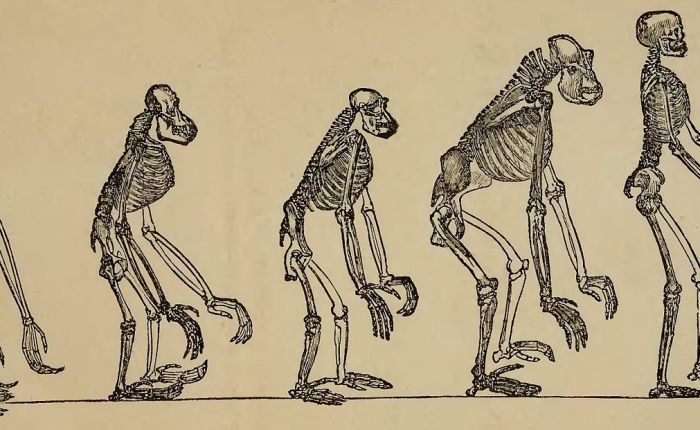
We thus begin with Homo erectus, learning how to chip away stone to make tools. As Bronowski notes, this simple ability, to chip away at a stone until a cutting edge is left, is a remarkable indication of human uniqueness. Since the behavior is learned and is not an instinct, it requires a preconception of what the toolmaker wants to create, a certain amount of imagination is required to picture the goal before it is realized. What’s more, creating a stone tool requires a sense of the structural properties of the rock. (I’ve actually tried making stone tools with various types of rock, and let me tell you that it’s not so easy. Even with an archaeologist giving me advice, I was only able to create stone tools of the sophistication of an Australopithecus—randomly beating the stone until a sharp edge was created.) Thus both our creative drive and our knowledge are involved in this quintessentially human activity. “Every animal leaves traces of what he was. Man alone leaves traces of what he created.”

This brings Bronowski to one of his main points, one of the themes of this series: that art and science are not fundamentally different; rather, they are two manifestations of the human spirit. What is this human spirit? It is a composite of many qualities, what Bronowski calls “a jigsaw of human faculties,” which include our wide behavioral flexibility, our capacity to play, our need to create, our curiosity about the natural world, our sense of adventure, our love of variety. Indeed, these can be pithily described by saying that humans retain many childlike characteristics throughout their lives. The name of the last episode is “The Long Childhood.”

One of my favorite sequences in this documentary is when Bronowski takes the viewer from the posts and lintels of the Greek temples, to the arches in the Roman aqueduct in Segovia, to the somewhat prettier arches in the Mezquita in Cordoba, to the cathedral at Reims with its magnificent flying buttresses. Each of these structures, he explains, is a more sophisticated solution to this problem: how do you create a covered space out of stone? The lintel and post system used by the Greeks leads to a forest of columns, and the Mezquita, although less crowded, is still filled with arches. The Medieval Christians achieved a magnificent solution by placing the buttresses on the outside, thus leading to the towering, open interior of Reims.

We’re used to thinking of this development as an architectural triumph, but as Bronowski points out, it was also an intellectual triumph. This progression represents better and better understandings of the structural properties of stone, of the force of gravity, and of the distribution of weight. And when you see it play out in front of your eyes, it’s hard to shake the impression that these marvelous works are also progressively more elegant solutions to a mathematical puzzle. This is just one example of Bronowski’s talent: to see the artistic in the scientific and the scientific in the artistic; and he does this by seeing the human spirit in all of it.

Here’s another example. Bronowski wants to talk about how humanity has come to understand space, and how this understanding of space underpins our knowledge of structure. How does he do it? He goes to the Alhambra, and analyzes the symmetry in the tiles of the Moorish Palace. Then, he bends down and spreads a bunch of crystals on the ground, and begins to talk about the molecular symmetry that gave rise to them. It’s such a stunning juxtaposition. How many people would think to compare Moorish architecture with modern chemistry? But it’s so appropriate and so revealing that I couldn’t help but be awed.

As the title suggests, this series is not simply about science (or art), but about science through history. Bronowski aims to show how humanity, once freed from the constraints of instinct, used a combination of logic and imagination to achieve ever-deeper conceptions of our place in the universe. This is the Ascent of Man: a quest for self knowledge. It’s sometimes hard for us moderns to grasp this, but consider that we are living in one of the brief times in history that we can explain the formation of the earth, the origin of our species, and even the workings of our own brains. Imagine not knowing any of that. It’s hard to envy former ages when you consider that their sense of their place of the universe was based on myth supported by authority, or was simply a mystery. I’m sure (and I earnestly hope) that future generations will believe the same about us.

Bronowski’s final message is a plea to continue this ascent. This means spreading a understanding and an appreciation of science, as his programs tries to do. This strikes me as terribly important. I’ve met so many people who say things like “Science is a form of faith” or “Science can’t solve every problem” or “Science is dehumanizing and arrogant.” It’s sad to hear intelligent people say things like this, for it simply isn’t true. It’s an abuse of language to call science a faith; then what isn’t? And yes, of course science can’t solve every problem and can’t answer every question; but can anything? Science can solve some problems, and can do so very well. And science, as Bronowski points out, is the very opposite of dehumanizing and arrogant. Science is a most human form of knowledge, born of humility of our intellectual powers, based on repeated mistakes and guesses, always pressing forward into the unknown, always revising its opinions based on evidence. Atrocities are committed, not by people who are trained to question their own beliefs, but by ideologues who are convinced they are right.

This is Bronowski’s essential message. But like in any good story, the telling is half of it. As I’ve mentioned above, Bronowski and his team are brilliant at finding unexpected ways to illustrate abstract ideas. This series is full of wonderful and striking visual illustrations of Bronowski’s points. What’s more, the man is a natural storyteller, and effectively brings to life many of this series’ heroes: Newton, Galileo, Alfred Russell Wallace, Mendel. He’s also a poet; one of his books is a study of William Blake’s poetry. This not only gives him a knack for similes, but helps him to explain how science is fundamentally creative. One of my favorite scenes is when Bronowski compares abstract portraits of a man to the ways that various scientific instruments—radar, infrared, cameras, X-rays—detect the man’s face. As he explains, both the portrait and these readings are interpretations of their subjects.

The cinematography is also excellent. There are some sequences in this documentary that are still impressive, saturated as we are with CGI. There are even some quite psychedelic sections. One of my favorite of these was a sequence of microscopic shots of human cells with Pink Floyd (who contributed music) jamming chaotically in the background. Unlike in Clark’s Civilisation, which uses exclusively ‘classical’ music and is devoid of special effects, the style of this documentary is surprisingly modern and even edgy. Another thing Bronowski does that Clark doesn’t, is include some information on non-Western cultures, from Meso-America, Japan, China, and Easter Island.

Yes, there are some parts of this that are outdated. Most obviously, much of the scientific information is no longer accurate—particularly the information on human evolution in the first episode. This is unavoidable, and is in fact a tribute to the ideals Bronowski championed. More jarring is Bronowski’s somewhat negative assessments of the culture of Easter Island and the lifestyle of nomadic peoples. Less controversially, he also has some negative words to say about Hegel. (Did you know Hegel published an absurd thesis when he was young about how the distance of the orbits of the planets had to conform to a number series?) Another mark of this program’s age is that Bronowski several times shows nudity and even a human birth. This would never fly on television today, at least not in the States.

But these flaws are minor in such a tremendous program. The Ascent of Man is a landmark in the history of science education and of documentary making, and a stirring vision of the progress of humanity by an brilliant and sympathetic man. I hope you get a chance to watch it.

View all my reviews

Review: The New Spaniards

Review: The New Spaniards

The New SpaniardsThe New Spaniards by John Hooper

My rating: 4 of 5 stars

The New Spaniards is an updated and revised edition of The Spaniards, which was originally published in 1986. The revisions were extensive, and thus this text does not feel at all outdated. For subject matter, Hooper casts as wide a net as he can in the span of 400 pages, tackling subject after subject in a succession of pleasantly short but informative chapters. One learns here of Spain’s government, history, economy, culture, music, cinema, monarchy, military, sexual mores, as well as some of the ‘centrifugal forces’ (as Hooper calls them) in modern Spain, the separatist movements in the Basque country and Catalonia.

It is useful to compare this book (as David does) with Giles Tremlett’s Ghosts of Spain. The books are, at first glance, quite similar: they are both about modern Spain, both were published in 2006, both are by British journalists who have spent much time living here, and, most importantly, both have yellow covers. But the approaches taken by the two authors differ considerably. Tremlett is personal and immediate; he is married to a Spaniard, has children in Spanish schools, and thus has a lot invested in the future of Spain. His book is thus more anecdotal; he frequently writes in the first person, telling us of his travels throughout the country, the people he meets, the food he tastes, trying to convey some sense of what it’s like to actually live here.

Hooper, by contrast, although he spent many years here, is now living elsewhere. Perhaps as a consequence of this, his tone is much more detached and (as much as possible in a book of this sort) objective. His writing gets straight to the point; he keeps the reader’s interest, not through storytelling or flashy prose, but simply by presenting insightful information clearly and succinctly. Thus, although somewhat dry, I often found the book hard to put down, as it is a veritable feast of facts, figures, particulars, and generalities. So I am heartily grateful, both to Hooper and to Tremlett, for now I feel fairly knowledgeable about my new home.

And what a fascinating place to call home. I’m somewhat ashamed that I had so little interest in Spain before I came here, for it is a country well worth knowing. As many Spaniards like to point out, Spain is “different.” Just the other day, someone remarked to me that “Europe begins at the Pyrenees,” which is a saying here. There is, apparently, a widespread notion among Spaniards that Spain is quite unlike other European countries. Perhaps this is because Spain didn’t fight in either World War I or World War II, and lingered under a repressive regime until the mid 1970s, more or less isolated from the anxieties of the Cold War.

But Spain is changing quickly. Arguably, the theme of both Hooper’s book and Tremlett’s is “change.” Justifiably so, when you consider that Spain went from a Catholic society where divorce was nigh impossible to one of the first countries to legalize gay marriage. And perhaps because many Spaniards think that their country lags behind, they have fully and enthusiastically embraced modernity. According to Hooper, moderno has unambiguously positive connotations here (something which I haven’t had enough time to verify yet). But one only has to skim the history of modern Spain to be convinced that, in the last forty years, Spaniards have thrown themselves into the future. Indeed, Hooper begins this book with the results of an international survey which found that, in Spain, there exists the biggest difference in basic values between the young and the old.

Though, of course, some things change and some remain the same. The Spanish attitude to work is, as far as I can tell, still quite different from both the United States and the northern European countries. After witnessing how much people work in New York, a Spanish friend of mine, with a worried look on his face, told me “Work is good, but there are other things in life.” Simply by walking around Madrid, which I’ve heard is one of the most hardworking parts of Spain, I notice a big difference. In New York, at rush hour, the streets are filled with legions of men and women dressed for work, cramming into the subway, all with vaguely worried looks on their faces. Yet here, rush hour is not very noticeable; in fact, it took a few weeks for me to notice it at all. True, at certain times of the day, the metro is likely to be more full of nicely dressed people; but never is it packed, and nobody runs for the train or tramples you on their way out the door.

The cultural attitude that has been programmed into me since birth is that work is a duty, and the more and the better work you do, the more worthy you are. The money earned is a marker of personal value; and the more accumulated, the better. Indeed, I know people who are tremendously successful and who make a great deal of money, but who are loathe to spend even chump change. The attitude here is quite the opposite. Spaniards seem to regard work as a necessary evil. This is not to say that they can’t or don’t work hard—during the recession, many worked themselves to the bone, and still do—but the idea that one’s productivity is a measure of one’s dignity, and the sort of perverse pride some people in the States take in staying long hours at the office, eating at their desks, and hardly sleeping or spending time with friends—this seems to be largely absent here. And while most people I know in the States think of enjoying oneself as a privilege to be earned through work, in Spain enjoyment is regarded as a right. Thus, while the rush hour here is easy to overlook, the crush of women wearing high heels and make up, and men with gelled up hair and collared shirts, is noticeable every night of the week.

Doubtless, what I’ve just written is a stereotype, lacking in depth or nuance. But if you want something more insightful, you’ll just have to read this book. It is a sweeping and penetrating look at modern Spain, written with authority and rigor. Indeed, it is a bit hard for me to believe that Hooper is a journalist, for this book lacks that characteristic myopia of most journalism, which concentrates exclusively on the present moment. Hooper, by contrast, is scholarly and maintains a historical perspective throughout. In short, I recommend this book heartily; and I hope that it inspires you as much as it has me to ponder modern Spain.

View all my reviews

Review: Homage to Catalonia

Review: <i>Homage to Catalonia</i>

Homage to CataloniaHomage to Catalonia by George Orwell

My rating: 4 of 5 stars

I have the most evil memories of Spain, but I have very few bad memories of Spaniards. I only twice remember even being seriously angry with a Spaniard, and on each occasion, when I look back, I believe I was in the wrong myself.

Autobiographies and memoirs are, I think, the best books to read on vacation. Not only are they light, easy, and entertaining, but they’re usually not hard to put down. This is important because, if you’re like me, you may end up spending your whole vacation with your head buried in a book. Most valuable, however, is simply seeing how an excellent writer transforms their experiences into stories. The vague emotions of daily life, the interesting characters we encounter, the sights and sounds and smells of new places—good autobiographies direct our attention to these little details.

In this spirit I picked up Orwell’s Homage to Catalonia to read during my trip to Seville. It was an excellent choice. It’s been a while since I’ve read Orwell, and I’d nearly forgotten what a fine writer he is. In fact, perhaps the most conspicuous quality of this book is the caliber of the prose. It is written with such grace, clarity, and ease, that I couldn’t help being constantly impressed and, I admit, extremely envious at times. The writing is direct but never blunt; the tone is personal and natural, but not chummy. The book may have been a bit too readable, actually, since I had a hard time prying myself away to go explore Seville (and a book has to be very good indeed to compete with Seville).

There seems to be a bit of confusion about this book. Specifically, some people seem to come to it expecting to learn about the Spanish Civil War. This is a mistake; Orwell only experienced a sliver of the war, and his understanding of the political situation was limited to the infighting between various leftist groups. The events and conflicts that led up to the war, and the progress of the war itself, are for the most part unexplained. This book is, rather, a deeply personal record of his time in the Spanish militia. We learn more about Orwell’s military routine than about any battles between fascist and government forces. More light is shed on Orwell’s own political opinions than the political situation in Spain.

If you come to the book with this in mind, it will not disappoint. His time in Spain made a deep impression on Orwell; he writes of it in a wistful and nostalgic tone, as if everything that happened occurred in a dreamy, timeless, mist-filled landscape, disconnected from the rest of his life. Characters come and go, soldiers are introduced, arrested, or killed in action; but we do not get acquainted with anyone save Orwell himself. The mood is introspective and pensive, as if it all took place in another life. Even when he is describing his friends’ imprisonment, or his experience getting shot in the neck and hospitalized, he manages to sound dispassionate and serene.

Two chapters, however, do not fit into this characterization. These are Orwell’s analyses of the political situation in Barcelona during this time. In some books, they are published as appendices—which I think is a good choice, actually, since they interrupt the flow of the book quite a bit. Despite the abrupt change in tone and subject-matter, however, they make for valuable reading. The machinations and petty political squabbles that went on during this time are astounding. One would think that having a common enemy in Franco would be enough to unite the various factions on the Left, at least for the duration of the war. Instead, the anti-revolutionary communist party ended up declaring the pro-revolutionary communist party (of which Orwell was a member, entirely by chance) to be a fascist conspiracy, resulting in hundreds of people—people who had spent months fighting at the front—being thrown in secret prisons. Orwell himself narrowly escaped.

Nevertheless, I think that Orwell’s analyses of the general situation in Spain should be taken with copious salt. He understands nearly everything through a quasi-Marxist lens of class-warfare, which I think fails to do justice to the complex political and cultural history of the conflict. Added to this, one gets the impression that Orwell’s command of Spanish was fairly rudimentary, which I think greatly limited his ability to understand the war. To his credit, though, Orwell does warn us about his limitations:

In case I have not said this somewhere earlier in the book I will say it now: beware of my partisanship, my mistakes of fact, and the distortion inevitably caused by my having seen only one corner of events. And beware of exactly the same things when you read any other book on this period of the Spanish war.

But these are minor complaints of a book which I found to be supremely well-written and absolutely fascinating. His accounts of life at the front were possibly the best descriptions of war that I’ve ever read, with the exception of those in Tolstoy’s War and Peace. This is not because Orwell saw very much fighting; quite the opposite. Rather, he conveys a sense of the crushing boredom and the sense of futility that many soldiers must feel during a long, draw-out war. Also superb was his portrayal of political oppression, the climate of fear and backstabbing that arose during the party conflicts in Barcelona.

Perhaps most impressive, though, is that, despite all of the hardships Orwell endured, and despite the obvious injustices inflicted on both himself and his friends, he does not come across as bitter or resentful. I leave you with his words:

When you have had a glimpse of such a disaster as this—and however it ends the Spanish war will turn out to have been an appalling disaster, quite apart from the slaughter and physical suffering—the result is not necessarily disillusionment and cynicism. Curiously enough the whole experience has left me with not less but more belief in the decency of human beings.


View all my reviews