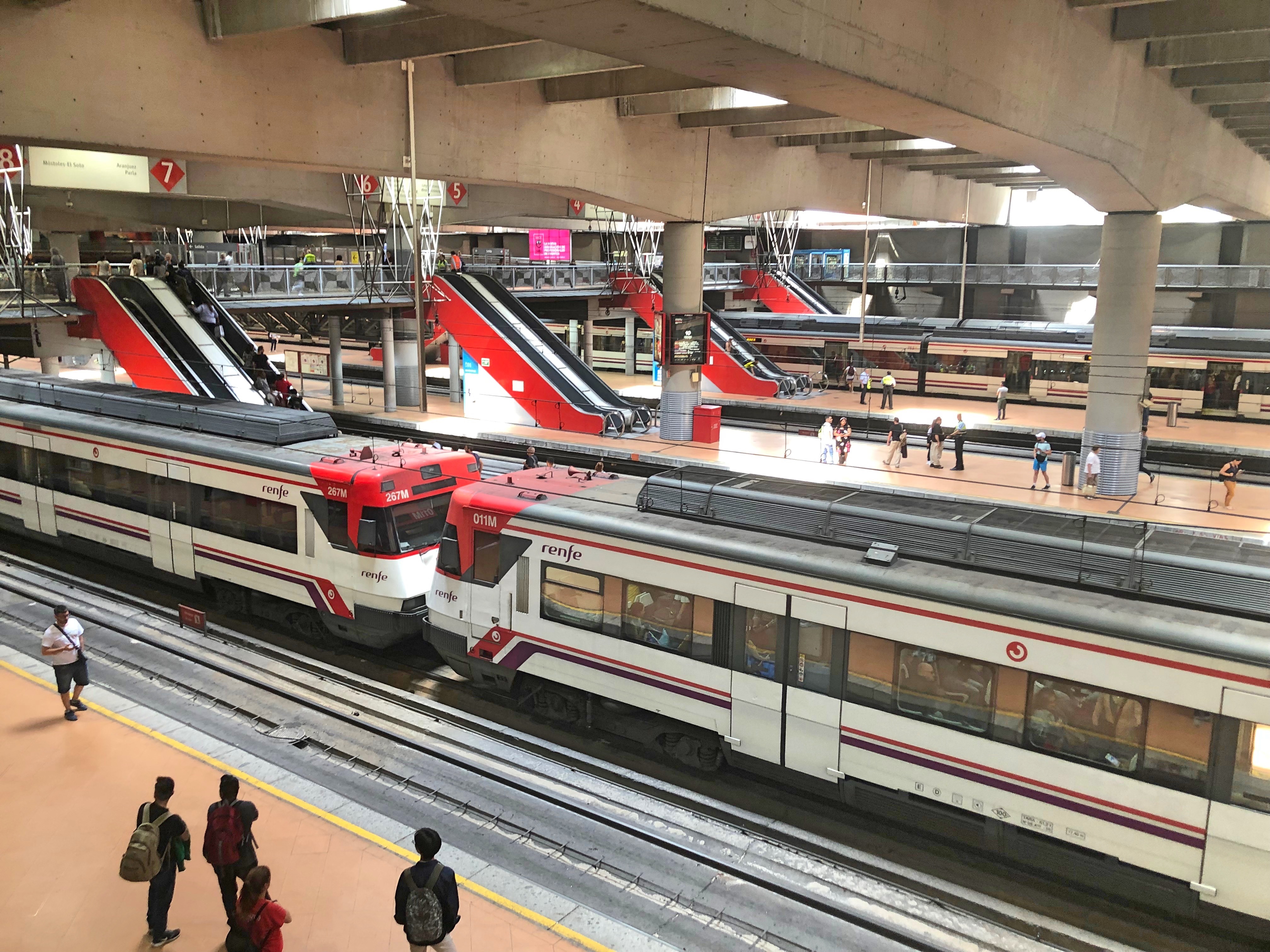
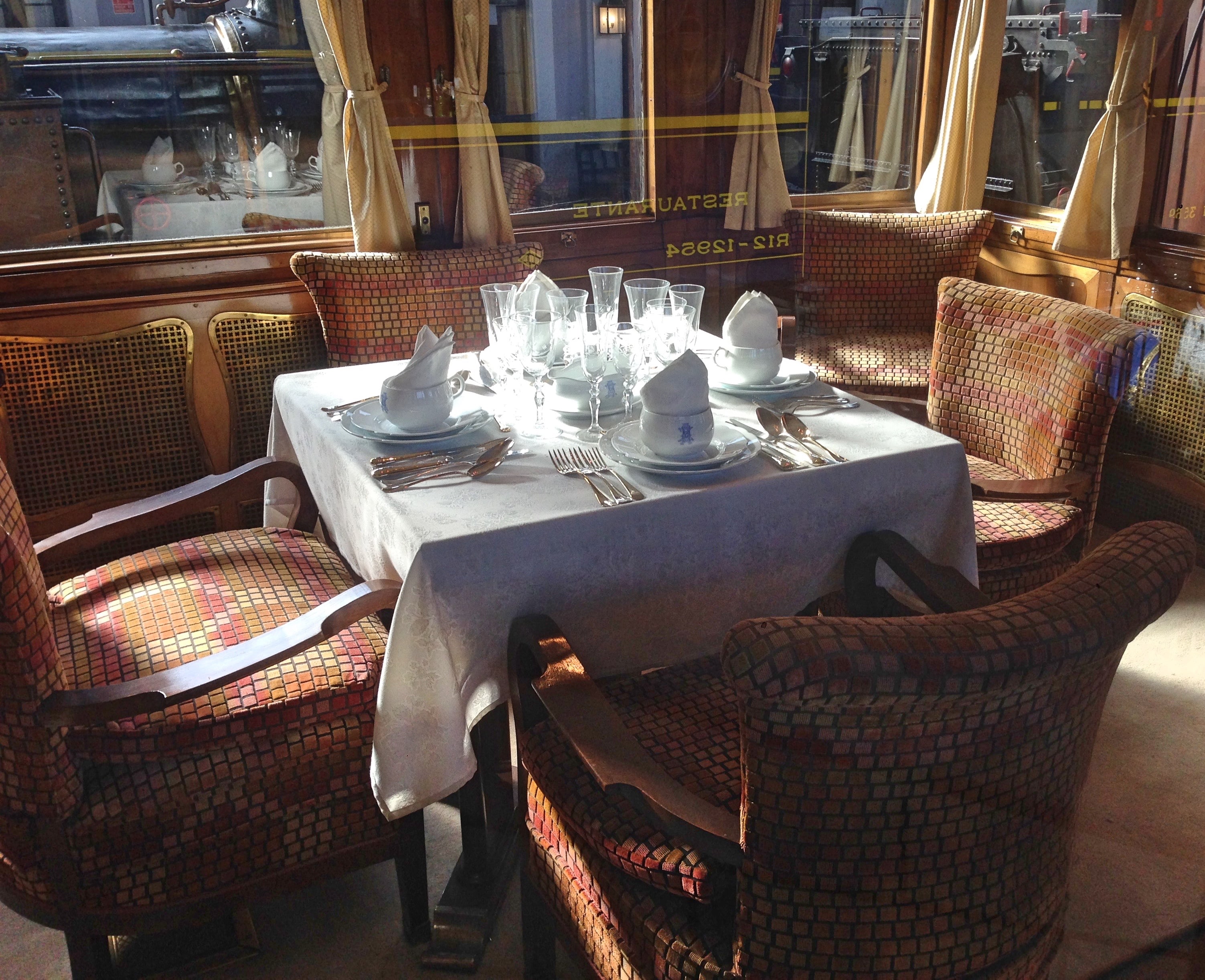
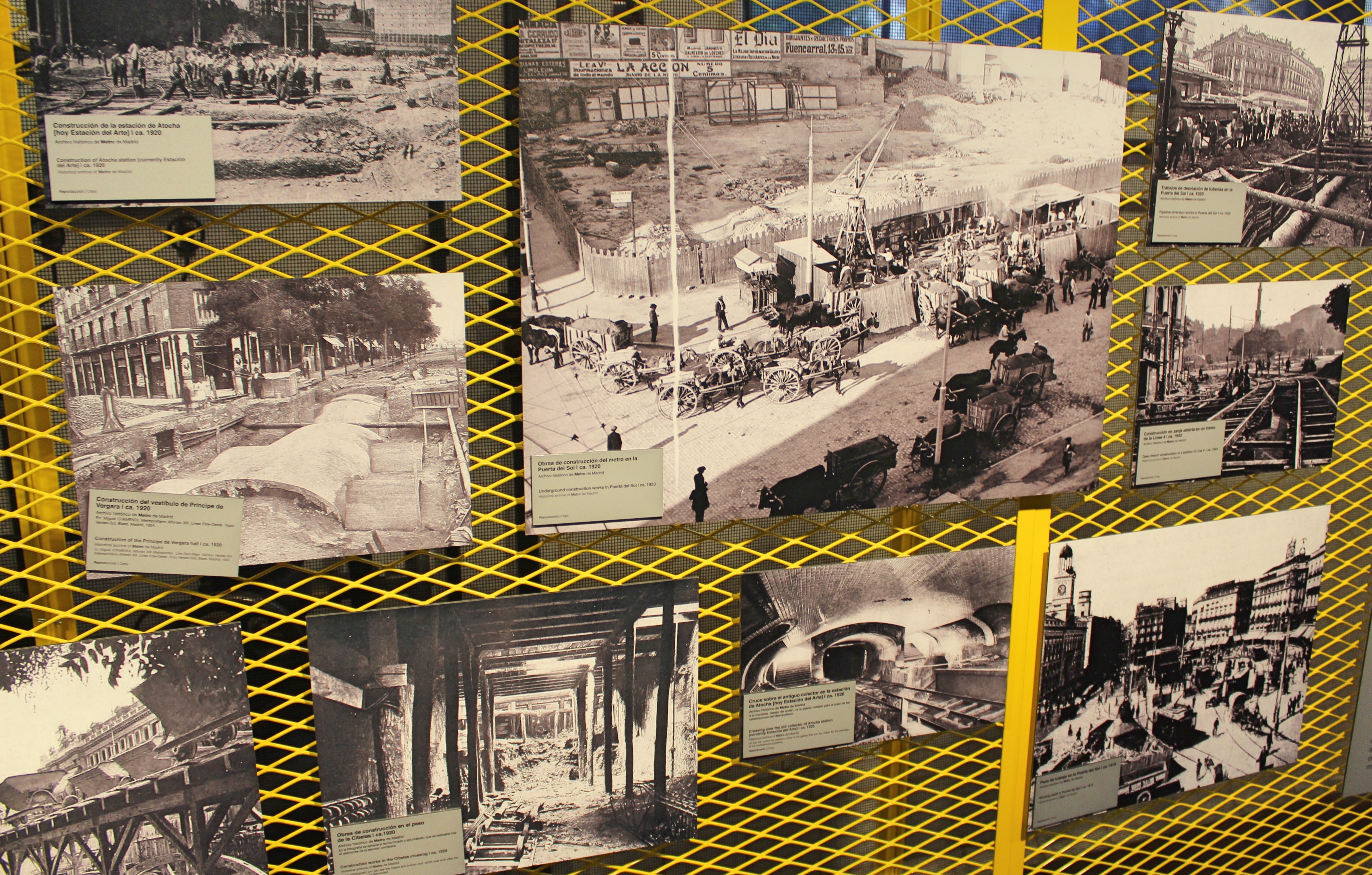
This year marks the 100th birthday of Madrid’s metro system, and the city is celebrating the occasion. Stations are being decorated, special exhibitions mounted, and festive trains displayed. And I think that we all should celebrate the metro—not just in Madrid, but everywhere—for it is one of those rare human inventions which has worked so well that it has become invisible. Though so often overlooked, the metro system of any city serves as both spine and arteries to the urban body: supporting and guiding development while moving the stuff of life from place to place. Chances are that, if you live in a city, you depend on the metro many times a week: to commute, to see friends, to run errands. Yet we only stop to notice this subterranean network when, for whatever reason, it stops working.
Like so many inventions in our modern world, the metro has been integrated so seamlessly into our lives that it can be difficult to realize what an enormous engineering triumph it represents. Thousands of workers had to tunnel through hundreds of miles of solid earth in order to lay down tracks and build stations; and the resulting network of subterranean passages has to be used every day, all year, without any cave-ins, collapses, explosions, asphyxiations—in short, while being absolutely safe and reliable. As a result of this collaboration of politicians, architects, engineers, designers, construction workers, and too many others to name, I can walk out of my apartment, down a flight of stairs, and then ascend on the other side of a city. For a very reasonable price.
Madrid’s metro is, in my opinion, especially impressive.Opened 56 years after London’s underground, 19 years after Paris’s métro, and 10 years after New York’s subway, Madrid’s metro has grown to become the ninth largest network in the world (and it is the network with the second-most escalators and elevators, only surpassed by Shanghai). The first line stretched a mere three and a half kilometers, traveling at 15 mph between eight stations. Nowadays, the network has 12 lines, 302 stations, and covers almost 300 kilometers. Very few places in the central zone of the city are more than a fifteen minute walk to the nearest metro. I am lucky to live near two of the most useful lines: the original Line 1, which goes through the heart of the city, and the circular Line 6, which makes a giant loop around the outside.
The entire sprawling network
Counting repeat rides, over two million people take the metro every day—well over half the city’s population. Notwithstanding all this, the metro remains clean, timely, and dependable. After four years of living in this city, I can recall very few times when I have been frustrated at the metro service (a constant occurrence in NYC). True, Madrid’s metro does not have a strong personality. It has none of the gritty charm of the New York subway or the endearing retro-ness of London’s tube. The metro is not especially futuristic, quaint, or beautiful. But it works—without screeching and howling, without unpleasant smells, without delays or derailments.
True to form, the metro’s celebrations have also been quiet, efficient, and unobstructive. They have largely consisted of decorating Metro Line 1, the so-called Centennial Line, with antique photos of the metro’s early days—riders in top-hats and trench coats, besmattered workmen excavating the tunnels, old-fashioned entryways amid a cityscape filled with vintage automobiles. One of the more amusing of these is of the King Alfonso XIII inaugurating the metro: the king stands in a pinstripe suit with his hands folded on a cane, a top hat hanging from its end, wearing a bipartite mustache; and surrounding him are dozens of men dressed and groomed identically. Fashion was very strict in those days. Apparently the current King Felipe VI has been so good as to repeat the voyage taken by his great grandfather.
For those who wish to get a deeper sense of the metro’s history provided by the photographs, there are two free museum spaces run by the metro: the Estación de Chamberí and the Nave de Motores.
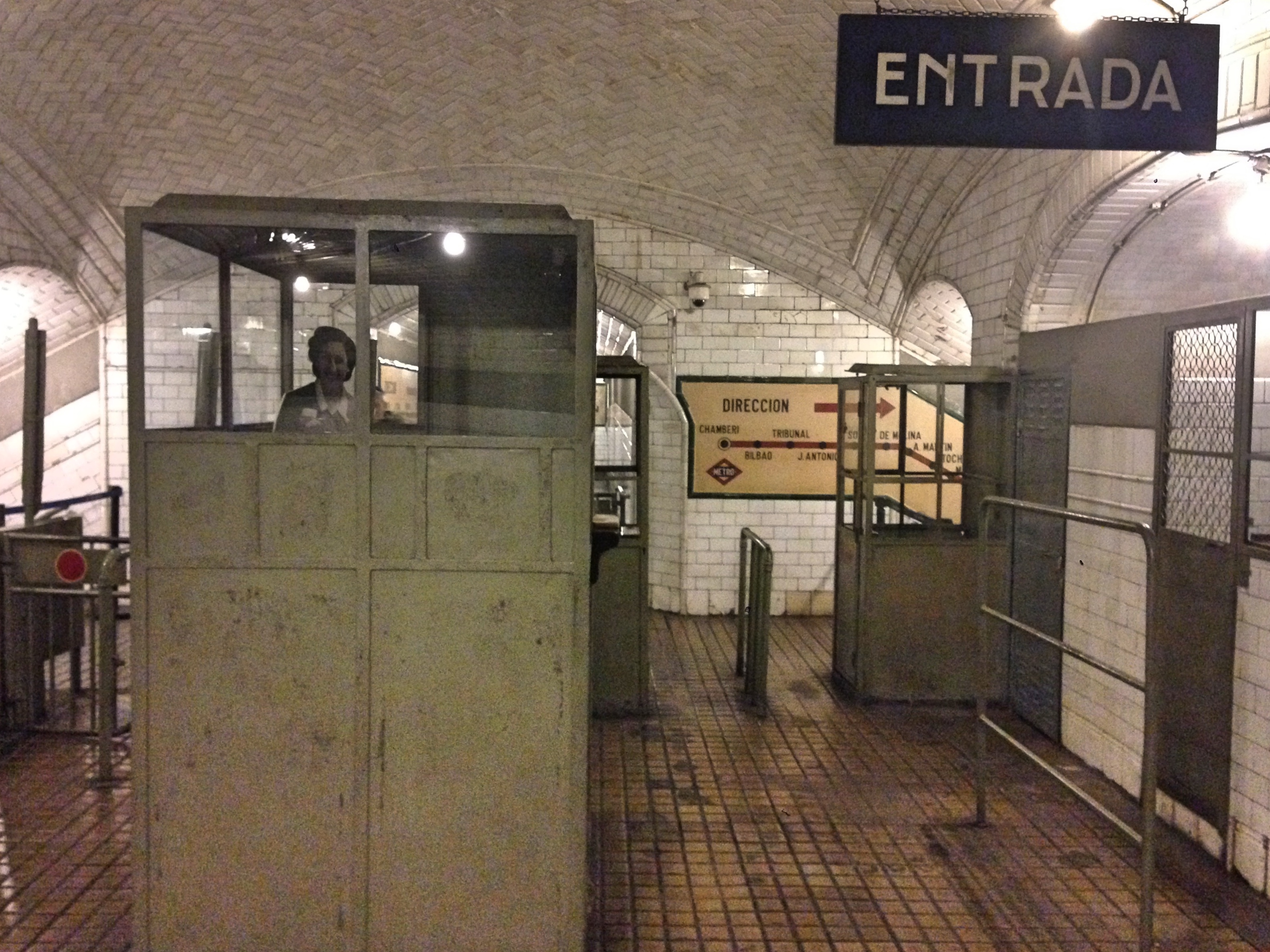
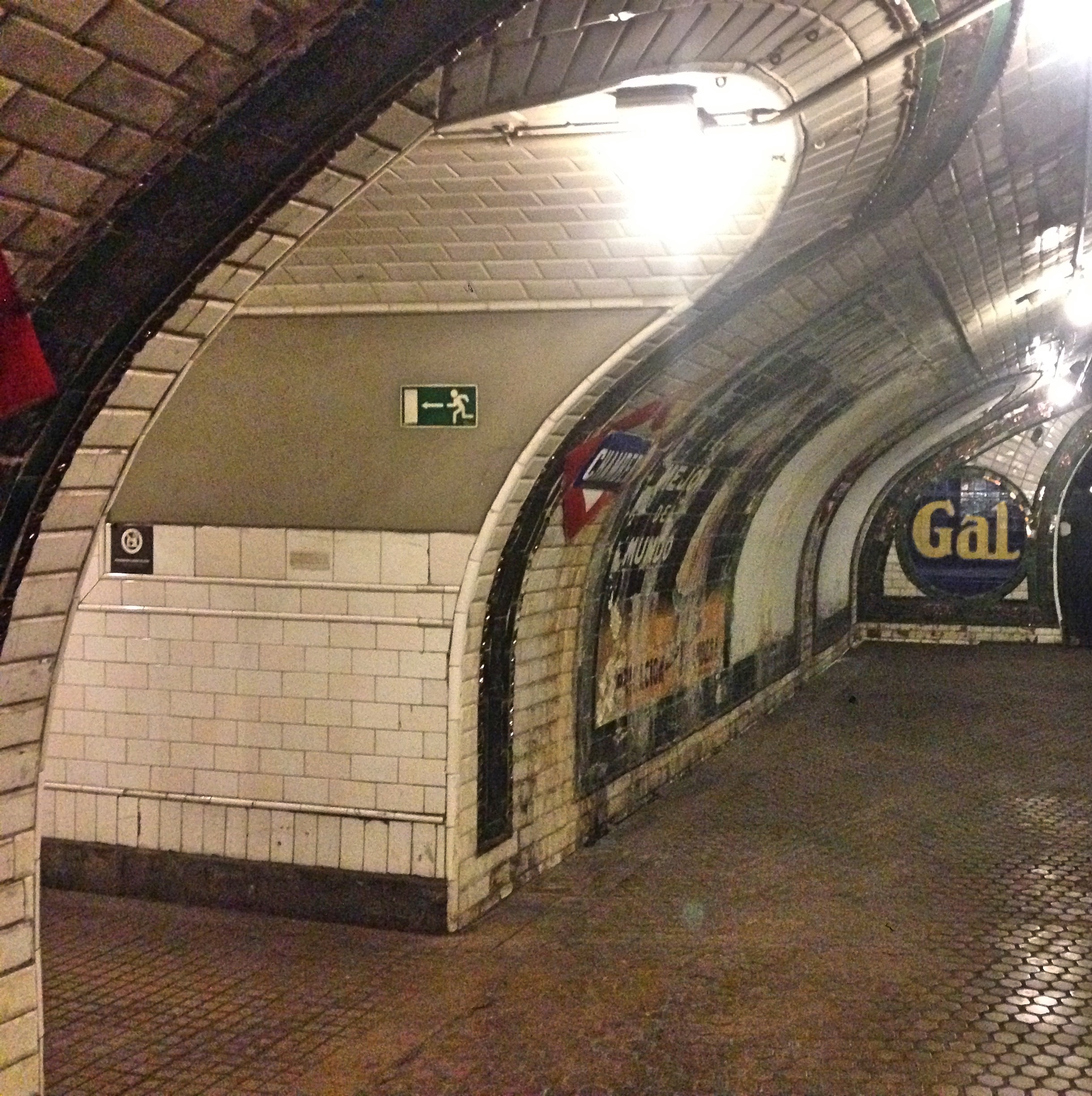
Chamberí was one of the first stations opened on Line 1. But like the City Hall station on New York’s Line 6, it was eventually closed down because the station’s curve was too sharp to be used with the newer, longer trains. As such, it became something of a time capsule, preserving the appearance of the first generation of train stations. Unlike the City Hall station, Chamberí was never designed to be an architectural showcase; it is simple and functional. Upon entering one passes the antique ticket-collecting booths, and descends to the old platform. Trains on Line 1 still scream past every five minutes or so.
When I arrived a guide was giving a free tour. Apparently, the station has a reputation for being haunted. You see, like many metro stations it was used as a bomb shelter during the Spanish Civil War, and the souls of victims are said to manifest occasionally to frighten visitors. Well, I did not see anything supernatural, but I did see many charming old advertisements—for cafés, hair gels, jewelry shops, and purgative mineral water. Few things are so evocative of the past as an ad for a product that no longer exists. These are the real ghosts.
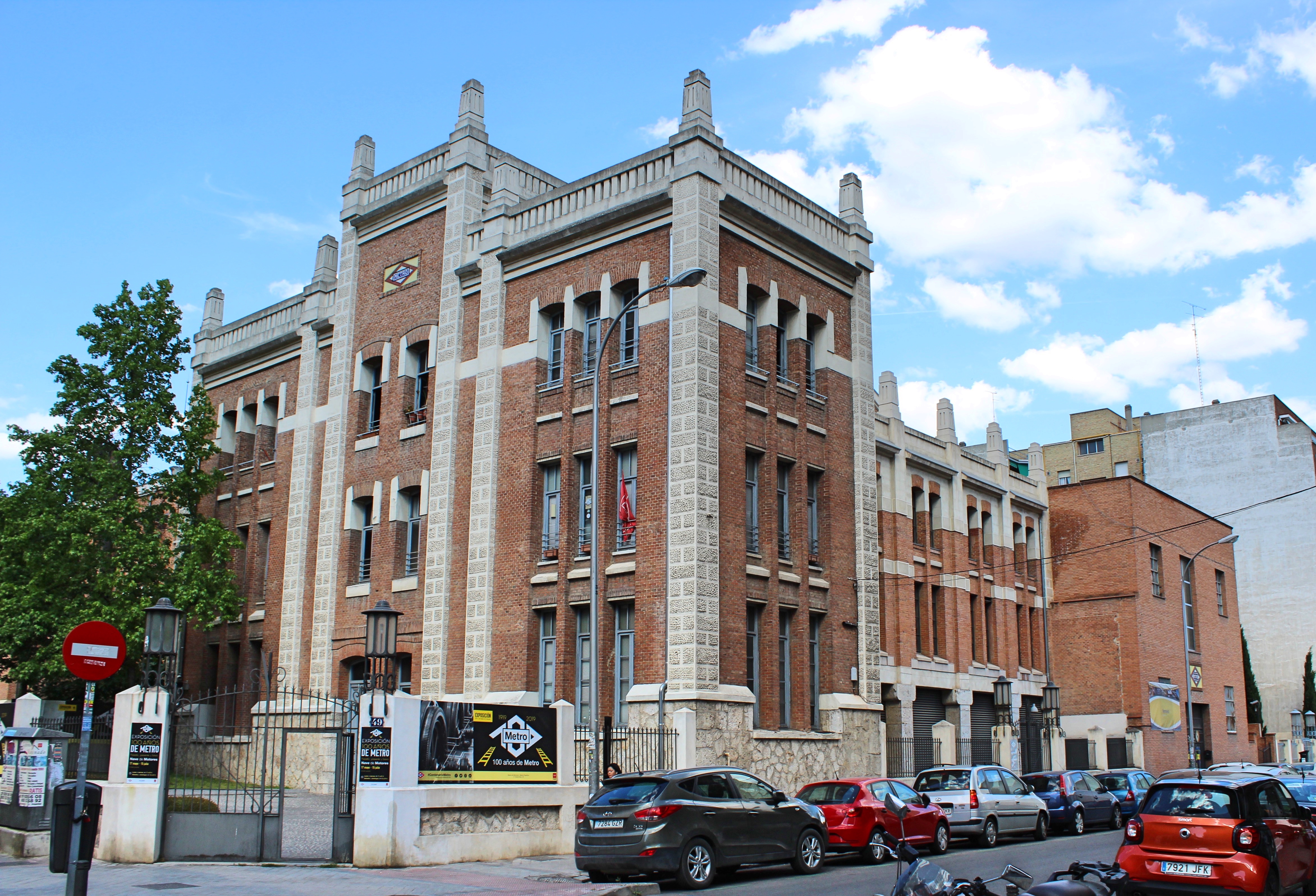
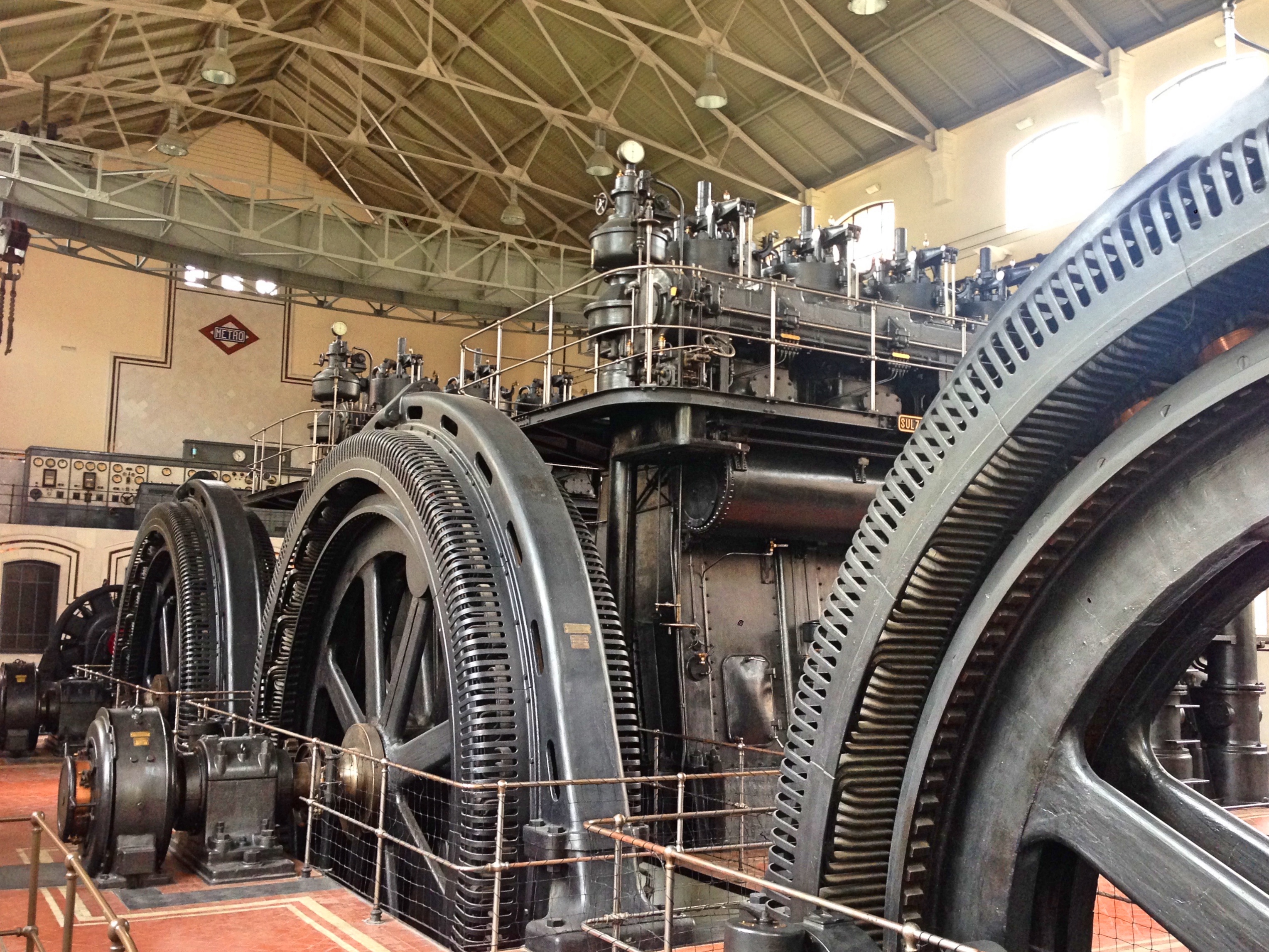
The other museum is, by chance, right in my neighborhood: the Nave de Motores. This is a cavernous building made to house three giant diesel engines, which used to provide power to the metro system. Just as the contemporary power grid was too feeble for the first generation of trains along the Hudson line, so Madrid’s electricity infrastructure did not support the power necessary to propel the metro. Thus, these engines had to be built especially for the purpose.
The Nave de Motores, in Pacífico
They are gargantuan contraptions, about half the size of a house. For a time this was the most powerful power plant in Spain. I cannot even fathom the noise they would create, much less the amount of fuel they burned. The current produced by these mammoth machines had to be converted by another array of motors before being wired down to the tracks below the station for use by the metro. On a balcony overlooking the engine space there is a control panel, where dozens of little gauges and meters informed the engineers of the state of affairs. (Apparently it is possible to sign up for a hard-hat tour of the tunnels below, but I cannot find the link on the metro’s website.)
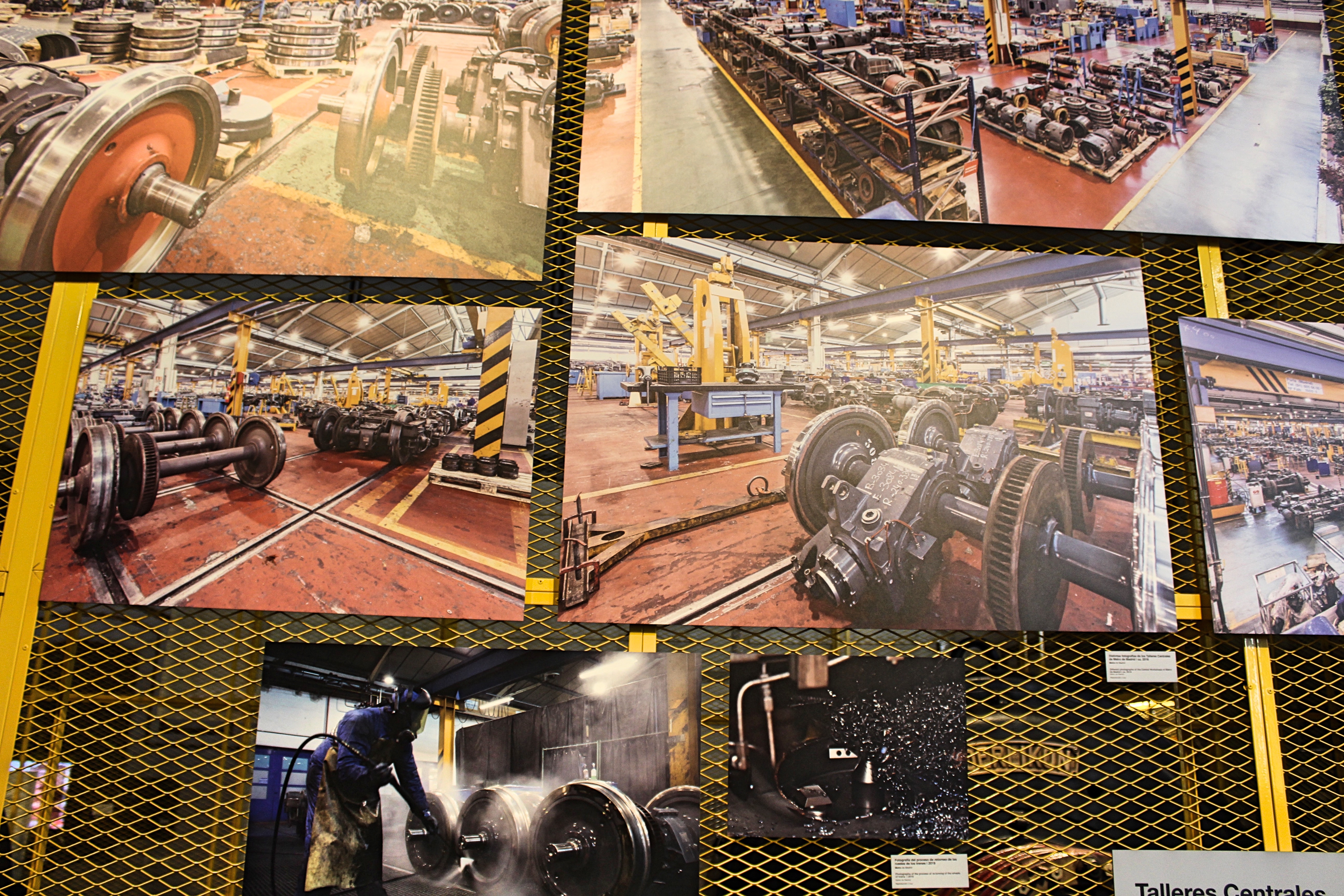
This month (May 17 to June 15) there is a special exhibition in the Nave de Motores, and the opening hours have been extended. The massive wheels have been decorated with lights, and informative panels have been put up all around the space. There are antique ticket machines on display, as well as different generations of metro tickets. One can even put on virtual reality goggles and look around a metro stop of the future. Videos of scenes from metro life are projected from the ceiling onto a table, while television monitors play informative mini-documentaries about the network. I was particularly impressed to see the testing and repair center, a huge warehouse where all the equipment is checked and fixed by a team of engineers and mechanics.
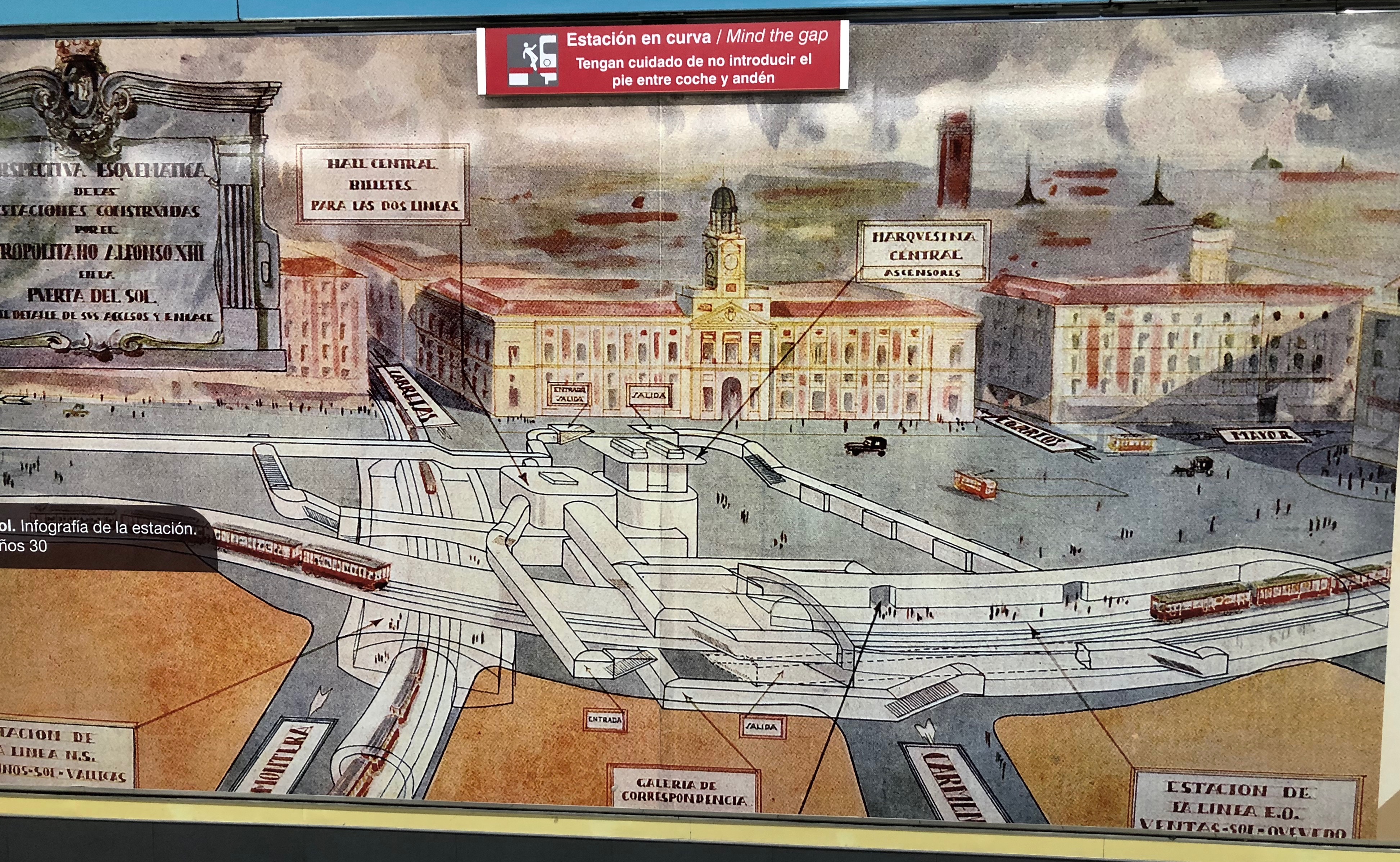
There were even a couple models on display, one of the tunnel-boring machine used to chew out the subterranean passages, and one of Sol’s metro station (one of the largest in the network). These miniatures help to give a taste of just how vast is the scale on which the network is built. Whole mountains of material had to be moved to dig out what is, in effect, another city underneath the city above.
The city beneath the city.
Work continues on the metro. Many of the lines have been adapted to allow for cell-phone service, which is much appreciated. Two years ago, Line 1 was closed for a few months for repairs; and Line 2 was recently closed for the same reason. (It has just reopened.) Every night, from 2:00 to 5:30 in the morning, the metro is closed down for repairs. It strikes me as strange that in Madrid, where people go out all night, the metro stops working, while in New York, where most people are home by 2:00, the subway runs all night. Maybe this is why Madrid’s metro runs so much more smoothly; but it is rather irritating on a Friday night.
The network has, for the most part, been entirely updated and transformed from its early years. However, one strange holdover remains. When the system was constructed, Madrid’s roads were like England’s: people drove on the left. Though the road orientation was switched in 1924, the metro kept is left-ward orientation, and so the trains always approach the station from the right as you are facing the train.
Madrid’s metro, like that of any city, serves a vital economic function: many people would not be able to get to their jobs without it. Aside from its economic function, however, the metro also serves as a center for social life. One becomes a native madrileño while riding on the metro: smushed up against bodies, eyeing strangers with anxiety or curiosity, respecting other people’s personal space with navigating the public space of underground transport. It is a place owned by everyone and no one, and so requires special rules to use. Don’t take up more than one seat. Take off your backpack. Give up your seat to the pregnant, the elderly, or the disabled. And don’t be a creep.
One also becomes socialized in more elusive ways. For example, the level of eye-contact considered acceptable on the Madrid metro can be unnerving for an American. Many newcomers to the city report feeling stared at. More than likely, they are just not used to the constant surveillance of Spanish city life—from shop windows, park benches, and balconies—and so misinterpret disinterested glances as either aggressive or suggestive, or both. Adapting to Spanish life means adapting to different standards of proximity and scrutiny. And much of this adaptation happens on the metro.
The metro can be a place of danger. Pickpockets are common, and their roaming hands are apt to relieve the unwary traveler of his wallet. It can also be an aggressive place. The only fight that I ever witnessed in Madrid was on the metro, between a young hothead and a homeless man. But the community quickly intervened, tearing the two kicking combatants apart. And this is the secret to the metro: that the citizens take an active role, however subtle or even invisible, in keeping it a safe place for everyone.
We can also ride the metro to get a taste of culture. In several stations there are miniature libraries, bibliometros (though I’ve never seen anyone actually use them). And apart from the decorations in some of the stations—such as in the stations of Paco de Lucía, Goya, and the Estación del Arte—there is the music. Hardly a station in the entire network is without its performer, singing and dancing in a busy corner, their hat covered in coins. Other musicians ride the metro, going from car to car, playing the pan-flute, singing duets, or rapping over a recorded beat. Admittedly this is not always welcome. Most of the time when I am on the metro I am trying to read. But city life is intrusive, in good ways and bad, and it isn’t for the rider to choose when and which.
Indeed, you might say that the metro represents Madrid in microcosm—both the frustration and the joy. There is the uncomfortable crowding, the long and wearisome commute, and the occasional bad apple. But just as often there is the snippet of overheard conversation, the random acts of kindness, and most of all the quiet assurance that you can get where you need to go.
So I say we should don our caps to the Madrid metro. We are lucky to have a system that is extensive, clean, cheap, and reliable. Take a ride on Line One. Visit the two free metro museums. And, most importantly, don’t be a creep.
Processing…
Success! You're on the list.
Whoops! There was an error and we couldn't process your subscription. Please reload the page and try again.
I have been a bad athlete for as long as I can remember. Apart from a brief and embarrassing stint on a soccer team in elementary school (all I can recall is spending an entire game crying my eyes out), I have avoided team sports all my life. And they have avoided me. In gym class I was always one of the last to be picked for a team. For all of middle school and high school I was tall, overweight, and consequently I had all the gawkiness and sluggishness of both conditions. True, I did spend a few years taking taekwondo classes in high school, and I was not so bad at it. But my unpromising career as a martial artist came to an abrupt end when all the stretching and kicking made it necessary to go to physical therapy for my aching, cracking knees.
Of all of the sports that I have failed at, the most conspicuous is running. Every year I dreaded the day in gym class when we would be made to run a mile. I always began with the hope that, this time, I would be able to run the whole thing without stopping. After all, nearly everyone else could. But inevitably, less than halfway through, I would run out of breath and have to walk; and I spent the rest of the time alternating between a wheezing run and a panting walk. Not once did I manage to run a mile in less than ten minutes. Just as bad was the PACER test, when we had to run from one end of the gym to the other within progressively shorter intervals, signalled by an ominous beep. The real studs were able to get to level nine, while I gave up far before that—defeated by the high-pitched tone.
This long and undistinguished experience taught me that I would never be a runner. My knee problems only added to this belief. So, after high school, I never tried. I was pragmatically and philosophically committed to a life of inactivity, with the sole exception of walking (a true intellectual’s sport). But then something happened to break my conviction that I could not run.
Last year, I got into the habit of leaving my apartment at the exact minute needed to catch the bus. Sometimes I left a little late, however, and this put me in a dilemma: walk and miss the bus (and this would mean arriving late to work), or run and catch it. My fear of being fired overcame my combined fears of looking foolish, getting my clothes sweaty, and dying of suffocation. So I ran. It started with only a half of a block, just a short sprint to catch the light. Then it became the whole block, and eventually two blocks—sprinting for the light, stopping, sprinting for the next light, stopping again—until I would run almost the whole way to the bus. And the strangest part is that I did not hate it.
Still, nothing changed. I did not participate in my school’s “Race Against Hunger,” a charity race that we do every year. Instead, I sat by the sidelines feeling bored and useless. I did not even own a pair of sneakers. Nevertheless, circumstances were quietly conspiring to make running a reality. Aside from my bus sprints, living in Europe had left a mark. On all my travels I had tried to walk as much as possible, mostly to avoid paying for taxis and buses and trains; and this had made me a resolute trekker, capable of walking miles under the hottest suns.
All of this unintended athletic experience culminated in a growing curiosity: Could I, finally, after a decade of not running, run a mile without stopping? Sure, I was no athlete; but I was skinnier and in better shape than I was in high school. That adolescent experience had left within me the iron conviction that a mile was an impossibly long distance for me, and that my body was simply unable to do it. Yet in the spirit of science I wanted to test this conviction.
So, one cold February day, I went to a sportswear store with my brother. I could not have felt any more out of place as I looked at sweatpants, recovery gels, and headbands than if I had wandered into an Aztec ritual sacrifice. This was not my world. But I managed to buy myself tights, sneakers, and an armband for my phone, feeling absolutely ridiculous all the while.
That same day I carried my purchases home and prepared for my trial. The tights were, well, tight; the armband was awkward to use. When I walked out into the street, I felt acutely embarrassed, as if everyone was staring at me. I had not worn athletic wear since… actually, I don’t know. What was I doing? Long before I began to run, my body became flushed with adrenaline. I was certain that I was about to make a fool of myself.
The walk to the park, where I would begin my run, seemed endless. But finally I arrived. This was the fateful moment. I opened the app, Runkeeper, and started the tracking function. Then, I fumbled in getting it into the armband holder, and then fumbled again in putting it on my arm. Now the run began—slowly. The first steps felt strange. Retiro Park seemed to bounce up and down. I remember finding it odd that I could enjoy the beauty of the trees while running; I had assumed that I would not be able to think about or appreciate anything.
Sure enough, the tightness in my lungs soon came, that horrible feeling of suffocating. But it was never powerful enough to make me want to stop. I kept going until I got to the artificial lake, and then I turned left and then left again, to complete the circuit. The ground was mostly flat but there was a slight hill near the end, and I thought my chest would explode as I crawled to the top of it. Finally, and unbelievably, I made it back to where I had started. And I had run the entire time. I checked the app—1.12 miles, at a pace of 9:39 per mile. For the first time in my life, at the age of 27, I ran a whole mile.
The months that followed were full of constant surprise. The biggest was that I actually enjoyed running. I did not necessarily enjoy the physical sensation of running; the mythical runner’s high eluded me, and I felt mostly pain and exhaustion. But I did enjoy improving; and I improved with every run—running longer distances at faster paces. Unlike writing or playing music, running can be measured objectively, in simple, cold figures. There can be no dispute over which runner is better or worse. This makes progress very easy to see and, consequently, very satisfying.
I chatted about it incessantly, even getting mildly obsessed with the subject. It felt genuinely surreal to be spending so much time thinking about an athletic activity: this was not me. More important, it felt liberating to see myself as someone who could actually do something physical. My carefully constructed self-image as a delicate intellectual had cracked and crumbled. I felt as if a new continent of experience was now available for exploration.
Eventually, my coworker, Holden, suggested that I do the half-marathon. He had signed up for the marathon and had been preparing for months. At first I dismissed the idea as absurd. The longest I had run at that point was six miles, at a very sluggish pace, and it nearly killed me. Yet, the idea was implanted in my head. I thought of the feeling of triumph, of surpassing even my most ambitious running goals. And, of course, I imagined how much weight I would lose in the process of training (it wasn’t much). So, I paid my 40€ (somewhat indignantly) and signed myself up. Now the serious training would begin.
This consisted of one long run a week, in which I tried to increase my maximum distance by one mile, and several shorter runs wherein I worked on my speed. This regime got me to 13 miles two weeks before the day of the half-marathon, April 27 (it had been moved up a day because of the elections on April 28). On my long runs, I would end up going so slowly that I struggled to pass old ladies with canes. But at least I knew that I could go the distance.
Finally there was only one week until race day. I was nervous. Somehow, I was certain that I was going to do badly and disappoint myself. It did not matter what time I got, of course, but I had decided that I was to run the race in less than two hours—not an easy thing for a beginning runner. I followed all the typical advice, taking a break in the days before the race and stuffing myself with platefuls of pasta. By the time Saturday came around I was well-rested, well-fed, and as prepared as I could have been. Would it be enough?
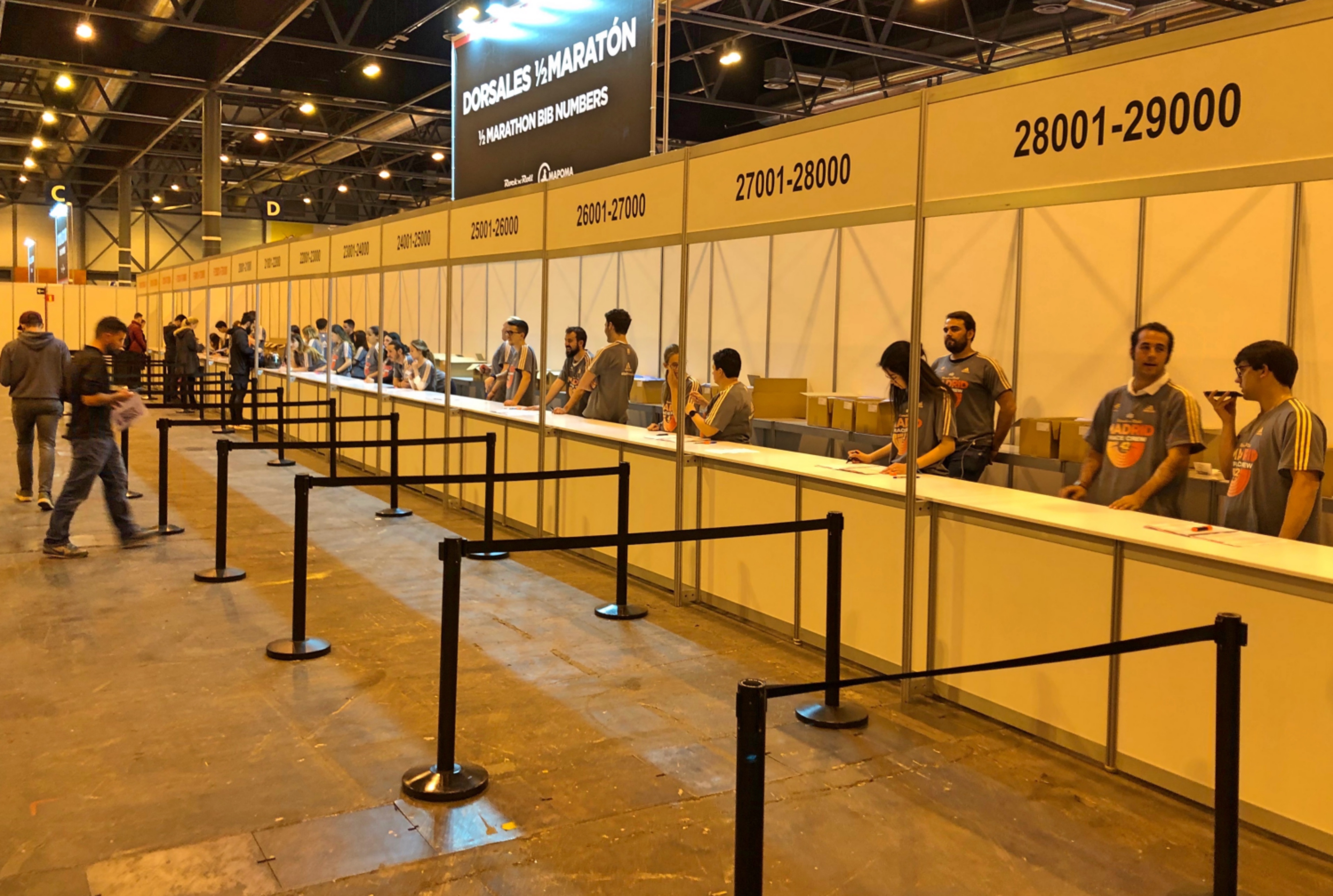
Two day before the race I picked up my bib (the little paper with your number on it, and a chip so they can track your movement). Annoyingly, they put the pick-up location all the way out in Feria de Madrid, a large complex of expo centers on the outskirts of the city. It took some time just to get there; and then it took some time just to walk through the mammoth buildings to the proper hall. There, a series of volunteers in booths gave me a bib, a t-shirt, and a drawstring bag. The rest of the space was full of other booths offering running-related products and services—energy gels, massages, protein powders. Probably many had free samples; but it was late and I wanted to go home.
The next night, I attached the bib to my sleeveless running shirt with safety pins. I was officially ready.
Race day.
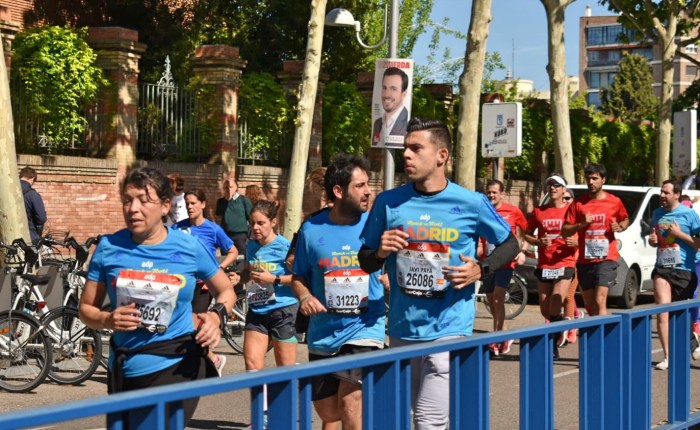
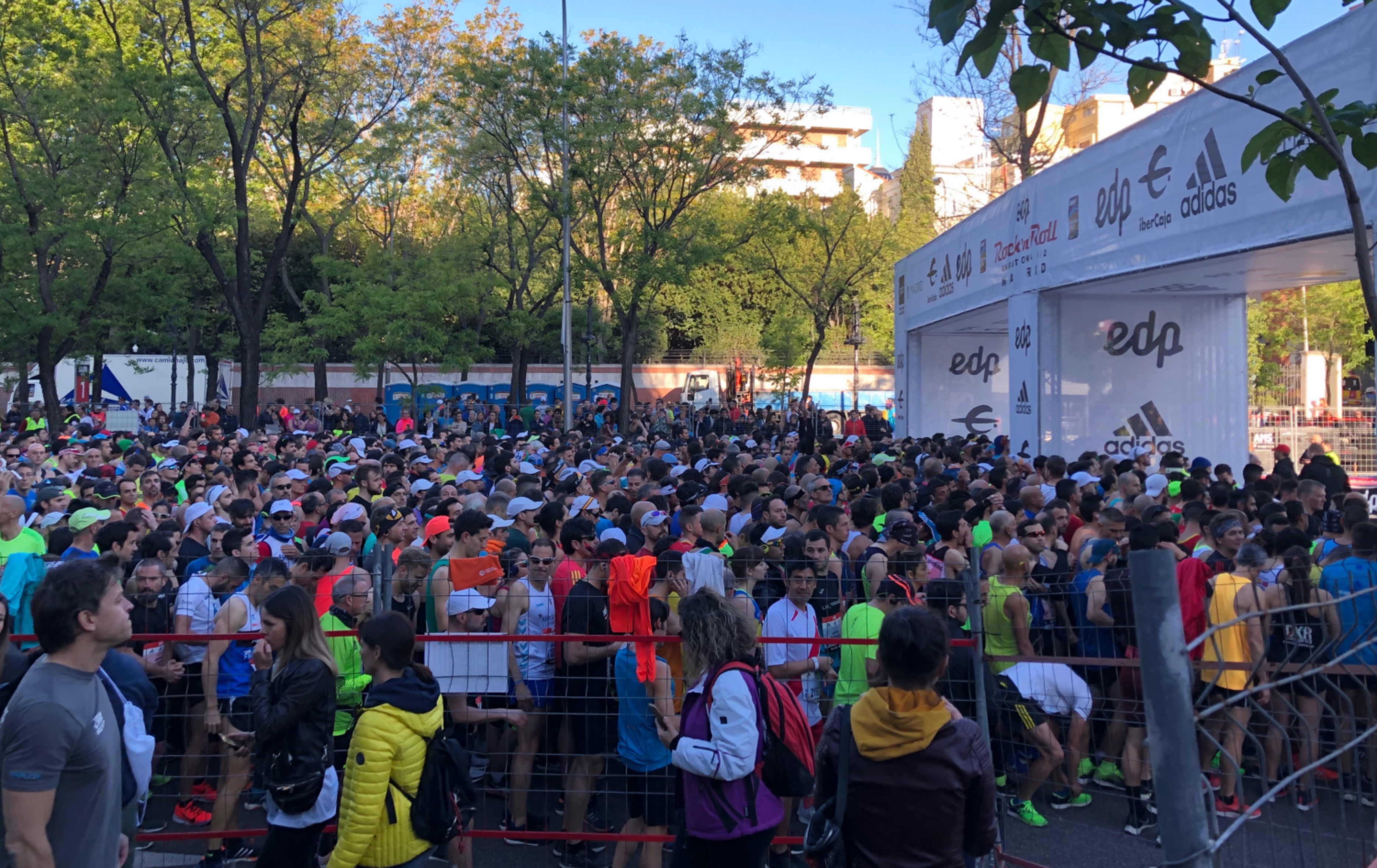
I woke up, ate toast and peanuts, drank water and coffee, and headed out the door. I had been told that it’s best to warm-up a bit before the race, so I jogged about ten minutes to the train station. When I walked out of the train, I was surrounded by thousands of men and women in colorful sports clothes. I did not realize it was such a massive undertaking. Stalls were set up for clothing drop off; hundreds of port-a-potties lined the streets (all without toilet paper); rock music blared from enormous speakers. The closer I got to the running corrals, the more I was awed at the sheer size of the event. 35,000 people were running that day—the 10k, the half-marathon, and the full marathon. William the Conqueror had conquered England with fewer.
I waited, warmed up again, and waited some more. Finally it was time to get into my corral. It was like being in a nightclub—a packed mass of bodies. How could I run through this? Rock music blared. The announcer counted down. Athletic-looking people were dancing (motivationally?) on elevated platforms in the middle of the track. They had spent a lot of money on this thing.
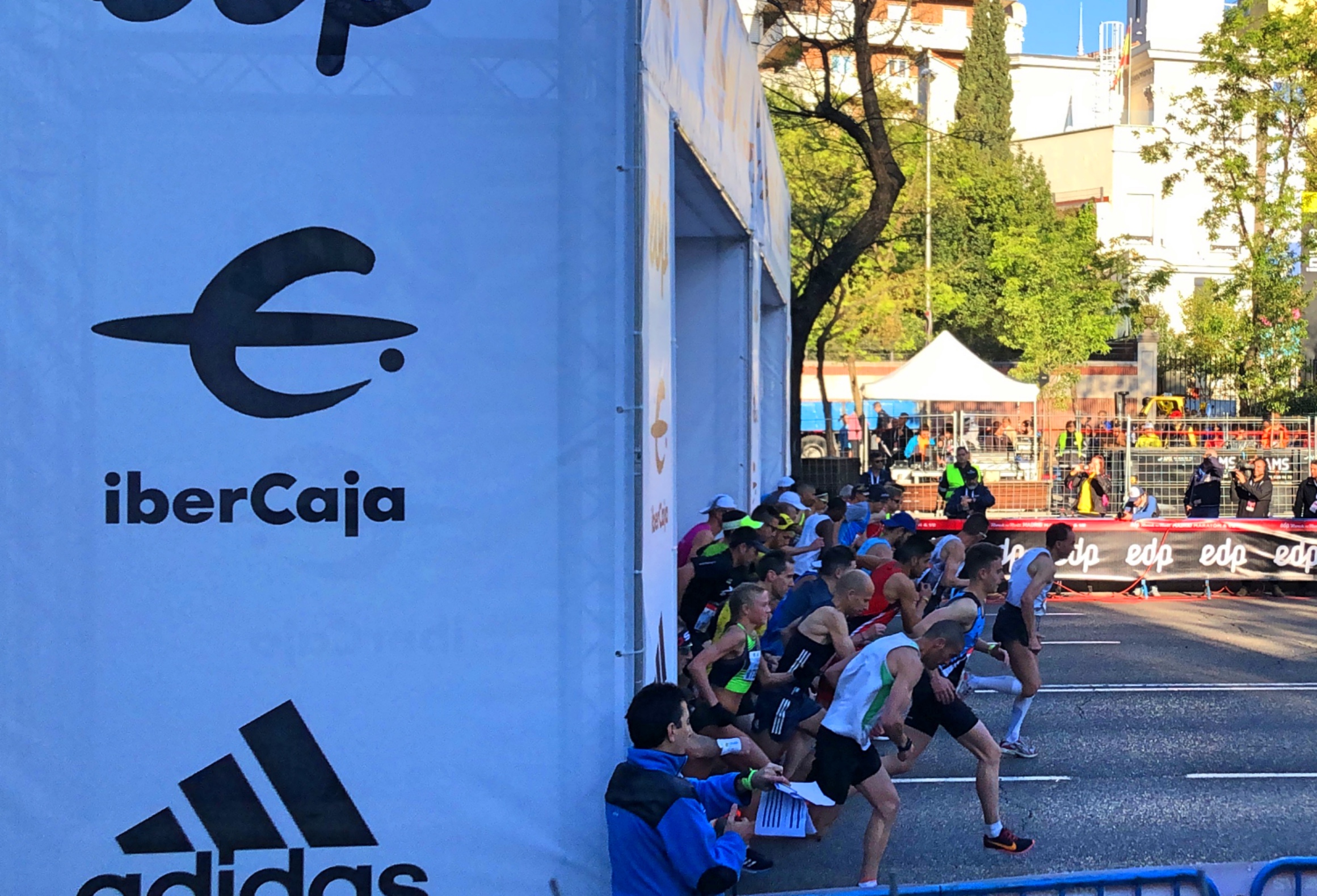
Finally the signal was given. I tensed for the exertion; but it was a bit anticlimactic, since the whole mass of people had to walk to the starting line before they actually began running. There were people holding big blue balloons with times on them; they were professional pacers, and would run the race at exactly the time indicated on their balloon. I struggled to find the 2 hour balloon: it was several hundred meters ahead, and had started before me. Finally I crossed the starting line and found myself jogging in a loose formation.
“Hey man,” I heard a voice say. I turned to see David, a friend I had made in my masters program. He had helped me work on my speed in preparation for the marathon, as I struggled to keep up with him on our weekly runs around Retiro Park. (This is something I discovered during training: running with better runners makes it easier to push your limits.) Soon it was apparent that he was still faster than me, as he pulled away through the crowd of runners. Besides David, I knew four other people running that day, but did not see a single familiar face during the whole race, even though our finishing times were mere minutes apart.
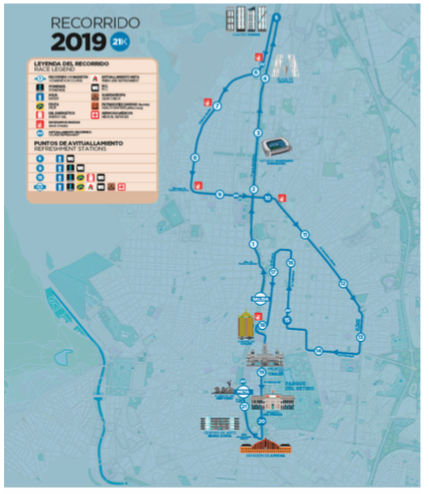
Peter Sagal said that anyone could run the first mile of a marathon, since it gives you the sensation of running with a mob. Unfortunately I did not feel the same way. Most people were fairly quiet, just focused on the long trail ahead; nobody burst forward in a mad dash. Our route took us straight north from the starting line, up towards the four skyscrapers near Chamartín station. The organizers had planned the route well, since these first 5 kilometers was the only stretch that was consistently uphill. After we turned the corner to go back south, it was smooth sailing.
The route
Without the reference of the balloon, I did not know if I was going fast enough. I tried to keep a constant pace, not pushing too hard but not going easy. The presence of so many other people was surprisingly motivating. I felt as if I were being urged ahead by a social force, and all I had to do was to follow the wave. For the most part there were not many onlookers—just a few scattered people cheering us on. I appreciated it. There are few sports more boring to watch than long-distance running.
The pacers in action. Photo by Rebeca López.
Fifty minutes in we passed our first water station, and I felt like a real professional as I drank my bottle on the move. I also took this opportunity to have some of the energy gel that Holden had given me. This is a cocktail of vitamins, sugar, and caffeine that tastes horrible but it has a satisfying effect. Suddenly I felt optimistic—even chipper. The exhaustion lifted and I felt my stride grow longer. Was this the elusive runner’s high? Probably it was just a caffeine rush, but it felt great nonetheless. As I reached a downhill area in the neighborhood of Salamanca, I began passing some runners ahead of me—which is strange for me. Also strange, I began to talk to myself in almost ecstatically encouraging tones: praising myself and egging myself on. Caffeine is an amazing drug.
As is often the case in Madrid, it was a perfect day to run: a clear blue sky, no wind, no humidity, and not too hot. I am not sure that I ever saw so much of Madrid in a single day, and the city looked beautiful in the sunlight. This is one of the great benefits of running: it makes you feel a part of the community. I had already experienced this during my practice runs in Retiro Park and Madrid Río. Because you are outside, covering plenty of ground, surrounded by others, you feel that you are really getting to know a place and to belong in it. That day, I felt like I belonged in Madrid.
Just as we reached the end of the hill, we passed through a small tunnel. There were people cheering on the road above. But the real noise came from the runners, who shouted and whooped as soon as they passed underground, making the space reverberate with a kind of barbaric din—a war cry for amateur athletes. I added my own feeble contribution to the chorus of adrenaline, and felt for a moment as part of something bigger than myself, as just one pulsating cell of an enormous beast. This feeling, I thought, is why people run these ridiculous races.
This sensation soon passed, as did the euphoric effect of the caffeine, and the usual pain and strain came back. Luckily, I soon reached another water station, and then swallowed the rest of my energy gel, which gave me another boost. But I could tell that my reserves were running low.
This particular marathon was a “rock ‘n’ roll” race, which meant that there were stages set up periodically along the course where local rock bands were playing. I must admit that I did not find the music particularly animating, partially because I was able to hear so little of it as I ran by. The cheering of the crowd was somewhat more uplifting, especially when I noticed my friend Monica calling my name. But by far the most motivating factor were the other runners, sweeping me up into a constant forward motion.
Partially because the race was a “rock ‘n’ roll” marathon, I decided to run it without headphones. This was the first time I had ever done a long run without my trusty audiobooks keeping me company, and I was afraid that I would get bored. But it turned out to be a good choice. Free from the distraction, I was able to focus my energy on keeping myself going at a steady pace. Indeed, the extended focus on my breath and my moving limbs made the experience at times rather meditative; I was completely absorbed in the experience of the race. Another advantage to not using headphones is that I did not have my running app telling me how much distance I had covered. This was a very strategic sort of ignorance, since it allowed me to keep pushing without fear of burning out too early.
Photo by Rebeca López
I started to enter more familiar neighborhoods, and I knew that I was in the final stretch. The more I ran, the more impressed I became at the scale of the marathon: they had to shut down half the city for us. Now I knew why I had paid 40€ to run. Still, city life tried to go on—in particular the life of the elderly, who refused to stop for any sweaty army. More times than could possibly be a coincidence I had to stop or swerve to avoid an octogenarian slowly crossing the race course, cane or walker in hand. They were either very brave or quite blind.
Soon I passed several men and women shouting directions at us: those running the full marathon had to turn left, while us half-marathoners continued straight. I knew from the map that this meant that we were in the final stretch. I did my best to push myself to go faster, but my whole body was achy and unresponsive. So I compromised by trying not to slow down. A small woman with a very loud voice started yelling what she meant to be encouraging slogans to us, most of which were about the beer waiting for us at the end. This failed to motivate me, I am afraid, since the thought of drinking beer after getting so dehydrated filled me with disgust.
It was around this time that the thought finally crossed my mind that I would very much like to stop. I had been running for almost two hours by then, and I was tired and even bored, and the finish line was failing to materialize. Luckily the course started taking us downhill, past Retiro Park on the way towards Atocha. At this point I spotted Rebe, to whom I had delegated the task of taking photos of the race for this blog. She was busy at work—so busy, in fact, that she did not notice me until I was right about to kiss her.
Photo by Rebeca López. I am on the far left.
Now it was truly the final stretch. We got to the bottom of the hill, into the Plaza del Emperador Carlos V, and then began up the Paseo del Prado. The finish line finally came into view. I was afraid to look at it, since I thought it would be too discouraging to see how slowly it came nearer; so I looked at the ground. The loud-voiced woman started shouting even more loudly and insistently. The crowd around us started to roar. I could hear music.
Before the race, I had imagined that the sight of the finish line would fill me with a final burst of energy, and I would be able to spring the last few hundred meters. But when I tried to speed up my body rebelled; it hurt too much; so I contented myself with, once again, keeping an even pace.
When I was within 100 meters I looked up and beheld the goal. Again, I tried sprinting, but it was impossible. So I jogged under the gateway and across the finish line, weakly raising my arms in tired triumph. I was done. Again, I had assumed that I would immediately feel transports of joy and accomplishment, but I was too exhausted to feel or to think anything—except, of course, at how exhausted I felt.
After the finish line volunteers were distributing medals, water bottles, and little bags full of food: a banana, an apple, a chocolate croissant, and a bottle of Powerade—for which I was extremely grateful. I started gulping down the water as I limped out of the race area and into the Plaza de Cibeles. Somehow, Rebe immediately found me, and we sat down nearby while I slowly recovered the ability to speak. My face was marked with salty-white streaks of dried sweat, my clothes were completely soaked, and I walked with an awkward limp. But I felt fantastic, and only felt better as the day progressed. Indeed, the sense of accomplishment, blended with complete bodily relaxation, creating one of the most pleasant days I can remember.
My final time was 2:05, which is five minutes above my goal time, but still easily the best I had ever run. I felt completely at peace—with myself and with the world. And I finally discovered the most valuable benefit of running: not losing weight, nor being healthy, nor even the sense of accomplishment, but just feeling good. And I felt good.
Once again, the December puente was coming around: a long weekend, the first one of the school year. I was exhausted from the last few months of Global Classrooms. I wanted to go somewhere quiet and cheap—somewhere that was not much of a tourist destination and did not have much to see. Thus, after some false starts, I settled on Ourense, one of the most overlooked cities in Galicia.
Galicia has become my favorite corner of Spain. The people are friendly, the landscape is beautiful, the tourists are scanty, the food is delicious, and the cost is low. My plan was, in essence, to go to Ourense with my girlfriend and—apart from stuffing my face with the harty local cuisine—to do as little as possible. In one major respect my plan failed. After eating dozens of unwashed grapes (long story), I got food poisoning during our excursion to Santiago de Compostela, which made eating difficult.
I also failed in my attempt to pick a city without anything to see. Spain is so dense with history that it pervades even its remotest corners. You can’t walk a mile without tripping over a ruin. And, of course, Ourense is not remote; it is the third-largest city in the region, larger than Santiago de Compostela; and its history stretches back to Roman times. This was a fortunate mistake for someone with a travel blog.
As I soon discovered upon leaving our Airbnb, Ourense has maintained an impressive medieval center. The streets are narrow and meandering; and the buildings are appropriately grey and granite, with arcades running underneath. We soon passed by the Igrexa de la Santísima Trindade, or the Church of the Holy Trinity, which is an impressive, almost castle-like gothic church with an enclosed courtyard. In minutes we were in the Plaza Mayor, which had been decorated for Christmas with a giant tree-shaped light.
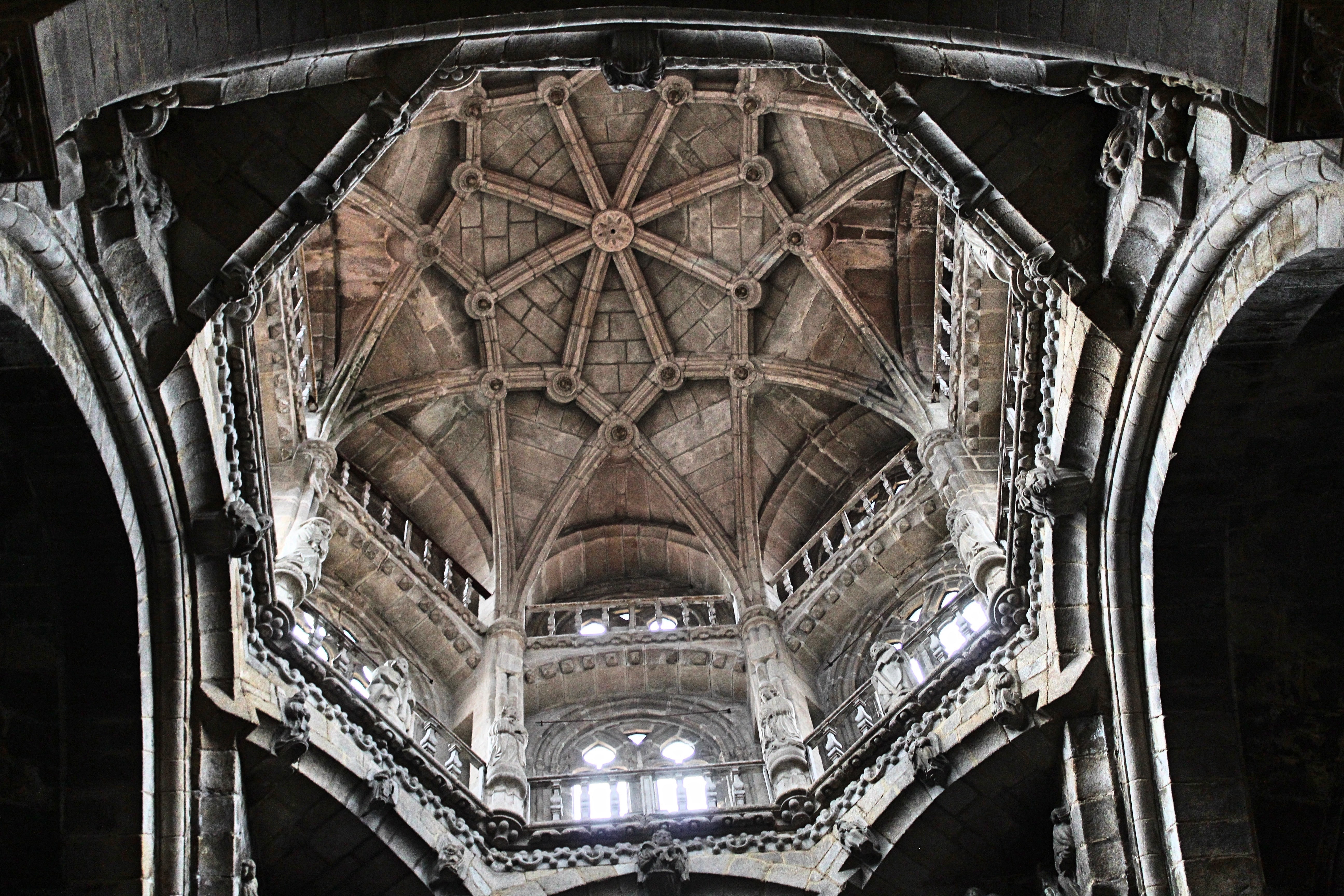
The Lantern
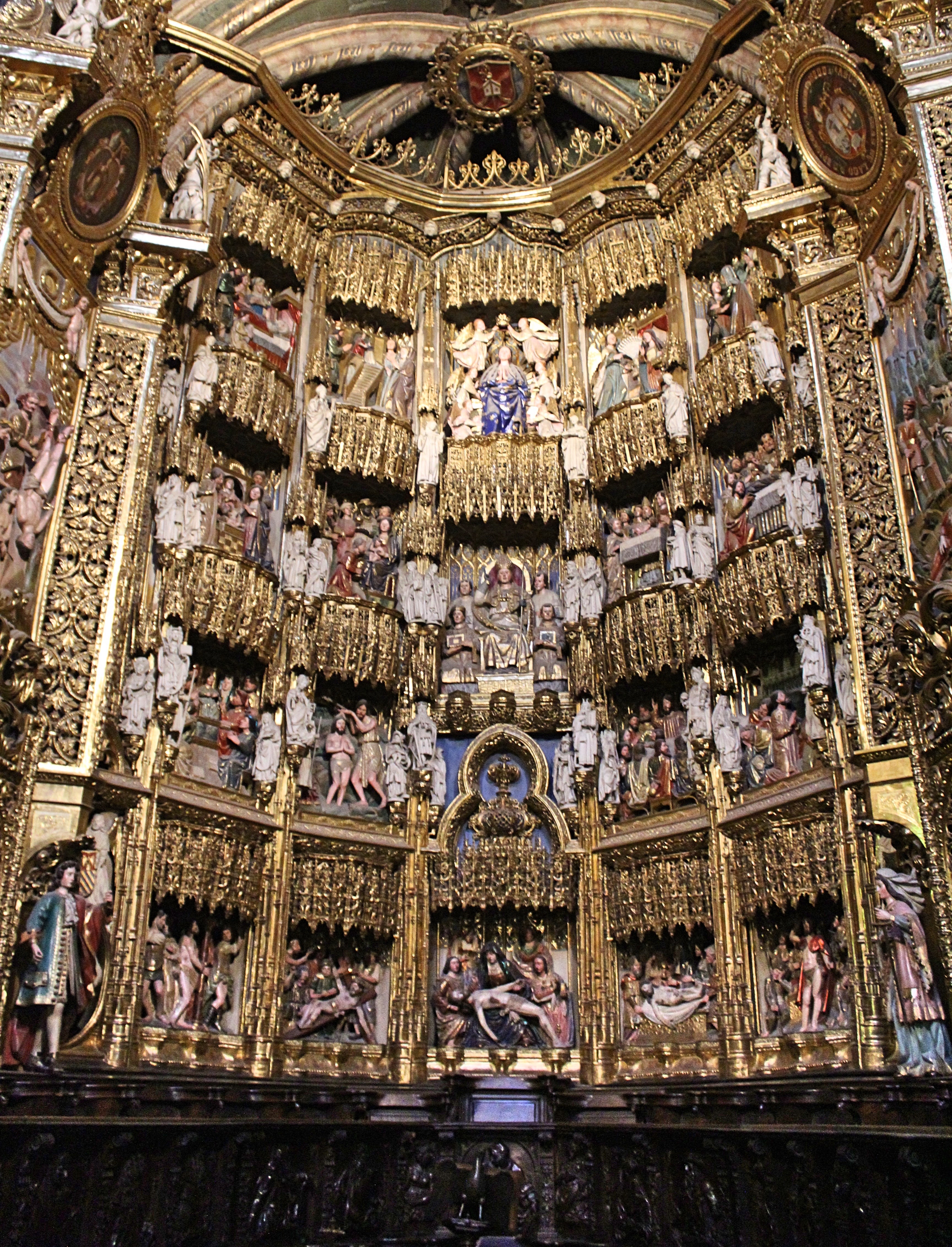
Right next to the plaza is the city’s cathedral, its most important historic site. From the outside it has none of the towering grandeur of the cathedral in Santiago. Indeed, the cathedral presents a heavy, fortified look, like the above-mentioned church. The inside is far more attractive. Apart from the impressive gothic nave and the beautiful central lantern, letting in light from eight sides, the cathedral is full of splendid decoration. The main altar, which sides under the octagonal lantern, is an explosion of flamboyant gothic, somewhat reminiscent of the enormous altar in Seville. In the center is a panel depicting St. Martin of Tours, to whom the cathedral is dedicated.
By far the most arresting chapel is the Capilla del Santo Cristo. One moves from the stark simplicity of gothic to the extravagant flourish of the Baroque. As befitting that era’s horror of empty space, every inch of the chapel is covered in decoration—shadowy paintings surrounded by delicately carved and gilded wood. In the center a realistic Christ with long flowing hair hangs from the cross. The chapel also contains the Renaissance choir stalls which once stood in the main nave. The final effect is one of extravagance. I am not sure that it is beautiful, but it is certainly impressive.
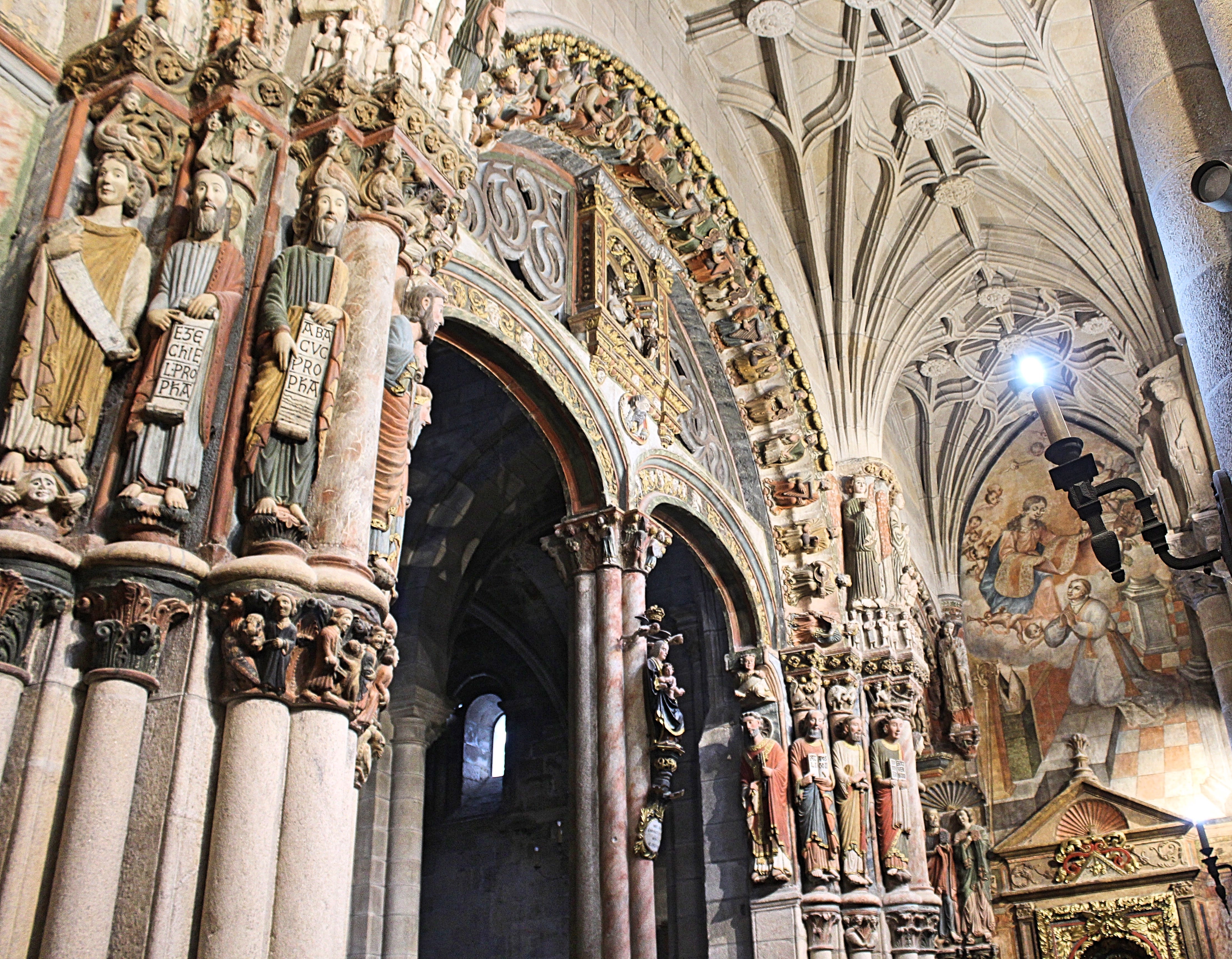
Yet the most famous work of art in the cathedral is the Pórtico del Paraíso. This is an elaborately carved tripartite doorway, which once served as the main entrance to the cathedral (but has since been engulfed by the growing cathedral). It was designed by students of the legendary Master Matteo, who is responsible for the more famous Pórtico da Gloria in Santiago. According to the audio guide the two cities, Ourense and Santiago, had something of a rivalry; and this doorway was an attempt to keep up with the neighboring city. Having seen both doorways, I can confidently say that Matteo’s is the superior. Even so, the Pórtico del Paraíso is an extremely fine piece of sculpture, which has been well preserved (or restored). The pigments of the paint still shine invitingly, filling the entire ensemble with a joyful glow.
I should not neglect to mention the cathedral museum, which is included in the ticket. There relics, treasures, paintings, altars, sculptures, and illuminated manuscripts on display, as well as a few Roman ruins unearthed during excavations and repairs.
Two large churches stand quite near the cathedral. One is the Igrexa de Santa Eufemia, a monumental Baroque church with a concave façade. The other is the Igrexa de Santa María Nai, another fine Baroque church which now stands, it is believed, on the foundation of the original cathedral. However, I mention these churches, not for their beauty, but because I always find it amusing that large churches are placed so close to each other, within a five minute walk of the city’s cathedral. Being a church artisan was a good career in those days; the demand was endless.
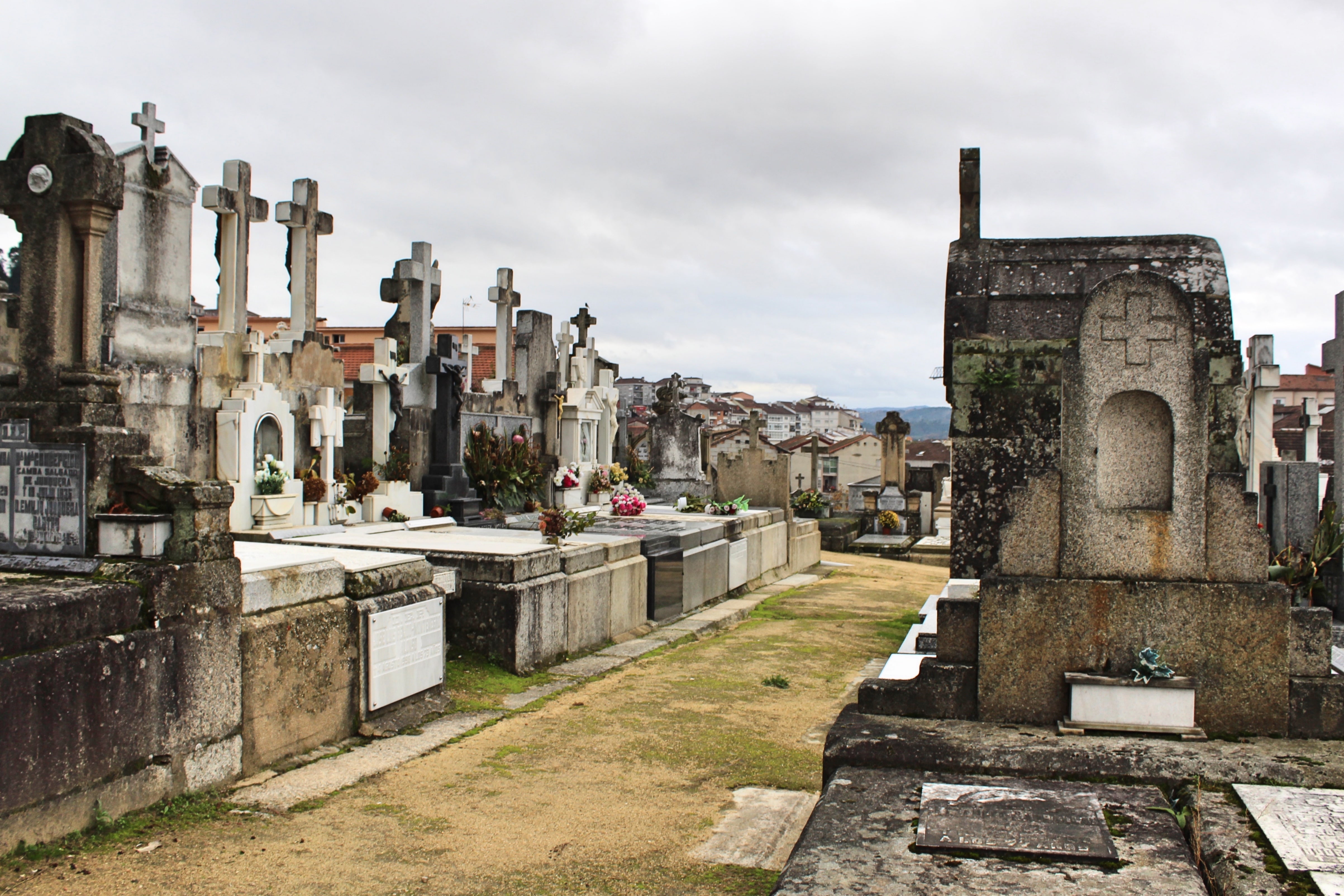
After ascending a staircase up to the hill overlooking the cathedral, I came to my favorite part of the city: the Cemetery of San Francisco. This cemetery goes back to the gothic period, and maintains many beautiful tombs and mausoleums. As usual, I felt a deep sense of calm as I walked through the cemetery, a repose from the temporary and trivial concerns that usual occupy my attention. (Rebe, on the other hand, found it creepy.) The hill also provided an excellent view of the city, the cathedral, and the countryside beyond.
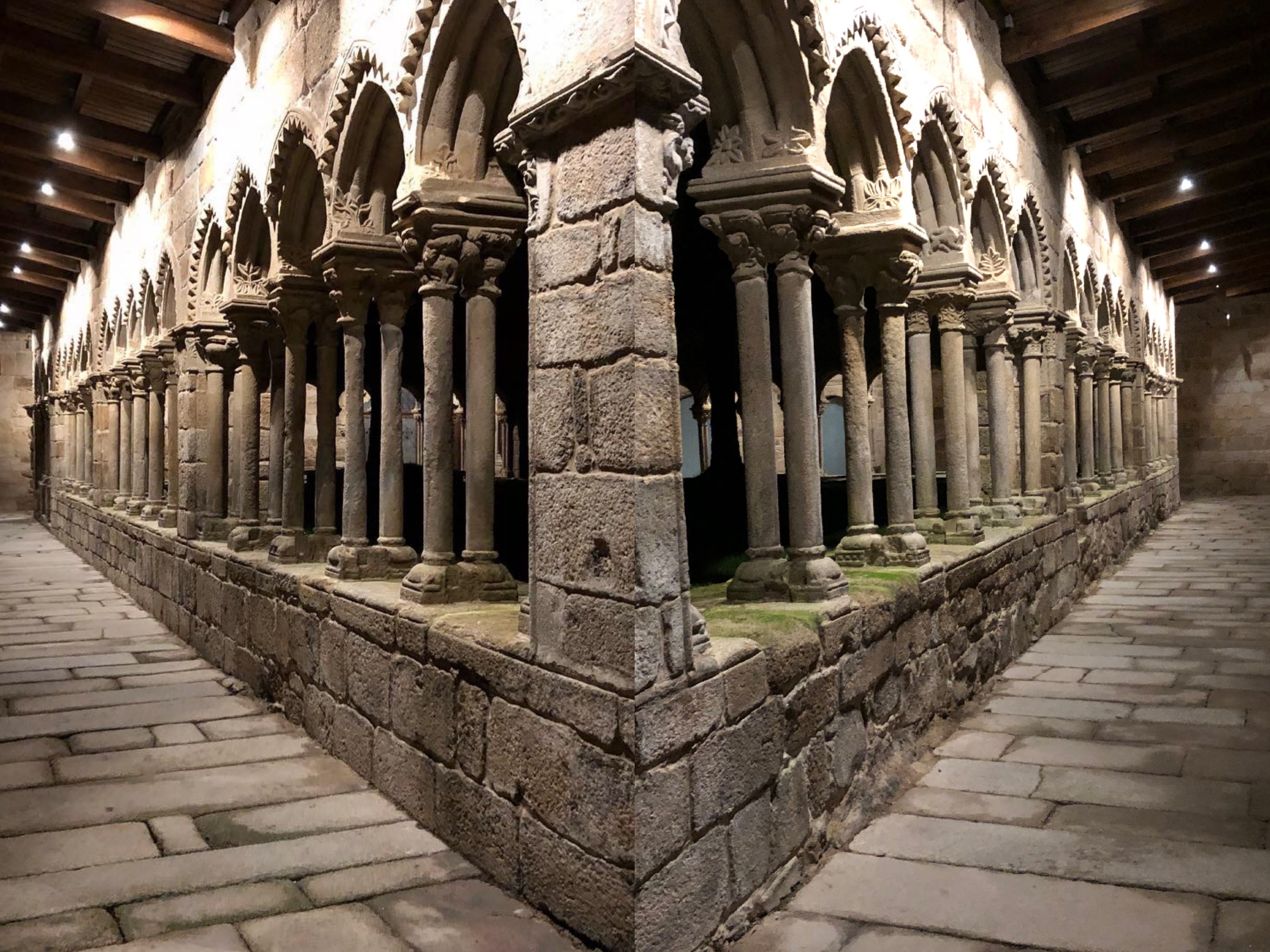
The cemetery used to be attached to an eponymous monastery, which has long since been confiscated and shut down. (For two centuries it was used as a nursery.) However, some artwork from the monastery is on display in a free gallery. And right next-door is the old cloister, the Claustro de San Francisco—now detached and homeless. This is without a doubt one of the great sights in Ourense: the cloister is decorated in the finest gothic fashion, a delicate and harmonious space that transmits the meditative peace of monastic life.
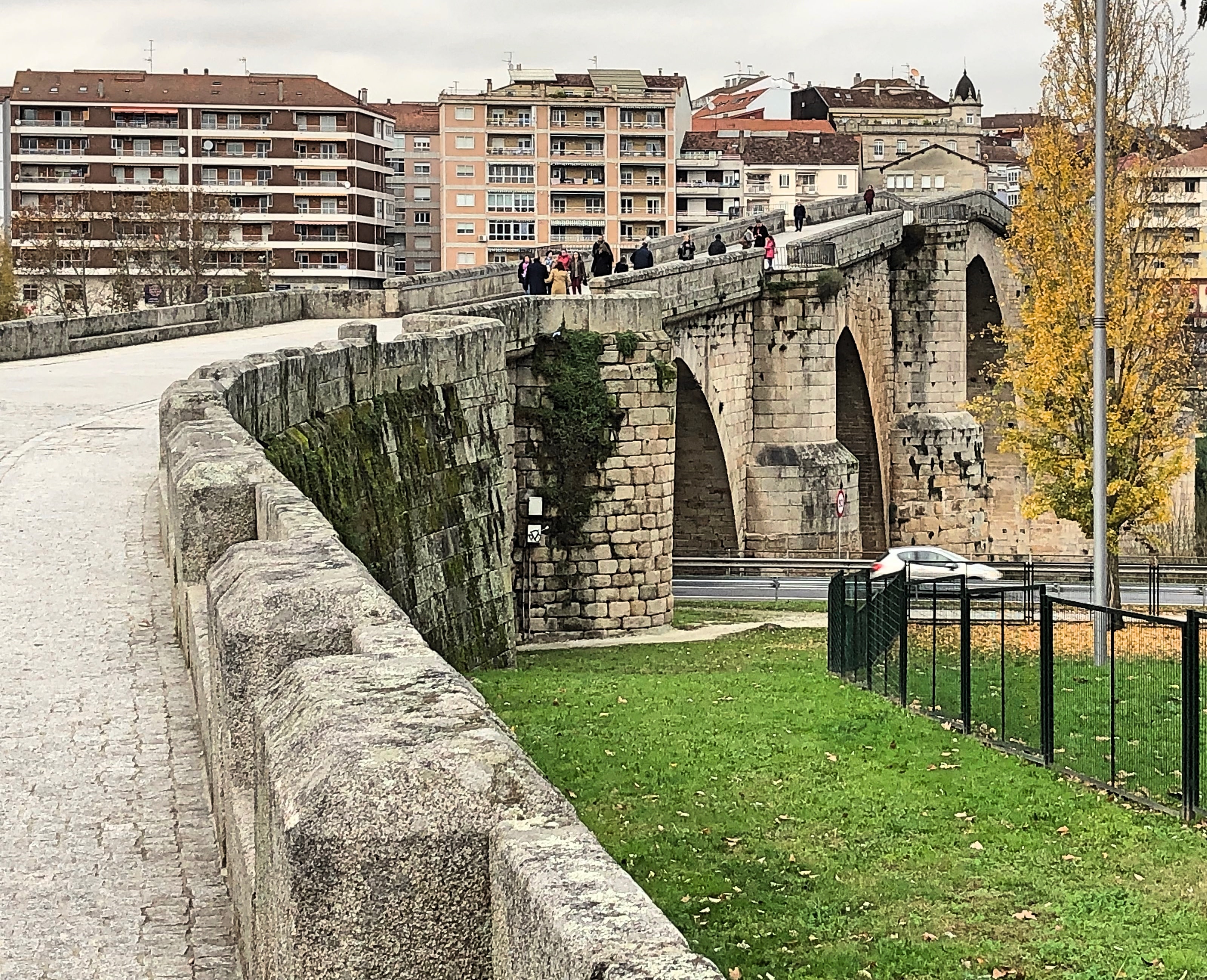
Now it was time to cross the river Miño, which runs through the center of the city. The most convenient walking bridge is the iconic Ponte Vella, or old bridge. The origins of this bridge go back to Roman times, though little remains but some foundation stones from that epoch. The current form of the bridge is medieval. It is an elegant construction, resting on a series of arches that stretches 208 meters (almost 700 feet) from end to end, and rises 33 meters (100 feet) over the water. The bridge has proven so important in the history of Ourense that it is featured on the city’s coat of arms.
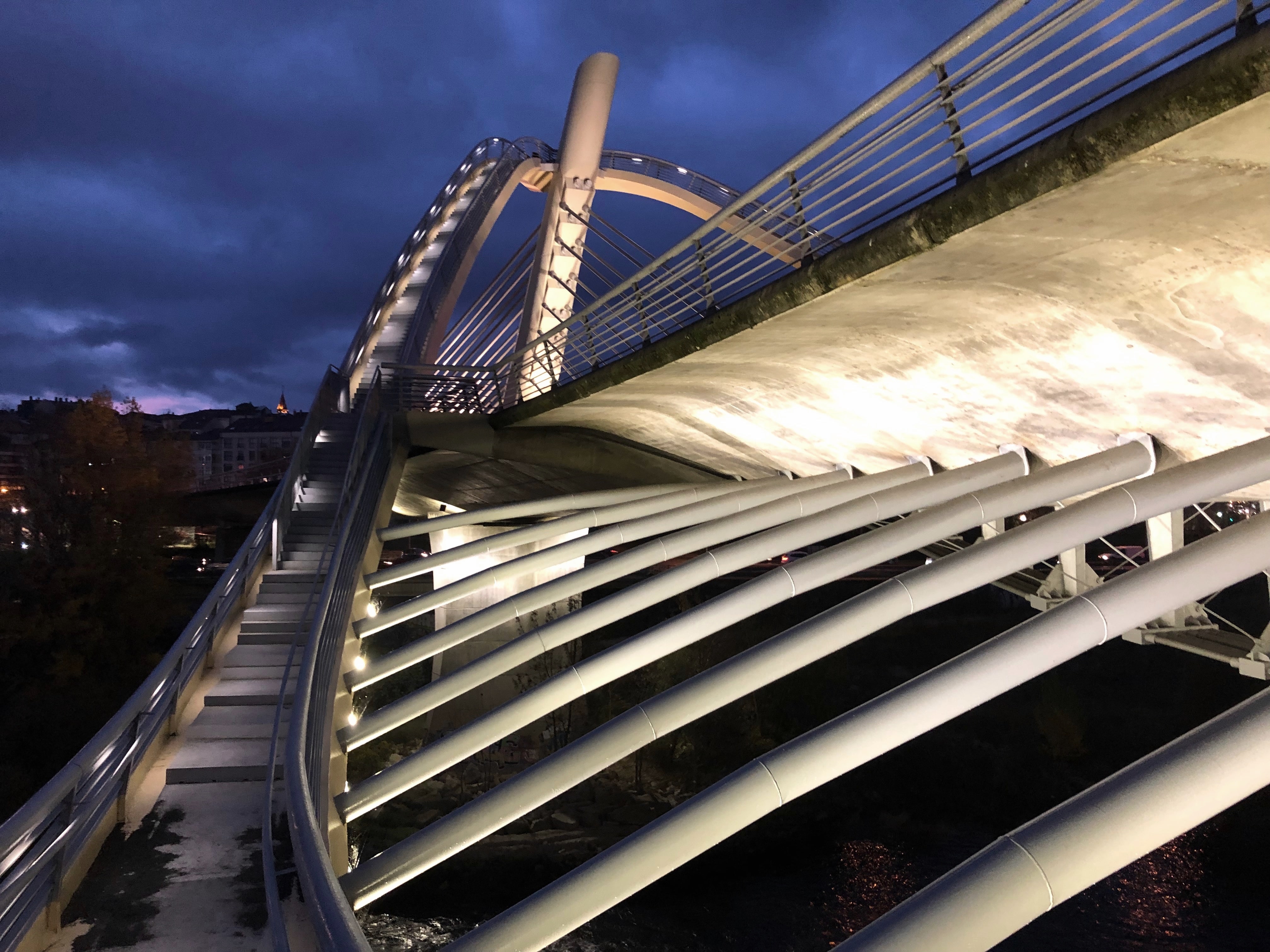
Yet this is not the only attractive bridge in Ourense. Also lovely is the Ponte do Milenio, a strikingly modern construction distinguished by the floating metal outline of a ship, which hangs suspended from the two slanted support beams. This is actually a walkway, on which you can dip down below the main section of the bridge to get closer to the water, or ascend to the top for a view of the river valley. Normally I am not very keen on modern design; but I was very much taken by this bridge, which combines functionality with an unconventional use, while maintaining an attractive overall form.
I have come all this way but I have yet to mention the greatest attraction in Ourense: the thermal baths. Ourense is highly geothermically active; thus the city is filled with steaming pools of water, many of which are free to visit. I admit that I am unclear on the science of this heating; though since Ourense is not volcanically active, I suppose that the water gets heated by the decay of radioactive elements deep underground. The water, however, is perfectly safe; and it reaches the surface at pleasant temperatures—warm, but not dangerous. This, by the way, is why the bath-loving Romans came to Ourense.
Most of the baths are situated outside of the city center, alongside the river Miño. However, one important bath sits right in the heart of Ourense: As Burgas. This bath has been used since Roman times, and it was believed to have both religious and curative properties. The baths were maintained into the Christian epoch, in part because it provided a welcome comfort to weary pilgrims on the Camino de Santiago. Also, according to what I can find, the heat was harnessed by artisans and bakers (though I can’t imagine how).
However, I felt uncomfortable at the prospect of taking a bath right in the center of the city, with pedestrians passing by on every side. So, we headed toward the river to visit the baths of A Chavasqueira. The walk there led us across the Ponte Vella to a path alongside the Miño. The place seems designed as a peaceful escape. There are no crowds and no cars, just the quiet murmuring of the river. Still, I felt apprehensive. I had never been to a thermal bath, and I did not much like the idea of sharing a hot tub with strangers. But, I have a blog to write, and this means I have to experience the typical attractions.
A Chavasqueira thermal baths. Image from Wikimedia Commons; photo by Roberto Chamoso G; licensed under CC BY-SA 3.0
A Chavasqueira, like the other thermal baths, is public and completely free. The baths consisted of four medium sized, shallow pools, rimmed with stone; and each bath is a different temperature. When we arrived, at mid-day, they were moderately full. Now, when it comes to public nudity, Spain is relatively conservative as far as European countries go; you will never encounter naked sunbathers on a stroll around Madrid’s Retiro Park, for example, as you might while exploring Berlin’s Tiergarten. However, they are still less conservative than prudish Americans. It is acceptable for women to be topless; and most people change with a towel rather than retreating to the public bathrooms, as I did. My natural timidity immediately flared up: I felt uncomfortable.
Still, I had come this far, and could not turn back now. Before going into the baths, it is customary to rinse off with the nearby shower. Seldom do I feel more pathetic and exposed than when I am being doused with cold water out in the open. This done, I lowered myself into the least populated pool. The water was quite warm but not scalding. Nearby an older bald man with a potbelly was determinately soaking, his face a serene grimace. I waited to be suffused with the blissful calm of hot mineral water, but felt… quite normal. In fact, I felt a strange combination of anxiety and boredom. The heat made my heart beat more quickly, and I felt my veins flood with adrenaline. What was I doing here? I could be taking a nice hot shower in the comfort and privacy of my own home.
Meanwhile, Rebe was splashing around quite contentedly, seeming to be properly relaxed. I tried to relax, to wait, to adjust. But I felt silly. What was I supposed to be doing, just sitting in water? After ten minutes I gave up, got out, and changed back into my clothes. Rebe wanted to stay longer, so I took a walk further down the Miño. Now, this was relaxing: solitude, cool air, movement, and nature. After thirty minutes I felt properly calmed after enduring the trauma of the hot springs.
After this all-to-typical failure to enjoy myself, I tried the hot springs again on the following day, and had a moderately better experience. Still, I admit that I do not see the appeal and do not find it especially relaxing. Clearly, I am not made for spa life.
But do not let my experience dissuade you. The vast majority of human beings seem to love thermal baths. And, in any case, Ourense is a charming city. Despite my food poisoning, I even managed to stuff myself with delicious Galician food. That is a successful vacation.
It was 2018, and my Easter break was fast approaching. Leaving the country during Holy Week is always expensive; and, besides, I had already booked two pricey trips—to Prague and to Paris—so I didn’t want to spend more than the bare minimum. Luckily, Spain has one travel option that requires almost no planning and little expenditure: the Camino de Santiago.
Two years had already gone by since my first and last camino, five days from Lugo to Santiago de Compostela. This time I wanted to start up where I had left off, in Santiago itself, in order to walk to the coast. The Romans may have made this pilgrimage before Christ or Christianity; they named the long granite cape that extends into the Atlantic “Finis Terrae,” or the End of the World, because they believed that this was the westernmost extension of the land. Unfortunately they were wrong in two respects: first, they underestimated the world by several continents; and second, Finisterre (as it is now known) is not even the westernmost point of the Iberian peninsula.
The cape has nevertheless continued to attract travelers. After pilgrims began to flock to Santiago during the Middle Ages, many of them decided, after reaching their goal, to keep going to the coast. This may be why the scallop shell became the symbol of the camino: many people wanted a souvenir from the end of the earth. This was my goal, too: to start in Santiago and keep going until the land ran out. I would walk 88 km (or 55 miles) in four days, giving me enough time to be back in Madrid for my birthday.
The best part of this plan was that almost no preparation was necessary. I did not need to book accomodations or even to buy gear, since I already had it. But I did need to obtain a pilgrim’s passport, or I wouldn’t be allowed to use the camino hostels (called “albergues”). This was easy enough. In the Plaza de Santiago in Madrid, at the Parish Church of Santiago and San Juan Bautista, they hand out passports for free (though a donation is recommended). If you go this route, be aware that the hours of availability are a little strange: 10:00 am to 1:00 pm, and then 6:00 pm to 8:00 pm. The other option is to go to the Association of the Friends of the Camino, but they are only open Tuesday through Thursday.
My passport in hand, my flight to Santiago booked, I was ready for my walk to the end of the world.
Arrival
The plane descended through the thick fog until the ground suddenly appeared out the window, moments before landing. With a jolt we had reached the earth. I was sleep-deprived and panicky. Even in the best of times flying makes me nervous; but lack of sleep throws my chemical balance off, and I am consequently much more prone to worry. I thus spent the flight alternating between fear and delirium. Though I had woken up at 4:45 that morning to catch the horridly early (but cheap) flight, I could not sleep a wink on the plane. I was wretched.
It was a wretched day in Galicia, too, and I was happy to be there. A short bus ride brought me to the center of the city, where I had breakfast with some friends who were also doing the camino (but a different route). After some aimless wandering, I made my way to the albergue. I had reserved a room in the Seminario Menor. This is a massive building on a hill across from the cathedral, not to be confused with the Seminario Mayor, which is right next to the cathedral. If the building had indeed been a seminary, it had been a major one: the albergue was large enough to house hundreds of pilgrims, and also had room for a primary school.
Though I had vague ideas of seeing more of Santiago, the bed proved irresistible. I collapsed into a feverish nap. By the time I awoke, hours later, I found that the city was suffering under the wrath of a terrible rainstorm. The water came down in sheets, turning the streets into streams and the sidewalks into puddles of mud. I was glad to be indoors. But if I ran into weather like this on my camino, I would be in for a bad time. The only rain equipment I had brought was a poncho. My shoes were not waterproof, nor was my backpack. The thought of simply going back to Madrid flitted through my head. A tempting idea.
But I had something to accomplish on this camino. My renewal deadline was coming up: I had to decide whether I was going to stay in Spain another year, or finally go back to New York to recommence by suspended adulthood. There were weighty factors on both sides. On the New York side I had my family and friends, and the prospect of a career as a public school teacher—quite a good profession in Westchester. Meanwhile, I was in a long-term relationship with a Spaniard, and had gotten accepted into a masters program for the coming year. I felt torn. The prospect of being away from home yet another year frightened me, especially since I had lately been prone to fits of homesickness. On the other hand, the thought of leaving Spain struck me as tragic: the end of an adventure, the end of a relationship, the beginning of a more conventional life. This seemed like the perfect problem to mull over on a pilgrimage.
When the rain died down, I went out to have dinner and buy some final supplies. That night I went to sleep early. I would need the rest.
Day 1: Santiago to Negreira
I set out as the sun was just beginning to rise. Though I am no enthusiast of the morning, it is advisable to begin walking the camino early: you avoid the hottest part of the day, and reduce the chance that the albergues will fill up. The route out of the city took my past the cathedral for one final look, and soon I was again in the Galician countryside.
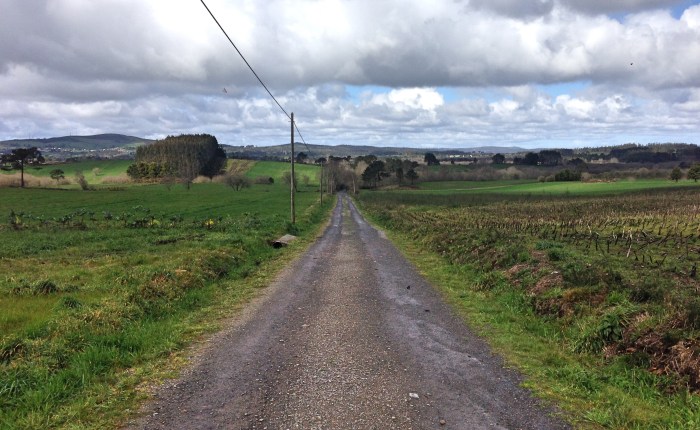
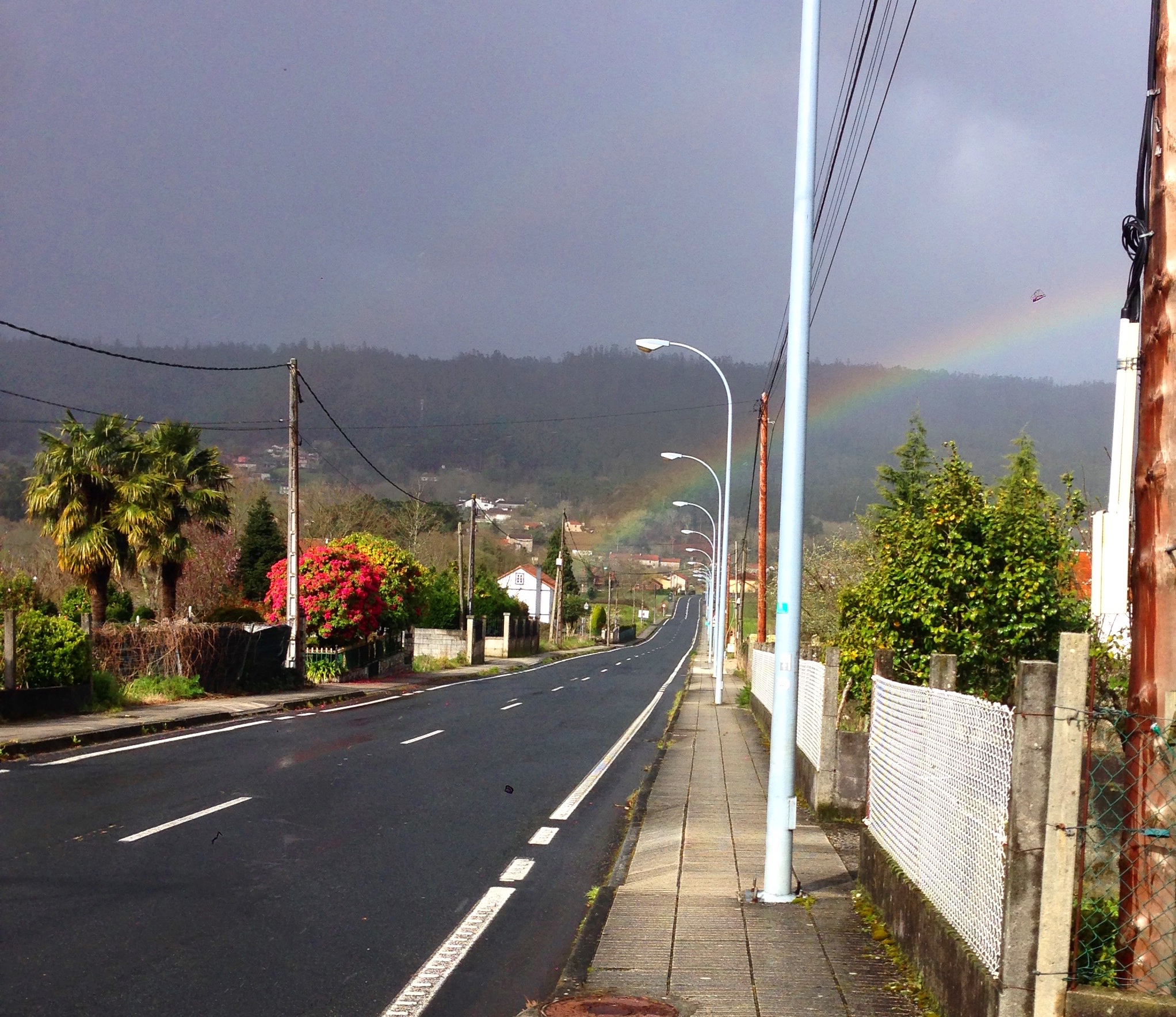
The day was overcast and a little cold. As usual, I found the mossy green of the landscape to be enchanting. I love Madrid, but its sandy soil can leave me longing for the verdant foliage of wetter climates. Coming to Galicia satisfies this yearning. After an hour of walking I looked over my shoulder to see the two spires of the cathedral in the far distance. I was on my way. I passed suburban homes and granite farms. Horses nibbled idly in a grassy field. The sky alternated between shades of grey occasionally broken by blue. Rain fell periodically, mostly in a drizzle. Two hours into the walk a magnificent rainbow appeared up ahead. It looked like it came to an end right in front of me: a good omen.
Before both of my caminos, I had imagined that I would do a lot of thinking as I walked. But this was far from true. Instead, I found myself in a kind of dreamy stupor, merely observing the slowly shifting landscape and the villages that I passed through—a rhythmic repetition of trees, clouds, hills, farms, fences, and fields. Scarcely an articulate thought broke my awareness. At times I feared that I was not properly savoring the moment, and so I attempted a walking meditation, focusing all my attention on my breath. This did little to change my state of mind, however, and soon I began listening to an audiobook (a history of 18th century Europe).
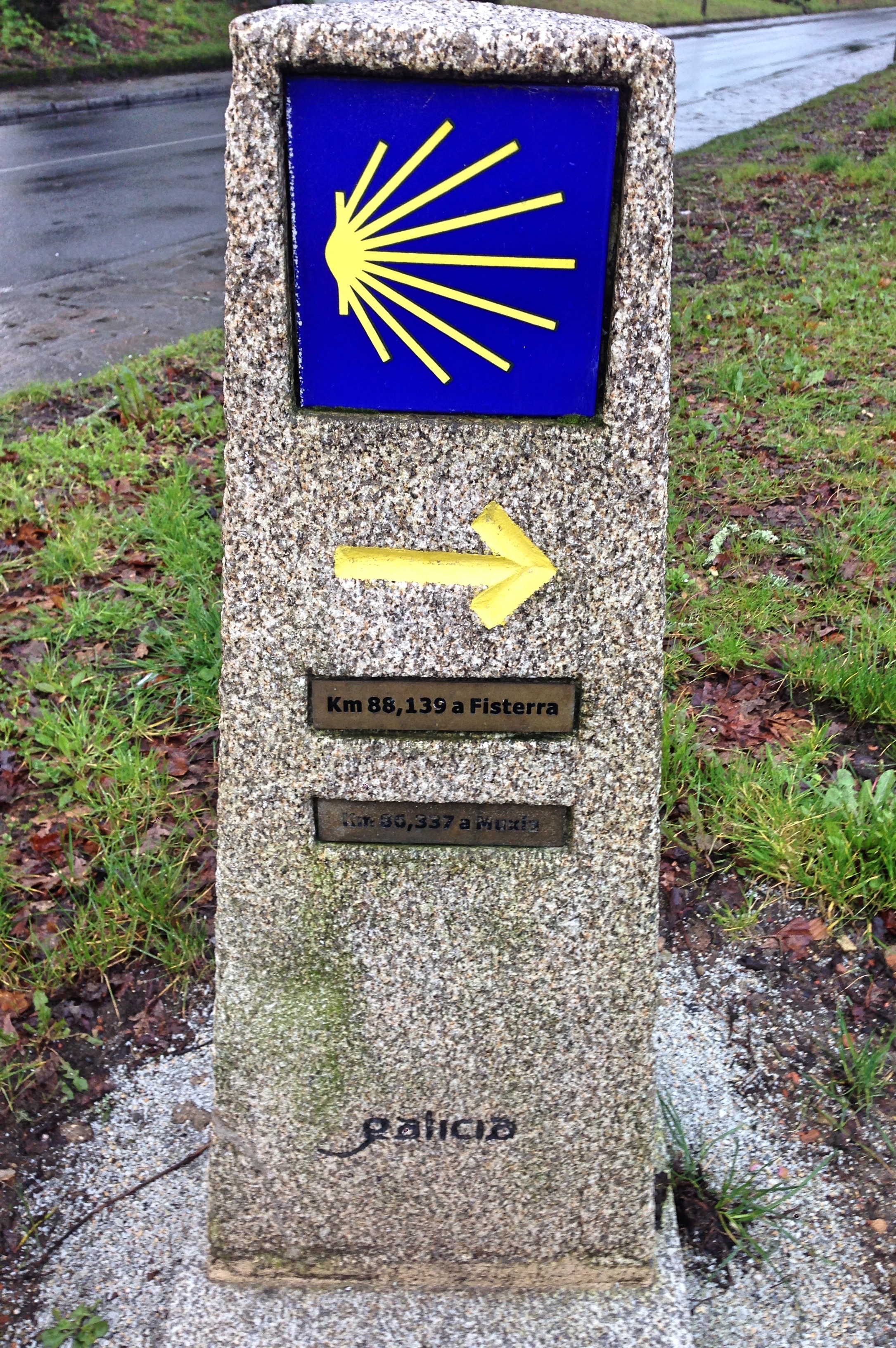
The first trail marker
The camino has a tendency to lull one into a blissful calm. No thinking is required; every turn is marked with a big yellow arrow, and all one has to do is put one foot in front of the other. It did not take a philosophical mind to compare this with my present life conundrum. While I followed this path which so many had walked before, I was trying to make a decision which many had made before: to stay abroad or to go home. Yet a wrong turn on the camino can be easily detected and corrected; but an unwise choice cannot be so easily mended, as time marches steadily forward.
The decisions we make in life are often compared to turns in a road. Yet life, unlike the camino, has no obvious right or wrong turns. Indeed, the whole concept of right and wrong breaks down when it comes to major decisions. Two turns in a road can be easily compared, since one leads to the desired destination and the other does not (or at the very least one is faster). But in life, the question is often not how to get to the final destination, but which destination to choose. Different answers cannot easily be compared.
What is better, to be a doctor or a painter? This depends on your own values, of course. But what are your values? Though we often think of ourselves as defined by what we deem important, it can be difficult to know what is truly important to us. We cannot simply introspect and encounter our values, since our priorities are revealed in actions over the long term. One may, for example, think that one has a passion for playing the piano; but after a year of practicing and giving recitals, this passion may fade into boredom. In any case, even if we could easily find out what is deeply important to us now, this would not necessarily solve the problem, since values change over time.
Most perplexingly, our values change in response to the decisions we make. So when we make a major decision, we are in the paradoxical position of choosing ourselves. Rather than choose something based on our values, we are choosing our values themselves. But then what can we base our decisions on? In other words, we are trying to choose something in the present which will satisfy us in the future—without knowing exactly what we are choosing will be like, or how the choice will change our own preferences. This seems like an intractable problem. If only life had big yellow arrows directing us in the right direction.
As you can tell, I do not like making major life decisions. No approach seems intellectually satisfactory. No criteria or value suffices. As a result, no matter how much I weigh the pros and cons, I always end up feeling as though I were following a kind of gut instinct. An existentialist would say that this proves that I am free; but personally I do not feel free when I am forced to choose something based on non-rational factors, merely following impulse and whim.
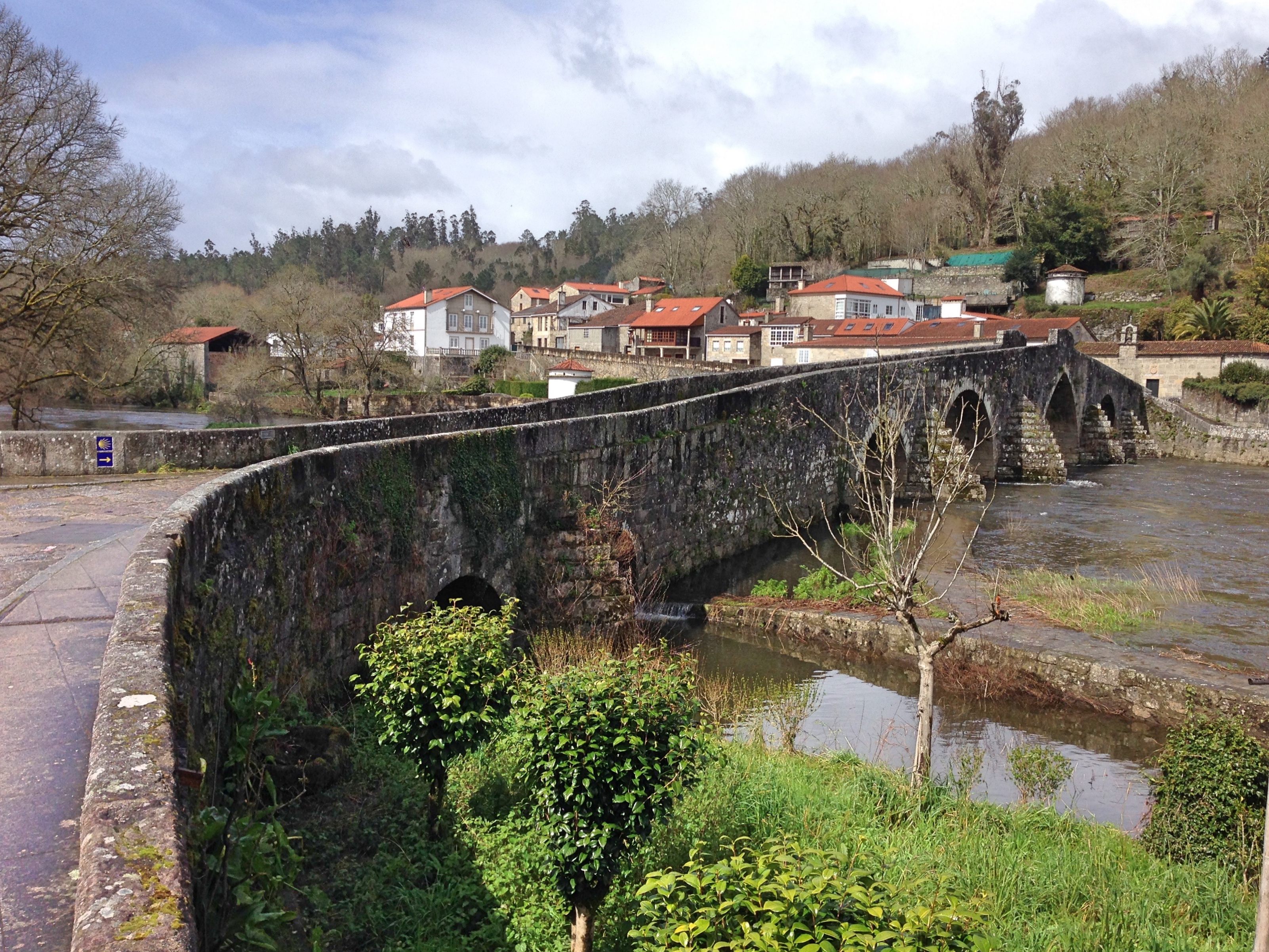
I am writing this now, but I did not think any of this as I trekked the first twenty kilometers of the journey. I merely walked and occasionally worried. The day passed uneventfully. I crossed the Ponte Maceira in Ames, a beautiful medieval stone bridge. The weather was mostly overcast, threatening rain and occasionally delivering. About four hours into the walk it started to rain seriously. I tried to put up with it, but eventually I gave up, rummaged through my backpack for my poncho, and then put it on. The thing wouldn’t fit over my coat, so I had to take off my coat and tie it to my backpack while I wore the blue plastic covering. And, of course, fifteen minutes after going through the trouble, the rain stopped and the skies cleared. This was the last time I used the poncho.
I arrived at Negreira at around one in the afternoon, cold to the bone. After dropping off my bag I went into a restaurant with a menu del día. This is one of the great parts of the camino. Most stopping points have restaurants offering cheap set meals—normally under ten euros—to pilgrims, most of them consisting of plentiful, hardy food. This was no different. I ordered wine, and they gave me a whole bottle, of which I drank more than I should have. It cost me 7.50€. Then I limped and stumbled back to the hostel for a nap.
The host met me at the front desk. He was an older man, with a paunch and a mustache, who was remarkably talkative. I’ll call him Maligno. Normally I do not like to chit chat while I travel, but I was feeling a little lonely just then, so I was glad for the conversation. His mouth rattled on like a freight train, his gravelly voice following the dramatic, sing-song accent common to the region. I got him on the subject of Galicia, on which he was loquacious. He started googling some of the sights to show me: attractive coastal towns, old Celtic ruins, and even a Roman gold mine.
Somehow the subject got changed to people who speak ugly languages. This quickly led him to tell the old joke about how Spanish is for talking to God, Italian for talking to women, and German for talking to horses. He then went on:
“Once I saw this girl, beautiful, just beautiful, I mean everything was perfect. And then she opened her mouth, and it was like—eck! Just the foulest, ugliest language you ever heard. What a shame, I thought. What a shame.”
With this, I excused myself and went to my bunk bed, where I promptly passed out. When I awoke, I decided to do something productive, and I made a pro and con chart of staying in Spain. It didn’t solve anything, of course, but it did occupy some time. After that I wrote a very bad poem, had a light dinner, and went to sleep.
Day 2: Negreira to Olveiroa
This was to be my hardest day—the longest that I had ever walked in my life: 33.6 km, or 21 miles. I had to get going early.
I began before sunrise. The mist was still heavy upon the land. The moon shone out from behind the clouds, and a light breeze blew through the trees. It was almost completely quiet. I felt a keen anxiety grip me as I began walking into the countryside. It was so dark that I was afraid I would get lost. But soon I found the familiar yellow arrows, pointing the way.
The sun gradually rose and I found myself, once again, in the mossy green countryside of Galicia. The walk that day was especially beautiful, mostly avoiding major roads. As the sun rose I could once again see the farmhouses and the fallow fields. A cow peeked its nose from out a barn window, while two dogs snuggled in the road. Once again I saw a rainbow, and once again it seemed to land right in front of me. I felt that I was on the right track.
It was a much sunnier day than the last, and the heat did not make the long walk any easier. I stopped several times—beside a wooden fence, by a stone church, near a running brook—to rest and eat a little. I had bought pretzels in Santiago, an uncommon snack in Spain, and savored a few handfuls on the way. At one point I stopped at a roadside cafe for a chocolate pastry and a coffee. The exhaustion crept up on me slowly; my feet began to hurt, my legs to tire. But the human body is made to walk. It is one of the hidden benefits of bipedalism: aside from freeing up our hands to carry things, walking on two legs allowed us to be more energy efficient. At least that is the theory.
When it was well past lunch time, the path led into an open field and up a large hill. A plaque informed me that this moderate eminence was the highest point in the county. And in ancient times this had been the site of a fortified settlement (though I could find no traces of it). But the view was valuable enough. The beautiful Galician countryside rolled out in front of me, almost painfully pretty in the sun, with its fields of farmland dotted with patches of pine trees. The grass shone intoxicatingly green in the sunshine, filling me with energy that carried me the remaining distance.
By the time I arrived it was four in the afternoon. Olveiroa is hardly big enough to even be called a village; it mainly exists as a stopping point on the camino. The biggest building in the place is the albergue, where everyone seemed to be concentrated. When I arrived it was absolutely packed, which made me nervous about finding a spot. But it turns out that the vast majority of the people eating in the restaurant where on a kind of bus tour, where they hike different segments of the camino each day and then get bused to back to a hotel. It struck me as a strange concept. In any case, I ordered a gigantic plate of food and ate it with ravenous delight.
The rest of the day was spent in my bunk. My feet were blistered and my knees ached. I limped outside around sundown to see the sky, but quickly gave up and hobbled back to my mattress to read. Very few people were staying at the albergue. Among them was a young German couple, probably around my age. They spent the whole time hugging and whispering to each other. I found it very annoying. Whispering, to me, is far more unpleasant to listen to than speaking, since a whisper conserves only the harsh consonant sounds—the hissing and popping.
Maybe I was feeling cranky, since the more I observed the cuddling couple the more irritated I became. At one point I felt inspired by my distaste of the amorous Germans to write a poem in my journal, which I include here:
Why do humans form pairs, Like socks or testicles? We arrange ourselves with mates Kiss, embrace, quarrel, separate. The world deems successful The couples that last until death. A strange prejudice! Separation is separation, In the grave or in the courts; And an amicable divorce may be A better way to say goodbye Than a heart attack. Monogamy has the worst track record Of any human institution, Except for all the other ones. We relieve ourselves with: Fantasies, flings, fights, Affairs, breakups, divorce... Or just the iron patience Of the ignored wife or the henpecked husband Waiting, waiting, waiting, For the end.
And with this bit of free-verse bile, I went to bed.
Day 3: Olveiroa to Cee
The next morning I fell out of bed, and quickly found myself ascending the steep hills nearby. Again, I got going before before dawn. The landscape was shrouded in morning mist. As I walked up the path I began to feel extremely isolated. Panicky thoughts began to pass through my brain. If a pilgrim-hating murderer was hiding behind one of these rocks, they could kill me and get away with it. My eyes began darting left and right, my body tense.
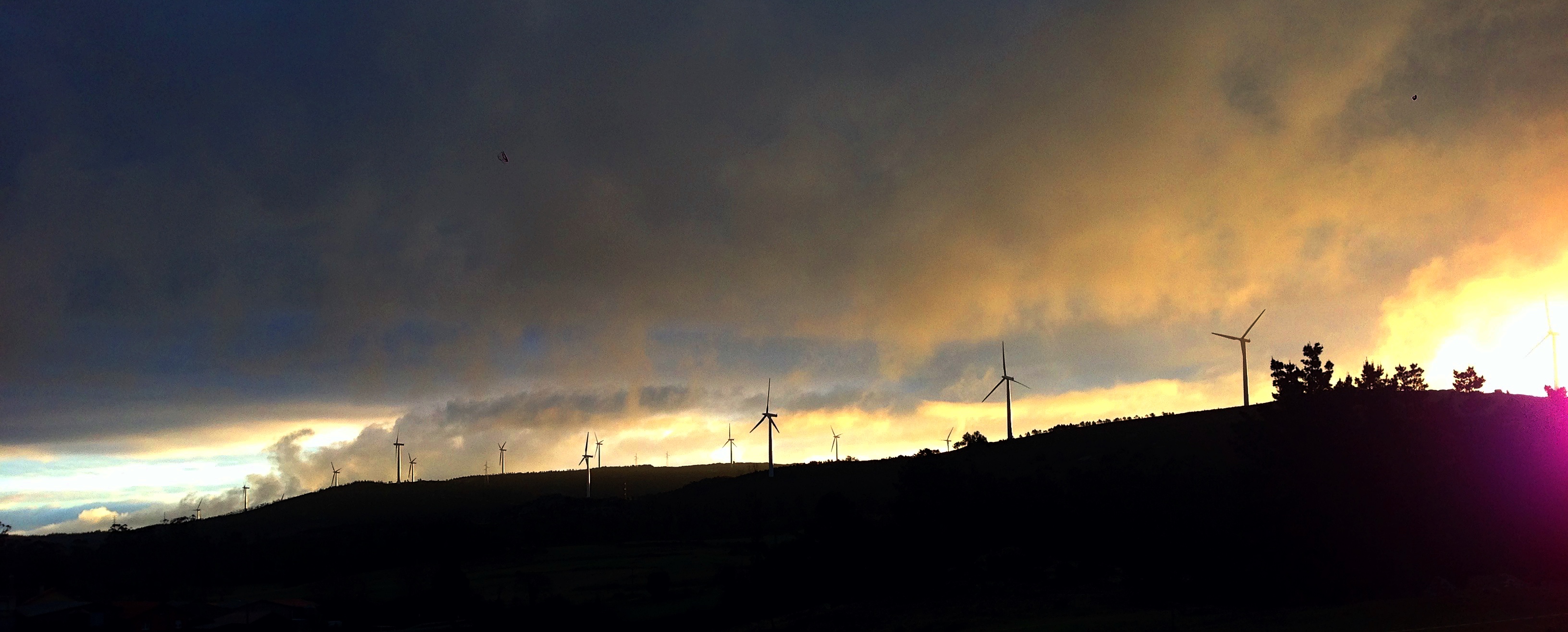
But the beauty of the surroundings, revealed by dawn, eventually calmed my nerves. It was marvelous. The fog opened up below me to reveal a river flowing through the valley. The rising sun cracked through the grey sky, splitting the horizon with yellow light; and in so doing revealed the silhouettes of wind turbines, so common here, immobile on the hilltops. At the time I was reading Don Quixote, and I imagined the old knight making a charge for one of these modern monsters. These power-generating machines are one of our century’s great inventions; their sleek forms make no attempt to counterfeit nature, and yet they blend in so harmoniously with the landscape.
Eventually I reached a fork in the road, where the camino diverges. You see, there are two options for the pilgrimage to Finisterre: the first goes direct, while the second takes a detour to Muxía, another beautiful coastal town somewhat to the north. The second path is considerably more taxing, since there are three days in a row of 30+ km. I chose the first, since I did not have an extra day to spend; but, of course, every road not taken leaves a little residue of regret. Further on, while crossing another field, I caught my first glance of the sea. It was a dreary grey day, and so all the greens and blues looked muted under the brooding sky. But I could smell the ocean, that salty, fresh savor in the air.
I reached Cee by one in the afternoon, a modest coastal town of about 8,000 inhabitants. I found a mostly-empty albergue, dropped off my bags, and then set out to have some lunch. The sight of the ocean put me in the mood for seafood, so I decided to find some of the justly famous pulpo gallego, or Galician octopus. This is one of the finest dishes in Spain. The octopus is extremely tender, without a trace of rubberiness; and the combination of sea salt, olive oil, and the spicy local paprika make it addictively savory.
After a short walk around town I retired to the albergue. The host was another talkative Galician fellow. He was a youngish man, in his mid thirties I guess, and had the air of a tired hippie. He told me that he had gotten addicted to the camino at a young age, when his mother took him for a week on the trail. Eventually he opened up his own albergue, and met his future wife a few years later—a Russian woman who was passing through. She came in the door a few moments later, with their two little lap dogs in tow. It seemed like a happy family. I had a beer while flipping through some of the extensive National Geographic guide books that were shelved in the salon.
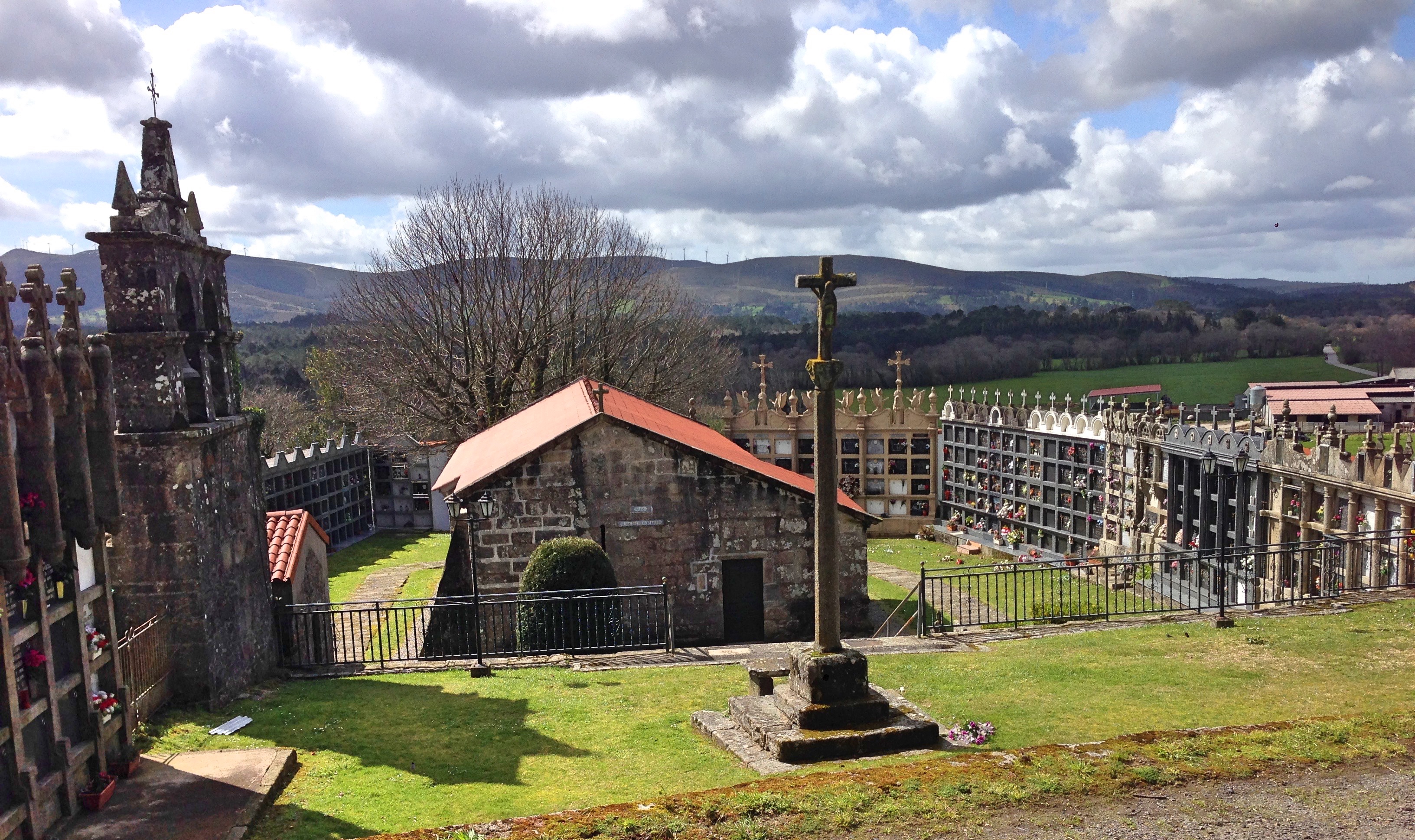
A typical Galician church and graveyard
The only other pilgrims in the albergue were two Frenchmen. I guessed they were father and son, since the younger one looked like he was in his teens. Neither of them spoke much English, though it was not for lack of trying on the teenager’s part. He struggled through a ten minute conversation with me, using plentiful hand gestures to make up for the gaps in his vocabulary. From this mime show I gathered that he had been on the camino for quite three months, having started in Seville. I admit that I find it difficult to imagine spending such a long time on the road, simply walking. Surely one would see many beautiful things. But I am afraid my brain would atrophy from the lack of variety. It had only been three days and I was already looking forward to returning to Madrid.
Day 4: Cee to Finisterre
My final day. I woke up a bit later, knowing that it was going to be a short walk. The path took me through stone alley up into the surrounding hills. The sky was overcast yet again, though the bits of clover covering the ground still glowed with a powerful green. My route followed the coastline towards the peninsula, which jutted out into the sea like a moored ship. As I looked down from the pine-shaded hilltop to the granite shore below, I wished, yet again, that I could properly savor the moment, that I could nestle inside the feeling of being alone in nature and just stay there, hold onto it, and take some piece of the feeling with me. But again the sights came and went, and I was left none the better.
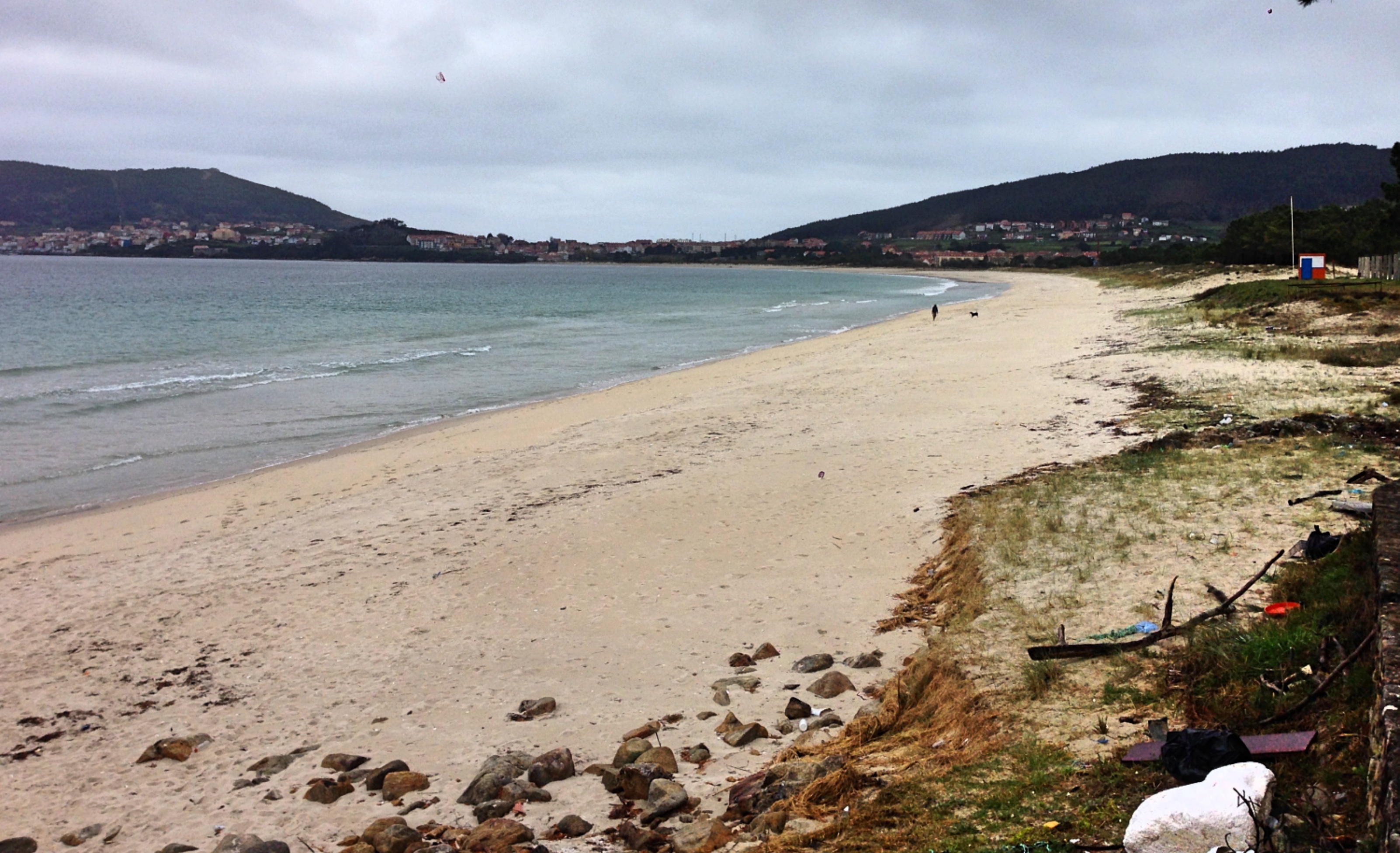
Eventually I walked down the hills onto a long beach. A man was playing with his dog on the sand, some hundred meters away. I snapped a photo. Minutes later, as I sat on a bench re-tying my shoes, he approached me, and asked me if I could email the photo to him. Sadly, I have forgotten to do it—until writing this post. We shall see if he replies.
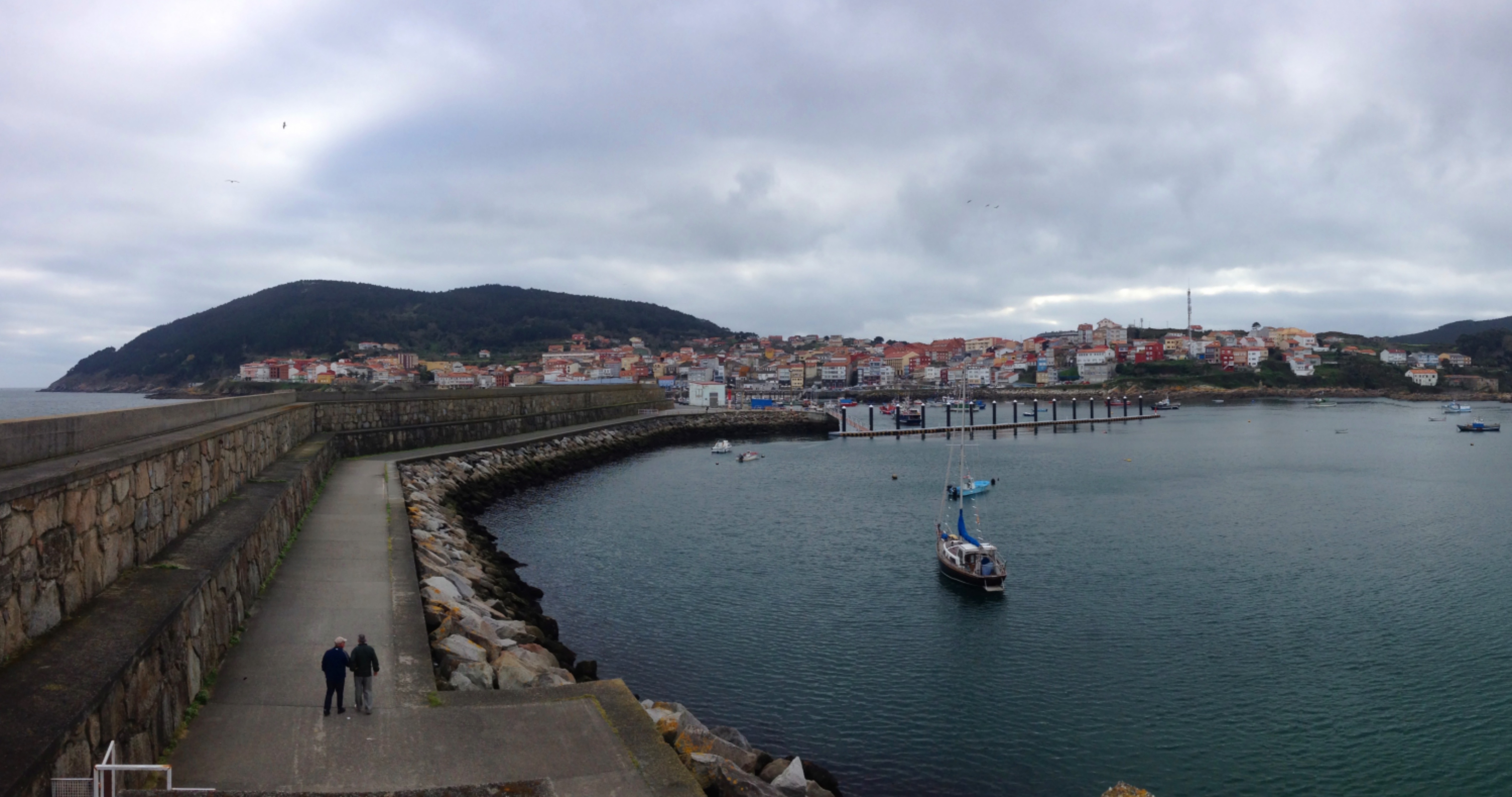
From there I made my way to the town of Fisterra (the Galician name for Finisterre). Like so many places in Galicia, it is dominated by the camino. Half the people walking through the town sported the typical gear of the modern pilgrim: waterproof coat, nylon backpack, collapsible walking stick. Advertisements for albergues were everywhere. Many of the faces I recognized from the past three days; a few recognized me, and we exchanged a wave. I was tempted to stop, but I wanted to see the end of the road first.
The path to the end of the peninsula brought me once again above the Galician shore. Halfway to the end I passed a statue of a windblow pilgrim, dressed in the traditional medieval costume; and I could not help comparing the modern pilgrims (myself included), with their bright neon clothes, unfavorably to this more simply apparelled traveler. After what seemed like an interminably long time, the end came into view.
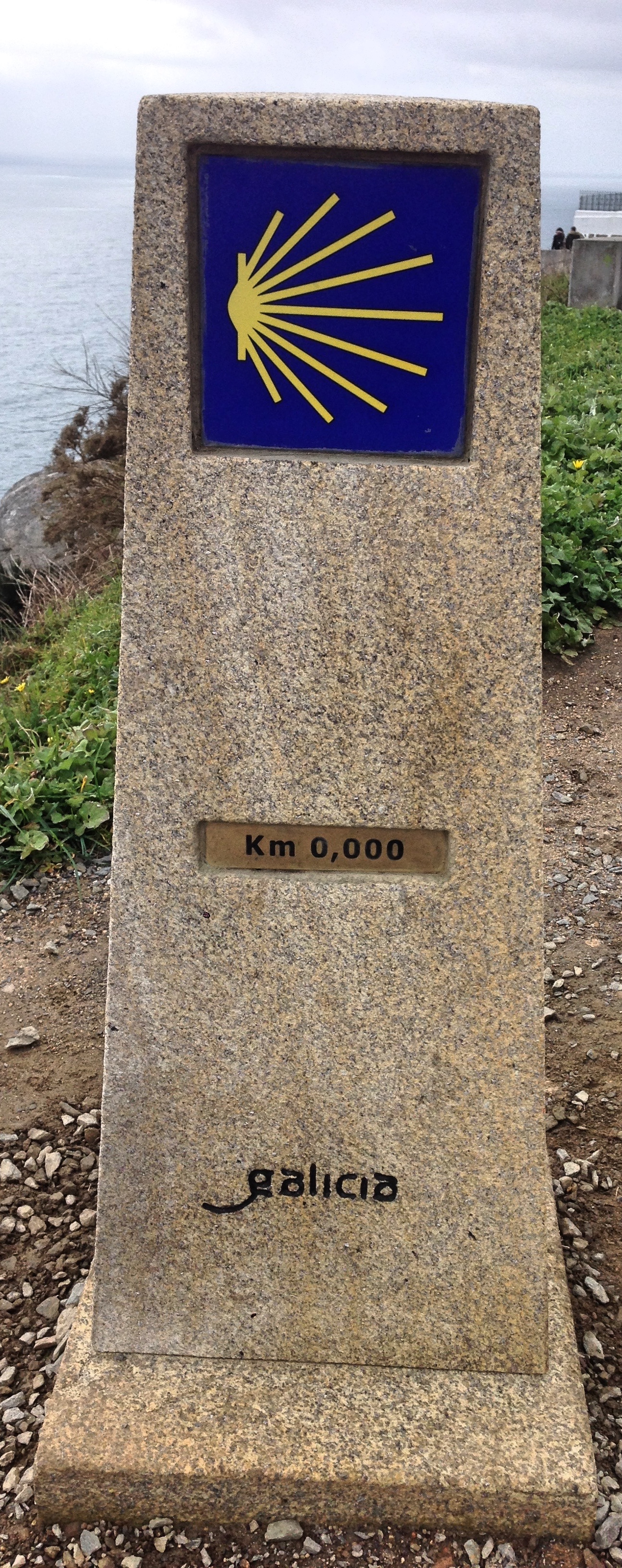
I admit that I was a little deflated, if only because there were so many people about. I wanted to feel alone on the edge of the world; but instead I felt like I was at a moderately popular tourist attraction—which, of course, I was. There was a stone cross on a boulder, where many were gathered. More gratifying, for me, was to see the final trail marker: 0.00 km. Seeing the constant and yet slow diminution of the remaining distance is one of the more satisfying and yet maddening aspects of the camino; so I felt a great surge of relief at finally seeing a zero. I was officially finished.
Further on, I came to the lighthouse. Next to it was one of those signs that shows the direction and distance to several major cities. One of the signs, pointing directly across the sea, was for New York: 5,235 km away. My home was right beyond the horizon. Or was it still my home? Did I belong on this side of the Atlantic, or that one? I still had not made a decision for next year. The camino had not resolved my dilemma.
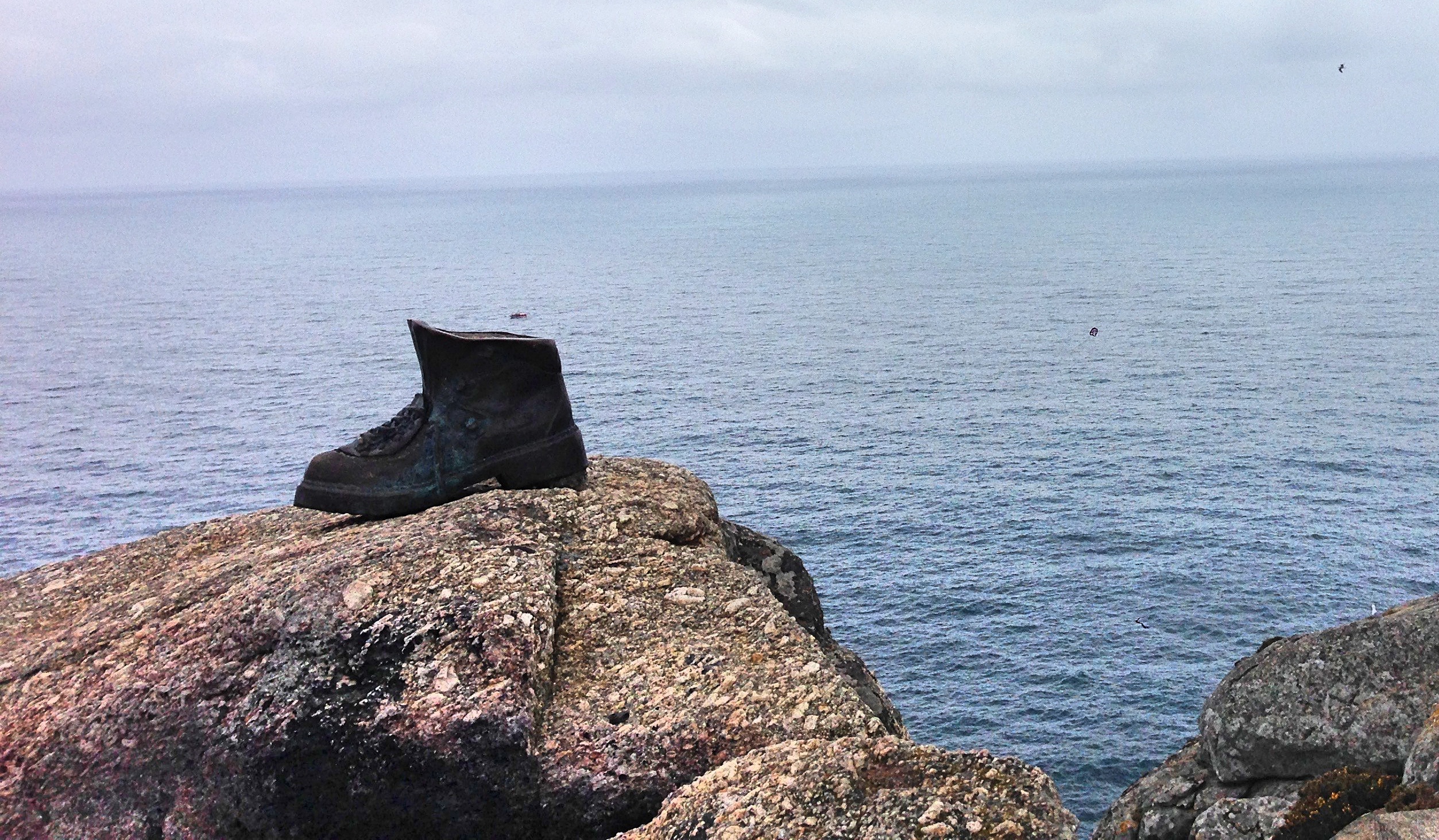
I passed the lighthouse and went down to the rocky tip of the peninsula, where it descends into the sea. The base of a red metal tower had been covered in stickers and paraphernalia—pilgrims wishing to leave their mark. Nearby was a metal statue of a single boot, a trademark camino marker. It seemed to be the perfect memorial for the trail—an anonymous testament to the blisters and bliss of untold walkers. I sat next to it and stared into the ocean, turning over my problem in my head. And I decided, then, that unless something unexpected happened, I would go back to New York to pick up my interrupted life.
And in that moment I felt sad to have to leave such a beautiful place that had given me so much; and I felt relieved at having chosen a path. But mostly, I just felt exhausted and hungry. Little did I know that, just two weeks later, my brother would decide to move to Spain, which would change my calculations completely. And so I now find myself, a year later, writing this long tale of failed self-discovery and unsuccessful soul-searching from Madrid.
I picked myself up and dragged myself back into town, where I found a nice albergue and paid extra to have my own room. The rest of the day was spent in walking idly around the port, eating delicious chipirones (squid sauteed with garlic), and writing in my diary. “Will I ever see this shore again?” I asked myself. “It’s very possible I won’t.” (I would.) My brain was eerily silent. The usual little voices which pop in and out of our heads, telling us things to fret about, were almost entirely gone. I felt empty and free.
Fisterra
The next day I walked to the bus station with a Russian man who was staying in my albergue, and who told me that he had begun his camino by taking ayahuasca in Portugal. The bus left me in Santiago de Compostela, and then a train brought me to Madrid. In five days I had been to the edge of the world and back, and was none the wiser for it.
This academic year I have taken two trips to Santiago de Compostela, one in December and one during Holy Week in April. The first time did not go well. I arrived with an upset stomach, which quickly escalated to full-blown food poisoning. Unfortunately my Airbnb was in Ourense so I was stuck there until our return train in the evening. It was a mediocre day.
But my recent trip was much more enjoyable. We took the night bus up from Madrid, which leaves at 12:30 at night and arrives at 9:00 the next morning. This is no comfortable way to travel. But it did give us an opportunity to see an Easter procession.
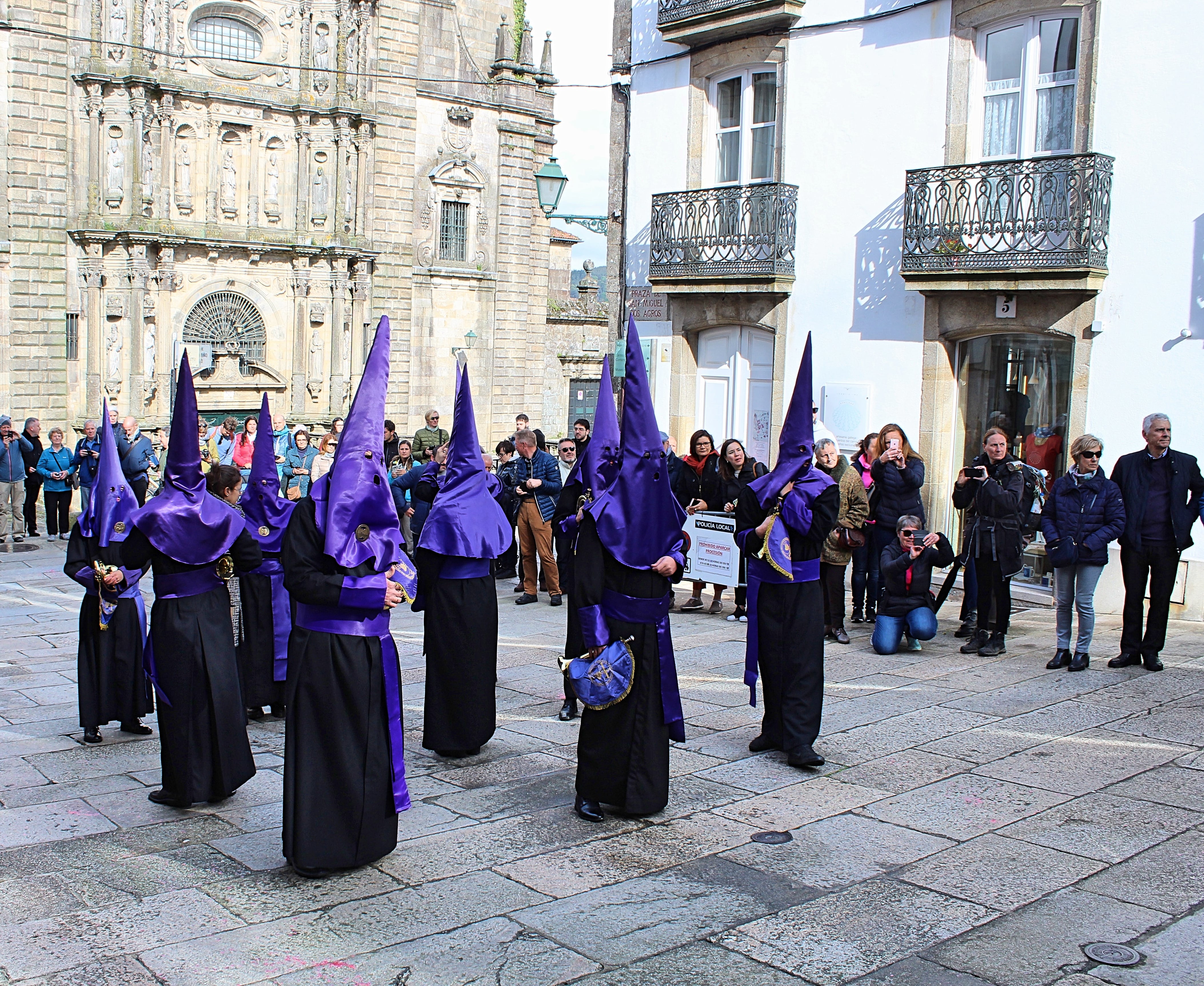
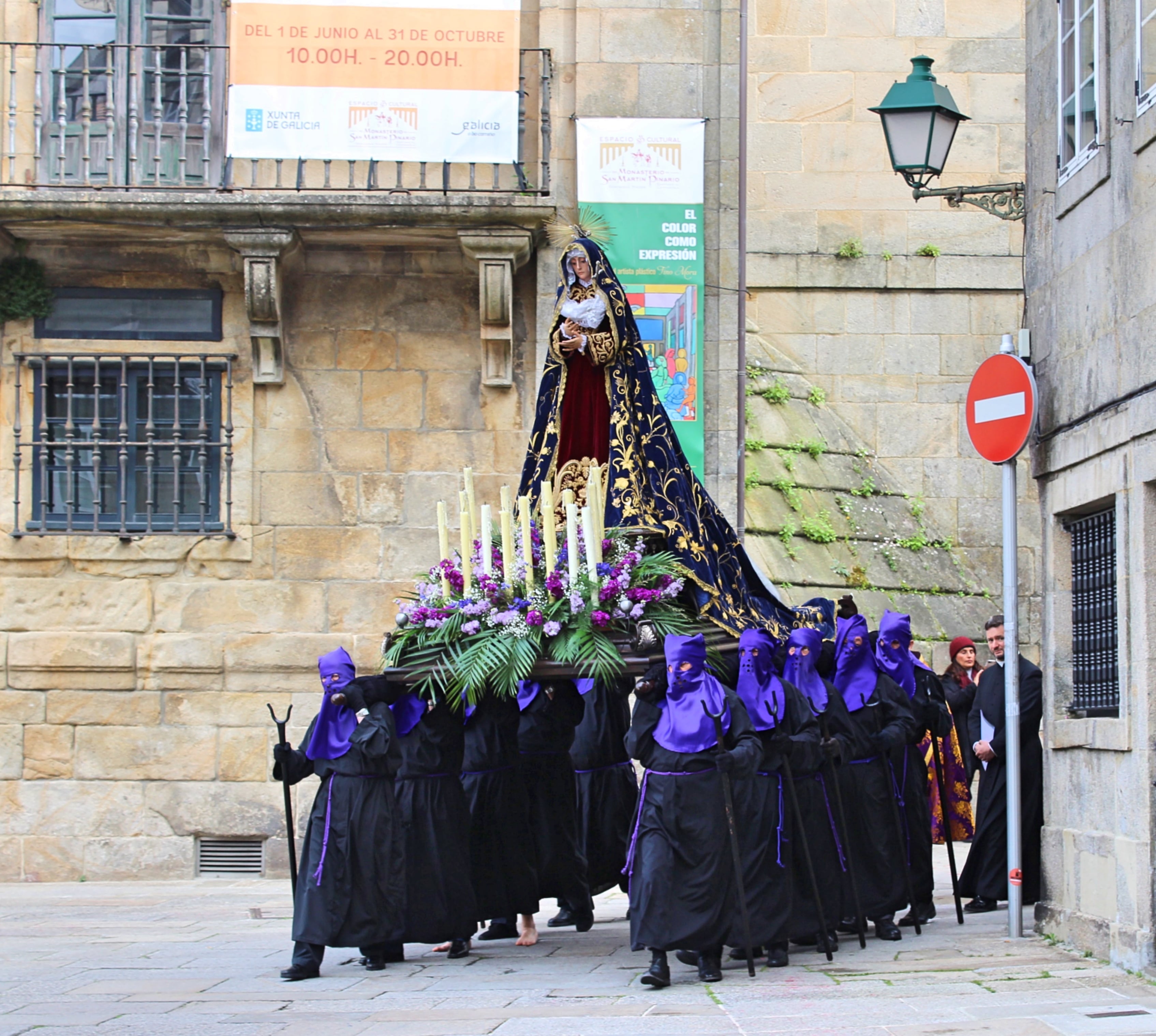
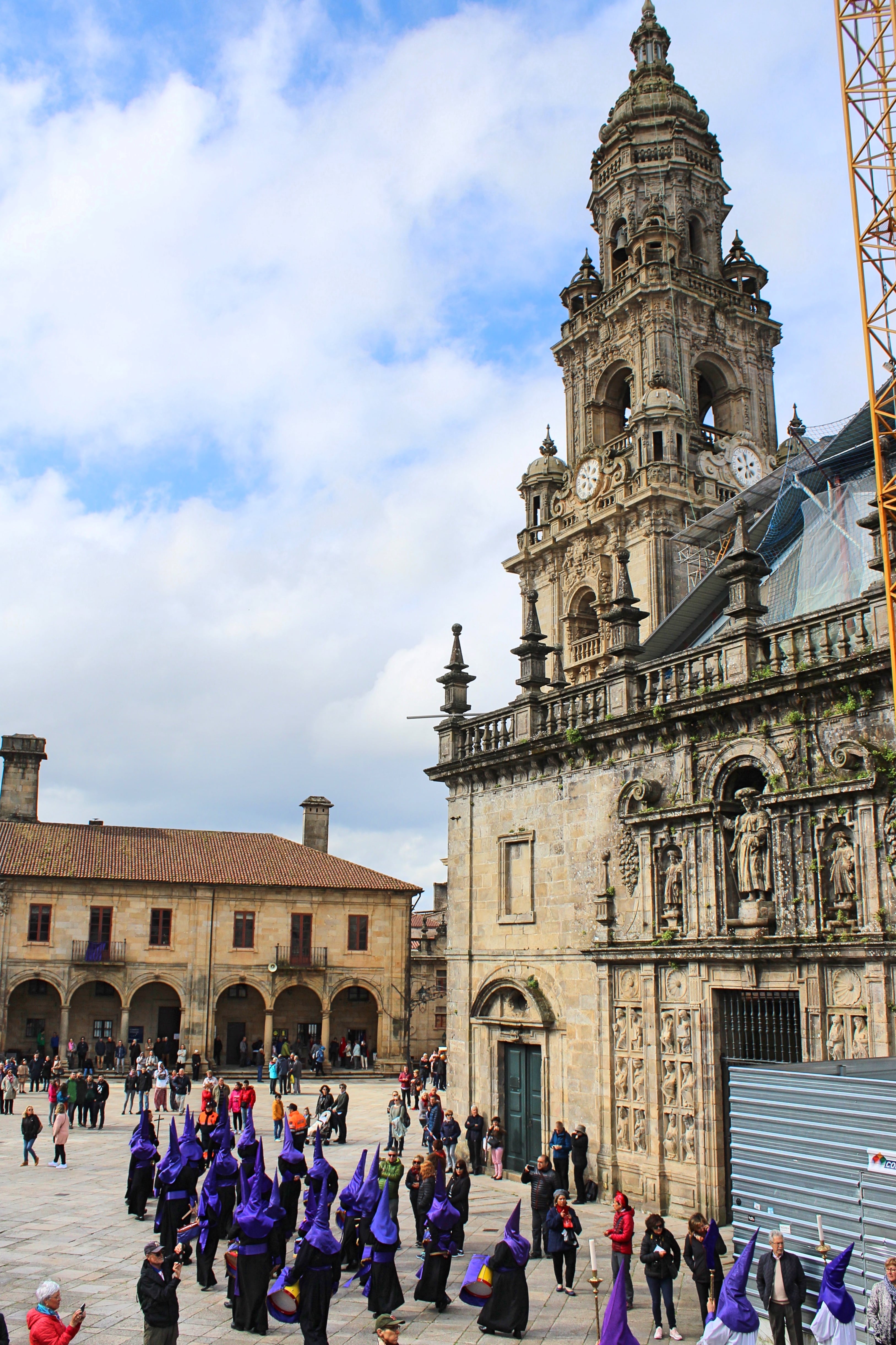
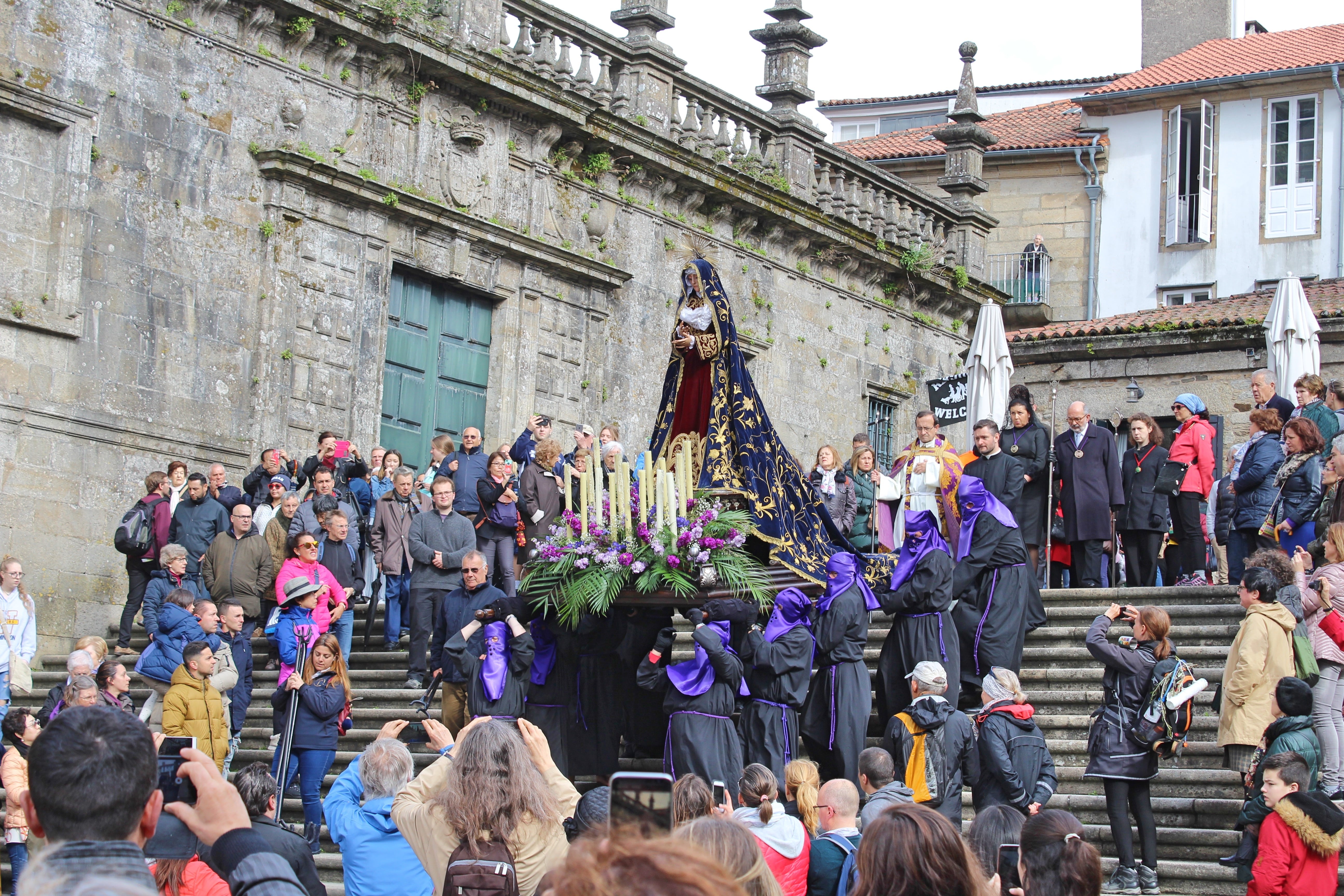
To an American, a Spanish Easter procession initially presents a frightening aspect, since the hoods strongly resemble those worn by the Ku Klux Klan (the Klan took it from the Spanish and not vice versa). But once this initial shock passes, the viewer is presented with an impressive religious spectacle. The hooded figures carry floats with religious figures on their shoulders, marching in unison, pounding walking sticks in a jarring metallic march. A band walks behind them, at times playing mournful and discordant tunes on their trumpets.
The elaborate doorway of the Monastery of San Martín Pinario can be seen in the backgroundThe walking sticks have notches, so that they can be used to support the float when they stop walkingThe procession entering the Praza de Quintana for a Good Friday ceremonyThe float makes its way down the stairs
No trip to Santiago is complete without a trip to the cathedral. Though I had been to Santiago several times before, December was the first time that I had seen the cathedral without scaffolding. The authorities are engaged in a years-long restoration effort, so that much of the cathedral’s famous façade had been covered up in previous years.
As good as new.St. James the pilgrim: A detail from another façade
The Pórtico de la Gloria was still undergoing reparations when I visited last December. So it was a relief when, this April, I was finally able to see the iconic doorway. In the past you could just walk into the cathedral and examine the statues for free. But now go through a special entrance, pay a modest fee, and go with a guided tour. And no photographs are allowed.
The money and the trouble are, however, entirely worth it if you enjoy medieval art. For the Pórtico de la Gloria is one of the finest pieces of medieval sculpture that I have ever seen.
An image in the public domain. Recent restoration work has recovered much of the original pigment.
Unfortunately, neither of my two recent trips to Santiago allowed me to see the famous Botafumeiro. This is the immense incensor that the priests swing from the ceilings of the cathedral. I went to a mass in December, on the feast day of the Immaculate Conception, thinking that such a special religious holiday would merit the use of the incensor. But no luck. I sat through the entire mass clutching my stomach, dizzy from the pain, only to walk out disappointed.
I thought that I would have another opportunity during Holy Week. But, again, I had bad luck. Though restoration work is finished outside, now the inside of the cathedral is covered in tarps and scaffolds. There will be no mass held inside the building until 2021, or so I was informed.
We did, however, visit the Cathedral Museum. This is surprisingly large, and contains two of the Botafumeiro incensors, as well as many works of religious art. I was also surprised to find a few tapestries based on Goya’s designs. But the best part of the visit may be the view of the Praza do Obradoiro, the grand square where the Camino de Santiago ends. As on any other day of the year, the square was full of supine pilgrims, resting after a long journey.
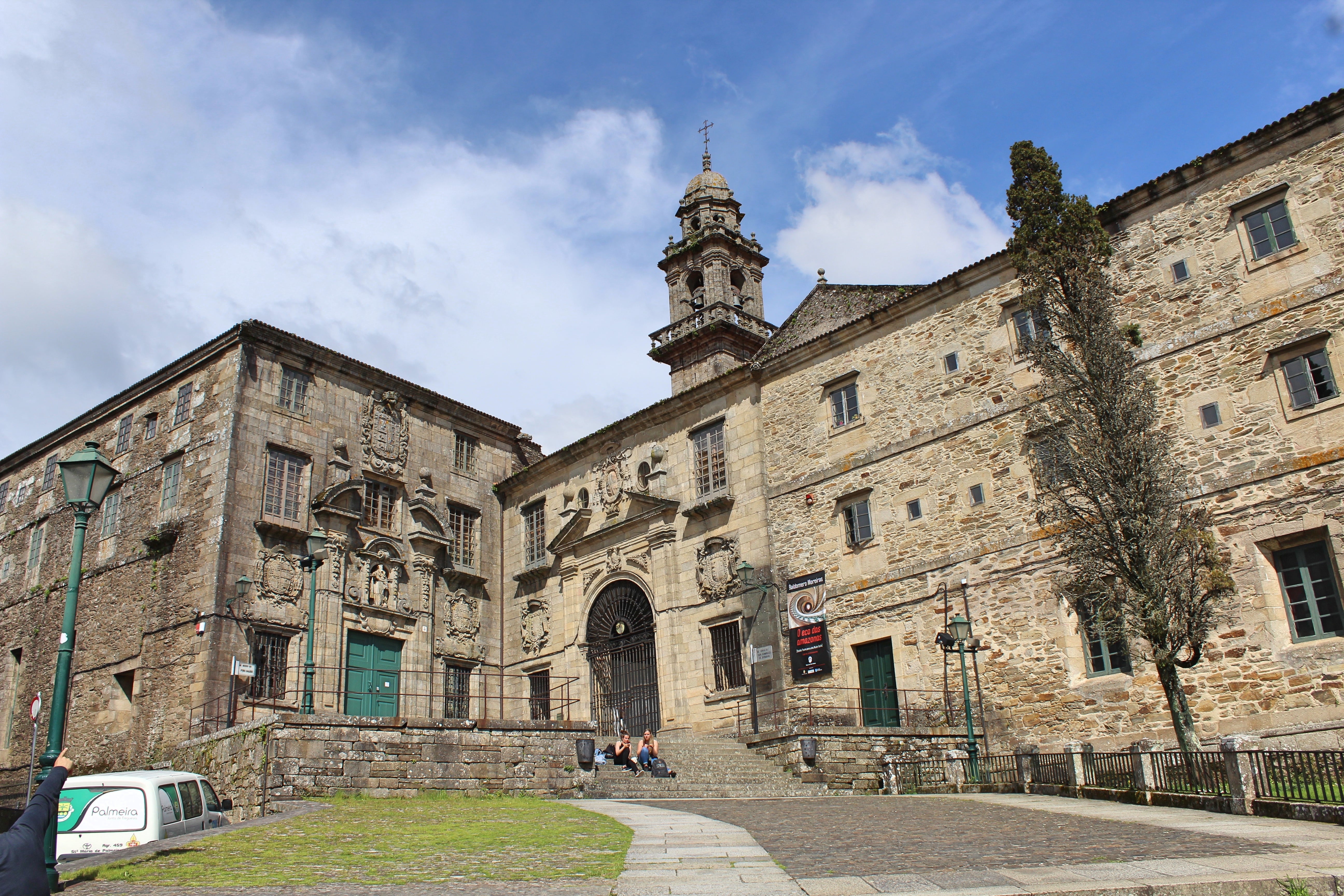
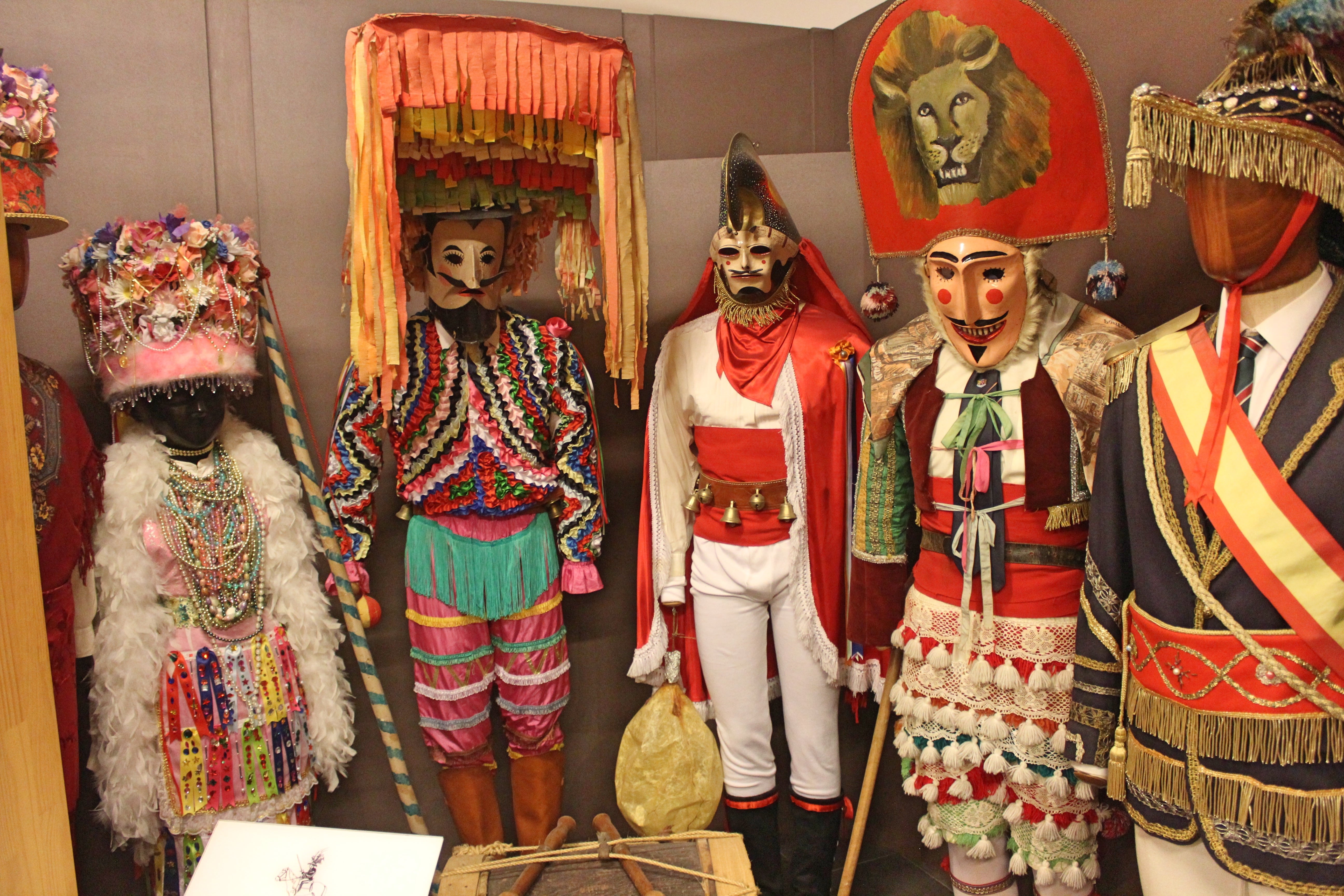
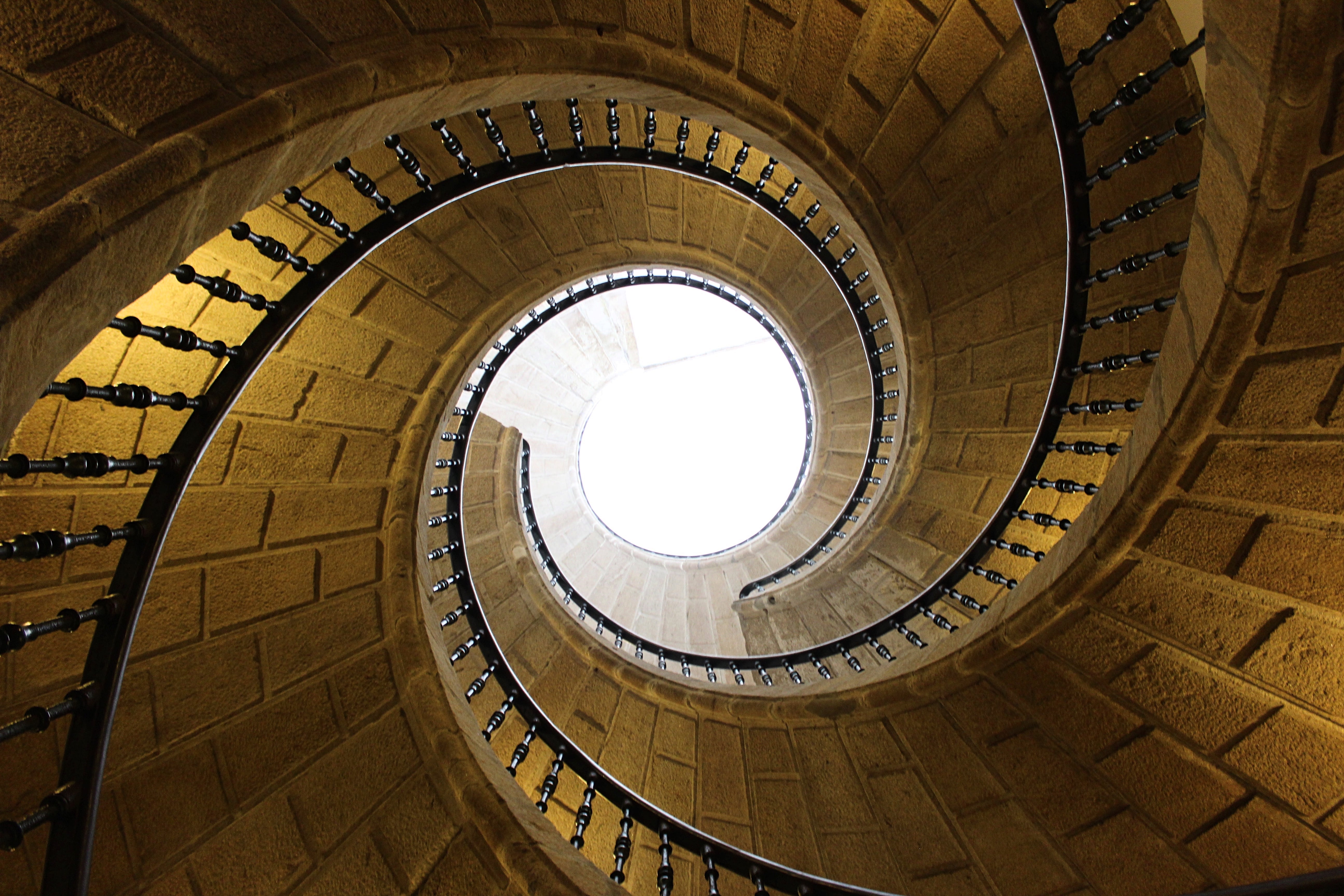
One of my favorite places to visit in the city is the Museo do Pobo Galego, or the Museum of the Galician People. It is a fascinating ethnographic exhibit on the traditional lifeways of the region, housed in an old monastery.
The Museum EntranceSome traditional carnival costumesThe famous double-helix staircase of the museum
Behind the museum is the Parque de Bonaval, one of my favorite parks in the city. Since this used to be the grounds of a church and a monastery, it is unsurprisingly that grave plots remain, though I am unsure if they still contain bodies.
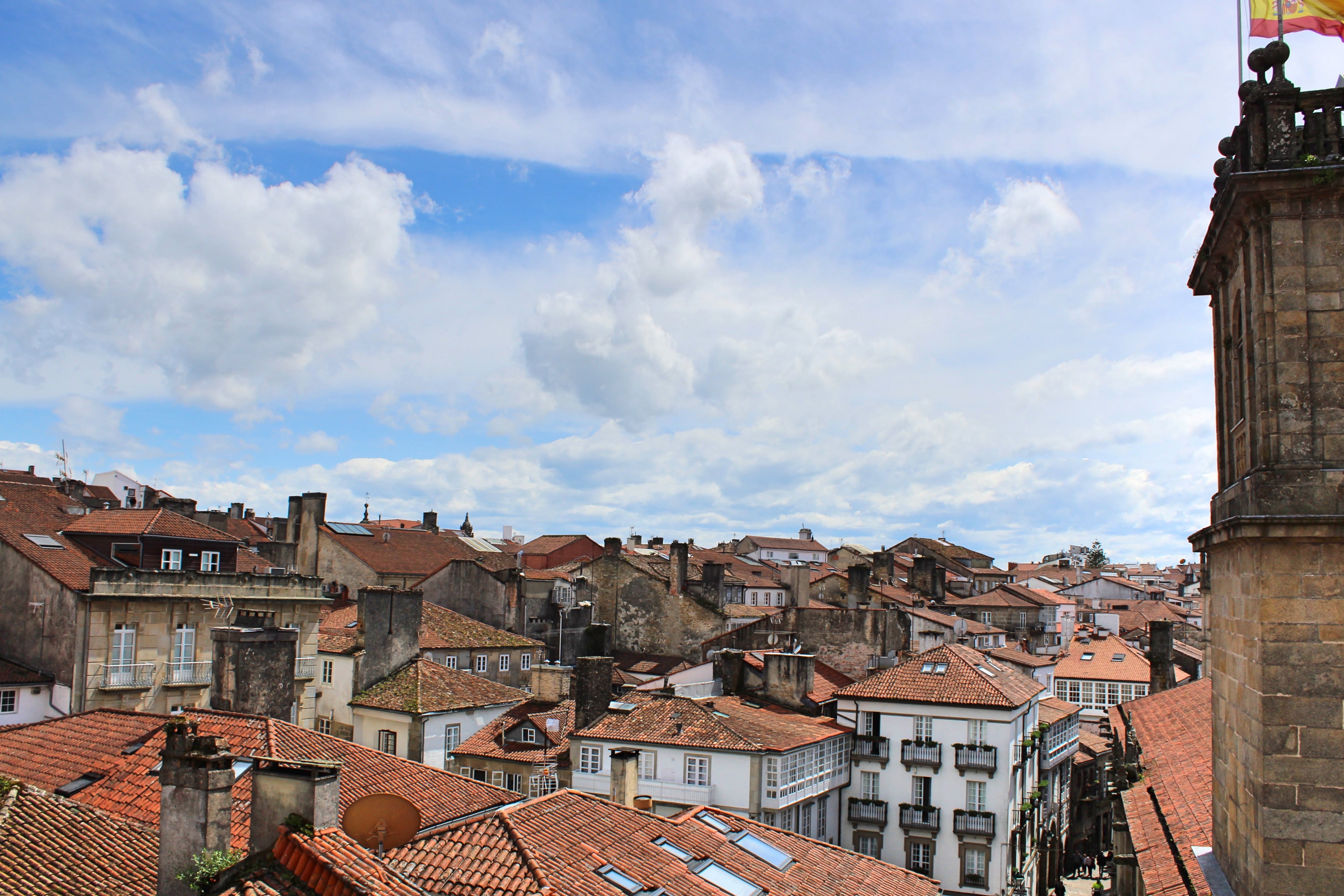
At the top of the park’s hill the visitor can also find an excellent view of the surroundings of the city.
Notice the arch of the futuristic cultural center in the distance
Another excellent park is the Parque Alameda in the center of the city. It captures the bucolic charm of the Galician forests.
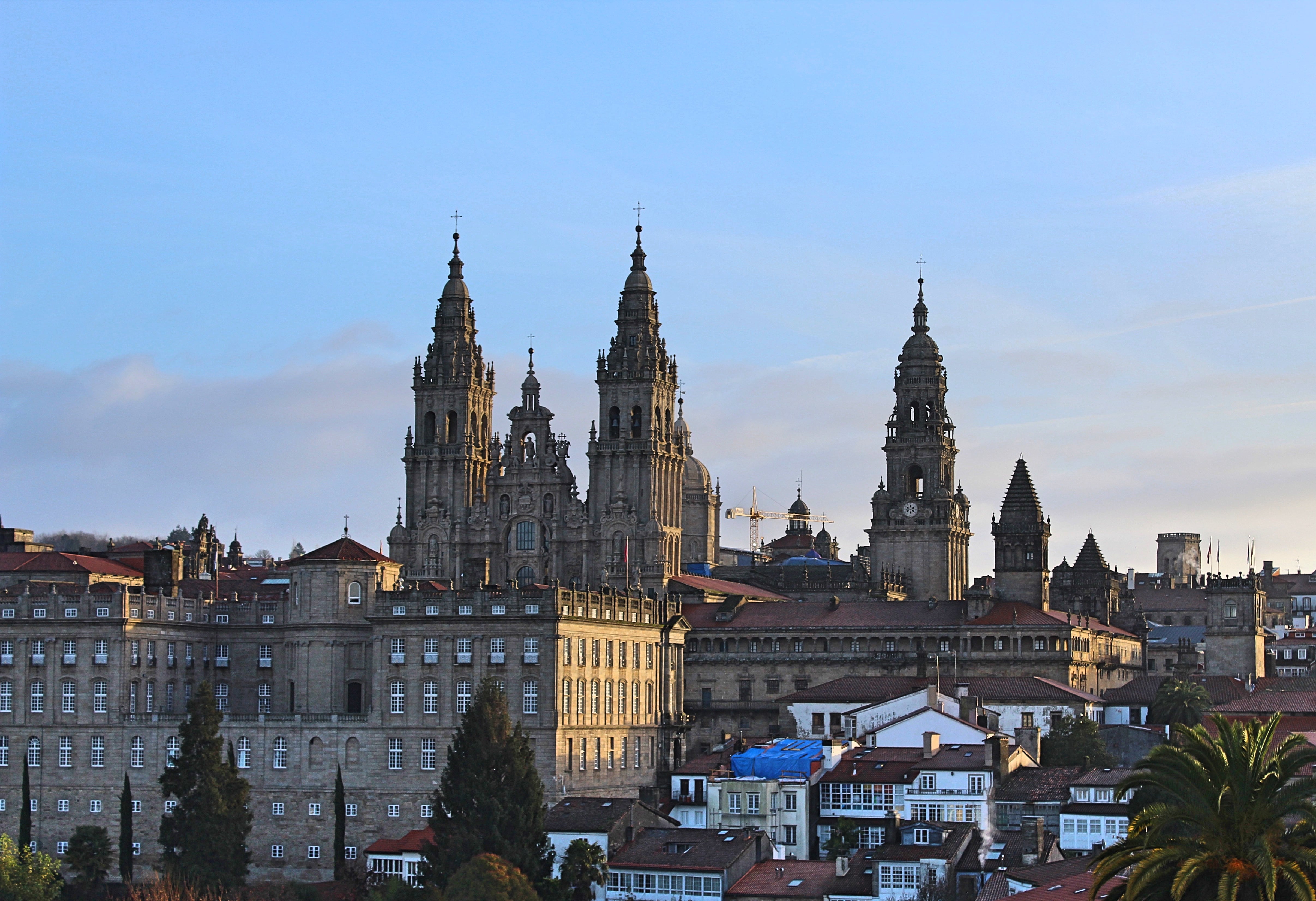
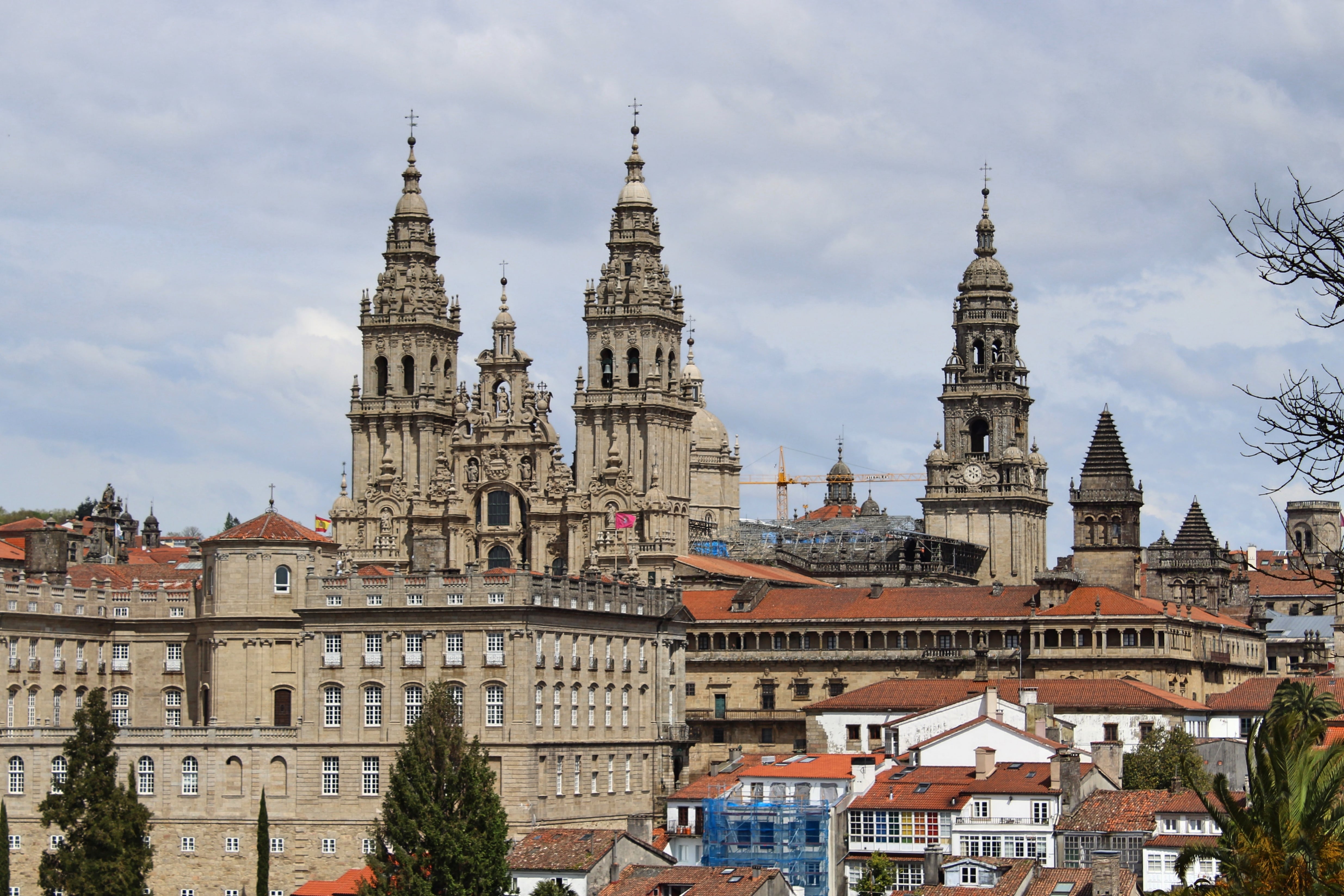
Best of all, this park offers an iconic view of the city and its cathedral. I took two shots with my new camera, one in winter and one in spring.
The view on a December morningThe view on an April afternoon
“Landed!” I texted my friend, using the airport wifi. “Where you at?”
I had just stepped off plane and into Dublin Airport, Terminal 1. My friend from home, Durso, had also just arrived—from Scotland.
This trip was months in the making. During the summer of 2017, Durso had asked me if I would like to meet up with him in Dublin for a weekend. Well, he didn’t just ask; he gave me an offer that I could hardly refuse: “If you come, I’ll pay for the hostel.” Free things have always been a weakness of mine; and in any case it sounded like fun, so I said: “Absolutely.”
Now it was December of that year. I hadn’t seen Durso, or anyone from home, in about three months.
In minutes I received a text from him:
“Word, just arrived. What terminal you in?”
“Uh, not sure. Lemme check… It’s terminal 1, I think.”
“OK, be right there.”
“But where are you?”
“Terminal 2.”
“I’ll head your way.”
The walk between the two terminals is short and well-marked. It would be difficult to miss somebody coming the opposite way. Nevertheless, I managed to get to the strikingly more modernistic Terminal 2 without catching sight of my friend. When I reconnected to the wifi, I messaged him.
“I’m here, Terminal 2. Where you at?”
But I could tell from the single, grey checkmark that my message didn’t arrive, which meant that he was off the wifi. I waited. The minutes passed slowly. I was a bit nervous. It’s always somewhat stressful trying to find someone without the use of phones, like people did in olden days. And I was also nervous because, though I’ve known Durso for a long time, I’ve never travelled with him. In fact, it had been about a year since I had travelled with anybody. I had gotten into the habit of solo travel after a breakup, and had gotten so used to it that I was convinced that company only made a trip worse. When I was alone I could do what I wanted, when I wanted; but now I would have to compromise. This was a test.
As I stood there, waiting for Durso in the cavernous hall of the terminal, I felt that this experiment was already failing. But soon enough, the trusty figure of Durso emerged from the crowd of travellers—unshaved, dressed in a collared shirt, a blazer, sunglasses, and brandishing his trademark curly locks.
“Bro!” he said, before we hugged.
Airport Selfie
“Hold on,” I said. “I need to take a selfie for my mom.”
That done, we made our way to the bus.
“Why are you all dressed up?” I asked him.
“Man, whenever I’m in Europe, I feel like I’m so badly dressed, so like everyday I get dressier and dressier. I just feel so ashamed around Europeans.”
“Weird. Well how’s your trip been so far?”
“Oh, dude, it’s been awesome.”
And at this, Durso launched into an impassioned and somewhat rambling account of his previous travels. His younger brother, Zach (whom we were to meet in the center), was studying abroad in Galway, and so Durso’s family took a trip to meet him there. Then, Durso had taken his own trip to Edinburgh and Glasgow (he liked the first and hated the second).
“Dude, so I went on this awesome walk in the highlands, after I took a bus to get there. And I was just walking and walking and it was, like, just so beautiful. But it was also really cold and I totally didn’t dress for it, and there were no people around, and I was just walking and walking, and finally the sun started setting, and I was like ‘Oh my god, I’m lost, I’m lost, I’m totally going to die, I’m going to get lost and freeze to death,’ but in the end it was fine, I just found the bus and went back to the city.”
Durso also had very positive impressions of Galway, which he vastly preferred to Dublin.
“Yeah, so, like Dublin is a nice city, but you don’t get a real feel for Ireland there. In Galway there were all these little boats and fishers and stuff, and the countryside was just so nice, so nice. Man I can’t wait to go back.”
The bus (the Airlink 747, a double-decker) wound its way to the city center, and soon Dublin came into view
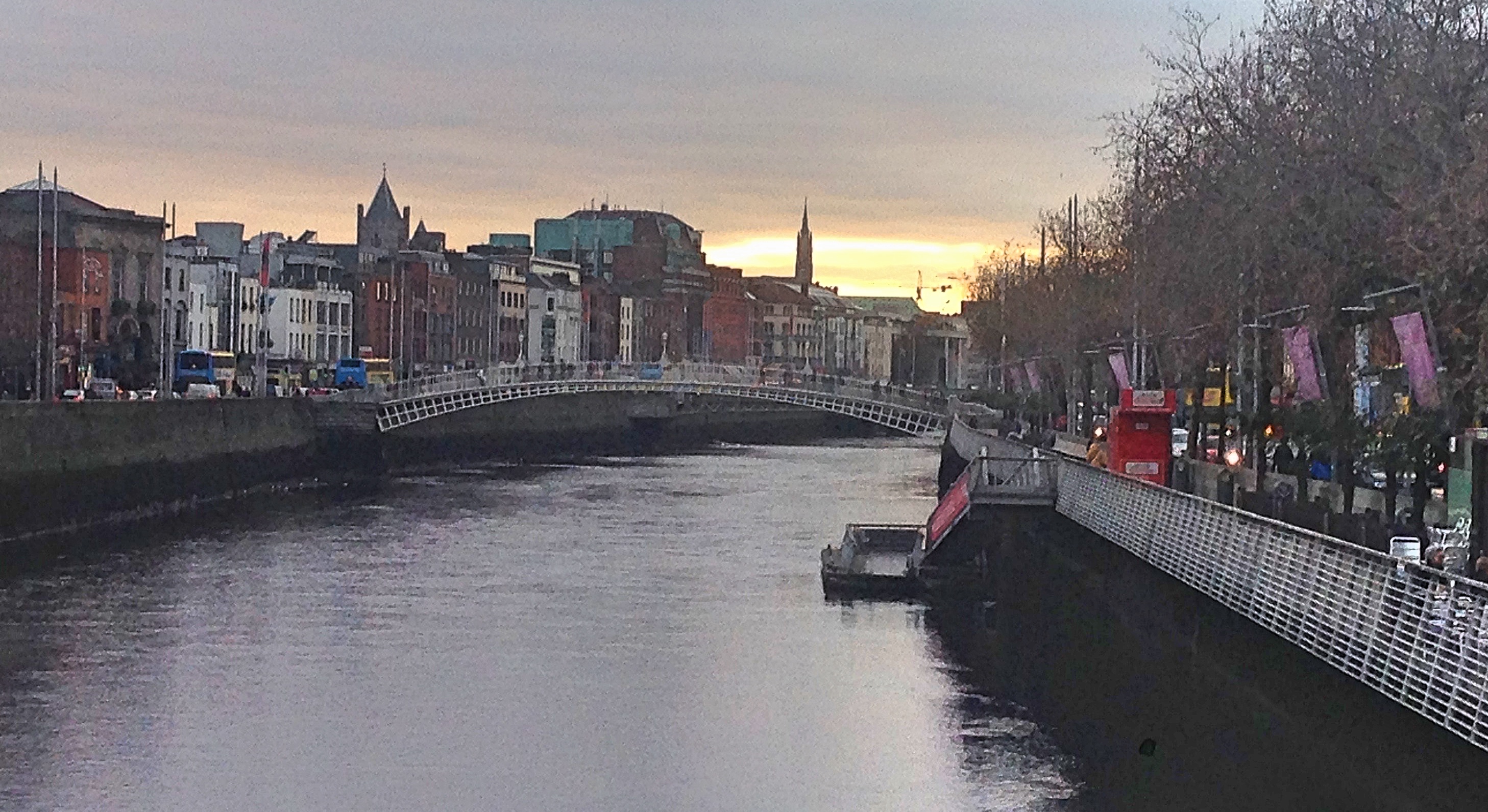
I had done absolutely no research beforehand, so my only expectations were shaped by my readings of James Joyce. Needless to say, however, Ulysses did not exactly give me an accurate impression of the city. Like many old but economically successful European cities, Dublin is an arresting mixture of old and somewhat dour heaps of stone, and new and shiny towers of twisting glass and metal. And as with many an old city, it is centered upon a river—in this case, the Liffey.
The Liffey with the Ha’Penny Bridge
The bus deposited us right on the riverside, very near to the hostel that Durso had booked. Zach was there, waiting near a Dunkin Donuts (if memory serves). Though I had known Durso for years, and had been to his house several times, this was the first time I had ever really spoken to Zach. In high school, I passed Zach nearly every day on my walk home, as he rode his scooter in front of his house (he’s several years younger than I am). Sometimes I said “hi,” but that’s about it.
Now he was full grown—an athletic build, square jawline—and stylistically worlds away from Durso: pragmatic and understated clothes, close-cropped hair, clean-shaven. And here he was in Ireland, studying something practical like business or economics. Unlike Durso or I, this boy was going places.
We checked in to the hostel. Durso had splurged, and had booked a room right in the center of the city. When I heard the price, I nearly choked. Immediately I felt very guilty for not paying (but not, of course, guilty enough to offer to pay a part of it). It was three of us in a room with three massive, three-story bunk beds—room for nine.
“Oh man, I wonder if anyone else is gonna come,” Durso said.
“Hope not.”
We left to see the city. It quickly became clear to me that Zach was not simply treating his study-abroad as an opportunity to drink Guinness. He had done his homework about his host country, and was brimming with historical facts that he led drop as we walked. Since I was (and remain) shamefully ignorant of Irish history, many of Zach’s facts were wasted on me. But some managed to stick.
“See that?” he said, pointing to a big neoclassical building with columns in front. “That’s the General Post Office. During the Easter Rising, the rebels used that building as a headquarters, so it got bombarded by the British. Here, you can still see the bullet marks.”
The GPO after the Rising
He pointed to a column and, indeed, the battle scars were unmistakable.
Next we crossed the river Liffey on the famous Ha’Penny Bridge—a very pretty cast-iron bridge, and named for the toll that pedestrians originally had to pay. Nowadays, thankfully, there are no turnstiles.
Our first stop was Trinity College, partly because I had insisted on seeing the Book of Kells. Trinity College is the oldest and most prestigious university in Ireland, and its campus has the distinguished look of academic pedigree. Stately buildings enclose a central square, through which students scurry from class to class like so many industrious ants. The Book of Kells is held in the college library. After a short queue (and about 15€) we were inside.
Well, not all of us. Since Zach had already paid to see it, he preferred to wait outside. Durso and I promptly found ourselves in a room full of backlit displays, explaining the history of illuminated manuscripts in Ireland. I wanted to take some photos for my records, but the staff were very insistent that no photos were allowed.
In his classic documentary, Civilisation, the art historian Kenneth Clarke describes the monasteries in Ireland as one of the last holdouts of Western civilization after the collapse of the Roman Empire—when Germany, France, Spain, and Italy were overrun by various “barbarian” populations. Clarke’s view is doubtless an exaggeration; civilization never stopped. Nevertheless, it is impossible to witness the high artistry and craftsmanship of these illuminated manuscripts without a feeling of awe. The Book of Kells was not the creation of a mighty artistic tradition in its prime, but was the work of a few monks on a far-off island during one of Europe’s lowest moments. As a case in point, the book was once stolen by Vikings during a raid.
I am getting ahead of myself. The Book of Kells is a sumptuously decorated collection of the gospels. As with many books during that time—all handmade and mostly religious—the book was decorated with images and patterns. The Book of Kells is special in that it is, perhaps, the most beautifully illuminated book in existence. What first strikes the viewer is the level of detail. The twisting, shifting shapes seem to curl endlessly around themselves into progressively finer and finer scales; it boggles the mind how anyone could have planned and executed such a thing. Kenneth Clarke reminds us that, in those days, they didn’t have television, so fancy patterns were likely the only visual entertainment available.
The text opening the Gospel of John
“Hey guys,” a voice behind us said.
I turned around to find—Zach.
“You came in after all?”
“I just snuck in through the exit. I remembered where it was from the last time. Nobody stopped me.”
“What a badass.”
We proceeded from the informational exhibit to the book itself. It is displayed in a darkened room (for preservation purposes, I gather) and shown beside other exemplary illuminated manuscripts. The 340 pages of the Book of Kells are bound in four volumes, and two of these are displayed at any one time, turned to different pages.
I peered down at the glass display case with reverence. I remembered first seeing the beautiful book in my Introduction to Art History class in college (taken as a core requirement), and being deeply impressed. Now I could see the masterpiece in person. The only problem was the other people. Specifically, one guy was bent down very close to the glass, and refused to budge. He stayed looking at the page for ten minutes, as the people around him jostled for space around the edges. I fully understand why the man would want to make the best of what may be his only opportunity to closely examine the glorious book. I’d love to do the same. Still, blocking other people’s views did violate Kant’s categorical imperative.
Considering the crowd and the dim lighting, you can probably get a better view of the book by simply going to Trinity College Library’s website, where the entire book has been digitized in high quality. But at least I get to brag about seeing it in person.
The last part of the visit is to the library’s famous Long Room. As one would expect, this is a very long room filled with very old books. Two floors rise upward to meet in the circular vaulted ceiling, creating a kind of tunnel of knowledge. Marble busts of great intellectuals line the lower walkway, including one of the great Irish writer, Jonathan Swift. It is a veritable temple of learning, as a library should be. And there was one more item on display: Brian Boru’s Harp.
“So this harp is supposed to be the oldest harp in the world,” Zach said. “It was made in the… 15h century I think? This was the model for the harp on Ireland’s coat of arms, so it’s like a national symbol.” (It’s also used in the logo for Guinness and Ryanair.)
“Nice.”
(Brian Boru, by the way, was an Irish king of the 10th century. The harp was reputed to have belonged to him, but that’s quite impossible, since it was made five hundred years after he died.)
Notice the harp.
When we re-emerged into the city I found, to my great dismay, that it was already getting dark. I checked the time on my phone.
“4:00?” I said in disbelief. “It’s getting dark at four o’clock?”
“Yep,” Zach said.
“In Madrid, the earliest it gets dark is 6:30!”
“Must be nice.”
“Where are we going?”
“Christ Church Cathedral,” Zach said. “It’s free.”
In minutes we were standing outside of a very pretty medieval church building. But when we stepped inside, we found, to our dismay, that you did have to pay.
Christ Church
“Lame,” Durso said. “I’m not paying to get in there.”
“Me neither,” Zach said.
“Oh well,” I said. “What’s next?”
“Well, we can go see St. Patrick’s.”
This is located right down the street from Christ Church. (If you are wondering how there can be two cathedrals so close together, this is because Christ Church is the cathedral for the local diocese while St. Patricks is the so-called National Cathedral. Both belong to the Church of Ireland.) At the end of a string of red apartment buildings, the more imposing, spired form of St. Patrick’s came into view. But, unfortunately, you have to pay to enter that cathedral, too, and my companions weren’t willing—and in any case it was five minutes to closing time. If I had been alone and the cathedral had been open, I likely would have forked over the money, if only because Jonathan Swift served here as the dean.
St. Patrick’s Cathedral
“Yeah, so apparently these two churches had kind of a rivalry for a while,” Zach explained. “Like dueling congregations. Kinda weird.”
It is indeed strange that two grandiose cathedrals for the same church would be built so very near each other. I was also surprised that there wasn’t a more imposing Catholic cathedral in the city, considering that Catholicism is the most popular religion in the country. But of course the Anglicans (of which the Church of Ireland is a branch) have historically wielded the power.
By now it was five o’clock, cold and dark, and every attraction was closed.
“What should we do?” I asked.
“Drink in the hostel?” Durso suggested.
“Sounds good to me.”
We found, to our relief, that nobody else had moved into our room when we were gone. We had the whole place to ourselves—an interior window, a concrete floor, and three triple-decker bunk beds. The beds had too little headroom to sit down in, so we sat down on the concrete floor, charging our phones. (In Ireland they use the UK-style outlets.)
Durso, as ever, came prepared. He had two bottles of liquor stowed away in his backpack, which we passed around. An hour passed this way, chit-chatting and, in my case, taking small sips (hard alcohol never sits well in my stomach), until I had a brilliant idea.
“Hey guys, let’s make fortresses. We can use the blankets from the other beds.”
Somewhat tipsy, we took the spare sheets and hung them from the upper beds, creating a kind of screen surrounding each of our bunks. I remember doing almost this very thing when I was young, pulling a bunch of chairs together in the living room and draping blankets over them to create a “fortress.” Both back then and in Dublin, it was strangely exhilarating; but why? A Freudian would say that we were recreating the elemental womb, seeking the feeling of being unborn. Well, I don’t know about that, but it did help give us some privacy in the bare room.
Now it was time to go eat. We wandered our way into the center, and wound up in a pub. It was then that I noticed how expensive Dublin is. Indeed, it is scarcely less pricey than London. But the prices seem even worse since they are in euros, making them easier to compare with the cost of Madrid.
“I can’t pay 12€ for a soup!”
“It’s good, bro,” Durso said.
I bit my tongue, since I still felt a bit guilty for not paying for the hostel.
I ordered Irish lamb stew. This is exactly what it sounds like—and it was delicious.
“I think they put Guinness in the broth,” Zach said.
I quickly finished my bowl, and mopped up the remaining broth with black bread. Scrumptious, but not nearly enough. I wanted to order more; but I had to save my money for beer.
We made our way to Temple Bar, the nightlife capital of Dublin. This is basically a zone in the center with a high concentration of attractive bars. Its name does not derive from any previous temple, but from a prominent local family or, perhaps, in imitation of a ceremonial entrance in London—scholars are not sure. The place was buzzing with activity; American accents were common in the air; and some visitors looked like they had had enough to drink already.
We went to the most famous establishment, the Temple Bar Pub (it is named after the street and not vice versa). The outside was decorated festivaly with strings of Christmas lights, and the inside was too. The place was totally packed. On the far end a group was playing traditional Irish music: a guitarist, a fiddler, and a singer. This seems to be a common staple in Irish pubs, and is very popular among the tourists. I was amazed to find that Durso and Zach knew many of the songs well enough to sing along. I was lost. Apart from movies, I had never listened to Irish music. And I must admit that, during my experience in Dublin, it all sounded very similar to me and generally failed to hold my attention.
We watched a couple songs, but eventually decided that the place was too crowded to stay at. We got out into the street, braced by the relative quiet and the cool night air. It was then that I had an unpleasant realization.
“Uh, guys,” I said, tapping my body. “I think I left my bag in the restaurant.”
“Oh shit,” Durso said. “You mean your purse?”
“It’s a messenger bag.”
“Word. Was there anything important in it?”
“Not really. Just my kindle. But I’d prefer not to lose it.”
“Ok let’s go,” Zach said.
“Sorry.”
We walked back towards the restaurant. From the street, however, it was difficult to determine which one we had been in, since several nearly identical establishments were located right next to each other. After first going in the wrong one and realizing our mistake, we found our way to the right spot. There, I asked the waiter if he had seen a small brown bag.
“It looks kinda like a purse,” I explained.
“If there is any lost and found, it’ll be a couple doors down, at the hotel.”
The restaurant, you see, was affiliated with a nearby hotel. I walked inside with Zach and asked the front desk.
“A small brown bag?” he asked.
“Yeah, it’s a messenger bag.”
I waited with some slight anxiety as he went into a back room. Meanwhile, a family arrived to check in, with heavy suitcases in tow. Five minutes later, the man arrived with a familiar brown bag.
“Thanks so much,” I said, checking inside. My kindle was intact.
“Got your purse?” Durso said, as we got back to the street.
“Shut up.”
Next we went to a less crowded pub, right alongside the Liffey. It was quite a sprawling affair, with several floors and bars around every corner. Like true tourists, we ordered three Guinesses and picked a seat. On a screen they were broadcasting a performance downstairs of a man playing more Irish music.
“You know,” I said, after tasting the Guiness, “everyone says that Guinness tastes better in Dublin. But this tastes the same to me.”
“Dude, this is way better,” Durso said.
“We’d have to compare them side by side,” Zach said.
A beer and a half later, I was feeling settled in.
“You know what guys? This is awesome. I can’t believe I’m in Dublin.”
“Yeah man, this is awesome. Though Galway is a lot better.”
“Don’t rub it in.”
It was, indeed, pleasant to be in Dublin. Though we had been friends for years, I had never traveled with Durso, and had hardly spoken to his brother. I was nervous that it would be too much; that I would get sick of them, or them of me. But, in the end, it was just what I needed to feel re-connected to home.
Brothers: Durso and Zach
After all, Dublin wasn’t too far off. Like New York, it was cold and rainy; and like New York, everybody spoke English. Even the people looked familiar. Durso, Zach, and I all hail from Irish stock; so walking around the streets felt like getting lost in a reunion of distant family. Most important, though, was the chance to see an old friend and to be effortlessly myself—something that is difficult when in foreign lands making new friends.
After three rounds, we left to get back to the hostel. But there was a snag.
“Hold on guys,” Durso said. “I wanna get almonds.”
We walked to a SPAR (which, if you don’t know, is a chain similar to 7-Eleven) to search for Durso’s desired snack. The store had an impressive array of nuts on sale. But no almonds.
“This is crazy,” Durso said. “Like, they have everything except almonds.”
“You sure?”
“Yeah, man, I checked everything.”
“Well, want some peanuts?”
“No, no, I want almonds.”
“But they don’t have almonds.”
“I know, I know.”
Durso searched the store with the air of a desperate man.
“Jesus, what should I get? They don’t have almonds. I don’t know.”
He held up a container of California rolls from the fridge.
“Maybe this… Do I want sushi?”
“Dude, don’t get sushi, man,” I said. “It can’t be good.”
“But they don’t have almonds.”
“Look, Durso,” Zach said. “How about this?”
And he handed Durso a pack of rice cakes.
“Hmmm,” Durso said. “Yeah, maybe, maybe this.”
We made it back to the hostel. Our room was at the end of a long hallway, whose walls were painted with cartoonish murals of famous celebrities. We passed Marilyn Monroe, Jimi Hendrix, and the Beatles. Meanwhile, Durso stayed in character.
“Help!” he said loudly. “Help me!”
“Shhhhh,” I said, as Zach laughed.
“I’m going to end it all! Death is the only way!”
Durso has a morbid sense of humor.
Back in our rooms, we had one last drink and a few rice cakes.
“Look what I nabbed,” Durso said, taking a glass out of his backpack.
“Did you take that from the bar?”
“Yep.”
“Dude!”
“What? I always take a glass.”
“You’re a kleptomaniac, bro.”
Then, we showered, brushed our teeth, and went to sleep in our little forts.
§
The next morning was grey, cloudy, and cold. We were headed to the beach.
To get there, we walked along the River Liffey on the north side. This took us through the more modern part of town—where, I suppose, many of the companies which make Dublin an economic powerhouse are located. We also passed by the Irish Emigration museum, which I would have liked to have visited if I had had more time, since at least half of my family line come from Ireland. A more gruesome site was the Famine Memorial, statues of six malnourished and spectral Irish (and an underfed dog), staring with hollow eyes to a hopeless beyond. Last we passed the impressive Samuel Beckett bridge, a cable-stayed bridge designed by Santiago Calatrava (a Spaniard) to look like a harp.
One thing which I barely noticed, but which I most certainly passed, was the Royal Canal. This is a 145 km (90 mile) stretch of water that extends from the Liffey in Dublin all the way to the River Shannon in Longford. It has long since served any serious function in transport or industry; but it has been revived as a kind of vertical park. The reason I mention this humble piece of watery infrastructure is because once, on a flight from New York to Madrid, I found a very short documentary about the canal on the plane’s entertainment system. Well, it was not exactly a documentary: two Irish Olympic athletes, mother and daughter, take a leisurely stroll along the canal while scholars and artists meet them along the way to tell them about its history. You see, I was tired but I couldn’t fall asleep; and this documentary seemed to be the most promising soporific short of chemical aid. So I turned it on and attempted, unsuccessfully, to drift off. In any case, it’s a lovely canal.
Samuel Beckett Bridge
When we neared the mouth of the Liffey we crossed to the southern side and begun making our way through several attractive neighborhood blocks. Yet I am afraid that the quaintness of this part of town only called to mind Monty Python’s “Every Sperm is Sacred” (which, by the way, was not filmed in Dublin at all). Finally, after passing through a small park, we arrived at the beach: Sandymount Strand.
Well, it had sand and an ocean, so I suppose it qualifies as a beach, though I could not imagine happily wading into the water on that stretch of coastline. For one, the looming Poolbeg Generating Station—a gargantuan gas power station with two towering smokestacks—did not inspire confidence. But Durso did look great modelling on the sand.
“The snotgreen sea. The scrotumtightening sea,” I quoted. “James Joyce wrote that. The man was a genius.”
“Did he really write that?” Zach said.
“Yeah, it’s one of my favorite quotes from Ulysses. And now I finally had a chance to use it.”
My outstanding literary taste displayed, we were ready to head back into town. After another long walk (and a stop for sandwiches and coffee) we found ourselves at Dublin Castle. This is more of a government complex than a castle nowadays, although originally it did have that function. Now only one turret remains from the erstwhile medieval fortifications; it is attached to the Chapel Royal, a church used by the British leader of Ireland until the establishment of the Free State in 1922.
“There’s a river running underneath it,” Zach said. “Once on a tour they showed it to us.”
(This would be the River Poddle—which, as it happens, is the source of Dublin’s name. A stretch of the river was known as the “dark pool,” which in Irish is “dubh linn.”)
After this we took a detour through a lovely park—St. Stephen’s Green—to get to our next destination: the National Museum of Archaeology. This is part of the National Museum of Ireland; and like every branch of that institution, entry is free. Walking into a museum without a queue or a fee must be one of life’s great experiences. Other countries should take note.
The museum is housed in a grand, cavernous structure that looks as if it used to be a train station. Its collection spans from prehistory, through the Bronze Age, to the medieval period. And there is quite a lot to see.
There was a logboat made in the early bronze age—a huge hollowed-out log that people would paddle through bogs; indeed, it is only because it got stuck in a bog that the organic material was preserved at all. In the center of the museum there is an extremely fine collection of Bronze Age gold objects. Many of these take the form of body ornaments, buttons, bracelets, or collars, and they are remarkable for the extreme skill of their craftsmanship. Collecting and shaping metal in such a way is no mean technological feat.
Aside from these highlights there were stone tools, clay pots, medieval swords, bronze axes, and information on migrations, diets, burials—the list goes on. But what interested Durso the most was the section on the Vikings. I found him near a replica Viking ship, eagerly reading a timeline.
“Why do you like the Vikings so much?” I said to him, rather rudely.
“Dude, they’re awesome.”
“No, they’re savages. They just went around raiding and raping.”
“But their lifestyle was just so amazing.”
(Durso had seen several Viking television shows.)
Probably I was too hard on the Scandinavian vandals. After all, nobody can doubt that they possessed a civilization of sorts, far outdoing their contemporaries in seafaring skill. Nevertheless, I still remain dubious of the Vikings, if only because I have imbibed the Hollywood image of them as predators on more peaceful and sedentary peoples. I am sure the historical reality is more interesting.
As Durso continued to scan the Viking timeline, I moved on, going through the Middle Ages and eventually finding myself in a small room dedicated to Egypt. Every archaeology museum must have at least a few mummies to be properly legitimate. Then, thinking that I had seen everything, I doubled back to find Durso. But he was nowhere in sight. This was odd, since from my vantage point on the second floor I could see the whole museum. As a case in point, I quickly spotted Zach, and went downstairs to meet him.
“Hey man,” I said, “do you know where your brother went?”
“No idea, I was looking for him too.”
“Alright. I think I’ve seen everything. Wanna find him?”
“Yeah, I’ll check over here.”
“Ok, he’s not upstairs, so I’ll look this way.”
And then we did what every horror movie counsels us not to do: split up to find a missing member of the party.
As I looked, I soon discovered that I had been mistaken about the dimensions of the museum. There was an entire wing that I had missed; and it was the most memorable part.
I found myself in a large space subdivided into little chambers, as in a maze; and in the center of each chamber there was a glass case containing a body. These are the famous bog bodies, corpses that have been preserved in Ireland’s peat bogs, many for over 2,000 years. The common hypothesis is that these people were ritualistically murdered, leading some to hypothesize that they were kings of a sort, since many were found near hills used to inaugurate rulers. Well, king or commoner, they are a morbidly fascinating sight. Their skin is leathery and reddish, their muscles and bones still plainly visible. Some even still have hair and clothes.
I think this was the first time in my life that I had seen a genuine corpse in person, and it was unsettling. It is impossible to examine the bodies without wondering what kind of people they were. Each was an individual, more or less like me, yet living in a radically different world and culture.
I grew so fascinated with the exhibit that I completely forgot that I was supposed to be looking for Durso. Finally I reached the end of the display room and turned around, only to bump into Durso right as I walked out.
“Hey dude, did you see those bog bodies? Totally awesome.”
“Yeah man.”
“Wait, where were you?”
“You know, just looking around.”
“Man, you’re just like my grandma, you have to read all the little signs and captions.”
“I wanna learn, bro.”
We quickly found Zach and then left the museum for our last destination: Glasnevin Cemetery. It was now well past lunch time, and the amount of available daylight was quickly running low. It was about an hour’s walk from the museum to the cemetery, most of it unremarkable, though I do remember passing over the Royal Canal.
On the way there Zach gave us another one of his fun facts:
“The Catholic church prohibited human dissections for a while, so that there was a kind of black market of human bodies. It was a big problem. Right after someone was buried, bodysnatchers would come, dig him up, and then put the body in a barrel of whiskey. This kept it well-preserved, and also it let them move the body without getting caught. Finally, they’d sell the body to whoever wanted it—like medical schools—and then they’d sell the whiskey.”
“Jesus.”
“That’s gross.”
When we arrived, Zach had many other facts to share with us.
O’Connell’s tower
“So, for a while there was a lot of prejudice against the Catholics. This guy, Daniel O’Connell, who was a big nationalist politician, campaigned for the opening of a cemetery where Catholics could perform their rites without being bothered. That’s why he’s buried under that big tower over there.”
He pointed to the round tower, which stands near the entrance to the cemetery. O’Connell must have been quite the figure to merit such a monumental tombstone. Indeed, it would be difficult to overstate his role in Irish emancipation.
Collins’ grave
Another hero of Ireland’s fight for independence was buried near the visitor’s center: Michael Collins.
“So, this guy is a bit more controversial. He fought in the Easter Rising [which is what damaged the post office building], and then he fought in the War of Independence. Eventually the British were like, ‘OK you guys can be free, as long as you swear loyalty to the queen. Collins said that it was a good idea, since it was a step towards being totally free. But other people thought it was like giving up, and then the Irish started fighting each other, and eventually Collins got killed.”
“Jeez.”
“Yeah, but a lot of people think of him as a hero. I did a tour here, and the guide said that there’s a woman who comes once a year with, like, a ton of flowers and leaves them on the grave without saying anything. And they don’t know who she is. She’s been coming for years.”
The last national hero whose grave we visited was Charles Stewart Parnell. I already knew something about Parnell, since he is featured prominently in a Joyce short story, “Ivy Day in the Committee Room,” in which canvassers discuss Parnell’s legacy on Ivy Day, a former holiday that commemorated the politician’s death. He was noteworthy for being an Irish Protestant able to work within the parliamentary system, alongside Catholic nationalists and English Whigs, to advance Home Rule. Yet like so many politicians, his career was cut short by a scandal: in his case, an affair. Joyce, like many, believed that he could have achieved Home Rule without violence had he not been abandoned for frivolous reasons.
Yet even if you don’t know anything about the man, you can tell that he was famous just from his grave, since it reads simply: “Parnell.”
Aside from its distinguished bodies, the cemetery was lovely in itself. I am, perhaps, inordinately fond of cemeteries, since I grew up near a beautiful one; but I think nearly anyone would find Glasnevin a wonderful place to walk about in. Attractive tombstones were thickly scattered over the green lawn—crosses, busts, weeping angels. In an older section many of the tombstones had tumbled over, making the cemetery look like a ruined battlefield. Crows circled in the air above, one of them landing on a mournful statue of the Virgin Mary. Nothing could have looked more bleak under the grey December skies. Yet even in their most desolate moments, cemeteries possess an alluring tranquility: the peacefulness of our common destiny.
By the time we left the cemetery the sun had almost set. And by the time we made it back to the center the sky was black. As expected, we spent some more time at the hostel, drinking the remains of Durso’s liquor and wine.
“Hey guys,” I said, a few swigs in. “I’m trying to start a religion.”
“Oh yeah?”
“It’s called Lotzism.”
“Lotzism,” Zach said, “I like the name.”
“What, do we just worship you?” Durso said.
“No, no. Well, yes. But it’s more than that. The idea is for everyone in the world to slowly become me.”
“Woah.”
“The first step is to read everything on my blog. It’s the Bible of my new religion. But eventually we could use some kind of genetic technology to literally transform everybody into a clone of myself. ”
“What’s the point of that?”
“Well, then everybody would think like me and nobody would disagree with me, ever.”
“I like it,” Zach said.
“To Lotzism!” Durso said, and we toasted.
For dinner we went to what is supposedly the oldest pub in Dublin, the Brazen Head. According to its website the pub dates back to 1198, though I am somewhat skeptical. In any case, it is an attractive establishment. The seating is something of an exercise in Social Darwinism: survival of the fittest. We were lucky and found a table. I ordered bangers and mash, which seemed too English to be eating in Ireland, but it was absolutely delicious.
After that we made our way to a bar for out final collective drink. I had my flight the next day, and Durso and Zach had to return to Galway, so we couldn’t stay out very late. We found ourselves on the top floor of a rather large establishment, sipping Guinness.
“Man, I still feel so ashamed of my first night here,” Durso said. “I was in Galway with Zach and my mom and my sister and Zach’s roommate, and we went to this bar. But I just drank, like, way too much, way, way too much, and eventually people started going home, and it was just me and my sister and Zach’s roommate. And I think I went to the bathroom, or they did, but somehow I got separated. But I thought that they had, like, just abandoned me, and so I ended up walking out of the pub and into the street, but I went the completely wrong direction and I ended up getting totally lost, and eventually I just called Zach at like 3 in the morning, like so pissed, like ‘You abandoned me!’ And he was like, ‘Where are you?’ And I said, ‘I dunno, I see a McDonalds.’ And I’d gone like a long ways in the wrong direction and Zach and his roommate had to come out and find me.”
“Jesus, dude.”
“Yeah, honestly it was pretty shitty of me.”
We finished drinking and went home, but not without having a long, philosophical, and slightly bitter conversation about love. The next morning we woke up, loaded up on the hostel breakfast, and went our separate ways—Durso and Zach to Galway, me to Madrid. But all of us would meet again, soon, in New York.
The train slowly creaked into motion, taking me away from Amsterdam Centraal. My hand was still a little bloody from cutting it on the bicycle; and my stomach was full of kebab (I haven’t properly visited a city unless I sample the local kebab), which is never an exactly pleasant sensation. Soon we were speeding through the Dutch countryside. What was most striking about the scenery is how amazingly flat it is (being largely recovered marshland); the only thing that broke the skyline were distant church spires.
I was on my way to Belgium. Now, this modest member of the Low Countries has a special significance for me. Growing up, I had a close friend from Belgium. His parents worked for the United Nations and so they ended up living in Sleepy Hollow, New York. I didn’t know anyone else from Europe, so my impression of the continent was shaped by my experience with my Belgian friend and his family.
They were an impressive bunch—tall, blond, active. I remember once witnessing the parents have lunch; to my amazement, they were eating salads! (My friend took every opportunity to eat junk food when he visited my house.) I heard strange stories of tasty waffles and french fries (which, the Belgians reminded me, weren’t really French). Finally, in my last year of high school, my Belgian friend had to move with his family to Tokyo, and I was permanently left with a hazy impression of a far-off land where everyone lived in cozy little houses eating salads and waffles. Now I could finally see Belgium for myself.
Brussels
My train rolled into Brussels, and I got out to find my Airbnb and to explore the city as best I could in the remaining hours of daylight. Brussels cannot help but be at least a little disappointing to someone who has just finished visiting Amsterdam. While the Dutch city is full of personality, Brussels immediately struck me as bland and anonymous. I felt as if I could be anywhere: Germany, France, Italy, Spain… Was this the place I had been dreaming about all these years?
My impression of the city considerably improved when I found my Airbnb. It was near a street full of attractive restaurants (yes, including kebab), and it was a surprisingly beautiful apartment for the price I had paid. The host, who spoke excellent English, worked in the movie industry; so the flat was decorated with many posters and other movie paraphernalia. This was some real European culture.
I had arrived somewhat late in the afternoon, so I didn’t have a lot of time to explore the city. After checking in I hightailed it to the main attraction of the city: the Manneken Pis. I wonder how the Brusselites feel that the identifying sculptural icon of their city is little peeing boy. Perhaps they have a good sense of humor, as the statue seems to indicate. In any case, I confess that I did not feel the profound sense of awe and wonder that the statue can inspire. But maybe this was because someone had cheekily dressed the statue up for winter, so his impishly naked form was buried under heavy fabrics. (Apparently this is the usual state of affairs. In the post-war European recovery and boom, the relieved and happy Belgians took to dressing their iconic statue in an ever-increasing assortment of traditional costumes. The young urinating rascal apparently has a wardrobe several times bigger than even a dedicated shopaholic.)
Five minutes from the “little pisser” is the central square of the city, the magnificent Grand Place. This expansive plaza contradicted everything that I thought I had observed about the Brussels. For it is not plain, generic, or blandly modern. It is, in fact, one of the most beautiful central squares that I have ever seen, comparable to the Marienplatz in Munich and Prague’s Old Town Square. It gives the visitor that unmistakably pleasurable sensation of being, without a doubt, in Europe.
From upper left to bottom: Town Hall, King’s House, guild houses.
Dominating the Grand Place is the old gothic Town Hall, which looks strikingly similar to the New Town Hall in Munich or the Town Hall in Vienna. And this is no coincidence, since both of those neo-gothic edifices take their inspiration from this genuinely gothic construction. The hall has survived fires and bombardment to serve as an archetype for the secular gothic style. Facing the Town Hall is the King’s House. This building—an administrative building that now houses the city’s museum—gets its name from the King of Spain (specifically, Philip I of Castile, the first Habsburg king in the Iberian peninsula); and thus it serves as a strange reminder of the erstwhile dominance of this Lowlandish nation by the Mediterranean country.* Apart from these two imposing spired structures, the rest of the plaza is dominated by guild houses, which look like ornate apartment buildings. One of these is called Le Roy d’Espagne, and could very well refer to me.
*You might be interested to learn that the word “flamenco” means “Flemish” in Spanish, and in the past was used for anything deemed extravagant. Thus it came to be applied to the genre of music, which of course does not come from Flanders.
My next and last stop (the sun was already setting) was the Cathedral of Brussels—or, more formally, the Cathedral of St. Michael and St. Gudula. It has only been a proper cathedral for sixty years or so, since Brussels falls within the diocese of Mechelen; and that city already had a cathedral. Oversized church or a properly-sized cathedral, it is an attractive building—made in the formidable French gothic, with its two towers standing like bulwarks over the city. The inside is correspondingly impressive, though little stands out for comment besides a resplendently decorated baroque altar. In sum, it is a worthy cathedral, and its front porch offers an attractive view of the city—especially during sunset. The worst that can be said of the building is that, like so much of Brussels, it blends in with other parts of Europe so seamlessly as to lack character.
The spire in the center is Brussels City Hall
My short time in Brussels was spent. The sun had set, and every attraction would be closed. I had decided to spent the next and final day of my trip visiting Bruges, so it seemed unlikely that I would be seeing anymore of the nation’s capital. This meant that I would not see the enormous Atomium, a steel sculpture of a unit of an iron crystal (and not, as some wrongly say, of an iron atom). I would also miss the Museum of Fine Art, which is so good that W. H. Auden dedicated a depressing poem to it. Indeed, I would not see any of Brussels many fine museums—which include those dedicated to trains, musical instruments, and comic strips. I had to choose between all this and Bruges, and I chose Bruges.
I ate dinner in a fish and chips shop (Bia Mara), bought some Belgian beers (Leffe) in supermarket to drink in the Airbnb, and then walked back to drink delicious beer by myself and to post photos (edited for extra saturation) on Instagram. Obviously I was having a great vacation.
But before I leave Brussels, I wanted to share some of what I learned about Belgium during my time there. I found, to my great surprise, that the country is still a monarchy; and the old royal palace (now unused by the royal family) stands in the city center—a palace which, if I can judge from the photos, is as bereft of character as the rest of the city. I also learned that Brussels is the unofficial capital of the European Union, with much of the organization’s offices located here; indeed, sometimes “Brussels” is used as a synecdoche for the EU. The presence of so many thousands of native and foreign bureaucrats in the city has not helped its reputation as a tourist destination. Perhaps this helps explain why the city gives such a strong impression of being anonymously European—it really is at the crossroads of Europe. NATO also has its headquarters here, only adding to the mix.
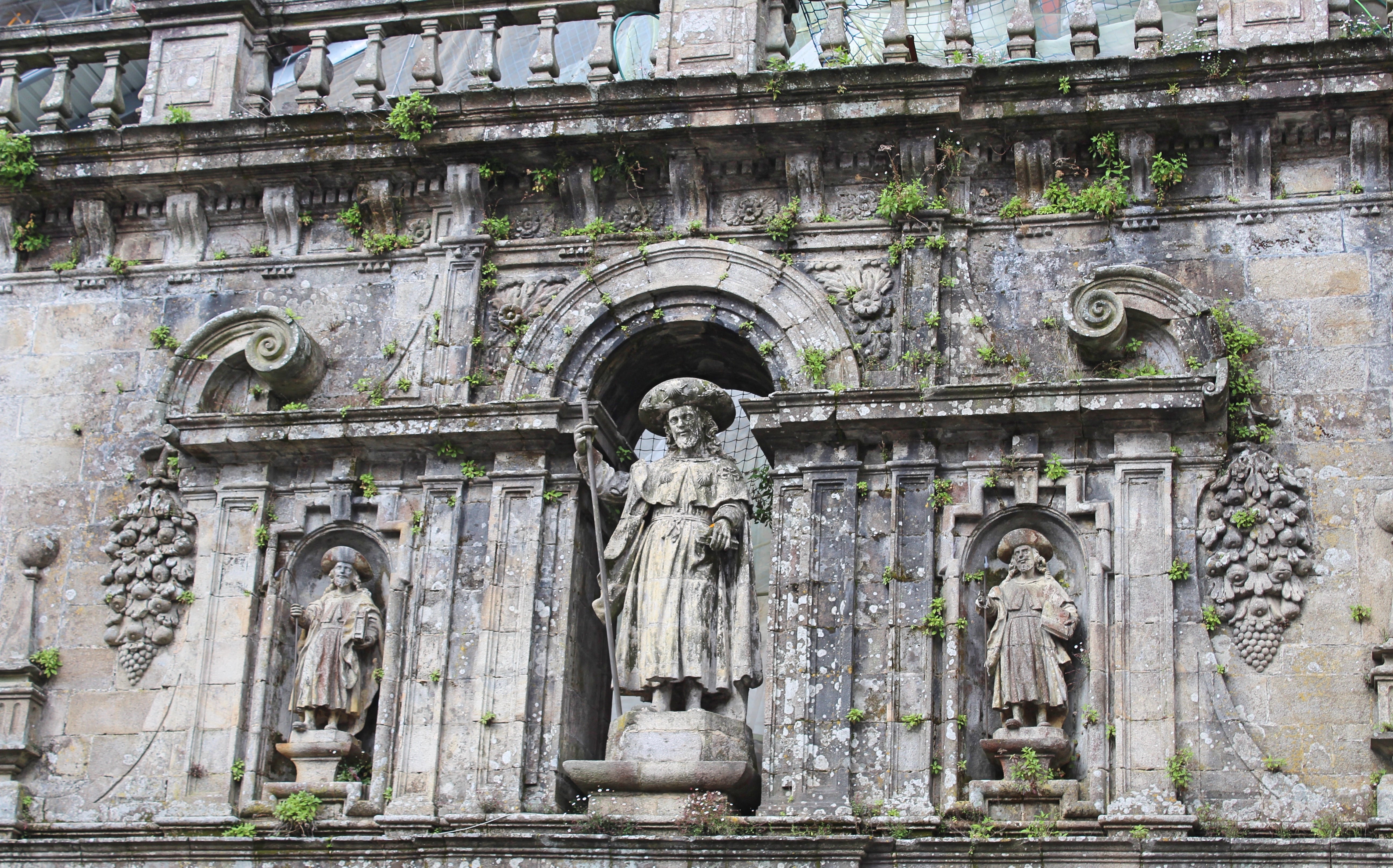
Yet it is not only Brussels that has something of an identity crisis. The whole country is split strongly and starkly along linguistic lines. In the south there is Wallonia, the French-speaking part of the country; and in the north, the Dutch-speaking Flanders. Brussels straddles these two regions uncomfortably, situated somewhat north of the Wallonian border and yet predominantly French-speaking, although it is nominally bilingual. From what I understand, those in the French part of the country rarely learn Dutch, and vice versa, leading to little intermingling and consequently little feeling of camaraderie between the two regions. The result is a strangely bipartite country, almost as if two smaller countries had been uncomfortably welded together.
This inner division expressed itself in the famous attempt to form a governing coalition that followed elections in 2010. After a record-shattering 589 days without a working government, the Flemish and Wallonian parties—who, you will remember, typically do not speak one another’s languages—finally managed to form a working alliance and elect somebody. Under these circumstances, it is perhaps unsurprising that there is a strong independence movement among the Flemish. Much like Catalonia in Spain, Flanders is the most affluent area of the country; and there are some who think the region would do better if not attached to Wallonia. After all this time, it seems that many Europeans still have not learned to live with one another. Unfortunately, when Europeans do live together, the result can be a city like Brussels.
Bruges
The train ride to Bruges was, if anything, more flat and watery than the trip from Amsterdam down to Brussels. I had never known why the Netherlands and Brussels were referred to as the “low countries” until this trip. There is hardly a hint of elevation to speak of. To pass the time, I read a selection of the works of John Ruskin, the eccentric Victorian art critic who was obsessed with the Alps; and he even went so far as to suggest that the inhabitants of flat regions have little notion of true grandeur. Clearly he had never been to Bruges.
When the train pulled in to Bruges’s station—taking slightly over an hour, and passing Ghent along the way—I could hardly contain my excitement. Bruges is one place I had never expected to visit. Indeed, even the day before I was unsure whether I should visit Bruges or stay in Brussels. Rewatching a few scenes from Martin McDonagh’s In Bruges convinced me that I should opt for the first option; sassy Irish hitmen seemed a welcome improvement over European bureaucrats.
Bruges is among that small class of cities, such as Venice or Toledo, whose every corner is picturesque. It is an adorable place. The downside of such places, however, is that they quickly become overrun by tourists. Though I was there during the off-season, I did not get a strong sense of local life; there seemed to little more than tourist attractions, gift shops, and overpriced restaurants. Still the city is worth it. I don’t know when exactly humankind lost its ability to make such splendidly pretty places; nowadays we only build such quaint dwellings using CGI.
I was delighted with everything—the narrow cobblestone streets, the brick houses with step-gabled roofs, the canals crossing this way and that. I just wanted to walk into one of the little houses, build a fire, start a family, and spend a happy life eating waffles and drinking beer. But I contented myself with taking lots of mediocre pictures, which is at least less of a commitment.
Why is Bruges so beautiful? The answer, as in so many cases, is money. Bruges spent the late middle ages as a commercial superpower, strategically situated near the English channel between Germany, France, and Spain. Merchants took advantage of a channel which led from the city’s harbor out into the ocean. Yet the good fortune was not destined to last. As with Seville’s equally lucrative river port, Bruges’s channel silted up and commerce, not usually loyal, moved elsewhere. This led to a long, slow, grinding decline, which was only broken centuries later when tourists realized that, as a result of this process, the city’s beautiful building had survived intact. Two World Wars also left the city unscathed, giving the contemporary traveler a time-capsule of a city.
Bruges Cathedral
The skyline of Bruges is dominated by three towers. The first I encountered was the city’s cathedral, St. Salvator’s. For such a stately purpose, it is a fairly homely building—at least when compared to such gothic monsters as the cathedral in Brussels. Built of brick and lightly decorated, its inside is restrained and calming. The next tower is that of the Belfry. This enormous protuberance stands proudly over market square, the central plaza, sprouting out of a lower building like an oak from a grassy field. In Bruges featured the tower in a starring role, such as when Colin Farrell tells a group of pudgy Americans that they shouldn’t try to climb to the top, and that he’s “not being funny.” As an out of shape American myself, I took Farrell’s advice and admired the Belfry from the ground.
The Belfry. Image by Graham Richter; licensed under CC BY 3.0; taken from Wikimedia Commons
The last and tallest tower belongs to the Church of Our Lady (Onze-Lieve-Vrouwekerk), a mostly gothic church which nevertheless, like the rest of the town, is mostly built of brick. But the church is more famous for what it contains that for its tower. First there are the gilded tombs of Charles the Bold and his daughter, Mary, the Duchess of Burgundy. Charles the Bold was cut down in battle and initially buried nearby; but his great-grandson, Emperor Charles V, had him and his daughter moved to Bruges. Strangely, however, modern researchers have been unable to find Charles’s body—though Mary’s corpse did make it to its intended location. In any case, the tombs are impressively lifelike and appropriately resplendent for noble bodies; and it was gratifying to find the forebears of the family which would one day come to dominate Spain: the Habsburgs.
Yet most people do not pause at the tombs for very long, since in the next room, in the center of an altar, is a work by Michelangelo. Few works by the dour master can be seen outside of Italy, and fewer still in such a small city as Bruges. The subject is simple: The Madonna and Child, with Jesus resting tranquility on the Virgin’s knee, who is looking just as pretty and angelic as she does in the Pietà in St. Peters. If you are familiar with Michelangelo’s work, it is not difficult to spot the master’s touch here. Every element is just so finely executed—the poses, the fabric, the composition—that the statue immediately calls out to the viewer.
Image by Elke Wetzig; licensed under CC BY-SA 3.0; taken from Wikimedia Commons
It seems strange that this should be so. I have seen hundreds of statues of this same subject, many by masters of their craft. How could Michelangelo take something that so many able men had been trying to do for so long, and do it better? This is the mystery of genius, I suppose. But could he have created such superlative art had not so many artists paved the way before him?
I should mention that this statue has been stolen and replaced twice: first during the Napoleonic invasions, and second during World War II. Luckily, violence and greed have so far left the statue intact, and have restored it to its rightful place.
It is difficult to write adequately about Bruges, I find, since you cannot give an accurate impression of the city by going through its parts, one by one, as a writer must do. So much of the experience of visiting consists in being lost in picturesque streets, surrounded by ever-changing views on all sides. Focusing on individual sights would detract from the impression of the whole. Nevertheless, there are some areas of the city that are worth singling out. One of these is Markt, or Market Square, the center of the city. This is where the famous Belfry can be seen. On one side of the square, the neo-gothic Provinciaal Hof (Provincial Court) rises in brooding majesty; while on the other, a row of pretty, brightly colored apartment buildings lightens the city’s aspect. In the center of the square is a statue of two Flemish heroes, Jan Breydel and Pieter de Coninck, who helped lead an (unsuccessful) uprising against the French in the 1300s.
Another important plaza is the Burg Square, where Bruges’s City Hall is located. Compared with that of Brussels, this city hall is rather unprepossessing, though it is yet another excellent example of secular gothic architecture.
The Basilica of the Holy Blood. Image by Matt Hopkins; licensed under CC BY-SA 2.0; taken from Wikimedia Commons
Near the city hall is Bruges’s most impressive church: the Basilica of the Holy Blood. Though ornately decorated, the church does not look like very much from the outside; indeed I hardly noticed it at first, since the rest of the city is just as attractive. But what I found up the staircase took me by surprise. This is the Chapel of the Holy Blood, dedicated to a vial of Jesus’s blood-stained cloth—supposedly picked up during the Crusades. If memory serves, there was a line of the faithful waiting to do reverence to this holy relic, and so to obtain divine favor. I didn’t join in. But I did admire the church. A vaulted, wooden ceiling focused all attention on the far wall, which is decorated with a colorful 20th century painting of the bloody scene. The walls on each side, and the ceiling above, are decorated in pleasing geometric patterns; and the stained glass, too, is of high quality, only adding to the swirl of color in the space. It is a rather cheerful place for worshiping blood.
I realize that I have come this far without mentioning the canals. The city is criss-crossed with watery channels, another legacy of its days as an active port; and this has earned the city, like Amsterdam, the nickname “Venice of the north.” As you can imagine, the constant presence of water only adds to the city’s considerable charm. The canals prevent Bruges from feeling constrained and claustrophobic, like so many medieval cities. One of the most photogenic spots in the city is the bridge crossing the Minnewater—a sort of pond that used to serve as a mooring-place for ships. From there I spotted a band of roving Spanish musicians, dressed in capes and strumming guitars. Were they street musicians, or just on vacation?
My last stop for the day—and what turned out to be my best experience in Bruges—was De Halve Maan brewery. (I thought that the name meant “half man,” but it means “half moon,” which I think is somewhat less cool.) This is a historic brewery, going back to the 1850s, right in the center of the city; and they give tours. I signed up for the next English group, waited a bit in the gift shop, and then embarked on a journey of discovery. Photos were not allowed, so I can’t give a detailed account of the tour; however, it was 45 minutes well spent. Our guide, a deadpan Flemish woman, took us from the modern brewing equipment on the ground floor, then up several steep and slender stairwells to rooms displaying antique brewing equipment. (Some of the staircases were so precipitous that my life flashed before my eyes; the tour is not well-suited to those with mobility issues.)
This was my first brewery tour, so I was eager to learn how this marvelous liquid is created. The process of making beer is at once extremely complex and beautifully simple, consisting of four natural ingredients (water, barley, hops, yeast) mixed, strained, heated, cooled, and aged in such a way that the end-result is a fizzy, bitter, refreshing and slightly intoxicating substance. I was certainly inspired to have a drink—and, luckily, the tour comes with a beer at the bar downstairs. As another added bonus, the view of Bruges from the top of the brewery is excellent, and photos are allowed. I left the brewery quite impressed with the company. They still make all their beer on site (though it is pumped through an underground tube several miles away for bottling).
The Cathedral is on the left, the Church of Our Lady is on the right
What makes Belgian beer so special? Well, I am not exactly an expert in the subject. But even in my dilettantish tasting of Belgian beer, a definite flavor emerges: rich and sweet, almost like brown sugar. In contrast to many English and American ales, the bitter, floral flavor of hops is never very pronounced. Instead the beer is heavy and scrumptious, like a good dessert. Much of the brewing culture in Belgium dates back to medieval monasteries, a tradition which has led to the country’s beer culture being listed as UNESCO intangible world heritage. Without doubt Belgian beer is one of the treasures and pleasures of Europe.
So ended my day in Bruges. Now it was time to return to Brussels and then to Madrid. Thankfully I took the time to examine my Ryanair boarding pass that night, or else I would not have realized that (of course) Ryanair does not fly out of Brussels’s primary airport, but out of the South Charleroi airport—considerably more difficult to get to. But who could complain about early flights and inconvenient airports when Belgium is the reward?
I arrived at my Airbnb late—almost midnight—after illegally riding the bus to the outskirts of the city.
I can never get used to these transport system where there are no turnstiles for the metro and where you cannot simply pay the busdriver. Instead, you must buy a ticket beforehand and validad it yourself. This makes the temptation to ride for free very difficult to resist, especially if it’s late and you don’t know where the ticket machines are. In Madrid or New York, if you try to ride a bus for free the driver will kick you off; and if you jump the turnstiles you can get a big fine. But in Amsterdam, you will only face consequences if the metro inspectors catch you. And what are the chances of that?
My Airbnb host was a relaxed fellow. I suspected that he enjoyed the free availability of marijuana in the city. In any case, he very kindly offered to lend me his museum pass, which allows any resident of the city to get into the museums for free. Unfortunately for me, I had foolishly planned ahead and bought my museum tickets online. The money was spent—and for nothing. This was the last time that I travelled responsibly.
It was a cold February night and I was hungry for dinner. The only place open was a kebab restaurant—not fast food, but genuine kebab. It was delicious. Biting into the spiced meat, I knew that Amsterdam was going to be a special place.
§
I woke up early the following morning and set off for the Van Gogh museum. Instead of riding illegally again, I decided that I would take the time to walk through the city. The weather was cold, grey, misty, and threatening rain. Despite the circumstances, however, and even though I hadn’t had breakfast, the city immediately caught my attention.
Amsterdam is among that small class of cities whose every avenue announces its identity. Even outside of the historic city center, it is impossible to forget that one is in Amsterdam. For one, there are the bicycles. There are thousands of them—hundreds of thousands. It is said that there are more bikes than people, and what I find online seems to confirm it: the population is around 820,000, while there are over 880,000 bikes. Why anyone would need more than one bicycle, I can hardly guess. Nonetheless it is an inspiring sight. Every corner of the city is crammed with pedalled contraptions; and there is more traffic on the bike lanes than on those for cars. But pedestrians have an extra worry when crossing the street.
The style of architecture is distinct, too. In the center there are the crow-stepped gables—creating the Netherlands’ distinctive skyline. Also distinctive is the use of brick. Everything seems to made of the baked clay blocks, giving the city a dark, brooding, and quasi-industrial feel. Certainly it is impossible to mistake a single street of Amsterdam for one in Madrid.
But perhaps the most distinctive touch of Amsterdam are the canals. Like much of the Netherlands, the city itself rests on what was previously swampland. The canals were used to redirect the water, thus making the land available to build on while providing convenient transportation within the city. The canals have also, historically, been useful in the city’s defense. The Stelling van Amsterdam is a system of forts surrounding the center, with low-lying ground that can be flooded to create a watery barrier too shallow for boats. Unfortunately for the Netherlands, this system of defence, however elegant, was rendered obsolete by advances in military technology—such as bombers.
Nowadays, the canals are mostly just pretty to look at. And they are plentiful. There are 165 canals, which is more than even Venice has; and well over a thousand bridges are needed to connect all the isles of land floating between them. Personally I found the constant presence of running water to be extremely charming. The canals make the whole city seem to breathe in the open air, counteracting the somewhat cramped aspect of the city’s narrow buildings.
The final result is a beguiling mixture: wide vistas and narrow alleys, crowded footbridges and bustling bike lanes, historic brick husks concealing modern interiors.
As I walked, listening to the soundtrack of Phantom Thread, I was lost in an aesthetic reverie—marvelling at every new perspective afforded to me. Each shop window and city street gained a strange significance, each one a kind of monument to past and present lives. The cold and the dark gave the city a melancholic hue; but it was a sweet sadness, the kind of sorrow one feels at all beauty, knowing that it is temporary. This, then, was my first and final impression of Amsterdam: the beauty of everyday life.
§
My first stop was the Van Gogh Museum.
Few museums dedicated solely to the art of one man can be ranked among the great museums of the world, but this is one of them. The institution is situated in a sleek, modern building in Museum Square. The museum received its collection—the largest in the world of Van Gogh’s works—from the artist’s family. After Vincent and his brother, Theo, passed away, his unsold work fell into the able hands of Theo’s widow, Johanna. She, in turn, left the collection to her son, named after his uncle, Vincent. The museum only opened its doors in 1973; before that, Van Gogh’s works were held and displayed in the state modern art museum, the Stedelijk.
No photographs are allowed inside the museum, which is likely a good thing, since otherwise there would be far too many selfie-takers clogging the halls. Thus, I will have to rely on my memory. On the ground floor there is a series of Van Gogh’s self-portraits. His oeuvre is particularly rich in self-portraits, perhaps because he was prone to melancholy self-examination, or perhaps because he simply could not afford other models. In any case, they are milestones in the history of art: an attempt at introspection whose nearest literary equivalent is, perhaps, Montaigne’s Essays. When the portraits are arranged chronologically, one can see the progression in his style, from lumpy forms of dull browns and greys, to bright blues and yellows in dashing lines. His best self-portraits achieve a mesmerizing stare about the eyes, comparable to the intensity in Michelangelo’s David.
The Gleaners, by Jean-Francois Millet
Next, the visitor ascends the stairs to enter the main collection. The exhibit begins with some of Van Gogh’s influences. One of the most important of these was Jean-François Millet, a French social realist who often painted rural scenes. Van Gogh was himself a passionate believer in painting from life; and in his early years especially he was fascinated by poverty and peasant ways. Many of his early sketches (which are on display) are of workers in a field or townspeople attending a mass. Van Gogh got a relatively late start in the craft (27, which is good news for the rest of us) and his early work displays no technical brilliance, to say the least. But it does show, if my eye may judge, a keen emotional sensitivity to the world around him, especially to the toil, drudgery, and misery of life. There is nothing in his work that can be called frivolous.
I came well prepared, since I had just finished reading a collection of Van Gogh’s letters (highly recommended). You may imagine, then, how much of a treat it was to see the artist’s work laid out chronologically after I had worked my way through his life. Again, what most strikes the viewer about Van Gogh’s early work is its lack of color. He seems to have had almost no interest in pigment. This is epitomized in his early masterwork, The Potato Eaters. He shows us a scene of peasants eating a humble meal. It is not an inspiring sight. The men and women have heavy, almost simian features, reminiscent of Goya’s black paintings (though I do not think Van Gogh ever saw them). The oil lamp illuminates the hovel with a sickly light, which reinforces the ill and withered look of the painting’s subject. Van Gogh shows us an ugly truth, horridly naked, and yet made monumental in its composition.
The Potato Eaters
Vincent’s style underwent a dramatic change when, after enduring years of isolated poverty and estrangement with his family, he moved in with his brother, Theo, in his Paris apartment. Theo was an art dealer, and Paris the art capital of the world, so Vincent was well-positioned to take stock of the dominant artistic currents of his time. In Paris he saw the work of modern masters like Monet, Seurat, and Cezanne, and befriended many other prominent artists (most famously Gauguin, who later came to stay with Vincent until they had a quarrel). The most immediate consequence of this exposure was Vincent’s discovery of color. Compared to his earlier work, the paintings he started to produce were bright and joyful, though still burning with intensity.
I would also like to add a curiosity I learned on my visit: that Van Gogh was enamored of Japanese art. Like many artists of the time, he collected Japanese prints. He even went to far as to copy them, producing his own versions of works by Hiroshige. His copies, though lacking the lightness and clean execution of the original, are well done. And he even went so far as to write Japanese all around the border of the painting (though I don’t know if it is proper Japanese, since I do not think he could read the language).
Unfortunately, Van Gogh’s years in Paris are some of his worst documented, since he was living with his brother and so had no need to write him letters. Nevertheless, it is clear that the artist was busy practicing his craft. The Van Gogh museum even has a study that he made of an object (I remember it was a small statue of an animal, but I cannot remember which). Van Gogh’s distinctively heavy brushstrokes also begin to make their emergence at this stage. In another room, a recreating of one of his paintings is on display under a microscope, so that the visitor can see the swirling textures of the master’s paint up close. This habit of daubing on pigment in glooping quantities caused his paintings to have an almost sculptural feel, something that no poster or print can capture.
The Yellow House
After two years Van Gogh left Paris for more the amiable climate of southern France. Here is when his real mature period begins. While his early works tend to focus on humans in action, his mature style was more focused on scenes: buildings, rooms, landscapes. One painting which epitomizes the change is The Yellow House, depicting the building in which he rented an apartment with the naive hope of turning it into an artists’ colony. Far from the center of focus, the people in the work are anonymous shadows, only serving to illustrate the city street that is his main focus. Van Gogh also painted his room. Here the painter’s expressionism is especially obvious. The perspective is warped; it is not quite believable as a space. But the bold yellows and light blues convey a sense of joyfulness and peace, which is nevertheless somewhat belied by the faint whiff of poverty one senses from looking at the barely furnished room.
But Van Gogh’s most famous painting from this period is likely the Sunflowers. Van Gogh made multiple versions of this painting; the most famous of these is at the museum. It is a masterpiece. The painting has the strong and instantly memorable visual impact of the best graphic design. Yet it is better than any design, of course. With his thick and skillful dabs of paint, Van Gogh makes the sunflowers almost tactile. Though more abstract and more beautiful than any real sunflower, one almost feels that she can reach into the painting and grab one. But the emotional effect of the painting goes far beyond its obvious visual properties. As in all of Van Gogh’s best work, the dominant feeling is joy, immense joy, struggling with and overcoming equally intense feelings of despair. During his stay at the Yellow House, Gauguin created a valuable image (also at the museum) of Van Gogh at work on the sunflowers.
Paul Gauguin, The Painter of Sunflowers
Needless to say his dreams of founding an artists’ colony failed. Van Gogh was hardly the figure to command a movement, not least because he was tetchy and unyielding. For example, he constantly clashed with Gauguin over the necessity of drawing from nature. Gauguin believed in letting the artist’s imagination run wild, free of constraint, but Van Gogh insisted that great art only resulted from close observation. In any case, their falling out had as much to do with Van Gogh’s worsening mental state as with his opinions. According to Gauguin, Van Gogh attempted to attack him with a razor; later this same night was when Van Gogh famously severed his ear.
This led to Van Gogh’s hospitalization and eventual suicide—and also to the most productive and extraordinary phase of his career. It is still unclear what ailment plagued the artist in his final years. His lifestyle—smoking and drinking heavily, frequenting prostitutes and possibly contracting syphilis, eating scantily and sleeping sporadically—no doubt contributed. The museum has a display of various hypotheses: Freudian theories of repression, bipolar disorder, sunstroke, digitalis poisoning. Likely we will never know for certain. Whatever the explanation, Van Gogh struggled heroically with his worsening condition, creating an oeuvre that rivals any in the history of art.
Almond Blossoms
One of these remarkable late paintings is his Almond Blossoms. The twisted branch of an almost tree in bloom stretches across the canvas. Beyond is the blue sky, as if the viewer is below and looking up at the boughs. It is a painting of extraordinary calm. One wonders how a man recently admitted into an asylum could conjure such a tranquil image of nature in its simple beauty. And here, once again, we see the artist’s talent for reproducing the emotional effect of nature, rather than nature herself. For the painting is impossible to mistake with a photograph; the brush marks are visible, the flowers are not finely detailed. Yet the painting gives the sense of lying on grass, looking up at an almost tree—the cool breeze, the gentle sun, the fresh smell of spring—better than any photograph can.
Wheatfield with Crows
Among the final paintings on display is Wheatfield with Crows. This is commonly said to be Van Gogh’s last completed painting—though no reliable record exists of it being so—and so critics are apt to see in it signs of depression. Certainly these are not difficult to find: the brooding, stormy sky; the windswept field; the black birds heralding death—and all in a style of extraordinary intensity. But to me this is not the work of a man tired with life, bent on leaving this world. Indeed, though it is hard to argue that the painting is happy, I still sense in it the same joy that one feels in Sunflowers: the awe in the face of a natural spectacle, the wonder at the basic scenes of everyday life. That the same man who painted this would, shortly later, shoot himself in a similar field, beggars my imagination.
Van Gogh’s self-mutilation, confinement, and eventual suicide form an essential part of his myth. No doubt he was dogged by a serious illness, which at times sent him into delusional fits. Yet it is very much disputable the role that Van Gogh’s mental illness—whatever its cause—played in his painting. Some have argued that it contributed to his creativity, giving him a unique vision. One can equally well argue that his art was a way of staying sane and fighting off his demons. Personally, I am averse to this modern tendency to diagnose everyone who seems odd, different, or eccentric with a mental disorder, equating different forms of genius with conditions or illnesses. Such diagnoses strip the individual of his agency, and even of his individuality. More importantly, post mortem diagnoses are impossible to prove.
This did it for the Van Gogh Museum. I can say without hesitation that it was one of the most extraordinary museums that I have had the pleasure of visiting. Fortunately, another one was just around the corner. So after a quick sandwich in Bagels and Beans—a local chain, very tasty—I was on my way to Amsterdam’s other major museum: the Rijksmuseum.
§
The Rijksmuseum is the Netherlands’ national museum, comparable to Louvre in Paris or the Prado in Madrid. Founded in 1800, the museum is located in a grand, palatial building—appropriately Dutch in design—right in the center of the city. In it can be found some of the finest examples of Dutch art, including many famous paintings by the Dutch Golden Age masters. It is a necessary visit for anyone with even a passing interest in the history of art.
Aside from a small collection of Asian and Medieval art, the museum’s collection really begins in force with the Renaissance. Here we see the beginning of portraiture as we know it: the attempt to capture the personality of one ordinary individual through a close concentration on their features. We see characters of various sorts—the proud, the crafty, the self-indulgent, the vain—at times ridiculous, yet rendered iconic through the painter’s brush. It is one of the great mysteries of art that it can transform the unique into the universal by emphasizing what is most unique. Perhaps this is because we are all different in the same ways.
The museum does not only contain paintings. There are also ornate chess-sets, statuettes, altarpieces, and even what were supposed to be unicorn horns (in reality, the tusks of narwhals). And there is a fascinating section devoted to colonial art—both art collected from, and inspired by, the Dutch colonization of the Indies. Here we find ornate cannon barrels, one with the head of a dragon, as well as small dioramas depicting colonial life. Also on display are delicate luxury items, such as furniture, candelabras, and mirrors—even an ornate harpsichord. Nearby are the 19th century paintings, among which are excellent examples of Dutch landscapes and portraits.
Yet the museum’s most valuable treasures are gathered together in the Gallery of Honor. And just as Velazquez’s masterpiece, Las Meninas, occupies pride of place in the center of the Prado, so does Rembrandt’s iconic The Night Watch dominate the central gallery.
This painting is justly famous for its revolutionary take on a group portrait. Traditionally, a portrait of this kind—not of nobles, but of the local militia—was a formal and static affair, with the participants lines up in rows according to their rank. Rembrandt cracks this convention wide open with this work. Every person is individualized, and everyone is engaged in some sort of action. As a result the group portrait is full of bustle and even confusion, as each character is busy loading their riffle, having a chat, or gesticulating heroically. It is difficult to imagine this chaotic rabble of men marching in formation, but easy to imagine them relaxing in a pub. Only a master of portraiture such as Rembrandt could have put together such a marvelously memorable image out of such seemingly unpromising material. And if any evidence was needed of his technical ability, examine the foreshortening on the lieutenant’s spear in the foreground.
The Night Watch
Another, somewhat lesser-known master of the Dutch Golden Age was Jacob van Ruisdael, who was the preeminent landscape artist of the period. One might think that the Netherlands is an unpromising land for landscape painters, since the Dutch countryside is so flat and domesticated. But Ruisdael has shown us otherwise. Personally I find his use of color and texture mesmerizing: the fluffy clouds floating in the light blue, the varying greens of the trees and the dull browns of the dirt—it all comes together in such a way that the ordinary beauty of daily scenes emerges. I particularly like his Windmill at Wijk bij Duurstede for its brooding, grey sky silhouetting a lonely windmill—perhaps an ironic comment on the force of technology as compared to that of nature.
Windmill at Wijk bij Duurstede
The Milkmaid
My favorite painter of this period, and the one that most perfectly captures my impression of Dutch life, is Johannes Vermeer. Here we see something almost entirely new in the history of art. Rather than focus on the forces of nature, the royalty, aristocrats, or wealthy merchants, we have a focus on the most absolutely ordinary of daily, domestic scenes. The most famous example of this is The Milkmaid, which shows us a serving woman engaged in pouring milk. Again, it is the most typical and unromantic of gestures; and yet Vermeer, with his fine attention to daily, manages to imbue into this gesture an extreme pathos—an elemental poetry.
The Little Street
Another one of my favorites is The Little Street, which shows us a typical, middle-class street in the city of Delft. The buildings are in the homely, Dutch style, made with step-gabled roofs of brick, and they are a little bit worn by the weather. Inside Vermeer allows us to spy on a woman at work, washing clothes. Nearby, seated in a doorstep, another woman is sewing; while two children are searching for something (or playing a game?) underneath a bench. Again, the painting is poignant for its very ordinariness. Vermeer shows us the quiet nobility of these neighborhood scenes, normally taken for granted and yet necessary for life to go on. And in the process the artist has created an image more impressive than the full-length portrait of Napoleon, dressed in the most pompous of imperial outfits, in another gallery of the museum.
In a word, I found in the Rijksmuseum what I had also found in the Van Gogh Museum, and indeed in the city itself—a celebration of the beauty of everyday life.
§
My next destination was Amsterdam’s infamous Red-Light District. This is so-called because of the red lighting used to advertise a prostitute’s service at night. The area is famous, not only for the working women displaying themselves in shop windows, but also for the many peripheral sex-related businesses: sex shops, sex shows, and even a museum of prostitution (which was what I decided to visit).
Ironically, perhaps, the red-light district in Amsterdam is in the most historic and beautiful part of the city. Canals criss-cross this side of town in a circular pattern, making all foot-travel a labyrinth of alleys, narrow streets, and foot-bridges. Hardly a street goes by that does not reveal another picturesque view of the city. It was a clear February afternoon, with the blue sky gradually turning pink in the sunset, and shadows gradually extending across the canals. I was there before dinner, so the area was fairly quiet. Indeed, apart from a few signs, it was difficult to know that I was even in a red-light district. No scantily clad women graced the windows overlooking the street. This meant that I could take pictures without fear. From what I hear, the women get angry when people photograph them, and may even leave their perch in violent pursuit.
Before I relate what I learned in the Museum of Prostitution, I wish first to cover another of Amsterdam’s famous markets: marijuana. Now, you may be surprised to learn that marijuana is not legal in the city; it is decriminalized—or tolerated, in other words. The result is the same, however: a visitor may consume weed without fear of the police, and even buy small quantities with impunity. This is normally done in “coffee” shops. I did not visit one of these during my stay—I was traveling alone, so it didn’t seem like a good idea—but I have heard ample stories of friends smoking too much, or eating too much of an edible, and repenting afterwards. Well, maybe next time.
The Museum of Prostitution is dedicated to Amsterdam’s other great vice: sex. It is right in the center of the red-light district, in a space that was formerly used by call girls. The ticket came with an audioguide, in my case narrated by a Russian sex worker. The museum itself is designed to replicate the spaces used in these circumstances, complete with bathrooms, beds, and chains. I learned some interesting facts along the way. The standard deal is to pay €50 until the man finishes—which normally takes less than 10 minutes. A working girl makes more money with a faster turnover, you see. The guide also told us about some of the dangers that prostitutes face, even in a highly regulated industry like Amsterdam’s, as well as some amusing stories about customers. Really, the most striking thing about the museum was how un-sexy the experience is made to seem, for both client and purveyor.
I especially appreciated the information about prostitution throughout the world. In most of the United States it is absolutely illegal. In Spain, it is decriminalized to be a prostitute, but pimping is illegal. In France it is legal to sell sex but illegal to buy it—a curious situation. In Amsterdam it is highly regulated, with a certain number of legal permits. Window prostitutes only constitute a moderate portion of the business in the country, with street walkers, sex clubs, and escort services rounding out the rest of the market. I have heard people say that STD testing is mandatory, but this is not actually true—though I am sure that many prostitutes regularly get tested, and condom use is universal.
Unfortunately, despite the increase in legal protections, the industry is still rife with problems. Prostitutes are far more likely to suffer abuse or rape. And since prostitution is still illegal in much of the world, and in any case there is a lot of money to be made by unscrupulous people, human trafficking, especially of underage girls, is still a serious problem. This has led to some crackdowns by the authorities. Coffee shops have not escaped this legal limbo, either, since although it is not illegal to buy or possess marijuana in small quantities, it is illegal to grow or buy it in large quantities—which leads one to wonder where these coffee shops get their supplies.
Though I was not inspired to try it for myself, I left the museum greatly impressed by the huge and so often ignored role that the world’s oldest profession has played, and still plays, in society. To pick a relevant example, Van Gogh was a dedicated patron of brothels. At one point he decided to live with a prostitute and her young child—despite the protests of his family and friends—and after his self-inflicted wound to the ear, he delivered the severed appendage to a local prostitute. And this story is just one of millions.
Sex work has been a constant presence in the history of every nation; yet this indecorous profession has consistently been pushed into the shadows. It is something we prefer to ignore, even if we all know it exists. Personally, despite its shortcomings, I think that the Dutch approach is far better than American prudishness. If we simply admit that, one way or another, sex work will continue to exist, we can install the necessary safeguards to make it safe for its practitioners. Pretending it does not exist only serves those who prey on the vulnerable.
§
I only had a long weekend to spend on this trip; and I had decided, perhaps too ambitiously, to visit both Amsterdam and Brussels in the three full days I had available. This meant that, after my long day exploring the treasures of Amsterdam, I had to catch a train the following afternoon. Only the morning remained to see more of this enchanting city.
I decided that my time was best spent in renting a bicycle. Amsterdam is one of the most bike-friendly cities in the world; and if you want to see the city from the perspective of a native, this is the only way to do it. So I trekked from my Airbnb to Centraal Station (listening to Frankenstein on audiobook, whose dark gothic tone did not quite match the bourgeois beauty of the city), deposited my big orange backpack in a luggage locker (they are located beyond the train turnstiles), and rented a bike from a place called MacBike (no relation to Apple).
It was a simple contraption with a few gears and decently working brakes. Somehow, while I was adjusting the seat for my overlong legs, I cut myself in my palm. It did not hurt at all; in fact I didn’t notice until after several minutes of riding; but it bled quite a bit and the scar lasted for months. Thus I bloodily made my way into the city. I was quite nervous at first. My riding skills are reasonable, but I felt intimidated by the rules of the road. I had never signalled, passed on the outside lane, stopped at a stop sign, or dealt with intersections on a bike. And I can hardly do those things in a car in any case. But once I got my biking legs back, I felt marvelous as I drifted down the historic city streets.
Bicycles are one of the most extraordinary inventions our species has blundered upon, and I think many cities could be vastly improved by following Amsterdam’s example and relying more on bike transport. They require no fuel except the food you eat, are fast enough to quickly navigate most city centers, need little space to store, produce no pollution, and as an added bonus promote healthiness and well-being. I remember watching a presentation by Bill Nye while I was in high school in which he told us that bicycles are the most energy-efficient form of transportation known to man. They are also quite relaxing and enjoyable.
As you can tell from this paean to bicycles, I was having a splendid time. But it was difficult to navigate the city, since I couldn’t follow any maps on my phone while I was riding. After several wrong turns and detours, then, I found my way to Vondelpark, a very pretty green space with twisting paths for walking and biking, and a little pond running down the center.
As I rode through this park, I had one of those surreal moments when one seems to be seeing oneself from a distance. I had heard of people visiting Amsterdam and renting bikes back when I was in high school, but never did I imagine that I might do the same thing myself one day. Yet here I was, less than ten years after graduating high school, pedaling around in this beautiful foreign city before my train left to Belgium—another place I never imagined that I would visit. It seemed too good to be true, like I was living somebody else’s life. This was an irrational reaction, since it is not as if biking in Amsterdam is objectively more pleasurable than biking in, say, my old university. What made it special was that, throughout the years, I had unconsciously invested the experience with an exotic, unreachable quality; and now I was finding that, far from unreachable, it was the easiest thing in the world.
In an hour I had arrived back in the train station. It was to be my last glimpse of the city before my ride to Belgium. The experience only confirmed what was, from the start, my constant impression of Amsterdam: the appreciation of ordinary pleasures, the celebration of daily beauty, the quiet contentment with the simple things in life. It is a city of high culture but of little pretense, of hard work yet of an easygoing attitude. I hope to return someday.
There is a legend that, if you see the frog on the façade of the old university building, you are destined to return to Salamanca. Well, I saw the frog on my first trip, three years ago. And sure enough I returned.
Salamanca is without doubt one of the best daytrips from Madrid. Like so many places in Spain, it is extremely photogenic. Here is the evidence.
The passage surrounding the magnificent Plaza MayorThe plazaThe famed Casa de las Conchas. It is a municipal library now.From the Casa’s courtyard you can see the Church of the Holy Spirit.The façade of the old university building.Can you find the frog?The old library.My brother contemplating the anatomy of a lizard.The main altar of the old cathedral. We took the tour of the Ieronimus tower—highly recommended.The cathedral’s roof.The view from the upper floor. It is difficult to capture the sense of vertigo in a photograph.My friend Holden and my brother.The old Roman Bridge in the distance, spanning the river TórmesThe astronaut floating in the façade of the New Cathedral.We stumbled upon a wedding.The Roman Bridge, with the cathedral in the distance.The Casa Lis, an Art Deco museum that we visited. It’s lovely, but no photos are allowed.A section from El Cielo de Salamanca, a fresco of the zodiac painted on a semi-dome in the Escuela Menores. It’s a stunning work, and free to visit.The Convento de San Esteban, with is impressive plateresque façade.The central cloister of the convent.A very old and a very big book.The convent church.
Recently I revisited Peñalara—the biggest mountain in Madrid’s Guadarrama range. I had already been to the mountain four times, but never before in the dead of winter. I doubted that there would be any snow at all. But I was wrong. The landscape was completely covered with snow and ice, smoothed slick by the wind. Rebe and I tried to climb to the peak, but we couldn’t even get halfway. The ground was too slippery, the wind too strong, and the fog too dense.
But it was still a lovely time. As a New Yorker, I sometimes find myself yearning for a proper winter in Spain. Going to the mountains gave me a taste of the cold without my having to live in it. It’s a perfect daytrip from Madrid. The only negative aspect was that, this time, I had to pay almost 30 euros round-trip to get there. Rebe, on the other hand, traveled for free, since it was included in her youth metro pass. Oh, the lost dreams of youth.
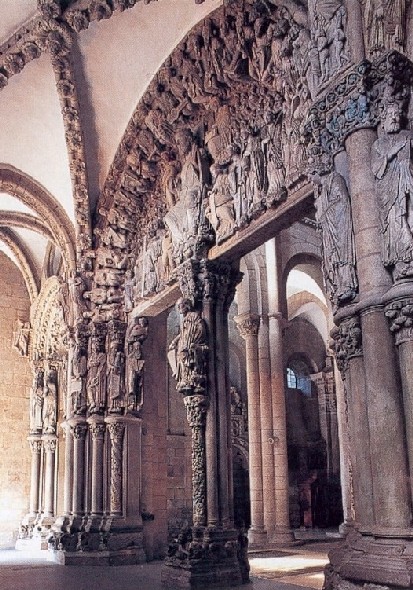
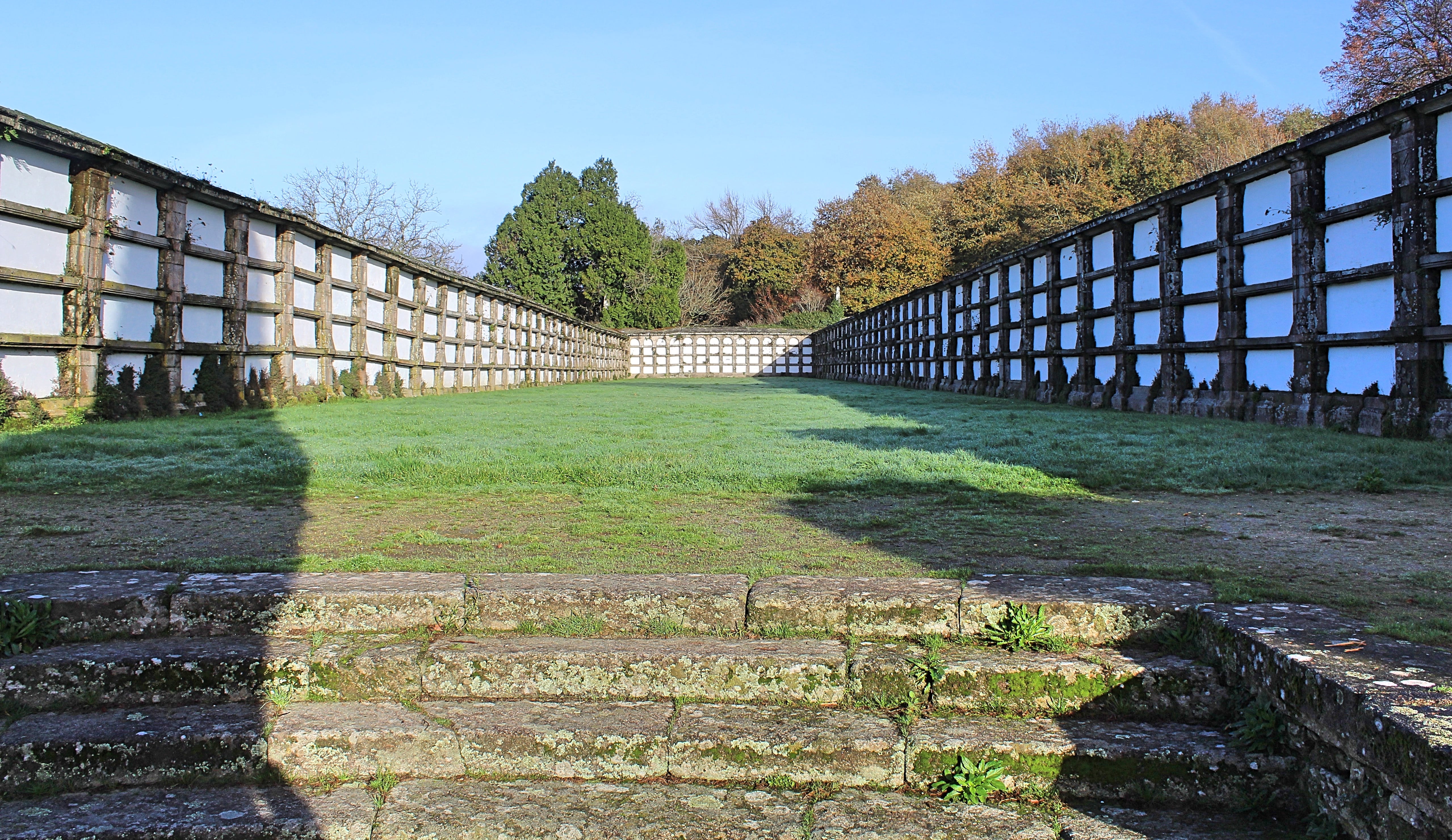
The train to Los Cotos. Tickets must be bought in advance.Rebe in the pinesThe author in a knit wool hatMany families come to go sleddingSkiers and serious hikers were also in attendanceA refuge from the snow