Review: Story of Philosophy

Review: Story of Philosophy

The Story of PhilosophyThe Story of Philosophy by Will Durant
My rating: 2 of 5 stars

The Story tried to salt itself with a seasoning of humor, not only because wisdom is not wise if it scares away merriment, but because a sense of humor, being born of perspective, bears a near kinship to philosophy; each is the soul of the other.

A long time ago, as I began to set about learning philosophy, I bought a used copy of this book, which sat, unread, on my shelves for a few years, its yellowed pages only growing more yellow, and its already cracked and broken spine castigating me from my bookshelf every time I passed by. Thus, about four or five months ago, I finally decided to read this book; but I quickly lost interest. Every time I put the book down, I waited a long time before picking it up again; and it was only when I downloaded an audiobook, last month that I was able to finish Durant’s popular history of philosophy.

This difficulty in finishing is the clearest indication of how I felt about it: I was unimpressed. Though by no means a bad book, and one with many good qualities, I can’t say I would recommend this book to anyone, for I believe Durant does an injustice to his topic. Simply put, this is both a poor history of and introduction to philosophy; it fails to convey adequately what philosophy is, what philosophers do, and how philosophy developed. There is little of intellectual or academic interest in these pages, and despite its eloquence I often managed to find it quite dull.

The trouble comes early on, when Durant makes this announcement:

The author believes that epistemology has kidnapped modern philosophy, and well nigh ruined it; he hopes for the time when the study of the knowledge-process will be recognized as the business of psychology, and when philosophy will again be understood as the synthetic interpretation of all experience rather than the analytic description of the mode and process of experience itself.

The absurdity of the above paragraph is obvious to anyone who has read a fair share of philosophy. Writing a history of philosophy while omitting epistemology is like writing a history of chemistry while refusing to talk about chemical bonds. Epistemology is a central part of philosophy, and, besides, a central concern of the greatest modern philosophers; so any treatment of the subject lacking epistemology is doomed to miss the mark. Besides this, I would also like to point out that the above paragraph reveals an intellectual weakness as well. How could epistemology be the subject of psychology, a science? Epistemology asks “What is knowledge?” This is clearly not a subject that can be investigated empirically or decided scientifically, for scientific investigation already presupposes that knowledge is empirical in nature. So already Durant is showing himself to be a poor philosopher, as well as a poor historian.

When we get into the thick of Durant’s book, we encounter an even more general problem. Durant’s modus operandi throughout this work is to treat the ideas of philosophers as byproducts of their experiences and their personalities. Not only does this often leads him into cheap psychoanalyzing (such as speculating about how Nietzsche’s father and mother influenced his outlook) as well as broad and often ridiculous generalizations about peoples and places (the Germans do this, the Jews do that), but, more damningly, turns systems of philosophy into mere quirks of personality and whims of fancy. In this book, philosophers are artists, not thinkers. Although Durant would have you believe that this is the wise and cosmopolitan perspective on the matter, this fails completely to do justice to these men.

Philosophy is, among other things, the art of argumentation. Philosophers, at least good philosophers, are extremely focused on the logical reasons for their beliefs. This is embodied in that great creation-myth of Western philosophy, Plato’s tales of Socrates, wherein that old sage wanders from citizen to citizen, perpetually demanding to know the reasons why they believe what they do. Plato’s Socrates is always asking, What do you mean by this word? And why do you mean it that way? The final goal of the philosopher is to harbor no dogmatic opinions—and by dogmatic I mean opinions that are accepted without scrutiny—but rather to probe and investigate every assumption, idea, and goal in life.

Durant’s treatment of philosophers does exactly the opposite. In Durant’s hands, philosophers are mere pundits, who spout theories left and right without taking the time to justify them. Durant’s chapters on their ideas are mere liturgies of opinions; and the final impression is that philosophy is just the art of having pompous and high-sounding views about grandiose subjects. It is absolutely worthless to know that Plato believed in a world of ideal forms without knowing why he did so; and the same goes for every other philosopher’s view. This emphasis on reason and argument is what separates philosophy from philosophizing; but you will find almost exclusively the latter in this book.

I would be being unfair if I didn’t acknowledge that many of this book’s faults are due to its genesis. This book was originally published as a series of pamphlets for the Blue Book series, which were inexpensive paperbacks for worker education. This origin largely explains why this book contains such a huge chronological leap, from Aristotle all the way to Francis Bacon, and also why Durant continually emphasizes the practical over the theoretical, the biographical over the intellectual.

Less excusable, perhaps, was Durant’s choice to write a chapter on Voltaire, who wasn’t even a philosopher, and Herbert Spencer, who was obsolecent even back when this book was written. Much better would have been a chapter on John Locke, who formulated many of the ideas later endorsed by Voltaire, and John Stuart Mill, a contemporary of Herbert Spencer who has had a much more lasting effect on the subsequent history of philosophy. While I’m at it, I think a chapter on Descartes would have been much better than a chapter on Francis Bacon (who is a fairly minor figure in the history of philosophy), for Descartes was also a pioneer of science, as well as a great mathematician, not to mention the father of modern philosophy.

For these reason, I would much more highly recommend Russell’s History of Western Philosophy over this book, as Russell, being himself a philosopher, at least does his best to reconstruct the reasons for other philosophers’ views, even if Russell sometimes falls short in this task. (I also want to note, in passing, that Durant considers Russell’s early work in logic and mathematics to be pure hogwash, whereas most philosophers today consider that to be Russell’s most enduring work.)

The only place that Durant surpasses Russell is in his chapter on Kant, which I think is a truly excellent piece of work, and a good place to start for any students seeking to understand that obscure German metaphysician. Other than this brief flash of sunlight, the rest of this book is nothing but passing storm clouds, rumbling ominously, constantly threatening to rain, and yet passing overhead with nary a drop, leaving us as parched as they found us.

View all my reviews

The Writing of Will Durant

The Writing of Will Durant

In my several reviews of Will Durant’s Story of Civilization, I have consistently praised his writing. The more I read, the more I want to read; and the more I digest, the more impressed I become. For this reason, I wanted to collect some samples of Durant’s prose, both for my own benefit, to serve as models for my prose, and to show others why I recommend Durant so highly.

For me, Durant is a writer of rare caliber, capable of being clear, charming, and graceful through thousands of pages. In many ways, Durant epitomized the pedagogical approach William Zinsser suggests in his book, Writing to Learn. Through his writing, Durant explored nearly every subject and epoch. He wrote his way through metaphysics and mercantilism, through paintings and plagues, through English law and ancient engineering. So, without further preface, here is a sampling of Durant’s prose. And mind you that these excerpts are not atypical, but representative of his whole work.

Durant on Religion. He is giving an overview of the Catholic Church; from The Reformation (Volume VI):

Through a formative millennium, from Constantine to Dante, the Christian Church offered the gifts of religion to men and states. It molded the figure of Jesus into a divine embodiment of virtues by which rough barbarians might be shamed into civilization. It formulated a creed that made every man’s life a part, however modest, of a sublime cosmic drama; it bound each individual to in a momentous relation with a God Who had created him, Who had spoken to him in sacred Scripture, Who had descended from heaven to suffer ignominy and death in atonement for the sins of humanity, and Who had founded the church as the repository of His teaching and the earthly agents of His power. Year by year the magnificent drama grew; saints and martyrs died for the creed, and bequeathed their example and their merits to the faithful. A hundred forms—a hundred thousand works—of art interpreted the drama and made it vivid even for letterless minds.

Durant on Home Life. He is painting a portrait of the home in medieval Europe; from The Age of Faith (Volume IV):

There was not much comfort in the medieval home. Windows were few, and seldom glassed; wooden shutters closed them against glare or cold. Heating was by one or more fireplaces; drafts came in from a hundred cracks in the walls, and made high-backed chairs a boon. In winter it was common to wear warm hats and fur indoors. Furniture was scanty but well made. Chairs were few, and usually had no backs; but sometimes they were elegantly carved, engraved with armorial bearings, and inlaid with precious stones. Most seats were cut into the masonry walls, or built upon chests in alcoves. Carpets were unusual before the thirteenth century. Italy and Spain had them; and when Eleanor of Castile went to England in 1254 as the bride of the future Edward I, her servants covered the floor of her apartment at Westminster with carpets after the Spanish custom—which then spread through England. Ordinary floors were strewn with rushes or straw, making some houses so malodorous that the parish priest refused to visit them.

Durant on Visual Art. He is describing the Sistine Chapel; from The Renaissance (Volume V):

[Michelangelo] divided the convex vault into over a hundred panels by picturing columns and moldings between them; and he enhanced the tridimensional illusion with lusty, youthful figures upholding the cornices or seated on capitals. In the major panels, running along the crest of the ceiling, Angelo painted scenes from Genesis: the initial act of creation separates light from darkness; the sun, moon, and planets come into being at the command of the Creator—a majestic figure stern of face, powerful of body, with beard and robes flying in the air; the Almighty, even finer in form than in the previous panel, extends His right arm to create Adam, while with his left arm He holds a very pretty Angel—this panel is Michelangelo’s pictorial masterpiece; God, now a much older and patriarchal deity, evokes Eve from Adam’s rib; Adam and Eve eat the fruit of the tree, and are expelled from Eden; Noah and his sons prepare a sacrificial offering to God; the flood rises; Noah celebrates with too much wine. All in these panels is Old Testament, all is Hebraic; Michelangelo belongs to the prophets pronouncing doom, not to the evangelists expounding the gospel of love.

Durant on Architecture. He is evaluating the palace of Versailles; from The Age of Louis XIV (Volume VIII):

Architecturally, Versailles is too complex and haphazard to approach perfection. The chapel is brilliant, but such flaunting of decoration hardly accords with the humility of prayer. Parts of the palace are beautiful, and the stairways to the garden are majestic; but the compulsion laid upon the designers to leave the hunting lodge intact, merely adding wings and ornament, injured the appearance of the whole. Sometimes the proliferating pile leaves an impression of cold monotony and labyrinthine repetition—one room after another to the spread of 1,320 frontal feet. The internal arrangement seems to have ignored physiological convenience, and to have presumed upon remarkable retentive power in noble vesicles. Half a dozen rooms had to be traversed to reach the goal of desire; no wonder we hear of stairways and hallways serving in such emergencies.

Durant on Literature. He is discussing Shakespeare’s language; from The Age of Reason Begins (Volume VII):

The language is the richest in all of literature: fifteen thousand words, including the technical terms of heraldry, music, sports, and the professions, the dialect of the shires, the argot of the pavement, and a thousand hurried or lazy inventions—occulted, unkenneled, fumitory, burnet, spurring… He relished words and explored the nooks and crannies of the language; he loved words in general and poured them forth in frolicsome abandon; if he names a flower he must go on to name a dozen—the words themselves are fragrant. He makes simple characters mouth polysyllabic circumlocutions. He plays jolly havoc with the grammar: turns nouns, adjectives, even adverbs into verbs, and verbs, adjectives, even pronouns into nouns; gives a plural verb to a singular subject or a singular verb to a plural subject; but there were as yet no grammars of English usage. Shakespeare wrote in haste, and had no leisure to repent.

Durant on Engineering. He is summarizing the Roman techniques for constructing roads; from Caesar and Christ (Volume III):

The consular roads were among their simpler achievements. They were from sixteen to twenty-four feet wide, but near Rome part of this width was taken up by sidewalks (margines) paved with rectangular stone slabs. They went straight to their goal in brave sacrifice of initial economy to permanent savings; they overleaped countless streams with costly bridges, crossed marshes with long, arched viaducts of brick and stone, climbed up and down steep hills with no use of cut and fill, and crept along mountaintops or high embankments secured by powerful retaining walls. Their pavement varied with locally available material. Usually the bottom layer (pavimentum) was a four- to six-inch bed of sand, or one inch of mortar. Upon this were imposed four strata of masonry: the statumen, a foot deep, consisting of stones bound with cement or clay; the rudens, ten inches of rammed concrete; the nucleus, twelve to eighteen inches of successively laid and rolled layers of concrete; and the summa crusta of silex or lava polygonal slabs, one to three feet in diameter, eight to twelve inches thick. The upper surface of slabs was smoothed, and the joints so well fitted as to be hardly discernible.

Durant on Music. He is explaining the development of musical notation; from The Age of Faith (Volume IV):

We owe to our medieval forebears still another invention that made modern music possible. Tones could now be determined by dots placed on or in between the lines of the staff, but these signs gave no hint as to how long the note was to be held. Some system for measuring and denoting the duration of each note was indispensable to development of contrapuntal music—the simultaneous and harmonious procedure of two or more independent melodies. Perhaps some knowledge had seeped from Spain of Arab treatises by al-Kindi, al-Farabi, Avicenna, and other Moslems who had dealt with measured music or mensural notation. At some time in the eleventh century Franco of Cologne, a priest mathematician, wrote a treatise Ars cantus mesurabilis, in which he gathered up the suggestion of earlier theory and practice, and laid down essentially our present system for indicating the duration of musical notes. A square-headed virga or rod, formerly used as a neume, was chosen to represent a long note; another neume, the punctum or point, was enlarged into a lozenge to represent a short note; these signs were in time altered; tails were added; by trial and error, through a hundred absurdities, our simple mensural notation was evolved.

Durant on War. He is describing the aftermath of the Thirty Years’ War; from The Age of Reason Begins (Volume VII):

The towns suffered only less than the villages. Many of them were reduced to half their former population. Great cities were in ruins—Magdeburg, Heidelberg, Wurzburg, Neustadt, Bayreuth. Industry declined for lack of producers, purchasers, and trade; commerce hid its head; once-wealthy merchants begged and robbed for bread. Communes, declaring themselves bankrupt, repudiated their debts. Financiers were loath to lend, fearing that loans would be gifts. Taxation impoverished everyone but generals, tax collectors, prelates, and kings. The air was poisonous with refuse and offal and carcasses rotting in the streets. Epidemics of typhus, typhoid, dysentery, and scurvy ran through the terrified population and from town to town…

Morals and morale alike collapsed. The fatalism of despair invited the cynicism of brutality. All the ideals of religion and patriotism disappeared after a generation of violence; simple men now fought for food or drink or hate, while their masters mobilized their passions in a competition for taxable lands and political power. Here and there some humane features showed: Jesuits gathering and feeding deserted children; preachers demanding of governments an end to bloodshed and destruction. “God send that there may be an end at last,” wrote a peasant in his daybook. “God send that there be peace again. God in heaven, send us peace.”

Durant on Science. Here he explains the consequences of Newton’s work on light; from The Age of Louis XIV (Volume VIII):

When [Newton] passed a small ray of sunlight through a transparent prism he found that the apparently monochrome light divided into all these colors of the rainbow; that each component color emerged from the prism at its own specific angle or degree or refraction; and that the colors arranged themselves in a row of bands, forming a continuous spectrum, with red at the one end and violet at the other. Later investigators showed that various substances, when made luminous by burning, give different spectra; by comparing these spectra with the one made by a given star, it became possible to analyze in some degree the star’s chemical constituents. Still more delicate observations of a star’s spectrum indicated its approximate motion toward or from earth; and from these calculations the distance of the star was theoretically deduced. Newton’s revelation of the composition of light, and its refraction in the spectrum, has therefore had almost cosmic consequences in astronomy.

Durant on Trade. Here he gives us a picture of Roman trade in the first century; from Caesar and Christ (Volume III):

The improvement of government and transport expanded Mediterranean trade to unprecedented amplitude. At one end of the busy process of exchange were peddlers hawking through the countryside everything from sulphur matches to costly imported silks; wandering auctioneers who served also as town criers and advertised lost goods and runaway slaves; daily markets and periodical fairs; shopkeepers haggling with customers, cheating with false or tipped scales, and keeping a tangential eye for the aedile’s inspectors of weights and measures.

Durant on Philosophy. Here he is summarizing Spinoza’s metaphysics; from The Age of Louis XIV (Volume VIII):

We may conclude that in Spinoza substance means the essential reality underlying all things. This reality is perceived by us in two forms: as extension or matter, and as thought or mind. These two are “attributes” of substance; not as qualities residing in it, but as the same reality perceived externally by our senses as matter, and internally by our consciousness as thought. Spinoza is a complete monist: these two aspects of reality—matter and thought—are not distinct and separate entities, they are two sides, the outside and the inside, of one reality; so are body and mind, so is physiological action and the corresponding mental state.

Review: Faust

Review: Faust

FaustFaust by Johann Wolfgang von Goethe
My rating: 4 of 5 stars

Student:
Hey Professor, I could use a hand,
I just read a play I didn’t understand.

Professor:
And what was this play, pray?

Student:
Faust, the one you assigned the other day.
I simply can’t wrap my mind around it;
I read it carefully, but I am left confounded.

Professor:
I have, alas, studied philosophy,
Literature, history, and poetry.
I have some time that I can set aside;
So I will do my best to be your guide.

Student:
Gosh, thanks! So where should I start?
I suppose at the most conspicuous part:
The language, it was strangely various;
Both in style and quality, it was multifarious.
One moment, it is regal and poetic;
Other moments it is hasty and frenetic.
Doggerel alternates with highfalutin;
At times colossal, at others Lilliputian.

Professor:
Perhaps the translation was abysmal?

Student:
Actually, I read the German original.

Professor:
Ah, I see; please go on.

Student:
I hope you won’t think I’m a moron,
But I also thought the drama lacking;
Even though Faust does all this yacking
About his tortured soul, his weary spirit,
I found his actions downright incoherent.
He alternately scorns the world and yearns—
For what? What does he wish to learn?
Although supposedly full of all these riddles,
I found him a bit superficial.
In short, it’s hard to care about his fate,
When all he does is whine and prate.

Professor:
What about Mephistopheles?

Student:
With him, I was somewhat more pleased.
He has at least a bit of spice;
His naughtiness is rather nice.

Professor:
And how did you like the plot?

Student:
That actually perplexed me a lot.
For one, it’s not a tragedy,
Since the play ends happily.
And what was with Walpurgis Night?
Yes it was fun, but it didn’t seem right
To interrupt the action so severely,
So pointlessly and cavalierly.
Some critics admire that scene, “it’s po-mo,”
They say, but I say “Oh, no!”
And what was with Valentine?
He sticks around for just one scene,
And if I am to be concise,
He struck me as a plot device.
To be honest, from what I gleaned,
I can’t tell why this is so esteemed.
It was nice and all, but I find it queer,
That Goethe is compared with Shakespeare.

Professor:
I can understand the plight you’re in,
It’s hard to know where to begin.
Goethe is a slippery fellow;
Reading him is like juggling jello.
He was a touch mercurial;
Often brilliant, occasionally dull.
He was a dabbler through and through
There wasn’t anything he wouldn’t do,
Or at least try; which is partly why
The language goes from low to high.

Student:
Certainly he was heterogeneous;
But why do you think he was a genius?

Professor:
In some ways he was like Faust;
He studied all, and all renounced.
He was skeptical of all modes of thought;
And found faults in everything he sought.
His distrust of tidiness
Is why the play is such a mess.
If reality is in disarray,
So shouldn’t be his play?

Student:
This strikes me as just an excuse.

Professor:
Everyone is entitled to their views.
Yet consider Goethe’s sophistication;
In him there is no mystification.
In renouncing reason, he does not turn,
To superstition, but instead learns
To spread his mind in all directions;
At once seeking, through reflection,
To transcend all worldly views,
While remaining coarse and worldly, too.
His wisdom soars above, and crawls below;
It is both cheap and tawdry, and it glows
And grows, expanding ever and anon—
Here one moment, in another, gone.
He was, in short, a universal man;
Easy to admire, hard to understand.

Student:
So was he Faust or Mephisto?

Professor:
He was both, he was both.

(view spoiler)

View all my reviews

Review: Philosophical Investigations

Review: Philosophical Investigations

Philosophical InvestigationsPhilosophical Investigations by Ludwig Wittgenstein

My rating: 5 of 5 stars

If you read first Wittgenstein’s Tractatus, and then follow it with his Philosophical Investigations, you will treat yourself to perhaps the most fascinating intellectual development in the history of philosophy. Wittgenstein has the distinct merit of producing, not one, but two enormously influential systems of philosophy—systems, moreover, that are at loggerheads with one another.

In fact, I wouldn’t recommend attempting to tackle this work without first reading the Tractatus, as the Investigations is essentially one long refutation and critique of his earlier, somewhat more conventional, views. But because I wish to give a short summary of some of Wittgenstein’s later views here, I will first give a little précise of the earlier work.

In the Tractatus, Wittgenstein argues that language has one primary function: to state facts. Language is a logical picture of the world. A given proposition mirrors a given state of affairs. This leads Wittgenstein to regard a great many types of utterances as strictly nonsense. For example, since ethics is not any given state of affairs, language couldn’t possible picture it; therefore, all propositions in the form of “action X is morally good” are nonsense.

Wittgenstein honestly believed that this solved all the problems of philosophy. Long-standing problems about causation, truth, the mind, goodness, beauty, etc., were all attempts to use language to picture something which it could not—because beauty, truth, etc., are not states of affairs. Philosophers only need stop the attempt to transcend the limits of language, and the problems would disappear. In his words: “The solution of the problem of life is seen in the vanishing of this problem.”

After publishing this work and taking leave of professional philosophy (as he thought it had been dealt with) Wittgenstein began to have some doubts. Certain everyday uses of language seemed hard to account for if you regarded language as purely a truth-stating tool. These doubts eventually culminated in a return to Cambridge, and to philosophy. His posthumously published Investigations represents the fullest expression of his later views.

So what are these views? Well, first let us compare the styles of the two works. The writing in both the Tractatus and the Investigations is extraordinary. Wittgenstein is one of the very finest writers of philosophy, in a league with Nietzsche and Plato. He uses almost no technical terms, and very simple sentence-structures; yet his phrases can stick in the mind for months, years, after first reading them. Just the other day, I was having a conversation with my German tutor about learning a foreign language. To something I said, she responded, “Die Grenzen meiner Spracher bedeuten die Grenzen meiner Welt.” (“The limits of my language are the limits of my world”—a quote from the Tractatus.)

Although the the writing in both works is equally compelling, the structures are quite different. In the Tractatus, Wittgenstein’s argument is unified, complete; he even numbers his sentences as primary, secondary, and tertiary in terms of their importance to the argument. In that work, we can clearly see the influence of Bertrand Russell’s logicism: language is reduced to logical propositions, and the argument is organized along logical grounds.

The reader of the Investigations will encounter something quite different. Wittgenstein writes in similarly terse aphorisms; he even retains a numbering-system for his points—each individual point getting its own numbered paragraph. The numbering of these paragraphs, however, is cumulative, and does not express anything about their significance to his larger design. It is almost as if Wittgenstein wrote down his thoughts on numbered flash cards, and simply constructed the book by moving the flash cards around. Unlike the Tractatus, which resolves itself into a unified whole, the Investigations is fragmentary.

I begin with style because the contrast in writing is a clue to the differences in thought between the earlier and later works. Unlike the Tractatus, the Investigations is rather a collection of observations and ideas. The spirit of Wittgenstein’s later enterprise is anti-systematic, rather than systematic. Wittgenstein aims not at erecting a whole edifice of thought, but at destroying other edifices. Thus, the text jumps from topic to topic, without any explicit connections or transitions, now attacking one common philosophical idea, now another. The experience can often be exasperating, since Wittgenstein is being intentionally oblique rather than direct. In the words of John Searle, reading the Investigations is “like getting a kit for a model airplane without any explanation for how to put it together.”

Let me attempt to put some of these pieces together—at least the pieces that were especially useful to me.

Wittgenstein replaces his old picture metaphor with a new tool metaphor. Instead of a word being meaningful because it pictures a fact, the meaning of a word is—at least most of the time—synonymous with the social use of that word. For example, the word “pizza” does not mean pizza because it names the food; rather, it means pizza because you can use the word to order the food at a restaurant. So instead of the reference to a type of object being primary, the social use is primary.

This example reveals a general quality of Wittgenstein’s later thought: the replacement of the objective/subjective dichotomy with the notion of public, social behavior.

Philosophers have traditionally posited theories of meaning that are either internal or external. For example, pizza can mean the particular food either because the word points to the food, or because the word points to our idea, or sensation, of the food. Either language is reporting objective states of affairs, or subjective internal experiences.

Wittgenstein destroys the external argument with a very simple observation. Take the word “game.” If the external theory of meaning is correct, the word game must mean what it does because it points to something essential about games. But what is the essential quality that makes games games? Is there any? Some games are not social (think of solitaire), some games are not trivial (think of the Olympic Games), some games are not consequence-free (think of compulsive gambling), and some games are social, trivial, and consequence-free. Is a game something that you play? But you also play records and trombones. So what is the essential, single quality of “game” that our word refers to?

Wittgenstein says there isn’t any. Rather, the word “game” takes on different meanings in different social contexts, or modes of discourse. Wittgenstein calls these different modes of discourse “language-games.” Some examples of language games are that of mimicking, of joking, of mourning, of philosophizing, of religious discourse. Every language game has its own rules; therefore, any proposed all-encompassing theory of language (like Wittgenstein’s own Tractatus) will fail, because it attempts to reduce the irreducible. You cannot reduce chess, soccer, solitaire, black-jack, and tag to one set of rules; the same is true (says Wittgenstein) of language.

Another popular theory of meaning is the internal theory. This theory holds that propositions mean things by referring to thoughts or sensations. When I refer to pain, I am referring to an internal object; when I refer to a bunny, I am referring to a set of visual sensations that I have learned to call ‘bunny’.

Wittgenstein makes short work of this argument too. Let’s start with the argument about sensations. Wittgenstein points out that our ‘sensations’ of an object—say, a bunny—are not something that we experience, as it were, purely. Rather, our interpretations alter the sensations themselves. To illustrate this, Wittgenstein uses perhaps the funiest example in all of philosophy, the duck-rabbit:

duckrabbit

As you can see, whether you interpret this conglomeration of shapes, lines, and spaces as a rabbit or a duck depends on your interpretation; and, if you had never seen a duck or a rabbit in your life, the picture would look rather strange. Ernst Gombrich summed up this point quite nicely in his Story of Art: “If we look out of the window we can see the view in a thousand different ways. Which of them is our sense impression?”

The point of all this is that trying to make propositions about sense-impressions is like trying to hit a moving target—since you only see something a certain way because of certain beliefs or experiences you already hold.

The argument about inner feelings is equally weak. For example, when we learned the word pain, did someone somehow point to the feeling and name it? Clearly, that’s impossible. What actually happens is that we (or someone else) exhibited normal behavioral manifestations of pain—crying, moaning, tearing, clutching the afflicted area. The word pain then is used (at least originally) to refer to pain-behavior, and we later use the word ‘pain’ as a replacement for our infantile pain-behavior—instead of moaning and clutching our arm, we tell someone we have a pain, and that it’s in our arm. This shows that the internal referent of the word ‘pain’ is not fundamental to its meaning, but is derivative of its more fundamental, public use.

This may seem trivial, but this line of argument is a powerful attack on the entire Cartesian tradition. Let me give you an example.

René Descartes famously sat in his room, and then tried to doubt the whole world. He then got down to his own ego, and tried to build the work back up from there. This line of thought places the individual at the center of the epistemological question, and makes all other phenomena derivative of the fundamental, subjective experience of certainty.

But let us, as Wittgenstein advises, examine the normal use of the word “to know.” You say, “I know Tom,” or “I know American history.” If someone asked you, “What makes you say you know Tom and American history?” you might say something like “I can pick Tom’s face out of a crowd,” or “I could pass a history test.” Already, you are giving social criteria for what it means to know. In fact, the word “to know” presupposes the ability to verify something with something that is not yourself. You would never verify something you remember by pointing to another thing you remember—that would be absurd, since your memory is the thing being tested. Instead, you indicate an independent criterion for determining whether or not you know something. (The social test of knowledge is also explicit in science, since experiments must be repeatable and communicable; if a scientist said “I know this but I my can’t prove it once more,” that would not be science.)

So because knowing anything apparently requires some kind of social confirmation, the Cartesian project of founding knowledge on subjective experience is doomed from the start. Knowing anything requires at least two people—since you couldn’t know if you were right or wrong without some kind of social confirmation.

Wittgenstein brings this home with his discussion of private language. Let’s say you had a feeling that nobody has told you how to name. As a result, you suspect that this feeling is unique to yourself, and so you create your own name for it. Every time you have the feeling, you apply this made-up name to it. But how do you know if you’re using the name correctly? How do you know that every time you use your private name you are referring to the same feeling? You can’t check it against your memory, since your memory is the very thing being doubted. You can’t ask somebody else, because nobody else knows this name or has this sensation. Therefore, merely thinking you’re using the name consistently and actually using the name consistently would be indistinguishable experiences. You could never really know.

Although Wittgenstein’s views changed dramatically from the early to the late phase of his career, you can see some intriguing similarities. One main current of Wittgenstein’s thought is that all philosophical problems result from the misuse of language. Compare this statement from the Tractatus, “All philosophy is ‘Critique of language’,” with this, from the Investigations: “Philosophy is a battle against the bewitchment of our intelligence by means of language.” In both works, Wittgenstein is convinced that philosophical problems only arise because of the misuses of language; that philosophers either attempt to say the unsayable, or confuse the rules of one language-game with another—producing nonsense.

I cannot say I’ve thought-through Wittgenstein’s points fully enough to say whether I agree or disagree with them. But, whether wrong or right, Wittgenstein already has the ultimate merit of any philosopher—provoking thought about fundamental questions. And even if he was wrong about everything, his books would be worth reading for the writing alone. Reading Wittgenstein can be very much like taking straight shots of vodka—it burns on the way down, it addles your brain, it is forceful and overwhelming; but after all the pain and toil, the end-result is pleasant elation.

View all my reviews

Review: Do What You Love and Other Lies About Success and Happiness

Review: Do What You Love and Other Lies About Success and Happiness

Do What You Love and Other Lies About Success and HappinessDo What You Love and Other Lies About Success and Happiness by Miya Tokumitsu
My rating: 4 of 5 stars

Maybe anybody can do what he or she loves, but only the wealthy can avoid going into debt to pay for it.

I first heard of Tokumitsu when an essay of hers was being circulating among some friends on Facebook. I was struck by how well she articulated some half-formed thoughts that had lately been kicking around my head, so I immediately got her book. Then, I immediately put off reading it, until now.

Tokumitsu’s thesis is that the cultural ideal of doing what you love (DYWL) is, in practice, often exploitative and nefarious. She gives many reasons for this. First, DWYL glorifies certain types of work—almost all white collar—and ignores others. Only certain jobs are believably lovable; other types of work are unglamorous, and thus ignored. Steve Jobs gave a famous commencement speech in which he encouraged the young graduates to follow their dreams; but Apple would be impossible without the thousands of people toiling in factories, cafeterias, and warehouses supporting the visionaries.

Another way that DWYL can be exploitative is when it is used to underpay workers. Any musician can tell you that they are often expected to play for free, because they’re doing it out of love and not for money. Unpaid internships have grown in popularity; and academics nowadays often find themselves in underpaid adjunct work, because they’re supposed to be passionate about their subject. These purgatory periods are characterized as paying your dues; and yet studies have shown that, more often than not, unpaid internships and adjunct work don’t lead to full-time positions.

I find the situation in academia especially ironic. As a group, academics are some of the most politically conscious, leftist people out there. And yet in academia the pressure to do underpaid work, to personally identify with your job, and to work long hours can be intense. All this is justified with the notion that academic work is more noble than the grubby capitalism of the non-academic world. In the process, however, academics become ideal capitalist workers, doing enormous amounts of work for little compensation. This is “hope labor” at its purest: badly paid work performed in the hope of breaking through to the next tier.

In many ways, the DWYL ethic is not so different from the Protestant Work Ethic identified by Weber over 100 years ago. The major shift is that the Protestant Ethic viewed work as a duty, while DWYL sees work as love. Duty isn’t trendy anymore, but self expression is, which is what DWYL is all about. In any case, although the virtues we choose to emphasize have changed, the basic logic of an individualistic, competitive system remain. When you’re living in a supposed meritocracy, the poor can be dismissed as deserving their poverty, and the rich congratulated for deserving their wealth. DWYL just puts a different spin on this. One hundred years ago we might have chosen to emphasize Steve Job’s force of will, penuriousness, or his abstemiousness; but now we talk about his passion, vision, and his courage.

Another consequence of DWYL, in Tokumitsu’s opinion, is the culture of overwork. Employers want their employees to be passionate; and the easiest way to demonstrate dedication is to work long hours. This mentality is certainly common in both New York and Madrid; and it is rather strange when you consider that people become generally worse employees when they work longer hours. When you don’t sleep enough, it takes a toll on your health, not to mention makes you sluggish and slow-witted.

One of Tokumitsu’s most valuable observations, in my opinion, is that the DWYL mindset seems to devalue sources of pleasure, pride, and love that are not work-related. Under DWYL, finding love in a non-work activity, like a hobby, a relationship, or just relaxing, is frivolous. If you were serious and passionate, you would be paying your dues and working as an intern. Tokumitsu illustrates this with her discussion of the documentary Finding Vivian Maier, in which the interviewees express astonishment and mild disapproval that Maier, who worked her whole life as a nanny, could have been such a dedicated, talented photographer and have not sought recognition.

The book ends with a call to make free time legitimate. In order to enjoy free time, we need to be paid decently and to work reasonable hours. We shouldn’t be seen as lazy or insufficiently passionate if we want to be fairly compensated for artistic, academic, or even menial work; and we should have the leisure to pursue interests outside work, since for most of us having a wonderful job isn’t realistic. To accomplish this, Tokumitsu envisions labor movements.

These are some of the Tokumitsu’s observations I have found most valuable. For that reason, I think the book is worth reading. But I must admit that, even when I was in agreement, I often found this book exasperating. Without looking at her biography, I could tell Tokumitsu was a recovering academic. The formal writing style, the many quotations and citations, the Marxist bent, and especially the topic of the book—everything belied a recently minted PhD who had felt the pain of the academic job market.

There’s nothing wrong with having a PhD, of course. But there is something wrong with writing a book like this in an academic style. The book’s subject is accessible and relevant, and Tokumitsu’s aim is to spur labor movements. Yet its orientation and tone severely restrict its audience. Her first chapter, for example, is an analysis of two television shows and the way that they portray the DWYL mentality. The analysis was well done, but why on earth would you lead with that?

The prose was also a problem for me. I admit I’m especially sensitive to this sort of thing, since I spent a bad year in a PhD program. And I also admit that Tokumitsu is certainly a better writer than the vast majority of her peers in academe. (I’m talking about the humanities, specifically.) I also think that Tokumitsu has great potential.

Even so, there are many sentences like this one: “Attending the theatrical performance of one’s child faces long odds against the obligations of capitalist production.”

The sentence is irritating in many ways. It is about something intimate, but uses formal language. It is about something concrete, and yet uses abstractions. It turns something personal into something coldly impersonal. Here’s an example of a rewrite: “Making time for your daughter’s school play is hard when your boss can email you at any hour of the day.” I’m not saying my sentence is perfect, but it’s at least an improvement.

The Marxist perspective was also unfortunate, in my opinion, because it will further limit her audience. The DWYL mentality afflicts people of all political persuasions; and I think you can see serious flaws in the mentality without being opposed to capitalism itself. Wanting shorter hours and higher pay is pretty uncontroversial, after all.

I could go on with this complaining, but I’d better stop. Really, the book is a worthy read. Certainly it will be hard for me to forget Tokumitsu’s insights. And even if the style isn’t terribly accessible, the book compensates by being short. So stop doing what you love, and read this book.

View all my reviews

Review: The Magic Mountain

Review: The Magic Mountain

The Magic MountainThe Magic Mountain by Thomas Mann

My rating: 5 of 5 stars

Ah yes, irony! Beware of the irony that flourishes here, my good engineer.

In my freshman year of college, I took a literature course to fulfill a core curriculum requirement: Sexuality in Literature. It was a great class; we read Plato’s Symposium, Sappho’s poetry, the Song of Solomon, Sade, and Sacher-Masoch. But of all the great books we made our way through that semester, the one that most stuck with me was Mann’s collection of short fiction, which included Death in Venice.

I was a negligent student of literature in high school. Only rarely did I do my assigned readings, and so I had a remarkably poor vocabulary. (In fact, a friend recently borrowed my copy of Death in Venice, wherein I underlined every word I didn’t know; “Man, your vocabulary sucked,” he said as he returned it.) So you can imagine what it was like for me to try and tackle the enormous erudition and sophistication of Thomas Mann. I was underprepared and overwhelmed. It was work enough to simply understand a sentence; unweaving his sophisticated themes and symbols was beyond my ken. Yet I still managed to enjoy the collection; more, I even savored it. The acute joys of reading fine literature, so alien before, were slowly opening themselves up to me.

The point of this autobiographical digression is that Thomas Mann has earned himself a special place in my reader’s heart. So it was with excitement and trepidation that I recently walked into a book store and bought a copy of his most iconic novel: The Magic Mountain.

Now, seven long weeks later, I have set myself the difficult task of reviewing this book. And, make no mistake, the task is difficult; for The Magic Mountain is perhaps the most ambiguous and elusive work of literature I’ve ever read. Even perhaps more so than Ulysses, the novel is a throwing down of the gauntlet, a tremendous, impudent challenge to any would-be critic. So I hope my reader will excuse me if this review it a bit disorganized, a bit slipshod, as I wrestle with this novel’s hydra heads in no particular order.

The premise is simple: Hans Castorp, a likable, if simpleminded, young man visits his cousin, Joachim Ziemssen, in a sanatorium for a three-week stay, and ends up staying seven years. All of the action takes place on the titular mountain—a reference to a sentence in Nietzsche’s Birth of Tragedy, where Nietzsche is himself referring to Mount Olympus—as the young, impressionable Castorp gets sucked into the environment. He toys around with ideas, he listens to learned discussions, he befriends interesting personalities, he acquaints himself with death, he falls in love, he indulges in food and alcohol—in a word, he dabbles. He almost entirely forgets about his former life as an aspiring engineer “down there” in the “flatlands”—as the residents of the Berghof call the hustling, bustling world of the healthy below.

When characterizing the style of this novel, one falls naturally into paradoxes: the book is both carefully realistic and deeply allegorical, it is both poetic and prosaic, both lyrical and didactic, both ironic and earnest, both knowing and naïve. Mann accomplishes this feat of ambiguity by adopting a narrative voice of the most gentle and subtle irony. Mann’s own opinions of any of the ideas and characters presented in the book are difficult, if not impossible, to guess at. Simply put, Mann takes no sides; he never professes unguarded allegiance or admiration; everything, in short, is coated in an understated mocking humor. And this ambiguity is summed up perfectly well in the person of our protagonist Hans himself, who dabbles in all things and commits to none, and who is constantly vacillating in his dilettante fashion.

Perhaps as a result of this essential abstruseness, the novel seems to make reference to everything at once. Dostoyevsky often comes to mind, as Mann involves his characters in long philosophical debates, à la The Brothers Karamazov. And like Dostoyevsky’s fiction, Mann creates characters which are allegories for certain philosophies of life: we have Settembrini the rational humanist, Naphta the religious radical, Madame Chauchat the symbol of lust, and, my personal favorite, Mynheer Peeperkorn the hedonist. But then suddenly the novel will take a distinctly Proustian turn, as the narrator indulges in long, lyrical discussions of time, music, and the passing seasons. We sometimes get doses of Faust or even Don Quixote, as Hans, our would-be scholar, our wandering knight-errant, trundles about with Joachim in tow, often getting himself into farcical situations. And then suddenly Dante will appear, with Settembrini as Virgil, Madame Chauchat as Beatrice, and the sanatorium itself as the Mountain of Purgatory—where the patients come to be purged of their sickness, rather than their sins.

What is so arresting about all of these literary parallels is that Mann manages to evoke them in the context of story wherein—it must be admitted—almost nothing at all happens; at least, nothing out of the ordinary. There’s no plot to speak of, no major obstacle to overcome, no central struggle, and even no consistent theme. Rather, the story is episodic in nature (here we are reminded of Cervantes again), and is quite realistic to boot. In fact, on the surface, The Magic Mountain is a fairly conventional novel; at least, it isn’t nearly as difficult to read as either Proust or Joyce. Mann’s sentences, though sometimes long, are rarely rococo; and his dialogue and characterizations are, on the surface at least, rather orthodox. Again, here we see Mann as a master of subtlety, evoking the whole Western cannon in the course of a conversation between a patient and his doctor.

Now let me try to unravel some of the themes heard in Mann’s great symphony. One obvious theme is that of sickness and death. Hans encounters a wide variety of attitudes towards illness during his stay. First, we have the medical staff, represented by Dr. Behrens, who sees sickness and death as just matters of business and biology—a matter for science. Contrasted with Behrens, we have Dr. Krokowski, the aspiring psychologist, who sees sickness as unrequited love, as a product of mental tensions. Then, we see Settembrini’s proud disdain of sickness, for it the enemy of vital human life, of social progress. Castorp is inclined to see something poetic in sickness—a kind of ennobling suffering, which parallels the genius’s intellectual struggle. Naphta is wont to praise sickness, for it weakens man’s love of the flesh, and turns his attention to the ascetic Spirit. And we cannot forget the dutiful Joachim, who hates sickness, because it prevents the accomplishment of one’s duty.

Amid the great themes of the novel, we also encounter innumerable smaller motifs. One is that of music. Castorp becomes obsessed with a gramophone; the narrator speculates on the experience of time in music and literature; Settembrini famously calls music “politically suspect.” Another is politics, as the reader gets absorbed in the intellectual clashes between the humanist Settembrini, who champions liberalism and enlightement, and the caustic Naphta, who is a monomaniacal Christian-Marxist-Hegelian. Mann also displays his talents in evoking sexual tension, as Castorp eyes the alluring Chauchat for months and months, just as Aschenbach observed Tadzio.

But perhaps the major theme of this novel is time. In the Berghof, time is experienced differently. Down below, in the flatlands, time is measured in days, hours, minutes, seconds. Up here, in the sanatorium, time is measured in weeks, months, years. Time forms the whole basis of their stay; for their sickness is often likened to a prison sentence, a sentence which is constantly increased. Their day is carefully divided into segments—five meals, “rest cures” (which consist of just laying down for hours on end), and little strolls. They regularly measure their temperature—holding the thermometer in their mouths for seven painful minutes—and chart their fevers through the passing weeks, hoping to see it normalize. One is often even reminded of Einstein’s theory, for time seems to be supernaturally stretched out, dilated and distended, up in the mountain.

Connected with the leitmotif of time is that of acclimatization. When Castorp arrives, he is a stranger in a strange land. Everything is unfamiliar to him. His habits are all out of sync; he finds the patients’ behavior odd and uncanny. But slowly Hans gets used to things (or, as it’s put by Behrens, he gets used to not getting used to things). The reader, too, experiences a sort of acclimatization, as we acquaint ourselves with the Berghof and its many residents. The world of rest-cures and the half-lung club are, to us as well, strange at first, but gradually become intimately familiar. How much the reader himself has gotten used to things is made clear when Hans gets a visit from his uncle. Hans’s uncle goes through the same process as did Hans when he first arrived; but whereas we were outsiders for Hans’s arrival, we are locals for his uncle’s. We are inclined to laugh at the uncle’s incredulity and foreignness; we are now part of the knowing club, and can wink to each other when the flat-footed visiter from the flatlands commits a faux-pas.

Because so much of this novel has to do with getting used to things, it almost demands to be read slowly—a little bit at a time, over many weeks. Indeed, I was almost dismayed at how much time it took me to get through; for not only does the novel take a long time to read, but it feels long. This book simply revels in its own length. One can even go further and say that the experience of reading the novel—to a degree that is almost eerie—mirrors the experience of Castorp as he stays in the Berghof. I picked up the book from the bookstore in almost the same spirit as Castorp when he arrived to visit his cousin—a casual impulsiveness. And gradually, inevitably, I got absorbed in it, entranced by it. I too committed more time than I expected to toy with ideas, to acclimatize myself to a strange place, to put normal life on hold and indulge in an aesthetic experience.

When the reader gets to the 700th page, and reflects that he has been with Hans Castorp for seven whole years, and has gotten to know so many characters so well, he, too, may feel that he has gotten himself a little lost. The atmosphere of the novel, so rich in ambiguity and so full of ideas, may also awake some lingering sickness of soul, or maybe just make us a little dizzy. And now, as I take my leave of the book, I am, like my companion Hans, thrown back into the hustle and bustle of the buzzing flatlands, expelled from the rarefied air of The Magic Mountain—a little wiser, a little more experienced, and, with any luck, a little healthier.

View all my reviews

Review: The Power of Myth

Review: The Power of Myth

The Power of MythThe Power of Myth by Joseph Campbell
My rating: 4 of 5 stars

I have bought this wonderful machine—a computer. Now I am rather an authority on gods, so I identified the machine—it seems to me to be an Old Testament god with a lot of rules and no mercy.

Joseph Campbell’s Hero with a Thousand Faces is a book that, for better or worse, will forever change how you see the world. Once you read his analysis of the monomyth, the basic outline of mythological stories, you find it everywhere. It’s maddening sometimes. Now I can’t watch certain movies without analyzing them in terms of Campbell’s outline.

But that book had another lasting effect on me. Campbell showed that these old myths and stories, even if you don’t believe them literally—indeed, he encourages you not to—still hold value for us. In our sophisticated, secular society, we can still learn from these ancient tales of love, adventure, magic, monsters, heroes, death, rebirth, and transcendence.

This book is a transcription of conversations between Campbell and Bill Moyers, made for a popular TV series. It isn’t exactly identical with the series, but there’s a lot of overlap. Moyers is interested in Campbell for seemingly the same reason I am: to find a value for myths and religion without the need for dogmatism or provinciality.

The book is mainly focused on Campbell’s philosophy of life, but many subjects are touched upon in these conversations. Campbell was, in his own words, a generalist, so you will find passages in here that will annoy nearly anybody. (A good definition of a generalist is somebody who can irritate specialists in many different fields.) Personally, I find Campbell most irritating when he talks about how bad the world is nowadays since people don’t have enough myths to live by. It seems obvious to me that the contemporary world, more secular than ever before, is also better off than ever before (Trump notwithstanding).

Campbell sometimes shows himself to be a sloppy scholar, such as his quoting of a letter by Chief Seattle, now widely believed to be fake. And I certainly don’t agree with his adoption of Jung’s psychology, which is hardly scientific. Indeed, to reduce old myths to Jung’s psychological system is merely to translate one myth into another. Perhaps Jung’s myth is easier to identify with nowadays, but I reject any claim of scientific accuracy. In sum, there is much to criticize in Campbell’s scholarly and academic approach.

Yet his general message—that myths and religions can be made valuable even for contemporary nonbelievers—has a special relevance for me. I grew up in an entirely nonreligious household, and I’m thankful for that. Nevertheless, I sometimes wonder whether I have missed out on something precious. Religious is as near to a human universal as you are likely to find, and I have no experience with it. Often I find myself reading religious books, exploring spiritual practices, and hanging around cathedrals. Although many beliefs and practices repel me, some I find beautiful, and I am fitfully filled with envy at the tranquility and fortitude that some practitioners seem to derive from their faith.

Campbell has been most valuable to me in his ability interpret religions metaphorically, and his insistence that they still have value. Reading Campbell helped me to clarify many of the things I have been thinking and wondering about lately, so I can’t help mixing up my own reflections with Campbell’s. Indeed, there might be more of my opinions in this review than Campbell, but here it goes.

One of the main lessons that art, philosophy, and religion teach us is that society imposes upon us superficial values. Wealth, attractiveness, sex, coolness, success, respectability—these are the values of society. And it’s no wonder. The economy doesn’t function well unless we strive to accumulate wealth; competition for mates creates a need for standards of beauty; cultural, political, and economic power is distributed hierarchically, and there are rules of behavior to differentiate the haves from the have-nots. In short, in a complex society these values are necessary—or at any rate inevitable.

But of course, these are the values of the game: the competition for mates, success, power, and wealth. In other words, they are values that differentiate how well you’re doing from your neighbor. In this way they are superficial—measuring you extrinsically rather than intrinsically. One of the functions of art, philosophy, and religion, as I see it, is to remind us of this, and to direct our attention to intrinsic values. Love, friendship, compassion, beauty, goodness, wisdom—these are valuable in themselves, and give meaning and happiness to an individual life.

How many great stories pit one of these personal values against one of the social values? Love against respectability, friendship against coolness, wisdom against wealth, compassion against success. In comedy—stories with happy endings—the intrinsic value is harmonized with the social value. Consider Jane Austen’s novels. In the end, genuine love is shown to be compatible with social respectability. But this is often not true, as tragedy points out. In tragedy, the social value wins against the personal value. The petty feud between the Capulets and the Montagues prevents Romeo and Juliet from being together. Respectability wins over love. But the victory is hollow, since this respectability brings its adherents nothing but pain and conflict.

Art thus dramatizes this conflict to show us what is really valuable from what is only apparently so. Philosophy does this not through drama, but reason. (I’m not claiming this is all either art or philosophy does.) Religion does it through ritual. This, I think, is the advantage of religion: it is periodical, it is tied to your routine, and it involves the body and not just the mind. Every week and every day you go through a procedure to remind yourself of what is really worthwhile.

But these things can fail, and often do. Art and philosophy can become academic, stereotyped, or commercial. And religion can become just another social value, used to cloak earthly power in superficial sanctity. As Campbell points out during these interviews, religion must change as society changes, or it will lose its efficacy. To use Campbell’s terminology, the social function of myth can entirely replace its pedagogical function. In such cases, the myths and rituals only serve to strengthen the group identity, to better integrate individuals into the society. When this is taken too far—as Campbell believes it has nowadays—then the social virtues are taught at the expensive of the individual virtues, and the religion just becomes another worldly power.

Myths can become ineffective, not only due to society co-opting their power, but also because myths have a cosmological role that can quickly become outdated. This is where religion comes into conflict with science. As Campbell explains, one of the purposes of myths is to help us find our place in the universe and understand our relationship to the world around us. If the religion is based on an outdated picture of the world, it can’t do that effectively, since then it forces people to choose between connecting with contemporary thought or adhering to the faith.

For my part, I think the conflict between science and religion is ultimately sterile, since it is a conflict about beliefs, and beliefs are not fundamental to either.

When I enter a cathedral, for example, I don’t see an educational facility designed to teach people facts. Rather, I see a place carefully constructed to create a certain psychological experience: the shadowy interior, the shining golden altars, the benevolent faces of the saints, the colored light from the stained glass windows, the smell of incense, the howl of the organ, the echo of the priest’s voice in the cavernous interior, the sense of smallness engendered by the towering roof. There are beliefs about reality involved in the experience, but the experience is not reducible to those beliefs; rather, the beliefs form a kind of scaffolding or context to experience the divine presence.

Science, too, is not a system of beliefs, but a procedure for investigating the world. Theories are overturned all the time in science. The most respected scientists have been proven wrong. Scientific orthodoxy today might be outmoded tomorrow. Consequently, when scientists argue with religious people about their beliefs, I think they’re both missing the point.

So far we have covered Campbell’s social, pedagogical, and cosmological functions of myths. This leaves only his spiritual function: connecting us to the mystery of the world. This is strongly connected with mysticism. By mysticism, I mean the belief that there is a higher reality behind the visual world; that there is an invisible, timeless, eternal plain that supports the field of time and action; that all apparent differences are only superficial, and that fundamentally everything is one. Plotinus is one of the most famous mystics in Western history, and his system exemplifies this: the principal of existence, for him, is “The One,” which is only his name for the unknowable mystery that transcends all categories.

Now, from a rational perspective all this is hard to swallow. And yet, I think there is a very simple thought buried underneath all this verbiage. Mysticism is just the experience of the mystery of existence, the mystery there is something instead of nothing. Science can explain how things work, but does not explain why these things are here in the first place. Stephen Hawking expressed this most memorably when he said: “Even if there is only one possible unified theory, it is just a set of rules and equations. What is it that breathes fire into the equations and makes universe for them to describe?”

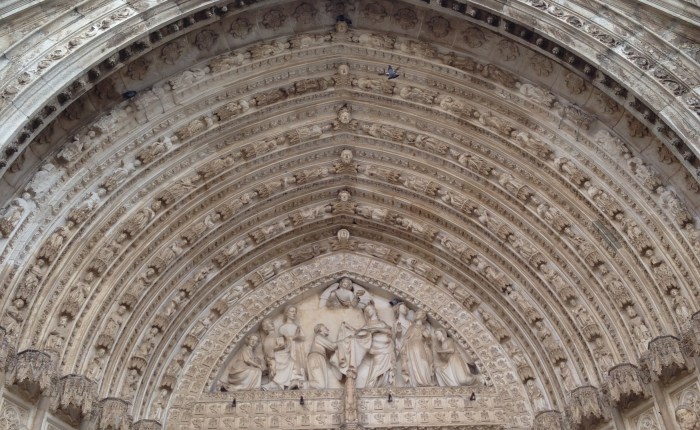
It is arguably not a rational question—maybe not even a real question at all—to ask “Why is there something rather than nothing?” In any case, it is unanswerable. But I still often find myself filled with wonder that I exist, that I can see and hear things, that I have an identity, and that I am a part of this whole universe, so exquisite and vast. Certain things reliably connect me with this feeling: reading Hamlet, looking up at the starry sky, and standing in the Toledo Cathedral. Because it is not rational, I cannot adequately put it into words or analyze it; and yet I think the experience of mystery and awe is one of the most important things in life.

Since it is just a feeling, there is nothing inherently rational or anti-rational in it. I’ve heard scientists, mystics, and philosophers describe it. Yes, they describe it in different terms, using different concepts, and give it different meaning, but all that is incidental. The feeling of wonder is the thing, the perpetual surprise that we exist at all. Campbell helps me to connect with and understand that, and for that reason I am grateful to him.

View all my reviews

Review: Publishing 101

Review: Publishing 101

Publishing 101Publishing 101 by Jane Friedman

My rating: 4 of 5 stars

I teach the rules, even though there aren’t any.

Several years ago I embarked upon a novel (my second; although my first attempt was so slapdash and haphazard that it hardly deserves the name). As it gradually took form, and draft after draft accumulated, the idea that I might actually do something with it appeared less and less absurd. But few things are more mysterious to me than the world of publishing. Every time I tried to investigate, a hornet’s nest of unfamiliar entities—agents, editors, query letters, submissions guidelines, genre, category, digital platform—swarmed and buzzed so menacingly until I gave up, overwhelmed. I needed someone to hold my hand, a Virgil to guide me through the several circles of pre-publication hell. That’s where Friedman came in.

Friedman has been in the publishing industry a long time, notably working as the publisher and editorial director of Writer’s Digest. Now she is perhaps best-known for her blog on writing advice. This book was made from that blog, stitching together the most popular posts since 2008 into a basic guide. In theory, you could get everything in this book for free by rummaging around her site. But the book is cheap on Kindle, so what the heck.

Friedman is a sober and pragmatic guide. This is what I like about her. She is not promising miracles, she knows that no approach will work for everyone (or even most people), she has no illusions about the failure rate. There is no magical thinking in this book, only cold and calculated strategies to incrementally increase your likelihood of success. Absent from this book are those “self-help miracle stories” that one so often finds in the writings of professional advice givers.

She is also a fountain of information. Here you will find advice on traditional publication, self-publishing, as well as ample instruction on digital marketing, online platform, and all the other things that keep me up at night. Indeed, Friedman is most enthusiastic and convincing when it comes to online self-promotion. This is unsurprising, since this was her main avenue of success. Still, I think many would-be writers will be surprised by how much of this book is given over to marketing rather than researching and contacting publishers. I know I was.

There is an awful lot of sales talk in this book. Trying to publish a book is, after all, just marketing a product (although I find it bemusing to consider my poor manuscript a commodity). And I must admit that all this talk of hard-selling, soft-selling, building a network, connecting with fans, and suchlike salesy things sometimes gives me a queasy feeling in my stomach. Many writers, I suspect, write to get away from all that, not to make it a permanent fixture in their lives. Writers are not known for being particularly social, suave, or business-savvy creatures.

Nevertheless I think Friedman’s advice is sane and sensible. Her main nugget of wisdom is that your online presence should not be forced or mercenary. Write a blog about something you care about; connect with people just for fun; do things that interest you and that are connected with your creative work. It takes patience and persistence to establish any kind of reputation, following, or clout, so you’ve got to see your digital activity as something rewarding rather than a chore. Easier said than done, I’m sure.

Like anything under the sun, this book is not without its flaws. The main flaw, as Friedman herself acknowledges, is that it was originally written as a series of blog posts. (At one point she says: “If I read a book and think ‘I could’ve gotten this from a series of blog posts,’ then I consider it a failure.” Luckily for her, I’m more lenient in this regard.) The writing is filled with lists, bullet-points, and a relentless stream of short paragraphs. Such writing works extremely well on a blog, of course, where most people are simply scanning for information; but in a book, it grows tiresome.

Another thing I missed was concrete examples. Friedman’s advice, though sensible, was often abstract; often I wished she would give me the story of an author she helped, or just a short vignette about someone who successfully implemented her strategies. I’m sure she has many such stories, and I wished she had used some of them, since they would have brought warmth and blood to potentially anemic advice.

There were also many times I was inclined to doubt her recommendations. For example, Friedman is very keen on authors having their own websites. Now maybe I am exceptional, but I have never, not once, visited an author’s website. Have you? Also, she suggests that you gather emails and send out blasts (not indiscriminately) when you have a big update. But again, I habitually delete all emails that aren’t work related or personal. Doesn’t everyone?

All these quibbles and queries aside, however, I think that this is an excellent book. Friedman is realistic, thorough, and businesslike, without sacrificing the raison d’être of writing: to create and to enjoy the process of creation. Unfortunately for me, I am now fairly convinced that my own poor manuscript hasn’t much commercial potential (but now that I see how brutal the publishing industry is, I’m not sure I mind). In any case, for those lost souls wandering around inferno, looking for the path to paradise, Friedman will be your guide. But be warned: a long climb up Mt. Purgatory awaits!

View all my reviews

Review: Pride and Prejudice

Review: Pride and Prejudice

Pride and PrejudicePride and Prejudice by Jane Austen
My rating: 5 of 5 stars

Jane Austen’s tools are tweezers and a nail file. Tolstoy built cityscapes; Dostoyevsky dug sewer systems; Joyce made funhouses; Kafka put up prisons; Cervantes created carnivals. Austen crafts ivory figurines, incredibly lifelike portraits that fit in the palm of your hand.

When you read Pride and Prejudice you see the novel in its barest form. Her prose has no pyrotechnics, her descriptions have little poetry. Word-play, fantastic events, bizarre characters, cliff-hangers, and elaborate plots are similarly absent. When you read this book you realize that these tools are not only unnecessary, but can distract from the craft of the novel.

In all of the annals of social science—the ethnographies of anthropology, the studies of sociology—there has never been an observer of social life more keen than Ms. Austen. What we have here is one of the best accounts of marriage customs ever written. That information alone would make this book invaluable.

But of course, this is no academic treatise; it is a novel, and a brilliant one at that. Unlike other authors, who use the dialogue to present information about the plot, for Austen the dialogue is the plot. It is a story of information and misunderstanding. Who thinks what, who knows what, who tells what to whom—all form the intimate tapestry of events that propel this book forward to its merry conclusion.

Austen also excels at omitting unnecessary information. She never tells instead of shows. She does not beleaguer the reader with descriptions of personalities, or even of appearances. Descriptions of setting are similarly kept to the barest minimum; in fact, they are almost apologetic.

The scenes of our greatest struggles and triumphs aren’t always aboard a whaling ship or before the gates of Troy. Sometimes they are conversations held over the soft plunking of a piano-forte

View all my reviews

Review: Writing to Learn

Review: Writing to Learn

Writing to Learn: How to Write--And Think--Clearly about Any Subject at AllWriting to Learn: How to Write–And Think–Clearly about Any Subject at All by William Zinsser
My rating: 3 of 5 stars

Humor is the most perilous of writing forms, full of risk; to make a vocation of brightening the reader’s day is an act of continuing gallantry.

Specialization inspires in me a certain existential dread. This is of two sorts. The first is the despairing thought that, by specializing, I will come to know only a certain, restricted corner of the vast universe. The second, more puerile fear is that, by becoming a specialist, I will commit myself on a path I won’t like very much.

Generalization is often, I suspect, motivated as much by fear of commitment as by humanistic curiosity. In Spanish there’s a word for a man who likes to sleep around—a picaflor—which conjures up the suggestive image of a bee going from flower to flower. Well, picaflores and Don Juans and Lotharios are generalists. Devoted husbands are specialists.

Promiscuity aside, we continue to do homage to generalists with our notion of the “Renaissance Man,” and the quintessential Renaissance Man was of course Leonardo da Vinci. His notebooks are filled not only with “art,” but studies of anatomy, light, physics, engineering, music, and so much else.

Last year I read a selection of Leonardo’s notebooks, hoping to find out how one man could tackle so many disparate subjects. My conclusion was that his versatility was due to the application of his medium: drawing. By making careful, detailed sketches of things—bees, bodies, bridges—he came to understand them. His pencil thus acted as antennae, with which he probed and investigated his world.

I thought: Could I do something similar? Certainly I have little talent as regards visual art. But I do have a verbal addiction. Perhaps I could use writing in a way similar to how Leonardo used sketching? Such an idea was hardly original. Soon I found out that Zinsser, the writing guru, already had a book about it.

The idea of reading another Zinsser book was not especially appealing. I had already read his popular book On Writing Well, and came away with a sour taste in my mouth. But if I was going to be the next Leonardo, I had to swallow some pickles. Dutifully I bought this book; and, after equally dutiful procrastination, I am here to tell you about it.

My first reaction is distaste. This is not entirely rational. Every good writer has what I call a “literary personality”—related to, but not identical with, their real personality—and I simply do not like Zinsser’s. I do not wish to spend time with him or to invite him to supper. I cannot really articulate why I dislike him, in the same way I can’t say exactly why I don’t like the sound of people eating apples. He’s a strong writer and I agree with much of what he says. He is thoughtful, curious, broadly educated, sensitive to art, music, and literature, and generally benign in his means and ends. When I think about it, I really ought to like him quite a bit. Yet I don’t.

Maybe this is because I object to the way he romanticizes his craft. Zinsser would have you believe writing clearly is one of the most difficult, dangerous, and distasteful activities in the world. It is so hard and so strenuous that it requires continual, backbreaking effort. Good writers are saints, many of them martyrs, including Zinsser himself: “I don’t like to write, but I take great pleasure in having written.” Zinsser makes very clear that his vocation is a heroic one, especially considering that he not only writes himself, but teaches it too:

Why, then, would anyone in his right mind want to be a writing teacher? The answer is that writing teachers aren’t altogether in their right mind. They are in one of the caring professions, no more sane in the allotment of their time and energy than the social worker or the day care worker or the nurse.

It takes serious audacity (to use a polite word) for a writing teacher to compare himself to a nurse. I also gag at this self-pity about the how hard it is to write well. Yes, it can be hard. Lots of things are hard. The only thing that sets writers apart is that they tend to whine the most eloquently.

Even when I put my personal dislike aside, however, I still must conclude that this book is disappointing. It begins with an unnecessary autobiographical section on Zinsser’s childhood education. (Considering how much Zinsser likes to talk about omitting unnecessary material, I found this especially ironic.) The rest of the book consists of long excerpts of what Zinsser considers to be successful examples of writing in different subjects, from anthropology to chemistry, from geology to mathematics. The book could easily have been an anthology, and probably should have been.

Most of what I wanted from this book is lacking. Yes, any subject can be written about engagingly—Zinsser didn’t need to prove this to me—but how do you go about doing that? Zinsser avoids the problem of methodology by insisting that good writing is learned by imitation. This is no doubt largely true; still I found it to be an abdication of this book’s promise: to give the would-be autodidact a strategy, or at least a few tips, for writing to learn.

Another serious omission is that Zinsser does not provide any concrete advice for teachers looking to apply this philosophy to their classes. There are a few reported examples of teachers who have done so, and a lot of hortatory passages about the benefits of “writing across the curriculum,” but very little in the way of concrete strategies for implementing this idea. As both a student and a teacher, I was irked by this.

Still, I suppose this book does have its value as a piece of propaganda. Zinsser is enthusiastic about writing, and his enthusiasm is contagious. For anyone skeptical that any subject—even chemistry, physics, or math—can be written well, or if you’re unsure whether writing can help you think and learn, you’ll find these doubts addressed here. For all its faults, this book does provide a glimpse of a compelling educational ideal: one that allows all of us to be picaflores in good conscience.

View all my reviews