Review: Every Man for Himself and God Against All

Review: Every Man for Himself and God Against All

Every Man for Himself and God Against All: A Memoir by Werner Herzog

My rating: 5 of 5 stars

I saw my first Werner Herzog film in my final year at college. I found out at the last minute that, to graduate on time, I needed to take some kind of history class. For some reason that I don’t remember (maybe cultural aspirations), I chose an introduction to Art History. It was taught by an unenthusiastic and disgruntled graduate student (by the end of that semester he would quit his program to become a chiropractor), yet it somehow left a deep impression on me. I had very limited knowledge of ancient and medieval art, and I can still vividly remember first seeing photos of the Book of Kells and the Boudreaux Tapestry.

But probably my most intense experience of art came early in the semester, when we were learning about prehistoric art. In the middle of class, the professor mentioned, offhand, that there was a recent documentary by Werner Herzog about the caves of Lascaux. I had never heard of Herzog, but I decided to look for the film anyway. It was not at all what I expected. Rather than a standard overview of what we know about cave paintings (which is not much, anyway), the film is an attempt to come to terms with the painters as artists. I felt cheated at first—thinking the film unscientific and wishy-washy—but, by the end, I was convinced that Herzog had indeed taken the right approach. For he does the most important thing, which is to try to recreate with his camera the actual experience of being in the caves.

Later on, I saw Aguirre, the Wrath of God and Fitzcarraldo—probably his two most famous films, both with the unstable actor Klaus Kinski—though I have to admit that neither of them left a particularly deep impression on me. It was only this past summer that I fell completely under Herzog’s spell, when my friends invited me to watch Grizzly Man. I was completely transfixed by it, and (as is typical with me, when I find something I really like) I found myself bringing it up in conversation months afterwards. And so I fell down the rabbit hole—or, to put it in more Herzogian terms, I plunged headfirst into the abyss.

One reason that I became so enamored of his films is because Herzog captures images on film that I’ve only dreamed about: What is it like to swim under the ice, or to get lost in the desert, or to walk inside a volcano, or indeed to be in a cave full of prehistoric paintings? The human experiences that Herzog likes to explore also attract my morbid imagination: living on death row, being attacked by a bear, surviving in the jungle after falling from the air (both Dieter Dengler and Julianes Sturz). And I find Herzog’s manner of approaching these images and experiences to be wonderfully human—perhaps, because he is such a pedestrian filmmaker. I mean that literally, in that his films always convey a kind of physical closeness, as if you are there walking beside him. His most characteristic touch as a filmmaker, I’d argue, are his shots in which the footsteps of the cameraman are palpable.

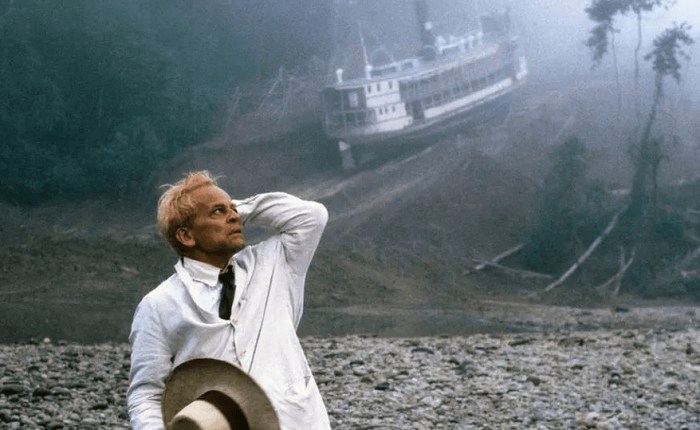
But above all, I appreciate his films and documentaries because they are not about the interpersonal struggles that characterize so much of Hollywood—between children and parents, or between friends, or above all between couples. Granted, this means that his work generally has little value as social commentary, in the way that, say, a classic Victorian novel has. Yet it makes up for it by being about what is, for me, the ultimate theme: the doomed struggle between humanity and the universe. This is summed up in what is arguably the central image in his entire oeuvre, the challenge of Fitzcarraldo: lifting a boat over a mountain in the middle of the jungle. Indeed, the making of the film itself became such an impossible task that it is doubly metaphoric.

Well, I have gone on about Herzog’s work as a filmmaker, but this is a book review, after all. Yet it is apropos, my reaction to this book only makes sense if you know that I am in the midst of a Herzog obsession. And I would only recommend the book to people in a similar predicament. That is, it is difficult for me to imagine someone with only a casual interest in Herzog, or perhaps just wishing to read a good book of memoires, really enjoying the book. Yet if you are a fan, this is wonderful reading.

Or listening. It was an easy decision to experience the book in audio format, narrated in Herzog’s iconic voice. It is certainly good practice for my Herzog impersonation (though it’s still mediocre). Also, it was constantly amusing whenever Herzog pronounced any sort of foreign word—be it German, Spanish, or Nahuatl—as his voice became inundatingly phlegmy.

While Herzog is an extremely thoughtful person—indeed, he seems to be one of the last living examples of the twentieth-century European intellectual, full of strange opinions and oracular pronouncements—while that is true, as I was saying, he is not particularly introspective. To the contrary, he declares himself the enemy of psychoanalysis, and says that there are parts of the human psyche which should remain shrouded in darkness. It is this aversion to delving emotional depths, I think, which makes him spurn human relationships as the focus of his work—and, it seems, as the focus of his life, for he does not seem to be principally motivated by his family or friends.

What motivates him artistically and personally are, rather, what you might call miniature obsessions. The geneses of his films seem to take the following form: He hears a piece of music (such as the madrigals of Carlo Gesualdo) or a story (such as about the simultaneously-speaking twins, Freda and Greta Chaplin) or sees an image (such as man in a protective suit battling an oil fire) and then decides he must make a film about it.

This tendency to get completely lost in a temporary fixation is another quality I share with Herzog. But the big difference between him and sorry devils such as myself is that Herzog is not content to read a book or watch a movie about his latest mania. He actually travels to the ends of the earth to explore it himself.

His absolute determination to see his projects through, regardless of the hardships or the risks, is perhaps his most admirable (and frightening) quality, and the one I identify with the least. I am a soft person who likes comfort, while this book is full of hardship after hardship and injury after injury. It is sometimes difficult to escape the conclusion that the man is a masochist. But I think it is more accurate to say that he has a philosophic attitude to pain. It is woven into his worldview, as something he simply expects to receive from the universe.

Now, I do have to confess at the end of this review that, now and then, I do get a faint whiff of charlatanism. Herzog seems to like telling stories about himself, and he also seems to have a flexible attitude towards the truth (as explained in his theory of “ecstatic truth”). There are precious few flashes of, say, self-deprecating humor to puncture the popular caricature of himself. But even if Herzog the man does not quite live up to Herzog the character, the artistic persona is so compelling that I think we would have to invent him ourselves if he did not really exist.


View all my reviews

Review: Columbus (Laurence Bergreen)

Review: Columbus (Laurence Bergreen)

Columbus: The Four Voyages by Laurence Bergreen

My rating: 4 of 5 stars


I remember learning about Columbus when I was in elementary school. The story was simple: he was a daring, visionary man who set out to prove that the earth was round, heroically defeating the nay-sayers who thought that he would sail right over the edge of the earth. To the mind of a child, it is a compelling tale. It is also, of course, complete fantasy (to use a polite word). Since those Edenic days of unproblematic national heroes, Columbus has become a much more divisive figure. So I decided I ought to get the real story, hopefully from somebody without an ideological axe to grind.

As I knew from his books on Marco Polo and Magellan, Bergreen is in the business of writing popular histories of famous explorers. This book is up to his usual standards, though the raw material he had to work with is naturally somewhat messier. Both Polo and Magellan were famous for one iconic voyage, while Columbus travelled to the “New World” on four separate occasions. Instead of one grand adventure, then, we get a series of expeditions, each one drearier than the last. By the fourth voyage, I was quite ready to be done with the Genoese explorer.

But I did learn. For example, Bergreen makes it clear that the competing narratives of Columbus have existed from almost the very beginning. There were rumors and accusations regarding his cruelty and incompetence during his lifetime (which resulted in his imprisonment); and not long after his death the great Spanish anti-colonialist, Bartolomé de las Casas, skewered Columbus for his role in the destruction of the native peoples. In short, he was never a universally beloved hero.

Furthermore, Columbus only became a cornerstone of patriotic ideology centuries later. He started to be celebrated in North America, for example, after the Revolutionary War, as the young nation searched for a founding myth that wasn’t so tied to England. In Spain, October 12th (when Columbus “discovered” the New World) did not become a holiday until 1892, as part of the conservative restoration of the Bourbon monarchy. In the United States, it was not made a holiday until 1937.

So, should Columbus Day be celebrated? Insofar as celebrating Columbus is merely a way of celebrating European colonization of the Americas (which certainly seems to be the case), then I think the answer must be a clear no. I don’t think it is possible to learn about the cataclysm that engulfed the native peoples of the Americas—which resulted in millions dead and the disappearance of so many cultures and languages—and think that worth celebrating. Granted, there is a kind of paradox for European Americans in this, since if there had not been a Columbus we would not exist; and it is difficult to wish oneself out of existence. Even so, celebrating the enslavement and elimination of whole peoples does not seem quite right.

Yet what about celebrating Columbus himself? Well, he does not exactly make a good impression in these pages. Certainly he was a bold and determined man, willing to risk his life for an idea (as well as for gold and glory). And his talent as a navigator is impressive. But these positive qualities seem rather pale when compared with his narrow-mindedness, his incompetence as an administrator, his cruelty to others, and his messiah complex. In the course of these voyages he combats several mutinies (with varying degrees of success), strands his own men (to be used as a bargaining chip), and has untold numbers of people enslaved. And even if you focus exclusively on his role as a “discoverer,” it is difficult to celebrate a man who steadfastly refused to acknowledge the truth of what he, in fact, had stumbled upon.

The truth is that Columbus, contrary to what the legend says, did not have a more accurate notion of the earth than the experts of the time. Precisely the reverse: Columbus’s voyage was based on a profound underestimate of the size of the earth. Indeed, it was pure luck that there was an unsuspected continent in the middle of the ocean. If America did not exist, and there were nothing but open sea between Europe and Asia—as he thought—Columbus would almost certainly have died in the enormous expanse of water. And he never even had the good grace to admit his mistake, insisting to the end that he had found a route to Asia, despite the very clear evidence to the contrary.

Of course, the fact remains that Columbus thought to do something that nobody (to his knowledge) had ever done before, and in the process inaugurated a new period of history. Indeed, given the tremendous importance of his voyage, we ought to do our best to understand both the man and the colonial undertaking he stands for. And I don’t think that is accomplished with myths and unreflecting celebration.


View all my reviews

Review: Long Day’s Journey into Night

Review: Long Day’s Journey into Night

Long Day’s Journey into Night by Eugene O’Neill

My rating: 5 of 5 stars


My first experience of this play was of an audio recording. It did not make an especially deep impression on me, and I was on the verge of writing a review saying as much, when another reviewer alerted me to the literary importance of the stage instructions. Chastened, I decided I ought to actually read the play before I made a fool of myself, and I’m glad I did. O’Neill, after all, never intended for this work to be produced as a play. It is, rather, like Goethe’s Faust a kind of closet drama, more effective on the page than on the stage.

The play is a masterful depiction of addiction and familial dysfunction. Indeed, I found it to be almost clinical in its psychology. O’Neill was clearly writing from personal experience. He ably captures the mixture of love and resentment that an unhealthy family bond can give rise to—perpetual annoyance, an endless buildup of grievances, non-stop bickering, all built on an unshakable foundation of love. And the characters of this play do love one another, quite dearly, even if they are stuck in a vicious cycle of blame and abuse.

Woven into this dreadful dynamic is addiction. Every member of the family is an addict, and all display the tell-tale signs. They search for excuses—good new or bad news, loneliness or companionship, special occasions or recurrent problems—to justify their habit. And then there is the deferral of responsibility, most exemplified by the mother in this play, who manages to blame everything in her life—her husband, her sons, her doctors, her upbringing—except herself for her morphine addiction. Yet of course the self-deception is never really believed. This awful truth is always there, burning underneath, a gnawing feeling that the substance will never quite deaden.

These contradictions—of great affection and resentment, of excuses and self-knowledge—are so starkly on display in this play that I think even the most brilliant actor would struggle to do it justice. The shifts of tone are too abrupt, the push and pull of conflicting feelings and truths are too violent. But, somehow, it works when read. On the page, a jostled, confused, and depressing mess becomes something orderly, transparent, and deeply tragic. A potentially pathetic group of boozers and dope fiends are transformed into symbols of aching humanity.

Considering that this play is strongly autobiographical, it is frankly amazing to me that O’Neill was able to create such a masterpiece. To confront what must have been a painful and traumatic time in his life and turn it into such a drama—a drama that pulls no punches, and yet condemns no one—is deeply impressive. As this play amply demonstrates, life too often conquers art. Routine deadens us to it, money woos us from it, addiction numbs us to it, so that we lose both our sensitivity to its beauty and the time and energy to create it. But sometimes, art conquers life. And this play is an example of that.


View all my reviews

Review: The Gathering Storm

Review: The Gathering Storm

The Second World War, Volume I: The Gathering Storm by Winston S. Churchill

My rating: 4 of 5 stars


When I first learned, many years ago, that Winston Churchill had written a history of the Second World War, I knew that I would have to read it. After all, I grew up watching documentary after documentary about the conflict (before the History Channel was all about aliens, it was mainly Hitler content). Finally, this summer, I found the complete set, cheap, at the Strand bookstore in New York. Looking at the six fat volumes on my bookshelf, I knew that I was in for a long campaign.

The book is, indeed, long (over 700 pages in this edition), but it is a surprisingly fast read. It was written in haste—if “written” is the right word, for most of the book was either dictated or excerpted from official documents—and reads like a series of dispatches or field reports. This is simultaneously the book’s weakness and its great strength. For Churchill does not attempt to give a universal, impartial overview of the war, but rather recreates what it was like for him to be in the thick of it. And although his perspective does impose serious limitations and distortions on the material, it also makes the narrative far more thrilling. The rush of events is palpable.

Half of this book is devoted to the buildup of the war. Churchill, to his credit, saw the Nazi threat coming from miles away, and tried again and again to rouse his country into action. Unfortunately, his warnings go unheeded, and Germany is allowed time and space to rebuild its military unmolested. It is truly maddening to contemplate all of the lost opportunities. When Germany invaded the Rhineland, for example—clearly violating the Treaty of Versailles—the French and English could have taken decisive action at a time when the German military was miniscule. But nothing can compare with the infamous Munich Agreement, in which a country capable of defending itself was given away to the Germans, which only further strengthened their military for the inevitable war.

One can imagine how such a book could devolve into a series of self-congratulatory told-you-sos. But Churchill, at least in print, is quite generous to his political opponents. In particular, Chamberlain, the architect of appeasement, comes off rather well in Churchill’s telling—portrayed a resolute, peace-loving man who made some very bad decisions. Indeed, I found Churchill’s narrative voice to be rather odd. He has a kind of boyish fascination with war and weapons, and a jingoistic faith in the British people and their empire. Indeed, although he was so very right about Nazi threat, I can easily imagine myself dismissing such a strong believer in king and country as a war-mongering kook.

But he was not a kook, at least not in this regard. Indeed, in his great attention to detail regarding military matters, and his ability to strike a brave, defiant note at a difficult hour, he proved that he was the right man for the moment.


View all my reviews

Review: American Colonies

Review: American Colonies

American Colonies: The Settling of North America by Alan Taylor

My rating: 5 of 5 stars


This is an exceptional volume of popular history. Few periods, I reckon, are as mythologized and misunderstood as the European colonization of the United States. In my public school, for example, I learned that the heroic Columbus proved the earth wasn’t flat, and that the Pilgrims lived in joyful harmony with the Wampanoag. To be fair, in high school, this ridiculously rosy picture was brought back to earth somewhat. Still, I think that many Americans (and I may still fall into this category) hold onto many misconceptions about our early history.

Taylor begins with Columbus and ends with the Russian and Spanish colonization of North America’s west coast. On the way, he discusses the Spanish conquistadores, the French fur traders, the main islands of the Caribbean, the slave trade, and of course the English colonies along the east coast. Even Captain James Cook and his fateful exploration of Hawaii gets a section. Taylor shows what dynamics in Europe motivated expansion—both the large-scale political and economic considerations, and the push and pull factors that made people want to leave. And, of course, Taylor mentions the many Native American groups who cooperated with and resisted, fought for and against, exploited and were exploited by the incoming Europeans.

This history begins with a calamity on a scale difficult for us even to imagine. European diseases ravaged the indigenous population of the United States, causing a population collapse so dramatic that it makes the bubonic plague seem mild by comparison. There is no way to exaggerate the loss this represents, both in terms of people and their lifeways. However, while Taylor does not minimize this tragedy, he also avoids falling into the opposite error of portraying the natives as innocent nature people. To the contrary, he shows how different groups adapted to European presence, often becoming essential allies and trading partners to the new colonists.

Taylor also gives ample space to that other original sin of America: slavery. It is not pleasant reading. His relatively brief coverage of the conditions aboard a slave ship, for example, is deeply disturbing. But even in this case, he does not ignore the agency of his subjects. He describes, for example, how slaves would subtly resist their overseers by feigning misunderstanding or working inefficiently. I also appreciated his explanations of how slavery operated differently in the Caribbean and on the continental United States, according to climate and economic pressures.

In sum, what emerges from these pages is a vivid portrait of a rapidly changing continent—a complicated story to which innumerable groups contributed. While Taylor does demolish the patriotic myth of heroic and benevolent European colonizers, this book is not simply a hit job. Rather, it is a rich, well-written, and dispassionate account of a one of history’s most consequential periods.


View all my reviews

Review: The Corner

Review: The Corner

The Corner: A Year in the Life of an Inner-City Neighborhood by David Simon

My rating: 5 of 5 stars


Some authors have the power to make you feel that you are just understanding the world for the first time. This is, for example, Roberto Caro’s gift. In every one of his books, he seems to expose the world of politics, revealing its inner workings like an ant colony on display in a transparent container. And this is also the consummate gift of this writing team, Simon and Burns. Here, as in Simon’s Homicide, and as in their masterpiece The Wire, these authors show you something you think you already know about: urban poverty. But you really see it for the first time.

In many ways, this book is the ideal companion to William Julius Wilson’s book, When Work Disappears, which was published just one year earlier. Wilson, a sociologist, explains urban poverty using historical trends, statistics, and surveys, whereas Simon and Burns worked like anthropologists: following around their subjects for an entire year and more, trying to understand their world through their eyes.

These different methodologies converge on the same story. When decent working-class jobs disappear from an area, it sets off a chain reaction that erodes the fabric of the society. Those with means move out; those that remain behind are left with few and stark choices. The teenagers in this story, for example, are faced with the options of attending a struggling school system, working for a minimum-wage job, or selling drugs. And while there are significant risks to this last option—risks that, sooner or later, become terrible consequences for all of them—it is undeniable that the reward is immediate and great.

Another theme of both books is how strategies and mindsets that are adaptive on “the corner” are maladaptive anywhere else. The tendency to think in the short-term, to backstab, to lie and cheat, to never show vulnerability—all of these are essential for both the addicts and dealers, though of course they become self-defeating when any of them try to leave this world. And of course many do try to leave it, earnestly and repeatedly. But with so few economic opportunities and so many barriers to government aid (the struggle to just get into a rehab center is Sisyphean), these efforts meet with scant success.

When writing of people in such difficult circumstances, it is tempting to treat them as pure victims. Yet the authors manage to convey the full humanity of their subjects—their many shortcomings and also their strivings—while never minimizing what they are up against. Indeed, this is perhaps the most impressive aspect of this book, and what makes these stories so compelling simply as stories, and not just illustrations of American decadence.

If there is any moral to this book, it is the absolute failure of the war on drugs. Simon and Burns tell of an unending, unceasing drug market—an entire ecosystem of sellers and buyers, operating 24 hours a day, 7 days a week, right in the open. Yes, the police do come and make arrests and confiscate a few vials. But the risk of incarceration is nothing compared to the force of full-fledged addiction or the endless, easy money that dealing provides. At one point, the authors aptly compare the drug war to the debacle of the Vietnam War: all the money, manpower, and machinery in the world is not enough when a war is ill-conceived to begin with.

But what is the solution? What would help? The authors—wisely, I think—refrain from any policy suggestions. Instead, we are left with a kind of mirror-image of the America that Robert Caro describes. Whereas Caro focuses on extraordinary individuals who fundamentally change their worlds, Simon and Burns show how political inertia, economic forces, and human folly conspire to trap everyone—inner-city teachers, beat cops, social workers, rehab nurses, and everyone selling and using—in an endless cycle that chews people up and spits them out, generation after generation. As in Homicide, this is a remarkable work of journalism.


View all my reviews

Review: Homicide

Review: Homicide

Homicide: A Year on the Killing Streets by David Simon

My rating: 5 of 5 stars


What led me here (as I suspect is true of many readers) was my love of The Wire. Of all of the television I have seen, I found Simon’s masterpiece to be uniquely engrossing and thought-provoking. And despite the obvious creative license taken with the plot, what makes the show so compelling is the bedrock foundation of fact upon which the story is based. Thus, I wanted to get to know some of Simon’s source material directly.

I am glad I did. This book is a triumph in its own right—worth reading even if Simon had never gone on to be a famous television writer. This is just an excellent work of journalism. Simon was given unique access to a squad of murder detectives and their work. He hung around the office on late nights, he listened to interrogations, he read case files, he visited murder scenes, he sat through trials, he went to hospitals and morgues—in short, he did it all. And by simply organizing his observations and writing them down, he has produced a wonderfully insightful look into crime and police work.

Anyone with even a passing acquaintance with detective stories—that is, all of us—has internalized quite a few myths and preconceptions, which are battered to pieces in these pages. For one, most murders do not have a motive beyond rage, greed, or simple recklessness. They are purely impulsive, so detectives rarely bother asking “Who would want this person dead?” Indeed, the Sherlock Holmes image of the cold, rational detective motivated by his love of the common good has virtually no shred of truth to it. The detectives in this book, while decent men (and they are all men), are not on a personal mission against crime. They are motivated by professional pride, by departmental statistics, by overtime pay—and occasionally, yes, by strong feelings of justice.

While we often hear stories of cold cases being solved through innovative scientific techniques, the basic tools of the detective are quite simple: evidence, witnesses, and confessions. And the first two are usually necessary to obtain the third, since most people don’t confess unless they’re backed into a corner. The interrogation techniques Simon describes are somewhat disturbing. Though the detectives do make their suspects aware of their Miranda rights, they do so in such a way that suspects are too intimidated or confused to really stop and consider their next move. The majority don’t use their right to call a lawyer, and instead endure hours of intense interrogation, while detectives browbeat and sometimes scream at them. A surprising number of suspects break and sign confessions.

It is hard not to feel uneasy about this. Indeed, studies have found that some innocent people will even confess to crimes they didn’t commit, just to escape from the intense psychological pressure of the situation. But Simon makes the point that, if detectives were prevented from using manipulative interrogation techniques, they would hardly convict anyone. And when he details the difficulties of actually convicting murderers in court (far fewer than 50% of those arrested for murder end up convicted by a jury of their peers), it is difficult to resist his logic. And when the top brass demand a high clearance rate for the department (that is, the rate of solved to unsolved murders), it is no wonder that detectives will resort to anything to put a case from red to black.

As is usual with Simon’s work, this is the story of ordinary, fallible people who are doing their best (mostly) in a failing, dysfunctional system. The reasons that there are so many murders in Baltimore in the first place go very far beyond the walls of the police department or even the city government. So even though the detectives often do admirable work and lock up obviously dangerous individuals, there is an overwhelming sense of futility in the book. After all, the detectives only arrive after a murder has taken place. They may find the man responsible (and it is usually a man), but even with him behind bars, the next murder is just a block, or a day, or a phone call away.

Yet the book is not wholly bleak. What prevents it from being so are the personalities of the detectives. For the most part, they are smart and, often, surprisingly funny—with a dark gallows humor imposed by the job. And they are surprisingly sympathetic. Indeed, although I share very little life experience with any of these men, somehow I often found myself identifying with them. This is, in essence, the charm of the book: rather than making you fantasize about being an investigative genius, it allows you to see what it would be like if you—the real you, but in another life, perhaps—became an actual, overworked, underpaid homicide detective.

It is a rare book that dramatizes police work while neither elevating the detectives into superheroes nor demonizing them as thugs. Like a good candid photograph, Simon’s portrait is both unflattering and endearing. It is both an uncommonly good work of journalism and a work of art.


View all my reviews

Review: The Emperor of All Maladies

Review: The Emperor of All Maladies

The Emperor of All Maladies: A Biography of Cancer by Siddhartha Mukherjee

My rating: 5 of 5 stars


I do not consider myself a superstitious person—not even remotely—but somehow I felt a deep reluctance to pick up this book. It may have taken us a long time to figure out the germ theory of diseases, yet the psychology of contagion runs deep. I had the irrational fear that even learning about cancer would somehow unleash it into my life.

But turning away from frightful things is not a good way to live. And, anyway, even though there is a lot of sadness in this book, and a lot to stoke your fears (perhaps it is best to avoid if you have a tendency toward hypochondria), but this is basically a story of innovation.

Mukherjee moves through surgery, radiation therapy, chemotherapy, cancer prevention, and modern targeted drugs, showing how each arose and developed in response to different sorts of cancer and out of the science and technology of the moment. It is a vast story, which includes the development of anasthesia and antibiotics, the discovery of genes and chromosomes, the first research into radioactivity, and the campaign against smoking. To use the obvious metaphor, it is a war waged on multiple fronts.

The challenges are manifold. I had naively thought that all cancer was basically the same disease, with its subtypes just minor variations. But it turns out that there is enormous genetic and chemical variety among cancers, so that a treatment effective for one may do little for another. Indeed, even for a single type—breast cancer, say—treatment can be unpredictable. This is what makes the story of doctor’s attempt to treat the disease so riveting, as it feels like a battle between two equally wily antagonists. At several points in this history, doctors attempt extreme cures—radical surgeries, or nearly fatal doses of chemotherapy—only to be defeated. Meanwhile, the victories can be as modest as a remission of just a few months.

It is probably best not to philosophize about a fatal disease, but there does seem to be a lot of irony in our quest to defeat cancer. For one, it has only become so prevalent in the modern period, because we have started living so long. Its appearance as the great killer, then, is a kind of perverse mark of progress. Further, there is the irony of trying to fight what is, in essence, a corrupted version of ourselves—a group of renegade cells which have figured out how to replicate and survive even better than our own body. There is great scope for metaphor here, but if there is a moral to cancer then I don’t think it is a simple one.

Mukherjee does an admirable job weaving a potentially chaotic and depressing story into something coherent and even hopeful. Though the book is composed of history, science, and his own experience as a doctor, these different threads reinforce one another rather than clash. The clinical anecdotes are sparing—just enough to connect the past to the present—and his thumbnail explanations of science are lucid and illuminating. But, most important, despite the many tragic deaths which litter these pages, the final impression is of how much can be accomplished when a researcher’s diligence, a doctor’s pledge to save life, and a patient’s will to live work together, generation after generation.


View all my reviews

Review: The Path to Power

Review: The Path to Power

The Path to Power by Robert A. Caro

My rating: 5 of 5 stars


Last winter, I went to the Film Forum in Manhattan with some friends to see the new documentary about Robert Caro and his famous editor, Robert Gottlieb. It was a wonderful experience on many levels. The documentary was fascinating and inspiring—the story of two people who, in quite different ways, have lived fully dedicated to literature—and it was the perfect place to see it, in the heart of Caro’s and Gottlieb’s city, surrounded by other New Yorkers.

Gottlieb comes across as a lovable and brilliant person (he has, sadly, since passed away at the age of 92), but Caro comes across as something superhuman, an embodied intellectual force. The name of the documentary, Turn Every Page, aptly summarizes what makes Caro so special: the meticulous, obsessive, even demented attention to detail—the determination to get to the heart of every aspect of every story, to never be satisfied with half-truths or empty explanations. And then, once he has gathered together his facts, this relentless attention is focused on the writing. For Caro is not satisfied with merely presenting us with his (always impressive) research. He is determined—again, maniacally so—to make us understand on a deep emotional level what each of these facts mean.

All of these qualities are fully on display in this, the first book of Caro’s monumental biography of the 36th president of the United States. As a political biography—a record of the accumulation and use of power—the book is peerless. Caro traces how Johnson, by sheer force of his personality, went from a rural boy with little education and less money to a member of Congress in just a few years. His chapters on Johnson’s elections alone—his campaign strategies, his fundraising, his advertising—are a goldmine for any political historian, and eye-opening for even the most cynical of readers.

Yet everybody knows that Caro is a master of political biography. What surprised me most was how brilliant this book was in other respects. His descriptions of the Texas Hill Country, for example—its climate, its soil, its weather—often rise to such a level of poetry that I was reminded of John Steinbeck. And his chapter on life in the Hill Country before electrification—the difficulty of even simple chores like washing and ironing—is so empathetic that it brings this experience to life as powerfully as even the most gifted novelist could manage.

Aside from this wonderful scene-setting, and aside from the incisive history, this book is of course the study of a personality. And it is a peculiar one. Indeed, underneath all of the historical detail, I think there is a very basic moral conundrum at the heart of this book. It is, in short, that Johnson is successful and effective—indeed, often a force for good—while being personally unlikeable and morally vacuous.

Caro goes to great lengths to illustrate the uglier sides of Johnson’s character. His urge for power is so great that it trumps every other consideration in his life: love, loyalty, ideals, friendship, ethics. When he is stealing elections, betraying friends and allies, and cheating on his wife, not once does he give evidence that he even possesses a conscience. And yet, in his quest for power, he educates children, helps the unemployed find jobs, secures money for veterans, and electrifies his district, among much else.

This paradox is illustrated in Johnson’s treatment of his secretaries. While he worked as a congressional assistant, Johnson went to great lengths to help the constituents of his district—far more than any ordinary assistant could or would. But this unusual effectiveness was achieved by working his own secretaries to such a degree that they could not have any life outside of work, and one had a nervous breakdown and fell into alcoholism. This is a consistent pattern: the specific people close to Johnson are used as tools for his own advancement, while the abstract people out in the world benefit from his obsessive work ethic.

To put the matter another way, Johnson seems to violate every ethical precept I know regarding the treatment of others, and lives in total contradiction of every piece of advice I know regarding wise and good living. Johnson comes across as a miserable person destined to share his misery with the world. But it becomes clear that Johnson’s personality type is perfectly suited for politics, and he achieves almost instant success when he enters that field. Indeed, one gets the impression that everyone else in Washington D.C. is just a toned-down version of Johnson—equally as power-hungry, but not as effective.

Somehow, we seem to have a system designed to elevate people whom most of us would find repulsive. Maybe this is inevitable, as the people who most desire power are the ones most likely to get hold of it. Perhaps the best thing to do, then, is to hope that the institutions are set up in such a way that, as in the case of Johnson, these driven individuals end up having beneficent effect on society. And yet, this does seem like an awfully risky strategy.

In any case, as I hope you can see, this is a superlative book, excellent on many levels. It is, in fact, among the select class of books that can forever change your outlook.


View all my reviews

Review: Faraday’s Experimental Researches in Electricity

Review: Faraday’s Experimental Researches in Electricity

Faraday’s Experimental Researches in Electricity: Guide to a first reading by Michael Faraday

My rating: 4 of 5 stars


In the first volume of Robert Caro’s biography of Lyndon Johnson, there is a fantastic chapter about what life in the Texas Hill Country was like before electricity arrived. Every basic task was substantially more difficult: water had to be carried in buckets, clothes had to be washed by hand, water had to be boiled over an open fire, milk and eggs had to be refrigerated in ice cellars, and on and on. When power finally did arrive to this rural area—thanks in large part to Johnson’s work—it transformed daily life in a matter of years. Johnson was considered a hero, and rightly so.

But if Lyndon Johnson deserves ample praise for having helped bring electricity to his district, what does Michael Faraday deserve? For it was Faraday who first discovered the principles of the electric motor and the electric generator. If not for him, the harsh conditions described by Caro—a life of ceaseless toil, barely eking out a living—might be not just confined to a rural area in Texas, but the general condition of our species. Faraday was, in short, a historical figure of supreme importance, and his work represents a turning point in human history.

Knowing this, it is shocking to see just how humble and, in many ways, how simple his work actually was. The tools at his disposal seem, to the modern reader, almost laughably primitive. Whereas modern physicists are using a city’s worth of power to accelerate particles down a track kilometers long, Faraday was fiddling with wires and bar magnets and compasses. And yet, with such simple tools at his disposal, and with scarcely any formal education—indeed, hardly knowing any math beyond basic algebra—Faraday made contributions to physics comparable to Newton or Einstein.

The format of this book is simple. It is not, like the Principia, a unified work conceived as a final theory. Rather, Faraday reached his conclusions slowly, over years of experimental work; and this book is a reflection of his process. Starting in 1821, Faraday began publishing accounts of his experiments in the Philosophical Transactions of the Royal Society. These papers were eventually collected and published in three separate volumes, in 1839, 1844, and 1855, consisting of 29 “series” of experiments in total.

Before I go any further, I should note that I did not make my way through all three of these volumes. Rather, I bought a condensed and annotated version published by Green Lion Press and edited by Howard Fisher. Frankly, I do not have the patience or interest to fight my way through 1,500 of the original, and I doubt many others do either. I also very much appreciated Fisher’s introductory essays, without which I think I would have been quite lost (and I often was, anyway).

Remarkably, Faraday maintains a numbering system for his paragraphs throughout, so that he can refer to earlier paragraphs of previous series as easily as one might cite the Bible. This is a simple device, but it does help to reveal the unity that underpins the apparently disorganized quality of this work, as it shows how Faraday was continually returning to the same questions and refining his answers.

I have already mentioned that Faraday was unversed in mathematics. And this makes him fairly unique in the field of physics, in which equations are sometimes elevated to a level that equates math with reality. However, the more one reads of his work, the more one comes to see that, even if he eschewed quantitative reasoning, Faraday was an extremely precise thinker. Part of this is his use of diagrams, which for Faraday almost take on the role of equations in summarizing complex relationships. He is also very sensitive to language, and is constantly trying to choose words that do not carry any inappropriate theoretical baggage.

Just because this book is written in good old-fashioned English, however, does not make it easy. Often, Faraday is responding to dead controversies and in general is using both language and theories that seem strange to the modern reader. To pick a simple example, static electricity is referred to as “ordinary” electricity, since this was the most commonly encountered electricity in Faraday’s day. What is more, Faraday very often must describe a detailed experimental apparatus or procedure, and I very often found myself totally unable to picture what was going on.

Here is a fairly typical example:

A ray of light issuing from an Argand lamp, was polarized in a horizontal plane by reflexion from a surface of glass, and the polarized ray passed through a Nichol’s eye-piece revolving on a horizontal axis, so as to be easily examined by the latter. Between the polarizing mirror and the eye-piece two powerful electro-magnetic poles were arranged, being either the poles of a horse-shoe magnet, or the contrary poles of two cylinder magnets; they were separated from each other about 2 inches in the direction of the line of the ray, and so placed, that, if on the same side of the polarized ray, it might pass near them; or if on contrary sides, it might go between them, its direction being always parallel, or nearly so, to the magnetic lines of force.

I don’t know about you, but I find this to be extremely exhausting.

Not all of the book was so dense, however. I particularly enjoyed the fifteenth series, which basically consisted of Faraday and his assistants putting their hands in a tank and getting an electric eel to shock them. Science was indeed simpler back then.

But the final impression is of Faraday’s remarkable theoretical vision. Although he is an extremely concrete thinker—couching even his most speculative remarks in terms of experiments—he nevertheless succeeded in probing some highly abstract questions. Beginning with the relationship between electricity and magnetism, he goes on to consider the relationship of force to matter, to light, and even to empty space.

His work is, in short, a model for science, showing how careful observation and the judicious use of imagination can revolutionize our understanding of the natural world. Compared to the baroque mathematical models of string theorists—whose theories have yet to receive any confirmation from experiment—Faraday’s approach is refreshing indeed.

View all my reviews

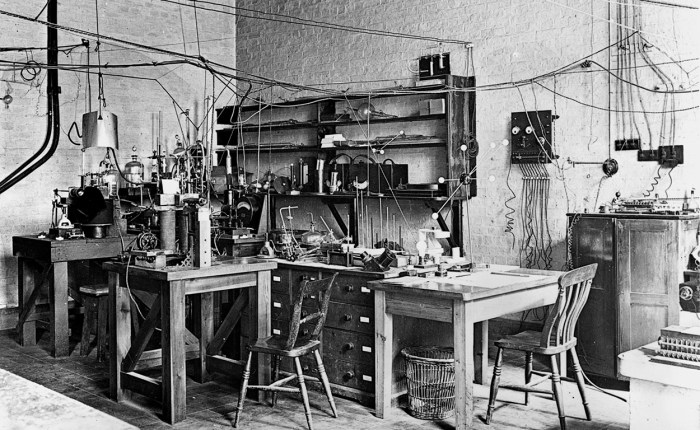
(Cover image is Faraday’s labs in the Royal Institution; photo taken from Wikimedia Commons; uploaded by AnaConvTrans.)