Review: All Quiet on the Western Front

Review: All Quiet on the Western Front

All Quiet on the Western FrontAll Quiet on the Western Front by Erich Maria Remarque

My rating: 4 of 5 stars

All Quiet on the Western Front is an extraordinary war novel. It has everything you would expect from a book about World War I: the mixture of boredom and fear; the constant specter of gore; the unrelenting threat of death from every direction; the strong bonds between fellow soldiers and the hatred of superior officers; the reduction of life to its most basic elements; the depersonalization of oneself and one’s enemies; the feeling of apathy and pointlessness; and the difficulty in re-adjusting to civilian life. This, by and large, is the common image of the First World War nowadays, so it is surprising to me that this novel sparked controversy when it was first published. The Nazis eventually burned Remarque’s books, and later decapitated Remarque’s sister.

I have never been in battle, thank heavens, and I hope never to be. Thus the conditions described by Remarque, though doubtless true enough, often struck me as unreal—ghoulish nightmares rather than reality. Indeed, the First World War in general is hard for me to wrap my mind around. That so much carnage could result from such petty causes—it makes my stomach tie itself into a knot the more I think about it. And then there is the, for me, strange collision of the nineteenth and the twentieth centuries: Kaisers and the aristocracy, cavalry charges, bayonets, juxtaposed with gas bombs, land mines, and heavy artillery. Technologically, it seems that defensive weapons far outpaced offensive ones. There were heavy artillery and machine guns, but neither were portable and so of limited use in an attack. Thus the endless trench warfare and the pointless offensives, as both sides could beat each other back but neither could win a decisive victory.

The final effect for the soldier, if he escaped with his body intact, was trauma. This was a world before PTSD; back then it was called “shell shock,” and poorly understood. But as Remarque describes the conditions on the front line, it is no wonder that recruits were traumatized; rather it would be a wonder if they weren’t. The carnage—bodies stabbed, shot, blown to bits, and wounded in every other imaginable way—was ever-present and horrific. Added to that is the constant fear—of artillery, snipers, landmines, electrified barbed wire, or merely getting separated from your fellows and lost in no-man’s land. And then the soldier must endure the loss of his friends—his fellow soldiers, with whom he forms bonds of terrific strength—as the war takes more and more men.

The worst part, perhaps, is that after enduring all this, the soldier cannot easily return to civilian life. In war, life is reduced to its bare essentials: the search for food, warmth, safety. Every moment, even those of rest, is part of a struggle to survive. Thus the soldier is shocked when he returns to his home. Civilian life, though enviably safe and comfortable, also seems terribly artificial, oriented towards goals that, to a soldier accustomed to struggling for bare survival, can seem superficial and even despicable. Remarque portrays this brilliantly, as the returning Narrator finds himself unable to communicate his experiences when he goes home on leave. After reading Proust’s novel set during the First World War, which focuses on the ridiculous pontifications of the socialites far behind the front lines, treating the war as just another topic for gossip, I can see why returning soldiers could feel disgusted.

Just thinking of how young these soldiers were—just eighteen when they began fighting—one realizes that a whole generation of men spent some of their most formative years in the most brutal conditions imaginable. It is no wonder they considered themselves the Lost Generation. And what was it for? Although admittedly the propaganda seems to have been quite effective in whipping up anti-German, -French, or -English sentiment, many soldiers must have felt like Stefan Zweig did—that the conflict was pointless. Remarque captures the absurdity of the situation: powerful men in ornate rooms, signing pieces of paper that result in thousands of young men fighting and killing thousands of other young men, not because any of them have any grievance against one another, but for the sake of the Fatherland.

Remarque conveys all this with a gripping immediacy. The story moves forward at lightning pace; and yet there is nuance and depth, too, in this short novel. Even though this is hardly a story of adventure, you realize that merely to keep on going required a kind of daily heroism—an unglamorous, grueling, thankless heroism—the loyalty to one’s fellows and the determination not to succumb to despair. War brings out both sides of the human character: our enormous capacity for violence and destruction, and our capacity for selfless devotion and extraordinary endurance. This is why war has formed one of the most popular themes of literature, going all the way back to Homer. But between those two extremes we often forget that war is long, boring, and terrifying, and that many people lose everything. It is this daily horror, and the daily heroism required to live through it, that Remarque captures.

View all my reviews

Review: The Analysis of Mind

Review: The Analysis of Mind

The Analysis of MindThe Analysis of Mind by Bertrand Russell

My rating: 3 of 5 stars

When you drop a weight on your toe, and you say what you do say, the habit has been caused by imitation of your undesirable associates, whereas it is brought into play by the dropping of the weight.

It is a puzzle of our modern scientific worldview that we have been extremely successful in explaining things remote from our experience, and yet have made comparatively little headway in explaining our experience itself.

We begin with physics, the king of the sciences. Here we are dealing with things like force, time, mass, charge—abstract qualities which we can define precisely and measure accurately. Using these variables we can, and have, constructed theoretical edifices which continue to astound me and the rest of the world with their surpassing precision and elegance. Yet it is in physics that we have found that our everyday notions are most flawed. Seemingly solid objects like tables and people are, it turns out, mostly empty space. Under certain circumstances, time slows down, objects become foreshortened. Space itself is not wholly distinct from time, but forms a four-dimensional fabric that bends in response to matter. And even our basic logical notions, like that of identity, fail miserably when confronted with the probabilistic world of quantum mechanics.

Things get a bit more orderly when we move up the scale of complexity from physics to chemistry. No longer are we dealing with matter in the abstract, but specific types of matter, with their own specific, recognizable qualities—smell, hardness, color. Here we can at least picture specks of matter, arranged into three-dimensional structures, changing and rearranging like grains of sand on a storm-tossed shore. Our ability to predict and explain the universe on this scale is less precise, and perhaps less elegant, than in physics, but it is nonetheless impressive. Yet as we climb the rungs of complexity from hydrogen to organic chemistry, up through biochemistry, we somewhere reach the frontier that separates life from inanimate matter.

Where we draw the line is, in part, merely a question of semantics; but it is also a scientific question, since we are interested in explaining the origins of life—and we can’t decide when life arose without deciding what life is. Viruses seem to sit right on this troubling boundary; but let’s put them to the side. We arrive, then, at bacteria, organisms too small to sense, but which still form the majority of life on earth, both in mass and variety. These little bitty dots of life float to and fro, performing their limited array of behaviors; and yet, simple as they are, do we have equations that could tell us exactly when a specific bacteria will divide, or exactly what direction it will turn next? And is not our knowledge of what life is even now so limited that we are still surprised, year after year, at the strange and inhospitable places we find bacteria happily residing?

Once we arrive at things like trees, mushrooms, bison, and baboons, all bets are off as far as predictive precision is concerned. It is true, we do have Darwinian evolution, which admirably and elegantly unites all of these phenomena into an orderly framework. Nonetheless, our knowledge here is qualitative, not quantitative; and when dealing with something like, say, animal behavior, biology sometimes approaches what can be called “natural history”—the mere collection of facts. Unlike in physics and in chemistry, where nearly every new particle or element is predicted beforehand—not only its mere existence, but its precise qualities, too—in biology, every new species discovered is a surprise. And even when we have good evolutionary grounds for predicting an ancestral species, the exact qualities of said species cannot be simply deduced from a theory; they must be inferred from remains and analogs.

Finally, we get to our own behavior—and here things get really messy. Because we humans exhibit such behavioral flexibility, we can’t quite decide where genetic influence ends and environmental influence begins. Nor can we even make definitive statements about the limits of our behavioral flexibility, as shown by the Westerners who were continually flabbergasted at the discoveries of cultural anthropologists. Moreover, our dominant theories of human behavior in the social sciences contradict one another. The premises of economics run counter to those of anthropologists; evolutionary psychologists and sociologists make different assumptions and operate within incompatible paradigms. Thus we are left with the ironic result that we can predict the behavior of an electron, which nobody has ever seen, with enormous precision, and yet cannot predict the behavior of our spouses, who we see every day, despite our most valiant efforts.

This isn’t a pretty picture; but the next step in our journey is even uglier. When we arrive at the threshold between body and mind, we are stumped completely. How does consciousness arise from a blob of neural tissue? How do chemical signals and electric jolts, when arranged in a sufficiently complicated network, give rise to awareness? How on earth do we explain choice, will, fear, hope? We reach for science, but here our typical scientific approach encounters an obstacle. Science, which is a method for achieving objective results, is being asked to explain subjectivity; a technique for paring away our biases and partialities, leaving only the truth, is being applied to the very center of our biases and partialities. In short, the only indubitable evidence we have of our awareness is purely personal, and yet such evidence—namely, eyewitness testimony—is inadmissible in the scientific enterprise.

In these paradoxical territories, where we cannot yet achieve satisfactory results using empirical research, philosophy makes its home. And here is where Bertrand Russell enters. Published in 1921, The Analysis of Mind is Russell’s attempts to muster the greatest science and philosophy of his day to explain the human mind. Relying not only on his own techniques of logical analysis, Russell draws on David Hume’s empiricism, William James’s psychology, Freud’s psychoanalysis, and the recently-developed behaviorism, quoting scientific papers more often than other philosophers. It is a valiant effort, and I’m not sure how much better Russell could have done given the knowledge available at the time.

Nevertheless, from the perspective of our own day, this book is quite clearly outdated. The most general flaw is that Russell doesn’t posit nearly enough complexity in the mind to account for the richness of mental activity. Again, this is as much the fault of Russell’s influences as Russell himself. Hume thought the mind was merely a succession of sensations and images; William James mainly relied on habit to explain human behavior; Freud divided the mind into the conscious, the unconscious, and the censor, reducing all motivation to the sex drive; and behaviorism, of course, attempts to circumvent the mind completely, explaining everything through observable actions.

Russell more or less attempts to put these theories together, fiddling with one here, another there, trying to find the right combination to account for the human mind. The result is, I’m sorry to say, supremely unconvincing. For example, a ubiquitous feature of human behavior is language, which certainly cannot be accounted for by mere stimulus-and-response, as Russell attempts to do here. Language is not a mere habit, the way that biting your nails is. This has been evinced by the extraordinary difficulty in constructing translating programs—something which, of course, was far in the future when Russell wrote this. Also flat-footed was Russell’s attempt to built up all the contents of the mind with mere sensations and images (imagined sensations). For example, how could you build up something like happiness from sights, sounds, and tactile sensations? Could you construct despair out of moonlight, a minor chord, and the smell of mould?

Most troubling, though, was Russell’s attempt at monism. Now, to backtrack a little, in philosophy two approaches have been offered to supplant the mind-body problem. The first is materialism, which considers everything supposedly mental to be, at most, the mere byproduct of something physical; and the second is idealism, which takes the opposite approach—namely, considering everything in the universe to be really mental. Spinoza famously tried to steer a middle course, and proposed that matter and mind were two forms of the same thing, a doctrine which has been called “neutral monism.” This idea was much later taken up by William James, and is put forward here by Russell, under James’s influence. The problem, however, is that in positing something intermediary and more fundamental than matter and mind, Russell does violence to both.

Russell’s solutions is essentially to reduce everything to sensations. Physics deals with the behavior of sensations from every possible perspective, whereas psychology deals with the behavior of sensations from only one perspective. Thus, a table in physics is just a table seen from every possible angle, under every possible light, and so on; and a single person’s experience is a successions of sensations—a table, a chair, a pizza—seen from one vantage point. Note the advantage: if mind and matter are just two aspects of the same thing, the mind-body problem is solved. In keeping with this view, Russell suggests that matter is, in his words, a “logical fiction,” which physicists merely posit as the glue to hold the data of sensations together. In his words:

Instead of supposing that there is some unknown cause, the “real” table, behind the different sensations of those who are said to be looking at the table, we may take the whole set of these sensations (together possibly with certain other particulars) as actually being the table. That is to say, the table which is neutral as between different observers (actual and possible) is the set of all those particulars which would naturally be called “aspects” of the table from different point of view.

I have very little sympathy for this view, as perhaps do most other people nowadays. Making sensations fundamental puts humans at the very center of reality. The world was around a long time before life arose, and thus cannot be explained as a collection of sensations. Moreover, our current understanding of physics requires that certain things, far outside of our experience, be treated as fundamental; and even though these entities are merely deduced, never directly observed through our senses, by using them we can formulate predictions of extreme precision and accuracy, which is the goal of science.

Russell might respond that, in the interest of applying Occam’s razor, we should ideally have a science that rests on directly observable data (i.e. sensations), since every microscopic particle we posit is an extra, hypothetical entity. Nevertheless, such a thing doesn’t seem possible—which isn’t surprising, considering that, so far as we know, the way we perceive the universe is accidental, limited, and imprecise, the result of the needs of an ape species living on a small planet orbiting an ordinary star. But Francis Bacon, writing 400 years ago, might have said it best:

But by far the greatest hindrance and aberration of the human understanding proceeds from the dullness, incompetency, and deceptions of the senses; in that things which strike the sense outweigh things which do not immediately strike it, though they be more important. Hence it is that speculation commonly ceases where sight ceases; insomuch that of things invisible there is little or no observation.

In fact, the relationship of what we actually sense to modern physics is fairly tenuous. When we are, for example, running an experiment and using a detecting device, what matters is the information the device displays, not the sensations we experience. For example, the detector might display its readings in neon green lettering, in roman numerals, in Chaucerian English, in Egyptian hieroglyphics—in whatever language you want. These would all be quite different sensations, but would all signify the same thing. In short, it is what we deduce from our experience, rather than our experience itself, which is significant.

This, of course, brings us back to our initial paradox—namely, that we can deduce the origins of the universe from our experience, but we cannot explain how our experience arises from our brains. Well, at least Russell cannot; and if he can’t, what hope do I have?

View all my reviews

Review: Titus Andronicus

Review: Titus Andronicus

Titus AndronicusTitus Andronicus by William Shakespeare

My rating: 3 of 5 stars

This play is famous for being Shakespeare’s dud, not only bad by his lofty standards but by any standard. Even Harold Bloom, who worships Shakespeare this side of idolatry, calls Titus Andronicus “ghastly bad.” The plot is mechanical and clumsy—but admittedly that’s true of many Shakespeare plays. More important, the characters are bland and flat, with the notable exception of Aaron the Moor, who nevertheless is still leagues behind the serviceable villains Iago and Edmund. But the main problem, for audiences and critics, has been the violence. This play is a bloodbath; character are not just killed, they are hacked to bits.

True idolaters of Shakespeare have attempted to defend him from this play. The most obvious defense is that he didn’t write it, or that he collaborated with someone else and only wrote the good bits. Unfortunately the available evidence seems to support the Bard’s authorship. Given the time period, it would hardly be surprising that Shakespeare could write something so violent. Elizabethan audiences were quite fond of bloodshed; and this play was wildly successful in Shakespeare’s lifetime. Harold Bloom takes a subtler approach in Shakespeare’s defense, and asserts that Shakespeare wrote this to free himself from the influence of Christopher Marlowe, by parodying Marlowe’s style to excess. This reading does have its merits. Many passages are nearly impossible to read straight:

Come, brother, take a head,
And in this hand the other will I bear
And, Lavinia, thou shalt be employ’d
Bear thou my hand, sweet wench, between thy teeth.

I agree with Bloom that these lines, the last in particular, cannot be read without a shocked chortle. And Aaron the Moor, devious plotter, is as ridiculous as Dr. Evil in his famous monologue:

Even now I curse the day—and yet, I think, / Few come within the compass of my curse— / Wherein I did not some notorious ill; / As kill a man, or devise his death; / Ravish a maid, or plot a way to do it; / Accuse some innocent, and forswear myself; / Set deadly enmity between two friends; / Make poor men’s cattle break their necks; / Set fire on barns and hay-stacks in the night, / And bid the owners quench them with their tears. / Oft I have digg’d up dead men from their graves, / And set them upright at their friends’ door / Even when their sorrow as almost forgot, / And on their skins, as on the bark of trees, / Have with my knife carved in Roman letters / “Let not your sorrows die, though I am dead.” / Tut, I have done a thousand dreadful things / As willingly as one would kill a fly; / And nothing grieves me more heartily indeed / But that I cannot do ten thousand more.

And yet the play is rarely funny, not even unintentionally funny. Indeed, some lines have a certain gravity and grandeur, though they are often marred by melodrama. Titus’s impassioned sorrow, too, does contain a faint hint of Lear’s magnificently mad grief:

If there were reason for these miseries
Then into limits could I bind my woes
When heaven doth weep, doth not the earth o’erflow?
If the winds rage, doth not the sea wax mad,
Threatening the welkin with his big-swoln face?
And wilt thou have a reason for this coil?

But even the most charitable appraisal must rate Titus Andonicus far behind the other tragedies. Of all Shakespeare’s plays that I know, it is the most marked by its Elizabethan origins, the least able to transcend its epoch. The only indication that this playwright will go on to do bigger and greater things is Aaron the Moor, by far the most “Shakespearean” character in the play, whose tenderness for his newborn son adds an extra dimension to his villainy.

All this being said, I still must say I quite enjoyed Titus Andronicus. This is probably because we are nowadays swinging back around to Elizabethan sensibilities. In a world where Game of Thrones—far more bloody and gruesome than this play—is the most popular show in the world, Titus Andronicus is neither intolerably gory nor overly melodramatic. Indeed, I think if HBO did a production of it, they could make a lot of money.

View all my reviews

Review: Working

Review: Working

WorkingWorking by Studs Terkel

My rating: 4 of 5 stars

They ask me if it’s true that when we bury somebody we dig ‘em out in four, five years and replace ‘em with another one. I tell ‘em no. When these people is buried, he’s buried here for life.

—Elmer Ruiz, Gravedigger

It is not really accurate to call Terkel the “author” of this book. The real authors are the 133 subjects of Terkel’s interviews. Terkel serves as a stenographer and redactor, recording interviews and editing them into readable format. This is no mean feat, of course. The ability to get everyday people to open up and share their private thoughts is an uncommon skill. And considering how messy, faltering, and scatterbrained most ordinary speech is, rare talent is required to edit it into readable form while preserving the subject’s voice. Terkel is the ideal person for this task, able to ask probing but open-ended questions, creating interviews that follow the train of the subject’s thoughts without straying off topic. The result is a panoramic view of people and professions, encompassing nearly every imaginable attitude towards work, representing a wide swath of the public without reducing variation to a single narrative.

Books like this are especially valuable, considering how prone we are to taking work for granted. Work, as an institution, is a fairly recent phenomenon, the child of the Industrial Revolution. Back when the vast majority of the populace were farmers, “work” did not exist. Farmers work very hard, of course, but the rhythm of their work is dictated by the seasons; there are no set hours and no salary. The way we make our living is radically different from how our ancestors did; and yet work, nowadays, seems like the most natural thing in the world, more eternal and more important than marriage. This lack of scrutiny is especially striking, considering that our jobs dictate our social status, consume most of our time, and are usually the number one thing we complain about.

So what are the common themes of these interviews? One is boredom. Adam Smith famously proclaimed the economic benefits of the division of labor, which allows workers to be orders of magnitude more productive by dividing up tasks. But Smith was also wary of the dangers of this division:

The man whose whole life is spent in performing a few simple operations, of which the effects are perhaps always the same, or very nearly the same, has no occasion to exert his understanding or to exercise his invention in finding out expedients for removing difficulties which never occur. He naturally loses, therefore, the habit of such exertion, and generally becomes as stupid and ignorant as it is possible for a human creature to become.

Well, as Terkel shows, this is not quite accurate. Even the workers who have worked their whole lives doing very repetitive work show themselves thoughtful and humane in their interviews. Mike Lefevre, an astonishingly articulate steelworker, says “It isn’t that the average working guy is dumb. He’s tired, that’s all.” The real danger is not stupidity, but profound boredom, which is arguably worse. I know this from experience: though apparently harmless, boredom can be hellish, and can wreak serious harm on your psyche. And it is a ubiquitous malady, either from repetition or simple inactivity. Nora Watson, an editor in an advertising agency, says:

Jobs are not big enough for people. It’s not just the assembly line worker whose job is too small for his spirit, you know? A job like mine, if you really put your spirit into it, you would sabotage immediately. You don’t dare. So you absent your spirit from it. My mind has been so divorced from my job, except as a source of income, it’s really absurd.

Connected to this boredom is a kind of brutish narrowness. Every person, even the most ordinary, is radically unique, with their own perspective, talents, and propensities. Jobs, on the other hand, often require only a very limited set of skills, forcing the worker to neglect a large part of their potential and to put aside their own priorities and preferences. Thus workers in this book often report feeling like “machines” or being “dehumanized,” such as Eric Nesterenko, a hockey player:

I know a lot of pro athletes have a capacity for a wider experience. But they wanted to become champions. They had to focus themselves on their one thing completely. His primary force when he becomes champion is his ego trip, his desire to excel, to be somebody special. To some degree, he must dehumanize himself.

Some workers feel dissatisfied because of the disconnect between their jobs and the rest of their lives. Kay Stepkin, director of bakery cooperative, says: “I see us living in a completely schizophrenic society. We live in one place, work in another place, and play in a third. You have to talk differently depending on who you’re talking to.” Other workers lament the separation of their work and the final product, such as Mike Lefevre: “It’s hard to take pride in a bridge you’re never gonna cross, in a door you’re never gonna open. You’re mass-producing things and you never see the end result of it.” The common theme is social compartmentalization and the feeling of isolation that results, something that the philosopher John Lachs thinks is responsible for modern alienation.

It goes without saying that inequality—economic, social, political—is a major source of concern. Roberto Acuna, a farm worker, has this to say:

I began to see how everything was so wrong. When growers have an intricate watering system to irrigate their crops but they can’t have running water inside the houses of workers. Veterinarians tend to the needs of domestic animals but they can’t have medical care for the workers. They can have land subsidies for the growers but they can’t have adequate unemployment compensation for the workers. They treat him like a farm implement. In fact, they treat their implements better and their domestic animals better. They have heat and insulated barns for the animals but the workers live in beat-up shacks with no heat at all.

Curiously, the bosses and elites on the other end of the differential, though more satisfied with their work, sometimes displayed alarmingly unhealthy or superficial mindsets:

My interest in motorcycles was for the money originally. I saw this was going to be a big field. Later, business becomes a game. Money is the kind of way you keep score. How else you gonna see yourself go up? If you’re successful in business, it means you’re making money. It gets to the point where you’ve done all the things you want to do. There’s nothing else you want to buy any more. You get a thrill out of seeing the business grow. Just building it bigger and bigger…

In America, where our jobs are one of the main determinants of our social standing, it is no surprise that status anxiety plays a big role in worker dissatisfactions. Dave Stribling, who works in an automobile service station, doesn’t like telling people what he does:

What really gets you down is, you’re at some place and you’ll meet a person and strike up a conversation with ’em. Naturally, sometimes during that conversation he’s going to ask about your occupation, what you do for a living. So this guy, he manages this, he manages that, see? When I tell him—and I’ve seen it happen lots of times—there’s a kind of question mark in his head.

And then there is that universal blight of modernity, the lack of meaning. The feeling of being useless, of wasting your talents, of working solely for profit or a paycheck, plagued many of the subjects in this book. This was most heartrending when expressed by the older subjects. Steve Dubi, a steelworkers, says: “What have I done in my forty years of work? I led a useless life. Here I am almost sixty years old and I don’t have anything to show for it.” And here is Eddie Jaffe, a press agent: “I can’t relax. ‘Cause when you ask a guy who’s fifty-eight years old, ‘What does a press agent do?’ you force me to look back and see what a wasted life I’ve had. My hopes, my aspirations—what I did with them. What being a press agent does to you. What have I wound up with? Rooms full of clippings.”

The modern remedy for this feeling of meaninglessnes, to “follow your passion,” also left many feeling lost and confused. Here is Sharon Atkins, a receptionist: “I don’t know what else I’d like to do. That’s what hurts the most. That’s why I can’t quit this job. I really don’t know what talents I have. I’ve been fostered so long by school and didn’t have time to think about it.” And some, like the unforgettable Cathleen Moran, a hospital aide, are just annoyed by the idea: “I don’t know any nurse’s aid who likes it. You say, ‘Boy, isn’t that rewarding that you’re doing something for humanity?’ I say, ‘Don’t give me that, it’s a bunch of baloney. I feel nothin’.’ I like it because I can watch the ball games in the afternoon.”

By the end of this list, it is easy to see what Studs Terkel means with his opening lines: “This book, being about work, is, by its very nature, about violence—to the spirit as well as to the body.” But Working is not totally bleak. There are many workers, often in very ordinary jobs, who report great satisfaction. This seemed to be associated with jobs that require a lot of social interaction. I experienced this myself, when I switched from a desk job to teaching. It is hard to feel isolated and useless when you’re constantly dealing with people. Dolores Dante, a waitress, enjoys the constant waves of new customers: “I have to be a waitress. How else can I learn about people? How else does the world come to me?”

Another obvious source of satisfaction is expertise. One of the most satisfied subjects in this book is Babe Secoli, a supermarket checker. She is satisfied with her work because she does it well. In the days before barcodes and digital cash registers, Babe memorized all the prices in the store: “I’m not ashamed that I wear a uniform and nurse’s shoes and that I got varicose veins. I’m makin’ an honest living. Whoever looks down on me, they’re lower than I am.”

But perhaps the biggest source of satisfaction is the feeling of helping others. This is what Jean Stanley, a cosmetics saleswoman, takes pleasure in, despite not considering her job very important: “You would have liked to do something more exciting and vital, something you felt was making a contribution. On the other hand, when you wait on these lonely old women and they leave with a smile and you feel you’ve lifted their day, even a little, well, it has its compensations.”

This book certainly shows its age. There are many professions which no longer exist, mostly due to automation. But as a portrait of work, as a modern institution, Terkel has given us something timeless.

View all my reviews

Review: In Search of Lost Time

Review: In Search of Lost Time

In Search of Lost Time  (À la recherche du temps perdu #1-7)In Search of Lost Time by Marcel Proust

My rating: 5 of 5 stars

In reality, every reader is, while he is reading, the reader of his own self. The writer’s work is merely a kind of optical instrument which he offers the reader to enable him to discern what, without this book, he would perhaps never have perceived in himself.

I struggled with Proust, on and off, for three years. I read these books sitting, standing, lying down, in cars and on trains, waiting in airports, on commutes to work, relaxing on vacation. Some of it I read in New York, some in Madrid, Lisbon, Vienna. By now this book functions as my own madeleine, with different passages triggering memories from widely scattered places and periods in my life.

I am surprised I reached the end. Every time I put down a volume, I was sure I would never pick up another; each installment only promised more of the same and I had already had more than enough; but then the nagging sense of the incomplete overcame my aversion and, with mixed feeling, I would pick up the next one and repeat the experience.

Throughout this long voyage, my response to Proust has been consistent—I should say consistently inconsistent—alternately admiration and frustration. There are times when I fall completely under Proust’s spell, and times when I find his writing intolerable. Probably this mixture has much to do with what Harold Bloom called the “anxiety of influence,” since almost as soon as I finished the first volume, I started working on a novel, a novel which very clearly bears the traces of Proust’s influence. It may be that, with Proust, I have something of an Oedipal complex, and I need to lodge criticism at his work in order to clear the air for my own—though I don’t know. What I do know is that my reactions to this book have proven tempestuous and I have yet to spur myself to write a fair review.

When approaching a novel of this size and complexity, it is difficult to know where to start. Can In Search of Lost Time even be called a novel? In a writing class my instructor told us that any story needs to have a protagonist, an objective, a series of obstacles, a strategy for overcoming these obstacles, a sequence of failures and successes, all of it culminating in a grand climax that leads directly to a resolution. If you look carefully, you can, indeed, make out the bare outline of this dramatic pattern in Proust’s work. But, like the slender skeleton of a peacock buried under a mountain of feathers, this outline serves as a vague scaffold over which are draped colorful ornament; and it is the ornament that attracts our attention.

In most novels, any given passage will serve some dramatic purpose: characterization, description, plot. However, there are times when the author will pull back from the story to make a more general comment, on society, humanity, or the world. These comments are, very often, pungent and aphoristic—the most quotable section of the whole book, since they do not depend on their context. Some authors, like Dickens, very infrequently make these sorts of remarks; others, like George Elliot, are full of them: “Will not a tiny speck very close to our vision blot out the glory of the world, and leave only a margin by which we see the blot? I know of no speck so troublesome as self.”

Elliot’s masterpiece, Middlemarch, is distinguished for being simultaneously didactic and dramatic, equal parts analysis and art. Proust goes even further in the direction of analysis, totally overwhelming every other aspect of the book with his ceaseless commentary. No event, however insignificant, happens without being dissected; the Narrator lets no observation go unobserved, even at the cost of being redundant. This endless exegesis, circling the same themes with relentless exactitude, is what swells this book to its famously vast proportions. Tolstoy, no laconic writer, used less than half the length to tell a story that spanned years and encompassed whole nations. The story Proust tells could have been told by, say, Jane Austen in 400 pages—although this would leave out everything that makes it worth reading.

Different as the two authors are, the social milieu Proust represents is oddly reminiscent of Jane Austen’s world, being populated by snobby aristocrats who jostle for status and who never have to work, a world of elegant gatherings, witty conversation, and artistic dilettantism. Austen and Proust also share an affinity for satirizing their worlds, although they use different means for very different ends. In any case, both Austen’s England and Proust’s France are long gone, and it can be very difficult for the modern reader to sympathize with these characters, whose priorities, manners, and lifestyle are so distant from our own. Why should we care about soirées and salons, dukes and duchesses, who do nothing but gossip, pursue petty love affairs, and pontificate ignorantly in their pinched world?

Yet this narrow social milieu, though always in focus, only forms the backdrop for Proust’s real purpose; and this purpose is suitably universal: to create a religion of art. A new religion was needed. Proust was writing at a turbulent time in European history: in the aftermath of the Death of God, as the fin de siècle high society of his youth was shattered by World War I, as new notions of psychology overturned old verities of human behavior, as every convention in art, music, and literature was being broken. Even the physical world was becoming unrecognizable—populated by quantum fields and bending space-time. It was the world of Freud’s unconscious, Einstein’s relativity, and Picasso’s cubism, when new theories about everything were embraced. Granted, Proust may have been only peripherally aware of these historical currents, but he was no doubt responsive to them, as this novel amply proves.

In this book, Proust sets out to show that our salvation lays in art. This means showing us that our salvation does not lay in anything else. Specifically, Proust must demonstrate that social status and romantic love, two universal human aspirations, are will-o’-the-wisps. He does this subtly and slowly. First, as a young man, the Protagonist is awed by high society. The names of famous actresses, writers, composers, and most of all socialites—the aristocratic Guermantes—hold a mysterious allure that he finds irresistible. He slowly learns how to behave in salons and to hold his own in conversation, eventually meeting all the people he idolized from afar. But when he finally does make the acquaintance of these elite socialites, he finds that their wit is exaggerated, their knowledge superficial, their opinions conventional, their artistic taste deficient. In short, the allure of status was empty.

And not only that, temporary. In the final volume, Proust demonstrates that status waxes and wanes with changes of fashion, often in unforeseen ways. By the end of the book, Rachel, who began as a prostitute, is a celebrated actress; while Berma, who began as a celebrated actress, ends as a broken down old women, still respected but no longer fashionable. The Protagonist’s friend, Bloch, who is a flatfooted, stupid, and awkward man, ends the book as a celebrated author, despite a total lack of originality or wit. The Baron de Charlus, an intensely proud man, ends up doffing his hat to nearly anyone he runs into in the street, while the rest of society ostracizes him. Status, in other words, being based on nothing but mass whim, is liable to change whimsically.

Proust’s views of love are even more cynical. The Protagonist does have a genuine affection for his mother and grandmother; but these are almost the only genuine bonds in the entire long novel. When Proust looks at romantic love, he sees only delusion and jealousy: an inability to see another person accurately combined with a narcissistic urge to possess and a paranoia of losing them. The archetypical Proustian relationship is that between Swann and Odette, wherein Swann, a figure in high-society, has a casual dalliance with Odette, a courtesan, and despite not thinking much of Odette, Swann nearly loses his mind when he begins to suspect she is cheating on him. He marries Odette, not out of romantic passion, but in order to gain some measure of peace from his paranoid jealousy.

Summarized in this way, Proust’s views seem, if somewhat disenchanted, hardly radical. But the real thrust of Proust’s thinking depends on a truly radical subjectivism. This book, as Harold Bloom points out, is wisdom literature, firmly rooted in the introspective tradition of Montaigne. But Proust is more than introspective. A true Cartesian, Proust is solipsistic. And much of his rejection of worldly sources of happiness, and his concomitant embrace of art, depends on this intensely first-person view of the world.

In his emphasis on the subjective basis of reality, Proust’s thought is often oddly reminiscent of Buddhism. Our personalities, far from being stable, are nothing but an endless flux that changes from moment to moment; each second we die and are born again. What’s more, we perceive other people through the lens of our own desires, knowledge, opinions, and biases, and therefore never perceive accurately. There are as many versions of you as there are people to perceive you. Thus we never really know another person. Our relationships with friends and lovers are really relationships with mental constructions that have only a tenuous connection with the real person:

The bonds between ourselves and another person exist only in our minds. Memory as it grows fainter loosens them, and notwithstanding the illusion by which we want to be duped and with which, out of love, friendship, politeness, deference, duty, we dupe other people, we exist alone. Man is the creature who cannot escape from himself, who knows other people only in himself, and when he asserts the contrary, he is lying.

You might think that this is a shockingly cynical view, and it is; but Proust adheres to it consistently. Here he is on friendship:

… our friends being friends only in the light of an agreeable folly which travels with us through life and to which we readily accommodate ourselves, but which at the bottom of our hearts we know to be no more reasonable than the delusions of the man who talks to furniture because he believes that it is alive…

And love, of course, comes off much even worse than friendship:

Almost everyone was surprised at the marriage, and that in itself is surprising. No doubt very few people understand the purely subjective nature of the phenomenon we call love, or how it creates, so to speak, a supplementary person, distinct from the person whom the world knows by the same name, a person most of whose constituent elements are derived from ourselves.

In the dissolving acid of Proust’s solipsism, one can see why he considers both social status and romantic love as vain pursuits, since they are not, and can never be, based on anything but a delusion.

Of course, status and love do bring people happiness, at least temporarily. But Proust is careful to show that all happiness and sadness caused by these things have nothing to do with their reality, but only with our subjective understanding of that reality. Depending on how we interpret a word or analyze an intention; depending on whether we hold someone in esteem or in contempt—depending, in short, on how we subjectively understand what we experience—we will be happy or sad. The source of all suffering and bliss is in the mind, not the world, but we are normally blind to this fact and thus so on mistakenly trying to alter the world: “I had realized before now that it is only a clumsy and erroneous perception which places everything in the object, when really everything is in the mind…”

As you can see, we are moving in a strikingly mystical direction, where love and success are just egotistic delusions, hypostatized mental artifacts that we mistake for solid reality. Proust’s answer to this predicament is also mystical in flavor. Normally we are trapped by our perspective, thinking that we are viewing reality when we are actually just experiencing our own warped mental apparatus. To break us out of this trap we must first experience unhappiness: “As for happiness, that is really useful only in one way only, by making unhappiness possible.” And unhappiness results when something we mistook to be solid—reputation, love, even life itself—is shown to be fleeting and unreal, that our everyday reality is based on nothing but lies, mistakes, and misunderstandings. You might say this is Proust’s version of Christian consolation. For in the despair that opens up during these crises, we can give up our fantasies and partake in Proustian mysticism.

This mysticism consists in reconnecting with our basic sensations. To do this, Proust does not, like the Buddhists, turn to meditation on the present moment. Instead, he relies on art and memory. Normal language is totally inadequate to this task. Our words, being universally used, only convey that aspect of experience that is common to everyone; all the individual savor of a perception, its most essential quality, is lost. But great artists—like the fictitious Vinteuil, Bergotte, or Elstir—can use their medium to overcome the usual limits of discourse, transmitting the full power of their perspectives. Even so, this artistic communication can only act as a spur for our own introspective quest. Shorn of illusory happiness, inspired by example, we can probe our own memory and experience the bliss of pure experience.

Memory is essential in this, for Proust thinks that it is only by juxtaposing one experience with another that we can see the perception in its pure form, without any reference to our conventional reality. This is why moments of involuntary memory, like the madeleine episode, are so important for Proust: it is in these moments, when a present experience triggers a long-buried memory, that we can re-visit the experiences of our past, free from delusion, as a pure impartial spectator. The final Proustian wisdom is essentially contemplative, passive, aesthetic, able to see the ironies of human life and to appreciate the recurring patterns of human existence.

Proust’s goal, then, is to do for the reader what Bergotte, Elstir, and Vinteuil did for his Narrator: to create art that acts as a window to the self. And his style is exactly suited to this purpose. In my review of a book on meditation, I noted what I called the “novelistic imagination,” which is our tendency to see the world as a setting and ourselves as the Protagonist, beset by trials and tribulations. Meditation aims to break out of this rather unrealistic mindset by focusing on the present moment. Proust’s aim is similar but his method is different. He takes the narrative tendency of the novelistic imagination, and stretches and stretches, pulling each sentence apart, twisting it around itself, extending the form and padding the structure until the narration is hardly narration at all, until you are simply swimming in a sea of sounds.

By doing so, Proust allows you to feel the passage of time, to make time palpable and real, and to feel our memory processing and being activated over and over again in response to passing sensations. This way, Proust hopes to bring us in contact with reality: “An hour is not merely an hour, it is a vase full of scents and sounds and projects and climates, and what we call reality is a certain connection between these immediate sensations and the memories which envelop us simultaneously with them…”

This is my attempt to elucidate Proust’s aesthetic religion. Of course, like any religion of art, it is objectionable for manifold reasons: it lacks any moral compass, it is elitist, it is purely passive. Not only that, but Proust connects with his religion a solipsism that is questionable on philosophic grounds, not to mention cynical in the extreme. It is a cold, antisocial, unsympathetic doctrine, with appeal only to disenchanted aesthetes. But of course, this is ultimately a work of art and not of philosophy; and so In Search of Lost Time must be judged on literary grounds.

When it comes to the criteria by which we judge a usual novelist—characterization, dialogue, plot—I think Proust is somewhat weak. There is, of course, little plot to speak of. And although Harold Bloom thought that Proust was a rival of Shakespeare when it came to characterization—a judgment that baffles me—I felt very little for any of the people in this novel. They all speak in Proust’s longwinded voice, and so never came alive for me. It always seems as if I am overhearing Proust describe someone rather than meeting them myself.

But of course one cannot appraise Proust using these standards. This novel is, above all, audacious. It is a modernist tour de force, which turns nearly every novelistic convention on its head. More than that, it is a novel of ideas, which puts forward a radical view of the human predicament and its own answers to the perennial questions of life. It is wisdom literature rooted deeply in tradition, while being absolutely original and uncompromising in its newness. It is both intensely beautiful and intensely ugly—hideously sublime. For anyone who can pull themselves through all its pages, it will leave them deeply marked. I know I have been.

View all my reviews

Quotes & Commentary #54: Goethe

Quotes & Commentary #54: Goethe

I have, alas, studied philosophy, / Jurisprudence and medicine too, / And, worst of all, theology / With keen endeavor, through and through— / And here I am, for all my lore, / The wretched fool I was before.

—Goethe, Faust

For many years now I have been an avid autodidact. I have, alas, studied philosophy, ancient and modern, analytic and continental. I have read tomes of history and slogged my way through old poems and enormous novels. I have slammed my intellect against textbooks—physics, chemistry, psychology, economics—often to no avail. Theology, biography, books in foreign tongues, collections of essays and classics of science—I have read them all.

And yet, despite all this, a feeling of ignorance, utter and hopeless ignorance, often plagues me. And this feeling is not entirely illusory. After all, there are still huge swaths of knowledge of which I have not the faintest idea. How does a computer work? What about the history of China, Russia, India, Latin America? How do you grow corn or build a house? How do lithium batteries or Wi-Fi work? The world around me is still, in large part, mysterious. And even if I spend my whole life investigating, there simply isn’t enough time to learn it all.

This bothers me. Partially it is a feeling of being inauthentic. How can I be a citizen of a world I don’t understand? How can I act intelligently and make wise choices if so much is beyond my grasp? One need not be omniscient to live authentically, of course; and partial knowledge, being the best we mortals can ever achieve, is what we must work with. Still, it does seem that the more complex the world becomes, as the global economy weaves more and more lives into a tighter knot, the more we must learn in order to achieve even a basic understanding of the ramifications of our lives.

Thoreau felt this, I think, which is what drove him into the woods. At least there, living simply and in relative isolation, he could hope to come to grips with his world. In our post-industrial society, this is simply impossible. Take, for example, the desk that my computer is sitting on. The top is made of wood. Where was the tree cut down, where was the wood cut up, and who did this? What chemical process was used to dye the wood? And the metal legs: What kind of metal is it, where does it come from, how was it put together? Hundreds of people must have had a hand in this simple table, from its beginning as a tree, to the factory, to the truck that transported it, and the shop that finally sold it.

And this is just a table. Multiplied by all the objects in your life, you can get some idea of how enmeshed you are in relationships and technologies that you do not, and cannot, completely understand. I think this feeling of being ignorant of the sources of your own possessions, the fabric of your daily life, is part of what drives me to read.

The table example only touches on the social world. What about questions about the natural world? How does my body work, and why does it have the shape it has? Where did the universe come from and what are its properties? What is the fundamental truth of things? What is the order of reality? Human science has done an astoundingly successful job in tackling these questions. Indeed, it is by far the most successful example of human intellectual efforts. Even so, the world we have discovered is so amazingly complex that no one mind could understand it all. You have to specialize, and study for years, to hope to deeply understand even one part of it. As for the rest, we must settle for simplified versions, popular accounts, sketchy outlines. And even with this recourse, we must still learn continuously if we hope to survey everything.

The vastness of available knowledge, then, is another reason why I read. But there is still a deeper reason. This has to do with what might be called ‘existential’ questions, questions about the meaning and purpose of life. What does it mean to be good? What does it mean for a society to be just? Why are we here, what should we be doing? Questions like these driver seekers into the arms of poets, philosophers, and preachers. These are the questions that have been asked most persistently by our benighted species. We have been hoping to find our place in the universe since the very beginning. And yet, it is these questions that most trenchantly resist final answers.

Seen in this way, the quest for knowledge may seem hopeless. We may end up feeling like Faust, bitter and disappointed, after a lifetime of effort for negligible results. The utter hopelessness of this search is what, I think drives some into religions, where God serves as a universal explanation and justification, for everything and anything. It drove Faust in the opposite direction. Nevertheless, the impossibility of total knowledge or final answers does not mean that we cannot achieve adequate knowledge and workable answers. Our history, our philosophy, literature, and science, has clearly proven otherwise. So instead of being bitter like Faust and selling our soul to some deity or devil, we should embrace the endlessness of the quest. After all, the world would be terribly boring if we could know everything about it.

Quotes & Commentary #53: Goethe

Quotes & Commentary #53: Goethe

Not all that’s foreign can be banned

For what is far is often fine.

A Frenchman is a thing no German man can stand,

And yet we like to drink their wine.

—Goethe, Faust

So long as humans have divided themselves into groups, xenophobia has existed. Like many phobias—such as of spiders, snakes, and heights—fear of foreigners has an evolutionary logic. In a time before laws, city walls, and police, when small migratory bands of hunter-gatherers roamed the world, strangers were an acute threat. Violence within one’s own group could be reduced through interdependence and social pressure; but there was comparatively little to deter violence between groups. As such, it made sense to be fearful of strangers, just as it made sense to fear poisonous critters and deadly falls.

But the human environment changes faster than the human mind can evolve. Our fears are often maladjusted to the modern world. We panic when we see rats, bats, cockroaches, and we feel queasy on tall buildings. Yet how many people have phobias of cars or guns, two far more deadly facets of the modern world? Not many, and that’s the point: our brains are attuned to different threats than now exist. The same logic applies to foreigners. The old fear of strangers, once useful and life-preserving, has in our day of nation-states transformed into useless a fear of foreigners. And as everybody in the United States knows, this fear has recently experienced a resurgence.

Xenophobia is nothing new in America. We were never so accepting of immigrants as our national mythology would have us believe. There have been periods of backlash against many different ethnic groups: Germans, Irish, Chinese, and now immigrants from Latin America and from predominately Muslim countries. That this xenophobia is based on provably irrational fears—rampant crime, “job stealing,” or terrorism—hardly affects the deep-rooted emotional response to foreigners. And whipping up sentiment against outsiders, after all, is the easiest thing in the world, since outsiders have no social bonds to the community.

Yet however deeply rooted the fear is in our psychology, it is not ineradicable. A fear of insects is another of our predisposed phobias, since poisonous insects were daily perils for our ancestors. But when I was in Kenya, constantly exposed to legions of flying, crawling, stinging, biting bugs, I soon lost my fear and felt perfectly at home. I ceased to be afraid once I realized that my fear was irrational: the bugs were safe, so long as I didn’t do anything stupid. Similarly, living in an international city like New York reduces xenophobia through daily contact. An irrational fear quickly dissipates when prolonged experience exposes the fear’s lack of basis in reality.

I do not mean to be overly simplistic. Obviously other factors than our primitive wiring affect xenophobia. In the case of Germany and France, for example, those two states competed for resources and power, leading them into conflict and stirring up hatred. And this hatred, combined with political and language barriers, was—despite living in close proximity—sufficient to motivate the populations of those two countries to kill one another in huge numbers, just for their sake of identity. Obviously, proximity by itself is not enough to overcome xenophobic hatred. Both groups must see each other, not as competitors, but as collaborators, with something positive to contribute to one another.

As Goethe points out, I think that cuisine has played a surprisingly central role in promoting inter-group harmony. It is said that music is an international language, but I think food and alcohol better deserve that title. Ingredients, dishes, delicacies, gourmet products, and culinary techniques have traveled far and wide. When it comes to fear of foreigners, perhaps our stomach bypasses our brains. Even the most virulent American nationalist, I suspect, enjoys the occasional Chinese take-out. Food is universal; and sharing food, breaking bread together, is a universal sign of peace.

In the heady days of Trump’s campaign, one of his supporters, Marco Gutierez, warned that, if the Mexicans weren’t pushed out, there would be “a taco truck on every corner.” Perhaps this is exactly what we need, as attacks on immigrants’ rights increase daily.

Review: A People’s History of the United States

Review: A People’s History of the United States

A People's History of the United StatesA People’s History of the United States by Howard Zinn

My rating: 4 of 5 stars

In a country famous for its historical ignorance, Howard Zinn sold two million copies of a 700-page history book. In a country famous for its allergy to the left, Howard Zinn wrote a best-seller from a staunchly left-wing perspective. Every evaluation of his book must begin and end with this achievement. Whatever you like or dislike about Zinn, clearly he did something right.

As you set out to judge this book, you must first decide whether it is a work of inquiry or of advocacy. This distinction has worn thin in our postmodern age, as we have become hyper-aware of the inescapability of bias. Nevertheless I think the distinction holds good in theory, however blurred it may be in practice.

An inquirer searches for the truth, even if the truth contradicts her original opinion; an advocate attempts to motivate people, to bring about some action, even if the action is somewhat vague or far-removed. An inquirer will risk dense and dry writing to get her point across; an advocate will risk simplification and generalization to get her point across. An inquirer will highlight information that her thesis doesn’t account for, and will include counterarguments and consider their merits; an advocate will minimize inconvenient information and will knock down strawmen of counterarguments.

This book is clearly a work of advocacy. And it is important to remember this, since as a work of inquiry A People’s History of the United States has almost no merit whatsoever. Zinn mostly relies on secondary sources, and makes no attempt at addressing counterarguments or at accommodating different viewpoints. His aim is not to explain American history, but to use American history to spark outrage.

Granted that this book is advocacy, we must then ask two more questions: whether it is responsible or irresponsible, and whether it is altruistic or selfish. Responsible advocacy uses careful research, seeks out unbiased sources, and acknowledges those sources; irresponsible advocacy uses lies or severe distortion of facts, or simply lies by omission. Altruistic advocacy acts on behalf of a wide swath of people, not just a narrow interest; selfish advocacy does the opposite. As an example of responsible, altruistic advocacy, Rachel Carson’s Silent Spring addresses an issue of broad concern using careful research. On the other hand, the cigarette industry’s fight against the researchers who uncovered the negative health effects of smoking was an example of irresponsible, selfish advocacy, fighting on behalf of a small group using outright lies.

It is worth noting, by the way, that these two values can come into conflict. In these situations the advocate is faced with a choice: What is better, to distort the truth for a worthy cause, or to tell the truth at the expense of that cause? You might say that, if dishonesty is required, the cause can’t be worthy; but the fact remains that careful scholarship is often at odds with popular success—and popular success is what advocates aim for.

I think Zinn faced just this dilemma in this book, forced to choose between a work that would satisfy academics and would sell well, and he chose popularity. Granted, given the constraints of a popular book, I think he is decently honest with his sources. And it is worth noting that Zinn is frank about his political biases and goals. Nevertheless, I think it is obvious that he relies on books—again, mostly secondary sources—that are broadly sympathetic with his views; that he selectively quotes those who aren’t; and that he questions the motivations of any who disagree with him. What we must ask, then, is this: Does Zinn’s moral aim excuse this approach?

I think, on the whole, it does. At the time Zinn first wrote this book, history books used in public schools were unabashedly nationalistic, omitting labor movements, women’s movements, civil rights movements, and pushing aside the atrocities committed against the Native Americans. In other words, the history commonly taught and known was a history of presidents and elections, wars and victories, a history that ignored large swaths of underprivileged people. Of course Zinn didn’t change this single-handedly; he was the beneficiary of an entire academic movement. But his book, by its popularity, played an important role in changing the status quo. By the time I went to school, we had units on women’s movements, labor movements, and the barbarous mistreatment of blacks and Native Americans. It is also largely thanks to Zinn, I believe, that there is a growing movement against the celebration of Columbus Day (a person who I don’t think we ought to celebrate).

It is eminently right that the injustices and oppressions and inequities of American history be laid before the public. For history is never a neutral series of facts. Every political ideology relies on some historical narrative. Thus, systematically omitting episodes of history is equivalent to squelching certain political views. And even though I am not always in agreement with its ideology, I think that the United States suffers from its lack of a strong leftist movement.

Just recently, the political power of history has been dramatically demonstrated through the conflict over Civil War statues. More and more people are coming to the conclusion, I think rightly, that having statues of Confederate generals is not politically neutral. Of course we must learn and commemorate history. But it is impossible to remember and commemorate everything. We are always faced with a choice; and this choice is shot through with ideological questions. What we choose to remember, and how we choose to remember it, is a moral issue; and I think Zinn is right to remind us of the struggles of the unprivileged and powerless against the privileged and powerful—not for their sake, but for ours.

This, in brief, is why I generally approve of this book. But I do have many criticisms.

Most superficially, I think this book suffers from a lack of organization. Many chapters feel like hasty cut-and-paste jobs, jumping from topic to topic, summarizing and quoting from different sources, without anything more than a sense of outrage to tie it together. In this way, the book is bizarrely reminiscent of a a Bill Bryson work: a hodgepodge of stories, thrown together in a loose jumble. I also think that Zinn should have highlighted more individual stories and condensed some tedious lists of movements, if only for dramatic effect.

More seriously, I think that Zinn commits the moral error of many on the left: by holding people to a stringent standard, the important moral differences between groups are minimized. This was most noticeable on his chapters on the Civil War and World War II, in which Zinn goes to lengths to undermine the moral superiority of the North and of the United States. I absolutely agree with Zinn that the North was hardly a utopia of freedom and equality (racism was almost universal), and that the United States was hardly a shinning beacon on a hill (think of the Japanese internment camps, the Dresden bombing, or the nuclear bombings). Nevertheless, I think that, with all their inequities and injustice, the Union and the United States were clearly preferable to the slave-owning Confederate or Nazi Germany. Minimizing this difference is dangerous.

I also object to the way that Zinn makes it seem as though the United States is controlled by a vast conspiracy, or that all the elements of power work together in one seamless ‘system’ (one of Zinn’s favorite words). He does, at one point, acknowledge that this system arose unconsciously, through necessity and in stages, and is not, for the most part, used intentionally by the powerful. But this, then, leads to the question: What is the difference between an unconsciously developed and unintentionally used system of control, and no ‘system’ at all?

Or consider this paragraph:

The American system is the most ingenious system of control in world history. With a country so rich in natural resources, talent, and labor power the system can afford to distribute just enough wealth to just enough people to limit discontent to a troublesome minority. It is a country so powerful, so big, so pleasing to so many of its citizens that it can afford to give freedom of dissent to a small number who are not pleased.

Zinn’s message is clear: that this is an unjust situation created by powerful people. But think about what he is saying: The United States is a country where most people are content and where the discontented are allowed to express themselves. Phrased like this, the observation looses its outraged and semi-conspiratorial edge; indeed it doesn’t seem so bad at all. I cite this only as an example of Zinn’s use of rhetoric and insinuation to make political points, a dishonest habit. Another bad habit is his tendency to question the motivation of the people he intends to criticize. Every reform or government action aimed at equality is, for Zinn, just a concession aimed at promoting the long-term stability of ‘the system.’ Again, this leads to the question: What, in practice, is the difference between a self-interested concession and an honest attempt at reform?

I also want to note that Zinn’s effort to write a “people’s” history became, at times, a thin pretense. This was obvious whenever the general opinion didn’t match his own. Zinn was not simply chronically “the people”; he consistently chooses to focus on those who shared his ideals, whether they represented the majority or a small minority. This was most obvious in the chapter on the Second World War, which focuses on the small group of people who disapproved of it. But it was a tendency throughout. Here is a typical passage:

After the bombing of Iraq began with the bombardment of public opinion, the polls showed overwhelming support for Bush’s action [Bush Sr.], and this continued through six weeks of the war. But was it an accurate reflection of the citizen’s long-term feelings about war? The split vote in the polls just before the war reflected a public still thinking its opinion might have an effect. Once the war was on, and clearly irreversible, in an atmosphere charged with patriotic fervor … it was not surprising that a great majority of the country would declare its support.

This is special pleading at its worst. The people’s opinion, when it disagrees with Zinn’s opinion, is of course not really their opinion; it is just manipulation. But when the people do agree with Zinn, it is of course their “true” opinion.

This, by the way, is another nasty habit of the left: a pretense to knowing the true interests of the unprivileged, even if the unprivileged themselves disagree with the left and among each other. Thus all the differences that divide the unprivileged—racism, sexism, xenophobia, and homophobia among the poor—are both excused and then dismissed as being superficial differences that mask a true unity, perhaps even instilled by the powerful to divide the poor. In a way this is a disrespectful view of “the people,” since Zinn apparently thinks that most people are far more easily manipulated than he is himself, and thus should be judged by a more lenient standard than the crafty powerful.

I am heaping a lot of criticism on Zinn; but I do think that, despite all this, Zinn is almost always on the morally right side: for equality, for pacifism, for democracy. And even though, largely thanks to Zinn, many of the episodes he covered in this book have made their way into school curriculums and the national awareness, I still learned a great deal from reading this. Both the Mexican-American War (which, to protest, Thoreau spent a night in jail) and the Spanish-American War (which resulted in prolonged, brutal fighting in the Philippines), two American power-grabs, still receive scant coverage in classrooms. And the long, ignominious history of U.S. intervention throughout the world, propping up dictators and plotting to topple governments, is still not widely known—and it should be.

I think Zinn has already been quite successful in changing people’s perception of history. But is this book inspiring or motivational? On the one hand, Zinn is a powerful writer whose every line carries a sense of justified outrage; and outrage, as Zinn shows, is what motivates many to fight for change. On the other, Zinn portrays movement after movement trying and failing—only about one in ten even partially succeeds, it seems—which can easily create a fatalistic cynicism. I was often reminded of the Onion article: “Humanity Surprised It Still Hasn’t Figured Out Better Alternative to Letting Power-Hungry Assholes Decide Everything.

It’s a joke, I know, but I do wonder about this. In a way this is the issue raised by—heaven help us—Game of Thrones: Is it really better, morally speaking, to be an idealist like Ned Stark, if that leads to your defeat at the hands of less scrupulous parties? This is one of the oldest questions in politics; and the way you answer it determines, to some extent, where you fall on the political spectrum. Zinn represents one answer, and I think it is one we too often forget in our cynical age.

View all my reviews

Two Hudson Ruins—Part 2, Bannerman Castle

Two Hudson Ruins—Part 2, Bannerman Castle

(I decided to split my original post for ease of navigation. Continued from part one.)


Further north in the Hudson, as the train passes through the marshes at Cold Spring and then hooks along the edge of Hudson Highland Park on its way to Beacon, the passenger will see something striking through the window. Standing on an island in the Hudson, conspicuous and incongruous, is a castle.

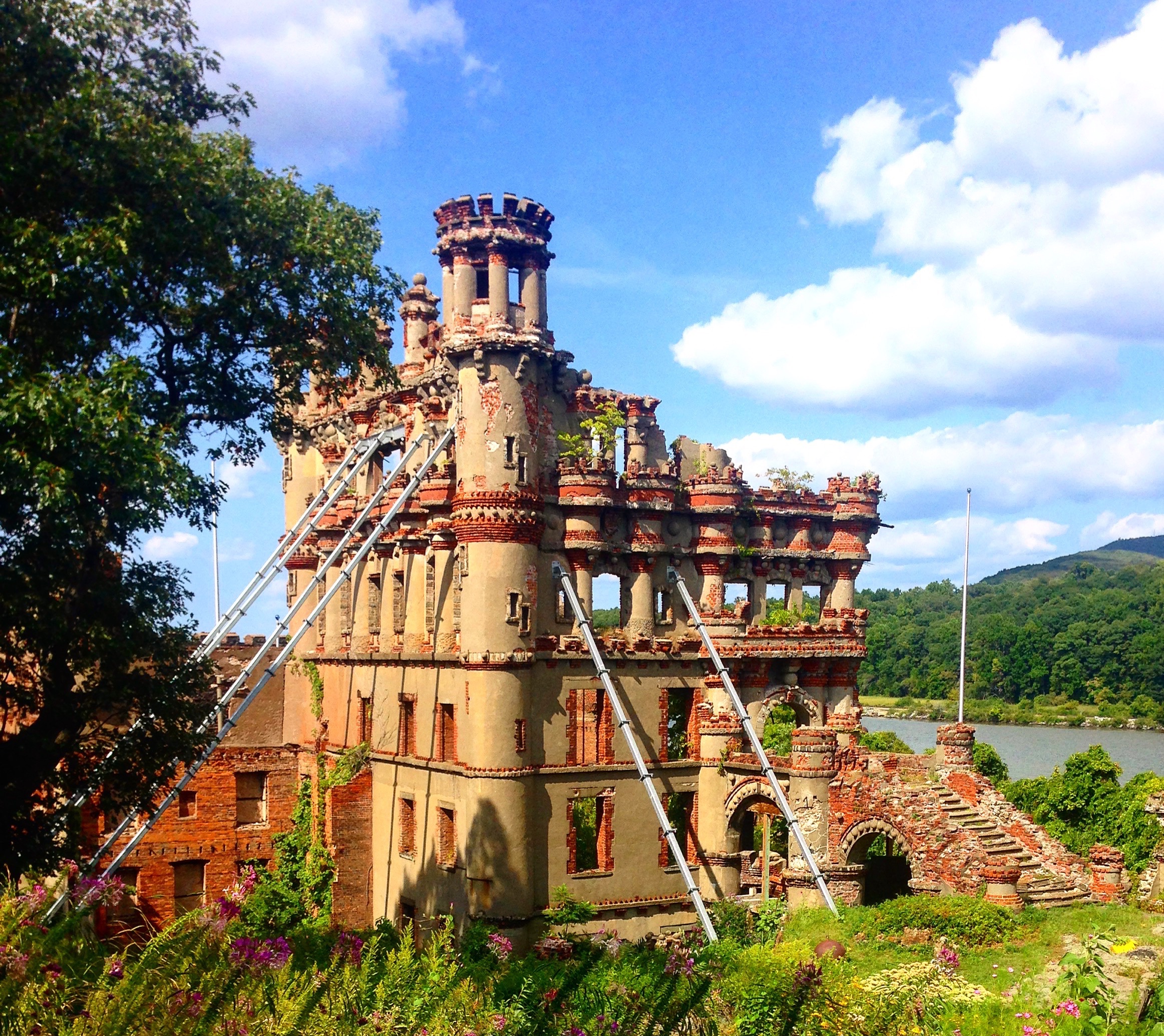
Or perhaps I should say a former castle, since it is distinctly a ruin now. Only the outer walls remain, its insides gutted and empty. Ivy climbs up the surface and the green shade of trees can be seen through the empty window frames. Even so, it is an impressive sight, with its battlements and crenellated walls standing proudly over the Hudson, like something out of a fairy tale.

But it is clear, upon reflection, that this structure could never have been an actual castle, despite appearances to the contrary. Putting all tactical considerations aside—castles were obsolete during almost all of our history—its brick walls are thin and high, totally unsuited to defensive architecture. (To see what I mean, visit Castle Clinton in Battery Park, which has thick, squat walls, durable and difficult to hit with canon fire.)

Like many passengers on the train, I idly wondered “What is that?” as we passed, my mind drifting off to remote possibilities. When I asked my mom later, she told me that it was built by a rich American with a European wife, who wanted to make her feel at home in the New World—or at least, that’s the story she heard. I was satisfied with this rumored explanation for a time. But upon my return from Spain, I decided to dig a little deeper into the castle’s history. And, as so often happens, the truth is far more interesting than the myths.

Unless you have a boat and don’t mind being penalized for trespassing, the way to visit the castle is on a tour with the Bannerman Castle Trust. These tours depart from either Newburgh or Beacon, two historic towns that are themselves worth visiting. You can choose to go by ferry or kayak. (In a recent homicide case, which made national headlines, a woman was convicted for criminally negligent homicide when she left her fiancé to die in the Hudson after his kayak capsized near Bannerman Island. I took the ferry.)

Our tour left at two in the afternoon. About forty people lined up at the water, and then crossed a wobbly dock to board the ferry. As I said, the tours are given by Bannerman Castle Trust, the same organization that is responsible for the castle’s preservation. They are a genial and jovial bunch who obviously enjoy what they do.

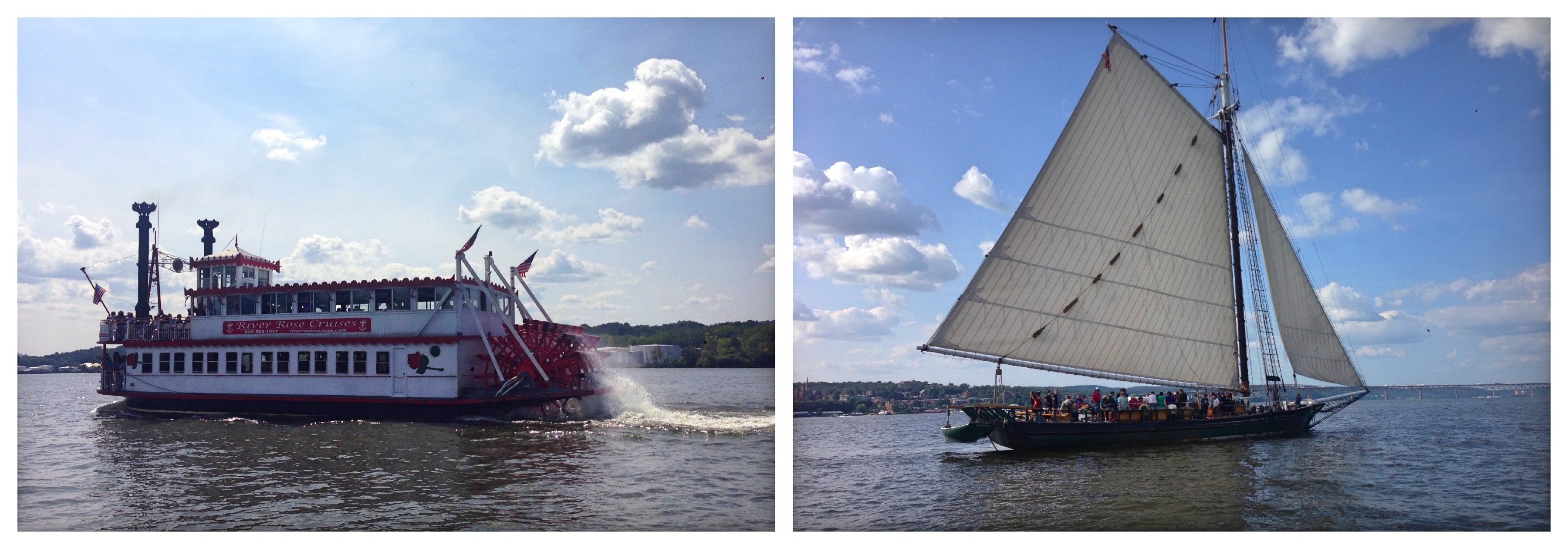
The boat began its short journey to the island. To our left we could see the Newburgh-Beacon bridge, a surprisingly pretty cantilevered steel construction. It was a sunny day and the river was full of boats. Jet skis and cigarette boats zoomed past, making a terrible racket, and kayakers waded in the shallows. Along the way, we passed two antique vessels, a Mississippi paddle wheeler and a sail sloop, and all the passengers waved to each other—people are generally friendlier at sea, I suppose. (The sloop was the Clearwater, the boat built as part of Pete Seeger’s campaign to clean the Hudson.)

Clearwater River Rose
The River Rose and the Clearwater

The castle seemed to rise out of the sea as we neared. By its juxtaposition, the Hudson Valley was transformed into an alpine lake or a Scottish loch in my eyes. We docked and shuffled out, and the tour guides split us into two groups. Thus commenced an excellent two-hour tour, which explained a history that was far more interesting than I dared hope.

Bannerman Water

Though commonly known as Bannerman Island, its true name is Pollepel Island. ‘Pollepel’ is one of those place-names that baffle explanation. Our guide told us that his preferred hypothesis was that the island was named after the Dutch word for a wooden spoon, which was also the name for the contraption that deposited misbehaving sailors on the island as punishment. There is also a legend about a girl named Polly Pell, who was stranded on the island and rescued by a brave lad, who she then married—a story which, like all tales of romance, our guide assured us is baseless and false.

In any case, the really interesting history of the island begins in 1900, when it was purchased by Francis Bannerman VI (1851 – 1918).

Bannerman has one of those appealing, Andrew Carnegie, rags-to-riches stories from the nineteenth century. Like Carnegie, Bannerman came to the United States from Scotland, a poor boy in a poor family. After a series of odd jobs, his father ended up in the scrap industry. Then, when the Civil War broke out, Bannerman’s father went to fight for the Union side, forcing the younger Bannerman to quit school and work for the family business. At night, he made extra money by traveling around the New York harbor in a little rowboat, using a hook to dredge up chains and rope that ships had sloughed off into the water, in order to sell them for scrap.

Later, the younger Bannerman started his own scrap company. He found a profitable—and at the time entirely novel—avenue for business in selling old military equipment. You see, after a war is concluded, all sorts of goods—rifles, swords, bayonets, canons, black powder, uniforms, and even canned foods—can be purchased very cheaply. Then, when another war breaks out, it can be sold at lower prices than new equipment, while still making a nice profit. Bannerman didn’t only sell to bellicose governments, however, but became a leading supplier to collectors, bands, vaudeville acts, rodeos, movie producers, circuses, and theater groups. Bannerman’s illustrated catalogue are still regarded as the gold standard by collectors of antique war equipment.

After doing business in several different locations in Brooklyn, Bannerman opened his main shop in Manhattan, at 501 Broadway. But the city government very sensibly decided that it was unsafe to have so much military equipment, including several tons of explosives, in the middle of a major city; so they made him move it out. This is why Bannerman purchased Pollepel island for his armory—it is isolated and therefore safe. The location had another advantage. Since the island is in full view of the train, and since the Hudson, at that time, was crawling with merchant ships, Pollepel was an excellent place to advertise his business from. Hundreds of potential customers would be passing by each day. This is also why Bannerman invested in such ornate architecture. A castle is certainly more eye-catching than a billboard.

Bannerman died in 1918, of “overwork,” as the New York Times obituary said, using one of those euphemisms of the previous era. At the time, he was donating large amounts of equipment to the Allies fighting the First World War. His business model became seriously compromised a few years earlier, when a change in the laws imposed stricter regulations on the trading of explosives—which is good news for the rest of us.

If Bannerman had lived two years more, he would have seen the wisdom of the New York City government in banishing him to the island. For in 1920, one of the powder houses blew up. It was a massive explosion, reportedly breaking windows for miles in all directions—or so said our guide—and blowing a chunk of the wall hundreds of feet across the Hudson onto the train tracks, blocking the train for hours. Bannerman’s wife, Helen, narrowly avoided death (the hammock she had been laying on was hit by flying debris, but she had just gone inside), and her eardrums were ruptured by the shockwave.

Under the direction of Bannerman’s sons, the business carried on for a time, until eventually, in 1967, the island was purchased by the State of New York for parkland. Despite the family’s attempts to sell off their massive store of supplies, there was still much left, some of which was taken by the Smithsonian Museum. The island was opened to the public the next year. But then the next phase of damage to the island occurred. In 1969, the buildings caught fire in a colossal blaze, perhaps an act of arson, destroying everything except the outer brick and concrete walls. After that the island was off limits to the public, for the sensible reason that the remaining structures were unstable and could collapse.

Many years later, in 1993, the Bannerman Castle Trust was founded, which worked with the State of New York to preserve and promote the castle. They have made great strides. Kayak tours, hard-hat tours, and finally, in 2003, walking tours were introduced. The dock where the ferry lands and the stairway that leads up to the island were built under their direction, as was a bridge connecting the two highest peaks of the island (which cadets in West Point helped to construct). They also organize volunteer teams of gardeners, who have created some really splendid gardens on the island. And this is not to mention the historical work.

Thankfully, nobody was hurt when, in 2009, a big section of the outer walls collapsed. To prevent further damage, the walls are held up by long metal braces. Still, it’s worth asking how much longer the structure will last without substantial repairs.

Bannerman Castle Braces

Despite the explosion, the fire, and the collapse—and partially because of them—the castle is magnificent. For me it was a dreamlike experience to be standing near it, since I have been fantasizing about visiting this island since I first laid eyes on the ruin. The façade of the building has many charming architectural ornaments, such as the semispherical balls that run along the top. A resourceful man, Bannerman used vintage bayonets to reinforce the concrete.

The castle isn’t the only structure on the island. On the second highest point—Bannerman was afraid of lightning strikes, so he didn’t build on the highest—is the house in which he and his family stayed. This building was only very recently rehabilitated; only a few years ago, it was covered in ivy. The house is built in the same vein as the castle, a fanciful exterior concealing a homey interior. Now it is a sort of mini-museum, full of old images and informational panels.

Bannerman House

In the water surrounding the island, there are still further remnants of Bannerman’s business. During the island’s heyday, Bannerman constructed an artificial harbor, or breakwater, around the island. Now only a few stone towers remain, peaking out of the water. Doubtless more are submerged just under the waves, a hazard for passing boats.

Water Tower
One of the old towers for the breakwater

The Bannermans only stayed on the island during summers. But a superintendent, Leonard Owen, stayed all year long; and his daughter, Eleanor, grew up on the island, commuting to school by sled during winter. Two of the historians of the island, Barbara and Wesley Gottlock, recently turned her memoirs into a children’s book. (These two authors also collaborated on the Images of America book on the island, which I relied on for this post.) Bannerman’s daughter, Jane, is still alive and active in the Trust.


Well that’s the story, or at least the quick version. When I began learning about these ruins, I had no idea that they would contain so much history. Perhaps I should stop being so surprised that the world, once examined, is a tremendously interesting place. Ruins are not just food for the imagination. Every ruin, even the humblest, is the product of human hands, and bears the traces of humans dreams and disappointments.

Two Hudson Ruins—Part 1, Yonkers Power Plant

Two Hudson Ruins—Part 1, Yonkers Power Plant

(I have broken up my original post into two separate posts, for ease of navigation. You can find part two here.)


Introduction

The train ride on the Hudson Line, from Manhattan to Poughkeepsie, must be one of the most scenic in the United States. The ride has both natural and artificial beauties along the way. The Hudson Valley itself is magnificent, with the palisades across the shimmering waters; and this is doubly true in autumn, when the trees turn their fiery hues. Occasionally you pass a sail boat or a freight barge in the river, or a team of rowers diligently practicing in the Bronx. The train also takes you under the High Bridge, the new Tappan Zee Bridge, and the Bear Mountain Bridge, three engineering feats. A careful rider can even catch a glimpse of Sunnyside, Washington Irving’s old home. (Irving was very annoyed when they built the railroad right next to his house.)

Palisades
Hudson Palisades

Among all this, the most striking landmarks along the way are, for me, the ruins. Specifically, two ruins: the Yonkers Power Plant and Bannerman Castle.

Ruins have a power to fascinate that is difficult to account for logically. They are the same structures that exist, in unruined form, all over the place. The difference between a ruin and a proper structure, architecturally speaking, is pure defect: the ruins have lost their integrity and utility. And yet ruins have been captivating the artistic imagination since at least the Romantic era. Their battered and broken forms have provided inspiration for Shelley’s poems, Byron’s travel sketches, and Caspar David Friedrich’s paintings. It was the ruins of Rome that shaped the Renaissance in Italy, and those same ruins that inspired Edward Gibbon to memorialize Rome’s decline and fall.

What is it about ruins that is so compelling? There are many answers. One is that ruins allow us to visualize time. We see how time’s tooth rusts metal, cracks foundations, and crumbles stone. We see what rots away and what petrifies in place. Ruins also allow us catch a glimpse of a world without humans, the world we would leave behind if we all mysteriously disappeared. We can see the natural world slowly reclaiming buildings and walls, as plants and animals invade the empty space. Perhaps we feel what Shelley felt when contemplating the fate of Ozymandias: that humanity’s urge for immortality is futile and vain, since everything eventually decays.

For all of these reasons, and still others, ruins have an undeniable power—as attested by the many photographers, amateur and professional, who go out of their way to document them. This is my little contribution.


The Yonkers Power Plant

Power Station Top

The Hudson Valley has been many things since its water began to carve a channel through the earth: wilderness, scenic escape, suburbia.

One hundred years ago, the valley was an artery of industrialization, dotted with factories and warehouses, noisy with barges and freight trains. The Hudson Valley was also one of the great centers of brick production, its soil baked and sold far and wide, which is why so many of its old buildings are brick. But we are long past the industrial age, and these buildings no longer house factories or store goods. Nowadays they house fine restaurants, cafés, or even libraries, such as the Irvington Public Library, which is in the old Lord and Burnham factory building.

The most impressive of these old factory buildings is still in use: the Domino Sugar Refinery, in Yonkers. Originally built in 1893, this refinery still produces three million pounds of sugar per day. It is one of Domino’s three major refineries, the last major sugar refinery in the Northeast, and a major source of employment within Yonkers. With an old, hulking brick building standing aside newer metal conveyer belts, this refinery is the sister of the more famous one in Williamsburg, Brooklyn, which closed in 2004 and was mostly demolished in 2014, except for some buildings given landmark status.

But the grandest ruin of the industrial age sits a few miles north. This is the Yonkers Power Plant, which stands on the river side of the local Glenwood train station. With its smokestacks scolding the sky hundreds of feet in the air, the plant is hard to miss. I often saw it on my commute to the city and wondered, what is it doing here? Why was there such a massive building rotting, empty and neglected, by the side of the tracks?

The answer comes down to power. When the trains began running in the 1840s—connecting faraway places and disturbing Washington Irving’s peace—they were running on steam. By the early 1900s, the railroad was prepared to switch to electricity, using the newly designed third rail. The problem was that, at the time, the municipal electrical grid was not powerful or dependable enough to supply the power. Thus the New York Central & Hudson River Railroad, which owned the Hudson Line back then, built their own power plants. The Yonkers Power Plant was situated along the river for several reasons: to be close to the tracks, to take advantage of the water to cool the machinery, and to make it easy to supply the plant with coal, which was delivered by ship.

The power plant was built by the architectural firm, Reed and Stem, who also collaborated on Grand Central Station. (Charles A. Reed was related by marriage to the president of the New York Central railroad, which doubtless helped him get commissions.) The plant opened in 1907, and ran on coal, which was brought by barge to the boiler room below. The steam generated by the boiler was used to power several massive turbines on the floor above. This power, generated in alternating current, was changed into direct current for the trains by rotary converters. (These rotary converters, by the way, are the only heavy machinery still in the factory; the rest was sold for scrap metal.)

Brendan Jenkins
Photo of the interior, by Brendan Jenkins, taken from Wikipedia Commons

By the 1930, it no longer made financial sense for the railroads to be in the power business, so in 1936 the plant was sold to Edison Light and Electric (a subsidiary of Con Edison) and converted to run on oil. This was not a long term solution either, since the plant’s relatively small size (relative to more modern power plants, that is) made it inadequate to New York’s massive power needs. So in 1963, the plant was closed. It was eventually sold to a private owner, who mostly let nature and teenagers have their way. The plant acquired the name “Gates of Hell,” for supposedly being the place where gangs held ritual inductions. Over the years, it became overgrown and covered in graffiti (some of it quite good). Meanwhile, proposals to transform the plant into apartments did not pan out.

(By the way, I am mainly relying on the excellent website, Hudson Valley Ruins, for this information. Their page on the power plant also has many great pictures.)

Most recently, the power plant was purchased by an entrepreneur named Lela Goren, who announced a plan to convert the plant into an arts exhibition center. The building will be renovated in two phases, which will cost $150 million all together, and finished sometime in the next decade. Work began in 2013. The grounds have already been substantially cleared of rubbish and debris, and the walls are being stabilized. I am pleased to learn, from this NY Times article, that Goren plans on keeping much of the industrial aesthetic, even the graffiti.

On a sunny summer afternoon I visited the plant for myself. I stepped off the train at Glenwood Station and craned my neck upward at the redbrick wreck. Despite the work the Goren Group had already done, the place is still visibly a ruin. All the windows are smashed; ivy climbs up iron beams; and an eerie silence pervades the building.

Glenwood is a local station, and few people use it. Aside from the old plant, Glenwood’s main attraction is the Hudson River Museum, which focuses on the river’s ecology. That day, I was the only person standing on the platform. A fence surrounds the old plant, covered in “Do Not Enter” and “No Trespassing” signs, assuring the prospective intruder that video cameras are surveilling the property. Even so, standing there alone on the platform, with nobody else in sight, it was difficult to resist climbing into the ruin. I would not even have had to climb the fence, since a stepladder was helpfully leaned up against it. The ruin still has its visitors.

Ladder
Ladder still used by trespassers

But I’m no daredevil, so I contented myself with patrolling its perimeter. Yet through the gaping windows I could glimpse the cavernous interior space, which many have compared to a cathedral nave. Indeed, compared with a gothic cathedral, the power plant is an exceedingly light, airy structure, with thin walls and plentiful windows. The towering brick façade, combined with the thin steel girders of the building’s innards, make it seem as if an elephant body is being suspended from chicken bones.

Power Station Window

The plant consists of two buildings, the main plant and a substation next door. The substation is where the rotary converters transformed the current from alternating to direct, so the trains could use it; from there the current was sent to the rail tracks. An attractive metal footbridge connects the two buildings. Outside, a metal tower still stands, rusted and overgrown, which I believe used to hold the wires. On the southern side of the station there’s a little park. From here you can see how the station juts out into the Hudson. This must have been to enable the use of the Hudson’s water in the boilers; and, indeed, the boiler room still floods during high tide, I believe.

Skybridge Substation
The plant and substation, with skybridge

I can see why Lela Goren saw potential in the plant, since its location is as attractive as the building itself. Across the river you have an excellent view of the Hudson Palisades. Looking northwards, you can see the Hudson Valley all the way up to the Tappan Zee. Looking south, Manhattan comes into view, a silhouette behind the George Washington Bridge.

Power Station Hudson_Fotor

From this vantage point, with the city in the distance, the river ferrying boats along its glimmering waves, it is difficult to believe that this wonderful brick building was made to simply to supply electricity to trains. It was truly a different time. At its peak, the Yonkers Power Plant could generation 30,000 kilowatts, or 30 megawatts. To put this in perspective, the Indian Point Nuclear Plant in Croton, the Robert Moses Power Dam in Niagara Falls, and the Ravenswood Generating Station in Queens can all generate over 2,000 megawatts. We have come a long way. But unfortunately for us, not one of those is even one-tenth as beautiful as the Yonkers Power Station.

(Click here for Part 2.)

Processing…
Success! You're on the list.