Reading this book is an ordeal. It is very long and very depressing. Charting the Third Reich from the birth of Hitler to the collapse of Germany, Shirer tells the whole story with the sweep of a novelist and the detail of an accountant. He wrote the book after having access to huge stores of documents captured by the Allies after the war. Diaries, schedules, testimonies from the Nuremberg trials, the minutes of meetings, and much more were the raw material marshalled to create this tome.
As is often noted, Shirer was a journalist, not a historian, a fact that helps to explain much about this book. He lived in Berlin as a foreign correspondent from 1933 to the end of 1940, reporting on the rise of Hitler and the beginnings of the war, until the threat of the Gestapo forced him to return home. This firsthand experience lent color to his narrative, but also focused his attention on readily observable events. Rather than talk of larger trends—social shifts, economic pressures, cultural developments—Shirer focuses almost exclusively on the doings of individuals in power, such as he had been reporting on.
This focus makes the narrative vivid and pleasingly concrete, but also results in a superficial analysis. A historian would naturally spend more time on the rampant inflation of the times, the institutional weakness of the Weimar Republic, the wider political trends in Europe, the mechanics of a totalitarian state, and so on. Further, Shirer’s explanation of why Germany embarked on such a destructive enterprise boils down to: because it is peopled by Germans. That is, he locates a kind of cultural essence in the German people, an essence stemming from the Reformation and especially Martin Luther, added to by Hegel and then by Nietzsche, which came to full fruition in National Socialism. But this sort of cultural essentialism is, for me, just intellectual laziness. It can be used to explain anything or everything, since these posited cultural qualities are vague and unobservable.
In any case wider historical analysis plays a very small part in this book, which is mainly a record of the decisions and actions of the leading men of the Nazi regime. That is to say that this book is a political and not a military history. The Second World War is discussed, of course, but only insofar as its developments affected or were caused by the Nazi leaders. Shirer is mainly concerned with charting the rise to power of these ruthless men: how they outsmarted the Weimar Republic leaders, fooled the international community, bullied and threatened their way to conquests, and finally instigated a war that resulted in their own ruin.
The balance of the book is tilted heavily towards the rise of the Third Reich. This can make for some dreary reading. In retrospect it is stupefying to witness how blind, inept, and spineless were Hitler’s opponents, first within Germany and then beyond its borders, until the final crisis spurred the world into action against him. Though Shirer’s sturdy prose is normally quite plain and unadorned, he has a steady instinct for the dramatic and writes several unforgettable scenes. Nevertheless the scale of detail Shirer saw fit to include sometimes weighs down the narrative into benumbing dullness. The endless, petty diplomatic maneuvers that preceded the beginning of the War—negotiations, ambassadors, threats, ultimatums, calculations, second thoughts, and so on—made it a relief when the soldiers finally started shooting.
These political dealings of the Nazis constitute the vast bulk of this book. It is a masterclass in how far a little cunning, shameless lying, and absolute ruthlessness can get you. It is also a lesson in the need to cooperate to take decisive action against common threats. In the years since Vietnam, many have concluded that the main lesson to be drawn from America’s foreign policy is the folly of interventionist wars. After the First World War, the Western powers were understantly ever more chary of violence. And yet, at least in Shirer’s telling of the history, a timely show of force could have nipped Hitler’s rise in the bud. If England and France had upheld their treaties and defended their territories and their allies, Hitler could not have amassed so much power at a time when the German military was still small. (Though it must be said that Shirer’s intellectual weakness appears here, too, since he attributes this inaction to pure cowardice.)
In any case, this does bring out an interesting dilemma in foreign policy concerning the benefits and risks of violent intervention. In the case of Hitler, timely action could have prevented a disastrous conflict. And yet in many other historical cases, such as with Saddam Hussein, the threat of non-intervention was vastly overestimated, while the cost of intervention vastly underestimated. The word “estimate” is key here, since these decisions must necessarily be based on guesses of future threats and costs—guesses which may easily be wrong. Since it is impossible to know with certainty the scale of a threat that a situation may pose if left unchecked, there is no surefire way out of this dilemma. This, of course, is just a part of a wider dilemma in life, since so many of our everyday decisions must necessarily be made based on guesses of what the future holds.
You can see that this book, though a popular account, is not lightweight in its details or its implications. Yet it does show its age. Published in 1960, it was written before many valuable sources of information became available, such as the French archives. It also shows its age in its occasional references to homosexuality, which Shirer treats as a perverted vice. This is, of course, morbidly ironic, considering the Nazi persecution of homosexuals (something that Shirer fails to mention). But all in all The Rise and Fall of the Third Reich remains a gripping popular overview of this nightmarish time.
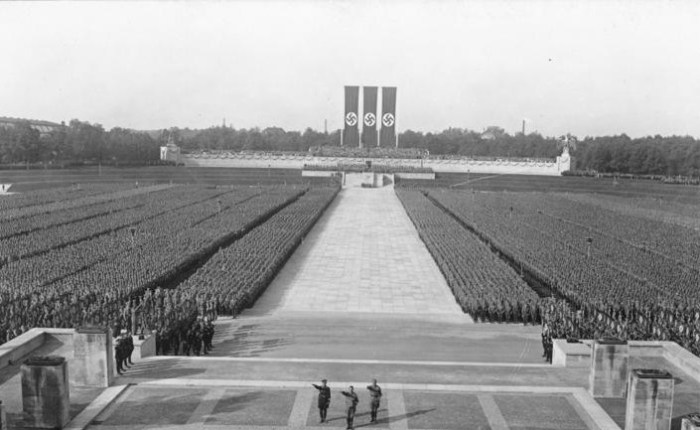
(Cover attributed to Bundesarchiv, Bild 102-16196; licensed under CC BY-SA 3.0; taken from Wikimedia Commons.)
The most famous monastery in the community of Madrid is, undoubtedly and deservedly, El Escorial—the grandest monastery in the country. Nevertheless, that building’s primary function was never to be a home for monks, but a seat of power. To see a proper monastery without leaving the bounds of Madrid, one can go to Las Descalzas or La Encarnación, two historic and lovely monasteries in the center.
More impressive than either of these, however, is El Paular, which is located near a small village, Rascafría, in the Madrid mountains. Getting there on public transportation is not easy, especially on the weekend. Bus 194 leaves the Plaza de Castilla every Sunday at 8 am. The trip lasts well over two hours, mostly because the indirect route travels over local roads, making frequent stops. And since the only viable return bus leaves Rascafría at 6:30 pm, going there is an all-day commitment. (Admittedly there is a return bus at 3:00 pm, but if you visit the monastery and take the tour you won’t make it.)
Let me pause here for a linguistic lesson. When we wish to make a compound word out of a noun and a verb in English, we normally put the noun first and add “-er” to the verb. Thus we get “skyscraper.” Spanish follows the opposite procedure, with the verb first and the noun second, which is plural. The word for “skyscraper” in Spanish is rascacielos (lit. “scrape skies”). Learning this principle was invaluable to me, since it makes trips to hardware stores infinitely easier. Can-opener is abrelatas and pencil-sharpener is sacapuntas. At first glance the toponym Rascafría follows this principle, rasca being from “scrape” (although “fría” as a noun isn’t known to me). This appearance is entirely illusory, it seems, since the name derives from rocas frías, or cold rocks.
The bus deposited me in this cold and rocky place at around 10:30 in the morning, on a chilly November day. The walk to the monastery took about twenty minutes. I arrived in time to be there when the gates opened at 11:00. Before going inside, I retreated a little from the entrance so as to see the monastery amid its surroundings. The best place to see El Paular is from the Puente del Perdón, a picturesque stone bridge (built in the 1700s) that runs over the river Lozoya. From here you can see the monastery’s tall spire presiding over a square building, adjoining a series of domes and semi-domes on the right. With the looming mountains serving as a backdrop, the monastery is quite a quaint sight.
El Paular was founded around the year 1390 as a Carthusian monastery, a purpose which it served until, in 1835, like so many monasteries in Spain, it was confiscated by the state. Bereft of purpose, the monastery suffered the effects of time and neglect. In the twentieth century there was an ineffectual attempt to incorporate it into the national park of the Guadarrama Mountains. Later on, the monastery was converted into a sort of artist residence for landscape painters—a task for which, due to its surroundings, the monastery was admirably well-suited. Finally, in 1954, the monastery became, once again, a monastery, this time for the Benedictine order; and it remains so to this day.
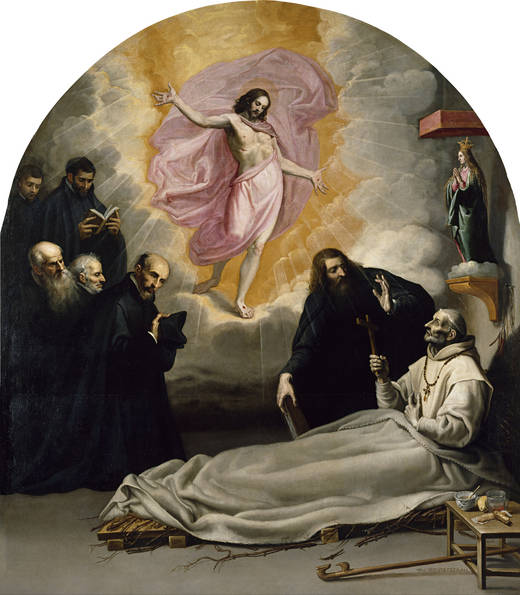
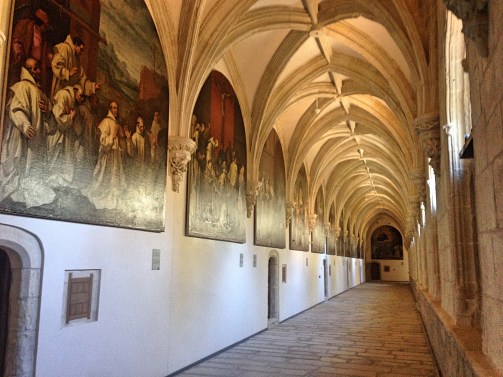
I paid the entrance and went inside. They were having mass in the church when I entered, so I proceeded directly to the cloister. Here I discovered an unexpected delight. Lining the walls of the cloister is a series of 52 oil paintings by Vicente Carducho, a contemporary of Diego Velazquez. These paintings tell the story of the Carthusian Order from its founding to the present day. Thus the series begins with the Carthusian founder, St. Bruno, and ends with the closure of the monasteries during the English Reformation. Individually, these paintings are masterful works of Golden Age realism, telling stories of miracles, martyrs, and myths with a dynamic flair worthy of Carducho’s friend, Lope de Vega. (Indeed, the two of them can be seen in one of the paintings.) But together they have a cumulative effect that goes far beyond their technical merits.
Lope de Vega is the grey, bearded man on the left; Carducho himself is immediately to the right of the writer.
And we must count ourselves extremely fortunate to be able to see the series all together, since after the monastery’s 1835 confiscation the paintings were acquired by the Prado, and for many years were loaned out to various museums around the country. During this time two of the paintings were lost (there were originally 54) in the confusion of the Spanish Civil War. It was only in 2006 that they were restored and finally reunited in their original home.
Once I finished appreciating the paintings—which took the better part of an hour—I wandered over the entrance of the church for the scheduled tour. Mass soon finished; and about a dozen people, mostly elderly, shuffled out of the elaborately decorated church door. A short, rotund man wearing a monk’s habit—a plain dark robe in this case—appeared and shepherded us inside. The church itself is a plain, clean, white space, mostly devoid of elaborate decoration. The exception to this is the magnificent main altar, which contains 17 Biblical scenes in finely detailed alabaster.
In a jovial and bouncing voice, the monk explained all about the monastery and its history. Then we moved further into the monastery, passing through the vestry and the chapter house, while the monk rapidly rattled off the dates, styles, and provenance of the art work to be seen. Finally we reached the Capilla del Sagrario, or the Chapel of the Sanctuary.
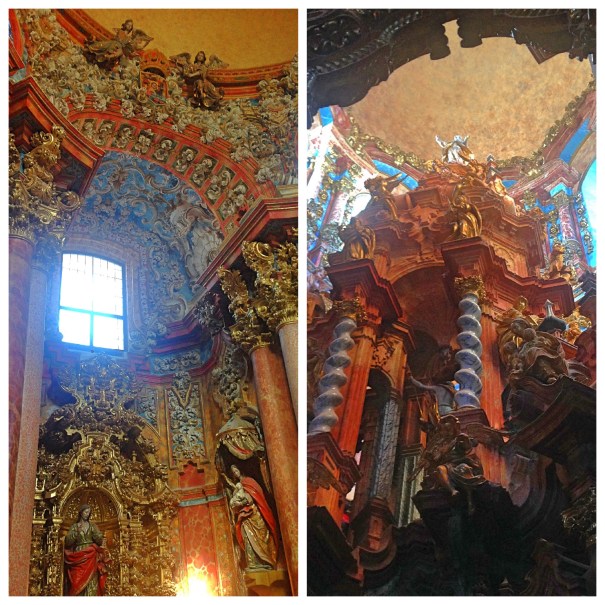
This chapel is undoubtedly one of the greatest works of Baroque art to be found in Spain. The colors are regal and soothing: silver, pink, and sky blue. Every surface is covered with extremely intimate ornament, in a style the monk called “Churrigueresque,” a Baroque manner of decoration native to Spain. Floral designs squirmed up the walls; silver curled and bloomed; columns twisted and angels burst from walls. The chapel comprises several separate nooks, each one dedicated to a different saint. In the central chamber a hexagonal tabernacle rises up several meters off the ground, constructed of colored marble taken from all over Spain. It is an extraordinary work. Even the floor is impressive, made from interlocking triplets of diamonds that, together, form the image of a cube.
The monk then led us to the refectory, where the monks eat their meals in silence, while somebody reads scripture aloud. Finally we reached the church and concluded the tour.
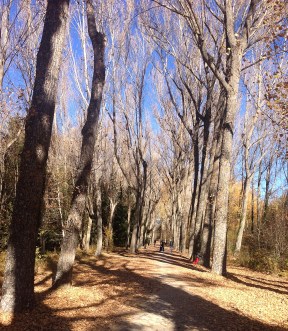
I now had about three hours to kill before my bus left back to Madrid. Thankfully, aside from the monastery, Rascafría is itself a lovely place. Madrid’s northern mountains provide some of the best hiking in the country. Rascafría is no exception to this. Even on this chilly winter day the place was full of men, women, and children in windbreakers carrying pointed walking sticks. I joined them, crossing the Puende del Perdón and turning to walk alongside the river Lozoya. Unknowingly I had entered the Bosque finlandes, or the Finnish Forest, an attractive natural park formed by importing trees and vegetation from that Scandinavian country. Though at the time I did not know this, I did notice that the trees were strikingly tall and straight.
I walked on, passing by ruined farms, masticating cows, and once again over the shallow river. Eventually I came upon a sign about the local trails. There was a short caption about an old legend pertinent to the area, which told of a beautiful Moorish girl who fell in love with a young man, and every day washed her face in the river while waiting his return (from where, it didn’t say). It is said that she waits still in a cave somewhere. Well, I certainly did not find any beautiful enchanted lasses, Moorish or otherwise, on my walk; but I did take some nice pictures of the scenery. Eventually I wandered onto the route of the Cascada del Purgatorio (everything seems to have a religious name in Spain), named after a nearby waterfall that the hiker can visit.
As the hour of my departure neared, I went back to the town to eat something. Though small, Rascafría is itself a charming sight, with the Artiñuelo Stream passing its center. There are also many attractive restaurants, though they are strangely expensive, due to the many visitors of the trails and the monastery, I suppose. I ate a delicious chocolate cake with raspberry dressing and then got on the bus, to doze during the long ride back to Madrid.
This book has the very modest distinction of being the only book I’ve read whose author I have interviewed. Carlos Lázaro is a history teacher at the school in which I work; and when he is not scolding students or grading reports, he is researching Spanish military aviation history. This is one of the numerous books he has published on this topic.
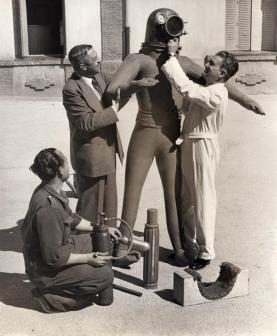
La aventura aeonáutica is a dual biography of two of the most important innovators in Spanish aviation history: Emilio Herrera and Juan de la Cierva. Herrera was of the same generation as the Wright Brothers. His specialty was lighter-than-air crafts—dirigibles, zeppelins, and so on—to which he made great practical and theoretical contributions. Among his many accomplishments was his participation in the first intercontinental flight of the Graf Zeppelin, which earned him a ticker-tape parade in New York City. He also designed what is considered the first spacesuit, for a planned but never realized ascension to the stratosphere. Later in life he was also important for his loyalty to the Spanish Republic in exile, even becoming its (mostly ceremonial) president.
Juan de la Cierva is mainly remembered for his invention of the autogiro, or autogyro. This was a sort of early-generation helicopter, designed to fly at speeds impossibly slow for fixed-wing aircraft. The principle of the autogyro is, however, quite different from that of a helicopter. Most notably, the rotor on top is completely unpowered. Forward thrust is provided by a small frontal propeller. This motion pushes air up into the rotor, causing it to spin—though notably, unlike in a helicopter, the air flows through the rotor upwards, not downwards. The rotor’s blades are angled so that the rotation provides lift. You may think of an autogyro as a plane whose wings rotate rather than stay fixed. For this reason autogyros cannot take off and land vertically, nor can they hover, unless there is a countervailing breeze. In any case, I hope you can see from this description that this was an ingenious and original contribution to aeronautic technology.
Like Herrera, De la Cierva was politically active; unlike Herrera, De la Cierva was a committed member of the Right, and threw his support behind Franco. His life was cut short in a plane crash—ironically a passenger plane, not any experimental flight—while trying to organize international support for the coup.
I found the lives of these two men fascinating, since I had not even known their names beforehand, much less any of their accomplishments. The book is admirably informative and concise, full of attractive photos and nifty little side-panels. Hopefully I will visit the Museo del Aire in Madrid soon, to see some of these historical craft for myself.
I think Crab, my dog, be the sourest-natured dog that lives.
Two Gentlemen of Verona is usually grouped with A Comedy of Errors and The Taming of the Shrew as one of Shakespeare’s early comedies. I am inclined to see it as the earliest, if only because it is by far the least compelling. Whereas Shakespeare is rightly known for the depth of his psychological insight and the realism of his characters, the personages of this play are shallow and implausible creatures.
The two titular gentlemen are anything but. Proteus is a cad, a lout, and finally a monster, while his friend Valentine is a nincompoop. The women who capture their hearts are rather more compelling—especially Silvia, who sees right through Proteus—and yet their attraction to these unscrupulous airheads dims their stature as well. The final scene is the culmination of everything wrong with this play: after banishing his friend and lying through his teeth, Proteus tries to rape Silvia, and is then immediately forgiven by Valentine (note: not Silvia), in an ambiguous line that, at first glance, seems to mean that Valentine is gifting him his paramour Silvia. The scene could almost be funny if it were played as a farce, but the straight version I saw was sickening
The real heroes of this play are Proteus’s servant Launce and Launce’s dog Crab—a mutt who, despite having no lines, is better-realized than any of the protagonists. Now with Launce we have the real Shakespearean magic: a living, breathing, fully human character, immediately relatable and deeply compelling. His hilarious monologues are the jewels of this play, which does not deserve him. Other than this pair, the play is only interesting for prefiguring many of the themes Shakespeare would later explore with greater clarity and depth.
The most spectacular day trips from Madrid are also, fortunately, some of the easiest. Toledo, Segovia, and El Escorial can all be reached in under an hour from the center, and Ávila isn’t much further away. But once these more convenient options are exhausted there is still much to see.
Granted, with Spain’s high-speed trains even faraway cities like Seville and Barcelona can be visited in a day (though they deserve far more time). And with a car you will have no trouble getting around. But if, like me, you are looking to travel cheaply, on public transportation, then some destinations are difficult.
One of these difficult day trips is Consuegra. This is a little town, of about 10,000 inhabitants, in the region of Castilla La-Mancha, further south from Toledo. Getting there from Madrid takes time. The only option for public transportation is a bus. It departs from Madrid’s Estación del Sur, near the Mendez Álvaro metro station. The journey lasts 2.5 hours each way, which means a day trips involves 5 hours on the bus.
I had planned to get some good reading in but, as often happens, the lack of sleep (I left Madrid early) and the shifting and rocking of the bus soon lulled me into a deep doze. My kindle rested in my lap, while my head rested against the window. The drive was thus passed in the uneasy limbo between unconsciousness, vivid dreams, and semi-wakefulness. Eventually I stirred, groggy yet refreshed, in Consuegra before lunch time.
Allow me to pause here for a linguistic lesson. The word consuegra itself means the mother-in-law of your son or daughter. In other words, she is the mother of whoever your child marries. In English we have no word for this, of course. We just lazily affix “in-law” to our names for blood-relations. But in Spanish there is a distinct name for parent-in-law (suegro/a), daughter-in-law (nuera), son-in-law (yerno), and brother/sister-in-law (cuñado/a), in addition to the parent-in-law of your child (consuegro/a). Curiously, these terms are nowadays applied to the family of boyfriends and girlfriends who are not yet married. Indeed the term for boyfriend/girlfriend (novio/a) was originally adapted from the Spanish word for groom/bride. It seems that, when dating became widely practiced and accepted, lacking the vocabulary for non-marital relationships, the words for married couples were simply transferred to this new situation.
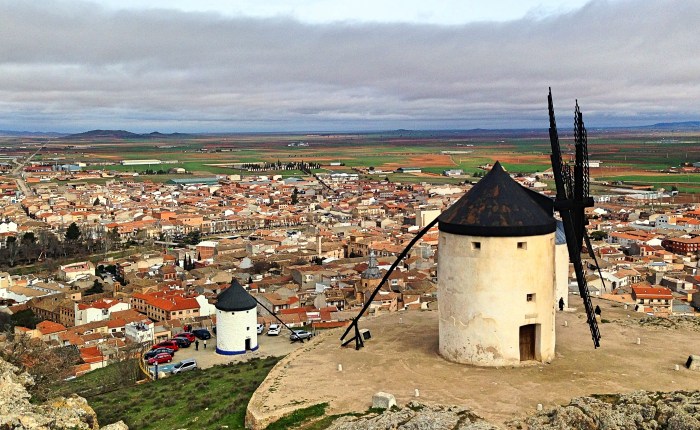
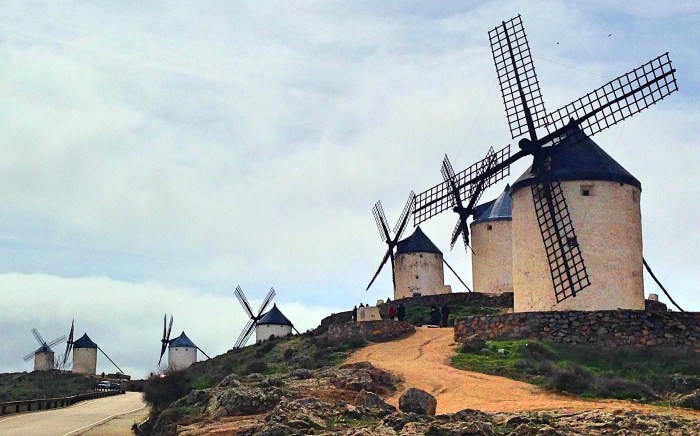
The town of Consuegra itself, though charming, is not especially remarkable. It is a destination because of the hill that rises above the center. On this modest eminence, the Cerro Calderico, the visitor will see why Consuegra is a site of pilgrimage for Quixote followers. For this hill in La Mancha is crowned with twelve windmills, perhaps the very same that the Knight of the Sad Countenance thought were an army of giants.
Though the wind still blows, the mills no longer grind grain. (Indeed, the wind in this area stills blows so hard that, the first of March, they sustained heavy damage from hurricane-force gales, nearly destroying many of them. Repairs are underway.) Many of the windmills house specialized stores for local products, like wines and cheese—and Castilla-La Mancha makes the best cheese in all of Spain. But they are worth visiting just for the tremendous view of these slumbering giants.
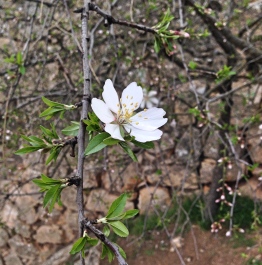
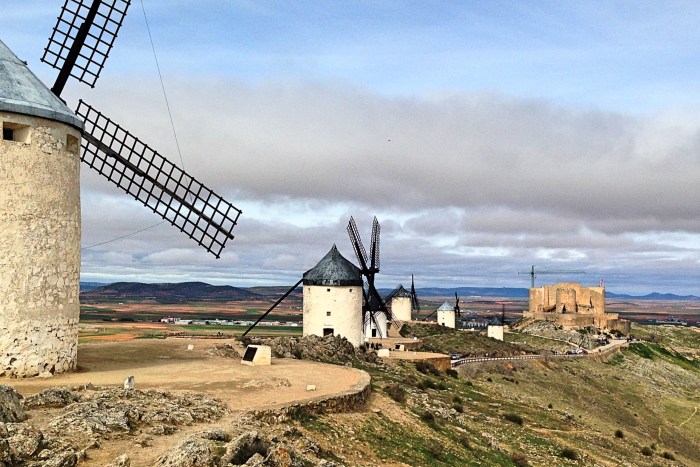
A craggy stone wall, a dilapidated pile now, still crosses over the hill. Weeds and wildflowers spring up from the dry soil. Though the hill is not especially tall, it provides a commanding view of the surrounding countryside. Castilla-La Mancha is one of the only non-mountainous parts of Spain. Instead of peaks, empty fields spread out before the visitor, spotted with roads and farmland. Consuegra and its environs have maintained their agricultural character, you see. Not nearly enough tourists pause here to have transformed the economy.
The Cerro Calderico does not only provide a platform for windmills, but is also the site of one of Castilla-La Mancha’s greatest castles: El Castillo de la Muela (which literally means the “castle of the molar”). The hill is a logical place for a fortress, with its steep sides and commanding view; and indeed it has been used for this purpose since Roman times. More recently, the castle was the squabbled over during the confusion of the Middle Ages, when Spain was populated by various small kingdoms, Christian and Muslim.
From the outside the castle presents itself as little more than a vertical heap of stones. To enter one had to pay a small fee. I considered it, even though in my experience the insides of castles are fairly uninteresting. But then I heard screaming, shouting, and riotous laughing coming from within. I assumed that a gaggle of drunkards were wandering around inside, and decided to skip the experience. I later learned, however, that the castle gives guided tours with historical reenactments, which doubtless was the source of the shouting I heard.
After taking my fill of the terrific view I descended back into town for lunch. For this I went into the first attractive bar I found, ordering some beer and tapas. Here I had one of those experiences that make me love this country. Unlike in the United States, whole families are welcomed into bars. A young couple with a newborn in a cradle were standing at the bar, eating and chatting. Next to them a group of senior citizens did the same, and at a table another married couple sat with their two children. Everybody was huddled close and talking loud. The bartenders joked with the customers, all of whom (except me) seemed to be regulars. There was an incredible feeling of effortless bustle, as drinks and food were served with speed but no stress, as Spaniards spoke in loud tones and made sweeping gesticulations, and easy laughter sounded all around.
More and more people packed into the bar, which only improved the atmosphere. Spaniards are far less shy than Americans when it comes to close physical contact; and unlike in American bars, there was no loud music to drown out conversation. The result is a lively but easygoing mood of all-embracing social life. Though alone, I instantly felt as if I were part of the community.
I left the bar in high spirits, intending to go straight for the bus station. But soon my attention was caught by a large tent that had been set up in one of the central squares. Investigation revealed that a wine festival was taking place. I paid three euros to enter, which came with three tickets, each of which I could trade for a glass of wine. Local vintners had set up stalls all around tent. In the center was a giant table, already littered with paper plates and plastic cups. The place was packed. I had to elbow my way to each glass of wine.
I quickly became curious about the strange cardboard boxes, filled with small holes, that so many people were carrying around. In the back of the tent I discovered the reason for this. In an open cage, dozens of little chicks were waddling. For a small price the customer could scoop up one of these chicks to take home. This was a big hit with the children, you may imagine. Yet I doubt that any of these chicks will be allowed to grow up and become useful, for eggs or meat. And using baby chickens as for the amusement of children does not strike me as kosher.
The wine drunk, I tipsily made my way back to the bus to return to Madrid. It had been a truly excellent day. And, best of all, I had 2.5 hours to sleep off the wine on the way home.
I have been working with Carlos Lázaro for two years now, as an assistant in his history lessons. His class is inevitably enjoyable. Students who, in other classes, are noisy and disruptive act respectfully and dutifully in Carlos’s classroom. Indeed, the students are so assiduous about taking notes that it can be hard to get them to stop.
The high school in which I work is “bilingual,” which means that some subjects, such as history, are taught in English. Carlos is the head of the school’s history department. Together we work with students in 2º ESO, which is equivalent to America’s eighth grade. The curriculum we follow is, in many ways, strikingly different from the sorts of stuff we learned in my high school in New York. Most notably (for me at least) are the lengthy units on art history—architecture, sculpture, painting. Our textbooks in the states mainly focused on social, economic, and political history.
In addition to his job as a teacher, Carlos is an accomplished academic and author, having written several books. I sat down with him one day to ask him about his work and life.
ROY: Have you ever done an interview before?
CARLOS: No.
R: Really?
C: No, no, not in English. Though I was interviewed on Spanish television, TVE1.
R: Tell me about your education. What subjects did you study?
C: I grew up in a working class neighborhood in the southwest of Madrid. A very violent neighborhood with a lot of drugs. Carabanchel Alto, it’s called. It had one of the biggest prisons in Spain. I went to a religious school for my whole primary and secondary education. But as early as middle school I was interested in history. When I was a kid I learned to read and write through history books that I got from my older schoolmates. Yes, I love history and this is the reason I was interested.
Originally, I was more interested in ancient history—Rome, Greece, Ancient Egypt. But when I got to university I changed my interest to Native American anthropology. In fact I got a PhD in this subject. My thesis was related to the tribes that refused or expelled the Spanish conquerors. I was specialized in the Chilean Mapuche. But my final book in anthropology was related with the treaties that the Spanish Crown signed with Native American tribes, covering about 200 signed agreements. I saw the original documents in the archives, both here in Spain and in the Americas.
R: How did you get interested in aviation history?
C: In the university I met former Republican fighter pilots, and it was an overwhelming experience for me. But I had been interested in aviation long before that. For 24 years I had lived near a military airfield, watching the planes take off and land. So when I met these pilots I got so excited about the histories of their lives. They had fought in the Spanish Civil War and they explained what they did afterwards. For example, some of them fled to the Soviet Union after the war. Some went to the United States or to Mexico, and also, in some cases, were in prison. It was, as I said, overwhelming for me, so from this moment onwards I began to do research about them.
R: Tell me about some of your books. What are they about? Why did you choose those topics?
The space suit designed by Emilio Herrerra
C: The book I’m working on now is a collection of memoirs of pilots—foreign and Spanish—who fought in the Civil War. But with one main goal. Our main problem in teaching history, not only aviation history but in general, is that we don’t have titles like “A Brief History of the Spanish Civil War” or “A Brief History of Aerial Warfare in the Spanish Civil War.” So I’m trying to provide people with these memoirs in order to be able to hook the public’s interest. This is the same thing I do with my teaching, to try to hook my students on history.
I have written 10 books. Three of them were about anthropology and the rest are about aviation history. My most beloved book is a biography of Emilio Herrera, a Spanish engineer who designed, in 1934, the first space suit in history, designed for a high altitude balloon flight. He was both a pilot and a scientist, and was in contact with Einstein and von Braun. I also wrote a book about a pilot, a Republican pilot. My personal goal, as I said, is to popularize aviation history and also to make it available in both Spanish and English, a bilingual version, for the many English and Americans who are interested in this history. As you know we are sitting near the battleground of the Battle of Jarama (a battle in the Spanish Civil War), and not every American knows that there were American pilots fighting in this battle.
R: What brought you to teaching?
C: Well, I like explaining and summarizing historical events—and I like history, of course—so, this is the reason that I got my PhD and also took the oposiciones (the required state exam that all public servants must take) in order to get my teaching position. My teaching definitely helps my writing, and vice versa. Every day I try to improve what I’m doing, reviewing my classes in order see what works and what doesn’t. Presenting information accessibly in my books helps me do the same in class; and my students’ reactions help me decide how to present information in my books.
R: What are some challenges of teaching history? How do you deal with them?
C: I think the most difficult challenge of teaching history is providing students with accessible information. Making it accessible. I think that history couldn’t be “unverbal,” and thus couldn’t be, in a sense, boring. You need to be patient, giving them tips, clearly organized topics. Summarize as much as possible: don’t try to fill their brains with data because they are going to erase everything when they leave the classroom. I’m trying to get my students to love something about their past.
R: What are some tips you have for history teachers?
C: Define your goals. Strive towards these goals. Provide your students with accessible information—and most of all, information that is useful in their daily lives. Old pupils have gotten in contact with me, and say they love history because it has been so useful for them—reading books, traveling, visiting museums, something like that. When I was teaching in a village in Toledo we made a trip to an old airfield that was nearby, and I explained how it was used during the war. It was an extraordinary experience for them. They had no idea it was there.
Besides giving lectures, it’s great to have the students do research and give presentations. Also different media are useful. For example today I showed them a short documentary about the Renaissance. Jokes, anecdotes, and open-ended questions are good for engaging their attention. Try not to be monotonous.
R: How do you get your students to work so well?
C: It’s a mixture of mastering them, being tough in some cases, and in other cases giving them self-confidence. Some students are not self-confident, and you need to show them that they have a lot of interesting things to work with. In the beginning of the year it’s important to go over classroom rules—sitting properly, raising your hand, taking notes. Establish very clear rules from the very beginning.
R: How is teaching history important for society in general?
C: Someone* once said, “People who forget their past are condemned to repeat it.” It’s a good way to learn about our mistakes, to think about what happened in the past, to try to avoid the same problems and avoid risks in the future.
R: Why do you think many people find history boring?
C: I think because, for them, history is repeating facts and not thinking. And of course in some cases you need to learn the names of battles and so on. But history is, fundamentally, a way of thinking, a way of organizing your brain, so that you can understand what happened in the past.
But for many students history is just a pile of dates, names, battles, events, nothing useful for their lives. I’m trying to provide them with another face of history. How could history help them? What does history teach us? Why did our ancestors face these problems? And what solutions did they find? What lessons do these have for the new problems we will face in the future?
To hook their interest it helps to explain something to do with their behavior or their language that they use in their daily lives. For example there is a Spanish word “flipado” that is like “dizzy,” which comes from the English word “flip.” This was a drink that buccaneers drank, a kind of alcoholic mixture. So this common Spanish words has this English origin, and most of my students have no idea. This is a small example of how history can explain our daily reality.
*George Santayana is the originator of the English quote, “Those who do not remember their past are condemned to repeat it.” The nearly identical Spanish phrase “Los pueblos que olvidan su historia están condenado a repetirla,” is attributed to Nicholás Avellaneda, who is said to have taken it from Cicero.
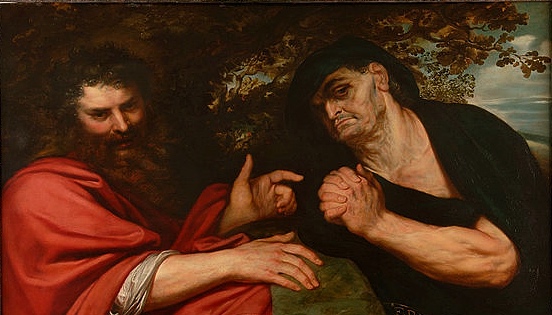
Taste is not only a part and an index of morality;—it is the ONLY morality.
John Ruskin can be said to be the John the Baptist of the religion of art, a herald of things to come. He was shortly followed by the great aesthetes, Walter Pater, Oscar Wilde, and Marcel Proust—who all read and were deeply influenced by his work. But Ruskin himself cannot be called an aesthete—at least, not in the sense that he considered aesthetic appreciate the central goal of life. For Ruskin, art provided not only aesthetic pleasure but genuine moral instruction; great paintings could be read like psalms, and great buildings were sermons in stone.
In this, as in so many other ways, Ruskin can be jarring for the modern reader. Indeed, his ideas were jarring even back then. He made a profession of insistently, dogmatically, and unequivocally asserting opinions that, to most people, seem manifestly untrue. The most notorious of these opinions is thus summed up by him: “You can have noble art only from noble persons, associated under laws fitted to their time and circumstances.” Unethical people, therefore, could produce only base art. And if an entire age habitually produced shoddy paintings and buildings—as Ruskin believed of his own age—then there must obviously be something deeply wrong with that society.
Art and society were thus, for Ruskin, deeply intertwined. This is the bridge that connects his art and his social criticism. Art is never just for art’s sake; it has a didactic and a moral purpose. A work of art is great in proportion to the greatness of its ideas; and these ideas are not the products of an eccentric individual, but of a whole culture, evolving and refining itself through generations. Every great work that results from this evolution “is the embodiment of the Polity, Life, History, and Religious Faith of nations.” As such, these works have a vital social purpose; and it is the job of the art critic to explicate their moral significance. We see this most clearly in Ruskin’s major works on architecture, The Stones of Venice and The Seven Lamps of Architecture, which are concerned, above all, with the ethical lessons inherent in gothic architecture.
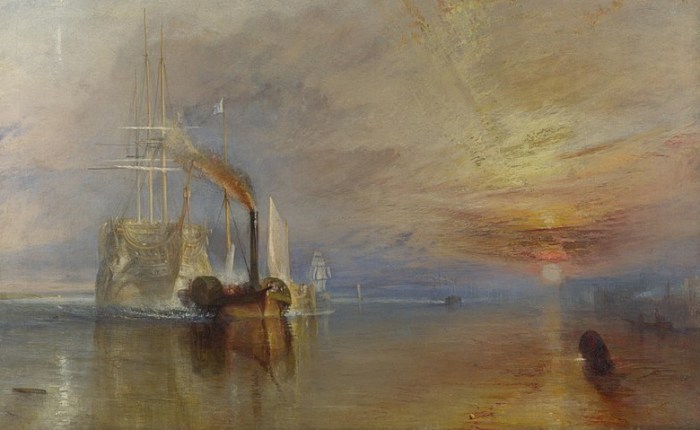
For Ruskin, however, art was not only moral, but truthful. From this conviction came his youthful defense of J.W. Turner in his five-volume Modern Painters. Turner’s works, he thought, revealed a deep insight into the workings of nature; and since Ruskin was himself keenly sensitive to natural beauty, especially mountains, he became Turner’s champion. The job of the landscape painter, like that of the poet, is to record nature as faithfully as possible. Inferior painters and poets allow themselves to be overpowered by emotions, which lead them to personify or to distort nature: Ruskin called this the “pathetic fallacy.” But the truly great painter or poet, the Turners and Dantes, are always in complete control of themselves.
One can see why this was jarring. Most of us naturally distinguish whether something is good, beautiful, or true; but Ruskin insisted that these qualities were inextricable. Art could not be great if it was immoral or if it was untrue. Indeed, for Ruskin, you might say that these qualities were not separable at all; having any of them without having all three was inconceivable. But their existence was not dependent on solitary, virtuous geniuses. To the contrary: the ability to understand nature only exists in developed cultures; moral systems are the products of peoples; and great art can only exist within a school and a tradition. Society was therefore deeply important for Ruskin, being the wellspring of everything he admired and sought.
The later half of his life was, as a result, spent in social reform. Specifically, Ruskin set himself up as the enemy of industrial capitalism. Gothic art was great because each workman was an artist; but in mass-production the workers are reduced to machines. The division of labor is, as he said, really the division of souls, allowing for efficiency but stunting human growth. The ethic of enlightened selfishness could never inspire any great works, since the highest ethical value is selflessness. The environmental destruction wrought by industrialism was not only a crime against future generations but a crime against ourselves, since we were destroying the truth and beauty of nature, which is one of the vital sources of happiness.
This is the quickest summary I can give this selection of Ruskin’s work, whose volumes fill many shells and touch on many different disciplines. There are many reasons to dismiss Ruskin’s ideas. The relationship of beauty to truth and to goodness is obviously more complicated than he insisted. Murderers, rapists, and thieves have been great painters. Honorable men have built ugly houses. And what is the truth of a symphony? But for me it is a relief to find someone who finds beauty so socially vital.
I have spent far too long in concrete landscapes, surrounded by endless rows of identical houses, each one ugly in itself and uglier en masse. The effect that such thoughtless dreariness has on my mood—in contrast with the great enlivening freshness I feel when in a lovely city—has convinced me that architectural beauty is not merely an added frill or an extra perk, but is a positive social good. And it is difficult to dismiss Ruskin’s ideas on architecture, society, and the economy when one goes from a modern suburb to a well-preserved medieval town. How is it that finer houses were built by peasants? How is it that the most wealthy society in history can produce only the most mindless repetition, vast labyrinths of stupidity, destroying whole landscapes in the process?
Ruskin is the prophet of this phenomenon, and thus valuable now more than ever. But apart from this, Ruskin is worth reading just for the quality of his writing. His early style, flowery and involuted, gave way to a clearer strain later in life. But throughout his career his prose is rich with observation and abounding in memorable phrases. Even if one disagrees with all of his conclusions, it is impossible to read him without some stimulating thought.
One can imagine the anonymous author of Lazarillo de Tormes sitting down to write in a mood similar to that of Erasmus when he penned In Praise of Folly, or of Voltaire when he composed Candide: full of the wry amusement of one engaged in a learned, witty, and irreverent literary exercise. And yet this book, like those other two, quickly became something far more than an elegant diversion. For with Lazarillo the author spawned an entire literary genre, the picaresque, creating a character and a story that have retained their charms long after the targets of the author’s satire have passed out of this world.
The most conspicuous target of the author’s derision is the church—which is likely why the author wished to remain unknown. Pardoners, priests, friars, and chaplains are exposed as hypocritical sinners—as gluttons, profligates, and fornicators, with a pious word for everybody. But the writer also takes aim at the inflated sense of honor that infected society in his day, which most famously compels a starving knight to go about town, pretending to be well off, preferring to suffer and even to die rather than have his poverty revealed.
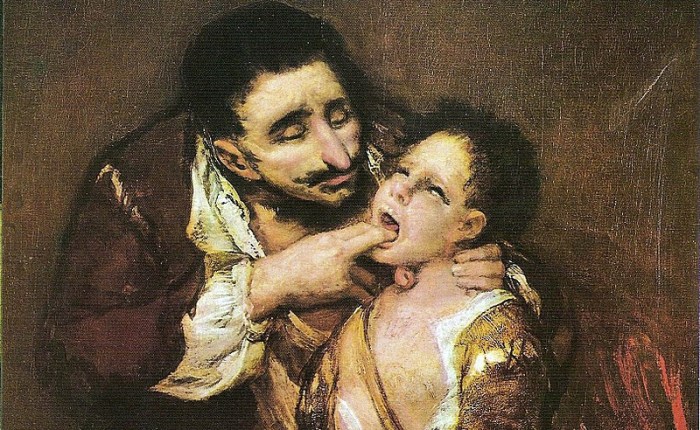
We see all this through the eyes of Lázaro, a man of humble origins whose highest ambition is to have a full belly. This proves extremely difficult, however, as he goes from one master to another, each of them proving unable or unwilling to satisfactorily feed the ravenous rogue. Like all picaresque heroes, Lázaro is, at bottom, simple and good, with a robust and hearty humor, but who is nevertheless forced into cunning and trickery by hard circumstances. This formula—so successful in the age of television—was used to its full potential in its first historical appearance. Even through the difficult lens of old Castilian, Lázaro’s schemes to steal some crumbs of bread or some swigs of wine are still wonderfully funny.
But the novella is more than a slapstick comedy. The necessities of his belly and the earthiness of his mind allow Lázaro to penetrate all the hypocrisies of those around him—since, after all, hypocritical words cannot be eaten. Lázaro thus proves the ideal vessel for exposing the gulf between being and seeming. The reality he faces is bleak: full of sin, suffering, and poverty. And yet his society is in a state of constant denial, covering up this bleak reality with noble phrases and unheeded pieties. That this is more or less always the case in human life is why this book remains one of the jewels of Spanish literature.
If you want to catch a glimpse of Catalonia’s Roman heritage, no city is better suited than Tarragona—or, as the Romans called it, Tarraco. The capital of its eponymous province, the city of Tarragona is nevertheless much smaller than Barcelona, with a population of about 130,000. It is easily accessible from that mecca of Catalonia, about an hour away by commuter train, and thus well-suited for day trips. Tarragona is also worth visiting on its own—especially if you’re looking for a place less infested by tourists. Like Barcelona, it is situated on the Mediterranean coast, in a section the Catalans call the Costa Daurada, or “golden coast.”
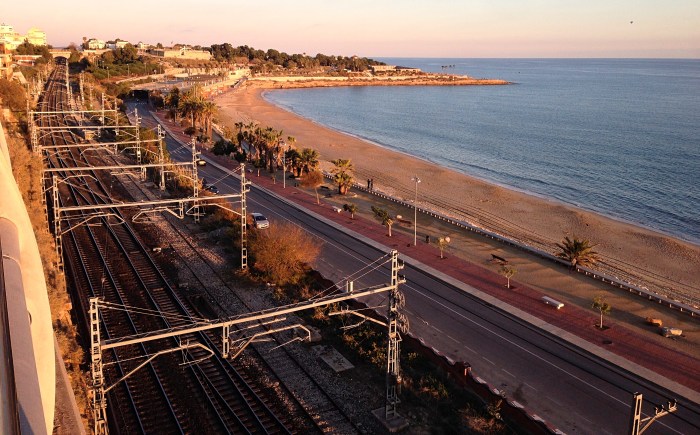
Tarragona’s beach with the tracks towards Barcelona
Roman remains are scattered throughout the city, especially in the old city center. This part of town is also called the “high part” by the inhabitants, for the obvious reason that it is situated high on a hill overlooking the sea to one side and the land on the other. You can reach this point by ascending the Via de l’Imperi Roma, a fine tiled walkway, sheltered with trees, that goes along the remains of the old Roman wall (which was likely built atop another, older wall, perhaps Phoenician). For a small price the visitor can climb up these walls and walk their length, giving one an excellent view of the city as well as the surrounding valley on the inland side.
Going along this way, the walker curves around back towards the city and the sea. I passed the Archaeology Museum, which unfortunately was closed at the time. Nevertheless, outside the building there are some ruins to explore, notably a staircase that leads up into the shell of the old Praetorium Tower. This tower has been repaired, rebuilt, and repurposed many times throughout its long life: as a castle, a barracks, and finally a prison. According to the informational plaque, it was used for this last function as recently as the Spanish Civil War (1936-39), when it was filled far beyond capacity with political and military prisoners, many of whom were executed. Nowadays, the tower is a ruined shell; before it, on a tall pillar, stands the statue of a Roman dignitary, who seems to be gazing despairingly at the sea beyond.
Nearby, like a stone scar in the middle of the city, is yet another ruin. Like so many ancient remains, weather and time (not to mention the people who used these old ruins as stone quarries) have taken their toll on this site. All I could discern were doorways and what could have been rows of seats. A plaque informed me that this was a section of the old circus maximus, the stands where crowds cheered as chariots sped by. Further down, closer to the sea, a larger section of the old racing ground has been preserved. Apart from walls, doorways, and seating, there is a tower affixed to the structure—whose purpose I admit I do not know, but which looks to my eyes like a later addition.
But the most impressive ruin in Tarragona is still further towards the water. This is the amphitheater, which sits like a man-made crater in the hill above the beach. Few sights in Catalonia are more picturesque than this one: the tan stone, symmetrical and bare, seeming to float above the sea. Built in the early 2nd century, the amphitheater was approximately the same size as the one in Mérida, big enough for 15,000 spectators. And like all amphitheaters in Rome, what these spectators viewed was gore: fights to the death between slaves. During the reign of Valerian (253 – 260), the Christian bishop Fructuosus was, along with his two deacons, burned alive in this very amphitheater during one of the many waves of persecutions against the Christians.
The Roman remains within Tarragona have been subject to the pressure of an expanding city. Their rocks have been quarried and their structures used as foundations. But outside the city, some ruins have fared rather better. The most famous of these is the so-called Pont del Diable, or Devil’s Bridge. More prosaically, this is Les Ferreres Aqueduct. This was built during the time of Augustus to transport water to the city of Tarraco. Today it sits, peaceful and pristine, in a wooded area about 4 km north of the city.
I could have gotten there easily enough by bus. But I like walking and so I decided to go by foot. Google Maps has a bad habit of routing pedestrians with the most direct route, without considering whether it’s really walkable. So the path took me along the highway N-240 (which links Tarragona and Bilbao), which is indeed quite direct. The problem was that the sidewalk dwindled and eventually disappeared, leaving me wandering in the tight space between the guardrail and the grass. Eventually I decided that this was possibly unsafe and certainly unpleasant, so I turned into Sant Pere i Sant Paul, a suburb of Tarragona. Once I crossed through this sleepy hamlet (and stopped for coffee), I entered some dirt paths that led through a pine forest.
Amid these natural surroundings the aqueduct mysteriously materializes, traversing a wide valley between two hills. It has hardly aged a day. The tan rock bears the same color as the sandy soil underneath, and indeed of much of the stone of this region. It is not as tall or as graceful as the aqueduct of Segovia, which has three levels of arches rather than Ferreres’s two. Nevertheless, one cannot walk across the top of the aqueduct in Segovia, as one can here. There is no ticket booth nor any tourist apparatus of any kind. One simply walks up and across, enjoying the view of the surrounding forest. Admittedly the constant whooshing of the nearby highway traffic does lessen the enchanting sensation of having discovered a forgotten ruin. Even so, the aqueduct is one of the jewels of Tarragona.
This exhausts my knowledge of Tarragona’s famous Roman ruins. But Tarragona has still more to offer.
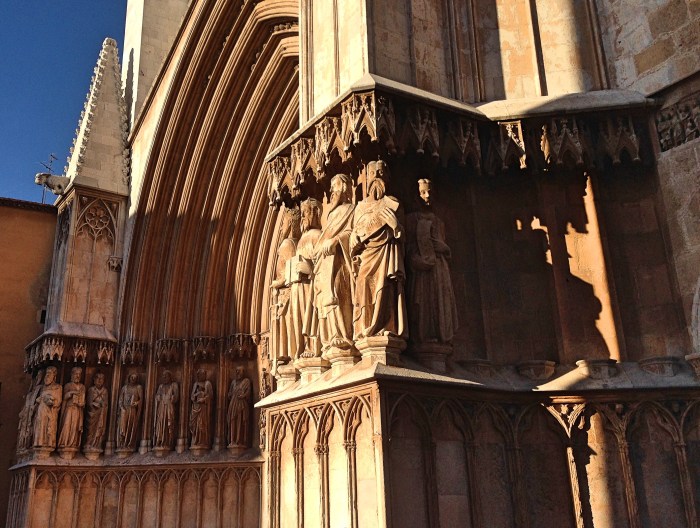
The most beautiful building in the city is Tarragona’s Cathedral. The building sits ensconced in the historic center, up on the hill, surrounded by attractive narrow streets and old buildings. A flight of stairs leads you up to its façade. This is most notable for its row of saints, apostles, and prophets in robs who flank the main doorway. In the central doorjamb stands the Virgin, holding Christ; and below her is a bas-relief of Adam and Eve. Once inside, I was able to hear the cathedral’s magnificent organ resonating throughout the space, since it was in the process of being tuned. This did not sound exactly beautiful, I admit, but it is a pleasure to hear even a single note on a real church organ.
What first attracted my attention was the main altar. Luckily the visitor can walk right up to it, which is usually not the case. It is a wonderful gothic creation in polychromed alabaster, depicting scenes from the lives of Jesus and Mary in 18 separate reliefs. Once more, the Virgin and Child stand in the center, while above two golden angels raise their weapons in righteous fury. The cathedral also has a lovely cloister, spacious and filled with green. When I visited a painter had set up an easel in one corner and was at work. From the painter’s spot you could also see the cathedral’s distinctive octagonal tower, which is doubtless why he chose it. I particularly enjoyed the small vents in the walls around above the cloister windows, each one carved into a different pattern.
Attached to the cloister is the Dioecian Museum, which houses several religious paintings and tapestries. I was also surprised to find that one door led into an archaeological excavation. A temple dedicated to the cult of Augustus has been uncovered under the cathedral. Humans like to build their temples over one another, it seems, perhaps for the sake of continuity during a period of dogmatic change. Many churches in Spain have been built over mosques, which themselves had been built over Visigothic churches. And so history flows on.
Once you descend the hill on which the old town sits, you can come to the city’s central road: the Rambla Nova. In the center is a spacious walkway where, when I visited, a Christmas market had been set up. Here you can also see the Monument als castellers, which is a metal statue depicting Catalonia’s famous tradition of making human pyramids. This tradition, by the way, is one of two in Catalonia to be designated UNESCO Intangible Cultural Heritage. The other is the Patum of Berga, a festival celebrated in the city of Berga during Corpus Christi, in which people dress up in giant monster costumes and dance.
At the end of the Nova Rambla is the Balcó del Mediterrani, a lookout point that sits high up above the Mediterranean Sea beyond. Dotting the seascape were the shapes of ships, large shipping frigates at anchor in the harbor. I wonder, do the sailors sleep on board or do they take a little boat to shore? The life of a sailor is a great mystery to me. Someone who assuredly did sleep many nights at sea is Roger de Llúria, a Catalan who was one of the greatest naval commanders of the medieval period, and whose statue stands in the center of the lookout point.
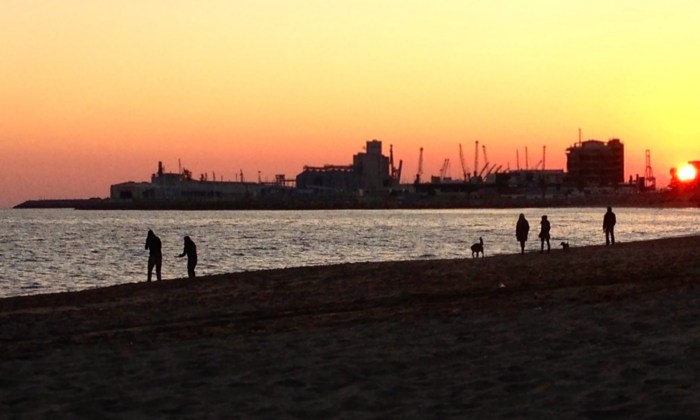
From here there is no direct way to get down to Tarragona’s beach, the Platja del Miracle. But it is worth the walk if you want to see the sun set below the dockyard, turning the skyline red and turning every building and person into a black silhouette. You may even enjoy a swim.
This wraps up my series on Catalonia. Of course with my measly three trips there I have inevitably left out much of the region’s treasures. Even so, I am tremendously impressed with Catalonia. It is a place replete with national and cultural beauty, rich with history, and still striving towards the future.
Carlos Gómez is a retired teacher who spent his career working in a public school in Rivas-Vaciamadrid. He taught philosophy, mainly to bachillerato students (the final two years of high school), but also a class called “Ethical Values” to lower levels. He has been my student for over a year now; and, despite his constantly humble insistence that his English is “so bad,” he is remarkably articulate in this second language, which he learned later in life.
We have our classes in his personal library. The walls are lined with bookshelves, stuffed full. Around me I see Newton, Locke, Bentham, Hobbes, Schopenhauer, Kant, the complete works of Unamuno and Ortega y Gasset, a multi-volume history of private life, and several histories of Western philosophy. On one shelf sits a bust of Voltaire, looking impish. In his office hangs a poem by Antonio Machado; and on an easel sits a painting he is working on.
Carlos recently agreed to turn one of our classes into an interview, focusing on his experience in philosophy and education. The following is an edited transcript.
CARLOS: This will be the first interviewed I ever answered.
ROY: Are you excited?
C: Yes, I feel like a like a VIP. All people like to have other people interested in them, I think.
R: Okay, first question. What originally drew you to philosophy? Were there any particular authors or experiences that inclined you to study the subject?
C: It was really the influence of a teacher. When I was in secondary school, my main goal, until the age of 17, was to study chemistry. But then something happened. And that was to have a very good philosophy teacher. He was, indeed, a student of Ortega y Gasset. His name was Antonio Rodríguez Huéscar. He was a student of Ortega y Gasset during the Spanish Republic (1931-35), and he went into exile at the end of the Civil War. He ended up teaching philosophy at Puerto Rico University, but he eventually decided to come back to Spain. He was an old man by then. And he decided to get a post as a philosophy teacher here, but he wasn’t allowed to teach in a university, because of his past. So he taught in a secondary school.
Well, he came to my public school, and for me that was amazing. I discovered philosophy. At that time philosophy was taught in the two last years of Bachillerato. I had him as a teacher these two years, and I saw that philosophy was “my way.” That was my only reason to study philosophy. A great teacher.
R: What made you decide to become a secondary school teacher?
C: Here in Spain, professional paths for a philosopher are few. One of the most important is to be a teacher. Another one is to publish and to translate other philosophers, but most graduates become teachers, either at secondary school or at university. This is our fate. In my case, I became a teacher just when I finished my degree.
R: Can you give me some idea of the process of becoming a secondary school teacher of philosophy?
C: To be a teacher in a secondary school you need to have a degree. In fact, if you are trying to be a philosophy teacher, your degree need not be in philosophy. You just need a degree in general. Of course, most people who teach philosophy studied the subject, too. You also need to pass the oposiciones.
The oposiciones are a special public examination in which there are a determined number of posts to be got. People need, not only to pass the exam, but to beat each other. This is why they are called “oposiciones,” because everyone is opposed. There is a writing portion in which you need to write about one subject chosen from 150 possible subjects. Most of these were about the history of philosophy, specific philosophers, aesthetics, ethics, etc.
The second part of the exam used to be called the encerrona, because they locked you in a classroom with some books, to prepare a topic that had been given to you randomly. You don’t choose it. I had 4 or 5 hours to prepare the topic, and then I had to give a presentation about it. The last part of the exam was a kind of pedagogical test, about how to teach philosophy, how to organize your materials, what exercises, what resources you could employ to make your subject more attractive.
R: What are some of the challenges of getting adolescents to grapple with philosophical questions?
C: I don’t know if I got it, I tried but… Well, today I think the main obstacle to gain teenagers to our cause is that they live in a visual culture. They don’t usually read. And they understand mostly things that they can see or that they can imagine. Or things that they can find in their everyday life. Philosophy, on the other hand, as everyone knows, is a quite general, quite abstract subject. So the question is to unite both things. So, to me, this visual culture is the most difficult obstacle. How do you overcome that? Well, with difficulty. I don’t have an easy solution, but I think you need to bring philosophical questions closer to their lives.
Carlos with the “auto-icon” of philosopher Jeremy Bentham
I’ve discovered that you have to begin to treat any problem by asking for their experience in that field. Of course, you don’t ask a teenager “Does God exist?” But, perhaps, “Do you think we’re alone in the universe?” or “Do you think have any idea about the meaning of life?” or “Have you ever thought about death?” Or something similar. Trying to attract them to problems that, eventually, can get them to your field—to a field in which you, eventually, can ask “Do you think there could be another kind of being different from us, more powerful than us, a creator, or a judge for our actions?”
But I repeat that I have no magic bullet for this problem. You have a saying, in English, “If there’s a will, there’s a way.” And I think that this is the way. The other thing is to have the will.
R: In the United States we do not teach philosophy in public secondary schools. Are we missing out?
C: Well, I don’t know if you are missing out. We have always had a subject of philosophy in secondary schools. And I’ve learned quite recently that this is not very common, even in Europe. But I think that it has its function. Why? I would say that everybody should have the opportunity to think about the persistent problems that afflict human beings. As Popper says, if you don’t have a philosophical idea, you will have a philosophical prejudice. In any case, you won’t have any conscious idea about what to do in an ethical context, or about what is going to happen when you die, or about what it means to live in a fair society.
I think that it’s better to be trained to use your mind to solve these problems. And I think, in any case, you will be a philosopher, as Kant said, since everyone faces philosophical problems. The important point, for me, is that philosophy in secondary school should be understood as training, a training to be conscious of problems, to have a reflective attitude. For me, it’s nothing but that. To be reflective.
R: Do you think that philosophy classes contribute to the health of society?
C: I hope so! For me the answer is the same. Societies where people make their decisions consciously is definitely preferable to a society where people make decisions in a random way. And to make a non-rational decision, for me, is to make a random decision. Would this be the solution of every social problem? Absolutely not. But if we had this kind of society, a rational society, a society in which all its members think through their decisions—this would absolutely be better than the reverse. Some philosophers have had their utopia in which all people are rational and discuss every issue rationally, and make their decision without any interest or interference. Of course this is far from real. But I think that the main idea is a good one, even though this is a very difficult, in some way unreachable, ideal—but an ideal that attracts us so much that it makes us walk in its direction. And this is good in itself, even though we never reach the goal.
R: How would you respond to those who find philosophy pretentious nonsense or completely impractical?
C: In some sense they are right, because there have been, in history, a lot of pretentious philosophers and a lot of impractical philosophers. Even from the point of view of a philosopher. This can be said of some number of philosophers, but not of philosophy in itself. As happens in every realm of culture, there are people who aren’t at the level they are supposed to be. But is philosophy in itself pretentious? Absolutely not. For example, Ortega y Gasset is, for me, an example of a clear, practical philosopher. He wrote understandably and he brought his ideas to the political arena. He gained a seat in parliament. He wrote many articles about the political situation.
Carlos at Wittgenstein’s grave
In general, I don’t think it’s necessary that philosophers be considered as men who live above the clouds, not interested in real life. This is not true. On the other hand, it is true that philosophers who write in a very complicated way have created a “black legend” about philosophy. But that is something we have to fight against. We don’t need to take that as something essential for philosophy.
R: Do you have any suggestions for improving Spain’s educational system?
C: Today, I am an outsider, out of the public educational system, so I can speak more freely. But I don’t really have a magic bullet in this case either. But for me there are two general lines to develop. One of them would be to get rid of charter schools. Why? Because I think it doesn’t make sense that we have schools that are at the same time public and private. If it is private, it must face the challenges that private companies face. And they should not have any public benefits. They should not have public aid. I think this because, nowadays in Spain, public schools have to compete with a kind of school that offers them benefits that public schools, with their limited budgets, cannot. This is not fair. The charter schools, as a result, get the best students. Because students are attracted by things like indoor pools and dancing programs, and so on. So private schools shouldn’t use public funds.
The other idea that I always had is that… Well, you know, we have all the students from 7th grade to 12th in the same schools, with the same kinds of curriculums. That is to say that they all study the same academic things, in the same classrooms, with the same level of depth, and the same teachers. For me this is not functional. When I was a child there were two curriculums. There were two paths. A more academic line, which led us to university. And there was a practical, professional line which led into vocational schools. I think this model is better than the one that we have today. And I would go back to it. Of course, you must allow people to switch back and forth, if they want. Teenagers change their minds. Many problems we have in secondary schools nowadays come from this lack of differentiation. How can you teach a class when one half is interested and the other half isn’t?
R: Are there any thinkers, ideas, or books that you find yourself returning to again and again?
C: I am interested, basically, in questions of epistemology (the theory of knowledge), ethics, and politics. I don’t know enough about aesthetics, for example, and hence I am not interested in it too much. I also do not care much for ontology. My preference for the above mentioned topics has been constant from the beginning. And the philosophers who have contributed the most to these fields are the ones I like best. For example, Aristotle more than Plato, though I recognize that Plato was more creative. In modern philosophy, I like the empiricists (such as Hume) more than the rationalists; and among the rationalist philosophers I like Spinoza, but not Descartes very much.
But my very favorite philosophers are those from the age of Kant and afterwards. Kant himself is the father of contemporary philosophy. And there are the greatest of the nineteenth century, Marx and Nietzsche. Mill is interesting, too. In my early days I liked Ortega very much, but Ortega is a philosopher who I don’t read anymore. I also like philosophers who are involved in the social sciences, like Karl Mannheim, about whom I wrote my thesis.
I am particularly interested in questions of technology, like whether technology is releasing us from nature or is exploiting or manipulating us, or is leading us to a new form of slavery. Technology is bringing new philosophical questions to light. Such as the old problem of immortality. Soon it may be, indeed, literally possible that we live longer or, even—why not?—that we live forever. Well, I don’t know. The question of human nature, raised by Hume, is also more important than it has ever been. Since today the possibility of changing human nature does exist. But for me the questions are more interesting than the answers.
I think you can find philosophical problems everywhere, if you have the proper sight. There are people who would never find a philosophical problem anywhere. And there are people, like us, who find philosophical problems everywhere. For me, these problems exist. Philosophers can be detestable people. But that doesn’t affect philosophy itself, and philosophy itself matters. And I think it will matter forever.

 The Rise and Fall of the Third Reich: A History of Nazi Germany by William L. Shirer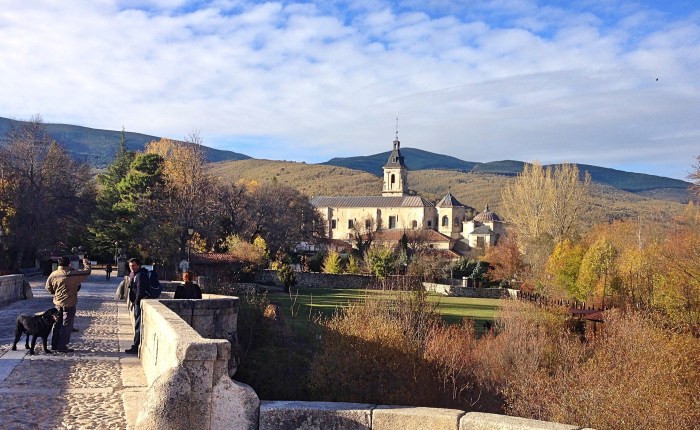













 Lotz in Translation