Alexander von Humboldt was a remarkable man. Simultaneously a savant and an explorer, he knew everyone, studied everything, and did his best to travel everywhere. Andrea Wulf brings together the many seemingly divergent worlds that he bridged: the worlds of Thomas Jefferson, Simón Bolívar, Napoleon, Goethe, Charles Darwin, and even Isambard Kingdom Brunel. He left his fingerprints on the worlds of science, literature, art, and even politics. Yet today he is (or was, before Wulf) a fairly obscure figure in the English-speaking world.
Thus this book is not simply a biography, but an attempt at rehabilitation. Wulf wishes to restore Humboldt to his place of honor; and she does this by arguing that his influence has been fundamental and pervasive. But before she can deal with Humboldt’s reputation, she must first narrate the scientist’s own coming of age. Humboldt was one of these figures with seemingly boundless energy, who threw himself into his work with complete abandon. We watch the young Humboldt as he struggles with, and finally throws off, the expectations of his upbringing, and then dashes away to South America. Once he embarks on his voyage, it does not take a strong writer—which Wulf is—to make his story exciting. Humboldt’s own travelogues were bestsellers.
Humboldt emerges from his travels with a concept of nature which, Wulf argues, was revolutionary and which became extremely influential. Wulf identifies three new elements of Humboldt’s approach to nature: First, that nature cannot be understood without both the scientific and the poetic eye; analysis and sentiment are necessary to do justice to the natural world. Second, that the living world must be understood as a gestalt, with organisms depending on one another in an intimate set of relationships that boggles the intellect. And third, that scientists must think on a global scale if they wish to understand the complex interactions between plants, animals, and climates.
This is the meat of the book. Yet it is here that I began to shift from enchantment to disappointment. For Wulf does not do nearly enough work to convince the skeptical reader that Humboldt’s view of nature was so entirely new. I would have appreciated far more background on previous conceptualizations of the natural world. Without this, it is hard to tell where Humboldt was innovative. Further, Wulf is always rather vague with Humboldt’s actual scientific contributions. She elects to keep the narrative pace driving forward, which doubtless helped her sales; yet I would have appreciated an explanation of Humboldt’s thought in more detail, with a good deal more quoting of the man.
Conversely, Wulf could have greatly reduced the space devoted to the men Humboldt influenced. She has individual chapters for John Muir, Henry David Thoreau, Charles Darwin, George Perkins Marsh, and Ernst Haeckel—space that she uses as opportunities to prove her thesis that Humboldt’s writings were fundamental to their success. But I found the biographical detail for these men excessive, and her point overstated. She makes it seem as if these men owed their accomplishments—if not wholly, at least in large part—to Humboldt’s influence. But you cannot measure influence, and you cannot prove a counterfactual (what would they have done without Humboldt?). In any case, the point is entirely abstract without a more careful discussion of Humboldt’s ideas; lacking that, it is not possible to say where his influence begins or ends.
By now I am convinced that Humboldt was an important and compelling figure in the history of science. But I am far from convinced that his late obscurity was a mere result of anti-German prejudice caused by the two World Wars, as Wulf claims in the Epilogue. Too many other German scientists and philosophers remained famous. Rather, I think Humboldt may have fallen into obscurity because it is difficult to do justice to the nature of his contribution. Unlike Darwin, he did not originate any major scientific theory that could unify a great many phenomena under a simple explanation. Humboldt’s major contributions seems to be perspectival: seeing nature as complex yet whole, as godless yet beautiful, as vast and inhuman yet spiritually refreshing. And it is difficult to work that into a textbook.
But sound, as I have said above, only travels 180 toises in the same time of one second: hence the velocity of light is more than six hundred thousand times greater than that of sound.
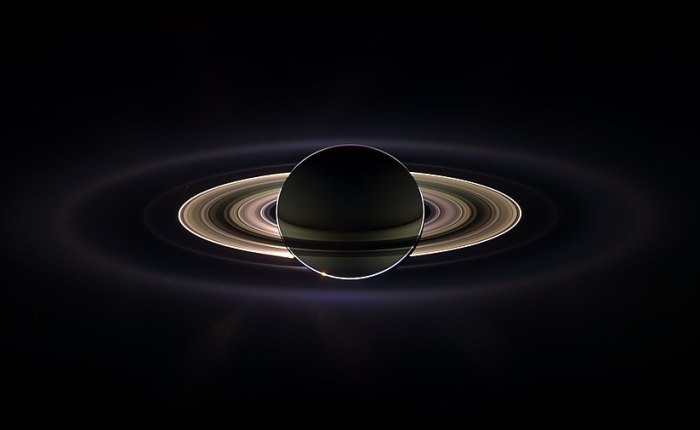
This little treatise is included in volume 34 of the Great Books of the Western World, which I used to read Newton’s Principia and his Opticks. In this edition the Treatise comes out to about 50 pages, so I decided it was worth combing through. Christiaan Huygens is one of the relatively lesser known figures of the scientific revolution. But even a brief acquaintance with his life and work is enough to convince one that he was a thinker of gigantic proportion, in a league with Descartes and Leibniz. His work in mechanics prefigured Newton’s laws, and his detailed understanding of the physics of pendulums (building from Galileo’s work) allowed him to invent the pendulum clock. His knowledge of optics also improved the technology of telescope lenses, which in turn allowed him to describe the rings of Saturn and discover the first of Saturn’s moons, Titan.
Apart from all this, Huygens was the progenitor of the wave theory of light. This is in contrast with the corpuscular theory of light (in which light is conceived of as little particles), put forward 14 years later in Isaac Newton’s Opticks. Newton’s theory quickly became more popular, partially because of its inherent strength, and partially because it was Isaac Newton who proposed it. But Huygens’s wave theory was revived and seemingly confirmed in the 19th century by Thomas Young and Augustin-Jean Fresnel.
Essentially, Huygens’s idea was to use sound as an analogy for light. Just as sound consists of longitudinal waves (vibrating in the direction they travel) propagated by air, so light must consist of much faster waves propagated by some other, finer medium, which Huygens calls the ether. He conceives of a luminous object, such as a burning coal, as emitting circular waves at every point in its surface, spreading in every direction throughout a space.
Like Newton, Huygens was aware of Ole Rømer’s calculation of the speed of light. It had long been debated whether light is instantaneous or merely moves very quickly. Aristotle rejected the second option, thinking it inconceivable that something could move so fast. Little progress had been made since then, because making a determination of light’s speed presents serious challenges: not only is light several orders of magnitude faster than anything in our experience, but since light is the fastest thing there is, and the bearer of our information, we have nothing to measure it against.
This changed once astronomers began measuring the movement of the Jovian moons. Specifically, the moon Io is eclipsed by Jupiter every 42.5 hours; but as Rømer measured this cycle at different points in the year, he noticed that it varied somewhat. Realizing that this likely wasn’t due to the moon’s orbit itself, he hypothesized that it was caused by the varying distance of Earth to Jupiter, and he used this as the basis for the first roughly accurate calculation of the speed of light. Newton and Huygens both accepted the principle and refined the results.
Huygens gets through his wave theory, reflection, and refraction fairly quickly; and in fact the bulk of this book is dedicated to an analysis of Icelandic spar—or, as Huygens calls it, “The Strange Refraction of Icelandic Crystal.” This is a type of crystal that is distinctive for its birefringence, which means that it refracts light of different polarizations at different angles, causing a kind of double image to appear through the crystal. Huygens delves into a detailed geometrical analysis of the crystal, which I admit I could not follow in the least; nevertheless, the defining property of polarization eludes him, since to understand it one must conceive of light as a transverse, not a longitudinal, wave (that is, unlike a sound wave, which cannot be polarized). In the end, he leaves this puzzling property of the crystal for future scientists, but not without laying the groundwork of observation and theory that we still rely upon.
All together, this little treatise is a deeply impressive work of science: combining sophisticated mathematical modeling with careful experimentation to reach surprising new conclusions. Huygens illustrates perfectly the rare mix of gifts that a scientist must have in order to be successful: a sharp logical mind, careful attention to detail, and a creative imagination. The world is full of those with only one or two of these qualities—brilliant mathematicians with no interest in the real world, obsessive recorders and cataloguers with no imagination, brilliant artists with no gift for logic—but it takes the combination to make a scientist of the caliber of Huygens.
In manifold ways 2018 was an excellent year. I traveled to places I never expected to see, I read books that had long been on my list, and in general I had a great time. In fact, I did so many things that I have a lot of catching up to do on this blog. And my major resolution is to put even more effort into my writing this year.
So, without further ago, here is an incomplete list of the places I visited that I still need to write about:
One of my resolutions is to brush up on math. I hope, first, to read about Greek mathematics, and even to see if I can penetrate a few works of Archimedes (highly unlikely). I also have a calculus textbook that I hope to use to revive my atrophying abilities (equally improbable).
Meanwhile, I have typically immoderate and unrealistic reading goals. Some hefty existentialist tomes have been weighing me down: books by Kierkegaard, Sartre, and Husserl, to name just three. There are also many classic French writers I have yet to read: Pascal, Balzac, Stendhal, Le Rouchefoucault… And then there are some ponderous and interminable history books that are in my sights.
I should stop myself here, since I will have to eat all of these words. One thing I can be certain of, though, is that I will neither diet nor exercise.
Few authors, especially the unpublished, can resist the opportunity to read aloud.
2018 has shaped up to be an excellent year in reading. I somehow finished fifteen more books than I had the previous two years. Admittedly, many of my books this year were quite short; some of Plato’s dialogues are arguably more like pamphlets than books, and I read twelve of them this year. These slim volumes were, I hope, compensated by a few ponderous tomes. I stumbled through the two final books of Will Durant’s The Story of Civilization, at 1092 and 870 pages; George Santayana’s 862 page treatise on ontology; 1300 pages of Plutarch’s Parallel Lives; and finally William Shirer’s Rise and Fall of the Third Reich, weighing in at a tedious 1614 pages. I also attempted to read a 1400 page history of New York City; but I was forced to take a break halfway through to recover from an acute overdose of urbane facts.
The two most prominent themes of this year’s reading have been art and science.
I learned about the works and lives of Picasso, Miró, and Goya, and I savored Santiago Ramón y Cajal’s sketches of brain cells, which are as much artistic as scientific achievements. I also read two books of John Ruskin’s eloquent ravings on the value, morality, and beauty of art. Henry Adams concurred with Ruskin about the superiority of medieval art, as he demonstrated in his book about Chartres. Giorgio Vasari, however, took the reverse position, arguing that the Renaissance saved Europe from centuries of barbarous art; and he proved this thesis in his reverential biographies of Renaissance painters and sculptors. But by far the most compelling book on art I read this year was a collection of Vincent van Gogh’s letters, which reveal a man of extraordinary sensitivity and intelligence.
My reading in science began with two classics in the philosophy of science: Popper’s The Logic of Scientific Discovery and Kuhn’s The Structure of Scientific Revolutions—both excellent. But after learning the theory I wanted to know the practice; so I started blundering my way through the classics of the Copernican revolution. I began with Ptolemy’s Almagest, and followed this with Copernicus’s De Revolutionibus, Kepler’s Harmonies of the World, and Galileo’s Two New Sciences and Sidereus Nuncius; and I finally reached the capstone of the scientific revolution with Newton’s Principia. Looking at this list, I feel rather proud of myself; but in truth most of this “reading” consisted of flipping through pages of incomprehensible mathematics. I needed secondary sources to even achieve a basic understanding, relying on an abridged and annotated version of Ptolemy, Very Short Introductions to Copernicus and Galileo, and a popularization of Newton written by Colin Pask. And am I any the wiser for all this toil?
I had hoped to do half of my reading this year in Spanish; but with a total twenty books I did not even achieve a quarter. Luckily, many of these were excellent. Federico García Lorca’s trilogy of plays is a remarkable look at the force of tradition in rural Spain. The poetry of Antonio Machado was perhaps even more profound, with its blend of metaphysical calm and romantic sensitivity to nature. I also read two superlative novels from Spanish masters: Marianela by Benito Pérez Galdós, and El árbol de la ciencia by Pío Baroja. To do my homework, I sampled Spain’s golden age, reading Tirso de Molina’s El burlador de Sevilla, and Lope de Vega’s Fuente Ovejuna and El caballero de Olmedo. But the highlight of this year’s Spanish books was undoubtedly Don Quijote de la Mancha, which I read in the modernized version by Andrés Trapiello. Not that Cervantes needs any help, but Ortega’s and Unamuno’s commentaries on the Spanish masterpiece did widen my appreciation of that most infinitely entertaining of novels.
The two authors who most dominated my year were Shakespeare and Plato, as I labored under the optimistic delusion that I could read both of their complete works. I still have a long way to go, of course; but any time spent with these two masters is rewarding; and I hope to continue my naive ambition next year. I read very few works of English language fiction this year, of which E.M. Forster’s Howards End was the standout work. As usual, I tried to read about New York and the United States while I was home during the summer. This lead me to pick up Mark Twain’s Life on the Mississippi, John Steinbeck’s Travels with Charley, John Muir’s The Mountains of California, Dee Brown’s Bury My Heart at Wounded Knee, David McCullough’s The Great Bridge, Ron Chernow’s Titan, and Alistair Cooke’s America. None of these was as revelatory as The Power Broker, which I read last summer; but each one shed some light on my vast and aggravating homeland.
The most exciting event on Goodreads this year has been my recent ascension to the most followed reviewer in Spain, with 1,700 new followers just this month. Believe me, I’ve been as baffled as you must be. The mystery was partly solved when I investigated the list of my followers, and found that a large part bear the obvious traces of fake accounts. I would like to take this opportunity to publicly assert that I have not paid for any bot service, and I have no idea why they would choose to follow my reviews. Perhaps the computers have a taste for pretentious prose.
In any case, I would like to thank my fellow reviewers and followers, man or machine, for contributing to this excellent year of reading. You support me in my own endeavors, you inspire me with your intelligence and curiosity, and you provide me a community of thoughtful readers and writers. So may 2019 be as good a year for book enthusiasts as the this one has been.
It happened one Pentecost when King Arthur and his knights of the Round Table had all assembled at the castle of Kynke Kenadonne and were waiting, as was customary, for some unusual event to occur before settling down to the feast, that Sir Gawain saw through the window three gentlemen riding toward the castle, accompanied by a dwarf.
I fully expected to dislike this book. The prospect of five hundred pages of jousting knights struck me as endlessly tedious, and I only opened the book out of a sense of respect for its status as a classic. But immediately I found myself entranced. This is a thoroughly engrossing read. And I should not have been surprised, since it delves so heartily into the two staples of popular entertainment: sex and violence. Indeed, one of the most amusing aspects of this book is how completely out of harmony is the chivalric code with the Christian religion; the characters do nothing but mate and slaughter, while the name of “Jesu” is on everybody’s lips.
Sir Thomas Malory assembled Le Morte d’Arthur out of several pre-existing legends, some of which he translated from French manuscripts, with a few stories of his invention thrown in. His major innovation was to arrange these traditional tales into a semi-coherent order, beginning with Arthur’s ascension to the throne and ending with his death at the hands of his son. The result is a patchwork of stories nested within stories, all told at a pace which, to a modern reader, can seem ludicrous. Major developments occur on every page, one after the other, in a staccato rhythm which can make the stories appear bluntly humorous, even if it was not Malory’s intention.
The world depicted in these pages is so frankly unreal, the level of violence so constant and gratuitous, that its final impression is that of a cartoon: “They fought once more and Sir Tristram killed his opponent. Then, running over to his son, he swiftly beheaded him too.” Daily life is entirely hidden from view. There are no peasants, no merchants, no artisans; there are no friends or happy families. There are only questing knights, heavily armed men who are obsessed with challenging one another. And though they profess a knightly code of conduct, even the most chivalrous of knights are seen to be unscrupulous murderers and, with few exceptions, unrepentant adulterers. The hero of this book, Sir Launcelot, feels very few pangs of guilt for continuously sleeping with his liege’s wife, Gwynevere; and he is the best of knights.
But the characters are so flat, their actions so stereotyped, their lives so monotonously dramatic, that I found it impossible to view them as moral actors, praiseworthy or damnable. They are, rather, centers of this bizarre world that Malory constructs. And it certainly is an exciting place. Monsters, magicians, enchantresses, prophesies, curses, visions, and of course endless combat and manic love—the small isle of Britain can hardly contain it all. Sure, there are parts of the book that drag, particularly during the tournaments. Malory’s descriptions of combat are heavily stylized, consisting of the same basic elements over and over again; and, as in the Iliad, large engagements are pictured as a series of individual contests between heroic foes. But for the most part Malory combines his traditional motifs together dexterously, enlivening larger stories with innumerable episodes, creating a raucous forward momentum.
As a result of all this, I greatly enjoyed Le Morte d’Arthur, even if it was not for the reasons that Malory intended. I found the book delightfully absurd, almost parody of itself, a sort of whimsical fantasy novel. What Malory hoped to convey with these stories—whether they are supposed to represent a model of heroism, an ironic comment on violence, or a response to the Wars of the Roses—I cannot say; but his book is better than any television show I know.
Finally I have come to the last book in this series. It was four long years ago when I first read The Life of Greece; and these have been the four most educational years of my life, in part thanks to The Story of Civilization. Though I have had some occasions to criticize Durant over the years, the fact that I have dragged myself through ten lengthy volumes of his writing is compliment enough. Now all I need to do is to read the first volume of the series, Our Oriental Heritage, in order to bring my voyage to its end. (I originally skipped it because it struck me as absurd to squeeze all of Asia into one volume and then cover Europe in ten; but for the sake of completion I suppose I will have to read it.)
Durant did not plan to write this volume. His previous book, Rousseau and Revolution, ends with a final bow. But Durant lived longer than he anticipated (he died at 96), so he decided to devote his final years to a bonus book on Napoleon. It is extraordinarily impressive that he and his wife, Ariel, could have maintained the same high standard of writing for so many decades; there is no notable decline in quality in this volume, which makes me think that Durant should have written a book on healthy living, too.
The Age of Napoleon displays all of Durant’s typical merits and faults. The book begins with a bust: Durant rushes through the French Revolution, seeming bored by the whole affair, seeing the grand drama only as a disruptive prelude to Napoleon. This showcases Durant’s inability to write engagingly about processes and events; when there is no central actor on which to focus his attention, the writing becomes colorless and vague. Further, it also shows that Durant, while a strong writer, was a weak historian: he provides very little analysis or commentary on what is one of the most important and influential events in European history.
When Napoleon enters the scene, the book becomes appreciably more lively. For reasons that largely escape me, Durant was an unabashed admirer of the diminutive general, and sees in Napoleon an example of the farthest limits of human ability. Though normally uninterested in the details of battles and campaigns, Durant reveals a heretofore hidden talent for military narration as he covers Napoleon’s military triumphs and defeats. Some parts of the book, particularly near the end, are genuinely thrilling—an adjective that rarely comes to mind with Durant’s staid and steady style. Granted, he had an extraordinary story to tell; Napoleon’s rise, fall, rise again, and fall again are as epic as anything in Plutarch.
But as usual Durant shines most brightly in his sections on artists, poets, and philosophers. The greatest section of this book is that on the Romantic poets: Wordsworth, Coleridge, Shelley, and Byron. (For some reason, Durant sees fit to exclude Keats, even though the scope of Keats’ life falls entirely within that of Napoleon.) Less engaging, though still worthwhile, was Durant’s section on the German idealist philosophers; and his miniature biography of Beethoven was a stirring tribute. Many writers who properly belong in this volume were, however, paid their respects in the previous, most notably Goya and Goethe, since Durant thought that this volume would never appear.
Though I am happy to reach the end, I am saddened that I cannot continue the story of Europe’s history any further forward with Durant. He is an inspiring guide to the continent’s cultural treasures.
There is not a single effect in Nature, not even the least that exists, such that the most ingenious theorists can ever arrive at a complete understanding of it.
One of the most impressive aspects of the Very Short Introduction series is the range of creative freedom allowed to its writers. (Either that, or its flexibility in repurposing older writings; presumably a version of this book was published before the VSI series even got off the ground, since its author died in 1993.) This is a good example: For in lieu of an introduction, Stillman Drake, one of the leading scholars of the Italian scientist, has given us a novel analysis of Galileo’s trial by the Inquisition.
Admittedly, in order to contextualize the trial, Drake must cover all of Galileo’s life and thought. But Drake’s focus on the trial means that many things one would expect from an introduction—for example, an explanation of Galileo’s lasting contributions to science—are only touched upon, in order to make space for what Drake believed was the crux of the conflict: Galileo’s philosophy of science.
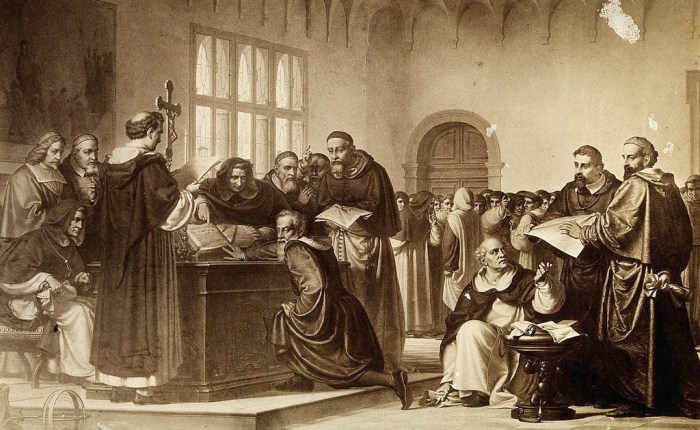
Galileo Galilei was tried in 1633 for failing to obey the church’s edict that forbade the adoption, defense, or teaching of the Copernican view. And it seems that he has been on trial ever since. The Catholic scientist’s battle with the Catholic Church has been transformed into the archetypical battle between religion and science, with Galileo bravely championing the independence of human reason from ancient dogma. This naturally elevated Galileo to the status of intellectual heroe; but more recently Galileo has been criticized for falling short of this ideal. Historian of science, Alexandre Kojève, famously claimed that Galileo hadn’t actually performed the experiments he cited as arguments, but that his new science was mainly based on thought experiments. And Arthur Koestler, in his popular history of astronomy, criticized Galileo for failing to incorporate Kepler’s new insights. Perhaps Galileo was not, after all, any better than the scholastics he criticized?
Drake has played a significant role in pushing back against these arguments. First, he used the newly discovered working papers of Galileo to demonstrate that, indeed, he had performed careful experiments in developing his new scheme of mechanics. Drake also points out that Galileo’s Dialogue Concerning the Two Chief World Systems was intended for popular audiences, and so it would be unreasonable to expect Galileo to incorporate Kepler’s elliptical orbits. Finally, Drake draws a hard line between Galileo’s science and the medieval theories of motion that have been said to presage Galileo’s theories. Those theories, he observes, were concerned with the metaphysical cause of motion; whereas Galileo abandoned the search for causes, and inaugurated the use of careful measurements and numerical predictions in science.
Thus, Drake argues that Galileo never saw himself as an enemy of the Church; to the contrary, he saw himself as fighting for its preservation. What Galileo opposed was the alignment of Church dogma with one very particular interpretation of scripture, which Galileo believed would put the church in danger of being discredited in the future. Galileo attributed this mistaken policy to a group of malicious professors of philosophy, who, in the attempt to buttress their outdated methods, used Biblical passages to make their views seem orthodox. This was historically new. Saint Augustine, for example, considered the opinions of natural philosophers entirely irrelevant to the truth of the Catholic faith, and left the matter to experts. It was only in Galileo’s day (during the Counter-Reformation) that scientific theories became a matter of official church policy.
Drake’s conclusion is that Galileo’s trial was not so much a conflict between science and religion (for the two had co-existed for many centuries), but between science and philosophy: the former concerned with measurement and prediction, the latter concerned with causes. And Drake notes that many contemporary criticisms of Galileo—leaving many loose-ends in his system, for example—mirror the contemporary criticisms of his work. The trial goes on.
Personally I found this book fascinating and extremely lucid. However, I am not sure it exactly fulfills its promise as an introduction to Galileo. I think that someone entirely new to Galileo’s work, or to the history and philosophy of science, may not get as much out of this work. Luckily, most of Galileo’s own writings (translated by Drake) are already very accessible and enjoyable.
It is shown in the Scholium of Prop. 22, Book II, that at the height of 200 miles above the earth the air is more rare than it is at the surface of the earth in the ratio of 30 to 0.0000000000003998, or as 75,000,000,000,000 to 1, nearly.
Marking this book as “read” is as much an act of surrender as an accomplishment. Newton’s reputation for difficulty is well-deserved; this is not a reader-friendly book. Even those with a strong background in science and mathematics will, I suspect, need some aid. The historian of mathematics Colin Pask relied on several secondary sources to work his way through the Principia in order to write his excellent popular guide. (Texts by S. Chandrasekhar, J. Bruce Brackenridge, and Dana Densmore are among the more notable vade mecums for Newton’s proofs.) Gary Rubenstein, a math teacher, takes over an hour to explain a single one of Newton’s proofs in a series of videos (and he had to rely on Brackenridge to do so).
It is not that Newton’s ideas are inherently obscure—though mastering them is not easy—but that Newton’s presentation of his work is terse, dense, incomplete (from omitting steps), and at times cryptic. Part of this was a consequence of his personality: he was a reclusive man and was anxious to avoid public controversies. He says so much himself: In the introduction to Book III, Newton mentions that he had composed a popular version, but discarded it in order to “prevent the disputes” that would arise from a wide readership. Unsurprisingly, when you take material that is intrinsically complex and then render it opaque to the public, the result is not a book that anyone can casually pick up and understand.
The good news is that you do not have to. Newton himself did not advise readers, even mathematically skilled readers, to work their way through every problem. This would be enormously time-consuming. Indeed, Newton recommended his readers to peruse only the first few sections of Book I before moving on directly to Book III, leaving most of the book completely untouched. And this is not bad advice. As Ted said in his review, the average reader could gain much from this book by simply skipping the proofs and calculations, and stopping to read anything that looked interesting. And guides to the Principia are certainly not wanting. Besides the three mentioned above, there is the guide written by Newton scholar I. Bernard Cohen, published as a part of his translation. I initially tried to rely on this guide; but I found that, despite its interest, it is mainly geared towards historians of science; so I switched to Colin Pask’s Magnificent Principia, which does an excellent job in revealing the importance of Newton’s work to modern science.
So much for the book’s difficulty; on to the book itself.
Isaac Newton’s Philosophiæ Naturalis Principia Matematica is one of the most influential scientific works in history, rivaled only by Darwin’s On the Origin of Species. Quite simply, it set the groundwork for physics as we know it. The publication of the Principia, in 1687, completed the revolution in science that began with Copernicus’s publication of De revolutionibus orbium coelestium over one hundred years earlier. Copernicus deliberately modeled his work on Ptolemy’s Almagest, mirroring the structure and style of the Alexandrian Greek’s text. Yet it is Newton’s book that can most properly be compared to Ptolemy’s. For both the Englishman and the Greek used mathematical ingenuity to draw together the work of generations of illustrious predecessors into a single, grand, unified theory of the heavens.
The progression from Copernicus to Newton is a case study in the history of science. Copernicus realized that setting the earth in motion around the sun, rather than the reverse, would solve several puzzling features of the heavens—most conspicuously, why the orbits of the planets seem related to the sun’s movement. Yet Copernicus lacked the physics to explain how a movable earth was possible; in the Aristotelian physics that held sway, there was nothing to explain why people would not fly off of a rotating earth. Furthermore, Copernicus was held back by the mathematical prejudices of the day—namely, the belief in perfect circles.
Johannes Kepler made a great stride forward by replacing circles with ellipses; this led to the discovery of his three laws, whose strength finally made the Copernican system more efficient than its predecessor (which Copernicus’s own version was not). Yet Kepler was able to provide no account of the force that would lead to his elliptical orbits. He hypothesized a sort of magnetic force that would sweep the planets along from a rotating sun, but he could not show why such a force would cause such orbits. Galileo, meanwhile, set to work on the new physics. He showed that objects accelerate downward with a velocity proportional to the square of the distance; and he argued that different objects fall at different speeds due to air resistance, and that acceleration due to gravity would be the same for all objects in a vacuum. But Galileo had no thought of extending his new physics to the heavenly bodies.
By Newton’s day, the evidence against the old Ptolemaic system was overwhelming. Much of this was observational. Galileo observed craters and mountains on the moon; dark spots on the sun; the moons of Jupiter; and the phases of Venus. All of these data, in one way or another, contradicted the old Aristotelian cosmology and Ptolemaic astronomy. Tycho Brahe observed a new star in the sky (caused by a supernova) in 1572, which confuted the idea that the heavens were unchanging; and observations of Haley’s comet in 1682 confirmed that the comet was not somewhere in earth’s atmosphere, but in the supposedly unchanging heavens.
In short, the old system was becoming unsustainable; and yet, nobody could explain the mechanism of the new Copernican picture. The notion that the planets’ orbits were caused by an inverse-square law was suspected by many, including Edmond Haley, Christopher Wren, and Robert Hooke. But it took a mathematician of Newton’s caliber to prove it.
But before Newton published his Principia, another towering intellect put forward a new system of the world: René Descartes. Some thirty years before Newton’s masterpiece saw the light of day, Descartes published his Principia Philosophiæ. Here, Descartes summarized and systemized his skeptical philosophy. He also put forward a new mechanistic system of physics, in which the planets are borne along by cosmic vortices that swirl around each other. Importantly, however, Descartes’s system was entirely qualitative; he provided no equations of motion.
Though Descartes’s hypothesis has no validity, it had a profound effect on Newton, as it provided him with a rival. The very title of Newton’s book seems to allude to Descartes’s: while the French philosopher provides principles, Newton provides mathematical principles—a crucial difference. Almost all of Newton’s Book II (on air resistance) can be seen as a detailed refutation of Descartes’s work; and Newton begins his famous General Scholium with the sentence: “The hypothesis of vortices is pressed with many difficulties.”
In order to secure his everlasting reputation, Newton had to do several things: First, to show that elliptical orbits, obeying Kepler’s law of equal areas in equal times, result from an inverse-square force. Next, to show that this force is proportional to the mass. Finally, to show that it is this very same force that causes terrestrial objects to fall to earth, obeying Galileo’s theorems. The result is Universal Gravity, a force that pervades the universe, causing the planets to rotate and apples to drop with the same mathematical certainty. This universal causation effectively completes the puzzle left by Copernicus: how the earth could rotate around the sun without everything flying off into space.
The Principia is in a league of its own because Newton does not simply do that, but so much more. The book is stuffed with brilliance; and it is exhausting even to list Newton’s accomplishments. Most obviously, there are Newton’s laws of motion, which are still taught to students all over the world. Newton provides the conceptual basis for the calculus; and though he does not explicitly use calculus in the book, a mathematically sophisticated reader could have surmised that Newton was using a new technique. Crucially, Newton derives Kepler’s three laws from his inverse-square law; and he proves that Kepler’s equation has no algebraic solution, and provides computational tools.
Considering the mass of the sun in comparison with the planets, Newton could have left his system as a series of two-body problems, with the sun determining the orbital motions of all the planets, and the planets determining the motions of their moons. This would have been reasonably accurate. But Newton realized that, if gravity is truly universal, all the planets must exert a force on one another; and this leads him to the invention of perturbation theory, which allows him, for example, to calculate the disturbance in Saturn’s orbit caused by proximity to Jupiter. While he is at it, Newton calculates the relative sizes and densities of the planets, as well as calculates where the center of gravity between the gas giants and the sun must lie. Newton also realized that gravitational effects of the sun and moon are what cause terrestrial tides, and calculated their relative effects (though, as Pask notes, Newton fudges some numbers).
Leaving little to posterity, Newton realized that the spinning of a planet would cause a distortion in its sphericity, making it marginally wider than it is tall. Newton then realized that this slight distortion would cause tidal locking in the case of the moon, which is why the same side of the moon always faces the earth. The slight deformity of the earth is also what causes the procession of the equinoxes (the very slow shift in the location of the equinoctial sunrises in relation to the zodiac). This shift was known at least since Ptolemy, who gave an estimate (too slow) of the rate of change, but was unable to provide any explanation for this phenomenon.
The evidence mustered against Descartes’s theory is formidable. Newton describes experiments in which he dropped pendulums in troughs of water, to test the effects of drag. He also performed experiments by dropping objects from the top of St. Paul’s Cathedral. What is more, Newton used mathematical arguments to show that objects rotating in a vortex obey a periodicity law that is proportional to the square of the distance, and not, as in Kepler’s Third Law, to the 3/2 power. Most convincing of all, Newton analyzes the motion of comets, showing that they would have to travel straight through several different vortices, in the direction contrary to the spinning fluid, in order to describe the orbits that we observe—a manifest absurdity. While he is on the subject of comets, Newton hypothesizes (correctly) that the tail of comets is caused by gas released in proximity to the sun; and he also hypothesizes (intriguingly) that this gas is what brings water to earth.
This is only the roughest of lists. Omitted, for example, are some of the mathematical advances Newton makes in the course of his argument. Even so, I think that the reader can appreciate the scope and depth of Newton’s accomplishment. As Pask notes, between the covers of a single book Newton presents work that, nowadays, would be spread out over hundreds of papers by thousands of authors. The result is a triumph of science. Newton not only solves the longstanding puzzle of the orbits of the planets, but shows how his theory unexpectedly accounts for a range of hitherto separate and inexplicable phenomena: the tides, the procession of the equinoxes, the orbit of the moon, the behavior of pendulums, the appearance of comets. In this Newton demonstrated what was to become the hallmark of modern science: to unify as many different phenomena as possible under a single explanatory scheme.
Besides setting the groundwork for dynamics, which would be developed and refined by Euler, d’Alembert, Lagrange, Laplace, and Hamilton in the coming generations, Newton also provides a model of science that remains inspiring to practitioners in any field. Newton himself attempts to enunciate his principles, in his famous Rules of Reasoning. Yet his emphasis on inductivism—generalizing from the data—does not do justice to the extraordinary amount of imagination required to frame suitable hypotheses. In any case, it is clear that Newton’s success was owed to the application of sophisticated mathematical models, carefully tested against collections of physical measurements, in order to unify the greatest possible number of phenomena. And this was to become a model for other intellectual disciples to aspire to, for good and for ill.
A striking consequence of this model is that its ultimate causal mechanism is a mathematical rule rather than a philosophical principle. The planets orbit the sun because of gravity, whose equations accurately predict their motions; but what gravity is, why it exists, and how it can affect distant objects, is left completely mysterious. This is the origin of Newton’s famous “I frame no hypothesis” comment, in which he explicitly restricts himself to the prediction of observable events rather than speculation on hidden causes (though he was not averse to speculation when the mood struck him). Depending on your point of view, this shift in emphasis either made science more rational or more superficial; but there is little doubt that it made science more effective.
Though this book is too often impenetrable, I still recommend that you give it a try. Few books are so exalting and so humbling. Here is on display the furthest reaches of the power of the human intellect to probe the universe we live in, and to find hidden regularities in the apparent chaos of experience.
It is the little things one bungles at. The big, real ones are nothing when they come.
The last time I reviewed a novel by E.M. Forster, I wound up blubbering with praise; and now I find myself in similar circumstances. As with A Passage to India, I find Howards End exemplary in every respect: the themes, characterization, the prose, the pacing, the plot. I ought also to mention Forster’s versatility. Though rarely funny, Forster is capable of romantic lyricism, gritty realism, and flighty philosophy. Most convincing of all is his control. Nothing is overdone or heavy-handed—which requires a mixture of technique and taste. While exploring social problems, one never feels that the novel is being unduly interrupted; while constructing a character into an archetype, one never feels that the individual is lost; and the story, though carefully plotted, rarely feels predictable or contrived.
Yet Forster is not a great novelist for his skill alone. He is great because of his insight. More than any novelist I know, Forster is able to connect the inner with the outer life (which is the theme of this novel, and the source of its most famous quote: “Only connect”). Forster is able to show, in other words, how social and economic circumstances breed characters; and how even intelligent and well-meaning characters fail to escape the bounds of their class and nation. He shows, for example, how the money inherited by Margaret and Helen allows for their mental freedom; how Mr. Wilcox’s life of business molds him into a well-meaning shell; and how, despite his best efforts, Leonard Bast cannot help but be shaped by his poverty.
However, if the novel has a message, it is this: even if the inner life is powerless to change material circumstances, it is ultimately the more important aspect of life. This is because, when a tragedy strikes, and mere business acumen or worldly knowledge will not suffice, it is emotional fortitude that is required. Mr. Wilcox has a sort of false strength—a fragile ego he hides behind, a sort of masculine bluff which is easily shattered. Margaret, by contrast, is able to endure tragedies because of her self-knowledge. She is not afraid of the darker aspects of her mind; thus she can look with equanimity upon herself and others, accepting their flaws while seeing their potential. This is what Forster means by “connect”: connecting “the beast” with “the monk”—that is, admitting one’s desires instead of hiding behind a false screen of decency. Only so can we achieve self-knowledge.
By common consent, the richest man in modern history was John D. Rockefeller. At his peak he was worth at least three times more than the world’s current richest man, Jeff Bezos—over $300 billion to Bezos’s $112 billion. In a world before income taxes or antitrust laws, it was possible to amass fortunes which (one hopes) would be impossible today. Strangely, however, this living embodiment of Mammon did not have extravagant tastes. To the contrary, for a man of such unlimited resources Rockefeller was known for his simple, even puritanical, ways. According to Ron Chernow, a recent biographer, Rockefeller had a habit of buying homes and keeping the original decoration, even if it was absurdly out of keeping with his own taste, just to avoid an unnecessary expense.
Thus when John decided to buy a property near his brother William’s estate (Rockwood), near the Hudson River, he simply stayed in the pre-existing houses. (William’s Rockwood mansion has since been torn down, but the property has been transformed into a wonderful park.) The spot Rockefeller chose occupies the highest point in the Pocantico Hills overlooking the Hudson; it is named Kykuit from the Dutch word kijkuit, which means “lookout.” Likely enough Rockefeller would have been satisfied indefinitely with a fairly modest dwelling, had not his loyal son, John D. Rockefeller, Jr., decided to take charge of a manor house to be built for his father.
Junior and his wife, Abby Aldrich, set to work on an ambitious, architecturally eclectic design. They worried about every detail, as they knew how exacting and finicky the paterfamilias could be; the planning and construction took six painstaking years; the couple even took the precaution of sleeping in every room in the house, just to be sure that it was perfect. Nevertheless, John the father was unsatisfied; and he could not conceal his dissatisfaction. He was disturbed, for example, that the servants’ door was right underneath his bedroom window, so he could hear it clapping all day. Eventually (and doubtless to his son’s dismay) Rockefeller concluded that the house needed to be completely remodeled; and thus the current, Classical Revival form of the house came into being.
(An amateur landscape designer, Rockefeller was also dissatisfied with the work of Frederick Law Olmsted, whom you may remember as the designer of Central Park. Senior decided to do the landscaping himself.)
As in Sunnyside, tours are given by the Historic Hudson Valley. But you cannot go directly to the Kykuit property. To visit, you must buy a ticket in the gift shop of Philipsburg Manor, another historic site (a 17th century farm) in Sleepy Hollow, right across from the Cemetery. After you sign up for a tour, you board a small bus, which transports you on the 10 minute ride to the property. A cheesy informational audio clip plays during the trip, giving some brief background information about the family and the property. This sets the scene for the tour guide. I have, incidentally, heard that the content of the tour can vary significantly depending on the guide’s interests.
As the bus rolls in, through the gates and beyond the walls—passing by a “play house” still used by the Rockefeller family (many of whom still live somewhere on the massive estate)—one gets a sense of the private, exclusive, and isolated world inhabited by the world’s richest man. Widely known and, for a time, almost universally hated, Rockefeller needed to create his own refuge. My favorite detail was the tunnel underneath the mansion that was used to make deliveries without disturbing Rockefeller’s rest.
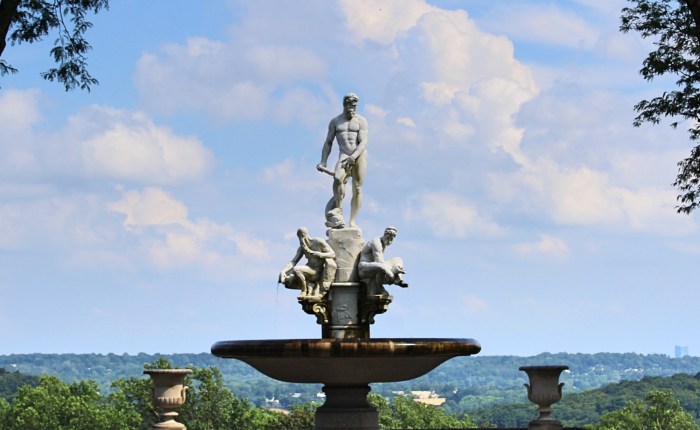
The bus deposited us in front of the house, near an impressive Oceanus fountain, copied from a fountain in Florence. Ivy crawls up the stone facade, all the way up to the neoclassical tympanum. An eagle crowns the top, displaying the family crest. From there the guide led us up onto the porch, where two strikingly modern statues stand flank the doorway. This is a constant feature in Kykuit: the juxtaposition between classic and contemporary tastes. John D. Rockefeller himself had very little taste in art, conservative or otherwise; his son, Junior, was enamored of the past—Greek, Medieval, even classical Chinese. Meanwhile, Junior’s wife, Abby, and his son, Nelson, were important patrons of modern art. Thus the house is an, at times, uneasy incorporation of these divergent tastes.
As a case in point, there are beautiful examples of Chinese porcelain on display throughout the house, protected by plexiglass cases. (The guide explained the glass was installed to protect them from playing children.) In a room used by Nelson Rockefeller there is also the vice-presidential flag, commemorating his term under Gerald Ford. Nelson wanted to be president himself, and he had the experience to do it—he was the governor of New york from 1959-72—but according to Ron Chernow, his divorce made him an unpalatable candidate. (How times have changed!) There were also portraits of the Rockefellers, and a phenomenal bust of the bald, decrepit, and yet mesmerizing John D. Rockefeller Senior—whom I was excited to meet, since I had just read a book about him.
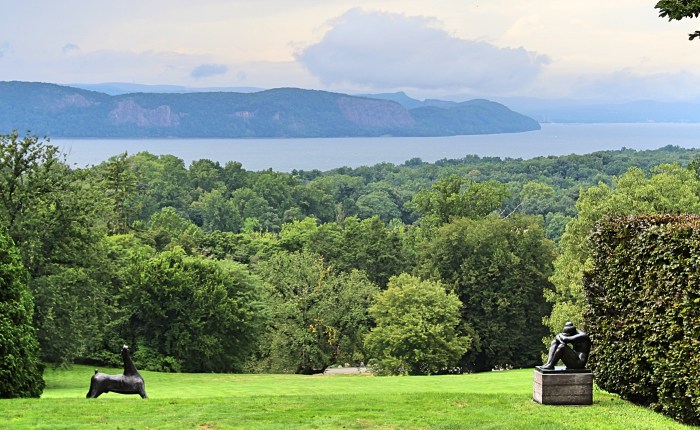
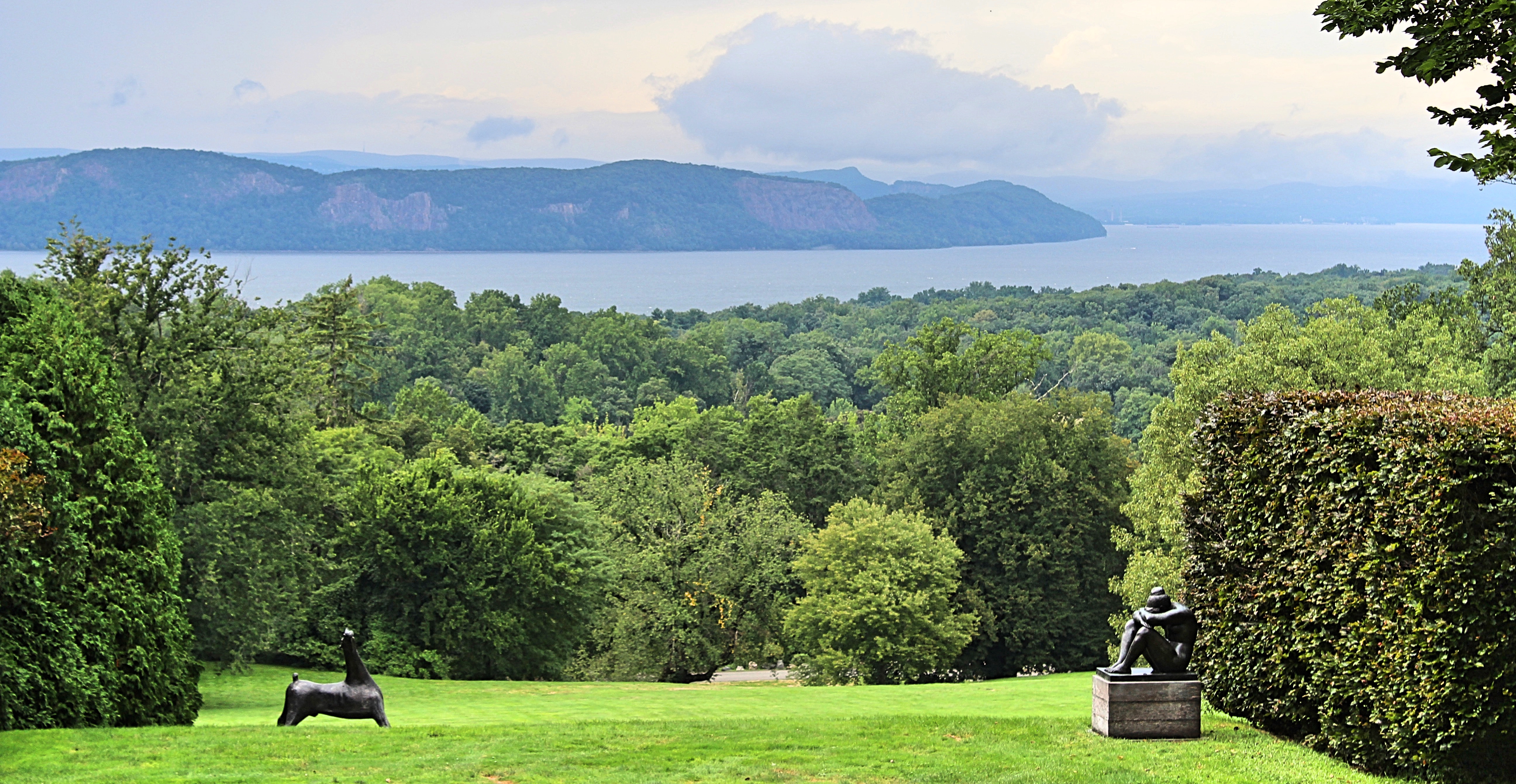
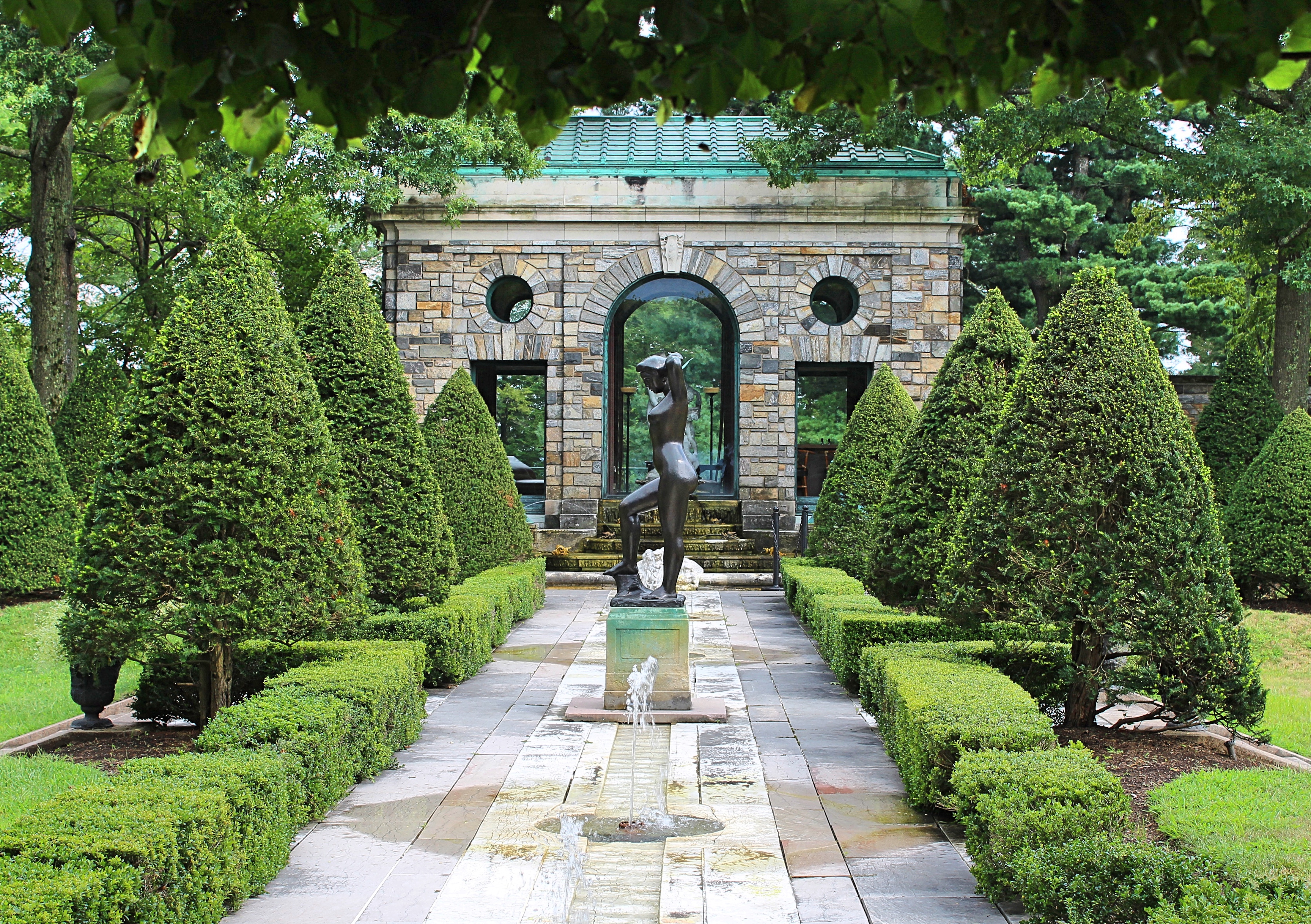
After this, our guide led us into the gardens. The most notable feature of these are the modernist statues scattered about—gruesome metal bodies amid neat hedgerows. Unsurprising for such a commanding spot, the view is excellent. On a tolerably clear day you can see all the way to Manhattan from the back porch. I imagined lounging on an easy chair, sipping some very posh drink—for some reason a mint julep comes to mind—and contemplating the Hudson. But of course the Rockefellers were Baptist stock, and teetotallers all, so the drink is pure fantasy. Beyond view (and beyond the scope of the tour) was the reversible nine-hole golf course that Rockefeller used with Baptist scrupulousness; after God and Mammon, golf was his top priority. Likely Rockefeller Senior would have been shocked and appalled by the massive modernist statue (resembling an alien squid) that was airdropped by helicopter into place on the property during his grandson’s tenure.
Then we made our way inside to visit the art gallery in the basement. This includes original works by many modern artist, the most famous being Andy Warhol; but the best works on display are undoubtedly the Picasso tapestries. These were commissioned by Nelson Rockefeller, to be made by Madame de la Baume Dürrbach, for the purpose of making his works easier to display. The biggest of these tapestries was a copy of Guernica, now on display at the United Nations building. Of the ones in this private gallery, my favorite is of Picasso’s Three Musicians (the original hangs in the MoMA). Even when I toured Kykuit as a child, tired, hungry, and very bored with all this old-people nonsense, I was impressed that a person could have Picassos in his basement; and my opinion has not changed.
To speed through the tour somewhat, we eventually boarded the bus again to go back to Philipsburg Manor. However, we did stop at the stables on the way back, which was filled with antique horse carriages and old luxury automobiles. In addition to being an avid golfer, you see, Rockefeller Senior also loved to go riding in his carriage and, in later life, to take fast drives in his fancy cars. (A strange detail from the biography is that, in later life, the upright and conservative Rockefeller would grope women during these rides. He was a man of many contradictions.)
This fairly well sums up my visit to Kykuit. It is an impressive place—six floors, forty rooms, and twenty bedrooms. Even so, considering Rockefeller’s vast fortune, and considering the kinds of monstrous mansions that other rich families—most notoriously the Vanderbilts—built for themselves, it is a restrained edifice. One can see the old Baptist tastes coming through, even amid all this wealth and splendor. Even so, I cannot imagine living in such a private world, so far removed from pesky neighbors and city noise. But the Rockefellers apparently had no trouble with the house. Nelson Rockefeller lived in it up until his death in 1979, when it was donated for use as a museum.
Before ending this post, I should also mention two nearby Rockefeller monuments.
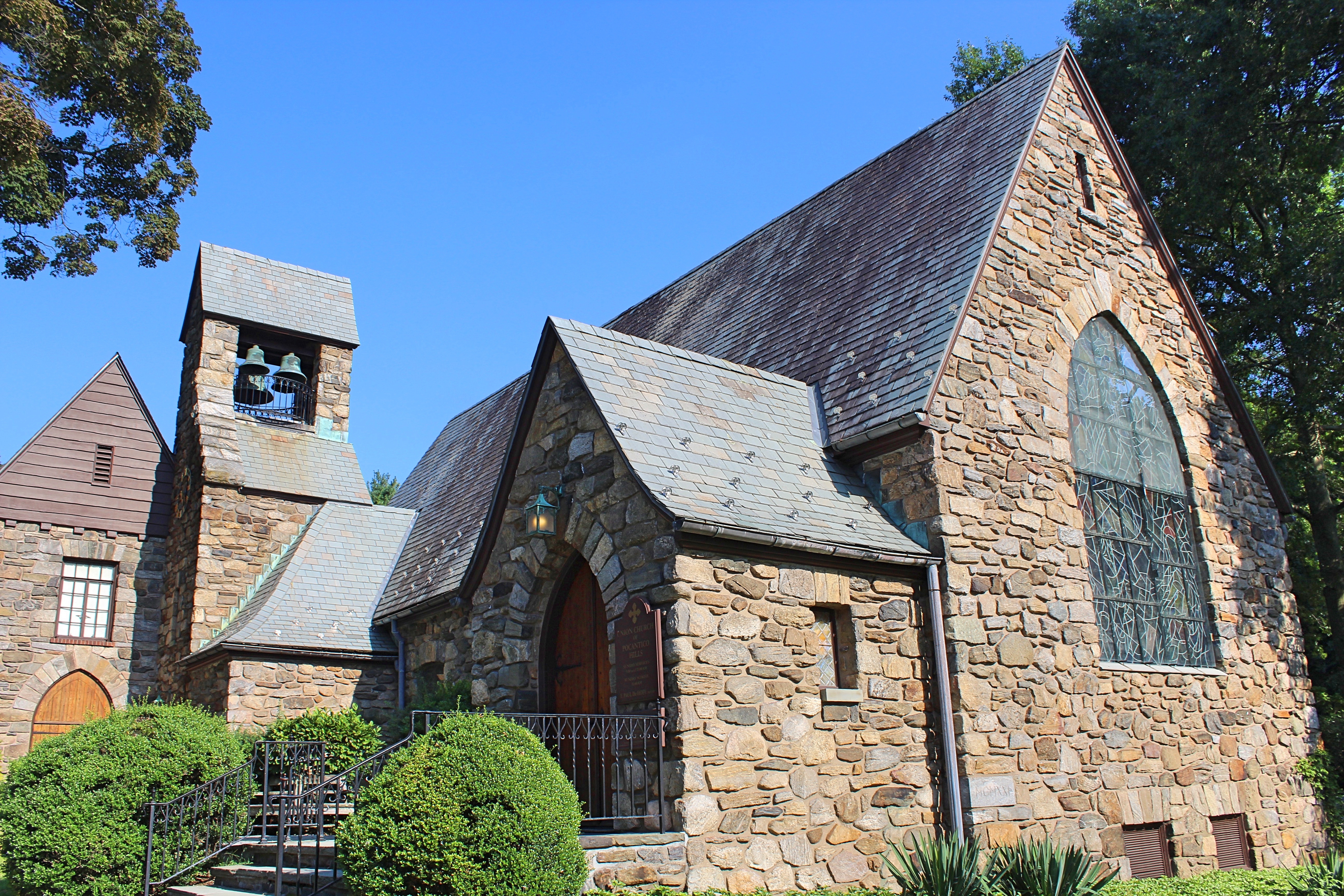
The first is the Union Church. This is one of two non-denominational churches (the other being Riverside Church in Manhattan) commissioned by John D. Rockefeller, Jr. It is an attractive and modest building, made of cut stone with a steeply slanting roof. Though the church does have an active congregation, most of the time its main use is as a tourist attraction, also administered by Historic Hudson Valley. The church is notable for its stained glass. The rose window was designed by the modernist pioneer Henri Matisse; according to the guide (I was the only one on the “tour”), it was the last work the artist ever completed. It is a simple, abstract pattern, yet subtly interesting to look at. More memorable, however, is the series of stained-glass windows completed by Marc Chagall, using Biblical scenes to commemorate deceased members of the Rockefeller family. Though I am normally not greatly fond of Chagall’s work, I must say that the strong, simple colors of Chagall’s windows created a pleasant—if not exactly religious—atmosphere.
Stone Barns
The second Rockefeller institution is Stone Barns, a center for sustainable agriculture established by David Rockefeller (Junior’s youngest son). (Sharing the Rockefeller talent for long life, David passed away just last year, at the age of 101.) The center lies on the edge of the Rockefeller State Park, alongside Bedford Road, surrounded on all sides by rolling farmland. It is a very pleasant place for a stroll. The buildings of the complex are completed in a style reminiscent of Union Church, as well as of the Cloisters museum in Manhattan: deep-grey cut stone. The farm is dedicated to growing high-quality produce and livestock without using anything “artificial.” Some of its products are served in the famous Blue Hill restaurant on the property—a place so absurdly fancy and expensive that, judging by the way things are going, I doubt I will ever get an opportunity to try. The menu, which costs $258 per person, consists of many different courses of artisanal dishes using esoteric ingredients. I have bought cheaper transatlantic plane tickets.
Processing…
Success! You're on the list.
Whoops! There was an error and we couldn't process your subscription. Please reload the page and try again.










 Lotz in Translation