Episode 18 of my podcast is here, a recording of my review of Beautiful Brain: the Drawings of Ramón y Cajal.
To listen, click below:
https://podcasts.apple.com/us/podcast/review-cajals-beautiful-brain/id1469809686?i=1000450594560
Episode 18 of my podcast is here, a recording of my review of Beautiful Brain: the Drawings of Ramón y Cajal.
To listen, click below:
https://podcasts.apple.com/us/podcast/review-cajals-beautiful-brain/id1469809686?i=1000450594560

Thomas Jefferson: The Art of Power by Jon Meacham
My rating: 2 of 5 stars
I did not enjoy this book. But my opinion might not be entirely fair, since it is colored by having read biographies of Alexander Hamilton and John Adams—two of Jefferson’s political foes—right before this, by two authors (Chernow and McCullough) whom I vastly prefer. This meant that I brought some strong preconceptions to the experience.
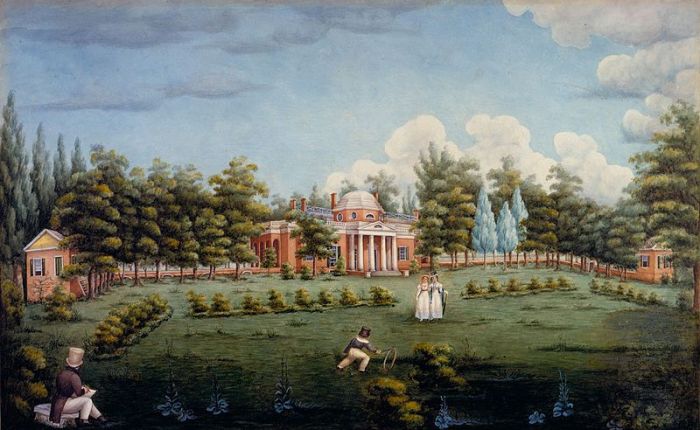
Nevertheless, I came to this book with a great deal of hope. Jefferson had come off rather badly in the two above-mentioned biographies. I wanted to see the other side of the man, the side that so many have admired. In fact, I played the audiobook recording of this book on a family trip down to Virginia, on our way to visit Jefferson’s home, Monticello, thinking that Meacham’s biography would whet our thirst for Jefferson history.
The effect was the opposite. All of us came away with a strong distaste for Jefferson, as well as dissatisfaction for Meacham’s apologetic treatment of the man. But before getting into differing opinions of Jefferson—of which there are endless—I shall talk about the writing, of which there may be more agreement.
To do justice to Jefferson the man would require a great deal of psychological subtly. Jefferson was reserved, withdrawn, even sphinx-like, a man full of contradictions. In the hands of an acute writer, Jefferson would make for a fascinating character-study. Yet Meacham is almost wholly uninterested in psychology. Jefferson is painted more vividly in his cameos in the Hamilton and Adams biographies than he is here.
To my mind, Jefferson was a man whom one could never take at face value, yet Meacham is often content to do just that. To pick just one example, in the exchange between Jefferson and Abigail Adams on the scurrilous writings of James Callender, Meacham is content to repeat Jefferson’s bland and disingenuous excuses of his support for Callender’s vilifications of John Adam’s character (that he bailed Callender out of jail merely because they held similar political views). Such instances are repeated throughout the book, with Meacham accepting as honest what I often read as intentionally misleading or simply duplicitous.
In any case, even if Jefferson is put to one side, no other personage in this book comes alive, as do so many in the above-named biographies. John Adams—a raging personality of epic proportion—is hardly more exciting than the taciturn George Washington. I was particularly disappointed at the lack of attention paid to Jefferson’s close and important relationship with James Madison, who is absent far too often in these pages, and who leaves hardly any impression whatever.
Meacham also lacks interest in drama. Good biographies can pull you into the historical moment, and make you feel how contingent the outcome of important events was on the quirks of personality or even simple chance. Yet in this book everything is a fait accompli. Difficult and arduous accomplishments, moments of danger and discord, are all summarized and narrated with a kind of mellow assurance that these events were destined to come to pass. The result is a book that is emotionally flat.
I would have excused these faults if Meacham had dug deep into the historical background or the political issues. But these, too, are given only a superficial treatment. Not nearly enough context is given, for example, for the reader to understand exactly why the Declaration of Independence was such a revolutionary document at that time. The same can be said for the Virginia Statute of Religious Liberty.
Instead, Meacham prefers to resort to strings of vague, Latinate adjectives and to draw grand-sounding conclusions. This is his habitual mode. The following passage, from the Prologue, gives a taste of this tone:
In pursuit of his ends, Jefferson sought, acquired, and wielded power, which is the bending of the world to one’s will, the remaking of reality in one’s own image. Our greatest leaders are neither dreamers nor dictators: They are, like Jefferson, those who articulate national aspirations yet master the mechanics of influence and know when to depart from dogma.
This tendency often leads him to substitute clichés for insight:
America has always been torn between the ideal and the real, between noble goals and inevitable compromise. So was Jefferson. In his head and in his heart, as in the nation itself, the perfect warred with the good, the intellectual with the visceral. In him as in America, that conflict was, and is, a war without end.
To me, this is neither good prose nor does it provide any valuable information. You could say all of the same things about virtually any nation or political leader. And in any case I do not think it is even true. Were all of Jefferson’s goals “noble”? Is compromise “inevitable”? Is the “war” between the “ideal and the real” actually similar to the conflict between “the intellectual” and “the visceral”? What does this even mean? This passage is hardly even valid as a platitude.
This leads me to what is my core criticism of the book: Jon Meacham’s understanding of Jefferson. Meacham’s central point is that Jefferson was a man of high ideals, but someone who was willing to compromise on his ideals in order to be an effective politician. This is the “Art of Power.” Thus, all of Jefferson’s pronouncements of principle are taken at face value, and all of his actions that do not align with his stated valued are excused as shrewd maneuvering.
Yet there is a difference between compromising on one’s vision and doing just the opposite. Consider Jefferson’s presidency. After having spent the last twelve years whipping up fears of overbearing central power, Jefferson signed the Louisiana Purchase and instituted a trade embargo—two huge expansions of federal power. Meacham would have us see these moves as capitulations to circumstances. But I think Jefferson’s tendency to flout the dictates of his own pen are too numerous to excuse. To pick another example, although he often styled himself above politicking and libel, Jefferson frequently employed others to write attacks on his enemies (as in the case of James Callender).
Here is another example. After stoking fear of a national army, and after his strong advocacy of the separation of the legislative and executive powers, once in office Jefferson himself asked a senator to introduce a bill approving military force—a direct contradiction of his stated principles on both counts. Characteristically, Jefferson also requested that the senator burn his note to him, so as not to appear to be meddling in the legislature. This is what Meacham has to say on the subject: “His adversaries might see such maneuvers as hypocritical and underhanded, but in Jefferson’s mind he was doing the right thing the right way. To seize power grandly would threaten the democratic ethos of the country—an ethos he thought essential.”
As an apology for Jefferson’s actions, this makes little sense to me. First, it hardly matters whether Jefferson thought he was doing the right thing in his mind. We all are, always. Second, to consider the mere ethos of democracy important while seizing power is certainly not democratic in any meaningful sense. This is typical of the whole book: where Meacham sees a flexible and enlightened politician, I see a person totally unwilling to live by the principles that he professes.
This is, of course, most flagrantly true in the case of slavery—an area in which Jefferson is inexcusable. To do Meacham credit, he does not attempt to justify Jefferson’s life of slaveholding. Nevertheless, I think he paid far too little attention to Jefferson’s domestic situation, which was totally dominated by slaves: as workers, servants, a sexual partner, and even his own children.
I see the issue of slavery as the most telling fact of Jefferson’s psychology, showcasing his ability to compartmentalize his thoughts. None of his actions were self-consistent. He wrote that slavery was evil and must end one day. But he did nothing to end it. At the same time, he thought that blacks could never co-exist with whites, all while having a life built upon the backs of slaves, living in constant contact with them. If he really believed that slaves were genetically inferior, as he wrote, how could he have had children with Sally Hemings, one of his slaves? Could he really believe that his own children with Hemings were naturally inferior? And if he did not, how could he totally relegate these children, his own blood, to a subservient or an invisible role in his life?
These questions leave me with a rather disturbing image. Meacham, however, sees Jefferson as a flawed hero—whose vision of artful politics has much to teach us. Jefferson did likely leave the world better than he found it. And, believe me, I find many aspects of Jefferson extremely admirable. In many ways I aspire to Jefferson’s wide interests and his intellectual greatness. But I think that any honest reckoning of the man will have to deal with these darker shades of his character. The vision of politics that Meacham offers, where high principles exist mostly as rhetoric or ethos, is not for me.
For episode 17 of my podcast, I recorded my review of Charles Darwin’s travelogue, The Voyage of the Beagle:
To listen, click below:
https://podcasts.apple.com/us/podcast/review-the-voyage-of-the-beagle/id1469809686?i=1000450118012
New York City is a land of bridges. According to the site, The Bridges of NYC, there are 2,027 bridges in the city—over five times as many as the bridges in Venice. Most of those bridges are small, ugly, and deservedly ignored. But several attract attention, and for good reason. The most famous bridge in the city is, of course, the Brooklyn Bridge. But before getting to that bridge, I will review some of the other 20 bridges that connect the island of Manhattan to Brooklyn, Queens, the Bronx, or New Jersey.
The largest bridge connected to the island of Manhattan is the George Washington Bridge. The bridge spans the Hudson, and connects New York to New Jersey. If not the biggest bridge in all of NYC, it is the busiest—carrying hundreds of thousands of commuters per day on its two levels. A suspension bridge opened in 1931, the George Washington is not especially beautiful; indeed, it is rather grey and devoid of character. But the bridge is open to pedestrian traffic, and so can provide an excellent view of the Hudson River (though this view is, admittedly, somewhat impeded by the anti-suicide net).

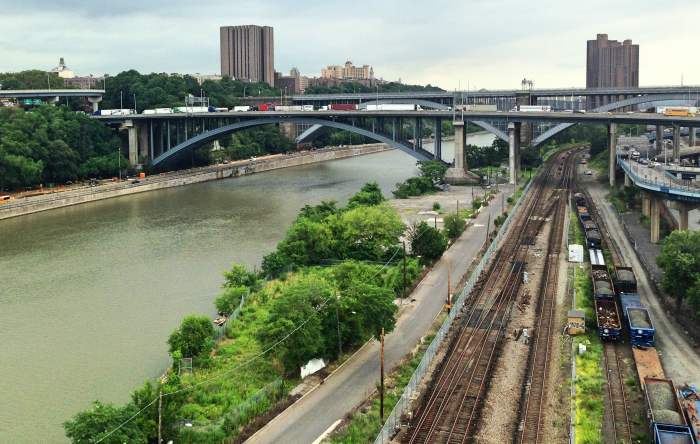
The majority of the bridges into Manhattan are located on the other side of the island, spanning the Harlem River between Manhattan and the Bronx. A traveler on the Hudson Line of the Metro North will pass by or under many of them, including the apparently unnamed railroad bridge that takes the train over the Harlem River, between the Third Avenue Bridge to the south and the Madison Avenue Bridge to the north. Both of these are swing bridges, a design that allows the steel structure to rotate to let boats pass by (though this is seldom nowadays).

As the train goes north, it passes by the Macombs Dam Bridge, which appears to be just another swing bridge, but which is also the third-oldest bridge in the city, having been opened in 1895. Further north are two large bridges, the Alexander Hamilton and the Washington (not George Washington), which rest on enormous steel arches.


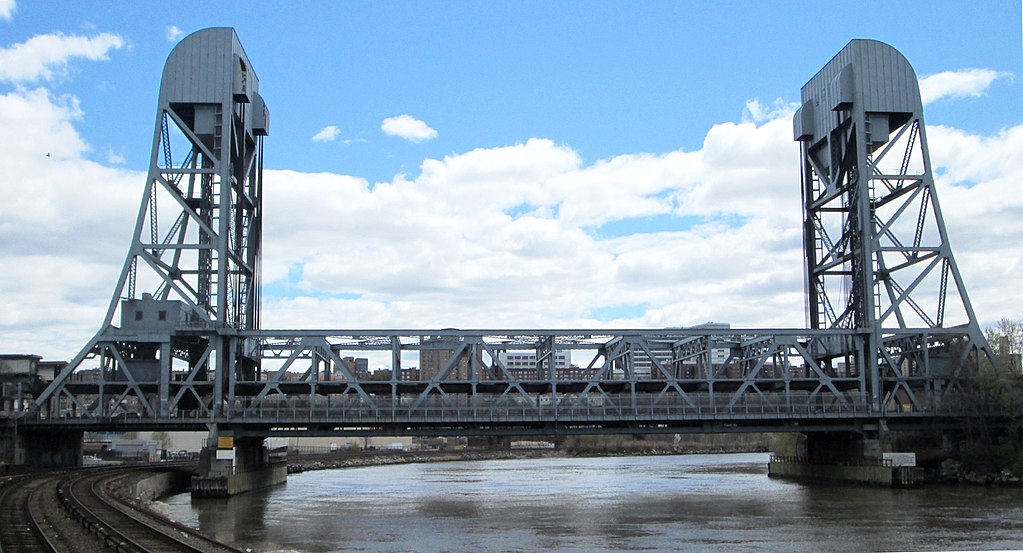
After that comes the Broadway Bridge, a somewhat odd-looking lift bridge, whose central span can be elevated to allow for passing boats. When I am waiting for the train at the nearby Metro North Station, I like to watch the Line 1 Subway pass over this bridge, creating an odd metallic echo and illuminating the bridge with blue sparks. And finally there is the Henry Hudson Bridge, another tall and not especially beautiful structure resting on a single steel arch. The infamous Robert Moses had to fight against the protests of the local residents to get the bridge constructed, as a part of his Henry Hudson Parkway plan.

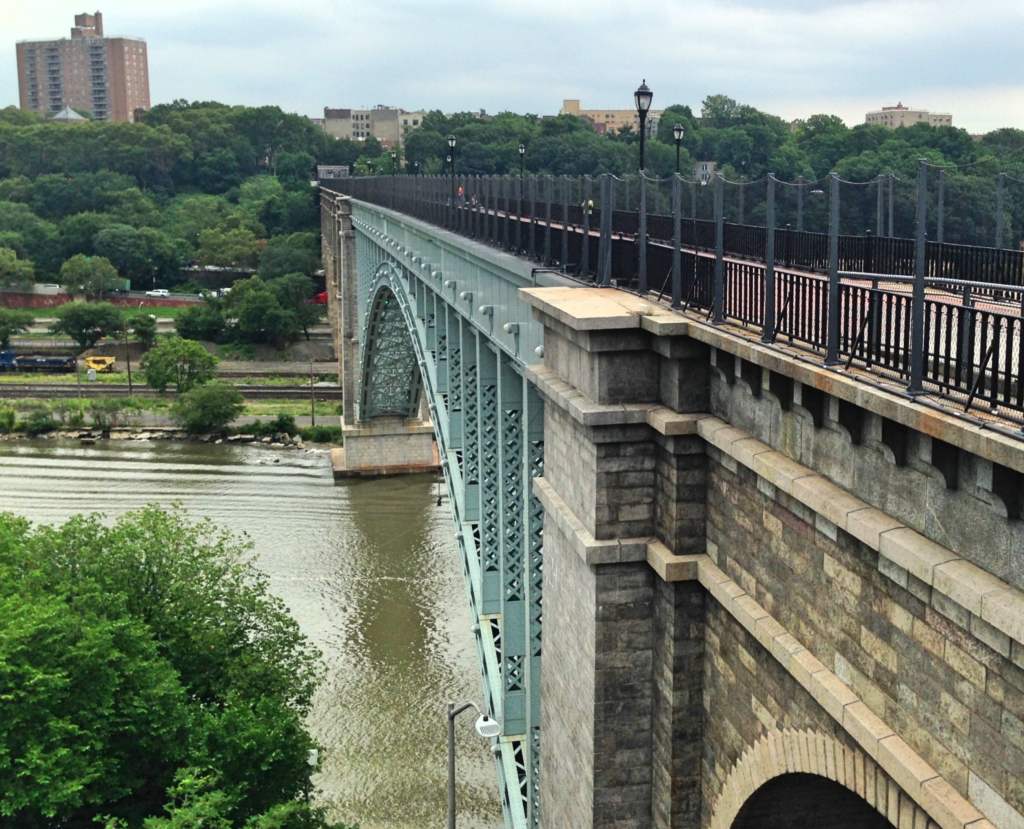
The very oldest and one of the most beautiful bridges in the whole city is also found in this area: the High Bridge. Constructed in 1848, the High Bridge was originally built as a part of the Croton Aqueduct, ferrying water from upstate New York into the city in a long tunnel, carried across the Harlem River on a series of stone archways. The High Bridge’s design and function gave it the appearance of an ancient Roman aqueduct; but the stone columns impeded traffic on the Harlem River; so in 1928 the columns were replaced by a single steel arch, much like the nearby Alexander Hamilton or Washington Bridges. Nevertheless, the bridge—now for pedestrians only—is one of the loveliest in the city, ideal for a walk with a view. The old water tower, designed to pump the water from the Croton Aqueduct uptown, still presides over the Manhattan side of the bridge, looking like a turret from some forgotten castle.

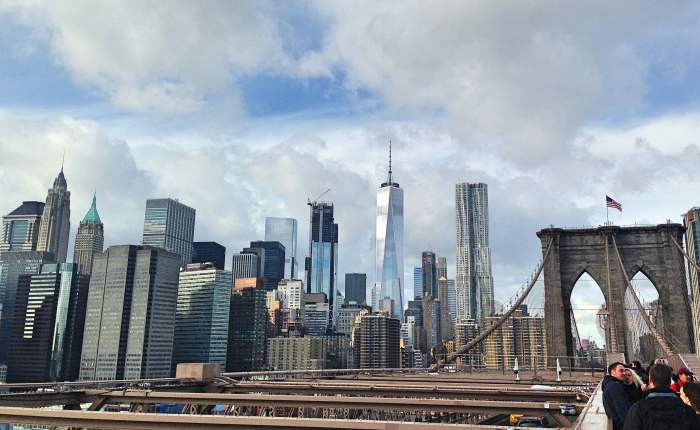
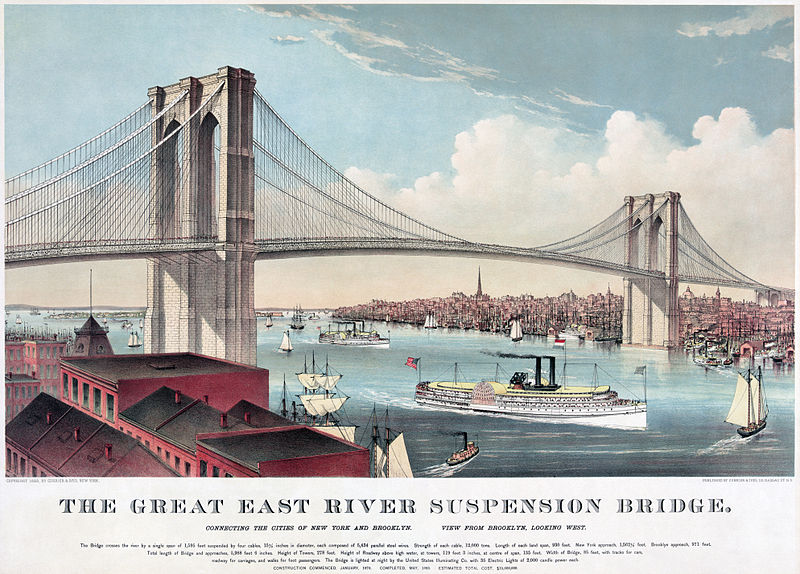
The most impressive bridges in Manhattan are, however, concentrated downtown, connecting the borough with Brooklyn, across the East River: the Manhattan Bridge, the Williamsburg Bridge, and the Brooklyn Bridge. Of these, the last named was the first to be built and remains the crown jewel of NYC infrastructure, a monument of engineering and one of the most significant public works of the 19th century.

When construction began on the Brooklyn Bridge, in 1870, Manhattan and Brooklyn were two different cities. Unification of the boroughs would not come until 1898. Thus, the politics behind the bridge were controversial and complicated, requiring the cooperation of two rather corrupt city governments (“Boss” Tweed, of Tammany Hall, was on the board for the Bridge). Before the bridge was built, the only access across the East River was provided by a handful of ferry companies. For decades commuters relied on these little boats to get to work, as Walt Whitman immortalized in his poem, “Crossing Brooklyn Ferry”:
Crowds of men and women attired in the usual costumes, how curious you are to me!
On the ferry-boats the hundreds and hundreds that cross, returning home, are more curious to me than you suppose,
And you that shall cross from shore to shore years hence are more to me, and more in my meditations, than you might suppose.

The Bridge was designed by John Augustus Roebling, a man of enormous proportions. After studying philosophy with none other than Georg Wilhelm Friedrich Hegel in Germany, Roebling moved to the United States to pursue a Utopian vision of a collectivist, agricultural community in Saxonburg, Pennsylvania. When this did not pan out, Roebling turned his attention to engineering, creating daring and ingenious designs of suspension bridges and perfecting the steel cables necessary to build them. He was the natural choice to design and build the Brooklyn Bridge. But, when the bridge was still in the planning stage, Roebling injured his foot, developed tetanus, and died. (A believer in water therapy, he refused conventional treatment and insisted on soaking his injured foot and wrapping it in towels.) This left the project to his more-than-capable son, Washington Roebling.
Washington was already a Civil War hero and, thanks to his travels in Europe, an expert in caissons. A caisson is a sort of massive container, meant to be sunk to the bottom of the river. Water is then pumped out of the bottom chamber, and pressurized air is pumped in, allowing men to dig on the riverbed. They had to dig deep into the river until they hit the bedrock appropriate to carry the weight of the bridge. It was harrowing and dangerous work—deep underwater, under intense pressure, with water constantly seeping in. As the caisson sunk deeper and deeper, requiring higher pressure to keep the water out, the men began to develop the bends when they returned to the surface (or, as it was called then, “caisson sickness”). Since the condition was not understood at the time, the management had no idea how to prevent it. Workers would come up from the heavily pressurized air to sea level in only a few minutes, not nearly enough time for the body to adjust. This left many in agonizing pain, some permanently injured, and a few dead.

Washington Roebling himself was a victim of decompression sickness (though it may have been compounded by stress), leaving him so sickly and weak that he had to communicate all of his instructions by letter and observe the bridge by telescope. Even so, the caissons eventually reached the appropriate depth, were filled with concrete to serve as the foundations, and then construction of the stone towers began—easily the most massive buildings in the city at the time. Then, the wire cables had to be suspended. The board unwisely chose an unscrupulous wire manufacturer, who knowingly provided shoddy products in order to increase his profit. And though the bridge engineers caught on to this ruse, some of the defective wire is still built into the bridge (though not enough to make it unsafe, I am assured). In fact, John A. Roebling’s original design was meant to make the bridge at least six times as strong as necessary, making it possibly the most durable bridge in the city.
Finally, in 1883, the bridge was opened to massive acclaim. It was a technological marvel, a pivotal work of infrastructure, and a tourist attraction—as it remains. Originally the bridge had room for pedestrians, electric street-cars, and horse-drawn carriages, and also two cable-cars that ferried people back and forth. One of the earliest film recordings by Thomas Edison is a passenger’s view from the front of one of these cable cars, as crowds of men in top-hats walk by. (To learn more about the bridge, I recommend David McCullough’s excellent history, from which I am drawing my information.)
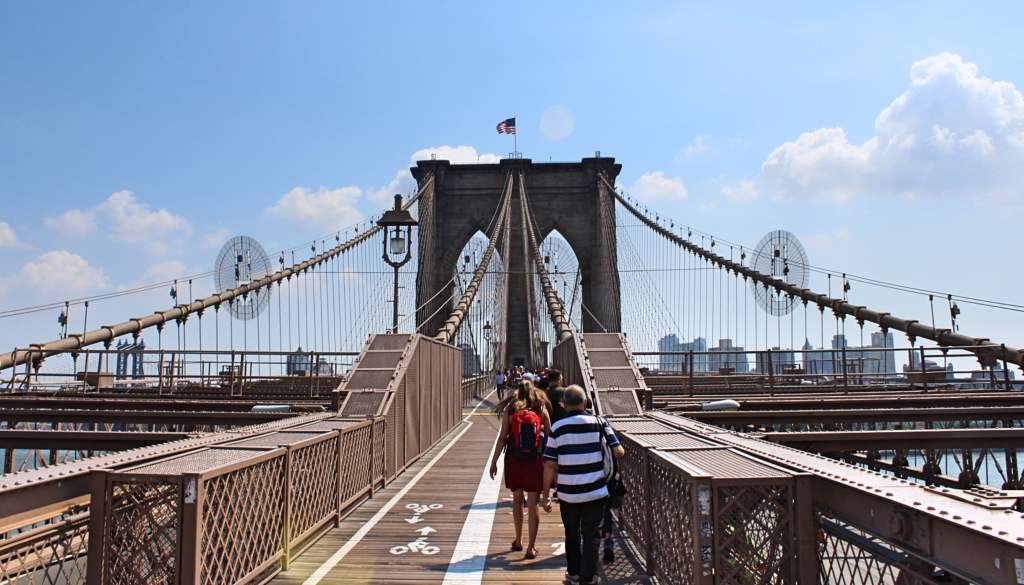
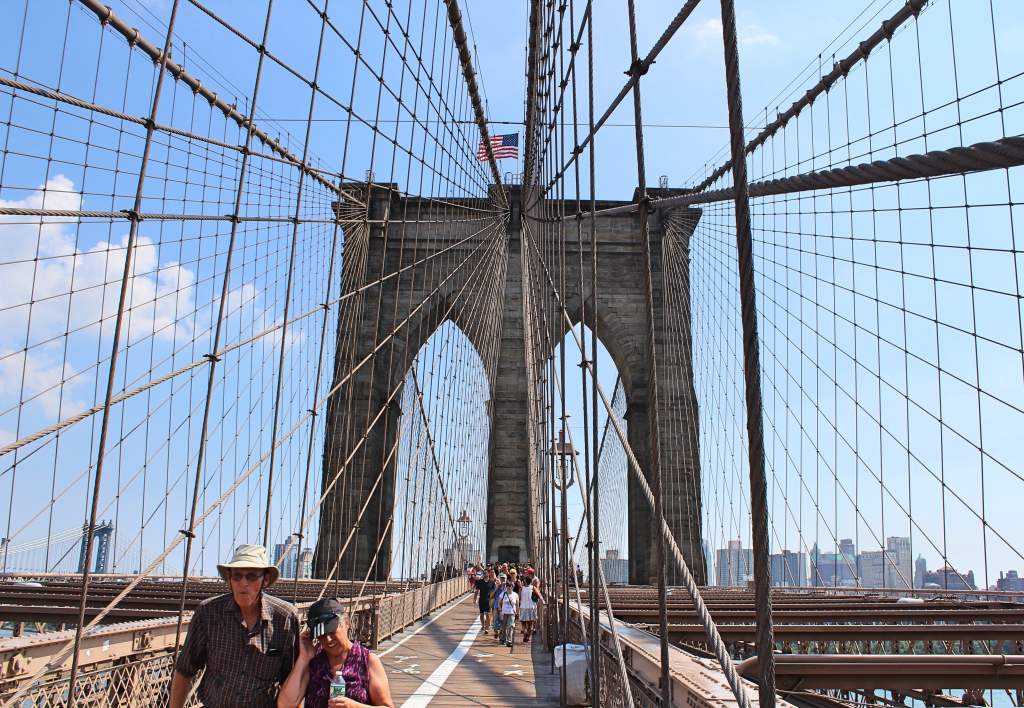
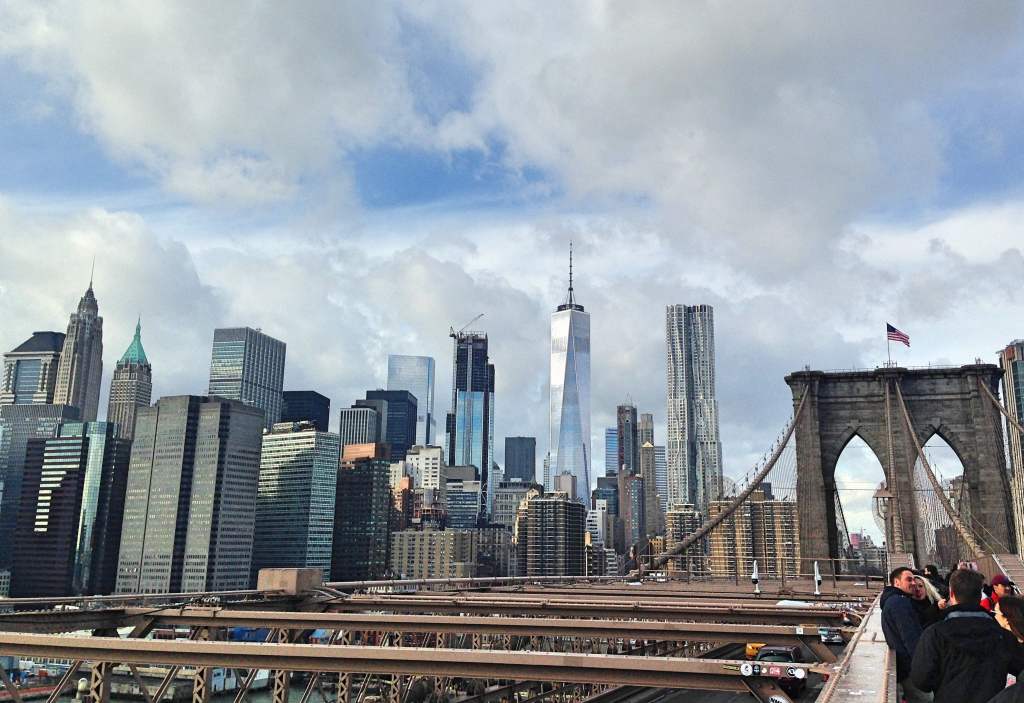
The bridge looks rather different now. For one, the cable cars have gone. And the street cars and horse-drawn carriages have been replaced by a sea of yellow taxis and multicolored automobiles. Pedestrian access is via a special walkway, elevated above the road level, going through the center of the bridge. The walkway nominally has both a walking lane and a bike lane, though so many tourists crowd the bridge on any given day that cyclists must fight their way through the crowd—shouting constantly. The view from the bridge has changed quite a bit, too. Far from being the largest structure in the city, the bridge’s towers now appear diminutive against the background of skyscrapers in Manhattan.

But the bridge is still a lovely sight. The gothic arches rise up and into the air, culminating in a solid block of stone that seems oddly ancient in the city of glass and metal. The surrounding steel cables create a pleasing geometric pattern, shifting slowly as one crosses the bridge. From the center of the walkway the cables form a kind of receding net, creating a grid that disappears into a vanishing point, much like a Renaissance painting. And the view of Manhattan, Brooklyn, and the East River from the bridge is one of the best in the city. Considering that it is so iconic, so pleasant, and free, the Brooklyn Bridge is a necessary part of any visit to New York.

Yet the bridge’s neighbors also deserve mention. Slightly east of the Brooklyn Bridge is the Manhattan Bridge, an all-metal suspension bridge that used an innovative design which was to prove highly influential. Opened just 26 years after the Brooklyn Bridge, the Manhattan Bridge nevertheless appears modern and unremarkable—wholly functional, with no thought given to aesthetics. Unlike on the Brooklyn Bridge, this bridge’s pedestrian platform is separate, off to one side, and situated below the main span, which somewhat limits the view. I do, however, enjoy the experience of riding the subway (lines B, D, N, and Q) over the bridge—hearing the hard clack of the tracks and seeing the city through the triangular bars.

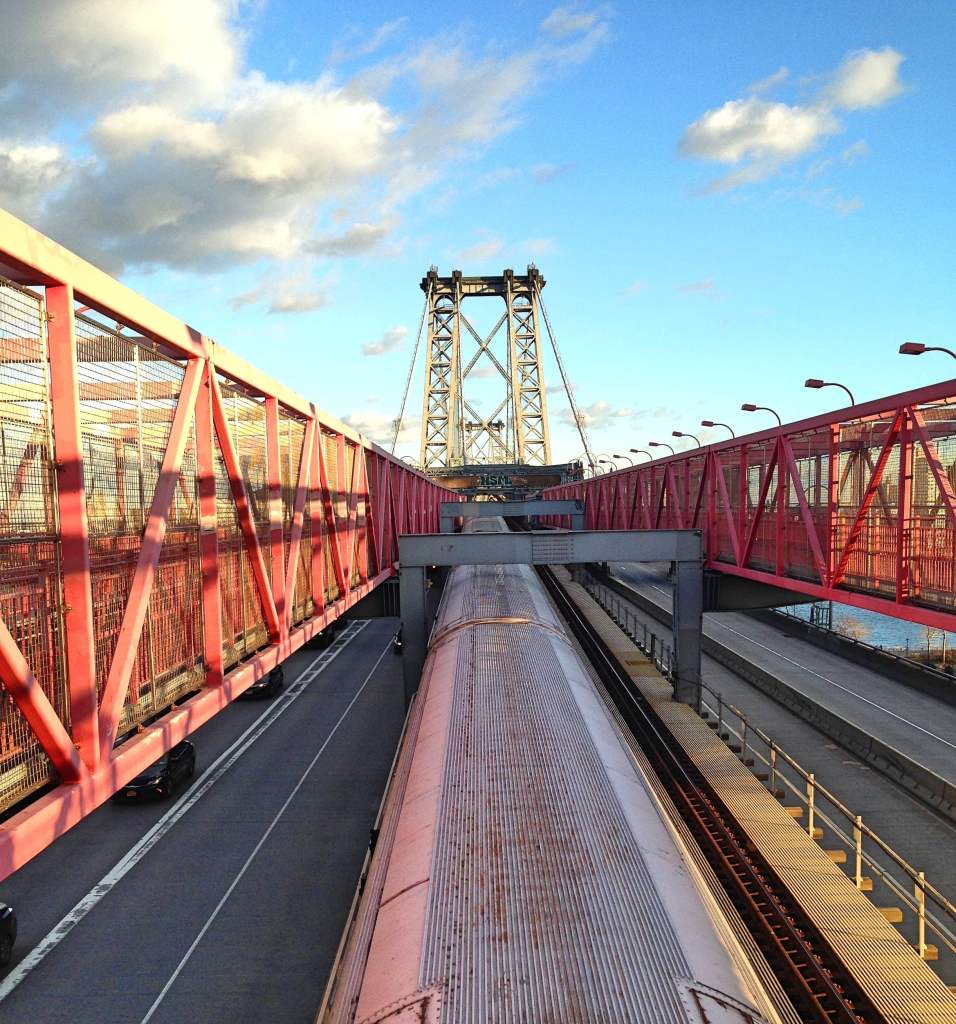
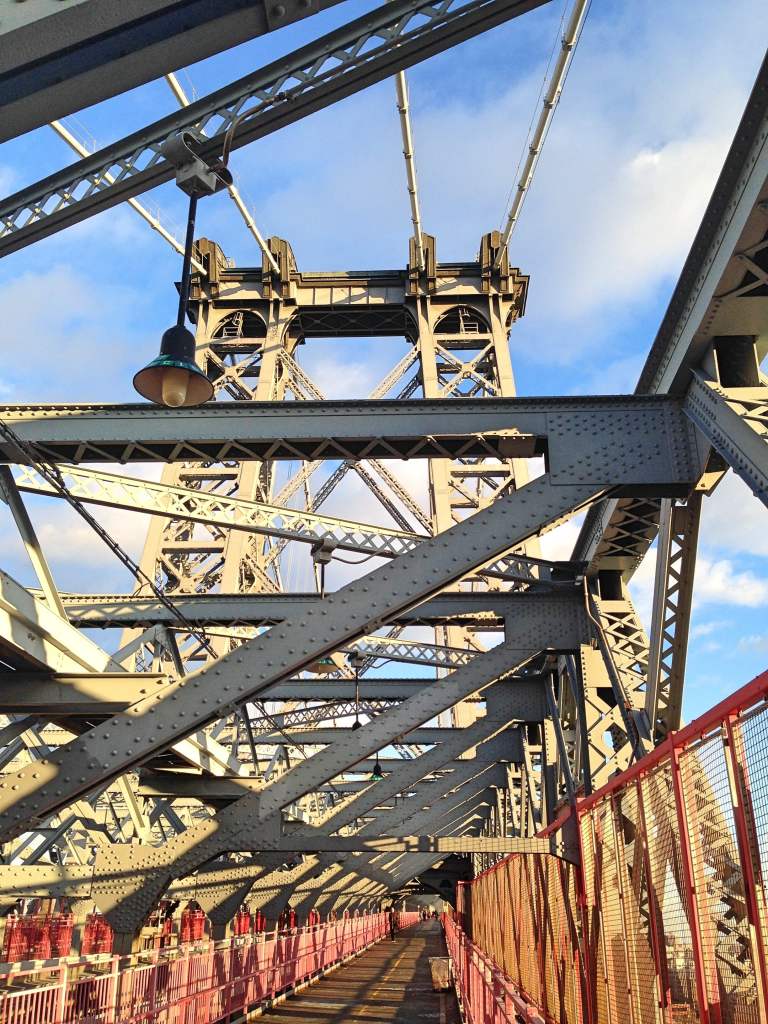
Further east and north is the Williamsburg Bridge. This bridge looks to the untrained eye rather similar to the Manhattan Bridge. Opened six years earlier, in 1903, it is also an all-metal suspension bridge, appearing nowadays to be plain and utilitarian. In my opinion, however, this bridge is one of the lesser-known treasures of NYC. Like the Brooklyn Bridge, it has a central walkway that gives a nice view of the city (though, admittedly, the view from this bridge is obscured by a thick metallic cage that encloses the walkway). If the bridge is less picturesque, it compensates by being far less crowded than the Brooklyn Bridge. Both times I walked across, the span was nearly empty. The visitor can also observe the subway (lines J, M, and Z) passing underneath the platform, causing a pleasant ruckus and rumbling. I even observed some love-locks on the bridge.


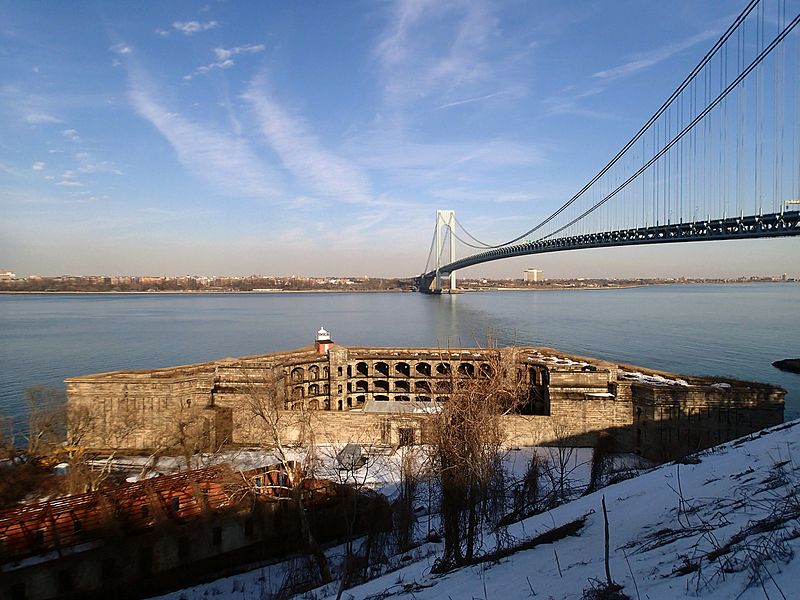
I will end this post by mentioning one bridge that I have personally never seen. The Verrazzano-Narrows Bridge is the longest and largest bridge in NYC, and was also the longest in the world for nearly twenty years (1964 – 81). (The Williamsburg Bridge and the George Washington have both held that distinction as well.) The enormous bridge was built under the auspices of Robert Moses as a way of connecting Brooklyn with Staten Island, and named in honor of the first known European explorer to enter New York Harbor, Giovanni da Verrazzano. Strangely, however, Moses forgot to look up the spelling of that explorer’s name, officially naming the bridge called the “Verrazano-Narrows” (with one z). It was not until 2018, fifty-eight years after its opening, that the name was finally corrected. Now Giovanni can rest in peace.

To follow up my previous post about two notable uptown churches, here are two of the most famous and historic churches in downtown Manhattan.
Standing in the shadow of the One World Trade Center is one of the most historic and quiet buildings in the city: St. Paul’s Chapel.
Few buildings can so powerfully evoke the history of New York and of the United States as a whole. The chapel was completed in 1766, making it the oldest church in Manhattan and the only church on the island which dates from pre-Revolutionary times. Indeed, the church is so old that it dates from a time when New York was not the financial center it is today, but a provincial city in a relatively unimportant colony far away from the centers of power and commerce.

Unlike the city’s two cathedrals, therefore, St. Paul’s is a rather humble construction, dwarfed by the surroundings skyscrapers. From the outside, the church’s most striking features are its neoclassical portico and its large central bell-tower (when it was first built, St. Paul’s was the tallest building in New York—consider that). In design it is Georgian, modeled on the much larger St. Martin-in-the-Fields, in London. Unlike its pale English counterpart, however, St. Paul’s is grey and brown, since it was built using the local schist and brownstone.

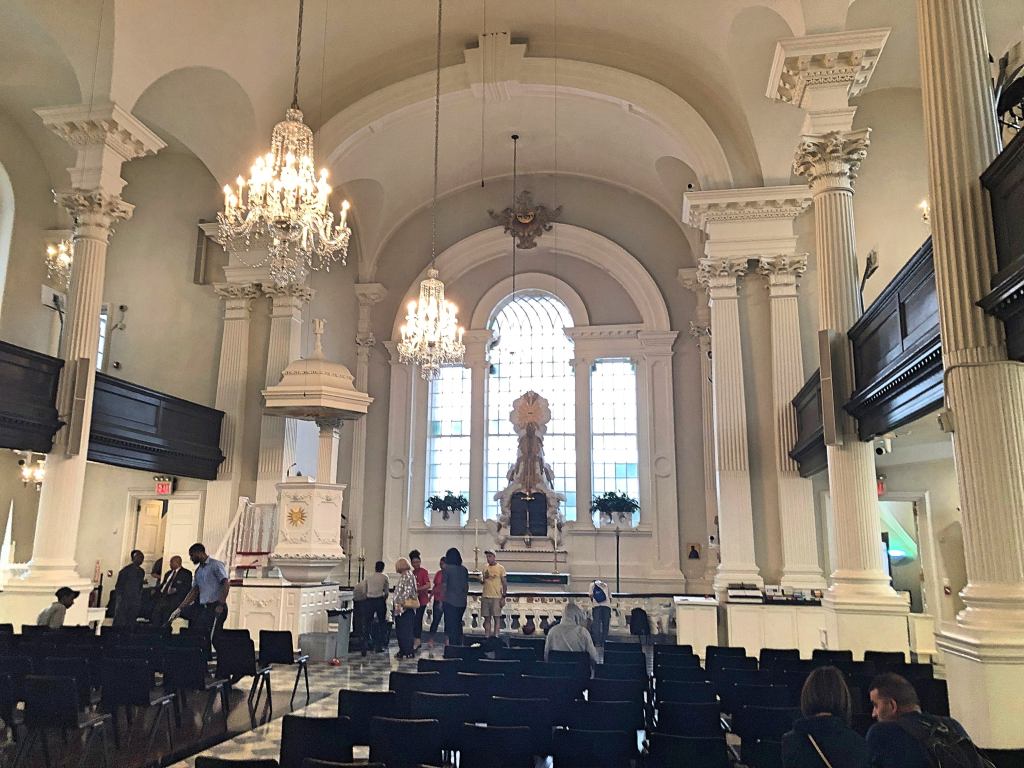
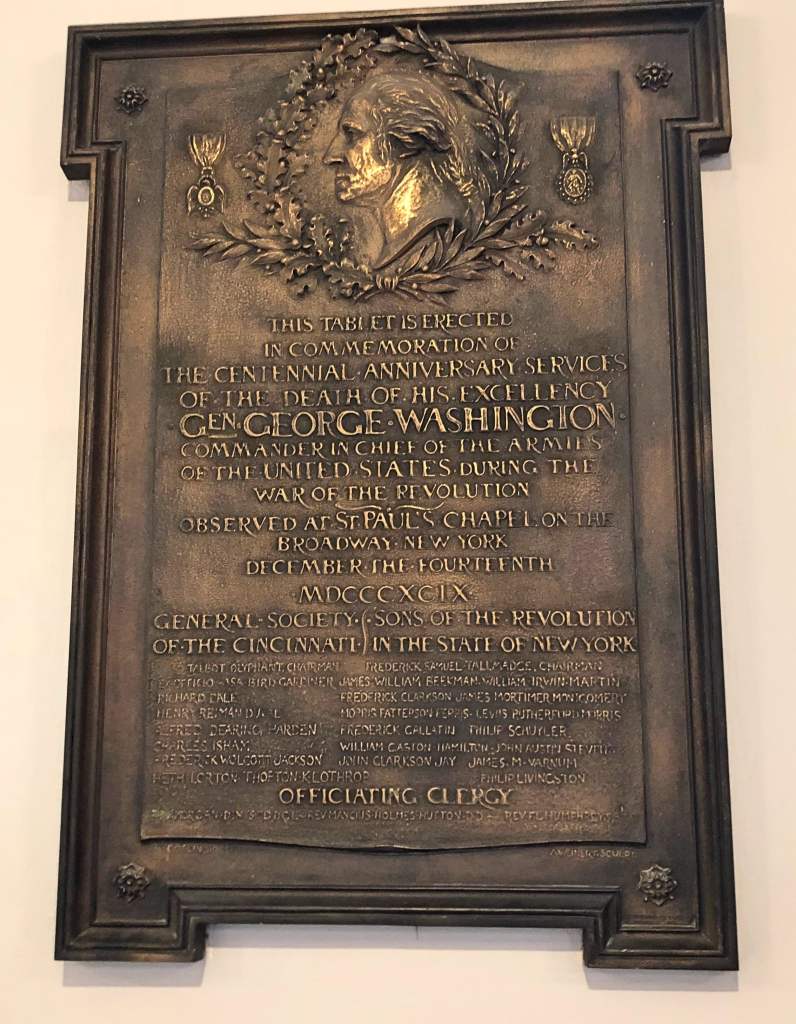
The inside is, if anything, even less ostentatious than its exterior. If anything, the chapel’s whitewashed walls and spare decoration evoke a kind of ethereal purity, above all worldly riches. Only two works of art call our attention: an early painting of the Seal of New York and the Great Seal the American Seal (featuring a bird which looks far more like a turkey than an eagle, as Benjamin Franklin would have liked). Nearby a plaque is dedicated to the memory of George Washington, who would come here to pray in the early years of his presidency, when New York City was briefly the nation’s capital. Alexander Hamilton, some years before that, had drilled in the churchyard during the Revolutionary War.


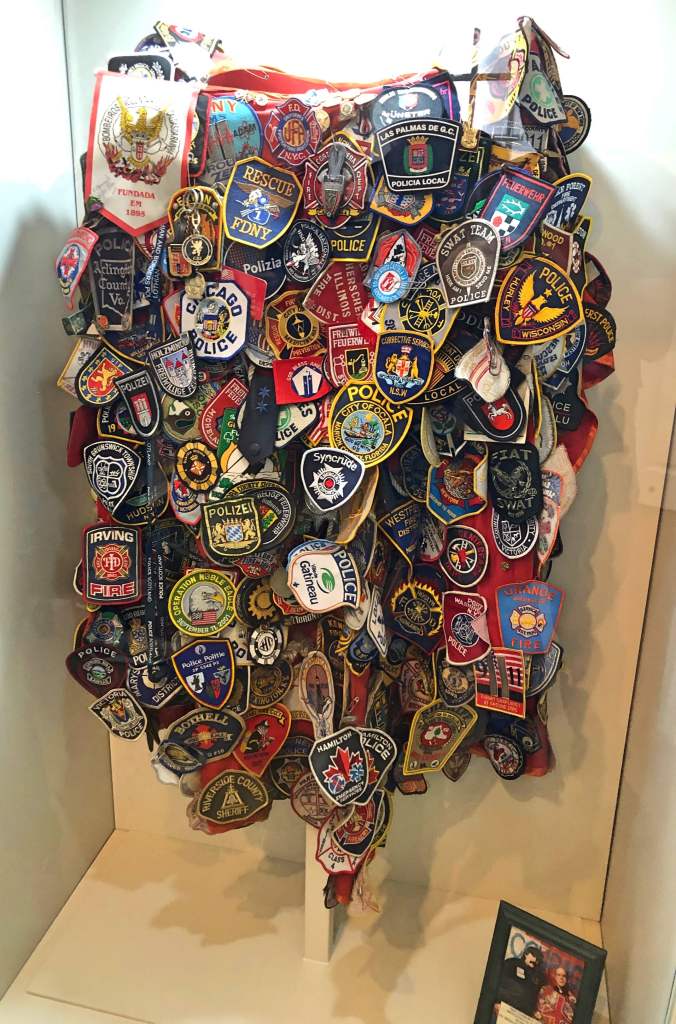
The church has played a role in far more recent American history, however. During the horrific attacks of 9/11, the church served as an impromptu shelter for emergency workers. Firefighters and police officers slept on the pews, while volunteers prepared meals by the hundreds. The church became known as “The Little Chapel that Stood” during the ordeal, since it suffered no serious damage during the attacks. A small chapel in the back of the church commemorates this dark time, preserving some of the mementos that citizens left on the fences of the church as a memorial.

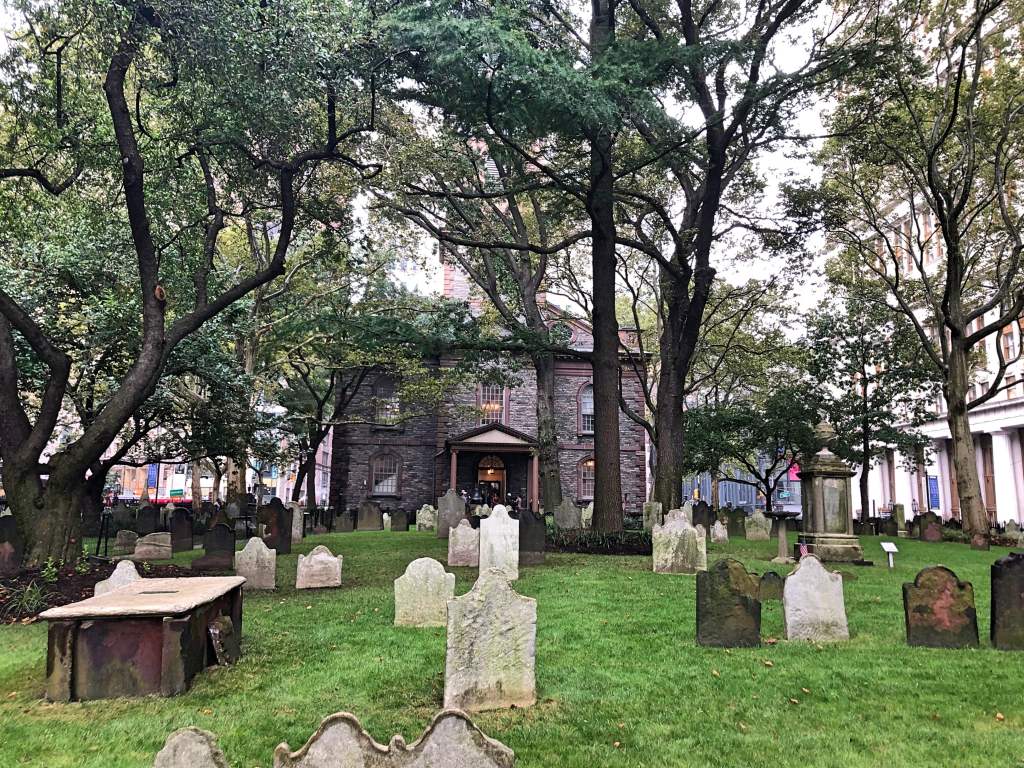
Behind the church is a graveyard, among the oldest in Manhattan. Among others, here is buried Richard Montgomery, a general during the Revolutionary War who was killed during an unsuccessful attack on Quebec.
St. Paul’s chapel, as its name indicates, is not a stand-alone church. Rather, it is a “chapel of ease” for those who found going to the parish church too far from the port, and thus too inconvenient. This explanation is a bit difficult to swallow, however, considering that St. Paul’s is literally a five-minute walk from the parish church: Trinity.

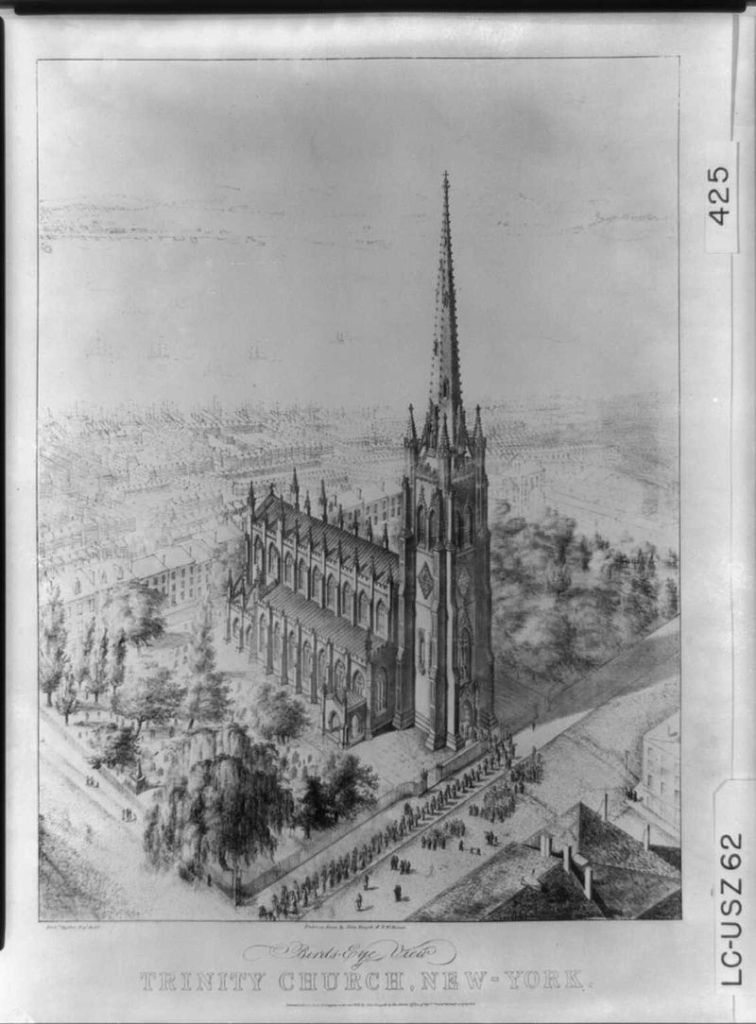
Trinity Church is, unquestionably, the most important church in NYC history. It has been around from the beginning. It was first opened in the closing years of the 17th century, serving as the parish church of the Church of England in what was then a small, provincial city, only recently transferred from Dutch to English control. The first church building, which I suppose was likely an impressive structure, burned down in 1776 during the Revolutionary War, shortly before Manhattan was evacuated by Washington’s troops and ceded to the British. A second building was erected in its place, where (like St. Paul’s chapel) Washington and Hamilton came to pray during NYC’s brief stint as the nation’s capital. But severe weather fatally damaged that building, too.
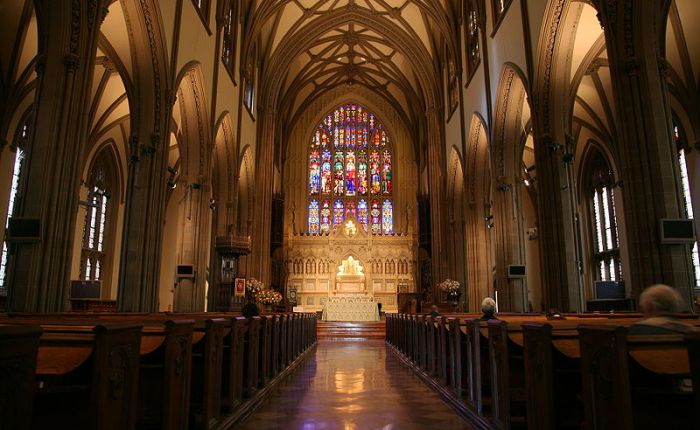
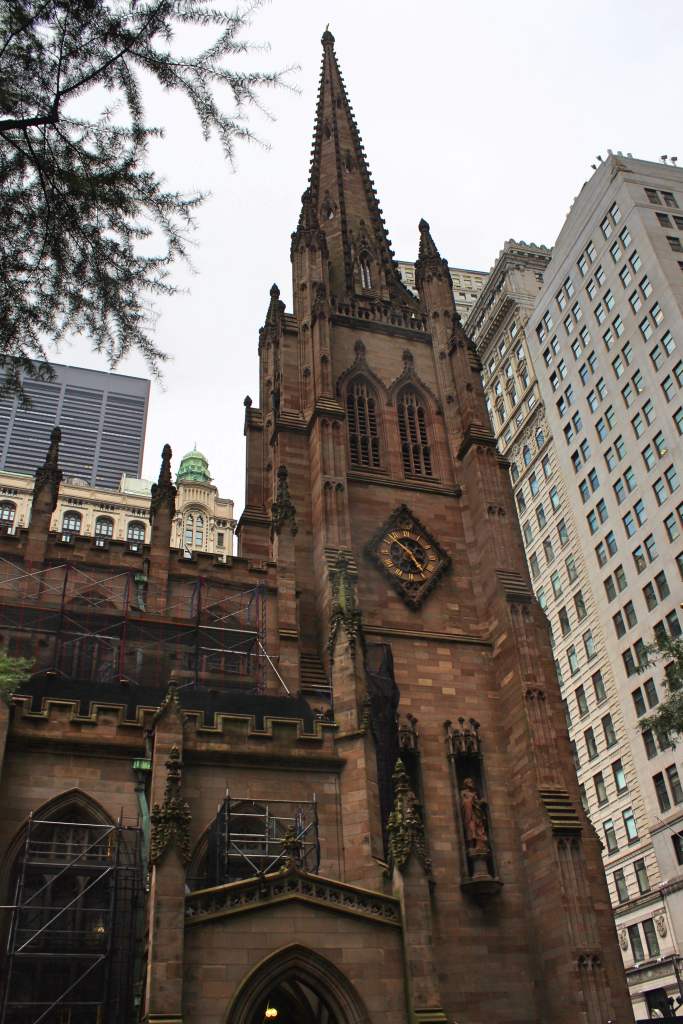
The church that stands today is the third version, which was finished in 1846. For many years its spire was the tallest structure on Manhattan, indeed in the United States—something that is difficult to believe nowadays, as the church is crushed to insignificance among the giant skyscrapers of Wall Street. In style it is gothic revival, though its design is muted and humble as compared with, say, St. Patrick’s Cathedral further uptown. What it lacks in splendor it makes up in simple beauty, which is difficult to find in Manhattan. Yet it is ironic, of course, that what was once the greatest building in New York City is nowadays charming for its small size.

The interior of Trinity is even more understated than its exterior. The gothic vaulting and pointed arches do not give their usual impression of extreme verticality, and in fact the space is inviting and human-scaled.

My most vivid memory of Trinity was when I was interviewing for my first job. The company was on Wall Street (though it was not in finance). I arrived quite early and wanted to kill some time before entering the building; and as it was raining, Trinity provided the perfect escape. I was desperate for a job and this was my first real interview, so you can imagine how nervous I was. I sat in one of the pews and read Ecclesiastes in one of the bibles, a chapter whose heroic fatalism helped to calm me. Meanwhile, a group of choral singers had set up near the altar and begun rehearsing, which allowed me to hear the church’s wonderful acoustics. It was a great way to calm down before the interview. I still did not get the job.
As with St. Paul’s Chapel, Trinity is surrounded by a graveyard, also one of the oldest in the city. By far the most famous burial is Alexander Hamilton (1755 – 1804), one of the most influential intellectuals and statesmen in the founding of the United States. His death was as dramatic and memorable as his life: shot down in a duel with Vice President Aaron Burr, across the Hudson in New Jersey. His grave is fairly simple: a rectangular base topped with a pyramid, which duly lauds his memory. Next to Hamilton is buried his wife, Elizabeth Schuyler, who survived her husband by fifty long years. Alexander’s son, Philip, who died in a duel two years before his father, is also buried here.

Much further uptown, at 155th street, is another churchyard managed by Trinity Church. It is on the former estate of John James Audubon, and includes many famous burials, including Audubon himself. I have not visited yet, but I plan to.
For anyone in the area of Battery Park or Wall Street, these two churches provide a much-needed relief from the rush of suits and ties, the inhumanly vast buildings, the often hostile weather, and the relentless city noise. What is more, they are vessels of New York City history, nearly as old as the city itself.
A new episode of my podcast is out: my review of Isaac Newton’s Opticks. And I have a new microphone!
https://podcasts.apple.com/us/podcast/review-newtons-opticks/id1469809686?i=1000449793940
My new podcast episode is here, and it is my review of Isaac Newton’s Principia. To listen, click below:
https://podcasts.apple.com/us/podcast/review-newtons-principia/id1469809686?i=1000448423201

John Adams by David McCullough
My rating: 5 of 5 stars
This is a wholly enjoyable book, which is the secret of its success. Merely flipping through and scanning a couple passages was enough to convince me to abandon everything else I was reading and to go on a pleasure cruise through history. McCullough’s writing is charming to a rare degree—elevated yet folksy, readable without being simple, and filled with personality without being opinionated. I can see why he is so popular.
Yet it must be said that McCullough achieves this charm by relegating much of the tedious, dreary, or ugly side of Adams’s life to the background. A serious intellectual appraisal of Adams would require a much deeper analysis of his political writings; but here they are minor episodes. A serious appraisal of Adams’s presidency would require a far more thorough review of his policies and legistlation, most obviously the Alien and Sedition Acts. Yet here they are just touched upon. Obviously, such a book as I am describing would be both longer and, almost certainly, duller.
Instead of attempting any kind of definitive appraisal, McCullough gives us a literary biography, a portrait of a man in his times. And Adams is well chosen for the subject of such a book. He left a huge correspondence and a copious diary, writing with rare candor and verve throughout his life, which gives the happy biographer a great deal to work with. Further, Adams was a personality of rare proportion: prickly, warm, passionate, brilliant, stubborn, loyal, foolhardy, blunt, obtuse, principled… the list is endless. As are all of us, Adams was a strange inter-mixture of virtues and vices, yet none of his were moderate.
Even if Adams had been devoid of character, however, the events of his life would still attract attention. He was at the forefront of the Continental Congress, instrumental in driving the early stages of the Revolutionary War: creating an army, appointing Washington to head it, declaring independence, and then choosing Jefferson to draft the declaration. Then, Adams had a long and adventurous life in Europe, working in England, France, and the Netherlands—a feast for the biographer. What is more, Adams was intimately involved with many of the leading personalities of the times, not to mention being the father of another president. So you can see that McCullough had plenty of grist for his mill.
Apart from all of this, John Adams was married to perhaps an even stronger character, Abigail. She comes across as truly John’s better half, if not more intelligent than wiser than he, with a personality more stable but no less fascinating. Thus the biography is, quite often, more of a dual biography of these two extraordinary people. Jefferson receives almost as much attention as Abigail, alternately friend and foe, serving as Adams’s foil: calm, reserved, duplicitous, underhanded, and often unwilling to live by the principles he professes—which makes him a far more effective politician. McCullough turns Adams and Jefferson into the twin poles of the Revolution, much as Chernow did with Hamilton and Jefferson. I suppose I should read something about Jefferson now.
Even if the reader will not come away with an understanding of Adams’s politics and policies, there is still a great deal of value in this book. As with every McCullough book, it is a window into a bygone age, illuminated by bright personalities. And in my case, that is all I wanted.
View all my reviews
The Oresteia: Agamemnon, The Libation Bearers, The Eumenides by Aeschylus
My rating: 5 of 5 stars
The Greeks had an intoxicating culture, or at least it seems to us. All of the iniquities and superstitions of the ancient people have been buried or lost, leaving only the perfect skeletons of buildings and the greatest of their literary productions. As a result, they strike us as a race of superpeople. This trilogy certainly furthers this impression, for it is a perfect poetic representation of the birth of justice and ethics out of the primordial law of retaliation.
The most basic ethical principal is loyalty. We are born into a family, establish reciprocal relationships with friends, become a contributing member of a mutually supporting group, and so naturally feel bound to treat this network of people with the proper respect and kindness. But loyalty has several problems. First, one’s family, friends, and group are largely determined by chance—and who is to say that our family and friends are the most worthy? Second, loyalty does not extend outside a very limited group, and so does not preclude the horrid treatment of others. And, as the Greek plays show us, the bounds of loyalty can sometimes cross, putting us in a situation where we must be disloyal to at least one person.
This is the essential problem of Antigone, where the titular character must choose between loyalty to her city or to her dead brother, who betrayed the state. This is also the problem faced by Orestes, who must choose between avenging his father and treating his mother properly. In Sophocles’ play, the problem proves intractable, leading to yet another string of deaths. But Aeschylus shows that by submitting the bonds of loyalty to a higher, impartial court that we can resolve the contradictions and put an end to the endless series of mutual retaliations that loyalty can give rise to.
The rise of judicial procedures, and of concepts of ethics that extend beyond loyalty to fairness, was a crucial step in the rise of complex societies. Aeschylus has given us an immortal dramatization of this epochal step. But, of course, this play is more than a philosophical or historical exercise. It is a work of high drama and poetry, worthy to stand at the first ranks of literature for its aesthetic merit alone. The Greeks continue to enchant.
View all my reviews
New York provides an architectural feast, especially if you do not mind straining your neck. Not least among the city’s treasures are its many churches. I have already discussed Saint Patrick’s, the city’s Catholic cathedral, easily one of the grandest buildings in the city. But Saint Patrick’s is not the only cathedral in New York.
Further uptown is a cathedral of even grander proportions: Saint John’s. This is a behemoth of a building, certainly the largest church building in New York City and arguably in the entire country. (The Basilica of the National Shrine of the Immaculate Conception, in Washington D.C., covers more area but contains far less volume.) And the building as it exists now falls far short of the original plan. Neither of the cathedral’s front towers has been completed, nor has the enormous tower that was to stand over the midpoint of the building. Indeed, after a fire destroyed the north transept in 2001, the cathedral has even lacked a crucifix floorplan. This has led it to be informally dubbed St. John the Unfinished.

Even with all of these parts missing, however, it is a giant church. Not to be outdone by the Catholics, the Epicopalians conceived the project as a way to rival or even surpass St. Patrick’s. This cathedral, too, is built in an elaborate neo-gothic style that mimics the great cathedrals of France and Spain. Its hulking façade, with its three enormous doors sitting underneath pointed arches, beckons the visitor from the streets of modern Manhattan to a seemingly medieval world. All of the decorations carefully maintain this illusion, from the frilly spires, to the ornamental carvings, to the friezes of Biblical scenes above the doors. Even the monumental brass doors are covered in art, showing scenes from the life of Christ and representations of the four evangelists. Aside from the cathedral’s manifestly incomplete state, the only thing that breaks the illusion is the appearance of grey discoloration from car exhaust.

The inside is fully in keeping with this aesthetic. Enormous pillars hold up a vaulted ceiling, while stained glass windows allow colored light to drift inside. The visitor is greeted by a beautifully carved wooden choirstall, holding an image of Christ against a golden background. (This is a real 15th century German work, on loan from the Metropolitan.) The cathedral even has a sort of poor man’s version of the Poet’s Corner in Westminster Abbey. As far as I know, there are no actual poets buried in this section of the church; instead, small tablets bearing the names and brief quotes of famous American authors cover the floor. According to the plaque, the idea was inspired by a rector in the church of Washington Irving in my hometown, Tarrytown.

All this is true to the style of highfalutin European cathedrals. Closer inspection, however, reveals a church very unlike those it imitates, even St. Patrick’s downtown. Saint John the Divine was conceived as a different sort of institution, a “Democratic Church,” as it dubs itself, open to any and all who would like to come. True to form, the rainbow colors of LGBT pride were displayed prominently near one altar. And this is not a pose. To pick just two examples of the church’s progressive tendency, the cathedral hosted a performance by Diamanda Galás meant to raise awareness of the AIDS epidemic, and displayed Edwina Sandys’ statue, Christa, a portrayal of Christ as a woman (unsurprisingly, a very controversial work).

All of this is world’s apart from the staid, traditional activity of St. Patrick’s. On the other hand, it is free to walk into the Catholic cathedral, while visitors of Saint John’s have to pay.
Adjacent to the building is an attractive little green space, known as the West 111th Street People’s Garden. Here is located the building of the Cathedral School, a K–8 school for children of any faith; and during the summer it is common to see flocks of children in summer camp parading by. Nearby is the Peace Fountain, a sculpture by Greg Wyatt supposedly portraying the battle between the Archangel Michael and Satan, and the triumph of good over evil. Yet to me the statue looks like an angel strangling a curious giraffe. In any case, the odd sculpture provides a nice illustration of the cathedral’s less orthodox attitude towards traditional themes.

To get to our next church, we must walk a good twenty minutes or so. The pleasantest route takes us directly through the main campus of Columbia University. Founded in 1754 as King’s College, Columbia is the oldest university in New York, and one of the best in the world. Suffice to say that everyone from Alexander Hamilton to Barack Obama have studied there. The campus leaves no doubt as to the honor, splendor, and pretensions of the institution. The grandiose Butler Library, for example, is adorned with the names of great thinkers and writers: Herodotus, Plato, Shakespeare, Tacitus, Voltaire… Directly opposite is the Low Memorial Library, another stately neoclassical edifice; and on the steps leading up to its entrance is the statue of Alma Mater, a symbol of the university, made by the same sculpture who designed the Lincoln Memorial, Daniel Chester French.

The thirsty or hungry traveler may also take a small detour to stop at Tom’s Restaurant, a diner used in the exterior shots of Seinfeld. (Though the outside looks exactly like it does in the show, the inside looks nothing like the fictional Monk’s Cafe.) It is a nice place to have a coffee.

The walk further uptown takes us alongside Riverside Park, and through some quite swanky neighborhoods, with upscale apartments attended by liveried doormen. It is an appropriate setting for a church intimately connected with wealth: Riverside Church.
Riverside Church was the idea of John D. Rockefeller, Jr. Curiously, this was not the first Rockefeller church that I visited. Much closer to my home, Rockefeller helped to establish the Union Church in Pocantico Hills, a lovely stone building with beautiful stained-glass windows by Marc Chagal and Henri Mattise. Riverside Church is much grander in scale, with an enormous bell tower that rises high up above the rest of the building, and which makes Riverside the tallest church building in the United States.

So big is the tower, in fact, that the actual church seems insignificant by comparison, though it is by no means small. The interior consists of a single nave, again neo-gothic in design, filled with pointed arches and stained glass. Architecturally, it is more perfectly composed, more pure of form than Saint John’s, which lends it a rare tranquility and grace. It is simple and beautiful. John D. Rockefeller was motivated to found the church partly out of a dissatisfaction with the Baptism of his youth. He wanted a more modern church, which is why Riverside is nondenominational, and also why great figures of science are carved into the decorations, including Galileo, Newton, and even Darwin.

Riverside Church is like Saint John’s in its history of progressive activism. Indeed, the church arguably has an even stronger connection to social reform. Most famously, Martin Luther King, Jr. gave a major speech against the Vietnam War here, in 1967; and there are still photographs of him on the bulletin board. A far more humble mark of the church’s ethos is the bathroom sign, which declares “Anyone can use this restroom regardless of gender identity or expression.” The church is still an epicenter for advocacy on many fronts, from anti-torture, to immigrants’ rights, to support for the HIV-positive. It is a model for a humanitarian church.
It is hardly sensible to visit Riverside Church without visiting the monument next door. Within a few hundred feet of the church doors is the tomb of Ulysses S. Grant, hero of the Civil War and 18th President of the United States. It is the largest and grandest tomb of an American President, an enormous neoclassical structure complete with Greek columns and domed ceiling. Even though his presidency has been widely regarded as a failure, he was an immensely popular figure at the time of his death; his funeral drew one and a half million spectators. This explains the grandiose design of his final resting place, which is highly reminiscent of Napoleon’s tomb in Les Invalides.

Nowadays, the tomb is a quiet and largely ignored corner of New York, with a handful of tourists respectfully poking about at any one time. Yet it is well worth a visit. Grant is interred in a massive granite coffin, alongside his wife in an identical sarcophagus. The coffins are below the floor level, visible through a hole in the floor, where they rise up from the lower level on a platform—again, much like Napoleon’s tomb. The visitor can descend and walk around the coffins, pausing to admire the busts of other Civil War generals, such as William Tecumseh Sherman. On the upper level, flanking the staircase, are two side chapels with historical flags from the war. And up above a mosaic depicts the surrender of Robert E. Lee to Grant. One could be forgiven for thinking that Grant was a general alone, and not a president, from the evidence of his tomb.


Here is where I will end my little tour, which can take as little as a couple hours. Separated by only a few blocks are the largest and the tallest churches in the United States—not to mention a historic university and an enormous tomb. But Saint John the Divine and Riverside Church are, for me, far more than architectural delights. They are living institutions, still engaged in the proper work of religion: to improve the lives of their congregations.