From Gold to Glory: A Slice of the Camino

From Gold to Glory: A Slice of the Camino

It was the summer of 2020.

Spain’s response to the pandemic was much like other European nations. However, there was one notable difference: for almost three months, the vast majority of the population were only allowed outside to go to the supermarket. Businesses were closed all over the world, of course; and people were urged and even compelled to stay indoors. However, most countries to my knowledge made an exception for outdoor exercise. Not Spain. We could not take a walk, ride a bike, or go on a jog.

As a result, by the time we were allowed out for a breath of fresh air, I was intensely nature-deprived. Indeed, during the lockdown I began obsessively buying plants from the supermarket. I even bought a zoom lens for my camera to take close-up pictures of the neighborhood trees. Now, I normally like the outdoors, but it is surprising to me how debilitating it felt to be totally cut off from trees, grass, and sun. Admittedly, it is impossible to determine how much of my anxiety during this period was due to nature-deprivation, and how much due to every other disruption (social, professional, personal) that took place. Suffice to say that I felt withered.

Under normal circumstances I get my fill of forest from the Rockefeller State Park Preserve, behind my house in New York. However, the restrictions on travel that year made it impossible for me to go home. So I decided to travel to the lushest part of the country: Galicia. This region is famous, among other things, for being the end-point of the Camino de Santiago—the network of walking and biking trails that start from all over Europe and converge in Santiago de Compostela. I had walked parts of this trail on two separate occasions, but much of it remained unexplored. After a bit of preparation, I had my pilgrim’s passport and a plan. But it was not exactly simple.


Day 1: Arrival in Las Médulas

Las Médulas is the name of a former Roman gold mine. It is a tremendously important archaeological site and has been declared UNESCO World Heritage. It is also, as it happens, on one of the branches of the Camino—though not on a much-traveled one.

Determined to visit, I decided that I would start my Camino there. But there was a problem: getting to Las Médulas from Madrid on public transportation is not easy. After a week of investigating, I figured out a viable route. First, I had to catch a fast train from Madrid to the city of León, which left at 5:30 in the morning. (The seating system put the few passengers on the train all close together, in flagrant contradiction of social distancing.) Once in León, I had to walk quickly to the city’s bus station to catch the morning bus to Ponferrada, a nearby city. Then, in Ponferrada, I had to immediately get on a local bus (more of a van) to a small village called Carucedo. Finally, I walked about an hour from the bus stop to Las Médulas. I note all this for anyone tempted to follow in my footsteps.

I arrived at my hotel in time for Spanish lunch, having had almost nothing to eat all day. Luckily, there was a table available at the hotel restaurant. I ordered the local specialty: botillo del bierzo. This is a very heavy dish, consisting of pig intestines stuffed with spiced pork, with a side of potatoes and cabbage. The Mediterranean diet, indeed. After so little sleep, and such a hearty meal, a nap was irresistible. I lost consciousness as soon as my body touched the bed. It was only thanks to multiple alarms that I awoke in time for my evening tour of the Roman mines.
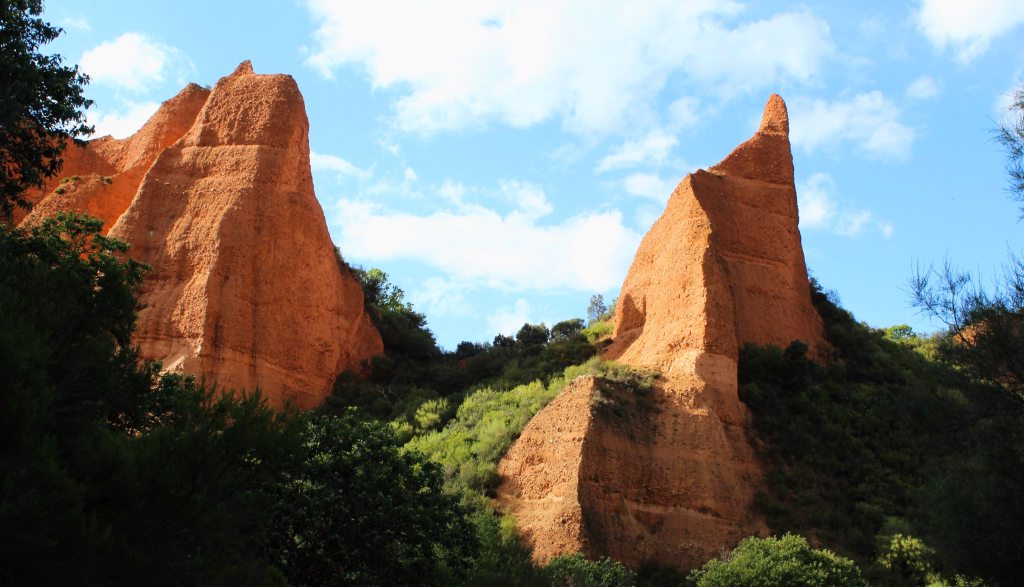
Unless you were told, you would probably never suspect that the landscape of Las Médulas was man-made. A collection of orange cliffs jut out from the forested valley, with no obvious sign of human manipulation. However, these jagged ridges were not worn away through natural processes, but with a Roman mining technique known as ruina montium (destroying the mountain). The first step was to dig a network of tunnels into the mountain (by hand of course). Then, enormous quantities of water were transported via aqueduct up to the top, and poured into these tunnels, eventually causing a kind of avalanche. This way, the Romans accessed the large stores of gold in the mountain’s interior. According to our guide, the workers responsible for this were not exactly enslaved, but were indentured servants. In any case, it was brutal and dangerous work, and our guide informed us that many miners ended their own lives.
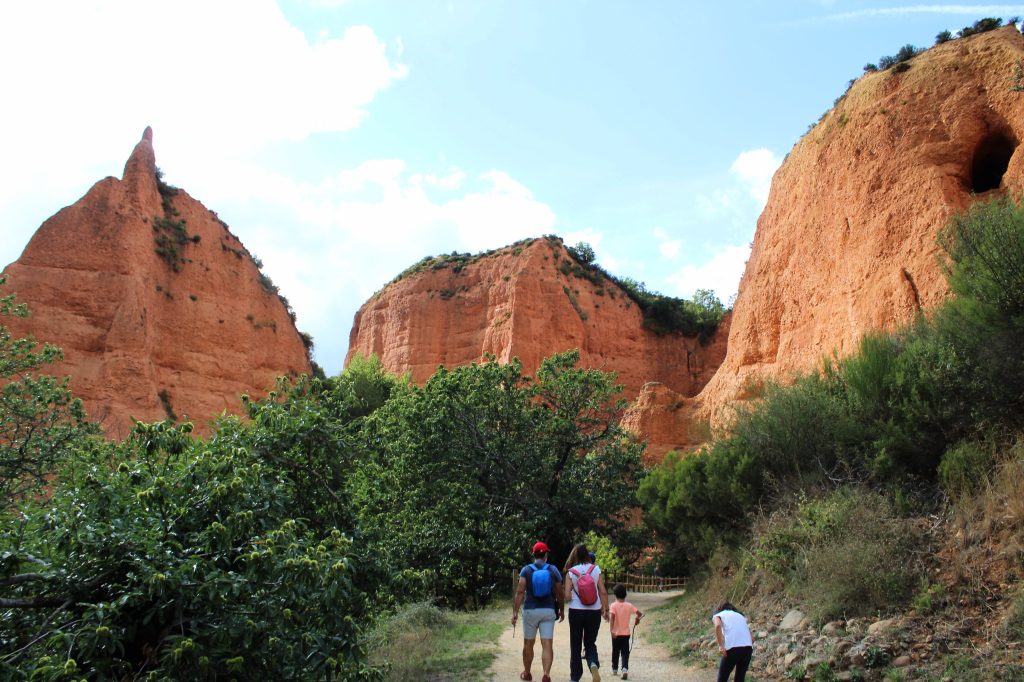
This story of Las Médulas—a story of environmental destruction and worker exploitation—is, thus, not exactly the most charming story of antiquity. It is a strange irony, then, that this rapacious extraction produced such a picturesque landscape. The faces of the cliffs are so orange that they seem still to be imbued with gold. The surrounding forest is full of chestnuts, heather, holly, and rock rose. After spending the whole morning in a rush of anxiety and impatience, the valley was almost supernaturally calm.


Day 2: Las Médulas to Ponferrada

I awoke early and set out before the sun. I was nervous. Las Médulas is on a leg of the Camino that is seldom traveled under the best of circumstances. During a pandemic it was deserted. The EU’s borders were (mostly) closed to travelers, and in any case most Spaniards still thought it unwise to sleep in bunk beds with strangers. Thus, the albergues (pilgrim’s hostels) along this route were closed, so I had to spend one day going the opposite direction on this route, in order to link up with the more famous French Way where things would be open.

The region is strewn with dilapidated houses.

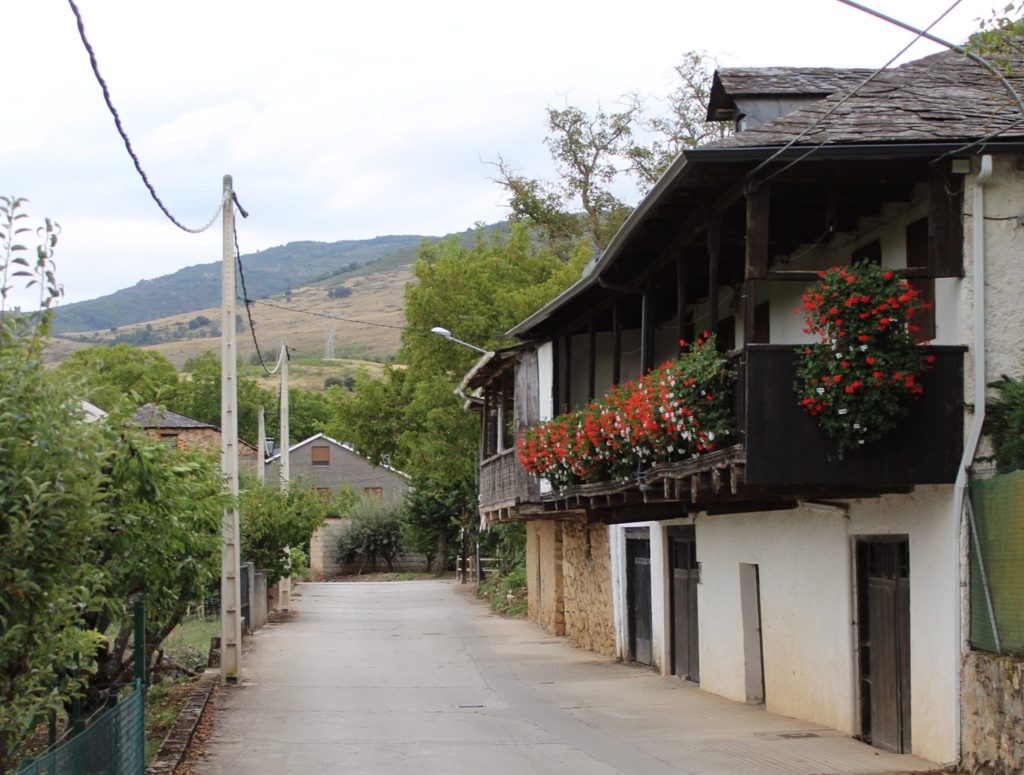
Normally, when you walk the camino, a series of yellow arrows and concrete markers guide you along the way. But now, I would have to find the arrows and try to intuit where the pilgrim was supposed to be coming from. This seemed rather difficult. I soon found, however, that the route was nearly as easy to follow backwards as forwards, and I relaxed into the rhythm of the road. I was not yet in Galicia, but in a part of Castilla y León called El Bierzo. The landscape was hilly, with a light covering of trees, and the ground dry and rocky. In the morning hours it was cool enough for a jacket. The route took me through several small villages, each full of houses that featured a distinctive kind of wooden balcony that I found quite beautiful.
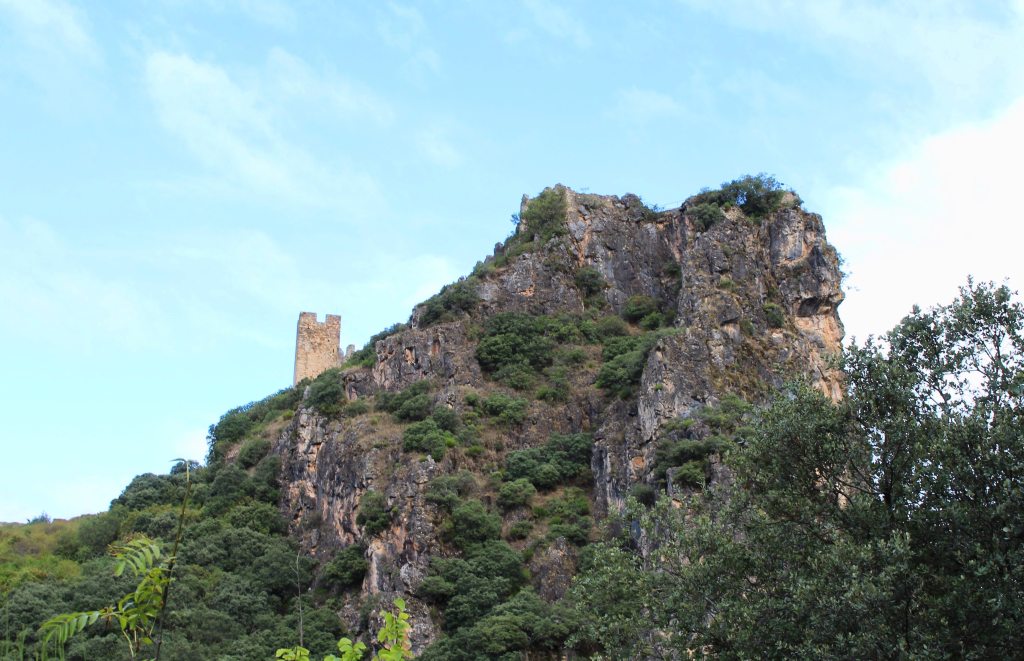
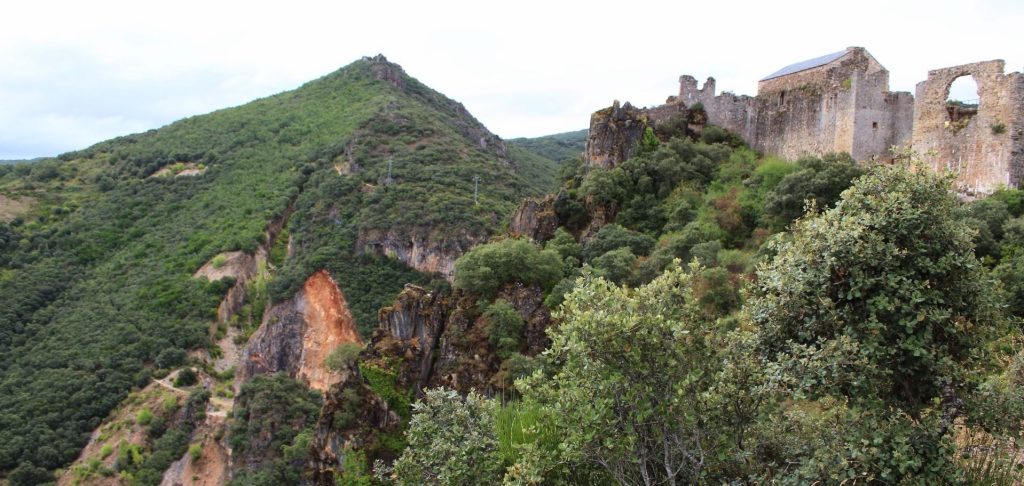
As I went along, I listened to an audiobook by Jonathan Haidt about how to be happy. I suppose I was in an introspective mood. Yet all of Haidt’s advice seemed trite compared with the simple experience of walking and observing. If you can take an interest in your surroundings, then there is little else you will need to be content. And I was fully absorbed. So much time staring at the ceiling of my apartment had made virtually anything wild and green fascinating. The countryside here had a sort of rugged beauty, which culminated in the Castillo de Cornatel. This is a fortress that sits on a hilltop, believed to have been originally built in Roman times to defend their goldmines. In any case, the castle is now little more than an eloquent ruin. I peeked inside and carried on my way.
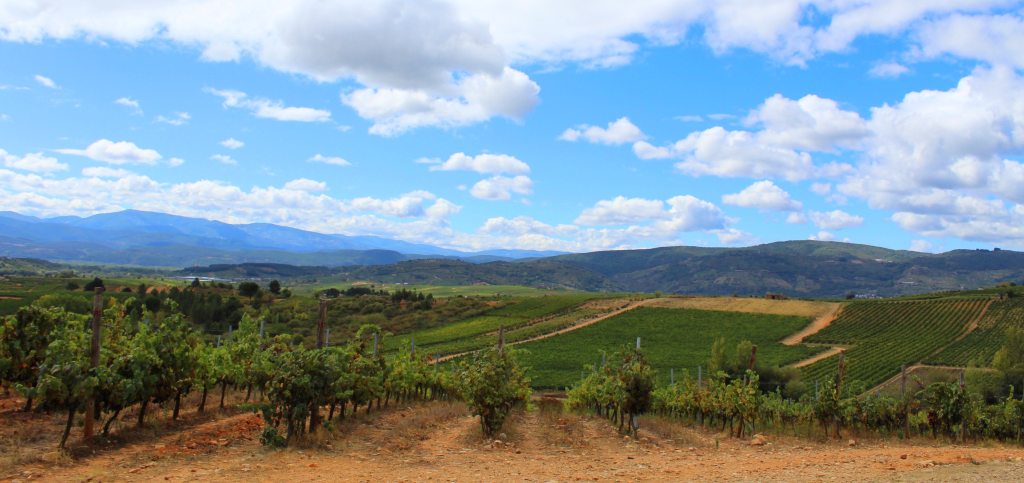
Descending the hill, I found myself in wine country. Virtually every region of Spain has its own variety of the drink. The grape from here is called mencía. As I walked, I was passed on a road by an elderly man driving a tractor; his wife sat in the trailer, alongside several buckets of grapes. What a life. Now I was getting near Ponferrada. In the distance I could see the strange geometric form of the Torre de la Rosaleda, the tallest building in the city. My legs and back were aching now. Six hours of walking had gone by and I still had an hour to go. The path took me alongside the Sil River, across it, and then finally to the municipal albergue.

Once there, I was amused by the reception. The institution had developed a kind of sanitation ritual for all incoming guests. My whole body was sprayed with a disinfectant; my backpack had to be kept in a trash bag; and even the soles of my shoes were chemically cleaned. Meanwhile, guests were not required to wear masks indoors, though of course the virus is primarily transmitted through the air. Even at the time, it seemed rather silly.

I ate two hearty meals and passed the time by reading Monkey—a delightful abridgement of the Chinese classic, A Journey to the West. (The story concerns a Buddhist pilgrim, so it seemed rather appropriate.) Unfortunately, I was much too footsore to do any sightseeing, and so passed up the chance to visit the city’s impressive Templar Castle or the Fábrica de la luz, a museum of industry in a former power plant. I suppose I will just have to go back.

The Templar Castle of Ponferrada.

Day 3: Ponferrada to Villafranca del Bierzo

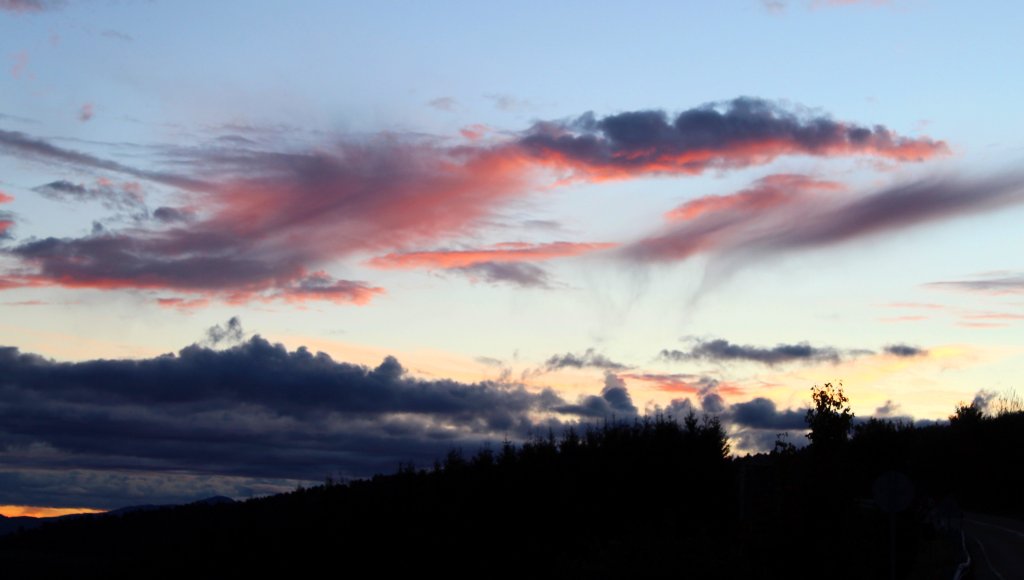
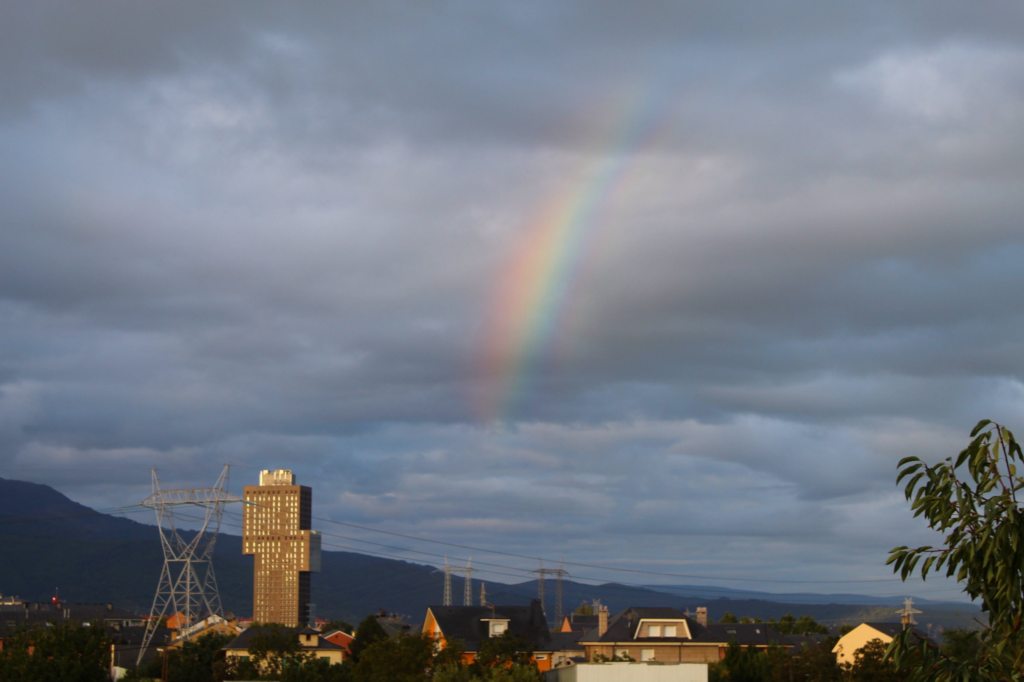
I awoke early, before my alarm, at half past five. Outside it was calm and black. The route took me along the river Sil to the outskirts of the city. On the way, I passed the Fábrica de la luz and once again regretted not having been able to visit. It was not long before the western clouds were tinged with gold, and the gray dusk began to dissipate. Behind me, in the morning mist, a rainbow hovered over Ponferrada.
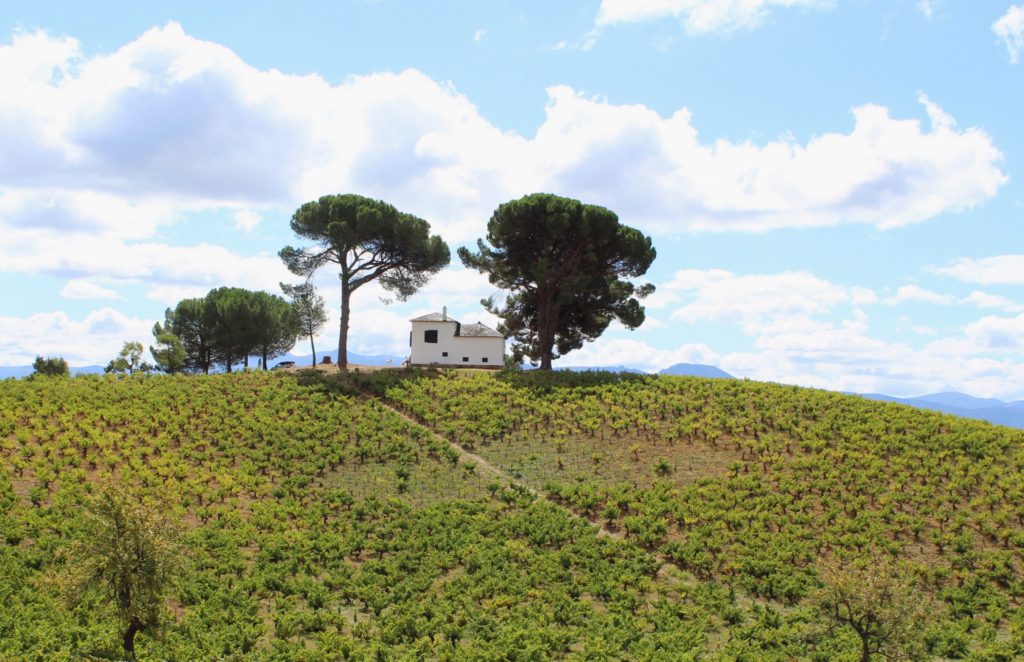
The first half of the walk was not especially interesting. I slowly made my way through suburb after suburb. The residents were just beginning to stir—walking their dogs, making their way to the local café, doing yard-work. Finally, the suburbs gave way to a beautiful stretch of wine country. The sun was shining strongly now, and the vines were an ocean of bright green. I did my best to walk slowly, to take in the scenery. Agricultural country has a particular charm—at once natural and cultivated. I felt a pang of envy for whoever was living in the fine white house among this little paradise.

At about two in the afternoon I arrived in Villafranca del Bierzo. It is a surprisingly beautiful place. Though scarcely three thousand people call it home, it is full of impressive structures: a romanesque church, a large monastery, and even a castle. Being a Camino town has its advantages, I suppose. Better still, the town was full of excellent bars and restaurants. After seeing so many grapes, I could not resist a sampling of the local wine, which I found to be excellent (though I am hardly a connoisseur). By nine I was in my bunk bed. The only other residents of the albergue were two quiet Spanish men. We all said goodnight and turned off the lights. 

Day 4: Villafranca del Bierzo to O Cebreiro

I awoke full of excitement. According to gronze.com (a great resource for anyone considering the trail), the next stretch of the camino was both among the most beautiful and the most arduous. The trail would take me up into the mountain range that separates northern Castilla y León from Galicia. For those completing the entire Camino, the entry into Galicia is a special occasion, since that means they are in the final stretch. For me it was special, too, since I just generally love Galicia.

The beginning of the trail was disappointing. Far from beautiful, the trail ran along a highway and there was little in the way of scenery. I had (happily) finished the book on happiness and began an audiobook by David Attenborough about life on earth. His resonant voice soothed me as I made my way under overpasses and through small villages. In one village, there was a woman with a clipboard waiting for pilgrims passing through. She told me that in the villages I had to wear a mask (I already was, though it was a cloth mask that looked rather like a diaper) and that I had to register in a government website before entering the province of Galicia (I already had). She also told me that the village of Ponfría—which was on the route—was under lockdown because of a local outbreak.

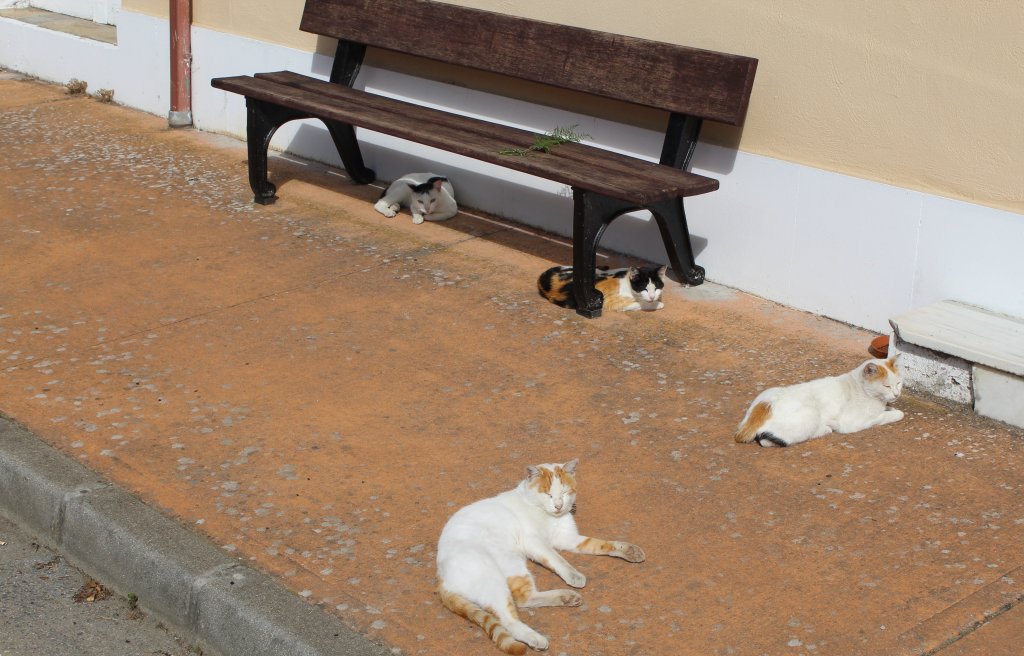
Armed with this information, I kept on going. The sun climbed in the sky and it got hot enough for me to stop and change into shorts. Finally the landscape began to bloom as I left the highway and made my way into the woods. Cows abounded, often sunning themselves on the grass. And every village had its colony of stray cats. About three-quarters of the way there, I was accosted (in English) by a shirtless man asking me for some change. I didn’t have any and told him so. But I was taken aback at the request, as we were really not near any village.

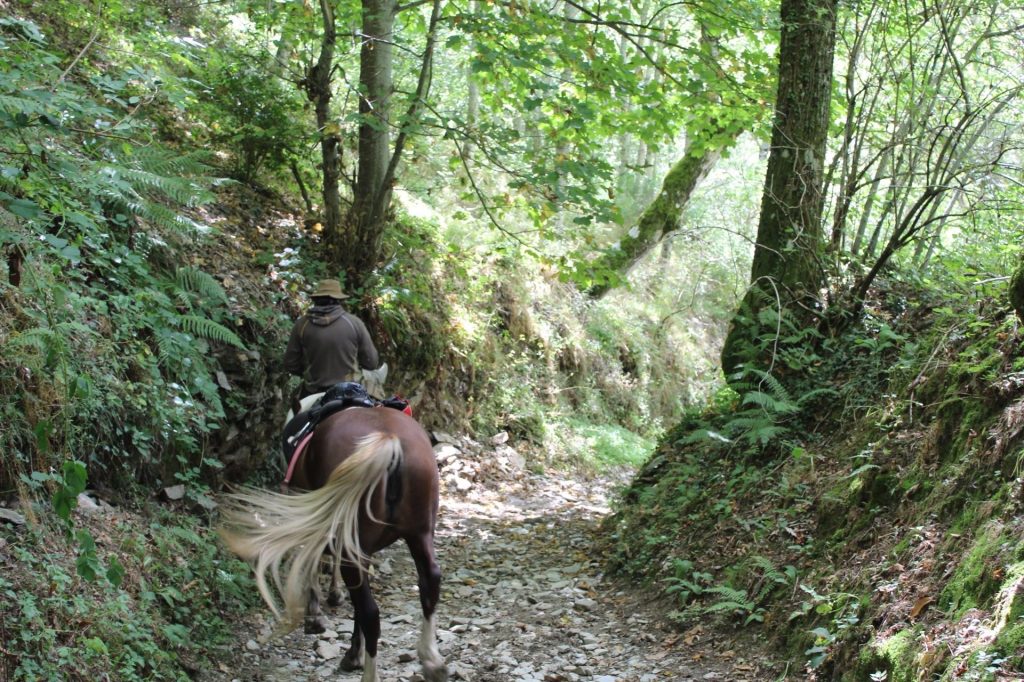
The next thing I knew, I had hit the mountain. The trail led up and up, through a dense forest of oak and birch. It was hard going and after a few minutes I paused to catch my breath. When I did, I looked back to see the shirtless man not far behind, and I got the strange notion that he was after me. This caused me to pick up my pace, and I started rushing up the mountain almost at a run. Besides being irrational, this was a shame since, in retrospect, this was one of the most beautiful stretches of the walk. I climbed and climbed until, near the top, I was surprised by a man on horseback, who was making his way down the steep, rocky path with a great deal of care.
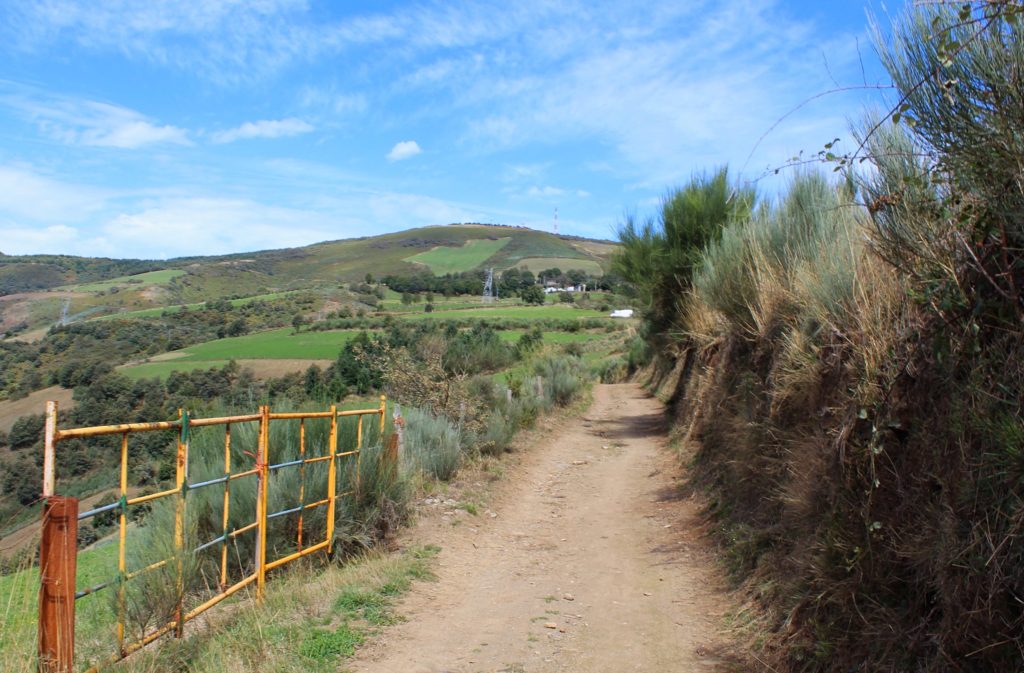
Then the trees cleared and I found myself on the top of a series of rolling hills. Nearby was an elaborate sign that announced my official entry into Galicia. The trail led up and down over the gentle ridges until I reached one of the infinite small Galician settlements which dot the region. This one had an attractive restaurant and I immediately decided I would stay for lunch. I ordered caldo gallego—the regional soup—and chicken. Several tables were already occupied by other pilgrims. As I ate, the shirtless vagabond arrived, and seated himself at a table with a woman, who seemed to know him. They commenced to talk in German. She bought him a beer and let him finish her meal. A group of cows walked by on the street and, of course, some cats were sunbathing.
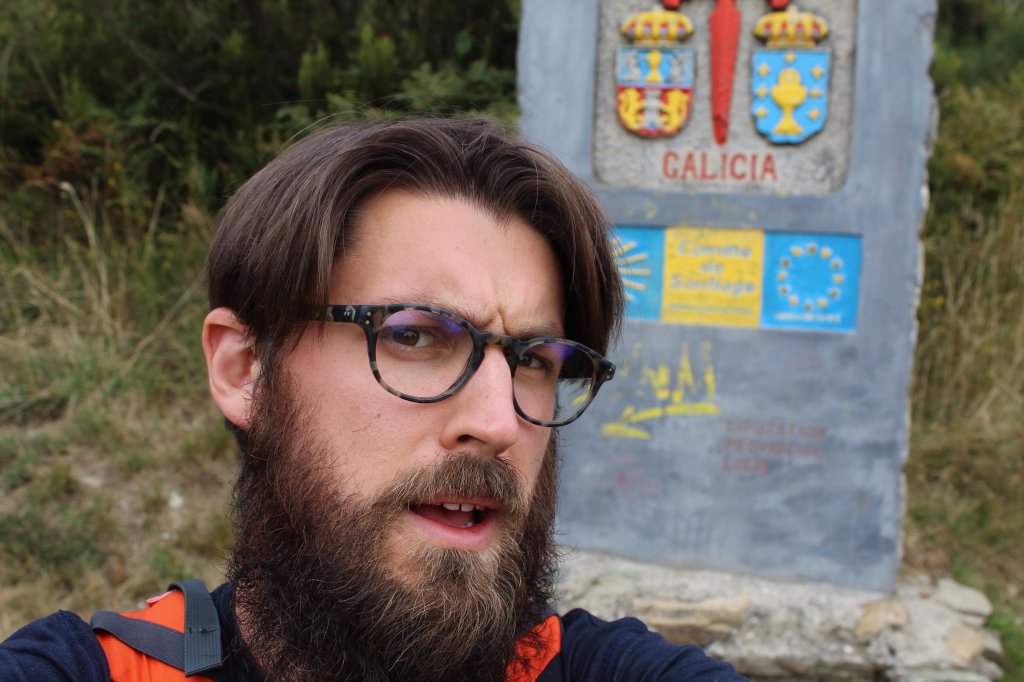
My entry into Galicia. Note the pandemic beard.

Walking on a full stomach (and several glasses of wine) was not pleasant. Thankfully, my destination was very close. O Cebreiro an attractive little town (population: 121) situated on a hillside. There are wonderful views from every corner of the town and a few well-equipped shops for pilgrims, who constitute the economic basis of the village. Though tiny, there is some sightseeing in O Cebreiro. There are four examples of pre-roman buildings which can be visited, presumably reconstructions of the sorts of buildings in the ancient “castros” (Celtic settlements). There is also the church of Santa María, an ancient building with a legend attached to it.
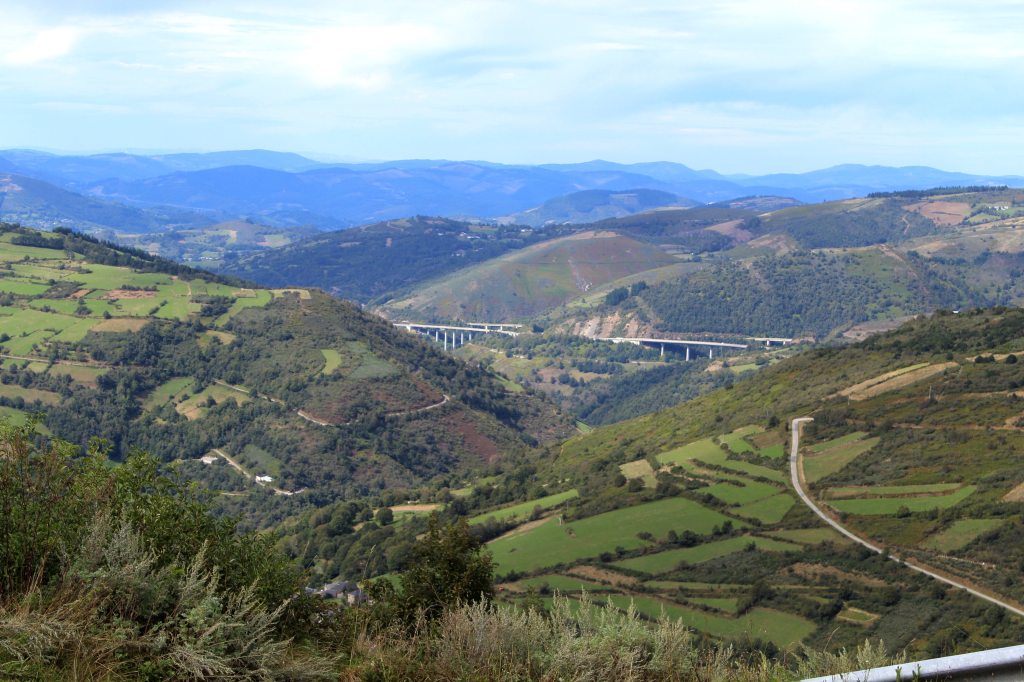
As it happens, the legend was told to me by a Polish woman staying in my albergue. It goes: There was once a very devout man who never missed mass. One day the weather was terrible, a storm was blowing, but he still came to worship. The priest was surprised and amused by his devotion and joked that mass wasn’t worth all this trouble. Then God, to humiliate the priest, turned the holy wafer into real, bleeding flesh. Catholic legends are always a bit macabre. Anyway, this Polish woman was among the minority of truly faithful pilgrims. She said that she had sold everything in her country to walk the camino and devote herself to God. I declined her offer to accompany her to mass.
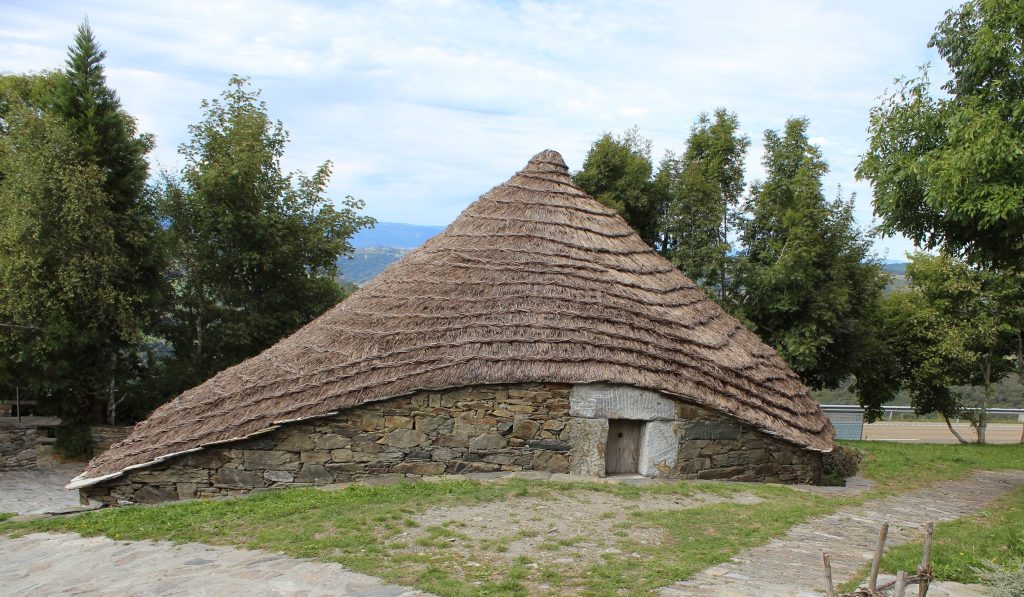
A traditional Galician dwelling.

Day 5: O Cebreiro to Triacastela

The sunrise was particularly beautiful that morning.

I awoke late the next day, at 6:30. But that was alright, since I only had 22 km to trek that day, a relatively light day on the Camino. The path took me further up the mountain, until a sign informed me that I was 1300 meters above sea level. There, a statue of a windswept pilgrim presides over the road, providing a kind of solidarity to the passing traveler.

Then I began to descend into the heartland of Galicia. The landscape became ever greener as I went along. The countryside was at its most bucolic, with winding dirt roads cutting across fields ringed with forest. Cows were ever-present, as were there droppings. David Attenborough continued to amaze me with his stories of the natural world. I also listened to some broadcasts of Alistair Cooke’s Letters From America—the British journalist’s reflections on American life. In my diary, I remarked of Cooke: “He is like a village priest, weaving together history, folk wisdom, penny philosophy, and current events.” For the record, I have never met a village priest.
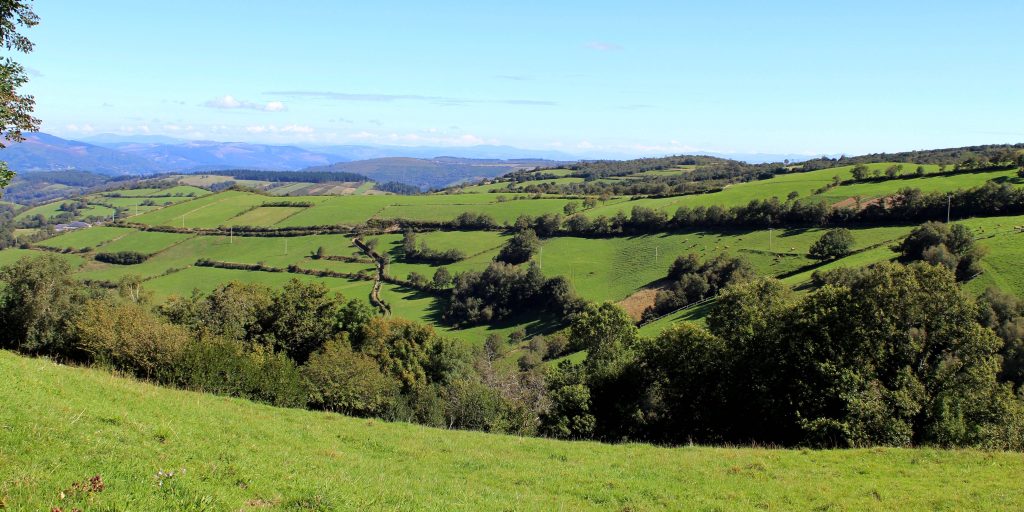
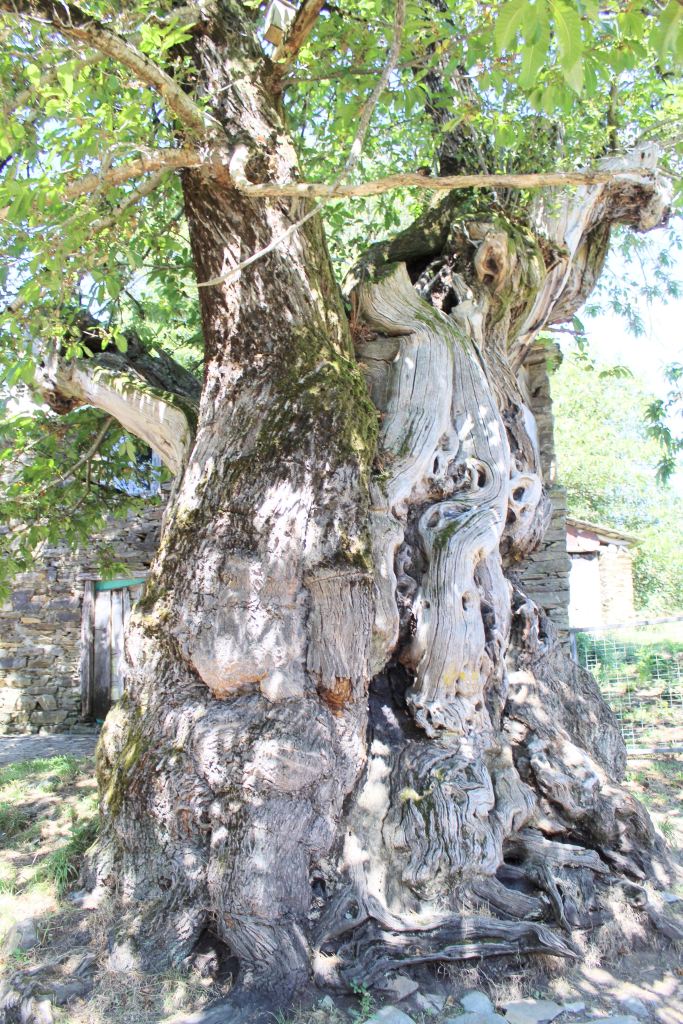
The tree is apparently 850 years old.

Finally, I arrived in Triacastela. On the way in I passed the famous Castaño de Ramil, a famous chestnut tree that is a major landmark on the Camino. Apparently it is about 850 years old; it certainly looks like it, at least. The town of Triacastela is small and lovely. It is situated in a valley, surrounded by the woods on all sides. I checked into an albergue owned by a very pleasant man from Ibiza, and immediately went to the restaurant he recommended for a hearty meal. My hunger slaked, I spent the rest of the day just lazing about. But I was extremely happy. In my diary I wrote:

“I feel as though today I found what I was looking for. Galicia always does it. The landscape could easily be upstate New York. The weather is almost perfect—sunny, but not hot. I love the vibrant lushness and the bucolic charm. As I write, I can see cows grazing and hear their bells tinkling. A mother and daughter are nearby, playing on some swings.”

What I was searching for was, apparently, nature and peace. And, truth be told, I can remember few times when I was so absolutely content. This did not make me, however, any more willing to socialize with my fellow pilgrims. Many people love the chance to make friends on the Camino. Not me. When I walk, I want to be alone, and I make sure not to invite any unwanted conversation. I suppose this makes me antisocial and unpleasant. But there are not that many opportunities in life to be really alone.
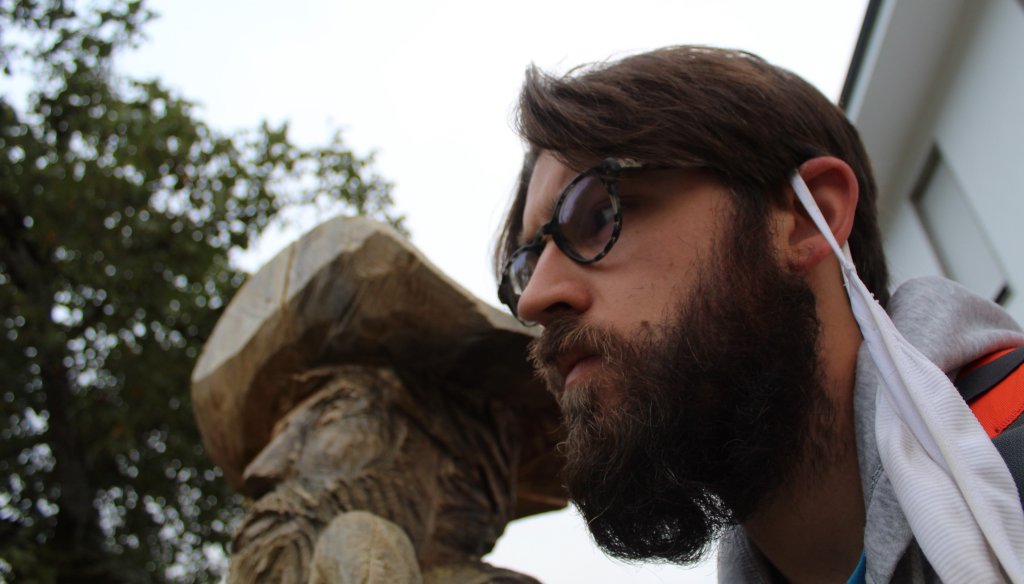
At least the beard made me look more like a pilgrim.

Day 6: Triacastela to Sarria

This day I had a decision to make. The Camino here forks into two roads: one leads to Sarria via Samos, and the other gets there via San Xil. The path through Samos is attractive because it passes by the Abadía de Samos, an impressive historic monastery. This seemed like obviously the better option until I found out that the monastery did not open until noon; and if I wanted to get to Sarria at a reasonable time (in time for lunch, and before the heat of the day) I would pass through Samos in the early morning. Perhaps I should have done what many other pilgrims did, and go straight past Triacastela to see the monastery in the evening. Having missed my chance, I decided to take the San Xil route, since it is supposed to be the more picturesque.
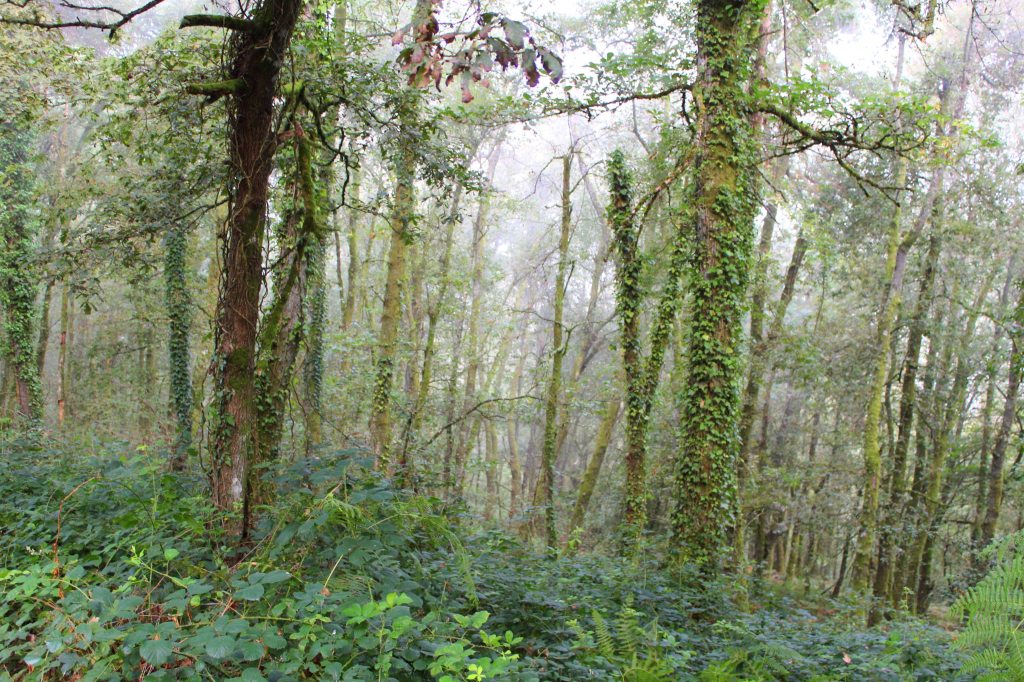
It certainly was. The morning mist rolled up through the valley, obscuring the landscape in a white fog until the sun was finally warm enough to break it up, revealing the ever-green Galicia underneath. Vines clung to trees and moss to rocks. Birds called in the canopy overhead. I shared the road with cows and watchful dogs. Sometimes the path took me up on a hill, offering me a view of the sweet, almost innocent landscape all around me. It is the sort of place that makes city-dwellers want to move to a farm and start milking cows. 
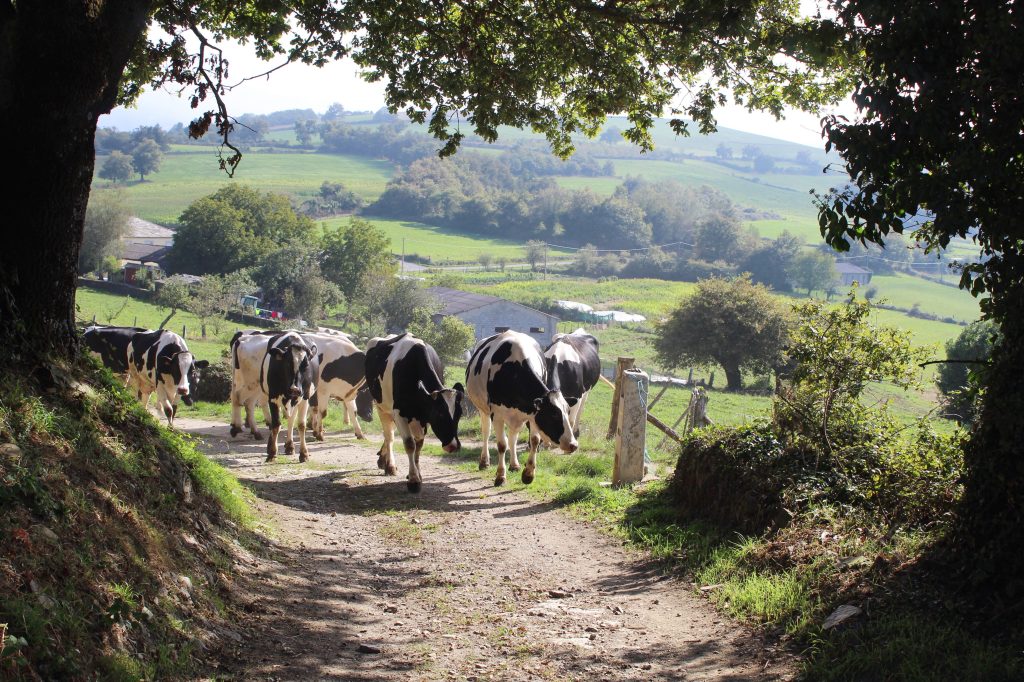
I arrived at Sarria feeling a little sad. This was my last day on the journey. Though I was enjoying it immensely, the news was increasingly alarming: levels of COVID were spiking once again. It was possible that the different regions would once again go into lockdown (and they would, though about a month later)—which was not good for me, as my identity card was expired and awaiting renewal. Getting back to Madrid felt urgent. So I tried to savor my last day in Galicia.

Compared to the little towns I had been staying in, Sarria, with a population of 13,000, felt like an actual city. It is not a place devoted exclusively to pilgrim tourism. There are high schools and pet shops and locals eating in the restaurants. After lunch, I tried to do a little sightseeing by walking around the Fortaleza, a ruined fortress, but my sore feet made me give it up. So I went to bed early, with a full belly and an empty mind.


Day 7: Sarria to Madrid

Accustomed to my Camino schedule, I woke up in the early morning, even though my train back to Madrid left at noon. With nothing to do, I decided I would hike part of the next section of the trail. So, with my backpack on my aching shoulders, I headed off into the early-morning fog.

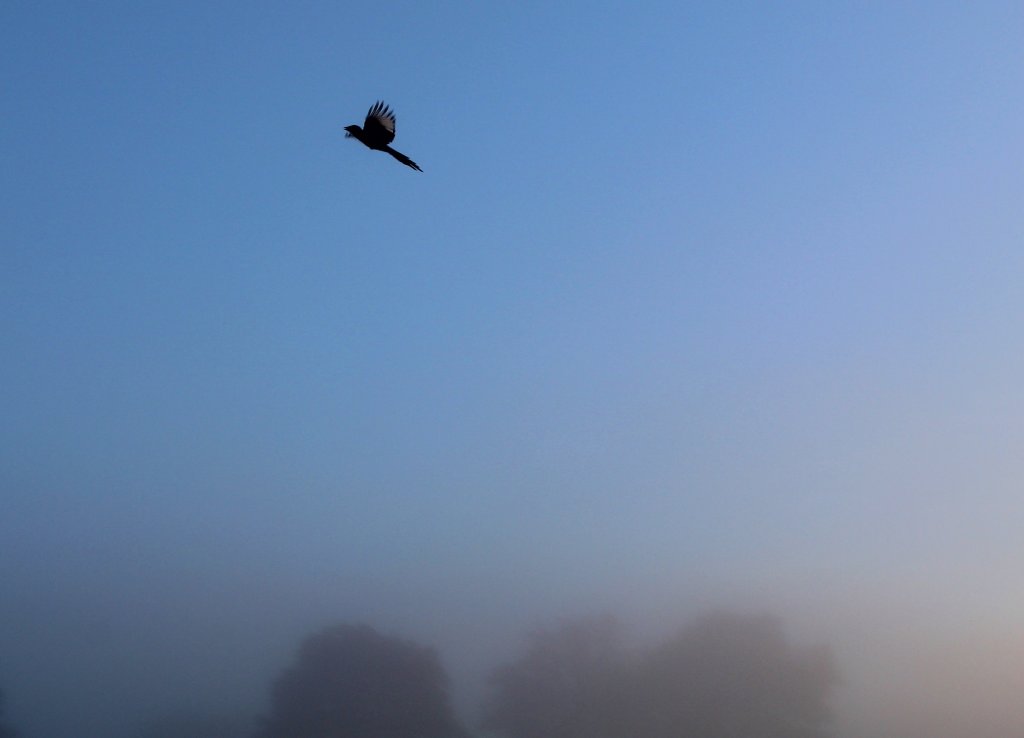
I crossed a stone bridge and then found myself in the countryside once more. Further on, the trail crossed a local railroad without any gates or lights to warn of an oncoming train. A little dangerous. It was remarkably misty that morning. The landscape was entirely invisible. The sun was just a vague yellow blotch in the sky, as in a painting by Turner. I could hardly even see ten feet in front of me (that’s about three meters). Out of the sea of fog a flying magpie appeared and disappeared. Somewhere nearby a dog started barking at me. Spiderwebs were covered in water droplets. And then, seemingly all at once, the fog cleared away and I was once again in the beautiful green of Galicia.
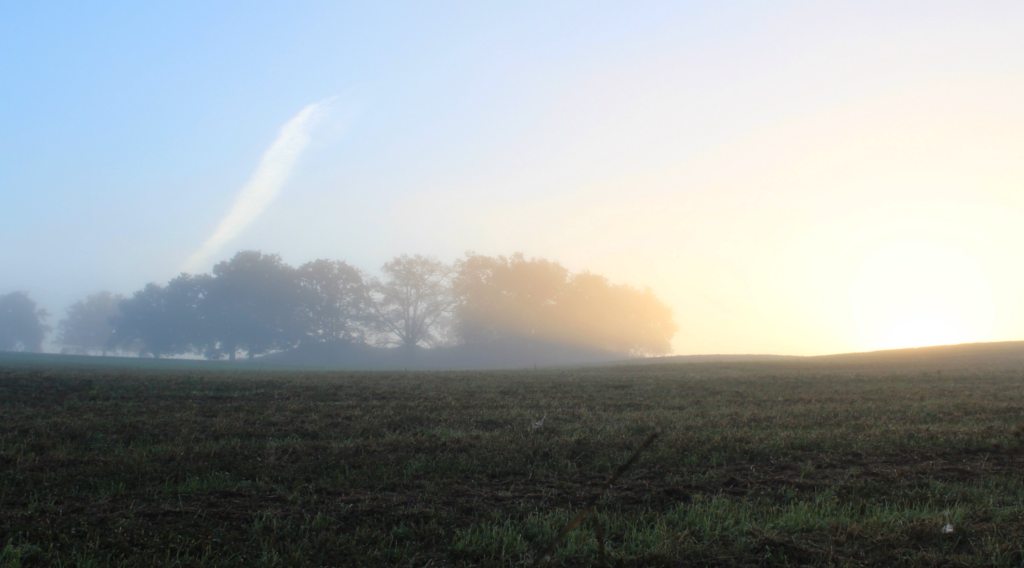
After passing through some small villages the trail took me alongside another highway. A truck passed by, carrying live pigs—spreading a stench so bad that I was only too glad to wear my cloth-diaper mask. Finally I decided that I could not afford to go any further and so turned back toward Sarria. All the savoring in the world could not make time stand still. I said a long and sad goodbye to the Galician countryside. I arrived back in Sarria in time to eat lunch before my train ride.
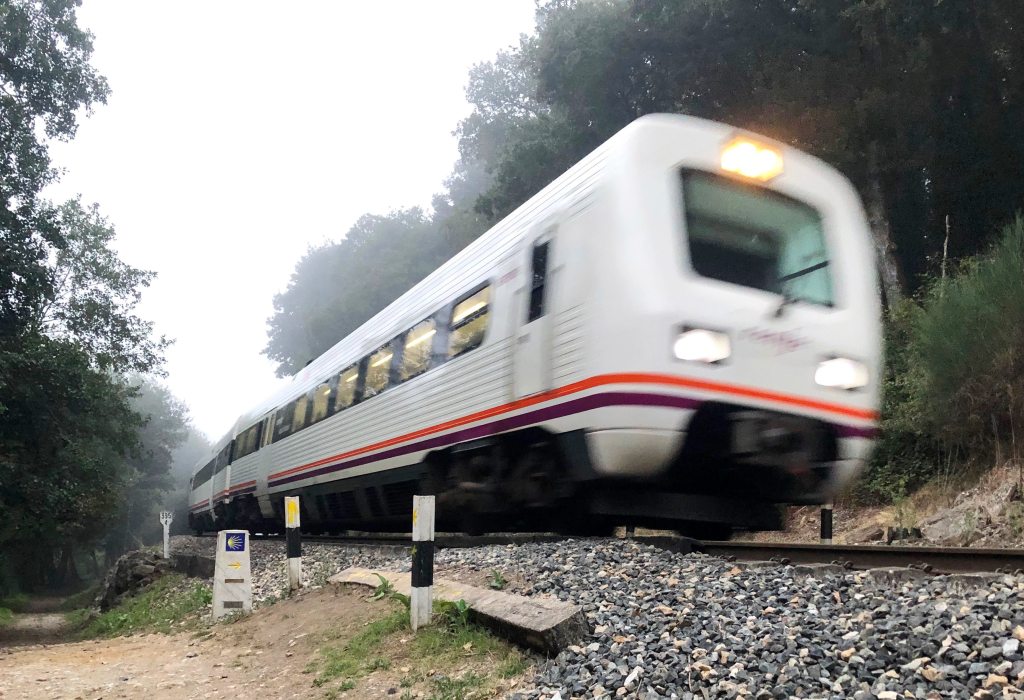
And then it was time to go. This was the seventh or eighth time I had been on this train back to Madrid from the north, and each time it has been a mournful experience. In the five hours of the journey, the landscape dries out; the trees disappear; and the green of Galicia is transformed into the straw color of the interior. But this time was different. More than any vacation I have ever taken, I had achieved a state of blissful peace during my walk. It was a very good Camino.
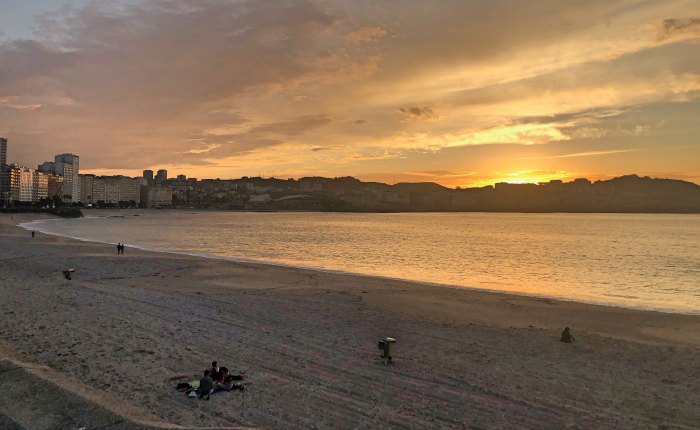
Snapshots of Galicia

Snapshots of Galicia

As I have written time and again, Galicia is my favorite place in Spain, a region I return to again and again. Part of it is homesickness. Galicia is the only region in the country which bears a passing resemblance to the Hudson Valley—green, hilly, forested. But part of it is due to Galicia’s unique delights: its simple and hearty food, its distinct local architecture and customs, its calm and quiet. And, best of all, a trip to Galicia is very easy on the wallet.


A Coruña

It was the summer of that fateful year, 2020. My brother had just left to return to America. Soon, the school year would begin, and I would go back to in-person teaching—though I could hardly imagine what it would be like after the trauma of the (still ongoing) pandemic. Wanting a last gasp of peace before what I assumed would be chaos, I took a train to my favorite city in Spain, A Coruña.

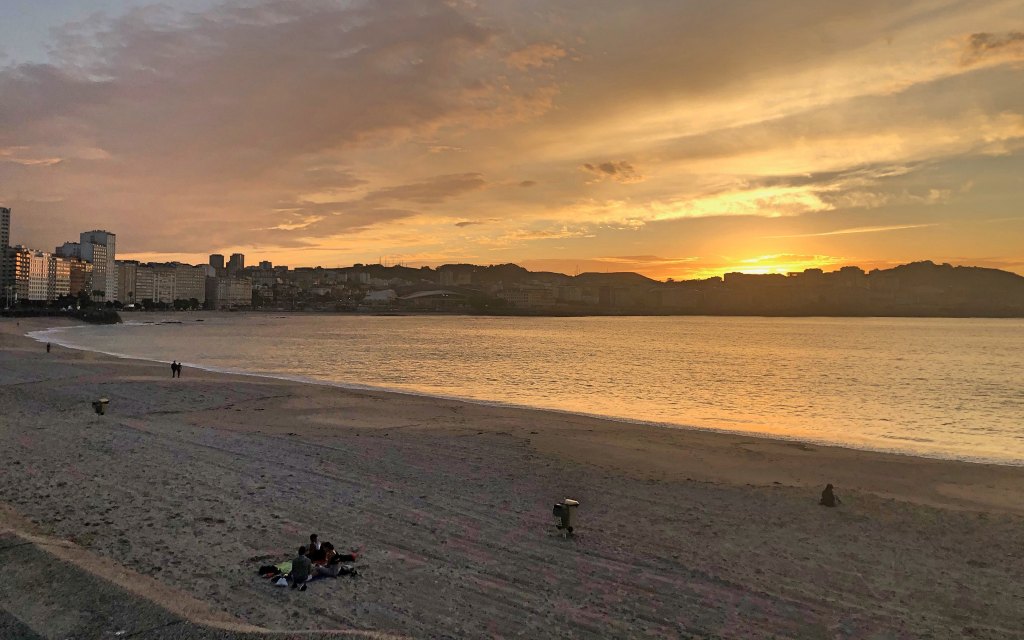
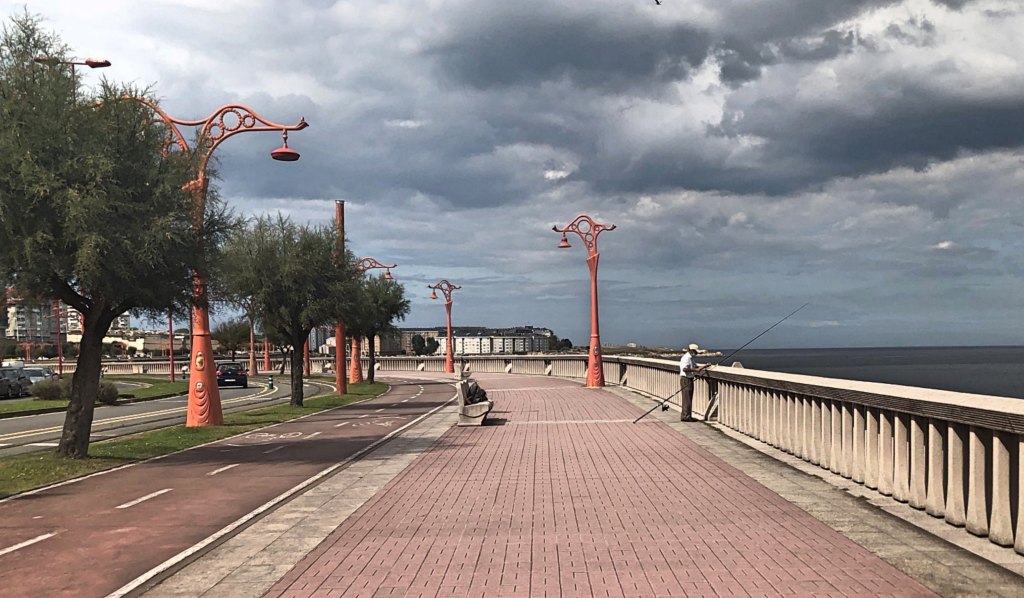
I had no ambition to do anything but relax. I walked for miles—through the dense streets of the old city, under the distinctive galerías (glass balconies), along the promenade (paseo maritímo) and past the aquarium. One evening, I sat amid the jagged rocks below the Tower of Hercules, a Roman lighthouse, and read a book as the waves crashed below me. Another evening I made my way to Monte de San Pedro and watched the sunset from the old naval guns overlooking the sea. For dinner, I had takeout Chinese food. It was absolutely splendid.

And I packed my running shoes. After the isolation and confinement of the lockdown, I craved the outdoors, and spent as much of my time under the sky as possible. I ran in the late afternoon, with the sun beginning to set. A cool breeze blew in from the ocean, seeming to propel me faster than I had ever gone before. The combination of wind and waves flowing all around me gave me the odd sensation of flying. This, of course, was followed by duck curry and spring rolls.

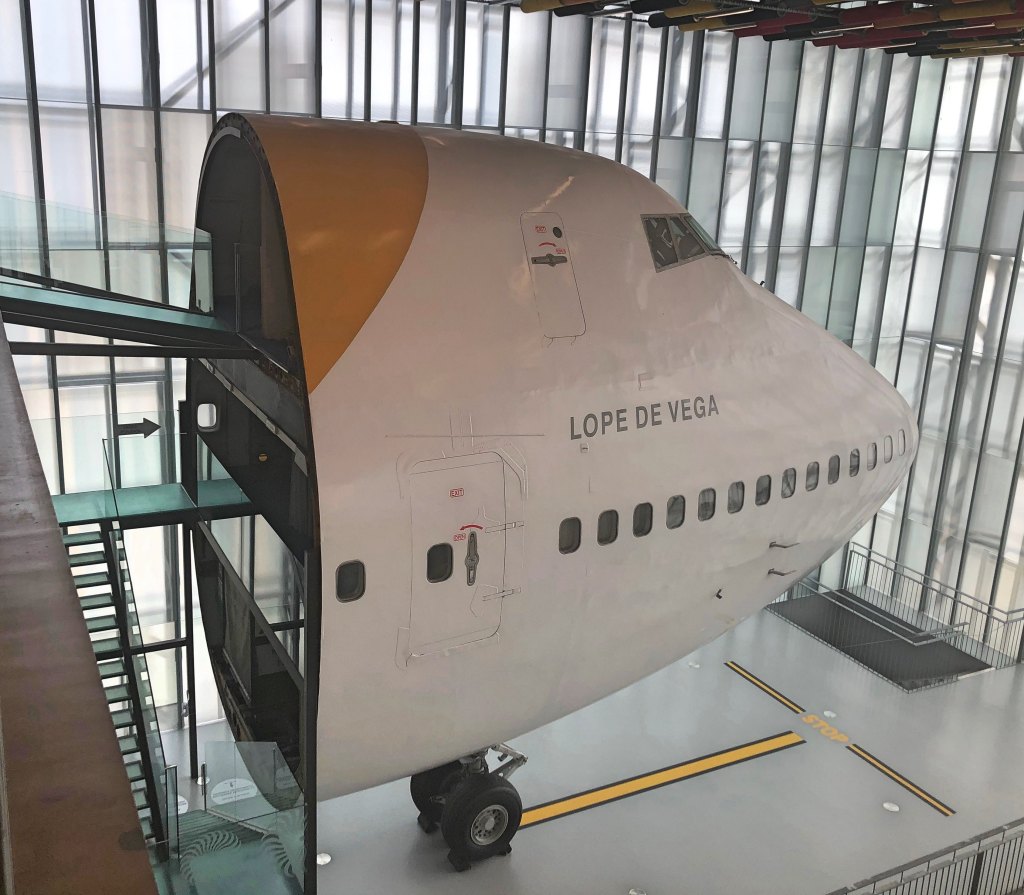
The only thing vaguely touristy that I did was to visit the Museum of Science and Technology. Considering the museum’s low entry fee and relative obscurity, it is an impressive institution. The halls were filled with beautiful examples of extinct apparatuses—calculating machines, steam locomotives, telegraphs, type-writers… By far the biggest installation is a cockpit of a Boeing 747, which you can walk inside. It must have been no easy task to transport. My only criticism of the museum is that they put the informational texts in three languages (English, Castillian, and Galego)—yet the texts are not repeated in those languages, but continue through them. That means to read the information completely you must be trilingual. 


A Walk in the Woods

The coast of Galicia—like that around A Coruña—is gorgeous. But I had just finished a camino through the wooded interior of the countryside, and I was still craving the forest. So, one day, I decided to take a day trip to a more rural area.

Yet I had little idea where to go or how to get there. In search of a solution, I looked up the stops on the train that runs from A Coruña to Santiago de Compostela, and then I examined these stops on Google Maps to see if they looked like decent hiking spots. I eventually settled on a little stop called Cerceda-Meirama, which is remote from any major population center. The fast train had me there in no time.

I emerged onto an empty platform and immediately found myself in the countryside. Having absolutely no idea in what direction to go, I decided to try to walk a lap around a nearby lake. As often happens in Galicia, I passed by a few scattered houses and then was in the woods—or, at least, a grove of trees. (Unfortunately, the countryside of Galicia has been heavily logged and many areas are covered with young saplings, often eucalyptuses, deliberately planted to be farmed later.)

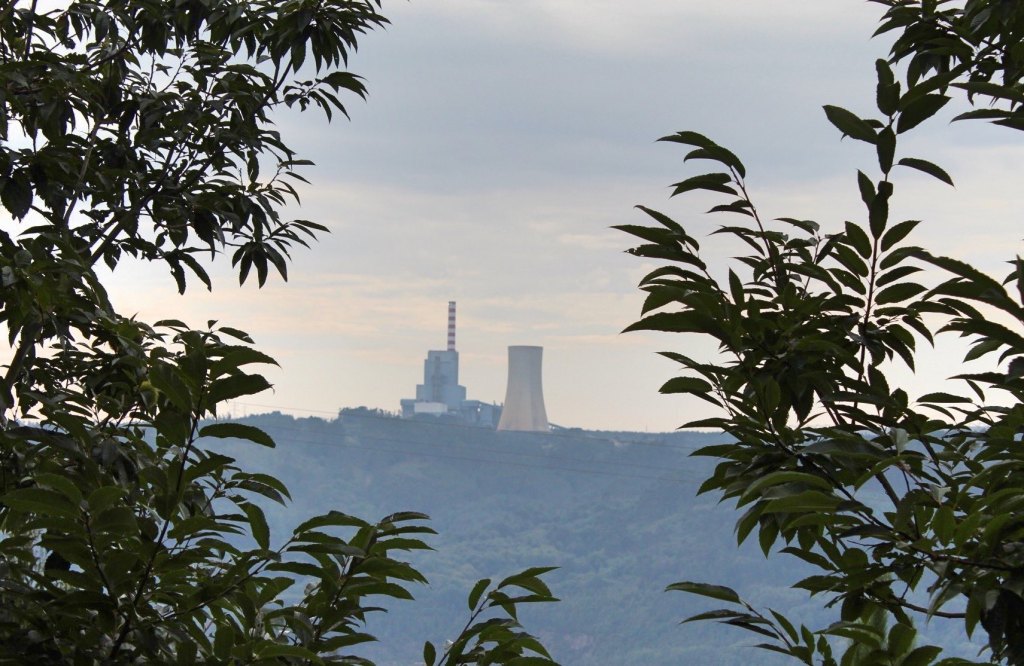
The narrow path took me alongside the Meirama Lake. This is not a natural lake, but was created to cover an industrial eyesore. For decades, not a lake but a lignite mine occupied this area, which only closed as recently as 2017. (Lignite is a type of coal.) Indeed, though at the time I assumed the surrounding trees were planted by loggers, they were actually put into place by the mining company as part of an environmental rehabilitation project that had previously denuded the area. An ominous concrete cylinder still sits, overlooking the lake, next to a featureless gray building.

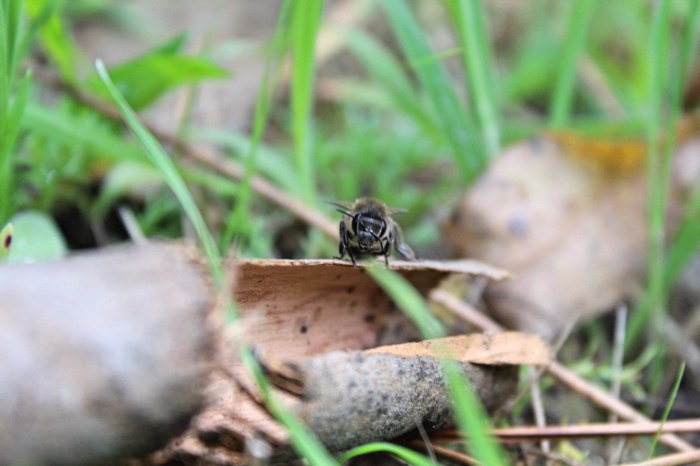
I cannot honestly say that the path was particularly beautiful. Even so, in my nature-deprived state, I was enraptured by the intermittent calls of birds and even stopped to examine insects crawling along the dirt road. I walked along quite contently, making a circuit around the lake and trying to be mindful of my return time. (The fast train does not pass through this station so often, so I had until about four in the evening or I would be stranded for the night.) Eventually I decided that I had time to spare, and took a detour.

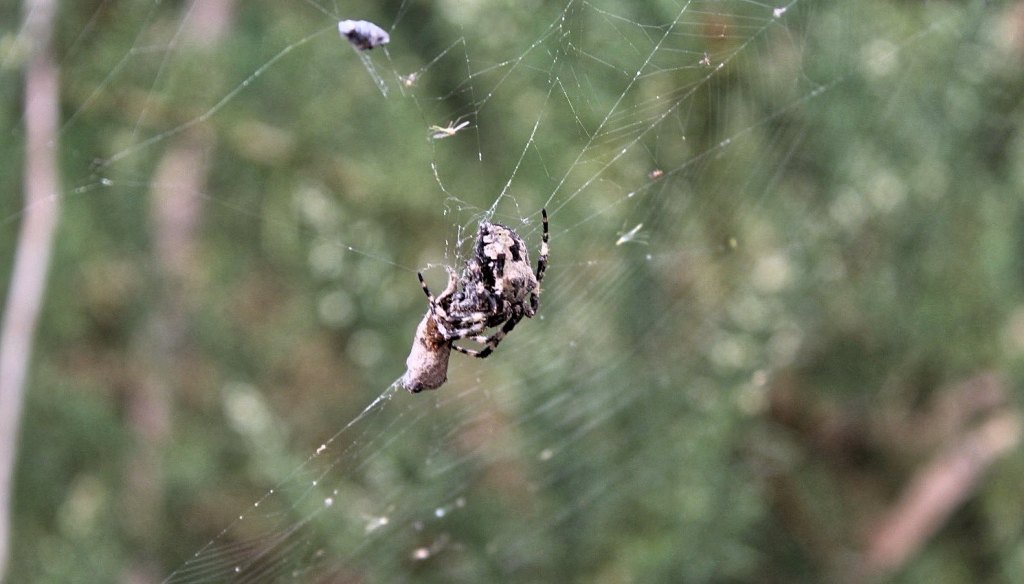
Things went bad very quickly. The path I took trailed off into the forest, and soon I was scrambling through brush. Twice I almost walked straight into a spiderweb with a large awaiting inhabitant. Somehow, to right myself, I had to walk up to an overpass and then along a small highway, before finding a path leading me in the correct direction. Even then, I was not (pardon the pun) out of the woods. The hour of my departure was nearing, and I was still quite lost, just hoping that the path I was on would lead me back to the train station.

Once again, however, the path led to a dead end in the forest. Luckily, by now I was at least close to civilization. Through the brush I could see what was obviously a field of crops. Desperate by now, I went for it—pushing through the thick vegetation and praying that there would be no shotgun-wielding farmer or attack dog waiting for me. Thankfully, not a soul was in sight, and I was able to make my way through the rows of wheat to the nearby road. I only had twenty minutes now before my train arrived. No choice but to run.

Tired and sore, wearing hiking boots, I jogged the remaining distance to the station (scaring off what I believe were two partridges in the process). I made it, sweaty and panting, with just a minute to spare. Sometimes relaxing is hard work.


Pontevedra

The next day I decided to visit Pontevedra. I had been there once before, but it was under unfortunate circumstances. That time, I had parked the rental car in an underground parking lot (the center of the town is a pedestrian zone), and had scratched it badly against a concrete pillar. This put me in such a fretful state that I could not even focus on the city.

But this time was different. I arrived on the early train from A Coruña, ready to do some sightseeing.

The name Pontevedra comes from Latin, and means “old bridge.” And there is, indeed, a rather old bridge in the city, the Burgo Bridge, built in the 12th century. It spans the River Lérez—the dominant water feature of Pontevedra, which sits nestled in a bend of this river, near the coast. Pontevedra is not an especially large city, but it is an especially well-planned one. It was a pioneer in instituting a car-free zone in the center, and is known for the high quality of life enjoyed by its denizens.

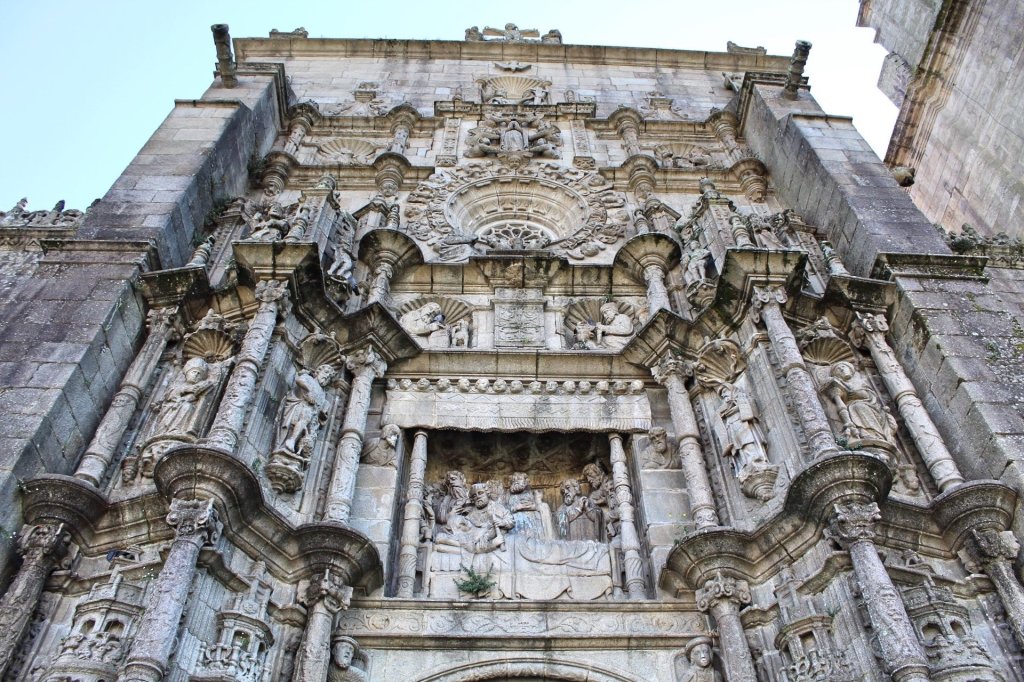
As in any good old Spanish city, there are lots of ornate churches to see. Chief among these is probably the Church of the Pilgrim Virgin. By European standards, it is not an especially old construction, dating back to about the signing of the American Constitution. It was made in order to venerate a rather odd statue of the Virgin Mary dressed as a pilgrim. This image was declared the patron saint of the Portuguese Way, a branch of the Camino de Santiago that passes up through Portugal and then Pontevedra on its way to Santiago de Compostela. Even if you are not a pilgrim, however, you must admit that it is a rather nice church.

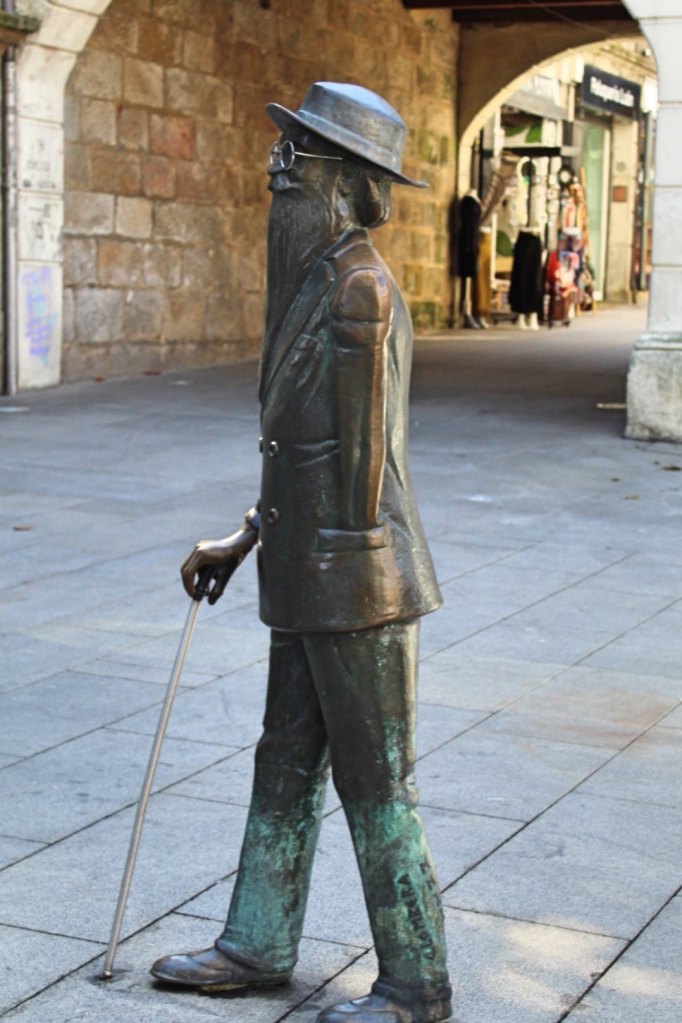
The car-free center of Pontevedra is well-preserved and charming. There are tiny side-streets and grand plazas, historic convents and ornate façades, and of course lots of restaurants and cafés. As I strolled around, I came across a life-sized statue of Ramón del Valle-Inclan, an iconic Spanish writer who was born just outside the city. He is outfitted in his usual way: neat suit, thick-rimmed glasses, and a long flowing beard. A literary innovator and iconoclast, he now holds an honored place among the Spanish literary patheon, and is one of the many writers often assigned to suffering high school students.

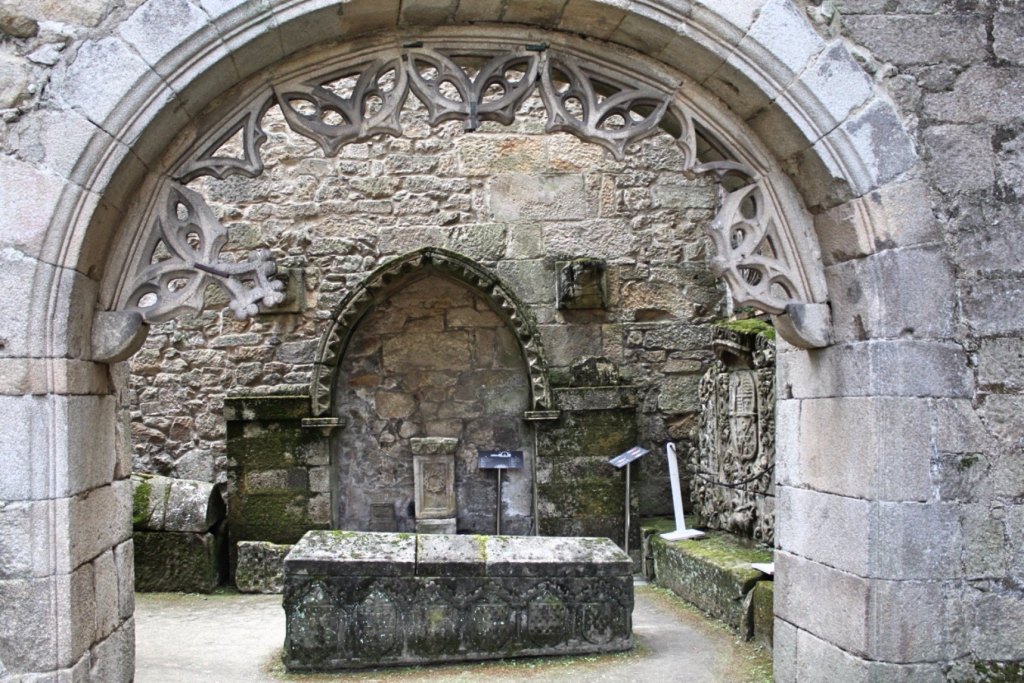
One of the most interesting sites in the city are the ruins of the church of San Domingos. This is (or was) a lovely gothic structure that now stands without a roof or half of its walls. I have seen ruined churches before, but those have been ruined by some disaster, like an earthquake or a fire. In this case, the culprits are time and neglect. In 1836, during a liberal spasm in Spanish history, a huge amount of land was confiscated from the Catholic church through a law called, in Spanish, the desamortización. This Dominican convent was one of them. The monks had to find a new home and the building was used, in turn, as a women’s prison, hospice, and an infant school. But it fell into decay very quickly under civil ownership and now stands like a ghost in the old city.

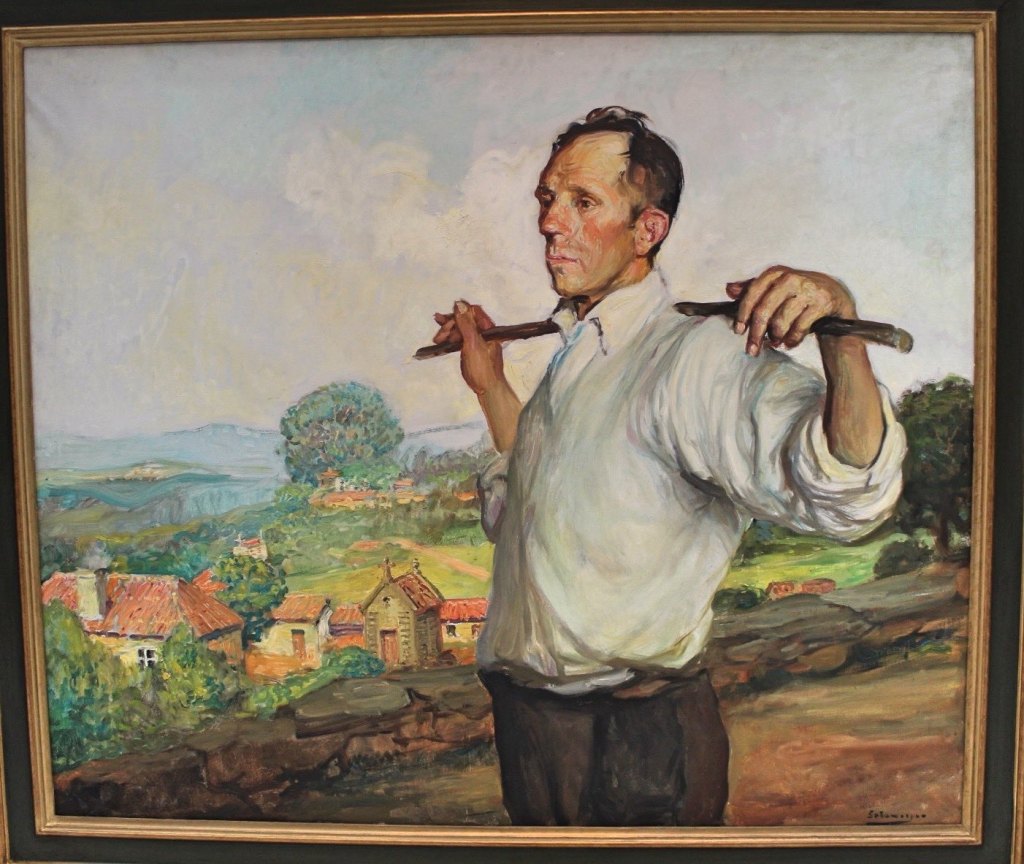
I have said before, and will again, that it is often worthwhile to visit relatively obscure museums in Europe, as they can have collections that rival the most prestigious institutions in the United States. This is certainly true of Pontevedra’s Provincial Museum. Even the structure itself is impressive, comprising a complex of buildings which includes modern glass constructions and former mansions. Its collection is vast and varied, including archaeological remains, ornate silverware, religious sculptures, traditional costumes and oil paintings (including those by Goya and Sorolla). Best of all, it is free to visit.

After spending a few hours in the museum, I made my way to the nearest Pulpería I could find. As its name would suggest, this is a kind of restaurant that specializes in octopus. I gorged myself on tentacles and pimientos de padrón (small green peppers), and chased it down with a pitcher of the local wine—typically young and fruity. For some reason, it is customary to drink the wine out of a little ceramic bowl, which reminds me very much of the vessels used to drink saki (called sakazuki).

The meal ended, I contemplated trying to do more visiting. But, somehow, I had lost the motivation. Instead, my legs took me on a meandering walk out of the city and, following the river, towards the ocean. I walked until the city receded into the less dense outskirts, and kept going until I came across a small beach at the mouth of the river. A small boat—more of a dingy—had been hauled up on the sand, looking somehow pathetic next to the water. Smokestacks split the sky on the opposite bank. A helicopter came into view, flying low over the river. Though I was surrounded on all sides by evidence of human life, I was the only person in view, and I had the illogical feeling that I had reached the edge of the world.

This romantic feeling was dispelled when I checked the time and realized that, once again, I had to hurry in order to make my train back to A Coruña. I arrived that night, and celebrated with a final dinner at the takeout Chinese restaurant. It had been an excellent stay in Galicia.


Santiago de Compostela

One year later. It was the All Saints’ Day holiday, in late October, 2021. I had no plan whatsoever, except to relax and to look for some foliage. (Madrid is quite bereft of colorful leaves in autumn, as a result of, well, not having many trees.) I bought a cheap train ticket to Santiago de Compostela, the regional capital, and booked the cheapest Airbnb I could find. My hosts were not thrilled when I arrived at nearly midnight. But at least I was back in Galicia.

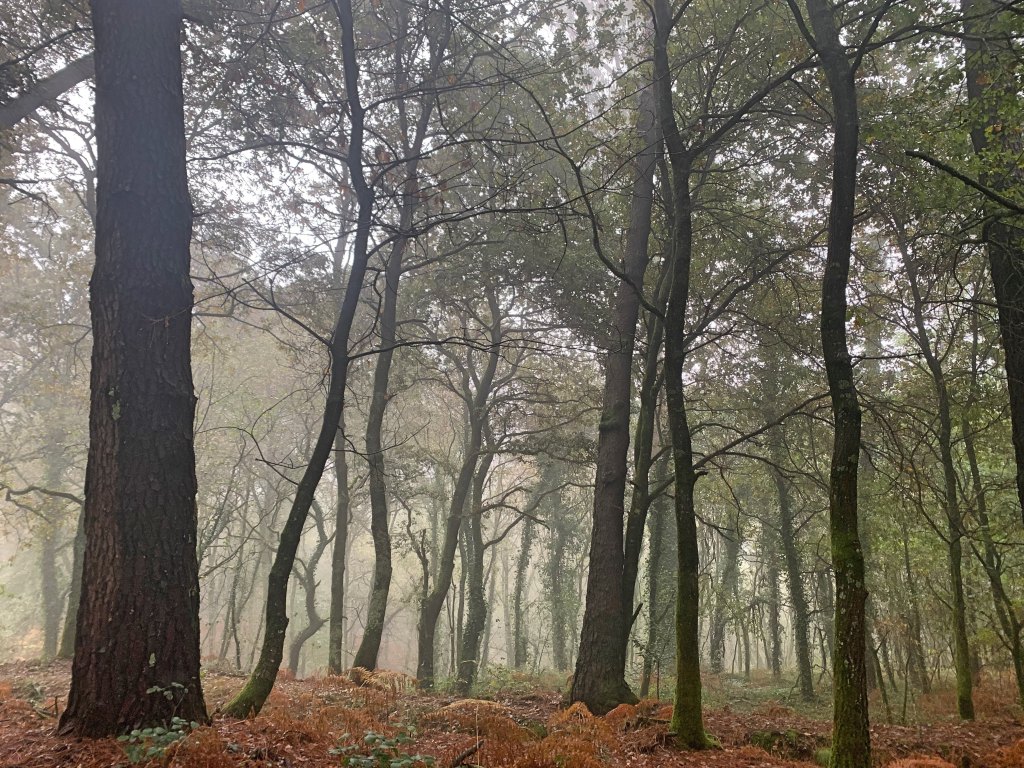
My first day was uneventful. It was the day before Halloween, overcast and foggy. I decided that I wanted to take a hike. Santiago de Compostela has some attractive city parks—the two principal ones being the Parque de San Domingos de Bonaval and the Parque da Alameda—but these are rather small. Seeking wider fields to wander, I walked to the edge of town, to the Parque Forestal de Monte Pedroso. This is a large park—well, more of a young forest than a park. The land had obviously been clear cut not too long ago. Virtually all of the trees were young saplings, planted in neat rows on the hilly landscape, doubtless to be themselves harvested at some future date. (Galicia, though beautiful, has mutilated many of its own landscapes.)

Paths led in and out of clearings in the forest, climbing and falling through the misty trees. The fog was so thick that I would have been completely disoriented if not for the AllTrails app on my phone. It was perfect for Halloween, but not ideal for pretty foliage or beautiful views. At the very least, the hike allowed me to work up an appetite for my visit to El Mesón Do Pulpo, one of Galicia’s many fine pulperías, or octopus restaurants.

I must have been in a very suggestible mood, for I allowed the waiter to talk me into buying a plate of octopus followed by a whole steak, washed down with a pitcher of the fruity local wine. It was an excessive amount of food—and absolutely delicious. You can imagine that the rest of that day was not particularly productive. The only thing I managed to do was to have another excessive meal, this time dinner at a Korean restaurant called NuMaru. I am glad I did, since it was perhaps the best Korean food I ever tasted, better than any restaurant I have visited in Madrid (which one would think is more cosmopolitan and diverse than the provincial Santiago). Clearly, then, my first full day in Galicia was a success.

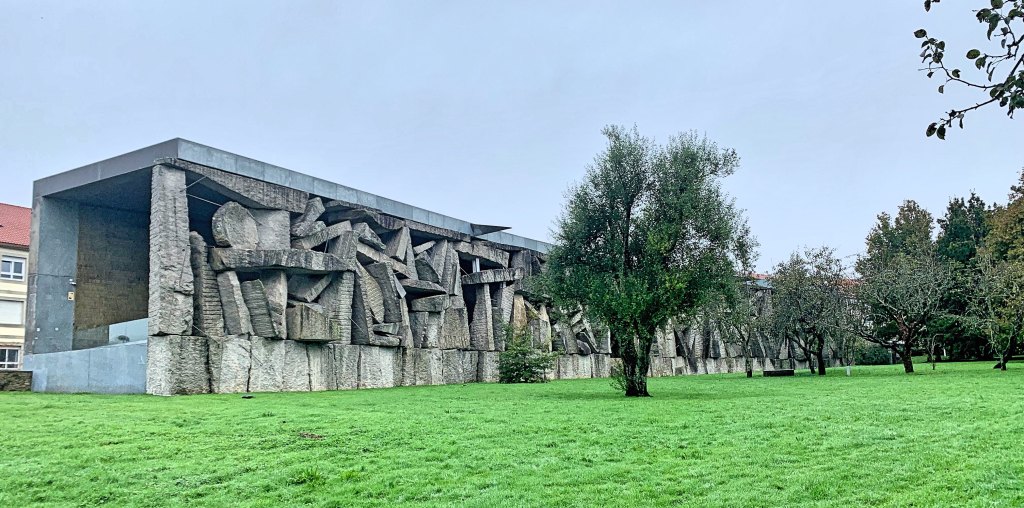
As an afterthought, I wanted to mention the strange architectural installment (sculpture?) I found on the edge of town, on my way to the forest. The thing consists of a kind of arched hallway, constructed of massive pieces of granite. This monstrous monument was built in honor of the Sociedade Xeral de Autores e Editores, which translates to the General Society of Authors and Editors, a private organization that aims to protect intellectual property of those who write and publish music, books, and plays. This sounds noble enough, but it sometimes boils down to publishing companies trying to wring money out of musicians and acting companies—most of which never gets to the artists or writers themselves. Once, the organization charged €96 to a high school theater company who wanted to do a play by Federico García Lorca, who died in 1936. This happened in 2010.

In any case, my next day in Galicia was far, far more eventful. 


A Whirlwind Tour

I awoke early, having set an alarm. The previous day, my Airbnb host invited me on an outing to see his native village. “It is one of the most beautiful villages in Galicia,” he said. The other guest at the Airbnb was going, too. Not having any real plans, I accepted.

The next day, after breakfast, I was ready to go.

“Alright, I’m ready,” the host said.

“And the other guest?”

“Something came up.”

Unphased, I followed my good host and got into the passenger seat of his car. It soon emerged that my host was not simply a man fond of his pueblo. He was a professional researcher and extremely knowledgeable about his native region. As he drove, he rattled off a constant string of information about the area, and I soon realized that, rather than a simple trip to a town, he had an entire itinerary planned out.

Our first stop was the church of Santa Maria de Adina. The church itself is large and attractive but otherwise not remarkable. But buried in the surrounding graveyard is Camilo José Cela, a writer who was born in this town and who went on to win the Nobel Prize in Literature in 1989. I have not read any of his work (it does not seem to be especially popular now), but I was glad to pay my respects to a writer.

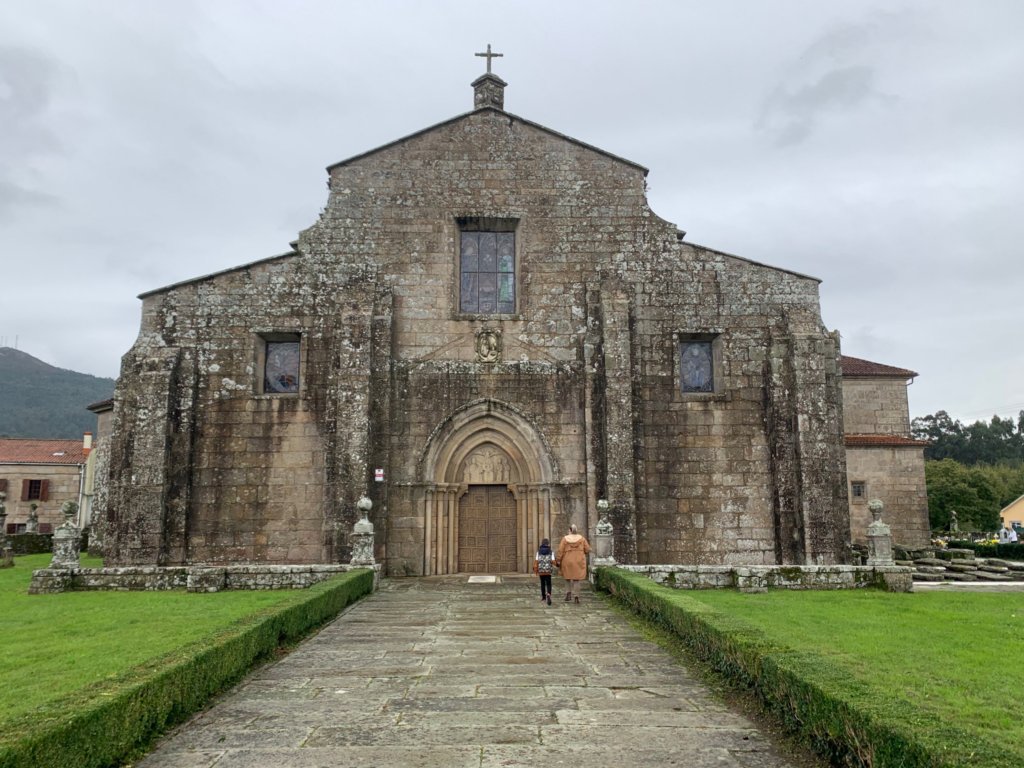
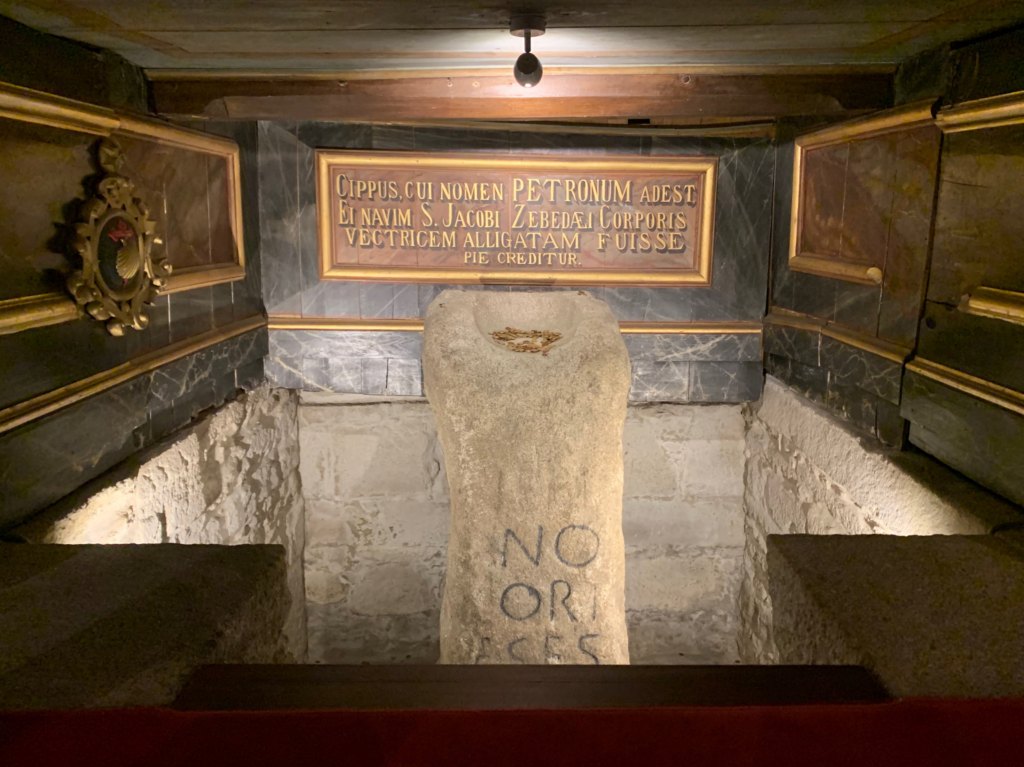
Nearby was the town of Padrón, our next stop. This town will be familiar to lovers of Spanish food, for being the home of the famous pimientos de Padrón—delicious small green peppers that are fried in olive oil and served with rock salt. But my host wanted to show me the Parroquial Church. Again, like many local Spanish churches, it was large and attractive but not memorably so. What sets the church apart is the “pedrón.” This is a sort of large stone that is given pride of place in the church. According to legend, the ship that divinely transported Saint James’ body from Jerusalem to Spain was finally moored to this stone.

The truth is actually more interesting than the legend, as the letters clearly visible on the stone were actually inscribed by the Romans to honor the god Neptune. It reads: “To Neptune: the Orieses (?) put up this stone at their expense.” It seems odd that a pagan monument would hold pride of place in a church. But many pagan rites and rituals were taken over by the Christians. (Christmas is December 25, not because we know when Jesus was born, but because it allowed the holiday to replace the pagan celebration of the winter solstice.) According to this website, the stone was used even before the Romans as a place to tie up their ships.

The tour continued. My host then took me to a very small village called Bustelo, in order to show me a fine example of a Galician cruceiro. This is a distinctly Galician artifact, consisting of a large stone cross standing atop a pillar, often with a small carving of Jesus or the Virgin as adornment. According to my guide, since only the properly baptized were allowed to be buried in the church graveyard, babies who died at or near birth were often prohibited from this sacred ground. Despondent mothers thus would bury their babies at the base of this cruceiro, being another kind of religious burying ground. (If you’re curious, this website contains an image and the location of every cruceiro in Galicia. They are quite beautiful, in my opinion.)

Our next stop was another distinctive monument of Galicia: the hórreo (yes, it sounds like the American cookie). This is small building that was used to store food, primarily grain, before refrigerators became common. They are elevated to keep out vermin, and normally have slits in the walls to keep the food dry. Nowadays they sit unused, a charming and constant reminder that one is in Galicia. My guide had an encyclopedic knowledge of hórreos as well as cruceiros, and he took me to see one of the largest ever built, called the hórreo do traba. It is huge: five or six times the length of a normal hórreo. I have no idea why it was built so large.

Next we visited the lovely seaside town of Noia where, mercifully, we had some coffee. But our break was brief: I was whisked off to the church of Santa María a Nova, which now houses a museum of antique gravestones. These are notable for their decoration (though they are often faded by time and weather), which normally feature the deceased person’s profession. I must admit, however, that I did not understand much of what I saw.

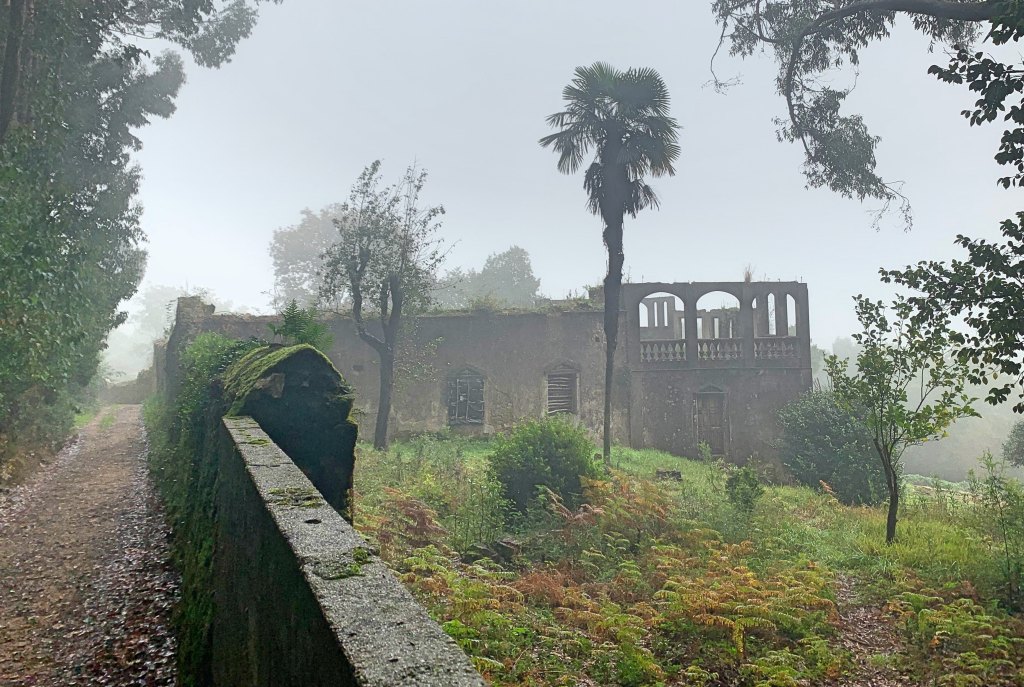
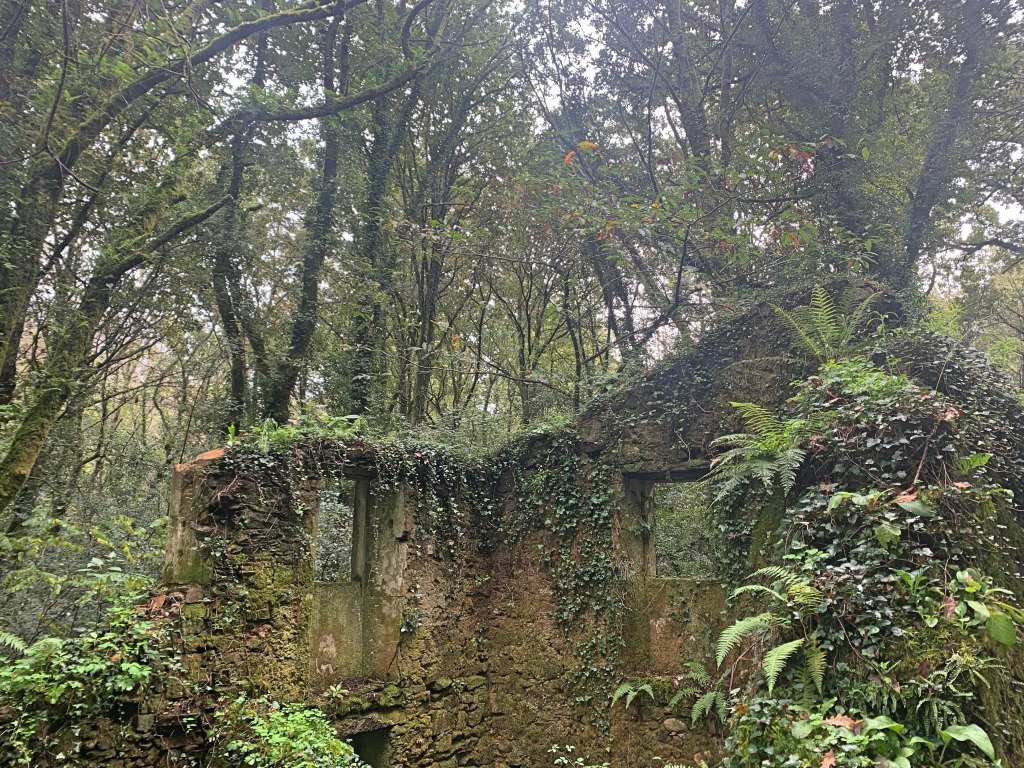
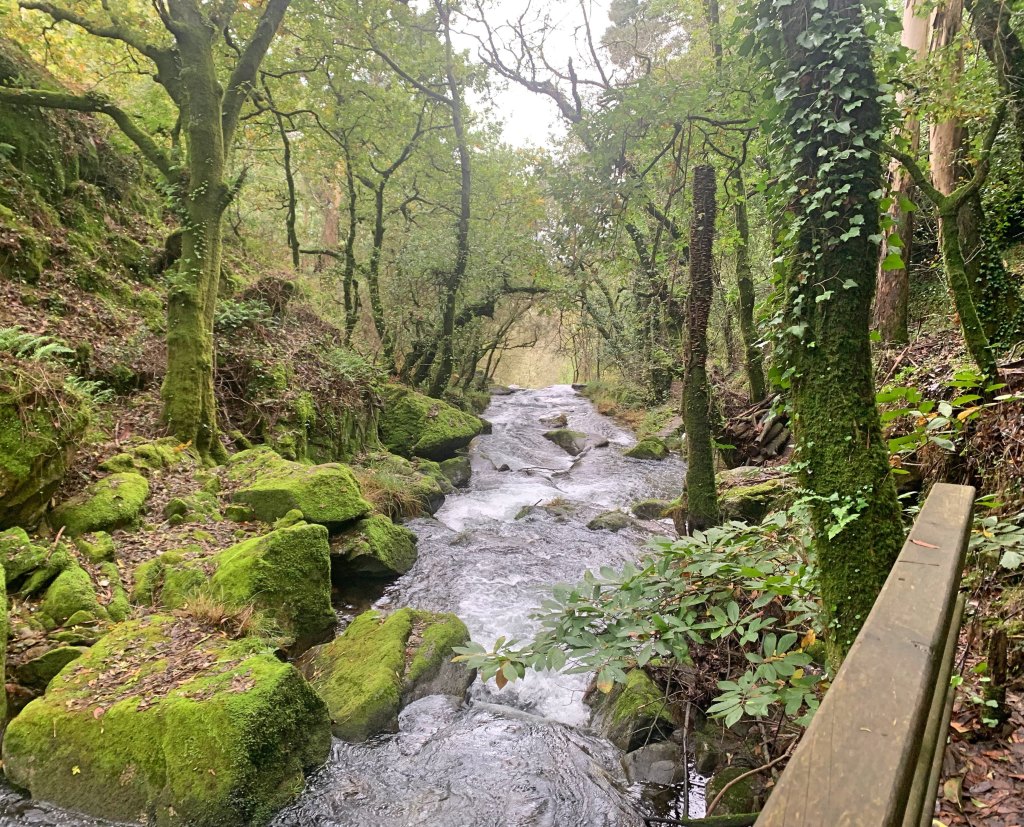
No matter, we had pressing business, and within moments I was back in the car on my way to the next destination. This was probably my favorite thing I saw that day, but I admit I was on guard when my host pulled over by the side of a road and told me to start walking into the forest. My misgiving aside, it was a thoroughly lovely example of a lush Galician forest, with moss-covered trees all around, and the Traba river gurgling nearby. Soon we had arrived at our destination, the abandoned village of Xei. Though the ruins appear absolutely ancient, this village was not abandoned so long ago (less than a century, I think). According to this website, the town was depopulated because its economy relied on the water-powered mills, which became obsolete with the adoption of electricity. In any case, I think ruins often have a strange and otherworldly beauty, and these skeletal structures, green with encroaching forest, were wonderfully evocative.

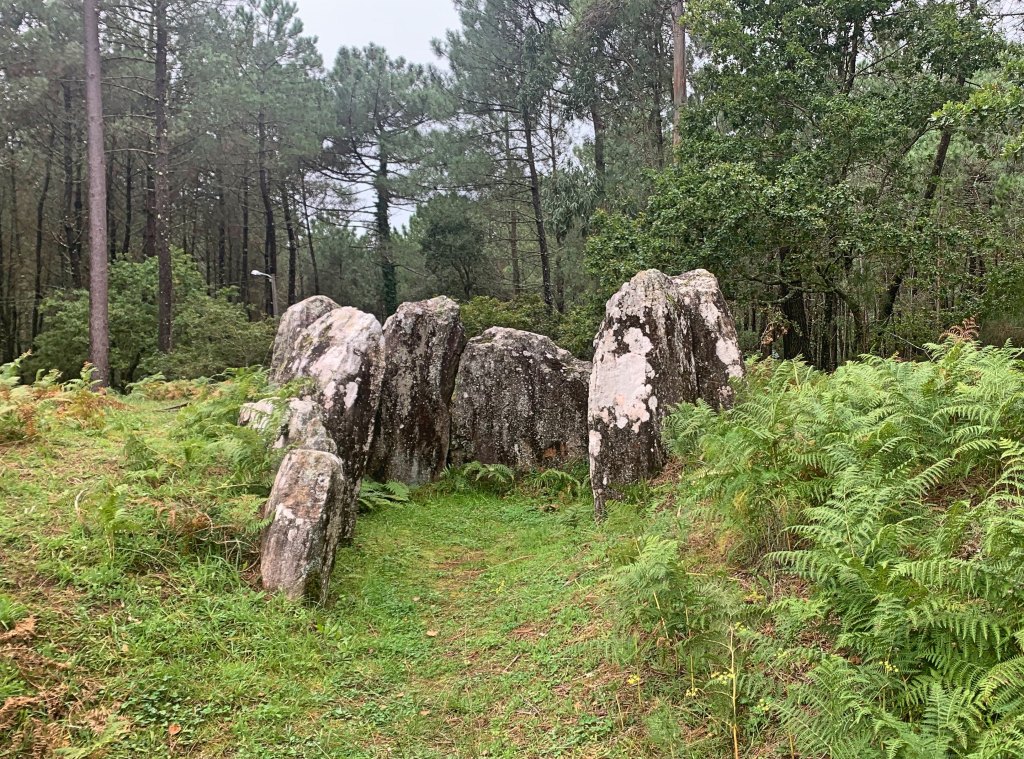
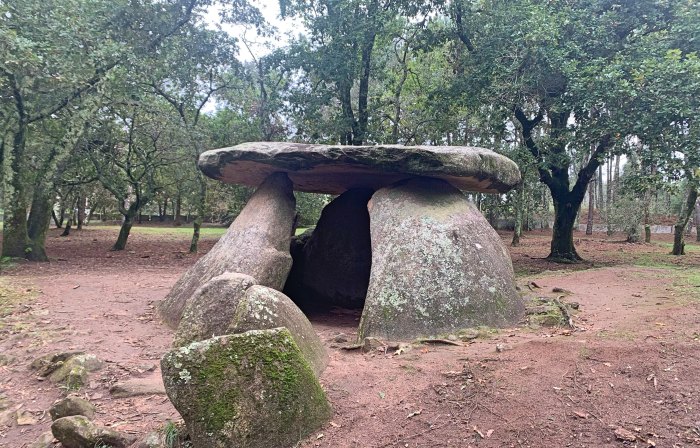
Our next stop was brief, to the nearby Dolmen of Argalo. A dolmen is a kind of megalithic tomb, consisting of a single chamber in a stone structure. In this case, very large slabs of granite were stuck into the ground to form the walls, and dirt was piled up all around it to make a kind of mound. Human remains do not preserve well in the acidic soil, so no bones were found inside. However, archaeologists did uncover stone tools and fragments of ceramics. As my guide remarked, we will never know what the people who built these believed.

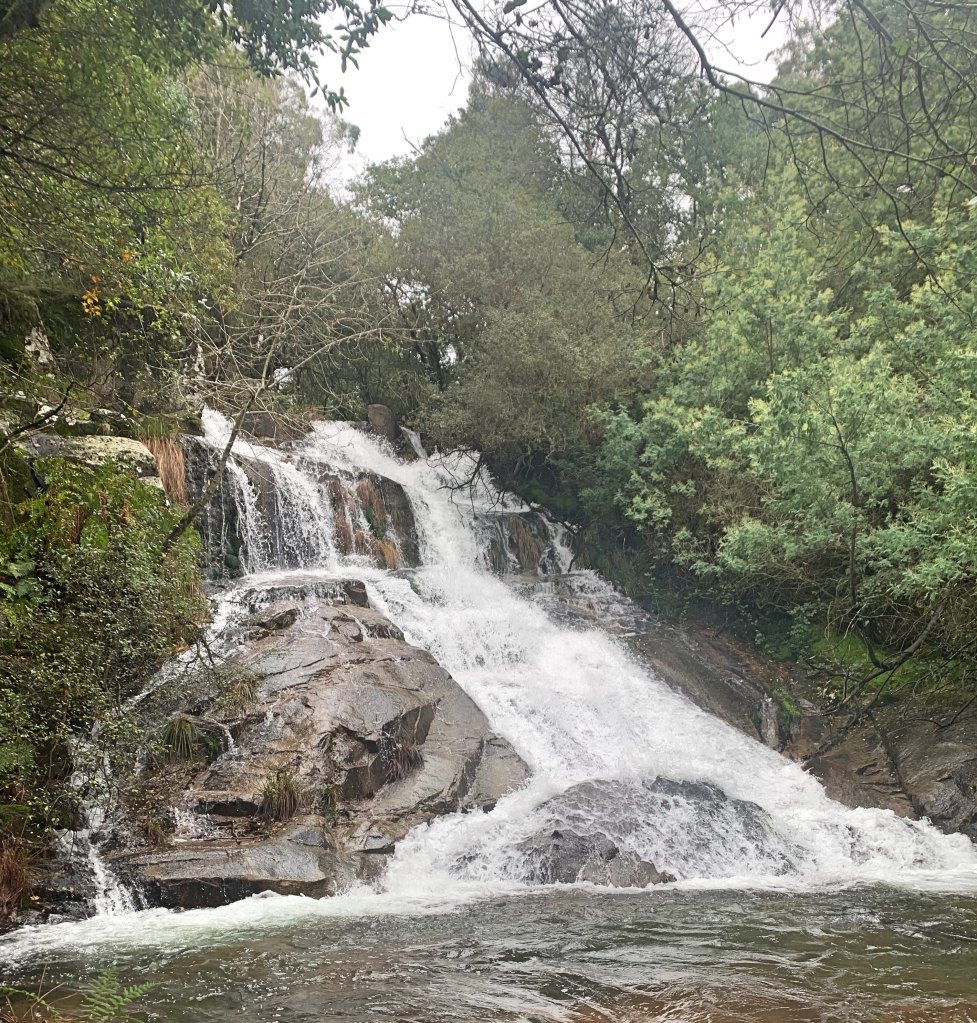
Are you tired already? I was, but that did not stop us from visiting yet another stop. I shouldn’t complain, since this was also a wonderfully beautiful spot. We parked the car near a large old monastery building, the Mosteiro de San Xusto de Toxosoutos, which seemed unused. But this attractive old building was not our objective. Nearby, a path led into the forest, along the San Xusto river, and soon we were surrounded yet again by beautiful Galician forest. Better yet, at this juncture the river formed a series of ever-more attractive waterfalls (fervenza in Galician). Also of interest were the large mill-stones which now sit, unused, alongside the river, a reminder of the ancient importance of water-power.

In addition to its many charms, Galicia is rich in prehistoric sites. Not far from the waterfalls, for example, was yet another dolmen, the Dolmen de Axeitos. This one is larger and more impressive than the Dolmen of Argalo, with a massive granite slab somehow elevated in place as a roof over the wall stones. Whoever made this benefited from not a little teamwork, coordination, and technological sophistication, since moving stones of that size is no easy feat.

It was getting late now, and darkness was setting in. But my guide still wanted to show me one more thing. Aside from dolmens, Galicia has many sites known as “castros,” which are the remains of ancient (presumably Celtic) settlements. One of these sites is the Castro de Neixón, which occupies a peninsula on the coast. (Peninsulas were advantageous locations, both ideal for fishing and sea transport, and easy to defend from the land.) To be honest, this site was disappointing compared to the spectacular Castro de Baroña, which I had previously seen. But the interpretation center nearby also houses a fine museum—which, unfortunately, I was too tired to really take in.

We arrived back in Santiago de Compostela at around eight at night. I immediately went to the nearest restaurant I could find, which happened to be a Chinese place. I was ravenous—we had eaten just a little sandwich for lunch—and the order actually discouraged me from ordering the amount of food I wanted to. He was amazed when I ate every last bite. I really am grateful to the host for having shown me such a wealth of interesting things. But it was a long, long day.


A Pilgrims’ Mass

I had just one more morning in Santiago de Compostela, and I knew how I was going to spend it. The previous night, I learned that the other Airbnb guest (the one who had abandoned the odyssey of Galician sightseeing) was a veteran of the Camino de Santiago. He informed me that was planning on attending the so-called Pilgrims’ Mass the following day.

Now, I had already attended this mass several times (once while suffering a severe stomach cramp), and had always been disappointed that the famed Botafumeiro was not used. This is the enormous incensor that, on special days, is swung from wildly through the cathedral on a pulley. Constantly missing this event was perhaps my greatest disappointment in Spanish travel. But according to my fellow guest, today there was a good chance that I would finally witness the spectacle.

The cathedral was packed. There were lines to get in at every entrance. I arrived nearly an hour early and still had to stand, as the pews were completely occupied. It was obvious at a glance that most of the audience was not there to save their souls. Foreign languages abounded, and cameras were held at the ready. I was certainly no different; but even within this great crowd I tried to temper my expectations. I had been in a similar crowd when the Botafumeiro failed to materialize.

But today was different. A hush came over the crowd as the robed priests appeared. Then, somewhere behind me, voices began to echo in the stone chamber. It was a choir, and a very good one. The singers were moving through the space, from the front to the back, but with so many people I could hardly catch a glimpse of them. It hardly matters, as their voices were rendered omnipresent by the reverberations, washing over me like a wave. It was genuinely spiritual music, soothing and even spine-tingling in its ethereal beauty.

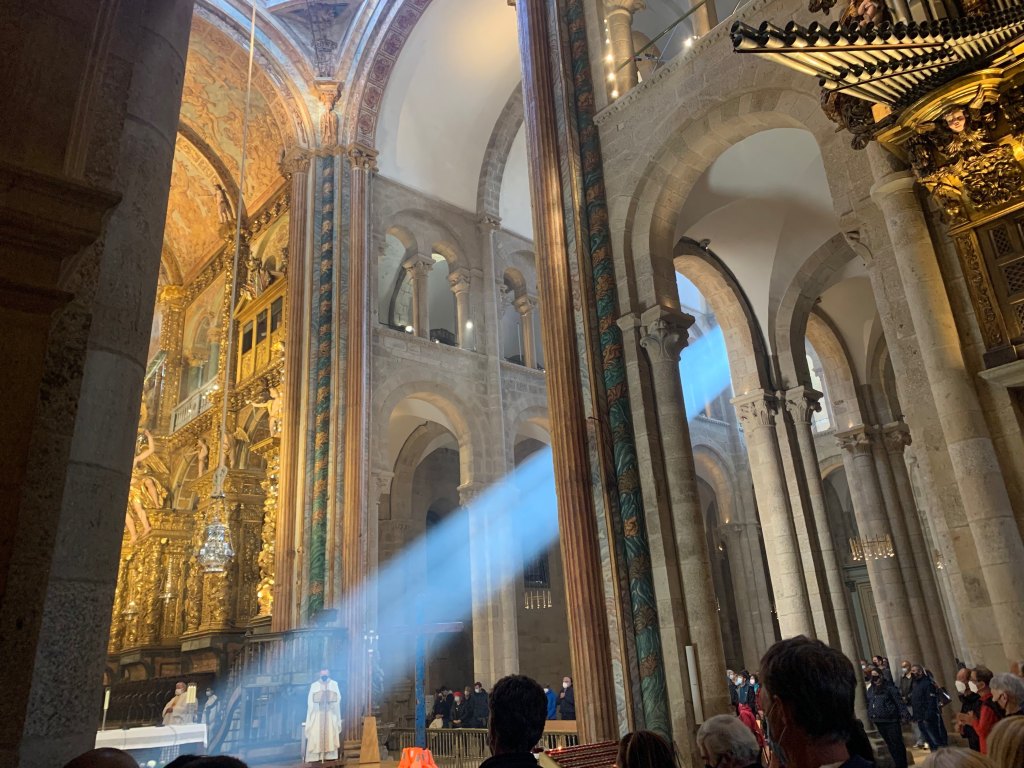
The choir ceased, and the priest approached the pulpit. Everyone turned around to face the main altar. Sunlight was pouring in through the high windows, a single bright beam illuminating the white robe of the priest. For the second time in my life, I briefly considered converting to Catholicism. (The first time was in Mont Saint-Michel, and also involved sunlight and choirs.) I was so transported by the atmosphere that I could hardly register anything he was saying. In any case, his prayers were brief. Soon an organ had begun to play, now filling the cathedral with piercing reedy notes, while several robed men got into position around a multi-corded rope.

My body filled with electricity as I realized that, yes, this time I was finally going to see it. The rope was pulled taught and the men began to tug, gently at first, and then more firmly. With every tug, the enormous incensor began to swing higher and higher, from right to left, until it completed an arc that almost touched the ceiling. Smoke poured out of the flying metal casket, and soon the entire cathedral smelled of frankincense and myrrh.

This performance lasted for about five minutes. Then, the Botafumeiro gradually slowed down enough for the brave priests to catch it. This was our cue to leave, and the audience filed out in a respectful silence. I must admit, as absolutely cool as the Botafumeiro was, it did leave me feeling a little sorry for the priests. It is not a sight calculated to inspire religious devotion, merely to please tourists like myself. There is nothing theologically significant about a flying ball of smoke. Even so, I was very happy to have seen it. Though it had been more than a year since my last walk on the Camino, it felt like the end of a long pilgrimage.

Review: Hiroshima

Review: Hiroshima

Hiroshima by John Hersey

My rating: 5 of 5 stars


This is certainly one of the great books of the previous century. It is superlative in many respects. Most obvious is the book’s historical value, which needs no further elaboration. Hiroshima is also a stylistically innovative and influential book, pioneering the dramatic writing techniques that would come to characterize some of the best journalistic writing after the war. And Hersey also deserves praise for his stylistic restraint. Virtually no event could have been more liable to evoke overwrought prose or vain attempts to capture the broad sweep of the tragedy. Hersey’s decision to focus on only six survivors, and to narrate what they saw with simple directness, was an act of great authorial self-control.

But this book is great for more important reasons than these. The power of atomic weapons is such that most of us can barely imagine it, much less picture ourselves their victims. Thus, as with many historical atrocities, the stories of survivors bridge the gap between imagination and experience, and allow us—at least dimly—to grasp the extent of the horror. Merely being faced with the reality of the bomb is enough to make a point. Without any explicit preaching, Hiroshima utterly convinces us that weapons which wreak such indiscriminate violence and widespread destruction have no possible rational use, even in war.

Last, the book is a wonderfully humanistic document. The people in this book were struck with a weapon they did not even suspect existed. They lost their homes, churches, and businesses, and they lost parents, children, spouses, and friends. And yet Hersey shows how these ordinary people often proved capable of extraordinary heroism and resilience, not only in the immediate aftermath, but in the years that followed. I found this especially moving, as I am often ashamed of my own inability to deal calmly with petty frustrations and minor setbacks. Books like this may not make me any wiser, but they at least leave me with a little hope—for myself, and for us all.


View all my reviews

Review: Why We Sleep

Review: Why We Sleep

Why We Sleep: Unlocking the Power of Sleep and Dreams by Matthew Walker

My rating: 5 of 5 stars


I first heard of this book from Michael Pollan’s short work on caffeine. There, he calls Why We Sleep (to paraphrase) one of the most disturbing books he had read in a while. This caught my attention. How could a book on sleep be disturbing?

From the first page of this book, I knew why. The author, Matthew Walker, is essentially diagnosing a major health crisis that is going on in front of our drooping, baggy eyes—namely, the crisis of insufficient sleep. According to Walker, virtually everything we do—how we work, how we relax, how we seek entertainment—is disruptive of sleep. And he has plenty of studies to show that, when you do not sleep enough, there are serious consequences.

In addition to the familiar cognitive impairments of bad sleep (inability to focus, lack of energy, wild mood swings), there are the long-term health risks, such as the increased likelihood to develop cancer, heart disease, or diabetes. More unfortunate still, there does not seem to be any way of getting around the familiar recommendation of eight hours of sleep per night. We cannot get by with less, and we cannot make it up on the weekend.

Indeed, the news gets worse and worse. Even moderate amounts of alcohol and caffeine can gravely affect sleep (and marijuana, too—sorry); and sleeping pills may do more harm than good. Our phones, tablets, and computers—even our indoor lights—wreak additional damage by throwing off our natural diurnal rhythms. So this pretty much eliminates all of my nightly plans.

What it comes down to, says Walker, is a cultural disrespect for sleep. I am certainly guilty of this. I have always taken pride in using the opportunity of a plane, train, or bus ride to read a book rather than to nod off, and felt secretly superior to those dozing around me. More generally, sleeping is often equated with laziness. Waking up after midday is a moral failing; taking a nap on the job is a fireable offense; and going to bed early is socially questionable. Further, many people—especially in the business world—take pride in their ability to get by on few hours of sleep. Wakefulness is productiveness. But this prejudice is, Walker contends, based on ignorance of the real value of sleep.

Sleep is a biologically basic process. All mammals, birds, and reptiles, some fish, and even insects have been observed in a sleep-like state. Lack of sleep can not only be harmful, but fatal. Some gruesome rat experiments have shown this, as does the rare disease, Fatal Familial Insomnia, in which the brain becomes incapable of generating sleep—which is inevitably fatal. Sleep is just as basic a need as food. And as you might expect from such a basic need, it is hard-wired into our evolution. Indeed, two distinct types of sleep have evolved, which accomplish different purposes: REM and (creatively named) non-REM.

As you may know, the REM stands for “rapid eye movement,” which is when we experience vivid dreams; and it alone accomplishes many things. In addition to fostering creativity by forging novel links between memories, REM sleep apparently keeps us sane (people experimentally deprived of REM sleep for long enough experience symptoms of psychosis). Non-REM is, perhaps, the more restful sort, when new memories are moved from temporary storage to a more permanent location. The two sleep types thus work together and come at predictable moments in the night: deep non-REM sleep early on, and REM closer to the time we wake up. (Short sleep thus selectively cuts down our REM sleep time.)

Walker explains the science because he wants to drive home the importance of sleep—not a luxury, or an indulgence, but a survival mechanism designed by natural selection. With this basic point in hand, Walker goes on to make several social criticisms, and at times the book almost becomes a polemic.

Take driving, for example. Everybody knows that driving drunk is dangerous and irresponsible. But Walker cites studies showing that drowsy driving is, if anything, even more dangerous. When you are sleep deprived, your brain can drift off into what are called “micro-sleeps,” which last just a couple seconds. This is quite enough time to get into a serious car crash. And this is common. Over the Christmas break, everybody I mentioned this to had a story about falling asleep behind the wheel. It has happened to me, too—a thoroughly alarming experience, which thankfully did not result in a crash. Considering this, I cannot help but agree with Walker this issue is just as deserving of public awareness campaigns as inebriated driving.

Walker is also highly critical of how the medical community treats sleep. For one, most general physicians have little training when it comes to sleep, and so are apt to prescribe sleeping pills to patients with insomnia. Unfortunately, sleeping pills merely sedate the brain without generating natural sleep, and so do not really solve the problem. Another issue is that of doctors’ timetables. From residency on, doctors are often expected to work inhumanly long shifts, even though evidence shows that sleep-deprived doctors are less effective by every measure. Another issue is patient sleep. Although sleep is highly conducive to healing, hospitals often present hostile sleep conditions (loud noise, bright lights, poorly scheduled tests), especially in the ICU, which actively impedes recuperation.

Last but not least, Walker contends that many (though not all!) children diagnosed with mental disorders, like ADHD, may really be suffering from a sleep problem, as insufficient sleep can cause many of the same symptoms (lack of focus, lack of emotional control, etc.). This neatly dovetails with another issue: schools. According to Walker, every person has a natural sleep-schedule, and teenagers tend to have a later one than adults. When teenagers are expected to get to class by eight o’clock or earlier, therefore, we are making it impossible for them to adequately sleep, in the same way most adults would not be able to adapt to a job that began at six in the morning. As a result, many teenagers are chronically under-slept. No wonder that they are so considerate and polite.

This certainly resonates with my experience. Not only did my high school start early, but most of the musical extra-curriculars took place in the hour before regular classes. This meant that I had to arrive by quarter to eight, while I hardly ever went to bed before midnight (often much later). Unsurprisingly, I was a zombie for most of my morning classes. It is easy for me, then, to concur with Walker in proclaiming these early start times for high schools to be illogical and counterproductive. Thankfully this message seems to be slowly sinking in, and some schools have begun pushing back their schedules.

This review, long as it is, hardly does justice to the content of this book. Not only has Matthew Walker written an excellent work of popular science, but he has written a quietly revolutionary work. After all, our society would really look quite different if we took our need to sleep as seriously as we took our need to eat. The world Walkers imagines is certainly a more relaxed and humane one (though, it must be said, perhaps a bit puritanical in its strictures). Imagine, for example, a world when napping during work was encouraged and when start times were flexible. Imagine getting a deduction on your health insurance for sleeping enough. A boy can dream.

There was only one moment in which I doubted the good Walker. In 2015, a study was released that tracked the sleep of three hunter-gatherer groups, and found that they slept, on average, slightly less than seven hours, rather than the expected eight. This seems to undermine Walker’s contention that the modern world is uniquely inimical to sleep. He counters that the study may only show that these hunter-gatherers are also not sleeping enough. But this seems like rather weak tea after telling us of the evils of coffee, alarm clocks, and LED lights. If those free of modern temptations can’t do it right, what hope do we have? Perhaps we are doomed. Even so, I think all of us could benefit by treating our shuteye with a little more respect. Speaking of which, it is already past my bedtime.
_______________________________________________
A fellow reviewer on Goodreads, Siddhartha, recommended an article written by the blogger Alexey Guzey that examines the first chapter of Matthew Walker’s book in depth, purporting to find many factual errors. I think it is worth going over Guzey’s points.

First, he notes that, while Walkers claims that longer sleep leads to longer life, in reality studies show a kind of U-curve, where both short and long sleep times are associated with higher mortality. Walker addresses this later on, but defends his position by stating that diseases and comorbidities often lead people to sleep more. Guzey counters that some diseases actually make people sleep less. In any case, Walker’s argument does seem fairly week to me in the absence of evidence that these longer sleep times are certainly caused by diseases. (Also it seems like circular reasoning to assert that anyone sleeping significantly longer than 8 hours must have some sort of disease. Were they presumably under-sleeping before, causing an illness that pushed them into over-sleeping?)

Guzey’s next points out that it is untrue that a good night’s sleep is always beneficial, since sleep deprivation is used as a therapy for depression. Now, to me these seems like nit-picking. One can still say it is almost always beneficial. True, Walker does discount the potential benefits of sleep deprivation therapy without much thought, but that is still a minor point since Walker is not a psychologist.

Guzey’s third point is also somewhat unfair. He points out that it is far from certain that the lack of sleep is what kills victims of Fatal Familial Insomnia. Yes, Walker uses Fatal Familial Insomnia to bolster his claim that lack of sleep is fatal, but he does admit (later on) that it is impossible to say that the lack of sleep is what actually kills in the disease, since victims suffer extensive brain damage. But Walker bases his assertion of the mortality of sleep loss on some (rather cruel) rat studies. Admittedly, we are not rats.

Another of Guzey’s criticisms is that, while Walkers is quite insistent on the eight-hour number, the National Sleep Foundation actually recommends anywhere between seven and nine hours. (And though Walkers invokes the WHO, the World Health Organization has not actually issued sleep recommendations.) This is certainly a legimitate critique of the book, since somebody who sleeps seven hours is actually within the normal range, even though they would get the impression from Walker’s book that they are underslept and at risk.

Several other factual errors Guzey point out are quite valid. It does seem true that, contrary to Walker, the WHO has not declared any sleep loss epidemic in industrialized nations. This is a serious error in itself. Guzey also calls into question whether those in the industrialized world really are getting less sleep now than people did 100 years ago. This claim, in my opinions, does deserves far more scrutiny. True, late night work emails and LED screens are recent inventions. But working on a farm or a factory is hardly more forgiving or flexible. And, again, if hunter-gatherers aren’t sleeping more than we are, perhaps the evidence of a recent sleep loss epidemic is not so strong after all.

Not having done any research myself, I can only give my two cents. I did get the strong impression that Walker consistently emphasized the most potentially dire consequences and examples of sleep loss. And, honestly, I really hope that Walker’s prophecies of doom are somewhat exaggerated, since obtaining perfect sleep while going to work, having a decent social life, keeping up with a hobby or two (not to mention the pressures of raising children—not that I have any) seems close to hopeless.

Even after all of this, I do think that this book is an important corrective to our current cultural disregard of sleep. Thank you for your time.


View all my reviews

Review: Johnson’s Dictionary

Review: Johnson’s Dictionary

A Dictionary of the English Language: an Anthology by Samuel Johnson

My rating: 4 of 5 stars

LEXICOGRAPHER: A writer of dictionaries; a harmless drudge, that busies himself in tracing the original, and detailing the signification of words.


A dictionary is a marvelous thing. I discovered this during my first year in college, when I was finally asked to do some challenging reading (and when I finally decided to start doing the assigned readings). It was with some shame that I admitted to myself, after a few weeks, that I often came across a word I did not understand. Indeed, this happened with such frequency that I finally resolved to underline all of the words I could not confidently define, and then look them up. But even this didn’t seem like enough. By the time I encountered the troublesome word again, its definition would be forgotten. Thus the “Word Project” was born.

To forcibly expand my pitiful lexicon, I resolved that I would write out the definition of every unfamiliar word in the back of a marble notebook. Then, to reinforce the definition, I would flip to the front of the notebook and use the word in a sentence. Astoundingly, I actually followed through with this resolution, and carried on the habit for years—filling up two whole marble notebooks in the process, comprising thousands of words, definitions, and sentences. I even filled up the margins with lists of synonyms. (I cannot help feeling that I have gotten much lazier with time. Could I be so disciplined now?)

A few examples from the first page include: inculcate, surfeit, equivocal, corroborate, and depredation. By the time I got to the second notebook, the words were more exotic: jactitation (the restless turning of the body in illness), imago (the unconscious idealized mental image of someone), and ontogenesis (which I’ll let you look up). But I find the lists of synonyms, or near-synonyms, more interesting now. For example: petulant, peevish, tetchy, crotchety, fractious. Or: effrontery, impudence, impertinence, insolence. I could go on—synonyms are wonderful fun, at least for writers—but I shall resist.

The project was a success. My vocabulary improved markedly, to the point when I so rarely came across an unfamiliar word that I stopped bothering to write them down. (It does still happen from time to time, though.) However, my loftier goals were unrealized. You see, I had hoped that, by expanding my vocabulary, I might even make myself noticeably more intelligent. A mind with more words to express itself must, I theorized, think more efficiently. Unfortunately, that theory did not seem to hold water (half the time I don’t think in words, anyway), and my mental acuity remained unchanged. I also thought that such a project might improve my writing. And though I do think I am, at least, more sensitive to language as a result of the project, I normally prefer to use simpler words, anyway.

Even so, in retrospect the “Word Project” was one of the greatest things I ever did for my own education. The definitions of these abstruse words were, for me, a kind of key to the wider world of knowledge and literature. I would never have developed my love of books had I constantly been scratching my head at unfamiliar words. So I have a keen appreciation for any “harmless drudge” who chooses to write a dictionary. Lexicographers do the world a great service.

This volume is, of course, not a book one can use as a standard dictionary. David Crystal has edited the 2,300 pages of dense text into something more manageable, by selecting for those passages that the modern writer might find most curious. Included are words that are now obsolete, words whose meanings have significantly changed, and words with especially pleasurable definitions.

As an example of the latter, fun is defined as “sport, high merriment, frolicksome delight.” And to flatter is “to sooth with praises; to praise with blandishments; to gratify by servile obsequiousness.” As you can see, Johnson has a tendency to pleonasm in his definitions. He is also fond of expressing his opinion of a given word, in a way that no modern dictionary would. “Fun,” for example, is “a low cant word,” and many terms are dismissed as “barbarous.”

Some words have changed in surprising ways. Johnson defines punk as “a whore; a common prostitute; a strumpet,” and punctuation as “the act or method of pointing.” Yet the most delightful entries are perhaps those words which are no longer used. Often one feels that it is a shame it should be so. What is wrong with smellfeast (“one who haunts tables”), fopdoodle (“an insignificant wretch”), and mouth-friend (“one who professes friendship without intending it”)?

If nothing else, it is worth reading this anthology to fully admire Samuel Johnson’s genius and industry. Virtually nobody nowadays would undertake to write a dictionary single-handedly. And such a task would be so massive—running the gamut from scientific jargon to recent slang—that it is difficult to image anyone succeeding. That Johnson did succeed is, more than any other of his accomplishments, the reason he was so widely venerated during his lifetime. (His contemporaries more often referred to him as “Dictionary Johnson” rather than “Dr.”)

And even if his dictionary is hopelessly outdated now, it still can serve as a model of strong writing. Johnson’s definitions are a pleasure to read through—punchy, pugnacious, and punctilious—and each one is accompanied by at least one (often many more) quotation from well-respected authors. This way, the reader’s mind is expanded while her taste is refined. An elegant idea, at least. Yet if I wish to accomplish anything in this review, it is not to praise Johnson’s Dictionary—worthy though it is of praise—but to exhort you to pause, every so often, and ask yourself whether you really know what a word means. A trip to a dictionary can open up new realms of reality.


View all my reviews

2023: New Year’s Resolutions

2023: New Year’s Resolutions

Happy New Year! Another year has come and gone in the world—and also on this blog. In fact, I began writing here more than seven years ago! That being said, I know I have been relatively inactive this past year—I didn’t even write New Year’s Resolutions last year—which I am sorry for. In my defense, this was because I spent so much time this past year working on my new novel. At least I managed to get a few drafts completed.

Even so, one New Year’s Resolution I will make is to re-dedicate myself to this blog. I have missed writing here and, I am sure, at least a couple people (?) have missed it, too. In that spirit, here is a list of trips that I still have to write up:

Yes, it has been a productive travelling year. If 2023 is half as good in this respect, I will be fortunate indeed. I should also add the New York landmarks I visited this past summer:

  • Hyde Park & Vanderbilt Mansion
  • Intrepid Air and Space Museum
  • Louis Armstrong House Museum
  • Lyndhurst & the Untermeyer Gardens
  • Olana & Kaaterskill Falls
  • West Point

Honestly, if I get through all this writing this year, it will be a miracle. But, somehow, I am feeling optimistic.

There are also lots of books I hope to read, much too many to name. Aside from these literary labors, I hope to continue practicing guitar and learning German. A more lucrative job would be nice, too. The most intimidating goal of all, however, is to finally run a full marathon. I took the plunge and signed up for the Madrid marathon in April. Wish me luck.

2022 in Books

2022 in Books

2022 on Goodreads by Various

My rating: 4 of 5 stars


I have the nagging feeling that I’ve gotten lazy about reading—as if I fail to prioritize it, or that it is rarer for me to get swept up into a book. When I examine the books I did manage to read, however, I see that I have had an altogether decent year in this department. In any case, it is wiser to focus on the positives.

As usual, my reading was divided between certain themes and a random spattering of other books.

One major theme—arguably the dominant theme of the year—was music. The first book I completed was Paul McCartney’s The Lyrics, which coincided with my second viewing of Peter Jackson’s incredible Beatles documentary, Get Back. This reignited my Beatlemania and, more generally, my musical fandom. During the course of the year, I made my way through three books on blues, a history of jazz, a history of music in New York City, a history of modern pop music, biographies of Biggie Smalls and Bob Dylan, and the memoirs of Bob Dylan, Pattie Smith, and Miles Davis. Of these, the absolute best was Miles Davis’s Autobiography, which is so engaging, so full of great stories, so illuminating, that it easily ranks among the best books of the year. And I should also mention Malcolm Gladwell’s audiobook on Paul Simon, a delightful little gem. If nothing else, I am grateful to have reconnected with my love of music this year.

Another, rather vague category could be termed “nature and adventure.” This incorporates Ken Burns’s excellent documentary on America’s National Parks, a book about the Hudson River school of landscape paintings, as well as several accounts of getting lost in the wilderness. Most of these combine danger with discovery: Lewis and Clark’s journals on their voyage across the country, Ernest Shackleton’s account of his failed attempt to cross Antarctica, and Steven Callahan’s record of his struggle to survive in an inflatable life-raft. Best of all was Over the Edge of the World, Laurence Bergreen’s book about Magellan’s journey around the world. This last book was such a winning combination of excitement and historical interest that I would recommend it to nearly anyone.

In the realm of fiction, I made my way through some old classics: Eugénie Grandet, Eugene Onegin, The Charterhouse of Parma, Ivanhoe, As I Lay Dying, The Scarlet Pimpernel, and Their Eyes Were Watching God… My absolute favorite was younger, slimmer, and more stylish than these hoary volumes: Italo Calvino’s If on a winter’s night a travelerThough not profound, it is a delightful work which manages to be utterly post-modern without being annoying (well, it is slightly annoying). I should also mention Camus’s The Fall, which is certainly profound but not quite delightful.

By far the longest book I finished was a history of science in Spain, El país de los sueños perdidos. I feel almost silly for having dedicated so much time to it, since I neither enjoyed it very much nor learned what I hoped to learn. My most popular review of the year was of David Graeber’s posthumously released book, The Dawn of Everything, which somehow managed to be both brilliant and disappointing at once. Meanwhile, the most-represented author on my list is none other than Rick Steves. Somehow, this dorky, goofy tour-guide absolutely won me over. In addition to reading three of his books, I watched all of his travel programs on YouTube—learning a lot about European travel and travel writing in the process.

Two of the most moving books of the year concerned the holocaust: Anne Frank’s diary and Elie Wiesel’s Night. The books are, in a way, complementary, as they are both written from the perspective of a young adolescent swept up in this catastrophe—indeed, Wiesel’s book begins where Frank’s diary ends, at the gates of the concentration camp. These first-hand accounts of human cruelty were supplemented by Paul Preston’s book on atrocities committed during the Spanish Civil War. There seem to be no depths too deep for us to sink to. But since I don’t think a book review—or the year itself, for that matter—should end on such a dark, depressing note, I also would like to mention that I finally read some books on Norse Mythology, which were lovely.

I suppose if next year’s books are just as good as this year’s, I will have no cause to complain. And, as always, the pleasure will be all the greater with the Goodreads community.

To see the rest of my books, click here.


View all my reviews

Images of Asturias

Images of Asturias

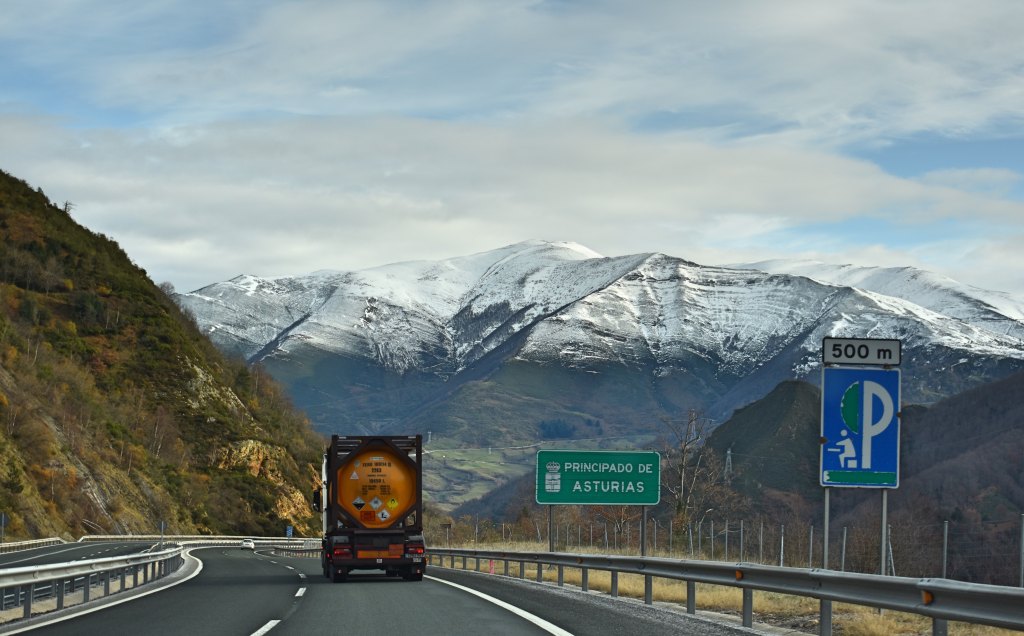
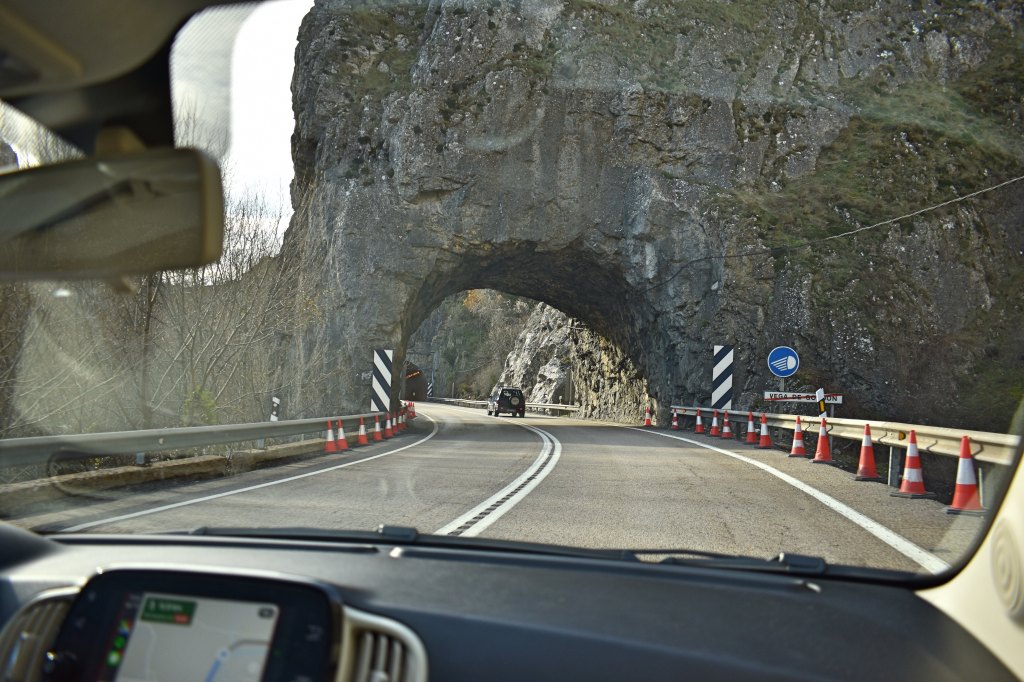
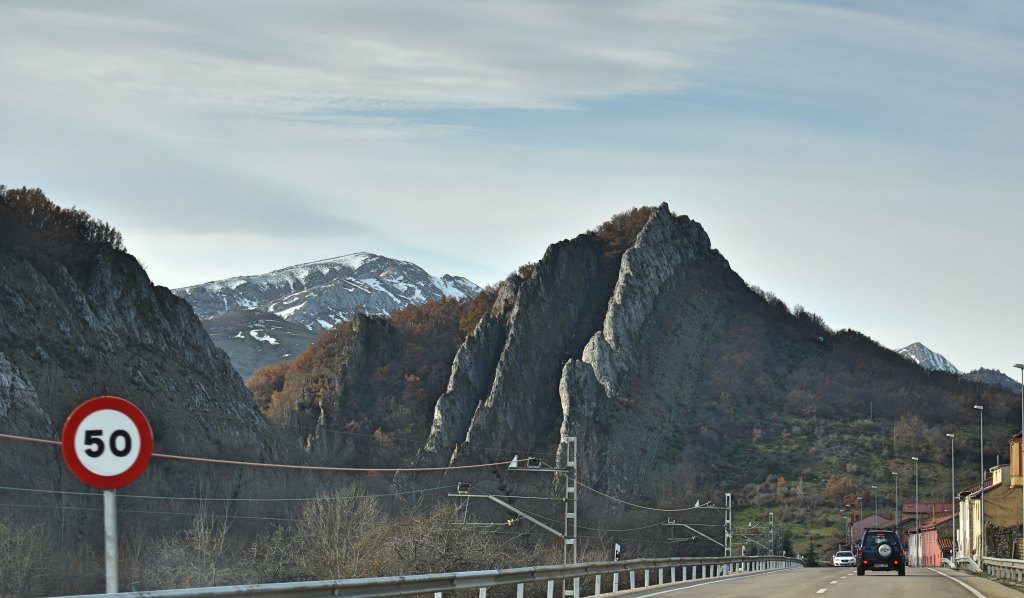
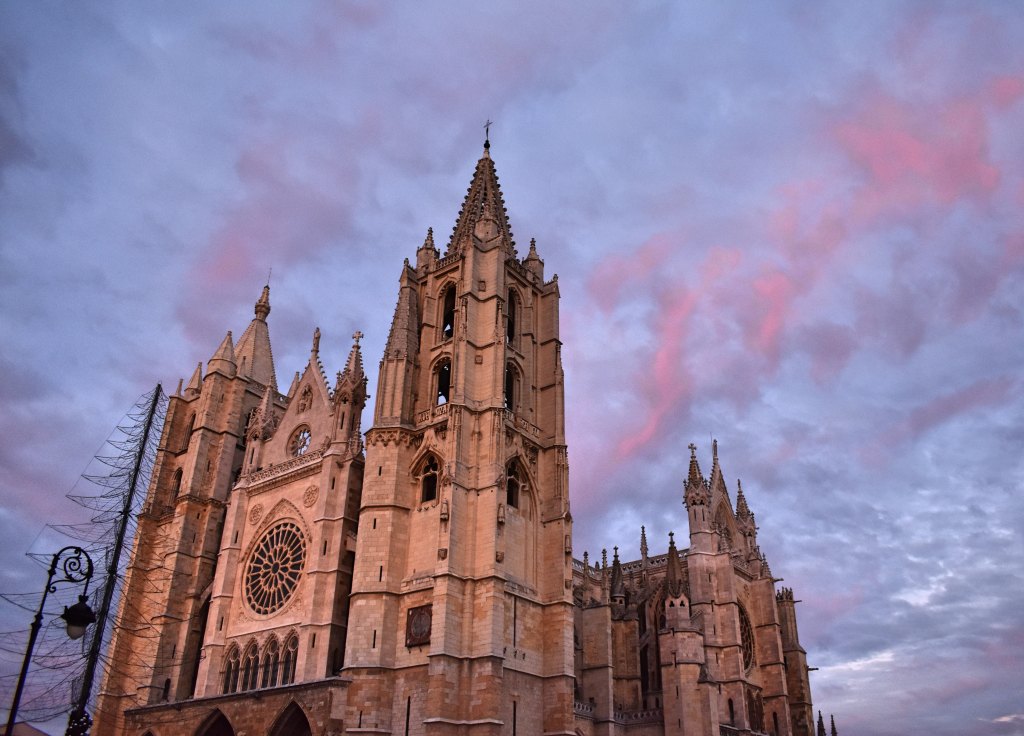
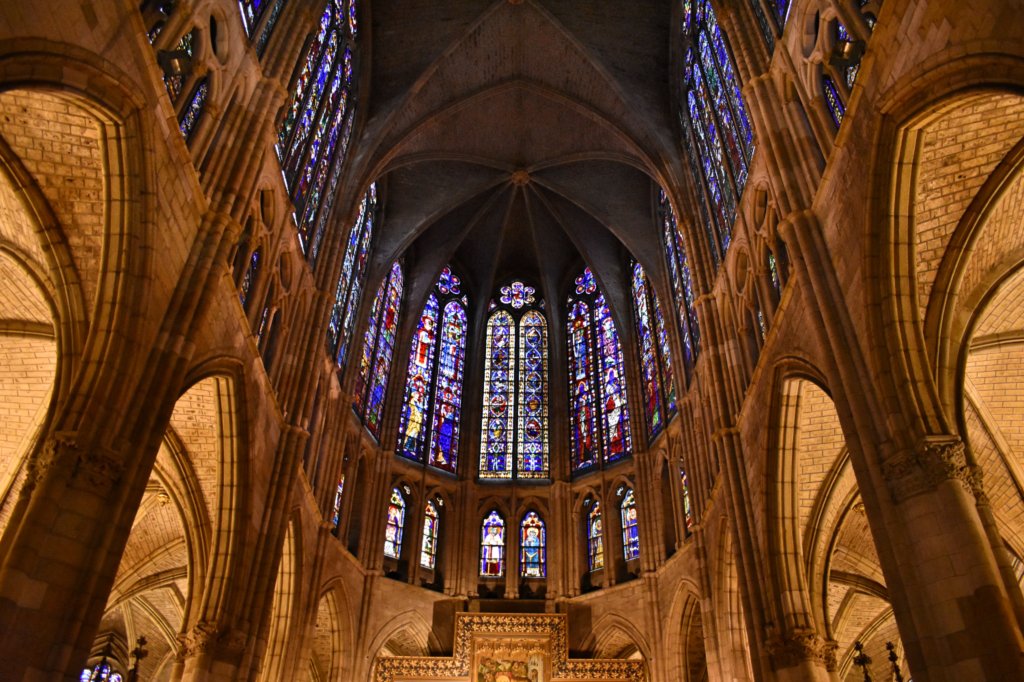
From León, the journey continued north. Our GPS took us on the main highway, the AP-66, which cuts straight through the Cordillera Cantábrica—the major mountain range separating the interior plains from the northern coast—with tunnel after tunnel. Our destination was Oviedo, the capital of Asturias. Thankfully, this time our Airbnb had heating and hot water.


Oviedo

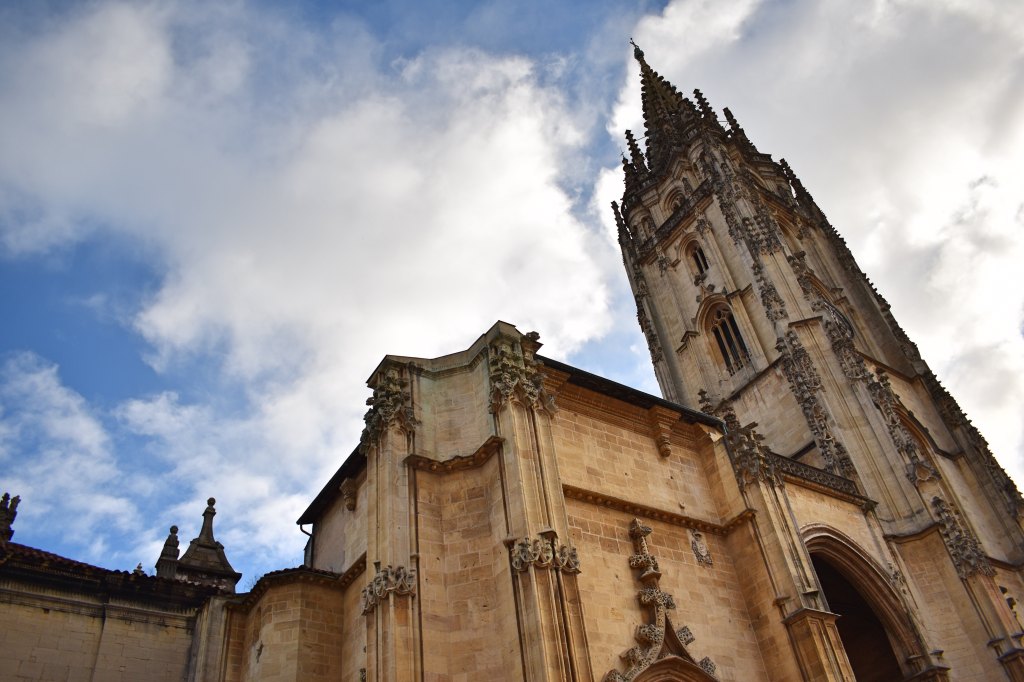
On my last visit to Oviedo, I went into raptures about the beauty of the city. This time around, having much to see, we did not spend very much time in the city. Indeed, though last time I regretted not entering the cathedral to see the Cámara Santa—a pre-Romesque church that has been converted into a chapel, and which now houses several famous relics—during this trip I positively forgot. I suppose I will just have to go back.

Instead, our brief time in the city center was spent visiting museums. If memory serves, we were able to buy combination tickets to the Archaeology and the Fine Arts Museums. In general, it is a good idea to visit even relatively obscure, provincial museums in Europe, as there is a good chance that it will have a collection that rivals far more prestigious institutions in the United States. This was no exception. The archaeology museum had artifacts from the stone age to medieval times, and the collection was housed in a beautiful old monastery. Even more impressive was the Museum of Fine Arts (Bellas Artes), which has a surprisingly large and wide-ranging collection of paintings, including some by Picasso, Sorolla, El Greco, and Goya.

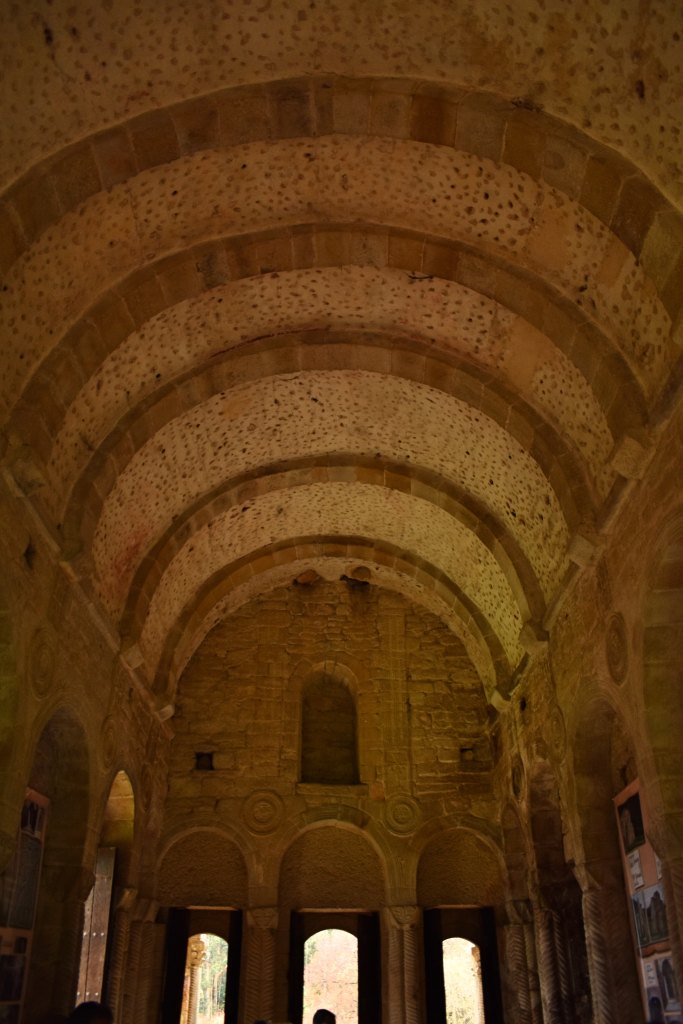
Then, we ventured somewhat outside the city to see what are Oviedo’s most precious monuments: Santa María del Naranco and San Miguel de Lillo. These are two pre-Romanesque structures from the 9th century—very rare survivals from this time period. I visited these two structures on my last visit to Oviedo, but I wasn’t able to go inside. This time, however, we arrived in time to take a tour of Santa María del Naranco. Despite its religious name, this structure originated as a palace, built for the Asturian king Ramiro I, and was only consecrated centuries later. Compared to what was to come in the Romanesque and the Gothic ages, this structure seems quaint and primitive. Indeed, considering that it is less spacious than many suburban houses, it is difficult to believe that it was intended to be a palace. But for its time, its design was highly innovative—incorporating rounded arches and the barrel vault to make it more spacious and bright inside. Though these two buildings are youngsters compared with, say, the Colosseum or the Parthenon, they nevertheless evoke the feeling of deep time and lost memories.

The last thing I must mention about Oviedo is the food. In Spain, Asturias is famous for its cuisine, and we sampled two of the most iconic dishes: fabadas (a hearty bean stew) and cachopo (similar to cordon bleu). Washed down with the local hard cider, this makes for a hearty meal in the cold, rainy weather.


Cudillero

With a few hours of daylight to spare on our first day in Asturias, we decided to visit Cudillero. To be honest, I had no idea what this was, but Rebe assured me that it was worth seeing. We put the name ‘Cudillero’ in our GPS and started to drive. Within an hour, I was screaming as we careened down a steep, narrow road straight through the center of a seaside village. The street seemed much too narrow for a car, and the many pedestrians paid no heed as they walked back and forth in front of us. Meanwhile, the GPS took us down and down and down, until we were right at the water’s edge. At least there was free parking.

To be honest, I do not have much to say about Cudillero, other than that it is a memorably beautiful and dramatic village. The entire thing is like an amphitheater, with some roads that ring from side to side, and others that lead down toward the water. Every new vantage point opened up another lovely perspective on the town.


Cangas de Onís

We visited Cangas de Onís when the light was already fading and we were pressed for time. It is a small village and, as often happens, parking was scarce. We found a parking spot on the street but it required me to parallel park—something I hadn’t done in years. I messed it up, badly. To make matters worse, an elderly local couple were standing on the sidewalk, watching me. The shame grew too acute and I eventually gave up and drove away. Thankfully, after I circled back, we found a parking lot. (I have since improved my parallel parking abilities.)

The town is quite lovely but we hardly had time to do anything but walk down the main street and admire the elegant “Roman” bridge, which is actually medieval.


Lagos de Covagonda

Our next stop was nearby. Now, if you visit during the off season, it is possible to drive to these lakes yourself. But as this was a holiday weekend (the Puente de la Constitución, in early December), we had to park the car and board a bus at a bus station right outside Cangas de Onís. It is probably wiser to buy the tickets online instead of doing as we did and buying them on the spot, late in the day.

The bus trip is a bit harrowing, as the enormous vehicle navigates narrow mountain roads. But we got there in one piece. It is a stunning place. The lakes are over 1,000 meters up the mountain (3300 feet), and are surrounded by snow-capped mountains, with still green meadows below.


Mirador del Fitu

I do not remember what day we visited this lookout point, but it was one of the best things we did in Asturias. It is one of the most beautiful mountain views I have ever seen.

A special thanks to Rebe, who took many of these photos.

The Drive South

For the drive back to León, and then to Madrid, we set the GPS to avoid tolls. This took us, instead of through the mountain via tunnels, over the top via the Puerto de Pajares. This is a lovely mountain road, full of twists and turns, that leads up and up, giving you a wonderful view of the bucolic Asturian countryside.

Along the way, you can see the historic Rampa de Pajares, a train line that seems to weave around the road. This was constructed between 1880-4, and represented a major engineering accomplishment. I am not sure if trains still use the tracks, though. The high-speed trains (AVE) pass through a tunnel rather than climb the mountain.

Right when we reached the top (about 1380 meters, or 4500 feet) we saw a light covering of snow on the ground. In retrospect, we were lucky. Had the weather been less kind, the road might easily have been impassable with snow. Once we began our descent on the other side of the mountain chain, we saw a series of fascinating rock formations. Rebe look up one particularly noticeable mountain on her phone, and found that it was the fossilized remains of a coral reef! If anything, this is an excellent lesson in geology.

After a brief stop in León (described in the other post), we carried on to Madrid. Our trip was over. It was the best mountain scenery I have ever seen.

The mountain is no impediment.
That ridge is, apparently, an ancient coral reef!

Images of León

Images of León

Three years ago, in December of 2019, Rebe and I took a trip up north, to Léon and Asturias. Though I have already written a post about those two areas, my first visit was brief—and in any case I did not have a decent camera back then. It is with much apology, therefore, that I upload these belated photos of what was a thoroughly lovely holiday.

The drive from Madrid to León is the better part of four hours. Thus, we could have arrived at a decent time, had not the rental company been swamped with angry customers, waiting to pick up their cars. A word to the wise: when you rent at the cheapest company, you end up paying one way or another—in time, emotional energy, and yes, unexpected payments. As the Spanish say, lo barato sale caro. This has been my consistent experience with rental companies and airlines—though, I admit, I am so stingy that I still can’t help myself when I see a good deal.

In any case, we arrived in León just before the sunset. Compared to Madrid, it was frigid—made that much colder by the fact that the airbnb I selected did not have heating or hot water (again, being cheap has its costs). We were greeted by a dramatic sunset, the pinks, oranges, and reds dancing across wisps of clouds, as the shifting light played across the gray surfaces of the city. Such sunsets are rare in normally cloudless Spain.

We headed straight for the cathedral, hoping to visit before it closed for the evening. This cathedral is, without doubt, one of the finest in Spain—and all of Europe, for that matter. León, you see, was a major stopping point along the Camino de Santiago,  and so was visited by a constant stream of pilgrims during the Middle Ages—who, of course, brought both money and knowledge along with them. This explains the notable French influence in the gothic design of León Cathedral.

Although it is, by the exalted standards of gothic cathedrals, not especially big, its placement in an open plaza allows the visitor to appreciate the full, weighty majesty of the structure. In the waning evening light the delicate tracery, the graceful buttresses, and the many points and spires appeared like a dance captured in stone. But the real treasure is inside the walls—or, rather, in the walls themselves: the stained glass. Unlike most gothic churches, León has preserved its medieval windows (wars, bombs, and fires destroyed a good many over the centuries). These are absolutely stunning: full of intricate details and hundreds of individual figures, filling the interior with gemlike colors and ethereal light.

Once we had our fill of divine beauty, we turned our attention to more earthly matters. It was December and the town was full of Christmas decorations and market stands selling all sorts of knicknacks. I did some Christmas shopping—buying a colorful plate with a serrated center, for grinding up garlic, as a present to my grandmother—while Rebe contented herself with a new pair of mittens. And if you are in Spain in the winter months, it is obligatory to have some churros with hot chocolate.

Our meandering took us, inevitably, to Casa Botines, one of a handful of buildings outside Catalonia designed by Anton Gaudí. It is a severe building, strictly neogothic, lacking the exuberance of Gaudí’s later works. Even so, it fits in harmoniously with the city of León and is, at the very least, imposingly symmetrical. Right next to it is the Palacio de los Guzmanes, an attractive Renaissance structure that is now the seat of the local government (Guzmán was a wealthy family who commissioned the original palace).

This was basically it for our evening in León. After a short stroll along the Bernesga River, we drove to the Airbnb where we shivered all night.

Rebe with her new mittens.

However, this was not our last glimpse of the city. Three days later, on the way back from Asturias, we made a stop in the city to see the one major attraction we missed: the Basilica de San Isodoro. The history of the basilica’s name is interesting in itself. Though originally dedicated to another saint, in the middle ages it was re-dedicated after the Muslim ruler of Seville allowed the remains of the venerated Sevillian (he was a theologian and archbishop) to be moved north to León, which at the time was under Christian control.

Above the Casa Botines. Below the Palacio de los Guzmanes.

The basilica can only be visited on a guided tour. And though this tour lasted about an hour, only two things really stick out in my memory. The first is a jewel-encrusted chalice that was displayed in a glass case, in the center of a room devoted solely to this item: the Chalice of Doña Urraca. This item lay relatively unnoticed and uncelebrated in the basilica’s collection until 2014, when two Spanish writers claimed that it was the legendary Holy Grail. The evidence for this assertion was thinner than air. Art historians believe the chalice was likely constructed in 11th century Germany. In any case, there is another potential Holy Grail in Valencia’s Cathedral, if you want to cover all of your bases.

The real jewel of the basilica is, undoubtedly, the royal pantheon. This is the burial place of many of the kings and queens of León—from a time before Spain existed as a country, and León was just one of several small kingdoms occupying the Iberian Peninsula. Yet the pantheon is not famous for its bodies, but for its art. The ceiling is covered in a series of beautiful and well-preserved murals from the Romanesque period. These are of such fine quality that they have been compared with the Sistine Chapel, though stylistically they share little with Michelangelo. As is typical of Romanesque art, the figures are stylized, almost cartoonish, with no attempt at creating accurate proportions or a realistic space. The result is a kind of naive charm that I find quite moving.

A public domain image of the Pantheon.

That was the end of our tour. We ate tacos at a nearby Mexican restaurant (surprisingly good), and kept going back towards Madrid. But not long after we left the city, the sky exploded into yet another gorgeous sunset—with streaks of purple, red, and pink undulating like waves in the rolling clouds. We pulled over to take pictures. By chance, right in our line of sight, was one of the iconic Osborne bulls—the universal symbol of Spain. It was yet another reminder of the enchanting beauty of this country.

A special thanks to Rebe, who took many of these photos.

Review: The Song Machine

Review: The Song Machine

The Song Machine: Inside the Hit Factory by John Seabrook

My rating: 4 of 5 stars

When I was quite young, somebody gave my brother and me a new toy for Christmas. It was a little plastic speaker, which played 60-second clips from popular songs from tiny memory cards called “HitClips.” Though primitive in retrospect, at the time it seemed like incredible technology—to us kids, at least—and I spent weeks driving my mother crazy by playing and re-playing the one-minute version of NSYNC’s “Bye Bye Bye” I had. My brother, meanwhile, had the HitClip of Bon Jovi’s “It’s My Life,” and now if I listen to either song it makes me slightly nauseous.

This was, however, probably the most significant intrusion of contemporary pop music into my childhood. My father is a musician and, under his influence, I became a fan of the music of his generation—the Beatles, Jimi Hendrix, the Who, Bob Dylan—and remained mostly ignorant of, and uninterested in, the music of my peers. Indeed, like many teenagers with pretentions to artistic and intellectual superiority, I was quite proud to be disdainfully unaware of what was on the radio. It was therefore quite interesting to retrospectively learn about this music via John Seabrook.

Seabrook examines just the music that I was busy snubbing my nose at: the pop music of the nineties and aughts, such as the Backstreet Boys, NSYNC, Brittney Spears, Rihanna, Kesha, Kelly Clarkson, and Katy Perry. However, as quickly becomes clear, these artists are not the real focus of the book. Rather, Seabrook wants to examine the far less famous people who actually write and produce the songs that make popstars so famous. Indeed, it is fairly uncommon for a pop star to actually write their own music nowadays, which is why they have to tour and perform so regularly—they do not make much money on record sales.

A surprising number of songwriters are Swedish (apparently, the culture or the language fosters melodic gifts), such as Max Martin—a man infinitely less well-known than the singers I listed above, but who has written many of the songs that made them famous. Martin, along with others such as Dr. Luke and Tricky Stewart, do not write songs the way you might imagine is the “normal” way. Rather than searching for chords and melodies on a guitar or a piano, they focus on making “beats” or backing tracks—usually, using only digital tools, a fact that has put many studio musicians out of business. Then, this track is sent out to “top line” writers, who come up with the melody and perhaps the title; and finally, a lyrics writer finishes up the product.

Working this way, a song can be created relatively quickly. This is key to the modern pop song industry, as it allows producers to search for potential hits via trial and error. The same backing track can be sent out to a dozen or more top line writers, who in turn send back their melodies and ideas for the song. Of these options, the most appealing is chosen, and then worked into a full song. Even at this point, however, it is not unusual for a recorded song to be canned for being deemed insufficient. With so many options to choose from, producers need only to release what they are confident will succeed. And this is not merely a matter of guesswork. According to Seabrook, there are computer programs which analyze songs and rate their likelihood of becoming popular.

Now, being a purist is a good way to make yourself unhappy. And, in any case, “authenticity” in art is difficult to insist on, as it is such a slippery thing to pin down. Even so, I have to say that my sneering teenage self felt amply justified by this book. But before I snub my nose, I must add some caveats.

First, as Seabrook points out, this is hardly the first time in history when songs have been written by professionals for purely commercial ends. From Tin Pan Alley, to the Brill Building songwriters, to Motown and Phil Specter, there have long been professional songwriters creating material for charismatic singers. And hardly anybody thinks it inauthentic, for example, when a trained soprano sings an aria written by a professional composer (and many opera composers were quite shamelessly commercial, recycling old material and working with tight deadlines). At the very worst, this production model puts pop singers on the same level as movie stars, who are admired and praised just for knowing how to recite their lines. If anything is new about the modern “song machine,” then, it is just that the producers nowadays have more advanced tools than their predecessors.

All of this being granted, I must admit that parts of the book turned my stomach. This was especially true of the chapter on K-pop, which describes how potential stars are trained to sing and dance from a young age, and whose lives—from their schedules, to their diet, or even the boundaries of their love life—are carefully managed. The section on the dispute between Kesha and Dr. Luke—which included allegations of abuse and rape—was just as upsetting, epitomizing the exploitative extremes of the business. Indeed, as another reviewer has pointed out, there is a striking gender imbalance in the industry, with the overwhelming of producers and songwriters being men. And, of course, even if it is not exactly new, it is never pretty to see the inner workings of industrialized pop culture. It is like a visit to a hot dog factory.

Seabrook, for his part, seems to have come to like contemporary pop music more as a result of his delve into this world. Well, to each their own I suppose. He has written an informative and entertaining book on a subject that most people are familiar with, but which relatively few understand, and so has earned the right to listen to as much NSYNC as his stomach can handle.


View all my reviews