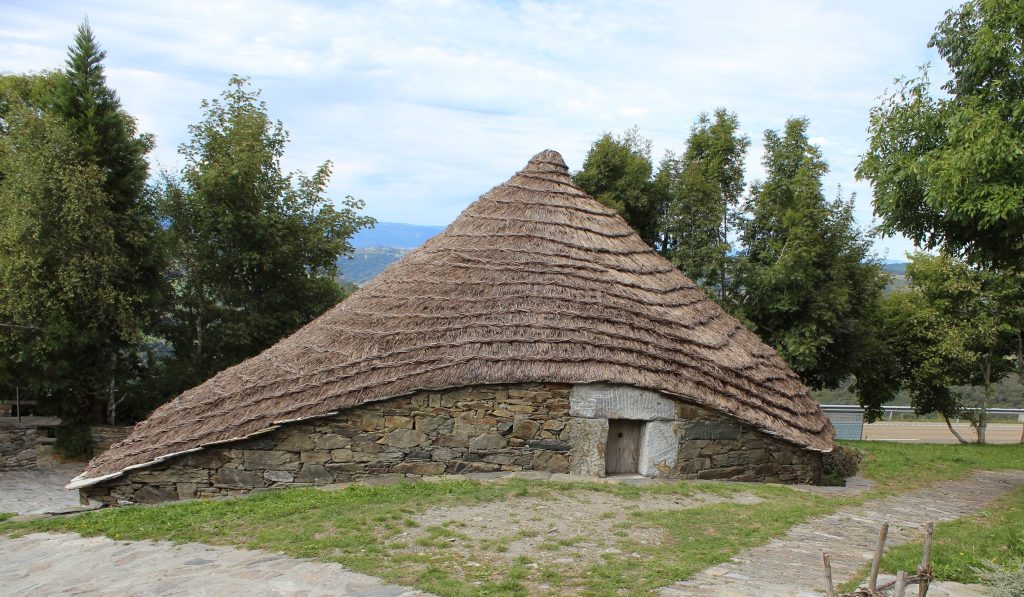
Happy New Year! Another year has come and gone in the world—and also on this blog. In fact, I began writing here more than seven years ago! That being said, I know I have been relatively inactive this past year—I didn’t even write New Year’s Resolutions last year—which I am sorry for. In my defense, this was because I spent so much time this past year working on my new novel. At least I managed to get a few drafts completed.
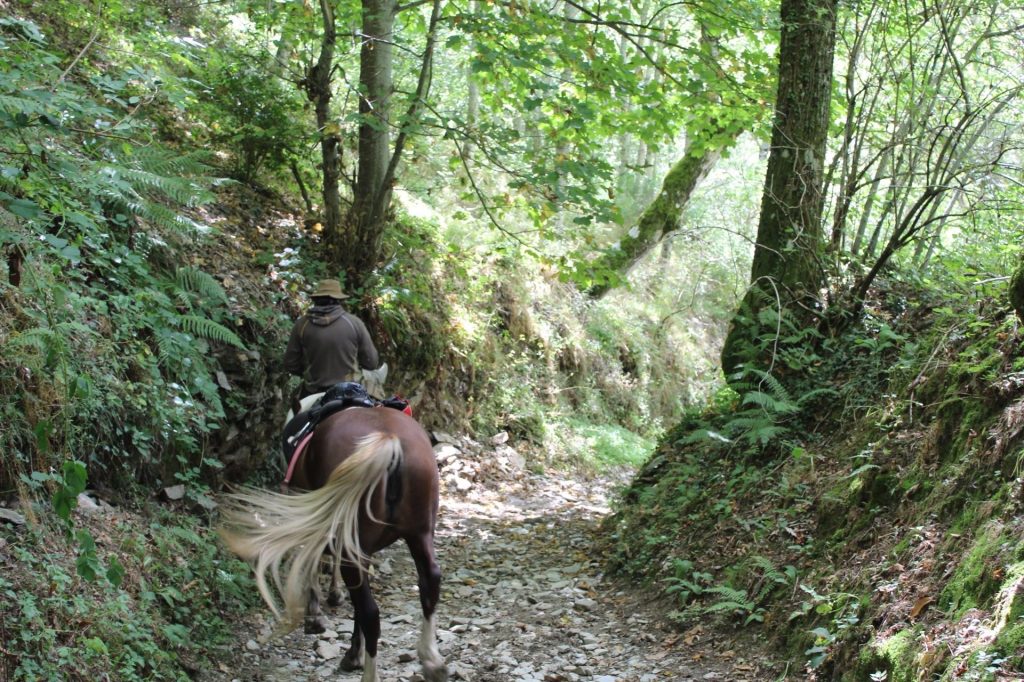
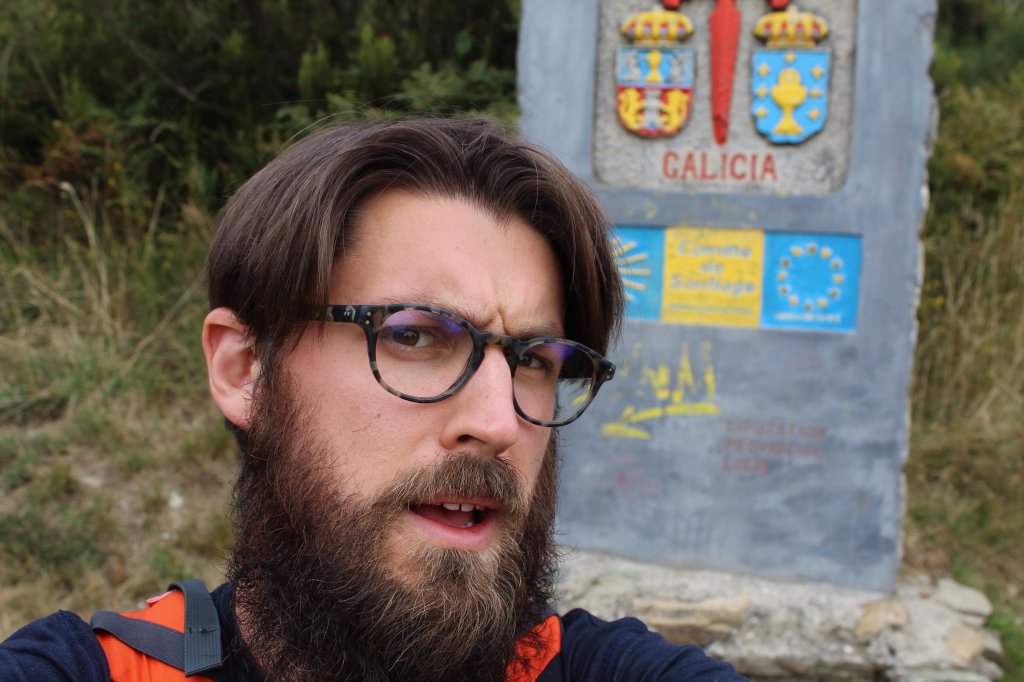
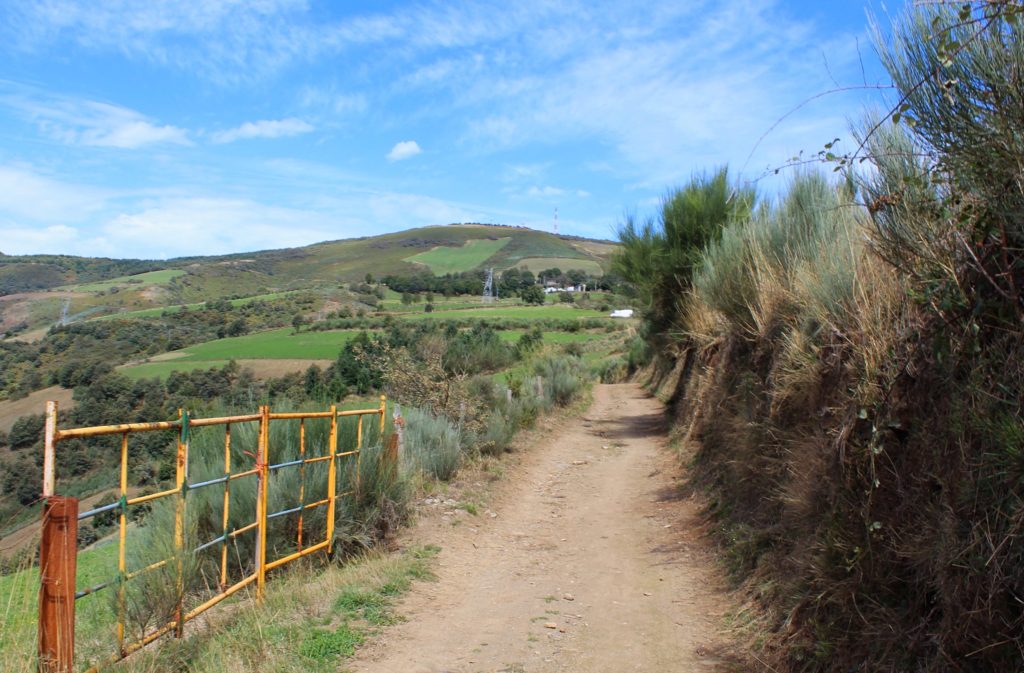
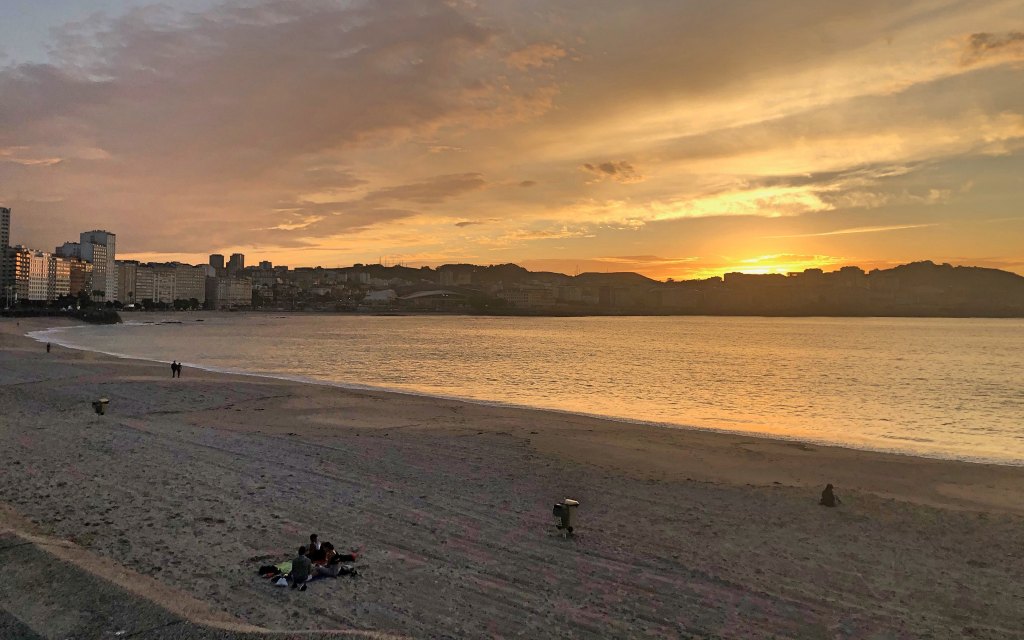
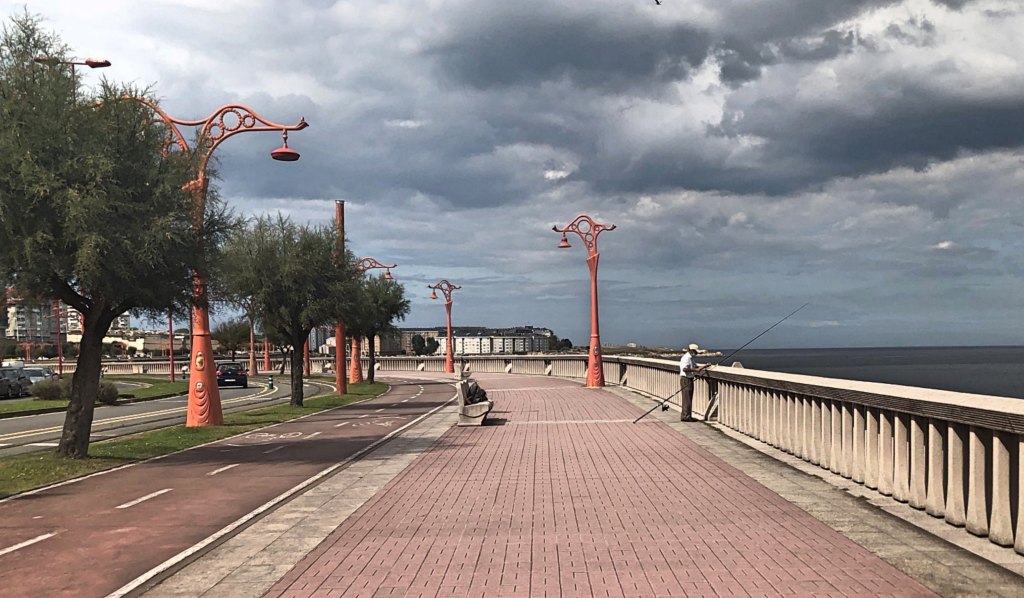
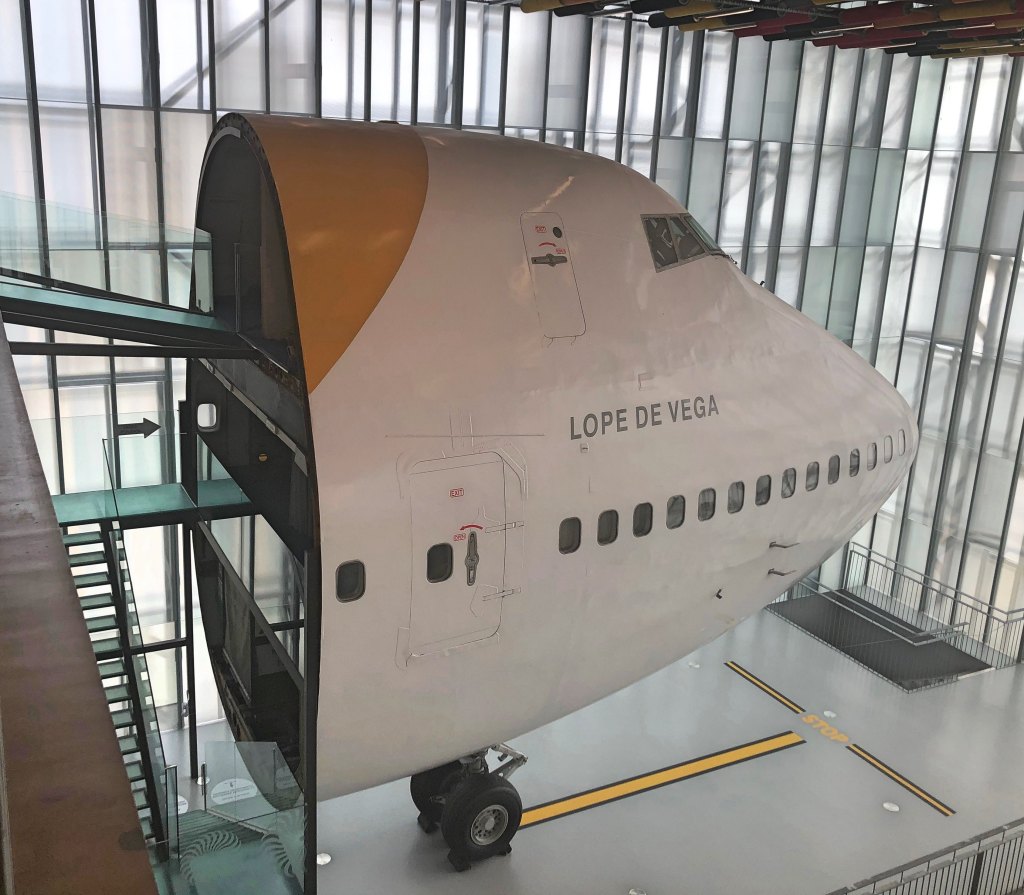
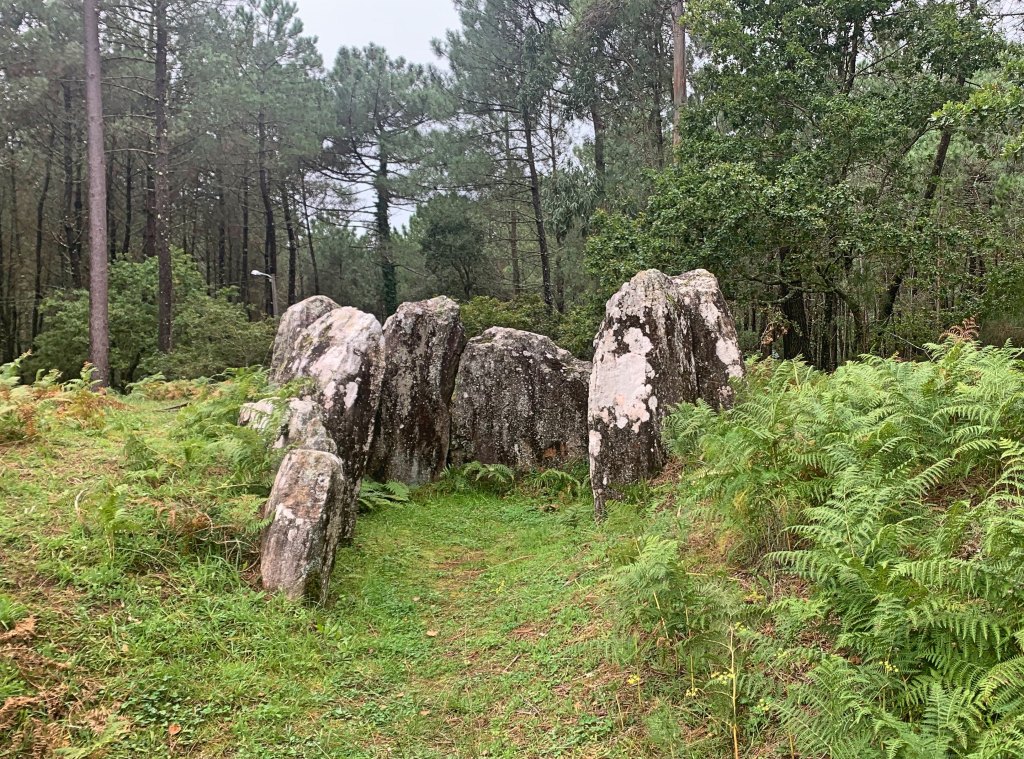
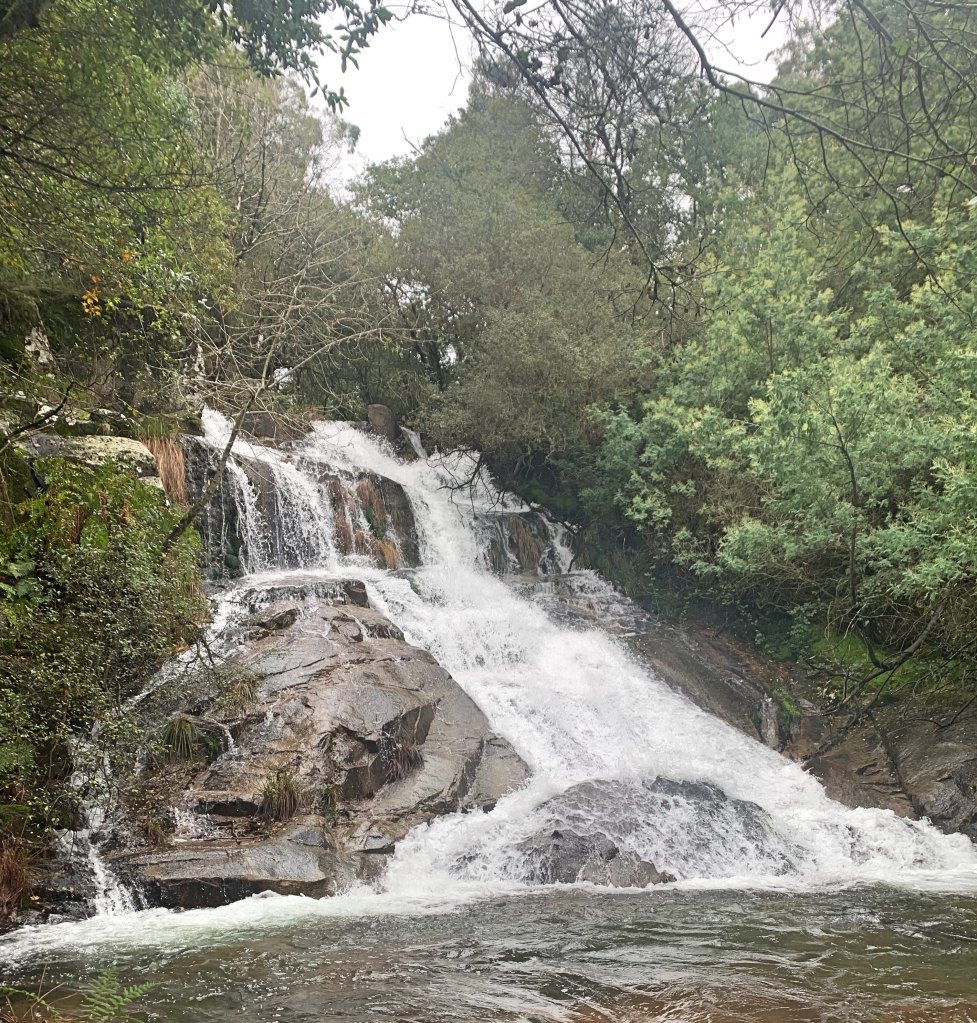
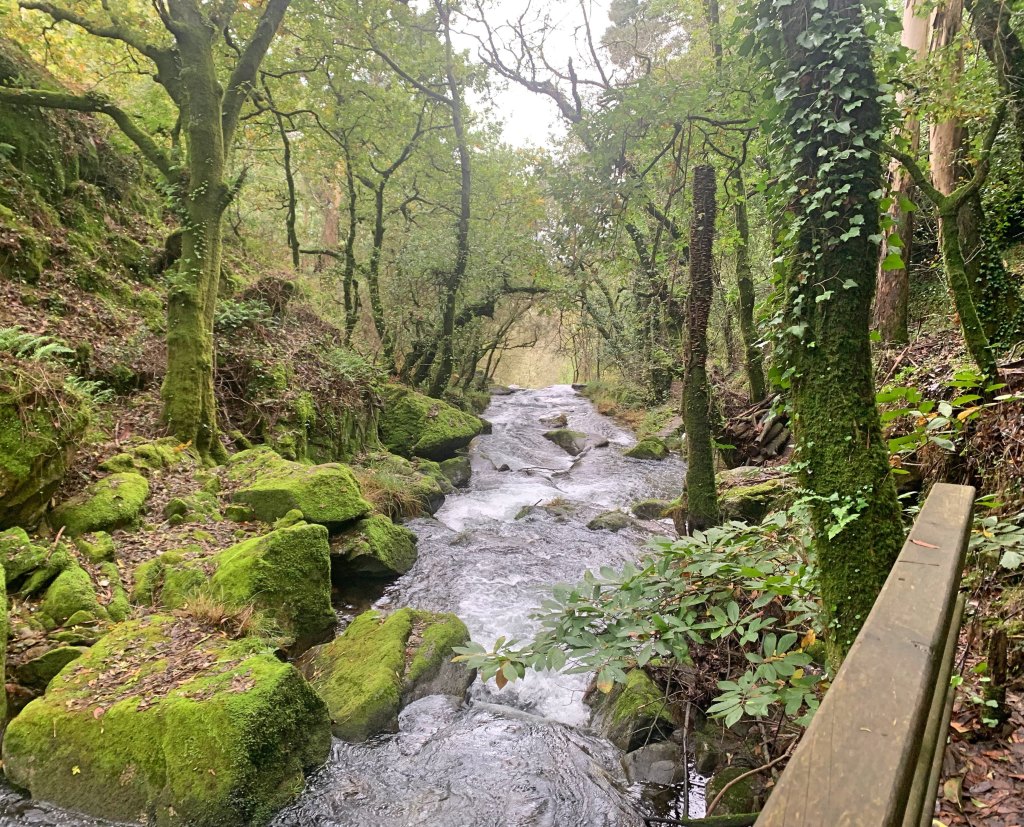
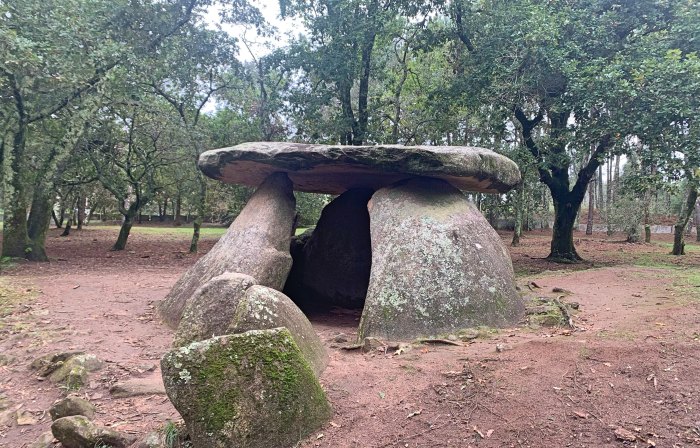
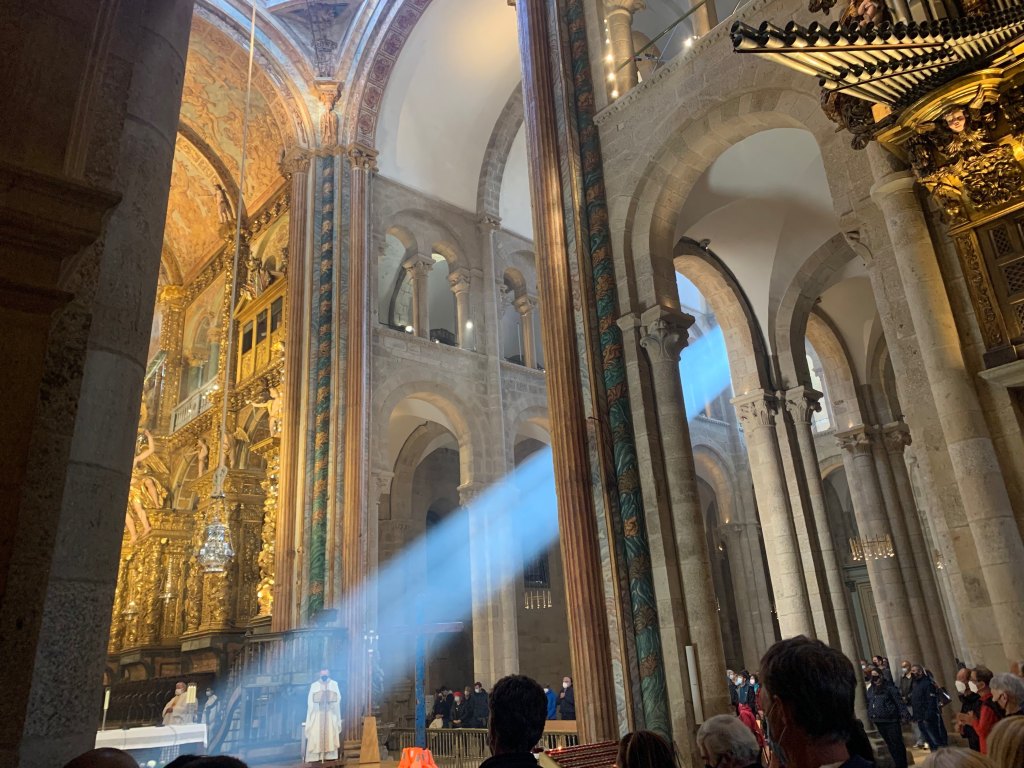
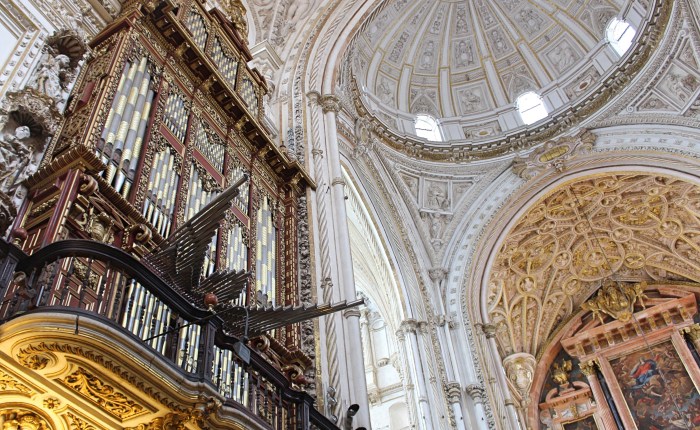
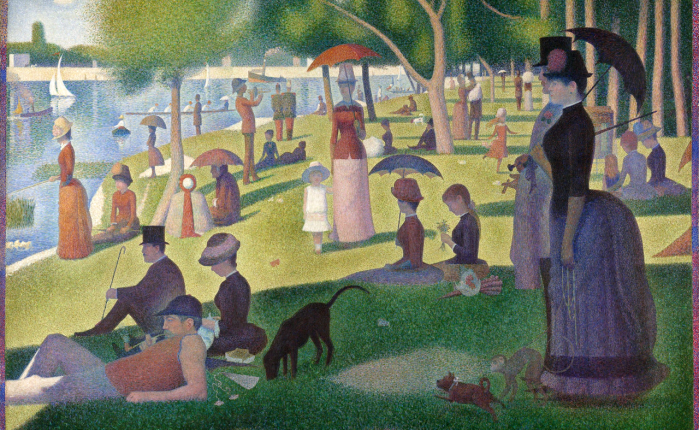
Even so, one New Year’s Resolution I will make is to re-dedicate myself to this blog. I have missed writing here and, I am sure, at least a couple people (?) have missed it, too. In that spirit, here is a list of trips that I still have to write up:
Yes, it has been a productive travelling year. If 2023 is half as good in this respect, I will be fortunate indeed. I should also add the New York landmarks I visited this past summer:
Hyde Park & Vanderbilt Mansion
Intrepid Air and Space Museum
Louis Armstrong House Museum
Lyndhurst & the Untermeyer Gardens
Olana & Kaaterskill Falls
West Point
Honestly, if I get through all this writing this year, it will be a miracle. But, somehow, I am feeling optimistic.
There are also lots of books I hope to read, much too many to name. Aside from these literary labors, I hope to continue practicing guitar and learning German. A more lucrative job would be nice, too. The most intimidating goal of all, however, is to finally run a full marathon. I took the plunge and signed up for the Madrid marathon in April. Wish me luck.
I have the nagging feeling that I’ve gotten lazy about reading—as if I fail to prioritize it, or that it is rarer for me to get swept up into a book. When I examine the books I did manage to read, however, I see that I have had an altogether decent year in this department. In any case, it is wiser to focus on the positives.
As usual, my reading was divided between certain themes and a random spattering of other books.
One major theme—arguably the dominant theme of the year—was music. The first book I completed was Paul McCartney’s The Lyrics, which coincided with my second viewing of Peter Jackson’s incredible Beatles documentary, Get Back. This reignited my Beatlemania and, more generally, my musical fandom. During the course of the year, I made my way through three books on blues, a history of jazz, a history of music in New York City, a history of modern pop music, biographies of Biggie Smalls and Bob Dylan, and the memoirs of Bob Dylan, Pattie Smith, and Miles Davis. Of these, the absolute best was Miles Davis’s Autobiography, which is so engaging, so full of great stories, so illuminating, that it easily ranks among the best books of the year. And I should also mention Malcolm Gladwell’s audiobook on Paul Simon, a delightful little gem. If nothing else, I am grateful to have reconnected with my love of music this year.
Another, rather vague category could be termed “nature and adventure.” This incorporates Ken Burns’s excellent documentary on America’s National Parks, a book about the Hudson River school of landscape paintings, as well as several accounts of getting lost in the wilderness. Most of these combine danger with discovery: Lewis and Clark’s journals on their voyage across the country, Ernest Shackleton’s account of his failed attempt to cross Antarctica, and Steven Callahan’s record of his struggle to survive in an inflatable life-raft. Best of all was Over the Edge of the World, Laurence Bergreen’s book about Magellan’s journey around the world. This last book was such a winning combination of excitement and historical interest that I would recommend it to nearly anyone.
In the realm of fiction, I made my way through some old classics: Eugénie Grandet, Eugene Onegin, The Charterhouse of Parma, Ivanhoe, As I Lay Dying, The Scarlet Pimpernel, and Their Eyes Were Watching God… My absolute favorite was younger, slimmer, and more stylish than these hoary volumes: Italo Calvino’s If on a winter’s night a traveler… Though not profound, it is a delightful work which manages to be utterly post-modern without being annoying (well, it is slightly annoying). I should also mention Camus’s The Fall, which is certainly profound but not quite delightful.
By far the longest book I finished was a history of science in Spain, El país de los sueños perdidos. I feel almost silly for having dedicated so much time to it, since I neither enjoyed it very much nor learned what I hoped to learn. My most popular review of the year was of David Graeber’s posthumously released book, The Dawn of Everything, which somehow managed to be both brilliant and disappointing at once. Meanwhile, the most-represented author on my list is none other than Rick Steves. Somehow, this dorky, goofy tour-guide absolutely won me over. In addition to reading three of his books, I watched all of his travel programs on YouTube—learning a lot about European travel and travel writing in the process.
Two of the most moving books of the year concerned the holocaust: Anne Frank’s diary and Elie Wiesel’s Night. The books are, in a way, complementary, as they are both written from the perspective of a young adolescent swept up in this catastrophe—indeed, Wiesel’s book begins where Frank’s diary ends, at the gates of the concentration camp. These first-hand accounts of human cruelty were supplemented by Paul Preston’s book on atrocities committed during the Spanish Civil War. There seem to be no depths too deep for us to sink to. But since I don’t think a book review—or the year itself, for that matter—should end on such a dark, depressing note, I also would like to mention that I finally read some books on Norse Mythology, which were lovely.
I suppose if next year’s books are just as good as this year’s, I will have no cause to complain. And, as always, the pleasure will be all the greater with the Goodreads community.
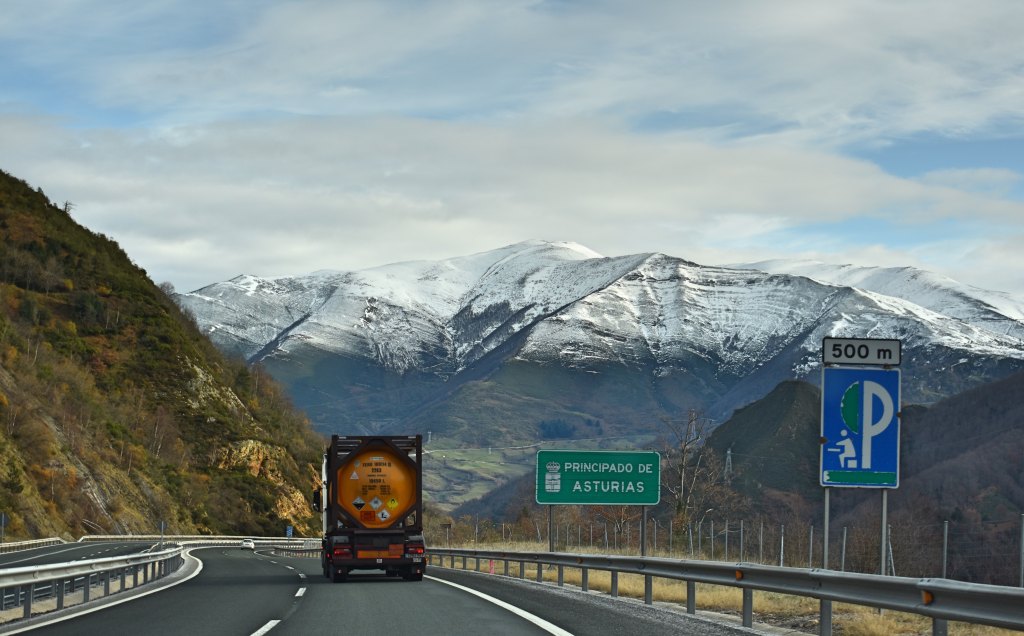
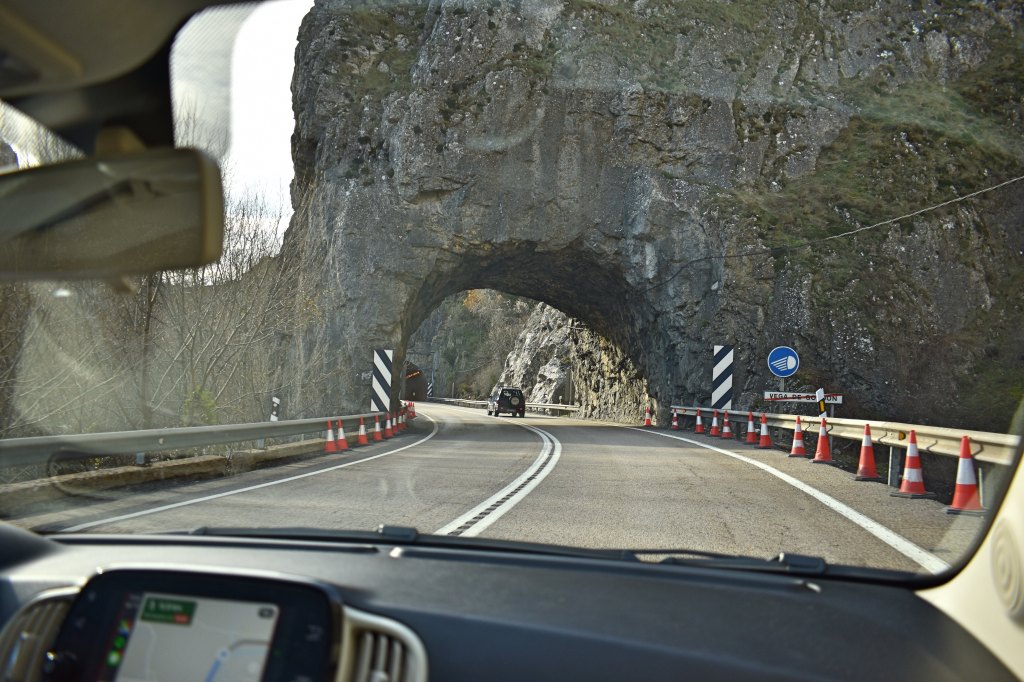
From León, the journey continued north. Our GPS took us on the main highway, the AP-66, which cuts straight through the Cordillera Cantábrica—the major mountain range separating the interior plains from the northern coast—with tunnel after tunnel. Our destination was Oviedo, the capital of Asturias. Thankfully, this time our Airbnb had heating and hot water.
Oviedo
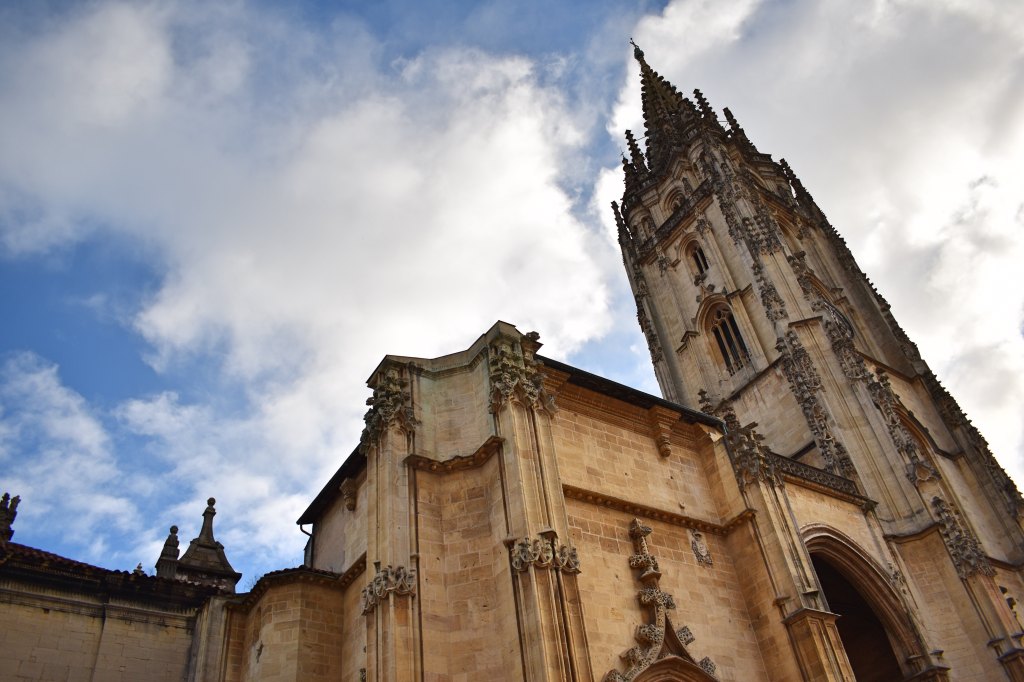
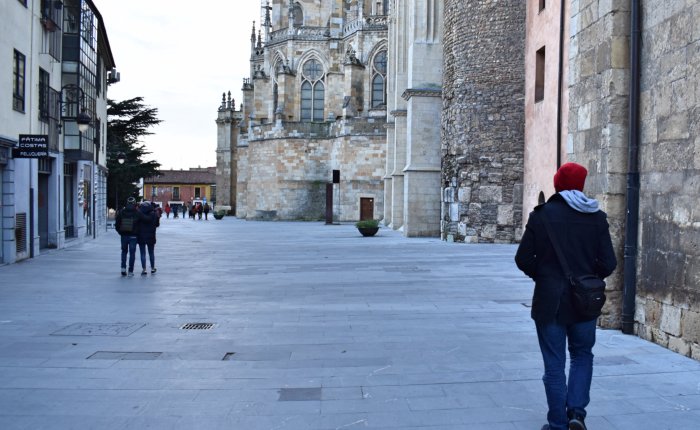
On my last visit to Oviedo, I went into raptures about the beauty of the city. This time around, having much to see, we did not spend very much time in the city. Indeed, though last time I regretted not entering the cathedral to see the Cámara Santa—a pre-Romesque church that has been converted into a chapel, and which now houses several famous relics—during this trip I positively forgot. I suppose I will just have to go back.
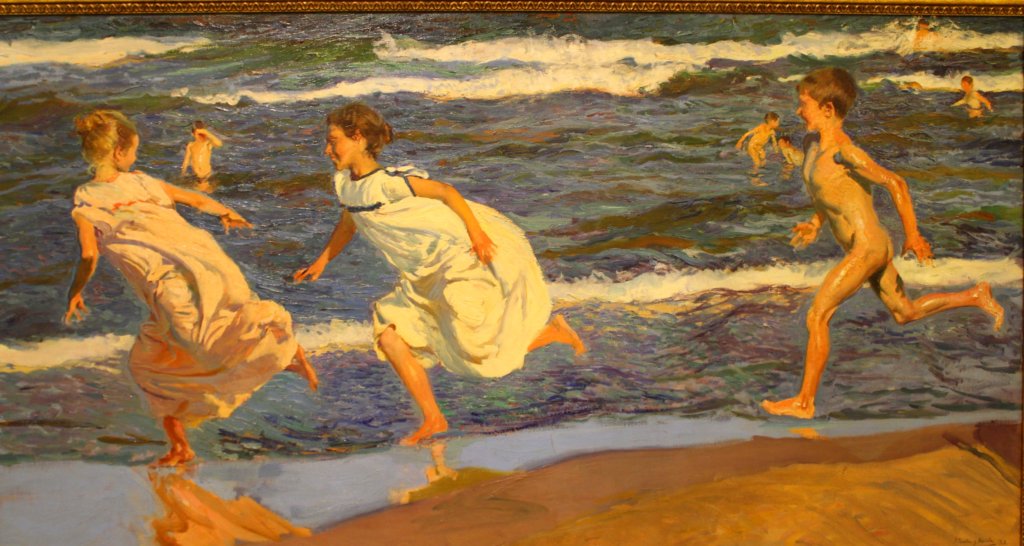
Instead, our brief time in the city center was spent visiting museums. If memory serves, we were able to buy combination tickets to the Archaeology and the Fine Arts Museums. In general, it is a good idea to visit even relatively obscure, provincial museums in Europe, as there is a good chance that it will have a collection that rivals far more prestigious institutions in the United States. This was no exception. The archaeology museum had artifacts from the stone age to medieval times, and the collection was housed in a beautiful old monastery. Even more impressive was the Museum of Fine Arts (Bellas Artes), which has a surprisingly large and wide-ranging collection of paintings, including some by Picasso, Sorolla, El Greco, and Goya.
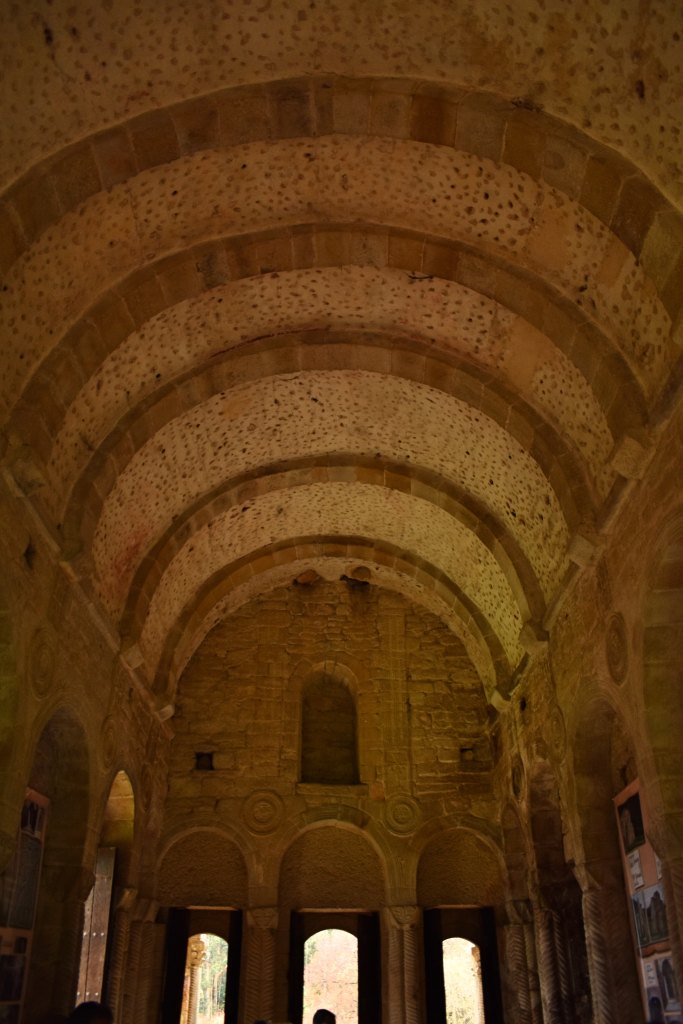
Then, we ventured somewhat outside the city to see what are Oviedo’s most precious monuments: Santa María del Naranco and San Miguel de Lillo. These are two pre-Romanesque structures from the 9th century—very rare survivals from this time period. I visited these two structures on my last visit to Oviedo, but I wasn’t able to go inside. This time, however, we arrived in time to take a tour of Santa María del Naranco. Despite its religious name, this structure originated as a palace, built for the Asturian king Ramiro I, and was only consecrated centuries later. Compared to what was to come in the Romanesque and the Gothic ages, this structure seems quaint and primitive. Indeed, considering that it is less spacious than many suburban houses, it is difficult to believe that it was intended to be a palace. But for its time, its design was highly innovative—incorporating rounded arches and the barrel vault to make it more spacious and bright inside. Though these two buildings are youngsters compared with, say, the Colosseum or the Parthenon, they nevertheless evoke the feeling of deep time and lost memories.
The last thing I must mention about Oviedo is the food. In Spain, Asturias is famous for its cuisine, and we sampled two of the most iconic dishes: fabadas (a hearty bean stew) and cachopo (similar to cordon bleu). Washed down with the local hard cider, this makes for a hearty meal in the cold, rainy weather.
Cudillero
With a few hours of daylight to spare on our first day in Asturias, we decided to visit Cudillero. To be honest, I had no idea what this was, but Rebe assured me that it was worth seeing. We put the name ‘Cudillero’ in our GPS and started to drive. Within an hour, I was screaming as we careened down a steep, narrow road straight through the center of a seaside village. The street seemed much too narrow for a car, and the many pedestrians paid no heed as they walked back and forth in front of us. Meanwhile, the GPS took us down and down and down, until we were right at the water’s edge. At least there was free parking.
To be honest, I do not have much to say about Cudillero, other than that it is a memorably beautiful and dramatic village. The entire thing is like an amphitheater, with some roads that ring from side to side, and others that lead down toward the water. Every new vantage point opened up another lovely perspective on the town.
Cangas de Onís
We visited Cangas de Onís when the light was already fading and we were pressed for time. It is a small village and, as often happens, parking was scarce. We found a parking spot on the street but it required me to parallel park—something I hadn’t done in years. I messed it up, badly. To make matters worse, an elderly local couple were standing on the sidewalk, watching me. The shame grew too acute and I eventually gave up and drove away. Thankfully, after I circled back, we found a parking lot. (I have since improved my parallel parking abilities.)
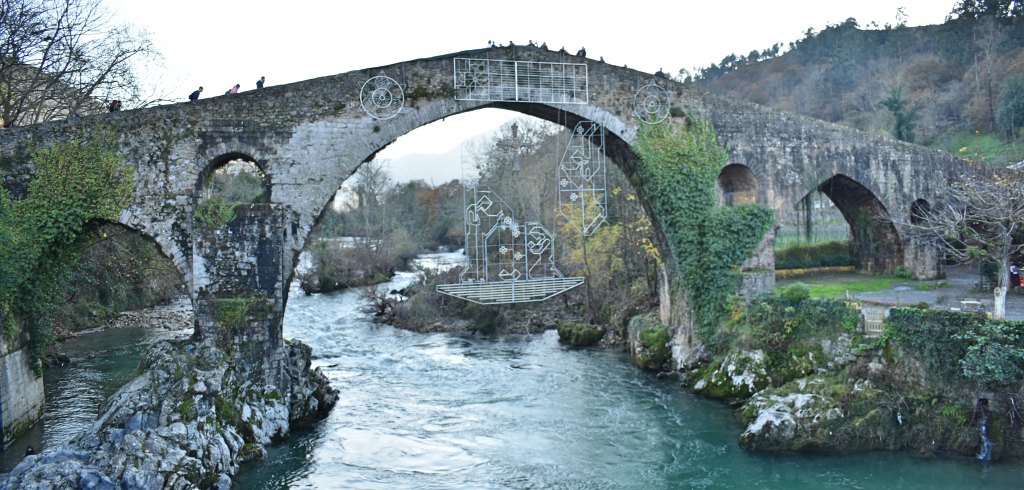
The town is quite lovely but we hardly had time to do anything but walk down the main street and admire the elegant “Roman” bridge, which is actually medieval.
Lagos de Covagonda
Our next stop was nearby. Now, if you visit during the off season, it is possible to drive to these lakes yourself. But as this was a holiday weekend (the Puente de la Constitución, in early December), we had to park the car and board a bus at a bus station right outside Cangas de Onís. It is probably wiser to buy the tickets online instead of doing as we did and buying them on the spot, late in the day.
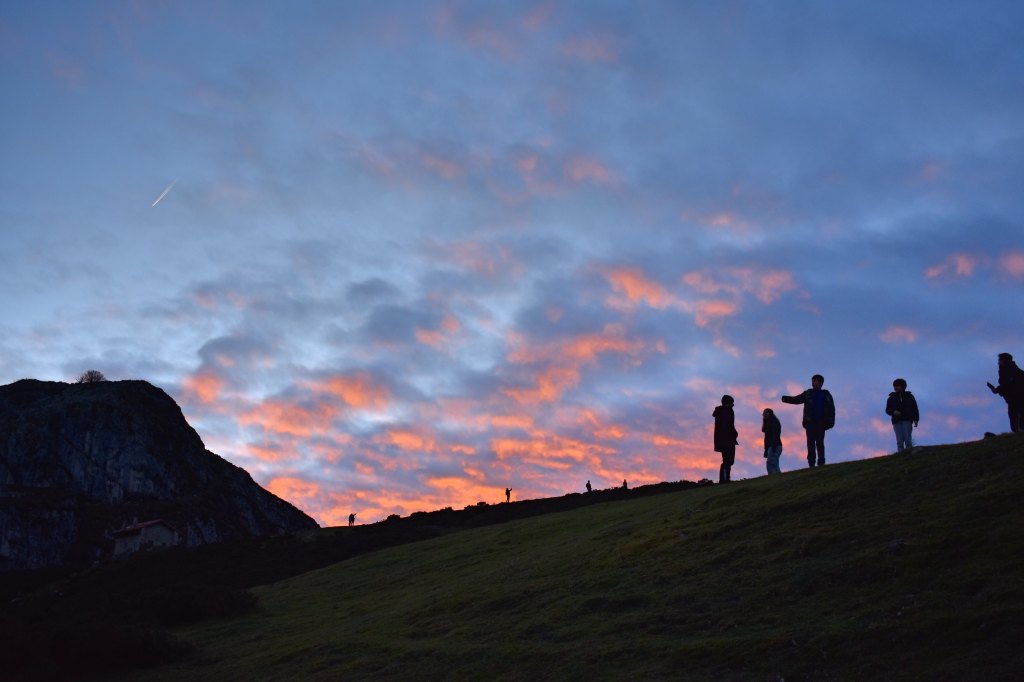
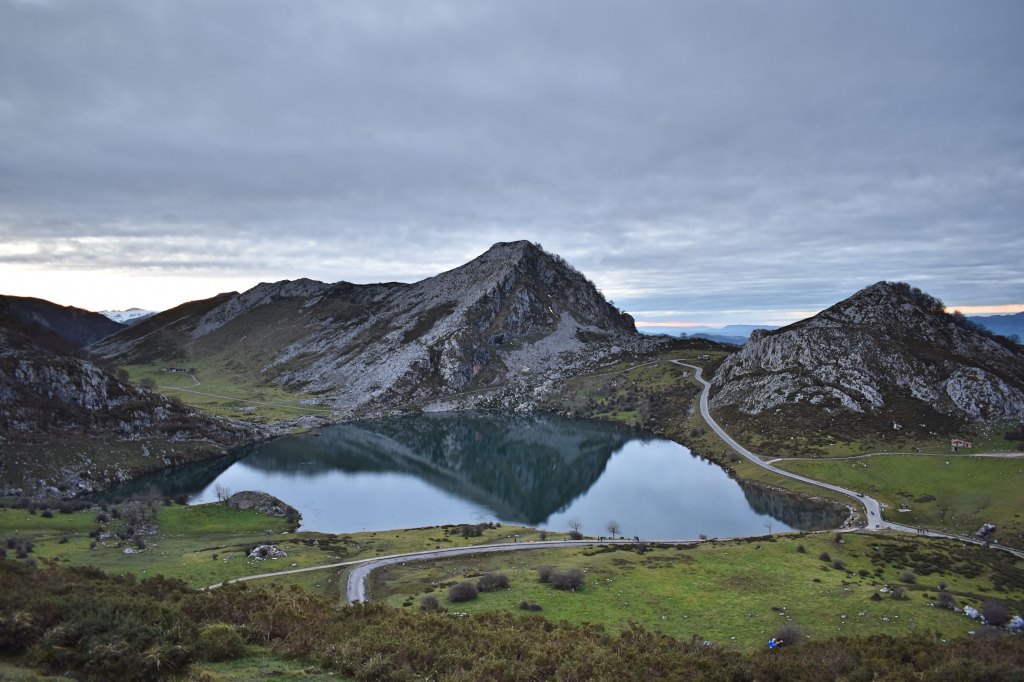
The bus trip is a bit harrowing, as the enormous vehicle navigates narrow mountain roads. But we got there in one piece. It is a stunning place. The lakes are over 1,000 meters up the mountain (3300 feet), and are surrounded by snow-capped mountains, with still green meadows below.
Mirador del Fitu
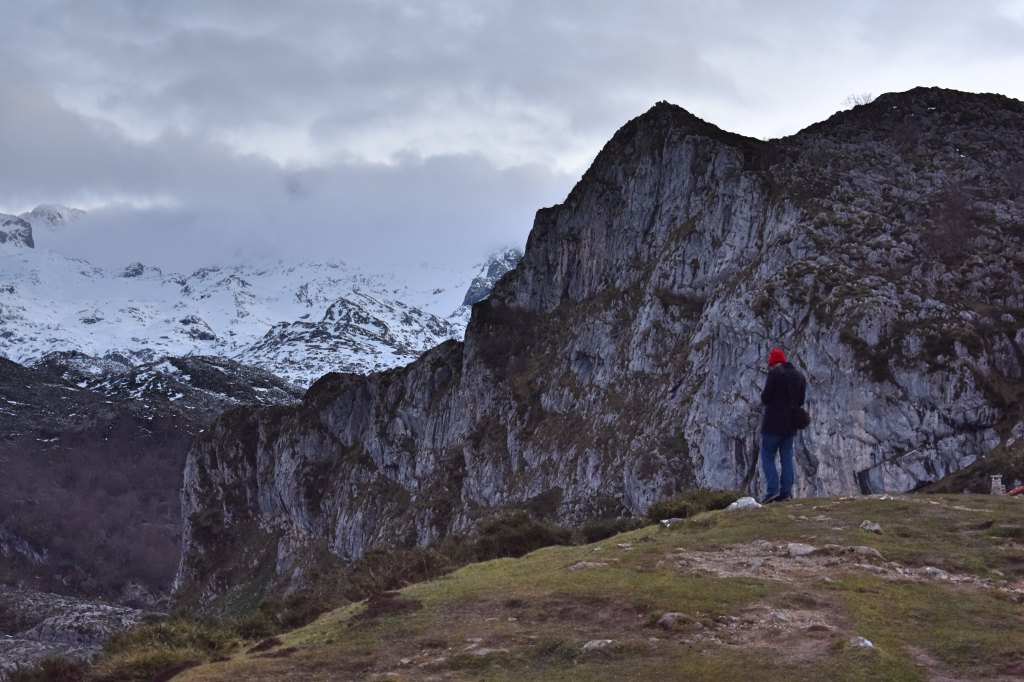
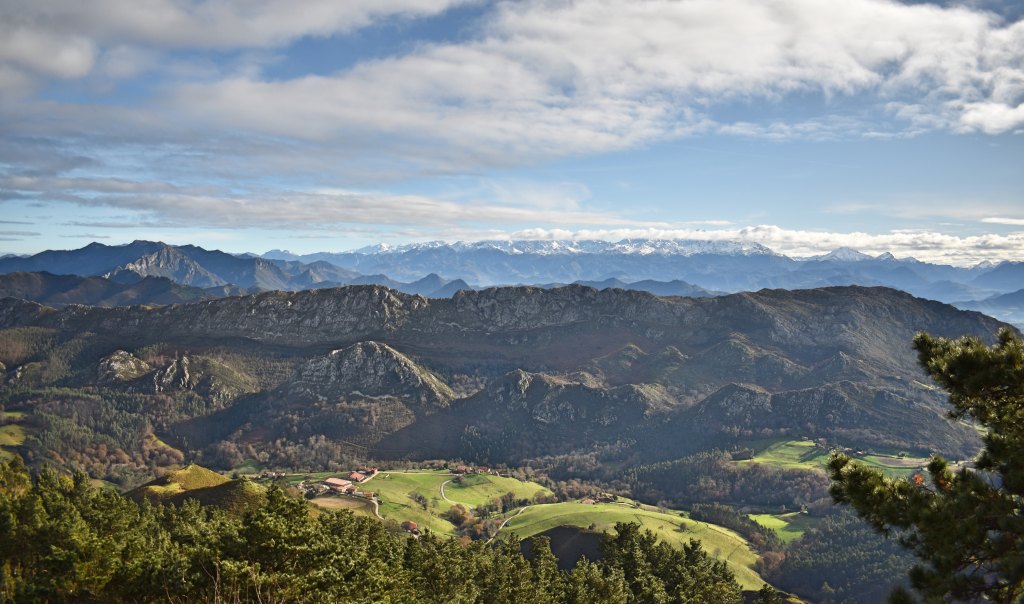
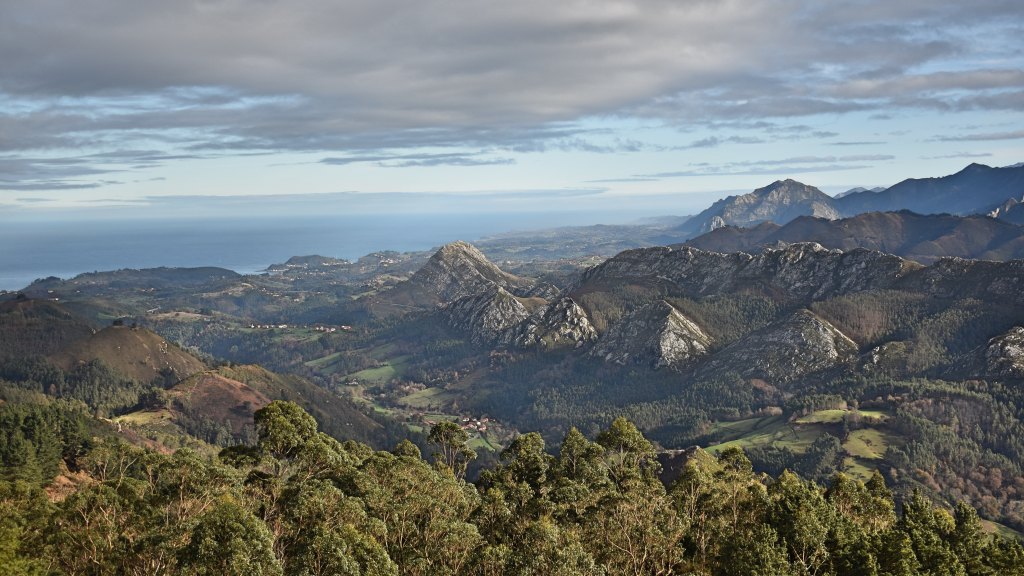
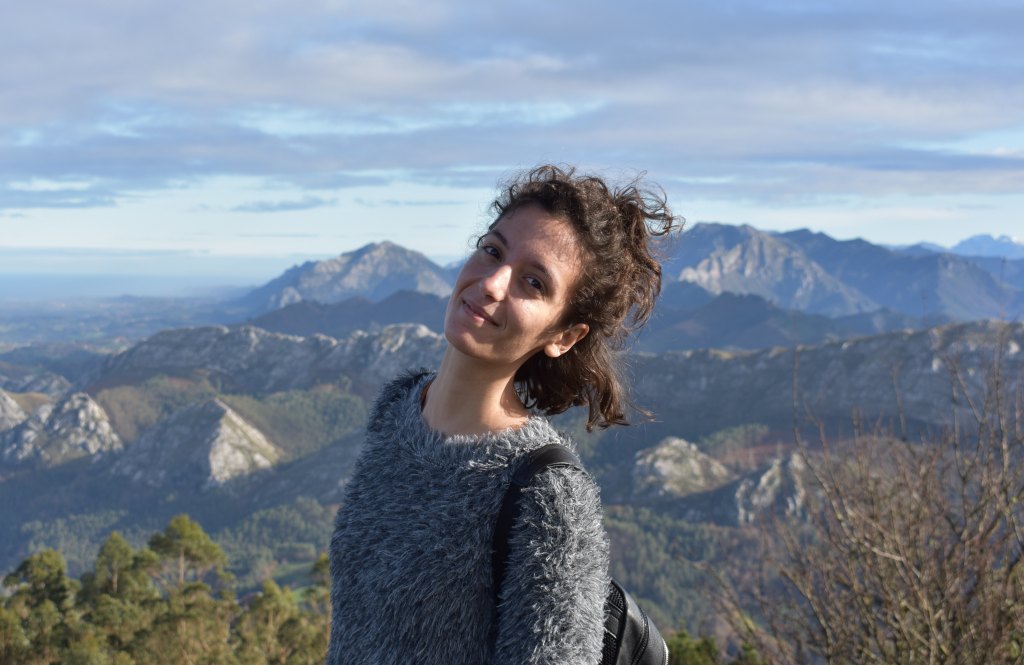
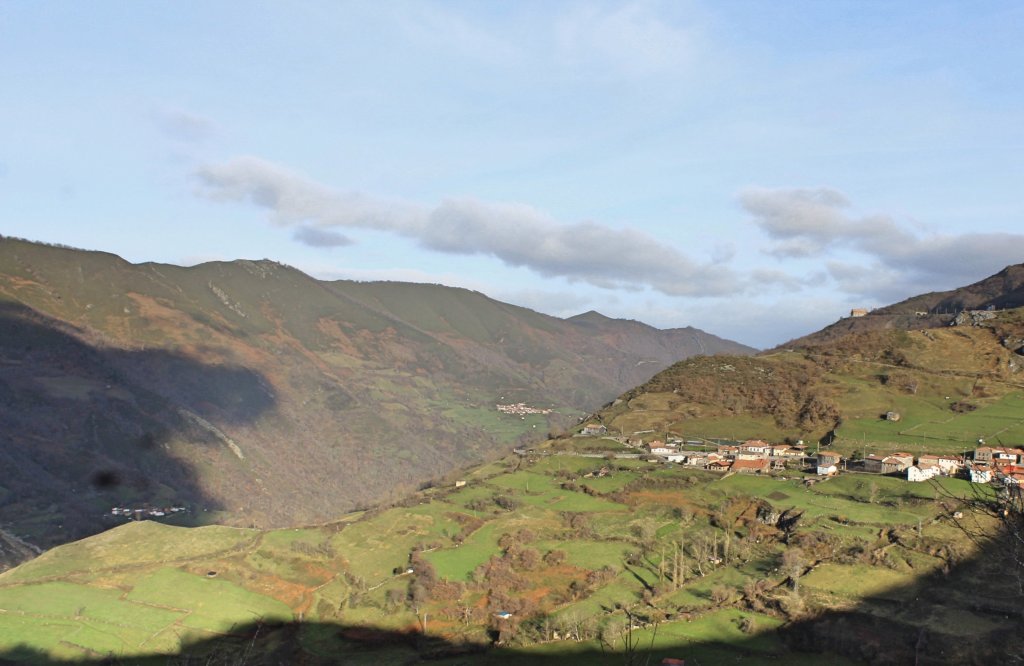
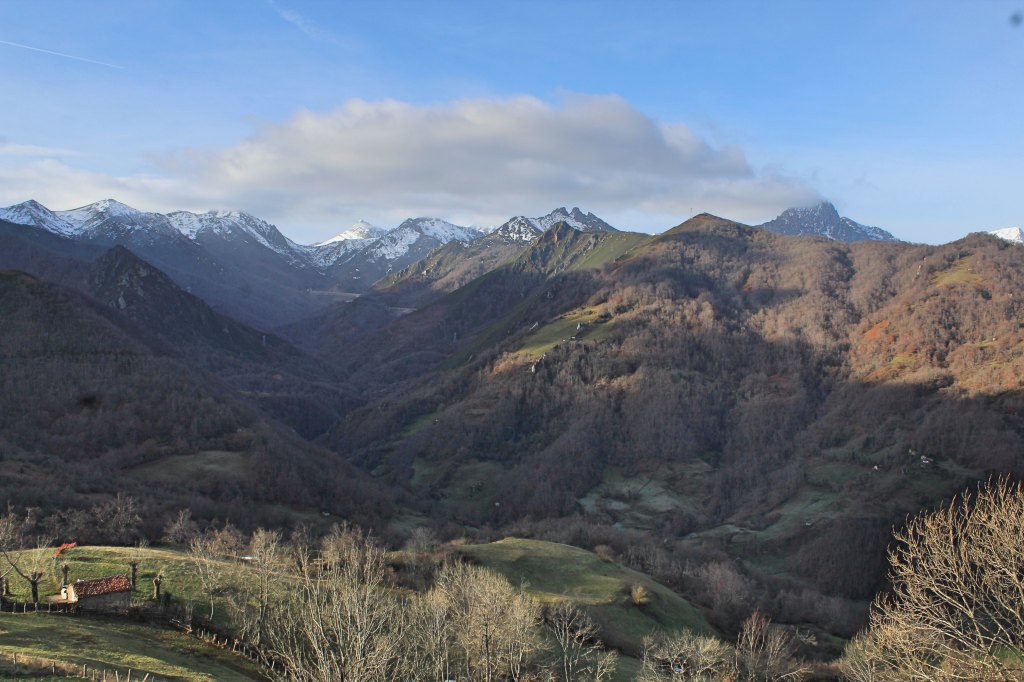
I do not remember what day we visited this lookout point, but it was one of the best things we did in Asturias. It is one of the most beautiful mountain views I have ever seen.
A special thanks to Rebe, who took many of these photos.
The Drive South
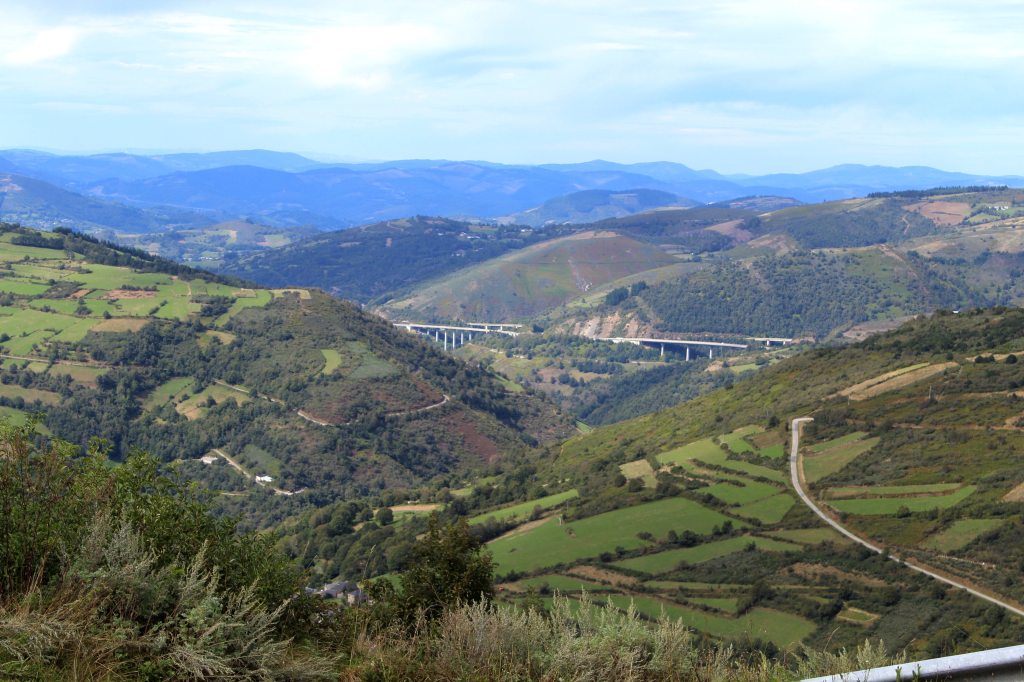
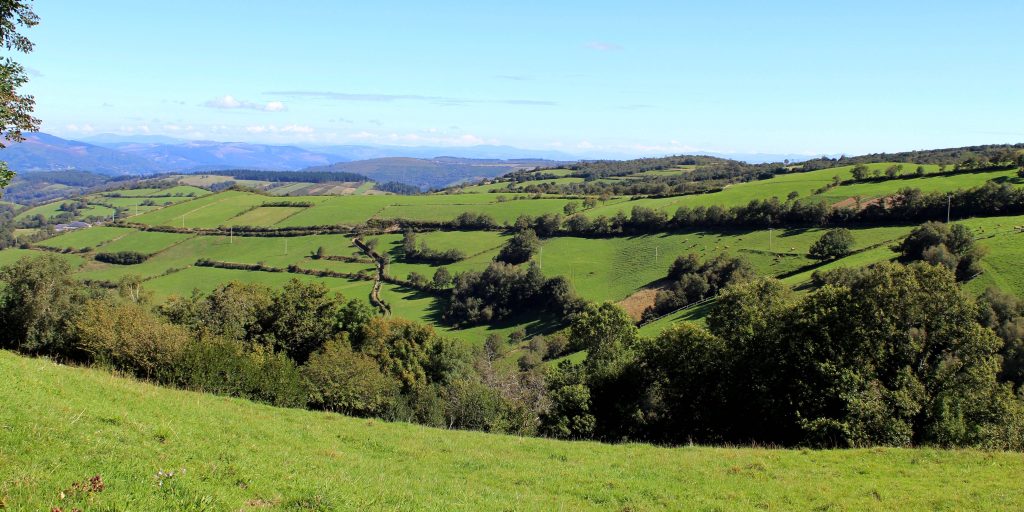
For the drive back to León, and then to Madrid, we set the GPS to avoid tolls. This took us, instead of through the mountain via tunnels, over the top via the Puerto de Pajares. This is a lovely mountain road, full of twists and turns, that leads up and up, giving you a wonderful view of the bucolic Asturian countryside.
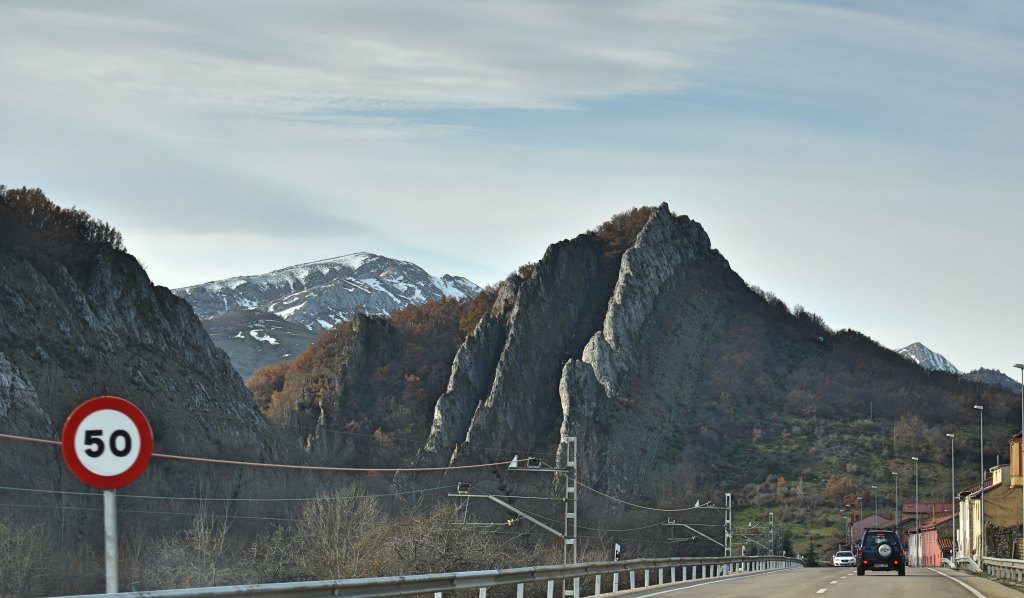
Along the way, you can see the historic Rampa de Pajares, a train line that seems to weave around the road. This was constructed between 1880-4, and represented a major engineering accomplishment. I am not sure if trains still use the tracks, though. The high-speed trains (AVE) pass through a tunnel rather than climb the mountain.
Right when we reached the top (about 1380 meters, or 4500 feet) we saw a light covering of snow on the ground. In retrospect, we were lucky. Had the weather been less kind, the road might easily have been impassable with snow. Once we began our descent on the other side of the mountain chain, we saw a series of fascinating rock formations. Rebe look up one particularly noticeable mountain on her phone, and found that it was the fossilized remains of a coral reef! If anything, this is an excellent lesson in geology.
After a brief stop in León (described in the other post), we carried on to Madrid. Our trip was over. It was the best mountain scenery I have ever seen.
Three years ago, in December of 2019, Rebe and I took a trip up north, to Léon and Asturias. Though I have already written a post about those two areas, my first visit was brief—and in any case I did not have a decent camera back then. It is with much apology, therefore, that I upload these belated photos of what was a thoroughly lovely holiday.
The drive from Madrid to León is the better part of four hours. Thus, we could have arrived at a decent time, had not the rental company been swamped with angry customers, waiting to pick up their cars. A word to the wise: when you rent at the cheapest company, you end up paying one way or another—in time, emotional energy, and yes, unexpected payments. As the Spanish say, lo barato sale caro. This has been my consistent experience with rental companies and airlines—though, I admit, I am so stingy that I still can’t help myself when I see a good deal.
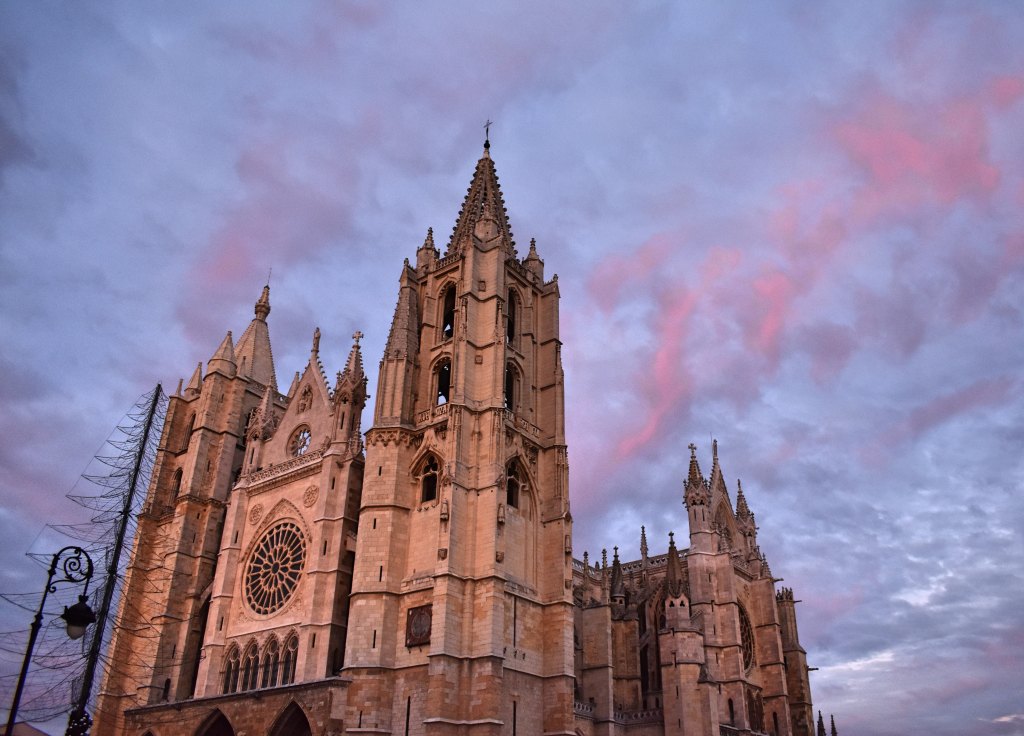
In any case, we arrived in León just before the sunset. Compared to Madrid, it was frigid—made that much colder by the fact that the airbnb I selected did not have heating or hot water (again, being cheap has its costs). We were greeted by a dramatic sunset, the pinks, oranges, and reds dancing across wisps of clouds, as the shifting light played across the gray surfaces of the city. Such sunsets are rare in normally cloudless Spain.
We headed straight for the cathedral, hoping to visit before it closed for the evening. This cathedral is, without doubt, one of the finest in Spain—and all of Europe, for that matter. León, you see, was a major stopping point along the Camino de Santiago, and so was visited by a constant stream of pilgrims during the Middle Ages—who, of course, brought both money and knowledge along with them. This explains the notable French influence in the gothic design of León Cathedral.
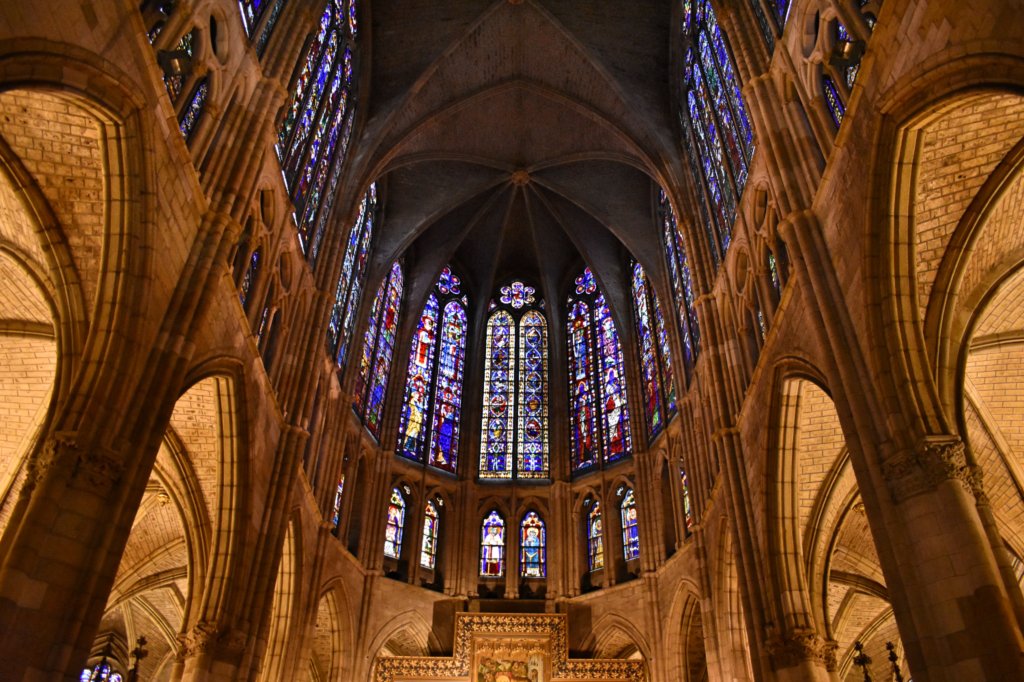
Although it is, by the exalted standards of gothic cathedrals, not especially big, its placement in an open plaza allows the visitor to appreciate the full, weighty majesty of the structure. In the waning evening light the delicate tracery, the graceful buttresses, and the many points and spires appeared like a dance captured in stone. But the real treasure is inside the walls—or, rather, in the walls themselves: the stained glass. Unlike most gothic churches, León has preserved its medieval windows (wars, bombs, and fires destroyed a good many over the centuries). These are absolutely stunning: full of intricate details and hundreds of individual figures, filling the interior with gemlike colors and ethereal light.
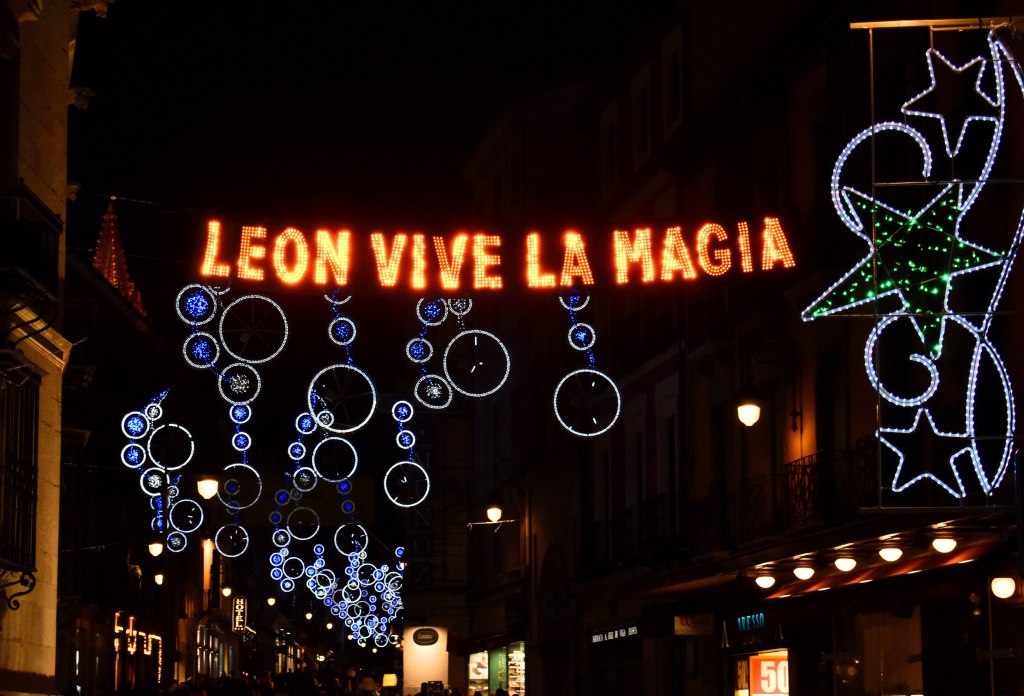
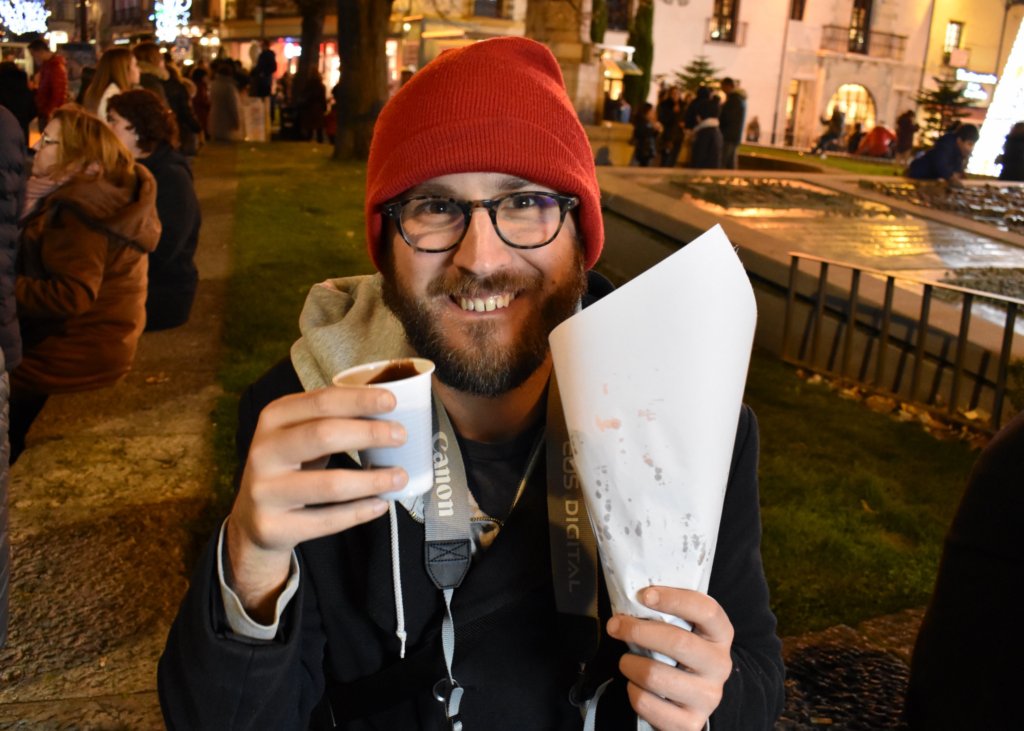
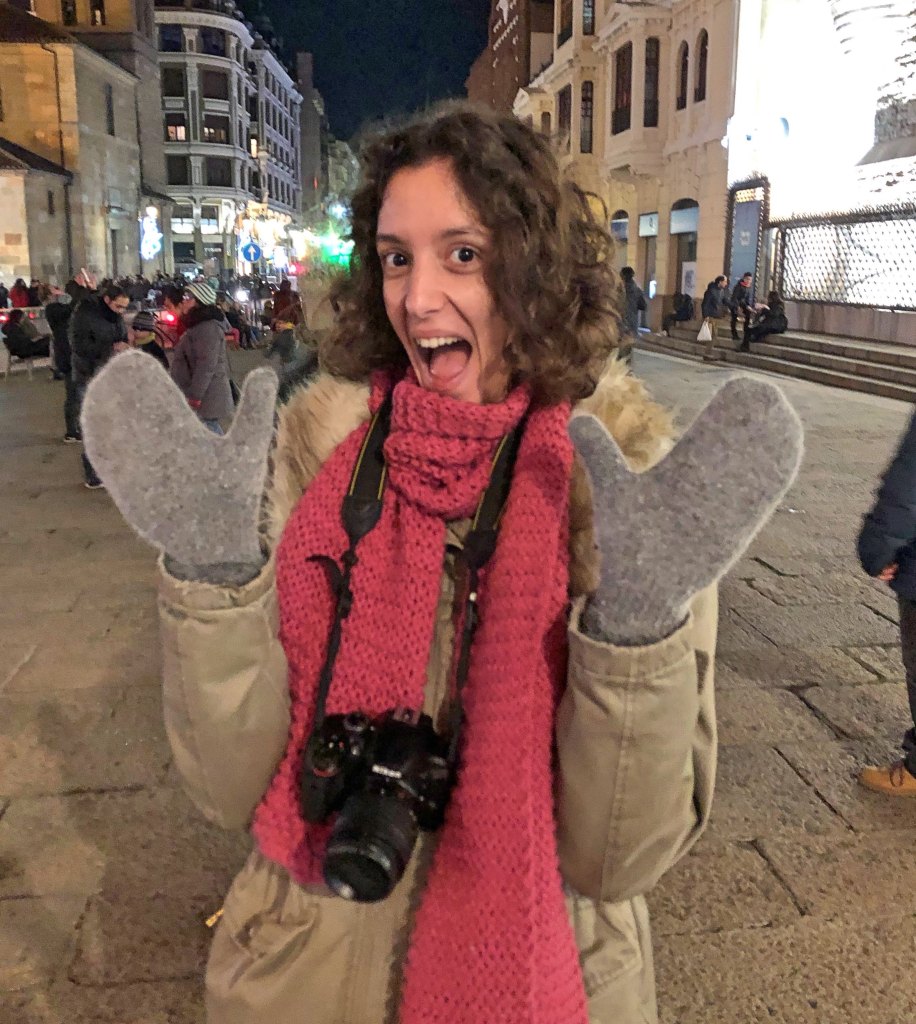
Once we had our fill of divine beauty, we turned our attention to more earthly matters. It was December and the town was full of Christmas decorations and market stands selling all sorts of knicknacks. I did some Christmas shopping—buying a colorful plate with a serrated center, for grinding up garlic, as a present to my grandmother—while Rebe contented herself with a new pair of mittens. And if you are in Spain in the winter months, it is obligatory to have some churros with hot chocolate.
Our meandering took us, inevitably, to Casa Botines, one of a handful of buildings outside Catalonia designed by Anton Gaudí. It is a severe building, strictly neogothic, lacking the exuberance of Gaudí’s later works. Even so, it fits in harmoniously with the city of León and is, at the very least, imposingly symmetrical. Right next to it is the Palacio de los Guzmanes, an attractive Renaissance structure that is now the seat of the local government (Guzmán was a wealthy family who commissioned the original palace).
This was basically it for our evening in León. After a short stroll along the Bernesga River, we drove to the Airbnb where we shivered all night.
Rebe with her new mittens.
However, this was not our last glimpse of the city. Three days later, on the way back from Asturias, we made a stop in the city to see the one major attraction we missed: the Basilica de San Isodoro. The history of the basilica’s name is interesting in itself. Though originally dedicated to another saint, in the middle ages it was re-dedicated after the Muslim ruler of Seville allowed the remains of the venerated Sevillian (he was a theologian and archbishop) to be moved north to León, which at the time was under Christian control.
Above the Casa Botines. Below the Palacio de los Guzmanes.
The basilica can only be visited on a guided tour. And though this tour lasted about an hour, only two things really stick out in my memory. The first is a jewel-encrusted chalice that was displayed in a glass case, in the center of a room devoted solely to this item: the Chalice of Doña Urraca. This item lay relatively unnoticed and uncelebrated in the basilica’s collection until 2014, when two Spanish writers claimed that it was the legendary Holy Grail. The evidence for this assertion was thinner than air. Art historians believe the chalice was likely constructed in 11th century Germany. In any case, there is another potential Holy Grail in Valencia’s Cathedral, if you want to cover all of your bases.
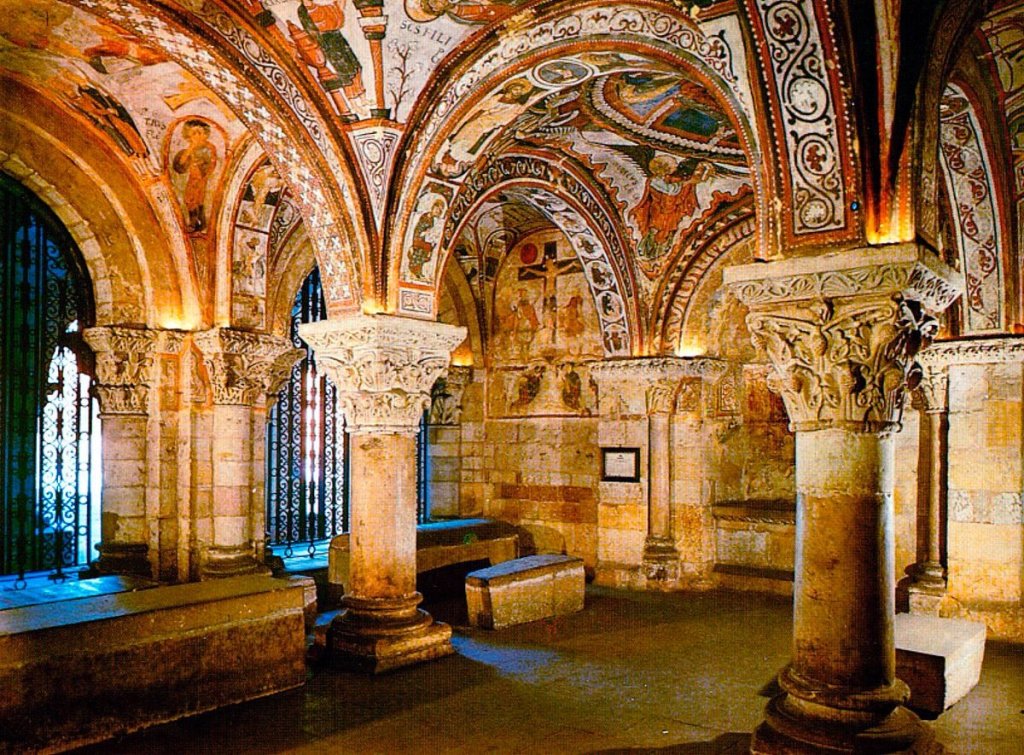
The real jewel of the basilica is, undoubtedly, the royal pantheon. This is the burial place of many of the kings and queens of León—from a time before Spain existed as a country, and León was just one of several small kingdoms occupying the Iberian Peninsula. Yet the pantheon is not famous for its bodies, but for its art. The ceiling is covered in a series of beautiful and well-preserved murals from the Romanesque period. These are of such fine quality that they have been compared with the Sistine Chapel, though stylistically they share little with Michelangelo. As is typical of Romanesque art, the figures are stylized, almost cartoonish, with no attempt at creating accurate proportions or a realistic space. The result is a kind of naive charm that I find quite moving.
A public domain image of the Pantheon.
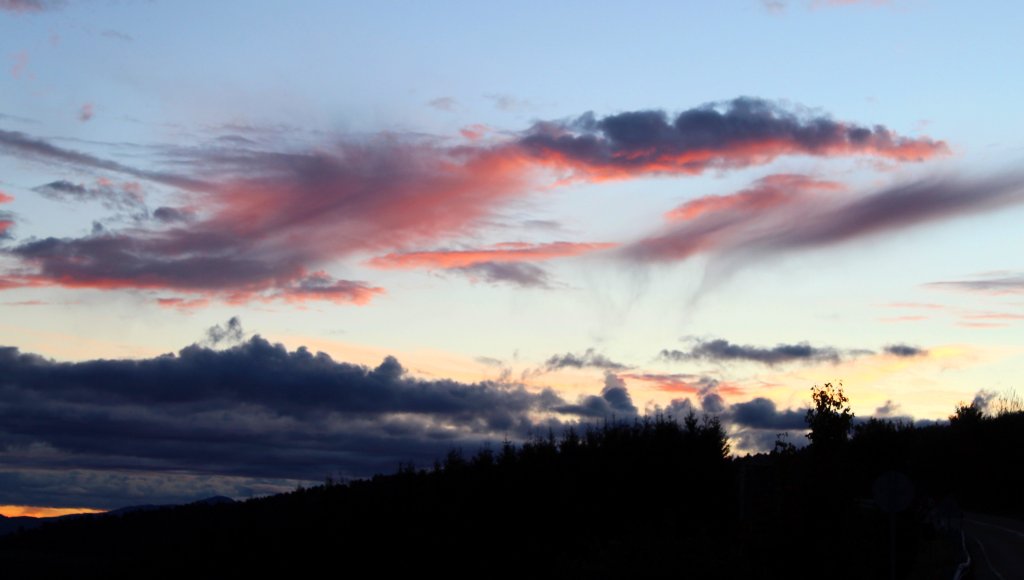
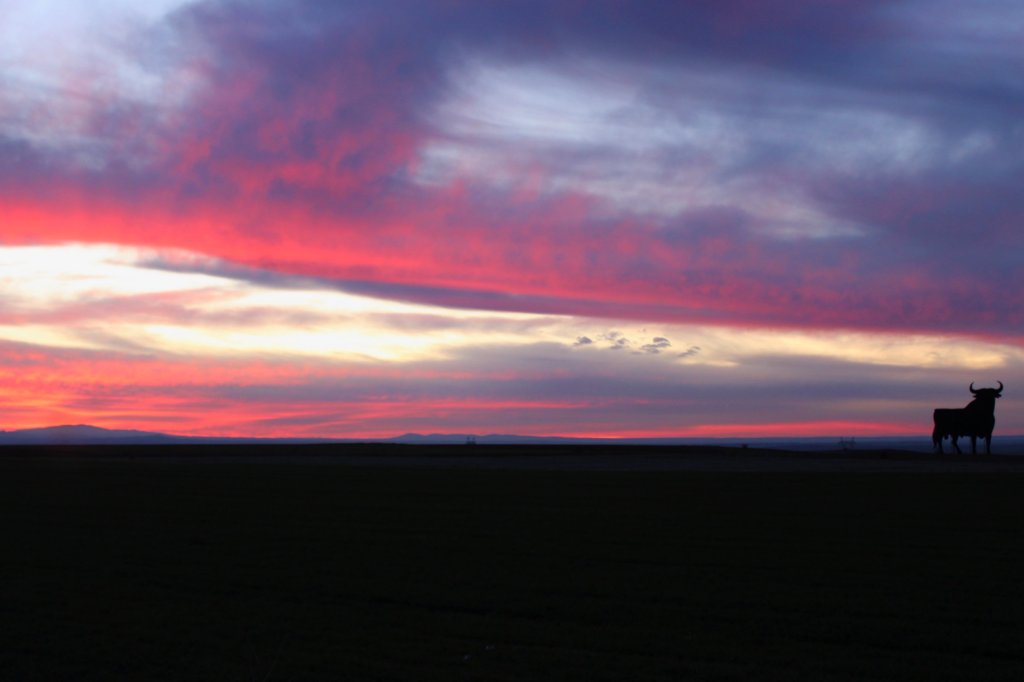
That was the end of our tour. We ate tacos at a nearby Mexican restaurant (surprisingly good), and kept going back towards Madrid. But not long after we left the city, the sky exploded into yet another gorgeous sunset—with streaks of purple, red, and pink undulating like waves in the rolling clouds. We pulled over to take pictures. By chance, right in our line of sight, was one of the iconic Osborne bulls—the universal symbol of Spain. It was yet another reminder of the enchanting beauty of this country.
A special thanks to Rebe, who took many of these photos.
When I was quite young, somebody gave my brother and me a new toy for Christmas. It was a little plastic speaker, which played 60-second clips from popular songs from tiny memory cards called “HitClips.” Though primitive in retrospect, at the time it seemed like incredible technology—to us kids, at least—and I spent weeks driving my mother crazy by playing and re-playing the one-minute version of NSYNC’s “Bye Bye Bye” I had. My brother, meanwhile, had the HitClip of Bon Jovi’s “It’s My Life,” and now if I listen to either song it makes me slightly nauseous.
This was, however, probably the most significant intrusion of contemporary pop music into my childhood. My father is a musician and, under his influence, I became a fan of the music of his generation—the Beatles, Jimi Hendrix, the Who, Bob Dylan—and remained mostly ignorant of, and uninterested in, the music of my peers. Indeed, like many teenagers with pretentions to artistic and intellectual superiority, I was quite proud to be disdainfully unaware of what was on the radio. It was therefore quite interesting to retrospectively learn about this music via John Seabrook.
Seabrook examines just the music that I was busy snubbing my nose at: the pop music of the nineties and aughts, such as the Backstreet Boys, NSYNC, Brittney Spears, Rihanna, Kesha, Kelly Clarkson, and Katy Perry. However, as quickly becomes clear, these artists are not the real focus of the book. Rather, Seabrook wants to examine the far less famous people who actually write and produce the songs that make popstars so famous. Indeed, it is fairly uncommon for a pop star to actually write their own music nowadays, which is why they have to tour and perform so regularly—they do not make much money on record sales.
A surprising number of songwriters are Swedish (apparently, the culture or the language fosters melodic gifts), such as Max Martin—a man infinitely less well-known than the singers I listed above, but who has written many of the songs that made them famous. Martin, along with others such as Dr. Luke and Tricky Stewart, do not write songs the way you might imagine is the “normal” way. Rather than searching for chords and melodies on a guitar or a piano, they focus on making “beats” or backing tracks—usually, using only digital tools, a fact that has put many studio musicians out of business. Then, this track is sent out to “top line” writers, who come up with the melody and perhaps the title; and finally, a lyrics writer finishes up the product.
Working this way, a song can be created relatively quickly. This is key to the modern pop song industry, as it allows producers to search for potential hits via trial and error. The same backing track can be sent out to a dozen or more top line writers, who in turn send back their melodies and ideas for the song. Of these options, the most appealing is chosen, and then worked into a full song. Even at this point, however, it is not unusual for a recorded song to be canned for being deemed insufficient. With so many options to choose from, producers need only to release what they are confident will succeed. And this is not merely a matter of guesswork. According to Seabrook, there are computer programs which analyze songs and rate their likelihood of becoming popular.
Now, being a purist is a good way to make yourself unhappy. And, in any case, “authenticity” in art is difficult to insist on, as it is such a slippery thing to pin down. Even so, I have to say that my sneering teenage self felt amply justified by this book. But before I snub my nose, I must add some caveats.
First, as Seabrook points out, this is hardly the first time in history when songs have been written by professionals for purely commercial ends. From Tin Pan Alley, to the Brill Building songwriters, to Motown and Phil Specter, there have long been professional songwriters creating material for charismatic singers. And hardly anybody thinks it inauthentic, for example, when a trained soprano sings an aria written by a professional composer (and many opera composers were quite shamelessly commercial, recycling old material and working with tight deadlines). At the very worst, this production model puts pop singers on the same level as movie stars, who are admired and praised just for knowing how to recite their lines. If anything is new about the modern “song machine,” then, it is just that the producers nowadays have more advanced tools than their predecessors.
All of this being granted, I must admit that parts of the book turned my stomach. This was especially true of the chapter on K-pop, which describes how potential stars are trained to sing and dance from a young age, and whose lives—from their schedules, to their diet, or even the boundaries of their love life—are carefully managed. The section on the dispute between Kesha and Dr. Luke—which included allegations of abuse and rape—was just as upsetting, epitomizing the exploitative extremes of the business. Indeed, as another reviewer has pointed out, there is a striking gender imbalance in the industry, with the overwhelming of producers and songwriters being men. And, of course, even if it is not exactly new, it is never pretty to see the inner workings of industrialized pop culture. It is like a visit to a hot dog factory.
Seabrook, for his part, seems to have come to like contemporary pop music more as a result of his delve into this world. Well, to each their own I suppose. He has written an informative and entertaining book on a subject that most people are familiar with, but which relatively few understand, and so has earned the right to listen to as much NSYNC as his stomach can handle.
Alan Lomax was one of the few non-musicians—perhaps the only one—whose influence on American music rivals that of the greatest artists.
He spent the whole of his life studying, collecting, analyzing, and disseminating traditional music, especially that of his own country. Great artists like Muddy Waters might never have gotten their big break if not for Lomax. Other artists, like Bob Dylan, might never have been exposed to formative influences.
Rivers of song flowed through this man, who was never rich, who never held an academic post, who often operated with no institutional backing, and who remains comparatively little known. This is not entirely the public’s fault. Lomax was a genius when it came to finding wellsprings of musical traditions, but he was not so adept at self-promotion. It took him decades, for example, to find a publisher for his writings on blues music, The Land Where the Blues Began—a book that was finally published in 1995, some forty years after the events it describes. (More unfortunately still, the book is ultimately disappointing and disorganized.)
As another pertinent example of Lomax’s troubles with finding backers, there is a gap of twelve years between the release of the pilot of his American Patchwork documentary series (1979) and the rest of the programs (1991). Yet whatever he lacked in persuasiveness, he made up for in perseverance. However long it took, Lomax did eventually complete his documentaries on American music, which are now free to stream on folkstreams.net. And they are a treasure.
The American Patchwork series consists of five episodes. The pilot, which shares its title with Lomax’s book, is about blues in the Mississippi Delta. The other episodes cover jazz parades in New Orleans, Cajun music (also in Louisiana), the folk music of Appalachia, and finally “Dreams and Songs of the Noble Old,” which explores how the elderly serve as the pillars of musical tradition. Each episode is about an hour, and each one is worthwhile. Lomax, as usual, created them on a shoestring budget, with just a single cameraman, and so the documentaries have an almost homemade and unprofessional feeling to them. There is no sophisticated editing, no stunning visuals (indeed the camera work and editing often seems sloppy), and Lomax himself does all of the voiceovers. But what they do have, in abundance, is great music.
Most striking of all, this music is not, for the most part, played by famous professionals. Lomax takes care to find living traditions, and to enter into the communities to record the music as it is enjoyed in its original setting—often played by volunteers and amateurs, or at most by semi-professionals. As a child of the suburbs, I find these sorts of traditions fascinating and even inspiring. This sort of music—local, nonspecialist, communal—is so different from the music of the modern world, written by professional songwriters, performed by groomed superstars, and consumed from headphones or a speaker.
This difference is exemplified most clearly in Lomax’s episode on the “Noble Old.” There, Lomax shows how this music—most of which is not written down—is passed down from generation to generation, through living repositories of song, who accumulate more and more knowledge with each passing year. This could not contrast more sharply with today, where even being in one’s thirties is enough to isolate oneself from the main currents of popular music. (I am speaking from experience!) When music must be transmitted that way, from mother to daughter, from mouth to mouth, then it takes on an entirely different quality. For nothing will survive long in a community’s collective memory if it is not, somehow, vital to the identity of the community, embodying its values and even a sort of wisdom.
Lomax was a champion of this music his entire life. And despite his tendency to make romantic and unconvincing generalizations about peoples and cultures, he ultimately does make a convincing case for the vitality and beauty of these traditions. Of course, there is a certain paradox in people like Lomax and, by extension, myself—people who have traveled widely, read widely, gone to college, live in cosmopolitan cities, and so on—pining for the traditions of those who live in relatively closed, isolated, and often poor communities. In the modern world, we do not know the songs of our elders (if they even have songs to share), but we know a great many other things. And as much as I loved the episode on Appalachia, I will not be moving there anytime soon.
Even so, I found myself moved halfway to tears by each one of these documentaries. Comparing this lovely, haunting music with the formulaic and soulless jingles of the modern world, it is difficult not to feel that we have, somehow, gone badly off course. Nevertheless, the banality of pop culture is probably an inevitable price to pay if you want to live in a cosmopolitan culture. After all, once a society becomes relatively unmoored from traditional values (which is one way to define cosmopolitanism), the only measure of cultural value is what attracts people’s attention, and pop music certainly does that. Ironically, however, this freedom from tradition is what allows us to appreciate the musical traditions of vastly different cultures—within the United States and beyond.
I do not think Alan Lomax ever squared the circle of how to reconcile local tradition with a broad and tolerant perspective—how to have a strong identity and yet appreciate people quite different from oneself. His most ambitious attempt was to create a world-wide database of traditional music, the global jukebox; but rather than create a universal schema that could incorporate all human art, it only showcased the incredible variety in the world. Even so, and even if his loftiest intellectual goals were never reached, Lomax changed American music forever. And he still has much to teach us.
I am a sucker for books like this—stories of survival and exploration—and this one must be among the best. It has everything: wild orgies, bloody battles, mutinies, shipwrecks, torture, disease, treasure—and all of this excitement is woven into a historically significant tale. Indeed, aside from being just a darn good story, Magellan’s voyage provides an insightful window into its time: the state of navigation, of European politics, and of global trade, as well as a snapshot of early European encounters with other cultures (it did not go well).
Magellan was arguably a victim of the same misconception that misled Columbus: namely, that the earth was significantly smaller than it really is. Just as Columbus believed that he could make it to Asia simply by heading straight across the Atlantic, so did Magellan believe that the spice islands would be within a few days or, at most, weeks sail beyond South America. Both were mistaken, though for Magellan’s crew the consequences were significantly more dire.
In the 99 days at sea between the strait which now bears the explorer’s name, and their first landfall at Guam, nineteen sailors died of scurvy, and many others fell gravely ill. (Of the 270 sailors who set out on the voyage, 173 would die, 55 would desert, 12 would be taken prisoner, and only 30 would successfully complete the circumnavigation.)
In retrospect, it is difficult to believe that Europeans could remain so ignorant for so long about the causes of the disease (vitamin C deficiency). Somehow, it did not even cross the sailors’ minds that their diet of biscuits and dried meat could be the cause of their ill health. Even seemingly obviously sources of evidence—such as their quick recovery upon eating fresh fruit, or the seeming immunity from the disease of all those (like Magellan) who were eating preserved quince—did not provoke any sort of epiphany. Instead, the sailors vaguely chalked up the disease to “bad air.” This is an illustrative moment in the history of science, for it shows how background assumptions and beliefs shape the sorts of things we are inclined to view as pertinent evidence.
Indeed, many aspects of this voyage strike the modern reader as absurd. For one, the expedition’s main objective was the acquisition of spices—namely, cloves, nutmeg, and cinnamon. Considering that virtually anyone can now obtain each of these spices in a supermarket for a pittance, it beggars belief that so many sailors would risk their lives for such a purpose. At the time, these “exotic” spices were only grown in a few islands in the Pacific Ocean, and were thus rarer and more valuable than gold. Nowadays, in the age of factory farming, this is obviously not the case—a vivid lesson in supply and demand. What used to be the quintessential marker of extreme wealth are now the standard components of a pumpkin spice latte.
Another absurdity is that Magellan never intended to circumnavigate the globe. Thinking that the spice islands (the Moluccas) were not very far from South America, his plan was to return the way he came. Instead, he proved that his new route to Asia was entirely impractical, with virtually no commercial prospects whatsoever. The Pacific Ocean (which he named) proved to be both far too big and not at all “pacific.” Ironically, the main accomplishment of the voyage was intellectual—proving, for example, that the earth was far larger than previously thought—which had nothing to do with its original purpose. Certainly, Magellan himself was the furthest thing from a scientist.
If I have one criticism of the book, it is that Bergreen is far too laudatory of Magellan, using words like “heroic” to describe him and his men. The man was undoubtedly impressive: brave to the point of foolhardiness, determined to the point of stubbornness, and a highly skilled navigator. However, he was hardly an exemplary leader. Brutal, cruel, highhanded, he did not inspire any loyalty among his armada. He was almost the victim of a popular mutiny (and, in any case, one ship did sneak back to Spain), and he was possibly abandoned by the bulk of his men during the battle that claimed his life. One can clearly see the shape of European colonization to come in his attempts at mass conversion and his willingness to kill and enslave those he comes across.
It is yet another irony that the man most famous for circumnavigating the globe only got about halfway before dying in an ill-advised and unnecessary battle. Interestingly, though in Spain Juan Sebastián Elcano—the captain who led the survivors back to Spain after Magellan’s death—is almost as famous as Magellan himself, the Basque mariner does not feature prominently in this book. Elcano, for his part, is certainly a less colorful character than the Portuguese commander, though he must have been a skilled leader to have successfully completed the voyage. (He later died of scurvy on another expedition.) In celebration of the 500th anniversary of the voyage (completed on September 6, 1522), there was even a cantata written in Elcano’s honor and performed at the National Spanish Auditorium. Unfortunately, there were no more tickets available, and I missed it.
Yet if this strange and terrible voyage had a true hero, I would argue it was neither Magellan nor Elcano, but the Venetian nobleman, Antonio Pigafetta. A gentleman scholar, he kept a diary of the voyage that has proven to be a trove of information. He was endlessly curious, and made genuine attempts to understand the language and culture of some of the places they visited. It is largely thanks to him that we have such a vivid account of the voyage. And I think a good story is worth all the tea in China—or all the cloves in the Moluccas.
On a hot day a few summers ago, I took a trip to Woodlawn Cemetery, in the Bronx, with my dad. It is an enormous place, so even with the official map it took some time to find who we were looking for. Eventually we stopped the car and got out to front a large black slab, inscribed with two bars of music, so shiny that we could see our own reflections in it. This was the tomb of “Sir” Miles Davis (he was a member of the Knights of Malta), the man who had helped inspire my dad to devote himself to jazz bass.
Through my dad’s influence, I have been listening to jazz all my life (though not always intentionally), and I have come to know and love most of the great names. Some of them were right there in the cemetery: Duke Ellington, Max Roach, Coleman Hawkins. It was with this background that I approached Miles Davis’s autobiography, and I loved every minute of it.
The magic of this book is the skill with which Quincy Troupe has captured Miles’s voice. He is completely there, in all his profane glory (much to the chagrin of some readers). This, combined with an uncanny impersonation by Dion Graham in the audiobook, makes you feel like you are right in the room with him. But of course the person who ultimately deserves the credit is Miles himself, for agreeing to the project, and for being just so uncompromisingly blunt. His raw honesty is what makes this into a great autobiography.
And if you are in any way a jazz fan, this is a real feast. Miles knew close to everybody. From the very beginning of his career, he was thrown in with Charlie Parker and Dizzy Gillespie, right at the center of the Bebop world. His stories of Charlie Parker alone—who seems to prefigure Miles in many ways—are worth the price of the book. After his early years, Miles becomes a bandleader, and helps to launch the careers of many other musical giants: Cannonball Adderley, Bill Evans, John Coltrane, Herbie Hancock… In short, for decades Miles’s career was at the very center of jazz history. And more often than not, he was at the vanguard.
But this book is not just namedropping and a few memorable anecdotes. As I said, Miles the man really comes alive in these pages, and that means, most of all, his love for the music. Near the end of the book, he describes himself as having “musical demons,” and I think that is an apt description of the way that music ruled his life. It really seemed to open up the finest part of his nature: not only in pure musical expression, but also in his treatment of other musicians. Despite his mean reputation, he is generosity itself when discussing the accomplishments of his fellows, and does not stint on praise. This is what, I think, made him such an effective bandleader—he could really appreciate different sorts of musical gifts.
The dark side to an overwhelming obsession like this is that it leaves little in your life for other things. This is apparent in his often abysmal—indeed, abusive—treatment of the women in his life. This is perhaps even more apparent in his behavior as a father—or lack thereof, as his four children are barely mentioned at all in the book (he takes time to criticize two of his sons, though admits he had not been much of a father). Another major theme is drug abuse—an occupational hazard of touring musicians, I suppose—which ebbs and flows throughout his life. Indeed, his substance abuse and mistreatment of women often go hand in hand, as he depends on women either to enable his habit or to help him get clean. Suffice to say that this isn’t the autobiography of a saint.
The final impression is of a deeply restless man. He was never fully satisfied, and never content to sit on his laurels. This is what enabled him to stay musically innovative for so long, this constant searching. It is only near the end of his life that he seems to achieve a modicum of peace, and he accomplished this by turning to painting—another creative outlet that would make the musical demons quiet down. (I quite like his paintings, actually.)
As far as political opinions go, there really is only one Miles expresses, but he does so over and over: That white Americans are stealing black culture—copying styles of music and making millions off of them. Now, to me, this seems to be an obvious fact, as it has repeatedly happened throughout the course of history, most notoriously with Elvis Presley. So I cannot fault him for being resentful. I also think Miles is onto something when he says that black music is America’s one great contribution to world culture.
I picked up this book feeling curious, and put it down nearly obsessed with Miles. It is worth reading because he was one of the major musical forces of the last century, but also because it is simply a great autobiography by any standard. Miles was a complex, and contradictory person, and the book seems to capture his every vice and virtue, and even his living voice. I wish it were longer.
Since Rick Steves has taken over my life lately—don’t ask—I decided to see how all his travelling has affected his politics. I was sort of afraid, given his background, that this book would be little more than a collection banalities and platitudes (“make friends with people from other cultures,” “don’t think your way is the only way,” and that sort of thing); but this book surprised me by being genuinely, well, political. Steves has definite opinions and a real message—with a few platitudes thrown in, too, of course.
It should be noted that, like almost everything Steves writes, this book is primarily for Americans. Many of his “lessons” will be obvious to people who live elsewhere. For example, he begins with a good chapter on the wars in former Yugoslavia. He paints a vivid picture of the how the Balkan countries are still scarred by the conflict—including a woman who still has a piece of shrapnel in her back. His point is simple: most Americans don’t know what it is like to be in a war, and seeing its effects up close might make us reconsider our proclivity to bomb and invade other countries.
Some of the content is to be expected by any thoughtful American who has travelled in Europe. It is hard not to think at least some aspects of life overseas are superior: public transport, social healthcare, bike-friendly cities, long vacations, family leave… the list goes on. I would add the lack of guns. After you spend some time in a country where you can be sure the vast majority of people—criminals included—do not have guns, the entire “debate” in the United States is immediately seen to be silly. When Americans argue that guns increase personal safety and ensure political freedom, the rest of the world simply laughs.
Steves is strongest on drug policy. He notes the many European countries which have substituted a public safety for a law enforcement model with drugs, and makes a strong case that it is both more humane and more effective than just locking people up. The travel writer is not just all talk, either, since he helped to promote and sponsor the bill to legalize marijuana in his home state of Washington. This is another excellent example of how travel can affect one’s politics, since the first time you travel to a country where marijuana is legal to consume, and notice that the sky isn’t falling, you wonder if it’s really worth imprisoning people for doing so.
The chapters on Iran and on the Holy Land were classic Rick Steves. They were both attempts to understand a conflict (between the US and Iran, and between Israel and Palestine) from a less partisan perspective. It is perhaps extremely naïve to think that by simply getting to know ordinary people “on the other side,” so to speak, we can reduce antagonism. As Steves himself makes clear, there are historical and structural forces at work, which push peoples into conflict. Nevertheless, I find it heartwarming that he so earnestly tries to focus on the ordinary humanity of these peoples, rather than on the political narratives. It is something we see all too little in conventional news.
The chapter on El Salvador was perhaps the most impressive. The United States’ interventions—often violent and undemocratic—in Latin American politics is something that most Americans are hardly aware of. It is an uncomfortable history to say the least, and only figures such as Noam Chomsky routinely talk about it. But Steves travelled to El Salvador during the Salvadoran Civil War, and several times after that, to see our foreign policy with his own eyes. He even had his travel diary printed and sent to members of Congress, in a bid (albeit an idealistic one) to stop American interference.
By the end, for someone who could easily have spent his life eating gelato for the camera, Steves is shown to be a man of strong convictions. Of course, the book is not perfect. Steves is prone to falling into stereotypes when he compares Europeans and Americans; and, not being an expert on anything he writes about, his analysis can be fairly superficial. And of course there is the trademark cheesy Rick Steves style—that is inevitable. But I think this book is valuable for voicing some opinions that are likely to be quite unpopular among many Americans, and for doing so in a way that is accessible and friendly. Maybe travel really is enlightening? Now, if we could only figure out how to fly without creating greenhouse gases…
The plane—Ryanair, unfortunately—landed well after dark. My brother and I quickly extracted some złoty from an ATM and then got into a taxi. The driver was a friend of our Airbnb host. Quite polite and charming, he asked us about where we were from, and a halting conversation began.
“Man, it’s really cold,” I observed, lamely, during a lull.
“Yes,” he said in his thick accent. “In Poland, we have winter.”
Indeed, he was right: it was winter. In fact, this was the last weekend of February 2020, right before the pandemic turned the world on its head. Though I was blissfully unaware of it at the time, this trip would prove to be my last gasp of “normalcy”—and, at least until now, my final European trip outside of Spain. But at the time, I only noticed that it was awfully cold compared to Madrid.
We had left for Poland as soon as we had gotten out of work. As a result, by the time we made it into our room, it was past midnight, and we only had the energy to crawl into bed and pass out.
The next day we awoke, dazed and still a little cold, ready to explore Krakow.
But first, breakfast. For this, we stopped by a food stand and got some obwarzanki krakowskie, the so-called Krakow bagel. Unlike the bagels I am used to, this version is thinner, saltier, and crunchier—almost like a cross between a bagel and a soft pretzel. Very tasty and affordable. After this wholesome repast, we wandered toward Krakow’s old center.
Like many cities in Europe, Krakow has a history that stretches back to medieval times, and beyond. And like many beautiful cities, a certain set of circumstances conspired to build up and preserve the place. The first necessary step is to enjoy a golden age of artistic creation—either through commerce, or by being the seat of political power, or preferably both—and it just so happens that Poland’s so-called golden age occurred when Krakow was the capital of the country. Then, importantly, political power shifted elsewhere (to Warsaw), leaving many impressive buildings to weather the centuries, bereft of their original importance. Finally, and crucially, Krakow was lucky enough to survive the desolation of modern warfare. While Warsaw was blown to smithereens, Krakow remained relatively unscathed during the Second World War. Thus it is that the city has the look and charm of a medieval capital.
The first thing to catch our eyes was the Grunwald Monument. This is an enormous equestrian statue of the Polish king Władysław II Jagiełło (don’t ask me to pronounce it), who forged an alliance with Lithuania and defeated the Teutons (Germans) in the battle of Grunwald. This epochal battle, which took place in 1410, is said to mark the beginning of Poland’s golden age; and the monument was erected 500 years later, in 1910, to commemorate this symbol of Polish pride. Unsurprisingly, when the Nazis invaded, they could not abide the sight of a monument to a German defeat; so they did what Nazis do, and destroyed it. The monument was rebuilt in 1976—and may it be forever a symbol of Poles triumphing over Germans.
Nearby is the barbican. This is a kind of fortress that once formed an important part of the city’s defenses. Though we did not go inside, a single glance was enough to reveal an imposing and, in a way, a beautiful structure—with gothic spires jutting out over the solid brick walls. I would hate to have been the poor soldier tasked with capturing it. The original medieval walls are also preserved nearby, which encircle the old center of Krakow. We proceeded through the gate, and down a long avenue—Floriańska Street—filled with touristy shops and American fast food, until we reached the Rynek Główny, which is just Polish for “Main Square.” It is a grand, open space, filled with pigeons, tourists, and stately buildings.
Prominent among these is the Town Hall Tower, a gothic clock tower that—as its name suggests—once formed a part of the town hall. For better or worse, the rest of the town hall was demolished in 1820 in order to open up the Main Square. Much more modest in stature is the Church of St. Adalbert, a relatively small church with modest decorations inside. Yet it is distinguished for being one of the oldest stone churches in the country, having been built in the 11th century. Nearby is the Adam Mickiewicz Monument, a large sculptural assembly that may be the best place to meet somebody if you want an easy-to-find landmark. Adam Mickiewicz, by the way, can perhaps be considered the national bard of Poland. (One day, I hope to read his epic poem, Pan Tadeusz.) Right in the center of the square is Cloth Hall, a lovely Renaissance building that once served as a kind of medieval stock exchange, though for spices and fabrics instead of stocks and bonds. Nowadays it is a touristy market.
Yet the loveliest building of the bunch, for me, is St. Mary’s Basilica. Like the cathedral at Chartres, this basilica has two unmatching towers, which rise splendidly over the main square. The interior is even more impressive than the relatively unadorned façade. Pride of place undoubtedly belongs to the magnificent wooden altarpiece, carved by one Veit Stross. As you may have guessed from his name, Stross was a German; yet his masterpiece has—ironically, perhaps—become an icon of the Polish identity. Even more ironically, this artistic treasure was stolen by the Nazis, only to be found in the basement of the Nuremberg Castle (a city, as it happens, where Stross also lived and worked). Passing over the other lovely works of art in the basilica—most notably, Jan Matejko’s murals—I must mention the hejnał mariacki, a bugle call played every hour, twenty-four hours a day, from the taller tower. It is a beautiful melody that ends awkwardly and abruptly, in honor of a bugler who was, supposedly, shot in the throat by an arrow during an attack by the Mongols, in the 13th century.
The altar was being restored when I visited.
Next we made our way to another edge of the old town, to a hill overlooking the river Vistula. This is Wawel, a large building complex that includes a castle and a cathedral. It is an architecturally jumbled place, with buildings from every major stage of Poland’s history. One highlight is the arcades in the Italian Renaissance-style courtyard, constructed under the reign of Sigismund the Old (1506 – 1548). This old Sigismund, along with the younger one, are buried in a resplendent chapel in the cathedral. Yet old as he was, Sigismund was not the first king to be buried in this august place, that distinction belonging to Władysław I the Elbow-high, so called because of his short stature. This cathedral, as it happens, also has two unmatching towers; and while not as beautiful as St. Mary’s, Wawel Cathedral makes up for it with its many royal bodies.
Leaving the old town now, we visited the nearby neighborhood of Kazimierz. This part of town is now most famous—partly thanks to the movie Schindler’s List, which was filmed here—for its Jewish culture. But Kazimierz was never exclusively Jewish, as you can see from the many churches, such as the impressively pointy Corpus Christi Basilica.
The Old Synagogue.
Though this part of the city was looted and destroyed by the Nazis, and then further devasted by the Red Army, many examples of Jewish culture survive. Foremost among these is the Old Synagogue, which is part temple and part fortress, with thick walls built to protect those inside. Constructed in the 15th century, it is the oldest synagogue in the country. Aside from the many synagogues and Jewish restaurants, there are also many reminders of the oppression suffered by this community under the Nazis. A plaque affixed to a stone invites onlookers to meditate on the tens of thousands of Jews from Krakow killed during the Second World War. A short walk across the Vistula brings you to another monument, this one consisting of empty metal chairs, which commemorates the former Jewish ghetto (the Nazis forced the Jewish population to leave Kazimierz and live in this ghetto, where conditions were so bad that most did not survive).
Nearby is the famous factory of Oskar Schindler. If you have seen the movie (I actually haven’t, come to think of it), you know the story: Schindler, a member of the Nazi Party, dedicated enormous resources and energy in order to keep the Jewish workers of his factory safe, thus saving the lives of over 1,000 Jews. The factory is now part memorial, part museum. You can see Schindler’s old desk, examples of the enamelware they produced, as well as exhibits on the history of Krakow—including a good deal of information about World War II and the Holocaust. It is an ideal place to learn about some of the more recent history of the city.
To learn about some more distant history, the place to go is the Rynek Underground. As its name suggests, this is a subterranean museum, to be found below the Main Square (it took us a few minutes to locate the entrance). This museum is situated in an archeological site, where the remains of the medieval city are still visible. Rather than just letting the old bricks and rocks do the talking, however, the curators opted for holograms, wherein daily scenes of medieval life (recreated by actors) are projected onto the scene. I am not sure that it was particularly educational, but it was interesting. My favorite part of the museum, ironically, was near the end of the visit, where a documentary of the history of Krakow is simply played on repeat. It was quite well-made, I thought, and taught me more than the actual exhibits had.
This fairly well did it for our time in Krakow. Yet the Rynek Underground did not prove to be the most interesting thing we saw below the earth that trip.
Wieliczka Salt Mines
The train from Krakow dropped us in the town of Wieliczka in a little under an hour. Having a bit of time to kill before our timed entry, we went on a short stroll of the town. It is quite a pretty place, with brightly colored buildings spread out in the valley—though not particularly exciting. Surely, few tourists would go out of their way to visit this place if not for the enormous mine below the ground.
Finally, it was time for us to enter. For reasons that soon become obvious, it is only possible to visit the mines in a group. For one, the descent to the main level of the mine is long; and there are so many passages that it would be easy to get hopelessly disoriented and lost. For another thing, there are quite a number of precipitous chasms that the unwary traveler could easily trip into. In a word, the Wieliczka Salt Mines are big—over 300 meters (1,000 feet) below the earth, and whose chambers and tunnels, if laid end to end, would cover the same distance between Krakow and Warsaw. The guided tour covers a mere fraction of this enormous extent. Thus, to visit you need a guide.
Descending into the mine.
Now, considering that I did not even know beforehand that salt is mined, you can imagine that this experience was a revelation to me. The walls of the tunnels are brownish gray, nothing like the crystalline white familiar to cooks. This salt is truly ancient, having been formed in seabeds eons ago. Through the churning of the earth’s tectonic plates, this oceanic salt has ended up many hundreds of miles from the nearest coast. Apparently sick of bland cabbage and potatoes, Poles have been mining salt here since the 13th century. (The smaller Bochnia Salt Mine, located nearby, is slightly older.) The salt is mined much as anything else might be: by tunneling into rich veins, extracting as much as possible with picks and shovels, and then hurling it back up to the surface where (I presume) it can be processed into something more attractive than its raw, rocky state. For much of its history this work was carried out by man-power alone; but eventually horses were brought down into the tunnels, to perform some of the drudgery in literally abysmal conditions.
Nowadays the horses are just models.
One cannot discuss the history of these mines without mention of Casimir III the Great. One of the most important and pivotal rulers in the country’s history (he ruled from 1333 to 1370), he was instrumental in the development of these mines. This was no disinterested gesture, however, as up to a third of the royal revenues were derived from salt. In the medieval world, salt was big business. Another famous name that must be mentioned is that of Nicolaus Copernicus. (That is the latinized version of his name; in Polish—his country of birth—his name is Mikołaj Kopernik.) He is the first known person to visit the mines as a tourist, and he was followed by many more over the centuries. Thus, even though salt production stopped in 1996, Wieliczka is still a gold mine—pardon the pun—of tourism, with over a million visitors per year.
A salty last supper.
Yet the reason that Wieliczka became so popular is not because tunnels and salt are so fascinating. It is, simply, a beautiful place. Over the years, talented miners have carved works of art into the walls—humorous statues, religious figures, historical personages. There are four entire chapels, one of them as impressive as a cathedral, complete with a chandelier adorned with salt crystals. Another highlight is an underground lake, eerily blue in the artificial light of the cavern, whose water is so saturated with salt that it is probably quite toxic. And then there are the massive scaffolds that seem to go endlessly on into the bowels of the earth.
Yes, that is salt.
This fairly well wraps up my trip to Poland. But I would be remiss if I ended this post without mentioning the food. Though most people do not think of Eastern Europe as a garden of culinary delights, I must say that every single thing I ate in Krakow was scrumptious. The pierogies, the soups, the fried pork cutlets, the potato pancakes, and, yes, even the cabbage—it was all terrific. (I would like to single out the restaurant Domowe Przysmaki for special praise.) One night, my brother and I walked out of the center of town to visit a food cart selling nothing but grilled kielbasa, and it was worth the cold and the long line. The fresh ingredients and bright flavors of Mediterranean cuisine get all of the attention, but if you ask me the salty, vinegary, smoky flavors of Poland are just as satisfying.
Considering everything I mentioned in this post, along with the opportunity to visit Auschwitz (detailed in another post), I would say that this is one of the most interesting and rewarding corners of Europe for the traveler.