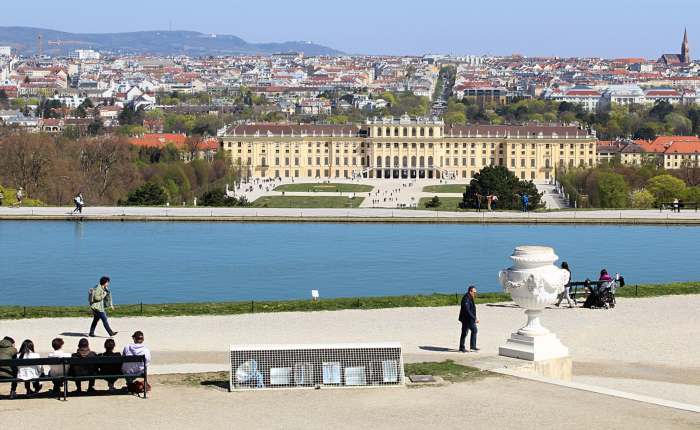
Chicago: Sewage and Synchronicity

Chicago: Sewage and Synchronicity

For years, one of my closest childhood friends, Greg, was living in Chicago as he completed his Ph.D. in history. In the summer of 2021, he was at work on his dissertation, which meant the window to visit him was narrowing. So my brother and I made the journey from New York for a long weekend in the windy city.


As the plane broke through the high, wispy clouds, the city came into view. What was revealed was an astonishingly flat landscape divided into grids as far as the eye could see. We touched down in O’Hare Airport, where we caught the blue line train to the city center. It was a long ride with quite a lot of racket; but complaining about functional public transport in the United States is in bad taste. Slow and loud as it may have been, the “El” trains got us out to Hyde Park (where Greg lives) for a very affordable price. I am grateful.

Since we spent half our time just hanging out, I will not attempt any sort of chronological account of our trip, and will instead simply focus on the major sights we saw while there.

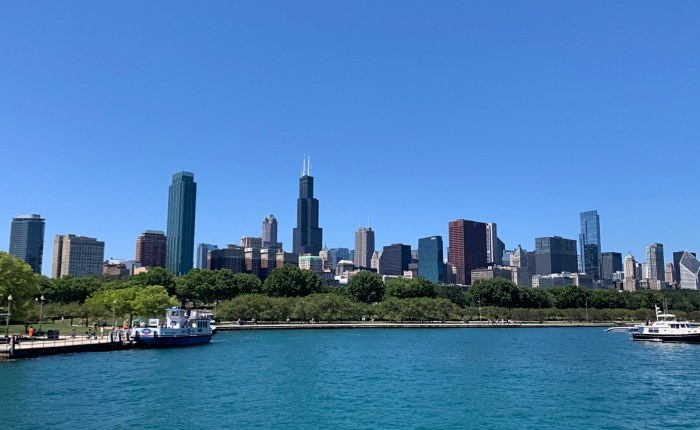
 The most logical place to begin is right in the center of the city. Compared with New York, Chicago is a fairly dispersed city, having no natural boundaries to its expansion besides Lake Michigan. Thus, much of Chicago is not particularly dense—indeed, can seem almost suburban in its layout. However, the heart of the city is rivaled in America only by Manhattan in the height and splendor of its skyscrapers.

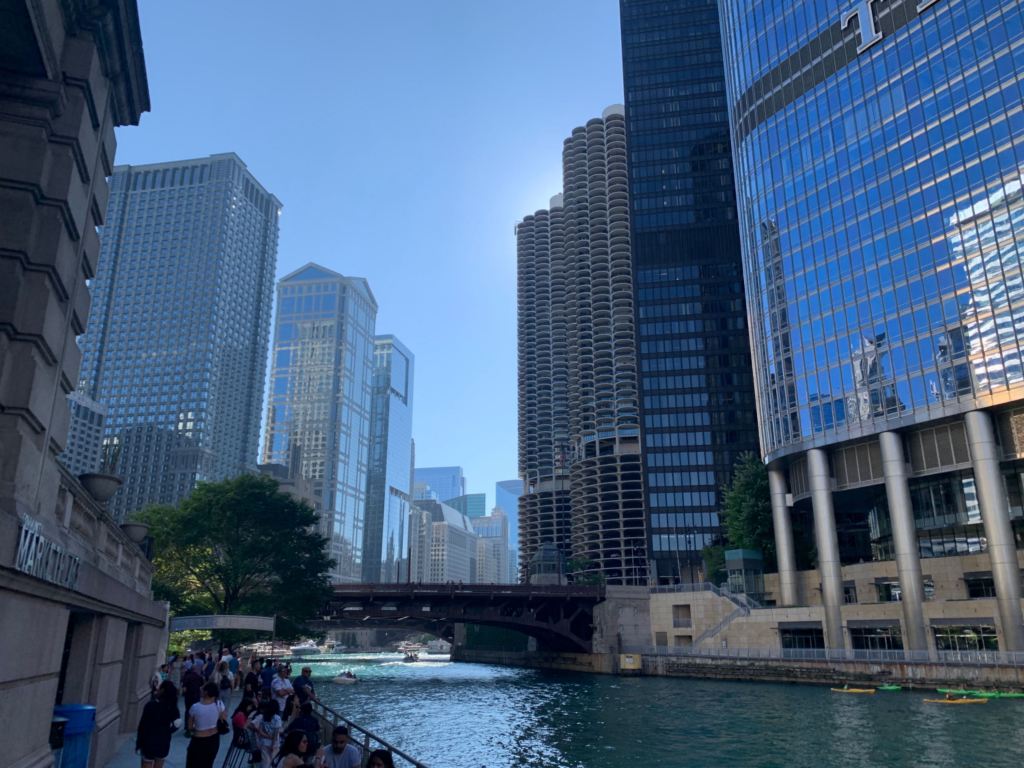
These buildings are gathered on either side of the Chicago River, which flows through the city center and into Lake Michigan. (It is this river that the Chicagoans dye green every St. Patrick’s Day, to the delight of the fish.)

Or, well, the river is supposed to flow into the lake; but in 1900, the flow of the river was reversed by city engineers. This was a highly controversial move, as it was done because all of the sewage and garbage deposited into the river was flowing into Lake Michigan, the city’s main water source—an obviously unsanitary situation that provoked outbreaks of typhoid and cholera. Through the use of canal locks, the river was made to flow backwards, thus bringing the tainted water via the Chicago Sanitary and Ship Canal (an enormous engineering feat in itself) to the Des Plaines River, which eventually reaches all the way to the Mississippi River.

But you can imagine that, however popular this reversal may have been in the city of Chicago, it was decidedly unpopular for those further downstream. Indeed, in 1906 the state of Missouri eventually took the issue all the way to the Supreme Court, which ruled in favor of Illinois (though it does not seem especially fair to me).

While we are on the topic of sewage and the Chicago River, there is another story that I must relate. This is the infamous Dave Matthews Band Chicago River incident of 2004, in which a tour bus belonging to the band dumped the bus’s “blackwater tank” (in other words, the sewage) while crossing a bridge over the Chicago River. The driver apparently thought that he could get away with such a maneuver. But unfortunately, the bridge had a grated metal bottom which let the vile liquid through. At just that moment, a boat was passing underneath giving an architecture tour, and the passengers were doused in “blackwater.”

Having said all this, I suppose the fish have more to worry about than green dye.

But to return to my original point, the Chicago River—if not the most appealing body of water—is surrounded by some magnificent architecture. Surely neither you nor I have the patience to go through every single building in the city of Chicago, so I will only mention a few that caught my eye.

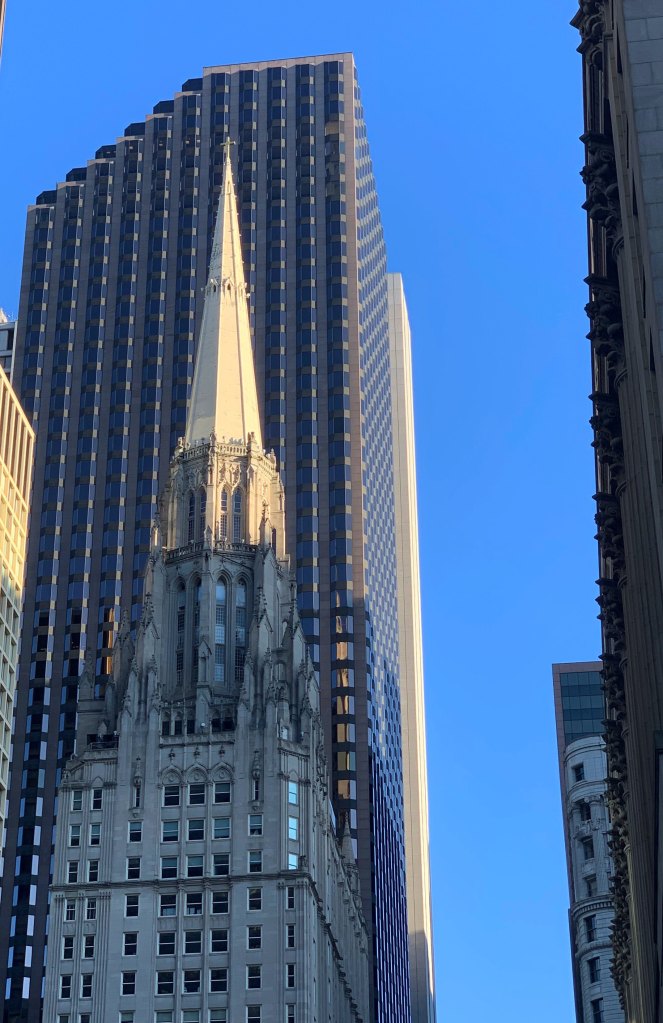
One I particularly liked is the Wrigley Building, which features a tower styled after the Giralda in Seville. Built at almost the same time (the 1920s) was the Tribune Tower, which has an elaborate neo-gothic style, with fake flying buttresses adorning the top. Somewhat similar is the neo-gothic Mather Tower, which is so tall and slender that it is sometimes likened by Chicagoans to an upside-town telescope. And completing the rounds of neo-gothic skyscrapers, we have the First United Methodist Church, which looks like a beautiful church spire had been cut off and attached to a bland office building. Of course, the entire thing is not used as a church—but if it were, it would be the tallest church building in the world.

I must begrudgingly mention the Trump Tower, which is one of the most notable buildings in the Chicago skyline. As one might expect of the former president, he wanted to have the tallest building in the world. The plans were considerably scaled back, however, after the September 11 attacks, though Trump’s ego may have been assuaged by the enormous TRUMP sign on the side of the building. (The same architect who designed this building, Adrian Smith, went on to design the Burj Khalifa, which indeed is the tallest building in the world.) On the subject of tall buildings, I must of course mention the big momma of Chicago skyscrapers, the Willis Tower (though you may know it by its former name, the Sears Tower.) This 110-story mammoth is the dominant feature of the Chicago skyline. After it was completed in 1973, it became the world’s tallest building, and held that title for nearly a quarter of a century. It is still among the very tallest of American skyscrapers. The view from the top must be incredible, but the price is pretty steep.

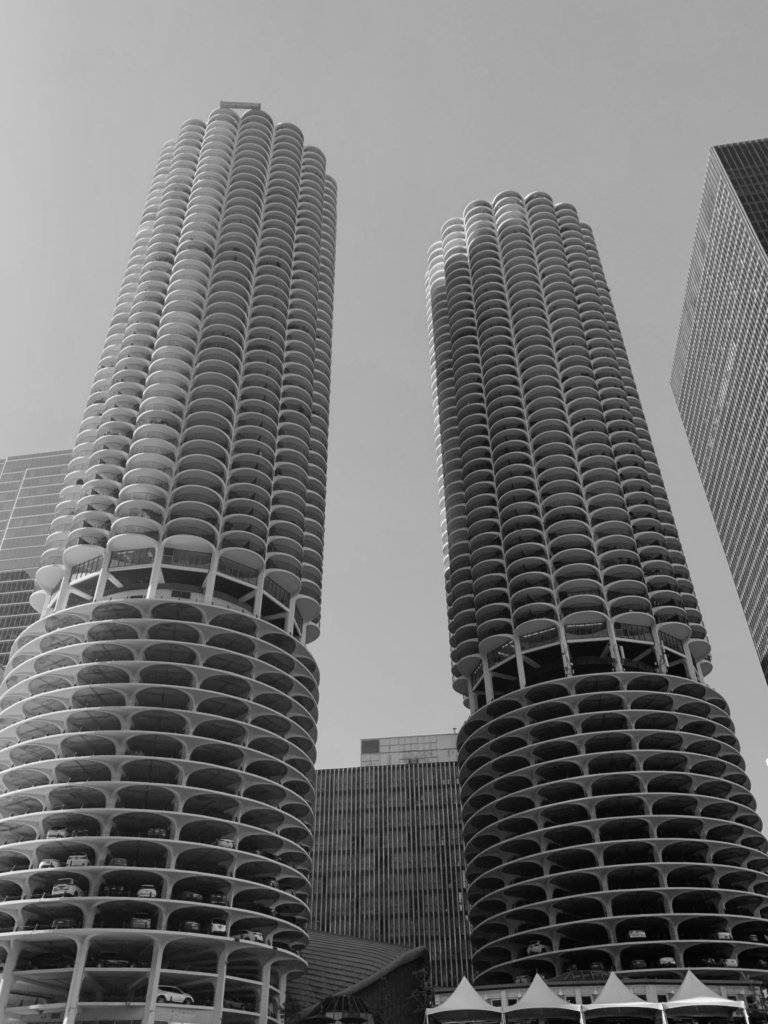
I have left my absolute favorite for last: Marina City. These are two twin residential towers like no other I have ever seen. The aptest description I can think of for these knobby, gnarly, bulging edifices is of two corn cobs. They were built in groovier times—the 1960s—and very much retain a sense of playful fun. That is to say, unlike virtually every “serious” building, there is nothing at all pretentious in this design, and I found myself wondering what it must be like to live in such a whimsical place.

I think they look especially cool in black and white.

Even with such a brief description, I think several facts about Chicago are immediately evident. Most obviously, if you have any appreciation for fine architecture, then Chicago is a wonderful place to visit. Furthermore, since enormous skyscrapers bearing the names of famous companies do not just spring up from the ground, it is evident that Chicago is an economic powerhouse.

Or at least it was. After hitting a peak of population in the 1950s, Chicago has been steadily losing residents, and it seems possible that the city’s days as a center of finance and industry are behind it. But, as I have learned from my travels in Europe, often the best places to visit are the cities that are past their economic prime. Nobody visits Florence and wishes that it were still a power-hungry city-state. Perhaps it is insensitive to say so, but the diminution of economic development helps to preserve valuable heritage. And, ultimately, such places can be far more pleasant than the crawling ant hills which generate capital.

All prognostications of hope and doom aside, another worthy place to visit is Millennium Park. This park opened as recently as 2004, on what used to be the site of the city’s rail yards. As urban centers in the United States deindustrialize, uses must be found for the old factories and railways which have fallen into disuses. Millennium Park is a wonderful model for how this can be done, for it has transformed a large swath of dead real estate into one of the most popular places to visit in the entire country.

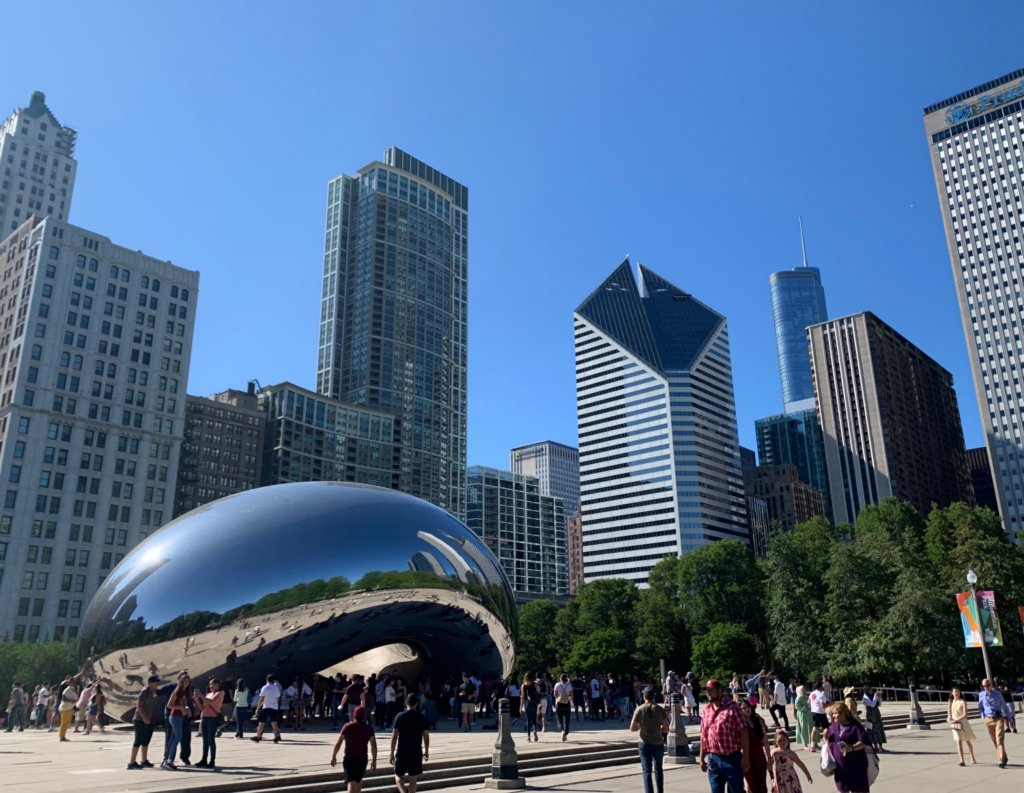
One thing that makes the park so attractive are the works of public art. Most famous is Anish Kapoor’s Cloud Gate, perhaps better known as “the Bean.” Compared to, say, Michelangelo’s David it may seem extremely simplistic: steel welded together into a bean shape and then highly polished. However, any fair judge of the work must admit, I think, that it is a brilliantly successful work of public art. Walking around this huge, misshapen fun-house mirror brings out a sense of childish delight in many visitors. And residents of Chicago do have a sense of ownership with the Bean, as evidenced by the hilarious series of 2017 fake Facebook events which began with “Windex the Bean.” A great deal of public art—especially abstract, “modern” public art—falls flat, in the sense that residents hardly care about it. But the Bean has come to symbolize all of Chicago, and therefore must be considered exemplary.

An obligatory Bean selfie.

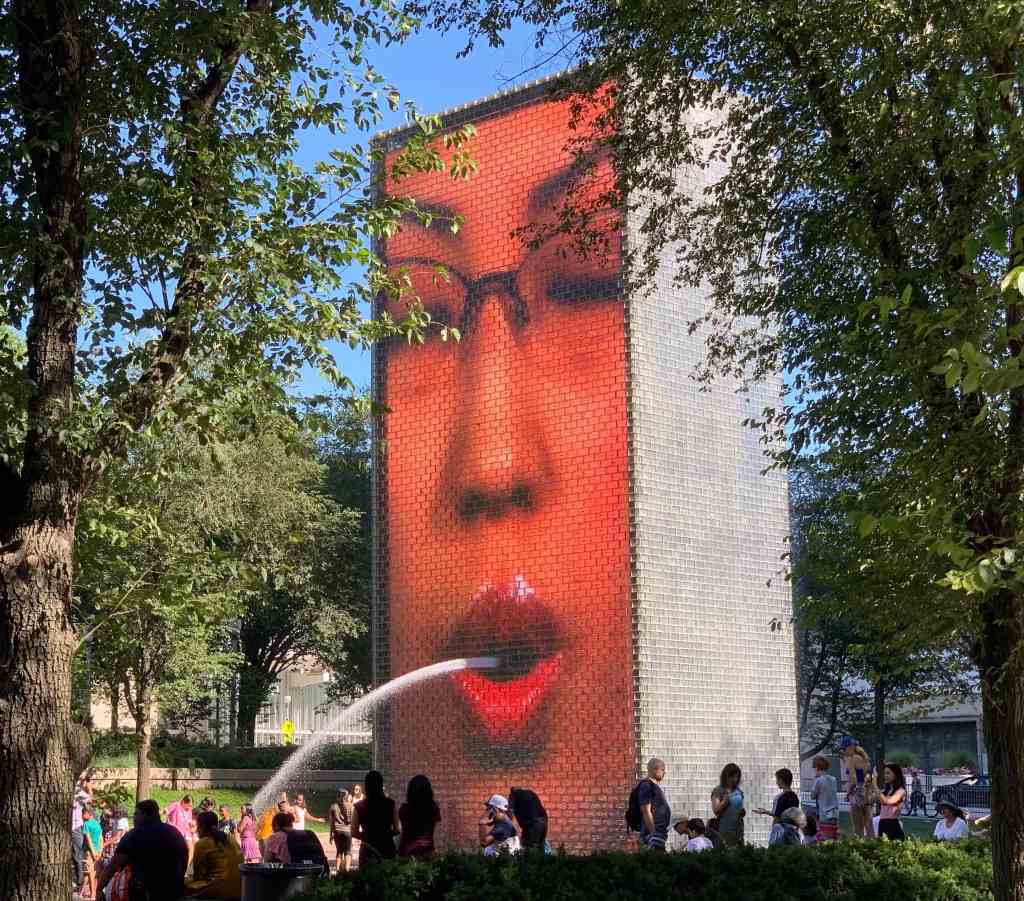
Just as delightful, in my opinion, is Jaume Plensa’s work Crown Fountain, which features two large towers of video screens over which water can flow. These towers can show any image. But when I visited, these featured faces of ordinary people “blowing,” with a stream of water emanating from their mouths. Judging from the children who were happily gathered underneath these streams, playing in the water, I think that Crown Fountain must also be considered an exemplary success of public art—art which is fully embraced by the community.

Right next to Millennium Park is one of the greatest attractions in the entire city: the Art Institute of Chicago. Now, before visiting I knew that this was a great museum. But I was frankly unprepared for the quality and size of the museum’s collection. Very few museums in the world are comparable; and in the United States, I believe that only New York’s Met stands on the same level.

The Art Institute has an encyclopedic collection, not only of European paintings, but ranging from Ancient Egypt to the Far East to indigenous American art. More importantly, this collection is of the very highest quality. At every turn I was faced with an intriguing work—sometimes striking or bizarre, sometimes shockingly beautiful, but always interesting and worthy of contemplation. If I had known that the museum would be so excellent, I would have tried to spend more than a few hours there. As it was, I was only able to enjoy the highlights.

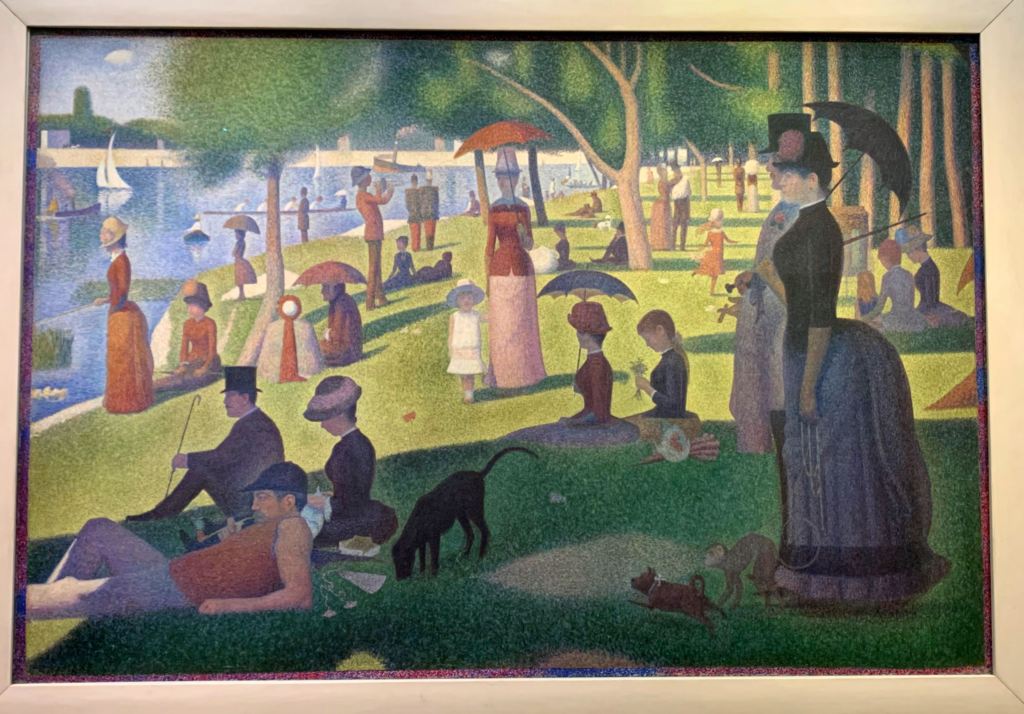
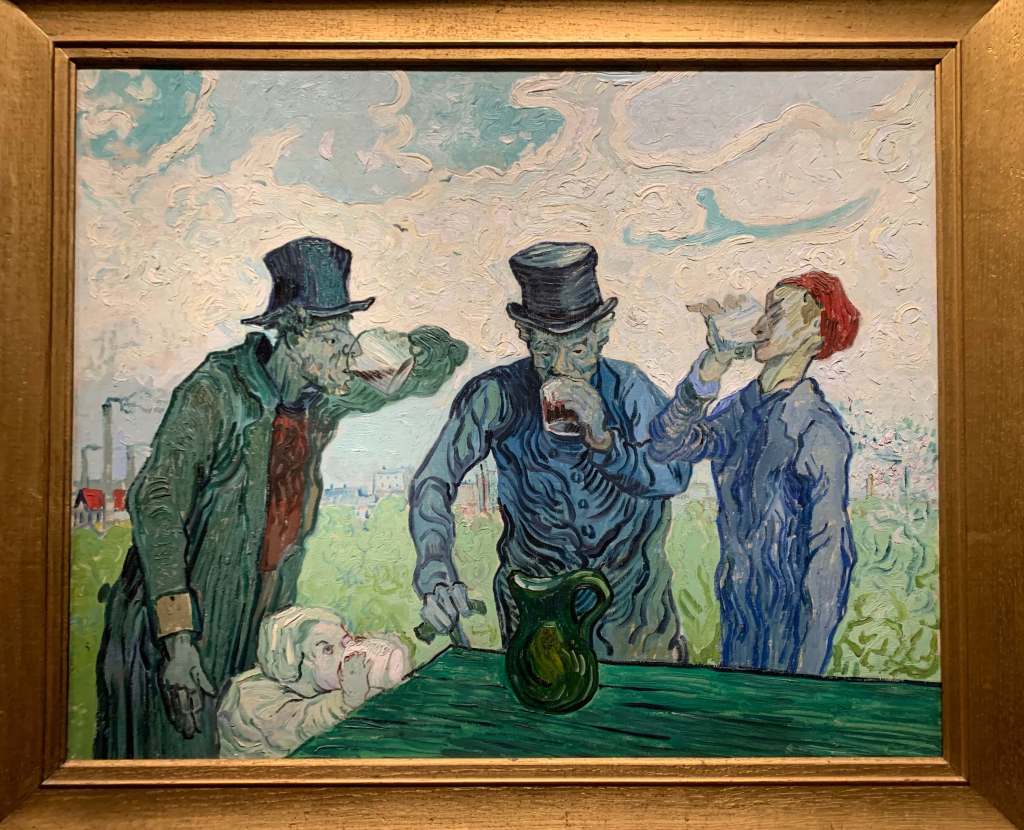
Greg first guided us to his favorite work, a series of stained glass windows by Marc Chagall, which have a soothing, ethereal midnight blue glow. (And I was reminded of how fortunate I am to have comparably beautiful Chagall windows near my house in Sleepy Hollow, at the Union Church of Pocantico Hills.) For my part, I was especially excited to see Georges Seurat’s masterpiece of modernist alienation, A Sunday Afternoon on the Island of La Grande Jaffe; and I was surprised and delighted to encounter the American equivalent, Edward Hopper’s Nighthawks. The Art Institute has a strong collection dealing with everyday despair.

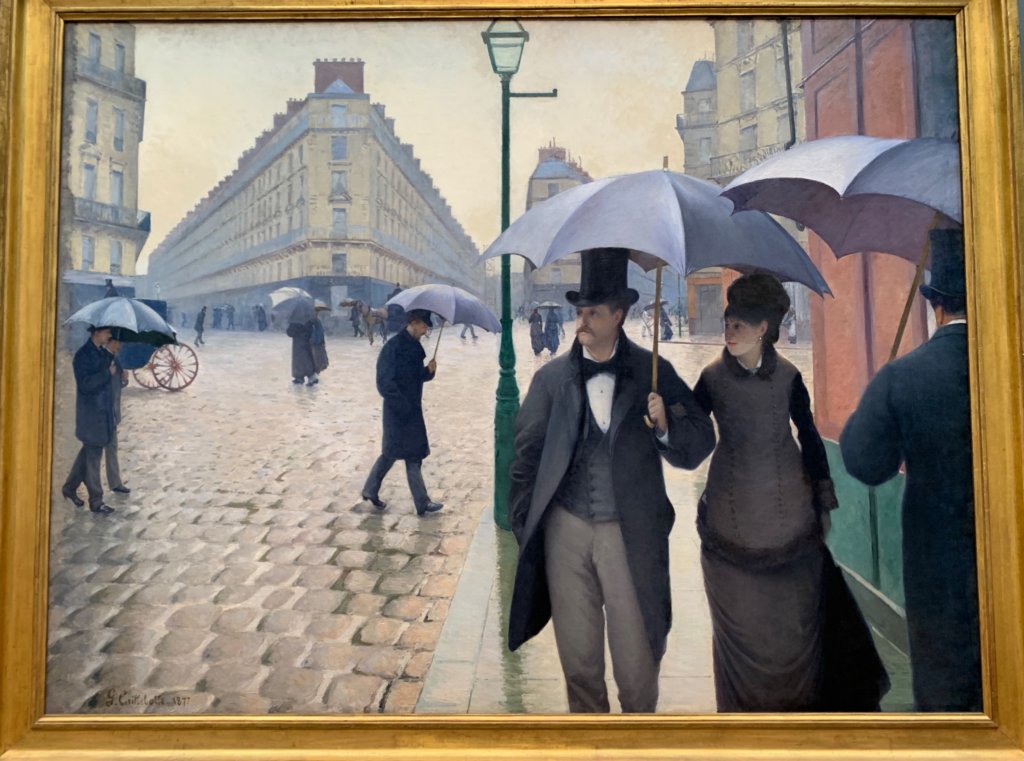
But the Art Institute is certainly not limited to negative emotion. From Monet, to Georgia O’Keeffe, to the amazing woodblock prints of Hokusai, the lush beauty of nature is present in abundance. From El Greco’s religious ecstasy, to a statue of the Buddha in meditation, to a ritual knife used by rulers in the Chimú culture, we can see evidence of our preoccupation with the supernatural. There are portraits of rural life (like American Gothic or Monet’s painting of haystacks) as well as urban life (like Caillebotte’s rendering of a Paris street or Delauney’s distorted Eiffel Tower). Compare the locomotive in Monet’s Arrival of the Normandy Train with the one in Magritte’s Time Transfixed to see how the same object can be examined, first, as a sensory impression and, second, as a symbol for the unconscious.

But all of these comments and categories are ultimately just a superficial attempt to come to grips with something whose power lies in its very ambiguity—as is true of all great art. My point is simply that you can hardly come away from the museum without a sense of wonder.

(The Art Institute is featured in my favorite Chicago movie: Ferris Bueller’s Day Off. Cameron experiences a kind of existential dread—or awakening, perhaps?—in front of Suerat’s masterpiece, while Ferris and Sloane kiss in front of the Chagall windows.)

I was particularly gratified to learn that the famous 2018 portraits of Barack and Michelle Obama were on loan from the National Portrait Gallery. I had actually missed my opportunity to see them during my 2019 visit to Washington D.C., so it was one of life’s rare second chances. For me, both Kehinde Wiley’s portrait of Barack and Amy Sherald’s portrait of Michelle are well done. They achieve the traditional aim of a portrait, in that they present a likeness of the subject that reveals something of their personality, while also providing a novel twist on the old and tired tradition of oil portraiture. I particularly like Wiley’s take on Barack, in that it emphasizes his thoughtfulness, which I think is his defining quality.

The Obamas are, of course, hometown heroes in Chicago. Michelle has deep roots in the city, having been born and raised on the South Side. And Barack (despite having spent much of his childhood in Hawaii) is identified with the city as well, for it was here that he began his political career. The cult of the Obamas is epitomized in the so-called Kissing Rock. Located in the Hyde Park neighborhood, this is a plaque affixed to a rock, celebrating the spot (approximate, I suppose) where they shared their first kiss. Not far is the site of the future Barack Obama Presidential Library, not yet opened as of this writing.

On the subject of museums, I ought to mention the other major museum we visited on our trip: the Museum of Science and Industry.

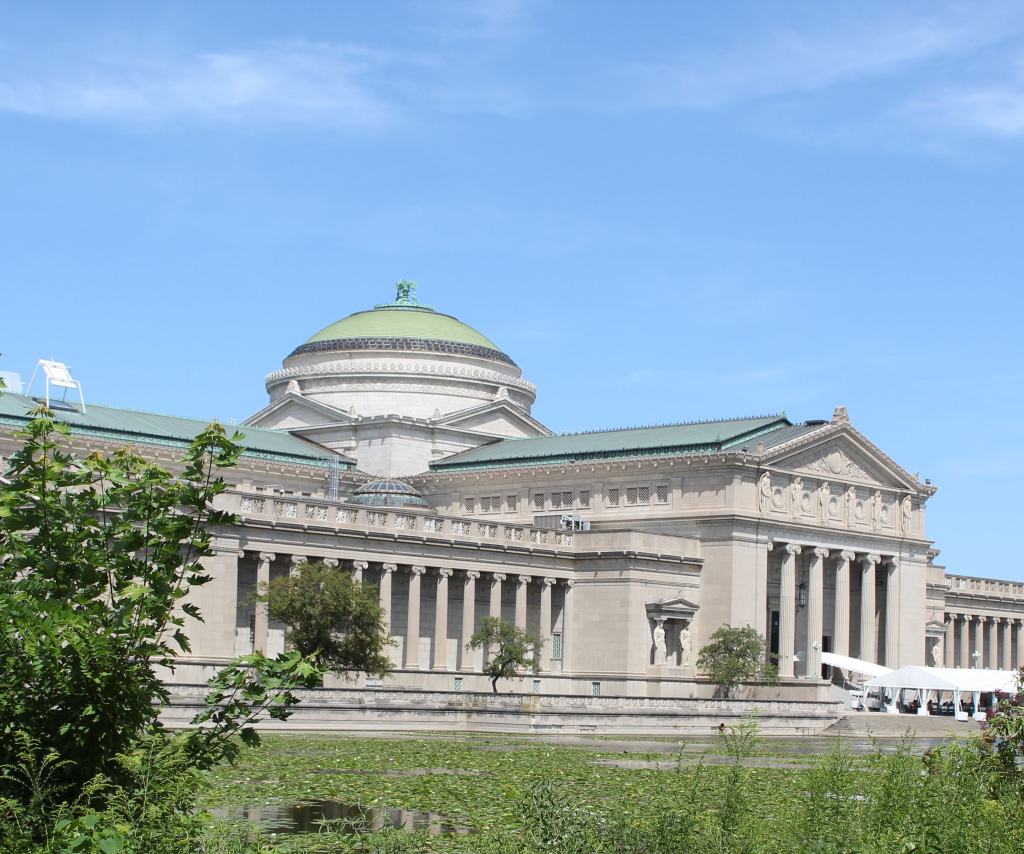
This museum is quite far from the center of Chicago, being located on the South Side, near the Hyde Park neighborhood where we were staying. As with many museums around the world, this one is housed in a magnificent building that was constructed for another purpose—in this case, the 1893 World’s Columbian Exposition (basically a world’s fair).

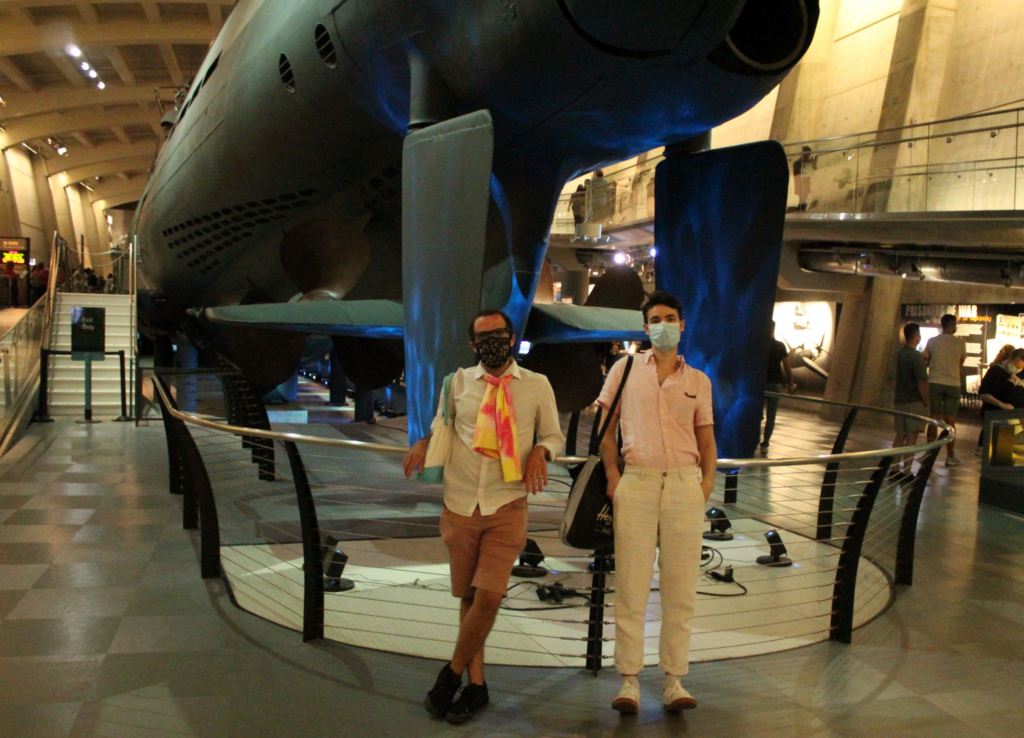
I insisted on going for the simple reason that I had recently watched the classic German war film Das Boot and I felt that I had to see the German U-boat on display. My first impression of the U-Boat was of its size: somehow I had imagined the U-boats would be relatively compact affairs. But U-505 was enormous: 250 feet (76 meters) long, and had a crew of about 50 people. She had an eventful history. After sinking several boats in 1942, she suffered a string of bad luck as she was repeatedly sabotaged by members of the French resistance working at the docks. Finally, on her 10th patrol, she was attacked with depth charges—an experience that proved so traumatic that the captain actually shot himself in front of his crew during the attack. Eventually the U-boat was disabled by the US Navy, who captured the vessel in order to study her.

Greg and Jay for scale.

At the time, I found the experience of seeing an actual German U-boat to be almost awe-inspiring—the chance to see with my own eyes something I had heard about since I was a kid. But in retrospect I am disappointed that we could not take a tour of the interior. Normally the museum offers these tours (for an additional price), but when we visited it was unavailable because of the blasted pandemic. Another casualty of the pandemic was the coal mine. Amazingly, the museum has a large replica coal mine filled with machinery from different time periods, which visitors can tour. But unfortunately for us, as with the U-Boat, the small enclosed spaces make it unfriendly to social distancing rules, and it was closed.

(On the plus side, we did save money this way, since both the U-boat and the coal mining tours cost extra.)

The Museum of Science and Industry is enormous—with exhibits about agriculture and aviation, about weather and math—but only a few things stick out in my memory. One is the beautiful Pioneer Zephyr, the first diesel-powered train in the United States. It has an extremely sleek design made out of glimmering stainless steel, which at the time probably looked futuristic but which nowadays looks retro. Aside from being an attractive vehicle, the Pioneer Zephyr is important in American history, as it helped to repopularize train travel after the Great Depression. It was so streamlined and so fast (it set a speed record between Denver and Colorado) that it was even nicknamed “The Silver Streak” and made the subject of a movie. But my favorite touch was the “observation lounge” in the rear car, which was designed to provide panoramic views as the passengers flew across the countryside.

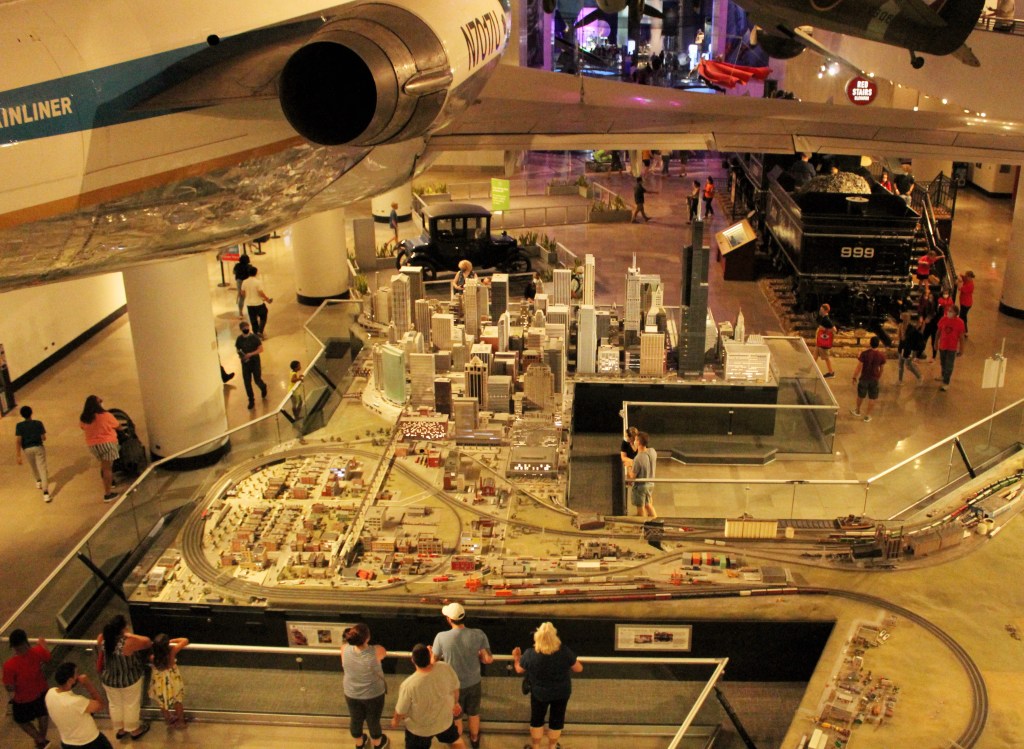
Another wonderful exhibit was the Great Train Story. This is an enormous model train set, which is a scale model of the journey between Chicago and Seattle. It was obviously made with obsessive attention to detail: at every point in the trip there is something of interest. Though I have no interest in model trains whatsoever, I found myself fully absorbed as I walked around the periphery, following the train as it traversed the “country.” At its best, train travel can be charming and romantic (not to mention efficient), allowing you to glide through landscapes the way a ship sails up a river. And, strangely, the Great Train Story captured that sensation.

That does it for my visit to the Museum of Science and Industry. But I feel I ought to mention the other great museum of Chicago, the Field Museum of Natural History. This is located close to the Art Institute and is one of the great natural history museums of the world. One of my few regrets from the trip is not having visited this institution, as it has an excellent collection of dinosaur fossils.

The most famous of these fossils is the T-rex nicknamed Sue, who is special for many reasons. For one, Sue is the most complete T-rex fossil ever found, with more than 90% of the skeleton (by weight, not by number of bones) accounted for. Sue is also special for having had a tough life. She had broken ribs and a damaged shoulder blade (which healed), holes in her skull from some kind of parasite, and she also probably suffered from arthritis and gout. Sue was one sick puppy. But the story of Sue’s discovery is a drama in itself. Somehow, it involved an FBI raid and the leader of the fossil expedition being sent to prison. To top it all off, when she was sold to the Field Museum, Sue fetched the highest price of any dinosaur fossils ever found up to that time ($8.3 million in 1997, which would be about double that today). She is worth every penny.

This pretty well does it for my time in the center of Chicago. But during our visit we spent most of our time, not visiting the main sites, but in Hyde Park with my friend Greg.

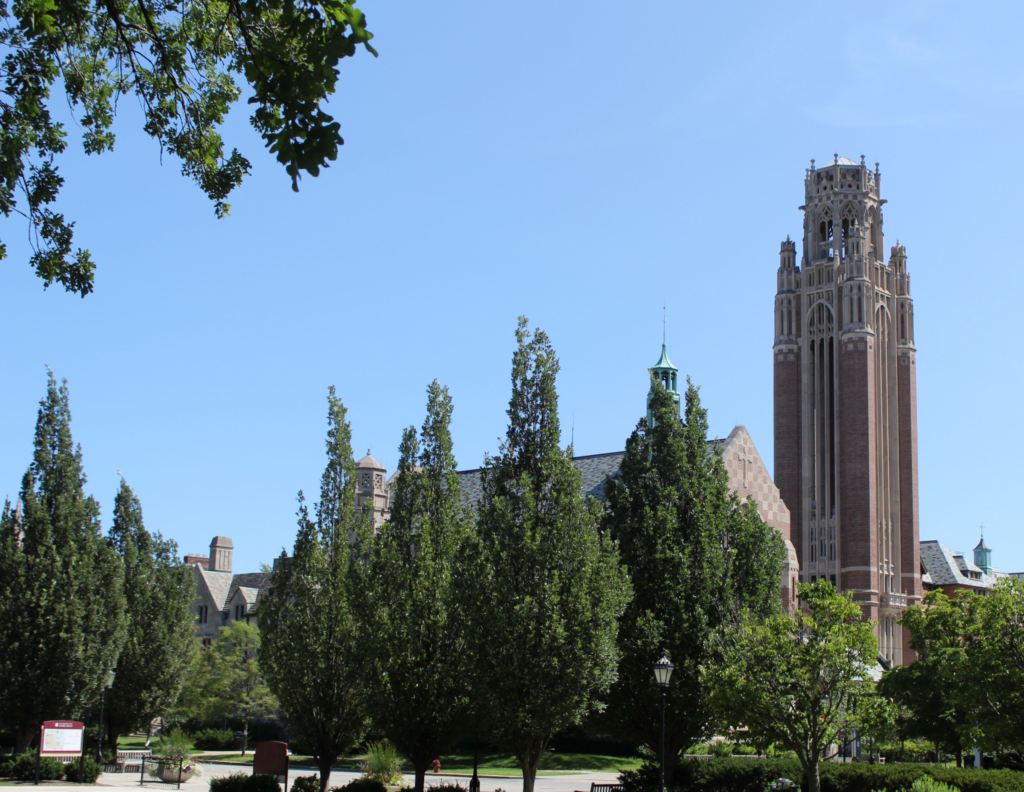
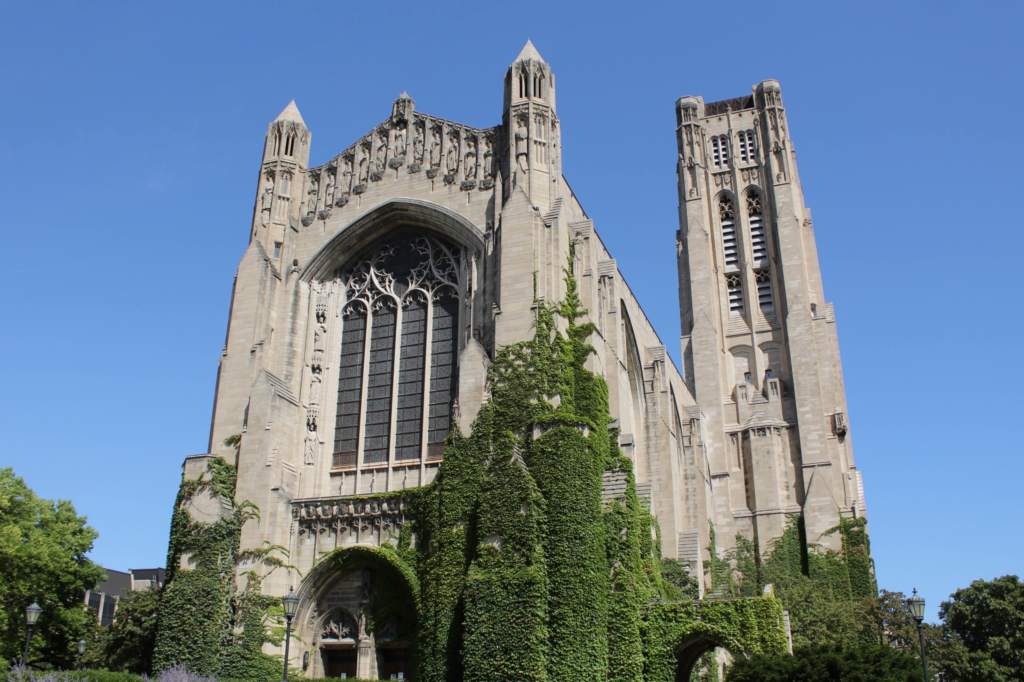
A student of the University of Chicago, Greg naturally lived quite close to its campus. One day he gave us a little tour as we made our way to a farmer’s market. As we walked through it, I found the manicured, neo-gothic campus to be both beautiful and strangely familiar. This deja vu was due, I think, to the college’s architecture being influenced by the taste of its founder: John D. Rockefeller. I grew up in the shadow of Rockefeller’s estate, so by now I can recognize his preferred aesthetic: neo-gothic, molded out of gray granite. This is especially evident in the monumental Rockefeller Chapel, the dominant structure of the campus, big enough to seat 1700 people. Compare it to another great Rockefeller church, the Riverside Church in Manhattan, and the similarities are unmistakable.

Rockefeller Chapel

As we walked, a question popped into my mind, seemingly out of nowhere:

“Greg, what do you think is the most beautiful college campus in America?”

He thought about it and answered: “Pepperdine,” mainly because of its prime location on a hill overlooking the Californian coast.

We arrived at the farmer’s market and I proceeded to stuff myself with artisanal meat pies. But I had a shock when we went up to a fruit stand and the vendor said to Greg:

“You get a free banana if you answer this question.”

“Shoot.”

“What’s the most beautiful campus in the United States?”

“Pepperdine.”

And he got his free banana.

This is one of the most striking examples of synchronicity—uncanny coincidence—that I can remember. The chance that the fruit vendor would ask the exact same question that had popped into my head five minutes prior seems remarkably low. If this was an act of God, I suppose He really wanted Greg to have that banana.

I should also mention our trips to the lake. After just a short walk, we found ourselves on a lovely sand beach on the shore of Lake Michigan. The water was cool, calm, and—best of all—free of salt. (Not that I would drink it, but at least it doesn’t hurt if it gets in your eyes.) And unlike many urban beaches I have visited, it also wasn’t overcrowded. It made me realize how unfortunate residents of Madrid are not to have a water feature nearby. Swimming was wonderfully refreshing after a day of trekking around in the heat. We went on three separate occasions during our four-day trip, and I can easily imagine becoming a regular during the summer months. 

Our first day, the water was choppy.

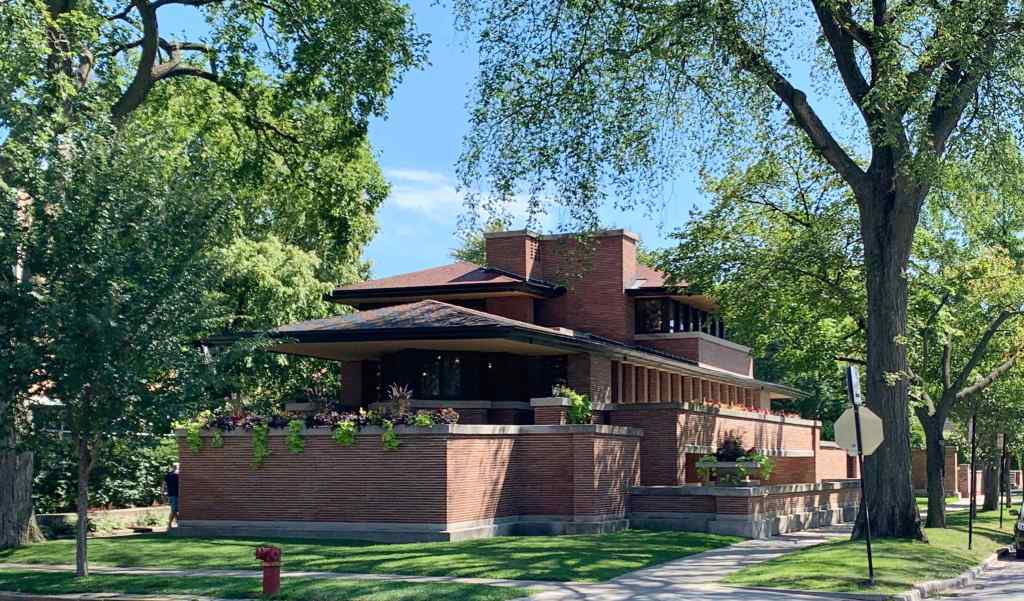
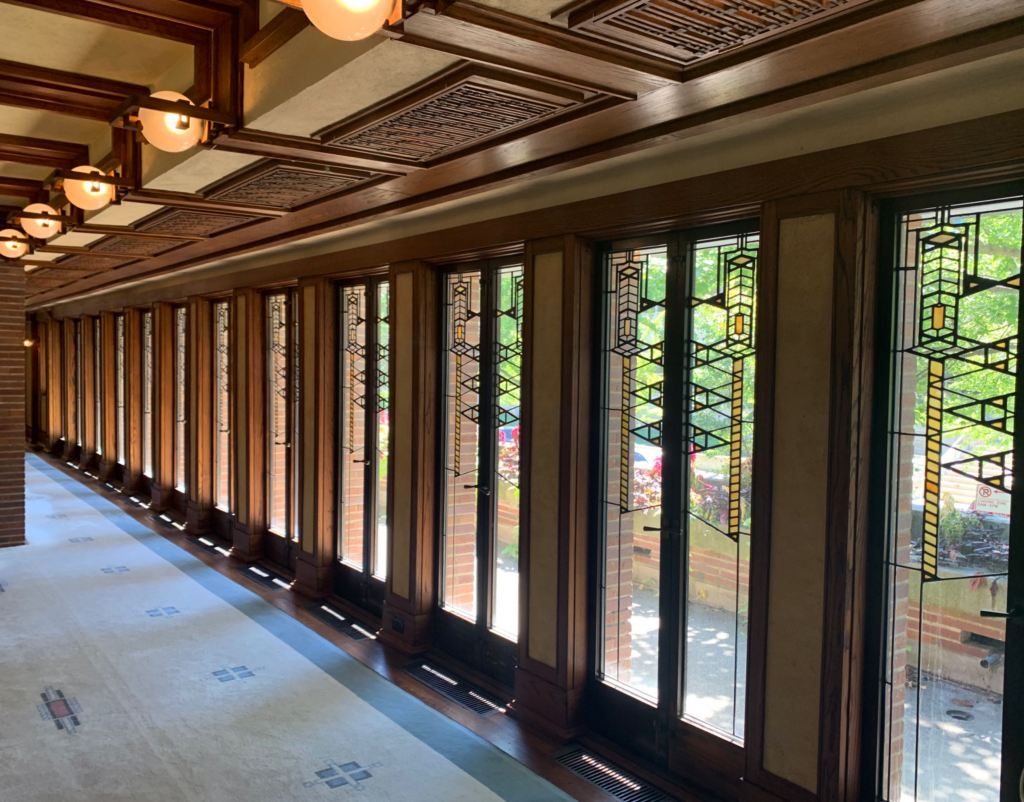
This part of the city does have a major attraction: the Frederick C. Robie House. Completed in 1910, the house was designed by Frank Lloyd Wright and commissioned by an assistant manager who was just 28 years old (this is when the real estate market was kinder, it seems). Poor Fred Robie did not, however, get to enjoy the fruit of his wealth and taste for long. After just fourteen months, a combination of his dissolving marriage and inheriting his father’s gambling debts made him have to sell the house. The next owner, David Lee Taylor, wasn’t any luckier, as he died less than a year after moving in. Eventually the house ended up in the hands of the Chicago Theological Seminary, who used it (rather sacrilegiously) as a dormitory. The clergymen even planned several times to demolish the building in order to construct a bigger building for their students, and the nonagenarian Wright had to get involved in the protests to stop it. 

Nowadays, the Robie House is listed as a UNESCO World Heritage Site, so it is well out of danger. It has also been largely restored to its original condition. To visit, you need to sign up for a tour, which required no previous reservation when we visited.

This was the first (and so far the only) Wright house I visited, so I did not know what to expect. My only experience of an architecturally notable home is the Casa Batlló, in Barcelona, which was designed by Antoni Gaudí. Compared to the Catalan architect’s intricate and exuberant style, Wright’s design seemed extremely restrained. However, as the tour progressed, I began to appreciate the cohesive vision that tied together everything from the brickwork, to the light fixtures, to the furniture. Everything was of a piece. The horizontal is consistently emphasized over the vertical, making the house seem short, flat, and stretched out. Unlike in Gaudí’s work, right angles abound, which gives the space a kind of crisp mathematical precision. The palette of earth tones that characterize every surface in the house almost make it seem as if the house sprung out of the ground. I especially liked the designs on the stained-glass windows, which are ornamental without being ostentatious.

The guide, who was excellent, recited several of Wright’s more pugnacious quotes about architecture, such as “Modernistic houses are more boxes than houses.” Wright clearly had his own ideas about how a building should be put together. But I must say that, however beautiful the house may have been, I did not find myself wishing I could live in it. The Wright furniture was stylish but did not seem comfortable, and the balanced rooms did not have enough available space for my liking. Also, I imagine that the many large windows make it quite difficult to heat in Chicago’s brutal winters. Maybe this is why the priests wanted to replace it. I wouldn’t want to live in a work of art.

This pretty much rounds out my experience of Chicago’s main sights. To conclude, besides our visit to the city’s gay neighborhood (Northalsted) to spend time in a fun bar with arcade games, I should mention the food. Naturally, we had to try Chicago’s most iconic dish, deep dish pizza. My mom actually went to school in the city and cooks deep dish at least once a year, so I do not have the typical New Yorker’s scorn for this style of pizza. Deep dish really isn’t very comparable to a “normal” pizza, anyway; it is more like a casserole. But if you accept it for what it is, I think that it is extremely delicious.

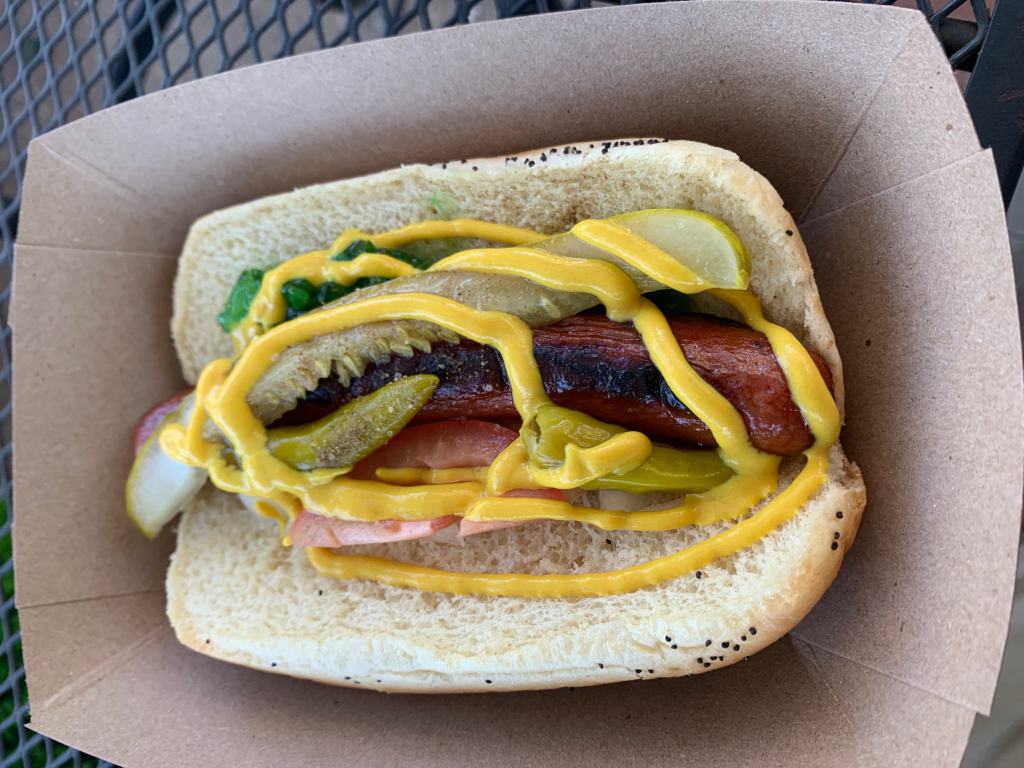
The other iconic Chicago food we had were the hot dogs. These are traditionally made of beef and topped with pickles, pickled peppers, onions, tomatoes, mustard, and celery salt. I was a bit skeptical of having so many toppings, but it may have been the best hot dog I have ever had. The many sour and acidic ingredients help to balance the greasy, meaty flavor of the frank, making for one perfect gustatory experience.

My biggest regret from the trip is that we didn’t visit one of the city’s many blues bars. The only other time I have been in Chicago was when I was 17 years old, visiting colleges with my aunt and uncle. They were kind enough to take me to a blues bar and I remember loving it. Indeed, I bought the band’s CD and listened to it for weeks afterwards. But this was 2021, COVID times, and we deemed it too risky to go into a crowded bar. I suppose I will just have to return to the windy city.

After a final swim in the lake, my brother and I got on the El and made our way to the airport, where we wolfed down some Chinese food and awaited our flight back to New York. It had been a great trip.

Review: The Path to Power

Review: The Path to Power

The Path to Power by Robert A. Caro

My rating: 5 of 5 stars


Last winter, I went to the Film Forum in Manhattan with some friends to see the new documentary about Robert Caro and his famous editor, Robert Gottlieb. It was a wonderful experience on many levels. The documentary was fascinating and inspiring—the story of two people who, in quite different ways, have lived fully dedicated to literature—and it was the perfect place to see it, in the heart of Caro’s and Gottlieb’s city, surrounded by other New Yorkers.

Gottlieb comes across as a lovable and brilliant person (he has, sadly, since passed away at the age of 92), but Caro comes across as something superhuman, an embodied intellectual force. The name of the documentary, Turn Every Page, aptly summarizes what makes Caro so special: the meticulous, obsessive, even demented attention to detail—the determination to get to the heart of every aspect of every story, to never be satisfied with half-truths or empty explanations. And then, once he has gathered together his facts, this relentless attention is focused on the writing. For Caro is not satisfied with merely presenting us with his (always impressive) research. He is determined—again, maniacally so—to make us understand on a deep emotional level what each of these facts mean.

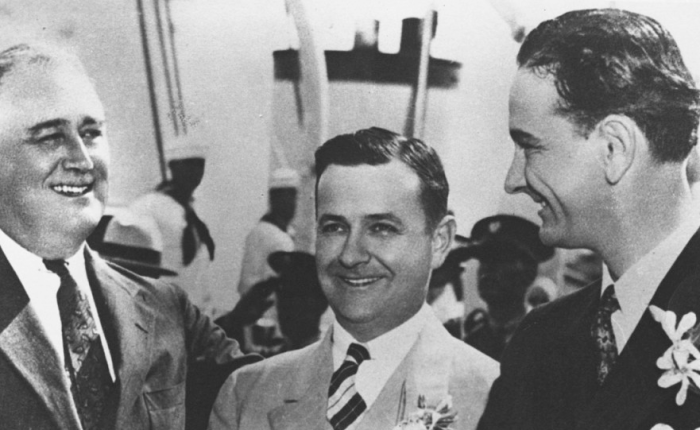
All of these qualities are fully on display in this, the first book of Caro’s monumental biography of the 36th president of the United States. As a political biography—a record of the accumulation and use of power—the book is peerless. Caro traces how Johnson, by sheer force of his personality, went from a rural boy with little education and less money to a member of Congress in just a few years. His chapters on Johnson’s elections alone—his campaign strategies, his fundraising, his advertising—are a goldmine for any political historian, and eye-opening for even the most cynical of readers.

Yet everybody knows that Caro is a master of political biography. What surprised me most was how brilliant this book was in other respects. His descriptions of the Texas Hill Country, for example—its climate, its soil, its weather—often rise to such a level of poetry that I was reminded of John Steinbeck. And his chapter on life in the Hill Country before electrification—the difficulty of even simple chores like washing and ironing—is so empathetic that it brings this experience to life as powerfully as even the most gifted novelist could manage.

Aside from this wonderful scene-setting, and aside from the incisive history, this book is of course the study of a personality. And it is a peculiar one. Indeed, underneath all of the historical detail, I think there is a very basic moral conundrum at the heart of this book. It is, in short, that Johnson is successful and effective—indeed, often a force for good—while being personally unlikeable and morally vacuous.

Caro goes to great lengths to illustrate the uglier sides of Johnson’s character. His urge for power is so great that it trumps every other consideration in his life: love, loyalty, ideals, friendship, ethics. When he is stealing elections, betraying friends and allies, and cheating on his wife, not once does he give evidence that he even possesses a conscience. And yet, in his quest for power, he educates children, helps the unemployed find jobs, secures money for veterans, and electrifies his district, among much else.

This paradox is illustrated in Johnson’s treatment of his secretaries. While he worked as a congressional assistant, Johnson went to great lengths to help the constituents of his district—far more than any ordinary assistant could or would. But this unusual effectiveness was achieved by working his own secretaries to such a degree that they could not have any life outside of work, and one had a nervous breakdown and fell into alcoholism. This is a consistent pattern: the specific people close to Johnson are used as tools for his own advancement, while the abstract people out in the world benefit from his obsessive work ethic.

To put the matter another way, Johnson seems to violate every ethical precept I know regarding the treatment of others, and lives in total contradiction of every piece of advice I know regarding wise and good living. Johnson comes across as a miserable person destined to share his misery with the world. But it becomes clear that Johnson’s personality type is perfectly suited for politics, and he achieves almost instant success when he enters that field. Indeed, one gets the impression that everyone else in Washington D.C. is just a toned-down version of Johnson—equally as power-hungry, but not as effective.

Somehow, we seem to have a system designed to elevate people whom most of us would find repulsive. Maybe this is inevitable, as the people who most desire power are the ones most likely to get hold of it. Perhaps the best thing to do, then, is to hope that the institutions are set up in such a way that, as in the case of Johnson, these driven individuals end up having beneficent effect on society. And yet, this does seem like an awfully risky strategy.

In any case, as I hope you can see, this is a superlative book, excellent on many levels. It is, in fact, among the select class of books that can forever change your outlook.


View all my reviews

Review: Faraday’s Experimental Researches in Electricity

Review: Faraday’s Experimental Researches in Electricity

Faraday’s Experimental Researches in Electricity: Guide to a first reading by Michael Faraday

My rating: 4 of 5 stars


In the first volume of Robert Caro’s biography of Lyndon Johnson, there is a fantastic chapter about what life in the Texas Hill Country was like before electricity arrived. Every basic task was substantially more difficult: water had to be carried in buckets, clothes had to be washed by hand, water had to be boiled over an open fire, milk and eggs had to be refrigerated in ice cellars, and on and on. When power finally did arrive to this rural area—thanks in large part to Johnson’s work—it transformed daily life in a matter of years. Johnson was considered a hero, and rightly so.

But if Lyndon Johnson deserves ample praise for having helped bring electricity to his district, what does Michael Faraday deserve? For it was Faraday who first discovered the principles of the electric motor and the electric generator. If not for him, the harsh conditions described by Caro—a life of ceaseless toil, barely eking out a living—might be not just confined to a rural area in Texas, but the general condition of our species. Faraday was, in short, a historical figure of supreme importance, and his work represents a turning point in human history.

Knowing this, it is shocking to see just how humble and, in many ways, how simple his work actually was. The tools at his disposal seem, to the modern reader, almost laughably primitive. Whereas modern physicists are using a city’s worth of power to accelerate particles down a track kilometers long, Faraday was fiddling with wires and bar magnets and compasses. And yet, with such simple tools at his disposal, and with scarcely any formal education—indeed, hardly knowing any math beyond basic algebra—Faraday made contributions to physics comparable to Newton or Einstein.

The format of this book is simple. It is not, like the Principia, a unified work conceived as a final theory. Rather, Faraday reached his conclusions slowly, over years of experimental work; and this book is a reflection of his process. Starting in 1821, Faraday began publishing accounts of his experiments in the Philosophical Transactions of the Royal Society. These papers were eventually collected and published in three separate volumes, in 1839, 1844, and 1855, consisting of 29 “series” of experiments in total.

Before I go any further, I should note that I did not make my way through all three of these volumes. Rather, I bought a condensed and annotated version published by Green Lion Press and edited by Howard Fisher. Frankly, I do not have the patience or interest to fight my way through 1,500 of the original, and I doubt many others do either. I also very much appreciated Fisher’s introductory essays, without which I think I would have been quite lost (and I often was, anyway).

Remarkably, Faraday maintains a numbering system for his paragraphs throughout, so that he can refer to earlier paragraphs of previous series as easily as one might cite the Bible. This is a simple device, but it does help to reveal the unity that underpins the apparently disorganized quality of this work, as it shows how Faraday was continually returning to the same questions and refining his answers.

I have already mentioned that Faraday was unversed in mathematics. And this makes him fairly unique in the field of physics, in which equations are sometimes elevated to a level that equates math with reality. However, the more one reads of his work, the more one comes to see that, even if he eschewed quantitative reasoning, Faraday was an extremely precise thinker. Part of this is his use of diagrams, which for Faraday almost take on the role of equations in summarizing complex relationships. He is also very sensitive to language, and is constantly trying to choose words that do not carry any inappropriate theoretical baggage.

Just because this book is written in good old-fashioned English, however, does not make it easy. Often, Faraday is responding to dead controversies and in general is using both language and theories that seem strange to the modern reader. To pick a simple example, static electricity is referred to as “ordinary” electricity, since this was the most commonly encountered electricity in Faraday’s day. What is more, Faraday very often must describe a detailed experimental apparatus or procedure, and I very often found myself totally unable to picture what was going on.

Here is a fairly typical example:

A ray of light issuing from an Argand lamp, was polarized in a horizontal plane by reflexion from a surface of glass, and the polarized ray passed through a Nichol’s eye-piece revolving on a horizontal axis, so as to be easily examined by the latter. Between the polarizing mirror and the eye-piece two powerful electro-magnetic poles were arranged, being either the poles of a horse-shoe magnet, or the contrary poles of two cylinder magnets; they were separated from each other about 2 inches in the direction of the line of the ray, and so placed, that, if on the same side of the polarized ray, it might pass near them; or if on contrary sides, it might go between them, its direction being always parallel, or nearly so, to the magnetic lines of force.

I don’t know about you, but I find this to be extremely exhausting.

Not all of the book was so dense, however. I particularly enjoyed the fifteenth series, which basically consisted of Faraday and his assistants putting their hands in a tank and getting an electric eel to shock them. Science was indeed simpler back then.

But the final impression is of Faraday’s remarkable theoretical vision. Although he is an extremely concrete thinker—couching even his most speculative remarks in terms of experiments—he nevertheless succeeded in probing some highly abstract questions. Beginning with the relationship between electricity and magnetism, he goes on to consider the relationship of force to matter, to light, and even to empty space.

His work is, in short, a model for science, showing how careful observation and the judicious use of imagination can revolutionize our understanding of the natural world. Compared to the baroque mathematical models of string theorists—whose theories have yet to receive any confirmation from experiment—Faraday’s approach is refreshing indeed.

View all my reviews

(Cover image is Faraday’s labs in the Royal Institution; photo taken from Wikimedia Commons; uploaded by AnaConvTrans.)

Gauchos: A Lifelong Bar

Gauchos: A Lifelong Bar

One of the best parts of living in Spain is the restaurant scene. The country is exceptional simply for the number of dining establishments. If I had to guess, I would say that there must be more bars and cafés per capita here than in any other country in the world. And though you may not think so, this alone is quite a wonderful thing, since you really never have to worry about where you are going to eat or drink. Chances are, there will be something close.

But in this post I want to focus, not on the quantity, but on the special quality of Spanish restaurants. And to do this, I think it will be better to discuss one exemplary bar rather than to speak in abstractions. For this, I went across the street to one of my favorite local bars, Los Gauchos, and interviewed them. These are my discoveries.

Gauchos is located in the Pacífico neighborhood, which is fairly central but which doesn’t attract much tourism. It is in many respects a typical Spanish bar—or, as the Spanish say, “un bar de toda la vida” (a lifelong bar). That is, it is the sort of establishment you might find in the north or the south, the east or the west, and which retirees and children would both recognize.

An example of a vitrina, one of the most characteristic features of a Spanish bar.

According to Javier—the son of the owner—Gauchos has been open for about thirty years. It was purchased from previous owners, who had run the bar for fifteen years before that. A lifelong bar indeed. (It was the previous owners who named the bar after the famous “gauchos,” who were something like South American cowboys.)

The bar has been around so long that the neighborhood has changed around it. According to Javier (who has worked here since he was 16) and the jovial bartender Melchor (who has worked here since it opened 30 years ago), Pacífico has become more residential in recent years. In past decades, the area was full of offices and industry, and consequently was a ghost town on the weekends when nobody had to work. Lately, they’ve noticed that rising rents are pushing younger people out of the neighborhood, further into the peripheries of the city. 

Now, my country has dive bars and local restaurants aplenty. But I think the closest thing the United States has to this sort of restaurant is, perhaps, a diner—a privately-owned restaurant which nevertheless has a recognizable aesthetic and a fairly standard menu. However, the Spanish “bar de toda la vida” is quite different in being, well, a bar. There is simply no place in my country where you can get a coffee and toast in the morning, eat a multiple-course meal at lunch, and have a gin tonic with your friends until late at night. The typical Spanish bar is an all-in-one experience.

This makes Gauchos, and other bars like it, a kind of de facto neighborhood gathering place. In the morning it attends to the mad rush of commuters on their way to work. Around lunchtime, besuited office workers might sit down for a leisurely lunch. And at night, the sidewalk is full of neighbors having a drink. Partly because apartments in Madrid are often small, friends tend to meet in bars rather than in one another’s houses. The neighborhood bar thus plays an important role as the communal living room. 

Many times I have witnessed a grandpa or a grandma come after picking up their nieto from the nearby school. The other night, three generations of a family came in to hang out. Meanwhile, a man with a guitar sat down to drink peppermint tea and read a comic book. The most raucous nights are when there is an important football match, and the bar and even the pavement fill up with people watching the game on the large TVs, screaming in triumph or agony at every development. In short, the clientele is a cross-section of the neighborhood itself.

As I mentioned, the typical Spanish bar is similar to the American diner in having a standard menu. Just as the latter will have pancakes, hamburgers, and milkshakes, so the former will have bocadillos, tostadas, and tortilla de patata. If Gauchos’s menu is exemplary, it is in having even more reasonable prices than usual. You can order a full plate of food for about 5 euros. The lunch menu—which includes two courses, a drink, and dessert—costs ten euros and fifty cents.

The low prices are not incidental, but essential to any neighborhood Spanish bar. It is a place for anyone and everyone to come. This is a major contrast with most bars and restaurants in the United States, which are seldom cheap (especially after tipping), and which normally try to distinguish themselves with ornate decorations or unusual food options. By contrast, you can buy a cup of coffee in Gauchos and sit there for hours without anyone bothering you.

The contrast goes deeper. Neighborhood bars in Spain are essentially public, open spaces, where anyone can come in and feel at home, whereas bars in the United States are very different. Gauchos, for example, is bright inside and there is never any music playing. (Hemingway would call it a “clean well-lighted place.”) You don’t have to shout to have a conversation and you don’t have to squint to read. By contrast, I often find the darkness and loudness of American bars to be sort of oppressive. You can seldom forget that the bar is private property and that you are not the owner.

The aesthetic of Gauchos is extremely simple. The walls are white, and the chairs and tables are completely plain. As is common in Spain, the bar itself has a large glass display cabinet that is even refrigerated, where the customer can see the various options for tapas,* or even raw meat and pickled fish to be used later. The sign outside consists of simple plastic lettering against a white background. Below this is the iconic toldo verde (green canopy), where the patrons gather to escape either the sun or the (rare) rain.

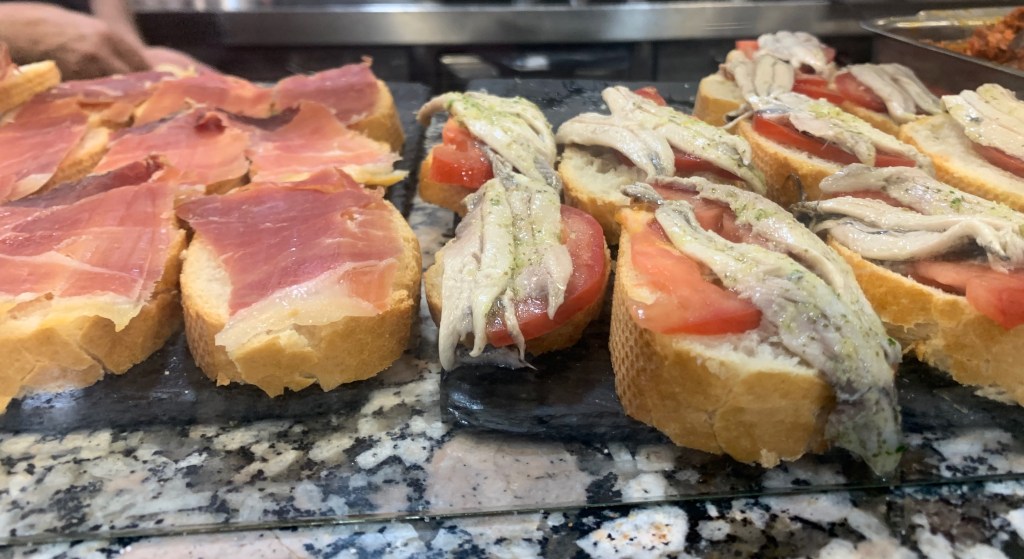
(*There seems to be some confusion among Americans as to what tapas are. In Madrid, a tapa is just a small bit of food included with your drink. This is normally just a few olives or some mixed nuts. But in a good place like Gauchos, you might get a mini sandwich, some fried chorizo, or a plate of patatas bravas.)

Some tapas waiting to be deployed. The fish on the right are boquerones, anchovies pickled in vinegar. (They’re good!)

There is, in short, hardly any decoration to speak of, which is why British journalist Leah Pattem, in her popular blog, has coined the term “no-frills” for this sort of establishment. It is an apt description, and I think she deserves much credit for bringing this sort of bar—so common as to be taken for granted by many—into the spotlight.

Indeed, for my money the neighborhood bars of Spain are a cultural resource as precious, in their own way, as the Alhambra or the Sagrada Familia. And I think that the people who run them deserve a great deal of credit. It is very hard work—long hours, few days off, both physically and emotionally taxing. So I think we all owe a debt of gratitude to the people who form the backbone of the neighborhood’s social life.

Bartender Melchor, hard at work.

In Spain, as elsewhere, the existence of local restaurants is threatened by ongoing gentrification and the spread of corporate restaurant chains. These trends, if they continue, threaten to turn every city corner into the soulless copy of every other—where identical freeze-dried food can be purchased at identical prices from identically uniformed workers. But if the large crowds that gather around Gauchos every evening are any indication, the Spanish have not lost their taste for their bares de toda la vida—and I hope they never do.

Edinburgh: Wind and Whisky

Edinburgh: Wind and Whisky

When you live in Europe, you notice that certain destinations come up in conversation with surprising frequency. Porto, Budapest, and Normandy are among those which are highly-praised among the well-traveled. Edinburg is another. So although I had no special reason to go—I had not even found an especially cheap flight—I decided that I would use my February vacation to take a little trip up north and see what all the fuss was about.

The plane broke through the gray clouds and touched down in Scotland on a cold, drizzly morning. I found the bus indicated by my Airbnb host and got on the top floor. The double-decker bus afforded me a commanding view of a not-very-exhilarating urban landscape as we traveled from the airport to the suburb where I was to stay. Though there really was nothing interesting to see, the combination of the dreary skies and the (in my eyes) quaint domestic architecture made a powerful contrast with the usual Spanish scenes of sun and walled-in houses.

Soon enough, I was at my destination. It was a rather odd Airbnb experience. My host told me that she had been repeatedly trying to contact me, only to realize that she was thinking of another guest (she managed various properties). Then, I was told, among other things, that the shower was set to the absolute perfect temperature and ought not be changed; also, she insisted that Scotland was just as humid as Florida, so that I ought to leave my window open for a certain amount of time every day to prevent mold. (Unless I am mistaken, the amount of moisture that air can hold is dependent on its temperature, so that cold Scottish breeze can’t hold nearly as much humidity as the scorching soup that is Florida’s atmosphere.) But this sort of thing is par for the course when staying in somebody else’s place. At least it was cheap.

With my bag dropped off, I caught the bus to the city center. I really appreciated the double-decker bus now, as it allowed me a wonderful way to enjoy Edinburgh’s Old Town. But by the time I stepped onto the cobblestone street, I was tired, thirsty, and extremely hungry. The daylight was fading now, and I desperately wanted dinner. This did not put me in the best mood to appreciate the lovely city which now opened up before me. Yet I was sentient enough to notice that the architecture formed a kind of coherent whole, all of the buildings made of the same grayish-brown stone, and constructed in the same heavy style, which seemed somehow suited for this clime.

I wandered up the venerable streets feeling rather sorry for myself, as I peered into window after window to see family and friends having dinner. I did not have the heart or the stomach to walk into a restaurant by myself and eat at a lonely table. I wanted something fast and anonymous, and my prayers were answered when I discovered a quiet kebab shop. I sat down at one of few chairs and, within minutes, my meal was ready. Better than any kebab I had in Spain, and this was not even a well-known spot. And as I ate, I reflected on the stark difference between what I had just observed of Scottish eating culture, huddled up inside, and that of Spain—where patios are overflowing onto every sidewalk. Of course, the weather is the explanation, though I also found it curious that nobody else was in this kebab shop on a Friday night. In Spain, it would have been full to the brim with drinkers.

It was, by now, too late to see any attractions. But it was not too late to enjoy a drink. For this, one of my friends had suggested the famous pub, Sandy’s Bell. Though I was somewhat buoyed by the food, I still felt nervous when I looked through the cloudy windows to see a bar filled with a rowdy crowd. But after pacing back and forth on the frigid street, I mustered enough courage to barge in. The barman immediately asked me for a drink and, like an idiot, I just said “beer.” (In Spain one often just orders “cerveza” and you’re given the only beer on tap.) He wasn’t satisfied with that, and asked me to choose a beer, and I scarcely helped matters when I said “an ale.” One of the regulars at the bar—an older man—took matters into his own hands and said “Try this!” while holding his own drink up to my lips. Too surprised to refuse, I drank a gulp and said, “That one!” The barman returned shortly with a pint of the dark ale.

My troubles were hardly over. The place was packed and every chair and barstool was occupied. I found a corner of the wall I could lean on and sipped my beer rather awkwardly, trying not to be noticed. This was my first Scottish pub experience, and somehow I found it very intimidating. I tried to slow down and enjoy the beer (which was quite good), but I found myself drinking faster and faster, as a part of me was eager to leave. When I realized that I was failing to enjoy the pub, I got rather down on myself—all these years of traveling had not cured me of feeling like a misplaced high school student—but slowly resolved to cut my losses.

Just as I had taken the last sip of beer and I was ready to pay and head out, a man got up to leave from the bar and, like an angel from heaven, offered me his seat. (I really must have looked conspicuously uncomfortable.) I thanked him from the bottom of my heart and got ready for another beer, this time from the commanding position of the bar. A drink sitting down is incomparably better than one standing up, and I felt quickly at ease. The experience was made even better with the purchase of a bag of crisps (salt and vinegar, my favorite flavor, which is rarely available in Spain), which persuaded me that I ought to have a third beer.

Time slowly ticked by. Eventually I remembered that the bar is famous for its live music. I asked a nice young fellow to my left, and he told me that it started at nine. I looked at my watch: about 45 minutes to go, and no beer left. My better judgment told me that I should just stop and come back another night; but my tempting demons—rather convincing, usually—told me that I ought to just tough it out until I heard some music. The decision was instantly made when I spotted a bottle of Laphroaig on an upper shelf. This is my dad’s favorite type of whiskey, and I felt duty-bound as a son to have a glass in his honor. This was ordered, and I could have sworn that I could feel a wave of respect pass over my fellow patrons.

Laphroaig is, you see, not an especially popular single-malt scotch. A single taste will let you know why. Coming from the island of Islay (pronounced “eye-luh”), this scotch is normally described by whisky enthusiasts as “peaty,” though the first words that come to mind of most ordinary people are considerably less kind. It tastes, to me, how I imagine a strong iodine solution would taste (though admittedly I have never tasted iodine). In other words, Laphroaig is harsh—almost chemically harsh. And yet, strangely, the taste grows on you. If you can get past your initial revulsion you will find it has a sort of complex smokiness beneath the initial shocking acrimoniousness. In short, I actually managed to enjoy my glass of Laphroaig.

And luckily for me, the music began right as I was finished. It was a small group of three people, two on guitars and one on violin, playing lively tunes. I took it in for a while, and then caught the bus back to my Airbnb. I had a big day ahead.


I will begin by mentioning the things I did not decide to see. Perhaps most notably, I did not visit Edinburgh Castle. This is probably the most famous and popular monument in the city—perhaps in all of Scotland—and, even from the outside, you can see why. It is an impressive and imposing fortress which towers over the city. However, from what I read about the castle, there was nothing on the inside which I thought merited the steep entry fee. But I did enjoy the sculptures of Scottish heroes Robert the Bruce and William Wallace that adorned the entryway.
Next on my list of negative tourism is the Holyrood Palace. This palace is actually connected to the castle with a broad avenue known as the Royal Mile (though it is really a little longer than a mile). Holyrood is the official residence of the British monarch in Scotland, still used whenever the king or queen is in town. The rest of the year, it is open to tourism. I actually think that Holyrood is likely a rewarding place to visit, but palaces tend to put me in a bad mood.

But I did enjoy seeing the ruins of Holyrood Abbey behind the palace. While I assumed that it had been gutted in a fire, the story of its destruction is quite a bit more interesting. The abbey played an important role in Scottish history for several centuries after its construction in the 12th century. But when its old timber roofs were replaced by stone vaults seven-hundred years later, this proved to be the end of the old church. Its walls could not support the added weight and the roof eventually collapsed. It does make a fine ruin, though.

Photo taken from Wikimedia Commons; taken by Kaishu.

Another major attraction that I did not visit was Her Majesty’s Yacht, Britannia. As its name suggests, this yacht was used by the British royalty from 1954 to 1997, and is now a kind of museum showcasing royal pomp and luxury. Needless to say, this would have put me in a bad mood, too.

An example of a close.

The last attraction I missed was Mary King’s Close. Now, a “close” is just another term for an alley, and there are a lot of alleys in Edinburgh. The historic center used to be enclosed by a wall, requiring high density, and so these closes are highly claustrophobic spaces—hemmed in by neighboring buildings. This particular close (named after a merchant) was, well, closed as neighboring construction both partially destroyed and buried the little alleyway. Nowadays the abandoned close has something of a reputation among ghost hunters and other seekers after the paranormal. But tourists enjoy the tours about daily life in 17th-century Edinburgh. Perhaps I ought to have gone to this one.  

So where did I go? My first visit was to the National Museum of Scotland. This is an enormous museum with a collection of virtually anything you might imagine. And best of all, it is free to visit. The central hall is immediately impressive—a large area, full of light, modeled on the original Crystal Palace. There, I was immediately attracted by the skull of a sperm whale (“Moby”) who had washed up on Scottish shores and who, despite rescue attempts, unfortunately perished. Moby was not an especially large male (indeed, slightly below average), but even so, his skull alone is longer than two tall men lying end-to-end.

As I said, the museum has a vast and varied collection. There is an exhibit on space, animals, geography, fashion, Ancient Egypt… But I figured that, if I was in Scotland, I ought to visit the Scottish History wing. This is housed in a separate and rather futuristic building, and it makes for an excellent visit. You are led, chronologically, from the stone age on the ground floor to the industrial revolution at the top. Though Scotland is a small and rather remote country, this exhibit encapsulates all of the glory and interest of its history. As I traveled from a medieval greatsword to James Watt’s steam locomotive, I found myself almost awed by how much had transpired in this soggy northern country. 

Right next to the museum is another popular attraction: Greyfriars Kirkyard, a historical cemetery. But before you enter, you might notice the small metal statue of a terrier with a polished nose. This is Bobby, a semi-legendary dog who—according to the story—spent 14 years guarding the grave of his deceased owner, John Gray. The story is understandably quite popular, and Bobby (or his statue) is undeniably cute. But I have to admit that I feel skeptical. Not that I deny the nobility and loyalty of our canine friends, but the story does seem too perfectly calculated to attract tourists. And there are many reasons (free food?) that a dog might be found in a graveyard.

Well, whether or not the Bobby story is perfectly accurate, Greyfriars is worth visiting. I must admit that my knowledge of Scottish history is so spotty that I did not recognize a single name. Yet the grandeur of the tombs is enough to impress upon the visitor the importance of this burying ground. While I strolled around, I noticed two Americans who seemed to be walking with determined step to a particular grave. Thinking that they must know something I didn’t, I followed them as they made their way to the edge of the graveyard. There, I was disappointed to find that they were visiting the grave of a man named Tom Riddle. Now, I have no idea who this man really was, and I am sure my American guides did not either. They were visiting because this name was used by J.K. Rowling as an alias for Voldemort. (Indeed, I think there is quite a lot of Harry Potter tourism to Edinburgh.)

Though I did not know this story at the time, this is the perfect moment to mention one of the more macabre episodes in Edinburgh’s history. There was a time in Scottish history when the medical demand for human cadavers—which doctors used in their lectures—far outpaced the supply, mainly because of strict laws regulating which bodies could be used for such a purpose (paupers and prisoners, mainly). This led to the grotesque practice of “body snatching,” in which grave robbers would dig up the recently buried and sell them to a doctor for a handsome profit. Indeed, this was such a problem that several anti-robbery devices were developed, such as the mortsafe, which is basically a cage placed over the body. (You can see examples of these in Greyfriars.)

But in 1828, two men decided to take this practice one step further, and began murdering people in order to sell their bodies. The men had a very simple system: get a person very drunk, and then smother them to death by laying on top of the victim. After sixteen such murders, they were discovered. One of them, Hare, was inexplicably given a light sentence, while the other, Burke, was hanged for his crimes. With poetic justice, Burke’s body was then dissected before a group of medical students. His skeleton is still on display at Surgeon’s Hall in Edinburgh (I wish I had gone!), as well as—and this strikes me as a tad overboard—a notebook bound with Burke’s skin. 

While I am on this morbid topic, I should mention two other tombs I visited during my time in Edinburgh. One was of the great economist Adam Smith, who is buried in the graveyard of Canongate Kirk. The grave is neither big nor particularly elaborate, but its inscription gets right to the point: “Here are deposited the remains of Adam Smith, author of the Theory of Moral Sentiments and the Wealth of Nations.” Nothing more need be said, as those two works will last longer than any tombstone. Next I visited the tomb of the other great pillar of the Scottish Enlightenment, David Hume. This is in Old Calton Cemetery, which is located on Calton Hill, one of the high points of the city. His tomb is slightly more monumental, consisting of a kind of hollow tower, but there is no memorable inscription. Yet merely being close to the mortal remains of this most skeptical of philosophers was a thrill (though he would likely say I was irrational).

Curiously, right next to this tomb is a statue of one of my countrymen, Abraham Lincoln. He stands over a monument to the Scottish American soldiers who died in the American Civil War. The Scottish are an international bunch.

Very close to Hume’s final resting place, right at the crest of the hill, is a park. In addition to providing excellent views over the city, there are a few curiosities to be found here. The most obvious, perhaps, is the Nelson Monument—an enormous tower, dedicated to the memory of the admiral who helped defeat Napoleon (and, thus, a very British memorial).

But I much preferred the other massive stone construction, the National Monument of Scotland. This was intended to be a glorious monument to the Scottish soldiers who died during the Napoleonic wars, modeled after the Parthenon in Athens. (This idea, by the way, was owed to the notorious Earl of Elgin, who stole the Parthenon frieze from Greece and brought it to the British Museum, where it remains to this day.) The final result, however, is comic and slightly pathetic. The campaign ran out of funds when just the portico had been completed, and it has remained that way ever since. Now it is just a collection of massive columns over a base—columns holding up nothing, a glorious doorway leading to nowhere. But it is great fun to climb on. 

Even more fun to climb was Arthur’s Seat. This is a hill, formed by an ancient volcano, which looms over the city, and which is to Edinburgh what Central Park is to New York. Nobody quite knows why it is called Arthur’s Seat, as it seems highly unlikely that King Arthur—if he even existed—built Camelot here. Thinking that I ought to maximize my time in Edinburgh, I climbed the hill in a mad rush and got to the top in less than an hour. (What are vacations for, if not to anxiously hurry through?) Once there, I got a taste of the famous Scottish wind—or, as they might say, it was a wee bit blowy. The view of the city and the sea beyond was wonderful. The landscape was impressively rugged and wild. Somehow, for a park right next to the capital of Scotland, Arthur’s Seat transports you instantly to the middle of nowhere.

The Nelson Monument with Arthur’s Seat in the background

I should mention that observation of the geology of Arthur’s Seat helped James Hutton develop his scientific ideas. And this is no small thing, as Hutton is known as the “Father of Modern Geology,” whose work basically initiated the modern discipline. This influential Scot is buried in Greyfriars Kirkyard. 

The view from Arthur’s Seat

Now, this does it for my first complete day in Edinburgh, which was long and exhausting. However, as the rest of my sightseeing was done in snatches around a daytrip (mentioned below) and before my flight back, I will mention the remaining sights here without attempting a narrative.

If you walk around Edinburgh, you will undoubtedly notice an infinity of shops selling scarfs and sweaters with what we call, in the US, a plaid design. In Scotland, this is a tartan, and they are often organized according to family names, or “clans.” I was rather excited to find a scarf with the design of my own “clan,” the Johnstons (through my mother’s mother). However, I really did not need a scarf and so decided not to buy one. I am glad I didn’t, as it turns out that this tartan-clan typology is a prime example of what the historian Eric Hobsbawn called an “invented tradition”—as it only goes back to the 19th century and was an intentional way of shaping perceptions of Scottish history. In other words, it is not true that “clans” were proudly displaying their colors back when William Wallace was slicing through Englishmen. Oh well.

John Knox with a friendly greeting card.

If you are in the center of the city, it is certainly worth your while to step into St. Giles’ Cathedral. This is the mother church of Scotland, where John Knox—the Scottish Martin Luther—acted as minister. Now, I must say that I am far too ignorant to give you any more information about this church, so I will only add that it is both beautiful and central to Scottish history. For example, proudly on display is the National Covenant, a document signed in opposition to the king’s attempt to meddle with Scottish religion. If that isn’t a symbol of Scottish independence, then I don’t know what is.

Nearby is a monument to David Hume. The handsome philosopher lounges in a chair, dressed in a toga, and holding a large book. When I visited, however, he was also wearing a Ukrainian flag. This was February 28, 2022, and the Russian invasion of Ukraine had begun just four days earlier. Most commentators had assumed that the battle would be over within the week, perhaps in just three days. So it is stunning to me that, as I sit here over a year later, the war is showing no signs of stopping. I am sure that Hume would have something incisive to say about the folly of mankind in this regard.

There are, of course, monuments and statues all over the capital of Scotland (I’ve already mentioned many), but I think that the grandest is easily that of Walter Scott. It is something of a monstrosity: a neo-gothic spire that ascends 200 feet (60 meters) into the air. This stone needle is covered with statues: 64 characters from Scott’s novels, 8 kneeling druids, and 16 busts of other Scottish poets and writers. Walter Scott and his dog, life sized, sit in the center of this stone carbuncle, almost comically small by comparison. As you may well imagine, an enormous number of stonemasons had to be recruited to put this together; and apparently the hewing came at a steep human cost, as many masons were fatally inflicted with silico-tuberculosis from breathing in the stone dust.

Considering Scott’s fairly modest place in the Western literary canon nowadays, this huge effort seems disproportionate to say the least. But during his lifetime, he was among the most famous and influential authors in the world. As it happens, when I visited, I had just finished reading Ivanhoe; and I think that the monument’s faux-medieval grandeur is quite in keeping with Scott’s style.

I cannot wrap up my time in the Scottish capital without mentioning some Scottish food. Now, when I was younger, my friends and I used to joke (for some reason) about haggis, treating it as an epitome of a disgusting dish. Certainly a description of the food—minced sheep innards cooked in its stomach—does not sound particularly appetizing. But when I ordered a plate of haggis with “neeps and tatties” (rutabaga and mashed potatoes) at the appropriately-named Haggis Box, I found that it was absolutely inoffensive—not only that, but tasty. The meat is minced with onions, oatmeal, and a generous amount of black pepper, and to me was quite reminiscent of Spanish morcilla (blood sausage) in both flavor and texture. In any case, when you stop to consider what goes into an ordinary sausage, then haggis ceases to appear exotic. 

Another Scottish classic is the Full Scottish Breakfast. This is rather similar to the English Breakfast, though it is even richer and heavier. Standard components include: bacon, sausage, haggis, eggs, toast, fried tomatoes, mushrooms, baked beans, and potato scones. I had one of these at the Southern Cross Café before my flight back to Madrid, and did not have to eat anything the rest of the day. A wonderful experience.

This pretty well does it for my time in the city of Edinburgh. But I cannot leave off writing without an overview of the whiskey—or, as the Scottish write it, “whisky.” For this, I went to the Scotch Whisky Experience, which is located quite near Edinburgh Castle. It is certainly a touristy place, though I quickly found that it was a worthy visit.

The first part consists of a silly “ride” on a whiskey barrel, during which an animated Scottish ghost (“animated” in both senses) explains the process of making this distilled spirit. In short, this consists of fermenting malted barley, distilling it until the alcohol content is at least 40%, and then aging the result in an oak barrel. The second part was a kind of virtual tour of the Scottish whisky regions, which are: Upland, Lowland, Speyside, Campbeltown, and Islay. We were each given a scratch-off with the distinct aromas of each whisky type—and, sure enough, the Islay sample smelled like Laphroiag. 

Along with these single malt types (which must be made from malted barley), there is blended whisky, which is usually both cheaper and milder, and thus comprises most of the market. Blended whisky is made from a mixture of grain alcohol (usually corn) with a bit of single-malt. The grain alcohol is fairly neutral in flavor, so any personality is derived from the single malt that is added. 

I was then given a tasting of four single-malt scotches, and thought the Islay whisky was the most interesting (if not necessarily the most drinkable). Indeed, I found the “Experience” to be surprisingly rewarding. Perhaps this is just a romantic notion, but I felt as though Scotland itself was palpable—indeed, tasteable—in each glass. The harsh and smoky flavors somehow called to mind the soggy, grassy, and rocky landscape that I had glimpsed on Arthur’s Seat. Just as it is difficult to imagine such a robust and unforgiving liquor being cultivated in sunny Spain, so is it equally impossible for the rugged landscape of Scotland to yield up anything gentler than this spirit.


During my time writing book reviews on Goodreads, I have “met” many interesting people. One of these is a woman named Karen, who is from Scotland but who has lived in Germany most of her adult life. By chance, she was in Scotland during my visit, and so we agreed to actually, physically meet, as she kindly offered to show me a few sites near Edinburgh.

The drive itself was slightly disorienting, as Karen had brought over her German car but we were driving on the opposite side of the road. Everything was as in a mirror (you pass on the right), but thankfully, Karen did not seem flummoxed. I began to reflect that, even while walking on a sidewalk, an American or a Spaniard will naturally keep to the right side. Do British people naturally keep to the left on the pavement? Somebody must study this.

Our first stop was the Falkirk Wheel. This is a rather odd contraption, designed to unite two canals built at different levels. The Forth and Clyde Canal was opened in 1790, and the Union Canal 32 years later, in 1820. Together they provided a water route between the two major cities of Scotland, Glasgow and Edinburgh; but the problem was that the canals are built at different heights, with the Union Canal 115 feet (35 meters) higher than the Forth and Clyde. This height difference was originally overcome with a series of eleven locks—which is the standard solution. But locks are also expensive and slow, as they take a long time to fill and empty, and require a lot of water and energy for pumps. In any case, the age of canals was soon superseded by the age of the railway, and the canals fell into disuse. Eventually the locks became inoperable and were taken apart, and the canals became rather useless watery ditches.

But as the new millennium approached, the authorities decided that this waterway should be reopened—if not for commercial, at least for symbolic reasons. This beautiful piece of infrastructure was the result. The wheel consists of two troughs of water balanced around a central spoke. By just slightly adjusting the amount of water in each trough, gravity can be used to help turn the wheel and take ships up and down. As such, it is both faster and more efficient than a traditional canal lock, though I am not sure if it could work on a larger scale (such as on the Panama Canal). It is also simply a sleek design.

Karen and I took the canal “cruise,” though to call it a cruise is like calling a walk in the park a “safari.” This is not to say that it was uninteresting. About twenty people got into a boat and we were (very slowly) lifted up to the Union Canal, while a guide explained some of the history of the canal. 

I was especially entertained because the guide had a wonderful, classic Scottish accent. Though every word he spoke was recognizable, it was as if he had put a different vowel between the same consonants. (Sance ya can rad a santance wath all the vawals changed, ya can andarstand wan taa.) While on the subject, it is worth noting that Scottish people have a habit of pronouncing names in surprising ways. For example, though Edinburgh seems obviously meant to be pronounced “eh-din-burg,” the Scottish say “eh-din-bruh.” There are also a few characteristic bits of Scottish English I noticed. “Kirk,” for example, is a local word for “church; and on one traffic sign, the reader was instructed not to park “outwith the line”—the preposition meaning “outside of.” A useful word, that.

Our next stop was, for me, wholly unexpected. Karen informed me that we were going to see a big sculpture, but when I laid eyes on The Kelpies I was stunned by their scale. This is a work by Andy Scott and was completed just ten years ago, in 2013. Two horse’s heads—98 feet, or 30 meters, high—emerge from the ground near a section of the Forth and Clyde Canal. A “kelpie” is, apparently, a kind of water spirit that takes the form of a horse. But Scott has stated that the statue was meant more as an homage to the work horses who played an important role in Scottish history, not least by pulling barges on the canals. The sculptures are made of steel and, for something so large, are remarkably dynamic and lifelike. I think it is a wonderful work of public art.

After that, we headed to a little town called Culross (pronounced “coo-riss,” for some reason). This is a little town across the bay from Edinburgh. Our first order of business was lunch, for which we found a serviceable—if rather slow—taco truck. Then we ambled into town, where we found that there was a little market set up. I took the liberty of buying some fudge and coffee, and had yet another experience of Scottish friendliness. Everyone there was talkative and pleasant. Karen and I walked around the town for a bit, enjoying the lovely village architecture and peeking into the abbey, which was closed when we were there.

Our final stop was in the town of North Queensferry, in order to see the bridges which span the Firth of Forth. “Firth” is yet another example of Scottish English; it means an estuary. The Firth of Forth is, as you may expect, on the river Forth, which reaches the ocean near Edinburgh. At this particular junction in the river, three huge bridges span the division.

We parked the car, ascended a staircase, and soon found ourselves on one of these bridges—the Forth Road Bridge. This is perhaps the least visually interesting of the bridges, but it is the only one open to pedestrian traffic. Indeed, there is little else on the bridge. Opened in 1964, it was in service until 2017, when it was replaced by the adjacent Queensferry Crossing Bridge. Since that time, it has only been open to pedestrians, buses, and taxis. Karen and I thus had the bridge almost all to ourselves. I found it to be a wonderful idea, and now I wish the same was done with the old Tappan Zee Bridge, in New York, which was demolished to make way for the new one. (To be fair, the new one does have a pedestrian walkway.)

That’s the Forth Road Bridge in the background.

The Queensferry Crossing Bridge is an attractive piece of infrastructure. But the real star is the original Forth Bridge. Completed in 1890, this railway bridge is a monument to Scottish engineering. Its design was innovative and was especially noteworthy in using steel—a relatively new material for large constructions at the time. The pictures of the bridge do not do it justice. You need to see it up close to get a sense of its massive scale.

Apparently, the bridge was built so robustly because of an earlier disaster. In 1879, the Tay Bridge (spanning the nearby Firth of Tay) collapsed while a train was passing over, killing everybody onboard. This had the effect of scrapping the original plans for the Forth Bridge, as it was designed by the same architect, Thomas Bouch. (Bouch died less than a year after the disaster, his reputation in ruins.) This tragedy is also notable for being the subject of one of the worst poems ever written in English, by the iconic bad poet, William McGonagall. His poem begins:

Beautiful Railway Bridge of the Silv’ry Tay!

Alas! I am very sorry to say

That ninety lives have been taken away

On the last Sabbath day of 1879

Which will be remembered for a very long time.

(He is buried in Greyfriars, if you would like to pay your respects.)

After we finished admiring the bridges, Karen kindly dropped me back off in Edinburgh. My time there, I have already described, so I will bring this long post to a close. As I hope I have conveyed, I had a wonderful time in the Scottish capital. It is a beautiful and fascinating city, and I hope to return one day, and to see even more of Scotland.

Review: The Return of the Native

Review: The Return of the Native

The Return of the Native by Thomas Hardy

My rating: 3 of 5 stars


One of my vices is the reading of advice columns. The problems of the correspondents are often so bizarre as to be beyond the imagination of even the most lurid novelists. My favorite agony aunt (as the British say) is Carolyn Hax, who writes for the Washington Post. And her advice very often boils down to one simple precept: mind your own business.

This book is one long illustration of the wisdom of this maxim, as the entire tragedy of the plot could have been avoided if any of the major characters (and, indeed, even some of the minor ones) had simply minded their own business. From the aunt who cannot trust her niece—or, indeed, even her own son—to marry the right person, to the rejected suitor who spies, eavesdrops, and meddles, to the two principal characters—Eustacia and Wildeve—who express their dissatisfaction with their own marriage by tarnishing another’s, and finally to the titular “native,” whose love for his own country is tainted by his savior complex, thinking that he ought to “improve” his fellows.

Now, you may think that the injunction to attend to your own affairs is not exactly a profound subject for a novel. But considering how difficult it is, and how often we try and fail to do this, I think that it is worth close examination. Indeed, I would go so far to say that minding one’s own business is a bedrock moral principle.

To mind your own business is, in one sense, a way of showing respect, by trusting that others will have the wisdom to manage their own lives. And even if another person evidently cannot act wisely, to refrain from interfering is still very often the best course. The freedom to screw up one’s own life in one’s own chosen manner is an inseparable part of having personal autonomy. In any case, even the kindest intervention can often backfire, as Hardy illustrates with the case of Diggory Venn, who has enough good intentions to pave several superhighways to the fiery pit, and who gets most everyone except himself there in record speed.

However, the injunction to mind your own business is also, potentially, a profoundly conservative one. And as with many Victorian novels—indeed, as with many stories generally—the message boils down to this: do not tamper with the social order. Except for Thomasin and Venn (not coincidentally, the two characters who have a happy ending), all of the major characters consider the Heath to be, in some way, beneath them. Whether their dreams are financial (Mrs. Yeobright), educational (Clym), or romantic (Wildeve and Eustacia), they want to, somehow, get beyond their social reality. And as often happens in stories, the result is a tragic end for them and a return to statis of the society.

I have got caught up in analyzing what I take to be the moral of this book, but I have not said anything about its quality. Unfortunately, I have to admit I found the novel to be quite mediocre. The story is full of cliches (unread letters, mistimed messages, the lover in disguise) and implausible coincidences. I think a good tragedy should show how the end result is an inevitable consequence of the protagonist’s personality. But with so much seeming bad luck involved in this story, the final impression is that the denouement was just a matter of blind chance.

But it must be admitted that this artificial plot was at least very exciting. Hardy dives right into to the scandalous drama of his story and he never lets up. There is hardly a breath to the ceaseless action, except for the interludes involving the Heath folk, who apparently Hardy conceived of as a kind of Greek chorus to his Sophoclean tragedy. Indeed, as the novel was first serialized in a magazine, I think the experience of reading it must have been remarkably close to that of watching a good soap opera.

Hardy’s characters are only partly successful. His women are more compelling than the men, who are rather stiff, shallow figures. But even the novel’s strongest character, Eustacia, is hampered by Hardy’s penchant for writing dialogue that is pretentious and stuffy, even in moments of great drama. Consider this sample, Eustacia’s reply to her husband during a pivotal scene:

Never! I’ll hold my tongue like the very death that I don’t mind meeting, even though I can clear myself of half you believe by speaking. Yes. I will! Who of any dignity would take the trouble to clear cobwebs from a wild man’s mind after such language as this? No: let him go on, and think his narrow thoughts, and run his head into the mire. I have other cares.

Aside from the strangely epistolary quality of this speech, it is also a good example of a certain psychological implausibility, as Eustacia at key moments withholds explanations which would materially benefit her to provide. That she does this is not a convincing consequence of her character, prideful though she may be, but it is required for the plot to plod onward.

The prose of the novel is not much better. Hardy often seems to be straining for a weighty, literary style that feels both unnecessary and false. He often, for example, includes references to history, literature, and mythology which only prove his own learning, adding nothing to the story. And he gives the impression of choosing words simply to show off. To be fair to Hardy, the writing does improve from the beginning towards the end, which the introduction to this volume attributes to its origin as a serialized novel. Yet even in the final part, we get a sentence like this:

All the known incidents of their love were enlarged, distorted, touched up, and modified, till the original reality bore but a slight resemblance to the counterfeit presentation by surrounding tongues.

Such an ostentatious style may, perhaps, be appropriate in a history of the decline and fall of the Roman Empire, but it is jarring in the context of a novel about rural folks.

In the end, I think this is only a half-successful novel—certainly entertaining, but so uneven as to be ultimately unconvincing as a work of art. But I can say that Hardy would at least have made a first-class agony aunt.

View all my reviews

Reflections on Reading the Quran

Reflections on Reading the Quran

The Qur’an: Saheeh International Translation by Anonymous


Some years ago, on a trip to Istanbul, I visited the Süleymaniye Mosque with a friend. It was a memorable experience. As we waited outside, a few men washed themselves in the fountains outside the building, purifying themselves before prayer. We went in through another entrance, and found ourselves in an expansive space—light flooding in from the high windows, the geometric designs and arabesques creating an imposing symphony of color. In aesthetic, it was the furthest thing from a gothic cathedral—with its profusion of statues, friezes, sculptures, and gargoyles—but the mosque was, nevertheless, a place of equal spiritual grandeur.

We walked up to the partition that separated the prayer rug from the area reserved for tourists. There, a young Muslim man began to talk to us in good English. He was very polite, asking us where we were from, what we thought of the Mosque, and explaining some of the history and architecture (according to him, the ostrich eggs on the chandeliers were to keep spiders away?). As he spoke to us—so sincere, attentive, and obviously passionate about his faith—I thought of the free copy of the Quran that had been given to me on the previous day, when we visited the equally impressive Blue Mosque, and I quietly resolved to read it.

It took me a while, but I did. This copy is a translation by Saheeh International, first published in 1997 in Saudi Arabia, obviously meant for mass distribution. Now, apparently this organization is a group of three American women who converted to Islam. The translation is widely used but is considered to be both Sunni in flavor and quite conservative. It is certainly possible that it was not the “best” translation for me to read, though I found it to be readable and unpretentious, if not always the most elegant.

This was not my first time attempting to read the Quran. About ten years ago, I tried to read John Medows Rodwell’s translation. But I did something which I rarely do with a book: gave up. The problem was that I did not know how to approach it. Having just finished large chunks of the Old and New Testaments, I thought that the Quran would be at least roughly similar. But it is a very different sort of book. If you skip all the begetting in Genesis, for example, you find that it is, at the very least, an excellent collection of stories. But the Quran is not a collection of stories—indeed, it is not a linear narrative at all. In order to appreciate it, I think that the reader must have some understanding of how somebody born into a Muslim community would first experience the book.

For this, I highly recommend Michael Sells’s excellent book, Approaching the Quran. There, Sells makes the important point that the Quran is heard more often than it is read. Though it may be slightly blasphemous to call Quranic recitation an “artform,” I think that anyone who hears it will recognize that it is a highly developed activity, requiring keen sensitivity to prosody and melody, and following strict rules. Even more striking, this recitation may be heard in rather ordinary situations, almost as one listens to music. Sells, for examples, tells of a driver playing a tape of Quranic recitation on a crowded city bus, while just two weeks ago I ate in a kebab shop with a Quranic recitation playing over the speakers.

This aural quality of the Quran harkens back to its origins. According to Muslim tradition, the Quran was revealed to Muhammed over a period of 23 years by the archangel Gabriel. Muhammed was illiterate and, therefore, did not write down the Quran himself. According to the tradition, it was recited to him and he recited it to his followers, word for word. Indeed, Quran literally means “the recitation.” Unlike in the Christian tradition, then—wherein the works of the Bible are thought to be divinely inspired but not normally considered the direct word of God—the Quran is indeed considered by Muslims to be the actual Divine speech.

Michael Sells points to this difference by referring to how Christian and Muslim missionaries operate in different ways when they come to a new place. The Christians will set about translating their scripture into the local language, while the Muslims will start giving classes in classical Arabic. Martyn Oliver, in his introduction to the Quran, explains the difference in another way. Whereas Christians view the Bible as a human production inspired by God, whereas Jesus is considered to be God incarnate, Muslims consider Muhammad to be divinely inspired but, ultimately, a human, while the Quran is the perfect and miraculous word of God.

I think this background is quite important to know when you attempt to read the Quran. Though of course you can pick up a translation and read it from front to back—which is what I did—this is not how the book was first transmitted, nor how most Muslims first encounter the Quran. Furthermore, the Quran’s organization is baffling unless you understand some of this history.

The book is divided into 114 chapters, called surahs. And these are not organized according to any narrative or obvious internal logic. Rather, they are arranged roughly from longest to shortest. In my edition, Surah 2 (the first is a short opening) is 43 pages long, while Surah 114 consists of six short lines. To confuse matters further, the shorter surahs are normally the ones revealed earlier to Muhammed, before his migration to Medina. Thus the Quran is also in roughly reverse-chronological order—the final revelations coming first. But, again, these features are only puzzling if, like me, you intend to read the Quran from cover to cover.

Despite this seeming disorganization, I think any reader will find that the Quran does have a unified message. The major themes of the book frequently repeat with slight variations from surah to surah, and so the ideas and tenets of the faith are built up in a non-linear fashion from beginning to end.

My first impression was of a powerfully monotheistic faith. True, while Christianity (which is my point of reference, despite not being religious myself) is also monotheistic, I think that if you compare the imagery of the trinity, the angels, the legions of saints, and the Virgin Mary found in any Catholic church with the single emphasis on one omnipotent creator God found in the Quran, you will see a clear difference. Indeed, the Quran repeatedly criticizes both the polytheists and the Christians for thinking that God could have peers or a son.

Another major emphasis of the Quran is the apocalypse. In this, it reminds me of the early Christian church, when the imagery of Christ the judge was far more common than Christ on the cross. Readers are continually warned that God is able to see into their innermost thoughts and that angels record all of their deeds. The terrors of hell and the rewards of heaven are described in far more detail than in the Bible (sometimes even reminding me of Dante) and we are often warned of the final day, when every person will be bodily revived and then judged.

Many Biblical stories are told and retold in the Quran, sometimes in ways that differ considerably from the originals. Rather than the long historical chronicles that one can find in the Bible, however, these stories are told more for their moral point. One obvious theme is that prophets are often rejected by their countrymen, with disastrous results—a clear parallel with Mohammed’s situation.

Yet another common theme of these stories is the importance of faith—of trusting in God’s decrees. Indeed, though there are many sections detailing rules of conduct—such as when to fast, when one can divorce and remarry, or the injunction to go on pilgrimmage (though there is not, I should say, an explicit section on the “Five Pillars” of Islam)—what struck me was how much of the religion is based on the simple act of faith: the belief that God is absolute, all-powerful, all-knowing, and the most merciful. Such a God obviously cannot have any rivals, and no wordly goods can possibly compare with His favor. It is a simple idea, but with deep and far-reaching implications.

I am sure that my impressions will strike both experts and believers as naïve and simplistic. However, I still feel that my understanding of, and appreciation for, this global religion has been deepened by this reading. And that is no small thing.


View all my reviews

Jaca: A Slightly Unsuccessful Journey

Jaca: A Slightly Unsuccessful Journey

In the September of 2020, Rebe and I attempted to visit the Pyrenees. I have already written a post about what a disaster it turned out to be, so I will not repeat the story here. But suffice to say, we did not make it to our destination.

It was now December 2021. Over a year had passed, and we decided to make a second attempt. Our plan was to explore the Pyrenees region by car. For our home base, we chose the city of Jaca, which is close to the major sites while still large enough to be a good place to spend the evenings (“large” being a relative term: the population is about 13,000). The car was rented, and we made the four-hour drive up to Jaca on a Friday evening, arriving just before sundown.

We had just enough time to settle into the Airbnb and have dinner. Worn out from working that morning and the trip up, we fell asleep early.

One of the few photos we have of Jaca before the snow. Note the brooding clouds in the background.

“Oh my god!” I said, looking out the window when I woke up.

“What? What?!” Rebe said, still in bed.

“It’s snowing!”

“Oh.” She rolled over, annoyed at being woken up for something like snow.

She may not have been impressed, but I looked out the window completely amazed—and not a little nervous. The snow was raining down in great globs of white. I had seen the previous day that some snow was forecast, but this was a genuine blizzard. And we were not prepared.

Friends had warned me about this. I was told by every Spaniard I knew that I ought to bring chains for the tires. But being perfectly ignorant about cars, I assumed that this would be easy to procure. Indeed, I expected the car to come with chains, or at least the rental agency to have some available. This was not the case, however.

Well, no problem, I figured that we would buy some on the way up to Jaca. When we stopped at an automotive store near Zaragoza, however, I realized that this was going to be more complicated than anticipated. I had reserved a normal-sized car from the agency, but for whatever reason we had been given a Toyota RAV 4—in other words, an SUV, with big tires. The automotive store informed us that, for a car of that size, the tire chains would cost well over 100 euros. With only light snow predicted, and for a vacation of just three days, this seemed to be a waste of money.

Not anymore. The snow was coming down in sheets and I knew there was no way we would be able to use the car that day. The only thing to do was to explore Jaca.

The city had been transformed. Whereas yesterday there had not been a bit of snow on the ground—the grass was green and the surroundings mountains visible—now everything was covered in white, and the air was so thick was snow that you could hardly see 100 meters.

The effect of a winter hat on my hair.

It had been years since I had seen snow like this (probably not since I was in college, in New York), and I was completely transfixed. Rebe and I bundled up and waddled around the city taking photos of everything. But we could tell that snow was a matter of course for the locals, as the shops and cafés were opening up as usual.

Indeed, we were surprised to find the city’s largest monument open for visits: the Ciudadela. As its name indicates, this is a citadel, which sits right in the center of the city. It was constructed in the 17th century as a defensive outpost against the French. (Nearby, just outside the city, there’s another fortress built for the same purpose: Fuerte Rapitán.) The citadel did not perform its function satisfactorily, however, as when the French invaded in 1809 they captured the citadel (without resistance!) and held onto it for five years. Later, as with many fortresses, castles, and other monuments in the country, this citadel was used to hold prisoners during the Civil War—in this case, by Franco’s forces. Apparently the conditions were awful. 

Compared with many of the ruined castles scattered over Spain, this fortress is visibly a modern construction. Designed by an Italian (Tiburcio Spanocchi), it was built with a series of low, thick walls arranged concentrically in a star pattern. The tall, flat walls of castles are almost useless against cannon-fire, you see. With this design, it is difficult to hit the walls at a right angle. Further, this design allows the separate corners to defend one another, since the guns can be aimed at the fortress itself.

One of Spain’s elite donkey regimine.

Yet I really can’t say that military history was on my mind as I walked over the defensive ditch and up onto the walls. Rather, the fortress just served as yet another stage for the falling snow to dance across. But we did make it into a few of the building’s exhibitions. The Ciudadela now houses a local military museum. There was information about the history of different military units, special mountain forces, different badges and ranks, and so forth. These exhibits passed briefly through my awareness as I stomped through the halls with my wet boots. It just did not seem like a day to be visiting a museum.

Rebe and I soon finished the visit and were off exploring the town again. I wanted to do a bit of hiking, so we walked the edge of town. Children were building snowmen, families were hurling snowballs, friends were skiing across parks, and plows would occasionally scrape by. Every time a car slowly made its way down the streets, its tires slipping pitifully on the ice, I observed with a pit in my stomach. Unless we could find tires, this was our fate.

But I wanted to enjoy the morning, at least, before we worried about driving. So we made our way through a park and down a path to the Aragón River. With so much snow on the ground, the going was slow and tiring. We decided not to press our luck and turned back at the bridge, returning to town thoroughly worn out from climbing the small hill that leads up from the river. To recover our energy, we went into the nearest café, where I did something I hadn’t done in years: drink a hot chocolate. It was so warm and delicious that I instantly decided I ought to do it more often.

This was the only “eventful” part of the day. We had lunch in some place or other in town and then decided we ought to try to get tired for the car. First, we tried a gas station on the edge of town. Of course, we were out of luck. Half the city was out looking for chains that day and they were completely sold out. We were advised to try a store on the edge of town called Merca Asia. Now, it seems very odd to an American, but there is a type of general goods store in Spain which is usually called some variation of “something-asia,” most commonly “Hiperasia.” The proprietors are normally Chinese immigrants and the enormous stores have virtually anything you can imagine in them.

So Rebe and I walked along the old Jaca Highway, our boots soaked through, wind whipping through our coats, to this store. We were disappointed but not surprised to find it already full of people asking for the exact same thing: tire chains. Without much hope, I asked the man if he had any chains in our size. He said no, but more were soon on the way, and he asked for my number to call me when they arrived. This did not seem very promising but, just in case, I gave him my number anyway. Then we walked back into town, ate dinner, and went to sleep.


The next day we, unfortunately, had plans. Rebe had booked us a ride on a zip-line in a nearby town, and we had to get there by noon. This meant driving. At least the roads were considerably better than they were the previous day, but that is not saying much. There was still ice everywhere. The Spanish do not salt the roads as aggressively as we do in New York, apparently.

We found the car where we had left it after the drive up. It was covered with a thick layer of snow. We needed 10 minutes to clear everything off. Then there was the question of getting out of the parking lot. Unlike the roads, it had not been plowed, and it was not covered with a thick layer of ice. I was really not sure whether the car would be able even to get out of the parking lot.

I should mention at this point that this was my first time driving in snowy or icy conditions, so I had absolutely no idea what I was doing. But I did manage to back up and get on the road. Going slowly, already in a panic, we followed the GPS out of the city. It directed us up a steep hill. But as soon as we began to drive up, I slammed on the breaks. The hill was also covered in a thick layer of ice and I was not sure whether the car would even be able to make it up on road tires. Already half crazed with fear, I slowly backed the car off the hill and got back on the highway, which at least was quite clear.

The problem was that the highway did not lead in the right direction. We had to turn around. The GPS directed us to a place where we could easily make the maneuver. But we had another problem. The little exit ramp where we were instructed to go had been left unplowed, and we ran straight into a snowbank. Now I had to free the car from the snow and merge back onto the highway, with traffic coming from both directions. To make matters worse, cars started appearing behind me, waiting to make the turn. 

When the coast was clear I stepped on the gas. The wheels turned but nothing happened. We were absolutely stuck. I tried again, pumping the pedal, with zero result. At this point my panic and shame was extreme. I was convinced that I would either be killed in an accident, killed by angry fellow-motorists, die of a heart attack, or get arrested for incompetent driving. (Rebe, meanwhile, was extremely calm.) When the man in the car behind me stepped out and started walking towards us, I expected the worst.

But he was politeness itself, and he offered to push us out of the snowbank. With just a slight shove, we were freed, and my heart soared in gratitude for this everyday hero. Soon enough, we were on the highway driving toward Hoz de Jaca. The landscape was beautiful in the snow, which made every hill and rocky outcropping look like a mountain in the distance. We took the exit and began to drive on local roads, which were both more crowded and snowier than the highway. Several signs warned that chains were required by law on the road ahead, warning of fines for non-compliant vehicles. I got so nervous that I pulled over and had Rebe call the zipline place. They assured us that chains were unnecessary and, moreover, that there was plenty of parking.

Their assurance did not make the drive any less stressful. The road narrowed and narrowed until—as often happens in rural Spain—it was only about one and a half lanes wide, though it was for both directions of traffic. In normal circumstances, this is managed by having one car pull off into the shoulder, though when the road was hemmed in with snow banks this proved difficult. I nearly had a heart attack when we had to drive over a narrow dam and then through an equally narrow tunnel (I kept wondering how the locals deal with these roads), but finally we arrived in Hoz de Jaca.

Yet the promise of parking was exaggerated. There was, indeed, a parking lot, but it had not been plowed and was completely useless. Instead I drove up a side street, hoping to find something there. This was a poor decision. This road was also not plowed, and after about 50 meters it was completely impassable. I realized that I had to go back down the hill in reverse. This was not easy, as the road was full of parked cars and it twisted around houses and trees. Luckily, another savior appeared at this moment, in the form of an old man from the town. He stood behind us and yelled instructions, allowing us to navigate the treacherous street (though I still bumped into a tree). I thanked the man from the bottom of my heart as he guided us into a parking spot.

We got out and prepared ourselves for a high-adrenaline experience. Rebe went inside to inform the zipline folks we had arrived. She emerged a few minutes later—angry.

“They say there’s too much wind,” she said. “And they don’t know if they’ll be able to do it today.”

“So what do we do?”

“Let’s just go.”

That seemed wise. The thought of waiting around in the cold for an undefined amount of time was not appealing. And our money would be refunded.

Defeated, we got back in the car and made the harrowing drive through the tunnel and over the dam to the highway. Our next destination was the National Park of Ordesa and Monte Perdido. This is perhaps best described as the Spanish Yosemite: a beautiful valley ringed by epic mountains. It is both a national park and a UNESCO World Heritage site, and is doubtless one of the major attractions of the area.

The drive there was fairly easy until, at a turn-off, there was a sign flashing that chains were required past that point. Right beside the exit was a gas station, so we pulled over to have some time to think. I went inside and asked the attendant whether chains were really necessary. He said yes: the road to the park was pretty rough. Surprisingly, the gas station had chains in the correct size for our SUV. But again they cost well over 100 euros, and could not be returned. Rebe and I thought it over and decided, again, that it wasn’t worth it to buy chains for a car that wasn’t ours, for such a short amount of time.

In retrospect, we probably should have just bought the chains we were offered on the way up, and saved ourselves all this hassle. To be fair, however, I think that the Ordesa National Park is best in Fall and Spring, and that visiting after a heavy snowfall would have been difficult and disappointing. But this could easily be a case of sour grapes.

Defeated once again, we got back in the car and decided to call it a day and return to Jaca. Indeed, we felt so discouraged by the turn of events that we decided to cut short our vacation early. This was actually the official advice. All along the highway, lights were flashing, warning everyone to “return home early,” as another big snowstorm was set to hit on the last day of the long weekend (i.e., the day when everybody would be on the road). We decided, after everything we had been through so far, not to tempt fate further.

This just left one evening in Jaca. I took a walk around the city in the waning light, enjoying the distant vistas of snow on the mountains, and then I decided to visit the Cathedral and the attached Diocesan Museum. Both were surprisingly excellent. Indeed, as I have often mentioned on this blog, local museums in Europe can be of astonishingly high quality, and this is yet another example of this principle. Though small, the collection of Romanesque art is of astonishingly high quality, featuring many beautifully-painted naves. If an American museum had this exhibit, it would be justly famous. Yet I was alone as I appreciated the art.

We had our final dinner in Jaca and prepared to leave early the next morning. I should say that I found Jaca to be quite a congenial place to be stuck in. There are plenty of bars and good restaurants and, though small, the center of the city is very attractive. Indeed, for such a small place, the number of interesting places to eat and shop is impressive. There was even an Iranian-Spanish restaurant (Nadali) and a local brewery (Borda). So it really did not feel very disappointing to have to spend so much time in Jaca.

But it did feel somewhat disappointing to be leaving with our metaphorical tail between our legs, without having really seen the Pyrenees. I suppose Rebe and I will have to make yet another attempt to visit this part of the country.

Epilogue: El Monasterio de Piedra

We began driving early, hoping to squeeze in some last-minute sightseeing. First, we took the road north, towards France, hoping for some good views of the mountains. But we were not rewarded with any dramatic vistas, as the highway passed through a relatively flat area. So we turned around and headed back towards Madrid. The weather was brooding and threatening. As the highway led up over a range of hills it began to pour rain. Many other cars were on the road with us, doubtless heeding the same warning about the incoming storm.

By midday we had gone by Zaragoza and soon we arrived at our main stop: El Monasterio de Piedra. I have already written a long post about this place and its history, so I will only say here that it is a kind of romantic landscape garden that is well worth a visit if you are anywhere in the neighborhood. I think the pictures speak for themselves.

Rebe for scale.

After touring the place and having a quick lunch, we got back in the car to complete the drive. The driving conditions soon got significantly worse than before. As darkness fell, we entered a mass of dense fog, making it impossible to see anything except the lights of the other cars on the road. It was quite a dizzying and even a slightly dreamlike experience to be driving without being able to see the road—just intuiting where it must be by the location of the cars in front of me. About halfway through this ordeal, Rebe informed me that cars in Europe are required to have fog lights. We switched them on and they did help quite a bit.

I felt a great sense of relief when we returned the car. Now I would not have to even think about snow chains for the foreseeable future. And despite the many obstacles, it did not have a scratch on it. The next day—our planned day of return—we slept in.

I was feeling rather good about our decision to come back early, until one of my coworkers told me that he had taken a skiing trip to the French Pyrenees, and had no trouble driving back on the day of the storm. Indeed, there was hardly any snow to speak of. Defeated again!

Review: What We Owe to Each Other

Review: What We Owe to Each Other

What We Owe to Each Other by T.M. Scanlon

My rating: 3 of 5 stars

Like many readers of this book, I was led here by the show The Good Place—though my path was indirect. A friend of mine spent months trying to convince me to watch it, arguing that it was “made for me.” But I very rarely watch TV and I never felt compelled to make an exception for the show, however brilliant it may have been.

About a year after my friend moved away, however, I received this book in the mail. Apparently, this relatively obscure philosophy text was referred to multiple times in the show, as the protagonist slowly learned what it means to be a good person. And my friend decided, if she could not get me to watch the show, it would be far easier to get me to read a book. Considering that I am here now, this was a correct surmise.

I really don’t know why the show’s writers chose this, among all of the available philosophy texts, to be featured in the show (an in-joke?). For I really can hardly imagine a work of philosophy less likely to improve a person’s everyday behavior than this one. This is not a criticism of Scanlon, you see, as the book was not written to be exhortatory or uplifting. Rather, this is a work of academic philosophy about the abstract nature of morality. I only point this out to save fans of the show from disappointment.

Scanlon here sets out to give a contractualist account of morality. Well, not quite. He quickly admits that his focus does not include all of what is conventionally thought of as ethics. For some people, saying grace before a meal is morally right, whereas for others preserving a particularly beautiful tree from destruction is something they consider a duty. Indeed, what people consider to be a moral requirement is a large, messy, and varied category. Scanlon here restricts himself to a narrower domain, what he calls “what we owe to each other.” This, in short, has to do with the morality of interpersonal behavior—how we treat one another.

Scanlon begins in a somewhat unusual way, with a delve into the psychology of motivation. He argues that humans, as rational creatures, are better described as being motivated by “reasons” than by “desires.” A desire, in his view, is a kind of short-term motivational urge; and while we do experience such urges, we most often do things because of some larger goal or in accordance with some value. A parent may punish a child, for example, because they think discipline is a necessary part of child-rearing, even if they feel no actual anger—or, indeed, even if they are tired and would rather let it slide.

The fact that humans are motivated by “reasons” and not just “desires” is what makes us, in Scanlon’s views, particularly subject to the laws of morality. This is because we humans, as rational creatures, have a strong motive to care that the reasons for our actions be justifiable to our fellows. Social life would be impossible otherwise. Indeed, for Scanlon, this is the very heart of morality: that we act in a way that no one affected by our action could reasonably reject the principles which guided us.

You might notice that this formula has much in common with Kant’s categorical imperative. Where it differs is in its social (or contractualist) orientation. Morality is not a consequence of a priori rational rules or a special metaphysical category, but rather a consequence of the nature of rationality itself—something we are almost certain to care about, given that we live in communities and act in accordance with broad principles. This account of morality does, however, differ sharply from those along utilitarian lines, and Scanlon argues at length against such views.

I have been trying to present Scanlon’s views fairly, but I have to admit that I did not find this book compelling. For one, his distinction between reasons and desires—an important foundation of his theory—strikes me as particularly fragile. At various points in the book he formulates principles (such as about honesty) which could serve for ethical action. But it is obvious that these principles are so abstract that virtually no ordinary person would think along such lines. Indeed, Scanlon himself admits that most people have rather vague intuitions about their reasons for action, though for him it suffices that the reasons could be formulated.

Worse, while arguing for the primacy of reasons over desires in human motivation, Scanlon does not cite any but “phenomenological” evidence—which is to say, his own experience. To be fair, I have no idea what the state of psychological research into motivation was in 1998, when the book was published. But within a decade, researchers like Jonathan Haidt would make a very strong case that the reasons we profess for acting or thinking in a certain way are not reliable indications of our true motivation.

For example, people often have strong moral feelings (of outrage or disgust, say) without being able to say exactly why they object to something. It seems that our emotional reaction comes first and then our frontal lobe tries to justify the feeling, rather than the opposite. To quote Benjamin Franklin: “So convenient a thing it is to be a reasonable creature, since it enables one to find or make a reason for everything one has a mind to do.”

If Haidt’s model is true, and humans are not primarily motivated by “reasons,” then many of Scanlon’s arguments about morality and why we ought to care about it are considerably weakened. Yet even if we leave this issue to the side, I also found Scanlon’s test of moral validity to be unhelpful. His formula is: Act in such a way that nobody affected by the action could reasonably reject the principles which guided your actions.

To my mind, Scanlon ought to have spent much more time specifying exactly what he meant by “reasonable.” He does not provide any sort of test or easily applicable standards which would show whether a given principle can be reasonably rejected or not, apparently believing that our intuitions about what is reasonable or not would mostly coincide. Perhaps that is true much of the time, but in my experience there is a great deal of disagreement over what is reasonable (and, indeed, what is moral). By the end, I could not help thinking that Scanlon’s formulation was so vague as to be close to useless.

This is related to another fault. Though Scanlon spends a great deal of time explaining the specifics and advantages of his ethical system, he does not show how his way of thinking applies to any tricky areas of morality. He entirely avoids any controversial case—such as abortion, animal rights, the death penalty—and seems content to show that his system forbids murder and most forms of dishonesty. Bertrand Russell once remarked that, in ethics, the philosopher often proceeds by taking the conventional conclusions of morality for granted, and then finding some extra way of justifying them—and this strikes me as precisely the sort of exercise Scanlon is engaged in.

As for the writing style, I notice that many readers found it off-putting. But by the standards of academic philosophy, I would actually say that this book is extremely accessible. That is, of course, not high praise, but at the very least Scanlon avoids formal logic and the impenetrable argot of continental philosophers. Yet it must be admitted that by normal standards the writing is quite dry and lifeless.

But I really do not want to heap so many criticisms upon this book. Scanlon here presents a thoughtful new take on ethics with a minimum of jargon and without being strident or doctrinaire. If I did not find it a rewarding read, it is probably because I am not part of the book’s intended audience (other academic philosophers). Now, after having spent weeks on the book and a lot of time on this review, I wonder if I wouldn’t have been better off just watching the show…


View all my reviews