
The train left Grand Central past midnight. The car was full of the normal, usually ignored sounds of train travel—clattering tracks, a mechanical hum, muffled conversation—and the city was both dark and luminescent, a dull texture of blue lights outside the window. This was just an ordinary night in the modern world.
I arrived home around two in the morning, exhausted. All I wanted to do was to watch a silly YouTube video and go to sleep. But the omniscient algorithm suggested something quite outside my usual tastes: a grainy video entitled: “The Backrooms (Found Footage).” I watched it, and was immediately hooked. I wouldn’t get to sleep until well past five.
If you don’t already know, Backrooms is a species of analog horror, a subgenre that uses grainy footage which emulates old recording equipment. It is horror based on the uncanny, on the unsettling, far more than gore or traditional jumpscares (though there is some of that, too).
The premise of the videos is rather simple: a character suddenly finds himself mysteriously transported to another space, which doesn’t seem to be used for anything, or lead anywhere. The quest to explore it, or escape from it, is the story of Backrooms.
At first, I was taken up with the question of how the film-maker had found or created such an elaborate set. But then it dawned on me: none of it was real. All of it had been painstakingly cooked up on a computer. It would have been impressive from a studio. Yet Backrooms was not the product of a professional team, or even of a single seasoned expert. It was put together by a teenager, Kane Parsons, whose prodigious ability and artistic talent from a young age has given him a nearly Mozartian reputation.
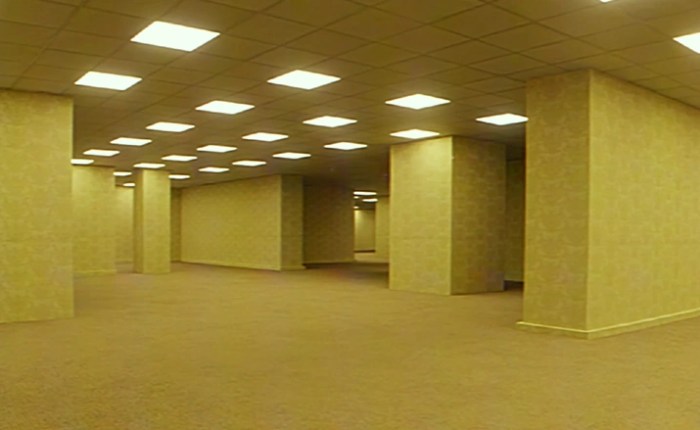
Parsons wasn’t the originator of the idea, however. He took his inspiration from a pre-existing internet fandom, a series of stories and videos that originated in a 4chan creepypasta post from 2019. It started with a rather ugly photo of a bare yellow room with an ominous caption, and bloomed into a full community.
Yet Parsons took this into quite a different direction. His version is a series of videos that create a fragmented narrative. They mainly center on the fictional company ASYNC, which opened a portal to the Backrooms and is studying it for commercial ends. His story is thus a kind of science-fiction, told through a series of internal memos, security tapes, experimental reports, as well as the found footage of the first video.
While fans of the original Backrooms idea initially rebelled at Parsons’s version, his take on the concept has since become the dominant representation. Indeed, Parsons’s Backrooms has itself spawned a whole community around it—of fan theories, parodies, and some very good imitations. Even though it is now mostly known through the work of one artist, Backrooms is still, in short, a very online phenomenon. And Parsons encourages that—reading the comments on his videos, responding to fan theories, and enjoying the parodies.
If you want a sample of the fanaticism that fans bring to the series, you can check out the many videos on the Film Theory channel, which combine obsessive attention to detail with fervent speculation. For my part, however, the appeal of the series is almost wholly disconnected from these sorts of questions (what are the monsters? what is creating the Backrooms? how can you survive in them?).
The series is more profitably viewed, in my opinion, as a kind of extended commentary on the kinds of spaces that we humans build for ourselves. Parsons is brilliant at creating rooms, hallways, and furniture that look extremely real and yet not quite right. Indeed, every new space of the Backrooms we see—apartment blocks, suburban neighborhoods, forests and cityscapes—is a kind of parody of something intimately familiar. What Parsons does is to strip these places of their familiarity; and he does that by changing subtle details, rendering them wholly dysfunctional: doors that lead nowhere, chairs too big to sit on, signs flipped backwards.
In another context, this could be funny, as many of the parody videos are. But in Parsons’s hands, it becomes extremely unsettling. These spaces are so flagrantly hostile, so completely inhospitable, that it is a challenge even to survive in them. And if this is the case, why do we keep designing our real world to look so similar? It would be risible if it weren’t tragic. The line between comedy and horror, after all, can be disturbingly thin, and depend on as little as the background music.
Speaking of music, Parsons also deserves credit for the soundscapes he creates. His videos are not only visually stunning, but sonically rich. Clearly multi-talented, he writes and performs all of the music for the series, as well as the Foley (the footsteps, the rattle of the camera, and every other incidental noise). Yet the sounds that most stick with me are the ugly modern ones: the crackle of a radio, the hissing of static, the buzzing of machinery—and, most of all, the ominous angry hum of the electric lights.
The final effect is a horror version of the experience that I had on the train in the opening paragraph—a menacing world of artificial spaces and sounds. And the effect of viewing Parsons work, for me, has been a heightened awareness of the unnaturalness of daily life—how the sonic and visual and even tactile textures that surround us can so often be cold and repellent.
Oddly, however, Backrooms can sometimes have the exact reverse effect. Seeing all of this stripped of its human context—in the endless hallways devoid of life—we are free to notice that, if bleak and uninviting, these spaces also have a strange, almost abstract beauty to them. If it fails as a dwelling place, our modern world succeeds in creating its own aesthetic.
Theories about the nature of the Backrooms vary from it being the leftover parts of a computer simulation (implying that we live inside a giant computer), or some kind of living entity that is misremembering the real world (which doesn’t seem to clear anything up).
For my part, however, the best way to understand the Backrooms is a kind of extended metaphor for the internet: a mirror version of our reality, extending infinitely and everywhere, into which some people fall and never return. (It seems possible that Parsons is aware of this parallel, as his timeline of ASYNC’s exploration of the Backrooms roughly coincides with the development of the World Wide Web.)
All of this, from a 4chan post! Indeed, Backrooms not only symbolizes the internet, but exemplifies how it works—how it connects people, amplifies voices, and forms communities around ideas. Beginning with a single image on a forum, all of this blossomed into a whole series and (now) a major motion picture. Parsons does fit the stereotype of the solitary genius, but he is also very much at the helm of a vast, widely-dispersed community—one which he interacts with, and even collaborates with.
But the internet, like the Backrooms, is also full of monsters. For example, another internet phenomenon—a man almost exactly Parsons’s age—comes to mind, the “looksmaxxing” influencer, Braden Eric Peters, otherwise known by “Clavicular.” While spewing a version of toxic masculinity that seems to be a parody of itself, Clavicular has become immensely famous. It is an interesting case of parallel lives: two kids who, in a previous age, might have been simple misfits, finding fame and fortune by connecting with widespread communities online.
Indeed, what both figures exemplify, though in very different ways, is the central aesthetic experience of both the Backrooms and the internet: alienation. There is an obvious irony here. While more connected than ever before, the world we live in often makes us feel isolated. The internet does provide a sense of community, but it is so often just a simulacrum, ultimately unsatisfying and unhealthy—a kind of parody version of the real thing. Clavicular and the young men he represents have responded to this alienation by turning to a toxic culture of misogyny. Parsons, instead, has turned it into art.
For better or for worse, then, the internet is also a misshapen copy of the world we live in. And through its dark corridors, it connects people who otherwise might feel isolated and alone. In the case of Clavicular, as in so many other examples, this has only magnified voices which should have been left on the social margins. But in Kane Parsons, we see the original promise of the internet fulfilled—the emergence of a brilliant and distinctive voice from a community of creators. Like the Backrooms, the internet is both extremely dangerous and strangely beautiful.

