Ancient Cities: Athens

Ancient Cities: Athens

The plane landed late; and by the time the metro took us to the city, it was midnight. Though the Airbnb was not far from the metro stop, we were so tired that we elected to take a taxi. The driver grimaced when he saw the address.

“How much you pay to stay there?” he asked.

“Not much,” I said truthfully.

“You should pay nothing!”

He dropped us off in front of a long, dark alley.

“Stay on that side,” he told us, before driving off.

“I guess this is it,” I said, and we hesitatingly began to walk into the darkness.

Just as we approached the door, a noise startled us. Two homeless people were crouched right beside the door, talking. In truth I had no reason to think that they posed any kind of threat. But the taxi driver’s words had put me on edge. I fumbled with the lockbox on the door, reading the relevant digits from my phone and tugging. The thing popped open and revealed our keys.

We took the elevator to the top floor. There, I read in the instructions that I was to use the blue key for this one. My friend Becca tried to open it, but to no avail.

“Are you sure it’s this one?” she said.

“Yes, it says the blue key for the blue door.”

She tried again.

“It’s not working,” she said. “Want to try?”

I pocketed my phone and grabbed the key. But as soon as I turned it I felt a snap—the key had broken off in the lock. I was horrified. It was one o’clock in the morning and I had just jammed the lock of our apartment. There was nothing to do but to call the host, who I hoped lived close by. Luckily he picked up quickly.

“You what?” he said.

“The key broke off in the lock.”

He grumbled.

“How hard is it to open a door?” he said. 

“I’m sorry…”

“You know ten people are staying there?”

“Yes, I know it’s…”

“Just wait there.”

I assumed that he would have to call the locksmith, which on a Friday night at one in the morning could easily take hours and cost hundreds of euros. But, to my immense relief, within five minutes he appeared carrying a box of tools. The key shard was extracted and, with some more scolding, we were ushered inside. He then opened a lockbox inside the apartment and gave us a replacement key. The charge was five euros.

“Thank you!” I said, marvelling at the efficiency of the process. Guests must break keys in the door all the time, if he had it down to such a science.

Anyways, the ordeal was over: we had arrived in Athens. From the balcony of our Airbnb we could see it: the Parthenon, high up on its hill, gleamingly lit with floodlights. I looked at the ancient temple, relaxed, and felt that strange wondrous feeling of finally seeing something with your eyes which you have seen a thousand times in photographs.

I was finally here, in Athens, the honorary birthplace of Western culture. I was in the city of Socrates, Plato, and Aristotle; of Aeschylus, Sophocles, and Euripides; of Thucydides and Pericles and Solon. For worshippers of history, no ground is more sacred. And yet my first experience in this city of philosophy and art was being frightened by a taxi driver and then criticized by a disgruntled landlord.


Our first stop was the National Archaeology Museum. As one might expect from an archaeology museum in one of the greatest of ancient cities, this is one of the city’s cultural jewels. It is located right in the heart of Athens, in an impressive neoclassical building that evokes the grandiose history it hopes to document. When we went, the line was short and the price was entirely reasonable.

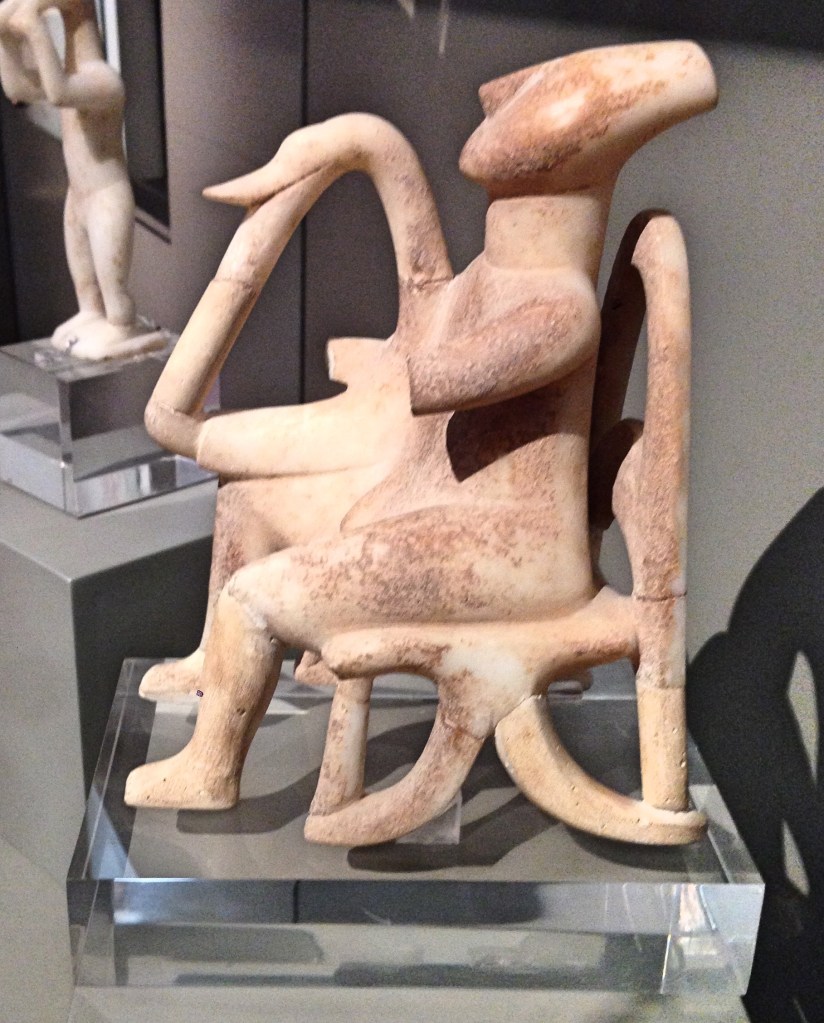
The collection begins with a set of artifacts which cannot be properly called ‘Greek.’ Some of these are Cycladic art, from the Cyclades, a collection of small, rocky islands off the Greek coast. The art is remarkable, both for its high quality and for its extreme contrast to what we normally think of as ‘Greek’ art. There is no hint of realism in these works. To the contrary, the sculptures of faces and bodies are heavily stylized, leaving a characteristically angular and abstract form which would fit in well in any modern art gallery. One of my favorite works from this section is the representation of a harp player, whose instrument seems to emanate from his leg.
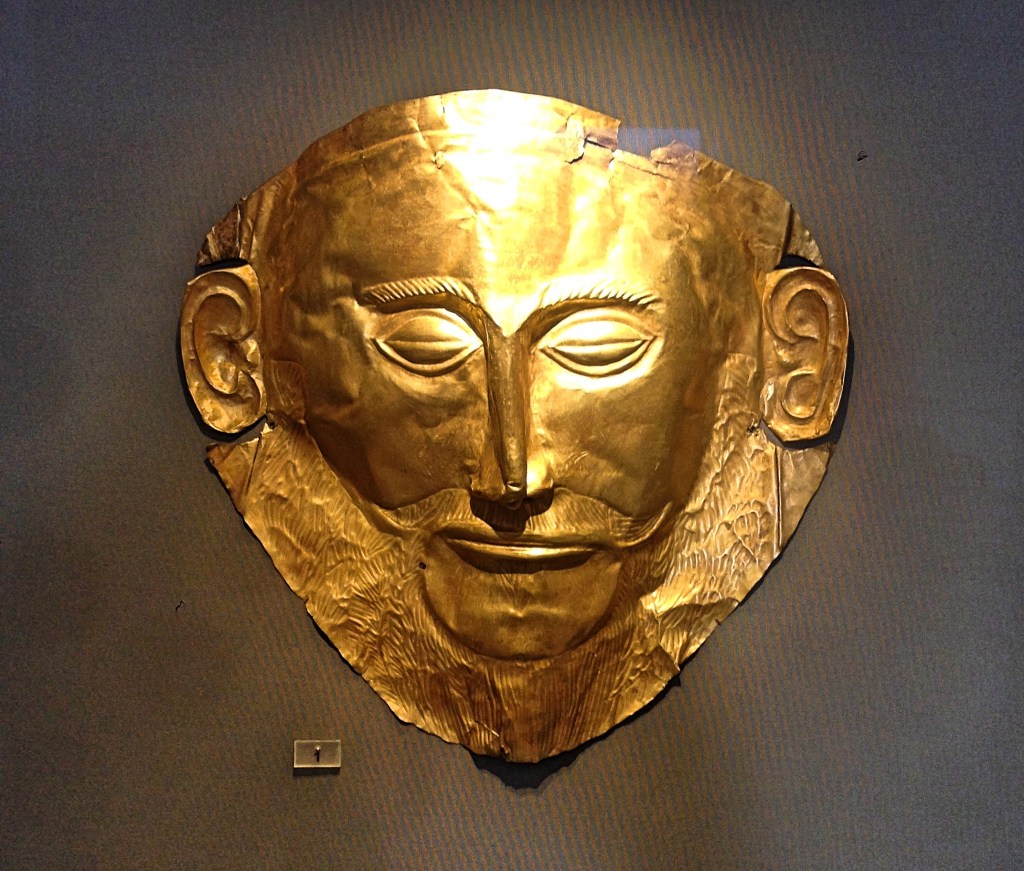
Another civilization which flourished before the ancient Greeks were the Mycenaeans, whose culture covered much of modern-day Greek, the Peloponesus, and the islands. The archaic culture takes its name from the greatest city of its era, Mycenae. One of the artistic masterpieces from this period is the so-called Mask of Agamemnon. This is a funerary mask made of pounded gold around 1500 BCE. The mask owes its name to its discoverer, Heinrich Schilemann, who believed it to belong to the legendary king of the Trojan War. Nowadays this link seems extremely unlikely, if not fanciful. The mask is beautiful, nonetheless. Its highly stylized features evoke an individual—noble, powerful, and tranquil in the repose of death. 
What I stumbled upon next astonished me: the Antikythera mechanism. This is one of the most remarkable artefacts in history, one which I had heard about several times from documentaries and television. But I had no idea it was here. The Antikythera mechanism is a highly sophisticated device used to compute the positions of celestial objects and to calculate eclipses. In essence it is an ancient computer. It was discovered in a shipwreck off the coast of Antikythera, in 1901, and was made some time around 100 BCE. Badly corroded by its centuries under the sea, and broken into several fragments, the pale green chunks of metal hardly do justice to the triumph that such an object represents. 

In technical sophistication it would be over a thousand years until Europeans created anything comparable. The mechanism contained over 30 gears whose turnings could model the irregular movements of the sun, moon, and planets. It would be wound with a little crank, and it was originally covered with inscriptions of the months and days (Egyptian names written in Greek script) and the intercalandary days used to correct the Egyptian 360-day year. The level of knowledge needed to create such a device is extraordinary. Merely developing the mathematics needed to accurately calculate the moon’s orbit, for example, took generations of work. And to be able to build such a delicate device that embodies these mathematical relationships in a usable form—that is true sophistication.
Near the fragments of the original device are several modern reconstructions of what it may have looked like. All of these agree that it was a medium-sized box with a metallic face that displayed several rotating rings. The device is not exactly beautiful to look at; but in what it means for our species—the ability to chart and predict the movement of celestial bodies with mathematical precision—it is an artifact more moving than even the finest sculpture.

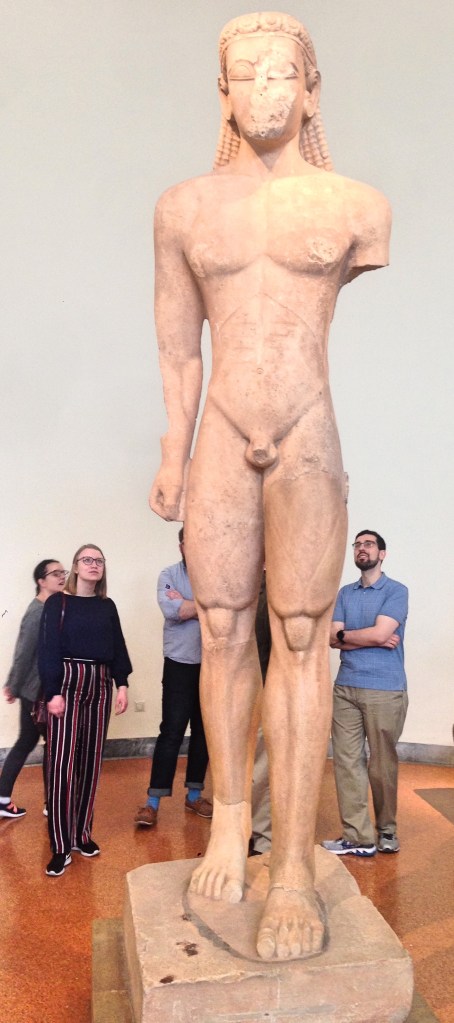
The museum’s sculpture collection allows the visitor to see the evolution of Greek technique. The archaic period was characterized by a notable influence of Egyptian art upon the Greeks. One can see this clearly in the Knoisos Kouros, a large statue of a young man made around 500 BCE to mark a grave. The figure is stiff, with his arms straight at his sides; his hair is braided behind him; and his mouth wears that characteristic ‘archaic smile,’ a sort of otherworldly grin typical of this period. Nearby is a statue of a sphinx—with a smiling human head, an eagle’s wings, and a lion’s body. Clearly these early Greeks were admirers of their ancient counterparts in the Nile Valley.

Compare this statue with one made about 100 years later: the Poseidon of Cape Artemision. This is a bronze statue depicting a bearded god, his arm raised in a gesture of smiting, found in a shipwreck. (It is unclear whether it is Poseidon or Zeus, since the object in the god’s arm—a trident or a thunderbolt—has been lost.) Here the body is far from stiff, but poised to strike, its right foot lifting up in preparation. The face, too, is far more expressive. Gone is the archaic smile. The bearded god is magnificent, foreboding, and regal.

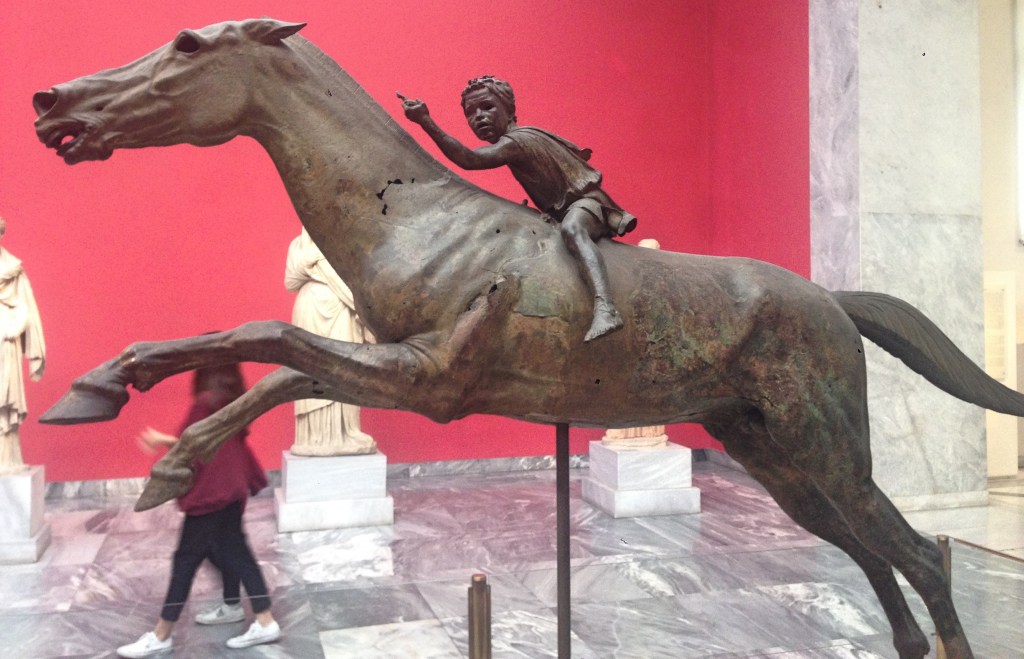
Found in that same shipwreck is the Jockey of Artemision, a bronze statue that was made even later, at around 150 BCE. Here realism has advanced considerably. We see a young boy riding a horse. The horse is frozen mid-stride, while the impossibly small boy is seated bareback. To my eyes the work has a decidedly morbid air: the horse looks sickly while the boy looks frightened. But it is a masterful work of art, with every muscle of the horse’s body modeled beautifully, and its face wonderfully lifelike. Again, we must marvel at the technical sophistication needed to create such a well-balanced, realistic sculpture out of bronze. 
The Golden Age of Greek art is, however, normally considered to lie between the stiffness of the archaic period and the realism of the Hellenistic period. During this properly classical age, idealized form met technical sophistication, creating those wonderful heroic figures who are both believable and yet beyond human. Among these we might class the Aphrodite of Knidos or the Capitoline Venus, iconic statues of the idealized female body, both of which can be found at the museum—or, at least, Roman-era copies. 
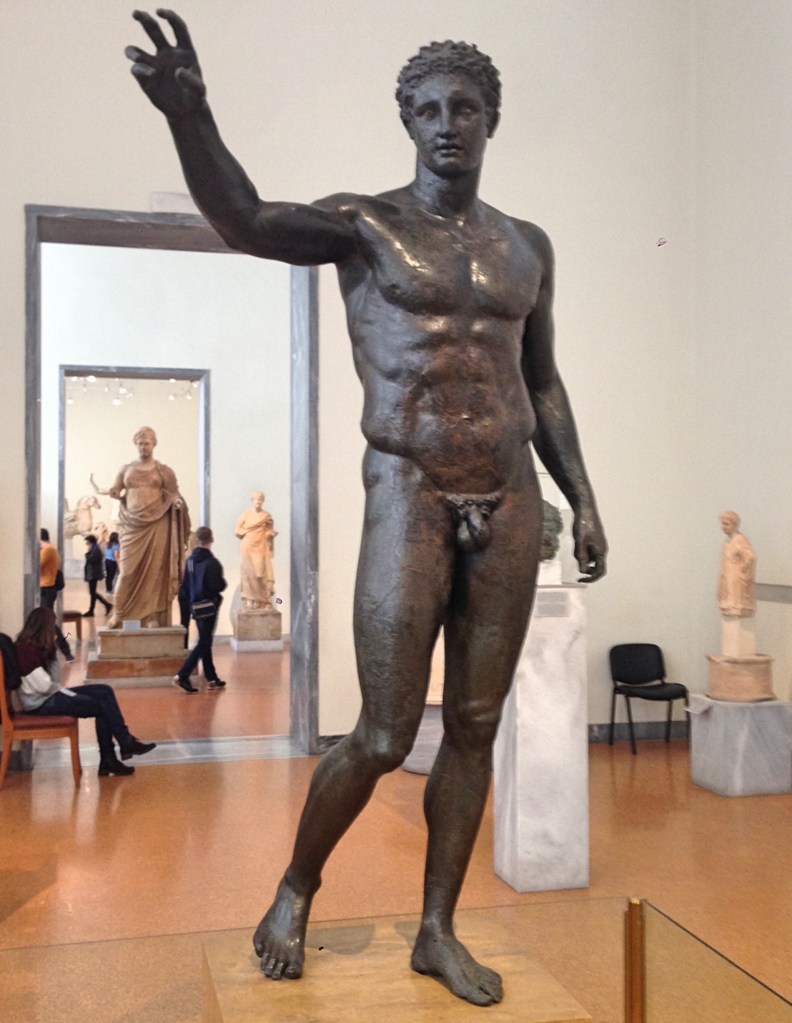
One of the museum’s great male nudes is the Antikythera Ephebe, a bronze statue found in the same shipwreck that yielded up the above-mentioned mechanism. As with the case of the Poseidon statue mentioned above, the identity of the young man is unclear, since we do not know what he held in his hand. Nevertheless it is an extraordinary representation of the perfect human form—very far-removed in conception and execution from the Egyptian-influenced statues created just two centuries before. 

The museum has many masterpieces; but one cannot do justice to its collection by focusing on these pieces alone. There are superb examples of ancient coins and pottery, and sculptures ranging from 1,000 BCE to the Roman era. The Greek vase-painting alone deserves and rewards close study. But, for me, the most moving galleries were those which contained ancient funerary markers. These are like tombstones, most often decorated with statues in high relief, that show us intimate and often touching representations of the departed. In one we see a father holding a baby, whose little hand is outstretched towards his deceased mother. It is wonderful art; but, more importantly, it is so wonderfully human.

This was our first morning. As visiting museums is tough work, we emerged tired and hungry. But the weather was lovely beyond belief. It was mid-March, and Madrid was still feeling the winter chill. Athens, meanwhile, was sunny and perfectly warm, and the sky had nary a cloud. We were also fortunate when it came to food. Greek food is justly famous; and Athens, of course, has no shortage of it. We ate lunch in a place called O Kostas, ordering two lamb gyros and fries with feta cheese. It was delicious. For dessert, we headed to a spot called Lukumades, which serves a type of pastry called, appropriately, Loukoumades. These are essentially like doughnut holes—fried balls of dough—but they are especially sumptuous, soft on the inside and slightly tough on the outside. Traditionally they are served with honey, which is what I ordered. It was a voluptuary experience.

After we ate, we headed to a tour that Becca had booked before we arrived. We wanted to see at least some of the country outside of Athens. A trip to Delphi or, better still, one of the Greek islands would have been ideal; but since we had limited time, we settled on a short trip to the Temple of Poseidon. The tour met at a hotel, where we boarded a large tour bus. I was rather impressed at the driver’s ability to maneuver the blimp-like vehicle through the narrow Athenian streets. Our guide gave us a running narration of the sites we were passing, through the bus’s PA system, as well as giving us some background as to the history and the mythology associated with the temple.

Apart from its major monuments, the city of Athens is itself not especially attractive—a clutter of unremarkably buildings—but the landscape surrounding the city partakes in all that fabled beauty of the Greek countryside. The bright blue Mediterranean, the gentle hills and small islands sparsely covered with green, and the little towns nestled among these elevations—the whole scene brought my thoughts back to the country’s ancient past. 

Many times I have heard it said that the particular geography of Greece was the key to its cultural development: that the hills and mountains made overland travel difficult, while the many islands and harbors made sea travel, and thus international trade, far more profitable. Thus, the Greeks became excellent sailors and developed independent city-states, whose merchants sailed far and wide, coming into contact with other cultures and bringing back ideas, arts, and technologies from afar. I have even heard it said that the particular clarity of the Meditteranean sun in Greece shaped their logical philosophy and their classical art. Theories such as these should always be handled with caution. Still, as I looked at this dramatic and yet harmonious landscape, I could not help but feel inspired myself.

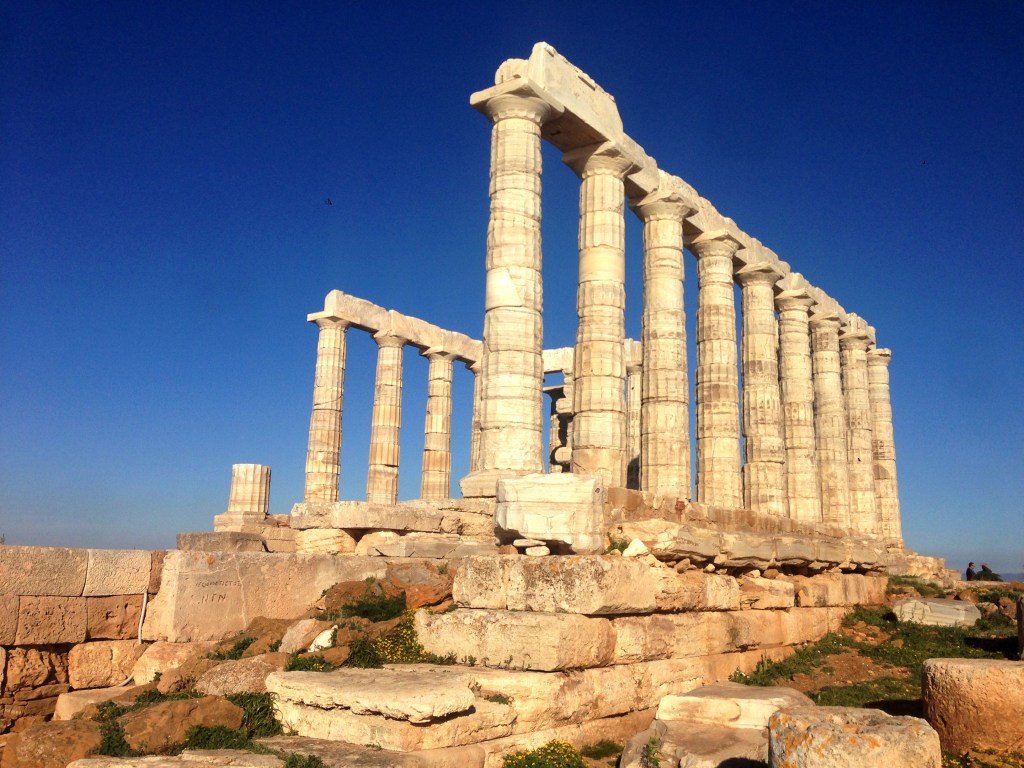
Finally we reached the temple. It stands on a bluff overlooking the sea, a commanding position for the house of a god. The guide led us from the parking lot to the site, gave us a little speech, and then let us roam free. Built during the Golden Age of Athens, under Pericles (c. 440 BCE), the temple itself is now in a ruined state, with less than half of the original columns standing and nothing of the roof or internal structures to speak of. Even so, the temple has been a tourist destination for many years, as attested by the many graffiti carved into the rock, including the name of Lord Byron. The ruined temple is perhaps all the more charming to modern visitors because of its ruin. As it stands now, the columns open up towards the viewer, and the temple itself becomes a kind of lens or frame for the landscape around it.
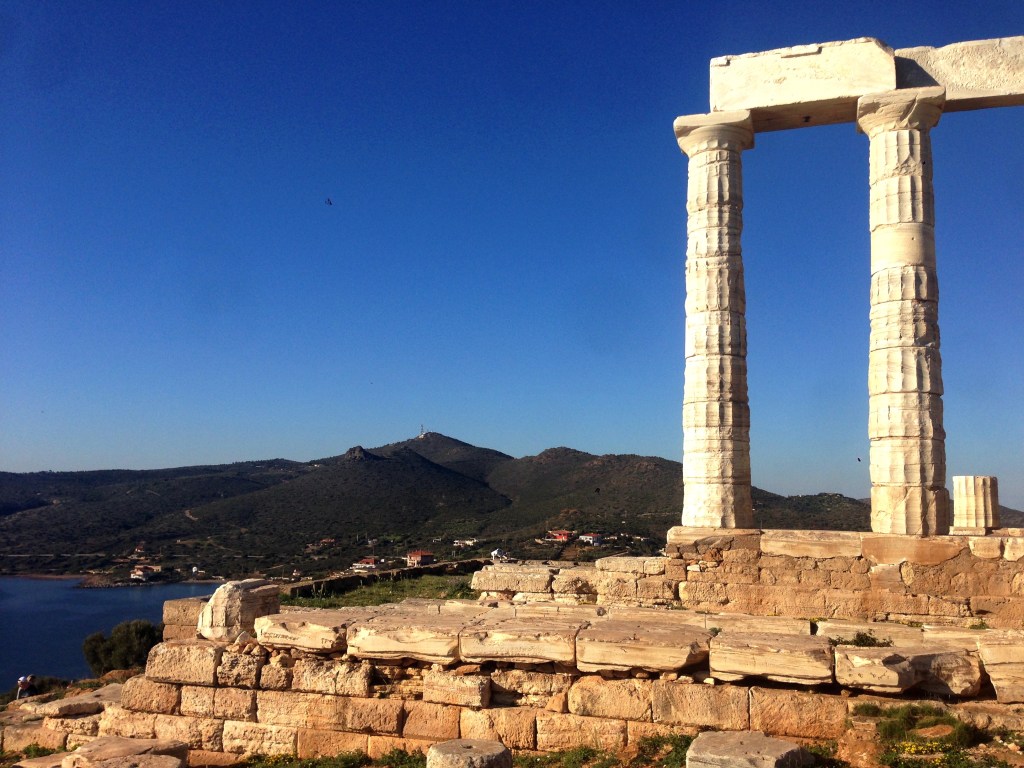
Martin Heidegger, the philosopher who idolized the Greeks, was horrified by most of what he actually saw on his trip to Greece. This temple was one of the few sites that inspired him, which he recorded in his influential essays on aesthetics:

Standing there, the building rests on the rocky ground. This resting of the work draws up out of the rock the obscurity of that rock’s bulky yet spontaneous support. Standing there, the building holds its ground against the storm raging above it and so first makes the storm itself manifest in its violence. The luster and gleam of the stone, though itself apparently glowing only by the grace of the sun, first brings to radiance the light of the day, the breadth of the sky, the darkness of the night.

My response to the structure was, however, muted compared with my response to the landscape surrounding the temple. Nevertheless, it was special to see my first true Ancient Greek temple, in situ. It is a work of art that perfectly complements nature.
We arrived back around dinnertime, ate, and then went to bed. Tomorrow was going to be a big day.


We awoke in our pitch-dark room early. It was time to visit the Acropolis. Breakfast was easy. The streets were full of vendors selling sesame bread rings—which taste like thin, crunchy bagels.

The walk to the base of the hill was short, and it was not long before we began to encounter ruins. First was Hadrian’s Library, built during the reign of that Roman Emperor to house some of the cultural treasures of Athens. (Educated Romans were acutely aware of the cultural debt they owed to Greece.) Little of this structure remains, just a few walls and free-standing columns in a grassy field. Nearby is the Roman agora (an agora is an open space used for assemblies). Athens’ original agora was apparently swallowed up by surrounding buildings, making a new one necessary during the Roman era. The most famous structure in this area is the Tower of the Winds, possibly the first weather station in history, equipped with a wind vane, multiple sundials, and a water clock.

Our path then took us past the iconic Theater of Dionysus. Built into the side of the hill, the theater will be familiar to anyone who has seen later Roman theaters, partially because the Romans refurbished it, and partially because this is the prototype of all theaters that came later—possibly history’s first theater. Semicircular rows of seats descend to the stage, which is framed by a grandiose stone backdrop. It was amazing to see the venue where, in all probability, the works of Aeschylus, Sophocles, Euripides, and Aristophanes were performed. It may be difficult for us to appreciate this nowadays, when theater and all its offspring (television, movies) so dominate our entertainment and art. But at one point theater was an entirely new, cutting-edge artistic medium. The Greeks not only gave birth to this artform, but quickly produced masterpieces, still powerful after more than 2,000 years. 

The theater of Dionysus

The path took us on a gradual ascent up the hill of the Acropolis. Soon we came to the entrance to the site. Though there were lots of tourists mulling about, I was surprised that we did not have to wait on a long line to get inside. It was not at all like visiting the Colosseum in Rome: we paid and walked right inside. A little more walking, and we were standing before the ancient entrance to the Acropolis, the Propylaea. This consists of a marble colonnade, with wings on either side, which sits grandly atop the stairs leading up to the Acropolis. At the time this was a sacred space, and so the Propylaea served as a gate, and was used to control access to the city’s temples, barring the way of any undesirables. 
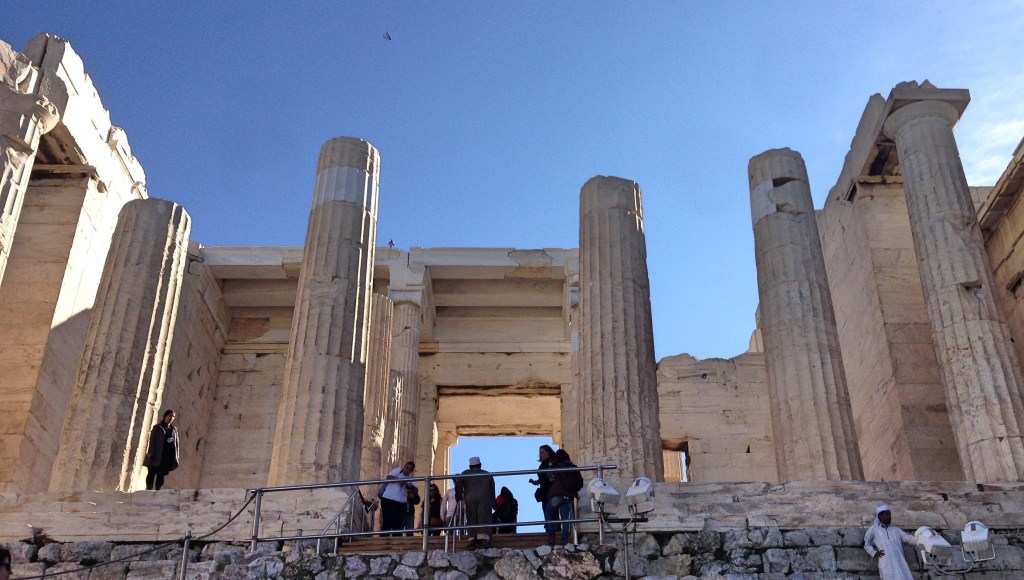
The Propylaea

We climbed the stairs, passed under the Propylaea—and there it was, the Parthenon. 

Seeing any iconic site evokes a peculiar feeling: a quick succession of awe, disappointment, boredom, excitement, curiosity, wonder, and awe again. First you think, “That’s it!” Then you think, “Well, I guess that’s it.” And then you start to really look at it, in a way you never could in photos or in videos. Now you can sense the building’s proportions, and see it in the proper situation—the strong Mediteranean sun bearing down, the bear rock of the hill underfoot, and the expansive view on every side.

The Parthenon was built at the height of Athenian power, at around 450 BCE. Athens had just emerged victorious from a war with Persia, the very war recorded by Herodotus in his Histories. During that conflict, the Persians had ransacked the city of Athens and had burned several sacred sites, including an older temple. Nevertheless, Athens emerged from the war stronger than ever before, the de facto leader of the Delian League—a loose federation of Greek city-states. Indeed, the league dues paid to Athens by the other members helped to fund the new temple, something that the other cities did not appreciate. The high-handed leadership of Athens eventually resulted in the Peloponnesian War, recorded by Thucydides, which ended with the defeat of Athens by Sparta and its allies, and the end of the Athenian Golden Age.

The author in front of the Parthenon. Photo by Becca Kantor.

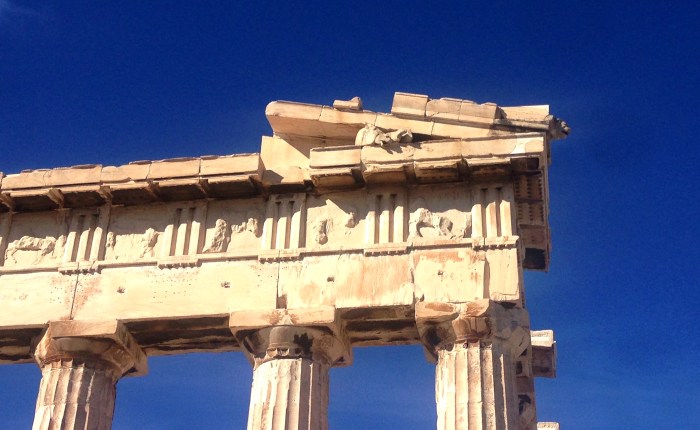
The construction of the Parthenon, then, coincides exactly with Athens’ most glorious moment. On the surface the building is simplicity itself: rows of columns (69 in all, originally) holding up a roof. But the beauties are in the subtleties. First, the columns themselves swell slightly in the middle, in order to counteract the optical illusion that perfectly straight columns are narrower in the middle. The whole foundation itself is slightly bowed, or bent, which helped rain flow off the roof as well as made the building stronger—not to mention lessening the stiffness of the building’s profile.

Then there is the artwork. Very little of the original sculptures remain, much of it having been carted off to England by Thomas Bruce, the Earl of Elgin (more on that later). As extraordinary as much of this artwork is, it was not meant to be the main focus on the structure. In fact, it was placed so high above that it is unclear how it could have been properly seen. The Ancient Greek traveller, Pausanias, does not even mention the friezes that are now considered touchstones in the history of art. Instead, the main focus of the building was an enormous statue of Athena, holding the winged form of Nike (or vistory), now lost to time.

We do have a good idea of what this statue would have looked like, though, from several reproductions and representations, as well as from written descriptions. Ironically, as the classicist Mary Beard points out, we in the present would likely not have found this statue particularly beautiful. Certainly the full-scale reproduction in Nashville is not inspiring. The gargantuan figure was not meant to be a work of art, after all, but a cult image—indeed, the goddess herself made incarnate. And the temple was not a place of services or worship, such as a church or a mosque, but a place to house the offerings to this physical goddess.

Nowadays, we are not apt to see the ruined temple as the house of a goddess, or even as primarily a religious structure. Rather, we cannot help seeing the Parthenon as a kind of visual representation of the culture that gave us philosophy, art, and democracy. We see the ancient structure, and we think of Pericles, the great leader of Athens, and his iconic funeral oration:

If we look to the laws, they afford equal justice to all in their private differences…if a man is able to serve the state, he is not hindered by the obscurity of his condition. The freedom we enjoy in our government extends also to our ordinary life. There, far from exercising a jealous surveillance over each other, we do not feel called upon to be angry with our neighbour for doing what he likes…

But the Parthenon has been affected by far more history than merely Classical Athens. The building served as a church for much longer than it ever was the home of Athena. The pagan temple was first consecrated under the Byzantines as a Greek Orthodox church; and then, during the crusades, the Parthenon fell under the control of several different Western European states, becoming a Roman Catholic church controlled by the French, the Italians, and the Catalans in turn. Finally the Ottoman Turks seized control, and the Parthenon became a mosque. In 1687, during a war with Venice, the Ottomans unwisely decided to use the Parthenon as a refuge for civilians, as well as a storage depot for gunpowder. A stray Venetian shell ignited the powder, killing dozens and seriously damaging the building’s structure.

Thus, what we see now is merely a shadow of what the building would have originally looked like. In fact, the Parthenon has already been partially reconstructed; at the beginning of the previous century, not even the building’s outline remained standing. Even so, what would have been the dark internal chamber is now nothing but empty space (where a large crane was parked when I visited). What stands, in other words, is only the outer rim of the building—as if a house had been gutted, leaving only its external walls. What is more, almost all of the sculpture has been destroyed or removed; and, importantly, the bright paint that would have originally decorated the Parthenon has long ago been washed away.

The building we celebrate, then, is very different from what the Athenians actually built. And as in the case of the Temple of Poseidon, I suspect that we cherish the Parthenon because the passing years have turned it into a noble ruin. Rather than a colorful exterior containing a dark internal chamber, we now find a skeleton made of pure white marble, filled with nothing but sunlight and air. What we see, in other words, is only the mathematically clean and elegant outline of the original structure—giving us a rather false idea of what life in Ancient Greek was actually like.

Still, it is beguiling to behold. The temple has a mesmerizing power, its irregularities so subtle as to be unnoticeable and yet intriguing. What could have been a stiff and rather lifeless building instead appears supple, graceful, and dynamic.

It is worth momentarily pulling your gaze from the Parthenon to examine some of the other temples on the Acropolis. The most notable of these is the Erechtheion, a somewhat smaller temple dedicated to both Poseidon and Athena. According to the founding myth of the city, those two gods had a contest in order to which one of them would become the city’s patron deity. Poseidon struck the ground with his trident, and caused a well to gush forth. Unfortunately, however, it the water was salty. Athena responded by causing an olive tree to grow. As olives are fundamental to the Mediterranean diet, the Greeks wisely chose Athena. This temple marks the spot where the contest supposedly took place, and was built around the two miraculous gifts—the marks of Poseidon’s trident and the sacred olive tree.
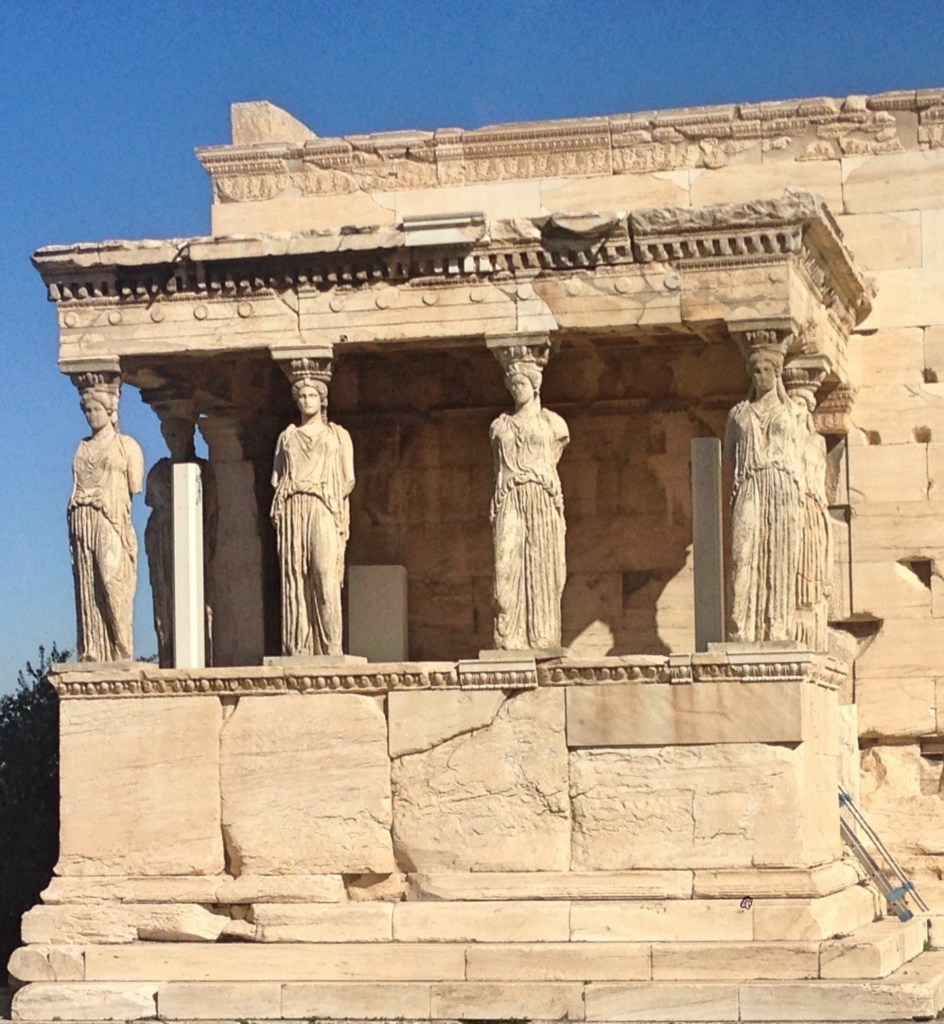
The Porch of the Maidens, in the Erechtheion

The profile of the Erechtheion is somewhat odd, since it was perforce built over uneven ground, to which the architects had to adapt. Its most famous feature is the Porch of the Maidens, a porch held up by the statues of six young women, called Caryatids. Now the statues in the porch are all replicas. One of them was carted off by the infamous Lord Elgin, and now stands in the British Museum. The other five have been moved to the Parthenon Museum (more later).
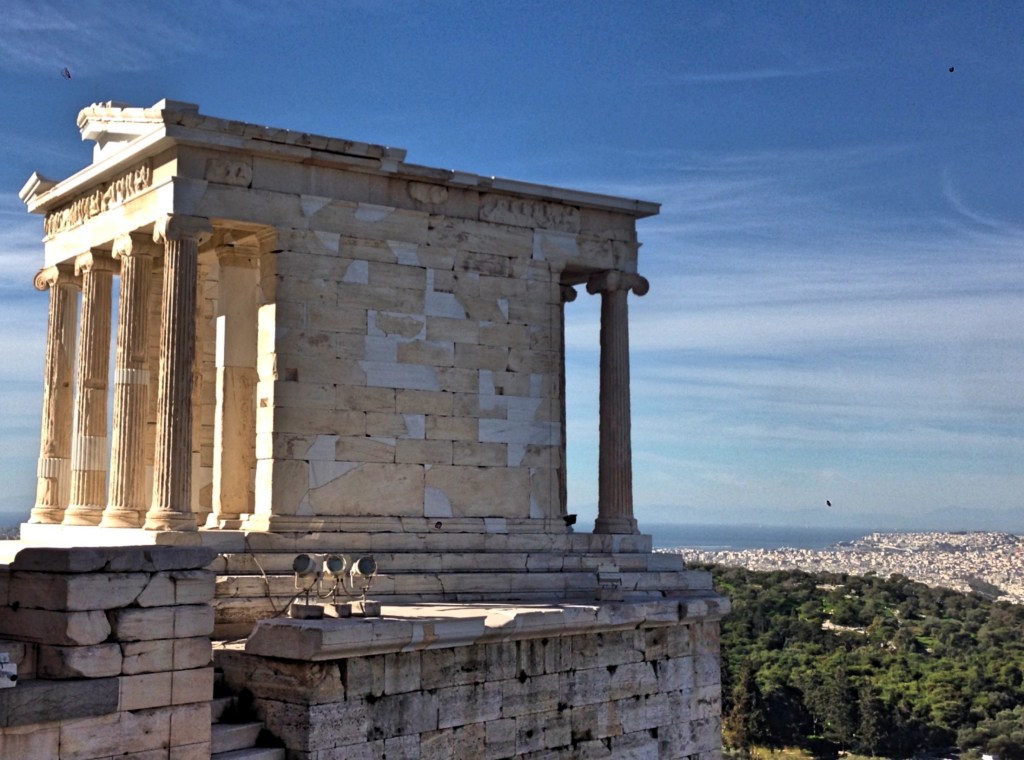
The Temple of Athena Nike

The last temple on the hill is the Temple of Athena Nike. It is a small temple situated near the entrance, which was decorated with friezes of the highest quality, some of which are now in the British Museum, and others which have remained in Athens. Besides these other structures, it is worth mentioning the view from the hill of the Acropolis. Athens spreads out in all directions, an endless sea of mostly white buildings hemmed in by distant green mountains. From here I could see the Temple of Hephaestus, a remarkably well-preserved temple that does not receive a fraction of the attention from tourists as do the ruined temples in the city—which supports my earlier point, that we are attracted to these buildings precisely because they are ruins. Near the temple is the Church of the Holy Apostles, a 10th century Orthodox Church.
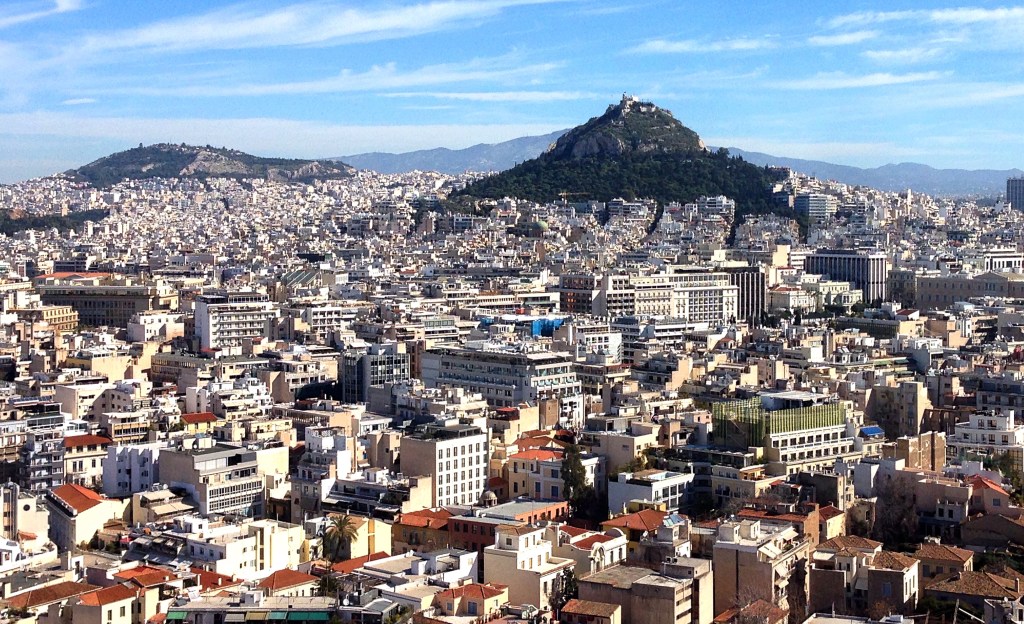
Athens, with Mount Lycabettus in the distance

I could also see the famous Areopagus, a rocky outcropping said to be where the gods held Ares on trial (thus the name), and, according to Aeschylus, where the gods held Orestes on trial for the murder of his mother. The ancient Athenians used this hill for their own trials, and St. Paul was said to have made a speech to the Athenians in this spot. John Milton referenced this classical past in the title of his iconic defense of a free press, the Areopagitica. Looking in another direction I saw the ruins of the Temple of Olympian Zeus, at one time the largest temple in Greece, but now only a collection of free-standing columns in a grassy field. Most striking of all was Mount Lycabettus, a hill whose rocky peak is taller even than the Acropolis.

I descended from the Acropolis feeling a mixture of triumph and deflation. The big moment was over: I had seen the Parthenon. Was I any the better for it? But we still had a great deal more to see, much of it found in the Acropolis Museum, located right down the hill from the Acropolis itself.

The Acropolis Museum is the second great museum in the city of Athens. Compared with the Archaeology Museum, this one is a much younger institution, having been opened in 2009 after many false starts. The museum, thus, projects a sleek, modern aspect to the visitor. Even the building itself is interesting and innovative. Designed by the Swiss, Parisian, New Yorker Bernard Tschumi, the entire structure is lifted above an ancient archaeological site, leaving the ruins below both visible to visitors and accessible to researchers. 

Unfortunately, photos were not allowed in most of the museum, so I must rely on my hazy memory. The first exhibit was housed in a large hall. Shards of broken pottery and other small archaeological remains were housed in glass cases along the walls, while free-standing statues and structures were scattered throughout the space. This is the gallery containing artifacts from the slopes of the Acropolis—consisting of a mishmash of domestic items and the remains of various small sanctuaries. The floor has several glass panels, allowing the visitor to look down at the ancient site below (called the “Makrygianni plot”). As the museum’s website explains, the upwards slope of this hall intentionally recalls the slope of the Acropolis hill itself: quite a nice touch.

After climbing some stairs, the visitor then finds herself in a sort of enormous warehouse, with concrete grey pillars holding up the high ceiling, and large windows letting in the bright Greek sun. The space is full of statues and fragments of buildings, many of them visibly archaic. These are the remains of the pre-Golden Age Acropolis, the temple complex which was largely destroyed by the invading Persians. Only broken fragments of the decorations remain, but they are beautifully suggestive. Particularly noteworthy are the pediments from the Hekatompedon, the so-called Ur-Parthenon that stood on the site of the current temple. We see a lion killing a calf, the curling body of a snake, and a man with three bodies (each of them wearing the above-mentioned archaic smile). For me, the statues of the animals are especially lovely. The Golden-Age Greeks seldom depicted animals in their visual art, preferring to focus instead on ideal human form.
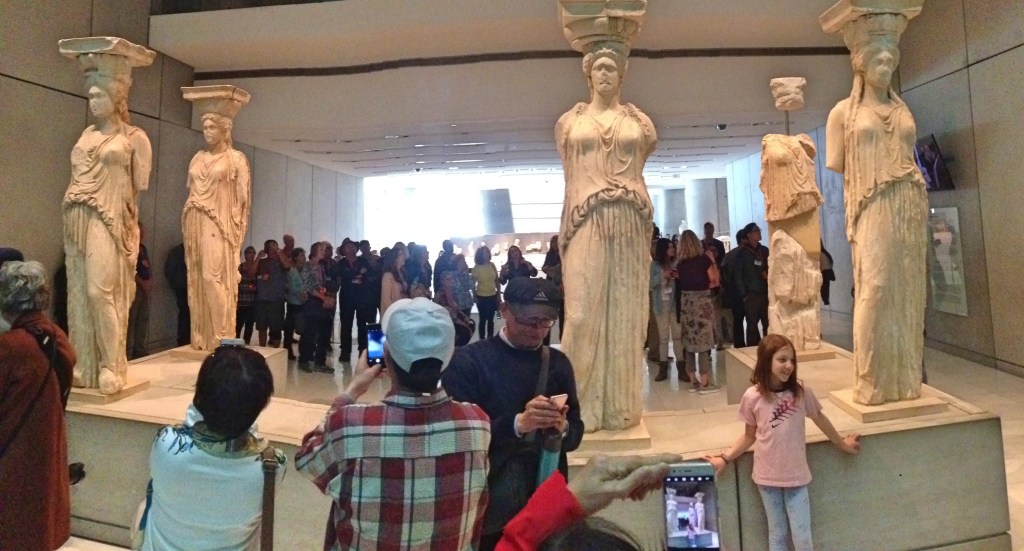
Moving on through this floor, the visitor then comes to a special balcony, where she will find five familiar friends: the Caryatids who hold up the Porch of the Maidens in the Erechtheion. They are exhibited, appropriately, on a balcony within the museum. These are the originals—at least, those that have remained in Athens. Besides taking one back to England, Lord Elgin badly damaged another of the Caryatids in his attempt to remove the sculpture. The authories in the museum have done their best to piece her back together again, but the difference is stark. The mythological significance of these Caryatids is, as it happens, uncertain. According to the museum’s website, the most plausible theory is that they represent choephoroi (mourners, or “libation bearers”) of Cecrops I, the king of Athens who was supposedly buried there.
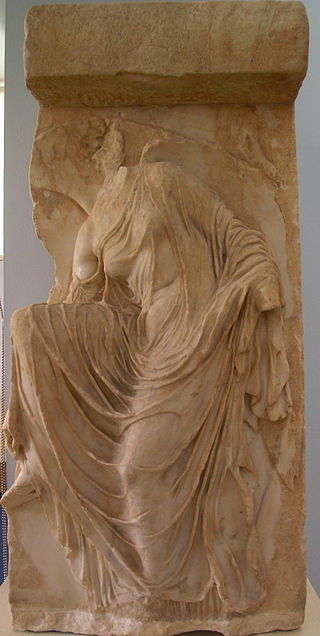
Photo by Marysas; licensed under CC BY-SA 2.5;
taken from Wikimedia commons

Nearby are the friezes taken from the Temple of Athena Nike. Among these is a justly famous sculpture of a goddess adjusting her sandal. For me, it is a wonderful piece. The way that the thin cloak drapes over the goddess’s body is masterful, both revealing the countours of her body and creating a fascinating geometrical pattern. Indeed, the lightness and daintiness of this image reminds me of nothing else so much as Degas’ many paintings of ballerinas.

So far, we have already had much to see: but the museum’s main raison d’être is still unmentioned. On the top floor is a space especially constructed to house the friezes and sculptures from the Parthenon. It is an enormous space, flooded with light, made to be the exact same dimensions of the original building, and even oriented the same way. In the original building, the friezes would have been far above the visitor, with most of their beautiful details impossible to see. Here, the friezes are dispalyed above the viewer, but close enough for pleasurable viewing. At either end are the remains of the pediments—fragmentary sculptures of gods and heroes.

In my opinion, it is a brilliant design, doing justice to the original setting of the works while allowing for added visibility. The Greek authorities had good reason for investing in such a cutting-edge design, you see. Remember that the vast majority of the original friezes are not in Greece at all, but in Athens, thanks to the aforementioned Lord Elgin. The Louvre has some other pieces, and a few other fragments are scattered here and there. As one might expect, Greece has been trying to get back these originals for decades, arguing that they were taken under improper settings. One of the main arguments against returning the works was that they are impossible to see in the original setting. But the construction of this gallery had made that argument a moot point. Now, Athens has arguably a better space for displaying the artwork than London or Paris. 

The British Museum and its counterparts have, unsurprisingly, been less than forthcoming in these demands to return the originals. For one, losing the Parthenon freize would mean losing one of the British Museum’s prized posessions. What is more, giving back the artwork would set a precedent that could potentially unravel the British Museum completely, considering how many of the British Museum’s prized works have been taken from other parts of the world, often under less than scrictly legal circumstances. Greece is just one of many countries demanding repatriation.

For my part, I would be deeply sad to see the British Museum come apart. But after seeing the frankly amazing gallery in Athens, I cannot help but think that this is where the Parthenon freize belongs—lit up by the Mediterranean sun, with the Parthenon itself visible through the wide windows. Seen here, amid so much other classical art, the work is just more meaningful than in foggy London.

So what is in the gallery, if the originals are in London and Paris? Well, mostly plaster casts. Certainly they lack the quality and luster of the original marble, but it is better than the proverbial nothing.

The sculptures and friezes of the Parthenon are virtually the definition of classical perfection for us moderns. In the pediments (under the slanted roof) we see the birth of Athena from the head of Zeus on one end, and the competition between Athena and Poseidon for the loyalty of the citizens on the other—though these are so badly damaged that only fragments of heads and bodies remain. Somewhat better preserved are the metopes. These are panels of friezes in high relief that went around the outside of the building. There were, originally, 92 of these; but time, deliberate destruction (by Christians who thought them graven images), and accidental tragedies (such as the powder explosion) have destroyed most of them beyond recognition. The best ones are mostly in the British Museum, while some of the most ruined panels are still in place on the building, all by invisible to the visitor.

The metopes were divided into four themes, one per side: the gigantomachy (the fight between the gods and the giants); the Amazonomachy (the fight between Greeks and Amazon warriors); the fall of Troy; and the fight between the Lapiths and the centaurs. The theme is clear: war. Each of the panels depicts two figures, embroiled in conflict. These four mythical wars encapsulate the worldview of Periclean Athens quite well: the supriority of the divine over earthly force, the superiority of men over women (and the Athenians were patriarchal even by ancient standards), the superiority of Greeks over non-Greeks (xenophobia is nothing new), and the superiority of humans over the beasts. It is easy to see these articles of faith as a response to the Persian invasion—an assertion of the superiority of Greece over everyone else.

As works of art, the panels of the fight between the Lapiths (legendary Greeks) and the centaurs are perhaps the finest from the Parthenon. Some of them must certainly be ranked among the finest sculptures in Western history. However, as Mary Beard points out in her guide, several of these panels are manifestly inferior—stiff, awkward, misproportioned. It seems that the Greeks hired mediocre workmen in order to get the building finished. After all, the entire building was finished in less than ten years. Compare that to the decades, and even centuries, it took to build the great cathedrals!
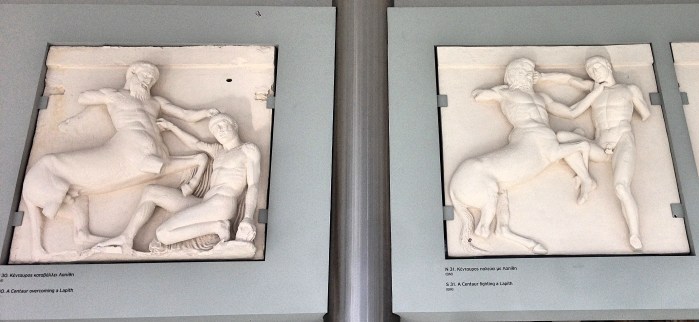
The metopes

The last major sculptural work is the frieze, which went around the naos in a continuous panel. Like most Greek temples, the Parthenon consisted of two major parts: the peristyle, which are the columns that wrap around the perimeter, and the naos, or inner chamber. The Parthenon as we know it today consists exclusively of the peristyle, which contained the pediments and the metopes. As a result, imagining how the frieze would have originally looked is somewhat more difficult for us.

The frieze, sculpted in rather low relief, depicts an enormous procession, with men, women, and children, animals of various sorts, and people on horseback, bearing all sorts of goods and objects. It is an amazing work of art, containing immense variety within a coherent narrative structure, in a style that has come to be synonymous with Classical Athens. Ironically, however, scholars are still unsure what this iconic work of art is supposed to represent. The work is virtually unique for being a representation of daily life—something otherwise absent in Greek artwork. Most would accept that it is some sort of religious procession, but which one is yet to be determined. The museum’s website asserts that it is the Panathenaia—the most important ritual in honor of Athena—but, according to Mary Beard, this is far from clear. So, as it happens, we do not know what one of the most influential works of Western art is about.
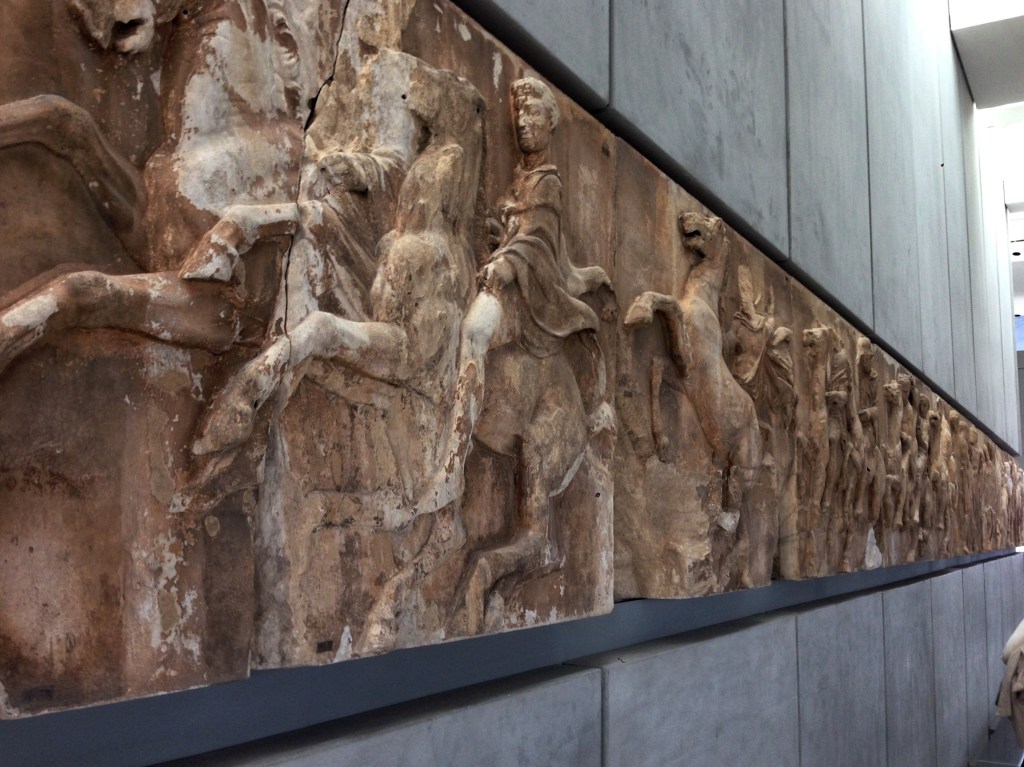
The frieze

After our busy morning on the Acropolis and several hours in the museum, we had ingested all of the art and architecture we would digest for one day. Our next stop was quite a bit different. Becca wanted to visit a famous sandal shop, which used to be owned and run by Stavros Melissinos, known as the poet sandalmaker. The shop is well-known; and it counts many celebrities as past customers, including John Lennon (after whom there is now a sandal named). Now, I must admit that I am not an expert sandal connoisseure. I have been wearing Birkenstocks for most of my life, and they suit me just fine. But other people seem pretty pleased with the shop’s products.

We spent the rest of our time just wandering and eating. Virtually everything we tasted was excellent. Before long, it was time to brave the dark alley once more, and go to sleep in our little bunk-beds. The next morning we walked over to Syntagma square—the central plaza of Athens—and then took the metro back to the airport. It had been quite a journey. Surely, we had missed a great deal of what Athens has to offer. But what we had seen was enough to make Athens one of my favorite trips in Europe. I will return one day.
Processing…
Success! You're on the list.

Letters from Spain #2: Autumn in Madrid

Letters from Spain #2: Autumn in Madrid

Here is episode two of my podcast:

https://podcasts.apple.com/us/podcast/letters-from-spain-2-autumn-in-madrid/id1469809686?i=1000454646534

For the transcript, see below:


October in Madrid has pretty well run its course, and by now I know what that means. The weather has turned on a dime from gorgeous sunny days to bitterly cold rain, and the trees look more decrepit by the hour. Nature is preparing to hibernate, and yet my year is just beginning.

For the fifth time, I made my way to the Mercado Cervantino in Alcalá de Henares. Alcalá de Henares, by the way, is a smallish historical city on the outskirts of Madrid. This was the very first trip I took inside Spain. I had just barely arrived to the country, and I was still in a constant state of mild panic. Not counting university, my move to Spain was my first move away from home. I was convinced that disaster loomed everywhere. Specifically, I had a paranoid fear that somebody was going to steal my wallet, and I would end up homeless on the Spanish streets.

Anyways, I passed the short train ride to Alcalá obsessively checking my pockets and scanning everyone around me, afraid of the strangers, afraid of missing my stop, afraid of everything. But when I got off the train, all the fear left me. Now, I need to preface this description by admitting that my first impressions of Madrid were slightly disappointing. Madrid is a modern city; and to a person trying to escape New York, this is not a mark in its favor. But Alcalá—now here was the true old Spain, the Europe I had been looking for.

The city is home to one of Spain’s most historically important universities, and so it is filled with beautiful old buildings. Soon I noticed the big bushy nests of storks atop these old buildings, which struck me as almost unbelievably quaint and attractive. I elbowed my way through the thick crowds, my hands stuck into my pockets, until I arrived at my goal: the childhood home of Miguel de Cervantes, which is now a museum right in the center of the city.

Standing there, in that admittedly unremarkable piece of architecture, I felt for the first time what I later came to call “European Travel syndrome.” This is the uncanny feeling that something absolutely remote and perhaps even mythical is actually as real as you and me. Cervantes, for example, has been just real in my mind as his creation, Don Quijote. But when you visit the house where he was raised, and imagine him in diapers, crying for milk, being rocked to sleep, the amazing author of the world’s first novel becomes quite a different sort of creature in your mind.

This is one of the great differences between Americans, even cultured Americans, and Europeans. On this side of the Atlantic, history is tangible, visible, and as omnipresent as air, while for Americans learning solely through books and pictures, history is inevitably something quite fantastic, impossibly distant, and irretrievably dead.

Not that Spaniards are immune from the kind of historical romanticizing that we practice at home in Renaissance Fairs, as the Medieval Market of Alcalá proves. Here the vendors wear pseudo-medieval costumes and sell plastic swords and toy shields. Imaginary knights do battle while unlookers eat grilled meat. And so on. The main difference, in fact, is that here the festival takes place in a genuinely medieval city.

This celebration begins around October 9th, the day Cervantes was baptized in 1547. Three days later comes another October fixture, the Día de la Hispanidad, or the national day of Spain. This takes place on October 12, which you may recognize as the day Christopher Columbus landed in the New World. This historical event marked the beginning of the Spanish Golden Age, during which Spain became the most powerful country in the world, dominating half the globe. Interestingly, however, all reference to Columbus has been deliberately removed from the holiday’s official name; and, in my experience, hardly anyone talks about Columbus, positively or negatively, during this holiday. 

Rather, the focus is on a grand military parade through the center of Madrid. Military aircraft fly overhead, trailing colorful smoke, while columns of troops march past followed by rolling tanks. Presiding over this (largely empty) show of military might is the king, Felipe VI, attended by dozens of generals and politicians. The whole thing has a stuffy, conservative air, only lightened by the rather farcical nature of the military demonstration. This year, for example, the parachutist who was supposed to grandly descend from the sky, trailing an enormous Spanish flag, got caught on a streetlight and was knocked unconscious. Two years ago, a fighter pilot crashed and died in Albacete.

Like so many European countries—and, indeed, maybe every country—Spain is caught uncomfortably between is past and its future. It celebrates on Columbus Day, but does not mention Columbus. The country has not been a major military power since God knows when, but they must have a military parade. And though the king has very little real power in the government, he is the central focus of the event. In my experience, most Spaniards gladly accept the holiday and pay little attention to the history, the parade, or the king.

But Spaniards (and tourists) do care about the next event: Tapapiés. This is an annual food festival held every October in one of Madrid’s liveliest neighborhoods, Lavapiés. This year the event goes from the 17th to the 27th, and every year it is the same deal. A restaurant prepares a special tapa—a small plate of food, typically only a few bites—and sells it with a beer for two euros fifty. The streets and bars are usually packed, with a mostly young crowd, and musicians set up here and there to perform. As the night progresses, the results are predictable: you eat too little, drink too much, and spend more money than you ought But it is a good time.

This year, however, was slightly pathetic. For one, nobody could accompany me except my brother, and he’s my roommate. Then, when we arrived, it immediately began to rain—hard. As the weather got worse, we ducked for cover inside a mostly empty Turkish restaurant that was not participating in the event. Just then, we heard a kind of muffled bang, and a crowd of people began running away from the plaza. It didn’t sound anything like a gunshot to me, but several people mentioned a gun and a gunshot as they fled the scene. Meanwhile, I stood in the doorway of the restaurant, and watched.

After the street cleared out, a few men wearing hoods and bandannas around their faces ran up. I recognized them as being rioters. You see, some politicians in Catalonia had just been sentenced to prison for organizing an illegal referendum on the region’s independence, two years ago. Independence movements are one of Spain’s eternal problems, you see, flaring up repeatedly throughout its history, as I am sure I will discuss in another podcast. Here I only wish to say that these men were among the same demographic as the football hooligans who beat up fans of opposing teams, and with about as much brains.

The man in front of me overturned garbage cans into the road, trying vainly to slow down the police, and then ran off. A minute later, he was followed by a column of police in riot gear—with truncheons and clear plastic shields—who paved the way for an entire convoy of armored police vehicles. I assume they were making their way towards Callao, the plaza which was the epicenter of the rioting. I later learned that three officers were injured that night, one of them stabbed. Considering the rain and all this commotion, my brother and I decided to stay in the restaurant and eat a kebab.

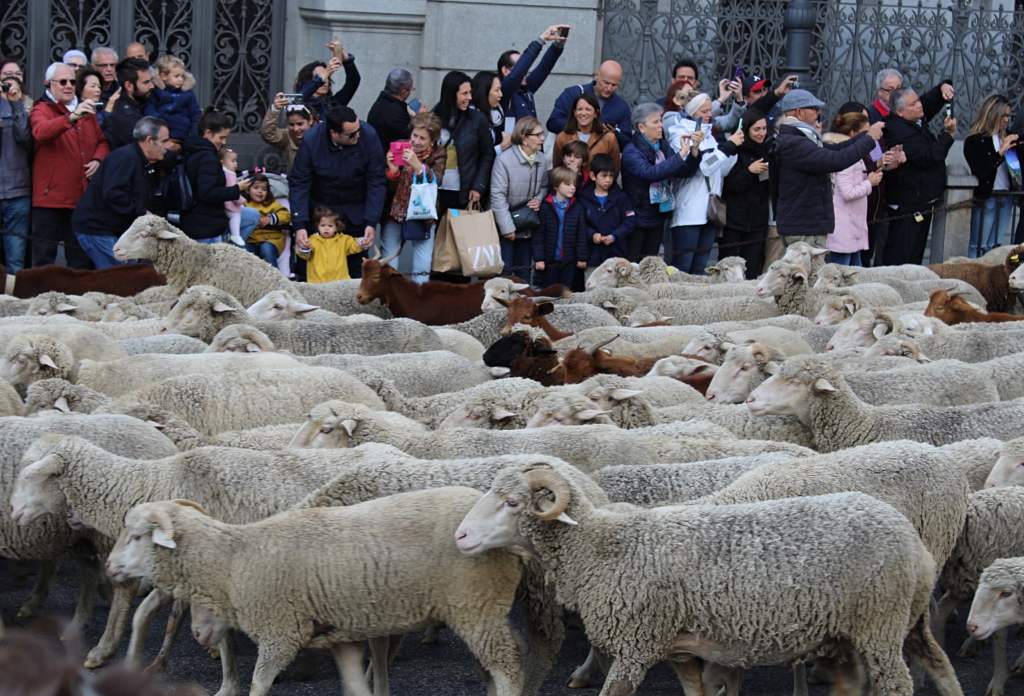
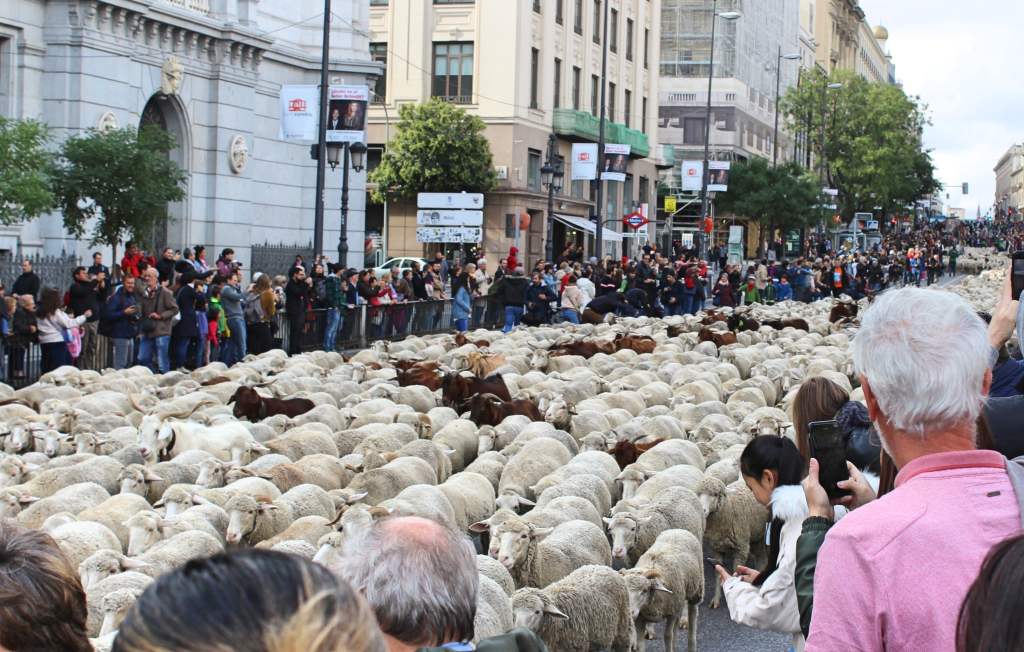
The next morning I saw something I had never seen before: the Fiesta de la Transhumancia, or the Transhumance Festival. This is a yearly event. Shepherds take their flocks of sheep and goats down from Asturias on the historical paths set aside by King Alfonso the tenth (so-called “the wise”) in 1273 for their use. One of these paths (called cañadas reales) cuts right through Madrid, and so the shepherds enter in grand array, wearing their traditional garb, singing songs, dancing, playing bagpipes, and leading their sheep from Casa de Campo to the Plaza de Cibeles. The shepherds were charming, but their sheep were exhilerating—a swarming ocean of white fleece. The whole scene could not have looked more out of place in the normally busy intersection.

This, in a nutshell, has been my October in Madrid. Certainly it lacks much of what makes Autumn in New York so charming. This time of year, I particularly miss the extraordinary fall foliage of my home state. But it must be admitted that Madrid has some compensating joys.

Images of the Fiesta de la Transhumancia

Images of the Fiesta de la Transhumancia

Every October in Madrid something peculiar happens: the streets around the center flood with about 1,800 sheep and 200 goats. This is the Fiesta de la Transhumancia, a festival celebrating the history of shepherding in Spain. By the time the sheep arrive in Madrid, they have already had quite a journey. Beginning in the north of the country, in the Picos de Europa, they make their way south for the winter on the cañadas reales, one of which passes through Madrid.

These “royal ravines,” as you might translate the term, were set aside in 1273 by Alfonso X (so-called “the wise”) to support Spain’s wool industry, and it seems that the shepherds have retained their ancient right. I have heard it said that this focus on producing merino wool ultimately damaged Spain’s economy by directing resources away from agriculture. In any case, it has given rise to this colorful tradition.

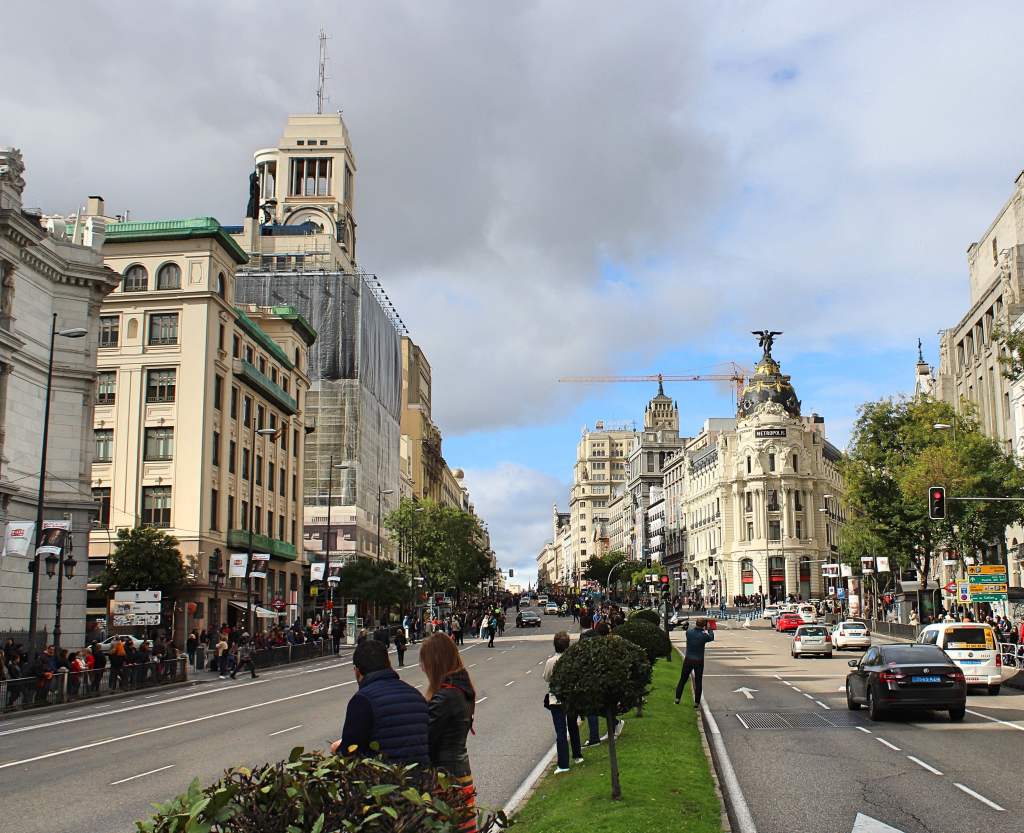
The sheep enter the city through Casa de Campo, and eventually make their way to the Plaza de Cibeles, passing through the Puerto de Sol during their trek. My brother and I scoped out spot near the bottom of Gran Vía to catch the sheep on the final leg of this journey.

The sheep are preceded by their masters, dressed in traditional garb, singing old songs, and playing historic instruments.

They are followed by a flood of sheep, punctuated by a few brown goats wearing tinkering bells. Alert sheep dogs and shepherds wielding cane sticks kept the animals moving in line. For somebody raised on or near a farm, such a sight would likely not evoke any strong reaction. But for me, it was exhilarating.

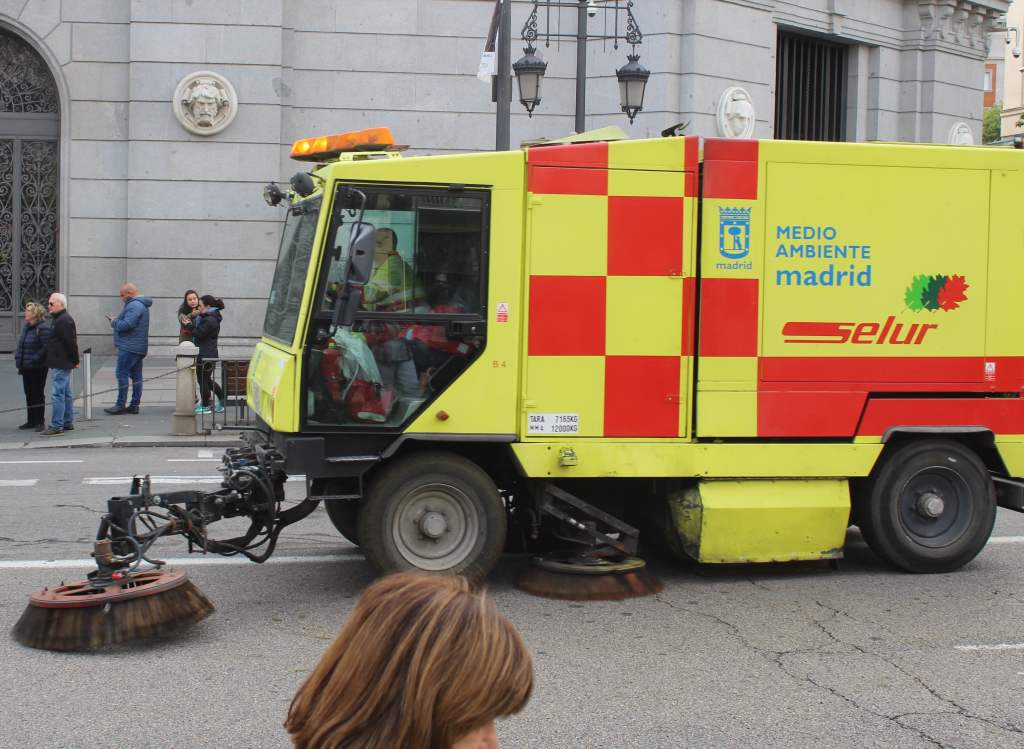
The sheep were followed by a team of oxen pulling a card—absolutely enormous beasts—and then a crew of street sweepers, to deal with the mass of urine and excrement left on the pavement.

New Podcast: Letters from Spain #1

New Podcast: Letters from Spain #1

I recently started on a new podcast project, Letters from Spain, where I hope to document my life in Madrid, and to reflect on some of the differences between Spain and the United States.

To listen to the first episode, click here.

Below is the text of the podcast:


Letter #1: Beginning

I am here to talk about Spain.

But I should begin with some reservations. Talking about other cultures is a dangerous enterprise. A major risk is exoticizing the culture—making it seem altogether unusual and even nonsensical. From there, it is a short step to dismissing the culture completely, treating it as an illogical accident of humankind, a bizarro land where nothing is as it should be. On the other extreme we may normalize the culture by focusing exclusively on the ways in which it is not so very different. This way we treat the other culture as we treat ourselves, which is partly good; however, this way we may fail to recognize how a culture is genuinely special.

This is only the beginning of our troubles. To talk about something, we must ourselves have a point of view; and that is formed, of course, by our own culture. For me that culture is American, specifically from New York, specifically from Westchester County, specifically from the town of Sleepy Hollow. For me, that is ‘normal,’ and this sense of normality shapes my perspective. I cannot help but compare Spain to this culture, my culture, and to see everything Spanish as, in a sense, a deviation. Is it possible to talk about a culture in purely objective terms? I doubt it; and even if it were possible, I doubt that it would be worth listening to. Culture is, among other things, a system of values, and you cannot understand it without having values of your own.

I am going on, listing difficulties, and yet there are still more risks. An obvious one is the use of stereotypes. Now, what is a stereotype? It is not merely a generalization, but a widely known and popularly believed generalization, usually with positive or negative ramifications. Each country has its share of stereotypes—the Spanish dance flamenco, go to bullfights, and sleep siestas, while Americans eat hamburgers and live in big houses. And so on. Now, some people say that stereotypes are problematic because they are generalizations. I don’t think that’s true. All knowledge consists of generalizations. And some generalizations are perfectly true. It is true, for example, that Spanish people tend to eat dinner later than Americans.

The problem with stereotypes, then, is not that they are generalizations, but that they are misapplied or untrue generalizations. Most Spanish people don’t like flamenco, or go to bullfights, or have time in the middle of the day for a nap. And, besides, these stereotypes are troublesome because they project a kind of fantasy version of Spain, where the people are living passionate, dangerous lives under the scorching Mediterranean sun. Don’t get me wrong, these things do exist in Spain, and they are interesting facets of Spanish culture. But to characterize the whole country that way is highly inaccurate, to say the least.

Considering all of these risks, then, what am I here to do? In this podcast, I hope to use my own experience in Spain to consider some of the subtler differences between life here and life back in the United States. To tell you something about myself, my name is Roy. I am a 28-year-old English teacher, living in Madrid. I decided to move here over four years ago, when I was working in Manhattan in an office job that, shall we say, did not fulfill my dreams of post-college life. I wanted an escape, to see the wider world, to go on an adventure; and Europe seemed to be the answer. I had been reading about European history for years. In undergrad, I studied cultural anthropology, and my advisor did his research in the south of Spain. Dreams of castles and philosophers’ graves beguiled me, and soon I found myself on a plane to Madrid.

You may ask, why Spain? Well, the answer is not very inspiring. Simply, Spain is one of the easiest countries to legally work in for Americans. It was an entirely opportunistic move. But, it was a fortunate one, since I became enamored of the country within months. My backstory explains my own bias. Like many people, I suspect, I came to Spain seeking an escape from the dreary world of American adulthood, and I found one. Thus, for me, Spain is tinged with a kind of rosy hue, as a place of refuge and adventure. I have lived here long enough for some of this to have worn off, but still I am predisposed to see all things Spanish as good. Still, I do hope I will avoid idealizing this country, since such a romanticized image would have little value. 

So in this podcast I want to explain what I have come to learn and appreciate about this place, and why I have chosen to stay year after year. And I will do this from an inescapably American perspective. The differences between Spanish and American culture goes far beyond flamenco and siestas, and I think these subtler differences have much to teach us. I hope do to this without either collapsing the differences between these two cultures, and without making Spain seem impossibly exotic. Let us see if I can thread the needle. 

Historic Hudson Homes: The Grange

Historic Hudson Homes: The Grange

This is part of a series on Historic Hudson Homes. For the other posts, see below:


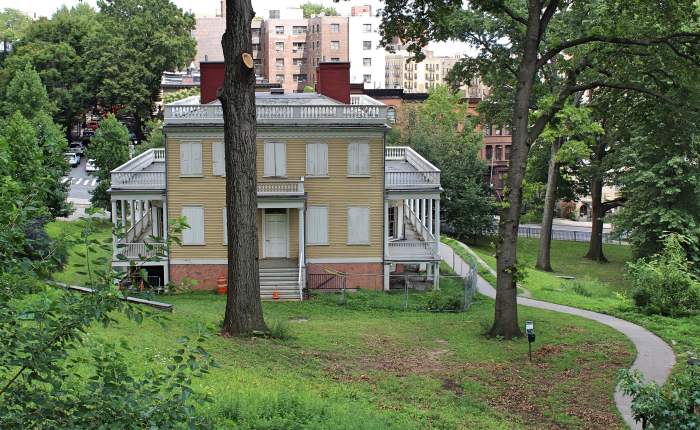
I stumbled upon the Alexander Hamilton’s house completely by accident. I met a couple of friends from out of town, and in the process of exploring the Upper West Side we came upon it.

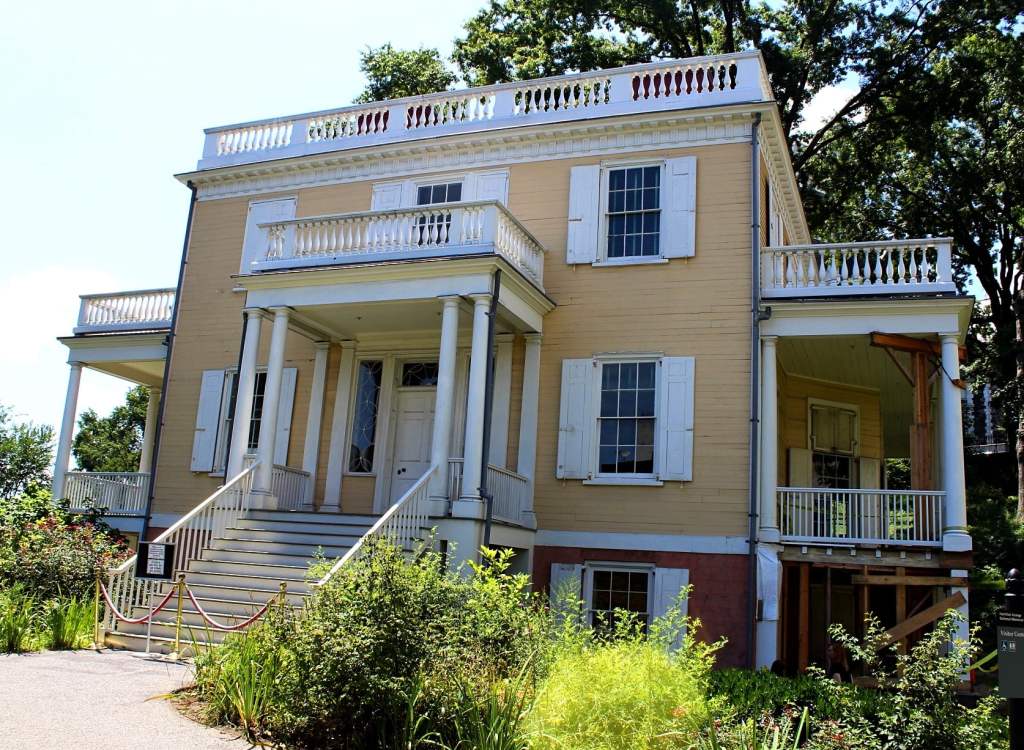
The discovery that one of the Founding Fathers’ houses was here, in Harlem, was astounding. The humble wooden house could hardly look more out of place nowadays. Set amidst the landscape of glass, steel, and concrete, the Federal style building looks as if it has been plopped down from another age. And in a way it was. The house has been moved from its original location not once, but twice.

When Hamilton had the house built, in the early 1800s, he was already in the twilight of his career. He had finished his epochal tenure as the Secretary of the Treasury—during which he constructed the nation’s financial system from the ground up—and had been reduced by a series of quarrels and scandals to an ordinary private citizen. To name just two watersheds in his life, he was publically exposed (and exposed himself) as an adulterer, and he also openly quarelled with John Adams, the presidential candidate of his political party, the Federalists. He was a brilliant statesman but a poor politician.

After this semi-voluntary retirement from the life of politics, Hamilton worked as a high-profile lawyer in New York City. Brilliant in everything he did, his career in law was no exception. To escape from the bustle of the city, Hamilton hired John McComb Jr.—the architect who designed NYC’s majestic City Hall, among other things—to build a rustic retreat for himself and his large family (he had eight children). At the time, Harlem was of course nothing like the city it is today. The area was still mostly farms and undeveloped woodland, an ideal spot to build a country house. 

Hamilton did not have much time to enjoy his little paradise, however. Just two years after it was completed in 1802, Hamilton was killed in a duel with Vice-President Aaron Burr—another high-profile NYC lawyer, and a long-time rival of Hamilton’s. The property stayed in the family for some decades hence, occupied by his long-surviving wife Elizabeth and their children. But eventually it was sold and, by the late 1800s, it was in foreclosure and doomed to destruction. The building only survived because of the intervention of the St. Luke’s Episcopal Church, which bought the house and had it relocated, to conform with the Manhattan street grid.

This purchase was not for purely disinterested historical reasons, however. The church modified the house so that it could be used for services—a purpose which it served for many years. Eventually a larger church building was constructed, enclosing the old home. Then, in the 1920s, a historical preservation society intervened, buying the property and partially restoring some of its original features and decoration. It was only in the 1960s that it was designated a National Historic Landmark. But it remained hemmed in by the many tall buildings that sprung up around it.

Finally, in 2006, the house was moved to a more open location, in St. Nicholas Park, which was still within Hamilton’s original property. The move was a minor feat of technical achievement, gently cradling the entire structure and shifting it, inch by inch, to its new home. Now it stands in a relatively open space, near a few churches, some brownstown apartments, a playground, a taxi service, and a funeral home. And this curious conjunction of the historical, the mundane, the holy, the profitable, and everything else, is what New York City is all about. 

For anyone who has visited Jefferson’s Monticello or Washington’s Mount Vernon, Hamilton’s little home may be something of a let down. Hamilton was never greatly wealthy in life; he owned no slaves*—indeed, was part of the Abolition Society—and, though addicted to work, was scrupulously honest in his personal finances. In any case, much of the house’s original furnishings and character were lost in its two moves and its many renovations.

The visitor enters on the ground floor, what used to be the basement. There is a small gift shop near the entrance, with books by and about Hamilton. The rest of the space is a miniature museum. There is a time-lapse video of the epochal re-location of the house, and a short documentary that plays on a loop, giving an overview of Hamilton’s life. His accomplishments are also displayed in a series of informational panels and timelines. My favorite object on display was a mourning scarf—a scarf made and sold on the occasion of his untimely death, for people to honor his life. Amusingly, the scarf gives an incorrect account of Hamilton’s background, saying that he was “descended by his father of respectable Scottish ancestry, by his mother was reputably connected to New York.”

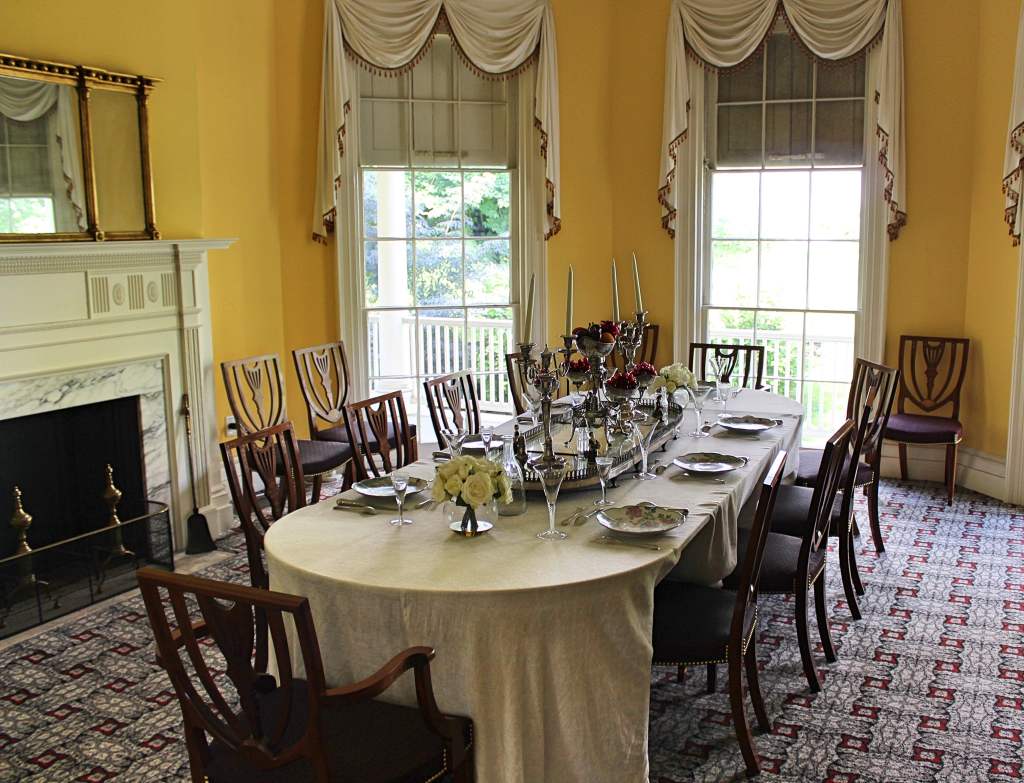
The Dining Room

The reality, as you may know, was very different. Hamilton’s father, James, was a complete failure in life, and abandoned Hamilton and his brother when they were very young. (James may not even have been Hamilton’s real father, anyway, as Chernow speculates.) Further, Hamilton’s mother was far from reputable—she abandoned her husband and had Hamilton out of wedlock—and, in any case, died when Alexander was very young, leaving him little in the way of property or connections. Hamilton was, in other words, both a bastard and an orphan, as his musical proudly proclaims. But I suppose it is not polite to mention that at a funeral.

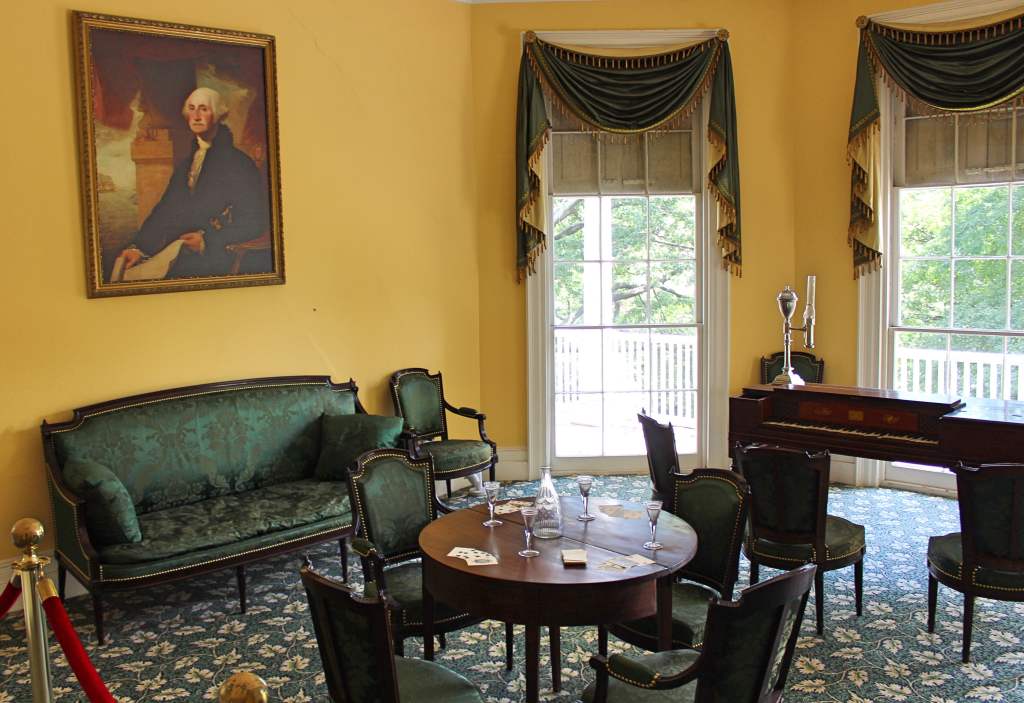
The Salon

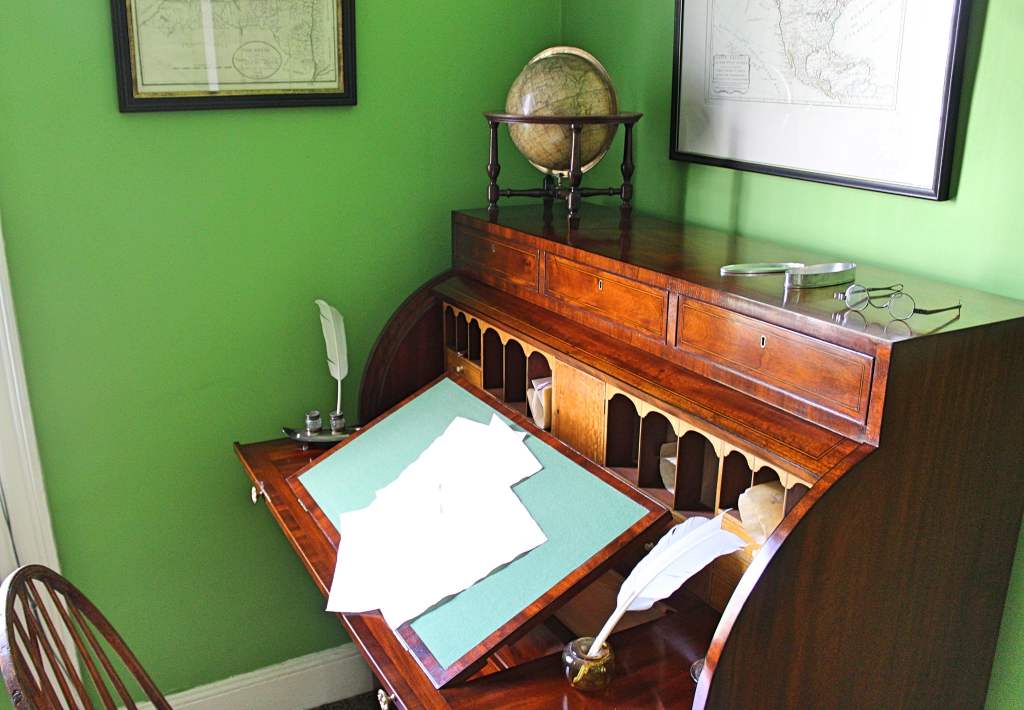
The house’s period rooms are all upstairs, on the first floor, accessible with a small wooden staircase from the basement. The hours of access are extremely limited (on weekdays from 12:00 to 1:00, and from 3:00 to 4:00), which makes visiting somewhat inconvenient. But it does not take much time to see everything. There are three main rooms to visit: the dining room, the salon, and Hamilton’s study (where he must have spent most of his time). The dining room features a long elegant table and is well lit with three tall windows. The salon is where I imagine the family spent much of their time, playing cards and receiving guests. Hamilton’s study is much as one would expect: decorated with maps and well-stocked with books. It must have been far messier and fuller when he was alive. He was an avid reader and inveterate scribbler.

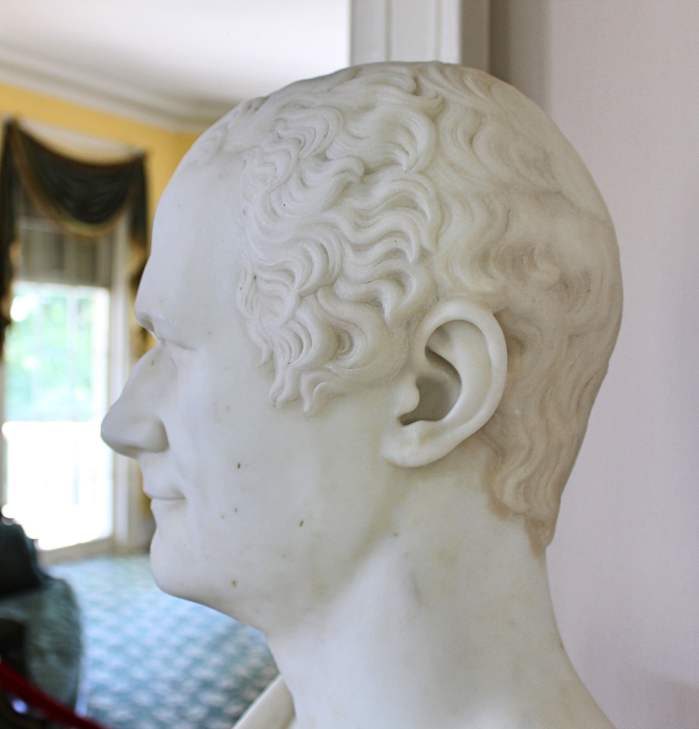
Two notable paintings hang on the walls, one a full-length portrait of Hamilton himself, looking like a sophisticated dandy. There is also a portrait of George Washington, given as a gift to the Hamiltons from the Washingtons (the two men worked very closely together). The two original paintings are now in the Metropolitan Museum of Art, where they hang proudly in the American Wing; the paintings here are reproductions. Even more captivating is a life-sized bust of Hamilton, dressed like a Roman statesman and looking quite like one too. According to the guide, Hamilton’s wife considered the bust extremely lifelike, and even spoke to it after his death. It is a wonderful piece, bringing him to life with a winsome and wise smile. (Thomas Jefferson, Hamilton’s great rival, had a replica of this bust in his house in Monticello, placed opposite to his own, so the two would be forever in opposition.)

And that is about all there is to see. If anything, the house is charming because it shows how humble may be the life of an extraordinary historical figure.

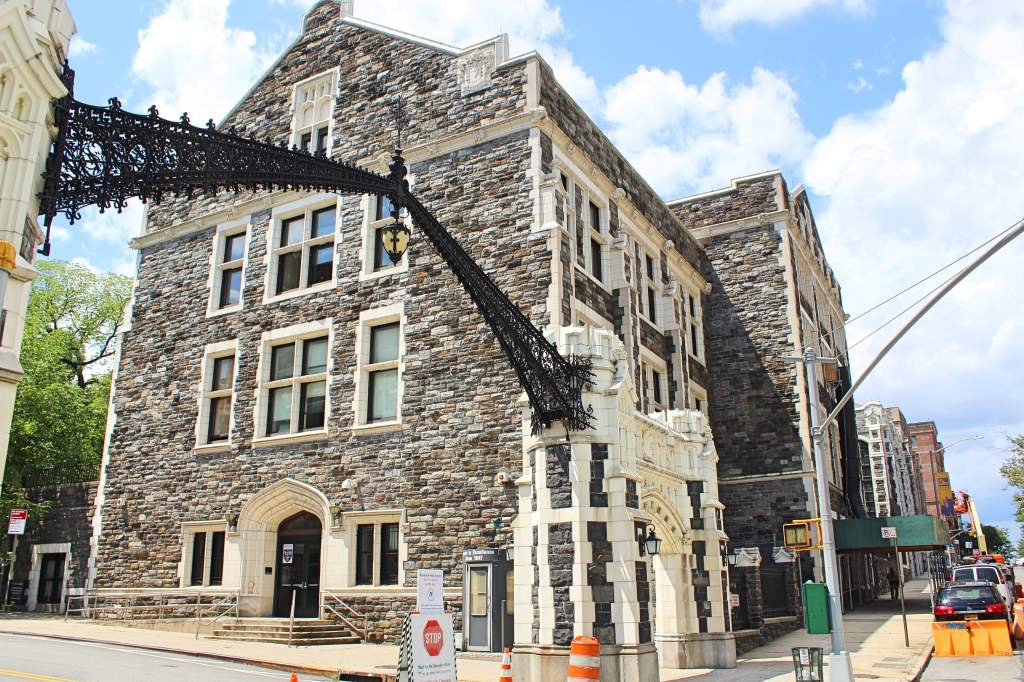
But I should not end this post without mentioning another monument next door. Up the hill from Hamilton’s Grange is one of the most attractive college campuses I have ever seen: the North Campus of CUNY’s City College. The entire complex is built in a flamboyant neo-gothic style, designed by the architect George Browne Post. Everything follows a unified aesthetic, from the elaborate iron grillwork on the gates to the little lamps flanking the entrances. The stonework on the buildings is particularly delightful, with enough subtle variation in color and texture to remain endlessly pleasant to examine. Every detail is well-done, from the wry gargoyles scattered throughout to the ornamented roofs and towers.

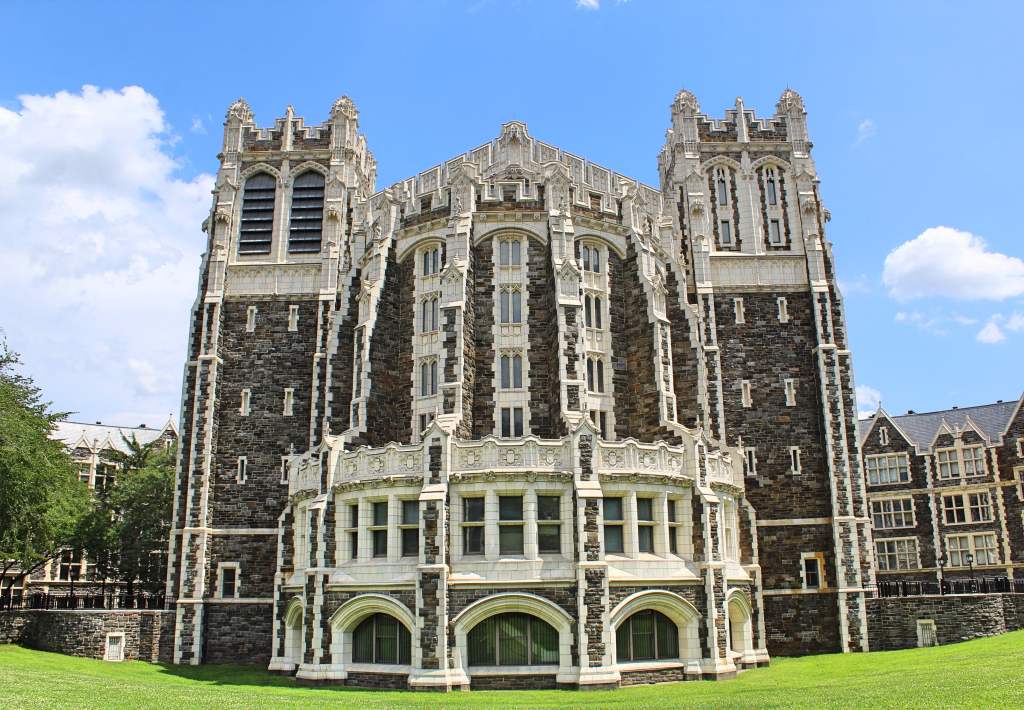
The centerpiece of the complex is Shepard Hall—named after a prominent NYC lawyer—which features a central building in the shape of a cathedral, and two curving wings on either side. Unfortunately I could not enter the building, as all the doors were locked. If I had gone inside, I would have seen the monumental Great Hall, a sort of central nave at the end of which is a mural by Edwin Blashfield, the artist who decorated the Library of Congress. In front of this hall is a statue of Alexander S. Webb, a general in the Civil War and the second president of the university. The statue makes him out to look like quite a swaggering military figure, and not exactly a bookish man.

(On the subject of statues, I ought, too, to mention the statue of Alexander Hamilton in front of the Broadway Spanish Baptist Church nearby. Here he looks rather like he does in the aforementioned painting, a heroic dandy.)

To me, the campus is a delightful and inspiring place. Indeed, the only American university campus of comparable beauty I know of is the University of Virginia, designed by Thomas Jefferson. Having gone to a rather unattractive university myself, I am very sensitive to the effect that architecture can have on the mood and atmosphere of an institute of higher learning. The strong verticality of the gothic buildings lifts one up and their historical form inspires a sense of participating in an honorable intellectual tradition.


*This may not actually be true. Subsequent research has shown that Hamilton probably did buy, sell, and own slaves. Oh well.

Processing…
Success! You're on the list.

Two NY Churches: Saint John the Divine and Riverside Church

Two NY Churches: Saint John the Divine and Riverside Church

New York provides an architectural feast, especially if you do not mind straining your neck. Not least among the city’s treasures are its many churches. I have already discussed Saint Patrick’s, the city’s Catholic cathedral, easily one of the grandest buildings in the city. But Saint Patrick’s is not the only cathedral in New York. 

Further uptown is a cathedral of even grander proportions: Saint John’s. This is a behemoth of a building, certainly the largest church building in New York City and arguably in the entire country. (The Basilica of the National Shrine of the Immaculate Conception, in Washington D.C., covers more area but contains far less volume.) And the building as it exists now falls far short of the original plan. Neither of the cathedral’s front towers has been completed, nor has the enormous tower that was to stand over the midpoint of the building. Indeed, after a fire destroyed the north transept in 2001, the cathedral has even lacked a crucifix floorplan. This has led it to be informally dubbed St. John the Unfinished.

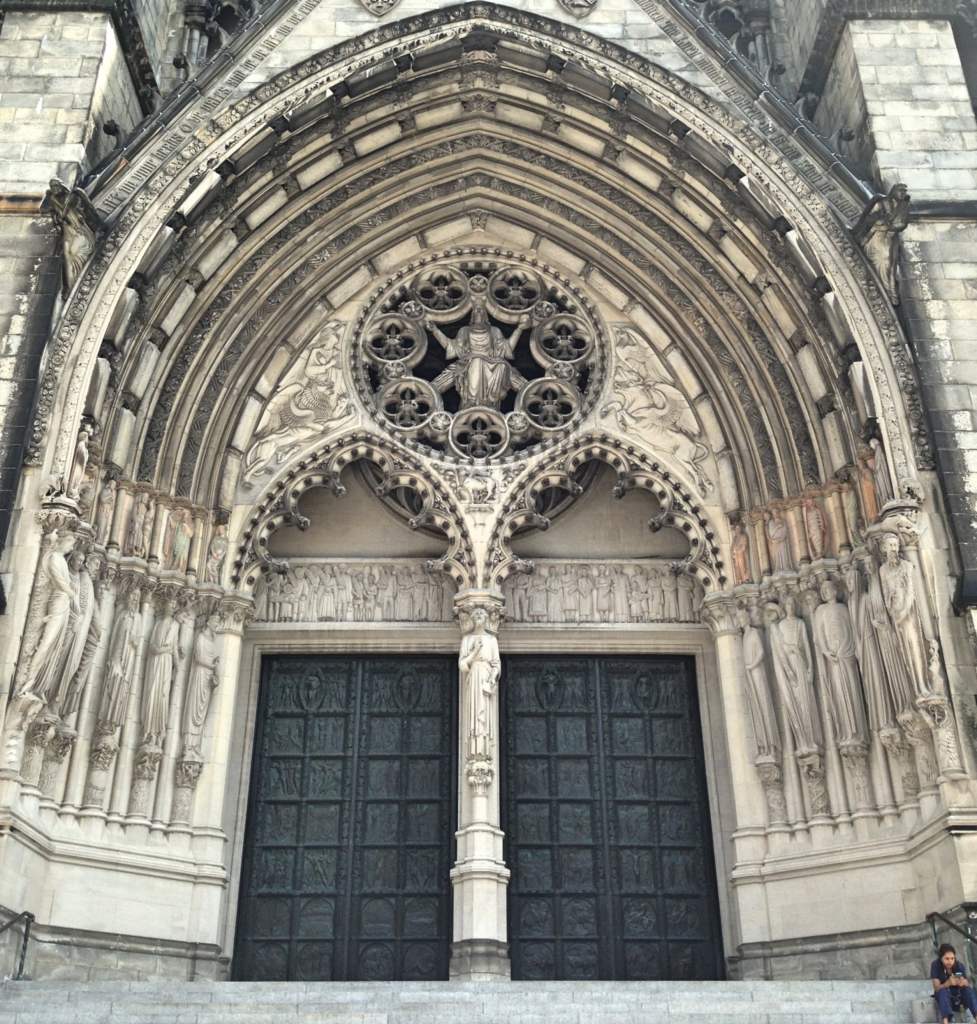
Even with all of these parts missing, however, it is a giant church. Not to be outdone by the Catholics, the Epicopalians conceived the project as a way to rival or even surpass St. Patrick’s. This cathedral, too, is built in an elaborate neo-gothic style that mimics the great cathedrals of France and Spain. Its hulking façade, with its three enormous doors sitting underneath pointed arches, beckons the visitor from the streets of modern Manhattan to a seemingly medieval world. All of the decorations carefully maintain this illusion, from the frilly spires, to the ornamental carvings, to the friezes of Biblical scenes above the doors. Even the monumental brass doors are covered in art, showing scenes from the life of Christ and representations of the four evangelists. Aside from the cathedral’s manifestly incomplete state, the only thing that breaks the illusion is the appearance of grey discoloration from car exhaust.

Note the person at bottom right, for scale.

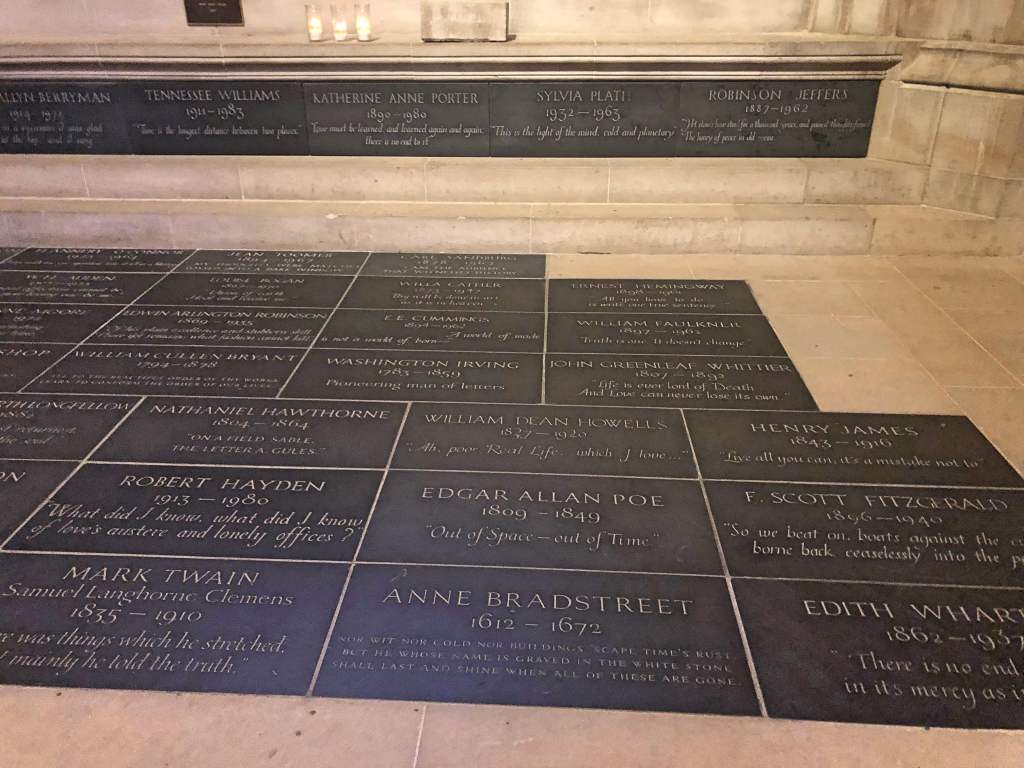
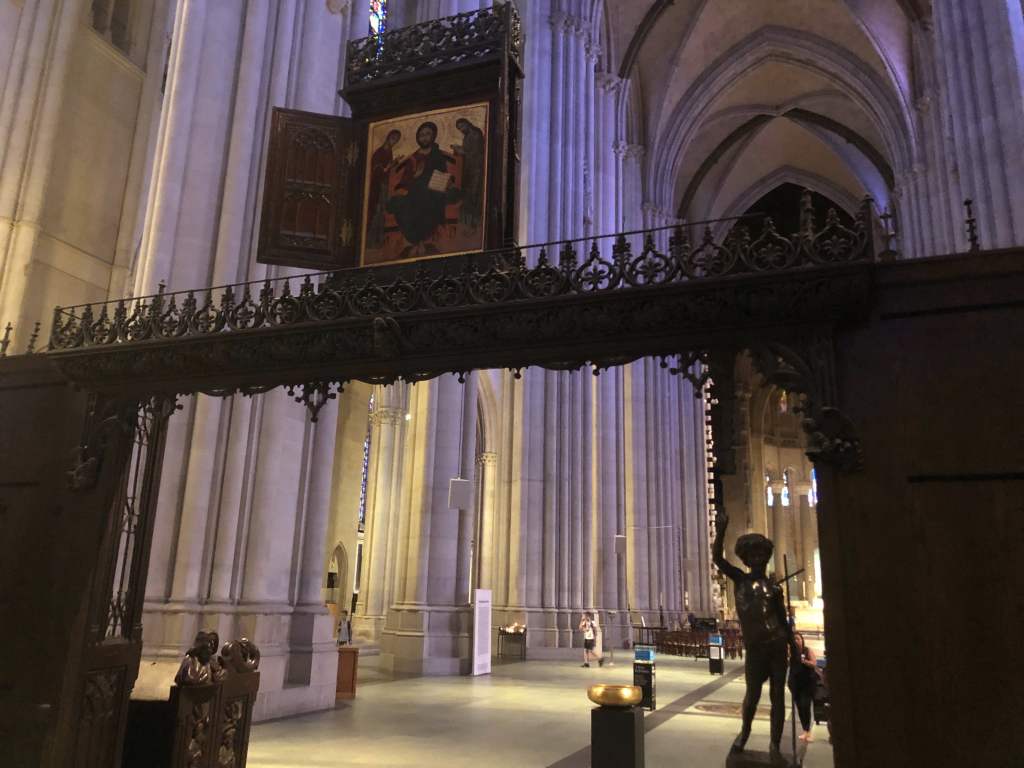
The inside is fully in keeping with this aesthetic. Enormous pillars hold up a vaulted ceiling, while stained glass windows allow colored light to drift inside. The visitor is greeted by a beautifully carved wooden choirstall, holding an image of Christ against a golden background. (This is a real 15th century German work, on loan from the Metropolitan.) The cathedral even has a sort of poor man’s version of the Poet’s Corner in Westminster Abbey. As far as I know, there are no actual poets buried in this section of the church; instead, small tablets bearing the names and brief quotes of famous American authors cover the floor. According to the plaque, the idea was inspired by a rector in the church of Washington Irving in my hometown, Tarrytown.

All this is true to the style of highfalutin European cathedrals. Closer inspection, however, reveals a church very unlike those it imitates, even St. Patrick’s downtown. Saint John the Divine was conceived as a different sort of institution, a “Democratic Church,” as it dubs itself, open to any and all who would like to come. True to form, the rainbow colors of LGBT pride were displayed prominently near one altar. And this is not a pose. To pick just two examples of the church’s progressive tendency, the cathedral hosted a performance by Diamanda Galás meant to raise awareness of the AIDS epidemic, and displayed Edwina Sandys’ statue, Christa, a portrayal of Christ as a woman (unsurprisingly, a very controversial work).

All of this is world’s apart from the staid, traditional activity of St. Patrick’s. On the other hand, it is free to walk into the Catholic cathedral, while visitors of Saint John’s have to pay.

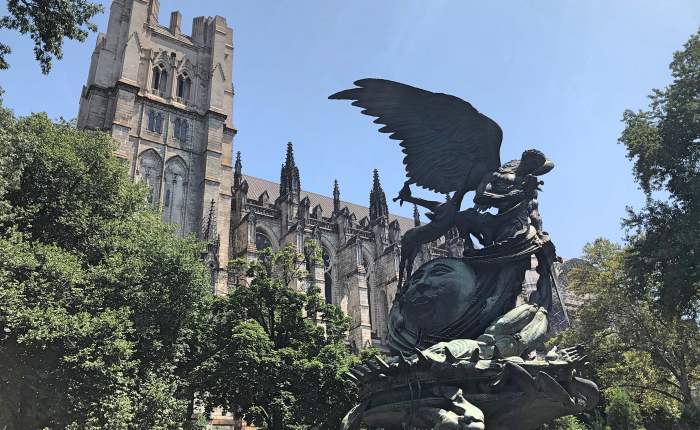
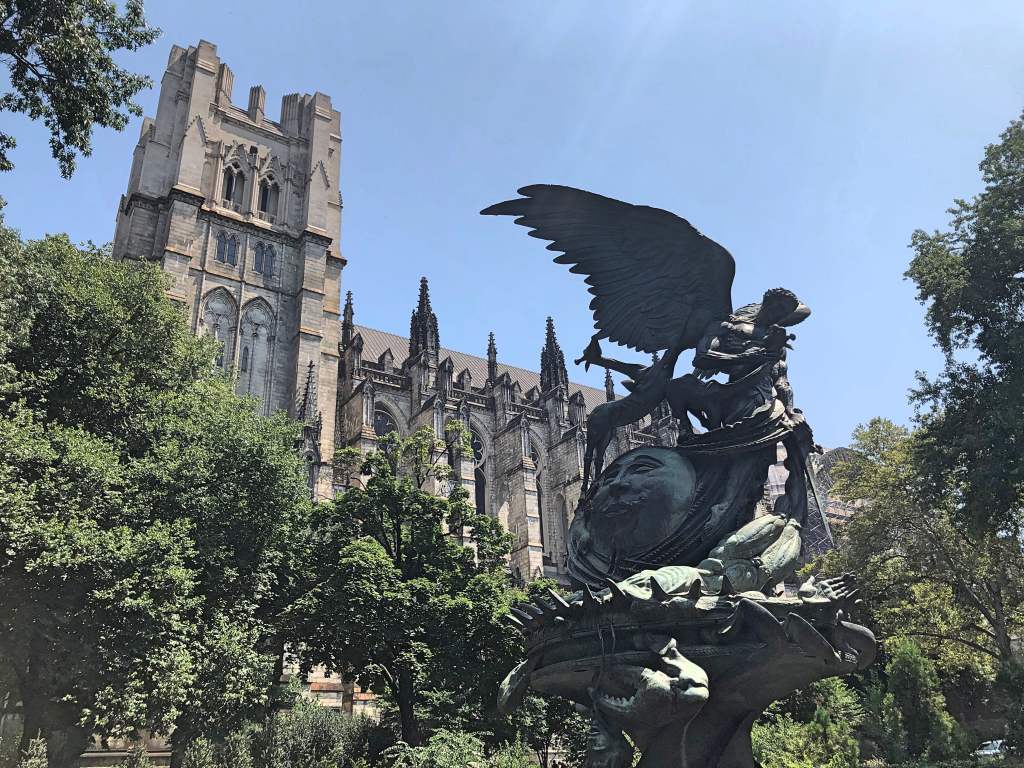
Adjacent to the building is an attractive little green space, known as the West 111th Street People’s Garden. Here is located the building of the Cathedral School, a K–8 school for children of any faith; and during the summer it is common to see flocks of children in summer camp parading by. Nearby is the Peace Fountain, a sculpture by Greg Wyatt supposedly portraying the battle between the Archangel Michael and Satan, and the triumph of good over evil. Yet to me the statue looks like an angel strangling a curious giraffe. In any case, the odd sculpture provides a nice illustration of the cathedral’s less orthodox attitude towards traditional themes.

To get to our next church, we must walk a good twenty minutes or so. The pleasantest route takes us directly through the main campus of Columbia University. Founded in 1754 as King’s College, Columbia is the oldest university in New York, and one of the best in the world. Suffice to say that everyone from Alexander Hamilton to Barack Obama have studied there. The campus leaves no doubt as to the honor, splendor, and pretensions of the institution. The grandiose Butler Library, for example, is adorned with the names of great thinkers and writers: Herodotus, Plato, Shakespeare, Tacitus, Voltaire… Directly opposite is the Low Memorial Library, another stately neoclassical edifice; and on the steps leading up to its entrance is the statue of Alma Mater, a symbol of the university, made by the same sculpture who designed the Lincoln Memorial, Daniel Chester French.

The thirsty or hungry traveler may also take a small detour to stop at Tom’s Restaurant, a diner used in the exterior shots of Seinfeld. (Though the outside looks exactly like it does in the show, the inside looks nothing like the fictional Monk’s Cafe.) It is a nice place to have a coffee.

The walk further uptown takes us alongside Riverside Park, and through some quite swanky neighborhoods, with upscale apartments attended by liveried doormen. It is an appropriate setting for a church intimately connected with wealth: Riverside Church.

Riverside Church was the idea of John D. Rockefeller, Jr. Curiously, this was not the first Rockefeller church that I visited. Much closer to my home, Rockefeller helped to establish the Union Church in Pocantico Hills, a lovely stone building with beautiful stained-glass windows by Marc Chagal and Henri Mattise. Riverside Church is much grander in scale, with an enormous bell tower that rises high up above the rest of the building, and which makes Riverside the tallest church building in the United States.

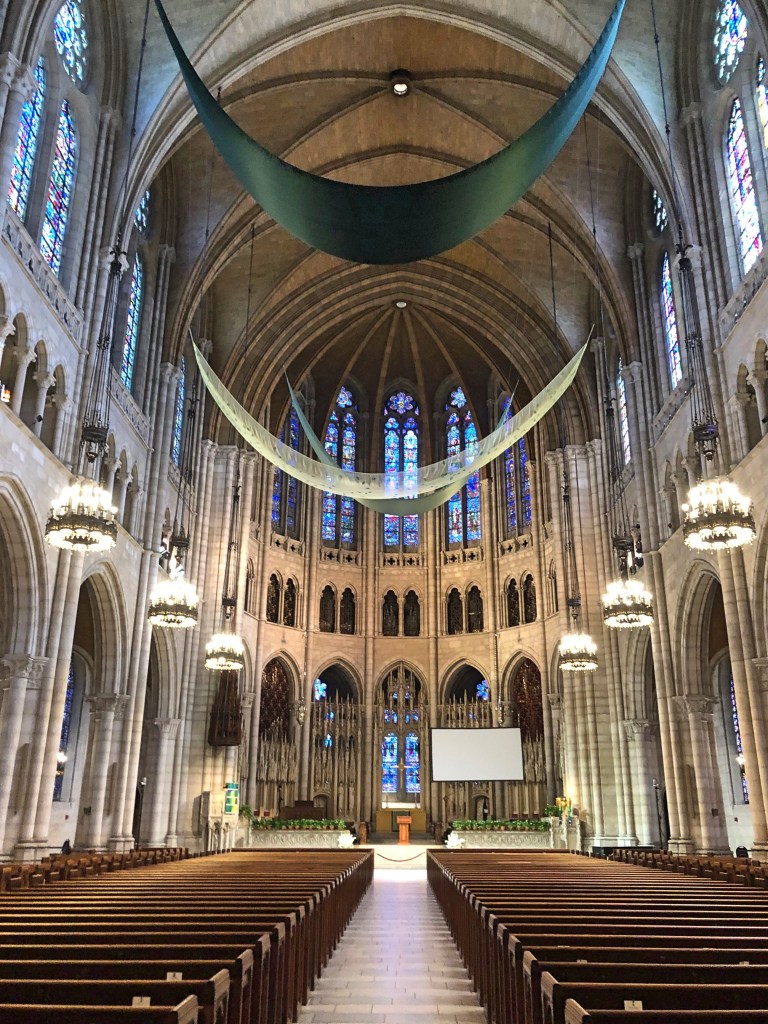
So big is the tower, in fact, that the actual church seems insignificant by comparison, though it is by no means small. The interior consists of a single nave, again neo-gothic in design, filled with pointed arches and stained glass. Architecturally, it is more perfectly composed, more pure of form than Saint John’s, which lends it a rare tranquility and grace. It is simple and beautiful. John D. Rockefeller was motivated to found the church partly out of a dissatisfaction with the Baptism of his youth. He wanted a more modern church, which is why Riverside is nondenominational, and also why great figures of science are carved into the decorations, including Galileo, Newton, and even Darwin.

Riverside Church is like Saint John’s in its history of progressive activism. Indeed, the church arguably has an even stronger connection to social reform. Most famously, Martin Luther King, Jr. gave a major speech against the Vietnam War here, in 1967; and there are still photographs of him on the bulletin board. A far more humble mark of the church’s ethos is the bathroom sign, which declares “Anyone can use this restroom regardless of gender identity or expression.” The church is still an epicenter for advocacy on many fronts, from anti-torture, to immigrants’ rights, to support for the HIV-positive. It is a model for a humanitarian church.

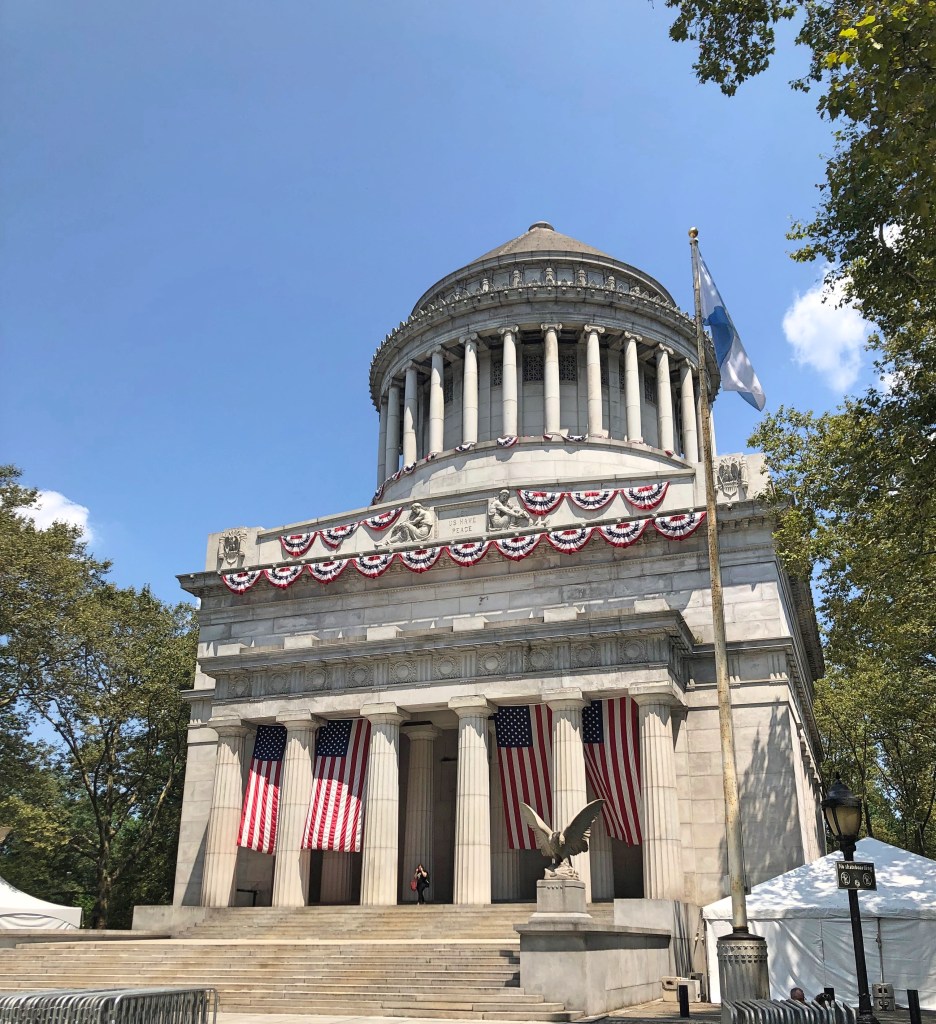
It is hardly sensible to visit Riverside Church without visiting the monument next door. Within a few hundred feet of the church doors is the tomb of Ulysses S. Grant, hero of the Civil War and 18th President of the United States. It is the largest and grandest tomb of an American President, an enormous neoclassical structure complete with Greek columns and domed ceiling. Even though his presidency has been widely regarded as a failure, he was an immensely popular figure at the time of his death; his funeral drew one and a half million spectators. This explains the grandiose design of his final resting place, which is highly reminiscent of Napoleon’s tomb in Les Invalides.

Nowadays, the tomb is a quiet and largely ignored corner of New York, with a handful of tourists respectfully poking about at any one time. Yet it is well worth a visit. Grant is interred in a massive granite coffin, alongside his wife in an identical sarcophagus. The coffins are below the floor level, visible through a hole in the floor, where they rise up from the lower level on a platform—again, much like Napoleon’s tomb. The visitor can descend and walk around the coffins, pausing to admire the busts of other Civil War generals, such as William Tecumseh Sherman. On the upper level, flanking the staircase, are two side chapels with historical flags from the war. And up above a mosaic depicts the surrender of Robert E. Lee to Grant. One could be forgiven for thinking that Grant was a general alone, and not a president, from the evidence of his tomb.

Here is where I will end my little tour, which can take as little as a couple hours. Separated by only a few blocks are the largest and the tallest churches in the United States—not to mention a historic university and an enormous tomb. But Saint John the Divine and Riverside Church are, for me, far more than architectural delights. They are living institutions, still engaged in the proper work of religion: to improve the lives of their congregations.

Two NY Cemeteries: Green-Wood and Woodlawn

Two NY Cemeteries: Green-Wood and Woodlawn

More people are alive now than ever before, and yet the dead still outnumber the living. Many, perhaps most, of those dead are buried beneath our feet. It is unclear whether there are more interments than inhabitants in all of New York City, but it seems at least possible, considering that over five million people are buried in Queens—over twice that borough’s population. Calvary Cemetery alone holds three million bodies, making it the largest cemetery in the country.

Queens became an epicenter for burials in the 19th century, when land scarcity in Manhattan led citizens to look further afield. The state government took a cue from Pere Lachaise, the magnificent Parisian cemetery located far outside the city center. They eventually decided to convert barren and useland land near the Queens-Brooklyn border into an array of cemeteries. According to Keith Williams, bodies in Manhattan were disentered in the dead of night, to be ferried over to their new home across the river; and many were doubtless destroyed in the process.

The city was badly in need of a park around this time. Neither Central Park nor Prospect Park would be open until the 1870s. It was partly for this reason that the beautiful Green-Wood cemetery, which opened in 1838, became so popular. Indeed, the cemetery was such an attractive place to stroll about that, by the 1860s, it had scarcely fewer visitors than Niagara Falls. Though mostly neglected by tourists nowadays, it is still a lovely respite from the noise of city life, not to mention a repository of the city’s history.

I visited the cemetery on a scorching day in August. The air was humid and heavy. My clothes were soaked through with sweat, and the sun beat down harshly in the open space of the cemetery. Autumn or spring is preferable. I entered through the monumental neo-gothic gate at 25th street—a delightful work of architectural exuberance by Richard Upjohn, one of the founders of the American Institute of Architects.

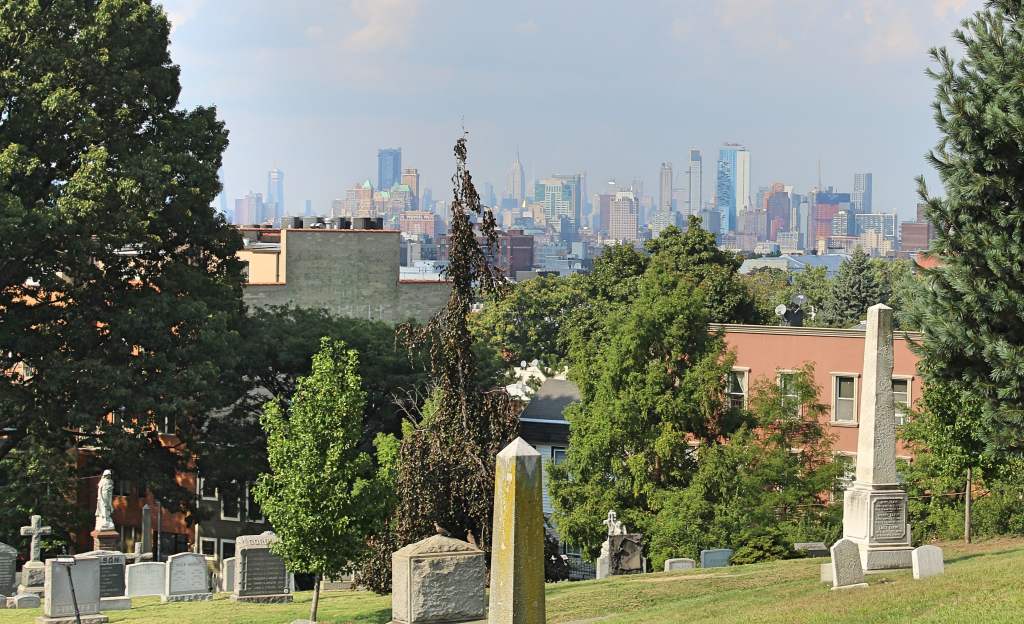
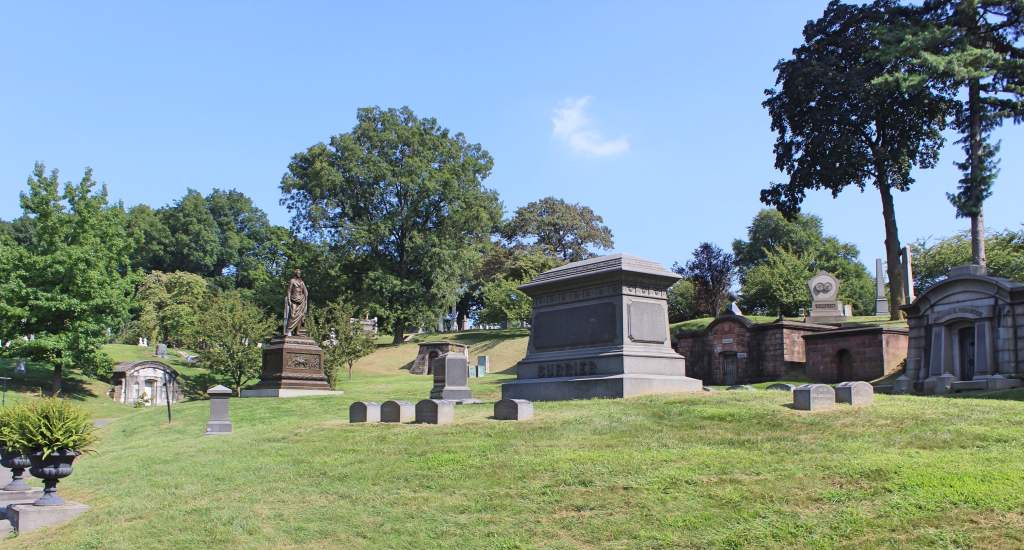
Once inside, the cemetery is as rustic and attractive as a park, with roads winding through grass lawns and scattered trees. The tombstones are distributed somewhat sparsely and unevenly in this immense green space. The majority are simple graves, no more than a foot or two tall, with some more imposing obelisks thrown in. Here and there one finds a statue, in bronze or stone, and some of the wealthier families have their mausoleums built into hillsides. Near the entrance at 25th street is one of the original ponds; and nearby is the cemetery chapel, a noble structure modeled after the work of Christopher Wren. Even more beautiful, perhaps, than the cemetery itself is the view that it provides, with several vantage points offering an excellent look at the Manhattan skyline beyond the river. 

Green-Wood Cemetery holds over 560,000 “permanent residents” (as the website calls them) and a great many of them are famous. Indeed, a list of the prominent burials in the cemetery reads like a who’s who of notable 19th century New Yorkers. We have Henry Ward Beecher (1813 – 1887), a preacher who during his lifetime was among the most famous men in America. Brother of Harriet Beecher Stowe (the author of Uncle Tom’s Cabin), Henry was himself an abolitionist and later on a champion of women’s suffrage. However, his immaculate image became somewhat tarnished during a highly publicized adultery trial.

Another dead titan from this age is William M. Tweed (1823 – 1878), known as “Boss” Tweed, the corrupt and powerful leader of Tammany Hall. After years of stealing millions of taxpayer money, he was exposed and thrown into prison. On the stand, with nothing to lose, his confessions shocked the nation. He hoped for an early release; but that was not to be. Tweed did manage to escape custody once, sneaking across the Atlantic aboard a Spanish vessel; but he was apprehended in Vigo, Spain, by the local police (who had nothing other than a rough sketch to go on). He eventually died in an American jail.

Green-Wood cemetery, though never affiliated with any religion, has prided itself through the years on its respectability, prohibiting all executed criminals, and all who died in jail, from burial within its esteemed grounds. But Tweed, never one to play by the rules, posthumously circumvented this rule and found himself underground for the long sleep.

To discuss all of the notable people sunken in the dirt would take me from now until my own funeral. But I might mention two great musical giants to be found there, Leonard Bernstein (1918 – 1990), most famous for West Side Story, and Elliot Carter (1908 – 2012), one of the pre-eminent American composers of the last century, who lived all of 103 years. Yet another of the cemetery’s residents may have had a greater influence on music than either of these composers: Henry Steinway (1817 – 1871), founder of Steinway & Sons. His son, William (1835 – 1896), is there too, who played an important role in the development of Queens. In fact, the 7 train stills runs under the East River in the so-called Steinway tunnel, which William commissioned for his own shipping and transportation.

We may also find some men of the Revolutionary era, such as William Livingston (1723 – 1790), a New Jersey governor who signed the Declaration of Independence, and DeWitt Clinton (1769 – 1828), New York governor who oversaw the building of the Erie Canal. Indeed, the cemetery itself has a deep connection to the Revolutionary War, since it occupied a sight of a major engagement in the Battle of Brooklyn during the opening stages of the war—when invading redcoats routed Washington’s ragtag army, in a colossal defeat for the rebels. 

But the cemetery is not just a collection of famous bodies. A more somber monument is that raised to the victims of the Brooklyn Theater Fire, a conflagration which killed nearly 300 people in 1876. Of the victims, some 100 whose bodies were scorched beyond identification were interred in a common grave here, marked by an obelisk. About twice as many people died in this disaster as in the more famous Triangle Shirtwaist Factory fire of 1911. It was the third-deadliest fire in American history.

Even if you have no interest in the dead, Green-Wood is worth visiting for its greenery. In fact, Green-Wood is a notable arboretum, and its map also has the location of some notable trees—such as American Chestnuts and large Camperdown Elms. Life prospers where death appears to reign.

On that note, let us leave the Green-Wood cemetery and travel back across the East River, to Manhattan, and then onwards north to the Bronx. Here we will find another enormous and noteworthy cemetery: Woodlawn.

Opened during the Civil War, in 1863, this cemetery received some of bodies removed from overcrowded Manhattan. It has since grown to vast proportions, and is now the resting place of over 300,000 people. While not as inviting and park-like as Green-Wood, and while not providing such an excellent view of Manhattan, the cemetery is quite attractive in its own right. What is more, Greenwood is the final resting place of some of the most iconic figures in American history.

I visited on a cold winter day, last January, with my father. My priority was to see the tomb of Herman Melville (1819 – 1891). It is a simple and indeed humble tombstone, with nothing but an empty scroll of paper as decoration. This was surprising to me. For my money, Moby Dick is the Great American Novel, and Melville our greatest novelist. Yet Melville himself died in relative obscurity. After early success writing potboiler seafaring novels, Melville’s reputation sank once he turned to more serious work; and starting with Moby Dick, he was a critical and financial failure. It was only some decades after his death that his star began to rise again. For any struggling writers (such as myself) his story provides a depressing truth, slightly tempered by the hope that posterity can be kinder than contemporaries.

Melville and Me

My father’s hero is also in this same cemetery: Miles Davis (1926 – 1991). A bass player and jazz lover, my dad has been talking to me about Miles Davis all my life, especially Davis’s landmark album, Kind of Blue; so it was gratifying for us both to finally visit him. Davis’s grave is a large tombstone, so highly polished as to be almost mirror-like. The first two measures of one of Davis’s compositions, “Solar,” are inscribed on the tombstone. Curiously, Davis is referred to as “Sir,” which as I learned was because he was inducted into the Order of Malta (in a ceremony in the Alhambra in Granada).

Note our reflections
Miles and My Dad.

It would be hard to name a musician so influential in the history of jazz. Yet there is one buried right next to Davis: the Edward Kennedy Ellington, better known as “Duke” (1899 – 1974). Ellington has a claim to being the supreme composer of jazz tunes—many of which have become standards in the repertoire—and, indeed, I think he can be justly considered one of the master composers in any genre of the last century, for his music went far beyond the conventional boundaries. His grave is a small plaque in the ground, set before a large tree and flanked by two stone crosses. 

Nearby, up the hill, is the conspicuous grave of Illinois Jacquet (1922 – 2004), an important saxophonist; and not too far off lies Coleman Hawkins (1904 – 1969), another great saxophone player, and further on Max Roach (1924 – 2007), the great bebop drummer. Woodlawn does not, however, cater solely to jazz musicians. Also interred is Irving Berlin (1888 – 1989), the Russian-born Jewish composer who helped to define American music, all while being unable to read music and only being able to play in the key of F sharp. Even if you know nothing of Berlin, chances are you can sing at least one of his songs.

Two major figures from the history of New York City are also here in Woodlawn. Fiorello La Guardia (1882 – 1947), the short Italian sometimes called the “Little Flower” who was arguably the city’s most influential mayor. He sits under an elegant tombstone, which states simply: “Statesman, Humanitarian.” Buried within the community mausoleum is someone perhaps even more influential in the city’s history, Robert Moses (1888 – 1981), the subject of the landmark biography The Power Broker. Moses was a power broker indeed, responsible for the building of parks, roads, public housing projects, and bridges. In the process, Moses displaced hundreds of thousands of the poor and destroyed whole communities. He died with his reputation in tatters, yet having fundamentally shaped New York in the twentieth century.

Woodlawn, too, is an arboretum, with some beautiful trees on its grounds. Unfortunately for me, January was not the best time to appreciate this. Nor was the bracing breeze of that January day any more pleasant than the oppressing heat and humidity of the day in August when I visited Green-Wood.

In spite of this, I greatly loved my visits to these two resting grounds. Indeed, cemeteries are some of my favorite places. They are storehouses of history, and sites of homage to those who have shaped our world. They are also places of peace, an escape from the bustle of the surrounding city, providing us a space to contemplate how our own lives might be remembered. I recommend a visit.

NY Museums: The American Museum of Natural History

NY Museums: The American Museum of Natural History

This is part of a series on New York City museums. For the other posts, see below:


There is no place in New York City to which I have a more intimate connection than the American Museum of Natural History. I practically grew up inside its walls. For a nerdy boy on the Upper West Side, it was the perfect place for a weekend outing. My mom recalls taking me there and letting me run around in the big Hall of Ocean Life, while she enjoyed a beer at the refreshment stand. (They do not sell beer anymore.) My dad took me plenty of times, too, and then followed up the visit with a meatball subway sandwich.

Kids still love the museum. The natural world, after all, is far more accessible than the highfalutin world of art. A child who is still figuring out the basics of the world around her has no need of elaborate images to reconnect her to her senses. And it is fortunate for our society that the museum is so accessible to children. Judging from the case of Carl Sagan, Stephen Jay Gould, or Neil deGrasse Tyson (as well as myself) the fascination exerted on youthful visitors to the museum often matures into a fascination for the natural world and a respect for the power of human reason. And you do not need to be a child to feel this twin amazement at world without and the intelligence within. I feel it every time I visit.

You can enter the museum from several spots. The grandest is, without a doubt, through the Roosevelt Rotunda on Central Park West. When walking up the stairs, the visitor will notice the heroic equestrian statue of President Theodore Roosevelt. It is worth pausing to continue this statue, for it encapsulates much of the controversial history of the institution. The mustachioed man is flanked by a Native American and an African man, both on foot, and both looking rather dejected to my eyes. The racial message is clear: the white man sits atop the lesser races. To its credit, the AMNH is acknowledging this imagery with a special exhibit, “Addressing the Statue.” I think this strategy is far preferable to the idea of simply removing it, since now the statue provides an opportunity for learning.

Theodore Roosevelt holds a special place in the history of the museum. His father was one of the museum’s founders, when it was still housed in the Arsenal Building of Central Park. The younger Roosevelt was himself an ardent naturalist, and we have him to thank for many of our country’s most beautiful national parks. But being a nationalist in those days did not mean what it means today. Roosevelt did an awful lot of hunting on behalf of the museum, providing some of the exotic animals that were later stuffed and mounted in the amazing displays. Our views on hunting big game and on racial differences have both, fortunately, evolved since then.

To thank the President for his support, the museum is studded with acknowledgements. The most extravagant of these is the massive mural painted by William Andrew Mackay, covering three tall walls of the Roosevelt Rotunda, where the visitor enters. These depict the eventful life of the naturalist president, turning him into a kind of secular saint on the walls of the cavernous room. But of course most people’s attention is absorbed by what is happening in the middle: the dramatic encounter between a brontosaurus protecting its calf, and the hungry allosaurus prowling for prey. Both the baby and the predator are dwarfed by the gargantuan form of the brontosaurus, whose already significant height is bolstered by standing on its hind legs. Personally I doubt that such a massive animal could perform such a maneuver without breaking its legs. Indeed, replica fossils had to be used, since the real fossils (made of stone, after all) are too heavy to mount in such a way.

Much as I would like to move on to the museum’s exhibits, there is one more relic from the museum’s past that deserves comment. Downstairs from the glorious Roosevelt Rotunda is the Roosevelt Memorial Hall, which includes four small exhibitions about the varied activities of the president: his interest in nature; his love of exploration; his time as a statesman; and his life as a writer. What draws most attention, however, is a diorama showing a meeting between Peter Stuyvesant—the Dutch leader of what later became NYC—and the indigenous Lenape people. Made in 1939, this diorama contains several omissions and inaccuracies that work in the Europeans’ favor, such as showing the Lenape almost nude. Again, to its credit, the AMNH has included annotations on the glass, pointing out several of these problems; and their website includes lesson plans to help visiting teachers use the diorama.

I am dwelling on these examples of the museum’s less noble past, not to portray the institution in a negative light, but to show that the museum is working to improve itself without burying its past. It is a model to imitate. And the museum has a long history. This year, 2019, marks the 150th anniversary of the institution. This makes the AMNH one year older than the Metropolitan, which was founded in 1870.

Now it is finally time to enter the museum. Luckily, the entrance fee is still a suggested donation for all visitors, so you need not break the bank. What should we see first? There is a great deal to choose from. In fact, the AMNH is the largest natural history museum in the world, with millions upon millions of specimens of animals, fossils, minerals, artifacts… It would be virtually impossible to see the entire thing in one day. For my part, it has taken me dozens of visits to fully wrap my mind around the museum; and even a lifetime would not suffice to learn all it has to teach.
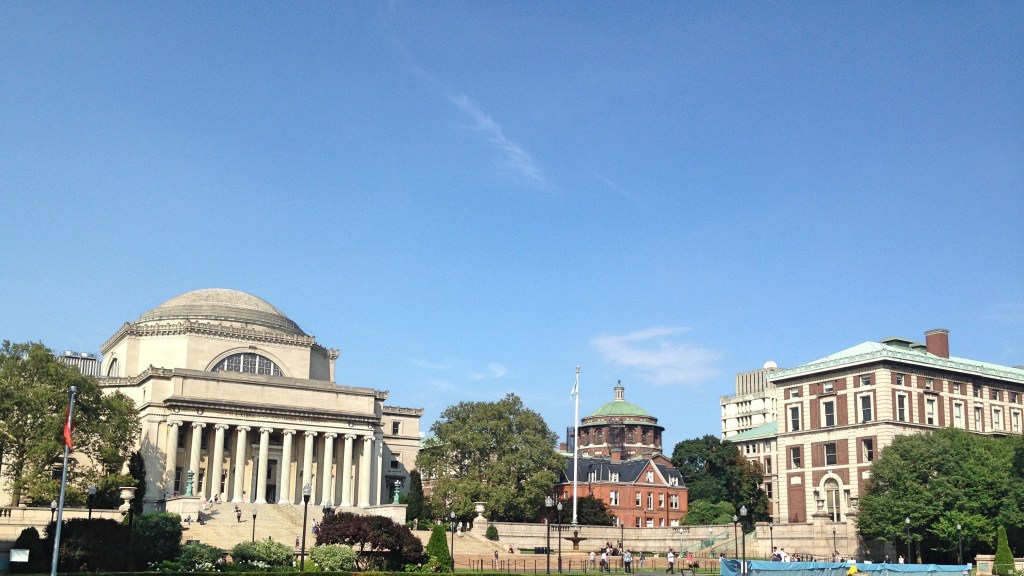
Let us go on straight ahead from the Roosevelt Rotunda into the Hall of African Mammals. Simply as a work of art, this is one of the high points of the museum. In the center a herd of eight African elephants—bulls, cows, and calves—huddle together. Arranged around this heard, in little niches in the walls, are other exotic animals: lions, zebras, giraffes. The visitor would be forgiven for thinking that all of these were merely plastic replicas; but they are real taxidermied specimens of animals (one of the elephants was shot by Theodore Roosevelt himself). This gives the dioramas a kind of macabre air, which is combined with melancholy when examining endangered species such as the rhinos and the gorillas. 

Yet art intervenes to uplift this collection of exotic bodies into a thrilling exhibit. Every diorama is masterfully done: the animals stand in dramatic, lifelike poses amid an environment so scrupulously recreated as to be totally convincing. Added to this are the paintings on the curved surfaces enclosing the dioramas. These hand-painted backgrounds are worthy works of art in their own right: adapting perspective to the wall’s curvature in order to create a nearly seamless continuation with the scene in the foreground. The result is a strange blend of natural beauty and human invention, which is at turns convincingly lifelike and technically astounding. As I walked along from diorama to diorama, I felt like pilgrim visiting a church, walking around from chapel to chapel.

The lion’s share of the credit for this work goes to Carl Akeley, who participated in both collecting and mounting these specimens. Though this business of big-game taxidermy can seem to us in the present day as grim and barbaric, I think that Akeley deserves to be viewed as an artist of high ability. Creating compelling nature dioramas is no easy matter. It requires a naturalist’s eye for fact and a sculpture’s eye for form. To construct a compelling design that is, at the same time, true to nature, requires a special knack. Akeley was a master of it.

A kind of sister to this gallery is the Hall of Asian Mammals, also accessible through the Roosevelt Rotunda. This is a decidedly smaller space; and as the plaque on the wall informs us, the animals here are owed to a “Mr. Ferney” and a “Colonel Faunthorpe,” who made six expeditions into Asia to hunt these animals. Two Asian Elephants stand in the center of this gallery, slightly smaller than their African counterparts. This gallery originally contained a specimen of a giant panda and a Siberian tiger, but the subsequent history of those species led the museum to place these in the Hall of Biodiversity as examples of endangered species (more later). On my latest trip, I learned that there is a type of Asian Lion with a rangy mane, which lives in a small sliver of India.

Now let us descend a flight of stairs once again to the Rockefeller Memorial Hall, on the ground floor. Here we can enter the space directly below the Hall of African Mammals: the Hall of North American Mammals. We find still more superb animal dioramas. The most famous of these is the Alaska Brown Bear. Two of these stand behind the glass. One is reared up on its hind legs, while the other prowls menacingly nearby. The height of the upright bear is startling. Standing before it, you feel how easily this creature could overpower you. Another superb display is of the moose, which features two bull moose jousting with their antlers. As a Canadian friend once told me, moose are the “king of the beasts.”

A quick trip through the Roosevelt Memorial Hall will lead us to one of the museum’s newer spaces: the Hall of Biodiversity. Opened in 1998, it did not exist when I was a young child. The room has a stunning design. Through the center is a swath of artificial rainforest, made to replicate one of earth’s most diverse environments. A legion of tentacled creatures hang from the ceiling, including a giant squid, an octopus, and a massive jellyfish. A glass case holds the giant panda and Siberian tiger, among others, as examples of endangered species; and the bones of the long-dead dodo can be found. Most of the action takes place on the far wall, which is illuminated from behind. Here is represented the entire panoply of life, from bacteria, to algae, to fungi, to plants, and finally to all the many variations of animals: worms, insects, crustaceans, mollusks, and vertebrates of every kind. (There is an online version that you can click through.)

The sheer abundance of models on display gives a visual illustration to the richness of life on this planet. This amazing variety, developed over 3 billion years of evolution, goes far beyond our humdrum ideas about plant and animal types. To give an example, once a teacher of mine asked everyone in class to make a guess at how many species of bee there are in the world. People’s guesses ranged between 12 and 300. The answer is 20,000. Unfortunately, this biodiversity is being dramatically curtailed through human action—which is why this gallery was made. 

This attractive space opens up to what has always been, for me, the most dramatic room in the museum: the Hall of Ocean Life. Here is where I would spend most of my time as a child. This hall is one of the biggest spaces in the museum. It is dominated by the life-sized model of a blue whale, the largest animal to ever exist on the planet, hanging from the ceiling. This lightweight model weighs no less than 21,000 pounds—so just imagine what the real animal must weigh. It is frankly stupefying that something so large can be alive. The entire herd of elephants from the Hall of African Mammals can huddle underneath its belly.

Dioramas line the walls of both floors of this hall. The best of these are on the bottom, where you can find a polar bear, a pod of walruses, and a huddle of sea lions. Here, as elsewhere, these displays are amazingly dramatic and lifelike. We can see the sharks in pursuit of the poor sea turtle, and the dolphins jumping out of the water to catch some flying fish. But the real masterpiece of this hall is the battle between the sperm whale and the giant squid. The sperm whale is the biggest toothed predator in the world, and its prey is likewise large. This big-headed mammal dives deep under the water—sometimes over a mile deep, going more than an hour without breathing—in order to prey on the invertebrate monsters that lurk below.

The most notable foe of this whale is the giant squid, itself one of the world’s largest animals, capable of growing to over 40 feet in length. When a whale finally catches on of these squids, it must be a serious fight, as the suction-cup scars found on the hide of sperm whales attest to. The diorama evokes all the drama of this encounter. We arrive once the fight has commenced: the whale has one of the squid’s tentacles in its jaws, and the squid is wrapped around the whale’s enormous head. The diorama is illuminated in a semi-darkness that recalls the inky blackness of the deep ocean

As a child, I found this scene both fascinating and terrifying, and became obsessed. I drew the battle over and over, doing my best to perfect the two different forms: the smooth blue whale and the sprawling red squid. Even now, this conflict between the big-brained sperm whale and the monstrous giant squid calls to mind a deep conflict within our own nature.

This description only touches upon the strange, otherworldly beauty on display in the Hall of Ocean Life—a beauty that captivated me as a child and which still moves me. The world below the seas is more fantastic and alien than anything dreamed up in science fiction. You can see this clearly in the three dioramas depicting life in the ancient oceans: creatures whose bodies form spirals, cones, wings, prowling about on an ocean floor populated with blooming anemones. The colorful, twisting, bulbous forms of the coral reef also evoke this strange allure. A part of me has always wished to be a marine biologist.

Now we will leave the Hall of Ocean Life to travel back through the Hall of Biodiversity, to enter a space which I have still not adequately explored. The first is the Hall of North American Forests. This space is dedicated to the sorts of environments present in the United States and Canada, from the deserts of Arizona to the cold forests of Ontario. The most impressive object on display is a cross section from a 1,400 year-old Sequoia. It is enormous: big enough to serve as a dance floor or even to serve as the foundation for a house. Notable historical events are marked on the tree rings, going from the invention of book printing in China (in 600), to the crowning of Charlemagne (in 800), to the death of Chaucer (in 1400), to the ascension of Napoleon (in 1804), to when the tree was finally cut down, in 1891.

This hall is also notable for a diorama depicting the little critters who live in the soil, responsible for breaking down organic matter and keeping the cycles of life in swing. The worm, centipede, and daddy-long-legs are blown up to 24 times their actual size, which is not a pleasant sight. The same can be said for the giant model of a malarial mosquito, which does not increase my affection for that species. Teddy Roosevelt played a part in educating the public about the role mosquitos play in spreading malaria, since he had to deal with the disease when overseeing the Panama Canal.

When we leave this hall, we enter yet another of the museum’s grand entrance spaces. This is named, appropriately enough, the Grand Gallery. It is most famous for the hanging Great Canoe, made by the peoples of the Pacific Northwest. Carved from a single tree, this enormous boat can hold a dozen people and is suitable for use in ocean waves. The front features an exquisite painting of a killer whale. When I was a boy, I normally entered the museum here. At the time the canoe was filled with the plastic figures of Native Americans; and I would look at these mannequins with a kind of uncomprehending terror, since I could not figure out what those men were doing. The museum has since refurbished the canoe and removed the figures, hanging it higher so as to make the decoration more visible. 

There are still other treasures to be found in this gallery. In one corner is a glass containing an ammonite fossil. This are extinct mollusks which looked like squids living in a spiral shell. This particular ammonite happened to fossilize under high pressure, which resulted in it being an iridescent rainbow. Nearby is a magnificent stibnite: a metallic crystal formed from antimony and sulfur. These crystals form themselves into a collection of jagged silver spikes all sprouting from a central core. A nearby child compared it to a porcupine.

The Grand Gallery normally leads to the Northwest Coast Hall; but it is currently closed for renovation. This hall is the oldest continued exhibit space in the museum, having been opened in 1900. The peoples of the Pacific Northwest are known throughout the world for the high quality of their visual art, including the iconic totem pole. This hall contained a great many of these poles, among other art, which made it one of the museum’s more beautiful spaces. Much of this was collected by the pioneering anthropologist, Franz Boas, during the famed Jesup North Pacific Expedition of 1897 – 1902. The current renovations are yet another example of the museum’s attempt to confront its past: updating the information to reflect how these cultures wish to be represented, rather than how anthropologists represented them 100 years ago.

The Grand Gallery also leads into the equally grand Hall of Human Origins. Opened in 1921, this hall was the first exhibit about the controversial topic of human evolution in the United States. The hall still performs this admirable task, teaching visitors about the evolutionary past of our own species. The visitor is first confronted with three skeletons, one of a modern human, one of a chimpanzee (our closest living relative), and one of a Neanderthal (our nearest extinct cousin). On the wall there are models of various primates, with their genetic similarity to humans shown underneath. Chimpanzees are nearly identical, with 99% similarity.

A major highlight are casts of famous human ancestor fossils, including Turkana Boy and Lucy. (I myself studied human evolution in the Turkana Basin, so it is always gratifying to see the plaque about the region.) There is also a reproduction of the Laetoli Footprints—imprints preserved in volcanic ash 3.5 million years ago, showing clear evidence of bipedalism—and a diorama of the what the two australopithecus may have looked like as they walked across the ashy plain (the male with his arm snuggly around his mate). There are also scenes representing the life of early humans, building shelters out of mammoth bones or being ambushed by giant hyenas. It was a tough life back in the paleolithic.

After moving through the Hall of Human Origins, you come to the Hall of Meteorites. This is most notable for containing a large chunk of the Cape York Meteorite. It is unknown when this iron meteorite struck the earth (near Cape York, in Greenland), though it was likely thousands if not millions of years ago. The original meteorite broke up into three large pieces, which were used by the Inuit living nearby to make iron tools. For decades Westerners searched for the mysterious source of iron (not easy to come by in the arctic), until Robert Peary, the explorer, finally found the meteorites and arranged for them to be transported and sold to the AMNH (likely without compensating the Inuit). The fragment displayed is so heavy that the foundations for the platform had to be built down to the bedrock below. It’s an awfully big rock. 

The Hall of Meteorites normally leads to the Hall of Gems and Minerals. However, this hall is closed for renovations at the moment, which does not surprise me, since every time I visited the hall struck me as looking decidedly retro. The angular, geometrical design of the room (which appropriately mirrors that of a crystal) was praised highly when it was opened in the 1970s; but nowadays it looks very similar to how Kubrick imagined the future would be, in 2001: A Space Odyssey. Nevertheless, this is one of the most beautiful corners of the museum. The glass displays, arranged throughout the room, are filled with gleaming stones—gems which reflect and refract light in a thousand distinct ways. 

(Visit here to see photos of the original gallery and concept drawings for the new gallery.)

This hall has a colorful history. Whenever I visit, I think that the hall looks like the kind of place Lex Luther would rob in order to get some kryptonite. Other people have had similar thoughts, it seems. In 1964, Jack Roland Murphy (“Murph the Surf”), with two accomplices, snuck into the museum and stole some of its most famous pieces: the Eagle Diamond, the DeLong Star Ruby, and the Star of India sapphire (all donated to the museum by J.P. Morgan). The thieves were eventually caught, and the jewels found and returned to the museum—the Star of India was found in a bus station foot locker—with the notable exception of the Eagle Diamond, which was likely cut into smaller pieces and sold. (Murph the Surf was later convicted for murder; in prison he became a minister and was released early; he is currently the vice president of the International Network of Prison Ministries.) 

The heist even inspired a 1975 movie.

We have gone to the very end of the museum, but we have still left out one of the museum’s most notable wings: the Rose Center for Earth and Space. Opened in 2000 (so I did not see it as a child) this is the newest part of the museum, and it shows. The space-age design features a massive central sphere enclosed in a glass cube. The new Hayden planetarium is housed within this sphere, where visitors can see shows projected on the upper dome. Neil deGrasse Tyson is the first and, so far, the only director of the Rose Center; and he narrates many of the astronomical shows.

Below this “cosmic cathedral” (as the designer called it) is the Hall of the Universe. Here you can find information about stars, planets, galaxies, and the moon, all displayed on sleek metallic panels. There are scales that tell you what your weight would be on Mars and the Moon (in pounds, which requires a conversion for non-American visitors). In one clear glass case there is a self-contained ecosystem of algae and tiny shrimp—a microcosm that represents the macrocosm of earth. A curving walkway that leads away from the planetarium takes the visitor through the entire history of the universe, from the big bang to the present day. 

The star of the hall is the Willamette Meteorite. This is another iron meteorite, yet it looks strikingly different from the Cape York Meteorite. Its surface is pockmarked—I believe from centuries of weather erosion. The rock has been on earth a long time. Possibly the core of an early proto-planet, smashed to smithereens in a cosmic collision, this meteorite struck earth thousands of years ago (but we have yet to be able to find the impact sight). It was found in Oregon, but it was likely moved by expanding and receding glaciers. As with the Cape York Meteorite, the Willamette Meteorite was taken without the consent of the native peoples who had long known about it. This led to a lawsuit, in 1999, by the Confederated Tribes of the Grand Ronde Community of Oregon, demanding the return of the rock (which had been in the museum for nearly 100 years by then). Luckily, the AMNH reached a deal that allowed it to keep the meteorite.

Adjoining the Hall of the Universe is the Hall of Planet Earth, devoted to geology. This gallery has accomplished the difficult job of rendering geology visible, tactile, and immediate. The space is filled with models of geological formations, many of which can be touched. These slices of earth help to illustrate the normally invisible processes below the surface which have shaped our planet—the slow churning of the continental plates, the effects of receding glaciers and running water, the volcanic explosions which hurl up new land from the depths. The hall also has a section devoted to climate change, which features an ice core (a piece of ice formed over thousands of years) which the visitor can “read” by moving a monitor over different sections, thus revealing how the climate has changed. 

From what I observed, children love the Rose Center for Earth and Space. Everywhere I looked young kids were reading, looking, touching, laughing, and in general having a great time. To me this represents an accomplishment of a high order. Making whales and dinosaurs accessible to children is straightforward; but to make accessible the abstract theories of physics, the slow processes of geology, and the distant threat of global climate change—this calls for subtlety and skill, and the designers of this hall have accomplished their task with brilliance.

Now we must get to an elevator and ascend from the bottom to the top floor. We have dallied in the museum for a good, long time, and it will close soon, so we had better get to the spectacular fossil rooms on the fourth floor.

The proper place to begin is on the Orientation Hall. Here the visitor can see a video that explains some background of evolution and cladistics (making evolutionary trees). But the visitor will likely have difficulty focusing on this video, since in 2016 the museum added an enormous dinosaur to the room. This is the Titanosaur, a massive, long-necked sauropod whose form dominates the space. From tail to head, the animal stretches 119 feet (or 32 meters); and in life it likely weighed well over 60 tons (an adult elephant, by comparison, weighs about one-tenth as much). The size of these animals is simply staggering—especially considering that they began life in an egg scarcely bigger than that of an ostrich. How much vegetation did one of these have to eat in a day in order to survive? 

The fossil rooms make a closed circuit, so the visitor can go in any direction. The most logical direction to go in, however, is to begin with the Hall of Vertebrate Origins—since this way the galleries are chronological.

From the perspective of biology, the Hall of Vertebrate Origins is likely the most fascinating hall of fossils, even if it lacks any of the spectacular specimens of later eons. We can see examples of the first vertebrates, on sea, on land, and in the air. One of the more memorable fossils on display are the jaws of the extinct Megalodon, a shark that lived millions of years ago, and which grew several times larger than today’s great white shark. The tremendous and terrifying jaws, hanging from the ceiling, dwarf even the bite of a Tyrannosaur. Nearby hangs a model of the Dunkleosteus, an armored fish that lived many hundreds of millions of years before the Megalodon, and which likely was major predator of its day. Further on is a Pterosaur, a member of the first known vertebrates to have achieved flight. (Commonly called dinosaurs, the Pterosaurs were closely related but technically not dinosaurs. Also, the term “Pterodactyl” only refers to one subgroup of the Pterosaurs.)

These three examples only touch on the immense biological richness in this hall. For anyone hoping to better understand the history of life on our planet, their time will be well spent in close examinations of the specimens on display. The museum also offers computer booths that allow visitors to scroll through various evolutionary trees and learn more about different species.

We now come to one of the museum’s most spectacular spaces: the Hall of the Saurischian Dinosaurs. Now, Dinosaurs are typically split into two large evolutionary groups, the Ornithiscia and the Saurischia. The latter includes all carnivorous dinosaurs as well as sauropods (and birds, the only living dinosaur group). This means that this gallery includes the famous Tyrannosaur. Even when manifestly dead, the Tyrannosaur has a commanding presence. The mere thought of it being alive is enough to cause goose bumps. And this predator—one of the largest to have ever walked the earth—was likely even more terrifying than we normally think. According to the paleontologist Stephen Brusette, Tyrannosaurus was highly intelligent, had excellent vision, and likely lived and hunted in packs. One of them is frightening enough; imagine a gaggle of T. Rex. And to think that this fearsome creature began its life no bigger than a chicken. 

Across from the Tyrannosaur is another museum favorite, the Apatosaurus (sometimes called the Brontosaurus). This is a sauropod, somewhat smaller than the Titanosaur in the other room, but still large enough to make even the Tyrannosaur look petite by comparison. Another fearsome predator on display is the Allosaurus, a carnivore somewhat smaller than Tyrannosaurus that lived several million years earlier, which was an apex predator in its own epoch. This Allosaur is bending over to scrape some meat off of a fresh carcass. One less flashy specimen on display is the skull of a velociraptor (which, despite its portrayal in Jurassic Park, was about the size of a turkey).

Next we come to the Hall of the Ornithischian dinosaurs. This group does not contain quite as many star dinosaurs as the other hall, but it will not disappoint. Here can be found one of the museum’s most important specimens, a mummy of a duck-billed dinosaur. Unlike in the vast majority of dinosaur remains, here we do not only have the skeleton, but the skin of the ancient animal. This has allowed scientists to get a much better idea of what the scales of a dinosaur were like. Also on display is a Stegosaurus, famous for its small brain, spiked tail, and a back covered in vertical plates (whose purpose is still debated). My personal favorite, however, is the Triceratops, an herbivore that lived alongside T. rex and was one of its principal foes. Powerfully built, with a three-pronged horn and a protective ridge, hunting these beasts must have been no easy matter. 

I am always moved by the dinosaurs. They were magnificent animals, many of them so far beyond the range of size and power that we can find among today’s land mammals and reptiles. That such a diverse group of powerful beasts could go entirely extinct from a chance event—a meteoric bolt from the blue—cannot but remind us of our own precarious existence. Indeed, these chance catastrophes play a disturbingly crucial role in the history of life on our planet. Dinosaurs themselves would never have become so dominant if not for the Triassic-Jurassic extinction event (possibly caused by volcanic activity), which eliminated much of their competition. And the mammals would never have been able to emerge as the current dominant life form if not for the Cretaceous-Paleogene extinction event, which eliminated every one of these creatures (except for birds), thus leaving the stage set for us. But how long will we last?

The next hall focuses on the early history of our own clan, the mammals. The further back one goes in evolution, the mudier become the distinctions between distinct lineages. Thus, some of the fossils on display in the Hall of Primitive Mammals do not strike us as mammals—and in fact are not, only early relatives. Into this class falls the Dimetrodon, a sail-backed cuadroped that looks far more reptilian to my eyes than anything resembling a house cat. But a close examination of its skull reveals the tell-tale opening behind its eye socket, leaving a bony arch which scientists have decided constitutes the defining mark of a new class of animal, the Synapsids, which includes mammals.

The Hall of Primitive Mammals is notable for the mammal island—a large array of fossil specimens that illustrate the range of mammalian diversity. By any measure, we mammals are an immensely diverse lot, having populated the land, sea, and air, occupying all sorts of niches, and ranging in size from a large insect (the smallest bat) to the biggest animal ever to exist (the blue whale). Amid this sea of variety we find the Glyptodont, an extinct relative of the armadillo, far larger and far more heavily armored. The face of this fossil preserves a sense of the patient drudgery which must have characterized this poor beast’s life, as it dragged its heavy shell through the landscape. The saber-toothed cat led a more exciting, if not more successful, life thousands of years ago, as did the lumbering cave bear. But the most terrifying skeleton of all may belong to the Lestodon, an enormous ground sloth whose gaping nose socket seems to look at you like a cyclops.
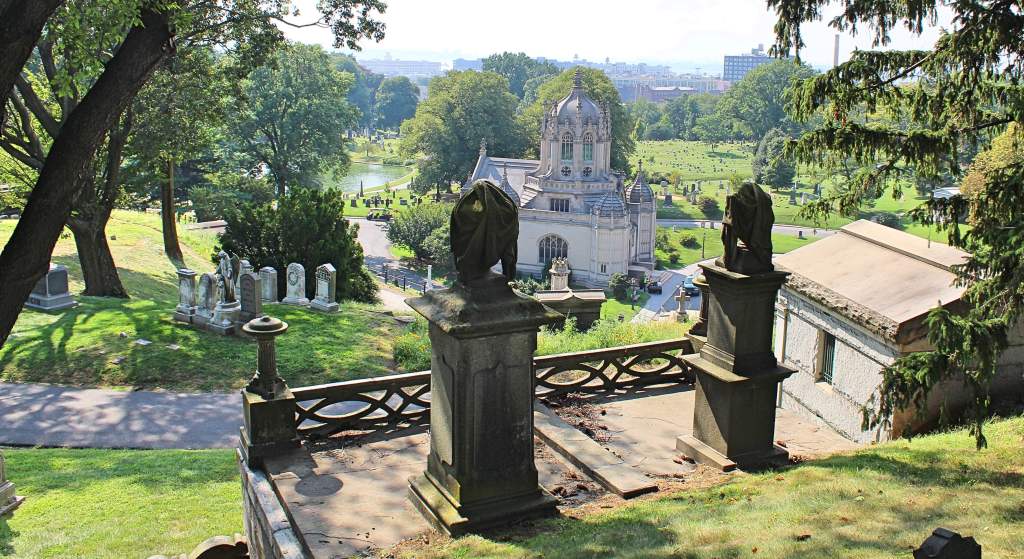
Finally we come to the Hall of Advanced Mammals, which features species more recently extinct (many of which died off during the great megafauna extinction 10,000 years ago). Here we can see a large array of specimens that illustrate the evolution of horses, growing up from dainty things the size of dogs up into the stallions of today (though, as often happens with evolution, this progress was not always linear). At the end of the hall we see extinct relatives of the elephant. One is the mastodon, which is about the size and build of a modern elephant, if slightly stockier. This nearly complete fossil skeleton was found in New York—amazing to consider.

Standing a head taller is the Mammoth, a much closer relative of the elephant that went extinct not too long ago, while the Mesopotamian and Egyptian civilizations were well under way. It is massive, of nearly dinosaurian proportions, with tusks that curve so tightly inward that it seems they would have been useless for defense. (Scientists are now playing with the idea of using DNA from frozen mammoth remains to bring them back. I wish them luck.)

By now, you must be exhausted. Museum fatigue has set in, and you can no longer concentrate on or even enjoy what you are seeing. This is inevitable at the American Museum of Natural History. There is just way too much. I have already written far, far more than I planned to, and there is still so much of the museum left to explore. I have left out the Hall of Reptiles and Amphibians, the Hall of North American Birds, and the Hall of Primates. And that is not all. The museum has huge exhibits devoted to cultural anthropology. Aside from the aforementioned Northwest Coast Hall, there is the Hall of Asian Peoples, the Hall of African Peoples, the Hall of Mexico and Central America, and the Hall of South American Peoples.

And here I must add a note of criticism. It says a great deal that a museum of natural history would include exclusively non-Western cultures. Admittedly, this is largely a historical artifact of the time when the study of “primitive” living peoples was grouped with the study of human evolution and primate behavior in the discipline of “anthropology.” This grouping obviously reflected cultural and racial biases of the original founders of the field. But we have moved far beyond that, and now it seems discordant and strange to walk through, say, the Hall of Asian Peoples. How could a single hall, however well-made, encompass the enormous history and diversity of the Middle East, Central Asian, Southeastern Asia, and East Asia? Even encompassing the traditions of China alone would require a museum for itself. Not only that, but the cultural halls generally have a dark and dingy aspect, as if they have been left unchanged for decades.

So it is my hope that the museum soon refurbishes, not just the Northwest Coast Hall, but all of the cultural halls—taking into account not only advances in our understanding, but how the cultures themselves would like to be represented. Judging by the progress that the museum is already making in this respect, I think that the future looks bright.

What more can I say about the Museum of Natural History? I have already said more than I planned to, and yet it scarcely seems enough. My visits to the museum had a fundamental influence on me. My shifting interests throughout my childhood and adulthood—in marine biology, chemistry, physics, botany, human evolution, and human cultures—have virtually tracked the floor plan of the museum. From an early age, I have been possessed with a desire to collect, catalogue, and display—an urge which I am sure owes much to this place. Beyond its importance in my life, however, I see the Museum of Natural History as a model institution for the coming ages, as something much needed in our society, even as a kind of secular church for the new age: capable of appealing to the mind and to the emotions. I hope that every child may feel the wonder I felt, and still feel, at both the universe around us and the intelligence within, which has allowed us to know something of this universe.