Review: Rage

Review: Rage

Rage by Bob Woodward

My rating: 4 of 5 stars

We were speaking past each other, almost from different universes.

Under normal circumstances, I would not subject myself to a single book about Donald Trump, much less two. But I happened to finish A Very Stable Genius—written by two of Woodward’s fellow reporters at the Washington Post—during one of the most bizarre weeks in Trump’s very bizarre presidency.

The week began ordinarily enough, with the revelation in the New York Times that Trump was using his business failures to avoid taxes. Big surprise. This scandal was quickly eclipsed by Trump’s unhinged performance in the first presidential debate, which even some keen supporters found unpalatable. And then Trump managed to top his own performance, by announcing his coronavirus diagnosis. Somehow, even this potentially solemn event quickly devolved into a carnival of lies, as various reports on the president’s health conflicted. The farce was capped off by Trump’s tweeting “Don’t be afraid of COVID” after leaving the hospital.

I mention all this only to show that, even after four years and four thousand scandals, Trump has retained his ability to completely absorb my attention and, yes, to shock me. Hoping for some more insight or clarity, I reached for this book—yet another in the long list of Trump exposés. And I did find that Rage complemented the story told in A Very Stable Genius quite nicely, covering much of what is left out in that earlier book. Whether I am any the wiser for having read these books is another question.

The basic story is simple: Trump relentlessly wore down his advisors and officials through unreasonable and often contradictory demands, until they either resigned in frustration or were fired (often via a Tweet). As the authors of A Very Stable Genius put it, Trump ground through his human guard rails. This way, advisors willing to oppose or moderate the president were gradually replaced by sycophants who did little to curb his more destructive whims. Thus, when a real crisis hit the country, one requiring a complex and coordinated response, the White House was completely unprepared.

However, it is also apparent that this was not originally the story that Woodward set out to tell. The first half of the book focuses quite steadily on foreign policy, and is clearly the fruit of much careful research. There are the usual stories of Trump snubbing allies and pining after Putin. But the real surprise comes when Woodward reveals that he somehow obtained the letters exchanged between Trump and Kim Jong-un. Though containing little of substance, these letters are quite surprising in their affectionate and even flowery tone. Even so, this is one section of the book where Trump does not come off so badly. Nothing was gained from the meetings and the letters, but nothing was lost, either; and arguably it was worth a try to extend an olive branch.

Like so much of life, the book gets severely derailed in its second half by the arrival of the coronavirus. It was around this time, too, that Woodward gained access to Trump himself. From January to shortly before the book’s publication, Woodward interviewed the president eighteen times, for a total of over nine hours. This meant that Woodward had a direct line to Trump during the greatest test of his presidency. The book thus becomes a kind of character study in a time of crisis, with Woodward pushing and probing, trying to understand why Trump is handling the pandemic so badly.

The closer a look one gets of Trump, the stranger he appears. To use Woodward’s phrase, he is a “living paradox”—or at least bafflingly inconsistent. One obvious example of this is Trump’s decision to do these interviews in the first place. After all, Woodward had already written a book highly critical of Trump, and is an associate editor at the Washington Post, a paper Trump routinely derides as liberal media spouting fake news. Was it simply bad judgment? More likely, in my opinion, Trump thought that by personally speaking with Woodward, he could convince the journalist to change his tone. (Trump hoped to do the same with Mueller, Putin, and Kim Jong-un, after all.) Either that, or he simply found the publicity and prestige offered by a Woodward book irresistible.

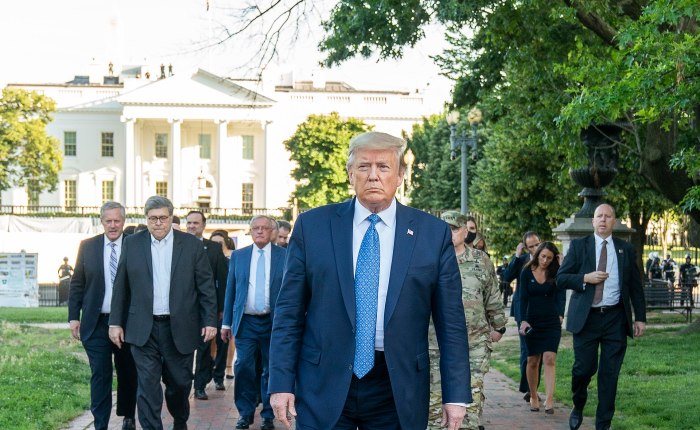
Another tension in Trump’s personality is that between authoritarianism and negligence. Trump’s admiration for strong-men around the world has often been noted, as has his demand for loyalty and praise from his subordinates. And his response to the Black Lives Matter protests—threatening to send the military, and using federal troops to illegally detain protesters—is broadly authoritarian. On the other hand, Trump’s response to the coronavirus crisis reveals a man quite averse to real responsibility, as he often left it up to the governors to deal with the problem. An aspiring autocrat could easily have used the emergency to appropriate more power for himself, but Trump did no such thing.

But this apparent paradox is resolved when one realizes that Trump’s conception of authority is very superficial. Being praised by subordinates, being the center of attention, being declared the best, being seen as a tough guy—this is the extent of what Trump demands from the world.

This superficiality is pervasive in Trump’s makeup, and has much to do with his (almost non-existent) relationship with the truth. It is common to call Trump a “liar”—and, of course, the major revelation of this book is that Trump apparently knew how dangerous the coronavirus was in February, and did not take action or warn the public. Yet for me this term is misleading, as it implies that Trump is fully aware of the truth and is carefully concealing it. I am sure he does that sometimes, of course. But more often it is as if he is speaking as a person might when totally overcome with emotion—in extreme rage or ecstatic joy—without even considering the truth.

The reason I say this—and I hope that I am not getting carried away here—is that, when Trump speaks, the words do not seem to come from some deep place inside himself, as happens during a thoughtful conversation. Rather, the words seem to pop out of thin air, determined only be the immediate needs of the present. To put it slightly differently, Trump never seems to be searching inside himself as he speaks—turning an issue over mentally or finding the appropriate phrase—but instead his mouth goes off by itself, like a machine gun, in its predictably staccato rhythm. The following excerpt captures this quite well:

“I’ve talked to lots of your predecessors,” [Woodward] said. “I never talked to Nixon, but I talked to many, many of them. They get philosophical when I ask the question, what have you learned about yourself? And that’s the question on you: What have you learned about yourself?”

Trump sighed audibly. “I can handle more than other people can handle. Because, and I’ll tell you what, whether I learned about it myself—more people come up to me and say—and I mean very strong people, people that are successful, even. A lot of people. They say, I swear to you, I don’t know how it’s possible for you to handle what you handle. How you’ve done this, with the kind of opposition, the kind of shenanigans, the kind of illegal witch hunts.”

I find this response so telling, because we can safely ignore the truth or falsity of Trump’s words. Indeed, I am inclined to think that questions of this kind usually elicit bullshit. But if I were asked this, I know that I would have to pause and search within myself for something that at least appeared to be self-knowledge. I would have to at least simulate speaking from the heart. And it takes a certain amount of self-awareness to do this. Trump’s answer, meanwhile (which essentially amounts to “I am better than other people”), pivots almost immediately from self-knowledge to what anonymous “very strong people” are telling him. In other words, it does not even betray the modicum of self-knowledge necessary to plausibly bullshit.

I am writing this to fully express these thoughts for myself, even though I am painfully aware that I am falling into the tar-pit of Trump’s personality. But enough. Let us move on from Trump to the secondary question of whether Woodward is guilty of journalistic malpractice for sitting on the information about the coronavirus. And I think he is. Woodward has given multiple reasons why he did not go public with the Trump tape, such as that he needed to give the story more context, or that he thought Trump was just talking about China. Neither of these make much sense to me. And I do think it could have made a difference if the recording of Trump had been released in, say, March.

Be that as it may, this book is still a valuable and alarming look into Trump’s White House and character. After such a steady inspection, it is difficult to disagree with Woodward’ conclusion: “Trump is the wrong man for the job.”

View all my reviews

Review: The Deficit Myth

Review: The Deficit Myth

The Deficit Myth: Modern Monetary Theory and the Birth of the People’s Economy by Stephanie Kelton

My rating: 3 of 5 stars

Deficits can be used for good or evil.

Robert Skidelsky, in his enormous biography of Keynes, remarks that economics today occupies the same situation as theology did in the Middle Ages—as a complex a priori logic that can be used to reach any number of contradictory conclusions. The more I read in the subject, the more I agree with him. To be taken seriously in politics means being able to use this logic. And yet, despite the seemingly scientific nature of this language, we seem hardly better able to pinpoint the nature of economic reality than the scholastics were able to count the angels.

I am exaggerating, of course. But I am a little distressed to find that, according to Stephanie Kelton, most economists and politicians—who already disagree with one another—are still fundamentally wrong about money, taxes, fiscal policy, and government debt. Here is another perspective to add to the mix: Modern Monetary Theory, or MMT.

Kelton begins the book by taking a page right out of David Graeber’s history of debt. Money was not invented, as so often supposed, to solve the problems of a barter economy. Instead, money and taxes go hand in hand. The argument goes like this: If you introduce a currency into a fully functioning credit economy (where people just keep track of what is owed to one another), then there is little reason why people would adopt it. But if you institute a tax payable only in this currency, and threaten punishment for non-payment, then suddenly everyone must find a way to acquire the new currency, and this means doing some work for the state.

In other words, governments introduced taxes, not to collect money (which it was producing anyway) but to compel work. And Kelton argues that this is still true today: that governments do not depend on taxes. She uses the example of a scorekeeper in a board game. The scorekeeper adds and subtracts points for other players, but they are never in need of points for themselves. Points are simply willed into existence whenever needed. Kelton argues that the US government (and other governments with what she calls “monetary sovereignty”) is in essentially the same position with regard to the US dollar. Since we use a fiat currency, any number of dollars can be willed into existence. Thus, the government does not depend on tax revenue, any more than a scorekeeper must subtract points from other players in order to stay afloat. In short, we do not have to worry about the deficit, since government debt is nothing like the debt you or I may have.

Does that mean that the government can just spend infinite money? No, Kelton says: though the deficit is not a problem, inflation may be. Too much government spending may lead to too many dollars chasing too few resources, which can cause prices to rise. Does that mean that taxes are unnecessary? Also no, according to Kelton, since, apart from compelling work, taxes perform at least two important functions. First, they remove money from circulating, thus decreasing inflationary pressure; and second, they reduce inequality, which leads to a healthier society. Yet if the government cannot spend infinitely, and if we still do need to tax, then what are we doing wrong?

To answer that, Kelton next turns her attention to unemployment. Kelton notes that unemployment is built into our economy, largely via the policies of the Federal Reserve. The Fed aims for an arbitrary level of unemployment (say, 3%) which it considers the “natural” rate. Going below this natural rate would, it is feared, cause inflation to kick in, since demand would outpace supply. But this “natural” rate is little more than a guess, Kelton argues. Even when unemployment has been very low in recent years, inflation has remained low. Indeed, in this argument Kelton seems to have been prescient, since just in August the Fed decided to change its policy of lifting interest rates once employment hits a certain level, thus paving the way for more sustained employment growth.

But Kelton has a fairly dim view of the prospects of using monetary policy to govern the economy. Instead, she thinks that unemployment should be directly eliminated using a Federal Jobs Guarantee. This is the main policy proposal of the book, and Kelton spends a good deal of time selling it. The advantages are compelling. Most obviously, unemployment is bad for people and communities, so it would be highly desirable to get rid of it. And a jobs guarantee would give workers more bargaining power, since the wage floor would rise (the jobs would pay a living wage) and the threat of losing work and health insurance would be eliminated.

Still, I admit that I was not convinced. For one, even according to MMT’s own premises, the huge increase in aggregate demand—caused by increased federal spending, eliminating unemployment, and increasing wages across the board—could cause inflation. Kelton does not really address this potential pitfall.

On a more practical level, I also have trouble imagining the logistics. Kelton describes a program that can employ anyone, anywhere, in socially meaningful jobs. But there is not necessarily the right amount of meaningful work in any given location, nor do the unemployed necessarily have the skills necessary to do this work (and re-training has its limits). I think that a substantial amount of make-work is inevitable in such a scheme. Furthermore, I can hardly contemplate the enormous bureaucracy that would be needed to administer such a program. It seems there would be just as many people making jobs as people needing jobs made for them.

The job guarantee’s major policy rival, universal basic income (UBI), has none of these practical challenges (though of course it could cause inflation, too), since it is merely paid via the IRS. Admittedly, jobs do provide social and psychological benefits that an income does not. But Kelton does not discuss UBI at all, which I thought disappointing.

At this point, the reader may be forgiven for wondering what is so new about MMT. After all, Paul Krugman—an orthodox Keynesian economist critical of MMT—has been writing for years about the mistake of thinking of the federal budget like a household budget, and the desirability of federal deficits in times of recession. The difference, so far as I understand it, brings us into dangerously wonky territory. Krugman avers that when we near full employment, a large deficit may require higher interest rates in order to avoid inflation. Kelton counters that our assumptions that low interest rates boost spending, and higher interest rates constrict spending, are actually incorrect. In other words, Krugman thinks that monetary policy can partly compensate for fiscal policy, while Kelton thinks that monetary policy is not particularly useful.

I have little to add to this, other than to remark that I can never understand why these disputes—like theology—always take the form of high theoretical debates from first principles. It strikes me that the impact of monetary policy is an empirical question that could be answered with a careful look at the historical record. But what do I know?

Well, I have done my best to elucidate this sacred mystery, but I ought to evaluate the book. Like many readers, I found the writing in this book extremely grating. The tone was somewhere between a salesperson and a televangelist—promising instant enlightenment and easy solutions—which immediately put me on edge. In fairness, when Kelton is not selling MMT but explaining it, the book can be quite fascinating. But Kelton’s insistence on treating MMT as blindingly true, and its enemies as either blinkered traditionalists or deceptive politicians, was not charming or effective. And the amount of repetition could even be condescending. By the time I reached the end, I really could not stand to hear another iteration of the central tenets of MMT. I got it the first couple times.

Whatever the flaws of the book, and whether or not MMT is an accurate picture of how the economy works, it at least makes you think about how the deficit is treated in public discourse. Anyone who reads the news cannot help but notice that the swelling deficit is only invoked when we have to pay for, say, healthcare or infrastructure; but, somehow, when tax cuts to the wealthy or defense spending are on the table, nobody seems to worry. Even if the deficit presents more of a problem than Kelton believes, it is obvious that, if anything is worth going into debt for, it is programs that benefit the public, rather than bombs or yachts. I hope that followers of Keynes, MMT, Thomas Aquinas, and William of Ockham can at least agree with that.


View all my reviews

Review: Debt

Review: Debt

Debt: The First 5,000 Years by David Graeber

My rating: 4 of 5 stars

For a very long time, the intellectual consensus has been that we can no longer ask Great Questions. Increasingly, it’s looking like we have no other choice.

Three years ago, I went on vacation in the north of Spain, to the city of A Coruña. There, perched on the jagged rocks below the Roman lighthouse, I read Oswald Spengler’s Decline of the West. The crashing sound of ocean waves just seemed an appropriate accompaniment to Spengler’s grandiose attempt to analyze all of human history.

At it happened, I ended up reading David Graeber’s Debt in the exact same circumstances. And perhaps this coincidence highlighted the odd similarities between Graeber’s book and Spengler’s. On the surface, the two men are quite radically opposed: Spengler is mystical, conservative, and mainly preoccupied with ‘high culture,’ while Graeber is conversational, leftist, and usually focused on more humdrum human affairs. But both The Decline of the West and Debt are sweeping scholarly exercises which attempt to completely alter our view of history. As a consequence, the books have similar merits—a large perspective, unusual connections, an original angle—while suffering from the same basic weakness: the attempt to strap history into a Procrustean bed.

But I am getting ahead of myself, as I should explain what this book is about. Graeber set out to write about debt, partly as a response to the 2008 financial crash, but also to respond to a certain moral confusion he noticed in the general culture. This is the notion that one always ought to ‘pay one’s debts.’ Most of us, I suspect, would agree that this is the right and proper thing to do. But there are many cases in which debt can be morally questionable. Consider a man who had an unexpected heart attack and was taken to a hospital out of his insurance network, or a young student who took out college loans but then had to drop out because her father had a heart attack, or a family who had agreed to a predatory mortgage for a house that the bank knew they could not afford, or a poor country forced to adopt austerity policies by the IMF in order to pay their debts richer countries—in any of these cases, is it moral to pay one’s debts?

As Graeber points out, standard economic theory does not hold that all debts must be repaid. Rather, both the lender and the debtor enter into an arrangement with a certain amount of risk. The loan is, in a sense, an investment like buying stock, and may or may not yield money according to the fortunes of the debtor. But this is not how we typically treat debt. Bolstered by our moral sense that debts should be paid, we accept a moral lopsidedness in the relationship, giving lenders quite extraordinary powers (garnishing wages, confiscating property) to extract money from debtors. Yet Graeber is not an economist, and does not want to restore a balance to the arrangement. Rather, he is disturbed by the very concept of debt. For what sets debt apart from an obligation is that it can be precisely quantified. This means debts require a system of money.

This leads Graeber to examine the origins of money, which for me was easily the strongest section of the book. Most economist textbooks explain money by pointing out that money solves the problem of a double coincidence of wants. That is, if I have some extra boots, and I would like to trade them for some beer, it is quite possible the brewer already has all the boots he needs. But if I can sell the boots for money, and the brewer accepts cash payments, then we are in business. The problem with this story is that there is no historical evidence that such a thing happened. Indeed, this hypothetical situation is rather bizarre—essentially taking a world very much like our own, and then removing the money.

Instead, it appears from the historical record that credit systems developed before actual money. These could be formal or quite informal. As an example of the latter, imagine you are living in a small village. One day, you see your neighbor wearing a nice pair of boots, and you ask if he has any extras. He does, and offers them to you as a gift. Next month, you make a big brew of beer and then give him a jug of it, offering it as a gift. The key is that, using such a credit system, you effectively get around the double coincidence of wants, since there is a very good chance that you will eventually have something your neighbor wants, and vice versa. This is just one informal example of how such a credit system could work with ‘virtual money.’ Graeber, being an anthropologist, is full of fun examples of exchange practices from around the world, all of which fly in the face of our idealized notions of purely economic transactions.

After quite effectively demolishing what Graeber calls the ‘myth of barter,’ he embarks on a grand tour of history. And here is where the book fell off the rails for me. Now, this is not to say I did not enjoy the ride: Graeber is an engaging writer and is full of fascinating factoids and radical notions. But I was constantly bugged by the sensation that either I was misunderstanding Graeber, or that he was not proving what he thought he was proving. To give you a smattering of Graeber’s points, he argues that the use of coinage influenced ancient Greek philosophers’ concepts of matter, that religions emphasizing selfless charity arose in reactions to markets emphasizing selfish acquisition, that our notions of property derive through Roman law from slavery, that money was actually introduced by kings who used it to debt-finance wars, and that the Spanish conquistadores were driven to commit such atrocities because they were in debt.

As you can see, that is an awful lot of material to cover; and this is just a sample. Each of these arguments is, in my opinion, quite interesting (if not always convincing). But, again, I was always unsure as to the larger point that Graeber was trying to make. On the one hand, Graeber seemed to be saying that money and debt are inextricably bound up in an ugly history of violence; but on the other, Graeber demonstrates that debt financing is a remarkably old and persistent practice, and is partly responsible for what we (pretentiously) call ‘civilization.’ At the end of the book, Graeber states that his purpose was to give his readers a wider taste of what is possible, so that we can reimagine our society. However, one of Graeber’s main insights is that history is cyclical: alternating from periods of hard money (like precious metals) and virtual money (like IOUs and fiat currency)—though both of these systems involve debt. If anything, then, this book left me with the impression that debt is an inescapable part of life.

Allow me, if you please, to mention one of my pet peeves here. Graeber is a big fan of etymologies. This book is peppered with words and their unexpected origins, which Graeber often uses as evidence in his arguments. In my opinion, this is a very lazy and unconvincing way of arguing. Do not misunderstand me: I like a good etymology as much as anyone. But the fact that a word once meant one thing and now means another does not, in my opinion, prove that these two concepts are somehow secretly connected. I would have much preferred more detailed examinations of historical evidence; but Graeber actually goes out of his way in the afterward to criticize historians for being overly empirical. This is not a message I can get behind.

But enough of that. I am sorry to be writing even a moderately critical review in the wake of Graeber’s tragic passing. For all of this book’s (perceived) faults, I am very glad to have read it. Like Spengler, Graeber had a mind full of fire, and was always letting off sparks in every direction. He was, in advertising parlance, an idea man; and this book is full of bold new ways of seeing our past and present. And even if Graeber’s grand theories about society and history do not, ultimately, pan out, one can say of Graeber what Walter Pater said of aesthetic theorists:

Many writers have been made by writers on art and poetry to define beauty in the abstract, and express it in the most general terms, to find a universal formula for it. The value of these attempts has most often been in the suggestive and penetrating things said by the way.

View all my reviews

Review: Private Guns, Public Health

Review: Private Guns, Public Health

Private Guns, Public Health by David Hemenway

My rating: 4 of 5 stars

Viewed from abroad, America’s so-called freedom is portrayed as the freedom to sit behind a door with a gun.


Guns were one of my first and longest childhood obsessions. I would ask my mom to buy me encyclopedias of guns, complete with illustrations of pistols, rifles, shotguns, machine guns, assault rifles, and grenade launchers. I learned about the different loading and firing mechanisms, different sorts of bullets and bores, and even about the history of firearms. I had memorized, for example, which guns had been used by each side in World War II. In middle school I even took to designing my own guns on paper.

While my own gun obsession took a predictably nerdy form, in a way it was not at all unusual. First-person shooter video games were and remain intensely popular, and a lot of the fascination comes from the thrill of virtually firing all sorts of exotic weapons. Most action movies have a similar appeal. At one point, all the boys in my neighborhood even acquired realistic-looking airsoft guns, which we would use to pelt one another with little plastic pellets. (When white children do this, the cops aren’t called.)

But it was only when I had graduated high school that I held a real gun. It was just a .22 caliber practice rifle, which we used to shoot a few soda cans. Even so, I remember the powerful and disturbing sensation of knowing that the only thing between safety and injury was a mere twitch of the finger. Contrary to my childhood fantasies, the reality was not something I much cared for.

Gun culture in the United States is odd by any standard. With less than 5% of the world’s population, American civilians own nearly half of all the firearms on the planet. There are more guns than people; and this, despite the fact that only about a third of the population owns a gun. Nowhere else in the developed world is close, and nowhere else has gun ownership become such a divisive and persistent issue.

David Hemenway, the director of the Harvard Injury Control Research Center, wrote this book to inject some reason and data into the conversation. This book is filled with study after study—mostly statistical analyses—that all aim to prove a simple point: that guns are a threat to public safety. To most people living elsewhere in the world, this point will probably seem blindingly obvious; but it is just such a point that is debated incessantly in America.

One of the most common arguments in favor of guns is that they can be used in self-defense, and thus protect citizens from criminals. But having a gun in the house also introduces different sorts of risks. For one, there is the question of gun accidents. This can take many forms. Guns can be dropped and misfire, or can be fired in the mistaken belief that they are unloaded. Tragically, many young children die while playing with guns that have been unsafely stored. And then there is suicide. Studies have shown that a substantial portion of suicides are impulsive decisions made in a moment of crisis, not carefully-planned acts. This means that having access to a deadly weapon in a crisis can dramatically increase the chances that a suicide attempt results in fatal injury. Added to this are mistakes that turn deadly:

A fourteen-year-old girl jumped out of a closet and shouted ‘Boo’ when her parents came home in the middle of the night. Taking her for an intruder, her father shot and killed her.

Yet maybe the increased risks from accident and suicide are balanced by decreased risk from criminality? The evidence is not encouraging. Hemenway finds no evidence to support the notion that gun ownership acts as a deterrent for criminals. He also finds surprisingly few examples of guns being used to successfully ward off robbers. Indeed, studies show that the safest thing to do in the event of a robbery is to call the police and run away (not necessarily in that order). What is more, in evaluating the policy of allowing guns for self-defense, we also must factor criminal access to guns—that a robber is more likely to be armed.

Another argument in favor of guns is that regulations will only stop the “good guys” from getting guns, not the “bad guys.” This argument is unconvincing for many reasons. For one, the population of the world is not so easily divided into good and bad people. Take, for example, the couple who threatened Black Lives Matter protesters with their guns last July. Were they good guys or bad guys? According to the law, they were committing a felony; yet according to the Republican Convention, they were acting heroically. This is a silly example, but it does show how many illegal uses of fire-arms are considered “self-defense” by the users.

This argument is also unconvincing because the weight of evidence is all on the other side. In states where there are stricter gun laws there are fewer guns. In countries with stricter gun laws, it is far less likely that a criminal will be able to purchase a firearm. This is obvious as soon as one leaves the United States. Indeed, the truth is that “bad guys” all over the world are often able to get guns due to our lax gun laws. Most of the guns used in criminal activity in strict states like New York come from permissive states like Florida; a third of the guns in Japan from the United States. In short, while we worry about drugs and gangs entering our country, lethal weapons have been illegally leaking out.

But the sticking point is always the Constitution—specifically, the Second Amendment, which guarantees the “right to keep and bear arms.” Yet Hemenway convincingly shows that this amendment was not written to guarantee individuals the right to buy guns, but in part of a larger debate about standing armies. After all, the amendment begins: “A well regulated Militia, being necessary to the security of a free State… .” One must remember that the United States Constitution was written to replace the Articles of Confederation, which gave too much power to the individual states at the expense of the federal government. This amendment seems to have been a way of placating the Anti-Federalists, who wanted to maintain the states’ right to have their own militias.

The amendment was actually interpreted along these lines—as guaranteeing the right to state militias—up until 2008, when the Supreme Court first decided that the right does indeed extend to individuals. (In my opinion, the constitutional wording is almost incoherent if meant to apply to individuals, but I am no legal scholar.) Nevertheless, that decision still conceded the government’s right to regulate the sale and purchase of firearms; so there is no legal reason why we could not enact more sensible regulations.

Still, a common pro-gun argument goes that civilian gun-ownership is a major check on government tyranny. It is difficult to see the logic in this argument. For one, the government has tanks and fighter jets, so this is not even realistic. And of course people living all over the world, in places with far fewer guns, enjoy the same civil liberties as Americans do. Indeed, as the opening quote shows, most non-Americans consider an armed society substantially less free, since freedom is incompatible with the threat of violence. One could even make the argument that civilian firearms directly threaten freedom, since they give government forces a pretext for violent action.

What is more, there is no historical evidence that the founders thought this was desirable. Shays’ Rebellion was an armed revolt against the government on behalf of debtors, led by a Revolutionary War veteran. The revolt was put down by the state government after the nascent federal government could not raise enough money, which further exposed the weaknesses in the Articles of Federation. In short, far from inspiring the founders, this armed rebellion likely goaded the founders to further empower the federal government.

Some years later, during the presidency of George Washington, there was another armed revolt: the Whiskey Rebellion, so named because it was against the taxation of whiskey. Far from supporting this citizen justice, Washington rode out himself at the head of an army, accompanied by Alexander Hamilton, to put it down. (Luckily, the rebels dispersed before any fighting.) If these examples do not show the founders’ attitude towards armed civilian uprisings, then I am not sure what could.

To cut this short, American gun laws are extremely lax by world standards. Meanwhile, the evidence suggests that guns do not help keep people safe, but precisely the reverse. And there does not appear to be any legal reason why we cannot improve the situation. Even the American public broadly supports gun restrictions, such as mandatory background checks, closing legal loopholes, and improving gun design to make accidents less likely. This has been shown in survey after survey. And yet, despite all this, there does not seem much hope of significant change.

Although gun control is not the most pressing issue facing the United States (the list grows daily), I think that the issue does crystalize one of the most frustrating and depressing aspects of American political life: our inability to make progress on issues that do (or should) have broad consensus. Like so many problems—climate change, abortion, and recently COVID-19—guns have been fully assimilated into the American culture war machine, which inevitably turns all nuanced discussions into simple pro and against stances. Once this happens, even repeated tragedies seem unable to shake us out of our paralysis.

For me, this was made brutally apparent after the Sandy Hook school shooting. Even the cold-blooded murder of children was not enough to cause meaningful change. By the time of the Stoneman Douglas high school shooting, six years later, the culture war had polarized the issue so greatly that the two sides were not even living in the same universe anymore, as we can see from the many conspiracy theories claiming that the entire tragedy was somehow faked. As a thousand Americans die per day from the virus, and as wildfires rage and hurricanes batter the coast, this same dynamic plays out again and again—threats to public health that we are unable to address due to the culture war machine.

I find David Hemenway’s contribution to this issue to be both compelling and strangely touching. He has held onto the belief that he can change people’s minds using statistics, and that he can steer the conversation away from simple pro and against stances to a more nuanced discussion based on shared interests and values. Yet such a book as this—written dispassionately, full of careful reasoning and research, devoted to the public good—seems particularly unlikely to make a significant impact. And that, perhaps, is the most depressing fact of all.

View all my reviews

Review: The House of Morgan

Review: The House of Morgan

The House of Morgan: An American Banking Dynasty and the Rise of Modern Finance by Ron Chernow

My rating: 4 of 5 stars

When I picked up this book, I assumed it was a biography of the two famous John Pierpont Morgans. But this is far more; indeed it is a true history of the Morgan bank, though admittedly with heavy emphasis on the biographies of the key figures. Given that this history spans over a century and includes a huge number of players, politics, and policies, the fact that Chernow could put out such a polished book in two and a half years is a testament to his skill as a writer and researcher.

The book is most colorful in its beginning and slowly fades into the dullness of contemporary reality. The Bank of Morgan began with the 19th century financier George Peabody, a sort of Dickensian miser turned philanthropist. Lacking a son, Peabody passed on his business to Junius Spencer Morgan, another personality of a bygone age, who managed to combined pious moralizing with strict business. His son, Pierpont, is by far the most colorful character in this panorama. A rabid art collector, an amateur archeologist, and an inveterate womanizer with a swollen nose and an enormous yacht, Pierpont was a central figure in the American economy of his age.

His son, “Jack,” though resembling Pierpont physically, was a far more mild-mannered sort of banker. His life is mostly lacking in racy and romantic stories (except for the time he was shot by a would-be assassin). The Morgan line mostly fizzles off after Jack; but there are many other Morgan bankers to take note of. The most important was undoubtedly Thomas Lamont. Chernow tracks Lamont’s strange journey from the cosmopolitan advocate of the League of Nations to an apologist for Italian fascism and Japanese aggression. It appears wide culture and smooth manners do not immunize one from ugly politics.

The wider historical arc of Chernow’s book gave me a bit of nostalgia. We begin with bankers in top hats and stiff collars, guzzling port wine and sucking on cigars. (Pierpont was a heavy drinker and smoker, and believed that exercise was unhealthy.) These bankers relied on charisma and relationships as much as they did on any technical understanding. The early House of Morgan was paternalistic towards its employees and stressed an esprit de corps—the importance of banking tradition over personal egos. This sleepy world of respectable bankers gives way, in the late twentieth century, to the high-octane world of trading, where highly trained employees work twelve-hour days trying to beat one another in an enormous casino.

The activities of the bankers also change markedly in this history. While nobody would argue that Pierpont was saintly or altruistic, his main activities consisted of reorganizing industrial companies to make them more productive and effective. This is a great contrast with the bankers of the 1980s, who are mainly concentrated on speculative activities and hostile takeovers which seem to have very little to do with work of real value.

Of course, my impressions of this history are colored by the fact that I know relatively little about finance and thus at times had trouble following the business side of things. Chernow, for his part, is typically vague when it comes to any technical details; his preferred style is to focus on individuals and their foibles. This was a bit frustrating, since I felt that I could have learned more had Chernow simply included more in the way of explanation.

But, as it stands, this is an extremely readable and compelling history of one of America’s most important banks. Things have changed since the publication of this book. Morgan Stanley is still going strong, though J.P. Morgan mainly serves as a brand used by Chase bank, and Morgan, Grenfell & Co. does not even exist as a name anymore. Even 23 Wall Street, the iconic home to this iconic bank, now sits empty and unused, apparently owned by a shadowy billionaire who is reportedly sitting in a Chinese jail. Such is the fate of all great empires.


View all my reviews

Review: A Brief History of Neoliberaism

Review: A Brief History of Neoliberaism

A Brief History of Neoliberalism by David Harvey

My rating: 4 of 5 stars

It is one thing to maintain, for example, that my health-care status is my personal choice and responsibility, but quite another when the only way I can satisfy my needs in the market is through paying exorbitant premiums to inefficient, gargantuan, highly bureaucratized but also highly profitable insurance companies.


Neoliberalism is a term that is often thrown about; and yet, like socialism and capitalism, I often feel that I do not quite know what it means. Its common definition—the preference for free trade and free markets—did not seem to distinguish it from capitalism itself, as I understood the term, which made me wonder why neoliberalism was so controversial and hated.

Harvey’s book goes a long way in answering this question. The best way to understand neoliberalism may be historical. After the end of the Second World War, governments were dominated by Keynesian policies—that is, the use of taxation and spending (if necessary, deficit-spending) to control boom and bust cycles. But in the 1970s the Keynesian consensus broke down as a result of stagflation: low growth combined with high inflation. The failure of Keynesian policies to get the economy out of its rut led, eventually, to the embrace of quite a different governing philosophy: neoliberalism.

This has many intellectual components. Neoliberals are—at least in theory—opposed to fiscal policies as a way of fighting economic ups and downs. (In practice, this means that governments must adopt austerity measures in order to keep their budgets balanced in an economic downturn.) In fact, neoliberals are quite generally anti-government, at least in their rhetoric. They favor privatization, deregulation, low taxes, and low tariffs. The central idea is simple and, on its face, compelling. Prices communicate market information far better than a government can manage; individuals understand their own needs better than the government; and the profit motive is the great driver of general prosperity.

Yet what (ostensibly) began as a great liberation of sovereign individuals and all of their creative genius became, instead, an economic transfer from the poor to the rich. The evidence, by now, is clear that neoliberalization did not jump-start the economy. Growth has never recovered its pre-1970s levels; and economists now admit that they simply do not know how to make an economy grow. But as growth slowed, and wages stagnated for most mere mortals, the rich, richer, and richest made off with ever-increasing slices of the economic pie. Inequality reached such stark levels not seen since the 1920s. Harvey contends that this was not a mere byproduct of the economic philosophy, but one of its primary goals.

If the rhetoric of neoliberalism were, indeed, true—if the government was merely “getting out of the way,” and letting the market do its magic—then claims of nefarious intent would perhaps be unfounded. But as Harvey points out, the neoliberal state is no mere bystander. On the contrary, state power is quite necessary to the operation of neoliberal policies.

Most obviously, if property rights and contracts are sacrosanct, then there must be enforcement—violent if necessary—of those rights. In practice, this also means that there is a double standard between debtors and lenders. In a neoliberal state, the debtor has all the responsibility not to take out a loan that they cannot pay back; and there is very little protection if they do take such a loan. Meanwhile, there is no similar responsibility on behalf of the lender not to lend irresponsibly (as the 2008 financial crash proved); and if the lender does so, the state sanctions any draconian measures necessary to extract repayment.

The state also actively subsidizes the wealthy, both directly and indirectly. It directly subsidizes companies through (among other things) bailouts. The mortgage tax deduction is essentially a handout to the rich—as well as a spur to high-end housing construction. It puts up legal impediments to labor organizations and strikes.

And the indirect subsidies are many. If a community is devasted by a free trade deal, the state deals with the social fallout (often through mass incarceration, in the US). If the housing market leaves many homeless, then the state steps in to enforce eviction notices and provide homeless shelters. If medical insurance is out of reach to many, then the state provides public healthcare and emergency rooms. And this is only to speak domestically. Harvey documents many cases when the IMF and World Bank pressured developing countries to adopt neoliberal policies, and then demanded repayment of loans even if it meant impoverishing their populations.

In sum, the neoliberal state is not a mere onlooker, enforcing class-neutral rights and ensuring a fair game is played without cheating. On the contrary, the neoliberal state serves to provide welfare to the rich while enforcing brutal ‘capitalism’ on the poor.

Yet Harvey is not only valuable in his catalogue of neoliberal hypocrisies. Many of the most interesting parts of this book, I found, were Harvey’s reflections on how neoliberalism has transformed the culture. His contention is that the 1960s era emphasis on personal liberty has led to a kind of atomization of society. As more and more people are convinced that the government is evil or at least useless, people seek different forms of community. This can take many forms: religiousness, political populism (which Harvey predicts), or, for the progressively minded, NGOs. Indeed, one can see the rise in NGO activity as a kind of tacit defeat by the left, as they have yielded the possibility of democratic, governmental action, and instead turned to privately owned organizations run by elites.

More broadly, the embrace of a radically individualist philosophy makes political organization difficult. How can you politically unite people behind the idea that the government is the problem? Few forces have been able to transcend this limitation, most notably nationalism—giving birth to neoliberalism’s ugly cousin, neoconservatism. Other collective bonds—such as race, gender, or sexuality—do not have the widespread pull of nationalism, which Harvey believes gives the left a chronic disadvantage.

Harvey’s solution to this (unsurprisingly, given that he is a Marxist) is to make class, once again, a basis of political mobilization. It is only when workers collectively reform the society that the rich can be defeated. Unfortunately, the two economic crises that have transpired since this book was published have yet to make that happen. Nevertheless, I think this is a valuable and incisive book about one of our era’s most distinctive features.


View all my reviews

Review: Evicted

Review: Evicted

Evicted: Poverty and Profit in the American City by Matthew Desmond

My rating: 5 of 5 stars

Eviction is a cause, not just a condition, of poverty.

Yesterday, on July 24, the federal moratorium on evictions—protecting about 12 million renters—ended; and many state-level moratoriums will conclude soon as well. Enhanced unemployment benefits, which gave households an extra $600 per month, will terminate this month, too, meaning that families will lose income at just the moment they are vulnerable to eviction. Meanwhile, as the virus rages on, so does massive unemployment. It seems likely, then, that the United States is on the cusp of a huge wave of evictions. Under these circumstances, I thought it was a good time to read this book.

This is an urban ethnography written about the lives of the desperately poor as they struggle to find stable housing. Matthew Desmond lived for months in a trailer park and then in the inner city, following people around, taking notes and photographs, recording conversations, conducting interviews, and carrying out large surveys. In many ethnographies—especially since the postmodern turn—the author has striven to include herself in the narrative, emphasizing the subjectivity of the process. But Desmond has effaced himself from this book, and has instead written a kind of nonfiction novel of eight families undergoing eviction.

The first thing that strikes the reader is that Desmond is an excellent writer. The narration is gripping from the beginning—dramatic, vivid, and even occasionally poetic—meaning that my first reaction was emotional rather than intellectual. Wrenching pity for the people caught up in this cycle of poverty alternated, at times, with light disapproval at seemingly self-destructive behavior, which disappeared into outrage at the landlords profiting from this situation, and then incredulity that such things can be allowed to go on in a supposedly advanced nation. Often, I found it hard to take in, and had to put the book down to take a breath:

[Crystal] had been born prematurely on a spring day in 1990 shortly after her pregnant mother was stabbed eleven times in the back during a robbery—the attack had induced labor. Both mother and daughter survived. It was not the first time Crystal’s mother had been stabbed. For as far back as she could remember, Crystal’s father had beat her mother. He smoked crack and so did her mother and so did her mother’s mother.

But if this book were merely a collection of such stories, it would be little more than poverty voyeurism. This book has quite an important point to make, though, and that is how eviction is not only a consequence of poverty, but one of its major causes.

Any account of housing instability needs to begin with the fact that most people who qualify for housing aid to not get it—3 out of 4 receive no aide whatsoever. This leaves them at the mercy of the private housing market, which has seen steadily rising rents for years, at a time when wages are stagnant. Though it is normally recommended to pay no more than 30% of your wages in rent, the subjects of this book paid far, far more—in some cases, over 90%. This has serious consequences. Most obviously, if you are paying so much of your income in rent, it is impossible to save, and often even to pay basic expenses. What is more, this means that virtually any unforeseen expense—repairs, medical problems, or a funeral—can make a renter fall behind.

Once behind, it is extremely difficult for a renter to catch up. This effectively puts them at the mercy of the landlord. Even if the house is in disrepair and violates safety codes, missing rent means that the renter can be evicted on short notice. As Desmond describes, some landlords are willing to be lax—at least for a time—and cut deals with tenants. But for many who fall behind, the sheriff will soon be knocking on their door, along with a team of movers, giving the tenants a stark choice: to have their things left on the curb, or put into storage (where they need to pay extortionate fees in order to keep it from being trashed). Most evictees do not have housing lined up, and many end up in homeless shelters.

In a market where buyers are desperate and sellers are relatively scarce, there is little incentive for landlords to reduce prices, or even to make basic repairs of their properties. As Desmond explains, it is often more profitable for landlords to evict late-paying tenants and contract new ones than to make their properties livable. The tenants in these pages put up with rats, roaches, broken walls, smashed windows, clogged plumbing, sagging ceilings, to give just a short list. Desmond himself did not have hot water during his stay at the trailer park, despite paying rent on time, repeatedly asking the landlord, and even informing them that he was writing a book about life in a trailer park.

Eviction is not a rare occurrence—there are well over one million per year in the United States—and it is also not merely a private tragedy. Unsurprisingly, evictions concentrate in poor neighborhoods; and when residence in an area is unstable, it makes it an even less desirable place to life. As Jane Jacobs pointed out, neighborhoods are not primarily made safe by patrolling police, but by the constant presence of people on the street, people with a sense of ownership of the neighborhood. Ejecting residents obviously erodes this possibility—and not only in the area where people are evicted from, but also in the areas they unwillingly move to—which makes the city generally less safe.

Eviction is also not colorblind. Just as black men are disproportionately locked up, Desmond found that black women are disproportionately thrown out. And when you consider that having either a conviction or an eviction record can disqualify you from public housing, and can legally be used to screen potential renters by private landlords, you can see that this disadvantage is compounded. The white families in these pages certainly did not have an easy time finding and maintaining housing, but the black families were significantly worse off. Desmond followed one white couple who managed to find a place despite both of them having eviction and felony records, and one of them an outstanding warrant!

It is crucial to remember that housing instability is not merely the byproduct of individuals navigating private markets. The government is not only culpable for being a bystander to suffering citizens, but for propping up this very situation. Just as government force—in the guise of police officers and prisons—has been used to deal with the social fallout of disappearing jobs, so has government force—in the form of eviction courts, sheriffs, movers, public eviction records, and homelessness shelters—been used to deal with the disappearance of affordable housing. Without this government backing, the situation could not exist.

In many cases Desmond documented, government workers actually encouraged landlords to evict their tenants. Since many properties do not meet building codes, virtually any government attention—whether from the police, the fire department, an ambulance, or social services—can motivate a landlord to eject a tenant. What is more, if too many 911 calls come from an address, the property is labeled a ‘nuisance property,’ and landlords are forced by the police to ‘take action’—usually through an eviction. Even victims of domestic abuse are often evicted, one reason that many victims do not contact the police.

If we can agree that this situation is unconscionable, then of course we must do something to change it. But what? One solution is rent control: establish maximum prices that landlords can legally charge. This can have some quite negative unintended consequences, however. For one, if low-income housing ceases to be profitable, then there is no incentive to create more. This leads to shortage. But what about simply giving people more money, such as by raising the minimum wage or a basic income scheme? The problem with this strategy is that rising rents can easily offset income gains.

One fairly easy, short-term solution would be to provide defendants in civil courts with public defenders. Currently, in the United States, only defendants in criminal courts have such a right, though many other nations also provide legal counsel in civil cases. At the moment, most people do not even show up for their eviction hearings; the majority who show up do not have a lawyer, and most of them lose the case. Legal counsel can profoundly change the odds of evictees. And it is worth noting that, though hiring lawyers is expensive, cycling people through homelessness shelters is even more so—and this does not even take into account the other forms of economic disruption caused by eviction, such as job loss (quite common when people lose their home).

Another solution, popular in the past, has been to build public housing. This has several obvious problems, too. For one, as happened in NYC, vibrant and affordable neighborhoods were bulldozed to make way for enormous housing projects. What is more, the design of public housing projects was ill-conceived: enormous high-rises with parks in between. By isolating the poor into these buildings—with no shops or other services nearby, and few good communal spaces—the projects became dangerous and dysfunctional.

It is possible that smarter public housing could play an important role in the housing crisis. If apartments are scattered through the city, rather than concentrated, and integrated with shops, restaurants, and other businesses, then it is much less likely that they will become dangerous. An added benefit to cheap public housing is that they exert a downward pressure on the housing market, since private apartments must compete with them. However, the housing shortage is so acute that public housing alone is unlikely to be enough; it would require too much building.

This is why Matthew Desmond advocates housing vouchers. These vouchers basically pick up the tab for renters, covering anything above 30% of their income. However, there is an obvious problem with such a scheme: landlords are incentivized to overcharge for their properties, since the money is guaranteed. Indeed, according to Desmond, this often happens, which leads to a lot of wasted taxpayer money. Clearly, some mechanism is necessary to establish reasonable prices. But the voucher scheme does have the great advantage of scalability: they can be distributed quickly and widely.

Such a program would not be cheap. And in the United States, welfare programs tend to be politically divisive, since in our individualistic culture we prefer to hold the poor responsible for their own poverty. This mindset runs very deep. Desmond even records a preacher who, after giving a sermon about the importance of charity, refused to help a homeless woman so that she could learn her lesson. And certainly many of the people in this book did make bad, self-destructive choices. But as Desmond points out—and as psychological studies have shown—living in poverty actively erodes people’s ability to choose wisely and to think in the long term. Furthermore, many behaviors which seem irrational to middle-class onlookers are actually sensible adaptations to poverty.

The other important point to consider is that those of us lucky enough not to live in poverty are also benefiting from government policies. The federal government subsidizes mortgages—a policy that mainly benefits people with six-figure incomes. The capital gains exception means that homeowners who sell their house do not have to include much of that money in their income, and thus are not taxed. Indeed, the United States loses far more in tax revenue through these kinds of tax breaks than it spends in housing aid for the poor. This fits into a common pattern in American life: that those least in need of help are those most likely to receive it (and vice versa, of course).

As I hope you can see, this is a gripping and important book. The reader comes away with both an intellectual and a visceral understanding of housing insecurity. There are some things that I wish Desmond included—most notably, what economic trends drove this change—but, on balance, I do not think anyone could have written a better book on this topic. Now, as we face the prospect of mass evictions in the wake of the coronavirus pandemic, perhaps we will summon the political will to do something about the problem.

View all my reviews

Review: Tightrope

Review: Tightrope

Tightrope: Americans Reaching for Hope by Nicholas D. Kristof

My rating: 4 of 5 stars

Something is wrong with America’s tax structure when the working poor pay taxes so the federal government can make a payment to an e-commerce giant owned by the world’s richest man.

This book was timely when it was released, and it has only grown timelier since the pandemic struck. Normally, Americans are typified by high levels of patriotism and pride in our country—the unshakeable conviction that we are the greatest. (Indeed, as the authors note, while Americans students are not especially strong by international standards, they are most likely of all to think they have mastered the subject-matter.) But now, as the virus comes roaring back, with unemployment soaring and systemic racism undeniable, this illusion is difficult to maintain. Indeed, the pandemic may have been the perfect crisis to expose the underlying weaknesses in our society. With every country responding to the same challenge, we can compare successes and failures; and at the moment the US response is not inspiring.

The premise of this book is that the United States is falling behind its peer countries in many respects—high-school enrollment, healthcare, child mortality, incarceration—largely as a result of a governmental philosophy embraced in the 1970s. In a nutshell, this was the philosophy of extreme individualism: that every person is wholly responsible from themself. Put another way, this was a kind of radical, economic meritocracy—the belief that the distribution of wealth was a perfect reflection of people’s worth. Thus, the wealthy deserved their wealth and should not be taxed or regulated, while the poor deserved their poverty and should not be helped.

The effects of this mentality can be seen in all sorts of places. The IRS is much more likely to audit someone making less than $20,000 than someone making a thousand times that. White collar crimes are rarely prosecuted, and if so with a fine or a light sentence, while a shoplifter can face serious jail time. After irresponsibly marketing OxyContin—and contributing to a heroine epidemic that cost many lives—Purdue paid a fine that was a mere fraction of their profits, while there are many poor individuals serving life sentences for drug possession. Two zip codes in the same city, one rich and one poor, correspond with life expectancies that differ by twenty years. Income bracket is a stronger predictor of college success than SAT scores (and income partially predicts SAT scores, too). The list goes on.

One irony of American life is that the excuse given for not having welfare programs is always the same: How will we pay for it? When it comes to helping out poor Americans we suddenly become extremely penurious. Thus, we wring our hands about Section 8 housing assistance but not tax breaks for mortgages, and we knit our brow at public healthcare but rarely discuss the tax breaks for employer-based healthcare. We underinvest in social services, rehab facilities, education, and housing, but we do not bat an eye at the expense of cycling the poor through shelters, emergency rooms, and jails. When it comes to police, prisons, and the military, there is never any discussion of affordability.

What makes this book worthwhile is not for this information, however, as it can be found in many places, but for the stories from Nicholas Kristoff’s life. The son of Yamhill, a small town in Oregon, Kristoff has watched many of the kids he grew up with succumb to deaths of despair over the years. The most memorable case may be the Knapp family. After growing up with an abusive, alcoholic father, the five Knapp children all died before their sixtieth birthday. One died of liver failure, one of hepatitis from injecting drugs, one of a heroin overdose, one of an explosion in a drug lab, one of a fire while inebriated and unconscious. In fact, when the book was published one of the siblings, Keylan, was still alive, but died last March.

While in any individual case you can make an argument about bad choices, the mere fact that a quarter of the children on Kristoff’s school bus died points to a deeper problem. In the authors’ opinion, the fundamental shift is the disappearance of decent, blue-collar work—particularly for men. By now, the story is familiar enough. Whereas, in the past, a person without a high school diploma could work a unionized job in a factory and afford a house, that is simply not the case nowadays.

The disappearance of jobs has a kind of domino effect: people deal drugs to make money, take drugs to ward off boredom, get arrested, lose custody of children, have their driver’s license revoked, get evicted—in short, the cycle of poverty.

Now, as Kristoff and WuDunn repeatedly point out, it is far too easy to write this off as a series of irresponsible choices. And it is true, many poor people make bad decisions. Being impoverished does not inculcate saintliness or enlightenment. But to ascribe the failure to individuals is, I think, both illogical and unfair, though that is so often how we choose to see it in America. Indeed, this sort of individualistic thinking can be quite compelling, such as in the case of Tanitoluwa Adewumi, a Nigerian immigrant who won the New York State K-3 chess championship at the age of eight while living in a homeless shelter. His tale attracted attention and Tani is now living in a real home, thanks to the generosity of many strangers.

Stories like this are intensely inspiring, since they seem to validate our belief that real merit will always get rewarded in the end. But arguably the more socially important fact of Tani’s story is that all the children he was competing against were from well-off families, with private chess tutors. And this underscores the essential point: that chess ability—like so many things—is not normally the product of raw talent and individual drive alone, but also the result of resources and environment.

For me, the best way of thinking about the competing influences of environment and individual merit is that they conflict only at their extremes. Here is what I mean. The environment is akin to the menu in a restaurant, and the individual chooses from these pre-set options. Only rarely, in extreme cases, does the diner get to switch restaurants and look at a new menu.

Just so, when a child is born into a family of a certain economic class, there is a certain range of likely economic outcomes. A child of a middle-class family has a decent chance of becoming, say, a doctor, while the child of a wealthy family has a fair shot at becoming a CEO. In the United States, at present, most children will not radically change the economic class they were born into. It is even more unlikely that a child of a billionaire will end up homeless than that a homeless boy will win a chess championship. But a small number of people, through a combination of luck and skill, will succeed in radically raising themselves (or, in some cases, lowering themselves). In these cases, individual factors will seem to have trumped environmental influence.

To continue the metaphor, just as it is the responsibility of the individual to choose wisely from the menu, it is the responsibility of the society to make sure that nothing on the menu is poisonous. Too often, however, people are born into circumstances that make it extremely difficult to choose correctly. And in the case of the poor, one bad choice can be disastrous. This is the meaning of the book’s title: the least advantaged have the least room for error—one mistake, and society brands them a criminal, a junkie, or a welfare queen—while those from wealthy backgrounds can make any number of mistakes without facing catastrophic consequences. To use the book’s metaphor, then, it is the individual that has to walk, but it is society that choses whether they will walk on a tightrope or a promenade.

How can we change this situation? The book ends with a series of policy suggestions—universal health care, jobs programs, child credits, maternity leave—which I suspect will not be terribly surprising. But if we are going to adopt any of these, we must first throw off the perspective of seeing every person as wholly responsible for their fate, our belief that the market is a faultless reflection of personal merit—which is the perfect excuse for inaction. We say of poor kids like Tani that they “beat the odds,” and they do deserve accolades. But these stories should motivate us to change those very odds, so that they are not stacked so heavily against the poor.


View all my reviews

Review: When Work Disappears

Review: When Work Disappears

When Work Disappears: The World of the New Urban Poor by William Julius Wilson

My rating: 4 of 5 stars

It is just as indefensible to treat inner-city residents as superheroes who are able to overcome racist oppression as it is to view them as helpless victims.

This book is remarkable to read now, as it documents a phenomenon that has only grown more widespread in the years since its publication. William Julius Wilson set his sights on understanding the causes and effects of urban poverty, particularly as it afflicted the black community.

The process Wilson identifies will be familiar to most Americans now: As factories close and industry decamps, well-paying jobs for people without college degrees dry up. The disappearance of decent work causes a kind of domino effect. Those who can move out, do so, leaving only the most disadvantaged to stay. Little by little, the community starts to crumble. Families fall apart as people—particularly fathers—are unable to support their children. Drug use and drug dealing become widespread in a community with few legitimate employment opportunities.

Meanwhile, the government provides little support for the people trapped in this situation. The chronically underfunded schools did not provide a ladder out of poverty. The lack of public transportation means that people who do not own cars have little opportunity to find work elsewhere. Mothers are forced to choose between staying on welfare, facing stigma and losing a sense of autonomy, or taking minimum-wage work and losing health insurance—for themselves and their children. Instead of providing drug counseling and addiction support, the primary response is to incarcerate drug offenders in large numbers, which only further debilitates the community and makes family life even more difficult.

By now, this basic process has played out in many parts of America. But before it affected rural whites, it hit urban African Americans. And here is where the country’s racial attitude became a major factor. For the public response to this suffering was not sympathetic; rather, people worried about “thugs” and “super predators,” making American streets unsafe—people so dangerous that they could not be helped, only locked away. The public pointed the finger at “welfare queens” and accused poor mothers of milking the system to live a life of ease. In other words, as is so often the case in the United States, we blamed the poor for living in poverty.

As Wilson, a distinguished sociologist, is at pains to show, the key factor in this process is the disappearance of jobs. When there is no opportunity to make a decent living, a community suffers. Nowadays such a thesis is hardly controversial. Indeed, we have seen it play out in many parts of the country. But at the time, it was a vital point to make, since the public discourse insistently framed the problem as a kind of moral failing on the part of the poor. Either that, or some sort of negative cultural attribute was blamed. And, of course, all of this was racially coded. But as more and more communities succumb to this process, the explanations relying on personal responsibility or cultural traits seems less and less plausible. This is a structural problem.

This is not to say that Wilson is against using culture as an explanation. To the contrary, in the first part of this book, where he relies on surveys and interviews performed by his team, he notes how living in such an environment can cause adaptations that are maladaptive elsewhere. This can become a self-reinforcing cycle, since negative stereotypes are sometimes borne out, and used to further stigmatize the community. One of the most fascinating sections are a series of interviews with employers in the area, many of whom give excuses and justifications for not wanting to hire black employees, particularly males. But even more striking is that most of Wilson’s respondents endorsed the basic American value system of individualism and personal responsibility. Those on welfare did not relish a life of ease, but longed for work that could support themselves and their children.

The second part of this book looks at larger trends and solutions. Wilson notes that the sort of urban poverty widespread in American cities is virtually nonexistent in Europe, and credits the strong safety net there. His own proposals for improving the lives of the urban poor are familiar by now—universal healthcare, improved infrastructure, more funding for education—but they do not seem much closer to reality now than in 1996, when this book was published. We can start moving in direction at any time. All that is lacking is the political will.


View all my reviews

Review: Are Prisons Obsolete?

Review: Are Prisons Obsolete?

Are Prisons Obsolete? by Angela Y. Davis

My rating: 4 of 5 stars

Despite the important gains of antiracist social movements over the last half century, racism hides from view within institutional structures, and its most reliable refuge is the prison system.

If you know anything about Angela Davis—anti-racist activist, Marxist-feminist scholar—you know that her answer to the question posed in the title is “Yes.” This is a short primer on the prison abolition movement, written at a time (2003) when criminal justice reform was not an especially popular topic in mainstream politics. Though mass incarceration was already well underway by the time Angela Davis published this book, it would take the public over a decade to come to grips with this disturbing transformation of the American criminal justice system.

Angela Davis spent some time in prison herself. Indeed, she was the third woman to make it onto the FBI’s 10 most-wanted list, when guns registered under her name were used in a deadly courtroom attack. (After a nationwide campaign, a court ruled that mere possession of the arms used in a crime was not enough evidence to entail guilt, and she was released.) Davis already considered herself an anti-prison activist in the late 1960s, when the national prison population was about 200,000. By the time she published this book, that number had gone up by 1,000%.

Davis provides some valuable background into the rise of prisons. Though nowadays the prison—like public schools and office jobs—seems like an inevitable part of life, it is worth remembering that, like so much we take for granted, it arose under particular historical circumstances in the not-too-distant past. In the case of prisons, it arose in the context of the Enlightenment, specifically when ideas of the social contract and individual rights became more widespread. After all, it does not make much sense to punish somebody by depriving them of their rights if they did not have any to begin with. (This is also why prison was not used as a punishment for slaves or, for many years, women.)

Another historical root of the prison is Christianity. The name ‘penitentiary’ indicates what early prison advocates hoped it would accomplish: by giving criminals time to reflect upon their evil ways, they would repent, reform themselves, and be able to return to society as a productive member. It does not take much imagination to see the continuity between the monastery and the jail, where the inhabitants occupy cells, follow strict routines, and endure much time alone.

Thus, prison originally arose as a far more humane alternative to the sorts of corporal and capital punishments common in America and Europe—lashings, removal of limbs, burning, hanging, and so on. And of course, however brutal prisons may be, I think we must acknowledge that they are certainly more humane than what came before. Nevertheless, we must also acknowledge that much of the rhetoric of reform and repentance has fallen away. Considering the brutal conditions inside prisons, and the high rates of recidivism upon release, talk of personal transformation nowadays would sound insincere at best.

Davis then goes on to offer a series of other critiques of the prison system. The anti-racist perspective—that the criminal justice system disproportionately targets people of color—will be familiar to most Americans nowadays. Davis also has much to say on the subject of female prisons, the most disturbing of which is the widespread sexual assault that occurs in these institutions. Last, Davis talks about the perverse economic incentives of prison: cheap labor, captive markets, and a way of dealing with otherwise ‘unproductive’ members of society. In short, the criminal justice system, as it stands today, exacerbates and reinforces existing inequalities.

The last chapter is on potential alternatives, and this is where I thought the book was most lacking. Davis is fairly vague on the possible alternatives to prison. She does, however, make the important point that there is not one, single replacement, but a variety of options for different sorts of problems. Some of these are obvious: expanding mental health resources, legalizing and regulating sex work, drug rehabilitation programs, and other usual suspects. But the great stumbling block to prison abolition is not the many non-violent acts that are currently criminal, but violence. What shall we do with rapists, armed robbers, and murderers (which, it is important to note, commit a minority of crimes)?

Davis does not directly answer this question, but instead ends with the story of Amy Biehl, a young white American woman who was killed in South Africa during the unrest of Apartheid. The four men convicted of her murder were pardoned as part of the Truth and Reconciliation Commission; two of them eventually met Biehl’s parents, and were hired to work in the NGO established in Amy’s name.

Davis offers this story as an example of “restorative,” rather than “retributive,” justice. However, I think that reliance on such stories does sidestep the essential issue at hand, and that is the issue of deterrence.

In my view, the strongest justification for prison is as a deterrent to socially destructive behaviors, and its continued existence should depend on how effective it is as a deterrent. Admittedly, this is not how most of us think about prison. The natural human tendency—so strong as to be almost irresistible—is to think of punishments as vengeance. The idea that somebody could commit a horrid act and get away with it can be deeply disturbing. It is as if the whole universe has been set wrong, and harsh punishment is required to set it right.

This compulsion is so strong that even many people arguing for police defunding or decarceration ask for vengeance. After all, one common demand is that offending police officers be themselves arrested and imprisoned. It is remarkably upsetting to consider that, say, police officers could bust into Breonna Taylor’s house and kill her in her sleep, and not even lose their jobs. And yet letting go of this sense of vengeance is exactly what activists such as Davis are asking us to do.

In cooler moments, we may consider that no amount of punitive action for those officers will bring Taylor back. And, of course, the same is true of most crimes: the punishment may seem to correct the cosmic scales, but it rarely undoes the crime (unless, say, a thief returns stolen goods). The truth, however, is that punishment is not really about the criminal; it is a negative consequence imposed to deter further criminal acts by others. In other words, the punishment is really for all would-be criminals. Thus, punishment is justified if, say, imprisoning the police responsible for Taylor’s death would make other atrocities less likely.

(Of course, in some cases there is also a public safety element to imprisonment. If a person is potential danger to their community, then it is justifiable to remove them. Thankfully, the number of serially violent criminals is fairly low.)

To revisit the case of Amy Biehl, if every murderer was pardoned and then offered a job, I think it is fair to say that this would create a perverse incentive structure. This is the challenge of radical criminal justice reform. And this leads us many empirical questions: How effective are prisons at crime deterrence? Does the crime rate depend on the incarceration rate? Does the crime rate depend on the severity of the sentencing? Is there another sort of deterrence that would be more humane? While considering all these points, the guiding ethical principle must be to inflict the least suffering consistent with a safe community.

Judging for myself, it seems implausible that the incarceration rate and the stringency of sentencing have a decisive effect on the crime rate. The United States has the highest incarceration rate in the world, and yet the country is hardly a paradise of lawful behavior. On the contrary, by many metrics the US experiences far more violent crime than comparable nations. Clearly other factors—widespread poverty, a poor social safety net, the availability of guns—are playing a big role. Furthermore, the continued use of the death penalty in the US, and the use of long sentences and brutal ‘supermax’ prisons, does not seem to have had an appreciable effect on the crime rate.

There is also the question of how our prison system is even contributing to the crime rate. After all, if we incarcerate huge numbers of people for nonviolent crimes, subject them to dehumanizing conditions, and then release them saddled with criminal records—effectively barring them from many jobs and forms of housing—then it stands to reason that criminal behavior will often result. And it does: recidivism rates are persistently high. Ideally, any justice system would not only deter crimes, but would help to rehabilitate those who have committed crimes. After all, the whole community gains when a former inmate becomes a productive citizen. Our current system, by contrast, traps former inmates into second-class citizenship.

If we want to examine a justice system built along different lines, we may take a look at Norway. There, prison sentences are much shorter (the average is around 8 months), and prisons themselves can look very different from what we imagine. In many prisons there are no security cameras and no barred windows, and the security guards are unarmed. (Also keep in mind that Norway’s incarceration rate is nearly ten times lower than America’s!) The consequence of this light treatment has not been an explosion of crime. On the contrary, Norway is one of the safest countries in the world. The recidivism rate is also low, meaning that most former inmates find work and lead productive lives.

Now, one may argue that the Norwegian way could not work in the United States, since it is a country with much less poverty and a stronger social safety net. But this is precisely the point of anti-prison activism: By discouraging us from seeing the prison as a dumping ground for undesirable members of society—a kind of human trash bin—it helps to focus our attention on improving our communities in other, less punitive, ways. A thriving society will simply not need as many prisons as one that is struggling. Imagining a decarcerated world thus requires that we imagine a world where government support comes in the form of jobs programs, affordable housing, drug addiction support, mental health resources, functioning schools—and not simply in the form of a baton and handcuffs.


View all my reviews