Review: Autobiography (Darwin)

Review: Autobiography (Darwin)
The Autobiography of Charles Darwin, 1809–82

The Autobiography of Charles Darwin, 1809–82 by Charles Darwin

My rating: 4 of 5 stars

I have attempted to write the following account of myself, as if I were a dead man in another world looking back at my own life. Nor have I found this difficult, for life is nearly over with me. I have taken no pains about my style of writing.

This is the quintessential scientific autobiography, a brief and charming book that Darwin wrote “for nearly an hour on most afternoons” for a little over two months. Originally published in 1887—five years after the naturalist’s death—it was somewhat censored, the more controversial religious opinions being taken out. It was only in 1958, to celebrate the centennial of The Origin of Species, that the full version was restored, edited by one of Darwin’s granddaughters, Nora Barlow.

The religious opinions that Darwin expresses are, nowadays, not enough to raise eyebrows. In short, his travels and his research slowly eroded his faith until all that remained was an untroubled agnosticism. What is interesting is that Darwin attributes to his loss of faith his further loss of sensitivity to music and to grand natural scenes. Apparently, in later life he found himself unable to experience the sublime. His scientific work also caused him to lose his appreciation for music, pictures, and poetry, which he heartily regrets: “My mind seems to have become a kind of machine for grinding general laws out of large collections of facts,” he says, and attributes to this the fact that “for many years I cannot endure to read a line of poetry.”

The most striking and lovable of Darwin’s qualities is his humility. He notes his lack of facility with foreign languages (which partially caused him to refuse Marx’s offer to dedicate Kapital to him), his terrible ear for music, his difficulty with writing, his incompetence in mathematics, and repeatedly laments his lack of higher aesthetic sensitivities. His explanation for his great scientific breakthrough is merely a talent for observation and dogged persistence. He even ends the book by saying: “With such moderate abilities as I possess, it is truly surprising that thus I should have influenced to a considerable extent the beliefs of scientific men on some important point.” It is remarkable that such a modest and retiring man should have stirred up one of the greatest revolutions in Western thought. Few thinkers have been more averse to controversy.

This little book also offers some reflection on the development of his theory—with the oft-quoted paragraph about reading Malthus—as well as several good portraits of contemporary thinkers. But the autobiography is not nearly as full as one might expect, since Darwin skips over his voyage on the Beagle (he had already written an excellent book about it) and since the second half of his life was extremely uneventful. For Darwin developed a mysterious ailment that kept his mostly house-bound, so much so that he did not even go to his father’s funeral. The explanation eluded doctors in his time and has resisted firm diagnosis ever since. But the consensus seems to be that it was at least in part psychological. It did give Darwin a convenient excuse to avoid society and focus on his work.

The final portrait which emerges is that of a scrupulous, methodical, honest, plainspoken, diffident, and level-headed fellow. It is easy to imagine him as a retiring uncle or a reserved high school teacher. That such a man, through a combination of genius and circumstance—and do not forget that he almost did not go on that famous voyage—could scandalize the public and make a fundamental contribution to our picture of the universe, is perhaps the greatest argument that ever was against the eccentric genius trope.

View all my reviews

Review: The Structure of Scientific Revolutions

Review: The Structure of Scientific Revolutions

The Structure of Scientific RevolutionsThe Structure of Scientific Revolutions by Thomas S. Kuhn

My rating: 5 of 5 stars

Observation and experience can and must drastically restrict the range of admissible scientific belief, else there would be no science. But they cannot alone determine a particular body of such belief. An apparently arbitrary element, compounded of personal and historical accident, is always a formative ingredient of the beliefs espoused by a given scientific community at a given time.

This is one of those wonderfully rich classics, touching on many disparate fields and putting forward ideas that have become permanent fixtures of our mental furniture. Kuhn synthesizes insights from history, sociology, psychology, and philosophy into a novel conception of science—one which, despite seemingly nobody agreeing with it, has become remarkably influential. Indeed, this book made such an impact that the contemporary reader may have difficulty seeing why it was so controversial in the first place.

Kuhn’s fundamental conception is of the paradigm. A paradigm is a research program that defines a discipline, perhaps briefly, perhaps for centuries. This is a not only a dominant theory, but a set of experimental methodologies, ontological commitments, and shared assumptions about standards of evidence and explanation. These paradigms usually trace their existence to a breakthrough work, such as Newton’s Principia or Lavoisier’s Elements; and they persist until the research program is thrown into crisis through stubborn anomalies (phenomena that cannot be accounted for within the theory). At this point a new paradigm may arise and replace the old one, such as the switch from Newton’s to Einstein’s system.

Though Kuhn is often spoken of as responding to Popper, I believe his book is really aimed at undermining the old positivistic conception of science: where science consists of a body of verified statements, and discoveries and innovations cause this body of statements to gradually grow. What this view leaves out is the interconnection and interdependence between these beliefs, and the reciprocal relationship between theory and observation. Our background orients our vision, telling us where to look and what to look for; and we naturally do our best to integrate a new phenomenon into our preexisting web of beliefs. Thus we may extend, refine, and elaborate our vision of the world without undermining any of our fundamental theories. This is what Kuhn describes as “normal science.”

During a period of “normal science” it may be true that scientific knowledge gradually accumulates. But when the dominant paradigm reaches a crisis, and the community finds itself unable to accommodate certain persistent observations, a new paradigm may take over. This cannot be described as a mere quantitative increase in knowledge, but is a qualitative shift in vision. New terms are introduced, older ones redefined; previous discoveries are reinterpreted and given a new meaning; and in general the web of connections between facts and theories is expanded and rearranged. This is Kuhn’s famous “paradigm shift.” And since the new paradigm so reorients our vision, it will be impossible to directly compare it with the older one; it will be as if practitioners from the two paradigms speak different languages or inhabit different worlds.

This scandalized some, and delighted others, and for the same reason: that Kuhn seemed to be arguing that scientific knowledge is socially solipsistic. That is to say that scientific “truth” was only true because it was given credence by the scientific community. Thus no paradigm can be said to be objectively “better” than another, and science cannot be said to really “advance.” Science was reduced to a series of fashionable ideas.

Scientists were understandably peeved by the notion, and social scientists concomitantly delighted, since it meant their discipline was at the crux of scientific knowledge. But Kuhn repeatedly denied being a relativist, and I think the text bears him out. It must be said, however, that Kuhn does not guard against this relativistic interpretation of his work as much as, in retrospect, he should have. I believe this was because Kuhn’s primary aim was to undermine the positivistic, gradualist account of science—which was fairly universally held in the past—and not to replace it with a fully worked-out theory of scientific progress himself. (And this is ironic since Kuhn himself argues that an old paradigm is never abandoned until a new paradigm takes its place.)

Though Kuhn does say a good deal about this, I think he could have emphasized more strongly the ways that paradigms contribute positively to reliable scientific knowledge. For we simply cannot look on the world as neutral observers; and even if we could, we would not be any the wiser for it. The very process of learning involves limiting possibilities. This is literally what happens to our brains as we grow up: the confused mass of neural connections is pruned, leaving only the ones which have proven useful in our environment. If our brains did not quickly and efficiently analyze environmental stimuli into familiar categories, we could hardly survive a day. The world would be a swirling, jumbled chaos.

Reducing ambiguities is so important to our survival that I think one of the primary functions of human culture is to further eliminate possibilities. For humans, being born with considerable behavioral flexibility, must learn to become inflexible, so to speak, in order to live effectively in a group. All communication presupposes a large degree of agreement within members of a community; and since we are born lacking this, we must be taught fairly rigid sets of assumptions in order to create the necessary accord. In science this process is performed in a much more formalized way, but nevertheless its end is the same: to allow communication and cooperation via a shared language and a shared view of the world.

Yet this is no argument for epistemological relativism, any more than the existence of incompatible moral systems is an argument for moral relativism. While people commonly call themselves cultural relativists when it comes to morals, few people are really willing to argue that, say, unprovoked violence is morally praiseworthy in certain situations. What people mean by calling themselves relativists is that they are pluralists: they acknowledge that incompatible social arrangements can nevertheless be equally ethical. Whether a society has private property or holds everything in common, whether it is monogamous or polygamous, whether burping is considered polite or rude—these may vary, and yet create coherent, mutually incompatible, ethical systems. Furthermore, acknowledging the possibility of equally valid ethical systems also does not rule out the possibility of moral progress, as any given ethical system may contain flaws (such as refusing to respect certain categories of people) that can be corrected over time.

I believe that Kuhn would argue that scientific cultures may be thought of in the same pluralistic way: paradigms can be improved, and incompatible paradigms can nevertheless both have some validity. Acknowledging this does not force one to abandon the concept of “knowledge,” any more than acknowledging cultural differences in etiquette forces one to abandon the concept of “politeness.”

Thus accepting Kuhn’s position does not force one to embrace epistemological relativism—or, at least not the strong variety, which reduces knowledge merely to widespread belief. I would go further, and argue that Kuhn’s account of science—or at least elements of his account—can be made to articulate even with the system of his reputed nemesis, Karl Popper. For both conceptions have the scientist beginning, not with observations and facts, but with certain arbitrary assumptions and expectations. This may sound unpromising; but these assumptions and expectations, by orienting our vision, allow us to realize when we are mistaken, and to revise our theories. The Baconian inductivist or the logical positivist, by beginning with an raw mass of data, has little idea how to make sense of it and thus no basis upon which to judge whether an observation is anomalous or not.

This is not where the resemblance ends. According to both Kuhn and Popper (though the former is describing while the second is prescribing), when we are revising our theories we should if possible modify or discard the least fundamental part, while leaving the underlying paradigm unchanged. This is Kuhn’s “normal science.” So when irregularities were observed in Uranus’ orbit, the scientists could have either discarded Newton’s theories (fundamental to the discipline) or the theory that Uranus was the furthest planet in the solar system (a superficial fact); obviously the latter was preferable, and this led to the discovery of Neptune. Science could not survive if scientists too willingly overturned the discoveries and theories of their discipline. A certain amount of stubbornness is a virtue in learning.

Obviously, the two thinkers also disagree about much. One issue is whether two paradigms can be directly compared or definitively tested. Popper envisions conclusive experiments whose outcome can unambiguously decide whether one paradigm or another is to be preferred. There are some difficulties to this view, however, which Kuhn points out. One is that different paradigms may attach very different importance to certain phenomena. Thus for Galileo (to use Kuhn’s example) a pendulum is a prime exemplar of motion, while to an Aristotelian a pendulum is a highly complex secondary phenomenon, unfit to demonstrate the fundamental properties of motion. Another difficulty in comparing theories is that terms may be defined differently. Einstein said that massive objects bend space, but Newtonian space is not a thing at all and so cannot be bent.

Granting the difficulties of comparing different paradigms, I nevertheless think that Kuhn is mistaken in his insistence that they are as separate as two languages. I believe his argument rests, in part, on his conceiving of a paradigm as beginning with definitions of fundamental terms (such as “space” or “time”) which are circular (such as “time is that measured by clocks,” etc.); so that comparing two paradigms would be like comparing Euclidian and non-Euclidian geometry to see which is more “true,” though both are equally true to their own axioms (while mutually incompatible). Yet such terms in science do not merely define, but denote phenomena in our experience. Thus (to continue the example) while Euclidian and non-Euclidian geometries may both be equally valid according to their premises, they may not be equally valid according to how they describe our experience.

Kuhn’s response to this would be, I believe, that we cannot have neutral experiences, but all our observations are already theory-laden. While this is true, it is also true that theory does not totally determine our vision; and clever experimenters can often, I believe, devise tests that can differentiate between paradigms to most practitioners’ satisfaction. Nevertheless, as both Kuhn and Popper would admit, the decision to abandon one theory for another can never be a wholly rational affair, since there is no way of telling whether the old paradigm could, with sufficient ingenuity, be made to accommodate the anomalous data; and in any case a strange phenomena can always be tabled as a perplexing but unimportant deviation for future researchers to tackle. This is how an Aristotelian would view Galileo’s pendulum, I believe.

Yet this fact—that there can be no objective, fool-proof criteria for switching paradigms—is no reason to despair. We are not prophets; every decision we take involves risk that it will not pan out; and in this respect science is no different. What makes science special is not that it is purely rational or wholly objective, but that our guesses are systematically checked against our experience and debated within a community of dedicated inquirers. All knowledge contains an imaginative and thus an arbitrary element; but this does not mean that anything goes. To use a comparison, a painter working on a portrait will have to make innumerable little decisions during her work; and yet—provided the painter is working within a tradition that values literal realism—her work will be judged, not for the taste displayed, but for the perceived accuracy. Just so, science is not different from other cultural realms in lacking arbitrary elements, but in the shared values that determine how the final result is judged.

I think that Kuhn would assent to this; and I think it was only the widespread belief that science was as objective, asocial, and unimaginative as a camera taking a photograph that led him to emphasize the social and arbitrary aspects of science so strongly. This is why, contrary to his expectations, so many people read his work as advocating total relativism.

It should be said, however, that Kuhn’s position does alter how we normally think of “truth.” In this I also find him strikingly close to his reputed nemesis, Popper. For here is the Austrian philosopher on the quest for truth:

Science never pursues the illusory aim of making its answers final, or even probable. Its advance is, rather, towards the infinite yet attainable aim of ever discovering new, deeper, and more general problems, and of subjecting its ever tentative answers to ever renewed and ever more rigorous tests.

And here is what his American counterpart has to say:

Later scientific theories are better than earlier ones for solving puzzles in the often quite different environments to which they are applied. That is not a relativist’s position, and it displays the sense in which I am a convinced believer in scientific progress.

Here is another juxtaposition. Popper says:

Science is not a system of certain, or well-established, statements; nor is it a system which steadily advances towards a state of finality. Our science is not knowledge (episteme): it can never claim to have attained truth, or even a substitute for it, such as probability. … We do not know: we can only guess. And our guesses are guided by the unscientific, the metaphysical (though biologically explicable) faith in laws, in regularities which we can uncover—discover.

And Kuhn:

One often hears that successive theories grow ever closer to, or approximate more and more closely to, the truth… Perhaps there is some other way of salvaging the notion of ‘truth’ for application to whole theories, but this one will not do. There is, I think, no theory-independent way to reconstruct phrases like ‘really there’; the notion of a match between the ontology of a theory and its ‘real’ counterpart in nature now seems to me illusive in principle.

Though there are important differences, to me it is striking how similar their accounts of scientific progress are: the ever-increasing expansion of problems, or puzzles, that the scientist may investigate. And both thinkers are careful to point out that this expansion cannot be understood as an approach towards an ultimate “true” explanation of everything, and I think their reasons for saying so are related. For since Popper begins with theories, and Kuhn with paradigms—both of which stem from the imagination of scientists—their accounts of knowledge can never be wholly “objective,” but must contain an aforementioned arbitrary element. This necessarily leaves open the possibility that an incompatible theory may yet do an equal or better job in making sense of an observation, or that a heretofore undiscovered phenomenon may violate the theory. And this being so, we can never say that we have reached an “ultimate” explanation, where our theory can be taken as a perfect mirror of reality.

I do not think this notion jeopardizes the scientific enterprise. To the contrary, I think that science is distinguished from older, metaphysical sorts of enquiry in that it is always open-ended, and makes no claim to possessing absolute “truth.” It is this very corrigibility of science that is its strength.

This review has already gone on for far too long, and much of it has been spent riding my own hobby-horse without evaluating the book. Yet I think it is a testament to Kuhn’s work that it is still so rich and suggestive, even after many of its insights have been absorbed into the culture. Though I have tried to defend Kuhn from accusations of relativism or undermining science, anyone must admit that this book has many flaws. One is Kuhn’s firm line between “normal” science and paradigm shifts. In his model, the first consists of mere puzzle-solving while the second involves a radical break with the past. But I think experience does not bear out this hard dichotomy; discoveries and innovations may be revolutionary to different degrees, which I think undermines Kuhn’s picture of science evolving as a punctuated equilibrium.

Another weakness of Kuhn’s work is that it does not do justice to the way that empirical discoveries may cause unanticipated theoretical revolutions. In his model, major theoretical innovations are the products of brilliant practitioners who see the field in a new way. But this does not accurately describe what happened when, say, DNA was discovered. Watson and Crick worked within the known chemical paradigm, and operated like proper Popperians in brainstorming and eliminating possibilities based on the evidence. And yet the discovery of DNA’s double helix, while not overturning any major theoretical paradigms, nevertheless had such far-reaching implications that it caused a revolution in the field. Kuhn has little to say about events like this, which shows that his model is overly simplistic.

I must end here, after thrashing about ineffectually in multiple disciples in which I am not even the rankest amateur. What I hoped to re-capture in this review was the intellectual excitement I felt while reading this little volume. In somewhat dry (though not technical) academic prose, Kuhn caused a revolution still forceful enough to make me dizzy.

View all my reviews

Review: Vanity Fair

Review: Vanity Fair

Vanity FairVanity Fair by William Makepeace Thackeray

My rating: 4 of 5 stars

The world is a looking glass, and gives back to every man the reflection of his own face. Frown at it, and it will in turn look sourly upon you; laugh at it and with it, and it is a jolly kind companion; and so let all young persons take their choice.

There seems to be little to say about Vanity Fair that is worth the time in saying it. This is an open book; its appeal is direct, its themes obvious, its interpretation unambiguous. It is an extended satire of Victorian England—what more is there to add?

I was prepared for the nineteenth-century prose; indeed, Thackeray’s unadorned style has aged uncommonly well. I had readied myself for its protracted length and copious cast of characters. I was even prepared for the strong authorial voice and frequent asides; in this, Thackeray follows Henry Fielding quite closely. But I was not quite ready for such a depressing novel. For the secret of Vanity Fair’s lasting success is not, I think, due merely to Thackeray’s execution—brilliant as it is—but owes itself far more to the novel’s triumphant immoralism.

Like many great novelist, Thackeray opens the book by introducing to us a pair of characters, Becky Sharp and Amelia Sedley, who are to be foils for each other. Amelia is simple and good, while Becky is calculating and wicked. Following the standard conventions, we should expect Amelia to emerge triumphant and Becky to be foiled. And yet Thackeray consistently and persistently flaunts this expectation. Instead, he throws his characters into a world full of cowards, egoists, hypocrites, dullards, drunkards, gluttons, dandies, and every other species of vice—in short, Vanity Fair—and shows us that, in such a world, virtue is a luxury few can afford.

Indeed, the frightening thing about this novel is that Thackeray gradually pulls us into sympathy with Becky Sharp. The daughter of a painter and a dancing master, she hoists herself up from the lowest to the highest ranks of society using only her wit. In the process, it becomes clear that she is a sociopath in the proper sense of the word—seeing others as mere instruments, unable to care for anyone but herself. And yet we feel—we are made to feel—that she is not morally lower than those around her (who also only care for money and status), only cleverer and more determined.

In a word, Thackeray’s thesis is that, in our depraved world—where people care only for vanities, and where unjust accidents such as birth determine the distribution of these goods—the only logical course of action is to be ruthless. Thackeray completes this impression by showing how commonly virtue leads to misery. Amelia’s virtue, though genuine, is consistently made to look foolish. Her dedication to her husband is rendered ridiculous by her husband’s unfaithfulness, her dedication to her son rendered absurd by her son’s unconcern with leaving the house, and so on. For my part I found it very difficult to like her, and more often found myself rooting for Becky.

William Dobbin is the only character who is allowed to appear really admirable. Yet his virtue, too, is for most of the story ignored and unrewarded. And when he finally obtains his goal—by which time he has grown bitter with waiting—this is arguably caused, not by his action, but by Becky Sharp, the only effectively active character in the book.

The final result of this has been to leave me with a feeling of emptiness. Thackeray’s portrayal of Vanity Fair is convincing enough to leave the reader with a numbing sense of cynicism, scarcely pierced by the novel’s few tender moments. Despite this, I must recommend the book highly. Thackeray has, in many ways, aged better than his chief rival, Dickens. His prose is leaner and sharper, his characters more realistic, and his ethos free of Dickens’ dripping sentimentality. This is satire raised to a sweeping view of human life—which does not make it any funnier.

View all my reviews

Review: The Merchant of Venice

Review: The Merchant of Venice

The Merchant of VeniceThe Merchant of Venice by William Shakespeare

My rating: 3 of 5 stars

I can easier teach twenty what were good to be done, than be one of the twenty to follow mine own teaching.

In my first review of this play I agonized over whether it was truly anti-Semitic or not. Now I am not unsure: this play is undoubtedly anti-Semitic. The plot is simply incoherent if Shylock is to be regarded as anything but a villain. Sympathetic as we may be to a man so mistreated, we cannot sympathize with someone so single-mindedly bent on material gain and bloody vengeance. No playgoer can conscientiously hope, in the trial scene, that Shylock is successful in fulfilling his bond. And Shakespeare does not allow us to suspect that Shylock is bluffing: he is prepared to cut out a man’s flesh and weigh it on a scale (a traditional anti-Semitic image) simply because “it is my humour.” If Shakespeare was trying to be slyly subversive, he did a very poor job.

What provokes audiences into sympathy with Shylock is the end of the trial, in which, aside from being denied his money, he is forcibly converted to Christianity, on pain of death. To us this seems such an obvious mockery of justice, such an undeniable outrage, that we assume Shakespeare must have felt the same way, and to have written the scene to undermine all the Christian talk of mercy. Yet I do not think Shylock’s fate would have provoked anything like this reaction in Shakespeare’s England, where anti-Semitism was taken for granted. To the contrary, that such a greedy and bloodthirsty Jew should be spared some of his fortune and accepted into Christianity might have been seen as wholly just, even merciful.

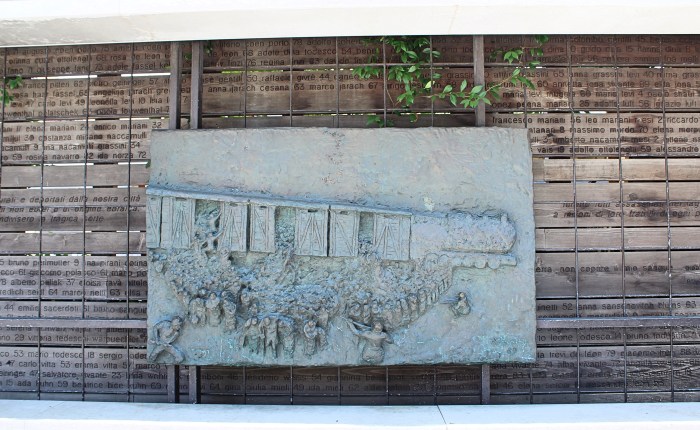
The final result of this—Shylock’s villainy and the play’s anti-Semitism—made the trial scene literally sickening for me. One man, mistreated and spiteful, is trying to legally kill another man for defaulting on a debt, and he is in turn stripped of his property, his identity, and his honor—humiliated, kicked, and spat upon. And all this is delivered as the denouement of a romantic farce, complete with cross-dressing ladies and a playful love story. I admit that I was in no mood to overlook or excuse the anti-Semitism, having recently stood in the Ghetto Vecchio in Venice, and seen the monuments to the deported Jews there. Even so, I think anyone must admit that the play’s dramatic coherence is seriously compromised, even destroyed, by the decline of anti-Semitism.

It speaks to the power of Shakespeare’s art that, even in such an obviously anti-Semitic play, which uses so shamelessly anti-Jewish stereotypes, and which so joyfully persecutes the play’s Jewish villain—even despite all this, we still read and stage this play. As often happens in life, charisma can deaden our moral senses; and Shylock is nothing if not charismatic. He is one of dozens of Shakespeare’s characters whose dialogue reveals a complete personality, a shifting mind whose depths we can only guess at, whose roving interior life extends into parts unknown. Somehow Shakespeare has conjured a character that embodies all of the negative Jewish stereotypes, yet who nevertheless is a believable and fully individual human. This is dramatically admirable and, in retrospect, morally reprehensible. For, as Harold Bloom said, Shylock’s very plausibility is why the play has been such a potent inspiration for anti-Semites.

I am not sure what conclusion to draw from all this. The play is without doubt one of Shakespeare’s stronger efforts. And yet, by the end, I felt little more then distress.

View all my reviews

Review: Lives of the Artists

Review: Lives of the Artists

Lives of the ArtistsLives of the Artists by Giorgio Vasari

My rating: 4 of 5 stars

An artist lives and acquires fame through his works; but with the passing of time, which consumes everything, these works—the first, then the second, and the third—fade away.

After Plutarch’s Lives, Vasari’s Lives of the Artists is likely the most iconic collection of biographies of famous men. He published two editions of the book, the first in 1550, the second in 1568; and both found success in Vasari’s lifetime and have continued to sell well ever since. In life Vasari was a typical Renaissance man, achieving fame for his paintings (he decorated the Palazzo Vecchio) and his architecture (he was responsible for the loggia of the Uffizi), in addition to his work as a biographer. Granted, his paintings are not highly regarded nowadays (though many are pleasing enough to my eyes); but this posthumous verdict did not prevent him from making a fine living. And when you write the first book of art history in the history of art, the rest hardly matters.

The edition I own is highly abridged, as are nearly all popular versions, since the original contains dozens upon dozens of painters, sculptors, and architects—most of whom the casual reader does not know of or care for. This explains why most of the Lives are so short. Indeed, fans of any particular Renaissance artist are liable to be disappointed by Vasari’s treatment. He runs through Sandro Botticelli in all of ten pages, for example, barely pausing to mention the Birth of Venus. Indeed, many of these biographies are hardly biographies at all, just extended catalogues of works. This is certainly useful for the art historian (though Vasari made many mistakes) but it does not make for electrifying reading.

The modern psychoanalyzing mode of artistic biographies was, of course, entirely alien to Vasari, and he seems to regard the artist’s personality as a source of gossip but not of insight. This does not prevent him from including many good stories. Like Plutarch himself, Vasari is rich in anecdote—and, as in Plutarch, half of them are probably false. Fact or fiction, a good story is preferable to a dry fact, and this is when Vasari’s Lives really come alive. We hear of Cimabue agreeing to take on Giotto as a pupil, after seeing the young boy scratching on a stone; or of Paolo Uccello staying up long nights to work on problems of perspective. Whether these stories help us to understand the paintings is doubtful; but they do help to bring alive this amazing time in history.

Vasari begins the book with a sketch of the history of art as he understood it. His opinion is not a masterpiece of subtlety. In essence, the Greeks and Romans understood that art begins by copying nature, and so produced excellent works; then art fell into barbarism (Vasari coined the term “gothic” to describe medieval art) in which the ancient knowledge was lost and artists had no knowledge of proper technique; finally the painter Giotto came and revived the arts, inaugurating a process that culminated in the works of Michelangelo. I must say that this view, though little more than naked prejudice, is at least refreshing in Vasari’s conviction that art was ascending and culminating in his own epoch. (Most of us are disposed to think it is declining.) It is striking that Michelangelo’s historic importance was understood even during his own lifetime. This was not an age of poor Van Goghs working in lonely shacks. The great artists were recognized and rewarded when they lived; and younger artists were seen to have surpassed their masters—novel concepts in our romantic age.

The Life of Michelangelo, whom Vasari knew and worshipped, is by far the longest and forms the core of this collection. Indeed, all the other lives can be seen as mere leadup to the great Florentine, who fulfils all the promise of former ages. Vasari here turns from chronicler to hagiographer, praising Michelangelo with every breath. You might even say that Vasari turns into quite the Boswell, including various bits of Michelangelo’s conversation, and also several letters written to him by the great artist, as if to prove that Michelangelo really was his friend. All this makes for good reading, even if the worshipful tone is grating. The second longest Life in my collection is that of another Florentine (Vasari was a fierce patriot of his home city), Filippo Brunelleschi. This life is perhaps even better than that of Michelangelo, as Vasari charts the squabbles and drama behind the scenes of Brunelleschi’s dome.

Vasari’s style is easygoing and almost conversational, and the pages go by quickly. He strikes me as a man full of shallow opinions but of a generous mind and a steady judgment. This book—full of errors, lacking any historical context, and greatly out of step with modern opinion—could hardly be read as a standalone volume on Renaissance painting. But every book on the subject borrows, knowingly or unknowingly, from Vasari, who has given bread to scholars and delight to readers for generations with this charming book.

I have endeavored not only to record what the artists have done but to distinguish between the good, the better, and the best, and to note with some care the methods, manners, styles, behavior, and ideas of the painters and sculptors; I have tried as well as I know how to help people who cannot find out for themselves to understand the sources and origins of various styles, and the reasons for the improvement or decline of the arts at various times and among different people.

View all my reviews

Review: Plutarch’s Lives

Review: Plutarch’s Lives

Parallel LivesParallel Lives by Plutarch

My rating: 3 of 5 stars

Ease, and speed of execution, seldom produces work of any permanent value or delicacy. It is the time which is spent in laborious production for which we are repaid by the durable character of the result.

In the course of his grand theory of history, Oswald Spengler distinguishes what he sees as the fundamental difference between the ancient Greco-Roman and the contemporary Western cultures: the Greek’s ideal concept was of bounded, perfect forms, while the Western soul craves the boundless, the formless, and the infinite. It is a somewhat vague statement, I know, but I kept coming back to Spengler’s idea as I read Plutarch’s Lives.

Specifically, I kept thinking of Spengler’s idea as I mentally compared Plutarch’s conception of personality with Montaigne’s. I could not help making this comparison, you see, since it was Montaigne who led me to Plutarch. The Frenchman idolized the Greek; and the Essays are full of quotes of and references to Plutarch. Indeed, Montaigne specifically praises Plutarch for his insight into human nature:

The historians are my right ball, for they are pleasant and easy, and where man, in general, the knowledge of whom I hunt after, appears more vividly and entire than anywhere else… the variety and truth of his internal qualities, in gross and piecemeal, the diversity of means by which he is united and knit, and the accidents that threaten him. Now those that write lives, by reason they insist more upon counsels than events, more upon what sallies from within, than upon what happens from without, are the most proper for my reading; and, therefore, above all others, Plutarch is the man for me.

For my part this quote better describes Montaigne than Plutarch. Since it is exactly in this—the representation of personality—that I think Spengler’s idea most aptly applies in these two writers.

Compare the representation of a person in a classical Greek statue and in a portrait by Rembrandt, and I think you will catch my meaning. The first is all surface—shapely limbs, a well-proportioned body, a harmonious face, whose eyes nevertheless stare out serenely into vacancy, suggesting nothing internal. In Rembrandt it is exactly the reverse: the face may be ugly, the body largely hidden in shadows, yet all the energy is focused on the expression—an expression of endless suggestion, which brings to us a definite human personality.

I feel the same contrast between Plutarch and Montaigne. Plutarch’s method of characterization is statuesque. He enumerates his heroes’ virtues and qualities as if they were set in stone; and he derives all of their actions from these static characteristics. Montaigne is completely the reverse: he contradicts himself a thousand times in his book, and in the process reveals the qualities of his mind far more exquisitely than any straightforward description could accomplish. Plutarch’s heroes never change: their character is their destiny; whereas Montaigne is nothing but change. Indeed, for me it is hard to say that Plutarch’s heroes have “personality,” in the sense that I can imagine meeting them. They are no more relatable than a Greek statue.

They were certainly relatable to Plutarch himself, however, as he writes in a famous passage:

It was for the sake of others that I first undertook to write biographies, but I soon began to dwell upon and delight in them for myself, endeavoring to the best of my ability to regulate my own life, and to make it like that of those who were reflected in their history as it were in a mirror before me. By the study of their biographies, we receive each man as a guest into our minds, and we seem to understand their character as the result of personal acquaintance, because we have obtained from their acts the best and most important means of forming an opinion about them.

This quote also illustrates Plutarch’s moral purpose. For a book written by a Greek living under Roman domination, comparing the lives of Greeks and Romans, he seems to have been quite bereft of political purpose. He is, rather, a moralist. Through his biographies he hopes to determine which actions are noble, which nobler, and which noblest, an analysis he performs through his comparisons at the end of the paired lives. He writes biographies in the conviction that we naturally imitate which we see and admire; we are drawn in by the attraction we feel for noble characters, and become ennobled ourselves in the process. This is why Plutarch eschews writing strict history:

I am writing biography, not history; and often a man’s most brilliant actions prove nothing as to his true character, while some trifling incident, some casual remark or jest, will throw more light upon what manner of man he was than the bloodiest battle, the greatest array of armies, or the most important siege. Therefore, just as portrait painters pay most attention to those peculiarities of the face and eyes, in which the likeness consists, and care but little for the rest of the figure, so it is my duty to dwell especially upon those actions which reveal the workings of my heroes’ minds, and from these to construct the portraits of their respective lives, leaving their battles and their great deeds to be recorded by others.

This sounds promising enough: teaching moral lessons through depicting great personalities. My problem—aside from not being able to relate to the heroes—was that I questioned the very greatness of their actions. Of course there are many virtuous actions recorded here, worthy of praise and emulation. However, nearly all of Plutarch’s heroes are military commanders; and these pages are spattered with blood. The cutthroat world of ancient political squabbles, territorial conquests, internal strife, did not strike me as promising ground to teach virtue. Voltaire was perhaps thinking of Plutarch when he made this remark:

Not long since the trite and frivolous question was was debated in a very polite and learned company, viz., Who was the greatest man, Caesar, Alexander, Tamerlane, Cromwell, etc.? Somebody answered that Sir Isaac Newton excelled them all. The gentleman’s assertion was very just; … those politicians and conquerors (and all ages produce some) were generally so many illustrious wicked men. That man claims respect who commands over the minds of the rest of the world by force of truth, not those who enslave their fellow-creatures: he who is acquainted with the universe, not they who deface it.

Plutarch, to his credit, does give a remarkable portrait of the Newton of his time: Archimedes. But this is tucked away in his life of the Roman general, Marcellus.

For these reasons I had a great deal of difficulty in finishing this book. After every couple Lives I had to take a break; so it took me three years of on-again, off-again reading to finally get to the end. My ignorance did not help, either. Plutarch, being an ancient author, sometimes presumed a great deal more knowledge that I possessed about the relevant political history; and so I found myself frequently lost. And his style, though eloquent, is also monotonous (at least in translation), which was another challenge to my attention.

But I am glad I read Plutarch. This book is an extraordinary historical document, an invaluable (but not infallible) source of information about these ancient figures. Plutarch loved a good story and these pages are rich in anecdote—some of them so famous that it is likely you know one even if you have not read Plutarch. And though I struggled through many of the less famous figures, I was entranced by Plutarch’s biographies of the heroes I was acquainted with: Pompey, Alexander, Cicero, Brutus, and Antony. (Shakespeare followed the latter two Lives very closely in his Roman plays.) If Plutarch was good enough for Montaigne then, by Jove, he is good enough for me.

View all my reviews
Review: Two Books by Henry Adams

Review: Two Books by Henry Adams

The Education of Henry Adams : An AutobiographyThe Education of Henry Adams : An Autobiography by Henry Adams

My rating: 3 of 5 stars

Once more! this is a story of education, not of adventure! It is meant to help young men—or such as have intelligence enough to seek help—but it is not meant to amuse them.

Everyone agrees that this book is difficult and odd. An autobiography of an American man of letters, the son of a diplomat, grandson of a president, historian, journalist, secretary, all told in the third person, written for his private circle of friends. At once claiming to be the story of one man’s life, a critique of the educational methods of the nineteenth century, a parable of the fin de siècle, and a new theory of history, the book is, in reality, none of the above, and is instead the sigh of an old man looking back on his life.

I must admit that I found this book exasperating in the extreme. One quickly gets the impression that, when Adams uses the word “education,” it is meaningless or worse than meaningless. He goes to London with his father, and becomes intimately acquainted with the workings of British politics, all during the difficult years of the American Civil War, and complains that he received no useful “education.” He teaches at Harvard for seven years, a professor of Medieval History, and concludes: “On the whole, he was content neither with what he had taught nor with the way he had taught it. The seven years in teaching seemed to him lost.” He becomes a journalist in the capital, and then works on a seven-volume history of America during Jefferson’s presidency; and still, after all this, he insists he has received no useful “education.” And after every phase of his life, when Adams rings the same gloomy bell, the reader asks: “What on earth would satisfy you, Mr. Adams?”

Another exasperating element is the degree to which Adams assumes a familiarity with the intricacies of 19th century politics. Reading the chapters when he was in England felt like reading a grocer’s shopkeeping books. It was disjointed, jerky, and, worst of all, didn’t explain a thing. At first, I assumed this difficulty resulted from Adams’s originally writing the book for his circle of friends; but the obscurity goes even further: it is as if Adams wrote the book only for himself. The book swings wildly in tone from dry note-taking to half-formed and half-coherent abstractions, all written in a prose style lucidly opaque.

Adams also gives the impression of being a bit muddle-headed. He spends some time talking about Lyell’s geology and Darwin’s evolution, and it soon becomes apparent he understands neither. He goes on long tangents about “force,” while it is obvious that what Adams means by that word is as meaningless as what he means by “education.” He ends the book on a very confused and seemingly pointless attempt to give a mathematical explanation of history, but never reaches above vague commonplaces, endlessly repeated. I seldom came across an insight of his that was insightful.

In short, the impression was that Adams had taken all of the stuff of his life—his doings, his friendships, his thoughts, his career, his background—and left it out to bake in the hot sun, until all the savor and succulence was scorched out of it, leaving only a tough jerky that wearies the jaw in the attempt to chew the husk.

Still, after all this, I must admit that this book has a strange power. There were times I could not put it down, even when I felt I wasn’t understanding a thing. Adams always seemed to be only two steps away from a great insight, an astounding thought; but he never quite reaches it, which is why the book can seem so tragic. He was always searching and never finding; and the reader is left in doubt what he was searching for, and whether anyone will ever find it. In his elegant, knotty prose, he turns out aphorism after aphorism—all apparently insightful, but in reality empty—popping like soap bubbles leaving nothing but air. And what saves the book is that Adams knew this, and yet could do nothing better.


Mont-Saint-Michel and ChartresMont-Saint-Michel and Chartres by Henry Adams

My rating: 3 of 5 stars


Saint Thomas did not allow the Deity the right to contradict Himself, which is one of man’s chief pleasures.

I read this book in preparation for my visit to Chartres, which was just last week. I had not been very fond of Adam’s most famous book, his Education, but I had high hopes that his writing would improve when his focus shifted to something other than his own life. Yet I have found the two books discouragingly similar.

As a stylist Adams appears, at least superficially, quite strong. His sentences are clear and mostly elegant, occasionally epigrammatic. But stylistic problems appear on a higher level of organization. Both Adam’s autobiography and this book were not originally written for publication, but for his close circle of family and friends; and as a result, Adams seems to explain everything except what most needs to be explained. His ideas float against a background that he does not provide, making his train of thought appear out of context. In this he reminds me of George Santayana, who similarly omits to signal where he is going and why he is going there, though Adams lacks the philosopher’s occasionally forays into sublimity to compensate. The result is rather irritating, superficially clear but actually opaque, like overhearing an eloquent old man talk to himself.

But my gravest complaint about Adams, both here and in his autobiography, is his tendency to organize his books around central ideas that I find vague and vapid. In the Education, this takes the form of his armchair theorizing about “force,” the Dynamo, and the laws of physics as applied to history, and even more prominently in his main theme of “education,” his conception of which remains unclear to the very end. In this book it mainly takes the form of his insistence that “The Virgen” was personally involved in the construction of Chartres Cathedral. To be fair, he tends to treat these ideas (and himself) with a considerable amount of irony; but the irony does not amount to full satire, leaving it unclear whether he is merely kidding or if he intends these ideas to be somehow insightful.

Again, just as in his autobiography, here the dominant mood is notalgia. Though extremely successful, Adams apparently felt out of harmony with his world and yearned for a time when society was simpler and more unified. This leads him quite naturally to the Middle Ages, to the poetry, to the great cathedrals, and to the theology of St. Thomas Aquinas, which unite art and science into a seamless whole. Consequently this book, far from being historical analysis, is more of a personal appreciation of the French Medieval period, spinning off into fantasy or speculation wherever it suits him. This self-indulgent tone is grating to somebody trying to learn about Chartres.

Now that I have gotten all this criticism out of the way, I must admit that the book, like his autobiography, has its merits and charms. He is obviously fond of this period, and so writes in a tone of enthusiastic admiration that proves quite infectious. This keen appreciation for the “spirit” of the Medieval period is the book’s most useful attribute, helping to put the reader in the mindset to appreciate the epoch’s art, poetry, and thought. I found Adams’s chapters on architecture, specifically on Chartres, to be stuffy and difficult to follow—for here, as in his chapters on British politics in the Education—he assumes a level of familiarity (specifically about the French royal family) that the reader is unlikely to possess. But when context is provided by an external source, Adams can be quite pleasant. When I visited Chartres, and saw its magnificent stained glass for myself, his chapters ceased to be so vexing.

The chapters I most enjoyed were the final three, about philosophy—specifically, Abelard, St. Francis of Assisi, and St. Thomas Aquinas—since here my background was not so lacking. Yet even here it must be said that Adams’s comments are more in the spirit of an amateurish aficionado rather than a serious student. He interprets Aquinas as an “artist” rather than a thinker, repeatedly disqualifying himself from passing sentence on Aquinas’s arguments (though he says some perceptive things in spite of this).

By contrast I thought the chapters on poetry were the worst, since they mainly consisted of excerpts of poetry, in Latin or Medieval French, with repeated assurances of their high quality and their untranslatable beauty. (His mostly bland translations serve to prove his point.) But in general Adams’s approach to poetry is the same as his approach to architecture and theology, mostly confined to passionate declarations of affection, without much attempt at analysis or insight.

View all my reviews
(Cover photo by Benh LIEU SONG; licensed under CC BY 2.5; taken from Wikimedia Commons.)

Review: The Rural Trilogy (Lorca)

Review: The Rural Trilogy (Lorca)

Bodas de sangreBodas de sangre by Federico García Lorca

My rating: 4 of 5 stars

Bodas de Sangre, or Blood Weddings, is an odd combination of the ancient and the modern. The story could not be more elemental: the conflict of love and duty, the tragedy of death. And yet the style is pure Lorca—symbolic, surrealistic, modern. The play is effective, not for any subtlety or refinement, but for the sheer amount of force that Lorca brings to bear on the main themes. The characters are nameless archetypes, whose speech is poetic passion. Lorca’s use of naturalistic imagery in his poetry—animals, trees, rivers, the moon—reinforces the primeval quality of the story, as if tragedy were a law of the universe. I am excited to read the other two plays of Lorca’s so-called rural trilogy.


La casa de Bernarda AlbaLa casa de Bernarda Alba by Federico García Lorca

My rating: 4 of 5 stars

This is the second of Lorca’s “rural trilogy” I have read, and if anything I liked it even more than Bodas de Sangre. In form and theme the two are quite similar. Like a Greek tragedy, the plot is simplicity itself, with one obvious conflict and one calamitous resolution. Again, Lorca’s power as a dramatist comes, not from subtlety or wit, but from pure passion. The incompatibility between traditional values and human impulses, with all its tragic implications, is laid bare by Lorca, who shows us a culture whose religious mores and gender norms oppress women and deprive them of a fulfilling life. Strikingly, the cast of characters is entirely female, even though the conflict revolves around a male who is always offstage. This allows Lorca to focus on a side of life that was often swept aside, while maintaining an atmosphere of tension and constraint that makes the play so riveting. I am excited for Yerma.


YermaYerma by Federico García Lorca

My rating: 4 of 5 stars

I have enjoyed each play of Lorca’s rural trilogy more than the last. He is such a heartrending writer. Even on the page, the emotion of the play is raw and deeply affecting. He had an acute ear for dialogue, and could write as naturalistically as anyone; and when this naturalism is supplemented by his poetic gifts—at times surrealistic, at times pastoral—the language becomes electric with meaning. The word I keep coming back to is “elemental,” since the plays dramatize basic and timeless tragedies of human life.

In this play the tragedy is the anguish caused by being childless in a time when women were valued as mothers and mostly confined to the house. As in the other two plays in the so-called “trilogy” (they all have distinct plots), the basic conflict is between conservative, religious traditions and spontaneous human impulses. Lorca seems to have felt deeply the suffering caused by an uncompromising Catholic morality, and convincingly shows how it doomed people to lifelong unhappiness. It is fittingly tragic that this same moral code contributed to Lorca’s own death.

View all my reviews
Sorolla-9

Review: King John

Review: King John

King JohnKing John by William Shakespeare

My rating: 3 of 5 stars

And oftentimes excusing of a fault
Doth make the fault the worse by the excuse

King John is normally regarded as one of Shakespeare’s earliest and weakest history plays. The plot mainly concerns the king’s conflict with France over his legitimacy, since John inherited the throne from his brother, Richard the Lionheart, even though the late king’s son, Arthur, was alive and well. This leads to a rather silly confrontation between the two powers, in which they try to get the town of Angiers to recognize one of them as the true king, which the townsfolk resolutely refuse to do. The warring factions finally decide to just destroy Angiers—presumably for the satisfaction—until they receive the timely recommendation to marry the prince of France to the princess of England, thus uniting their houses. This is done, and succeeds in suppressing the conflict for about five minutes, until a Cardinal stirs up the war again (which leads to some notable anti-Catholic blasts from Shakespeare).

Compared to Shakespeare’s more mature works, the characters in this play are mostly stiff and lifeless, with far less individualizing marks than we expect from the master of characterization. As Harold Bloom says, at this point Shakespeare was very much under the influence of Christophe Marlowe, and follows that playwright in his inflated, bombastic speeches. I admit that the swollen rhetoric often had me laughing, especially during the first confrontation between the English and French parties. The pathetic and spiteful King John is somewhat more interesting, if not more lovable, than the rest, but the real star is Philip Faulconbridge (later Richard Plantaganet), the bastard son of Richard the Lionheart, and the only immediately recognizable Shakespearean character. As with Launce in Two Gentlemen of Verona, it is a relief and a delight whenever Philip appears onstage.

As far as notable quotes go, this play is the source of our phrase “gild the lily,” though it misquotes the play, which goes: “To gild refined gold, to paint the lily.” Also notable is this description of grief for a lost child, which many surmise expressed Shakespeare’s grief for his own deceased son, Hamnet, though this is pure speculation:

Grief fills the room up of my absent child
Lies in his bed, walks up and down with me,
Puts on his pretty looks, repeats his words,
Remembers me of his gracious parts,
Stuffs out his vacant garments with his form

View all my reviews

Review: Letters on England

Review: Letters on England

Letters on EnglandLetters on England by Voltaire

My rating: 4 of 5 stars

Time, which alone gives reputation to writers, at last makes their very faults venerable.

Voltaire and Rousseau are usually grouped together as the twin pillars of the 18th century, the first championing reason and reform, the second romanticism and revolution. After reading them back to back, I know who I prefer. Rousseau is arguably a far more original thinker and writer; yet his personality is so irksome and his arguments so irrational that it can be unpleasant to read him. Voltaire, by contrast, is witty, charming, and delightful; and after Rousseau’s lyrical fantasies, Voltaire’s deflating sarcasm is extremely refreshing.

This book is a collection of essays on topics related to England, written after Voltaire’s three-year stay on the island nation. He interviews a Quaker, visits Parliament, goes to the theater, and then expounds the philosophy of Bacon, Locke, and Newton. He skips lightly from topic to topic, a barb here, a jest there, while revealing an impressive range of knowledge—from inoculation to history, from theater to physics. In general his opinion of England is quite positive, arguably idealized, seeing England as a land of toleration and philosophy. Indeed, the only thing that Voltaire shows some reservation towards is Shakespeare, whose dramas struck Voltaire’s Enlightenment taste as lacking refinement.

The book was controversial when published, since many in France saw Voltaire’s praise of England—correctly—as veiled criticism of their own country. Nowadays, this political purpose only adds to the essays’ charms, as we see Voltaire as a champion of an open society, from religion to science to literature, in addition to an omnivorous intellectual. Few books pack so much into so little space.

View all my reviews