The name of Claude Monet stands over the artworld like a colossus—the man who defined one of the most iconic movements in art: impressionism. For a great many, I suspect, these blurs of color and light are what immediately spring to mind when they imagine the French countryside. The image of the paint-stained artist, brush in hand, standing in a field of grass, flouting both artistic conventions and social norms, is virtually a cliché now. But all of this we owe to Claude Monet.
Stereotype or no, I admit that this vision of the artist has a certain romantic appeal to me. And so I decided, on my last trip to Paris, to pay a visit to the home of this artist to partake of this dreamy, wistful aesthetic.
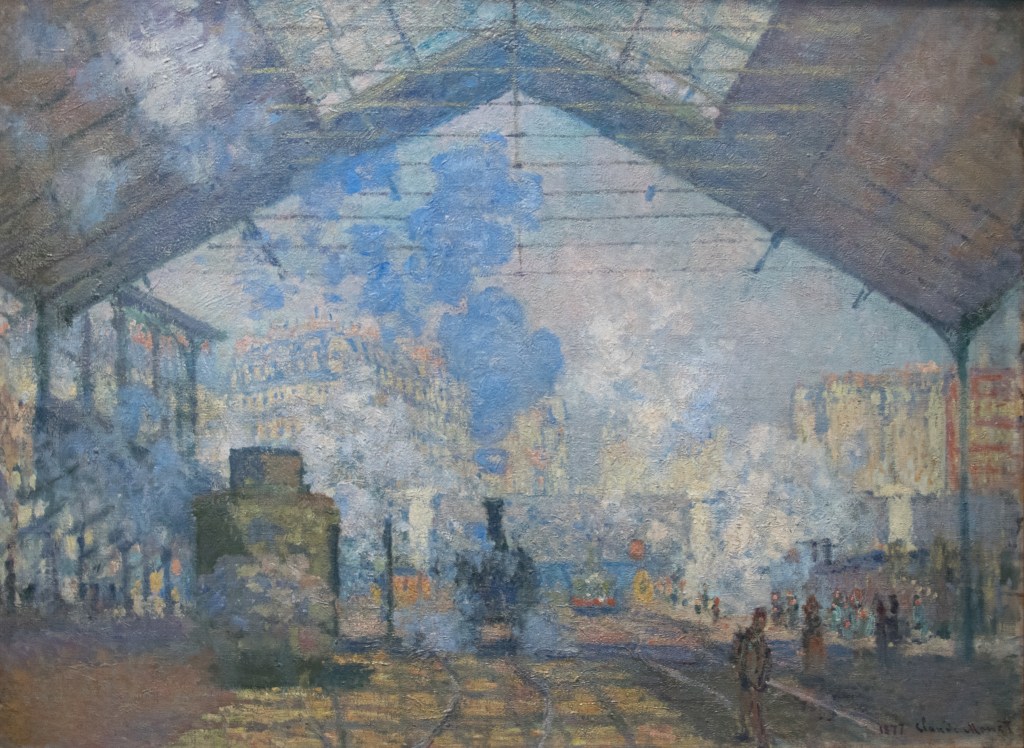
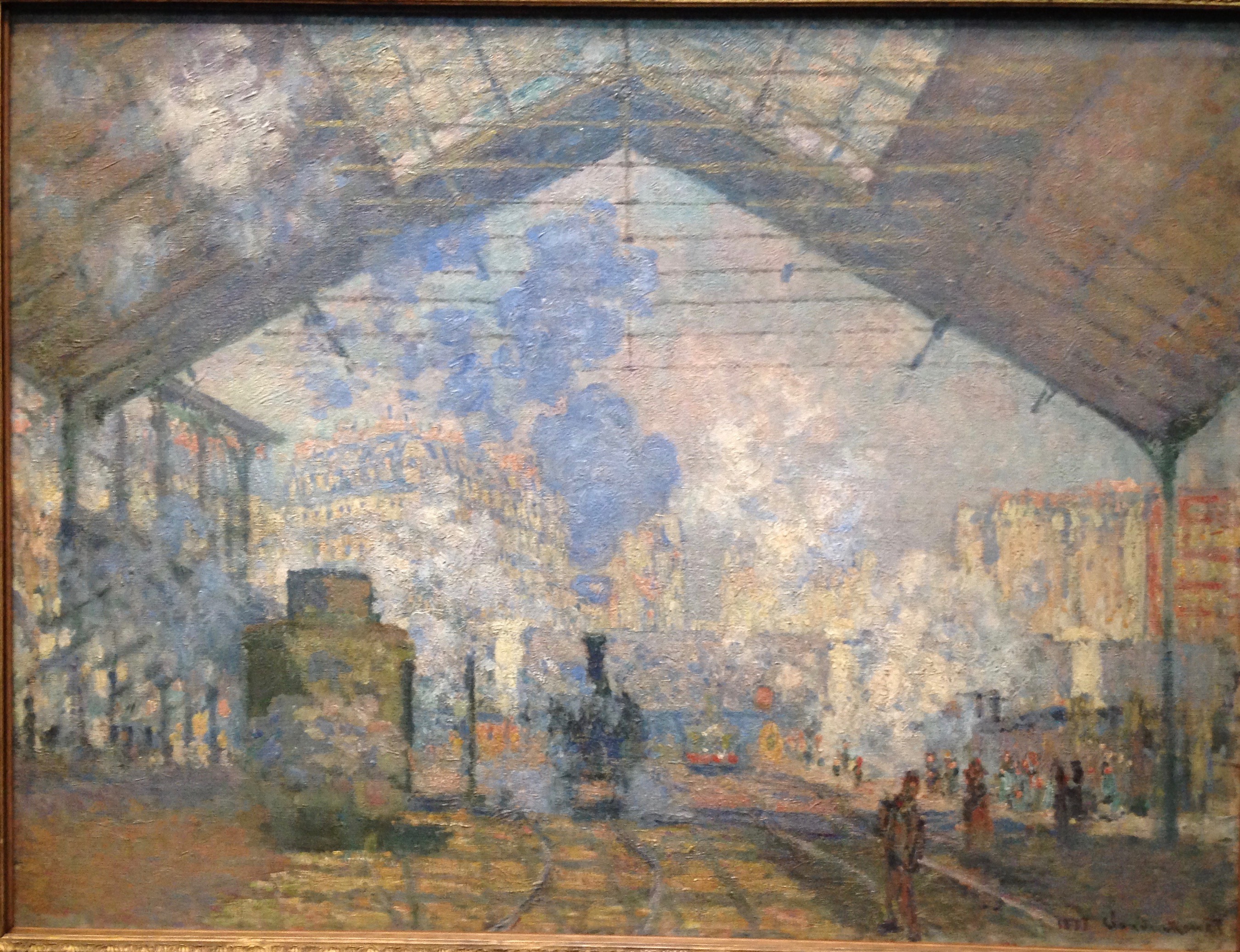
Normally, getting there from Paris is no challenge. A high-speed train bridges the distance in less than an hour—departing from Gare Saint-Lazare, a station Monet depicted in a series of paintings, and then arriving in the town of Vernon. This town lies just across the river Seine from Giverny. A taxi, a bus, or even a sprightly walk will get you to Monet’s house in no time.
Gare Saint-Lazare
But I was unlucky. During my trip, in May of 2024, there was maintenance scheduled on this particular train line, so this option was out. So I opted for something I habitually avoid: a guided bus tour.
The bus was set to depart early in the morning, from the Avenue de la Bourdonnais, in the shadow of the Eiffel Tower. However, there was a hitch. As the group of tourists—speaking a babble of tongues—gathered on the pavement to board the bus, a police officer approached the tour guides and explained something with authoritative insistence. Apparently, the bus could not park in its usual spot, because of the new rules put in place in preparation of the summer olympics.
The preparation was already apparent. The Champs de Mars was buried in a mass of scaffolds, and a large stage was nearly finished in the Trocadero on the other side of the river. What this meant for us, however, was that we had to walk to a street a few blocks away. As we walked, a young Italian woman, who spoke astoundingly good English, chit chatted with an elderly American couple; but I was too focused on Monet for smalltalk.
The bus swept us out of the city and into rolling fields of green. We were headed north, towards Normandy. On the bright May morning, it was easy to imagine why this gentle, domesticated landscape inspired artists to capture its delicacy.
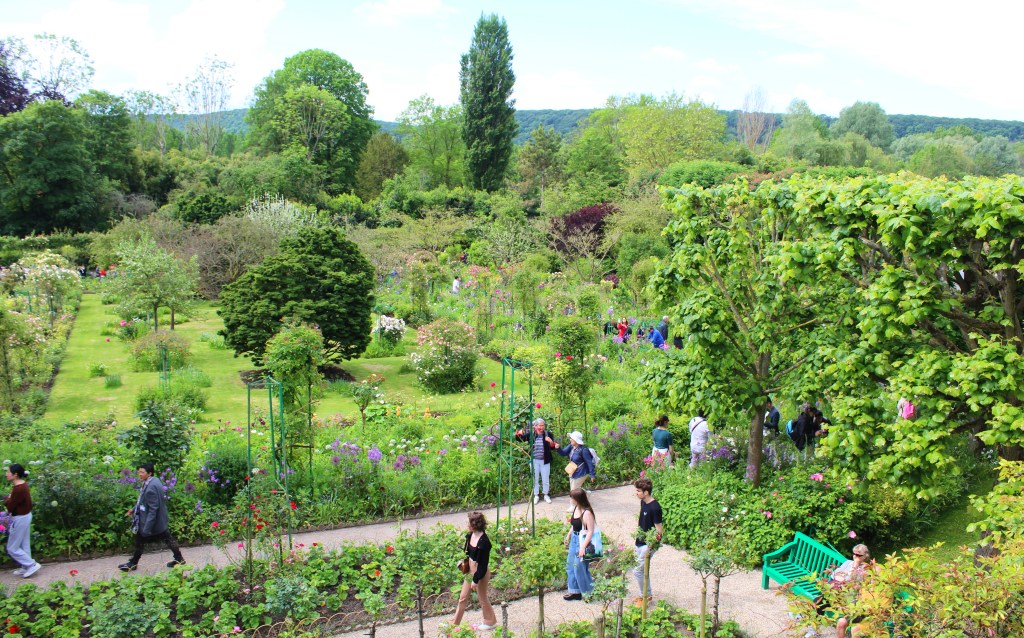
We arrived in no time, and I followed the crowd into the property. This was a moment I had imagined to myself many times. Monet’s gardens are a kind of mythical place in the world of art, a place I had seen through Monet’s eyes innumerable times, imbued by his vision with mystery and translucent beauty. It was almost a surreal moment, then, when I realized that I was standing in the gardens, and that they were real, physical, concrete.
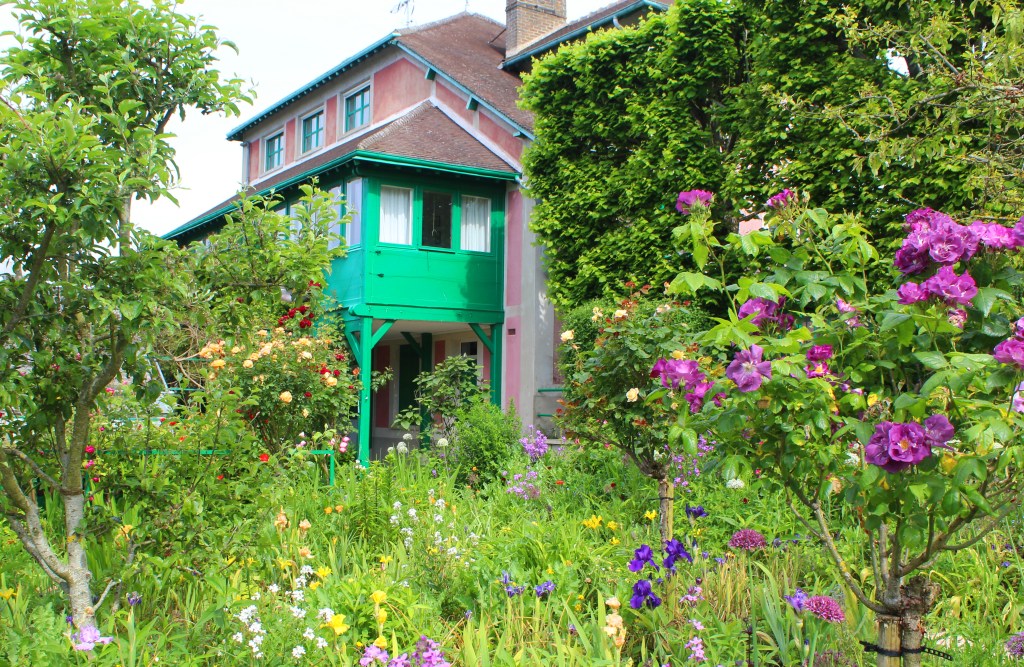
The gardens are divided into two sections. Directly in front of the simple house, with its pink plaster walls and vine-covered trellises, there are rows of flowers in square plots. They are arranged like globs of paint, splashes of color that look organized from afar but haphazard from up close. It is impressionism made manifest.
The more famous section of the garden is on the other side of the highway that runs through town. Monet purchased this property later, which is why it is not contiguous with the original gardens. Visitors nowadays can pass from one to the other through a small underpass under the road, but Monet himself would have had to cross it.
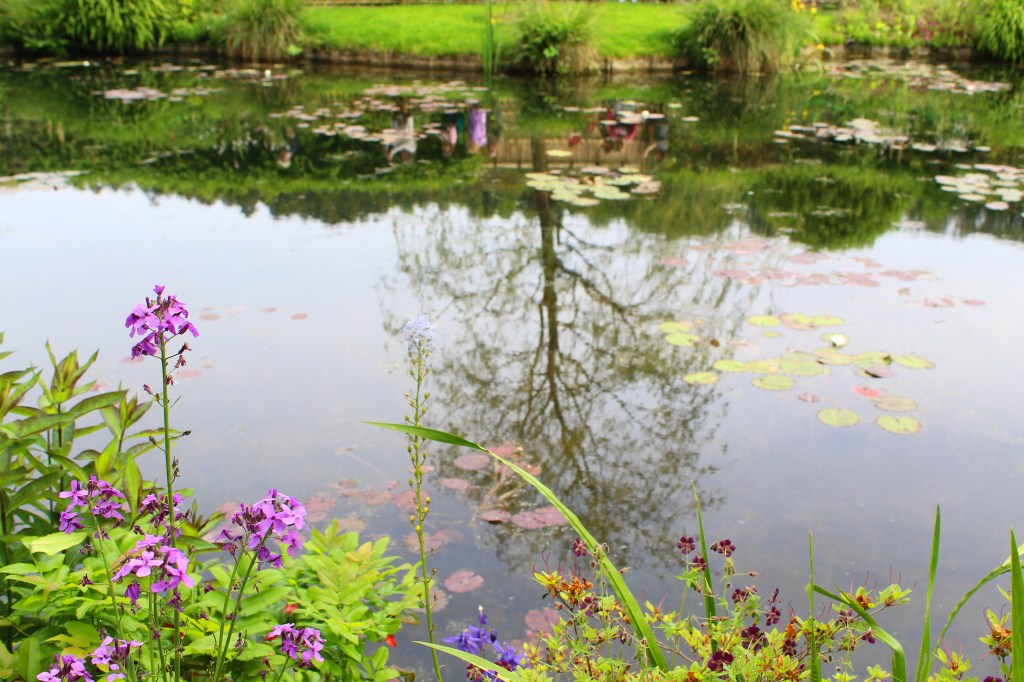
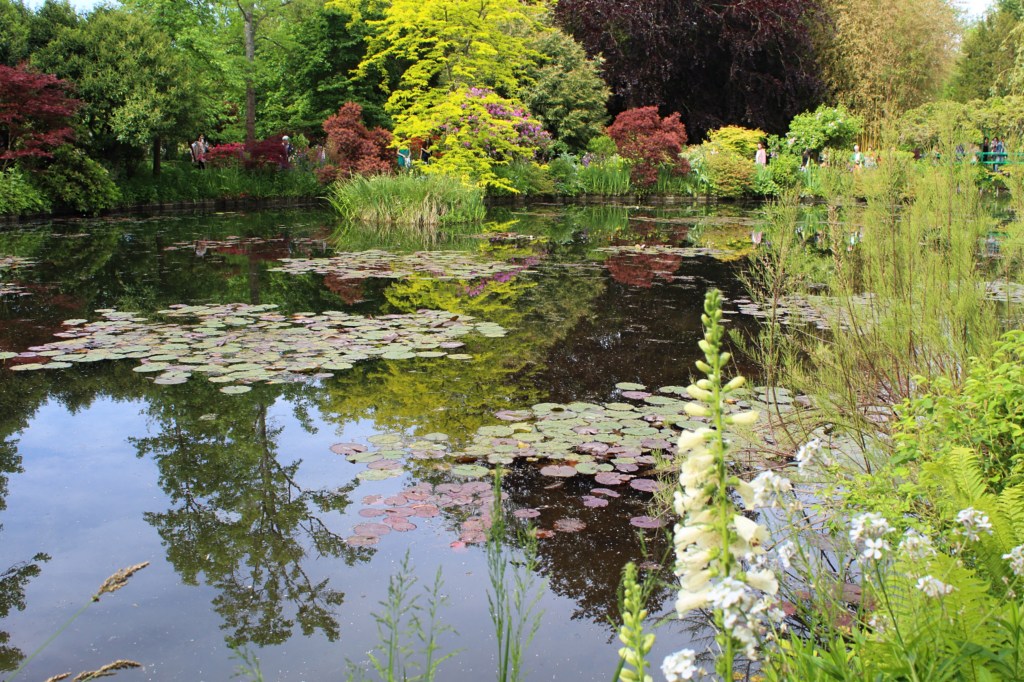
If the first section embodies the lightness and prettiness that is often associated with impressionism, this one is its highest embodiment. Here, Monet expressed his love for Japan, with the thicket of bamboo, the famous pond of water lilies, and the green wooden bridge. The pond is shallow and murky, and ringed all sorts of trees, bushes, and flowers. As a result, the surface texture is a mixture of reflections—of the blue sky, grey clouds, and the surrounding gardens—and the waterlilies lurking below. Though I was there briefly, it took little imagination to picture how the surface could change with the time of day, the weather, and the seasons. It is a kind of laboratory to study color and light.
I would have loved to have basked in the garden for hours, but my time was limited by the tour bus schedule. So I pulled myself away to queue up for the house. It is much as one might expect of Monet—open, light, airy, and unpretentious. Unfortunately, however, it is difficult to put oneself in the artist’s shoes and imagine oneself at home, if only for the constant crowds pushing the visitor from room to room. But I still had a few moments to appreciate Monet’s fine collection of Japanese prints.
The visit ends, as so many do, in the gift shop. Yet unlike so many gift shops, this one is actually one of the main attractions. Though it looks like a large green-house, this was actually Monet’s studio—and it is easy to see why, as the large windows in the ceiling flood the space with light. Perhaps it is sacrilegious to fill such a space with knick-knacks for tourists; yet, as far as knick-knacks go, the items on display are surprisingly enticing, if only because they are adorned with the master’s paintings.
If I had more time in Giverny, I would have walked the short distance to the Église Sainte-Radegonde, where Monet is buried in a family plot. I would also have liked to visit the small Museum of Impressionism, which has a collection of paintings by Monet and others. But, alas, my tour bus was departing for Paris, and I didn’t have any more time to spend in Giverny.
When I got back into the city, I decided to round out my Monet experience by visiting the Musée Marmottan. This is located near the Bois de Boulogne, a huge park to the west of the city. The museum has one of the finest Monet collections in the world, mostly thanks to a huge donation by Michel Monet, the artist’s only heir. It is housed in what used to be a Duke’s old hunting lodge; and like the Frick Collection in New York, it preserves some of the ambience of obscene wealth.
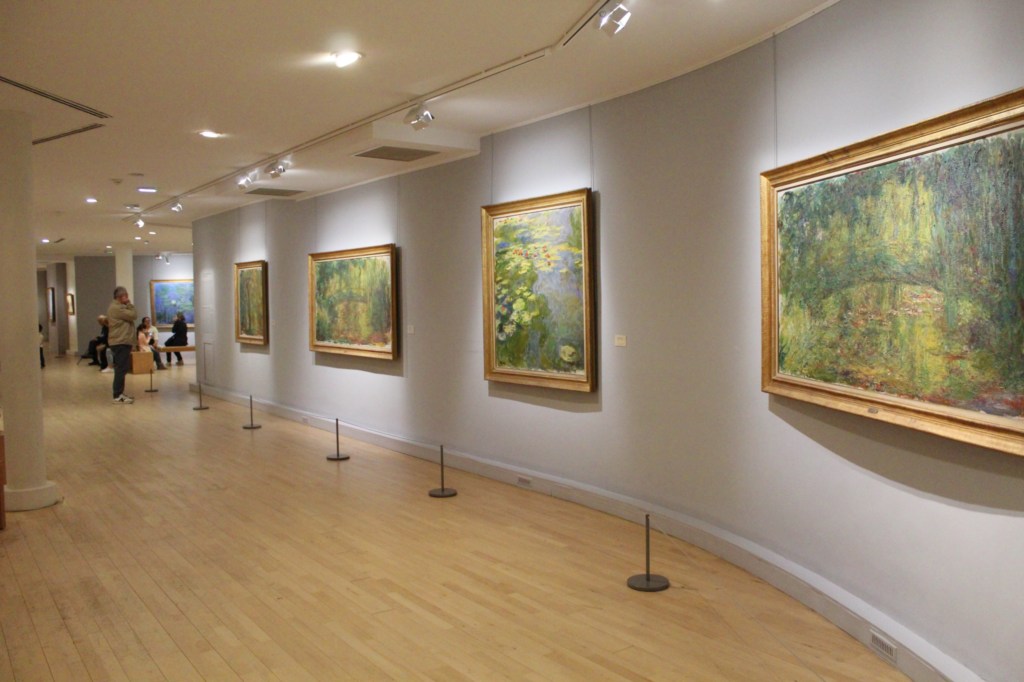
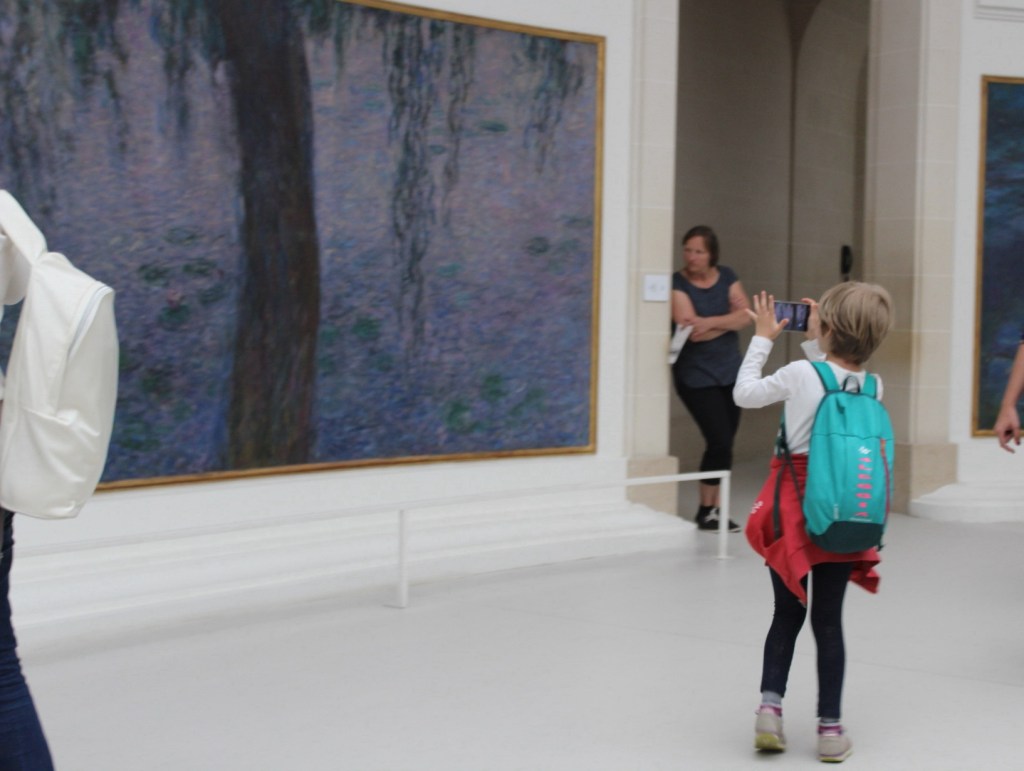
The museum has a series of rotating special exhibits (when I visited, it was about art and sport) and a collection of impressionists that goes far beyond Monet. But his work is the main attraction. The paintings are held in an underground space, modeled after another museum in Paris, the Musée de l’Orangerie—with large, open, well-lit rooms which situate the viewer in a kind of simulated garden.
And, indeed, standing there after paying a visit to the real garden gives you a wonderful insight into the way an artist’s eye can both capture and transform its subject. Monet’s paintings are both highly “unrealistic”—impossible to mistake for a photograph, say—and yet startlingly accurate. They convey subtleties of light and color that a more “correct” technique would overlook. Or rather, they convey a kind of flavor—a subjective sensation, overlaid with aesthetic appreciation.
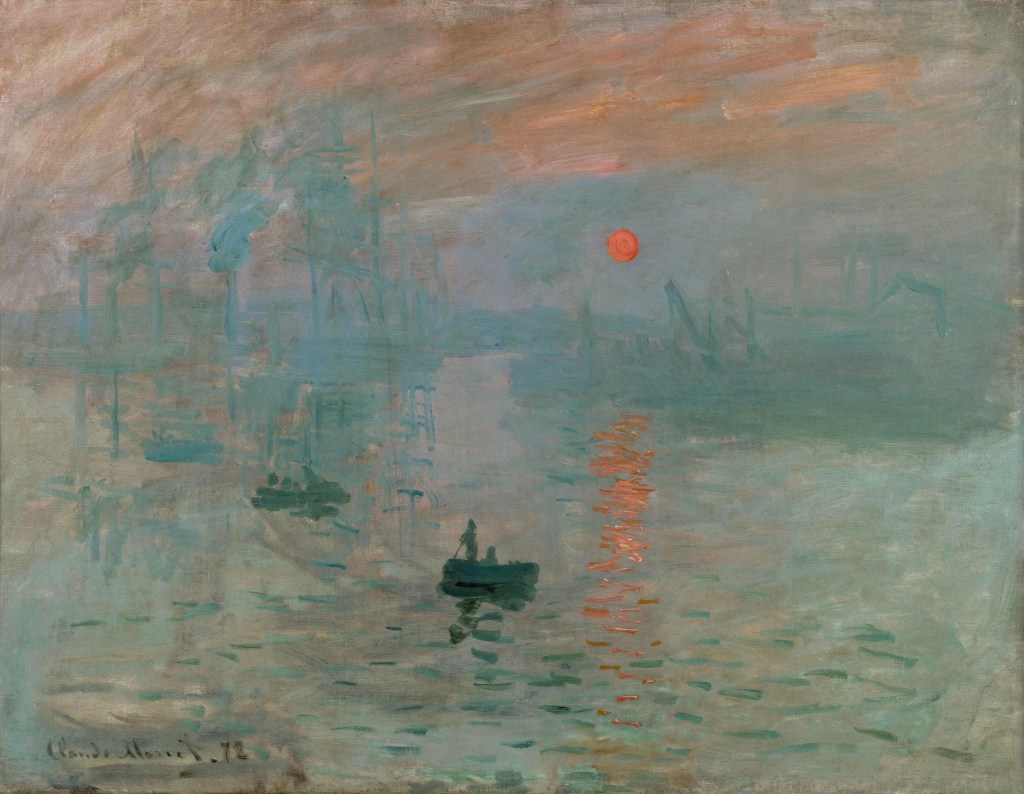
The only disappointment of my visit was that the museum’s most famous work, Impression, Sunrise, was away on loan. This work, which Monet completed in 1872, was monumentally influential; it would eventually give the entire artistic movement its name. The painting was both daringly original and a continuation of trends that came before. Its originality is apparent when compared to the oil paintings of the established French artists of Monet’s day, with their impeccable technique and focus on mythological or allegorical subjects. Monet’s work is nothing like that. But a side-by-side comparison with, say, a Victor Turner painting shows how Monet took pre-existing techniques for portraying light and atmosphere, and then expanded on them.
Impression, Sunrise
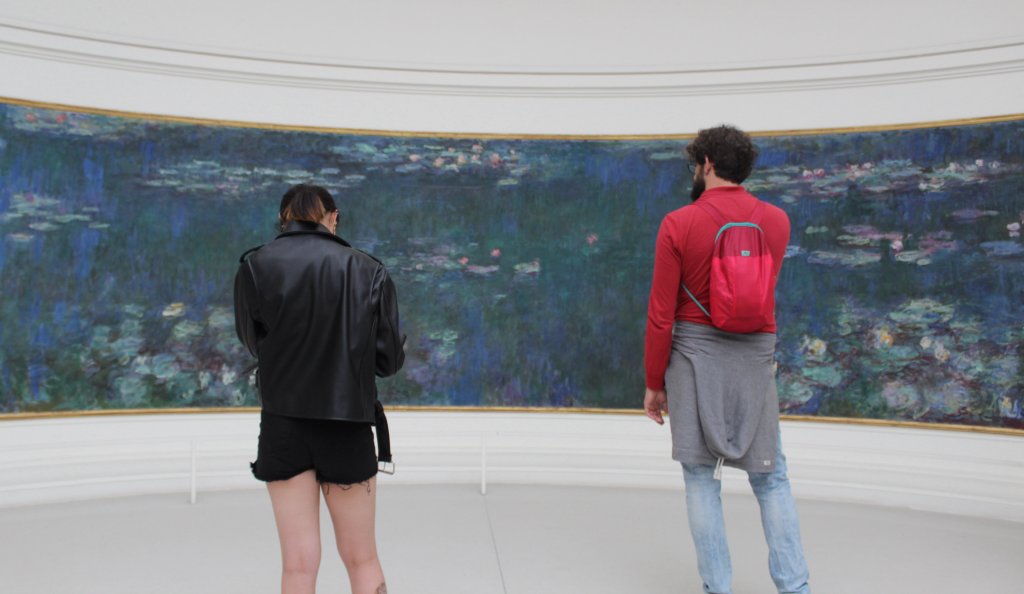
The last museum I want to discuss is one I visited many years before this trip, before even the 2020 pandemic: the Musée de l’Orangerie. This museum is in what used to be an “orangery,” a building to protect orange trees from the harsh Paris winter. In the past, you see, oranges were something of a royal prerogative—so delicate that only the huge resources of the monarchy could keep them alive in European climes. This particular orangery is located in the Tuileries Garden, and is the home of Monet’s most impressive works.
The visitor enters and almost immediately finds herself in an oval room, flooded with white light. Running along either wall are huge canvases, the Water Lilies—so big that you can easily imagine that you are visiting Monet’s home in Giverny. They are mesmerizing: exuding an almost mystical intensity. In their own way, these paintings are as ambitious and monumental in scope as any in art history; and yet, they are concerned with something completely ordinary. What makes them so powerful is the intensity of vision that Monet brings to the scene, as if he is somehow penetrating the surface layer of reality and looking at its essence.
I remember sitting on the central benches a long time, and willing myself to extract as much from the paintings as I could. I tried to imagine what it would be like for me to have such a vision, to see light and color as pure attributes of nature, rather than mere signs of material things. What I’m trying to say is that these paintings struck me as being wonderfully profound, in a way that very few paintings do. But then again, perhaps I just like pretty pictures.
Well, that rounds out my Parisian Monet experience. While I’m sure his work is not to everybody’s taste—with its focus on pure aesthetic qualities instead of content—I think that Monet has earned his place in the pantheon of artistic greatness. His career was intensely innovative, and he nurtured his creativity into his old age. Unlike so many artists, it is Monet’s final works which have arguably become his most celebrated. Further, I think his art is especially relevant now, as the contemporary art world—with its emphasis on message over form—has moved so radically away from the principles he embodied. This is not to say that either camp is correct, only that Monet’s vision of art is one that is worth getting to know.
Like the generations of leaves, the lives of mortal men. Now the wind scatters the old leaves across the earth, now the living timber bursts with the new buds and spring comes round again. And so with men; as one generation comes to life, another dies away.
—Homer, The Iliad
Last week I took a walk in the sierra. A dirt path twisted its way through the pines, leading me out of the town and into the forest. It was a cool day. My fingers felt frozen in my pockets. The air had the fresh, crisp smell of autumn. I could scarcely hear a sound. The only noise I recall is the tinkling of the bells worn by the cows and sheep, grazing in the nearby farms.
I passed a small brook running downhill, and sat down on a nearby rock to rest. The sound of running water is one of the most calming in the world; your anxieties seem to get carried off by it. On the stream’s surface I saw the reflections of branches hanging overhead. Their brittle leaves were green, red, and golden yellow, and their surging reflections in the stream reminded me of a painting by Monet.
Further on, I entered a clearing, where the trees had been cut down to make room for a power line. Behind me I saw the mountains of the sierra, their grey jagged peaks scratching the clouds above. In the other direction was the city of Cercedilla nestled into the hillside. The last rays of the setting sun shone mournfully through the clouds, making the buildings glow.
I saw all this, and I felt in my bones how small a part of the world I am. How many people were living in that town? How many people had to walk through this forest to clear the path? How many years of rain and water erosion were responsible for that running brook? How many eons did the tectonic plates need to throw up such massive mountains?
All the organisms around me, including myself, had evolved over millions of lifetimes to fill a specific niche. Those cows and sheep, animals we intimately rely on, were domesticated by men and women not very different from myself, so many generations ago.
The people who put up those monstrous power cables were each as unique and self-absorbed as I am. Each of them had a favorite after-work drink, each had their own problems with their spouses and their own exasperations with work, each had their own private moments, as I was having, when they were struck by some fleeting, incidental beauty, filled with poetic emotions they could not put into words.
When I reflect on how many generations have come before me, and how intimately they have shaped my world, I get a sense of my vanishing insignificance in view of the whole. And when I consider that all these humans were only a small, passing manifestation of the pageantry of life, and that even life itself is just an isolated itch of matter, I feel even tinier.
I took a deep breath and turned to go. The ground was strewn with the discarded leaves of autumn. One day, I would be among them.
A Spanish woman was saying this to her friend as we passed by.
GF and I both laughed.
“I guess Paris has the same reputation everywhere,” GF said.
Indeed it does. It is amazing to me how many Spaniards have recited the same line to me: “The only problem with Paris is the Parisians.”
I would expect this kind of stereotype to be prevalent among tourists; but two Spaniards who lived in Paris for a long time, and who spoke French fluently, told me the same thing. Why is this image so persistent? Even now we see this stereotype reenacted in movies, television shows, and books. Bill Bryson, in his jejune travelogue of Europe, dwells on this image of the Parisians at length: the snobby, miserable, rude, pretentious Parisian.
Perhaps the person who explained it most memorably was a Blablacar driver from Barcelona who spent three years living there. He said:
“People from Madrid are cocky. But they’re at least happy. People from Paris think they’re better than everyone else, and they’re still miserable.”
In short, the Parisians have an image problem.
Paris, however, does not. Every person I’ve spoken to has praised Paris to the skies. What a strange reputation for a city to have: beautiful and full of assholes. Needless to say I was curious to see for myself.
Not that I needed any additional encouragement to visit Paris. The city’s history speaks for itself. Voltaire, the French Revolution, World War II; the Eiffel Tower, the Louvre, Versailles; the impressionists, the modernists, the existentialists; Ernest Hemingway, Ezra Pound, Gertrude Stein; the art of French cooking, the art of French life—the city has been the center of so much activity that, whatever interest you may have, whether it be painting, cooking, writing, history, philosophy, or just eating, odds are you will be led to Paris.
And I was finally going.
Unfortunately I wouldn’t be there for long. I had to squeeze my trip into a weekend. We would arrive early Friday morning, have all of Saturday to explore, and leave early Sunday.
When I say early, I mean early in the most brutal and cruel sense. In order to book the cheapest flights, GF and I fly when other people don’t. When you’re booking a flight several months in advance, it may sound reasonable to fly at 7 in the morning. But when the date of departure nears, and you realize to make it to the airport, get through security, and be on time for boarding, you have to wake up at 4, this decision may feel somewhat less sensible than it appeared at first. This decision may be especially regretted if, like me, you spend most of the week without sleeping enough, because you teach classes both in the early morning and late at night. And if you’re built like me—tall, leggy, and delicate—you will not be able to catch a wink of sleep when sitting in a cramped seat several thousand feet in the air.
Thus I arrived in Paris with red eyes, a sore neck, and that mixture of panic and mental inactivity that comes with sleep-deprivation. It was in this state that I shuffled down the line to get through customs. (I thought that people coming from Madrid didn’t have to go through customs, since it’s in the Schengen zone, but with the terrorist activity I understand border control has been tightened.)
In my best accent, I said Bonjour to the woman behind the class, as I handed her my passport. She flipped through the passport to the page with my photo and personal information. Then, she flipped to the page before that.
Immediately I felt nervous. Several years ago, on a flight to Kenya, I managed to get toothpaste on my passport (the tube exploded). Unfortunately, the stains are still visible; but fortunately, only the irrelevant first page was affected. Sure, it doesn’t look great, but it’s hardly worth the hassle and expense to get a new one.
These considerations were apparently lost on the customs official who, after turning to the afflicted page, looked up to give me the most unforgettable look. She jerked her neck back, pursed her lips into a duck-billed sneer, and raised her eyebrows with alarm. Then she stamped my passport and rolled her eyes and she handed it back to me. This hasn’t happened to me anywhere else.
I was in France.
More specifically, I was in the Beauvais-Tillé Airport. This is a small and shabby airport, handling about 4 million people annually. (For comparison, the Charles de Gaulle Airport handles about 66 million people annually.) It is marketed by Ryanair as the Beauvais-Paris airport, but this is simply a lie. The airport is 85 km away from Paris. The only way to get to Paris is by bus; the bus costs 17€ per trip, and the ride takes over an hour. Bear this in mind the next time you want to fly Ryanair to Paris.
A long line had already formed in front of the ticket machines for the bus. Apparently, the only way to get a ticket was to use one of these machines; and since everybody needed a ticket, everyone was waiting. The line moved slowly. We stood, shuffled a feet steps forward, and stood.
“I’m gonna go look at what’s going on,” GF said.
She left her bag and went to the front.
“There’s only one working machine,” she said as she returned.
There must have been at least fifty people in line. So here’s another tip: if you plan on saving money by taking an early flight on Ryanair to Paris, and justify this decision with the thought that it gives you extra time in Paris, consider that you will have to wait in line to buy tickets for a bus, and then take a bus ride that lasts 70 minutes and costs 17€. But I was too tired to be feeling regrets.
Finally an employee came out and began working on the broken machines. He pulled them apart, tinkering with the inside, and then rebooted them. As one of them started up, I noticed the operating system: Windows 97. No wonder they weren’t working.
But when the machines sprung back to life, we were able to buy our tickets and go out to the buses. And what do you know? Outside was a ticket booth with real people selling tickets, and a pretty reasonable line. Keep all this in mind for your next trip to Paris.
The countryside around Beauvais
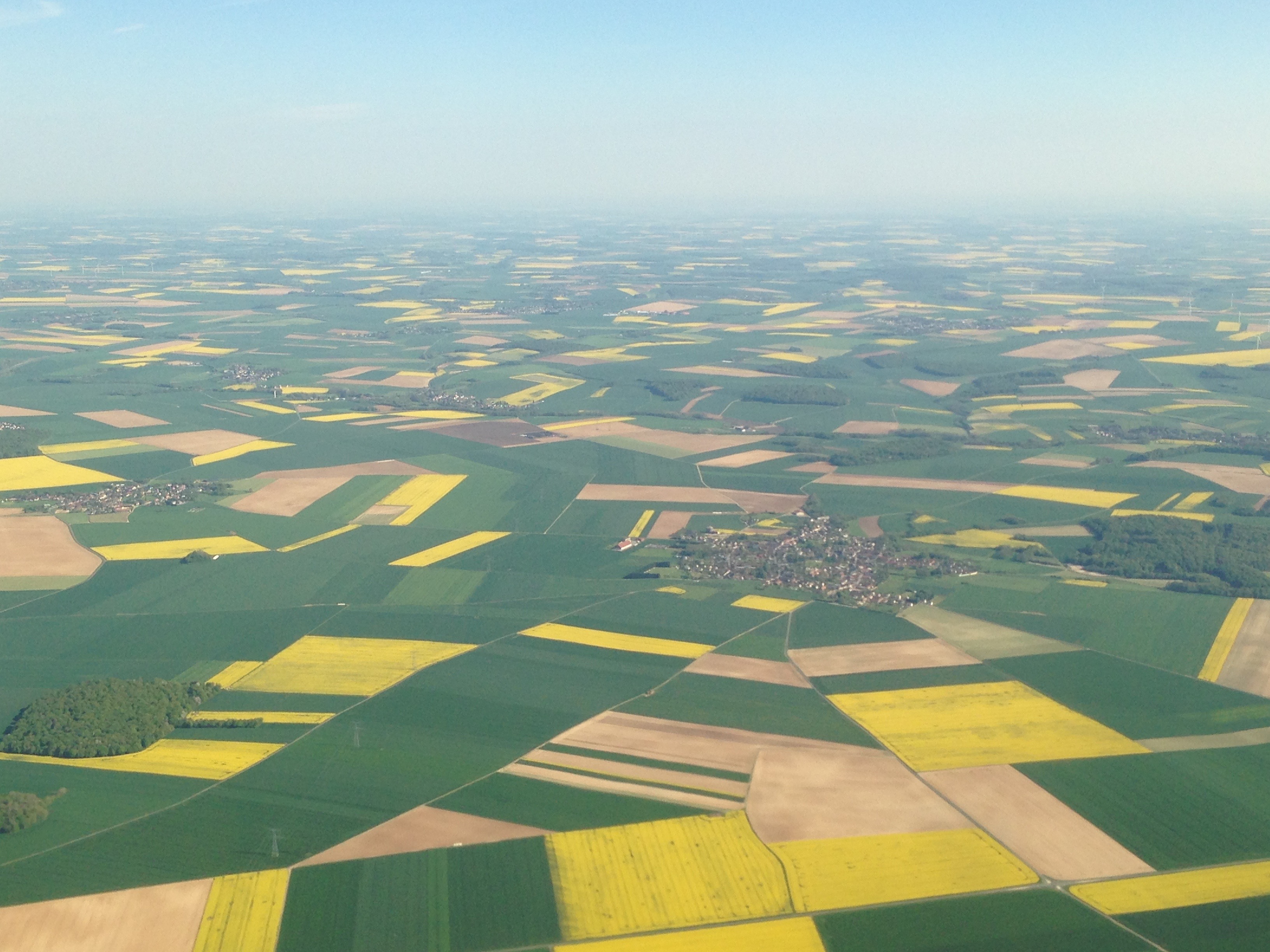
GF slept the whole busride. I listened to an audiobook and looked out the window. The ride from the Beauvais-Tillé Airport to Paris is at least quite nice. It was a lovely, sunny day, and the French countryside rolled past—fields of green farmland with hardly a house in sight. The ride was so different from any I’d seen in Spain. For one, the landscape was flat, while Spain is persistently mountainous. What is more, the lush, glowing green of everything contrasted sharply with the dry, sandy soil near Madrid. And I didn’t even see one castle!
I was just about to drift off when we entered the city. Suddenly, I was filled with excitement. Out the window I could see several skyscrapers. And then, in the distance, I saw that famous form, so iconic and unmistakable—the silhouette of the Eiffel Tower in the distance.
Now only was I in France, but in Paris.
The first thing you will notice about Paris is that it looks like Paris.
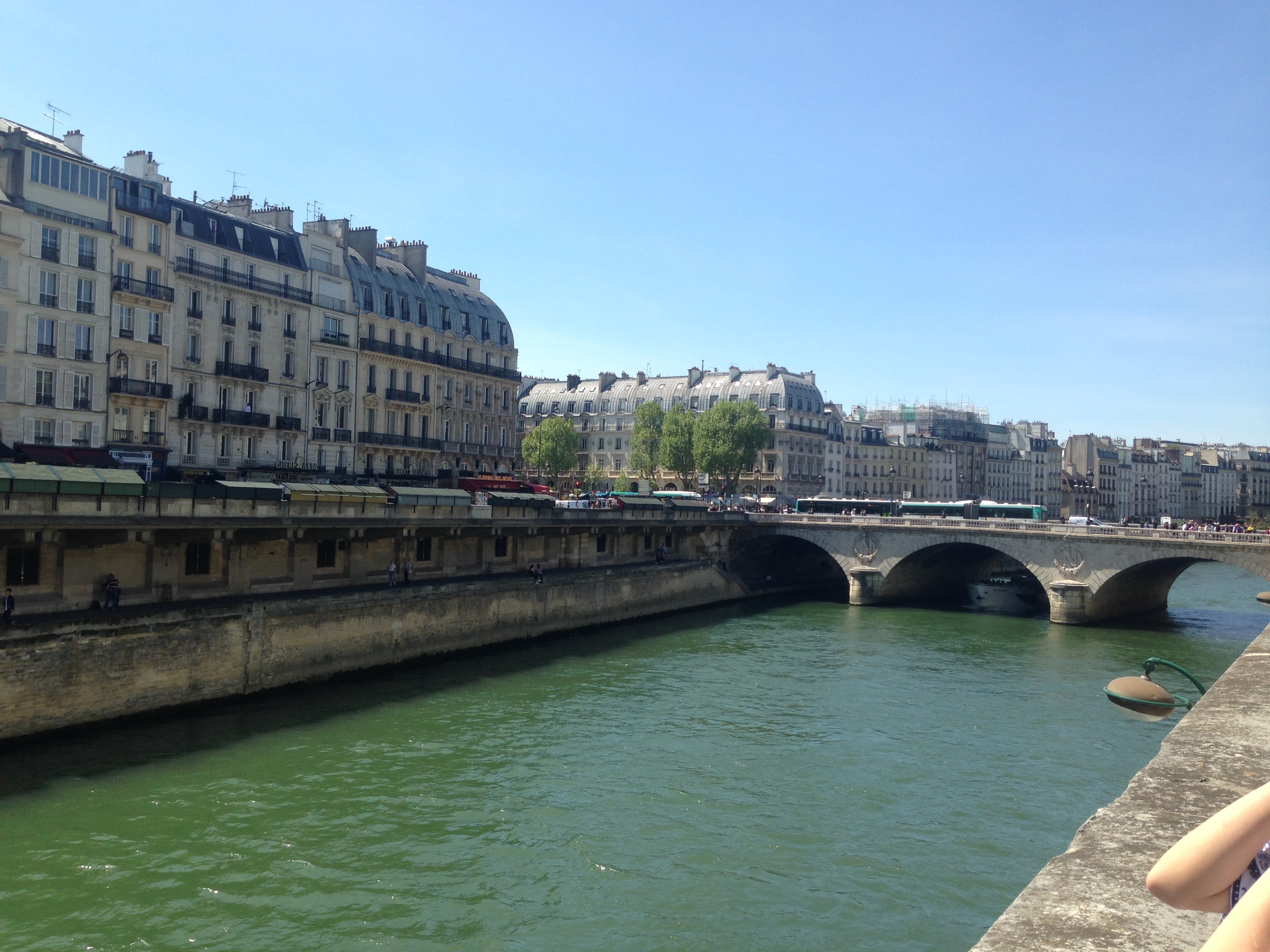
Nothing is out of place. You can stroll along the Seine, its dirty, dark green waters flowing merrily while ferry after ferry go by. Along the river, people are selling used books, Japanese prints, and pornographic posters from shabby wooden shacks. Cafés are inescapable and immaculate. There are no gaudy plastic signs, there is no tasteless decoration. The menus are displayed in glass cases; the color scheme is a subdued mix of blacks, greys, and dark reds. The waiters are well dressed; the tables and chairs are of finished wood; the silverware, the plates, the glasses are polished and stylish. Tree-shaded boulevards lead to roundabouts with monuments in the middle. Everything looks antique and lovingly preserved. The city is elegance itself.
Our first stop was the Sainte-Chapelle. I wanted to go there, because I still have a vivid memory of seeing pictures of the Sainte-Chapelle in my art history course. We were covering the gothic, and the professor was explaining how the gothic architects managed to make buildings with ever-large windows—a very difficult feat in a stone building. The apotheosis of this tendency was the Sainte-Chapelle, a building made completely of stained glass—or at least it seems.
The Sainte-Chapelle (Holy Chapel) was completed in 1248, under the auspices of Louis IX. He had acquired some important relics from Venice (including the Crown of Thorns) and wanted a place to put them. Damaged during the Revolution and restored afterwards, nowadays the building is primarily a tourist attraction.
Except for the tall, gothic spire, you cannot see the building from the street. It is now entirely surrounded by another edifice, that wraps around the outside. This building serves as a security checkpoint, through which you must pass in order to reach the inside. This means standing on a line as person by person shuffles through a metal detector. The French are not taking any risks nowadays. Once you get through security, you’ll see burly men with assault riffles strolling around the complex, looking tough and serious. They walk by, looking both reassuring or menacing, depending on your mood, as you wait in the next line to actually purchase your ticket. You can enjoy the exterior of the building as you wait; but unfortunately you cannot see the facade very well, since the restricted area prevents you from getting far enough away.
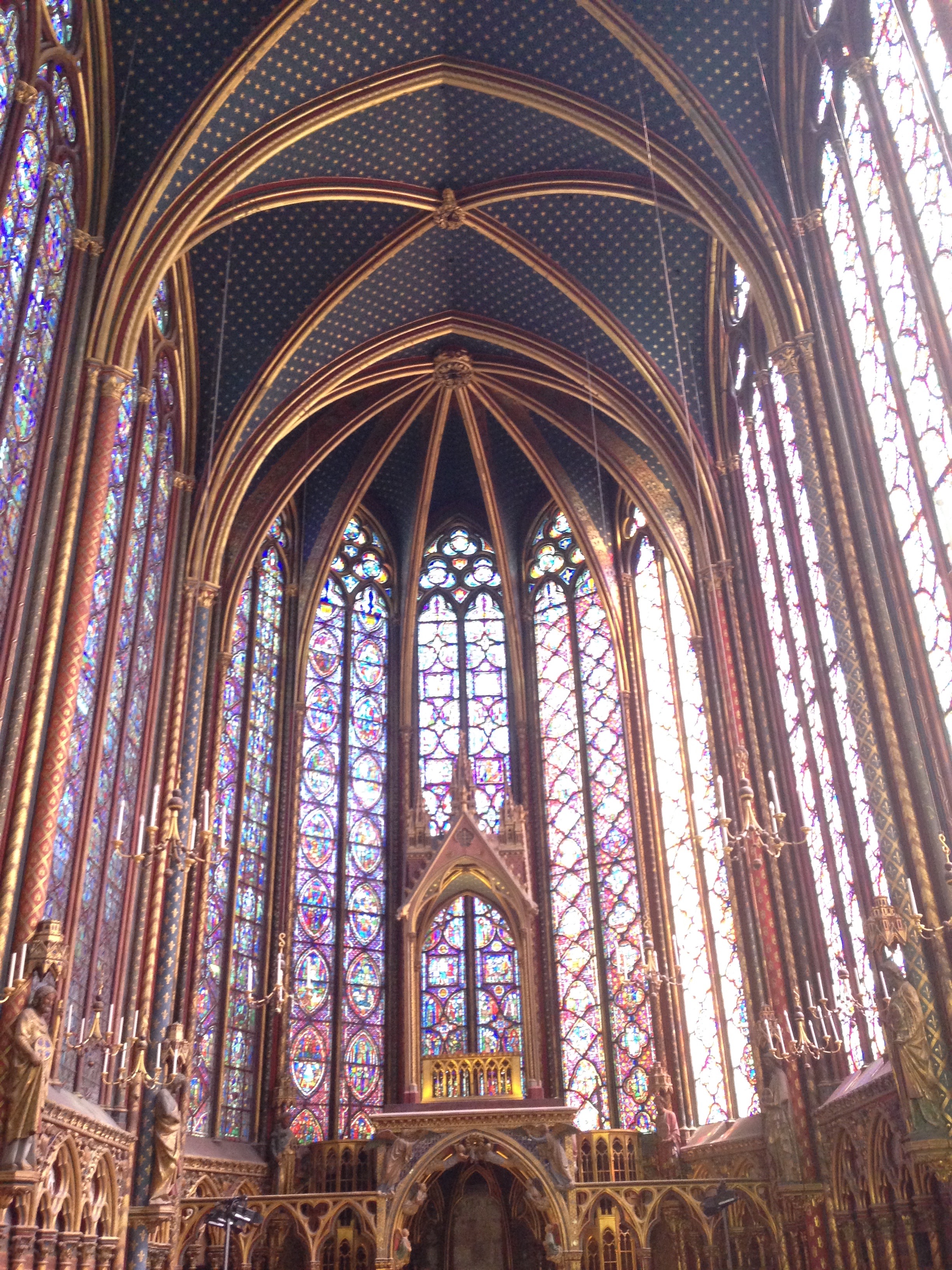
When we finally bought our tickets, went inside, and then ascended the stairs to the upper chapel, we gasped in unison. The place is stunning. The room seems to be suspended through sorcery; how can such delicate mullions support a stone roof? This illusion is created, as in many gothic structures, by moving the main support outside and out of view, in the form of flying buttresses. But the illusion is perfect.
Light pours in from every direction, turned into a rainbow of colors by the stained glass. The more you examine the glass, the more entranced you become, for the glass is covered with scenes from the Bible. On one side is the Old Testament, and on the other side the New. The ceiling has been painted to look like the night sky; wooden sculptures of saints adorn the interior; and on the wall above the doorway, below the magnificent rose window, is a fresco of Christ enthroned, surrounded by angels. For me, the only thing that the Sainte-Chapelle lacked was the sense of spiritual power and religious awe that I often get from gothic buildings. The final effect is rather purely aesthetic—a sweet, delicious prettiness.
Our next stop was the Louvre. By now we were tired and hungry. We had been awake for a long time, hadn’t slept or ate much, and had been on our feet for much of the day. But I was determined to go. Even before I had any interest in history, art, or Paris, I had heard of the Louvre. Everyone has. It is one of the few art museums with a world-wide reputation, a name respected by connoisseurs and philistines. It was unavoidable.
The Louvre seen from the Musée d’Orsay
Originally, the Louvre was a fortress, built under Philip II in the 12th century, right in the center of Paris on the right bank of the Seine. (You can still see the castle foundations in the Louvre basement.) Many years later, in the 16th century, the building was transformed into a Renaissance palace by Francis I; the Louvre thus bears no trace of the French Gothic style, and is instead a classical construction of straight lines and clean forms. Monarchs stayed in the palace for a while, until Louis XIV decided that he preferred to live in Versailles. Then the building was given to various academies. Finally, during the French Revolution, people had the truly revolutionary idea of transforming it into a public museum to display the Royal Collection. It opened in 1793.
The Louvre is large. It contains multitudes. Its collection spans from the beginnings of Egypt to the present day. You would need several days of persistent, diligent walking to see everything, and perhaps a lifetime to properly appreciate and understand the many thousands of paintings and artifacts. We didn’t have a lifetime or several days; we had a few hours before the museum closed. Thus I only experienced a taste of the collection, and I can only offer you an echo of a taste.
Of course, there’s the Mona Lisa. The painting hangs in the center of the Louvre’s vast collection of Renaissance art. A museum employee stands on either side; a barrier prevents anyone from getting too close; and a thick plate of glass ensures that the painting would survive even if the museum went up in flames. Probably at any time of the day, there is a big crowd around the painting. When GF and I went, it was around dinner time (the Louvre is open late on Fridays), so the crowd was not terrible.
We slowly elbowed our way through the crowd, as the elusive image came into view. It is a very strange experience, seeing a famous painting with your own eyes. The Mono Lisa is perhaps the most iconic image in the world (maybe second to McDonald’s golden arches) so you’d think seeing the original would be akin to a religious experience. But many have told me that they found the painting disappointing.
The most common complaint I hear is that the painting is small. At first glance, this is an odd thing to complain about; the Mona Lisa is a portrait, and has the usual dimensions of that genre. But upon further reflection, this complaint is revealing of the way we experience art in the modern world.
Unlike people living as recently as the 19th century, you have already seen high quality images of the Mona Lisa a thousand times—on television, in movies, on billboards, advertisements, and commercials. This reproduction of the image has turned it into an icon. What makes something iconic is that it stands for more than itself. Originally, the word icon meant a devotional image, of a saint, Jesus, or the Virgin, used in prayer and religious ritual. In theory, the icon is not meant to be the object of religious worship, but merely an aid; the image allows the worshipper to focus his feelings and thoughts on the next world. Thus an icon is not meant to draw attention to itself, but help you think of something else.
The Mona Lisa performs a similar function in our own world, serving as a visual cue for all sorts of diverse associations—Leonardo, the Renaissance, Italy, the Louvre, culture, sophistication, mystery, even painting itself. This use of the image has gradually ruined our ability to really see it; we stop paying attention to the details, just as we stop paying attention to a font when we begin to read a story. Like a word in a book, we glance at the image instead of carefully scanning it. The Mona Lisa has ceased to be a thing in itself, and has become a symbol for other things. And when this is the case, the only difference between seeing a copy and seeing the original can be superficial things, like size.
It would take much patient work to be able to see the painting as it would appear to you for the first time, as a fresh work of art. And when you are standing in a crowd of people, crushed on all sides, surrounded by cameras and iPhones, separating by at least ten feet from the painting itself, it is all but impossible to give the painting justice. I stood there and did my very best; but it wasn’t long before somebody nearby asked me to take a photo of him standing in front of the painting.
“Alright,” I said, as he handed me his camera.
He smiled and then unfurled a sign that read:
“YOU SHOULD BE HERE!”
It would take a library of books to do justice to the Louvre’s collection, so I will only mention a few more famous works. A floor below the Mona Lisa is a sculpture by Michelangelo, the Dying Slave. Originally sculpted for the uncompleted tomb of Pope Julius II, the work depicts the moment of death of a supine and nearly naked man. This seems potentially spiritual and tragic, but to me the sculpture looks inescapably sexual; the figure’s pose and even his face strike me as strangely feminine. Am I alone in this?
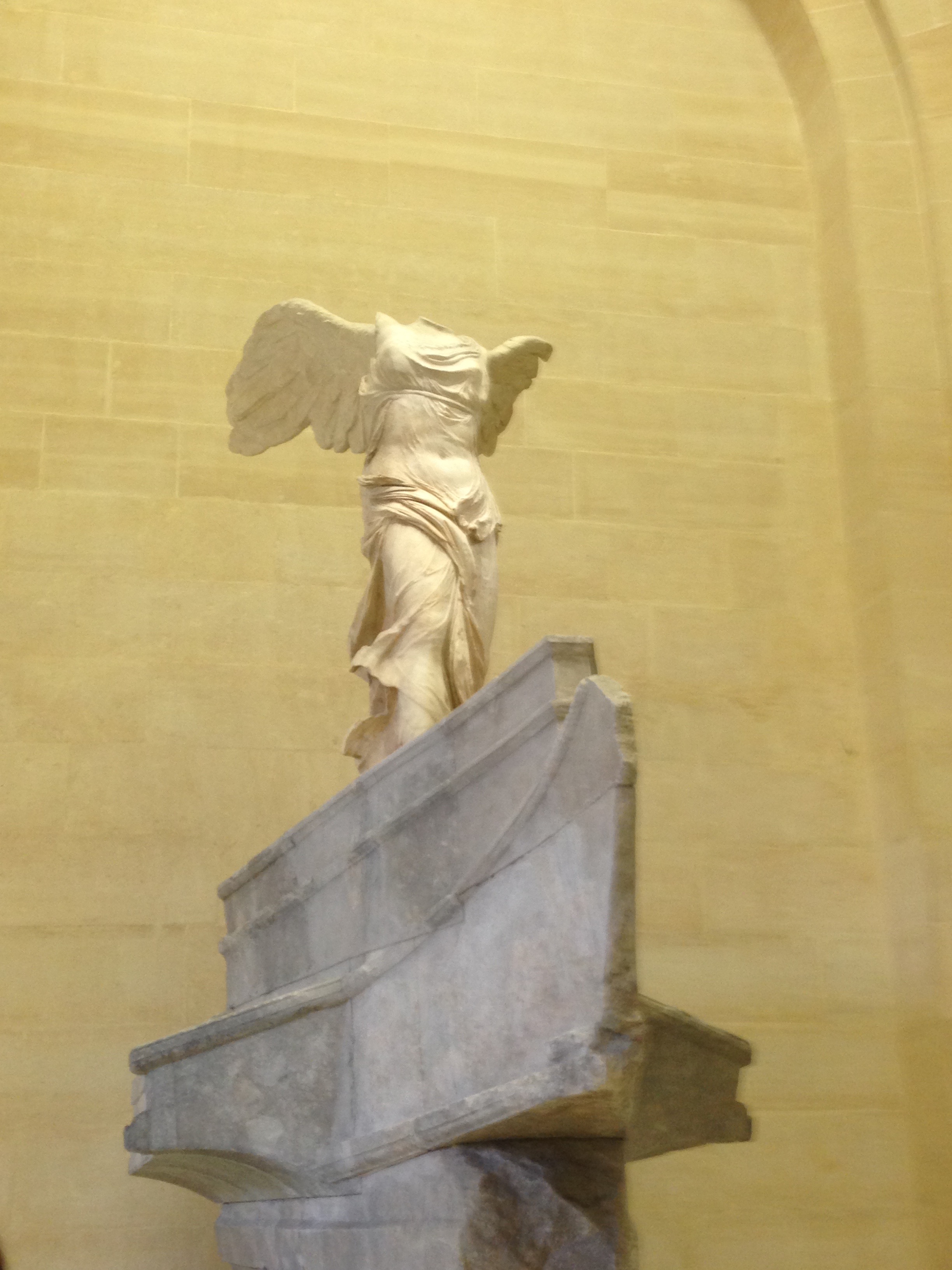
The Louvre boasts two Greek sculptures of high repute, the Winged Victory of Samothrace and the Venus de Milo. Both of these works, made before the common era, were discovered in the 19th century. The first is an image of the goddess of victory, Nike, perhaps built to commemorate a naval victory. She seems to be standing on the brow of a ship, her silky garments flowing in the breeze. Unfortunately, the statue’s head and arms have been lost to time; she is now a winged torso on two strong legs. Despite this, the work manages to be supremely expressive, perhaps the most convincing image of triumph I know. The Venus de Milo is a sculpture of Venus, her arms missing, her chest bare, her legs wrapped in a loose robe, leaning on one leg with an arched torso.
The last work I’ll mention is the Seated Scribe. This is a small sculpture of painted limestone, depicting a man sitting cross legged, writing on a piece of papyrus that rests on his lap. Compared to a Greek sculpture, there is nothing remarkable about this work. But when you consider that it was made around 2,500 BCE in Ancient Egypt, you will be able to appreciate just how special it is. The Seated Scribe is unlike any other piece of Egyptian art I’ve seen. First, the very fact that the work depicts a scribe is significant, for Egyptian art typically portrays gods, pharaohs, or perhaps servants and soldiers. What is more, while most art from this period is highly idealized, this sculpture is quite realistic; the scribe has an individualized face and even a paunch. Instead of seeing an image of power, we are seeing a single man, imperfect, frail, and hard at work.
By the time we left, we were both utterly exhausted. We hadn’t slept more than four hours, we hadn’t eaten in about eight hours, and we had been on our feet for about ten hours. My body was a patchwork of pains: my legs were aching, my feet were blistered, my clothes were soaked with sweat, my stomach was grumbling, my eyes were bloodshot, and my head was pounding. GF wasn’t doing much better. And in that state, we dragged ourselves to eat some cheap Chinese food and go to bed. We had another long day ahead.
We awoke early, threw on our clothes, and skipped breakfast. We wanted to get to Notre-Dame right as it was opening, to avoid the extremely long line we had seen the previous day.
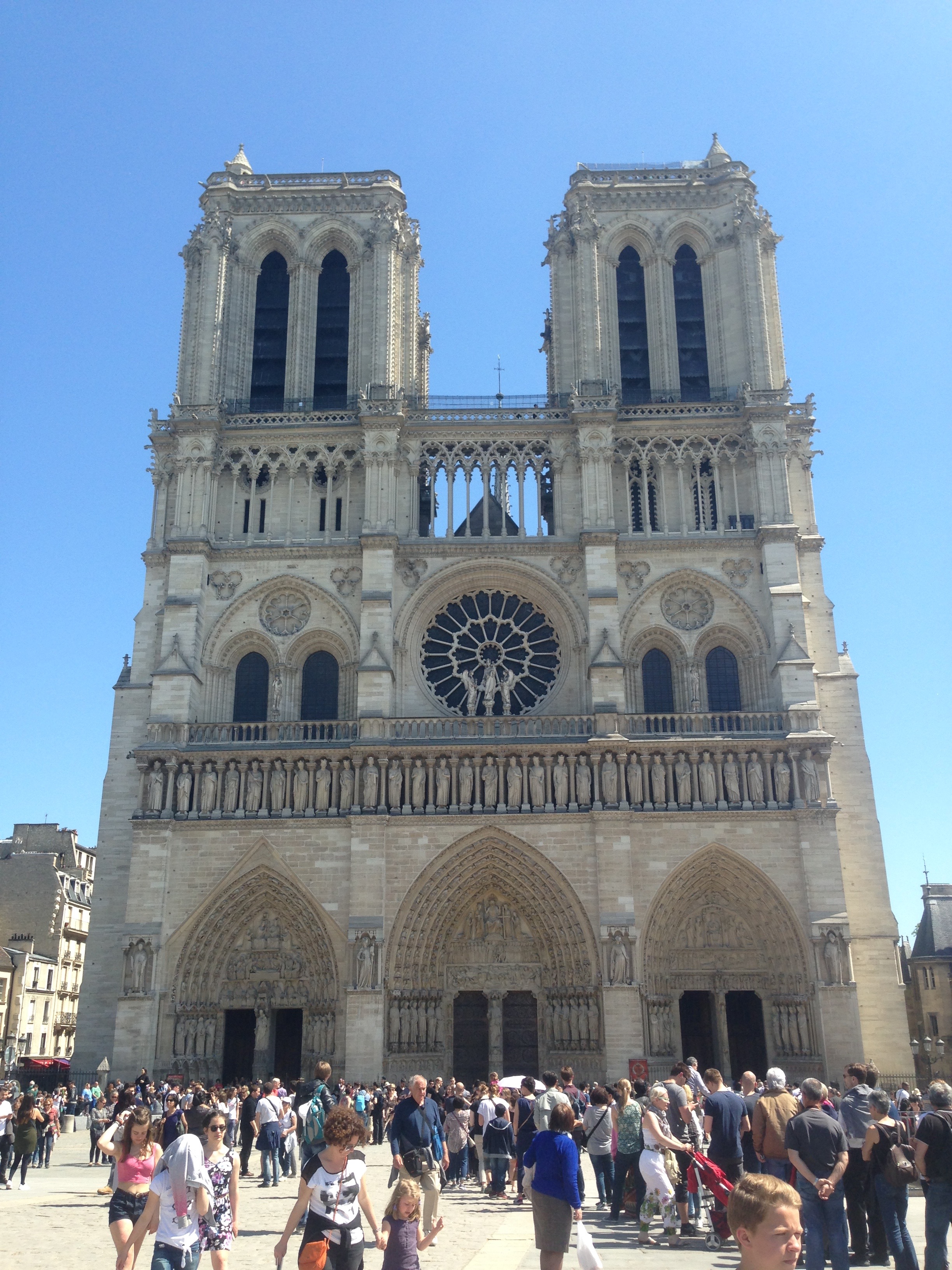
This was only partly successful. A line had already formed, though it was only about half as long as the line from yesterday. We dutifully got on and waited. This at least gave me a chance to observe the cathedral’s wonderful façade.
The demeanor of the great building is immediately recognizable and familiar, even to people who do not consider themselves interested in this sort of thing. To me, the cathedral, although undeniably gothic, has a certain classical elegance not found in, say, Toledo. Everything is perfectly symmetrical and harmonious. There is no jumbling of styles or mixture of motifs you so often find in other cathedrals. Although the building took almost 200 years to build, it seems to bear a unified design. (I suspect, however, that a more knowledgeable eye would detect significant differences in style that escaped me.)
Perhaps because the cathedral was recently given a cleaning, nowadays it looks fresh and even youthful. This freshness was accentuated by the beautiful sunny day, to the extent that the spiritual power I normally feel in the presence of gothic cathedrals was somehow lacking. Notre-Dame looked rather cheerful and even inviting. This might be because the building is not so angular as other cathedrals; instead of spires, such as are found in Burgos and Chartres, the towers of Notre-Dame have flat tops.
The line was moving quickly. As I approached, I was able to better see the friezes that adorned the front portals. These are perhaps the most impressive part of the cathedral; for gothic sculptures, they are remarkably naturalistic, while remaining powerfully religious. My favorite was of a man calmly holding his own decapitated head in his hands. This is St. Denis of Paris. Back in Roman times, in the third century, he was the Bishop Paris, and had the good fortune to be decapitated during a persecution of the Christians. Unperturbed by this, the good bishop calmly picked up his head and walked ten kilometers, preaching all the way. People had more pluck back then.
Finally we got inside; and to our surprise, it was free. The place was absolutely swarming with tourists. This is why I don’t enjoy visiting the cathedrals in Madrid and in Lisbon. I enjoy cathedrals not only for the art, but because they are big, quiet places that put me in a meditative mood. But in a dense crowd, watching out for pickpockets, I didn’t feel that I could properly enjoy the ambience. This is a shame, because it’s really a lovely cathedral; the stained glass is almost as marvelous as that in the Sainte-Chapelle.
We were outside in about half an hour, both of us starving by now. We sat down to an overpriced, but quite good, breakfast in a café nearby and then began walking towards our next destination: the Musée d’Orsay.
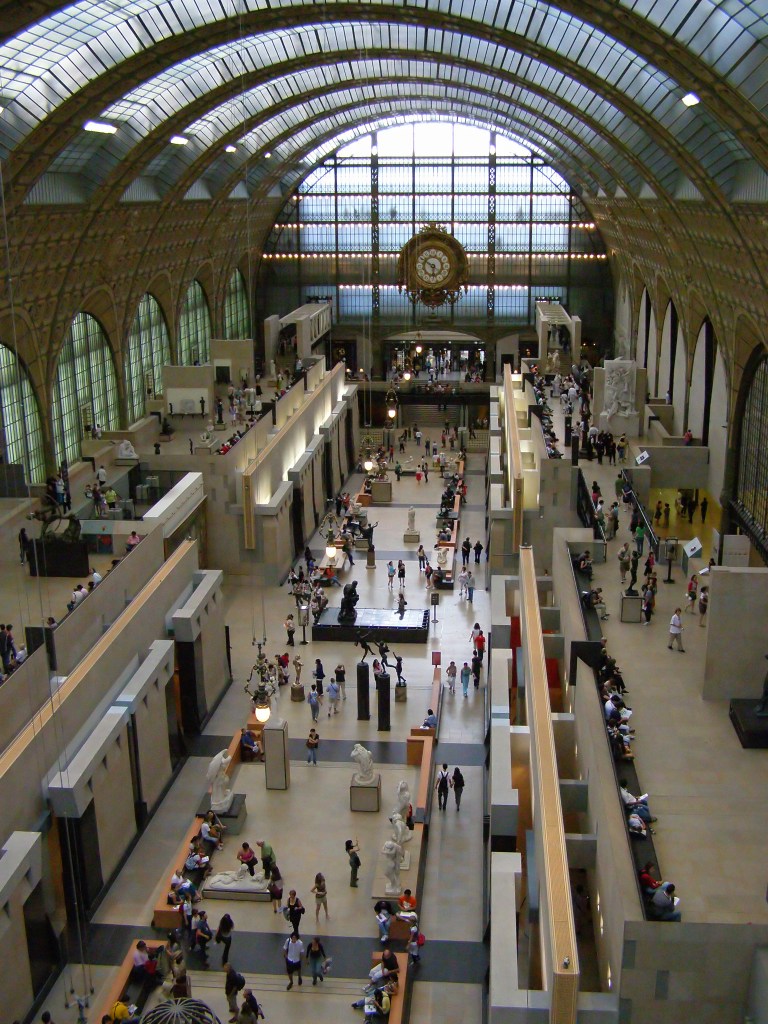
The Musée d’Orsay is one of the world’s finest art museums. Opened as recently as 1986, the museum is housed in an erstwhile railroad station, Gare d’Orsay, completed right in time for the 1900 World’s Fair in Paris. The place still looks like a train station, with a cavernous, rounded glass ceiling. Wisely, the architects of the museum decided to leave much of the upper space open; and this, combined with the plentiful natural light, makes you feel almost as if you are outside. The layout of the museum is equally tasteful. The galleries for paintings are situated symmetrically on each side, along a central corridor; and this corridor, as well as two walkways up above, has been filled with sculptures, big and tiny.
Unlike the Louvre, the Musée d’Orsay concentrates on a very specific place and time—namely, art produced in France (Paris, mostly) in the mid 19th and early 20th centuries. This may sound a bit narrow, but this was actually one of the most fertile periods in the history of art; and if you want to properly know this epoch, you’ve got to come here. The museum has paintings by Delecroix, Manet, Monet, Cézanne, van Gogh, Signac, Seurat, as well as sculptures by Gaugin and Rodin, among innumerable others. The collection has been chosen with exquisite taste. Every other painting is a masterpiece. Nothing is disappointing or out of place. And best of all, unlike the Louvre, you can see everything in three to four hours.
Walking through the Musée d’Orsay was nearly overwhelming. I have never been more entranced by a museum, nor more affected by visual art. In fact, the experience made such a deep impression on me that I will have to devote an entire post to it. Here I offer only a brief sketch.
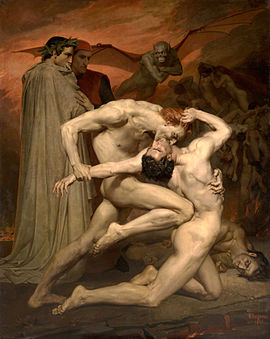
I saw everything, drinking up each painting with desperate relish. I watched as the styles changed and evolved. First I admired the academic style of William Bourguereau, who painted mythological subjects—Greek Gods, ancient heroes, scenes from Dante—with technical mastery: carefully arranged compositions, scientific anatomy, photographic shadowing; every shape is molded, every line is deliberate, every brushstroke is concealed. The paintings are masterpieces of technique, and yet stale, because they seem to bear no relationship between the artist and the world; rather, they are monuments to a dying tradition.
In reaction to this academic style, which held sway for so long, came the impressionists. Instead of mythological scenes, the impressionists turned their eye to everyday subjects—picnics, soirées, views of the street from apartment windows. Their compositions are typically off-center and messy. Their brushstrokes are not concealed; colors and lines blur into one another. In terms of technique, it seems a step backwards from Bourguereau, but in reality the achievement is more stunning, for they had to develop their technique from scratch. The final effect is a perfect representation of that moment when, after turning your head, a new scene comes into view, all the colors still buzzing, the light playing tricks with your eyes, the forms indistinct as you try to focus. The rise of the impressionists represents a step away from the Platonic conception of knowledge—namely, a View from Nowhere, a perfect perspective that can grasp the world in its entirety—to the our more Nietzschean view of knowledge—namely, inherently subjective, bound up within a specific point of view.
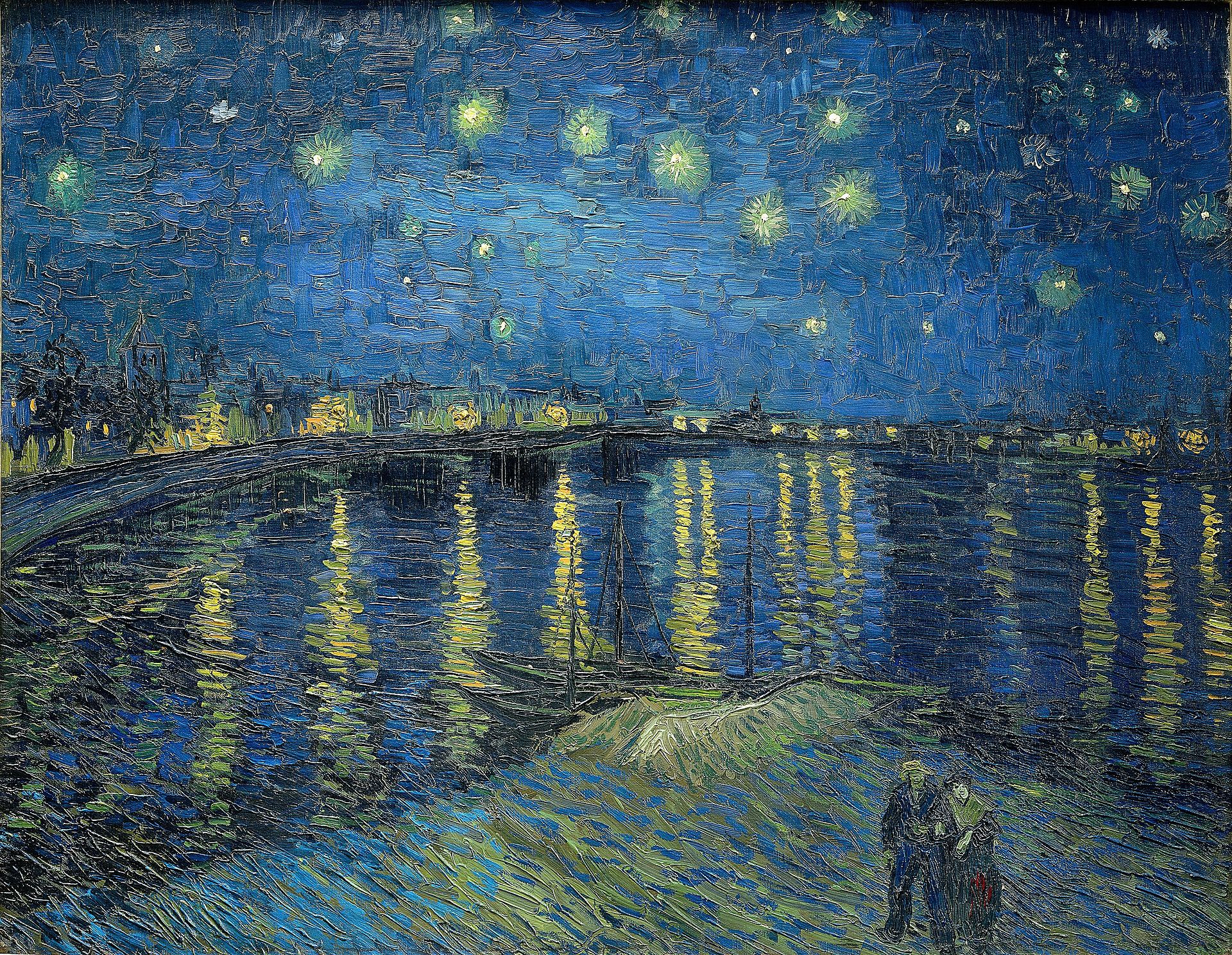
But the impressionists were only the first step. After investigating the way our eyes detect light, later artists started to probe into the ways that our brains put together the data from our eyes into the world as we know it. With this came the following question: What if the way we tend reconstructed the world is completely arbitrary? Could we make sense of our sense data using a different principle, with equal legitimacy? Thus artists began tearing the world apart, sewing it back together in new or interesting ways. Some artists, like Cezánne, tried to simplify the world into more elemental shapes and colors; others, like Signac, tried using atoms of pure color; and van Gogh used curling waves, as if the world we see were only reflection in an swirling ocean of paint.
Starry Night over the Rhône
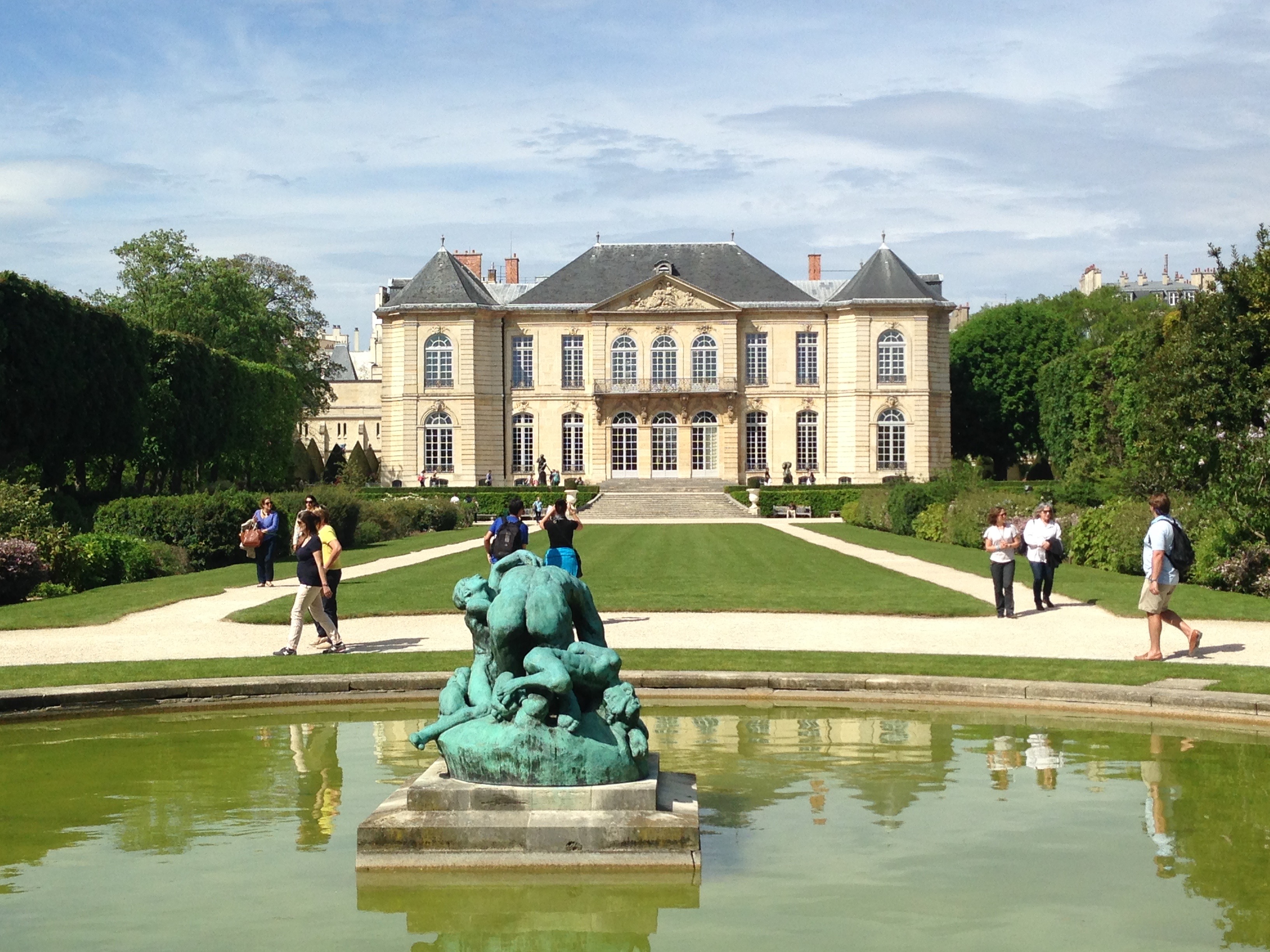
By the time I walked through the museum, I was absolutely exhausted. But we still had one more museum to see: the Musée de Rodin. This museum, opened in 1919, devoted almost solely to the French sculptor, Auguste Rodin, who was considered by none other than Kenneth Clark as the greatest sculptor since Michelangelo. The museum is situated in the former Hôtel Biron, where Rodin liked to work. When he died, he donated his sculptures and his collection of art to the French government, on the condition that they make the hotel into a museum. It was done, and is now one of the many charming places to visit in Paris.
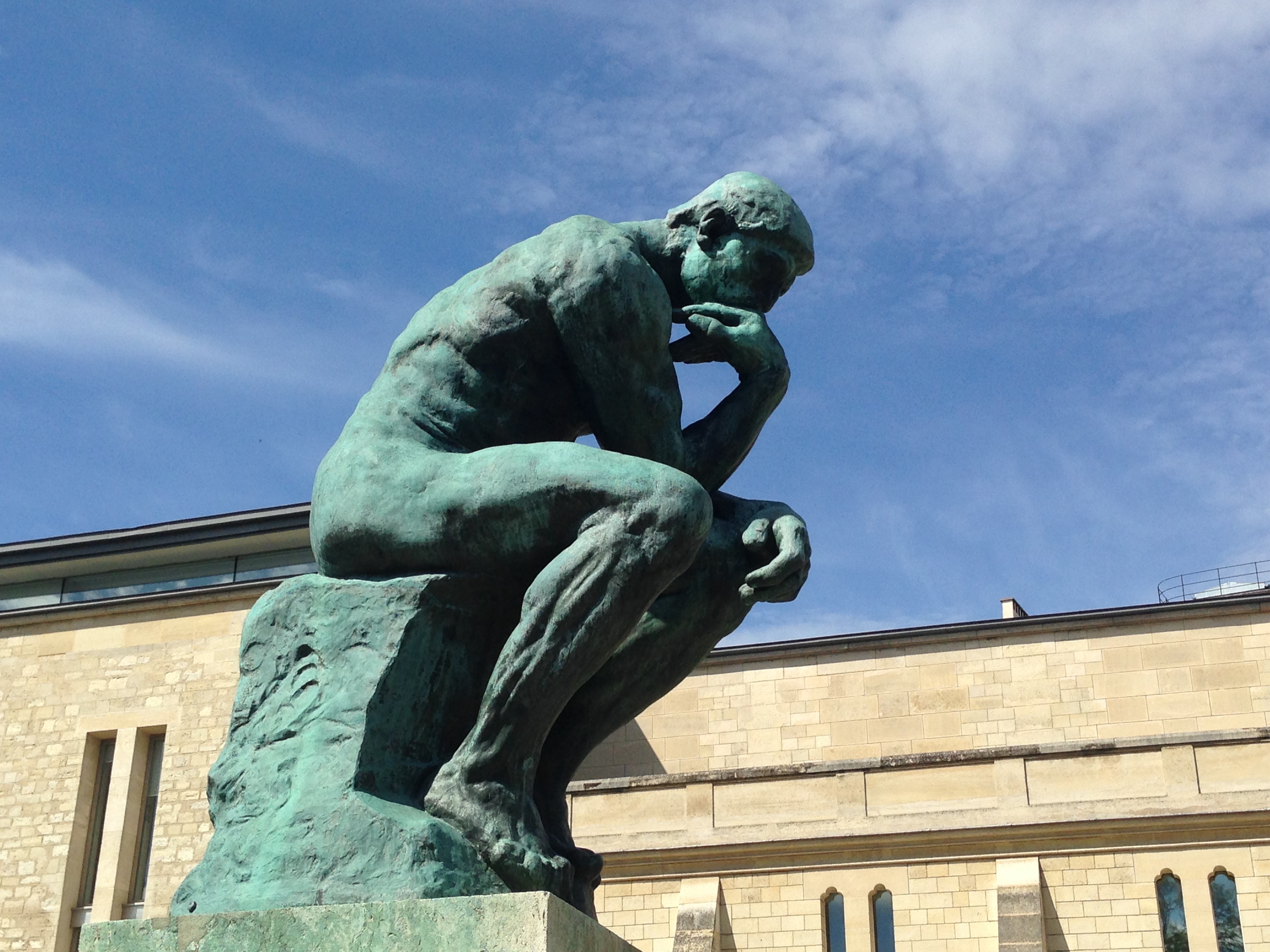
The museum consists of an extensive garden and the old building, with Rodin’s sculptures scattered generously throughout. The garden might be the nicest part. There, you can find The Thinker thinking away, surrounded by hedges, as well as copies of almost every one of his major works.
Now, I must admit that my ability to appreciate sculpture lags far behind my ability to appreciate paintings. Even so, it is clear that Rodin was a brilliant artist. While still depicting human figures, largely with realistic anatomy, he manages to break completely from the Greco-Roman tradition. Far from representing idealized forms, Rodin’s figures are human, imperfect, and often ugly. Far from achieving a classical, timeless grace, Rodin’s figures are twisted, contorted, tortured. The Thinker is a case in point: far from a wise philosopher, calm and contemplative, the man is troubled, anguished, and brooding.
One of my favorite works was Rodin’s Gates of Hell. Originally intended to be the doorway for a Museum of Decorative Arts, until the museum was abandoned, the sculpture is now considered one of Rodin’s masterworks, perhaps his magnus opus. It is meant to be an elaborate representation of Dante’s Inferno. Many of his most famous sculptures originated as pieces of this composition, with The Thinker presiding over the entrance. Everything around the pensive man is a stew of sin and suffering, with figures emerging, half-formed, from the background, tortured, broken, their faces wracked with pain. It is a powerful and terrifying work.
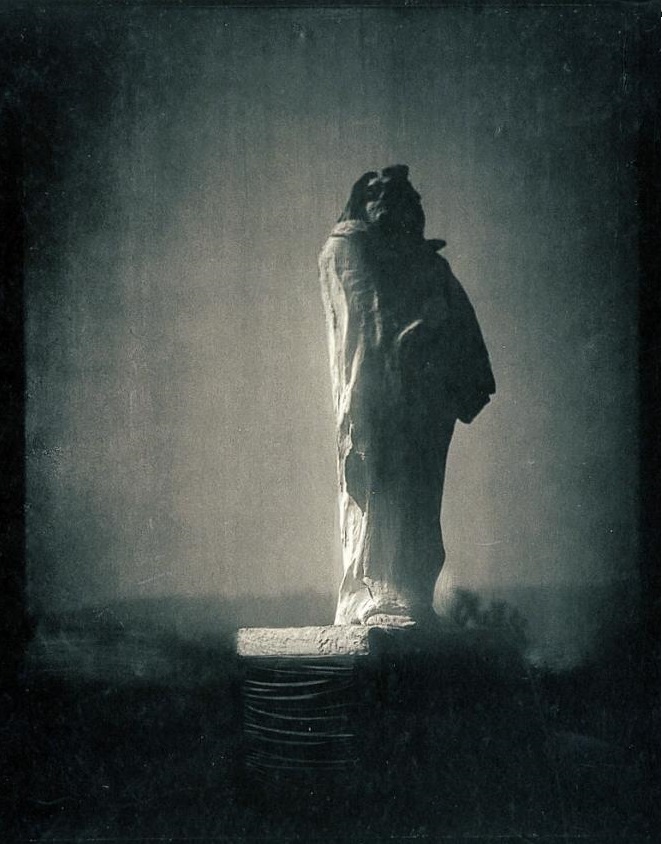
But the sculpture I like best is Rodin’s Monument to Balzac. It is really an absurd statue. The writer stands, his body entirely enveloped in a robe, with his mustachioed face held high, as if snubbing the viewer. At first glance, the figure’s pose might seem totally unnatural; but the longer you look, the more you can see how the body of a paunchy man might easily look like this under a thick robe. I love the sculpture because it manages to make something so apparently unheroic into the symbol of human genius. Balzac is totally uncouth. He is ugly, fat, unshaven; his hair is messy, his robe is shabby. And yet, his inner brilliance allows him to stand completely above the world, unconcerned with conventional success, totally devoted to his personal vision. The sculpture is a monument to the outcast, eccentric, and ultimately triumphant artist.
The monument photographed in 1911 by Edward Steichen
After walking through the garden and the old hotel, enjoying not only samples of Rodin’s finished work but preparatory studies he left behind, I was done with museums. I couldn’t possibly absorb any more art. By now the day was waning; in a couple hours, the sun would set. Luckily, there was only one more thing I absolutely needed to see: the Eiffel Tower.
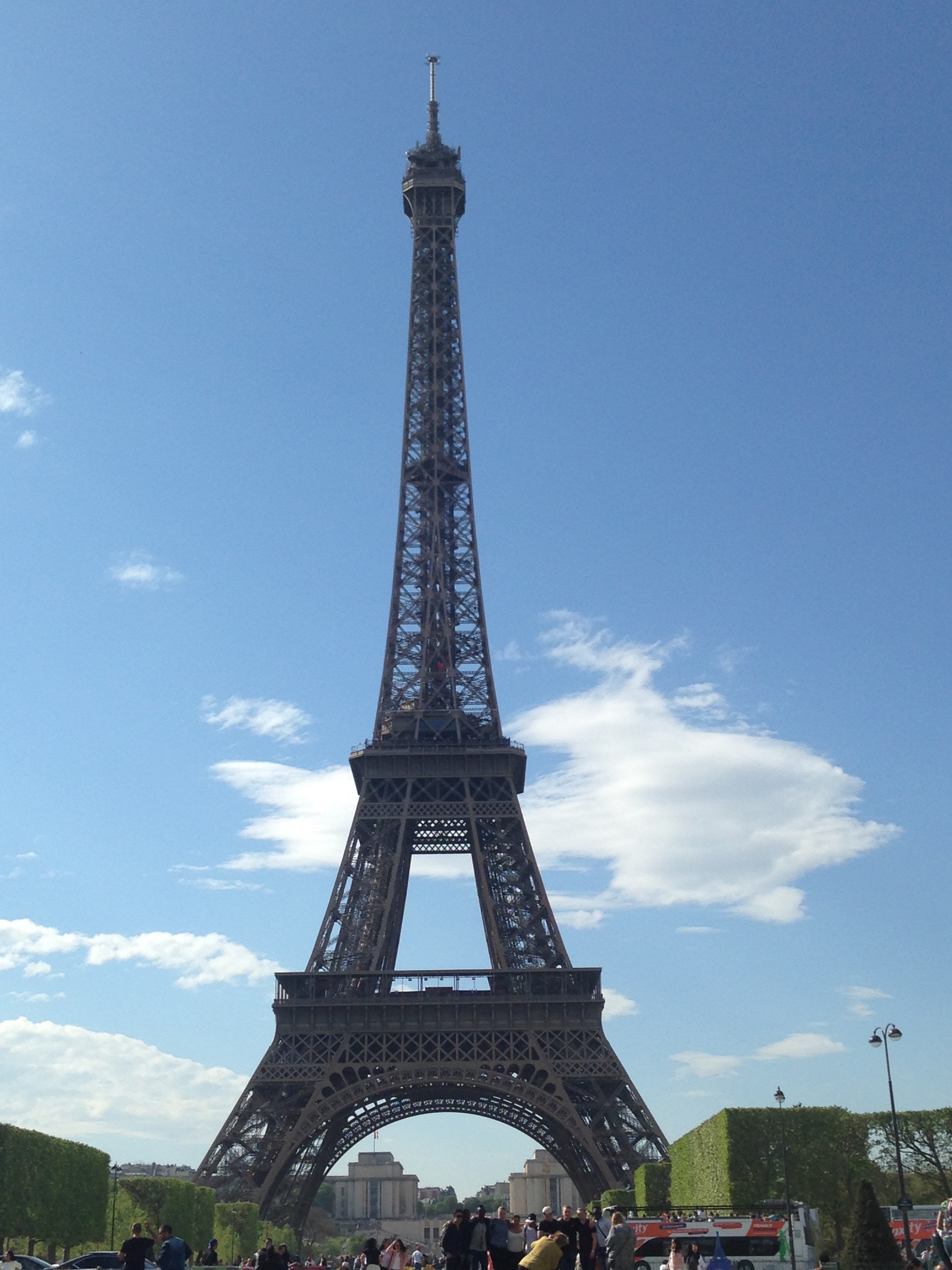
Luckily, it wasn’t hard to find. Standing at 1,063 ft (324 m) tall, the Eiffel Tower remains the tallest structure in Paris. Built for the World’s Fair 1889, it was criticized quite severely in its time, especially by the intelligentsia. This is amazing to me, for it is difficult to imagine how the tower could be more perfect.
For me, and perhaps many others, the Eiffel Tower represents Paris’s Golden Age. It was a time when the future could be embraced without scorning the past, when aesthetic values could be questioned without beauty being abandoned. Made of wrought iron, the structure was so daring that people thought it would be blown over by the wind. I can understand why. Even now, there seems to be so little metal per square inch that it looks like it’s made of matchsticks glued together, ready to come apart at the merest breeze.
You can no longer walk under the Eiffel Tower without passing through a security checkpoint.
There is something human about its shape. Looking at the tower dead on, with only two of its legs visible, the tower seems like a Colossus standing over the world. The tower is also, like Paris, elegance itself. The way that the legs gently curve together until they meet at the top has all the classic grace of the Parthenon. Or perhaps the Eiffel Tower can be better compared with the pyramids, as its creator did. This is the modern pyramid, equally useless, equally monolithic, equally iconic. For whatever reason, I find it tremendously inspiring that people built something so big and so ambitious for no practical benefit whatsoever. To me, this is the essence of being human.
We sat in the grass nearby for a few minutes, just taking in the sight. Men were walking around, trying to sell bottles of wine. I was really in the mood for some wine, but I didn’t feel confident about buying wine from these guys and drinking it in the park. Isn’t it illegal? After shooing away five of them, I decided to go. You can’t really enjoy a view when you’re constantly refusing a drink.
We had only one final stop, and not much time to see it: Montmartre. Montmartre is a famous neighborhood in Paris, with a similar reputation to the West Village in New York. Situated on a hill, in the past Montmartre was a haven for artists, where eccentric bohemians could live with cheap rents. Nowadays, it is mainly a tourist attraction, most notable for the gigantic Sacré-Cœur Basilica. Near Montmartre is the famous Moulin-Rouge, nestled amid countless sex shops. By the way, I wonder how so many sex shops manage to stay in business; you’d think they would all sell basically similar products, and so having so many would be unsustainable. But they manage to stay in business, apparently. I suppose enough horny tourists come to Paris to keep an entire town of sex shops above water.
We took our obligatory photo of the Moulin-Rouge, and then began to walk up the hill. On the way, we passed Les Deux Moulins, the café where the film Amélie was shot. (Great movie, by the way.) Soon we arrived at the top. The white cupola of Sacré-Cœur, lit up by spotlights, shone like a beacon amid the darkness. Gathered round where hundreds of people, tourists speaking dozens of languages, and immigrants speaking dozens more trying to sell stuff to the tourists. Inside the basilica, a mass was being held. Outside, people smoke and drank and laughed with one another. It was a wonderful night.
We walked down the stairs in front to the street below. Then suddenly I saw a flash of light.
“What was that?” I asked GF.
“Dunno,” she said. “Go look.”
I walked over to where some other people where standing.
In the distance, I could see the Eiffel Tower, its form lit up with yellow lights. On the top, a searchlight was slowly spinning, sending a powerful beam in all directions. Seconds later, the light turned towards us again, flashing like the sun itself as it passed. I looked on in wonder. And as I looked, I couldn’t help thinking that this image could represent all of Paris: elegant, mysterious, brilliant, illuminating all the world around.






 Lotz in Translation