In the Footsteps of García Lorca

In the Footsteps of García Lorca

Federico García Lorca is the most famous playwright and poet that Spain produced in the previous century. This is largely owing to undeniable brilliance, as any readers of Bodas de Sangre or Yerma can attest to. Yet his fame is also due, in part, to the tragic story of his death—executed by Nationalist forces during the first few months of the Spanish Civil War. Among the hundreds of thousands dead from that conflict, Lorca remains its most famous victim. And in death, he has become a kind of secular saint to artistic freedom.

The precise details of Lorca’s murder were, for a long while, rather obscure; and it is largely thanks to the Irish writer, Ian Gibson, that it was finally uncovered. Prior to our trip to Granada, Rebe had read Gibson’s book, El asesinato de García Lorca, and so we had a full Lorca itinerary planned.

Our first stop was the Huerta de San Vicente. This was the summer house of the García Lorca family for the last ten years of the poet’s life. It is a kind of rustic villa, typical of Andalusia, with large windows and whitewashed walls—ideal for keeping cool. We joined a tour and were shown around the house, which has a piano that Lorca would play on (he was a gifted musician, and friends with Manuel de Falla), as well as a desk at which he wrote.
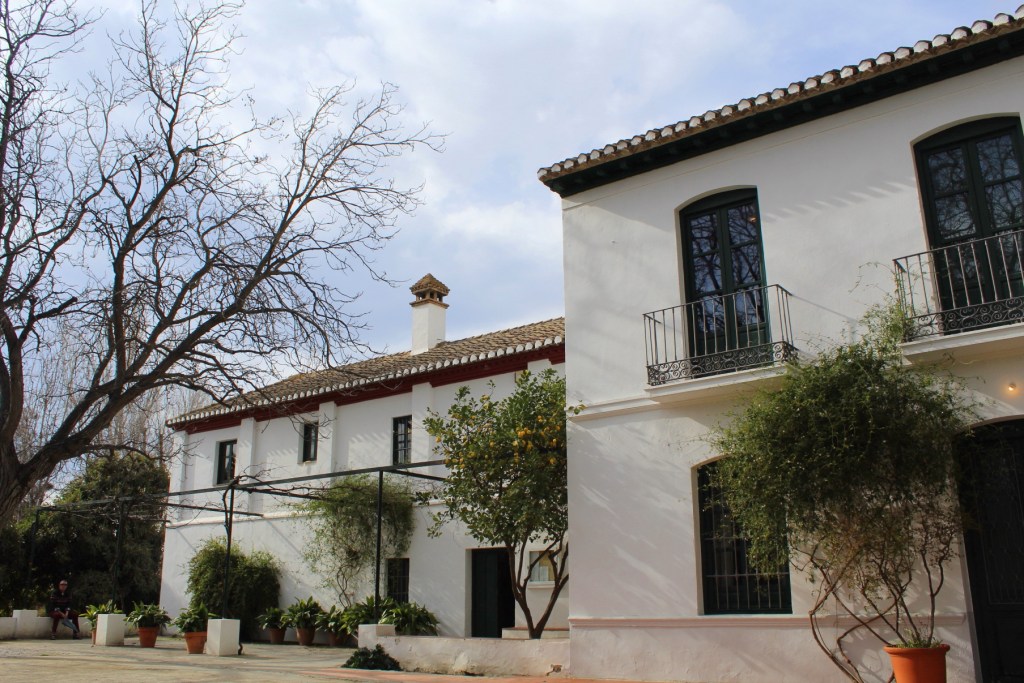
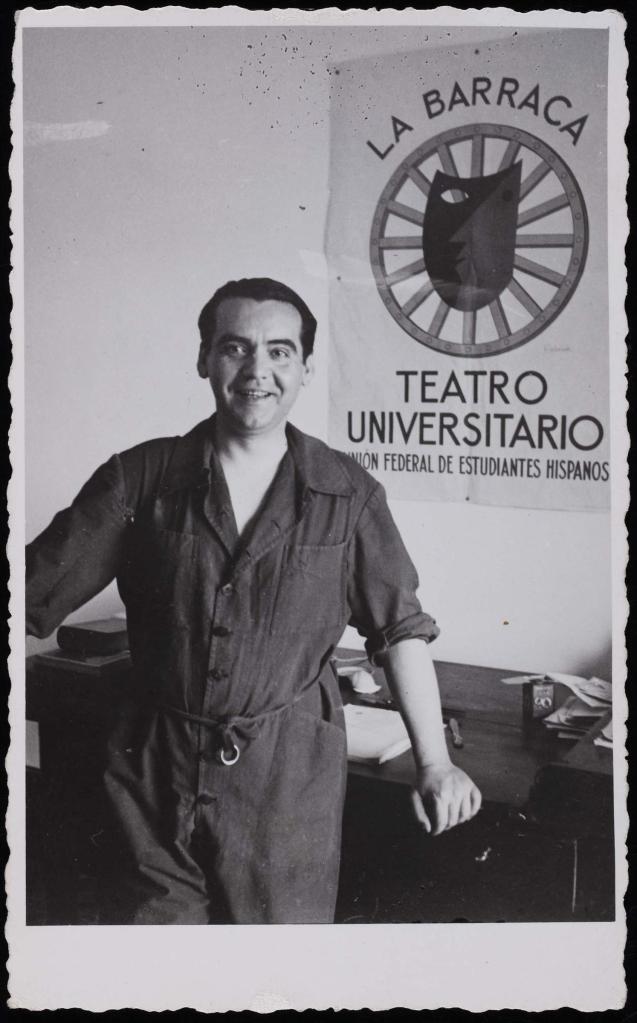
The hour-long visit gave a satisfying overview of the many facets of his short life. Lorca came across as a man wholly devoted to the arts—to music, to poetry, and above all to theater. One of my favorite items on display was a poster for La Barraca, a popular theater group that he helped to direct. They would travel around the countryside and perform for the benefit of the public, putting on avante-garde shows for the masses. It reminds me somewhat of the Federal Theater Project of the American New Deal, and demonstrates that Lorca, while not overtly political, did not shy away from social causes.
Our next stop was the small town of Fuente Vaqueros, which is a short drive from Granada. There, we visited the house where Lorca was born and spent his earliest years. It is a large house with thick walls, ideal for keeping out the heat. We were given a tour—just the two of us—by a local whose grandfather had gone to the same primary school as Lorca himself! He explained that the Lorca family was quite wealthy, having made their fortune in the tobacco business. Indeed, their house was one of the first to receive electricity in the area.

The upstairs of the house was made into a small exhibition space. Among other things, there is the only extant video clip of the poet, as he emerges from a truck used to haul theater supplies. The video has no sound and it lasts for only a few moments. Yet it is a tantalizing glimpse into the past. Also on display are puppets that Lorca made, in order to put on shows for his baby sister.

A short drive from Fuente Vaqueros is the town of Valderrubio, previously known as “Asquerosa” (“Disgusting”). Apparently, this name is a linguistic coincidence, having come from the Latin Aqua Rosae (“Pink Water”), but it led to the unfortunate toponym “asquerosos” for the denizens of this perfectly inoffensive town. Here is yet another house museum of the playwright, this one larger and grander than the one in Fuente Vaqueros. Unfortunately, however, we arrived too late for the tour of this house, and had to content ourselves with a quick walk-through.
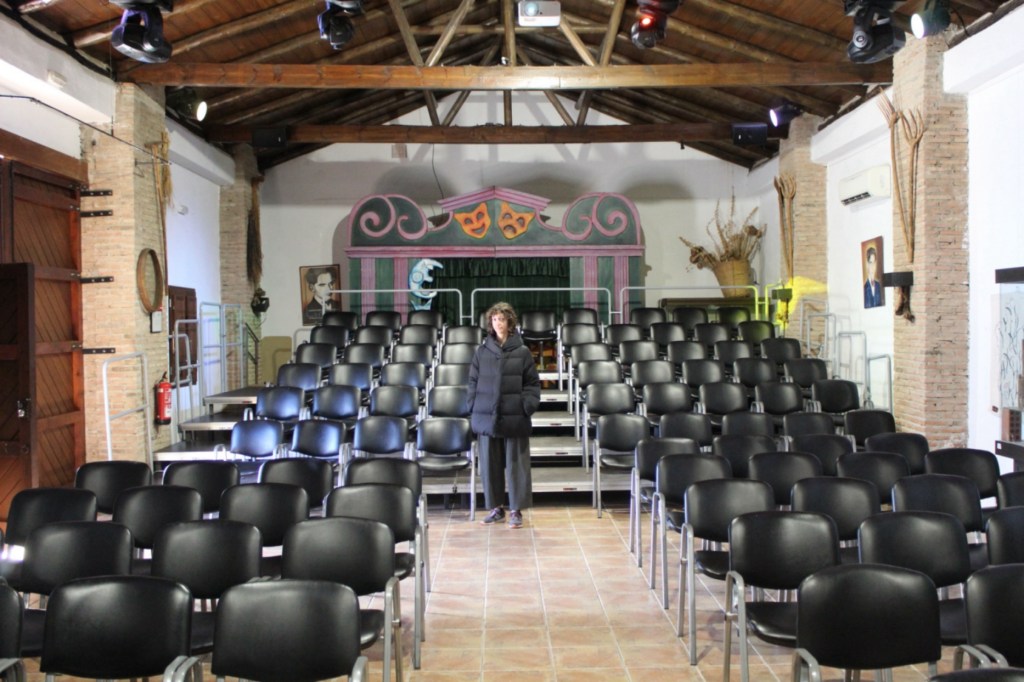
Rebe in the theater attached to the house museum.

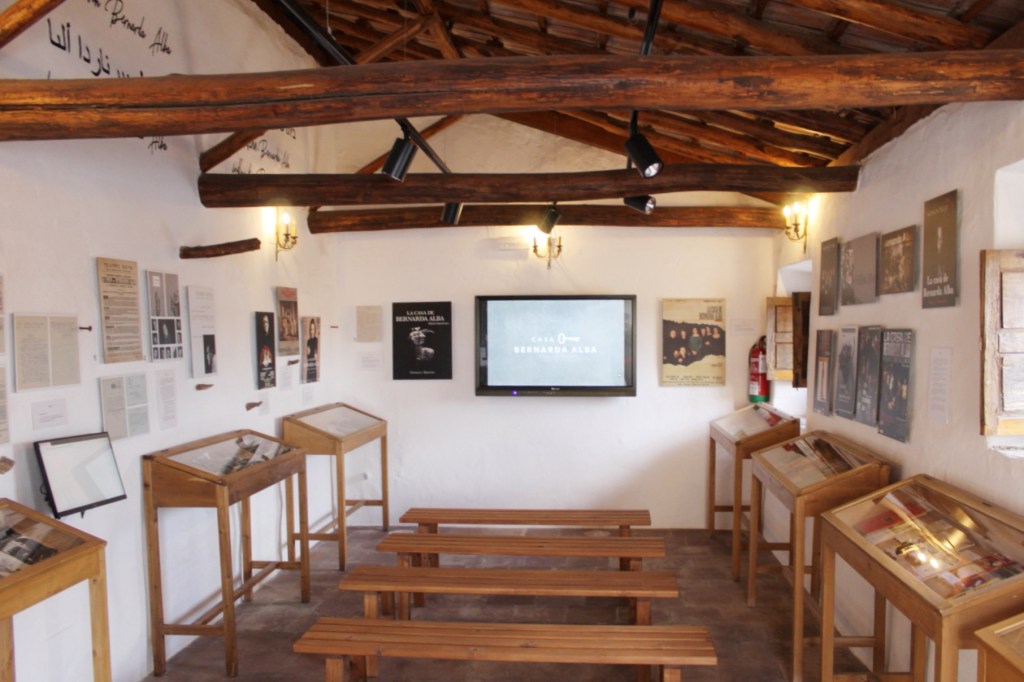
But we were on time for the tour of the House of Bernarda Alba. This is an attractive villa next to the Lorca property, where a widow lived with her daughters. Federico used this family as the basis for one of his best plays, La casa de Bernarda Alba, which is about a tyrannical widow who imposes a decade’s long period of mourning on herself and her daughters after the death of her husband. Apparently, the actual family—who I presume weren’t nearly as monstrous as Lorca portrayed them—were understandably quite offended by this, and cut off contact with the Lorcas. And now, to add insult to injury, their home stands as a museum to the poet’s honor!
Our last stop was rather more somber. On the 19th of August, 1936, Lorca was arrested, taken outside the city, and shot. Against the advice of his friends, on the eve of the Civil War he had traveled to his native city. But as war broke out and violence spread, he realized that he was unsafe and so hid himself in the home of family friends, who were members of the right-wing Falangist party. The political connection didn’t help. Along with three other men, he was taken to a spot on the highway between Vïznar and Alfacar and shot.

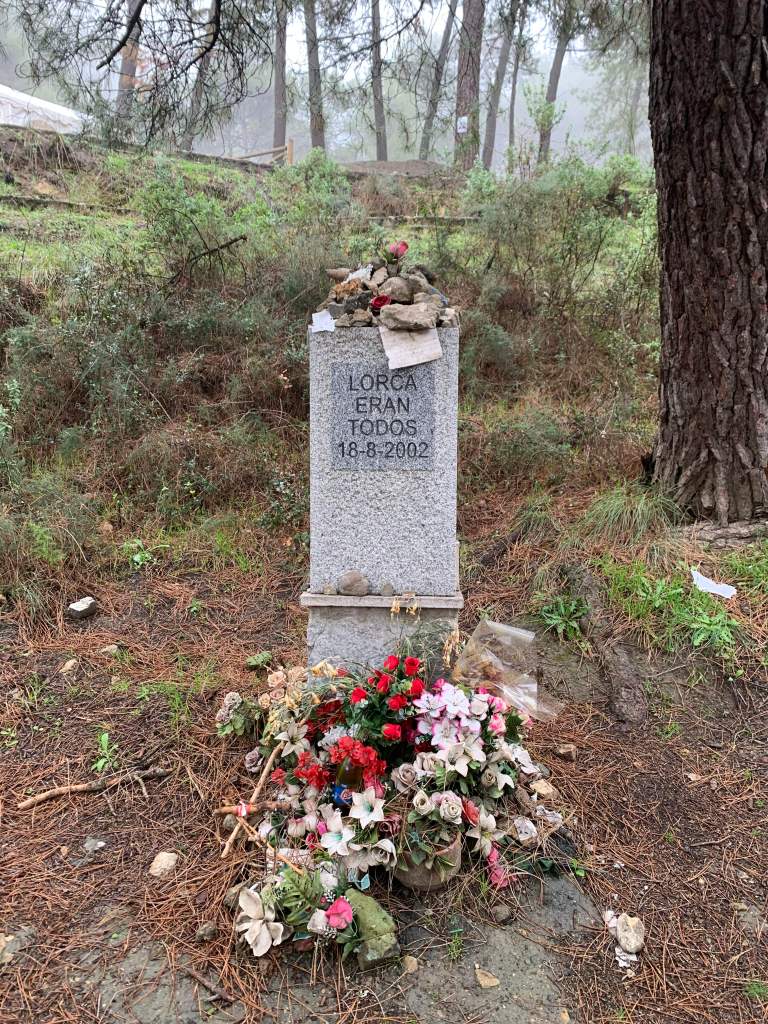
The place where Lorca was executed is hardly recognizable today. At the time it was a barren hillside, completely devoid of vegetation. Today, however, it is a grove of tall pine trees that cover the ground with shade. We parked the car and walked up a hill, not sure what we were looking for. Then we noticed papers tacked onto trees, like ‘Lost Cat’ posters on telephone polls. They were photos of the people believed to be executed here. There were dozens of these photos, each one with a name, profession, and believed date of death.
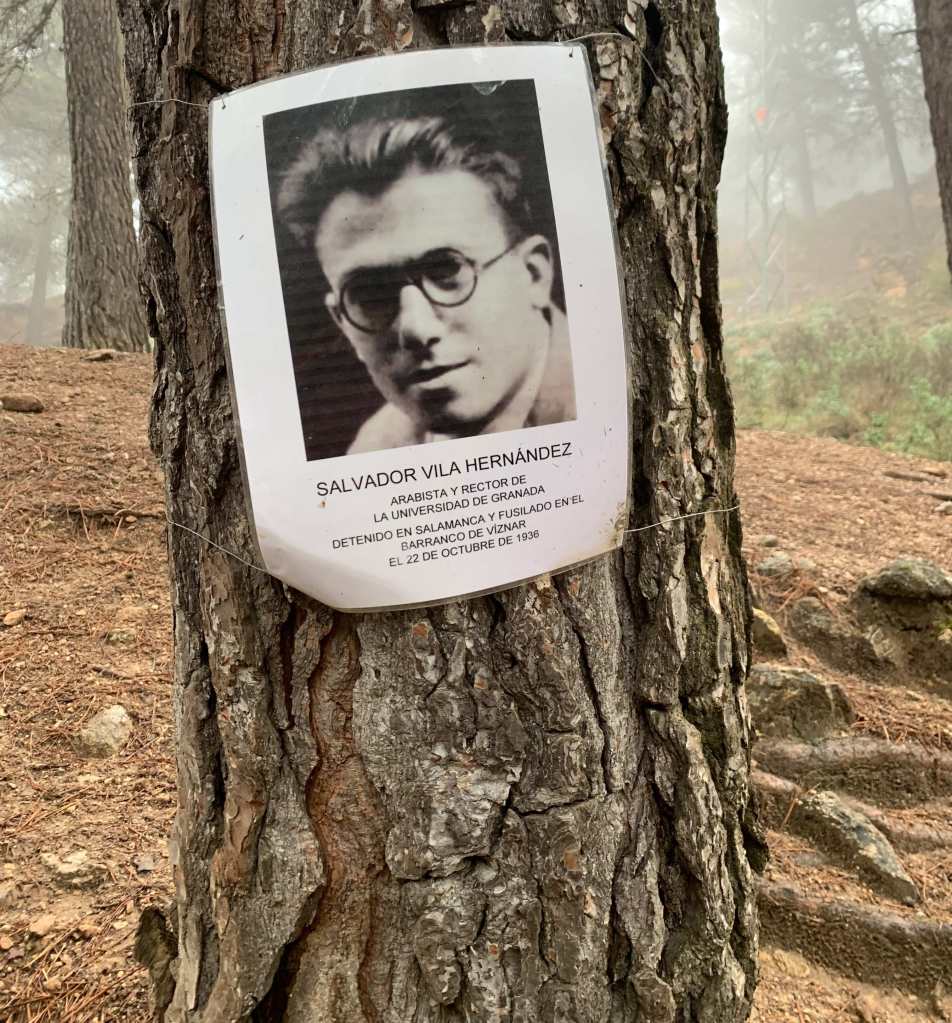
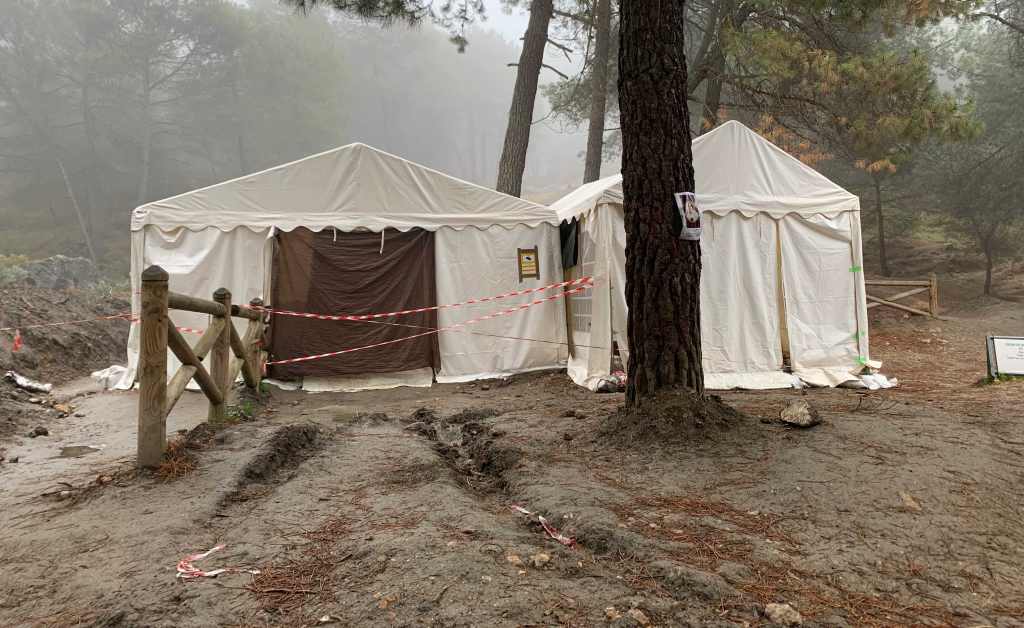
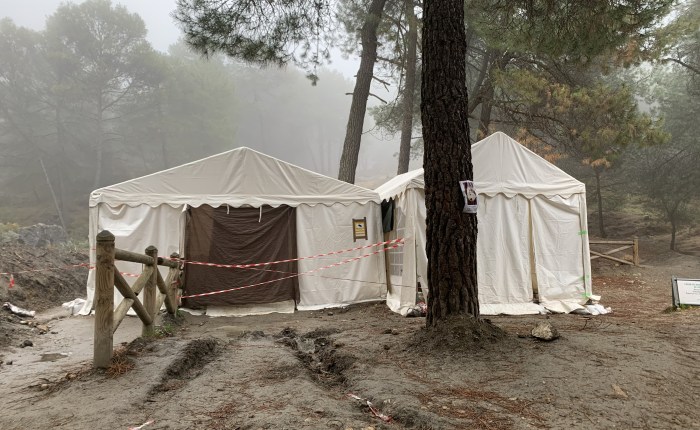
Even more unsettling were the white tents, standing empty and silent. They were covering excavation pits, where investigators are finally unearthing the remains of the hundreds of victims executed here, nearly a century after the Civil War. The investigators are also collecting DNA samples from surviving family members, so as to be able to identify any remains they uncover. Lorca’s body is believed to be here somewhere, though it hasn’t been identified yet. (You can learn more about the effort by following the groups’s Instagram.)
To state the obvious, it is chilling to think that such a harmless man—a gift to the world and an ornament to his country—could be deemed so threatening that he had to be executed this way. His last moments must have been terrifying. His work, however, has outlived Franco and his regime, and perhaps it will outlive the current constitution.

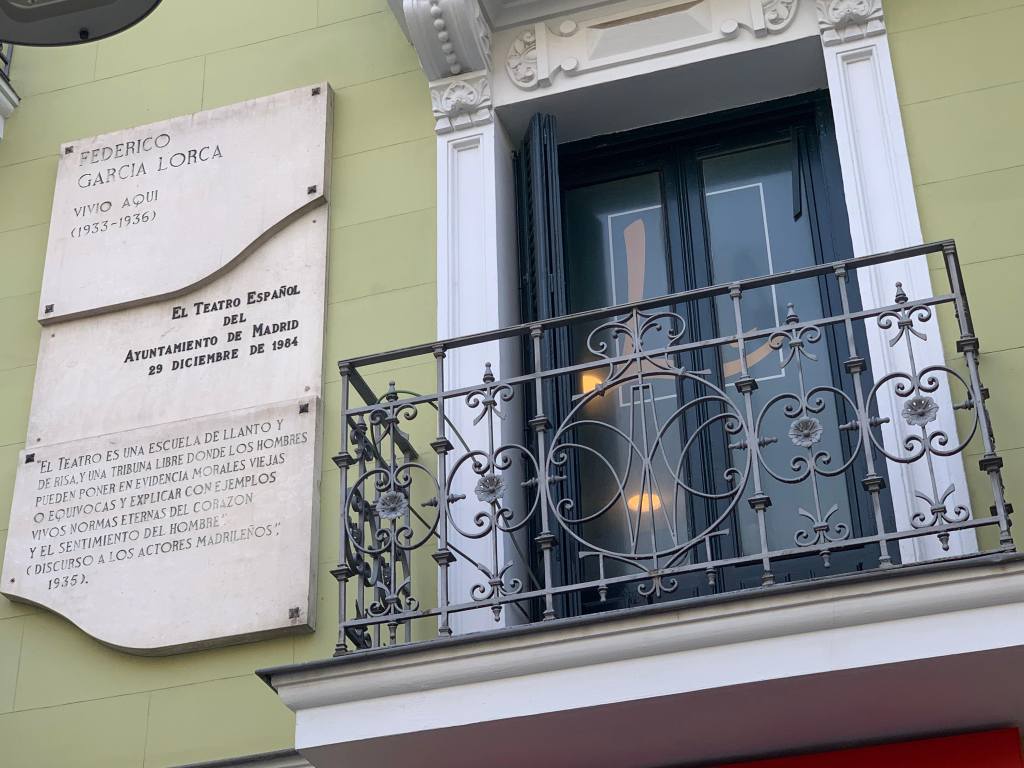
Now, for the very serious Lorca fan, there are also some sites to visit in Madrid. There is a lovely statue of the poet in the plaza de Santa Ana, and on Calle de Alcalá 96 there is a plaque which marks the apartment where Lorca lived for the last three years of his life. Another worthwhile visit is the Residencia de Estudiantes, where Lorca lived as a student along with his Dalí. The two were very close as young men, though many have criticized Dalí’s later reconciliation with the Francoist regime as a betrayal to the memory of his friend. 
But, of course, the most important thing is not to follow in his footsteps, but to keep reading and performing his works. This way, he will remain forever alive. 
Review: The Assassination of García Lorca

Review: The Assassination of García Lorca

El asesinato de García Lorca by Ian Gibson

My rating: 5 of 5 stars


Sometimes the simple act of remembering is political. History is, unfortunately, replete with crimes that one government or another would prefer to remain hidden. And, certainly, forgetting is probably easier for everyone involved—less traumatic, more convenient—even, perhaps, for the victims. Thus, whenever some busybody like Ian Gibson begins stirring up old trouble, the accusation of “opening up old wounds” is inevitably trotted out (ironically, by the ones who did the wounding in the first place).

And yet, even if it is not entirely logical—even if what is done is done, and nothing can change that—some sense of moral duty, of obligation to victims who are beyond all human help, seems to compel us nevertheless to reach back into the past and seek justice. This book is imbued with that sense—perhaps a quixotic sense—of ethical duty, as Gibson attempts to nudge the moral balance of the universe back in the right direction.

He first establishes that Lorca was anything but the apolitical flower child that he is sometimes portrayed as. It is true that Lorca was perhaps somewhat naïve and, in general, was averse to party politics (he repeatedly refused to join the communist party). But he was politically active and unambiguously allied with the left, as was evident by several public declarations. Indeed, the idea that Lorca was, in his final days, converting to the fascist cause—an openly homosexual poet who dramatized the evils of conservative Catholicism!—was never anything but laughable.

Gibson then does his best to establish the events that lead to Lorca’s death in Granada, using interviews with witnesses (admittedly many years after the fact) to pin down as many details as he can. In the process, he gives the reader a sense of the climate of terror and repression that engulfed Granada in the opening days of the military uprising—jails packed to bursting, mass graves filled by firing squads, a knock on the door at mightnight to go “take a walk.” In the process, he also lays to rest another myth of Lorca’s murder, that he was somehow killed by uncontrollable elements of the falangist party—a random act of violence, in other words. On the contrary, Lorca’s death was the product of an intentional campaign of “purification,” approved of and organized by the authorities.

This book might not have had such an impact on me had I not visited Granada as I was on the final pages. Though I had read many of Lorca’s works before the visit, he was still just a historical personage for me—one of Spain’s many dead poets. But visiting his former houses (there are several, as his family was very wealthy) transformed him into somebody startlingly real and close. I saw the piano that he liked to noodle on, the writing desk on which he wrote his most famous plays, and even hand-drawn theater backdrops to be used in a puppet show for his baby sister.

This trip culminated in a visit to the Barranco de Víznar, the place of his execution. We arrived on a foggy Sunday morning and followed the path into the woods. Soon, we came upon several white tents, which covered the excavations sites of mass graves. The trees around the site were covered with laminated posters bearing the names and faces of those executed there—professors, politicians, farmers, pharmacists, music teachers… In the center was a simple memorial covered in flowers, with the inscription “They were all Lorca.”

So far, the remains of dozens of individuals have been recovered there by a team of investigators, though none have yet been identified by DNA tests. That this excavation had to wait nearly 100 years to take place is a measure of the silence—imposed, in an attempt to forget—that followed the Spanish Civil War. But relatives of the victims have kept their memories alive, and now they are perhaps receiving some modicum of justice. Even today, memorializing these victims takes courage. Just last week, a hiker was assaulted at that very place by a man screaming “There aren’t many buried here!” The hiker was hospitalized. But the work continues.


View all my reviews

Review: The Rural Trilogy (Lorca)

Review: The Rural Trilogy (Lorca)

Bodas de sangreBodas de sangre by Federico García Lorca

My rating: 4 of 5 stars

Bodas de Sangre, or Blood Weddings, is an odd combination of the ancient and the modern. The story could not be more elemental: the conflict of love and duty, the tragedy of death. And yet the style is pure Lorca—symbolic, surrealistic, modern. The play is effective, not for any subtlety or refinement, but for the sheer amount of force that Lorca brings to bear on the main themes. The characters are nameless archetypes, whose speech is poetic passion. Lorca’s use of naturalistic imagery in his poetry—animals, trees, rivers, the moon—reinforces the primeval quality of the story, as if tragedy were a law of the universe. I am excited to read the other two plays of Lorca’s so-called rural trilogy.


La casa de Bernarda AlbaLa casa de Bernarda Alba by Federico García Lorca

My rating: 4 of 5 stars

This is the second of Lorca’s “rural trilogy” I have read, and if anything I liked it even more than Bodas de Sangre. In form and theme the two are quite similar. Like a Greek tragedy, the plot is simplicity itself, with one obvious conflict and one calamitous resolution. Again, Lorca’s power as a dramatist comes, not from subtlety or wit, but from pure passion. The incompatibility between traditional values and human impulses, with all its tragic implications, is laid bare by Lorca, who shows us a culture whose religious mores and gender norms oppress women and deprive them of a fulfilling life. Strikingly, the cast of characters is entirely female, even though the conflict revolves around a male who is always offstage. This allows Lorca to focus on a side of life that was often swept aside, while maintaining an atmosphere of tension and constraint that makes the play so riveting. I am excited for Yerma.


YermaYerma by Federico García Lorca

My rating: 4 of 5 stars

I have enjoyed each play of Lorca’s rural trilogy more than the last. He is such a heartrending writer. Even on the page, the emotion of the play is raw and deeply affecting. He had an acute ear for dialogue, and could write as naturalistically as anyone; and when this naturalism is supplemented by his poetic gifts—at times surrealistic, at times pastoral—the language becomes electric with meaning. The word I keep coming back to is “elemental,” since the plays dramatize basic and timeless tragedies of human life.

In this play the tragedy is the anguish caused by being childless in a time when women were valued as mothers and mostly confined to the house. As in the other two plays in the so-called “trilogy” (they all have distinct plots), the basic conflict is between conservative, religious traditions and spontaneous human impulses. Lorca seems to have felt deeply the suffering caused by an uncompromising Catholic morality, and convincingly shows how it doomed people to lifelong unhappiness. It is fittingly tragic that this same moral code contributed to Lorca’s own death.

View all my reviews
Sorolla-9

Review: Poet in New York

Review: Poet in New York

Poet in New York: A Bilingual EditionPoet in New York: A Bilingual Edition by Federico García Lorca
My rating: 4 of 5 stars

I want to cry because I feel like it
as the boys in the back row cry,
because I am not a man nor a poet nor a leaf
but a wounded pulse that probes the things of the other side.

Poetry is an odd thing. You notice this when you encounter poetry in a second language. This happened to me a few weeks ago, when I went to a poetry reading in Madrid. There were four or five poets there, some of them fairly well-known, with a crowd of hushed listeners hanging on their every word. Meanwhile, with my very imperfect Spanish, I was only able to catch bits of phrases and scattered words that added up to nothing.

“Look, I can be a poet,” I said to a friend after the show: “A cow is a moon, / a moon is a balloon.” That’s really how it sounded to me.

In a way, this isn’t surprising, of course; but it got me thinking how strange a thing is poetry. We string phrases together that, interpreted literally, are either false, absurd, meaningless, or banal; and yet somehow, when the poetry works, these phrases open up subtle emotional reactions in their listeners. Why is it that a certain phrase seems just right, inexhaustibly expressive and unutterably perfect, while a similar phrase may be dead on arrival, impotent, sterile, and maybe even unpleasant? Bad poetry, indeed, can be excruciating and embarrassing to witness, perhaps because it is in bad poetry that the essential strangeness of the act of poetry is most acutely manifest. We feel that this whole thing is silly—trying to make portentous sounding phrases that signify close to nothing. And yet the genuine article, once witnessed, is undeniable.

I usually group poetry along with novels and short stories, as literature; but lately I think that poetry may be closer to another art form: dance. Dance is distinct from every other kind of movement—from walking to golf to sign language—in that it is not oriented towards any external goal. That is, the movement itself is the goal; the point is to move, and to move well. In poetry, too, our words—which normally point us towards the world, if only to an imaginary or a hypothetical world—are stripped as much as possible of their normal denoting function; the point becomes, rather, the pure manipulation of diction and grammar, in much the same way that, in dance, the point becomes the pure movement of limb and trunk.

This is a healthy thing, I think, since in life we can get so preoccupied with the attainment of a goal that we become blind to everything that does not advance our progress towards our object. A coach of a football team, for example, is only concerned with how well his players’ actions increase the likelihood of winning; and likewise, normally when we use language, we are using it to accomplish something specific, from ordering pizza to chiding children. Dance and poetry, by stripping away the intentionality of the act, reveal the subtle beauty in the activity itself, allowing us to slow down, to appreciate the rhythm of a word or the gentle flexion of an arm.

I must hasten to add that this description of poetry and dance does not apply equally to all examples. Alexander Pope’s poetry approaches very nearly to prose in its use of denotation; and T.S. Eliot’s “The Waste Land” is on the other side of the spectrum. A similar spectrum applies in the case of dance, I suppose.

Federico García Lorca’s poetry is much closer to Eliot’s in this regard, perhaps even further along in its tendency towards connotation. This makes his poetry doubly hard for a foreigner like me to appreciate, since the specific emotional flavors of his words are bland in my mouth. As a young man Lorca lived in the famous Residencia de Estudiantes, in Madrid, where he became close friends with Dalí. The two exerted a mutual influence on each other, both moving towards the surrealism that was becoming trendy in the art world.

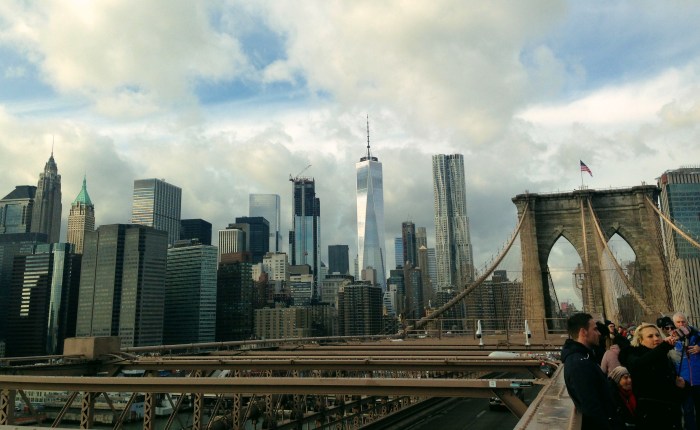
Lorca wrote this book many years later, during and after his visit to New York City in 1929-30, during which he witnessed the Stock Market Crash. Economic depression or not, however, the inhuman vastness of the city, the crowds and concrete, the money-obsessed workers and the poor and the homeless, the racial discrimination and the absence of nature, seems to have made a deep impression on the rural Andalusian poet. These poems are his anguished response to this experience.

Lorca’s poetry is surreal in the textbook sense that he uses a succession of vivid, concrete images that, taken together, add up to something nebulous and unreal. Much like Dalí, Lorca has a talent for creating bizarre images that nevertheless manage to be emotionally compelling. Opening the collection more or less at random I find:

All is broken in the night,
its legs spread wide over the terraces.
All is broken in the warm pipes
of a terrible, silent fountain.

Admittedly it does take some time to find the odd beauty in the apparently random, unconnected pictures. My first instinct was to read them like metaphors; but if Lorca did indeed have something specific in mind that he was trying to allegorize, the allegories are much too complicated and disjointed to be deciphered. Rather, I think these poems must be read simply for the beauty of the language, the striking collisions of words, the flashes of light and the rumblings of sound. The poems seem to capture nothing more nor less than an emotional mood—different shades of desolation—that presents itself to the conscious mind in a kind of personal mythology, as in a dream. Dalí was deeply influenced by Freud during his stay in the student residence, and I wouldn’t be surprised if Lorca was too.

Even if it is difficult to articulate the structure and meaning of Lorca’s image-world, it is certainly not random. Certain words and images come up again and again, as in a dream sequence, being shuffled and re-shuffled throughout the collection. Some of these words are oil, ant, worm, thigh, moon, void, footprint, hollow, glass, night, wounded, agony, sky, cracked, death, coffin, iron… The ultimate effect of these words, recombined again and again, is cumulative; they create echoes of themselves in the reader’s mind, calling up half-remembered associations from other poems, creating an emotional coherence in the literally incoherent text.

Look at concrete shapes seeking their void.
Mistaken dogs and bitten apples.
Look at the longing, the anguish of a sad fossil world
that cannot find the accent of its first sob.

The emotional resonance of the words themselves is also important, something that is unfortunately lost in translation. For example, the word for “oil,” aceite, has an interesting blend of comforting familiarity and a tint of the exotic. I think this is because the word originally comes from Arabic, and maintains a certain foreign flavor, even as it denotes something absolutely integral to the Spanish culture: olive oil, which is used in everything. The word also brings up the rolling olive fields, stumpy trees on sandy soil, that fill Lorca’s Andalucía; and this again calls to mind the age-old farming tradition, the intimate connection with the land, totally absent in New York City. There is also the double association of oil as integral to cooking and as something potentially toxic and polluting. A native Spaniard will likely disagree with this chain of associations, but I think the word is undeniably resonant.

Ultimately, though, I don’t think I can articulate exactly why the text of these poems is gripping, in the same way that I cannot articulate exactly why I find some dancers compelling and others not. You cannot learn anything about New York City from these poems, and arguably you can’t learn very much about Lorca, either. I’m not even sure that the cliché is correct, that these poems can “teach you about yourself.” Maybe they don’t teach anything except how to feel as Lorca felt. I don’t think that’s a problem, though, since the point of reading is not always to learn about something, just as the point of moving isn’t always to get somewhere. Sometimes we read simply for the pleasure of the text.

View all my reviews