Historic Hudson Homes: Lyndhurst & Untermyer Gardens

Historic Hudson Homes: Lyndhurst & Untermyer Gardens

This is part of a series on Historic Hudson Homes. For the other posts, see below:


It should perhaps come as no surprise that the Hudson Valley is full of the former (and current) homes of the exceptionally wealthy. It is ideally situated to serve as a kind of country retreat for the rich—within a stone’s throw of New York City, but surprisingly green and bucolic.

In the stretch of Route 9 between Irvington and Tarrytown there is a conspicuous concentration of opulent residences. The most famous is arguably Sunnyside, the house of Washington Irving, which now seems like a cottage compared to its neighbors. Nearby is the Belvedere Estate, which once belonged to Samuel Bronfman, owner of Seagram Company, of Canadian whisky fame—though it now serves as the headquarters for the Unificationists, a Korean-Christian version of scientology. And there is also Shadowbrook, a Gilded Age mansion owned by famed jazz saxophonist Stan Getz.

More historical is Villa Lewaro, an Italianate mansion owned by Madam C. J. Walker, the first female self-made millionaire in America—a feat even more impressive considering that she was an African American, living at the turn of the century. She made her wealth by selling beauty products marketed for black women, and then became a noted philanthropist. During her life, Villa Lewaro became an important meeting place for black intellectuals of the Harlem Renaissance.

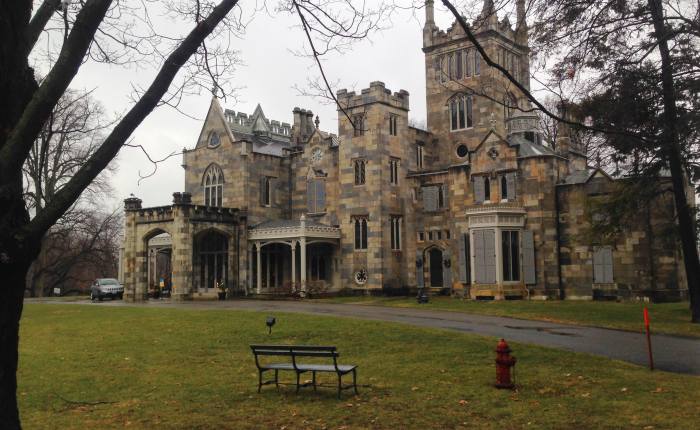
But the grandest of all of these mansions is Lyndhurst. Rising like a misplaced cathedral over the Hudson, Lyndhurst is a spectacular example of neo-gothic architecture. It was first built for William Paulding, mayor of New York City, and a relative of both John Paulding (the Revolutionary War hero who caught the treasonous Major John André) and, through his sister’s marriage, of Washington Irving. Its extravagant style led locals to deem it “Paulding’s Folly,” though the subsequent owner, George Merrit, expanded the house and made it even more fanciful. Both the original house and the expansion were designed by Alexander Jackson Davis, one of the most sought after architects of his day.
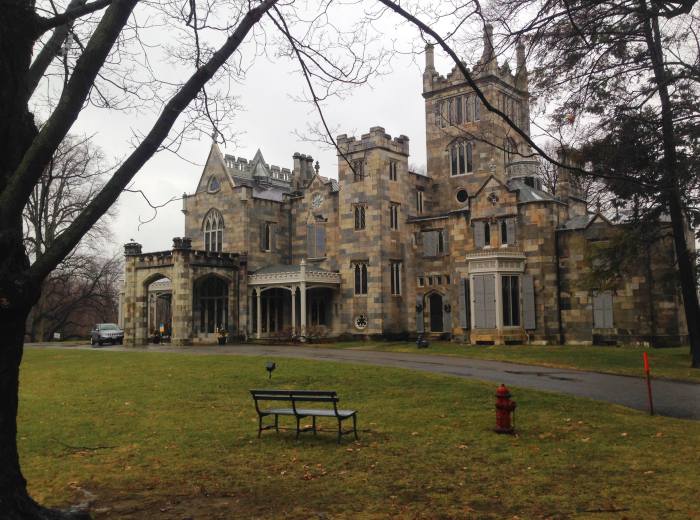
Yet the name most associated with Lyndhurst is that of Jay Gould. It is a name that was widely columniated during his life, and his reputation has hardly improved since his death in 1892. Gould was one of the most famous and despised robber barons, who manipulated markets, bribed politicians, and bent and broke the law in order to maintain his dominance. Unlike Cornelius Vanderbilt, say, Gould’s opulence was not due to his founding a useful business. He was more like Warren Buffet than Bill Gates—an investor, not an entrepreneur. Still, in his defense it must be admitted that, like Vanderbilt or Rockefeller or Carnegie, Gould was a self-made man, born into poverty. (Unlike Rockefeller or Carnegie, however, Gould never became a prominent philanthropist.)

Lyndhurst, as it stands today, is much as Gould left it. The visit begins in the old Carriage House, where there is a gift shop, an informational film, and where you sign up for the tour. (The house can only be visited with a guide.) The interior continues the gothic theme of the facade. The ceilings are vaulted, and the narrow windows curve into a pointed arch (making some rooms of the house rather dark). Imitations of gothic tracery even adorn some of the walls. The furniture, too, is in keeping with the severity of the aesthetic, but several lovely examples of Tiffany stained glass do help to alleviate the stuffy atmosphere.
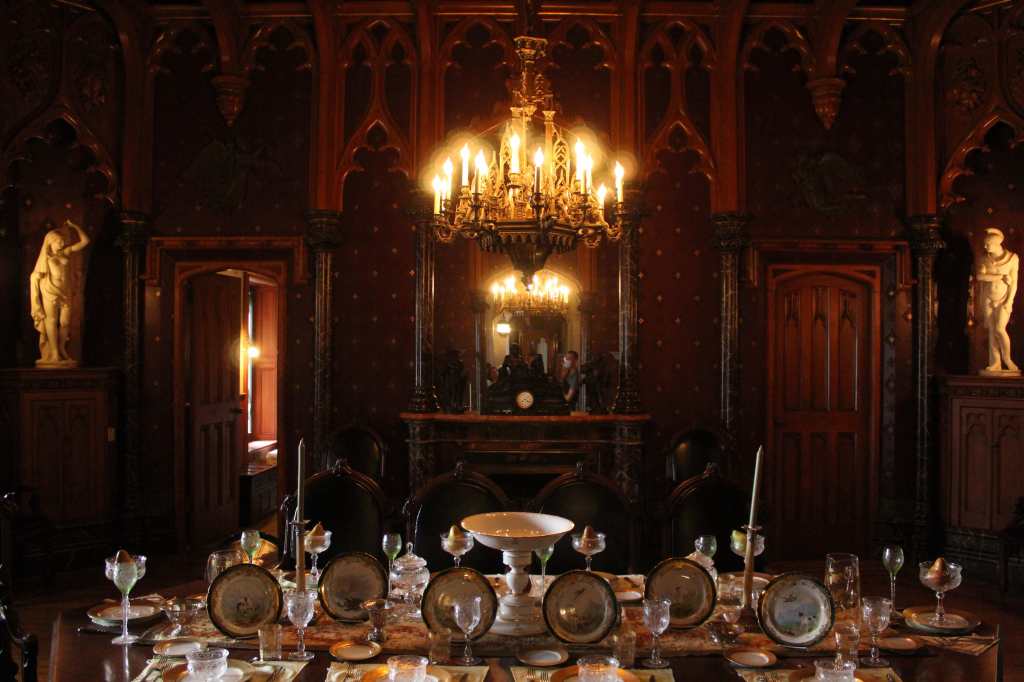
A curious detail, pointed out by the guide, is the use of paint to imitate other materials. While many surfaces appear at first glance to be marble, they are, in reality, painted wood. Meanwhile, the gothic ceilings, window panes, and tracery are made of wood and plaster rather than real stone. This would seem rather counterintuitive, since Gould certainly could afford any medium he wished. But at the time it was considered both fashionable and luxurious to use faux materials. (There is a fine line, apparently, between extreme luxury and garbage.)

The second floor of the house is dominated by a central gallery, which is brightened by the large windows. This is filled with oil paintings—by lesser-known European masters—most of which can loosely be described as 18th century Romantic realism. Among the collection, however, is a rendering of the Jay Gould Memorial Chapel, a beautiful stone church he helped to reconstruct, as well as a study for the Tiffany stained glass windows to be installed in the chapel. There is also a portrait of Gould himself, who always comes across to me as a misplaced barfly, with his unkempt beard and surly expression.

The two opulent master bedrooms open out into this sun-filled art gallery, making a sharp contrast with the dark, almost church-like ground floor. I would feel rather depressed eating in the pseudo-cathedral of a dining room, but quite happy waking up to such a beautiful, open space.
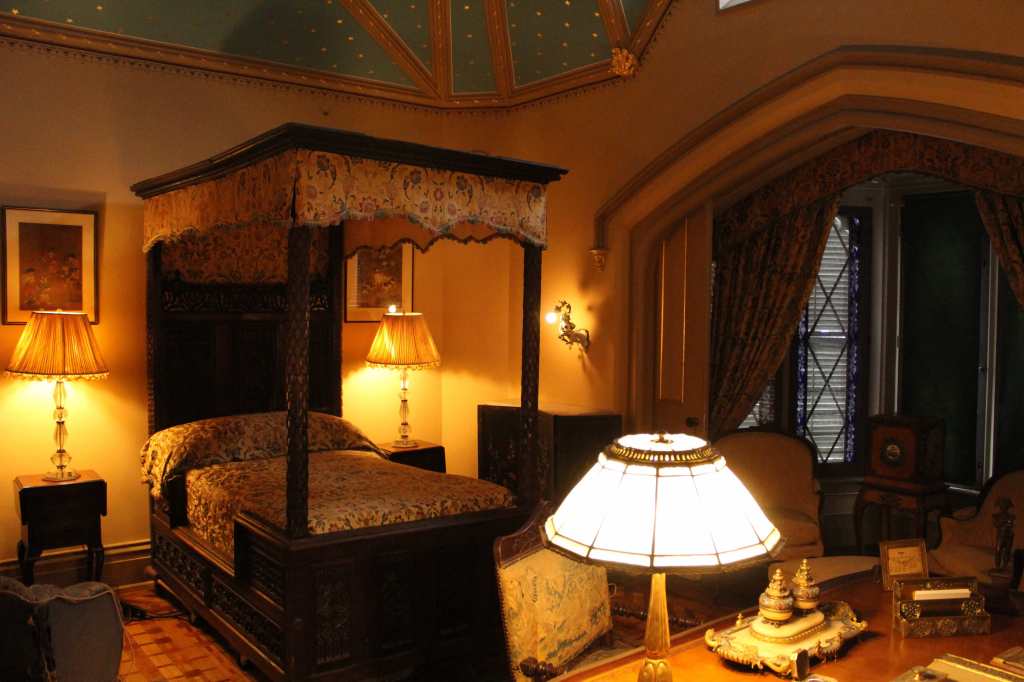
With its strange mixture of neo-gothic, faux-materials, and ersatz religion, Lyndhurst is one of the most memorable of the great Hudson Valley mansions—surpassed in extravagance, perhaps, only by Frederic Church’s Olana. However, as with so many of these great houses, the gardens are ultimately the pleasanter place.

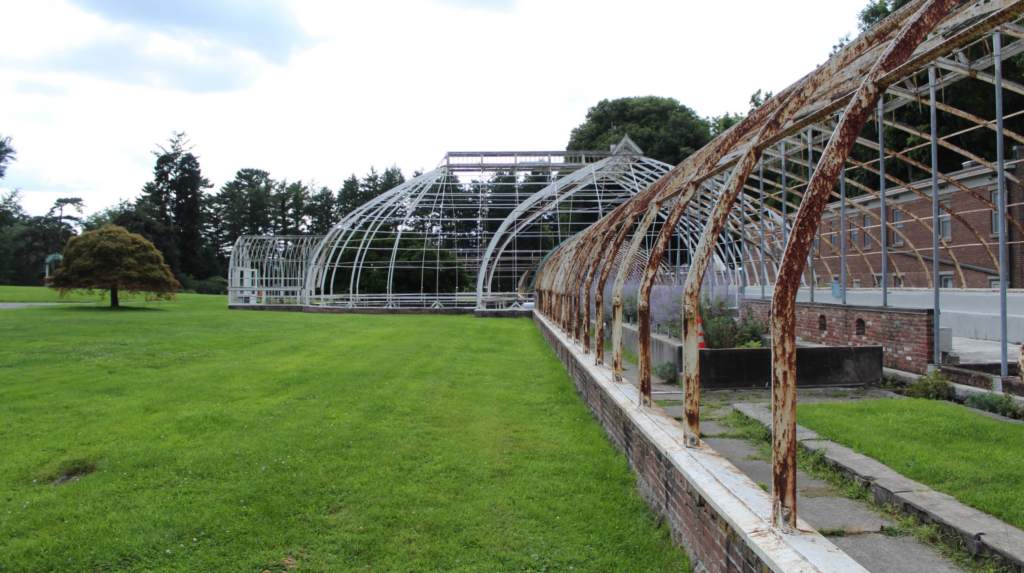
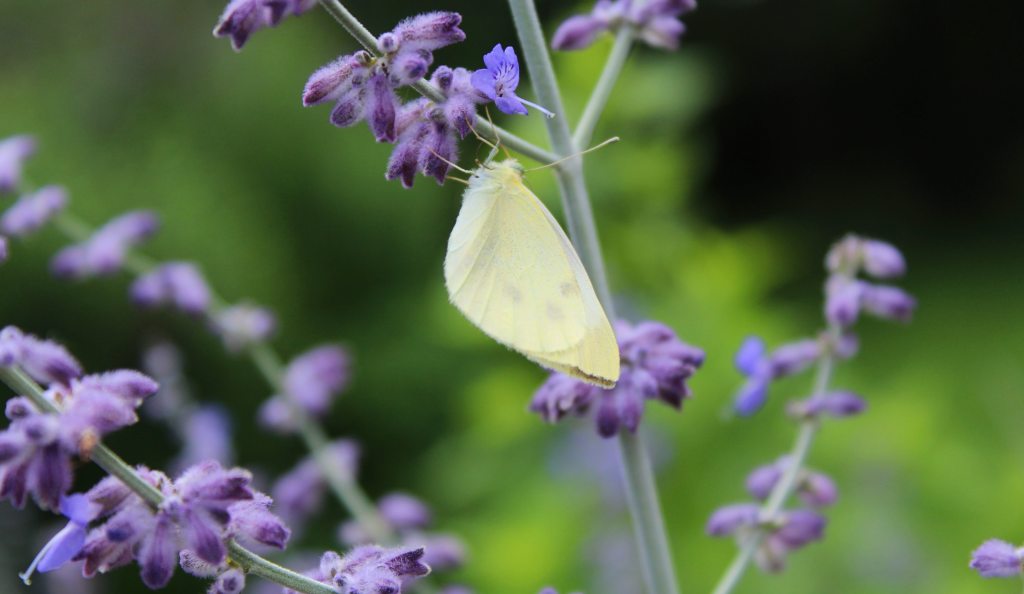
On its great lawn, jazz concerts are held in the summer, organized by Jazz Forum Arts, which hosts performances all along the Hudson Valley. It is crossed by two prominent trails, the Old Croton Aqueduct and the newer Westchester RiverWalk. There, the walker can enjoy the rose garden, which is reliably swarming with bees and other pollinators, and take in the ruins of the old Greenhouse, which once contained over 40,000 plants, but is now just an empty frame.
If you continue walking south along the Old Croton Aqueduct for about two hours—or, alternately, if you drive twenty minutes down Route 9—you will reach yet another grand Hudson estate. This one, however, is conspicuously lacking the mansion. Much like William Rockefeller’s Rockwood, the resplendent Greystone has long since been demolished (leaving only its name in the nearby Metro-North station). But what survived is arguably better than even the finest old residence. It is perhaps the loveliest garden in the Hudson Valley.
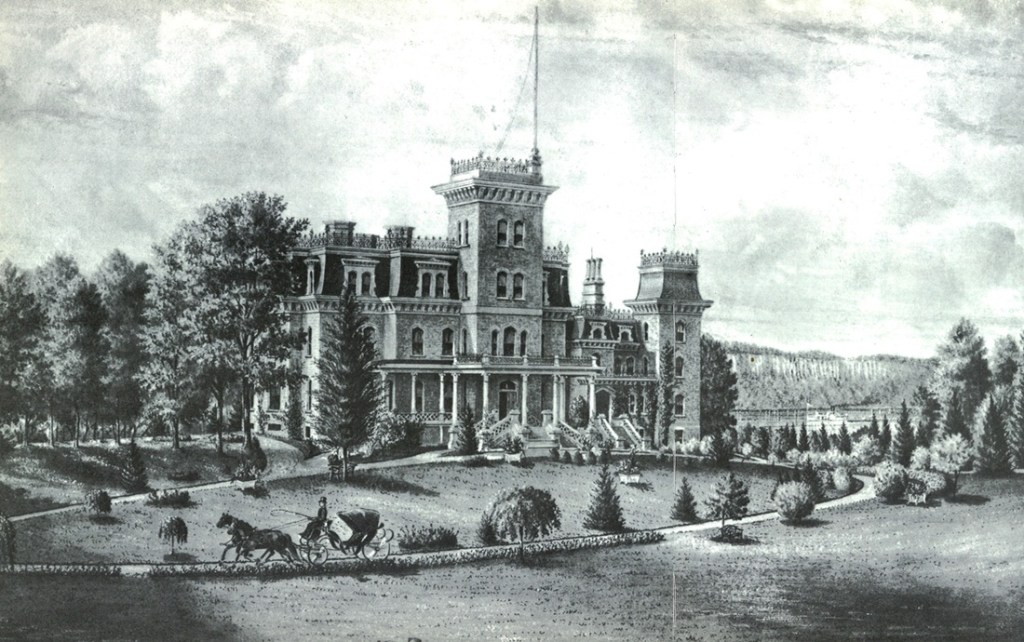
The bygone Greystone mansion

I am referring, of course, to the Untermyer Park and Gardens. Samuel Untermyer was another colorful figure from a bygone age. A lawyer by profession, he somehow made his fortune by fighting against corporate interests. He was an enemy of trusts and monopolies, an advocate of stock market regulation, and instrumental in the establishment of the Federal Reserve. He was also, as it happens, an avid botanist, who wanted to create gardens that would outshine even the landscape at John D. Rockefeller’s Kykuit. Thus, he hired the French-trained architect and designer William W. Bosworth—indeed, the same one the Rockefeller’s hired—to make him the finest gardens that money could buy.
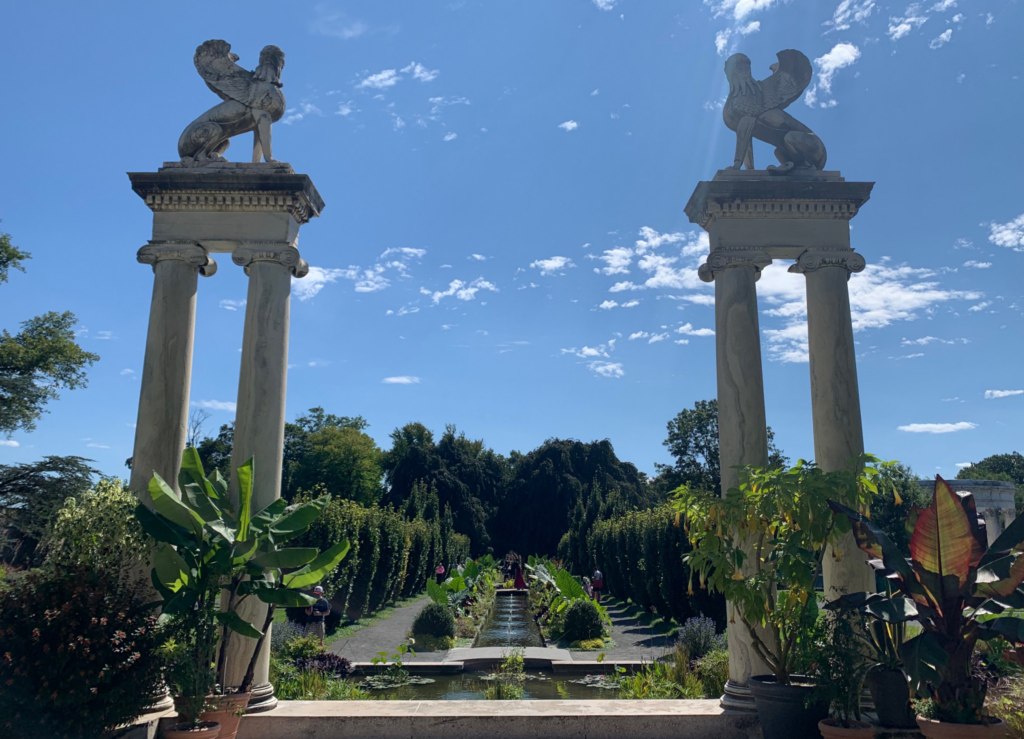
The result is something unlike any other garden I have visited. It is surrounded by high walls, apparently in imitation of old Persian models. After passing under two shady weeping beeches, the central waterway leads the visitor’s eye down the highly symmetrical space. In its focus on flowing water, the garden is indeed reminiscent of its Moorish counterparts in the Alhambra, though the wet climate of the Hudson Valley allows for a proliferation of plant life—rhododendrons, lilies, hollies, hydrangea, amid much else—that is wholly unlike its Islamic models. This central space terminates in a large reflecting pool, over which two sphinxes preside.
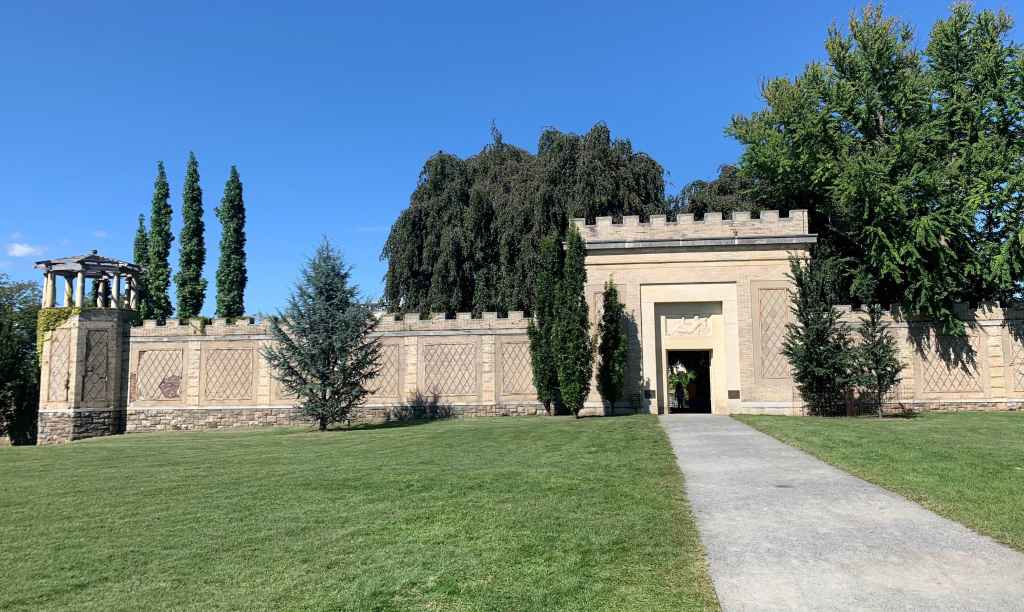
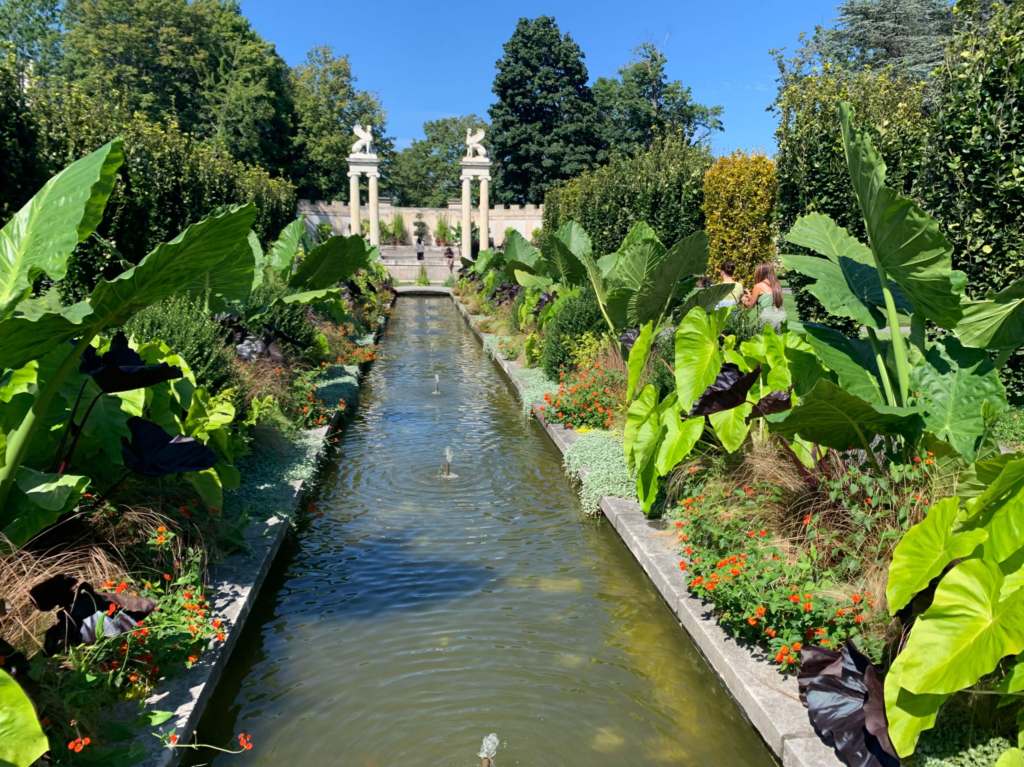
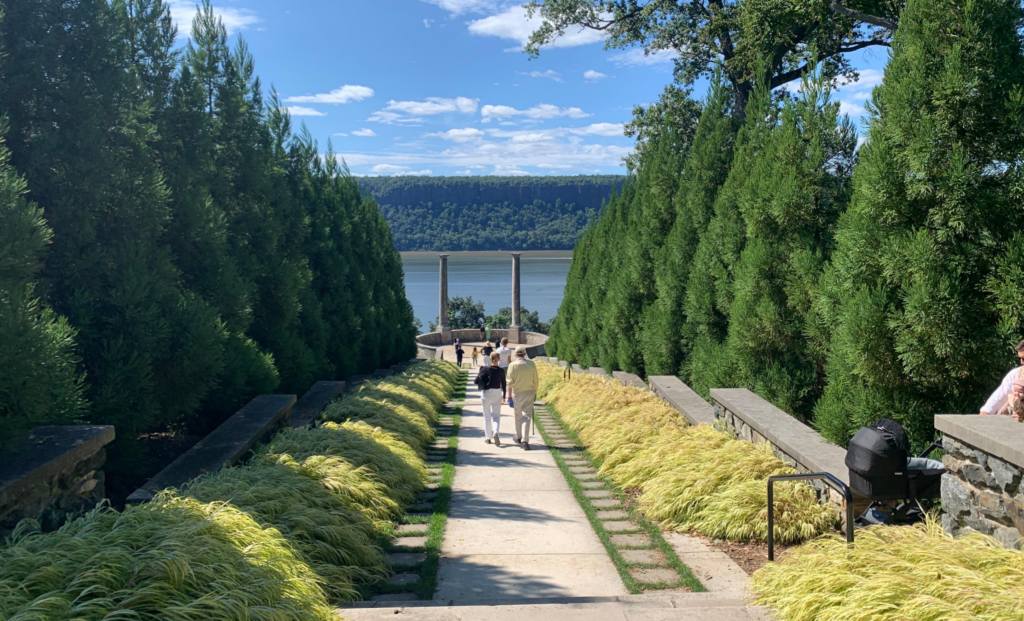
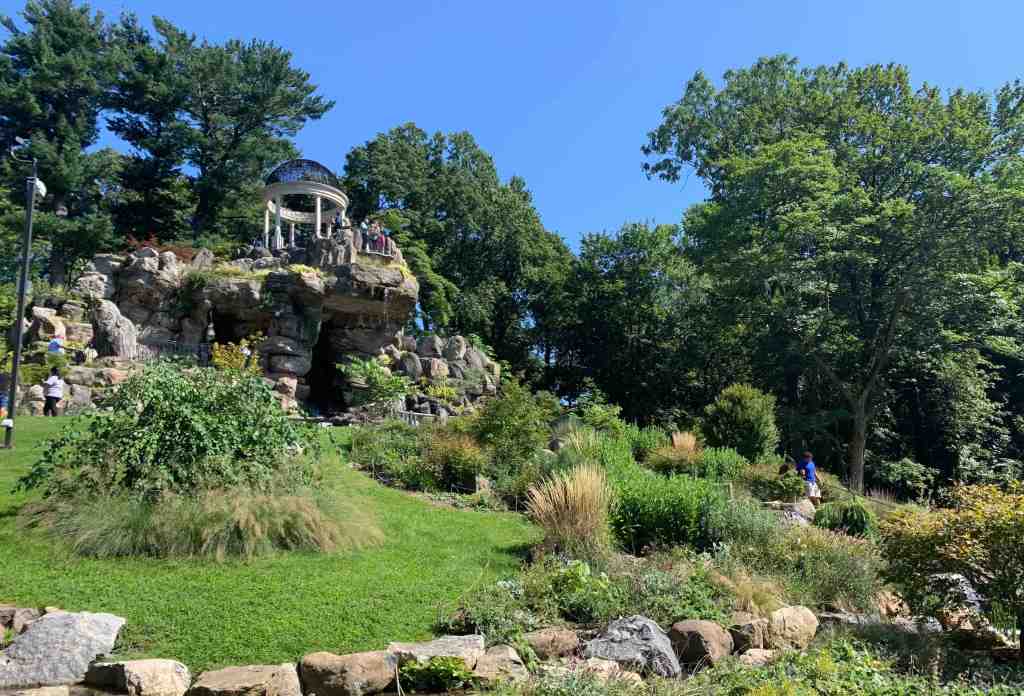
After exploring this space (the pseudo-Greek Temple of the Sky was closed when I visited), you can walk down the long, cedar-lined stairway to the Overlook. This may be the best spot on the Hudson to enjoy the palisades, as the view somehow presents the illusion of a wholly undeveloped river, with no human habitation in sight. From there, a path leads to another pseudo-Greek edifice, the Temple of Love—sitting on top of an artificial rocky outcropping, from which a stream trickles down. It would, indeed, be a good place to take someone on a date—scenic, romantic, and free of charge.
It is heartening to see the gardens in such fine shape, as they suffered long periods of neglect after Untermyer’s passing in 1940. He wished to will both the mansion and the gardens to the public, but the cost of upkeep proved so daunting that the property was refused by New York State and Westchester County. The city of Yonkers eventually agreed to accept a small parcel of the original estate, though it quickly fell into disrepair and suffered vandalism. In the 1990s, community leaders began advocating for the purchase of more land, and in 2011 the Untermyer Gardens Conservancy started restoring the park to its former glory.
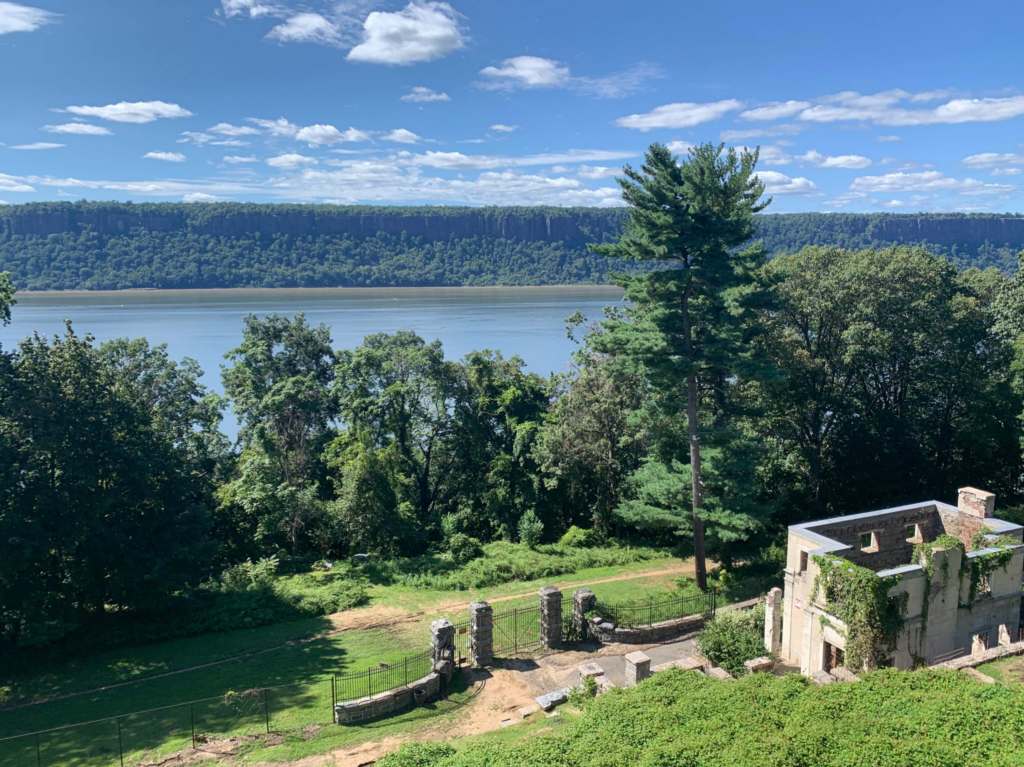
Even now, however, the beautiful gardens are only a shadow of what they once were. During Untermyer’s life, they had sixty greenhouses, tended by sixty gardeners, and was considered one of the centers of botany in the country. Yet what is left is remarkable enough—and all the more remarkable that it is free and open to the public.
Historic Hudson Homes: Cedar Grove & Olana

Historic Hudson Homes: Cedar Grove & Olana

This is part of a series on Historic Hudson Homes. For the other posts, see below:


Before the advent of “modern art” in the 20th century, the United States was considered something of a backwater as far as painting was concerned. Any American painter with an ounce of ambition had to travel to Paris and spend time copying masterpieces in the Louvre in order to become respectable.

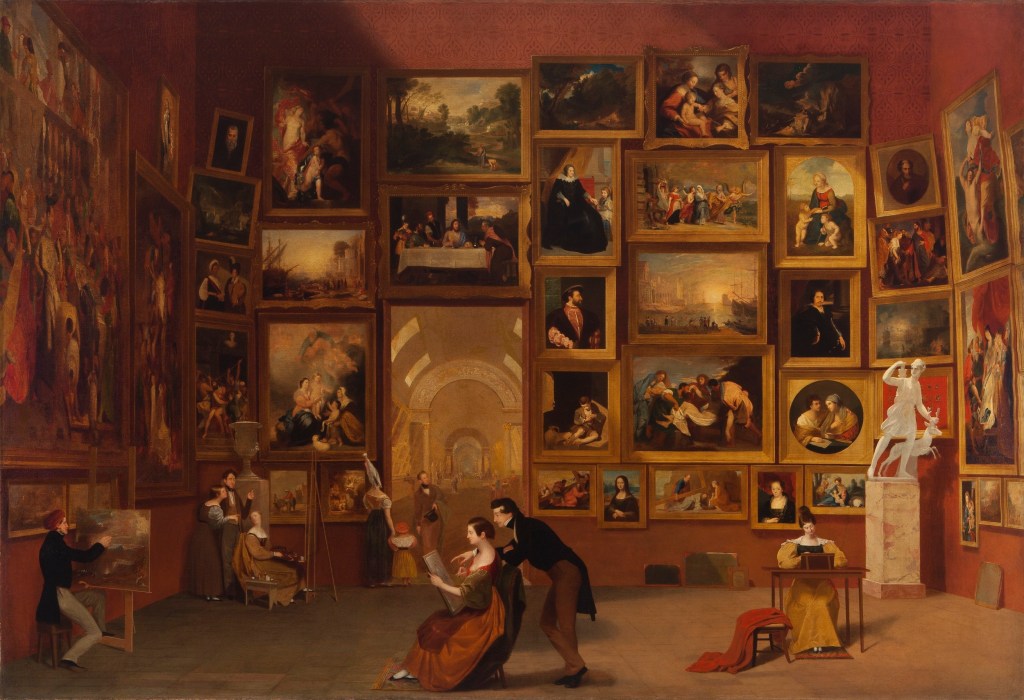
This is precisely what Samuel Morse did. For two years he worked on what was supposed to be his masterpiece, The Gallery of the Louvre, in which he painstakingly reproduced several European masterworks in miniature. This technical tour de force, proof of his hard-earned artistic prowess, earned him—well, very little, which is why he quit painting thereafter and went into the telegraph business. Thus the eponymous code.

Of the American artists who did achieve success during this time, such as Mary Cassat, John Singer Sargent, and James McNeil Whistler, they all spent formative years in Paris and worked in thoroughly European modes.

But one school of genuinely American painting emerged in the 19th century which owed relatively little to the Old World. This was the Hudson River School. This consisted of grand, sweeping landscapes, capturing the relatively (to Europe) wild and untouched countryside. And though artists in this school would eventually paint all over the United States—and beyond—it is named for the place it began: the Hudson Valley.

It took a foreigner to see the beauty in the American landscape, and the potential to turn it into a new sort of painting. Having grown up in grimy, gritty England—in the throes of the industrial revolution—and moved to the United States as a young man, Thomas Cole (1801 – 1848) was deeply impressed by the endless green hills of the Hudson Valley.

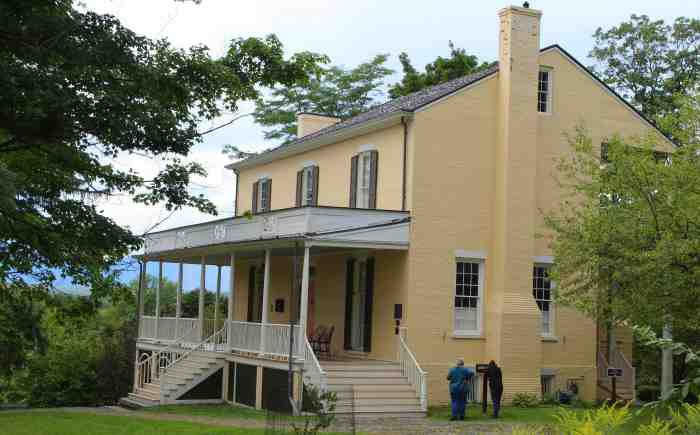
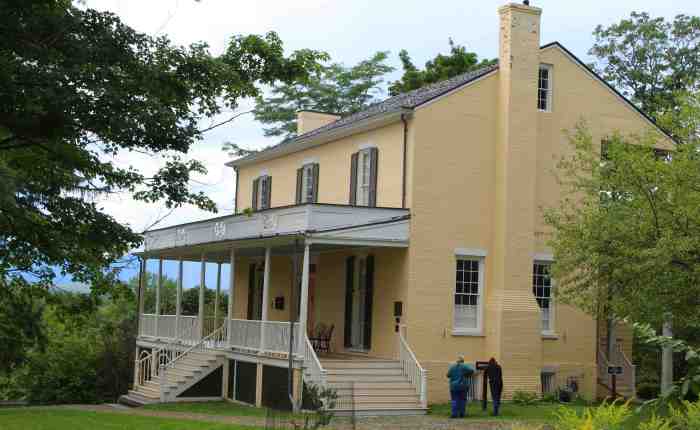
Cole arrived in Catskill, New York, in his early 30s, and rented a room in Cedar Grove, the home of the Thomsons, a prosperous local family. A few years later he married Maria Bartow, a niece of the paterfamilias, and made the house his permanent home. What is now the Thomas Cole National Historic Site is, therefore, the ancestral Thomson residence.

The main house is a beautiful building in the Federal-style, constructed in the early days of the nation, with a lovely porch that wraps around the front. The view from the porch is, indeed, worthy of a picture, with the green-blue profile of the Catskills rolling in the distance. It is not difficult to see why the painter chose to live here. While the Catskills lack the dramatic rocky ridges of the great European mountain chains, the soft, undulating green carpet seems to embody the gentleness of nature. 

Due to a navigation error, my mother and I arrived late for the “Deep Dive” tour of the house. Still, we got plenty of information. The house is well-conserved and presented. There are reproductions of many of Cole’s letters and journal entries scattered about, as well as several original paintings. The majority of Cole’s paintings portray rugged landscapes where small figures are dwarfed by nature, though at times he included wild architectural fancies, such as a blue pyramid in The Architect’s Dream.

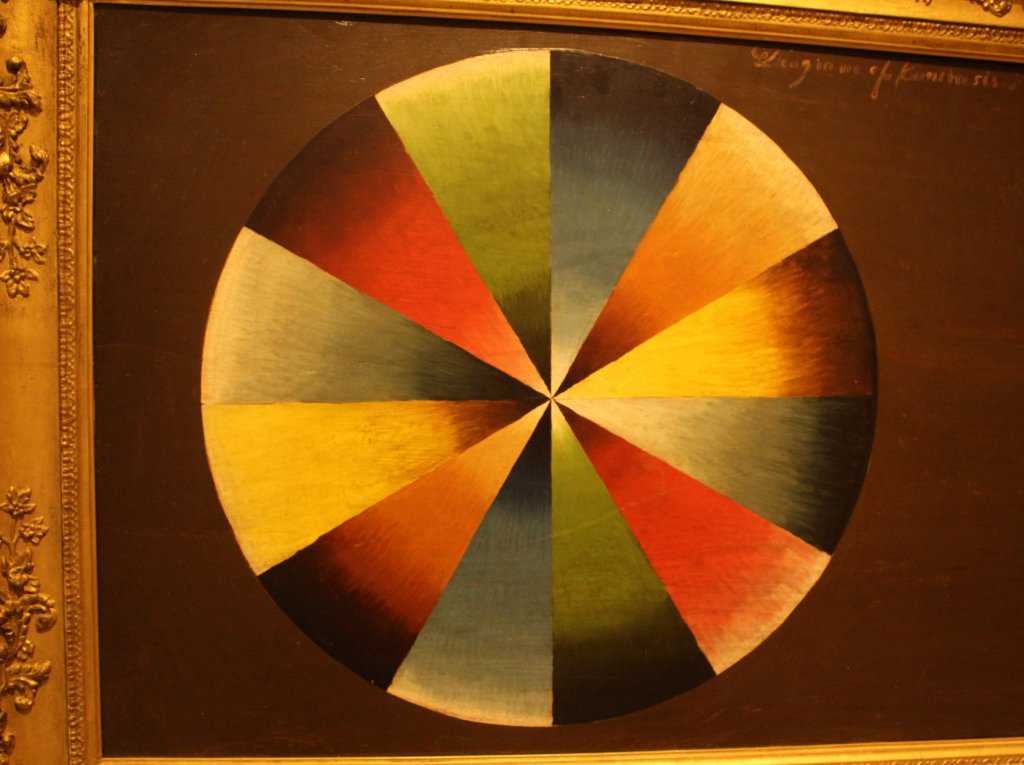
Upstairs, the museum has the last painting that Cole ever worked on, still unfinished. A cloudy blue sky hovers over a featureless brown landscape, revealing the painter’s process—painting from top to bottom. The only clue as to what he intended to paint below are two figures holding a cross, scratched roughly into the paint. Yet still more eye-catching is his Diagram of Contrasts, a color wheel painted over a black background, which looks startling like a work of contemporary abstract art. Indeed, Cole’s description of the work in his diary is reminiscent of Kandinsky:

It is what may be called the music of colours. I believe that colours are capable of affecting the mind, by combination, degree, and arrangement, like sound.

My favorite part of the visit was a video in Thomas Cole’s original studio (a room which he hated, since its only light source was a window facing north). Using his diaries, the museum recreated a hike that he took in the Catskills, juxtaposing his sketches and paintings with photos of the scene now. Cole’s final product may not compare favorably with, say, The Last Supper; but it would never have occurred to that Italian genius—or, indeed, to any major European painter up to this time—to use hiking as a basis of artistic inspiration. It was a major innovation.

The Thomas Cole National Historic Site includes not only the main house, but several other buildings on the property. There is the visitor center, of course, and also two buildings that Cole designed himself: the Old and the New Studios. The Old Studio—which Cole used for the most productive years of his life—is little more than an adjunct to an old barn, with extra windows for good lighting. The New Studio was wholly designed by Cole, but was demolished in the 70s. It has since been reconstructed according to his design and now serves as an art gallery.

Thomas Cole died young, at the age of 47. But the movement he founded culminated in the work of his star pupil, Frederic Edwin Church (1826 – 1900). As a young artist, Church was a frequent visitor to Cole’s home; and it is easy to picture the young artist admiring the green hillside on the other side of the Hudson. After achieving both fame and wealth far beyond anything Cole could have dreamed of, Church bought himself a huge estate, and erected one of the most startling buildings in the Hudson Valley: Olana.

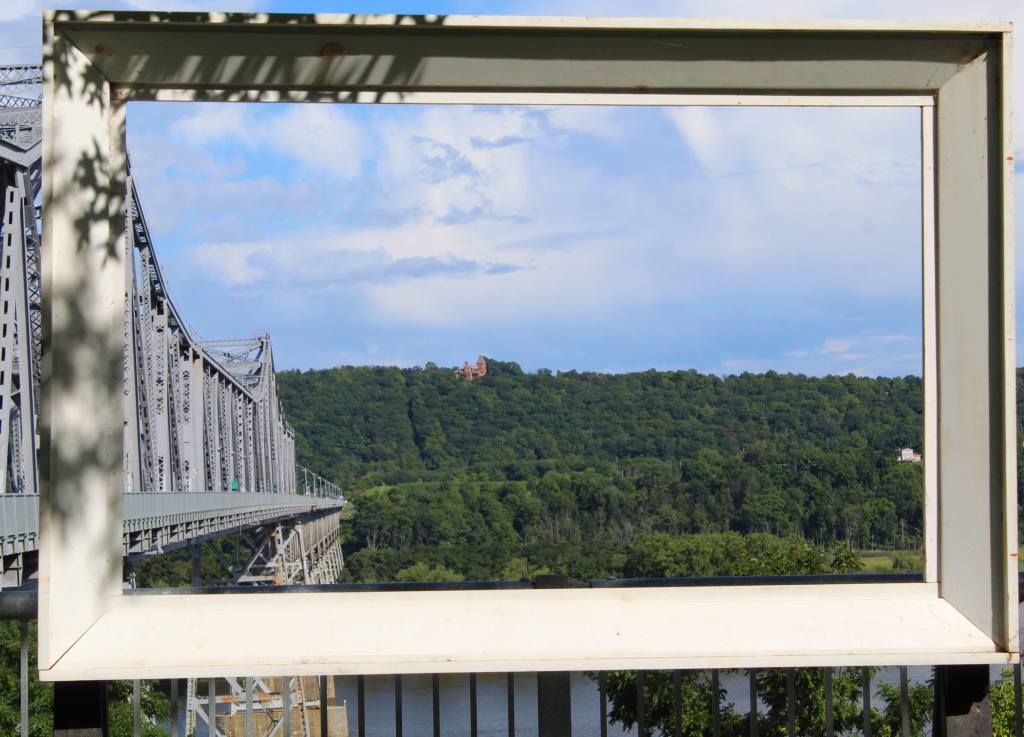
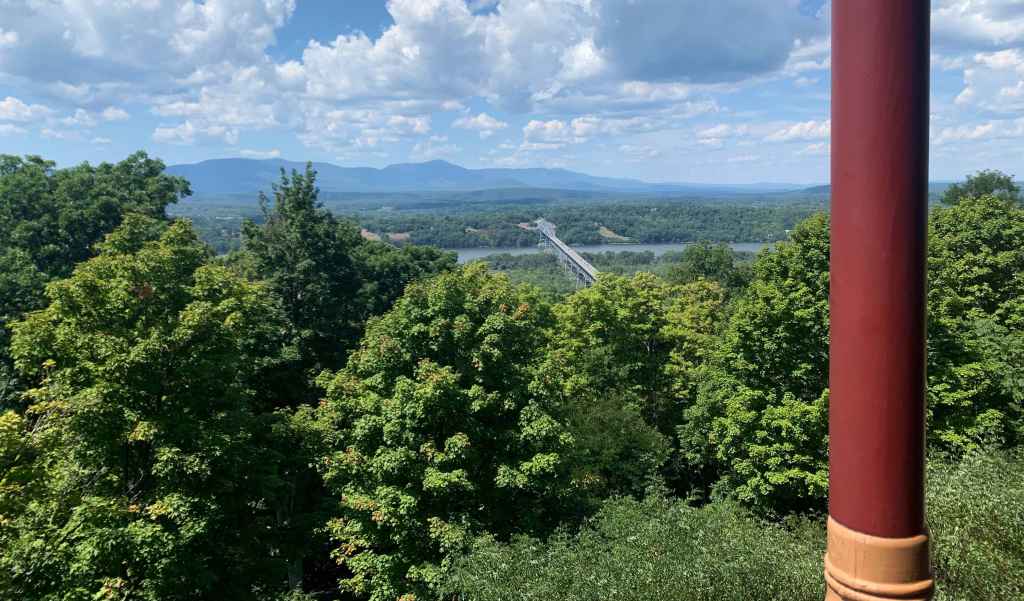
This property can be spotted from Cedar Grove, as a red dot among the green hills. Indeed, as of 2018, visitors can even walk from Cedar Grove to Olana, thanks to a pedestrian walkway that was affixed to the Rip Van Winkle Bridge. I walked part of the way and recommend the experience, if only for the wonderful views of the river and the Catskills beyond.

Olana amid the hills, seen from across the river, with the Rip Van Winkle Bridge to the left.
Here is the reverse view, from the porch of Olana.

(Curious motorists may notice that the road from the bridge curves somewhat awkwardly on the western side. This was precisely to avoid disturbing Thomas Cole’s historic residence.)

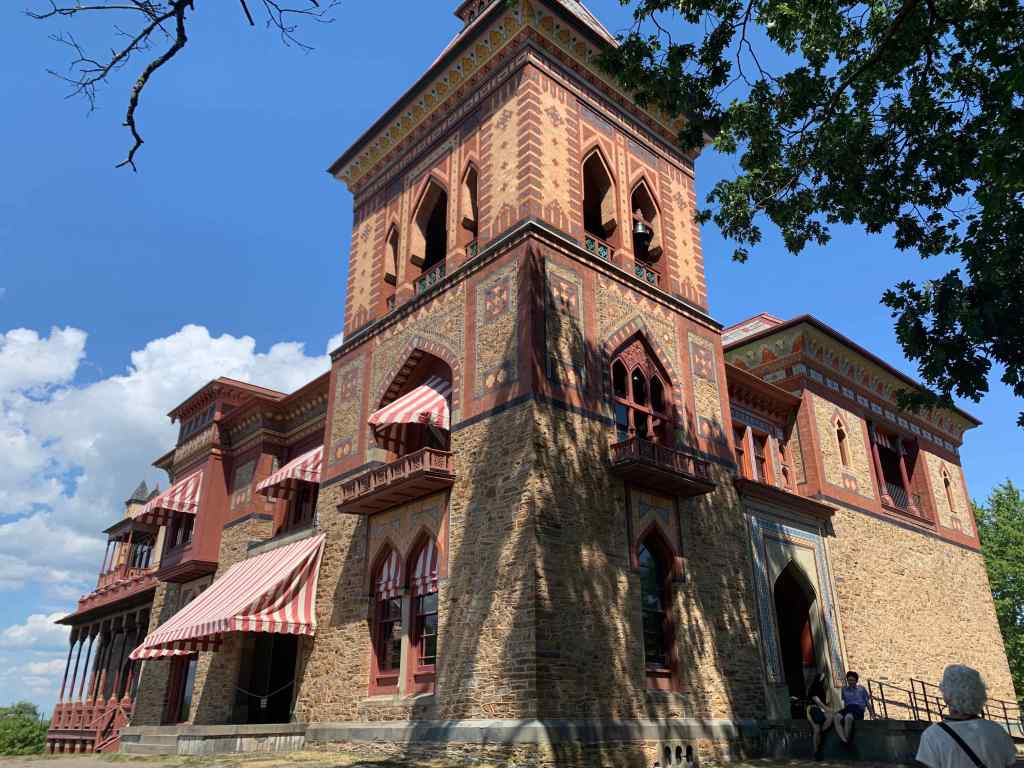
Olana presents a startling vision to the new visitor. You see, Church was a remarkably well-traveled man, especially considering that he lived before the age of air-travel. He designed Olana—in collaboration with famed architect, Calvert Vaux—after returning from the Middle East, basing both the design and the name on Persian models. (In this, he resembles an earlier Hudson Valley resident, Washington Irving, who built his Sunnyside after returning from Spain.)

Historically, painting has been a poorly remunerated profession. Van Gogh famously died penniless, but even the great Rembrandt was considered as little more than skilled craftsman. Of course, most aspiring painters still carry the cross of poverty; but in the 20th century it became at least possible for the most successful artists to become independently wealthy.

So how was Church able to afford such an ostentatious house on one of the most attractive bluffs overlooking the Hudson Valley? This was partly the result of an innovative business practice. In addition to having wealthy patrons who supported him and bought his work—the life-blood of artists for centuries—Church hit upon the idea of touring with his paintings. That is, he sold admission to his works, which would be exhibited in well-lit rooms complete with benches, from which the eager audience could view the painting with opera glasses. At the time, it must have been like a trip to the movies.

This idea worked because of how and what Church painted. Like his mentor, Cole, Church was primarily a landscape painter; but he worked on a grander scale—painting enormous canvasses that could occupy the entire wall—and traveled to far more “exotic” landscapes.

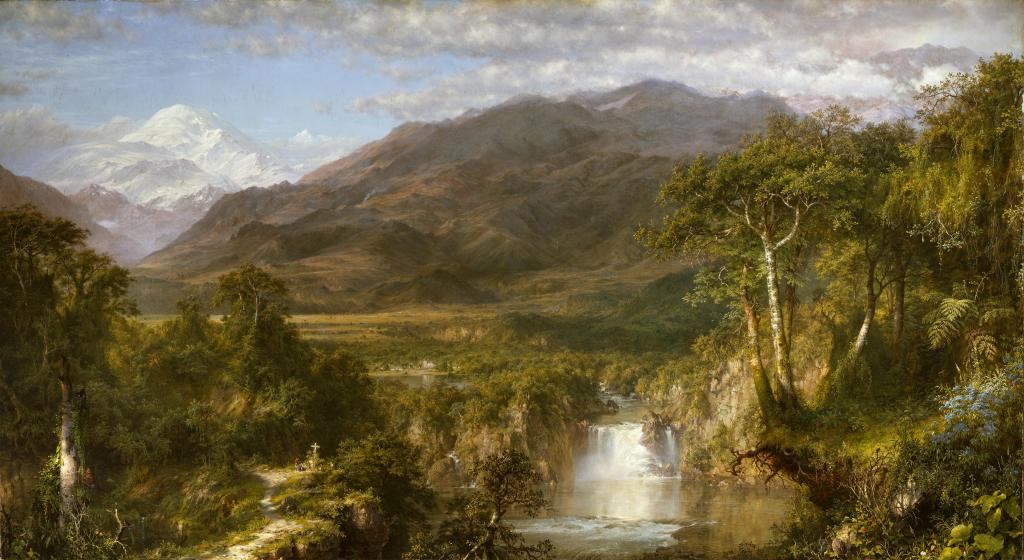
His most famous painting, In the Heart of the Andes, is an excellent example. Inspired by the naturalist Alexander von Humboldt, Church traveled to a land where few Westerners had dared to go, and took painstaking care to accurately capture it all on his canvass—from plant species to climate zones. At a time before color photography, when long-distance travel was inaccessible to the vast majority, the painting must have been a startling window into a distant, alien world. It was a David Attenborough documentary for the 19th century. (You can see this enormous canvass in the Met, where it still may steal your breath.)

The house at Olana unites Church’s dominant interests: landscape, art, and travel. The many arched windows open out onto views of the Hudson Valley and the Catskills that are, indeed, worthy of a painting. And in addition to the house’s odd profile—a kind of Victorian imitation of Persian design, altered to suit a cold climate—it is further distinguished by the many stenciled designs that run along the walls, inside and out. Church designed these stencils himself; and along with striped awnings and colorful roof tiles, they serve to give the house a visual flair quite foreign to most American mansions.

The furnishing of the house reflects Church’s wide travels, as various knicknacks from Mexico and the Middle East are scattered among the elegant furniture. But the main thing the visitor sees are paintings. There are dozens of them—not only by Church, but also Cole and other artist acquaintances. The vast majority of these are landscapes, which again demonstrate both his immaculate technique and his wide travels. Compared to Cole’s more staid style, Church is a cinematic painter, whose landscapes transport you into another world. I would certainly have paid admission to see one.

In addition to Church’s home, the visitor can enjoy his estate, which must be one of the most attractive pieces of property in the entire Hudson Valley. But as it happened, we had to go west on the day we visited; so instead of strolling on the carriage roads, we got in the car and headed to a site on the Hudson River Art Trail: Kaaterskill Falls.

The name of this waterfall—like the name of the Catskills themselves—comes from “cat” (as in bobcat, which presumably were more common in earlier times) and “kill,” an old Dutch term for a stream. Indeed, throughout New York, the curious visitor will find many streams bearing ominous names, like the Sing Sing Kill or Beaverkill.

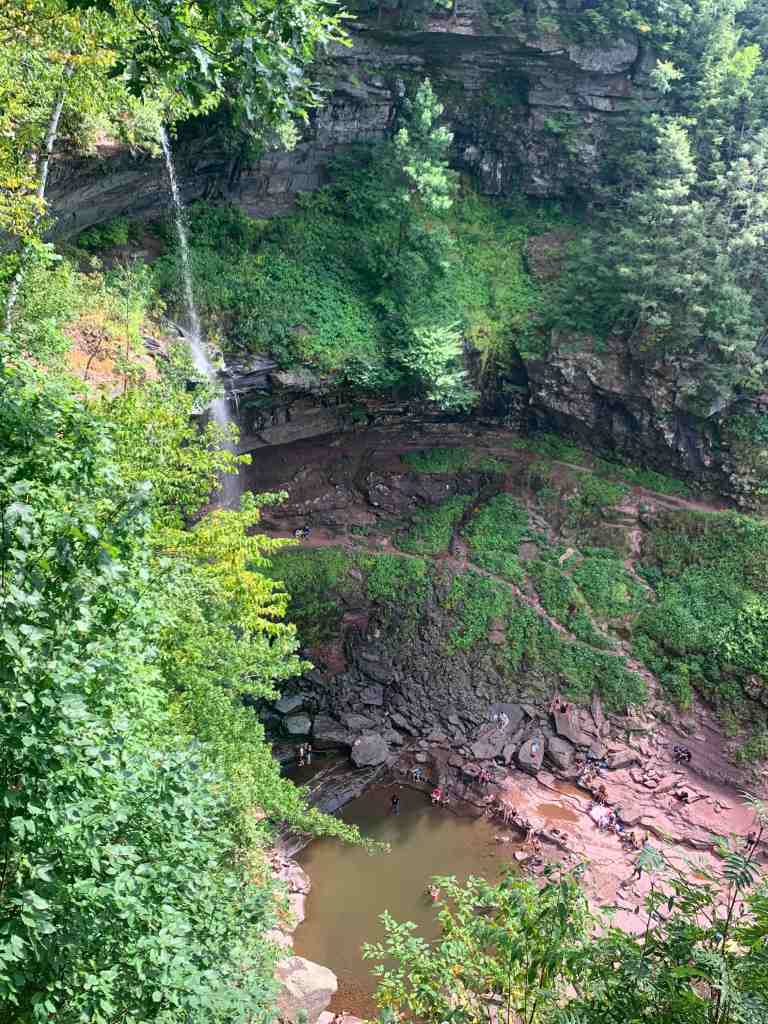
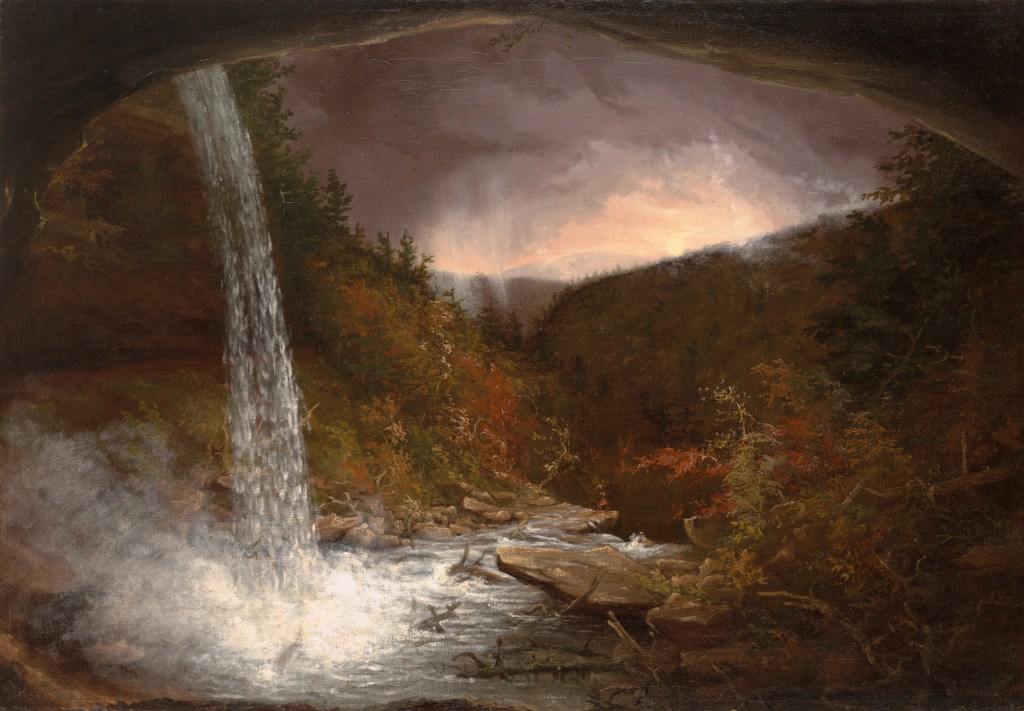
The falls are magnificent. A stream of water plunges down over 200 feet from a sheer cliff, making them taller than Niagara Falls, if orders of magnitude less powerful. It was largely thanks to Thomas Cole that the falls became a popular tourist attraction in the early United States, who was the first of many to popularize the cascade in paintings. On the day we visited, there were people swimming in the murky pool below, while dozens looked on, awestruck. It is easy to see how Cole was inspired to start a new artistic movement by this landscape.

Thomas Cole’s rendering of the falls.

Historic Hudson Homes: Sunnyside

Historic Hudson Homes: Sunnyside

This is part of a series on Historic Hudson Homes. For the other posts, see below:


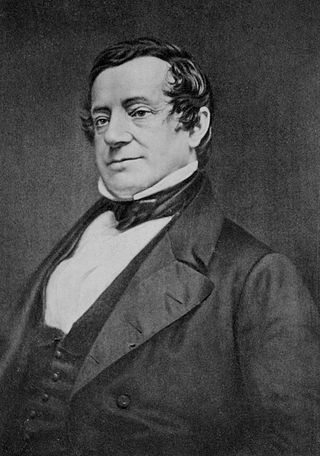
Washington Irving haunts my corner of Westchester like a beneficent ghoul. As a quintessential New Yorker, and the first American writer to gain international prominence, he left monuments to his memory scattered about everywhere. In my native town of Sleepy Hollow, he is inescapable: our municipal statue, our high school football team, and our most famous landmark, the cemetery—not to mention postcards, ghost tours, haunted hayrides, and all our other identifying symbols. Irving was clearly a generous person, as he donated his own name to the town next door, Irvington, where his house still remains as a tourist attraction.

320px-Irving-Washington-LOC
Washington Irving

In the grand scheme of the universe, Sunnyside is quite close to my own domicile. Yet when, like me, you lack a car; and also, like myself, you enjoy walking places, the journey can take a long while. Luckily the walk there is very pleasant, since Sunnyside is right next to the Aqueduct trail that extends from NYC all the way to Croton. The path took me through the heart of Tarrytown, across Route 9, and then past Lyndhurst mansion—another historic Hudson home, an extravagant neo-gothic castle once owned by Jay Gould. After that I passed by a large property owned by the Belvedere Family Community (otherwise known as Unificationists), who have chosen this picturesque spot to bring about world peace.  

By the time I reached Sunnyside I was tired and very sweaty. But paying customers, even smelly ones, are seldom turned away. Sunnyside is run by the Historic Hudson Valley, an organization which administers several other sites along the river (such as the subject of my next post, Kykuit). To visit you must sign up for a guided tour, which you do in the gift shop (as you are conveniently surrounded by overpriced books and paraphernalia); the price is a little more then $20. As I waited for the tour to start, I was tempted to buy a copy of Irving’s History of New York, his breakthrough piece of social satire; but I remembered I already have a copy on my Kindle. For all its social ills, technology does occasionally save us from gift-shop prices.

Sunnyside_Tarrytown_Currier_and_Ives_crop_closeup
An artist’s rendering

In minutes, the tour commenced. Our pleasant guide, who was dressed in period costume, took us to our first stop: a ripe old sycamore tree, planted in the heart of the property. It has been growing there since 1776—respectably middle-aged for a tree but not exactly venerable. Our guide then directed our attention to the property itself. Apparently Irving was an amateur gardener and landscape designer, and helped to mold his property according to his romantic tastes. Here there are no French gardens, with neat hedgerows and grid-like walking paths, but something more akin to the English Gardens in Munich: a blend of planning and nature.

Of course, the property was originally much nicer, since it extended all the way to the Hudson River. But when the Hudson Line railroad was completed in 1849, it cut off his property from the water; and I cannot imagine the country-loving writer had much affection for the noisy, screeching, fuming locomotives chugging before his windows. Even today, the whooshing of the Metro-North disturbs the peace of this hitherto isolated spot. In fairness, the Metro-North has compensated by naming a few of their train cars after the famous writer and his creations—Headless Horseman, Knickerbocker, Ichabod Crane, Rip Van Winkle, and so on. I should also note that the observant rider on the Hudson Line can catch a glimpse of Sunnyside between the Irvington and Tarrytown stations, somewhat south of the Tappan Zee Bridge.

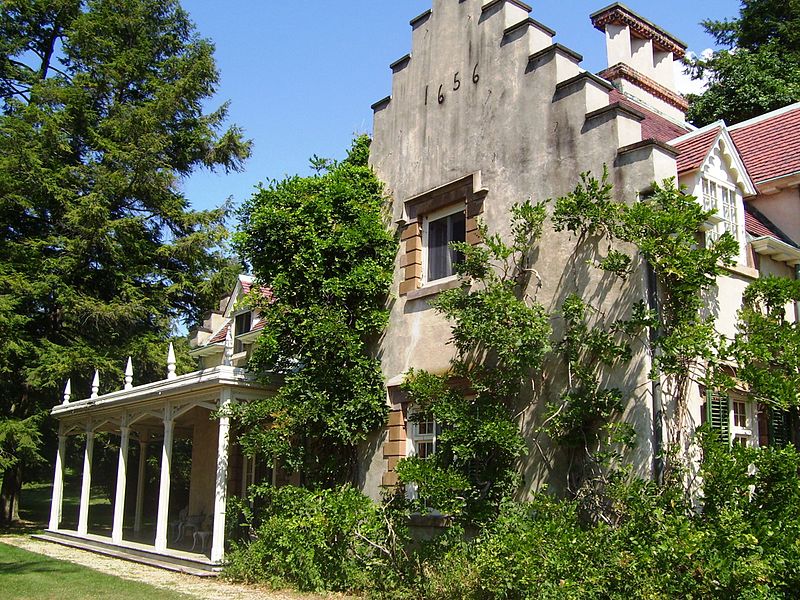
Sunnyside_west_facade_and_piazza
The West Façade. Photo by Beyond My Ken; licensed under CC BY-SA 4.0; taken from Wikimedia Commons

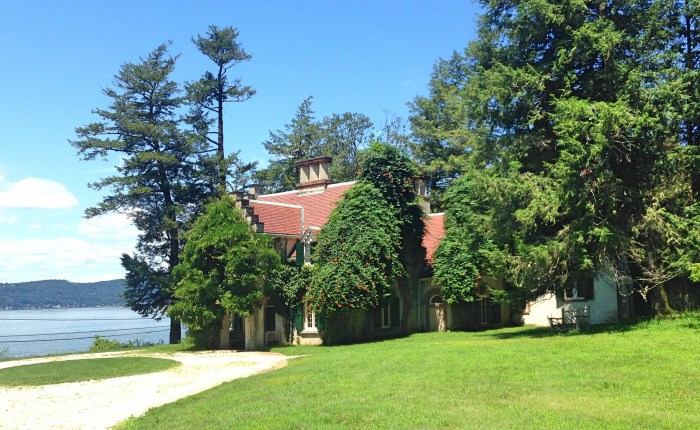
The building of Sunnyside itself is arrestingly modest—indeed, hardly bigger than my own suburban home. Its exterior bears the whimsical and fanciful humor of its maker. Most obvious is the Dutch stepped-gable, which shows how fascinated Irving was with the original Dutch inhabitants of this region. (His most famous characters, and even his own pseudonym, Knickerbocker, bear testimony to this interest.) On the river-facing side of the house he put the date 1656—a date which only roughly corresponds to the first cottages build on this land by Dutch settlers (in the 1690s), and which shows Irving’s love for mixing fact and fiction heedlessly together (as he did in his history of New York and his biography of Columbus). And last we come to the so-called Spanish tower, whose sharply swooping roof is modeled after Spanish golden age architecture (such as the El Escorial). Irving, you see, spent a good many years in Spain as the American ambassador (I cannot even escape him here!), so he was naturally interested in Iberian architectural styles.

Sunnyside_Spanish_Tower
The Spanish Tower. Photo by Beyond My Ken; licensed under CC BY-SA 4.0; taken from Wikimedia Commons

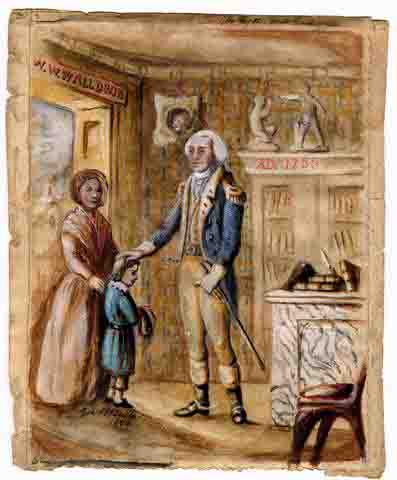
My memory of the interior is necessarily more vague, since you cannot take pictures. In any case, there are few surprises—a study filled with books, a living room with a piano for social events, a bedroom (where Irving happened to die), and so on. My favorite object on display was a little watercolor, apparently by Irving himself, depicting his legendary meeting, as a boy, with his namesake George Washington. (According to our guide, it cannot be determined whether this meeting actually took place.)

Irving had little more than twenty years to enjoy his cottage, from its construction in 1835 to his own demise (he died of a heart attack in the bedroom upstairs) in 1859; and this was interrupted by his long stay in Spain. Though he chose the spot for its picturesque isolation, considering it a kind of writerly escape from the noise of Manhattan, he seldom had peace: besides the railroads, he had to contend with many visitors, both invited and uninvited. If we had to look for a modern parallel to the fame Irving enjoyed, we would have to choose a figure such as Stephen King or George R.R. Martin. Both he and his house were a sort of American monument, gracing the covers of magazines and attracting tourists. Besides this public attention, the bachelor Irving shared his house with his brother Peter, and Peter’s daughters, whom had fallen on hard times. Irving’s very presence transformed this country escape into a center of American culture.

Washington_Irving's_Encounter_with_George_Washington
Washington Irving meeting George Washington

There is little more to add. After Irving’s death the family lived on in the house for several generations, only finally parting with it in 1945. For its preservation we must thank a man who is quickly becoming one of the heroes of this blog: John D. Rockefeller, Jr., who bought up the house and turned it into a museum. For any lovers of literature or history in the Hudson Valley, it is well worth a visit.

Two Hudson Ruins—Part 1, Yonkers Power Plant

Two Hudson Ruins—Part 1, Yonkers Power Plant

(I have broken up my original post into two separate posts, for ease of navigation. You can find part two here.)


Introduction

The train ride on the Hudson Line, from Manhattan to Poughkeepsie, must be one of the most scenic in the United States. The ride has both natural and artificial beauties along the way. The Hudson Valley itself is magnificent, with the palisades across the shimmering waters; and this is doubly true in autumn, when the trees turn their fiery hues. Occasionally you pass a sail boat or a freight barge in the river, or a team of rowers diligently practicing in the Bronx. The train also takes you under the High Bridge, the new Tappan Zee Bridge, and the Bear Mountain Bridge, three engineering feats. A careful rider can even catch a glimpse of Sunnyside, Washington Irving’s old home. (Irving was very annoyed when they built the railroad right next to his house.)

Palisades
Hudson Palisades

Among all this, the most striking landmarks along the way are, for me, the ruins. Specifically, two ruins: the Yonkers Power Plant and Bannerman Castle.

Ruins have a power to fascinate that is difficult to account for logically. They are the same structures that exist, in unruined form, all over the place. The difference between a ruin and a proper structure, architecturally speaking, is pure defect: the ruins have lost their integrity and utility. And yet ruins have been captivating the artistic imagination since at least the Romantic era. Their battered and broken forms have provided inspiration for Shelley’s poems, Byron’s travel sketches, and Caspar David Friedrich’s paintings. It was the ruins of Rome that shaped the Renaissance in Italy, and those same ruins that inspired Edward Gibbon to memorialize Rome’s decline and fall.

What is it about ruins that is so compelling? There are many answers. One is that ruins allow us to visualize time. We see how time’s tooth rusts metal, cracks foundations, and crumbles stone. We see what rots away and what petrifies in place. Ruins also allow us catch a glimpse of a world without humans, the world we would leave behind if we all mysteriously disappeared. We can see the natural world slowly reclaiming buildings and walls, as plants and animals invade the empty space. Perhaps we feel what Shelley felt when contemplating the fate of Ozymandias: that humanity’s urge for immortality is futile and vain, since everything eventually decays.

For all of these reasons, and still others, ruins have an undeniable power—as attested by the many photographers, amateur and professional, who go out of their way to document them. This is my little contribution.


The Yonkers Power Plant

Power Station Top

The Hudson Valley has been many things since its water began to carve a channel through the earth: wilderness, scenic escape, suburbia.

One hundred years ago, the valley was an artery of industrialization, dotted with factories and warehouses, noisy with barges and freight trains. The Hudson Valley was also one of the great centers of brick production, its soil baked and sold far and wide, which is why so many of its old buildings are brick. But we are long past the industrial age, and these buildings no longer house factories or store goods. Nowadays they house fine restaurants, cafés, or even libraries, such as the Irvington Public Library, which is in the old Lord and Burnham factory building.

The most impressive of these old factory buildings is still in use: the Domino Sugar Refinery, in Yonkers. Originally built in 1893, this refinery still produces three million pounds of sugar per day. It is one of Domino’s three major refineries, the last major sugar refinery in the Northeast, and a major source of employment within Yonkers. With an old, hulking brick building standing aside newer metal conveyer belts, this refinery is the sister of the more famous one in Williamsburg, Brooklyn, which closed in 2004 and was mostly demolished in 2014, except for some buildings given landmark status.

But the grandest ruin of the industrial age sits a few miles north. This is the Yonkers Power Plant, which stands on the river side of the local Glenwood train station. With its smokestacks scolding the sky hundreds of feet in the air, the plant is hard to miss. I often saw it on my commute to the city and wondered, what is it doing here? Why was there such a massive building rotting, empty and neglected, by the side of the tracks?

The answer comes down to power. When the trains began running in the 1840s—connecting faraway places and disturbing Washington Irving’s peace—they were running on steam. By the early 1900s, the railroad was prepared to switch to electricity, using the newly designed third rail. The problem was that, at the time, the municipal electrical grid was not powerful or dependable enough to supply the power. Thus the New York Central & Hudson River Railroad, which owned the Hudson Line back then, built their own power plants. The Yonkers Power Plant was situated along the river for several reasons: to be close to the tracks, to take advantage of the water to cool the machinery, and to make it easy to supply the plant with coal, which was delivered by ship.

The power plant was built by the architectural firm, Reed and Stem, who also collaborated on Grand Central Station. (Charles A. Reed was related by marriage to the president of the New York Central railroad, which doubtless helped him get commissions.) The plant opened in 1907, and ran on coal, which was brought by barge to the boiler room below. The steam generated by the boiler was used to power several massive turbines on the floor above. This power, generated in alternating current, was changed into direct current for the trains by rotary converters. (These rotary converters, by the way, are the only heavy machinery still in the factory; the rest was sold for scrap metal.)

Brendan Jenkins
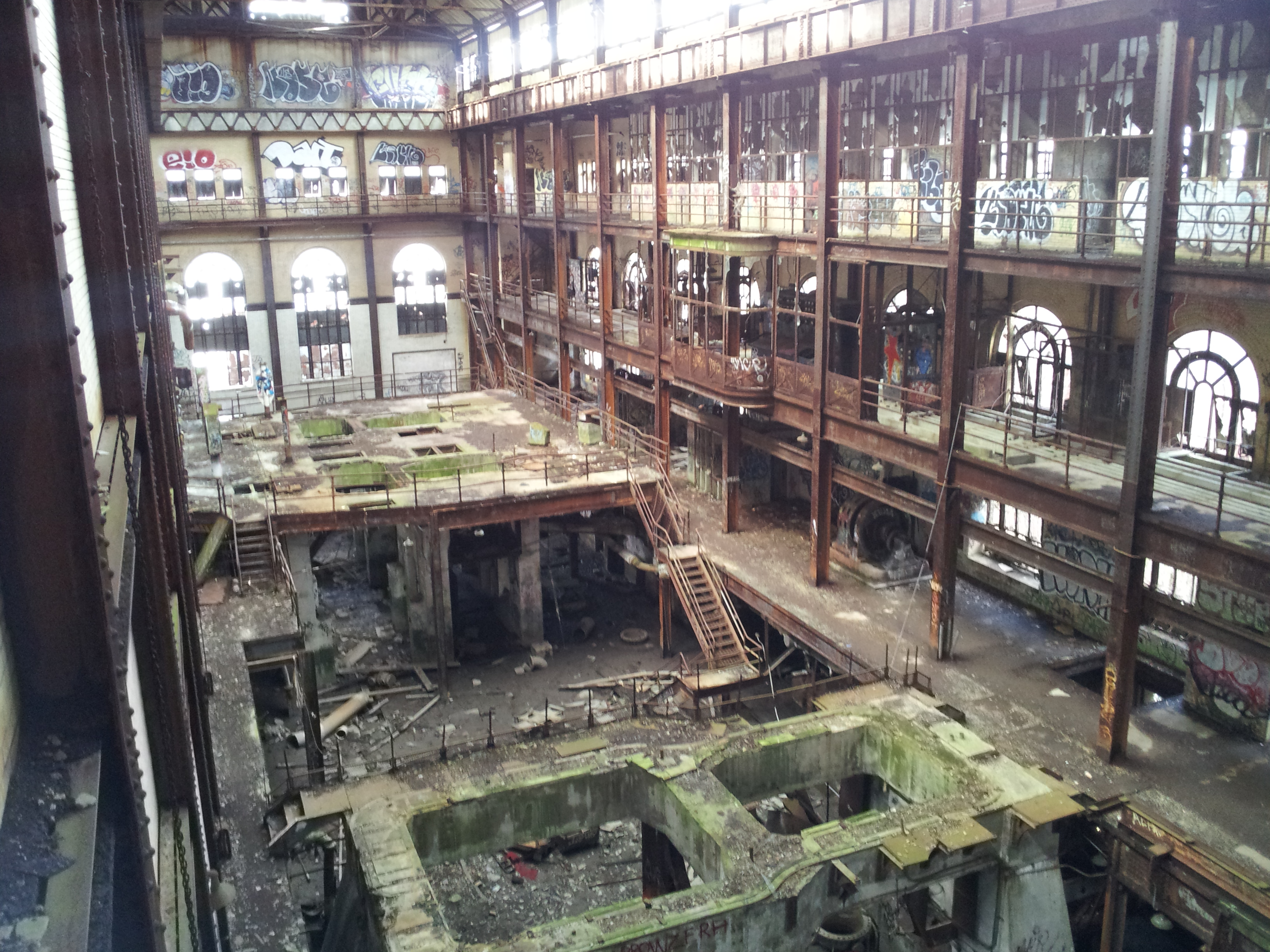
Photo of the interior, by Brendan Jenkins, taken from Wikipedia Commons

By the 1930, it no longer made financial sense for the railroads to be in the power business, so in 1936 the plant was sold to Edison Light and Electric (a subsidiary of Con Edison) and converted to run on oil. This was not a long term solution either, since the plant’s relatively small size (relative to more modern power plants, that is) made it inadequate to New York’s massive power needs. So in 1963, the plant was closed. It was eventually sold to a private owner, who mostly let nature and teenagers have their way. The plant acquired the name “Gates of Hell,” for supposedly being the place where gangs held ritual inductions. Over the years, it became overgrown and covered in graffiti (some of it quite good). Meanwhile, proposals to transform the plant into apartments did not pan out.

(By the way, I am mainly relying on the excellent website, Hudson Valley Ruins, for this information. Their page on the power plant also has many great pictures.)

Most recently, the power plant was purchased by an entrepreneur named Lela Goren, who announced a plan to convert the plant into an arts exhibition center. The building will be renovated in two phases, which will cost $150 million all together, and finished sometime in the next decade. Work began in 2013. The grounds have already been substantially cleared of rubbish and debris, and the walls are being stabilized. I am pleased to learn, from this NY Times article, that Goren plans on keeping much of the industrial aesthetic, even the graffiti.

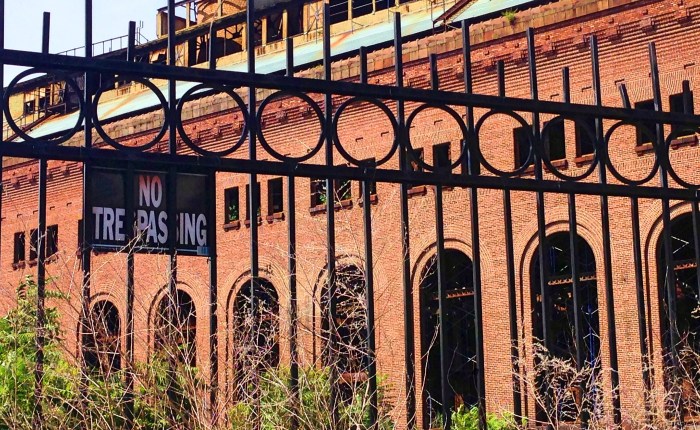
On a sunny summer afternoon I visited the plant for myself. I stepped off the train at Glenwood Station and craned my neck upward at the redbrick wreck. Despite the work the Goren Group had already done, the place is still visibly a ruin. All the windows are smashed; ivy climbs up iron beams; and an eerie silence pervades the building.

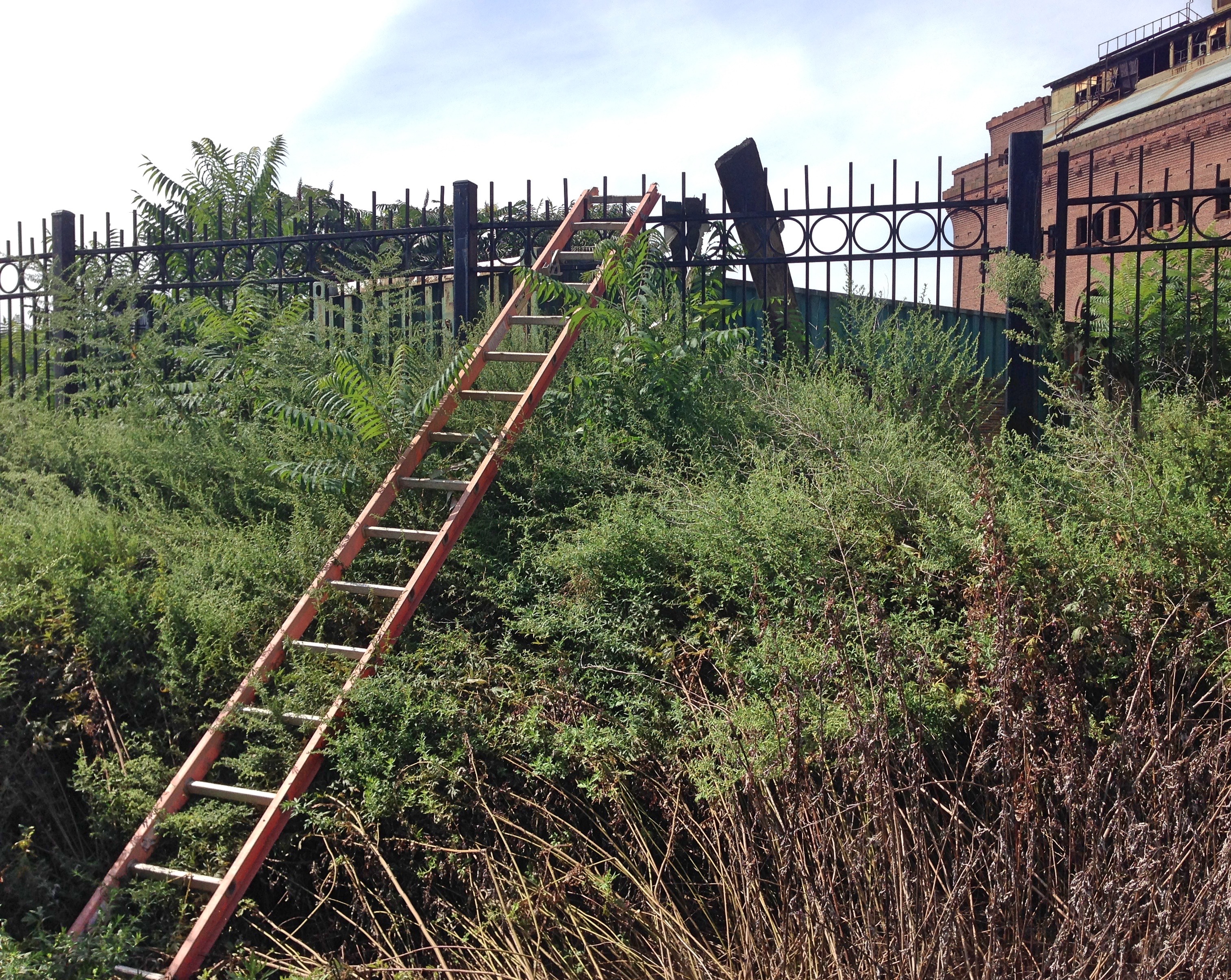
Glenwood is a local station, and few people use it. Aside from the old plant, Glenwood’s main attraction is the Hudson River Museum, which focuses on the river’s ecology. That day, I was the only person standing on the platform. A fence surrounds the old plant, covered in “Do Not Enter” and “No Trespassing” signs, assuring the prospective intruder that video cameras are surveilling the property. Even so, standing there alone on the platform, with nobody else in sight, it was difficult to resist climbing into the ruin. I would not even have had to climb the fence, since a stepladder was helpfully leaned up against it. The ruin still has its visitors.

Ladder
Ladder still used by trespassers

But I’m no daredevil, so I contented myself with patrolling its perimeter. Yet through the gaping windows I could glimpse the cavernous interior space, which many have compared to a cathedral nave. Indeed, compared with a gothic cathedral, the power plant is an exceedingly light, airy structure, with thin walls and plentiful windows. The towering brick façade, combined with the thin steel girders of the building’s innards, make it seem as if an elephant body is being suspended from chicken bones.

Power Station Window

The plant consists of two buildings, the main plant and a substation next door. The substation is where the rotary converters transformed the current from alternating to direct, so the trains could use it; from there the current was sent to the rail tracks. An attractive metal footbridge connects the two buildings. Outside, a metal tower still stands, rusted and overgrown, which I believe used to hold the wires. On the southern side of the station there’s a little park. From here you can see how the station juts out into the Hudson. This must have been to enable the use of the Hudson’s water in the boilers; and, indeed, the boiler room still floods during high tide, I believe.

Skybridge Substation
The plant and substation, with skybridge

I can see why Lela Goren saw potential in the plant, since its location is as attractive as the building itself. Across the river you have an excellent view of the Hudson Palisades. Looking northwards, you can see the Hudson Valley all the way up to the Tappan Zee. Looking south, Manhattan comes into view, a silhouette behind the George Washington Bridge.

Power Station Hudson_Fotor

From this vantage point, with the city in the distance, the river ferrying boats along its glimmering waves, it is difficult to believe that this wonderful brick building was made to simply to supply electricity to trains. It was truly a different time. At its peak, the Yonkers Power Plant could generation 30,000 kilowatts, or 30 megawatts. To put this in perspective, the Indian Point Nuclear Plant in Croton, the Robert Moses Power Dam in Niagara Falls, and the Ravenswood Generating Station in Queens can all generate over 2,000 megawatts. We have come a long way. But unfortunately for us, not one of those is even one-tenth as beautiful as the Yonkers Power Station.

(Click here for Part 2.)

Processing…
Success! You're on the list.