Review: Don Quixote

Review: Don Quixote

Don Quijote de la Mancha: puesto en castellano actual íntegra y fielmente por Andrés TrapielloDon Quijote de la Mancha: puesto en castellano actual íntegra y fielmente por Andrés Trapiello by Miguel de Cervantes Saavedra

My rating: 5 of 5 stars

“I know who I am,” replied don Quijote, “and I know who I can be…”

I bought this book under the sway of a caprice which, if it were not too hackneyed to say so, I would call quixotic. This was two years ago. I was in the royal palace in La Granja de San Ildefonso, near Segovia. I had just toured the palace—one of the finest in Spain—and was about to explore the French gardens, modeled after those in Versailles, when I encountered the gift shop. Normally I do not buy anything in gift shops, since half of it is rubbish and all of it is overpriced. But this book, this particular volume, called out to me and I obeyed.

It was a foolish purchase—not only because I paid gift-shop prices, but because my Spanish was not anywhere near the level I needed to read it. And at the time, I had no idea I would be staying in Spain for so long. There was a very good chance, in other words, that I would never be able to tackle this overpriced brick with Bible-thin pages. At least I left myself some hope. For this is not the original El ingenioso caballero don Quijote de la Mancha—written in Spanish contemporaneous with Shakespeare’s English—but a bastardization: its style diligently modernized by the writer Andrés Trapiello. Even with this crutch, and even with an additional two years of living in Spain, this book was a serious challenge.

Before charging headlong into the thickets of criticism, I want to say a word in praise of Trapiello’s edition. Cervantes’s Spanish is not as difficult as Shakespeare’s English, but it still foreign enough to prove an obstacle even to native speakers. I know many Spaniards, even well-read ones, who have never successfully made it through El Quijote for this very reason (or so they allege). Trapiello has done the Spanish-speaking world a great service, then, since he has successfully made El Quijote as accessible as it would have been to its first readers, while preserving the instantly recognizable Cervantine style. And while I can see why purists would object to this defacement of hallowed beauty, I would counter that, if ever there were a book to painlessly enjoy, it is El Quijote.

To get a taste of the change, here is Trapiello’s opening lines:

En un lugar de la Mancha, de cuyo nombre no quiero acordarme, vivía no hace mucho un hidalgo de los de lanza ya olvidada, escudo antiguo, rocín flaco y galgo corredor. Consumían tres partes de su hacienda una olla con algo más de vaca que carnero, ropa vieja casi todas las noches, huevos con torreznos los sábados, lentejas los viernes y algún palomino de añadidura los domingos.

And here is the original:

En un lugar de la Mancha, du cuyo nombre no quiero acordarme, no ha mucho tiempo que vivía un hidalgo de los de lanza en astillero, adarga antigua, rocín flaco y galgo corredor. Una olla de algo más vaca que carnero, salpicón las más noches, duelos y quebrantos los sábados, lentejas los viernes, algún palomino de añadidura los domingos, consumían tres partes de su hacienda.

Now, undeniably something is lost in the transition. Cervantes’s “duelos y quebrantos” (lit. “aches and pains”), for example, is undeniably more evocative than Trapiello’s “huevos con torreznos” (eggs with bacon); but without Trapiello I would have no idea what Cervantes meant. It is also worth noting how similar the two are; Trapiello has taken care to change only what he must.

Onward to the book itself. But I hesitate. The more I contemplate this book, the more I think that a critic must be as daft as the don and as simple as his squire to think he can get to the bottom of it. Cervantes was either extremely muddle-headed or fantastically subtle, since this book resists any definite conclusions you may try to wring from its pages. Perhaps, like many great books, it simply got out of the author’s control. Just as Tolstoy set out to write the parable of a fallen woman and gave us Anna Karenina, and as Mark Twain set out to write a boys’ book and invented American literature, it seems Cervantes set out to write a satire of chivalric romances and produced one of the great works of universal art. It is as if a New Yorker cartoonist accidentally doodled Guernica.

The key to the book’s enduring beauty, I think, is Cervantes’s special brand of irony. He is the only author I know who can produce scorn and admiration in the same sentence. He is able to ruthlessly make fun of everything under the sun, while in the same moment praising them to the heavens. The book itself embodies this paradox: for it is at once the greatest rejection of chivalric romance and its greatest embodiment—an adventure tale that laughs at adventure tales. There is no question that Cervantes finds the old don ridiculous, and he makes us agree with him; yet by the end, Quijote is more heroic than Sir Galahad himself.

The central question the books asks is whether idealism is noble or silly. There is no question that the Knight of the Sorrowful Countenance is a hilarious figure. But do we laugh at his expense, or at our own? Is his idealism pathetic, or is it our realism? The book resists both horns of this dilemma, until finally we must conclude that we are all—dreamers and realists alike—equally ridiculous. For we all reside in a social world whose rules only exist in our beliefs and in our actions, a world which we create but do not design. It is only Quijote who seems to realize (however unconsciously) that, by changing the script, we can recreate the world. And he does. By the time we get to Part Two, everyone is playing along with Quijote.

Even so, I am not able to go so far as Miguel de Unamuno, and consider Quijote a sort of messiah. I do not think Cervantes’s irony permits this. For Quijote truly is out of touch, and frequently gets pummeled for it. And even when his fantasy inspires others to play along, and to help him create his new world, they never do so for disinterested reasons. Some, including Sancho, play along for gain; others do so to control or to help Quijote; and most do it just to have some fun at his expense. This is the dilemma faced by all revolutionaries: they have the vision to see a better world, the courage to usher it in with their actions, and the charisma to inspire others to follow them; but most worldlings chose to play along for ulterior motives, not for ideals; and so the new world becomes as corrupt as the old one. To put this another way, Quijote’s problem is not that he is out of touch with the social order, but that he is out of touch with the human heart.

Much of the greatness of this book lays in the relationship between the don and his squire. Few friendships in literature are so heartwarming. Sancho, in his simplicity, is the only one who can even partially meet Quijote in his new world—as a genuine participant in Quijote’s make-believe. Of course, Sancho is not free from ulterior motives, either. There is the island he is to rule over. But the longer the story goes on, the more Sancho believes in his master, and the less he pursues material gain. We are relieved to see that, when finally offered his island, the squire comes running back to the don in a matter of days. As the only two inhabitants of their new world, as the only two actors in their play, they are homeless without one another.

It is useful to compare Shakespeare’s and Cervantes’s method of characterization. As Harold Bloom points out, Shakespeare’s characters are most truly themselves when they are alone, soliloquizing. When together, on the other hand, even close friends and lovers never seem to communicate perfectly, but talk past each other, or talk for their own benefit, or simply show off. But don Quijote and Sancho Panza are most truly themselves when they are with each other; they draw one another out and spur one another on; they ceaselessly bicker while remaining absolutely loyal; they quibble and squabble while understanding one another perfectly. When they are separated during Sancho’s sojourn on the island, the reader feels that each has lost more than half of himself. For my part, though I am not sure it is more “realistic,” I find Cervantes’s friendship more heartening than the bard’s. Though they begin as polar opposites, the squire and the knight influence one another as the story progresses, eventually coming to resemble one another. This beats Romeo and Juliet by a league.

What strikes most contemporary readers of this ur-novel is its modernity. Formally, Cervantes is far more daring than his Victorian successors. This is admittedly more apparent in Part Two, when Cervantes has his characters travel around a world where Part One has already been published and read widely, and where the spurious Part Two by Alonso Fernández de Avellaneda (a pseudonym) has just been released. This leads to self-referential tricks worthy of the coolest postmodernist: the duo encountering readers of the prequels and commenting on their own portrayal. Another daring touch was Cervantes’s use of the Arabic historian Cide Hamete Berengeli—whose Arabic book, found on the streets of Toledo, he is merely transcribing into Castilian—which allows him to comment on the text he is writing: praising the historian’s scrupulous attention to detail and skipping over boring sections in the “original.”

All this is done, not merely to be clever, but to reinforce the sense of infinite irony that pervades the text. The gap opened up by these tricks is what gives Cervantes room to be so delightfully ambiguous. As the authorship is called into question, and as the characters—who are imaginative actors to begin with—become aware of themselves as characters, the sense of a guiding intelligence crafting the story becomes ever more tenuous. The final irony, then, is that this self-referential irony does not undermine the reality of the story, but only reinforces it. In Part Two, especially, the characters leap from the book into reality, becoming both readers and writers of themselves—so real, indeed, that we risk repeating the don’s error of mistaking the book with reality.

Having said all this in praise of El Quijote, I should mention some of the book’s flaws. These are mostly confined to Part One, wherein Cervantes inserts several short novelas that have, for the most part, aged poorly. At the time there was, apparently, a craze for pastoral love stories involving shepherds and shepherdesses, which nowadays is soppy sentimental trash. One must also admit that Cervantes’s was a very mediocre poet, so the verse scattered throughout these pages can safely be skipped. On the whole, though the book’s most iconic moments are in Part One, Part Two is much superior and more innovative.

Part Two is also far sadder. And this is the last ambiguity: the reader can never fully decide whether to laugh or cry. Tragedy and comedy are blended so deeply together that no emotional response seems adequate. I still have not decided with any certainty how I feel or what I think about this book. All I know is that I wish it could go on forever—that I could read another chapter of don Quijote’s and Sancho Panza’s adventures for the rest of my life. To reach the end is unbearable. Don Quijote should live eternal life. And he will.
View all my reviews

Review: Our Lord Don Quixote

Review: Our Lord Don Quixote

Vida De Don Quijote Y Sancho/ the Life of Don Quijote and Sancho (Letras Hispanicas / Hispanic Writings)Vida De Don Quijote Y Sancho/ the Life of Don Quijote and Sancho by Miguel de Unamuno

My rating: 4 of 5 stars

‘For me alone was Don Quixote born, and myself for his sake; he knew how to act and I to write,’ Cervantes has written with his pen. And I say that for Cervantes to recount their lives, and for me to explain and elucidate them, were born Don Quijote and Sancho. Cervantes was born to narrate, and to write commentary was I made.

Miguel de Unamuno defies classification. At once a philosopher, a literary critic, a novelist, a poet, and an essayist—and yet none of them completely—he resembled Nietzsche in his mercurial identity. In this way, too, did he resemble Nietzsche: though he had many themes and central ideas, he had no system. He wrote in short feverish bursts, each one as fiery and explosive as a sermon, going off into the branches (as the Spanish say) and returning again and again to his ostensible subject—only to depart once more. He was a wandering knight errant of a writer.

Unamuno was a member of the so-called Generation of ‘98. The date—1898—alludes to the Spanish-American war, a conflict in which Spain suffered a humiliating defeat and lost nearly all of her colonies. After this, it became impossible to see Spain as a world power; her decline and decadence were incontrovertible. This generation of intellectuals and artists was, therefore, concerned with rejuvenating Spanish culture. In Unamuno’s case, this took the form of finding Spain’s ‘essence’: which he did in the person of Don Quixote. He sees in the knight errant everything profound and important in Spanish culture, as a kind of Messiah of Spanish Catholicism, often comparing Quixote to Iñigo de Loyola and Teresa de Ávila.

This book has, therefore, a quasi-nationalistic aim, which may weary the non-Spanish reader. But it survives as one of the greatest works of criticism written on Spain’s greatest book.

The title of Vida de Don Quijote y Sancho is usually rendered in English as Our Lord Don Quijote; and this title, though not literal, does ample justice to Unamuno’s project. In this work Unamuno undertakes to write a full, chapter-by-chapter commentary on Cervantes’ novel; but his commentary is no conventional literary criticism. Unamuno declares his belief that Don Quixote and his squire were real, and that Cervantes did a grave injustice to their lives by writing it as a farce. In reality, the Don was a hero of the highest order, a saint and a savior, and Unamuno aims to reveal the holiness of the Knight of the Sorrowful Countenance for his readers.

Unamuno is, thus, the most quixotic of interpreters. He claims to see naught but pure nobility and heroism in the great knight from La Mancha. And yet the grandiose and ludicrous claims of Unamuno, and the farcical nature of Don Quixote himself, put the reader on guard: this commentary, like the great novel itself, is laden with delicate irony—an irony that does not undermine Unamuno’s literal meaning, but complements and complicates it.

You might call this Cervantine irony, and it is difficult to adequately describe, since it relies on a contradiction. It is the contradiction of Don Quixote himself: perhaps the most heroic character in all of literature, braver than Achilles and nobler than Odysseus, and yet laughably ridiculous—at times even pitiable and pathetic. We are thus faced with a dilemma: applaud the knight, or ridicule him? Neither seems satisfactory. At times Quixote is undeniably funny, a poor fool who tilts at windmills; but by the end of the novel—an ending more tragic than the darkest of Shakespeare’s tragedies—when he renounces his life as a knight and condemns all his adventures as insanity, we cannot help but feel profoundly sad, and we plead along with Sancho that he continue to live in his fantasy world, if not for his sake than for ours.

This is the paradox of idealism. To change the world you must be able to re-imagine it: to see it for what it might be rather than for what it is. Further, you must act “as if”—to pretend, as it were, that you were living in a better world. How can you hope to transform a dishonest world if you are not honest yourself, if you do not insist on taking others at their word? Quixoticism is thus the recipe for improving the world. Dorothea, from Middlemarch, is a quietly quixotic figure, only seeing pure intentions in those around her. But paradoxically, by presupposing only the best, and seeing goodness where it is not, she creates the goodness that she imagines. Confronted with a person who sees only the most generous motives, those she meets actually become kind and generous in her presence.

We then must ask: Is Dorothea a fool? And if so, does it even matter? And what does it even mean to be a fool? For as Lionel Trilling pointed out, Cervantes posed one of the central questions of literature: What is the relationship between fiction and reality?

Human reality is peculiar: We acknowledge an entire class of facts that are only facts because of social agreement. The value of a dollar, for example, or the rules of football are real enough—we see their effects every day—and yet, if everyone were to change their opinion at once, these “facts” would evaporate. These “social facts” dominate our lives: that Donald Trump is president and that the United States is a country are two more examples. You might say that these are facts only because everyone acts “as if” they are: and our actions constitute their being true.

The reality that Don Quixote inhabits is not, in this sense, less real than this “normal” social reality. He simply acts “as if” he were residing in another social world, one purer and nobler. And in doing so, he engenders his own reality—a reality inspired by his pure and noble heart. What is a queen, after all, but a woman who we agree to treat as special? And if Don Quixote treats his Dulcinea the same way, what prevents her from being a queen? What is a helmet but a piece of metal we choose to put on our heads? And if Don Quixote treats his barber’s bowl as a helmet, isn’t it one? We see this happen again and again: the great knight transforms those around him, making them lords and ladies, monsters and villains, only by seeing them differently.

In this way, Don Quixote opens a gulf for us: by acknowledging the conventional nature of much of our reality, and the power of the imagination to change it, we are left groping. What does it mean for something to be real? What does it mean to be mistaken, or to be a fool? To improve the world, must we see it falsely? Is this false seeing even “false,” or is it profoundly true? In short, what is the relationship between fiction and fact?

To me, this is the central question of Cervantes’ novel. But it remains a dead issue if we choose to see Quixote merely as a fool, as he is so commonly understood. Indeed I think we laugh at the knight partly out of self-defense, to avoid these troublesome issues. Unamuno’s worshipful commentary pushes against this tendency, and allows us to see the knight in all his heroism.

View all my reviews

Day Trips from Madrid: Alcalá de Henares

Day Trips from Madrid: Alcalá de Henares

(I wrote this post only a few months after my arrival in Spain, while I was still mostly ignorant of the country and its language. With the exception of Chinchón, I have visited all of these places since then, so I have appended little notes at the end of my posts about what I now know. I have also broken up my original post for ease of navigation.)


There are many advantages to living in Madrid. It’s big, it’s bustling, and it’s diverse. But one of my favorite aspects of Madrid is its location. By design, the capital of Spain is almost equidistant from every corner of the country; to drive from Madrid to Catalonia, to Andalusia, to the Basque Country, and to Galicia all take roughly the same amount of time. And transportation isn’t hard to find; the city is well connected by rail, highway, and plane to all points of the compass. Travel is cheap, easy, and fast.

As a consequence, there are a great many excellent day trips you can take from Madrid. I’ve already written about some of them: Toledo, Segovia, and El Escorial. In these posts, I want to talk about some of the perhaps lesser-known cities for day-trippers. I’ll start at the very beginning, with my first trip inside Spain.


Alcalá de Henares

As soon as I got to Spain, I blabbed to everybody I met that I had read Don Quixote. I was very proud of this, for I thought it gave me some kind of badge of honor in Spanish culture. And indeed, a few people seemed genuinely impressed—though less so when I told them I read it in English.

“Ah, so you like Cervantes?” a friend of ours said.

“Oh yes, he’s incredible.”

“You should visit Alcalá de Henares, then. It’s where Cervantes was born.”

This was only our second week in Spain, and we were still a bit disoriented by our surroundings. The prospect of taking an actual trip in Spain seemed almost Herculean, an added challenge to the day-to-day struggle of navigating our new city. But I was determined to get culture, by hell or high water; so as soon as we could, we made it to Atocha station and took the Cercanías to Alcalá de Henares. (For once in our lives, we found the train without a problem.)

The train was too full for us to sit down. We stood by the doors, both of us swaying nervously with the ever-present anxiety you feel when in a strange environment. I was looking forward to seeing the area around Madrid, but the windows were smudged and dirty; and the view, from what I could see, wasn’t much anyway—just the featureless tan wasteland of the dry foothills. Before even coming to Spain I had terrified myself by reading online stories about the ingenuity of pickpockets in Europe, and couldn’t stop casting interrogative glances at all the passengers around me, wondering whether any of them were thieves eyeing me up, waiting for the perfect moment to strike.

Station after station went by, and I was paying fierce attention to all of them, paranoid that we would miss our stop and get hopelessly lost. It’s really exhausting traveling somewhere totally new—it is for me, at least—because you can’t take anything for granted. The doors of the trains work differently; the seats are arranged differently; the automatic announcer is speaking a foreign language. Added to this, I was constantly afraid of doing something wrong by accident, breaking the train etiquette of Spain and drawing everyone’s attention to myself. It’s pretty amusing to me now, as I look back; but then it was just stressful and scary.

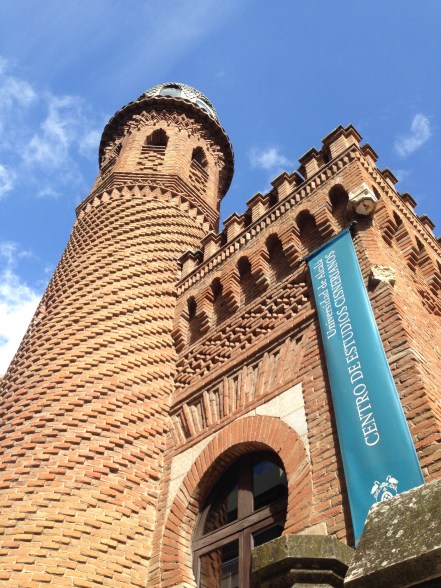
We arrived. After some confused mucking about, we began making our way to the center of town. Neither of us had Spanish SIM cards yet, so our phones didn’t work. We just followed the crowd, who all seemed to be walking in the same direction. The city seemed rather ordinary at first—though even this was interesting to me, since I hadn’t seen any city in Spain besides Madrid yet—but soon something caught our eye. It looked like a little castle, with a tower on one end and a tiny battlement at the top of a square structure.

IMG_0364

But what really made it stand out was the intricate ornamentation. The façade of the tower, for example, was covered in swirls. It was quite pretty. Although we didn’t know this at the time, it’s called the Palacete Laredo, and is one of the famous monuments of Alcalá. It was originally built as a private house for Manuel Laredo, a polymath artist who served as the mayor of Alcalá de Henares. Nowadays, it serves as a museum of the Cistercian order, as well as a specialized research branch of the Complutense University.

Looking back now, I can tell that it was built in a Neo-Mudéjar style, with crescent arches and a domed minaret. The top of the main building, however, is not Neo-Mudéjar in style, but rather looks like a small copy of the Alcázar in Segovia. In fact, the more I look at my pictures, the more of a stylistic jumble the place appears, with all sorts of different Spanish architectural elements mixed together. Of course, at the time I just thought it looked weird.

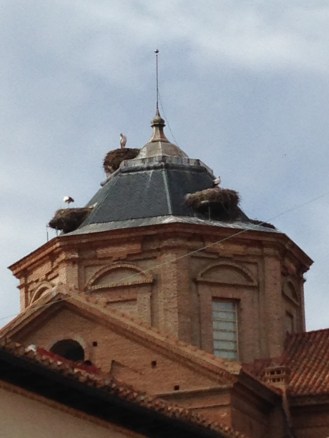
We kept going, following the trickle of pedestrians into the center of town. Eventually the buildings started to look older; the streets were narrower here and paved with stone. But what most caught our attention was a big beautiful bird, sitting on top of an old church. It looked so incongruous and stood so still that we were convinced it was fake—that is, until it twitched its head. When we got a bit closer we could see it had built a big, bushy nest up high on the building.

IMG_0399.jpg

As we moved on, following the throng of people wherever it seemed thickest, we eventually found ourselves in a dense crowd. Little shacks were set up all over the place, selling cheese, sausage, olives, nuts, spices, tea, wooden bowls, leather bags, colorful scarves, cheap jewelry. Not only that, but all the people in these shops were dressed up in funny outfits, like they were in Medieval times. Was Spain always like this on the weekends? I was both excited and terrified—excited to see a slice of Spanish life, but now scared more than ever about being pickpocketed.

We rounded a corner and came across an outdoor restaurant. Dozens of tables and chairs were gathered under a tent. Several harried men in ridiculous costumes—looking like court jesters, with striped red and white shirts and big puffy hats—were running left and right, carrying massive trays of food. Outside the tent was the cooking area, where a large circular charcoal grill was covered in sausages, meats, fish, and vegetables of all kinds. Immediately I felt very, very hungry. From the shops were hung all manner of flags and banners painted with signs from medieval heraldry—black, yellow, and red.

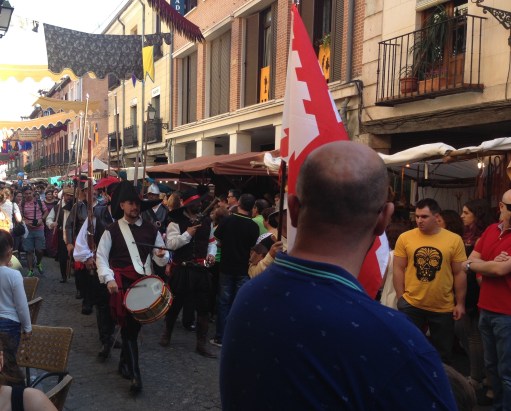
Every new street we entered was more packed than the last. Soon it dawned on us that this wasn’t at all normal, but was some kind of special festival. As if to confirm our suspicion, a group of men dressed up like medieval soldiers, with fake swords by their sides, paraded through the crowd while another man, dressed in rags, pretended to be a lunatic. One of the soldiers held him by a rope, while the maniac ran after people in the crowd (mostly women), gargling his throat and reaching out his dirty hands. Another soldier was beating a big bass drum, while they all shouted things that I couldn’t understand.

Alcala Marching Band

(As we later learned, this was the Cervantino, a medieval fair named after Cervantes, which is held in the first couple weeks of October. I have since gone back twice, and I highly recommend it.)

We wandered along this way, two bewildered Americans, absolutely intimidated by our surroundings, until eventually we were standing in front of a couple of statues. I immediately recognized these as being Don Quixote and Sancho Panza; both of them were sitting on a bench, and seemed to be having a damned good time. In between the knight errant and his square there was a space on the bench where tourist after tourist was lining up to have their picture taken. I would have had my picture taken, too, if I wasn’t so afraid that my phone would disappear as soon as I took it out of my pocket.

Don and Sancho statue

Behind the bench was the Cervantes House—the house where Cervantes himself was born and reared. We got on line and went right in. It’s quite a small place, actually. In the center of the house is a little courtyard, around which every room is situated. The insides of these rooms were furnished to look like they would have during Cervantes’ lifetime. I have to admit not much caught my eye, except perhaps the old kitchen equipment. It was more rewarding just to pace about, thinking that I was standing in the very place where Cervantes, that master of masters, entered into the world. This feeling was so strange to me that I’m not sure I quite took it in. This was perhaps the first appearance of “European Travel Syndrome” in my life. You simply can’t have an experience like this in New York.

Cervantes Statue
The statue of Cervantes in the main square

In just half an hour, we were out in the street again. We didn’t know anything else to do except walk around, seeing as much of the city as we could. Many of the buildings were impressive; but at this early stage, we didn’t really know how to go about visiting buildings or even how to look at them. In fact, what I most remember were not the buildings themselves, but the dozens stork nests sitting snuggly on rooftops, their bushy lairs looking somehow both ridiculous and majestic.

Alcala Food Stand

Eventually, we decided to sit down to eat in one of those tent restaurants. The waiter ran up to us, his floppy hat thrown over to one side of his head, and asked us in a slew of Spanish words what we wanted. We ordered two things, and he was off. At this point, we were so clueless in Spanish that most of the time we didn’t even know what we were ordering in restaurants. This was a classic example: We asked for “pimientos fritos” thinking they were french fries; five minutes later, the waiter dropped a plate of fried, salted green peppers on our table. I know, I know, this is an embarrassing mistake, not least because “potato” is “patata” here—not hard to guess.

The upside of our ignorance was that we ended up learning a lot about Spanish food, since we accidentally ate a lot of it. These pimientos were a case in point: we loved them, and pimientos now are one of our staple dishes. Really, if you’re in Spain and you can’t speak Spanish, just go into a restaurant and order whatever sounds interesting. All the food is good here.

After eating the pimientos, and then following it with a plate full of chorizo and tomato sauce on bread, we began to walk around again. But I’m afraid we didn’t do much of interest; and in an hour, we were on our way back to the train station to return to Madrid.

Reading over what I just wrote, and comparing it to what I find online about Alcalá de Henares, it’s obvious to me that we left most of the main sights unseen. Oh well, next time. But it was a fantastic stroke of luck to arrive on the very weekend when they were having their famous Medieval Market. And as I look back on it, this trip seems to presage our whole time in Spain so far: we arrive clueless and unprepared, and yet everything works out marvelously. Traveling in Spain is, in fact, a lot like ordering in a Spanish restaurant: even if you have no idea what you’ll get, you can be sure it will be delightful.


Alcala University

Addendum: Since this initial trip, I have since learned that Alcalá de Henares has been more than simply the birthplace of Cervantes, but has played an important role in Spanish history.

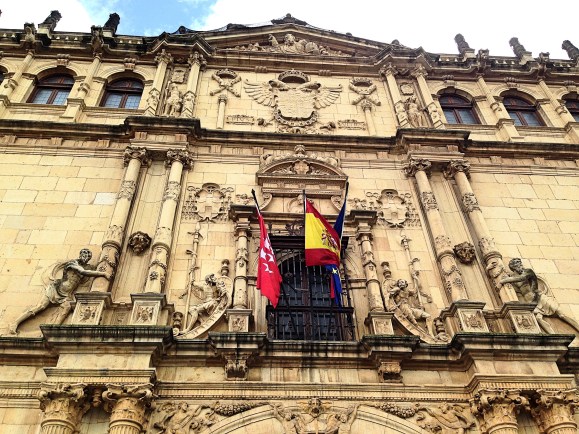
The city has existed since at least Roman times, when it was known as Complutum. It was in this town that Cardinal Cisneros, one of the leading functionaries of the Catholic Monarchs, founded the University of Alcalá in 1499. Under his direction the scholars of the university undertook and completed one of the greatest intellectual accomplishments of the Spanish Golden Age, the Polyglot Bible, which contained the entire text of the Old and New Testaments in three languages: Latin, Hebrew, and Greek—and sometimes Aramaic. The University was eventually moved to Madrid, where it was renamed the Complutense (which comes from Alcalá’s Latin name); and it remains one of the major universities in the country.

The original university building still stands in Alcalá’s main square. Its frontal façade is magnificent, and for a small price you can take a guided tour to learn about the university’s history.

The Cathedral of Alcalá is also worth a visit. Although it was burned during the Spanish Civil War, thus destroying many of its decorations and altars, it remains an attractive building. The cathedral is, curiously, the unique for being the only one in the world which possess the title “Magistral Church,” which requires that all of its priests be doctors in theology. 

Alcala Cathedral

Don Bigote: Chapter 1

Don Bigote: Chapter 1

Don and Dan Build a Shelter

In a little town in Alabama—where exactly I won’t tell you, since my dad always says the internet is full of creeps—there’s man who wears a grey smoking jacket on hot summer days, who has a loaded antique revolver on his hip at all times, and who keeps an old greyhound out back. This guy is my neighbor, Don Bigote, who everyone calls “Colonel.”

He may be called that, but I don’t think ever was in the army. I think he got that nickname from his habit of wearing a gun all the time (though God knows he isn’t the only person to do that around here). Or maybe it’s the stiff, sort of military way he walks and moves around, like he’s a windup doll. In any case, it’s clear that the guy was never a soldier, since he’s so skinny and light— basically a skeleton with some skin stretched over it. This skinniness, combined with his height—he’s a lot taller than any of the boys on the basketball team—makes him look like a human streetlamp.

But I forgot to mention Don Bigote’s trademark look: his enormous white mustache. I don’t know how he maintains that thing, since his hair is thin, and the top of his head is totally bald. But his mustache sits proudly over his lips, totally covering his mouth. In the wind, it shivers like a leaf on a tree, and it’s always moist with whatever he just finished eating. But normally, that thing is perfectly brushed, trimmed, and sculpted. It’s a work of art. 

Don Bigote isn’t working now. Nobody’s really sure what he did before he retired. My mom thinks he was a schoolteacher, since “All teachers are useless hippies. And besides how else could he have such a good pension? The good-for-nothing, stealing from the government!” My dad thinks he never worked at all, “How could he? Look at him, he’s a total crank! He couldn’t hold down a job in a million years. Must’ve inherited his money.”

Most people agree that Bigote’s a bit off. He doesn’t seem to have any friends or family. His social life is confined to his greyhound, Rosebud, who he alternately pampers, and then totally forgets. On the one hand Rosebud’s house is nicer than Bigote’s. On the other hand, Bigote sometimes forgets to feed or walk her for days at a time (we can tell because she walks around in his yard, head low, pawing at his door).

The two of them are pretty funny to see when they walk through the neighborhood. Rosebud is one of those old greyhounds who used to race. Who knows if she was any good. But now, the old pooch is almost as stiff, skinny, and boney as Don Bigote himself. Rosebud walks slowly, limping slightly, with her head bent down, not pausing to sniff at anything, while Bigote marches forward to an invisible drumbeat.

You get the picture. Well, Don Bigote has been our neighbor for a long time now. And aside from a few neighborly interactions, and aside from the usual commonplace hellos and all that, and aside from the occasional jokes about his weirdness, we haven’t had much to do with him. Not yet, anyway. 

Lately I’ve had much more important things to worry about. 

I just graduated high school, which is a big deal. That’s something you only do once. You can graduate college multiple times, and you can get married to many different people—in a row or all at once (depending on where you live)—and you can have as many kids are your sperm count permits and your wife’s (or wive’s) egg count allows, and you can exclude as many of those kids from your will as your heart desires, and you can even die over and over again if someone brings you back with a defibrillator—but graduating high school is a one-off thing. So I’m savoring the experience.

To get particular, this savoring involves a lot of drinking and as many girls as I can convince to be a part of the celebrations. I’ve saved up money, planned it all out with friends, and friends of friends, and just whatever random people I could find, and I’ve done all my homework, tracking down good party spots, checking where the cops like to patrol, and buying all the supplies we need—beer and condoms, mostly—to make sure that this savoring goes on for as long as possible. So far so good.

Last night was no exception. I won’t go into details, because I don’t remember any. But this morning I woke up on Jimmy’s couch next to someone (what’s her name?), needing badly to pee and vomit (not in that order), with a bad headache and a kind of little fire in my private parts, which I hope is just from overuse. After taking care of business, I do what I always do: throw on my clothes and sneak out, leaving everything for Jimmy to clean up.

Well, as I’m walking home, eyes hurting, head hurting, body hurting, and almost blind in the sun, stopping once in a while to spit up a little into the bushes, this dude Don Bigote—who, I should say now, before I forget, is the entire subject of this story, and the entire reason I’m writing in the first place, so pay attention!—this dude Don Bigote, as I was saying, with his mustache twinkling in the sunlight (he must’ve drank something recently), walks over from his front porch to his fence and starts talking to me.

“Hello, good sir,” he says.

“Ugh,” I reply.

“Fine day, is it not?”

“Yug.”

“Yes, there is a northerly breeze, and the sun’s rays are dripping full down like a waterfall from heaven.”

“Gargle.”

He opens the gate of his fence and approaches closer. I can hardly keep my eyes open, and judging from the sounds my stomach is making, I don’t have long to get to a bathroom (we ate spicy burritos before the party).

“May I ask, sir,” he says, “if I have the honor of talking to the first-born son of Mr. and Mrs. Chopin?”

“Yurgle,” I answer.

“And is this first-born son bestowed with the appellation, ‘Daniel’?”

“That’s me,” I say. “Dan Chopin.” Stomach clock still ticking.

“Ah, what a pleasure,” he says, and stretches out his hand. I do likewise and he very formally and firmly shakes my limp hand until he’s good and satisfied.

“And am I correct in the knowledge, recently acquired, that this very same son, Dan Chopin, is recently graduated from high school?”

“Mmmm.” Stomach can’t take much more of this.

“And is this same aforementioned son, the honorable Dan Chopin, currently in want of gainful employment?”

“Uuhhhhhuuuhh!” I scream. “Man, I’m in a rush!” And I run into the house and make it to the bathroom just in time (well, close enough).

I shower, nap, get up, shave, apply deodorant under my armpits and my legpit, and then I go again to the bathroom just to make sure my system is totally vacant, and then—cleaned up and emptied out—I go downstairs to eat my mom’s cooking. I’ll give it to her, that lady can cook. And I can smell that she’s already busy in the kitchen. 

“You got a letter,” she says as I walk in. “It’s on the table.”

“Oh yeah? What’s for dinner.”

“Chicken. You got a letter. It’s on the table.”

“Oh yeah? What kind of chicken?”

“Roasted. The letter is there on the table.”

“And what’s on the side?”

“Potatoes and greenbeans. The letter’s right there on the table.”

“Heck yeah,” I say, as I sit down at the table and open the letter, thinking it’s just the usual bullshit about college. But then I pause. It’s written in script, and the writing is all squiggly and fancy-like. I need to squint to read it, since who writes in script? It goes like this:

My dear Daniel,

I hope this letter finds you in good health and fine spirits. I am sorry to have caught you at an inopportune moment earlier today, my sincere apologies.

I am writing you today to introduce a certain proposal into your hands. Recently I have been doing a great deal of work in my house, and it struck me that I badly require assistance, seeing as I am old and increasingly in need of haste due to events beyond my control.

My proposal is this. I wish to contract your services, for a few hours each week, to help me around the home. For your services, I will give you a suitable monetary reward, the exact amount being negotiable but certainly substantial.

If you wish to accept this offer, or if you are merely intrigued and wish to learn more, please come over any time tomorrow and we will discuss it further. If, however, you cannot or do not wish to accept this offer, be assured that I understand and respect your decision, and no further action need be taken on your part.

Yours faithfully,

Don Bigote

What a wackjob. Who writes like this? Well, what should I do? I’ve got so many parties coming up, I don’t think I have any spare time…. tonight at Jimmy’s again, then Thursday I’m with Jessica, then Friday we’re going to the old factory… But then again, if I work during the day, maybe it won’t be a problem. And some extra money could really help with the partying, especially since I got fired from that froyo job.

“Hey mom,” I say.

“Not for another five minutes,” she says, stirring something.

“No, it’s not about dinner.”

“What, then?”

“This letter, it’s from the Colonel. He wants me to work for him.”

“That’s nice, dear.”

“Says he’ll pay.”

“Very nice.”

“What do you think?”

“Well, it sounds terribly nice.”

“Should I do it?”

“I think it would be a nice thing, Danny.”


Next day at noon, I knock on his door.

In three seconds Don Bigote opens it. He’s dressed the usual way: pistol on hip, grey smoking jacket, mustache looking sharp.

“My dear Chopin, come in,” he says, gesturing like a butler in a movie.

“Yo,” I say. “What’s up?”

“I am so pleased you came.” 

We walk to his kitchen. On the way I get a glimpse of his house. It’s a total mess. Magazines, books, and papers are everywhere. It’s a weird assortment of stuff, too—the National Review, ¡Adios America! by Ann Coulter, a book of Latin grammar, a history of the Spanish Reconquista, and several books with the Twin Towers on the cover. Also random are the pictures on the walls—Donald Trump, Ronald Reagan, the Confederate flag, a map of Europe, a glossy photograph of a castle, and an old oil portrait of someone with a big chin who looks historical and important. And the whole place smells like cigars and sawdust. 

When we get to his kitchen—which is filthy, with chipped plates, dirty dishes, and greasy glasses in the sink, and pots and pans and forks and knives everywhere—a radio is playing:

“Nowadays, you can’t say you’re against immigration or the media immediately calls you a racist. Like, am I a racist if I don’t like Mexicans? It’s a conspiracy! The left is trying to open the floodgates, my fellow Americans, and they’re already in control of all the television, all the…”

 Don Bigote turns off the radio. Then he pulls out a chair for me at the kitchen table, and walks over to the cabinet to get something. In front of me is a Bible (in the King James translation), and a book called Vaccines and Autism: Behind the Liberal Conspiracy to Poison our Kids.

“I understand,” he says, as he rummages through his shelves, “that nowadays it is illegal for people of your age to partake of alcoholic drinks. Government tyranny!” He pulls down a bottle of bourbon from the shelves. “Those ungodly communists!” He pours me a drink, and pours himself one.

“To freedom!” he says, and we clink glasses. The bourbon burns.

“Onward to business, then,” he says, crossing his leg over the other, sitting straight up as if someone stuck a stick up his ass. “Chopin, before I begin, I need your most solemn promise of confidentiality. What I am about to tell you is very sensitive information, and if you were to tell anybody, maybe even your parents, then things could get very bad for me.”

“No worries, dude. I’m no snitch.”

“Excellent. Well, to begin, surely you are aware, Chopin, that the world is in crisis. This much is clear to everybody. Immigrants are pouring in and turning the streets into chaos, Muslim terrorist are sneaking into countries and killing untold numbers of innocents, and the media and the government are doing nothing to stop it.”

“You sound like my dad.”

“Yes, all this is generally known and rightly complained of. But after many years of painstaking research on the internet, searching through countless forums, blogs, and chatrooms, as well as a huge effort of radio listening and video watching—it has come to my attention that the trouble goes far, far, far deeper than you think.”

“Oh yeah?” I say, and polish off the bourbon.

“You see, all of these events are connected. The Muslims, the Mexican immigrants, the Media, the Government—they aren’t separate phenomena, but are working in a close alliance. And they have been for a long time, Chopin. Now, I don’t want to scare you, but what if I told you that everything from the Twin Towers attack, to global warming, to vaccinations, to multiculturalism, to abortion, to evolution, to feminism—all of these, Chopin, are part of a carefully planned and perfectly executed conspiracy.”

“Is it alright with you if I have another glass?” I say, as I walk over to the bourbon bottle.

“Yes, yes, of course.”

“So, like, why?”

“Why?”

“Yeah, what’s the point of this conspiracy, then?”

“Chopin, don’t be naïve!” he says. “The purpose is as clear as crystal: to end Western Civilization as we know it.”

“Mmmhmm,” I say, mid gulp, mulling it over. “Are you sure about this, dude? Sounds pretty crazy to me. Like, isn’t the government busy killing the terrorists over there? And, like, why would feminists want to blow up the World Trade Center?”

“I know it may seem hard to believe,” he says. “But that’s just the brilliance of it—that’s why so few have figured out the truth.”

“Well, alright. Then shouldn’t we stop it? Or like tell the police?”

“Chopin, Chopin, I wish we could. But I’m afraid the conspiracy goes far too deep. I mean, look at this.”

He pulls out a twenty dollar bill from his pocket.

“Just watch.”

He starts folding it very carefully, like its origami or something. When he’s finished the bottom is triangular and it’s been folded lengthwise in half.

“See?” he says, handing it to me.

I can see two parts of the White House with trees on the end.

“Can you believe it?”

“Well, I’ve honestly seen better. My friend can make a swan.”

“The Twin Towers!” he says.

I look again. I guess it does sort of look like two buildings on fire, if you squint.

“The twenty dollar bill has had this design since 1928. You know what that means? They have been planning this since before the World Trade Center existed! And at the highest levels of government!”

His eyes were wide with terror, and his mustache seems to be crawling around on his upper lip like a small animal.

“Wow, that’s pretty crazy,” I say. “Some real illuminati shit. So, like, when’s the last time you went to a doctor?”

“You can’t trust doctors either, Chopin. I’m afraid they are some of the most fiendish conspirators of all.”

“I see, I see. Well, man, it seems pretty hopeless. What do you want me to do?”

“At this point, Chopin, I think that there is no hope of preventing their success. Civilization will collapse entirely, in about five years if my calculations are correct. Thus, I have taken it upon myself to begin storing up knowledge for the dark times to come. If I cannot prevent this disaster, at least I can make it easier for future generations to rebuild civilization and regain what was lost. This is what I need you for.”

“Yeah, go on.”

“You see, I am building a shelter beneath this house, a shelter deep underground, where I will store up all of the knowledge, the literature, music, architecture, painting, poetry, all of the science and philosophy, and of course all of our theology and religion, where it will be safe, I hope, when society begins to fall apart. I can’t build it alone, so that’s why I wanted to hire you, as an assistant.”

“So, like, how much are we talking here?”

“Is this a monetary question?”

“Yeah. Cashwise, how much?”

“Well, since I expect money will lose its value in a few years, I am willing to be very generous. How about $50 an hour?”

“I’LL DO IT!” I say. “Let’s start right away!”


“Okay,” he says, “let me see here. How long did you say the basement is?”

“25 feet and 3 inches.”

“And tell me the width once more?”

“20 feet 8 inches and a quarter.”

“Hmmm. This means, according to my calculations, that we need about sixteen hundred cinderblocks, eight bags of cement (I have the mixer machine already out back), at least half a ton of gravel, and several hundred feet of plastic tubing.”

“Why tubes?”

“My dear Chopin,” Bigote says. “The atmosphere on the surface will be unbreathable. We need to install an atmosphere purification system, to remove toxins and radiation, so we can survive long enough for the earth’s ecosystem to re-balance itself. Trust me, I’ve read several blogs about this.”

“Who’s ‘we’?”

“Why, do you think I’d be so heartless as to leave you to fend for yourself during this cataclysm? The thought of it!”

“And my parents?”

“Well, uh, you see Chopin, space is very limited.”

“Ok, I hope you’re a good cook, then, if I won’t have my mom with me.”

“Have no fear about that. I have been practicing the ancient and noble arts of French and Italian cooking, so that I can teach the survivors how to make poulet cordon bleu and spaghetti carbonara—two vital elements of Western culture.”

“Sounds dope.”

“No more time for small talk, Chopin. We must attend to business. Let us away to the pick up truck, to purchase these supplies and start construction.”

“Ok, but I’m driving.”

Bigote’s truck is a true piece of shit and leaves a trail of black fumes behind it as it coughs its way to the department store. The whole interior smells like gasoline and burning brake fluid, which pours in through the ventilators, and the seats aren’t even comfortable.

“I bought it used,” he explains. “No paperwork, paid in cash. For the past seventeen years, you see, I have been doing my best to live off the grid. No bank account, no government records, no paperwork, no signatures, nothing. I live invisibly.”

“But isn’t your name on your mailbox?”

“An alias, my good Chopin, an alias. My true name is not Don Bigote.”

“What is it, then?”

“Here we are!” he says, as the Home Depot pops into view.

We jump out, and I pick up one of those big metal trolleys for serious home improvement shopping. Bigote leads the way, his giant legs crawling like a giant spider over the flat parking lot, his mustache fluttering heroically in the wind. He looks ridiculous and I feel embarrassed, but money is money.

We walk through the sliding automatic doors and into the big warehouse of the store. 

“First, I suppose we should get the concrete,” Bigote says, staring down at his list through wire-framed glasses.

“Welcome to Home Depot,” someone says. “Can I help you?”

“Yes, do you—”

Don Bigote looks up at the assistant and freezes. I look at the assistant, too, and recognize him immediately. He’s my classmate Juan López, from Venezuela, a short, dark-haired boy with a nose piercing. Quite good at lacrosse. 

“No, sorry, I’m not in need of anything, just browsing, thank you very much…”

Don Bigote turns and bolts down the nearest aisle.

“Yo Juan, you coming tonight?” I say.

“Dunno yet dude.”

“Ok, well see ya around.” 

I follow Bigote.

When I find him, he’s leaning against the tires, pale and panting.

“Dude, what’s wrong?”

“Don’t you see!” he sputters. “They’re here! The Mexicans!”

“Who, Juan? He’s not Mexican, dude.”

“That’s what they want you to believe!”

“Who? His parents?”

“Oh, this is bad, Chopin, very bad. If they see what materials I’m buying, they will get suspicious and investigate, and my scheme will be ruined. No, it’s too risky, too risky.”

“I’m pretty sure it’s fine, dude. Juan’s cool, mostly. He did hit a guy in gym class in April. Got suspended.”

“Damn them to hell!” he says, pounding his fist into his palm. “Clever bastards! I will not be defeated so easily!”

And with this, he pulls his revolver out of his holster and starts dashing towards the front door.

“What the fuck?!I yell, and run after him.

He gets to the end of the aisle, stops, and aims straight at Juan.

“See you in Hell, communists!”

“Wait, wait, wait!” I yell, and tackle him from behind just as the shot is fired.

The bullet goes wild and hits the roof. Meanwhile the two of us slam into a shelf full of electric drills, which comes tumbling down. And then, like in all the movies, the domino effect: one shelf hits another shelf hits another, until the entire store is collapsing. Babies are crying, men and women are running for the exits, the alarm is sounding, red lights and a siren, the sprinkler too, everything is going totally nuts.

Finally the last shelf tumbles down, and the place is deathly still, except for the cheesy shopping music. The two of us slowly get to our feet.

What do we do? What do we do? Shit, shit, shit, Bigote will get arrested, and then who will pay me? And what if they arrest me, too? Think, think, think. 

I got it!

“Freeeee stuff!” I yell. “Get it quick, get it now! Before the cops come!”

The store explodes again, as every customer begins frantically looting, ripping open the cash machines, filling up their arms with everything they can carry, running this way and that, in every direction.

“Now’s our chance! We’ve got to go!” I say to Bigote, and yank him towards the exit.

“But the shelter!”

“No time, dumbass! Let’s get our asses in drive, and skedaddle!”

And we run out into the parking lot, jump into the car, and zoom into the sunset.

(Continued in Chapter 2.)

Review: Spiritual Exercises

The Spiritual Exercises of St. Ignatius: Based on Studies in the Language of the AutographThe Spiritual Exercises of St. Ignatius: Based on Studies in the Language of the Autograph by Ignatius of Loyola
My rating: 4 of 5 stars

Just as taking a walk, journeying on foot, and running are bodily exercises, so we call Spiritual Exercises every way of preparing and disposing the soul to rid itself of all inordinate attachments, and, after their removal, of seeking and finding the will of God in the disposition of our life for the salvation of our soul.

Saint Ignatius of Loyola (1491 – 1556), the founder of the Society of Jesus, has a claim to being among the most influential Spaniards in history.

His beginning was quixotic. The son of a Basque nobleman, his imagination was fed, like the Don’s, on tales of knight errantry and romance. This led to a career in the army, cut short by a canon ball that struck and permanently crippled his leg. His shattered bone had to be set, and then re-set twice, in order to heal properly; and by then his injured leg was too short, and he had to endure months of painful stretching. He walked with a limp the rest of his life.

During his convalescence, deprived of his usual adventure stories, he read about the lives of the saints. This, combined with the pain and immobility, worked a religious conversion in him. When he healed, he resolved to devote his life, no longer to earthly glory and the favors of young Doñas, but to God and the Catholic Church. Thus, eventually, the Society of Jesus was formed, which bears the military stamp of its founder in its dedication, organization, and devotion.

The Jesuits soon acquired a reputation for being excellent educators. Voltaire himself, no friend of anyone in a robe or a hood, received his early education from Jesuits, and always had a good word to say about his instructors and his tutelage. The success of the Jesuits in education is somewhat ironic, considering its founder’s lack of interest in formal schooling. In the words of this edition’s translator, St. Ignatius wrote in “limping Spanish,” since he had “only the elements of an education” and used the Spanish language “with little knowledge of its literary form.”

I should pause to note that this translation, by Louis J. Puhl, a Jesuit himself, is excellent. The language is clear, simple, and idiomatic. To achieve this, he had to depart somewhat radically from the original sentence structure, as well as abandon the sixteenth-century Spanish idioms used by St. Ignatius. He justifies this by noting that the book is meant to be a practical manual, not a work of literature, and I think he is right.

The Spiritual Exercises is meant for a month-long retreat. To that end, the exercises are divided into four weeks. We begin with an examination of our conscience. What sins are we committing? We are invited to compare our many sins with the fallen angels, now demons in hell, who committed only one sin. Then we are instructed to contemplate the sin of the rebellious angels and the first sin of Adam and Even in the Garden. What is the nature of those sins? What makes them tempting? What makes them abhorrent in the eyes of God? After that, we shall vividly imagine the tortures of the damned: the smell of burnt bodies, the screams and cries of the hopelessly sinful, the burning flames and the sea of writhing flesh. (The epic of Dante or the paintings of Hieronymus Bosch are helpful.) This is the first week.

The schedule is demanding: “The First Exercise will be made at midnight; the Second, immediately on rising in the morning; the Third, before or after Mass, at all events before dinner; the Fourth, about the time of Vespers; the Fifth, an hour before supper.” I don’t know how many hours that would be in total. Elsewhere, he says: “One who is educated or talented, but engaged in public affairs or necessary business, should take an hour and a half daily for the Spiritual Exercises.” I imagine this total number of hours would increase for somebody on a spiritual retreat.

Before I mention what I liked, I will state my reservations. For me, the fixation of sinfulness and the terrors of hell have always been the most disagreeable aspects of Christianity. I don’t think it is healthy to despise one’s own body, to focus relentlessly on one’s faults, or to act in accordance with a moral code for fear of eternal torment. For somebody, such as myself, who has grown up in the post sexual liberation era, quotes like the following are hard to swallow: “I will consider all the corruption and loathsomeness of my body. I will consider myself as a source of corruption and contagion from which has issued countless sins and evils and the most offensive poison.”

In one section, St. Ignatius even recommends hurting oneself for penance: “The third kind of penance is to chastise the body, that is, to inflict sensible pain on it. This is done by wearing hairshirts, cords, or iron chains on the body, or by scourging or wounding oneself, and by other kinds of austerities.” And in another section, he states that all believers must submit unhesitatingly and completely to the church: “If we wish to proceed securely in all things, we must hold fast to the following principle: What seems to me white, I will believe black if the hierarchical Church so defines.” Neither of these strike me as a good idea.

All these reservations aside—and if a pagan such as myself can judge—I think that this book can be profitably used by contemporary Christians seeking to have a deeper spiritual experience.

I myself tried to do some of the exercises in this book. This was a challenge. I am not a Christian and my knowledge of the Bible is not as intimate as could be desired. What is more, I did not have an hour and a half every day; the most I was willing to spend was half an hour. In any case, even if I was a practicing Catholic, these exercises are not meant to be used by oneself. My attempt to do the exercise was an experiment to see if I could interpret the mythology of Catholicism in a way that had meaning for my own life. And I am happy to report that, despite some struggles, I made considerable progress in experiencing this grand faith, which I have long admired as an outsider.

View all my reviews

Quotes & Commentary #26: Durant

Quotes & Commentary #26: Durant

A sense of humor, being born of perspective, bears a near kinship with philosophy; each is the soul of the other.

—Will Durant, The Story of Philosophy

Durant, though not much of a comedian (and hardly more of a philosopher), did have his funny moments. My favorite of his subtle sarcasms is this delicious pun: “Holland boasted of several ladies who courted in Latin, who could probably conjugate better than they could decline.”

I was reminded of this quote while reading Viktor Frankl’s book, Man’s Search for Meaning. In his brief overview of his therapeutic technique, Logotherapy, Frankl mentions that he often uses humor to help his patients deal with neuroses.

The popular cognitive therapist, David D. Burns, also uses humor to help his patients deal with anxiety and depression. One of his techniques for managing fear is to replace a dreadful fantasy with a funny one. This relies on the same principle as the advice commonly given to people with a fear of public speaking: imagine everyone in the crowd in their undergarments. The effect of this is to transform something dreadfully serious and frightening into something absurd, and even fun.

I remember something from a documentary I saw long ago (I wish I could remember which one) that human babies laugh when something apparently dangerous turns out, upon closer inspection, to be harmless. For example: A mom hides her face behind her hands. The baby gets confused and nervous. He can no longer see her face. Is that still his mom? What’s going on? Then, the mom takes her hands away, revealing a silly smile. The baby giggles with delight. It was mommy all along!

The reason why humor is effective in dealing with anxiety relies, I think, on this same mechanism. When we manage to see the humor in our situation, we see it from a new point of view, a new perspective in which our problems, which looked terrible from up close, now look silly and harmless.

In a way, to find something humorous, we must see the situation from a greater distance. Instead of getting absorbed in a problem, letting its shape occupy our whole field of vision, we place the problem in a landscape and thus contextualize it. When we do this, often we find ourselves laughing, because the problem, which before seemed so huge, is really small and insignificant in the grand scheme of things.

Here’s a recent example. A book review I wrote, of which I am fairly proud, was somehow deleted off Goodreads. At first I got very annoyed and upset. I had put so much effort into writing it! And I lost all the likes and comments! Then, with a smile, I realized that it is a bit absurd to get worked up about an internet book review. People are struggling to find jobs, managing chronic diseases—and for Pete’s sake Trump is president! My lost book review was nothing to get frustrated about.

As Durant points out, it is this quality of humor—seeing the part within the context of the whole—that most approaches philosophy. Durant does not, of course, mean “philosophy” in the strict, modern sense of the word (the subject that deals with problems of metaphysics, epistemology, ethics, and so forth). He means, rather, philosophy in its classic sense, as a method of regulating one’s life and thoughts in order to be more virtuous and happy. Nowadays, instead of philosophy, we have therapy and self-help books to aid us in this quest. But whatever we decide to call the art of life, I think most of us can agree that humor plays no small part in it.

Just the other day, I was having a conversation with a teacher in the philosophy department of my school. I asked if there were any Spanish philosophers she would recommend. She mentioned a couple names, but then she added: “You know, the most profound Spanish philosophy cannot be found in any philosophy book. It’s in Don Quixote.”

I was struck by this comment, because Unamuno, who I just finished reading, had the same opinion. And I can’t help agreeing. All profound comedy—and there is no comedy no more profound than Don Quixote—necessarily carries with it a profound philosophy. I do not mean by this that you can extract from Cervantes anything similar to Kant’s ethics; only that great comedy requires an ability to see things as they really are, within the context of the whole, and to transmit this vision with punch and savor.

The comedian alive who, in my opinion, comes closest to this quixotic ideal is Louis C.K. His comedy is distinctive for its emphasis on self-mockery. Most often he uses himself as the butt of his jokes. But his comedy is saved from narcissism because, despite his wealth and fame, he convincingly adopts an everyman persona. Whenever he makes fun of himself he is making fun of you, because inevitably you think the same thoughts and do the same things. But his comedy isn’t threatening because, however denigrating he can be, everyone in the audience is all in it together.

This ability to make fun of yourself is one of the qualities I value most highly. It saves you from being arrogant, condescending, and over-serious. It allows you to be humorous without picking on other people. Self-mockery is also, I think, an excellent antidote to many of life’s petty troubles (like deleted book reviews). If you can take a step back from yourself, and honestly see your faults, your pettiness, and your absurdities—not with bitterness but with forgiving humor—then you will be able to see your successes and your failures with the gentle irony that life, a thoroughly silly thing, so richly deserves.