Review: The Autobiography of Benvenuto Cellini

Review: The Autobiography of Benvenuto Cellini

The Autobiography Of Benvenuto CelliniThe Autobiography Of Benvenuto Cellini by Benvenuto Cellini

My rating: 4 of 5 stars

All men of whatsoever quality they be, who have done anything of excellence, or which may properly resemble excellence, ought, if they be persons of truth and honesty, to describe their life with their own hand

Why we like or dislike someone, why we admire or despise them, why we are happy or annoyed by their conversation, are questions more difficult than they look. After reading this book, for example, I have grown quite enamored of Benvenuto Cellini, even though he had many ugly sides to his character—besides being criminally immoral. These flaws were unmistakable and impossible to ignore; and yet he had one quality that allowed me, and has allowed many others, to grow fond of him nevertheless: charisma.

Born in Florence in 1500, Benvenuto Cellini was a goldsmith and a sculptor, considered one of the most important artists of Mannerism. During his lifetime he traveled all around Italy and France, making rings, necklaces, salt shakers, statues, fountains, buttons, lapels, and coins for rich and powerful patrons. Perhaps his most famous work is the statue of Perseus standing over the body of Medusa, her bloody head held aloft in his hand, which can be found in Florence. As far as I know, the only work of his I have personally seen is his fine crucifix in the Escorial near Madrid. But despite Cellini being, to quote his book, “the greatest artist ever born in his craft,” he is nowadays mostly remembered for his autobiography, which is without doubt the most important work of its kind from the Renaissance.

Cellini wrote his autobiography in a simple, matter-of-fact style. His main focus was on his development and career as an artist, but he also relates many stories from his personal life along the way. And from this narration emerges a remarkable portrait of the man himself.

The most conspicuous part of Cellini’s character is his arrogance. He says near the beginning “in a work like this there will always be found occasion for natural bragging,” but occasional is hardly a fitting description of his boasting. Every page is stuffed with self-praise. He compliments himself for his robust constitution, his strong body, his keen mind, his kind nature, his skill in combat, and most of all his artistic prowess. The only artist he thinks equal to himself is Michelangelo, and with few exceptions he considers his rivals to be incompetent dunces, or worse.

It does not take shrewd judgment to read between the lines of this autobiography. Cellini only admits to being in the wrong once in his life. (After taking sexual advantage of one of his models, he viciously beat her. He felt guilty because the day before he had forced her at gunpoint to marry her lover. The next day, he beat her up again.) Other than this, Cellini would have you believe he is a decent, honest, respectful man and that all his enemies were motivated by jealousy or pure wickedness. And yet, the speed and consistency with which he finds himself surrounded by enemies, and the frequency with which he gets into disputes and fights, makes it painfully clear that he must have been a bellicose and infuriating fellow.

The degree to which Cellini was blind to his faults is both terrifying and oddly endearing. That someone could be so unconcerned with the morality of his actions or with the justice of his behavior is an instructive lesson in human nature. (And that he is still likable is another lesson.) Cellini narrates the vilest deeds in such a mundane tone that you almost forget what he is talking about. Here is Benvenuto’s forth murder, the killing of Pompeo, a rival goldsmith:

I drew a little dagger with a sharpened edge, and breaking the line of his defenders, laid my hand upon his breast so quickly and coolly, that none of them were able to prevent me. Then I aimed to strike him in the face; but fright made him turn his head round; and I stabbed him just beneath the ear. I only gave two blows, for he fell stone dead by the second. I had not meant to kill him; but as the saying goes, knocks are not dealt by measure.

(Besides the tone of that passage, the most amazing thing for me is that he aimed for Pompeo’s head but professed he didn’t mean to kill him. The guy was seriously nuts.)

When I reread the above excerpt, I think I ought to loathe such a man, who can both commit a murder and then talk about it so coolly. But Cellini’s ego and his personality are so exaggerated that I have trouble thinking of him as a real person. With all his misadventures, crimes, vanities, boasts, and disputes, he seems more like a character invented by Dickens or Cervantes than a man I can identify with. In this, I couldn’t help being reminded of Trump, who is relentlessly egotistical and cruel, but who escapes normal consequences because he seems more like a caricature than a human being.

Because Cellini is focused on his own doings, the world of the Renaissance stays mostly in the background. Sometimes it is easy to forget the setting entirely, since Benvenuto is one of those rare, timeless personalities. But at other times, the great difference between his world and mine was simply alarming.

One night during dinner, for example, his friend brought a prostitute; out of respect for his friend, Benvenuto refused her advances; but after those two went to bed, Benvenuto seduced the prostitute’s 14-year-old serving girl. The next morning he woke up with the bubonic plague. Another time, when he was sick, the best doctors in Rome instructed him that he couldn’t drink any water. His condition got worse and worse—doubtless due to dehydration—until finally, disobeying their orders, he drank a pitcher of water and felt immediately better. The doctors were stunned. The doctors had better luck on another occasion, though. When Benvenuto got a metal splinter in his eye, a doctor successfully flushed it out by slicing open live pigeons and letting their blood rush into his eye.

These are just a taste of some of Benvenuto’s anecdotes. His life was enviously exciting—indeed it’s rather amazing he lived so long, since he had many close calls with death. When he wasn’t being poisoned or fighting off highway bandits, he was suffering illness, injury, and imprisonment. And amidst all this, he managed to attain the highest reputation and skill as an artist, and also to write the most important autobiography of his century. If being a Renaissance Man means living life to the fullest, Cellini is a prime example.

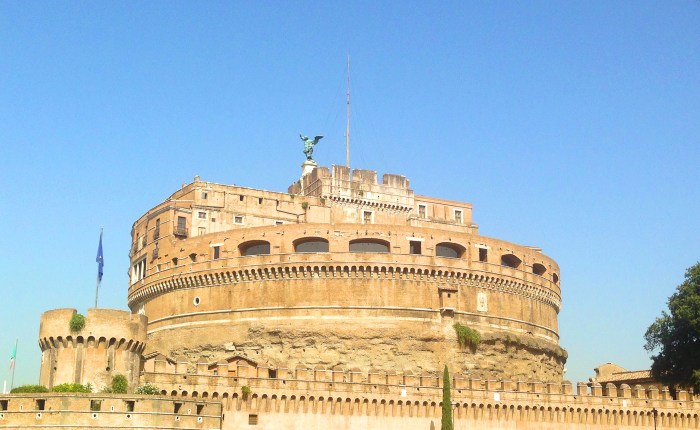
If you are planning on taking a trip to Italy, or just want to learn more about the Renaissance, I cannot recommend this book highly enough. I listened to the audiobook version while I was in Rome. Cellini was narrating the time he defended the Castel Sant’Angelo during the 1527 sack of Rome. As Cellini boasted about his heroic deeds—he would have you believe he defended the castle single-handedly—I turned a corner and found myself face to face with that very castle (see above). It was one of the most memorable moments of my reading life.
View all my reviews

Review: Rousseau’s Confessions

Review: Rousseau’s Confessions

ConfessionsConfessions by Jean-Jacques Rousseau

My rating: 4 of 5 stars

There are times when I am so unlike myself that I could be taken for someone else of an entirely opposite character.

This book begins with a falsehood and only escalates from there. Rousseau, prone to hyperbole, boldly asserts that his autobiography is without precedent. Nevermind St. Augustine’s famous autobiography, which shares the same name; and ignore the works of St. Teresa, Benvenuto Cellini, and Montaigne. I suppose this sort of boastful exaggeration shouldn’t count for much; after all, Milton began Paradise Lost by saying he was attempting “Things unattempted yet in prose or rhyme.” Nevertheless, the second part of Rousseau’s assertion, that his enterprise would “find no imitator,” is even more indisputably false than the first one. This book has found nothing if not imitators.

Rousseau’s Confessions is really two distinct works, the first covering his childhood to his early adulthood, the second up to age fifty-three. For my part, the first is far better, and far more original. Like any modern self-psychoanalyzer, Rousseau traces his personality to formative events in his childhood—quite unusual at the time, I believe. Even more surprising is how frankly sexual is Rousseau’s story. He begins by describing the erotic pleasure he derived from being spanked by his nanny, relates a few homosexual encounters (undesired on his part), and frequently mentions masturbation. Much of the first book is simply prolonged descriptions of all the women he’s had anything to do with.

The second part is less striking, sometimes dull, but still full of interesting episodes. Rousseau has much to say about his career as a composer, something of which I had no idea before reading this book. He begins his career as a musician as a bungler and a phony, but eventually succeeds in closing the gap between his pretensions and abilities. It isn’t long before Rousseau finds himself stitching together some musical and lyrical fragments from Jean-Philippe Rameau and Voltaire into Les fêtes de Ramire, a one-act opera; and he soon becomes Rameau’s enemy, because (Rousseau is convinced) Rameau is jealous of Rousseau’s musical powers.

Rousseau also relates the famous tale of his children. After taking a seamstress, Thérèse, as his mistress, and having several children by her, he persuades her (and himself) to give them up to the foundling hospital. This is probably the most infamous episode of Rousseau’s life, and has provided plentiful fuel for those wish to discredit his ideas on education and child-rearing. As Rousseau grows old and becomes a man of letters, he accumulates ever more enemies, including Diderot and Grimm, who (Rousseau asserts) plotted relentlessly against him, partially because Rousseau scorned city life and modern luxuries.

I can’t help comparing this book with another great autobiography I recently read, that of Benvenuto Cellini. The two men are in many ways opposites. Cellini is a man of the world; his eye is turned exclusively outward; he is all action; he is confident in high society; he rarely blushes and never admits a fault. Rousseau is a man of sentiment and feeling, absorbed in his private world, often timid, awkward, and unsure of himself, and who often makes self-deprecating remarks.

And yet, the more I read, the more I saw strong similarities between these two self-chronicles. They are both massive egotists. If I were to write my autobiography, I’d hope that it would include some nice portraits of people in my life; but in these books there is no compelling portrait of anyone except their authors.

Like many narcissists, their vanity is easily wounded. They are obsessed with slights, and consider anyone who doesn’t show the proper respect to be, not only inconsiderate, but downright villainous. They both make enemies quickly, wherever they go. And yet, the fact that so many people they meet turn against them does not prompt them to pause and reflect; rather, they attribute all antipathy to envy, jealousy, or pure malevolence. Both have persecution complexes; both are paranoid; and both entertain extremely high opinions of their own virtues and abilities. In Rousseau’s own words, he is among “the best of men.”

It occurs to me that the urge to write an autobiography, in an age when autobiography was anything but common, requires a certain amount of narcissism. What surprises me is that these two men, Cellini and Rousseau, are also quite oblivious of themselves and utterly unable to question their own opinion. This is in strong contrast to Montaigne, somebody who Rousseau explicitly scorns:

I have always laughed at the false ingenuousness of Montaigne, who, feigning to confess his faults, takes great care not to give himself any, except such as are amiable; whilst I, who have ever thought, and still think myself, considering everything, the best of men, felt there is no human being, however pure he may be, who does not internally conceal some odious vice.

There may be a grain of truth in accusing Montaigne of attributing only amiable faults to himself (though reports by his contemporaries coincide remarkably well with Montaigne’s self-report). Even so, Montaigne had a quality that Rousseau eminently lacked: the ability to jump out of his own perspective. When playing with his cat, Montaigne paused to reflect “who knows whether she is amusing herself with me more than I with her?” And in that simple question—pushing himself out of his own skull, seeing himself from the eyes of his cat—he transcends all of the searching self-analysis of Rousseau. Rousseau’s total inability to, even for one moment, question his righteousness and his enemies’ wickedness is what makes him, by the end of the book, nearly intolerable—at least for me.

So much for Rousseau’s personality. As a portrait of a man, this book is interesting enough; but as the confessions of one of the most influential thinkers in the 18th century, it is far more so. Rousseau, whatever his faults, was undeniably remarkable. To paraphrase Will Durant, Rousseau, with almost no formal education, abandoned early by his father, wandering incessantly from place to place, setting himself as an enemy of the dominant currents of thought and art of the time, the avowed antagonist both of Rameau, the foremost composer, and Voltaire and Diderot, the foremost writers—this Rousseau nevertheless managed to become the decisive influence on the next century.

Cases like Rousseau’s make me stop and reflect about the nature of intellectual work. Neither a strong reasoner nor an adept researcher—any competent professor could poke gaping holes in his arguments and cite reams of factual inaccuracies—it is Rousseau, not they, who is still being studied at college campuses all over the world, and who will be in the foreseeable future. Indisputably he was an excellent stylist, though this hardly accounts for his canonical status.

What sets Rousseau apart, intellectually at least, is his enormous originality. Rousseau himself realizes this:

I know my heart, and have studied mankind; I am not made like anyone I have been acquainted with, perhaps like no one in existence; if not better, I am least claim originality, and whether Nature did wisely in breaking the mold with which she formed me, can only be determined after having read this work.

Rousseau wrote in a way no one had before. His ideas were fresh, his attitude unique. Although he had influences, there is nothing derivative about him. The more I read and the longer I live, the more am I drawn to the conclusion that the ability to form new ideas—genuinely new, not just re-interpretations of old ones—is one of the rarest human faculties. Rousseau had this faculty in abundance. It is impossible to read him within the context of his time and not be utterly astounded at his creativity.

It is just this sort of creativity, the thing we most celebrate and praise, that seems impossible to teach— impossible by definition, since you cannot teach somebody to think totally outside the bounds of your own paradigm. You cannot, in other words, teach someone to transcend everything you teach them. You can teach somebody to solve problems creatively; but how can you teach somebody to examine problems previously unimagined? This is just one of the paradoxes of education, I suppose.

In any case, Rousseau is just another example of those canonical thinkers who could never get tenure nowadays. It’s a funny world.

View all my reviews

Quotes & Commentary #51: Montaigne

Quotes & Commentary #51: Montaigne

I set little store by my own opinions, but just as little by other people’s.

—Michel de Montaigne

Although nobody is free from self-doubt, I have long felt that I have this quality to an inordinate degree. The problem is that I can’t decide whether this is a good or a bad thing.

On the one hand, doubting yourself is one of the keys of moderation and wisdom. If you think you already know everything you cannot learn. If you are sure that your perspective is right you cannot empathize. Dogmatism, selfishness, and ignorance result from the inability to doubt the truth of your own opinions.

There are no such things as self-doubting fanatics. The ability to question your own opinions and conclusions is what prevents most people from committing atrocities. I couldn’t kill somebody in the name of an idea, since there is no idea I believe in strongly enough.

And yet, this tendency to doubt my own beliefs and conclusions so often makes me hesitating, indecisive, and occasionally spineless. Never mind killing anyone: I don’t even believe in my political ideals enough to stand up to somebody I find offensive. I doubt the worth of my dreams, the reason of my arguments, the virtue of my actions; and I am not terribly sure about my professional competency or my literary skill.

No matter what I do, I have this nagging feeling that, somewhere out there, there are people who could make me appear ridiculous by comparison. So often I feel out of the loop. I hesitate to submit my writing anywhere because I think a professional editor would cut it to pieces. I hesitate to put forth arguments because I think a real expert could see right through them. I hesitate to commit to a profession because I doubt my own ability to follow through, to perform difficult tasks, and to do my duties responsibly.

My nagging self-doubt is more of a feeling than a thought; but insofar as a feeling can be expressed in words, it goes like this: “Well, maybe there’s something big out there that I don’t know, something important that would render all my knowledge and standards inadequate.”

The odd thing is that I have no evidence that this fear is justified. In fact, I have evidence to the contrary. The more I read and travel, the more people I meet, the more places I work, the less surprised I am by what I find. The contours of daily reality have grown ever-more familiar, and yet this fear—the fear that, somehow, I have missed something big—this fear remains.

The perilous side of self-doubt is that it can easily ally itself with baser qualities. I can argue myself out of taking risks because I am unsure whether I really want the goal. I can argue myself out of standing up for what I believe is right by doubting whether it really is right, and whether I could prove it. Self-doubt and fear—fear of failure, fear of rejection, fear of being publically embarrassed—so often go hand-in-hand.

I can’t say why exactly, but the thought of writing a flawed argument, with a logical fallacy, an unwarranted assumption, or a sloppy generalization, fills me with dread. How mortifying to have my mental errors exposed to the world! Maybe this is from spending so much time in a school environment wherein the number of correct answers was used as a measure of my worth. Or maybe it is simply my personality; being “right” has always been important to me.

This fear of being wrong is particularly irrational, since some of the greatest minds and most influential thinkers in history have been wrong—Galileo, Newton, Darwin, Einstein, all of them have erred. Indeed, the fear of being wrong is not only irrational, but counterproductive to learning, since it sometimes prevents me from exposing my thoughts, increasing the likelihood that I will persist in an error.

Despite the negatives, I admit that I am often proud of my ability to doubt my own conclusions and change my opinions. I see it as a source of my independence of mind, my ability to think differently from others and to come to my own conclusions. After all, doubting yourself is the prerequisite of doubting anything at all. As Plato illustrated in his Socratic dialogues, from the moment we our born our minds are filled with all sorts of assumptions and prejudices which we absorb from our culture. The first step of doubting conventional opinion is thus doubting our own opinions.

But just as often as my self-doubt is a source of pride, it is a source of shame. I am sometimes filled with envy for those rare souls who seem perfectly self-confident. In this connection I think of Benvenuto Cellini, the Renaissance artist who left us his remarkable autobiography. Cocksure, boastful, selfish, prideful, Cellini was in many ways a despicable man. And yet he tells his story with such perfect certainty of himself that you can’t help but be won over.

Logically, self-confidence should come after success, since otherwise it isn’t justified. But so often self-confidence comes beforehand, and is actually the cause of success. In my experience, when you believe in yourself, others are inclined to believe in you. When you are confident you take risks, and these risks often enough pay off. When you are confident you state your opinions boldly and clearly, and thus have a better chance of convincing others.

Confidence is often discussed in dating. Self-confident people are seen as more attractive, and tend to have more romantic success since they take more risks. The ability to look somebody in the eye and say what you think and what you want—these are almost universally seen as attractive qualities; and not only in romance, but in politics, academics, business, and nearly everything else.

The charisma of confidence notwithstanding, this leads to an obvious danger. Many people are confident without substance. They boast more than they can accomplish; they speak with authority and yet have neither evidence nor logic to back their opinions. The world is ruled by such people—usually men—and I think most of us have personal experience with this type. I call it incompetent confidence, and it is rampant.

As Aristotle would say, there must be some ideal middle-ground between being confidently clueless, and being timidly thoughtful. And yet, in my experience, this middle-ground, if it even exists, is difficult to find.

I suppose that, ideally, we would be exactly as confident as the reach of our knowledge permitted: bold where we were sure, hesitating where we were ignorant. In practice, however, this is an impossible ideal. How can we ever be sure of how much we know, or how dependable our theories are? Indeed, this seems to be precisely what we can never know for sure—how much we know.

For the world to function, it seems that it needs doers and doubters. We need confident leaders and skeptical followers. And within our own brains, we need the same division: the ability to act boldly when needed, and to question ourselves when possible. Personally, I tend to err on the side of self-doubt, since it easily allies itself with laziness, inaction, and fear; but now I am starting to doubt my own doubting.