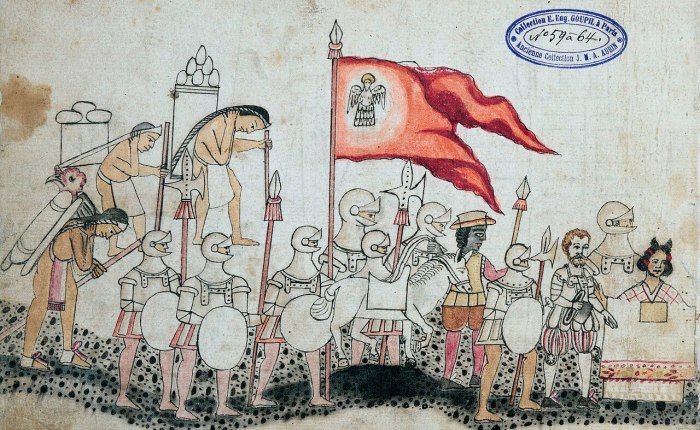
Review: Florentine Codex, Book 12

Review: Florentine Codex, Book 12

Florentine Codex: Book 12: Book 12: The Conquest of Mexico (Volume 12) by Bernardino de Sahagún

My rating: 4 of 5 stars


The more I read about the Pre-Colombian cultures of Mexico, the more I am confronted with the basic questions of historiography. Though there are many excellent sources of information—ruins, artwork, living ancestors, Spanish eyewitness accounts, pre-contact documents, indigenous stories, and later historical accounts—all of these carry with them strong limitations and biases, giving our knowledge a kind of multicolored, mosaic quality.

This book is an excellent example of this. Written by a Spanish friar using native informants, this is a kind of hybrid insider/outsider document. The knowledge collected by Sahagún was authentic and valuable, and yet it was collected as a part of a missionary effort—not just to conserve, but also to convert. Further, Sahagún wrote his enormous treatise on Aztec culture many decades after initial contact, at a time when the Mexica empire was shattered, its people subjugated, and its culture already heavily influenced by the Spaniards. While enormously valuable, then, this document cannot be read as a clear window into the past.

The strongest example of this is the beginning of the document. Here, it mentions the several ominous omens—a flame in the sky, a boiling lake—that supposedly appeared before the arrival of the Spanish, giving the conquest an almost Biblical aspect. The codex also claims that the Aztec emperor initially mistook the Spaniards for gods, thus leading to several strategic errors.

But this information is dubious for several reasons. For one, anything so highly flattering to the Christian missionaries (as if God is intervening on their behalf) should be suspect in itself. What’s more, these stories were collected from people living a generation or more after the conquest, not direct witnesses; and one can see how these stories serve a kind of defensive purpose. After all, if the heavens intervened to topple their culture, it somewhat absolves the fallible humans who were defeated. It is no wonder that modern historians have largely discarded these stories as myths.

Does that make this document valueless? Absolutely not. Apart from the specific information contained therein—much of it indeed reliable—it also preserves a sense of huge cultural disruption that the Spanish caused when they arrived. So much of the book consists of confused and desperate battles, which escalate in scope and intensity until the book has a nearly apocalyptic tone. Even now, one can feel the sense of cultural dislocation and loss in these pages. Particularly evocative, I found, was the section on the introduction of smallpox:

But before the Spaniards had risen against us, first there came to be prevalent a great sickness, a plague. It was in Tepeilhuitl that it originated, that there spread over the people a great destruction of men. Some it indeed covered [with pustles]; they were spread everywhere, on one’s face, on one’s head, on one’s breast, etc. There was indeed perishing; many died of it.

This book is also worth reading precisely because of the issue that I highlighted above. As lay readers, we are rarely confronted with the realities of actually doing history—the difficult work of piecing together coherent narratives from a variety of fragmentary and sometimes contradictory sources. Yet when a historian does this work in the background, and presents us with a neat story, we are given a false perception of how easy it is to draw conclusions about the past. In the case of the Spanish conquest of Mexico, it just so happens that our sources are particularly fraught. This period in time, then, shows in exaggerated form the problems that exist in any historical work, and is thus an education in itself.

View all my reviews

Review: Maya to Aztec

Review: Maya to Aztec
Maya to Aztec: Ancient Mesoamerica Revealed

Maya to Aztec: Ancient Mesoamerica Revealed by Edwin Barnhart

My rating: 4 of 5 stars

Here is another excellent lecture series by Edwin Barnhart. Just earlier this year I listened to, and greatly enjoyed, his series on the civilizations of North America. Now he is on his home turf, for Barnhart is a specialist in Maya archaeology. Surprisingly, however, I thought that the lecture series got off to something of a rough start. He jumps right into the Olmecs without enough framing or background. But soon enough I got my bearings, and the rest was a delightful trip through Meso-American archaeology.

Although I was somewhat more familiar with the basics of the Mayans and the Aztecs than with the ancient peoples of North Americans, I was still astounded at the depths of my own ignorance. It is frankly incredible that you can go through the American educational system and learn infinitely more about the Babylonians, Egyptians, and the Greeks than about the Mayans and the Aztecs. Granted, much of what we know about these civilizations was discovered fairly recently. The Mayan script was only deciphered in the 1970s; and as Barnhart points out, there is so much left to be discovered, including whole cities. Barnhart himself discovered a city (Maax Na).

The pyramids, pictoral script, and ancient date of these civilizations naturally bring up associations of Egypt. Yet the comparison is somewhat misleading, since the peoples of Meso-America consisted of a patchwork of cultures, sharing obvious similarities but equally important differences, whose fortunes waxed and waned through the centuries. Egypt, by contrast, was a singularly homogenous culture. Mesopotamia is likely a better comparison in this regard. But, of course, the Meso-American cultures have many distinct features.

One of the most important is the elaborate calendar system. Barnhart, an expert on paleo-archaeology, goes into great detail in explaining the Mayan numeral and calendrical systems. What is striking is not only the great complexity of the system, but also the cultural importance of the calendar. It was used by the entire region; and its keepers—who were religious men—communicated with one another even while their own states were at war. The calendar was filled with significance and omens, and was always consulted before important tasks. Barnhart speculates that the cyclical nature of the calendar also explains why cities were periodically abandoned.

Another peculiar feature is the Meso-American ball game, which was played across the region. This ball game was not just a sport, but a kind of living metaphor for Meso-American cosmology. I am not familiar of any other examples from the ancient world of a sport being so culturally central. And, of course, there is the human sacrifice—especially among the Aztecs. It is difficult to hear about these practices nowadays; though I do wonder which area had more religion-inspired killings during this time: Meso-America or Europe?

Barnhart ends the lecture series by narrating the first European contact and the eventual destruction of the Aztec Empire by Hernán Cortés and his men. (There is a new series on Amazon about Cortés, which was made to commemorate the 500th anniversary of the fall of Tenochtitlán, which happened in 1521.) It is an exciting and a depressing story, as the work of centuries is burned or buried. But Barnhart ends on a positive note, observing the many ways that these cultures have survived, and expressing hope that the modern descendants of the Maya, the Aztecs, and the many other cultures will take control of their heritage. For my part, now I really want to go to Mexico.


View all my reviews