NY Museums: The American Museum of Natural History

NY Museums: The American Museum of Natural History

This is part of a series on New York City museums. For the other posts, see below:


There is no place in New York City to which I have a more intimate connection than the American Museum of Natural History. I practically grew up inside its walls. For a nerdy boy on the Upper West Side, it was the perfect place for a weekend outing. My mom recalls taking me there and letting me run around in the big Hall of Ocean Life, while she enjoyed a beer at the refreshment stand. (They do not sell beer anymore.) My dad took me plenty of times, too, and then followed up the visit with a meatball subway sandwich.

Kids still love the museum. The natural world, after all, is far more accessible than the highfalutin world of art. A child who is still figuring out the basics of the world around her has no need of elaborate images to reconnect her to her senses. And it is fortunate for our society that the museum is so accessible to children. Judging from the case of Carl Sagan, Stephen Jay Gould, or Neil deGrasse Tyson (as well as myself) the fascination exerted on youthful visitors to the museum often matures into a fascination for the natural world and a respect for the power of human reason. And you do not need to be a child to feel this twin amazement at world without and the intelligence within. I feel it every time I visit.

You can enter the museum from several spots. The grandest is, without a doubt, through the Roosevelt Rotunda on Central Park West. When walking up the stairs, the visitor will notice the heroic equestrian statue of President Theodore Roosevelt. It is worth pausing to continue this statue, for it encapsulates much of the controversial history of the institution. The mustachioed man is flanked by a Native American and an African man, both on foot, and both looking rather dejected to my eyes. The racial message is clear: the white man sits atop the lesser races. To its credit, the AMNH is acknowledging this imagery with a special exhibit, “Addressing the Statue.” I think this strategy is far preferable to the idea of simply removing it, since now the statue provides an opportunity for learning.
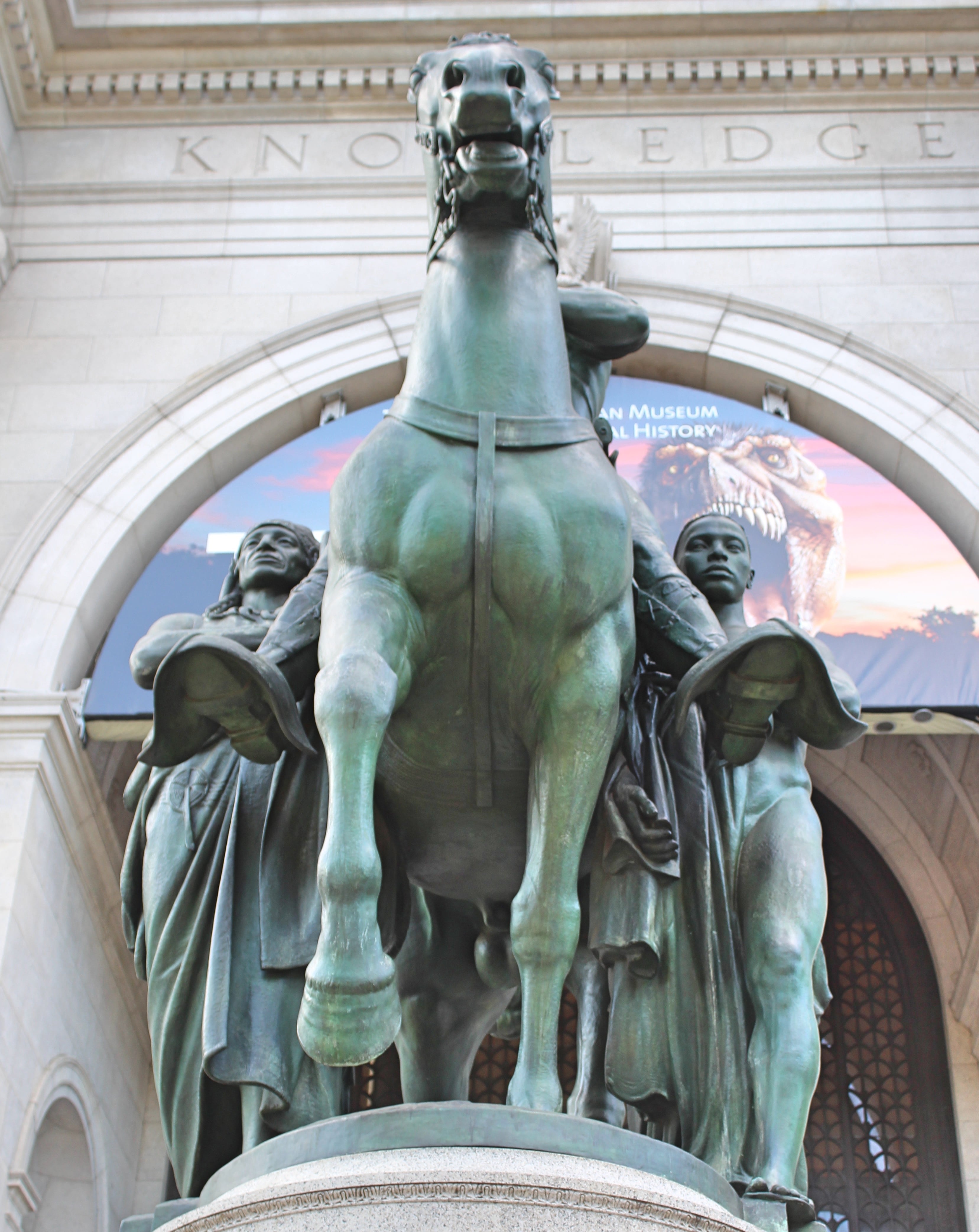
Theodore Roosevelt holds a special place in the history of the museum. His father was one of the museum’s founders, when it was still housed in the Arsenal Building of Central Park. The younger Roosevelt was himself an ardent naturalist, and we have him to thank for many of our country’s most beautiful national parks. But being a nationalist in those days did not mean what it means today. Roosevelt did an awful lot of hunting on behalf of the museum, providing some of the exotic animals that were later stuffed and mounted in the amazing displays. Our views on hunting big game and on racial differences have both, fortunately, evolved since then.

To thank the President for his support, the museum is studded with acknowledgements. The most extravagant of these is the massive mural painted by William Andrew Mackay, covering three tall walls of the Roosevelt Rotunda, where the visitor enters. These depict the eventful life of the naturalist president, turning him into a kind of secular saint on the walls of the cavernous room. But of course most people’s attention is absorbed by what is happening in the middle: the dramatic encounter between a brontosaurus protecting its calf, and the hungry allosaurus prowling for prey. Both the baby and the predator are dwarfed by the gargantuan form of the brontosaurus, whose already significant height is bolstered by standing on its hind legs. Personally I doubt that such a massive animal could perform such a maneuver without breaking its legs. Indeed, replica fossils had to be used, since the real fossils (made of stone, after all) are too heavy to mount in such a way.

Much as I would like to move on to the museum’s exhibits, there is one more relic from the museum’s past that deserves comment. Downstairs from the glorious Roosevelt Rotunda is the Roosevelt Memorial Hall, which includes four small exhibitions about the varied activities of the president: his interest in nature; his love of exploration; his time as a statesman; and his life as a writer. What draws most attention, however, is a diorama showing a meeting between Peter Stuyvesant—the Dutch leader of what later became NYC—and the indigenous Lenape people. Made in 1939, this diorama contains several omissions and inaccuracies that work in the Europeans’ favor, such as showing the Lenape almost nude. Again, to its credit, the AMNH has included annotations on the glass, pointing out several of these problems; and their website includes lesson plans to help visiting teachers use the diorama.

I am dwelling on these examples of the museum’s less noble past, not to portray the institution in a negative light, but to show that the museum is working to improve itself without burying its past. It is a model to imitate. And the museum has a long history. This year, 2019, marks the 150th anniversary of the institution. This makes the AMNH one year older than the Metropolitan, which was founded in 1870.

Now it is finally time to enter the museum. Luckily, the entrance fee is still a suggested donation for all visitors, so you need not break the bank. What should we see first? There is a great deal to choose from. In fact, the AMNH is the largest natural history museum in the world, with millions upon millions of specimens of animals, fossils, minerals, artifacts… It would be virtually impossible to see the entire thing in one day. For my part, it has taken me dozens of visits to fully wrap my mind around the museum; and even a lifetime would not suffice to learn all it has to teach.

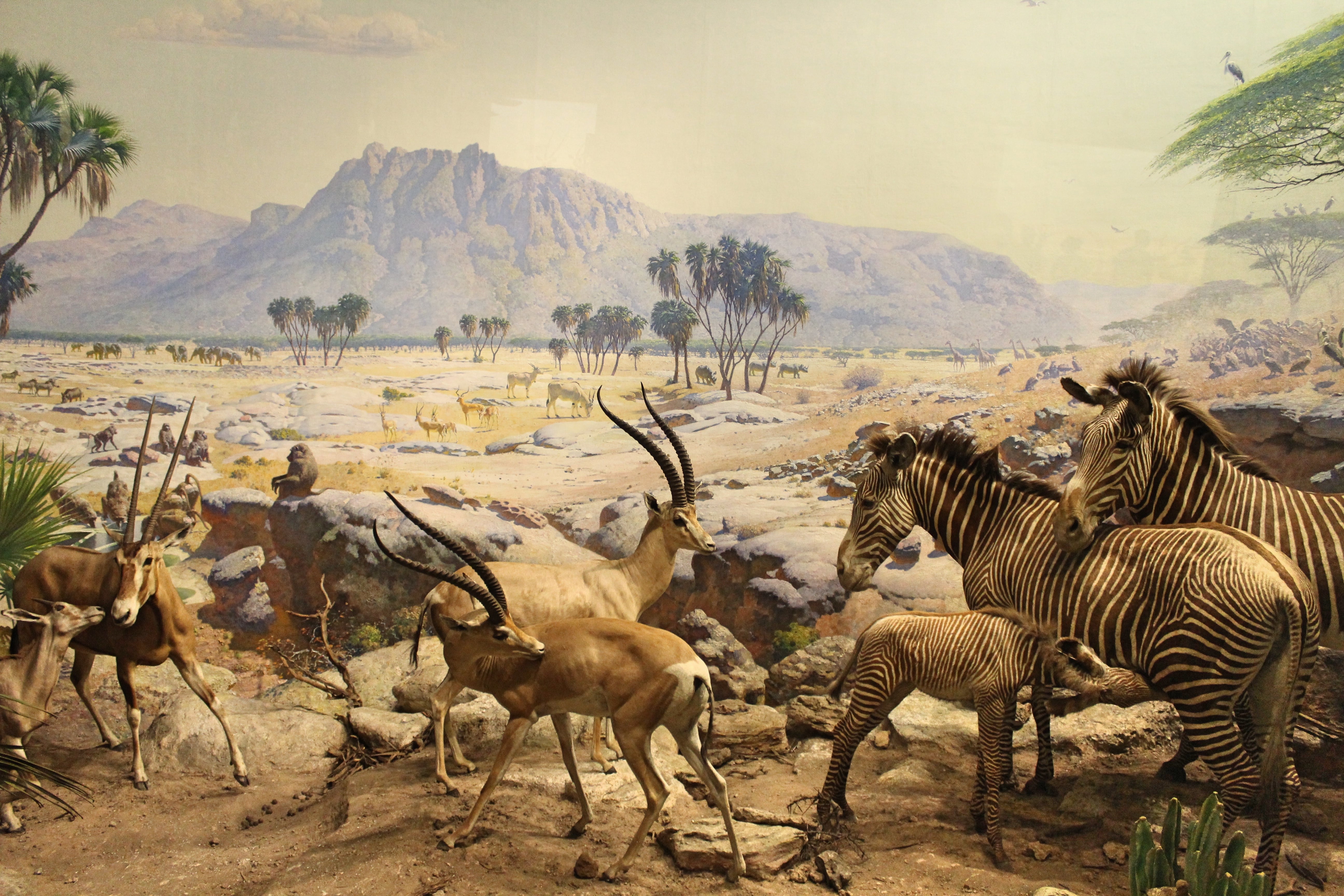
Let us go on straight ahead from the Roosevelt Rotunda into the Hall of African Mammals. Simply as a work of art, this is one of the high points of the museum. In the center a herd of eight African elephants—bulls, cows, and calves—huddle together. Arranged around this heard, in little niches in the walls, are other exotic animals: lions, zebras, giraffes. The visitor would be forgiven for thinking that all of these were merely plastic replicas; but they are real taxidermied specimens of animals (one of the elephants was shot by Theodore Roosevelt himself). This gives the dioramas a kind of macabre air, which is combined with melancholy when examining endangered species such as the rhinos and the gorillas. 
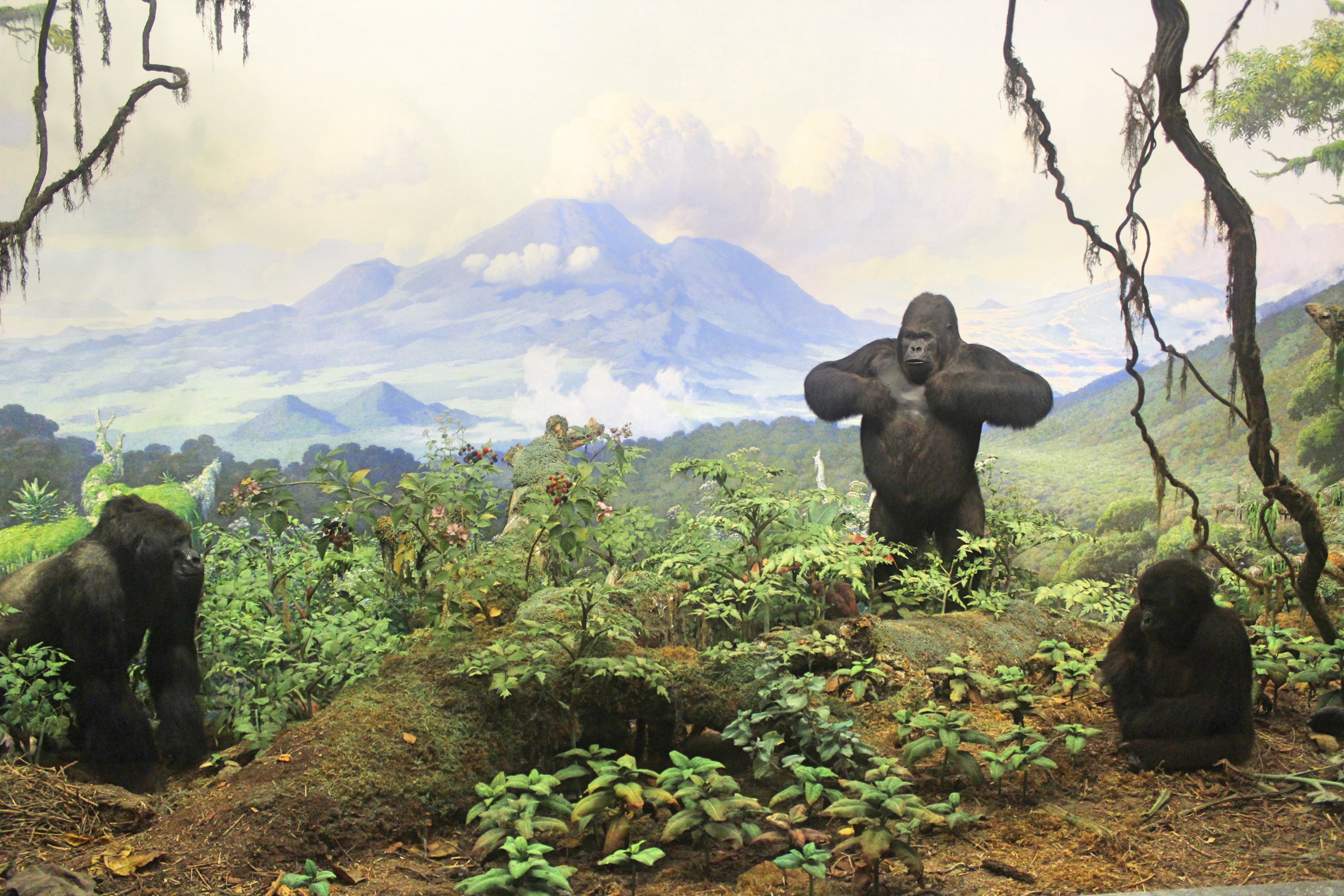
Yet art intervenes to uplift this collection of exotic bodies into a thrilling exhibit. Every diorama is masterfully done: the animals stand in dramatic, lifelike poses amid an environment so scrupulously recreated as to be totally convincing. Added to this are the paintings on the curved surfaces enclosing the dioramas. These hand-painted backgrounds are worthy works of art in their own right: adapting perspective to the wall’s curvature in order to create a nearly seamless continuation with the scene in the foreground. The result is a strange blend of natural beauty and human invention, which is at turns convincingly lifelike and technically astounding. As I walked along from diorama to diorama, I felt like pilgrim visiting a church, walking around from chapel to chapel.
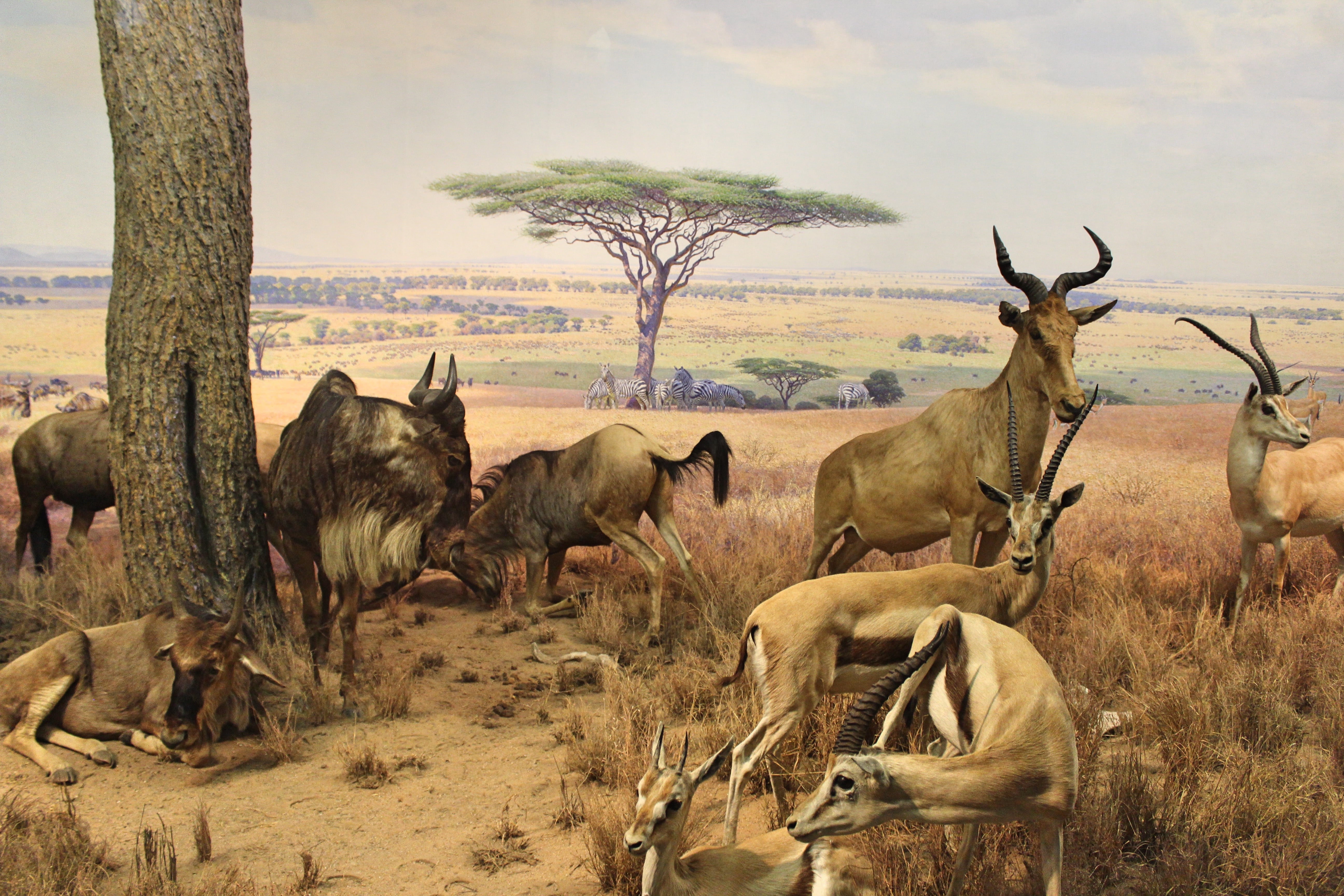
The lion’s share of the credit for this work goes to Carl Akeley, who participated in both collecting and mounting these specimens. Though this business of big-game taxidermy can seem to us in the present day as grim and barbaric, I think that Akeley deserves to be viewed as an artist of high ability. Creating compelling nature dioramas is no easy matter. It requires a naturalist’s eye for fact and a sculpture’s eye for form. To construct a compelling design that is, at the same time, true to nature, requires a special knack. Akeley was a master of it.
A kind of sister to this gallery is the Hall of Asian Mammals, also accessible through the Roosevelt Rotunda. This is a decidedly smaller space; and as the plaque on the wall informs us, the animals here are owed to a “Mr. Ferney” and a “Colonel Faunthorpe,” who made six expeditions into Asia to hunt these animals. Two Asian Elephants stand in the center of this gallery, slightly smaller than their African counterparts. This gallery originally contained a specimen of a giant panda and a Siberian tiger, but the subsequent history of those species led the museum to place these in the Hall of Biodiversity as examples of endangered species (more later). On my latest trip, I learned that there is a type of Asian Lion with a rangy mane, which lives in a small sliver of India.

Now let us descend a flight of stairs once again to the Rockefeller Memorial Hall, on the ground floor. Here we can enter the space directly below the Hall of African Mammals: the Hall of North American Mammals. We find still more superb animal dioramas. The most famous of these is the Alaska Brown Bear. Two of these stand behind the glass. One is reared up on its hind legs, while the other prowls menacingly nearby. The height of the upright bear is startling. Standing before it, you feel how easily this creature could overpower you. Another superb display is of the moose, which features two bull moose jousting with their antlers. As a Canadian friend once told me, moose are the “king of the beasts.”

A quick trip through the Roosevelt Memorial Hall will lead us to one of the museum’s newer spaces: the Hall of Biodiversity. Opened in 1998, it did not exist when I was a young child. The room has a stunning design. Through the center is a swath of artificial rainforest, made to replicate one of earth’s most diverse environments. A legion of tentacled creatures hang from the ceiling, including a giant squid, an octopus, and a massive jellyfish. A glass case holds the giant panda and Siberian tiger, among others, as examples of endangered species; and the bones of the long-dead dodo can be found. Most of the action takes place on the far wall, which is illuminated from behind. Here is represented the entire panoply of life, from bacteria, to algae, to fungi, to plants, and finally to all the many variations of animals: worms, insects, crustaceans, mollusks, and vertebrates of every kind. (There is an online version that you can click through.)
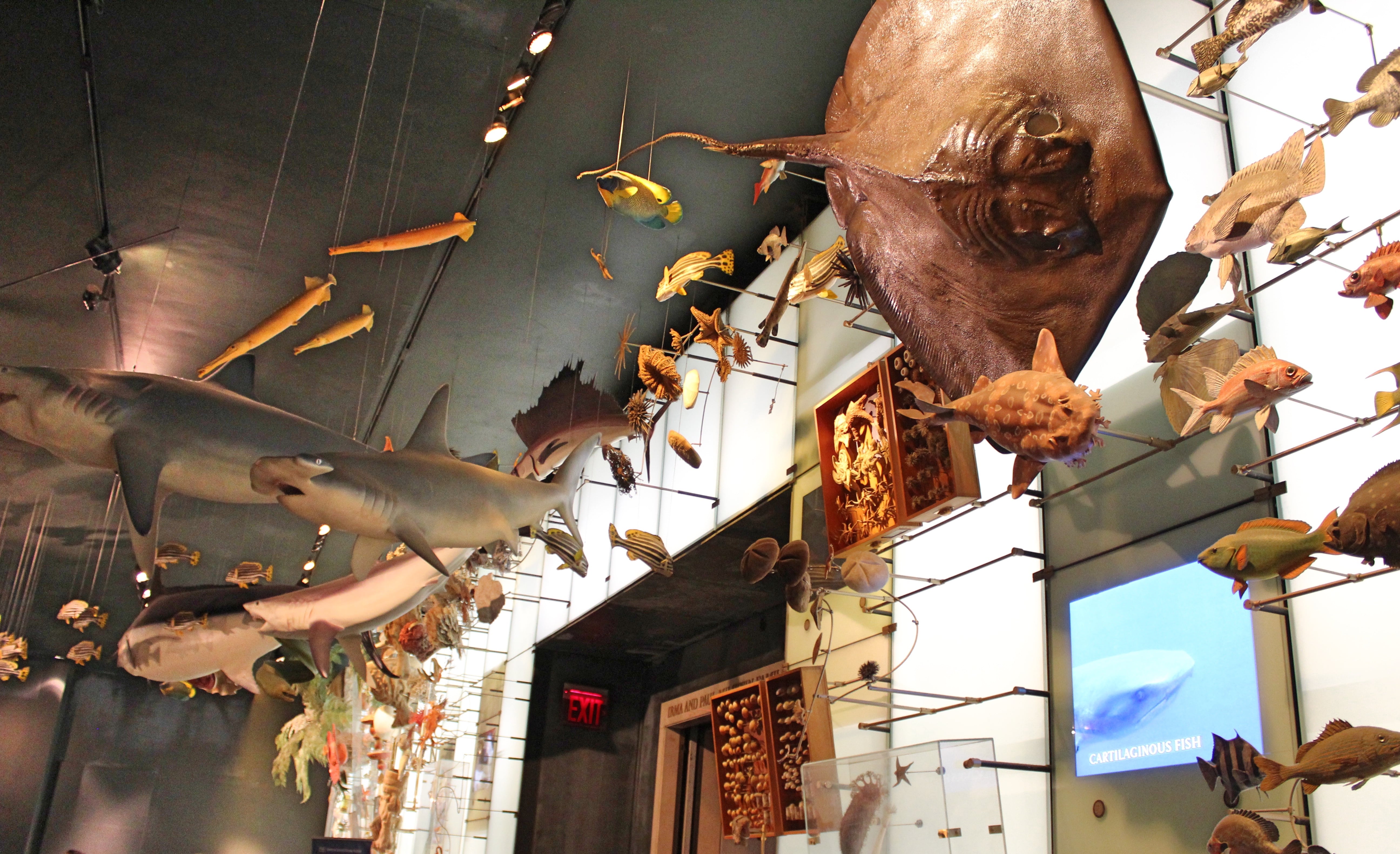
The sheer abundance of models on display gives a visual illustration to the richness of life on this planet. This amazing variety, developed over 3 billion years of evolution, goes far beyond our humdrum ideas about plant and animal types. To give an example, once a teacher of mine asked everyone in class to make a guess at how many species of bee there are in the world. People’s guesses ranged between 12 and 300. The answer is 20,000. Unfortunately, this biodiversity is being dramatically curtailed through human action—which is why this gallery was made. 

This attractive space opens up to what has always been, for me, the most dramatic room in the museum: the Hall of Ocean Life. Here is where I would spend most of my time as a child. This hall is one of the biggest spaces in the museum. It is dominated by the life-sized model of a blue whale, the largest animal to ever exist on the planet, hanging from the ceiling. This lightweight model weighs no less than 21,000 pounds—so just imagine what the real animal must weigh. It is frankly stupefying that something so large can be alive. The entire herd of elephants from the Hall of African Mammals can huddle underneath its belly.

Dioramas line the walls of both floors of this hall. The best of these are on the bottom, where you can find a polar bear, a pod of walruses, and a huddle of sea lions. Here, as elsewhere, these displays are amazingly dramatic and lifelike. We can see the sharks in pursuit of the poor sea turtle, and the dolphins jumping out of the water to catch some flying fish. But the real masterpiece of this hall is the battle between the sperm whale and the giant squid. The sperm whale is the biggest toothed predator in the world, and its prey is likewise large. This big-headed mammal dives deep under the water—sometimes over a mile deep, going more than an hour without breathing—in order to prey on the invertebrate monsters that lurk below.

The most notable foe of this whale is the giant squid, itself one of the world’s largest animals, capable of growing to over 40 feet in length. When a whale finally catches on of these squids, it must be a serious fight, as the suction-cup scars found on the hide of sperm whales attest to. The diorama evokes all the drama of this encounter. We arrive once the fight has commenced: the whale has one of the squid’s tentacles in its jaws, and the squid is wrapped around the whale’s enormous head. The diorama is illuminated in a semi-darkness that recalls the inky blackness of the deep ocean

As a child, I found this scene both fascinating and terrifying, and became obsessed. I drew the battle over and over, doing my best to perfect the two different forms: the smooth blue whale and the sprawling red squid. Even now, this conflict between the big-brained sperm whale and the monstrous giant squid calls to mind a deep conflict within our own nature.

This description only touches upon the strange, otherworldly beauty on display in the Hall of Ocean Life—a beauty that captivated me as a child and which still moves me. The world below the seas is more fantastic and alien than anything dreamed up in science fiction. You can see this clearly in the three dioramas depicting life in the ancient oceans: creatures whose bodies form spirals, cones, wings, prowling about on an ocean floor populated with blooming anemones. The colorful, twisting, bulbous forms of the coral reef also evoke this strange allure. A part of me has always wished to be a marine biologist.

Now we will leave the Hall of Ocean Life to travel back through the Hall of Biodiversity, to enter a space which I have still not adequately explored. The first is the Hall of North American Forests. This space is dedicated to the sorts of environments present in the United States and Canada, from the deserts of Arizona to the cold forests of Ontario. The most impressive object on display is a cross section from a 1,400 year-old Sequoia. It is enormous: big enough to serve as a dance floor or even to serve as the foundation for a house. Notable historical events are marked on the tree rings, going from the invention of book printing in China (in 600), to the crowning of Charlemagne (in 800), to the death of Chaucer (in 1400), to the ascension of Napoleon (in 1804), to when the tree was finally cut down, in 1891.

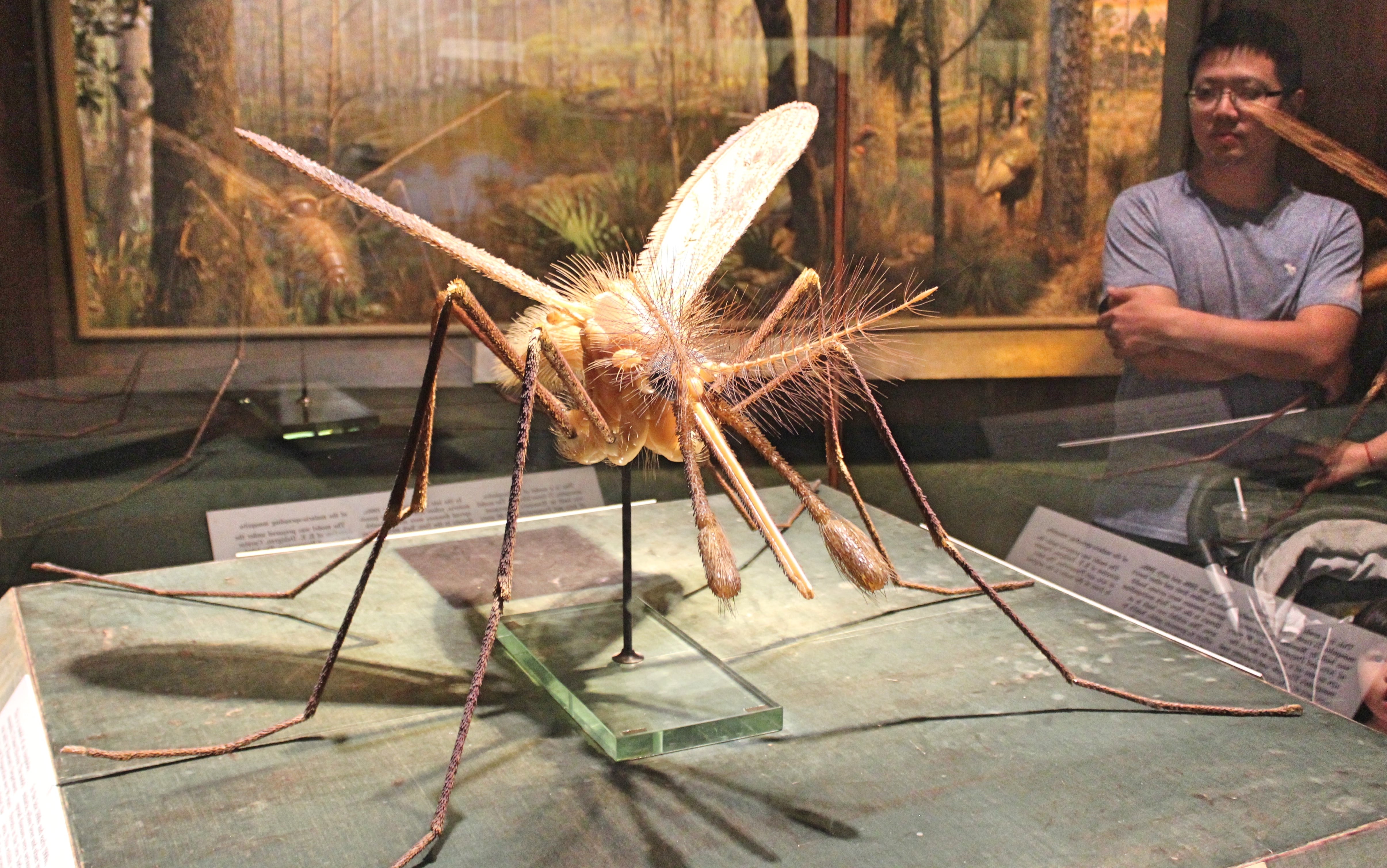
This hall is also notable for a diorama depicting the little critters who live in the soil, responsible for breaking down organic matter and keeping the cycles of life in swing. The worm, centipede, and daddy-long-legs are blown up to 24 times their actual size, which is not a pleasant sight. The same can be said for the giant model of a malarial mosquito, which does not increase my affection for that species. Teddy Roosevelt played a part in educating the public about the role mosquitos play in spreading malaria, since he had to deal with the disease when overseeing the Panama Canal.
When we leave this hall, we enter yet another of the museum’s grand entrance spaces. This is named, appropriately enough, the Grand Gallery. It is most famous for the hanging Great Canoe, made by the peoples of the Pacific Northwest. Carved from a single tree, this enormous boat can hold a dozen people and is suitable for use in ocean waves. The front features an exquisite painting of a killer whale. When I was a boy, I normally entered the museum here. At the time the canoe was filled with the plastic figures of Native Americans; and I would look at these mannequins with a kind of uncomprehending terror, since I could not figure out what those men were doing. The museum has since refurbished the canoe and removed the figures, hanging it higher so as to make the decoration more visible. 

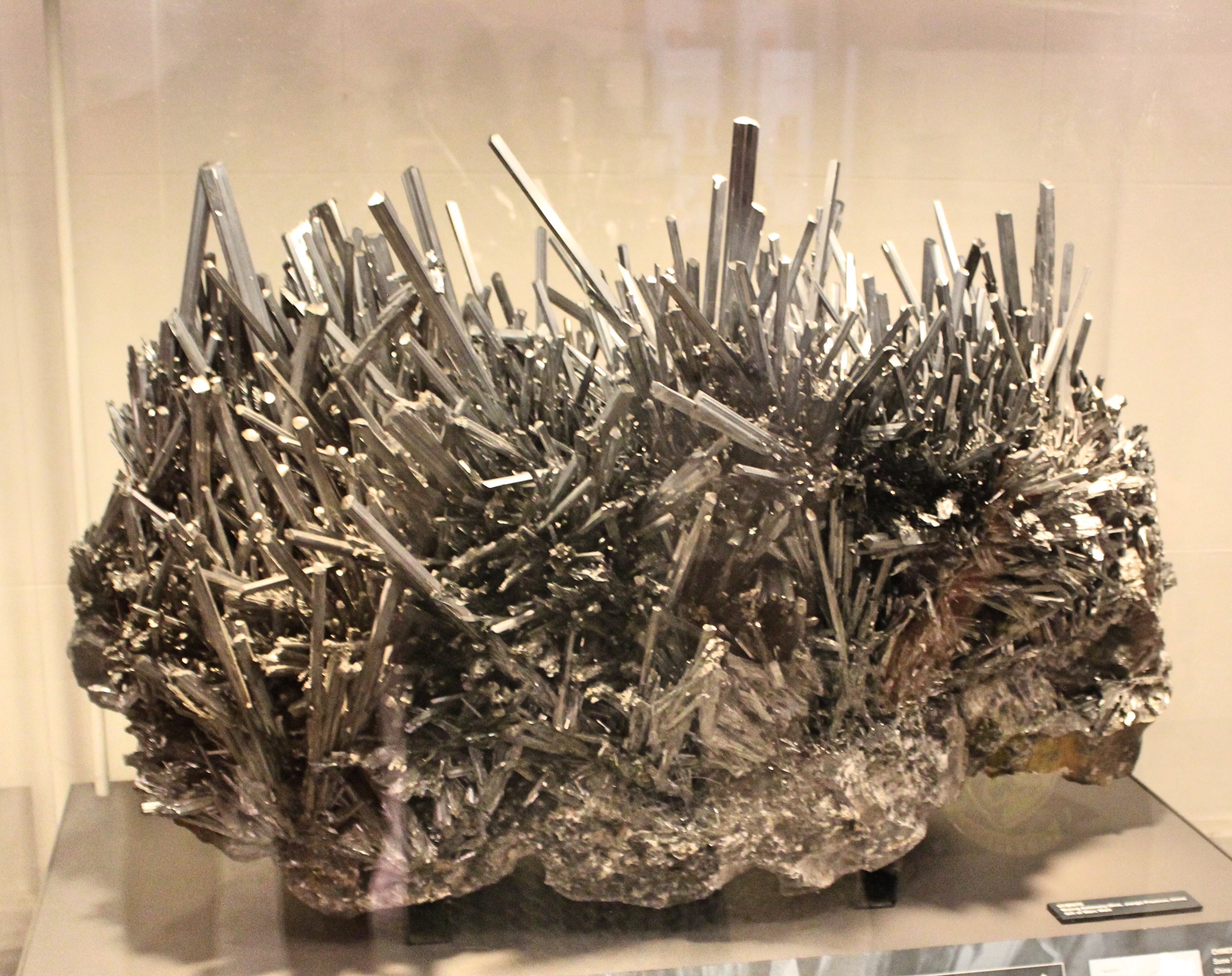
There are still other treasures to be found in this gallery. In one corner is a glass containing an ammonite fossil. This are extinct mollusks which looked like squids living in a spiral shell. This particular ammonite happened to fossilize under high pressure, which resulted in it being an iridescent rainbow. Nearby is a magnificent stibnite: a metallic crystal formed from antimony and sulfur. These crystals form themselves into a collection of jagged silver spikes all sprouting from a central core. A nearby child compared it to a porcupine.
The Grand Gallery normally leads to the Northwest Coast Hall; but it is currently closed for renovation. This hall is the oldest continued exhibit space in the museum, having been opened in 1900. The peoples of the Pacific Northwest are known throughout the world for the high quality of their visual art, including the iconic totem pole. This hall contained a great many of these poles, among other art, which made it one of the museum’s more beautiful spaces. Much of this was collected by the pioneering anthropologist, Franz Boas, during the famed Jesup North Pacific Expedition of 1897 – 1902. The current renovations are yet another example of the museum’s attempt to confront its past: updating the information to reflect how these cultures wish to be represented, rather than how anthropologists represented them 100 years ago.

The Grand Gallery also leads into the equally grand Hall of Human Origins. Opened in 1921, this hall was the first exhibit about the controversial topic of human evolution in the United States. The hall still performs this admirable task, teaching visitors about the evolutionary past of our own species. The visitor is first confronted with three skeletons, one of a modern human, one of a chimpanzee (our closest living relative), and one of a Neanderthal (our nearest extinct cousin). On the wall there are models of various primates, with their genetic similarity to humans shown underneath. Chimpanzees are nearly identical, with 99% similarity.

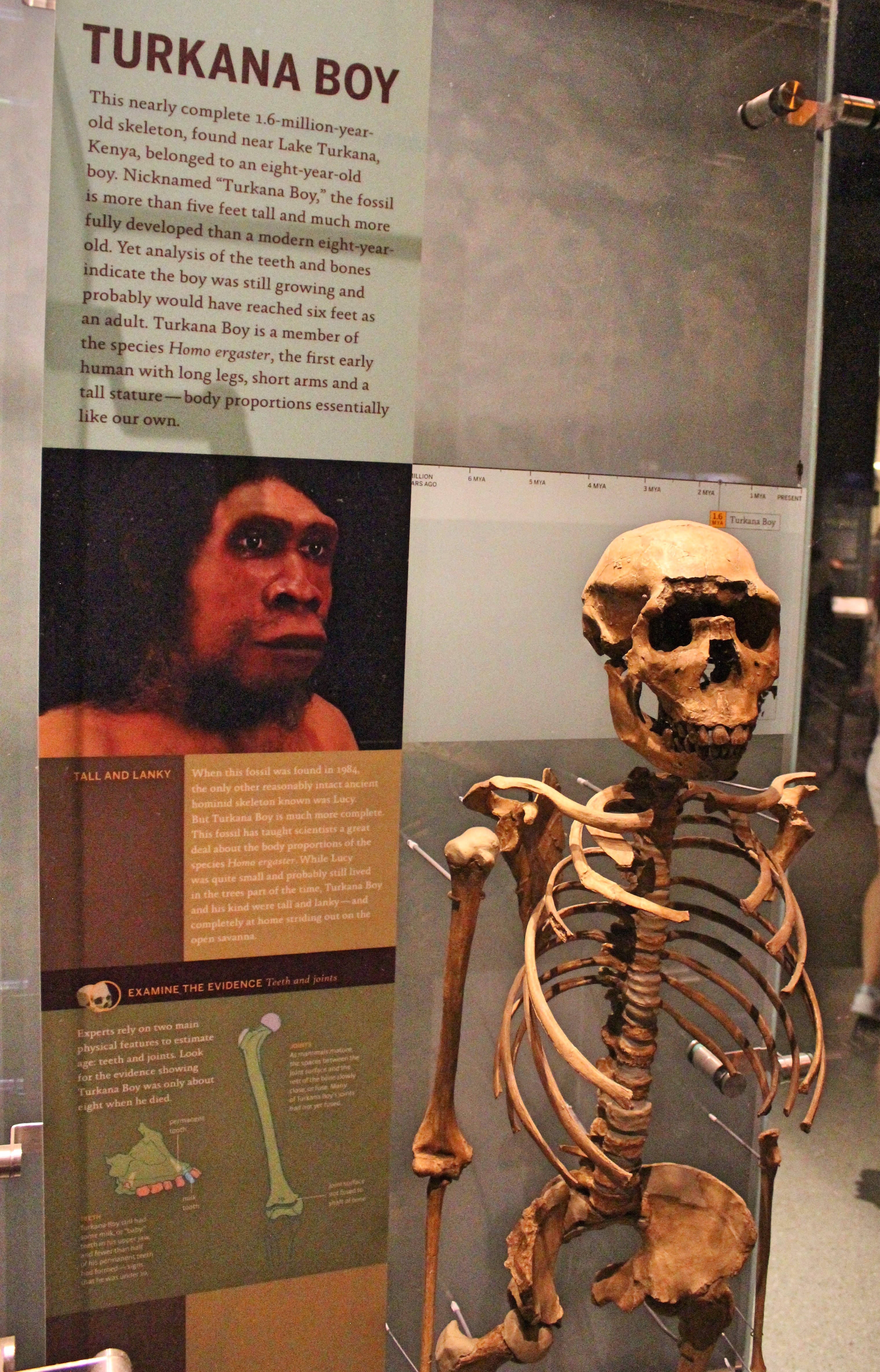
A major highlight are casts of famous human ancestor fossils, including Turkana Boy and Lucy. (I myself studied human evolution in the Turkana Basin, so it is always gratifying to see the plaque about the region.) There is also a reproduction of the Laetoli Footprints—imprints preserved in volcanic ash 3.5 million years ago, showing clear evidence of bipedalism—and a diorama of the what the two australopithecus may have looked like as they walked across the ashy plain (the male with his arm snuggly around his mate). There are also scenes representing the life of early humans, building shelters out of mammoth bones or being ambushed by giant hyenas. It was a tough life back in the paleolithic.
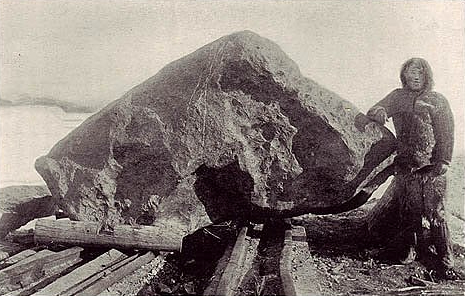
After moving through the Hall of Human Origins, you come to the Hall of Meteorites. This is most notable for containing a large chunk of the Cape York Meteorite. It is unknown when this iron meteorite struck the earth (near Cape York, in Greenland), though it was likely thousands if not millions of years ago. The original meteorite broke up into three large pieces, which were used by the Inuit living nearby to make iron tools. For decades Westerners searched for the mysterious source of iron (not easy to come by in the arctic), until Robert Peary, the explorer, finally found the meteorites and arranged for them to be transported and sold to the AMNH (likely without compensating the Inuit). The fragment displayed is so heavy that the foundations for the platform had to be built down to the bedrock below. It’s an awfully big rock. 
The Hall of Meteorites normally leads to the Hall of Gems and Minerals. However, this hall is closed for renovations at the moment, which does not surprise me, since every time I visited the hall struck me as looking decidedly retro. The angular, geometrical design of the room (which appropriately mirrors that of a crystal) was praised highly when it was opened in the 1970s; but nowadays it looks very similar to how Kubrick imagined the future would be, in 2001: A Space Odyssey. Nevertheless, this is one of the most beautiful corners of the museum. The glass displays, arranged throughout the room, are filled with gleaming stones—gems which reflect and refract light in a thousand distinct ways. 

(Visit here to see photos of the original gallery and concept drawings for the new gallery.)

This hall has a colorful history. Whenever I visit, I think that the hall looks like the kind of place Lex Luther would rob in order to get some kryptonite. Other people have had similar thoughts, it seems. In 1964, Jack Roland Murphy (“Murph the Surf”), with two accomplices, snuck into the museum and stole some of its most famous pieces: the Eagle Diamond, the DeLong Star Ruby, and the Star of India sapphire (all donated to the museum by J.P. Morgan). The thieves were eventually caught, and the jewels found and returned to the museum—the Star of India was found in a bus station foot locker—with the notable exception of the Eagle Diamond, which was likely cut into smaller pieces and sold. (Murph the Surf was later convicted for murder; in prison he became a minister and was released early; he is currently the vice president of the International Network of Prison Ministries.) 

The heist even inspired a 1975 movie.

We have gone to the very end of the museum, but we have still left out one of the museum’s most notable wings: the Rose Center for Earth and Space. Opened in 2000 (so I did not see it as a child) this is the newest part of the museum, and it shows. The space-age design features a massive central sphere enclosed in a glass cube. The new Hayden planetarium is housed within this sphere, where visitors can see shows projected on the upper dome. Neil deGrasse Tyson is the first and, so far, the only director of the Rose Center; and he narrates many of the astronomical shows.

Below this “cosmic cathedral” (as the designer called it) is the Hall of the Universe. Here you can find information about stars, planets, galaxies, and the moon, all displayed on sleek metallic panels. There are scales that tell you what your weight would be on Mars and the Moon (in pounds, which requires a conversion for non-American visitors). In one clear glass case there is a self-contained ecosystem of algae and tiny shrimp—a microcosm that represents the macrocosm of earth. A curving walkway that leads away from the planetarium takes the visitor through the entire history of the universe, from the big bang to the present day. 
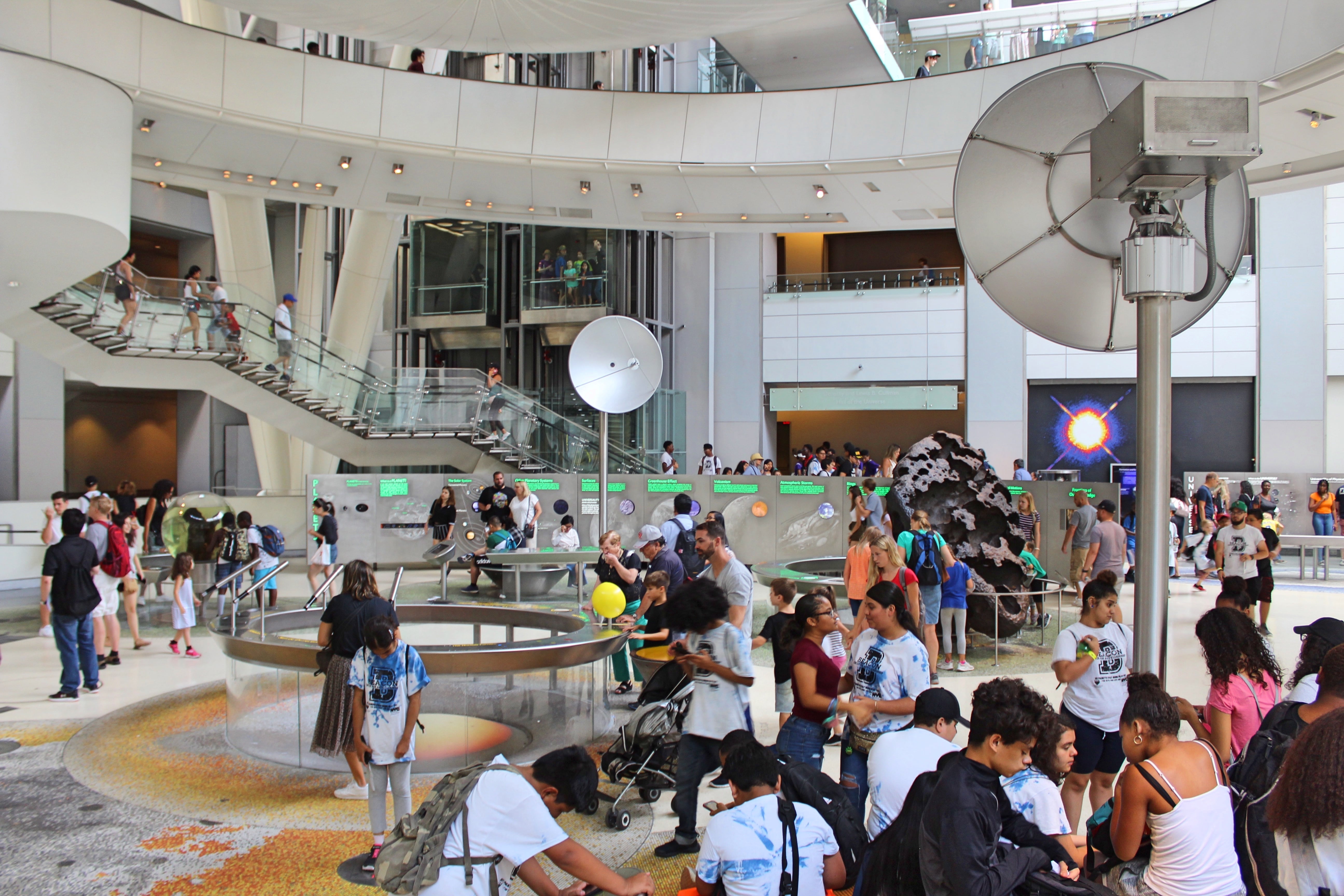
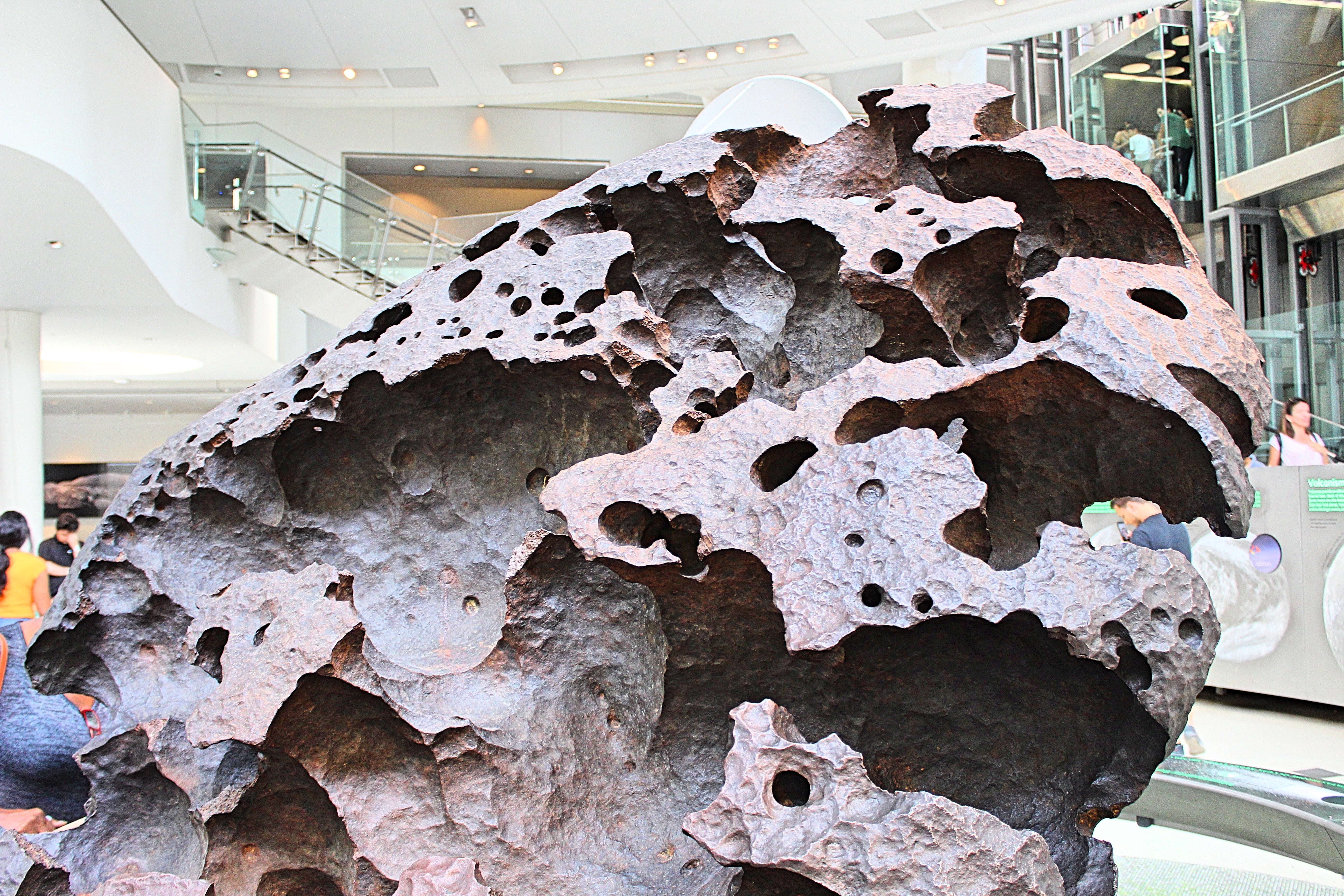
The star of the hall is the Willamette Meteorite. This is another iron meteorite, yet it looks strikingly different from the Cape York Meteorite. Its surface is pockmarked—I believe from centuries of weather erosion. The rock has been on earth a long time. Possibly the core of an early proto-planet, smashed to smithereens in a cosmic collision, this meteorite struck earth thousands of years ago (but we have yet to be able to find the impact sight). It was found in Oregon, but it was likely moved by expanding and receding glaciers. As with the Cape York Meteorite, the Willamette Meteorite was taken without the consent of the native peoples who had long known about it. This led to a lawsuit, in 1999, by the Confederated Tribes of the Grand Ronde Community of Oregon, demanding the return of the rock (which had been in the museum for nearly 100 years by then). Luckily, the AMNH reached a deal that allowed it to keep the meteorite.
Adjoining the Hall of the Universe is the Hall of Planet Earth, devoted to geology. This gallery has accomplished the difficult job of rendering geology visible, tactile, and immediate. The space is filled with models of geological formations, many of which can be touched. These slices of earth help to illustrate the normally invisible processes below the surface which have shaped our planet—the slow churning of the continental plates, the effects of receding glaciers and running water, the volcanic explosions which hurl up new land from the depths. The hall also has a section devoted to climate change, which features an ice core (a piece of ice formed over thousands of years) which the visitor can “read” by moving a monitor over different sections, thus revealing how the climate has changed. 
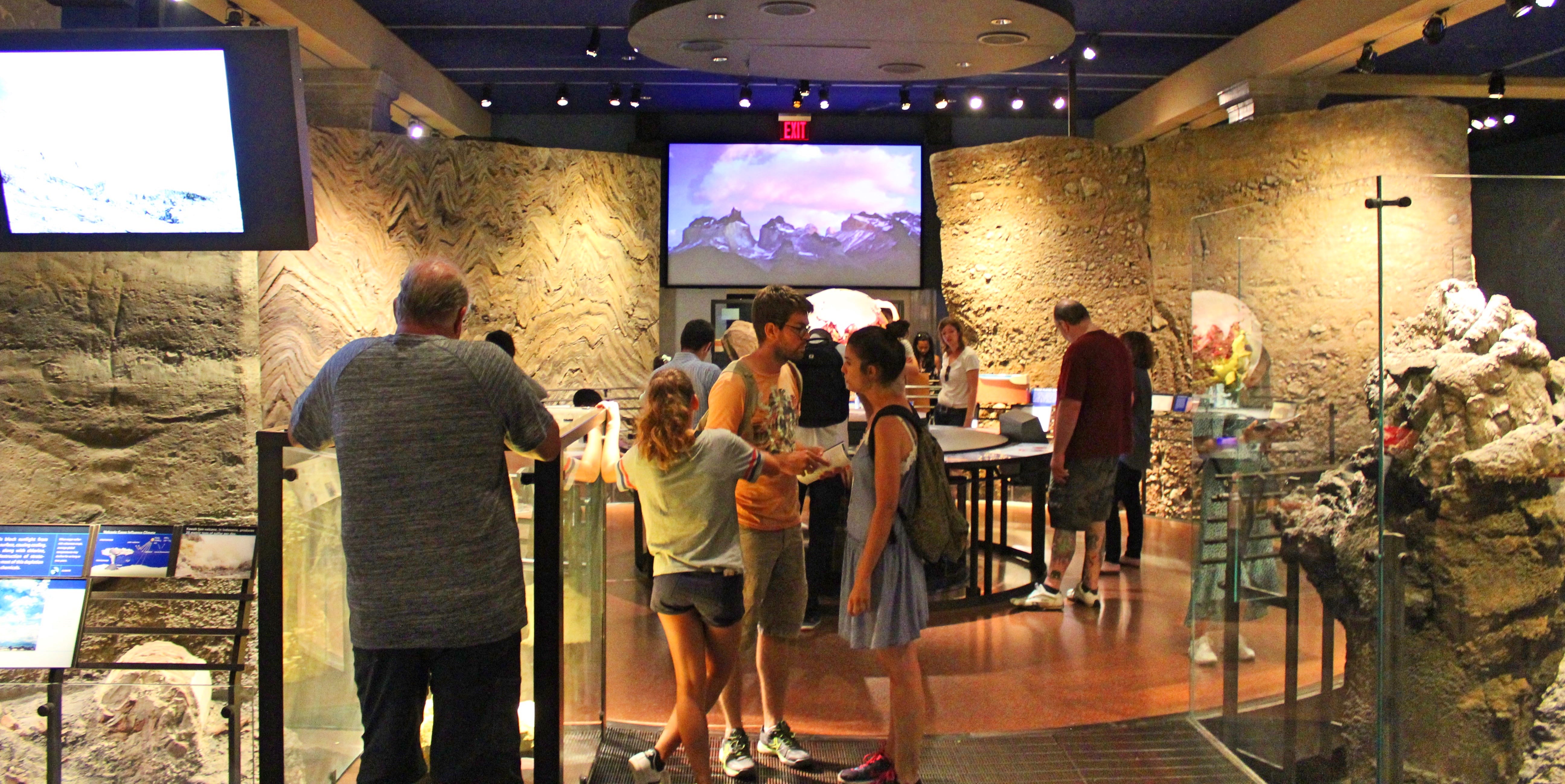
From what I observed, children love the Rose Center for Earth and Space. Everywhere I looked young kids were reading, looking, touching, laughing, and in general having a great time. To me this represents an accomplishment of a high order. Making whales and dinosaurs accessible to children is straightforward; but to make accessible the abstract theories of physics, the slow processes of geology, and the distant threat of global climate change—this calls for subtlety and skill, and the designers of this hall have accomplished their task with brilliance.

Now we must get to an elevator and ascend from the bottom to the top floor. We have dallied in the museum for a good, long time, and it will close soon, so we had better get to the spectacular fossil rooms on the fourth floor.

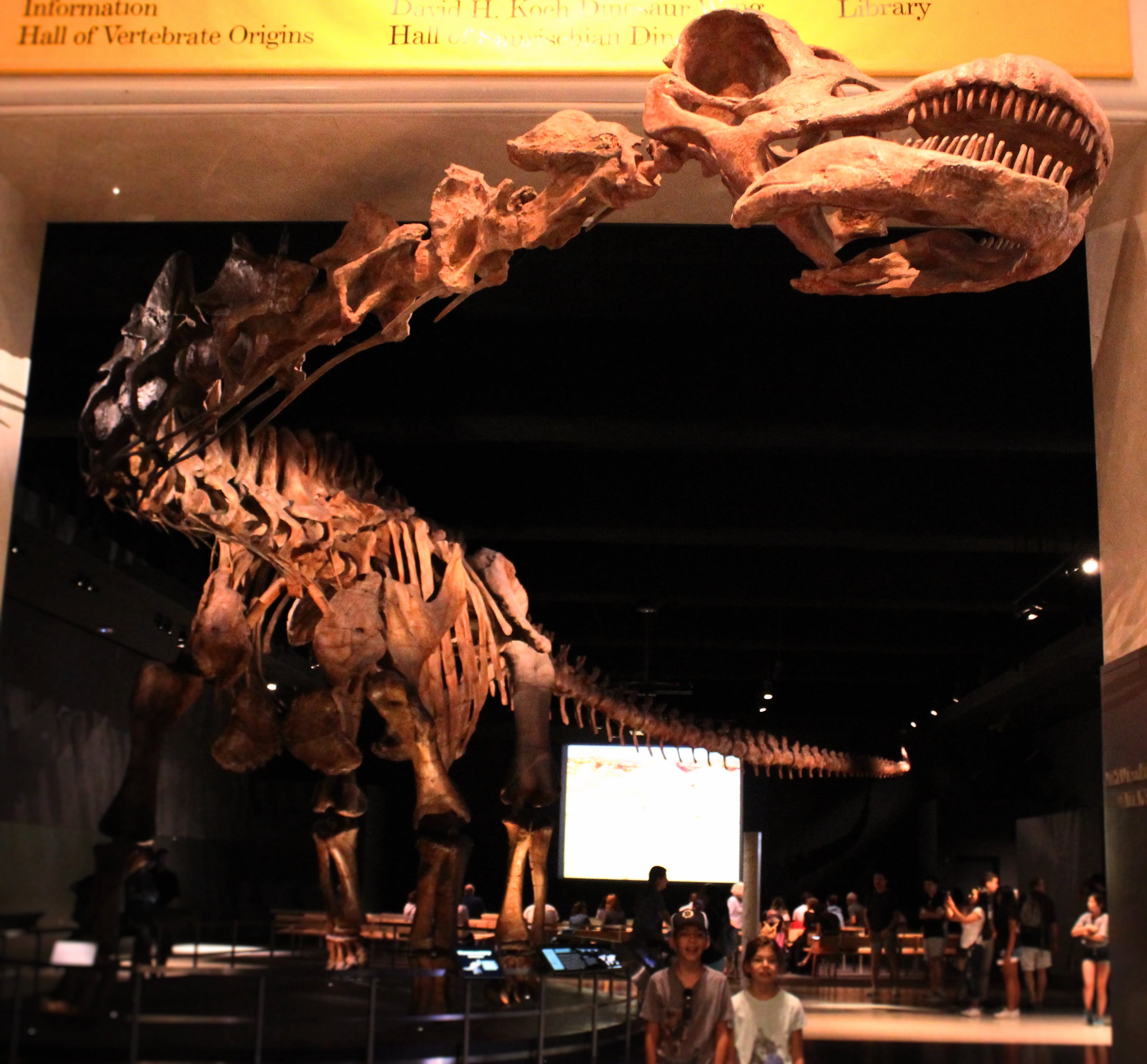
The proper place to begin is on the Orientation Hall. Here the visitor can see a video that explains some background of evolution and cladistics (making evolutionary trees). But the visitor will likely have difficulty focusing on this video, since in 2016 the museum added an enormous dinosaur to the room. This is the Titanosaur, a massive, long-necked sauropod whose form dominates the space. From tail to head, the animal stretches 119 feet (or 32 meters); and in life it likely weighed well over 60 tons (an adult elephant, by comparison, weighs about one-tenth as much). The size of these animals is simply staggering—especially considering that they began life in an egg scarcely bigger than that of an ostrich. How much vegetation did one of these have to eat in a day in order to survive? 
The fossil rooms make a closed circuit, so the visitor can go in any direction. The most logical direction to go in, however, is to begin with the Hall of Vertebrate Origins—since this way the galleries are chronological.

From the perspective of biology, the Hall of Vertebrate Origins is likely the most fascinating hall of fossils, even if it lacks any of the spectacular specimens of later eons. We can see examples of the first vertebrates, on sea, on land, and in the air. One of the more memorable fossils on display are the jaws of the extinct Megalodon, a shark that lived millions of years ago, and which grew several times larger than today’s great white shark. The tremendous and terrifying jaws, hanging from the ceiling, dwarf even the bite of a Tyrannosaur. Nearby hangs a model of the Dunkleosteus, an armored fish that lived many hundreds of millions of years before the Megalodon, and which likely was major predator of its day. Further on is a Pterosaur, a member of the first known vertebrates to have achieved flight. (Commonly called dinosaurs, the Pterosaurs were closely related but technically not dinosaurs. Also, the term “Pterodactyl” only refers to one subgroup of the Pterosaurs.)
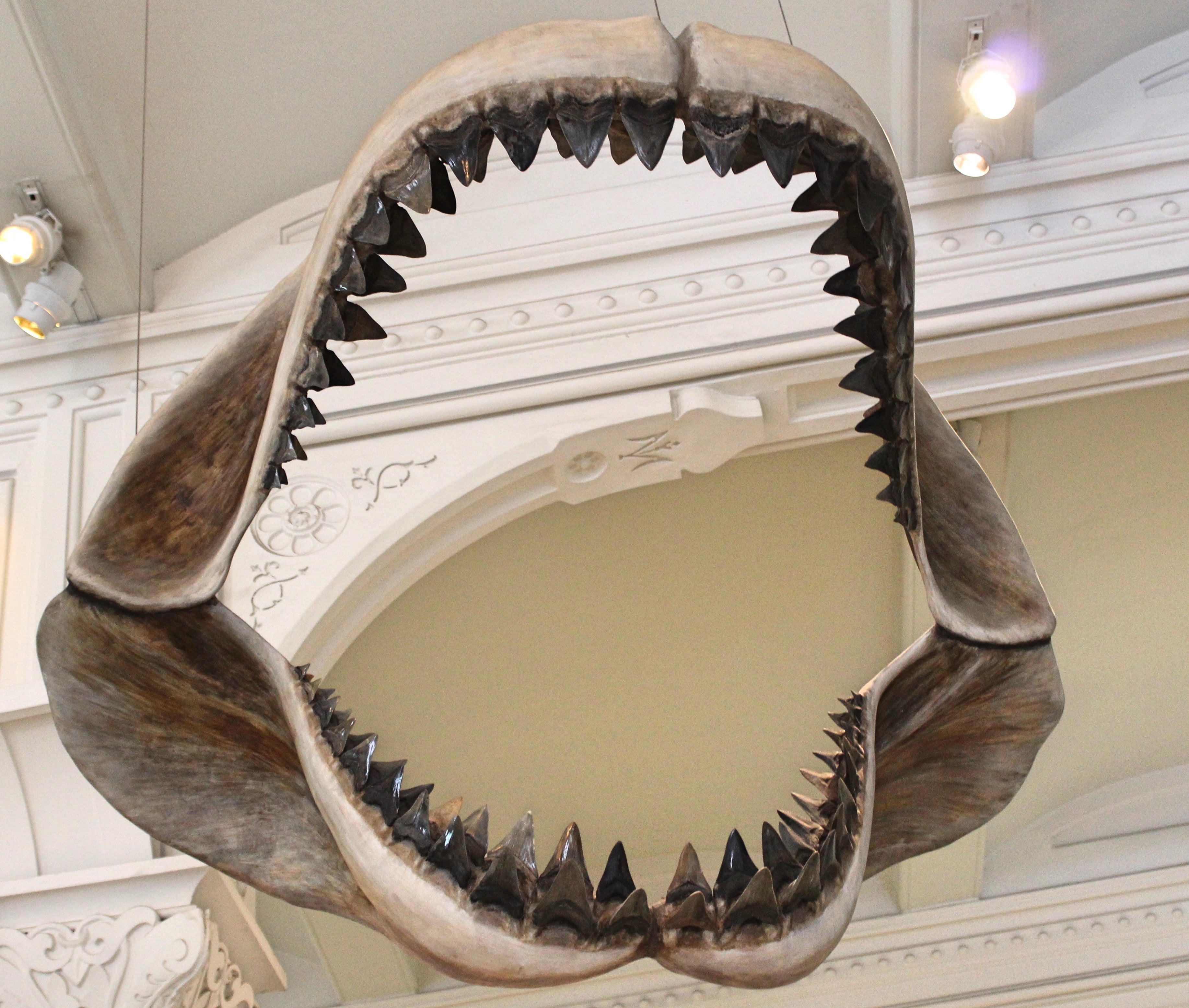
These three examples only touch on the immense biological richness in this hall. For anyone hoping to better understand the history of life on our planet, their time will be well spent in close examinations of the specimens on display. The museum also offers computer booths that allow visitors to scroll through various evolutionary trees and learn more about different species.

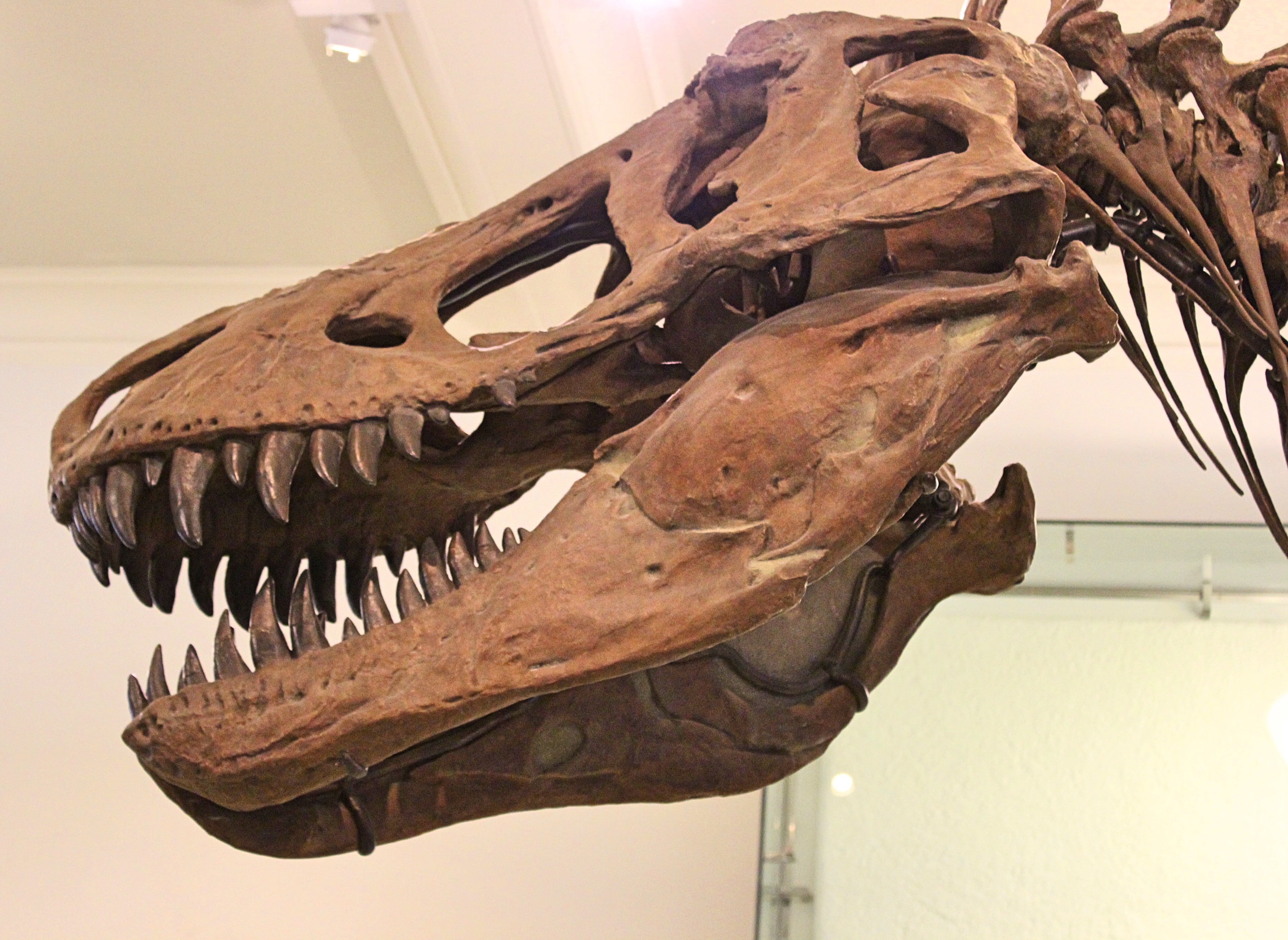
We now come to one of the museum’s most spectacular spaces: the Hall of the Saurischian Dinosaurs. Now, Dinosaurs are typically split into two large evolutionary groups, the Ornithiscia and the Saurischia. The latter includes all carnivorous dinosaurs as well as sauropods (and birds, the only living dinosaur group). This means that this gallery includes the famous Tyrannosaur. Even when manifestly dead, the Tyrannosaur has a commanding presence. The mere thought of it being alive is enough to cause goose bumps. And this predator—one of the largest to have ever walked the earth—was likely even more terrifying than we normally think. According to the paleontologist Stephen Brusette, Tyrannosaurus was highly intelligent, had excellent vision, and likely lived and hunted in packs. One of them is frightening enough; imagine a gaggle of T. Rex. And to think that this fearsome creature began its life no bigger than a chicken. 
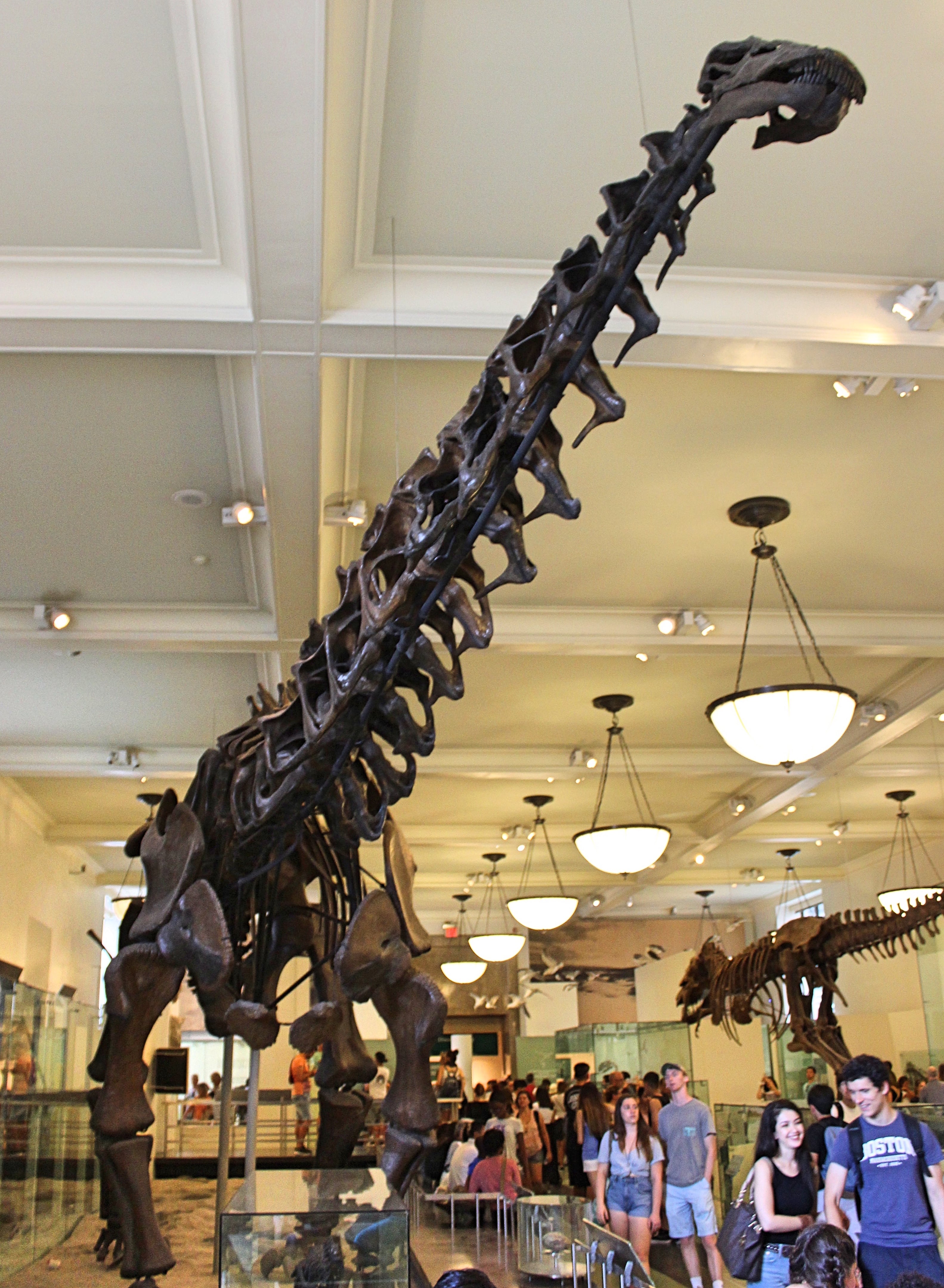
Across from the Tyrannosaur is another museum favorite, the Apatosaurus (sometimes called the Brontosaurus). This is a sauropod, somewhat smaller than the Titanosaur in the other room, but still large enough to make even the Tyrannosaur look petite by comparison. Another fearsome predator on display is the Allosaurus, a carnivore somewhat smaller than Tyrannosaurus that lived several million years earlier, which was an apex predator in its own epoch. This Allosaur is bending over to scrape some meat off of a fresh carcass. One less flashy specimen on display is the skull of a velociraptor (which, despite its portrayal in Jurassic Park, was about the size of a turkey).
Next we come to the Hall of the Ornithischian dinosaurs. This group does not contain quite as many star dinosaurs as the other hall, but it will not disappoint. Here can be found one of the museum’s most important specimens, a mummy of a duck-billed dinosaur. Unlike in the vast majority of dinosaur remains, here we do not only have the skeleton, but the skin of the ancient animal. This has allowed scientists to get a much better idea of what the scales of a dinosaur were like. Also on display is a Stegosaurus, famous for its small brain, spiked tail, and a back covered in vertical plates (whose purpose is still debated). My personal favorite, however, is the Triceratops, an herbivore that lived alongside T. rex and was one of its principal foes. Powerfully built, with a three-pronged horn and a protective ridge, hunting these beasts must have been no easy matter. 

I am always moved by the dinosaurs. They were magnificent animals, many of them so far beyond the range of size and power that we can find among today’s land mammals and reptiles. That such a diverse group of powerful beasts could go entirely extinct from a chance event—a meteoric bolt from the blue—cannot but remind us of our own precarious existence. Indeed, these chance catastrophes play a disturbingly crucial role in the history of life on our planet. Dinosaurs themselves would never have become so dominant if not for the Triassic-Jurassic extinction event (possibly caused by volcanic activity), which eliminated much of their competition. And the mammals would never have been able to emerge as the current dominant life form if not for the Cretaceous-Paleogene extinction event, which eliminated every one of these creatures (except for birds), thus leaving the stage set for us. But how long will we last?

The next hall focuses on the early history of our own clan, the mammals. The further back one goes in evolution, the mudier become the distinctions between distinct lineages. Thus, some of the fossils on display in the Hall of Primitive Mammals do not strike us as mammals—and in fact are not, only early relatives. Into this class falls the Dimetrodon, a sail-backed cuadroped that looks far more reptilian to my eyes than anything resembling a house cat. But a close examination of its skull reveals the tell-tale opening behind its eye socket, leaving a bony arch which scientists have decided constitutes the defining mark of a new class of animal, the Synapsids, which includes mammals.

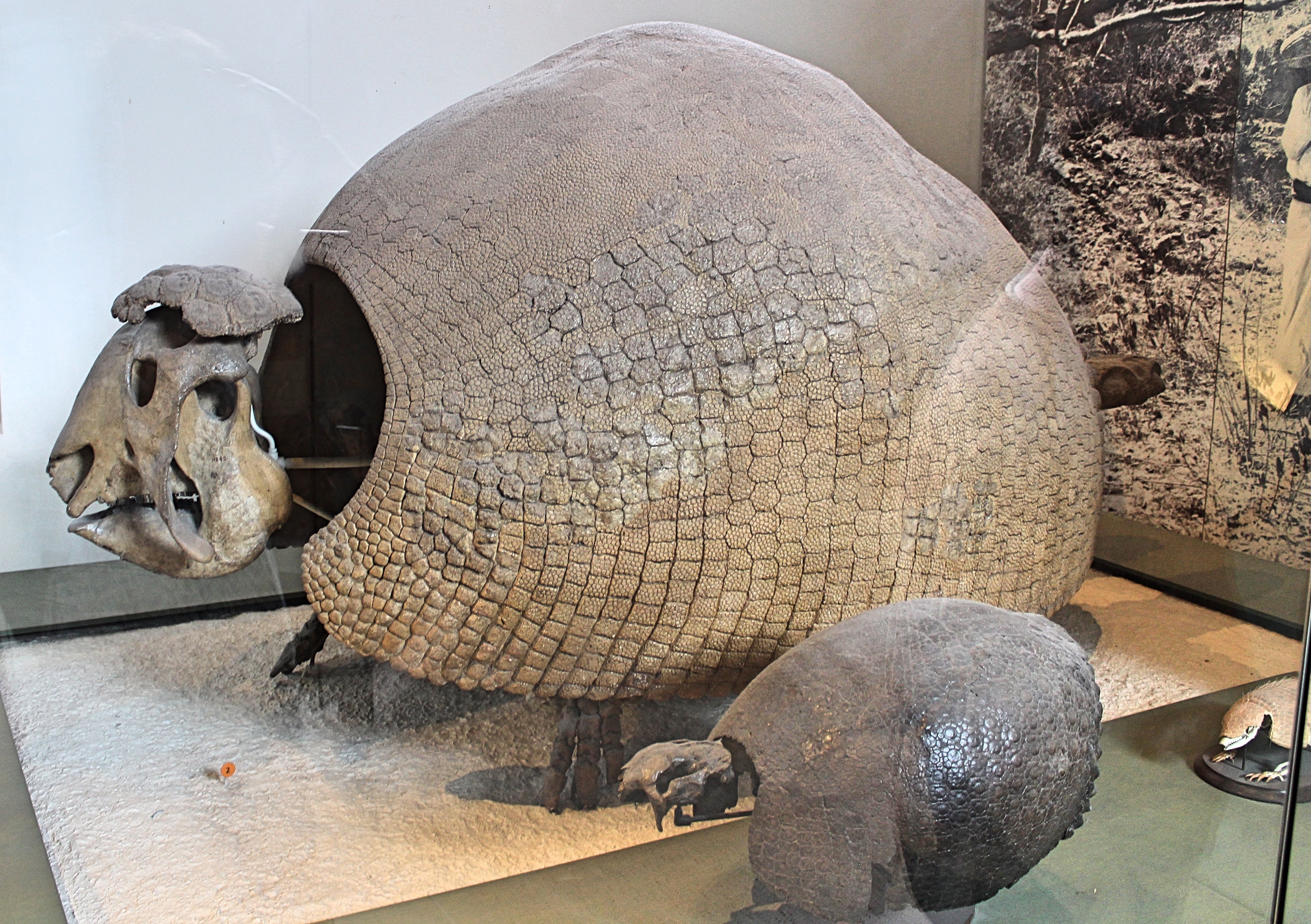
The Hall of Primitive Mammals is notable for the mammal island—a large array of fossil specimens that illustrate the range of mammalian diversity. By any measure, we mammals are an immensely diverse lot, having populated the land, sea, and air, occupying all sorts of niches, and ranging in size from a large insect (the smallest bat) to the biggest animal ever to exist (the blue whale). Amid this sea of variety we find the Glyptodont, an extinct relative of the armadillo, far larger and far more heavily armored. The face of this fossil preserves a sense of the patient drudgery which must have characterized this poor beast’s life, as it dragged its heavy shell through the landscape. The saber-toothed cat led a more exciting, if not more successful, life thousands of years ago, as did the lumbering cave bear. But the most terrifying skeleton of all may belong to the Lestodon, an enormous ground sloth whose gaping nose socket seems to look at you like a cyclops.
Finally we come to the Hall of Advanced Mammals, which features species more recently extinct (many of which died off during the great megafauna extinction 10,000 years ago). Here we can see a large array of specimens that illustrate the evolution of horses, growing up from dainty things the size of dogs up into the stallions of today (though, as often happens with evolution, this progress was not always linear). At the end of the hall we see extinct relatives of the elephant. One is the mastodon, which is about the size and build of a modern elephant, if slightly stockier. This nearly complete fossil skeleton was found in New York—amazing to consider.
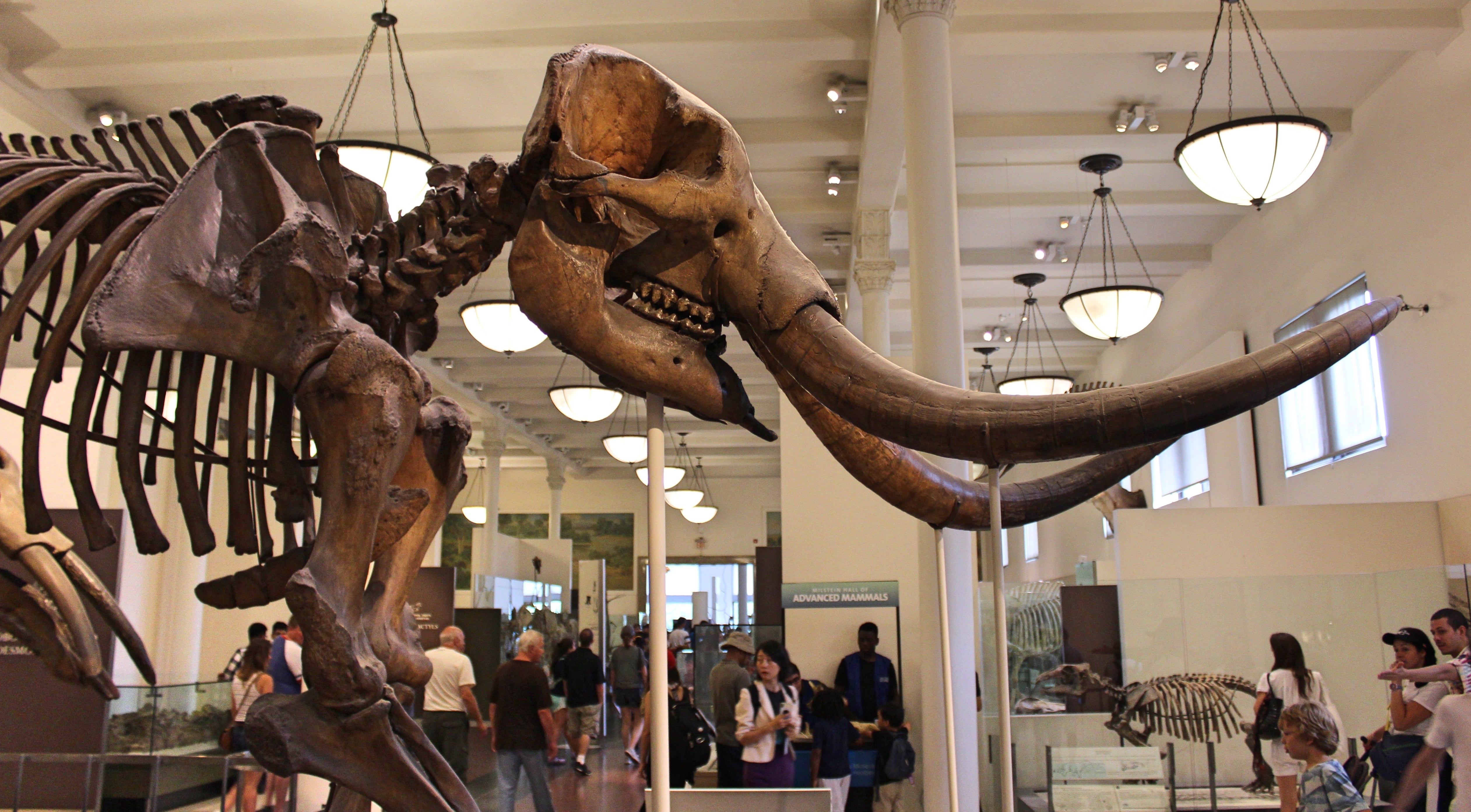
Standing a head taller is the Mammoth, a much closer relative of the elephant that went extinct not too long ago, while the Mesopotamian and Egyptian civilizations were well under way. It is massive, of nearly dinosaurian proportions, with tusks that curve so tightly inward that it seems they would have been useless for defense. (Scientists are now playing with the idea of using DNA from frozen mammoth remains to bring them back. I wish them luck.)

By now, you must be exhausted. Museum fatigue has set in, and you can no longer concentrate on or even enjoy what you are seeing. This is inevitable at the American Museum of Natural History. There is just way too much. I have already written far, far more than I planned to, and there is still so much of the museum left to explore. I have left out the Hall of Reptiles and Amphibians, the Hall of North American Birds, and the Hall of Primates. And that is not all. The museum has huge exhibits devoted to cultural anthropology. Aside from the aforementioned Northwest Coast Hall, there is the Hall of Asian Peoples, the Hall of African Peoples, the Hall of Mexico and Central America, and the Hall of South American Peoples.

And here I must add a note of criticism. It says a great deal that a museum of natural history would include exclusively non-Western cultures. Admittedly, this is largely a historical artifact of the time when the study of “primitive” living peoples was grouped with the study of human evolution and primate behavior in the discipline of “anthropology.” This grouping obviously reflected cultural and racial biases of the original founders of the field. But we have moved far beyond that, and now it seems discordant and strange to walk through, say, the Hall of Asian Peoples. How could a single hall, however well-made, encompass the enormous history and diversity of the Middle East, Central Asian, Southeastern Asia, and East Asia? Even encompassing the traditions of China alone would require a museum for itself. Not only that, but the cultural halls generally have a dark and dingy aspect, as if they have been left unchanged for decades.

So it is my hope that the museum soon refurbishes, not just the Northwest Coast Hall, but all of the cultural halls—taking into account not only advances in our understanding, but how the cultures themselves would like to be represented. Judging by the progress that the museum is already making in this respect, I think that the future looks bright.

What more can I say about the Museum of Natural History? I have already said more than I planned to, and yet it scarcely seems enough. My visits to the museum had a fundamental influence on me. My shifting interests throughout my childhood and adulthood—in marine biology, chemistry, physics, botany, human evolution, and human cultures—have virtually tracked the floor plan of the museum. From an early age, I have been possessed with a desire to collect, catalogue, and display—an urge which I am sure owes much to this place. Beyond its importance in my life, however, I see the Museum of Natural History as a model institution for the coming ages, as something much needed in our society, even as a kind of secular church for the new age: capable of appealing to the mind and to the emotions. I hope that every child may feel the wonder I felt, and still feel, at both the universe around us and the intelligence within, which has allowed us to know something of this universe.
Historic Hudson Homes: Kykuit

Historic Hudson Homes: Kykuit

This is part of a series on Historic Hudson Homes. For the other posts, see below:


By common consent, the richest man in modern history was John D. Rockefeller. At his peak he was worth at least three times more than the world’s current richest man, Jeff Bezos—over $300 billion to Bezos’s $112 billion. In a world before income taxes or antitrust laws, it was possible to amass fortunes which (one hopes) would be impossible today. Strangely, however, this living embodiment of Mammon did not have extravagant tastes. To the contrary, for a man of such unlimited resources Rockefeller was known for his simple, even puritanical, ways. According to Ron Chernow, a recent biographer, Rockefeller had a habit of buying homes and keeping the original decoration, even if it was absurdly out of keeping with his own taste, just to avoid an unnecessary expense.
Thus when John decided to buy a property near his brother William’s estate (Rockwood), near the Hudson River, he simply stayed in the pre-existing houses. (William’s Rockwood mansion has since been torn down, but the property has been transformed into a wonderful park.) The spot Rockefeller chose occupies the highest point in the Pocantico Hills overlooking the Hudson; it is named Kykuit from the Dutch word kijkuit, which means “lookout.” Likely enough Rockefeller would have been satisfied indefinitely with a fairly modest dwelling, had not his loyal son, John D. Rockefeller, Jr., decided to take charge of a manor house to be built for his father.

Junior and his wife, Abby Aldrich, set to work on an ambitious, architecturally eclectic design. They worried about every detail, as they knew how exacting and finicky the paterfamilias could be; the planning and construction took six painstaking years; the couple even took the precaution of sleeping in every room in the house, just to be sure that it was perfect. Nevertheless, John the father was unsatisfied; and he could not conceal his dissatisfaction. He was disturbed, for example, that the servants’ door was right underneath his bedroom window, so he could hear it clapping all day. Eventually (and doubtless to his son’s dismay) Rockefeller concluded that the house needed to be completely remodeled; and thus the current, Classical Revival form of the house came into being.

(An amateur landscape designer, Rockefeller was also dissatisfied with the work of Frederick Law Olmsted, whom you may remember as the designer of Central Park. Senior decided to do the landscaping himself.)

As in Sunnyside, tours are given by the Historic Hudson Valley. But you cannot go directly to the Kykuit property. To visit, you must buy a ticket in the gift shop of Philipsburg Manor, another historic site (a 17th century farm) in Sleepy Hollow, right across from the Cemetery. After you sign up for a tour, you board a small bus, which transports you on the 10 minute ride to the property. A cheesy informational audio clip plays during the trip, giving some brief background information about the family and the property. This sets the scene for the tour guide. I have, incidentally, heard that the content of the tour can vary significantly depending on the guide’s interests.

As the bus rolls in, through the gates and beyond the walls—passing by a “play house” still used by the Rockefeller family (many of whom still live somewhere on the massive estate)—one gets a sense of the private, exclusive, and isolated world inhabited by the world’s richest man. Widely known and, for a time, almost universally hated, Rockefeller needed to create his own refuge. My favorite detail was the tunnel underneath the mansion that was used to make deliveries without disturbing Rockefeller’s rest.Kykuit_facade

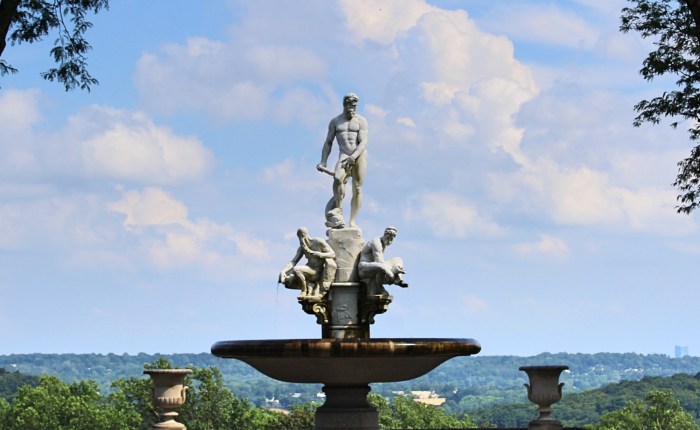
The bus deposited us in front of the house, near an impressive Oceanus fountain, copied from a fountain in Florence. Ivy crawls up the stone facade, all the way up to the neoclassical tympanum. An eagle crowns the top, displaying the family crest. From there the guide led us up onto the porch, where two strikingly modern statues stand flank the doorway. This is a constant feature in Kykuit: the juxtaposition between classic and contemporary tastes. John D. Rockefeller himself had very little taste in art, conservative or otherwise; his son, Junior, was enamored of the past—Greek, Medieval, even classical Chinese. Meanwhile, Junior’s wife, Abby, and his son, Nelson, were important patrons of modern art. Thus the house is an, at times, uneasy incorporation of these divergent tastes.kykuit_side

As a case in point, there are beautiful examples of Chinese porcelain on display throughout the house, protected by plexiglass cases. (The guide explained the glass was installed to protect them from playing children.) In a room used by Nelson Rockefeller there is also the vice-presidential flag, commemorating his term under Gerald Ford. Nelson wanted to be president himself, and he had the experience to do it—he was the governor of New york from 1959-72—but according to Ron Chernow, his divorce made him an unpalatable candidate. (How times have changed!) There were also portraits of the Rockefellers, and a phenomenal bust of the bald, decrepit, and yet mesmerizing John D. Rockefeller Senior—whom I was excited to meet, since I had just read a book about him.

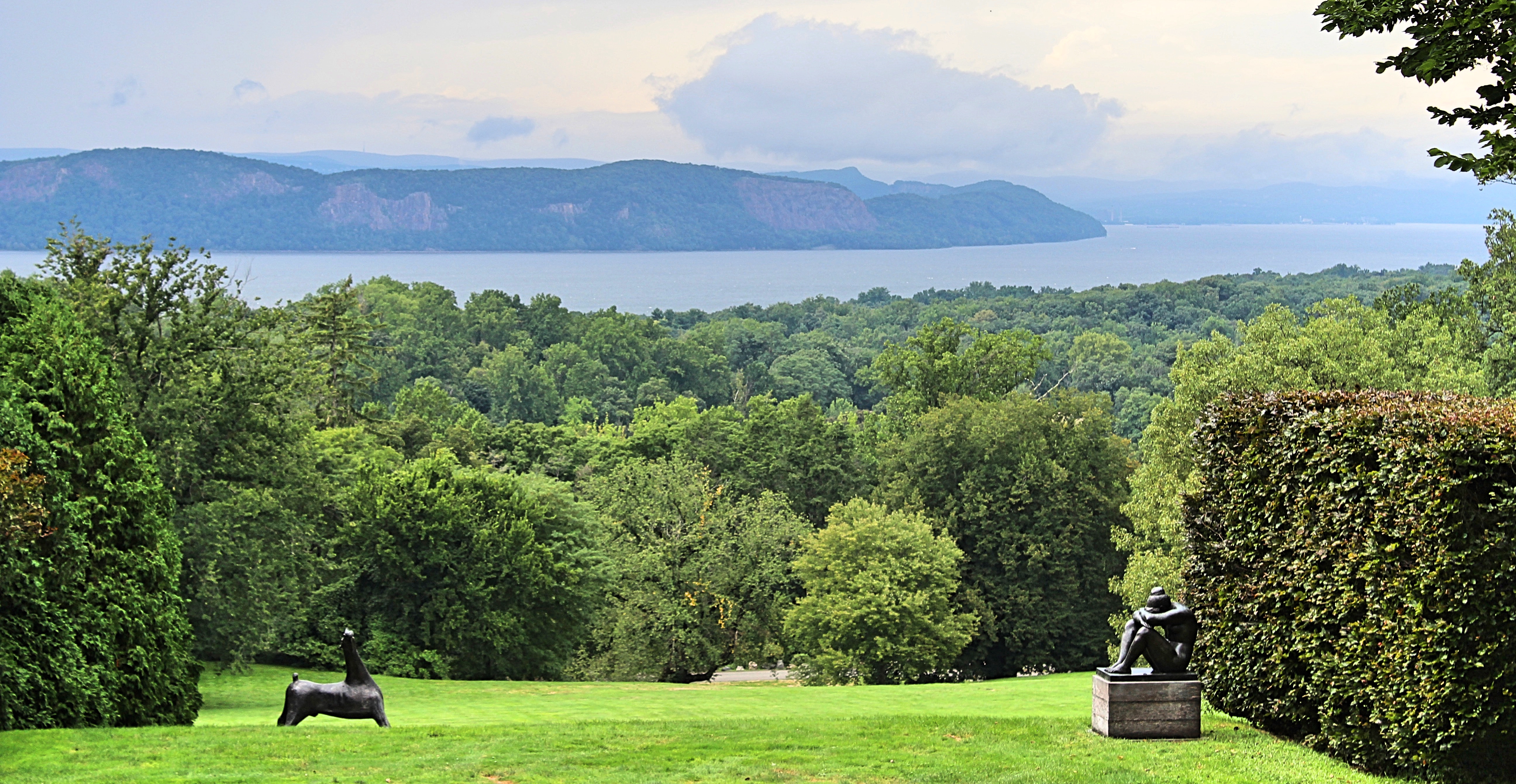
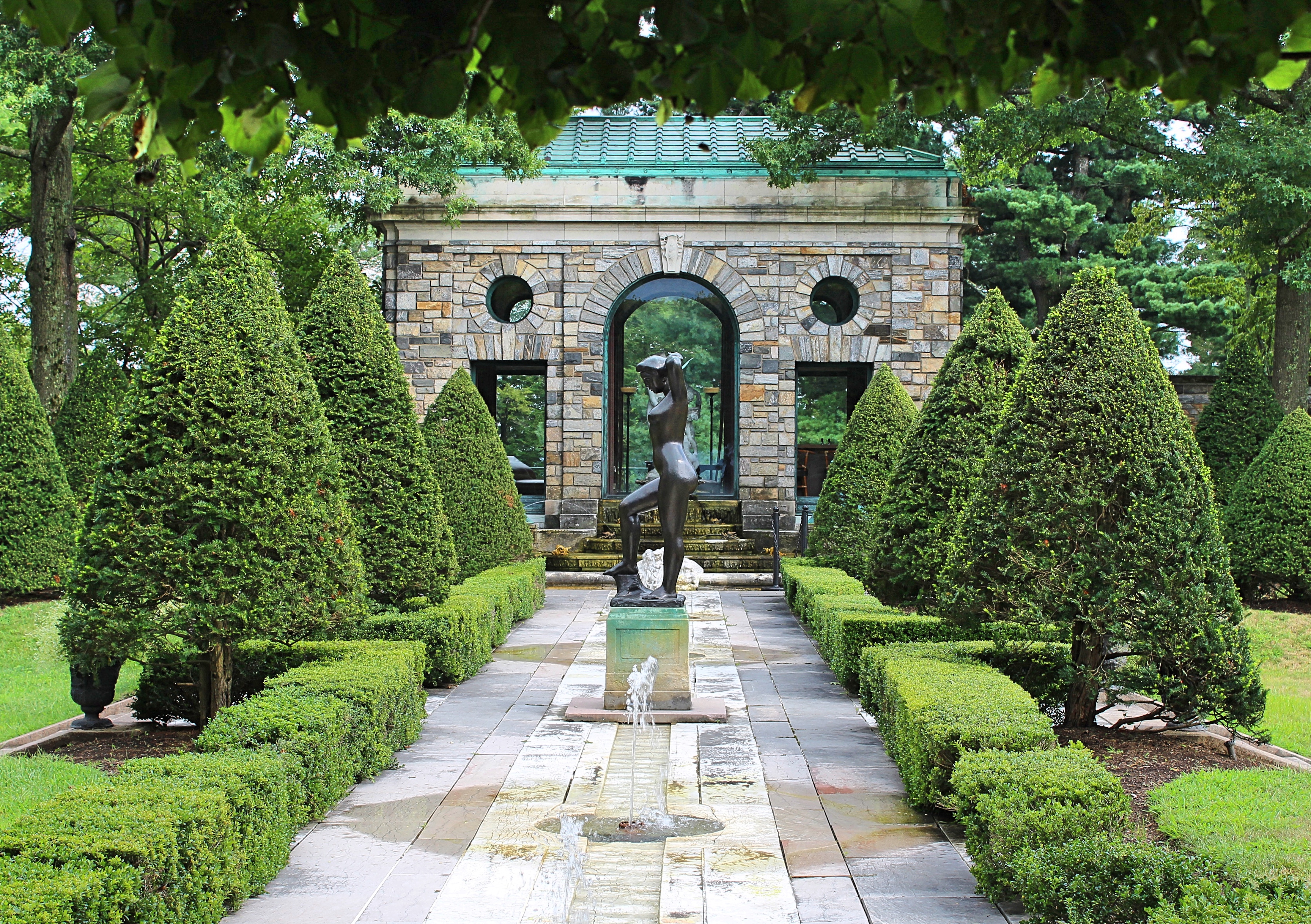
After this, our guide led us into the gardens. The most notable feature of these are the modernist statues scattered about—gruesome metal bodies amid neat hedgerows. Unsurprising for such a commanding spot, the view is excellent. On a tolerably clear day you can see all the way to Manhattan from the back porch. I imagined lounging on an easy chair, sipping some very posh drink—for some reason a mint julep comes to mind—and contemplating the Hudson. But of course the Rockefellers were Baptist stock, and teetotallers all, so the drink is pure fantasy. Beyond view (and beyond the scope of the tour) was the reversible nine-hole golf course that Rockefeller used with Baptist scrupulousness; after God and Mammon, golf was his top priority. Likely Rockefeller Senior would have been shocked and appalled by the massive modernist statue (resembling an alien squid) that was airdropped by helicopter into place on the property during his grandson’s tenure.

Then we made our way inside to visit the art gallery in the basement. This includes original works by many modern artist, the most famous being Andy Warhol; but the best works on display are undoubtedly the Picasso tapestries. These were commissioned by Nelson Rockefeller, to be made by Madame de la Baume Dürrbach, for the purpose of making his works easier to display. The biggest of these tapestries was a copy of Guernica, now on display at the United Nations building. Of the ones in this private gallery, my favorite is of Picasso’s Three Musicians (the original hangs in the MoMA). Even when I toured Kykuit as a child, tired, hungry, and very bored with all this old-people nonsense, I was impressed that a person could have Picassos in his basement; and my opinion has not changed.

To speed through the tour somewhat, we eventually boarded the bus again to go back to Philipsburg Manor. However, we did stop at the stables on the way back, which was filled with antique horse carriages and old luxury automobiles. In addition to being an avid golfer, you see, Rockefeller Senior also loved to go riding in his carriage and, in later life, to take fast drives in his fancy cars. (A strange detail from the biography is that, in later life, the upright and conservative Rockefeller would grope women during these rides. He was a man of many contradictions.)

This fairly well sums up my visit to Kykuit. It is an impressive place—six floors, forty rooms, and twenty bedrooms. Even so, considering Rockefeller’s vast fortune, and considering the kinds of monstrous mansions that other rich families—most notoriously the Vanderbilts—built for themselves, it is a restrained edifice. One can see the old Baptist tastes coming through, even amid all this wealth and splendor. Even so, I cannot imagine living in such a private world, so far removed from pesky neighbors and city noise. But the Rockefellers apparently had no trouble with the house. Nelson Rockefeller lived in it up until his death in 1979, when it was donated for use as a museum.

Before ending this post, I should also mention two nearby Rockefeller monuments.

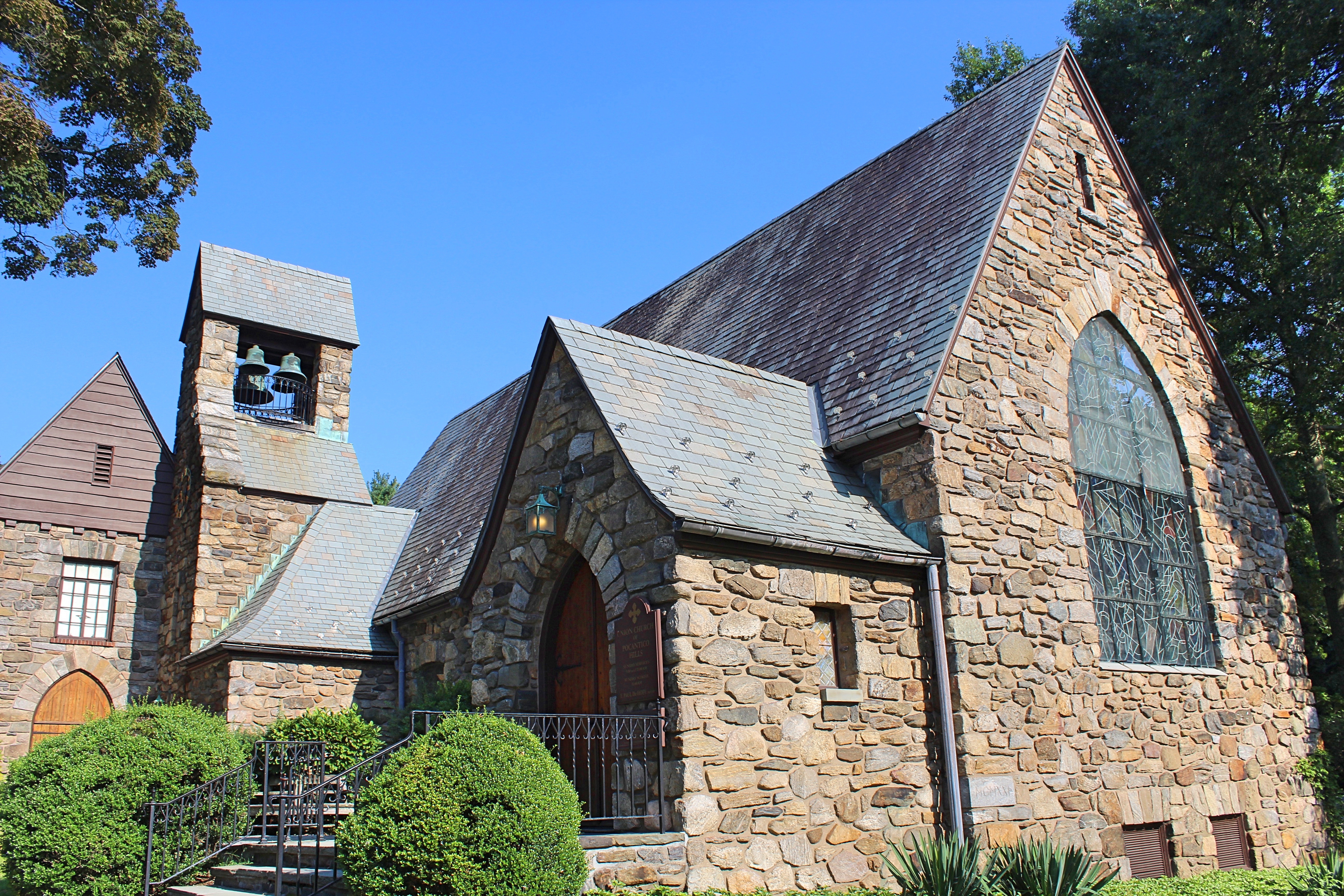
The first is the Union Church. This is one of two non-denominational churches (the other being Riverside Church in Manhattan) commissioned by John D. Rockefeller, Jr. It is an attractive and modest building, made of cut stone with a steeply slanting roof. Though the church does have an active congregation, most of the time its main use is as a tourist attraction, also administered by Historic Hudson Valley. The church is notable for its stained glass. The rose window was designed by the modernist pioneer Henri Matisse; according to the guide (I was the only one on the “tour”), it was the last work the artist ever completed. It is a simple, abstract pattern, yet subtly interesting to look at. More memorable, however, is the series of stained-glass windows completed by Marc Chagall, using Biblical scenes to commemorate deceased members of the Rockefeller family. Though I am normally not greatly fond of Chagall’s work, I must say that the strong, simple colors of Chagall’s windows created a pleasant—if not exactly religious—atmosphere.

Stone Barns

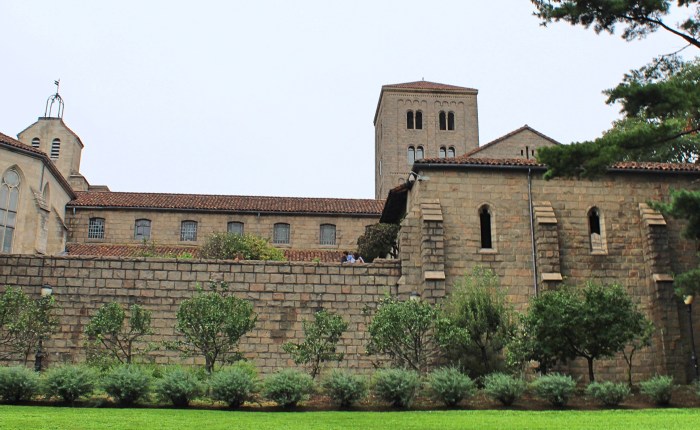
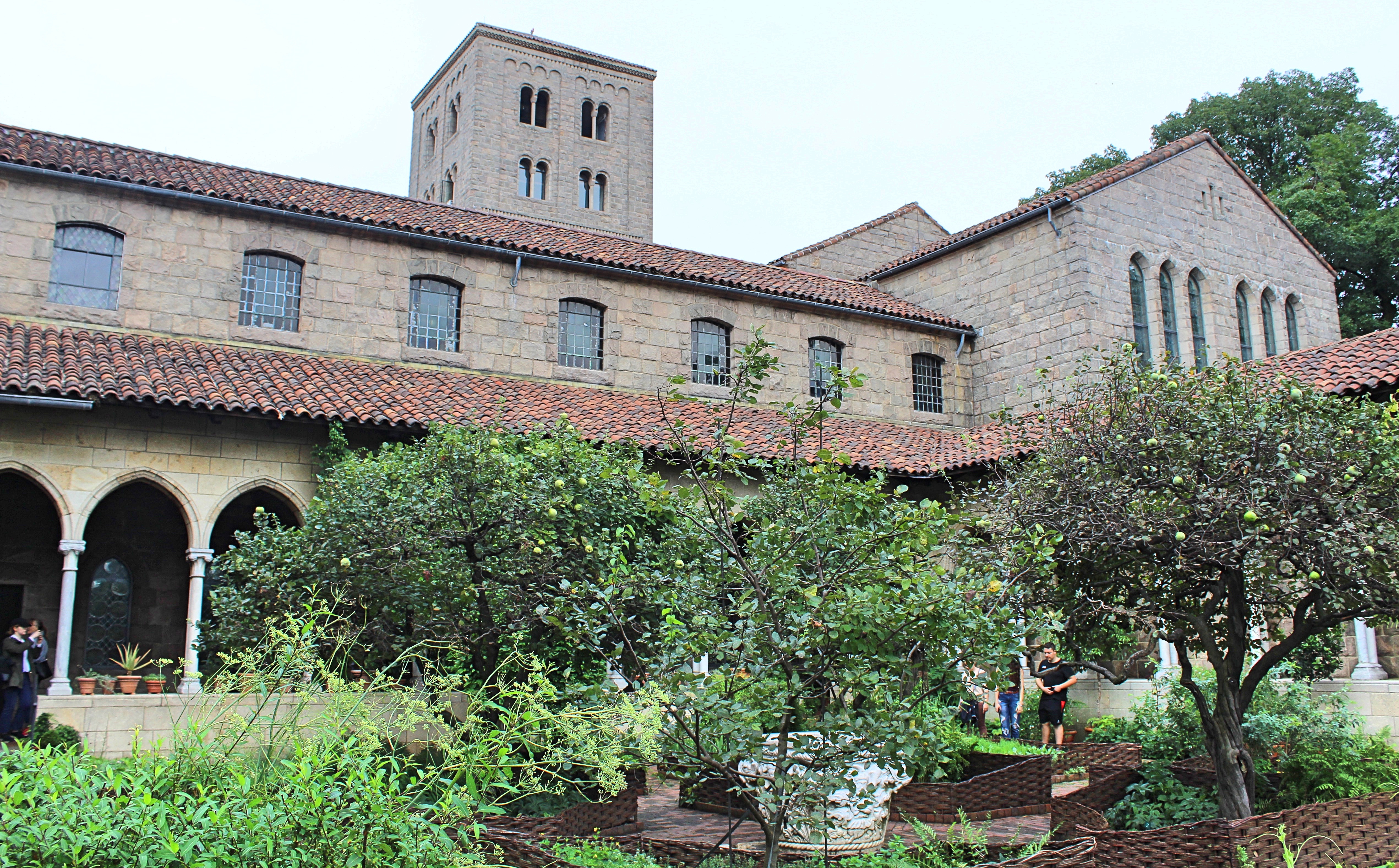
The second Rockefeller institution is Stone Barns, a center for sustainable agriculture established by David Rockefeller (Junior’s youngest son). (Sharing the Rockefeller talent for long life, David passed away just last year, at the age of 101.) The center lies on the edge of the Rockefeller State Park, alongside Bedford Road, surrounded on all sides by rolling farmland. It is a very pleasant place for a stroll. The buildings of the complex are completed in a style reminiscent of Union Church, as well as of the Cloisters museum in Manhattan: deep-grey cut stone. The farm is dedicated to growing high-quality produce and livestock without using anything “artificial.” Some of its products are served in the famous Blue Hill restaurant on the property—a place so absurdly fancy and expensive that, judging by the way things are going, I doubt I will ever get an opportunity to try. The menu, which costs $258 per person, consists of many different courses of artisanal dishes using esoteric ingredients. I have bought cheaper transatlantic plane tickets.

Processing…
Success! You're on the list.

Historic Hudson Homes: Sunnyside

Historic Hudson Homes: Sunnyside

This is part of a series on Historic Hudson Homes. For the other posts, see below:


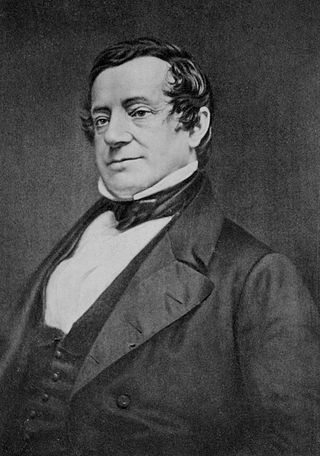
Washington Irving haunts my corner of Westchester like a beneficent ghoul. As a quintessential New Yorker, and the first American writer to gain international prominence, he left monuments to his memory scattered about everywhere. In my native town of Sleepy Hollow, he is inescapable: our municipal statue, our high school football team, and our most famous landmark, the cemetery—not to mention postcards, ghost tours, haunted hayrides, and all our other identifying symbols. Irving was clearly a generous person, as he donated his own name to the town next door, Irvington, where his house still remains as a tourist attraction.

320px-Irving-Washington-LOC
Washington Irving

In the grand scheme of the universe, Sunnyside is quite close to my own domicile. Yet when, like me, you lack a car; and also, like myself, you enjoy walking places, the journey can take a long while. Luckily the walk there is very pleasant, since Sunnyside is right next to the Aqueduct trail that extends from NYC all the way to Croton. The path took me through the heart of Tarrytown, across Route 9, and then past Lyndhurst mansion—another historic Hudson home, an extravagant neo-gothic castle once owned by Jay Gould. After that I passed by a large property owned by the Belvedere Family Community (otherwise known as Unificationists), who have chosen this picturesque spot to bring about world peace.  

By the time I reached Sunnyside I was tired and very sweaty. But paying customers, even smelly ones, are seldom turned away. Sunnyside is run by the Historic Hudson Valley, an organization which administers several other sites along the river (such as the subject of my next post, Kykuit). To visit you must sign up for a guided tour, which you do in the gift shop (as you are conveniently surrounded by overpriced books and paraphernalia); the price is a little more then $20. As I waited for the tour to start, I was tempted to buy a copy of Irving’s History of New York, his breakthrough piece of social satire; but I remembered I already have a copy on my Kindle. For all its social ills, technology does occasionally save us from gift-shop prices.

Sunnyside_Tarrytown_Currier_and_Ives_crop_closeup
An artist’s rendering

In minutes, the tour commenced. Our pleasant guide, who was dressed in period costume, took us to our first stop: a ripe old sycamore tree, planted in the heart of the property. It has been growing there since 1776—respectably middle-aged for a tree but not exactly venerable. Our guide then directed our attention to the property itself. Apparently Irving was an amateur gardener and landscape designer, and helped to mold his property according to his romantic tastes. Here there are no French gardens, with neat hedgerows and grid-like walking paths, but something more akin to the English Gardens in Munich: a blend of planning and nature.

Of course, the property was originally much nicer, since it extended all the way to the Hudson River. But when the Hudson Line railroad was completed in 1849, it cut off his property from the water; and I cannot imagine the country-loving writer had much affection for the noisy, screeching, fuming locomotives chugging before his windows. Even today, the whooshing of the Metro-North disturbs the peace of this hitherto isolated spot. In fairness, the Metro-North has compensated by naming a few of their train cars after the famous writer and his creations—Headless Horseman, Knickerbocker, Ichabod Crane, Rip Van Winkle, and so on. I should also note that the observant rider on the Hudson Line can catch a glimpse of Sunnyside between the Irvington and Tarrytown stations, somewhat south of the Tappan Zee Bridge.

Sunnyside_west_facade_and_piazza
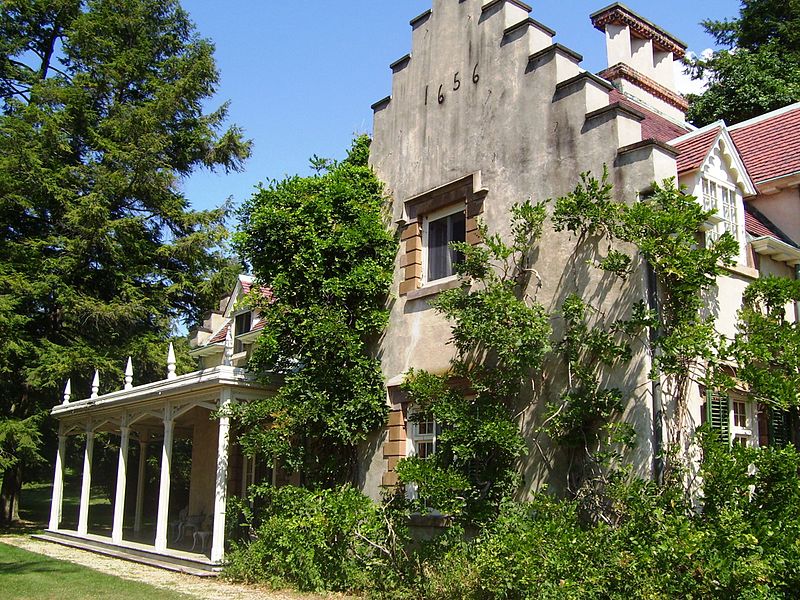
The West Façade. Photo by Beyond My Ken; licensed under CC BY-SA 4.0; taken from Wikimedia Commons

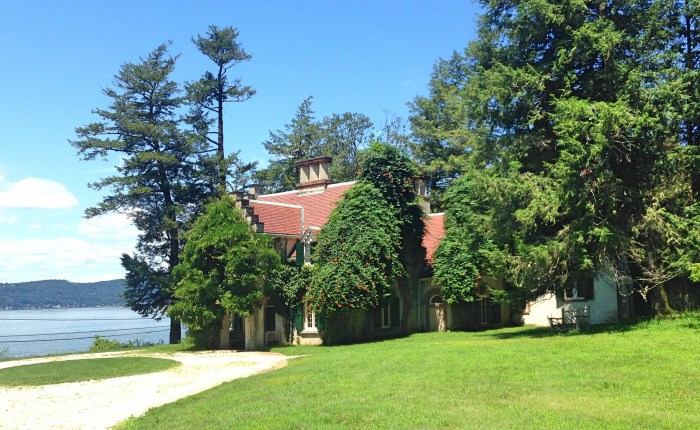
The building of Sunnyside itself is arrestingly modest—indeed, hardly bigger than my own suburban home. Its exterior bears the whimsical and fanciful humor of its maker. Most obvious is the Dutch stepped-gable, which shows how fascinated Irving was with the original Dutch inhabitants of this region. (His most famous characters, and even his own pseudonym, Knickerbocker, bear testimony to this interest.) On the river-facing side of the house he put the date 1656—a date which only roughly corresponds to the first cottages build on this land by Dutch settlers (in the 1690s), and which shows Irving’s love for mixing fact and fiction heedlessly together (as he did in his history of New York and his biography of Columbus). And last we come to the so-called Spanish tower, whose sharply swooping roof is modeled after Spanish golden age architecture (such as the El Escorial). Irving, you see, spent a good many years in Spain as the American ambassador (I cannot even escape him here!), so he was naturally interested in Iberian architectural styles.

Sunnyside_Spanish_Tower
The Spanish Tower. Photo by Beyond My Ken; licensed under CC BY-SA 4.0; taken from Wikimedia Commons

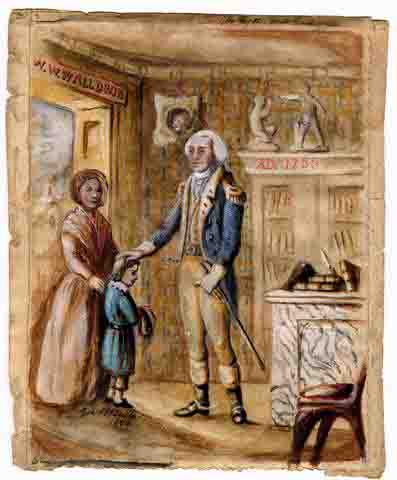
My memory of the interior is necessarily more vague, since you cannot take pictures. In any case, there are few surprises—a study filled with books, a living room with a piano for social events, a bedroom (where Irving happened to die), and so on. My favorite object on display was a little watercolor, apparently by Irving himself, depicting his legendary meeting, as a boy, with his namesake George Washington. (According to our guide, it cannot be determined whether this meeting actually took place.)

Irving had little more than twenty years to enjoy his cottage, from its construction in 1835 to his own demise (he died of a heart attack in the bedroom upstairs) in 1859; and this was interrupted by his long stay in Spain. Though he chose the spot for its picturesque isolation, considering it a kind of writerly escape from the noise of Manhattan, he seldom had peace: besides the railroads, he had to contend with many visitors, both invited and uninvited. If we had to look for a modern parallel to the fame Irving enjoyed, we would have to choose a figure such as Stephen King or George R.R. Martin. Both he and his house were a sort of American monument, gracing the covers of magazines and attracting tourists. Besides this public attention, the bachelor Irving shared his house with his brother Peter, and Peter’s daughters, whom had fallen on hard times. Irving’s very presence transformed this country escape into a center of American culture.

Washington_Irving's_Encounter_with_George_Washington
Washington Irving meeting George Washington

There is little more to add. After Irving’s death the family lived on in the house for several generations, only finally parting with it in 1945. For its preservation we must thank a man who is quickly becoming one of the heroes of this blog: John D. Rockefeller, Jr., who bought up the house and turned it into a museum. For any lovers of literature or history in the Hudson Valley, it is well worth a visit.

NY Museums: The Cloisters

NY Museums: The Cloisters

This is part of a series on New York City museums. For the other posts, see below:


Sitting atop one of the highest points on the island of Manhattan, overlooking the palisades of the Hudson Valley stretching northwards, is the most convincing slice of Europe in New York—perhaps in the country. This is the Cloisters, a branch of the Metropolitan Museum, specializing in medieval art and architecture.

Like any great museum, the story of the Cloisters begins with a person and his vision. In this case we have George Grey Barnard, a European-trained sculptor and collector, who managed to acquire a large collection of medieval sculptures, pillars, and and tombs during his time in France. He did this by focusing on stones that had been the victims of pillage and war—often repurposed by local populations for mundane needs. This was an especially amazing feat, considering that Barnard—an exuberant and impulsive man—was not wealthy to begin with, and had terrible spending habits which often landed himself on the verge of financial ruin.

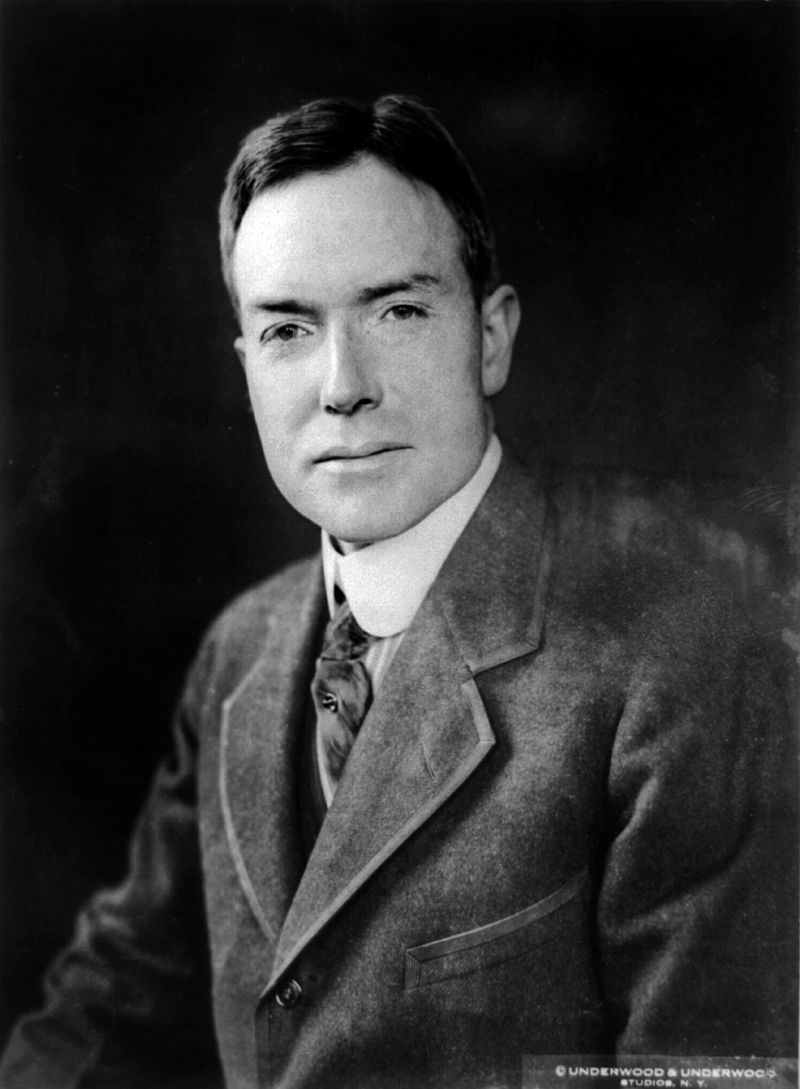
Junior
John D. Rockefeller, Jr.

It was during one of his periodic pecuniary crises that he was forced to sell his collection to John D. Rockefeller, Jr., a man who could hardly have been more different—puritanical, reserved, prudent. But the two men shared a love for medieval art; and Barnard’s collection was the first step towards Junior’s dream of opening a museum in this romantic niche of Manhattan.

Things moved rather swiftly with the world’s wealthiest man financing the project. After the acquisition of Barnard’s collection in 1925, Junior had Fort Tyron Park built around the chosen site (designed by the descendants of the designer of Central Park); then, he had substantial sections from abbeys in Catalonia and France shipped to New York, where they were incorporated into a single structure. The museum was then donated to the Metropolitan Museum, and the park to the city. The result is an oasis of medieval Europe in uptown Manhattan.

It is interesting to compare this museum to the one founded by Junior’s wife, Abby Aldrich: the MoMA. They are a study in contrast. The MoMA sits right in the center of the city, surrounded by activity and noise; its design is sleek and modern, with a vertical orientation and sterile white walls. The Cloisters is situated far from the city center; indeed it is somewhat inconvenient to visit the museum, since it is so out of the way. The surrounding park is quiet and bucolic, a haven from the noise and stress of city life. The museum building itself is an attempt to recreate the past: using traditional materials and techniques to mimic a bygone age. If the MoMA tries to break with tradition, the Cloisters tries to break with modernity. It is a wonder that Junior and Abby got along so well, since they had such diametrically opposed attitudes to art.

cloister_cloisters

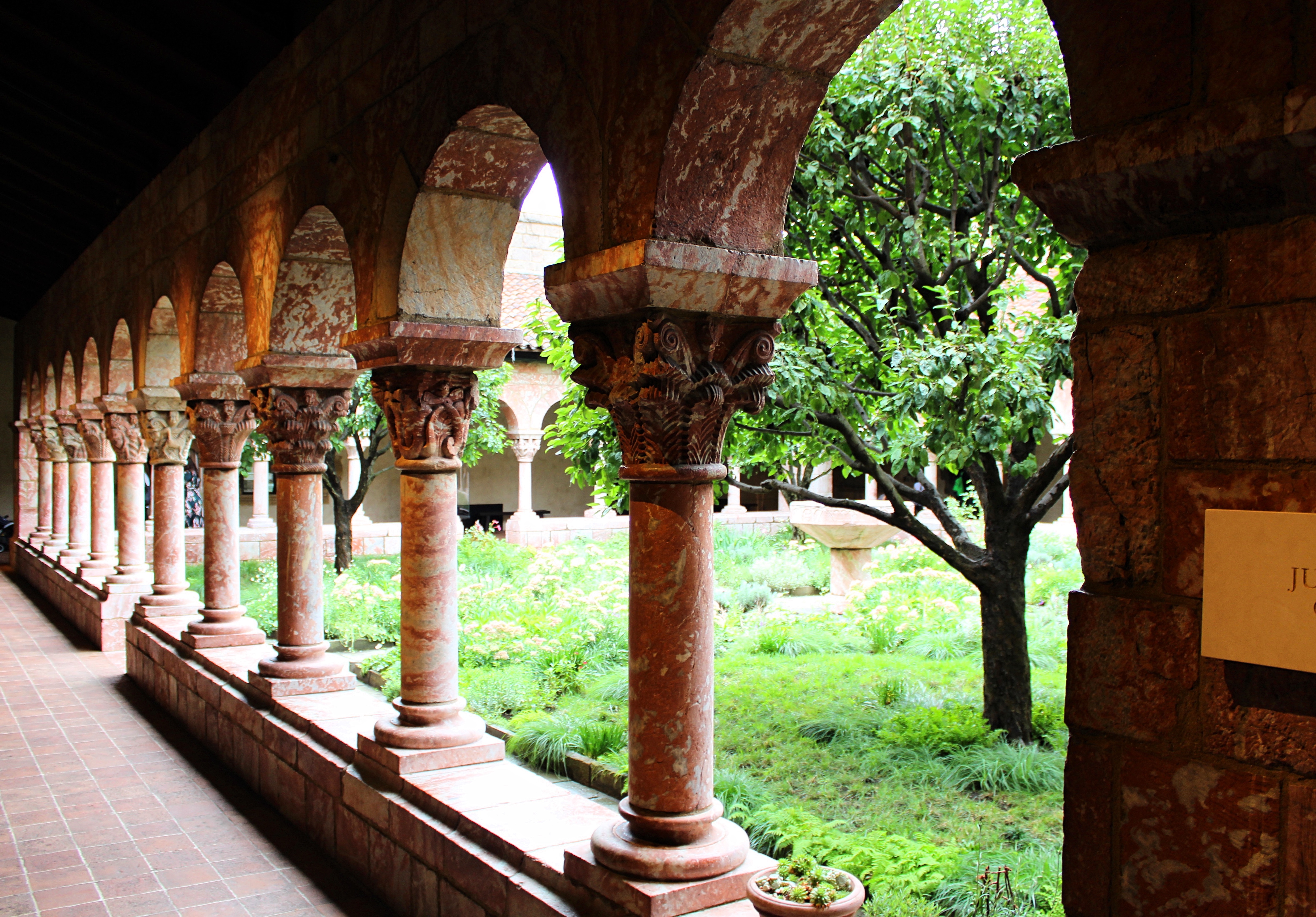
The Cloisters is exceptional in that the building itself is one of the main attractions. Whenever possible, the original materials have been integrated into the structure, creating a faux-monastery, complete with quasi-churches and pseudo-cloisters, where imaginary monks perform invisible rituals. There are several ornamented doorways, with sculptures climbing up the sides and crowning the top. Some walls display decorative friezes—Biblical scenes and medieval bestiaries—and the windows shine with colorful stained glass. The cloisters have authentic columns, complete with Romanesque capitals; and there are three gardens where rare plant species pertinent to the medieval mind are grown. (Apparently, the madonna lily is associated with love and fertility.)

garden_cloisters

As for the museum’s collection, on display are fine examples of every type of medieval plastic art: paintings, altars, carvings, sculptures, reliquaries, sarcophagi, illuminated manuscripts, stained glass, and tapestries. For the most part these are not organized by medium or style, but by their architectural setting: they are placed to create a harmonious and authentic experience. Thus walking around the Cloisters is akin to exploring a great cathedral, whose every chapel contains distinct works of art, organized by religious themes rather than academic categories. The final effect is not an emphasis on any one piece in the collection, but on the collection as a gestalt: an integrated, aesthetically captivating space.

interior_cloisters

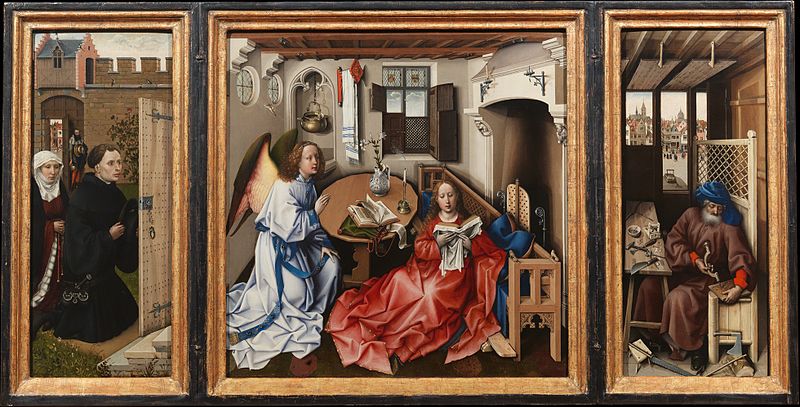
Nevertheless some pieces to stand out for special comment. One is the Mérode Altarpiece, whose central panel depicts the annunciation. It is a wonderful example of Dutch realism, showing a celestial scene taking place in a modest Dutch living room. I particularly like the Virgin’s round, plump face, and her carefree expression as she idly reads a book, not even bothering to look up at the angel bearing news of universal significance. In general the interior is convincingly painted—filled with fine detail, especially the book lying open on the table—but the perspective is a little uneven, as you can clearly see when comparing the table to the room. The kneeling figures of the donors are on the left-hand panel, looking appropriately wan and penitent. On the right, Joseph (looking considerably older than his wife) is busy at work as a carpenter; and behind him, through the window, we can see what is obviously a lovely Netherlandish town. (Biblical scholarship was not highly advanced in those days.)

Annunciation_Triptych_(Merode_Altarpiece)_MET_DP273206

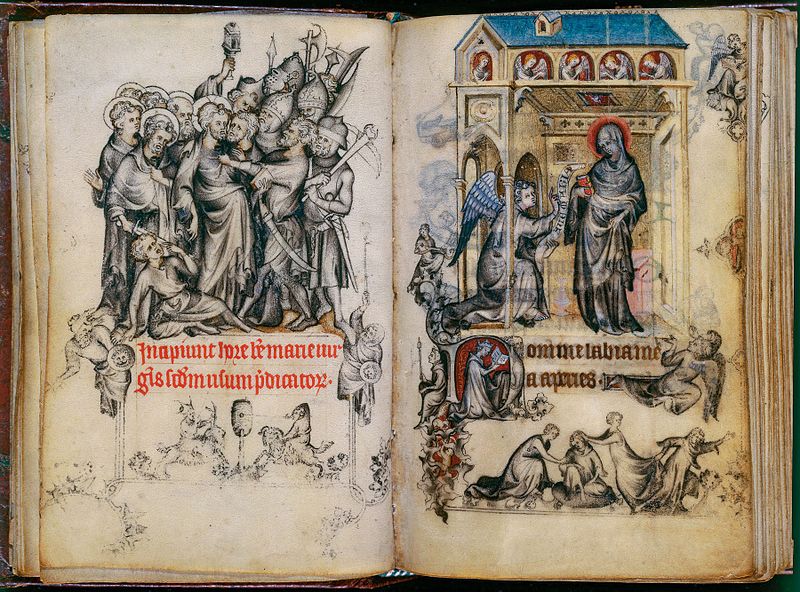
Besides Rockefeller Junior, an important early donor to the museum was J.P. Morgan, who contributed a few items from his incomparable collection of rare manuscripts (most of which, however, he kept for his own museum downtown). Among these are the Cloisters Apocalypse, the Psalter of Bonne de Luxembourg, and the Hours of Jeanne d’Evreux. This last is particularly impressive. A “book of hours” is a prayer book, usually made for wealthy patrons, containing prayers appropriate for different times of the day. In this case, Jeanne d’Evreux was the third wife of king Charles IV of France (reigned 1325-28); and the book was executed by the Parisian artist Jean Pucelle, who was a witty inventor of drolleries (the little designs that frame the text in an illuminated manuscripts). In any case, the book is a terrific example of gothic illumination.

800px-4_Jean_Pucelle._Hours_of_Jeanne_d'Evreux._1325-28,_Metropolitan_Museum,_New-York

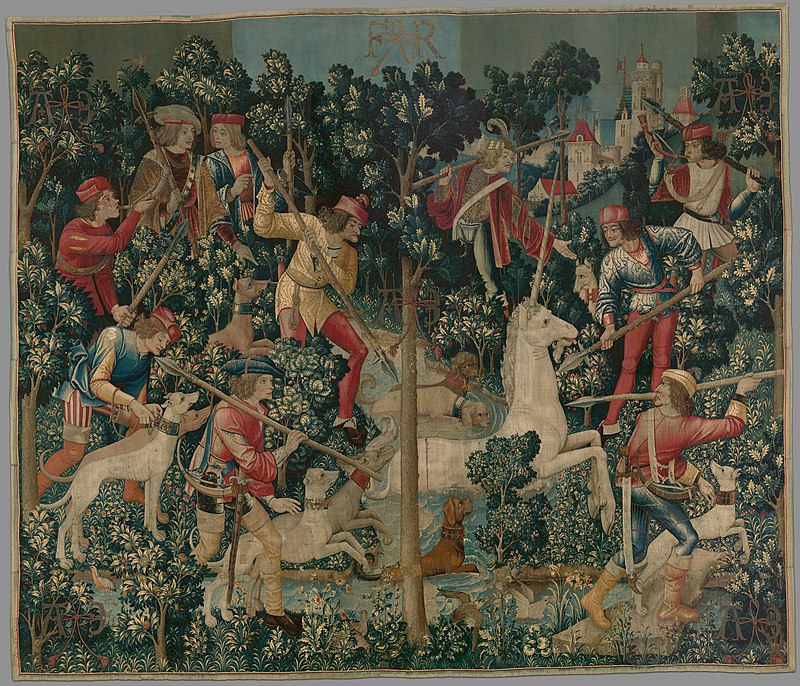
Yet my favorite work—and I suspect the favorite of many others—is the famed Unicorn Tapestries. This is a series of seven tapestries, depicting the hunt, capture, and (possible) rebirth of a unicorn. Its provenance is mysterious: First recorded in the possession of La Rochefoucauld family many years after their creation, then looted during the French Revolution (reputedly used to cover potatoes), the tapestries were ultimately acquired by Rockefeller Junior, who adored them and could scarcely bear donating them to the museum. But eventually his charity prevailed over his aesthetic greed, and now the tapestries hang in the museum for all to see.

800px-The_Unicorn_is_Attacked_MET1

What is immediately striking is the quality of their workmanship and preservation. I have seen a fair number of tapestries by now, and most are not nearly as detailed nor as vibrant. Scholars debate nearly everything about the works—their meaning, their relationship to paganism and Christianity, and even the order in which they should be seen. Nevertheless some basic narrative is obvious. A group of hunters sets out in the forest; they encounter the unicorn by a well, surrounded by other beasts; they attack; the unicorn defends itself, killing a dog with its horn and kicking a man; but the unicorn is surrounded, killed, and brought back to the castle (apparently with its horn missing). But there is one tapestry that is difficult to account for, showing a unicorn standing inside a fenced enclosure, alive and with horn intact. Where does this image fit in? Should it go first or last? Does the unicorn come back to life?

This last interpretation makes some sense, considering that the unicorn was used as a symbol for Christ during the Middle Ages. Still, the metaphor of hunting a unicorn seems odd for symbolizing the path to Christian salvation. Are the hunters supposed to be those seeking Christ’s wisdom, or is this rather a metaphor for the passion and death of Christ? I can hardly give a coherent answer; but the ambiguity only adds to the tapestry’s magnetic power. Yet even as images alone, the series is compelling: the lush forest, the atmosphere of fantasy, the dynamic encounters with the unicorn.

I am spilling words on these exceptional works, yet I feel I am failing to do justice to this museum—whose effect is never dependent on the excellence of a single piece. Indeed you might say that the building itself is the greatest work on display. Despite being a melange of elements—incorporating churches and monasteries from different eras and different regions—the Cloisters convincingly brings the visitor into the Medieval mindset: of chivalry, romance, nobility, and, most importantly, Christianity. Indeed, arguably the architectural eclecticism of the museum accurately captures the feel of medieval religious structures, which were often built over hundreds of years and incorporated several different mediums and styles.

cloisters_collage

So if you have any interest at all in the Middle Ages, I highly recommend taking the A train uptown (190th street station) to visit this shrine to a bygone age.

NY Museums: MoMA

NY Museums: MoMA

This is part of a series on New York City museums. For the other posts, see below:


I have always been prone to conservative tastes in music, literature, and art. I remember having long discussions in high school about the emptiness of contemporary music and the inanity of modern art (at the time, I knew close to nothing about visual art, ancient or modern). Every painting I encountered from the 20th century only confirmed my prejudices—using a minimum of technical skill to create images that were either incomprehensible or simply dull. At the ripe age of eighteen I mourned the decline in standards and the decadence of our culture.

Luckily, my tastes have broadened somewhat since then (though not as much as could be desired), and I have come to cherish the Museum of Modern Art as one of the great museums in New York—indeed, of the world.

Like many New York landmarks, the MoMA is a product of the Rockefeller family. Specifically, it was conceived and funded by Abby Aldrich Rockefeller, along with two of her friends.

Abby was the wife of John D. Rockefeller, Jr., who himself had a great love of art. However, he and his wife had diametrically opposed tastes. Junior was fond of Chinese porcelain and medieval art (which led him to develop the Cloisters Museum, uptown), while his wife was enamored with modern art. This occasioned not a few marital squabbles, since the straight-laced and puritanical Junior considered modern art to be degenerate and scandalously uninhibited. To add insult to injury, Abby wanted to demolish their old home to make way for the museum. Nevertheless, Junior offered the requisite financial support for his wife’s project, and so the MoMA was born. It opened in 1929, just a few days after the financial crash (while Junior was busy dealing with Rockefeller Center); and this opening marks a watershed in the institutional acceptance of modern art.

Upon entering the MoMA, the visitor should go all the way to the top, the fifth floor (American style), and then work her way down. Nearly all of the museum’s most famous paintings are to be found in this gallery, so it is best to go with fresh eyes.

starry_night

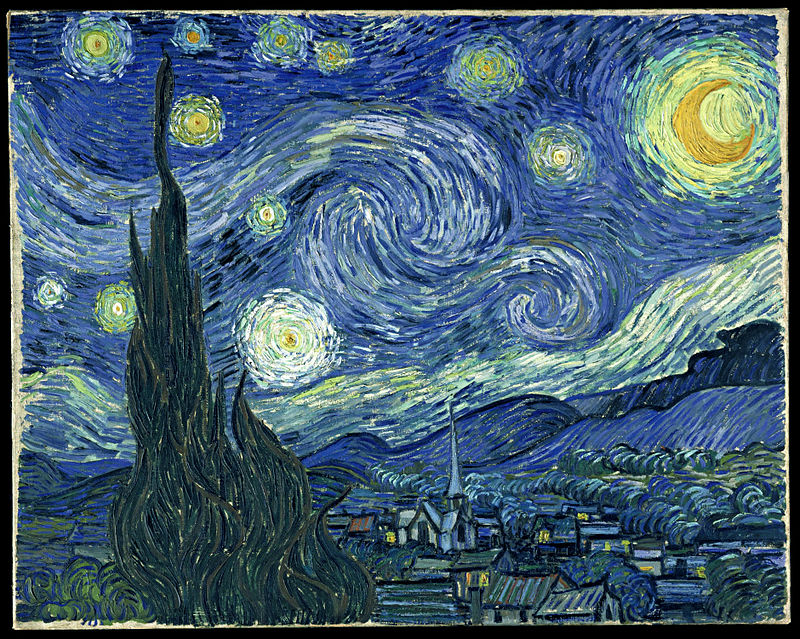
Almost immediately you will find the most famous painting in the collection: Starry Night. Like La Gioconda in Paris or The Birth of Venus in Florence, Starry Night is always surrounded by a swarm of buzzing tourists. Predictably, this detracts from the viewing experience. Much of the pleasure of a great painting consists in minute observation; and this is doubly true of Van Gogh’s works, which are so thick with paint that they are nearly tactile. In any case, I need hardly say that Starry Night is one of the great images of Western Art, as instantly recognizable as Guernica or the Sistine Chapel ceiling. The swirls in the night sky have been as overanalyzed as Mona Lisa’s famous smile: as turbulent manifestations of the artist’s epileptic visions, or as a profound insight into the physics of nebular star formation, or as an allegorical representation of Christ.

While I think Starry Night is undeniably among Van Gogh’s best, I admit that overexposure has diminished my enjoyment of the painting. It is like hearing a song played one hundred times on the radio: even if it is a great song, it will lose interest eventually. In any case, the painting is exceptional in many respects. Unlike the majority of Van Gogh’s mature work (characterized by the artist’s strong commitment to observation), it contains several imaginative elements. For one, the village in the distance is an invention: it was not visible from his window at the monastery in which he was staying. More striking, the swirls in the sky seem to be a purely imaginative detail—not only invented, but fantastical. Are they clouds, wind, or a spiral galaxy? Nothing quite seems to fit, which is strange in a painter so obsessed with working from nature.

Starry_Night_Over_the_Rhone
Starry Night Over the Rhône

The final result is a painting whose effect is somewhat different from Van Gogh’s other mature work. The Starry Night Over the Rhône, for example, is typical of the artist in that, despite not being “realistic,” it evokes the sensation of an actual starry night. The Starry Night in the MoMA, however, evokes a quite different feeling: that of a cryptic, quasi-mystical utterance.

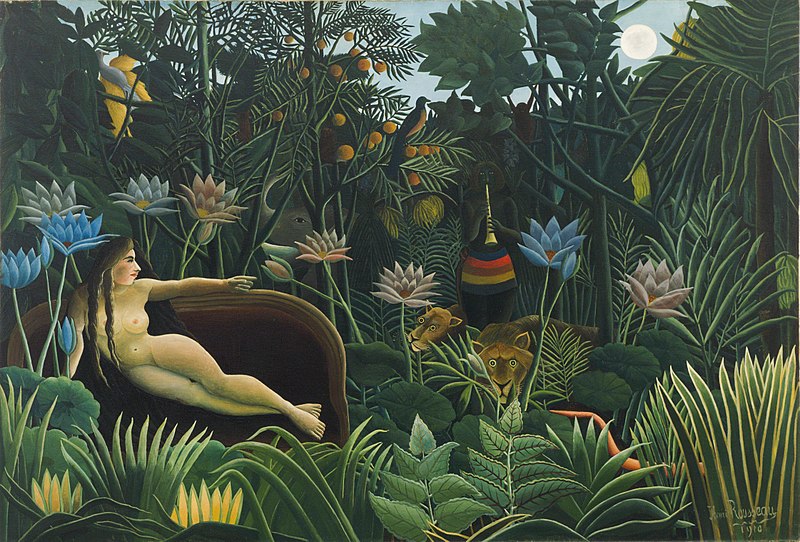
Another famous painting in this gallery is Henri Rousseau’s The Dream. It features a nude European woman reclining on a couch, in a reclining pose reminiscent of many European female nudes, such as Titian’s Venus of Urbino or Goya’s The Naked Maja. But she is not in a living room, but deep in the jungle, surrounded by exotic birds, tropical plants, two lions, and an African person playing the flute. The style is exaggerated and cartoonish, not exactly dreamlike but heavily stylized. The woman’s portrayal, for example, is almost Egyptian in its perspective: her body facing forward but her head entirely in profile, with both of her braids somehow in front of her chest. My favorite aspect of the painting are the large, hypnotic eyes of the lions, which serve to make the animals seem terrified rather than terrifying.

800px-Henri_Rousseau_005

However, I must admit that, on the whole, I do not find the painting terribly captivating to look at. I do appreciate it as a kind of satire of bourgeois dreams of the exotic: the gentile French woman, dozing in her salon, lost in daydreams of the lush forests of the Africa. And perhaps the snake tail sticking out from the bushes, and the fruit hanging on the tree above, tell us that this imaginary Eden is liable to implode when faced with actual knowledge.

Les_Demoiselles_d'Avignon

In the next room there are several works by Picasso, including what I consider to be, after Guernica, his greatest: Les Demoiselles d’Avignon. (In this case, Avignon refers to a street in Barcelona where prostitutes would congregate, not to the city in France.) It is a brutal, disturbing work. Picasso painted it in 1907, when he was still relatively obscure and was embroiled in a rivalry with the older Henri Matisse. At the time there was widespread interest in so-called “primitive” art, such as that of sub-Saharan Africa, Oceania, and pre-Roman Iberian sculpture. The painter Gauguin (who died in 1903) also contributed to this interest, since he had spent the last ten years of his life on the island of Tahiti, and had cultivated a “primitive” style in his late works. (This can be seen in Gauguin’s The Seed of Areoi, also at the MoMA.) Picasso combined this interest in the exotic with his admiration of Cézanne, whose daring landscapes pioneered the geometrical simplification that would become the basis of Picasso’s mature style. (The MoMA features several excellent works by Cézanne, including The Bather.)

The result is a painting utterly unlike any other in Western art. Five nude prostitutes gaze at the viewer, who is supposed to be a potential customer in their brothel. But there is not a hint of sensuality about these ladies of the night. Indeed, the extreme distortions of their bodies, and the mask-like form of their faces, transforms them into threatening monsters—particularly the two women on the right, whose faces bear the obvious influence of African art. The women have been literally objectified: reduced to distorted, two-dimensional placards. But the objectification turns them into objects of fear rather than desire; their curves are sharpened into knife-blades, their frontal gazes—traditionally a sign of invitation—are instead frightening blanks, devoid of any discernible emotion.

Compare this work with Matisse’s Le bonheur de vivre (The Joy of Life), completed just the year before; it shows us a colorful landscape full of voluptuous nudes, luxuriating in sensual pleasure. This is the ever-beguiling fantasy of sex. Picasso shows us the reality beneath the fantasy, the ugliness that we push into the shadows. For the relationship between the viewer as client, and the prostitutes gazing back, is dehumanizing for both parties. The women are visibly dehumanized—turned into thin masks, which perform their sexual function without pleasure or pain, without lust or hatred, but only a blank apathy. For his part, the client’s desire for sex becomes yet another financial transaction, performed mechanically—without enthusiasm and even without real desire—to fulfill mundane biological urges.

Perhaps I am reading too far into the painting, but for me the image represents the consequences of a repressive sexual morality: wherein a single man’s only opportunity for sex is the brothel, which in turn fuels a market that preys upon vulnerable women, pulling them into a cycle of poverty and abuse. Yet this is only one of an endless list of interpretations, as the helpless critic struggles to make sense of this pitiless image.

It was not a long way from these distorted forms to Picasso’s major breakthrough: cubism. Several cubist works of his hang nearby, as well as those of his partner in cubism, Georges Braque. I must admit that these works of “high” cubism always leave me cold: they are monochromatic and chaotic images, with at most the purely intellectual interest of a crossword puzzle. But there is no denying that cubism was the most influential movement of the period; through the painters’ experiments with perspective and abstraction, a new idiom was developed, a pictorial language that Picasso (among others) would later use to great effect.

Not far from here is a room mostly dedicated to works by Marcel Duchamp. Now, Duchamp is one of the most influential figures in 20th century art; in his program, The Shock of the New, Robert Hughes dedicates ample time to his work, and most of what he says is quite positive. For my part, I have been unable to penetrate this artist’s work, in part because he seems to represent what I generally dislike about modern art: namely, its abandonment of aesthetic qualities for intellectual games or self-involved irony.

duchamp_moma

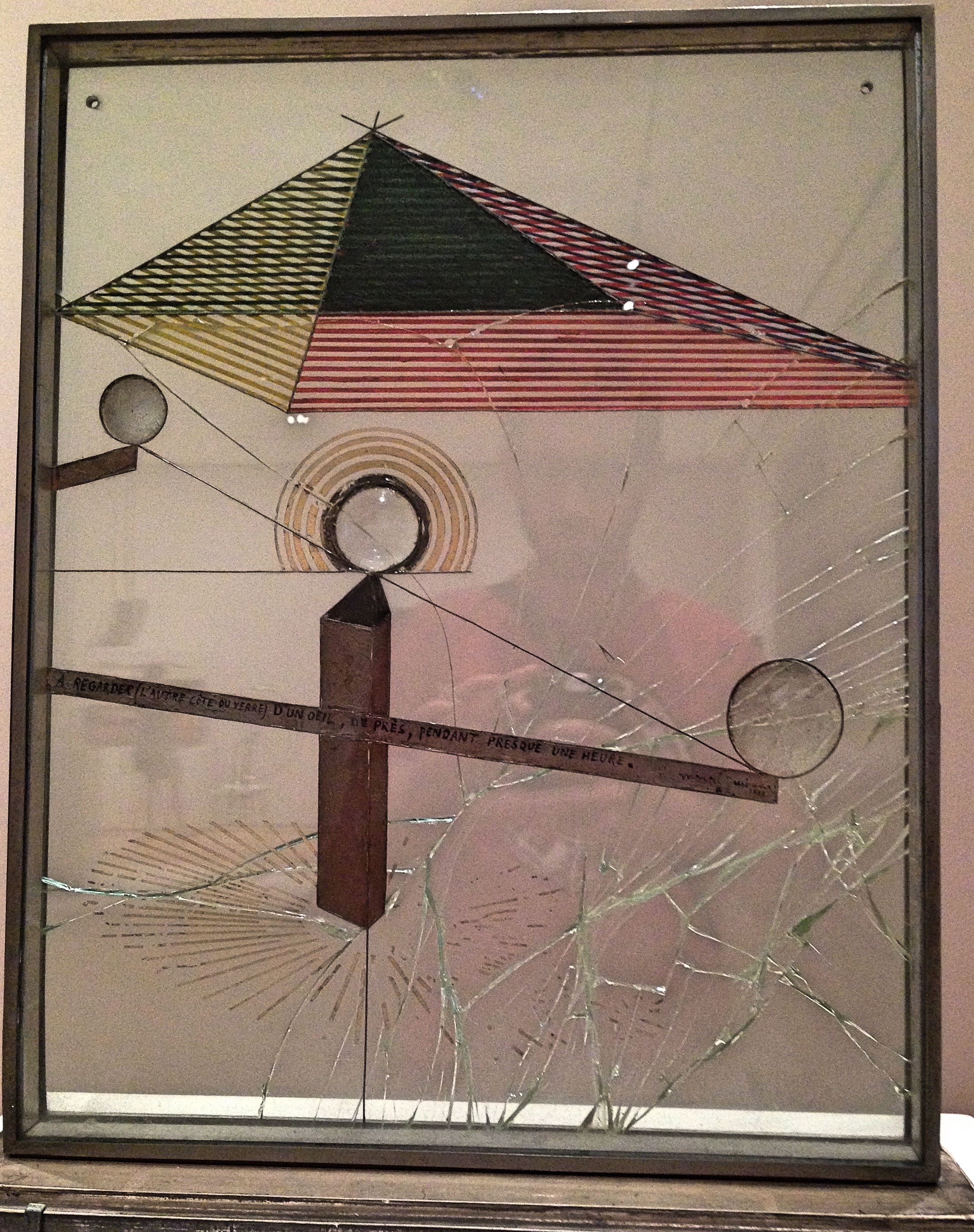
An example of this is his piece To Be Looked at (From the Other Side of the Glass) with One Eye, Close to, for Almost an Hour. It consists of two panes of glass with a magnifying lens mounted in the middle. On the glass is a geometrical design of a three-dimensional pyramid. The glass was unintentionally cracked during transport, which greatly appealed to Duchamp’s sense of random creation. I can see that the piece is a sort of ironic comment on science and perspective; the design and the lens suggest the meticulous representation of space, and yet it is a mere parody—the image through the lens is distorted and fuzzy. It is also a sort of ironic comment on the act of seeing in a gallery, since the viewer must dedicate a frankly unrealistic amount of time to experience the visual distortions induced by the lens. In other words, the whole point of this work, which uses symbols of seeing scientifically, is to see badly. Yet is it interesting to look at?

Another example of Duchamp’s work is Three Standard Stoppages. He made this by dropping a meter-long thread onto sheets of glass, so they it fell in haphazard shapes, and then gluing the threads to the glass. Afterwards, he made wooden “rulers” (whose length is less than a meter, since the thread is curved) using these shapes. The idea (or so the MoMA audioguide explains) is to show the arbitrariness and the boringness of the standard meter, as opposed to the spontaneous naturalness of these shapes. This is a fine idea; but again I do not see the point of creating a work of art which only serves as the prop for an argument. I remain old-fashioned enough to think that it should be beautiful in itself; this is one of my many intellectual shortcomings.

De_Chirico's_Love_Song

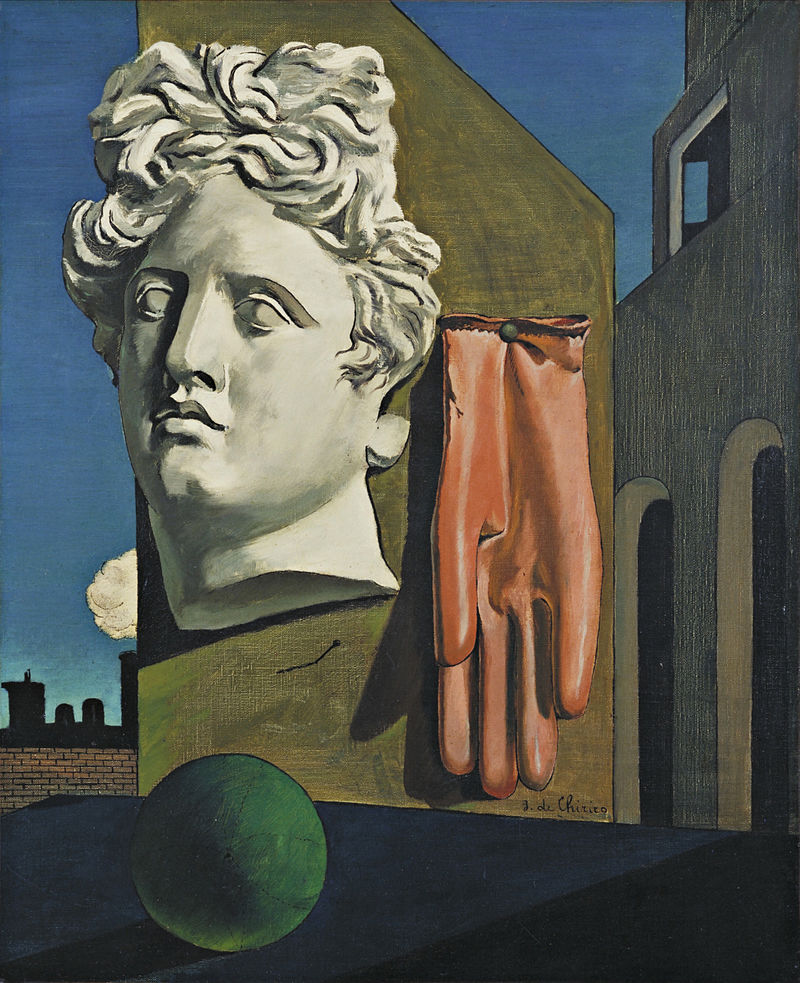
A room nearby is dedicated to the work of Giorgio de Chirico. Indeed, the MoMA has perhaps the world’s greatest collection of this elusive artist’s work, including his most famous painting: The Song of Love. Like so many of Chirico’s paintings, it is a baffling image: a rubber glove hangs from a wall, next to a beautiful antique bust (of Apollo?), with a green ball on the ground in front—all of this in a cartoonish urban landscape. Like many, I can only hazard a guess of what this all means. I suppose that the powerful juxtaposition of the bust and the rubber glove is suggestive of different interpretations of the human body—one a unique idealized image, another a prefabricated utilitarian object—indicative of the many cultural manifestations of the same underlying reality. But, really, whatever interpretation we choose to impose, the image persists; and it is memorable.

La_danse_(I)_by_Matisse

Another memorable image is Dance (1) by Henri Matisse. The work in the possession of the MoMA is a preliminary work for a decorative panel in the Heritage Museum, Saint Petersburg. If you keep in mind that this naive image was created in 1909, you can get an idea of how revolutionary it must have been. For there is not a hint of realism in the work; not only do the figures lack detail, but their postures are impossible—anatomically and perspectively. The landscape consists of two blobs of color, slashed across the canvass. And yet it is an utterly convincing image of joyous celebration. The freedom from realism is transformed into a freedom of all restraint, a kind of basic delight in movement and release. The painting is also a convincing demonstration that childlike can produce lasting art.

800px-Kazimir_Malevich_-_'Suprematist_Composition-_White_on_White',_oil_on_canvas,_1918,_Museum_of_Modern_Art

I have a much more negative opinion of another so-called childish piece in the collection, White on White, by Kazimir Malevich. Malevich was the creator of the Suprematist movement, which emphasized the use of basic geometrical shapes—squares, circles, lines, and so on—with a black-and-white color scheme. White on White consists of an off-white square positioned diagonally in a white canvass. Neither this painting nor any other of the Suprematist works on display produce even the slightest iota of emotion in me; they are not visually interesting or intellectually stimulating.

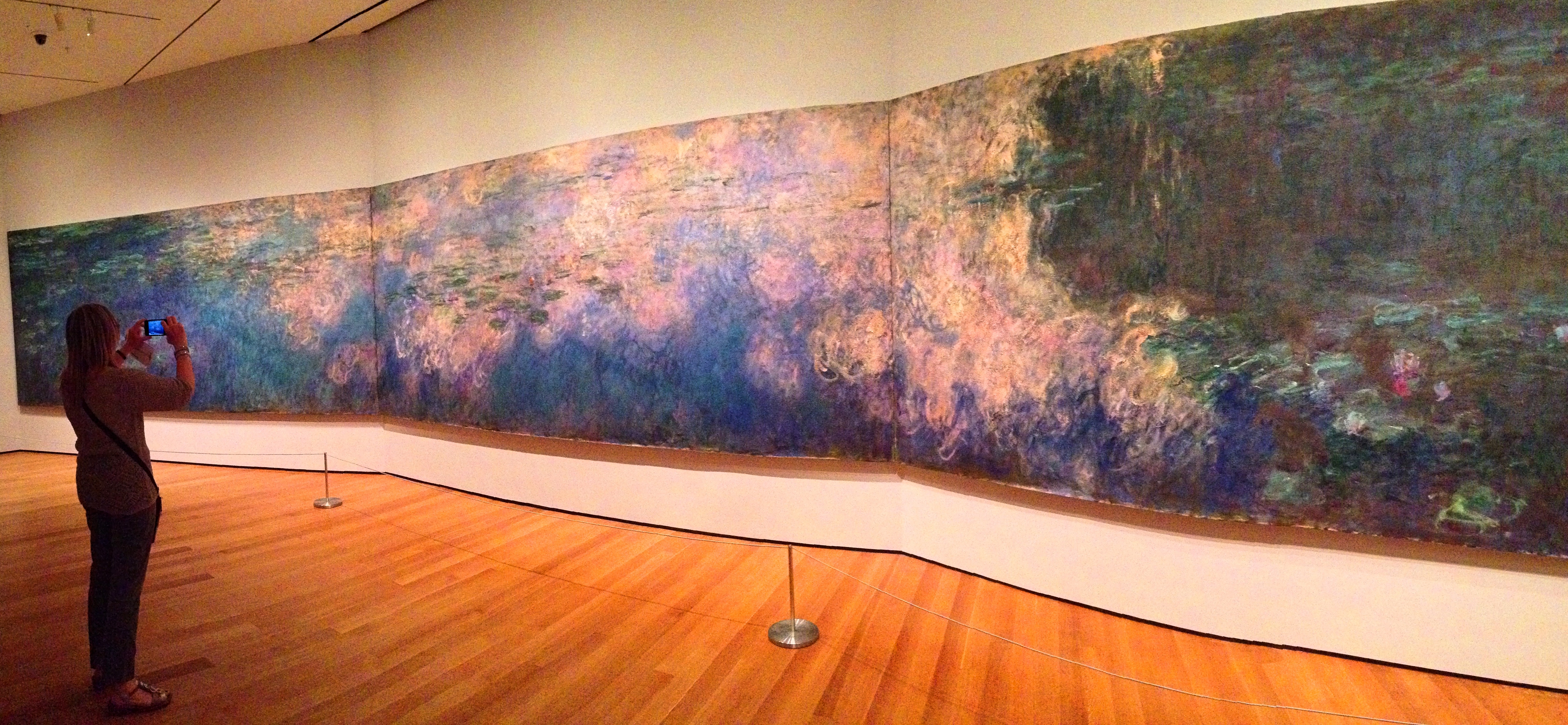
But I should not pause to cast aspersion, but should dwell on the paintings that I do like. Among these is, naturally, Claude Monet’s wonderful painting of water lilies, stretched out on an enormous canvass (well, actually three canvasses). In the later part of his life, Monet retreated into his own estate; here following Voltaire’s advice, he cultivated his own garden. This became his artistic haven, where he would sit for hours, working. The most famous and stunning results of this aesthetic quest are these enormous representations of the surface of his lily pond. (Monet made several of these; most are collected in the Musée de l’Orangerie in Paris.) The work is unmoderated aesthetic bliss: the swirling colors are so inherently peaceful and pleasant that they induce a sort of meditation, an artistic absorption in color and light.

waterlilies_monet_moma

I see that I am rattling on and on, as I tend to do, so I will restrict myself to two more paintings. But be advised that this list is only representative of my tastes, and does not adequately reflect the wealth of beauty on display.

As a somewhat begrudging fan of Dalí, I was delighted to finally see his Persistence of Memory. This image is so famous that it requires no description. Nevertheless, I think it is worth pausing to savor this painting’s brilliance. For no painting I know is such a convincing depiction of time. Contrast this work with another whose subject is time: The Ages and Death, by Hans Baldung. This painting, which hands in the Prado, represents time by showing its effect on the female body. It is an exceptional painting, well executed and well conceived; but it has none of the haunting power of Dalí’s work. For here time itself ages—it melts and droops pathetically. In Baldung time is universal, inescapable, and adamantine; but for Dalí time itself takes place in a larger environment—that suggested by the rocky landscape—and is itself subject to change. This leads us to ask: what is ultimate, after all?

pollock_moma

The last painting I will mention is Jackson Pollock’s One: Number 31, 1950. Admittedly, giving the name of a certain Pollock seems silly, since I at least would be at a complete loss to pick one out of a slideshow. Nevertheless I do want to single out this painting, and Pollock’s work generally, for its extraordinary energy. Though superficially random, any amount of inspection will reveal that, in fact, Pollock exerted an extreme level of control over his paint drippings. The result is a sort of explosion of human movement, an exploration of gesture, a kind of visual dance, where the overlapping colors create a rhythmic sensation, and the blobs of paint sticking out of the canvass make it nearly tactile.

If she is at all like me, the visitor will be quite exhausted by the end of this gallery. Yet this floor, although it contains the majority of the MoMA’s most famous works, is only a small fraction of its total exhibitions. On the next floor down are the more contemporary works, from 1940 to 1980. I will pass over this gallery in silence since, for me, visual art after the Second World War is hit or miss—and usually the latter. Below this, on the third floor, is a rotating special exhibition on architecture. When I went last year it was a fascinating exposition dedicated to Frank Lloyd Wright; this year it is dedicated to communist Yugoslavian architecture. On the second floor (European first floor) the collection continues from 1980 up to the present. Finally, on the ground floor is the Abby Aldrich Rockefeller sculpture garden, a peaceful place full of bizarre statues, plants, and benches, which is perfect for having a short rest.

This does it for my virtual tour of the MoMA. It is well worth a visit, not only because of its wonderful collection, but because it is one of the most significant institutions that governed artistic taste in the 20th century. Next, I will examine a museum founded by Abby Aldrich’s conservative husband: the Cloisters.

NY Museums: The Morgan

NY Museums: The Morgan

This is part of a series on New York City museums. For the other posts, see below:


Just as royalty and nobles have played a crucial role in Europe’s art, providing money and stability to artists, in American history very rich patrons have played an equally important role in the establishment of cultural institutions. From Carnegie, to Frick, to the Rockefellers, great business tycoons have used their enormous wealth to bring culture to the masses; and in this respect J.P. Morgan is no exception.

Unlike the above-mentioned robber barons, Morgan was not an industrialist; his specialty was money itself. A son and eventually a father of a banker, finance was in Morgan’s blood. He had dealings with every major player in business and government of the age, and was instrumental in the creation of the era’s major conglomerates: General Electric (which hailed from Thomas Edison), United States Steel (from Carnegie, Schwab, and Frick), and AT & T (from Alexander Graham Bell)—to name just a prominent few. A large man with a deformed nose, he struck the unflappable John D. Rockefeller as moody and impulsive. But this iconic money-changer and pharaonic materialist was not bereft of an appreciation of higher things.

The Morgan Library & Museum sits right in midtown Manhattan, on Madison Avenue and 36th street. The main building looks quite similar to the Frick: a severe, grey, neoclassical structure. Adjoining this is an attractive brownstone building; and the complex is completed with a sleekly modern—and rather discordant and tasteless—box of an entryway, built in 2006 to help organize the space. This is where the contemporary visitor enters and pays.

No photos are allowed inside the complex, so I am forced to rely on my paltry memory.

320px-JPMorgan
John Pierpont Morgan

As one would expect, the house is richly furnished. The original entrance hall is gorgeously decorated, with Renaissance-style wall frescos and Pompeian motifs; even the floor is attractively patterned. Anyone visiting the banker would know immediately that this was financial royalty. Morgan’s study, where he made decisions that shaped the economy, is a deep shade of scarlet—the rug, the wall paper, the furniture. Morgan himself, with his handlebar mustache sitting under his bulbous nose, presides over the fireplace in the form of a portrait. Few rooms give such an indelible impression of power.

The next room accessible from the entrance hall was, I believe, previously the librarian’s office; now it contains a fine sampling of Morgan’s impressive collection of Babylonian cylinder seals. These are small circular objects made of hard stone, about an inch long, inscribed with delicately carved reliefs. They were used as a sort of signature or official seal, by rolling the seal over soft clay to create a horizontal image. Dozens of these seals were on display in the room. Since the seals themselves do not look like much, they were shown alongside an impression made with the seals, wherein the images can be clearly seen. These typically involve scenes of gods and royalty, and are quite beautiful works of art. Certainly it is a much more elegant way of indicating ownership and approval than illegibly scribbling our names.

800px-Cylinder_seal_Shamash_Louvre_AO9132
This image is from the Louvre. It is in the public domain, taken from Wikimedia Commons

From here I went to the central attraction of the museum: the library itself. Even if it had no books at all, it would be a beautiful space—the ceiling as richly decorated with allegorical friezes as El Escorial’s royal library. Three floors of oaken bookcases line every wall up to the ceiling, each one filled with venerable volumes covered by a protective screen. On the ground level there are display cases that showcase some of the library’s treasures. And these are beyond anything I had expected.

320px-Gutenberg_bible_Old_Testament_Epistle_of_St_Jerome
A page from the University of Texas copy of the Gutenberg Bible (public domain)

Here is the finest collection of manuscripts and rare books that I had ever hoped to see. To begin with, there are three Gutenberg Bibles, the first book published with moveable type in Europe, one of the most iconic books in history. While the invention of printing was, no doubt, a great advance in the history of our species, it must be admitted that the Gutenberg Bibles look rather plain next to the older, handmade ones nearby. The most famous example of these is the Morgan Bible, or Crusader Bible, a brilliantly illuminated Bible showing scenes from the Old Testament, but depicted as if it had occurred in medieval France. (Thus it is easy to mistake the images for depictions of the crusades.) The images are chaotic and violent, but no less compelling for being so; and seeing it such vivid illustrations between the cover of a book does make one a little nostalgic for the days when books were handmade.

Morgan_Bible_10r

The most ornate book in the collection—and the first in the Morgan Library catalogue, MS M.1—is a book of the gospels from the 9th century, around the reign of Charlemagne. (I admit that I cannot remember if I actually saw this book in person, but I did see it in a documentary that mentioned the library.) The cover is a mass of ornately decorated gold, encrusted with precious jewels. The amount of material wealth devoted to this single volume beggars belief—though it does seem a little ironical to decorate a book about Jesus of Nazareth, arch-enemy of the money-changers, so resplendently. While I am on the topic of ironies, I must also add a point made by the journalist Alistair Cooke, that while these super rich tycoons—Carnegie, Frick, Morgan—were buying up the treasures of Europe, they were benefiting from waves of European immigrants willing to work long hours for low wages. And so these robber barons exploited the huddled masses of Europe to buy up its treasures.

Morgan_Beatus

But it is difficult to be indignant for very long when you are looking at such beautiful books. The Morgan Beatus, for example, is a brilliantly illuminated copy of the Commentary on the Apocalypse by Beatus of Liébana, with bright yellows and reds and oranges, showing us a world redeemed and a world aflame. Then there is the Hours of Catherine of Cleves, a wonderful example of gothic illumination. As with so many other illuminated manuscripts, the mind boggles at the amount of time it would have taken to paint a single one of these ornate pages, much less a whole book of them. An example of this is the Farnese Hours, illuminated by Giulio Clovio over a period of nine years. Clovio was a friend of the young El Greco, during his early years in Italy, and the Greek painter created a portrait of the old Italian master, pointing to this masterpiece of Renaissance illumination. The book was completed in 1546, 100 years after the Gutenberg Bible was printed, already the waning years of the art of illumination.

Farnese_hours

Still more exciting than these beautiful books, for me, were the original manuscripts on display. These are the notebooks and pieces of paper where authors and composers first wrote down their masterpieces. Among these is Dickens’s A Christmas Carol, with his edits still preserved, as well as nine novels by Sir Walter Scott, including Ivanhoe. Honoré de Balzac, Émile Zola, Lord Byron, and William Makepeace Thackeray also are in attendance; and in music there are handwritten examples from Beethoven, Brahms, Mozart, and even Bob Dylan (the latter obviously not acquired during Morgan’s lifetime). It is thrilling to see the preserved handwriting of these men (and yes, they are mostly men), since they can appear so unreal behind the printed page. The artists become living, working, fallible souls when you can see them scribbling and scratching out. Even the most iconic works of art were the process of trial and error.

I must say that I was stupefied by the end of my visit. The collection had exceeded my every expectation. Few places are as inspiring as a beautiful library. The museum is a magnificent tribute to the ways that we have preserved and transmitted our culture—in all its manifold facets. From the Babylonian cylinder seals to Bob Dylan’s “Blowin’ in the Wind,” humans continue to scribble, print, draw, paint, and inscribe our art and ideas for the benefit of people in distant times and faraway places.

But there was still one more thing to see. The Morgan has a temporary exhibition space, and when I visited this was dedicated to an exhibit on Henry David Thoreau. This was a stroke of luck, since I had recently finished rereading Walden.

Thoreau

Considering the scanty possessions that Thoreau left behind, the exposition was astonishingly complete. There was Thoreau’s writing desk, over a dozen volumes of Thoreau’s diaries, and Thoreau’s walking stick (notched so that he could measure things on his walks). Also present was every original photograph (there are only two, admittedly) taken of the man. The exhibit was filled with information about his life and extracts of his journals. Seeing his humble collections gathered all in a heap—his scribbled and illegible handwriting, his beat up desk, his pocket-sized images—spoke more eloquently of his life’s project than all the fanciful phrases he ever assembled. And just as with the original manuscripts, seeing his original possessions helped to turn Thoreau from a distant voice into a living, breathing person.

NY Museums: The Frick

NY Museums: The Frick

This is part of a series on New York City museums. For the other posts, see below:


As a child in Manhattan, growing up on the Upper West Side, I visited the Museum of Natural History nearly every week. It is a little boy’s paradise: dinosaur bones, stuffed lions and elephants, and my favorite—the whales. Later, in high school and college, I developed a taste for the Metropolitan Museum of Art. I was first drawn to the Arms and Armor room—swords and guns, another boy’s paradise—and then progressed to the Egyptian and Greek antiquities. It takes little sophistication to enjoy cursed mummies and violent gods.

But it was not until I moved to Europe, and began visiting art museum’s here, that I developed an appreciation for sculpture and painting. Thus it was only during one of my summer trips back home to New York that I finally visited one of the finest art museum’s in the city: the Frick.

The Frick Collection is housed in the former mansion of Henry Clay Frick, who was one of the great robber barons that dominated the Gilded Age of America. He made his fortune by selling coke (the carbon fuel, not the drug), and achieved industrial dominance by partnering and eventually merging with Carnegie’s steel company. Despite his success and wealth, he is a difficult man to admire. Like many tycoons, he was adamantly opposed to organized labor, and played a key role in repressing the Homestead strike—a violent confrontation in which 9 strikers and 3 pinkerton detectives were killed, and which caused a major setback to the labor movement. He was so hated by laborers, in fact, that the anarchist Alexander Berkman tried to assassinate him. The attempt failed (Frick would die in 1919, at the age of 69, of a heart attack) and Berkman spent 14 years in jail as a consequence, where he wrote a famous memoir of his experience.

800px-Henry_Clay_Frick
Henry Clay Frick

But whatever Frick’s defects in the realm of social justice, no one can accuse the man of bad taste. He accumulated superlative works of art during his lifetime; and, fortunately for us, he donated his house and his collection to the public upon his death, to be used as a museum. Along with Rockefeller and Carnegie, Frick is yet another example of a robber baron who managed to be both cutthroat and civic minded.

The museum sits across from Central Park, on 5th avenue and 70th street, about a 10 minute walk south from the Metropolitan. From the outside the mansion is not especially impressive: a squat neoclassical building, the color of granite. It has none of the conspicuous stateliness of Andrew Carnegie’s old mansion, located just up the road (it is a part of Cooper Union now). But the inside is not nearly so restrained: each room is richly decorated, with the finest furniture, chandeliers, mirrors, and wallpaper that money could buy. I have walked through my share of palaces in Europe, so I am used to seeing affluent interiors; but I still found myself gaping as I walked through the house. In the giddy years before income taxes, the robber barons could accumulate more wealth than Old World despots.

320px-Philip_IV_of_Spain_-_Velázquez_1644

But of course the absorbing interest of the museum is not the interior decoration, however sumptuous, but the paintings on display. Though relatively small, the Frick has one of the finest collections of old masters in the city—perhaps in the country. Relatively few works by Velazquez are available outside of Spain. New Yorkers are fortunate: the Metropolitan has a handful, the Hispanic Society has three, and the Frick has one—a portrait of Felipe IV. Typical of Velazquez, it is a masterful work: we feel we are standing right in front of the king. The Spanish monarch’s magnificently regal outfit—painted with such delicacy that it is almost tactile—contrasts sharply with the awkward and gangly figure who wears it, with his monumental Hapsburg chin sticking out below his curled mustache. Most impressive of all, Velazquez manages to imbue this unpromising figure with a certain kingly dignity—his eyes calm, thoughtful, careworn, but in control.

320px-La_fragua

The other two members of the Spanish triumvirate are also in attendance: Goya and El Greco. I especially like the former’s contribution to the collection: The Forge. It is an excellent example of Goya’s ability to convey strenuous action while preserving the harmony of the composition. The stocky figures, contorted with effort, nevertheless combine to form a solid triangle in the center of the painting. I also enjoy the gloomy, almost liquid blackness that engulfs the figures, emphasizing their solitary grandeur.

800px-Johannes_Vermeer_-_De_Soldaat_en_het_Lachende_Meisje_-_Google_Art_Project

The Dutch masters are also here in force. Frick managed to get his hands on three Vermeers. My favorite of these, Officer and Laughing Girl, shows all the hallmarks of his style: an interior room lit from a side window, with a homely girl in the center and a detailed map in the background. In this case the girl is chatting with a soldier, seated with his back to us. Is she being courted, or is there something more scandalous afoot? From a purely technical perspective, the most extraordinary feature of the painting is the map, which is so beautifully and accurately rendered as to beggar belief. Rembrandt is here, too, with two works. One of these is a self-portrait, showcasing himself as a florid gentleman with a sword strapped to his hip. The other paintings is rather more mysterious: The Polish Rider. It shows us an armed man in slightly exotic garb, mounted on horseback. Scholars cannot decide who this person is supposed to be; he is called “Polish” because of the style of his hat and dress; but beyond that there is little but guesses.

800px-Rembrandt_-_De_Poolse_ruiter,_c.1655_(Frick_Collection)

We can also see a work by the greatest of English painters, J.W. Turner. The Harbor of Dieppe is entirely typical of his style: a bright yellow morning, a shimmering sea, and a large perspective with dozens of figures and boats. Nothing about the painting’s content is profound or especially moving. Its appeal is mainly to the eye—it is a joy to behold, since Turner captures so perfectly the warmth and the brilliance of a summer sunrise. Standing in front of the painting, you can almost feel the sun on your skin. How can paint be made to glow so intensely? In this glorious landscape of light—Turner paints the sun twice, in the sky and reflected in the sea—we can also sense the magic of all ports of travel: a place where different corners of the earth mingle, a gateway to the wide world, beckoning us towards the beyond.

800px-Joseph_Mallord_William_Turner_-_The_Harbor_of_Dieppe_-_Google_Art_Project

In the interest of brevity, I will skip over many other worthwhile paintings to get to the two great masterpieces of the collection, both by Hans Holbein. They hang on either side of the great fireplace in the center of the mansion. To the right is a portrait of the English politician Thomas Cromwell, and to the left is the Renaissance humanist Thomas More (famous for inventing the word “utopia”). The two were adversaries in life. Cromwell aided Henry VIII in his quest to annul his marriage to Catherine of Aragon in order to marry Anne Boleyn, which resulted in England’s break with the Catholic Church; meanwhile, More remained loyal to the Pope and opposed the new marriage. Despite this opposition, the two men shared the same fate: beheaded by the order of the king. More was beheaded for opposing the establishment of the Church of England, and Cromwell because he helped arrange the king’s next marriage (after Boleyn was duly decapitated) to the German princess Anne of Cleves (who did not please the king, but who escaped execution). These were dangerous times for love.

Holbein_frick

The two portraits are masterful. Each detail is so sharply defined that you can lean in very close without noticing the brushstrokes. Both men sit in sumptuous rooms, and Holbein obviously delighted in painting the fabrics of their gowns, the tablecloth, the cushions. And, as in any great portrait, the personalities of the sitters shine through. Cromwell appears suspicious, scheming, intelligent, and alert; he is a man grasping for power and influence, and wary of all impediments. More’s portrait is a study in contrast. He is dignified and focused. Unlike Cromwell, who gazes sideways with narrowed eyes, More stares straight ahead. His eyes are soft and sensitive, almost like a poet’s, and yet the expression is far from naive; it is, rather, experienced and far-sighted. It is easy to picture such a man dying for his principles, just as it is easy to picture Cromwell plotting to bolster his influence with the king. The two portraits are complemented by Holbein’s portrait of Henry VIII himself, which I have seen many times in the Thyssen in Madrid. As you stare past the corpulent face into his black beady eyes, you can tell that this was not a man to be trifled with.

I left the museum deeply impressed. By any standard the Frick has a marvelous collection of paintings, all the more remarkable for being here in America and for being showcased in a historical mansion. Whether you are a tourist or a New Yorker, I urge you to visit.

Saint Patrick’s Cathedral and Rockefeller Center

Saint Patrick’s Cathedral and Rockefeller Center

New York is a city bent on the future. Every new generation overtops the next, in the relentless march skyward. This is especially apparent when we compare two of the cities landmarks which are right across the street from one another: St. Patrick’s Cathedral and Rockefeller Center.


St. Patrick’s Cathedral

St. Patrick’s is not the first Catholic cathedral in the city of New York. It replaced a building that is now called St. Patrick’s Old Cathedral (nowadays merely a church), which is still standing, further down town. It is easy to see why the authorities wanted the old structure replaced: it has none of the grandness and grandiosity that the cathedrals of great cities are supposed to have. Construction began on the current cathedral (the land had long been owned by the church) in 1858, and was completed twenty years later. When it was finished the towering spires must have dominated the landscape from miles around—since what is currently midtown Manhattan is far north of the former population center. Nowadays, of course, the gothic spires look almost dainty compared to the highrises nextdoor.

stpatricks_facade

The cathedral presents an impressive face to passersby on the sidewalk below. Designed in a resplendent neo-Gothic style, where pointed arches hold everything up, its orientation is entirely vertical. This is the classic aim of gothic architecture: to draw the looker’s gaze towards heaven. But now, ironically, the cathedral has the opposite effect: it provides relief from the relentlessly vertical structures of midtown Manhattan. The city block on which the cathedral stands is a breath of air in an otherwise claustrophobic space, a note of contrast in an otherwise monotonous wall of buildings. And besides what it gains from its surroundings, the cathedral’s façade is lovely in itself—dense with decoration and design, so very different from the walls of concrete and glass that normally encase the sidewalk.

stpatricks_inside

Visiting the cathedral is free. To enter, you must only let the people in front check your bags. The interior is no less impressive and harmonious as the exterior. Indeed, it is almost too harmonious. Much of the loveliness of European cathedrals consists, for me, in the fact that they were built over a long period of time. The buildings were shaped by several generations of workers and artisans, using different materials, in different styles, with different techniques. As a result the visitor can really feel the time that has gone by in the cathedral, can sense how the building played an integral part in the community’s life for hundreds of years.

The visitor to St. Patrick does not get this sensation, since the whole aesthetic is unified. The same materials, the same styles, and the same techniques were used throughout the space. The decoration on the chapels, the walls, the choir, the altar, and the stained glass is all of a piece—very well done, but somehow sterile when added together. Another element that adds to this sensation is that the builders of St. Patrick had modern tools and technology to work with; and as a result, much of the artwork has a kind of manufactured perfection that is simply not seen in old cathedrals. Of course this is the trouble with any revivalist art: in seeking to replicate the artwork of the past, without going through the trouble needed in those days to make it, the revivalists produce only a sort of empty copy: superficially perfect and yet lacking in emotional power.

stpatricks_inside1

If I am being harsh on St. Patrick’s, it is only because I am comparing it with some of the great cathedrals I have had the pleasure of seeing: Toledo, Prague, Chartres. But this is an unreasonable comparison, since St. Patrick’s was not made in analogous circumstances. And even the harshest critic must admit that, all told, it is a lovely building—pure, bright, balanced. I feel refreshed every time I visit, and grateful every time I walk by on the street.


Rockefeller Center

Across from St. Patrick’s Cathedral is another New York landmark: Rockefeller Center. This building complex—19 distinct buildings in all—is centered around a plaza, made famous by the massive Christmas tree placed there every year. Thousands of workers commute here every day—to clean, to sell, to sit behind a desk—and thousands more tourists come to experience one of the best views of New York, on top of 30 Rockefeller Plaza, the tallest building in the center.

Though I have lived in or near New York City my whole life, I had not visited the Top of the Rock until this very year. This is a common occurrence: residents neglect the great monuments and attractions of their own cities, only to seek them abroad. It is a little strange, since seeing the sights of one’s own city is cheaper and easier than going elsewhere; what’s more, it provides an opportunity to learn about local history, which enriches the experience of living in a place. Yet there are good reasons that residents stay away. Tourist attractions are crowded and expensive. The Top of the Rock is a case in point: it costs $36 for a visit that will likely last under an hour; and the visitor will likely be elbowing crowds half the time. A certain mindset is necessary to justify the expense with the experience, a mindset that is common enough while traveling but rare during workaday life.

But my time spent living abroad has turned New York City into a quasi-foreign town, which I can enjoy like any other tourist. So even though I was put off by the price, I decided to visit.

I bought my ticket online, which comes with an entrance time. At the designated hour I walked through the doors, went up the stairs, passed through a metal detector, and got in the line for the elevators. On the walls were images and panels of information, explaining some of the history of Rockefeller center. The line moved too quickly to really delve into the story, but I happened to know some of the from reading Ron Chernow’s biography of the Rockefeller paterfamilias. Rockefeller was not a project of the Oil magnate, however, but of his son, John D. Rockefeller, Junior. A man deeply involved in charity, with the world’s largest fortune at his disposal, Junior wished to help the Metropolitan Opera relocate. Thus he bought this plot of land from Columbia University in 1928.

Unfortunately for everyone involved, the stock market crashed a year later and the Great Depression ensued. The Metropolitan Opera could not relocate, so Junior was stuck with a massive development in a sinking economy. To avoid going bankrupt himself, Junior had to compromise on his principles. A hater of modern art, a lifelong teetotaler, and certainly a prude, Junior nevertheless approved designs for an Art Deco building complex complete with Radio City Music Hall, where patrons could enjoy alcohol while they contemplated dancing girls. Thus there are some notable artistic works on display, such as the Atlas statue across from St. Patricks and the Prometheus statue in the Plaza’s fountain. Despite this and other adornment, however, the buildings themselves are quite plain and brown.

After I passed these information displays I was herded to the elevator. The employees did a good job in keeping the crowds moving and organized, but even the best crowd control is not a pleasant experience. Admittedly, they tried to alleviate the discomfort: the woman who operated the elevator drummed on the walls and told jokes. The elevator itself was also memorable. It shot up to the top floor sixty-fifth floor in under a minute; and as we were elevated, images were projected onto the clear glass ceiling, while sound effects played. It was an audiovisual experience.

Once at the top, I found myself in an enclosed space with balconies. By following the signs I ascended up to the outdoor observation decks. And there it was—New York City, for miles all around. It was a typical summer day in the city: hot, muggy, overcast. The humidity in the air diminished the visibility somewhat, making things in the distance appear vague and grey. Still, the view was astonishing.

topofrock_north
topoftherock_tall
432 Park Avenue

If I looked north I could see Central Park, with the Great Lawn, the Reservoir, and the Metropolitan Museum. On the left flowed the Hudson, with the George Washington Bridge in the far distance; and on the right I could see the Harlem and the East rivers. This view must have been more impressive in the past, since lately a spate of skyscrapers have been constructed in the space between Rockefeller Center and Central Park. The tallest of these, at 432 Park Avenue, is a residential apartment building that is even taller than the Empire State Building. Indeed, if you discount the antenna on top of the One World Trade Center, it is the tallest building in New York. Its huge height (1,398 feet, 550 feet taller than 30 Rock) is accentuated by its thinness, which looks almost unsafe. Two similarly tall and skinny buildings are going up directly north of 30 Rock, which will not improve the view.

topofrock_south

The view south is even more impressive. Front and center is the Empire State Building, towering over its surroundings. The ability to see this iconic structure from a level height is why 30 Rock, and not the Empire State Building itself, is the best view of New York. (30 Rock is not nearly so pretty from the Empire State observatory.) Beyond, down near Wall Street, the One World Trade Center stands like a ceramic blade; and if I squinted I could just make out the Statue of Liberty in the harbor. On a clear summer day, or better yet on a clear summer night, the view would be perfect. (But sunset tickets costs extra.) The views to the east and west are not quite so interesting: On one side is Queens and Brooklyn, and on the other is New Jersey.

topofrock_observatory

One thing that becomes immediately apparent from up high are the centers of real estate development. The tall buildings of New York are concentrated mainly at the southern tip of Manhattan and in midtown, from about 36th street upwards, with a notable gap in between these two areas that stretches from the Village to the Empire State Building. The newest concentrations of skyscrapers are, as I said before, between Rockefeller Center and Central Park, and also in the new Hudson Yards developments on the west side. Proceeding further north, the building size abruptly drops off in the area next to, and north of, Central Park.

topoftherock_stpatricks

I stayed on the roof for about an hour, enjoying the new perspectives. Pedestrians were nearly invisible on the sidewalks below, and the cars looked smaller than toys. Even St. Patrick’s Cathedral, directly underneath, looked dainty and delicate. The steady hums of air conditioners on the tops of neighboring buildings was clearly audible, as they fought against the summer heat. Helicopters flew by, traveling up and down the rivers, almost at eye level. I could not regret spending almost $40 to get up here. It is refreshing to see familiar things from a new perspective. Suddenly an imposing and monolithic place was turned into an oversized jungle gym.

Two Hudson Ruins—Part 2, Bannerman Castle

Two Hudson Ruins—Part 2, Bannerman Castle

(I decided to split my original post for ease of navigation. Continued from part one.)


Further north in the Hudson, as the train passes through the marshes at Cold Spring and then hooks along the edge of Hudson Highland Park on its way to Beacon, the passenger will see something striking through the window. Standing on an island in the Hudson, conspicuous and incongruous, is a castle.

Or perhaps I should say a former castle, since it is distinctly a ruin now. Only the outer walls remain, its insides gutted and empty. Ivy climbs up the surface and the green shade of trees can be seen through the empty window frames. Even so, it is an impressive sight, with its battlements and crenellated walls standing proudly over the Hudson, like something out of a fairy tale.

But it is clear, upon reflection, that this structure could never have been an actual castle, despite appearances to the contrary. Putting all tactical considerations aside—castles were obsolete during almost all of our history—its brick walls are thin and high, totally unsuited to defensive architecture. (To see what I mean, visit Castle Clinton in Battery Park, which has thick, squat walls, durable and difficult to hit with canon fire.)

Like many passengers on the train, I idly wondered “What is that?” as we passed, my mind drifting off to remote possibilities. When I asked my mom later, she told me that it was built by a rich American with a European wife, who wanted to make her feel at home in the New World—or at least, that’s the story she heard. I was satisfied with this rumored explanation for a time. But upon my return from Spain, I decided to dig a little deeper into the castle’s history. And, as so often happens, the truth is far more interesting than the myths.

Unless you have a boat and don’t mind being penalized for trespassing, the way to visit the castle is on a tour with the Bannerman Castle Trust. These tours depart from either Newburgh or Beacon, two historic towns that are themselves worth visiting. You can choose to go by ferry or kayak. (In a recent homicide case, which made national headlines, a woman was convicted for criminally negligent homicide when she left her fiancé to die in the Hudson after his kayak capsized near Bannerman Island. I took the ferry.)

Our tour left at two in the afternoon. About forty people lined up at the water, and then crossed a wobbly dock to board the ferry. As I said, the tours are given by Bannerman Castle Trust, the same organization that is responsible for the castle’s preservation. They are a genial and jovial bunch who obviously enjoy what they do.

The boat began its short journey to the island. To our left we could see the Newburgh-Beacon bridge, a surprisingly pretty cantilevered steel construction. It was a sunny day and the river was full of boats. Jet skis and cigarette boats zoomed past, making a terrible racket, and kayakers waded in the shallows. Along the way, we passed two antique vessels, a Mississippi paddle wheeler and a sail sloop, and all the passengers waved to each other—people are generally friendlier at sea, I suppose. (The sloop was the Clearwater, the boat built as part of Pete Seeger’s campaign to clean the Hudson.)

Clearwater River Rose
The River Rose and the Clearwater

The castle seemed to rise out of the sea as we neared. By its juxtaposition, the Hudson Valley was transformed into an alpine lake or a Scottish loch in my eyes. We docked and shuffled out, and the tour guides split us into two groups. Thus commenced an excellent two-hour tour, which explained a history that was far more interesting than I dared hope.

Bannerman Water

Though commonly known as Bannerman Island, its true name is Pollepel Island. ‘Pollepel’ is one of those place-names that baffle explanation. Our guide told us that his preferred hypothesis was that the island was named after the Dutch word for a wooden spoon, which was also the name for the contraption that deposited misbehaving sailors on the island as punishment. There is also a legend about a girl named Polly Pell, who was stranded on the island and rescued by a brave lad, who she then married—a story which, like all tales of romance, our guide assured us is baseless and false.

In any case, the really interesting history of the island begins in 1900, when it was purchased by Francis Bannerman VI (1851 – 1918).

Bannerman has one of those appealing, Andrew Carnegie, rags-to-riches stories from the nineteenth century. Like Carnegie, Bannerman came to the United States from Scotland, a poor boy in a poor family. After a series of odd jobs, his father ended up in the scrap industry. Then, when the Civil War broke out, Bannerman’s father went to fight for the Union side, forcing the younger Bannerman to quit school and work for the family business. At night, he made extra money by traveling around the New York harbor in a little rowboat, using a hook to dredge up chains and rope that ships had sloughed off into the water, in order to sell them for scrap.

Later, the younger Bannerman started his own scrap company. He found a profitable—and at the time entirely novel—avenue for business in selling old military equipment. You see, after a war is concluded, all sorts of goods—rifles, swords, bayonets, canons, black powder, uniforms, and even canned foods—can be purchased very cheaply. Then, when another war breaks out, it can be sold at lower prices than new equipment, while still making a nice profit. Bannerman didn’t only sell to bellicose governments, however, but became a leading supplier to collectors, bands, vaudeville acts, rodeos, movie producers, circuses, and theater groups. Bannerman’s illustrated catalogue are still regarded as the gold standard by collectors of antique war equipment.

After doing business in several different locations in Brooklyn, Bannerman opened his main shop in Manhattan, at 501 Broadway. But the city government very sensibly decided that it was unsafe to have so much military equipment, including several tons of explosives, in the middle of a major city; so they made him move it out. This is why Bannerman purchased Pollepel island for his armory—it is isolated and therefore safe. The location had another advantage. Since the island is in full view of the train, and since the Hudson, at that time, was crawling with merchant ships, Pollepel was an excellent place to advertise his business from. Hundreds of potential customers would be passing by each day. This is also why Bannerman invested in such ornate architecture. A castle is certainly more eye-catching than a billboard.

Bannerman died in 1918, of “overwork,” as the New York Times obituary said, using one of those euphemisms of the previous era. At the time, he was donating large amounts of equipment to the Allies fighting the First World War. His business model became seriously compromised a few years earlier, when a change in the laws imposed stricter regulations on the trading of explosives—which is good news for the rest of us.

If Bannerman had lived two years more, he would have seen the wisdom of the New York City government in banishing him to the island. For in 1920, one of the powder houses blew up. It was a massive explosion, reportedly breaking windows for miles in all directions—or so said our guide—and blowing a chunk of the wall hundreds of feet across the Hudson onto the train tracks, blocking the train for hours. Bannerman’s wife, Helen, narrowly avoided death (the hammock she had been laying on was hit by flying debris, but she had just gone inside), and her eardrums were ruptured by the shockwave.

Under the direction of Bannerman’s sons, the business carried on for a time, until eventually, in 1967, the island was purchased by the State of New York for parkland. Despite the family’s attempts to sell off their massive store of supplies, there was still much left, some of which was taken by the Smithsonian Museum. The island was opened to the public the next year. But then the next phase of damage to the island occurred. In 1969, the buildings caught fire in a colossal blaze, perhaps an act of arson, destroying everything except the outer brick and concrete walls. After that the island was off limits to the public, for the sensible reason that the remaining structures were unstable and could collapse.

Many years later, in 1993, the Bannerman Castle Trust was founded, which worked with the State of New York to preserve and promote the castle. They have made great strides. Kayak tours, hard-hat tours, and finally, in 2003, walking tours were introduced. The dock where the ferry lands and the stairway that leads up to the island were built under their direction, as was a bridge connecting the two highest peaks of the island (which cadets in West Point helped to construct). They also organize volunteer teams of gardeners, who have created some really splendid gardens on the island. And this is not to mention the historical work.

Thankfully, nobody was hurt when, in 2009, a big section of the outer walls collapsed. To prevent further damage, the walls are held up by long metal braces. Still, it’s worth asking how much longer the structure will last without substantial repairs.

Bannerman Castle Braces

Despite the explosion, the fire, and the collapse—and partially because of them—the castle is magnificent. For me it was a dreamlike experience to be standing near it, since I have been fantasizing about visiting this island since I first laid eyes on the ruin. The façade of the building has many charming architectural ornaments, such as the semispherical balls that run along the top. A resourceful man, Bannerman used vintage bayonets to reinforce the concrete.

The castle isn’t the only structure on the island. On the second highest point—Bannerman was afraid of lightning strikes, so he didn’t build on the highest—is the house in which he and his family stayed. This building was only very recently rehabilitated; only a few years ago, it was covered in ivy. The house is built in the same vein as the castle, a fanciful exterior concealing a homey interior. Now it is a sort of mini-museum, full of old images and informational panels.

Bannerman House

In the water surrounding the island, there are still further remnants of Bannerman’s business. During the island’s heyday, Bannerman constructed an artificial harbor, or breakwater, around the island. Now only a few stone towers remain, peaking out of the water. Doubtless more are submerged just under the waves, a hazard for passing boats.

Water Tower
One of the old towers for the breakwater

The Bannermans only stayed on the island during summers. But a superintendent, Leonard Owen, stayed all year long; and his daughter, Eleanor, grew up on the island, commuting to school by sled during winter. Two of the historians of the island, Barbara and Wesley Gottlock, recently turned her memoirs into a children’s book. (These two authors also collaborated on the Images of America book on the island, which I relied on for this post.) Bannerman’s daughter, Jane, is still alive and active in the Trust.


Well that’s the story, or at least the quick version. When I began learning about these ruins, I had no idea that they would contain so much history. Perhaps I should stop being so surprised that the world, once examined, is a tremendously interesting place. Ruins are not just food for the imagination. Every ruin, even the humblest, is the product of human hands, and bears the traces of humans dreams and disappointments.

Two Hudson Ruins—Part 1, Yonkers Power Plant

Two Hudson Ruins—Part 1, Yonkers Power Plant

(I have broken up my original post into two separate posts, for ease of navigation. You can find part two here.)


Introduction

The train ride on the Hudson Line, from Manhattan to Poughkeepsie, must be one of the most scenic in the United States. The ride has both natural and artificial beauties along the way. The Hudson Valley itself is magnificent, with the palisades across the shimmering waters; and this is doubly true in autumn, when the trees turn their fiery hues. Occasionally you pass a sail boat or a freight barge in the river, or a team of rowers diligently practicing in the Bronx. The train also takes you under the High Bridge, the new Tappan Zee Bridge, and the Bear Mountain Bridge, three engineering feats. A careful rider can even catch a glimpse of Sunnyside, Washington Irving’s old home. (Irving was very annoyed when they built the railroad right next to his house.)

Palisades
Hudson Palisades

Among all this, the most striking landmarks along the way are, for me, the ruins. Specifically, two ruins: the Yonkers Power Plant and Bannerman Castle.

Ruins have a power to fascinate that is difficult to account for logically. They are the same structures that exist, in unruined form, all over the place. The difference between a ruin and a proper structure, architecturally speaking, is pure defect: the ruins have lost their integrity and utility. And yet ruins have been captivating the artistic imagination since at least the Romantic era. Their battered and broken forms have provided inspiration for Shelley’s poems, Byron’s travel sketches, and Caspar David Friedrich’s paintings. It was the ruins of Rome that shaped the Renaissance in Italy, and those same ruins that inspired Edward Gibbon to memorialize Rome’s decline and fall.

What is it about ruins that is so compelling? There are many answers. One is that ruins allow us to visualize time. We see how time’s tooth rusts metal, cracks foundations, and crumbles stone. We see what rots away and what petrifies in place. Ruins also allow us catch a glimpse of a world without humans, the world we would leave behind if we all mysteriously disappeared. We can see the natural world slowly reclaiming buildings and walls, as plants and animals invade the empty space. Perhaps we feel what Shelley felt when contemplating the fate of Ozymandias: that humanity’s urge for immortality is futile and vain, since everything eventually decays.

For all of these reasons, and still others, ruins have an undeniable power—as attested by the many photographers, amateur and professional, who go out of their way to document them. This is my little contribution.


The Yonkers Power Plant

Power Station Top

The Hudson Valley has been many things since its water began to carve a channel through the earth: wilderness, scenic escape, suburbia.

One hundred years ago, the valley was an artery of industrialization, dotted with factories and warehouses, noisy with barges and freight trains. The Hudson Valley was also one of the great centers of brick production, its soil baked and sold far and wide, which is why so many of its old buildings are brick. But we are long past the industrial age, and these buildings no longer house factories or store goods. Nowadays they house fine restaurants, cafés, or even libraries, such as the Irvington Public Library, which is in the old Lord and Burnham factory building.

The most impressive of these old factory buildings is still in use: the Domino Sugar Refinery, in Yonkers. Originally built in 1893, this refinery still produces three million pounds of sugar per day. It is one of Domino’s three major refineries, the last major sugar refinery in the Northeast, and a major source of employment within Yonkers. With an old, hulking brick building standing aside newer metal conveyer belts, this refinery is the sister of the more famous one in Williamsburg, Brooklyn, which closed in 2004 and was mostly demolished in 2014, except for some buildings given landmark status.

But the grandest ruin of the industrial age sits a few miles north. This is the Yonkers Power Plant, which stands on the river side of the local Glenwood train station. With its smokestacks scolding the sky hundreds of feet in the air, the plant is hard to miss. I often saw it on my commute to the city and wondered, what is it doing here? Why was there such a massive building rotting, empty and neglected, by the side of the tracks?

The answer comes down to power. When the trains began running in the 1840s—connecting faraway places and disturbing Washington Irving’s peace—they were running on steam. By the early 1900s, the railroad was prepared to switch to electricity, using the newly designed third rail. The problem was that, at the time, the municipal electrical grid was not powerful or dependable enough to supply the power. Thus the New York Central & Hudson River Railroad, which owned the Hudson Line back then, built their own power plants. The Yonkers Power Plant was situated along the river for several reasons: to be close to the tracks, to take advantage of the water to cool the machinery, and to make it easy to supply the plant with coal, which was delivered by ship.

The power plant was built by the architectural firm, Reed and Stem, who also collaborated on Grand Central Station. (Charles A. Reed was related by marriage to the president of the New York Central railroad, which doubtless helped him get commissions.) The plant opened in 1907, and ran on coal, which was brought by barge to the boiler room below. The steam generated by the boiler was used to power several massive turbines on the floor above. This power, generated in alternating current, was changed into direct current for the trains by rotary converters. (These rotary converters, by the way, are the only heavy machinery still in the factory; the rest was sold for scrap metal.)

Brendan Jenkins
Photo of the interior, by Brendan Jenkins, taken from Wikipedia Commons

By the 1930, it no longer made financial sense for the railroads to be in the power business, so in 1936 the plant was sold to Edison Light and Electric (a subsidiary of Con Edison) and converted to run on oil. This was not a long term solution either, since the plant’s relatively small size (relative to more modern power plants, that is) made it inadequate to New York’s massive power needs. So in 1963, the plant was closed. It was eventually sold to a private owner, who mostly let nature and teenagers have their way. The plant acquired the name “Gates of Hell,” for supposedly being the place where gangs held ritual inductions. Over the years, it became overgrown and covered in graffiti (some of it quite good). Meanwhile, proposals to transform the plant into apartments did not pan out.

(By the way, I am mainly relying on the excellent website, Hudson Valley Ruins, for this information. Their page on the power plant also has many great pictures.)

Most recently, the power plant was purchased by an entrepreneur named Lela Goren, who announced a plan to convert the plant into an arts exhibition center. The building will be renovated in two phases, which will cost $150 million all together, and finished sometime in the next decade. Work began in 2013. The grounds have already been substantially cleared of rubbish and debris, and the walls are being stabilized. I am pleased to learn, from this NY Times article, that Goren plans on keeping much of the industrial aesthetic, even the graffiti.

On a sunny summer afternoon I visited the plant for myself. I stepped off the train at Glenwood Station and craned my neck upward at the redbrick wreck. Despite the work the Goren Group had already done, the place is still visibly a ruin. All the windows are smashed; ivy climbs up iron beams; and an eerie silence pervades the building.

Glenwood is a local station, and few people use it. Aside from the old plant, Glenwood’s main attraction is the Hudson River Museum, which focuses on the river’s ecology. That day, I was the only person standing on the platform. A fence surrounds the old plant, covered in “Do Not Enter” and “No Trespassing” signs, assuring the prospective intruder that video cameras are surveilling the property. Even so, standing there alone on the platform, with nobody else in sight, it was difficult to resist climbing into the ruin. I would not even have had to climb the fence, since a stepladder was helpfully leaned up against it. The ruin still has its visitors.

Ladder
Ladder still used by trespassers

But I’m no daredevil, so I contented myself with patrolling its perimeter. Yet through the gaping windows I could glimpse the cavernous interior space, which many have compared to a cathedral nave. Indeed, compared with a gothic cathedral, the power plant is an exceedingly light, airy structure, with thin walls and plentiful windows. The towering brick façade, combined with the thin steel girders of the building’s innards, make it seem as if an elephant body is being suspended from chicken bones.

Power Station Window

The plant consists of two buildings, the main plant and a substation next door. The substation is where the rotary converters transformed the current from alternating to direct, so the trains could use it; from there the current was sent to the rail tracks. An attractive metal footbridge connects the two buildings. Outside, a metal tower still stands, rusted and overgrown, which I believe used to hold the wires. On the southern side of the station there’s a little park. From here you can see how the station juts out into the Hudson. This must have been to enable the use of the Hudson’s water in the boilers; and, indeed, the boiler room still floods during high tide, I believe.

Skybridge Substation
The plant and substation, with skybridge

I can see why Lela Goren saw potential in the plant, since its location is as attractive as the building itself. Across the river you have an excellent view of the Hudson Palisades. Looking northwards, you can see the Hudson Valley all the way up to the Tappan Zee. Looking south, Manhattan comes into view, a silhouette behind the George Washington Bridge.

Power Station Hudson_Fotor

From this vantage point, with the city in the distance, the river ferrying boats along its glimmering waves, it is difficult to believe that this wonderful brick building was made to simply to supply electricity to trains. It was truly a different time. At its peak, the Yonkers Power Plant could generation 30,000 kilowatts, or 30 megawatts. To put this in perspective, the Indian Point Nuclear Plant in Croton, the Robert Moses Power Dam in Niagara Falls, and the Ravenswood Generating Station in Queens can all generate over 2,000 megawatts. We have come a long way. But unfortunately for us, not one of those is even one-tenth as beautiful as the Yonkers Power Station.

(Click here for Part 2.)

Processing…
Success! You're on the list.