West to Extremedura: Mérida

West to Extremedura: Mérida

(Continued from my post about Cáceres.)

Mérida has a long and noble history. Founded in the year 25 C.E. as a Roman Colony, during the reign of Octavius, the city was the starting point of the Vía de la Plata (the Silver Way)—a major Roman road running from south to north—and the capital of the Roman province of Lusitania. The city is an hour’s drive west of Cáceres. As usual, we were taking a Blablacar. Our driver was a young man from Seville—laid back, sociable, patient with our Spanish—and the drive proceeded very pleasantly.

The drive became doubly pleasant when a rainbow appeared to our left. It was interesting to see how the rainbow seemed to move across the landscape with us as we drove. I have this deep-rooted idea from watching cartoons as a child that a rainbow is a stationary object (how else could Leprechauns bury their pots of gold at the end?). But of course that’s not true; rainbows are optical illusions caused by the refraction of light through water droplets in the air, and thus appear at a different locations to each individual viewer. I suppose I’ll have to play the lottery if I want a pot of gold.

Soon we had arrived. Our bags tucked away,  we began to explore the city. By now it was already rather late; all the monuments were closed, and the sun would be setting in an hour. With few options, we decided that we would stroll along the Guadiana River. The Guadiana is the bigger of the two rivers (the other is the Albarregas) that run through the city. The forth largest river in Spain, further west it forms part of the border with Portugal.

(By the way, the prefix Guad- can be found in several other Spanish place names, such as the Guadalquivir, the river that runs through Seville and Córdoba; the Guadarrama, a mountain range near Madrid; and Guadalajara, an old city in Castilla La Mancha. This prefix is a Castillianization of Arabic.)

A park ran along the riverside, green and splendid. Stray cats hid among the bushes, and teenagers sat and chatted on the benches. The river was calm and clear; the overhanging trees were reflected on its surface in the waning daylight. We walked until we reached a bridge, and then climbed a stairwell hoping to cross the river. But once we got to the top, we both gasped.

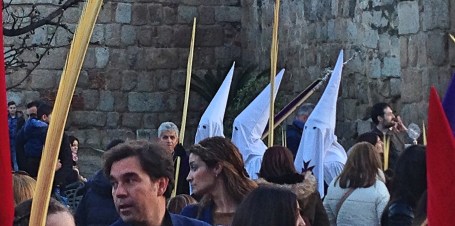
Half the town was gathered in the square, under the walls of the old Moorish fortress. The people were having an Easter Parade.

The most immediately noticeable thing—for an American, at least—is that it looks like a gathering of the Ku Klux Klan. Of course, the Spaniards created their costumes first, and thus it is absurd to associate them with American racism. Nevertheless, the first time I saw it with my own eyes, I couldn’t help feeling uneasy.

Semana Santa

The unease passed quickly, however, and soon I was wholly absorbed in the spectacle. Rows and rows of hooded figures were lined up, some in red, some in white, each of them carrying a stalk of wheat. Among these were dozens of children, who carried little bags full of candy with them; as they walked by, they handed each passerby a treat. Behind the hooded figures was the float. On a large platform a life-sized figure of Jesus was seated on a donkey for his triumphant entry into Jerusalem.

Floats such as this—typical of Semana Santa (Holy Week) in Spain—are carried on the shoulders of a team of men, who huddle underneath, hidden under a veil. It must be heavy. As I watched, the float slowly lurched into motion, step by slow step, plodding like a giant through the town.

Behind the float was the marching band of brass instruments and drums. The music was very simple, and very loud. The snare drums beat out a slow, methodical march rhythm. Over this, the band played a somber sequence of minor chords—a sour, out of tune, tremendously tragic sound that conveyed a sense of overwhelming loss. Sometimes a trumpeter would play a call-and-response with the rest of the horns, squeezing out a strangled series of shrill notes, to be answered by the violent blare of the other players. If you think I didn’t liked it, you’re mistaken; it was music with pathos.

We stood and watched the Holy Week procession for over an hour. I feel privileged to have seen it. Unlike any American tradition, the Semana Santa traditions in Spain give the overwhelming impression of authentic age—as if they have been celebrated the same way for centuries. One feels that one is looking into the depths of history. In stark contrast to the commercial holidays I am accustomed to, the parade had a gravity and solemnity that was deeply moving.

But now it was dark, and we were hungry and tired. After a quick bite we went to sleep.


The next day was Monday. This was to be our only day full in Mérida, so we had lots to see. As I mentioned, Mérida was an important city in Hispania (Rome’s name for Spain). Consequently, some of the finest Roman ruins in Spain, and perhaps anywhere in the world outside Italy, can be found here.

Visitors to the Roman ruins of Mérida have the option to buy combination tickets, which include six sites. This is what we did. Then we went to the two jewels of the city: the Theater and the Amphitheater, located right in the center of town.

The visit took us to the amphitheater first. This is a like a smaller version of Rome’s Colosseum—though it was still a massive construction, big enough for 15,000 spectators. Many of the entranceways into the area are still perfectly useable, the Roman arches still holding strong. Other parts of the building are in various states of decay, allowing me to see the different layers of materials used in the building. One thing I learned—and I’m mildly ashamed I didn’t know this before—was that the Romans had bricks. Indeed, the bricks looked so neat and pristine, their color still bright red, that I found it hard to believe that they were original.

Caceres Amphitheater

The years had been hardest on the seats; most of them are reduced to rubble. Apart from that, however, the preservation is astonishing. Our visit took us through a long tunnel, the main entrance. On either side of the walkway, cardboard cutouts of gladiators are standing guard; beside these are captions of information, explaining the typical armaments of the different types of gladiators. I had thought there were only two or three types of gladiators, but apparently there were a dozen or more, each with their own distinct weaponry. Some had tridents and nets, some had rectangular shields and short swords, and some had small circular shields, heavy helmets, and daggers.

On a stone in front of the box seats reserved for government officials is a faded inscription: AUGUST. PONT. MAXIM. TRIBUNIC POTESTATE XVI. (I myself couldn’t read it, but there was an informational plaque nearby.) From this we learn that this amphitheater was built during the reign of Caesar Augustus, around the year 8 BCE to be precise. To put that in context, the Colosseum was built about eighty years later, in 75 CE.

I tried in vain to imagine what it would be like to fight for my life in front of hundreds of cheering people, and gave up. It is a chilling thought to realize that this splendid architectural marvel was built so that the exploited citizenry and overfed nobles could watch slaves kill each other. It is yet another proof that great art can be produced for nefarious ends.

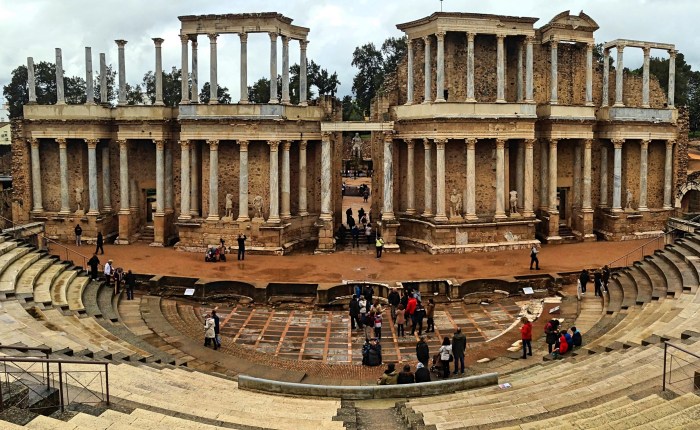
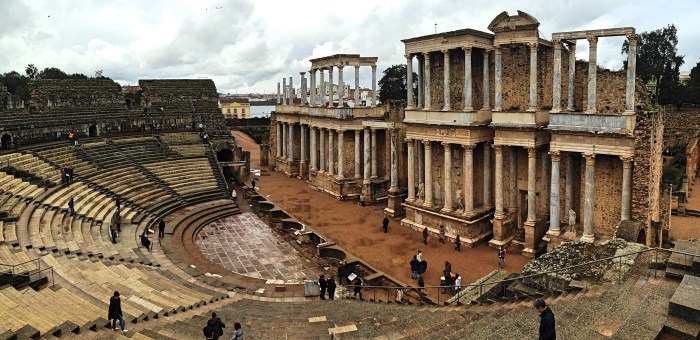
After our fill of pictures we went to the next stop, the Roman theater. It was even more impressive than the amphitheater we had just passed through: it was gorgeous.

Caceres Theater

The theater holds about 6,000 people. First built in around 15 BCE, and majorly renovated about 200 years later, it consists of a semi-circular stadium of seats surrounds a central stage. At first glance the seats looked to be in much better condition than the seats in the neighboring amphitheater; but this was an illusion created by stone-colored plastic coverings. (Plays are still performed here so they need working seats.) In the middle is a semi-circular open space, and beyond that, on a raised platform, a larger rectangular space: this was where the magic happened. But the real attraction was the structure behind the stage.

On each side, resting upon two levels of ten elegant Corinthian columns, was a wonderful façade that served as a backdrop for the ancient theater productions. This is called the scaenae frons, a normal fixture of Roman theaters. It had three doors, one in the center and one on each side, that allowed the actors to enter and exit the stage. The columns themselves were lovely, carved from delicately textured gray and white marble. Standing in the nooks of these columns were Roman statues (the originals are on display at Mérida’s Museum of Roman Art; these are replicas) of gods and heroes, with flowing robes and ornate armor.

I feel a powerful sense of helplessness in moments like this, when faced with something so beautiful and so historic. What am I supposed to do? I take pictures, I wander around, I sit, I stand, I stroll, I do my best to examine and appreciate. I feel a sense of awe at the age and splendor of the place, but what am I supposed to do with this feeling? I wish that the experience would humble me, will put things in perspective, and thus ennoble me; but of course the person who walks out of the monument is still the same petty, neurotic person who walked in.

I hoped to visit the city’s Museum of Roman Art next, but here I realized that I had planned my trip poorly: we were there on the only day the museum is closed, Monday. So we left to go find some more Roman ruins.

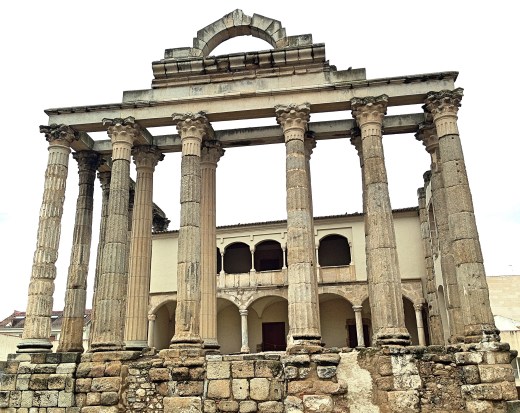
Luckily, Roman ruins were not in short supply. In just ten minutes we came upon the so-called Temple of Diana. This is something of a misnomer, as the temple was actually dedicated to Augustus. In any case it is an impressive sight; a marble lintel sat atop several towering columns. Behind the remains of the temple is affixed an old Renaissance-style house. Apparently, some rich knight decided that it would be nice to live next to the old ruins. The house was elegant enough, but the final effect of the house and the temple was somewhat incongruous. If memory serves, the government considered knocking the house down; but finally decided that it was important enough to merit preservation.

Templo de Diana Caceres

Next we went to the Alcázaba. As its name suggests, this is an old Moorish fortress; it stands next to the Roman bridge, so as to guard the old entrance to the city, and apparently was built over the remains of an older, Roman fortress. This fortress came in handy to the Moors, as they faced several uprisings. The walls are tall and thick, and could have easily withstood all but the most organized attacks.

The entrance fee was included in our combination tickets, so we walked right in. Unfortunately, there wasn’t much to see inside the walls. I imagine that the place was previously full of military barracks and other martial necessities, made out of non-durable materials like wood, which have since disappeared. The only exception to this was the stone cistern. This was a square building that stands in the center of the fortress. There is nothing inside except a long ramp that leads deep underground. At the bottom is a pool of clear, blue rainwater where, surprisingly enough, some fish make their home. But what do they eat?

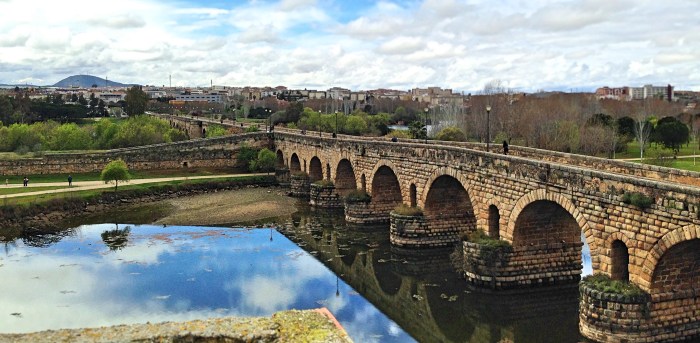
Adjacent to the fortress is the Roman Bridge. This bridge is quite similar to the Roman bridges I had seen in Salamanca and Córdoba: a stone road built over a series of arches, not more than fifty feet over the water. But the bridge of Mérida does have the distinction of being considerably longer; indeed, it is the longest surviving bridge from ancient Rome. The bridge stretches well over 790 m, or 2,500 ft—a stupefying achievement of engineering. The Romans knew what they were doing.

Caceres Roman Bridge

GF and I walked to the other side of the river, and towards the other major bridge of Mérida, the Puente Lusitania. This is an attractive, modern bridge, designed by the architect Santiago Calatraba. The form of the Puente Lusitania is dominated by a big, great fin, like the back of a whale. Its completion in 1991 finally allowed the city to close the Roman Bridge to vehicular traffic. In other words, the only bridge linking both halves of Mérida until 1991 was a bridge built by the Romans.

(The only other bridge across the Guadiana is the railroad bridge, a triangulated structure of cast iron beams riveted together, designed by an Englishman named William Finch in the nineteenth century. The three bridges of Mérida, taken together, are a lovely study in contrasts.)

Our next stop was the Circus Maximus. This was on the other side of town; we had to walk about half an hour, all the way through the city center and through a tunnel under a highway to get there. Again, our tickets included this visit, so we walked right in.

In truth, there wasn’t much to see. It is a dilapidated stone wall (previously, rows of seating), that surrounds an oval-shaped grass field. The only impressive thing about the monument was its size: it’s huge. This was, of course, because chariot races cannot be carried out in closets. We walked around the grassy field for a few minutes, while I tried in vain to imagine what a chariot race would look and feel like, the horses stampeding in a confused heap, the wheels rattling, the whips cracking, the men shouting, the crowd screaming.

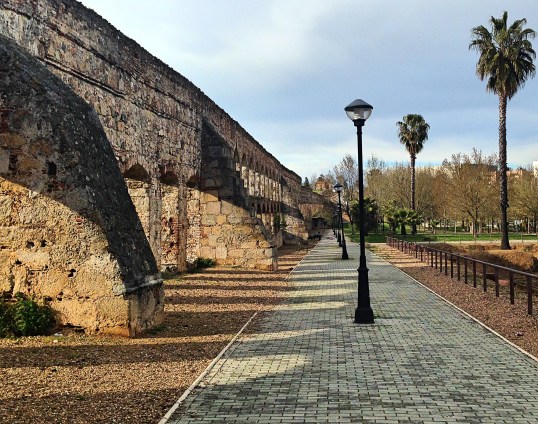
Outside the Circus Maximus were the remains of an old Roman aqueduct, the Acueducto de San Lázaro, one of the three Roman aqueducts of Mérida. Compared with the extraordinary aqueduct of Segovia, this one was rather short—only about 20 to 30 feet. It did go on for quite a ways, however, eventually extending over the other river of Mérida, the Albarregas.

San Lazaro Aqueduct

We followed the aqueduct for a while, across the river and into a park, until the aqueduct disappeared over a hill. Then, we broke off for our next destination, the last site included in our tickets: the Casa del Mitreo.

This is an archaeological site that consists of the remains of an entire Roman housing complex. Understandably, you can’t go in; the visitor walks around a platform raised above the ruins, allowing you to peek inside the rooms from above. The complex was quite large; either it was one very rich family, or several families of more humble means. I don’t know, because all the information panels were written in very small font, in Spanish, and there was a crying kid nearby that kept breaking my focus. Oh well.

Most notable were the impressive floor mosaics, beautifully preserved. My favorite was a floor that had three concentric patterns: an outer pattern of criss-crosses, a middle pattern of rectangles, and an inner pattern of an intricate labyrinth. Floor tilling hasn’t advanced much in the last two thousand years, it seems.

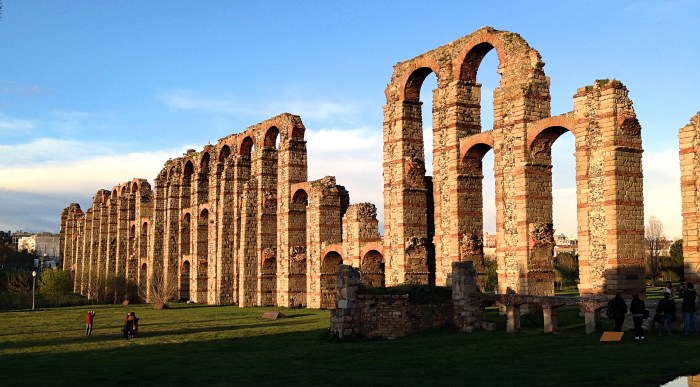
The sun was setting now, and both of us were exhausted. We had been on our feet all day, crisscrossing all over town. But we had one final thing see: the Acueducto de los Milagros, or Aqueduct of the Miracles. This meant yet another walk through town, which we dutifully made, painful and blistered as my feet now were. It was worth it.

Aqueduct Milagro


This aqueduct is massive, about 25 m, or 80 ft tall, standing on three rows of arches. It is partly in ruins now, scarred by the tooth of time, but this only lent it a special majesty. The sun was setting, shinning directly onto the aqueduct, making its brick construction glow a rusty red. All around was a park, where families were talking and laughing. GF and I sat on a bench, resting our aching limbs, staring up at the towering ruin. It was so impressive and so lovely that soon I felt myself full of energy again, ready to drag myself through a dozen more Roman monuments.

Soon the sun was setting. We limped back into town, and were again greeted with a surprise: they were having another Easter Parade. This time the crowd was gathered in front of the doors of a church. Just as we got there, the procession started to exit the building, walking with slow steps to the beat of another doleful march. We watched it go for a while, and then went to feast on beer and cheap sandwiches. Our trip was over. We would be going to Lisbon early next morning, but that’s for another post.

I’m not sure I’ve had a better day in Spain, and that’s saying something. Do visit Mérida. It is an extraordinary place.

Caceres Storks

West to Extremadura: Cáceres

West to Extremadura: Cáceres

“See those trees?” the driver said.

“Yeah.”

“That’s what the pigs eat, the acorns from those trees. They’re called encinas.”

We were on our way to Cáceres, one of the major cities in Extremadura. Out the window I could see the flat, featureless, interminable plains of the region. Extremadura is known in Spain as being the poorest autonomous region—whose subsidization the Catalans are forever resenting. Life here, in this land of farmers and shepherds, has historically been rough. Perhaps this is why so many of the infamous conquistadors—including the two most famous, Francisco Pizarro and Hernán Cortés—ventured forth from this land: having few prospects at home, they sought adventure abroad.

The drive west from Madrid is perhaps the least interesting one in Spain I know. There isn’t anything to see except fields of grass and the aforementioned short, shrubby trees. But the visual dullness is amply compensated by what the traveler can learn about Spain from a trip here. Case in point: jamón ibérico, the finest ham in the country—and ham is fundamental to Spanish food—comes from here. The black pigs roam, free-range, eating the acorns of the encina trees, known in English as the “holm oak.”

Our driver spoke in the fast, clipped accent of Cáceres, only slightly easier to understand than the dreaded accent of Andalusia. We were on vacation for Semana Santa, Holy Week. Our final destination was Lisbon; but to break the trip into manageable chunks we decided to stop in Cáceres and Mérida on the way there, cities that had been recommended to us.

In two hours we arrived, dropped off our bags, and went into the city center. It was a rainy, overcast day, with a chilly breeze. The gray sky and the dull light gave the town a forsaken aspect. But instead of detracting from the city’s charm, the weather added to it.

Cáceres is one of the major cities of the region, the capital of its eponymous province. The city is notable for having one of the finest historical centers in Spain. The walled city is almost perfectly preserved; it looks as though hardly anything has changed since the Middle Ages. Most of the buildings are worn and weather-beaten, but their brown stone façades are all the more impressive for that. Unlike Toledo, few buildings stand out for special comment. Rather it is the entire city center that is the main attraction, the narrow stone streets, the proud walls, the many church spires.

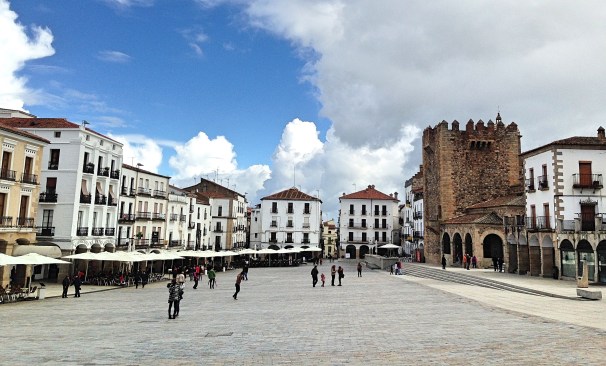
Caceres Plaza Mayor
The Plaza Mayor

But Cáceres is not exactly beautiful, and it certainly isn’t pretty. The city is impressive for its severity. While wandering through the chilly interior of a cavernous church, or standing in the rain underneath the city walls, you get the powerful sense of what it must have been to live here, eking out a living on the hard soil, taking shelter behind the walls, seeking salvation in another world. The final impression is that life here was precarious and hard; and even now the town seems only to limp by on the strength of its tourism.

Caceres Street

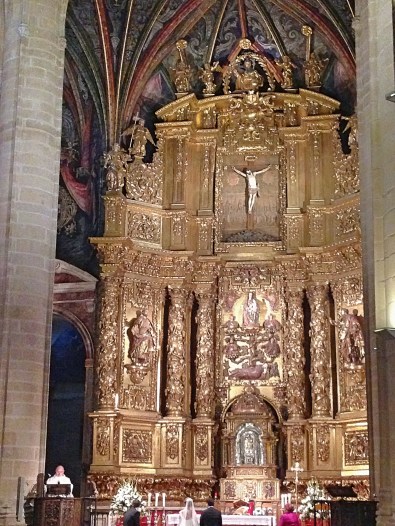
The first building we visited was the Concatedral de Santa Maria de Cáceres, a co-cathedral built at the end of the Romanesque period. Like most building in Cáceres, it is rather plain; the outside is devoid of ornament. The most beautiful thing on the inside is a massive carved wooden altar, quite a marvelous piece of work. You can also visit the building’s tower, which affords you with an excellent view of the old city.

Caceres Altar

Probably the most conspicuous church in Cáceres is the Iglesia de San Francisco Javier. This church sits at one of the highest points in the city, and its two white towers, which flank the main doorway, can be seen from quite a distance. The inside is rather unusual: On both the ground and the upper level there is a massive timeline, recounting the history of Spain and the Catholic Church. It wasn’t very well made; the board was so crowded with names and dates, all printed in tiny letters, that you would have to spend many hours to read everything. Also on the upper floor was a museum of Belén (nativity scene) figurines. They had examples not only from Spanish history, but from all around the world. There was everything in the church except a church.

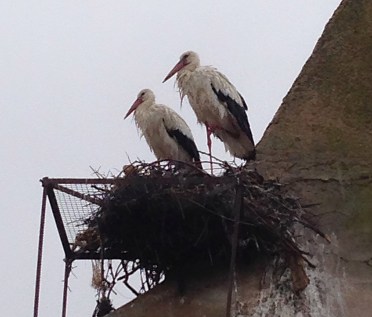
From the top floor you can walk up to either of the tall, white towers. Not only did we get a nice view of the city, but we also got a close look at some of the white storks nesting on the opposite tower. They are lovely birds.

Caceres Storks

Next we went to the Museum of Cáceres. In truth, I wasn’t expecting much from this museum; and the nondescript building only confirmed my lack of excitement. The place seemed so destitute that I doubted there could be anything worth seeing. But I am happy to report that I was very wrong.

The collection spanned from prehistory to the present day. It began with the region’s pre-Roman inhabitants, their jewelry and clay pots. Next were the Roman artifacts, including little statues and tablets with still visible Latin inscriptions. There were replicas of the agricultural tools used by the erstwhile peasants of the region, as well as their traditional dresses. Down a flight of steps I found a room dedicated to the Visigoths, and down another flight, in the basement, was the most impressive room of all. It was an original aljibe, a water well constructed by the Moors. In dim, subterranean light, the distinctive crescent arches of the Moors stand over a still pool of water. It is enchanting.

I thought that would be all, but a walkway led to another building, and there I found that the Museum of Cáceres also boasts an impressive collection of modern art, including a sketch by Picasso. On the floor below that, there are also a few examples of Medieval art, and even a work by El Greco. If you find yourself in Cáceres, do visit this museum.


The next day was bright and sunny. We ate breakfast and headed into town. Once there, however, we realized that we didn’t have very much to do. We had seen the major churches, we had seen the museum, we had walked all the streets. Now what? I was lazily turning this question over when I noticed how lovely the surrounding area looked in the sunlight.

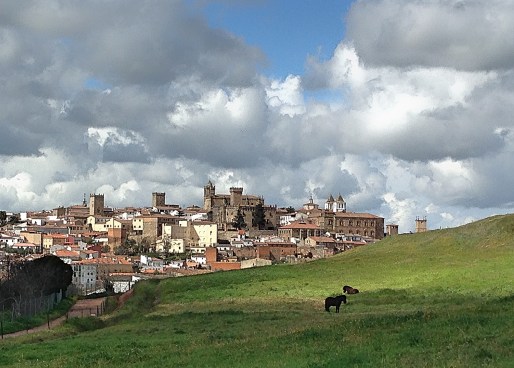
Thus we turned down a narrow street, passed through the old medieval gate, and emerged on the other side. In just twenty minutes we were surrounded by farms and rolling grassland. Horses grazed nearby, sticking their noses through the farm gate in hope of food. We found a dirt path leading away from the road, going to our left into one of the grassy fields. By now the weather was nearly perfect, with a warm sun and a cool breeze. The grass shone green, and the flowers were in bloom. In the distance we could see more horses grazing in the open fields; and beyond that the old city center of Cáceres sitting nobly on its hill.

Caceres Distance


The natural scenery and the blue sky felt so refreshing after the gloomy rain and the harsh Medieval architecture of yesterday. The only buildings here were derelict. An old farmhouse with boarded up windows, stuccoed brick walls, and cracked wooden window-frames stood by the side of the path; its roof was totally caved in, the wooden beams a broken heap on the floor, everything covered in weeds. A stone wall ran besides this farm; shards of colored glass has been glued to the top to discourage trespassers.

We walked for hours, holding our jackets, soaking in the sun and breathing the fresh air. But then the sun began to go away, and it became so chilly we had to put our jackets back on. Storm clouds were appearing; in just minutes the blue sky was devoured by grey. We began heading back for town, but we hadn’t gotten far before the rain started. Unluckily for us, we didn’t have our umbrellas, so we huddled through the town back to our room.

Soon we were back at our Airbnb. Our two days in Cáceres were spent. The town is not, perhaps, as imposing as Toledo or Córdoba; but what Cáceres lacks in major landmarks it makes up in intimacy. The medieval streets are not filled with noisy street performers or clowns in costume, as in so many other Spanish cities. You will not have to nudge your way through massive tour groups or dodge gaggles of Americans on Segways. The restaurants are filled with locals, not tourists. Horses roam the city’s surroundings, not double-decker buses. Intense tourism gradually turns every site into Disneyland, but Cáceres is still a city.

A Sip of Logroño

A Sip of Logroño

(Continued from my post about Burgos.)

Our next stop was the city of Logroño, the capital of the province of La Rioja. With only 5,045 square kilometers, La Rioja is the smallest province on mainland Spain and the second smallest overall, only slightly larger than the Balearic Islands. For any wine connoisseurs, the region needs no introduction. Located in the upper regions of the Iberian System of mountains, the province occupies the valley of the Ebro; and it is here that this mighty river splits and divides into seven channels, which is why La Rioja is known in Spanish as “The land of the seven valleys.” The climate of this valley—gradually varying as the land ascends from east to west—has proven ideal for viticulture.

Logroño is by far the largest city in this province, concentrating more than half its population within its reach. Like Zaragoza, the city is huddled around the Ebro; and like León and Oviedo, it is an important stop on the Camino de Santiago. Compared with any of those three cities, Logroño has played a relatively modest part in Spanish history. Surrounded by Aragon to the East and Castilla y León to the West, the city has never been a major center of power. But it is a center of wine—and that is what I was there for.

We took a Blablacar there the next morning. For part of the way, we were accompanied by two college-aged girls. I only mention them because they immediately struck me as odd.

In Spain, greetings are important. When you get into a car, you often perform all sorts of contortions so you can—like a proper human being!—kiss one another on the cheeks and make introductions. But these girls, who were Spaniards, sat timidly in the corner and gave us nervous smiles. And even though my Spanish was halfway decent by then, I found it impossible to communicate with them. Eventually we stopped in a small, no-name town and they hastily got out without even a word of goodbye. I looked around at the town, which struck me as one of the seemingly identical, featureless pueblos one drives through on the way to the major cities. Why were they here? Were they running away or something?

“Weird people,” the driver said, as we started driving away. I’m glad I wasn’t the only person to think so.

Our plan was to visit a bodega, which is the Spanish word for winery. (As a side note, I can’t help finding this word funny, since in New York City a “bodega” is a corner store.)

Our Airbnb host was out of town, so we were shown in by the host’s mother, a terribly nice woman who answered all our questions, gave us recommendations, and even made us reservations for a tour at a winery—specifically, the Campo Viejo winery. But there was one problem. When she left, we realized that she was under the impression that we had a car; the winery was well outside of town, and when I called to ask if it was possible to walk there, the man said “No, no, take a taxi.”

We were feeling stingy and we didn’t want to pay for a cab. Travel doesn’t pay for itself. Google Maps said it would take an hour, and that was exactly how much time we had before our tour. So we decided to walk. Our phones soon led us out of the city and into the surroundings countryside. We were forced to walk on the road because there were no sidewalks, but thankfully the roads were mostly empty.

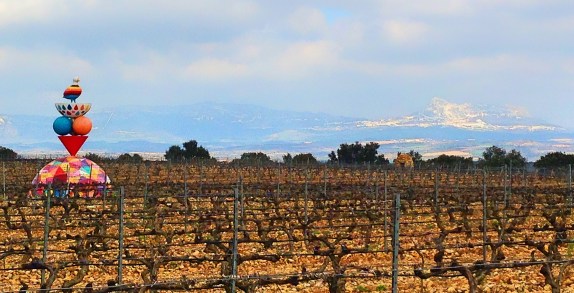
In just forty minutes we were making our way through rows and rows of grape plants. Or at least I assumed they were. This was my first trip to a vineyard or a winery, and to my ignorant eyes the plants looked like stunted trees, not “vines.”

Logroño Vineyard
The colorful thing was part of a marketing campaign

Finally we arrived, and right on time. The tour began. And unsurprisingly, it was in Spanish. The guide very kindly offered to translate in English for us, but we bravely said no, hoping to improve our Spanish in the process.

Consequently, at a generous estimate I understood about 20% of the tour. Probably more like 10%. But here’s the outline. To start, he took us outside where he talked about the grapes, and then went downstairs where he told us about the history of the winery. Next he led us into a massive room where hundreds of thousands of bottles of wine were sitting on racks; he had to shout to be heard over the giant fans, which kept the room at a constant temperature, pressure, and humidity. I believe this room was to combat the effects of “bottle-shock”—the temporary distortion in flavor that follows the bottling of wine.

After that, we were shown the factory. On metal platforms suspended twenty feet from the ground we walked among about forty gigantic metal tanks. He told us about the fermentation and distillation process, and I understood none of it. But even though I didn’t understand what any of the equipment was for, I think there is something terribly exciting about being around big, shiny, high-tech equipment. I felt like I had stepped into the future, and it smelled like fermented grapes. The last stop was most impressive of all. A ramp led us down to another massive room at the bottom of the building. Our guide switched on the lights, and suddenly I saw thousands of wooden barrels, all pilled atop one another, stretching out before me like the ocean. There must have been thousands.

It always amazes me that we can develop things like wine-making to the pitch of perfection, an exquisite blend of science and art, and yet we cannot solve problems like poverty. I suppose there’s more profit in the former.

Finally it was time for the tasting. Our group gathered around the bar, and the guide began pouring out classes of white wine. He tried to talk us through the process to properly taste wine—sniffing and gurgling and pondering—but I had downed my glass before he’d even started. I liked everything, but I must admit by pallet is extremely insensitive: all wine tastes pleasant but rather similar to me. Case in point: the thing I remember most fondly from the tasting was not the wine, but the free chorizo and bread sticks that I munched on ravenously.

Best of all, we didn’t even have to walk back. There was a nice Spanish couple from Burgos on our tour, and one of them was very excited by the opportunity to practice his English with us. He spent the whole tour tasting chatting with us; and when we finished, he offered to give us a ride back to town.

“Do you trust me?” he said, as we climbed into his car. Normally this kind of comment would send chills running down my spine; but in the mouth of a non-native speaker, it seemed nice and innocent.

Well, we survived. In just ten minutes we were back in town. Since we didn’t have any plans beyond our wine tasting, we decided to kill time before dinner by visiting all the church buildings in town. Logroño, as I mentioned, is situated along the Camino de Santiago, the famous pilgrimage route that runs along the north of Spain. This route is clearly marked with the classic cockle shell insignia; and even though it was cold and off-season, we saw a handful of dutiful pilgrims, wearing blue rain jackets and lugging around giant backpacks, making their way through the town.

None of the churches or basilicas of Logroño is memorably impressive on its own, especially after seeing the Burgos Cathedral. But taken together, the churches of Logroño form a wonderful tableau of religious architecture.

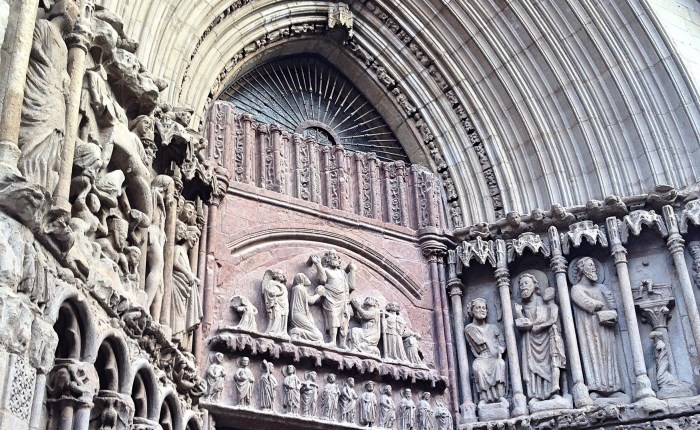
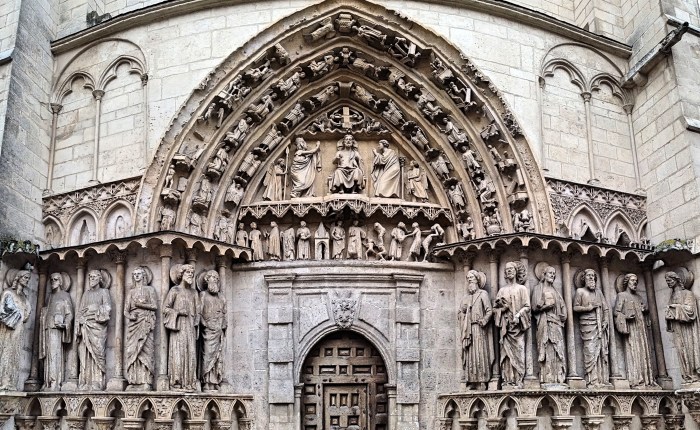
We went to four or five in quick succession. One church that sticks out in my memory is the Iglesia de San Bartolomé, which has a wonderful front portal, bursting with radiating arches and crowned with a sculpture of the Last Judgment. The inside was empty, except for a lonely priest sitting in the confessional booth; and in the cold silence of that stone building, I couldn’t help feeling sorry for the lonely priest, waiting for a congregation that seldom comes.

Logroño San Bartolomé_Fotor

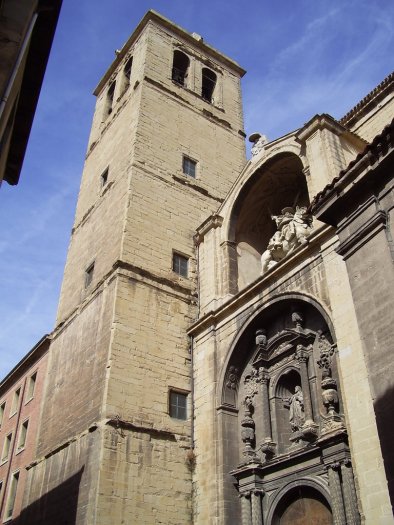
Another church worth mentioning is the Iglesia de Santiago del Real, one of the largest churches in the city. You can recognize the church from the equestrian statue of Santiago wearing his pilgrim’s hat, his arm raised to strike. As we wandered through the dark and cavernous insides, examining the chapels and altars, a man came in, kneeled down on a pew, and prayed. Three minutes later he got up and left, the thud of the heavy wooden door echoing ominously through the interior.

Santiago's_Church_in_Logroño
Photo by jynus; licensed under CC BY 2.5; taken from Wikimedia Commons

“I wonder what it’s like to be a catholic in one of these places,” GF said. “Does it add to the experience?”

I had been wondering the same thing. For the two of us, all the altars, chapels, and architecture of Catholicism are simply art; our appreciation is purely aesthetic. It must be a different thing completely to look upon the giant crucifixes in the stone buildings, and see the Truth of the Universe. Sometimes I almost regret that these stronger, more spiritual pleasures are cut off from me. But so it goes.

Logroño Cathedral.jpg

Last we went to the cathedral, which you can recognize by its two towering spires. Technically the Cathedral of Logroño is a co-cathedral; indeed it is one of three in its diocese, along with the Cathedral of Calahorra and the Cathedral of Santo Domino de la Calzada. In any case, we weren’t able to look around because there was a wedding being held. When we peeped in, the groom and the bride were kneeling before the altar while loud organ music was playing. The priest was standing nearby. Catholicism may be fading here in Spain, but it’s certainly not dead.

Logroño Wedding

Finally it was time for dinner. For this we went to the Calle Laurel, the famous culinary arterty of Logroño. The street is so narrow and so full of people during meal times that no car could make it through—and none did. Restaurant after restaurant is packed into the small stretch of street; and in each one you can see plate after plate lined up on the bar, waiting for you to partake. Many of these dishes are ostentatious in their presentation: meatballs are served in a wine glass, covered in a bright red sauce; ham is suspended like a flag on a ship from toothpicks sticking out of the top of a croquette.

To avoid the crowd, we got to the street at 7:30 (very early for Spain), picked a restaurant, and dove in. We ordered whatever caught our eye. But to my dismay, as soon as I chose a dish the waiter would take it and stick it in the microwave. The food still tasted good, but the microwave rendered it soggy and textureless, and one croquette was still cold in the middle.

We went to another bar and got the same treatment; and ditto in a third bar after that. All told, we samples six different bars before calling it quits, most of the food only moderately good. But thankfully we saved the best for last. To finish we walked into a bar that served only mushrooms—the Bar Ángel. They are the simplest things in the world, cooked in olive oil with a sprinkle of salt; and they are delicious. If you’re in Logroño, find the restaurant with the grill filled with mushrooms and eat your fill.

The next morning we took a Blablacar back to Madrid, riding with a couple of guys from Senegal; they both worked in a meat factory in Cuenca. One of them slept the whole time, but the driver was a sociable fellow and we talked in accented Spanish the whole way back. And thus ended another weekend in Spain.

A Taste of Burgos

A Taste of Burgos

Burgos is the second largest city in the province of Castilla y León, after León itself. One thousand years ago or thereabouts, the city was the capital of the erstwhile kingdom of Castilla. Now the city governs a high plateau, 859 m (2,818 ft) above sea level, situated some miles inland and therefore insulated from the warming currents of the Mediterranean. Chilly wind sweeps through its streets, and winter inevitably brings heavy snow.

But there is plenty to compensate for the cold.

The ride up was long and pleasant. It was only the driver, GF, and myself. The driver was a young man from Galicia who lived in Burgos, working as an air traffic controller. He spoke slowly and with a clear accent, which gave me the pleasant illusion that I was fluent in Spanish. After two hours we arrived.

Soon we were walking towards the center of the city. As usual in Burgos, it was a cold, cloudy day. But I didn’t care; I was about to see one of the finest cathedrals in Spain.

But first we had to eat. I was hungry. So we ducked into a bar for some croquettes and tortilla and coffee. While there, we asked the barman to point us to the cathedral’s entrance.

“Right around that corner,” he said. “But before you go in, go to the Iglesia de San Nicolás, a very nice church.”

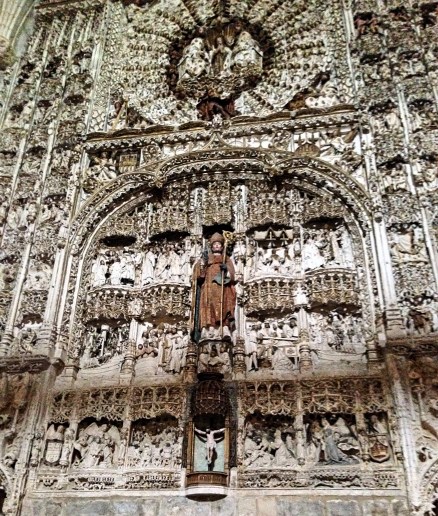
He was right. This little church is right next to the cathedral, and it definitely merits a visit. The central altarpiece is incredible, a towering monolith of white marble carved into an army of angles. There are so many little figures and scenes in it that it would be impossible to look at it all; in fact, the carved reliefs are so tiny that they form only surface details, elements of an abstract pattern. This monumental altar, one of the great works of Renaissance Spain, was designed by the sculptor Simón de Colonia and executed by his son.

Iglesia de San Nicolas AltarNow it was time to see what we came for: the Cathedral of Burgos, La Santa Iglesía Catedral Basílica Metropolitana de Santa María. We walked out of the church and looked up. It was stupendous. The cathedral of Burgos is one of Spain’s lesser known treasures, at least to outsiders. Even greater than the Cathedral of León, it is the finest example of French Gothic in Spain.
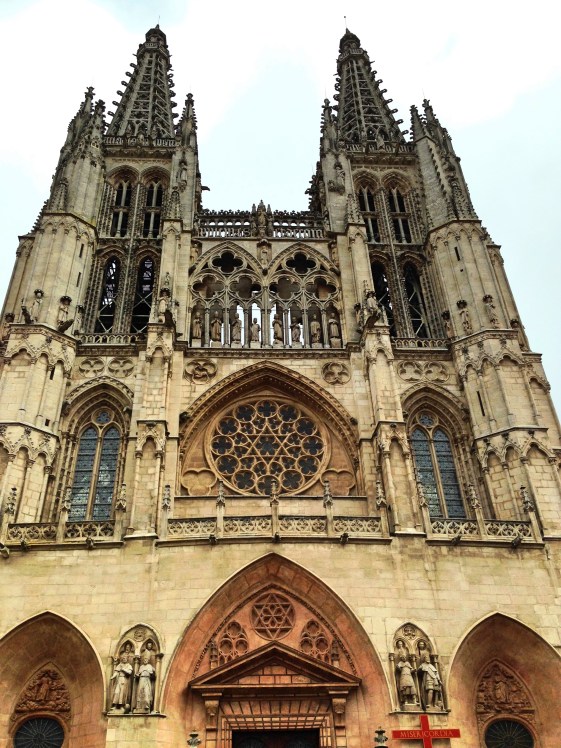
Burgos Cathedral Front

We walked around the outside for a while, just taking it in. Like the Cathedral of Santiago de Compostela, the massive building is impressive from every side. Sculptures stand above the doorway, their noble robed figures looking down on the viewer with infinite calm. Reliefs are carved into the exterior walls, of men, of animals, of abstract decorations. Above one doorway, now unused, is an excellent scene of the Last Judgment, each figure looking like it had been carved yesterday. The whole thing is bristling with spires, over twenty of them, impaling any poor clouds that get too close.

Cathedral Back

Whereas many cathedrals in Spain are stylistic patchworks, due to their being built and repaired in many different epochs, the Cathedral of Burgos is a symphony of stone—balanced, unified, pure French Gothic. (And this is not, by the way, because it was built all at once, but because later generations mostly kept to the original aesthetic.) Burgos, you see, is one of the major stopping-points on the Camino de Santiago, the pilgrimage route which brought untold thousands from the rest of Europe. This is why the cathedral has such a strong French influence.

After we had drunk our fill of the looming edifice, we went inside. The entry ticket came with an audioguide included. Thinking that we’d practiced enough Spanish that day, we got the guides in English. There were two narrators, a man and a woman, and both of them spoke with such soothing tones and such calm slowness that I felt I was being deliberately lulled to sleep, not informed.

The inside of the cathedral is not as overwhelming as its outside, which is hardly saying anything. There are fine Renaissance paintings, old Romanesque frescos, impressive sculptures, admirable altars—too much to remember or name. But a few things stick out in my memory.

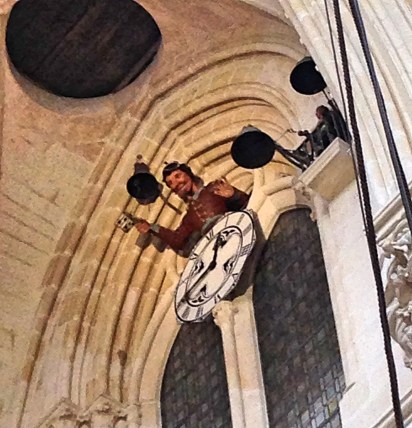
First was a wooden figure of a man’s upper half emanating from a section of the ceiling, high up above near the ceiling. Every hour this impish fellow strikes the bell and opens his mouth. This automaton is called the Papamoscas, named after the flycatching tit, whose snapping beak the Papamoscas is supposed to resemble. Unfortunately I didn’t get to see this delightful rogue in action. But he is sufficiently incongruous—looking almost Mephistophelean with his grin—to attract the attention of nearly every traveler to the cathedral, including Victor Hugo.Papamoscas BurgosThen there was the central cupola. This was unlike any I had ever seen before. Instead of a large dome crowning the building, it was filled with small windows in an intricate pattern; standing underneath and looking up, it looks like heaven itself is opening up. The audioguide explained how it was created, but I don’t remember now, and even at the time I couldn’t believe it. Hanging from so high a place and looking as delicate as paper ribbons, it is impossible to believe it was made from stone. The credit for this lovely work goes to Juan de Vallejos, an otherwise obscure and unknown figure.
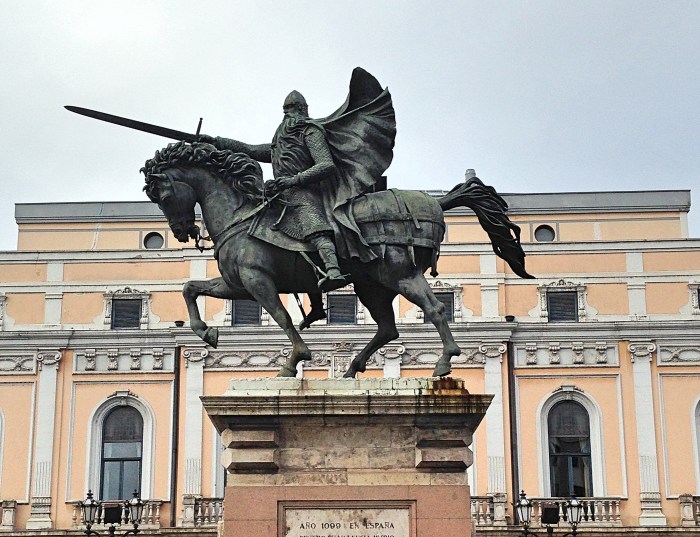
Immediately below is something even more special: the tomb of El Cid Campeador, the half-legendary warrior from the Spanish Middle Ages. The tomb is nothing special to look at—just a slab of granite on the floor—but the man certainly was.

El Cid is the star of the first major work of Spanish literature, El Cantar del Mio Cid, an epic poem in which he is portrayed as a tireless warrior for Christianity against the Muslims. (The real story was, as usual, more complicated.) I had read this poem right before moving to Spain. Thus, standing there before his tomb felt a bit like standing in front of Washington Irving’s old room in the Alhambra: like I had completed a circuit. I love moments like this, when past and present are suddenly thrown together, because it is in these times that we can feel how much we’ve changed and how much we’ve stayed the same.

El Cid Statue

On the recommendation of both our driver and our host, we went to Casa Pancho for lunch, a restaurant quite near the cathedral. It was early for lunch, but the place was already bustling.

I knew what I wanted: morcilla. This is Spanish blood sausage, a common ingredient in stews from Asturias to Segovia to Cáceres; and the morcilla in Burgos is supposed to be the best in Spain. Indeed, in supermarkets you can find blood sausage labeled “Morcilla de Burgos.” This label doesn’t necessarily mean that the morcilla was made in Burgos; rather it means that the sausage was made with rice rather than onions, which is the Burgos style. Rice gives the sausage a denser and, in my opinion, more pleasant texture in comparison with onions, which are used in the morcilla of Estremadura.

I ordered two tapas of morcilla to start. It was great, so much better than other morcilla I had tried. Then I ordered pepper stuffed with morcilla in a spicy sauce, and it was even better; and after that, a piece of bread topped with a quail egg, a hot pepper, and morcilla. Everything was delicious.

Burgos trees
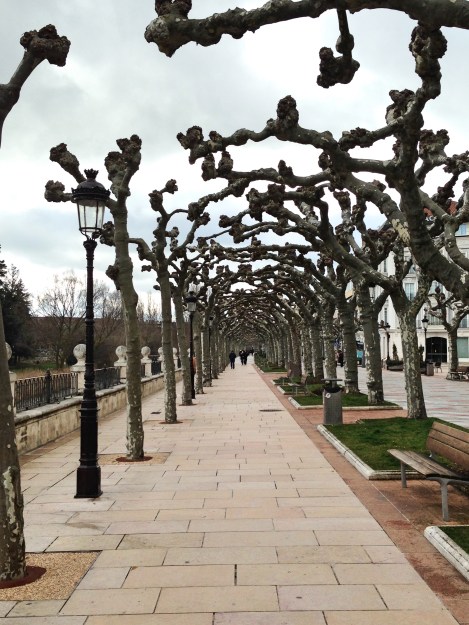
Along the streets of Burgos, the trees were cut to grow into one another, forming one continuous twisted form

Both of us left satisfied and happy. In fact, the food was so good and so reasonably priced that the meal stands out in my memory as one of the best I’ve had in Spain.

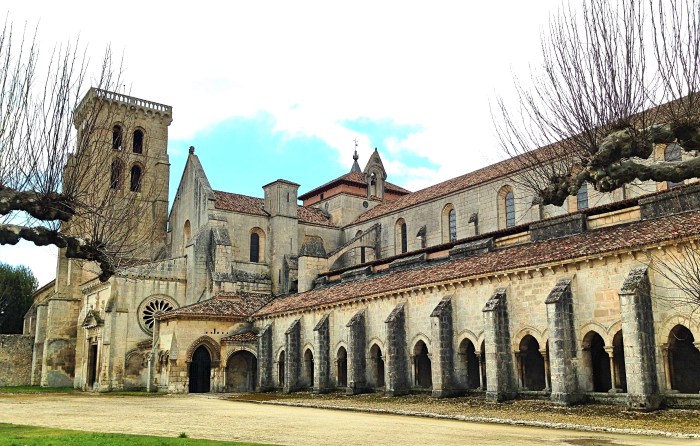
The next stop was Las Huelgas. This is a large monastery that is situated a bit outside the city center. It took us about twenty minutes to walk there. It is an impressively large building, its gray form stretching hundreds of feet.

Las Huelgas

But when we got there we found that it was closed, and it wouldn’t open for another forty minutes. This is a common occurrence in Spain, especially in smaller cities: monuments close in the middle of the day and reopen a few hours later. The Spanish may profess that the siesta is dead, but midday breaks are still something the tourist must be wary of.

We retreated to a café to kill time. On the television, the news was playing; they were covering the story about the castle in the south of Spain, the Medrera castle in Cádiz, that had been restored with hideously poor taste, essentially turning the old castle into a block of concrete. The news story compared it to the other famous botched restoration in Spain, the ecce homo in Borja that an elderly Spaniard had famously turned into ‘Beast Jesus’. In fairness, restoration is difficult, delicate work. But it shouldn’t be the occasion to turn a piece of heritage into modern art.

Finally it was time to go. We paid and went to buy our tickets.

“Would you like to visit now?” the cashier asked as I was paying.

“Yeah, now,” I said.

“Okay, follow her,” she said, pointing to her colleague.

We did, and soon discovered that we were with a group. We were on a tour; the only problem was, the tour was in Spanish. Our guide was a woman with short gray hair, who seemed very professional. Sometimes I understood almost everything she said, other times almost nothing.

What immediately struck me were the sarcophagi. For a long time this monastery had served as a royal burying place; many kings and queens of Castille can be found here. In this respect Las Huelgas is the counterpart to the Royal Pantheon in the the Basilica of San Isidro in León. Though many of the sarcophagi are relatively bare and unadorned, and though I had never hard of anyone buried there, the sensation of being surrounded by so many royal corpses sent shivers up my spine. Even on a purely aesthetic level, many of the coffins bear beautiful carvings and decorations, and their placement in the cavernous space allows the visitor to walk around them and get a close-up view

Another thing I noticed was the preponderance of Mudéjar ornamentation on the walls. The ceilings were built with the lovely, crisscrossing, intricately interlocking wooden pieces so typical of Mudéjar and Moorish architecture. And some of the stucco decorations could easily have been in the Alhambra, if not for the royal emblem of Castile inscribed in the vegetable motifs, not to mention the Latin calligraphy (instead of Arabic) inscribed into the pattern—a wonderful example of syncretism in history.

Though the visitor wouldn’t guess it—I certainly didn’t—the monastery is still active and in use, with a population of Cistercian monks. Apart from its use as a royal pantheon, it is also historically notable for having some of the oldest stained class windows in Spain, and for being the discovery site of one of the most important musical manuscripts from the middle ages, the Las Huelgas Codex—which is an invaluable source of our knowledge of medieval plainchant and polyphonic motets. And this is not to mention its museum of cloths and fabrics, preserving many royal garments and tapestries from the middle ages.

Beyond this I unfortunately cannot say much, since I visited when my Spanish was still far from fluent, thus preventing me from understanding much of what our guide said.

By now it was late. The only thing to do that was still open was the Museum of Human Evolution. We walked there from the monastery—about twenty minutes—and searched around for the entrance. The museum is in a cluster of big buildings, and the entrance is actually not well marked. We walked around for about five minutes before asking somebody, who pointed us in the right direction. Ahead of us in line to enter was an American man, who took the opportunity to complain to the woman at the front desk that the place is hard to find.

“I was looking for twenty minutes!” he said.

“Yes, sir, it’s not very good,” she said.

The Museo de Evolución Humana is housed in a huge building. The best way to describe the museum is that it looks expensive. Lots of money had been spent here. Everything was new and shiny. Indeed, it looks like they had money to spare, since they didn’t use the space efficiently; probably more than half of the volume of the building is totally empty.

The first floor (or floor zero in Europe) is dedicated to the archaeological site in the (now collapsed) caves of the Atapuerca Mountains, just a few kilometers away from the museum. This site, which can be visited by bus from the city, is known for being the location of the discovery of the oldest known European hominin fossils, Homo antecessor. It is not a designated UNESCO World Heritage site, and I hope to visit one day.

On this floor there were four raised platforms, the tops of which were covered in a very realistic imitation landscape, with fake trees, shrubs, and grass. These are meant to be the environment of the Atapuerca Mountains. You can walk into the bottom of these platforms, as if walking into the caves; and inside are all sorts of fancy displays, with replicas of bones, tools, and audiovisual presentations.

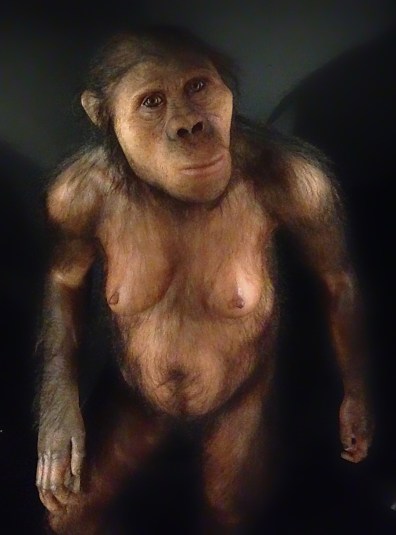
The second floor (European first floor) is dedicated to the theory of evolution. Most notable was the timeline, arranged in a semicircle, of human evolution. It is complete with replica skulls of hominin fossils, making the gamut from Australopithecines, to Homo erectus, to Neanderthals, and finally to us. Even more impressive than the skulls were the life-sized models of these species as they might have looked in life, all of them excellently made, quite startlingly alive. I kept expecting them to move.

Burgos Evolution

The next level up was about the history of technology. In glass cases were stone tools from different stages of our evolution, ranging from simple choppers to finely crafted arrowheads, as well as replicas of wooden and bone tools. Despite its showy and even ostentatious presentation, the museum is undoubtedly among the best science museums in Spain, and well worth a visit.

It was late now, and we had only one more stop: the Taberna Patillas. This bar was recommended to us by our host because every night they have free music. We ate a quick dinner of pizza and then huddled into the corner of the bar, drinks in hand, waiting for the music to start. We waited, and waited. The bar gradually filled up. Half an hour went by.

As we waited, we took the time to examine the decoration. Every inch of the walls and even the ceilings was covered in old ads, postcards, portraits, posters, photographs, and other paraphernalia—all related to musical performances. There were framed and signed pictures of musicians, and on one wall there was a big painting of the bar itself, with the bartender playing the guitar. Next to it, a guitar hung; and nearby was a mandolin. The place has character.

After forty minutes a group of men walked into the bar and sat down at a table near ours, two of them carrying guitars. All of them were late middle-aged, with graying hair, all wearing collared shirts and sweaters. Everyone around grew quiet and turned their seats to face the men. The two guitarists tuned; then one of the other men stood up. He looked like the oldest of the bunch; he had snow white hair swept back across his head, and an equally white goatee.

The guitarists started playing, running through a few bars. Then the man started to sing. He had a strong voice, almost operatic. When he sung, he held his body in a stiff posture, his shoulders thrown back, his chin raised, gesticulating dramatically with his hands. He finished with a flourish and everyone burst into applause; then he began on another, this one more mellow.

After three songs, the singer bowed and made his exit. But the band stayed on. Many of them were also talented singers; and they could sing in harmony. Maybe it was the atmosphere, maybe it was the beer, maybe it’s because I was tired and had seen so much that day, but I thought the music some of the best I’d ever heard. It was so intimate, and so direct. If you find yourself in Burgos, go to Taberna Patillas at about 8:30, and wait.

Taberna Patillas Burgos

After about an hour, we left. We were both very tired. All in all, my day in Burgos was easily one of the best I’ve had in Spain—full of history, science, music, fine architecture, and good food. Burgos is a special place.

(This trip continued onwards to Logroño.)

North from Madrid: Oviedo

North from Madrid: Oviedo

(This post is continued from my posts on León and Gijón.)

After escaping the tempest in Gijón, we drove to the city of Oviedo—the capital city of Asturias. We dropped off our bags in the hotel and went out to eat. It was a cool, clear night. Though situated several miles inland, Oviedo has an oceanic climate, very similar to that of Gijón. But fortunately for us, this day the storm that hit Gijón didn’t travel so far inland.

All of us were tired and soaking wet, so we didn’t have a lot of energy to go exploring. We walked around for about ten minutes before settling on a bar near the hotel.

“Cider is the typical drink in Asturias,” D said. “Sidra.”

“Oh, okay,” I said, “let’s get some.”

The waiter came, and we got a bottle. But we couldn’t just pour it for ourselves. In Asturias they are serious about their cider, and you have to pour it in a special way: by holding the bottle high up above your head in one hand, and the glass as low as possible in the other. Then you try to aim the stream of the cider into the glass. This process is meant to aerate the cider—but I seriously doubt it noticeably affects the flavor; it just looks cool. In any case, our waiter duly performed this feat for us, taking the glass and the bottle to a special pouring station so he didn’t get the floor wet.

Cider in Spain, by the way, is quite different from cider in the United States. It is not at all sweet, but instead quite bitter. I like it.

Two fellows in the bar were watching a soccer game on the television.

“That’s the game in Gijón,” D said, pointing to the screen.

“Really?” I said, thinking about the storm we just escaped. “They’re playing in that weather?”

“Soccer fans are crazy,” D said.

I lapsed into a pensive silence as I contemplated the game on TV. I’ve never been able enjoy sports of any kind; and I have trouble understanding why other people do. In all competitive team sports, the point is to win; and you support your team just because it is “your” team. The whole affair seems to be an exercise in pointless competitiveness and mindless provincialism. All this passion for balls and nets. Admittedly, there is of course a huge degree of skill, finesse, strategy, and athleticism in sports too, which are their redeeming qualities. I can enjoy watching Olympic gymnastics, for example, since it isn’t about winning or beating the other team (at least, for me it isn’t).

Athleticism notwithstanding, aggressive displays of fandom—singing, chanting, wearing matching jerseys, even deliberately getting into fights—give me the creeps and I cannot help having misgivings about the whole thing. Doubly so, when I consider how much time and money is spent on these activities that could be spent elsewhere. When I see people looking at a TV in a bar, their mouths open, their eyes transfixed, I cannot help thinking of the countless hours they have done the same thing.And how has it benefitted them? It’s like an addiction. And when I think of the tremendous salaries paid to athletes and coaches and owners, I feel a bit ill.

Look, I know this has nothing to do with Oviedo, but part of traveling is forming your opinions about certain things in life, and this is my opinion about sports.

Well, we ate, we drank, we paid, and then we went to bed. We’d had a long day, and had another one coming up.


San Miguel de Lillo

Our first stop the next morning was San Miguel de Lillo. This church is situated outside the city proper, elevated on the grassy Monte Naranco, a mountain that provides an excellent view of Oviedo.

At first glance, you wouldn’t think much of the building. The church is scarcely bigger than a house; and to an ignorant viewer, such as I was, it looks like it could have been built fifty years ago. But this is one of the oldest surviving churches in Spain. It was consecrated in 848, and is built in a pre-Romanesque style. It sits, rather lonesome, in a flat space by the side of a road.

As I mentioned elsewhere, Asturias was only very briefly controlled by the Muslims during the Middle Ages, and so is home to perhaps the longest continuously Christian settlement in the Peninsula. This is one reason for the excellent preservation of this Pre-Romanesque structure. (The title of the “oldest church in Spain,” however, goes to San Juan de Baños, a Visigothic church in the province of Palencia, built almost two centuries before San Miguel de Lillo—around the year 650.)

San Miguel de Lillo is relatively simple and unadorned: flat walls, right angles, and a few small windows. The visible ornamentation is confined to the lovely lattice window on the southern wall. It is arresting to think that this church could comfortably fit into the nave of the great Romanesque edifices that would be build a couple hundred years later. Technical advancement was swift and startling.

San Miguel de Lillo Distance

We took some pictures, wandered around, and then decided to walk along the road to see the companion of this lonesome structure: Santa María del Naranco.

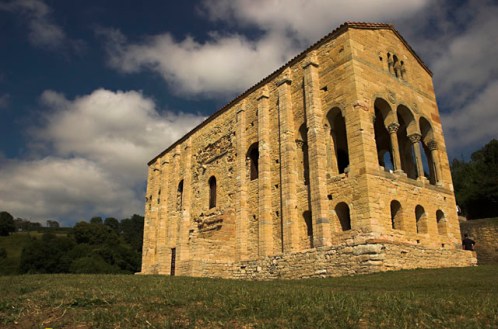
Along with San Miguel de Lillo, this building once formed a part of a large palace complex commissioned by the Asturian king, Ramiro I (790 – 850). It is possible that he wanted to building his palace here, on the Monte Naranco, because of domestic disturbances and challenges to his legitimacy. In any case, it did give him a nice view.

Santa María del Naranco was originally his palace; but as the name indicates it was later turned into a church. The building is about as tall as San Miguel de Lillo, but considerably longer. Still, it is not a terribly big building; and in fact the idea that it had once served as a palace made me feel nostalgic for simpler times.

Santa Maria del Narco
Photo by Flipao de Spain (?); licensed under CC BY-SA 2.0; taken from Wikimedia Commons

This apparently humble structure is of considerable architectural importance, partly because it presaged many of the features that came to dominate the Romanesque period—such as the barrel vault with transverse ribs, reinforced by abutments on the outside. I particularly appreciated the balconies on either side, formed by graceful rounded arches. There are more than half a dozen windows on either side, and quite large ones too. If San Miguel de Lillo struck me as claustrophobic and dark, this building was airy and light.

To enter these buildings, you need to be a part of a tour—and, according to the schedules on the doors, there wouldn’t be any tours for some hours. Thus we contented ourselves with examining and taking pictures of their fine exteriors. The view of Oviedo from here was even more photogenic—with the snowy peaks of mountains in the distance. Spain is a place of expansive vistas. Everywhere I go, I see a view worth painting.

Once done with pictures, we got into the car and drove into town.

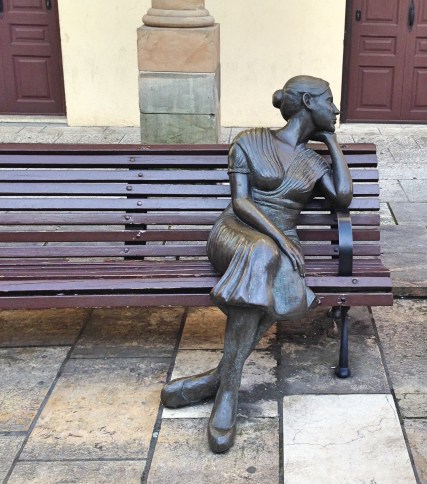
The first thing you will notice in Oviedo are the statues. There are tons of them, sitting in every park and plaza. Most of them are metal sculptures of people: a mother nursing her baby, a young woman sitting on a bench, a scholar reading a book, a farmer with her donkey, an elegantly dressed woman of society, a traveler in a big overcoat with a pile of suitcases, a fisherwoman sitting amongst her fish, looking bored and tired.

Oviedo Statue

Individually, these sculptures are no masterpieces; but the final effect is to give Oviedo an indelible charm. For me, the sculptures, with their prosaic subject matter, drew my attention to the poetry of everyday life. The statues focused my attention on all the little moments of boredom, anxiety, or tenderness that populate the day—the microscopic tugs of emotion that we push to one side as we go about our usual business.

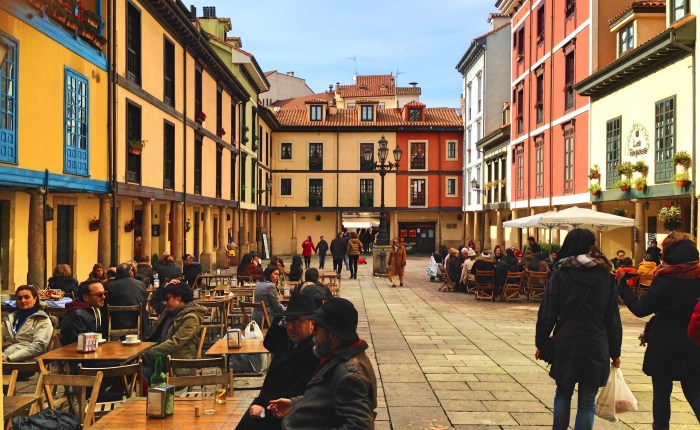
And these statues were scattered throughout a truly lovely town. The whole aesthetic of Oviedo is intimate and joyful. No building is too big or ostentatious; everything is on a human scale. The streets twist and turn, effortlessly leading you from one plaza to another. Every time you turn a corner you are surprised by another open space, full of people. Bright colors, blues and yellows especially, give a playful atmosphere to the city. It is a pleasure just to walk around.

The artistic focus on everyday life was matched by the abundance of life I found on the streets of Oviedo. It was a warm and sunny day, and the streets were full of people—not tourists, but residents going about their day. Patrons crowded the restaurants; children ran through the streets while their parents chatted. An art gallery was open to the public, selling works by local artists—some of it quite good. Women and men of all ages filled the streets, having conversation with friends, carrying shopping bags, smoking, drinking, laughing, gossiping, sitting, standing. But most conspicuous was the market.

Tables were set up in rows, filling several plazas and streets; and on these tables was assembled every sort of thing you can buy. There were jackets, shirts, socks, pants, and a table covered in underwear.

Oviedo Market

And there was a lot more than clothes. One table was covered in tools of all sorts: pliers, saws, rakes, clamps, shears, picks, hammers, screwdrivers, levels, planes, axes, and even a meat cleaver—all of it old and rusty. It looked like the set of a horror movie. Moving on, I found electric drills and power saws, extension cords, old flower pots, metal chalices, target arrows, paint brushes, and tea kettles. There were old candelabras, sunglasses, wooden bowls, statuettes of bathing women, ceramic vegetables, floral tea cups, a bust of a woman wearing a bonnet, wooden serving spoons, hand mirrors, golden incense burners, old music boxes with handles to turn, bronze crucifixes, copper bells, tiny metal horse statues, old clothing irons. How had these people accumulated so much stuff? And who wanted to buy it? It was a flea market of the most charming kind, and every table brought to light unexpected mysteries.

Oviedo Market 2


Finally I got to the used books, and lost myself in their titles. There was a lot to choose from. Eventually I found something I’d long wanted to buy: a copy of Ortega y Gasset’s La rebelión de las masas, or The Revolt of the Masses—his most famous work. Happy in my purchase, I moved on, past a woman selling flowers and into a luxury food shop selling local produce. It was full of quality meats, cheese, vinegars, olive oils, and wines. GF bought herself a big thing of cabrales cheese, and D and T did the same.

Beyond this there is not much to tell. We briefly peaked inside the Church of San Juan el Real, a twentieth-century edifice built in a delightfully eclectic mixture of styles—which also so happens to be the church where Fransico Franco was married.

We did the same with Oviedo’s elegant gothic cathedral—though at the time I didn’t take the time to appreciate the Cámara Santa, or Holy Chapel. This is a pre-Romanesque structure, roughly the same age as those mentioned above, that is now adjoined to the gothic cathedral. Even today, the chamber retains its original function: to house the relics of the Kingdom of Asturias, which include the Sudarium of Oviedo, supposedly the cloth wrapped around the head of Jesus after he was crucified. The so-called Torre vieja, a pre-Romanesque tower, sits besides this chamber—built as a look-out post to detect potential Norman or Muslim raiders, hoping to steal the relics.

We also took a quick stroll around the Campo de San Francisco, Oviedo’s charming central park, which like the city itself is full of statues—not to mention turtles and birds. From there it is a short distance to the Campoamor Theater, the venue where the Princess of Asturias Awards are bestowed. Previously called the “Prince of Asturias Awards,” its name was changed when Felipe, the Prince of Asturias, became the King of Spain in 2014—thus making Felipe’s daughter, Leonor, the new Princess of Asturias. Prince or Princess, this is Spain’s most famous honor, given for achievements in the arts, sciences, or public affairs.

Campo de San Francisco

The city more or less explored, by now it was 3 o’clock and we were hungry. D really wanted to eat a cachopo. This is one of the most iconic dishes of Asturias. It consists of two fillets of veal, with ham and cheese sandwiched on the inside, quite like veal cordon bleu.

We tried one restaurant, but it was full; we tried another, it too was full. Restaurant after restaurant was jam-packed with people. Finally we had to give up, since it was time to check out of the hotel. Thus I didn’t get to try cachopo in Oviedo. But from my experience in Asturian restaurants in Madrid, I can confidently say that it is a delicious dish. Indeed, all the Asturian cuisine I have tried is excellent. And this is not just my opinion: Asturias is generally regarded within Spain as being one of the best provinces for eating.

Our trip was over. It was time to retrace our steps back to Madrid. The road led back up the Cantabrian Mountains, and the view was even more spectacular. Several times we stopped the car and got out to take photos. In the crisp air and the clear sunlight, you could see for dozens of miles. We arrived in Madrid after nightfall. And so we were faced, once again, with the melancholy prospect of returning to work in the morning after a great weekend of travel

North from Madrid: The Cantabrian Mountains & Gijón

North from Madrid: The Cantabrian Mountains & Gijón

(I have broken up my original post for ease of navigation. Click here for León, and here for Oviedo.)

Over the Hills

Asturias Mountains

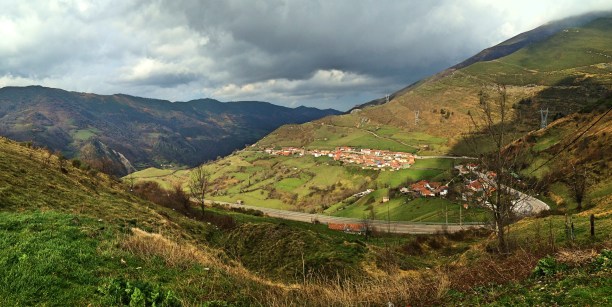
The drive to Gijón was magnificent. It was a stormy, overcast day. The sky was gray and the countryside was covered in fog. The road wended its way through green hills. The land here was grassy, a big change from the parched land of Madrid. Little towns appeared and disappeared as we went, just a few shabby buildings huddled around the road.

Running parallel to this road was the railway. It was perched a little bit above us on the hills. It must have been built long ago, for at several points it was sheltered by a concrete bunker that looked ancient. To me the bunker looked like it could collapse at any minute, and I managed to convince myself that this railway must not be used any more, for it was too dangerous. But a passing train told me otherwise. The road and the railway danced around one another through the hills; the tracks passed from our left and to our right as we drove over railroad crossings. Our radio began to flicker in and out, dissolving in a haze of static. The fog, the green hills, the tiny villages gave me that distinctly odd feeling, which I can only describe by saying it felt like I was in a movie.

Suddenly we found ourselves on the top of a mountain. That road had taken us up to 1,400 meters (about 4,500 feet) above sea level, and now we began a steep descent. Before us was an entire mountain range, their peaks covered in snow. These are the Cantabrian Mountains, a range that runs 180 miles across the north of Spain. It was these mountains that, several hundred years ago, shielded the embattled Christians during the Muslim invasion; and they still constitute a major barrier in the Peninsula, separating the plains of Castilla y León from the coastal regions of Asturias and Cantabria.

Located in these same mountains, further east, are the famous Picos de Europa (Peaks of Europe), so named because they were the first landform visible to sailors returning to Europe from the Americas. Nowadays these mountains are an iconic natural park—one of the chain of parks that occupy the entire range.

Valley Asturias

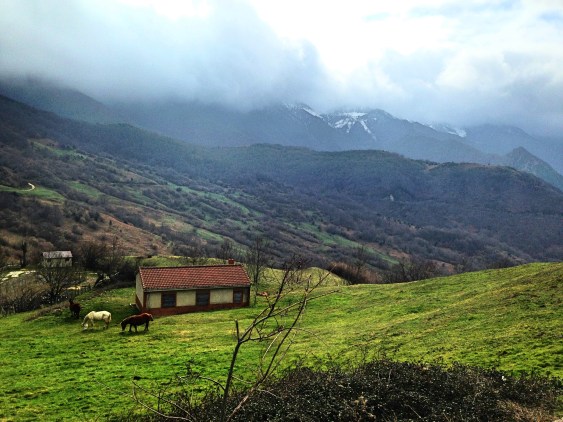
The road led down into a huge green valley. Little towns could be seen below us. In such an big space the towns looked as fragile and insignificant as ant-hills on a sidewalk—mere specks in the enormous expanse. The road twisted and turned around the mountain, into the very bottom of the valley. Horses roamed these fields, pure white and chestnut brown, grazing on the grass. The scenery was stupendously beautiful—almost overpoweringly so.

After ten minutes we stopped at a restaurant by the side of the mountain, to take pictures of the view. I tried to open the door, and immediately felt an intense pressure pushing from the other side. It was the wind. Strong gusts of cold blew constantly up there, forceful enough to make you lose your balance. The wind tore right through your clothes and chilled you in seconds. I had only felt intense wind like that once before, when I was standing on the top of Ngorongoro crater in Tanzania. I ran behind the restaurant building to escape the gusts. But there was one creature up there who didn’t seem to mind.

Asturias Mountains Horses

Sitting outside by the parking lot was an enormous dog. I don’t know what was the breed or whether it was a mutt. It had a big, slobbery face and a mottled, gray coat. He was clearly an old dog. But he was friendly. As soon as we got out, the dog raised itself on its creaky legs and started ambling towards us. All of us gave him some friendly pats on the head, and all of us were instantly covered in saliva.

I snapped some pictures and then got right back in the car. It was just too cold. But I felt bad to leave the dog: he seemed so lonesome up in that parking lot, sleeping in the cold wind.

We started driving again. But the cold had sapped my strength. I fell asleep almost as soon as I got in, and the next thing I knew I was in Gijón.


Gijón

Gijon Port

“Nice town,” I said, after I woke up and stretched my legs in the tight space.

We were driving through the city center, turning down narrow streets.

“When do you wanna stop?” I asked.

“What do you think we’re doing?” T said. “We’re looking for parking!”

Every street we saw was packed, so finally we decided to suck it up and pay to park in a garage. Soon we were out on the street, walking along the harbor.

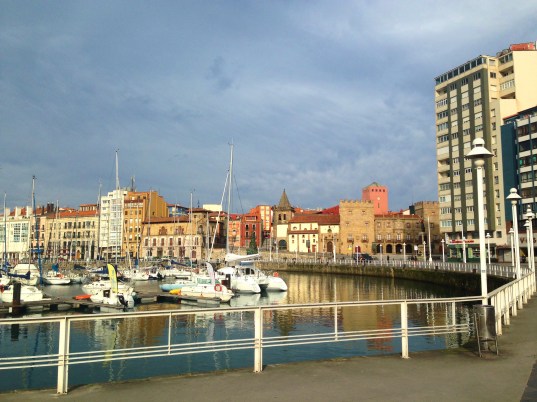
Gijón is a harbor city, occupying the biggest and best port of the Asturian coast, bathed in the Bay of Biscay. Though now the biggest city in the province, Gijón has historically been relatively unimportant; it was only in the nineteenth century, when it became an industrial hub, that the town started to grow into the city it became.

When we arrived it was an overcast but otherwise nice day. The harbor was full of little white boats. For the most part these boats were all of the same type: speed boats with two motors, big enough for four people at most. I suppose there is a lot of pleasure boating up here.

It was lunch time by now, and all of us were famished. We walked around aimlessly until we found a restaurant and ordered the menú del día. This came with the famous fabadas asturianas, or Asturian fabada stew. This is a stew made with pork, chorizo, and fabada beans. Curiously, nearly every region of Spain has its signature bean stew. Madrid has its cocido marileño, made with garbanzos. Segovia’s stew uses judiones, a giant white bean; and in Cantabia, right next to Asturias, the local cocido montañes uses smaller white beans. Aside from the beans, however, the ingredients are fairly standard—above all, salted, spiced, and cured pork. In any case, all of these dishes make for a very hearty, filling, delicious meal.

After lunch, we strolled into the peninsula that forms the old city center. This peninsula has quite a bulbous shape, and juts out rather impudently into the sea. The neighborhood is called the Cimadevilla, and forms the oldest part of the city, which has ruins dating back to Roman times—though I didn’t see any.

At the end of this peninsula is a park, and quite a nice one. This is the Cerro de Santa Catalina, or hill of Saint Catalina. It used to be a military fortification, but now it is a rolling, grassy hill that overlooks the ocean, where children play and senior citizens stroll. Once you walk to the top, you can see the whole town behind you, the coastline on either side of you, and the endless stretch of water in front of you.

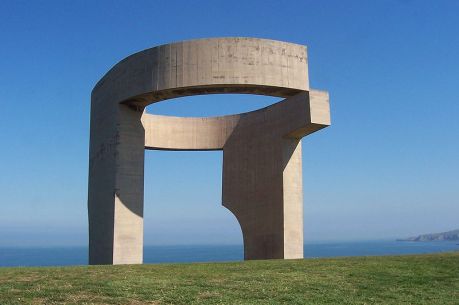
In the center of the park is the Eulogy to the Horizon, a sculpture by Basque sculptor Eduardo Chillida. It is a large concrete construction that looks like a ring standing on two pillars. But the ring is oriented horizontally, hanging over you with little apparent support. The whole structure looks impressively precarious, as if it can totter any minute. Framed between the legs of the sculpture is the great ocean beyond. There you can sit, hanging your legs off a cliff, enjoying the view.

Eulogy to the Horizon
Photo by Roberto Sueiras Revuelta; licensed under CC BY-SA 3.0; taken from Wikimedia Commons

We walked around the park for a few minutes, and then paused to look at the other side of the harbor. It was filled with cranes, boats, and warehouses; this was the industrial port.

View from Park

“What’s that?” GF asked, pointing.

I squinted, and noticed a strange dark cloud forming over the port.

“Huh,” I said. “Weird. Maybe it’s coal smoke or something.”

As we kept looking, the cloud grew bigger and darker.

“Wow, look at that,” T said, noticing the cloud. “Good thing the winds aren’t blowing towards us.”

But almost as soon as she said that, the winds changed. The cloud was moving towards us. I’ve never seen anything like it, a big, black mass of fog rushing over the open waters towards me. It was surreal and a bit terrifying.

“Let’s get out of here,” T said, and we began to walk away. The other park-goers had a similar idea, and we all started heading towards the town. But we didn’t go fast enough.

The next minute, the storm hit. Terrible winds ripped through the park, bending trees, turning clothes into balloons, making people stumble as they walked away. It felt like I was back on that mountain.

“Holy shit!” I said to GF as we hurried back towards town.

Then it started raining. In minutes it turned from a drizzle to a downpour. I couldn’t help being filled with pity when I saw a band of teenage girls struggling through the storm wearing tutus with bare legs.

The rain kept intensifying. It was obvious that there wasn’t any more fun to be had in Gijón, so we skedaddled to the car. We passed street after street, and soon I could hear the sound of human voices in the distance, accompanied by a drum. Who on earth was singing in this weather? We turned a corner and came upon a group of about 50 people, all wearing blue and white shirts. A girl was pounding a simple rhythm on a drum and the rest of the people, mostly men, were singing at the top of their lungs. It sounded like a drunken, disheveled pep rally. These were sports fans from Galicia; their team was playing against Asturias that day.

The wind and the rain continued to pick up strength—very soon becoming dangerous. The only time I have experienced comparable weather was during hurricane Sandy.

“I’ll go and get the car, you guys wait here,” D said, like a true hero, and ran off into the storm.

The rest of us took cover under the entranceway of a bank. The winds roared, traffic lights swung too and fro, and pedestrians ran for cover. After five minutes of waiting, a group of teenagers joined us in our little shelter. We talked and then lapsed into silence. More time passed. The weather only grew more vicious. It got so bad that I began to be afraid for D’s sake. What if a branch fell on him? What if he was knocked over by a gust of wind? Such questions didn’t seem unreasonable as I watched a man stumbling in the street, his hands raised to protect his eyes from the rain. And indeed, I later learned that this storm caused some significant damage to the town. It was a spectacular thing to see.

Ten minutes went by; then fifteen. Just as I began to consider going out after him, the car pulled up.

“He’s here!” we cried, as we ran to the car and hopped in.

“Let’s get out of here,” D said.

We retreated. Our next stop was our hotel in Oviedo, only 40 minutes away. By the time we arrived there, the weather had turned from a tempest to a calm night.


Addendum: Cut short by the storm, we missed the most notable sight in Gijón: the Universidad Laboral de Gijón. This is a massive building—the biggest in Spain, measured in area (270,000 m2), dwarfing even the Cathedral of Sevilla (11,520 m2) and the Monastery of El Escorial (32,000 m2).

This is no accident. Construction began shortly after the end of the Spanish Civil War, in 1940, and the building is imbued with the ethos of Spanish nationalism. In style, it is a deliberate imitation of—or homage to—Juan de Herrera’s design of the Escorial. In this way it is oddly reminiscent of the infamous Valley of the Fallen: another post-war monument on a massive scale, laden with Spanish symbols. Nowadays this massive building complex is home to a host of institutions—an art center, a music school, and as a branch of the University of Oviedo.

North from Madrid: León

North from Madrid: León

(I have broken up my original post for ease of navigation. Click here for Gijón, and here for Oviedo.)

“See that?” D said. “That’s the Valle de los Caídos.”

D is a softspoken Spaniard who works in software development. He was our only driver, poor man, because none of us could drive a stick-shift. We were on the highway going north. D was pointing out the window at a gigantic cross in the distance; this was the famous and controversial monument erected by Franco after the Spanish Civil War: the Valle de los Caídos, or the Valley of the Fallen.

“Anyone want a piece of avocado?” T asked.

T is a lively Russian émigré, who teaches English here. We had a very international car.

Our first stop was León because it was the closest. The drive there took about four and a half hours, which is quite a long time when you’re sitting in the back and have long legs and achy knees. I was going into my typical hibernation mode, which I use for all long car rides, when a thought popped into my head.

“Hey guys,” I said. “I’m pretty sure I forgot to bring underwear.”

“Too late now,” GF said.

“Yeah,” T said. “You’ll just have to buy some when we get there.”

I spent a few minutes panicking about whether any stores would be open; but the panic quickly passed, and within an hour I had fallen asleep, as I always do, with my head pressed against the glass.


León

I woke up. We had arrived. It was dark outside. My neck hurt the way it always does when I sleep sitting up, and my mouth was full of that disgusting taste I always get when I take a nap. D was trying to find a parking spot near our hostel. As we drove along, I looked out the window in the hopes of finding an open clothing store. There were several, and I tried to remember their location as the car went along.

T really had to go to the bathroom so D dropped us off near the entrance to go find a parking spot by himself. The hostel was confusing. We pressed the buzzer to get in and walked up the stairs to the first floor. There we found two doors, one right and one left, each with a sign on the side of it. T went to one of the doors and knocked. No answer. She knocked harder. Nothing.

“What the hell?” she said. “Does nobody work here?”

She knocked again and we waited, but the building was absolutely silent.

“This is ridiculous,” she said. “I’m calling them.”

She took out her phone and dialed the number of the hostel.

I couldn’t follow the conversation, but after a minute T went over to one of the doors and dialed a number on the keypad. The door clicked and we pushed it open.

We walked inside and found an empty hallway with several doors along the sides. Each door had a keypad on the side of it. The hostel was completely automated, apparently. Pretty cool.

Soon D arrived from parking the car.

“We need codes to get in,” T said.

D looked in his phone and found an email from the hostel. They’d sent it just two hours before. We typed in the codes and went into our rooms. But I couldn’t relax. I had to buy underwear.

“Hey, would you mind if I went to buy some underwear real quick?” I said to T.

“What, are you embarrassed if we come with you?”

“It will only take a minute,” I said. “I want to go before the stores close.”

“Okay, go, go,” T said.

GF and I walked out into the street and started looking. On the next corner was a Hiperasia. These are locally owned shops—most often owned by Chinese immigrants—that contain every variety of product you can imagine, from window fans to a white boards, from candelabras to Halloween costumes, from cigarette lighters to potted plants. These products are often of mediocre quality, but the stores are quite convenient—not only because of their variety, but also because they are open when most other stores are closed.

We walked inside.

¿Hay ropa de interior para hombres?” I asked the woman standing near the door.

From the confused look on the woman’s face I could immediately tell that she couldn’t speak Spanish. It was really weird to have the shoe on the other foot, for once.

Thankfully, I soon noticed a bunch of underwear hanging nearby. I picked two of them, paid, and went back to the hostel, where D and T were waiting for us.

“Do you guys wanna go walk around and get something to eat?” D asked.

“Sure,” we said.

The four of us went down to the street and started walking. On our walk we passed a park, where there was a small metal model of a settlement.

“This is the Roman camp,” D said to me, pointing at the model. “León was originally a camp for Roman soldiers. The name comes from the word for ‘legions’.”

(According to Wikipedia, this is true; the name comes from the old Roman name Legio. This is an interesting coincidence, since león is also the Spanish word for lion.)

After about fifteen minutes we found a restaurant and went inside. All of us ordered drinks first, to see what food would be included. Our drinks came with two small plates, one of chorizo, and one of mushrooms in a sauce made from queso de cabrales.

Queso de cabrales, or goat cheese, is a type of blue cheese that is native to Asturias (the province immediately to the north of León). I was not prepared for the flavor of this cheese. I winced as soon as it touched my tongue. It did not taste sour or rank the way some blue cheeses do, but bitter and earthy. But it wasn’t the flavor that made me wince, but something else; as soon as it touched my tongue I felt an electric shock—the flavor was intense. I did not like it very much, but everyone else loved it.

We sat there and ate and drank, all of us a bit tired. After three rounds of drinks and three rounds of tapas we’d had enough and went back to bed. I stayed up for a few hours reading Anna Karenina. Anna and Vronsky had just moved abroad to Italy where they were dallying in European art, and Tolstoy was satirizing them beautifully, with the lightest and most compassionate touch. There’s nothing like traveling with a good book.

§

We woke up the next day, bright and early, ready to see León.

“Did you do a new underwear dance this morning?” T asked as we met in the hall. (I hadn’t. The underwear was a little tight but still quite comfortable, in case you’re wondering.)

Our first stop was the cathedral, but on our way there we went past the Casa Botines (see above), which is one of the few architectural works by Antoni Gaudí outside of Barcelona. It was the first work of his I had ever seen, and I have to admit it looked Disneyish to me. The style is theatrical neo-gothic. All the windows and towers are designed to be narrow, sharp, and tall; and combined with the somber grey color, the building looks like it belongs on a movie set rather than a city block. The building is now the headquarters of the bank, Caja España.

Leon CathedralSoon we were standing in front of the cathedral. The building had that wonderful, foreboding grandeur of true gothic architecture. Two large towers flanked the central section with the rose window, flying buttresses extending from either side. So much mass is concentrated in the front of the building that the final effect, for me, is that the edifice looks like it is about to charge right at you when you’re standing in front of it. All of the architectural elements are pushing and pulling against one another, giving it a feeling of tension and poise.
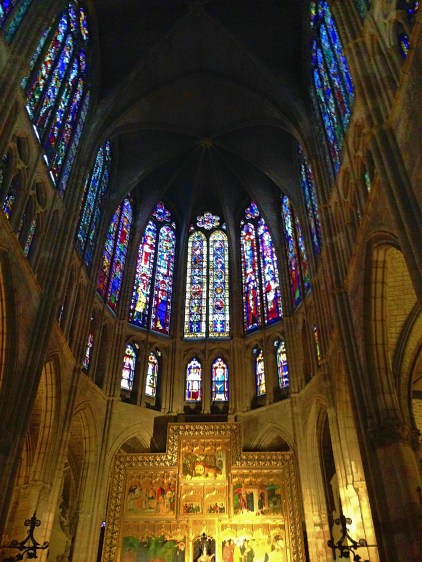
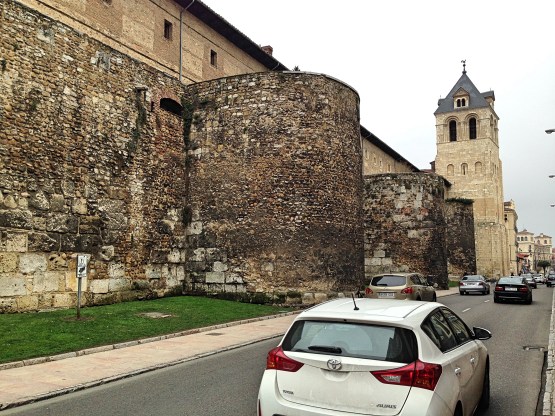
Stained Glass Close Leon

We went in. It was quite dark inside. The walls and chapels seemed bare and unadorned—not that it mattered, since it was impossible to focus on anything but the cathedral’s stained glass windows. These must be the most beautiful in all of Spain. Standing in that dark room and looking up at the glass, with their deep greens and blues and reds, I felt strangely at peace. Looking back, I am reminded of a quote from Middlemarch:

It is strange how deeply colors seem to penetrate one, like scent. I suppose that is the reason why gems are used as spiritual emblems in the Revelation of St. John. They look like fragments of heaven.

Indeed these windows were more than mere fragments of heaven, but portals letting heaven shine through into interior gloom. The building—so massive when seen from the outside—is pure air and light within. How could these medieval workmen have built such massive windows in a structure made completely of stone? It is an architectural feat so amazing that I cannot get used to it. Every wall of the cathedral glowed with dancing patterns of glimmering images. I soon gave up walking around the cathedral and just sat down on the pews, lost in silent admiration.

Stained Glass and Main Altar Leon_Fotor
The main altar with stained glass above

Thirty minutes passed, and we were back on the street. Suddenly the sound of drumming and singing caught my ear. I looked over and saw a procession of about a dozen strangely dressed women. Curious, I started following the little parade. The women were dressed in colorful headscarves, dresses, and black shawls. A man was beating on a little drum and all of them were singing.

“What is this?” I asked D.

“I think it’s a procession for a religious holiday celebrating women,” he said.

“Oh, neat.”

We followed the procession for a while and then cut off to visit the Plaza Mayor. There, we found a farmer’s market. Tables were set up, covered in crates of fresh vegetables. The vegetable vendors were doing good business, too; the place was buzzing. Nearby there were parked several vans, with sides that opened up to reveal red piles of meat. D and T, who love buying food from these markets, went right over to one of these meat vans.

I wasn’t particularly interested in buying anything, but the meat vendor almost convinced me. He was giving away samples left and right, giving us a taste of anything we wanted. I was chewing on some particularly good chorizo when a very short man with a big blond mustache, wearing a plastic Viking’s helmet (with the two horns) and carrying about thirty balloons, walked up and started talking with the meat vendor.

Then the balloon Viking noticed a wineskin hanging from the meat van. He walked over, grabbed the wineskin, and said “¡Mira!” (look!) as he proceeded to squirt a stream of red wine into his mouth, turning his tongue blood red and leaving scarlet specks in his blonde mustache. A true viking indeed.

We had plans to see Oviedo and Gijon that same weekend, so we couldn’t stick around all day. Thus, sadly, we had to start making our way back to the hostel.

On our way, we passed by the remains of an old wall city walls, which we climbed up. These are the original Roman walls that protected the budding city. At present they delimit the outer edge of the casco viejo, or historical center.

Leon Wall

We got back to the hostel, paid the bill, and then got into the car. But we only got about a mile before we stopped to see something that caught our eye. This was the Hostal de San Marcos, a large, impressive building that was originally a convent, but has since been converted into a Parador de Turismo: a luxury hotel in an old historical building. Convento de San MarcosDespite whatever renovations the building has suffered on its insides, the exterior retains its impressive plateresque façade. Though part of the building is off limits to visitors, since that’s where the fancy guests stay, there is a church and a small museum you can visit—with a lovely gothic interior and several fine statues, not to mention a Renaissance church.

But I was most surprised to learn that this building, one of the most important Renaissance structures in Spain, was used to intern political prisoners in the wake of the Spanish Civil War. Indeed, during and after the war, this noble building became a symbol of Fascist repression. Thousands of prisoners were sent here, and many were tortured and killed. This beautiful building is thus a fair summary of European history: from religious piety, to fascist brutality, to high-end luxury.

Out in front of the convent, in the middle of the massive plaza, there is a statue of a weary pilgrim, resting his bearded head against a crucifix, a reminder of the important role that the Camino de Santiago has played in its history.

Pilgrim Statue

After half an hour of peeking around, we got in the car and drove off again. This time I stayed awake, for the most part.


Addendum: I was only in the city of León a short time, and I certainly missed a lot. One thing I wish I had seen was the Interpretation Center of León’s Roman history.

But the most obvious and grave omission was the Basílica de San Isidro de León, which is considered to be one of the most important Romanesque buildings in Spain. The Royal Mausoleum is particularly noteworthy: I have heard it described as the “Sistine Chapel of the Romanesque” for its extensive, wonderful ceiling frescos. The kings buried here were not kings of Spain, but of León, which was its own small kingdom before the unification of the Spanish peninsula in the 15th century. Hopefully one day I will be able to see it for myself.

The Palace of San Ildefonso de La Granja

The Palace of San Ildefonso de La Granja

In Hemingway’s book, Death in the Afternoon, he mentions his favorite things to see in Madrid:

“But when you have the Prado and the bullfight season at the same time with El Escorial not two hours to the north and Toledo to the south, a fine road to Avila and a fine road to Segovia, which is no distance from La Granja, it makes you feel very badly, all question of immortality aside, to know that you will have to die and never see it again.”

All of these places I had seen, except La Granja. Naturally I had to go.

The Palace of La Granja is found in the town of San Ildefonso, in the province of Segovia, near the Guadarrama mountains. From Madrid, there isn’t a direct way to get there on public transportation. First we took a train to Segovia; from the train station we took a bus to the city’s central bus station, and from there you can take a bus to La Granja. The whole process takes well over two hours.

We went straight to the palace. When seen from the direction of the town, it is not stunning. Its main distinguishing feature is a large cupola that towers above everything else in the town. I suppose the kings who lived here were not especially concerned with awing the few citizens of the town; rather, this palace was originally a kind of royal retreat, where the kings spent their summers to go hunting in the forests nearby.

Granja Trees

The palace itself dates from the 1720s, under the reign of the first monarch of the Bourbon dynasty, Philip V, after the chaos of the War of Spanish Succession. The war ended with a French family on the Spanish throne, and thus this palace bears the mark of French taste. Specifically, it is modeled on the palace of Versailles, built by Philip V’s grandfather, Louis XIV. Like its forebear, La Granja even has its own splendid French gardens, of which we will see more later.

Our visit began with a museum of tapestries. Now, I’ve seen my fair share of tapestries in Spain, and normally I do not find them terribly interesting. But these were magnificent. The palace had tapestries dating back to the reign of the Catholic Monarchs (the late 15th century). But the most impressive were made during the time of Charles V. They were massive, well over 12 feet tall. The surfaces were covered with elaborate, allegorical scenes, with damsels and knights, sages and demons, each personifying a virtue or a vice. There were also mythological beasts and historical figures woven into the panoply of images. There was Hercules holding up the heavens, and a representation of Boethius’s Wheel of Fortune, as well as Plato, Seneca, and Solomon the Wise. I wish photos were allowed.

Then we went into the palace proper. The first room had portraits of Philip V and his family, all of them bedecked in frilly outfits and white wigs, all of them smiling gaily. Their smile reminded me of Kenneth Clarke’s episode on the French Enlightenment, in his marvelous documentary, Civilisation. It is an ironical, bemused, dispassionate smile, a smile that Clarke dubbed the “smile of reason.” This was, after all, the Enlightenment.

As usual in palaces, the rooms were beautifully furnished: still-lifes, portraits, and religious paintings hung on the walls; delicately carved and upholstered chairs stood awaiting the royal bottoms (which, alas, do not appear nowadays); and elaborate chandeliers hung in every room. Each ceiling was covered in a large painting, usually of a mythological scene amid a heavenly background.

When I walk through the former abodes of the ultra-wealthy, I tend to feel a little queasy. It all seems so frivolous and so profligate. Nobody should be this rich. Palaces are not warm, welcoming places; they crush you under the weight of all their finery and splendor. I cannot imagine that living in a palace has a positive effect on your psychology. Every single piece of furniture, every clock and candelabra, bespeaks wealth and power. And how do you keep your head and govern a country when your entire world is a never-ending chant to yourself? How do you manage a kingdom when you live in a world apart?

Nevertheless, the royal apartments in La Granja were so tastefully decorated that my usual misgivings about palaces didn’t bother me. We walked through the bedrooms, dressing rooms, the study, the banquet hall, and then went down the stairs to the ground floor. By comparison, this floor was quite empty. The most lovely thing to be seen is a beautiful fountain full of bronze figures, with a backdrop made from seashells. Other than that, however, the ground floor is full of neo-classical statues. These were of very poor quality, I thought—bland and lifeless.

But it wasn’t long until we went through the entire floor and had gone outside to visit the gardens. Now this was the real palace. The gardens of La Granja are massive; indeed, judging from the map, the gardens are bigger than the whole town of San Ildefonso! For the most part, they consist of long, straight avenues lined with trees and bushes that connect several plazas; and in each of these plazas is a fountain. The fountains are the most impressive part, even when they are turned off (as they were during our visit). The most eye-catching is the long, terraced fountain that runs down a hill next to the palace; small statues line the walkway on both sides, and at the top are more statues in bronze. From here you can see the palace at its most impressive. Clearly, this is the facade that was meant to be seen.

Granja Palace

Philip V must have felt quite smug with himself after having these gardens built; they represent the dominance of French royalty over Spanish affairs. But I did not feel even an inkling of the splendor that the gardens were supposed to represent. Rather, the place was cold and empty. The trees were still bare; a chilly breeze blew threw the gardens; the snow-covered peaks of the Guadarrama stood in the distance; and the fountains sat amid this wintry landscape, dry and silent. 

IMG_3417

From an anthropological perspective, I thought the gardens embodied certain unmistakable ideals of the Enlightenment: orderly rows of hedges, straight paths, circular plazas, Greco-Roman sculptures. It is easy to imagine Philip V strolling through with his ironical smile and white wig, admiring his taste and power. The garden was planned like a city, with main avenues and connecting streets. There is no Romantic love for untamed nature, no mystical communion with the chaotic. Nature is domesticated, ordered, disciplined, brought into line with the dictates of reason. The result is impressive, but it lacked what I most crave from parks: life.

IMG_3406

We strolled around for about half an hour, and then we left. It was lunch time. I was really excited for this, because the last time I visited Segovia I had some excellent food. We had one meal in mind, the two classic dishes of Segovia: Judiones de la Granja and Cochinillo. The first is a bean stew, and the second is roast suckling pig. They are so popular that almost every restaurant offers a daily special with the two dishes, the first as an appetizer and the second as the main course. The problem is that it’s expensive. We walked around for about twenty minutes, comparing prices, before settling on one restaurant with decent prices and full with clients. (If a restaurant is full of Spaniards eating, it’s probably pretty good.)

Luckily there were seats. We ordered the special, and waited with stomachs grumbling and mouths watering. First came the Judiones. Judiones are big and tender white beans, grown locally. They are served in a stew, along with chorizo, pancetta, and morcilla (blood sausage), a combination that gives it a distinctive smoky, peppery flavor. We finished the stew, mopping up the last of the sauce with our bread. Then came the cochinillo, a huge hunk of meat served over a bed of fries. The skin was crispy, the meat was tender and juicy, and everything tasted of savory oil. I enjoyed it so much my hair stood on end. I stuffed myself and then sat back with a satisfied sigh. It was easily one of the best meals I’ve had here.

Because of the bus schedule, we had about an hour and a half to kill before the next bus to Segovia. Luckily, we happened upon the perfect solution: the Royal Glass Factory of La Granja. Originally it was a factory established by Philip V to make glass products for the La Granja palace. Nowadays it’s not a factory anymore, but a museum dedicated to all things glass.

Granja Glass Factory

Most surprising was simply the museum’s size. It has everything. Inside you can find historical examples of the machines used in glass manufacturing—massive metal contraptions that I did not understand. There were also fine examples of stained glass, bottles and jugs stretching back centuries, and an entire wing dedicated to modern practitioners of the art of glassblowing, with some really spectacular examples. But coolest of all, they had two (somewhat unenthusiastic) glassblowers giving demonstrations. The nonchalance with which the glassblower stuck the rod into a fiery furnace and then turned in the red-hot mass into a lovely vase was remarkable.

IMG_3433.jpg

Indeed, the museum had so much that I wished I could have spent more time inside looking around. But, alas, the bus was coming. We left, took the bus back to Segovia, and then the train back to Madrid.

Day Trips from Madrid: Manzanares el Real

Day Trips from Madrid: Manzanares el Real

As I am slowly discovering, Madrid has an inexhaustible wealth of day trips. I have already written posts for my four favorites—Toledo, El Escorial, Salamanca, and Segovia—and another four great trips: Ávila, Chinchón, Aranjuez, and Alcalá de Henares. Now I must add to this already long list: Manzanares el Real.

Manzanares el Real is a small town north of Madrid, situated at the foot of the Guadarrama mountains. The only way to get there on public transportation is by bus line 724, which you take from the Intercambiador at Plaza de Castilla.

On the advice of a classmate, GF and I decided to spend a Sunday morning of an otherwise lazy weekend on a trip there. It was a dreary February day, cloudy and drizzling. The bus ride was unremarkable, taking us through several of those nondescript Spanish villages that always manage to disorient me, since they look so similar that I cannot tell whether I’ve seen them before. I spent most of the ride reading, anyway. To be exact, I was reading Hemingway’s famous guide to bullfighting, Death in the Afternoon, which was appropriate, since our route took us past a bullring and a statue of a matador.

In forty minutes we arrived. Our first stop was the tourist office, where a very friendly women gave us a map and marked it up with sites to see. In retrospect, I am deeply impressed with her for being so enthusiastic; there are not very many things to do in Manzanares, but she squeezed every last drop out of the possibilities.

Our first stop—and, indeed, the only reason we made the trip in the first place—was the castle. Manzanares is home to one of the best preserved and most picturesque castles in Spain, the so-called “New Castle.” (It was built in the 15th century. We will meet the “old” castle later.)

The castle is surrounded by a wall, full of narrow slits for archers, that wraps closely around the perimeter. The castle itself has a square layout, with a small appendage in the back. Tall towers stand over each corner. Its symmetrical form, gray granite façade, and curving walls combine to form a surprisingly pretty building.

Manzanares Side

After some mucking about trying to find the ticket booth, we bought tickets and went in. To be frank, I am not sure I would recommend doing this. There was not very much on the inside of the castle. In the lower level were a few panels of information; and in upper floors, there were old bedrooms and living spaces with period furniture. But neither of these were memorable. The only thing worth seeing was the view from the top of the castle. You can walk all around the roof, going from tower to tower. On one side you can see the town, and the mountains beyond; on another side, the nearby reservoir.

IMG_2238

We were outside again in less than an hour. Now what? We looked at the map the woman at the tourist office had given us. The only thing that caught my attention was the aforementioned “Old Castle.” This is about a ten minute walk from the New Castle, across the Manzanares River that runs through the town. It would be easy to miss if you weren’t looking for it. Hardly anything remains. At first glance it is just an empty, grassy field; the only indication that there used to be a castle here is a small granite wall, no more than five feet tall.

From there, we followed a road the woman recommended, which took us out of the town and towards the reservoir; the idea was to get away from the city, so we could get a good photo of it. On the way, we passed by the town cemetery. The gate was open, nobody was standing by, so we walked in.

I had been wanting to visit a cemetery since I came to Spain, and this was the first opportunity that presented itself. I was interested in cemeteries because, before coming here, I gave a tour of the Sleepy Hollow Cemetery to a family from Madrid. During the visit, they kept remarking how different American cemeteries are from Spanish ones.

IMG_2243

They were right. While Americans cemeteries can look like parks, their Spanish counterparts are totally devoid of vegetation. Instead, the dead are interred in stone sarcophagi that sit on top of the ground, or they occupy a slot in a large stone wall. For me, the place had a much more somber feel than its American counterparts. There was nothing alive in there except us.

We left and kept going along the road. Soon we crossed a bridge that took us over the reservoir, turned around, and admired the view. It was still a drizzly, dreary day, but the grey rainclouds brought out a special charm to the landscape. On the banks of the reservoir, amid the pools of water, white cows were grazing. Beyond was the town, nestled at the foot of a craggy mountain, a mass of jagged grey slithered up into the mist.

IMG_2255

These strange rock formations are known as La Pedriza, and compose one of the biggest granite ranges in Europe. Aside from their bizarre and beautiful shapes, they provide excellent rock climbing opportunities—not that I would know.

We took some pictures and then headed back into town to the bus station. The surrounding area actually looked like it had some nice hiking paths; but I hadn’t brought the shoes or the willingness to go on a hike. We went to the bus stop.

While we waited for the bus to arrive, I admired some of the storks who made their nest on a tree nearby. This was the first time I heard the strange clacking noise that storks make by rapidly beating their beaks together, as they arch their heads so far back that the tops of their skulls touch the backs of their long slender necks. (Storks don’t have vocal chords, so clacking their beaks is the only way they can “call.”) I thought the sound was coming from a motorcycle engine at first, the noise is so strange and harsh. Doesn’t it damage their beaks to snap them together so forcefully? Spain is full of mysteries.

Manzanares Castle

Santiago in Retrospect

Santiago in Retrospect

Well over a year ago, after completing my short camino, I spent some time exploring the city of Santiago de Compostela. Procrastination prevented me from doing a timely blog post. So with the benefit of hindsight but penalty of forgetting, I will complete this long overdue write-up.


Monastery Church Entrance

Santiago de Compostela is a remote and storied city. Situated in the province of Galicia, in the north-west of the Iberian Peninsula, far from Spain’s capital and remote from the rest of Europe, it has never been the crucible of a religion nor the seat of an empire. Probably we would never have mentioned it had it not been for one shepherd who, one day, over a thousand years ago, reported seeing a light over a field. Those who followed this light found a tomb; and inside, the body of St. James the Greater.

As I discussed in my post about the Camino de Santiago, this story is an apocryphal legend. What is certain is that the Christians in the north of Spain were in trouble. During the last one hundred years, Muslims had poured into the Iberian Peninsula, conquering everything with effortless ease. These Muslims relied on irrigation for their agriculture—the combination of the crops and the technologies they brought with them forever transformed Iberian farming—so they had trouble colonizing mountainous regions. So it was these northern, rainy, and mountainous areas to which many of the Christians retreated, huddling in modern-day Galicia and Asturias.

Outmanned, disorganized, technologically and culturally outmatched, these Christians had little hope of defeating the Muslims southward. But the “discovery” of St. James’s body helped to change this situation. Suddenly, an obscure, rural, and remote area of a Christian outpost became one of the most important holy sites in Christendom, comparable with Rome or Jerusalem. Eventually, the Christians of northern Spain expanded their territory, extending their dominion along the northern coast all the way to the Pyrenees. Once linked up with France, pilgrims began to pour into the country, seeking penance and repentance through the journey.

The cultural effects of this pilgrimage could hardly be overstated. By this time, Europe had emerged from the confusion which followed Rome’s collapse, and daring new architectural styles were being developed: the Romanesque, Gothic, and later Renaissance and Baroque. The Camino de Santiago became the artery through which these styles flowed into Spain; and as a result, some of the most splendid cathedrals in the country can be found along the route: the gothic cathedrals in León and Burgos, for example, and the magnificent Romanesque cathedral of Santiago itself. And it is this cathedral that any visitor to the city must turn to first.


Mirador

The Cathedral of Santiago is the end-point of the entire camino, the iconic goal of the arduous pilgrimage. And the building is worth the walk.

According to legend, the cathedral was built over the tomb of St. James. This church quickly became a potent symbol of Christianity, prompting the Moors in 997 to invade, burn down the early church, and take the bells and the gates with them back to their capital in Córdoba, where this bounty was placed—appropriately enough—in the Great Mosque. When King Ferdinand III of Castile conquered Córdoba over two hundreds years later, he had the same bells and gates transported to the Cathedral of Toledo, where they remain to this day.

The front entrance of the cathedral stands proudly above the Plaza de Obradoiro (gallego for “workshop”), a monumental square that, on any given day, is full of exhausted pilgrims and energetic street vendors. This square, and the two baroque spires of the cathedral’s façade, owe their current form to Fernando de Casas Novoa, who undertook the work in the early 18th century. Though a relatively obscure architect, Novoa achieved a stupendous result. The façade sweeps upward like an orchestral crescendo, its symmetrical ornamentation perfectly balanced between a strong upward vertical push and swelling curves, embellished at every point by intricate friezes.

This would be enough to make any cathedral notable; but the Santiago Cathedral has three more impressive façades: on the northern, southern, and eastern ends. And each of these façades overlooks plazas of almost equal grandeur. Counterbalancing the two spires at the western entrance is the clock tower, another elegant Baroque skyscraper. The pilgrim can thus walk 360 degrees around the building without ceasing to find something to attract his eye.

Cathedral from North
The Cathedral from the north

And yet the most beautiful portal of the cathedral is not visible from the outside at all. It is the Pórtico de la Gloria—which, because of the subsequently built baroque exterior, now stands on the inside of the western entrance. Designed by Master Mateo in the late 12th century, this portal is now considered to be one of the masterpieces of Romanesque sculpture. Tragically—for me—this site was closed when I arrived in Santiago, so I did not have the privilege of beholding it. But I did get a chance to see some sculptures from this portico in the Prado, where they were transported during repair-work in Santiago—and even this small sample was extraordinary.

Like so many secular pilgrims, I decided to go to a “pilgrim’s mass” in the cathedral, to take part in the religious tradition. These are held throughout the day, in multiple languages, and are abbreviated compared with the usual mass. I was hoping to see the famous botafumeiro, but it made no appearance. This is a giant censer—or incense burner—that is swung from the ceiling during masses on religious holidays. If you haven’t seen a video, I recommend it; the censer swings wildly, spilling forth perfumed smoke into the cavernous church. A team of eight men is needed to get it going; and it costs the cathedral nearly $500 every time this ceremony is performed. Swinging a giant metal object full of burning coals would seem to come with certain risks; and indeed the censer has flown off its rope many times—though I believe no one has ever been seriously hurt.

Santiago Main altar

After the mass was finished, I got in line to ascend to the main altar. This is a magnificent mass of gold and smiling angels, whose lithe bodies lift the shimmering metal towards heaven. In the center of this arrangement, seated under Jesus, is a statue St. James himself; and it is considered good luck to lay one’s hand on his back. (I am not sure if this statue is a reliquary or just an icon.) This deed having been performed, I leapt down to explore the rest of the cathedral. Signs are posted on every wall, with a schedule for mass in English, French, German, Italian, Japanese…. to be held in one of the cathedral’s many attractive chapels. The cathedral’s ceiling has the characteristic rounded barrel vault of Romanesque structures; and surface after surface is adorned with the signature scallop shell of the camino.

Once you exit the cathedral, and finish your long circuit around the outside, you will end up once again in the Plaza de Obradoiro. Here there is yet another notable landmark: the Hostal de los Reyes Católicos. As you face the cathedral’s western entrance, this venerable building stands to your left. It was originally a hostel, commissioned by the Catholic Monarchs, Isabel and Ferdinand, for weary pilgrims finishing their journey. A lovely platersque façade adorns the main doors of this building; but beyond this I could not venture, for nowadays the hostel is a Parador de Turísimo: an old building refurbished into a fancy hotel for wealthy guests. The old hostel does honor its roots by offering a free meal to pilgrims—the first ten who walk in the doors, that is. I didn’t try my luck.

Monasterio de San Martín Pinario

Facing the northern façade of the cathedral is yet another landmark: the Monasterio de San Martín Pinario. This is the second largest monastery in the country, after El Escorial. The side facing the cathedral is fronted with a lovely garden, but the visitor cannot enter here; rather you must go around the corner, at the church entrance, where a sweeping staircase takes you underneath an imposing sculptural display of saints. Inside, you will find a golden altar in a high-walled church. Unlike in so many churches—since this one is no longer in use—you are allowed to walk wherever you please, onto or behind the main altar, or up into the choir, which gives you a priest’s-eye view of the church.

Monastery Church

Like the Monasterio de Santo Tomás in Ávila, this monastery also previously served as a center of scientific research: inside there was a collection of bird specimens, a surprisingly accurate anatomical model, and a collection of old chemical containers on display. This monastery was confiscated by the central government at around the same time as the Monasterio de Piedra in Zaragoza, in 1835, during the Carlist War. Thankfully, unlike the Monasterio de Piedra it was not burned, and was finally given over to be used as a seminary, a use which it retains to this day.

Anatomical Specimen

The “casco viejo” (historical center) of Santiago is itself a monument. As in Toledo, Córdoba, or Cáceres, the narrow, twisting, tightly packed medieval streets have been preserved. Small squares centered around statuesque fountains, churches with their stone crucifixes sticking from the street—this was the old city, which, like everything else in Galicia, was made almost exclusively from the deep grey granite so abundant in the region. The constant presence of this somber silvery stone, juxtaposed with the cool green of the countryside, is one of the most characteristic features of this part of Spain.

One of the finest parks in the city is the Parque de Alameda, which provides some excellent relief from the occasionally claustrophobic center. This park is most notable for its lookout point, which provides the best view of the Santiago Cathedral in the city (see the headline image above). Unfortunately for me, this view was partially obscured by the scaffolding erected around one of the towers, as part of the cathedral’s extensive maintenance work. Santiago’s other notable park is the Parque de Santo Domingo de Bonival, a Romantic garden filled with stone fragments and ruins, in the grounds of a former convent. The park still preserves a cemetery—in which, quite unlike American cemeteries, the bodies are interred in shelves built into long walls.

Santiago Cemetery

The convent to which this cemetery belonged was possessed by the Spanish government during the same wave of confiscations that took the Monasterio de San Martín Pinario. The beautiful church still stands, and is now used for events—I briefly peeked inside, but they were performing renovations. The convent itself has also been repurposed. Nowadays it is home to the Museo de Pobo Galego. “Pobo Galego” is gallego (the language of Galicia) for el Pueblo Gallego, or the Galician People, and is without doubt one of the best museums in the city.

Compared to both the Basques and the Catalans, the Galicians have been relatively free from separatist and nationalist movements. Yet as a region, Galicia is arguably as distinct from the rest of Spain as those better-known examples. Gallego is one of Spain’s four official languages—along with Spanish, Basque, and Catalan—and is widely spoken in the region. Written down, gallego looks extremely similar to Portuguese, but I do not believe the two languages are mutually intelligible. For what it’s worth, the traveler George Henry Borrow—who was a genius in languages and could speak over twenty—reported being dumbfounded by the language, despite being fluent in Portuguese and Spanish.

Galicia Museum Ship

Appropriately enough, gallego is abundant in the Museum of the Galician People. This museum is dedicated to preserving some of the distinct cultural traditions of the region—many of which are sinking into obscurity, due to technological innovation and the spread of mainstream Spanish culture. The museum is full of models and replicas: of buildings, costumes, fishing nets, musical instruments, farming implements, and even traditional fishing vessels, all accompanied with extensive information. To someone with an anthropological background, like me, it was enchanting. The highlight of the museum was, however, not an exhibit at all, but the picturesque double-helix staircase that was part of the erstwhile monastery.

IMG_4575

My last stop was the Museo de las Peregrinaciones, or the Pilgrimage Museum. This turned out to be far more interesting than I expected. Not only was there a good historical overview of the Camino de Santiago—complete with examples of guidebooks from many centuries and countries, including a huge hand-drawn guidebook in Japanese—but there was also information about pilgrimage as a human phenomenon.

Japanese Guide Book

Europe, of course, is not the only place that has turned the simple act of moving into a religious rite. The hajj is one of the five pillars of Islam; and today the journey to Mecca is undertaken by millions every year. Aside from the Camino de Santiago, the pilgrimage routes of Kumano Kodo, in Japan, is the only UNESCO-recognized walking path—and journeys on foot have as long and venerable a history in Japan as anywhere.

And this is not to mention the examples from literature. The Odyssey is the West’s foundational and proverbial example of a transformative journey; and Chaucer’s Canterbury Tales takes place on a pilgrimage. In Japan, Matsuo Basho’s famous collection of Haiku’s, The Narrow Road to the Deep North, was written during his wanderings on foot. But naming individual works cannot do justice to the idea of pilgrimage, since nearly every iconic story involves a journey of some kind.

Why is it that humans, from around the world and across history, have discovered a spiritual significance in travel? The new sites and sounds, foreign cities and strange customs, hold an obvious appeal. The privations induced by travel reduce life to its most basic elements, perhaps reminding pilgrims of what is important and what is frivolous. The act of the journey easily lends itself as a metaphor for the transformation of the traveler, whose outlook is shifted as much as his body. The withdrawal from one’s usual surroundings gives the pilgrim time to think and reflect during the long hours on the road. And the act of throwing one’s fortune to the winds—away from the safety of one’s home, navigating unfamiliar obstacles—has obvious religious implications.

Pilgrimage represents travel at its best—the seeking of wisdom, simplicity, and community, the sense of adventure, the willingness to adapt, the striving for understanding—and Santiago de Compostela is, as I discovered, an ideal place for pilgrims of all nations.