I’ve just returned from visiting the new special exhibition in the Prado: Treasures of the Hispanic Society of America. It is fantastic. I had no idea that the Hispanic Society—a relatively unknown and ignored museum in uptown Manhattan—had such a vast and beautiful collection. The special exhibit adds a completely new dimension to the Prado; it is like having an entire additional museum inside the original one. It opened on April 4th and will continue until the 10th of September, and so I recommend you go see it while you can.
The Hispanic Society of America is a museum and library dedicated to Spanish and Latin American culture. It is housed in an impressive Beaux-Arts building in Audubon Terrace, situated in uptown Manhattan. (I’ve never visited or even seen the museum; and since it will be closed until 2019 for renovations, it seems as if I won’t be seeing it anytime soon.)
The museum was founded in 1904 by the exceedingly wealthy and Spain-obsessed Archer Milton Huntington, heir to the Huntington railroad fortune, who commissioned the Audubon Terrace three years later. This building complex (so named because it was built on land formerly owned by the famous naturalist), although beautiful, was not the ideal location for a museum. Being so far uptown, inconveniently distant from the tourist center of Manhattan, the Hispanic Society has attracted relatively few visitors over the years—and this, despite having the finest collection of Spanish art outside of Spain, and despite being free to visit.
The new exhibition in Madrid’s Prado has recently changed this. The Hispanic Society lent its collection to the Prado as part of a mutually beneficial exchange. The Society’s building in New York is in need of repair. Its lack of air conditioning makes it a poor environment to preserve cherished works of art; and there is not enough space to display the Society’s huge collection. The Hispanic Society also lacks the funds necessary to restore some of its priceless paintings. The Prado, in exchange for being allowed to borrow the collection, agreed to undertake these renovations at their own expense. Along with the help of the bank BBVA, the museum is even paying the transportation and exhibition costs. When interested are aligned, cooperation can accomplish marvels.
Even more important than the restoration and renovation work, the Prado’s special exhibit has already helped to make the Hispanic Society more well-known. By the end of the exhibit, 400,000 visitors are expected—and this is incredible, considering that the museum was getting only 25,000 visitors per year in New York. (I am getting most of this information from the excellent article recently published in the New York Times about the exhibit.) Considering what I’ve seen today, it is a shame that the museum languished in obscurity for so long; it certainly deserves a more ample reputation.
It is impossible to talk about the Hispanic Society without discussing its founder. Archer Milton Huntington’s fondness for all things Spanish is particularly peculiar, considering that he was active immediately after the United States fought and won the Spanish-American War in 1898. This was a period of scant respect for Spanish culture, and a period of cultural anguish in Spain (which eventually culminated in an artistic and intellectual revival by those known as the Generation of ‘98; more below).
Huntington used his vast fortune to purchase archaeological artifacts and old manuscript collections, along with works of art in nearly every medium, including several by Spanish masters. (I wonder what I would do if I were born into such a wealthy family; probably not anything nearly so admirable.) But he was careful to extend his activities to the present day as well. Huntington formed close ties with the contemporary Spanish painters Zuloaga and Sorolla, and commissioned the latter to paint several works for the Society. Indeed, what is sometimes regarded as Sorolla’s masterpiece, The Provinces of Spain—14 giant murals depicting Spanish life—was commissioned by, and remains in, the Hispanic Society.
The exhibit in the Prado is organized chronologically, from prehistoric Iberia to the early 20th century. Every object on display is fascinating. The visitor is greeted by copper-age pottery, from around 2,000 BCE, decorated with fine geometrical patterns. We then swiftly move into Roman times: a mosaic, the torso of a goddess, delicately decorated bracelets. There is an exquisite belt-buckle from the Visigothic period, and a pyxis (a small ceramic vessel) from the Ummayad caliphate period of Moorish Spain—covered in vegetable motifs of stupefying beauty. Even more stunning is the so-called Alhambra Silk, from a later period of Moorish Spain, woven with the same intricate, mathematical patterns as the tiles in that famous palace in Granada. Reliquaries, funerary statues, and, most memorably, gothic door-knockers with fantastic beasts—iron dogs, lions, and dragons snarling in wait for the visitor—give yet another intimate look into the Spanish past.
One of the Hispanic Society’s prized possessions is its extensive collection of rare books and manuscripts. There is a private letter from Carlos V to his son, the eventual Philip II, advising the young man how to govern in Carlos’s absence. Illuminated bibles and even a copy of the Torah, every inch of every page decorated with care and skill, along with official grants and royal decrees, bearing both elaborate ornamentation and the original leaden seals—all this is collected for the visitor’s pleasure. I cannot fathom how much time it would have taken to create even one of those books. Everything had to be done by hand; and since every page was beautified with elaborate drawings and designs—even documents of state, which presumably needed to be produced in some haste—I am led to imagine scores upon scores of scribes and artists in the service of the king and the church.
I was especially gratified to find the historic maps on display. It is always fascinating to see old maps; they capture so much about the worldview of the time. There is one map of Teocaltiche—a province of Mexico—drawn up, if memory serves, either by the missionary or the colonial governor stationed there. It is an extraordinary thing: instead of a useful tool for navigation, it is a cartoon featuring naked natives practicing human sacrifice, battling the Spanish invaders with bows and arrows, and in general causing all sorts of chaos. The thing is clearly the work of a European mind, horrified by the “savages” he encountered. More beautiful is the map of the world by Giovanni Vespucci, nephew of the more famous Amerigo Vespucci. This map is impressively accurate, for the most part, in addition to being attractively made. The shape of the American continents is left vague and undefined, mostly because Europeans hadn’t gotten around them yet.
The most prized items of the collection are the three paintings by Velazquez. There is one portrait of a little girl—unnamed, but perhaps a relative of the painter—which showcases Velazquez’s talent for capturing charming young faces. Even better is Velazquez’s full-length portrait of the Conde Duque, Gaspar de Guzmán, Philip IV’s most powerful minister, a kind of Spanish counterpart to Cardinal Richelieu. He stands proudly, dressed in velvety black, looking every inch the ruler. The Hispanic Society also boasts an excellent portrait by Goya of the Duchess of Alba. She is dressed as a Maja (a lower-class resident of Madrid who tended to dress splendidly; there was apparently a fashion for adopting lower-class dress at the time) and pointing proudly down at her feet, perhaps to signify that she owns the land. It is a wonderful picture; there is so much energy in the Duchess’s feature and pose.
I thought that the exhibit would end with Goya, but the Prado has dedicated another floor to the collection. After an escalator ride I found myself surrounded by even more excellent paintings. Of these, the most important and impressive is a series of portraits by Sorolla—an excellent and perhaps underrated portraitist—of notable Spanish intellectuals and artists from the time, including most of the prominent members of the Generation of ’98. This includes the novelist Pío Baroja, the philosopher Miguel de Unamuno, and the poet Antonio Machado, along with Azorín himself, the essayist who coined the name “Generation of ‘98” (the generation of artists and intellectuals whose lives were shaped by Spain’s defeat in the Spanish-American War in 1898). All of the portraits are remarkable examples of the portraitist’s ability to capture a complex personality in a gesture, a posture, and an expression.
Along with these works by Sorolla—which also includes two of his enchanting beach scenes—the collection also includes some notable works by Zuloaga. My favorite of these was his The Family of the Gypsy Bullfighter, which manages to combined startling realism of feature (I was immediately reminded of Ribera) with more modernist touches of color and shading. This blending of traditional and modernist seems to have been a persistent feature of his paintings, and allowed him to please both parties. He was particularly praised—both by Huntington and by Unamuno, at least—for his ability to capture the ‘essence’ of Spain. (This was a time when many countries were preoccupied with their ‘essences’.)
This little essay has been hastily dashed out, with enthusiasm and love, for a heretofore underappreciated cultural institution. I naturally feel a particular attachment to the Hispanic Society, since it is from New York and connected to Spain. After visiting this exhibit, it is impossible not to share, at least in part, Huntington’s passion for all things Spanish. What a wonderful breadth and depth of history is collected here.
It was at Rome, on the 15th of October 1764, as I sat musing amidst the ruins of the Capitol, while the bare-footed friars were singing vespers in the temple of Jupiter, that the idea of writing the decline and fall of the city first started to my mind.
—Edward Gibbon
Trajan’s Column
I was stressed, sweaty, tired, and running a little late. Today was my day to visit the Vatican. I needed to get to the ticket office on time, or risk losing my entry to that sacred place. The only problem was that—because I did not trust myself with navigating Rome’s metro, especially not when so much was at stake—I had opted to walk; and this meant over an hour of trekking, at full speed, on a humid sunny day, as I followed my phone—which occasionally froze and required me to restart the map program—through the unfamiliar city.
Nothing could stop me or slow me down: not the lure of food, not the heat of the sun, not the ambling tourists that crowded the sidewalks. The only thing that could halt my steps was, as it turned out, Trajan’s Column.
I had first seen this monument in art history class; even now I can vividly remember how awed and impressed I was at the craftsmanship displayed by the Romans in this work. The column, I should explain, was made to celebrate the military victories of Trajan. It stands 30 meters (98 feet) tall, and even higher if you include the pedestal. Twisting along this length, covering the entire surface, is a series of bas reliefs depicting Trajan’s military campaigns. The detail is fine and exquisite: hundreds and hundreds of figures, legionaries, barbarians, and beasts of burden, in all varieties of poses and positions, marching and fighting up and down the column. We see Trajan laying siege, crossing rivers, celebrating victory; trumpeters blowing their horns, animals being led to the sacrifice, barbarians being tortured and trampled underfoot.
I must immediately admit, however, that all this detail was mostly invisible to me. You see, the column now sits in a parking lot—quite forlornly, I think—and it is not possible to get close enough to really appreciate the bas relief. It would be better if there were some sort of scaffold surrounding the column. As it stands now, the tourist must gape up from a distance.
There is a platform on the top, which can be reached by climbing up the steps inside the column (though this is off limits to the visitor). Originally the work was topped with a statue of an eagle, later replaced by a statue of Trajan himself. During the Renaissance, this imperial statue was, in turn, later replaced by a statue of St. Peter. Nowadays the Fords and Hondas that surround the column add an extra contemporary flavor. Thus time and changing fashions conspire to render the old glory of the Roman emperor obsolete and ridiculous. And yet, even now, there is no way to look upon Trajan’s Column without imagining that same emperor standing on the top, looking proudly out at his city and his empire, the ruler and conqueror of all within view and beyond the horizon in every direction.
The Pantheon
I turned a corner, and there it was: the Pantheon. I was not even looking for it; I had been searching for the Trevi Fountain. Only in Rome can you unintentionally stumble upon one of the most famous buildings in the world.
The exterior of the building is striking enough. In front is a portico, supported by eight Corinthian columns. Sticking out behind this portico is a somewhat bulbous mass, a circular structure made of plain, drab concrete. The surface is discolored from centuries of rain, leaving ugly water stains, and is now cheerlessly grey, even in the bright summer sun of Rome. But contained within this somewhat unpromising exterior is one of the most beautiful spaces in history.
The Pantheon’s name, which means “all the gods,” reveals its original function as a temple. (Though there is some doubt about whether all the Olympian gods were actually worshipped there.) It was built during the reign of Hadrian, in about 120 CE, and is one of the best-preserved buildings from ancient Rome. Indeed, it seems hardly fitting to include the Pantheon in my post on “ruins,” since it is a fully functioning building.
The building was mobbed when I arrived. A line extended out the door; the surrounding area was packed with people; and inside there was hardly an inch of elbow room. This is unsurprising, considering that the ancient temple is right in the center of Rome, free to visit, and one of the most famous edifices in the world.
Since the beginning of the medieval period, the Pantheon has been used as a Christian church. It was this re-consecration and repurposing that saved the building from oblivion. (The official name is the Church of St. Mary and the Martyrs.) There is an altar at the far end of the building; and statues of Mary and various Saints stand guard around the perimeter of the building. The final effect is somewhat like standing in the Mezquita in Cordova: the Christian trapping look out of place in building whose architectural language is so different from a usual church.
The real highlight of the Pantheon is its ceiling. Even today, there is no unreinforced concrete dome larger than the Pantheon’s. It is a magnificent architectural feat. To me it scarcely seems believable that the Romans, without computers or calculators or even protractors, could have designed and executed something so geometrically precise. The coffering is so clean and regular that it looks digital.
In the center of this dome is an oculus, or opening, that lets sunlight pour into the building. A bright, yellow spot of the sun’s rays illuminates the interior like a searchlight, traveling around the space as the sun moves in the sky. On the floor below this opening are drains, so that the building doesn’t flood in the rain.
I sat down on one of the pews facing the altar, and stared up at the magnificent ceiling, suspended so enchantingly above me. This temple had been built for many gods, and had been re-dedicated to One; but as I sat there, it was easy to see what that the Pantheon was really consecrating: the force of human genius.
Triumphal Arches
The architecture of Rome speaks the language of power. It has been imitated around the world, in ancient and modern times, to symbolize dominance and military might.
You can see this in the Arc de Triomphe in Paris, or the Porte Saint-Denise in the same city; you can see this in Madrid, with the Puerta de Alcalá; you can see this in London, with the Wellington Arch; you can see this in New York City, with the Washington Square Arch; and you can see this most clearly, perhaps, in Berlin, with the Reichstag Building and its neoclassical portico, the towering Berlin Victory Column inspired by Trajan’s Column, and the Brandenburg Gate, one of so many triumphal arches to be inspired by Roman examples.
One of the earlier and most influential of these Roman arches is that of Titus, located just outside the Roman Forum, on the famous Via Sacra. Built in the first century CE, it has only one arch. The inside of this arch is coffered with floral motifs. On the inner walls, on both sides, are reliefs commemorating the victories of Titus, the emperor Domitian’s older brother. I remembered from my art history class that this arch is notable for having one of the earliest depictions of a Menorah, which is pictured in the frieze celebrating Titus’s conquest of Jerusalem.
Larger and grander is the arch of Septimius Severus, which is in the Roman Forum itself. This was completed in 203 CE, and dedicated to the military victories of Septimus Severus and his sons against the Parthians. It has three arches—a large one in the center, and two smaller ones flanking it—and its façades are covered with reliefs depicting military campaigns. One of Septimius Severus’s sons, Caracalla, eventually had his brother Geta assassinated; and Geta’s name and image were removed from all monuments.
The largest of the three triumphal arches is the Arch of Constantine, completed in 315. This arch is situated between the Coliseum and the Roman Forum; originally it spanned the Via triumphalis, the road that generals and emperors traveled when they entered the city in triumph. It is an interesting stylistic jumble, since it was built out of spolia, or the remains of earlier pieces, which leads to juxtapositions of artistic periods. I cannot help but seeing this gesture—appropriating Rome’s glorious past—as a sign of the empire’s decadence. Indeed, Constantine’s arch, while the largest, was also the last triumphal arch built in Rome.
The Palatine Hill
The Palatine Hill, Roman Forum, and Colosseum are included on the same ticket. This is important to know, since it makes buying your ticket much more convenient. Most people buy their tickets at the Colosseum ticket office, which can mean quite a long wait on line. You might have better luck doing as I did, and buying your tickets at the Palatine Hill ticket office, on Via San Gregorio 30. There wasn’t a single person ahead of me; in three minutes I had my tickets and was strolling around the Palatine Hill. And this was on a Saturday.
The Palatine Hill is one of the Seven Hills of Rome; and of these seven it is the most central. According to legend, this hill was where the she-wolf, Lupa, nurtured the abandoned Romulus and Remus, and where Romulus, after killing his brother in a fit of pique, decided to found the city that bears his name. The less-mythological origins of this hill are also interesting: archaeologists have discovered settlements dating back to the Bronze Age, the remains of which you can see displayed in the Palatine Museum. Both in fable and in fact, then, the Palatine Hill is at the heart of Rome’s history.
As you stroll up the hill, a jumble of sun-baked brick strikes your eye. Arches tower over arches, in a rolling, chaotic mass of rusty red. I could not guess what any of these skeletal structures had been used for. I was first reminded of the abandoned Yonkers Power Plant, near my home in Sleepy Hollow, a similarly empty pile of brick. Yet that ruin, far younger, is somewhat ghoulish; it still echoes with the sounds of departed life. These bones of Rome had been washed by the rain of a thousand seasons, and bleached by the sun of a thousand summers. They were dead and sterile; they seemed to be part of the landscape, growing from the soil, rather than anything put there by people.
But of course people did build these structures—very powerful people. These ruins are, most of them, the remains of palace complexes of erstwhile emperors; the biggest of these is the Flavian Palace (Domus Flavia), which owes its ultimate form to Septimius Severus, but there are also temples and aristocratic houses from the Republican period. Another notable structure is the one known as the Stadium of Domitian, which looks like a hippodrome for chariot races, except that it is obviously too small to fulfill that purpose. This has led to some speculation as to its function; the most popular theory is that it was the emperor’s private gardens.
Because there were so many different buildings, from different eras, jutting up against one another and superimposed on top of one another, it was difficult for me to get a sense of what it used to look like by walking around the ruins. Instead, I was given a sense of time, of lost time; a feel for the lapsed years that disappeared into an unknown past. So many generations had come and gone on this hill, dismantling, repurposing, renovating, and expanding the work of their predecessors. These were people like me, with their own ambitions and ideologies, their own perspectives; and some were the most powerful men of their time. And now look what is left.
Aside from its ruins, the Palatine Hill is worth visiting simply for the view. Standing atop of the hill, surrounded by the remains of an ancient empire, you can see modern Rome stretch out before you. St. Peter’s stands proudly in the distance; to one side is the Circus Maximus; and standing above the enormous retaining walls, which extended the hill’s scope to accommodate the ever-growing imperial palace, you can see the whole Roman Forum.
The only thing, besides the burning Roman sun, that detracted from my visit were the art installations set up around the site. Take, for example, Mark Lulic’s piece, The Death of the Monument. This is just a large sign that says “Death of the Monument” in bright red letters. Now, in my opinion this piece obviously has no aesthetic merit, since it looks like an unimaginative advertisement. Its only purpose, then, can be conceptual. And as one might expect, accompanying this work is an explanatory caption, written in pretentious art jargon. I will quote an example:
Persuasive and seducing like in the best mass communication marketing tradition, the admonition transforms into an illogical presence of the artwork, which is a monumental negation of itself. The visual impact conveyed through a specialized and unconscious mechanism acquires instinctively a conceptual form, leading us to raise some questions: doesn’t the death of the monument coincide with its birth?
And so on in the same vein.
I find this disturbing on many levels. First, I am against any work of art that lacks both aesthetic and intellectual interest, and requires a condescending and badly written plaque in order to explain the art to the viewer. Good art should never need to be explained, only experienced. This is putting aside the sacrilege of putting such mediocre art in the middle of the Palatine Hill, turning a profound historical visit into a trip to a mediocre art gallery. The artist’s bad taste has been compounded by the bad taste of whoever let him install his art here. And this piece is only one example of many that pollute the Palatine Hill. Such art is a depressing index of our current cultural moment.
The Roman Forum
The Roman Forum (Forum Romanum) sits in a valley underneath the Palatine Hill. This forum was, for many hundreds of years, the heart of Rome; it was a center of commerce, trade, worship, and political power. Now it is center of tourism.
Looking down from that hill, you can see the Forum in its entirety. What you see is a jumble of columns with no roof to support, domes hanging over open air, fragmentary walls slowly crumbling to dust, the foundations of demolished buildings, and doorways leading nowhere; you see arches celebrating long-dead emperors, fountains sacred to long-dead heroes, temples dedicated to long-dead gods: the ruins of an entire civilization.
It would take many thousands of words to describe all of these ruins individually. I will only mention a few in passing. The Temple of Castor and Pollux, built around 500 BCE, is now little more than three towering Corinthian columns supporting the smallest bit of roof. The Temple of Saturn, built about the same time, is somewhat more complete, still possessing all of its front portico; in the old temple building, now long-gone, the Romans used to keep the official scales for weighing precious metals. The old Palace of the Vestal Virgins—where virgins lived a life of solitude, tending a sacred flame—has been lost; but several statues of the blessed women still grace the forum.
Perhaps the most impressive ruin, at least for sheer size, is the Basilica of Maxentius. This was completed during the reign of Constantine. Now only three of the basilica’s three concrete barrel vaults, coffered to save weight, remain standing. Rising to 39 meters (130 feet), it was the largest building in the Roman Forum; even now it is so large that it looks scarcely out of place amid the modern city. How on earth Romans managed to construct a building so large, with little internal support, is beyond my feeble understanding and imagination.
The most complete building in the Roman Forum might be Santa Maria Antiqua. Built in the 5th century, this is the oldest Christian monument in the forum, and one of the most important examples of early Christian art. The reason it has been so well-preserved is because an earthquake buried the church in the 9th century, and it stayed sealed under the rocks for over 1,000 years, until finally it was re-opened in the 20th century. This makes the church something of an unintentional time-capsule. What was revealed, upon its re-discovery, was a wonderful assortment of frescoes, their vivid colors preserved by the sterile air. These frescoes are especially valuable, since they provide a window into the pre-iconoclastic period of Christian art.
For my part, although I am ignorant as to their scholarly importance, I could not but be moved by these ancient, decaying portraits of angels and saints. In the dim light and dusky air, amid the faded ink and chipped plaster, the serene eyes of the first Christians stared back at me from across centuries—a triumphant victory, however temporary, against Time’s sharp tooth.
The Colosseum
Finally it was time to visit the last ruin. Blinking in the hot sun, overwhelmed by all I had seen—far too much to take in for one day—I walked away from the forum and towards the most famous building in Rome. I still remember seeing the Colosseum in pictures in my sixth grade history class. I remember learning about the gladiators, the battles between wild animals and condemned prisoners, the executions of Christians, the mock-naval battles. Now I was finally here.
Purists will insist on calling it the Flavian Amphitheater. This was its original name, which it took from the name of the dynasty who built it. Construction began in 72 under Vespasian, and was completed in 80 by Titus; then Domitian, also a Flavian emperor, could not resist making a few modifications of his own. It is known as the Colosseum—or so the theory goes—because of the colossal statue of Nero that used to stand nearby. (This statue was 30 meters, or 100 feet, tall. Now no trace of it remains, save its base. How something like that disappears is not easy to fathom.)
The Colosseum is the biggest amphitheater ever built. It could hold somewhere between 50,000 and 80,000 people. Its tall outer walls reach a height of 48 meters (157 feet). Elliptical rather than perfectly circular, it is 189 meters (615 feet) long and 156 meters (510 feet) wide; its perimeter stretches to about 550 meters (1,800 feet).
But these numbers seem pale and lifeless compared to the experience of seeing it with your own eyes. It is a mammoth structure. As you stand on the hillside facing its outer walls, the building fills up your entire field of vision. Its walls tower above you, dwarfing the hundreds of people scurrying about its edges. Circumambulating the building takes five long minutes. The tall outer wall only extends about halfway round the structure; where it has collapsed, you can see the rows of interior arches that supported the many rows of seats inside. The entire area around the Colosseum is packed with tourists, tour guides, and vendors. Selfie sticks jut out left and right; groups pose for photo after photo; aggressive guides try to sell you their services.
Even though I had a ticket, I had to wait a few minutes on a long line. The security was pretty tight; everyone had to scuttle through a pair of overworked metal detectors. When you are finally inside, the most striking thing is the place’s familiarity. I had already seen so many photos of the amphitheater that every curve of its outline was already known to me. This happens with every iconic monument. It takes an act of will to see the place as it really is, rather than as a cultural symbol. I tried to blink away my preconceptions, to see the Colosseum afresh, as a hunk of stones laden with history; but so many notions had already molded my reaction that I felt strangely disconnected.
There is nothing especially beautiful about the Colosseum’s interior. Every part of the building is the same shade of brown; and its partially collapsed state makes it seem like a rolling mass of dun-colored stones in some lonely desert. The building is so filled with windows and arches that it is practically transparent; what remains today are just the building’s bones, its vital organs having long been reduced to dust. Today there are two levels available to visitors, though in the past there must have been at least four (and many more rows of seats). As I walked in the covered corridors that circumscribe the amphitheater, I was reminded when I was in Madrid’s bull ring, Las Ventas: and in that moment I could dimly imagine how it must have felt to be a Roman bustling through a crowd, trying to find his seat, so he could watch a bloody spectacle.
Beautiful or not, the building is grand and impressive. Merely as a feat of engineering, it is enough to inspire awe. Putting aside its massive size and its thoughtful organization, allowing visitors quick exit and entry, the Colosseum also boasted a system, called the hypogeum, of trap-doors and hidden chambers that allowed gladiators and animals to enter the ring from many different spots. What remains of this elaborate system can be seen in the amphitheater’s arena.
The now-absent floor of the Colosseum was made of wood and covered with sand. The hypogeum was below this, which consisted of walls, cages, and tunnels, two levels deep. Complex pulleys, and even hydraulic equipment, were used to haul men and animals onto the stage. Animals as big as elephants could be introduced this way. Tunnels also connected the Colosseum with nearby stables and gladiator barracks, allowing the “performers” to enter into the arena unseen by the crowd. Before this hypogeum was built, the arena could be flooded with water to have mock-naval battles.
The ultimate irony of the Colosseum is, of course, that something so grand and inspiring, the result of so much knowledge and work, could be used for such barbarous purposes. Slaves condemned to kill other slaves, exotic animals brought to be butchered, prisoners mauled by lions en masse. This is only another example of the sad human truth, that our greatest gifts and capabilities, our art and our technology, can be employed in the service of the darkest side of our nature. This is why we must educate our ends as well as means.
Another view of the Roman Forum
Afterthought
Edward Gibbon decided to write his magisterial history of Rome’s decline and fall after seeing her ruins. Upon witnessing these remains of a long-dead empire, the contemporary visitor cannot help but ask the same question as did Gibbon: how did such a powerful civilization collapse and fail? How is it possible that the people who built the Pantheon and who decorated Trajan’s column could vanish?
History teaches few lessons more clearly than this: that all human order requires constant reinforcement, or it will fall into disorder. Gibbon said much the same thing when he reminded us that “all that is human must retrograde if it does not advance.” Rome’s progress from the proud conqueror who erected arches celebrating her victories, to the aging empire of Constantine that looked backward to Rome’s glory days, to the sack of Rome by Alaric in 410; her progress from the glorious marble statues you can see in the Palatine Hill Museum, to the sad faces that stare back at you from the walls of Santa Maria Antiqua; her progress from the engineers who could create the concrete dome of the Pantheon, to the middle ages when the secret of making concrete had been lost: What does all this mean for us? Are we staring into our past, or our future?
And yet, did Rome really fall? Here I am, writing in a Latinized language, in a European country whose laws and institutions were influenced by Rome’s, and whose language, Spanish, grew directly out of Rome’s. Here I am in Spain, one of the many countries of the European Union, an effort to unite the continent largely inspired by Rome’s example. Order, when neglected, may fall into disorder; and perhaps it always does. But the ideal of order persists: it persists in the memories of men and women, it persists in books and the spoken word, and it persists in monumental ruins—in broken columns, crumbling amphitheaters, and cracked foundations—that serve as a beacon for future generations.
In the year 812—or so the story goes—a hermit in the northwest of Spain saw a strange light hovering over an empty field. When he and his compatriots later went to investigate, they found an old Roman tomb; and inside, miraculously preserved, was the body of Saint James the Apostle.
There are, of course, several difficulties with this story. First, James was supposed to have been martyred by being decapitated, but his body was found intact. (This is not to mention the 800-year preservation.) Moreover, since he was killed in Jerusalem, it is difficult to explain how his body traveled hundreds of miles to Spain. According to tradition, an angel deposited the body in an empty, rudderless boat, which miraculously sailed all the way to Spain; but this requires that we invoke a legend to explain another legend.
According to another story, St. James was later seen at the Battle of Clavijo, fighting with the Christians against the Moors during the Reconquista, in which the Christians conquered the Iberian Peninsula from its erstwhile Muslim rulers. This exploit earned James the epithet “Matamoros” (Moorslayer). Unfortunately, putting aside the obvious problem of resurrection, the Battle of Clavijo is now almost unanimously believed to be a fictitious battle, invented hundreds of years after it supposedly took place.
All of these are legends that stretch credulity to the breaking point. But legends, even if they are not literally true, can often teach us valuable lessons about history. The main thing that these stories tell us is that the Christians in Medieval Spain needed a figure to rally around, a religious and yet warlike figure to provide them with inspiration.
The reason for this is not difficult to discern. In the 9th century, Moors were in control of most of the Iberian Peninsula, with the Christians pushed into a pocket in the north. Fighting an enemy with a different religion, a bigger population, more resources, and a thriving culture was probably not terribly encouraging for the Christians. Thus, Santiago (Spanish for “Saint James”) was “discovered,” an event that eventually transformed the lonely region of Galicia into one of the most important religious sites in Christendom.
Since the 9th century, people have been visiting Santiago de Compostela, a tradition that has continued, unbroken, ever since. Nowadays there are innumerable routes you can take, all of them converging on the great cathedral in Santiago de Compostela. The original route, traveled by the first pilgrims, is now called the Camino Primitivo; it starts in Oviedo and takes about two weeks. When the path to France was conquered by Christians in the 11th century, pilgrims began visiting from beyond the Pyrenees. This route, from France, is called the Camino Francés, and is now the most famous and popular of all, taking the pilgrim from Saint-Jean-Pied-de-Port in the French Pyrenees across the whole breadth of Spain to Santiago, a journey that lasts about 30 days.
During the Middle Ages, the Camino was often undertaken as a form of penance, a way to expiate some sin. Today the pilgrimage mostly attracts tourists, though there is no shortage of those whose motivation is religious or spiritual.
My motivation was, I suppose, curiosity. I had never walked a long distance on foot, I had never stayed in a hostel, and I had never been to Galicia. This is not to mention the friends, acquaintances, and strangers who had all recommended the experience. But since neither GF nor I had neither the time nor the stamina, we couldn’t dream of doing the whole 30 day trek from France. So we took a week off and decided to spend five days on camino, five days experiencing the pilgrimage. We bought boots and backpacks, and booked our Blablacar to our starting point: Lugo.
Arrival: Lugo
We arrived in the afternoon, and I was feeling nervous. I am by nature a nervous fellow, often for no good reason; but that day I felt nervous for what I thought was a legitimate cause: we didn’t have any reservations for a place to stay. This was because, as GF informed me, we could just go to the local albergue (pilgrim’s hostel) and sleep there. But we discovered on the ride up to Lugo that, this very weekend, the city was hosting its popular Roman Festival. The town would be packed with visitors. This made me fear that, due to the influx of tourists, the albergue would be totally full. By the time we arrived, I had convinced myself that we’d have to sleep on the street.
In the hopes of avoiding this fate, I was desperately trying to get us to the albergue as quickly as possible, since the beds are always provided on a first-come, first-served basis. But to get a bed, first we had to get our pilgrim’s passport. This is a little booklet that allows you to use the pilgrim’s hostels (much cheaper than normal lodgings), and is also proof of your voyage, allowing you to get your certificate of completion when you get to Santiago. It is full of blank pages, and every albergue and church you visit along the way has a special stamp to mark it.
Where you buy the passport depends on what town you’re in. We found out from the local tourist office that we had to go to the cathedral. There, a man sold us each a passport for the very reasonable sum of 2€, and then stamped it with the logo of the Lugo Cathedral. From there we rushed to the albergue and found that they had plenty of spots (as usual my panic was baseless). We got our passports duly stamped at the front desk, paid 6€ apiece—a typical price at the public albergues—and went upstairs to the sleeping area.
It was a Spartan room, with white walls and aluminum bunkbeds. The receptionist had given us both a plastic package at the front desk, which I discovered to be a thin, tissue-like covering for the mattress and pillow, for hygiene and not comfort. I put these on the bed, and then had a look around the place. The sleeping area must have had space for at least 20 people, yet the bathroom only had one shower; and the shower had no door or screen, which for me was very distressing, since I like my privacy.
Besides that, the place was lacking one more crucial thing: blankets. A quick look around told me that most of the other pilgrims were smart enough to have brought sleeping bags. Us two, we didn’t have anything. But what could we do now? Just hope it didn’t get too cold.
We had until 10pm to explore the city. If we weren’t back at the albergue by then, we’d be locked out for the night. (Most albergues have a curfew.) But this was more than enough time to see Lugo.
Both of us were very hungry by now. Luckily, because of the Roman festival, the city center was full of little stands selling food. The vendors at these stands were, as befitting a Roman festival, dressed in togas; and the labels for the food were written in Latin. We ordered empanadas gallegas, which are a kind of flat empanada typical of Galicia, cut into triangular slices like a pizza. I had the “pullum” (chicken).
When we were done eating, we took some time to explore the festival. The entire town was a scene of buzzing activities. In one square, wooden walls were built, creating a little fortress; and in front were catapults, trebuchets, and other siege weapons—all life-sized copies, if somewhat crudely made. Young men and women swaggered around in togas, tunics, capes, and armor, some of them holding fake swords. Others were dressed like barbarians, wearing fur cloaks and wielding spears. A marching band passed through, dressed in impressively realistic centurion costumes.
Little stands were everywhere, selling ribbons and garlands of flowers, scented candles and jars of honey, dried meats and cheeses, wooden mortars and pestles, silk tunics and leather-bound notebooks, plastic helmets and toy bows and arrows, fake swords and brightly painted shields. Some people walked around, dragging dozens of floating, cartoon-themed balloons, while firefighters stood on the periphery in case of emergency. It was a lovely sight.
After enjoying the festival, we went back to the cathedral to get a better look. Since the day was cloudy and overcast, the inside was quite dark. Thus the cathedral had that gloomy, mystical ambience I so enjoy in Spanish churches—the shadowy space only illuminated by the gleam of light reflecting off the gold altar-piece. There is, for me, something especially profound about Spanish Catholicism, and the Lugo Cathedral exemplified it perfectly.
Next we had a real treat: the Roman walls. Lugo is, in fact, the only city in the world still surrounded by fully intact Roman walls. Undoubtedly the walls have been repaired many times over the centuries; indeed, sections were being repaired that very day. Nevertheless, the walls are original, and they encircle the entire old section of Lugo. These walls are made of thin slabs of granite (which are ubiquitous in Galicia), and reach a height of 10 to 15 meters (about 30 to 50 feet). They are free to visit, and have many staircases and ramps to get on or off.
We got on and started walking. I didn’t appreciate how tall and thick the walls were until we got to the top. I wonder why the Romans built them this way, for they seemed unnecessarily big to me. It’s difficult for me to imagine any of the local “barbarian” tribes posing such a serious threat to the Roman military that these robust defenses would be necessary. The walls are too tall to climb, too strong to knock down. Even a modern day truck going at full speed wouldn’t be enough to break through; so what hope did the barbarians have? I suppose that fortifications like these have a psychological as well as a military purpose, demonstrating Roman might. And I also suppose that “better safe than sorry” is a principle that the Romans must have followed, too.
The circumference of the walls is more than two kilometers. We did not want to wear ourselves out before the camino even began, so we walked about half that before getting off. After this, there isn’t much to tell. We went to a supermarket to get some food, spent some time relaxing at the albergue, and went to sleep early.
Or at least, I tried to go to sleep. Laying down without a blanket, in a room full of 20 other people, some of them snoring, others whispering, others staring at the ceiling, made me feel uncomfortably exposed. I could see everyone and they could see me. Lying there, so obviously unprepared, surrounded by obviously prepared pilgrims, I couldn’t help feeling like a fool out of my depth. Maybe this camino was too much for me?
It took me about two hours to finally get to sleep; and I woke up two hours later, shivering all over from the cold. I lay there awake for some time, vainly wrapping myself in my little towel for warmth, too sleepy to think or to feel anything in particular. Then finally my body adapted to the cold and I drifted off once again, but not for long.
Day 1: Lugo to Ponte Ferreira
We woke at six in the morning.
Waking up early had been recommended to us, since, as I said before, the beds in the albergues as given on a first-come, first-served basis; and the idea of walking five hours and then not being able to find a bed sent shivers of terror down my spine. I was determined not to let that happen.
The walk did not start smoothly. We attempted to follow the signs for the camino, but quickly got lost. After some panicked walking about, GF looked up the proper route on her phone and we got ourselves on track. The morning was cool, grey, and misty. It was the time of day that seems suspended halfway between dream and reality, when everyone is asleep, when the town is silent and empty, and when the world is covered in a shroud of fog.
Or it would have seemed like this, had not Lugo been full of bedraggled partygoers. The Spanish are really intense: dozens and dozens of people had stayed out partying until six in the morning. As GF and I walked along in our boots and backpacks, groups of half-drunk and half-asleep young people—their togas in disarray and their tiaras sitting sideways on their heads—slowly made their way to their beds. It was quite a sight.
Soon we were out of the town, following the path. It was really exciting at first; following the signs felt like a scavenger hunt, deciphering clues to find a prize.
The route of the camino is marked simply and obviously. Sometimes a yellow arrow, painted onto the ground or a wall, is all the pilgrim has to go on. But the most iconic and common symbol for the camino a scallop shell, its round side facing the proper direction. Usually this symbol is placed on concrete platforms along the roadway, though sometimes the signs are stuck into city streets or the sides of buildings.
The scallop shell, by the way, is one of the most important symbols of the camino. The shape of the shell itself is a wonderful representation of the voyage, with all the lines of the shell converging on a single point, just as all the pilgrimage routes converge on Santiago. The way that scallop shells get swept up by the waves and deposited on the beach is symbolic of pilgrims getting swept up on the camino and deposited in Santiago. Despite this symbolic resonance, it is not known for sure why the scallop shell was adopted as the symbol of the camino. There are various legends surrounding the origins, but the most likely explanation seems to be that pilgrims just wanted a souvenir to take back, and scallop shells made nice keepsakes.
That first morning, the scallop-shell signs directed us on a grassy path surrounded on both sides by granite walls. Then we were led down a staircase, under a bridge, across a river—and away we went on a road into the depths of Galicia.
I was still feeling anxious. The idea of spending every night in a place with public showers and no blankets didn’t sit well with me. I imagined myself by the end of the experience—dirty, stinky, and beside myself with sleep-deprivation. But I did my best to put away these thoughts and appreciate the walk.
It was extremely charming, being led on and on by the scallop shells. The morning was still young, and the temperature was perfect: cool, misty, with a slight breeze.
It wasn’t long until we had left the suburbs and had entered the countryside of Galicia. Here I soon noticed that the province of Galicia is quite distinct from the rest of Spain. For one, it is green. Madrid is dry and up in the mountains, so the soil is sandy and the trees are sparse and scrawny. But Galicia is fairly flat and very rainy, so is covered in thick, lush vegetation. For me, this was wonderful, since one of the things I miss the most about New York is the trees and forests—the ability to get lost in the woods, with the sky covered by the canopy overhead and the tree trunks closing in around you. Thus Galicia didn’t feel foreign to me, but made me feel right at home.
Also distinct is the architecture of Galicia, which relies on their copious supplies of granite. They use granite for everything: for houses, barns, fences, statues, bridges, walls, and roofs. The way that towns are distributed in Galicia is also striking: instead of being widely spaced, with big stretches of emptiness between them (as is common in the rest of Spain), the towns are lightly spread throughout the province, with a few farms here, a few cottages there, and not many big vacant areas.
A typical Galician crucifix
The Galicians also have two signature architectural works. First are the big stone crucifixes that they like to put outside their churches. Second are the hórreos, which are raised food storage containers used to keep out rats and other vermin. They are typically built on large platforms, with a barrier on the bottom so that no rodent could climb up. The upper structure is usually made with a granite frame and wooden walls, often with a crucifix on top.
An hórreo made of brick
At the time, however, GF and I didn’t know this, so we spent many hours trying to figure out what the things were. Because of the crucifix, at first we thought they were family tombs. But then we noticed that we could see through the cracks in the wooden boards, and there was nothing inside. (Nowadays people just use refrigerators to store their food, so the hórreos stand empty.) I was wondering if it had some sort of religious significance, like a family shrine; and GF thought it might be used to keep animals.
The route alternated between country roads and forest paths. The latter were certainly preferable, not only because of the more scenic surroundings, but because it felt more comfortable to walk on dirt than asphalt. That being said, the trails were occasionally muddy, at times impassably so; and I managed to get my pants absolutely covered in dirt. A word to the wise: don’t wear white trousers on your camino.
I expected to do a lot of thinking and talking on the camino, but for the most part we went along in a thoughtless silence. Most of the time I simply got lost in the scenery, observing the Galician countryside.
We walked through countless tiny villages, maybe just a dozen houses along the road. Dogs were everywhere, barking and sniffing at us as we passed. Now and then we’d pass by a farmer, engaged in some day to day task: sitting on their tractor, rummaging around in their shed, or escorting their cows out to pasture, switch in hand, whipping and yelling to keep the animals moving. Sometimes the scenery would bore me with its monotony, but then a snatch of singular beauty would shock me out of my weariness: a glance of cows sunbathing through the trees, a granite church by the roadside, a trail lined with purple flowers.
Of course, there was some pain involved. We were sleep-deprived and hungry. We ate a light breakfast early in the morning, and didn’t eat lunch until around 3:00 pm. The only thing that kept us going was a package of mixed nuts that GF had wisely brought along. Thankfully, the path was usually flat, so we didn’t feel exhausted by the walking. But it wasn’t long before our feet began to get sore and our bulky backpacks pressed painfully on our shoulders.
In general, the early mornings were the easiest, since we were refreshed from sleep; then, after an hour, we’d begin to get tired; eventually we’d get our second wind, as we got into the rhythm of walking; and then a more complete exhaustion would begin to take hold around noon.
This first day was the toughest. We walked about 25 kilometers, which took seven hours. We arrived at the albergue hungry, exhausted, tired, sore, and covered in dirt and sweat. All I wanted was a shower and a warm place to sleep; and I was doubtful about getting either of these. But we were in luck. This time, we stayed at a private albergue. This meant that the prices were higher—10 euros instead of 6—but it also meant they had warm blankets and individual showers.
We were actually the first to arrive at the albergue, beating everyone else from Lugo. I was so nervous about not getting a bed, I didn’t allow us to take any breaks or to let up the pace. I don’t recommend this: the camino isn’t a race. Take my advice, and don’t obsess about not getting a place to stay, since it can interfere with your ability to relax and enjoy the experience.
We took our boots off our stinky and sore feet, took long showers, changed into our pajamas, and washed our dirty clothes. We had sandwiches for lunch, and then spent time relaxing in bed, reading and napping. At night we had a communal dinner with the other pilgrims, which I recommend. None of them spoke English, giving us a good opportunity to practice our Spanish. We ate seafood paella and complained about Donald Trump—a perfect dinner, if you asked me.
Then we went to bed, tired and satisfied, ready for our next leg of the journey.
Day 2: Ponte Ferreira to Melide
The next day we woke up at 6, had a communal breakfast, and hit the road.
Again, the landscape was shrouded in mist. A wonderful silence permeated the countryside. The sun was hidden behind the clouds, a cool breeze gently blew, and our voices and footsteps seemed muffled in that heavy air. The dim light and the grey fog turned everything the same liquid color and blurred the boundaries between earth and sky. Gradually the fog receded and clear sunlight poured in from above, making every leaf and flower glow with their proper shade, reestablishing the normal shapes of things.
In addition to being very bright, the sun also has the unfortunate quality of being remarkably hot. I certainly felt this was we walked on into the daylight hours, the sun beating down upon my neck. My back and shoulders were absolutely soaked in sweat, since my backpack prevented any ventilation. The water in our bottles got unpleasantly warm, and soon there wasn’t much water left.
We walked through a pocket of farmland, passing field after field, until we found ourselves in a hilly stretch of open land. On the hilltops were dozens, if not hundreds, of wind turbines spinning away. The path kept leading us closer to them, allowing me to get a better look. I enjoyed this, since I find wind turbines to be extremely pretty. They look modern, even space-age with their sleek white form; and yet they blend so bucolically with the landscape. To me, the view represents the future harmony of humans with their environment, using both technology and taste to achieve a sustainable relationship.
Our path began to take us up one of these hills, disclosing a progressively more expansive view of the countryside around us. Soon both of us were gaping and sputtering—“Wow, wow, wow, it’s so nice!”—and stopping every twenty feet to take more photos and to take it all in.
A little bit after one o’ clock, we reached our destination: Melide. This is a town with a population of about 9,000, which is actually quite large for the area. We found an albergue—with blankets!—and made ourselves at home. Already present was a Canadian woman, holding an ice pack to her leg. She was extremely talkative, and soon we learned that her son had bought her a ticket to Europe as a Christmas present, so they could walk the camino together. But about a week’s walk from the final point she hurt her knee. Also present were a couple women from Puerto Rico, one a makeup artist and one a painter. We made small talk for a while until, compelled by hunger, GF and I went out to get some food.
Melide is most well known for its pulpo (octopus), so we went to the town’s most well-regarded pulpería: A Garnacha. It’s a big place with long, wooden benches and a busy wait staff. GF and I ordered some potatoes, pimientos, and octopus. It was all delicious. Most distinctive was the strong, spicy paprika they had put on everything.
An elderly Galician couple sat next to us. I was trying to decide what to drink, so when I noticed the waiter bring them a small pitcher of wine, I asked:
“Sorry, what kind of wine is that?”
“This? This is Ribeiro. It’s good, I recommend it,” the man said.
“Oh, thanks.”
I ordered some when the waiter came by again, and quickly got a chance to taste it myself.
“Wow, it’s very good,” I said.
“Isn’t it? It’s the local specialty.”
“It tastes very young, very fruity.”
“Yes, they don’t age the wine in barrels,” the man said, “but bottle it immediately. That’s how we like it.”
“Well, cheers!” I said, and we all clinked our glasses and returned to our meals.
After we finished eating, the man leaned over and asked:
“Would you like a coffee? We invite you.” (This means he’ll pay.)
“Really? Sure we would.”
“So are you both pilgrims?”
“Yes, we walked five hours today.”
“Where did you start?”
“In Lugo, not too far away.”
“Ah, well, that’s still good. And where are you from?”
“New York, but we live in Madrid.”
“Really? What do you do there?”
“English teachers.”
“That’s lovely. I’m a Spanish teacher, myself.”
“Yeah?”
“I work for an NGO here, teaching immigrants how to speak.”
The man told us more about the local cuisine and gave us recommendations for places to see in Santiago. After coffee, he had me try a couple of the local liquors. By the time I left, I had downed two shots in addition to the wine, making me a bit tipsy. It wasn’t long before we had finished talking and parted ways; but this short conversation is one of my favorite memories from the camino. It felt wonderful to have two local people welcome us like that.
The rest of the evening we spent resting and chatting with the Canadians and the Puerto Ricans. Soon we were off to sleep, ready for our next day.
Day 3: Melide to Arzúa
A sign with information on albergues, written in Gallego, the language of Galicia
We awoke to another cool, misty morning.
By now, the walking had already begun to take a toll on us. I felt achy and apathetic. GF felt energetic enough, but her feet were beginning to blister. One of the Canadians told her that Vaseline would help, and even gave her some to put on; but even so treated, her feet felt sore and sensitive.
The trails were much more crowded now. Our route was linking up with the more popular Camino Francés, so we were seldom alone. This did ruin some of the romance of the walk, since it didn’t feel as adventurous with so many other people around. The compensating pleasure was to see all the types of people that the Camino attracts.
There were Spaniards, Americans, Brits, Germans, Chinese, Portuguese, and Italians—not to mention the Puerto Ricans and Canadians. I saw a husband and wife with two young kids, pushing them along in a sports stroller. I briefly met a man from Manchester, who was walking the camino at the impressive age of 83. There were couples, groups of friends, and loners. At a café, I spent some time talking to an American father and daughter who had walked all the way from France. And several times we passed a young, hippy couple who were walking along with a donkey, pitching a tent by the side of the road. There were many bicyclists, too, who would often zoom by in their brightly-colored, form-fitting outfits, yelling “Buen Camino!” as they passed. No matter what country you come from, what language you speak, that’s what you say to another pilgrim when you pass on the road: Buen Camino!
Seeing such a variety of people made me think of a section in The Autobiography of Malcolm X. During his pilgrimage to Mecca, as part of the hajj, Malcolm X saw people of all different races interacting as brothers and sisters; and this experience inspired him to change his pessimistic views about the coexistence of races.
This, I think, is one of the lessons of any pilgrimage. When you’re on the road, with only some clothes on your back and only your feet to push you forward, all the differences that normally loom so large—race, age, nationality, gender, and even religion—become insignificant. Everyone is equal on a pilgrimage. Everyone eats the same food, sleeps in the same beds, and walks the same road. Everyone has the same needs and the same struggles. And not only are you equals, but you are allies; your destination binds you together with common purpose. If only we could treat life more like a pilgrimage—help each other up when we fall, cheer each other on instead of envying success, and feeling our common humanity rather than our petty differences.
We arrived in Arzúa in just about four hours—quite an easy walk. Arzúa is a small town of about 6,000, mostly situated along a central highway.
We got ourselves set up in a nice albergue, and went out to lunch at the town’s best restaurant, Casa Teodora. Though it had very good reviews online, neither of us were expecting much from a restaurant in such a small town. But we were pleasantly surprised. The food was generously portioned, and absolutely scrumptious. I particularly remember the caldo gallego, or Galician soup, a simple but delicious dish of potatoes and cabbage. We left thoroughly full (and in my case inebriated, because they included a bottle of wine), and soon passed out in our albergue. By dinner time, we were still so stuffed that we could hardly eat. If you find yourself in Arzúa, make sure to eat at Casa Teodora.
Day 4: Arzúa to Pedrouzo
As I write this, my memories of our days of walking are a blur of green countryside, foresty trails, idyllic farmland, and the constant weight of my backpack pressing down upon me. Misty mornings and bright afternoons, sore feet and achy hips, the smell of dew and cow manure, the taste of mixed nuts and chocolate biscuits, the sound of chirping birds and the occasional Buen camino! and always the endless road ahead—all this forms the fabric of my recollections.
Only a few impressions stick out from this day. I remember that some people had taken it upon themselves to print out quotes of famous philosophers on orange and yellow sheets of paper, and to tape them onto the sides of garbage cans along the way. We ran into these in many different areas, which really amused me. The prank crescendoed in a so-called “Wall of Wisdom,” which was a granite wall that had been covered in hundreds of these quotes. Unfortunately I didn’t bother to take a photo, and I can’t remember any quote in particular; but I respected the dedication of the authors and their aim of spreading wisdom to pilgrims. My only other distinct memory is of a wall next to a bar that had hundreds of empty beer bottles sitting on it. Some people had a good time.
Our original plan was to stop in a small town called A Rúa, but we arrived there so early and felt so energetic that we went on to the next town, O Pedrouzo. This turned out to be a good choice, because the town was bigger and had a better selection of places to eat. Yet even though we walked farther than originally planned, we arrived before noon, when the albergue wasn’t even open. We passed the time sitting in a café, wasting time on our phones.
By chance, I found myself reading an article about travel and classism.
“Yo, I just read this article someone posted on Facebook,” I said to GF, after finishing.
“Oh yeah?” GF said, without looking up from her phone.
“Yeah, it’s about travel and privilege.”
GF gave a polite grunt.
“I’ve actually been thinking about this,” I went on. “We have this whole culture of touting travel as soul-expanding and so forth, but the author argues that this is just a form of classism.”
GF looked up, slightly more interested.
“For example, you take all these photos of cool places, you eat in all these expensive restaurants, and you interact mainly with people working in the travel industry—you know, people who speak English and you are paid to accommodate your needs. Then you go back and talk about how enriching travel is. Isn’t that just a way of flouting your privilege?”
“Yeah, I guess so,” GF said. “But, for example, I feel like we don’t do that. We interact with a lot of locals and don’t spend that much money.”
“That’s true. Although even to be here, we had to save up for a while, and probably we couldn’t have done that unless we had parents who let us live with them.”
“Yeah, I guess,” GF said. “But it still doesn’t seem right to put down traveling because it costs money.”
“I agree. I think that’s the problem with this article. To do something that requires money isn’t necessarily classist. And even if it is a sign of privilege, that doesn’t mean it isn’t good for you.”
“Word.”
I thought for a moment. GF went back to her phone.
“Though, to be fair,” I finally said, “probably most of this talk about travel is just self-aggrandizing. When people do things that genuinely make them a better person, usually they don’t immediately brag about it.”
“Eh, I don’t know about that,” GF said. “Doesn’t everybody want to look good in front of others?”
“Yeah, I think so,” I said. “But I still think that people often confuse the urge to look good with actually improving themselves.”
“Probably,” GF said. I could tell she was losing interest in the conversation.
Thankfully, it was soon time to go to the albergue. We were the first to arrive. The receptionist hadn’t even started working yet; the cleaning lady had just unlocked the door and started tidying up the place. She let us leave our stuff there, even though she wasn’t authorized to accept our money. So after staking out two beds in the enormous room, we walked into town, bought some snacks at the supermarket, and sat on a park bench.
There isn’t much else to tell about this day, except for something I overheard at dinner. GF and I went to a pizza shop and sat down. The only other people there were a middle-aged Australian couple who had finished eating and were polishing off their beers. I tried not to eavesdrop, but my ears perked up when I heard the woman mention that she had just finished reading a book about the camino. I strained to catch the title of the book, since I wanted to read a book about the camino myself. Unfortunately, I missed it. By the time I started paying attention, she was saying:
“Yeah, and you know, one of the things he says that struck me as so true, was this. The biggest lesson that the camino teaches is to pack light.”
The guy chuckled.
“That’s it?” he said. “Not very profound, I don’t think.”
“No, no, but it is,” she said. “When people start the camino, they think they need to bring all this fancy stuff. But it just slows them down and makes them tired. So they learn exactly what they need, and what they can do away with.”
“Yeah, sure.”
“But also, that’s an important lesson for life, isn’t it? You really don’t need that much. And most people load themselves down with all sorts of things that just slow them down in the long run. You can just chuck it in the trash. You really need very little to be happy.”
“Alright,” the guy said. “I’ll cheers to that.” And the two of them finished their beers.
Day 5: O Pedrouzo to Santiago de Compostela
I woke up excited. This was it: the final leg of the journey, the last day on the road, the culmination of all those miles. Barring any unforeseen disasters, by that afternoon I would be standing underneath the iconic spires of the Santiago Cathedral.
There was no mist that morning, just blue sky and sun. We quickly located the camino and began walking. Soon we were out of the town, on a forest trail. The trees curved up all around us, their branches sweeping in protective arches. For me, there is a curious mix of the static and the dynamic about trees; they seem like petrified bodies, twisting and turning as if in motion, and yet curiously still.
Soon we were running into other pilgrims; we passed some, and others passed us. A few faces were familiar, but most were strangers. We smiled regardless. But about an hour into the walk, we ran into some friends: the two women from Puerto Rico. They were walking along with a man from Andalusia. GF and I decided to join them. The Andalusian was a nice fellow—though unfortunately I had a lot of trouble understanding him. No matter how good my Spanish gets, that accent defeats me every time.
This difficulty was alleviated when, a few minutes later, the man decided to stop off at a café for something to eat. This left just us and the Puerto Ricans. I think both GF and I were craving some additional company, so we decided to stick with our friends. Walking along, we talked about everything and nothing—the roving, scatterbrained, inconsequential small talk of strangers on a long journey. They taught us some Puerto Rican expressions and told us something about their lives. We chatted about the local food, made banal observations about our surroundings, and told each other stories of other places we visited.
The hours passed swiftly as we walked. Soon we were within an hour of our destination. The Andalusian man caught up with us while we tarried at a café, and thus we began our final approach with five people. We stopped for a final rest near the Monte de Gozo, or the Hill of Joy, an elevation overlooking Santiago de Compostela. On top is a funny, modern sculpture with two metal loops and a crucifix on top. There was also small church nearby, where GF and I stamped our pilgrim’s passports. One of the Puerto Ricans offered me a fig, which I gladly accepted. It was sugary, gooey, syrupy, and scrumptious. I made a mental note to eat more figs.
Soon we were off again. We climbed down the hill, crossed a bridge over a highway, and soon began the seemingly endless walk through the outskirts of Santiago de Compostela towards the center. Slowly but steadily, we neared the heart of the city. The buildings grew bigger, the streets more crowded. Eventually I realized that the city was beginning to look medieval, with the characteristic narrow, winding streets. We passed an imposing stone church, and then a granite fountain with the bust of a man in a frilly collar. Then we found ourselves walking past a large, impressive building with the frieze of the royal insignia sculpted on the front.
“What’s that?” GF said.
“Maybe it’s a university,” I said.
“Or a convent?” said one of the Puerto Ricans.
“It’s a monastery,” said a man nearby. He was wearing long dreadlocks but no shirt.
“Oh, thanks,” I said.
“Didn’t want you guys not to know,” he said, and then shrugged.
We passed through a small tunnel. Inside was a man playing the bag pipe, a traditional instrument in Galicia. I wanted to enjoy it, but the hollering ricocheted off the walls until it became truly abrasive to listen to. But soon we were out in the open air again, this time in the Plaza del Obradoiro.
We had arrived. In the middle of the large, square plaza, lots of pilgrims were laying down on the ground, their backpacks still on their backs. Other pilgrims were taking turns posing for pictures in front of the cathedral, their walking sticks held high in the air. Merchants were selling scallop shells, others were going around advertising hostels; but most people were just smiling and enjoying the moment. The pilgrimage was over. This was it.
To our left was the famous Hostal de los Reyes Católicos, a pilgrim hostel established by Queen Isabel and King Ferdinand five hundred years ago. (Nowadays it’s way too expensive for folks like me.) Behind us was the Town Hall of Santiago, with a sculpture of Santiago himself on horseback gracing the top. And in front was the Santiago Cathedral, with its crisscrossing front staircase and two Romanesque towers. Unfortunately, the moment was not quite as picturesque as it could have been, since more than half of the cathedral’s façade was covered with scaffolding for repair work. But, damn it, we made it!
Coming to the end of any journey is always bittersweet. For five days and more, the Santiago Cathedral seemed impossibly distant. There were even times before our trip that I thought I’d never see the cathedral for myself. After all, when was I ever going to find the time and energy to hike on some old pilgrimage trail in the north of Spain? And now, here I was, seeing the thing with my very eyes. I felt fantastic, but also a bit sad. Now I had nothing to be excited about.
Indeed, it was a really bittersweet moment for me. I knew that this was the last big trip in Spain I would take with GF, since she had to go back for graduate school. At least I could say that we had a fitting end to our adventurous year, ending our travels in the most symbolic destination in the country: Santiago de Compostela. We had spent only five days walking; but we had spent eight months traveling. We had seen and done so many things since we arrived. We had tried so many foods, visited so many churches, walked so many miles. We had met so many people, had so many conversations (many in Spanish!), traveled in so many cars, buses, trains, and planes. And were we any different? Or was this all just an exercise in conspicuous consumption? Were we flaunting our privilege, or did we grow?
These questions flashed through my mind, and then I let them go. We said goodbye to our Puerto Rican friends and went to our Airbnb. Soon we had put our backpacks down and were lounging on the bed. My back, my hips, my knees, my feet—everything was sore. I was sad to finish, but also pretty happy I didn’t have to carry that backpack anymore.
There was only one more thing we had to do for our trip to be complete. After we rested for a while, we headed back towards the city center. We were going to the Pilgrim’s Reception Office to get our Compostelas—the official document showing that you completed your camino. The office is on Rúa Carretas, 33, about a five minute’s walk from the cathedral.
To get in, we had to show a security guard our pilgrim’s passports. He took some time to look them over. I’m not sure what he was checking, but I believe he was making sure that we walked at least 100 kilometers. Lugo is almost exactly 100 kilometers from Santiago, which is why we chose it. I also think he was making sure we had stamps from albergues along the way. You see, the stamps aren’t just for fun; they are to make sure you don’t just take a bus. Granted, it still wouldn’t be too difficult to fake it, but honestly who would want to do that?
Soon the security guard let us inside. We turned a corner and found ourselves in a queue. I was afraid that we’d have to wait for a long time, since our Spanish professor said that it can take hours. But there were only about ten people ahead of us, and the line moved fast. As in a government office, a monitor over the door displayed the number of an available desk.
Soon it was my turn. I walked up, said hello, and the woman handed me a short form to fill out with basic information. One of the questions was whether I had completed the camino for reasons of sport, tourism, spirituality, or religion. The truth is, probably tourism would have been the most honest answer. But a friend of ours advised us that the certificate they give to tourists is far uglier than the one they give to spiritual or religious pilgrims; so, with some misgivings, I put down spirituality. In an instant she handed me my certificate.
It was marvelous. The whole thing was written in Latin—they had even translated my name. A medieval image of Santiago sat atop the upper right corner; and across the left side was a charming, floral motif. I loved it. Soon the certificate was safely stowed away in a little tube they sold me for two euros, and we were out on the street again. We had officially, certifiably, formally walked the camino. We even had receipts to prove it.
(Click here for my post about Santiago de Compostela.)
(For ease of navigation, I have split my original post into four parts: click here for San Juan de Gaztelugatxe, here for the Vizcaya Bridge, and here for San Sebastián.)
If you travel north-east from Madrid, towards the elbow where the northern coast of Spain meets the western coast of France, you will eventually reach one of the most fascinating corners of the country: el País Vasco, or the Basque Country.
The Basques are an ethnic group indigenous to the region, and they’ve been around a long time. Their origins cannot be precisely determined, but it is thought that they represent a living lineage of the people who occupied Europe before the Roman expansion. This is believed because their language, Basque (Euskara, as they call it), is unrelated to any of the neighboring Romantic languages. That’s clear at a glance. Look at even a Basque street sign, and your eye will rebel at the confusing jumble of consonants—so thick that even German would flee in terror. The language is absolutely isolated; there is nothing similar, no dialects even remotely related. Its survival is an indication of the Basques’ remarkable toughness.
The Basque region has always been troublesome for Spain. This is understandable, considering that the Basques have a different language and culture. Basque separatism has existed since at least the time of Ortega y Gasset, who identified it in his book, EspañaInvertebrada (1922), as one of the forces of disintegration in modern Spain.
Much more recently, the Basque terrorist group ETA fought for independence. To date they have killed over 800 people, and that number rises when you include injuries and kidnapping. Thankfully there haven’t been any attacks in many years. But this antagonism between the Basques and the Spanish still exists. Just this month, while working at a summer camp, some kids from Bilbao got very angry when kids from Madrid started making fun of them for being Basque. And one of those Basque kids kept telling me “I don’t like Spain,” even though he lived in Spain and spoke Spanish far better than Euskara.
For all these reasons, I have long been interested in visiting the region; and this is not to mention all the friends who recommended going. So GF and I decided to spend a long weekend exploring the Basque Country for ourselves. Our first stop was the most populous city: Bilbao.
Bilbao
Bilbao is a city of industry. On our train ride from the suburbs to the city center, we passed dockyards, cranes, shipping containers, and factories. Bilbao is situated on an estuary; and the whole riverside, from the city center to the Bay of Biscay, is a scene of unbroken industry. Unlike many Spanish cities, Bilbao is a place bent on the future. On our way in, GF and I passed the Exhibition Center—a daring building, erected in 2004, that looks like a waiter carrying too many plates in one hand. Once you reach the center of Bilbao, a circular glass skyscraper towers overhead; and a modern bridge made of twisting metal spans the river. Even the garbage disposals look like robots.
But Bilbao also has history. The historical center of the city is the Casco Viejo, which is where we headed to first. It is a lovely area, with narrow streets and plentiful restaurants. One of the most famous things about the Basque country is the food. Instead of tapas, they have pintxos, which are more or less the same thing—small servings of food, mostly on bread.
Our Airbnb host recommended the Casco Viejo for eating; and since every restaurant was advertising pintxos, we randomly picked one and sat down. I’m sorry to say that, although good, the food did not leave a deep impression on me. Indeed, I cannot say that I found the food in Bilbao noticeably different from the food in, say, Logroño—that is to say, it seemed fairly typical of Spanish food. It’s good food, to be sure, but I expected something more distinct. Instead, we had croquetas on bread, jamón on bread, tortilla on bread, chorizo on bread, and so on. In any case, it was inexpensive and filling, so I cannot complain.
We spent some time wandering around the Casco Viejo, enjoying the medieval streets. We wanted to visit the cathedral, which is small and has a lovely façade; but it was closed, for whatever reason. So we decided to leave the old area, and walk towards Bilbao’s main attraction: the Guggenheim Museum.
The River, with Bilbao’s lovely art nouveau train station
The walk towards the Guggenheim was delightful, taking us along the riverside. In some sections I was reminded of Paris, with elegant apartment buildings and the old Santander train station, decorated in a colorful art nouveau style. Then the city began to look more modern. Rectangular glass buildings, brutally square, towered overhead; and a small white suspension bridge came into view. Soon we could see the Guggenheim itself, although its strange form was mostly hidden from view by apartment buildings and another suspension bridge. Next to this bridge, two odd, grey towers curled up towards the sky, serving no apparent function but decoration.
As we neared, I grew increasingly excited. I had heard of the Bilbao Guggenheim before I even came to Spain, and had longed to see it ever since. My anticipation growing, we walked under the bridge and turned a corner.
The Guggenheim
The sight did not disappoint. Designed by Frank Gehry, the Bilbao Guggenheim is covered in overlapping titanium strips, meant to look like the scales of a giant fish. The curling form of the building is also reminiscent of a fish, or perhaps of a massive, misshapen boat. Indeed, the building looks more at home in water than on land—a feeling reinforced both by a large pond in front and its location right next to the river. Just as in Gaudí’s work, there is hardly a straight line to be found; everything swells and curves, contracts and expands. In front, a large statue of a ghastly, nightmarish spider welcomes visitors to the museum. It is not exactly a beautiful place, but undeniably intriguing.
We found the entrance and went inside. The first thing we saw was a work by Andy Warhol. Consisting of at least fifty separate silkscreens, the work was an exploration of color and shadow. Essentially, Warhol just took the same silkscreen and made copies of it with many different colors (mostly bright neon). I enjoyed walking around the room, seeing how the image changed as I went along, but GF was deeply unimpressed with the piece. And I cannot say I found it terribly inspiring, either.
My favorite room in the museum was the largest. It housed Richard Serra’s massive installation, The Matter of Time. The work consists of long, thin metal strips, far taller than a person, arranged in geometrical patterns throughout the space. Some of these are in waves, some circles, some spirals. The feeling of walking through it is rather like being lost in a maze. Several times I lost track of GF, and had to search through the odd shapes to find her. The acoustic properties were also interesting, the metal sheets creating massive echoes, amplifying my footsteps into a loud clacking. The way that the installation warped and stretched my perception of space made it a true work of art.
The most well-represented artist in the museum was Louise Bourgeois. She is mostly known for her three-dimensional installations, which often use materials found around the house. In content, her work tends to be highly autobiographical. The aforementioned spider in front of the museum, which is her work, is meant to represent her mother. This strikes me as rather grim, but as the audioguide informed us, the spider’s weaving is supposed to represent nurturing and protection—though I’m not sure I buy that. Her relationship with her father does not seem to have been any better. One of her most famous works, Destruction of the Father, is an abstract depiction of a banquet in which the children have rebelled, killed, and eaten their father. The whole installation is made of soft materials, illuminated with red light that makes everything look like flesh; and the “children,” the “food,” and the “table” are formless blobs. In sum, I find her work a bit creepy.
The most beautiful room in the museum was the one dedicated to 20th century Parisian art. Unfortunately, while I remember being quite pleased with the paintings, the only canvases that stick out in my memory are Robert Delaunay’s portrayals of the Eiffel Tower. These are wonderful works, with the towering form of the Eiffel Tower squeezed, compressed, stretched, and twisted, standing over a trembling Paris below. There is an attractive energy and dynamism to the paintings, which fit well with the aesthetic of Bilbao, for Delaunay’s painting, the Eiffel Tower, and Bilbao are all oriented towards the technological future. More generally, I found the works in those rooms satisfied my ideal of what art should be—original, daring, personal, and yet informed by a tradition of technical competency and well-worn standards of beauty.
This does not apply to another room in the Bilbao Guggenheim, the one dedicated to “Masterpieces.” This label may have been tongue-in-cheek, for the works contained therein were, one and all, large canvasses covered in either a monochromatic shade of paint, or merely splattered haphazardly with colors. One of them, I remember, looked like someone had randomly thrown blue paint at a white canvass; but the audioguide informed me that the artist had a nude model covered in paint roll around on it. Another one (if memory serves) consisted of an amorphous blob of green, yellow, and blue, which the audioguide explained was meant to represent the countryside of the artist’s youth. It’s things like that which give modern art a bad name. True, there was a work by Mark Rothko, who I tend to enjoy. Apart from this, however, I was left cold. I spent about ten minutes doing my best to appreciate the works, and then finally gave it up.
It took us about three hours to see the whole museum, and then we were out on the street again. My final assessment of the museum’s collection is the same as my opinion of the building itself: not exactly beautiful, but intriguing. There are times when I feel that the modernist emphasis on originality and personal expression has been horrid for visual art. By jettisoning tradition they have abandoned both the technical facility and the standards of beauty that have guided the best artists for hundreds of years. But sometimes, when I see something truly strange and fascinating, I think that this search for new modes of expression, new aesthetics, new mediums, new techniques—in a word, for newness—is both necessary and good. It is, in any case, true that it is impossible to reproduce the aesthetics of earlier times without producing sterile works; great art must reflect both the times of its birth and the vision of its creator.
I wanted to see more, but our day was over. Since we had spent the morning in the car, it was already quite late. We ate dinner and went back to our Airbnb to rest. Originally we planned to spend two days exploring Bilbao, but a recommendation from our Blablacar driver made us change those plans. Instead, we would try to see the Hermitage of San Juan de Gaztelugatxe.
Ernest Hemingway was, to put it mildly, not an animal rights advocate; but even he felt misgivings before attending his first bullfight—not for the bull, but for the horses. (More on the horses later.) He went for reasons of art; he wanted a chance to see death for himself, to analyze his own feelings about it, in order to escape what he regarded as the trap of the aspiring writer—to feel as you’re expected to feel, not as you actually feel. Much of his book on bullfighting is dedicated to persuading the reader to do the same; he enjoins us to attend at least one show, and to do so with an open mind—to see how it really affects you, instead of how it’s supposed to affect you.
I put down Death in the Afternoon and decided that I would give it a try. But I still felt uneasy about it. Not many things are more controversial in Spain than the bullfight. The country is split between aficionados and those who object on moral grounds. In several parts of Spain, including Catalonia, the bullfight has even been outlawed. It is easy for me to see why people find the custom unethical. Six animals are killed per show, and they are not killed quickly. Nevertheless, from my studies of anthropology I have retained the conviction that you ought to try to understand something before you condemn it. Thus I wanted to see a fight with my own eyes, to analyze my own reactions, before I came to any sort of verdict.
This post will follow that course, first by providing a description, and then my attempt at analysis. Probably everything I say will seem infuriatingly ignorant to the aficionado, but that is unavoidable. I’m a guiri and there’s no escaping that.
The Fight
The big time to see bullfights is in May and June, during the festival of San Isidro. A fight is held every day for eight weeks straight. The fight I saw took place in Madrid’s bullring, Las Ventas. It is a lovely stadium, built in a Neo-Mudéjar style with horseshoe arches, ceramic tiles, and elaborate ornamentation in the red-brick façade. I’d bought the cheapest tickets I could. In any bullring, the price of the ticket depends on the distance from the action, as well as whether the seat is in the sun or the shade (the seats in the shade can be twice as pricey). The seats are hardly seats, just a slap of concrete. You can rent a pillow to sit on for €1, which is probably a good idea.
Las VentasThe stadium was completely full; the vast majority of the crowd were not tourists, but Spaniards. Unlike flamenco, the bullfight has retained a strong fandom among the natives here. There were people of all descriptions: young children, teenage girls, twenty-something men, married couples, and senior citizens. Almost everyone was dressed in their Sunday best.
A bullfight is a highly organized affair. Each event has three matadors; each matador fights two bulls—not consecutively, but by turns. The matadors fight in the order of reputation, with the most famous (and presumably most skilled) matador taking the last turn. A complete fight takes less than fifteen minutes. It is divided into three parts, each announced by a trumpet blast.
First the bull runs out, charging into the arena at full speed. The bull is fresh, energetic, and haughty. It charges at anything that moves, trying to dominate its environment. This bull has hardly seen a dismounted man before in its life; it has been reared in isolation, to be both fierce and inexperienced. Before anything can be done with the bull, the bull must be tested. Thus the matador and his banderilleros begin to provoke the bull. To do this, they are each equipped with large capes, pink and yellow, which they use to attract the bull’s attention. It runs at them, and they hide for safety behind special nooks in the arena’s edge. Sometimes the bull tries to pursue them, ramming the wooden wall with his horns; but there is nothing the bull can do once they get into the nook.
Hiding from the bullThe only person who comes out and stands in the ring is the matador, who performs some passes with his cape. Really impressive capework is impossible with the bull at this stage, since it is too vigorous and belligerent. But these passes are not for show. The matador needs to see how the bull moves, the way it charges, whether the bull favors any specific area of the arena. Each bull is different. Some will charge at anything, and others need to be coaxed. Some are defensive, others offensive. Some slash their horns left and right, and others scoop down and lift up. The matador needs to know the bull to work with it.
Testing the bull(It sometimes happens that they decide the bull is unsuitable. This happened once during my show. Suddenly everyone left the ring, leaving the bull alone. Then the gates opened, and half a dozen heifers ran into the ring. The bull, seeing the heifers, immediately calmed down, and followed them out of the ring. I assume that the bull is killed in this case, since it isn’t useful for anything; a bad bull won’t be bred, and a bull cannot be fought twice, since they learn from experience.)
Next the picadores enter the ring. These are men armed with lances, riding on horseback. The horses are blindfolded and heavily armored with padding. The bull is led by the bandilleros towards the horses and provoked to attack. For whatever reason, the bull always tries to lift the horse on its horns. This doesn’t work, because the horse is significantly bigger than the bull; indeed, the horse seems hardly to react at all to the bull’s attack. Meanwhile, the picador stabs the bull in its back, jabbing his lance into a mound of neck muscle. As the bull ineffectually tries to lift the horse, it drives the spear into its own flesh. The pain is usually enough to discourage the bull after about a minute. By the end of the ordeal, the bull’s back is covered in blood.
A picador facing a bull(In the past, when Hemingway wrote his book, this part of the bullfight was considerably more gory. The horses wore no armor, and were thus often killed. There are some terrible photos of horses being impaled in Hemingway’s book. The bull would rip them apart. The picador thus had a narrow window to do his job, and would often end up on the ground, pinned under his dying horse. I am glad that this isn’t the custom anymore, though doubtless a purist like Hemingway would mourn its passing.)
The bull gives up, the picadores leave the ring. Next the bandilleros must further weaken the bull. They do this by stabbing barbs into the same area of the bull’s back. This is a really dangerous job. The bull must be running straight at them in order to drive the barbs deep enough into its muscles. The bandillero runs at an angle to the bull’s charge, holding the barbs high above his head with outstretched arms, and stab the bull right over its own horns. The pain makes the bull pause for a second—which gives the bandillero much needed time to get the out of there. Even so, the guys have to run like hell, and often end up jumping straight over the wall out of the arena in order to escape. Three pairs of barbs must be speared into the bull. These barbs, which are covered in colorful paper, don’t fall out, but hang from the bull’s back for the rest of the fight.
A bandillero preparing to attackFinally the matador enters the arena. This is the culminating phase, the part that everything else has been leading up to. By now the bull has been thoroughly weakened. It is tired, injured, and, most importantly, disillusioned of its own power. The bull does not charge at anything that moves anymore, but conserves its strength carefully; it does not heedlessly waste its energy sprinting across the field, but makes more calculated attacks. The bull also holds its head lower, and does not slash with its horns, since its neck muscles have been damaged. In this state, the matador can work with the bull.
The matadorWith a red cape in one hand and a sword in the other, the matador dominates the bull. It is incredible to see. In just a minute, the bull goes from a dangerous, wild animal to mere clay in the matador’s palm. The matador can let the bull pass within a hair’s breath of his chest; he can stand a mere footstep in front of the bull’s face; he can turn his back and walk away. The bull is completely under his control. I cannot imagine the amount of time spent around bulls necessary to achieve this seemingly mystical ability.
Working up close with the bullAfter about three minutes of capework, wherein the matador lets the bull come nearer and nearer to him, then it is finally time for the kill. The matador walks to the edge of the ring and exchanges his sword for a heavier one. (What was the first one for?) A hush comes over the ring. Hundreds of people hiss, urging all conversation and cheering to stop. The matador stands before the bull, holding the sword above his head. With his left hand, he shakes the cape. The bull charges, the matador lunges with his sword, stabbing the bull over its horns and into its back. The crowd erupts in applause. The bull begins to stagger. The bandilleros come out, sweeping their capes at the bull, who is now too weak to properly attack. Finally the bull gives up. It limps away from its harassers, making its way to the opposite corner of the ring. But soon it loses its strength; its legs collapse and it falls to the ground. A bandillero walks over and finishes it off with a dagger.
The fight is over. The bull’s body is tied to a team of mules, and dragged around the arena in triumph before being removed from the ring.
Reaction
The bullfight is not considered a sport, but an art form. This is important to note, for as a sport the bullfight would fail utterly. There is no winning or losing, only a beautiful or an ugly performance. There is also hardly any element of suspense, since every bullfight follows the same course and ends the same way.
Of course there is a certain unpredictability to a fight, since everyone who enters the ring risks his life. No matter how much you practice around bulls, you cannot eliminate the chance of being gored. During my show alone, the bulls managed to knock down two people, and probably would have killed them if the others hadn’t managed to quickly get the bull away. But the occupational hazard of being killed by the bull, while certainly integral to the fight, is not what excites aficionados. Rather, it is the skill and artfulness of the matador they enjoy.
It does not take an imaginative eye to see symbolism in a bullfight. The bull is a force of nature. It is stronger and faster than any man, a heedless, seemingly indomitable force that will indifferently trample anyone in its wake. The bull is elemental. It is fought by men in elaborate costumes, following a prescribed ritual. The bull moves with violent impulse; the men move with elaborate grace. The bull stands on four legs, his dark brown body close to the ground; the men stand on two legs, holding their brightly clad bodies rigidly erect.
The men defeat the bull because they have intelligence. The bull cannot understand the difference between the cape and the man, and thus all its strength is wasted in pointless attacks. The men use an animal they tamed—the horse—as well as tools they invented—the pike, the barb, the cape, the sword—in order to dominate and vanquish the bull. Thus the bullfight dramatizes the triumph of human intelligence over mindless power, the victory of culture over nature.
Or perhaps you can interpret the spectacle as a psychological allegory. Bulls have been a symbol of the beastly side of human nature since the story of the minotaur in the labyrinth, and probably long before. The bull thus represents unbridled instinct, the untamed animal that lurks within us, the impulses that we have but must repress in order to live in society. The matador controls and then destroys these impulses, restoring us to civilization. In this light, the bullfight represents the triumph of the ego over the id.
In any case, the spectacle is meant to be tragic. The bull is a beautiful, noble animal, who fights with tenacity and courage. The bull is feared, respected, and envied for its power and its freedom. The tragedy is that this sublime animal must be killed. But its death is necessary, for the bull represents everything incompatible with society, everything we must attempt to banish from ourselves in order to live in civilization. To be absolutely free, as free as an untamed bull, and to be civilized are irreconcilable states. Living in society requires that we give up some freedom and remove ourselves from the state of nature. Although we gain in peace and security from this renunciation, it can still be sorely regretted, for it means leaving some impulses forever unsatisfied. Thus we identify with the bull as much as with the matador; and even though we understand that the bull must be killed, we know this is terribly sad, because it means a part of ourselves must be killed.
This is how I understand the bullfight. I am sure many would find this interpretation terribly jejune. But the more important point is that the spectacle is one that can be seriously analyzed for its aesthetics. It is not a mere display of daring and skill, but an artistic performance that touches on themes of life and death, nature and culture, animal and man. It is as ritualized as a Catholic mass, and just as laden with symbolism.
But is it moral? Should it be tolerated? Is it ethical to enjoy the spectacle of an animal getting wounded and then killed? Is it wrong to cheer as a matador successfully stabs a sword into a living creature?
Ernest Hemingway had this to say about the morality of bullfighting:
So far, about morals, I only know that what is moral is what you feel good after and what is immoral is what you feel bad after and judged by these moral standards, which I do not defend, the bullfight is very moral to me because I feel very fine while it is going on and have a feeling of life and death and mortality and immortality, and after it is over I feel very sad but very fine.
If I adopt Hemingway’s view, and take my emotional reaction as the basis of my moral judgments, then I must come to a different conclusion. Of course, I had many emotions as I watched. First I was impressed by the spectacle of the bull charging across the arena. Then I admired the stoicism of the horses as they withstood the bull’s attacks; and I felt pity for the bull as the lance was driven into its back. I was again impressed by the physical courage of the bandilleros as they let the bull charge full speed towards them. And of course I was filled with awe at the skill of the matador, who sometimes seemed more god than man.
But finally I was disgusted. Hemingway described the bull’s death as a tragedy, but for me it was not sad; it was sickening. I felt weak, dizzy, and nauseated. And it was not the type of nausea that I get in long car rides. It was a feeling I’ve had only a few times before. The first time was in the sixth grade. I was performing a dissection on a pig in science class. My partner was a vegetarian, but I was the one who had to leave midway through, because I thought I would vomit.
During that dissection, I felt that I had swallowed a stone, that I was covered in filth, that my blood was rancid, that my skin was alive and crawling. I had this same feeling when I saw a goat have its throat cut open in Kenya, and I had this same feeling as I watched a bull struggle across the arena, its chest heaving, its legs shaking, blood dripping from its mouth, only to collapse into a heap of quivering pain, and die.
If I followed my emotions, I must condemn the bullfight as unambiguously immoral. But I have read enough psychology to know that emotional reactions can often be illogical. And I have read enough Nietzsche to know that moral judgments are often hypocritical and self-serving. Indeed, as somebody who eats meat, I feel odd drawing a line between a bullfight and a slaughterhouse. Does it really make such a big difference if the animal is killed painlessly or not? We do not make this distinction with humans. You simply cannot kill a human “humanely,” though we think we can kill animals that way. So if I want to condemn the bullfight, ought I to become a vegetarian?
Hypocrisy aside, I have trouble deciding how animals should be considered in a moral framework. As I have written elsewhere, I think humans can be held accountable for their actions because they can understand their consequences and alter their behavior accordingly. Bulls obviously cannot do this; a bull cannot reason “If I kill this man, I will be killed as punishment.” Thus a bull cannot be held accountable in any moral framework; and this also means that a bull cannot enjoy the protection of moral injunctions. The golden rule cannot be applied to an untamed animal—or to any animal, for that matter.
For this reason, I am not against meat eating or hunting (except endangered species, of course). But bullfighting is distinguished from those two activities by the amount of pain inflicted on the animal, and all for the sake of mere spectacle. Now, I can understand why this didn’t bother anyone in the past. Death and suffering used to be far more integral to people’s lives; infant mortality was high, childbirth was dangerous, and most people lived on farms, constantly surrounded by birth and death. But nowadays, as we have banished death to slaughterhouses and hospitals, seeing an animal stabbed and killed before our eyes is shocking and gruesome. The reason the bullfight is tolerated is because it is cloaked in ritual and hallowed by time. The tradition and aesthetic refinement stops people from seeing the bullfight as animal cruelty.
As I said before, animals cannot operate within a moral system, so they cannot be protected by moral codes. The morality of bullfighting is thus not a question of the bull, but of us. How does it affect us to watch a creature suffering without feeling compunction? How does it change us to witness a ritualized death and to cheer it on? How does it reflect upon us that we can be so desensitized to violence passing right before our eyes? The willingness to turn a creature into an object, and to use pain as a plaything, is not something I want for myself. I do not want to be so totally insensitive to the suffering of a fellow creature.
Nevertheless, I have serious misgivings about condemning the bullfight. For one, it is an art form, and a beautiful one. But more importantly, I feel remarkably hypocritical, not only because I eat meat, but because my modern, luxurious lifestyle allows me to completely banish the killing of animals into the background. Instead of having to witness it, I allow death to happen behind the scenes, as I go about my day blissfully unaware. Perhaps having to witness death is a good thing, to bring me back to reality and to prevent me from living in a kind of bourgeois fantasyland.
In conclusion, then, I have to admit that I don’t really know what to think. I would be sad to see the tradition disappear, but I also find the spectacle sickening. In any case, I’m happy I went, but I do not plan on going again.
Of all the many things to see and do in Madrid, of all the wonderful parks and museums, of all the shops and restaurants, the Museo del Prado stands out to me as by far the most rewarding place to visit in the city. Considering how many masterpieces are on display, how many of the finest collections of world class artists—El Greco, Velazques, Goya—can be found here, I have no doubt that it must be one of the greatest art museums in the world. The first time I visited, I was in a state of perpetual amazement—and I’m not usually an art enthusiast.
In this post I would like to take you on a guided tour through the museum. But be warned: I am no art expert, and can hardly even be called an amateur. My knowledge of art history and my capacity for intelligent criticism are slim to none. Nevertheless, they say the best way to learn is to teach, so I will try to teach you about this place.
Since it would be neither possible nor desirable to talk about every work in the collection, I will confine my tour to my favorites. Here’s another warning: my descriptions of paintings will be dreadfully boring and pointless unless you look at an image of the paintings yourself. You can’t take photographs of the paintings in the Prado, so I can’t insert my own images. Therefore I recommend you simply search the title of the painting as you read through.
But I’m getting a bit ahead of myself. Before I got into the nitty gritty of analyzing the paintings, I have to tell you a bit about the museum itself. (By the way, throughout this post I am relying on the official Prado guidebook as well as what I can find online for information.)
The Prado
The Prado is located, appropriately enough, on the Paseo del Prado, a long boulevard in the city center that is also home to the Thyssem Museum, not to mention several government offices. From the outside, the building isn’t especially impressive. It is a long neoclassical building, with arches on the first floor and columns on the second; its façade is a dark grey. Near the front entrance is a metal statue of Goya, hat in hand, looking every inch a gentleman. Near another entrance is a wonderful statue of Velazques, slumped in a chair, a brush in one hand and an easel in the other.
The museum was first opened in 1819, under the auspices of King Ferdinand VII. According to the guide book, the model for the modern public museum was the Louvre in Paris, which was opened in 1793 during the Revolution. After the Napoleonic wars, many of the revolutionary ideas in France were disseminated to Spain. Indeed, now that I think about it, the institution of a public museum is quite a revolutionary idea. Consider where these great collections come from; they used to be the personal collections of monarchs, nobles, and the super rich. It was thus a great advance for civilization when the institution of the public museum was created, for it signaled a broader shift in values. Art was to be celebrated as communal heritage, not hoarded as a private prize. But I suppose the old, hoarding model of art appreciation did have its merits, since it is due to the fine taste and acquisitiveness of the erstwhile Spanish monarchs that we have this collection in the first place.
Let’s have a look inside. The vast majority of the museum’s permanent collection is housed on two levels. The floor plans of both are nearly identical. The Prado Museum is a symmetrical structure. In the center are the largest chambers, bookending the building. Connecting these rooms is a wide hallway, the main gallery, with a lovely arched ceiling. To one side of this gallery (left or right, depending which way you’re walking) is a labyrinth of rooms where most of the art is to be found. I find it easy to get a bit disoriented in these rooms, since you must keep turning left and right to get to the next one. But travelers less navigationally challenged than I am will have no trouble.
The two floors are divided chronologically, with the oldest art on the bottom floor and the newer art on the top. The span of time covered by the collection ranges from about 1300 to 1800. (The Reina Sofia has the more modern works.) Unsurprisingly, the majority of the artists on display are Spanish. The Prado is fairly weak on Northern European paintings—though there are some very nice Flemish works here. (The Thyssem Museum just across the road, which I’ll save for another post, is an excellent complement to the Prado, since it is strong in many areas where the Prado is weak.) There are also many works by Tintoretto and especially Titian, who painted for the Spanish monarchs.
Although the museum contains the excellent works by many artists, the heart of the museum, as the guidebook says, is undoubtedly Velazquez. Of his one hundred or so known paintings, nearly half can be found here. Thus with him we find both the most complete and arguably the most impressive collection in the whole museum. It is to him, therefore, that we must now turn.
Velazquez
Diego Velazquez (1599 – 1660) was perhaps the greatest artist of Spain’s greatest age. Born in Seville, he spent much of his life painting for Phillip IV as a court painter. He painted the king, the queen, princesses and princes, court jesters, dwarves, as well as religious and mythological paintings. Velazquez is to Spanish painting what Cervantes is to Spanish literature.
One of my favorite of his works is his Apollo at the Forge of Vulcan, a mythological subject. This paintings depicts the scene in Homer when Apollo tells Vulcan, the crippled god of fire and blacksmiths, that his beautiful wife, Venus, is having an affair with Ares the god of war. It’s marvelous. Apollo, god of light, is clothed in an orange robe; his garlanded head emits rays like the sun itself. He is turned away from the viewer, one hand lifted, as he tells Vulcan the bad news. Before him are several grubby, shirtless men, wearing only brown robes around their waists. They are at work in Vulcan’s forge, surrounded by various tools and anvils; everything in the room is a musty, brownish gray, lending contrast with the bright robe of Apollo. A delicate play of shadows makes the viewer feel the space. The illusion is perfect.
The musculature on these smithies is fantastic—not at all exaggerated, but taut and distinct. Every one of them (I’m not sure which figure is Vulcan and which are his helpers) looks at Apollo in amazement. My favorite is the second man from the right. His eyes pop in astonishment, his jaw hangs slack from his mouth. He looks as though he’s about to drop the hammer he’s carrying. He’s clearly stunned by the news. His skinny face, his curly hair, his five o’clock shadow, and his Greek nose—all is so magnificently done that you wonder whether he will soon turn his head and look straight at you.
Another of my favorites is also a mythological scene: The Feast of Bacchus. Dionysus (or Bacchus), god of wine, sits in the center. He is naked except for a blanket draped over his waist. For a god, his physique is flabby, and his arms are thin. He is placing a garland on the head of one of his revelers, who kneels at the god’s feet. But strangely, Dionysus isn’t looking at what he’s doing; his eyes are turned away, to his right, and a coy smile is playing on his lips. It’s as if he’s thinking about something, a secret that he’s keeping from his followers.
To his left are the revelers, a motley crew of bearded peasants. Every one of them is smiling and drunk. My favorite of these is the seated man immediately to the right of Dionysus (from our perspective). The realism of this face is stupefying. He looks out at you from beneath a black, rimmed hat, tilted back on his head. He smiles, showing white teeth from under a bushy mustache. He looks middle aged, but already his face is wrinkled and careworn. He’s dressed like a peasant, and has the look of a man used to manual labor. Although he is giving a toothy grin, I find something quietly tragic in this face. He smiles because of the drink, because of the merrymaking; he smiles because, for a few brief hours, he can forget his cares, forget his hard life, and lose himself in drink. Is this Dionysus’s secret? Is this why he looks away? Is it that he knows that the happiness he provides is a false happiness, not born from appreciation of what one has, but from forgetfulness of one’s lot?
These are two of my favorites, but they don’t convey the versatility of Velazquez’s art. There is, for example, his Christ on the Cross, which is easily one of the best I’ve seen of this subject. It’s a terribly sad painting, with Jesus’ hanging, face turned down, eyes closed, in front of a pitch black background. Velazquez focuses the whole of the viewer’s attention on the Savior’s body, which hangs limply from the cross. His isolation is devastating; He is totally abandoned in this painting—but for the halo of light around His head.
There is a room full of paintings of court buffoons. Apparently, it’s true that kings used to have people who used to be called (quite unjustly) “freaks of nature.” Velazquez painted many of these buffoons, most of them dwarves; and the paintings are excellent. You might expect the portraits to be condescending or exaggerated, but Velazquez looked upon these subjects with real empathy. There is one portrait in particular, of a bearded dwarf, sitting on the floor, staring intently at the viewer. There is nothing buffoonish or silly in his expression; rather, he looks dignified and serious.
I can’t help comparing these portraits with the many paintings of kings, queens, princes, and princesses in the next room. This is the center of the museum, an octagonal chapel that houses the royal portraits. I have to admit that (apart from Las Meninas) I don’t care for these at all. I find the whole lot frankly ridiculous—not because of Velazquez’s execution, but because of the subjects. Many are equestrian portraits. The king sits on a horse rearing its legs, staring off into the distance. It could potentially be heroic, but the final effect is comical—almost satirical. Philip IV looks more like a buffoon than his buffoons, with his overlong, egg-shaped head; his greasy, red hair; his pale, pasty skin; his oversized, puffy lips; his empty, dull eyes. I’m not judging his job as king—he obviously had good taste in art, at least—but he wasn’t a handsome man.
And the dresses that these poor women had to wear! There is a portrait of Queen Mariana of Austria, for example, and I can’t help feeling both sad and embarrassed for the woman. Her dress is so big you could have a dinner party underneath it, and her enormous hair is a close second. She wears a severe and unhappy expression on her face, perhaps because this getup was so uncomfortable. Fashion is a funny thing. This used to be considered highly dignified—royal, in fact. And now, it’s beyond absurd.
But of course, the shining exception to this Las Meninas. This is Velazquez’s masterpiece, and can fairly be said to be the greatest painting in the whole Prado (though it’s not my personal favorite). It is one of those images, like Michelangelo’s Creation of Adam and Da Vinci’s Mona Lisa, that can stick in your mind forever after just one glance. There is too much, and not enough, to be said about it; one could fill a library with analysis and come up short.
First, there is Velazquez himself in the painting, leaning slightly to his left, with a brush in one hand and an easel in another. He is staring right at the viewer, with a thoughtful and serene expression on his face. He looks as though, at any moment, he will begin to paint you, the viewer, as you stand and contemplate him. But what is he painting? Hanging on the other end of the room is a mirror, where we can see a ghostly image of a couple—the king and queen—who Velazquez is presumably in the process of painting.
In the center is the princess Margarita, who also looks right at the viewer. There is something mysterious about his expression. Her head is turned slightly away from us, but she turns her eyes to face us. To her right and left are her maids of honor, the titular meninas, waiting on the princess. But she isn’t interested in them; she’s thinking about something else. What? On the far right of the painting is a dog, looking very sleepy, being bothered by a little girl; and we also see another of the king’s dwarves. On the far side of the room, to the right of the mirror, a man standing in an open doorway. He is one of my favorite parts of the painting. The way he stands, with one foot raised on the stair above him, makes me want to follow him into the scene.
Why is this painting so powerful? At first glance, it’s just a slice of everyday life. Nothing terribly interesting is happening. So why is it so universally celebrated? Well, for one, the composition is perfect. The way the figures are arranged in the space is unsurpassable. But this is a technical perfection. There is something deeper; Velazquez seems to be getting at something. Perhaps the painting is a comment upon art itself. There he stands, painting a royal portrait, in a room already filled with paintings. There he stands, before two of the most powerful people in the world, a guest in their house, working under their patronage. But although Philip IV commanded millions of men, and Velazquez only a brush and paint, whose work has been more enduring?
José de Ribera
José de Ribera (1591- 1652) was a contemporary of Velazquez, who was born in Spain but died in Naples. Stylistically, he strikes me as quite close to Velazquez, though he is not as profound. The Prado has an impressive collection of his works, and two in particular have caught my fancy.
The first is his portrait of Democritus (or Archimedes, depending on who you ask). Of course, it is an imagined portrait, but it is done in the same manner as a real one. Democritus stands before you, a quill in one hand, some papers in another. (If you look closely, you can see that these papers are covered in geometrical drawings, which leads me to think it was supposed to be Archimedes.) The man himself is an ugly fellow. He’s going bald, with only a tuft of hair on the top of his head; and on his face is an unkempt beard. His baldness makes his creased forehead looks enormous, adding to the impression of a man devoted to his intellect. However, he is no dull scholar. He smiles at the viewer, a happy and mischievous smile. It is the smile of an old lecher rather than a philosopher. Or perhaps it is just the mischievousness of a man who is above all the things that make us frown; a man who sees life as a silly game. Although every element seems inappropriate—his winking smile, his peasant clothes, his scraggly beard, his balding head—taken together, the whole thing is a convincing portrait of a real philosopher. It’s a wonderful painting.
The next painting I love by Ribera is his Trinity. The first thing to notice is its composition. The work abounds in diagonal symmetry. Seen from a distance, the painting is composed of five diagonal bands, running from the bottom left to the top right. The first band (at the bottom right) is dark blue; the second (formed by the cape on which Jesus is being carried) is white; the third, (formed by the angels) is a mix of black space and flesh colored faces; the next (formed from God the Father’s robes) is bright red; and the last is bright yellow. Running counter to these bands of color, from the bottom right to the top left, is Jesus’ deathly pale body, stretched out across the canvas. The final effect of this is to make an “X” in the painting, a collision of lines at opposite angles that adds intensity to the composition.
Jesus’ head rests in God’s lap, while his legs are supported by the angels. His arms hang limply from his sides, and his legs are curled beneath him. The portrait of God the Father is one of the most convincing images of God I’ve ever seen, perhaps second only to Michelangelo’s renditions. Although His Son lies dead before Him, He is imperturbably calm. He is infinitely powerful, and yet above all of the corruptions that usually taint the heart’s of the powerful here in earth. Perched below Him is a shining white dove, the Holy Ghost, completing the Trinity. To me, this is the height of religious art.
El Greco
Now I get to one of my absolute favorites, El Greco (1541 – 1614). His real name was Domenicos Theotocopoulos, but the Spaniards gave him his nickname (“the Greek”). Born in Crete, El Greco was trained in the Byzantine tradition of icon paintings. Later, he traveled to Venice, eventually working in Titian’s workshop. Unable to find suitable patronage, he later made his way to Spain, settling down in Toledo. According to the Prado Guidebook—and I quite agree—he forms part of the trinity of great Spanish painters, along with Velazquez and Goya.
His style—influenced by both Orthodox and Catholic traditions—is absolutely unique and unmistakable. In fact, his style is so distinct that it makes more sense to talk about his work as a whole rather than individual paintings, which I will now attempt to do.
Although El Greco often dealt with traditional, religious themes, his treatment was far from traditional. The colors are bright and pure. El Greco painted with a severely limited pallet; he wasn’t working with the big, fancy 64-crayon box, but the basic 12-crayon set. These simple colors dominates over everything else—big, brash, bright colors; the paintings would be gaudy if they weren’t so beautiful. The bright reds, greens, yellows, and blues swirl and curl across the canvas, highlighted by the dark grey backgrounds he prefers.
There is a certain cartoonish character to his paintings. By this, I don’t mean that they are silly, but that they are exaggerated. El Greco doesn’t aim for a ‘realistic’, ‘lifelike’ representation; instead, he aims for an expression of passionate emotions. Realism, perspective, orderly composition—all are sacrificed for feeling. His figures are distorted and contorted, with elongated bodies in exaggerated and sometimes unnatural poses. Here the vertical predominates over the diagonal and the horizontal. Everything is stretched, and you can feel your eye being pulled upwards. I cannot help comparing this intense feeling of height with that evoked by the Toledo Cathedral in El Greco’s home town. In both that wonderful cathedral and in El Greco’s paintings, the whole emphasis is upwards, creating an astonishing feeling of smallness and awe.
All of these characteristics are evident in El Greco’s Trinity. This painting was actually based on a print by Dürer—the same print on which Jose de Ribera based his depiction of the Trinity. But even though the inspiration was the same, how different are the results! Ribera’s work, although supernatural in subject matter, is strongly realistic in style, whereas El Greco hardly makes the attempt to be realistic. As I mentioned above, Ribera’s painting is based on diagonal symmetry, whereas El Greco’s work is all vertical. Here, Christ lays lifeless, but His body is still held upright. The angels, too, stand upright, as well as God Himself. El Greco’s color pallet also differs markedly from Ribera’s; the latter uses complex shades and shadowing to achieve the verisimilitude, while the former’s preference for bright colors is apparent. Jesus’ naked flesh is contrasted with the bright blue, red, and green robes of the angels who flank Him. And above these figures is the Holy Ghost, flying triumphant against a shining yellow background. Ribera’s picture, although taking place in an imaginary space, still looks solid and three dimensional, while El Greco’s treatment of space seems almost medieval in his lack of concern with solidity and depth. Two masters; two diametrically opposed artistic visions.
For me, the strongest works of El Greco in the Prado are his Annunciation and Baptism of Christ. These two works were both originally part of an Altarpiece that El Greco designed and which has since been dismantled. The composition and style of both are quite similar: a Biblical scene plays out on the lower half of the canvas, while on the upper half figures float above the action. The feeling of vertigo engendered by these works is especially noticeable in person. I find it’s best to experience El Greco’s paintings while standing quite close, looking up at the top. Seen from this angle, elongated and distorted figures do not look at all ridiculous, but like heaven itself has opened up above you.
I find it especially difficult to articulate exactly why I like El Greco’s work so much. His work is not technically astounding (at least, not in my opinion). They are also not exactly pretty, at least not in the way many landscapes and portraits are pretty. True, there is a certain sweetness and tenderness in El Greco’s faces, such as the face of the Virgin in the Annunciation; but there is no physical beauty, and hardly any individuation. Like in medieval painting, El Greco isn’t trying to capture individual personalities; his paintings are not about people—at least, not primarily—but about the divine.
He is great because his vision is so convincing. One feels that he is trying to communicate his whole worldview to you. The author who I most readily think of for comparison is Dostoyevsky. Both El Greco and Dostoyevsky were unconcerned with realism, naturalism, or conventional elegance, but instead subordinated everything to their profound, religious perspective. Both produced works that would be silly, ugly, or even ridiculous if they were not so powerfully moving. Both were products of their time, and yet looked far beyond their time; both had styles influenced by the fashions of the day, which yet broke every rule of conventional taste. Both were overshadowed during their lifetimes by lesser artists, due to their insistence on expressing their deepest thoughts in a style unique to themselves. El Greco, like Dostoyevsky, defines what it means to be a true artist.
Goya
We now move on to the third part of the Trinity—Goya.
Francisco Goya (1746 – 1828) was actually alive when the Prado was opened. Though born into a poor family, he eventually rose to be the most famous painter in Spain. Now he is recognized as one of the most influential and important painters of his century—indeed, of all time. The Prado has an enormous collection of Goya’s works. According to the guidebook, there are almost 150 paintings of his. Like Velazquez, Goya was extraordinarily versatile; he painted portraits, country scenes, landscapes, mythological scenes, religious works, and still lifes. But Goya was also an artist of enormous depth, creating many works of astonishing emotional force.
Because he was so versatile, it’s difficult to discuss his work as a whole. But there are some things I notice. First, he had a preference for dark colors; many of his paintings are set in a kind of gloomy twilight, even if they are outside. Second, to my eye Goya’s figures are unnaturally short and stocky; and I find that Goya’s faces have a kind of ape-like quality, with a small forehead, a small nose, and big eyes. In some paintings, this effect is subtle, but in others it is quite apparent. Many of Goya’s best paintings are depictions of violence, terror, desperation, and pain. Like Kafka, Goya had a way of portraying the terrors of life so forcefully that even us moderns, constantly barraged with violent imagery, are still shocked and horrified by what we find.
Although there are several fine portraits by Goya in the Prado—as well as one famous nude drawing of a woman, which was quite scandalous at the time—what most appeals to me is his darker side. This is exemplified in two of his most famous paintings, The Secondof May and The Third of May, 1808. These depict the Napoleonic occupation of Madrid, and the short-lived Spanish resistance to the French soldiers. They are both enormous paintings, about twice the size of an average man. They hang side by side in the lower floor of the Prado, a panorama of war.
The first painting, The Second of May, 1808, depicts the fighting itself. The scene is set in the Puerta del Sol, where Spanish citizens are attacking the French troops. Some of these French soldiers are Mamelukes on horseback, who Napoleon picked up in Egypt. According to the audioguide, the sight of Arab troops in Madrid was an especially troubling sight for the Spaniards, since they had fought so hard to push the Muslims out of their continent.
Be that as it may, Goya’s treatment can hardly be called propagandistic. There are no heroes or villains in this painting; rather, everyone—Spanish, Egyptian, or French—is reduced to animal desperation. There is nothing glorious to be found; there is only despair and death. Compare one of the figures in the foreground, a Spaniard. He is dressed in dark clothes; in his right hand a dagger is held aloft. Below him, hanging off a horse, is a dead Mameluke with blood dripping down his body. Even so, the Spaniard, with inhuman eyes filled with a mixture of fear and hatred, prepares to stab down once more at the dead soldier. Above him is his counterpart on the French side, a Mameluke seated on a horse. He also has a knife grasped in his right hand, prepared to stab down; his eyes also are filled with that mixture of fear and hatred that animates the Spaniard. These two foes are equals in this battle—neither is ideologically, morally, or culturally superior. They are men turned to beasts through violence. Around these two figures, everyone else is nearly faceless; their eyes and mouths are mere blurs in the confusion.
The second painting, The Third of May, 1808, depicts the ruthless execution by the French of the prisoners taken during the uprising. The scene is now the hill of Principe Pio. On the right of the painting, a faceless line of French soldiers are hunched over their rifles, prepared to fire. Here the soldiers are neither men nor beasts, but mere machines of destruction. On the left are a group of cowering men, about to be killed. The most arresting figure is, of course, the man in the very center. While everyone around him is dressed in dark colors, this man wears a white shirt and yellow pants. He alone doesn’t cower; he looks right at the firing squad. His arms are raised high in the air—but why? Is he begging for mercy? No, it’s something more. That man’s gesture express Goya’s own feelings at the senseless destruction of war. It is a horrified, despairing plea for it all to stop; for the soldiers to cease seeing each other are enemies, and to start seeing their enemies as humans.
But these two paintings, as violent as they are, seem almost tame in comparison with Goya’s Black Paintings. Here is where Goya most nearly approaches Kafka. These paintings were originally painted by Goya for himself, late in his life, while he was living in a house outside Madrid called La Quinta del Sordo (The House of the Deaf Man). They are enigmatic, mysterious, and terrifying works. Their name comes from their dark color, which Goya achieved by mixing printer’s ink in with his oil paints.
The most inscrutable of these paintings is what’s called the Half-Submerged Dog. A dog’s head emerges from behind something—a dark brown area at the bottom of the painting. But what going on? Is the dog swimming? Above, the canvas is absolutely featureless, just a dark, textured yellow. The viewers eye is attracted to the dog’s expression; he is staring up into the yellow space above, and looks frightened to me. But it is really impossible to guess what Goya was trying to depict here. The final impression is one of devastating emptiness and confusion.
The rest of the paintings are hardly easier to interpret. Two giant men stand in a countryside, cudgeling one another. A goat-like shaman sits surrounded by monkeyish peasants. An old man eats soup, while a cadaverous figure points a bony finger.
But the most absolutely disturbing of these paintings is Saturn Devouring his Son. The subject is the old Greek legend. Saturn was told that one of his children would overthrow him, so he gamely decided to eat them all as soon as they were born. Goya takes this story and turns it into a nightmare. Saturn is not godlike, not even human. He kneels in a dark space, his naked body covered in shadow. He stares at the viewer with wide eyes as he takes another bite of the already decapitated, bleeding figure clutched in his hands. There is no question why he is doing this: fear. You can see in his eyes, he is terrified. This must be one of the most penetrating analyses of power I know. This titan, ruler of the universe, is forced to eat his own children to maintain his control. Absolute power has not only corrupted him, but it has destroyed him. There is nothing left in him but desperation.
Only the Beginning
I have spent days writing this post, and have only scratched the surface of the treasures you can find in the Prado. I need to stop before I get any further carried away in my descriptions. But know that these paintings I have described, though I think they are some of the best in the museum, are not a fair representation of all that the Prado contains. There are works by Titian, Tintoretto, Roger van der Weyden, Rubens, Dürer, Raphael, Caravaggio, Corregio, and Fra Angelico. Added to this are innumerable works by minor masters, filling every room with beauty.
If you visit Madrid, do take the time to go to the Prado. It’s a magnificent place.
A few weeks before moving to Madrid, I was sitting at the dining-room table while my brother showed me pictures from his high school trip to Spain.
The old digital camera made a beep every time he scrolled to the next photo—a tired and rather unenthusiastic beep. The screen, moreover, was exceedingly tiny, even compared to the one on my smart-phone. It is amazing to think that there was a time, not too long ago, when digital cameras like this one were cutting-edge; and now they seem like artifacts from another epoch.
“This was cool,” my brother said, pointing to a microscopic image.
I leaned in and squinted my eyes. With a suppressed gasp, I recognized a towering Roman Aqueduct.
“Wow, where’s that?” I asked.
“Segovia.”
§
Several weeks, a plane ride, and a train ride later, my girlfriend and I were standing on a line for the bus to Segovia. We’d just taken the train from Madrid; and, owing to our full bladders, we had missed the first bus from the train station by going immediately to the bathroom upon our arrival; so we had to wait on line for another one to arrive.
“When’s the next bus coming?” I asked, petulantly.
“According to the schedule, not for another thirty minutes.”
“What? So what are we going to do?”
“I dunno.”
I looked around at the landscape beyond. I’d heard that Segovia is a bit like The Lord of the Rings (El Señor de Los Anillos); and indeed it was. Fields of dry grass stretched out in all directions, leading to the gently sloping peaks of the sierra on the horizon. Armies of orcs and elves marched through the countryside of my imagination as I waited, bored and sullen, for the bus to arrive.
“Let’s just walk,” I said, after five minutes.
“No.”
“C’mon,” I said. “It’s only about an hour. I’m tired of waiting here.”
“We’re not walking.”
I began to mope again.
A group of five American girls was standing in front of us, each of them wearing a floral dress and a black leather jacket; did they coordinate? I looked back at the station building, then at an advertisement on a billboard, then at the line in front of me, and then out at the scenery.
“C’mon!” I said again. “I wanna walk. This sucks.”
“There is no chance I’m walking,” my girlfriend said. “Just wait.”
“This is a waste of time!” I whined. “We might as well just go back to Madrid.”
The sun beat down upon my back, the wind occasionally whipped up in a gust, and still the bus didn’t come. The man in front of me shifted his weight from one leg to another, the couple behind us had a subdued conversation, and still the bus didn’t come. No, the bus didn’t come when I looked to the left or the right, nor when I frowned or pouted.
And then it did. A blue blip appeared on the road far away, and was gradually magnified into a full-sized city bus. The bus pulled up to the line, and then the driver promptly got out of the vehicle and popped inside the station building. He was taking a break.
This is actually one of the most jarring differences between Spain and New York. The bus drivers in NYC are more or less chained to their seats. The very suggestion that they would get out of their vehicle is preposterous. Here, the buses are driven by people, and sometimes they take breaks. It’s hard to get used to.
In five minutes, however, we were standing on the bus, speeding towards Segovia. I’m glad we didn’t walk.
§
We were delivered right into the center of Segovia. I looked up and blinked into the cloudless sunny sky. Towering over me was a Roman aqueduct.
It was magnificent. Right before my very eyes were two rows, one atop the other, of the famous Roman arches. After all these years, the thing still conveyed a sense of the awe and splendor of the imperial power. What must the local inhabitants of Segovia have thought when these invaders erected this massive structure? What could have prepared them for this feat of engineering, a pathway on stilts to carry water from miles away to the heart of their city?
Even to this denizen of the twenty-first century, the aqueduct is breathtaking. It is so narrow compared to its height that it looks like a strong gust of wind could knock it down. But of course, the wind has puffing away at it for a few centuries now, all to no effect. It has been built with such tremendous skill that it has outlived even the immortal empire that erected it.
When I imagine a gang of ancient Romans, without calculators, without spreadsheet software, without cranes, steel support beams, retractable tape-measures, reflective vests, or hard-hats, pulling up stone after stone with pulleys and hand-twisted rope, writing down their designs on papyrus scrolls (or whatever they used), mixing their Roman cement by hand in giant vats, strong-arming these heavy stones into place, I am simply beyond astonishment at what they accomplished. Really, I haven’t the slightest idea how they did what they did; I have trouble even assembling the furniture from IKEA.
Faced with something like this, there’s not much a tourist can do. You take a photo from one angle, take a photo from another angle; then stop, gape, and stare. You climb some stairs to take another photo; you take a photo with the town in the background, with the sky in the background, with yourself in the foreground; then stop, gape, stare, repeat. It is terribly frustrating, really, because you know that no amount of photos could possibly do justice to the thing sitting before your eyes. Not even your eyes can do justice to it.
But we couldn’t spend all day just staring at it; we had only a few hours, and more sites to see. Our next stop was the Segovia Cathedral.
Compared to other cathedrals I’ve seen, the Segovia Cathedral struck me as more feminine. I hope this adjective does not ring of sexism, for it is not only me who uses it; among the Spaniards, the cathedral is known as la Dama de las Catedrales (“the Lady of the Cathedrals”), partly because of its small size, and partly because of its elegant and curved exterior. Compared with, say, the Toledo Cathedral, the cathedral of Segovia seems rather subdued; the bright tan color is more welcoming than the harsh gray of Toledo; and absent are the statues which seem to burst from every corner of its more southerly cousin.
There was no line, and not even an entrance fee, so we walked right in. The interior was just as welcoming as its exterior. The whole space was wonderfully bright, owing to the many windows on each level of the cathedral. Indeed, there was nothing “gothic” about this gothic cathedral; the design seemed rather joyful and playful. But pleasant as the place was, it did not powerfully capture my attention like other cathedrals have; and thus in thirty minutes, we were walking outside, heading to our next location.
This was the Alcázar of Segovia. As I’ve mentioned in another post, the word “alcazar” comes from the Arabic word for “castle”; thus the word is now used in Spain for castles or forts left behind by the Moors. The three most famous of these, I believe, are in Córdoba, Sevilla, and Segovia. Having visited all three, I can tell you that each one is a stunning work of architecture.
The Alcázar of Segovia is the most dramatic of the group. Built on a large rock overlooking the surrounding area, the castle can only be approached from one direction—that is, unless one is prepared to climb straight up a few hundred feet of rock. In short, it is a perfect spot for a defensive structure, which is why the site has been used for fortifications since Roman times.
A solid wall of stone greets the visitor (or would-be conqueror) as the structure is approached, a towering tan bulwark which seems to beat its chest at you, daring you to attack. Separating the castle from the approaching walkway is a deep moat, which, interestingly enough, was carved into the rock by fitting logs into grooves in the stone and pouring water onto the logs, causing them to swell and break the rock. Thus, with the drawbridge pulled up, the place would be nearly impregnable. Or at least, short of simply blasting it to smithereens, I have no idea how one would go about invading the thing. And indeed, according to the audioguide the place was never successfully taken (though I’m not sure how many attempts were made to do so).
The inside were perhaps less impressive than the outside. A fire had badly damaged the interior of the castle in the 19th century, and it has since been only partially restored. Nonetheless, it was an agreeable experience to walk around the place. Empty suits of armor (which looked like replicas), greeted us as we walked in, and old pieces of fancy furniture—thrones and chairs and beds—were available for our viewing pleasure. Ornate tapestries hung from the ceilings; stained-glass windows adorned the outside walls; and royal portraits and religious paintings decorated every room. More interesting, perhaps, was the Hall of Kings, a room wherein a band of miniature sculptures of every Spanish monarch—stretching back to Pelagius, the 8th century Visigothic king—wrapped around the top of the room, each of them sitting on a golden throne, all seeming to be part of some otherworldly general council.
But the highlight of the tour was the tower. To get up to the top, one had to climb perhaps one-hundred stairs up a twisting spiral staircase, occasionally pressing oneself against the wall to allow people to pass by on their way down. It’s an exhausting, claustrophobic, and slightly harrowing experience, as it would be so easy to slip and tumble down all one-hundred steep stone steps and break your neck. But we paid extra to see the tower, and by Joe we were going to see it.
If you are like me, you will be panting, sweaty, and have aching knees by the time you reach the top; but the view is worth it. Or, at least, this is what I told myself as I leaned against the wall, panting, snapping a few photos of the town and countryside beyond. But I’m afraid my peace of mind was disturbed by the knowledge that I would soon have to descend those same steps that led me up here, which did not put me in the mood to wax poetic about the distant hills, the rolling plains, the rivers and trees far below, the bright sunny sky above, and the town of Segovia stretched out before me. No, I was not feeling terribly appreciative at that moment; in fact, I was feeling somewhat peckish. But it was a bit like The Lord of the Rings.
§
Before our trip, a kind Spanish teacher from Segovia gave us some tips. She mentioned all the usual sites, which didn’t seem to excite her a whole lot; but she very much perked up when she began recommending food.
We thus arrived in Segovia with a list of foods to eat and restaurants to eat them in. And it wasn’t long after leaving the Alcázar that we had been seated in one of these restaurants, and were going through our list.
The first dish was judiones. This is a bean stew made with giant beans (judiones de La Granja, or “beans from La Granja”), chorizo, bacon, pork, onions, and of course plenty of salt. It’s a rich and hearty appetizer, perfect for cold weather. But what I was really excited for was the cochinillo asado, or Spanish roast suckling pig. This is the most well-known dish of Segovia, and deservedly so. It is exceedingly simple, but exceedingly delicious. The skin is crispy and buttery, while the inside is rich, tender, and succulent. To finish, for desert we had ponche Segoviano, which is a sort of simple cake with a creamy sauce; it was milky, sweet, and scrumptious.
In fact, I think that the meal was the best I’ve had in all of Spain so far—and that’s saying something. We emerged from the restaurant too full to walk; we could only waddle our way back to the bus, taking sundry wrong turns along the way. We had a train to catch, and not enough confidence in our own ability to figure out the buses to wait any longer. This turned out to be a good thing, as we spent about five minutes waiting at the wrong stop. Really, there’s nothing like foreign travel to make you feel absolutely clueless and lost.
But we were not lost; soon we were riding the bus to the train, and then the train to Madrid. This was, by the way, the first high-speed train I’d even ridden on, and I must say that it’s extremely impressive how the train is able to reach such tremendous speeds without passengers feeling so much as a bump. We seemed, rather, to hover through the landscape; or perhaps the landscape hovered past us, whizzing by in a great green blur.
I was luckily sitting on the westward facing side of the train, and thus could see the sun setting on the horizon. It was terrific; the distance was lit up in vivid shades of red and orange, while the sky above turned a purplish blue. It reminded me of the sunset I had seen on the plane ride over; the ground was so flat that it could have been a sea of clouds or a rolling ocean.
I wanted to show my girlfriend, but she was fast asleep. So I pressed my cheek against the cold glass, and watched the sun slowly dip below the horizon, the color draining out of the sky until the world was shrouded in the deep blue of night.
“Where’s the damned gate?” I asked my friend, as we stood in the train station, bewildered, worried, looking at every sign, nervously checking the time as the appointed hour of our departure neared.
I thought it must be upstairs, since that’s where the arrow seemed to point; but my friend, more perceptive than myself, noticed that the sign said bajo on it.
“That means it’s on the ground floor,” she said.
She pointed this out while we were already on the escalator up; so after we lamely rode all the way up, and then the adjacent one all the way down, we began again to scour the ground floor for our gate.
“Maybe it’s this way?” my friend offered, pointing in the direction that most people were walking.
We joined the crowd, and found ourselves headed towards the door outside.
“No, no,” I said. “This is to exit the building.”
We returned to where we started, once more examining the sign with the ambiguous arrow. Time was running out. We’d given ourselves a good 45 minutes to get lost, and we’d used nearly all of them. Luckily, we soon noticed the (very obvious) gate entrance, where people were lining up to pass through security.
After walking through the metal detector, we walked frantically down the platform, passing car after car of the train, looking in the windows for open seats. Finally, we got to a car that was mostly empty; we hopped on, found the two nearest seats, and sat down—happy that the stress of the morning was over.
Our peace was disturbed when, just two minutes later, two very nice Spanish women politely informed us that we were sitting in their seats.
“Perdone,” I said, as we got up, again confused and embarrassed, and walked away.
“I told you we shouldn’t have sat there,” I said as we recommenced our desperate search for seats. (I’d said no such thing, by the way.) “That must’ve been the reserved section!”
“Whatever.”
We went through one, then two, then three cars—all of them completely full—until finally, in an otherwise full car, there were two empty seats.
We sat down again, hoping that finally we could relax.
As I sat there, letting my breathing slow, still a bit disoriented from the activity and lack of sleep, I noticed that an elderly British couple was sitting in front of us. This would not be worth mentioning if, a moment later, a Spanish man hadn’t came up and told them that they were sitting in his seat.
“What?” said the Englishman.
“Yes, look,” the Spaniard said in English, holding up his ticket. With his finger, he pointed to two numbers on the top of the slip of paper.
“E6 and E7, car 3,” he said.
I looked up and found, to my surprise, that the seats had numbers and letters. We had assigned seats!
“Oh, terribly sorry,” the Englishman said, as he and his wife relocated to their proper seats—which, as it turned out, were right behind us.
“Quick,” I said to my friend, “the tickets!”
She pulled out the tickets from her bag, and we hastily examined them. E8 and E9, car 3. I looked up: we were sitting in our exact seats.
One thing to remember when traveling in foreign lands: even simple things can be a challenge, since here your conventional wisdom is unconventional, and your common sense far from common. This can make you come across as a fool, and feel like one, too. But you know you’re not a fool—you’re an American. And although there’s a large degree of overlap in the two categories, they aren’t exactly equal.
§
I had been urged, repeatedly and sometimes urgently, by friends and family who had been to Madrid that, once there, I shouldn’t miss a chance to visit Toledo.
Toledo is a small city, situated about 75 kilometers south of Madrid. It can be gotten to cheaply and quickly, by train in 30 minutes and by bus in an hour, making it the ideal place for day-trippers. It is a city of long history and rich culture, of fine architecture and splendid sights.
But of course I didn’t know any of this when, after much cursing and petty frustration, I booked two round-trip tickets (ida y vuelta) on the train for a Sunday trip. Really, I didn’t know anything about the place at all, other than that its cathedral was reputed to be one of the finest gothic cathedrals in Europe.
As a result, I had nothing definite in mind when I stepped off the train in Toledo, blinking in the bright sun, looking around in a befuddled daze. My ignorance didn’t bother me, however, as going places without knowing anything about them is something I tend to do. After all, I’d moved to Spain without knowing Spanish—or really anything about Spain at all except that there was bullfighting, flamenco, and an inquisition a long time ago—so why not try the same approach with Toledo?
My friend was less keen on this, though, so she went about procuring a map from the nearby tourist office—even as I insisted that it was unnecessary, since we have phones.
Yet we needed neither a map nor a phone to tell us that we’d arrived somewhere special; even the train station was lovely. In fact, it hardly seemed like a train station at all—more like a renovated relic. I know now, since I’ve looked it up, that the building was constructed in the early 20th century, and so was far from ancient. Nevertheless, the amount of effort exerted on a purely functional edifice—elaborately ornamented on the inside and outside, with finely carved wooden railings and stained-glass windows—was enough to convince me that Toledo was not an ordinary city.
Since we were traveling on the cheap, we decided not to take a cab or a bus into town, but to walk. This was, it turned out, an excellent choice, not only because of the agreeable weather, but because the approach from the station to the town took us across a bridge, spanning across a sparkling blue river, and allowed us to see the whole antique city, nestled up on a hilltop, almost as a traveler would have seen it a few hundred years ago.
I admit I indulged in a bit of romanticizing in the last paragraph; for it is impossible to forget that, however old Toledo might be, it is now the twenty-first century. Indeed, the juxtaposition between old and new was a constant refrain during our trip there. City buses crawled up twisting roads, alongside fortified walls; modern cars squeezed their way through crooked, narrow streets, forcing pedestrians to press themselves up against the sides of buildings, as if in a police line-up, to avoid getting clipped by passing side-mirrors.
To an American, at least, and I suspect to most other people, the past has a strange and eerie power, which lingers in the present like a faint, musty odor. The whole city felt old. We went through a stone gate, passing churches and abbeys, climbing up a road that had possibly been laid down before my country was a country—perhaps before my country was even a colony.
In these moments, when in the presence of something truly antique, there is a certain type of pensiveness that comes upon us, a certain reverie which, we hope, is akin to wisdom. Being in the presence of an object so much older than ourselves puts our own lives into a historic perspective. We feel ourselves, all too briefly, to be but a small and passing phenomenon in the pageant of works and deeds that came before us and will continue after us. Our problems, struggles, and triumphs are made ridiculous in the face of these accomplishments, and we are humbled.
If there is something edifying or character-building about visiting historic sites, I suspect that the above is it. The problem, however, is that these contemplative moments—when the passing years yawn open in your mind like a chasm, swallowing you up until nothing remains but mute astonishment—are cut short by all the other people there, trying to do the exact same thing.
It is one of the paradoxes of travel that, because it’s supposed to be good for you, everyone does it; and because everyone does it, it ceases to be good for you. Nothing quite ruins the romance of gazing at an old statue like two people in front of it, taking a selfie. And not only does this ruin the romance, but it makes it hard to even get a good selfie yourself.
§
The first thing I wanted to do was to visit the cathedral—since that was the only thing I knew about, anyway. I typed “Toledo Cathedral” into my phone, and was helpfully shown the way with a blue path extending from the tips of my toes to one of the finest gothic cathedrals in Europe. Still, we managed to take a few wrong turns (I’m not sure mapping software was built for the crooked, tightly packed, criss-crossing roads of old towns like Toledo), and, as usual, I managed to leave my friend behind a few times as I ruthlessly powerwalked in whatever direction I thought was correct.
But gothic cathedrals are notoriously hard to miss; so in just twenty-minutes time, we found ourselves gaping upward at the magnificent Catedral Primada María de Toledo. It was even more marvelous than I’d expected. It was, in fact, probably the most beautiful structure that I’d ever seen. Most conspicuous was the tremendous spire, ornamented with spikes, reaching upward like a hand grasping towards heaven.
Hypnotized, we made our way towards it (though we took a short detour to examine the metal swords on sale in a gift shop), trying to find the entrance. Our search took us past the three great doors. In typical gothic style, these were surrounded by concentric archways, which had the effect of making them seem like portals to another world.
Every corner of the façade was stuffed with bas-reliefs of religious figures; the whole building, in fact, was covered in little statues, who prayed and chanted and sang endlessly to the heavens and to the earth. The entire Judeo-Christian tradition was there, the prophets, the apostles, angels and psalmists and kings and priests and even God.
It was a very strange feeling, standing there in front of those doors; it was as if the entire cathedral was looking down at us, judging our little lives. Perhaps because there were so many human figures carved into the walls, or perhaps because the whole building, both in its large-scale design and its fine details, was redolent with symbols and tradition—for whatever reason, the cathedral did not seem in that moment to be a mere hunk of stone, but strangely alive.
But of course, I couldn’t let this feeling linger long, for I had to take pictures. This done, we kept moving, slowly circling the entire edifice, until we ended up at the tourist entrance. Strange: there was no line; only a couple employees standing in front of the open door.
“Ask him if this is for the cathedral,” I told my friend.
“¿Por el catedral?” she asked.
“Sí, pero se abre a las dos,” he responded.
“It opens at two,” my friend told me.
“Damn.”
Somewhat despondently, we pulled out the tourist map (the damn thing was useful, after all) and began looking for other things to do until then. The nearest attraction was the El Greco museum, so we decided on that.
§
Like most everything I encountered here, I knew almost nothing about El Greco before coming to Spain. I’d seen a few of his paintings in an art history textbook, and remembered liking them—but that’s about it. So I was understandably not very excited for the museum.
But I perked up a bit when the lady at the front desk told us it was free.
“Sweet!” I said, and in a few minutes we found ourselves standing in an old house, refurnished to give it the appearance it would’ve had during El Greco’s life.
“Imagine, El Greco, the famous painter, lived here!” I said to myself, looking around the quaint old place.
Unfortunately, I soon found out from reading a sign on the wall that he’d never lived here; in fact, his old house no longer exists. This museum was bought and built by some eccentric nobleman (if memory serves) under false pretenses, and the true state of affairs was discovered later.
Somehow, learning this made the experience considerably less cool. I’m not exactly sure why this is, mind you. Really, when you think it over, it’s hard to resist the conclusion that the tourist’s search for the authentic is a bit silly.
The simple truth is that “authenticity” is not a property of objects, but of our perception of objects. Take these two scenarios: First, what if the sign told me that this was the real house, when it really wasn’t? And second, what if the sign told me that this wasn’t the real house, when it really was?
In the first scenario, I’d be thrilled; and in the second scenario, I’d be disappointed—even though the physical house would be, in both cases, identical. The simple fact is that I have no direct way of telling whether this or that particular house was the previous home to a famous Spanish Renaissance painter. My feelings of awe or anticlimax are thus pure exercises of my imagination; they are only tenuously related with the physical object. If told the house was real, I could imagine the painter himself (not that I know what he looked like) walking through these very halls; while if told the house was only a replica, these pleasant images wouldn’t spring so easily to mind. But of course, I can imagine El Greco wherever and whenever I want. And if I was a master of self-deception, maybe I could even convince myself that he’d lived in my own apartment?
To return to the museum, I wasn’t very impressed with it. Seeing old-fashioned furniture and old-fangled kitchens does not play strongly upon my passions. So I walked from room to room, my eyes passing over every surface, my mind somewhere else, until I found myself in a room filled with El Greco’s works.
My interest was piqued. Most of the paintings were individualized portraits of saints. One detail I remember in particular, which I learned from reading a caption, is that it’s a tradition in Catholic art to portray martyred saints holding the instrument with which they were killed. Thus, there were a few portraits of saints with crucifixes leaned upon them, staring straight into the viewer’s eyes, as if challenging us to equal their conviction.
But the most arresting painting of the lot was the portrait of St. Peter, teary-eyed, his hands clasped in prayer in front of his chest, beseeching heaven for forgiveness. He had just denied Christ (as in, denied he knew Christ) three times, just as Jesus prophesied, and was repenting for his cowardice.
It’s difficult to capture the feeling of standing before a great painting—especially for someone such as myself, who knows so little about art. But what I remember most are St. Peter’s eyes, sad and soft, seeming to twinkle as you looked at the portrait.
This was near the end of our walk through the museum; and soon we found ourselves, once again, standing on the streets, wondering what to do. Thankfully, it was almost two o’clock; so after eating a brief lunch—and a very early lunch, for Spaniards—we were on our way, once again, to visit one of the finest gothic cathedrals in Europe.
§
The line was short, the wait was brief, the price of admission came with an audioguide; and in just a few minutes, we found ourselves standing under the vaulted ceiling of Toledo Cathedral.
The first thing I noticed upon entering was the smell. It was a scent I had experienced at least once before, at a concert in a church in New York. Perhaps this is a scent associated with all catholic places of worship—I don’t know. What I do know is that, whatever the smell is, I love it. I find it intoxicating and irresistible. I know this sounds funny, but I wish my whole life smelled like this, for there is something unearthly and calming about it, as if this faint fragrance is above all of the petty concerns and vain ambitions, all of the weaknesses and frailties that beset human life. It is a smell that puts the whole cosmos in perspective. I’d buy it if I knew where to find it.
The next feeling is a vertiginous sense of height. The ceiling, made entirely of heavy stone, hovers high up above you, suspended in mid-air. Light pours in through stained-glass windows, dozens of feet up, making the top of the cathedral brighter than the bottom; it is as if heaven itself is illuminating the space. At ground level, meanwhile, the place is dusky and dim—a twilight of religious mystery. The building is just as impressive on the ears as on the eyes. Footsteps, snatches of conversation, coughs, sneezes, and whispers are all quickly picked up by the towering room, carried up to the top of the building, bounced off the walls, and returned to you as indistinct murmuring. Even your own breath seems far away.
I put on the audioguide and began the virtual tour. I’ve quickly developed a strong liking for audioguides. They are private—preserving the individual experience, and giving you the freedom to go where you please—but they also connect you intimately with your surroundings. Left to my own devices, a particular religious work of art, for example, might be wholly unintelligible; but with an expert in my ear, guiding my eye, feeding me information, a meaningless image becomes an icon, laden with symbolism. This way, I was led by my ears all through the cathedral, then into its museum, then outside into the cloister, and then back in again, learning about kings, cardinals, saints, and artists.
Perhaps this is only a modern prejudice, but I am normally tempted to say that art is a form of self-expression. Yet this definition is wholly inadequate when faced with something like the Toledo Cathedral. So many hands contributed to this building, across so many years, in so many different styles, that it’s obvious that the building is not the expression of any individual. Rather, the building seems to be the expression of an age, of a religion, of a whole people. It is a blend of sensibilities across centuries.
I can’t hope to recount all the different tombs and temples contained in that church; and besides, such a straightforward list would be dull. I will try, however, to articulate why I found my time in the cathedral so profoundly moving, even though I am not at all religious.
But what does it mean to be religious? Does it mean to believe certain dogmas and to endorse a particular mythology? A single glance at the cathedral would give you this impression. Every spare surface has been ornamented with an image from the Judeo-Christian saga. During the Middle Ages, I can imagine these pictures and sculptures being a visual Bible for the unlettered farmers who prayed here, inculcating the faith through the sight rather than words.
“Faith” and “belief” are words we often hear associated with religion. Although some church fathers, such as St. Thomas Aquinas, attempted to persuade others with reason, in the church’s history tremendous clashes of power and violence were waged over doctrinal differences. Arianism, the belief that Jesus was distinct and subordinate to God the Father, came very close to being made the orthodox belief, until it was slowly beaten back by its opponents; and a war had to be waged during the Middle Ages, the Albigensian Crusade, to wipe out a puritanical sect of Christians who had adopted a dualist view of the cosmos (i.e. holding that there was both an evil and a good force in the universe). I give these two examples only to show that, in the history of religion, or at least of Catholicism, a lot of ink and blood has been spilled to establish one belief over another.
Insofar as religion consists in holding beliefs in the supernatural, I can’t abide by it. It seems to me a violence to human reason to enforce beliefs based neither on evidence nor logic. But once the pretentions to reality of Catholic dogma are pared away, once we discredit and ignore the occult elements, what are we left with?
What remains is a complex medley of stories and rituals, myths and legends, customs and ceremonies. Without the core of belief, this remnant can perhaps be called the “shell” of the religion. For Catholicism, this shell is partly physical, partly immaterial. The intangible portion of the remainder consists of the wonderful stories—Adam and Eve, David and Samuel, Jesus and the apostles—full of drama and wit and wisdom. The material remainder consists of things like the Book of Kells, the Hagia Sophia, and of course the Toledo Cathedral.
Taken together, I’d argue that the remaining shell of the religion can be seen, not simply as an anthropological curiosity, but a tremendous work of art. The Catholic religion is like a beautiful, multi-colored tapestry, spread over the whole of human life. Or perhaps it can be better described as an aesthetic system, through which the mundane events of daily life are dramatized. The beauty often hidden in our humdrum affairs is accentuated and given meaning within this tradition. Like a painter, the myths and rituals of religion begin with something ordinary—a shopkeeper, a sunny evening in the park, a few objects sitting on a table—and transforms them into something beautiful and significant.
Of course, I can’t claim any originality for this thought; many have said this before. The Spanish American philosopher, George Santayana, is my most direct influence in seeing religion this way. Here is a quote from his book, The Life of Reason: “Mythical thinking has its roots in reality, but, like a plant, touches the ground only at one end. It stands unmoved and flowers wantonly into the air, transmuting into unexpected and richer forms the substances it sucks from the soil.”
This is an image which has stuck with me: a flower taking nutrients from the unremarkable and ugly dirt, and turning them into a blossom of color. And is not something similar happening when, as in Catholicism, every day of the calendar year commemorates the life of a saint, whose heroic deeds are recounted in dramatic stories? Is not something similar happening when every stage of life and death is marked by a sacrament and a ritual?
These meditations filled my head as I wandered through Toledo Cathedral, gasping up at the ceiling, staring in continuous awe at the many paintings and statues and frescoes contained therein. It was an experience which, I predict, I’ll remember all my life.
§
The rest of my time in Toledo was, of course, something of an anticlimax compared to this. We visited a synagogue, used by the Sephardic Jews before they were expelled in 1492 by the Catholic monarchs. But the main impression left on me by that museum was that I would do well to read The Ornament of the World, by María Rosa Menocal, which tells the story of the brief period of mutual tolerance between Muslims, Jews, and Christians in medieval Spain.
We also visited a temporary exhibition on torture devices, which consisted of replicas of torture devices, alongside gory descriptions of how they were used on their poor victims. The information was framed in the context of the Spanish Inquisition, when torture was used to extract confessions from accused heretics. However, I now suspect that the information presented was untrustworthy, or at least greatly exaggerated. For example, the exhibition had an iron maiden, but according to the Wikipedia article—which I trust!—there is no reliable evidence of the existence of iron maidens before 1793; and although several iron maidens are on display around the world, its unlikely that any of them were ever used. It seems to be an invention of our morbid modern imagination, rather than a condemnation of medieval times.
After this, we tried to visit the Hospital de Tavera, a medical center constructed during the Renaissance. But, unfortunately for us, the place was closed by the time we got there. Oh well.
We were out of time. The train was leaving in 25 minutes, and the station was 20 minutes away. So we powerwalked and jogged the kilometer between the town and the train station, quickly passing through the beautiful station building, presented our tickets, and boarded the train—this time, making sure to sit down in our proper seats. My friend fell asleep shortly after sitting down, and I almost did the same; in thirty minutes, we were exiting the gate which had so eluded us that morning.
“Whew, that was fun,” said my friend. “What’s next?”

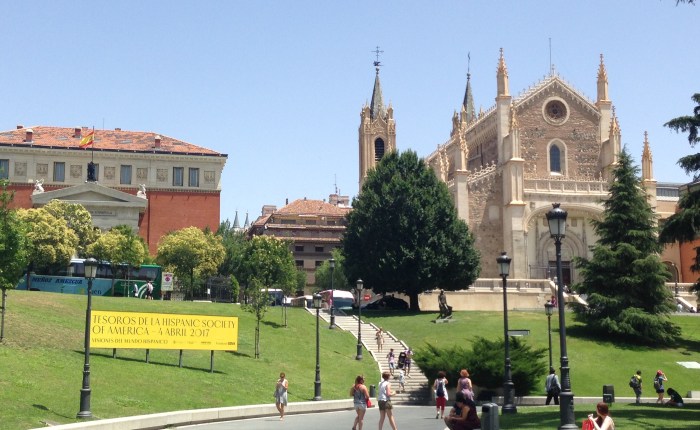


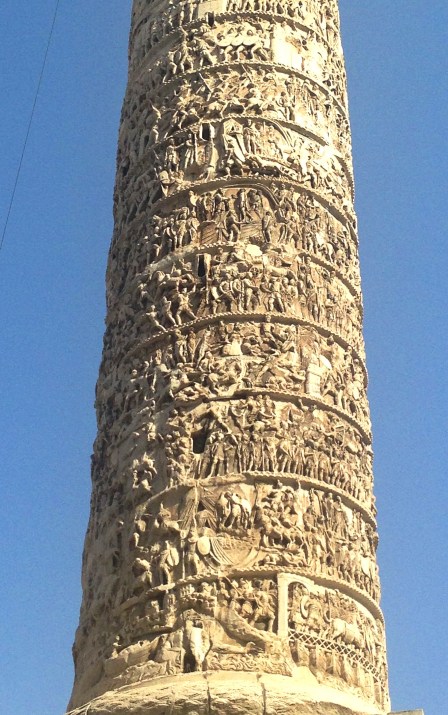


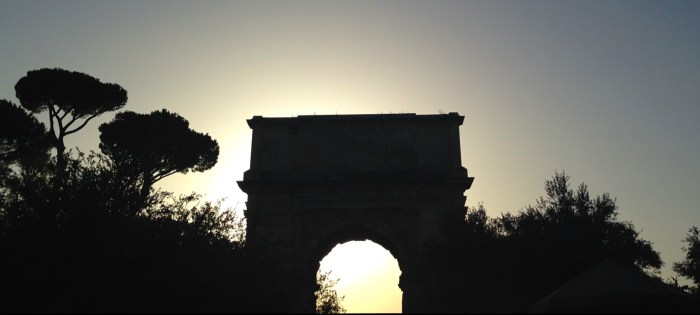

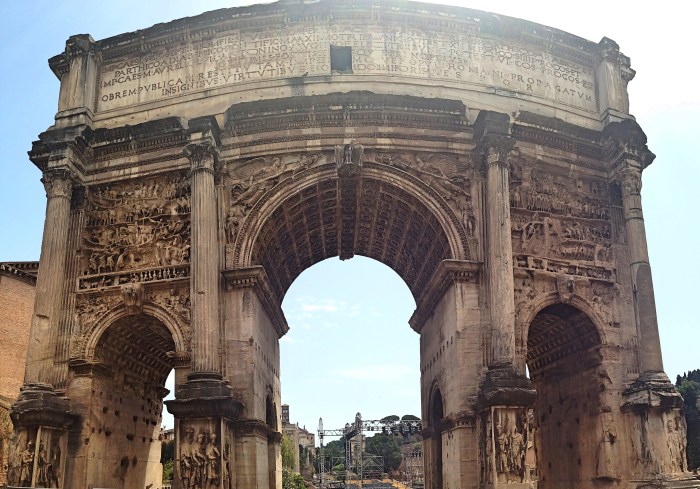

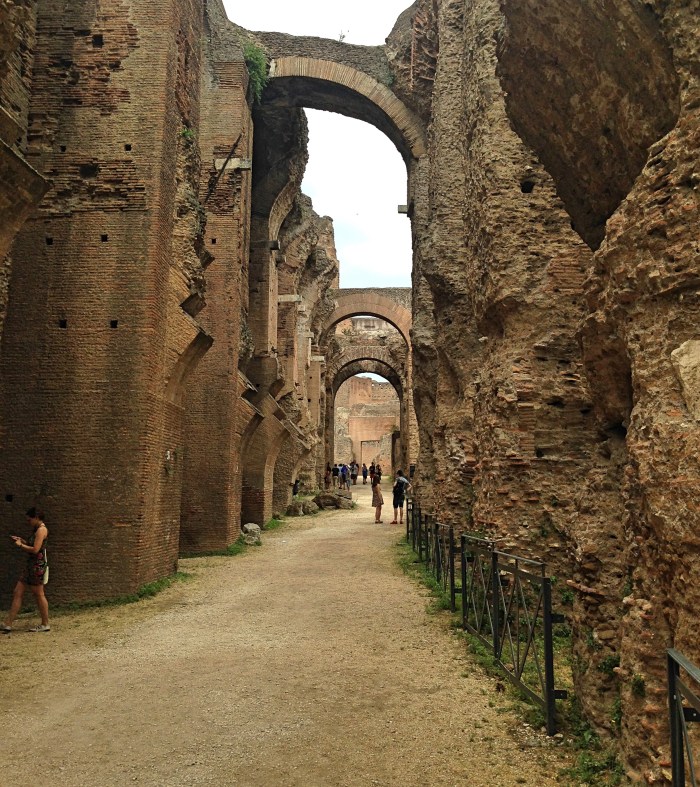

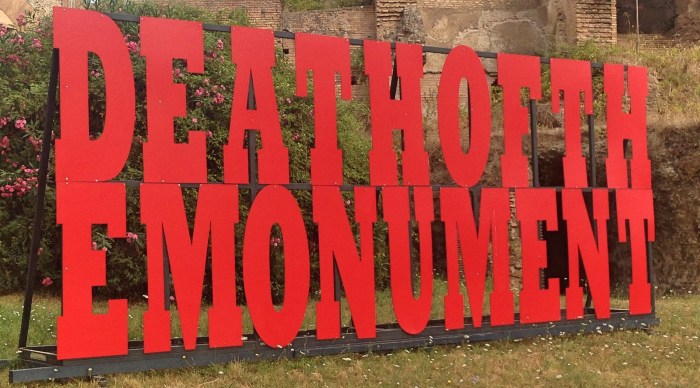


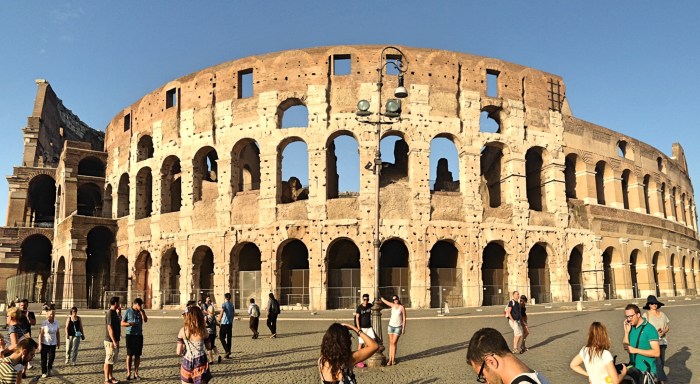


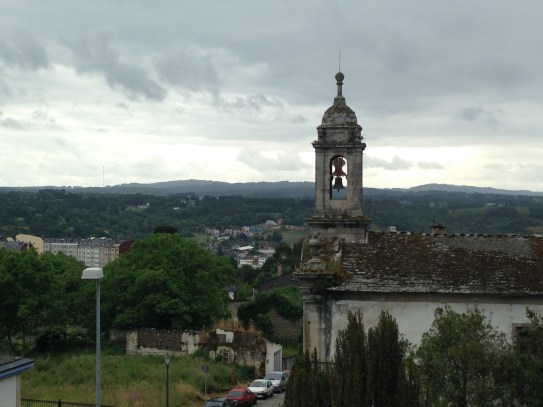
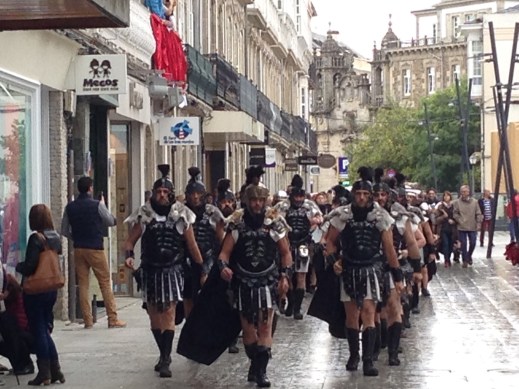
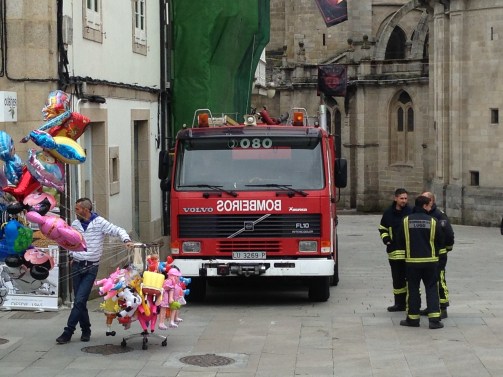


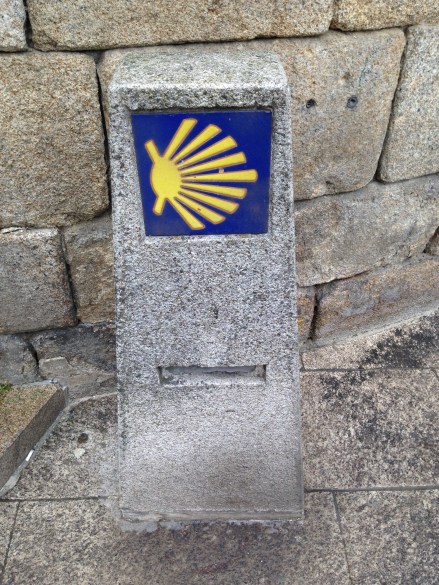
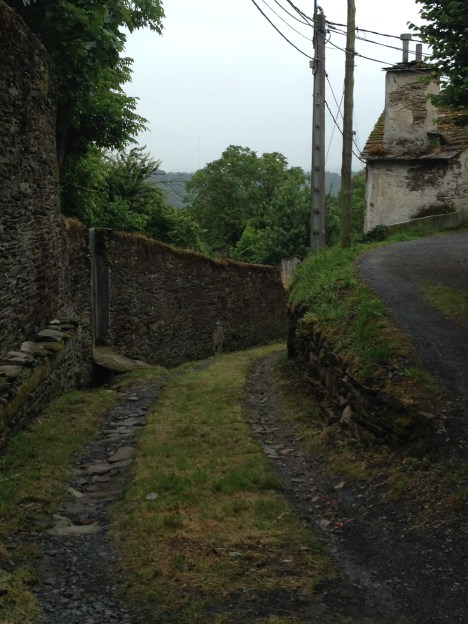
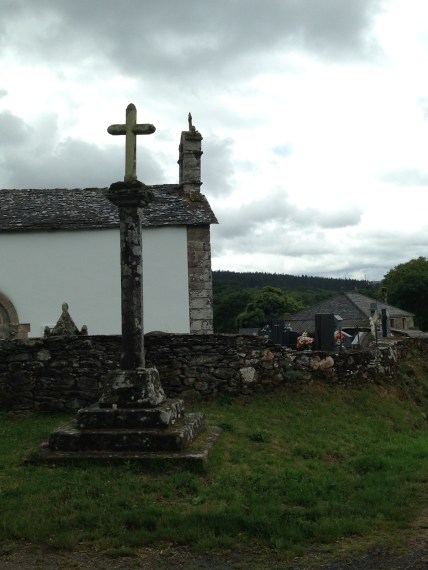


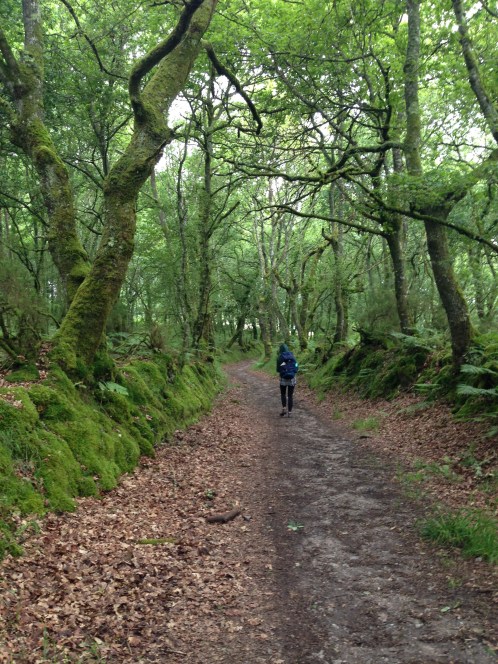

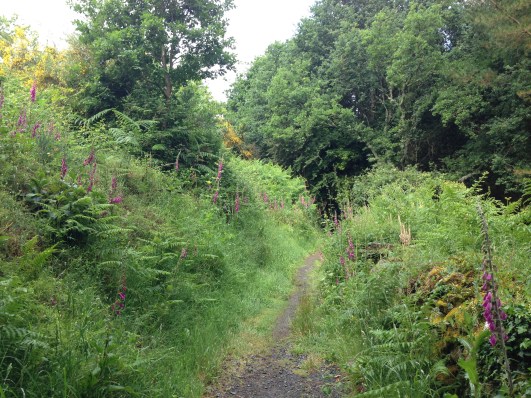
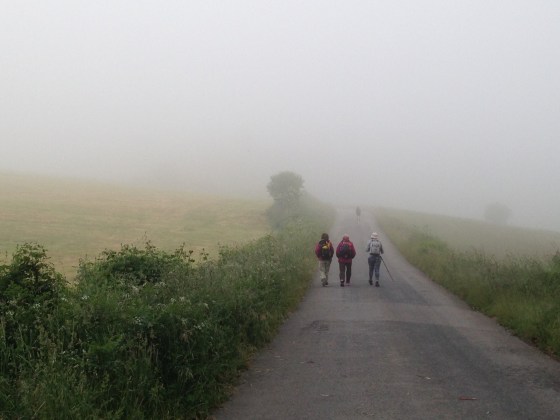
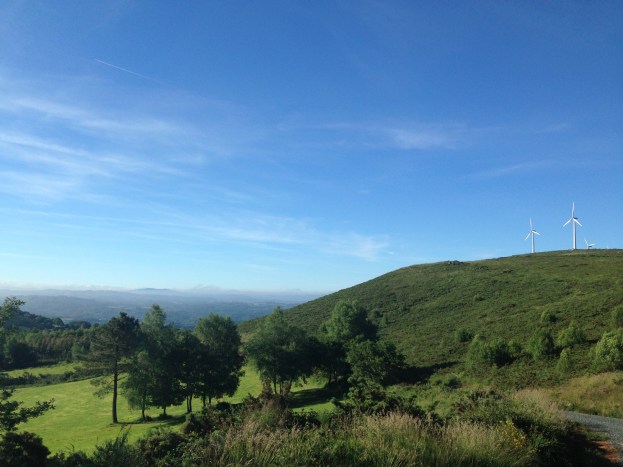
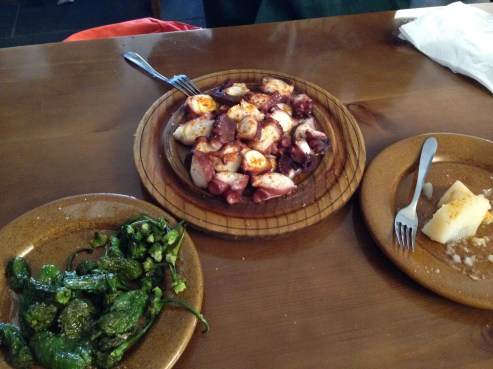

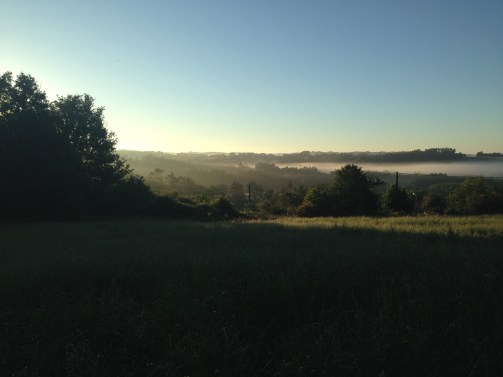
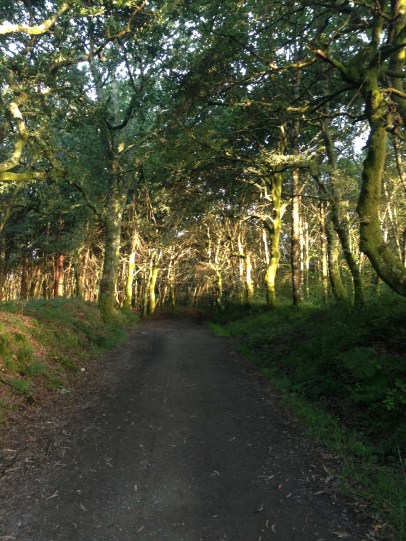
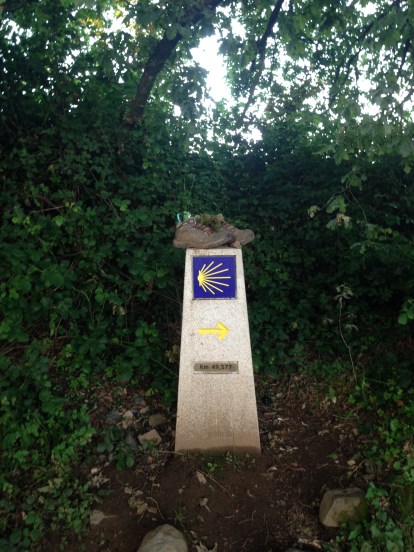

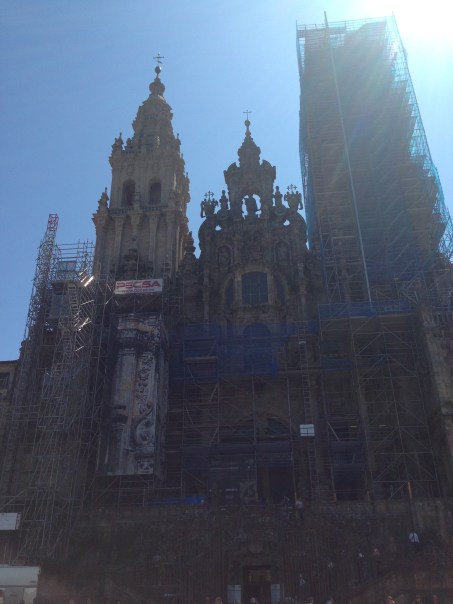
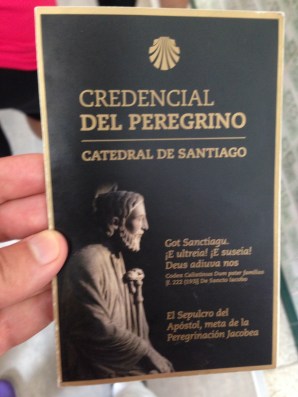
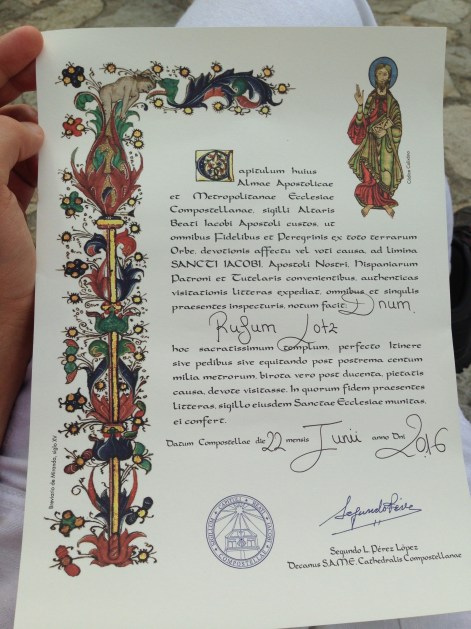
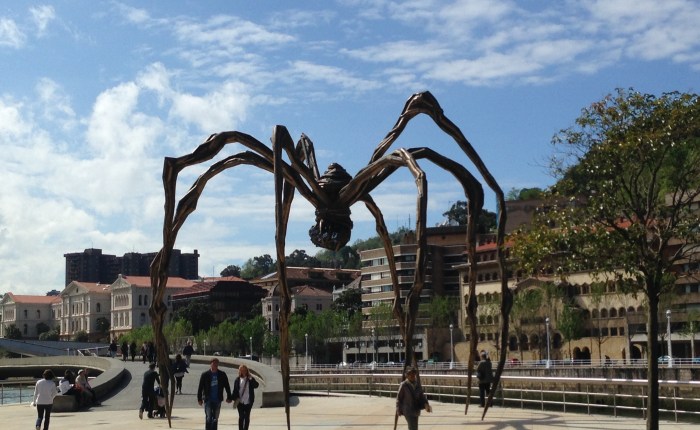
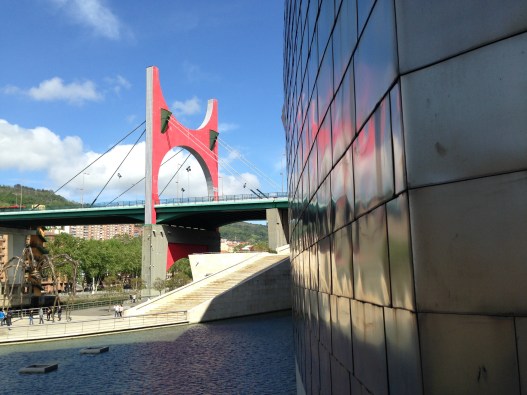
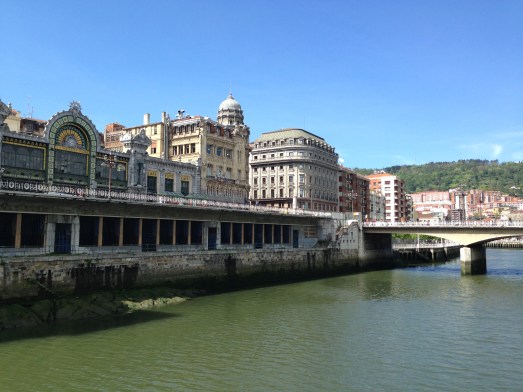
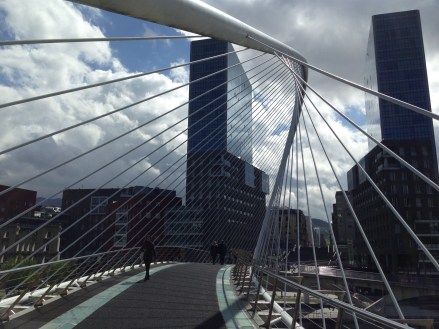
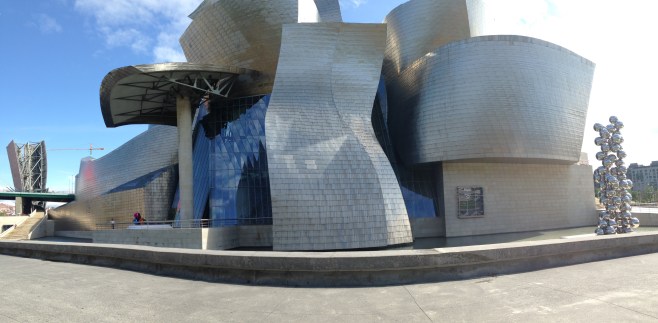

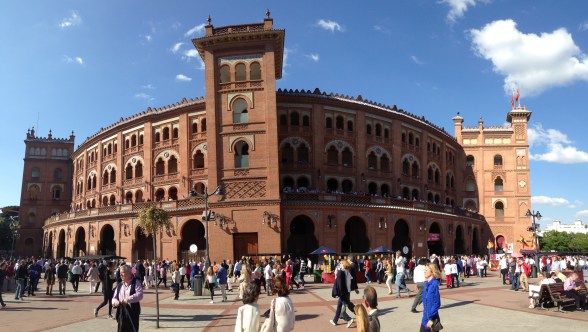


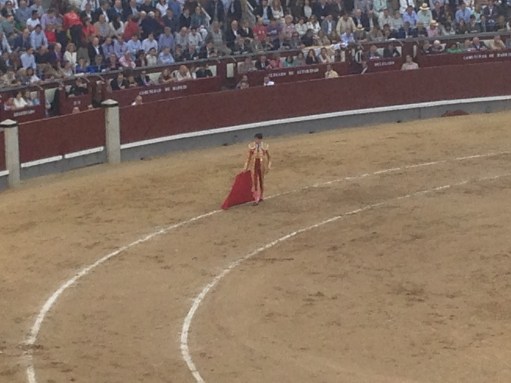

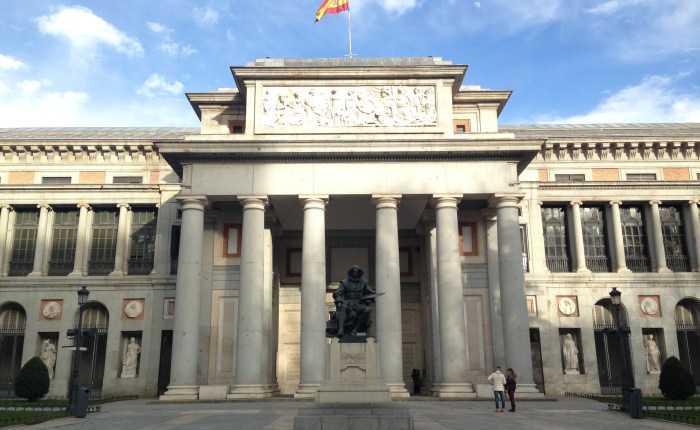
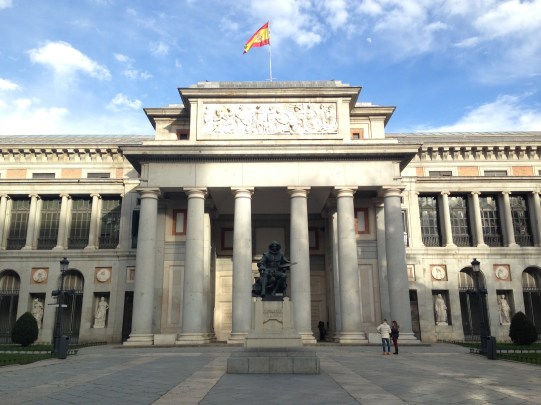

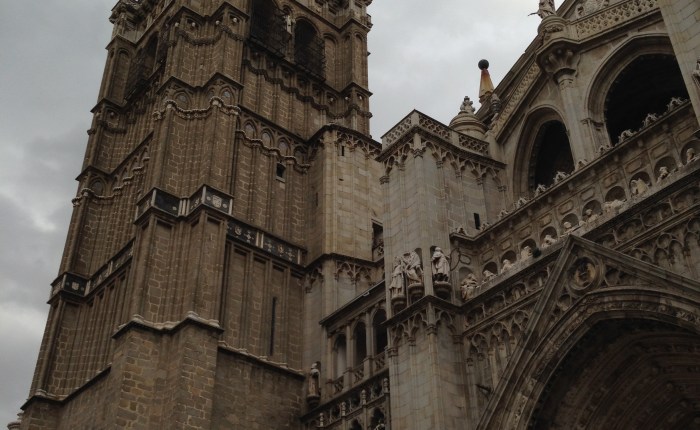
 Lotz in Translation