Review: The Path to Power

Review: The Path to Power

The Path to Power by Robert A. Caro

My rating: 5 of 5 stars


Last winter, I went to the Film Forum in Manhattan with some friends to see the new documentary about Robert Caro and his famous editor, Robert Gottlieb. It was a wonderful experience on many levels. The documentary was fascinating and inspiring—the story of two people who, in quite different ways, have lived fully dedicated to literature—and it was the perfect place to see it, in the heart of Caro’s and Gottlieb’s city, surrounded by other New Yorkers.

Gottlieb comes across as a lovable and brilliant person (he has, sadly, since passed away at the age of 92), but Caro comes across as something superhuman, an embodied intellectual force. The name of the documentary, Turn Every Page, aptly summarizes what makes Caro so special: the meticulous, obsessive, even demented attention to detail—the determination to get to the heart of every aspect of every story, to never be satisfied with half-truths or empty explanations. And then, once he has gathered together his facts, this relentless attention is focused on the writing. For Caro is not satisfied with merely presenting us with his (always impressive) research. He is determined—again, maniacally so—to make us understand on a deep emotional level what each of these facts mean.

All of these qualities are fully on display in this, the first book of Caro’s monumental biography of the 36th president of the United States. As a political biography—a record of the accumulation and use of power—the book is peerless. Caro traces how Johnson, by sheer force of his personality, went from a rural boy with little education and less money to a member of Congress in just a few years. His chapters on Johnson’s elections alone—his campaign strategies, his fundraising, his advertising—are a goldmine for any political historian, and eye-opening for even the most cynical of readers.

Yet everybody knows that Caro is a master of political biography. What surprised me most was how brilliant this book was in other respects. His descriptions of the Texas Hill Country, for example—its climate, its soil, its weather—often rise to such a level of poetry that I was reminded of John Steinbeck. And his chapter on life in the Hill Country before electrification—the difficulty of even simple chores like washing and ironing—is so empathetic that it brings this experience to life as powerfully as even the most gifted novelist could manage.

Aside from this wonderful scene-setting, and aside from the incisive history, this book is of course the study of a personality. And it is a peculiar one. Indeed, underneath all of the historical detail, I think there is a very basic moral conundrum at the heart of this book. It is, in short, that Johnson is successful and effective—indeed, often a force for good—while being personally unlikeable and morally vacuous.

Caro goes to great lengths to illustrate the uglier sides of Johnson’s character. His urge for power is so great that it trumps every other consideration in his life: love, loyalty, ideals, friendship, ethics. When he is stealing elections, betraying friends and allies, and cheating on his wife, not once does he give evidence that he even possesses a conscience. And yet, in his quest for power, he educates children, helps the unemployed find jobs, secures money for veterans, and electrifies his district, among much else.

This paradox is illustrated in Johnson’s treatment of his secretaries. While he worked as a congressional assistant, Johnson went to great lengths to help the constituents of his district—far more than any ordinary assistant could or would. But this unusual effectiveness was achieved by working his own secretaries to such a degree that they could not have any life outside of work, and one had a nervous breakdown and fell into alcoholism. This is a consistent pattern: the specific people close to Johnson are used as tools for his own advancement, while the abstract people out in the world benefit from his obsessive work ethic.

To put the matter another way, Johnson seems to violate every ethical precept I know regarding the treatment of others, and lives in total contradiction of every piece of advice I know regarding wise and good living. Johnson comes across as a miserable person destined to share his misery with the world. But it becomes clear that Johnson’s personality type is perfectly suited for politics, and he achieves almost instant success when he enters that field. Indeed, one gets the impression that everyone else in Washington D.C. is just a toned-down version of Johnson—equally as power-hungry, but not as effective.

Somehow, we seem to have a system designed to elevate people whom most of us would find repulsive. Maybe this is inevitable, as the people who most desire power are the ones most likely to get hold of it. Perhaps the best thing to do, then, is to hope that the institutions are set up in such a way that, as in the case of Johnson, these driven individuals end up having beneficent effect on society. And yet, this does seem like an awfully risky strategy.

In any case, as I hope you can see, this is a superlative book, excellent on many levels. It is, in fact, among the select class of books that can forever change your outlook.


View all my reviews

Review: Faraday’s Experimental Researches in Electricity

Review: Faraday’s Experimental Researches in Electricity

Faraday’s Experimental Researches in Electricity: Guide to a first reading by Michael Faraday

My rating: 4 of 5 stars


In the first volume of Robert Caro’s biography of Lyndon Johnson, there is a fantastic chapter about what life in the Texas Hill Country was like before electricity arrived. Every basic task was substantially more difficult: water had to be carried in buckets, clothes had to be washed by hand, water had to be boiled over an open fire, milk and eggs had to be refrigerated in ice cellars, and on and on. When power finally did arrive to this rural area—thanks in large part to Johnson’s work—it transformed daily life in a matter of years. Johnson was considered a hero, and rightly so.

But if Lyndon Johnson deserves ample praise for having helped bring electricity to his district, what does Michael Faraday deserve? For it was Faraday who first discovered the principles of the electric motor and the electric generator. If not for him, the harsh conditions described by Caro—a life of ceaseless toil, barely eking out a living—might be not just confined to a rural area in Texas, but the general condition of our species. Faraday was, in short, a historical figure of supreme importance, and his work represents a turning point in human history.

Knowing this, it is shocking to see just how humble and, in many ways, how simple his work actually was. The tools at his disposal seem, to the modern reader, almost laughably primitive. Whereas modern physicists are using a city’s worth of power to accelerate particles down a track kilometers long, Faraday was fiddling with wires and bar magnets and compasses. And yet, with such simple tools at his disposal, and with scarcely any formal education—indeed, hardly knowing any math beyond basic algebra—Faraday made contributions to physics comparable to Newton or Einstein.

The format of this book is simple. It is not, like the Principia, a unified work conceived as a final theory. Rather, Faraday reached his conclusions slowly, over years of experimental work; and this book is a reflection of his process. Starting in 1821, Faraday began publishing accounts of his experiments in the Philosophical Transactions of the Royal Society. These papers were eventually collected and published in three separate volumes, in 1839, 1844, and 1855, consisting of 29 “series” of experiments in total.

Before I go any further, I should note that I did not make my way through all three of these volumes. Rather, I bought a condensed and annotated version published by Green Lion Press and edited by Howard Fisher. Frankly, I do not have the patience or interest to fight my way through 1,500 of the original, and I doubt many others do either. I also very much appreciated Fisher’s introductory essays, without which I think I would have been quite lost (and I often was, anyway).

Remarkably, Faraday maintains a numbering system for his paragraphs throughout, so that he can refer to earlier paragraphs of previous series as easily as one might cite the Bible. This is a simple device, but it does help to reveal the unity that underpins the apparently disorganized quality of this work, as it shows how Faraday was continually returning to the same questions and refining his answers.

I have already mentioned that Faraday was unversed in mathematics. And this makes him fairly unique in the field of physics, in which equations are sometimes elevated to a level that equates math with reality. However, the more one reads of his work, the more one comes to see that, even if he eschewed quantitative reasoning, Faraday was an extremely precise thinker. Part of this is his use of diagrams, which for Faraday almost take on the role of equations in summarizing complex relationships. He is also very sensitive to language, and is constantly trying to choose words that do not carry any inappropriate theoretical baggage.

Just because this book is written in good old-fashioned English, however, does not make it easy. Often, Faraday is responding to dead controversies and in general is using both language and theories that seem strange to the modern reader. To pick a simple example, static electricity is referred to as “ordinary” electricity, since this was the most commonly encountered electricity in Faraday’s day. What is more, Faraday very often must describe a detailed experimental apparatus or procedure, and I very often found myself totally unable to picture what was going on.

Here is a fairly typical example:

A ray of light issuing from an Argand lamp, was polarized in a horizontal plane by reflexion from a surface of glass, and the polarized ray passed through a Nichol’s eye-piece revolving on a horizontal axis, so as to be easily examined by the latter. Between the polarizing mirror and the eye-piece two powerful electro-magnetic poles were arranged, being either the poles of a horse-shoe magnet, or the contrary poles of two cylinder magnets; they were separated from each other about 2 inches in the direction of the line of the ray, and so placed, that, if on the same side of the polarized ray, it might pass near them; or if on contrary sides, it might go between them, its direction being always parallel, or nearly so, to the magnetic lines of force.

I don’t know about you, but I find this to be extremely exhausting.

Not all of the book was so dense, however. I particularly enjoyed the fifteenth series, which basically consisted of Faraday and his assistants putting their hands in a tank and getting an electric eel to shock them. Science was indeed simpler back then.

But the final impression is of Faraday’s remarkable theoretical vision. Although he is an extremely concrete thinker—couching even his most speculative remarks in terms of experiments—he nevertheless succeeded in probing some highly abstract questions. Beginning with the relationship between electricity and magnetism, he goes on to consider the relationship of force to matter, to light, and even to empty space.

His work is, in short, a model for science, showing how careful observation and the judicious use of imagination can revolutionize our understanding of the natural world. Compared to the baroque mathematical models of string theorists—whose theories have yet to receive any confirmation from experiment—Faraday’s approach is refreshing indeed.

View all my reviews

(Cover image is Faraday’s labs in the Royal Institution; photo taken from Wikimedia Commons; uploaded by AnaConvTrans.)

Review: The Return of the Native

Review: The Return of the Native

The Return of the Native by Thomas Hardy

My rating: 3 of 5 stars


One of my vices is the reading of advice columns. The problems of the correspondents are often so bizarre as to be beyond the imagination of even the most lurid novelists. My favorite agony aunt (as the British say) is Carolyn Hax, who writes for the Washington Post. And her advice very often boils down to one simple precept: mind your own business.

This book is one long illustration of the wisdom of this maxim, as the entire tragedy of the plot could have been avoided if any of the major characters (and, indeed, even some of the minor ones) had simply minded their own business. From the aunt who cannot trust her niece—or, indeed, even her own son—to marry the right person, to the rejected suitor who spies, eavesdrops, and meddles, to the two principal characters—Eustacia and Wildeve—who express their dissatisfaction with their own marriage by tarnishing another’s, and finally to the titular “native,” whose love for his own country is tainted by his savior complex, thinking that he ought to “improve” his fellows.

Now, you may think that the injunction to attend to your own affairs is not exactly a profound subject for a novel. But considering how difficult it is, and how often we try and fail to do this, I think that it is worth close examination. Indeed, I would go so far to say that minding one’s own business is a bedrock moral principle.

To mind your own business is, in one sense, a way of showing respect, by trusting that others will have the wisdom to manage their own lives. And even if another person evidently cannot act wisely, to refrain from interfering is still very often the best course. The freedom to screw up one’s own life in one’s own chosen manner is an inseparable part of having personal autonomy. In any case, even the kindest intervention can often backfire, as Hardy illustrates with the case of Diggory Venn, who has enough good intentions to pave several superhighways to the fiery pit, and who gets most everyone except himself there in record speed.

However, the injunction to mind your own business is also, potentially, a profoundly conservative one. And as with many Victorian novels—indeed, as with many stories generally—the message boils down to this: do not tamper with the social order. Except for Thomasin and Venn (not coincidentally, the two characters who have a happy ending), all of the major characters consider the Heath to be, in some way, beneath them. Whether their dreams are financial (Mrs. Yeobright), educational (Clym), or romantic (Wildeve and Eustacia), they want to, somehow, get beyond their social reality. And as often happens in stories, the result is a tragic end for them and a return to statis of the society.

I have got caught up in analyzing what I take to be the moral of this book, but I have not said anything about its quality. Unfortunately, I have to admit I found the novel to be quite mediocre. The story is full of cliches (unread letters, mistimed messages, the lover in disguise) and implausible coincidences. I think a good tragedy should show how the end result is an inevitable consequence of the protagonist’s personality. But with so much seeming bad luck involved in this story, the final impression is that the denouement was just a matter of blind chance.

But it must be admitted that this artificial plot was at least very exciting. Hardy dives right into to the scandalous drama of his story and he never lets up. There is hardly a breath to the ceaseless action, except for the interludes involving the Heath folk, who apparently Hardy conceived of as a kind of Greek chorus to his Sophoclean tragedy. Indeed, as the novel was first serialized in a magazine, I think the experience of reading it must have been remarkably close to that of watching a good soap opera.

Hardy’s characters are only partly successful. His women are more compelling than the men, who are rather stiff, shallow figures. But even the novel’s strongest character, Eustacia, is hampered by Hardy’s penchant for writing dialogue that is pretentious and stuffy, even in moments of great drama. Consider this sample, Eustacia’s reply to her husband during a pivotal scene:

Never! I’ll hold my tongue like the very death that I don’t mind meeting, even though I can clear myself of half you believe by speaking. Yes. I will! Who of any dignity would take the trouble to clear cobwebs from a wild man’s mind after such language as this? No: let him go on, and think his narrow thoughts, and run his head into the mire. I have other cares.

Aside from the strangely epistolary quality of this speech, it is also a good example of a certain psychological implausibility, as Eustacia at key moments withholds explanations which would materially benefit her to provide. That she does this is not a convincing consequence of her character, prideful though she may be, but it is required for the plot to plod onward.

The prose of the novel is not much better. Hardy often seems to be straining for a weighty, literary style that feels both unnecessary and false. He often, for example, includes references to history, literature, and mythology which only prove his own learning, adding nothing to the story. And he gives the impression of choosing words simply to show off. To be fair to Hardy, the writing does improve from the beginning towards the end, which the introduction to this volume attributes to its origin as a serialized novel. Yet even in the final part, we get a sentence like this:

All the known incidents of their love were enlarged, distorted, touched up, and modified, till the original reality bore but a slight resemblance to the counterfeit presentation by surrounding tongues.

Such an ostentatious style may, perhaps, be appropriate in a history of the decline and fall of the Roman Empire, but it is jarring in the context of a novel about rural folks.

In the end, I think this is only a half-successful novel—certainly entertaining, but so uneven as to be ultimately unconvincing as a work of art. But I can say that Hardy would at least have made a first-class agony aunt.

View all my reviews

Reflections on Reading the Quran

Reflections on Reading the Quran

The Qur’an: Saheeh International Translation by Anonymous


Some years ago, on a trip to Istanbul, I visited the Süleymaniye Mosque with a friend. It was a memorable experience. As we waited outside, a few men washed themselves in the fountains outside the building, purifying themselves before prayer. We went in through another entrance, and found ourselves in an expansive space—light flooding in from the high windows, the geometric designs and arabesques creating an imposing symphony of color. In aesthetic, it was the furthest thing from a gothic cathedral—with its profusion of statues, friezes, sculptures, and gargoyles—but the mosque was, nevertheless, a place of equal spiritual grandeur.

We walked up to the partition that separated the prayer rug from the area reserved for tourists. There, a young Muslim man began to talk to us in good English. He was very polite, asking us where we were from, what we thought of the Mosque, and explaining some of the history and architecture (according to him, the ostrich eggs on the chandeliers were to keep spiders away?). As he spoke to us—so sincere, attentive, and obviously passionate about his faith—I thought of the free copy of the Quran that had been given to me on the previous day, when we visited the equally impressive Blue Mosque, and I quietly resolved to read it.

It took me a while, but I did. This copy is a translation by Saheeh International, first published in 1997 in Saudi Arabia, obviously meant for mass distribution. Now, apparently this organization is a group of three American women who converted to Islam. The translation is widely used but is considered to be both Sunni in flavor and quite conservative. It is certainly possible that it was not the “best” translation for me to read, though I found it to be readable and unpretentious, if not always the most elegant.

This was not my first time attempting to read the Quran. About ten years ago, I tried to read John Medows Rodwell’s translation. But I did something which I rarely do with a book: gave up. The problem was that I did not know how to approach it. Having just finished large chunks of the Old and New Testaments, I thought that the Quran would be at least roughly similar. But it is a very different sort of book. If you skip all the begetting in Genesis, for example, you find that it is, at the very least, an excellent collection of stories. But the Quran is not a collection of stories—indeed, it is not a linear narrative at all. In order to appreciate it, I think that the reader must have some understanding of how somebody born into a Muslim community would first experience the book.

For this, I highly recommend Michael Sells’s excellent book, Approaching the Quran. There, Sells makes the important point that the Quran is heard more often than it is read. Though it may be slightly blasphemous to call Quranic recitation an “artform,” I think that anyone who hears it will recognize that it is a highly developed activity, requiring keen sensitivity to prosody and melody, and following strict rules. Even more striking, this recitation may be heard in rather ordinary situations, almost as one listens to music. Sells, for examples, tells of a driver playing a tape of Quranic recitation on a crowded city bus, while just two weeks ago I ate in a kebab shop with a Quranic recitation playing over the speakers.

This aural quality of the Quran harkens back to its origins. According to Muslim tradition, the Quran was revealed to Muhammed over a period of 23 years by the archangel Gabriel. Muhammed was illiterate and, therefore, did not write down the Quran himself. According to the tradition, it was recited to him and he recited it to his followers, word for word. Indeed, Quran literally means “the recitation.” Unlike in the Christian tradition, then—wherein the works of the Bible are thought to be divinely inspired but not normally considered the direct word of God—the Quran is indeed considered by Muslims to be the actual Divine speech.

Michael Sells points to this difference by referring to how Christian and Muslim missionaries operate in different ways when they come to a new place. The Christians will set about translating their scripture into the local language, while the Muslims will start giving classes in classical Arabic. Martyn Oliver, in his introduction to the Quran, explains the difference in another way. Whereas Christians view the Bible as a human production inspired by God, whereas Jesus is considered to be God incarnate, Muslims consider Muhammad to be divinely inspired but, ultimately, a human, while the Quran is the perfect and miraculous word of God.

I think this background is quite important to know when you attempt to read the Quran. Though of course you can pick up a translation and read it from front to back—which is what I did—this is not how the book was first transmitted, nor how most Muslims first encounter the Quran. Furthermore, the Quran’s organization is baffling unless you understand some of this history.

The book is divided into 114 chapters, called surahs. And these are not organized according to any narrative or obvious internal logic. Rather, they are arranged roughly from longest to shortest. In my edition, Surah 2 (the first is a short opening) is 43 pages long, while Surah 114 consists of six short lines. To confuse matters further, the shorter surahs are normally the ones revealed earlier to Muhammed, before his migration to Medina. Thus the Quran is also in roughly reverse-chronological order—the final revelations coming first. But, again, these features are only puzzling if, like me, you intend to read the Quran from cover to cover.

Despite this seeming disorganization, I think any reader will find that the Quran does have a unified message. The major themes of the book frequently repeat with slight variations from surah to surah, and so the ideas and tenets of the faith are built up in a non-linear fashion from beginning to end.

My first impression was of a powerfully monotheistic faith. True, while Christianity (which is my point of reference, despite not being religious myself) is also monotheistic, I think that if you compare the imagery of the trinity, the angels, the legions of saints, and the Virgin Mary found in any Catholic church with the single emphasis on one omnipotent creator God found in the Quran, you will see a clear difference. Indeed, the Quran repeatedly criticizes both the polytheists and the Christians for thinking that God could have peers or a son.

Another major emphasis of the Quran is the apocalypse. In this, it reminds me of the early Christian church, when the imagery of Christ the judge was far more common than Christ on the cross. Readers are continually warned that God is able to see into their innermost thoughts and that angels record all of their deeds. The terrors of hell and the rewards of heaven are described in far more detail than in the Bible (sometimes even reminding me of Dante) and we are often warned of the final day, when every person will be bodily revived and then judged.

Many Biblical stories are told and retold in the Quran, sometimes in ways that differ considerably from the originals. Rather than the long historical chronicles that one can find in the Bible, however, these stories are told more for their moral point. One obvious theme is that prophets are often rejected by their countrymen, with disastrous results—a clear parallel with Mohammed’s situation.

Yet another common theme of these stories is the importance of faith—of trusting in God’s decrees. Indeed, though there are many sections detailing rules of conduct—such as when to fast, when one can divorce and remarry, or the injunction to go on pilgrimmage (though there is not, I should say, an explicit section on the “Five Pillars” of Islam)—what struck me was how much of the religion is based on the simple act of faith: the belief that God is absolute, all-powerful, all-knowing, and the most merciful. Such a God obviously cannot have any rivals, and no wordly goods can possibly compare with His favor. It is a simple idea, but with deep and far-reaching implications.

I am sure that my impressions will strike both experts and believers as naïve and simplistic. However, I still feel that my understanding of, and appreciation for, this global religion has been deepened by this reading. And that is no small thing.


View all my reviews

Review: What We Owe to Each Other

Review: What We Owe to Each Other

What We Owe to Each Other by T.M. Scanlon

My rating: 3 of 5 stars

Like many readers of this book, I was led here by the show The Good Place—though my path was indirect. A friend of mine spent months trying to convince me to watch it, arguing that it was “made for me.” But I very rarely watch TV and I never felt compelled to make an exception for the show, however brilliant it may have been.

About a year after my friend moved away, however, I received this book in the mail. Apparently, this relatively obscure philosophy text was referred to multiple times in the show, as the protagonist slowly learned what it means to be a good person. And my friend decided, if she could not get me to watch the show, it would be far easier to get me to read a book. Considering that I am here now, this was a correct surmise.

I really don’t know why the show’s writers chose this, among all of the available philosophy texts, to be featured in the show (an in-joke?). For I really can hardly imagine a work of philosophy less likely to improve a person’s everyday behavior than this one. This is not a criticism of Scanlon, you see, as the book was not written to be exhortatory or uplifting. Rather, this is a work of academic philosophy about the abstract nature of morality. I only point this out to save fans of the show from disappointment.

Scanlon here sets out to give a contractualist account of morality. Well, not quite. He quickly admits that his focus does not include all of what is conventionally thought of as ethics. For some people, saying grace before a meal is morally right, whereas for others preserving a particularly beautiful tree from destruction is something they consider a duty. Indeed, what people consider to be a moral requirement is a large, messy, and varied category. Scanlon here restricts himself to a narrower domain, what he calls “what we owe to each other.” This, in short, has to do with the morality of interpersonal behavior—how we treat one another.

Scanlon begins in a somewhat unusual way, with a delve into the psychology of motivation. He argues that humans, as rational creatures, are better described as being motivated by “reasons” than by “desires.” A desire, in his view, is a kind of short-term motivational urge; and while we do experience such urges, we most often do things because of some larger goal or in accordance with some value. A parent may punish a child, for example, because they think discipline is a necessary part of child-rearing, even if they feel no actual anger—or, indeed, even if they are tired and would rather let it slide.

The fact that humans are motivated by “reasons” and not just “desires” is what makes us, in Scanlon’s views, particularly subject to the laws of morality. This is because we humans, as rational creatures, have a strong motive to care that the reasons for our actions be justifiable to our fellows. Social life would be impossible otherwise. Indeed, for Scanlon, this is the very heart of morality: that we act in a way that no one affected by our action could reasonably reject the principles which guided us.

You might notice that this formula has much in common with Kant’s categorical imperative. Where it differs is in its social (or contractualist) orientation. Morality is not a consequence of a priori rational rules or a special metaphysical category, but rather a consequence of the nature of rationality itself—something we are almost certain to care about, given that we live in communities and act in accordance with broad principles. This account of morality does, however, differ sharply from those along utilitarian lines, and Scanlon argues at length against such views.

I have been trying to present Scanlon’s views fairly, but I have to admit that I did not find this book compelling. For one, his distinction between reasons and desires—an important foundation of his theory—strikes me as particularly fragile. At various points in the book he formulates principles (such as about honesty) which could serve for ethical action. But it is obvious that these principles are so abstract that virtually no ordinary person would think along such lines. Indeed, Scanlon himself admits that most people have rather vague intuitions about their reasons for action, though for him it suffices that the reasons could be formulated.

Worse, while arguing for the primacy of reasons over desires in human motivation, Scanlon does not cite any but “phenomenological” evidence—which is to say, his own experience. To be fair, I have no idea what the state of psychological research into motivation was in 1998, when the book was published. But within a decade, researchers like Jonathan Haidt would make a very strong case that the reasons we profess for acting or thinking in a certain way are not reliable indications of our true motivation.

For example, people often have strong moral feelings (of outrage or disgust, say) without being able to say exactly why they object to something. It seems that our emotional reaction comes first and then our frontal lobe tries to justify the feeling, rather than the opposite. To quote Benjamin Franklin: “So convenient a thing it is to be a reasonable creature, since it enables one to find or make a reason for everything one has a mind to do.”

If Haidt’s model is true, and humans are not primarily motivated by “reasons,” then many of Scanlon’s arguments about morality and why we ought to care about it are considerably weakened. Yet even if we leave this issue to the side, I also found Scanlon’s test of moral validity to be unhelpful. His formula is: Act in such a way that nobody affected by the action could reasonably reject the principles which guided your actions.

To my mind, Scanlon ought to have spent much more time specifying exactly what he meant by “reasonable.” He does not provide any sort of test or easily applicable standards which would show whether a given principle can be reasonably rejected or not, apparently believing that our intuitions about what is reasonable or not would mostly coincide. Perhaps that is true much of the time, but in my experience there is a great deal of disagreement over what is reasonable (and, indeed, what is moral). By the end, I could not help thinking that Scanlon’s formulation was so vague as to be close to useless.

This is related to another fault. Though Scanlon spends a great deal of time explaining the specifics and advantages of his ethical system, he does not show how his way of thinking applies to any tricky areas of morality. He entirely avoids any controversial case—such as abortion, animal rights, the death penalty—and seems content to show that his system forbids murder and most forms of dishonesty. Bertrand Russell once remarked that, in ethics, the philosopher often proceeds by taking the conventional conclusions of morality for granted, and then finding some extra way of justifying them—and this strikes me as precisely the sort of exercise Scanlon is engaged in.

As for the writing style, I notice that many readers found it off-putting. But by the standards of academic philosophy, I would actually say that this book is extremely accessible. That is, of course, not high praise, but at the very least Scanlon avoids formal logic and the impenetrable argot of continental philosophers. Yet it must be admitted that by normal standards the writing is quite dry and lifeless.

But I really do not want to heap so many criticisms upon this book. Scanlon here presents a thoughtful new take on ethics with a minimum of jargon and without being strident or doctrinaire. If I did not find it a rewarding read, it is probably because I am not part of the book’s intended audience (other academic philosophers). Now, after having spent weeks on the book and a lot of time on this review, I wonder if I wouldn’t have been better off just watching the show…


View all my reviews

Review: Les Misérables

Review: Les Misérables

Les Misérables by Victor Hugo

My rating: 4 of 5 stars


When I was in the sixth grade I was placed into the “challenge” class. This was a special program for academically “gifted” children, meant (as its name would suggest) to give us more stimulating schoolwork. If memory serves, most of our classes were given over to logic and math problems. But our major project was to read Victor Hugo’s Les Miserables.

We were, of course, assigned a student version of the novel, though even this abridgement seemed immense to me. I am really not sure whether I read the whole thing. If I did, I barely understood even the basic outline. (Maybe I didn’t deserve to be “challenged.”) My only memory of the book is of a description of the streets of Paris, which struck my 11-year-old mind as unbelievably and impenetrably detailed.

The year culminated with a visit to see the musical on Broadway. (Living close to NYC has its perks.) I was stunned that such a long and boring book could be transformed into an exciting performance. Was this what we had been talking about all year? The music was stuck in my mind for days—weeks. And ever since then, I have had the vague intention of making another go at this literary challenge.

The perfect opportunity presented itself when I signed up to run a marathon. If I listened to the audiobook during my training runs, I could tackle two challenges at once. It turned out that Victor Hugo had even more stamina than an endurance runner, since there was still a substantial chunk of the book left by the time I ran my race. But even the longest books submit to persistence!

It is tempting, when finishing a book of this size, to sing its praises. After all, if the book was not brilliant, then spending sixty hours on it hardly seems worthwhile. But I had quite a mixed reaction to Les Miserables. And I think I would be doing my sixth-grade self a disservice if I did not attempt an honest, accurate report.

The book opens with a long and loving portrait of a character who plays a very minor role in the plot: Bishop Myriel. This is Hugo’s version of the thoroughly good man, a living saint, someone who emulates Christ in word and deed. And though this section was (as usual with Hugo) unnecessarily lengthy and (also typical) highly sentimental, I admit that I found this portrait of human goodness thoroughly moving. Bishop Myriel, indeed, is the heart of Les Miserables, the culmination of the sort of humanitarian goodness that Hugo hopes to inculcate.

This high sense of moral obligation is what prevents the novel from devolving into a long exercise in romantic windbaggery. Hugo writes, not just as an entertainer, but as a reformer—even, perhaps, a revolutionary—and he urges his readers to feed the hungry, tend to the sick, clothe the poor, educate the ignorant, to pardon the guilty, and to lift up everyone who has been cast off by society. And Hugo is not merely paying lip service. The most moving parts of the novel are also the places where Hugo illustrates his social vision.

I think this goes a long way to explaining this book’s lasting appeal. The world is still full of Jean Valjeans, born into poverty and then receiving only punishment from the law.

But of course Les Miserable would not have been made into a musical if it were a long sermon. It is also (at times) a cracking good story. At his best, Hugo is able to raise the tension of the novel to a fever pitch, and then hold it there for page after page. I am thinking, in particular, of Jean Valjean’s long ride to attend the trial of the falsely-accused Champmathieu, or when Valjean is taken prisoner by Thénardier in the apartment.

These high points are, however, compensated by many, many slow sections. By modern standards (and probably at the time, too), Hugo is longwinded in the extreme. Partly this is because he does not abide by our strict notions of the novel, simply narrating the deeds of his characters. Rather, he is constantly analyzing, opining, and moralizing, in a rhetorical style which, at its worst, could sound very much like a self-important politician giving a speech to his donors.

Hugo was a romantic in the full sense of the word, and this also made him prone to a kind of sickly sentimentality which the modern reader can scarcely tolerate. There were times when I felt as though I could not roll my eyes hard enough. This is most apparent in Hugo’s characterization of Cosette, who is portrayed as very sweet, very beautiful, very pure, very innocent… very nothing, in other words. She is hardly given any personality at all, which makes both Marius’s infatuation and Jean Valjean’s adoration dramatically dull.

Now, I am probably achieving some sort of apotheosis of stupidity by saying this, but Les Miserable is just too long. This is not just owing to Hugo’s prolixity, but to his roaming digressions. Perhaps a quarter of the novel could be excised without doing any damage to the story. There is, for example, an entire section on monastic life, one on the sewers of Paris, another on slang, and an unbelievably long one which narrates the Battle of Waterloo. Admittedly, some of this material is interesting (I particularly liked the essay on slang). But it struck me as, to say the least, rather clumsy to insert these opinions as essays—and especially at some of the most dramatic turning points in the book.

To put the most generous interpretation on these digressions, however, they can be considered a mark of the book’s great ambition. And this is ultimately a winsome quality. As with many of the great novels of the 19th century, one feels that the author is attempting to reform the whole society, from the sewers to the schools to our very souls. And if the novel can seem a little flabby and bloated, it is also strong enough to confidently take its place among its peers—War and Peace, Bleak House, The Brothers Dostoyevsky, Middlemarch… This is a high bar, to say the least.

One hardly imagine two authors less alike than Leo Tolstoy and Charles Dickens, and yet Victor Hugo somehow manages to combine elements of both writers. He has Tolstoy’s sense of history and his focus on realistic detail, while being just as committed to social reform (and just as prone to sentimentality) as Dickens. If he does not quite reach the artistic heights of either writer, Hugo remains an inspiring figure—intellectually ambitions, socially committed, and dramatically compelling. At the very least, his book presents a worthwhile challenge.


View all my reviews

Review: The Egyptian Book of the Dead

Review: The Egyptian Book of the Dead

The Egyptian Book of the Dead by Anonymous

My rating: 3 of 5 stars


Of all the great classic books, The Book of the Dead has been on my list for the longest time. My interest in the book was first ignited by the 1999 cinematic masterpiece, The Mummy, which was released at just the moment to leave a permanent imprint on my growing brain. Unfortunately, I have discovered that The Book of the Dead does not really allow you to summon an army of ninja mummies or to revive my long-lost love, Anck-su-namun. If anything, I appear to have only resuscitated Brendan Fraser’s acting career…

Some books are far more interesting to read about than to actually read, and this is one of them. The Book of the Dead is not really a book in that it was never intended to be read for pleasure or even for edification. And, in any case, The Book of the Dead is not an accurate translation of what the Egyptians called it, which would be something like: The Book of Coming Forth by Day.

This sounds poetic. But perhaps a more descriptive title would be The Ancient Egyptian Manual for Safely Dying. For despite this text being the product of an ancient religion, filled with supernatural beings and too many gods to keep track of, this is above all a practical text. If you use the spells contained herein, you can be sure of making your way through Duat, the hellish underworld populated by monsters and other perils, to safety in the afterlife.

These powerful spells would be written on a long scroll of papyrus and buried along with the mummified body. These various papyri were not always identical, often containing variations of the same spell and a different total numbers of spells. But in total about 190 different incantations have been identified.

The practice of burying bodies with this “book” began about 1500 BCE, during the so-called New Kingdom, but many of the spells have even older origins. The very oldest funerary spells are known as Pyramid Texts, and they were inscribed inside the burial chamber of the Pharaohs in (you guessed it) the pyramids, during the Old Kingdom. Apparently, the afterlife was the sole privilege of the Pharoah in the beginning of Egyptian history. But this changed during the Middle Kingdom, when officials, courtiers, and otherwise very rich individuals began to be buried with Coffin Texts—spells inscribed on the inside of the sarcophagus or on the linen shroud that wrapped the body. When these spells began to be written on papyrus, their use became even more widespread. Life in Ancient Egypt was still thoroughly monarchical, but the afterlife became a touch more democratic.

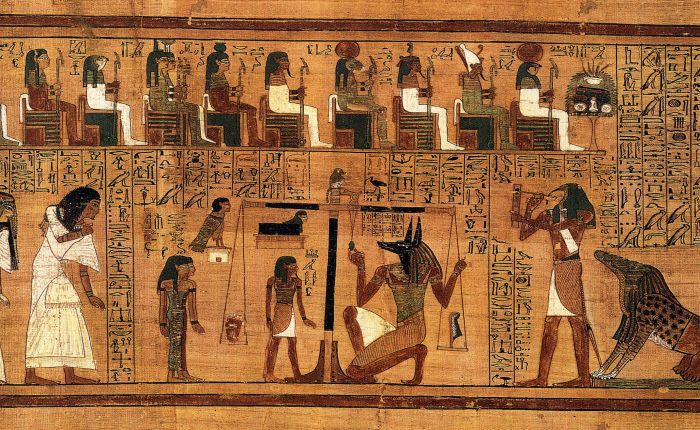
Even (or perhaps especially) if you cannot read hieroglyphs, these papyri were often quite lovely, being richly decorated with vignettes. The most beautiful example of these papyri is the Book of Ani, named after the man whom the book was made for, a Theban scribe. It is worth scrolling through the entire papyrus (the full image is on Wikipedia) and just enjoying the many illustrations, including the famous vignette of Anubis weighing the deceased’s heart against the feather of Maat. This papyrus was actually stolen from the Egyptian police (who had confiscated it from antique dealers) and smuggled to England, where it became a prized item in the British Museum. (The man who stole it, E.A. Wallis Budge, is also, as it happens, the author of the most widely read English translation.)

All of this information is, in my opinion, quite fascinating. Unfortunately, the actual experience of reading the book is considerably less stimulating. As I mentioned above, the spells were not written as literature and make for repetitive, dull, and flat reading. I first attempted to tackle a Spanish version that had been given to me, edited by one Luis Tomás Melgar. But after about 100 pages I simply could not stand it, and decided to try the classic Budge version. The same thing happened: after about 100 pages, I could not bear to read another spell.

Indeed, I am a little embarrassed to admit how unpleasant I found this. Normally I can power through when I don’t much like a book. But it felt as though my brain had been dissolved with acid and was being extracted through my nose. Thus, I decided to have mercy on myself and to mark the book as “read,” while I still had some grey matter intact.

In fairness to the Ancient Egyptian priests and scribes who compiled the book, I ought to include a sample of a spell. Here is one allowing the deceased to transform into a hawk:

Hail, Great God, come now to Tattu! Make thou smooth for me the ways and let me go round to visit my thrones; I have renewed myself, and I have raised myself up. O grant thou that I may be feared, and make thou me to be a terror. Let the gods of the underworld be afraid of me, and may they fight for me in their habitations which are therein. Let not him who would do harm to me draw nigh unto me, or injure me, in the House of Darkness, that is, he that clotheth and covereth the feeble one, and whose name is hidden; and let not the gods act likewise towards me.

If you can make it through 200 pages of this, you are a stronger reader than I am.

Even if The Book of the Dead is not exactly great (or good) literature, it does provide an interesting insight into ancient religion. There is a striking difference displayed here in the attitude towards the Egyptian gods and, say, that displayed towards Yahweh in the Old Testament. In the former, the believer uses spells that grant him predictable control over the gods and other supernatural beings, while the psalms are prayers, supplications, thanksgiving, worship, meditations—attempts to approach and understand the divine, rather than command it.

Another noteworthy aspect is how thoroughly focused on death and the afterlife the Egyptian religion appears to have been. Getting to the afterlife was not seen as the reward of a life well-lived. To the contrary, the spells in this book allow the deceased to reach this eternal reward despite whatever sins they may have committed. The judgment of the gods was not inexorable or unavoidable, but open to magical manipulation. Even if you “defrauded the temples of their oblations” or “purloined the cakes of the gods,” there was still hope of escaping divine retribution.

I know it is highly unfair—and, also simply pointless—for me to judge an ancient religion, especially considering that I did not even manage to finish the sacred book. But I couldn’t help thinking that this religion lacked most of the elements which I normally find compelling in a creed: a substantive moral code, consolation for life’s tragedies, acceptance of the inevitable… There is nothing poetic about death, life’s last major transition (if it can be called that). Instead, the final journey is regarded in such a prosaic, literal-minded way that it evokes no strong feeling. The soul must be defended from physical dangers in order to reach a state of physical well-being, and that is all.

Of course, it is quite possible, and perhaps likely, that The Book of the Dead is not perfectly representative document when it comes to Egyptian religion. After all, the book was not meant to be read by the living, so maybe it is no wonder that I did not find much of value. If I can still access Goodreads from beyond the grave, I will update this review at that (hopefully remote) date.

View all my reviews

Review: The Lotus Sutra

Review: The Lotus Sutra

The Lotus Sutra by Anonymous

My rating: 4 of 5 stars


This book is an excellent example of a text that is interesting as a historical document, but not as literature. To put the matter more bluntly, The Lotus Sutra has much to teach but is not very fun to read.

Having recently finished The Platform Sutra, I was struck by how different these two Buddhist scriptures are. The former is dense with doctrine and often quite deeply philosophical, whereas this text is full of revelations, miracle stories, and parables. And whereas The Platform Sutra accords pretty well with the Western conception of Buddhism as a secular, humanistic philosophy, The Lotus Sutra is frankly and powerfully religious.

This is not a world of quietly meditating monks, but of divine beings, hungry ghosts, endless eons of time, and extravagant promises of salvation. Indeed, the many layers of heaven and hell—the rewards and punishments doled out by Karma—reminded me very much of Dante’s cosmos (though here, neither state is permanent). Believers are promised to enjoy excellent senses of hearing and smell in their next lives, as well as good health and handsome noses; whereas nonbelievers will have crooked noses, bad skin, and halitosis. In short, no New York City atheist could really get behind the message of The Lotus Sutra.

One of the book’s most curious features is its meta-commentary. It is a story of itself—ceaselessly telling us how many sentient beings were saved by hearing its message. And yet, the book does not appear to have much of a message other than to inform us that it is very important. But I do think that The Lotus Sutra contains at least a few important doctrinal innovations.

Quite significant, for example, is the idea of “skillful means.” This is the notion that a Buddhist teacher may use any strategy to enlighten his pupils, even if that involves telling a lie. Closely related to this is the idea of the “one vehicle,” which holds that every strategy—meditating, memorizing sutras, repeating mantras, donating to monasteries, preaching sermons—are all merely aspects of one great effort to enlighten the world. This may sound harmless enough, but the implication is that the previous preachings of the Buddha were merely a half-truth, tailored to the low capacities of his first followers.

For example, the original doctrine held that the Buddha died and achieved enlightenment; that he was the first discoverer of the way; that there is only one Buddha; and that the path to enlightenment is to be attained only by those who diligently follow the path the Buddha laid for them. But The Lotus Sutra informs us that the Buddha never died; that there have been innumerable Buddhas; and that virtually everyone can become enlightened.

In other words, this sutra turns Buddhism into a kind of universalist religion, wherein merely repeating one line of a sutra or thinking one pious thought is enough to guarantee ultimate salvation. It reminds me very much of the transformation of the original Christian message (love your neighbor, abhor wealth, forgive your enemies) into the medieval Catholic church, wherein absolution could be bought and sins confessed away. In this case, Siddhartha Gautama’s demanding eightfold path is turned into an all-embracing highway, wherein anyone can drive straight to Buddhahood with a bit of goodwill.

This new, welcoming doctrine is not exactly so keen on women, however. The perfect future state of universal enlightenment is pictured as a world without women. And the one woman in the text who achieves Buddhahood—the daughter of the dragon king, Longnü—turns into a man the instant she does so. To be fair, Buddhism is hardly the only major religion with a misogynist streak; and I supposed it may have even been “enlightened” at the time to allow the possibility that a woman may transform into a man.

Thus, despite the text being rather repetitive and mystical, I would recommend it to anyone hoping to learn more about Buddhism. If you like it, you may have secured your future Buddhahood—though, I fear I may have attracted some grave karmic consequences with my review. If you meet a snake with very bad breath in the future, you know what happened.


View all my reviews

Review: The Canterbury Tales

Review: The Canterbury Tales

The Canterbury Tales by Geoffrey Chaucer

My rating: 4 of 5 stars


I must begin this review with a kind of repentance. Many years ago, I made my way through The Canterbury Tales in the original Middle English. I figured myself rather clever and linguistically capable enough to handle the language. Indeed, I even felt no pangs about reading the book before bedtime, fighting through the morass of unusual spellings and unfamiliar words while I was at my drowsiest. Needless to say, I did not have an easy time of it. And this difficulty colored rather unfairly my opinion of Chaucer.

This time around, I opted for a modern “translation”—two, in fact: the first, a print version by Nevill Coghill; the second, an audio version by Gerald J. Davis.* Immediately the error of my first impression was apparent. When the obscurity of Chaucer’s English was stripped away, I encountered a thoroughly enjoyable and wholly interesting book.

Admittedly, the circumstances of my reading were also more propitious. I read The Canterbury Tales this time around while I was, myself, on a pilgrimage—spending a few days on the Camino de Santiago, in the north of Spain. Chaucer made for quite an excellent companion—more entertaining, in fact, than the real pilgrims I encountered. (The conceit of the book struck me as especially fanciful by comparison with my experience. Virtually all conversation between the real-life pilgrims consisted of the most predictable small-talk—where are you from, how many kilometers, what’s your job, etc. Certainly I was no better as a conversationalist.)

I was first struck by Chaucer’s obvious debt to Boccaccio. The basic device is the same: a group of people are stuck together, and must tell stories to pass the time. More than that, several of the stories in this book are taken directly from Boccaccio (who is not credited, though I think that was common practice at the time). However, the differences are important as well, and highlight Chaucer’s strengths. Most obvious is that Chaucer was not just a storyteller, but a poet, and his tales are written in brilliant verse. More important, however, are the characters Chaucer employs to tell his stories. While Boccaccio’s storytellers are all genteel aristocrats, Chaucer’s raconteurs come from all levels of society, the poor and the rich, the lowborn and the noble, the profane and the holy.

In these two great gifts—his poetic suppleness and his all-embracing social vision—Chaucer is a direct forerunner of Shakespeare. But the similarity does not stop there. While Chaucer’s characterizations, like Boccaccio’s, are often fairly superficial, at times he achieves depths worthy of the bard himself. This is most obvious in the acknowledged high point of the poem, the Wife of Bath’s Prologue. Here, it is clear that Chaucer realized he had achieved something of a breakthrough, since he allowed the prologue to run longer than any other—longer, even, than the story that follows. And like any of Shakespeare’s great characters involved in a soliloquy, the Wife of Bath comes wholly alive in a way that, as far as I know, was unprecedented for the time.

The content of the stories is varied, but some major themes stand out for comment. The most striking, I think, is that of women and wives. Chaucer presents several disparate views on the matter. One story, for example, advocates that wives be absolutely subservient and obedient to all their husband’s whims, while the Wife of Bath (among others) believes that marriages only work when the wife is in charge. Related is the question of women’s sexuality: Is it something evil or innocent? Is sex to be free and easy within marriage, or is virginity the ideal state? A secondary theme is that of religion. Chaucer, like Boccaccio, makes fun of monks and clergy outrageously, but this does not stop him from being extremely pious in other moments.

This brings me to the low points in the book, the two prose pieces: the Tale of Melibee and the Parson’s Tale. Both of these are not really tales at all, but moralizing essays, full of Bible quotes and references to Aristotle and Cicero. (Indeed, they are wisely omitted from the Coghill version, but I suffered through the audio.) Here, we see that Chaucer could be dreadfully boring in certain moods. These two pieces have no humor at all, and are full of the stuffiest, most pedantic piety imaginable—solemnly concluding, for example, that temperance is the opposite of gluttony, or that good advice is preferable to bad advice. After the ebullience of the Wife of Bath, it is puzzling that Chaucer could have written such tedious pettifoggery. Did he intend these ironically, or was he protected himself from damaging accusations, or did he undergo a religious awakening halfway through writing the tales?

Whatever the case may be, the rest of the book is good enough to forgive him these trespasses. To state the obvious, this book is a classic in every sense of the word. Perhaps I ought to try the original once more? Or should I not press my luck?
___________
*For what it is worth, I liked the Davis version, and noticed no difference in quality from the esteemed Coghill version. However, I find it odd that Davis has translated books from so many different languages: Gilgamesh, Don Quixote, The Divine Comedy, Beowulf… Either he is a linguistic genius or is getting some help.


View all my reviews

Review: Wonderful Life

Review: Wonderful Life

Wonderful Life: The Burgess Shale and the Nature of History by Stephen Jay Gould

My rating: 3 of 5 stars


This book is a headache-inducing mixture of contrary qualities. My emotions swung wildly as I read, from pleasure to exasperation, from wonder to annoyance.

The subject of the book is fascinating. Gould here sets out to tell the story of the Burgess Shale, a site discovered in 1909 by Charles Walcott in the Canadian Rockies. Owing to unusual conditions (an underwater mudslide, 500 million years ago) fossils of thousands of ancient organisms were preserved in excellent condition—not only the typical hard parts that survive fossilization, but their soft tissue as well. This was an unprecedented and highly significant find, as it provided a kind of snapshot of life shortly after the famous Cambrian Explosion (when macroscopic animals suddenly become common in the fossil record).

Amazingly, though the importance of the find was widely understood, most of the specimens collected remained unanalyzed and poorly understood for decades. Their discoverer, Walcott, published a few preliminary studies but nothing of significant depth. It was not until the 1970s that a team of researchers—Harry Blackmore Whittington, Derek Briggs, and Simon Conway Morris—started reinvestigating these samplings and publishing long monographs on their findings. Their research and conclusions form the core of Gould’s book.

It is when Gould is describing the story of the shale’s discovery, and especially when he is describing how the scientists went about their work, that he is at his absolute best. And I think he deserves all the praise in the world for this. Few books for the general public, if any, take the reader so intimately into the process of paleontological research—collecting specimens, dissecting samples, debating taxonomies. What is more, Gould manages to make a book about fossilized worms into absolutely gripping reading. There were times when I felt my heart swell with admiration for these scientists hunched over a microscope, scratching through the exoskeleton of some three-inch creature in order to write a 100-page monograph to be read by a handful of experts. This is no small accomplishment for an author.

Where Gould falters, for me, is in the interpretation he gives to this story. Gould argues that the Burgess fossils completely overturn our notions of evolution and constitute a breakthrough comparable with Darwin’s theory. He bases this grandiose claim on the amount of taxonomic diversity encountered within the samples. Now, when Walcott first analyzed the fossils, he classified the animals as members of modern groups. But when Whittington, Briggs, and Conway Morris re-examined these fossils, they found a great many organisms that did not fit into any modern classification.

From this, Gould draws two conclusions. First, he asserts that this was a particularly fertile time for evolution; and he bases this claim on the large variation present in the fossils. Second, he makes the grander claim that the large number of viable organisms whose descendants did not survive to the present day proves that the history of life is highly contingent.

Now, let me explain why both of these claims are frustrating.

For one, there is a perfectly obvious reason why the Cambrian period could have involved more evolutionary “experimentation” than the present day. This is that, when organisms are first evolving to occupy previously unoccupied niches—as the first macroscopic animals were doing—there would be comparatively less environmental pressure to do so in the most efficient possible way. The first freely swimming animal, for example, did not need to swim faster than any other animal trying to eat it. Gould himself eventually gets around to this explanation, though he seems not entirely satisfied with it.

But the other—and even more obvious—explanation is that these animals are only more varied in a limited sense. As Gould himself admits, modern animals occupy more varied environments and exhibit a far large range of sizes and behaviors. What the Burgess animals possess is taxonomic variety—requiring the creation of new phyla, families, or orders to accommodate them into our filing cabinets. However, what he fails to mention is that this is exactly what one should expect from such ancient fossils. Our taxonomic categories were developed to classify modern animals, so why should they apply neatly to animals living half a billion years ago?

I think this point deserves further elaboration. Our modern categories were purposefully defined using the traits which remain invariable over the largest number of extant species. They would be useless otherwise. It is thus nonsensical when Gould wonders why there should arise so many new phyla in the Cambrian, but not today. This is like wondering why there are so many strange words in Chaucer but not the newspaper. In other words, the huge taxonomic variation Gould discusses is largely an artifact of our own categories and not an actual property of the animals themselves. A foreign language does not have an objectively more complex vocabulary just because there are more unfamiliar words in it.

Ironically, some of the taxonomic weirdness that Gould discusses has since been revised away, as the “radical” interpretations of Whittington, Briggs, and Conway Morris were themselves re-interpreted, placing many animals in more familiar categories. To take just one example, the Burgess animals hallucigenia is here presented as a truly nightmarish creature which walks on spikes and has tentacles sticking out of its back. Most concerning of all, it has a formless blob for a head! This animal was, understandably, at first given its own genus; but it has since been recognized as a lobopodian when a more accurate reconstruction was hit upon. (It turns out that the spikes are on its back and are not its legs; and that its head is, in fact, not a formless blob.)

Of course, Gould can hardly be blamed for basing his book on outdated science. After all, it was published over 30 years ago. But I do think that Gould, of all people, should have known that interpretations of fossil remains are frequently contested and revised, so it seems unwise of him to have based such grandiose conclusions on such a shaky foundation.

Now for Gould’s second claim, that the Burgess fossils prove that the history of based on chance—or, in his words, “decimation by lottery.” He repeatedly states that no modern scientist, if transported back in time, could have selected which lineages would survive to the present day or would end in extinction, since there is no obvious anatomical flaw in the extinct lineages. And he argues that this proves chance, not superiority, determined evolutionary survival.

This strikes me as a completely bizarre argument, since I am not sure who Gould is even arguing against. What scientist believes they could pick out evolutionary winners and losers 500 million years from now? Or even 500 years from now? Virtually every organism is well-adapted to its environment. If you traveled to the previous ice age, could you find an anatomical flaw in the woolly mammoth? I doubt it. But does this prove that extinction is totally random? Hardly.

Indeed, Gould eventually admits that even he himself does not believe that extinction is a truly random process (though this makes his use of the term “lottery” rather puzzling). Instead, he adopts the wholly conventional view that extinction occurs when the environment changes too quickly for a species to adapt, and that the species which do survive environmental shifts are able to do so because of traits they evolved under different circumstances.

In other words, yes, luck is a factor in evolutionary survival. Indeed, considering that evolution is a physical process, one could argue that it is completely a matter of luck which species survive or perish. In a general sense, luck determines whether an asteroid will hit, whether an invasive species will outcompete you, or whether hairless primates will destroy your habitat. But what biologist would deny that? It strikes me that the only people who seriously object to this do so for religious reasons, seeing the evolution of human life as something pre-ordained or divinely guided. Yet Gould acts as if he is arguing against the dominant view in his field.

To sum up, Gould is grandly making a non-controversial point using evidence that does not even prove his point. The burgess fauna were not necessarily more varied than today’s; and even if they were, that would not prove that evolution is random.

I am sorry to be writing such a critical review of this book. It just seemed such a shame that such a great story could be weighed down by so much unnecessary intellectual baggage. If this had simply been an exploration of the Burgess fauna it would have been delightful. Indeed, though perhaps outdated, the many illustrations of ancient creatures are still charming to contemplate. And though I found the book quite frustrating, if read in the right spirit, I still think it is wonderfully educational about the process of science—though, perhaps not in the manner it intended to be.

(Cover photo a reconstruction of hallucigenia by Martin R. Smith and Jean-Bernard Caron. Taken from Wikimedia Commons, CC BY-SA 4.0.)


View all my reviews