Crítica: La guerra civil española, por Anthony Beevor

Crítica: La guerra civil española, por Anthony Beevor

La guerra civil españolaLa guerra civil española by Antony Beevor

My rating: 4 of 5 stars

(Esto es una traducción de un post en inglés.)

Como demostró la guerra civil española, la primera baja de la guerra no es la verdad, sino la fuente de la que procede: la consciencia y la integridad del individuo.

Hace unos meses, esperando curar mi ignorancia total de la guerra civil española, comencé a buscar un libro. Había escuchado diversas opiniones sobre la famosa historia por Hugh Thomas, y en todo caso su extensión no me pareció ideal como introducción. Mi compañero de trabajo, un historiador militar, me recomendó Ángel Viñas; pero sus libros son largos igualmente, y además solo están disponibles en español—español difícil. Sin embargo, quería practicar de leer español, y no deseaba un “introducción breve” o algo así. La versión de Anthony Beevor tiene la longitud correcta; y su dificultad, cuando es traducido al español, es ideal: desafiante pero factible.

Anthony Beevor es un historiador militar; y su libro es principalmente una historia de ejércitos y batallas. Las fuerzas que desestabilizaron el gobierno y crearon tanta tensión en el país están resumidas rápidamente; y las repercusiones —su legado, sus efectos persistentes en la vida política española, su significado más amplio en la historia del siglo veinte— todo esto está mencionado, pero no analizado. Como cualquier historiador, Beevor necesita poner límites a su material. Se centra en la península ibérica en los años entre 1936-39.

Beevor es un escritor excelente. Sus párrafos son minas de información; él resume, ofrece estadísticas y da ejemplos memorables. Inspecciona el campo de batalla como un observador aéreo; informa sobre luchas de poder como periodista investigador. No deja que su material le agobie, pero condesa eventos complicados hasta formar frases elegantes. Su enfoque está más en eventos a escala grande que en historias individuales. La narración pausa con poco frecuencia para analizar el carácter de una persona concreta, o para contar un anécdota, pero mantiene la perspectiva de un general observando sus tropas.

A pesar de su habilidad de escribir, Beevor no puede cambiar el hecho que esta guerra es complicada. Tantos actores están involucrados—comunistas, anarquistas, republicanos, sindicalistas, conservadores, falangistas, carlistas, monarquistas, vascos, catalanes, alemanes, italianos, soviéticos, estadounidenses, británicos, franceses—que es imposible presentar la guerra como una historia sencilla. Beevor divide la materia en 38 capítulos cortos, cada uno sobre un aspecto, en un esfuerzo representar justamente la complejidad del conflicto sin agobiar el lector. Es una estrategia efectiva, pero llega con el inconveniente de una fragmentación desagradable.

Sin embargo, este libro hace lo que he esperado haría: ofrecer un resumen del conflicto, sus causas inmediatas, sus actores principales y el curso de la guerra. Dicho esto, tengo que admitir que la historia militar del conflicto—las batallas, las estrategias, las armas—es solo de interés temporal.

Lo que quiero saber es—¿Por qué? ¿Por qué un país decidió desgarrarse? ¿Por qué ciudadanos, vecinos, familiares decidieron matarse? ¿Por qué radicalismo triunfó en la derecha y la izquierda? ¿Por qué una democracia fracasó y un régimen represivo tomó el poder? Estas son grandes preguntas, que este libro no dirigirse. Para entender el trasfondo histórico y la inestabilidad que siguió a la guerra, quiero leer el libro de Gerald Brenan, El laberinto español.

Mientras tanto, me han dejando con una imagen de un derrumbe moral. Al principio del golpe, habían asesinatos en masa de curas, obispos, monjas en los cientos y los miles; y la Iglesia Español, por su parte, fue cómplice con frecuencia en represión y tiranía. Se cometieron masacres y ejecuciones en los dos lados. Por ejemplo, cuando los republicanos estaban al mando de Málaga, 1.005 personas fueron fusiladas. En la primera semana después de la conquista de los nacionalistas, fusilaron más de 3.000 personas; y dentro de 1944, más de 16.000 fueron ejecutados.

En el lado republicano, decisiones militares importantes fueron tomados por razones políticas; la propaganda política fue tan penetrante que los dirigentes se sentían ciegamente seguros que iban a ganar, y actuaron para justificar sus presuntuosas predicciones. Llevaron a cabo ofensivos inútiles—en Segovia, Teruel y el Ebro—costaron miles de vidas y perdieron los recursos de la República, para capturar lugares de ninguna importancia estratégica. Confiando ciegamente en la alta moral, los anarquistas se negaron a regular la economía y disciplinar sus tropas, dando una “una justificación ideológica de la ineficacia.” Eventualmente, facciones estalinistas se apoderaron el poder en el lado “republicano,” suprimiendo violentamente otros partidos.

Voluntarios valientes llegaron a España desde muchos países, la mayoría para luchar contra los fascistas; sin embargo, su entusiasmo fue malgastado por dirigentes ineptos. Al tiempo de todo eso, Francia, Inglaterra, y Estados Unidos manteniendo una póliza oficial de “no intervención,” mientras la Italia fascista, la Alemania nazi y la Rusia soviética enviaron tropas y armas a España, probando estrategias y equipo que iban a usar en la Segunda Guerra Mundial.

Al final, Franco ganó. Los perdedores tenían pocas opciones. Muchos escaparon a Francia, en donde ellos estaban encarcelados en campos de concentración, en que comían lo insuficiente, vivían en condiciones antihigiénicas, en temperaturas bajo cero. En Saint-Cyprien, morían entre 50 y 100 presos cada día, y los otros campos no fueron mucho mejor. Después de una indignidad inicial, la prensa francesa olvidó la situación de los refugios españoles. Aquellos que se quedaron en España encontraron un gulag de encarcelamiento, trabajo forzado, y muerte. Unos escaparon a las colinas, y otros lucharon en bandas de guerrillas; pero normalmente no duraron mucho. Y si los estalinistas hubieran ganado la guerra, no está claro que las condiciones habrían sido mejores.

Una cosa que me llamó la atención con frecuencia era la diferencia en eficacia entre los nacionalistas y los republicanos. Mientras Franco reguló bien su economía durante la guerra y tomó decisiones militares eficaces, el lado republicano fue inundado por decenas de monedas, preocupado por formar sindicatos, y se preparando para la revolución inminente. El mismo día en que Málaga cayó, cuando tantas personas fueron ejecutadas, en Barcelona el gobierno estaba preocupado por la colectivización de las vacas.

Esto mostró una característica persistente en la derecha y la izquierda. La igualdad y la autoridad son dos valores conflictivos; y la mayoría de gobiernos intenta encontrar un equilibrio entre ellos. Cuando la derecha se convierte en extrema, prefiere la autoridad sobre la igualdad; y cuando la izquierda se convierte en extreme, la igualdad es una obsesión. De este modo, observamos el ejército se organizaron bajo del mando de Franco, mientras los republicanos dividieron en facciones luchando entre ellos, más centrado en sus esquemas utópicas que ganar la guerra.

La igualdad sin la autoridad crea justicia sin poder. La autoridad sin la igualdad, poder sin justicia. El primero es preferable moralmente y totalmente inadecuado en sus medios; y el segundo usa medios eficaces para cumplir objetivos injustos. En la práctica, esto significa que, en competición directa, la derecha extrema va a ganar, por los menos a corto plazo; sin embargo, a largo plazo, su énfasis en autoridad, obediencia y disciplina crea sociedades injustas y pueblos infelices. La izquierda extrema, por su parte, después de colapsar en facciones peleando, a veces revierte a la forma autoritaria, mientras un partido se convierte en el más poderoso y pierde su paciencia con discutir (algo que ocurre rápidamente en un crisis).

Un camino en el medio es necesario para navegar entre estos valores. ¿Pero cuál es el equilibro correcto? Supongo que esta es una de las preguntas más viejas de los seres humanos. En todo caso, mientras dejo el libro, me quedo una oscura imagen con muy pocos áreas iluminadas.

View all my reviews

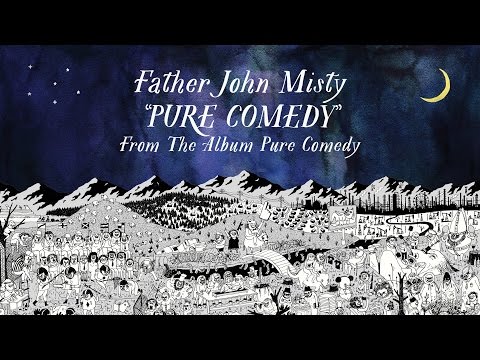
Review: Pure Comedy

Review: Pure Comedy

Rating: A

Another white guy in two thousand seventeen / Who takes himself so goddam seriously.”

Like nearly all the music I like, this album was introduced to me by my dad. He sent me the recent New York Times article about Father John Misty’s new album.

I hadn’t been listening to much music, and expected very little—especially from a guy called Father John Misty. (His real name is Joshua Tillman.) But by the first lines of the opening number, I was entranced: “The comedy of man starts like this / Our brains are way too big for our mother’s hips.” In short, this is the best album I’ve heard in a long while. So here I am, writing my first album review, since apparently I can’t appreciate anything without rating and analyzing it anymore.

Tillman’s music is striking for the discordance between his dark, sarcastic, and at times apocalyptic lyrics, and his lighthearted musical sensibilities. He is, of course, not the first artist to play with the juxtaposition of lyrical and musical style; Randy Newman is an obvious comparison. Yet Tillman does this not only for comedic effects, but because it allows him to examine the themes that pervade his music: disorientation, everyday despair, the nefariousness of the normal. For Pure Comedy is a true concept album, and its message is arguably more important than its melodies.

This is not to say his melodies aren’t lovely. Tillman has a knack for writing tunes that sound “classic”—many of them could have been written anytime between the 1960s and the present day—while not being derivative or gimmicky. Instrumentally, he mostly sticks with what you can find in any bar band: horns, piano, guitar, drums, backing singers. He has enough harmonic sophistication to avoid dullness, while keeping his tunes singable and straightforward. As a vocalist he is also impressive: a strong and soulful baritone, capable of a dulcet falsetto, which he uses to good effect. His time in Fleet Foxes does seem to have left its mark, most noticeably in his penchant for using the wordless “Oohhh” as a chorus.

While musically gifted, Tillman’s real talent, I think, is as a lyricist. His lyrics are uniformally well-crafted—witty, aphoristic, memorable, and hard-hitting. He has a talent for epigram: “The only thing that makes them feel alive is the struggle to survive. But the only thing they request is something to numb the pain with.” His lyrical power does not come from absurd imagery or fantastic wordplay, but from the force with which he hammers his main themes. There is little oblique in Tillman; for all his hipster cleverness, he does not mince words: “They’re just like the ones before, with their standards lower, another concert goer will pay you to believe.”

One of the major themes in this album is religion. Tillman, who was raised in a profoundly religious family, is nowadays nearly as caustically atheistic as Richard Dawkins: “And how’s this for irony? Their idea of being free is a prison of beliefs that they never ever have to leave.” And yet while Dawkins is so often petulant and conceited on this subject, Tillman manages to escape the unpleasantness of sophomoric arrogance by turning his sarcasm upon everything else in sight: atheism, music, pop culture, consumerism, hipsterdom, intellectualism, the avant garde, technology, and himself: “One side says ‘Ya’ll go to hell.’ The other says ‘If I believed in God I’d send you there.’”

The most persistent feeling that this album instills is a profound and overwhelming disgust with the modern world: “Some dream of a world written in lines of code… Some envision a state governed by laws of business.” In this I am reminded most strongly of George Grosz’s paintings of life in Berlin in the 1920s: fat, stupid, pig-faced caricatures of the German middle class marching through city streets, the brutal thoughtlessness of modern life, the omnipresence of newspapers filled with malevolent lies and irrelevancies, and the constant need of diversions—drink, smoke, gambling, war—to make life tolerable.

Tillman approaches this feeling very nearly in his music video of the title track, “Pure Comedy.” The video alternates between footage taken from news programs, documentaries, YouTube videos, and other found sources, interspersed with very Groszian drawings, by Matthew Daniel Siskin, of demon-toothed and overweight cretins dancing on a dying earth.

I admit that I can’t watch this video without an overpowering feeling of horror. Clips of newscasters reading nonsense from teleprompters, a man eating mass-produced pretzels and filling up his car with gas—cute animal videos, internet memes, infomercials, televangelists, product reviews, sports matches, natural disasters, and of course the revolting face of the current president—all this combines to produce a terrifying sense of the banal. All of these are things we spend so many hours consuming; they form the very fabric of modern life. And yet how meaningless, pointless, totally bereft of intelligence they are.

But if Tillman’s point was just this, a disgust with the modern world, he would be little more than a puerile complainer (as I am). His album has a positive thrust, too, and ironically enough it is religious in its simplicity. For Tillman, the main culprit of the world’s ugliness is fear: fear of the unknown, fear of pain, fear of suffering, fear of death, fear of rejection, fear of losing, fear of each other. We elect tough-talking rulers to make us feel secure from aliens, we invent gods and religions to make the chaos of reality seem organized, we spend our lives plugged into technological hubs where we can experience reality at a distance, polished, cleaned, and most of all, safe.

The antidote to this fear, Tillman thinks, is empathy. It is a message summed up long ago by E.M. Forster: “Only connect.” Or, in Tillman’s words, “I hate to say it, but each other’s all we’ve got.” Nationalism, religious bigotry, pop culture, entertainment—all of these are things that divide us, and they do so by preying on our fears: of foreigners, of infidels, of being uncool, of discomfort, of missing out. The comedy—the purest comedy, as Tillman sees—is that, by dividing ourselves this way, we create the very things we fear, and deprive ourselves of our most precious resource: each other.

Beneath all the garbage of our daily discourse are people—lonely, scared, starving, insecure—and these people, all of us, have found themselves in a universe seemingly indifferent to their environment: “this bright blue marble orbited by trash … this godless rock that refuses to die.” This is the basic reality. And yet we do all we can to cover up this basic reality, inventing a hundred ways to turn our eyes from it—virtual reality, highbrow art, lowbrow art, sports, TV, and yes, music—a hundred excuses to deny our basic identity with other people, and a hundred ideologies to pretend that reality is somehow other than it so manifestly is: “Just waiting for the part where they start to believe they’re at the center of everything, and some all-powerful being endows this horrorshow with meaning.”

Even so, if this album were just a sort of secular soul-music, a gospel for the godless, it would probably be intolerably preachy. Tillman escapes this pitfall (partially, at least) with his 13-minute long “Leaving LA,” the centerpiece of the album. Musically, it is bare: featuring just Tillman slowly strumming a few basic chords and singing a simple tune. There is no chorus, and no bridge. A gorgeous string arrangement—both haunting and tender—is the only thing that saves the song from musical monotony.

Lyrically, however, “Leaving LA” is masterful: “Some ten-verse chorus-less diatribe” in which Tillman turns his own sardonic wit upon himself. He imagines himself as an aging folk-rock star, disparaging younger groups; in his fantasy future he is tremendously successful, a “national treasure,” and yet still a phony: “Closing the gap between the mask and me.” He speaks of his insecurity: “Until I figured, if I’m here I just might conceal my lack of skill here in the spotlight.” He describes himself as “Merely a minor fascination to manic virginal lust and college dudes,” and then predicts his fans will “jump ship” after hearing this song.

This self-deprecation, and self-awareness, is probably the album’s saving grace, what prevents Tillman from seeming like a curbside apocalyptic preacher. Since one of Tillman’s biggest targets is the entertainment industry—even entertainment as a concept, which he dedicates a whole song to attacking—how can he, a songwriter and musician, do his job in good conscience? As an artist, what can he do? Can music shock its hearers into wakefulness? And, by extension, can we listen to his music in good conscience without thinking about what he’s saying?

His answer is that he, and us, are all to an extent complicit in all of the things we like to deprecate. We are all participating in this universal banality. But how can we stop? Self-deprecation seems like a good first step, at least. And in that spirit, I suppose I should end with Tillman’s “Ballad of a Dying Man,” a song which perfectly encapsulates all the self-appointed cultural critics, the snobby know-it-alls, and the internet gurus: including me.

Review: The Battle for Spain

Review: The Battle for Spain

La guerra civil españolaLa guerra civil española by Antony Beevor

My rating: 4 of 5 stars

As the Spanish Civil War proved, the first casualty of war is not truth, but its source: the conscience and integrity of the individual.

Anthony Beevor is a military historian; and his book is mainly a record of armies and battles. The forces that destabilized the government and created so much tension within the country are quickly summarized; and the aftermath of the war—its legacy, its lingering effects in Spanish political life, its wider significance in 20th century political history—all this is hinted at, but not delved into. Like any historian, Beevor needs to set limits to his material. He focuses on the Iberian peninsula in the years between 1936-39.

Beevor is an excellent writer. His paragraphs are mines of information; he summarizes, offers statistics, gives striking examples. He surveys the battlefield like an aerial observer; he reports power struggles like an investigative journalist. He never lets the material run away from him, but compresses complex events into well-turned sentences. His focus is more on large-scale movements than on individual stories. The narration seldom pauses to analyze a person’s character, or to relate a telling anecdote, but instead maintains the perspective of a general examining his troops.

Beevor’s considerable powers of narration notwithstanding, he can’t help the fact that this war is complicated. So many actors are involved, all with different motives—communists, anarchists, republicans, trade unionists, conservatives, falangists, carlists, monarchists, Basques, Catalans, Germans, Italians, Soviets, Americans, British, French—that presenting the war as a clean story is impossible. Beevor breaks the material into 38 short chapters, focusing his gaze on one aspect, in an effort to do justice to the war’s complexity without overwhelming the reader. This is an effective strategy, but it comes at the price of a certain unpleasant fragmentation. The grand sweep of the narrative is obscured.

Nevertheless, this book does what I hoped it would: provide an overview of the conflict, the immediate causes, the principal actors, and the course of the war. Having said this, I must admit that the military history of the conflict—the battles, the strategies, the armaments—is only of passing interest to me.

What I really want to know is—Why? Why did a country decide to tear itself apart? Why did countrymen, neighbors, relatives decide to kill each other in mass numbers? Why did radicalism triumph on both the left and the right? Why did a democracy fail and a repressive regime seize power? These are big questions, which this book admittedly doesn’t address. To understand the historical background and the instability that led up to the war, I plan to read Gerald Brenan’s book, The Spanish Labyrinth.

In the meantime, I am left with little more than a picture of moral collapse. The really dreadful thing about this war is how few heroes there were in high places. Mass murders were committed on both sides. At the outbreak of the military coup, there are spontaneous slaughters of clergymen, monks, bishops, in the hundreds and thousands; and the Spanish Church, for its part, was too often complicit in repression and tyranny. Mass murders and executions were perpetrated on each side. To pick one example, when the republican side was in control of Málaga, 1,005 people were executed or murdered. In the first week after its conquest by the nationalists, over 3,000 people were killed; and by 1944, another 16,000 had been put to death.

On the republican side, important military decisions were made for political reasons; political propaganda was so pervasive that leaders felt blindly sure they would win, and tried to act to justify their boastful predictions. Useless offensives were carried out—in Segovia, Teruel, and the Ebro—costing thousands of lives and wasting the Republic’s resources, to capture targets of no strategic importance. Blindly trusting in high morale, anarchists refused to regulate the economy and discipline their troops, providing an “ideological excuse for inefficiency.” Stalinist factions eventually seized power on the “republican” side, violently suppressing other parties.

Brave volunteers from all over the world poured into Spain, most to fight against the fascists; and yet their zeal was squandered by careless leadership. Meanwhile, France, England, and the United States maintained a policy of “non-intervention,” while Fascist Italy, Nazi Germany, and Soviet Russia poured troops and military equipment into the country, testing out weapons and strategies that they would later use in the Second World War.

Eventually, of course, Franco won. Those on the losing side had few options. Many fled to France, where they were imprisoned in what amounted to concentration camps, in which they were forced to live on insufficient food, in unhygienic housing, and in freezing temperatures. In Saint-Cyprien, there were 50 to 100 deaths daily, and the other camps weren’t much better. After initial outrage, the French press promptly forgot the plight of these Spanish refugees. Those who remained in Franco’s Spain faced a gulag of imprisonment, forced labor, and death. Some escaped to the hills to hide out, and others fought in scattered bands of guerilla fighters; but these usually didn’t last long. And yet if the Stalinists had won the war, it isn’t clear that conditions would have been any better.

One thing that repeatedly struck me as I read through this book was the contrast in efficiency between the nationalists and the republicans. While Franco regulated his wartime economy and made effective military decisions, the republican side was awash in dozens of local currencies, busy worrying about forming syndicates, and preparing for the imminent proletariat “revolution.” On the same day as Málaga fell, when so many were put to death by Franco’s forces, in Barcelona the government was worrying about the collectivization of cows.

This seems to show us a persistent feature of both the left and the right. Equality and authority are two ideals at odds with one another; and most governments concern themselves with finding a balance between these two values. When the right becomes extreme, it gravitates towards extreme authority at the expense of equality; and when the left is radicalized, the reverse happens, and equality is fetishized. Thus we see the nationalist army consolidating itself under Franco, while the republican side devolved into warring factions, more concerned with their utopian schemes than with winning the war.

Equality without authority produces justice without power. Authority without equality, power without justice. The first is morally preferable in its ends and totally inadequate in its means; while the latter uses brutally efficient means to achieve brutally unjust ends. In practice, this means that, in direct contests, the extreme right will most often triumph over the extreme left, at least in the short-term; and yet in the long-term their emphasis on authority, obedience, and discipline produces unfair societies and unhappy populaces. The extreme left, for its part, after collapsing into mutually squabbling factions, sometimes devolves into the authoritarian pattern as one party emerges as the most powerful and as they lose patience with discussion (which doesn’t take long in a crisis).

Some middle-path is needed to navigate between these two ideals. But what’s the right balance? I suppose this is one of the oldest questions of human societies. In any case, as I put down this book, I am left with a dark picture lightened by very few bright patches.

View all my reviews

Review: Rousseau’s Confessions

Review: Rousseau’s Confessions

ConfessionsConfessions by Jean-Jacques Rousseau

My rating: 4 of 5 stars

There are times when I am so unlike myself that I could be taken for someone else of an entirely opposite character.

This book begins with a falsehood and only escalates from there. Rousseau, prone to hyperbole, boldly asserts that his autobiography is without precedent. Nevermind St. Augustine’s famous autobiography, which shares the same name; and ignore the works of St. Teresa, Benvenuto Cellini, and Montaigne. I suppose this sort of boastful exaggeration shouldn’t count for much; after all, Milton began Paradise Lost by saying he was attempting “Things unattempted yet in prose or rhyme.” Nevertheless, the second part of Rousseau’s assertion, that his enterprise would “find no imitator,” is even more indisputably false than the first one. This book has found nothing if not imitators.

Rousseau’s Confessions is really two distinct works, the first covering his childhood to his early adulthood, the second up to age fifty-three. For my part, the first is far better, and far more original. Like any modern self-psychoanalyzer, Rousseau traces his personality to formative events in his childhood—quite unusual at the time, I believe. Even more surprising is how frankly sexual is Rousseau’s story. He begins by describing the erotic pleasure he derived from being spanked by his nanny, relates a few homosexual encounters (undesired on his part), and frequently mentions masturbation. Much of the first book is simply prolonged descriptions of all the women he’s had anything to do with.

The second part is less striking, sometimes dull, but still full of interesting episodes. Rousseau has much to say about his career as a composer, something of which I had no idea before reading this book. He begins his career as a musician as a bungler and a phony, but eventually succeeds in closing the gap between his pretensions and abilities. It isn’t long before Rousseau finds himself stitching together some musical and lyrical fragments from Jean-Philippe Rameau and Voltaire into Les fêtes de Ramire, a one-act opera; and he soon becomes Rameau’s enemy, because (Rousseau is convinced) Rameau is jealous of Rousseau’s musical powers.

Rousseau also relates the famous tale of his children. After taking a seamstress, Thérèse, as his mistress, and having several children by her, he persuades her (and himself) to give them up to the foundling hospital. This is probably the most infamous episode of Rousseau’s life, and has provided plentiful fuel for those wish to discredit his ideas on education and child-rearing. As Rousseau grows old and becomes a man of letters, he accumulates ever more enemies, including Diderot and Grimm, who (Rousseau asserts) plotted relentlessly against him, partially because Rousseau scorned city life and modern luxuries.

I can’t help comparing this book with another great autobiography I recently read, that of Benvenuto Cellini. The two men are in many ways opposites. Cellini is a man of the world; his eye is turned exclusively outward; he is all action; he is confident in high society; he rarely blushes and never admits a fault. Rousseau is a man of sentiment and feeling, absorbed in his private world, often timid, awkward, and unsure of himself, and who often makes self-deprecating remarks.

And yet, the more I read, the more I saw strong similarities between these two self-chronicles. They are both massive egotists. If I were to write my autobiography, I’d hope that it would include some nice portraits of people in my life; but in these books there is no compelling portrait of anyone except their authors.

Like many narcissists, their vanity is easily wounded. They are obsessed with slights, and consider anyone who doesn’t show the proper respect to be, not only inconsiderate, but downright villainous. They both make enemies quickly, wherever they go. And yet, the fact that so many people they meet turn against them does not prompt them to pause and reflect; rather, they attribute all antipathy to envy, jealousy, or pure malevolence. Both have persecution complexes; both are paranoid; and both entertain extremely high opinions of their own virtues and abilities. In Rousseau’s own words, he is among “the best of men.”

It occurs to me that the urge to write an autobiography, in an age when autobiography was anything but common, requires a certain amount of narcissism. What surprises me is that these two men, Cellini and Rousseau, are also quite oblivious of themselves and utterly unable to question their own opinion. This is in strong contrast to Montaigne, somebody who Rousseau explicitly scorns:

I have always laughed at the false ingenuousness of Montaigne, who, feigning to confess his faults, takes great care not to give himself any, except such as are amiable; whilst I, who have ever thought, and still think myself, considering everything, the best of men, felt there is no human being, however pure he may be, who does not internally conceal some odious vice.

There may be a grain of truth in accusing Montaigne of attributing only amiable faults to himself (though reports by his contemporaries coincide remarkably well with Montaigne’s self-report). Even so, Montaigne had a quality that Rousseau eminently lacked: the ability to jump out of his own perspective. When playing with his cat, Montaigne paused to reflect “who knows whether she is amusing herself with me more than I with her?” And in that simple question—pushing himself out of his own skull, seeing himself from the eyes of his cat—he transcends all of the searching self-analysis of Rousseau. Rousseau’s total inability to, even for one moment, question his righteousness and his enemies’ wickedness is what makes him, by the end of the book, nearly intolerable—at least for me.

So much for Rousseau’s personality. As a portrait of a man, this book is interesting enough; but as the confessions of one of the most influential thinkers in the 18th century, it is far more so. Rousseau, whatever his faults, was undeniably remarkable. To paraphrase Will Durant, Rousseau, with almost no formal education, abandoned early by his father, wandering incessantly from place to place, setting himself as an enemy of the dominant currents of thought and art of the time, the avowed antagonist both of Rameau, the foremost composer, and Voltaire and Diderot, the foremost writers—this Rousseau nevertheless managed to become the decisive influence on the next century.

Cases like Rousseau’s make me stop and reflect about the nature of intellectual work. Neither a strong reasoner nor an adept researcher—any competent professor could poke gaping holes in his arguments and cite reams of factual inaccuracies—it is Rousseau, not they, who is still being studied at college campuses all over the world, and who will be in the foreseeable future. Indisputably he was an excellent stylist, though this hardly accounts for his canonical status.

What sets Rousseau apart, intellectually at least, is his enormous originality. Rousseau himself realizes this:

I know my heart, and have studied mankind; I am not made like anyone I have been acquainted with, perhaps like no one in existence; if not better, I am least claim originality, and whether Nature did wisely in breaking the mold with which she formed me, can only be determined after having read this work.

Rousseau wrote in a way no one had before. His ideas were fresh, his attitude unique. Although he had influences, there is nothing derivative about him. The more I read and the longer I live, the more am I drawn to the conclusion that the ability to form new ideas—genuinely new, not just re-interpretations of old ones—is one of the rarest human faculties. Rousseau had this faculty in abundance. It is impossible to read him within the context of his time and not be utterly astounded at his creativity.

It is just this sort of creativity, the thing we most celebrate and praise, that seems impossible to teach— impossible by definition, since you cannot teach somebody to think totally outside the bounds of your own paradigm. You cannot, in other words, teach someone to transcend everything you teach them. You can teach somebody to solve problems creatively; but how can you teach somebody to examine problems previously unimagined? This is just one of the paradoxes of education, I suppose.

In any case, Rousseau is just another example of those canonical thinkers who could never get tenure nowadays. It’s a funny world.

View all my reviews

Review: Arrival (2016)

Review: Arrival (2016)

 Rating: A-

Language is the foundation of civilization. It is the glue that holds a people together. It is the first weapon drawn in a conflict.

(Cover image taken from the official trailer.)

I have never written a movie review before, so have some patience while I get my bearings. Also, I clearly can’t say much without spoilers, so be warned.

The premise of Arrival intrigued me as soon as I heard it: a science-fiction alien story centered, not on warfare, but on language. Instead of a soldier, the protagonist is a linguist; and instead of defeating aliens she needs to understand them.

After a touching yet cryptic opening sequence—whose relation to the story isn’t revealed until much later—the movie begins with another day in the life of Louise Banks (played by Amy Adams), a professor of linguistics. She walks into a lecture hall, one of those stale and lifeless theaters of knowledge, in order to give a class on the Romance languages—specifically, on why Portuguese sounds so different from the other languages. (She never explains this, which is frustrating, since I genuinely want to know!)

Something is clearly wrong, however, as few students are in class, and their phones keep beeping. The aliens have just arrived, and everybody all the world over is in a panic. The confusion and alarm that would accompany the appearance of genuine UFOs was portrayed with subtlety and realism. People are rushing home (but why would home be any safer?), the military is scrambling jets (in a show of force?), and the newscasters are droning on incessantly in their foux-knowledgeable voices, filling up airtime with their lack of information.

We see snatches of Banks’s life here, which give us a taste of her personality. She is a loner, somewhat cold, very quiet. We see her lakeside house—angular, empty, tranquil, and almost sterile. It needn’t even be said that she is single and lives alone. Snatches of a phone call with her mom further characterize her—she is calm, detached, and impatient of folly.

Then, as in any hero’s journey, comes the call to adventure, this time in the form of Army Colonel Weber (played by Forest Whitaker, who gives his colonel a strong Boston accent). The Colonel dramatically puts a device on the table, and plays a chilling recording; it is an unintelligible series of clicks, whooshes, and moans, obviously not human. Can she translate it?

The call to adventure is at first refused (she can’t translate from a recording), and then accepted (as it must be for the movie), and soon enough Banks is snatched away to begin her quest. Next we are shown our first vision of the UFO: it is an oblong black egg that hovers ominously over the landscape, as pitifully small fighter jets fly by. The soundtrack, written by Jóhann Jóhannson, really shines in this sequence. Unearthly wailing sounds, reminiscent of alien speech, swell in and out over a droning base as the helicopters approach the monolithic object.

We also meet the other protagonist, Ian Donnelly (played by Jeremy Renner), a theoretical physicist who will work with Banks. The two of them soon begin their task.

The alien spacecraft opens up a hatch every 18 hours, giving the humans a two-hour window to go inside and make contact. (The reason for this pattern is never explained.) I particularly liked the portrayal of the huge number of precautions that the military takes when going inside the UFO. Even though no form of radiation, bacteria, or anything else potentially hazardous is detected, they must receive numerous booster shots, wear hazmat suits with heavy air purifiers, and be decontaminated each time they return.

Finally they go inside. Watching Donnelly’s childlike joy at touching the spacecraft is moving; for all he knows, he’s in a highly dangerous situation, and yet he is like a seven-year old at a zoo. I think his character is at least partially inspired by Carl Sagan, the alien-obsessed physicist. Like Sagan, Donnelly wants to communicate with the aliens through math, supposedly the universal language; and yet he soon must play second-fiddle to the linguist.

The inside of the ship is a large empty black chamber, composed of perfectly right angles. On the far end of the chamber is a transparent screen flooded with white light, through which the aliens appear. At first it is difficult to see them, because their side of the chamber is full of black smoke (part of the atmosphere they breathe?), and their form is only revealed gradually. I can’t say I was totally impressed by the design of the aliens. They are called “heptopods,” due to their having seven appendages and seven digits on each appendage; but they basically look like big, black, lumpy squids.

Thus begins the quest to communicate with the heptopods, which is the main drama of the movie. The government needs to ask them why they arrived on earth; and this requires quite a bit of linguistic prep work, since not only do our heroes need to make the question intelligible, but enough vocabulary is needed to make the answer meaningful. As far as I know, putting translation in the center of an alien movie is unique. In Independence Day (1996), for example—which I watched obsessively as a kid—the attempt to communicate with the giant UFOs lasts about three seconds. (They fly a helicopter near the alien craft to flash lights as a way of making contact; a laser blast promptly destroys the helicopter.)

Banks quickly realizes that verbal communication is a non-starter, since human vocal chords can’t reproduce heptopod speech. So she opts for written communication, and soon discovers that the heptopods have their own written language. This language is quite different from our own. It does not correspond with what the heptopods “say”; it is not, in other words, a transcription of speech. This means that the meaning is not sequenced in time.

Like a sentence in any other language, an English sentence has a front end and a back end, and must be read in the correct order to make proper sense. When we speak, we obviously must start at some time and end later; and so do our written sentences. Not so the heptopod system, wherein meaning is encoded, as it were, directly, with reference purely to ideas. It has the same meaning forward and backwards; and its meaning can be understood at a glance, like a picture.

Its easy to see how simple nouns and verbs—lions, helicopters, walking, giving—could be represented this way; but it is difficult for me to imagine how complex logical relationships or temporal sequences could be transcribed so that the message is the same forwards and backwards. The movie does not get into the mechanics of the language, however, which is just as well.

While I’m at it, I also wonder if linguistic communication would be possible at all with creatures from another planet. Wittgenstein famously said “If a lion could speak, we could not understand him”—meaning, I think, that our language is so tied up in our human experience of the world that it could never serve as a bridge across different species. Put another way, Wittgenstein thought that our language does not and cannot refer to pure ideas—notions that would be the same as understood by any creature.

Our experience of the world is so filtered through our senses, our biology, our specifically human brains, that it seems to me that an alien—from a planet with a vastly different ecosystem, breathing different atmosphere, with senses adapted to different conditions and a nervous systems built on entirely different principals—might conceptualize the world in such different terms that any real communication would be nearly impossible. All this is a massive digression, of course. But a movie that can prompt such ponderings is certainly worth watching.

Soon enough, Banks is coming to grips with the heptopod written language. The visual design of this language is excellent: it is written in inky smoke, and takes the form of a circular swirl with complex bulges and branches. Meanwhile, Banks is beginning to have strange visions, all featuring an unidentified little girl—the same girl from the opening sequence. It is clear that Banks is her mother; and these can’t be memories, since Banks has never had children. Is Banks cracking from sleep deprivation?

While Banks is working on the translation, the world situation is growing ever-more tense. There are twelve of these “shells” (as they’re called), and each country is taking a different approach to communicating with the heptopods. People everywhere are panicking. An image of one of the creatures is leaked and goes viral. China in particular is full of military bluster, and seems constantly on the verge of attacking their shell; and the longer the situation persists, the more people seem to think that the wise thing to do is take military action.

This brings us to one of the movie’s major themes: confronting the unknown. The only thing threatening about the shells is that they are mysterious. Who are the aliens? Where did they come from? What do they want? They don’t attack; they don’t cause any damage; they just hover above the landscape. And yet, the mere presence of unknown visitors causes riots, protests, looting, cult suicides—total panic. It almost seems as if people would prefer that the aliens demonstrated some malicious intent; at least then they’d know what to do. In this situation of total ambiguity, people’s fears fill up the vacuum of knowledge. Never mind that the aliens likely have technology far in advance of humans. We have the urge to attack, not because it’s wise, but to end this terrifying doubt.

What should you do when you confront the unknown? Understand it, or destroy it? This is the movie’s essential question. Banks represents the first solution. The main drama of the movie takes place in the shell’s chamber. There, the confrontation is given stark visual form: Banks stands and stares straight into the blinding light at the other end. The aliens are literally unreachable, separated by a partition. They communicate by imposing form onto nebulous clouds. Language is the tool through which Banks and the heptopods bridge the gap that separates them from one another.

Captain Marks, who works with Banks and Donnelly, represents the other solution. We see him listening to conservative talk radio—an obvious parody of Rush Limbaugh—whose host castigates the Army for not having enough guns, and recommends a “shot across the bow” as a demonstration of human military might. This is probably the movie’s wryest cultural comment, the tendency of the right to use blustering and macho rhetoric, even in highly delicate and complex situations. Captain Marks, spooked by this and also by his wife’s fears, decides to go rogue and attack the ships. His attack fails to accomplish anything, however, and only results in his own death (or imprisonment?) and makes Banks’s job that much more difficult.

Another major theme of the movie is our inability to work together, even in the direst of circumstances. Although it is obviously within each country’s best interest to share their data and collaborate—a “non-zero sum game,” to quote the movie—communication ultimately breaks down between nations as suspicion and paranoia take hold.

As Banks repeatedly shows, communication requires trust, which is exactly why she is so skilled at it. Instead of being scared of contamination and frightened of approaching the heptopods, she removes her protective suit and puts her hand on the glass. In other words, she chooses to trust the heptopods. Communication breaks down between the nations of the world precisely because of this lack of trust; they are afraid that the aliens are trying to get them to attack one another.

Full crisis mode ensues when Banks finally asks what the aliens are doing on earth, and gets the response “Offer Weapon.” Thus begins the dramatic final sequence, during which Banks has to rush to interpret this message before other nations of the world begin bombing their shells. After a final visit to the shell, the heptopods explain to Banks that the “weapon” is their own language, which, because it is the same forwards and backwards, allows you to see the future when you learn it. They are offering it to humanity because they will need humanity’s help in 3,000 years (which they know because they can see the future).

By the way, the idea that learning a non-temporal language could so fundamentally alter your perception of time, allowing you to see into the future, is based on the Sapir-Whorf hypothesis, otherwise known as linguistic relativity. This is a real theory, put forward in the 1950s, which argued that your language fundamentally shapes your perception of the world. The most famous (and also most infamously incorrect) example of this are supposedly huge number of words for “snow” among the Inuit, reportedly allowing them to see fine differences in different types of snow. Strong versions of this hypothesis—in which one’s language totally shapes your cognitive processes—have been ruled out; but it is true, I believe, that our language influences our thought in manifold subtle ways.

Banks, now aware of her new ability, looks into the future in order to see how she can prevent the impending catastrophe, and stop the Chinese from attacking their shell. Like all time travel, this presents some interesting paradoxes of causality. Can knowledge of the future, already determined by the present, influence the present? If the only reason that Banks could obtain the information she needed was because she had already used it, what causes what? This paradox is sort of glossed over, and that’s fine by me.

The crisis resolved, the heptopods mysteriously vanish—having accomplished their goal of uniting the peoples of the world and teaching humanity their language—and Banks is left to live her life. This leads, predictably, to a romantic entanglement with physicist Ian Donnelly. He is the man with whom Banks has her daughter, an adorable little girl who is fated to die from a “really rare disease” sometime in her adolescence.

This brings us to the movie’s second major theme: confronting the known. Because she can see the future, Banks is forced to live her life with full awareness of how everything will turn out. Her marriage to Donnelly will end in divorce, and her daughter will die young. Indeed, Donnelly wants a divorce precisely because he thinks they shouldn’t have had a daughter if Banks knew she would die.

The odd fact is that total knowledge is, in a way, far more terrifying than total mystery. It is one thing to try something when you’re not sure you’ll succeed, but it requires even more courage to try something even when you know you will fail. And yet, Banks embraces her fate, and lives her life anyway. This is the most literal illustration of Nietzsche’s amor fati, love of fate, that I’ve ever seen: instead of trying to change anything, Banks tries to appreciate each moment for what it is.

As far as acting goes, the standout performance is Amy Adams’s. Her portayal of Banks is subtle and sensitive. Banks is quiet without being timid, highly observant but fiercely independent, and incredibly strong without being overpowering. She speaks in a soft voice, nearly a whisper, and her face is usually deadpan calm. And yet this makes the emotional moments of the film that much more touching.

I am glad that such a thoughtful, tasteful movie is finding both commercial and critical success nowadays. While arguably somewhat derivative of Kubrick’s work—the visuals and sound-effects were polished and excellent, but hardly groundbreaking—Arrival manages to ask many deep questions within a gripping and accessible plot. All in all, a truly excellent film.


Directed by Denis Villenueve

Written by Eric Heisserer

Staring Amy Adams, Jeremy Renner, and Forest Whitaker


Review: Othello

Review: Othello

OthelloOthello by William Shakespeare

My rating: 4 of 5 stars

I had rather be a toad and live upon the vapor of a dungeon than keep a corner in the thing I love for others’ use.

This play recently reasserted itself into my life after I was taken to see it performed here in Madrid. Though I couldn’t understand very much, since it was in elaborate and quick Spanish, I still enjoyed it. (Among other things, the performance featured lots of semi-nudity, men wearing gas masks on dog leashes, and M.I.A.’s “Paper Planes.”) Inspired, I decided to watch the BBC Television Shakespeare version, with Anthony Hopkins (looking suspiciously dark) playing the titular role.

The first time I read this play, I remember being somewhat baffled. Othello was stiff and uncompelling, Desdemona sickly sweet, and Iago operated from no discernable motive to accomplish pointless ends. This time around, I think I have made a little progress.

Othello naturally associates itself in my mind with Julius Caesar. In these plays, the titular characters, both generals, are distant, cold, and simple, and come to be totally overshadowed by other characters. In Julius Caesar, Brutus takes the lead, struggling to live morally in an immoral world; in this play we have Iago, who turns heroes into villains and innocence into carnage.

Who can pay attention to Othello when Iago is on the stage? He is hypnotizing. Shakespeare seems to accomplish the impossible by making one of his own characters the author of the play. Iago directs everything: he sets the plot in motion, manipulates the player’s emotions, controls what happens when, where, how fast, to who, for what reason, and what it means. He is playwright and stage manager, an artist whose intelligence is so cunning that he can paint upon reality itself.

The really frightening thing about Iago is that he can make you believe him, too, even though you know better. He is so utterly convincing in his lies, so keen in his psychological interpretations, so plausible in his attributions of motive and cause, that I found myself questioning whether Desdemona actually did sleep with Cassio. Nobody in the play stands a chance against such a roving and beguiling genius. Even Othello, brave, noble, commanding, is helpless in the Iago’s grips.

The mysterious thing about Iago is what drives him. In the beginning of the play, he attributes his hatred for Othello to rumors about Othello sleeping with his wife. Later on, Iago says he is resentful because Cassio was made Othello’s lieutenant. And yet his plan is not just to besmirch Cassio’s reputation—the self-interested thing to do—but to corrupt and then destroy Othello’s soul—which does not benefit Iago at all, or at least not in worldly terms.

What actuates him seems not to be jealousy, nor envy, nor egotism, but pure spite: the desire for revenge irrespective of justice or self-interest. Revenge for its own sake. This is so terrifying, and yet so compelling, because spite is such an exquisitely human emotion. It is an emotion that seems to have no practical benefit nor rational justification; and yet who has not felt the twangs of spite, the evil joy in injuring somebody who has injured you? It is spite that prompts Milton’s Satan to fight against infinite power; and it is spite that spurs Iago onward to destroy Othello, at great personal risk, for no personal benefit other than the joy in seeing Othello suffer for promoting Cassio instead of Iago.

As Harold Bloom points out, this tragedy is notable for having not even one moment of comic relief. It is unrelenting in its horror. We see innocent character after innocent character fall prey to Iago; we see Othello, a flawed but a good man, descend into madness; and finally we see Desdemona, the paragon of faithless love, smothered in her bed. Desdemona’s death scene is particularly hard to watch. She does not scream for help. She does not even protest her innocence as strongly as we’d like. Instead, she begs for one day, one half-hour, one moment of life more, and is denied.

We don’t even get the satisfaction of seeing Iago pay for his crimes, or having him explain himself. “Demand me nothing. What you know, you know. From this time forth I never shall speak word.”

An interesting question is whether Othello and Desdemona’s marriage would have had a crisis even without Iago. They are a particularly ill-starred couple. Othello is a man of war, shaped by camp-life, accustomed to absolute power; he solves his problems with force; he destroys those who challenge or disobey him. Desdemona is love incarnate, faithful, kind, gentle, and totally without malice. She is attracted to Othello for his adventurous life; Othello is attracted to her admiration for him. The story of their courtship—Othello regaling her with his war-stories, and she giving him hints of her interest—makes it sound as though Othello is only attracted to his own reflection in her. This is in keeping with a man who refers to himself in the third person.

Othello’s obvious unsuitability to married life makes him an easy dupe to Iago. Desdemona’s guileless purity makes her the perfect victim. Iago’s only mistake is that he underestimated his own wife—an odd, but telling mistake to make. Is there a moral to this story? I’m not sure. But I’ll be staying away from people named Iago.
View all my reviews

Review: Excellent Sheep

Review: Excellent Sheep

Excellent Sheep: The Miseducation of the American Elite and the Way to a Meaningful LifeExcellent Sheep: The Miseducation of the American Elite and the Way to a Meaningful Life by William Deresiewicz
My rating: 4 of 5 stars

I still remember my first exposure to Deresiewicz. I had recently dropped out of graduate school—full of disgust and indignation—and as a form of self-therapy I was busy reading everything I could find about the flaws of higher education. Naturally, I jumped on Deresiewicz’s essay in The American Scholar: The Disadvantages of an Elite Education. It seemed to put into words so many things I’d been thinking.

A few days later, I was in the car with my mom and my brother (we were dropping my brother off at his elite university), bitterly complaining, and at great length, about the evils of the system. My mom turned on the radio.

This book is an odd jumble. While barely more than 200 pages, it attempts to be a manifesto, an exposé, a path to tranquility, a work of cultural criticism, and a philosophy of education. Needless to say the book fails to be every one of these things, but this doesn’t mean it fails to be any of them.

Deresiewicz’s first section, wherein he talks about the flaws in the system, is the most successful, since it is what he knows about. In a nutshell, the problem with American higher education is that there is an enormous amount of pressure and prestige for precious little substance.

Young people have more hoops than ever to jump through: if they want to go to Harvard, they must be super students. They can’t afford to stop for one moment. They need to get excellent grades, take all the toughest subjects, be leaders in extra-curriculars—at least six!—maybe found a few clubs themselves, outcompete their peers in the SAT, and in general tick off all the rights boxes.

The problem, of course, is that the things that look good to the college admission office often have dubious educational value, and are most often the product of privilege as much as talent. The vignette that most stuck with me was about the “college enrichment programs” that took young people on carefully choreographed trips, so they would have some good stories for their college essays. (This is not to mention the writing assistance, sometimes bordering on ghost-writing, that the wealthy can afford.)

The ironic part is that all of this stress and effort does not lead to social mobility, since the wealthy already start with such a big advantage. Each cohort of students at elite universities is disproportionally upper or upper-middle class. This is no coincidence, since universities need a sizable number of “full-freighters”—students whose parents can afford to pay the enormous tuition costs—in order to stay afloat.

Even more ironic is that it doesn’t even lead to an excellent education. As the university becomes increasingly reliant on wealthy students, the students increasingly get treated like customers. The university cannot afford to fail them; it cannot even afford to make them uncomfortable, which is arguably a prerequisite to genuine learning. Grade-inflation is rampant. Universities focus on hiring a few research professors, because these professors bring more prestige. Though experts, these professors are often not especially good teachers; and besides, there aren’t very many of them. The bulk of the teaching gets done by contingent faculty, chronically underpaid, always underappreciated, who come and go, without the time or resources to teach to their potential.

Instead of education, these universities focus on ranking. The problem is that the ranking is not based on quality of instruction, but on things like admission rates: the more selective, the better. It benefits elite colleges to advertise to students who have a very low chance of getting in, since if they apply and get rejected, the school looks better.

The result is a system obsessed with prestige at the expense of learning. From the moment students arrive to their final graduation speech, students are praised for being the best, the brightest, the most wonderful. And yet they are enmeshed in an educational system that encourages them to put themselves into boxes for admissions, that rarely challenges their fundamental beliefs, and that leaves them with a sense of entitlement, a sense that they deserve all of the nice things their elite education will give them.

So what should an education do? This brings us to part two and three of Deresiewicz’s book, which I thought were much weaker. He has a lot to say about the value of a liberal education, about self-discovery, taking risks, questioning beliefs, developing a philosophy, finding your real passion, and lots of other nice clichés. To be fair, these are clichés for a reason: in some form or another, they are the goal of a true education. Nevertheless, I didn’t find Deresiewicz’s prescriptions particularly insightful or inspiring.

Finally, Deresiewicz aims his sights at society as a whole. What has this educational model done to our country, and how can we fix it? All the recent presidents, as products of “the system,” come in for a good bashing—especially Barack Obama, who Deresiewicz finds to be arrogant, condescending, technocratic, while totally blind to genuine ideological differences. The book ends with a widespread, sweeping, universal condemnation of the entire upper and upper-middle class. Their time has passed, he thinks, and they must be removed from the stage of history, just as the old, aristocratic WASP class had before them.

What are we to make of all this? It’s clear that the book bites off far more than it can chew. Ambition is certainly not a problem; but when ambition so far outpaces execution, it certainly is.

One weakness is that this book is so personal. By his own admission, Deresiewicz—the offspring of upper-middle class, Jewish parents, a former professor at Yale—is bitter about his experience in elite education, and it shows. For many years, it seems, he was dissatisfied and unfulfilled, consumed by feelings of envy and empty accomplishment, which accounts for both the self-help and the invective.

But emotion is a perilous guide. While at his best he is sardonic and witty, at his worst he is alternately whiney and preachy. His torrents of feeling often blow his vessel into strange waters—like the psychology of achievement addiction, or the dysfunction of government—where he thrashes about ineffectually.

This thrashing led to some tiresome writing. He has a tendency to write in epigram after epigram—none very clever—pounding and hammering his opinions into your head, while supplying few particulars and little evidence. He makes sweeping generalizations, all written in antitheses: “Everybody is doing this, and nobody is doing that,” “All of us care about this, and none of us pays attention to that,” and so on. He rarely qualifies his points, he does not address counterarguments, he does not betray even the least doubt of his righteousness and the system’s evilness. (The book’s condescending title is indicative of its fervor.) If I were his writing teacher, I would tell him it needs more work.

This book could really have been a long essay, focusing exclusively on the flaws of elite universities. The rest feels like self-indulgence and padding, an excuse to air his views and sell a book.

But for all his shortcomings, I think that Deresiewicz is making a vital point. All of his complaints boil down to one insight: meritocracy is insidious.

Now, how can this be? Isn’t meritocracy good? Isn’t is the only fair and just system? Well, there are several obvious problems. For one, what is ‘merit’? Any meritocracy must begin with some notion of worth; and this notion will always be shaped by cultural and economic pressures. You simply cannot measure the inherent ‘worth’ of a person, so you end up measuring people against some arbitrary standard—like analytical intelligence or academic pedigree—imposed by the outside.

But even if we could agree on a universal measure of ‘merit’ (which is impossible), there would be no guarantee that we could measure it perfectly. Some people will be lucky, others unlucky. And even if we could agree on a standard and measure it perfectly—two impossible conditions—we are still left with the question of reward. If somebody is in the top fifth percentile, how much wealth do they ‘deserve’? This will also be arbitrary, and whatever decision will likely not satisfy everyone.

So you see, first a meritocracy imposes an arbitrary standard, and then denies the existence of luck, and then distributes rewards along this standard arbitrarily. A meritocratic system is not necessarily fair—since people’s worth cannot be measured—nor is it necessarily effective—since chance will always play a role—nor is it necessarily just—since meritocratic systems can still be highly unequal. The most insidious part is that it makes people believe they deserve their rewards: the rich deserve their wealth, the poor their poverty.

This is essentially what Deresiewicz is complaining about. The American elite educational system tends to reward certain qualities that are not necessarily desirable (and which are usually associated with wealthy families), and then treat this unequal distribution as justified. But when you think about it, is it really fair that educational resources and prestige be concentrated in very few, very expensive institutions, instead of distributed more evenly throughout the system?

I agree with this fundamental critique. However, I am far from sure that I know how to fix it. For his part, Deresiewicz puts his faith in the old tradition of the liberal arts education.

While I am naturally very sympathetic to this idea, I always ask myself: Are the liberal arts compatible with big institutions? Can a tradition predicated on free thought, on questioning authority, and on open enquiry—a tradition that is not oriented towards job skills or economic gain—be made compatible with an organization of power and wealth? Can we really expect students to pay enormous tuitions to induct them into the life of the mind? Or can we expect tax-payers to support universities that do the same?

To me is seems that, in the United States, by asking our universities to be both liberal arts colleges and pre-vocational training, we are asking the impossible. The first tradition teaches us how to live, while the second teaches us how to work. The problem, it seems to me, is that in the United States we have come to identify so fully with our jobs that we can’t see the questions as separate. Deresiewicz definitely falls into this error, which he exemplifies by his endorsement of the “follow your passion” advice for a better life.

As I finish, I am left with more questions than when I started. And, as cliché as that sounds, that is still the sign of a good book.

View all my reviews

Review: Tools for Teaching

Review: Tools for Teaching

Tools for Teaching: Discipline, Instruction, Motivation.  Primary Prevention of Classroom Discipline ProblemsTools for Teaching: Discipline, Instruction, Motivation. Primary Prevention of Classroom Discipline Problems by Fredric H. Jones
My rating: 5 of 5 stars

Have you ever looked at the work kids turn in these days and wondered, “What will happen to this country in the next 50 years?” When you watch Larry sharpen his pencil, you know that the future is in good hands. It’s inspirational.

Last year I switched from teaching adults to teaching teenagers. Though I’m still teaching English, the job could hardly be more different. With adults, I could focus entirely on content; my students were mature, intelligent, and motivated, so I could think exclusively about what to teach them, and how. With kids, I am dealing with a classroom full of energetic, distracted, unruly, loud, and sometimes obnoxious humans whose main motivation is not to fail the upcoming exam. They’re not there because they want to be, and they would always inevitably rather be doing something else.

This probably makes me sound jaded and disenchanted (and I hasten to add that I actually have a lot more fun teaching kids, and my students are great, I swear!); but the fact is inescapable: when you’re teaching in a school setting, you need to worry about classroom management. Either you will control the kids, or they will control you.

It is the hope of every beginning teacher, myself included, to manage through instruction. We all begin with the same dream: to create lessons so dynamic, so enriching, so brilliant, and to teach with such charisma and compassion, that misbehavior isn’t a problem. But this doesn’t work, for two obvious reasons. For one, we don’t have unlimited control of the curriculum; to the contrary, our room to maneuver is often quite limited. And even with complete autonomy, having interesting lessons would be no guarantee of participation or attention, since it only takes one bored student to disrupt, and only one disruption to derail a lesson.

Even if you’re Socrates, disruptions will happen. When they do, in the absence of any plan, you will end up falling back on your instincts. The problem is that your instincts are probably bad. I know this well, both from experience and observation. Our impulsive reaction is usually to nag, to argue, to preach, to bargain, to threaten, to cajole—in other words, to flap our mouths in futility until we finally get angry, snap, yell, and then repeat the process.

But no amount of nagging creates a motivated classroom; and no amount of speeches—about the value of education, the importance of respect, or the relevance of the lesson to one’s future—will produce interested and engaged students. In short, our instinctual response is inefficient, ineffective, and stressful for both teacher and students. (Again, I know this both from experience and observation.)

Some strategies are therefore needed to keep the kids settled and on task. And since teachers are chronically overworked as it is—the endless grading and planning, not to mention the physical strain of standing in front of classes all day—these strategies must be neither too complex nor too expensive. To the contrary, they must be relatively straightforward to implement, and they must save time in the long run.

This is where Fred Jones comes in. Fred Jones is the Isaac Newton of classroom management. This book is nothing less than a fully worked out strategy for controlling a room full of young people. This system, according to him, is the result of many hundreds of hours of observing effective and ineffective teachers, trying to analyze what the “natural” teachers did right and the “unnatural” teachers wrong, and to put it all together into a system. And it really is systematic: every part fits into every part, interlocking like the gears of a bicycle.

This makes the book somewhat difficult to summarize, since it is not a bag of tricks to add to your repertoire. Indeed, its main limitation—especially for me, since I’m just assistant who goes from class to class—is that his strategies cannot be implemented piecemeal. They work together, or they don’t work. As a pedagogical nomad who merely helps out, I am not really in a position to put this book into practice, so I cannot personally vouch for it.

Despite this, Jones manages to be utterly convincing. The book is so full of anecdotes, insights, and explanations that were immediately familiar that it seemed as if he was spying on my own classrooms. Unlike so many books on education, which offer ringing phrases and high-minded idealism, this book deals with the nitty-gritty reality of being a teacher: the challenges, frustrations, and the stress.

The main challenge of classroom management—the problem that dwarfs all others—is to eliminate talking to neighbors. Kids like to talk, and they will talk: when they’re supposed to be listening, when they should be working, whenever they think they can get away with it. This is only natural. And with the conventional classroom approach—standing in the front and lecturing, snarling whenever the kids in the back are too loud—talking to neighbors is inevitable, since the teacher is physically distant, and the kids have nothing else to do.

Jones begins by suggesting board work: an activity that each student must start at the beginning of class, something handed out or written on the board, to eliminate the usual chaos that attends the beginning of the lesson. He then goes into detail about how the classroom should be arranged: with large avenues to the teacher can quickly move around. Movement is key, because the most important factor that determines goofing off is physical proximity to the teacher. (This seems certainly less true in Spain, where people are more comfortable with limited personal space, but I imagine it’s quite true in the United States.)

This leads to the lesson. Jones advocates a pedagogical approach that only requires the teacher to talk for five minutes or less at a time. Break down the lesson into chunks, using visual aids for easy understanding, and then immediately follow every concept with an activity. When the kids are working, the teacher is to move around the classroom, helping, checking, and managing behavior, while being sure not to spend too much time with the students he calls “helpless handraisers”—the students who inevitably raise their hands and say they don’t understand. (To be clear, he isn’t saying to ignore these students, but to resist the impulse to re-teach the whole lesson with your back turned to the rest of the class.)

This leads to one of the main limitation of Jones’s method: it works better for math and science than for the humanities. I don’t see how literature or history can be broken down into these five-minute chunks without destroying the content altogether. Jones suggests frequent writing exercises, which I certainly approve of, but it is also hard for me to imagine teaching a lesson about the Spanish Reconquest, for example, without a lengthy lecture. Maybe this is just due to lack of imagination on my part.

When it comes to disruptions, Jones’s advice is refreshingly physical. The first challenge is remaining calm. When you’re standing in front of a crowd, and some kids are chuckling in the back, or worse, talking back to you, your adrenaline immediately begins to flow. Your heart races, and you feel a tense anxiety grip your chest, intermediate between panic and rage. Before doing anything, you must calm down. Jones suggests learning how to relax yourself by breathing deeply. You need to be in control of your emotions to respond effectively.

Then, Jones follows this with a long section on body language. The way we hold our bodies signals a lot about our intentions and our resolve. Confidence and timidity are things we all intuitively perceive just from looking at the way someone holds herself. How do you turn around and face the offending students with conviction? How do you signal that you are taking the disruption seriously? And how do you avoid seeming noncommittal or unserious?

One of the most brilliant sections in this book, I thought, was on dealing with backtalk. Backtalk can be anything, but as Jones points out, it usually takes a very limited number of forms. Denial is probably the most common; in Spanish, this translates to “Pero, ¡no he hecho nada!” Then there is blaming; the student points her finger at her neighbor, and says “But, she asked me a question!” And then there is misdirection, when the offending student says, “But, I don’t understand!” as if they were in a busy intellectual debate. I see all these on a daily basis. The classic mistake to make in these situations is to engage the student—to argue, to nag, or to scold, or to take their claim that they “don’t understand” at face value. Be calm, stay quiet, and if they keep talking move towards them. Talking back yourself only puts you on the same level.

The penultimate section of the book deals with what Jones calls Preferred Activity Time, or PAT. This is an academic activity that the students want to do, and will work for. It is not a reward to hold over their heads, or something to punish the students with by taking it away, but something the teacher gives to the class, with the opportunity for them to earn more through good behavior. This acts as an additional incentive system to stay on task and well behaved.

The book ends with a note on what Jones calls “the backup system,” which consists of the official punishments, like suspension and detention, that the school system inflicts on misbehaving kids. As Jones repeatedly says, this backup system has been in place for generations, and yet it has always been ineffective. The same small number of repeat offenders account for the vast majority of these reprimands; obviously it is not an successful deterrent. Sometimes the backup system is unavoidable, however, and he has some wise words on how to use it when needed.

Now, if you’ve been following along so far, you’ll have noticed that this book is behaviorist. Its ideas are based on control, on incentive systems, on input and output. As a model of human behavior, I think behaviorism is far too simplistic to be accurate, and so I’m somewhat uncomfortable thinking of classroom management in this way. Furthermore, there are moments, I admit, when the job of teaching in a public school feels more like working in a prison than the glorious pursuit of knowledge. Your job is to keep the kids in a room, keep them quiet and seated, and to keep them busy—at least, that’s how it feels at times. And Jones’s whole system can perhaps legitimately be accused of perpetuating this incarceration model of education.

But teachers have the choice of working within an imperfect system or not working. The question of the ideal educational model is entirely different from the question this book addresses: how to effectively teach in the current educational paradigm. Jones’s approach is clear-eyed, thorough, intelligent, insightful, and eminently practical, and for that reason I think he has done a great thing. Teaching, after all, is too difficult a job, and too important a job, to do with only idealism and instinct as tools.

View all my reviews

Review: Bleak House

Review: Bleak House

Bleak HouseBleak House by Charles Dickens
My rating: 4 of 5 stars

Call it by any name Your Highness will, attribute it to whom you will, or say it might have been prevented how you will, it is the same death eternally—inborn, inbred, engendered in the corrupted humours of the vicious body itself, and that only—Spontaneous Combustion, and none other of all the deaths that can be died.

For better or for worse, I read this novel through the lens of two critics: Harold Bloom and George Orwell.

In The Western Canon, Bloom calls Bleak House Dickens’s finest achievements; and he considers the novel to be among the central novels in the titular canon. This opinion is based, in part, on Esther Summerson’s narrative (which comprises half of the book; the other half is told from an omniscient narrator).

Bloom agrees with the conventional opinion that Dickens’s modus operandi is to create static and cartoonish characters, far removed from the constantly changing and evolving characters of, say, Tolstoy or Shakespeare. But in Esther, Bloom thought Dickens had transcended his art: he had created a genuinely Shakespearean self, a narrator who could overhear her own narration, and who engaged in a constant dialogue with herself—a mercurial and growing consciousness.

This opinion is far from popular. I’m not sure I agree with it; certainly she doesn’t strike me as “Shakespearean,” and she would not be at home in any of Tolstoy’s works. Unlike a Shakespearean or a Tolstoyan character, it is difficult to see myself in her. This isn’t just me. Esther has irked critics from the beginning. She is too good for her own good. She is passive, forgiving, unconditionally loving, self-negating, dutiful, hardworking, dreadfully kind, painfully virtuous, devoid of malice, thankful to a fault—someone who lives exclusively for others. It’s hard to like her, because it’s so hard to identify with somebody like that, and such a selfless ideal of feminine behavior strikes us nowadays as both sexist and untenable.

And yet, for me, she is ultimately sympathetic, at least from a distance. I think this is due to her resilience. Her childhood as an orphan is harsh and loveless; she is so thirsty for affection that every slight kindness reduces her to tears. As she grows, she is formed by an ethos of feminine subservience and duty, modesty and virtue, an ethos which she embodies as perfectly as possible.

In Esther, however, this is not a sign of passivity and weakness, but of independence and strength. She does not let the world, so often cruel and unfair, make her spiteful; she does not become bitter and resentful from the blows of misfortune. She is determined to be happy; and she realizes that happiness cannot be achieved through selfishness, but requires generosity, forgiveness, and identifying oneself with others. She realizes, in short, that selflessness is the wisest and best form of selfishness, since it leads to the greatest fulfillment.

Nevertheless, I should immediately add that this ethical ideal is so tinged by Dickens’s patriarchal worldview and sickly sweet sentimentality that Esther becomes more of a fairytale heroine than a religious figure. It is hard to admire her, since she is so painfully self-effacing; it is hard to imagine being her friend, since she always puts others above herself, and friendship is based on equality. She is independent and strong, but only in the context of a world where women are expected to be passive to the point of invisibility.

On second thought, perhaps it is wrong to attribute this irksome self-sacrificing nature purely to sexism; for Dickens also gives us a masculine embodiment of this virtue in the form of Mr. Jarndyce. Jarndyce is almost equally self-sacrificing and self-effacing; his one selfish act is his marriage proposal to Esther, which he eventually retracts; everything else he does for the good of his kith and kin. Granted, he is far more active than Esther, being the masculine patriarch; but this activity is oriented exclusively to the good of others.

All this notwithstanding, I found Jarndyce far less sympathetic than Esther, because his personality is nothing but a benign vacuum. A person—at least for me—is partly defined by what he or she wants; and someone who only wants what other people want is not a person, but a kindly automaton. With Esther, selflessness is made to seem, if not desirable, at least viable; but with Jardynce it is neither. He is palpably a figure of the infantile imagination, a kind of idealized father, protective, caring, loving, and in the end such a fantasy that he vanishes altogether into a ray of sunlight.

Esther’s foil is Mrs. Jellyby. She is a picture of selfish selflessness. Mrs. Jellyby abuses her family, neglects her children, and ignores her husband, subordinating everything to her plans for a small tribe in Africa. On the surface, she is an immensely charitable person, living purely for the sake of this tribe. Her “charity,” however, is manifestly an implement of extreme egoism, reducing everyone else in her house to servants and assistants, directing all attention to herself and her own seeming goodness. She talks incessantly about helping others but never actually does.

In his essay on Dickens, Orwell divides up do-gooders into moralists and reformers. Moralists try to improve people’s behavior and values, and see society’s ills as flowing from personal failings. Reformers take the opposite view; they try to improve the structure of society, seeing individual moral failings as products rather than causes of social ills. Dickens is a classic moralist, and Mrs. Jellyby is his portrait of a misguided reformer.

For Dickens, all goodness is personal—flowing from one individual to another—while reformers, like Mrs. Jellyby, mistakenly believe that goodness is impersonal, which is why she concerns herself with the lives of people she has never met. She cannot make society better because she herself is full of vices; while Esther improves society without even trying, by her every virtuous action and her inspiring example.

Again, it must immediately be said that Dickens’s portrayal of Mrs. Jellyby is also tinged with sexism. Aside from a rash reformer, Mrs. Jellyby is a meddling woman—a woman who thinks she can be a man, a woman who doesn’t know her place, a woman who fails to be a wife and a mother. It is impossible to imagine Dickens using the same tone with a male character. This sexism is something to keep in mind, of course; but it does not, for me, negate his wider point about charity and goodness.

Perhaps Orwell’s best insight into Dickens is this: “The outstanding, unmistakable mark of Dickens’s writing is the unnecessary detail.” This novel is long; it is unnecessarily long. For the first four hundred or so pages, it seems to be still trying to get going; the plot clanks and clunks into motion like an old steam engine. A partial explanation for this is that the book was at first a serial, the 19th century equivalent of a sitcom, spinning out plots and subplots to fill episodes and seasons, entertaining its readers piecemeal. But it is also due to Dickens’s perspective. He sees life always in the concrete, never in the abstract, and with a vividness of vision and a relish for daily life that fill his novels with energy and color. The plot serves the detail rather than the reverse; the story is just a conveyance for brilliant particulars.

Many things irked me about this book. Dickens’s sentimentality is often nauseating and sometimes comes across a cheap trick, like the overwrought string music playing in the background of a bad soap opera. The transition from an omniscient narrator to Esther’s narration was a brilliant device, but also made the book a bit difficult for me to follow, and easy to put down. Dickens’s characters are always exciting, but his descriptive language can be soporific. He has a tendency to let himself get carried away into prose poetry, all written in the passive voice. Occasionally, these are masterful, such as the famous beginning paragraphs of this novel; but just as often they make me drowsy.

What is miraculous about Dickens is that his books are so apparently simple and straightforward, and yet they can be endlessly analyzed. Perhaps this is because he effortlessly combines so many contradictory elements: social realism with imaginative fancy, sentimental prettiness with grotesque horror, moral preaching with biting satire, advocacy with art, propaganda with poetry. Dickens’s flaws leap to the eye—his inability to create three-dimensional characters, his lack of intellectual curiosity, his superficial view of the world, his inability to appreciate the sublime, his clumsy plots, his mountains of petty details, his soporific prose style—and yet his appeal is nearly universal. That the same writer could entrance both Harold Bloom, the enemy of political art, and George Orwell, the champion of political art, is a sign of his genius. And in the end, when faced with somebody as universal and powerful as Dickens, all analysis can do is reveal the limitations of its method.

View all my reviews

Review: Orwell’s Essays

Review: Orwell’s Essays

A Collection of EssaysA Collection of Essays by George Orwell

My rating: 5 of 5 stars

What I have most wanted to do throughout the past ten years is to make political writing into an art.

George Orwell is one of the inescapable writers of the last century. Far from becoming irrelevant, his works seem to become more significant with each passing year (as most recently evidenced by the present administration’s strained relationship with the truth). Orwell himself said that the “final test of any work of art is survival,” and his works seem on track to pass this final test. His dystopian novel recently became a surprise best-seller, almost seventy years after its initial publication. That is more than mere survival.

And yet it isn’t for his political insights that I opened this collection of essays. It was rather—and I feel somewhat silly saying this—for his writing style. Orwell’s writing is, for me, a model of modern prose. His style can accommodate both the abstract and the concrete, the homely and the refined, the pretentious and the vulgar; his prose can satisfy both the academic and the artist, the intellectual and the layperson, the Panurge and the parish priest. It is unmistakably modern, even sleek, while obviously informed by the tastes and standards of the past. It is fiery, angry, and political, while remaining intimate, human, and honest.

Something that repeatedly struck me while reading this collection was an inner conflict in Orwell’s worldview. There are two sides of the man, sometimes in harmony, and sometimes at odds: the writer and the activist. Orwell the writer is captivated by the rhythms of words, the sounds of sentences; he loves ruminating on a strange personality or a memorable story; he is enchanted by the details of daily life. Orwell the activist is outraged at injustice and uncompromising in his moral sense; he sees people as a collection of allies and enemies, taking part in a grand struggle to bring about a better society.

Orwell himself discusses this tension in his little essay, “Why I Write.” In a more peaceful age, he thinks, he could have been an entirely aesthetic writer, perhaps a poet, not paying much attention to politics. It was his firsthand experience of imperialism, poverty, and fascism that activated his political conscience. Specifically, it was the Spanish Civil War that “tipped the scale” for him: “Every line of serious work that I have written since 1936 has been written, directly or indirectly, against totalitarianism and for democratic socialism.”

Be that as it may, Orwell seems to have repeatedly struggled to reconcile this aim with his more humanistic side. In his brilliant essay on Dickens, for example, he spends page after page trying to analyze Dickens as a kind of social philosopher, examining Dickens’s views on work, on the state, on education, and so on. Since Dickens was anything but a philosopher—as Orwell himself admits—this repeatedly leads to frustrating dead ends, and fails completely to do justice to Dickens’s work. It is only in the last section, where Orwell drops this pretense and treats Dickens as a novelist, that the essay becomes deeply insightful. Indeed, it soon becomes clear—it seems clear to me, at least—that Orwell likes Dickens for his writing, and not his activism, however much he may wish to think otherwise.

Other essays exhibit this same tension. In his essay on vulgar postcard art, for example, he notes how backward is the social worldview expressed in the cards; but he is obviously quite fond of them and even ventures to defend them by likening their humor to Sancho Panza’s. His essay on boy’s magazines follows an identical pattern, exposing their conservative ideology while betraying a keen interest, even a warm fondness, for the stories. In his appreciative essay on Rudyard Kipling’s poems, he even goes so far as to defend Kipling’s political views, at least from accusations of fascism.

It is largely due to Orwell’s influence, I think, that nowadays it is uncontroversial to see the political implications in a movie cast or a Halloween costume. In all of these essays, Orwell worked to undermine the naïve distinction between politics and everyday life, showing how we absorb messages about standards, values, and ideologies from every direction. He did not merely state that “All art is propaganda,” but he tried to show it, both in his analyses and his own works. At least half the time, he is utterly convincing in this. (And indeed, Orwell was such a brilliant man that, even when I think he’s involved in a pointless exercise, he makes so many penetrating observations along the way— incidentally, parenthetically—that his writing fully absorbs me. )

We owe a tremendous debt to Orwell for this insight. Nevertheless, I can’t help thinking that there is something terribly limiting about this perspective. All art may be propaganda, but it is not only propaganda; it is not even primarily so. There needs to be room in criticism, as in life, for the non-political. We need to be able to enjoy a novelist because of his characters and not his views on the state, a poet for his lines rather than his opinions, a dirty joke or a trashy magazine just because we want a laugh and a break. Orwell would agree with me up to a point, I think, but would also say that every decision to be “non-political” implicitly accepts the status quo, and is therefore conservative. This may be true; but it is also true that such “non-political” things are necessary to live a full life.

Where I most disagree with Orwell is his conviction that the media we consume—magazines, post cards, popular novels, television—nefariously and decisively shape our worldview. For my part, I suspect that people absorb their opinions more from their community, face-to-face, and then seek out media that corresponds with their pre-existing views: not the reverse. Media may reinforce these views and give them shape and drive, but I don’t think it generates them.

All this is besides the point. I admire Orwell, for his fierce independence, for his sense of outrage and injustice, for his facility with words, for his attempt to blend art and truth. In sum, I admire both the writer and the activist, and I think his work should be read until judgment day.

View all my reviews